EP1566458A1 - Alliage en aluminium pour moulage-forgeage, article moule/forge en aluminium et procede de fabrication de cet article - Google Patents
Alliage en aluminium pour moulage-forgeage, article moule/forge en aluminium et procede de fabrication de cet article Download PDFInfo
- Publication number
- EP1566458A1 EP1566458A1 EP03748621A EP03748621A EP1566458A1 EP 1566458 A1 EP1566458 A1 EP 1566458A1 EP 03748621 A EP03748621 A EP 03748621A EP 03748621 A EP03748621 A EP 03748621A EP 1566458 A1 EP1566458 A1 EP 1566458A1
- Authority
- EP
- European Patent Office
- Prior art keywords
- forging
- forged
- aluminum
- cast
- less
- Prior art date
- Legal status (The legal status is an assumption and is not a legal conclusion. Google has not performed a legal analysis and makes no representation as to the accuracy of the status listed.)
- Withdrawn
Links
Images
Classifications
-
- C—CHEMISTRY; METALLURGY
- C22—METALLURGY; FERROUS OR NON-FERROUS ALLOYS; TREATMENT OF ALLOYS OR NON-FERROUS METALS
- C22F—CHANGING THE PHYSICAL STRUCTURE OF NON-FERROUS METALS AND NON-FERROUS ALLOYS
- C22F1/00—Changing the physical structure of non-ferrous metals or alloys by heat treatment or by hot or cold working
- C22F1/04—Changing the physical structure of non-ferrous metals or alloys by heat treatment or by hot or cold working of aluminium or alloys based thereon
- C22F1/05—Changing the physical structure of non-ferrous metals or alloys by heat treatment or by hot or cold working of aluminium or alloys based thereon of alloys of the Al-Si-Mg type, i.e. containing silicon and magnesium in approximately equal proportions
-
- B—PERFORMING OPERATIONS; TRANSPORTING
- B21—MECHANICAL METAL-WORKING WITHOUT ESSENTIALLY REMOVING MATERIAL; PUNCHING METAL
- B21J—FORGING; HAMMERING; PRESSING METAL; RIVETING; FORGE FURNACES
- B21J1/00—Preparing metal stock or similar ancillary operations prior, during or post forging, e.g. heating or cooling
- B21J1/06—Heating or cooling methods or arrangements specially adapted for performing forging or pressing operations
-
- B—PERFORMING OPERATIONS; TRANSPORTING
- B21—MECHANICAL METAL-WORKING WITHOUT ESSENTIALLY REMOVING MATERIAL; PUNCHING METAL
- B21J—FORGING; HAMMERING; PRESSING METAL; RIVETING; FORGE FURNACES
- B21J5/00—Methods for forging, hammering, or pressing; Special equipment or accessories therefor
-
- B—PERFORMING OPERATIONS; TRANSPORTING
- B21—MECHANICAL METAL-WORKING WITHOUT ESSENTIALLY REMOVING MATERIAL; PUNCHING METAL
- B21J—FORGING; HAMMERING; PRESSING METAL; RIVETING; FORGE FURNACES
- B21J5/00—Methods for forging, hammering, or pressing; Special equipment or accessories therefor
- B21J5/002—Hybrid process, e.g. forging following casting
-
- B—PERFORMING OPERATIONS; TRANSPORTING
- B21—MECHANICAL METAL-WORKING WITHOUT ESSENTIALLY REMOVING MATERIAL; PUNCHING METAL
- B21K—MAKING FORGED OR PRESSED METAL PRODUCTS, e.g. HORSE-SHOES, RIVETS, BOLTS OR WHEELS
- B21K1/00—Making machine elements
- B21K1/26—Making machine elements housings or supporting parts, e.g. axle housings, engine mountings
-
- B—PERFORMING OPERATIONS; TRANSPORTING
- B21—MECHANICAL METAL-WORKING WITHOUT ESSENTIALLY REMOVING MATERIAL; PUNCHING METAL
- B21K—MAKING FORGED OR PRESSED METAL PRODUCTS, e.g. HORSE-SHOES, RIVETS, BOLTS OR WHEELS
- B21K3/00—Making engine or like machine parts not covered by sub-groups of B21K1/00; Making propellers or the like
-
- B—PERFORMING OPERATIONS; TRANSPORTING
- B22—CASTING; POWDER METALLURGY
- B22D—CASTING OF METALS; CASTING OF OTHER SUBSTANCES BY THE SAME PROCESSES OR DEVICES
- B22D21/00—Casting non-ferrous metals or metallic compounds so far as their metallurgical properties are of importance for the casting procedure; Selection of compositions therefor
- B22D21/002—Castings of light metals
- B22D21/007—Castings of light metals with low melting point, e.g. Al 659 degrees C, Mg 650 degrees C
-
- C—CHEMISTRY; METALLURGY
- C22—METALLURGY; FERROUS OR NON-FERROUS ALLOYS; TREATMENT OF ALLOYS OR NON-FERROUS METALS
- C22C—ALLOYS
- C22C21/00—Alloys based on aluminium
- C22C21/02—Alloys based on aluminium with silicon as the next major constituent
-
- C—CHEMISTRY; METALLURGY
- C22—METALLURGY; FERROUS OR NON-FERROUS ALLOYS; TREATMENT OF ALLOYS OR NON-FERROUS METALS
- C22C—ALLOYS
- C22C21/00—Alloys based on aluminium
- C22C21/06—Alloys based on aluminium with magnesium as the next major constituent
- C22C21/08—Alloys based on aluminium with magnesium as the next major constituent with silicon
Definitions
- the present invention relates to a cast aluminum alloy for forging and an aluminum cast-forged product that is used for a vehicular part or the like and is less costly, and a method of manufacturing an aluminum cast-forged product. More particularly, it relates to a cast aluminum alloy for forging that is used to manufacture vehicular suspension parts which are required to be light in weight to improve fuel consumption of an automobile and can use useless forging materials such as flash generated in a forging process, an aluminum cast-forged product that has high mechanical properties and contains particular amounts of silicon, magnesium, copper, and manganese, and a method of manufacturing an aluminum cast-forged product.
- the measures for improving the fuel consumption of the automobile include the use of new power sources such as a fuel cell, natural gas, and electricity, or the hybrid use thereof, the technical improvement in a motor system such as a lean fuel engine and a direct injection engine, and the decrease of running resistance due to improvement in loss of a power transmission system and improvement in vehicle body contours.
- a measure that is most effective and capable of being taken together with any other technology is the reduction in weight of the automobile. If the automobile itself is made light in the weight, the load on the power source is lessened, and the amount of power to be consumed can be saved irrespective of power sources.
- the reduction in weight of the suspension parts of the automobile is an object having a higher priority, because this reduction contributes to the improvement in drivability and riding quality of the automobile.
- frame parts or some parts of the engine have also been regarded as the objects of the reduction in weight, and attempts have been made to use light metal materials therefor.
- the weight lightening technology is broadly divided into a structure design technology and a material technology.
- the change of material used is an easily employable measure for lightening the weight.
- such a material for lightening the weight is generally expensive.
- the material for lightening the weight include resin materials such as FRP, thinned iron sheets using high tensile strength steel sheets, aluminum alloys, magnesium alloys, titanium alloys, ceramics, metallic compound materials, and the like.
- aluminum alloys have fewest drawbacks such as corrosion resistance and the like, and are lowest in cost in the materials for lightening the weight although being higher in cost than iron, and can easily be applied as alternatives without requiring any large change in the basic design of the automobile.
- the aluminum alloys having a density about one-third that of iron, have already been used for many easy-to-manufacture castings such as engine cylinder heads and engine cylinder blocks. These castings are manufactured by highspeed injection molding, a so-called high pressure die casting method, and thus can be manufactured at a relatively low cost with high production efficiency. However, castings having large thickness and high strength cannot be produced. There is a problem that the application of cast parts to suspensions as a part light in weight since a failure of such a part due to insufficient strength directly leads to the safety problem.
- suspension parts which have advanced in studies of the weight reduction technology as examples, the present status of the technology will be described.
- Materials used for the suspension parts such as a steering knuckle and a suspension arm are required to have high corrosion resistance, sufficient properties such as strength and elongation, and few defects, and an A6061 alloy forged product, an AC4CH alloy squeeze cast product (low-speed injection molded product), and the like that meet the requirements have already been used.
- these materials still have an unsolved problem of high cost, so that the application thereof is extremely limited at present.
- JP-A-5-59477 an aluminum alloy for forging in which the coarseness of crystal grains is restrained by controlling a composition, whereby high mechanical properties are attained has been proposed. It is stated that a tensile strength of 40 kgf/mm 2 has been attained because of the improvement in strength of matrix, and the restraint in not coarsening crystal grains by adjusting the composition so as to contain 1.0 to 1.5 wt% of silicon, 0.8 to 1.5 wt% of magnesium, 0.4 to 0.9 wt% of copper, 0.2 to 0.6 wt% of manganese, 0.3 to 0.9 wt% of chromium, and the like.
- JP-A-7-258784 an aluminum alloy material for forging having superior castability and high strength has been proposed in JP-A-7-258784.
- the formation of crack during casting which has been formed in the case where the conventional A6061 alloy is used as the raw material, does not occur, in the case of aluminum alloy forged product obtained by casting continuously a molten metal of an aluminum alloy material in which the composition is adjusted so as to contain 0.8 to 2.0 wt% of silicon, 0.5 to 1.5 wt% of magnesium, 0.5 to 1.0 wt% of copper, 0.4 to 1.5 wt% of manganese, 0.1 to 0.3 wt% of chromium, and the like with controlling a cooling rate in a solidification process, thereafter soaking the resultant, subsequently hot-forging aluminum alloy, thereafter subjecting to a solution heat treatment, and further an aging treatment, when the aluminum alloy forged product is cast into a shape close to a final product.
- JP-A-8-3675 an aluminum alloy for forging having superior mechanical properties and involving the low cost has been proposed. It is stated that the formation of the hot crack does not occur at the time of casting, and that the strength after the forging can be improved by forging, with an upsetting ratio of 10 to 50%, an aluminum alloy whose components have been adjusted so as to contain 0.6 to 3.0 wt% of silicon, 0.2 to 2.0 wt% of magnesium, 0.3 to 1.0 wt% of copper, 0.1 to 0.5 wt% of manganese, 0.1 to 0.5 wt% of chromium, and the like, and also 1.5 wt% or more of Mg 2 Si.
- JP-A-2002-302728 the present inventors also have proposed a thick-wall aluminum processed product which is an aluminum cast-forged product having high tensile strength, proof stress, and elongation and having improved mechanical properties as compared with the conventional cast-forged product, and having superior corrosion resistance and high quality without any defects and involving the low cost, and a method of manufacturing the product.
- a cast aluminum alloy for forging which is the raw material for the forging, an aluminum alloy, characterized in that the alloy contains 0.2 to 2.0 wt% of silicon, 0.35 to 1.2 wt% of magnesium, 0.1 to 0.4 wt% of copper, and 0.01 to 0.08 wt% of manganese.
- the present invention has been developed in view of the above-described conventional problems, and an object thereof is to solve the problems with the conventional art and, more particularly, to provide an aluminum cast-forged product capable of satisfying needs of the market as an aluminum thick-wall processed product and having high tensile strength, proof stress, and elongation; and a method of manufacturing an aluminum cast-forged product. That is, the object is to provide an aluminum alloy material which can be cast/processed like high-concentration products such as AC4CH containing 3 wt% or more of silicon and which can be processed in a final shape of a desired component like AC4CH without requiring low-speed casting, an aluminum cast-forged product cast/forged by the material, and a method of manufacturing an aluminum cast-forged product.
- high-concentration products such as AC4CH containing 3 wt% or more of silicon
- Another object of the present invention is to provide various lightweight parts for vehicles brought about by the above-described aluminum cast-forged product and the method of manufacturing the product, and accordingly to save fuel consumption of automobiles and to reduce the amount of emitted carbon dioxide and to contribute to environmental measures such as the prevention of global warming.
- an aluminum cast-forged product having a sufficient strength capable of meeting needs of market can be obtained by making predetermined amounts of silicon, magnesium, copper, manganese, and chromium, and optionally titanium contain therein, with improving fluidity and castability.
- the present invention has been completed.
- a cast aluminum alloy for forging which is usable for a material for forging, consisting essentially of: 0.6 to 1.8 wt% of silicon; 0.6 to 1.8 wt% of magnesium; 0.8 wt% or less of copper; 0.2 to 1.0 wt% of manganese; 0.25 wt% or less of chromium; 0.0 to 0.15 wt% of titanium; and unavoidable impurities.
- the present cast aluminum alloy for forging in manufacturing various parts for vehicles including suspension parts having mechanical properties capable of satisfying needs of the market such as a tensile strength of 320 MPa or more, a proof stress of 280 MPa or more, and an elongation of 10% or more.
- the aluminum alloy is used to cast a preformed product having a forging ratio of 18 to 60%, and subsequently the preformed product may be cast and formed in the shape of the final product. Accordingly, it is possible to manufacture the parts for vehicles with a lower cost and higher productivity as compared with low-speed casting using AC4CH.
- an aluminum cast-forged product which is manufactured by forging a preformed product cast from the above-described aluminum alloy consisting essentially of 0.6 to 1.8 wt% of silicon, 0.6 to 1.8 wt% of magnesium, 0.8 wt% or less of copper, 0.2 to 1.0 wt% of manganese, 0.25 wt% or less of chromium, 0.0 to 0.15 wt% of titanium, and unavoidable impurities, the aluminum cast-forged product consisting essentially of: 0.6 to 1.8 wt% of silicon; 0.6 to 1.8 wt% of magnesium; 0.8 wt% or less of copper; 0.2 to 1.0 wt% of manganese; 0.25 wt% or less of chromium; 0.0 to 0.15 wt% of titanium; and unavoidable impurities. Therefore, the manufactured aluminum cast-forged product has sufficient mechanical properties such that the product is usable as the suspension parts for the vehicles, the frames for
- an aluminum cast-forged product consisting essentially of 0.6 to 1.8 wt% of silicon, 0.6 to 1.8 wt% of magnesium, 0.8 wt% or less of copper, 0.2 to 1.0 wt% of manganese, 0.25 wt% or less of chromium, 0.0 to 0.15 wt% of titanium, and unavoidable impurities
- the method including: a melting step of melting a material for forging which is an aluminum alloy consisting essentially of 0.6 to 1.8 wt% of silicon, 0.6 to 1.8 wt% of magnesium, 0.8 wt% or less of copper, 0.2 to 1.0 wt% of manganese, 0.25 wt% or less of chromium, 0.0 to 0.15 wt% of titanium, and unavoidable impurities at about 680 to 780°C to obtain a molten metal; a casting step of casting the obtained molten metal at a mold temperature
- the flash generated at the time of the forging may be reused as the raw material.
- a shape forging ratio of the raw material for forging that is, the preformed material is preferably 18 to 60%. Therefore, it is possible to preferably manufacture the suspension parts for the vehicles, the frames for the vehicles, and the parts for engine by the method of manufacturing an aluminum cast-forged product according to the present invention.
- an aluminum alloy consisting essentially of 0.6 to 1.8 wt% of silicon, 0.6 to 1.8 wt% of magnesium, 0.8 wt% or less of copper, 0.2 to 1.0 wt% of manganese, 0.25 wt% or less of chromium, 0.0 to 0.15 wt% of titanium, and unavoidable impurities is used to first cast a preformed material, and next the preformed material is forged to manufacture a cast-forged product having a desired shape.
- the aluminum alloy constituted of the above-described composition it is possible to prepare an aluminum cast-forged product of the present invention, having mechanical properties meeting marketing needs. It is possible to preferably use the product in parts for vehicles in rugged environments, especially suspension parts for automobiles, frames for vehicles, and parts for engines.
- the cast aluminum alloy for forging and the aluminum cast-forged product of the present invention will hereinafter concretely be described.
- the cast aluminum alloy for forging of the present invention is an aluminum alloy consisting essentially of 0.6 to 1.8 wt% of silicon, 0.6 to 1.8 wt% of magnesium, 0.8 wt% or less of copper, 0.2 to 1.0 wt% of manganese, 0.25 wt% or less of chromium, 0.0 to 0.15 wt% of titanium, and unavoidable impurities.
- Silicon serves to enhance fluidity and to improve a casting shrinkage when contained in the aluminum alloy. Also, this element precipitates Mg 2 Si when coexisting with magnesium, and contributes to the improvement in mechanical properties such as elongation, tensile strength, and proof stress.
- the content of silicon is less than 0.6 wt%, a sufficient mechanical property is not secured.
- the content of silicon exceeds 1.8 wt%, the elongation decreases, it is not possible to manufacture the product in accordance with marketing needs, and therefore this is not preferable.
- the content of silicon is preferably 0.8 to 1.3 wt%, further preferably 0.8 to 1.1 wt%.
- 0.6 to 1.8 wt% of magnesium be contained in the cast aluminum alloy for forging. If the content of magnesium is less than 0.6 wt%, the amount of precipitation of Mg 2 Si is undesirably insufficient, and the strength is insufficient. If the content is more than 1.8 wt%, in addition to the insufficient strength, quenching sensitivity decreases, and thus the forging defect is liable to be generated. As a result, the quality of the forged material decreases, and the mechanical property also unfavorably decreases.
- the content is preferably 0.6 to 1.2 wt%, further preferably 0.7 to 1.1 wt%.
- Copper is an element that can improve the strength, when contained in the aluminum alloy.
- a copper-containing forged material an Al-Cu or Al-Cu-Mg based precipitate yielded by a so-called aging treatment, in which the forged material is left to stand at ordinary temperature after cooled and crystals are precipitated for a long period of time, can be obtained. Accordingly, a strength improving function by Mg 2 Si precipitated as described above is promoted to enhance the strength.
- the strength higher than that of the conventional forged material is indispensable, it is preferable that copper be contained.
- the content of copper is more than 0.8 wt%, the corrosion resistance is deteriorated, the alloy is liable to rust, and the strength cannot unfavorably be maintained over a long period.
- the content is preferably 0.005 wt% or more, less than 0.3 wt%, further preferably more than 0.1 wt%, and less than 0.2 wt%.
- Manganese is an element that restrains the recrystallization of the aluminum alloy and the growth of crystal grains, when contained in the aluminum alloy. As a result, the grain structure in the aluminum alloy is kept to be refined, and the strength is maintained.
- a minute amount of manganese needs to be contained. However, if too much manganese is contained, workability decreases at the time of the forging, also intermetallic compounds are formed, and a decrease in the mechanical properties, especially the elongation, is found.
- 0.2 to 1.0 wt% of manganese be contained in the cast aluminum alloy for forging. If the content of manganese is less than 0.2 wt%, a desired strength cannot sometimes be obtained. If the content is more than 1.0 wt%, formability undesirably decreases, and defects are liable to be generated. The content is more preferably more than 0.5 wt%, and 0.7 wt% or less.
- Chromium forms dispersed particles, and it has an effect of inhibiting a grain boundary from moving after recrystallization, when contained in the aluminum alloy. Therefore, refined crystal grains and sub-crystal grains can be obtained. It is preferable that 0.25 wt% or less of chromium be contained in the cast aluminum alloy for forging. Even when the content of chromium exceeds 0.25 wt%, the desired effect cannot sometimes unfavorably be attained. The content is more preferably 0.04 to 0.25 wt%.
- Titanium refines the crystal grains of a casting, and enhances workability at the time of the forging, when contained in the aluminum alloy. It is preferable that 0.0 to 0.15 wt% of titanium be contained in the cast aluminum alloy for forging. It is to be noted that even when titanium is not contained, a considerably large trouble is not caused.
- the metals contained in minute amounts in the cast aluminum alloy for forging and the aluminum cast-forged product in accordance with the present invention are as described above, and the balance is unavoidably contained impurities and aluminum. It is preferable that the unavoidably contained impurities be contained by an amount as small as possible.
- the content is less than 0.1 wt%, preferably 0.05 wt% or less.
- the flash generated at the time of the forging be used as the raw material.
- This raw material is adjusted so as to allow the resulting composition to form the intended aluminum alloy consisting essentially of 0.6 to 1.8 wt% of silicon, 0.6 to 1.8 wt% of magnesium, 0.8 wt% or less of copper, 0.2 to 1.0 wt% of manganese, 0.25 wt% or less of chromium, 0.0 to 0.15 wt% of titanium, and unavoidably contained impurities by measures such as preparing of metals that are insufficient using pure metals, and mixing with another aluminum alloy.
- the unavoidable impurities be not contained in the aluminum alloy by 0.1 wt% or more in total.
- the temperature of a mold is preferably adjusted at about 60 to 150°C.
- the mold preferably has a shape such that a forging ratio is about 18 to 60%, assuming that the shape of the final forged product is 100%, because the strength is enhanced by the subsequent forging and the forging process can further be simplified. That is, when the forging ratio is set to about 18 to 60%, the strength improving effect due to the forging and the cost reduction due to a simplified forging process are balanced.
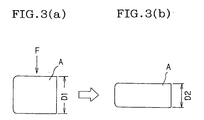
- the forging ratio means a value representing the degree of forming.
- a forging ratio R is represented by the following equation.
- R[%] (D1 - D2)/D1 x 100 (D1>D2)
- the forging ratio is represented by the following equation.
- R[%] (D2 - D1)/D1 x 100 (D2>D1)
- the fact that the so-called preformed material having a shape such that the forging ratio is about 18 to 60% assuming that the shape of the final forged product is 100% is obtained by the casting means that the preformed material having a shape such that the forging ratio determined using the thickness of each portion of the raw material for forging and the thickness of each corresponding portion in the final product obtained by forging the raw material for forging is about 18 to 60% in each portion is obtained by the casting.
- the cast material obtained/molded using a casting apparatus that is, the raw material for forging is heated to a surface temperature at about 380°C to a melting point or less and is stamped by a forging press to obtain a roughly forged material.
- the roughly forged material is cooled, thereafter heated again to the surface temperature at about 380°C to the melting point or less, and is finished/stamped by the forging press to obtain a finish forged material.
- the finish forged material is subjected to clipping flash and heat treatment such as T6 treatment to obtain a forged product.
- the load of the forging press is about 2600 to 2800 tons for rough forging and about 3200 to 3800 tons for finish forging.
- the aluminum cast-forged product in accordance with the present invention can be obtained.
- the flash generated by the forge-pressing and clipping flash in the manufacturing process of the present invention is collected by a flash removing machine, and can be reused as the raw material for the aluminum cast-forged product of the present invention. Therefore, all of the raw materials for forging are recycled, and are not disposed of as wastes or are not used as an inexpensive raw material for forging.
- the mold for the casting is brought closer to the shape of the product as compared with the conventional raw material for forging so that the forging ratio is about 18 to 60% assuming that the shape of the final forged product is 100% while achieving the strength improving effect by the forging, by which the pressing is facilitated. Therefore, unlike the conventional forging process, steps of extruding, cutting, heating, rough forging, finish forging, and clipping flash are not observed, thus the manufacturing process can be simplified, and the manufacturing cost can be reduced.
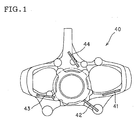
- FIG. 1 is a diagram showing one example of the aluminum cast-forged product of the present invention.
- a steering knuckle 40 which is the part for the automobile is shown.
- a small amount of copper was added to scraps of A6082 alloy to prepare a raw material forming the aluminum alloy consisting essentially of 0.6 to 1.8 wt% of silicon, 0.6 to 1.8 wt% of magnesium, 0.8 wt% or less of copper, 0.2 to 1.0 wt% of manganese, 0.25 wt% or less of chromium, 0.0 to 0.15 wt% of titanium, and unavoidably contained impurities.
- the steering knuckle 40 having a shape shown in FIG. 1 was manufactured in accordance with the following steps.
- the raw material for forging having a shape with a forging ratio of 30% assuming that the shape of the final steering knuckle 40 was 100% was cast at a mold temperature of 100°C.
- die forging was performed using a forging press at a rough forging temperature of 395°C (surface temperature) by applying a rough forging load of 2770 tons to obtain a roughly forged material.
- the roughly forged material was subjected to the die forging again using the forging press at a finish forging temperature of 460°C (surface temperature) by applying a finish forging load of 3260 tons. Finally, the finish forged material was trimmed.
- Example 2 After a solution heat treatment which was a T4 treatment by heating the finish forged material at 530°C for three hours, the finish forged material was cooled. Then, an aging treatment was done as T6 treatment by heating the finish forged material at 180°C for six hours. Thus, the steering knuckle 40 was obtained as a product.
- Example 2 operations similar to those of Example 1 were repeated to obtain the steering knuckle 40, except that the molten metal temperature was set to 720°C and the mold temperature was set to 125°C. Temperature conditions and load conditions are given in Tables 1 and 2, respectively.
- Examples 1 and 2 reveal that the mechanical properties of the aluminum cast-forged product in accordance with the present invention were capable of clearing the standards as needs of market in all of the tensile strength, proof stress, and elongation.
- an aluminum cast-forged product further satisfying needs of market in mechanical properties such as a tensile strength, proof stress, and elongation with a simpler manufacturing process with good productivity and at low cost.
- various lightweight and inexpensive vehicular parts such as suspension parts for vehicles, frames for the vehicles, and parts for engines are provided. Through lightening of weights of the vehicles, fuel consumption of automobiles is saved. As a result, emitted carbon dioxide is reduced, and an effect of contribution to prevention of global warming is also attained.
Landscapes
- Engineering & Computer Science (AREA)
- Mechanical Engineering (AREA)
- Chemical & Material Sciences (AREA)
- Materials Engineering (AREA)
- Metallurgy (AREA)
- Organic Chemistry (AREA)
- Physics & Mathematics (AREA)
- Thermal Sciences (AREA)
- Crystallography & Structural Chemistry (AREA)
- Forging (AREA)
- Vehicle Body Suspensions (AREA)
Applications Claiming Priority (3)
| Application Number | Priority Date | Filing Date | Title |
|---|---|---|---|
| JP2002288455 | 2002-10-01 | ||
| JP2002288455 | 2002-10-01 | ||
| PCT/JP2003/012514 WO2004031424A1 (fr) | 2002-10-01 | 2003-09-30 | Alliage en aluminium pour moulage-forgeage, article moule/forge en aluminium et procede de fabrication de cet article |
Publications (2)
| Publication Number | Publication Date |
|---|---|
| EP1566458A1 true EP1566458A1 (fr) | 2005-08-24 |
| EP1566458A4 EP1566458A4 (fr) | 2006-04-26 |
Family
ID=32063674
Family Applications (1)
| Application Number | Title | Priority Date | Filing Date |
|---|---|---|---|
| EP03748621A Withdrawn EP1566458A4 (fr) | 2002-10-01 | 2003-09-30 | Alliage en aluminium pour moulage-forgeage, article moule/forge en aluminium et procede de fabrication de cet article |
Country Status (7)
| Country | Link |
|---|---|
| US (2) | US20040151615A1 (fr) |
| EP (1) | EP1566458A4 (fr) |
| JP (1) | JPWO2004031424A1 (fr) |
| CN (1) | CN1497052A (fr) |
| AU (1) | AU2003268697A1 (fr) |
| PL (1) | PL374938A1 (fr) |
| WO (1) | WO2004031424A1 (fr) |
Cited By (3)
| Publication number | Priority date | Publication date | Assignee | Title |
|---|---|---|---|---|
| WO2009006939A1 (fr) | 2007-07-09 | 2009-01-15 | Bharat Forge Aluminiumtechnik Gmbh & Co. Kg | Coulée-forgeage d'alliages de corroyage |
| CN106435299A (zh) * | 2016-09-30 | 2017-02-22 | 华南理工大学 | 一种SiC颗粒增强铝基复合材料及其制备方法 |
| CN107955893A (zh) * | 2017-12-01 | 2018-04-24 | 宁波拓普汽车电子有限公司 | 一种铝合金转向节的锻造成型方法 |
Families Citing this family (27)
| Publication number | Priority date | Publication date | Assignee | Title |
|---|---|---|---|---|
| US20060000094A1 (en) * | 2004-07-01 | 2006-01-05 | Garesche Carl E | Forged aluminum vehicle wheel and associated method of manufacture and alloy |
| CN100355527C (zh) * | 2005-05-20 | 2007-12-19 | 东北轻合金有限责任公司 | 铝合金螺旋桨叶的制造方法 |
| DE502006000145D1 (de) * | 2005-08-22 | 2007-11-29 | Rheinfelden Aluminium Gmbh | Warmfeste Aluminiumlegierung |
| JP2009149931A (ja) * | 2007-12-19 | 2009-07-09 | Honda Motor Co Ltd | アルミニウム系部品及びそれの製造方法 |
| DE102008008326A1 (de) * | 2008-02-07 | 2011-03-03 | Audi Ag | Aluminiumlegierung |
| JP5416624B2 (ja) * | 2010-03-15 | 2014-02-12 | 株式会社神戸製鋼所 | 自動車足回り部品およびその製造方法 |
| KR101211988B1 (ko) | 2012-05-25 | 2012-12-13 | 이상순 | 가스버너헤드의 알루미늄 열간단조 방법 |
| CN103834836B (zh) * | 2012-11-23 | 2016-03-02 | 深圳市欣茂鑫精密五金制品有限公司 | 一种压铸锻造铝合金及其生产方法 |
| CN103031470B (zh) * | 2012-12-13 | 2014-01-15 | 湖南晟通科技集团有限公司 | 一种铝合金铸造铸锭的方法及用该铸锭挤压型材的方法 |
| CN103484734A (zh) * | 2013-08-12 | 2014-01-01 | 安徽环宇铝业有限公司 | 一种高延伸率铝合金型材及其制造方法 |
| CN103898374B (zh) * | 2014-03-26 | 2016-08-24 | 安徽家园铝业有限公司 | 一种建筑用铝合金型材及其制备方法 |
| CN103898383B (zh) * | 2014-03-26 | 2016-05-18 | 安徽家园铝业有限公司 | 一种高热导率铝合金型材及其制备方法 |
| FR3032204B1 (fr) * | 2015-01-29 | 2019-08-09 | Saint Jean Industries | Piece en alliage d'aluminium bas silicium |
| CN105436369B (zh) * | 2015-11-13 | 2020-05-12 | 新荣株式会社 | 借助于铸造锻造工艺的汽车离合器用缸制造方法及装置 |
| CN105483470A (zh) * | 2015-12-15 | 2016-04-13 | 天津立中车轮有限公司 | 高强度铝合金车轮 |
| CN105734366A (zh) * | 2016-04-27 | 2016-07-06 | 谭钰良 | 一种汽车散热器铝箔材料 |
| CN107541623A (zh) * | 2017-08-30 | 2018-01-05 | 宁波华源精特金属制品有限公司 | 一种防倾杆 |
| CN107598065A (zh) * | 2017-10-23 | 2018-01-19 | 徐州市博威机械制造有限公司 | 一种发动机壳体的锻造工艺 |
| US11021187B2 (en) * | 2017-12-08 | 2021-06-01 | ILJIN USA Corporation | Steering knuckle and method of making the same |
| CN111770840B (zh) * | 2018-01-12 | 2023-04-07 | 阿库莱德公司 | 铝轮和制造方法 |
| JP6887460B2 (ja) * | 2019-04-10 | 2021-06-16 | 株式会社リケン | 車両用ナックル |
| JP7619098B2 (ja) * | 2021-03-09 | 2025-01-22 | トヨタ自動車株式会社 | アルミニウム合金鍛造材の製造方法 |
| CN114033591A (zh) * | 2021-11-16 | 2022-02-11 | 苏州星波动力科技有限公司 | 铝合金油轨及其成型方法和制造方法、发动机、汽车 |
| CN115194083A (zh) * | 2022-06-29 | 2022-10-18 | 中国第一汽车股份有限公司 | 一种铸锻联合乘用车铝合金后转向节的生产方法 |
| CN115229162A (zh) * | 2022-07-20 | 2022-10-25 | 山东昊方联合铸造有限公司 | 一种铝合金制动盘帽的液态挤锻压铸造工艺 |
| CN115283593B (zh) * | 2022-08-18 | 2024-06-25 | 重庆新钰立金属科技有限公司 | 一种发电机油箱框铝锻件的成型方法 |
| CN116871446A (zh) * | 2023-06-12 | 2023-10-13 | 芜湖禾田汽车工业有限公司 | 新能源汽车铝合金锻件的铸锻工艺 |
Family Cites Families (13)
| Publication number | Priority date | Publication date | Assignee | Title |
|---|---|---|---|---|
| US4082578A (en) * | 1976-08-05 | 1978-04-04 | Aluminum Company Of America | Aluminum structural members for vehicles |
| DE3243371A1 (de) * | 1982-09-13 | 1984-03-15 | Schweizerische Aluminium AG, 3965 Chippis | Aluminiumlegierung |
| JPS63230844A (ja) * | 1987-03-20 | 1988-09-27 | Showa Alum Corp | オ−トバイ等のリム用アルミニウム合金 |
| JPH086161B2 (ja) * | 1988-03-07 | 1996-01-24 | 日本軽金属株式会社 | 高強度A1‐Mg‐Si系合金部材の製造法 |
| JP2697400B2 (ja) * | 1991-08-28 | 1998-01-14 | 日本軽金属株式会社 | 鍛造用アルミニウム合金 |
| JPH07258784A (ja) * | 1994-03-23 | 1995-10-09 | Kobe Steel Ltd | 鋳造性に優れた鍛造用Al合金材料および高強度Al合金鍛造品の製法 |
| JP3471421B2 (ja) * | 1994-04-25 | 2003-12-02 | 日本軽金属株式会社 | アルミニウム合金鍛造材の製造方法 |
| JPH0978210A (ja) * | 1995-09-07 | 1997-03-25 | Mitsubishi Materials Corp | アルミ合金製車両ホイールの製造方法および車両ホイール |
| JPH1112675A (ja) * | 1997-06-28 | 1999-01-19 | Kobe Steel Ltd | 熱間鍛造用アルミニウム合金及び熱間鍛造品の製造方法 |
| DE69921925T2 (de) * | 1998-08-25 | 2005-11-10 | Kabushiki Kaisha Kobe Seiko Sho, Kobe | Hochfeste Aluminiumlegierungsschmiedestücke |
| JP3695699B2 (ja) * | 2000-10-11 | 2005-09-14 | 株式会社神戸製鋼所 | アルミニウム合金製サスペンション部品のロール成形用素材の寸法決定方法およびアルミニウム合金製サスペンション部品の製造方法 |
| JP2002302728A (ja) * | 2001-04-09 | 2002-10-18 | Hoei Kogyo Kk | 鋳造鍛造用アルミニウム合金、アルミニウム鋳造鍛造品及び製造方法 |
| JP4774630B2 (ja) * | 2001-05-18 | 2011-09-14 | 日産自動車株式会社 | アルミニウム鍛造部品の製造方法 |
-
2003
- 2003-09-30 EP EP03748621A patent/EP1566458A4/fr not_active Withdrawn
- 2003-09-30 WO PCT/JP2003/012514 patent/WO2004031424A1/fr not_active Ceased
- 2003-09-30 AU AU2003268697A patent/AU2003268697A1/en not_active Abandoned
- 2003-09-30 JP JP2004541254A patent/JPWO2004031424A1/ja active Pending
- 2003-09-30 PL PL03374938A patent/PL374938A1/xx not_active Application Discontinuation
- 2003-09-30 CN CNA031349463A patent/CN1497052A/zh active Pending
- 2003-10-01 US US10/674,811 patent/US20040151615A1/en not_active Abandoned
-
2005
- 2005-07-25 US US11/187,794 patent/US20050279429A1/en not_active Abandoned
Cited By (5)
| Publication number | Priority date | Publication date | Assignee | Title |
|---|---|---|---|---|
| WO2009006939A1 (fr) | 2007-07-09 | 2009-01-15 | Bharat Forge Aluminiumtechnik Gmbh & Co. Kg | Coulée-forgeage d'alliages de corroyage |
| CN106435299A (zh) * | 2016-09-30 | 2017-02-22 | 华南理工大学 | 一种SiC颗粒增强铝基复合材料及其制备方法 |
| CN106435299B (zh) * | 2016-09-30 | 2018-04-13 | 华南理工大学 | 一种SiC颗粒增强铝基复合材料及其制备方法 |
| CN107955893A (zh) * | 2017-12-01 | 2018-04-24 | 宁波拓普汽车电子有限公司 | 一种铝合金转向节的锻造成型方法 |
| CN107955893B (zh) * | 2017-12-01 | 2020-08-21 | 宁波拓普汽车电子有限公司 | 一种铝合金转向节的锻造成型方法 |
Also Published As
| Publication number | Publication date |
|---|---|
| AU2003268697A1 (en) | 2004-04-23 |
| AU2003268697A8 (en) | 2004-04-23 |
| WO2004031424A1 (fr) | 2004-04-15 |
| US20050279429A1 (en) | 2005-12-22 |
| US20040151615A1 (en) | 2004-08-05 |
| EP1566458A4 (fr) | 2006-04-26 |
| CN1497052A (zh) | 2004-05-19 |
| JPWO2004031424A1 (ja) | 2006-02-02 |
| PL374938A1 (en) | 2005-11-14 |
Similar Documents
| Publication | Publication Date | Title |
|---|---|---|
| US20050279429A1 (en) | Aluminum alloy for casting-forging, aluminum casting-forging product and processes for production thereof | |
| EP1380662A1 (fr) | Alliage d'aluminium de moulage/forgeage, produit d'aluminium moule/forge et procedes de fabrication | |
| JP5894289B2 (ja) | ダイカスト鋳造品、および、車両用部品 | |
| CN108290210B (zh) | 用于制造轻金属铸造部件的方法和轻金属铸造部件 | |
| JPH06172949A (ja) | マグネシウム合金製部材およびその製造方法 | |
| JPH09249951A (ja) | 微細組織を有するアルミ鍛造製品の製造方法 | |
| CN106319305A (zh) | 6061材料商用车铝合金轴头液态模锻工艺法 | |
| US20250297342A1 (en) | Aluminum alloys for structural high pressure vacuum die casting applications | |
| JP3324093B2 (ja) | 自動車部材向け鍛造加工用アルミニウム合金材及び鍛造加工自動車部材 | |
| KR101258801B1 (ko) | 엔진의 로우 크랭크 케이스용 알루미늄 베어링 인서트의 제조방법 | |
| JP5689423B2 (ja) | エンジンピストン用素形材の製造方法 | |
| CN106345984A (zh) | 应用于商用车轮毂的a357铝合金的液态模锻工艺法 | |
| DE102011118014A1 (de) | Verfahren zum Herstellen eines Karosseriebauteils für ein Kraftfahrzeug aus einem Aluminiumhalbzeug und Karosseriebauteil | |
| JP5588884B2 (ja) | マグネシウム合金鍛造ピストンの製造方法およびマグネシウム合金鍛造ピストン | |
| JP3037926B2 (ja) | アルミホイール鋳造用アルミニウム合金 | |
| JPH07150312A (ja) | アルミニウム合金鍛造素材の製造方法 | |
| JP3747232B2 (ja) | アルミニウム鋳造鍛造品の製造方法 | |
| KR100703130B1 (ko) | 비열처리형 고연성 알루미늄 주조합금 및 그 제조방법 | |
| EP1400292A1 (fr) | Produit moulé/forgé en aluminium et procédé pour sa fabrication | |
| KR100727178B1 (ko) | 반용융 성형법을 이용하여 제조한 알루미늄 합금 부품의열처리 방법 | |
| CN106399770B (zh) | 应用于商用车轴头的a357铝合金的液态模锻工艺法 | |
| JP2003001357A (ja) | アルミニウム鋳造鍛造品の製造方法 | |
| JP2003103330A (ja) | 鍛造品製造方法、鍛造品製造装置、及びプリフォーム鍛造材 | |
| KR101191772B1 (ko) | 자동차 핸들용 알루미늄 합금 조성물의 제조방법 | |
| WO2025147527A1 (fr) | Alliage d'aluminium coulé à ductilité élevée à faible coût |
Legal Events
| Date | Code | Title | Description |
|---|---|---|---|
| PUAI | Public reference made under article 153(3) epc to a published international application that has entered the european phase |
Free format text: ORIGINAL CODE: 0009012 |
|
| 17P | Request for examination filed |
Effective date: 20050428 |
|
| AK | Designated contracting states |
Kind code of ref document: A1 Designated state(s): AT BE BG CH CY CZ DE DK EE ES FI FR GB GR HU IE IT LI LU MC NL PT RO SE SI SK TR |
|
| AX | Request for extension of the european patent |
Extension state: AL LT LV MK |
|
| RAP1 | Party data changed (applicant data changed or rights of an application transferred) |
Owner name: ASAHI TEC CORPORATION |
|
| DAX | Request for extension of the european patent (deleted) | ||
| RBV | Designated contracting states (corrected) |
Designated state(s): DE FR GB IT |
|
| A4 | Supplementary search report drawn up and despatched |
Effective date: 20060309 |
|
| STAA | Information on the status of an ep patent application or granted ep patent |
Free format text: STATUS: THE APPLICATION HAS BEEN WITHDRAWN |
|
| 18W | Application withdrawn |
Effective date: 20060731 |