EP1550477B1 - Stent und verfahren zu seiner herstellung - Google Patents
Stent und verfahren zu seiner herstellung Download PDFInfo
- Publication number
- EP1550477B1 EP1550477B1 EP03794087.1A EP03794087A EP1550477B1 EP 1550477 B1 EP1550477 B1 EP 1550477B1 EP 03794087 A EP03794087 A EP 03794087A EP 1550477 B1 EP1550477 B1 EP 1550477B1
- Authority
- EP
- European Patent Office
- Prior art keywords
- stent
- polymer
- mandrel
- matrix
- polymer film
- Prior art date
- Legal status (The legal status is an assumption and is not a legal conclusion. Google has not performed a legal analysis and makes no representation as to the accuracy of the status listed.)
- Expired - Lifetime
Links
Images



Classifications
-
- A—HUMAN NECESSITIES
- A61—MEDICAL OR VETERINARY SCIENCE; HYGIENE
- A61F—FILTERS IMPLANTABLE INTO BLOOD VESSELS; PROSTHESES; DEVICES PROVIDING PATENCY TO, OR PREVENTING COLLAPSING OF, TUBULAR STRUCTURES OF THE BODY, e.g. STENTS; ORTHOPAEDIC, NURSING OR CONTRACEPTIVE DEVICES; FOMENTATION; TREATMENT OR PROTECTION OF EYES OR EARS; BANDAGES, DRESSINGS OR ABSORBENT PADS; FIRST-AID KITS
- A61F2/00—Filters implantable into blood vessels; Prostheses, i.e. artificial substitutes or replacements for parts of the body; Appliances for connecting them with the body; Devices providing patency to, or preventing collapsing of, tubular structures of the body, e.g. stents
- A61F2/82—Devices providing patency to, or preventing collapsing of, tubular structures of the body, e.g. stents
- A61F2/86—Stents in a form characterised by the wire-like elements; Stents in the form characterised by a net-like or mesh-like structure
- A61F2/90—Stents in a form characterised by the wire-like elements; Stents in the form characterised by a net-like or mesh-like structure characterised by a net-like or mesh-like structure
-
- A—HUMAN NECESSITIES
- A61—MEDICAL OR VETERINARY SCIENCE; HYGIENE
- A61L—METHODS OR APPARATUS FOR STERILISING MATERIALS OR OBJECTS IN GENERAL; DISINFECTION, STERILISATION OR DEODORISATION OF AIR; CHEMICAL ASPECTS OF BANDAGES, DRESSINGS, ABSORBENT PADS OR SURGICAL ARTICLES; MATERIALS FOR BANDAGES, DRESSINGS, ABSORBENT PADS OR SURGICAL ARTICLES
- A61L31/00—Materials for other surgical articles, e.g. stents, stent-grafts, shunts, surgical drapes, guide wires, materials for adhesion prevention, occluding devices, surgical gloves, tissue fixation devices
- A61L31/08—Materials for coatings
- A61L31/10—Macromolecular materials
-
- A—HUMAN NECESSITIES
- A61—MEDICAL OR VETERINARY SCIENCE; HYGIENE
- A61L—METHODS OR APPARATUS FOR STERILISING MATERIALS OR OBJECTS IN GENERAL; DISINFECTION, STERILISATION OR DEODORISATION OF AIR; CHEMICAL ASPECTS OF BANDAGES, DRESSINGS, ABSORBENT PADS OR SURGICAL ARTICLES; MATERIALS FOR BANDAGES, DRESSINGS, ABSORBENT PADS OR SURGICAL ARTICLES
- A61L31/00—Materials for other surgical articles, e.g. stents, stent-grafts, shunts, surgical drapes, guide wires, materials for adhesion prevention, occluding devices, surgical gloves, tissue fixation devices
- A61L31/14—Materials characterised by their function or physical properties, e.g. injectable or lubricating compositions, shape-memory materials, surface modified materials
- A61L31/16—Biologically active materials, e.g. therapeutic substances
-
- B—PERFORMING OPERATIONS; TRANSPORTING
- B29—WORKING OF PLASTICS; WORKING OF SUBSTANCES IN A PLASTIC STATE IN GENERAL
- B29C—SHAPING OR JOINING OF PLASTICS; SHAPING OF MATERIAL IN A PLASTIC STATE, NOT OTHERWISE PROVIDED FOR; AFTER-TREATMENT OF THE SHAPED PRODUCTS, e.g. REPAIRING
- B29C41/00—Shaping by coating a mould, core or other substrate, i.e. by depositing material and stripping-off the shaped article; Apparatus therefor
- B29C41/02—Shaping by coating a mould, core or other substrate, i.e. by depositing material and stripping-off the shaped article; Apparatus therefor for making articles of definite length, i.e. discrete articles
- B29C41/04—Rotational or centrifugal casting, i.e. coating the inside of a mould by rotating the mould
- B29C41/042—Rotational or centrifugal casting, i.e. coating the inside of a mould by rotating the mould by rotating a mould around its axis of symmetry
-
- B—PERFORMING OPERATIONS; TRANSPORTING
- B29—WORKING OF PLASTICS; WORKING OF SUBSTANCES IN A PLASTIC STATE IN GENERAL
- B29C—SHAPING OR JOINING OF PLASTICS; SHAPING OF MATERIAL IN A PLASTIC STATE, NOT OTHERWISE PROVIDED FOR; AFTER-TREATMENT OF THE SHAPED PRODUCTS, e.g. REPAIRING
- B29C41/00—Shaping by coating a mould, core or other substrate, i.e. by depositing material and stripping-off the shaped article; Apparatus therefor
- B29C41/02—Shaping by coating a mould, core or other substrate, i.e. by depositing material and stripping-off the shaped article; Apparatus therefor for making articles of definite length, i.e. discrete articles
- B29C41/14—Dipping a core
-
- B—PERFORMING OPERATIONS; TRANSPORTING
- B29—WORKING OF PLASTICS; WORKING OF SUBSTANCES IN A PLASTIC STATE IN GENERAL
- B29C—SHAPING OR JOINING OF PLASTICS; SHAPING OF MATERIAL IN A PLASTIC STATE, NOT OTHERWISE PROVIDED FOR; AFTER-TREATMENT OF THE SHAPED PRODUCTS, e.g. REPAIRING
- B29C41/00—Shaping by coating a mould, core or other substrate, i.e. by depositing material and stripping-off the shaped article; Apparatus therefor
- B29C41/02—Shaping by coating a mould, core or other substrate, i.e. by depositing material and stripping-off the shaped article; Apparatus therefor for making articles of definite length, i.e. discrete articles
- B29C41/20—Shaping by coating a mould, core or other substrate, i.e. by depositing material and stripping-off the shaped article; Apparatus therefor for making articles of definite length, i.e. discrete articles incorporating preformed parts or layers, e.g. moulding inserts or for coating articles
-
- B—PERFORMING OPERATIONS; TRANSPORTING
- B29—WORKING OF PLASTICS; WORKING OF SUBSTANCES IN A PLASTIC STATE IN GENERAL
- B29C—SHAPING OR JOINING OF PLASTICS; SHAPING OF MATERIAL IN A PLASTIC STATE, NOT OTHERWISE PROVIDED FOR; AFTER-TREATMENT OF THE SHAPED PRODUCTS, e.g. REPAIRING
- B29C41/00—Shaping by coating a mould, core or other substrate, i.e. by depositing material and stripping-off the shaped article; Apparatus therefor
- B29C41/02—Shaping by coating a mould, core or other substrate, i.e. by depositing material and stripping-off the shaped article; Apparatus therefor for making articles of definite length, i.e. discrete articles
- B29C41/22—Making multilayered or multicoloured articles
-
- A—HUMAN NECESSITIES
- A61—MEDICAL OR VETERINARY SCIENCE; HYGIENE
- A61F—FILTERS IMPLANTABLE INTO BLOOD VESSELS; PROSTHESES; DEVICES PROVIDING PATENCY TO, OR PREVENTING COLLAPSING OF, TUBULAR STRUCTURES OF THE BODY, e.g. STENTS; ORTHOPAEDIC, NURSING OR CONTRACEPTIVE DEVICES; FOMENTATION; TREATMENT OR PROTECTION OF EYES OR EARS; BANDAGES, DRESSINGS OR ABSORBENT PADS; FIRST-AID KITS
- A61F2/00—Filters implantable into blood vessels; Prostheses, i.e. artificial substitutes or replacements for parts of the body; Appliances for connecting them with the body; Devices providing patency to, or preventing collapsing of, tubular structures of the body, e.g. stents
- A61F2/02—Prostheses implantable into the body
- A61F2/04—Hollow or tubular parts of organs, e.g. bladders, tracheae, bronchi or bile ducts
- A61F2/06—Blood vessels
- A61F2/07—Stent-grafts
- A61F2002/072—Encapsulated stents, e.g. wire or whole stent embedded in lining
-
- A—HUMAN NECESSITIES
- A61—MEDICAL OR VETERINARY SCIENCE; HYGIENE
- A61F—FILTERS IMPLANTABLE INTO BLOOD VESSELS; PROSTHESES; DEVICES PROVIDING PATENCY TO, OR PREVENTING COLLAPSING OF, TUBULAR STRUCTURES OF THE BODY, e.g. STENTS; ORTHOPAEDIC, NURSING OR CONTRACEPTIVE DEVICES; FOMENTATION; TREATMENT OR PROTECTION OF EYES OR EARS; BANDAGES, DRESSINGS OR ABSORBENT PADS; FIRST-AID KITS
- A61F2210/00—Particular material properties of prostheses classified in groups A61F2/00 - A61F2/26 or A61F2/82 or A61F9/00 or A61F11/00 or subgroups thereof
- A61F2210/0004—Particular material properties of prostheses classified in groups A61F2/00 - A61F2/26 or A61F2/82 or A61F9/00 or A61F11/00 or subgroups thereof bioabsorbable
-
- A—HUMAN NECESSITIES
- A61—MEDICAL OR VETERINARY SCIENCE; HYGIENE
- A61F—FILTERS IMPLANTABLE INTO BLOOD VESSELS; PROSTHESES; DEVICES PROVIDING PATENCY TO, OR PREVENTING COLLAPSING OF, TUBULAR STRUCTURES OF THE BODY, e.g. STENTS; ORTHOPAEDIC, NURSING OR CONTRACEPTIVE DEVICES; FOMENTATION; TREATMENT OR PROTECTION OF EYES OR EARS; BANDAGES, DRESSINGS OR ABSORBENT PADS; FIRST-AID KITS
- A61F2210/00—Particular material properties of prostheses classified in groups A61F2/00 - A61F2/26 or A61F2/82 or A61F9/00 or A61F11/00 or subgroups thereof
- A61F2210/0076—Particular material properties of prostheses classified in groups A61F2/00 - A61F2/26 or A61F2/82 or A61F9/00 or A61F11/00 or subgroups thereof multilayered, e.g. laminated structures
-
- A—HUMAN NECESSITIES
- A61—MEDICAL OR VETERINARY SCIENCE; HYGIENE
- A61F—FILTERS IMPLANTABLE INTO BLOOD VESSELS; PROSTHESES; DEVICES PROVIDING PATENCY TO, OR PREVENTING COLLAPSING OF, TUBULAR STRUCTURES OF THE BODY, e.g. STENTS; ORTHOPAEDIC, NURSING OR CONTRACEPTIVE DEVICES; FOMENTATION; TREATMENT OR PROTECTION OF EYES OR EARS; BANDAGES, DRESSINGS OR ABSORBENT PADS; FIRST-AID KITS
- A61F2250/00—Special features of prostheses classified in groups A61F2/00 - A61F2/26 or A61F2/82 or A61F9/00 or A61F11/00 or subgroups thereof
- A61F2250/0058—Additional features; Implant or prostheses properties not otherwise provided for
- A61F2250/0067—Means for introducing or releasing pharmaceutical products into the body
-
- A—HUMAN NECESSITIES
- A61—MEDICAL OR VETERINARY SCIENCE; HYGIENE
- A61L—METHODS OR APPARATUS FOR STERILISING MATERIALS OR OBJECTS IN GENERAL; DISINFECTION, STERILISATION OR DEODORISATION OF AIR; CHEMICAL ASPECTS OF BANDAGES, DRESSINGS, ABSORBENT PADS OR SURGICAL ARTICLES; MATERIALS FOR BANDAGES, DRESSINGS, ABSORBENT PADS OR SURGICAL ARTICLES
- A61L2300/00—Biologically active materials used in bandages, wound dressings, absorbent pads or medical devices
-
- B—PERFORMING OPERATIONS; TRANSPORTING
- B29—WORKING OF PLASTICS; WORKING OF SUBSTANCES IN A PLASTIC STATE IN GENERAL
- B29K—INDEXING SCHEME ASSOCIATED WITH SUBCLASSES B29B, B29C OR B29D, RELATING TO MOULDING MATERIALS OR TO MATERIALS FOR MOULDS, REINFORCEMENTS, FILLERS OR PREFORMED PARTS, e.g. INSERTS
- B29K2995/00—Properties of moulding materials, reinforcements, fillers, preformed parts or moulds
- B29K2995/0037—Other properties
- B29K2995/0059—Degradable
-
- B—PERFORMING OPERATIONS; TRANSPORTING
- B29—WORKING OF PLASTICS; WORKING OF SUBSTANCES IN A PLASTIC STATE IN GENERAL
- B29K—INDEXING SCHEME ASSOCIATED WITH SUBCLASSES B29B, B29C OR B29D, RELATING TO MOULDING MATERIALS OR TO MATERIALS FOR MOULDS, REINFORCEMENTS, FILLERS OR PREFORMED PARTS, e.g. INSERTS
- B29K2995/00—Properties of moulding materials, reinforcements, fillers, preformed parts or moulds
- B29K2995/0037—Other properties
- B29K2995/0059—Degradable
- B29K2995/006—Bio-degradable, e.g. bioabsorbable, bioresorbable or bioerodible
-
- B—PERFORMING OPERATIONS; TRANSPORTING
- B29—WORKING OF PLASTICS; WORKING OF SUBSTANCES IN A PLASTIC STATE IN GENERAL
- B29L—INDEXING SCHEME ASSOCIATED WITH SUBCLASS B29C, RELATING TO PARTICULAR ARTICLES
- B29L2031/00—Other particular articles
- B29L2031/753—Medical equipment; Accessories therefor
Definitions
- the present invention relates to a stent (intraluminal graft) which is recently used for intravascular therapy and surgical operation, particularly to enlarge a coronary stenosis, a carotid stenosis, a biliary duct, or an esophagus or to block an aneurysm and to a process for producing the same.
- a stent intraluminal graft
- ischemic heart diseases are generally treated by percutaneous transluminal cornary angioplasty (PTCA), that is, a procedure of introducing a balloon catheter to, for example, a narrowed part through a lumen of a blood vessel and, after that, inflating a balloon with liquid such as normal saline solution.
- PTCA percutaneous transluminal cornary angioplasty
- this procedure has a problem of high possibilities that an acute phase block of a coronary artery is caused and that the portion treated by PTCA is narrowed again (so-called post-PTCA restenosis).
- intraluminal graft called stent has been developed.
- the stent recently rapidly came into practical use and are in widespread use. According to recent data, nearly 75% of procedures using balloon catheters have been already replaced by procedures using stents.
- Stent matrix is an intraluminal graft which is implanted into a portion of a lumen to be treated through the lumen of a blood vessel or the like and is increased its diameter at the portion of the lumen to be treated so that the lumen is supported by action on the inside.
- the stent is mainly used in procedure for coronary artery so that the following description will be made mainly as to the procedure for coronary artery, the stent can be used for other lumens of human body such as biliary duct, esophagus, trachea, prostate, urinary duct, fallopian tube, aortic aneurysm, peripheral artery, renal artery, carotid artery, and cerebral blood vessel.
- stents will be used in many procedures including dilation of the narrowed portion, aneurysm embolization, cancer therapy, and the like, particularly that importance of microscopic stents will be increased according to the use in a field of cerebral surgery.
- a metallic stent matrix may thrombose a patient after several weeks from insertion of the metallic stent matrix. This is because the metallic stent itself is exposed to blood, resulting in adsorption of blood proteins such as fibrinogen and adherence or agglutination of blood platelets, thus forming thrombus. Further, thrombus may be formed because blood platelets are agglutinated on the convexes and concaves of a skeleton of the metallic stent matrix.
- JP H11-299901A discloses to coat an outer periphery of a metallic stent matrix with a flexible polymer film having a number of fine pores.
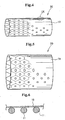
- Fig. 2 is a perspective view showing such a metallic stent matrix 10 having a mesh form to be used for a stent
- Fig. 3 is a perspective view showing the stent matrix of Fig. 2 in the expanded state 10'
- Fig. 4 is a perspective view showing a stent 20 comprising the stent matrix 10 of which outer periphery is coated with a flexible polymer film 19 having fine pores
- Fig. 5 is a perspective view showing the stent 20 in the expanded state
- endothelial cells In biological tissues, inner walls of blood vessels and the like, that is, portions to be directly in contact with blood are coated with cell layer so-called endothelial cells. Since the surfaces of the endothelial cells are covered by sugar and the endothelial cells secrete substances that inhibit activation of blood platelets such as prostaglandin, thrombus is hardly formed in biological tissues.
- the outer periphery of the metallic stent matrix is coated with a polymer film, thereby promoting proper endothelium formation with tissues and reducing thrombogenic property.
- the polymer film for coating the outer periphery of the stent matrix is formed as follows. That is, a mandrel for a cover strip is first impregnated in a polymer solution, then is dried, and is perforated. After that, the mandrel is pulled out, thereby forming a membrane cover strip (envelope-shaped cover film). A stent matrix is inserted into the envelope-shaped cover film in a state that the cover film is sufficiently expanded by sending air into the cover film. After that, the sending of air is stopped so as to shrink the cover film, thereby forming a covering membrane on the outer periphery of the stent matrix.
- the outer periphery of the metallic stent matrix is covered by a flexible polymer film having fine pores so as to engraft endothelium on the surface of the film on the outer periphery of the stent matrix, thereby reducing the causing of thrombus formation.
- the inner periphery of the stent matrix is not covered with the polymer film so that the metallic stent matrix is exposed. There is still a problem of causing thrombus, allergic to metal, stimulus of tissues due to metal, and rust development.
- the convexes disarrange bloodstream, facilitating the formation of thrombuses.
- the formed thrombuses exfoliate and move downstream (travels peripherad through the bloodstream) so as to cause infarction in small blood vessel on the downstream side or platelet-derived growth factor discharged from blood platelets in the thrombuses stimulate to cause thickening. Therefore, the problem of causing intimal thrombus is serious at this portion.
- the method of forming a polymer film as an outer covering membrane on the outer periphery of a stent matrix by inserting the stent matrix to an envelope-shaped cover film and shrinking the envelope-shaped cover film has the following problem. That is, as shown in Figs. 2 and 3 , the stent matrix 10 used in JP H11-299901A is formed of a cross-hatched lattice.
- the outer covering membrane is bonded at contact points between the polymer film and the respective stent struts 11 composing the mesh stent matrix 10 as shown in Fig. 6 . Accordingly, the integrity between the polymer film 19 and the stent matrix is poor.
- the contact points between the stent struts 11 and the polymer film 19 slide and move. That is, the position of the polymer film 19 covering the outer periphery of the stent matrix is shifted when the stent is expanded.
- the polymer film 19 has fine pores which are arranged to be spaced substantially equally.
- the purpose of the formation of fine pores is inhibiting formation of thrombuses and intimal thickening by grafting endothelial cells on the inner wall of the stent. Therefore, it is believed that the pores are formed at positions other than the position directly above the stent skeleton.
- the fine pores may be occluded by the stent struts. If the fine pores are occluded, the arrangement design of the fine pores becomes worthless.
- JP H11-299901A also describes that the polymer film is coated with biodegradable polymer or chemicals.
- the portions of the inner periphery of the polymer film where the struts of the mesh stent matrix are positioned are not coated with such a coating of the functioning agent.
- surfaces without coating of the functioning agent are exposed. The coating also becomes worthless.
- JP H11-299901A it is described that the adhesion of the cover strip to the outer periphery of the stent matrix 10 may be secured by heat-sealing of sending heated air during the coating of the stent matrix with the cover strip. Though this operation increases the adhesion at contact points between the polymer film 19 and the stent struts 11 composing the mesh stent matrix, it is impossible to coat entire surfaces of the stent struts 11 by the polymer film 19. Since the stent matrix is generally formed by laser beam machining of a metallic tube, shape edges of stent struts formed by cutting are rounded by chemical polishing or sonic treatment so that the surface of the stent matrix is generally mirror finish.
- US 6 309 413 discloses an endoluminal graft that is both expandable and supportive.
- a stent matrix made of a flexible material having shape memory property allowing deformation of the stent into an arch has been developed in order to allow the stent to be inserted into a bent vascular channel and a stent matrix which is deformable into an arch during expansion has been developed because there is a need that the stent can be deformed while increasing its diameter according to the shape of a part (for example, a part bent into an arch) of a vascular channel where the stent will be implanted.
- a stent of the invention comprises a tubular stent matrix of which diameter is extendable and a flexible polymer layer coating said stent matrix, and is characterized in that the polymer layer is closely attached to and covers the entire surface of the stent matrix.
- the stent Since the flexible polymer layer is attached to and covers the entire surface of the stent matrix not only the outer periphery of the stent matrix, the stent has no problem of causing allergic to metal, stimulus of tissues due to metal, and rust development. Since the inner periphery of the stent is a flat and smooth surface covered by the polymer layer without convexes and concaves so as not to disarrange bloodstream, the formation of thrombus can be inhibited well. In addition, there is no problem of drift between the stent matrix and the polymer layer during the expansion of the stent, thereby maintaining the positional relationship between the stent matrix and the polymer layer before and after the expansion of the stent.
- a process of producing a stent of the invention is a process of producing a stent having a tubular stent matrix of which diameter is extendable and flexible polymer films which are attached to both the inner periphery and the outer periphery of said stent matrix and have a plurality of fine pores formed therein, said process comprising: a step of forming the polymer film by impregnating a mandrel into a liquid resin material for forming the polymer film and pulling up the mandrel; and a step of equalizing the thickness of the polymer film by pulling up the mandrel in the vertical direction and controlling the pulling-up speed, characterized wherein said fine pores are formed after the polymer film is formed by laser machining and the pulling-up speed is gradually lowered.
- the flexible polymer films cover not only the outer periphery but also the inner periphery of the stent matrix in the stent produced by the process of the invention, the formation of thrombus can be inhibited well.
- the thickness of the polymer film can be equalized all over the length in the longitudinal direction of the stent (that is, the direction of pulling up the mandrel) by controlling the pulling-up seed of the mandrel.
- the thickness of the polymer film can be equalized all over the length in the longitudinal direction of the mandrel by gradually lowering the speed of pulling up the mandrel.
- a stent matrix composing a stent of the first invention is a tubular member having a length of from about 2 to 40 mm and a diameter of from about 1/10 to 1/2 of the length.
- the thickness of the stent matrix (wall thickness of the tubular member) is preferably from 11 to 2000 ⁇ m, more preferably from 51 to 500 ⁇ m, especially preferably from 101 to 300 ⁇ m.
- the stent matrix is preferably formed of a mesh so that the stent matrix can be flexibly expanded radially, particularly preferably, a cross-hatched lattice as shown in Fig. 2 in which the lattice extends in the helical direction.
- the stent matrix is preferably made of a biocompatible metal.
- a biocompatible metal include stainless steel, titanium, tantalum, aluminum, tungsten, nickel-titanium alloy, cobalt-chromium-nickel-iron alloy.
- the stent matrix is preferably subjected to heat treatment for shape memory.
- the heat treatment is conducted by converting the crystal structure of nitinol from martensite phase to austenite phase while the stent matrix is expanded, thereby memorizing the shape and giving self-expandability to the stent matrix.
- resins having excellent mechanical strength such as polyether ether ketone, aromatic polyamide, polyimide, and the like may be used for the base material of the stent.
- Suitable material of the flexible polymer layer is a high-molecular elastomer having high flexibility.
- a high-molecular elastomer include elastmers of polystyrene series, of polyolefin series, of polyester series, of polyamide series, of silicone series, of urethane series, of fluorocarbon resin series, and of natural rubber series, copolymers of these, and polymer alloys of these.
- a segmented polyurethane, a polymer of polyolefin series, and a polymer of silicone series are preferable, particularly, a segmented polyurethane having high flexibility and excellent mechanical strength is best.
- the segmented polyurethane polymer has a flexible polyether section as its soft segment and a section containing highly aromatic rings and urethane bonds as its hard segment, wherein the soft segment and the hard segment are subjected to phase separation to form a fine structure.
- the segmented polyurethane polymer is excellent in antithrombogenicity and is also excellent in properties such as strength and ductility so that it can be sufficiently expanded without being broken when the stent is expanded radially.
- the thickness ("d" in Fig. 1 as will be described later) of a polymer layer made of the segmented polyurethane polymer is preferably from 1 ⁇ m to 100 ⁇ m, particularly from 5 ⁇ m to 50 ⁇ m, especially from 20 ⁇ m to 50 ⁇ m.
- the polymer layer is preferably provided with a plurality of fine pores.
- the fine pores may be arranged in random order.
- the fine pores are formed to have substantially equal intervals therebetween.
- the phrase "substantially equal intervals" does not mean that the distances between fine pores are equal, but means that the fine pores are arranged at nearly regular intervals by a method of controlling the spaces between the fine pores. Accordingly, the arrangement with substantially equal intervals includes arrangements of oblique order, of circular order, of elliptic order, and the like which look random order at the first glance.
- the fine pores may have any size and any shape if the fine pore can allow passage of endothelial cells.
- the fine pores are preferably circular pores of which diameter is from 5 ⁇ m to 500 ⁇ m, preferably from 10 ⁇ m to 100 ⁇ m, more preferably from 20 ⁇ m to 100 ⁇ m. It should be understood that the fine pores may be pores of ellipse, square, rectangular, or other shape. This is true for the state before expansion. At a time when the stent is expanded and implanted in a lumen, the shape is varied from circle to ellipse and the diameter is also varied accordingly.
- the fine pores are aligned in a plurality of straight lines with intervals of from 51 ⁇ m to 10000 ⁇ m, preferably from 101 ⁇ m to 8000 ⁇ m, more preferably from 201 ⁇ m to 5000 ⁇ m.
- the plurality of straight lines are arranged in the axial direction of the stent with a predetermined constant angular interval from each other and are from 10 to 50 in number.
- the best diameter and interval of the fine pores are in subservient relationship.
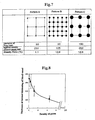
- the relationship can be easily understood by assuming the relationship as the density of pores in the polymer layer. That is, when substantially circular pores are arranged at nearly equal intervals just like three patterns shown in Fig. 7 , the density per unit area naturally depends on the diameter and the interval of the fine pores.
- Fig. 8 The relation between the density of pores and the thickness of the intimal thickening of a blood vessel caused by implantation of the stent into the blood vessel is shown in Fig. 8 .
- the preferable diameter and interval of fine pores are in relationship with the density of pores. It should be understood that, even with preferable density of pores, too small diameter of pores is not preferable because the growth of endothelial cells on the inner side of the stent must be poor and, on the other hand, too large diameter of pores is also not preferable because the strength of the polymer layer must be poor and ingression of endothelial tissues must be excessive.
- the polymer layer may be coated with a biodegradable polymer (bioabsorbable polymer).
- a biodegradable polymer include gelatine, poly-lactic acid, polyglycolic acid, caprolactone, lactic-glycol acid copolymer, polygioxisanone, and chitin.
- the biodegradable polymer may contain a therapeutic drug such as an antiplatelet drug, an antithrombotic drug, a growth accelerator, a growth inhibitor, and an immune-suppressing drug.
- the therapeutic drug is discharged into living body according to the degradation of the biodegradable polymer and thus provide effects of inhibiting formation of thrombus, inhibiting growth of smooth muscle cells so as to prevent constriction, inhibiting growth of cancerous cells, or promoting the growth of endothelial cells so as to achieve early formation of endothelium lining.
- Such a therapeutic drug examples include heparin, low-molecular heparin, hirudin, argatroban, formacolin, vapiprost, prostamoline, prostakilin homolog, dextran, D-phe-pro-arg chloromethyl ketone, dipyridamole, platelet receptor antagonist of glycoprotein, recombinant hirudin, thrombin inhibitor, vascular heptyne, angiotensin-converting enzyme inhibitor, steroid, fibrocyte growth factor antagonist, fish oil, omega 3 fatty acid, histamine, antagonist, HMG-CoA reductase inhibitor, seramin, serotonin blocker, thioprotease inhibitor, triazolopyrimidine, interferon, vascular endothelial growth factor (VEGF), rapamycin, and FK506.
- a therapeutic drug may be a statin drug having a function of melting plaque such as mevalotin, fuluvastatin, or the like.
- the polymer layer on the outer peripheral side of the stent may be coated with a lubricative substance in order to smooth the movement of the stent within a fine blood vessel in a human body.
- a lubricative substance include low-molecular hydrophilic substances such as glycerin, biocompatible substances such as hyaluronic acid and gelatine, and synthetic hydrophilic polymers such as polyethylene glycol, polyacrylamide, polydimethyl acrylamide, and polyvinylpyrrolidone.
- the stent of the invention in which the entire surface of the stent matrix is coated with the polymer layer wherein the polymer layer is closely attached to the entire surface of the stent matrix can be produced by the following process.
- the polymer solution may be a solution of polymer or a polymerized solution of monomer.
- a segmented polyurethane polymer solution prepared from an organic solvent such as dioxane or tetrahydrofuran may be used.
- a deacetonated, dealcoholized, or deoximated silicon rubber of condensation hardening type may be used.
- a coating containing the therapeutic drug is formed.
- the time and period when the therapeutic drug is discharged into the body can be controlled.
- the fine pores are formed in the stent intermediate by laser or the like after the mold removal.
- the formation of the coating of a biodegradable polymer or a lubricative polymer or the formation of fine pores by laser machining is performed in first.
- the description has been made here with a method of performing the formation of fine pores by laser machining after the coating formation.
- An embodiment of the present invention comprises the features of a process comprising: impregnating a mandrel in a polymer solution, pulling up the mandrel in the vertical direction so as to form an inner polymer layer, attaching a stent matrix to the mandrel having the inner polymer layer so that the stent matrix is overlaid onto the mandrel, then impregnating the mandrel with the stent matrix into the polymer solution, pulling up the mandrel with the stent matrix so as to form an outer polymer layer, and then pulling out the mandrel.
- a mandrel is impregnated into a polymer solution slowly not to entrap air bubbles, is then pulled up in the vertical direction, and is subjected to hardening treatment such as drying or ultraviolet irradiation, if necessary, so as to form an inner polymer layer.
- hardening treatment such as drying or ultraviolet irradiation, if necessary, so as to form an inner polymer layer.
- the drying is suitable as the hardening treatment.
- the ultraviolet irradiation or heat hardening is suitable as the hardening treatment.
- the stent matrix is attached to the mandrel having the inner polymer layer thus formed such that the stent matrix is overlaid onto the mandrel.
- the mandrel with the stent matrix attached is impregnated into the polymer solution slowly and is then pulled up in the vertical direction so as to form an outer polymer layer.
- the mandrel is pulled out, thereby producing a stent intermediate. Since the inner polymer layer and the outer polymer layer of the stent intermediate thus produced generally protrude from the both ends of the stent matrix, the excess protruding portions of the polymer layers are cut off.
- the mandrel is impregnated into the biodegradable polymer solution, i.e. the mandrel is subjected to the same coating treatment as mentioned above before the formation of the inner polymer layer or after the formation of the outer polymer layer.
- a coating containing the therapeutic drug is formed.
- the time and the period when the therapeutic drug is discharged into the body can be controlled. The same is true for the formation of a lubricative polymer layer.
- the fine pores are formed by laser machining to penetrate the inner polymer layer and the outer polymer layer before or after pulling out the mandrel.
- the mandrel is impregnated into an organic solvent which allows the polymer film to slightly swell preferably at a cubical expansion of 10% or less, thereby easily pulling out the mandrel from the stent intermediate.
- the kind of the organic solvent and the impregnating time depend on the material of the polymer film.
- the mandrel is preferably impregnated into lower alcohol, preferably methanol or ethanol, particularly into methanol preferably for 1-30 hours, particularly for 5-20 hours. This facilitates the drawing of the mandrel.
- the polymer film slightly swells so that the adhesion between the polymer film and the mandrel is reduced and that the lower alcohol has affinities both to the metal and the polymer layer and low surface tension so that the lower alcohol enters into a boundary face between the metallic mandrel and the inner polymer layer so as to reduce adherence between the surface of the mandrel and the polymer layer and improve the sliding property.
- a polymer layer 12 closely adheres and coats the entire surfaces of stent struts 11 composing a mesh stent matrix.
- the inner surface A of the stent is a flat and smooth surface of the polymer layer 12. Since this stent has absolutely no exposed surface of the metallic stent matrix, the problem of causing allergic to metal, stimulus of tissues due to metal, and rust development is solved. The problem of formation of thrombus is also solved. Particularly, the inner surface is a flat and smooth surface without convexes and concaves, thereby solving the formation of thrombus on convexes and concaves. In addition, there is no problem of displacement between the polymer layer and the stent matrix before and after the expansion of the stent.
- the coating thickness of the polymer layer represents the thickness of a part of the polymer layer 12 directly coating the stent strut 11, designated by "d" in Fig. 1 .
- a mesh stent matrix 10 having a diameter of 4 mm, a length of 20 mm, and a thickness of 0.2 mm shown in Fig. 2 was employed.
- Fig. 3 is a perspective view of the metallic stent matrix 10' after being expanded.
- the metallic stent matrix 10' in this state has a diameter of 8 mm, a length of 20 mm, and a thickness of 0.2 mm.
- a stent was produced by coating the entire surfaces of the metallic stent matrix 10 with a segmented polyurethane polymer layer.
- a mandrel made of SUS316 was impregnated into a polyurethane solution to form a polyurethane layer for coating a cylindrical outer surface of the mandrel.
- the metallic stent matrix which was slightly expanded was overlaid on the polyurethane layer with significant pressure.
- the mandrel with the stent matrix was impregnated into the polyurethane solution to form a coating so that both the inner and outer peripheries of the stent matrix were coated. After laser machining, the portions of the films protruding from the both ends were cut out.
- the mandrel with the stent intermediate was impregnated into ethanol and the stent intermediate was pulled out from the mandrel.
- the polyurethane solution was prepared by dissolving 10% by weight of Capdiomat (trade name) SPU: segmented polyurethane (available from Kontoron Cardiovascular Inc.) into a mixed solution of tetrahydrofuran and dioxane.
- Capdiomat trade name
- SPU segmented polyurethane
- the polyurethane polymer layer thus formed was perforated by excimer laser to have pores having a diameter of 100 ⁇ m such that the pores were substantially equally arranged at intervals of 200 ⁇ m. Pores aligned along 24 lines in total were formed by repeating a process of turning the stent intermediate at 15° in the circumferential direction after forming pores in a line in the longitudinal direction,
- Fig. 9 An X-ray transmission image of the stent thus obtained was taken by an X-ray microscope system (Model 1072, available from Skyscan).
- the X-ray transmission image is Fig. 9 .
- the coating thickness "d" was 25 ⁇ m.
- Fig. 9 corresponds to a portion IX of the stent shown in Fig. 4 , but shown as an enlarged image.
- the stent in which the entire surfaces of lattice-like struts 11 of the stent matrix are coated with the polyurethane polymer layer 12 with well adhesion. It is found that, even when the stent skeleton is moved according to the expansion of the stent matrix, the polyurethane polymer layer follows this movement, thus maintaining the positional relationship between the polymer layer and the stent. It is also found that the projecting structure of the stent struts as a factor of blocking bloodstream is laminated by the polymer film so as to have a flat and smooth surface.
- a coating of a polyurethane polymer film was formed only on the outer periphery of a stent matrix by the method described in JP H11-299901A . Fine pores were formed in the same manner as Example 1.
- An X-ray transmission image of the stent thus obtained was taken by the same way as Example 1.
- the X-ray transmission image is Fig. 10 . It is found that, in the stent, the polymer film covers and is in contact with the outer periphery of the stent matrix by points (lines) as shown in Fig. 6 , that is, the polymer film is fixed only by contact points. It is pointed out that the contact points are shifted by slide movement during the expansion of the stent.
- Fig. 11a shows Comparative Example 1
- Fig. 11b shows Example 1.
- Positioned outside the polymer layer is an existing intima and positioned inside the polymer layer is a neogenetic intima.
- the thickness of the intimal thickening of Example 1 ( Fig. 11b ) is thinner than that of Comparative example ( Fig. 11a ).
- thrombus may be easily formed around the struts so that platelet-derived growth factors and the like are discharged, resulting in intimal thickening.
- a mixed aqueous solution containing 5% of photoreactable gelatine of spiron benzophenone series, 2.5% of heparin, and 0.1% of silver powder was prepared.
- the stent produced in Comparative Example 1 was placed horizontally statically and the mixed solution was dropped to the inner wall of the stent at an amount of 20 ⁇ L per 1cm 2 .
- the dropped solution was stretched uniformly by a round bar made of PTFE and was exposed to light to fix a coating. This procedure was repeated twice.
- the stent of which inner wall was thus coated was expanded in air by a balloon catheter and, after that, was observed by an X-ray microscope. An X-ray transmission image taken of this stent is Fig. 13 .
- the stent of the invention since the polymer layer is closely attached to the entire surface of the stent matrix, excellent biocompatibility can be given to the stent, thereby preventing adverse effects to human tissues such as allergy and thrombus due to metal.
- the stent has no problem of displacement between the stent matrix and the polymer layer during the expansion of the stent.
- a coating of the biodegradable polymer may be formed by first obtaining a stent intermediate using a liquid base resin material such as the segmented polyurethane polymer and, after releasing the stent intermediate from the mold, impregnating the stent intermediate into a liquid resin material of the biodegradable polymer.
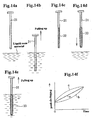
- a mandrel 31 is impregnated into a liquid resin material slowly not to entrap air bubbles, is then pulled up in the vertical direction, and is subjected to hardening treatment such as drying or ultraviolet irradiation, if necessary, so as to form an inner polymer film 32 as shown in Fig. 14c .
- the drying is suitable as the hardening treatment.
- the ultraviolet irradiation or heat hardening is suitable as the hardening treatment.
- the distribution of thickness of the inner polymer film 32 is made uniformly in the longitudinal direction of the mandrel 31 by gradually lowering the pulling-up speed of pulling up the mandrel.
- the pulling-up speed may be lowered in a linear fashion as indicated by a solid line "a” in Fig. 14f and may be lowered with decelerating speed as indicated by a double-dashed line "b".
- the pulling-up speed may be lowered such that degree of the decelerating speed may be gradually reduced as shown by dashed line C.
- the deceleration is preferably continuously conducted. This does not mean exclusion of stepwise deceleration.
- a stent matrix 33 is attached to the mandrel 31 having the inner polymer layer thus formed such that the stent matrix 33 is overlaid onto the mandrel 31.
- the stent matrix 33 is impregnated into the liquid resin material slowly and is pulled up in the vertical direction so as to form an outer polymer film. The pulling-up speed of this time is also controlled to have a pattern being gradually lowered in the same manner as the case of the inner polymer film 32.
- the mandrel 31 is pulled out, thereby producing a stent. Since the inner polymer film and the outer polymer film of the stent thus produced generally protrude from the both ends of the stent matrix 33, the excess protruding portions of the polymer films are cut off.
- the liquid resin material for forming the polymer films may be polymer solution or solution of a monomer.
- the polymer solution is preferable because polymerization is not required so that the formation of film is easy.
- a therapeutic drug may be contained into the biodegradable polymer solution.
- a coating layer of the biodegradable polymer containing the therapeutic drug can be formed.
- the time and the period when the therapeutic drug is discharged into the body can be controlled.
- fine pores are formed to penetrate the inner polymer film 32 and the outer polymer film before or after pulling out the mandrel 31.
- the fine pores are formed by laser machining.
- the mandrel for pulling out the mandrel from the stent thus obtained, the mandrel is impregnated into an organic solvent which allows the polymer film to slightly swell preferably at a cubical expansion of 10% or less, in the same manner as described in the first invention, thereby easily pulling out the mandrel from the stent.
- the kind of the organic solvent and the impregnating time depend on the material of the polymer film.
- the mandrel is preferably impregnated into lower alcohol, preferably methanol or ethanol, particularly into methanol preferably for 1-30 hours, particularly for 5-20 hours. This facilitates the drawing of the mandrel.
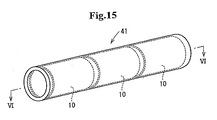
- a single stent matrix 33 is overlaid onto the mandrel 31 as shown in Fig. 14d in the aforementioned embodiment, two or more stent matrixes may be overlaid onto the mandrel with being slightly spaced apart from each other. In such a stent, a portion between the stent matrixes can be flexibly bent.
- a mesh stent matrix 10 having a diameter of 4 mm, a length of 20 mm, and a thickness of 0.2 mm shown in Fig. 2 was employed.
- Fig. 3 is a perspective view of the metallic stent matrix 10' after being expanded.
- the metallic stent matrix 10' in this state has a diameter of 8 mm, a length of 20 mm, and a thickness of 0.2 mm.
- a stent was produced by coating the inner periphery and the outer periphery of the metallic stent matrix 10 with segmented polyurethane polymer films. As described concretely, a mandrel having a diameter of 3.8 mm and made of stainless steel was impregnated into a polyurethane solution, was then pulled up, and was dried so as to form a cylindrical coating of the polyurethane having 30 ⁇ m. The metallic stent matrix which was slightly expanded was overlaid on the coating with significant pressure.
- the mandrel with the stent matrix was impregnated into the polyurethane solution, was then pulled up, and was dried so as to form a coating having a thickness of 50 ⁇ m so that the inner and outer peripheries of the stent matrix were coated. After laser machining, the portions of the films protruding from the both ends were cut out. The mandrel with the stent was impregnated into methanol for 12 hours and the stent was pulled out from the mandrel.
- the polyurethane solution was prepared by dissolving 10% by weight of segmented polyurethane, a trade name Capdiomat, (available from Kontoron Cardiovascular Inc.) into a mixed solution of tetrahydrofuran and dioxane.
- the speed of pulling up the mandrel was lowered in a linear fashion such that the initial speed was 10 mm/minute and the last speed was 5 mm/minute.
- Sections cut in the radial direction by high stainless steel were taken by a microscope.
- the thickness of the film at a section corresponding to an upper end of the mandrel during impregnation was 78.6 ⁇ m ⁇ 4.3 ⁇ m and the thickness at a section corresponding to a lower end of the mandrel was 80.1 ⁇ m ⁇ 2.4 ⁇ m. From this result, it was found that the film thus formed had a substantially uniform thickness.
- the films were perforated by excimer laser to have pores having a diameter of 100 ⁇ m such that the pores were substantially equally arranged at intervals of 200 ⁇ m. Pores aligned along 24 lines in total were formed by repeating a process of turning the cylindrical polymer film at 15° in the circumferential direction after forming pores in a line in the longitudinal direction.
- a stent was produced in the same manner as Example 4 except that the speed of pulling up the mandrel was constant at 10 mm/minute.
- the thickness of the film at radial sections in the same manner as Example 4, the thickness of the film at a section corresponding to an upper end of the mandrel during impregnation was 77.1 ⁇ m ⁇ 3.1 ⁇ m and the thickness of the film at a section corresponding to a lower end of the mandrel was 89.3 ⁇ m ⁇ 4.2 ⁇ m. From this result, it was found that thickness of the film thus formed was different in the vertical positional relationship. From this, it was noted that the thickness of the polymer film according to the present invention is uniform.
- the metallic stent provided with polymer film covering of the third invention can prevent adverse effects to human tissues such as thrombus due to metal.
- the polymer films are attached to the inner periphery and the outer periphery of the stent matrix, excellent biocompatibility can be given to the stent.
- the present invention can achieve homogenization of thickness of the polymer film.
Landscapes
- Health & Medical Sciences (AREA)
- Engineering & Computer Science (AREA)
- Mechanical Engineering (AREA)
- Life Sciences & Earth Sciences (AREA)
- Vascular Medicine (AREA)
- Animal Behavior & Ethology (AREA)
- Veterinary Medicine (AREA)
- Public Health (AREA)
- Heart & Thoracic Surgery (AREA)
- Biomedical Technology (AREA)
- General Health & Medical Sciences (AREA)
- Surgery (AREA)
- Epidemiology (AREA)
- Chemical & Material Sciences (AREA)
- Molecular Biology (AREA)
- Medicinal Chemistry (AREA)
- Cardiology (AREA)
- Oral & Maxillofacial Surgery (AREA)
- Transplantation (AREA)
- Media Introduction/Drainage Providing Device (AREA)
- Prostheses (AREA)
- Materials For Medical Uses (AREA)
Claims (10)
- Verfahren zur Herstellung eines Stents (20), der eine röhrenförmige Stentmatrix (33), deren Durchmesser ausdehnbar ist, und flexible Polymerfilme (12), (19), (32) aufweist, die sowohl an der Innenperipherie als auch der Außenperipherie der Stentmatrix (33) befestigt sind und eine Mehrzahl feiner Poren aufweisen, die darin gebildet sind, wobei das Verfahren Folgendes umfasst:einen Schritt des Bildens des Polymerfilms (12), (19), (32) durch Imprägnieren eines Dorns (31) in einem flüssigen Harzmaterial zum Bilden des Polymerfilms (12), (19), (32) und Hochziehen des Dorns (31); undeinen Schritt des Ausgleichens der Dicke des Polymerfilms (12), (19), (32) durch Hochziehen des Dorns (31) in senkrechter Richtung und Regulieren der Hochziehgeschwindigkeit;dadurch gekennzeichnet, dassdie Hochziehgeschwindigkeit des Dorns (31) allmählich reduziert wird; undwobeidie feinen Poren durch maschinelle Laserbearbeitung gebildet werden, nachdem der Polymerfilm (12), (19), (32) gebildet worden ist.
- Verfahren zur Herstellung eines Stents (20) nach Anspruch 1, wobei der Polymerfilm (12), (19), (32) ausschließlich aus einem Grundharzmaterial hergestellt ist.
- Verfahren zur Herstellung eines Stents (20) nach Anspruch 1, wobei der Polymerfilm (12), (19), (32) eine Grundschicht umfasst, die aus einem Grundharzmaterial und einer Schicht von biologisch abbaubarem Polymer gebildet ist, die die Oberfläche der Grundschicht bedeckt.
- Verfahren zur Herstellung eines Stents (20) nach Anspruch 2 oder 3, wobei das flüssige Grundharzmaterial eine Lösung von segmentiertem Polyurethanpolymer ist.
- Verfahren zur Herstellung eines Stents (20) nach Anspruch 1, wobei die feinen Poren voneinander in Abständen von 51 bis 10000 µm beanstandet sind und jede Pore einen Durchmesser von 5 bis 500 µm aufweist.
- Verfahren zur Herstellung eines Stents (20) nach einem der Ansprüche 1 bis 5, wobei die Dicke der Polymerfilme (12), (19), (32) 10 bis 100 µm beträgt.
- Verfahren zur Herstellung eines Stents (20) nach einem der Ansprüche 1 bis 6, wobei die Stentmatrix (33) ein metallisches Maschenteil (10) ist.
- Verfahren zur Herstellung eines Stents 20 nach einem der Ansprüche 3 bis 7, wobei das biologisch abbaubare Polymer ein Arzneimittel enthält.
- Verfahren zur Herstellung eines Stents (20) nach Anspruch 8, wobei das Arzneimittel aus einer Gruppe ausgewählt ist bestehend aus Heparin, niedermolekularem Heparin, Hirudin, Argatroban, Formacolin, Vapiprost, Prostamolin, Prostaklinin-Homologon, Dextran, D-Phe-Pro-Arg-Chlormethylketon, Dipyridamol, Plättcherezeptoragonist von Glycoprotein, rekombinantem Hirudin, Thrombininhibitor, vaskulärem Heptyn, Antiotensin umwandelndem Enzyminhibitor, Steroid, Fibrozyten-Wachstumsfaktoragonist, Fischöl, Omega 3-Fettsäure, Histaminantagonist, HMG-CoA-Reduktaseinhibitor, Seramin, Serotoninblocker, Thioproteaseinhibitor, Triazolpyrimidin, Interferon, vaskulärem Endothelwachstumsfaktor (VEGF), Rapamycin, FK506, Mevalotin und Fluvastatin.
- Stent (20), der durch ein Verfahren nach einem der Ansprüche 1 bis 9 hergestellt wird.
Applications Claiming Priority (17)
| Application Number | Priority Date | Filing Date | Title |
|---|---|---|---|
| JP2002243871 | 2002-08-23 | ||
| JP2002243871 | 2002-08-23 | ||
| JP2003109169 | 2003-04-14 | ||
| JP2003109167 | 2003-04-14 | ||
| JP2003109168 | 2003-04-14 | ||
| JP2003109168A JP4325259B2 (ja) | 2003-04-14 | 2003-04-14 | ステントの製造方法 |
| JP2003109167A JP2004313320A (ja) | 2003-04-14 | 2003-04-14 | ステントの製造方法 |
| JP2003109169A JP4395553B2 (ja) | 2003-04-14 | 2003-04-14 | ステントの製造方法 |
| JP2003169510A JP2005000518A (ja) | 2003-06-13 | 2003-06-13 | ステントの製造方法及びステント |
| JP2003169510 | 2003-06-13 | ||
| JP2003201201 | 2003-07-24 | ||
| JP2003201201A JP2005040219A (ja) | 2003-07-24 | 2003-07-24 | ステント |
| JP2003201836 | 2003-07-25 | ||
| JP2003201836A JP5463513B2 (ja) | 2002-08-23 | 2003-07-25 | ステント |
| JP2003286901A JP2005052419A (ja) | 2003-08-05 | 2003-08-05 | ステント |
| JP2003286901 | 2003-08-05 | ||
| PCT/JP2003/010496 WO2004022150A1 (ja) | 2002-08-23 | 2003-08-20 | ステント及びその製造方法 |
Publications (3)
| Publication Number | Publication Date |
|---|---|
| EP1550477A1 EP1550477A1 (de) | 2005-07-06 |
| EP1550477A4 EP1550477A4 (de) | 2010-11-17 |
| EP1550477B1 true EP1550477B1 (de) | 2015-11-04 |
Family
ID=31982815
Family Applications (1)
| Application Number | Title | Priority Date | Filing Date |
|---|---|---|---|
| EP03794087.1A Expired - Lifetime EP1550477B1 (de) | 2002-08-23 | 2003-08-20 | Stent und verfahren zu seiner herstellung |
Country Status (6)
| Country | Link |
|---|---|
| US (1) | US8591782B2 (de) |
| EP (1) | EP1550477B1 (de) |
| CN (1) | CN1678366B (de) |
| AU (1) | AU2003257604A1 (de) |
| TW (1) | TW200404526A (de) |
| WO (1) | WO2004022150A1 (de) |
Cited By (1)
| Publication number | Priority date | Publication date | Assignee | Title |
|---|---|---|---|---|
| US9585668B2 (en) | 2004-03-31 | 2017-03-07 | Merlin Md Pte Ltd | Medical device |
Families Citing this family (176)
| Publication number | Priority date | Publication date | Assignee | Title |
|---|---|---|---|---|
| US6955661B1 (en) * | 1999-01-25 | 2005-10-18 | Atrium Medical Corporation | Expandable fluoropolymer device for delivery of therapeutic agents and method of making |
| US20060177416A1 (en) | 2003-10-14 | 2006-08-10 | Medivas, Llc | Polymer particle delivery compositions and methods of use |
| AU2002345328A1 (en) | 2001-06-27 | 2003-03-03 | Remon Medical Technologies Ltd. | Method and device for electrochemical formation of therapeutic species in vivo |
| WO2004026178A2 (en) * | 2002-09-19 | 2004-04-01 | Exstent Limited | External stent |
| US8246673B2 (en) * | 2002-09-19 | 2012-08-21 | Exstent Limited | External support for a blood vessel |
| US7637942B2 (en) | 2002-11-05 | 2009-12-29 | Merit Medical Systems, Inc. | Coated stent with geometry determinated functionality and method of making the same |
| US7959671B2 (en) | 2002-11-05 | 2011-06-14 | Merit Medical Systems, Inc. | Differential covering and coating methods |
| US7344559B2 (en) * | 2003-08-25 | 2008-03-18 | Biophan Technologies, Inc. | Electromagnetic radiation transparent device and method of making thereof |
| US20050055085A1 (en) * | 2003-09-04 | 2005-03-10 | Rivron Nicolas C. | Implantable medical devices having recesses |
| US8021331B2 (en) * | 2003-09-15 | 2011-09-20 | Atrium Medical Corporation | Method of coating a folded medical device |
| EP1682210A4 (de) | 2003-11-07 | 2009-11-04 | Merlin Md Pte Ltd | Implantierbare medizinprodukte mit verbesserter sichtbarkeit, mechanischen eigenschaften und biokompatibilität |
| EP1689328A4 (de) * | 2003-11-20 | 2010-12-01 | Merit Medical Systems Inc | Differentialabdeckung und beschichtungsverfharen |
| US20050119723A1 (en) * | 2003-11-28 | 2005-06-02 | Medlogics Device Corporation | Medical device with porous surface containing bioerodable bioactive composites and related methods |
| US7632299B2 (en) * | 2004-01-22 | 2009-12-15 | Boston Scientific Scimed, Inc. | Medical devices |
| US8715340B2 (en) | 2004-03-31 | 2014-05-06 | Merlin Md Pte Ltd. | Endovascular device with membrane |
| US8034096B2 (en) * | 2004-03-31 | 2011-10-11 | Cook Medical Technologies Llc | Stent-graft with graft to graft attachment |
| US8500751B2 (en) | 2004-03-31 | 2013-08-06 | Merlin Md Pte Ltd | Medical device |
| US7601382B2 (en) * | 2004-08-05 | 2009-10-13 | Boston Scientific Scimed, Inc. | Method of making a coated medical device |
| US8312836B2 (en) * | 2004-09-28 | 2012-11-20 | Atrium Medical Corporation | Method and apparatus for application of a fresh coating on a medical device |
| US9801982B2 (en) * | 2004-09-28 | 2017-10-31 | Atrium Medical Corporation | Implantable barrier device |
| US8367099B2 (en) | 2004-09-28 | 2013-02-05 | Atrium Medical Corporation | Perforated fatty acid films |
| US9801913B2 (en) * | 2004-09-28 | 2017-10-31 | Atrium Medical Corporation | Barrier layer |
| US9012506B2 (en) | 2004-09-28 | 2015-04-21 | Atrium Medical Corporation | Cross-linked fatty acid-based biomaterials |
| US9000040B2 (en) | 2004-09-28 | 2015-04-07 | Atrium Medical Corporation | Cross-linked fatty acid-based biomaterials |
| US20090011116A1 (en) * | 2004-09-28 | 2009-01-08 | Atrium Medical Corporation | Reducing template with coating receptacle containing a medical device to be coated |
| US20060083768A1 (en) * | 2004-09-28 | 2006-04-20 | Atrium Medical Corporation | Method of thickening a coating using a drug |
| WO2006036982A2 (en) | 2004-09-28 | 2006-04-06 | Atrium Medical Corporation | Drug delivery coating for use with a stent |
| US9592324B2 (en) * | 2006-11-06 | 2017-03-14 | Atrium Medical Corporation | Tissue separating device with reinforced support for anchoring mechanisms |
| JP2006130064A (ja) * | 2004-11-05 | 2006-05-25 | National Cardiovascular Center | ステントデリバリシステム |
| US20070100321A1 (en) * | 2004-12-22 | 2007-05-03 | Leon Rudakov | Medical device |
| CN101170965A (zh) * | 2005-03-09 | 2008-04-30 | 田纳西大学研究基金会 | 屏障支架及其用途 |
| EP1885288B1 (de) | 2005-05-13 | 2015-03-18 | Merit Medical Systems, Inc. | Drainage-stent und entsprechendes verfahren |
| US20060276875A1 (en) * | 2005-05-27 | 2006-12-07 | Stinson Jonathan S | Medical devices |
| US7622070B2 (en) * | 2005-06-20 | 2009-11-24 | Advanced Cardiovascular Systems, Inc. | Method of manufacturing an implantable polymeric medical device |
| JP4735111B2 (ja) * | 2005-08-03 | 2011-07-27 | 独立行政法人国立循環器病研究センター | 人工弁を有するステント |
| US20070055352A1 (en) * | 2005-09-07 | 2007-03-08 | Wendy Naimark | Stent with pockets for containing a therapeutic agent |
| CA2623198C (en) | 2005-09-22 | 2014-08-05 | Medivas, Llc | Bis-(a-amino)-diol-diester-containing poly(ester amide) and poly(ester urethane) compositions and methods of use |
| WO2007038246A2 (en) * | 2005-09-22 | 2007-04-05 | Medivas, Llc | Solid polymer delivery compositions and methods for use thereof |
| US9427423B2 (en) * | 2009-03-10 | 2016-08-30 | Atrium Medical Corporation | Fatty-acid based particles |
| US9278161B2 (en) | 2005-09-28 | 2016-03-08 | Atrium Medical Corporation | Tissue-separating fatty acid adhesion barrier |
| EP1933991A4 (de) * | 2005-10-15 | 2012-05-02 | Atrium Medical Corp | Hydrophobe vernetzte gele für bioabsorbierbare arzneimittelträgerüberzüge |
| EP1962894A4 (de) * | 2005-12-07 | 2012-11-14 | Medivas Llc | Verfahren zum zusammensetzen einer polymer-zusammensetzung zur abgabe eines biologischen mittels |
| US8840660B2 (en) | 2006-01-05 | 2014-09-23 | Boston Scientific Scimed, Inc. | Bioerodible endoprostheses and methods of making the same |
| US8089029B2 (en) | 2006-02-01 | 2012-01-03 | Boston Scientific Scimed, Inc. | Bioabsorbable metal medical device and method of manufacture |
| CA2642250A1 (en) * | 2006-02-13 | 2007-08-23 | Merlin Md Pte Ltd | Endovascular device with membrane |
| US8048150B2 (en) | 2006-04-12 | 2011-11-01 | Boston Scientific Scimed, Inc. | Endoprosthesis having a fiber meshwork disposed thereon |
| JP5445130B2 (ja) * | 2006-05-02 | 2014-03-19 | メディバス エルエルシー | 眼の外部または内部への眼科用薬剤の送達法 |
| EP2021141A4 (de) * | 2006-05-09 | 2013-07-03 | Medivas Llc | Biologisch abbaubare wasserlösliche polymere |
| CA2659761A1 (en) | 2006-08-02 | 2008-02-07 | Boston Scientific Scimed, Inc. | Endoprosthesis with three-dimensional disintegration control |
| US8052744B2 (en) | 2006-09-15 | 2011-11-08 | Boston Scientific Scimed, Inc. | Medical devices and methods of making the same |
| ATE517590T1 (de) | 2006-09-15 | 2011-08-15 | Boston Scient Ltd | Biologisch erodierbare endoprothesen |
| JP2010503491A (ja) | 2006-09-15 | 2010-02-04 | ボストン サイエンティフィック リミテッド | 生物学的安定性無機層を有する生浸食性エンドプロスシーシス |
| WO2008034031A2 (en) | 2006-09-15 | 2008-03-20 | Boston Scientific Limited | Bioerodible endoprostheses and methods of making the same |
| WO2008036548A2 (en) | 2006-09-18 | 2008-03-27 | Boston Scientific Limited | Endoprostheses |
| US20080097401A1 (en) * | 2006-09-22 | 2008-04-24 | Trapp Benjamin M | Cerebral vasculature device |
| KR100826664B1 (ko) * | 2006-11-01 | 2008-05-02 | 주식회사 엠아이텍 | 스텐트 및 이 스텐트의 제조방법 |
| WO2008058036A1 (en) * | 2006-11-03 | 2008-05-15 | R & D Green Materials, Llc | Process for preparing biodegradable articles |
| US9492596B2 (en) * | 2006-11-06 | 2016-11-15 | Atrium Medical Corporation | Barrier layer with underlying medical device and one or more reinforcing support structures |
| US9622888B2 (en) | 2006-11-16 | 2017-04-18 | W. L. Gore & Associates, Inc. | Stent having flexibly connected adjacent stent elements |
| US8871242B2 (en) | 2006-11-17 | 2014-10-28 | National Cerebral And Cardiovascular Center | Blood anticoagulant material, coating material and indwelling device comprising the same, and treatment using blood anticoagulant material |
| DE602007007660D1 (de) * | 2006-12-07 | 2010-08-19 | Mallinckrodt Inc | Medizinische vorrichtungen für die lokalisierte arzneimittelabgabe |
| US8768486B2 (en) | 2006-12-11 | 2014-07-01 | Medtronic, Inc. | Medical leads with frequency independent magnetic resonance imaging protection |
| ATE488259T1 (de) | 2006-12-28 | 2010-12-15 | Boston Scient Ltd | Bioerodierbare endoprothesen und herstellungsverfahren dafür |
| US7938286B2 (en) * | 2007-02-13 | 2011-05-10 | Gateway Plastics, Inc. | Container system |
| CA2685965A1 (en) | 2007-03-30 | 2008-10-09 | Medivas, Llc | Bioabsorbable elastomeric polymer networks, cross-linkers and methods of use |
| US8133553B2 (en) * | 2007-06-18 | 2012-03-13 | Zimmer, Inc. | Process for forming a ceramic layer |
| US8309521B2 (en) | 2007-06-19 | 2012-11-13 | Zimmer, Inc. | Spacer with a coating thereon for use with an implant device |
| JP2010533548A (ja) * | 2007-07-17 | 2010-10-28 | メディバス エルエルシー | 生体吸収性エラストマー動脈支持装置および使用方法 |
| US20090029937A1 (en) * | 2007-07-24 | 2009-01-29 | Cornell University | Biodegradable cationic polymer gene transfer compositions and methods of use |
| CN101940802B (zh) * | 2007-09-04 | 2015-02-04 | 株式会社日本斯滕特技术 | 药物缓释性支架 |
| US8052745B2 (en) | 2007-09-13 | 2011-11-08 | Boston Scientific Scimed, Inc. | Endoprosthesis |
| US8608049B2 (en) * | 2007-10-10 | 2013-12-17 | Zimmer, Inc. | Method for bonding a tantalum structure to a cobalt-alloy substrate |
| US20110230973A1 (en) * | 2007-10-10 | 2011-09-22 | Zimmer, Inc. | Method for bonding a tantalum structure to a cobalt-alloy substrate |
| US20110027379A1 (en) * | 2007-12-06 | 2011-02-03 | Cornell University | Oligo-Ethylene Glycol-Based Polymer Compositions and Methods of Use |
| US8926688B2 (en) * | 2008-01-11 | 2015-01-06 | W. L. Gore & Assoc. Inc. | Stent having adjacent elements connected by flexible webs |
| US20090187256A1 (en) * | 2008-01-21 | 2009-07-23 | Zimmer, Inc. | Method for forming an integral porous region in a cast implant |
| US20090198286A1 (en) * | 2008-02-05 | 2009-08-06 | Zimmer, Inc. | Bone fracture fixation system |
| US7998192B2 (en) * | 2008-05-09 | 2011-08-16 | Boston Scientific Scimed, Inc. | Endoprostheses |
| US8236046B2 (en) | 2008-06-10 | 2012-08-07 | Boston Scientific Scimed, Inc. | Bioerodible endoprosthesis |
| US8206635B2 (en) | 2008-06-20 | 2012-06-26 | Amaranth Medical Pte. | Stent fabrication via tubular casting processes |
| US20100042202A1 (en) * | 2008-08-13 | 2010-02-18 | Kamal Ramzipoor | Composite stent having multi-axial flexibility |
| US10898620B2 (en) | 2008-06-20 | 2021-01-26 | Razmodics Llc | Composite stent having multi-axial flexibility and method of manufacture thereof |
| US7985252B2 (en) | 2008-07-30 | 2011-07-26 | Boston Scientific Scimed, Inc. | Bioerodible endoprosthesis |
| EP2323671A4 (de) * | 2008-08-13 | 2012-09-26 | Medivas Llc | Biologisch abbaubare aabb-poly(depsipeptid-)polymere sowie verfahren zu ihrer verwendung |
| US8262692B2 (en) * | 2008-09-05 | 2012-09-11 | Merlin Md Pte Ltd | Endovascular device |
| US8382824B2 (en) | 2008-10-03 | 2013-02-26 | Boston Scientific Scimed, Inc. | Medical implant having NANO-crystal grains with barrier layers of metal nitrides or fluorides |
| WO2010101901A2 (en) | 2009-03-02 | 2010-09-10 | Boston Scientific Scimed, Inc. | Self-buffering medical implants |
| JP5597625B2 (ja) | 2009-03-02 | 2014-10-01 | 株式会社日本ステントテクノロジー | 薬剤溶出性ステント |
| US20100303882A1 (en) * | 2009-05-26 | 2010-12-02 | Mallinckrodt Inc. | Medical Devices for Localized Drug Delivery |
| US20110038910A1 (en) | 2009-08-11 | 2011-02-17 | Atrium Medical Corporation | Anti-infective antimicrobial-containing biomaterials |
| MX2011010391A (es) | 2009-08-25 | 2012-01-20 | Prostec Co Ltd | Suministros medicos y metodo para producir los mismos. |
| CN102038564A (zh) * | 2009-10-14 | 2011-05-04 | 周星 | 可取出支撑架 |
| JP2011156083A (ja) * | 2010-01-29 | 2011-08-18 | Nippon Zeon Co Ltd | 消化器系ステント |
| WO2011119573A1 (en) | 2010-03-23 | 2011-09-29 | Boston Scientific Scimed, Inc. | Surface treated bioerodible metal endoprostheses |
| WO2011137270A1 (en) * | 2010-04-29 | 2011-11-03 | The Government Of The United States Of America, As Represented By The Secretary Of The Navy | Cell and biofactor printable biopapers |
| US20110270405A1 (en) * | 2010-04-30 | 2011-11-03 | Boston Scientific Scimed, Inc. | Duodenal Metabolic Stent |
| US10322213B2 (en) | 2010-07-16 | 2019-06-18 | Atrium Medical Corporation | Compositions and methods for altering the rate of hydrolysis of cured oil-based materials |
| US10166128B2 (en) | 2011-01-14 | 2019-01-01 | W. L. Gore & Associates. Inc. | Lattice |
| US9839540B2 (en) | 2011-01-14 | 2017-12-12 | W. L. Gore & Associates, Inc. | Stent |
| US9744033B2 (en) | 2011-04-01 | 2017-08-29 | W.L. Gore & Associates, Inc. | Elastomeric leaflet for prosthetic heart valves |
| US9872788B2 (en) | 2011-05-05 | 2018-01-23 | Relief Therapies, Inc. | Device for protecting hemorrhoids |
| ES2558357T3 (es) | 2011-06-23 | 2016-02-03 | Dsm Ip Assets B.V. | Micro- o nanopartículas que comprenden un copolímero de poliesteramida biodegradable para uso en el suministro de agentes bioactivos |
| TW201311774A (zh) * | 2011-06-23 | 2013-03-16 | Toray Industries | 具有抗血液凝固作用的疏水性高分子化合物 |
| US9873765B2 (en) | 2011-06-23 | 2018-01-23 | Dsm Ip Assets, B.V. | Biodegradable polyesteramide copolymers for drug delivery |
| US9554806B2 (en) | 2011-09-16 | 2017-01-31 | W. L. Gore & Associates, Inc. | Occlusive devices |
| US20130289690A1 (en) | 2011-11-01 | 2013-10-31 | Hira V. Thapliyal | Personalized prosthesis and methods of use |
| US9510935B2 (en) | 2012-01-16 | 2016-12-06 | W. L. Gore & Associates, Inc. | Articles including expanded polytetrafluoroethylene membranes with serpentine fibrils and having a discontinuous fluoropolymer layer thereon |
| ES2943709T3 (es) | 2012-04-06 | 2023-06-15 | Merlin Md Pte Ltd | Dispositivos para tratar un aneurisma |
| CN102631715A (zh) * | 2012-05-04 | 2012-08-15 | 江南大学 | 一种抗凝血纳米纤维膜的制备方法 |
| US9867880B2 (en) | 2012-06-13 | 2018-01-16 | Atrium Medical Corporation | Cured oil-hydrogel biomaterial compositions for controlled drug delivery |
| US9283072B2 (en) | 2012-07-25 | 2016-03-15 | W. L. Gore & Associates, Inc. | Everting transcatheter valve and methods |
| US10376360B2 (en) | 2012-07-27 | 2019-08-13 | W. L. Gore & Associates, Inc. | Multi-frame prosthetic valve apparatus and methods |
| US9931193B2 (en) | 2012-11-13 | 2018-04-03 | W. L. Gore & Associates, Inc. | Elastic stent graft |
| US10966820B2 (en) | 2012-12-19 | 2021-04-06 | W. L. Gore & Associates, Inc. | Geometric control of bending character in prosthetic heart valve leaflets |
| US9144492B2 (en) | 2012-12-19 | 2015-09-29 | W. L. Gore & Associates, Inc. | Truncated leaflet for prosthetic heart valves, preformed valve |
| US9968443B2 (en) | 2012-12-19 | 2018-05-15 | W. L. Gore & Associates, Inc. | Vertical coaptation zone in a planar portion of prosthetic heart valve leaflet |
| US9101469B2 (en) | 2012-12-19 | 2015-08-11 | W. L. Gore & Associates, Inc. | Prosthetic heart valve with leaflet shelving |
| US10279084B2 (en) | 2012-12-19 | 2019-05-07 | W. L. Gore & Associates, Inc. | Medical balloon devices and methods |
| US10321986B2 (en) | 2012-12-19 | 2019-06-18 | W. L. Gore & Associates, Inc. | Multi-frame prosthetic heart valve |
| US9737398B2 (en) | 2012-12-19 | 2017-08-22 | W. L. Gore & Associates, Inc. | Prosthetic valves, frames and leaflets and methods thereof |
| CN103057023B (zh) * | 2013-01-21 | 2015-03-04 | 中国科学技术大学 | 一种用于离心铸造硅胶管的改进方法 |
| US9320592B2 (en) * | 2013-03-15 | 2016-04-26 | Covidien Lp | Coated medical devices and methods of making and using same |
| US9545301B2 (en) | 2013-03-15 | 2017-01-17 | Covidien Lp | Coated medical devices and methods of making and using same |
| US11911258B2 (en) | 2013-06-26 | 2024-02-27 | W. L. Gore & Associates, Inc. | Space filling devices |
| JP2016524951A (ja) * | 2013-06-27 | 2016-08-22 | ボストン サイエンティフィック サイムド,インコーポレイテッドBoston Scientific Scimed,Inc. | ステント及びその使用方法 |
| WO2015020676A1 (en) | 2013-08-08 | 2015-02-12 | Boston Scientific Scimed, Inc. | Dissolvable or degradable adhesive polymer to prevent stent migration |
| US9668890B2 (en) | 2013-11-22 | 2017-06-06 | Covidien Lp | Anti-thrombogenic medical devices and methods |
| US10842918B2 (en) | 2013-12-05 | 2020-11-24 | W.L. Gore & Associates, Inc. | Length extensible implantable device and methods for making such devices |
| WO2015100238A1 (en) * | 2013-12-27 | 2015-07-02 | Neograft Technologies, Inc. | Artificial graft devices and related systems and methods |
| US20170128244A1 (en) * | 2014-06-12 | 2017-05-11 | National Cerebral And Cardiovascular Center | Stent |
| US9827094B2 (en) | 2014-09-15 | 2017-11-28 | W. L. Gore & Associates, Inc. | Prosthetic heart valve with retention elements |
| CN106999637A (zh) * | 2014-09-23 | 2017-08-01 | 波士顿科学国际有限公司 | 具有形状记忆聚合物过滤层的可植入医疗装置 |
| GB2529488B (en) * | 2014-09-30 | 2016-09-28 | Neoss Ltd | Reinforced membrane |
| US10299948B2 (en) | 2014-11-26 | 2019-05-28 | W. L. Gore & Associates, Inc. | Balloon expandable endoprosthesis |
| CA2969171C (en) | 2014-12-18 | 2023-12-12 | Dsm Ip Assets B.V. | Drug delivery system for delivery of acid sensitive drugs |
| EP3285687A4 (de) | 2015-04-22 | 2019-07-10 | AneuMed, Inc. | Personalisierte prothese und einsetzverfahren |
| WO2016183128A1 (en) * | 2015-05-11 | 2016-11-17 | Trivascular, Inc. | Stent-graft with improved flexibility |
| EP3294150B1 (de) | 2015-05-14 | 2021-12-15 | W. L. Gore & Associates, Inc. | Vorrichtungen zur okklusion eines vorhofohrs |
| RU171036U1 (ru) * | 2016-02-19 | 2017-05-17 | Общество с ограниченной ответственностью "ИнТехноБиоМед" (ООО "ИнТехноБиоМед") | Каркас стента из биодезинтегрируемого материала |
| JP6951832B2 (ja) * | 2016-03-25 | 2021-10-20 | 朝日インテック株式会社 | 医療用デバイス |
| EP3445282B1 (de) | 2016-04-21 | 2023-06-28 | W. L. Gore & Associates, Inc. | Diametral einstellbare endoprothesen |
| US10568752B2 (en) | 2016-05-25 | 2020-02-25 | W. L. Gore & Associates, Inc. | Controlled endoprosthesis balloon expansion |
| EP3476370B1 (de) * | 2016-06-23 | 2023-02-15 | M.I.Tech Co., Ltd. | Stent mit mehreren öffnungen für verdauungsorgane |
| US10869747B2 (en) | 2017-05-10 | 2020-12-22 | Cook Medical Technologies Llc | Side branch aortic repair graft with wire lumen |
| DE102017111964A1 (de) * | 2017-05-31 | 2018-12-06 | Jotec Gmbh | Stentgraft mit Taschen |
| US11246699B2 (en) | 2017-07-18 | 2022-02-15 | Cook Medical Technologies Llc | Flexible stent with non-bonded stent cover material regions |
| CN110198685A (zh) * | 2017-08-05 | 2019-09-03 | 想象科学私人有限公司 | 具有增大的药物递送区域的可植入装置 |
| CN107510519A (zh) * | 2017-09-05 | 2017-12-26 | 辽宁垠艺生物科技股份有限公司 | 带膜网状支架 |
| CN111182856B (zh) | 2017-09-12 | 2022-04-29 | W.L.戈尔及同仁股份有限公司 | 用于假体瓣膜的瓣叶框架附连件 |
| CA3072814C (en) | 2017-09-27 | 2023-01-03 | W.L. Gore & Associates, Inc. | Prosthetic valve with expandable frame and associated systems and methods |
| EP3687452B1 (de) | 2017-09-27 | 2026-07-15 | Edwards Lifesciences Corporation | Prothesenklappen mit mechanisch gekoppelten segeln |
| JP7136901B2 (ja) | 2017-10-09 | 2022-09-13 | ダブリュ.エル.ゴア アンド アソシエイツ,インコーポレイティド | 調和されたステントカバー |
| CA3078699C (en) | 2017-10-13 | 2023-10-10 | W.L. Gore & Associates, Inc. | Telescoping prosthetic valve and delivery system |
| US11173023B2 (en) | 2017-10-16 | 2021-11-16 | W. L. Gore & Associates, Inc. | Medical devices and anchors therefor |
| WO2019089135A1 (en) | 2017-10-31 | 2019-05-09 | W. L. Gore & Associates, Inc. | Transcatheter deployment systems and associated methods |
| EP3703616B1 (de) | 2017-10-31 | 2026-07-29 | Edwards Lifesciences Corporation | Medizinische herzklappe und segel zur förderung von gewebeeinwuchs |
| CN114831777A (zh) | 2017-10-31 | 2022-08-02 | W.L.戈尔及同仁股份有限公司 | 假体心脏瓣膜 |
| CN109498208B (zh) * | 2018-11-29 | 2021-03-05 | 广州健康元呼吸药物工程技术有限公司 | 一种覆膜载药气道支架及其制备方法 |
| CN111388155A (zh) * | 2018-12-28 | 2020-07-10 | 先健科技(深圳)有限公司 | 植入式支架系统 |
| US11497601B2 (en) | 2019-03-01 | 2022-11-15 | W. L. Gore & Associates, Inc. | Telescoping prosthetic valve with retention element |
| CN109875735B (zh) * | 2019-03-08 | 2023-11-21 | 王翔宇 | 一种完全可降解覆膜支架及覆膜支架系统 |
| JP7381601B2 (ja) | 2019-04-12 | 2023-11-15 | エドワーズ ライフサイエンシーズ コーポレイション | マルチパートフレーム及び関連するレジリエントブリッジ特徴部を備えた弁 |
| CN110575282A (zh) * | 2019-09-26 | 2019-12-17 | 杭州心桥医疗科技有限公司 | 覆膜支架用结构及覆膜支架 |
| EP4058504A1 (de) | 2019-11-12 | 2022-09-21 | DSM IP Assets B.V. | Polyesteramidcopolymere mit hohen glasübergangstemperaturen |
| JP7499339B2 (ja) * | 2020-01-13 | 2024-06-13 | ボストン サイエンティフィック サイムド,インコーポレイテッド | 移動防止ステント |
| CN111419470B (zh) * | 2020-03-17 | 2022-08-30 | 首都医科大学附属北京安贞医院 | 一种支架覆膜机 |
| EP4176839A4 (de) | 2020-07-06 | 2024-11-06 | Lifetech Scientific (Shenzhen) Co., Ltd. | Abgedeckter stent |
| CN113893062B (zh) * | 2020-07-06 | 2023-01-03 | 先健科技(深圳)有限公司 | 覆膜支架 |
| JP6789532B1 (ja) | 2020-07-17 | 2020-11-25 | バイオチューブ株式会社 | 血管内留置用ステント |
| CN122398501A (zh) * | 2020-09-30 | 2026-07-17 | 南微医学科技股份有限公司 | 一种硅酮支架的制造方法、硅酮支架及置入系统 |
| CN112826644A (zh) * | 2020-12-31 | 2021-05-25 | 中国人民解放军总医院第一医学中心 | 一种防血栓血管内支架 |
| CN115517833A (zh) * | 2022-06-24 | 2022-12-27 | 江苏朴芃医疗科技有限公司 | 血管覆膜支架及其制作方法及覆膜支架输送系统 |
| CN115281888A (zh) * | 2022-08-04 | 2022-11-04 | 江苏朴芃医疗科技有限公司 | 覆膜支架 |
| CN118809904A (zh) * | 2023-04-19 | 2024-10-22 | 上海微创医疗器械(集团)有限公司 | 覆膜网篮的成型方法、覆膜网篮及可折叠血泵 |
| CN120093492B (zh) * | 2023-12-04 | 2026-03-17 | 先健科技(深圳)有限公司 | 凹槽支架 |
| DE102024126581A1 (de) * | 2024-09-16 | 2026-03-19 | Universität Stuttgart, Körperschaft Des Öffentlichen Rechts | Verfahren zur Herstellung eines medizinischen Implantats und Vorrichtung zur Durchführung des Verfahrens |
Citations (1)
| Publication number | Priority date | Publication date | Assignee | Title |
|---|---|---|---|---|
| EP0815805A2 (de) * | 1996-06-26 | 1998-01-07 | Cordis Corporation | Endoprothesenanordnung zur perkutanen Entfaltung sowie Verfahren zu ihrer Entfaltung |
Family Cites Families (19)
| Publication number | Priority date | Publication date | Assignee | Title |
|---|---|---|---|---|
| JPS575048A (en) | 1980-06-13 | 1982-01-11 | Ricoh Co Ltd | Coating method by dipping |
| CA1322628C (en) | 1988-10-04 | 1993-10-05 | Richard A. Schatz | Expandable intraluminal graft |
| AU7998091A (en) * | 1990-05-17 | 1991-12-10 | Harbor Medical Devices, Inc. | Medical device polymer |
| JP3570434B2 (ja) * | 1993-05-10 | 2004-09-29 | 住友電気工業株式会社 | ステント及びその製造方法 |
| US5632772A (en) | 1993-10-21 | 1997-05-27 | Corvita Corporation | Expandable supportive branched endoluminal grafts |
| US5855598A (en) * | 1993-10-21 | 1999-01-05 | Corvita Corporation | Expandable supportive branched endoluminal grafts |
| US5723004A (en) * | 1993-10-21 | 1998-03-03 | Corvita Corporation | Expandable supportive endoluminal grafts |
| JP3585970B2 (ja) | 1994-11-24 | 2004-11-10 | テルモ株式会社 | 生体内留置用ステント |
| WO1996025897A2 (en) * | 1995-02-22 | 1996-08-29 | Menlo Care, Inc. | Covered expanding mesh stent |
| EP0808614B1 (de) | 1996-05-23 | 2003-02-26 | Samsung Electronics Co., Ltd. | Flexibler, selbstexpandierbarer Stent und Verfahren zu dessen Herstellung |
| WO1998038947A1 (en) * | 1997-03-05 | 1998-09-11 | Scimed Life Systems, Inc. | Conformal laminate stent device |
| JPH11299901A (ja) * | 1998-04-16 | 1999-11-02 | Johnson & Johnson Medical Kk | ステント及びその製造方法 |
| CA2335333C (en) | 1998-06-19 | 2009-05-05 | Endologix, Inc. | Self expanding bifurcated endovascular prosthesis |
| WO2000004999A1 (en) | 1998-07-21 | 2000-02-03 | Biocompatibles Limited | Coating |
| US6245099B1 (en) * | 1998-09-30 | 2001-06-12 | Impra, Inc. | Selective adherence of stent-graft coverings, mandrel and method of making stent-graft device |
| US6120525A (en) * | 1999-07-14 | 2000-09-19 | Westcott; Mitchell S. | Skin tensioning device |
| JP2001327609A (ja) * | 2000-05-19 | 2001-11-27 | Terumo Corp | 生体内留置用ステント |
| US6752829B2 (en) | 2001-01-30 | 2004-06-22 | Scimed Life Systems, Inc. | Stent with channel(s) for containing and delivering a biologically active material and method for manufacturing the same |
| JP2002355316A (ja) | 2001-03-30 | 2002-12-10 | Terumo Corp | ステントカバーおよびステント |
-
2003
- 2003-08-20 US US10/525,016 patent/US8591782B2/en not_active Expired - Fee Related
- 2003-08-20 AU AU2003257604A patent/AU2003257604A1/en not_active Abandoned
- 2003-08-20 WO PCT/JP2003/010496 patent/WO2004022150A1/ja not_active Ceased
- 2003-08-20 CN CN03820006.6A patent/CN1678366B/zh not_active Expired - Fee Related
- 2003-08-20 EP EP03794087.1A patent/EP1550477B1/de not_active Expired - Lifetime
- 2003-08-22 TW TW092123220A patent/TW200404526A/zh not_active IP Right Cessation
Patent Citations (1)
| Publication number | Priority date | Publication date | Assignee | Title |
|---|---|---|---|---|
| EP0815805A2 (de) * | 1996-06-26 | 1998-01-07 | Cordis Corporation | Endoprothesenanordnung zur perkutanen Entfaltung sowie Verfahren zu ihrer Entfaltung |
Cited By (1)
| Publication number | Priority date | Publication date | Assignee | Title |
|---|---|---|---|---|
| US9585668B2 (en) | 2004-03-31 | 2017-03-07 | Merlin Md Pte Ltd | Medical device |
Also Published As
| Publication number | Publication date |
|---|---|
| US8591782B2 (en) | 2013-11-26 |
| WO2004022150A1 (ja) | 2004-03-18 |
| CN1678366B (zh) | 2010-06-09 |
| TW200404526A (en) | 2004-04-01 |
| EP1550477A4 (de) | 2010-11-17 |
| TWI321048B (de) | 2010-03-01 |
| EP1550477A1 (de) | 2005-07-06 |
| AU2003257604A8 (en) | 2004-03-29 |
| CN1678366A (zh) | 2005-10-05 |
| US20060036311A1 (en) | 2006-02-16 |
| AU2003257604A1 (en) | 2004-03-29 |
Similar Documents
| Publication | Publication Date | Title |
|---|---|---|
| US8591782B2 (en) | Process for producing stent | |
| US5735897A (en) | Intravascular stent pump | |
| US10893960B2 (en) | Stent fabrication via tubular casting processes | |
| US6010530A (en) | Self-expanding endoluminal prosthesis | |
| US6423089B1 (en) | Vascular endoprosthesis and method | |
| JP2021000552A (ja) | 医療用デバイス | |
| US20050149163A1 (en) | Reduced restenosis drug containing stents | |
| JP2006500996A (ja) | 溶出性生体適合性移植可能医療器具を介してマイトマイシンを送達するための装置および方法 | |
| WO2000018446A1 (en) | Multi-layered sleeve for intravascular expandable device | |
| US20100070013A1 (en) | Medical Device With Microsphere Drug Delivery System | |
| JP2005538809A (ja) | 医療装置のための制御可能な薬剤放出勾配コーティング | |
| JP2010540204A (ja) | 内部薬物送達システムを備えた医療用インプラント | |
| JP5463513B2 (ja) | ステント | |
| JP2021515690A (ja) | 生体吸収性の逸流足場 | |
| JP2005052419A (ja) | ステント | |
| JP5217026B2 (ja) | ステント及びその製造方法 | |
| JP2005312584A (ja) | ステント及びその製造方法並びに該ステントを用いるドラッグデリバリー方法 | |
| JP5445649B2 (ja) | ステント | |
| JP2005040219A (ja) | ステント | |
| JP2006130064A (ja) | ステントデリバリシステム | |
| JP4395553B2 (ja) | ステントの製造方法 | |
| JP2004313320A (ja) | ステントの製造方法 | |
| JP2006141555A (ja) | ステント及びその製造方法 | |
| JP4325259B2 (ja) | ステントの製造方法 | |
| US20050021133A1 (en) | Tubular stents sandwiched inside of a composite membrane and methods of making and using thereof |
Legal Events
| Date | Code | Title | Description |
|---|---|---|---|
| PUAI | Public reference made under article 153(3) epc to a published international application that has entered the european phase |
Free format text: ORIGINAL CODE: 0009012 |
|
| 17P | Request for examination filed |
Effective date: 20050322 |
|
| AK | Designated contracting states |
Kind code of ref document: A1 Designated state(s): AT BE BG CH CY CZ DE DK EE ES FI FR GB GR HU IE IT LI LU MC NL PT RO SE SI SK TR |
|
| AX | Request for extension of the european patent |
Extension state: AL LT LV MK |
|
| DAX | Request for extension of the european patent (deleted) | ||
| RBV | Designated contracting states (corrected) |
Designated state(s): DE FR GB |
|
| A4 | Supplementary search report drawn up and despatched |
Effective date: 20101020 |
|
| RIC1 | Information provided on ipc code assigned before grant |
Ipc: B29C 41/14 20060101ALI20101014BHEP Ipc: A61F 2/06 20060101ALI20101014BHEP Ipc: B29C 41/04 20060101ALI20101014BHEP Ipc: A61M 29/02 20060101AFI20040325BHEP Ipc: B29C 41/20 20060101ALI20101014BHEP Ipc: B29C 41/22 20060101ALI20101014BHEP |
|
| RAP1 | Party data changed (applicant data changed or rights of an application transferred) |
Owner name: BRIDGESTONE CORPORATION Owner name: NATIONAL CEREBRAL AND CARDIOVASCULAR CENTER |
|
| 17Q | First examination report despatched |
Effective date: 20110211 |
|
| RAP1 | Party data changed (applicant data changed or rights of an application transferred) |
Owner name: JAPAN STENT TECHNOLOGY CO., LTD. Owner name: NATIONAL CEREBRAL AND CARDIOVASCULAR CENTER |
|
| RIC1 | Information provided on ipc code assigned before grant |
Ipc: B29C 41/14 20060101ALI20120716BHEP Ipc: B29C 41/22 20060101ALI20120716BHEP Ipc: B29C 41/04 20060101ALI20120716BHEP Ipc: B29C 41/20 20060101ALI20120716BHEP Ipc: A61M 29/02 20060101AFI20120716BHEP Ipc: A61F 2/06 20060101ALI20120716BHEP |
|
| RAP1 | Party data changed (applicant data changed or rights of an application transferred) |
Owner name: NATIONAL CEREBRAL AND CARDIOVASCULAR CENTER |
|
| REG | Reference to a national code |
Ref country code: DE Ref legal event code: R079 Ref document number: 60348223 Country of ref document: DE Free format text: PREVIOUS MAIN CLASS: A61M0029020000 Ipc: A61F0002900000 |
|
| RIC1 | Information provided on ipc code assigned before grant |
Ipc: A61F 2/07 20130101ALI20150309BHEP Ipc: A61F 2/90 20130101AFI20150309BHEP |
|
| GRAP | Despatch of communication of intention to grant a patent |
Free format text: ORIGINAL CODE: EPIDOSNIGR1 |
|
| INTG | Intention to grant announced |
Effective date: 20150518 |
|
| GRAS | Grant fee paid |
Free format text: ORIGINAL CODE: EPIDOSNIGR3 |
|
| GRAA | (expected) grant |
Free format text: ORIGINAL CODE: 0009210 |
|
| AK | Designated contracting states |
Kind code of ref document: B1 Designated state(s): DE FR GB |
|
| REG | Reference to a national code |
Ref country code: GB Ref legal event code: FG4D |
|
| REG | Reference to a national code |
Ref country code: DE Ref legal event code: R096 Ref document number: 60348223 Country of ref document: DE |
|
| REG | Reference to a national code |
Ref country code: DE Ref legal event code: R097 Ref document number: 60348223 Country of ref document: DE |
|
| PLBE | No opposition filed within time limit |
Free format text: ORIGINAL CODE: 0009261 |
|
| STAA | Information on the status of an ep patent application or granted ep patent |
Free format text: STATUS: NO OPPOSITION FILED WITHIN TIME LIMIT |
|
| 26N | No opposition filed |
Effective date: 20160805 |
|
| REG | Reference to a national code |
Ref country code: DE Ref legal event code: R119 Ref document number: 60348223 Country of ref document: DE |
|
| GBPC | Gb: european patent ceased through non-payment of renewal fee |
Effective date: 20160820 |
|
| REG | Reference to a national code |
Ref country code: FR Ref legal event code: ST Effective date: 20170428 |
|
| PG25 | Lapsed in a contracting state [announced via postgrant information from national office to epo] |
Ref country code: GB Free format text: LAPSE BECAUSE OF NON-PAYMENT OF DUE FEES Effective date: 20160820 Ref country code: FR Free format text: LAPSE BECAUSE OF NON-PAYMENT OF DUE FEES Effective date: 20160831 Ref country code: DE Free format text: LAPSE BECAUSE OF NON-PAYMENT OF DUE FEES Effective date: 20170301 |