EP1535888A1 - Gerät und verfahren zur herstellung von reifem kompostartigem material - Google Patents
Gerät und verfahren zur herstellung von reifem kompostartigem material Download PDFInfo
- Publication number
- EP1535888A1 EP1535888A1 EP03794144A EP03794144A EP1535888A1 EP 1535888 A1 EP1535888 A1 EP 1535888A1 EP 03794144 A EP03794144 A EP 03794144A EP 03794144 A EP03794144 A EP 03794144A EP 1535888 A1 EP1535888 A1 EP 1535888A1
- Authority
- EP
- European Patent Office
- Prior art keywords
- matured compost
- heating
- organic waste
- temperature
- vessel
- Prior art date
- Legal status (The legal status is an assumption and is not a legal conclusion. Google has not performed a legal analysis and makes no representation as to the accuracy of the status listed.)
- Pending
Links
Images

Classifications
-
- C—CHEMISTRY; METALLURGY
- C05—FERTILISERS; MANUFACTURE THEREOF
- C05F—ORGANIC FERTILISERS NOT COVERED BY SUBCLASSES C05B, C05C, e.g. FERTILISERS FROM WASTE OR REFUSE
- C05F17/00—Preparation of fertilisers characterised by biological or biochemical treatment steps, e.g. composting or fermentation
- C05F17/90—Apparatus therefor
- C05F17/95—Devices in which the material is conveyed essentially vertically between inlet and discharge means
- C05F17/955—Devices in which the material is conveyed essentially vertically between inlet and discharge means the material going from platform to platform
-
- F—MECHANICAL ENGINEERING; LIGHTING; HEATING; WEAPONS; BLASTING
- F26—DRYING
- F26B—DRYING SOLID MATERIALS OR OBJECTS BY REMOVING LIQUID THEREFROM
- F26B17/00—Machines or apparatus for drying materials in loose, plastic, or fluidised form, e.g. granules, staple fibres, with progressive movement
- F26B17/001—Machines or apparatus for drying materials in loose, plastic, or fluidised form, e.g. granules, staple fibres, with progressive movement the material moving down superimposed floors
- F26B17/003—Machines or apparatus for drying materials in loose, plastic, or fluidised form, e.g. granules, staple fibres, with progressive movement the material moving down superimposed floors with fixed floors provided with scrapers
-
- F—MECHANICAL ENGINEERING; LIGHTING; HEATING; WEAPONS; BLASTING
- F26—DRYING
- F26B—DRYING SOLID MATERIALS OR OBJECTS BY REMOVING LIQUID THEREFROM
- F26B17/00—Machines or apparatus for drying materials in loose, plastic, or fluidised form, e.g. granules, staple fibres, with progressive movement
- F26B17/18—Machines or apparatus for drying materials in loose, plastic, or fluidised form, e.g. granules, staple fibres, with progressive movement with movement performed by rotating helical blades or other rotary conveyors which may be heated moving materials in stationary chambers, e.g. troughs
- F26B17/20—Machines or apparatus for drying materials in loose, plastic, or fluidised form, e.g. granules, staple fibres, with progressive movement with movement performed by rotating helical blades or other rotary conveyors which may be heated moving materials in stationary chambers, e.g. troughs the axis of rotation being horizontal or slightly inclined
-
- F—MECHANICAL ENGINEERING; LIGHTING; HEATING; WEAPONS; BLASTING
- F26—DRYING
- F26B—DRYING SOLID MATERIALS OR OBJECTS BY REMOVING LIQUID THEREFROM
- F26B17/00—Machines or apparatus for drying materials in loose, plastic, or fluidised form, e.g. granules, staple fibres, with progressive movement
- F26B17/18—Machines or apparatus for drying materials in loose, plastic, or fluidised form, e.g. granules, staple fibres, with progressive movement with movement performed by rotating helical blades or other rotary conveyors which may be heated moving materials in stationary chambers, e.g. troughs
- F26B17/22—Machines or apparatus for drying materials in loose, plastic, or fluidised form, e.g. granules, staple fibres, with progressive movement with movement performed by rotating helical blades or other rotary conveyors which may be heated moving materials in stationary chambers, e.g. troughs the axis of rotation being vertical or steeply inclined
-
- C—CHEMISTRY; METALLURGY
- C02—TREATMENT OF WATER, WASTE WATER, SEWAGE, OR SLUDGE
- C02F—TREATMENT OF WATER, WASTE WATER, SEWAGE, OR SLUDGE
- C02F11/00—Treatment of sludge; Devices therefor
- C02F11/12—Treatment of sludge; Devices therefor by de-watering, drying or thickening
- C02F11/16—Treatment of sludge; Devices therefor by de-watering, drying or thickening using drying or composting beds
-
- Y—GENERAL TAGGING OF NEW TECHNOLOGICAL DEVELOPMENTS; GENERAL TAGGING OF CROSS-SECTIONAL TECHNOLOGIES SPANNING OVER SEVERAL SECTIONS OF THE IPC; TECHNICAL SUBJECTS COVERED BY FORMER USPC CROSS-REFERENCE ART COLLECTIONS [XRACs] AND DIGESTS
- Y02—TECHNOLOGIES OR APPLICATIONS FOR MITIGATION OR ADAPTATION AGAINST CLIMATE CHANGE
- Y02P—CLIMATE CHANGE MITIGATION TECHNOLOGIES IN THE PRODUCTION OR PROCESSING OF GOODS
- Y02P20/00—Technologies relating to chemical industry
- Y02P20/141—Feedstock
- Y02P20/145—Feedstock the feedstock being materials of biological origin
-
- Y—GENERAL TAGGING OF NEW TECHNOLOGICAL DEVELOPMENTS; GENERAL TAGGING OF CROSS-SECTIONAL TECHNOLOGIES SPANNING OVER SEVERAL SECTIONS OF THE IPC; TECHNICAL SUBJECTS COVERED BY FORMER USPC CROSS-REFERENCE ART COLLECTIONS [XRACs] AND DIGESTS
- Y02—TECHNOLOGIES OR APPLICATIONS FOR MITIGATION OR ADAPTATION AGAINST CLIMATE CHANGE
- Y02W—CLIMATE CHANGE MITIGATION TECHNOLOGIES RELATED TO WASTEWATER TREATMENT OR WASTE MANAGEMENT
- Y02W30/00—Technologies for solid waste management
- Y02W30/40—Bio-organic fraction processing; Production of fertilisers from the organic fraction of waste or refuse
Definitions
- the present invention relates to an apparatus and method for producing an odorless product like matured compost in a short period of time from organic waste such as biologically treated sludge and animal droppings.
- the composting method is a method of fermenting organic waste. According to this method, the odor component is degraded, while the organic matter is stabilized to remain in obtained matured compost. This compost has excellent handling property. To obtain such matured compost, however, fermentation over a long term such as several tens of days to one hundred and several tens of days is required.
- organic waste is heated and dried by a dryer such as a hot air dryer to vaporize and remove moisture in the organic waste, thereby obtaining a dried product with moisture content of 30-0%.
- a dryer such as a hot air dryer
- organic waste is carbonized by heating and distilling the organic waste to remove moisture in the organic waste and continuously heating them even after completely removing the moisture in the organic waste to keep temperature of 200-900°C by using a carbonizing apparatus. Therefore, the carbonizing method achieves the treatment in a shorter period of time.
- the heated and dried product from organic waste is obtained just by evaporating the moisture of the organic waste. Therefore, the heated and dried product has relatively good nature when the raw material is garbage, but easily decomposable organic matter and odor component remain in the product when the raw material is sludge produced by biologically processing drainage or waste. Accordingly, the heated and dried product is inferior to the matured compost in view of odor and handling property and thus still has a problem as unstable for use in agricultural land.
- the product obtained by carbonization is odorless.
- the product since the organic matter is carbonized, the product has no function as organic fertilizer so that it can be used only as a soil conditioner. Since the weight reduction is significant, salt in material is condensed. Therefore, the product has another problem that the salt concentration is so high during the process. Since the organic matter is partially burned, the product still has another problem of dioxin emission similar to an incineration equipment.
- JP 2001-130990A Proposed in JP 2001-130990A are a method of and an apparatus for producing matured compost-like material by treating organic waste with heat at temperature of 100-200°C after heating and drying them. According to this method and the apparatus, organic waste is dried with heat and continuously heated at a relatively low temperature of 100-200°C, thereby obtaining a product like matured compost which is odorless, has sufficient organic matter with relatively low salt concentration, and is suitable for organic fertilizer in a short period of time about 10-20 hours.
- the compost from ordinary garbage is obtained as a result of degrading organic matter with microbes (that is, fermenting the organic matter)
- the organic matter in the compost is stabilized. Therefore, the degradation speed when entered in soil is slow so that there is no possibility of oxygen deprivation due to rapid degradation.
- the compost since odor component is removed, the compost has no or little bad odor.
- the composting method since the odor component is removed by stabilizing the organic matter by the function of microbes (fermentation), a long period of time is required to produce the component.
- the matured compost-like material according to JP 2001-130990A is obtained by degrading organic waste with heat after dried and is thus odorless similar to the matured compost obtained by the composting method and has stabilized organic matter.
- organic waste as the raw material is thermally denaturalized by treating the organic waste with heat after heating and drying them. Therefore, the organic fertilizer like matured compost can be obtained by relatively low-temperature process without fermentation process in a short period of time (a day or less).
- the apparatus for producing matured compost-like material disclosed in JP 2001-130990A is an apparatus of batch processing type comprising a horizontal type cylindrical heating vessel into which the raw material (organic waste) is fed. Then, the raw material is heated and dried and treated with heat. A product (matured compost-like material) thus obtained is discharged from the heating vessel.
- the indirect heating method is generally employed in which a jacket is provided to surround the heating vessel and heating medium is circulated within the jacket, thereby heating the material.
- JP 2002-28608A Proposed in JP 2002-28608A is a method of producing matured compost-like material by treating organic waste with heat after heating and drying them. The temperature of the material during the process is detected and the processing time is set according to the result of detection, thereby stably manufacturing desired high-quality product.
- the conventional apparatus of batch processing type for producing matured compost-like material disclosed in JP 2001-130990A has a problem of losing continuity of process and another problem that a storage hopper for raw material (organic waste) and a storage hopper for product (matured compost-like material) are required to be large.
- a storage hopper for raw material (organic waste) and a storage hopper for product (matured compost-like material) are required to be large.
- the drying process and the heat treatment process after the drying process are completely different in amount and composition of exhaust gas, it is required to have a device for exhaust-gas treatment capable of handling exhaust gases of both processes.
- the device for exhaust-gas treatment is also required to be large. Accordingly, because the continuity of process is lost, the processing efficiency is poor, and the large peripheral devices are required, the apparatus of batch processing type is at a disadvantage in both industrial and economical views.
- the capacity of the vessel is increased to increase the amount of raw material to be processed at one cycle. It is impossible to have heat transfer surface corresponding to the increase in the capacity of the vessel. That is, the capacity of the vessel is increased three-dimensionally while the heat transfer surface by the jacket surrounding the vessel must be increased two-dimensionally. Accordingly, the amount of raw material to be treated per a unit area of the heat transfer surface is increased, thus leading to poor heat transfer efficiency. As the amount of material to be treated per the unit area of the heat transfer surface is larger, granulation property of obtained matured compost-like material is poorer. The product may not be granulated and should be powder so that the product has a problem of poor handling property and lower quality.
- the object of the first aspect of the present invention is to provide an apparatus for producing an odorless product like matured compost in a short period of time from organic waste, wherein the apparatus allows the continuous process and can ensure wider heat transfer areas, thereby achieving the size reduction of the apparatus.
- the object of the second aspect of the present invention is to provide an apparatus for producing an odorless product like matured compost from organic waste, wherein the apparatus allows the continuous process with ensuring quality of the product.
- the matured compost-like material produced by treating organic waste with heat after heating and drying them according to the method described in JP 2001-130990A can be a commercial product as organic fertilizer.
- the matured compost-like material when the product is used as organic fertilizer, is preferably composed of grains in a granulated form in view of handling property.
- the matured compost-like material obtained by heating organic waste such as, particularly, animal droppings is generally composed of fine particles of 1 mm or less in diameter so that it has problems of scattering and fling up dust and thus has poor handling property.
- the object of the third aspect is to provide a method of producing matured compost-like material of high commercial value having excellent handling property as organic fertilizer.
- the matured compost-like material produced by treating organic waste with heat after heating and drying them according to the method described in JP 2001-130990A is desired to contain three elements as active substances for vegetation including nitrogen, phosphorous, and potassium in a balanced manner.
- the content of each of nitrogen and phosphorous is on the order of 5% (weight ratio when dried) which is sufficient as organic fertilizer, while the content of potassium is, however, less than 0.5% (weight ratio when dried) which is insufficient. Therefore, it is necessary to add another chemical fertilizer containing potassium to compensate for the insufficient potassium.
- the object of the fourth aspect is to provide a method of producing matured compost-like material of high commercial value having excellent nature as organic fertilizer.
- An apparatus for producing matured compost-like material of the first aspect comprises a vertical vessel which is provided at an upper side thereof with an inlet for organic waste as material to be treated and provided at a lower side thereof with an outlet for the material treated with heat, heating panel(s) for heating the material which is disposed to be in contact with the material within the vessel, and moving means for moving the material within the vessel from the inlet toward the outlet, and is characterized in that the organic waste fed through the inlet is continuously heated and dried and is further treated with heat at temperature of 100-200°C.
- organic waste continuously fed through the inlet of the vessel is heated and dried by the heating panels so that the moisture thereof is gradually evaporated while it is moved from the inlet to the outlet. After the moisture is completely evaporated, the material is further heated, thereby gradually increasing the temperature of the material within the vessel to 100-200°C. Therefore, the organic matter is altered by heat denaturation, whereby obtained odorless matured compost-like material can be continuously taken out from the outlet.
- the apparatus since the heating panel(s) for heating the material within the vessel is in multi-stage form or spiral form, wide heat transfer surface is ensured. Therefore, the apparatus has high heat transfer efficiency, high heating efficiency, and excellent granulation. Accordingly, the apparatus of the first aspect allows increase in capacity of the heating vessel. The minimum size of the apparatus and the increase in production amount per installation area for the apparatus are allowed by increasing the capacity of the vertical-type vessel.
- the feeding amount of raw material is generally about 4t/day at the maximum.
- an apparatus having the production amount of 100t/day or more is achieved.
- a temperature detector is arranged in the vicinity of the outlet so that the condition of the heat denaturation is determined according to the measured temperature of the temperature detector, and a temperature controlling means controls such that the measured temperature becomes a predetermined value. Therefore, the organic matter in the material is securely altered by heat denaturation, whereby odorless matured compost-like material of stable quality can be continuously taken out from the outlet.
- An apparatus for producing matured compost-like material of the second aspect comprises a vessel which is provided with an inlet for organic waste and with an outlet for the material treated with heat, and a heating means for heating and drying the material within the vessel and further treating the material with heat at temperature of 100-200°C, and is characterized in that the organic waste is continuously fed through the inlet and the material treated with heat is continuously discharged through said outlet, and that a temperature detector is arranged in the vicinity of the outlet and a temperature controlling means is provided for controlling such that the temperature measured by the temperature detector becomes a predetermined value.
- organic waste is continuously fed through the inlet.
- the organic waste is heated and dried by a heating means so that the moisture thereof is gradually evaporated while it is conveyed from the inlet to the outlet of the vessel. After the moisture is completely evaporated, the material is further heated, thereby gradually increasing the temperature of the material within the vessel to 100-200°C. Therefore, the organic matter is altered by heat denaturation.
- the condition of the heat denaturation is determined according to the measured temperature of a temperature detector arranged in the vicinity of the outlet, and a temperature controlling means controls such that the measured temperature becomes a predetermined value. Therefore, the organic matter in the material is securely altered by heat denaturation, whereby odorless matured compost-like material of stable quality can be continuously taken out from the outlet.
- a method of producing matured compost-like material of the third aspect is a method of producing matured compost-like material by treating organic waste with heat after heating and drying the organic waste, and is characterized in that the heating and drying process is conducted after polymer is added to and mixed with the organic waste and, then, the heat treatment is conducted.
- the inventors have studied about the granulation during the heating of organic waste to find the reason why matured compost-like material from organic waste such as animal droppings as raw material can not be granulated while the material from the dehydration sludge cake has relatively well granulation properties.
- the factor behind quality of granulation is that no polymer is added to the animal droppings while polymer is normally added to sludge for dehydration treatment and invented a method improving the quality of granulation by adding polymer into organic waste.
- the matured compost-like material produced according to the method of the third aspect has excellent handling property without problems of deterioration of the working environment due to dust and decrease in yield due to scattering because the matured compost-like material is granular.
- a method of producing matured compost-like material of the fourth aspect is a method of producing matured compost-like material by treating organic waste with heat after heating and drying the organic waste, and is characterized in that the heating and drying process is conducted after potassium component is added to and mixed with the organic waste and, then, the heat treatment is conducted.
- potassium component which must be insufficient in matured compost-like material is previously added to and mixed with organic waste as the raw material, thereby obtaining matured compost-like material which contains nitrogen, phosphorous, and potassium as fertilizer active elements in a balanced manner. Therefore, it is not required to add another chemical fertilizer containing potassium when the matured compost-like material is used as organic fertilizer, thereby significantly reducing labor hour for manuring.
- potassium component is added to the organic waste as raw material before heat treatment. That is, when potassium is added to and mixed with the matured compost-like material obtained by heat treatment, the potassium can be compensated while the potassium is just mixed relative to the matured compost-like material so that the potassium may be transferred immediately by contact with water and the slow acting function as organic fertilizer can not be obtained.
- potassium component is added to the organic waste as raw material and is treated with heat, whereby the added potassium component is combined with humic component in the organic waste by the heat treatment so that the potassium is fixed together with nitrogen and phosphorous in the obtained matured compost-like material, thereby obtaining slow-acting organic fertilizer.
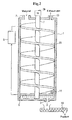
- Figs. 1 and 2 are sectional views showing embodiments of the apparatus for producing matured compost-like material of the first aspect.
- numeral 1 designates a vertical type cylindrical heating vessel which is provided at its upper side with an inlet 2 for raw material (organic waste) and provided at its lower side with an outlet 3 for product (matured compost-like material).
- heating panels 4 (4A-4F) are arranged in multiple stages (six stages in Fig. 1) .
- Each of the heating panels 4 (4A-4F) has a hollow structure. Heating oil heated by a heating oil boiler 5 flows from the heating panel 4A to the heating panels 4B, 4C, 4D, 4E, and 4F in this order. After that, the heating oil is returned to the heating oil boiler 5.
- rakes 6 (6A-6G) are arranged above the heating panels 4A-4F and a bottom 1G of the vessel 1, respectively for moving material.
- Numeral 7 designates a rotary shaft of the rakes 6 (6A-6G) and is driven by a motor 7M.
- the heating panels 4A, 4C, 4E are each formed in a ring-like shape having an opening 4a at the center thereof, while heating panels 4B, 4D, 4F are each formed in a disc-like shape having a gap 4b from the inner wall of the vessel 1.
- the rotary shaft 7 of the rakes 6 (6A-6G) extends through the openings 4a of the heating panels 4A, 4C, 4E and the centers of the heating panels 4B, 4D, 4F to the bottom 1G of the vessel 1.
- the raw material fed through the inlet 2 is moved by the rakes 6A-6F on the heating panels 4A-4F and the rake 6G on the bottom 1G of the vessel 1 to pass through the opening 4a of the heating panel 4A, the gap 4b between the heating panel 4B and the vessel inner wall, the opening 4a of the heating panel 4C, the gap 4b between the heating panel 4D and the vessel inner wall, and the opening 4a of the heating panel 4E, and the gap between the heating panel 4F and the vessel inner wall in this order and is then discharged through the outlet 3 formed in the bottom 1G of the vessel 1.
- the raw material is conveyed from the material hopper 8 by a conveyer 9 such as a screw conveyer, whereby the raw material is fed from the inlet 2 into the vessel 1.
- the outlet of the conveyer 9 is air-tightly connected to the inlet 2.
- Numeral 9M designates a motor for driving the conveyer 9.
- the treated material dried and treated with heat in the vessel 1 and discharged through the outlet 3 (the product, that is, matured compost-like material) is further discharged from a discharge conveyer 10. A part of the treated material may be mixed into the raw material to adjust the moisture level of the raw material.
- a temperature detector 11 is disposed in the vicinity of the outlet 3.
- the measured value of the temperature detector 11 is inputted into a controller 12.
- the controller 12 controls the operating condition of the heating oil boiler 5 (the heating temperature of heating oil, that is, the heating temperature of the material within the vessel 1), the speed of the motor 9M for driving the conveyer 9 (the feeding speed of the raw material into the vessel 1), and/or the speed of the motor 7M for rotating the rakes 6 (the moving speed of the material within the vessel 1, that is, the residence time of the material within the vessel 1).
- Numeral 13 designates a gas exhaust for exhausting gas from the vessel 1 and having a suction blower. Air is introduced from outside through the outlet 3 at the lower side of the vessel 1 and/or through air inlets not shown and waste gas is exhausted from the gas exhaust 13.
- the waste gas contains moisture and odor components and is sent to a waste gas treatment device, for example, of wet cleaning, burning deodorization, activated carbon deodorization, chemical deodorization, or biological deodorization.
- the raw material (organic waste) in the material hopper 8 is conveyed by the conveyer 9 and is thereby continuously fed into the vessel 1 through the inlet 2.
- the raw material fed into the vessel 1 is first rolled and moved on the first(highest)-stage heating panel 4A by the rake 6A while it is indirectly heated by the heating oil flowing inside the heating panel 4A and is granulated.
- the material then gradually falls down to the second-stage heating panel 4B through the opening 4a of the heating panel 4A.
- the material reaching the heating panel 4B is rolled and moved by the rake 6B while it is indirectly heated by the heating oil flowing inside the heating panel 4B and is granulated.
- the material is then gradually falls down onto the third-stage heating panel 4C through the gap 4b between the heating panel 4B and the inner wall of the vessel 1.
- the material within the vessel 1 is indirectly heated on each heating panel and granulated while it is rolled and moved on each heating panel and falls down onto the next lower heating panel.
- the heat treatment within the vessel 1 the moisture in the organic waste is evaporated so that the organic waste is dried.
- the organic waste is heated at a temperature of 100 to 200°C after dried, whereby the odor component in the organic waste is volatilized or degraded. Therefore, the organic matter is altered by heat denaturation, thereby obtaining an odorless matured compost-like material.
- the obtained matured compost-like material falls down from the heating panel 4F onto the bottom 1G of the vessel 1, is rolled and moved by the rake 6G and is continuously taken out through the outlet 3. Then, the product is discharged by the conveyer 10.
- the moisture in the organic waste is evaporated so that the organic waste is dried.
- the temperature of the organic waste as the material is less than 100°C when any moisture remains in the organic waste.
- the temperature of the material rises to 100°C or more. After that, as the heating is continued, the removal of the odor component and the degradation of the organic matter proceed according to temperature increase, thereby obtaining matured compost-like material having no or little odor.
- the temperature of the treated product when the heating treatment is finished depends on the nature of the raw material and the required quality level such as desired concentration of odor component, but the heating treatment is preferably finished when the temperature of the treated material is in a range from 110 to 200°C, particularly from 150 to 200°C. In this temperature range, the moisture is completely evaporated and thus removed and the odor component is volatilized and degraded, thereby obtaining a high quality matured compost-like material.
- the temperature detector 11 is arranged in the vicinity of the outlet 3 of the vessel 1 and the control is carried out by the controller 12 such that the measured temperature of the temperature detector 11, i.e. the temperature of the treated material to be discharged, is set to the predetermined temperature for the finish of the heating treatment, preferably from 110 to 200°C, more preferably from 150 to 200°C.
- the controller 12 conducts any of the following controls (1)-(3):
- the controller 12 may conduct any one of the above controls (1)-(3) or may conduct two or more of the above controls (1)-(3) in combination.
- the temperature of the treated material in the vicinity of the outlet 3 of the vessel 1 is detected, and the feeding speed of the raw material, the moving speed of the material within the vessel (the residence time of the material within the vessel), and/or the heating temperature is automatically controlled in such a manner that the temperature of the treated material in the vicinity of the outlet 3 becomes the predetermined temperature for the finish of the heating treatment, thereby preventing excess or insufficient heating treatment, i.e. preventing deterioration in product quality due to the insufficient heat treatment or waste of heating energy due to the excess heat treatment, and therefore stably and securely obtaining a high-quality product.
- the temperature detector 11 may be, but not limited to, a means such as a thermocouple of directly measuring the temperature of the material or a means such as an infrared temperature measuring device for indirectly measuring the temperature of the material.
- the temperature detector 11 is arranged in the vicinity of the outlet in order to accurately determine the finish of the heat treatment.
- the location of the temperature detector 11 is not limited inside the vessel 1 as shown in Fig. 1 and may be any place where the temperature of the treated material can be measured such as a place on the outside wall of the vessel 1.
- the location of the temperature detector 11 is preferably closer to the outlet 3, but may be a place where it is estimated that the heat treatment of the material is substantially finished.
- the temperature of the oil medium is kept at temperature from 100 to 300°C, preferably from 150 to 200°C, whereby the material of which temperature was less than 100°C before the finish of drying process is kept at temperature from 100 to 200°C after the finish of the drying process. This means that good heat treatment is done.
- raw material can be continuously poured into the vessel 1, heated and dried within the vessel 1, treated with heat at temperature from 100 to 200°C and granulated, and can be continuously taken out as matured compost-like material having stable quality.
- the heat treatment can be conducted in plural stages by the heating panels 4 arranged in multiple stages in the vessel 1. Therefore, sufficient heat transfer area for heating the material can be ensured even when the capacity of the vessel is increased, thereby conducting efficient heating and granulating treatment.
- the number of stages of the multi-stage heating panels there is no particular limitation on the number of stages of the multi-stage heating panels, so the number of stages may be suitably determined according to the capacity of the vessel.
- the heating panels are arranged horizontally and the rakes 6 are used to move the material in the vessel toward the outlet in the embodiment of Fig. 1, the heating panels may be slightly inclined such that the material slides down the inclined surface of the heating panel to sequentially fall down onto the next lower heating panel.
- a spiral-shaped heating panel is employed as the heating panel.
- members exhibiting the same functions as the members shown in Fig. 1 are marked by the same numerals.
- the spiral-shaped heating panel 20 disposed in a vessel 1 extends from a position near the material inlet of the vertical vessel 1 to a lower position of the vessel 1.
- the heating panel 20 is driven to rotate by a motor 7M and the rotary shaft 7.
- the heating panel 20 has a hollow structure in which heating oil heated by a heating oil boiler 5 circulates.
- the rotary shaft 7 is provided at its upper portion with a hole for supplying the heating oil to the top of the heating panel 20.
- the rotary shaft 7 is provided at its lower portion with a hole for taking out the heating oil from a lower portion of the heating panel 20.
- raw material (organic waste) fed through an inlet 2 of the vessel 1 is heated by the heating oil flowing within the heating panel 20 and granulated while the raw material rolls and slides the inclined surface of the spiral-shaped heating panel 20 from the beginning of the heating panel 20, and is dried by heat treatment.
- the material is treated with heat at temperature from 100 to 200°C so as to produce matured compost-like material.
- the matured compost-like material reaches the bottom 1G of the vessel 1 and is agitated and moved by a rake 6 on the bottom 1G so that the matured compost-like material is discharged as a product through an outlet 3.
- a temperature detector 11 is disposed in the vicinity of the outlet 3 of the vessel, and the feeding speed of the raw material, the moving speed of the material within the vessel (the residence time of the material within the vessel), and/or the heating temperature of the heating oil boiler is controlled by a controller (not shown) in such a manner that the measured value of the temperature detector 11 becomes the predetermined temperature, similarly to the apparatus of Fig. 1, thereby obtaining a product with stable quality.
- the spiral-shaped heating panel 20 is arranged vertically in the vertical vessel 1, sufficient heat transfer area for heating the material can be ensured even when the capacity of the vessel 1 is increased, thereby conducting efficient heating and granulating treatment.
- Organic waste to be treated by the apparatus of the first aspect as mentioned may include biologically treated sludge produced during biological treatment of waste water and waste such as sewage sludge, excess sludge, digested sludge, and sludge of household domestic wastewater treatment tanks, and/or garbage.
- biologically treated sludge produced during biological treatment of waste water and waste such as sewage sludge, excess sludge, digested sludge, and sludge of household domestic wastewater treatment tanks, and/or garbage.
- the continuous production of matured compost-like material can be achieved by a large-size vertical apparatus.
- the obtained matured compost-like material has no or little odor, enough residual organic fertilizer component, and relatively lower salt component so that it can be effectively used as an organic fertilizer and has excellent handling property.
- Organic waste including organic sludge and garbage, having a moisture content of 85% and an ignition loss of 82% was used as the raw material.
- the weight of the raw material before heated and dried was about 1 ton per 1 m 3 .
- the apparatus shown in Fig. 1 (but having 11 stages of heating panels) was employed to produce matured compost-like material by continuously treating the raw material with heat.
- the inside capacity of the vessel of this apparatus was 28 m 3 (8m in height, 2m in diameter).
- the heating panels were arranged in 11 stages at interval of about 0.5m. Heating oil heated by the heating oil boiler was circulated within the heating panels.
- the raw material was continuously fed at 1000 kg/hr and was agitated by rakes on the respective heating panels, whereby a product was taken through the outlet at 160 kg/hr.
- the temperature of the heating oil was controlled to be in a range from 200 to 220°C in such a manner that the measured temperature of the temperature detector became in a range from 150 to 160°C.
- matured compost-like material having no or little odor and having a quality equal to that of the matured compost-like material produced by the conventional apparatus of batch processing type having a processing capacity of 4000 kg/day could be produced by the continuous process.
- the apparatus for producing matured compost-like material according to the first aspect can effectively produce an odorless product like matured compost by continuously processing organic waste.
- a vertical heating vessel is easily grown in size, thereby, as a result, achieving the reduction in size of the apparatus and the increase in production amount per area of the apparatus.
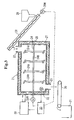
- Fig. 3 is a sectional view showing an embodiment of the apparatus for producing matured compost-like material of the second aspect.
- numeral 21 designates a horizontal type cylindrical heating vessel which is provided with an inlet 22 for raw material (organic waste) formed in an upper portion on one end side in the lateral direction and provided with an outlet 23 for product (matured compost-like material) formed in the bottom on the other end side.
- An agitator 24 for agitating and moving a material (not shown) inside the vessel from the inlet 22 to the outlet 23 and pushing out the material is arranged inside the vessel 21.
- the agitator 24 comprises a rotary shaft 24B provided with agitating blades 24A, and a motor 24M for rotating the rotary shaft 24B.
- a jacket 25 is provided around the vessel 21, a jacket 25 is provided.
- the jacket 25 is designed such that heating oil heated by a heating oil boiler 26 is circulated within the jacket 25 to heat the material inside the vessel 21.
- Raw material is conveyed from the material hopper 28 by a conveyer 29, whereby the raw material is fed through the inlet 22 into the vessel 21.
- Numeral 29M designates a motor for driving the conveyer 29.
- the treated material dried and treated with heat in the vessel 21 and discharged from the outlet 23 (the product, that is, matured compost-like material) is conveyed to and stored in a product hopper 31 by a conveyer 30.
- a temperature detector 32 is disposed in the vicinity of the outlet 23.
- the measured value of the temperature detector 32 is inputted into a controller 33.
- the controller 33 controls the operating condition of the heating oil boiler 26 (the heating temperature of heating oil, that is, the heating temperature of the material within the vessel 21), the speed of the motor 29M for driving the conveyer 29 (the feeding speed of the raw material into the vessel 21), and/or the speed of the motor 24M for rotating the agitator 24 (the moving speed of the material within the vessel 21).
- a blower for discharging gas from the vessel is provided, but not shown.
- the waste gas is fed into a waste gas treatment device by this blower.
- the raw material (organic waste) in the material hopper 28 is conveyed by the conveyer 29 and is thereby continuously fed into the vessel 21 through the inlet 22.
- the raw material fed into the vessel 21 is agitated within the vessel 21 by the agitator 24 and is gradually moved from the inlet 22 side toward the outlet 23 side while it is indirectly heated by the heating oil 27.
- the obtained matured compost-like material is continuously taken out through the outlet 23.
- the product is conveyed to and stored in the product hopper 31 by the conveyer 30.
- the moisture in the organic waste is first evaporated so that the organic waste is dried.
- the temperature of the organic waste as the material is less than 100°C when any moisture remains in the organic waste.
- the temperature of the material rises to 100°C or more. After that, as the heating is continued, the removal of the odor component and the degradation of the organic matter proceed according to temperature increase, thereby obtaining matured compost-like material having no or little odor.
- the temperature of the treated product when the heating treatment is finished depends on the nature of the raw material and the required quality level such as desired concentration of odor component, but the heating treatment is preferably finished when the temperature of the treated material is in a range from 110 to 200°C, particularly from 150 to 200°C. In this temperature range, the moisture is completely evaporated and thus removed and the odor component is volatilized and degraded, thereby obtaining a high quality matured compost-like material.
- the temperature detector 32 is arranged in the vicinity of the outlet 23 of the vessel 21 and the control is carried out by the controller 33 such that the measured temperature of the temperature detector 32, i.e. the temperature of the treated material to be discharged, is set to the predetermined temperature for the finish of the heating treatment, preferably from 110 to 200°C, more preferably from 150 to 200°C.
- the controller 33 conducts any of the following controls (1)-(3):
- the controller 33 may conduct any one of the above controls (1)-(3) or may conduct two or more of the above controls (1)-(3) in combination.
- the temperature of the treated material in the vicinity of the outlet 23 of the vessel 21 is detected, and the feeding speed of the raw material, the moving speed of the material within the vessel, and/or the heating temperature is automatically controlled in such a manner that the temperature of the treated material in the vicinity of the outlet 23 becomes the predetermined temperature for the finish of the heating treatment, thereby preventing excess or insufficient heating treatment, i.e. preventing deterioration in product quality due to the insufficient heat treatment or waste of heating energy due to the excess heat treatment, and therefore stably and securely obtaining a high-quality product.
- the temperature detector 32 may be, but not limited to, a means such as a thermocouple of directly measuring the temperature of the material or a means such as an infrared temperature measuring device for indirectly measuring the temperature of the material.
- the temperature detector 32 is arranged in the vicinity of the outlet in order to accurately determine the finish of the heat treatment.
- the location of the temperature detector 32 is not limited inside the vessel 21 as shown in Fig. 3 and may be any place where the temperature of the treated material can be measured such as a place on the outside wall of the vessel 21.
- the location of the temperature detector 32 is preferably closer to the outlet 23, but may be a place where it is estimated that the heat treatment of the material is substantially finished.
- heating organic waste by direct heating for producing matured compost-like material may cause fire, it is preferable to heat organic waste by indirect heating using an oil medium such as the heating oil shown in Fig. 3.
- the temperature of the oil medium 17 is kept at temperature from 150 to 200°C, whereby the material of which temperature was less than 100°C before the finish of drying process is kept at temperature from 100 to 200°C after the finish of the drying process. This means that good heat treatment is done.
- the agitator 24 is preferably an agitator capable of agitating the material within the vessel 21 and capable of moving the material from the inlet 22 side to the outlet 23 side.
- a ribbon-type agitator may be employed.
- the bottom of the vessel 21 is inclined so that the material is conveyed to the outlet side by agitating operation.
- raw material can be continuously poured into the vessel 21, heated and dried within the vessel 21, after that, further treated with heat at temperature from 100 to 200°C, and can be continuously taken out as matured compost-like material having stable quality.
- the embodiment of Fig. 3 is just an example of embodiments of the apparatus for producing matured compost-like material according to the second aspect so that the apparatus of the second aspect is not limited to the illustrated example.
- the apparatus of the present invention is not limited to a type in which the heating and drying process and the heat treatment after that are conducted in the same heating vessel and may be of a type in which the heating and drying process and the heat treatment are conducted in separate vessels, respectively. That is, raw material may be continuously fed into a drying vessel and continuously taken out as dried material. Then, the dried material may be continuously fed into a heat treatment vessel and continuously taken out as a product.
- temperature detectors are disposed near the outlet of the drying vessel and the outlet of the heat treatment vessel, respectively, and the feeding speed of the raw material or the dried material, the moving speed of the material within each vessel, and/or the heating temperature of each vessel is controlled in such a manner that the temperature of the dried material near the outlet of the drying vessel is set to the predetermined temperature about 100°C and the temperature of the treated material near the outlet of the heat treatment vessel is set to the predetermined temperature from 110 to 200°C, preferably from 150 to 200°C.
- Organic waste to be treated by the apparatus of the second aspect as mentioned may include biologically treated sludge produced during biological treatment of waste water and waste such as sewage sludge, excess sludge, digested sludge, and sludge of household domestic wastewater treatment tanks, and/or garbage.
- biologically treated sludge produced during biological treatment of waste water and waste such as sewage sludge, excess sludge, digested sludge, and sludge of household domestic wastewater treatment tanks, and/or garbage.
- the continuous production of matured compost-like material can be achieved.
- the obtained matured compost-like material has no or little odor, enough residual organic fertilizer component, and relatively lower salt component so that it can be effectively used as an organic fertilizer and has excellent handling property.
- Organic waste including organic sludge and garbage, having a moisture content of 85% and an ignition loss of 82% was used as the raw material.
- the weight of the raw material before heated and dried was about 1 ton per 1 m 3 .
- the apparatus shown in Fig. 3 was employed to produce matured compost-like material by continuously treating the raw material with heat.
- the inside capacity of the vessel of this apparatus was 10 m 3 .
- the jacket was arranged to allow the circulation of heating oil within the jacket.
- the temperature detector was disposed just before the outlet of the vessel.
- the raw material was continuously fed at 250 kg/hr and was agitated, whereby a product was taken through the outlet at 30 kg/hr.
- the moving speed (residence time) of the material within the vessel was about 20 hours.
- the temperature of the heating oil was controlled to be in a range from 200 to 210°C in such a manner that the measured temperature of the temperature detector became in a range from 160 to 170°C.
- matured compost-like material having no or little odor and having a quality equal to that of the matured compost-like material produced by the conventional apparatus of batch processing type could be produced by the continuous process.
- Matured compost-like material was produced in the same manner as Example 2-1 except that the temperature of the heating oil was set to be constant at 200°C and the feeding speed of the raw material was controlled to be in a range from 200 to 300 kg/hr in such a manner that the measured temperature of the temperature detector became a predetermined temperature.
- the temperature of the heating oil was set to be constant at 200°C and the feeding speed of the raw material was controlled to be in a range from 200 to 300 kg/hr in such a manner that the measured temperature of the temperature detector became a predetermined temperature.
- Matured compost-like material was produced in the same manner as Example 2-1 except that the temperature of the heating oil was set to be constant at 200°C and the moving speed (residence time) of the material within the vessel was controlled to be in a range from 15 to 24 hours in such a manner that the measured temperature of the temperature detector became a predetermined temperature.
- the temperature of the heating oil was set to be constant at 200°C and the moving speed (residence time) of the material within the vessel was controlled to be in a range from 15 to 24 hours in such a manner that the measured temperature of the temperature detector became a predetermined temperature.
- the apparatus for producing matured compost-like material according to the second aspect can securely produce a high-quality product by continuous process. Therefore, according to the second aspect, reduction in size of peripheral equipments such as the respective storage hoppers for raw material and products and the waste gas treatment device can be achieved, reduction in cost of equipments can be achieved, and matured compost-like material can be effectively produced by the continuous process in a short period of time.
- the organic waste is heated and dried so that the moisture in the organic waste is gradually evaporated. Also after the moisture content becomes less than 1%, i.e. the drying process is finished, the organic waste is further continuously heated at temperature preferably from 100 to 200°C.
- the temperature of the organic waste as the material is less than 100°C when any moisture remains in the organic waste.
- the temperature of the material rises to 100°C or more.
- organic matter in the material begins to be reduced.
- the heating is continued until the organic matter is reduced about 3-20%, matured compost-like material having no or little odor can be obtained.
- the suitable reduction of organic matter for producing a product after this heating depends on the kind of organic waste to be treated. For example, in case of excess sludge of activated sludge, the suitable reduction is relatively large, i.e. 5-20%. In case of digested sludge, the suitable reduction is relatively small, i.e. 3-10%.
- the heating temperature for the heating treatment after the heating and drying process is preferably in a range from 100 to 200°C, more preferably from 150 to 200°C. In this temperature range, the moisture is completely evaporated and thus removed, the odor component is volatilized and degraded, and organic matter is not carbonized, thereby obtaining a high quality matured compost-like material.
- the time periods required for the heating and drying process and for the heat treatment process vary according to the nature of raw material to be treated, the pouring method of raw material into a drying vessel, the specification of a heating device, and the operating condition. Normally, the time period for the heating and drying process is 10-15 hours and the time period for the heat treatment after that is 3-6 hours.
- the obtained product must be a high-quality product like matured compost having no or little odor, enough residual organic fertilizer component, and relatively lower salt component.
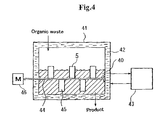
- Fig. 4 is a system diagram showing an embodiment of the apparatus for producing matured compost-like material which is suitable for the embodiments of the methods according to the third and fourth aspects.
- the indirect heating apparatus of Fig. 4 comprises a heating vessel 41 having a double wall structure forming a circulation passage in which oil medium 42 is circulated, thereby indirectly heating raw material 40 within the heating vessel 41.
- the oil medium 42 is heated by a heat exchanger 43 and is circulated in the circulation passage of the heating vessel 41.
- Organic waste is poured into the heating vessel 41 through an upper inlet (not shown), is agitated by agitating blades 45 driven by the rotation of a rotary shaft 44, and is heated with the oil medium 42, so that matured compost-like material is taken out as a product from the heating vessel 41 through a bottom outlet (not shown).
- Numeral 46 designates a motor for driving the rotary shaft 44.
- the temperature of the oil medium 42 is kept at temperature from 150 to 200°C, whereby the material 40 of which temperature was less than 100°C before the finish of drying process is kept at temperature from 100 to 200°C after the finish of the drying process. This means that good heat treatment is done.
- Waste gas containing volatile organic matter is generated during the aforementioned treatment.
- the waste gas is discharged through a gas exhaust (not shown) and is treated separately.
- polymer is added to and mixed with organic waste as raw material and, after that, the heating treatment is conducted without dehydration or after dehydration.
- the polymer may be natural polymer, synthetic polymer, or a combination thereof.
- natural polymer include starch, chitosan, and the like.
- Example to be employed as synthetic polymer include nonionic polymers such as polyacrylamide and polymethacrylamide, anionic polymers such as polyacrylic acid and copolymer of acrylamide and acrylic acid, cationic polymers such as copolymer of (meth)acryloyl oxyethyl trimethyl ammonium chloride and acrylamide, and amphoteric polymer such as copolymer of (meth)acryloyl oxyethyl trimethyl ammonium chloride and acrylic acid and acrylamide. These may be used alone or in combination.
- the polymer is preferably liquid phase such as aqueous solution, dispersion liquid, and emulsion in view of kneading property when added into organic waste.
- the polymer concentration of the aqueous solution is preferably in a range from 0.1 weight % to 1.0 weight %.
- dispersion liquid or emulsion it can be used directly or as aqueous solution.
- the amount of polymer to be added into the organic waste is suitably determined according to the solid matter concentration of the organic waste. For example, when the organic waste has a solid matter concentration about 2%, it is required to conduct dehydration by adding polymer of 0.6-1.5% in dry weight ratio to increase the solid matter concentration. After the dehydration, the polymer gathered in the dehydration sludge has granulating effect.
- the polymer is sufficiently evenly mixed relative to the organic waste. Accordingly, it is preferable that a mixing bath is provided separately from the heat treatment apparatus for organic waste and that after adding and mixing the polymer into the organic waste, the organic waste including the polymer is fed into the heat treatment apparatus without the dehydration or after the dehydration.
- a mixing bath is provided separately from the heat treatment apparatus for organic waste and that after adding and mixing the polymer into the organic waste, the organic waste including the polymer is fed into the heat treatment apparatus without the dehydration or after the dehydration.
- organic waste and polymer may be fed into the heat treatment apparatus. In this case, the organic waste and the polymer may be sufficiently mixed prior to the heating in the heat treatment apparatus and, after that, heated.
- the mixture obtained by adding and mixing the polymer into the organic waste is heated with being agitated as mentioned above.
- the mixture is treated with heat after subjected to the drying process, thereby obtaining matured compost-like material.
- advantageous granulation is conducted during the agitation with heat, so a method of producing matured compost-like material which is granular and has excellent handling property.
- the matured compost-like material has an mean grain size between 2 mm and 5 mm in view of handling property as organic fertilizer.
- potassium component is added to and mixed with organic waste as raw material and, after that, the heating treatment is conducted so as to produce matured compost-like material.
- the potassium component may be a potassium compound or a substance containing potassium in concentrated amount.
- the potassium compound powder of potassium sulfate or powder of potassium chloride which is widely used as chemical fertilizer can be suitably employed.
- substance containing potassium in concentrated amount substance without component harmful to vegetation is preferable, for example, food waste such as potato chaffs may be employed.
- potassium component is added such that the content of potassium in the matured compost-like material becomes 2-5 weight % (dry weight ratio), thereby obtaining organic fertilizer containing three elements of nitrogen, phosphorous, and potassium in a balanced manner.
- Organic waste having relatively high moisture content such as containing moisture about 50-85 % is better than organic waste having low moisture content in view of mixing uniformity of potassium component.
- the potassium component may be added in liquid phase such as aqueous solution.
- the potassium component is sufficiently evenly mixed relative to the organic waste.
- a mixing bath is provided separately from the heat treatment apparatus for organic waste and that after adding and mixing the potassium component into the organic waste, the organic waste including the potassium component is fed into the heat treatment apparatus.
- the heat treatment apparatus is provided with an agitating means enough for achieving even mixing, organic waste and polymer may be fed into the heat treatment apparatus.
- the organic waste and the polymer may be sufficiently mixed prior to the heating in the heat treatment apparatus and, after that, heated.
- the mixture obtained by adding and mixing the potassium component into the organic waste is heated with being agitated as mentioned above.
- the mixture is treated with heat after subjected to the drying process, thereby obtaining matured compost-like material.
- potassium component which must be insufficient in matured compost-like material made of ordinary organic waste is compensated, thereby obtaining matured compost-like material which contains nitrogen, phosphorous, and potassium in a balanced manner and thus can be used as organic fertilizer which can provide excellent balance of three fertilizer elements by itself.
- Fig. 4 shows an example of the apparatus for producing matured compost-like material suitable for the embodiments of the third and fourth aspects.
- the method of the present invention is not limited to a type in which the heating and drying process and the heat treatment after that are conducted in the same heating vessel as shown in Fig. 4 and may be of a type in which the heating and drying process and the heat treatment are conducted in separate vessels, respectively.
- the methods of the third and fourth aspects can be carried out by any of the apparatus for producing matured compost-like material as shown in Figs. 1 through 3.
- Organic waste to be treated by the method of the third or fourth aspect as mentioned may include sludge obtained by dehydrating biologically treated sludge produced during biological treatment of waste water and waste such as sewage sludge, excess sludge, digested sludge, and sludge of household domestic wastewater treatment tanks, garbage, and/or animal droppings.
- waste water and waste such as sewage sludge, excess sludge, digested sludge, and sludge of household domestic wastewater treatment tanks, garbage, and/or animal droppings.
- by heat treatment after heating and drying organic waste matured compost-like material of high commercial value can be obtained which has no or little odor, enough residual organic fertilizer component, and relatively lower salt component so that it can be effectively used as an organic fertilizer.
- the apparatus shown in Fig. 4 was employed to produce matured compost-like material by treating poultry dropping as raw material with heat.
- Aqueous solution containing 0.2 weight % of polyacrylamide as synthetic polymer was added in an amount of 0.5 weight % to the poultry dropping in dray weight ratio and evenly mixed.
- the mixture was fed into the heating vessel and was treated with heat with being agitated. Oil medium which was heated to 200°C was circulated. As a result, the material within the vessel was completely dried and the temperature rose to 100°C by 8-hour heat treatment. After that, the material was further treated with heat at temperature from 100 to 200°C for three hours, thereby obtaining granular matured compost-like material.
- Matured compost-like material was produced in the same manner as Example 3-1 except that the polymer was not added.
- the mean grain size of the obtained matured compost-like material and the ratio of fine particles having grain size of less than 1 mm relative to the matured compost-like material were measured and the results are shown in Table 1.
- Examples Polymer Matured compost-like material Mean grain size (mm) Ratio of fine particles less than 1 mm in grain size (%)
- the method of producing matured compost-like material of the third aspect as the method of producing matured compost-like material by treating organic waste with heat after heated and dried, improved granulation can be obtained and matured compost-like material can be produced which is granular and has thus excellent handling property without problems of scattering and fling up dust.
- the apparatus shown in Fig. 4 was employed to produce matured compost-like material by treating organic sludge having a moisture content of 82% (excess sludge discharged during the treatment of activated sludge) as raw material.
- a mixture was prepared by adding 4 kg of potassium sulfate powder in 160 kg of organic sludge and mixing them. The mixture was fed into the heating vessel and was treated with heat with being agitated. Oil medium which was heated to 200°C was circulated. As a result, the material within the vessel was completely dried and the temperature rose to 100°C by 13-hour heat treatment. After that, the material was further treated with heat at temperature from 100 to 200°C for four hours, thereby obtaining granular matured compost-like material having grain size about 1-5 mm.
- Matured compost-like material was produced in the same manner as Example 4-1 except that the potassium sulfate powder was not added. The contents of nitrogen, phosphorous, and potassium in the obtained matured compost-like material were measured and the results are shown in Table 2.
- Examples Potassium sulfate powder Contents in Matured compost-like material (weight %) Nitrogen Phosphorous Potassium Example 4-1 Added 5.6 3.8 3.2 Comparative Example 4-1 Not added 5.6 3.8 0.4
- Test of pot caltivation of Chinese cabbage was conducted by adding the matured compost-like material obtained in Example 4-1 in an amount of 5 kg per 1 m 3 of soil for soil treatment. As a result, growth and development was obtained which was significantly better than a case of treatment with commercial available chemical fertilizer (nitrogen, phosphorous and potassium each contained by 10 weight %) in an amount of 2.5 kg/m 3 .
- matured compost-like material As the method of producing matured compost-like material by treating organic waste with heat after heated and dried, matured compost-like material can be produced which has excellent balance of nitrogen, phosphorous and potassium as organic fertilizer and thus can provide well manuring effect when added only by itself.
Landscapes
- Engineering & Computer Science (AREA)
- General Engineering & Computer Science (AREA)
- Mechanical Engineering (AREA)
- Chemical & Material Sciences (AREA)
- Organic Chemistry (AREA)
- Life Sciences & Earth Sciences (AREA)
- Biochemistry (AREA)
- General Chemical & Material Sciences (AREA)
- Microbiology (AREA)
- Molecular Biology (AREA)
- Chemical Kinetics & Catalysis (AREA)
- Biotechnology (AREA)
- Health & Medical Sciences (AREA)
- Hydrology & Water Resources (AREA)
- Environmental & Geological Engineering (AREA)
- Water Supply & Treatment (AREA)
- Processing Of Solid Wastes (AREA)
- Fertilizers (AREA)
Applications Claiming Priority (7)
| Application Number | Priority Date | Filing Date | Title |
|---|---|---|---|
| JP2002256787A JP2004091280A (ja) | 2002-09-02 | 2002-09-02 | コンポスト様物製造装置 |
| JP2002256787 | 2002-09-02 | ||
| JP2002260226 | 2002-09-05 | ||
| JP2002260226A JP4000964B2 (ja) | 2002-09-05 | 2002-09-05 | コンポスト様物の製造装置 |
| JP2002265705A JP2004099395A (ja) | 2002-09-11 | 2002-09-11 | 熟成コンポスト様物の製造方法 |
| JP2002265705 | 2002-09-11 | ||
| PCT/JP2003/011069 WO2004022510A1 (ja) | 2002-09-02 | 2003-08-29 | 熟成コンポスト様物の製造装置及び製造方法 |
Publications (1)
| Publication Number | Publication Date |
|---|---|
| EP1535888A1 true EP1535888A1 (de) | 2005-06-01 |
Family
ID=31982133
Family Applications (1)
| Application Number | Title | Priority Date | Filing Date |
|---|---|---|---|
| EP03794144A Pending EP1535888A1 (de) | 2002-09-02 | 2003-08-29 | Gerät und verfahren zur herstellung von reifem kompostartigem material |
Country Status (6)
| Country | Link |
|---|---|
| US (1) | US20040172996A1 (de) |
| EP (1) | EP1535888A1 (de) |
| KR (1) | KR100651066B1 (de) |
| CN (3) | CN1817820A (de) |
| AU (1) | AU2003261842B2 (de) |
| WO (1) | WO2004022510A1 (de) |
Cited By (3)
| Publication number | Priority date | Publication date | Assignee | Title |
|---|---|---|---|---|
| CN103471360A (zh) * | 2013-09-11 | 2013-12-25 | 深圳市派沃新能源科技有限公司 | 一种多级筛板式烘干机 |
| US12296280B2 (en) | 2019-12-09 | 2025-05-13 | Grant Prideco, Inc. | Method for continuous thermal separation of a multi-component substance |
| US12504229B2 (en) | 2019-12-09 | 2025-12-23 | Grant Prideco, Inc. | Apparatus for continuous thermal separation of a multi-component substance |
Families Citing this family (21)
| Publication number | Priority date | Publication date | Assignee | Title |
|---|---|---|---|---|
| JP2005270731A (ja) * | 2004-03-23 | 2005-10-06 | Kurita Water Ind Ltd | 汚泥加熱処理時の臭気除去方法 |
| US20060283220A1 (en) * | 2005-06-03 | 2006-12-21 | Nutracycle Llc | System and process for high efficiency composting |
| CN201010609Y (zh) * | 2007-01-26 | 2008-01-23 | 张志霄 | 带型搅拌污泥多级二次蒸汽回用干燥装置 |
| JP4058497B1 (ja) * | 2007-02-27 | 2008-03-12 | 国立大学法人静岡大学 | 油滓処理装置、油滓処理方法および油滓由来の肥料の製造方法 |
| WO2009014669A2 (en) * | 2007-07-19 | 2009-01-29 | Goodman, Herbert | A method of processing and drying waste in a continuous process |
| US20090145188A1 (en) * | 2007-12-07 | 2009-06-11 | Halton Recycling Limited | Apparatus and methods for generating compost |
| JP5222183B2 (ja) * | 2009-03-03 | 2013-06-26 | 正夫 金井 | 連続式乾燥装置 |
| KR20120090919A (ko) * | 2012-07-27 | 2012-08-17 | 주식회사명성자동수문 | 모든 종류의 쓰레기와 모든 종류의 슬러지와 모든 종류의 인분과 축분과 모든 종류의 음식물 쓰레기와 모든 종류의 폐수를 이용하여 가스를 생산하는 친환경 공법 및 그 처리 과정을 이용하여 가스를 생산하는 가스생산시스템 |
| CN105157396B (zh) * | 2013-01-04 | 2017-09-29 | 浙江红绿蓝纺织印染有限公司 | 用于三废综合回收处理的连续干燥系统及其工作方法 |
| IL239067B (en) * | 2015-05-28 | 2021-12-01 | Mix Nadlan Ltd | Waste disposal |
| US10919249B2 (en) | 2016-02-19 | 2021-02-16 | Albert Mardikian | Apparatus for pressing and dehydrating of waste |
| CN106119105B (zh) * | 2016-07-11 | 2018-08-14 | 湖南屎壳郎环境科技有限公司 | 一种固体高温好氧发酵反应系统及方法 |
| CN108409367B (zh) * | 2018-06-14 | 2021-05-25 | 郑美花 | 一种生物菌肥烘干装置 |
| CN109078522A (zh) * | 2018-07-03 | 2018-12-25 | 胡州生 | 一种园林施肥用多种肥料混匀设备 |
| US10906846B2 (en) * | 2018-10-15 | 2021-02-02 | Hong-Shien Yo | Continuous heating reactor for composting |
| CN110156286B (zh) * | 2019-04-30 | 2024-03-22 | 广州华功环保技术有限公司 | 一种污泥处理设备 |
| CN110526449A (zh) * | 2019-09-17 | 2019-12-03 | 汕尾市海洋产业研究院 | 一种凡纳滨对虾高位池养殖废水悬浮物的回收工艺及其应用 |
| DE102020123246A1 (de) * | 2020-09-05 | 2022-03-10 | Alfred Kärcher SE & Co. KG | Kompostiervorrichtung |
| CZ309796B6 (cs) * | 2020-11-05 | 2023-10-18 | Petr Ing Vaníček | Nosná konstrukce pro řízený gravitační posun neseného materiálu a zařízení s touto nosnou konstrukcí |
| CN115127325A (zh) * | 2022-07-08 | 2022-09-30 | 张晓春 | 一种多层连续式污泥干燥装置 |
| CN116087261B (zh) * | 2023-04-11 | 2023-07-04 | 中国石油大学(华东) | 一种泡沫耐热稳定性评价装置和方法 |
Family Cites Families (14)
| Publication number | Priority date | Publication date | Assignee | Title |
|---|---|---|---|---|
| JPS50148277A (de) * | 1974-05-21 | 1975-11-27 | ||
| JPS5357559A (en) * | 1976-11-05 | 1978-05-24 | Ube Ind Ltd | Drying apparatus |
| JPS5480973U (de) * | 1977-11-16 | 1979-06-08 | ||
| US4255129A (en) * | 1979-07-11 | 1981-03-10 | Thomas N. DePew | Apparatus and method for processing organic materials into more useful states |
| US4453474A (en) * | 1980-09-29 | 1984-06-12 | Sterling Drug, Inc. | Method for controlling temperatures in the afterburner and combustion hearths of a multiple hearth furnace |
| JPS6041600A (ja) * | 1983-08-12 | 1985-03-05 | Kurita Water Ind Ltd | 汚泥脱水方法 |
| JPS6054797A (ja) * | 1983-09-02 | 1985-03-29 | Ichikawa Keori Kk | 汚泥の処理方法 |
| US4728339A (en) * | 1984-12-19 | 1988-03-01 | K-Fuel Partnership | Multiple hearth apparatus and process for thermal treatment of carbonaceous materials |
| JPH0585874A (ja) * | 1991-02-28 | 1993-04-06 | Ebara Infilco Co Ltd | 土壌改良材の製造方法 |
| JPH06100390A (ja) * | 1992-09-16 | 1994-04-12 | Sosuukai:Kk | 生ごみ処理装置 |
| US5290339A (en) * | 1992-12-17 | 1994-03-01 | Union Oil Company Of California | Platinum recovery |
| JP2001130990A (ja) * | 1999-08-23 | 2001-05-15 | Kurita Water Ind Ltd | 熟成コンポスト様物の製造方法及び製造装置 |
| JP2002012489A (ja) * | 2000-06-28 | 2002-01-15 | Tochigi Prefecture | 調整剤混合有機質資材とその製造方法 |
| JP3968969B2 (ja) * | 2000-07-14 | 2007-08-29 | 栗田工業株式会社 | コンポスト様物の製造方法及びコンポスト様物の製造装置 |
-
2003
- 2003-08-29 EP EP03794144A patent/EP1535888A1/de active Pending
- 2003-08-29 CN CNA2006100046424A patent/CN1817820A/zh active Pending
- 2003-08-29 CN CNA2006100046439A patent/CN1817821A/zh active Pending
- 2003-08-29 AU AU2003261842A patent/AU2003261842B2/en not_active Ceased
- 2003-08-29 WO PCT/JP2003/011069 patent/WO2004022510A1/ja not_active Ceased
- 2003-08-29 KR KR20047003809A patent/KR100651066B1/ko not_active Expired - Fee Related
- 2003-08-29 CN CNA038014513A patent/CN1585731A/zh active Pending
-
2004
- 2004-02-26 US US10/786,084 patent/US20040172996A1/en not_active Abandoned
Non-Patent Citations (1)
| Title |
|---|
| See references of WO2004022510A1 * |
Cited By (4)
| Publication number | Priority date | Publication date | Assignee | Title |
|---|---|---|---|---|
| CN103471360A (zh) * | 2013-09-11 | 2013-12-25 | 深圳市派沃新能源科技有限公司 | 一种多级筛板式烘干机 |
| CN103471360B (zh) * | 2013-09-11 | 2016-01-20 | 深圳市派沃新能源科技有限公司 | 一种多级筛板式烘干机 |
| US12296280B2 (en) | 2019-12-09 | 2025-05-13 | Grant Prideco, Inc. | Method for continuous thermal separation of a multi-component substance |
| US12504229B2 (en) | 2019-12-09 | 2025-12-23 | Grant Prideco, Inc. | Apparatus for continuous thermal separation of a multi-component substance |
Also Published As
| Publication number | Publication date |
|---|---|
| CN1817820A (zh) | 2006-08-16 |
| US20040172996A1 (en) | 2004-09-09 |
| CN1585731A (zh) | 2005-02-23 |
| AU2003261842A1 (en) | 2004-03-29 |
| KR20050032498A (ko) | 2005-04-07 |
| AU2003261842B2 (en) | 2007-11-22 |
| CN1817821A (zh) | 2006-08-16 |
| KR100651066B1 (ko) | 2006-12-01 |
| WO2004022510A1 (ja) | 2004-03-18 |
Similar Documents
| Publication | Publication Date | Title |
|---|---|---|
| AU2003261842B2 (en) | Apparatus and method for producing matured compost-like substance | |
| US4909825A (en) | Process and apparatus for drying and conditioning chicken manure or similar pasty substances | |
| JP6512859B2 (ja) | 廃棄物処理装置および廃棄物処理方法 | |
| US4193786A (en) | Process and apparatus for producing compost | |
| JP2003001228A (ja) | 有機質物の発酵処理方法及び装置 | |
| KR20020086743A (ko) | 유기 폐기물의 처리 방법 및 그 장치 | |
| KR19980024969A (ko) | 유기계 폐기물 처리 장치 및 방법 | |
| JP2000239082A (ja) | 炭化肥料の製造方法およびその装置 | |
| JP3933465B2 (ja) | 有機廃棄物分解装置及び分解方法 | |
| RU2214991C1 (ru) | Установка для переработки органических отходов в компост | |
| JP4000964B2 (ja) | コンポスト様物の製造装置 | |
| KR970010844B1 (ko) | 고형유기폐기물 처리장치 | |
| JP2004091280A (ja) | コンポスト様物製造装置 | |
| RU2071458C1 (ru) | Способ получения удобрения из органических отходов и устройство для его осуществления | |
| JP2001347248A (ja) | 有機質物の発酵処理方法及び装置 | |
| NL2021457B1 (nl) | Werkwijze en inrichting voor biologische droging | |
| JP2021159803A (ja) | 発酵乾燥装置、セメント製造システム、発酵乾燥方法、セメントクリンカーの製造方法、及び、発酵乾燥物の使用方法 | |
| WO2010151101A1 (en) | Novel in-vessel high rate composter | |
| JP7120682B1 (ja) | 乾燥糞の製造方法及び製造システム | |
| JP4194421B2 (ja) | コンポスト装置 | |
| JP2004099395A (ja) | 熟成コンポスト様物の製造方法 | |
| JP2741354B2 (ja) | 湿潤有機物汚泥の乾燥方法及び装置 | |
| JP2003063887A (ja) | 内部混合型発酵装置 | |
| JPH05239467A (ja) | 籾酢液・籾炭製造装置 | |
| JP3774791B2 (ja) | 使用済みキノコ栽培培地再処理装置 |
Legal Events
| Date | Code | Title | Description |
|---|---|---|---|
| PUAI | Public reference made under article 153(3) epc to a published international application that has entered the european phase |
Free format text: ORIGINAL CODE: 0009012 |
|
| 17P | Request for examination filed |
Effective date: 20040305 |
|
| AK | Designated contracting states |
Kind code of ref document: A1 Designated state(s): AT BE BG CH CY CZ DE DK EE ES FI FR GB GR HU IE IT LI LU MC NL PT RO SE SI SK TR |
|
| AX | Request for extension of the european patent |
Extension state: AL LT LV MK |
|
| DAX | Request for extension of the european patent (deleted) | ||
| STAA | Information on the status of an ep patent application or granted ep patent |
Free format text: STATUS: THE APPLICATION IS DEEMED TO BE WITHDRAWN |