EP1527984B1 - Fahrzeug-Motorhaube - Google Patents
Fahrzeug-Motorhaube Download PDFInfo
- Publication number
- EP1527984B1 EP1527984B1 EP04024208A EP04024208A EP1527984B1 EP 1527984 B1 EP1527984 B1 EP 1527984B1 EP 04024208 A EP04024208 A EP 04024208A EP 04024208 A EP04024208 A EP 04024208A EP 1527984 B1 EP1527984 B1 EP 1527984B1
- Authority
- EP
- European Patent Office
- Prior art keywords
- hood
- vehicle
- flange
- outer panel
- inner panel
- Prior art date
- Legal status (The legal status is an assumption and is not a legal conclusion. Google has not performed a legal analysis and makes no representation as to the accuracy of the status listed.)
- Expired - Lifetime
Links
Images



Classifications
-
- B—PERFORMING OPERATIONS; TRANSPORTING
- B60—VEHICLES IN GENERAL
- B60R—VEHICLES, VEHICLE FITTINGS, OR VEHICLE PARTS, NOT OTHERWISE PROVIDED FOR
- B60R21/00—Arrangements or fittings on vehicles for protecting or preventing injuries to occupants or pedestrians in case of accidents or other traffic risks
- B60R21/34—Protecting non-occupants of a vehicle, e.g. pedestrians
-
- B—PERFORMING OPERATIONS; TRANSPORTING
- B62—LAND VEHICLES FOR TRAVELLING OTHERWISE THAN ON RAILS
- B62D—MOTOR VEHICLES; TRAILERS
- B62D25/00—Superstructure or monocoque structure sub-units; Parts or details thereof not otherwise provided for
- B62D25/08—Front or rear portions
- B62D25/10—Bonnets or lids, e.g. for trucks, tractors, busses, work vehicles
- B62D25/105—Bonnets or lids, e.g. for trucks, tractors, busses, work vehicles for motor cars
-
- B—PERFORMING OPERATIONS; TRANSPORTING
- B60—VEHICLES IN GENERAL
- B60R—VEHICLES, VEHICLE FITTINGS, OR VEHICLE PARTS, NOT OTHERWISE PROVIDED FOR
- B60R21/00—Arrangements or fittings on vehicles for protecting or preventing injuries to occupants or pedestrians in case of accidents or other traffic risks
- B60R21/34—Protecting non-occupants of a vehicle, e.g. pedestrians
- B60R2021/343—Protecting non-occupants of a vehicle, e.g. pedestrians using deformable body panel, bodywork or components
Definitions
- the invention relates to a hood structure for a vehicle, such as an automobile.
- JP 8-80873 A discloses an example of a hood structure for a vehicle, which is applied to a vehicle such as an automobile.
- a hood inner panel is provided on a rear surface side of a hood outer panel including a convex side flat portion and a concave side flat portion between which a level difference portion is provided, and a shock absorbing body is provided between the hood outer panel and the hood inner panel.
- the shock absorbing body is supported by the hood inner panel, and supports, from the rear surface side, the convex side flat portion in the vicinity of the level difference portion.
- the shock absorbing body is deformed and collapsed so that desired reaction force is generated when a displacement of the hood becomes a predetermined value.
- the separate shock absorbing body needs to be provided between the hood outer panel and the hood inner panel, which leads to an increase in the number of components, an increase in weight, an increase in assembly cost, and deterioration of productivity. Also, when a hitting body hits the hood, incomplete collapse of the shock absorbing body occurs, and a portion of the shock absorbing body which is incompletely collapsed cannot be used as an energy absorbing stroke. Therefore, the energy absorbing stroke becomes small. Also, in the case where there are components such as an engine below the hood, and energy needs to be absorbed efficiently in a limited space, energy absorbing efficiency is reduced.
- hood structures for vehicles having a hood outer panel and a hood inner panel, a level difference portion formed on the hood outer panel along a longitudinal direction of a vehicle, bone portions on the hood inner panels along the longitudinal direction of the vehicle, and a flange formed on the hood inner panel to connect adjacent bone portions, are known from JP 60-124575 A , WO 02/476961 A1 and EP 0992418 A2 .
- WO 02/476961 A1 discloses a vehicle hood structure according to the preamble of claim 1
- a hood structure for a vehicle includes a hood outer panel constituting a vehicle body outer side portion of a hood; a hood inner panel constituting a vehicle body inner side portion of the hood; a relief portion that is formed on the hood outer panel along a longitudinal direction of a vehicle; several bone portions that are formed in the hood inner panel along the longitudinal direction of the vehicle at predetermined intervals in a vehicle width direction, so as to protrude toward the lower side of the vehicle body; and a flange that is formed in the hood inner panel to connects adjacent bones among the several bones.
- the flange is formed at a portion of the hood inner panel below the relief portion of the hood outer panel and is joined to the relief portion.
- the several bone portions are formed in the hood inner panel along the longitudinal direction of the vehicle at the predetermined intervals in the vehicle width direction, and the flange connects the adjacent bones among the several bones at the portion below the relief portion. Therefore, the relief portion of the hood outer panel and the flange of the hood inner panel provide a double structure. As a result, torsional rigidity of the hood is improved.
- the hood outer panel is unlikely to be inverted toward a lower side of the vehicle. Accordingly, since a primary peak value of an acceleration applied to the hitting body can be increased without providing a separate shock absorbing body. Since the separate shock absorbing body does not need to be provided, the amount of incomplete collapse can be reduced by the amount of incomplete collapse of the separate shock absorbing body. Thus, energy can be absorbed efficiently even in the case where there is only a limited space.
- the flange may be formed such that a cross section of the flange in the longitudinal direction of the vehicle is a straight line.
- the cross section of the flange in the longitudinal direction of the vehicle is a straight line. Therefore, the flange is not inverted when the hitting body hits the vicinity of the relief portion of the hood outer panel, and accordingly there is no excess stroke due to inversion of the flange. As a result, since tensile force is generated in the flange immediately after the hitting body hits the vicinity of the relief portion of the hood outer panel, the primary peak value can be generated early.
- reinforcement means for improving surface rigidity may be formed in the flange.
- the reinforcement means improves the surface rigidity of the flange.
- the flange is unlikely to be inverted when the hitting body hits the vicinity of the relief portion of the hood outer panel, and stress is propagated to the bone portions easily. Accordingly, the primary peak value can be further increased, and the rigidity of the hood itself can be improved.
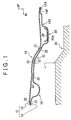
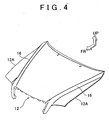
- a hood structure for a vehicle will be described with reference to FIG. 1 to FIG. 5 .
- an arrow UP indicates an upward direction of a vehicle body
- an arrow FR indicates a forward direction of the vehicle body
- an arrow IN indicates an inward direction of a vehicle width.
- a hood 10 includes a hood outer panel 12 and a hood inner panel 14.
- the hood outer panel 12 constitutes a vehicle body outer side surface of the hood 10.
- the hood inner panel 14 is provided on the inner side (i.e., on the rear surface side) of the hood outer panel 12, and constitutes a vehicle body inner side portion of the hood 10.
- (level difference portions) (relief portions) 16 are formed in the vicinity of vehicle-width-direction both ends of the hood outer panel 12 along a longitudinal direction of the vehicle body.
- Each of the relief portions 16 is formed from a portion the hood outer panel 12 which is in a front side of the vehicle body and which is in an inner side in the vehicle width direction to a portion of the hood outer panel 12 which is in a rear side of the vehicle body and which is in an outer side in the vehicle width direction.
- FIG. 3 several bone portions 18 are formed along the longitudinal direction of the vehicle at predetermined intervals in the vehicle width direction in a center region 14E of the hood inner panel 14.
- the center region 14E is a region other than a front edge portion 14A, a rear edge portion 14B, right and left vehicle-width-direction outer side line portions 14C and 14D of the hood inner panel 14, which are outer peripheral portions of the hood inner panel 14.
- a bone portion 20 is formed along the longitudinal direction of the vehicle at each vehicle-width-direction inner side portion which is positioned inside each of the vehicle-width-direction outer side line portions 14C and 14D.
- a notch 21 is formed between adjacent bone portions 18.
- Several adhesive agent application portions 22 are formed in an outer peripheral portion of the notch 21.
- vehicle-width-direction both ends 12A of the hood outer panel 12 are joined to vehicle-width-direction both ends 14F of the hood inner panel 14 by hemming process.
- Each of the bone portions 20 of the hood inner panel 14 protrudes toward a lower side of the vehicle body.
- a reinforcement 26 for a hood hinge is provided on an upper surface side of a bottom portion 20A of the bone portion 20.
- each of the bone portions 18 formed in the center region 14E of the hood inner panel 14 protrudes toward the lower side of the vehicle body.
- a flange 30 that connects the bone portion 18 and the bone portion 20 is formed at a portion below the relief portion 16 of the hood outer panel 12.
- the flange 30 of the hood inner panel 14 extends so as to be curved along the relief portion 16 of the hood outer panel 12.
- the flange 30 of the hood inner panel 14 is joined to the relief portion 16 of the hood outer panel 12 through an adhesive agent 32 applied to the adhesive agent application portion 22.
- engine room components 36 such as an engine are provided below the flange 30 of the hood inner panel 14.
- vehicle-width-direction outer side line portion 14C of the hood inner panel 14 is not shown, it is the same as that of the vehicle-width-direction outer side line portion 14D of the hood inner panel 14 shown in FIG. 1 .
- the flange 30 that connects the bone portion 18 and the bone portion 20 is formed at the portion below the relief portion 16 of the hood outer panel 12.
- the hood 10 has a double structure composed of two panels, that is, the hood outer panel 12 and the hood inner panel 14. As a result, torsional rigidity of the hood 10 is improved. Also, as shown in FIG. 2 , when a hitting body K hits the relief portion 16 of the hood outer panel 12, the relief portion 16 of the hood outer panel 12 is unlikely to be inverted toward the lower side of the vehicle.
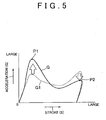
- a primary peak value P1 can be increased such that energy can be absorbed when a speed of the hitting body K is high, and a secondary peak value P2 can be decreased in the embodiment, as compared to an acceleration characteristic G1 shown by a dashed line in FIG. 5 in a comparative example in which the flange 30 is not formed. Accordingly, in the hood structure for a vehicle according to the embodiment, energy can be absorbed efficiently in a given space without providing a separate shock absorbing body.
- a separate shock absorbing body does not need to be provided between the hood outer panel 12 and the hood inner panel 14, it is possible to prevent an increase in the number of components, an increase in weight, and an increase in assembly cost. In addition, incomplete collapse of the shock absorbing body does not occur. As a result, even when there is only a limited space, energy can be absorbed efficiently using the limited space effectively.
- the thickness of the hood 10 is small. As a result, a distance L between the hood inner panel 14 and the engine room components 36 such as the engine below the hood is large, and a secondary hit on the engine room components 36 can be prevented.
- the relief portion 16 of the hood outer panel 12 is joined to the flange 30 of the hood inner panel 14 by the adhesive agent 32, tensile rigidity of the hood 10 is also improved.
- the flange 30 of the hood inner panel 14 extends so as to be curved along the relief portion 16 of the hood outer panel 12, as shown in FIG. 1 .
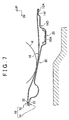
- the flange 30 of the hood inner panel 14 may be formed such that the cross section of the flange 30 is a straight line in the longitudinal direction of the vehicle body. In this case, the flange 30 is not inverted when the hitting body hits the relief portion 16 of the hood outer panel 12, and accordingly there is no excess stroke due to inversion of the flange 30, as shown in FIG. 7 .
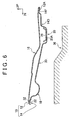
- a bead 50 that is reinforcement means (a reinforcement portion) for connecting the bone portion 18 and the bone portion 20 for improving surface rigidity may be provided in the flange 30 of the hood inner panel 14.
- the bead 50 improves the surface rigidity of the flange 30, the flange 30 is more unlikely to be inverted, and stress is propagated to the bone portion 18 and the bone portion 20 more easily when the hitting body K hits the relief portion 16 of the hood outer panel 12.
- the primary peak value P1 of the acceleration can be further increased, and the rigidity of the hood 10 itself can be improved, as compared to the acceleration characteristic G shown by the solid line in FIG. 5 . Accordingly, even in the case where there is only a limited space, energy can be absorbed efficiently using the limited space effectively.
- each of the relief portions 16 is formed in the vicinity of each of vehicle-width both ends of the hood outer panel 12, from the portion which is in the front side of the vehicle body and which is in the inner side in the vehicle width direction to the portion which is in the rear side of the vehicle body and which is in the outer side in the vehicle width direction.
- the hood structure for a vehicle according to the invention can be applied.
- an opening portion may be formed in the flange 30 of the hood inner panel 14 in order to reduce weight.
Landscapes
- Engineering & Computer Science (AREA)
- Mechanical Engineering (AREA)
- Chemical & Material Sciences (AREA)
- Combustion & Propulsion (AREA)
- Transportation (AREA)
- Superstructure Of Vehicle (AREA)
Claims (9)
- Motorhaubenaufbau für ein Fahrzeug, mit einem Außenblech (12), das einen Karosserieaußenbereich einer Motorhaube (10) bildet, und einem Innenblech (14), das einen Karosserieinnenbereich der Motorhaube (10) bildet, mit:einem Reliefbereich (16), der im Außenblech (12) in Längsrichtung eines Fahrzeugs ausgebildet ist;mehreren Rippenbereichen (18, 20), die im Innenblech (14) in Längsrichtung des Fahrzeugs in vorgegebenen Abständen in Fahrzeugbreitenrichtung so ausgebildet sind, dass sie in Richtung Karosserieboden ragen, undeinem Flansch (30), der im Innenblech (14) ausgebildet ist und zwei benachbarte Rippenbereiche (18, 20) der mehreren Rippenbereiche (18, 20) zu verbinden, dadurch gekennzeichnet, dassder Flansch (30) in einem Bereich des Innenblechs (14) ausgebildet ist, der unterhalb des Reliefbereichs (16) des Außenblechs (12) liegt.
- Motorhaubenaufbau für ein Fahrzeug nach Anspruch 1, wobei der Flansch (30) so ausgebildet ist, dass dessen Querschnitt in Längsrichtung des Fahrzeugs eine gerade Linie ist.
- Motorhaubenaufbau für ein Fahrzeug nach Anspruch 1 oder 2, wobei im Flansch (30) eine Verstärkung (50) zur Erhöhung der Oberflächensteifigkeit ausgebildet ist.
- Motorhaubenaufbau für ein Fahrzeug nach Anspruch 3, wobei die Verstärkung (50) aus einer Sicke besteht.
- Motorhaubenaufbau für ein Fahrzeug nach Anspruch 1, wobei der Reliefbereich (16) von einem Bereich des Außenblechs (12), der an der Frontseite der Karosserie und in Fahrzeugbreitenrichtung betrachtet innen liegt, bis zu einem Bereich des Außenblechs (12), der an der Heckseite der Karosserie und in Fahrzeugbreitenrichtung betrachtet außen liegt, ausgebildet ist.
- Motorhaubenaufbau für ein Fahrzeug nach Anspruch 1, wobei zwischen zwei anderen benachbarten Rippenbereichen (18, 20) als die beiden benachbarten Rippenbereiche (18, 20), die durch den Flansch (30) verbunden sind, der mehreren Rippenbereiche (18, 20) eine Einkerbung (21) ausgebildet ist.
- Motorhaubenaufbau für ein Fahrzeug nach Anspruch 1, wobei der Flansch (30) der Krümmung des Reliefbereichs (16) folgend verläuft.
- Motorhaubenaufbau für ein Fahrzeug nach Anspruch 1, wobei die beiden benachbarten Rippenbereiche (18, 20), die durch den Flansch (30) verbunden sind, jeweils in Breitenrichtung des Fahrzeugs betrachtet seitlich des Reliefbereichs (16) verlaufen.
- Motorhaubenaufbau für ein Fahrzeug nach Anspruch 1, wobei der Flansch (30) in Höhenrichtung des Fahrzeugs betrachtet in einem vorgegebenen Abstand zum Reliefbereich (16) angeordnet und mit dem Reliefbereich (16) durch ein Bindemittel (32) verbunden ist.
Applications Claiming Priority (2)
| Application Number | Priority Date | Filing Date | Title |
|---|---|---|---|
| JP2003365731 | 2003-10-27 | ||
| JP2003365731A JP4059187B2 (ja) | 2003-10-27 | 2003-10-27 | 車両用フード構造 |
Publications (3)
| Publication Number | Publication Date |
|---|---|
| EP1527984A2 EP1527984A2 (de) | 2005-05-04 |
| EP1527984A3 EP1527984A3 (de) | 2005-06-15 |
| EP1527984B1 true EP1527984B1 (de) | 2008-02-13 |
Family
ID=34420095
Family Applications (1)
| Application Number | Title | Priority Date | Filing Date |
|---|---|---|---|
| EP04024208A Expired - Lifetime EP1527984B1 (de) | 2003-10-27 | 2004-10-11 | Fahrzeug-Motorhaube |
Country Status (7)
| Country | Link |
|---|---|
| US (1) | US7140673B2 (de) |
| EP (1) | EP1527984B1 (de) |
| JP (1) | JP4059187B2 (de) |
| KR (1) | KR100676948B1 (de) |
| CN (2) | CN1315684C (de) |
| AU (1) | AU2004222857B2 (de) |
| DE (1) | DE602004011722T2 (de) |
Families Citing this family (37)
| Publication number | Priority date | Publication date | Assignee | Title |
|---|---|---|---|---|
| JP2005075176A (ja) * | 2003-09-01 | 2005-03-24 | Toyota Motor Corp | 車両用フード構造 |
| JP4059187B2 (ja) * | 2003-10-27 | 2008-03-12 | トヨタ自動車株式会社 | 車両用フード構造 |
| JP4470607B2 (ja) * | 2004-06-21 | 2010-06-02 | マツダ株式会社 | 車両用フード構造 |
| US20100244482A1 (en) * | 2005-09-12 | 2010-09-30 | Montagna John C | Tonneau Cover |
| USD574763S1 (en) | 2005-09-13 | 2008-08-12 | Durakon Industries, Inc. | Tonneau cover |
| FR2891236A1 (fr) * | 2005-09-29 | 2007-03-30 | Plastic Omnium Cie | Capot de vehicule automobile destine a fermer un compartiment moteur contenant des pieces rigides |
| JP4961764B2 (ja) * | 2006-02-10 | 2012-06-27 | マツダ株式会社 | 自動車のエンジンフード構造 |
| JP4719039B2 (ja) * | 2006-03-15 | 2011-07-06 | 株式会社神戸製鋼所 | 自動車用フード |
| JP4664874B2 (ja) * | 2006-07-07 | 2011-04-06 | 株式会社神戸製鋼所 | 自動車用フード |
| FR2907078B1 (fr) | 2006-10-17 | 2009-01-16 | Plastic Omnium Cie | Capot de vehicule automobile muni de corps creux |
| JP4200506B2 (ja) * | 2006-10-27 | 2008-12-24 | いすゞ自動車株式会社 | 車載部品の取付構造 |
| FR2911842B1 (fr) * | 2007-01-31 | 2009-08-21 | Peugeot Citroen Automobiles Sa | Structure de capot avant de vehicule |
| JP2010520121A (ja) * | 2007-03-07 | 2010-06-10 | アルコア インコーポレイテッド | 補強用発泡体を有する、歩行者に安全な自動車フード |
| US7735908B2 (en) * | 2007-07-24 | 2010-06-15 | Gm Global Technology Operations, Inc. | Vehicle hood with sandwich inner structure |
| US20090026807A1 (en) * | 2007-07-24 | 2009-01-29 | Gm Global Technology Operations, Inc. | Energy-Absorbing Vehicle Hood Assembly with Cushion Inner Structure |
| US7635157B2 (en) * | 2007-09-11 | 2009-12-22 | GM Global Technology Operation, INC | Vehicle hood assembly with rippled cushion support |
| DE102007053171B4 (de) * | 2007-11-08 | 2024-10-02 | Dr. Ing. H.C. F. Porsche Aktiengesellschaft | Motorhaube für ein Kraftfahrzeug |
| FR2937609B1 (fr) * | 2008-10-27 | 2012-12-21 | Plastic Omnium Cie | Doublure de capot de vehicule |
| DE202009017786U1 (de) * | 2009-09-17 | 2010-06-17 | GM Global Technology Operations, Inc., Detroit | Karosserie für ein Kraftfahrzeug |
| EP2542461A4 (de) * | 2010-03-05 | 2013-09-04 | Shape Corp | Energieabsorptionskappe für fussgänger |
| FR2964923A1 (fr) * | 2010-09-16 | 2012-03-23 | Peugeot Citroen Automobiles Sa | Vehicule concu pour minimiser un choc pieton |
| JP2012106653A (ja) * | 2010-11-18 | 2012-06-07 | Honda Motor Co Ltd | 自動車のフロントフード構造 |
| JP5589794B2 (ja) * | 2010-11-19 | 2014-09-17 | スズキ株式会社 | 車両用フロントフード |
| JP5711942B2 (ja) * | 2010-11-19 | 2015-05-07 | 日本プラスト株式会社 | カウルトップカバー |
| US8424629B2 (en) | 2011-03-09 | 2013-04-23 | Shape Corp. | Vehicle energy absorber for pedestrian's upper leg |
| US9248866B2 (en) | 2014-06-13 | 2016-02-02 | Toyota Motor Engineering & Manufacturing North America, Inc. | Hood assembly |
| US9381879B2 (en) | 2014-11-12 | 2016-07-05 | GM Global Technology Operations LLC | Local energy absorber |
| US9593517B2 (en) | 2014-12-31 | 2017-03-14 | Toyota Motor Engineering & Manufacturing North America, Inc. | Vehicles having load-transferring hood hinge members |
| US9499209B1 (en) * | 2015-07-15 | 2016-11-22 | Ford Global Technologies, Llc | Solar-activated structure for revealing a hidden indicia within a body panel of a vehicle |
| US10092055B2 (en) | 2016-01-06 | 2018-10-09 | GM Global Technology Operations LLC | Local energy absorber |
| US10246044B2 (en) | 2016-02-12 | 2019-04-02 | Ford Global Technologies, Llc | Vehicle hood assembly with deployable pedestrian protection |
| JP6718726B2 (ja) * | 2016-03-31 | 2020-07-08 | 株式会社神戸製鋼所 | 車両用フード |
| US10144457B2 (en) * | 2016-03-31 | 2018-12-04 | Kobe Steel, Ltd. | Vehicle hood |
| CN109501869A (zh) * | 2018-10-23 | 2019-03-22 | 中国第汽车股份有限公司 | 一种乘用车铝合金发动机罩 |
| CN117460661A (zh) * | 2021-06-04 | 2024-01-26 | 日本制铁株式会社 | 汽车盖板及其制造方法 |
| FR3128437A1 (fr) * | 2021-10-25 | 2023-04-28 | Psa Automobiles Sa | Capot pour véhicule automobile comprenant une doublure en forme d’arche |
| CN118665610A (zh) * | 2023-03-20 | 2024-09-20 | 本田技研工业株式会社 | 车用面板结构 |
Family Cites Families (30)
| Publication number | Priority date | Publication date | Assignee | Title |
|---|---|---|---|---|
| JPS60124575A (ja) * | 1983-12-08 | 1985-07-03 | Nissan Motor Co Ltd | 自動車のエンジンフ−ド構造 |
| US5124191A (en) * | 1991-03-11 | 1992-06-23 | Aluminum Company Of America | Structural panel |
| JPH05155355A (ja) * | 1991-12-03 | 1993-06-22 | Toyota Motor Corp | エンジンフード構造 |
| US5706908A (en) * | 1994-04-18 | 1998-01-13 | Nissan Motor Co., Ltd. | Front upper structure of automotive vehicle |
| JP3329086B2 (ja) | 1994-09-14 | 2002-09-30 | 日産自動車株式会社 | 自動車のフード |
| JP3871744B2 (ja) * | 1996-10-25 | 2007-01-24 | 本田技研工業株式会社 | 自動車用合成樹脂製パネル |
| JP3531789B2 (ja) * | 1998-05-13 | 2004-05-31 | 本田技研工業株式会社 | 自動車のボンネット |
| DE19846192A1 (de) * | 1998-10-07 | 2000-04-13 | Volkswagen Ag | Karosseriehaube, insbesondere Motorraumhaube eines Kraftfahrzeugs |
| DE59901135D1 (de) * | 1999-10-21 | 2002-05-08 | Ford Global Tech Inc | Motorhaube für Kraftfahrzeuge zum Schutz von Fussgängern |
| JP2001122049A (ja) * | 1999-10-26 | 2001-05-08 | Kobe Steel Ltd | 1kHz以下の周波数帯域の防音性に優れた輸送機用パネル構造体 |
| DE60126673T2 (de) * | 2000-12-13 | 2007-10-31 | Kabushiki Kaisha Kobe Seiko Sho, Kobe | Verkleidungskonstruktion für motorhaube eines personenwagenaufbaus |
| JP3823834B2 (ja) * | 2002-01-23 | 2006-09-20 | 日産自動車株式会社 | 車両用開閉体の内部構造 |
| ITMI20021042A1 (it) * | 2002-05-16 | 2003-11-17 | Adlev Srl | Struttura di cofano per autovetture a caratteristiche migliorate di sicurezza |
| JP2004122973A (ja) * | 2002-10-03 | 2004-04-22 | Fuji Heavy Ind Ltd | 車両用フロントフード |
| JP4192602B2 (ja) * | 2003-01-14 | 2008-12-10 | トヨタ自動車株式会社 | 車両のフード構造 |
| JP2005053265A (ja) * | 2003-08-06 | 2005-03-03 | Toyota Motor Corp | 車両用フード構造 |
| JP4289072B2 (ja) * | 2003-08-11 | 2009-07-01 | スズキ株式会社 | 自動車フード構造 |
| JP4053482B2 (ja) * | 2003-09-01 | 2008-02-27 | トヨタ自動車株式会社 | 車両用フード構造 |
| JP2005075176A (ja) * | 2003-09-01 | 2005-03-24 | Toyota Motor Corp | 車両用フード構造 |
| JP2005075163A (ja) * | 2003-09-01 | 2005-03-24 | Toyota Motor Corp | 車両用フード構造 |
| JP4422454B2 (ja) * | 2003-09-22 | 2010-02-24 | トヨタ自動車株式会社 | 車両用フード構造 |
| JP4053485B2 (ja) * | 2003-09-25 | 2008-02-27 | トヨタ自動車株式会社 | 車両用フード構造 |
| JP4076487B2 (ja) * | 2003-09-25 | 2008-04-16 | トヨタ自動車株式会社 | 車両用フード構造 |
| JP2005104274A (ja) * | 2003-09-30 | 2005-04-21 | Toyota Motor Corp | 車両用フード構造 |
| JP4059187B2 (ja) * | 2003-10-27 | 2008-03-12 | トヨタ自動車株式会社 | 車両用フード構造 |
| JP2005145224A (ja) * | 2003-11-14 | 2005-06-09 | Toyota Motor Corp | 車両用フード構造 |
| JP4200907B2 (ja) * | 2004-01-27 | 2008-12-24 | トヨタ自動車株式会社 | 車両用フード構造 |
| JP2005239092A (ja) * | 2004-02-27 | 2005-09-08 | Kanto Auto Works Ltd | 自動車のフード構造 |
| JP4214929B2 (ja) * | 2004-03-08 | 2009-01-28 | トヨタ自動車株式会社 | 車両用フード構造 |
| JP4470607B2 (ja) * | 2004-06-21 | 2010-06-02 | マツダ株式会社 | 車両用フード構造 |
-
2003
- 2003-10-27 JP JP2003365731A patent/JP4059187B2/ja not_active Expired - Fee Related
-
2004
- 2004-10-11 DE DE602004011722T patent/DE602004011722T2/de not_active Expired - Lifetime
- 2004-10-11 EP EP04024208A patent/EP1527984B1/de not_active Expired - Lifetime
- 2004-10-20 US US10/968,079 patent/US7140673B2/en not_active Expired - Lifetime
- 2004-10-26 CN CNB2004100870947A patent/CN1315684C/zh not_active Expired - Lifetime
- 2004-10-26 KR KR1020040085594A patent/KR100676948B1/ko not_active Expired - Fee Related
- 2004-10-26 AU AU2004222857A patent/AU2004222857B2/en not_active Ceased
- 2004-10-27 CN CNU2004201176667U patent/CN2744580Y/zh not_active Expired - Lifetime
Also Published As
| Publication number | Publication date |
|---|---|
| JP4059187B2 (ja) | 2008-03-12 |
| KR20050040734A (ko) | 2005-05-03 |
| DE602004011722T2 (de) | 2009-01-29 |
| CN2744580Y (zh) | 2005-12-07 |
| KR100676948B1 (ko) | 2007-01-31 |
| EP1527984A3 (de) | 2005-06-15 |
| AU2004222857A1 (en) | 2005-05-12 |
| CN1611407A (zh) | 2005-05-04 |
| CN1315684C (zh) | 2007-05-16 |
| DE602004011722D1 (de) | 2008-03-27 |
| AU2004222857B2 (en) | 2007-02-22 |
| US7140673B2 (en) | 2006-11-28 |
| EP1527984A2 (de) | 2005-05-04 |
| JP2005125989A (ja) | 2005-05-19 |
| US20050088016A1 (en) | 2005-04-28 |
Similar Documents
| Publication | Publication Date | Title |
|---|---|---|
| US7140673B2 (en) | Hood structure for vehicle | |
| KR100644416B1 (ko) | 차량 후드 구조체 | |
| EP2112981B1 (de) | Seitenelement für eine fahrzeugvorderfläche | |
| JP3828329B2 (ja) | 自動車の車体構造 | |
| US20160083019A1 (en) | Bonnet structure of automotive vehicle | |
| US6938950B2 (en) | Vehicle body structure | |
| JP2003226266A (ja) | 車体前部構造 | |
| WO2010097690A1 (en) | Vehicle front structure | |
| EP4159546B1 (de) | Vorderstruktur eines fahrzeugs | |
| US20190232904A1 (en) | Skeleton structure of vehicle front part | |
| JP2005145224A (ja) | 車両用フード構造 | |
| JPH11115818A (ja) | フロントサイドメンバ根元部構造 | |
| JP3617481B2 (ja) | 自動車の車体前部構造 | |
| JP3622715B2 (ja) | 車体前部構造 | |
| JP4053485B2 (ja) | 車両用フード構造 | |
| CN114162222B (zh) | 车身前部构造 | |
| JP3632654B2 (ja) | 車体前部構造 | |
| CN108349547B (zh) | 汽车的前部车身结构 | |
| KR20220120258A (ko) | 차량의 카울 보강 구조 | |
| CN113173139A (zh) | 车辆的车身结构 | |
| EP2428432B1 (de) | Vorderseitenchassis einer Fahrzeugkarosserie | |
| JP4214851B2 (ja) | 車両用フード構造 | |
| JP2025043067A (ja) | 車両構造 | |
| JP2005161892A (ja) | 車体前部構造 | |
| KR20010060904A (ko) | 자동차의 전방차체부 보강구조 |
Legal Events
| Date | Code | Title | Description |
|---|---|---|---|
| PUAI | Public reference made under article 153(3) epc to a published international application that has entered the european phase |
Free format text: ORIGINAL CODE: 0009012 |
|
| PUAL | Search report despatched |
Free format text: ORIGINAL CODE: 0009013 |
|
| 17P | Request for examination filed |
Effective date: 20041108 |
|
| AK | Designated contracting states |
Kind code of ref document: A2 Designated state(s): AT BE BG CH CY CZ DE DK EE ES FI FR GB GR HU IE IT LI LU MC NL PL PT RO SE SI SK TR |
|
| AX | Request for extension of the european patent |
Extension state: AL HR LT LV MK |
|
| AK | Designated contracting states |
Kind code of ref document: A3 Designated state(s): AT BE BG CH CY CZ DE DK EE ES FI FR GB GR HU IE IT LI LU MC NL PL PT RO SE SI SK TR |
|
| AX | Request for extension of the european patent |
Extension state: AL HR LT LV MK |
|
| AKX | Designation fees paid |
Designated state(s): DE FR GB IT |
|
| GRAP | Despatch of communication of intention to grant a patent |
Free format text: ORIGINAL CODE: EPIDOSNIGR1 |
|
| GRAS | Grant fee paid |
Free format text: ORIGINAL CODE: EPIDOSNIGR3 |
|
| GRAA | (expected) grant |
Free format text: ORIGINAL CODE: 0009210 |
|
| AK | Designated contracting states |
Kind code of ref document: B1 Designated state(s): DE FR GB IT |
|
| REG | Reference to a national code |
Ref country code: GB Ref legal event code: FG4D |
|
| RIN1 | Information on inventor provided before grant (corrected) |
Inventor name: ITO, KATSUYOSHI Inventor name: MORIKAWA, MASAAKI Inventor name: IKEDA, KOKI |
|
| REF | Corresponds to: |
Ref document number: 602004011722 Country of ref document: DE Date of ref document: 20080327 Kind code of ref document: P |
|
| REG | Reference to a national code |
Ref country code: DE Ref legal event code: R096 Ref document number: 602004011722 Country of ref document: DE Effective date: 20080327 |
|
| ET | Fr: translation filed | ||
| PLBE | No opposition filed within time limit |
Free format text: ORIGINAL CODE: 0009261 |
|
| STAA | Information on the status of an ep patent application or granted ep patent |
Free format text: STATUS: NO OPPOSITION FILED WITHIN TIME LIMIT |
|
| 26N | No opposition filed |
Effective date: 20081114 |
|
| REG | Reference to a national code |
Ref country code: DE Ref legal event code: R097 Ref document number: 602004011722 Country of ref document: DE Effective date: 20081114 |
|
| REG | Reference to a national code |
Ref country code: GB Ref legal event code: 746 Effective date: 20130717 |
|
| REG | Reference to a national code |
Ref country code: DE Ref legal event code: R084 Ref document number: 602004011722 Country of ref document: DE Effective date: 20130717 |
|
| REG | Reference to a national code |
Ref country code: FR Ref legal event code: PLFP Year of fee payment: 13 |
|
| REG | Reference to a national code |
Ref country code: FR Ref legal event code: PLFP Year of fee payment: 14 |
|
| REG | Reference to a national code |
Ref country code: FR Ref legal event code: PLFP Year of fee payment: 15 |
|
| PGFP | Annual fee paid to national office [announced via postgrant information from national office to epo] |
Ref country code: IT Payment date: 20210910 Year of fee payment: 18 Ref country code: FR Payment date: 20210913 Year of fee payment: 18 |
|
| PGFP | Annual fee paid to national office [announced via postgrant information from national office to epo] |
Ref country code: GB Payment date: 20210901 Year of fee payment: 18 |
|
| P01 | Opt-out of the competence of the unified patent court (upc) registered |
Effective date: 20230517 |
|
| GBPC | Gb: european patent ceased through non-payment of renewal fee |
Effective date: 20221011 |
|
| PG25 | Lapsed in a contracting state [announced via postgrant information from national office to epo] |
Ref country code: FR Free format text: LAPSE BECAUSE OF NON-PAYMENT OF DUE FEES Effective date: 20221031 |
|
| PG25 | Lapsed in a contracting state [announced via postgrant information from national office to epo] |
Ref country code: IT Free format text: LAPSE BECAUSE OF NON-PAYMENT OF DUE FEES Effective date: 20221011 Ref country code: GB Free format text: LAPSE BECAUSE OF NON-PAYMENT OF DUE FEES Effective date: 20221011 |
|
| PGFP | Annual fee paid to national office [announced via postgrant information from national office to epo] |
Ref country code: DE Payment date: 20230830 Year of fee payment: 20 |
|
| REG | Reference to a national code |
Ref country code: DE Ref legal event code: R071 Ref document number: 602004011722 Country of ref document: DE |