EP1501119B1 - Procede de fabrication de plaquettes semi-conductrices et plaquette - Google Patents
Procede de fabrication de plaquettes semi-conductrices et plaquette Download PDFInfo
- Publication number
- EP1501119B1 EP1501119B1 EP03719197A EP03719197A EP1501119B1 EP 1501119 B1 EP1501119 B1 EP 1501119B1 EP 03719197 A EP03719197 A EP 03719197A EP 03719197 A EP03719197 A EP 03719197A EP 1501119 B1 EP1501119 B1 EP 1501119B1
- Authority
- EP
- European Patent Office
- Prior art keywords
- wafer
- polishing
- back surface
- mirror
- chamfering
- Prior art date
- Legal status (The legal status is an assumption and is not a legal conclusion. Google has not performed a legal analysis and makes no representation as to the accuracy of the status listed.)
- Expired - Lifetime
Links
Images



Classifications
-
- H—ELECTRICITY
- H10—SEMICONDUCTOR DEVICES; ELECTRIC SOLID-STATE DEVICES NOT OTHERWISE PROVIDED FOR
- H10P—GENERIC PROCESSES OR APPARATUS FOR THE MANUFACTURE OR TREATMENT OF DEVICES COVERED BY CLASS H10
- H10P52/00—Grinding, lapping or polishing of wafers, substrates or parts of devices
-
- H—ELECTRICITY
- H10—SEMICONDUCTOR DEVICES; ELECTRIC SOLID-STATE DEVICES NOT OTHERWISE PROVIDED FOR
- H10P—GENERIC PROCESSES OR APPARATUS FOR THE MANUFACTURE OR TREATMENT OF DEVICES COVERED BY CLASS H10
- H10P90/00—Preparation of wafers not covered by a single main group of this subclass, e.g. wafer reinforcement
- H10P90/12—Preparing bulk and homogeneous wafers
-
- B—PERFORMING OPERATIONS; TRANSPORTING
- B24—GRINDING; POLISHING
- B24B—MACHINES, DEVICES, OR PROCESSES FOR GRINDING OR POLISHING; DRESSING OR CONDITIONING OF ABRADING SURFACES; FEEDING OF GRINDING, POLISHING, OR LAPPING AGENTS
- B24B37/00—Lapping machines or devices; Accessories
- B24B37/04—Lapping machines or devices; Accessories designed for working plane surfaces
- B24B37/042—Lapping machines or devices; Accessories designed for working plane surfaces operating processes therefor
-
- B—PERFORMING OPERATIONS; TRANSPORTING
- B24—GRINDING; POLISHING
- B24B—MACHINES, DEVICES, OR PROCESSES FOR GRINDING OR POLISHING; DRESSING OR CONDITIONING OF ABRADING SURFACES; FEEDING OF GRINDING, POLISHING, OR LAPPING AGENTS
- B24B9/00—Machines or devices designed for grinding edges or bevels on work or for removing burrs; Accessories therefor
- B24B9/02—Machines or devices designed for grinding edges or bevels on work or for removing burrs; Accessories therefor characterised by a special design with respect to properties of materials specific to articles to be ground
- B24B9/06—Machines or devices designed for grinding edges or bevels on work or for removing burrs; Accessories therefor characterised by a special design with respect to properties of materials specific to articles to be ground of non-metallic inorganic material, e.g. stone, ceramics, porcelain
- B24B9/065—Machines or devices designed for grinding edges or bevels on work or for removing burrs; Accessories therefor characterised by a special design with respect to properties of materials specific to articles to be ground of non-metallic inorganic material, e.g. stone, ceramics, porcelain of thin, brittle parts, e.g. semiconductors, wafers
-
- H—ELECTRICITY
- H10—SEMICONDUCTOR DEVICES; ELECTRIC SOLID-STATE DEVICES NOT OTHERWISE PROVIDED FOR
- H10D—INORGANIC ELECTRIC SEMICONDUCTOR DEVICES
- H10D84/00—Integrated devices formed in or on semiconductor substrates that comprise only semiconducting layers, e.g. on Si wafers or on GaAs-on-Si wafers
- H10D84/01—Manufacture or treatment
- H10D84/02—Manufacture or treatment characterised by using material-based technologies
- H10D84/03—Manufacture or treatment characterised by using material-based technologies using Group IV technology, e.g. silicon technology or silicon-carbide [SiC] technology
- H10D84/038—Manufacture or treatment characterised by using material-based technologies using Group IV technology, e.g. silicon technology or silicon-carbide [SiC] technology using silicon technology, e.g. SiGe
-
- H—ELECTRICITY
- H10—SEMICONDUCTOR DEVICES; ELECTRIC SOLID-STATE DEVICES NOT OTHERWISE PROVIDED FOR
- H10P—GENERIC PROCESSES OR APPARATUS FOR THE MANUFACTURE OR TREATMENT OF DEVICES COVERED BY CLASS H10
- H10P50/00—Etching of wafers, substrates or parts of devices
- H10P50/60—Wet etching
- H10P50/64—Wet etching of semiconductor materials
- H10P50/642—Chemical etching
-
- H—ELECTRICITY
- H10—SEMICONDUCTOR DEVICES; ELECTRIC SOLID-STATE DEVICES NOT OTHERWISE PROVIDED FOR
- H10P—GENERIC PROCESSES OR APPARATUS FOR THE MANUFACTURE OR TREATMENT OF DEVICES COVERED BY CLASS H10
- H10P70/00—Cleaning of wafers, substrates or parts of devices
- H10P70/10—Cleaning before device manufacture, i.e. Begin-Of-Line process
- H10P70/15—Cleaning before device manufacture, i.e. Begin-Of-Line process by wet cleaning only
-
- Y—GENERAL TAGGING OF NEW TECHNOLOGICAL DEVELOPMENTS; GENERAL TAGGING OF CROSS-SECTIONAL TECHNOLOGIES SPANNING OVER SEVERAL SECTIONS OF THE IPC; TECHNICAL SUBJECTS COVERED BY FORMER USPC CROSS-REFERENCE ART COLLECTIONS [XRACs] AND DIGESTS
- Y10—TECHNICAL SUBJECTS COVERED BY FORMER USPC
- Y10S—TECHNICAL SUBJECTS COVERED BY FORMER USPC CROSS-REFERENCE ART COLLECTIONS [XRACs] AND DIGESTS
- Y10S438/00—Semiconductor device manufacturing: process
- Y10S438/928—Front and rear surface processing
Definitions
- the present invention relates to a method for manufacturing a semiconductor wafer (hereinafter also referred to simply as a wafer) realizing high flatness, and particularly, to a method for manufacturing a wafer with high flatness in a process for manufacturing a semiconductor having an alkali etching step, and besides, a process for manufacturing a semiconductor wafer having a mirror polishing step with a wax mount system.
- a semiconductor wafer hereinafter also referred to simply as a wafer
- a semiconductor wafer has been conventionally manufactured according to a procedure as shown in a flowchart of Fig. 7 .
- the conventional method for manufacturing a semiconductor wafer includes: a slicing step for slicing a single crystal rod of silicon or the like into wafers (step 100); a chamfering step for chamfering a peripheral portion of a sliced wafer (step 102); a lapping step for lapping a chamfered wafer (step 104); an etching step for etching a lapped wafer (step 106); and a mirror polishing step for mirror polishing at least a front surface of an etched wafer (step 108).
- a wafer prior to the mirror polishing step is also referred to as a starting wafer.
- the chamfering (the chamfering step) is an indispensable step because unless the chamfering step is applied to a wafer peripheral portion, a single crystal of silicon or the like is very hard and brittle so that braking and chipping of a semiconductor wafer occur during a process for manufacturing the semiconductor wafer and a fabrication process for a device, which results in reduction in product yield in the processes and degradation in characteristics of a device.
- the chamfering processes there are known mainly a process rounding a wafer peripheral portion with a chemical method, and a process chamfering a peripheral portion thereof mechanically using a grinding stone. The latter mechanical process has generally been adopted in a recent trend of larger diameter of wafers because of good stability of wafer quality and excellence in dimensional precision.
- the wafer While it is required to firmly hold a wafer in order to process the periphery thereof by means of a mechanical method, the wafer is held on the main surfaces thereof from the nature of processing the wafer periphery, and in the processing the main surface thereof is subject to scratches and contamination.
- the main surface of the wafer is used as a surface on which a device pattern is illustrated, so the scratches and contamination on the main surface of the wafer has to be avoided at the lowest possible level. Therefore, generally, the chamfering is performed on a wafer immediately after the wafer is obtained by slicing a single crystal rod and thereafter, the main surfaces of the wafer are ground by lapping so as to make wafer thickness uniform, thereby the scratches and contamination on the main surfaces generated during the chamfering being removed.
- the dimensional precision of the chamfered surface has been improved not only by increasing smoothness of the chamfered surface using as a grinding stone abrasive grains with small sizes at the sacrifice of productivity in chamfering, but also by improving precision in a chamfering machine and a control technique therefor.
- the lapping is performed such that a wafer is sandwiched between an upper table and a lower table, a mixture obtained by mixing abrasive grains into a lapping solution (an abrasive agent) is supplied into clearances between the wafer and the upper and lower tables, and the wafer and the tables are rubbed against each other under a pressure applied therebetween to thereby grind the main surfaces of the wafer, in which situation a wafer holding metal jig is used for holding the wafer.
- a lapping solution an abrasive agent
- acid or alkali etching treatment is performed to remove processing damage or the like generated in lapping and other steps.
- a wafer is adhered to a polishing block, the wafer on the polishing block is pressed to a polishing cloth stuck on a polishing table and the wafer is polished while being rubbed on the polishing cloth.
- a wax mount system in which a wafer is stuck with wax
- a waxless mount system in which a wafer is firmly held by vacuum suction or the like without using wax.
- the waxless system not only requires neither of an adhering operation of a wafer to a polishing block and a releasing operation of the wafer from the polishing block, but also is easy in cleaning the wafer after polishing; therefore, this system is advantageous in aspects of productivity and cost.
- the waxless system has problems in respect of flatness of the polished wafer, local etching on the back surface of the wafer caused by polishing slurry and others, so the wax mount system stands as the present mainstream.
- a wafer is sucked at the front surface thereof with a vacuum suction device, wax is applied on the back surface thereof, the back surface is directed downward, the wafer is released from the vacuum suction device near the polishing block, and by dropping the wafer onto the polishing block due to its own weight, the wafer is adhered to the polishing block.
- a vacuum suction device provided with an air pad
- a wafer coated with wax is pressed to the polishing block at the central portion thereof as it is or in a state where the wafer is bent, in which situation by releasing the wafer from the vacuum suction device, the wafer is adhered to the polishing block.
- polishing block those made of glass such as borosilicate glass, or ceramics such as alumina and silicon carbide.
- glass such as borosilicate glass
- ceramics such as alumina and silicon carbide.
- a silicon single crystal ingot is sliced into silicon wafers and the following steps are thereafter applied sequentially to the sliced wafer: chamfering, lapping, etching and the like, followed by mirror polishing of at least the wafer main surface.
- edge polishing is performed in which the chamfered portion is mirror polished with a cylindrical buff or the like.
- wafer flatness in the wafer polishing step is greatly affected by a state of the wafer in the previous steps (steps prior to polishing).
- a configuration of a wafer etched in the previous step exerts an influence on a configuration of a polished wafer.
- CW a configuration of a wafer etched in the previous step
- waviness of the wafer is great, so it is difficult to improve flatness of the wafer.
- the reduction of the waviness is realized with adoption of a combination of alkali etching and acid etching, improved alkali etching or the like.
- SFQR Site Front Least Squares Range
- SFQR Site Front Least Squares Range
- the alkali etched wafer exhibits good SFQR values in the wafer surface but has sag on the outer peripheral portion, so the SFQRmax is present in the outer peripheral portion, which degrades an apparent quality of the wafer.
- EP 1 313 135 A1 discloses a method for processing a semiconductor wafer, wherein acid etching is performed after alkaline etching in order to avoid peripheral sag, and then the front polishing is performed. After acid etching and before the front polishing step the entire back side of a wafer can be polished in order to improve the quality of the back surface of the wafer, so that the waviness on the back surface of the wafer is reduced and does not influence the front surface polishing.
- the present invention has been made in light of the problem and it is an object of the present invention to provide a method for manufacturing a semiconductor wafer capable of manufacturing a wafer without ring-like sag in an outer peripheral portion thereof in polishing an alkali etched wafer (CW), and a wafer without the ring-like sag in the outer peripheral portion thereof.
- CW alkali etched wafer
- a first aspect of a method for manufacturing a semiconductor wafer according to the present invention comprises: a back surface part polishing and edge polishing step for performing back surface part polishing and edge polishing such that mirror polishing is performed on a chamfered portion and an inner part extending inward from a boundary between the chamfered portion and a back surface of a starting wafer; and a front surface polishing step for mirror polishing a front surface of the wafer subjected to the back surface part polishing and edge polishing step holding the wafer by the back surface thereof.
- the mirror polished area of the inner part extending inward from the boundary between the chamfered portion and the back surface of the wafer is in the range of 200 ⁇ m to 1000 ⁇ m toward the center of the wafer from the boundary.
- a second aspect of a method for manufacturing a semiconductor wafer according to the present invention comprises: a back surface part polishing step for mirror polishing an inner part extending inward from the boundary between a chamfered portion and a back surface of a starting wafer; and a front surface polishing step for mirror polishing a front surface of the wafer subjected to the back surface part polishing step holding the wafer by the back surface thereof.
- the mirror polished area of the inner part extending inward from the boundary between the chamfered portion and the back surface of the wafer is in the range of 200 ⁇ m to 1000 ⁇ m toward the center of the wafer from the boundary.
- the second aspect further comprises an edge polishing step for edge polishing the wafer subjected to the back surface part polishing step, wherein the front surface of the edge polished wafer is mirror polished.
- an alkali etched wafer As the starting wafer, it is preferable to use an alkali etched wafer as the starting wafer. By using the alkali etched wafer, there can be obtained a wafer with high flatness and few undulation.
- a third aspect of a method for manufacturing a semiconductor wafer according to the present invention comprises: a slicing step for slicing a single crystal rod into wafers each in the shape of a thin plate; a first chamfering step for chamfering the sliced wafers; a lapping step for lapping the chamfered wafers; a second chamfering step for chamfering the lapped wafers for the second time; an etching step for alkali etching the twice chamfered wafer; a back surface part polishing step for mirror polishing an inner part extending inward from the boundary between a chamfered portion and a back surface of a starting wafer; and a front surface polishing step for mirror polishing a front surface of the wafer subjected to the back surface part polishing step holding the wafer by the back surface thereof.
- the mirror polished area of the inner part extending inward from the boundary between the chamfered portion and the back surface of the wafer is in the range of 200 ⁇ m to 1000 ⁇ m toward the center of the wafer from the boundary. According to such steps, a wafer with high flatness can be manufactured.
- a fourth aspect of a method for manufacturing a semiconductor wafer according to the present invention comprises: a slicing step for slicing a single crystal rod into wafers each in the shape of a thin plate; a first chamfering step for chamfering the sliced wafers; a lapping step for lapping the chamfered wafers; a second chamfering step for chamfering the lapped wafers for the second time; an etching step for alkali etching the twice chamfered wafer; a back surface part polishing step for mirror polishing an inner part extending inward from the boundary between a chamfered portion and a back surface of a starting wafer; and a front surface polishing step for mirror polishing a front surface of the wafer subjected to the back surface part polishing step holding the wafer by the back surface thereof.
- the mirror polished area of the inner part extending inward from the boundary between the chamfered portion and the back surface of the wafer is in the range of 200 ⁇ m to 1000 ⁇ m toward the center of the wafer from the boundary.
- the fourth aspect further comprises an edge polishing step for edge polishing the wafer subjected to the back surface part polishing step, wherein the front surface of the edge polished wafer is mirror polished.
- any of the first to fourth aspects of a method for manufacturing a semiconductor wafer according to the present invention by altering a configuration of the boundary of the chamfered portion on an adhering surface, ring-like sag in an outer peripheral portion is reduced and thereby the SFQRmax is improved.
- the mirror polished area of the inner part extending inward from the boundary between the chamfered portion and the back surface of the wafer is more preferably on the order of 500 ⁇ m to 700 ⁇ m toward the center of the wafer from the boundary. With performing such polishing, flatness of the wafer front surface is improved.
- the wafer is adhered with wax and held by the back surface thereof and the front surface thereof is mirror polished.
- the front surface polishing step is, in other words, a wafer polishing method according to the wax mount system and, to put it more concretely, a method for polishing a front surface of a wafer in such a way that a wafer is adhered with wax by the back surface thereof and the front surface of the wafer and a polishing cloth are rubbed against each other while polishing slurry is supplied.
- a wafer according to the present invention is such that a front surface thereof is a mirror polished surface and the back surface thereof is an alkali etched surface, wherein an inner part extending from the boundary between a chamfered portion and the back surface of the wafer is mirror polished, and the mirror polished area of the inner part extending inward from the boundary between the chamfered portion and the back surface of the wafer is in the range of 500 ⁇ m to 700 ⁇ m toward the center of the wafer from the boundary.
- glossiness of the back surface thereof is in the range of 40 ⁇ 5% and the SFQRmax thereof is 0.11 ⁇ m or less.
- a wafer having such a quality level can be easily manufactured.
- a wafer of the present invention is a wafer with high flatness as far as an outer peripheral portion of the wafer and contributes to improvement on product yield or the like in a device fabrication process.
- a wafer of the present invention is rich in its versatility since the back surface thereof is close to a conventional surface state.
- etching treatment may be performed in order to make global flatness of a semiconductor wafer (flatness within a wafer surface) better and there are available, for example, a combination of alkali etching and acid etching, improvement on alkali etching and others.
- alkali etching it is advantageous to perform alkali etching.
- ring-like sag is observed in an outer peripheral portion of the polished wafer, resulting in degradation in flatness.
- causes for sag in an outer peripheral portion of the polished wafer include: a problem occurring in polishing wherein a polishing cloth sinks to thereby render excessive polishing in the outer peripheral portion of the wafer; a problem occurring in adhering wherein when the wafer is adhered with wax in, for example, the wax mount system, the outer peripheral portion of the wafer is adhered in a raised state and the raised outer peripheral portion is excessively polished; and a problem associated with a starting wafer such as a surface configuration prior to polishing, for example, surface roughness of the alkali etched wafer mentioned above, differences among configurations of the wafer outer peripheral portions, and others.
- the present inventors have conducted serious investigations into causes for generation of sag, and as a result, have reached a conception that one of the causes is due to the fact that a load on an outer peripheral portion of a wafer is higher compared with that on an area extending inward from the outer peripheral portion during polishing. Especially it was found that a configuration of an outer peripheral portion of a starting wafer raises a problem, and in order to reduce sag, it is effective to change an angular configuration of the boundary of the chamfered portion of the alkali etched wafer to a round configuration by edge polishing. With the edge polishing applied, it was possible to uniformly control a load on the outer peripheral portion and that on the surface excluding the outer peripheral portion during polishing.
- the main point of the method for manufacturing a semiconductor wafer according to the present invention is that there is mirror polished an inner part extending inward from a boundary between a chamfered portion and a back surface of a starting wafer, and then a front surface of the wafer with a back surface part mirror polished is mirror polished, especially by using the wax mount system, a wafer with high flatness being manufactured.
- the above described mirror polishing of the inner part extending inward from the boundary between the chamfered portion and the back surface of the starting wafer may be implemented either by edge polishing the chamfered portion together with the inner part extending inward from the boundary between the chamfered portion and the back surface of the starting wafer or by mirror polishing the inner part of the back surface in another step different from the edge polishing step.
- edge polishing is performed separately.
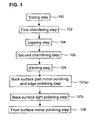
- FIG. 1 is a flowchart showing an example of a step sequence of a method for manufacturing a semiconductor wafer according to the present invention
- FIG. 2 is a flowchart showing another example of a step sequence of a method for manufacturing a semiconductor wafer according to the present invention.
- a slicing step for slicing a single crystal rod of silicon or the like step 100
- a first chamfering step for chamfering an outer peripheral portion of the obtained sliced wafer step 102
- a lapping step for lapping the chamfered wafer step 104
- the lapped wafer is immediately etched, but in the method of the present invention, the lapped wafer is again chamfered (a second chamfering step, step 105).
- the twice chamfered wafer is subjected to alkali etching treatment (an etching step, step 106).
- the etched wafer is subjected to back surface part polishing and edge polishing treatment (a back surface part polishing and edge polishing step, step 107ab).
- the back surface part polishing and edge polishing step includes: edge polishing treatment for edge polishing only the chamfered portion and in addition to that back surface part polishing treatment for mirror polishing the inner part extending inward from the boundary between the chamfered portion and the back surface of the wafer.
- a back surface light polishing step is performed if necessary on the back surface of the wafer subjected to the back surface part polishing and edge polishing step (a back surface light polishing step, step 107c).
- a front surface polishing step is fixed with, for example, wax the back surface of the wafer subjected to the back surface part polishing and edge polishing step or in addition to that the back surface light polishing step, and the front surface thereof is mirror polished (a front surface polishing step, step 108).
- the back surface part polishing and edge polishing step includes: ordinary edge polishing for edge polishing only the chamfered portion and also back surface part polishing for mirror polishing the inner part extending inward from the boundary between the chamfered portion and the back surface of the wafer, whereas as shown in FIG. 2 , the back surface part polishing treatment and the edge polishing treatment are divided into a back surface part polishing step (step 107a) and an edge polishing step (step 107b), which can be implemented separately. Moreover, in this case, the edge polishing step (step 107b) can be even omitted.
- An ingot of silicon or the like grown by the Czochralski method, the floating zone method or the like is sliced into wafers each in the shape of a thin plate in the slicing step by an inner diameter saw slicer or a wire saw.
- the first chamfering step can be performed using an inexpensive chamfering machine inferior in precision and functionality.
- this chamfering step while rotating a wafer held on a grinding stage (vacuum chuck) at a low speed, by pressing the wafer against a grinding stone rotating at a high speed under a predetermined load, the wafer is ground and chamfered tracing a profile of a groove of the grinding stone.
- the first chamfering treatment can also be performed using a chamfering machine excellent in precision and functionality, which is usually employed when chamfering a wafer.
- a chamfering width in the preliminary chamfering treatment performed prior to lapping is determined based on a chamfering width at the end of lapping taking into consideration that thickness of the wafer is reduced by lapping and in company therewith the chamfering width is also reduced.
- Main surfaces of a silicon wafer are lapped using loose abrasive grains of FO abrasive grains #1200 or more produced by Fujimi Incorporated. Especially, it is preferable that the abrasive grains are of #1500 or more.
- the lapping method is performed using a lapping machine in which wafers are held in planetary carriers and the carriers are subjected to planetary motion to thereby lap both surfaces of the wafers simultaneously between upper and lower lapping tables.
- the above FO grains were used as loose abrasive grains.
- the FO grains are fine grain abrasive based on pulverized alumina, which is artificial emery abrasive made of a mixture of brown alumina abrasive grains and zircon abrasive grains.
- abrasive grains of #1200 have an average grain size of the order of 7 ⁇ m to 8 ⁇ m. It is preferable to employ abrasive grains finer than the abrasive grains of #1200.
- chamfering is again performed after lapping.
- the second chamfering step as in the first chamfering step, while rotating a wafer held on a grinding stage (vacuum chuck) at a low speed, by pressing the wafer against a grinding stone rotating at a high speed under a predetermined load, the wafer is ground and chamfered tracing a profile of a groove of the grinding stone, which is implemented using a chamfering machine more excellent in precision and functionality than that in the first chamfering step.
- a semiconductor wafer can be manufactured without losing smoothness and dimensional precision of a chamfered surface at the end of the chamfering treatment. Furthermore, a lapped wafer has uniform thickness, so in the subsequent second chamfering, it is also advantageous to easily ensure dimensional precision of a chamfered surface.
- a chamfering width in the second chamfering performed after lapping is generally in the range of 400 ⁇ m to 500 ⁇ m.
- step sequential described above is presented as a preferable example and no specific limitation is imposed thereon, and there are conceivable various kinds of changes in respect of the above steps, such as addition of a surface grinding step and replacement of the lapping step with the surface grinding step.
- steps By implementing the above steps, a high flatness level of a wafer is ensured to a certain extent.
- alkali etching is preferably performed in the etching step.
- the etching is performed using an alkali aqueous etching solution at an alkali component concentration of 50 wt % or higher.
- An alkali component used in an etching solution of this embodiment is not limited to specific one and any can be employed as far as it can etch silicon; preferable examples in terms of an etching capability are hydroxides of alkali metals such as sodium hydroxide and potassium hydroxide and the most preferable one is sodium hydroxide.
- the alkali components described above may be used alone or in a mixture of plural components. For example, a mixture of sodium hydroxide and potassium hydroxide may be used and sodium hydroxide may be used alone.
- Stock removal in thickness (etched thickness) of a silicon wafer removed by an etching step in the present invention is only required to be the lowest thickness capable of removing processing damage without any specific limitation thereon; the stock removal total on the both surfaces is in the range of 15 ⁇ m to 40 ⁇ m in view of variations of the penetration depth of processing damage to be removed.
- the stock removal in thickness of the silicon wafer can be controlled mainly by adjusting a time for which the silicon wafer is immersed in an etching solution.
- an immersion time of the silicon wafer in the etching solution is set in a relationship between an etched thickness and a concentration of the etching solution; it is preferable to set a time so that an etched thickness falls in the range of 15 ⁇ m to 40 ⁇ m and the immersion time is usually on the order of 5 min to 60 min.
- the silicon wafer when immersing the silicon wafer in the etching solution, there may be additionally adopted conventional methods in which the silicon wafer is immersed in the etching solution while being vibrated therein, an ultrasonic wave is applied to the etching solution, or others so that the wafer is uniformly etched.
- glossiness of the wafer takes a value in the range of 15% to 30%.
- the glossiness is measured substantially in conformity with JIS Z8741 (Method for measuring specular glossiness) with a gloss meter-SD designated by JIS.
- the glossiness is a value evaluated under conditions that brightness in a state where nothing is placed at a position of an object is assumed to be 0% for convenience and glossiness of a mirror polished wafer is set at 100%.
- FIG. 4 is a schematic descriptive side view showing an example of an edge polisher.
- numerical reference 10 designates an edge polisher, which includes a wafer rotating device 12 rotating and holding a wafer W, and a rotary drum 16 on which a buff 14 is attached in a cylindrical shape.
- the cylindrical buff 14 is of a structure rotating at a high speed on the order of 800 rpm to 3000 rpm with a rotation axis 18 of the rotary drum 16 as the center and the cylindrical buff (polishing pad) 14 is attached on the outer surface of the rotary drum 16 so as to cover all the outer surface in close contact therewith.
- the wafer W is held on the wafer rotating device 12, rotates about the rotation axis 20 as the center in an inclined state at an angle of the order of 45 to 55 degrees to the rotary drum 16, and traverses in a vertical direction.
- a nozzle 22 is disposed above the contact point of the wafer W with the buff (polishing pad) 14 and supplies a processing liquid 24 quantitatively.
- edge polishing while simultaneously rotating the rotary drum 16 and the wafer W, the wafer W is brought into contact with the rotary drum 16 at an angle of about 55 degrees to the rotating drum 16.
- the outermost end of the edge portion of the wafer W is mirror polished in a state where the outermost end sinks into the cylindrical buff (polishing pad) 14.
- edge polishing is performed such that an extending area (width) of a part to be mirror polished by the edge polishing action on the back surface of the wafer, that is, an area to be mirror polished of an inner part extending toward the center of the wafer from the boundary between a chamfered portion and the back surface of the wafer is preferably in the range from 200 ⁇ m to 1000 ⁇ m , more preferably 500 ⁇ m to 700 ⁇ m.
- the effect thereof is attained by mirror polishing a part of an outer peripheral portion on the back surface of a wafer and it is preferable that an area of the mirror polished part is properly set depending on a polishing machine polishing the front surface of the wafer and polishing conditions, whereas the mirror polishing is performed such that a mirror polished area of an inner part extending toward the center of the wafer from the boundary between a chamfered portion and the back surface of the wafer is in the range of 200 ⁇ m to 1000 ⁇ m, preferably in the range of 500 ⁇ m to 1000 ⁇ m.
- the area to be mirror polished is preferably 500 ⁇ m or more, more preferably in the range of 500 ⁇ m to 700 ⁇ m.
- the extending area of the edge polishing action can be controlled by adjusting an angle of the wafer to the rotary drum and changing a property of a buff, whereas especially when edge polishing a wafer subjected to chamfering steps before and after the lapping step such a step sequence as of the first chamfering step, the lapping step and the second chamfering step, the extending area of the edge polishing action can be exactly controlled with less of variations in the area width thereof.
- step 107ab there is shown an example where in the back surface part polishing and edge polishing step (step 107ab), there are simultaneously performed ordinary edge polishing treatment and back surface part mirror polishing treatment for mirror polishing an inner part extending toward the center of the wafer from the boundary between the chamfered portion and the back surface of the wafer, while as shown in the flowchart of FIG. 2 , it is as described above that the back surface part polishing step (step 107a) performing back surface part polishing and the edge polishing step (step 107b) may be separately performed.
- the wafer back surface (main surface) may be further polished by a very small amount. Though such a step is not necessarily required, it may be added for adjustment of glossiness of the back surface and improvement on flatness.
- a polishing machine generally employed is used to polish the back surface by very small stock removal (1 ⁇ m or less).
- glossiness of a wafer back surface among wafers can be uniform and a back surface can be obtained with glossiness of the order of 40 ⁇ 5%.
- a front surface of a wafer is mirror polished.
- a main surface (front surface) side of a wafer is mirror polished by means of a polishing method of a wax mount system as an example.
- a polishing machine as shown in Fig. 5 for example, is used.
- FIG. 5 is a schematic descriptive side view showing an example of a polishing machine.
- numerical reference 30 designates a polishing machine which includes a polishing table 31, a polishing agent supply means 32, a polishing head 33, a head rotating means (not shown) and a table rotating means (not shown).
- a polishing machine which includes a polishing table 31, a polishing agent supply means 32, a polishing head 33, a head rotating means (not shown) and a table rotating means (not shown).
- the polishing block 35 is placed under the polishing head 33 and a front surface of the wafer W is brought into contact with a polishing cloth 34.
- the polishing head 33 is moved down and the front surface of the wafer W is pressed down onto the polishing cloth 34 with the polishing block 35 interposed therebetween.
- the polishing block 35 is a block made of ceramics and grooves of a lattice pattern is formed across the entire surface thereof (a surface for adhering a wafer). This type of polishing block is usually used.
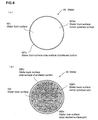
- the wafer front surface W1 is mirror polished to a high flatness level
- the wafer back surface W2 has a mirror polished part W2m in the outer peripheral portion and an alkali etched surface part W2e in the central portion.
- the mirror polished part W2m is in the range of 200 ⁇ m to 1000 ⁇ m, especially in the range of 500 ⁇ m to 700 ⁇ m in width extending toward the center of the wafer from the boundary between the chamfered portion and the back surface of the wafer.
- the boundary between the wafer main surface and the chamfered portion is definite and hence the area of the mirror polished part W2m can be easily controlled, but in the edge polished wafer both the main surface and the boundary of the chamfered portion are mirror polished and hence the boundary is hard to be exactly discriminated.
- the area of the mirror polished part is a distance extending from the boundary between the main surface and the chamfered portion.
- the area of the mirror polished part may be defined by an area including the chamfered portion.
- a wafer having a polished part of 600 ⁇ m in width extending toward the center of the wafer from the boundary between the wafer chamfered portion and the main surface of the wafer is in other words, in a case of a specification of the chamfering width of 400 ⁇ m, a wafer having a polished part of 1000 ⁇ m in width extending toward the center of the wafer from the outermost periphery of the wafer (the chamfering width of 400 ⁇ m + the inner part width of 600 ⁇ m extending toward the center of the wafer from the boundary).
- a wafer Since a standard of chamfering width is usually on the order of 400 ⁇ m to 500 ⁇ m, a wafer may be defined in specifications in consideration of the standard. A wafer obtained in the above-described manufacturing process can be easily at a level with SFQRmax of 0.09 ⁇ m to 0.11 ⁇ m.
- the wafer of the present invention there is mirror polished an inner part extending inward from the boundary between a chamfered portion and a wafer back surface and therefore only an outer peripheral portion of the wafer back surface (especially a small area of a width of the order of 1000 ⁇ m) is in a mirror polished state; the wafer can be treated in the same conditions as a wafer having conventionally used in a device fabrication process as described above without an adverse influence of the back surface roughness and is a wafer with a good flatness level, leading to an advantage of improvement on product yield and others on the side of a device maker.
- a p-type silicon single crystal ingot having a diameter of about 200 mm (8 inches) and the resistivity of about 10 ⁇ cm was obtained by the Czochralski method.
- the obtained ingot was processed according to a process similar to that shown in the flowchart of FIG. 1 to manufacture semiconductor wafers each having one mirror polished surface.
- the ingot described above was sliced into wafers and an outer peripheral portion of the sliced wafer was roughly chamfered (the first chamfering). Then, a main surface of the roughly chamfered silicon wafer was lapped using FO abrasive grains #1500 as loose abrasive grains. In this lapping step, the stock removal total on the both surfaces of the wafer is on the order of 70 ⁇ m. Then, the outer peripheral portion of the wafer was further chamfered to obtain a chamfered configuration meeting a specification (the second chamfering).
- an etching step was performed using a 55 wt % sodium hydroxide aqueous solution.
- the silicon wafer was immersed in an etching solution at 80°C to etch the wafer by the stock removal total on the both surfaces of about 20 ⁇ m.
- an etched wafer (CW) was obtained with glossiness on the order of 15 to 25%.
- the back surface of the etched wafer was polished so as to be 40 ⁇ 5% of glossiness.
- an edge polishing step was applied at this stage. Especially, the edge polishing was performed for mirror polishing not only the chamfered portion, but also the inner part of the main surface extending inward from the boundary between the chamfered portion and the main surface.
- the treatment making the chamfered portion mirror polished is implemented in a separate step and at this stage, only the outer peripheral portion of the main surface (back surface) of the wafer is mirror polished.
- the configuration of the outer peripheral portion of the back surface of the wafer is modified prior to the wafer front surface polishing.
- the back surface part polishing is preferably performed simultaneously with the edge polishing because of simplicity of the process.
- the wafer was edge polished at a wafer angle of 55°. Furthermore, by changing such conditions that a contact pressure and others were adjusted or the non-woven cloth made of two layers with different hardness values was used, in addition to the chamfered portion the outer peripheral portion of the wafer main surface was mirror polished up to an optional position.
- the starting wafer 1 (Example 1) was prepared by mirror polishing the inner part of 200 ⁇ m to 300 ⁇ m extending toward the center of the wafer from the innermost edge of the chamfered portion, and the starting wafer 2 (Example 2) was prepared by mirror polishing the inner part of 600 ⁇ m to 700 ⁇ m.
- the starting wafer 3 (Comparative Example 1) was prepared by edge polishing only the chamfered portion without making the outer peripheral portion of the main surface mirror polished.
- each of the starting wafers described above was adhered according to the wax mount system and the one surface (the front surface) of the wafer was polished with the polishing machine as shown in FIG. 5 .
- a polishing block prepared by forming lattice-like grooves of each of a width of 100 ⁇ m, a depth of 15 ⁇ m and a pitch of 3 mm on a sintered alumina compact with a diameter of 630 mm and a thickness of 20 mm.
- wax "sky liquid” produced by Nikka Seiko Co., Ltd. and seven 8-inch wafers (a diameter of 200 mm) were adhered on the polishing block.
- the polishing block on which the wafers were adhered was pressed down under a pressure and the wafers were polished on a polishing cloth while supplying the polishing slurry to polish them with the stock removal of the order of 10 ⁇ m.
- the polishing slurry used was an alkali solution containing colloidal silica (a pH value of 10.5) and the polishing cloth used was a non-woven cloth of urethane. After the mirror polishing was over, the wafers were peeled off and subjected to cleaning.
- a wafer was obtained such that the front surface of the wafer was mirror polished and the outer peripheral portion in the back main surface thereof was polished in the range of 200 ⁇ m to 300 ⁇ m (since the chamfered portion of the wafer obtained in this example is 400 ⁇ m, the wafer was obtained, in other words, a wafer with the outer peripheral portion of the back surface of the wafer being mirror polished in the range of 600 ⁇ m to 700 ⁇ m extending from the outermost periphery of the wafer) (Example 1).
- a wafer was obtained such that the outer peripheral portion in the back main surface thereof was polished in the range of 600 ⁇ m to 700 ⁇ m (a wafer with the outer peripheral portion of the back surface of the wafer being mirror polished in the range of 1000 ⁇ m to 1100 ⁇ m extending from the outermost periphery of the wafer, Example 2) and a wafer was obtained such that the front surface and the chamfered portion were mirror polished (Comparative Example 1).
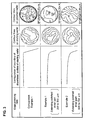
- the starting wafer 3 (Comparative Example 3) was used, ring-like sag is observed in the outer peripheral portion of the wafer after mirror polishing.
- the sag is started at a distance of the order of 10 mm from the outermost periphery.
- the SFQRmax value is on the order of 0.20 ⁇ m.
- Example 1 wherein after the mirror polishing was performed on the inner part extending inward from the boundary between the main surface and the chamfered portion in the back surface of the starting wafer, the front surface thereof was mirror polished, the SFQRmax values are improved and it is found from the map diagrams after the mirror polishing that a density of the contour lines in the outer peripheral portion of the wafer is low; a wafer with high flatness has been manufactured. Especially, in Example 2, a wafer with very high flatness of the SFQRmax value of 0.09 was manufactured.
- the SFQRmax is stably 0.11 ⁇ m or less.
- a wafer can be manufactured without ring-like sag in the outer peripheral portion thereof when polishing an alkali etched wafer and the manufacturing method is especially effective in polishing according to a wax mount system.
- a wafer of the present invention has high flatness without ring-like sag in the outer peripheral portion thereof.
Landscapes
- Engineering & Computer Science (AREA)
- Mechanical Engineering (AREA)
- Chemical & Material Sciences (AREA)
- Ceramic Engineering (AREA)
- Inorganic Chemistry (AREA)
- Mechanical Treatment Of Semiconductor (AREA)
- Grinding And Polishing Of Tertiary Curved Surfaces And Surfaces With Complex Shapes (AREA)
- Finish Polishing, Edge Sharpening, And Grinding By Specific Grinding Devices (AREA)
Claims (10)
- Procédé de fabrication d'une plaquette de semiconducteur comprenant :une étape de polissage de partie de surface arrière et de polissage de bord pour exécuter un polissage partiel de la surface arrière et un polissage du bord, de sorte qu'un polissage miroir soit exécuté sur une partie chanfreinée (W2c) et une partie intérieure (W2m) s'étendant vers l'intérieur à partir d'une limite entre la partie chanfreinée (W2c) et une surface arrière (W2) d'une plaquette de départ ; etune étape de polissage de surface avant pour exécuter un polissage miroir d'une surface avant (W1) de la plaquette soumise à l'étape de polissage de partie de surface arrière et de polissage de bord, en retenant la plaquette par la surface arrière (W2) de celle-ci,caractérisé en ce que
la surface ayant subi un polissage miroir (W2m) de la partie intérieure s'étendant vers l'intérieur à partir de la limite entre la partie chanfreinée (W2c) et la surface arrière (W2) de la plaquette est dans la plage de 200 µm à 1000 µm vers le centre de la plaquette à partir de la limite. - Procédé de fabrication d'une plaquette de semiconducteur comprenant :une étape de polissage de partie de surface arrière pour exécuter un polissage miroir d'une partie intérieure (W2m) s'étendant vers l'intérieur à partir de la limite entre une partie chanfreinée (W2c) et une surface arrière (W2) d'une plaquette de départ ; etune étape de polissage de surface avant pour exécuter un polissage miroir d'une surface avant (W1) de la plaquette soumise à l'étape de polissage de partie de surface arrière, en retenant la plaquette par la surface arrière (W2) de celle-ci,caractérisé en ce que
la superficie ayant subi un polissage miroir (W2m) de la partie intérieure s'étendant vers l'intérieur à partir de la limite entre la partie chanfreinée (W2c) et la surface arrière (W2) de la plaquette est dans la plage de 200 µm à 1000 µm vers le centre de la plaquette à partir de la limite. - Procédé de fabrication d'une plaquette de semiconducteur selon la revendication 2, comprenant en outre : une étape de polissage de bord pour exécuter un polissage de bord de la plaquette soumise à l'étape de polissage de partie de surface arrière, dans lequel la surface avant (W1) de la plaquette à bord poli subit un polissage miroir.
- Procédé de fabrication d'une plaquette de semiconducteur selon la revendication 1, comprenant en outre :une étape de tronçonnage pour tronçonner une barre de monocristal en plaquettes, chacune sous forme de plaque mince ;une première étape de chanfreinage pour chanfreiner les plaquettes coupées ;une étape de rodage pour roder les plaquettes chanfreinées ;une seconde étape de chanfreinage pour chanfreiner les plaquettes rodées pour la seconde fois ;une étape de gravure pour graver aux alcalins la plaquette deux fois chanfreinée ; etune étape de polissage de surface avant pour exécuter un polissage miroir d'une surface avant (W1) de la plaquette soumise à l'étape de polissage de partie de surface arrière et de polissage de bord en retenant la plaquette par la surface arrière (W2) de celle-ci.
- Procédé de fabrication d'une plaquette de semiconducteur selon la revendication 2 ou 3, comprenant en outre :une étape de coupe pour couper une barre de cristal unique en plaquettes chacune sous forme de plaque mince ; une première étape de chanfreinage pour chanfreiner les plaquettes coupées ;une étape de rodage pour roder les plaquettes chanfreinées ;une seconde étape de chanfreinage pour chanfreiner les plaquettes rodées pour la seconde fois ;une étape de gravure pour graver aux alcalis la plaquette deux fois chanfreinée ; etune étape de polissage de surface avant pour exécuter un polissage miroir d'une surface avant (W1) de la plaquette soumise à l'étape de polissage de partie de surface arrière, en retenant la plaquette par la surface arrière (W2) de celle-ci.
- Procédé de fabrication d'une plaquette de semiconducteur selon la revendication 5, comprenant en outre :une étape de polissage de bord pour exécuter un polissage de bord de la plaquette soumise à l'étape de polissage de partie de surface arrière, dans lequel la surface avant (W1) de la plaquette à bord poli subit un polissage miroir.
- Procédé de fabrication d'une plaquette de semiconducteur selon l'une quelconque des revendications 1 à 5, dans lequel la plaquette de départ est une plaquette gravée aux alcalis.
- Procédé de fabrication d'une plaquette de semiconducteur selon l'une quelconque des revendications 1 à 7, dans lequel la plaquette est collée avec de la cire et retenue par la surface arrière (W2) de celle-ci et la surface avant (W1) de celle-ci subit un polissage miroir.
- Plaquette, dans laquelle une surface avant (W1) de celle-ci est une surface ayant subi un polissage miroir et la surface arrière (W2) de celle-ci est une surface gravée aux alcalis, et dans laquelle une partie intérieure (W2m) s'étendant à partir de la limite entre une partie chanfreinée (W2c) et la surface arrière (W2) de la plaquette subit un polissage miroir,
caractérisée en ce que
la surface ayant subi un polissage miroir (W2m) de la partie intérieure s'étendant vers l'intérieur à partir de la limite entre la partie chanfreinée (W2c) et la surface arrière (W2) de la plaquette est dans la plage de 500 µm à 700 µm vers le centre de la plaquette à partir de la limite. - Plaquette selon la revendication 9, dans laquelle le brillant de la surface arrière (W2) de la plaquette est dans la plage de 40 +/- 5 % et le SFQR max. de celle-ci est 0,11 µm ou moins.
Applications Claiming Priority (3)
| Application Number | Priority Date | Filing Date | Title |
|---|---|---|---|
| JP2002128550 | 2002-04-30 | ||
| JP2002128550A JP4093793B2 (ja) | 2002-04-30 | 2002-04-30 | 半導体ウエーハの製造方法及びウエーハ |
| PCT/JP2003/005259 WO2003094215A1 (fr) | 2002-04-30 | 2003-04-24 | Procede de fabrication de plaquettes semi-conductrices et plaquette |
Publications (3)
| Publication Number | Publication Date |
|---|---|
| EP1501119A1 EP1501119A1 (fr) | 2005-01-26 |
| EP1501119A4 EP1501119A4 (fr) | 2007-01-17 |
| EP1501119B1 true EP1501119B1 (fr) | 2008-12-03 |
Family
ID=29397270
Family Applications (1)
| Application Number | Title | Priority Date | Filing Date |
|---|---|---|---|
| EP03719197A Expired - Lifetime EP1501119B1 (fr) | 2002-04-30 | 2003-04-24 | Procede de fabrication de plaquettes semi-conductrices et plaquette |
Country Status (8)
| Country | Link |
|---|---|
| US (1) | US7250368B2 (fr) |
| EP (1) | EP1501119B1 (fr) |
| JP (1) | JP4093793B2 (fr) |
| KR (1) | KR100909140B1 (fr) |
| CN (1) | CN100365774C (fr) |
| DE (1) | DE60325039D1 (fr) |
| TW (1) | TWI264772B (fr) |
| WO (1) | WO2003094215A1 (fr) |
Families Citing this family (59)
| Publication number | Priority date | Publication date | Assignee | Title |
|---|---|---|---|---|
| JP4273943B2 (ja) * | 2003-12-01 | 2009-06-03 | 株式会社Sumco | シリコンウェーハの製造方法 |
| JP4856861B2 (ja) * | 2004-07-20 | 2012-01-18 | シャープ株式会社 | 半導体装置の製造方法 |
| DE102006020823B4 (de) * | 2006-05-04 | 2008-04-03 | Siltronic Ag | Verfahren zur Herstellung einer polierten Halbleiterscheibe |
| US20080206992A1 (en) * | 2006-12-29 | 2008-08-28 | Siltron Inc. | Method for manufacturing high flatness silicon wafer |
| US8454852B2 (en) * | 2007-01-31 | 2013-06-04 | Shin-Etsu Handotai Co., Ltd. | Chamfering apparatus for silicon wafer, method for producing silicon wafer, and etched silicon wafer |
| US20100075442A1 (en) * | 2007-04-27 | 2010-03-25 | Yoshinori Hayashi | Semiconductor wafer processing apparatus, reference angular position detection method, and semiconductor wafer |
| JP2009302338A (ja) * | 2008-06-13 | 2009-12-24 | Sumco Corp | ウェーハの研磨方法および該方法により製造されるウェーハ |
| JP2009302410A (ja) * | 2008-06-16 | 2009-12-24 | Sumco Corp | 半導体ウェーハの製造方法 |
| JP2009302409A (ja) * | 2008-06-16 | 2009-12-24 | Sumco Corp | 半導体ウェーハの製造方法 |
| JP5600867B2 (ja) * | 2008-06-16 | 2014-10-08 | 株式会社Sumco | 半導体ウェーハの製造方法 |
| JP2009302478A (ja) * | 2008-06-17 | 2009-12-24 | Sumco Techxiv株式会社 | 半導体ウェーハの製造方法 |
| FR2935536B1 (fr) * | 2008-09-02 | 2010-09-24 | Soitec Silicon On Insulator | Procede de detourage progressif |
| EP2200077B1 (fr) * | 2008-12-22 | 2012-12-05 | Soitec | Procédé pour la liaison de deux substrats |
| DE102009030295B4 (de) * | 2009-06-24 | 2014-05-08 | Siltronic Ag | Verfahren zur Herstellung einer Halbleiterscheibe |
| JP5423384B2 (ja) * | 2009-12-24 | 2014-02-19 | 株式会社Sumco | 半導体ウェーハおよびその製造方法 |
| US8952496B2 (en) * | 2009-12-24 | 2015-02-10 | Sumco Corporation | Semiconductor wafer and method of producing same |
| WO2011083667A1 (fr) * | 2010-01-05 | 2011-07-14 | 住友電気工業株式会社 | Procédé et dispositif de traitement de plaquette de composé semi-conducteur |
| DE102010005904B4 (de) * | 2010-01-27 | 2012-11-22 | Siltronic Ag | Verfahren zur Herstellung einer Halbleiterscheibe |
| US8647171B2 (en) * | 2010-03-12 | 2014-02-11 | Wayne O. Duescher | Fixed-spindle floating-platen workpiece loader apparatus |
| US8758088B2 (en) | 2011-10-06 | 2014-06-24 | Wayne O. Duescher | Floating abrading platen configuration |
| US8696405B2 (en) | 2010-03-12 | 2014-04-15 | Wayne O. Duescher | Pivot-balanced floating platen lapping machine |
| US8647170B2 (en) | 2011-10-06 | 2014-02-11 | Wayne O. Duescher | Laser alignment apparatus for rotary spindles |
| US8602842B2 (en) * | 2010-03-12 | 2013-12-10 | Wayne O. Duescher | Three-point fixed-spindle floating-platen abrasive system |
| US8500515B2 (en) | 2010-03-12 | 2013-08-06 | Wayne O. Duescher | Fixed-spindle and floating-platen abrasive system using spherical mounts |
| US8647172B2 (en) | 2010-03-12 | 2014-02-11 | Wayne O. Duescher | Wafer pads for fixed-spindle floating-platen lapping |
| US8641476B2 (en) | 2011-10-06 | 2014-02-04 | Wayne O. Duescher | Coplanar alignment apparatus for rotary spindles |
| US8740668B2 (en) * | 2010-03-12 | 2014-06-03 | Wayne O. Duescher | Three-point spindle-supported floating abrasive platen |
| FR2961630B1 (fr) | 2010-06-22 | 2013-03-29 | Soitec Silicon On Insulator Technologies | Appareil de fabrication de dispositifs semi-conducteurs |
| US8338266B2 (en) | 2010-08-11 | 2012-12-25 | Soitec | Method for molecular adhesion bonding at low pressure |
| FR2964193A1 (fr) | 2010-08-24 | 2012-03-02 | Soitec Silicon On Insulator | Procede de mesure d'une energie d'adhesion, et substrats associes |
| US8337280B2 (en) | 2010-09-14 | 2012-12-25 | Duescher Wayne O | High speed platen abrading wire-driven rotary workholder |
| US8430717B2 (en) | 2010-10-12 | 2013-04-30 | Wayne O. Duescher | Dynamic action abrasive lapping workholder |
| JP2012178458A (ja) | 2011-02-25 | 2012-09-13 | Fujitsu Ltd | 半導体装置の製造方法及び半導体基板の洗浄方法 |
| JP6027346B2 (ja) * | 2012-06-12 | 2016-11-16 | Sumco Techxiv株式会社 | 半導体ウェーハの製造方法 |
| US9604339B2 (en) | 2012-10-29 | 2017-03-28 | Wayne O. Duescher | Vacuum-grooved membrane wafer polishing workholder |
| US9199354B2 (en) | 2012-10-29 | 2015-12-01 | Wayne O. Duescher | Flexible diaphragm post-type floating and rigid abrading workholder |
| US8998678B2 (en) | 2012-10-29 | 2015-04-07 | Wayne O. Duescher | Spider arm driven flexible chamber abrading workholder |
| US9039488B2 (en) | 2012-10-29 | 2015-05-26 | Wayne O. Duescher | Pin driven flexible chamber abrading workholder |
| US8998677B2 (en) | 2012-10-29 | 2015-04-07 | Wayne O. Duescher | Bellows driven floatation-type abrading workholder |
| US8845394B2 (en) | 2012-10-29 | 2014-09-30 | Wayne O. Duescher | Bellows driven air floatation abrading workholder |
| US9233452B2 (en) | 2012-10-29 | 2016-01-12 | Wayne O. Duescher | Vacuum-grooved membrane abrasive polishing wafer workholder |
| US9011207B2 (en) | 2012-10-29 | 2015-04-21 | Wayne O. Duescher | Flexible diaphragm combination floating and rigid abrading workholder |
| TWI599446B (zh) * | 2013-03-25 | 2017-09-21 | Sapphire polishing pad dresser production methods | |
| CN104142259A (zh) * | 2013-05-10 | 2014-11-12 | 河南协鑫光伏科技有限公司 | 一种太阳能单晶硅测试样片的制作方法 |
| JP2015038919A (ja) * | 2013-08-19 | 2015-02-26 | 株式会社ディスコ | ウェーハの製造方法 |
| JP6244962B2 (ja) * | 2014-02-17 | 2017-12-13 | 株式会社Sumco | 半導体ウェーハの製造方法 |
| JP6040947B2 (ja) * | 2014-02-20 | 2016-12-07 | 信越半導体株式会社 | ワークの両頭研削方法 |
| CN103847032B (zh) * | 2014-03-20 | 2016-01-06 | 德清晶辉光电科技有限公司 | 一种大直径超薄石英晶片的生产工艺 |
| CN103921205B (zh) * | 2014-04-04 | 2016-08-24 | 德清晶辉光电科技有限公司 | 一种6英寸铌酸锂晶片或钽酸锂晶片的生产工艺 |
| JP6045542B2 (ja) * | 2014-09-11 | 2016-12-14 | 信越半導体株式会社 | 半導体ウェーハの加工方法、貼り合わせウェーハの製造方法、及びエピタキシャルウェーハの製造方法 |
| DE102015220924B4 (de) * | 2015-10-27 | 2018-09-27 | Siltronic Ag | Suszeptor zum Halten einer Halbleiterscheibe mit Orientierungskerbe, Verfahren zum Abscheiden einer Schicht auf einer Halbleiterscheibe und Halbleiterscheibe |
| US10926378B2 (en) | 2017-07-08 | 2021-02-23 | Wayne O. Duescher | Abrasive coated disk islands using magnetic font sheet |
| EP3567139B1 (fr) | 2018-05-11 | 2021-04-07 | SiCrystal GmbH | Substrat de carbure de silicium chanfreinée et procédé de chanfreinage |
| EP3567138B1 (fr) * | 2018-05-11 | 2020-03-25 | SiCrystal GmbH | Substrat de carbure de silicium chanfreinée et procédé de chanfreinage |
| US11691241B1 (en) * | 2019-08-05 | 2023-07-04 | Keltech Engineering, Inc. | Abrasive lapping head with floating and rigid workpiece carrier |
| JP7562994B2 (ja) * | 2020-06-08 | 2024-10-08 | 株式会社Sumco | ウェーハ外周部の研磨装置 |
| TWI802406B (zh) * | 2021-07-29 | 2023-05-11 | 環球晶圓股份有限公司 | 碳化矽晶圓的加工方法 |
| CN115091638A (zh) * | 2022-06-30 | 2022-09-23 | 广东先导微电子科技有限公司 | 一种碲锌镉晶片加工方法 |
| CN115781459B (zh) * | 2022-12-16 | 2025-07-15 | 万华化学集团电子材料有限公司 | 晶棒滚圆开槽方法及晶棒滚圆开槽装置 |
Family Cites Families (23)
| Publication number | Priority date | Publication date | Assignee | Title |
|---|---|---|---|---|
| JP3430499B2 (ja) * | 1996-08-09 | 2003-07-28 | 三菱住友シリコン株式会社 | 半導体ウェ−ハおよびその製造方法 |
| US5821166A (en) * | 1996-12-12 | 1998-10-13 | Komatsu Electronic Metals Co., Ltd. | Method of manufacturing semiconductor wafers |
| JPH11188590A (ja) | 1997-12-22 | 1999-07-13 | Speedfam Co Ltd | エッジポリッシング装置 |
| JP3964029B2 (ja) * | 1998-01-20 | 2007-08-22 | 沖電気工業株式会社 | 半導体基板の製造方法 |
| JP3664593B2 (ja) * | 1998-11-06 | 2005-06-29 | 信越半導体株式会社 | 半導体ウエーハおよびその製造方法 |
| JP3329288B2 (ja) * | 1998-11-26 | 2002-09-30 | 信越半導体株式会社 | 半導体ウエーハおよびその製造方法 |
| JP3551300B2 (ja) * | 1999-02-18 | 2004-08-04 | 三菱住友シリコン株式会社 | 高平坦度ウェーハの製造方法 |
| JP4154683B2 (ja) * | 1999-09-30 | 2008-09-24 | 株式会社Sumco | 高平坦度裏面梨地ウェーハの製造方法および該製造方法に用いられる表面研削裏面ラップ装置 |
| US6376378B1 (en) * | 1999-10-08 | 2002-04-23 | Chartered Semiconductor Manufacturing, Ltd. | Polishing apparatus and method for forming an integrated circuit |
| DE19956250C1 (de) * | 1999-11-23 | 2001-05-17 | Wacker Siltronic Halbleitermat | Kostengünstiges Verfahren zur Herstellung einer Vielzahl von Halbleiterscheiben |
| DE10004578C1 (de) * | 2000-02-03 | 2001-07-26 | Wacker Siltronic Halbleitermat | Verfahren zur Herstellung einer Halbleiterscheibe mit polierter Kante |
| CN100346926C (zh) * | 2000-02-23 | 2007-11-07 | 信越半导体株式会社 | 晶片的周面倒角部分的抛光方法 |
| JP4846915B2 (ja) * | 2000-03-29 | 2011-12-28 | 信越半導体株式会社 | 貼り合わせウェーハの製造方法 |
| EP1189266B1 (fr) | 2000-03-29 | 2017-04-05 | Shin-Etsu Handotai Co., Ltd. | Procede d'obtention de tranches de silicium ou de soi et tranches ainsi obtenues |
| WO2002001616A1 (fr) * | 2000-06-29 | 2002-01-03 | Shin-Etsu Handotai Co., Ltd. | Procede de traitement d'une plaquette de semi-conducteur et plaquette de semi-conducteur |
| DE10058305A1 (de) * | 2000-11-24 | 2002-06-06 | Wacker Siltronic Halbleitermat | Verfahren zur Oberflächenpolitur von Siliciumscheiben |
| DE10142400B4 (de) * | 2001-08-30 | 2009-09-03 | Siltronic Ag | Halbleiterscheibe mit verbesserter lokaler Ebenheit und Verfahren zu deren Herstellung |
| KR100420205B1 (ko) * | 2001-09-10 | 2004-03-04 | 주식회사 하이닉스반도체 | 웨이퍼 제조 방법 |
| DE10159833C1 (de) * | 2001-12-06 | 2003-06-18 | Wacker Siltronic Halbleitermat | Verfahren zur Herstellung einer Vielzahl von Halbleiterscheiben |
| JP4464033B2 (ja) * | 2002-06-13 | 2010-05-19 | 信越半導体株式会社 | 半導体ウエーハの形状評価方法及び形状評価装置 |
| JP2004022677A (ja) * | 2002-06-13 | 2004-01-22 | Shin Etsu Handotai Co Ltd | 半導体ウエーハ |
| US7416962B2 (en) * | 2002-08-30 | 2008-08-26 | Siltronic Corporation | Method for processing a semiconductor wafer including back side grinding |
| WO2004027840A2 (fr) * | 2002-09-18 | 2004-04-01 | Memc Electronic Materials, Inc. | Procede de gravure de plaquettes de silicium |
-
2002
- 2002-04-30 JP JP2002128550A patent/JP4093793B2/ja not_active Expired - Fee Related
-
2003
- 2003-04-24 KR KR1020047015613A patent/KR100909140B1/ko not_active Expired - Fee Related
- 2003-04-24 EP EP03719197A patent/EP1501119B1/fr not_active Expired - Lifetime
- 2003-04-24 US US10/512,637 patent/US7250368B2/en not_active Expired - Lifetime
- 2003-04-24 WO PCT/JP2003/005259 patent/WO2003094215A1/fr not_active Ceased
- 2003-04-24 DE DE60325039T patent/DE60325039D1/de not_active Expired - Lifetime
- 2003-04-24 CN CNB03809715XA patent/CN100365774C/zh not_active Expired - Lifetime
- 2003-04-29 TW TW092110046A patent/TWI264772B/zh not_active IP Right Cessation
Also Published As
| Publication number | Publication date |
|---|---|
| EP1501119A4 (fr) | 2007-01-17 |
| EP1501119A1 (fr) | 2005-01-26 |
| CN100365774C (zh) | 2008-01-30 |
| WO2003094215A1 (fr) | 2003-11-13 |
| US7250368B2 (en) | 2007-07-31 |
| US20050142882A1 (en) | 2005-06-30 |
| CN1650404A (zh) | 2005-08-03 |
| DE60325039D1 (de) | 2009-01-15 |
| JP2003324081A (ja) | 2003-11-14 |
| JP4093793B2 (ja) | 2008-06-04 |
| KR20040111463A (ko) | 2004-12-31 |
| TWI264772B (en) | 2006-10-21 |
| KR100909140B1 (ko) | 2009-07-23 |
| TW200403738A (en) | 2004-03-01 |
Similar Documents
| Publication | Publication Date | Title |
|---|---|---|
| EP1501119B1 (fr) | Procede de fabrication de plaquettes semi-conductrices et plaquette | |
| KR100842473B1 (ko) | 웨이퍼의 제조방법 및 연마장치 및 웨이퍼 | |
| JP5358531B2 (ja) | 半導体ウェーハの製造方法 | |
| JP3846706B2 (ja) | ウエーハ外周面取部の研磨方法及び研磨装置 | |
| JP5538253B2 (ja) | 半導体ウェハの製造方法 | |
| KR100818683B1 (ko) | 경면 면취 웨이퍼, 경면 면취용 연마 클로스 및 경면 면취연마장치 및 방법 | |
| JP5127882B2 (ja) | 半導体ウェハの両面研磨方法 | |
| US7695347B2 (en) | Method and pad for polishing wafer | |
| US6284658B1 (en) | Manufacturing process for semiconductor wafer | |
| JP2011009736A (ja) | 半導体ウェーハのエッジを研磨する方法 | |
| KR102117362B1 (ko) | 실리콘 웨이퍼의 연마 방법 및 실리콘 웨이퍼의 제조 방법 | |
| KR20150001611A (ko) | 반도체 웨이퍼의 가공 프로세스 | |
| EP3576136A1 (fr) | Procédé de polissage d'une tranche semi-conductrice | |
| JP2005005315A (ja) | ウエーハの研磨方法 | |
| JP2010153844A (ja) | 活性層用ウェーハの製造方法 | |
| JP4154683B2 (ja) | 高平坦度裏面梨地ウェーハの製造方法および該製造方法に用いられる表面研削裏面ラップ装置 | |
| JP4681970B2 (ja) | 研磨パッドおよび研磨機 | |
| JP2865250B1 (ja) | シリコン半導体ウエハの製造方法 | |
| JP2003039310A (ja) | ウェーハの研磨方法及びウェーハ |
Legal Events
| Date | Code | Title | Description |
|---|---|---|---|
| PUAI | Public reference made under article 153(3) epc to a published international application that has entered the european phase |
Free format text: ORIGINAL CODE: 0009012 |
|
| 17P | Request for examination filed |
Effective date: 20041027 |
|
| AK | Designated contracting states |
Kind code of ref document: A1 Designated state(s): AT BE BG CH CY CZ DE DK EE ES FI FR GB GR HU IE IT LI LU MC NL PT RO SE SI SK TR |
|
| A4 | Supplementary search report drawn up and despatched |
Effective date: 20061214 |
|
| RIC1 | Information provided on ipc code assigned before grant |
Ipc: H01L 21/304 20060101AFI20031119BHEP Ipc: B24B 37/04 20060101ALI20061208BHEP |
|
| 17Q | First examination report despatched |
Effective date: 20070807 |
|
| GRAP | Despatch of communication of intention to grant a patent |
Free format text: ORIGINAL CODE: EPIDOSNIGR1 |
|
| GRAS | Grant fee paid |
Free format text: ORIGINAL CODE: EPIDOSNIGR3 |
|
| GRAA | (expected) grant |
Free format text: ORIGINAL CODE: 0009210 |
|
| AK | Designated contracting states |
Kind code of ref document: B1 Designated state(s): DE FR IT NL |
|
| REF | Corresponds to: |
Ref document number: 60325039 Country of ref document: DE Date of ref document: 20090115 Kind code of ref document: P |
|
| RAP2 | Party data changed (patent owner data changed or rights of a patent transferred) |
Owner name: SHIN-ETSU HANDOTAI CO., LTD. |
|
| NLT2 | Nl: modifications (of names), taken from the european patent patent bulletin |
Owner name: SHIN-ETSU HANDOTAI CO., LTD. Effective date: 20090422 |
|
| PLBE | No opposition filed within time limit |
Free format text: ORIGINAL CODE: 0009261 |
|
| STAA | Information on the status of an ep patent application or granted ep patent |
Free format text: STATUS: NO OPPOSITION FILED WITHIN TIME LIMIT |
|
| 26N | No opposition filed |
Effective date: 20090904 |
|
| PGFP | Annual fee paid to national office [announced via postgrant information from national office to epo] |
Ref country code: FR Payment date: 20100521 Year of fee payment: 8 |
|
| PGFP | Annual fee paid to national office [announced via postgrant information from national office to epo] |
Ref country code: IT Payment date: 20100422 Year of fee payment: 8 Ref country code: NL Payment date: 20100416 Year of fee payment: 8 |
|
| REG | Reference to a national code |
Ref country code: NL Ref legal event code: V1 Effective date: 20111101 |
|
| REG | Reference to a national code |
Ref country code: FR Ref legal event code: ST Effective date: 20111230 |
|
| PG25 | Lapsed in a contracting state [announced via postgrant information from national office to epo] |
Ref country code: NL Free format text: LAPSE BECAUSE OF NON-PAYMENT OF DUE FEES Effective date: 20111101 Ref country code: FR Free format text: LAPSE BECAUSE OF NON-PAYMENT OF DUE FEES Effective date: 20110502 |
|
| PG25 | Lapsed in a contracting state [announced via postgrant information from national office to epo] |
Ref country code: IT Free format text: LAPSE BECAUSE OF NON-PAYMENT OF DUE FEES Effective date: 20110424 |
|
| PGFP | Annual fee paid to national office [announced via postgrant information from national office to epo] |
Ref country code: DE Payment date: 20220302 Year of fee payment: 20 |
|
| REG | Reference to a national code |
Ref country code: DE Ref legal event code: R071 Ref document number: 60325039 Country of ref document: DE |