EP1458029A2 - Neuartige leitende Elemente für Dünnfilmtransistoren in einem Flachbildschirm - Google Patents
Neuartige leitende Elemente für Dünnfilmtransistoren in einem Flachbildschirm Download PDFInfo
- Publication number
- EP1458029A2 EP1458029A2 EP04250453A EP04250453A EP1458029A2 EP 1458029 A2 EP1458029 A2 EP 1458029A2 EP 04250453 A EP04250453 A EP 04250453A EP 04250453 A EP04250453 A EP 04250453A EP 1458029 A2 EP1458029 A2 EP 1458029A2
- Authority
- EP
- European Patent Office
- Prior art keywords
- layer
- aluminum
- thin film
- tft
- based metal
- Prior art date
- Legal status (The legal status is an assumption and is not a legal conclusion. Google has not performed a legal analysis and makes no representation as to the accuracy of the status listed.)
- Ceased
Links
Images




Classifications
-
- H—ELECTRICITY
- H10—SEMICONDUCTOR DEVICES; ELECTRIC SOLID-STATE DEVICES NOT OTHERWISE PROVIDED FOR
- H10D—INORGANIC ELECTRIC SEMICONDUCTOR DEVICES
- H10D30/00—Field-effect transistors [FET]
- H10D30/60—Insulated-gate field-effect transistors [IGFET]
- H10D30/67—Thin-film transistors [TFT]
- H10D30/6729—Thin-film transistors [TFT] characterised by the electrodes
- H10D30/6737—Thin-film transistors [TFT] characterised by the electrodes characterised by the electrode materials
- H10D30/6739—Conductor-insulator-semiconductor electrodes
-
- H—ELECTRICITY
- H10—SEMICONDUCTOR DEVICES; ELECTRIC SOLID-STATE DEVICES NOT OTHERWISE PROVIDED FOR
- H10D—INORGANIC ELECTRIC SEMICONDUCTOR DEVICES
- H10D86/00—Integrated devices formed in or on insulating or conducting substrates, e.g. formed in silicon-on-insulator [SOI] substrates or on stainless steel or glass substrates
Definitions
- the present invention relates to thin film transistors in a flat panel display. More particularly, the present invention relates to a novel structure for the electrodes and conductive lines found in thin film transistor structures that have small resistance loss and prevent image quality degradation caused by resistance loss in a large flat panel display.
- a thin film transistor (hereinafter, referred to as TFT) is a device in which a source electrode and a drain electrode can be electrically connected through a channel formed in a semiconductor layer that physically connects the source and drain electrodes according to a voltage applied to a gate electrode.
- the TFT is mainly used in a TFT panel of an active matrix flat panel display such as an electroluminescent display and a liquid crystal display.
- the TFT serves to independently drive sub-pixels that make up the display.
- a source electrode and a gate electrode of a TFT formed in a flat panel display are connected to driving circuits arranged on sides of the flat panel display through conductive lines.
- a source electrode, a drain electrode, and conductive lines electrically connected to the source and drain electrodes are often formed together and have the same structure using the same material for the sake of simplifying a manufacture process.
- a source electrode, a drain electrode, and conductive lines electrically connected thereto may be made of a chromium (Cr) based metal or a molybdenum (Mo) based metal such as Mo and MoW.
- Cr chromium
- Mo molybdenum
- a voltage drop between driving circuits and the sub-pixels may increase. This causes a response speed of the sub-pixels to decrease or to result in a non-uniform distribution of an image.
- These problems of speed and non-uniformity of image are further aggravated by the fact that newer displays are large, and the conductive lines that electrically connect to the pixels in aq large display are very long. These long conductive lines found in large displays magnify the resistive losses in a conductive line. Therefore, in recent years, with the advent of large TFT displays, it is even more important to use materials with low resistive losses to electrically connect to each TFT in a display.
- these conductive lines generally undergo a heat treatment process subsequent to formation of these conductive lines and electrodes.
- the activation process after gate metal sputtering is necessary in TFT fabrication, and the temperature of annealing is generally needed to be higher than 400°C .
- the high temperature annealing may cause connection lines and electrodes to form at a high resistance, especially when incorporated in a large display panel.
- Aluminum has been used in conductive lines and electrode structures for TFT's.
- Aluminum may have a low resistance as a material for a gate electrode and a conductive line connecting the gate electrode to a driving circuit.
- Aluminum may also drop the resistance in source electrodes, drain electrodes, and conductive lines electrically connected to the source and drain electrodes.
- TFT conductive elements the source electrode, the drain electrode, the gate electrode and the conductive lines electrically connected to the source, drain and gate electrodes.
- Tanaka '157 discloses TFT conductive elements made of Al.
- Each of the TFT conductive elements has a stacked structure of titanium nitride (TiN) layer/Al layer, TiN layer/Ti layer/Al layer, or TiN layer/Al layer/Ti layer, as illustrated in FIG. 7 of Tanaka '157.
- Advantages of such a structure include reduction of an electrical connection resistance (or contact resistance) between the TFT conductive elements and terminals connected to the TFT conductive elements as well as suppression of the generation of Al hillocks (or small hills or mounds) generated by a heat treatment process subsequent to the formation of the TFT conductive elements.
- Tanaka '157 fails to disclose solutions to reduce the resistance of the TFT conductive elements. Tanaka '157 fails to address prevention of the formation of highly resistive TiAl 3 when heat treated. TiAl 3 in the conductive layers causes the resistance of the conductive lines to increase, especially for large displays.
- a thin film transistor comprising a source electrode, a drain electrode, a gate electrode, and a semiconductor layer, where at least one of the source electrode, the drain electrode, and the gate electrode comprises an aluminum-based metal layer, a titanium layer, and a diffusion prevention layer interposed the aluminum-based metal layer and the titanium layer.
- a large flat panel display having a large number of sub-pixels driven by TFTs, each of the TFTs having the features described above.
- the diffusion prevention layer prevents aluminum in the aluminum-based layer from reacting with the titanium in the titanium layer during the heat treatment or annealing process and forming unwanted TiAl 3 , the presence of which increases the resistance or resistivity of the connection members.
- the diffusion prevention layer and the titanium layer may be orderly formed on opposite surfaces of the aluminum-based metal layer, or the diffusion prevention layer and the titanium layer may be formed on any one side of the aluminum-based metal layer.
- the diffusion prevention layer may be a titanium nitride layer.
- the titanium nitride layer may contain 5 to 85 wt% of nitrogen.
- the titanium nitride layer may have a thickness of about 100 to 600 ⁇ , preferably about 100 to 400 ⁇ , more preferably 200 to 400 ⁇ , and most preferably about 300 ⁇ .
- the aluminum-based metal layer may be made of an aluminum alloy containing about 0.5 to 5 wt% of one element selected from the group consisting of silicon, copper, neodymium, platinum, and nickel.
- the aluminum-based metal layer may be made of an aluminum-silicon alloy containing about 2 wt% of silicon.
- the present invention thus provides a novel structure for conductive elements used in a TFT in a flat panel display that has a low resistivity, even after a heat treatment.
- the present invention also provides a novel structure for a conductive layer for conductive elements in a TFT in a display that is made using aluminum and does not have any hillocks and does not have any TiAl 3 , even after a heat treatment.
- the present invention also provides a novel structure for conductive lines and electrodes used in TFT displays that improves display uniformity and improves speed, especially when the display is very large.
- FIG. 1 illustrates a TFT conductive element 120 having a stacked structure of a Ti layer 122, an Al layer 121, and a Ti layer 123.
- the Ti layers prevent the generation of Al hillocks formed during a heat treatment process.
- TiAl 3 may be generated at an interface between the Al layer and the Ti layer during a heat treatment process. The TiAl 3 increases the resistance of the TFT conductive element.
- FIG. 2 illustrates a circuit 112 of a flat panel display made up many sub-pixels, each sub-pixel having two TFT's.
- the circuit 112 includes a first TFT 10, a second TFT 50, a storage capacitor 40, and a light emission unit 60.
- a first source electrode 12 in the first TFT 10 is connected to a horizontal driving circuit H through a first conductive line 20 and a first gate electrode 11 in the first TFT 10 is connected to a vertical driving circuit V through a second conductive line 30.
- a first drain electrode 13 in the first TFT 10 is connected to a first capacitor electrode 41 of the storage capacitor 40 and to a second gate electrode 51 of the second TFT 50.
- a second capacitor electrode 42 of the storage capacitor 40 and a second source electrode 52 of the second TFT 50 are connected to a third conductive line 70.
- a second drain electrode 53 of the second TFT is connected to a first electrode 61 of the light emission unit 60.
- a second electrode 62 of the light emission unit 60 is arranged opposite to the first electrode 61 and spaced a predetermined gap apart from the first electrode 61.
- Between second electrode 62 and first electrode 61 is an active layer.
- the active layer may be an organic material layer, an inorganic material layer, or a liquid crystal layer and is arranged between the first electrode 61 and second electrode 62 according to the types of flat panel displays.
- FIG. 3 schematically illustrates a physical structure of one sub-pixel of the flat panel display of FIG. 2.
- conductive constitutional elements such as a substrate, a buffer layer, various types of insulating layers, a planarization layer, a light emission layer, a liquid crystal layer, a second electrode, a polarization layer, an orientation layer, and a color filter layer are omitted.
- nonconductive constitutional elements are instead illustrated in FIGS. 4 and 5.
- Only constitutional elements positioned at regions represented by oblique (or slanted) lines in FIG. 3 are electrically connected to each other. Other regions that are not represented by oblique lines are insulated.
- a conductive channel is formed in a semiconductor layer 80 that connects the first source electrode 12 and the first drain electrode 13.
- the charge moves into the first drain electrode 13.
- Charge determining the luminance of a driving unit flows through the third conductive line 70.
- the charge of the first drain electrode is supplied to the second gate electrode 51, the charge of the second source electrode 52 moves into the second drain electrode 53, thereby driving the first electrode 61 of the light emission unit 60.
- the storage capacitor 40 serves to maintain a driving operation of the first electrode 61 or increase a driving speed.
- the first TFT 10 and the second TFT 50 have a similar section structure.
- An electroluminescent display 114 illustrated in FIG. 4 includes a TFT panel, a light emission layer 87, and a second electrode 62.
- the TFT panel includes a substrate 81, a TFT 50, a first conductive line 20, a second conductive line 30, and a first electrode 61.
- the substrate 81 may be made of a transparent material, for example glass, and the second electrode 62 may be made of a metal with good reflectivity such as aluminium.
- the second electrode 62 may be made of a transparent conductive material, for example, indium tin oxide (ITO), and the first electrode 61 may be made of a metal with good reflectivity.
- ITO indium tin oxide
- a buffer layer 82 is formed on the whole surface of the substrate 81.
- a semiconductor layer 80 is formed to a predetermined pattern on the buffer layer 82.
- Semiconductor layer 80 may be made of silicon.
- a first insulating layer 83 is formed on the semiconductor layer 80 and on the remaining exposed surface of the buffer layer 82 where the semiconductor layer 80 is not formed.
- a second gate electrode 51 is formed to a predetermined pattern on the first insulating layer 83.
- a second insulating layer 84 is formed on the second gate electrode 51 and on the remaining exposed surface of the first insulating layer 83 on where the second gate electrode 51 is not formed.
- the first and second insulating layers 83 and 84 respectively are subjected to etching such as dry etching to expose portions of the semiconductor layer 80.
- the exposed portions of the semiconductor layer 80 are connected to a second source electrode 52 and a second drain electrode 53, that are formed to a predetermined pattern.
- a third insulating layer 85 is formed thereon. A portion of the third insulating layer 85 is etched to electrically connect the second drain electrode 53 and the first electrode 61.
- a planarization layer 86 is formed. The portion of the planarization layer 86 corresponding to the first electrode 61 is etched. Then, the light emission layer 87 is formed on the first electrode 61 and the second electrode 62 is formed on the light emission layer 87.
- the TFT 50 includes the second source electrode 52, the second drain electrode 53, the second gate electrode 51, and the semiconductor layer 80.
- the second source electrode 52 and the second drain electrode 53 are formed at a predetermined gap from each other on the same horizontal plane.
- the second source electrode 52 and the second drain electrode 53 are physically connected to the semiconductor layer 80.
- the second gate electrode 51 is electrically insulated from the second source electrode 52, the second drain electrode 53, and the semiconductor layer 80.
- the second gate electrode 51 is positioned above the semiconductor layer 80 and between the second source electrode 52 and the second drain electrode 53.
- a TFT is divided into a staggered type, an inverted staggered type, a coplanar type, and an inverted coplanar type according to the arrangements of the above electrodes and the semiconductor layer 80.
- a coplanar type is illustrated in the present invention, but the present invention is not limited thereto.
- the TFT 50 of FIG. 4 corresponds to the second TFT 50 illustrated in FIG. 3.
- the second source electrode 52 is connected to the third conductive line 70
- the second gate electrode 51 is connected to the first drain electrode 13 of the first TFT 10
- the second drain electrode 53 is connected to the first electrode 61 of light emitting unit 60
- the first source electrode 12 of the first TFT 10 is connected to the first conductive line 20
- the first gate electrode 11 is connected to the second conductive line 30.
- the first conductive line 20 corresponds to a data line for transmitting data
- the second conductive line 30 corresponds to a scan line.
- an electroluminescent display 114 includes the first electrode 61, the light emission layer 87 formed on the first electrode 61, and the second electrode 62 formed on the light emission layer 87.
- An electroluminescent display 114 can be divided into organic and inorganic electroluminescent displays.
- the light emission layer 87 is largely having an electron transport layer, a light emission material layer, and a hole transport layer.
- insulating layers are interposed between the first electrode 61 and the light emission layer 87 and between the second electrode 62 and the light emission layer 87.
- the light emission layer 87 of an organic electroluminescent display is made of an organic material, for example, phthalocyanine such as copper phthalocyanine (CuPc), N,N'-di(naphthalene-1-yl)-N,N'-diphenyl benzidine (NPB), or tris-8-hydroxyquinoline aluminium (Alq3).
- phthalocyanine such as copper phthalocyanine (CuPc), N,N'-di(naphthalene-1-yl)-N,N'-diphenyl benzidine (NPB), or tris-8-hydroxyquinoline aluminium (Alq3).
- an inorganic material layer between the insulating layers positioned at inner sides of the first electrode 61 and second electrode 62 emits light.
- An inorganic material for the inorganic material layer may be metal sulfide such as ZnS, SrS, and CsS. Recently, alkaline earth-based calcium sulfide such as CaCa 2 S 4 and SrCa 2 S 4 , and metal oxide are also used. Transition metals such as Mn, Ce, Tb, Eu, Tm, Er, Pr, and Pb and alkaline rare earth metals may be used as light emitting core atoms that form the light emission layer 87 together with the above inorganic material.
- the inorganic material layer emits light.
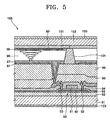
- FIG. 5 illustrates a liquid crystal display 105.
- a liquid crystal display and an electroluminescent display have a similar TFT panel structure, but different adjoining constitutional elements.
- adjoining constitutional elements of the TFT panel in a liquid crystal display will be described.
- a liquid crystal display 105 includes a TFT panel, a first orientation layer 97, a second substrate 102, a second electrode 62, a second orientation layer 99, a liquid crystal layer 98, and a polarization layer 103.
- the TFT panel includes a first substrate 91, a TFT 50, a first conductive line 20, a second conductive line 30, and a first electrode 61.
- the first substrate 91 corresponds to the substrate of an electroluminescent display.
- the first substrate 91 and the second substrate 102 are separately manufactured.
- a color filter layer 101 is formed on the lower surface of the second substrate 102.
- the second electrode 62 is formed on the lower surface of the color filter layer 101.
- the first orientation layer 97 and the second orientation layer 99 are formed on the upper surface of the first electrode 61 and the lower surface of the second electrode 62, respectively.
- the first and second orientation layers 97 and 99 lead to a proper orientation of a liquid crystal of the liquid crystal layer 98 interposed therebetween.
- the polarization layer 103 is formed on each of the outer surfaces of the first and second substrates 91 and 102 respectively.
- a spacer 104 is used to maintain a gap between the first and second substrates.
- a liquid crystal display allows light to pass through or be blocked according to the arrangement of a liquid crystal.
- the arrangement of the liquid crystal is determined by an electric potential difference between the first and second electrodes. Light that has passed through the liquid crystal layer exhibits a color of the color filter layer 101, thereby displaying an image.
- TFT conductive elements defined in the Description of the Related Art include the first and second source electrodes 12 and 52, the first and second drain electrodes 13 and 53, the first and second gate electrodes 11 and 51, the first conductive line 20, the second conductive line 30, and the third conductive line 70.
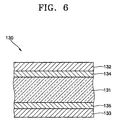
- the structures of the TFT conductive elements will be described in detail with reference to FIG. 6.
- the first and second gate electrodes 11 and 53 are formed simultaneously with the second conductive line 30 using the same material.
- the first and second source electrodes 12 .and 52, the first and second drain electrodes 13 and 53, the first conductive line 30, and the third conductive line 70 are at the same time formed using the same material. Since the formation sequences and materials for these TFT conductive elements may vary according to manufacture processes, they are not limited to those as described above.
- At least one of TFT conductive elements 130 according to the present invention includes an aluminum (Al)-based metal layer 131 and titanium (Ti) layers 132 and 133. Diffusion prevention layers 134 and 135 are interposed between the Al-based metal layer and the respective Ti layers.
- FIG. 6 illustrates that the diffusion prevention layers and the Ti layers are formed on both surfaces of the Al-based metal layer, a diffusion prevention layer and a Ti-layer may be formed on only one surface of the Al-based metal layer, that is also within the scope of the present invention.
- the second source electrode 52 and the second drain electrode 53 of FIG. 4 are formed in a vertically long shape.
- the layer structures of the second source electrode 52 and the second drain electrode 53 may be distorted. That is, although the second source electrode 52 and the second drain electrode 53 have a diffusion prevention layer and a Ti-layer between the Al-based metal layer 131 and the semiconductor layer 80, due to such distorted layer structure, the Al-based metal layer 131 and the semiconductor layer 80 may be partially in contact with each other. In this case, where the Al-based metal layer 131 is made of a pure Al, the Al can diffuse toward the semiconductor layer 80 made of silicon, thereby causing the malfunction of the semiconductor layer 80.
- the Al-based metal layer 131 is made of an Al alloy selected from the group consisting of an aluminum silicon (AlSi) alloy, an aluminum copper (AlCu) alloy, an aluminum neodymium (AINd) alloy, an aluminum platinum (AlPt) alloy, and an aluminum nickel (AINi) alloy.
- AlSi aluminum silicon
- AlCu aluminum copper
- AlPt aluminum neodymium
- AlPt aluminum platinum
- AINi aluminum nickel
- the Al-based metal layer 131 contains about 0.5 to 5 wt% of Si, Cu, Nd, Pt, or Ni. According to the results obtained from experiments, the AlSi alloy containing about 2 wt% of Si is more preferable.
- the Ti layers 132 and 133 serve to prevent the generation of Al hillocks during a heat treatment process.
- the diffusion prevention layers 134 and 135 serve to prevent the formation of TiAl 3 by reaction of the Al of the Al-based metal layer 131 with the Ti of the Ti layers 132 and 133 during the heat treatment process. By preventing the formation of TiAl 3 , the resistance of the TFT conductive elements 130 is reduced.
- the diffusion prevention layers 134 and 135 are made of TiN. This is because the TiN efficiently prevents the generation of TiAl 3 at an interface between the Al-based metal layer 131 and the Ti layers 132 and 133.
- the TiN layers134 and 135 contain 5 to 85 wt% of nitrogen.
- the Al-based metal layer 131 and the Ti layers 132 and 133 are deposited by DC-magnetron sputtering under an argon (Ar) gas atmosphere.
- the TiN layers 134 and 135 are deposited by reactive sputtering under a mixed gas atmosphere of Ar and nitrogen (N 2 ).
- Such a deposited structure is etched to a predetermined pattern for the TFT conductive elements 130 by dry etching with high frequency-enhanced plasma.
- the thickness of the TiN layers 134 and 135 are too thin, Al diffusion may occur. Therefore, the Al may easily react with the Ti of the Ti layers, thereby producing TiAl 3 .
- the TiN layers 134 and 135 are too thick, the resistance of the TFT conductive elements increases due to the high resistivity of the TiN.
- the TFT conductive elements 130 formed by interposing the TiN layers 134 and 135 between the Al-based metal layer 131 and the Ti layers 132 and 133 must have resistance lower than TFT conductive elements120 of FIG. 1. The thickness of the TiN layers satisfying these requirements is determined by following experiments and the results are presented in Table 1 below.
- Table 1 presents a change in resistivity according to the thickness of the TiN layers in TFT conductive elements having the structure of the Ti layer 132/the TiN layer 134/the Al-based metal layer 131/the TiN layer 135/the Ti layer 133 according to an embodiment of the present invention.
- each layer of the TFT conductive elements 130 is deposited by sputtering and then is subjected to heat treatment at 380°C in a vacuum to enhance the interface characteristics of the TFT conductive elements 130.
- Thickness of Ti layer 132 ( ⁇ ) Thickness of TiN layer 134 ( ⁇ ) Thickness of Al-based metal layer 131 ( ⁇ ) Thickness of TiN layer 135 ( ⁇ ) Thickness of Ti layer 133 ( ⁇ ) Total thickness ( ⁇ ) Resistivity ( ⁇ ⁇ cm) 500 0 4,000 0 500 5,000 17.24 500 100 3,800 100 500 5,000 5.34 500 200 3,600 200 500 5,000 4.51 500 300 3,400 300 500 5,000 4.23 500 400 3,200 400 500 5,000 4.62 500 500 3,000 500 500 5,000 5.02 500 600 2,800 600 500 5,000 5.36 500 700 2,600 700 500 5,000 5.68 500 800 2,400 800 500 5,000 6.47 500 900 2,200 900 500 5,000 7.03 500 1,000 2,000 1,000 500 5,000 7.78
- the graph of FIG. 7 is obtained from the results of Table 1.
- the line L represents ideal resistivity of TFT conductive elements of a thickness of 5,000 ⁇ made of Mo, i.e., theoretical minimal resistivity that is due to the resistivity of Mo. Using Mo, the ideal resistivity is 5.35 ⁇ ⁇ cm.
- a line M represents actual resistivity of TFT conductive elements 130 obtained empirically according to the present invention. That is, the resistivity of the line M is obtained by experiment.
- the thickness of the TiN layers 134 and 135 that result in a conductive element having a better resistivity than Mo based conductive elements satisfying the above-described requirements is a range of 100 to 600 ⁇
- the resistivity of the TFT conductive elements is relatively low when the TiN layers 134 and 135 have a thickness of 200 to 400 ⁇ .
- the resistivity of the TFT conductive elements is optimum when the TiN layers have a thickness of about 300 ⁇ .
- the TFT conductive elements having the TiN layers 134 and 135 with a thickness of 100 to 200 ⁇ and 400 to 600 ⁇ have resistivity lower than the TFT conductive elements made of only Mo, they have resistivity higher than the TFT conductive elements having the TiN layers 134 and 135 with a thickness of 200 to 400 ⁇ .
- the TiN layers 134 and 135 with a thickness of 100 to 200 ⁇ can be formed at a low cost, relative to the TiN layers 134 and 135 with a thickness of 400 to 600 ⁇ .
- FIG. 8 illustrates a resistance reduction effect of TFT conductive elements according to the present invention.
- the horizontal axis represents a temperature for a heat treatment process (heat treatment temperature) and the vertical axis represents resistivity of TFT conductive elements.
- the graph of A represents the resistivity of TFT conductive elements having a five layer structure of Ti layer (thickness: 500 ⁇ )/TiN layer (thickness: 500 ⁇ )/Al-based metal layer (thickness: 3,000 ⁇ )/TiN layer (thickness: 500 ⁇ )/Ti layer (thickness: 500 ⁇ ).
- the graph of B represents the resistivity of TFT conductive elements having a three layer structure of Ti layer (thickness: 500 ⁇ )/Al-based metal layer (thickness: 4,000 ⁇ )/Ti layer (thickness: 500 ⁇ ).
- the resistivity of the TFT conductive elements with the five layer structure is 5 ⁇ ⁇ cm
- the resistivity of the TFT conductive elements with the three layer structure is 21.5 ⁇ ⁇ cm, that is more than four times higher than the resistivity of the TFT conductive elements with the five layer structure.
- TFT conductive elements according to the present invention have the structure of Ti layer 132/TiN layer 134/Al-based metal layer 131/TiN layer 135/Ti layer 133.
- TFT conductive elements according to the present invention can have the structure of Ti layer 132/TiN layer 134/Al-based metal layer 131 because a resistance reduction effect is accomplished by the TiN layer interposed between the Al-based metal layer and the Ti layer.
- the present invention provides a TFT in that the generation of TiAl 3 is prevented and thus at least one of TFT conductive elements has a sufficiently low resistance, and a flat panel display including the TFT. Therefore, the flat panel display can have a fast response speed of sub-pixels and good image quality.
- the present invention also provides a TFT in that the generation of aluminum hillocks is prevented even after a heat treatment process, and a flat panel display including the TFT.
- the present invention also provides a TFT in that Al of TFT conductive elements does not diffuse toward a semiconductor layer, and a flat panel display including the TFT.
Landscapes
- Thin Film Transistor (AREA)
- Liquid Crystal (AREA)
- Electrodes Of Semiconductors (AREA)
- Electroluminescent Light Sources (AREA)
- Devices For Indicating Variable Information By Combining Individual Elements (AREA)
- Physical Vapour Deposition (AREA)
Applications Claiming Priority (4)
| Application Number | Priority Date | Filing Date | Title |
|---|---|---|---|
| KR20030015356 | 2003-03-12 | ||
| KR2003015356 | 2003-03-12 | ||
| KR1020030063583A KR100553747B1 (ko) | 2003-03-12 | 2003-09-15 | 박막트랜지스터 및 이를 구비한 평판표시소자 |
| KR2003063583 | 2003-09-15 |
Publications (2)
| Publication Number | Publication Date |
|---|---|
| EP1458029A2 true EP1458029A2 (de) | 2004-09-15 |
| EP1458029A3 EP1458029A3 (de) | 2006-03-15 |
Family
ID=32775313
Family Applications (1)
| Application Number | Title | Priority Date | Filing Date |
|---|---|---|---|
| EP04250453A Ceased EP1458029A3 (de) | 2003-03-12 | 2004-01-28 | Neuartige leitende Elemente für Dünnfilmtransistoren in einem Flachbildschirm |
Country Status (4)
| Country | Link |
|---|---|
| US (2) | US7317206B2 (de) |
| EP (1) | EP1458029A3 (de) |
| JP (1) | JP4038485B2 (de) |
| CN (1) | CN100419550C (de) |
Families Citing this family (16)
| Publication number | Priority date | Publication date | Assignee | Title |
|---|---|---|---|---|
| JP4038485B2 (ja) * | 2003-03-12 | 2008-01-23 | 三星エスディアイ株式会社 | 薄膜トランジスタを備えた平板表示素子 |
| US7791072B2 (en) | 2004-11-10 | 2010-09-07 | Canon Kabushiki Kaisha | Display |
| JP4650224B2 (ja) * | 2004-11-19 | 2011-03-16 | 日亜化学工業株式会社 | 電界効果トランジスタ |
| US7683370B2 (en) | 2005-08-17 | 2010-03-23 | Kobe Steel, Ltd. | Source/drain electrodes, transistor substrates and manufacture methods, thereof, and display devices |
| KR100774950B1 (ko) * | 2006-01-19 | 2007-11-09 | 엘지전자 주식회사 | 전계발광소자 |
| US7781767B2 (en) * | 2006-05-31 | 2010-08-24 | Kobe Steel, Ltd. | Thin film transistor substrate and display device |
| US9419181B2 (en) * | 2013-05-13 | 2016-08-16 | Infineon Technologies Dresden Gmbh | Electrode, an electronic device, and a method for manufacturing an optoelectronic device |
| CN103779358A (zh) | 2014-01-27 | 2014-05-07 | 京东方科技集团股份有限公司 | 一种阵列基板及其制作方法、显示装置 |
| US9548349B2 (en) * | 2014-06-25 | 2017-01-17 | International Business Machines Corporation | Semiconductor device with metal extrusion formation |
| US9711350B2 (en) | 2015-06-03 | 2017-07-18 | Asm Ip Holding B.V. | Methods for semiconductor passivation by nitridation |
| CN105140199B (zh) * | 2015-08-11 | 2018-06-29 | 上海华虹宏力半导体制造有限公司 | 顶层金属薄膜结构以及铝制程工艺方法 |
| KR20190043194A (ko) * | 2017-10-17 | 2019-04-26 | 삼성디스플레이 주식회사 | 금속 배선 및 이를 포함하는 박막 트랜지스터 |
| KR102554830B1 (ko) | 2018-10-04 | 2023-07-13 | 삼성디스플레이 주식회사 | 표시 장치 및 이의 제조 방법 |
| KR102839408B1 (ko) | 2019-01-17 | 2025-07-28 | 삼성디스플레이 주식회사 | 표시 장치 및 이의 제조 방법 |
| KR102819170B1 (ko) * | 2019-02-18 | 2025-06-12 | 삼성디스플레이 주식회사 | 표시 장치 및 이의 제조 방법 |
| CN113629078A (zh) * | 2021-08-23 | 2021-11-09 | 京东方科技集团股份有限公司 | 导电结构层、显示面板及其制作方法 |
Citations (3)
| Publication number | Priority date | Publication date | Assignee | Title |
|---|---|---|---|---|
| US5427666A (en) * | 1993-09-09 | 1995-06-27 | Applied Materials, Inc. | Method for in-situ cleaning a Ti target in a Ti + TiN coating process |
| JP2003015105A (ja) * | 2001-06-28 | 2003-01-15 | Hitachi Ltd | 画像表示装置 |
| EP1458030A2 (de) * | 2003-03-12 | 2004-09-15 | Samsung SDI Co., Ltd. | Neuartige leitende Elemente für Dünnfilmtransistoren in einem Flachbildschirm |
Family Cites Families (71)
| Publication number | Priority date | Publication date | Assignee | Title |
|---|---|---|---|---|
| US555112A (en) * | 1896-02-25 | August j | ||
| US4153529A (en) | 1975-04-21 | 1979-05-08 | Hughes Aircraft Company | Means and method for inducing uniform parallel alignment of liquid crystal material in a liquid crystal cell |
| DE3242831A1 (de) | 1982-11-19 | 1984-05-24 | Siemens AG, 1000 Berlin und 8000 München | Solarzelle aus amorphem silizium und verfahren zu ihrer herstellung |
| JPS59232464A (ja) | 1983-06-16 | 1984-12-27 | Hitachi Ltd | 化合物半導体装置 |
| US5278099A (en) | 1985-05-13 | 1994-01-11 | Kabushiki Kaisha Toshiba | Method for manufacturing a semiconductor device having wiring electrodes |
| US4646424A (en) | 1985-08-02 | 1987-03-03 | General Electric Company | Deposition and hardening of titanium gate electrode material for use in inverted thin film field effect transistors |
| US4933296A (en) | 1985-08-02 | 1990-06-12 | General Electric Company | N+ amorphous silicon thin film transistors for matrix addressed liquid crystal displays |
| JPS62120076A (ja) | 1985-11-20 | 1987-06-01 | Fujitsu Ltd | 薄膜トランジスタ |
| JPS62221159A (ja) | 1986-03-24 | 1987-09-29 | Fujitsu Ltd | 薄膜トランジスタマトリツクスの形成方法 |
| US4782380A (en) | 1987-01-22 | 1988-11-01 | Advanced Micro Devices, Inc. | Multilayer interconnection for integrated circuit structure having two or more conductive metal layers |
| JPS6419763U (de) | 1987-07-24 | 1989-01-31 | ||
| US4910580A (en) | 1987-08-27 | 1990-03-20 | Siemens Aktiengesellschaft | Method for manufacturing a low-impedance, planar metallization composed of aluminum or of an aluminum alloy |
| JPH0351016Y2 (de) | 1987-08-28 | 1991-10-31 | ||
| US4778258A (en) | 1987-10-05 | 1988-10-18 | General Electric Company | Protective tab structure for use in the fabrication of matrix addressed thin film transistor liquid crystal displays |
| JPH0666287B2 (ja) | 1988-07-25 | 1994-08-24 | 富士通株式会社 | 半導体装置の製造方法 |
| US5243202A (en) | 1990-04-25 | 1993-09-07 | Casio Computer Co., Ltd. | Thin-film transistor and a liquid crystal matrix display device using thin-film transistors of this type |
| JPH04265757A (ja) | 1991-02-21 | 1992-09-21 | Matsushita Electric Ind Co Ltd | 薄膜型サーマルヘッド |
| US5345108A (en) | 1991-02-26 | 1994-09-06 | Nec Corporation | Semiconductor device having multi-layer electrode wiring |
| JP2533414B2 (ja) | 1991-04-09 | 1996-09-11 | 三菱電機株式会社 | 半導体集積回路装置の配線接続構造およびその製造方法 |
| US5485019A (en) | 1992-02-05 | 1996-01-16 | Semiconductor Energy Laboratory Co., Ltd. | Semiconductor device and method for forming the same |
| KR950009934B1 (ko) | 1992-09-07 | 1995-09-01 | 삼성전자주식회사 | 반도체 장치의 배선층 형성방법 |
| JP3587537B2 (ja) | 1992-12-09 | 2004-11-10 | 株式会社半導体エネルギー研究所 | 半導体装置 |
| JPH06250211A (ja) | 1993-02-23 | 1994-09-09 | Hitachi Ltd | 液晶表示基板とその製造方法 |
| JP3613768B2 (ja) | 1993-08-11 | 2005-01-26 | ヤマハ株式会社 | 半導体装置 |
| JPH07120789A (ja) | 1993-10-28 | 1995-05-12 | Hitachi Ltd | 液晶表示装置及びその製造方法 |
| DE19515564B4 (de) | 1994-04-28 | 2008-07-03 | Denso Corp., Kariya | Elektrode für ein Halbleiterbauelement und Verfahren zur Herstellung derselben |
| JPH08129292A (ja) | 1994-10-31 | 1996-05-21 | Olympus Optical Co Ltd | 静電像形成装置用の電荷発生制御素子及びその製造方法 |
| US5742468A (en) | 1994-10-24 | 1998-04-21 | Olympus Optical Co., Ltd. | Electric charge generator for use in an apparatus for producing an electrostatic latent image |
| JP3744980B2 (ja) | 1995-07-27 | 2006-02-15 | 株式会社半導体エネルギー研究所 | 半導体装置 |
| US5747879A (en) * | 1995-09-29 | 1998-05-05 | Intel Corporation | Interface between titanium and aluminum-alloy in metal stack for integrated circuit |
| JPH09153623A (ja) | 1995-11-30 | 1997-06-10 | Sony Corp | 薄膜半導体装置 |
| JPH09213656A (ja) | 1996-02-02 | 1997-08-15 | Mitsubishi Electric Corp | 半導体装置およびその製造方法 |
| JP3647542B2 (ja) * | 1996-02-20 | 2005-05-11 | 株式会社半導体エネルギー研究所 | 液晶表示装置 |
| JP2850850B2 (ja) | 1996-05-16 | 1999-01-27 | 日本電気株式会社 | 半導体装置の製造方法 |
| US5759916A (en) | 1996-06-24 | 1998-06-02 | Taiwan Semiconductor Manufacturing Company Ltd | Method for forming a void-free titanium nitride anti-reflective coating(ARC) layer upon an aluminum containing conductor layer |
| US6831623B2 (en) * | 1996-10-22 | 2004-12-14 | Seiko Epson Corporation | Liquid crystal panel substrate, liquid crystal panel, and electronic equipment and projection type display device both using the same |
| US5893874A (en) | 1997-02-07 | 1999-04-13 | Smith & Nephew, Inc. | Surgical instrument |
| JP3641342B2 (ja) * | 1997-03-07 | 2005-04-20 | Tdk株式会社 | 半導体装置及び有機elディスプレイ装置 |
| TW531684B (en) * | 1997-03-31 | 2003-05-11 | Seiko Epson Corporatoin | Display device and method for manufacturing the same |
| US6028003A (en) | 1997-07-03 | 2000-02-22 | Motorola, Inc. | Method of forming an interconnect structure with a graded composition using a nitrided target |
| US5893752A (en) | 1997-12-22 | 1999-04-13 | Motorola, Inc. | Process for forming a semiconductor device |
| DE19734434C1 (de) | 1997-08-08 | 1998-12-10 | Siemens Ag | Halbleiterkörper mit Rückseitenmetallisierung und Verfahren zu deren Herstellung |
| JPH11144709A (ja) | 1997-11-04 | 1999-05-28 | Tdk Corp | 電気化学素子用電極及びその製造方法 |
| JP3980156B2 (ja) | 1998-02-26 | 2007-09-26 | 株式会社半導体エネルギー研究所 | アクティブマトリクス型表示装置 |
| KR100301530B1 (ko) | 1998-06-30 | 2001-10-19 | 한신혁 | 반도체소자의 층간 절연막 형성방법 |
| JP3403949B2 (ja) | 1998-09-03 | 2003-05-06 | シャープ株式会社 | 薄膜トランジスタ及び液晶表示装置、ならびに薄膜トランジスタの製造方法 |
| JP3461145B2 (ja) | 1998-09-11 | 2003-10-27 | パイオニア株式会社 | 電子放出素子及びこれを用いた表示装置 |
| US6285123B1 (en) | 1998-09-11 | 2001-09-04 | Pioneer Corporation | Electron emission device with specific island-like regions |
| JP2000150520A (ja) * | 1998-11-10 | 2000-05-30 | Internatl Business Mach Corp <Ibm> | 相互接続部、及び相互接続部の製造方法 |
| US6410986B1 (en) | 1998-12-22 | 2002-06-25 | Agere Systems Guardian Corp. | Multi-layered titanium nitride barrier structure |
| JP2000195948A (ja) | 1998-12-25 | 2000-07-14 | Hitachi Ltd | 半導体装置およびその製造方法 |
| US6380625B2 (en) | 1999-01-13 | 2002-04-30 | Advanced Micro Devices, Inc. | Semiconductor interconnect barrier and manufacturing method thereof |
| JP3916334B2 (ja) * | 1999-01-13 | 2007-05-16 | シャープ株式会社 | 薄膜トランジスタ |
| US6534393B1 (en) | 1999-01-25 | 2003-03-18 | Chartered Semiconductor Manufacturing Ltd. | Method for fabricating local metal interconnections with low contact resistance and gate electrodes with improved electrical conductivity |
| US6224942B1 (en) | 1999-08-19 | 2001-05-01 | Micron Technology, Inc. | Method of forming an aluminum comprising line having a titanium nitride comprising layer thereon |
| JP2001060590A (ja) | 1999-08-20 | 2001-03-06 | Denso Corp | 半導体装置の電気配線及びその製造方法 |
| TW418531B (en) * | 1999-08-24 | 2001-01-11 | Taiwan Semiconductor Mfg | Manufacture method of capacitor of DRAM cell |
| JP2001147424A (ja) | 1999-11-19 | 2001-05-29 | Hitachi Ltd | 導電性薄膜形成用の絶縁基板およびこの絶縁基板を用いた液晶表示素子 |
| US6365927B1 (en) | 2000-04-03 | 2002-04-02 | Symetrix Corporation | Ferroelectric integrated circuit having hydrogen barrier layer |
| TW493282B (en) * | 2000-04-17 | 2002-07-01 | Semiconductor Energy Lab | Self-luminous device and electric machine using the same |
| JP4316117B2 (ja) * | 2000-07-13 | 2009-08-19 | シャープ株式会社 | 薄膜トランジスタの製造方法 |
| US6503641B2 (en) * | 2000-12-18 | 2003-01-07 | International Business Machines Corporation | Interconnects with Ti-containing liners |
| JP2002202527A (ja) * | 2000-12-28 | 2002-07-19 | Nec Corp | アクティブマトリクス型液晶表示装置 |
| TW490857B (en) | 2001-02-05 | 2002-06-11 | Samsung Electronics Co Ltd | Thin film transistor array substrate for liquid crystal display and method of fabricating same |
| US6440752B1 (en) | 2001-03-26 | 2002-08-27 | Sharp Laboratories Of America, Inc. | Electrode materials with improved hydrogen degradation resistance and fabrication method |
| KR100374228B1 (ko) | 2001-03-28 | 2003-03-03 | 주식회사 하이닉스반도체 | 금속배선 형성 방법 |
| JP2002328389A (ja) | 2001-04-26 | 2002-11-15 | Matsushita Electric Ind Co Ltd | 液晶表示装置 |
| JP4650656B2 (ja) | 2001-07-19 | 2011-03-16 | ソニー株式会社 | 薄膜半導体装置の製造方法および表示装置の製造方法 |
| EP1343206B1 (de) | 2002-03-07 | 2016-10-26 | Semiconductor Energy Laboratory Co., Ltd. | Lichtemittierende Vorrichtung, elektronische Vorrichtung, Beleuchtungsvorrichtung und Herstellungsverfahren der lichtemittierenden Vorrichtung |
| JP4334811B2 (ja) | 2002-03-28 | 2009-09-30 | 株式会社ルネサステクノロジ | 半導体装置の製造方法 |
| JP4038485B2 (ja) * | 2003-03-12 | 2008-01-23 | 三星エスディアイ株式会社 | 薄膜トランジスタを備えた平板表示素子 |
-
2004
- 2004-01-15 JP JP2004008469A patent/JP4038485B2/ja not_active Expired - Lifetime
- 2004-01-28 EP EP04250453A patent/EP1458029A3/de not_active Ceased
- 2004-01-29 US US10/766,564 patent/US7317206B2/en not_active Expired - Lifetime
- 2004-03-12 CN CNB2004100399427A patent/CN100419550C/zh not_active Expired - Lifetime
-
2005
- 2005-08-19 US US11/206,901 patent/US20050285109A1/en not_active Abandoned
Patent Citations (3)
| Publication number | Priority date | Publication date | Assignee | Title |
|---|---|---|---|---|
| US5427666A (en) * | 1993-09-09 | 1995-06-27 | Applied Materials, Inc. | Method for in-situ cleaning a Ti target in a Ti + TiN coating process |
| JP2003015105A (ja) * | 2001-06-28 | 2003-01-15 | Hitachi Ltd | 画像表示装置 |
| EP1458030A2 (de) * | 2003-03-12 | 2004-09-15 | Samsung SDI Co., Ltd. | Neuartige leitende Elemente für Dünnfilmtransistoren in einem Flachbildschirm |
Non-Patent Citations (2)
| Title |
|---|
| MAEDA T ET AL: "A HIGHLY RELIABLE INTERCONNECTION FOR A BF2+-IMPLANTED JUNCTION UTILIZING A TIN/TI BARRIER METAL SYSTEM", IEEE TRANSACTIONS ON ELECTRON DEVICES, IEEE SERVICE CENTER, PISACATAWAY, NJ, US, vol. 34, no. 3, 1 March 1987 (1987-03-01), pages 599 - 606, XP000837058, ISSN: 0018-9383 * |
| NOGAMI T ET AL: "SUPPRESSED SI PRECIPITATION AT AN ALSI/SI CONTACT BY THE PRESENCE OF THIN SIO2 FILM ON THE SI SUBSTRATE", SEMICONDUCTOR SCIENCE AND TECHNOLOGY, IOP PUBLISHING LTD, GB, vol. 9, no. 11, 1 November 1994 (1994-11-01), pages 2138 - 2143, XP000476122, ISSN: 0268-1242, DOI: 10.1088/0268-1242/9/11/018 * |
Also Published As
| Publication number | Publication date |
|---|---|
| CN1530726A (zh) | 2004-09-22 |
| JP2004282030A (ja) | 2004-10-07 |
| CN100419550C (zh) | 2008-09-17 |
| EP1458029A3 (de) | 2006-03-15 |
| US7317206B2 (en) | 2008-01-08 |
| US20050072973A1 (en) | 2005-04-07 |
| US20050285109A1 (en) | 2005-12-29 |
| JP4038485B2 (ja) | 2008-01-23 |
Similar Documents
| Publication | Publication Date | Title |
|---|---|---|
| EP1458030A2 (de) | Neuartige leitende Elemente für Dünnfilmtransistoren in einem Flachbildschirm | |
| US7411298B2 (en) | Source/drain electrodes, thin-film transistor substrates, manufacture methods thereof, and display devices | |
| US7317206B2 (en) | Conductive elements for thin film transistors used in a flat panel display | |
| EP1331666B1 (de) | Lichtemittierende Vorrichtung | |
| CN1607874B (zh) | 发光元件及其制造方法和使用该发光元件的发光器件 | |
| WO2010053183A1 (ja) | 有機elディスプレイ用の反射アノード電極および配線膜 | |
| US20090065942A1 (en) | Semiconductor device, display device, and method of manufacturing semiconductor device | |
| JP2010225586A (ja) | 有機elディスプレイ用の反射アノード電極および配線膜 | |
| US7612377B2 (en) | Thin film transistor array panel with enhanced storage capacitors | |
| JP2007081385A (ja) | ソース−ドレイン電極、トランジスタ基板およびその製造方法、並びに表示デバイス | |
| KR101375853B1 (ko) | 산화물 박막 트랜지스터 및 그 제조방법 | |
| KR100553747B1 (ko) | 박막트랜지스터 및 이를 구비한 평판표시소자 | |
| JP2006331864A (ja) | 有機電界発光型表示装置 | |
| JP6023404B2 (ja) | 有機elディスプレイ用の反射アノード電極を含む配線構造の製造方法 | |
| KR100752371B1 (ko) | 박막트랜지스터 및 그의 제조방법 |
Legal Events
| Date | Code | Title | Description |
|---|---|---|---|
| PUAI | Public reference made under article 153(3) epc to a published international application that has entered the european phase |
Free format text: ORIGINAL CODE: 0009012 |
|
| AK | Designated contracting states |
Kind code of ref document: A2 Designated state(s): AT BE BG CH CY CZ DE DK EE ES FI FR GB GR HU IE IT LI LU MC NL PT RO SE SI SK TR |
|
| AX | Request for extension of the european patent |
Extension state: AL LT LV MK |
|
| PUAL | Search report despatched |
Free format text: ORIGINAL CODE: 0009013 |
|
| RIC1 | Information provided on ipc code assigned before grant |
Ipc: H01L 27/12 20060101ALI20060119BHEP Ipc: H01L 29/49 20060101ALI20060119BHEP Ipc: H01L 29/45 20060101AFI20040722BHEP |
|
| AK | Designated contracting states |
Kind code of ref document: A3 Designated state(s): AT BE BG CH CY CZ DE DK EE ES FI FR GB GR HU IE IT LI LU MC NL PT RO SE SI SK TR |
|
| AX | Request for extension of the european patent |
Extension state: AL LT LV MK |
|
| 17P | Request for examination filed |
Effective date: 20060913 |
|
| AKX | Designation fees paid |
Designated state(s): DE FR GB |
|
| 17Q | First examination report despatched |
Effective date: 20061106 |
|
| RAP1 | Party data changed (applicant data changed or rights of an application transferred) |
Owner name: SAMSUNG MOBILE DISPLAY CO., LTD. |
|
| STAA | Information on the status of an ep patent application or granted ep patent |
Free format text: STATUS: THE APPLICATION HAS BEEN REFUSED |
|
| 18R | Application refused |
Effective date: 20120315 |