EP1255641B1 - Laminated structure and method of forming same - Google Patents
Laminated structure and method of forming same Download PDFInfo
- Publication number
- EP1255641B1 EP1255641B1 EP00986863A EP00986863A EP1255641B1 EP 1255641 B1 EP1255641 B1 EP 1255641B1 EP 00986863 A EP00986863 A EP 00986863A EP 00986863 A EP00986863 A EP 00986863A EP 1255641 B1 EP1255641 B1 EP 1255641B1
- Authority
- EP
- European Patent Office
- Prior art keywords
- layer
- edge strip
- laminated structure
- green
- edge
- Prior art date
- Legal status (The legal status is an assumption and is not a legal conclusion. Google has not performed a legal analysis and makes no representation as to the accuracy of the status listed.)
- Expired - Lifetime
Links
- 238000000034 method Methods 0.000 title claims abstract description 35
- 239000000463 material Substances 0.000 claims abstract description 89
- 239000003792 electrolyte Substances 0.000 claims abstract description 25
- 238000010304 firing Methods 0.000 claims abstract description 23
- 239000000446 fuel Substances 0.000 claims abstract description 23
- 239000007787 solid Substances 0.000 claims abstract description 17
- 239000011230 binding agent Substances 0.000 claims description 29
- MCMNRKCIXSYSNV-UHFFFAOYSA-N Zirconium dioxide Chemical compound O=[Zr]=O MCMNRKCIXSYSNV-UHFFFAOYSA-N 0.000 claims description 18
- 239000004014 plasticizer Substances 0.000 claims description 10
- 239000002904 solvent Substances 0.000 claims description 9
- 239000010405 anode material Substances 0.000 description 13
- 239000002001 electrolyte material Substances 0.000 description 8
- 239000001301 oxygen Substances 0.000 description 6
- 229910052760 oxygen Inorganic materials 0.000 description 6
- QVGXLLKOCUKJST-UHFFFAOYSA-N atomic oxygen Chemical compound [O] QVGXLLKOCUKJST-UHFFFAOYSA-N 0.000 description 5
- 239000000919 ceramic Substances 0.000 description 5
- 238000005245 sintering Methods 0.000 description 5
- 239000002245 particle Substances 0.000 description 4
- YXFVVABEGXRONW-UHFFFAOYSA-N Toluene Chemical compound CC1=CC=CC=C1 YXFVVABEGXRONW-UHFFFAOYSA-N 0.000 description 3
- 239000011195 cermet Substances 0.000 description 3
- 239000002737 fuel gas Substances 0.000 description 3
- 239000007789 gas Substances 0.000 description 3
- IRIAEXORFWYRCZ-UHFFFAOYSA-N Butylbenzyl phthalate Chemical compound CCCCOC(=O)C1=CC=CC=C1C(=O)OCC1=CC=CC=C1 IRIAEXORFWYRCZ-UHFFFAOYSA-N 0.000 description 2
- LFQSCWFLJHTTHZ-UHFFFAOYSA-N Ethanol Chemical compound CCO LFQSCWFLJHTTHZ-UHFFFAOYSA-N 0.000 description 2
- 230000001680 brushing effect Effects 0.000 description 2
- 239000010406 cathode material Substances 0.000 description 2
- 230000001419 dependent effect Effects 0.000 description 2
- 238000007688 edging Methods 0.000 description 2
- 239000000203 mixture Substances 0.000 description 2
- 230000004048 modification Effects 0.000 description 2
- 238000012986 modification Methods 0.000 description 2
- 239000011236 particulate material Substances 0.000 description 2
- 229920002037 poly(vinyl butyral) polymer Polymers 0.000 description 2
- 230000007480 spreading Effects 0.000 description 2
- 238000003892 spreading Methods 0.000 description 2
- 229910052712 strontium Inorganic materials 0.000 description 2
- CIOAGBVUUVVLOB-UHFFFAOYSA-N strontium atom Chemical compound [Sr] CIOAGBVUUVVLOB-UHFFFAOYSA-N 0.000 description 2
- 229910001233 yttria-stabilized zirconia Inorganic materials 0.000 description 2
- 229910002328 LaMnO3 Inorganic materials 0.000 description 1
- CTQNGGLPUBDAKN-UHFFFAOYSA-N O-Xylene Chemical compound CC1=CC=CC=C1C CTQNGGLPUBDAKN-UHFFFAOYSA-N 0.000 description 1
- BQENXCOZCUHKRE-UHFFFAOYSA-N [La+3].[La+3].[O-][Mn]([O-])=O.[O-][Mn]([O-])=O.[O-][Mn]([O-])=O Chemical compound [La+3].[La+3].[O-][Mn]([O-])=O.[O-][Mn]([O-])=O.[O-][Mn]([O-])=O BQENXCOZCUHKRE-UHFFFAOYSA-N 0.000 description 1
- HDDVETISNKKNBG-UHFFFAOYSA-N [Pr+3].[Pr+3].[O-][Mn]([O-])=O.[O-][Mn]([O-])=O.[O-][Mn]([O-])=O Chemical compound [Pr+3].[Pr+3].[O-][Mn]([O-])=O.[O-][Mn]([O-])=O.[O-][Mn]([O-])=O HDDVETISNKKNBG-UHFFFAOYSA-N 0.000 description 1
- 229920005822 acrylic binder Polymers 0.000 description 1
- 230000009471 action Effects 0.000 description 1
- 150000001298 alcohols Chemical class 0.000 description 1
- 230000004888 barrier function Effects 0.000 description 1
- 238000006243 chemical reaction Methods 0.000 description 1
- 239000011248 coating agent Substances 0.000 description 1
- 238000000576 coating method Methods 0.000 description 1
- 230000000052 comparative effect Effects 0.000 description 1
- 238000005336 cracking Methods 0.000 description 1
- 230000001627 detrimental effect Effects 0.000 description 1
- 230000000694 effects Effects 0.000 description 1
- 239000007772 electrode material Substances 0.000 description 1
- 230000007717 exclusion Effects 0.000 description 1
- 239000011521 glass Substances 0.000 description 1
- 238000000227 grinding Methods 0.000 description 1
- 239000010416 ion conductor Substances 0.000 description 1
- 150000002576 ketones Chemical class 0.000 description 1
- 238000010030 laminating Methods 0.000 description 1
- 238000004519 manufacturing process Methods 0.000 description 1
- 229910002119 nickel–yttria stabilized zirconia Inorganic materials 0.000 description 1
- 239000003960 organic solvent Substances 0.000 description 1
- 239000007800 oxidant agent Substances 0.000 description 1
- 230000001590 oxidative effect Effects 0.000 description 1
- -1 oxygen ions Chemical class 0.000 description 1
- XNGIFLGASWRNHJ-UHFFFAOYSA-L phthalate(2-) Chemical compound [O-]C(=O)C1=CC=CC=C1C([O-])=O XNGIFLGASWRNHJ-UHFFFAOYSA-L 0.000 description 1
- 230000008569 process Effects 0.000 description 1
- 230000009257 reactivity Effects 0.000 description 1
- 230000000452 restraining effect Effects 0.000 description 1
- 238000005507 spraying Methods 0.000 description 1
- 238000010345 tape casting Methods 0.000 description 1
- 239000008096 xylene Substances 0.000 description 1
Images
Classifications
-
- B—PERFORMING OPERATIONS; TRANSPORTING
- B32—LAYERED PRODUCTS
- B32B—LAYERED PRODUCTS, i.e. PRODUCTS BUILT-UP OF STRATA OF FLAT OR NON-FLAT, e.g. CELLULAR OR HONEYCOMB, FORM
- B32B18/00—Layered products essentially comprising ceramics, e.g. refractory products
-
- B—PERFORMING OPERATIONS; TRANSPORTING
- B32—LAYERED PRODUCTS
- B32B—LAYERED PRODUCTS, i.e. PRODUCTS BUILT-UP OF STRATA OF FLAT OR NON-FLAT, e.g. CELLULAR OR HONEYCOMB, FORM
- B32B37/00—Methods or apparatus for laminating, e.g. by curing or by ultrasonic bonding
- B32B37/0007—Methods or apparatus for laminating, e.g. by curing or by ultrasonic bonding involving treatment or provisions in order to avoid deformation or air inclusion, e.g. to improve surface quality
- B32B37/0015—Methods or apparatus for laminating, e.g. by curing or by ultrasonic bonding involving treatment or provisions in order to avoid deformation or air inclusion, e.g. to improve surface quality to avoid warp or curl
-
- C—CHEMISTRY; METALLURGY
- C04—CEMENTS; CONCRETE; ARTIFICIAL STONE; CERAMICS; REFRACTORIES
- C04B—LIME, MAGNESIA; SLAG; CEMENTS; COMPOSITIONS THEREOF, e.g. MORTARS, CONCRETE OR LIKE BUILDING MATERIALS; ARTIFICIAL STONE; CERAMICS; REFRACTORIES; TREATMENT OF NATURAL STONE
- C04B35/00—Shaped ceramic products characterised by their composition; Ceramics compositions; Processing powders of inorganic compounds preparatory to the manufacturing of ceramic products
- C04B35/01—Shaped ceramic products characterised by their composition; Ceramics compositions; Processing powders of inorganic compounds preparatory to the manufacturing of ceramic products based on oxide ceramics
- C04B35/016—Shaped ceramic products characterised by their composition; Ceramics compositions; Processing powders of inorganic compounds preparatory to the manufacturing of ceramic products based on oxide ceramics based on manganites
-
- C—CHEMISTRY; METALLURGY
- C04—CEMENTS; CONCRETE; ARTIFICIAL STONE; CERAMICS; REFRACTORIES
- C04B—LIME, MAGNESIA; SLAG; CEMENTS; COMPOSITIONS THEREOF, e.g. MORTARS, CONCRETE OR LIKE BUILDING MATERIALS; ARTIFICIAL STONE; CERAMICS; REFRACTORIES; TREATMENT OF NATURAL STONE
- C04B35/00—Shaped ceramic products characterised by their composition; Ceramics compositions; Processing powders of inorganic compounds preparatory to the manufacturing of ceramic products
- C04B35/01—Shaped ceramic products characterised by their composition; Ceramics compositions; Processing powders of inorganic compounds preparatory to the manufacturing of ceramic products based on oxide ceramics
- C04B35/48—Shaped ceramic products characterised by their composition; Ceramics compositions; Processing powders of inorganic compounds preparatory to the manufacturing of ceramic products based on oxide ceramics based on zirconium or hafnium oxides, zirconates, zircon or hafnates
- C04B35/486—Fine ceramics
-
- H—ELECTRICITY
- H01—ELECTRIC ELEMENTS
- H01M—PROCESSES OR MEANS, e.g. BATTERIES, FOR THE DIRECT CONVERSION OF CHEMICAL ENERGY INTO ELECTRICAL ENERGY
- H01M8/00—Fuel cells; Manufacture thereof
- H01M8/10—Fuel cells with solid electrolytes
- H01M8/12—Fuel cells with solid electrolytes operating at high temperature, e.g. with stabilised ZrO2 electrolyte
- H01M8/1231—Fuel cells with solid electrolytes operating at high temperature, e.g. with stabilised ZrO2 electrolyte with both reactants being gaseous or vaporised
-
- B—PERFORMING OPERATIONS; TRANSPORTING
- B32—LAYERED PRODUCTS
- B32B—LAYERED PRODUCTS, i.e. PRODUCTS BUILT-UP OF STRATA OF FLAT OR NON-FLAT, e.g. CELLULAR OR HONEYCOMB, FORM
- B32B2307/00—Properties of the layers or laminate
- B32B2307/70—Other properties
- B32B2307/732—Dimensional properties
- B32B2307/734—Dimensional stability
-
- B—PERFORMING OPERATIONS; TRANSPORTING
- B32—LAYERED PRODUCTS
- B32B—LAYERED PRODUCTS, i.e. PRODUCTS BUILT-UP OF STRATA OF FLAT OR NON-FLAT, e.g. CELLULAR OR HONEYCOMB, FORM
- B32B2315/00—Other materials containing non-metallic inorganic compounds not provided for in groups B32B2311/00 - B32B2313/04
- B32B2315/02—Ceramics
-
- C—CHEMISTRY; METALLURGY
- C04—CEMENTS; CONCRETE; ARTIFICIAL STONE; CERAMICS; REFRACTORIES
- C04B—LIME, MAGNESIA; SLAG; CEMENTS; COMPOSITIONS THEREOF, e.g. MORTARS, CONCRETE OR LIKE BUILDING MATERIALS; ARTIFICIAL STONE; CERAMICS; REFRACTORIES; TREATMENT OF NATURAL STONE
- C04B2237/00—Aspects relating to ceramic laminates or to joining of ceramic articles with other articles by heating
- C04B2237/30—Composition of layers of ceramic laminates or of ceramic or metallic articles to be joined by heating, e.g. Si substrates
- C04B2237/32—Ceramic
- C04B2237/34—Oxidic
- C04B2237/345—Refractory metal oxides
- C04B2237/348—Zirconia, hafnia, zirconates or hafnates
-
- C—CHEMISTRY; METALLURGY
- C04—CEMENTS; CONCRETE; ARTIFICIAL STONE; CERAMICS; REFRACTORIES
- C04B—LIME, MAGNESIA; SLAG; CEMENTS; COMPOSITIONS THEREOF, e.g. MORTARS, CONCRETE OR LIKE BUILDING MATERIALS; ARTIFICIAL STONE; CERAMICS; REFRACTORIES; TREATMENT OF NATURAL STONE
- C04B2237/00—Aspects relating to ceramic laminates or to joining of ceramic articles with other articles by heating
- C04B2237/50—Processing aspects relating to ceramic laminates or to the joining of ceramic articles with other articles by heating
- C04B2237/52—Pre-treatment of the joining surfaces, e.g. cleaning, machining
-
- C—CHEMISTRY; METALLURGY
- C04—CEMENTS; CONCRETE; ARTIFICIAL STONE; CERAMICS; REFRACTORIES
- C04B—LIME, MAGNESIA; SLAG; CEMENTS; COMPOSITIONS THEREOF, e.g. MORTARS, CONCRETE OR LIKE BUILDING MATERIALS; ARTIFICIAL STONE; CERAMICS; REFRACTORIES; TREATMENT OF NATURAL STONE
- C04B2237/00—Aspects relating to ceramic laminates or to joining of ceramic articles with other articles by heating
- C04B2237/50—Processing aspects relating to ceramic laminates or to the joining of ceramic articles with other articles by heating
- C04B2237/56—Using constraining layers before or during sintering
- C04B2237/561—Constraining layers not covering the whole surface of the layers to be sintered, e.g. constraining layers with holes
-
- C—CHEMISTRY; METALLURGY
- C04—CEMENTS; CONCRETE; ARTIFICIAL STONE; CERAMICS; REFRACTORIES
- C04B—LIME, MAGNESIA; SLAG; CEMENTS; COMPOSITIONS THEREOF, e.g. MORTARS, CONCRETE OR LIKE BUILDING MATERIALS; ARTIFICIAL STONE; CERAMICS; REFRACTORIES; TREATMENT OF NATURAL STONE
- C04B2237/00—Aspects relating to ceramic laminates or to joining of ceramic articles with other articles by heating
- C04B2237/50—Processing aspects relating to ceramic laminates or to the joining of ceramic articles with other articles by heating
- C04B2237/56—Using constraining layers before or during sintering
- C04B2237/565—Using constraining layers before or during sintering made of refractory metal oxides, e.g. zirconia
-
- C—CHEMISTRY; METALLURGY
- C04—CEMENTS; CONCRETE; ARTIFICIAL STONE; CERAMICS; REFRACTORIES
- C04B—LIME, MAGNESIA; SLAG; CEMENTS; COMPOSITIONS THEREOF, e.g. MORTARS, CONCRETE OR LIKE BUILDING MATERIALS; ARTIFICIAL STONE; CERAMICS; REFRACTORIES; TREATMENT OF NATURAL STONE
- C04B2237/00—Aspects relating to ceramic laminates or to joining of ceramic articles with other articles by heating
- C04B2237/50—Processing aspects relating to ceramic laminates or to the joining of ceramic articles with other articles by heating
- C04B2237/58—Forming a gradient in composition or in properties across the laminate or the joined articles
- C04B2237/586—Forming a gradient in composition or in properties across the laminate or the joined articles by joining layers or articles of the same composition but having different densities
-
- C—CHEMISTRY; METALLURGY
- C04—CEMENTS; CONCRETE; ARTIFICIAL STONE; CERAMICS; REFRACTORIES
- C04B—LIME, MAGNESIA; SLAG; CEMENTS; COMPOSITIONS THEREOF, e.g. MORTARS, CONCRETE OR LIKE BUILDING MATERIALS; ARTIFICIAL STONE; CERAMICS; REFRACTORIES; TREATMENT OF NATURAL STONE
- C04B2237/00—Aspects relating to ceramic laminates or to joining of ceramic articles with other articles by heating
- C04B2237/50—Processing aspects relating to ceramic laminates or to the joining of ceramic articles with other articles by heating
- C04B2237/68—Forming laminates or joining articles wherein at least one substrate contains at least two different parts of macro-size, e.g. one ceramic substrate layer containing an embedded conductor or electrode
-
- C—CHEMISTRY; METALLURGY
- C04—CEMENTS; CONCRETE; ARTIFICIAL STONE; CERAMICS; REFRACTORIES
- C04B—LIME, MAGNESIA; SLAG; CEMENTS; COMPOSITIONS THEREOF, e.g. MORTARS, CONCRETE OR LIKE BUILDING MATERIALS; ARTIFICIAL STONE; CERAMICS; REFRACTORIES; TREATMENT OF NATURAL STONE
- C04B2237/00—Aspects relating to ceramic laminates or to joining of ceramic articles with other articles by heating
- C04B2237/50—Processing aspects relating to ceramic laminates or to the joining of ceramic articles with other articles by heating
- C04B2237/70—Forming laminates or joined articles comprising layers of a specific, unusual thickness
- C04B2237/702—Forming laminates or joined articles comprising layers of a specific, unusual thickness of one or more of the constraining layers
-
- C—CHEMISTRY; METALLURGY
- C04—CEMENTS; CONCRETE; ARTIFICIAL STONE; CERAMICS; REFRACTORIES
- C04B—LIME, MAGNESIA; SLAG; CEMENTS; COMPOSITIONS THEREOF, e.g. MORTARS, CONCRETE OR LIKE BUILDING MATERIALS; ARTIFICIAL STONE; CERAMICS; REFRACTORIES; TREATMENT OF NATURAL STONE
- C04B2237/00—Aspects relating to ceramic laminates or to joining of ceramic articles with other articles by heating
- C04B2237/50—Processing aspects relating to ceramic laminates or to the joining of ceramic articles with other articles by heating
- C04B2237/70—Forming laminates or joined articles comprising layers of a specific, unusual thickness
- C04B2237/704—Forming laminates or joined articles comprising layers of a specific, unusual thickness of one or more of the ceramic layers or articles
-
- Y—GENERAL TAGGING OF NEW TECHNOLOGICAL DEVELOPMENTS; GENERAL TAGGING OF CROSS-SECTIONAL TECHNOLOGIES SPANNING OVER SEVERAL SECTIONS OF THE IPC; TECHNICAL SUBJECTS COVERED BY FORMER USPC CROSS-REFERENCE ART COLLECTIONS [XRACs] AND DIGESTS
- Y02—TECHNOLOGIES OR APPLICATIONS FOR MITIGATION OR ADAPTATION AGAINST CLIMATE CHANGE
- Y02E—REDUCTION OF GREENHOUSE GAS [GHG] EMISSIONS, RELATED TO ENERGY GENERATION, TRANSMISSION OR DISTRIBUTION
- Y02E60/00—Enabling technologies; Technologies with a potential or indirect contribution to GHG emissions mitigation
- Y02E60/30—Hydrogen technology
- Y02E60/50—Fuel cells
Definitions
- a planar solid oxide fuel cell (SOFC) consists of a dense solid oxide electrolyte layer laminated with opposed porous electrodes.
- SOFC solid oxide fuel cell
- gaseous fuel oxidises at the anode resulting in release of electrons which flow through the external load and reduce oxygen at the cathode.
- the charge flow in the external circuit is balanced by ionic current flows within the electrolyte.
- oxygen from the air or other oxidant is converted to oxygen ions which migrate through the electrolyte layer and react with the fuel at the anode/electrolyte interface.
- the electrode materials must be porous.
- it is essential that the electrolyte material prevents the fuel gas and oxygen-containing gas from contacting each other and it must therefore be dense in order to prevent passage of the gases therethrough.
- a planar SOFC is made by forming a green ceramic or ceramic-like anode layer and firing it to at least partially sinter the anode material, applying a green solid oxide electrolyte layer to the sintered anode layer and then firing it to sinter the electrolyte material and, if necessary, the anode material. If the laminated structure has curled at the edges due to the different densities of the anode layer and electrolyte layer, weights may be applied to the curled edges before firing the laminated structure again in a process known as creep flattening. Alternatively, the weights may be applied to the edges of the structure before firing the electrolyte layer.
- a green ceramic or ceramic-like cathode layer is applied to the side of the sintered electrolyte layer remote from the anode material and sintered.
- the cathode layer is relatively thin, is generally sintered at a lower temperature than the electrolyte and may not extend to the edges of the electrolyte layer, so it generally does not present any problem with curling.
- the curled edges of the sintered laminated structure are ground or trimmed off to provide a substantially flat structure.
- US 5,937,264 discloses preparing a fuel cell using creep flattening.
- US 3,879,509 discloses manufacturing thin sheets while providing restraining forces of the edges thereof.
- a method of forming a sintered laminated structure comprising laminating first and second layers of green sinterable material so that the second layer is on one face of the first layer and extends to at least one edge of the first layer, the material of the second layer having a shrinkage rate during firing which is less than that of the material of the first layer, applying an edge strip of green sinterable material to an opposite face of the first layer along said at least one edge to form with the first and second layers a green laminated structure, the material of said strip having a shrinkage rate during firing which is less than that of the material of the first layer and the width of the edge strip along said one edge being no more than about 20% of the parallel dimension of the first layer, and in that the green laminated structure is fired to form the sintered laminated structure.
- a green laminated structure comprising a first layer of green sinterable material having a first shrinkage rate during firing and a second layer of green sinterable material on one face of the first layer extending to at least one edge of the first layer, the material of the second layer having a second shrinkage rate during firing which is less than the first shrinkage rate, and wherein the laminated structure has an edge strip of green sinterable material disposed on an opposite face of the first layer along said at least one edge, the material of said strip having a shrinkage rate during firing which is less than said first shrinkage rate and the width of the edge strip along said one edge being no more than about 20% of the parallel dimension of the first layer.
- the sintered laminated structure formed by the method of the invention is part of a planar solid oxide fuel cell, in which said first layer is an anode layer and said second layer is a solid oxide electrolyte, wherein a third, cathode layer is disposed on a face of the second layer remote from the first layer.
- the third, cathode layer may be disposed and fired on the second layer after the first layer, second layer and edge strip have been sintered together.
- the cathode material does not extend to the edges of the second layer, permitting a seal material to be applied to the face of the second layer remote from the first layer along the edges thereof.
- the second layer of sinterable material extends to all edges of the first layer, and the edge strip of green sinterable material also extends along all of said edges.
- the laminated structure will have a rectangular or other multi-edged shape with clear angles between adjacent edges, but the invention is equally applicable to a laminated structure having a continuously curved edge, such as round or oval, or a laminated structure having a combination of curved and linear edges, and the term "at least one edge" shall be construed accordingly to mean at least part of the overall edge or edges of the first layer.
- the edge strip may be removed from the sintered laminated structure, for example by grinding, but in some embodiments of the sintered laminated structure, including in some fuel cells, this is not necessary since the sintered edge strip need not have a detrimental effect on the performance of the sintered laminated structure.
- the shrinkage rate and porosity of the materials of the edge strip and second layer are similar or at least of the same order. It is not believed to be essential that the material of the edge strip is identical to the material of the second layer, or that it has an identical shrinkage rate during firing or porosity before or after firing. Preferably, the shrinkage rate of the edge strip differs by no more than 25%, more preferably by no more than 10%, from the shrinkage rate of the second layer. Similar considerations apply to the relative porosities of the edge strip and second layer. Similar considerations may also apply to other shrinkage characteristics of the edge strip and second layer, such as the rate of shrinkage at different stages of sintering and material reactivity.
- the sinterable materials and the porosities of the edge strip and second layer are the same or closely similar.
- the sinterable materials are preferably of the same general type.
- the material of the edge strip may be zirconia, preferably also Y 2 O 3 -doped.
- the edge strip(s) is narrower than the second layer it may have a density slightly greater than that of the second layer, for example up to 5 or 10% greater, to compensate at least partially for the differences in size.
- the width of the edge strip is no greater than the width of the edge portion of the laminated structure which would curl but for the presence of the edge strip. Similar considerations apply to the minimum width of the strip.
- the edge strip has the minimum width necessary to provide the desired performance of alleviating curling of the edge portion. While this desired width is not necessarily a function of the parallel dimension of the first layer, in accordance with the invention the width of the edge strip along said one edge is no more than about 20%, for example about 5 to 10%, of the parallel dimension of the first layer.
- the thickness of the edge strip may be chosen by trial and error so as to minimise curling at the edge portion of the laminated structure, while alleviating other undesirable effects such as cracking, delaminating and deformation of the second layer opposite the edge strip.
- the thickness of the edge strip is preferably within about 25% of that of the second layer, partly dependent upon the relative densities of the materials.
- the green sinterable materials of the first layer, second layer and edge strip will contain binder material in order to hold the particulate ceramic or ceramic-like material together prior to firing.
- the densities and shrinkage rates of the respective layers and edge strip may be controlled to a degree by adjusting the binder content, but the freedom to manipulate the binder content of the first and second layers will be restricted in the usual way by the requirements of the green material and of the sintered material.
- the binder content of the edge strip may be conveniently adjusted by trial and error to provide the optimum shrinkage therein with no curling of the at least one edge.
- the optimum binder content in the edge strip is slightly less than that of the second layer, for example in the range 10 to 20% less, preferably about 15% less. This has been found to avoid the edge strip creating a step at the edge portion of the laminated structure, while providing the desired alleviation of curling.
- Suitable binder materials for the edge strip and other layers include polyvinyl butyral.
- the second layer may have a binder content in the range of, for example, 20 to 25 wt% of the sinterable material.
- plasticiser and/or solvent material is applied to the opposite face of the first layer along said at least one edge in order to soften the binder in the green sinterable material of the first layer and permit the edge strip to be bonded to and/or at least partly embedded in the material of the first layer.
- the plasticiser and/or solvent may be applied as a thin layer by any suitable means, including spraying or brushing.
- the choice of whether to use plasticiser and/or solvent may be made by trial and error, but will usually be dependent upon the timing of the application of the edge strip.
- a solvent applied to the opposed face of the first layer will dry relatively quickly, whereas a plasticiser will extend the time allowed for application of the edge strip and preferably a mixture is used.
- plasticisers and solvents for the particular binder material may be selected for softening the binder to allow application of the edge strip, eg. phthalate plasticiser for organic solvents such as alcohols, toluene, xylene and ketones.
- the present invention is not concerned with overall curvature of the laminated structure which may occur during sintering even in the method of the present invention.
- the invention is aimed at alleviating curling of the at least one edge.
- each of the first and second layers of green sinterable material may be formed of plural layers of the material laminated together. This may permit, for example, different binder contents and/or different particle sizes to be used at particular depths of the respective first and second layers. In accordance with the invention, it is the overall shrinkage rate of the second layer which must be less than the overall shrinkage rate of the first layer.
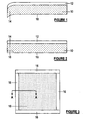
- the solid oxide electrolyte layer 12 comprises Y 2 O 3 -doped ZrO 2 (YSZ) which has been sintered into a dense layer to provide a barrier to fuel gas on the side of the anode layer 10 and oxygen-containing gas on the other side.
- the anode layer 10 comprises a porous Ni-YSZ cermet which in use permits the fuel gas to pass therethrough and react at the anode/electrolyte interface.
- the complete fuel cell will include a sintered porous cathode layer on the other side of the electrolyte layer 12.
- the sub-structure partly illustrated in Figure 1 is formed by tape casting a green anode material, optionally in plural layers (not illustrated) with varying levels of binder content.
- the green material has a particle size in the range of about 0.5 to about 10 microns and the particulate material is held together by a binder such as acrylic binder at a binder content of about 23 wt% of the green anode material to provide a porous structure.
- the green solid oxide electrolyte material is tape cast and roll laminated onto the green anode material and has a particle size in the range of about 0.5 to about 5 microns with the particulate material being held together by a binder such as polyvinyl butyral at a binder content also of about 23 wt% of the green electrolyte material.
- a binder such as polyvinyl butyral at a binder content also of about 23 wt% of the green electrolyte material.
- the curling of the edges of the sub-structure is not desirable in a fuel cell and must be ground off the anode layer, or the curled edges may be trimmed off.
- the anode layer may be fired first, before the green electrolyte material is disposed on it and then fired, but this is equally inconvenient.
- a thin cathode layer of, for example, strontium-doped lanthanum manganite having a thickness in the range of about 50 to 100 microns is screen printed onto the side of the electrolyte layer 12 remote from the anode layer 10.
- the strip 16 has a width of about 7mm and a thickness in the range of about 20 to 50 microns, for example about 30 to 40 microns, preferably about 35 microns.
- the green material of the edge strip 16 is substantially identical to that of the electrolyte layer 12, that is YSZ having a similar density with a binder content in the range of 17 to 25 wt% of the overall strip green material.
- the preferred binder content of the green strip material may be determined by trial and error at a level which alleviates the curling of the edge portion 14, and in one embodiment it has been found that a binder content of about 20 wt% is satisfactory compared to a binder content of about 23 wt% for the green material of the electrolyte layer.
- the green material of the edge strip may be tape cast at the desired width or may be cut from a wider tape.
- a light coating of solvent/plasticiser mix is applied, for example by brushing, to the edge portion 14 of the face 18 to which the strip of green material is to be applied.
- the solvent may be ethanol and the plasticiser benzyl butyl phthalate mixed in a weight ratio of about 2.5 to 5:1, preferably about 3.5:1.
- the green strip material is then applied to the edge portion 14 and air bubbles are rolled out.
- edge curl was less than 0.2mm in a batch of the sintered laminated structures, with many showing edge curl of less than 0.1 mm, compared to edge curl of at least 2mm, and as great 5mm, in the aforementioned comparative example without the edge strips.
Landscapes
- Engineering & Computer Science (AREA)
- Chemical & Material Sciences (AREA)
- Ceramic Engineering (AREA)
- Manufacturing & Machinery (AREA)
- Organic Chemistry (AREA)
- Structural Engineering (AREA)
- Materials Engineering (AREA)
- Sustainable Energy (AREA)
- Quality & Reliability (AREA)
- Life Sciences & Earth Sciences (AREA)
- Sustainable Development (AREA)
- Composite Materials (AREA)
- Chemical Kinetics & Catalysis (AREA)
- Electrochemistry (AREA)
- General Chemical & Material Sciences (AREA)
- Fuel Cell (AREA)
- Inert Electrodes (AREA)
- Devices For Post-Treatments, Processing, Supply, Discharge, And Other Processes (AREA)
- Laminated Bodies (AREA)
Applications Claiming Priority (3)
| Application Number | Priority Date | Filing Date | Title |
|---|---|---|---|
| AUPQ4921A AUPQ492199A0 (en) | 1999-12-30 | 1999-12-30 | Laminated structure and method of forming same |
| AUPQ492199 | 1999-12-30 | ||
| PCT/AU2000/001560 WO2001049485A1 (en) | 1999-12-30 | 2000-12-19 | Laminated structure and method of forming same |
Publications (3)
| Publication Number | Publication Date |
|---|---|
| EP1255641A1 EP1255641A1 (en) | 2002-11-13 |
| EP1255641A4 EP1255641A4 (en) | 2005-01-12 |
| EP1255641B1 true EP1255641B1 (en) | 2010-04-28 |
Family
ID=3819057
Family Applications (1)
| Application Number | Title | Priority Date | Filing Date |
|---|---|---|---|
| EP00986863A Expired - Lifetime EP1255641B1 (en) | 1999-12-30 | 2000-12-19 | Laminated structure and method of forming same |
Country Status (9)
| Country | Link |
|---|---|
| US (1) | US7045239B2 (enExample) |
| EP (1) | EP1255641B1 (enExample) |
| JP (1) | JP4845315B2 (enExample) |
| AT (1) | ATE465868T1 (enExample) |
| AU (1) | AUPQ492199A0 (enExample) |
| CA (1) | CA2395060C (enExample) |
| DE (1) | DE60044304D1 (enExample) |
| WO (1) | WO2001049485A1 (enExample) |
| ZA (1) | ZA200205067B (enExample) |
Families Citing this family (20)
| Publication number | Priority date | Publication date | Assignee | Title |
|---|---|---|---|---|
| JP4252453B2 (ja) * | 2001-09-26 | 2009-04-08 | 日本碍子株式会社 | 電気化学セルおよびその製造方法 |
| JP4923407B2 (ja) * | 2004-01-16 | 2012-04-25 | 三菱マテリアル株式会社 | 固体酸化物形燃料電池の製造方法 |
| CN101855767A (zh) | 2007-11-13 | 2010-10-06 | 博隆能源股份有限公司 | 针对较长寿命和较高电力设计的电解质支撑型电池 |
| US9246184B1 (en) | 2007-11-13 | 2016-01-26 | Bloom Energy Corporation | Electrolyte supported cell designed for longer life and higher power |
| EP2083465B1 (en) * | 2008-01-23 | 2012-08-01 | Institute of Nuclear Energy Research | A Process for Fabrication of a Fully Dense Electrolyte layer embedded in membrane electrolyte assembly of solid oxide fuel cell |
| JP4960903B2 (ja) * | 2008-02-27 | 2012-06-27 | 本田技研工業株式会社 | 積層体の検査方法、検査装置及び検査プログラム |
| JP5428178B2 (ja) * | 2008-03-28 | 2014-02-26 | 大日本印刷株式会社 | 固体酸化物形燃料電池の製造方法、及び積層体 |
| JP2009245717A (ja) * | 2008-03-31 | 2009-10-22 | Dainippon Printing Co Ltd | 固体酸化物形燃料電池の製造方法、この方法により製造された固体酸化物形燃料電池、及び固体酸化物形燃料電池用電解質・電極積層体 |
| JP5932232B2 (ja) * | 2011-03-25 | 2016-06-08 | 株式会社日本触媒 | アノード支持型ハーフセル及びこれを用いたアノード支持型セル、並びにアノード支持型ハーフセルの製造方法 |
| KR101351221B1 (ko) | 2011-09-21 | 2014-01-14 | 한국전력공사 | 테이프 캐스팅을 이용한 지지체식 코팅막의 제조방법 |
| US9206086B2 (en) | 2012-04-18 | 2015-12-08 | Nitto Denko Corporation | Method and apparatus for sintering flat ceramics |
| US9205571B2 (en) | 2012-04-18 | 2015-12-08 | Nitto Denko Corporation | Method and apparatus for sintering flat ceramics |
| JP5973377B2 (ja) * | 2013-04-24 | 2016-08-23 | 株式会社ノリタケカンパニーリミテド | 固体酸化物形燃料電池用グリーンシートおよびその製造方法 |
| JP5699347B2 (ja) * | 2013-09-12 | 2015-04-08 | 大日本印刷株式会社 | 固体酸化物形燃料電池、及び、固体酸化物形燃料電池の製造方法 |
| JP6162572B2 (ja) * | 2013-10-25 | 2017-07-12 | 日本特殊陶業株式会社 | 固体酸化物形燃料電池単セルの製造方法及び固体酸化物形燃料電池スタックの製造方法 |
| US9673470B2 (en) | 2014-01-22 | 2017-06-06 | King Fahd University Of Petroleum And Minerals | Electrolyte layer having a patchwork-type nanoporous grain boundary and a method of preparation thereof |
| JP6443662B2 (ja) * | 2014-10-21 | 2018-12-26 | 日産自動車株式会社 | 燃料電池セルの製造方法 |
| US10347930B2 (en) | 2015-03-24 | 2019-07-09 | Bloom Energy Corporation | Perimeter electrolyte reinforcement layer composition for solid oxide fuel cell electrolytes |
| JP6060297B2 (ja) * | 2016-04-28 | 2017-01-11 | 株式会社日本触媒 | アノード支持型ハーフセル及びこれを用いたアノード支持型セル |
| CN116826101A (zh) | 2022-03-26 | 2023-09-29 | 博隆能源股份有限公司 | 用于防止大占地面积固体氧化物燃料电池柱中的热致应力裂纹的方法和装置 |
Family Cites Families (25)
| Publication number | Priority date | Publication date | Assignee | Title |
|---|---|---|---|---|
| US3879509A (en) | 1971-09-07 | 1975-04-22 | Gilbert James Elderbaum | Method of producing thin ceramic sheets with minimal distortion |
| NL7310168A (nl) * | 1973-07-20 | 1975-01-22 | Hitachi Ltd | Werkwijze voor de vervaardiging van een samen- gestelde gesinterde structuur. |
| CH626314A5 (en) * | 1976-09-02 | 1981-11-13 | Gail Tonwerke Wilhelm | Ceramic veneer |
| JPH037086Y2 (enExample) * | 1986-01-29 | 1991-02-21 | ||
| US5130067A (en) * | 1986-05-02 | 1992-07-14 | International Business Machines Corporation | Method and means for co-sintering ceramic/metal mlc substrates |
| JPS63112473A (ja) * | 1986-10-28 | 1988-05-17 | 太陽誘電株式会社 | セラミツク基板の製造方法 |
| US4883497A (en) * | 1988-03-28 | 1989-11-28 | Arch Development Corporation | Formation of thin walled ceramic solid oxide fuel cells |
| JPH037086A (ja) * | 1989-05-31 | 1991-01-14 | Sanken Electric Co Ltd | モータ制御方法 |
| JPH03271165A (ja) * | 1990-03-20 | 1991-12-03 | Fujitsu General Ltd | シート積層体の焼成方法 |
| JPH04298964A (ja) | 1991-03-27 | 1992-10-22 | Ngk Insulators Ltd | 固体電解質型燃料電池及びその製造方法 |
| JP2945157B2 (ja) | 1991-03-27 | 1999-09-06 | 日本碍子株式会社 | 固体電解質型燃料電池及びその製造方法 |
| JPH04298963A (ja) * | 1991-03-27 | 1992-10-22 | Ngk Insulators Ltd | 固体電解質型燃料電池及びその製造方法 |
| JP3413880B2 (ja) * | 1993-07-16 | 2003-06-09 | 松下電器産業株式会社 | 多層セラミック焼結体の製造方法 |
| JPH07335239A (ja) * | 1994-06-08 | 1995-12-22 | Ngk Insulators Ltd | 接合体の製造方法 |
| DE19512146A1 (de) * | 1995-03-31 | 1996-10-02 | Inst Neue Mat Gemein Gmbh | Verfahren zur Herstellung von schwindungsangepaßten Keramik-Verbundwerkstoffen |
| JP3230423B2 (ja) * | 1995-09-12 | 2001-11-19 | 日本電信電話株式会社 | 中空平板状電極基板およびその製造方法 |
| US5670270A (en) * | 1995-11-16 | 1997-09-23 | The Dow Chemical Company | Electrode structure for solid state electrochemical devices |
| JPH09143512A (ja) * | 1995-11-29 | 1997-06-03 | Chichibu Onoda Cement Corp | 多層焼結体の製造方法 |
| JP3492492B2 (ja) * | 1996-06-14 | 2004-02-03 | 日本碍子株式会社 | セラミックダイヤフラム構造体の製造方法 |
| DE69707359T2 (de) | 1996-06-14 | 2002-06-27 | Ngk Insulators, Ltd. | Verfahren zur Herstellung einer keramischen Membranstruktur |
| JPH10167842A (ja) * | 1996-12-16 | 1998-06-23 | Sumitomo Kinzoku Erekutorodebaisu:Kk | 拘束層用セラミックグリーンシート及びこれを用いたセラミック基板の製造方法 |
| US5935727A (en) | 1997-04-10 | 1999-08-10 | The Dow Chemical Company | Solid oxide fuel cells |
| AUPO724997A0 (en) * | 1997-06-10 | 1997-07-03 | Ceramic Fuel Cells Limited | A fuel cell assembly |
| JP4300493B2 (ja) * | 1998-06-05 | 2009-07-22 | 日立金属株式会社 | セラミック積層体及びその製造方法 |
| US6458170B1 (en) * | 1998-12-03 | 2002-10-01 | The Regents Of The University Of California | Method for making thin, flat, dense membranes on porous substrates |
-
1999
- 1999-12-30 AU AUPQ4921A patent/AUPQ492199A0/en not_active Abandoned
-
2000
- 2000-12-19 DE DE60044304T patent/DE60044304D1/de not_active Expired - Lifetime
- 2000-12-19 CA CA002395060A patent/CA2395060C/en not_active Expired - Fee Related
- 2000-12-19 US US10/169,386 patent/US7045239B2/en not_active Expired - Fee Related
- 2000-12-19 EP EP00986863A patent/EP1255641B1/en not_active Expired - Lifetime
- 2000-12-19 JP JP2001549832A patent/JP4845315B2/ja not_active Expired - Fee Related
- 2000-12-19 AT AT00986863T patent/ATE465868T1/de not_active IP Right Cessation
- 2000-12-19 WO PCT/AU2000/001560 patent/WO2001049485A1/en not_active Ceased
-
2002
- 2002-06-24 ZA ZA200205067A patent/ZA200205067B/en unknown
Also Published As
| Publication number | Publication date |
|---|---|
| AUPQ492199A0 (en) | 2000-02-03 |
| EP1255641A4 (en) | 2005-01-12 |
| US7045239B2 (en) | 2006-05-16 |
| JP2003519023A (ja) | 2003-06-17 |
| CA2395060C (en) | 2008-07-08 |
| JP4845315B2 (ja) | 2011-12-28 |
| US20030129460A1 (en) | 2003-07-10 |
| ATE465868T1 (de) | 2010-05-15 |
| WO2001049485A1 (en) | 2001-07-12 |
| ZA200205067B (en) | 2003-10-07 |
| DE60044304D1 (de) | 2010-06-10 |
| CA2395060A1 (en) | 2001-07-12 |
| EP1255641A1 (en) | 2002-11-13 |
Similar Documents
| Publication | Publication Date | Title |
|---|---|---|
| EP1255641B1 (en) | Laminated structure and method of forming same | |
| EP0815608B1 (en) | Solid oxide fuel cells with specific electrode layers | |
| US8932783B2 (en) | Solid oxide fuel cell or solid oxide fuel cell sub-component and methods of preparing same | |
| US20060024547A1 (en) | Anode supported sofc with an electrode multifunctional layer | |
| US9070946B2 (en) | Electrolyte-electrode joined assembly and method for producing the same | |
| KR101685386B1 (ko) | 저온 동시소결에 의한 연료극 지지형 고체산화물 셀 및 그 제조방법 | |
| JP2009507356A (ja) | 一体的な密封部および支持体を備えたセラミックメンブラン、ならびにそれを包含する電気化学的電池および電気化学的電池積重構造 | |
| US7871735B2 (en) | Ceramic laminate structures | |
| WO2006079800A1 (en) | Fuel cell cathodes | |
| EP1096588A2 (en) | Solid oxide fuel cell with sintered air electrode | |
| EP3051617A1 (en) | Solid oxide fuel cell stack and method for manufacturing same | |
| KR100849994B1 (ko) | 고체산화물 연료전지의 단위전지 제조용 가압장치 및 이를이용한 제조방법 | |
| AU782584B2 (en) | Laminated structure and method of forming same | |
| JP7658769B2 (ja) | 固体酸化物型燃料電池およびその製造方法 | |
| JP2009009738A (ja) | 固体電解質形燃料電池及びその製造方法 | |
| WO2010095728A1 (en) | Electrolyte electrode assembly and method for producing the same | |
| JP2011009173A (ja) | 電解質・電極接合体の製造方法 | |
| JP6965041B2 (ja) | 電気化学反応単セルおよび電気化学反応セルスタック | |
| JPH09190824A (ja) | 固体電解質型燃料電池の燃料極構造及びその製造方法 | |
| CN113394434A (zh) | 固体氧化物型燃料电池及其制造方法 | |
| KR102100257B1 (ko) | 고강도 프레임이 적용된 고체산화물연료전지용 평판형 단전지 | |
| JP2017174813A (ja) | 電気化学セル | |
| JP2013077395A (ja) | アノード基板、固体酸化物形燃料電池及びアノード基板の製造方法 | |
| JPH08180886A (ja) | 固体電解質型燃料電池の空気極の接触抵抗低減方法 |
Legal Events
| Date | Code | Title | Description |
|---|---|---|---|
| PUAI | Public reference made under article 153(3) epc to a published international application that has entered the european phase |
Free format text: ORIGINAL CODE: 0009012 |
|
| 17P | Request for examination filed |
Effective date: 20020704 |
|
| AK | Designated contracting states |
Kind code of ref document: A1 Designated state(s): AT BE CH CY DE DK ES FI FR GB GR IE IT LI LU MC NL PT SE TR |
|
| AX | Request for extension of the european patent |
Free format text: AL;LT;LV;MK;RO;SI |
|
| A4 | Supplementary search report drawn up and despatched |
Effective date: 20041126 |
|
| RIC1 | Information provided on ipc code assigned before grant |
Ipc: 7H 01M 8/12 B Ipc: 7B 32B 18/00 A Ipc: 7C 04B 35/486 B Ipc: 7C 04B 35/01 B Ipc: 7B 32B 31/00 B |
|
| 17Q | First examination report despatched |
Effective date: 20050222 |
|
| GRAP | Despatch of communication of intention to grant a patent |
Free format text: ORIGINAL CODE: EPIDOSNIGR1 |
|
| RIC1 | Information provided on ipc code assigned before grant |
Ipc: B32B 37/00 20060101ALI20091103BHEP Ipc: C04B 35/01 20060101ALI20091103BHEP Ipc: C04B 35/486 20060101ALI20091103BHEP Ipc: B32B 18/00 20060101AFI20091103BHEP Ipc: H01M 8/12 20060101ALI20091103BHEP |
|
| GRAS | Grant fee paid |
Free format text: ORIGINAL CODE: EPIDOSNIGR3 |
|
| GRAA | (expected) grant |
Free format text: ORIGINAL CODE: 0009210 |
|
| AK | Designated contracting states |
Kind code of ref document: B1 Designated state(s): AT BE CH CY DE DK ES FI FR GB GR IE IT LI LU MC NL PT SE TR |
|
| REG | Reference to a national code |
Ref country code: GB Ref legal event code: FG4D |
|
| REG | Reference to a national code |
Ref country code: CH Ref legal event code: EP |
|
| REG | Reference to a national code |
Ref country code: IE Ref legal event code: FG4D |
|
| REF | Corresponds to: |
Ref document number: 60044304 Country of ref document: DE Date of ref document: 20100610 Kind code of ref document: P |
|
| REG | Reference to a national code |
Ref country code: NL Ref legal event code: VDEP Effective date: 20100428 |
|
| PG25 | Lapsed in a contracting state [announced via postgrant information from national office to epo] |
Ref country code: ES Free format text: LAPSE BECAUSE OF FAILURE TO SUBMIT A TRANSLATION OF THE DESCRIPTION OR TO PAY THE FEE WITHIN THE PRESCRIBED TIME-LIMIT Effective date: 20100808 Ref country code: SE Free format text: LAPSE BECAUSE OF FAILURE TO SUBMIT A TRANSLATION OF THE DESCRIPTION OR TO PAY THE FEE WITHIN THE PRESCRIBED TIME-LIMIT Effective date: 20100428 Ref country code: NL Free format text: LAPSE BECAUSE OF FAILURE TO SUBMIT A TRANSLATION OF THE DESCRIPTION OR TO PAY THE FEE WITHIN THE PRESCRIBED TIME-LIMIT Effective date: 20100428 |
|
| PG25 | Lapsed in a contracting state [announced via postgrant information from national office to epo] |
Ref country code: AT Free format text: LAPSE BECAUSE OF FAILURE TO SUBMIT A TRANSLATION OF THE DESCRIPTION OR TO PAY THE FEE WITHIN THE PRESCRIBED TIME-LIMIT Effective date: 20100428 Ref country code: FI Free format text: LAPSE BECAUSE OF FAILURE TO SUBMIT A TRANSLATION OF THE DESCRIPTION OR TO PAY THE FEE WITHIN THE PRESCRIBED TIME-LIMIT Effective date: 20100428 |
|
| PG25 | Lapsed in a contracting state [announced via postgrant information from national office to epo] |
Ref country code: CY Free format text: LAPSE BECAUSE OF FAILURE TO SUBMIT A TRANSLATION OF THE DESCRIPTION OR TO PAY THE FEE WITHIN THE PRESCRIBED TIME-LIMIT Effective date: 20100428 Ref country code: GR Free format text: LAPSE BECAUSE OF FAILURE TO SUBMIT A TRANSLATION OF THE DESCRIPTION OR TO PAY THE FEE WITHIN THE PRESCRIBED TIME-LIMIT Effective date: 20100729 |
|
| PG25 | Lapsed in a contracting state [announced via postgrant information from national office to epo] |
Ref country code: PT Free format text: LAPSE BECAUSE OF FAILURE TO SUBMIT A TRANSLATION OF THE DESCRIPTION OR TO PAY THE FEE WITHIN THE PRESCRIBED TIME-LIMIT Effective date: 20100830 Ref country code: DK Free format text: LAPSE BECAUSE OF FAILURE TO SUBMIT A TRANSLATION OF THE DESCRIPTION OR TO PAY THE FEE WITHIN THE PRESCRIBED TIME-LIMIT Effective date: 20100428 |
|
| PG25 | Lapsed in a contracting state [announced via postgrant information from national office to epo] |
Ref country code: BE Free format text: LAPSE BECAUSE OF FAILURE TO SUBMIT A TRANSLATION OF THE DESCRIPTION OR TO PAY THE FEE WITHIN THE PRESCRIBED TIME-LIMIT Effective date: 20100428 |
|
| PLBE | No opposition filed within time limit |
Free format text: ORIGINAL CODE: 0009261 |
|
| STAA | Information on the status of an ep patent application or granted ep patent |
Free format text: STATUS: NO OPPOSITION FILED WITHIN TIME LIMIT |
|
| 26N | No opposition filed |
Effective date: 20110131 |
|
| PG25 | Lapsed in a contracting state [announced via postgrant information from national office to epo] |
Ref country code: MC Free format text: LAPSE BECAUSE OF NON-PAYMENT OF DUE FEES Effective date: 20101231 |
|
| REG | Reference to a national code |
Ref country code: CH Ref legal event code: PL |
|
| PG25 | Lapsed in a contracting state [announced via postgrant information from national office to epo] |
Ref country code: LI Free format text: LAPSE BECAUSE OF NON-PAYMENT OF DUE FEES Effective date: 20101231 Ref country code: IE Free format text: LAPSE BECAUSE OF NON-PAYMENT OF DUE FEES Effective date: 20101219 Ref country code: CH Free format text: LAPSE BECAUSE OF NON-PAYMENT OF DUE FEES Effective date: 20101231 |
|
| PG25 | Lapsed in a contracting state [announced via postgrant information from national office to epo] |
Ref country code: LU Free format text: LAPSE BECAUSE OF NON-PAYMENT OF DUE FEES Effective date: 20101219 |
|
| PG25 | Lapsed in a contracting state [announced via postgrant information from national office to epo] |
Ref country code: TR Free format text: LAPSE BECAUSE OF FAILURE TO SUBMIT A TRANSLATION OF THE DESCRIPTION OR TO PAY THE FEE WITHIN THE PRESCRIBED TIME-LIMIT Effective date: 20100428 |
|
| PGFP | Annual fee paid to national office [announced via postgrant information from national office to epo] |
Ref country code: GB Payment date: 20131219 Year of fee payment: 14 Ref country code: DE Payment date: 20131220 Year of fee payment: 14 |
|
| PGFP | Annual fee paid to national office [announced via postgrant information from national office to epo] |
Ref country code: IT Payment date: 20131218 Year of fee payment: 14 |
|
| PGFP | Annual fee paid to national office [announced via postgrant information from national office to epo] |
Ref country code: FR Payment date: 20131220 Year of fee payment: 14 |
|
| REG | Reference to a national code |
Ref country code: DE Ref legal event code: R119 Ref document number: 60044304 Country of ref document: DE |
|
| GBPC | Gb: european patent ceased through non-payment of renewal fee |
Effective date: 20141219 |
|
| REG | Reference to a national code |
Ref country code: FR Ref legal event code: ST Effective date: 20150831 |
|
| PG25 | Lapsed in a contracting state [announced via postgrant information from national office to epo] |
Ref country code: GB Free format text: LAPSE BECAUSE OF NON-PAYMENT OF DUE FEES Effective date: 20141219 Ref country code: DE Free format text: LAPSE BECAUSE OF NON-PAYMENT OF DUE FEES Effective date: 20150701 |
|
| PG25 | Lapsed in a contracting state [announced via postgrant information from national office to epo] |
Ref country code: FR Free format text: LAPSE BECAUSE OF NON-PAYMENT OF DUE FEES Effective date: 20141231 |
|
| PG25 | Lapsed in a contracting state [announced via postgrant information from national office to epo] |
Ref country code: IT Free format text: LAPSE BECAUSE OF NON-PAYMENT OF DUE FEES Effective date: 20141219 |