EP1236682B1 - Siliciumoxidpulver und dessen Herstellung - Google Patents
Siliciumoxidpulver und dessen Herstellung Download PDFInfo
- Publication number
- EP1236682B1 EP1236682B1 EP02251417A EP02251417A EP1236682B1 EP 1236682 B1 EP1236682 B1 EP 1236682B1 EP 02251417 A EP02251417 A EP 02251417A EP 02251417 A EP02251417 A EP 02251417A EP 1236682 B1 EP1236682 B1 EP 1236682B1
- Authority
- EP
- European Patent Office
- Prior art keywords
- silicon oxide
- powder
- oxide powder
- gas
- mixture
- Prior art date
- Legal status (The legal status is an assumption and is not a legal conclusion. Google has not performed a legal analysis and makes no representation as to the accuracy of the status listed.)
- Expired - Lifetime
Links
Images
Classifications
-
- H—ELECTRICITY
- H01—ELECTRIC ELEMENTS
- H01M—PROCESSES OR MEANS, e.g. BATTERIES, FOR THE DIRECT CONVERSION OF CHEMICAL ENERGY INTO ELECTRICAL ENERGY
- H01M4/00—Electrodes
- H01M4/02—Electrodes composed of, or comprising, active material
- H01M4/36—Selection of substances as active materials, active masses, active liquids
- H01M4/48—Selection of substances as active materials, active masses, active liquids of inorganic oxides or hydroxides
- H01M4/485—Selection of substances as active materials, active masses, active liquids of inorganic oxides or hydroxides of mixed oxides or hydroxides for inserting or intercalating light metals, e.g. LiTi2O4 or LiTi2OxFy
-
- C—CHEMISTRY; METALLURGY
- C01—INORGANIC CHEMISTRY
- C01B—NON-METALLIC ELEMENTS; COMPOUNDS THEREOF; METALLOIDS OR COMPOUNDS THEREOF NOT COVERED BY SUBCLASS C01C
- C01B33/00—Silicon; Compounds thereof
- C01B33/113—Silicon oxides; Hydrates thereof
-
- H—ELECTRICITY
- H01—ELECTRIC ELEMENTS
- H01M—PROCESSES OR MEANS, e.g. BATTERIES, FOR THE DIRECT CONVERSION OF CHEMICAL ENERGY INTO ELECTRICAL ENERGY
- H01M10/00—Secondary cells; Manufacture thereof
- H01M10/05—Accumulators with non-aqueous electrolyte
- H01M10/052—Li-accumulators
- H01M10/0525—Rocking-chair batteries, i.e. batteries with lithium insertion or intercalation in both electrodes; Lithium-ion batteries
-
- H—ELECTRICITY
- H01—ELECTRIC ELEMENTS
- H01M—PROCESSES OR MEANS, e.g. BATTERIES, FOR THE DIRECT CONVERSION OF CHEMICAL ENERGY INTO ELECTRICAL ENERGY
- H01M4/00—Electrodes
- H01M4/02—Electrodes composed of, or comprising, active material
- H01M2004/026—Electrodes composed of, or comprising, active material characterised by the polarity
- H01M2004/027—Negative electrodes
-
- H—ELECTRICITY
- H01—ELECTRIC ELEMENTS
- H01M—PROCESSES OR MEANS, e.g. BATTERIES, FOR THE DIRECT CONVERSION OF CHEMICAL ENERGY INTO ELECTRICAL ENERGY
- H01M4/00—Electrodes
- H01M4/02—Electrodes composed of, or comprising, active material
- H01M4/04—Processes of manufacture in general
- H01M4/0471—Processes of manufacture in general involving thermal treatment, e.g. firing, sintering, backing particulate active material, thermal decomposition, pyrolysis
-
- H—ELECTRICITY
- H01—ELECTRIC ELEMENTS
- H01M—PROCESSES OR MEANS, e.g. BATTERIES, FOR THE DIRECT CONVERSION OF CHEMICAL ENERGY INTO ELECTRICAL ENERGY
- H01M4/00—Electrodes
- H01M4/02—Electrodes composed of, or comprising, active material
- H01M4/13—Electrodes for accumulators with non-aqueous electrolyte, e.g. for lithium-accumulators; Processes of manufacture thereof
- H01M4/131—Electrodes based on mixed oxides or hydroxides, or on mixtures of oxides or hydroxides, e.g. LiCoOx
-
- Y—GENERAL TAGGING OF NEW TECHNOLOGICAL DEVELOPMENTS; GENERAL TAGGING OF CROSS-SECTIONAL TECHNOLOGIES SPANNING OVER SEVERAL SECTIONS OF THE IPC; TECHNICAL SUBJECTS COVERED BY FORMER USPC CROSS-REFERENCE ART COLLECTIONS [XRACs] AND DIGESTS
- Y02—TECHNOLOGIES OR APPLICATIONS FOR MITIGATION OR ADAPTATION AGAINST CLIMATE CHANGE
- Y02E—REDUCTION OF GREENHOUSE GAS [GHG] EMISSIONS, RELATED TO ENERGY GENERATION, TRANSMISSION OR DISTRIBUTION
- Y02E60/00—Enabling technologies; Technologies with a potential or indirect contribution to GHG emissions mitigation
- Y02E60/10—Energy storage using batteries
Definitions
- This invention relates to a silicon oxide powder suitable as a negative electrode active material in lithium ion secondary cells, and a method for preparing the same.
- Silicon oxide represented by SiO is a well-known material. By taking advantage of its chemical activity, it is used, for example, in the synthesis of industrially useful alkylhalosilanes (Gary N. Bokerman et al., USP 5,051,247) and the direct synthesis of siloxanes (Peter L. Timms and William N. Rowlands, EPA 0406000A2 "Polysiloxane oils and process for their preparation”). It is also reported that magnesium silicide is prepared by reacting silicon oxide with magnesium at low temperatures (E. Fuglein and U. Schubert, Chem. Mater., 1999, 11, 865-866).
- JP-A 9-7638 corresponding to EP 840386A discloses that the use of SiOx as a negative electrode active material in lithium ion secondary cells facilitates occlusion and release of lithium ions. Silicon oxide is thus expected to find an extra application as the negative electrode active material in lithium ion secondary batteries.
- silicon oxide (SiOx) powder as the negative electrode material in lithium ion secondary cells leads to a drastically increased initial capacity, but poor cycle performance.
- An object of the invention is to provide a silicon oxide powder which can be used as the negative electrode material for a lithium ion secondary cell capable of maintaining a high capacity with satisfactory cycle performance.
- Other objects are to provide a method for preparing the silicon oxide powder, and the use as described.
- the invention provides a silicon oxide powder represented by the formula: SiOx wherein x is a number from 1.05 to 1.5 and having a BET specific surface area of 5 to 300 m 2 /g.
- the silicon oxide powder is prepared by heating a raw material powder mixture containing at least a silicon dioxide powder in an inert gas atmosphere or in vacuum at a temperature of 1,100 to 1,600°C to generate SiO gas, continuously or intermittently feeding oxygen gas to the SiO gas to form a gas mixture, and contacting the gas mixture with a surface of a cooled substrate to deposit silicon oxide powder.
- Another aspect is use in a lithium ion secondary cell, of such silicon oxide powder as negative electrode material.
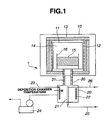
- FIG. 1 is a schematic cross-sectional view of an apparatus for preparing silicon oxide according to one embodiment of the invention.
- the silicon oxide powder of the invention is represented by the formula: SiOx wherein x is a number from 1.05 to 1.5 (i.e., 1.05 ⁇ x ⁇ 1.5) and has a specific surface area of 5 to 300 m 2 /g as measured by the BET adsorption method.
- a silicon oxide powder of the formula: SiOx wherein x is less than 1.05 is used as the negative electrode material in a lithium ion secondary cell
- the initial capacity of the cell is increased at the sacrifice of cycle performance. If x is more than 1.5, the cycle performance is improved at the sacrifice of charge-discharge capacity.
- x is between 1.1 and 1.3.
- a BET surface area of less than 5 m 2 /g indicates that silicon oxide particles have a lower surface activity.
- this silicon oxide powder is used as the negative electrode material in a lithium ion secondary cell, the amount of lithium ions migrating into and out of the silicon oxide powder is reduced and as a result, the charge/discharge capacity is reduced.
- the BET surface area is more than 300 m 2 /g, silicon oxide particles are so vulnerable to surface oxidation that the proportion of SiO 2 increases and hence, the value of x increases, resulting in a lowering of charge/discharge capacity.
- the preferred range of BET specific surface area is 10 to 200 m 2 /g.
- the silicon oxide powder defined above is prepared by heating a raw material powder mixture containing at least silicon dioxide powder in an inert gas atmosphere or in vacuum at a temperature in the range of 1,100 to 1,600°C to generate SiO gas, continuously or intermittently feeding oxygen gas to the SiO gas to form a gas mixture, and contacting the gas mixture with a surface of a cooled substrate for depositing silicon oxide particles thereon.
- the raw material powder mixture containing a silicon dioxide powder is typically a mixture of silicon dioxide and a powder capable of reducing the silicon dioxide.
- Illustrative of the reducing powder are metallic silicon and carbon-containing powders. Of these, metallic silicon is preferred for increased reactivity and yields.
- the metallic silicon used herein is not critical although metallic silicon species of high purity such as semiconductor grade Si, ceramic grade Si and chemical grade Si are preferred because of the increased purity of the resultant silicon oxide powder.
- the mixing proportion of silicon dioxide and a reducing powder is determined as appropriate as long as complete reduction is ensured.
- the mixture of silicon dioxide and a reducing powder is heated and maintained at a temperature in the range of 1,100 to 1,600°C, and preferably 1,200 to 1,500°C, for thereby generating SiO gas.
- a heating temperature below 1,100°C reaction proceeds with difficulty, resulting in a lower productivity.
- the raw material powder mixture is heated above 1,600°C, the mixture melts and loses reactivity and a choice of the furnace material becomes a concern.
- the atmosphere within the furnace may be either an inert gas or vacuum although the reaction in vacuum is advantageous in that reactivity becomes higher on account of thermodynamics so that reaction can proceed at lower temperatures.
- the SiO gas generated by heating the raw material powder mixture is then fed through a feed conduit to a deposition chamber for depositing a silicon oxide powder.
- the feed conduit is preferably heated and maintained at a temperature of 1,000 to 1,300°C, more preferably 1,100 to 1,200°C. If the feed conduit is below 1,000°C, the SiO gas may deposit and build up on the inner wall of the conduit, which becomes a disturbance to operation, eventually retarding stable continuous operation. Heating the conduit above 1,300°C achieves no additional effects and can invite an increase of power consumption.
- oxygen gas is fed thereto.
- the oxygen gas may be fed as such or an inert gas containing oxygen gas be fed.
- the x value in the resulting silicon oxide powder (SiOx) can be adjusted. It is not critical how to feed the oxygen gas, and the oxygen gas may be fed continuously or intermittently or otherwise. Any appropriate oxygen gas feed method may be selected in accordance with a particular purpose.
- the temperature is preferably 800 to 1,200°C, and especially 900 to 1,100°C.
- a gas mixture obtained by feeding oxygen gas to SiO gas is contacted with a surface of a substrate which is disposed within the deposition chamber and cooled with a coolant whereby a silicon oxide powder (SiOx) having a predetermined value of x deposits on the substrate.
- the temperature of the substrate at the surface is, though not critical, preferably 200 to 400°C.
- the resulting silicon oxide powder may have a BET specific surface area in excess of 300 m 2 /g and a lower purity.
- the resulting silicon oxide powder may have a BET specific surface area of less than 5 m 2 /g and a lower activity.
- the coolant for cooling the substrate is, though not critical, selected from liquids such as water and heat transfer media and gases such as air and nitrogen gas.
- the type of the substrate is not critical although the use of high-melting metals such as stainless steel, molybdenum and tungsten is preferred for ease of working.
- the silicon oxide powder thus deposited on the substrate is recovered by a suitable means such as a scraper. After recovery, the silicon oxide powder is pulverized to a desired particle size in a suitable means such as a ball mill, if necessary.
- the apparatus 1 includes a reaction furnace 10 and a deposition chamber 20 which are interconnected by a transfer conduit 30 having a heater 31 built therein. Disposed in the reaction furnace 10 is a muffle 11 which is surrounded by a heater 12. A heat insulator 13 is disposed around the heater 12.
- the muffle 11 defines a reaction chamber 14 therein. Disposed within the reaction chamber 14 is a container 16 for receiving a raw material powder mixture 15 containing a silicon dioxide powder.
- the heater 12 is operable to heat the raw material powder mixture 15 in the container 16 at a predetermined temperature to thereby generate a silicon oxide gas which is then fed into the deposition chamber 20 through the transfer conduit 30 connected to the muffle 11.
- a substrate 21 Disposed in the deposition chamber 20 are a substrate 21 and a heater 22 for heating the interior of the chamber 20.
- a gas inlet tube 23 Connected to the deposition chamber 20 are a gas inlet tube 23 for feeding oxygen gas into the chamber 20 and a vacuum pump 24 for evacuating and maintaining in vacuum the interior of the apparatus.
- the substrate 21 is provided in its interior with coolant channels (not shown) to which a coolant inlet tube 25 and a coolant outlet tube 26 are connected.
- the silicon oxide gas which has been introduced into the deposition chamber 20 through the feed conduit 30 is mixed with oxygen gas from the inlet tube 23 and brought in contact with the surface of the cooled substrate 21 whereby it is cooled and deposited as silicon oxide particles.
- the raw material powder mixture 15 used was an equimolar mixture of a silicon dioxide powder (BET surface area 200 m 2 /g) and a metallic silicon powder of the ceramic grade (BET surface area 4 m 2 /g).
- the reaction furnace 10 whose muffle 11 had a volume of 6,000 cm 3 .
- the vacuum pump 24 was operated to evacuate the reaction furnace 10 to a vacuum of 0.1 Torr or lower.
- the heater 12 was actuated to heat and maintain the container at a temperature of 1,350°C. With the heater 31 on, the transfer conduit 30 was heated and maintained at a temperature of 1,100°C.
- the heater 22 in the deposition chamber 20 was then actuated to heat the chamber 20 at a temperature of 900°C.
- water was flowed at a rate of 5.0 NL/min through the channels in the stainless steel substrate 21 having a surface area of 200 cm 2 to maintain the substrate surface at a temperature of about 280°C.
- An argon gas containing 20% of oxygen gas was continuously fed at a rate of 50 cc/min from the gas inlet tube 23 into the deposition chamber 20.
- This silicon oxide powder was an amorphous powder having a BET specific surface area of 210 m 2 /g and represented by the formula: SiOx wherein x is 1.22.
- the charge/discharge performance of the electrode was examined.
- a lithium ion secondary cell for the rating of the electrode was constructed using a lithium foil as the counter electrode.
- the nonaqueous electrolyte used was a nonaqueous electrolyte solution of lithium phosphorus hexafluoride in a 1/1 mixture of ethylene carbonate and 1,2-dimethoxyethane in a concentration of 1 mol/liter.
- the separator used was a microporous polyethylene film of 30 ⁇ m thick.
- the lithium ion secondary cell thus constructed was allowed to stand overnight at room temperature.
- a secondary cell charge/discharge tester Nagano K.K.
- a charge/discharge test was carried out on the cell 10 cycles under conditions including a constant current density of 0.5 mA/cm 2 , a discharge termination voltage of 0.003 V and a charge termination voltage 1.800 V.
- Table 2 The results are shown in Table 2.
- Silicon oxide powders represented by the formula: SiOx were prepared as in Example 1 except that the temperature within the deposition chamber 20, the flow rate of water through the substrate 21, and the flow rate of 20% oxygen-containing argon gas were changed as shown in Table 1.
- Example 2 Using the silicon oxide powders thus obtained, a charge/discharge test was carried out as in Example 1. The results of the charge/discharge test are shown in Table 2.
- Silicon oxide powders represented by the formula: SiOx were prepared as in Example 1 except that the temperature within the deposition chamber 20, the flow rate of water through the substrate 21, and the flow rate of 20% oxygen-containing argon gas were changed as shown in Table 1.
- Example 1 (°C) x BET surface area (m 2 /g)
- Example 1 900 5.0 50 280 1.22 210
- Example 2 900 5.0 200 280 1.45 200
- Example 3 800 7.0 50 210 1.32 280
- Example 4 1000 5.0 50 360 1.15 35
- Comparative Example 1 900 5.0 0 280 1.01
- Comparative Example 2 900 5.0 300 280 1.65 230
- Table 2 Initial charge/discharge 10th charge/discharge Charge capacity (mAh/g) Discharge capacity (mAh/g) Capacity loss (%) Charge capacity (mAh/g) Discharge capacity (mAh/g) Discharge retentivity (%)
- Example 1 1150 742 35 570 566 76
- Example 2 1010 720 29 560 557 77
- silicon oxide powder having the formula: SiOx wherein x is controlled in a specific range, which is used as a negative electrode material to construct a lithium ion secondary cell having a high capacity and improved cycle performance.
- the silicon oxide powder can be produced on an industrially acceptable scale.
Landscapes
- Chemical & Material Sciences (AREA)
- Inorganic Chemistry (AREA)
- Chemical Kinetics & Catalysis (AREA)
- Electrochemistry (AREA)
- General Chemical & Material Sciences (AREA)
- Organic Chemistry (AREA)
- Engineering & Computer Science (AREA)
- Materials Engineering (AREA)
- Manufacturing & Machinery (AREA)
- Silicon Compounds (AREA)
- Battery Electrode And Active Subsutance (AREA)
- Secondary Cells (AREA)
Claims (10)
- Siliciumoxidpulver, das durch die Formel SiOx, worin x = 1,05 bis 1,5 ist, dargestellt ist und eine spezifische Oberfläche nach dem BET-Verfahren von 5 bis 300 m2/g aufweist.
- Siliciumoxidpulver nach Anspruch 1, worin x zwischen 1,1 und 1,3 beträgt.
- Siliciumoxidpulver nach Anspruch 1 oder 2, mit einer spezifischen Oberfläche nach dem BET-Verfahren von 10 bis 200 m2/g.
- Verfahren zur Herstellung eines Siliciumoxidpulvers nach einem der Ansprüche 1 bis 3, folgende Schritte umfassend:Erhitzen eines Rohmaterial-Pulvergemischs (15), das zumindest Siliciumdioxidpulver umfasst, in einer Inertgasatmosphäre oder im Vakuum auf eine Temperatur von 1.100 bis 1.600 °C, um SiO-Gas zu erzeugen,kontinuierliches oder diskontinuierliches Zuführen von Sauerstoffgas zum SiO-Gas, um ein Gasgemisch zu bilden, undKontaktieren des Gasgemischs mit einer Oberfläche eines gekühlten Substrats (21), um Siliciumoxidpulver abzuscheiden.
- Verfahren nach Anspruch 4, worin die Substratoberfläche so gekühlt wird, dass ihre Temperatur im Bereich von 200 bis 400 °C gehalten wird.
- Verfahren nach Anspruch 4 oder 5, worin das Rohmaterial-Pulvergemisch ein Gemisch des Siliciumdioxidpulvers mit metallischem Siliciumpulver ist.
- Verfahren nach einem der Ansprüche 4 bis 6, worin das SiO-Gas über eine Zufuhrleitung (31), die erhitzt wird, um sie auf einer Temperatur von 1.000 bis 1.300 °C zu halten, in eine Abscheidungskammer (20) geleitet wird, um dort mit dem gekühlten Substrat (21) in Kontakt zu kommen.
- Verfahren nach einem der Ansprüche 4 bis 7, worin die Temperatur, bei der das Sauerstoffgas dem SiO-Gas zugeführt und damit vermischt wird, 800 bis 1.200 °C beträgt.
- Verfahren nach einem der Ansprüche 4 bis 8, worin das abgeschiedene Siliciumoxid gewonnen und bis zur gewünschten Teilchengröße pulverisiert wird.
- Verwendung von in einem der Ansprüche 1, 2 oder 3 definiertem Siliciumoxidpulver als aktives Material der negativen Elektrode in einer Lithiumionen-Sekundärzelle.
Applications Claiming Priority (2)
| Application Number | Priority Date | Filing Date | Title |
|---|---|---|---|
| JP2001053903A JP2002260651A (ja) | 2001-02-28 | 2001-02-28 | 酸化珪素粉末及びその製造方法 |
| JP2001053903 | 2001-02-28 |
Publications (2)
| Publication Number | Publication Date |
|---|---|
| EP1236682A1 EP1236682A1 (de) | 2002-09-04 |
| EP1236682B1 true EP1236682B1 (de) | 2006-01-11 |
Family
ID=18914318
Family Applications (1)
| Application Number | Title | Priority Date | Filing Date |
|---|---|---|---|
| EP02251417A Expired - Lifetime EP1236682B1 (de) | 2001-02-28 | 2002-02-28 | Siliciumoxidpulver und dessen Herstellung |
Country Status (4)
| Country | Link |
|---|---|
| US (1) | US6759160B2 (de) |
| EP (1) | EP1236682B1 (de) |
| JP (1) | JP2002260651A (de) |
| DE (1) | DE60208622T2 (de) |
Cited By (1)
| Publication number | Priority date | Publication date | Assignee | Title |
|---|---|---|---|---|
| WO2017004818A1 (zh) * | 2015-07-08 | 2017-01-12 | 深圳市贝特瑞新能源材料股份有限公司 | 一种硅氧化合物的制造设备及制备方法 |
Families Citing this family (33)
| Publication number | Priority date | Publication date | Assignee | Title |
|---|---|---|---|---|
| JP4044762B2 (ja) * | 2002-01-10 | 2008-02-06 | 電気化学工業株式会社 | 高純度・超微粉SiOx粉及びその製造方法 |
| MXPA05001941A (es) | 2002-10-16 | 2005-04-28 | Ciba Sc Holding Ag | Pigmentos reductores. |
| US20050048369A1 (en) * | 2003-08-28 | 2005-03-03 | Matsushita Electric Industrial Co., Ltd. | Negative electrode for non-aqueous electrolyte secondary battery, production method thereof and non-aqueous electrolyte secondary battery |
| US7432015B2 (en) | 2004-02-25 | 2008-10-07 | Samsung Sdi Co., Ltd. | Negative active material for a rechargeable lithium battery, a method of preparing the same, and a rechargeable lithium battery comprising the same |
| US8709653B2 (en) | 2004-03-08 | 2014-04-29 | Samsung Sdi Co., Ltd. | Negative active material for a rechargeable lithium battery, a method of preparing the same, and a rechargeable lithium battery comprising the same |
| WO2006011290A1 (ja) * | 2004-07-29 | 2006-02-02 | Sumitomo Titanium Corporation | 二次電池用SiO粉末およびその製造方法 |
| JP4994634B2 (ja) * | 2004-11-11 | 2012-08-08 | パナソニック株式会社 | リチウムイオン二次電池用負極、その製造方法、およびそれを用いたリチウムイオン二次電池 |
| CN100368291C (zh) * | 2005-07-08 | 2008-02-13 | 中南大学 | 一种超细高纯二氧化硅的生产方法 |
| JP5036161B2 (ja) * | 2005-10-14 | 2012-09-26 | パナソニック株式会社 | リチウムイオン二次電池用負極活物質、その製造方法、およびそれを用いたリチウムイオン二次電池 |
| KR101328982B1 (ko) | 2006-04-17 | 2013-11-13 | 삼성에스디아이 주식회사 | 음극 활물질 및 그 제조 방법 |
| KR100818263B1 (ko) | 2006-12-19 | 2008-03-31 | 삼성에스디아이 주식회사 | 다공성 음극 활물질, 그 제조 방법 및 이를 채용한 음극과리튬 전지 |
| JP2008244201A (ja) * | 2007-03-28 | 2008-10-09 | Brother Ind Ltd | 圧電アクチュエータの製造方法 |
| JP4634515B2 (ja) * | 2009-06-19 | 2011-02-16 | 株式会社大阪チタニウムテクノロジーズ | 珪素酸化物およびリチウムイオン二次電池用負極材 |
| JP5370055B2 (ja) * | 2009-10-06 | 2013-12-18 | 住友大阪セメント株式会社 | ケイ素低級酸化物粒子の製造方法及び該粒子の分散液 |
| JP4809926B2 (ja) * | 2009-10-22 | 2011-11-09 | 株式会社大阪チタニウムテクノロジーズ | リチウムイオン二次電池用負極活物質 |
| KR20130055668A (ko) * | 2010-09-17 | 2013-05-28 | 오사카 티타늄 테크놀로지스 캄파니 리미티드 | 리튬 이온 이차 전지 음극재용 분말, 이를 이용한 리튬 이온 이차 전지 음극 및 커패시터 음극과, 리튬 이온 이차 전지 및 커패시터 |
| KR101081864B1 (ko) * | 2011-04-01 | 2011-11-09 | 한국에너지기술연구원 | 휘발성이 우수한 고순도 SIOx나노 분말 제조 방법 및 그 제조 장치 |
| US9601228B2 (en) | 2011-05-16 | 2017-03-21 | Envia Systems, Inc. | Silicon oxide based high capacity anode materials for lithium ion batteries |
| US20130045419A1 (en) * | 2011-08-15 | 2013-02-21 | Hee-Joon Chun | Negative active material for rechargeable lithium battery, negative electrode including the same and method of preparing the same, and rechargeable lithium battery including the same |
| WO2013065141A1 (ja) * | 2011-11-02 | 2013-05-10 | 株式会社日立製作所 | 非水二次電池 |
| US9312535B2 (en) | 2012-01-09 | 2016-04-12 | Yeil Electronics Co., Ltd. | Silicon oxide for anode of secondary battery, method for preparing the same and anode of secondary battery using the same |
| US10553871B2 (en) | 2012-05-04 | 2020-02-04 | Zenlabs Energy, Inc. | Battery cell engineering and design to reach high energy |
| US9780358B2 (en) | 2012-05-04 | 2017-10-03 | Zenlabs Energy, Inc. | Battery designs with high capacity anode materials and cathode materials |
| KR101539856B1 (ko) * | 2012-10-16 | 2015-07-27 | 주식회사 엘지화학 | 규소 산화물의 제조방법 |
| KR101627396B1 (ko) * | 2012-10-16 | 2016-06-03 | 주식회사 엘지화학 | 이차전지의 음극 활물질용 규소 산화물 |
| JP5737265B2 (ja) * | 2012-10-23 | 2015-06-17 | 信越化学工業株式会社 | 珪素酸化物及びその製造方法、負極、ならびにリチウムイオン二次電池及び電気化学キャパシタ |
| DE102013205225A1 (de) | 2013-03-25 | 2014-09-25 | Wacker Chemie Ag | Herstellung von Silicium enthaltenden nano- und mikrometerskaligen Partikeln |
| US10020491B2 (en) | 2013-04-16 | 2018-07-10 | Zenlabs Energy, Inc. | Silicon-based active materials for lithium ion batteries and synthesis with solution processing |
| US10886526B2 (en) | 2013-06-13 | 2021-01-05 | Zenlabs Energy, Inc. | Silicon-silicon oxide-carbon composites for lithium battery electrodes and methods for forming the composites |
| WO2015024004A1 (en) | 2013-08-16 | 2015-02-19 | Envia Systems, Inc. | Lithium ion batteries with high capacity anode active material and good cycling for consumer electronics |
| CA2835583A1 (fr) * | 2013-11-28 | 2015-05-28 | Hydro-Quebec | Methode de preparation de siox nano-structure, et son utilisation comme anode de batterie lithium-ion |
| JP7251915B2 (ja) * | 2017-10-02 | 2023-04-04 | 株式会社大阪チタニウムテクノロジーズ | 負極材用粉末及び負極材料製造方法 |
| US11094925B2 (en) | 2017-12-22 | 2021-08-17 | Zenlabs Energy, Inc. | Electrodes with silicon oxide active materials for lithium ion cells achieving high capacity, high energy density and long cycle life performance |
Family Cites Families (13)
| Publication number | Priority date | Publication date | Assignee | Title |
|---|---|---|---|---|
| JPS6227318A (ja) | 1985-07-29 | 1987-02-05 | Kawasaki Steel Corp | Sio微粉末の製造方法およびその装置 |
| GB2233336B (en) | 1989-06-30 | 1992-12-02 | Elkem As | Polysiloxane oils and process for their preparation |
| US5051247A (en) * | 1990-09-04 | 1991-09-24 | Dow Corning Corporation | Silane products from reaction of silicon monoxide with organic halides |
| JPH097638A (ja) | 1995-06-22 | 1997-01-10 | Seiko Instr Inc | 非水電解質二次電池 |
| US5834378A (en) * | 1996-10-01 | 1998-11-10 | Kulite Semiconductor Products, Inc. | Passivation of porous semiconductors for improved optoelectronic device performance and fabrication of light-emitting diode bases on same |
| JP2001118568A (ja) | 1999-10-21 | 2001-04-27 | Denki Kagaku Kogyo Kk | 非水系二次電池 |
| JP4087029B2 (ja) | 1999-12-02 | 2008-05-14 | 電気化学工業株式会社 | 低級酸化ケイ素粉末及びその製造方法 |
| JP3568440B2 (ja) | 1999-12-24 | 2004-09-22 | 電気化学工業株式会社 | 非水系二次電池 |
| JP2001199716A (ja) | 2000-01-11 | 2001-07-24 | Denki Kagaku Kogyo Kk | 低級酸化ケイ素粉末の製造方法 |
| JP3865033B2 (ja) * | 2000-02-04 | 2007-01-10 | 信越化学工業株式会社 | 酸化珪素粉末の連続製造方法及び連続製造装置 |
| JP2001226112A (ja) | 2000-02-15 | 2001-08-21 | Shin Etsu Chem Co Ltd | 高活性な酸化珪素粉末及び製造方法 |
| JP5042427B2 (ja) * | 2000-05-08 | 2012-10-03 | 電気化学工業株式会社 | 低比誘電率SiOx膜の製造方法 |
| JP2001348656A (ja) * | 2000-06-07 | 2001-12-18 | Denki Kagaku Kogyo Kk | SiOx多孔質成形体 |
-
2001
- 2001-02-28 JP JP2001053903A patent/JP2002260651A/ja active Pending
-
2002
- 2002-02-26 US US10/082,315 patent/US6759160B2/en not_active Expired - Lifetime
- 2002-02-28 DE DE60208622T patent/DE60208622T2/de not_active Expired - Lifetime
- 2002-02-28 EP EP02251417A patent/EP1236682B1/de not_active Expired - Lifetime
Cited By (2)
| Publication number | Priority date | Publication date | Assignee | Title |
|---|---|---|---|---|
| WO2017004818A1 (zh) * | 2015-07-08 | 2017-01-12 | 深圳市贝特瑞新能源材料股份有限公司 | 一种硅氧化合物的制造设备及制备方法 |
| US10611644B2 (en) | 2015-07-08 | 2020-04-07 | Btr New Material Group Co., Ltd. | Equipment and process for preparing silicon oxides |
Also Published As
| Publication number | Publication date |
|---|---|
| JP2002260651A (ja) | 2002-09-13 |
| DE60208622T2 (de) | 2006-11-02 |
| US20020159941A1 (en) | 2002-10-31 |
| EP1236682A1 (de) | 2002-09-04 |
| DE60208622D1 (de) | 2006-04-06 |
| US6759160B2 (en) | 2004-07-06 |
Similar Documents
| Publication | Publication Date | Title |
|---|---|---|
| EP1236682B1 (de) | Siliciumoxidpulver und dessen Herstellung | |
| KR101751422B1 (ko) | 알칼리 금속 산소 음이온 전극 재료의 전기화학적 성능 향상 방법 및 이로부터 얻은 알칼리 금속 산소 음이온 전극 재료 | |
| US6821495B2 (en) | Method for the continuous production of silicon oxide powder | |
| EP1291321B1 (de) | Lithium-enthaltendes Siliciumoxidpulver und Verfahren zu dessen Herstellung | |
| JP3852579B2 (ja) | 金属元素ドープ酸化珪素粉末の製造方法及び製造装置 | |
| EP3480875B1 (de) | Negativelektrodenaktivmaterial für sekundärbatterien mit wasserfreiem elektrolyt und verfahren zur herstellung davon | |
| EP2688125A2 (de) | Verfahren zur kalzinierung von elektrodenmaterialien unter verwendung eines drehrohrofens | |
| EP2876710A1 (de) | Kathodenaktivmaterial für eine lithium-ionen-sekundärbatterie und herstellungsverfahren dafür, kathodenpolstück für eine lithium-ionen-sekundärbatterie und lithium-ionen-sekundärbatterie | |
| EP4020631A1 (de) | Silicium?siliciumdioxid-kohlenstoffkomplex, verfahren zum herstellen davon und aktives material für negative elektrode, das dieses für eine sekundäre lithiumbatterie umfasst | |
| JP4153125B2 (ja) | リチウム二次電池用正極活物質及びその製造方法 | |
| KR20110139281A (ko) | 열수 조건 하의 리튬-철-포스페이트의 합성 방법 | |
| JP6688663B2 (ja) | Li含有酸化珪素粉末及びその製造方法 | |
| CN116779792A (zh) | 一种锂离子电池负极材料、制备方法及应用 | |
| JP2001226112A (ja) | 高活性な酸化珪素粉末及び製造方法 | |
| CN115986112A (zh) | 一种硫化锂的制备方法及应用 | |
| US5888669A (en) | Transition metal-based ceramic material and articles fabrication therefrom | |
| EP3922601A1 (de) | Vorrichtung und verfahren zur herstellung von siliziumoxiden und material für negative siliziumoxidelektroden | |
| KR101561182B1 (ko) | 산화규소 제조용 산화규소계 소결체 및 이의 제조방법 | |
| JP3951107B2 (ja) | 多孔質酸化珪素粉末 | |
| CN115188944A (zh) | 纳米硅基复合材料的制备方法、纳米硅基复合材料及其应用 | |
| JP2002260669A (ja) | 非水電解質二次電池 | |
| CN115215342B (zh) | 一种原位共生纳米硅化物及其制备方法 | |
| JP4518278B2 (ja) | 多孔質酸化珪素粉末の製造方法 | |
| JP3340273B2 (ja) | 複合電極及びそれを用いる三フッ化窒素ガスの製造方法 | |
| EP1034572A1 (de) | Keramisches übergangsmaterial auf metallbasis und damit hergestellte artikel |
Legal Events
| Date | Code | Title | Description |
|---|---|---|---|
| PUAI | Public reference made under article 153(3) epc to a published international application that has entered the european phase |
Free format text: ORIGINAL CODE: 0009012 |
|
| AK | Designated contracting states |
Kind code of ref document: A1 Designated state(s): AT BE CH CY DE DK ES FI FR GB GR IE IT LI LU MC NL PT SE TR |
|
| AX | Request for extension of the european patent |
Free format text: AL;LT;LV;MK;RO;SI |
|
| 17P | Request for examination filed |
Effective date: 20021202 |
|
| AKX | Designation fees paid |
Designated state(s): DE FR GB |
|
| GRAP | Despatch of communication of intention to grant a patent |
Free format text: ORIGINAL CODE: EPIDOSNIGR1 |
|
| GRAS | Grant fee paid |
Free format text: ORIGINAL CODE: EPIDOSNIGR3 |
|
| GRAA | (expected) grant |
Free format text: ORIGINAL CODE: 0009210 |
|
| AK | Designated contracting states |
Kind code of ref document: B1 Designated state(s): DE FR GB |
|
| REF | Corresponds to: |
Ref document number: 60208622 Country of ref document: DE Date of ref document: 20060406 Kind code of ref document: P |
|
| ET | Fr: translation filed | ||
| PLBE | No opposition filed within time limit |
Free format text: ORIGINAL CODE: 0009261 |
|
| STAA | Information on the status of an ep patent application or granted ep patent |
Free format text: STATUS: NO OPPOSITION FILED WITHIN TIME LIMIT |
|
| 26N | No opposition filed |
Effective date: 20061012 |
|
| REG | Reference to a national code |
Ref country code: FR Ref legal event code: PLFP Year of fee payment: 15 |
|
| REG | Reference to a national code |
Ref country code: FR Ref legal event code: PLFP Year of fee payment: 16 |
|
| REG | Reference to a national code |
Ref country code: FR Ref legal event code: PLFP Year of fee payment: 17 |
|
| PGFP | Annual fee paid to national office [announced via postgrant information from national office to epo] |
Ref country code: GB Payment date: 20200219 Year of fee payment: 19 Ref country code: DE Payment date: 20200218 Year of fee payment: 19 |
|
| PGFP | Annual fee paid to national office [announced via postgrant information from national office to epo] |
Ref country code: FR Payment date: 20200113 Year of fee payment: 19 |
|
| REG | Reference to a national code |
Ref country code: DE Ref legal event code: R119 Ref document number: 60208622 Country of ref document: DE |
|
| GBPC | Gb: european patent ceased through non-payment of renewal fee |
Effective date: 20210228 |
|
| PG25 | Lapsed in a contracting state [announced via postgrant information from national office to epo] |
Ref country code: FR Free format text: LAPSE BECAUSE OF NON-PAYMENT OF DUE FEES Effective date: 20210228 Ref country code: GB Free format text: LAPSE BECAUSE OF NON-PAYMENT OF DUE FEES Effective date: 20210228 Ref country code: DE Free format text: LAPSE BECAUSE OF NON-PAYMENT OF DUE FEES Effective date: 20210901 |