EP1176653A2 - Membran-Elektrodeneinheit für Polymerelektrolyt-Brennstoffzellen und Verfahren zu ihrer Herstellung - Google Patents
Membran-Elektrodeneinheit für Polymerelektrolyt-Brennstoffzellen und Verfahren zu ihrer Herstellung Download PDFInfo
- Publication number
- EP1176653A2 EP1176653A2 EP01115252A EP01115252A EP1176653A2 EP 1176653 A2 EP1176653 A2 EP 1176653A2 EP 01115252 A EP01115252 A EP 01115252A EP 01115252 A EP01115252 A EP 01115252A EP 1176653 A2 EP1176653 A2 EP 1176653A2
- Authority
- EP
- European Patent Office
- Prior art keywords
- membrane electrode
- electrode unit
- membrane
- reaction
- precious metal
- Prior art date
- Legal status (The legal status is an assumption and is not a legal conclusion. Google has not performed a legal analysis and makes no representation as to the accuracy of the status listed.)
- Granted
Links
- 239000012528 membrane Substances 0.000 title claims abstract description 97
- 239000005518 polymer electrolyte Substances 0.000 title claims abstract description 29
- 239000000446 fuel Substances 0.000 title claims description 24
- 238000000034 method Methods 0.000 title claims description 16
- 238000006243 chemical reaction Methods 0.000 claims abstract description 69
- 239000003054 catalyst Substances 0.000 claims abstract description 59
- 239000010970 precious metal Substances 0.000 claims abstract description 40
- 229920000554 ionomer Polymers 0.000 claims abstract description 29
- OKTJSMMVPCPJKN-UHFFFAOYSA-N Carbon Chemical compound [C] OKTJSMMVPCPJKN-UHFFFAOYSA-N 0.000 claims abstract description 18
- 238000009826 distribution Methods 0.000 claims abstract description 17
- 229910052799 carbon Inorganic materials 0.000 claims abstract description 16
- 238000004519 manufacturing process Methods 0.000 claims abstract description 12
- 239000011248 coating agent Substances 0.000 claims abstract description 9
- 238000000576 coating method Methods 0.000 claims abstract description 9
- 239000002904 solvent Substances 0.000 claims abstract description 9
- 238000001035 drying Methods 0.000 claims abstract description 5
- 239000002322 conducting polymer Substances 0.000 claims abstract description 4
- 229920001940 conductive polymer Polymers 0.000 claims abstract description 4
- 238000002156 mixing Methods 0.000 claims abstract description 3
- BASFCYQUMIYNBI-UHFFFAOYSA-N platinum Chemical group [Pt] BASFCYQUMIYNBI-UHFFFAOYSA-N 0.000 claims description 62
- 229910000510 noble metal Inorganic materials 0.000 claims description 25
- 229910052697 platinum Inorganic materials 0.000 claims description 17
- 229910052751 metal Inorganic materials 0.000 claims description 11
- 239000002184 metal Substances 0.000 claims description 11
- 230000002378 acidificating effect Effects 0.000 claims description 9
- 239000000203 mixture Substances 0.000 claims description 9
- -1 platinum group metals Chemical class 0.000 claims description 8
- XEEYBQQBJWHFJM-UHFFFAOYSA-N Iron Chemical compound [Fe] XEEYBQQBJWHFJM-UHFFFAOYSA-N 0.000 claims description 6
- PXHVJJICTQNCMI-UHFFFAOYSA-N Nickel Chemical compound [Ni] PXHVJJICTQNCMI-UHFFFAOYSA-N 0.000 claims description 6
- KDLHZDBZIXYQEI-UHFFFAOYSA-N Palladium Chemical compound [Pd] KDLHZDBZIXYQEI-UHFFFAOYSA-N 0.000 claims description 6
- 239000000956 alloy Substances 0.000 claims description 5
- 229910045601 alloy Inorganic materials 0.000 claims description 5
- 239000002253 acid Substances 0.000 claims description 4
- 229920001577 copolymer Polymers 0.000 claims description 4
- 150000002739 metals Chemical class 0.000 claims description 4
- VYZAMTAEIAYCRO-UHFFFAOYSA-N Chromium Chemical compound [Cr] VYZAMTAEIAYCRO-UHFFFAOYSA-N 0.000 claims description 3
- RYGMFSIKBFXOCR-UHFFFAOYSA-N Copper Chemical compound [Cu] RYGMFSIKBFXOCR-UHFFFAOYSA-N 0.000 claims description 3
- ZOKXTWBITQBERF-UHFFFAOYSA-N Molybdenum Chemical compound [Mo] ZOKXTWBITQBERF-UHFFFAOYSA-N 0.000 claims description 3
- KJTLSVCANCCWHF-UHFFFAOYSA-N Ruthenium Chemical compound [Ru] KJTLSVCANCCWHF-UHFFFAOYSA-N 0.000 claims description 3
- 238000000429 assembly Methods 0.000 claims description 3
- 230000000712 assembly Effects 0.000 claims description 3
- 229910052804 chromium Inorganic materials 0.000 claims description 3
- 239000011651 chromium Substances 0.000 claims description 3
- 229910017052 cobalt Inorganic materials 0.000 claims description 3
- 239000010941 cobalt Substances 0.000 claims description 3
- GUTLYIVDDKVIGB-UHFFFAOYSA-N cobalt atom Chemical compound [Co] GUTLYIVDDKVIGB-UHFFFAOYSA-N 0.000 claims description 3
- 229910052802 copper Inorganic materials 0.000 claims description 3
- 239000010949 copper Substances 0.000 claims description 3
- 229910052742 iron Inorganic materials 0.000 claims description 3
- 229910052750 molybdenum Inorganic materials 0.000 claims description 3
- 239000011733 molybdenum Substances 0.000 claims description 3
- 229910052759 nickel Inorganic materials 0.000 claims description 3
- 229910052763 palladium Inorganic materials 0.000 claims description 3
- 229920000642 polymer Polymers 0.000 claims description 3
- 239000010948 rhodium Substances 0.000 claims description 3
- 229910052703 rhodium Inorganic materials 0.000 claims description 3
- MHOVAHRLVXNVSD-UHFFFAOYSA-N rhodium atom Chemical compound [Rh] MHOVAHRLVXNVSD-UHFFFAOYSA-N 0.000 claims description 3
- 229910052707 ruthenium Inorganic materials 0.000 claims description 3
- WFKWXMTUELFFGS-UHFFFAOYSA-N tungsten Chemical compound [W] WFKWXMTUELFFGS-UHFFFAOYSA-N 0.000 claims description 3
- 229910052721 tungsten Inorganic materials 0.000 claims description 3
- 239000010937 tungsten Substances 0.000 claims description 3
- 229910052720 vanadium Inorganic materials 0.000 claims description 3
- LEONUFNNVUYDNQ-UHFFFAOYSA-N vanadium atom Chemical compound [V] LEONUFNNVUYDNQ-UHFFFAOYSA-N 0.000 claims description 3
- 239000000654 additive Substances 0.000 claims 2
- 239000007789 gas Substances 0.000 description 25
- 239000000976 ink Substances 0.000 description 19
- UFHFLCQGNIYNRP-UHFFFAOYSA-N Hydrogen Chemical compound [H][H] UFHFLCQGNIYNRP-UHFFFAOYSA-N 0.000 description 12
- DNIAPMSPPWPWGF-UHFFFAOYSA-N Propylene glycol Chemical compound CC(O)CO DNIAPMSPPWPWGF-UHFFFAOYSA-N 0.000 description 12
- 239000001257 hydrogen Substances 0.000 description 12
- 229910052739 hydrogen Inorganic materials 0.000 description 12
- 239000000243 solution Substances 0.000 description 11
- QAOWNCQODCNURD-UHFFFAOYSA-N Sulfuric acid Chemical compound OS(O)(=O)=O QAOWNCQODCNURD-UHFFFAOYSA-N 0.000 description 10
- HEMHJVSKTPXQMS-UHFFFAOYSA-M Sodium hydroxide Chemical compound [OH-].[Na+] HEMHJVSKTPXQMS-UHFFFAOYSA-M 0.000 description 9
- 238000011068 loading method Methods 0.000 description 9
- 230000000052 comparative effect Effects 0.000 description 8
- 229920001343 polytetrafluoroethylene Polymers 0.000 description 8
- 239000004810 polytetrafluoroethylene Substances 0.000 description 8
- 229920000049 Carbon (fiber) Polymers 0.000 description 7
- 229920000557 Nafion® Polymers 0.000 description 7
- 239000006229 carbon black Substances 0.000 description 7
- 235000019241 carbon black Nutrition 0.000 description 7
- 239000004917 carbon fiber Substances 0.000 description 7
- VNWKTOKETHGBQD-UHFFFAOYSA-N methane Chemical compound C VNWKTOKETHGBQD-UHFFFAOYSA-N 0.000 description 7
- XLYOFNOQVPJJNP-UHFFFAOYSA-N water Substances O XLYOFNOQVPJJNP-UHFFFAOYSA-N 0.000 description 7
- 230000008569 process Effects 0.000 description 6
- QVGXLLKOCUKJST-UHFFFAOYSA-N atomic oxygen Chemical compound [O] QVGXLLKOCUKJST-UHFFFAOYSA-N 0.000 description 5
- 239000000463 material Substances 0.000 description 5
- 239000001301 oxygen Substances 0.000 description 5
- 229910052760 oxygen Inorganic materials 0.000 description 5
- 239000002245 particle Substances 0.000 description 5
- 230000005588 protonation Effects 0.000 description 5
- ZMXDDKWLCZADIW-UHFFFAOYSA-N N,N-Dimethylformamide Chemical compound CN(C)C=O ZMXDDKWLCZADIW-UHFFFAOYSA-N 0.000 description 3
- 229910002849 PtRu Inorganic materials 0.000 description 3
- 239000004020 conductor Substances 0.000 description 3
- 239000006185 dispersion Substances 0.000 description 3
- 230000000694 effects Effects 0.000 description 3
- 239000011148 porous material Substances 0.000 description 3
- 230000002441 reversible effect Effects 0.000 description 3
- 235000011121 sodium hydroxide Nutrition 0.000 description 3
- 239000004071 soot Substances 0.000 description 3
- SVTBMSDMJJWYQN-UHFFFAOYSA-N 2-methylpentane-2,4-diol Chemical compound CC(O)CC(C)(C)O SVTBMSDMJJWYQN-UHFFFAOYSA-N 0.000 description 2
- CURLTUGMZLYLDI-UHFFFAOYSA-N Carbon dioxide Chemical compound O=C=O CURLTUGMZLYLDI-UHFFFAOYSA-N 0.000 description 2
- UGFAIRIUMAVXCW-UHFFFAOYSA-N Carbon monoxide Chemical compound [O+]#[C-] UGFAIRIUMAVXCW-UHFFFAOYSA-N 0.000 description 2
- IAZDPXIOMUYVGZ-UHFFFAOYSA-N Dimethylsulphoxide Chemical compound CS(C)=O IAZDPXIOMUYVGZ-UHFFFAOYSA-N 0.000 description 2
- PEDCQBHIVMGVHV-UHFFFAOYSA-N Glycerine Chemical compound OCC(O)CO PEDCQBHIVMGVHV-UHFFFAOYSA-N 0.000 description 2
- KFZMGEQAYNKOFK-UHFFFAOYSA-N Isopropanol Chemical compound CC(C)O KFZMGEQAYNKOFK-UHFFFAOYSA-N 0.000 description 2
- 230000001476 alcoholic effect Effects 0.000 description 2
- 229910002091 carbon monoxide Inorganic materials 0.000 description 2
- 239000012876 carrier material Substances 0.000 description 2
- 239000000084 colloidal system Substances 0.000 description 2
- 238000002485 combustion reaction Methods 0.000 description 2
- 238000009792 diffusion process Methods 0.000 description 2
- 239000010411 electrocatalyst Substances 0.000 description 2
- 229910002804 graphite Inorganic materials 0.000 description 2
- 239000010439 graphite Substances 0.000 description 2
- 239000007800 oxidant agent Substances 0.000 description 2
- 230000003647 oxidation Effects 0.000 description 2
- 238000007254 oxidation reaction Methods 0.000 description 2
- 239000012429 reaction media Substances 0.000 description 2
- 230000009467 reduction Effects 0.000 description 2
- 238000005507 spraying Methods 0.000 description 2
- 244000000626 Daucus carota Species 0.000 description 1
- 235000002767 Daucus carota Nutrition 0.000 description 1
- 206010013786 Dry skin Diseases 0.000 description 1
- 229920006360 Hostaflon Polymers 0.000 description 1
- 229910001260 Pt alloy Inorganic materials 0.000 description 1
- 229910000929 Ru alloy Inorganic materials 0.000 description 1
- 239000003570 air Substances 0.000 description 1
- 150000001298 alcohols Chemical class 0.000 description 1
- 239000000010 aprotic solvent Substances 0.000 description 1
- 230000001680 brushing effect Effects 0.000 description 1
- 229910002092 carbon dioxide Inorganic materials 0.000 description 1
- 239000001569 carbon dioxide Substances 0.000 description 1
- 239000007795 chemical reaction product Substances 0.000 description 1
- 239000002131 composite material Substances 0.000 description 1
- 238000010276 construction Methods 0.000 description 1
- 238000011109 contamination Methods 0.000 description 1
- 238000009795 derivation Methods 0.000 description 1
- 238000007598 dipping method Methods 0.000 description 1
- SZXQTJUDPRGNJN-UHFFFAOYSA-N dipropylene glycol Chemical compound OCCCOCCCO SZXQTJUDPRGNJN-UHFFFAOYSA-N 0.000 description 1
- 230000005611 electricity Effects 0.000 description 1
- 239000003792 electrolyte Substances 0.000 description 1
- LYCAIKOWRPUZTN-UHFFFAOYSA-N ethylene glycol Natural products OCCO LYCAIKOWRPUZTN-UHFFFAOYSA-N 0.000 description 1
- 239000002737 fuel gas Substances 0.000 description 1
- 235000011187 glycerol Nutrition 0.000 description 1
- 150000002334 glycols Chemical class 0.000 description 1
- 229940051250 hexylene glycol Drugs 0.000 description 1
- 238000000265 homogenisation Methods 0.000 description 1
- 238000007731 hot pressing Methods 0.000 description 1
- 229930195733 hydrocarbon Natural products 0.000 description 1
- 150000002430 hydrocarbons Chemical class 0.000 description 1
- 150000002431 hydrogen Chemical class 0.000 description 1
- WGCNASOHLSPBMP-UHFFFAOYSA-N hydroxyacetaldehyde Natural products OCC=O WGCNASOHLSPBMP-UHFFFAOYSA-N 0.000 description 1
- 230000006872 improvement Effects 0.000 description 1
- 150000002500 ions Chemical class 0.000 description 1
- 230000001788 irregular Effects 0.000 description 1
- 239000011159 matrix material Substances 0.000 description 1
- 239000002923 metal particle Substances 0.000 description 1
- 230000004048 modification Effects 0.000 description 1
- 238000012986 modification Methods 0.000 description 1
- 239000002105 nanoparticle Substances 0.000 description 1
- 239000003960 organic solvent Substances 0.000 description 1
- 239000003973 paint Substances 0.000 description 1
- 230000000737 periodic effect Effects 0.000 description 1
- 239000002574 poison Substances 0.000 description 1
- 231100000614 poison Toxicity 0.000 description 1
- 229920001643 poly(ether ketone) Polymers 0.000 description 1
- 229920002480 polybenzimidazole Polymers 0.000 description 1
- 229920005597 polymer membrane Polymers 0.000 description 1
- 239000000843 powder Substances 0.000 description 1
- 238000002360 preparation method Methods 0.000 description 1
- 238000002407 reforming Methods 0.000 description 1
- 230000000284 resting effect Effects 0.000 description 1
- 229920006395 saturated elastomer Polymers 0.000 description 1
- 238000005245 sintering Methods 0.000 description 1
- 239000007787 solid Substances 0.000 description 1
- 125000000542 sulfonic acid group Chemical group 0.000 description 1
- 230000008646 thermal stress Effects 0.000 description 1
Images


Classifications
-
- H—ELECTRICITY
- H01—ELECTRIC ELEMENTS
- H01M—PROCESSES OR MEANS, e.g. BATTERIES, FOR THE DIRECT CONVERSION OF CHEMICAL ENERGY INTO ELECTRICAL ENERGY
- H01M4/00—Electrodes
- H01M4/86—Inert electrodes with catalytic activity, e.g. for fuel cells
- H01M4/90—Selection of catalytic material
- H01M4/92—Metals of platinum group
- H01M4/925—Metals of platinum group supported on carriers, e.g. powder carriers
- H01M4/926—Metals of platinum group supported on carriers, e.g. powder carriers on carbon or graphite
-
- H—ELECTRICITY
- H01—ELECTRIC ELEMENTS
- H01M—PROCESSES OR MEANS, e.g. BATTERIES, FOR THE DIRECT CONVERSION OF CHEMICAL ENERGY INTO ELECTRICAL ENERGY
- H01M8/00—Fuel cells; Manufacture thereof
- H01M8/02—Details
-
- H—ELECTRICITY
- H01—ELECTRIC ELEMENTS
- H01M—PROCESSES OR MEANS, e.g. BATTERIES, FOR THE DIRECT CONVERSION OF CHEMICAL ENERGY INTO ELECTRICAL ENERGY
- H01M4/00—Electrodes
- H01M4/86—Inert electrodes with catalytic activity, e.g. for fuel cells
- H01M4/88—Processes of manufacture
- H01M4/8803—Supports for the deposition of the catalytic active composition
- H01M4/881—Electrolytic membranes
-
- H—ELECTRICITY
- H01—ELECTRIC ELEMENTS
- H01M—PROCESSES OR MEANS, e.g. BATTERIES, FOR THE DIRECT CONVERSION OF CHEMICAL ENERGY INTO ELECTRICAL ENERGY
- H01M4/00—Electrodes
- H01M4/86—Inert electrodes with catalytic activity, e.g. for fuel cells
- H01M4/88—Processes of manufacture
- H01M4/8825—Methods for deposition of the catalytic active composition
- H01M4/8828—Coating with slurry or ink
-
- H—ELECTRICITY
- H01—ELECTRIC ELEMENTS
- H01M—PROCESSES OR MEANS, e.g. BATTERIES, FOR THE DIRECT CONVERSION OF CHEMICAL ENERGY INTO ELECTRICAL ENERGY
- H01M4/00—Electrodes
- H01M4/86—Inert electrodes with catalytic activity, e.g. for fuel cells
- H01M4/90—Selection of catalytic material
- H01M4/92—Metals of platinum group
-
- H—ELECTRICITY
- H01—ELECTRIC ELEMENTS
- H01M—PROCESSES OR MEANS, e.g. BATTERIES, FOR THE DIRECT CONVERSION OF CHEMICAL ENERGY INTO ELECTRICAL ENERGY
- H01M8/00—Fuel cells; Manufacture thereof
- H01M8/10—Fuel cells with solid electrolytes
-
- H—ELECTRICITY
- H01—ELECTRIC ELEMENTS
- H01M—PROCESSES OR MEANS, e.g. BATTERIES, FOR THE DIRECT CONVERSION OF CHEMICAL ENERGY INTO ELECTRICAL ENERGY
- H01M8/00—Fuel cells; Manufacture thereof
- H01M8/10—Fuel cells with solid electrolytes
- H01M8/1004—Fuel cells with solid electrolytes characterised by membrane-electrode assemblies [MEA]
-
- H—ELECTRICITY
- H01—ELECTRIC ELEMENTS
- H01M—PROCESSES OR MEANS, e.g. BATTERIES, FOR THE DIRECT CONVERSION OF CHEMICAL ENERGY INTO ELECTRICAL ENERGY
- H01M4/00—Electrodes
- H01M4/86—Inert electrodes with catalytic activity, e.g. for fuel cells
- H01M4/90—Selection of catalytic material
- H01M4/92—Metals of platinum group
- H01M4/921—Alloys or mixtures with metallic elements
-
- Y—GENERAL TAGGING OF NEW TECHNOLOGICAL DEVELOPMENTS; GENERAL TAGGING OF CROSS-SECTIONAL TECHNOLOGIES SPANNING OVER SEVERAL SECTIONS OF THE IPC; TECHNICAL SUBJECTS COVERED BY FORMER USPC CROSS-REFERENCE ART COLLECTIONS [XRACs] AND DIGESTS
- Y02—TECHNOLOGIES OR APPLICATIONS FOR MITIGATION OR ADAPTATION AGAINST CLIMATE CHANGE
- Y02E—REDUCTION OF GREENHOUSE GAS [GHG] EMISSIONS, RELATED TO ENERGY GENERATION, TRANSMISSION OR DISTRIBUTION
- Y02E60/00—Enabling technologies; Technologies with a potential or indirect contribution to GHG emissions mitigation
- Y02E60/30—Hydrogen technology
- Y02E60/50—Fuel cells
-
- Y—GENERAL TAGGING OF NEW TECHNOLOGICAL DEVELOPMENTS; GENERAL TAGGING OF CROSS-SECTIONAL TECHNOLOGIES SPANNING OVER SEVERAL SECTIONS OF THE IPC; TECHNICAL SUBJECTS COVERED BY FORMER USPC CROSS-REFERENCE ART COLLECTIONS [XRACs] AND DIGESTS
- Y02—TECHNOLOGIES OR APPLICATIONS FOR MITIGATION OR ADAPTATION AGAINST CLIMATE CHANGE
- Y02P—CLIMATE CHANGE MITIGATION TECHNOLOGIES IN THE PRODUCTION OR PROCESSING OF GOODS
- Y02P70/00—Climate change mitigation technologies in the production process for final industrial or consumer products
- Y02P70/50—Manufacturing or production processes characterised by the final manufactured product
Definitions
- the invention relates to fuel cells, in particular PEM fuel cells, in which a solid polymer is used as the electrolyte.
- Fuel cells locally convert a fuel and an oxidizing agent from one another separated by two electrodes into electricity, heat and water.
- a fuel can Hydrogen or a hydrogen-rich gas, oxygen or air as the oxidizing agent serve.
- the process of energy conversion in the fuel cell stands out with a particularly high degree of efficiency. For this reason, fuel cells win in combination with electric motors it is becoming increasingly important as an alternative for conventional combustion engines.
- PEM fuel cell polymer electrolyte fuel cell
- the PEM fuel cell consists of a stack of " Membrane electrode units (MEE), between which bipolar plates for gas supply and power line are arranged.
- a membrane electrode assembly consists of one Polymer electrolyte membrane with reaction layers applied on both sides and gas distribution layers.
- One of the reaction layers is an anode for the oxidation of hydrogen and the second reaction layer as cathode for the reduction of Oxygen trained.
- the arrangement of the reaction layer and gas distribution layer is referred to in the context of this invention as the electrode of the membrane electrode assembly.
- the gas distribution layers are usually made of carbon fiber paper or Carbon fleece and allow good access of the reaction gases to the reaction layers and good derivation of the cell current.
- the reaction layers for anode and cathode contain so-called electrocatalysts, which the respective reaction (Oxidation of hydrogen or reduction of oxygen) catalytically support.
- the metals of the are preferred as catalytically active components Platinum group of the Periodic Table of the Elements used. The majority will be like this Supported catalysts used, in which the catalytically active platinum group metals in highly dispersed form on the surface of a conductive carrier material were applied. The average crystallite size of the platinum group metals lies between 1 and 10 nm. Finely divided support materials have been used Soot proven.
- the polymer electrolyte membrane consists of proton-conducting polymer materials. These materials are also briefly referred to as ionomers below. Prefers is a tetrafluoroethylene-fluorovinyl ether copolymer with acid functions, in particular Sulfonic acid groups used. Such a material is, for example, under the Trade names Nafion® by E.I. du Pont expelled. However, there are others, in particular fluorine-free ionomer materials, such as sulfonated polyether ketones or aryl ketones or polybenzimidazoles can be used.
- No. 4,229,490 describes a method for producing a fuel cell electrode presented. This process involves the hydrophobization of a carbon fiber paper and the subsequent coating with a graphite / platinum black / PTFE mixture and Sintering.
- the fuel cell electrodes produced in this way have a high platinum loading and do not contain a proton-conducting polymer. The platinum used is thereby only connected to a small extent electrolytically.
- US Pat. No. 4,876,115 describes a method for treating a porous gas diffusion electrode which has a catalyst loading of less than 0.5 mg / cm 2 on carbon particles.
- the electrode is impregnated with a solution of a proton-conducting material.
- the surfaces of the carbon particles are coated with the proton-conducting material.
- US Pat. No. 5,234,777 proposes a membrane electrode unit which consists of a polymer electrolyte membrane and a composite layer of a supported platinum catalyst and an ionomer. This layer is characterized in that it is less than 10 ⁇ m thick and the platinum supported catalyst is uniformly dispersed in the proton-conducting ionomer. The platinum loading of the electrodes is less than 0.35 mg / cm 2 .
- the electrode layers are connected to the polymer electrolyte membrane.
- the Pt / C supported catalyst dispersed in an alcoholic solution of the ionomer.
- This dispersion also known as ink, is placed on a PTFE carrier film (PTFE: polytetrafluoroethylene) applied, dried and hot pressed onto the opposite Laminated on sides of a polymer electrolyte membrane.
- PTFE polytetrafluoroethylene
- the polymer electrolyte membrane is directly attached coated with a Pt / C supported catalyst ink and an ionomer solution.
- the applied layer is dried at at least 150 ° C.
- the reaction layers according to US Pat. No. 5,234,777 are distinguished by a homogeneous distribution of the catalyst in the ionomer.
- the hot pressing produces dense and pore-free layers of less than 10 ⁇ m, preferably 5 ⁇ m thick, with platinum loads of less than 0.35 mg Pt / cm 2 .
- the access of the reaction gases to the catalyst is limited due to the dense, pore-free reaction layer. This has a negative impact on the electrochemical performance of the PEM cell, especially when operating with dilute gases such as air or reformate gas.
- dilute gases such as air or reformate gas.
- the possible use of air and reformate gas instead of oxygen and hydrogen is an important prerequisite for the economical use of fuel cells in motor vehicles.
- DE 196 02 629 A1 describes a method for producing a membrane electrode unit proposed in which a noble metal catalyst on a carbon support is used, on which the ionomer is adsorbed as a colloid. This will a colloidal solution of the ionomer in a suitable organic solvent prepared and the supported catalyst treated with it. The one coated with the colloid Supported catalyst is processed into an ink and thus an electrode produced, which is pressed with the polymer electrolyte membrane.
- the membrane electrode units manufactured according to DE 196 02 629 A1 show no improved access of the reaction gases to the catalyst. Furthermore, it is very difficult, a defined and reproducible distribution of the ionomer in colloidal Achieve shape on the supported catalyst. The stability of the colloidal ionomer is limited. The transfer of the process to series production is therefore only conditional possible.
- EP 0 797 265 A1 describes a membrane electrode unit for PEM fuel cells with high overall porosity and improved electrochemical performance described.
- the high porosity is achieved by using pore formers in combination achieved with a special spraying process.
- the method has the disadvantage that the pore former leads to contamination and requires additional steps to remove the pore former from the membrane electrode assembly.
- the performance of the fuel cell in partial load operation that is, can be further increased at low current density. For this it is necessary to further improve the structure of the reaction layers containing the electrocatalyst.
- a membrane electrode assembly for polymer electrolyte fuel cells solved from a polymer electrolyte membrane, which a first and has a second side, both with porous reaction layers and gas diffusion layers are in contact, the reaction layers being supported on carbon Precious metal catalysts and ionomer contain.
- the membrane electrode assembly is characterized in that at least one of the two reaction layers additionally contains a precious metal black.
- a noble metal black becomes a highly disperse, carrier-free Understand precious metal powder that has a high specific surface.
- the membrane electrode units according to the invention show an increased activity the reaction layer, which is particularly evident when the cell is operating at low current density, that means with particularly high fuel utilization, in the form of an increased Performance affects.
- reaction layer according to the invention a mixture of a noble metal supported catalyst with a noble metal black contains, which is dispersed in a porous matrix of a proton-conducting ionomer is.
- a tetrafluoroethylene-fluorovinyl ether copolymer is preferred as the ionomer Acid groups used.
- the proportion of the precious metal black in the total precious metal content of the reaction layer in question is between 10 and 90% by weight, preferably between 40 and 90 Wt .-%.
- the one containing the precious metal black Reaction layer itself again from several sub-layers lying one behind the other exist the mixture of precious metal and carbon-based Precious metal catalyst is contained in at least one of the lower layers, while the further lower layers can contain other catalysts.
- the one directly with the ionomer membrane the lower layer in contact the mixture of precious metal carrot and supported Precious metal catalyst contains, while the second sub-layer with a equipped further, electrocatalytically active and supported noble metal catalyst is.
- precious metal black and supported precious metal catalyst can also be arranged in separate sublayers.
- the total thickness of the reaction layer according to the invention is between 5 and 100, preferably between 10 and 50 microns.
- All supported catalysts known in the field of fuel cells can be used as catalysts be used. Finely divided, electrically conductive serves as the carrier material Carbon. Carbon blacks, graphite or activated carbons are preferably used. The Supported catalysts on carbon black used can contain 5 to 80, preferably 30 to 60,% by weight Precious metal included.
- the precious metal tubes used have a noble metal surface area of at least 15 m 2 / g noble metal, preferably at least 30 m 2 / g.
- Suitable noble metals for the supported catalysts as well as for the noble metal tubes are the platinum group metals platinum, palladium, rhodium or alloys thereof.
- the concentration of the ionomer in the solution is preferably 1 to 10% by weight, based on the total weight of the solution.
- All media that use the ion-conducting material are suitable as solvents Can solve polymer. These can be polar, aprotic solvents, such as dimethylformamide or be dimethyl sulfoxide. Single and multi-valued are also suitable Alcohols, glycols and glycol ether alcohols and glycol ethers. Examples of suitable ones mono- or polyhydric alcoholic solvents are isopropanol, propylene glycol, Dipropylene glycol, glycerin, hexylene glycol.
- Known tools can be used for the dispersion and homogenization of the ink are used, such as high-speed stirrers, ultrasonic baths or three-roll mills.
- the homogenized ink can be applied to the polymer electrolyte membrane using various techniques be applied. This includes, for example, spraying, brushing, Paint or print.
- the drying of the applied reaction layers should at temperatures between 60 and 140, preferably between 70 and 120 ° C, take place.
- the reaction layers point Layer thicknesses between 5 and 100, preferably between 10 and 50 microns. Below With a thickness of 5 ⁇ m, the layer becomes irregular due to its porous structure. This results in reduced electrical conductivity. Above of 100 ⁇ m significantly reduces the electrochemical usability of the reaction layer. For the most common applications have layer thicknesses between 15 and 50 ⁇ m in particular proven.
- Polymer electrolyte membranes and also the ionomer contained in the reaction layers can be used in an acidic, proton-conducting H + form or after replacing the protons with monovalent ions such as Na + and K + in a non-acidic Na + or K + form
- Manufacture of membrane electrode assemblies can be used.
- the non-acidic form of the polymer membranes is usually more resistant to thermal stress than their acidic form and is therefore used with preference.
- the polymer electrolyte must first be converted back into its acidic, proton-conducting form. This happens through the so-called back protonation. The reverse protonation is carried out by treating the membrane electrode units in sulfuric acid.
- reaction layers directly on the polymer electrolyte membrane apply. They can also be applied to the gas distribution layers instead and only then with the polymer electrolyte membrane to a membrane electrode assembly be put together.
- Figure 1 shows the structure of a membrane electrode assembly (1).
- (2) denotes the protons conductive inonomer membrane.
- This membrane is on both sides with the reaction layers (3) and (4) coated, one of which the anode and the second the Forms the cathode of the membrane electrode assembly.
- the reaction layers contain Precious metal catalysts, the hydrogen supplied in the anode layer as fuel oxidize and reduce oxygen in the cathode layer to form water.
- Is used as fuel gas obtained by reforming hydrocarbons Gas mixture of hydrogen, carbon dioxide and small amounts of carbon monoxide used, is generally used as an anode catalyst on carbon particles supported platinum / ruthenium alloy catalyst (PtRu / C) used, the better Has poison resistance to carbon monoxide as pure platinum catalysts on carbon particles (Pt / C).
- the cathode catalyst used in the prior art usually a Pt / C supported catalyst is used.
- reaction layers (3) and (4) are so-called Gas distribution layers (5) in contact. It is usually about porous and electrically conductive carbon fiber papers or woven or non-woven Carbon pads.
- Figure 2 shows schematically the structure of a reaction layer according to the invention, which a mixture of a Pt / C supported catalyst and a precious metal black in one Contains ionomer.
- the precious metal black is usually in the form of primary metal particles that have grown into larger aggregates.
- the Pt / C supported catalyst contains platinum nanoparticles (shown as black rectangles in Figure 2) on the surface of finely divided carbon particles, usually soot.
- Examples 1 to 2 describe the production of membrane electrode units according to the invention, while comparative example VB1 the manufacture of a membrane electrode assembly shows without adding precious metal black.
- the polymer electrolyte membranes and the ionomer for the reaction layers were used in their non-acidic form and after completion of the manufacturing process again with the help of sulfuric acid in its acidic, proton-conductive modification transferred.
- inks were produced to produce the membrane electrode units according to the invention and the membrane electrode unit according to comparative example VB1:
- Ink A catalyst 40% Pt on carbon black Vulcan® XC 72 5.53 g Nafion solution 4.2% by weight in propylene glycol 43.92 g caustic soda 15% by weight in water 0.59 g
- Ink B Catalyst: 40% PtRu (1: 1) on carbon black Vulcan® XC 72 5.45 g Nafion solution 4.2% by weight in propylene glycol 43.13 g caustic soda 15% by weight in water 0.59 g
- Ink C Catalyst: 40% Pt on carbon black Vulcan® XC 72 5.12 g platinum black 40 m 2 / g 5.12 g Nafion solution 4.2% by weight in propylene glycol 40.46 g caustic soda 15% by weight in water 0.55 g
- catalyst ink B was used in each case to prepare the Anode layers, while inks A and C used to make the cathode layers were used.
- Ink A was screen printed on a Nafion® 112 membrane (thickness 50 ⁇ m) in the Na + form and dried at 90 ° C. The back of the membrane was then coated with the catalyst ink B in the same manner. The reverse protonation was carried out in 0.5 M sulfuric acid.
- the platinum loading of the cathode layer was 0.4 mg Pt / cm 2 , that of the anode layer 0.3 mg Pt / cm 2 . This corresponded to a total loading of the coated membrane with platinum of 0.7 mg / cm 2 .
- the layer thicknesses ranged between 15 and 20 ⁇ m.
- the printed area was 50 cm 2 each.
- the membrane electrode assembly was finished gas distribution layers are placed on the anode and cathode layers.
- the carbon fiber papers were first impregnated in a dipping process with a PTFE dispersion (Hostaflon TF5235 from Dyneon), dried and calcined at 350 ° C.
- the PTFE content of the anode gas distribution layer was 16% by weight and that of the cathode gas distribution layer was 8% by weight.
- these carbon fiber papers were coated on one side with a paste made of carbon black Vulcan XC72 and PTFE, dried and again calcined.
- the ratio of the parts by weight of carbon black and PTFE in this paste was 7: 3.
- the applied thickness of the dried paste was 2.5 mg / cm 2 .
- the carbon fiber papers thus treated were then used to form the membrane electrode assembly placed on the anode and cathode layers.
- Ink C was screen printed onto a Nafion® 112 membrane in the Na + form and dried at 90 ° C.
- the back of the membrane was then coated with the catalyst ink B in the same manner.
- the reverse protonation was carried out in 0.5 M sulfuric acid.
- the platinum loading of the cathode layer was 0.35 mg Pt / cm 2 , that of the anode layer 0.3 mg Pt / cm 2 . This corresponded to a total loading of the coated membrane with platinum of 0.65 mg / cm 2 .
- the layer thicknesses ranged between 10 and 20 ⁇ m.
- the printed area was 50 cm 2 each.
- Ink C was screen printed onto a Nafion® 112 membrane in the Na + form and dried at 90 ° C. A further coating of this side was then carried out with ink A. Thereafter, the back of the membrane was coated with the catalyst ink B in the same manner. The protonation was carried out in 0.5 M sulfuric acid.
- the platinum loading of the cathode layer was 0.45 mg Pt / cm 2 , that of the anode layer 0.3 mg Pt / cm 2 . This corresponded to a total loading of the coated membrane with platinum of 0.75 mg / cm 2 .
- the layer thicknesses ranged between 15 and 20 ⁇ m.
- the printed area was 50 cm 2 each.
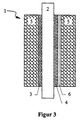
- the structure of the membrane electrode assembly thus produced is shown schematically in FIG. 3 shown.
- the anode layer (3) contains the PtRu / C catalyst of the catalyst ink B.
- the cathode of the membrane electrode assembly is composed of two reaction layers, the layer (4) resting on the membrane being a mixture of Contains Pt / C supported catalyst and platinum black and manufactured using ink C. has been.
- the second reaction layer (6) was produced with ink A and contains accordingly only the Pt / C supported catalyst.
- the cell voltages in air operation as a function of the current density are shown in FIG. 4 for the cells of comparative example 1 and examples 1 and 2.
- the membrane electrode units according to the invention significantly improved deliver electrical power compared to the prior art (VB1). this applies especially for the area of low current density, in which typically a high one Efficiency of energy conversion is sought.
- Table 3 shows the cell voltages still measured when the cells were loaded with a current density of 100 mA / cm 2 and 500 mA / cm 2 .
- Cell voltages in hydrogen / air operation at 100 and 500 mA / cm 2 example Cell voltage at 100 mA / cm 2 [mV] Cell voltage at 500 mA / cm 2 [mV] Comparative Example 1 815 681 example 1 823 696
Landscapes
- Chemical & Material Sciences (AREA)
- Chemical Kinetics & Catalysis (AREA)
- Engineering & Computer Science (AREA)
- General Chemical & Material Sciences (AREA)
- Electrochemistry (AREA)
- Manufacturing & Machinery (AREA)
- Materials Engineering (AREA)
- Sustainable Energy (AREA)
- Sustainable Development (AREA)
- Life Sciences & Earth Sciences (AREA)
- Inert Electrodes (AREA)
- Fuel Cell (AREA)
- Manufacture Of Macromolecular Shaped Articles (AREA)
Abstract
Description
- Anfertigen einer Tinte durch Mischen des Edelmetallmohres und des geträgerten Edelmetallkatalysators in einer Lösung aus einem Protonen leitenden Ionomer in einem Lösungsmittel,
- Dispergieren und Homogenisieren der Tinte,
- Beschichten der ersten Seite der Polymerelektrolyt-Membran mit der Tinte,
- Fertigstellen der Reaktionsschicht durch Trocknen der Beschichtung,
- Figur 1:
- Aufbau einer Membran-Elektrodeneinheit
- Figur 2:
- Aufbau einer Reaktionsschicht mit einer Mischung aus Edelmetallmohr und Pt/C-Trägerkatalysator in einer Schicht
- Figur 3:
- Aufbau der Doppelschicht-Anordnung von Beispiel 2
- Figur 4:
- Zellspannung in Abhängigkeit von der Stromdichte bei Wasserstoff/Luftbetrieb für die MEE der Beispiele 1 und 2 und von Vergleichsbeispiel 1
| Tinte A | Katalysator | 40 % Pt auf Ruß Vulcan® XC 72 | 5,53 g |
| Nafion-Lösung | 4,2 Gew.-% in Propylenglykol | 43,92 g | |
| Natronlauge | 15 Gew.-% in Wasser | 0,59 g | |
| Tinte B | Katalysator: | 40 % PtRu (1:1) auf Ruß Vulcan® XC 72 | 5,45 g |
| Nafion-Lösung | 4,2 Gew.-% in Propylenglykol | 43,13 g | |
| Natronlauge | 15 Gew.-% in Wasser | 0,59 g | |
| Tinte C | Katalysator: | 40 % Pt auf Ruß Vulcan® XC 72 | 5,12 g |
| Platinmohr | 40 m2/g | 5,12 g | |
| Nafion-Lösung | 4,2 Gew.-% in Propylenglykol | 40,46 g | |
| Natronlauge | 15 Gew.-% in Wasser | 0,55 g |
| Zellspannungen im Wasserstoff/Luftbetrieb bei 100 und 500 mA/cm2 | ||
| Beispiel | Zellspannung bei 100 mA/cm2 [mV] | Zellspannung bei 500 mA/cm2 [mV] |
| Vergleichsbeispiel 1 | 815 | 681 |
| Beispiel 1 | 823 | 696 |
| Beispiel 2 | 845 | 715 |
Claims (19)
- Membran-Elektrodeneinheit für Polymerelektrolyt-Brennstoffzellen aus einer Polymerelektrolyt-Membran, welche eine erste und eine zweite Seite aufweist, die beide mit porösen Reaktionsschichten und Gasverteilerschichten in Kontakt stehen, wobei die Reaktionsschichten auf Kohlenstoff geträgerte Edelmetallkatalysatoren und Ionomer enthalten,
dadurch gekennzeichnet, dass mindestens eine der beiden Reaktionsschichten zusätzlich ein Edelmetallmohr enthält. - Membran-Elektrodeneinheit nach Anspruch 1,
dadurch gekennzeichnet, dass der Anteil des Edelmetallmohres 10 bis 90 Gewichtsprozent des gesamten Edelmetallgehaltes der betreffenden Reaktionsschicht beträgt. - Membran-Elektrodeneinheit nach Anspruch 1,
dadurch gekennzeichnet, dass die das Edelmetallmohr enthaltende Reaktionsschicht aus mehreren hintereinander liegenden Unterschichten besteht, wobei wenigstens eine der Unterschichten sowohl das Edelmetallmohr als auch den auf Kohlenstoff geträgerten Edelmetallkatalysator enthält. - Membran-Elektrodeneinheit nach Anspruch 3,
dadurch gekennzeichnet, dass die das Edelmetallmohr enthaltende Reaktionsschicht aus zwei hintereinander liegenden Unterschichten besteht, wobei die direkt mit der Polymerelektrolyt-Membran in Kontakt stehende Unterschicht das Edelmetallmohr und den auf Kohlenstoff geträgerten Edelmetallkatalysator enthält und die zweite Unterschicht einen weiteren geträgerten Edelmetallkatalysator enthält. - Membran-Elektrodeneinheit nach Anspruch 1,
dadurch gekennzeichnet, dass die das Edelmetallmohr enthaltende Reaktionsschicht aus mehreren hintereinander liegenden Unterschichten besteht, wobei das Edelmetallmohr und der auf Kohlenstoff geträgerte Edelmetallkatalysator in separaten Unterschichten angeordnet sind. - Membran-Elektrodeneinheit nach einem der Ansprüche 1 bis 5,
dadurch gekennzeichnet, dass die Gesamtdicke einer Reaktionsschicht zwischen 5 und 100, bevorzugt zwischen 10 und 50 µm, liegt. - Membran-Elektrodeneinheit nach Anspruch 1,
dadurch gekennzeichnet, dass das Ionomer ein Tetrafluorethylen-Fluorvinylether-Copolymer mit Säuregruppen ist. - Membran-Elektrodeneinheit nach Anspruch 1,
dadurch gekennzeichnet, dass der Edelmetallgehalt jeder Elektrode 0,01 bis 5 mg Metall/cm2 beträgt. - Membran-Elektrodeneinheit nach Anspruch 1,
dadurch gekennzeichnet, dass die geträgerten Edelmetallkatalysatoren die Platingruppenmetalle Platin, Palladium, Rhodium oder Legierungen dieser Platingruppenmetalle enthalten. - Membran-Elektrodeneinheit nach Anspruch 9,
dadurch gekennzeichnet, dass die geträgerten Edelmetallkatalysatoren als weitere Legierungszusätze Ruthenium, Kobalt, Chrom, Wolfram, Molybdän, Vanadium, Eisen, Kupfer und Nikkel allein oder in Kombination enthalten. - Membran-Elektrodeneinheit nach Anspruch 1,
dadurch gekennzeichnet, dass das Edelmetallmohr die Platingruppenmetalle Platin, Palladium, Rhodium oder Legierungen dieser Platingruppenmetalle enthält. - Membran-Elektrodeneinheit nach Anspruch 11,
dadurch gekennzeichnet, dass das Edelmetallmohr als weitere Legierungszusätze Ruthenium, Kobalt, Chrom, Wolfram, Molybdän, Vanadium, Eisen, Kupfer und Nickel allein oder in Kombination enthält. - Membran-Elektrodeneinheit nach Anspruch 11 oder 12,
dadurch gekennzeichnet, dass die Metalloberfläche des eingesetzten Edelmetallmohres mindestens 15 m2/g beträgt. - Membran-Elektrodeneinheit nach Anspruch 13,
dadurch gekennzeichnet, dass die Metalloberfläche des eingesetzten Edelmetallmohres mindestens 30 m2/g beträgt. - Verfahren zur Herstellung einer Membran-Elektrodeneinheit nach Anspruch 1 durcha) Aufbringen der das Edelmetallmohr enthaltenden Reaktionsschicht auf die erste Seite der Polymerelektrolyt-Membran umfassend die folgenden Schritte:Anfertigen einer Tinte durch Mischen des Edelmetallmohres und des geträgerten Edelmetallkatalysators in einer Lösung aus einem Ionen leitenden Polymer in einem Lösungsmittel,Dispergieren und Homogenisieren der Tinte,Beschichten der ersten Seite der Polymerelektrolyt-Membran mit der Tinte,Fertigstellen der Reaktionsschicht durch Trocknen der Beschichtung,b) Aufbringen der zweiten Reaktionsschicht auf die zweite Seite der Polymerelektrolyt-Membran undc) Kontaktieren der Reaktionsschichten mit den Gasverteilerschichten.
- Verfahren nach Anspruch 15,
dadurch gekennzeichnet, dass das Polymer in der Membran und das Ionomer für die Reaktionsschichten in einer nichtazidischen Form vorliegen, und nach Fertigstellen der beiden Reaktionsschichten wieder in die azidische Form überführt werden. - Verfahren nach Anspruch 15 oder 16,
dadurch gekennzeichnet, dass das Ionomer ein Tetrafluorethylen-Fluorvinylether-Copolymer mit Säuregruppen ist. - Verfahren nach Anspruch 15,
dadurch gekennzeichnet, dass das Ionomer in einer Konzentration von 1 bis 10 Gew.-%, bezogen auf das Gesamtgewicht der Lösung, in dem Lösungsmittel gelöst ist. - Tinte zur Herstellung von Membran-Elektrodeneinheiten nach einem der Ansprüche 1-14,
dadurch gekennzeichnet, dass sie ein Gemisch aus einem Edelmetallmohr und einem auf Kohlenstoff geträgerten Edelmetallkatalysator in einer Lösung aus einem Ionomer in einem Lösungsmittel enthält.
Applications Claiming Priority (2)
| Application Number | Priority Date | Filing Date | Title |
|---|---|---|---|
| DE10037072 | 2000-07-29 | ||
| DE10037072A DE10037072A1 (de) | 2000-07-29 | 2000-07-29 | Membran-Elektrodeneinheit für Polymerelektrolyt-Brennstoffzellen und Verfahren zu ihrer Herstellung |
Publications (3)
| Publication Number | Publication Date |
|---|---|
| EP1176653A2 true EP1176653A2 (de) | 2002-01-30 |
| EP1176653A3 EP1176653A3 (de) | 2006-01-04 |
| EP1176653B1 EP1176653B1 (de) | 2010-06-23 |
Family
ID=7650703
Family Applications (1)
| Application Number | Title | Priority Date | Filing Date |
|---|---|---|---|
| EP01115252A Expired - Lifetime EP1176653B1 (de) | 2000-07-29 | 2001-06-23 | Membran-Elektrodeneinheit für Polymerelektrolyt-Brennstoffzellen und Verfahren zu ihrer Herstellung |
Country Status (8)
| Country | Link |
|---|---|
| US (1) | US7419740B2 (de) |
| EP (1) | EP1176653B1 (de) |
| JP (1) | JP5134744B2 (de) |
| KR (1) | KR20020010544A (de) |
| AT (1) | ATE472185T1 (de) |
| BR (1) | BR0103064A (de) |
| CA (1) | CA2353761A1 (de) |
| DE (2) | DE10037072A1 (de) |
Families Citing this family (35)
| Publication number | Priority date | Publication date | Assignee | Title |
|---|---|---|---|---|
| US7682725B2 (en) * | 1998-08-26 | 2010-03-23 | Siemens Aktiengesellschaft | Gas diffusion electrode and method for its production |
| NL1014696C2 (nl) * | 2000-03-20 | 2001-09-28 | Stichting Energie | Vervaardiging van lage-temperatuur brandstofcel elektroden. |
| DE10037074A1 (de) * | 2000-07-29 | 2002-02-14 | Omg Ag & Co Kg | Tinte zur Herstellung von Membran-Elektroden-Einheiten für PEM-Brennstoffzellen |
| KR100397954B1 (ko) * | 2001-03-20 | 2003-09-13 | 한국과학기술원 | 연료전지용 고분자 전해질막 제조방법 |
| KR20020076653A (ko) * | 2001-03-29 | 2002-10-11 | 홍병선 | 효율적인 수분 조절이 가능한 수소이온교환막 연료전지. |
| JP2002373662A (ja) * | 2001-06-13 | 2002-12-26 | Honda Motor Co Ltd | 固体高分子型燃料電池用電極 |
| US20030190517A1 (en) * | 2002-04-08 | 2003-10-09 | John Elter | Fuel cell |
| KR100480782B1 (ko) | 2002-10-26 | 2005-04-07 | 삼성에스디아이 주식회사 | 연료전지 단위체, 그 제조방법 및 상기 연료전지 단위체를채용한 연료전지 |
| US7569302B2 (en) * | 2002-11-05 | 2009-08-04 | Panasonic Corporation | Fuel cell for generating electric power |
| JP2004241362A (ja) * | 2002-12-09 | 2004-08-26 | Toyota Motor Corp | 膜電極接合体およびその製造方法 |
| KR100528020B1 (ko) * | 2003-03-31 | 2005-11-15 | 세이코 엡슨 가부시키가이샤 | 기능성 다공질층의 형성 방법, 연료 전지의 제조 방법,전자 기기 및 자동차 |
| DE10325324A1 (de) * | 2003-06-04 | 2004-12-30 | Umicore Ag & Co.Kg | Membran-Elektroden-Einheit für Direkt-Methanol-Brennstoffzellen und Verfahren zu ihrer Herstellung |
| US20050112450A1 (en) * | 2003-09-08 | 2005-05-26 | Intematix Corporation | Low platinum fuel cell catalysts and method for preparing the same |
| US20050221162A1 (en) * | 2004-04-01 | 2005-10-06 | Campbell Stephen A | Catalyst structures for electrochemical fuel cells |
| JP4908778B2 (ja) * | 2004-06-30 | 2012-04-04 | キヤノン株式会社 | 固体高分子型燃料電池の触媒層の製造方法および固体高分子型燃料電池の製造方法 |
| JP2008534719A (ja) * | 2005-03-30 | 2008-08-28 | ユミコア・アクチエンゲゼルシャフト・ウント・コムパニー・コマンディットゲゼルシャフト | 触媒層を製造するためのインク |
| JP5241488B2 (ja) | 2005-05-06 | 2013-07-17 | オハイオ ユニバーシティ | 固体燃料スラリーから水素を生成する方法 |
| TWI342082B (en) * | 2005-12-30 | 2011-05-11 | Ind Tech Res Inst | Electrode structure |
| US20090017344A1 (en) * | 2006-04-07 | 2009-01-15 | Darling Robert M | Composite Water Management Electrolyte Membrane For A Fuel Cell |
| JP5298405B2 (ja) * | 2006-04-14 | 2013-09-25 | トヨタ自動車株式会社 | 燃料電池用膜電極接合体の製造方法 |
| KR101319377B1 (ko) * | 2006-06-14 | 2013-10-17 | 삼성에스디아이 주식회사 | 연료 전지용 촉매, 이를 포함하는 막-전극 어셈블리 및이를 포함하는 연료 전지 시스템 |
| GB0614909D0 (en) * | 2006-07-27 | 2006-09-06 | Johnson Matthey Plc | Catalyst |
| EP2074672A1 (de) * | 2006-09-28 | 2009-07-01 | BASF Fuel Cell GmbH | Strukturen für gasdiffusionselektroden |
| US20090104497A1 (en) * | 2007-10-18 | 2009-04-23 | Kabushiki Kaisha Toshiba | Fuel electrode catalyst, method for producing fuel electrode catalyst, fuel cell, and method for producing fuel cell |
| US8501366B1 (en) | 2008-06-30 | 2013-08-06 | Sandia Corporation | Nanoengineered membrane electrode assembly interface |
| US8815468B2 (en) * | 2009-06-24 | 2014-08-26 | Ford Global Technologies, Llc | Layered electrodes and membrane electrode assemblies employing the same |
| US8865359B2 (en) * | 2010-07-27 | 2014-10-21 | GM Global Technology Operations LLC | Fuel cell having improved thermal characteristics |
| KR101309160B1 (ko) | 2011-08-11 | 2013-09-17 | 삼성에스디아이 주식회사 | 연료 전지용 촉매층 조성물, 그리고 이를 이용한 연료 전지용 전극, 연료 전지용 전극의 제조 방법, 연료 전지용 막-전극 어셈블리 및 연료 전지 시스템 |
| WO2013035191A1 (ja) * | 2011-09-09 | 2013-03-14 | 昭和電工株式会社 | 燃料電池用触媒層及びその用途 |
| JP5807654B2 (ja) * | 2013-03-28 | 2015-11-10 | トヨタ自動車株式会社 | 燃料電池用の触媒インクの製造方法、燃料電池用の触媒層の製造方法、燃料電池用の膜電極接合体の製造方法 |
| CN104600332B (zh) * | 2013-11-04 | 2017-10-03 | 中国石油化工股份有限公司 | 无膜燃料电池催化剂浆料及制备催化剂浆料与电极方法 |
| CN106663817B (zh) | 2014-07-08 | 2019-07-23 | Bdf Ip控股有限公司 | 用于电化学电池的阴极设计 |
| KR20180062091A (ko) * | 2016-11-30 | 2018-06-08 | 주식회사 엘지화학 | 막-전극 접합체 제조방법, 이로부터 제조된 막-전극 접합체 및 이를 포함한 연료전지 |
| KR102644546B1 (ko) * | 2018-10-17 | 2024-03-06 | 현대자동차주식회사 | 연료 전지용 촉매 복합체 및 이의 제조 방법 |
| US11616247B2 (en) | 2020-06-16 | 2023-03-28 | The Government Of The United States Of America, As Represented By The Secretary Of The Navy | Multi-interface membrane electrode assembly |
Citations (2)
| Publication number | Priority date | Publication date | Assignee | Title |
|---|---|---|---|---|
| JPH07296818A (ja) | 1994-04-22 | 1995-11-10 | Japan Gore Tex Inc | 高分子固体電解質燃料電池用電極及びそれと高分子固体電解質との接合体 |
| EP0736921A1 (de) | 1995-04-05 | 1996-10-09 | Johnson Matthey Public Limited Company | Elektrode mit zwei Elektrokatalysatoren |
Family Cites Families (24)
| Publication number | Priority date | Publication date | Assignee | Title |
|---|---|---|---|---|
| US4229490A (en) | 1978-09-01 | 1980-10-21 | Texas Instruments Incorporated | Novel method for catalyst application to a substrate for fuel cell electrodes |
| JPS5719971A (en) | 1980-07-09 | 1982-02-02 | Hitachi Ltd | Fuel cell |
| JPS58218771A (ja) | 1982-06-11 | 1983-12-20 | Sanyo Electric Co Ltd | 燃料電池マトリツクスの製法 |
| JPS60230357A (ja) | 1984-04-27 | 1985-11-15 | Agency Of Ind Science & Technol | 水素−酸素固体電解質燃料電池 |
| JPS6167787A (ja) * | 1984-09-10 | 1986-04-07 | Japan Storage Battery Co Ltd | イオン交換樹脂膜−電極接合体の製造法 |
| US4654104A (en) * | 1985-12-09 | 1987-03-31 | The Dow Chemical Company | Method for making an improved solid polymer electrolyte electrode using a fluorocarbon membrane in a thermoplastic state |
| JPS62168545A (ja) * | 1986-01-21 | 1987-07-24 | Fuji Electric Co Ltd | 白金担持触媒の調製方法 |
| US4876115A (en) | 1987-01-30 | 1989-10-24 | United States Department Of Energy | Electrode assembly for use in a solid polymer electrolyte fuel cell |
| JPH0412458A (ja) * | 1990-04-27 | 1992-01-17 | Fuji Electric Co Ltd | 固体高分子電解質型燃料電池 |
| JP3554321B2 (ja) * | 1991-02-19 | 2004-08-18 | ザ リージェンツ オブ ザ ユニバーシティ オブ カリフォルニア | 燃料電池のための膜触媒層 |
| US5234777A (en) | 1991-02-19 | 1993-08-10 | The Regents Of The University Of California | Membrane catalyst layer for fuel cells |
| GB9213124D0 (en) * | 1992-06-20 | 1992-08-05 | Johnson Matthey Plc | High performance electrode |
| JP3712768B2 (ja) | 1995-01-26 | 2005-11-02 | 松下電器産業株式会社 | 固体高分子型燃料電池の製造法 |
| JP3353518B2 (ja) * | 1995-01-31 | 2002-12-03 | 松下電器産業株式会社 | 固体高分子型燃料電池 |
| GB9504713D0 (en) * | 1995-03-09 | 1995-04-26 | Johnson Matthey Plc | Improved electrocatalytic material |
| DE19509748C2 (de) * | 1995-03-17 | 1997-01-23 | Deutsche Forsch Luft Raumfahrt | Verfahren zur Herstellung eines Verbundes aus Elektrodenmaterial, Katalysatormaterial und einer Festelektrolytmembran |
| DE19611510A1 (de) | 1996-03-23 | 1997-09-25 | Degussa | Gasdiffusionselektrode für Membranbrennstoffzellen und Verfahren zu ihrer Herstellung |
| JPH10270055A (ja) * | 1997-03-25 | 1998-10-09 | Mitsubishi Electric Corp | 電気化学触媒並びにそれを用いた電気化学反応装置、電気化学素子、リン酸型燃料電池およびメタノール直接型燃料電池 |
| JPH10270050A (ja) | 1997-03-26 | 1998-10-09 | Tokyo Gas Co Ltd | 燃料電池用電極及びその製造方法 |
| JP3351285B2 (ja) * | 1997-03-27 | 2002-11-25 | 三菱電機株式会社 | 固体高分子型燃料電池用アノード電極触媒 |
| DE19757320C2 (de) | 1997-12-23 | 2001-08-02 | Forschungszentrum Juelich Gmbh | Elektrode mit guter Kohlenmonoxidverträglichkeit für Brennstoffzellen |
| DE19812592B4 (de) * | 1998-03-23 | 2004-05-13 | Umicore Ag & Co.Kg | Membran-Elektroden-Einheit für Polymer-Elektrolyt-Brennstoffzellen, Verfahren zu ihrer Herstellung sowie Tinte |
| DE19815455A1 (de) * | 1998-04-07 | 1999-10-14 | Volker Rosenmayer | Kombination aus Elektrolyse- und Brennstoffzelle |
| DE19837669A1 (de) | 1998-08-20 | 2000-03-09 | Degussa | Katalysatorschicht für Polymer-Elektrolyt-Brennstoffzellen |
-
2000
- 2000-07-29 DE DE10037072A patent/DE10037072A1/de not_active Withdrawn
-
2001
- 2001-06-23 EP EP01115252A patent/EP1176653B1/de not_active Expired - Lifetime
- 2001-06-23 AT AT01115252T patent/ATE472185T1/de not_active IP Right Cessation
- 2001-06-23 DE DE50115527T patent/DE50115527D1/de not_active Expired - Lifetime
- 2001-07-19 US US09/907,961 patent/US7419740B2/en not_active Expired - Lifetime
- 2001-07-25 CA CA002353761A patent/CA2353761A1/en not_active Abandoned
- 2001-07-26 JP JP2001226524A patent/JP5134744B2/ja not_active Expired - Lifetime
- 2001-07-27 KR KR1020010045460A patent/KR20020010544A/ko not_active Withdrawn
- 2001-07-30 BR BR0103064-7A patent/BR0103064A/pt not_active Application Discontinuation
Patent Citations (2)
| Publication number | Priority date | Publication date | Assignee | Title |
|---|---|---|---|---|
| JPH07296818A (ja) | 1994-04-22 | 1995-11-10 | Japan Gore Tex Inc | 高分子固体電解質燃料電池用電極及びそれと高分子固体電解質との接合体 |
| EP0736921A1 (de) | 1995-04-05 | 1996-10-09 | Johnson Matthey Public Limited Company | Elektrode mit zwei Elektrokatalysatoren |
Also Published As
| Publication number | Publication date |
|---|---|
| KR20020010544A (ko) | 2002-02-04 |
| US20020037449A1 (en) | 2002-03-28 |
| BR0103064A (pt) | 2002-04-02 |
| JP5134744B2 (ja) | 2013-01-30 |
| DE50115527D1 (de) | 2010-08-05 |
| US7419740B2 (en) | 2008-09-02 |
| ATE472185T1 (de) | 2010-07-15 |
| DE10037072A1 (de) | 2002-02-14 |
| CA2353761A1 (en) | 2002-01-29 |
| JP2002110180A (ja) | 2002-04-12 |
| EP1176653A3 (de) | 2006-01-04 |
| EP1176653B1 (de) | 2010-06-23 |
Similar Documents
| Publication | Publication Date | Title |
|---|---|---|
| EP1176653B1 (de) | Membran-Elektrodeneinheit für Polymerelektrolyt-Brennstoffzellen und Verfahren zu ihrer Herstellung | |
| DE19812592B4 (de) | Membran-Elektroden-Einheit für Polymer-Elektrolyt-Brennstoffzellen, Verfahren zu ihrer Herstellung sowie Tinte | |
| EP0987777B1 (de) | Katalysatorschicht für Polymer-Elektrolyt-Brennstoffzellen | |
| DE60004594T2 (de) | Geschichtete Kohlenstoffelektrode für elektrochemische Zellen | |
| DE112007000670B4 (de) | Brennstoffzelle und Herstellungsverfahren für eine Brennstoffzelle | |
| DE69312788T2 (de) | Verfahren zur Herstellung von Membran-Elektrode-Anordnungen für elektrochemische Zellen und so hergestellte Anordnungen | |
| EP1150369B1 (de) | Gasverteilerstrukturen und Gasdiffusionselektroden für Polymerelektrolyt-Brennstoffzellen | |
| DE102008046403B4 (de) | Sauerstoffentwicklungsreaktionskatalysatoren enthaltende Elektroden | |
| EP1261057B1 (de) | Verfahren zur Herstellung einer Membran-Elektrodeneinheit und dadurch hergestellte Membran-Elektrodeneinheit | |
| DE102019105413A1 (de) | Verbundelektrodenschicht für eine polymerelektrolyt- brennstoffzelle | |
| EP1184925A2 (de) | PEM-Brennstoffzellenstapel | |
| EP0867048A1 (de) | Gasdiffusionselektrode für polymerelektrolytmembran-brennstoffzellen | |
| DE112015004105T5 (de) | Katalysator | |
| DE10159476A1 (de) | Verfahren zur Herstellung von Membran-Elektrodeneinheiten für Brennstoffzellen | |
| EP0797265A2 (de) | Gasdiffusionselektrode für Membranbrennstoffzellen und Verfahren zu ihrer Herstellung | |
| DE112015002354T5 (de) | Membran-elektroden-anordnung | |
| DE102009004529A1 (de) | Membranelektrodenanordnung mit niedriger Ionomerkonzentration an der Oberfläche | |
| DE102017122085B4 (de) | Verfahren zum Bilden eines kohlenstoffgeträgerten Katalysators | |
| DE102018215508A1 (de) | Zusammensetzung zur Herstellung einer Elektrode eines Membran-Elektroden-Bauteils für Brennstoffzellen, und Verfahren zur Herstellung der Elektrode eines Membran-Elektroden-Bauteils für Brennstoffzellen, bei dem diese verwendet wird | |
| DE112006001729B4 (de) | Spannungswechselbeständige Brennstoffzelleneletrokatalysatorschicht, Brennstoffzelle umfassend dieselbe und Verwendung derselben | |
| WO2019037974A1 (de) | Katalytische zusammensetzung, verfahren zu ihrer herstellung, ihre verwendung zur herstellung einer brennstoffzellenelektrode sowie brennstoffzelle mit einer solchen | |
| DE102022106413A1 (de) | Katalysatorschicht und verfahren zur herstellung derselben | |
| DE112020001053T5 (de) | Kathodenkatalysatorschicht für eine Brennstoffzelle, und Brennstoffzelle | |
| EP1636865A2 (de) | Membran-elektroden-einheit f r methanol-brennstoffzellen und verfahren zu ihrer herstellung | |
| DE102014102409A1 (de) | Gleichzeitiges Auftragen von Brennstoffzellkomponenten |
Legal Events
| Date | Code | Title | Description |
|---|---|---|---|
| PUAI | Public reference made under article 153(3) epc to a published international application that has entered the european phase |
Free format text: ORIGINAL CODE: 0009012 |
|
| 17P | Request for examination filed |
Effective date: 20010623 |
|
| AK | Designated contracting states |
Kind code of ref document: A2 Designated state(s): AT BE CH CY DE DK ES FI FR GB GR IE IT LI LU MC NL PT SE TR |
|
| AX | Request for extension of the european patent |
Free format text: AL;LT;LV;MK;RO;SI |
|
| RAP1 | Party data changed (applicant data changed or rights of an application transferred) |
Owner name: UMICORE AG & CO. KG |
|
| PUAL | Search report despatched |
Free format text: ORIGINAL CODE: 0009013 |
|
| RIC1 | Information provided on ipc code assigned before grant |
Ipc: 7H 01M 4/92 B Ipc: 7H 01M 8/10 A Ipc: 7H 01M 4/86 B Ipc: 7H 01M 4/88 B |
|
| AK | Designated contracting states |
Kind code of ref document: A3 Designated state(s): AT BE CH CY DE DK ES FI FR GB GR IE IT LI LU MC NL PT SE TR |
|
| AX | Request for extension of the european patent |
Extension state: AL LT LV MK RO SI |
|
| AKX | Designation fees paid |
Designated state(s): AT BE CH CY DE DK ES FI FR GB GR IE IT LI LU MC NL PT SE TR |
|
| 17Q | First examination report despatched |
Effective date: 20070309 |
|
| GRAP | Despatch of communication of intention to grant a patent |
Free format text: ORIGINAL CODE: EPIDOSNIGR1 |
|
| RIN1 | Information on inventor provided before grant (corrected) |
Inventor name: HEINZ, GERHARD Inventor name: VOGT, MARKUS, DR. Inventor name: ZUBER, RALF, DR. Inventor name: BINDER, MATTHIAS |
|
| GRAS | Grant fee paid |
Free format text: ORIGINAL CODE: EPIDOSNIGR3 |
|
| GRAA | (expected) grant |
Free format text: ORIGINAL CODE: 0009210 |
|
| AK | Designated contracting states |
Kind code of ref document: B1 Designated state(s): AT BE CH CY DE DK ES FI FR GB GR IE IT LI LU MC NL PT SE TR |
|
| REG | Reference to a national code |
Ref country code: CH Ref legal event code: EP |
|
| REG | Reference to a national code |
Ref country code: IE Ref legal event code: FG4D Free format text: LANGUAGE OF EP DOCUMENT: GERMAN |
|
| REF | Corresponds to: |
Ref document number: 50115527 Country of ref document: DE Date of ref document: 20100805 Kind code of ref document: P |
|
| REG | Reference to a national code |
Ref country code: NL Ref legal event code: VDEP Effective date: 20100623 |
|
| PG25 | Lapsed in a contracting state [announced via postgrant information from national office to epo] |
Ref country code: SE Free format text: LAPSE BECAUSE OF FAILURE TO SUBMIT A TRANSLATION OF THE DESCRIPTION OR TO PAY THE FEE WITHIN THE PRESCRIBED TIME-LIMIT Effective date: 20100623 |
|
| PG25 | Lapsed in a contracting state [announced via postgrant information from national office to epo] |
Ref country code: FI Free format text: LAPSE BECAUSE OF FAILURE TO SUBMIT A TRANSLATION OF THE DESCRIPTION OR TO PAY THE FEE WITHIN THE PRESCRIBED TIME-LIMIT Effective date: 20100623 |
|
| BERE | Be: lapsed |
Owner name: UMICORE A.G. & CO. KG Effective date: 20100630 |
|
| PG25 | Lapsed in a contracting state [announced via postgrant information from national office to epo] |
Ref country code: GR Free format text: LAPSE BECAUSE OF FAILURE TO SUBMIT A TRANSLATION OF THE DESCRIPTION OR TO PAY THE FEE WITHIN THE PRESCRIBED TIME-LIMIT Effective date: 20100924 |
|
| PG25 | Lapsed in a contracting state [announced via postgrant information from national office to epo] |
Ref country code: MC Free format text: LAPSE BECAUSE OF NON-PAYMENT OF DUE FEES Effective date: 20100630 Ref country code: NL Free format text: LAPSE BECAUSE OF FAILURE TO SUBMIT A TRANSLATION OF THE DESCRIPTION OR TO PAY THE FEE WITHIN THE PRESCRIBED TIME-LIMIT Effective date: 20100623 |
|
| REG | Reference to a national code |
Ref country code: CH Ref legal event code: PL |
|
| REG | Reference to a national code |
Ref country code: IE Ref legal event code: FD4D |
|
| PG25 | Lapsed in a contracting state [announced via postgrant information from national office to epo] |
Ref country code: PT Free format text: LAPSE BECAUSE OF FAILURE TO SUBMIT A TRANSLATION OF THE DESCRIPTION OR TO PAY THE FEE WITHIN THE PRESCRIBED TIME-LIMIT Effective date: 20101025 Ref country code: CY Free format text: LAPSE BECAUSE OF FAILURE TO SUBMIT A TRANSLATION OF THE DESCRIPTION OR TO PAY THE FEE WITHIN THE PRESCRIBED TIME-LIMIT Effective date: 20100623 |
|
| PG25 | Lapsed in a contracting state [announced via postgrant information from national office to epo] |
Ref country code: LI Free format text: LAPSE BECAUSE OF NON-PAYMENT OF DUE FEES Effective date: 20100630 Ref country code: CH Free format text: LAPSE BECAUSE OF NON-PAYMENT OF DUE FEES Effective date: 20100630 Ref country code: DK Free format text: LAPSE BECAUSE OF FAILURE TO SUBMIT A TRANSLATION OF THE DESCRIPTION OR TO PAY THE FEE WITHIN THE PRESCRIBED TIME-LIMIT Effective date: 20100623 Ref country code: IE Free format text: LAPSE BECAUSE OF FAILURE TO SUBMIT A TRANSLATION OF THE DESCRIPTION OR TO PAY THE FEE WITHIN THE PRESCRIBED TIME-LIMIT Effective date: 20100623 |
|
| PLBE | No opposition filed within time limit |
Free format text: ORIGINAL CODE: 0009261 |
|
| STAA | Information on the status of an ep patent application or granted ep patent |
Free format text: STATUS: NO OPPOSITION FILED WITHIN TIME LIMIT |
|
| 26N | No opposition filed |
Effective date: 20110324 |
|
| PG25 | Lapsed in a contracting state [announced via postgrant information from national office to epo] |
Ref country code: BE Free format text: LAPSE BECAUSE OF NON-PAYMENT OF DUE FEES Effective date: 20100630 |
|
| REG | Reference to a national code |
Ref country code: DE Ref legal event code: R097 Ref document number: 50115527 Country of ref document: DE Effective date: 20110323 |
|
| PG25 | Lapsed in a contracting state [announced via postgrant information from national office to epo] |
Ref country code: AT Free format text: LAPSE BECAUSE OF NON-PAYMENT OF DUE FEES Effective date: 20100623 |
|
| PG25 | Lapsed in a contracting state [announced via postgrant information from national office to epo] |
Ref country code: LU Free format text: LAPSE BECAUSE OF NON-PAYMENT OF DUE FEES Effective date: 20100623 |
|
| PG25 | Lapsed in a contracting state [announced via postgrant information from national office to epo] |
Ref country code: TR Free format text: LAPSE BECAUSE OF FAILURE TO SUBMIT A TRANSLATION OF THE DESCRIPTION OR TO PAY THE FEE WITHIN THE PRESCRIBED TIME-LIMIT Effective date: 20100623 |
|
| PG25 | Lapsed in a contracting state [announced via postgrant information from national office to epo] |
Ref country code: ES Free format text: LAPSE BECAUSE OF FAILURE TO SUBMIT A TRANSLATION OF THE DESCRIPTION OR TO PAY THE FEE WITHIN THE PRESCRIBED TIME-LIMIT Effective date: 20101004 |
|
| PGFP | Annual fee paid to national office [announced via postgrant information from national office to epo] |
Ref country code: IT Payment date: 20140508 Year of fee payment: 14 |
|
| PG25 | Lapsed in a contracting state [announced via postgrant information from national office to epo] |
Ref country code: IT Free format text: LAPSE BECAUSE OF NON-PAYMENT OF DUE FEES Effective date: 20150623 |
|
| REG | Reference to a national code |
Ref country code: FR Ref legal event code: PLFP Year of fee payment: 16 |
|
| REG | Reference to a national code |
Ref country code: FR Ref legal event code: PLFP Year of fee payment: 17 |
|
| REG | Reference to a national code |
Ref country code: FR Ref legal event code: PLFP Year of fee payment: 18 |
|
| PGFP | Annual fee paid to national office [announced via postgrant information from national office to epo] |
Ref country code: DE Payment date: 20200609 Year of fee payment: 20 Ref country code: FR Payment date: 20200512 Year of fee payment: 20 |
|
| PGFP | Annual fee paid to national office [announced via postgrant information from national office to epo] |
Ref country code: GB Payment date: 20200610 Year of fee payment: 20 |
|
| REG | Reference to a national code |
Ref country code: DE Ref legal event code: R071 Ref document number: 50115527 Country of ref document: DE |
|
| REG | Reference to a national code |
Ref country code: GB Ref legal event code: PE20 Expiry date: 20210622 |
|
| PG25 | Lapsed in a contracting state [announced via postgrant information from national office to epo] |
Ref country code: GB Free format text: LAPSE BECAUSE OF EXPIRATION OF PROTECTION Effective date: 20210622 |