EP1101762A1 - Verfahren zur Herstellung von Vinylencarbonat und dessen Verwendung - Google Patents
Verfahren zur Herstellung von Vinylencarbonat und dessen Verwendung Download PDFInfo
- Publication number
- EP1101762A1 EP1101762A1 EP00124005A EP00124005A EP1101762A1 EP 1101762 A1 EP1101762 A1 EP 1101762A1 EP 00124005 A EP00124005 A EP 00124005A EP 00124005 A EP00124005 A EP 00124005A EP 1101762 A1 EP1101762 A1 EP 1101762A1
- Authority
- EP
- European Patent Office
- Prior art keywords
- carbonate
- vinylene carbonate
- vinylene
- reaction
- formula
- Prior art date
- Legal status (The legal status is an assumption and is not a legal conclusion. Google has not performed a legal analysis and makes no representation as to the accuracy of the status listed.)
- Granted
Links
- VAYTZRYEBVHVLE-UHFFFAOYSA-N 1,3-dioxol-2-one Chemical compound O=C1OC=CO1 VAYTZRYEBVHVLE-UHFFFAOYSA-N 0.000 title claims abstract description 28
- 238000002360 preparation method Methods 0.000 title claims abstract description 5
- 238000000034 method Methods 0.000 title claims description 27
- KMTRUDSVKNLOMY-UHFFFAOYSA-N Ethylene carbonate Chemical compound O=C1OCCO1 KMTRUDSVKNLOMY-UHFFFAOYSA-N 0.000 claims abstract description 10
- 239000003795 chemical substances by application Substances 0.000 claims abstract description 8
- BVKZGUZCCUSVTD-UHFFFAOYSA-L Carbonate Chemical compound [O-]C([O-])=O BVKZGUZCCUSVTD-UHFFFAOYSA-L 0.000 claims abstract description 5
- 125000005843 halogen group Chemical group 0.000 claims abstract description 3
- ZMANZCXQSJIPKH-UHFFFAOYSA-N Triethylamine Chemical compound CCN(CC)CC ZMANZCXQSJIPKH-UHFFFAOYSA-N 0.000 claims description 24
- -1 alkyl amides Chemical class 0.000 claims description 6
- 238000004519 manufacturing process Methods 0.000 claims description 5
- 239000011541 reaction mixture Substances 0.000 claims description 5
- HBBGRARXTFLTSG-UHFFFAOYSA-N Lithium ion Chemical compound [Li+] HBBGRARXTFLTSG-UHFFFAOYSA-N 0.000 claims description 4
- 238000006243 chemical reaction Methods 0.000 claims description 4
- 229910001416 lithium ion Inorganic materials 0.000 claims description 4
- 239000003960 organic solvent Substances 0.000 claims description 4
- 239000000654 additive Substances 0.000 claims description 3
- 230000000996 additive effect Effects 0.000 claims description 3
- 239000007789 gas Substances 0.000 claims description 3
- 239000000178 monomer Substances 0.000 claims description 3
- 239000003973 paint Substances 0.000 claims description 3
- 230000001681 protective effect Effects 0.000 claims description 3
- 239000010409 thin film Substances 0.000 claims description 3
- 238000005292 vacuum distillation Methods 0.000 claims description 3
- 150000001412 amines Chemical class 0.000 claims description 2
- 238000004821 distillation Methods 0.000 claims description 2
- 229910017464 nitrogen compound Inorganic materials 0.000 claims description 2
- 125000005270 trialkylamine group Chemical group 0.000 claims description 2
- SKHGTWZYUURUMX-UHFFFAOYSA-N C1(OC(CO1)Cl)=O.C1(OCCO1)=O Chemical compound C1(OC(CO1)Cl)=O.C1(OCCO1)=O SKHGTWZYUURUMX-UHFFFAOYSA-N 0.000 claims 1
- 239000003513 alkali Substances 0.000 claims 1
- 238000000926 separation method Methods 0.000 claims 1
- 239000002904 solvent Substances 0.000 abstract description 6
- 238000005695 dehalogenation reaction Methods 0.000 abstract 2
- 229910052736 halogen Inorganic materials 0.000 abstract 1
- XKRFYHLGVUSROY-UHFFFAOYSA-N Argon Chemical compound [Ar] XKRFYHLGVUSROY-UHFFFAOYSA-N 0.000 description 10
- 239000000203 mixture Substances 0.000 description 7
- RTZKZFJDLAIYFH-UHFFFAOYSA-N Diethyl ether Chemical compound CCOCC RTZKZFJDLAIYFH-UHFFFAOYSA-N 0.000 description 6
- OYOKPDLAMOMTEE-UHFFFAOYSA-N 4-chloro-1,3-dioxolan-2-one Chemical compound ClC1COC(=O)O1 OYOKPDLAMOMTEE-UHFFFAOYSA-N 0.000 description 5
- 229910052786 argon Inorganic materials 0.000 description 5
- 239000007795 chemical reaction product Substances 0.000 description 3
- 238000006704 dehydrohalogenation reaction Methods 0.000 description 3
- 238000000746 purification Methods 0.000 description 3
- YBBRCQOCSYXUOC-UHFFFAOYSA-N sulfuryl dichloride Chemical compound ClS(Cl)(=O)=O YBBRCQOCSYXUOC-UHFFFAOYSA-N 0.000 description 3
- IJGRMHOSHXDMSA-UHFFFAOYSA-N Atomic nitrogen Chemical compound N#N IJGRMHOSHXDMSA-UHFFFAOYSA-N 0.000 description 2
- 150000001875 compounds Chemical class 0.000 description 2
- 238000003379 elimination reaction Methods 0.000 description 2
- 230000026030 halogenation Effects 0.000 description 2
- 238000005658 halogenation reaction Methods 0.000 description 2
- 238000010438 heat treatment Methods 0.000 description 2
- 239000011255 nonaqueous electrolyte Substances 0.000 description 2
- 239000000047 product Substances 0.000 description 2
- 238000003756 stirring Methods 0.000 description 2
- FMGWXUHQNIMWCP-UHFFFAOYSA-N 1,3-dioxolan-2-one 1,3-dioxol-2-one Chemical compound O=C1OCCO1.O=C1OC=CO1 FMGWXUHQNIMWCP-UHFFFAOYSA-N 0.000 description 1
- VEXZGXHMUGYJMC-UHFFFAOYSA-N Hydrochloric acid Chemical compound Cl VEXZGXHMUGYJMC-UHFFFAOYSA-N 0.000 description 1
- BZLVMXJERCGZMT-UHFFFAOYSA-N Methyl tert-butyl ether Chemical compound COC(C)(C)C BZLVMXJERCGZMT-UHFFFAOYSA-N 0.000 description 1
- 229910052783 alkali metal Inorganic materials 0.000 description 1
- 150000001340 alkali metals Chemical class 0.000 description 1
- 230000009286 beneficial effect Effects 0.000 description 1
- 230000015572 biosynthetic process Effects 0.000 description 1
- 150000004649 carbonic acid derivatives Chemical class 0.000 description 1
- 230000000052 comparative effect Effects 0.000 description 1
- 238000007796 conventional method Methods 0.000 description 1
- 238000000354 decomposition reaction Methods 0.000 description 1
- 230000008030 elimination Effects 0.000 description 1
- 238000001704 evaporation Methods 0.000 description 1
- 230000008020 evaporation Effects 0.000 description 1
- 238000002474 experimental method Methods 0.000 description 1
- 238000011010 flushing procedure Methods 0.000 description 1
- IXCSERBJSXMMFS-UHFFFAOYSA-N hydrogen chloride Substances Cl.Cl IXCSERBJSXMMFS-UHFFFAOYSA-N 0.000 description 1
- 229910000041 hydrogen chloride Inorganic materials 0.000 description 1
- 238000006460 hydrolysis reaction Methods 0.000 description 1
- 230000002452 interceptive effect Effects 0.000 description 1
- 238000002156 mixing Methods 0.000 description 1
- 229910052757 nitrogen Inorganic materials 0.000 description 1
- 229910052756 noble gas Inorganic materials 0.000 description 1
- 150000002835 noble gases Chemical class 0.000 description 1
- 229920000642 polymer Polymers 0.000 description 1
- 238000006116 polymerization reaction Methods 0.000 description 1
- 238000010926 purge Methods 0.000 description 1
- 230000009467 reduction Effects 0.000 description 1
- 238000010992 reflux Methods 0.000 description 1
- 238000001577 simple distillation Methods 0.000 description 1
- 239000003381 stabilizer Substances 0.000 description 1
- 239000007858 starting material Substances 0.000 description 1
- 238000003786 synthesis reaction Methods 0.000 description 1
- 229920003169 water-soluble polymer Polymers 0.000 description 1
- 238000010626 work up procedure Methods 0.000 description 1
Classifications
-
- C—CHEMISTRY; METALLURGY
- C07—ORGANIC CHEMISTRY
- C07D—HETEROCYCLIC COMPOUNDS
- C07D317/00—Heterocyclic compounds containing five-membered rings having two oxygen atoms as the only ring hetero atoms
- C07D317/08—Heterocyclic compounds containing five-membered rings having two oxygen atoms as the only ring hetero atoms having the hetero atoms in positions 1 and 3
- C07D317/10—Heterocyclic compounds containing five-membered rings having two oxygen atoms as the only ring hetero atoms having the hetero atoms in positions 1 and 3 not condensed with other rings
- C07D317/32—Heterocyclic compounds containing five-membered rings having two oxygen atoms as the only ring hetero atoms having the hetero atoms in positions 1 and 3 not condensed with other rings with hetero atoms or with carbon atoms having three bonds to hetero atoms with at the most one bond to halogen, e.g. ester or nitrile radicals, directly attached to ring carbon atoms
- C07D317/34—Oxygen atoms
- C07D317/40—Vinylene carbonate; Substituted vinylene carbonates
-
- H—ELECTRICITY
- H01—ELECTRIC ELEMENTS
- H01M—PROCESSES OR MEANS, e.g. BATTERIES, FOR THE DIRECT CONVERSION OF CHEMICAL ENERGY INTO ELECTRICAL ENERGY
- H01M10/00—Secondary cells; Manufacture thereof
- H01M10/05—Accumulators with non-aqueous electrolyte
- H01M10/052—Li-accumulators
- H01M10/0525—Rocking-chair batteries, i.e. batteries with lithium insertion or intercalation in both electrodes; Lithium-ion batteries
-
- H—ELECTRICITY
- H01—ELECTRIC ELEMENTS
- H01M—PROCESSES OR MEANS, e.g. BATTERIES, FOR THE DIRECT CONVERSION OF CHEMICAL ENERGY INTO ELECTRICAL ENERGY
- H01M10/00—Secondary cells; Manufacture thereof
- H01M10/05—Accumulators with non-aqueous electrolyte
- H01M10/056—Accumulators with non-aqueous electrolyte characterised by the materials used as electrolytes, e.g. mixed inorganic/organic electrolytes
- H01M10/0564—Accumulators with non-aqueous electrolyte characterised by the materials used as electrolytes, e.g. mixed inorganic/organic electrolytes the electrolyte being constituted of organic materials only
- H01M10/0566—Liquid materials
- H01M10/0567—Liquid materials characterised by the additives
-
- Y—GENERAL TAGGING OF NEW TECHNOLOGICAL DEVELOPMENTS; GENERAL TAGGING OF CROSS-SECTIONAL TECHNOLOGIES SPANNING OVER SEVERAL SECTIONS OF THE IPC; TECHNICAL SUBJECTS COVERED BY FORMER USPC CROSS-REFERENCE ART COLLECTIONS [XRACs] AND DIGESTS
- Y02—TECHNOLOGIES OR APPLICATIONS FOR MITIGATION OR ADAPTATION AGAINST CLIMATE CHANGE
- Y02E—REDUCTION OF GREENHOUSE GAS [GHG] EMISSIONS, RELATED TO ENERGY GENERATION, TRANSMISSION OR DISTRIBUTION
- Y02E60/00—Enabling technologies; Technologies with a potential or indirect contribution to GHG emissions mitigation
- Y02E60/10—Energy storage using batteries
Definitions
- the present invention relates to a method for producing vinylene carbonate and the use of the vinylene carbonate produced, for example as an additive for lithium ion batteries, as a paint component or as a monomer for the production of polyvinylene carbonate.
- the present invention is therefore based on the object of a method to indicate that it enables in a simple and economical manner To produce vinylene carbonate in high yield.
- the invention thus relates to a process for the preparation of vinylene carbonate of the formula (I) by reacting a monohalethylene carbonate of the formula (II) wherein X represents a halogen atom, with a dehydrohalogenating agent at elevated temperature in the presence of an organic solvent, which is characterized in that ethylene carbonate is used as the organic solvent.
- Dehydrohalogenating agents are used, for example alkali metal solutions, Amines, alkylamides or heterocyclic nitrogen compounds.
- the method according to the invention proceeds particularly advantageously when used of monochloroethylene carbonate as monohaloethylene carbonate of the above Formula (II).
- a protective gas atmosphere is also particularly advantageous for the implementation of the invention to avoid decomposition reactions.
- Suitable protective gases are, for example, nitrogen or noble gases, such as argon. This means that the use of a stabilizer commonly used for the vinylene carbonate obtained as a reaction product is eliminated.
- Monohalogenethylene carbonates are known compounds that for example by photochemical halogenation or by Azoisobutyronitrile (AIBN) initiated halogenation of ethylene carbonate with for example, sulfuryl chloride can be produced. Remaining amounts of AIBN or sulfuryl chloride in monohalogen ethylene carbonate can be allowed. Existing amounts of sulfuryl chloride can be found at inventive method for example by using a appropriate excess of dehydrohalogenating agent, such as Triethylamine.
- AIBN Azoisobutyronitrile
- the purification of the raw vinylene carbonate obtained by simple distillation according to the Invention shown that undesirable reductions in yield occur can.
- a purification process is therefore preferred according to the invention used that the shortest possible residence time of vinylene carbonate in the appropriate evaporation temperature guaranteed. This succeeds for example by vacuum distillation in a thin film evaporator at bath temperatures of around 100 ° C and a pressure of around 5 mbar. This makes it possible. directly from the reaction product of the Dehydrohalogenation vinylene carbonate in a yield of approximately at least Obtain 75% as a colorless product.
- the vinylene carbonate produced in the process according to the invention can for various applications are used, for example as an additive for Lithium ion batteries, e.g. as a solvent for non-aqueous electrolytes, as a paint component or as a monomer for the production of Polyvinylene carbonate.
- a solvent for non-aqueous electrolytes e.g. as a solvent for non-aqueous electrolytes
- a paint component e.g. as a paint component
- monomer for the production of Polyvinylene carbonate e.g. as a paint component
- Polyvinylene carbonate e.g.
- colorless polymers are obtained by a subsequent hydrolysis reaction yield water-soluble polymers.
- the raw vinylene carbonate mixture obtained in Example 1 is replaced by a Vacuum distillation in a thin film evaporator (inside diameter: 40 mm, rotor length: 25 cm) cleaned.
- the bath temperature is around 100 ° C and the pressure about 5 mbar.
- With an infeed rate of approx. 3 ml / min becomes a clear, slightly yellowish, oil-like after about 70 minutes Get distillate.
- the yield of purified vinylene carbonate is here 73.3%.
Landscapes
- Chemical & Material Sciences (AREA)
- Organic Chemistry (AREA)
- Organic Low-Molecular-Weight Compounds And Preparation Thereof (AREA)
- Secondary Cells (AREA)
- Low-Molecular Organic Synthesis Reactions Using Catalysts (AREA)
- Addition Polymer Or Copolymer, Post-Treatments, Or Chemical Modifications (AREA)
Abstract
Description


Claims (10)
- Verfahren zur Herstellung von Vinylencarbonat der Formel (I)durch Umsetzung eines Monohalogenethylencarbonats der Formel (II)
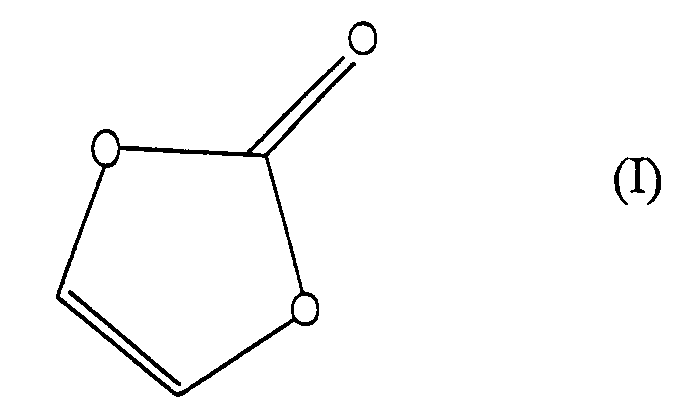 worin X ein Halogenatom bedeutet, mit einem Dehydrohalogenierungsmittel bei erhöhter Temperatur in Gegenwart eines organischen Lösungsmittels, dadurch gekennzeichnet, daß als organisches Lösungsmittel Ethylencarbonat eingesetzt wird.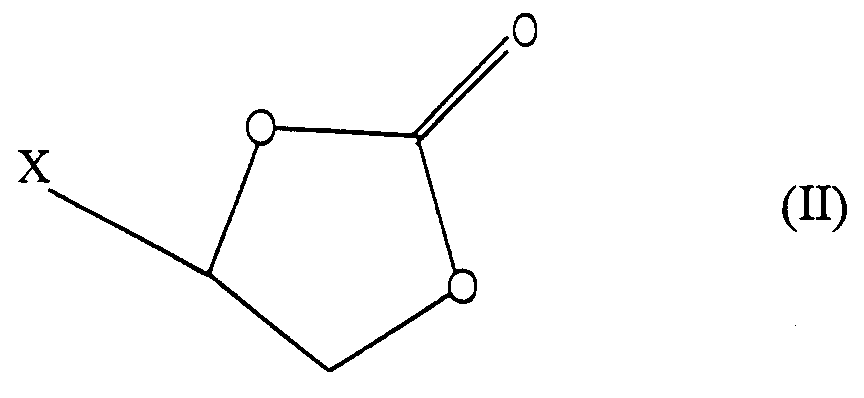
- Verfahren nach Anspruch 1, dadurch gekennzeichnet, daß die Umsetzung bei Temperaturen im Bereich von 40 - 80°C, vorzugsweise etwa 60°C, durchgeführt wird.
- Verfahren nach Anspruch 1 und/oder 2, dadurch gekennzeichnet, daß die Umsetzung während eines Zeitraums von 1 bis 4 Stunden, vorzugsweise etwa 2 Stunden, durchgeführt wird.
- Verfahren nach mindestens einem der Ansprüche 1-3, dadurch gekennzeichnet, daß das Dehydrohalogenierungsmittel aus Alkalilaugen, Aminen, Alkylamiden oder heterocyclischen Stickstoffverbindungen ausgewählt wird.
- Verfahren nach mindestens einem der Ansprüche 1-4, dadurch gekennzeichnet, daß als Dehydrohalogenierungsmittel ein Trialkylamin, vorzugsweise Triethylamin, verwendet wird.
- Verfahren nach mindestens einem der Ansprüche 1-5, dadurch gekennzeichnet, daß als Monohalogenethylencarbonat Monochlorethylencarbonat eingesetzt wird.
- Verfahren nach mindestens einem der Ansprüche 1-6, dadurch gekennzeichnet, daß die Umsetzung unter einer Schutzgasatmosphäre durchgeführt wird.
- Verfahren nach mindestens einem der Ansprüche 1-7, dadurch gekennzeichnet, daß das Vinylencarbonat aus der Reaktionsmischung durch Destillation abgetrennt wird.
- Verfahren nach Anspruch 8, dadurch gekennzeichnet, daß die Abtrennung des Vinylencarbonats durch Vakuumdestillation in einem Dünnschichtverdampfer erfolgt.
- Verwendung des nach dem Verfahren gemäß mindestens einem der Ansprüche 1-9 hergestellten Vinylencarbonats als Additiv für Lithiumionen-Batterien, als Lackkomponente oder als Monomer zur Herstellung von Polyvinylencarbonat.
Applications Claiming Priority (2)
| Application Number | Priority Date | Filing Date | Title |
|---|---|---|---|
| DE19955944A DE19955944A1 (de) | 1999-11-19 | 1999-11-19 | Verfahren zur Herstellung von Vinylencarbonat und dessen Verwendung |
| DE19955944 | 1999-11-19 |
Publications (2)
| Publication Number | Publication Date |
|---|---|
| EP1101762A1 true EP1101762A1 (de) | 2001-05-23 |
| EP1101762B1 EP1101762B1 (de) | 2003-02-26 |
Family
ID=7929786
Family Applications (1)
| Application Number | Title | Priority Date | Filing Date |
|---|---|---|---|
| EP00124005A Expired - Lifetime EP1101762B1 (de) | 1999-11-19 | 2000-11-04 | Verfahren zur Herstellung von Vinylencarbonat und dessen Verwendung |
Country Status (9)
| Country | Link |
|---|---|
| US (2) | US6395908B1 (de) |
| EP (1) | EP1101762B1 (de) |
| JP (2) | JP4927249B2 (de) |
| KR (1) | KR100719669B1 (de) |
| CN (1) | CN1139585C (de) |
| BR (1) | BR0005488A (de) |
| CA (1) | CA2326297A1 (de) |
| DE (2) | DE19955944A1 (de) |
| RU (1) | RU2271356C2 (de) |
Cited By (2)
| Publication number | Priority date | Publication date | Assignee | Title |
|---|---|---|---|---|
| EP2045249A1 (de) | 2007-09-24 | 2009-04-08 | Evonik Degussa GmbH | Verfahren zur Herstellung von Monochlorethylencarbonat und zu dessen anschließender Umwandlung in Vinylencarbonat |
| CN109134421A (zh) * | 2018-02-26 | 2019-01-04 | 江苏长园华盛新能源材料有限公司 | 从氟代碳酸乙烯酯前馏分中回收碳酸亚乙烯酯的方法 |
Families Citing this family (26)
| Publication number | Priority date | Publication date | Assignee | Title |
|---|---|---|---|---|
| DE19955944A1 (de) * | 1999-11-19 | 2001-07-19 | Merck Patent Gmbh | Verfahren zur Herstellung von Vinylencarbonat und dessen Verwendung |
| CN100585935C (zh) | 2002-07-15 | 2010-01-27 | 宇部兴产株式会社 | 非水电解液和锂电池 |
| KR100874326B1 (ko) * | 2002-11-27 | 2008-12-18 | 나노크리스탈주식회사 | 비닐렌카보네이트의 제조방법 |
| DE102004014629A1 (de) * | 2004-03-19 | 2005-10-06 | Varta Microbattery Gmbh | Galvanisches Element |
| DE102005021964A1 (de) | 2005-05-12 | 2006-11-16 | Lanxess Deutschland Gmbh | Verfahren zur Herstellung von Vinylencarbonat |
| DE102005021967A1 (de) | 2005-05-12 | 2006-11-16 | Lanxess Deutschland Gmbh | Hochreines Vinylencarbonat sowie ein Verfahren zur Reinigung von Vinylencarbonat |
| DE102005021966A1 (de) | 2005-05-12 | 2006-11-16 | Lanxess Deutschland Gmbh | Verfahren zur Reinigung von Vinylencarbonat |
| DE102005021968A1 (de) * | 2005-05-12 | 2006-11-16 | Lanxess Deutschland Gmbh | Verfahren zur Herstellung von Vinylencarbonat |
| CN100352813C (zh) * | 2005-08-22 | 2007-12-05 | 中国科学院长春应用化学研究所 | 碳酸亚乙烯酯的制备方法 |
| CN100448864C (zh) * | 2005-11-04 | 2009-01-07 | 比亚迪股份有限公司 | 碳酸亚乙烯酯的制备方法 |
| CN101210006B (zh) * | 2006-12-29 | 2010-11-17 | 比亚迪股份有限公司 | 一种碳酸亚乙烯酯的制备方法 |
| CN101279968B (zh) * | 2007-04-06 | 2011-03-30 | 比亚迪股份有限公司 | 一种碳酸亚乙烯酯的储存方法 |
| CN101417993A (zh) * | 2007-10-26 | 2009-04-29 | 埃沃尼克德古萨有限责任公司 | 一氯碳酸亚乙酯的制备方法及其随后转化成碳酸亚乙烯酯的方法 |
| CN101931107B (zh) * | 2009-06-24 | 2012-10-10 | 聚和国际股份有限公司 | 用于电化学装置的电解液及其电化学装置 |
| CN102351837A (zh) * | 2011-11-18 | 2012-02-15 | 太仓华一化工科技有限公司 | 一种制备碳酸亚乙烯酯的新方法 |
| JP5936947B2 (ja) * | 2012-08-09 | 2016-06-22 | 三菱化学株式会社 | 高純度ビニレンカーボネートの製造方法 |
| CN103113343B (zh) * | 2013-01-21 | 2015-10-28 | 张家港瀚康化工有限公司 | 防止碳酸亚乙烯酯变色的处理方法 |
| CN106749155B (zh) * | 2017-01-06 | 2019-04-26 | 淮安瀚康新材料有限公司 | 一种微通道反应制备碳酸亚乙烯酯的方法 |
| CN106905288B (zh) * | 2017-03-01 | 2019-05-31 | 山东永浩新材料科技有限公司 | 一种碳酸亚乙烯酯的制备方法 |
| CN113336736A (zh) * | 2021-05-31 | 2021-09-03 | 多氟多新材料股份有限公司 | 碳酸亚乙烯酯的制备方法 |
| CN113527251B (zh) * | 2021-09-01 | 2022-10-21 | 上海如鲲新材料股份有限公司 | 一种碳酸亚乙烯酯的制备方法 |
| KR102927216B1 (ko) | 2022-03-15 | 2026-02-13 | 주식회사 테크늄 | 비닐렌 카보네이트를 포함하는 조성물 및 비닐렌 카보네이트 화합물의 제조방법 |
| CN114957193B (zh) * | 2022-05-11 | 2023-07-28 | 内蒙古源宏精细化工有限公司 | 一种绿色合成碳酸亚乙烯酯的方法 |
| CN114933332A (zh) * | 2022-06-06 | 2022-08-23 | 安徽博石高科新材料股份有限公司 | 一种复合原料生产锰酸锂的方法 |
| CN115894429A (zh) * | 2022-12-16 | 2023-04-04 | 山东阳谷华泰化工股份有限公司 | 一种制备碳酸亚乙烯酯的方法 |
| CN119707909B (zh) * | 2024-05-31 | 2025-11-18 | 九江天赐高新材料有限公司 | 一种氟代碳酸乙烯酯的制备方法 |
Citations (4)
| Publication number | Priority date | Publication date | Assignee | Title |
|---|---|---|---|---|
| US3457279A (en) * | 1964-10-21 | 1969-07-22 | Jefferson Chem Co Inc | Vinylene carbonate production |
| JPH11180974A (ja) * | 1997-12-15 | 1999-07-06 | Mitsubishi Chemical Corp | ビニレンカーボネートの製造方法 |
| JP2000026449A (ja) * | 1998-07-10 | 2000-01-25 | Ube Ind Ltd | ビニレンカーボネートの製造方法 |
| JP2000138071A (ja) * | 1998-08-27 | 2000-05-16 | Ube Ind Ltd | 非水電解液およびそれを用いたリチウム二次電池 |
Family Cites Families (9)
| Publication number | Priority date | Publication date | Assignee | Title |
|---|---|---|---|---|
| US3041353A (en) * | 1960-08-26 | 1962-06-26 | Baker Chem Co J T | Process for preparing vinylene carbonate |
| DE2556759A1 (de) * | 1975-12-17 | 1977-06-30 | Hoechst Ag | Verfahren zur herstellung von polymeren des vinylencarbonats |
| US4353831A (en) * | 1981-02-02 | 1982-10-12 | The Dow Chemical Company | Process for making alkylene carbonates |
| DE3243591A1 (de) * | 1982-11-25 | 1984-05-30 | Hoechst Ag, 6230 Frankfurt | Vinylencarbonat-polymerysate, verfahren zu ihrer herstellung und ihre anwendung |
| US5274039A (en) * | 1989-03-21 | 1993-12-28 | Bayer Aktiengesellschaft | Coating compositions containing chemically modified amorphous polyolefins, a process for coating plastics with these compositions and the coated plastics produced therefrom |
| DE59205955D1 (de) * | 1991-11-22 | 1996-05-15 | Bayer Ag | Verfahren zur Herstellung von Alkylencarbonaten |
| JP3059832B2 (ja) * | 1992-07-27 | 2000-07-04 | 三洋電機株式会社 | リチウム二次電池 |
| JP4463333B2 (ja) * | 1998-03-11 | 2010-05-19 | 三井化学株式会社 | 非水電解液及び非水電解液二次電池 |
| DE19955944A1 (de) * | 1999-11-19 | 2001-07-19 | Merck Patent Gmbh | Verfahren zur Herstellung von Vinylencarbonat und dessen Verwendung |
-
1999
- 1999-11-19 DE DE19955944A patent/DE19955944A1/de not_active Withdrawn
-
2000
- 2000-11-04 DE DE50001321T patent/DE50001321D1/de not_active Expired - Lifetime
- 2000-11-04 EP EP00124005A patent/EP1101762B1/de not_active Expired - Lifetime
- 2000-11-16 CN CNB001329510A patent/CN1139585C/zh not_active Expired - Fee Related
- 2000-11-17 JP JP2000350379A patent/JP4927249B2/ja not_active Expired - Fee Related
- 2000-11-17 CA CA002326297A patent/CA2326297A1/en not_active Abandoned
- 2000-11-18 KR KR1020000068690A patent/KR100719669B1/ko not_active Expired - Fee Related
- 2000-11-20 RU RU2000128813/04A patent/RU2271356C2/ru not_active IP Right Cessation
- 2000-11-20 US US09/715,048 patent/US6395908B1/en not_active Expired - Lifetime
- 2000-11-21 BR BR0005488-7A patent/BR0005488A/pt not_active Application Discontinuation
-
2002
- 2002-04-04 US US10/115,235 patent/US20020107407A1/en not_active Abandoned
-
2011
- 2011-11-14 JP JP2011248194A patent/JP2012092107A/ja active Pending
Patent Citations (4)
| Publication number | Priority date | Publication date | Assignee | Title |
|---|---|---|---|---|
| US3457279A (en) * | 1964-10-21 | 1969-07-22 | Jefferson Chem Co Inc | Vinylene carbonate production |
| JPH11180974A (ja) * | 1997-12-15 | 1999-07-06 | Mitsubishi Chemical Corp | ビニレンカーボネートの製造方法 |
| JP2000026449A (ja) * | 1998-07-10 | 2000-01-25 | Ube Ind Ltd | ビニレンカーボネートの製造方法 |
| JP2000138071A (ja) * | 1998-08-27 | 2000-05-16 | Ube Ind Ltd | 非水電解液およびそれを用いたリチウム二次電池 |
Non-Patent Citations (6)
| Title |
|---|
| CHEM BER, vol. 111, no. 8, 1978, pages 2877 - 2890 * |
| CHEM BER, vol. 112, no. 1, 1979, pages 148 - 160 * |
| CHEMICAL ABSTRACTS, vol. 85, no. 11, 13 September 1976, Columbus, Ohio, US; abstract no. 77438m, SHAPORO A L ET AL: "Thermocatalytic reactions of chloroethylene carbonates" page 490; column 2; XP002901573 * |
| CHEMICAL ABSTRACTS, vol. 90, no. 7, February 1979, Columbus, Ohio, US; abstract no. 54350r, DAUB J ET AL: "(C6H6)n-hydrocarbons. 5. Specific reactions at the bicyclo[2.2.2]octadiene part of hexacyclo[9.3.2.24,7.02,9.03,8.010.12]octadeca-5,13,15,17-tetraene" page 559; column 1; XP002901572 * |
| CHEMICAL ABSTRACTS, vol. 91, no. 3, 16 July 1979, Columbus, Ohio, US; abstract no. 21015c, BASSIGNANI L ET AL: "Syntheses of DL-serine and of precursors thereof (glycolaldehyde and "masked" glycolaldehydes)" page 707; column 1; XP002901571 * |
| V SB ALKILENKARBONATY, 1975, pages 109 - 122 * |
Cited By (3)
| Publication number | Priority date | Publication date | Assignee | Title |
|---|---|---|---|---|
| EP2045249A1 (de) | 2007-09-24 | 2009-04-08 | Evonik Degussa GmbH | Verfahren zur Herstellung von Monochlorethylencarbonat und zu dessen anschließender Umwandlung in Vinylencarbonat |
| US8022231B2 (en) | 2007-09-24 | 2011-09-20 | Evonik Degussa Gmbh | Process for preparing monochloroethylene carbonate and subsequent conversion to vinylene carbonate |
| CN109134421A (zh) * | 2018-02-26 | 2019-01-04 | 江苏长园华盛新能源材料有限公司 | 从氟代碳酸乙烯酯前馏分中回收碳酸亚乙烯酯的方法 |
Also Published As
| Publication number | Publication date |
|---|---|
| RU2271356C2 (ru) | 2006-03-10 |
| CN1139585C (zh) | 2004-02-25 |
| US20020107407A1 (en) | 2002-08-08 |
| JP4927249B2 (ja) | 2012-05-09 |
| KR20010060348A (ko) | 2001-07-06 |
| US6395908B1 (en) | 2002-05-28 |
| DE50001321D1 (de) | 2003-04-03 |
| CA2326297A1 (en) | 2001-05-19 |
| EP1101762B1 (de) | 2003-02-26 |
| KR100719669B1 (ko) | 2007-05-17 |
| DE19955944A1 (de) | 2001-07-19 |
| BR0005488A (pt) | 2001-08-07 |
| JP2012092107A (ja) | 2012-05-17 |
| CN1304935A (zh) | 2001-07-25 |
| JP2001158783A (ja) | 2001-06-12 |
Similar Documents
| Publication | Publication Date | Title |
|---|---|---|
| EP1101762B1 (de) | Verfahren zur Herstellung von Vinylencarbonat und dessen Verwendung | |
| EP0556683B1 (de) | Verfahren zur Herstellung von 2-Chlor-5-methyl-pyridin | |
| EP1599459A1 (de) | Verfahren zur herstellung von 4-fluor-1,3-dioxolan-2-on | |
| DE69410153T2 (de) | Verfahren zur Herstellung von dimeren Alkylketenen durch Dimerisierung mittels tertiärer Amine | |
| EP0056981A1 (de) | Verfahren zur Herstellung von optisch aktiven 2-Chlorpropionsäureestern | |
| EP1881972B1 (de) | Verfahren zur Herstellung von Vinylencarbonat | |
| EP0147472B1 (de) | 4-chlor-4-methyl-5-methylen-1,3-dioxolan-2-on | |
| EP2050754A1 (de) | Verfahren zur Herstellung von Alkyl-methoxymethyl-trimethylsilanylmethylaminen | |
| EP3604262A1 (de) | Herstellungsverfahren für fluorierten kohlenwasserstoff | |
| DE69828777T2 (de) | Verfahren zur herstellung von buttersäureester-derivaten | |
| WO1988005778A1 (fr) | Procede pour la fabrication d'oximosilanes | |
| DE2538310C3 (de) | Verfahren zur Herstellung von O.O-Dialkylthionophosphorsäurechloriden | |
| EP1495037B1 (de) | Verfahren zur herstellung von perfluoralkylphosphinen und deren verwendung als perfluoralkylierungsreagenzien | |
| DE69326050T2 (de) | Verfahren zur Herstellung von 0,0'-Diacylweinsäureanhydrid und Verfahren zur Herstellung von 0,0'-Diacylweinsäure | |
| JPS6335621B2 (de) | ||
| EP0299171B1 (de) | Alkoholfreie Orthoester des Zirkoniums und Hafniums und Verfahren zu deren Herstellung | |
| EP4594391B1 (de) | Derivate von poly-3-hydroxy-alkanoaten und verfahren zu deren herstellung | |
| DE3411242A1 (de) | Alkylchlorsulfat-zwischenverbindungen und verfahren zu deren herstellung | |
| EP0266544B1 (de) | Verfahren zur Herstellung von Halogenalkoholen | |
| DE69013358T2 (de) | Fluorokohlenstoffverbindungen und verfahren zu deren herstellung. | |
| DE69517040T2 (de) | Ring-öffnendes amidierungs verfahren | |
| EP1714964A1 (de) | Verfahren zur Herstellung von ungesättigten, cyclischen Orthoestern | |
| DE2455217C3 (de) | Verfahren zur Herstellung von metallorganischen Kupferverbindungen | |
| EP0825183B1 (de) | Verfahren zur Herstellung von 1-Acetyl-4-Piperidonen | |
| RU1806143C (ru) | Способ получени 1,1,3,3-тетраметилдисилазана |
Legal Events
| Date | Code | Title | Description |
|---|---|---|---|
| PUAI | Public reference made under article 153(3) epc to a published international application that has entered the european phase |
Free format text: ORIGINAL CODE: 0009012 |
|
| AK | Designated contracting states |
Kind code of ref document: A1 Designated state(s): DE FR GB |
|
| AX | Request for extension of the european patent |
Free format text: AL;LT;LV;MK;RO;SI |
|
| 17P | Request for examination filed |
Effective date: 20010713 |
|
| 17Q | First examination report despatched |
Effective date: 20011005 |
|
| AKX | Designation fees paid |
Free format text: DE FR GB |
|
| GRAG | Despatch of communication of intention to grant |
Free format text: ORIGINAL CODE: EPIDOS AGRA |
|
| GRAG | Despatch of communication of intention to grant |
Free format text: ORIGINAL CODE: EPIDOS AGRA |
|
| GRAH | Despatch of communication of intention to grant a patent |
Free format text: ORIGINAL CODE: EPIDOS IGRA |
|
| GRAH | Despatch of communication of intention to grant a patent |
Free format text: ORIGINAL CODE: EPIDOS IGRA |
|
| GRAA | (expected) grant |
Free format text: ORIGINAL CODE: 0009210 |
|
| AK | Designated contracting states |
Designated state(s): DE FR GB |
|
| REG | Reference to a national code |
Ref country code: GB Ref legal event code: FG4D Free format text: NOT ENGLISH |
|
| REF | Corresponds to: |
Ref document number: 50001321 Country of ref document: DE Date of ref document: 20030403 Kind code of ref document: P |
|
| GBT | Gb: translation of ep patent filed (gb section 77(6)(a)/1977) | ||
| ET | Fr: translation filed | ||
| PLBE | No opposition filed within time limit |
Free format text: ORIGINAL CODE: 0009261 |
|
| STAA | Information on the status of an ep patent application or granted ep patent |
Free format text: STATUS: NO OPPOSITION FILED WITHIN TIME LIMIT |
|
| 26N | No opposition filed |
Effective date: 20031127 |
|
| PGFP | Annual fee paid to national office [announced via postgrant information from national office to epo] |
Ref country code: GB Payment date: 20091104 Year of fee payment: 10 Ref country code: FR Payment date: 20091123 Year of fee payment: 10 |
|
| GBPC | Gb: european patent ceased through non-payment of renewal fee |
Effective date: 20101104 |
|
| REG | Reference to a national code |
Ref country code: FR Ref legal event code: ST Effective date: 20110801 |
|
| PG25 | Lapsed in a contracting state [announced via postgrant information from national office to epo] |
Ref country code: FR Free format text: LAPSE BECAUSE OF NON-PAYMENT OF DUE FEES Effective date: 20101130 |
|
| PG25 | Lapsed in a contracting state [announced via postgrant information from national office to epo] |
Ref country code: GB Free format text: LAPSE BECAUSE OF NON-PAYMENT OF DUE FEES Effective date: 20101104 |
|
| REG | Reference to a national code |
Ref country code: DE Ref legal event code: R081 Ref document number: 50001321 Country of ref document: DE Owner name: BASF SE, DE Free format text: FORMER OWNER: MERCK PATENT GMBH, 64293 DARMSTADT, DE Effective date: 20120731 |
|
| PGFP | Annual fee paid to national office [announced via postgrant information from national office to epo] |
Ref country code: DE Payment date: 20150129 Year of fee payment: 15 |
|
| REG | Reference to a national code |
Ref country code: DE Ref legal event code: R119 Ref document number: 50001321 Country of ref document: DE |
|
| PG25 | Lapsed in a contracting state [announced via postgrant information from national office to epo] |
Ref country code: DE Free format text: LAPSE BECAUSE OF NON-PAYMENT OF DUE FEES Effective date: 20160601 |