EP1070681A1 - Alkalifreies Aluminoborosilicatglas, seine Verwendungen und Verfahren zu seiner Herstellung - Google Patents
Alkalifreies Aluminoborosilicatglas, seine Verwendungen und Verfahren zu seiner Herstellung Download PDFInfo
- Publication number
- EP1070681A1 EP1070681A1 EP00115188A EP00115188A EP1070681A1 EP 1070681 A1 EP1070681 A1 EP 1070681A1 EP 00115188 A EP00115188 A EP 00115188A EP 00115188 A EP00115188 A EP 00115188A EP 1070681 A1 EP1070681 A1 EP 1070681A1
- Authority
- EP
- European Patent Office
- Prior art keywords
- glasses
- oxide
- bao
- weight
- sro
- Prior art date
- Legal status (The legal status is an assumption and is not a legal conclusion. Google has not performed a legal analysis and makes no representation as to the accuracy of the status listed.)
- Granted
Links
Classifications
-
- C—CHEMISTRY; METALLURGY
- C03—GLASS; MINERAL OR SLAG WOOL
- C03C—CHEMICAL COMPOSITION OF GLASSES, GLAZES OR VITREOUS ENAMELS; SURFACE TREATMENT OF GLASS; SURFACE TREATMENT OF FIBRES OR FILAMENTS MADE FROM GLASS, MINERALS OR SLAGS; JOINING GLASS TO GLASS OR OTHER MATERIALS
- C03C3/00—Glass compositions
- C03C3/04—Glass compositions containing silica
- C03C3/076—Glass compositions containing silica with 40% to 90% silica, by weight
- C03C3/095—Glass compositions containing silica with 40% to 90% silica, by weight containing rare earths
-
- C—CHEMISTRY; METALLURGY
- C03—GLASS; MINERAL OR SLAG WOOL
- C03C—CHEMICAL COMPOSITION OF GLASSES, GLAZES OR VITREOUS ENAMELS; SURFACE TREATMENT OF GLASS; SURFACE TREATMENT OF FIBRES OR FILAMENTS MADE FROM GLASS, MINERALS OR SLAGS; JOINING GLASS TO GLASS OR OTHER MATERIALS
- C03C3/00—Glass compositions
- C03C3/04—Glass compositions containing silica
- C03C3/076—Glass compositions containing silica with 40% to 90% silica, by weight
- C03C3/089—Glass compositions containing silica with 40% to 90% silica, by weight containing boron
- C03C3/091—Glass compositions containing silica with 40% to 90% silica, by weight containing boron containing aluminium
- C03C3/093—Glass compositions containing silica with 40% to 90% silica, by weight containing boron containing aluminium containing zinc or zirconium
-
- C—CHEMISTRY; METALLURGY
- C03—GLASS; MINERAL OR SLAG WOOL
- C03C—CHEMICAL COMPOSITION OF GLASSES, GLAZES OR VITREOUS ENAMELS; SURFACE TREATMENT OF GLASS; SURFACE TREATMENT OF FIBRES OR FILAMENTS MADE FROM GLASS, MINERALS OR SLAGS; JOINING GLASS TO GLASS OR OTHER MATERIALS
- C03C1/00—Ingredients generally applicable to manufacture of glasses, glazes, or vitreous enamels
- C03C1/004—Refining agents
-
- C—CHEMISTRY; METALLURGY
- C03—GLASS; MINERAL OR SLAG WOOL
- C03C—CHEMICAL COMPOSITION OF GLASSES, GLAZES OR VITREOUS ENAMELS; SURFACE TREATMENT OF GLASS; SURFACE TREATMENT OF FIBRES OR FILAMENTS MADE FROM GLASS, MINERALS OR SLAGS; JOINING GLASS TO GLASS OR OTHER MATERIALS
- C03C3/00—Glass compositions
- C03C3/04—Glass compositions containing silica
- C03C3/076—Glass compositions containing silica with 40% to 90% silica, by weight
- C03C3/083—Glass compositions containing silica with 40% to 90% silica, by weight containing aluminium oxide or an iron compound
- C03C3/085—Glass compositions containing silica with 40% to 90% silica, by weight containing aluminium oxide or an iron compound containing an oxide of a divalent metal
-
- C—CHEMISTRY; METALLURGY
- C03—GLASS; MINERAL OR SLAG WOOL
- C03C—CHEMICAL COMPOSITION OF GLASSES, GLAZES OR VITREOUS ENAMELS; SURFACE TREATMENT OF GLASS; SURFACE TREATMENT OF FIBRES OR FILAMENTS MADE FROM GLASS, MINERALS OR SLAGS; JOINING GLASS TO GLASS OR OTHER MATERIALS
- C03C3/00—Glass compositions
- C03C3/04—Glass compositions containing silica
- C03C3/076—Glass compositions containing silica with 40% to 90% silica, by weight
- C03C3/083—Glass compositions containing silica with 40% to 90% silica, by weight containing aluminium oxide or an iron compound
- C03C3/085—Glass compositions containing silica with 40% to 90% silica, by weight containing aluminium oxide or an iron compound containing an oxide of a divalent metal
- C03C3/087—Glass compositions containing silica with 40% to 90% silica, by weight containing aluminium oxide or an iron compound containing an oxide of a divalent metal containing calcium oxide, e.g. common sheet or container glass
-
- C—CHEMISTRY; METALLURGY
- C03—GLASS; MINERAL OR SLAG WOOL
- C03C—CHEMICAL COMPOSITION OF GLASSES, GLAZES OR VITREOUS ENAMELS; SURFACE TREATMENT OF GLASS; SURFACE TREATMENT OF FIBRES OR FILAMENTS MADE FROM GLASS, MINERALS OR SLAGS; JOINING GLASS TO GLASS OR OTHER MATERIALS
- C03C3/00—Glass compositions
- C03C3/04—Glass compositions containing silica
- C03C3/076—Glass compositions containing silica with 40% to 90% silica, by weight
- C03C3/089—Glass compositions containing silica with 40% to 90% silica, by weight containing boron
- C03C3/091—Glass compositions containing silica with 40% to 90% silica, by weight containing boron containing aluminium
Definitions
- the invention relates to an alkali-free aluminoborosilicate glass, for example for use in display technology and for other applications, and a Process for its manufacture.
- the visual quality of the glass panes i.e. the quality regarding the absence of crystalline inclusions, nodes and bubbles very much be good.
- US Pat. No. 5,506,180 describes thermally stable and chemically resistant glasses, inter alia, for use as TFT display glass. Due to the high B 2 O 3 content of 10% and more and the low SiO 2 content (46-56%), such glasses are not sufficiently resistant to hydrochloric acid. Their resistance to hydrofluoric acid solutions is also moderate. The adaptation of the thermal expansion to polycrystalline silicon is insufficient.
- the processing temperatures V A of less than 1150 ° C. are too low to be able to use pulling processes such as the microsheet down-draw process or the overflow fusion process as an alternative to the float process.
- the specified lower cooling temperatures (strain point) of 642 ° C and less are too low to ensure low "compaction".
- European patent specification EP 510 544 B1 describes alkali-free glasses which can be produced in the float process and which are used, inter alia, as a substrate for various displays and photomasks.
- the glasses have only very small B 2 O 3 components and are BaO and MgO free. With CaO contents of at least 10% by weight and SrO contents of at least 11% by weight, they nevertheless have disadvantageously high alkaline earth contents. With 4.5 - 6.0 x 10 -6 / K, the thermal expansion of the glasses no longer meets the requirements for high-quality TFT display glasses adapted to polycrystalline silicon.
- the patent specification EP 527 320 B1 describes flat display display devices with a strontium aluminosilicate glass substrate containing at least 21 mol% SrO.
- the glass compositions for glasses with high devitrification stability appear to be particularly suitable for display in the overflow fusion drawing process to be aligned.
- the density of the glasses and their thermal Expansion coefficients are too high.
- Japanese JP 8-295530 A describes alkali-free glass substrates whose resistance to hydrochloric acid will be low due to the high B 2 O 3 content (up to 15% by weight).
- the relatively low SiO 2 glasses are free or low in MgO. They can each contain up to 5% by weight of ZnO and TiO 2 . ZnO can cause glass defects due to its tendency to evaporate from the glass surface in the float bath and subsequent condensation. The possible high content of TiO 2 will cause a brown color cast in the glasses when using conventional raw materials, since the Fe 3+ that is always present in common raw materials forms a brown color complex with Ti 4+ . The same applies to the glass substrates from WO 97/11920.
- EP 672 629 A2 and US 5,508,237 describe aluminosilicate glasses for flat displays. They show different areas of composition with different coefficients of thermal expansion. These glasses are said to be processable not only with the overflow fusion drawing process, but also with other flat glass production processes. However, the glasses in particular, which have a coefficient of thermal expansion matched to polycrystalline Si, will have very high processing temperatures V A , which make them unsuitable for the float process. As with the glasses described so far, the visual quality will not be high here either, since no way to an effective, in particular a float-compatible, refinement is shown.
- the refining agents Sb 2 O 3 and As 2 O 3 mentioned by way of example are unsuitable for the float process because of their easy reducibility. The same applies to the optional glass components Ta 2 O 5 and Nb 2 O 5 .
- German patent DE 38 08 573 C2 describes alkali-free SrO and B 2 O 3 -free, SnO 2 -containing aluminosilicate glasses which are easy to melt and inexpensive to refine.
- the glasses show a high chemical resistance. They are used as photo mask glasses. Their thermal expansion behavior with 4.0 x 10 -6 / K is not yet optimally adapted to that of polycrystalline Si. Due to their B 2 O 3 freedom, the glasses have a temperature-viscosity curve that is unfavorable for flat glass production processes.
- German patent specification of the applicant DE 196 17 344 C1 also describes alkali-free, SnO 2 -containing glasses.
- the glasses have a low SiO 2 content and are TiO 2 free. With a thermal expansion coefficient of approx. 3.7 x 10 -6 / K and a very good chemical resistance, these glasses are suitable for use in display technology.
- thermal expansion coefficient of approx. 3.7 x 10 -6 / K
- these glasses are suitable for use in display technology.
- WO 97/30001 describes substrates for solar cells and TFTs, which consist of glasses or glass ceramics based on an aluminosilicate glass, which have a thermal stability of at least 700 ° C. Their components and their areas of composition can vary within a very large framework and vary accordingly in their properties.
- the glasses can contain Cs 2 O. Because of their B 2 O 3 freedom, the glasses will have relatively high densities and inadequate crystallization stability.
- WO 98/27019 describes substrates for flat glass displays and photovoltaic devices made of glasses which have a coefficient of thermal expansion ⁇ 0/300 between 3.0 x 10 -6 / K and 4.0 x 10 -6 / K and a temperature at 10 14.5 dPas of more than 600 ° C and which consist of SiO 2 , Al 2 O 3 , B 2 O 3 and alkaline earth oxide (s) (10 - 25 wt .-% RO), of which only CaO is mandatory is present and SrO + BaO is between 0 and 3 wt .-%. With such an unbalanced ratio between small cations and large cations of the alkaline earths, the resistance to devitrification is again not good.
- German published patent application DE 196 01 922 A1 describes alkali-free SnO-containing glasses with a rather high B 2 O 3 content and with alkaline earth metal fractions, which can vary over a very wide range.
- JP 9-263 421 A and JP 10-454 22 A describe alkali-free glasses for use as substrates in flat display systems which can be processed using the float process.
- the glasses listed have rather high temperatures at a viscosity of 10 2 dPas, a sign of poor meltability, which makes cost-effective manufacture impossible, since the required temperature range also means that the tub and distributor material have to meet very high corrosion resistance requirements.
- the glasses made of JP 10-454 22 A are free of TiO 2 , ZrO 2 and CeO 2 .
- the density of the glasses containing BaO is relatively high at ⁇ > 2.6g / cm 3 .
- the glasses from JP 9-263 421 A preferably contain no BaO and are TiO 2 -, ZrO 2 - and CeO 2 - and SnO 2 -free.
- JP 10-130034 A, JP 10-114538 A and JP 10-59741 A are also alkali-free Glasses presented for use as substrate glass in displays.
- the glasses can all contain up to 10% by weight of ZnO, which is disadvantageous for a display using the float process.
- the glasses of JP 10-130034 A contain at least 0.05% by weight As 2 O 3 and 0.05% by weight SnO 2 .
- a representation in the float method is ruled out due to the As 2 O 3 content. Due to the sometimes very low SiO 2 content (only approx. 55% by weight) in the sample glasses, the HCl resistance does not meet the requirements placed on flat glass and photovoltaic substrates.
- JP 10-114538 A replaces the As 2 O 3 purification in JP 10-130034 A with Sb 2 O 3 and therefore contains between 0.05 and 3% by weight of Sb 2 O 3 , which also precludes float-compatible production.
- 0.05-2.0% by weight of SnO 2 is the sole refining agent. Additives and / or components that stabilize the tetravalent tin dioxide up to the refining temperature and prevent the premature release of oxygen are not mentioned in the document. Due to this fact, the glasses will not have the high visual quality (bubble-free) required for display applications.
- the glasses For the production of microsheet slices in the thickness range between 30 and 50 ⁇ m according to the microsheet down-draw process (MDD process), the glasses should at the same time have a very high resistance to devitrification and certain processing temperatures V A :
- Suitable processing temperatures are temperatures at the viscosity of 10 4 dPas of preferably 1260 to 1320 ° C.
- a parameter for the devitrification stability or crystallization stability is the maximum crystal growth rate v max [ ⁇ m / h]. It indicates the largest observed length growth of the crystals formed: When the growth rate v of the crystals is plotted against the temperature T, v max corresponds to the growth rate at the temperature of the maximum crystal growth, at KG max . The smaller v max is, the less crystalline volume is formed. This v max should not be more than 10 ⁇ m / h here.
- the temperature at the 10 4 dPas viscosity should preferably be between 1250 and 1350 ° C.
- Easily reducible glass components such as As 2 O 3 , Sb 2 O 3 , P 2 O 5 , Bi 2 O 3 , Nb 2 O 5 , Ta 2 O 5, PbO, CdO and also ZnO should not be included in the glass composition because they can be reduced to the elemental state under the reducing conditions in the float bath and can produce a gray metallic surface mirror or other micro-surface defects.
- the requirements for crystallization resistance are not as high here as with the MDD process mentioned.
- a v max of ⁇ 30 ⁇ m / h is still sufficient.
- the three glass-forming components SiO 2 , B 2 O 3 and Al 2 O 3 are present in narrowly defined contents, ie also in a close relationship to one another: the B 2 O 3 content is rather low and is at least 6.5% by weight. -% and at most 9.5% by weight. A restriction to less than 9% by weight is preferred. A content of between 7 and 8.5% by weight of B 2 O 3 is particularly preferred.
- the Al 2 O 3 content can vary between 14 and 21. A content of at least 15% by weight and at most 20% by weight is preferred. A content of at least 15.5% by weight and at most 19.5% by weight is particularly preferred.
- the SiO 2 content can be relatively high without disadvantages with regard to the viscosity in the melting range, namely> 60-65% by weight, which significantly improves the chemical resistance (for example against 5% HCl) and at the same time ensures a low density can be. Even higher proportions would increase the viscosity in the melting range too much.
- a proportion of at least 60.5% by weight is preferred, and a proportion of at most 62.5% by weight is particularly preferred.
- the desired low thermal expansion coefficients ⁇ 20/300 in the range from 3.0 to 3.8 ⁇ 10 -6 / K with a simultaneously low density ⁇ of at most 2.50 g / cm 3 will be achieved.
- the glass according to the invention contains relatively little alkaline earth oxide. This results in a low density with a high strain point and low thermal expansion. They are at least 8% by weight in total in the glass. With an even smaller proportion, the temperatures would be too high for the viscosities required in the melting and shaping range. A balanced ratio between small cations and large cations of the alkaline earth oxides has a positive effect on the processing temperature and on the devitrification stability.
- the glass therefore contains 1-8% by weight of MgO and 1-6% by weight of CaO as well as 0.1-3.5% by weight of BaO and 1-9% by weight of SrO.
- the total proportion of MgO, CaO, SrO and BaO should remain limited to a maximum of 16% by weight, otherwise the chemical resistance will decrease again.
- the use of SrO is preferred over BaO in order to keep the density of the glasses low. If the heavy oxides BaO and SrO were completely dispensed with or if their proportion were too small, the devitrification tendency would increase and the transformation temperature and the temperature would drop at a viscosity of 10 14.5 dPas. If the proportions of BaO and SrO were too high, the processing temperature would become unacceptably high.
- the low-BaO glasses are preferably processed using the float process, while the BaO-rich glasses are preferably processed using the pulling process due to their even better crystallization stability.
- the glass is free of ZnO and alkali oxides except for inevitable impurities.
- the glasses according to the invention Due to the special content of large cations (Ba 2+ , Sr 2+ ) in the borosilicate base glass with relatively high Al 2 O 3 contents, the glasses according to the invention have a low thermal expansion and very favorable viscosity-temperature curves, ie a steep viscosity curve in the transformation range and one flatter increase in viscosity in the processing area.
- the glass also contains 0.1-1.5% by weight of ZrO 2 .
- ZrO 2 improves chemical resistance.
- a minimum content of 0.2% by weight is preferred.
- the maximum ZrO 2 content is limited by the poor solubility of this component and is preferably 1% by weight, particularly preferably 0.6% by weight.
- the glass also contains 0.1-1% by weight of TiO 2 . This minimizes the otherwise often observed tendency to solarize the aluminoborosilicate glasses, ie the decrease in transmission in the visible wavelength range due to UV-VIS radiation.
- a content of at most 0.5% by weight is preferred, particularly preferably at least 0.2% by weight and at most 0.4% by weight.
- the glass also contains tin oxide, which is present in the glass in the redox equilibrium SnO 2 / SnO and which has a refining function, namely 0.1-1% by weight, calculated and used as SnO 2 .
- a content of at least 0.2% by weight and at most 0.8% by weight, particularly preferably at most 0.6% by weight of SnO 2 is preferred.
- the presence of 0.01-1.0% by weight of CeO 2 is essential to the invention: by combining SnO 2 with CeO 2 , the redox balance SnO 2 / SnO is stabilized and an unusually good refining effect is achieved for aluminoborosilicate glasses, so that the glasses according to the invention have the required high visual quality.
- SnO 2 and CeO 2 in combination with ZrO 2 stabilize the chemical resistance of the glasses. At higher CeO 2 contents, however, the UV absorption increases and the absorption edge shifts into the VIS range, so that a clear yellow coloration occurs in the glass. At the same time, the glasses fluoresce noticeably. A content of at most 0.5% by weight is therefore preferred.
- This relatively low CeO 2 content is made possible by the addition of nitrate, which sufficiently stabilizes the redox balance SnO 2 / SnO.
- NH 4 NO 3 is preferred, particularly preferably at least 1.0% by weight.
- NH 4 NO 3 other polyvalent ions in the glass melt can also be oxidized at the same time.
- the very good transmission of the glasses is only made possible by the oxidation of the Fe 2+ to Fe 3+ , which colors in the glass much less intensely than the divalent form.
- NH 4 NO 3 decomposes completely at the high temperatures, so that no residues impair the glass properties.
- the refining agents arsenic oxide and antimony oxide can be dispensed with and the glasses are free of these components as well as of the other easily reducible components lead oxide, cadmium oxide, tin oxide, bismuth oxide, niobium oxide, tantalum oxide and phosphorus oxide apart from inevitable impurities Not only processable with different drawing processes, but also with the float process. If the latter method is not to be used, the glass can be used under non-reducing conditions, for example in the down ⁇ draw ⁇ method. contain up to 1.5% by weight As 2 O 3 and / or Sb 2 O 3 as additional refining agents.
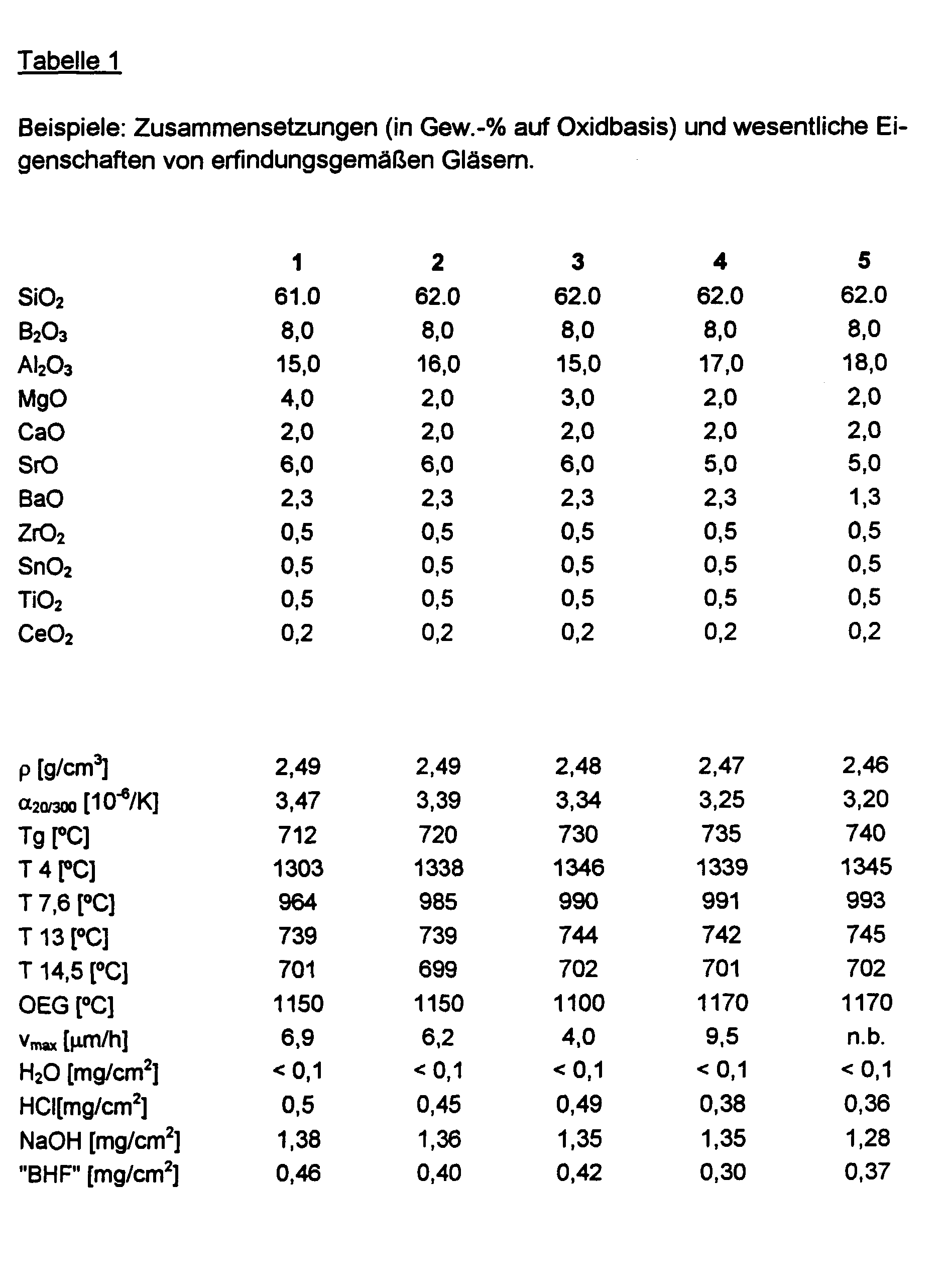
- the upper devitrification limit (liquidus temperature) OEG [° C] and the maximum crystal growth rate v max [ ⁇ m / h] are given as parameters for the tendency to crystallize (devitrification tendency) or stability.
- the temperatures for the viscosities 10 14.5 dPas, 10 13 dPas, 10 7.6 dPas and 10 4 dPas are in the tables as T 14.5; M 13; M 7.6 and M 4.
- Further properties of the glasses include the transformation temperature Tg [° C], the thermal expansion coefficient ⁇ 20/300 [10 -6 / K] and the density ⁇ [g / cm 3 ].
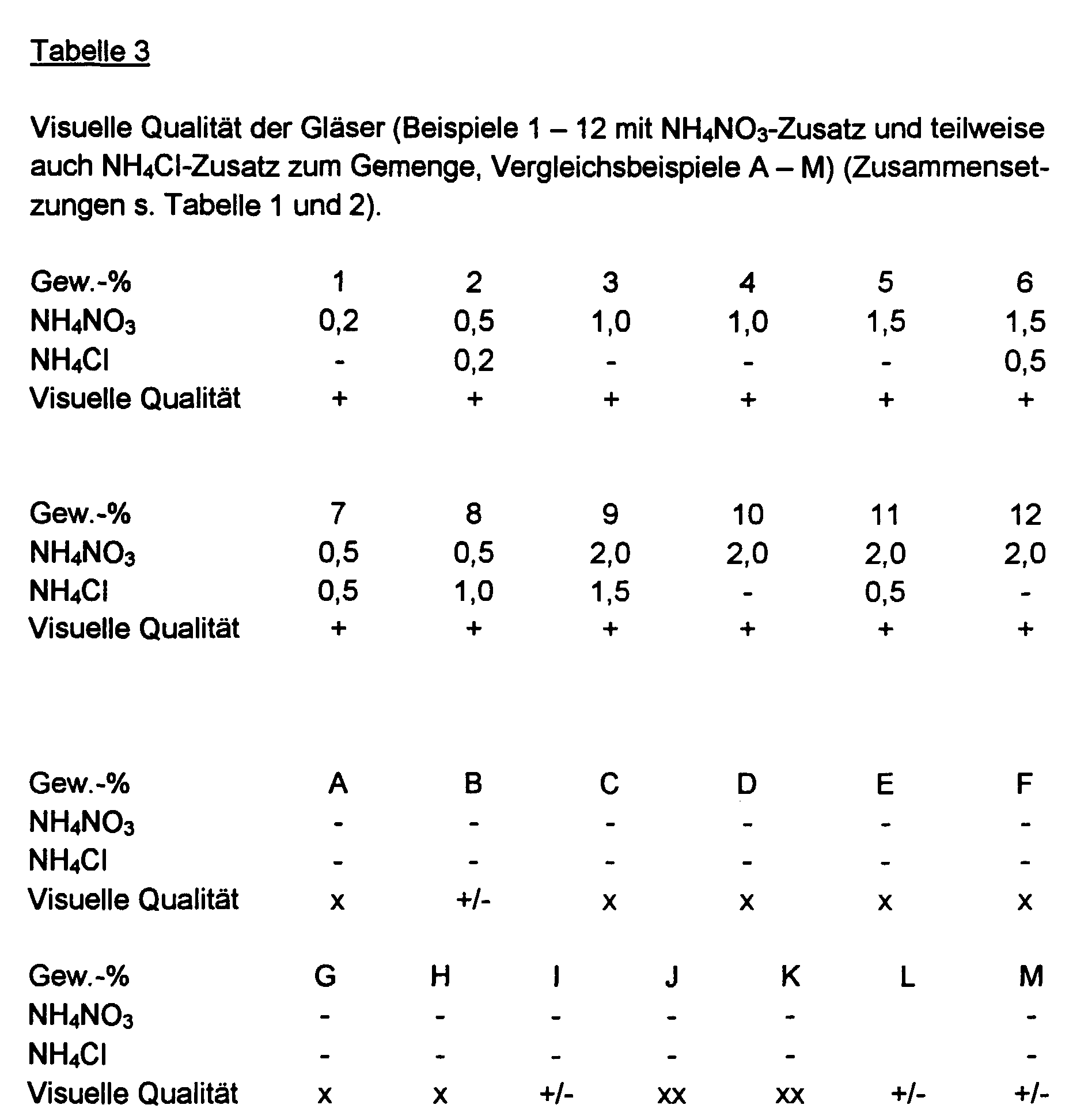
- Table 3 illustrates the good influence of the NH 4 NO 3 addition to the batch in the manufacturing process according to the invention with the otherwise conventional process steps, batch preparation (batch loading), melting, refining, homogenization, hot forming, ie processing in z. B. drawing or float, on the visual quality of the glasses.
- the glasses from the comparative examples also each have very good properties, but - in contrast to the glasses according to the invention - none of the comparison glasses fulfills the entire requirement profile for a display substrate glass for TFT applications: B 2 O 3 components which are too low reduce the devitrification stability and set the thermal expansion up (Examples A, CH). An excessively high content of B 2 O 3 reduces the resistance to hydrochloric acid (example B).
- Example I illustrates the need for a balanced ratio of small alkaline earth ions to large ones: with a "correct" total amount of alkaline earth oxides, but too much BaO, the processing temperature is very high.
- the B 2 O 3 -free comparative examples J, K and L either have far too poor resistance to devitrification or are not adapted well enough to polycrystalline silicon with regard to their thermal expansion.
- Comparative example M with too low SiO 2 content (as well as AJ and L) and too high RO content (as well as A, CH and L) has too high a density like the other examples.
- T g and T 14.5 are also not yet high enough to meet the high demands placed on the glasses.
- the glasses according to the invention are outstanding suitable for use as substrate glasses in display technology, in particular in TFT display technology, and in thin film photovoltaics as well as for MEMS and for SOI.
Landscapes
- Chemical & Material Sciences (AREA)
- Life Sciences & Earth Sciences (AREA)
- Engineering & Computer Science (AREA)
- Chemical Kinetics & Catalysis (AREA)
- General Chemical & Material Sciences (AREA)
- Geochemistry & Mineralogy (AREA)
- Materials Engineering (AREA)
- Organic Chemistry (AREA)
- Glass Compositions (AREA)
Abstract
Description
Damit sind Borosilicatgläser prinzipiell auch für den Einsatz als Substratglas in der Displaytechnik interessant, jedoch erfordert der Display-Herstellungsprozeß, beispielsweise für Thin Film Active Matrix Liquid Crystal Displays (TFT-AMLCD), sowie die gewünschte Anwendung ein ganz spezielles Eigenschaftsprofil der Gläser:
- ein an polykristallines Silicium angepaßter thermischer Ausdehnungskoeffizient α20/300 von 3,0 bis 3,8x10⁻⁶/K. Insbesondere ein α20/300 zwischen 3,0 und 3,3 x 10⁻⁶/K bedeutet eine gute Dehnungsanpassung auch bis zu Temperaturen von 700 °C
- eine Temperatur bei der Viskosität 1014,5 dPas von wenigstens 680 °C zur Sicherung einer hohen thermischen Prozeß- und Formstabilität des Glases während der Herstellung, insbesondere eines geringen Kompaktionsverhaltens (compaction, Schrumpf) des Glases in der Abkühlphase.
- eine alkalifreie Glaszusammensetzung, wobei ein Maximalgehalt an Alkalioxiden von Σ R2O = 2000 ppm tolerierbar ist, um eine Vergiftung der mikrostrukturierten Dünnfilm-Transistoren durch in die Halbleiterschicht eindiffundierende Alkaliionen zu vermeiden.
- eine hohe Hochtemperatur-Prozeßstabilität dokumentiert durch eine Transformationstemperatur Tg zwischen 710 °C und 780 °C.
- eine ausreichende chemische, d.h. hydrolytische, Säure- und Alkali-Beständigkeit gegenüber den beim Mikrostrukturierungsprozeß eingesetzten Reagenzien und Medien.
- eine möglichst geringe Dichte, d.h. ρ ≤ 2,50 g/cm3, um beim Trend zu großen Bildschirmformaten das Gesamtgewicht des Displays gering zu halten.
Die Gläser der JP 10-130034 A enthalten mindestens 0,05 Gew.-% As2O3 und 0,05 Gew.-% SnO2. Eine Darstellung im Floatverfahren scheidet aufgrund des As2O3-Gehaltes aus. Durch die teilweise sehr geringen SiO2-Gehalte (nur ca. 55 Gew.-%) in den Beispielgläsern entspricht auch die HCl-Beständigkeit nicht den Anforderungen, die an Flachglas― und Photovoltaik―Substrate gestellt werden.
JP 10-114538 A ersetzt die As2O3―Läuterung in JP 10-130034 A durch Sb2O3 und enthält deswegen bedingungsmäßig zwischen 0.05 und 3 Gew.-% Sb2O3, was eine floatverträgliche Herstellung ebenfalls ausschließt.
In JP 10-59741 A sind 0,05 ― 2,0 Gew.-% SnO2 alleiniges Läutermittel. Zusätze und/oder Komponenten, die das vierwertige Zinndioxid bis zur Läutertemperatur stabilisieren und die vorzeitige Sauerstofffreisetzung verhindern, werden in der Schrift nicht genannt. Aufgrund dieser Tatsache werden die Gläser nicht die für Display―Anwendungen geforderte hohe visuelle Qualität (Blasenfreiheit) aufweisen.
Die Verwendung von SrO ist gegenüber BaO bevorzugt, um die Dichte der Gläser gering zu halten. Würde auf die schweren Oxide BaO und SrO ganz verzichtet bzw. wäre ihr Anteil zu gering, so würde die Entglasungsneigung zunehmen und würden die Transformationstemperatur sowie die Temperatur bei der Viskosität von 1014,5 dPas sinken. Bei zu hohen Anteilen an BaO und SrO würde die Verabeitungstemperatur inakzeptabel hoch. Die BaO-armen Gläser werden bevorzugt im Floatverfahren verarbeitet, während die BaO-reicheren Gläser aufgrund ihrer noch besseren Kristallisationsstabilität vorzugsweise im Ziehverfahren verarbeitet werden. Bevorzugt ist ein Erdalkali-Gehalt (Σ RO = MgO + CaO + SrO + BaO) zwischen 9 und < 15 Gew.-%, wobei die einzelnen Oxide in folgenden Anteilen vorliegen sollten: MgO 1-7 Gew.-%; CaO 1-5; SrO 2-8; BaO 0,5-3. Besonders bevorzugt sind 3-5 Gew.-% MgO; 2-5 CaO; 3-7 SrO und 0,6 - < 3, ganz besonders bevorzugt bis 1,5, BaO, bei 10 - 14 Gew.-% RO. Das Glas ist bis auf unvermeidliche Verunreinigungen frei von ZnO sowie von Alkalioxiden. Durch den speziellen Gehalt an großen Kationen (Ba2+, Sr2+) im Borosilicatgrundglas bei relativ hohen Al2O3-Gehalten weisen die erfindungsgemäßen Gläser eine niedrige thermische Dehnung und sehr günstige Viskosität-Temperaturkurven, d. h. einen steilen Viskositätsverlauf im Transformationsbereich und einen flacheren Viskositätsanstieg im Verarbeitungsbereich auf.
Weiter enthält das Glas Zinnoxid, das im Glas im Redoxgleichgewicht SnO2/SnO vorliegt und das Läutermittelfunktion hat, und zwar 0,1 ― 1 Gew.-%, berechnet und eingesetzt als SnO2. Bevorzugt ist ein Gehalt von wenigstens 0,2 Gew.-% und von höchstens 0,8 Gew.-%, besonders bevorzugt von höchstens 0,6 Gew.-% SnO2.
Dieser relativ geringe CeO2-Gehalt wird durch die Zugabe von Nitrat ermöglicht, das das Redoxgleichgewicht SnO2/SnO in ausreichender Weise stabilisiert.
Erfindungsgemäß wird hier NH4NO3 in Mengen zwischen 0,2 und 3 Gew.-% dem Gemenge zugegeben. Durch die starke Oxidationswirkung von NH4NO3 wird die Läutermittelkombination SnO2/CeO2 im Einschmelzbereich in ihrer vierwertigen Form stabilisiert, so daß eine zu frühzeitige Abgabe des Sauerstoffs, vermieden wird.
Beim Erreichen der Läutertemperatur steht dann ein deutlich größerer Anteil an vierwertigem SnO2 und CeO2 für die Zersetzung zu SnO und Ce2O3 unter Sauerstofffreisetzung (= Läuterung) zur Verfügung, so daß eine außergewöhnlich gute visuelle Qualität der Gläser gefunden wurde.
Durch den Zusatz von NH4NO3 können gleichzeitig auch andere polyvalente Ionen in der Glasschmelze aufoxidiert werden. So wird die sehr gute Transmission der Gläser u.a. erst durch die Aufoxidation des Fe2+ zu Fe3+, das im Glas viel weniger intensiv als die zweiwertige Form färbt, ermöglicht.
NH4NO3 zersetzt sich bei den hohen Temperaturen vollständig, so daß keine Rückstände die Glaseigenschaften beeinträchtigen.
- H2O
- Behandlung mit Wasser für 24 Stunden bei 95° C.
- HCl
- Behandlung mit 5%iger Salzsäure für 24 Stunden bei 95° C.
- NaOH
- Behandlung mit 5%iger Natronlauge für 6 Stunden bei 95° C.
- "BHF"
- Behandlung mit 10%iger Flußsäurelösung für 20 Minuten bei 20° C
Die Temperaturen für die Viskositäten 1014,5 dPas, 1013 dPas, 107,6 dPas und 104 dPas sind in den Tabellen als T 14,5; T 13; T 7,6 und T 4 bezeichnet.
Als weitere Eigenschaften der Gläser sind angegeben die Transformationstemperatur Tg [°C], der thermische Ausdehnungskoeffizient α20/300 [10-6/K] und die Dichte ρ [g/cm3].


- xx
- Blasenzahl > 500 pro kg Glas
- x
- Blasenzahl > 100 ... 500 pro kg Glas
- +/-
- Blasenzahl 50 ... 100 pro kg Glas
- +
- Blasenzahl < 50 pro kg Glas
- Ihr thermischer Ausdehnungskoeffizient (α20/300 zwischen 3,0 und 3,8 x 10⁻⁶/K) ist sehr gut an polykristallines Silicium angepaßt
- Ihre Dichte ist sehr gering (g ≤ 2,50 g/cm3)
- Ihre chemische Beständigkeiten sind ausgezeichnet. (z. B. Gewichtsverlust von höchstens 1,0 mg/cm2 nach 24 stündiger Behandlung in 5%iger Salzsäure bei 95 °C)
- Sie besitzen eine ausreichende Solarisationsstabilität.
- Sie besitzen günstige Verarbeitungstemperaturen. (Temperatur bei der Viskosität 104 dPas zwischen 1280 °C und 1350 °C)
- Die Temperatur bei der Viskosität von 1014,5 dPas beträgt wenigstens 680° C. Die Transformationstemperatur Tg beträgt zwischen 710 °C und 780 °C
- Die Gläser sind alkalifrei.
- Die Gläser besitzen eine sehr gute Kristallisationsbeständigkeit.
- Die Gläser lassen sich aufgrund ihres Temperatur-Viskositätsverlauf und ihrer geringen Kristallisationsneigung, solange sie frei von leicht reduzierbaren Bestandteilen sind, sowohl mit verschiedenen Ziehverfahren als auch mit dem Floatverfahren verarbeiten. Es versteht sich jedoch, daß ein konkretes Glas aus dem erfindungsgemäßen Zusammensetzungsbereich aufgrund seines ganz speziellen Eigenschaftsprofils für das eine Verfahren noch besser geeignet ist als für das andere. Dem Fachmann ist es leicht möglich, aufgrund der hier gemachten Angaben das für die jeweilige Anwendung und die speziellen Bedürfnisse optimale Glas auszuwählen.
- Die Gläser besitzen aufgrund der ausgewogenen Kombination an Bestandteilen, insbesondere an Läutermitteln, die durch den Zusatz von NH4NO3 und/oder NH4Cl in ihrer Wirkung verstärkt werden können, eine sehr gute visuelle Qualität. Durch den Anteil an zugesetztem NH4Cl kann gleichzeitig der Wassergehalt des Glases beeinflußt werden.
- Durch den Zusatz des starken Oxidationsmittels NH4NO3 wird im Glas gleichzeitig die dreiwertige Form des Eisen―Ions stabilisiert, was zur Erhöhung der Transmission beiträgt.
- Die zu Scheiben verarbeiteten Gläser besitzen eine hohe Qualität hinsichtlich Warp (Scheibenverwölbung bzw. Scheibenverbiegung), Waviness (Feinwelligkeit der Scheibenoberfläche), Roughness (Mikrorauhigkeit der Scheibenoberfläche), Planität und Dickenkonstanz (in―plate thickness variation)
Claims (10)
- Alkalifreies Aluminoborosilicatglas, das folgende Zusammensetzung (in Gew.-% auf Oxidbasis) aufweist:
SiO2 > 60 - 65 B2O3 6,5 - 9,5 Al2O3 14 - 21 MgO 1 - 8 CaO 1 - 6 SrO 1 - 9 BaO 0,1 - 3,5 mit MgO + CaO + SrO + BaO 8 - 16 ZrO2 0,1 - 1,5 SnO2 0,1 - 1 TiO2 0,1 - 1 CeO2 0,01-1 - Aluminoborosilicatglas nach Anspruch 1,
gekennzeichnet durch folgende Zusammensetzung (in Gew.-% auf Oxidbasis):SiO2 60,5 - 65,0 B2O3 6,5 - 9,0 Al2O3 15 - 20 MgO 1 - 7 CaO 1 - 5 SrO 2 - 8 BaO 0,5 - 3 mit MgO + CaO + SrO + BaO 9 - 15 ZrO2 0,2 - 1 SnO2 0,2 -0,8 TiO2 0,1 - 0,5 CeO2 0,01 - 0,5 - Aluminoborosilicatglas nach Anspruch 1 oder 2,
gekennzeichnet
durch folgende Zusammensetzung (in Gew.-% auf Oxidbasis):SiO2 60,5 - 62,5 B2O3 7,0 - 8,5 Al2O3 15,5 - 19,5 MgO 3 - 5 CaO 2 - 5 SrO 3 - 7 BaO 0,6 - 1,5 mit MgO + CaO + SrO + BaO 10 - 14 ZrO2 0,2 - 0,6 SnO2 0,2 - 0,6 TiO2 0,2 - 0,4 CeO2 0,01 - 0,5 - Aluminoborosilicatglas nach wenigstens einem der Ansprüche 1 bis 3
dadurch gekennzeichnet,
daß es zusätzlich enthält:As2O3 0 - 1,5 Sb2O3 0 - 1,5 Cl- 0 - 1,5 F- 0 - 1,5 SO4 2- 0 - 1,5 mit As2O3 + Sb2O3 + Cl- + F- + SO4 2- ≤ 1,5 - Auf einer Floatanlage herstellbares Aluminoborosilicatglas nach wenigstens einem der Ansprüche 1 bis 3
dadurch gekennzeichnet,
daß es bis auf unvermeidliche Verunreinigungen frei ist von Arsenoxid, Antimonoxid, Bleioxid, Cadmiumoxid, Zinkoxid, Bismutoxid, Nioboxid,Tantaloxid und Phosphoroxid. - Aluminoborosilicatglas nach wenigstens einem der Ansprüche 1 bis 5,
das einen thermischen Ausdehnungskoeffizienten α20/300 zwischen 3,0 und 3,8x10⁻⁶/K, eine Temperatur bei der Viskosität 1014,5 dPas von wenigstens 680 °C, eine Temperatur bei der Viskosität 104 dPas zwischen 1270 °C und 1350 °C, eine Transformationstemperatur Tg zwischen 710 °C und 780 °C, eine Dichte ρ von höchstens 2,50 g/cm3 und einen Gewichtsverlust von höchstens 1,0 mg/cm2 nach 24stündiger Behandlung in 5%iger Salzsäure bei 95 °C aufweist. - Verfahren zum Herstellen eines Glases gemäß einem der Ansprüche 1 bis 6 mit den Verfahrensschritten Gemengezubereitung, Schmelzen, Läutern, Homogenisieren, Heißformgebung
dadurch gekennzeichnet,
daß dem Gemenge 0,2 ― 3 Gew.-% NH4 NO3 zugesetzt werden. - Verwendung des Aluminoborosilicatglases nach wenigstens einem der Ansprüche 1 bis 6 als Substratglas in der Displaytechnik.
- Verwendung des Aluminoborosilicatglases nach wenigstens einem der Ansprüche 1 6 als Substratglas in der TFT-Displaytechnik.
- Verwendung des Aluminoborosilicatglases nach wenigstens einem der Ansprüche 1 bis 6 als Substratglas in der Dünnfilm-Photovoltaik.
Applications Claiming Priority (2)
| Application Number | Priority Date | Filing Date | Title |
|---|---|---|---|
| DE19934072A DE19934072C2 (de) | 1999-07-23 | 1999-07-23 | Alkalifreies Aluminoborosilicatglas, seine Verwendungen und Verfahren zu seiner Herstellung |
| DE19934072 | 1999-07-23 |
Publications (2)
| Publication Number | Publication Date |
|---|---|
| EP1070681A1 true EP1070681A1 (de) | 2001-01-24 |
| EP1070681B1 EP1070681B1 (de) | 2002-10-16 |
Family
ID=7915462
Family Applications (1)
| Application Number | Title | Priority Date | Filing Date |
|---|---|---|---|
| EP00115188A Expired - Lifetime EP1070681B1 (de) | 1999-07-23 | 2000-07-13 | Alkalifreies Aluminoborosilicatglas, seine Verwendungen und Verfahren zu seiner Herstellung |
Country Status (8)
| Country | Link |
|---|---|
| US (1) | US6465381B1 (de) |
| EP (1) | EP1070681B1 (de) |
| JP (1) | JP2001048573A (de) |
| KR (1) | KR100707537B1 (de) |
| CN (1) | CN1176867C (de) |
| CA (1) | CA2314295C (de) |
| DE (2) | DE19934072C2 (de) |
| TW (1) | TW552244B (de) |
Cited By (10)
| Publication number | Priority date | Publication date | Assignee | Title |
|---|---|---|---|---|
| EP1118594A3 (de) * | 2000-01-12 | 2001-08-01 | Schott Glas | Alkalifreie Aluminoborosilicatgläser und ihre Verwendung |
| EP1118596A3 (de) * | 2000-01-12 | 2001-08-01 | Schott Glas | Alkalifreies Aluminoborosilicatglas und dessen Verwendung |
| EP1118595A3 (de) * | 2000-01-12 | 2001-09-12 | Schott Glas | Alkalifreies Aluminoborosilicatglas und dessen Verwendungen |
| WO2002076899A1 (de) * | 2001-03-24 | 2002-10-03 | Schott Glas | Alkalifreies aluminoborosilicatglas und verwendungen |
| WO2002098810A1 (de) * | 2001-06-06 | 2002-12-12 | Schott Glas | Verfahren zur unterdruckläuterung |
| WO2004020351A1 (en) * | 2002-08-29 | 2004-03-11 | Corning Incorporated | Producing glass using outgassed frit |
| WO2004076367A1 (de) * | 2003-02-21 | 2004-09-10 | Schott Ag | Glassubstrat für ein datenspeichermedium sowie einen datenspeicher, der ein solches glassubstrat umfasst |
| US6881692B2 (en) * | 2001-02-01 | 2005-04-19 | Nippon Electric Glass Co., Ltd | Alkali-free glass and glass plate for a display |
| DE102005039377A1 (de) * | 2005-08-19 | 2007-02-22 | Schott Ag | Verfahren zur Herstellung von gefloatetem Aluminosilikatglas mit einem Läutermittel enthaltend As2O3 und SnO2 |
| DE102019217977A1 (de) * | 2019-11-21 | 2021-05-27 | Schott Ag | Glas, Verfahren zur Herstellung eines Glases und Glasschmelzanlage |
Families Citing this family (52)
| Publication number | Priority date | Publication date | Assignee | Title |
|---|---|---|---|---|
| DE10000838B4 (de) * | 2000-01-12 | 2005-03-17 | Schott Ag | Alkalifreies Aluminoborosilicatglas und dessen Verwendungen |
| DE10064804C2 (de) * | 2000-12-22 | 2003-03-20 | Schott Glas | Alkalifreie Aluminoborosilicatgläser und ihre Verwendung |
| JP2002193636A (ja) * | 2000-12-25 | 2002-07-10 | Nippon Sheet Glass Co Ltd | 無アルカリガラスとその製造方法をそれを用いて得られるフラットディスプレーパネル |
| DE10204150A1 (de) * | 2002-02-01 | 2003-08-14 | Schott Glas | Erdalkalialuminosilicatglas und Verwendung |
| DE10209949A1 (de) * | 2002-03-06 | 2003-09-25 | Schott Glas | Glaskörper mit poröser Beschichtung |
| JP2004196649A (ja) * | 2002-12-06 | 2004-07-15 | Sumitomo Electric Ind Ltd | 蛍光性ガラス、光増幅用導波路および光増幅モジュール |
| JP4305817B2 (ja) * | 2002-12-11 | 2009-07-29 | 日本電気硝子株式会社 | 無アルカリガラス基板 |
| US20040127342A1 (en) * | 2002-12-27 | 2004-07-01 | China Optoelectronics Technology Corp. | Glass composition of a substrate for display |
| CN1764610A (zh) * | 2003-03-31 | 2006-04-26 | 旭硝子株式会社 | 无碱玻璃 |
| JP4726399B2 (ja) * | 2003-05-29 | 2011-07-20 | コニカミノルタオプト株式会社 | ガラス基板 |
| CN1898168B (zh) * | 2003-12-26 | 2012-08-01 | 旭硝子株式会社 | 无碱玻璃、其制造方法及液晶显示板 |
| EP1730084B1 (de) * | 2003-12-31 | 2017-05-17 | Corning Incorporated | Aluminiumsiliciumphosphat-gläser |
| KR100977699B1 (ko) * | 2005-07-06 | 2010-08-24 | 아사히 가라스 가부시키가이샤 | 무알칼리 유리의 제조 방법 및 무알칼리 유리판 |
| JP2013173670A (ja) * | 2006-05-23 | 2013-09-05 | Nippon Electric Glass Co Ltd | 無アルカリガラスおよび無アルカリガラス基板 |
| JP5703535B2 (ja) * | 2006-05-23 | 2015-04-22 | 日本電気硝子株式会社 | 無アルカリガラス基板 |
| JP5808069B2 (ja) | 2007-02-16 | 2015-11-10 | 日本電気硝子株式会社 | 太陽電池用ガラス基板 |
| CN101117270B (zh) * | 2007-06-07 | 2016-03-02 | 河南安彩高科股份有限公司 | 高弹性模量的铝硼硅酸盐玻璃及其应用 |
| WO2009054314A1 (ja) * | 2007-10-25 | 2009-04-30 | Asahi Glass Company, Limited | 無アルカリガラスの製造方法 |
| EP3138822B1 (de) | 2008-02-26 | 2023-07-26 | Corning Incorporated | Verfeinerungsmittel für silikatgläser |
| CN102757180B (zh) | 2008-03-19 | 2016-03-02 | Hoya株式会社 | 磁记录介质基板用玻璃、磁记录介质基板、磁记录介质和它们的制造方法 |
| JP5700617B2 (ja) | 2008-07-08 | 2015-04-15 | 株式会社半導体エネルギー研究所 | Soi基板の作製方法 |
| EP2351716A4 (de) * | 2008-09-10 | 2013-03-20 | Ohara Kk | Glas |
| JP5292028B2 (ja) * | 2008-09-10 | 2013-09-18 | 株式会社オハラ | ガラス |
| JP5292029B2 (ja) * | 2008-09-10 | 2013-09-18 | 株式会社オハラ | ガラス |
| US8445394B2 (en) * | 2008-10-06 | 2013-05-21 | Corning Incorporated | Intermediate thermal expansion coefficient glass |
| US8975199B2 (en) | 2011-08-12 | 2015-03-10 | Corsam Technologies Llc | Fusion formable alkali-free intermediate thermal expansion coefficient glass |
| DE102009031972B4 (de) * | 2009-07-02 | 2013-01-03 | Schott Ag | Photovoltaikmodul und Verwendung eines Glases für ein Photovoltaikmodul |
| US8647995B2 (en) | 2009-07-24 | 2014-02-11 | Corsam Technologies Llc | Fusion formable silica and sodium containing glasses |
| JP2012031048A (ja) * | 2010-07-01 | 2012-02-16 | Nippon Electric Glass Co Ltd | 無鉛半導体封入用ガラス |
| JP2012036074A (ja) * | 2010-07-12 | 2012-02-23 | Nippon Electric Glass Co Ltd | ガラス板 |
| WO2012137780A1 (ja) * | 2011-04-08 | 2012-10-11 | 旭硝子株式会社 | 基板用無アルカリガラスおよび基板用無アルカリガラスの製造方法 |
| US8999871B2 (en) * | 2011-05-25 | 2015-04-07 | Nippon Electric Glass Co., Ltd. | High refractive index glass |
| CN102306708B (zh) * | 2011-09-05 | 2013-11-06 | 中国科学院微电子研究所 | 一种OLEDoS微显示器件 |
| CN104039727A (zh) * | 2011-12-29 | 2014-09-10 | 日本电气硝子株式会社 | 无碱玻璃 |
| TWI614227B (zh) | 2012-02-29 | 2018-02-11 | 康寧公司 | 低cte之無鹼硼鋁矽酸鹽玻璃組成物及包含其之玻璃物件 |
| CN103703548B (zh) * | 2012-05-08 | 2016-11-23 | 新电元工业株式会社 | 半导体接合保护用玻璃复合物、半导体装置的制造方法及半导体装置 |
| CN102881386B (zh) * | 2012-09-20 | 2015-04-29 | 匡成效 | 一种玻璃绝缘子 |
| US9272945B2 (en) * | 2012-10-25 | 2016-03-01 | Corning Incorporated | Thermo-electric method for texturing of glass surfaces |
| JP6037117B2 (ja) * | 2012-12-14 | 2016-11-30 | 日本電気硝子株式会社 | ガラス及びガラス基板 |
| JP5914453B2 (ja) * | 2012-12-28 | 2016-05-11 | AvanStrate株式会社 | ディスプレイ用ガラス基板およびその製造方法 |
| US9701567B2 (en) | 2013-04-29 | 2017-07-11 | Corning Incorporated | Photovoltaic module package |
| CN105764865A (zh) | 2013-08-15 | 2016-07-13 | 康宁股份有限公司 | 掺杂有碱金属和不含碱金属的硼铝硅酸盐玻璃 |
| WO2015023561A2 (en) | 2013-08-15 | 2015-02-19 | Corning Incorporated | Intermediate to high cte glasses and glass articles comprising the same |
| CN107001113B (zh) * | 2014-09-25 | 2021-09-10 | 康宁股份有限公司 | 用于具有改善的透光性的玻璃的uv阻隔 |
| JP6172481B2 (ja) * | 2015-12-25 | 2017-08-02 | 日本電気硝子株式会社 | ガラス基板及びその製造方法 |
| WO2018125625A1 (en) * | 2016-12-29 | 2018-07-05 | Corning Incorporated | Solarization resistant rare earth doped glasses |
| CN106746601B (zh) * | 2016-12-30 | 2019-06-04 | 东旭集团有限公司 | 用于制备玻璃的组合物、玻璃制品及用途 |
| CN108341595B (zh) * | 2018-02-12 | 2020-09-29 | 东旭集团有限公司 | 玻璃用组合物、低夹杂物含量的玻璃及其制备方法和应用 |
| CN109160727B (zh) | 2018-10-16 | 2020-10-13 | 东旭光电科技股份有限公司 | 铝硅酸盐玻璃组合物、铝硅酸盐玻璃及其制备方法和应用 |
| CN111606560B (zh) * | 2020-06-05 | 2022-03-11 | 中建材蚌埠玻璃工业设计研究院有限公司 | 一种无碱铝硼硅酸盐玻璃 |
| CN112441743A (zh) * | 2020-11-26 | 2021-03-05 | 河南旭阳光电科技有限公司 | 一种无碱玻璃组合物、无碱玻璃及制备方法和应用 |
| WO2023055620A1 (en) * | 2021-10-01 | 2023-04-06 | Corning Incorporated | Fining packages for glass compositions |
Citations (3)
| Publication number | Priority date | Publication date | Assignee | Title |
|---|---|---|---|---|
| JPH0948632A (ja) * | 1995-08-02 | 1997-02-18 | Nippon Electric Glass Co Ltd | 無アルカリガラス基板 |
| DE19601922A1 (de) * | 1996-01-13 | 1997-07-17 | Eckhart Dipl Ing Watzke | Zinn- und zirkonoxidhaltige, alkalifreie Erdalkali-Alumo-Borosilicatgläser und deren Verwendung |
| EP0901990A1 (de) * | 1997-09-11 | 1999-03-17 | Schott Glas | Alkalifreies Aluminosilicatglas |
Family Cites Families (19)
| Publication number | Priority date | Publication date | Assignee | Title |
|---|---|---|---|---|
| JPS6414538A (en) * | 1986-06-02 | 1989-01-18 | Hitachi Ltd | Optimum control system for refrigerator |
| DD262653A1 (de) * | 1987-06-15 | 1988-12-07 | Jenaer Glaswerk Veb | Photomaskenglas niedriger ausdehnung mit verbesserten hafteigenschaften |
| US4766158A (en) * | 1987-08-03 | 1988-08-23 | Olin Corporation | Urethane-containing oxazolidone-modified isocyanurate foams and a composition and method for their production |
| JPS6457941A (en) * | 1987-08-28 | 1989-03-06 | Teruo Kihara | Cold heading tool |
| JP3083586B2 (ja) * | 1991-04-26 | 2000-09-04 | 旭硝子株式会社 | 無アルカリガラス |
| US5116789A (en) * | 1991-08-12 | 1992-05-26 | Corning Incorporated | Strontium aluminosilicate glasses for flat panel displays |
| FR2692883B1 (fr) * | 1992-06-25 | 1994-12-02 | Saint Gobain Vitrage Int | Verres thermiquement stables et chimiquement résistants. |
| US5508237A (en) * | 1994-03-14 | 1996-04-16 | Corning Incorporated | Flat panel display |
| DE69508706T2 (de) * | 1994-11-30 | 1999-12-02 | Asahi Glass Co. Ltd., Tokio/Tokyo | Alkalifreies Glas und Flachbildschirm |
| JP3666608B2 (ja) * | 1995-04-27 | 2005-06-29 | 日本電気硝子株式会社 | 無アルカリガラス基板 |
| US5811361A (en) * | 1995-09-28 | 1998-09-22 | Nippon Electric Glass Co., Ltd. | Alkali-free glass substrate |
| WO1997011920A1 (en) * | 1995-09-28 | 1997-04-03 | Nippon Electric Glass Co., Ltd. | Alkali-free glass substrate |
| DE19603698C1 (de) * | 1996-02-02 | 1997-08-28 | Schott Glaswerke | Alkalifreies Aluminoborosilicatglas und dessen Verwendung |
| GB2310314A (en) * | 1996-02-14 | 1997-08-20 | Gec Alsthom Ltd | Glass or glass ceramic substrates |
| JP3800657B2 (ja) * | 1996-03-28 | 2006-07-26 | 旭硝子株式会社 | 無アルカリガラスおよびフラットディスプレイパネル |
| DE19617344C1 (de) * | 1996-04-30 | 1997-08-07 | Schott Glaswerke | Alkalifreies Aluminoborosilicatglas und seine Verwendung |
| JP3800443B2 (ja) * | 1996-10-22 | 2006-07-26 | 日本電気硝子株式会社 | ディスプレイ用無アルカリガラス基板及びその製造方法 |
| US6060168A (en) * | 1996-12-17 | 2000-05-09 | Corning Incorporated | Glasses for display panels and photovoltaic devices |
| EP1152990B1 (de) * | 1998-11-30 | 2012-10-10 | Corning Incorporated | Glas für flachbildschirme |
-
1999
- 1999-07-23 DE DE19934072A patent/DE19934072C2/de not_active Expired - Fee Related
-
2000
- 2000-07-13 EP EP00115188A patent/EP1070681B1/de not_active Expired - Lifetime
- 2000-07-13 DE DE50000636T patent/DE50000636D1/de not_active Expired - Fee Related
- 2000-07-21 CA CA002314295A patent/CA2314295C/en not_active Expired - Fee Related
- 2000-07-22 KR KR1020000042127A patent/KR100707537B1/ko not_active Expired - Fee Related
- 2000-07-23 CN CNB001286048A patent/CN1176867C/zh not_active Expired - Fee Related
- 2000-07-24 US US09/624,607 patent/US6465381B1/en not_active Expired - Fee Related
- 2000-07-24 JP JP2000222686A patent/JP2001048573A/ja active Pending
- 2000-08-08 TW TW089114592A patent/TW552244B/zh not_active IP Right Cessation
Patent Citations (3)
| Publication number | Priority date | Publication date | Assignee | Title |
|---|---|---|---|---|
| JPH0948632A (ja) * | 1995-08-02 | 1997-02-18 | Nippon Electric Glass Co Ltd | 無アルカリガラス基板 |
| DE19601922A1 (de) * | 1996-01-13 | 1997-07-17 | Eckhart Dipl Ing Watzke | Zinn- und zirkonoxidhaltige, alkalifreie Erdalkali-Alumo-Borosilicatgläser und deren Verwendung |
| EP0901990A1 (de) * | 1997-09-11 | 1999-03-17 | Schott Glas | Alkalifreies Aluminosilicatglas |
Non-Patent Citations (1)
| Title |
|---|
| DATABASE WPI Section Ch Week 199717, Derwent World Patents Index; Class L01, AN 1997-188222, XP002150380 * |
Cited By (14)
| Publication number | Priority date | Publication date | Assignee | Title |
|---|---|---|---|---|
| US6707526B2 (en) | 2000-01-12 | 2004-03-16 | Schott Glas | Flat panel liquid crystal display such as for a laptop computer, having alkali-free aluminoborosilicate glass |
| EP1118596A3 (de) * | 2000-01-12 | 2001-08-01 | Schott Glas | Alkalifreies Aluminoborosilicatglas und dessen Verwendung |
| EP1118595A3 (de) * | 2000-01-12 | 2001-09-12 | Schott Glas | Alkalifreies Aluminoborosilicatglas und dessen Verwendungen |
| EP1118594A3 (de) * | 2000-01-12 | 2001-08-01 | Schott Glas | Alkalifreie Aluminoborosilicatgläser und ihre Verwendung |
| US6671026B2 (en) | 2000-01-12 | 2003-12-30 | Schott Glas | Flat panel liquid-crystal display such as for a laptop computer |
| US6867158B2 (en) | 2000-01-12 | 2005-03-15 | Schott Glas | Flat panel liquid-crystal display such as for a laptop computer |
| US6881692B2 (en) * | 2001-02-01 | 2005-04-19 | Nippon Electric Glass Co., Ltd | Alkali-free glass and glass plate for a display |
| WO2002076899A1 (de) * | 2001-03-24 | 2002-10-03 | Schott Glas | Alkalifreies aluminoborosilicatglas und verwendungen |
| US7727916B2 (en) | 2001-03-24 | 2010-06-01 | Schott Ag | Alkali-free aluminoborosilicate glass, and uses thereof |
| WO2002098810A1 (de) * | 2001-06-06 | 2002-12-12 | Schott Glas | Verfahren zur unterdruckläuterung |
| WO2004020351A1 (en) * | 2002-08-29 | 2004-03-11 | Corning Incorporated | Producing glass using outgassed frit |
| WO2004076367A1 (de) * | 2003-02-21 | 2004-09-10 | Schott Ag | Glassubstrat für ein datenspeichermedium sowie einen datenspeicher, der ein solches glassubstrat umfasst |
| DE102005039377A1 (de) * | 2005-08-19 | 2007-02-22 | Schott Ag | Verfahren zur Herstellung von gefloatetem Aluminosilikatglas mit einem Läutermittel enthaltend As2O3 und SnO2 |
| DE102019217977A1 (de) * | 2019-11-21 | 2021-05-27 | Schott Ag | Glas, Verfahren zur Herstellung eines Glases und Glasschmelzanlage |
Also Published As
| Publication number | Publication date |
|---|---|
| CN1284481A (zh) | 2001-02-21 |
| JP2001048573A (ja) | 2001-02-20 |
| KR20010069996A (ko) | 2001-07-25 |
| CA2314295A1 (en) | 2001-01-23 |
| CN1176867C (zh) | 2004-11-24 |
| DE50000636D1 (de) | 2002-11-21 |
| KR100707537B1 (ko) | 2007-04-12 |
| HK1033451A1 (en) | 2001-08-31 |
| DE19934072A1 (de) | 2001-01-25 |
| DE19934072C2 (de) | 2001-06-13 |
| TW552244B (en) | 2003-09-11 |
| US6465381B1 (en) | 2002-10-15 |
| EP1070681B1 (de) | 2002-10-16 |
| CA2314295C (en) | 2004-04-27 |
Similar Documents
| Publication | Publication Date | Title |
|---|---|---|
| EP1070681B1 (de) | Alkalifreies Aluminoborosilicatglas, seine Verwendungen und Verfahren zu seiner Herstellung | |
| EP0901990B1 (de) | Alkalifreies Aluminosilicatglas | |
| EP1118594B1 (de) | Alkalifreie Aluminoborosilicatgläser und ihre Verwendung | |
| EP1219573B1 (de) | Alkalifreie Aluminoborosilicatgläser und ihre Verwendungen | |
| DE10000839C1 (de) | Alkalifreies Aluminoborosilicatglas und dessen Verwendungen | |
| EP1118593B1 (de) | Alkalifreies Aluminoborosilicatglas und dessen Verwendung | |
| EP0805125B1 (de) | Alkalifreies Aluminoborosilicatglas und seine Verwendung | |
| DE10000836B4 (de) | Alkalifreies Aluminoborosilicatglas und dessen Verwendungen | |
| DE3882116T2 (de) | Substrat-Glas für Flüssigkristall-Anzeigevorrichtungen. | |
| EP1373155B1 (de) | Alkalifreies aluminoborosilicatglas und verwendungen | |
| EP1044932B1 (de) | Alkalifreies Aluminoborosilicatglas und dessen Verwendung | |
| DE69402991T2 (de) | Gläser mit einer höher Liquidus-Viskosität für flache Anzeigevorrichtungen | |
| DE69214385T2 (de) | Flache Anzeigevorrichtung mit einem Strontiumaluminosilikat-Glassubstrat | |
| DE69212052T2 (de) | Alkalifreies Glas | |
| DE69803135T2 (de) | Durchsichtige Glaskeramiken | |
| DE19680967B3 (de) | Alkalifreies Glassubstrat | |
| DE69205370T2 (de) | Flache Anzeigevorrichtung mit einem Erdalkalialuminoborosilikat-Glassubstrat. | |
| EP3147265B1 (de) | Chemisch beständiges glas und dessen verwendung | |
| DE3882039T2 (de) | Alkalifreies glas. | |
| DE4213579A1 (de) | Alkalifreies glas | |
| DE10162962A1 (de) | Alkalifreies Glas; Herstellungsverfahren dafür und dasselbe verwendendes Flachdisplay-Panel | |
| DE19840113B4 (de) | Alkalifreie Glaszusammensetzung zur Herstellung von Flachglas | |
| DE102022133592A1 (de) | Transparente Glaskeramik, insbesondere als Deckscheibe |
Legal Events
| Date | Code | Title | Description |
|---|---|---|---|
| PUAI | Public reference made under article 153(3) epc to a published international application that has entered the european phase |
Free format text: ORIGINAL CODE: 0009012 |
|
| 17P | Request for examination filed |
Effective date: 20000713 |
|
| AK | Designated contracting states |
Kind code of ref document: A1 Designated state(s): DE FR GB NL |
|
| AX | Request for extension of the european patent |
Free format text: AL;LT;LV;MK;RO;SI |
|
| RAP1 | Party data changed (applicant data changed or rights of an application transferred) |
Owner name: CARL-ZEISS-STIFTUNG TRADING AS SCHOTT GLAS Owner name: SCHOTT GLAS |
|
| AKX | Designation fees paid |
Free format text: DE FR GB NL |
|
| GRAG | Despatch of communication of intention to grant |
Free format text: ORIGINAL CODE: EPIDOS AGRA |
|
| GRAG | Despatch of communication of intention to grant |
Free format text: ORIGINAL CODE: EPIDOS AGRA |
|
| GRAH | Despatch of communication of intention to grant a patent |
Free format text: ORIGINAL CODE: EPIDOS IGRA |
|
| 17Q | First examination report despatched |
Effective date: 20020405 |
|
| GRAH | Despatch of communication of intention to grant a patent |
Free format text: ORIGINAL CODE: EPIDOS IGRA |
|
| GRAA | (expected) grant |
Free format text: ORIGINAL CODE: 0009210 |
|
| AK | Designated contracting states |
Kind code of ref document: B1 Designated state(s): DE FR GB NL |
|
| REG | Reference to a national code |
Ref country code: GB Ref legal event code: FG4D Free format text: NOT ENGLISH |
|
| REF | Corresponds to: |
Ref document number: 50000636 Country of ref document: DE Date of ref document: 20021121 |
|
| GBT | Gb: translation of ep patent filed (gb section 77(6)(a)/1977) |
Effective date: 20030113 |
|
| ET | Fr: translation filed | ||
| PLBE | No opposition filed within time limit |
Free format text: ORIGINAL CODE: 0009261 |
|
| STAA | Information on the status of an ep patent application or granted ep patent |
Free format text: STATUS: NO OPPOSITION FILED WITHIN TIME LIMIT |
|
| 26N | No opposition filed |
Effective date: 20030717 |
|
| REG | Reference to a national code |
Ref country code: GB Ref legal event code: 732E |
|
| NLS | Nl: assignments of ep-patents |
Owner name: SCHOTT AG Effective date: 20060612 |
|
| REG | Reference to a national code |
Ref country code: FR Ref legal event code: TP |
|
| PGFP | Annual fee paid to national office [announced via postgrant information from national office to epo] |
Ref country code: DE Payment date: 20080722 Year of fee payment: 9 |
|
| PGFP | Annual fee paid to national office [announced via postgrant information from national office to epo] |
Ref country code: FR Payment date: 20080715 Year of fee payment: 9 Ref country code: NL Payment date: 20080716 Year of fee payment: 9 |
|
| PGFP | Annual fee paid to national office [announced via postgrant information from national office to epo] |
Ref country code: GB Payment date: 20080722 Year of fee payment: 9 |
|
| GBPC | Gb: european patent ceased through non-payment of renewal fee |
Effective date: 20090713 |
|
| NLV4 | Nl: lapsed or anulled due to non-payment of the annual fee |
Effective date: 20100201 |
|
| REG | Reference to a national code |
Ref country code: FR Ref legal event code: ST Effective date: 20100331 |
|
| PG25 | Lapsed in a contracting state [announced via postgrant information from national office to epo] |
Ref country code: FR Free format text: LAPSE BECAUSE OF NON-PAYMENT OF DUE FEES Effective date: 20090731 |
|
| PG25 | Lapsed in a contracting state [announced via postgrant information from national office to epo] |
Ref country code: GB Free format text: LAPSE BECAUSE OF NON-PAYMENT OF DUE FEES Effective date: 20090713 |
|
| PG25 | Lapsed in a contracting state [announced via postgrant information from national office to epo] |
Ref country code: DE Free format text: LAPSE BECAUSE OF NON-PAYMENT OF DUE FEES Effective date: 20100202 |
|
| PG25 | Lapsed in a contracting state [announced via postgrant information from national office to epo] |
Ref country code: NL Free format text: LAPSE BECAUSE OF NON-PAYMENT OF DUE FEES Effective date: 20100201 |