EP0708120B1 - Latex et mélanges de latex acryliques et méthacryliques fluorés - Google Patents
Latex et mélanges de latex acryliques et méthacryliques fluorés Download PDFInfo
- Publication number
- EP0708120B1 EP0708120B1 EP95402315A EP95402315A EP0708120B1 EP 0708120 B1 EP0708120 B1 EP 0708120B1 EP 95402315 A EP95402315 A EP 95402315A EP 95402315 A EP95402315 A EP 95402315A EP 0708120 B1 EP0708120 B1 EP 0708120B1
- Authority
- EP
- European Patent Office
- Prior art keywords
- particles
- meth
- fluorinated
- monomer
- latex
- Prior art date
- Legal status (The legal status is an assumption and is not a legal conclusion. Google has not performed a legal analysis and makes no representation as to the accuracy of the status listed.)
- Expired - Lifetime
Links
- 239000000203 mixture Substances 0.000 title claims description 75
- NIXOWILDQLNWCW-UHFFFAOYSA-N acrylic acid group Chemical group C(C=C)(=O)O NIXOWILDQLNWCW-UHFFFAOYSA-N 0.000 title claims description 46
- 125000005395 methacrylic acid group Chemical group 0.000 title description 3
- 239000002245 particle Substances 0.000 claims abstract description 110
- 239000000178 monomer Substances 0.000 claims abstract description 108
- 229920000126 latex Polymers 0.000 claims abstract description 93
- 239000006185 dispersion Substances 0.000 claims abstract description 82
- 229920000642 polymer Polymers 0.000 claims abstract description 18
- 239000011258 core-shell material Substances 0.000 claims abstract description 8
- 239000004816 latex Substances 0.000 claims description 92
- 230000002209 hydrophobic effect Effects 0.000 claims description 26
- 230000009477 glass transition Effects 0.000 claims description 22
- 238000000034 method Methods 0.000 claims description 19
- 238000006116 polymerization reaction Methods 0.000 claims description 18
- 229920001519 homopolymer Polymers 0.000 claims description 17
- NIXOWILDQLNWCW-UHFFFAOYSA-M Acrylate Chemical compound [O-]C(=O)C=C NIXOWILDQLNWCW-UHFFFAOYSA-M 0.000 claims description 15
- 238000000576 coating method Methods 0.000 claims description 15
- 238000004132 cross linking Methods 0.000 claims description 12
- 125000000391 vinyl group Chemical group [H]C([*])=C([H])[H] 0.000 claims description 12
- 229920002554 vinyl polymer Polymers 0.000 claims description 12
- -1 diallyl maleates Chemical class 0.000 claims description 11
- 230000015572 biosynthetic process Effects 0.000 claims description 10
- 239000003973 paint Substances 0.000 claims description 10
- PPBRXRYQALVLMV-UHFFFAOYSA-N Styrene Chemical compound C=CC1=CC=CC=C1 PPBRXRYQALVLMV-UHFFFAOYSA-N 0.000 claims description 7
- 239000011248 coating agent Substances 0.000 claims description 7
- 239000002966 varnish Substances 0.000 claims description 7
- LYCAIKOWRPUZTN-UHFFFAOYSA-N Ethylene glycol Chemical compound OCCO LYCAIKOWRPUZTN-UHFFFAOYSA-N 0.000 claims description 6
- 239000003795 chemical substances by application Substances 0.000 claims description 6
- 238000007720 emulsion polymerization reaction Methods 0.000 claims description 6
- 230000008569 process Effects 0.000 claims description 6
- 239000004753 textile Substances 0.000 claims description 6
- 125000004206 2,2,2-trifluoroethyl group Chemical group [H]C([H])(*)C(F)(F)F 0.000 claims description 5
- CNCOEDDPFOAUMB-UHFFFAOYSA-N N-Methylolacrylamide Chemical group OCNC(=O)C=C CNCOEDDPFOAUMB-UHFFFAOYSA-N 0.000 claims description 5
- 238000012546 transfer Methods 0.000 claims description 5
- SMZOUWXMTYCWNB-UHFFFAOYSA-N 2-(2-methoxy-5-methylphenyl)ethanamine Chemical compound COC1=CC=C(C)C=C1CCN SMZOUWXMTYCWNB-UHFFFAOYSA-N 0.000 claims description 4
- HRPVXLWXLXDGHG-UHFFFAOYSA-N Acrylamide Chemical compound NC(=O)C=C HRPVXLWXLXDGHG-UHFFFAOYSA-N 0.000 claims description 4
- 239000012736 aqueous medium Substances 0.000 claims description 4
- 239000002023 wood Substances 0.000 claims description 4
- GOXQRTZXKQZDDN-UHFFFAOYSA-N 2-Ethylhexyl acrylate Chemical compound CCCCC(CC)COC(=O)C=C GOXQRTZXKQZDDN-UHFFFAOYSA-N 0.000 claims description 3
- JIGUQPWFLRLWPJ-UHFFFAOYSA-N Ethyl acrylate Chemical compound CCOC(=O)C=C JIGUQPWFLRLWPJ-UHFFFAOYSA-N 0.000 claims description 3
- VVQNEPGJFQJSBK-UHFFFAOYSA-N Methyl methacrylate Chemical compound COC(=O)C(C)=C VVQNEPGJFQJSBK-UHFFFAOYSA-N 0.000 claims description 3
- CQEYYJKEWSMYFG-UHFFFAOYSA-N butyl acrylate Chemical compound CCCCOC(=O)C=C CQEYYJKEWSMYFG-UHFFFAOYSA-N 0.000 claims description 3
- 239000003431 cross linking reagent Substances 0.000 claims description 3
- PNJWIWWMYCMZRO-UHFFFAOYSA-N pent‐4‐en‐2‐one Natural products CC(=O)CC=C PNJWIWWMYCMZRO-UHFFFAOYSA-N 0.000 claims description 3
- 230000001681 protective effect Effects 0.000 claims description 3
- HSOOIVBINKDISP-UHFFFAOYSA-N 1-(2-methylprop-2-enoyloxy)butyl 2-methylprop-2-enoate Chemical compound CC(=C)C(=O)OC(CCC)OC(=O)C(C)=C HSOOIVBINKDISP-UHFFFAOYSA-N 0.000 claims description 2
- NSPYRFXQDUFQOM-UHFFFAOYSA-N 1-ethylimidazolidin-2-one Chemical group CCN1CCNC1=O NSPYRFXQDUFQOM-UHFFFAOYSA-N 0.000 claims description 2
- XSCRXCDDATUDLB-UHFFFAOYSA-N 2-(2-methylpropoxymethyl)prop-2-enamide Chemical compound CC(C)COCC(=C)C(N)=O XSCRXCDDATUDLB-UHFFFAOYSA-N 0.000 claims description 2
- 125000003903 2-propenyl group Chemical group [H]C([*])([H])C([H])=C([H])[H] 0.000 claims description 2
- CERQOIWHTDAKMF-UHFFFAOYSA-N Methacrylic acid Chemical compound CC(=C)C(O)=O CERQOIWHTDAKMF-UHFFFAOYSA-N 0.000 claims description 2
- XTXRWKRVRITETP-UHFFFAOYSA-N Vinyl acetate Chemical compound CC(=O)OC=C XTXRWKRVRITETP-UHFFFAOYSA-N 0.000 claims description 2
- CDQSJQSWAWPGKG-UHFFFAOYSA-N butane-1,1-diol Chemical compound CCCC(O)O CDQSJQSWAWPGKG-UHFFFAOYSA-N 0.000 claims description 2
- 150000001875 compounds Chemical class 0.000 claims description 2
- IGBZOHMCHDADGY-UHFFFAOYSA-N ethenyl 2-ethylhexanoate Chemical compound CCCCC(CC)C(=O)OC=C IGBZOHMCHDADGY-UHFFFAOYSA-N 0.000 claims description 2
- ACCCMOQWYVYDOT-UHFFFAOYSA-N hexane-1,1-diol Chemical compound CCCCCC(O)O ACCCMOQWYVYDOT-UHFFFAOYSA-N 0.000 claims description 2
- 238000004519 manufacturing process Methods 0.000 claims description 2
- DCUFMVPCXCSVNP-UHFFFAOYSA-N methacrylic anhydride Chemical compound CC(=C)C(=O)OC(=O)C(C)=C DCUFMVPCXCSVNP-UHFFFAOYSA-N 0.000 claims description 2
- MDYPDLBFDATSCF-UHFFFAOYSA-N nonyl prop-2-enoate Chemical compound CCCCCCCCCOC(=O)C=C MDYPDLBFDATSCF-UHFFFAOYSA-N 0.000 claims description 2
- CWERGRDVMFNCDR-UHFFFAOYSA-N thioglycolic acid Chemical compound OC(=O)CS CWERGRDVMFNCDR-UHFFFAOYSA-N 0.000 claims 2
- 150000001252 acrylic acid derivatives Chemical class 0.000 claims 1
- 125000000217 alkyl group Chemical group 0.000 claims 1
- 230000001588 bifunctional effect Effects 0.000 claims 1
- 239000000839 emulsion Substances 0.000 abstract description 9
- 229920002313 fluoropolymer Polymers 0.000 abstract description 4
- 125000003709 fluoroalkyl group Chemical group 0.000 abstract 1
- 229920006120 non-fluorinated polymer Polymers 0.000 abstract 1
- 125000005010 perfluoroalkyl group Chemical group 0.000 abstract 1
- XLYOFNOQVPJJNP-UHFFFAOYSA-N water Substances O XLYOFNOQVPJJNP-UHFFFAOYSA-N 0.000 description 47
- 239000010408 film Substances 0.000 description 29
- IJGRMHOSHXDMSA-UHFFFAOYSA-N Atomic nitrogen Chemical compound N#N IJGRMHOSHXDMSA-UHFFFAOYSA-N 0.000 description 16
- 238000004581 coalescence Methods 0.000 description 13
- 238000002360 preparation method Methods 0.000 description 9
- UFWIBTONFRDIAS-UHFFFAOYSA-N Naphthalene Chemical compound C1=CC=CC2=CC=CC=C21 UFWIBTONFRDIAS-UHFFFAOYSA-N 0.000 description 8
- 230000003197 catalytic effect Effects 0.000 description 8
- 229910052757 nitrogen Inorganic materials 0.000 description 8
- VTYYLEPIZMXCLO-UHFFFAOYSA-L Calcium carbonate Chemical compound [Ca+2].[O-]C([O-])=O VTYYLEPIZMXCLO-UHFFFAOYSA-L 0.000 description 5
- IAYPIBMASNFSPL-UHFFFAOYSA-N Ethylene oxide Chemical compound C1CO1 IAYPIBMASNFSPL-UHFFFAOYSA-N 0.000 description 5
- CERQOIWHTDAKMF-UHFFFAOYSA-M Methacrylate Chemical compound CC(=C)C([O-])=O CERQOIWHTDAKMF-UHFFFAOYSA-M 0.000 description 5
- 239000003995 emulsifying agent Substances 0.000 description 5
- 238000009472 formulation Methods 0.000 description 5
- 239000010985 leather Substances 0.000 description 5
- 238000003786 synthesis reaction Methods 0.000 description 5
- 230000007704 transition Effects 0.000 description 5
- QTKPMCIBUROOGY-UHFFFAOYSA-N 2,2,2-trifluoroethyl 2-methylprop-2-enoate Chemical compound CC(=C)C(=O)OCC(F)(F)F QTKPMCIBUROOGY-UHFFFAOYSA-N 0.000 description 4
- 238000005299 abrasion Methods 0.000 description 4
- ROOXNKNUYICQNP-UHFFFAOYSA-N ammonium persulfate Chemical compound [NH4+].[NH4+].[O-]S(=O)(=O)OOS([O-])(=O)=O ROOXNKNUYICQNP-UHFFFAOYSA-N 0.000 description 4
- ORTYMGHCFWKXHO-UHFFFAOYSA-N diethadione Chemical compound CCC1(CC)COC(=O)NC1=O ORTYMGHCFWKXHO-UHFFFAOYSA-N 0.000 description 4
- 230000006872 improvement Effects 0.000 description 4
- 238000010348 incorporation Methods 0.000 description 4
- 239000000049 pigment Substances 0.000 description 4
- 239000003507 refrigerant Substances 0.000 description 4
- HRZFUMHJMZEROT-UHFFFAOYSA-L sodium disulfite Chemical compound [Na+].[Na+].[O-]S(=O)S([O-])(=O)=O HRZFUMHJMZEROT-UHFFFAOYSA-L 0.000 description 4
- 229940001584 sodium metabisulfite Drugs 0.000 description 4
- 235000010262 sodium metabisulphite Nutrition 0.000 description 4
- ORJDWQVKIMZEMX-UHFFFAOYSA-N (2-nonylphenyl) hydrogen sulfate Chemical class CCCCCCCCCC1=CC=CC=C1OS(O)(=O)=O ORJDWQVKIMZEMX-UHFFFAOYSA-N 0.000 description 3
- QGZKDVFQNNGYKY-UHFFFAOYSA-O Ammonium Chemical compound [NH4+] QGZKDVFQNNGYKY-UHFFFAOYSA-O 0.000 description 3
- 239000004971 Cross linker Substances 0.000 description 3
- DNIAPMSPPWPWGF-UHFFFAOYSA-N Propylene glycol Chemical compound CC(O)CO DNIAPMSPPWPWGF-UHFFFAOYSA-N 0.000 description 3
- 239000002253 acid Substances 0.000 description 3
- 238000006243 chemical reaction Methods 0.000 description 3
- 238000007872 degassing Methods 0.000 description 3
- 239000000945 filler Substances 0.000 description 3
- 239000010410 layer Substances 0.000 description 3
- 238000005259 measurement Methods 0.000 description 3
- JRKICGRDRMAZLK-UHFFFAOYSA-L peroxydisulfate Chemical compound [O-]S(=O)(=O)OOS([O-])(=O)=O JRKICGRDRMAZLK-UHFFFAOYSA-L 0.000 description 3
- 239000011734 sodium Substances 0.000 description 3
- 238000003756 stirring Methods 0.000 description 3
- VGGSQFUCUMXWEO-UHFFFAOYSA-N Ethene Chemical compound C=C VGGSQFUCUMXWEO-UHFFFAOYSA-N 0.000 description 2
- FAPWRFPIFSIZLT-UHFFFAOYSA-M Sodium chloride Chemical compound [Na+].[Cl-] FAPWRFPIFSIZLT-UHFFFAOYSA-M 0.000 description 2
- 238000013019 agitation Methods 0.000 description 2
- 229910001870 ammonium persulfate Inorganic materials 0.000 description 2
- 239000002518 antifoaming agent Substances 0.000 description 2
- 229910000019 calcium carbonate Inorganic materials 0.000 description 2
- 239000000969 carrier Substances 0.000 description 2
- 238000000151 deposition Methods 0.000 description 2
- 238000011161 development Methods 0.000 description 2
- WNAHIZMDSQCWRP-UHFFFAOYSA-N dodecane-1-thiol Chemical compound CCCCCCCCCCCCS WNAHIZMDSQCWRP-UHFFFAOYSA-N 0.000 description 2
- 238000001035 drying Methods 0.000 description 2
- 230000001804 emulsifying effect Effects 0.000 description 2
- 239000004811 fluoropolymer Substances 0.000 description 2
- 238000002156 mixing Methods 0.000 description 2
- SNQQPOLDUKLAAF-UHFFFAOYSA-N nonylphenol Chemical class CCCCCCCCCC1=CC=CC=C1O SNQQPOLDUKLAAF-UHFFFAOYSA-N 0.000 description 2
- 239000013307 optical fiber Substances 0.000 description 2
- 238000010422 painting Methods 0.000 description 2
- 230000035699 permeability Effects 0.000 description 2
- 230000001012 protector Effects 0.000 description 2
- 239000011780 sodium chloride Substances 0.000 description 2
- 239000000758 substrate Substances 0.000 description 2
- 239000002562 thickening agent Substances 0.000 description 2
- DAFHKNAQFPVRKR-UHFFFAOYSA-N (3-hydroxy-2,2,4-trimethylpentyl) 2-methylpropanoate Chemical compound CC(C)C(O)C(C)(C)COC(=O)C(C)C DAFHKNAQFPVRKR-UHFFFAOYSA-N 0.000 description 1
- OAYXUHPQHDHDDZ-UHFFFAOYSA-N 2-(2-butoxyethoxy)ethanol Chemical compound CCCCOCCOCCO OAYXUHPQHDHDDZ-UHFFFAOYSA-N 0.000 description 1
- DYBIGIADVHIODH-UHFFFAOYSA-N 2-nonylphenol;oxirane Chemical compound C1CO1.CCCCCCCCCC1=CC=CC=C1O DYBIGIADVHIODH-UHFFFAOYSA-N 0.000 description 1
- CFKMVGJGLGKFKI-UHFFFAOYSA-N 4-chloro-m-cresol Chemical compound CC1=CC(O)=CC=C1Cl CFKMVGJGLGKFKI-UHFFFAOYSA-N 0.000 description 1
- 239000005995 Aluminium silicate Substances 0.000 description 1
- 241001669679 Eleotris Species 0.000 description 1
- YCKRFDGAMUMZLT-UHFFFAOYSA-N Fluorine atom Chemical compound [F] YCKRFDGAMUMZLT-UHFFFAOYSA-N 0.000 description 1
- 206010053317 Hydrophobia Diseases 0.000 description 1
- 239000004594 Masterbatch (MB) Substances 0.000 description 1
- IGFHQQFPSIBGKE-UHFFFAOYSA-N Nonylphenol Natural products CCCCCCCCCC1=CC=C(O)C=C1 IGFHQQFPSIBGKE-UHFFFAOYSA-N 0.000 description 1
- 206010037742 Rabies Diseases 0.000 description 1
- 229910010413 TiO 2 Inorganic materials 0.000 description 1
- GWEVSGVZZGPLCZ-UHFFFAOYSA-N Titan oxide Chemical compound O=[Ti]=O GWEVSGVZZGPLCZ-UHFFFAOYSA-N 0.000 description 1
- 241001639412 Verres Species 0.000 description 1
- LXEKPEMOWBOYRF-UHFFFAOYSA-N [2-[(1-azaniumyl-1-imino-2-methylpropan-2-yl)diazenyl]-2-methylpropanimidoyl]azanium;dichloride Chemical compound Cl.Cl.NC(=N)C(C)(C)N=NC(C)(C)C(N)=N LXEKPEMOWBOYRF-UHFFFAOYSA-N 0.000 description 1
- 150000003926 acrylamides Chemical class 0.000 description 1
- 239000013543 active substance Substances 0.000 description 1
- 239000000853 adhesive Substances 0.000 description 1
- 230000001070 adhesive effect Effects 0.000 description 1
- 239000002313 adhesive film Substances 0.000 description 1
- 235000012211 aluminium silicate Nutrition 0.000 description 1
- 238000004458 analytical method Methods 0.000 description 1
- 125000000129 anionic group Chemical group 0.000 description 1
- 239000003945 anionic surfactant Substances 0.000 description 1
- 230000003042 antagnostic effect Effects 0.000 description 1
- 230000000844 anti-bacterial effect Effects 0.000 description 1
- 239000002216 antistatic agent Substances 0.000 description 1
- 230000001174 ascending effect Effects 0.000 description 1
- 239000003899 bactericide agent Substances 0.000 description 1
- 238000005452 bending Methods 0.000 description 1
- PFNZFRFPRHYDPE-UHFFFAOYSA-N benzene;dodecane-1-sulfonic acid Chemical compound C1=CC=CC=C1.CCCCCCCCCCCCS(O)(=O)=O PFNZFRFPRHYDPE-UHFFFAOYSA-N 0.000 description 1
- 239000011449 brick Substances 0.000 description 1
- 238000005266 casting Methods 0.000 description 1
- 230000015271 coagulation Effects 0.000 description 1
- 238000005345 coagulation Methods 0.000 description 1
- 239000008199 coating composition Substances 0.000 description 1
- 239000000084 colloidal system Substances 0.000 description 1
- 230000001143 conditioned effect Effects 0.000 description 1
- 238000001816 cooling Methods 0.000 description 1
- 239000012792 core layer Substances 0.000 description 1
- 239000007771 core particle Substances 0.000 description 1
- 239000006184 cosolvent Substances 0.000 description 1
- 230000001687 destabilization Effects 0.000 description 1
- 238000009792 diffusion process Methods 0.000 description 1
- 239000002270 dispersing agent Substances 0.000 description 1
- 238000009826 distribution Methods 0.000 description 1
- 239000012154 double-distilled water Substances 0.000 description 1
- 238000002296 dynamic light scattering Methods 0.000 description 1
- 230000000694 effects Effects 0.000 description 1
- 150000002191 fatty alcohols Chemical class 0.000 description 1
- 229910052731 fluorine Inorganic materials 0.000 description 1
- 239000011737 fluorine Substances 0.000 description 1
- 125000001153 fluoro group Chemical group F* 0.000 description 1
- 230000000855 fungicidal effect Effects 0.000 description 1
- 239000000417 fungicide Substances 0.000 description 1
- 230000004927 fusion Effects 0.000 description 1
- 239000011521 glass Substances 0.000 description 1
- 229920003063 hydroxymethyl cellulose Polymers 0.000 description 1
- 229940031574 hydroxymethyl cellulose Drugs 0.000 description 1
- 238000005470 impregnation Methods 0.000 description 1
- NLYAJNPCOHFWQQ-UHFFFAOYSA-N kaolin Chemical compound O.O.O=[Al]O[Si](=O)O[Si](=O)O[Al]=O NLYAJNPCOHFWQQ-UHFFFAOYSA-N 0.000 description 1
- 229910052751 metal Inorganic materials 0.000 description 1
- 239000002184 metal Substances 0.000 description 1
- 150000002739 metals Chemical class 0.000 description 1
- 239000010445 mica Substances 0.000 description 1
- 229910052618 mica group Inorganic materials 0.000 description 1
- 239000002736 nonionic surfactant Substances 0.000 description 1
- 239000012788 optical film Substances 0.000 description 1
- 230000035515 penetration Effects 0.000 description 1
- WVDDGKGOMKODPV-ZQBYOMGUSA-N phenyl(114C)methanol Chemical compound O[14CH2]C1=CC=CC=C1 WVDDGKGOMKODPV-ZQBYOMGUSA-N 0.000 description 1
- 229920000058 polyacrylate Polymers 0.000 description 1
- 229920006254 polymer film Polymers 0.000 description 1
- 230000000379 polymerizing effect Effects 0.000 description 1
- 229920001343 polytetrafluoroethylene Polymers 0.000 description 1
- 239000004810 polytetrafluoroethylene Substances 0.000 description 1
- 239000000843 powder Substances 0.000 description 1
- 230000037452 priming Effects 0.000 description 1
- FBCQUCJYYPMKRO-UHFFFAOYSA-N prop-2-enyl 2-methylprop-2-enoate Chemical compound CC(=C)C(=O)OCC=C FBCQUCJYYPMKRO-UHFFFAOYSA-N 0.000 description 1
- 239000011253 protective coating Substances 0.000 description 1
- 239000011541 reaction mixture Substances 0.000 description 1
- 230000009257 reactivity Effects 0.000 description 1
- 230000008521 reorganization Effects 0.000 description 1
- 230000000630 rising effect Effects 0.000 description 1
- GCLGEJMYGQKIIW-UHFFFAOYSA-H sodium hexametaphosphate Chemical compound [Na]OP1(=O)OP(=O)(O[Na])OP(=O)(O[Na])OP(=O)(O[Na])OP(=O)(O[Na])OP(=O)(O[Na])O1 GCLGEJMYGQKIIW-UHFFFAOYSA-H 0.000 description 1
- 239000007921 spray Substances 0.000 description 1
- 230000000087 stabilizing effect Effects 0.000 description 1
- 238000003860 storage Methods 0.000 description 1
- 238000013517 stratification Methods 0.000 description 1
- 239000000126 substance Substances 0.000 description 1
- 239000004094 surface-active agent Substances 0.000 description 1
- 229920002994 synthetic fiber Polymers 0.000 description 1
- 239000004758 synthetic textile Substances 0.000 description 1
- 238000012360 testing method Methods 0.000 description 1
- 239000000080 wetting agent Substances 0.000 description 1
Classifications
-
- C—CHEMISTRY; METALLURGY
- C08—ORGANIC MACROMOLECULAR COMPOUNDS; THEIR PREPARATION OR CHEMICAL WORKING-UP; COMPOSITIONS BASED THEREON
- C08L—COMPOSITIONS OF MACROMOLECULAR COMPOUNDS
- C08L27/00—Compositions of homopolymers or copolymers of compounds having one or more unsaturated aliphatic radicals, each having only one carbon-to-carbon double bond, and at least one being terminated by a halogen; Compositions of derivatives of such polymers
- C08L27/02—Compositions of homopolymers or copolymers of compounds having one or more unsaturated aliphatic radicals, each having only one carbon-to-carbon double bond, and at least one being terminated by a halogen; Compositions of derivatives of such polymers not modified by chemical after-treatment
- C08L27/12—Compositions of homopolymers or copolymers of compounds having one or more unsaturated aliphatic radicals, each having only one carbon-to-carbon double bond, and at least one being terminated by a halogen; Compositions of derivatives of such polymers not modified by chemical after-treatment containing fluorine atoms
-
- D—TEXTILES; PAPER
- D06—TREATMENT OF TEXTILES OR THE LIKE; LAUNDERING; FLEXIBLE MATERIALS NOT OTHERWISE PROVIDED FOR
- D06M—TREATMENT, NOT PROVIDED FOR ELSEWHERE IN CLASS D06, OF FIBRES, THREADS, YARNS, FABRICS, FEATHERS OR FIBROUS GOODS MADE FROM SUCH MATERIALS
- D06M15/00—Treating fibres, threads, yarns, fabrics, or fibrous goods made from such materials, with macromolecular compounds; Such treatment combined with mechanical treatment
- D06M15/19—Treating fibres, threads, yarns, fabrics, or fibrous goods made from such materials, with macromolecular compounds; Such treatment combined with mechanical treatment with synthetic macromolecular compounds
- D06M15/21—Macromolecular compounds obtained by reactions only involving carbon-to-carbon unsaturated bonds
- D06M15/263—Macromolecular compounds obtained by reactions only involving carbon-to-carbon unsaturated bonds of unsaturated carboxylic acids; Salts or esters thereof
- D06M15/277—Macromolecular compounds obtained by reactions only involving carbon-to-carbon unsaturated bonds of unsaturated carboxylic acids; Salts or esters thereof containing fluorine
-
- C—CHEMISTRY; METALLURGY
- C08—ORGANIC MACROMOLECULAR COMPOUNDS; THEIR PREPARATION OR CHEMICAL WORKING-UP; COMPOSITIONS BASED THEREON
- C08F—MACROMOLECULAR COMPOUNDS OBTAINED BY REACTIONS ONLY INVOLVING CARBON-TO-CARBON UNSATURATED BONDS
- C08F20/00—Homopolymers and copolymers of compounds having one or more unsaturated aliphatic radicals, each having only one carbon-to-carbon double bond, and only one being terminated by only one carboxyl radical or a salt, anhydride, ester, amide, imide or nitrile thereof
- C08F20/02—Monocarboxylic acids having less than ten carbon atoms, Derivatives thereof
- C08F20/10—Esters
- C08F20/22—Esters containing halogen
-
- C—CHEMISTRY; METALLURGY
- C08—ORGANIC MACROMOLECULAR COMPOUNDS; THEIR PREPARATION OR CHEMICAL WORKING-UP; COMPOSITIONS BASED THEREON
- C08F—MACROMOLECULAR COMPOUNDS OBTAINED BY REACTIONS ONLY INVOLVING CARBON-TO-CARBON UNSATURATED BONDS
- C08F265/00—Macromolecular compounds obtained by polymerising monomers on to polymers of unsaturated monocarboxylic acids or derivatives thereof as defined in group C08F20/00
- C08F265/04—Macromolecular compounds obtained by polymerising monomers on to polymers of unsaturated monocarboxylic acids or derivatives thereof as defined in group C08F20/00 on to polymers of esters
-
- C—CHEMISTRY; METALLURGY
- C08—ORGANIC MACROMOLECULAR COMPOUNDS; THEIR PREPARATION OR CHEMICAL WORKING-UP; COMPOSITIONS BASED THEREON
- C08F—MACROMOLECULAR COMPOUNDS OBTAINED BY REACTIONS ONLY INVOLVING CARBON-TO-CARBON UNSATURATED BONDS
- C08F285/00—Macromolecular compounds obtained by polymerising monomers on to preformed graft polymers
-
- C—CHEMISTRY; METALLURGY
- C08—ORGANIC MACROMOLECULAR COMPOUNDS; THEIR PREPARATION OR CHEMICAL WORKING-UP; COMPOSITIONS BASED THEREON
- C08L—COMPOSITIONS OF MACROMOLECULAR COMPOUNDS
- C08L33/00—Compositions of homopolymers or copolymers of compounds having one or more unsaturated aliphatic radicals, each having only one carbon-to-carbon double bond, and only one being terminated by only one carboxyl radical, or of salts, anhydrides, esters, amides, imides or nitriles thereof; Compositions of derivatives of such polymers
- C08L33/04—Homopolymers or copolymers of esters
- C08L33/06—Homopolymers or copolymers of esters of esters containing only carbon, hydrogen and oxygen, which oxygen atoms are present only as part of the carboxyl radical
- C08L33/10—Homopolymers or copolymers of methacrylic acid esters
Definitions
- the present invention relates to latexes and mixtures of fluorinated acrylic and methacrylic latexes low fluorine content, as well as their processes manufacturing.
- latex is meant aqueous dispersions of polymer particles, as obtained by emulsion polymerization.
- compositions intended to be applied for example by projection, float, rollers, brush, spray, threaded rod, impregnation, to achieve a uniform deposit according to the desired thickness, on substrates, such as concrete, bricks, concrete blocks, wood, synthetic textiles, leathers, metals, old paints, etc., to ensure after drying at a temperature close to room temperature, hydrophobic protective coatings.
- substrates such as concrete, bricks, concrete blocks, wood, synthetic textiles, leathers, metals, old paints, etc.
- paints to be applied on the most diverse substrates in the building sector, such as exterior paints, plasters, etc., varnishes for leathers, primers for leathers and textiles, varnishes for wood, etc.
- the current The invention also relates to all these applications.
- Preparation of particle dispersions structured based on 2,2,2-trifluoroethyl (meth) actylate has also been described for obtaining particles having three or four layers of different natures and having a high weight fraction (of the order of 75 - 95%) in these fluorinated monomers (JP-A-59-147 011, 59-147 010, 59-122 512, 59-124 915, 59-098 116 and 59-07 411).
- the applications of these polymers target the sheathing of optical fibers, and films obtained by particle fusion have good resistance to water and oil.
- the polymers obtained cannot be used for make hydrophobic coatings, such as paints and textile and leather finishes, due to their temperature very high glass transition.
- methacrylate 2,2,2-trifluoroethyl Polymerization of methacrylate 2,2,2-trifluoroethyl to give structured particles has also been developed to obtain stable dispersions in saline environment, usable as carriers of substances physiologically active (JP-A-63-228 069, 01 040 510, 01 144 403 and 01 170 854).
- the role of methacrylate 2,2,2-trifluoroethyl as hydrophobic monomer is limit the polymerization in water of the acid (meth) acrylic and favor its incorporation into bark particles. In this case, the polymers cannot be used in coatings due to their glass transition temperature too high.
- fluorinated structured particles The synthesis of fluorinated structured particles has also described to obtain fluorinated powders organosoluble (EP-393,480).
- the hearts of particles consists of polytetrafluoroethylene and the bark, by a fluorinated polyacrylate.
- latex mixtures constitute a technique to improve the properties of a latex. So we can make a latex with a level interesting property and use it as masterbatch to add a latex which does not have the property desired.
- the level of ownership obtained is generally intermediate between those of the two latexes and depends on relative proportions of each.
- tackiness is mainly provided by polymers of relatively low mass, while the cohesive property of the adhesive film is improved by higher mass polymers.
- latex mixtures having these characteristics thus constitutes an interesting means to obtain the desired mass polydispersity and generally easier than by direct polymerization.
- Latex mixtures can also be used in order to ensure crosslinking of the film at the time of coalescence and interpenetration of particles.
- two latexes are synthesized separately which carry chemically antagonistic functionalities. These latexes are then mixed without leading to a reaction between particles and allow storage times suitable. However, during the phase of particle interpenetration, the chemical reaction has place and helps strengthen cohesion and properties film mechanics.
- These two-component systems obtained by latex mixes are described for example in patents European EP-195 661 and EP-176 609.
- fluorinated latex intended to be used for the synthesis of dispersions giving hydrophobic coatings by coalescence, in which the fluorinated monomers of the aforementioned type would come into optimized quantities, would therefore constitute an improvement significant knowledge in this area and would contribute to promote the use of these fluorinated monomers for target areas of application.
- the Depositing Company therefore sought to point of film-forming fluorinated (meth) acrylic latexes, giving hydrophobic coalescence coatings in conditions close to room temperature and without require quantities of coalescing agents (such as benzyl alcohol, butyldiglycol, etc.) too important, these new latexes having a monomer content fluorinated very significantly reduced, and retaining nevertheless, interesting performances in the field of hydrophobia, i.e. a decrease in the wettability of the film by water and increased resistance to wet abrasion.
- coalescing agents such as benzyl alcohol, butyldiglycol, etc.
- fluorinated latexes with structured particles having a thin bark, rich in fluorinated monomer as well only by mixtures of fluorinated latexes with non-latexes fluorinated, these fluorinated latexes being advantageously those to structured particles above.
- mixtures of fluorinated latexes and non-fluorinated latexes of the present invention it is even more surprising than the performance obtained are greater than or equal to the performance of the fluorinated latex at the start and not intermediate between those of the latter and those of non-fluorinated latex.
- the conversation good hydrophobicity properties of the films corresponds, according to the analysis carried out, to a self-stratification of the film polymer, fluorinated latex, lower tension surface than non-fluorinated latex, migrating at the interface air / polymer to minimize system energy.
- the present invention therefore firstly relates to a fluorinated (meth) acrylic latex consisting of a dispersion of particles or of a mixture of particle dispersions, these dispersions being obtained by emulsion polymerization in aqueous medium in at least one stage, one or more perfluorinated monomer (s) of formula (I) as defined above having used (s) as the only fluorinated comomer (s) for the formation of the particles, and being distributed ( s) statistically in particles formed in one stage or distributed statistically in the bark of structured particles of the core-shell or core-intermediate layer (s)-shell type resulting from a polymerization respectively in two stages and at more than two stages, said latex consisting of a diposition of said structured particles (F struct.
- a fluorinated (meth) acrylic latex consisting of a dispersion of particles or of a mixture of particle dispersions, these dispersions being obtained by emulsion polymerization in aqueous medium in
- the monomer (s) of the sleeper (I) representing less than 80% by weight of the shell of the fluorinated structured particles, the proportion of monomers of formula (I) relative to the assembly used to form all of the particles of said latex being between 1.8 and 20% by weight, the nature and the proportion of the monomers entering into the composition of the random particles, fluorinated or not, as well as of the various stages of the structured particles, being chosen so that the glass transition temperature of the polymers composing the said statistical particles or the said stages of the particles structured either less than or equal to 40 ° C.
- the monomer (I) is the 2,2,2-trifluoroethyl (meth) acrylate.
- the nature and proportion of the monomers entering in the composition of random, fluorinated or no, as well as different stages of the particles structured, are chosen so that the temperature of glass transition of the polymers composing said statistical particles or said stages of particles structured less than or equal to 40 ° C, being in particular between -5 and 25 ° C. We keep good film-forming characteristics without requiring temperatures of application and amounts of coalescing agent too important.
- low temperature of glass transition means a temperature generally between -80 and -20 ° C; and by “temperature of high glass transition”means a temperature generally between +10 and 200 ° C.
- a (meth) acrylic monomer capable of leading to a homopolymer having a low transition temperature glassy is advantageously chosen from (meth) acrylates alkyl, such as ethyl acrylate, butyl acrylate, 2-ethyl hexyl acrylate and nonyl acrylate.
- a vinyl monomer of this type is in particular vinyl 2-ethyl hexanoate.
- a (meth) acrylic monomer capable of leading to a homopolymer having a glass transition temperature high is in particular methyl methacrylate.
- a monomer vinyl of this type is in particular vinyl acetate.
- a Styrene monomer of this type is in particular styrene.
- (meth) acrylic carboxylic monomers mention may be made in particular of acrylic acid and acid methacrylic.
- the crosslinking monomers are especially chosen among hydrophilic crosslinkers such as N-methylol (meth) acrylamide and isobutoxymethyl acrylamide, and hydrophobic crosslinkers such as ethylene glycol di (meth) acrylate, butanediol di (meth) acrylate, hexanediol di (meth) acrylate and methacrylic anhydride.
- hydrophilic crosslinkers such as N-methylol (meth) acrylamide and isobutoxymethyl acrylamide
- hydrophobic crosslinkers such as ethylene glycol di (meth) acrylate, butanediol di (meth) acrylate, hexanediol di (meth) acrylate and methacrylic anhydride.
- hydrophilic (meth) acrylic monomers they are in particular chosen from ethylimidazolidone (meth) acrylate and acrylamide.
- monomers capable of leading to low Tg homopolymers monomers capable of leading to high Tg homopolymers, (meth) acrylic monomers crosslinking carboxylic and monomers which enter the aforementioned composition, we can cite the same as those indicated above for particle formation fluorinated statistics, and particle bark structured fluorinated.
- monomers of compatibilization or grafting they are chosen in particular among the diallyl maleates, allyl (meth) acrylate and butane diol dimethacrylate, the latter also being a crosslinking.
- the proportion by weight of the bark represents 3 to 30%, preferably 5 to 20%, by weight, of said particles, for a size of these between 100 and 300 nm.
- This particle size is also targeted in a way general for imparting hydrophobic coating films resulting from the properties of sufficient gloss.
- the particle concentration of a latex according to the invention is generally between 10 and 65%, in especially between 40 and 55% by weight, of the total weight of the dispersion.
- the present invention also relates to a process for the preparation of a latex as defined above, characterized by the fact that at least one dispersion is prepared aqueous fluorinated (meth) acrylic particles with structure heart-bark or heart-layer (s) intermediate-bark, the or the monomers (I) used in the constitution of the shell said particles, which are mixed where appropriate dispersions obtained between them, and that we mix the case where appropriate the dispersion (s) obtained with at least one aqueous dispersion of (meth) acrylic particles non-fluorinated statistics, or that at least one aqueous dispersion of (meth) acrylic particles fluorinated statistics using, as a comonomer, one or compounds of formula (I), which, if appropriate, are mixed dispersions obtained between them and mixing the one or more resulting dispersions with at least one aqueous dispersion non-fluorinated statistical (meth) acrylic particles, all the above-mentioned aqueous dispersions being carried out by e
- the fluoropolymer of bark it is better not to have a mass too high for the bark and to add a quantity adequate transfer agent, such as an alkyl mercaptan (dodecylmercaptan, terdodecylmercaptan) or acid thioglycolic, at the time of the polymerization of the bark.
- a quantity adequate transfer agent such as an alkyl mercaptan (dodecylmercaptan, terdodecylmercaptan) or acid thioglycolic.
- the amount of transfer agent should not be too high not to affect the mechanical properties end of the polymer film. We can thus use up to 0.5% by weight, in particular up to 0.3% by weight of transfer with respect to the monomers introduced into the bark.
- An amount of crosslinking agent can also be introduced at the bark level with a suitable quantity transfer agent.
- the priming system used for the synthesis of structured particles can be a Red-Ox system such as K 2 S 2 O 8 , (NH 4 ) 2 S 2 O 8 / Na 2 S 2 O 5 , Na 2 SO 3 , a thermal system such as (NH 4 ) 2 S 2 O 8 , a water-soluble azo such as 2,2'-azobis (2-amidinopropane) dihydrochloride (V.50 (WACO)).
- the preferred systems are the Red-Ox (NH 4 ) 2 S 2 O 8 / Na 2 S 2 O 5 systems and (NH 4 ) 2 S 2 O 8 alone.
- the amounts used are between 0.2 and 0.5% by weight, preferably 0.25 to 0.35% by weight, relative to the monomers.
- the emulsifying systems used for preparation of the particles are chosen from the range of emulsifiers with a hydrophilic / lipophilic balance adapted.
- the preferred systems consist of a combination of an anionic surfactant, such as nonylphenol sulfates to 20-25 moles of ethylene oxide, the benzene dodecylsulfonate and ethoxylated fatty alcohols sulfates, with a nonionic surfactant such as nonylphenols ethoxylated with 10-40 moles of ethylene oxide and ethoxylated fatty alcohols.
- the preferred system is the association of oxyethylenated nonylphenol sulfate to 25 moles ethylene oxide and 25 mole oxyethylenated nonylphenol ethylene oxide, in preferred weight proportions from 50/50 to 85/25.
- the total amount of emulsifiers is 2 to 4% by weight, preferably 2.5 to 3.5% by weight, per compared to the monomers.
- Preparation of particle dispersions structured according to the invention is carried out, preferably, by a semi-continuous type process, making it possible to limit the compositional drifts inside the heart and the bark, a function of the reactivity relationships of the different monomers. It is however possible to carry out the polymerization of the core in batch.
- the latexes according to the invention are generally used as such or in the form of latex mixtures.
- mixtures of at least two latex one containing a sufficient amount of monomer (s) (I) to adequately lower the voltage surface of the polymer, the other containing no monomer (s) (I).
- a mixture can be produced several fluorinated latexes (with random particles or structured) containing identical or different contents in monomer (s) (I) with one or more non-fluorinated latexes.
- the mixture of a latex based on monomer (s) (I), a fluorinated latex based on another fluorinated monomer than the (s) monomers (I), and a non-fluorinated latex can also be considered.
- the average particle size of the different latex may be different; however, it is best to mix latex of similar sizes or use a fluorinated latex with an average size smaller than that non-fluorinated latex.
- the mixing of the latexes can be carried out at a temperature between 0 and 80 ° C, under pressure atmospheric, the use of a pressure higher than the normal pressure with no significant improvements in process.
- emulsifiers stabilizing the particles of each latex are compatible: these emulsifiers must not wear opposite charges and are preferably surfactants anionic and / or nonionic balance hydrophilic / lipophilic similar for the two latexes.
- the invention also relates to compositions intended to constitute a hydrophobic coating, such as a paint, in the building sector, a varnish or primer for leathers, a textile finish, a protective varnish for wood, characterized by the fact that they include minus a latex as defined above.
- a hydrophobic coating such as a paint, in the building sector, a varnish or primer for leathers, a textile finish, a protective varnish for wood, characterized by the fact that they include minus a latex as defined above.
- bath temperature and speed agitation are maintained respectively at 67 ° C. and 200 rpm. Introductions completed, we maintain the bath temperature at 67 ⁇ 1 ° C for 1 h 30.
- the dispersion is then cooled, filtered and brought to pH 9 by adding 20% NH 3 in water.
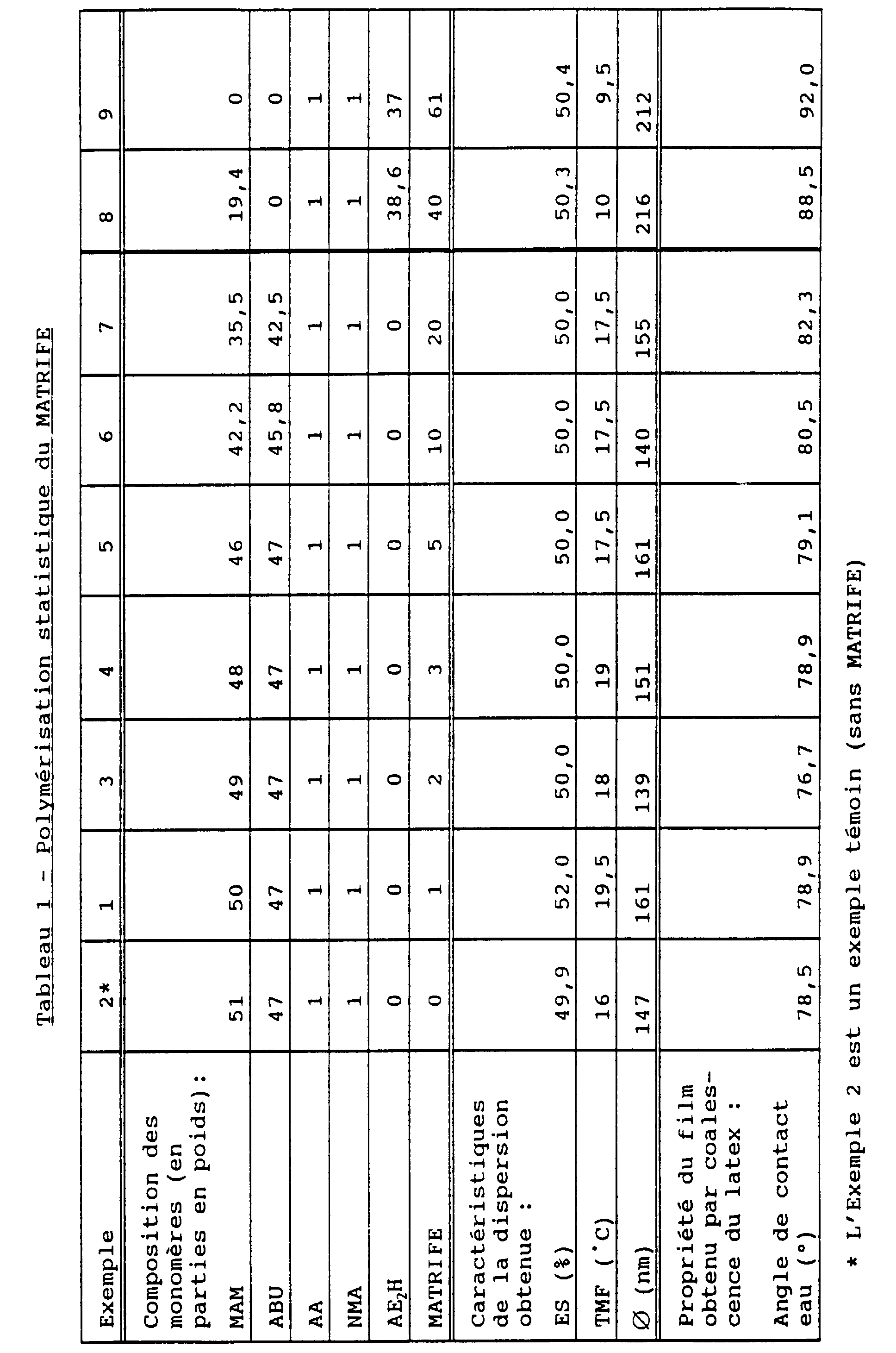
- Example 1 The procedure of Example 1 is reproduced, each time modifying the composition of the monomers involved in the polymerization.
- the compositions used and the characteristics of the dispersions obtained are also reported in Table 1, as well as the angle of contact with water, as a property of the films obtained by coalescence of the latexes.
- Example 10 MATRIFE polymerization to obtain structured particles
- a second preemulsion consisting of 7.2 parts of demineralized water, 0.1 part of AA, 10 parts of MATRIFE, 5.7 parts of AE 2 H, 0.07 part of NP 25OE and 0.36 part of NPS 25OE, simultaneously with a catalytic solution of 0.04 part of ammonium persulfate in 0.7 part of water, over a period of 30 minutes.
- the bath temperature and the stirring speed are maintained respectively at 67 ° C. and 200 revolutions / minute.
- the bath temperature is maintained at 67 ⁇ 1 ° C for 1 h 30 min.
- Example 10 The procedure of Example 10 is reproduced, in adding 0.2 part of MALLYL in the last third of the introduction of the first preemulsion.
- Example 10 The procedure of Example 10 is reproduced by modifying the compositions of the preemulsions, as also indicated in Table 2, with the characteristics of the dispersions thus obtained and the water contact angle as a property of the films obtained by coalescence of the latexes. .
- a paint for facades is prepared having the following formulation: Components Parts by weight Parts by volume Demineralized Water 78.0 106.7 Dispersion to be tested at 50.2% dry extract by weight 481.6 658.6 First group Non-association thickener marketed by COATEX under the name “VISCOATEX 46" (32% by weight) 4.7 6.4 Bactericide marketed by the company “RIEDEL DE HA ⁇ N” under the name “MERGAL K6N” (100%) 2.0 2.7 Fungicide sold by PHAGOGENE Laboratories under the name “PARMETOL DF19” (100%) 2.0 2.7 Wetting agent sold by the company “BK - Ladenburg” under the name “CALGON N” (100%) 0.6 0.8 Dispersant marketed by the company "COATEX” under the name “COATEX P / 90" (40% by weight) 3.0 4.1 Second group Antifoam sold by the company "HENKEL - NOPCO” under the name “DEHYDRAN 1620” (100%) 1.1 1.5
- film vapor permeability is less lowered when using particle dispersions with heart - bark structure.
- the contents of the reactor are then degassed at nitrogen, then heated to 55 ° C. Once this temperature reached, 10% of the first pre-emulsion is introduced containing 62.1 parts of demineralized water, 49.9 parts of EA, 30.6 parts of MAM, 7.7 parts of AA, 1.8 parts of NMA and 2.43 parts of NPS 25OE, as well as 10% of the solution catalytic consisting of 0.3 part of persulfate of ammonium in 6 parts of water, in 15 minutes, while now the temperature at 55 ° C.
- the temperature of the bath is then maintained at 55 ° C. for 15 minutes, then we resume the flows of the first pre-emulsion and the catalytic solution in 2 h 15 min.
- the casting of the first pre-emulsion finished we add the second pre-emulsion containing 6.9 parts of water demineralized, 5.32 parts of AE, 3.63 parts of MATRIFE, 0.85 part AA, 0.2 part NMA, 0.03 part DDM and 0.27 part of NPS 25OE, while continuing to introduce the rest of the catalytic solution and maintaining the temperature at 55 ° C.
- reaction mixture is heated for 1 h at 80 ° C, then cooled to temperature ambient and filtered through a 30 ⁇ m filter.
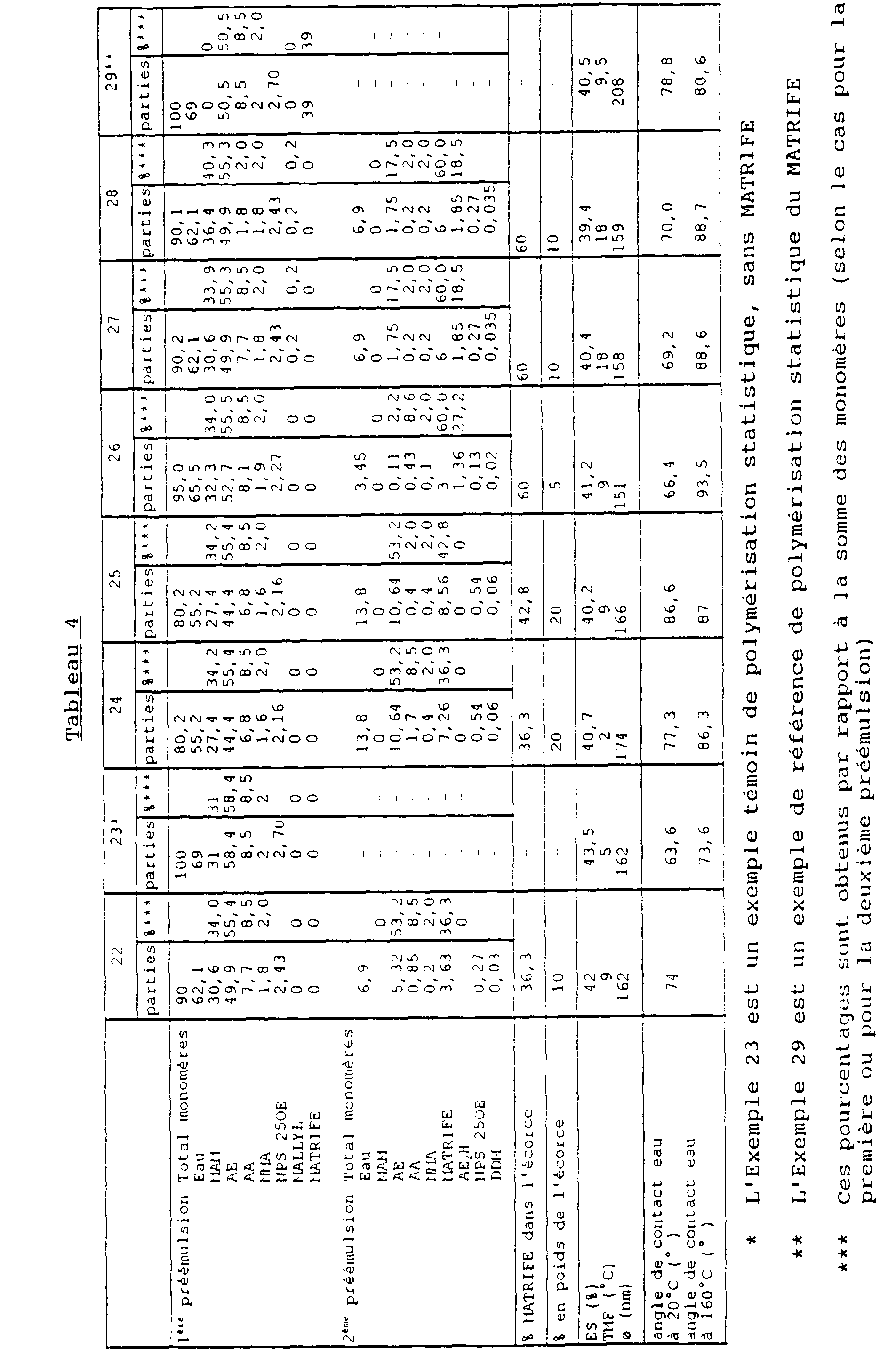
- Example 22 The procedure of Example 22 is reproduced, each time modifying the composition of the preemulsions. These compositions as well as the characteristics of the dispersions obtained are reported in Table 4 below, with the properties of the films obtained by coalescence of the latexes (contact angles).
- Examples 22 to 29 show the strong influence of the thickness and composition of the fluorinated bark on the hydrophobic properties of the films.
- the incorporation of MATRIFE in the bark of heart-bark structured particles allows significantly improve the hydrophobic performance of the film compared to the control (Example 23) and compared to the latex statistic of Example 29, containing 39 parts of MATRIFE.
- the treated leathers are characterized according to a method of dynamic resistance to water penetration (ASTM Standard 2099-70 1973) and according to a method of determination of color fastness or coating a leather with translational friction (NFG 52 301).
- Example 30 31 32 33 34 Dispersion of the Example 23 22 24 25 29 % overall of MATRIFE 0 3.6 7.26 8.56 39 Particle structure Statistical Heart-Bark Heart-Bark Heart-Bark Statistical Number of flexions ASTM 2099-70 352 ⁇ 138 375 ⁇ 228 1078 ⁇ 155 947 ⁇ 457 1804 ⁇ 441 Resistance to wet rubbing 1 3 2 3.5 z1
- Example 35 (for reference) : Preparation of a MATRIFE-free latex
- Example 35 The procedure of Example 35 is reproduced in each time modifying the composition of the monomers used in polymerization.
- Examples 38 to 42 Fluorinated latex mixtures Example 37 - latex non fluorinated Example 35
- Example Dispersion of Example 37 Dispersion of Example 35 % MATRIFE Water contact angle (°) ⁇ s (mN / m) 37 100 0 61 92.2 ⁇ 0.4 27.5 38 20 80 12.2 89.6 ⁇ 1.5 29.0 39 10 90 6.1 92.7 ⁇ 2.0 29.6 40 8 92 4.9 91.6 ⁇ 1.8 29.8 41 6 94 3.7 89.2 ⁇ 2.4 27.4 42 4 96 2.4 90.7 ⁇ 2.2 23.9 35 0 100 0 78.5 ⁇ 1.0 31.8
- Films obtained by coalescence of mixtures of latex have hydrophobic properties comparable to those obtained with fluorinated latex only and show therefore the interest of this technique to minimize the content by weight in MATRIFE necessary to obtain a coating protector with hydrophobic properties.
- Examples 46 and 47 Mixtures of fluorinated latex of Example 10 and non-fluorinated latex of Example 35
- Latex mixtures are produced for different proportions of the fluorinated latex synthesized in Example 10 and the non-fluorinated latex synthesized in Example 35.
- the results are collated in Table 9.
- Example % dispersion of Example 10 % dispersion of Example 35 % MATRIFE Water contact angle (°) ⁇ s (mN / m) 10 100 0 10 92.7 ⁇ 1.9 29.5 46 50 50 5 97 ⁇ 0.5 25.5 47 20 80 2 93 ⁇ 1.0 27.3 35 0 100 0 78.5 ⁇ 1.0 31.8
- Example % dispersion of Example 23 % dispersion of Example 29 % MATRIFE Number of flexions ASTM 2099-70 Resistance to wet rubbing 23 100 0 0 352 ⁇ 158 1 48 87.5 12.5 4.88 1595 ⁇ 235 3 49 75 25 3.75 2325 ⁇ 533 2.5 29 0 100 39 1804 ⁇ 441 1
- the mixture of fluorinated latex with non-fluorinated latex improves both abrasion resistance and wet bending relative to the control (Example 23) and by compared to a latex containing a large amount of MATRIFE statistically distributed (Example 29).
Landscapes
- Chemical & Material Sciences (AREA)
- Chemical Kinetics & Catalysis (AREA)
- Polymers & Plastics (AREA)
- Organic Chemistry (AREA)
- Health & Medical Sciences (AREA)
- Medicinal Chemistry (AREA)
- Textile Engineering (AREA)
- Engineering & Computer Science (AREA)
- Graft Or Block Polymers (AREA)
- Paints Or Removers (AREA)
- Compositions Of Macromolecular Compounds (AREA)
- Addition Polymer Or Copolymer, Post-Treatments, Or Chemical Modifications (AREA)
- Polymerisation Methods In General (AREA)
- Paper (AREA)
Description
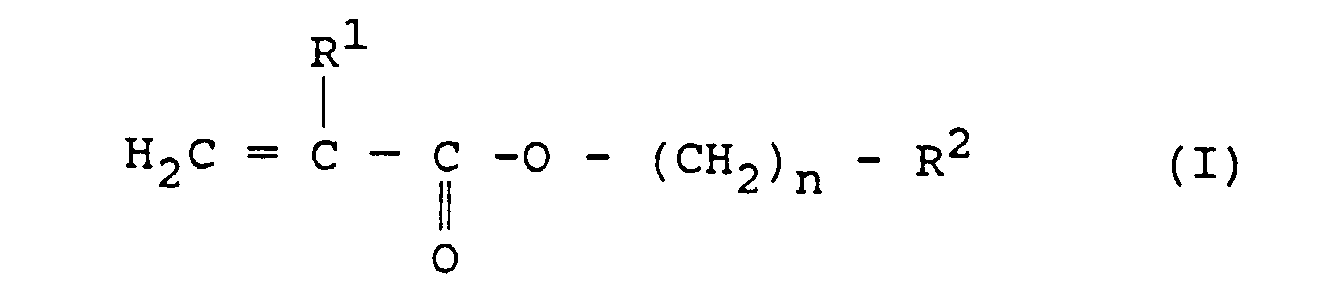
- R1 représente CH3 ou H ;
- R2 représente un radical alkyle perfluoré en C1-C10 ; et
- 0 < n ≤ 4,
la nature et la proportion des monomères entrant dans la composition des particules statistiques, fluorées ou non, ainsi que des différents stades des particlues structurées, étant choisies de telle sorte que la température de transition vitreuse des polymères composant lesdites particules statistiques ou lesdits stades des particules structurées soit inférieures ou égales à 40°C.
- 20-80%, notamment 35-70%, d'au moins un monomère (I) ;
- 20-80%, de préférence 20-55%, d'au moins un monomère (méth)acrylique ou vinylique capable de conduire à un homopolymère ayant une basse température de transition vitreuse ;
- 0-30%, de préférence 0-15%, d'au moins un monomère (méth)acrylique, styrénique ou vinylique capable de conduire à un homopolymère ayant une température de transition vitreuse élevée ;
- 0-10%, de préférence 0-2%, d'au moins un monomère (méth)acrylique carboxylique ;
- 0-3%, de préférence 0-2%, d'au moins un monomère (méth)acrylique réticulant ; et
- 0-5%, de préférence 0-2%, d'au moins un monomère (méth)acrylique hydrophile.
- au moins 20%, notamment au moins 40%, d'au moins un monomère (méth)acrylique ou vinylique capable de conduire à un homopolymère ayant une basse température de transition vitreuse ;
- 20%, notamment au moins 30%, d'au moins un monomère (méth)acrylique, styrénique ou vinylique capable de conduire à un homopolymère ayant une température de transition vitreuse élevée ;
- 0,5-10%, notamment 0,5-2,5%, d'au moins un monomère (méth)acrylique carboxylique ;
- 0,3-5%, notamment 0,5-3%, d'au moins un monomère (méth)acrylique réticulant ; et, dans le cas du coeur de particules structurées,
- 0-0,3%, notamment 0-0,2% d'au moins un monomère difonctionnel de compatibilisation ou de greffage dans le cas où le monomère réticulant est le N-méthylol-acrylamide.
- MATRIFE : méthacrylate de 2,2,2-trifluoroéthyle
- MALLYL : méthacrylate d'allyle
- MAM : méthacrylate de méthyle
- AA : acide acrylique
- AMA : acide méthacrylique
- AE2H . acrylate de 2-éthyl hexyle
- ABU : acrylate de butyle
- NMA : N-méthylol acrylamide
- AE : acrylate d'éthyle
- DDM : dodécylmercaptan
- NP 250E : nonylphénol oxyéthyléné à 25 moles d'oxyde d'éthylène
- NPS 250E : nonylphénol sulfate oxyéthyléné à 25 moles d'oxyde d'éthylène
- ES (%) : extrait sec, mesuré selon la norme ISO 1625 (1977)
- TMF (°C) : température minimale de filmification, mesurée selon la norme ISO 2115 (1976)
- ⊘ (mm) : diamètre moyen des particules, déterminé à l'aide d'un autosizer Lo-C distribué par la Société "MALVERN Instruments", cet appareillage utilisant le principe de la diffusion de lumière quasi élastique
- Angle de contact eau (°) : angle de contact avec l'eau d'un film ; la filmification est effectuée par dépôt d'une épaisseur déterminée de latex à l'aide d'un applicateur de 250 µm sur une plaque de verre, puis séchage à température ambiante pendant 8 heures et à 40°C pendant 1 nuit ; les angles de contact sont ensuite déterminés à l'aide d'un goniomètre sur les plaques conditionnées pendant 2 jours dans une salle à 50% d'humidité ; la mesure est effectuée avec de l'eau bidistillée ; la valeur d'angle de contact recherchée est supérieure ou égale à 90°
- Angle de contact naphtalène (°) : angle de contact avec le naphtalène d'un film obtenu comme précédemment ; la méthode utilisée est la même que précédemment, à la différence que la mesure est effectuée avec du naphtalène purifié
- Tension superficielle γs

| Composants | Parties en poids | Parties en volume | |
| Eau déminéralisée | 78,0 | 106,7 | |
| Dispersion à tester à 50,2% d'extrait sec en poids | 481,6 | 658,6 | |
| Premier groupe | Epaississant non associatif commercialisé par la Société COATEX sous la dénomination "VISCOATEX 46" (32% en poids) | 4,7 | 6,4 |
| Bactéricide commercialisé par la Société "RIEDEL DE HAËN" sous la dénomination "MERGAL K6N" (100%) | 2,0 | 2,7 | |
| Fongicide commercialisé par les Laboratoires PHAGOGENE sous la dénomination "PARMETOL DF19" (100%) | 2,0 | 2,7 | |
| Agent mouillant commercialisé par la Société "BK - Ladenburg" sous la dénomination "CALGON N" (100%) | 0,6 | 0,8 | |
| Dispersant commercialisé par la Société "COATEX" sous la dénomination "COATEX P/90" (40% en poids) | 3,0 | 4,1 | |
| Deuxième groupe | Antimousse commercialisé par la Société "HENKEL - NOPCO" sous la dénomination "DEHYDRAN 1620" (100%) | 1,1 | 1,5 |
| NH3 (22%) | 1,2 | 1,6 | |
| TiO2 commercialisé par la Société "TIOXIDE" sous la dénomination "TR92" | 140,7 | 48,1 | |
| Carbonate de calcium (charge) commercialisé par la Société "OMYA" sous la dénomination "DURCAL 2" | 64,7 | 32,8 | |
| Carbonate de calcium (charge) commercialisé par la Société "OMYA" sous la dénomination "DURCAL 10" | 141,9 | 71,9 | |
| Mica (charge) commercialisé par la Société "KAOLIN D'ARVOR" sous la dénomination "MICARVOR 20" | 51,6 | 25,2 | |
| Propylène glycol (cosolvant). | 15,2 | 20,8 | |
| Coalescent commercialisé par la Société "EASTMAN KODAK" sous la dénomination "TEXANOL" | 9,6 | 13,1 | |
| Troisième groupe | Antimousse commercialisé par la Société "HENKEL NOPCO" sous la dénomination "DEHYDRAN 1620" (100%) | 1,1 | 1,5 |
| Epaississant associatif commercialisé par la Société "SERVO DELDEN" sous la dénomination "SER AD FX 1010" (50% en poids) | 1,0 | 1,4 | |
| | |
| Exemple d'Application | Dispersion de l'Exemple | Angle de contact (°) | Angle de contact naphtalène (°) | Perméabilité à la vapeur d'eau (g/m2/24h) |
| 17 | 14 | 96,0 | 45,7 | 169 |
| 18 | 11 | 97,5 | 43,0 | 166 |
| 19 | 10 | 93,8 | 36,7 | 169 |
| 20 | 2 | 80,3 | 23,8 | 183 |
| 21 | 8 | 90,6 | 40,6 | 116 |
- Pigment noir commercialisé sous la dénomination "LEPTON" 20%
- Latex 30%
- Eau 50%
| Exemple | 30 | 31 | 32 | 33 | 34 |
| Dispersion de l'Exemple | 23 | 22 | 24 | 25 | 29 |
| % global de MATRIFE | 0 | 3,6 | 7,26 | 8,56 | 39 |
| Structure des particules | Statistique | Coeur-Ecorce | Coeur-Ecorce | Coeur-Ecorce | Statistique |
| Nombre de flexions ASTM 2099-70 | 352 ± 138 | 375 ± 228 | 1078 ± 155 | 947 ± 457 | 1804 ± 441 |
| Résistance aux frottements humides | 1 | 3 | 2 | 3,5 | z1 |
| Exemple | 35 | 36 | 37 | |
| Composition des monomères engagés | MAM | 51 | 19,4 | 0 |
| ABU | 47 | 0 | 0 | |
| AA | 1 | 1 | 1 | |
| NMA | 1 | 1 | 1 | |
| AE2H | 0 | 38,6 | 37 | |
| MATRIFE | 0 | 40 | 61 | |
| Caractéristiques des dispersions obtenues | ES % | 52,0 | 50,3 | 50,4 |
| TMF % | 19,5 | 10 | 9,5 | |
| ø nm | 161 | 216 | 212 | |
| Propriétés des films obtenus par coalescence des latex | Angle contact eau (°) | 72,9 | 88,5 | 92,2 |
| Tension superficielle (mN/m) γs | 31,8 | 27,5 |
| Exemple | Dispersion de l'Exemple 37 | Dispersion de l'Exemple 35 | % MATRIFE | Angle de contact eau (°) | γs (mN/m) |
| 37 | 100 | 0 | 61 | 92,2 ± 0,4 | 27,5 |
| 38 | 20 | 80 | 12,2 | 89,6 ± 1,5 | 29,0 |
| 39 | 10 | 90 | 6,1 | 92,7 ± 2,0 | 29,6 |
| 40 | 8 | 92 | 4,9 | 91,6 ± 1,8 | 29,8 |
| 41 | 6 | 94 | 3,7 | 89,2 ± 2,4 | 27,4 |
| 42 | 4 | 96 | 2,4 | 90,7 ± 2,2 | 23,9 |
| 35 | 0 | 100 | 0 | 78,5 ± 1,0 | 31,8 |
| Exemple | % de dispersion de l'Exemple 11 | % de dispersion de l'Exemple 35 | % MATRIFE | Angle de contact eau (°) | γs (mN/m) |
| 11 | 100 | 0 | 10 | 92,6 ± 1,5 | 30,6 |
| 43 | 50 | 50 | 5 | 92,2 ± 0,4 | 24,4 |
| 44 | 30 | 70 | 3 | 91,8 ± 1,0 | 27,5 |
| 45 | 20 | 80 | 2 | 92,7 ± 1,0 | 27,1 |
| 35 | 0 | 100 | 0 | 78,5 ± 1,0 | 31,8 |
| Exemple | % de dispersion de l'Exemple 10 | % de dispersion de l'Exemple 35 | % MATRIFE | Angle de contact eau (°) | γs (mN/m) |
| 10 | 100 | 0 | 10 | 92,7 ± 1,9 | 29,5 |
| 46 | 50 | 50 | 5 | 97 ± 0,5 | 25,5 |
| 47 | 20 | 80 | 2 | 93 ± 1,0 | 27,3 |
| 35 | 0 | 100 | 0 | 78,5 ± 1,0 | 31,8 |
- Pigment noir commercialisé sous la dénomination "LEPTON" 20%
- Mélange latex (ou latex de référence) 30%
- Eau 50%
| Exemple | % de dispersion de l'Exemple 23 | % de dispersion de l'Exemple 29 | % MATRIFE | Nombre de flexions ASTM 2099-70 | Résistance aux frottements humides |
| 23 | 100 | 0 | 0 | 352 ± 158 | 1 |
| 48 | 87,5 | 12,5 | 4,88 | 1595 ± 235 | 3 |
| 49 | 75 | 25 | 3,75 | 2325 ± 533 | 2,5 |
| 29 | 0 | 100 | 39 | 1804 ± 441 | 1 |
| Exemple | % de dispersion de l'Exemple 25 | % de dispersion de l'Exemple 23 | % MATRIFE | Angle de contact eau (°) | γs (mN/m) |
| 25 | 100 | 0 | 8,56 | 86,6 | 25,5 |
| 50 | 50 | 50 | 4,28 | 88,8 | 25,4 |
| 51 | 30 | 70 | 2,57 | 86,0 | 27,1 |
| 23 | 0 | 100 | 0 | 63,6 | 35,8 |
Claims (19)
- Latex (méth)acrylique fluoré consistant en une dispersion de particules ou en un mélange de dispersions de particules, ces dispersions étant obtenues par polymérisation en émulsion en milieu aqueux en au moins un stade, un ou plusieurs monomère(s) perfluoré(s) de formule (I) :dans laquelle :
 ayant été utilisé(s) comme seul(s) comonomère(s) fluoré(s) pour la formation des particules, et étant réparti(s) statistiquement dans des particules formées en un stade ou réparti(s) statistiquement dans l'écorce de particules structurées de type coeur-écorce ou coeur-couche(s) intermédiaire(s)-écorce résultant d'une polymérisation respectivement à deux stades et à plus de deux stades, ledit latex étant constitué par une dispersion desdites particules structurées ou par un mélange d'au moins une dispersion desdites particules structurées fluorées et/ou d'au moins une dispersion desdites particules statistiques fluorées et d'au moins une dispersion de particules statistiques fluorées (Fstat.), le ou les monomères de formule (I) représentant moins de 80% en poids de l'écorce des particules structurées fluorées, la proportion de monomères de formule (I) par rapport à l'ensemble des monomères utilisés pour former la totalité des particules dudit latex étant comprise entre 1,8 et 20% en poids,R1 représente CH3 ou H ;R2 représente un radical alkyle perfluoré en C1-C10 ;
et0 < n ≤ 4,
la nature et la proportion des monomères entrant dans la composition des particules statistiques, fluorées ou non, ainsi que des différents stades des particules structurées, étant choisies de telle sorte que la température de transition vitreuse des polymères composant lesdites particules statistiques ou lesdits stades des particules structurées soit inférieure ou égale à 40°C. - Latex selon la revendication 1, caractérisé par le fait que le monomère (I) est le (méth)acrylate de 2,2,2-trifluoroéthyle.
- Latex selon l'une des revendications 1 et 2, caractérisé par le fait que la proportion de monomères de formule (I) par rapport à l'ensemble des monomères utilisés pour former la totalité des particules dudit latex est comprise entre 2 et 10% en poids.
- Latex selon l'une des revendications 1 à 3, caractérisé par le fait que la nature et la proportion des monomères entrant dans la composition des particules statistiques, fluorées ou non, ainsi que des différents stades des particules structurées, sont choisies de telle sorte que la température de transition vitreuse des polymères composant lesdites particules statistiques ou lesdits stades des particules structurées soit comprise entre -5 et 25°C.
- Latex selon l'une des revendications 1 à 4, caractérisé par le fait que la composition en monomères de particules statistiques fluorées (Fstat.) ou de l'écorce de particules structurées fluorées (Fstruct.) est la suivante, en poids, pour un total de 100% en poids :20-80%, notamment 35-70%, d'au moins un monomère (I) ;20-80%, notamment 20-55%, d'au moins un monomère (méth)acrylique ou vinylique capable de conduire à un homopolymère ayant une basse température de transition vitreuse généralement comprise entre -80 et -20°C ;0-30%, notamment 0-15%, d'au moins un monomère (méth)acrylique, styrénique ou vinylique capable de conduire à un homopolymère ayant une température de transition vitreuse élevée généralement comprise entre +10 et 200°C ;0-10%, notamment 0-2%, d'au moins un monomère (méth)acrylique carboxylique ;0-3%, notamment 0-2%, d'au moins un monomère (méth)acrylique réticulant ; et0-5%, notamment 0-2%, d'au moins un monomère (méth)acrylique hydrophile.
- Latex selon l'une des revendications 1 à 5, caractérisé par le fait que la composition en monomères de particules statistiques non fluorées (NFstat.) et du coeur de particules structurées fluorées (Fstruct.) est la suivante, en poids, pour un total de 100 parties en poids :au moins 20%, notamment au moins 40%, d'au moins un monomère (méth)acrylique ou vinylique capable de conduire à un homopolymère ayant une basse température de transition vitreuse généralement comprise entre -80 et -20°C ;au moins 20%, notamment au moins 30%, d'au moins un monomère (méth)acrylique, styrénique ou vinylique capable de conduire à un homopolymère ayant une température de transition vitreuse élevée genéralement comprise entre +10 et 200°C ;0,5-10%, notamment 0,5-2,5%, d'au moins un monomère (méth)acrylique carboxylique ;0,3-5%, notamment 0,5-3%, d'au moins un monomère (méth)acrylique réticulant ; et, dans le cas du coeur de particules structurées,0-0,3%, notamment 0-0,2%, d'au moins un monomère difonctionnel de compatibilisation ou de greffage, dans le cas où le monomère réticulant est le N-méthylolacrylamide.
- Latex selon l'une des revendications 5 et 6, caractérisé par le fait que le monomère (méth)acrylique capable de conduire à un homopolymère ayant une basse température de transition vitreuse généralement comprise entre -80 et -20°C est choisi parmi les (méth)acrylates d'alkyle donnant des homopolymères ayant une température de transition vitreuse comprise entre -80 et -20°C : l'acrylate d'éthyle, l'acrylate de butyle, l'acrylate de 2-éthyl hexyle et l'acrylate de nonyle.
- Latex selon l'une des revendications 5 et 6, caractérisé par le fait que le monomère vinylique capable de conduire à un homopolymère ayant une basse température de transition vitreuse généralement comprise entre -80 et -20°C est le vinyl 2-éthyl hexanoate.
- Latex selon l'une des revendications 5 et 6, caractérisé par le fait que le monomère (méth)acrylique capable de conduire à un homopolymère ayant une température de transition vitreuse élevée généralement comprise entre +10 et 200°C est le méthacrylate de méthyle.
- Latex selon l'une des revendications 5 et 6, caractérisé par le fait que le monomère vinylique capable de conduire à un homopolymère ayant une température de transition vitreuse élevée généralement comprise entre +10 et 200°C est l'acétate de vinyle.
- Latex selon l'une des revendications 5 et 6, caractérisé par le fait que le monomère (méth)acrylique carboxylique est l'acide acrylique ou l'acide méthacrylique.
- Latex selon l'une des revendications 5 et 6, caractérisé par le fait que le monomère réticulant est choisi parmi les réticulants hydrophiles comme le N-méthylol (méth)acrylamide et l'isobutoxyméthylacrylamide, et les réticulants hydrophobes comme l'éthylène glycol di(méth)acrylate, le butanediol di(méth)acrylate, l'hexanediol di(méth)acrylate et l'anhydride méthacrylique.
- Latex selon la revendication 5, caractérisé par le fait que le monomère (méth)acrylique hydrophile est le (méth)acrylate d'éthylimidazolidone ou l'acrylamide.
- Latex selon la revendication 6, caractérisé par le fait que le monomère de compatibilisation ou de greffage est choisi parmi les maléates de diallyle, le (méth)acrylate d'allyle et le butane diol diméthacrylate.
- Latex selon l'une des revendications 1 à 14, caractérisé par le fait que la proportion pondérale de l'écorce des particules fluorées structurées (Fstruct.) représente 3 à 30%, de préférence 5 à 20%, en poids, desdites particules, pour une taille de celles-ci comprise entre 100 et 300 nm.
- Latex selon l'une des revendications 1 à 15, caractérisé par le fait que la concentration en particules est comprise entre 10 et 65%, en particulier entre 40 et 55% en poids, du poids total de la dispersion.
- Procédé de préparation d'un latex tel que défini à l'une des revendications 1 à 16, caractérisé par le fait qu'on prépare au moins une dispersion aqueuse de particules (méth)acryliques fluorées (Fstruct.) de structure coeur-écorce ou coeur-couche(s) intermédiaire(s)-écorce, le ou les monomères (I) entrant dans la constitution de l'écorce desdites particules, qu'on mélange le cas échéant les dispersions obtenues entre elles, et qu'on mélange le cas échéant la ou les dispersions obtenues avec au moins une dispersion aqueuse de particules (méth)acryliques statistiques non fluorées (NFstat.), ou bien qu'on prépare au moins une dispersion aqueuse de particules (méth)acryliques statistiques fluorées (Fstat.) en utilisant, comme comonomère, un ou des composés de formule (I), qu'on mélange le cas échéant les dispersions obtenues entre elles et qu'on mélange la ou les dispersions résultantes avec au moins une dispersion aqueuse de particules (méth)acryliques statistiques non fluorées (NFstat.), toutes les dispersions aqueuses précitées étant effectuées par polymérisation en émulsion en milieu aqueux à un ou plusieurs stades selon le cas.
- Procédé selon la revendication 17, caractérisé par le fait qu'on ajoute jusqu'à 0,5% en poids, notamment jusqu'à 0,3% en poids d'au moins un agent de transfert tel qu'un alkyl mercaptan ou l'acide thioglycolique par rapport aux monomères introduits lors de la polymérisation de l'écorce.
- Compositions destinées à constituer un revêtement hydrophobe, tel qu'une peinture, dans le domaine du bâtiment, vernis et apprêt pour cuirs, apprêts pour textiles, vernis de protection pour bois, caractérisées par le fait qu'elles comportent au moins un latex tel que défini à l'une des revendications 1 à 16.
Applications Claiming Priority (2)
| Application Number | Priority Date | Filing Date | Title |
|---|---|---|---|
| FR9412431 | 1994-10-18 | ||
| FR9412431A FR2725721B1 (fr) | 1994-10-18 | 1994-10-18 | Latex et melanges de latex acryliques et methacyliques fluores, leurs procedes de fabrication et leurs applications dans le domaine des revetements hydrophobes |
Publications (2)
| Publication Number | Publication Date |
|---|---|
| EP0708120A1 EP0708120A1 (fr) | 1996-04-24 |
| EP0708120B1 true EP0708120B1 (fr) | 1998-06-03 |
Family
ID=9467966
Family Applications (1)
| Application Number | Title | Priority Date | Filing Date |
|---|---|---|---|
| EP95402315A Expired - Lifetime EP0708120B1 (fr) | 1994-10-18 | 1995-10-17 | Latex et mélanges de latex acryliques et méthacryliques fluorés |
Country Status (12)
| Country | Link |
|---|---|
| US (1) | US5798406A (fr) |
| EP (1) | EP0708120B1 (fr) |
| JP (1) | JP3125977B2 (fr) |
| KR (1) | KR0174644B1 (fr) |
| CN (1) | CN1087310C (fr) |
| AT (1) | ATE166894T1 (fr) |
| CA (1) | CA2160734C (fr) |
| CZ (1) | CZ271195A3 (fr) |
| DE (1) | DE69502791T2 (fr) |
| FR (1) | FR2725721B1 (fr) |
| GR (1) | GR3027771T3 (fr) |
| TW (1) | TW320638B (fr) |
Families Citing this family (30)
| Publication number | Priority date | Publication date | Assignee | Title |
|---|---|---|---|---|
| TW494125B (en) * | 1997-07-11 | 2002-07-11 | Rohm And Haas Compary | Preparation of fluorinated polymers |
| ES2242393T3 (es) * | 1998-04-27 | 2005-11-01 | Kaneka Corporation | Composicion de resina que contiene un polimero de injerto multicapa. |
| FR2785904B1 (fr) * | 1998-11-13 | 2000-12-15 | Atochem Elf Sa | Polymeres fluores par polymerisation en miniemulsion |
| CA2365460A1 (fr) * | 1999-03-31 | 2000-10-12 | Ineke Verweire | Copolymeres fluores pour revetement de dispositifs biomedicaux et procede de fabrication correspondant |
| EP1108761A3 (fr) | 1999-12-13 | 2001-07-18 | Canon Kabushiki Kaisha | Polymère film, et un polymère pour sa production |
| GB0119728D0 (en) * | 2001-08-14 | 2001-10-03 | Avecia Bv | Aqueous crosslinkable coating compositions |
| KR100427261B1 (ko) * | 2001-12-04 | 2004-04-14 | 한국화학연구원 | 코어-쉘 구조의 불소계 발수발유성 코팅제의 제조 방법 |
| US7030208B2 (en) | 2002-04-11 | 2006-04-18 | Carbomer, Inc. | Biocompatible materials and probes |
| JP2005531647A (ja) * | 2002-04-11 | 2005-10-20 | カルボマー インク | 新規なイメージングプローブ |
| AU2003224917A1 (en) | 2002-04-11 | 2003-10-27 | Carbomer | Diabetes imaging probes |
| US7196133B2 (en) * | 2003-07-08 | 2007-03-27 | Kyoeisha Chemical Co., Ltd. | Surface tension control agent for coating material and coating material containing same |
| US20050136272A1 (en) * | 2003-12-23 | 2005-06-23 | Vanrheenen Paul | Gloss reducing polymer composition |
| US20050176876A1 (en) * | 2004-02-09 | 2005-08-11 | Lee Sou P. | Water-whitening resistant pressure-sensitive adhesive |
| WO2006117973A1 (fr) * | 2005-04-27 | 2006-11-09 | Daikin Industries, Ltd. | Fluoropolymere ayant un groupe s-sulfate et composition hydrophobe/oleofuge contenant le polymere |
| CN100354049C (zh) * | 2005-11-18 | 2007-12-12 | 清华大学 | 固体材料超疏水表面的形成方法 |
| CN100427520C (zh) * | 2006-06-16 | 2008-10-22 | 浙江大学 | 直升机蒙皮涂料用氟改性丙烯酸树脂制造方法 |
| US8202614B2 (en) | 2006-08-09 | 2012-06-19 | Luna Innovations Incorporated | Additive particles having superhydrophobic characteristics and coatings and methods of making and using the same |
| US20090030114A1 (en) * | 2007-07-25 | 2009-01-29 | Ying Wang | Fluoropolymer emulsions |
| SG189820A1 (en) | 2009-06-04 | 2013-06-28 | Basf Se | Fluorinated core-shell-polymers and process for preparing same |
| CN101696312B (zh) * | 2009-10-27 | 2012-01-11 | 华南理工大学 | 一种疏水亲油性双组份丙烯酸树脂及其制备方法与应用 |
| US8329822B2 (en) * | 2009-11-09 | 2012-12-11 | E.I. Du Pont De Nemours And Company | Fluoropolymer emulsions |
| US8507601B2 (en) * | 2009-11-09 | 2013-08-13 | E. I. Du Pont De Nemours And Company | Method using fluoropolymer emulsions |
| ES2378677B1 (es) | 2010-04-28 | 2013-02-28 | Repsol Lubricantes Y Especialidades, S.A. | Emulsiones con acción dual de barrera antihumedad y anti-pintadas. |
| US9000069B1 (en) * | 2010-07-02 | 2015-04-07 | The Sherwin-Williams Company | Self-stratifying coatings |
| CN102718920B (zh) * | 2012-07-04 | 2014-04-23 | 陕西科技大学 | 采用双原位同步法制备聚丙烯酸酯-纳米二氧化钛复合涂饰剂的方法 |
| CN107513861B (zh) * | 2017-08-24 | 2020-08-18 | 中国科学院成都有机化学有限公司 | 一种拒水拒油性能优异的纺织用低氟含量丙烯酸酯乳液及制备方法和防水织物的制备方法 |
| CN111836870B (zh) * | 2018-03-08 | 2023-03-24 | Agc株式会社 | 拒水拒油剂组合物的制造方法及拒水拒油性物品的制造方法 |
| CN114829041A (zh) * | 2019-12-17 | 2022-07-29 | 汉高股份有限及两合公司 | 水性聚合物分散体及其用途 |
| WO2021200647A1 (fr) * | 2020-03-31 | 2021-10-07 | 東レ株式会社 | Particules de polymère |
| CN115386036B (zh) * | 2021-09-30 | 2023-06-30 | 浙江金质丽新材料有限公司 | 一种用于木器封闭底漆的含氟丙烯酸树脂及其制备方法 |
Family Cites Families (41)
| Publication number | Priority date | Publication date | Assignee | Title |
|---|---|---|---|---|
| US3940359A (en) * | 1974-05-08 | 1976-02-24 | E. I. Du Pont De Nemours And Company | Soil-repellent coating compositions |
| JPS597411A (ja) | 1982-07-06 | 1984-01-14 | Ishikawajima Harima Heavy Ind Co Ltd | ロ−ルシフト装置 |
| JPS5998116A (ja) | 1982-11-29 | 1984-06-06 | Mitsubishi Rayon Co Ltd | フッ化アクリル樹脂多段重合体の製造方法 |
| JPS59122512A (ja) * | 1982-12-28 | 1984-07-16 | Mitsubishi Rayon Co Ltd | 弗化アクリル多段構造重合体樹脂の製造方法 |
| JPS59124915A (ja) | 1982-12-29 | 1984-07-19 | Mitsubishi Rayon Co Ltd | 弗化アクリル多段構造重合体樹脂の製造方法 |
| JPS59147010A (ja) | 1983-02-10 | 1984-08-23 | Mitsubishi Rayon Co Ltd | 弗化アクリル多段重合体樹脂 |
| JPS59147011A (ja) | 1983-02-10 | 1984-08-23 | Mitsubishi Rayon Co Ltd | 弗化アクリル多段構造重合体樹脂 |
| CA1230446A (fr) * | 1983-04-11 | 1987-12-15 | Akira Ohmori | Copolymere renfermant du fluor; composition a base de ce produit |
| US4474923A (en) | 1983-06-14 | 1984-10-02 | The Dow Chemical Company | Self-curable latex compositions |
| US4514537A (en) * | 1984-02-09 | 1985-04-30 | E. I. Du Pont De Nemours And Company | Tetrafluoroethylene polymer dispersions |
| JPS6119615A (ja) | 1984-07-05 | 1986-01-28 | Nitto Electric Ind Co Ltd | 樹脂水性エマルジヨンの製造方法 |
| JPS61103912A (ja) | 1984-10-25 | 1986-05-22 | Nitto Electric Ind Co Ltd | 樹脂水性エマルジヨン |
| NO860171L (no) * | 1985-01-30 | 1986-07-31 | Japan Synthetic Rubber Co Ltd | Fremgangsmaate for fremstilling av store polymerpartikler. |
| GB8507221D0 (en) | 1985-03-20 | 1985-04-24 | Courtaulds Plc | Polymer compositions |
| US4564561A (en) * | 1985-03-27 | 1986-01-14 | E. I. Du Pont De Nemours And Company | Fluorine-containing polymer compositions and their preparation |
| JP2545503B2 (ja) | 1985-05-30 | 1996-10-23 | 日東電工株式会社 | 免疫学的診断試薬 |
| JPS62100511A (ja) | 1985-10-28 | 1987-05-11 | Nitto Electric Ind Co Ltd | 樹脂エマルジヨンの製造方法 |
| JP2543503B2 (ja) * | 1986-07-01 | 1996-10-16 | 綜研化学株式会社 | 分岐構造を有する共重合体を分散安定剤として用いた乳化重合法 |
| JPS6392623A (ja) | 1986-10-07 | 1988-04-23 | Fuji Xerox Co Ltd | フツ素含有ビニル共重合体 |
| JPH0745523B2 (ja) | 1986-10-07 | 1995-05-17 | 富士ゼロックス株式会社 | 単分散微粒子共重合体の製造方法 |
| US4812337A (en) * | 1986-11-25 | 1989-03-14 | Kansai Paint Company, Limited | Metallic coating method |
| JPH0810223B2 (ja) | 1987-03-17 | 1996-01-31 | 日東電工株式会社 | 診断薬用ラテツクス、その製法および該ラテツクスを用いてなる診断薬 |
| JPS6440510A (en) | 1987-08-07 | 1989-02-10 | Nitto Denko Corp | Multi-layer polymer composition |
| JP2508760B2 (ja) * | 1987-10-20 | 1996-06-19 | 旭硝子株式会社 | 汚れ離脱性を有する撥水撥油剤 |
| JPH01144403A (ja) | 1987-11-30 | 1989-06-06 | Nitto Denko Corp | 樹脂エマルジョンの製法 |
| JPH01170854A (ja) | 1987-12-25 | 1989-07-05 | Nitto Denko Corp | 生理活性物質固定化用担体粒子の製造方法 |
| JP2715540B2 (ja) * | 1989-04-15 | 1998-02-18 | ダイキン工業株式会社 | 含フッ素樹脂の水性分散体、複合粉末およびオルガノゾル組成物 |
| WO1991000881A1 (fr) * | 1989-07-06 | 1991-01-24 | Norsolor | Nouveaux copolymeres acryliques et leur application au revetement de materiaux bitumineux |
| US5079319A (en) * | 1989-10-25 | 1992-01-07 | Ciba-Geigy Corporation | Reactive silicone and/or fluorine containing hydrophilic prepolymers and polymers thereof |
| FR2656316B1 (fr) * | 1989-12-21 | 1993-12-31 | Norsolor Sa | Nouveaux copolymeres acryliques et leur application comme revetements. |
| US5264531A (en) * | 1990-04-09 | 1993-11-23 | Mitsubishi Rayon Co., Ltd. | Acrylonitrile copolymer, and fiber or core-sheath conjugate fiber prepared therefrom |
| JPH0653779B2 (ja) * | 1990-08-30 | 1994-07-20 | 日東電工株式会社 | 樹脂水性エマルジヨンの製造方法 |
| DE4040641A1 (de) * | 1990-12-19 | 1992-06-25 | Pfersee Chem Fab | Mittel zur behandlung von fasermaterialien |
| JP3166862B2 (ja) | 1991-01-25 | 2001-05-14 | 大日本インキ化学工業株式会社 | フッ素樹脂水性分散体及びその水性分散体を含む水性塗料組成物 |
| JPH0561237A (ja) * | 1991-05-30 | 1993-03-12 | Fuji Xerox Co Ltd | マイクロカプセルおよびその製造方法 |
| JPH0778154B2 (ja) * | 1991-07-11 | 1995-08-23 | ヘキスト合成株式会社 | 含フッ素アクリル系共重合体水性エマルジョンの製造方法及びその組成物 |
| JPH05142847A (ja) * | 1991-11-15 | 1993-06-11 | Fuji Xerox Co Ltd | マイクロカプセルおよびマイクロカプセルトナー並びにそ の製造法 |
| JPH05140237A (ja) | 1991-11-22 | 1993-06-08 | Mitsui Toatsu Chem Inc | 含フツ素重合体の製造方法およびその組成物 |
| JPH05148122A (ja) | 1991-11-28 | 1993-06-15 | Kao Corp | 水系美爪料 |
| JPH06192342A (ja) * | 1992-12-25 | 1994-07-12 | Mitsui Toatsu Chem Inc | コアシェル型含フッ素重合体およびその製造方法 |
| JPH07225490A (ja) * | 1994-02-10 | 1995-08-22 | Japan Synthetic Rubber Co Ltd | 架橋ポリマー粒子およびその製造方法 |
-
1994
- 1994-10-18 FR FR9412431A patent/FR2725721B1/fr not_active Expired - Fee Related
-
1995
- 1995-10-17 CN CN95118631A patent/CN1087310C/zh not_active Expired - Fee Related
- 1995-10-17 EP EP95402315A patent/EP0708120B1/fr not_active Expired - Lifetime
- 1995-10-17 CZ CZ952711A patent/CZ271195A3/cs unknown
- 1995-10-17 AT AT95402315T patent/ATE166894T1/de not_active IP Right Cessation
- 1995-10-17 DE DE69502791T patent/DE69502791T2/de not_active Expired - Lifetime
- 1995-10-17 CA CA002160734A patent/CA2160734C/fr not_active Expired - Fee Related
- 1995-10-18 JP JP07294730A patent/JP3125977B2/ja not_active Expired - Fee Related
- 1995-10-18 US US08/544,693 patent/US5798406A/en not_active Expired - Lifetime
- 1995-10-18 KR KR1019950036026A patent/KR0174644B1/ko not_active Expired - Fee Related
- 1995-10-19 TW TW084111009A patent/TW320638B/zh active
-
1998
- 1998-08-28 GR GR980401950T patent/GR3027771T3/el unknown
Also Published As
| Publication number | Publication date |
|---|---|
| CN1130640A (zh) | 1996-09-11 |
| US5798406A (en) | 1998-08-25 |
| CA2160734A1 (fr) | 1996-04-19 |
| KR0174644B1 (ko) | 1999-04-01 |
| KR960014231A (ko) | 1996-05-22 |
| JPH08208936A (ja) | 1996-08-13 |
| TW320638B (fr) | 1997-11-21 |
| CZ271195A3 (en) | 1996-05-15 |
| GR3027771T3 (en) | 1998-11-30 |
| ATE166894T1 (de) | 1998-06-15 |
| CA2160734C (fr) | 2002-01-01 |
| FR2725721B1 (fr) | 1998-12-04 |
| JP3125977B2 (ja) | 2001-01-22 |
| EP0708120A1 (fr) | 1996-04-24 |
| CN1087310C (zh) | 2002-07-10 |
| DE69502791T2 (de) | 1999-01-21 |
| DE69502791D1 (de) | 1998-07-09 |
| FR2725721A1 (fr) | 1996-04-19 |
Similar Documents
| Publication | Publication Date | Title |
|---|---|---|
| CA2160734C (fr) | Latex et melanges de latex acryliques et methacryliques fluores, leurs procedes de fabrication et leurs applications dans le domaine des revetements hydrophobes | |
| CA2767173C (fr) | Dispersion aqueuse de polymere autoreticulable, a base de particules de polymere structurees en coeur dur et ecorce molle et compositions de revetements ou de traitement | |
| EP0644205A1 (fr) | Procédé de préparation de latex à taille de particules ultrafine | |
| FR2512355A1 (fr) | Particule polymere opacifiante et ses applications | |
| EP3068814B1 (fr) | Dispersion aqueuse de polymere a base de particules multistructurees pour revetements aqueux a resistance au blocking et a l'empreinte et avec une durete ameliorees | |
| BE622034A (fr) | ||
| FR2767835A1 (fr) | Latex ne contenant ni composes organiques volatils ni agents de coalescence et pouvant former un film a basse temperature | |
| CA2150512A1 (fr) | Dispersion stable aqueuse de copolymeres fluores hydroxyles et de copolymeres acryliques, son procede de preparation et son utilisation comme peinture en phase aqueuse | |
| LU86940A1 (fr) | Particules polymeres produites sequentiellement,dispersions aqueuses de particules polymeres produites sequentiellement,procedes pour la preparation de particules polymeres produites sequentiellement,et utilisation de particules polymeres produites sequentiellement | |
| EP1697475B1 (fr) | Compositions de revêtements comprenant une dispersion aqueuse de polymère filmogène et une silicone polyether, leur procédé de préparation et leurs utilisations | |
| EP0728154B1 (fr) | Dispersion aqueuse de polymere, son procede de fabrication et son application a la formulation de peintures | |
| EP0868451A1 (fr) | Latex composites a tres fine granulometrie - leur application aux peintures sans solvants | |
| EP1274794B1 (fr) | Compositions pour le traitement du cuir contenant des dispersions aqueuses de polymere, filmogenes en l'absence de solvant organique | |
| FR2695644A1 (fr) | Résines thermoplastiques résultant du greffage de polyoléfines chlorées par des monomères insaturés et procédé d'obtention. | |
| FR2803743A1 (fr) | Compositions cosmetiques contenant des dispersions aqueuses de polymeres, filmogenes en l'absence de solvant organique | |
| EP0875540A1 (fr) | Système monocomposant à base de latex coréactifs | |
| JPH04372674A (ja) | 水性常乾架橋型塗料用樹脂組成物 | |
| EP0875541A1 (fr) | Système monocomposant à base de latex coréactifs | |
| EP1451236B1 (fr) | Dispersion aqueuse de polymere a lessivabilite elevee, sa preparation et son application comme liant dans des compositions de revetement | |
| JP7856088B2 (ja) | 撥水撥油剤組成物、繊維処理剤、繊維の処理方法、繊維加工品およびコーティング剤 | |
| EP0875543B1 (fr) | Système monocomposant à base de copolymères coréactifs | |
| JPH115922A (ja) | アクリルシリコーンエマルジョン組成物 | |
| WO2001054896A2 (fr) | Produit composite multicouche comportant une couche de polymere adhesif sensible a la pression et resistant en temperature | |
| CN115734993A (zh) | 含聚合表面活性剂的聚合物乳液及其制备方法和用途 | |
| EP0875542A1 (fr) | Système monocomposant à base de polymères coréactifs |
Legal Events
| Date | Code | Title | Description |
|---|---|---|---|
| PUAI | Public reference made under article 153(3) epc to a published international application that has entered the european phase |
Free format text: ORIGINAL CODE: 0009012 |
|
| 17P | Request for examination filed |
Effective date: 19951027 |
|
| AK | Designated contracting states |
Kind code of ref document: A1 Designated state(s): AT BE CH DE DK ES FR GB GR IE IT LI LU NL PT SE |
|
| 17Q | First examination report despatched |
Effective date: 19970324 |
|
| GRAG | Despatch of communication of intention to grant |
Free format text: ORIGINAL CODE: EPIDOS AGRA |
|
| GRAG | Despatch of communication of intention to grant |
Free format text: ORIGINAL CODE: EPIDOS AGRA |
|
| GRAH | Despatch of communication of intention to grant a patent |
Free format text: ORIGINAL CODE: EPIDOS IGRA |
|
| GRAH | Despatch of communication of intention to grant a patent |
Free format text: ORIGINAL CODE: EPIDOS IGRA |
|
| GRAA | (expected) grant |
Free format text: ORIGINAL CODE: 0009210 |
|
| AK | Designated contracting states |
Kind code of ref document: B1 Designated state(s): AT BE CH DE DK ES FR GB GR IE IT LI LU NL PT SE |
|
| PG25 | Lapsed in a contracting state [announced via postgrant information from national office to epo] |
Ref country code: ES Free format text: THE PATENT HAS BEEN ANNULLED BY A DECISION OF A NATIONAL AUTHORITY Effective date: 19980603 Ref country code: AT Free format text: LAPSE BECAUSE OF FAILURE TO SUBMIT A TRANSLATION OF THE DESCRIPTION OR TO PAY THE FEE WITHIN THE PRESCRIBED TIME-LIMIT Effective date: 19980603 |
|
| REF | Corresponds to: |
Ref document number: 166894 Country of ref document: AT Date of ref document: 19980615 Kind code of ref document: T |
|
| REG | Reference to a national code |
Ref country code: CH Ref legal event code: EP |
|
| REF | Corresponds to: |
Ref document number: 69502791 Country of ref document: DE Date of ref document: 19980709 |
|
| ITF | It: translation for a ep patent filed | ||
| REG | Reference to a national code |
Ref country code: IE Ref legal event code: FG4D Free format text: FRENCH |
|
| PG25 | Lapsed in a contracting state [announced via postgrant information from national office to epo] |
Ref country code: DK Free format text: LAPSE BECAUSE OF FAILURE TO SUBMIT A TRANSLATION OF THE DESCRIPTION OR TO PAY THE FEE WITHIN THE PRESCRIBED TIME-LIMIT Effective date: 19980903 |
|
| GBT | Gb: translation of ep patent filed (gb section 77(6)(a)/1977) |
Effective date: 19980818 |
|
| REG | Reference to a national code |
Ref country code: PT Ref legal event code: SC4A Free format text: AVAILABILITY OF NATIONAL TRANSLATION Effective date: 19980626 |
|
| PG25 | Lapsed in a contracting state [announced via postgrant information from national office to epo] |
Ref country code: LU Free format text: LAPSE BECAUSE OF NON-PAYMENT OF DUE FEES Effective date: 19981017 |
|
| PG25 | Lapsed in a contracting state [announced via postgrant information from national office to epo] |
Ref country code: BE Free format text: LAPSE BECAUSE OF NON-PAYMENT OF DUE FEES Effective date: 19981031 |
|
| PLBE | No opposition filed within time limit |
Free format text: ORIGINAL CODE: 0009261 |
|
| STAA | Information on the status of an ep patent application or granted ep patent |
Free format text: STATUS: NO OPPOSITION FILED WITHIN TIME LIMIT |
|
| BERE | Be: lapsed |
Owner name: S.A. ELF ATOCHEM Effective date: 19981031 |
|
| 26N | No opposition filed | ||
| PGFP | Annual fee paid to national office [announced via postgrant information from national office to epo] |
Ref country code: DK Payment date: 19991013 Year of fee payment: 5 |
|
| PG25 | Lapsed in a contracting state [announced via postgrant information from national office to epo] |
Ref country code: LI Free format text: LAPSE BECAUSE OF NON-PAYMENT OF DUE FEES Effective date: 19991031 Ref country code: CH Free format text: LAPSE BECAUSE OF NON-PAYMENT OF DUE FEES Effective date: 19991031 |
|
| REG | Reference to a national code |
Ref country code: CH Ref legal event code: PL |
|
| PGFP | Annual fee paid to national office [announced via postgrant information from national office to epo] |
Ref country code: SE Payment date: 20011005 Year of fee payment: 7 |
|
| PGFP | Annual fee paid to national office [announced via postgrant information from national office to epo] |
Ref country code: PT Payment date: 20011017 Year of fee payment: 7 |
|
| PGFP | Annual fee paid to national office [announced via postgrant information from national office to epo] |
Ref country code: GR Payment date: 20011025 Year of fee payment: 7 |
|
| PGFP | Annual fee paid to national office [announced via postgrant information from national office to epo] |
Ref country code: IE Payment date: 20011026 Year of fee payment: 7 |
|
| REG | Reference to a national code |
Ref country code: GB Ref legal event code: IF02 |
|
| PG25 | Lapsed in a contracting state [announced via postgrant information from national office to epo] |
Ref country code: IE Free format text: LAPSE BECAUSE OF NON-PAYMENT OF DUE FEES Effective date: 20021017 |
|
| PG25 | Lapsed in a contracting state [announced via postgrant information from national office to epo] |
Ref country code: SE Free format text: LAPSE BECAUSE OF NON-PAYMENT OF DUE FEES Effective date: 20021018 |
|
| PG25 | Lapsed in a contracting state [announced via postgrant information from national office to epo] |
Ref country code: PT Free format text: LAPSE BECAUSE OF NON-PAYMENT OF DUE FEES Effective date: 20030430 |
|
| PG25 | Lapsed in a contracting state [announced via postgrant information from national office to epo] |
Ref country code: GR Free format text: LAPSE BECAUSE OF NON-PAYMENT OF DUE FEES Effective date: 20030506 |
|
| EUG | Se: european patent has lapsed | ||
| REG | Reference to a national code |
Ref country code: IE Ref legal event code: MM4A |
|
| PGFP | Annual fee paid to national office [announced via postgrant information from national office to epo] |
Ref country code: DE Payment date: 20101013 Year of fee payment: 16 |
|
| PGFP | Annual fee paid to national office [announced via postgrant information from national office to epo] |
Ref country code: IT Payment date: 20101020 Year of fee payment: 16 Ref country code: GB Payment date: 20101013 Year of fee payment: 16 |
|
| PGFP | Annual fee paid to national office [announced via postgrant information from national office to epo] |
Ref country code: FR Payment date: 20111103 Year of fee payment: 17 Ref country code: NL Payment date: 20111021 Year of fee payment: 17 |
|
| REG | Reference to a national code |
Ref country code: NL Ref legal event code: V1 Effective date: 20130501 |
|
| GBPC | Gb: european patent ceased through non-payment of renewal fee |
Effective date: 20121017 |
|
| REG | Reference to a national code |
Ref country code: FR Ref legal event code: ST Effective date: 20130628 |
|
| PG25 | Lapsed in a contracting state [announced via postgrant information from national office to epo] |
Ref country code: DE Free format text: LAPSE BECAUSE OF NON-PAYMENT OF DUE FEES Effective date: 20130501 Ref country code: GB Free format text: LAPSE BECAUSE OF NON-PAYMENT OF DUE FEES Effective date: 20121017 |
|
| REG | Reference to a national code |
Ref country code: DE Ref legal event code: R119 Ref document number: 69502791 Country of ref document: DE Effective date: 20130501 |
|
| PG25 | Lapsed in a contracting state [announced via postgrant information from national office to epo] |
Ref country code: FR Free format text: LAPSE BECAUSE OF NON-PAYMENT OF DUE FEES Effective date: 20121031 Ref country code: IT Free format text: LAPSE BECAUSE OF NON-PAYMENT OF DUE FEES Effective date: 20121017 Ref country code: NL Free format text: LAPSE BECAUSE OF NON-PAYMENT OF DUE FEES Effective date: 20130501 |