EP0666262B1 - Optisch aktive Verbindung, Flüssigkristall das sie enthält, Flüssigkristallanzeigevorrichtung und Verfahren die sie verwendet - Google Patents
Optisch aktive Verbindung, Flüssigkristall das sie enthält, Flüssigkristallanzeigevorrichtung und Verfahren die sie verwendet Download PDFInfo
- Publication number
- EP0666262B1 EP0666262B1 EP95100358A EP95100358A EP0666262B1 EP 0666262 B1 EP0666262 B1 EP 0666262B1 EP 95100358 A EP95100358 A EP 95100358A EP 95100358 A EP95100358 A EP 95100358A EP 0666262 B1 EP0666262 B1 EP 0666262B1
- Authority
- EP
- European Patent Office
- Prior art keywords
- diyl
- optically active
- group
- liquid crystal
- active compound
- Prior art date
- Legal status (The legal status is an assumption and is not a legal conclusion. Google has not performed a legal analysis and makes no representation as to the accuracy of the status listed.)
- Expired - Lifetime
Links
- 239000004973 liquid crystal related substance Substances 0.000 title claims description 278
- 150000001875 compounds Chemical class 0.000 title claims description 261
- 238000000034 method Methods 0.000 title claims description 94
- -1 1, 4-phenylene, pyridine-2,5-diyl Chemical group 0.000 claims description 404
- 239000000203 mixture Substances 0.000 claims description 156
- 229910052731 fluorine Inorganic materials 0.000 claims description 70
- 125000001424 substituent group Chemical group 0.000 claims description 57
- 125000000217 alkyl group Chemical group 0.000 claims description 56
- 125000001140 1,4-phenylene group Chemical group [H]C1=C([H])C([*:2])=C([H])C([H])=C1[*:1] 0.000 claims description 39
- 125000004051 hexyl group Chemical group [H]C([H])([H])C([H])([H])C([H])([H])C([H])([H])C([H])([H])C([H])([H])* 0.000 claims description 38
- 125000004955 1,4-cyclohexylene group Chemical group [H]C1([H])C([H])([H])C([H])([*:1])C([H])([H])C([H])([H])C1([H])[*:2] 0.000 claims description 36
- 125000004959 2,6-naphthylene group Chemical group [H]C1=C([H])C2=C([H])C([*:1])=C([H])C([H])=C2C([H])=C1[*:2] 0.000 claims description 34
- 125000004432 carbon atom Chemical group C* 0.000 claims description 28
- 239000000463 material Substances 0.000 claims description 25
- 239000004990 Smectic liquid crystal Substances 0.000 claims description 16
- 239000000758 substrate Substances 0.000 claims description 13
- 230000008569 process Effects 0.000 claims description 11
- 125000004435 hydrogen atom Chemical group [H]* 0.000 claims description 9
- 125000005842 heteroatom Chemical group 0.000 claims description 8
- 229910052739 hydrogen Inorganic materials 0.000 claims description 8
- 125000006165 cyclic alkyl group Chemical group 0.000 claims description 6
- 125000001153 fluoro group Chemical group F* 0.000 claims description 6
- 125000005714 2,5- (1,3-dioxanylene) group Chemical group [H]C1([H])OC([H])([*:1])OC([H])([H])C1([H])[*:2] 0.000 claims description 4
- XEKOWRVHYACXOJ-UHFFFAOYSA-N Ethyl acetate Chemical compound CCOC(C)=O XEKOWRVHYACXOJ-UHFFFAOYSA-N 0.000 description 222
- YXFVVABEGXRONW-UHFFFAOYSA-N Toluene Chemical compound CC1=CC=CC=C1 YXFVVABEGXRONW-UHFFFAOYSA-N 0.000 description 174
- 239000002904 solvent Substances 0.000 description 106
- VLKZOEOYAKHREP-UHFFFAOYSA-N n-Hexane Chemical compound CCCCCC VLKZOEOYAKHREP-UHFFFAOYSA-N 0.000 description 81
- 239000000243 solution Substances 0.000 description 81
- 125000001997 phenyl group Chemical group [H]C1=C([H])C([H])=C(*)C([H])=C1[H] 0.000 description 72
- 238000002360 preparation method Methods 0.000 description 67
- 230000004044 response Effects 0.000 description 66
- 238000003756 stirring Methods 0.000 description 66
- ZMXDDKWLCZADIW-UHFFFAOYSA-N N,N-Dimethylformamide Chemical compound CN(C)C=O ZMXDDKWLCZADIW-UHFFFAOYSA-N 0.000 description 63
- 238000001914 filtration Methods 0.000 description 61
- DKGAVHZHDRPRBM-UHFFFAOYSA-N Tert-Butanol Chemical compound CC(C)(C)O DKGAVHZHDRPRBM-UHFFFAOYSA-N 0.000 description 58
- 238000006243 chemical reaction Methods 0.000 description 57
- WYURNTSHIVDZCO-UHFFFAOYSA-N Tetrahydrofuran Chemical compound C1CCOC1 WYURNTSHIVDZCO-UHFFFAOYSA-N 0.000 description 54
- 238000000605 extraction Methods 0.000 description 54
- 238000007670 refining Methods 0.000 description 50
- VEXZGXHMUGYJMC-UHFFFAOYSA-N hydrochloric acid Substances Cl VEXZGXHMUGYJMC-UHFFFAOYSA-N 0.000 description 49
- 238000010898 silica gel chromatography Methods 0.000 description 46
- OKKJLVBELUTLKV-UHFFFAOYSA-N Methanol Chemical compound OC OKKJLVBELUTLKV-UHFFFAOYSA-N 0.000 description 39
- 210000004027 cell Anatomy 0.000 description 37
- LTMRRSWNXVJMBA-UHFFFAOYSA-L 2,2-diethylpropanedioate Chemical compound CCC(CC)(C([O-])=O)C([O-])=O LTMRRSWNXVJMBA-UHFFFAOYSA-L 0.000 description 36
- 230000003287 optical effect Effects 0.000 description 33
- XLYOFNOQVPJJNP-UHFFFAOYSA-N water Substances O XLYOFNOQVPJJNP-UHFFFAOYSA-N 0.000 description 33
- LFQSCWFLJHTTHZ-UHFFFAOYSA-N Ethanol Chemical compound CCO LFQSCWFLJHTTHZ-UHFFFAOYSA-N 0.000 description 31
- 125000002496 methyl group Chemical group [H]C([H])([H])* 0.000 description 31
- YMWUJEATGCHHMB-UHFFFAOYSA-N Dichloromethane Chemical compound ClCCl YMWUJEATGCHHMB-UHFFFAOYSA-N 0.000 description 27
- 230000005684 electric field Effects 0.000 description 27
- 238000010438 heat treatment Methods 0.000 description 27
- YLQBMQCUIZJEEH-UHFFFAOYSA-N tetrahydrofuran Natural products C=1C=COC=1 YLQBMQCUIZJEEH-UHFFFAOYSA-N 0.000 description 27
- HEMHJVSKTPXQMS-UHFFFAOYSA-M Sodium hydroxide Chemical compound [OH-].[Na+] HEMHJVSKTPXQMS-UHFFFAOYSA-M 0.000 description 26
- 239000005262 ferroelectric liquid crystals (FLCs) Substances 0.000 description 26
- NFHFRUOZVGFOOS-UHFFFAOYSA-N palladium;triphenylphosphane Chemical compound [Pd].C1=CC=CC=C1P(C=1C=CC=CC=1)C1=CC=CC=C1.C1=CC=CC=C1P(C=1C=CC=CC=1)C1=CC=CC=C1.C1=CC=CC=C1P(C=1C=CC=CC=1)C1=CC=CC=C1.C1=CC=CC=C1P(C=1C=CC=CC=1)C1=CC=CC=C1 NFHFRUOZVGFOOS-UHFFFAOYSA-N 0.000 description 26
- 238000001953 recrystallisation Methods 0.000 description 26
- 239000011259 mixed solution Substances 0.000 description 25
- 238000002844 melting Methods 0.000 description 24
- 230000008018 melting Effects 0.000 description 24
- 239000012071 phase Substances 0.000 description 24
- 230000010287 polarization Effects 0.000 description 23
- 230000002269 spontaneous effect Effects 0.000 description 23
- FEJUGLKDZJDVFY-UHFFFAOYSA-N 9-borabicyclo[3.3.1]nonane Substances C1CCC2CCCC1B2 FEJUGLKDZJDVFY-UHFFFAOYSA-N 0.000 description 22
- WZFUQSJFWNHZHM-UHFFFAOYSA-N 2-[4-[2-(2,3-dihydro-1H-inden-2-ylamino)pyrimidin-5-yl]piperazin-1-yl]-1-(2,4,6,7-tetrahydrotriazolo[4,5-c]pyridin-5-yl)ethanone Chemical compound C1C(CC2=CC=CC=C12)NC1=NC=C(C=N1)N1CCN(CC1)CC(=O)N1CC2=C(CC1)NN=N2 WZFUQSJFWNHZHM-UHFFFAOYSA-N 0.000 description 21
- 239000011521 glass Substances 0.000 description 21
- QTBSBXVTEAMEQO-UHFFFAOYSA-N Acetic acid Natural products CC(O)=O QTBSBXVTEAMEQO-UHFFFAOYSA-N 0.000 description 18
- BWHMMNNQKKPAPP-UHFFFAOYSA-L potassium carbonate Chemical compound [K+].[K+].[O-]C([O-])=O BWHMMNNQKKPAPP-UHFFFAOYSA-L 0.000 description 18
- PMZURENOXWZQFD-UHFFFAOYSA-L Sodium Sulfate Chemical compound [Na+].[Na+].[O-]S([O-])(=O)=O PMZURENOXWZQFD-UHFFFAOYSA-L 0.000 description 17
- LPNYRYFBWFDTMA-UHFFFAOYSA-N potassium tert-butoxide Chemical compound [K+].CC(C)(C)[O-] LPNYRYFBWFDTMA-UHFFFAOYSA-N 0.000 description 16
- VYPSYNLAJGMNEJ-UHFFFAOYSA-N Silicium dioxide Chemical compound O=[Si]=O VYPSYNLAJGMNEJ-UHFFFAOYSA-N 0.000 description 15
- 239000010408 film Substances 0.000 description 13
- 235000011121 sodium hydroxide Nutrition 0.000 description 13
- CSCPPACGZOOCGX-UHFFFAOYSA-N Acetone Chemical compound CC(C)=O CSCPPACGZOOCGX-UHFFFAOYSA-N 0.000 description 12
- KFZMGEQAYNKOFK-UHFFFAOYSA-N Isopropanol Chemical compound CC(C)O KFZMGEQAYNKOFK-UHFFFAOYSA-N 0.000 description 12
- 125000000484 butyl group Chemical group [H]C([*])([H])C([H])([H])C([H])([H])C([H])([H])[H] 0.000 description 12
- 238000001816 cooling Methods 0.000 description 12
- 238000001035 drying Methods 0.000 description 11
- IJGRMHOSHXDMSA-UHFFFAOYSA-N Atomic nitrogen Chemical compound N#N IJGRMHOSHXDMSA-UHFFFAOYSA-N 0.000 description 10
- JUJWROOIHBZHMG-UHFFFAOYSA-N Pyridine Chemical compound C1=CC=NC=C1 JUJWROOIHBZHMG-UHFFFAOYSA-N 0.000 description 10
- 238000004140 cleaning Methods 0.000 description 10
- 229920001721 polyimide Polymers 0.000 description 10
- 229910000027 potassium carbonate Inorganic materials 0.000 description 9
- YYROPELSRYBVMQ-UHFFFAOYSA-N 4-toluenesulfonyl chloride Chemical compound CC1=CC=C(S(Cl)(=O)=O)C=C1 YYROPELSRYBVMQ-UHFFFAOYSA-N 0.000 description 8
- 230000000052 comparative effect Effects 0.000 description 8
- 230000007704 transition Effects 0.000 description 8
- 125000004172 4-methoxyphenyl group Chemical group [H]C1=C([H])C(OC([H])([H])[H])=C([H])C([H])=C1* 0.000 description 7
- FLXCZXQZDKXMTK-UHFFFAOYSA-N [4-(2-phenylmethoxyethyl)phenyl]boronic acid Chemical compound C1=CC(B(O)O)=CC=C1CCOCC1=CC=CC=C1 FLXCZXQZDKXMTK-UHFFFAOYSA-N 0.000 description 7
- 239000000377 silicon dioxide Substances 0.000 description 7
- CDBYLPFSWZWCQE-UHFFFAOYSA-L sodium carbonate Substances [Na+].[Na+].[O-]C([O-])=O CDBYLPFSWZWCQE-UHFFFAOYSA-L 0.000 description 7
- 239000000126 substance Substances 0.000 description 7
- XWAWUFSKKPPSTL-UHFFFAOYSA-N 2-[4-(5-decylpyrimidin-2-yl)phenyl]ethanol Chemical compound N1=CC(CCCCCCCCCC)=CN=C1C1=CC=C(CCO)C=C1 XWAWUFSKKPPSTL-UHFFFAOYSA-N 0.000 description 6
- GCJFKRZYHYDWGA-UHFFFAOYSA-N 5-decyl-2-[4-(2-phenylmethoxyethyl)phenyl]pyrimidine Chemical compound N1=CC(CCCCCCCCCC)=CN=C1C(C=C1)=CC=C1CCOCC1=CC=CC=C1 GCJFKRZYHYDWGA-UHFFFAOYSA-N 0.000 description 6
- 230000008901 benefit Effects 0.000 description 6
- 230000000694 effects Effects 0.000 description 6
- 150000002596 lactones Chemical group 0.000 description 6
- 239000009719 polyimide resin Substances 0.000 description 6
- 239000002243 precursor Substances 0.000 description 6
- NJWSNNWLBMSXQR-MRVPVSSYSA-N (2r)-2-hexyloxirane Chemical compound CCCCCC[C@@H]1CO1 NJWSNNWLBMSXQR-MRVPVSSYSA-N 0.000 description 5
- DUVMFQYEWCGNPH-UHFFFAOYSA-N 1-bromo-4-(2-phenylmethoxyethyl)benzene Chemical compound C1=CC(Br)=CC=C1CCOCC1=CC=CC=C1 DUVMFQYEWCGNPH-UHFFFAOYSA-N 0.000 description 5
- 239000002253 acid Substances 0.000 description 5
- 238000004821 distillation Methods 0.000 description 5
- WFKAJVHLWXSISD-UHFFFAOYSA-N isobutyramide Chemical compound CC(C)C(N)=O WFKAJVHLWXSISD-UHFFFAOYSA-N 0.000 description 5
- 239000011159 matrix material Substances 0.000 description 5
- 229910052757 nitrogen Inorganic materials 0.000 description 5
- 125000001147 pentyl group Chemical group C(CCCC)* 0.000 description 5
- UMJSCPRVCHMLSP-UHFFFAOYSA-N pyridine Natural products COC1=CC=CN=C1 UMJSCPRVCHMLSP-UHFFFAOYSA-N 0.000 description 5
- 229910000029 sodium carbonate Inorganic materials 0.000 description 5
- QEUCCEOIPIURLD-UHFFFAOYSA-N 2-(4-bromophenyl)-5-decylpyrimidine Chemical compound N1=CC(CCCCCCCCCC)=CN=C1C1=CC=C(Br)C=C1 QEUCCEOIPIURLD-UHFFFAOYSA-N 0.000 description 4
- RTZKZFJDLAIYFH-UHFFFAOYSA-N Diethyl ether Chemical compound CCOCC RTZKZFJDLAIYFH-UHFFFAOYSA-N 0.000 description 4
- MZRVEZGGRBJDDB-UHFFFAOYSA-N N-Butyllithium Chemical compound [Li]CCCC MZRVEZGGRBJDDB-UHFFFAOYSA-N 0.000 description 4
- 239000011324 bead Substances 0.000 description 4
- 229910052681 coesite Inorganic materials 0.000 description 4
- 238000004891 communication Methods 0.000 description 4
- 238000005859 coupling reaction Methods 0.000 description 4
- 229910052906 cristobalite Inorganic materials 0.000 description 4
- 125000000956 methoxy group Chemical group [H]C([H])([H])O* 0.000 description 4
- 238000002156 mixing Methods 0.000 description 4
- 239000011347 resin Substances 0.000 description 4
- 229920005989 resin Polymers 0.000 description 4
- 125000006850 spacer group Chemical group 0.000 description 4
- 229910052682 stishovite Inorganic materials 0.000 description 4
- 238000004381 surface treatment Methods 0.000 description 4
- XOLBLPGZBRYERU-UHFFFAOYSA-N tin dioxide Chemical compound O=[Sn]=O XOLBLPGZBRYERU-UHFFFAOYSA-N 0.000 description 4
- 229910052905 tridymite Inorganic materials 0.000 description 4
- JHFOCYNTHVGSGQ-UHFFFAOYSA-N 1-methoxy-4-[4-(2-phenylmethoxyethyl)phenyl]benzene Chemical compound C1=CC(OC)=CC=C1C(C=C1)=CC=C1CCOCC1=CC=CC=C1 JHFOCYNTHVGSGQ-UHFFFAOYSA-N 0.000 description 3
- DSOMKQWUAYUYHL-UHFFFAOYSA-N 2-[4-(2-octyl-2,3-dihydro-1h-inden-5-yl)phenyl]ethanol Chemical compound C1=C2CC(CCCCCCCC)CC2=CC=C1C1=CC=C(CCO)C=C1 DSOMKQWUAYUYHL-UHFFFAOYSA-N 0.000 description 3
- AESVIZZDCFOXSZ-UHFFFAOYSA-N 2-[4-(4-methoxyphenyl)phenyl]ethanol Chemical compound C1=CC(OC)=CC=C1C1=CC=C(CCO)C=C1 AESVIZZDCFOXSZ-UHFFFAOYSA-N 0.000 description 3
- SBEMRIDITHQNPT-UHFFFAOYSA-N 2-[4-(5-decoxypyrimidin-2-yl)phenyl]ethanol Chemical compound N1=CC(OCCCCCCCCCC)=CN=C1C1=CC=C(CCO)C=C1 SBEMRIDITHQNPT-UHFFFAOYSA-N 0.000 description 3
- NJWSNNWLBMSXQR-UHFFFAOYSA-N 2-hexyloxirane Chemical compound CCCCCCC1CO1 NJWSNNWLBMSXQR-UHFFFAOYSA-N 0.000 description 3
- RBICHGWKAUWWBE-UHFFFAOYSA-N 5-decoxy-2-[4-(2-phenylmethoxyethyl)phenyl]pyrimidine Chemical compound N1=CC(OCCCCCCCCCC)=CN=C1C(C=C1)=CC=C1CCOCC1=CC=CC=C1 RBICHGWKAUWWBE-UHFFFAOYSA-N 0.000 description 3
- YGBQVJDBHPBZRU-UHFFFAOYSA-N 5-decyl-2-[4-[8-(oxiran-2-yl)octan-3-yl]phenyl]pyrimidine Chemical compound N1=CC(CCCCCCCCCC)=CN=C1C1=CC=C(C(CC)CCCCCC2OC2)C=C1 YGBQVJDBHPBZRU-UHFFFAOYSA-N 0.000 description 3
- QTBSBXVTEAMEQO-UHFFFAOYSA-M Acetate Chemical compound CC([O-])=O QTBSBXVTEAMEQO-UHFFFAOYSA-M 0.000 description 3
- 229940126062 Compound A Drugs 0.000 description 3
- NLDMNSXOCDLTTB-UHFFFAOYSA-N Heterophylliin A Natural products O1C2COC(=O)C3=CC(O)=C(O)C(O)=C3C3=C(O)C(O)=C(O)C=C3C(=O)OC2C(OC(=O)C=2C=C(O)C(O)=C(O)C=2)C(O)C1OC(=O)C1=CC(O)=C(O)C(O)=C1 NLDMNSXOCDLTTB-UHFFFAOYSA-N 0.000 description 3
- 239000004642 Polyimide Substances 0.000 description 3
- 239000004372 Polyvinyl alcohol Substances 0.000 description 3
- MNZMECMQTYGSOI-UHFFFAOYSA-N acetic acid;hydron;bromide Chemical compound Br.CC(O)=O MNZMECMQTYGSOI-UHFFFAOYSA-N 0.000 description 3
- 238000000576 coating method Methods 0.000 description 3
- 230000008878 coupling Effects 0.000 description 3
- 238000010168 coupling process Methods 0.000 description 3
- MHDVGSVTJDSBDK-UHFFFAOYSA-N dibenzyl ether Chemical class C=1C=CC=CC=1COCC1=CC=CC=C1 MHDVGSVTJDSBDK-UHFFFAOYSA-N 0.000 description 3
- 238000011049 filling Methods 0.000 description 3
- 239000001257 hydrogen Substances 0.000 description 3
- 229920002451 polyvinyl alcohol Polymers 0.000 description 3
- 239000010409 thin film Substances 0.000 description 3
- LTSUHJWLSNQKIP-UHFFFAOYSA-J tin(iv) bromide Chemical compound Br[Sn](Br)(Br)Br LTSUHJWLSNQKIP-UHFFFAOYSA-J 0.000 description 3
- LJRSECCCAXFYFU-UHFFFAOYSA-N 2-chloro-5-decylpyrimidine Chemical compound CCCCCCCCCCC1=CN=C(Cl)N=C1 LJRSECCCAXFYFU-UHFFFAOYSA-N 0.000 description 2
- 125000006043 5-hexenyl group Chemical group 0.000 description 2
- AMKGKYQBASDDJB-UHFFFAOYSA-N 9$l^{2}-borabicyclo[3.3.1]nonane Chemical compound C1CCC2CCCC1[B]2 AMKGKYQBASDDJB-UHFFFAOYSA-N 0.000 description 2
- 229910052582 BN Inorganic materials 0.000 description 2
- PZNSFCLAULLKQX-UHFFFAOYSA-N Boron nitride Chemical compound N#B PZNSFCLAULLKQX-UHFFFAOYSA-N 0.000 description 2
- OKTJSMMVPCPJKN-UHFFFAOYSA-N Carbon Chemical compound [C] OKTJSMMVPCPJKN-UHFFFAOYSA-N 0.000 description 2
- ZAFNJMIOTHYJRJ-UHFFFAOYSA-N Diisopropyl ether Chemical compound CC(C)OC(C)C ZAFNJMIOTHYJRJ-UHFFFAOYSA-N 0.000 description 2
- IAYPIBMASNFSPL-UHFFFAOYSA-N Ethylene oxide Chemical compound C1CO1 IAYPIBMASNFSPL-UHFFFAOYSA-N 0.000 description 2
- DGAQECJNVWCQMB-PUAWFVPOSA-M Ilexoside XXIX Chemical compound C[C@@H]1CC[C@@]2(CC[C@@]3(C(=CC[C@H]4[C@]3(CC[C@@H]5[C@@]4(CC[C@@H](C5(C)C)OS(=O)(=O)[O-])C)C)[C@@H]2[C@]1(C)O)C)C(=O)O[C@H]6[C@@H]([C@H]([C@@H]([C@H](O6)CO)O)O)O.[Na+] DGAQECJNVWCQMB-PUAWFVPOSA-M 0.000 description 2
- 235000003403 Limnocharis flava Nutrition 0.000 description 2
- 244000278243 Limnocharis flava Species 0.000 description 2
- OFOBLEOULBTSOW-UHFFFAOYSA-N Malonic acid Chemical compound OC(=O)CC(O)=O OFOBLEOULBTSOW-UHFFFAOYSA-N 0.000 description 2
- UFWIBTONFRDIAS-UHFFFAOYSA-N Naphthalene Chemical compound C1=CC=CC2=CC=CC=C21 UFWIBTONFRDIAS-UHFFFAOYSA-N 0.000 description 2
- KDLHZDBZIXYQEI-UHFFFAOYSA-N Palladium Chemical compound [Pd] KDLHZDBZIXYQEI-UHFFFAOYSA-N 0.000 description 2
- 239000004952 Polyamide Substances 0.000 description 2
- BLRPTPMANUNPDV-UHFFFAOYSA-N Silane Chemical compound [SiH4] BLRPTPMANUNPDV-UHFFFAOYSA-N 0.000 description 2
- UIIMBOGNXHQVGW-UHFFFAOYSA-M Sodium bicarbonate Chemical compound [Na+].OC([O-])=O UIIMBOGNXHQVGW-UHFFFAOYSA-M 0.000 description 2
- AWMVMTVKBNGEAK-UHFFFAOYSA-N Styrene oxide Chemical compound C1OC1C1=CC=CC=C1 AWMVMTVKBNGEAK-UHFFFAOYSA-N 0.000 description 2
- 239000011149 active material Substances 0.000 description 2
- 239000000853 adhesive Substances 0.000 description 2
- 230000001070 adhesive effect Effects 0.000 description 2
- ILAHWRKJUDSMFH-UHFFFAOYSA-N boron tribromide Chemical compound BrB(Br)Br ILAHWRKJUDSMFH-UHFFFAOYSA-N 0.000 description 2
- 230000008859 change Effects 0.000 description 2
- 239000013078 crystal Substances 0.000 description 2
- BEPAFCGSDWSTEL-UHFFFAOYSA-N dimethyl malonate Chemical compound COC(=O)CC(=O)OC BEPAFCGSDWSTEL-UHFFFAOYSA-N 0.000 description 2
- 239000012530 fluid Substances 0.000 description 2
- PJXISJQVUVHSOJ-UHFFFAOYSA-N indium(III) oxide Inorganic materials [O-2].[O-2].[O-2].[In+3].[In+3] PJXISJQVUVHSOJ-UHFFFAOYSA-N 0.000 description 2
- AMGQUBHHOARCQH-UHFFFAOYSA-N indium;oxotin Chemical compound [In].[Sn]=O AMGQUBHHOARCQH-UHFFFAOYSA-N 0.000 description 2
- 239000011810 insulating material Substances 0.000 description 2
- 238000011835 investigation Methods 0.000 description 2
- 239000007788 liquid Substances 0.000 description 2
- 238000004519 manufacturing process Methods 0.000 description 2
- 229910052751 metal Inorganic materials 0.000 description 2
- 239000002184 metal Substances 0.000 description 2
- 125000005699 methyleneoxy group Chemical group [H]C([H])([*:1])O[*:2] 0.000 description 2
- 229920002647 polyamide Polymers 0.000 description 2
- 125000001436 propyl group Chemical group [H]C([*])([H])C([H])([H])C([H])([H])[H] 0.000 description 2
- 239000000565 sealant Substances 0.000 description 2
- 229910000077 silane Inorganic materials 0.000 description 2
- 235000012239 silicon dioxide Nutrition 0.000 description 2
- 229910052708 sodium Inorganic materials 0.000 description 2
- 239000011734 sodium Substances 0.000 description 2
- NHDIQVFFNDKAQU-UHFFFAOYSA-N tripropan-2-yl borate Chemical compound CC(C)OB(OC(C)C)OC(C)C NHDIQVFFNDKAQU-UHFFFAOYSA-N 0.000 description 2
- QKXQTNJGEXVKAM-UHFFFAOYSA-N (2-octyl-2,3-dihydro-1h-inden-5-yl)boronic acid Chemical compound C1=C(B(O)O)C=C2CC(CCCCCCCC)CC2=C1 QKXQTNJGEXVKAM-UHFFFAOYSA-N 0.000 description 1
- JPEGUDKOYOIOOP-VIFPVBQESA-N (2r)-2-(hexoxymethyl)oxirane Chemical compound CCCCCCOC[C@H]1CO1 JPEGUDKOYOIOOP-VIFPVBQESA-N 0.000 description 1
- MUUOUUYKIVSIAR-ZCFIWIBFSA-N (2r)-2-but-3-enyloxirane Chemical compound C=CCC[C@@H]1CO1 MUUOUUYKIVSIAR-ZCFIWIBFSA-N 0.000 description 1
- WHNBDXQTMPYBAT-ZCFIWIBFSA-N (2r)-2-butyloxirane Chemical compound CCCC[C@@H]1CO1 WHNBDXQTMPYBAT-ZCFIWIBFSA-N 0.000 description 1
- SYURNNNQIFDVCA-RXMQYKEDSA-N (2r)-2-propyloxirane Chemical compound CCC[C@@H]1CO1 SYURNNNQIFDVCA-RXMQYKEDSA-N 0.000 description 1
- RYHBNJHYFVUHQT-UHFFFAOYSA-N 1,4-Dioxane Chemical compound C1COCCO1 RYHBNJHYFVUHQT-UHFFFAOYSA-N 0.000 description 1
- OHVLMTFVQDZYHP-UHFFFAOYSA-N 1-(2,4,6,7-tetrahydrotriazolo[4,5-c]pyridin-5-yl)-2-[4-[2-[[3-(trifluoromethoxy)phenyl]methylamino]pyrimidin-5-yl]piperazin-1-yl]ethanone Chemical compound N1N=NC=2CN(CCC=21)C(CN1CCN(CC1)C=1C=NC(=NC=1)NCC1=CC(=CC=C1)OC(F)(F)F)=O OHVLMTFVQDZYHP-UHFFFAOYSA-N 0.000 description 1
- QUWHOIKFJBTGHZ-UHFFFAOYSA-N 1-bromo-4-(4-pentylcyclohexyl)benzene Chemical compound C1CC(CCCCC)CCC1C1=CC=C(Br)C=C1 QUWHOIKFJBTGHZ-UHFFFAOYSA-N 0.000 description 1
- PMOSJSPFNDUAFY-UHFFFAOYSA-N 2-(4-bromophenyl)ethanol Chemical compound OCCC1=CC=C(Br)C=C1 PMOSJSPFNDUAFY-UHFFFAOYSA-N 0.000 description 1
- ARHIWOBUUAPVTB-UHFFFAOYSA-N 2-(4-methoxyphenyl)oxirane Chemical compound C1=CC(OC)=CC=C1C1OC1 ARHIWOBUUAPVTB-UHFFFAOYSA-N 0.000 description 1
- HKGWZPGNUJEGCT-UHFFFAOYSA-N 2-(4-methoxyphenyl)propanedioic acid Chemical compound COC1=CC=C(C(C(O)=O)C(O)=O)C=C1 HKGWZPGNUJEGCT-UHFFFAOYSA-N 0.000 description 1
- JQMFQLVAJGZSQS-UHFFFAOYSA-N 2-[4-[2-(2,3-dihydro-1H-inden-2-ylamino)pyrimidin-5-yl]piperazin-1-yl]-N-(2-oxo-3H-1,3-benzoxazol-6-yl)acetamide Chemical compound C1C(CC2=CC=CC=C12)NC1=NC=C(C=N1)N1CCN(CC1)CC(=O)NC1=CC2=C(NC(O2)=O)C=C1 JQMFQLVAJGZSQS-UHFFFAOYSA-N 0.000 description 1
- WCEGHTSWSPGCNF-UHFFFAOYSA-N 2-chloro-5-decoxypyrimidine Chemical compound CCCCCCCCCCOC1=CN=C(Cl)N=C1 WCEGHTSWSPGCNF-UHFFFAOYSA-N 0.000 description 1
- FCZHJHKCOZGQJZ-UHFFFAOYSA-N 2-oct-7-enyloxirane Chemical compound C=CCCCCCCC1CO1 FCZHJHKCOZGQJZ-UHFFFAOYSA-N 0.000 description 1
- AAMHBRRZYSORSH-UHFFFAOYSA-N 2-octyloxirane Chemical compound CCCCCCCCC1CO1 AAMHBRRZYSORSH-UHFFFAOYSA-N 0.000 description 1
- DMAYBPBPEUFIHJ-UHFFFAOYSA-N 4-bromobut-1-ene Chemical compound BrCCC=C DMAYBPBPEUFIHJ-UHFFFAOYSA-N 0.000 description 1
- CONKBQPVFMXDOV-QHCPKHFHSA-N 6-[(5S)-5-[[4-[2-(2,3-dihydro-1H-inden-2-ylamino)pyrimidin-5-yl]piperazin-1-yl]methyl]-2-oxo-1,3-oxazolidin-3-yl]-3H-1,3-benzoxazol-2-one Chemical compound C1C(CC2=CC=CC=C12)NC1=NC=C(C=N1)N1CCN(CC1)C[C@H]1CN(C(O1)=O)C1=CC2=C(NC(O2)=O)C=C1 CONKBQPVFMXDOV-QHCPKHFHSA-N 0.000 description 1
- RIMXEJYJXDBLIE-UHFFFAOYSA-N 6-bromohex-1-ene Chemical compound BrCCCCC=C RIMXEJYJXDBLIE-UHFFFAOYSA-N 0.000 description 1
- 238000012935 Averaging Methods 0.000 description 1
- 239000004593 Epoxy Substances 0.000 description 1
- UFHFLCQGNIYNRP-UHFFFAOYSA-N Hydrogen Chemical compound [H][H] UFHFLCQGNIYNRP-UHFFFAOYSA-N 0.000 description 1
- WHXSMMKQMYFTQS-UHFFFAOYSA-N Lithium Chemical compound [Li] WHXSMMKQMYFTQS-UHFFFAOYSA-N 0.000 description 1
- CSNNHWWHGAXBCP-UHFFFAOYSA-L Magnesium sulfate Chemical compound [Mg+2].[O-][S+2]([O-])([O-])[O-] CSNNHWWHGAXBCP-UHFFFAOYSA-L 0.000 description 1
- 229920000877 Melamine resin Polymers 0.000 description 1
- 239000004640 Melamine resin Substances 0.000 description 1
- 239000004988 Nematic liquid crystal Substances 0.000 description 1
- 239000004962 Polyamide-imide Substances 0.000 description 1
- 239000004793 Polystyrene Substances 0.000 description 1
- 229910052774 Proactinium Inorganic materials 0.000 description 1
- 229910052581 Si3N4 Inorganic materials 0.000 description 1
- KEAYESYHFKHZAL-UHFFFAOYSA-N Sodium Chemical compound [Na] KEAYESYHFKHZAL-UHFFFAOYSA-N 0.000 description 1
- GWEVSGVZZGPLCZ-UHFFFAOYSA-N Titan oxide Chemical compound O=[Ti]=O GWEVSGVZZGPLCZ-UHFFFAOYSA-N 0.000 description 1
- 229920001807 Urea-formaldehyde Polymers 0.000 description 1
- XTXRWKRVRITETP-UHFFFAOYSA-N Vinyl acetate Chemical compound CC(=O)OC=C XTXRWKRVRITETP-UHFFFAOYSA-N 0.000 description 1
- 238000009825 accumulation Methods 0.000 description 1
- DHKHKXVYLBGOIT-UHFFFAOYSA-N acetaldehyde Diethyl Acetal Natural products CCOC(C)OCC DHKHKXVYLBGOIT-UHFFFAOYSA-N 0.000 description 1
- 125000002777 acetyl group Chemical class [H]C([H])([H])C(*)=O 0.000 description 1
- 150000001336 alkenes Chemical class 0.000 description 1
- BHELZAPQIKSEDF-UHFFFAOYSA-N allyl bromide Chemical compound BrCC=C BHELZAPQIKSEDF-UHFFFAOYSA-N 0.000 description 1
- PNEYBMLMFCGWSK-UHFFFAOYSA-N aluminium oxide Inorganic materials [O-2].[O-2].[O-2].[Al+3].[Al+3] PNEYBMLMFCGWSK-UHFFFAOYSA-N 0.000 description 1
- KCXMKQUNVWSEMD-UHFFFAOYSA-N benzyl chloride Chemical compound ClCC1=CC=CC=C1 KCXMKQUNVWSEMD-UHFFFAOYSA-N 0.000 description 1
- 229940073608 benzyl chloride Drugs 0.000 description 1
- 229910052799 carbon Inorganic materials 0.000 description 1
- 150000001732 carboxylic acid derivatives Chemical class 0.000 description 1
- 239000003054 catalyst Substances 0.000 description 1
- 239000012461 cellulose resin Substances 0.000 description 1
- 229910000420 cerium oxide Inorganic materials 0.000 description 1
- 230000003098 cholesteric effect Effects 0.000 description 1
- 210000002858 crystal cell Anatomy 0.000 description 1
- 125000004122 cyclic group Chemical group 0.000 description 1
- 230000001419 dependent effect Effects 0.000 description 1
- 238000010586 diagram Methods 0.000 description 1
- HPNMFZURTQLUMO-UHFFFAOYSA-N diethylamine Chemical compound CCNCC HPNMFZURTQLUMO-UHFFFAOYSA-N 0.000 description 1
- 238000007598 dipping method Methods 0.000 description 1
- 125000000816 ethylene group Chemical group [H]C([H])([*:1])C([H])([H])[*:2] 0.000 description 1
- 238000001704 evaporation Methods 0.000 description 1
- 230000001747 exhibiting effect Effects 0.000 description 1
- 239000004744 fabric Substances 0.000 description 1
- 239000003365 glass fiber Substances 0.000 description 1
- 239000005457 ice water Substances 0.000 description 1
- 229910052745 lead Inorganic materials 0.000 description 1
- WABPQHHGFIMREM-UHFFFAOYSA-N lead(0) Chemical compound [Pb] WABPQHHGFIMREM-UHFFFAOYSA-N 0.000 description 1
- 239000007791 liquid phase Substances 0.000 description 1
- 229910052744 lithium Inorganic materials 0.000 description 1
- ORUIBWPALBXDOA-UHFFFAOYSA-L magnesium fluoride Chemical compound [F-].[F-].[Mg+2] ORUIBWPALBXDOA-UHFFFAOYSA-L 0.000 description 1
- 229910001635 magnesium fluoride Inorganic materials 0.000 description 1
- 150000002690 malonic acid derivatives Chemical class 0.000 description 1
- 230000005404 monopole Effects 0.000 description 1
- JRZJOMJEPLMPRA-UHFFFAOYSA-N olefin Natural products CCCCCCCC=C JRZJOMJEPLMPRA-UHFFFAOYSA-N 0.000 description 1
- TWNQGVIAIRXVLR-UHFFFAOYSA-N oxo(oxoalumanyloxy)alumane Chemical compound O=[Al]O[Al]=O TWNQGVIAIRXVLR-UHFFFAOYSA-N 0.000 description 1
- BMMGVYCKOGBVEV-UHFFFAOYSA-N oxo(oxoceriooxy)cerium Chemical compound [Ce]=O.O=[Ce]=O BMMGVYCKOGBVEV-UHFFFAOYSA-N 0.000 description 1
- RVTZCBVAJQQJTK-UHFFFAOYSA-N oxygen(2-);zirconium(4+) Chemical compound [O-2].[O-2].[Zr+4] RVTZCBVAJQQJTK-UHFFFAOYSA-N 0.000 description 1
- 229910052763 palladium Inorganic materials 0.000 description 1
- 230000002093 peripheral effect Effects 0.000 description 1
- 229920002120 photoresistant polymer Polymers 0.000 description 1
- 229920003055 poly(ester-imide) Polymers 0.000 description 1
- 229920002312 polyamide-imide Polymers 0.000 description 1
- 229920000515 polycarbonate Polymers 0.000 description 1
- 239000004417 polycarbonate Substances 0.000 description 1
- 229920000728 polyester Polymers 0.000 description 1
- 229920000642 polymer Polymers 0.000 description 1
- 229920006254 polymer film Polymers 0.000 description 1
- 229920002223 polystyrene Polymers 0.000 description 1
- 229920002689 polyvinyl acetate Polymers 0.000 description 1
- 239000011118 polyvinyl acetate Substances 0.000 description 1
- 239000004800 polyvinyl chloride Substances 0.000 description 1
- 229920000915 polyvinyl chloride Polymers 0.000 description 1
- 238000012545 processing Methods 0.000 description 1
- 230000009467 reduction Effects 0.000 description 1
- 238000010992 reflux Methods 0.000 description 1
- 238000007650 screen-printing Methods 0.000 description 1
- 239000003566 sealing material Substances 0.000 description 1
- HBMJWWWQQXIZIP-UHFFFAOYSA-N silicon carbide Chemical compound [Si+]#[C-] HBMJWWWQQXIZIP-UHFFFAOYSA-N 0.000 description 1
- 229910010271 silicon carbide Inorganic materials 0.000 description 1
- HQVNEWCFYHHQES-UHFFFAOYSA-N silicon nitride Chemical compound N12[Si]34N5[Si]62N3[Si]51N64 HQVNEWCFYHHQES-UHFFFAOYSA-N 0.000 description 1
- 229910052814 silicon oxide Inorganic materials 0.000 description 1
- 229910000030 sodium bicarbonate Inorganic materials 0.000 description 1
- 235000017557 sodium bicarbonate Nutrition 0.000 description 1
- 239000012312 sodium hydride Substances 0.000 description 1
- 229910000104 sodium hydride Inorganic materials 0.000 description 1
- KEAYESYHFKHZAL-IGMARMGPSA-N sodium-23 atom Chemical compound [23Na] KEAYESYHFKHZAL-IGMARMGPSA-N 0.000 description 1
- 238000005507 spraying Methods 0.000 description 1
- 230000003068 static effect Effects 0.000 description 1
- 238000003860 storage Methods 0.000 description 1
- OGIDPMRJRNCKJF-UHFFFAOYSA-N titanium oxide Inorganic materials [Ti]=O OGIDPMRJRNCKJF-UHFFFAOYSA-N 0.000 description 1
- 125000002088 tosyl group Chemical group [H]C1=C([H])C(=C([H])C([H])=C1C([H])([H])[H])S(*)(=O)=O 0.000 description 1
- 229920002554 vinyl polymer Polymers 0.000 description 1
- 230000000007 visual effect Effects 0.000 description 1
- 229910001928 zirconium oxide Inorganic materials 0.000 description 1
Images



Classifications
-
- C—CHEMISTRY; METALLURGY
- C07—ORGANIC CHEMISTRY
- C07D—HETEROCYCLIC COMPOUNDS
- C07D307/00—Heterocyclic compounds containing five-membered rings having one oxygen atom as the only ring hetero atom
- C07D307/02—Heterocyclic compounds containing five-membered rings having one oxygen atom as the only ring hetero atom not condensed with other rings
- C07D307/26—Heterocyclic compounds containing five-membered rings having one oxygen atom as the only ring hetero atom not condensed with other rings having one double bond between ring members or between a ring member and a non-ring member
- C07D307/30—Heterocyclic compounds containing five-membered rings having one oxygen atom as the only ring hetero atom not condensed with other rings having one double bond between ring members or between a ring member and a non-ring member with hetero atoms or with carbon atoms having three bonds to hetero atoms with at the most one bond to halogen, e.g. ester or nitrile radicals, directly attached to ring carbon atoms
- C07D307/32—Oxygen atoms
- C07D307/33—Oxygen atoms in position 2, the oxygen atom being in its keto or unsubstituted enol form
-
- C—CHEMISTRY; METALLURGY
- C07—ORGANIC CHEMISTRY
- C07D—HETEROCYCLIC COMPOUNDS
- C07D405/00—Heterocyclic compounds containing both one or more hetero rings having oxygen atoms as the only ring hetero atoms, and one or more rings having nitrogen as the only ring hetero atom
- C07D405/02—Heterocyclic compounds containing both one or more hetero rings having oxygen atoms as the only ring hetero atoms, and one or more rings having nitrogen as the only ring hetero atom containing two hetero rings
- C07D405/10—Heterocyclic compounds containing both one or more hetero rings having oxygen atoms as the only ring hetero atoms, and one or more rings having nitrogen as the only ring hetero atom containing two hetero rings linked by a carbon chain containing aromatic rings
-
- C—CHEMISTRY; METALLURGY
- C09—DYES; PAINTS; POLISHES; NATURAL RESINS; ADHESIVES; COMPOSITIONS NOT OTHERWISE PROVIDED FOR; APPLICATIONS OF MATERIALS NOT OTHERWISE PROVIDED FOR
- C09K—MATERIALS FOR MISCELLANEOUS APPLICATIONS, NOT PROVIDED FOR ELSEWHERE
- C09K19/00—Liquid crystal materials
- C09K19/02—Liquid crystal materials characterised by optical, electrical or physical properties of the components, in general
- C09K19/0225—Ferroelectric
-
- C—CHEMISTRY; METALLURGY
- C09—DYES; PAINTS; POLISHES; NATURAL RESINS; ADHESIVES; COMPOSITIONS NOT OTHERWISE PROVIDED FOR; APPLICATIONS OF MATERIALS NOT OTHERWISE PROVIDED FOR
- C09K—MATERIALS FOR MISCELLANEOUS APPLICATIONS, NOT PROVIDED FOR ELSEWHERE
- C09K19/00—Liquid crystal materials
- C09K19/04—Liquid crystal materials characterised by the chemical structure of the liquid crystal components, e.g. by a specific unit
- C09K19/06—Non-steroidal liquid crystal compounds
- C09K19/34—Non-steroidal liquid crystal compounds containing at least one heterocyclic ring
- C09K19/3441—Non-steroidal liquid crystal compounds containing at least one heterocyclic ring having nitrogen as hetero atom
- C09K19/3444—Non-steroidal liquid crystal compounds containing at least one heterocyclic ring having nitrogen as hetero atom the heterocyclic ring being a six-membered aromatic ring containing one nitrogen atom, e.g. pyridine
-
- C—CHEMISTRY; METALLURGY
- C09—DYES; PAINTS; POLISHES; NATURAL RESINS; ADHESIVES; COMPOSITIONS NOT OTHERWISE PROVIDED FOR; APPLICATIONS OF MATERIALS NOT OTHERWISE PROVIDED FOR
- C09K—MATERIALS FOR MISCELLANEOUS APPLICATIONS, NOT PROVIDED FOR ELSEWHERE
- C09K19/00—Liquid crystal materials
- C09K19/04—Liquid crystal materials characterised by the chemical structure of the liquid crystal components, e.g. by a specific unit
- C09K19/06—Non-steroidal liquid crystal compounds
- C09K19/34—Non-steroidal liquid crystal compounds containing at least one heterocyclic ring
- C09K19/3441—Non-steroidal liquid crystal compounds containing at least one heterocyclic ring having nitrogen as hetero atom
- C09K19/345—Non-steroidal liquid crystal compounds containing at least one heterocyclic ring having nitrogen as hetero atom the heterocyclic ring being a six-membered aromatic ring containing two nitrogen atoms
- C09K19/3458—Uncondensed pyrimidines
- C09K19/3466—Pyrimidine with at least another heterocycle in the chain
-
- C—CHEMISTRY; METALLURGY
- C09—DYES; PAINTS; POLISHES; NATURAL RESINS; ADHESIVES; COMPOSITIONS NOT OTHERWISE PROVIDED FOR; APPLICATIONS OF MATERIALS NOT OTHERWISE PROVIDED FOR
- C09K—MATERIALS FOR MISCELLANEOUS APPLICATIONS, NOT PROVIDED FOR ELSEWHERE
- C09K19/00—Liquid crystal materials
- C09K19/04—Liquid crystal materials characterised by the chemical structure of the liquid crystal components, e.g. by a specific unit
- C09K19/42—Mixtures of liquid crystal compounds covered by two or more of the preceding groups C09K19/06 - C09K19/40
- C09K19/46—Mixtures of liquid crystal compounds covered by two or more of the preceding groups C09K19/06 - C09K19/40 containing esters
-
- C—CHEMISTRY; METALLURGY
- C09—DYES; PAINTS; POLISHES; NATURAL RESINS; ADHESIVES; COMPOSITIONS NOT OTHERWISE PROVIDED FOR; APPLICATIONS OF MATERIALS NOT OTHERWISE PROVIDED FOR
- C09K—MATERIALS FOR MISCELLANEOUS APPLICATIONS, NOT PROVIDED FOR ELSEWHERE
- C09K19/00—Liquid crystal materials
- C09K19/52—Liquid crystal materials characterised by components which are not liquid crystals, e.g. additives with special physical aspect: solvents, solid particles
- C09K19/58—Dopants or charge transfer agents
- C09K19/586—Optically active dopants; chiral dopants
- C09K19/588—Heterocyclic compounds
-
- C—CHEMISTRY; METALLURGY
- C09—DYES; PAINTS; POLISHES; NATURAL RESINS; ADHESIVES; COMPOSITIONS NOT OTHERWISE PROVIDED FOR; APPLICATIONS OF MATERIALS NOT OTHERWISE PROVIDED FOR
- C09K—MATERIALS FOR MISCELLANEOUS APPLICATIONS, NOT PROVIDED FOR ELSEWHERE
- C09K19/00—Liquid crystal materials
- C09K19/04—Liquid crystal materials characterised by the chemical structure of the liquid crystal components, e.g. by a specific unit
- C09K19/06—Non-steroidal liquid crystal compounds
- C09K19/34—Non-steroidal liquid crystal compounds containing at least one heterocyclic ring
- C09K19/3402—Non-steroidal liquid crystal compounds containing at least one heterocyclic ring having oxygen as hetero atom
- C09K19/3405—Non-steroidal liquid crystal compounds containing at least one heterocyclic ring having oxygen as hetero atom the heterocyclic ring being a five-membered ring
-
- C—CHEMISTRY; METALLURGY
- C09—DYES; PAINTS; POLISHES; NATURAL RESINS; ADHESIVES; COMPOSITIONS NOT OTHERWISE PROVIDED FOR; APPLICATIONS OF MATERIALS NOT OTHERWISE PROVIDED FOR
- C09K—MATERIALS FOR MISCELLANEOUS APPLICATIONS, NOT PROVIDED FOR ELSEWHERE
- C09K19/00—Liquid crystal materials
- C09K19/04—Liquid crystal materials characterised by the chemical structure of the liquid crystal components, e.g. by a specific unit
- C09K19/06—Non-steroidal liquid crystal compounds
- C09K19/34—Non-steroidal liquid crystal compounds containing at least one heterocyclic ring
- C09K19/3402—Non-steroidal liquid crystal compounds containing at least one heterocyclic ring having oxygen as hetero atom
- C09K19/3411—Non-steroidal liquid crystal compounds containing at least one heterocyclic ring having oxygen as hetero atom the heterocyclic ring being a three-membered ring
-
- C—CHEMISTRY; METALLURGY
- C09—DYES; PAINTS; POLISHES; NATURAL RESINS; ADHESIVES; COMPOSITIONS NOT OTHERWISE PROVIDED FOR; APPLICATIONS OF MATERIALS NOT OTHERWISE PROVIDED FOR
- C09K—MATERIALS FOR MISCELLANEOUS APPLICATIONS, NOT PROVIDED FOR ELSEWHERE
- C09K19/00—Liquid crystal materials
- C09K19/04—Liquid crystal materials characterised by the chemical structure of the liquid crystal components, e.g. by a specific unit
- C09K19/06—Non-steroidal liquid crystal compounds
- C09K19/34—Non-steroidal liquid crystal compounds containing at least one heterocyclic ring
- C09K19/3402—Non-steroidal liquid crystal compounds containing at least one heterocyclic ring having oxygen as hetero atom
- C09K2019/3422—Non-steroidal liquid crystal compounds containing at least one heterocyclic ring having oxygen as hetero atom the heterocyclic ring being a six-membered ring
Definitions
- the present invention relates to a novel optically active compound, a liquid crystal composition containing the same, a liquid crystal device using the same and a liquid crystal apparatus. More particularly, the present invention relates to a novel liquid crystal composition having an improved response characteristic with respect to an electric field, a liquid crystal display device using the same, a liquid crystal device for use in a liquid crystal-optical shutter and a display apparatus using the liquid crystal device to display information.
- liquid crystal has been used in a variety of industrial fields as an electro-optical device.
- a major portion of liquid crystal devices uses a TN (Twisted Nematic) type liquid crystal disclosed in, for example, "Voltage Dependent Optical Activity of a Twisted Nematic Liquid Crystal", M.Schadt and W.Helfrich, P.127 and P.128, Vol. 18, No. 4 (February 15, 1971) of "Applied Physics Letters".
- the TN liquid crystal devices act on the basis of the dielectric arrangement effect of the liquid crystal, the effect being realized by the dielectric anisotropy of liquid crystal molecules such that the direction of the average molecular axis is oriented into a specific direction by the electric field. It has been said that the optical response speed of the TN liquid crystal devices is limited to milliseconds, the speed being unsatisfactory for a multiplicity of applications.
- the simple matrix method employs an electrode structure formed such that a scanning electrode group and a signal electrode group are arranged into a matrix configuration.
- a time division operation method has been employed in which address signals are selectively, sequentially and periodically applied to the scanning electrode group; and predetermined information signals are selectively and in parallel applied to the signal electrode group in synchronization with the address signals.
- TN type liquid crystal in the device operated by the foregoing method results in finite application of an electric field to a region (a so-called "semi-selected point") in which a scanning electrode is selected and as well as no signal electrode is selected or a region in which no scanning electrode is selected and as well as a signal electrode is selected. If the difference between voltage applied to the selected point and that applied to the semi-selected point is sufficiently large and if a voltage threshold required to orient liquid crystal molecules perpendicular to the electric field is set to an intermediate voltage between the foregoing voltages, the display device can be operated normally.
- the foregoing phenomenon takes place when liquid crystal having no bistability (the "stable state” is a state where liquid crystal molecules are oriented horizontally with respect to the surface of the electrode and liquid crystal molecules are oriented vertically only when the electric field is effectively applied) is operated by using a time accumulation effect (that is, scanned repeatedly). Therefore, the foregoing problem is an inherent problem that cannot be overcome.
- ferroelectric liquid crystal having chiral smectic phase C (phase S*C) or phase H (phase S*H) is usually used.
- the ferroelectric liquid crystal has bistability with respect to an electric field, the bistability being consisting of a first optically stable state and a second optically stable state. Therefore, unlike the optically modulating devices for use in the foregoing conventional TN type liquid crystal, liquid crystal molecules are oriented in the first optically stable state with respect to either electric field vector and liquid crystal molecules are oriented in the second optically stable state with respect to another electric field. Furthermore, liquid crystal of the foregoing type has characteristics (bistability) of having either of the two stable states in response to the added electric field and as well as maintaining the foregoing state if no electric field is added.
- the ferroelectric liquid crystal has an excellent characteristic of a high speed response as well as the bistability.
- the reason for this is that the spontaneous polarization of the ferroelectric liquid crystal and the applied electric field directly react with each other to induce transition of the state of orientation.
- the response speed is, by 3 to 4 orders, higher than that realized due to the reaction between the dielectric anisotropy and the electric field.
- the ferroelectric liquid crystal latently has the excellent characteristics as described above, use of the characteristics enables the foregoing problems experienced with the conventional TN type device to be overcome substantially essentially. Therefore, applying of the ferroelectric liquid crystal to a high speed optical shutter and a high-density and large-size display is expected. Hence, liquid crystal materials having the ferroelectric characteristic have been widely studied. However, the ferroelectric liquid crystal materials, that have been developed, are unsatisfactory in terms of their characteristics required for the liquid crystal device including the operationality at low temperatures, high speed response and contrast.
- the response speed can be raised by any of the following methods:
- the upper limit of the applied electric field is present because the ferroelectric liquid crystal is operated by an IC or the like. Therefore, it is preferable that the applied electric field is minimized. As a result, the viscosity ⁇ must be reduced or the intensity Ps of the spontaneous polarization must be enlarged.
- ferroelectric chiral smectic liquid crystal compound having a large spontaneous polarization involves a trend of having a large internal electric field generated by the spontaneous polarization and therefore encounters a great limitation in allowable device structures which are capable of realizing the bistable state. If the spontaneous polarization is enlarged excessively, the viscosity is also raised, thus resulting in that the response speed cannot be raised as desired.
- the response speed usually changes about 20 times which exceed the limit adjustable by changing the operation voltage and the frequency.
- the tilt angle ⁇ a in the foregoing non-spiral structure is caused to appear as the angle of the direction of the average molecule axis of liquid crystal molecules twisted in the first and second states of orientation. According to equation (2), when the apparent tilt angle ⁇ a is 22.5°, the maximum transmissivity is made highest. Therefore, the apparent tilt angle ⁇ a in the non-spiral structure for realizing the bistability must be closer to 22.5°.
- the tilt angle ⁇ a (the half of an angle made by axes of molecules in the two stable states) in the conventional non-spiral ferroelectric liquid crystal formed by an orienting process using a polyimide film subjected to a rubbing process is smaller than the tilt angle (angle ⁇ which is the half of the apex angle of a triangular prism to be described later) of the ferroelectric liquid crystal, the transmissivity is low.
- the contrast can be raised in a static state in which no electric field is applied, black images are undesirably lightened because liquid crystal molecules are fluctuated by a small electric field during the non-selected period in the matrix operation in a case where an image is displayed by applying a voltage.
- a liquid crystal composition having a chiral smectic phase which exhibits high speed response, the response speed of which does not considerably depend on temperatures and which has high contrast. Furthermore, uniform switching of the display, excellent visual angle characteristic, low temperature dependency and reduction of loads on the operating IC must be realized by making adequate the spontaneous polarization, chiral smectic pitch C, cholesteric pitch, temperature range, in which the liquid phase is realized, the optical anisotropy, tilt angle and the dielectric anisotropy.
- an object of the present invention is to provide an optically active compound capable of attaining a large spontaneous polarization, having high speed response, capable of reducing the temperature dependency of the response speed and realizing high contrast so as to put into practice a chiral smectic liquid crystal device, in particular, a ferroelectric liquid crystal liquid crystal device, and also to a liquid crystal composition containing the same, in particular a chiral smectic liquid crystal composition, a liquid crystal apparatus, and a display method which uses the foregoing liquid crystal composition.
- a 3 is a group selected from the group consisting of 1, 4-phenylene, pyridine-2,5-diyl, pyrimidine-2,5-diyl, pyrazine-2,5-diyl, pyr
- liquid crystal composition containing one or more kinds of the optically active compounds as an essential component.
- a liquid crystal device having the foregoing liquid crystal composition disposed between a pair of electrode substrates
- a liquid crystal apparatus having the liquid crystal device, in particular, a display apparatus, and a display method for displaying information by controlling the foregoing liquid crystal composition.
- R 1 , R 2 , A 1 , A 2 , A 3 , A 4 , X 1 , L and p may be combined within the aforesaid range. Although preferred combinations will be described, individual combinations of the described materials are suitably selected.
- optically active compounds represented by general formula (I) a compound satisfying any of requirements (Ia) to (Id) is preferably exemplified in the view points of the temperature range for the liquid crystal phase, miscibility, viscosity and orienting characteristic.
- L is usually optically active 4-butanolyde-2,4-diyl or optically active 4-alkyl-4-butanolyde-2,4-diyl (the alkyl group is straight-chain or branched alkyl group having 1 to 5 carbon atoms) or optically active 2-alkyl-4-butanolyde-2,4-diyl (the alkyl group is straight-chain or branched alkyl group having 1 to 5 carbon atoms).
- a is an integer from 1 to 16, d, g and i are integers from 0 to 7, b, e, h, j and k are integers from 1 to 10, f and w respectively are 0 or 1, m, n, q, r, s and t are integers from 0 and 10 in which b + d ⁇ 16 , e + f + g ⁇ 16 and h + i ⁇ 16 are satisfied, E is CH 3 or CF 3 , Y 1 is a single bond, -O-, -COO- or -OCO-, Y 2 is -COO-, -CH 2 O-, -CH 2 CH 2 O-, -CH 2 CH 2 CH 2 O- or -CH 2 CH 2 -, Y 3 is a single bond, -COO-, -CH 2 O-, -OCO- or -OCH 2 which may be optically active materials, and p is preferably an integer from 2 to 12, and further
- the five-membered cyclic lacton-based compound serving as the optically active compound and a liquid crystal composition containing the same have been disclosed in Japanese Patent Laid-Open No. 2-138274, Japanese Patent Laid-Open No. 2-138385 (USP.4,973,425), Japanese Patent Laid-Open No. 2-261893, Japanese Patent Laid-Open No. 2-286673, Japanese Patent Laid-Open No. 2-289561, Japanese Patent Laid-Open No. 3-52882, Japanese Patent Laid-Open No. 3-58981, Japanese Patent Laid-Open No. 3-173878, Japanese Patent Laid-Open No. 3-173879, Japanese Patent Laid-Open No.
- the foregoing compounds have a structure that the linking portion of the lactone ring and that of the mesogen skeleton are bonded with a methyleneoxy group or a single bond and no disclosure has been made about the compound according to the present invention in which the lactone ring is bonded by an alkylene bond. Furthermore, no description has been made about the characteristics and effects of the compound according to the present invention.
- a novel optically active five-membered cyclic lactone compound characterized in that the lactone ring and the mesogen skeleton are bonded with each other by the alkylene bond which is flexible and attains low viscosity.
- the present invention is structured based on a knowledge that the foregoing compound is capable of attaining a large spontaneous polarization, having high speed response, capable of reducing the temperature dependency of the response speed and realizing high contrast.
- optically active compounds represented by general formula (I') it is preferable to employ a compound satisfying the following condition (Ia') or (Ib') in viewpoints of the temperature range for the liquid crystal phase, the mixing easiness, the viscosity and orienting easiness for the liquid crystal:
- optically active compound represented by general formula (I') it is preferable that any material represented by (Iaa') to (Ibb') be employed.
- R 1 ' and R 2 are materials selected from a group consisting of (i') to (v').
- a' is an integer from 1 to 16
- d', g' and i' respectively are integers from 0 to 7
- b', e', h' and j' respectively are integers from 1 to 10
- f' is 0 or 1 in which b' + d' ⁇ 16 , e' + f' + g' ⁇ 16 and h' + i' ⁇ 16 are satisfied
- Y1' is a single bond, -O-, -COO- or -OCO- and Y 2 ' is -COO- or -CH 2 O-, which may be optically active.
- the optically active compound according to the present invention can be prepared by a method in which a lactone ring is formed in the final stage thereof and which is exemplified by a method (A) having the steps of converting an alcohol into tosyl so as to be prepared into a malonic acid derivative; and causing it to react with an optically active oxirane and a method (B) having the steps of coupling oxirane having a olefin terminal with 9-BBN; and causing it to react with a derivative of a malonic acid.
- the optically active compound can be prepared by forming the lactone ring and by subjecting it to a coupling reaction (preparation examples (C) and (D)).
- TsCl is p-toluenesulfonic acid chloride
- 9-BBN is 9-borabicyclo[3.3.1] nonane
- R 1 , R 2 , A 1 , A 2 , A 3 , A 4 , X 1 and P are the materials according to the foregoing general formula.
- p' is an integer from 0 to 10, and more preferably an integer from 0 to 4, and most preferably an integer 0, 2 or 4.
- L' is preferably 4-butanolyde-2,4-diyl and R2 is preferably a straight chain alkyl group having 4 to 10 carbon atoms.
- L' in the compound represented by general formula (II) is 4-butanolyde-2,4-diyl and R 2 is a straight chain hexyl group.
- optically active compound represented by general formula (II) is advantageous to serve as an intermediate material for preparing the optically active compound represented by general formula (I) in a case where L' is 4-butanolyde-2,4-diyl and as well as R 2 is -C 6 H 13 -. Furthermore, it is an effective compound to serve as an intermediate material for preparing a functional material and any of a variety of optically active materials (refer to the foregoing preparing methods B to D).
- the liquid crystal composition according to the present invention can be prepared by mixing one or more optically active compounds represented by general formula (I), preferably (I'), and one or more other liquid crystal compounds (mesomorphic compounds) at an adequate ratio.
- the number of the other liquid crystal compounds to be used together is 1 to 50, preferably 1 to 30, and most preferably 3 to 30.
- the "mesomorphic compound" according to the present invention is required to be liquid crystal or serve as a preferred component of a liquid crystal composition in the composition.
- liquid crystal composition according to the present invention be a chiral smectic liquid crystal composition, and in particular, be a ferroelectric chiral smectic liquid crystal composition.
- the "other liquid crystal compound” according to the present invention may be any of the following materials disclosed in Japanese Patent Laid-Open No. 4-272989: compounds (III) to (XII), preferably (IIIa) to (XIId), and more preferably (IIIaa) to (XIIdb).
- any of the following compounds may be employed: compounds (III) to (VI), preferably (IIIa) to (VIf) and more preferably (IIIaa) to (VIfa), in which R' 1 and/or R' 2 is -(CH 2 ) E C G F 2G+1 (where E is an integer from 0 to 10 and G is an integer from 1 to 15), a compound (VII) or (VIII), preferably (VIIa) to (VIIIb) and more preferably (VIIIba) or (VIIIbb) in which R' 3 and/or R' 4 is the same, and a compound (IX) to (XII), preferably (IXa) to (XIId) and more preferably (IXba) or (XIIdb) in which R' 5 and/or R' 6 is the same.
- liquid crystal compound represented by the following general formulas (XIII) to (XVIII) may be used: R' 7 -X' 6 -[Py2]-X' 7 -[Ph]-X' 8 -([PhY' 7 ]) N -[Tn]-R' 8 R' 7 -X' 6 -[Py2]-[Ph]-OCO-[Ph4F] R' 7 -X' 6 -[Py2]-[Ph]-OCO-[Ph34F] R' 7 -([PhY' 7 ]) Q -[Tz1]-[PhY' 8 ]-X' 7 -([PhY' 9 ]) R -([Cy]) T -X' 9 -R' 8 R' 7 -[Bo2]-A' 4 -X' 9 -R' 8 R' 7 -[Bt2]-A' 4 -X' 9 -R
- R' 7 and R' 8 be (i) to (viii).
- the ratio of the optically active compound according to the present invention in the liquid crystal composition obtained by mixing be 1 wt% to 80 wt%.
- a multiplicity of conditions such as the liquid crystal characteristic, high speed response, high contrast and uniform switching, must be met in a wide temperature range.
- any single compound cannot satisfy all of the foregoing conditions. Therefore, multiple kinds of compounds respectively having individual advantage are usually used to prepare the liquid crystal composition.
- the ratio of the optically active compound according to the present invention in the liquid crystal composition be 1 wt% to 60 wt%.
- the ratio be 1 wt% to 40 wt%. If the ratio is lower than 1 wt%, the effect of the compound according to the present invention is unsatisfactory.
- the ratio of the mixture of the two or more kinds of the optically active compounds according to the present invention in the liquid crystal composition prepared by mixing is 1 wt% to 80 wt%.
- the ratio be 1 wt% to 60 wt%, and more preferably 1 wt% to 40 wt% to cause the characteristics of the other liquid crystal compounds to exhibit.
- the chiral smectic phase liquid crystal layer in particular, the liquid crystal layer of the liquid crystal device according to the present invention be subjected to the processes such that the liquid crystal composition prepared as described above is, in a vacuum state, heated to an isotropic liquid temperature; it is enclosed in a cell for the device; it is gradually cooled to form the liquid crystal layer; and then the temperature is returned to room temperature.
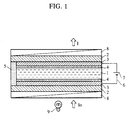
- Fig. 1 is schematic cross sectional view which illustrates an example of the liquid crystal device having the chiral smectic phase liquid crystal layer, in particular, a ferroelectric liquid crystal liquid crystal layer according to the present invention to describe the structure of the liquid crystal device.
- reference numeral 1 represents a liquid crystal layer
- 2 represents a glass substrate
- 3 represents a transparent electrode
- 4 represents an insulating orientation control layer
- 5 represents a spacer
- 6 represents a lead wire
- 7 represents a power source
- 8 represents a polarizing plate
- 9 represents a light source.
- the two glass plates 2 are coated with the transparent electrodes 3 made of thin films of In 2 O 3 , SnO 2 or ITO (Indium Tin Oxide). Then, polymer thin films, such as polyimide, are rubbed with gauze or acetate filling cloth or the like so that the insulating orientation control layer 4 is formed to orient the liquid crystal in the rubbing direction.
- the insulating orientation control layer 4 may be composed of two layers consisting of: an inorganic insulating layer, the insulating material of which is any of the following materials: a silicon nitride, a silicon carbide containing hydrogen, a silicon oxide, a boron nitride, a boron nitride containing hydrogen, a cerium oxide, an aluminum oxide, a zirconium oxide, a titanium oxide and magnesium fluoride; and a orientation control layer made of an organic insulating material, such as polyvinyl alcohol, polyimide, polyamideimide, polyester imide, polyparaxylene, polyester, polycarbonate, polyvinyl acetal, polyvinyl chloride, polyvinyl acetate, polyamide, polystyrene, cellulose resin, melamine resin, urea resin, acryl resin or photoresist resin.
- an inorganic insulating layer the insulating material of which is any of the following materials: a silicon nitride
- the insulating orientation control layer 4 may be formed solely by an insulating orientation control layer mainly composed of inorganic substances or an insulating orientation control layer mainly composed of organic substances. If the insulating orientation control layer is mainly made of inorganic substances, it can be formed by an evaporating method.
- the insulating orientation control layer can be formed by using a solution in which the organic insulating substances are dissolved or a solution of the precursor of the organic insulating substances (in a quantity of 0.1 wt% to 20 wt% of the solvent) and by hardening the material under a predetermined hardening condition (for example, with heat) by a spinner coating method, a dipping coating method, a screen printing method, a spray coating method or a roll coating method.
- a spinner coating method for example, a dipping coating method, a screen printing method, a spray coating method or a roll coating method.
- the thickness of the insulating orientation control layer 4 is usually 10 ⁇ to 1 ⁇ m, preferably 10 ⁇ to 3000 ⁇ , and most preferably 10 ⁇ to 1000 ⁇ .
- the two glass substrates 2 are positioned at arbitrary interval by the spacer 5.
- silica beads or alumina beads each having a predetermined diameter are used as the spacer 5 to be held between the two glass substrates 2.
- a sealing material for example, an epoxy bond is used to seal the peripheral portion.
- a polymer film or glass fiber may be used as the spacer. The foregoing chiral smectic liquid crystal composition is enclosed between the two glass substrates 2.
- the liquid crystal layer 1, in which the liquid crystal has been enclosed usually has a thickness of 0.5 ⁇ m to 20 ⁇ m, and preferably 1 ⁇ m to 5 ⁇ m.
- Fig. 1 is a transmissive type device
- the light source 9 is provided.
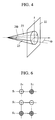
- Fig. 2 is a schematic view of the cell to explain the operation of the liquid crystal device.
- Reference numerals 21a and 21b represent substrates (glass plates) respectively coated with thin films made of In 2 O 3 , SnO 2 or ITO (Indium Tin Oxide). Liquid crystal of phase S*C or S*H oriented such that their liquid crystal molecule layers 22 are perpendicular to the surfaces of the glass plates 21a and 21b is enclosed between the substrates 21a and 21b.
- Bold lines 23 represent the liquid crystal molecules, the liquid crystal molecules 23 each having dipole moment (P ⁇ ) 24.
- voltage the threshold of which is larger than a predetermined value
- the spiral structures of the liquid crystal molecules 23 are untied.
- the direction of orientation of the liquid crystal molecules 23 can be changed such that all dipole moments (P ⁇ ) 24 face the direction of the electric field.
- the liquid crystal molecule 23 has an elongated shape in which its longer axial direction and a shorter axial direction have anisotropy of the refraction factor. Therefore, it can easily be understand that placing of polarizers crossed-Nicol each other on the upper and lower surfaces of the glass surface enables a liquid crystal optical modulating device to be constituted, the optical characteristic of which is changed based on the polarity of the applied voltage.
- the thickness of the liquid crystal cell for use preferably in the optical modulating device according to the present invention can be reduced satisfactorily (for example, 10 ⁇ m or thinner).
- the spiral structures of the liquid crystal molecules are untied as shown in Fig. 3 even if no electric field is applied.
- the dipole moment Pa or Pb is brought into an upward direction 34a or a downward direction 34b.
- an electric field Ea or Eb larger than a predetermined threshold is, as shown in Fig. 3, applied to a cell of the foregoing type by voltage applying means 31a and 31b, the dipole moments change their direction to the upward direction 34a or the downward direction 34b to correspond to the electric field vector.
- the liquid crystal molecules are oriented to a first stable state 33a or a second stable state 33b.
- the ferroelectric liquid crystal device as the optical modulating device enables two advantages as described above.
- the first advantage is that a very first response speed can be obtained.
- the second advantage is that the liquid crystal molecules have the bistability.
- the second advantage will now be described with reference to Fig. 3.
- Ea When the electric field Ea is applied, the direction of the liquid crystal molecules are changed so as to be oriented into the second stable state 33b. Even if the electric field is turned off, the liquid crystal molecules are maintained at the foregoing state. If the applied electric field Ea or Eb does not exceed a predetermined threshold, the previous state of orientation is maintained.
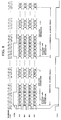
- Fig. 5 illustrates operation waveforms according to the present invention.
- symbols S S represent selected scanning waveforms to be applied to selected scanning lines
- S N represent non-selected scanning waveforms to be applied to non-selected scanning lines
- I S represent selected information waveform (black) to be applied to selected data lines
- I N represent non-selected information signal (white) to be applied to non-selected data lines.
- (I S - S S ) and (I N - S S ) represent voltage waveforms to be applied to pixels on the selected scanning lines. Pixels applied with voltage (I S -S S ) are brought into a black display state, while pixels applied with voltage (I N - S S ) are brought into a white display state.
- Fig. 5 (B) illustrates time-sequential waveforms realized when display shown in Fig. 6 is performed with the operation waveforms shown in Fig. 5 (A).
- shortest applying time ⁇ t in which the pixel on the selected scanning line is applied with monopole voltage, corresponds to the time of writing phase t 2 .
- the time t 1 for clearing one line is set to 2 ⁇ t.
- the raise of the bias ratio causes the amplitude of the information signal to be widened and thus the image quality deteriorates such that flickers take place and the contrast is lowered.
- Investigations performed by the inventors of the present invention resulted in that the practical bias ratio is 1/3 to 1/4.
- the liquid crystal device according to the present invention may be adequately combined with another device or a circuit to constitute a variety of liquid crystal devices.
- the liquid crystal device according to the present invention is used in a display panel portion and a communication synchronizing means is provided so that a liquid crystal display apparatus is realized, the communication synchronizing means being adapted to a data format composed of image information having the scanning address information shown in Figs. 7 and 8 and a SYNC signal.
- reference numeral 101 represents a liquid crystal display apparatus
- 102 represents a graphic controller
- 103 represents a display panel
- 104 represents a scanning line operating circuit
- 105 represents an information line operating circuit
- 106 represents a decoder
- 107 represents a scanning signal generating circuit
- 108 represents a shift register
- 109 represents a line memory
- 110 represents an information signal generating circuit
- 111 represents an operation control circuit
- 112 represents a GCPU
- 113 represents a host CPU
- 114 represents a VRAM.
- Image information is generated by the graphic controller 102 provided for the apparatus body, the image information being transferred to the display panel 103 by a signal transferring means shown in Figs. 7 and 8.
- the graphic controller 102 controls image information and communication between the host CPU 113 and the liquid crystal display apparatus 101 depending upon the CPU (central processing unit, hereinafter abbreviated to a "GCPU 112") and the VARM (an image information storage memory) 114.
- the control method according to the present invention is realized mainly on the graphic controller 102. Note that a light source is disposed on the reverse side of the display panel 103.
- the extracted solution was dried with anhydrous sodium sulfate and the solvent was removed by filtration so that 1.49 g of rough acetic acid 2- ⁇ 4- (5-decylpyrimidine-2-yl) phenyl ⁇ ethyl was obtained.
- the extracted solution was dried with anhydrous sodium sulfate and the solvent was removed by filtration so that 1.49 g of rough acetic acid 2- ⁇ 4- (5-decylpyrimidine-2-yl) phenyl ⁇ ethyl was obtained.
- the extracted solution was dried with anhydrous sodium sulfate, and then the solvent was removed by filtration so that 12.5 g of rough acetic acid 2- ⁇ 4-(5-decyloxypyrimidine-2-yl) phenyl ⁇ ethyl was obtained.
- Example Compound No. 5 prepared in Example 2 were mixed with the following parts by weight so that liquid crystal composition A was prepared.
- C 6 H 13 -Py2-Ph-OC 12 H 25 4.2 C 8 H 17 -Py2-Ph-OC 9 H 19 8.4 C 8 H 17 -Py2-Ph-OC 10 H 21 8.4 C 9 H 19 -Py2-Ph-OC 8 H 17 4.2 C 10 H 21 O-Ph-COO-Ph-OCH 2 CH(CH 3 )C 2 H 5 27.5
- the phase transition temperature of the liquid crystal composition A is as follows:
- Two glass plates each having a thickness of 0.7 mm were prepared, and an ITO film was formed on the glass plate so that an electrode, to which voltage was applied, was formed. Then, SiO 2 was evaporated on the ITO film so that an insulating layer was formed. Then, isopropyl alcohol solution containing silane coupling material (KBM-602 manufactured by Shinetsu Kagaku) by 0.2% was applied for 15 seconds by a spinner rotating at a rotational speed of 2000 rpm so that surface treatment was performed. Then, heating and drying were performed at 120°C for 20 minutes.
- silane coupling material KBM-602 manufactured by Shinetsu Kagaku
- the glass plates with the ITO films, further subjected to surface treatment were, for 15 seconds, applied with dimethyl acetoamide solution containing polyimide resin precursor (SP-510 manufactured by Toray) by 1.5 % by a spinner rotating at a rotational speed of 2000 rpm. After a desired film had been formed, heat shrinkage baking process was performed at 300°C for 60 minutes. Thus, a film having a thickness of about 250 ⁇ was applied.
- the baked film was subjected to a rubbing process using acetate filling, and then it was cleaned with isopropyl alcohol solution. Then, silica beads having an average diameter of 2 ⁇ m were placed on one of the glass plates in such a manner that the axes of the rubbing processes run parallel to one another. Then, an adhesive sealant ("LiqussoBond" manufactured by Chisso) was used to bond the glass plates to each other. Then, the glass plates were heated to 100°C for 60 minutes so that a cell was manufactured. Then, the liquid crystal composition B mixed in Example 10 was, in an isotropic fluid state, injected into the cell.
- LiqussoBond manufactured by Chisso
- the cell was gradually cooled from the anisotropic phase to 25°C at a rate of 20°C/hour so that a liquid crystal device (ferroelectric liquid crystal device) was manufactured.
- the thickness of the cell was measured by a Berek phase plate, resulting in about 2 ⁇ m.
- the thus-manufactured liquid crystal device was used to measure the intensity of the spontaneous polarization. The results are as follows: 10°C 30°C 40°C Spontaneous Polarization 11.6 nc/cm 2 8.7 nc/cm 2 5.8 nc/cm 2
- Example Compound No. 47 manufactured in Example 3 was used in place of the Example Compound No. 5 so that liquid crystal composition B was prepared.
- the phase transition temperature of the liquid crystal composition B was as follows:
- a ferroelectric liquid crystal liquid crystal device was manufactured by the same method as that of Example 26 except liquid crystal composition B being injected into the cell so that the spontaneous polarization was measured. The results are were as follows: 10°C 30°C 40°C Spontaneous Polarization 7.8 nc/cm 2 5.5 nc/cm 2 4.5 nc/cm 2
- Example Compound No. 19 manufactured in Example 4 was used in place of the Example Compound No. 5 according to Example 25 so that liquid crystal composition C was prepared.
- the phase transition temperature of the liquid crystal composition C was as follows:
- a ferroelectric liquid crystal liquid crystal device was manufactured by the same method as that of Example 11 except liquid crystal composition C being injected into the cell so that the spontaneous polarization was measured. The results are were as follows: 10°C 30°C 40°C Spontaneous Polarization 15.2 nc/cm 2 12.2 nc/cm 2 10.1 nc/cm 2
- Example Compound No. 257 manufactured in Example 6 was used in place of the Example Compound No. 5 according to Example 25 so that liquid crystal composition D was prepared.
- the phase transition temperature of the liquid crystal composition D was as follows:
- a ferroelectric liquid crystal liquid crystal device was manufactured by the same method as that of Example 11 except liquid crystal composition D being injected into the cell so that the spontaneous polarization was measured.
- the results are were as follows: 10°C 30°C 40°C Spontaneous Polarization 9.0 nc/cm 2 7.1 nc/cm 2 5.0 nc/cm 2
- Example Compound No. 229 manufactured in Example 8 was used in place of the Example Compound No. 5 according to Example 25 so that liquid crystal composition E was prepared.
- the phase transition temperature of the liquid crystal composition E was as follows:
- a ferroelectric liquid crystal liquid crystal device was manufactured by the same method as that of Example 11 except liquid crystal composition E being injected into the cell so that the spontaneous polarization was measured. The results are were as follows: 10°C 30°C 40°C Spontaneous Polarization 14.5 nc/cm 2 11.5 nc/cm 2 9.1 nc/cm 2
- optically active compound according to the present invention As can be understood from Examples 25 to 30, addition of the optically active compound according to the present invention to another liquid crystal compound in a small quantity will enable a liquid crystal composition having a large spontaneous polarization to be manufactured. Thus, it can be understood that the optically active compound according to the present invention has great performance for attaining the spontaneous polarization.
- Example Compound No. Constitutional Formula Parts by weight 15 C 13 H 27 -Py2-Ph-(CH 2 ) 2 -L1-C 5 H 11 2 51 C 12 H 25 -Btb2-Ph-(CH 2 ) 2 -L1-C 6 H 13 1 83 C 4 H 9 -Ph-Tn-(CH 2 ) 2 -L1-C 7 H 15 2 F 95
- a liquid crystal device was manufactured by the same method as that of Example 11 except liquid crystal composition G being injected into the cell.
- a peak-to-peak voltage Vpp 20 V was applied to detect optical response (change in the transmitted light quantity 0 to 90%) under crossed-Nicol so that the response speed (hereinafter called "optical response speed") was measured.
- the results were as follows: 10°C 25°C 40°C Response Speed 391 ⁇ sec 209 ⁇ sec 113 ⁇ sec
- a liquid crystal device was manufactured by the same method as that of Example 26 except liquid crystal composition F being injected into the cell.
- the optical response speed was measured by the same method as that of Example 16. The results were as follows: 10°C 25°C 40°C Response Speed 668 ⁇ sec 340 ⁇ sec 182 ⁇ sec
- a liquid crystal device was manufactured by the same method as that of Example 26 except liquid crystal composition H being injected into the cell.
- the optical response speed was measured by the same method as that of Example 31, and the switching state was observed.
- the uniformity of orientation in the liquid crystal device was excellent such that monodomain state was obtained.
- the results were as follows; 10°C 25°C 40°C Response Speed 413 ⁇ sec 220 ⁇ sec 121 ⁇ sec
- a liquid crystal device was manufactured by the same method as that of Example 26 except liquid crystal composition H being injected into the cell.
- the optical response speed was measured by the same method as that of Example 31, and the switching state was observed.
- the uniformity of orientation in the liquid crystal device was excellent such that monodomain state was obtained.
- the results were as follows; 10°C 25°C 40°C Response Speed 435 ⁇ sec 230 ⁇ sec 127 ⁇ sec
- a liquid crystal device was manufactured by the same method as that of Example 26 except liquid crystal composition J being injected into the cell.
- the optical response speed was measured by the same method as that of Example 31, and the switching state was observed.
- the uniformity of orientation in the liquid crystal device was excellent such that monodomain state was obtained.
- the results were as follows; 10°C 25°C 40°C Response Speed 451 ⁇ sec 244 ⁇ sec 135 ⁇ sec
- Example Compound No. Constitutional Formula Parts by Weight 236 C 10 H 21 -Pd-Ph-(CH 2 ) 2 -L1-Ph-OCH 3 1 256 C 11 H 23 -ID1-Ph-(CH 2 ) 4 -L2-Ph-H 2 299 C 11 H 23 -Ph-Np-(CH 2 ) 2 -L1-Ph-C 6 H 13 2 F 95
- a liquid crystal device was manufactured by the same method as that of Example 26 except liquid crystal composition K being injected into the cell.
- the optical response speed was measured by the same method as that of Example 31, and the switching state was observed.
- the uniformity of orientation in the liquid crystal device was excellent such that monodomain state was obtained.
- the results were as follows; 10°C 25°C 40°C Response Speed 430 ⁇ sec 231 ⁇ sec 128 ⁇ sec
- a liquid crystal device was manufactured by the same method as that of Example 26 except liquid crystal composition M being injected into the cell.
- the optical response speed was measured by the same method as that of Example 31, and the switching state was observed.
- the uniformity of orientation in the liquid crystal device was excellent such that monodomain state was obtained.
- the results were as follows; 10°C 25°C 40°C Response Speed 451 ⁇ sec 230 ⁇ sec 129 ⁇ sec
- a liquid crystal device was manufactured by the same method as that of Example 26 except liquid crystal composition L being injected into the cell.
- the optical response speed was measured by the same method as that of Example 31, and the switching state was observed. The results were as follows; 10°C 25°C 40°C Response Speed 784 ⁇ sec 373 ⁇ sec 197 ⁇ sec
- a liquid crystal device was manufactured by the same method as that of Example 26 except liquid crystal composition N being injected into the cell.
- the optical response speed was measured by the same method as that of Example 31, and the switching state was observed.
- the uniformity of orientation in the liquid crystal device was excellent such that monodomain state was obtained.
- the results were as follows; 10°C 25°C 40°C Response Speed 431 ⁇ sec 215 ⁇ sec 119 ⁇ sec
- a liquid crystal device was manufactured by the same method as that of Example 26 except liquid crystal composition O being injected into the cell.
- the optical response speed was measured by the same method as that of Example 31, and the switching state was observed.
- the uniformity of orientation in the liquid crystal device was excellent such that monodomain state was obtained.
- the results were as follows; 10°C 25°C 40°C Response Speed 510 ⁇ sec 263 ⁇ sec 150 ⁇ sec
- Example Compound No. Constitutional Formula Parts by Weight 331 C 6 H 13 O-Py2-Ph-(CH 2 ) 4 -L2-C 8 H 17 2 374 C 5 H 11 -Ha2-Ph-(CH 2 ) 5 -L2-C 11 H 23 2 407 C 6 H 13 -Ph-Ep1-(CH 2 ) 4 -L2-C 6 H 13 2 L 94
- a liquid crystal device was manufactured by the same method as that of Example 26 except liquid crystal composition P being injected into the cell.
- the optical response speed was measured by the same method as that of Example 31, and the switching state was observed.
- the uniformity of orientation in the liquid crystal device was excellent such that monodomain state was obtained.
- the results were as follows; 10°C 25°C 40°C Response Speed 486 ⁇ sec 253 ⁇ sec 145 ⁇ sec
- Example Compound No. Constitutional Formula Parts by Weight 310 C 10 H 21 -Py2-Ph-(CH 2 ) 2 -LM1-C 7 H 15 1 456 C 6 F 13 CH 2 O-Py2-Ph-(CH 2 ) 2 -L1-C 6 H 13 2 483 C 10 H 21 O-Py2-Ph-(CH 2 ) 2 -L1-C 6 H 13 2 L 95
- a liquid crystal device was manufactured by the same method as that of Example 26 except liquid crystal composition Q being injected into the cell.
- the optical response speed was measured by the same method as that of Example 31, and the switching state was observed.
- the uniformity of orientation in the liquid crystal device was excellent such that monodomain state was obtained.
- the results were as follows; 10°C 25°C 40°C Response Speed 440 ⁇ sec 224 ⁇ sec 128 ⁇ sec
- Example Compound No. Constitutional Formula Parts by Weight 1 C 6 H 13 -Ph-(CH 2 ) 2 -L1-C 8 H 17 2 25 C 5 H 11 -Pa-Ph-(CH 2 ) 2 -L1-C 8 H 17 2 34 C 6 H 13 -Boa2-Ph-(CH 2 ) 2 -L1-C 10 H 21 2 L 94
- a liquid crystal device was manufactured by the same method as that of Example 26 except liquid crystal composition S being injected into the cell.
- the optical response speed was measured by the same method as that of Example 31, and the switching state was observed.
- the uniformity of orientation in the liquid crystal device was excellent such that monodomain state was obtained.
- the results were as follows; 10°C 25°C 40°C Response Speed 372 ⁇ sec 195 ⁇ sec 106 ⁇ sec
- a liquid crystal device was manufactured by the same method as that according to Example 26, except liquid crystal composition R mixed in the composition according to Example 24 being injected into the cell.
- the optical response speed was measured by the same method as that according to Example 31. The results were as follows. 10°C 25°C 40°C Response Speed 653 ⁇ sec 317 ⁇ sec 159 ⁇ sec
- a liquid crystal device was manufactured by the same method as that of Example 26 except liquid crystal composition T being injected into the cell.
- the optical response speed was measured by the same method as that of Example 31, and the switching state was observed.
- the uniformity of orientation in the liquid crystal device was excellent such that monodomain state was obtained.
- the results were as follows; 10°C 25°C 40°C Response Speed 411 ⁇ sec 217 ⁇ sec 118 ⁇ sec
- Example Compound No. Constitutional Formula Parts by Weight 18 C 5 H 11 O-Py2-Ph23F-(CH 2 ) 2 -L1-C 4 H 9 2 72 C 6 H 13 -Ph-Py1-(CH 2 ) 2 -L1-C 6 H 13 2 93 C 9 H 19 O-Gp1-(CH 2 ) 2 -L1-C 8 H 17 2 R 94
- a liquid crystal device was manufactured by the same method as that of Example 26 except liquid crystal composition U being injected into the cell.
- the optical response speed was measured by the same method as that of Example 31, and the switching state was observed.
- the uniformity of orientation in the liquid crystal device was excellent such that monodomain state was obtained.
- the results were as follows; 10°C 25°C 40°C Response Speed 366 ⁇ sec 191 ⁇ sec 104 ⁇ sec
- a liquid crystal device was manufactured by the same method as that of Example 26 except liquid crystal composition V being injected into the cell.
- the optical response speed was measured by the same method as that of Example 31, and the switching state was observed.
- the uniformity of orientation in the liquid crystal device was excellent such that monodomain state was obtained.
- the results were as follows; 10°C 25°C 40°C Response Speed 450 ⁇ sec 237 ⁇ sec 130 ⁇ sec
- a liquid crystal device was manufactured by the same method as that of Example 26 except liquid crystal composition W being injected into the cell.
- the optical response speed was measured by the same method as that of Example 31, and the switching state was observed.
- the uniformity of orientation in the liquid crystal device was excellent such that monodomain state was obtained.
- the results were as follows; 10°C 25°C 40°C Response Speed 400 ⁇ sec 212 ⁇ sec 116 ⁇ sec
- the liquid crystal devices having the liquid crystal compositions G to K, M to Q and S to W according to the present invention between substrates thereof are able to improve the operation characteristic and high speed response at low temperatures. Also the temperature dependency of the optical response speed can be reduced.
- a liquid crystal device was manufactured by the same method as that of Example 26 except that 2% water solution of polyvinyl alcohol resin (PUA-117 manufactured by Kurare) in place of dimethylacetoamide solution containing polyimide resin precursor by 1.5 % according to Example 26.
- the optical response speed was measured by the same method as that according to Example 31. The results were as follows: 10°C 25°C 40°C Response Speed 378 ⁇ sec 202 ⁇ sec 109 ⁇ sec
- a liquid crystal device was manufactured by the same method as that of Example 26 except that the orientation control layer was formed only by polyimide resin in such a manner that SiO2 according to Example 26 was not used.
- the optical response speed was measured by the same method as that according to Example 31. The results were as follows: 10°C 25°C 40°C Response Speed 350 ⁇ sec 188 ⁇ sec 101 ⁇ sec
- the liquid crystal devices respectively having the liquid crystal compositions according to the present invention are able to improve the operation characteristic and the temperature dependency of the optical response speed can be reduced even if the structure of the device, such as the orientation control film, is changed.
- liquid crystal compositions were used in the following procedure to manufacture cells, the optical response of which was observed.
- Two glass plates each having a thickness of 0.7 mm were prepared, and an ITO film was formed on the glass plate so that an electrode, to which voltage was applied, was formed. Then, SiO 2 was evaporated on the ITO film so that an insulating layer was formed. Then, isopropyl alcohol solution containing silane coupling material (KBM-602 manufactured by Shinetsu Kagaku) by 0.2% was applied for 15 seconds by a spinner rotating at a rotational speed of 2000 rpm so that surface treatment was performed. Then, heating and drying were performed at 120°C for 20 minutes.
- silane coupling material KBM-602 manufactured by Shinetsu Kagaku
- the glass plates with the ITO films were, for 15 seconds, applied with dimethyl acetoamide solution containing polyimide resin precursor (SP-510 manufactured by Toray) by 1.0 % by a spinner rotating at a rotational speed of 3000 rpm.
- heat shrinkage baking process was performed at 300°C for 60 minutes.
- a film having a thickness of about 120 ⁇ was applied.
- the baked film was subjected to a rubbing process using acetate filling, and then it was cleaned with isopropyl alcohol solution. Then, silica beads having an average diameter of 1.5 ⁇ m were placed on one of the glass plates in such a manner that the axes of the rubbing processes run parallel to one another. Then, an adhesive sealant ("LiqussoBond" manufactured by Chisso) was used to bond the glass plates to each other. Then, the glass plates were heated to 100°C for 60 minutes so that a cell was manufactured. The thickness of the cell was measured by a Berek phase plate, resulting in about 1.5 ⁇ m. Then, the liquid crystal composition XA was, in an isotropic fluid state, injected into the cell.
- the cell was gradually cooled from the anisotropic phase to 25°C at a rate of 20°C/hour so that a liquid crystal device (ferroelectric liquid crystal device) was manufactured.
- the liquid crystal device was used to measure the contrast at 30°C with the operating waveform (1/3 bias ratio) shown in Fig. 5, resulting in 15.1.
- a liquid crystal device was manufactured by the same method as that of Example 33 except liquid crystal composition X mixed in Example 33 being injected into the cell. By using similar operation waveforms, the contrast at the time of the operation at 30°C was measured. The resulted contrast was 8.1.
- a liquid crystal device was manufactured by the same method as that of Example 48 except the foregoing composition being used. By using similar operation waveforms to those in Example 48, the contrast at the time of the operation at 30°C was measured. The resulted contrast was 17.3.
- Example Compound No. Constitutional Formula Parts by Weight 44 C 8 H 17 -Io1-Ph-(CH 2 ) 2 -L1-C 6 H 13 1 86 C 6 H 13 -Ph2F-Td-(CH 2 ) 2 -L1-(CH 2 ) 3 CH(CH 3 )C 6 H 13 2 102 C 5 H 11 -Ph-Ph3F-Tz1-(CH 2 ) 2 -L1-C 3 H 7 2 X 95
- a liquid crystal device was manufactured by the same method as that of Example 48 except the foregoing composition being used. By using similar operation waveforms to those in Example 48, the contrast at the time of the operation at 30°C was measured. The resulted contrast was 17.7.
- Example Compound No. Constitutional Formula Parts by Weight 6 C 7 H 15 O-Ph-Ph23F-(CH 2 ) 2 -L1-C 6 H 13 1 59 C 5 H 11 -Ha2-Ph-(CH 2 ) 2 -L1-C 11 H 23 2 95 C 3 H 7 COO-Ph-Gp1-(CH 2 ) 2 -L1-C 11 H 23 2 X 95
- a liquid crystal device was manufactured by the same method as that of Example 48 except the foregoing composition being used. By using similar operation waveforms to those in Example 48, the contrast at the time of the operation at 30°C was measured. The resulted contrast was 21.2.
- a liquid crystal device was manufactured by the same method as that of Example 48 except the foregoing composition being used. By using similar operation waveforms to those in Example 48, the contrast at the time of the operation at 30°C was measured. The resulted contrast was 19.0.
- a liquid crystal device was manufactured by the same method as that of Example 33 except the foregoing composition being used. By using similar operation waveforms to those in Example 48, the contrast at the time of the operation at 30°C was measured. The resulted contrast was 18.2.
- Example Compound No. Constitutional Formula Parts by Weight 326 C 10 H 21 -Pr2-Ph-(CH 2 ) 6 -L2-C 4 H 9 2 460 C 10 F 21 CH 2 O-Py2-Ph-(CH 2 ) 2 -L1-C 6 H 13 2 464 C 6 F 13 CH 2 O-Ph-Ph-(CH 2 ) 8 -L2-C 6 H 13 1 X 95
- a liquid crystal device was manufactured by the same method as that of Example 48 except the foregoing composition being used. By using similar operation waveforms to those in Example 48, the contrast at the time of the operation at 30°C was measured. The resulted contrast was 23.1.
- the liquid crystal device including any of the liquid crystal compositions XA, XB, XC, XD, XE, XF and XG had intense contrast at the time of the operation.
- a liquid crystal device was manufactured by the same method as that of Example 48 except the foregoing composition being used. By using similar operation waveforms to those in Example 48, the contrast at the time of the operation at 30°C was measured. The resulted contrast was 16.3.
- a liquid crystal device was manufactured by the same method as that of Example 48 except the foregoing composition being used. By using similar operation waveforms to those in Example 48, the contrast at the time of the operation at 30°C was measured. The resulted contrast was 10.4.
- Compound B was mixed with the following parts by weight in place of the example compound of the composition according to Example 48 so that liquid crystal composition XJ was prepared.
- Constitutional Formula Parts by Weight trans ⁇ C 10 H 21 -Py2-Ph-OCH 2 -L2-C 6 H 13 5 X 95
- a ferroelectric liquid crystal device was manufactured by the same method as that of Example 48 except the foregoing composition being used. By using similar operation waveforms to those in Example 48, the contrast at the time of the operation at 30°C was measured. The resulted contrast was 9.2.
- the liquid crystal device containing liquid crystal composition H according to the present invention exhibited greatly intense contrast at the time of the operation as compared with the liquid crystal device containing liquid crystal composition XI and XJ including compound A or B.
- a liquid crystal device was manufactured by the same method as that of Example 48 except 2% water solution of polyvinyl alcohol resin (PVA-117 manufactured by Kurare) being used in place of dimethylacetoamide solution of polyimide resin precursor by 1.0% according to Example 48.
- PVA-117 polyvinyl alcohol resin
- the contrast at the time of the operation at 30°C was measured. The resulted contrast was 16.1.
- a liquid crystal device was manufactured by the same method as that of Example 48 except the orientation control layer being formed by only polyimide resin without SiO2 employed in Example 48.
- the contrast at the time of the operation at 30°C was measured. The resulted contrast was 14.5.
- a ferroelectric liquid crystal device was manufactured by the same method as that of Example 48 except 1% NMP solution of polyamide acid (LQ1802 manufactured by Hitachi Kasei) being baked at 270°C for one hour in place of dimethyl acetoamide solution of polyimide precursor by 1.0% employed in Example 48.
- NMP solution of polyamide acid LQ1802 manufactured by Hitachi Kasei
- the contrast at the time of the operation at 30°C was measured. The resulted contrast was 28.1.
- the liquid crystal device according to the present invention having the liquid crystal composition disposed between substrates enables intense contrast similar to the device according to Example 48. Even if the operation waveform is changed, the detailed investigation resulted in that the liquid crystal device having the liquid crystal composition (ferroelectric liquid crystal composition) according to the present invention enables intense contrast to be obtained.
- the liquid crystal composition containing the optically active compound according to the present invention can be operated by making using of the ferroelectric characteristic of the liquid crystal composition.
- the liquid crystal device according to the present invention using the characteristic of the liquid crystal composition has excellent switching characteristic, high-speed response, capability of reducing in dependency of the optical response speed upon the temperature, and intense contrast.
- a display apparatus comprising the liquid crystal device according to the present invention with a light source, an operating circuit and the like as a display device is an excellent apparatus.
Landscapes
- Chemical & Material Sciences (AREA)
- Organic Chemistry (AREA)
- Crystallography & Structural Chemistry (AREA)
- Engineering & Computer Science (AREA)
- Materials Engineering (AREA)
- Liquid Crystal Substances (AREA)
- Plural Heterocyclic Compounds (AREA)
- Furan Compounds (AREA)
Claims (29)
- Optisch aktive Verbindung mit einer Struktur, die durch die folgende allgemeine Formel (I) wiedergegeben wird:worin R
 und R
 jeweils H, F, CN oder geradkettige, verzweigte oder cyclische Alkylgruppen [wobei ein oder mehr als ein -CH2- in der Alkylgruppe unter der Bedingung durch -O-, -S-, -CO-, -CH(CN)-, -CH=CH- oder -C≡C- ersetzt sein kann, dass Heteroatome einander nicht benachbart sind, und das Wasserstoffatom in der Alkylgruppe durch ein Fluoratom ersetzt sein kann] mit 1 bis 30 Kohlenstoffatomen bezeichnen, A
 eine Gruppe bezeichnet, die aus der Gruppe ausgewählt ist, die aus 1,4-Phenylen, Pyridin-2,5-diyl, Pyrimidin-2,5-diyl, Pyrazin-2,5-diyl, Pyridazin-3,6-diyl, 1,4-Cyclohexylen, 1,3-Dioxan-2,5-diyl, 1,3-Dithian-2,5-diyl, Thiophen-2,5-diyl, Thiazol-2,5-diyl, Thiadiazol-2,5-diyl, Benzoxazol-2,5-diyl, Benzoxazol-2,6-diyl, Benzothiazol-2,5-diyl, Benzothiazol-2,6-diyl, Benzofuran-2,5-diyl, Benzofuran-2,6-diyl, Chinoxalin-2,6-diyl, Chinolin-2,6-diyl, 2,6-Naphthylen, Indan-2,5-diyl, 2-Alkylindan-2,5-diyl (wobei die Alkylgruppe eine geradkettige oder verzweigte Alkylgruppe mit 1 bis 18 Kohlenstoffatomen ist), Indanon-2,6-diyl, 2-Alkylindan-2,6-diyl (wobei die Alkylgruppe eine geradkettige oder verzweigte Alkylgruppe mit 1 bis 18 Kohlenstoffatomen ist), Cumaran-2,5-diyl und 2-Alkylcumaran-2,5-diyl (wobei die Alkylgruppe eine geradkettige oder verzweigte Alkylgruppe mit 1 bis 18 Kohlenstoffatomen ist) besteht, von denen jede durch mindestens einen Substituenten substituiert sein kann, der aus der Gruppe ausgewählt ist, die aus F, Cl, Br, CH3, CF3 und CN besteht, A


- Optisch aktive Verbindung nach Anspruch 1, wobei die erwähnte optisch aktive Verbindung, die durch die allgemeine Formel (I) wiedergegeben wird, irgendeine der Verbindungen in (Ia) bis (Id) ist:(Ia) eine optisch aktive Verbindung, in der A
- Optisch aktive Verbindung nach Anspruch 1, wobei die erwähnte optisch aktive Verbindung, die durch die allgemeine Formel (I) wiedergegeben wird, irgendeine der Verbindungen in (Iaa) bis (Idb) ist:(Iaa) eine optisch aktive Verbindung, in der A
- Optisch aktive Verbindung nach Anspruch 1, bei der R
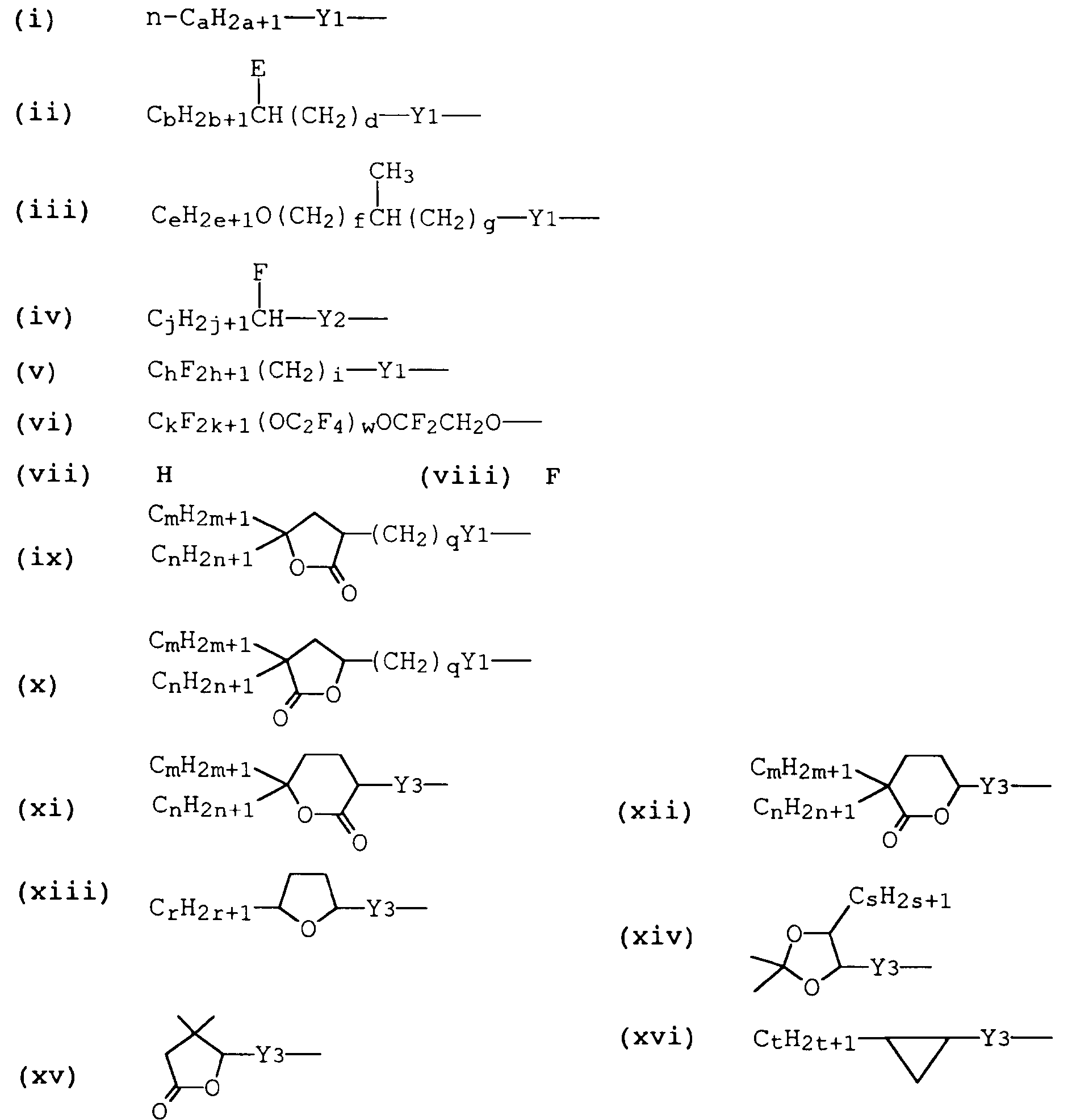
- Optisch aktive Verbindung nach Anspruch 1, bei der p der erwähnten optisch aktiven Verbindung, die durch die allgemeine Formel (I) wiedergegeben wird, eine ganze Zahl von 2 bis 12 bezeichnet.
- Optisch aktive Verbindung nach Anspruch 1, bei der p der erwähnten optisch aktiven Verbindung, die durch die allgemeine Formel (I) wiedergegeben wird, 2, 4, 6 oder 8 bezeichnet.
- Optisch aktive Verbindung nach Anspruch 1, bei der p der erwähnten optisch aktiven Verbindung, die durch die allgemeine Formel (I) wiedergegeben wird, 3, 5, 7 oder 9 bezeichnet.
- Optisch aktive Verbindung mit einer Struktur, die durch die folgende allgemeine Formel (I') wiedergegeben wird:worin R

- Optisch aktive Verbindung nach Anspruch 8, wobei die erwähnte optisch aktive Verbindung, die durch die allgemeine Formel (I') wiedergegeben wird, irgendeines der Materialien in (Ia') oder (Ib') ist:(Ia') eine optisch aktive Verbindung, in der A
- Optisch aktive Verbindung nach Anspruch 8, wobei die erwähnte optisch aktive Verbindung, die durch die allgemeine Formel (I') wiedergegeben wird, irgendeines der Materialien in (Iaa') bis (Ibb') ist:(Iaa') eine optisch aktive Verbindung, in der A
- Optisch aktive Verbindung nach Anspruch 8, bei der R
 worin a' eine ganze Zahl von 1 bis 16 bezeichnet, d', g' und i' jeweils ganze Zahlen von 0 bis 7 bezeichnen, b', e', h' und j' jeweils ganze Zahlen von 1 bis 10 bezeichnen, f' 0 oder 1 bezeichnet, wobei
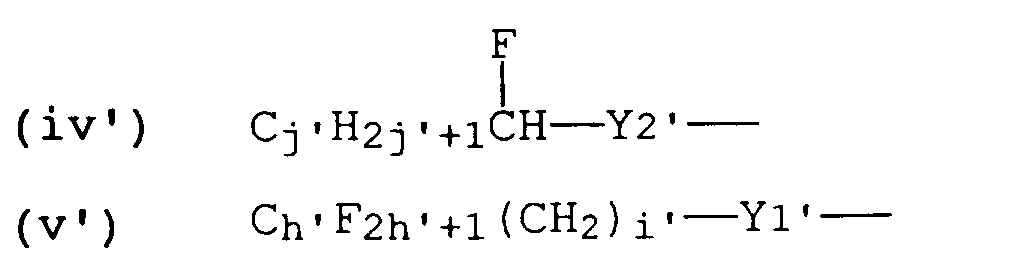
- Optisch aktive Verbindung mit einer Struktur, die durch die folgende allgemeine Formel (II) wiedergegeben wird:worin p' eine ganze Zahl von 0 bis 18 bezeichnet, L' optisch aktives 4-Butanolid-2,4-dyl bezeichnet und R

- Optisch aktive Verbindung nach Anspruch 12, bei der R
- Optisch aktive Verbindung nach Anspruch 12, bei der R
- Optisch aktive Verbindung nach Anspruch 12, bei der p' eine ganze Zahl von 0 bis 4 ist.
- Flüssigkristallmischung, die eine oder mehr als eine Art der erwähnten optisch aktiven Verbindungen nach einem der Ansprüche 1 bis 15 enthält.
- Flüssigkristallmischung nach Anspruch 16, in der die erwähnte optisch aktive Verbindung in einer Menge von 1 Masse% bis 80 Masse% enthalten ist.
- Flüssigkristallmischung nach Anspruch 16, in der die erwähnte optisch aktive Verbindung in einer Menge von 1 Masse% bis 60 Masse% enthalten ist.
- Flüssigkristallmischung nach Anspruch 16, in der die erwähnte optisch aktive Verbindung in einer Menge von 1 Masse% bis 40 Masse% enthalten ist.
- Flüssigkristallmischung nach Anspruch 16, wobei die erwähnte Flüssigkristallmischung eine chirale smektische Phase hat.
- Flüssigkristallmischung nach Anspruch 16, die zwei oder mehr Arten der erwähnten optisch aktiven Verbindungen enthält.
- Flüssigkristallvorrichtung, die die erwähnte Flüssigkristallmischung nach Anspruch 16 umfasst, die zwischen einem Paar Elektrodensubstraten angeordnet ist.
- Flüssigkristallvorrichtung nach Anspruch 22, bei der ferner auf dem erwähnten Elektrodensubstrat eine Orientierungssteuerungsschicht gebildet ist.
- Flüssigkristallvorrichtung nach Anspruch 22, bei der die erwähnte Orientierungssteuerungsschicht eine Schicht ist, die einer Reibbehandlung unterzogen worden ist.
- Flüssigkristallvorrichtung nach Anspruch 22, bei der die Elektrodenplatten des erwähnten Paares mit einer Zwischenraumdicke angeordnet sind, die realisiert wird, wenn Spiralen von Flüssigkristallmolekülen gelöst bzw. aufgedreht werden.
- Flüssigkristallgerät, das die erwähnte Flüssigkristallvorrichtung nach Anspruch 22 und eine Schaltung für den Betrieb der erwähnten Flüssigkristallvorrichtung umfasst.
- Flüssigkristallgerät nach Anspruch 26, bei dem die erwähnte Flüssigkristallvorrichtung als Anzeigevorrichtung angewendet wird.
- Flüssigkristallgerät nach Anspruch 27, das ferner eine Lichtquelle umfasst.
- Anzeigeverfahren, das den Schritt der Steuerung der erwähnten Flüssigkristallmischung nach Anspruch 16 zur Anzeige von Daten umfasst.
Applications Claiming Priority (9)
| Application Number | Priority Date | Filing Date | Title |
|---|---|---|---|
| JP14119/94 | 1994-01-13 | ||
| JP1411994 | 1994-01-13 | ||
| JP1411994 | 1994-01-13 | ||
| JP11959794 | 1994-05-09 | ||
| JP119597/94 | 1994-05-09 | ||
| JP11959794 | 1994-05-09 | ||
| JP337062/94 | 1994-12-27 | ||
| JP33706294 | 1994-12-27 | ||
| JP6337062A JP3062988B2 (ja) | 1994-01-13 | 1994-12-27 | 光学活性化合物、これを含有する液晶組成物、これを用いた液晶素子、表示方法、液晶装置 |
Publications (2)
| Publication Number | Publication Date |
|---|---|
| EP0666262A1 EP0666262A1 (de) | 1995-08-09 |
| EP0666262B1 true EP0666262B1 (de) | 2000-08-30 |
Family
ID=27280535
Family Applications (1)
| Application Number | Title | Priority Date | Filing Date |
|---|---|---|---|
| EP95100358A Expired - Lifetime EP0666262B1 (de) | 1994-01-13 | 1995-01-12 | Optisch aktive Verbindung, Flüssigkristall das sie enthält, Flüssigkristallanzeigevorrichtung und Verfahren die sie verwendet |
Country Status (4)
| Country | Link |
|---|---|
| US (1) | US5849217A (de) |
| EP (1) | EP0666262B1 (de) |
| JP (1) | JP3062988B2 (de) |
| DE (1) | DE69518554T2 (de) |
Families Citing this family (8)
| Publication number | Priority date | Publication date | Assignee | Title |
|---|---|---|---|---|
| EP0678509B1 (de) * | 1994-03-25 | 2001-10-04 | Canon Kabushiki Kaisha | Mesomorphische Verbindung, Flüssigkristallzusammensetzung die sie enthält, Flüssigkristallvorrichtung, -apparat und Anzeigevorrichtung diese Zusammensetzung verwendend |
| JP2003509507A (ja) * | 1999-09-21 | 2003-03-11 | キネティック リミテッド | 液晶化合物 |
| JP5015774B2 (ja) | 2004-07-29 | 2012-08-29 | メルク パテント ゲゼルシャフト ミット ベシュレンクテル ハフツング | ジフルオロ置換複素環化合物および液晶媒体における構成要素としてのその使用 |
| JP5201352B2 (ja) * | 2006-10-05 | 2013-06-05 | 日産化学工業株式会社 | 二官能性重合性化合物、重合性液晶組成物および配向フィルム |
| JP5419337B2 (ja) * | 2007-09-02 | 2014-02-19 | 独立行政法人科学技術振興機構 | ネマティック液晶性有機半導体材料 |
| CN102477305B (zh) * | 2010-11-25 | 2013-10-23 | 达兴材料股份有限公司 | 液晶化合物与液晶混合物 |
| CN102634346A (zh) * | 2012-03-21 | 2012-08-15 | 江苏和成显示科技股份有限公司 | 液晶组合物及其应用以及包含该液晶组合物的液晶显示器 |
| US9957213B2 (en) * | 2013-07-30 | 2018-05-01 | Semiconductor Energy Laboratory Co. | Organic compound, liquid crystal composition, liquid crystal element, and liquid crystal display device |
Family Cites Families (21)
| Publication number | Priority date | Publication date | Assignee | Title |
|---|---|---|---|---|
| US4367924A (en) | 1980-01-08 | 1983-01-11 | Clark Noel A | Chiral smectic C or H liquid crystal electro-optical device |
| JPS6025987A (ja) * | 1983-07-25 | 1985-02-08 | Meiji Seika Kaisha Ltd | 光学活性な天然型マルメロラクトンの製造方法 |
| JPH02138274A (ja) | 1987-09-07 | 1990-05-28 | Daiso Co Ltd | 液晶性化合物とその製法 |
| JPH02138385A (ja) | 1988-08-25 | 1990-05-28 | Daiso Co Ltd | 液晶組成物およびその用途 |
| CA1341098C (en) | 1988-08-25 | 2000-09-12 | Kazuhiko Sakaguchi | Liquid crystal composition and use thereof |
| JPH0699412B2 (ja) | 1989-02-20 | 1994-12-07 | ダイソー株式会社 | 液晶性化合物及び用途 |
| JPH0699411B2 (ja) | 1989-02-22 | 1994-12-07 | ダイソー株式会社 | 液晶性化合物及び用途 |
| DE69017483T2 (de) * | 1989-03-14 | 1995-09-14 | Daisow Co Ltd | Vorrichtung mit ferroelektrischen Flüssigkristallen. |
| JPH02261893A (ja) | 1989-03-31 | 1990-10-24 | Sharp Corp | 強誘電性液晶組成物およびそれを用いた液晶素子 |
| JP2797114B2 (ja) * | 1989-04-28 | 1998-09-17 | 大日本インキ化学工業株式会社 | 光学活性ラクトン誘導体,その中間体,液晶組成物及び液晶表示素子 |
| JPH03173879A (ja) | 1989-07-18 | 1991-07-29 | Mitsubishi Rayon Co Ltd | 光学活性体及び液晶組成物 |
| JPH0352882A (ja) | 1989-07-20 | 1991-03-07 | Daiso Co Ltd | 液晶性化合物及びその用途 |
| JPH0717628B2 (ja) | 1989-07-27 | 1995-03-01 | ダイソー株式会社 | 液晶性化合物およびその用途 |
| JP3031701B2 (ja) | 1990-11-27 | 2000-04-10 | チッソ株式会社 | ラクトン化合物および組成物 |
| JPH04272989A (ja) | 1991-02-27 | 1992-09-29 | Canon Inc | 液晶組成物、それを有する液晶素子、それ等を用いた表示方法及び表示装置 |
| JPH04334376A (ja) | 1991-05-10 | 1992-11-20 | Dainippon Ink & Chem Inc | 光学活性ラクトン誘導体、それを含む液晶組成物及び液晶表示素子 |
| JPH0559036A (ja) * | 1991-08-26 | 1993-03-09 | Dainippon Ink & Chem Inc | 光学活性なブチロラクトン誘導体とその合成中間体、それを含む液晶組成物及び液晶表示素子 |
| JP3039735B2 (ja) * | 1991-11-12 | 2000-05-08 | キヤノン株式会社 | 液晶性化合物、これを含む液晶組成物、それを有する液晶素子、それ等を用いた表示方法及び表示装置 |
| JP3308626B2 (ja) * | 1992-02-12 | 2002-07-29 | キヤノン株式会社 | 液晶性化合物、これを含む液晶組成物、それを有する液晶素子、それらを用いた表示方法、および表示装置 |
| DE4322905B4 (de) * | 1992-07-24 | 2012-08-09 | Merck Patent Gmbh | Chirale 2,6-Difluorbenzol-Derivate |
| JP3052882U (ja) | 1998-04-02 | 1998-10-09 | 清春 下高 | 墨付け用曲尺 |
-
1994
- 1994-12-27 JP JP6337062A patent/JP3062988B2/ja not_active Expired - Fee Related
-
1995
- 1995-01-12 DE DE69518554T patent/DE69518554T2/de not_active Expired - Fee Related
- 1995-01-12 EP EP95100358A patent/EP0666262B1/de not_active Expired - Lifetime
-
1996
- 1996-11-13 US US08/748,971 patent/US5849217A/en not_active Expired - Fee Related
Also Published As
| Publication number | Publication date |
|---|---|
| DE69518554T2 (de) | 2001-04-19 |
| JPH0827139A (ja) | 1996-01-30 |
| US5849217A (en) | 1998-12-15 |
| EP0666262A1 (de) | 1995-08-09 |
| JP3062988B2 (ja) | 2000-07-12 |
| DE69518554D1 (de) | 2000-10-05 |
Similar Documents
| Publication | Publication Date | Title |
|---|---|---|
| EP0625513B1 (de) | Mesomorphe Verbindung, Flüssigkristallzusammensetzung die diese enthält, Vorrichtung die diese verwendet, Anzeigevorrichtung und Methode | |
| JP3015998B2 (ja) | 液晶性化合物、それを含む液晶組成物、該液晶組成物を用いた液晶素子、液晶装置、並びに表示方法 | |
| EP0606090B1 (de) | Mesomorphe Verbindung, Flüssigkristallzusammensetzung und Flüssigkristallvorrichtung | |
| EP0641850B1 (de) | Mesomorphe Verbindung, eine diese enthaltene Flüssigkristallzusammensetzung, eine diese Zusammensetzung verwendende Flüssigkristallvorrichtung, Flüssigkristallapparat und Anzeigeverfahren | |
| EP0640676A1 (de) | Mesomorphe Verbindung, eine diese enthaltene Flüssigkristallzusammensetzung, eine diese Zusammensetzung verwendende Flüssigkristallvorrichtung, Flüssigkristallapparat und Anzeigeverfahren | |
| US5849217A (en) | Optically active compound, liquid crystal composition containing the same, liquid crystal device using the same, liquid crystal apparatus and display method | |
| JPH07179856A (ja) | 液晶性化合物、これを含有する液晶組成物、該液晶組成物を用いた液晶素子並びにこれらを用いた表示方法、表示装置 | |
| JPH07309850A (ja) | 光学活性化合物、それを含有する液晶組成物、それを有する液晶素子及びそれらを用いた表示方法、表示装置 | |
| EP0555843B1 (de) | Mesomorphe Verbindung, flüssigkristalline Zusammensetzung, flüssigkristalline Vorrichtung, Display-Apparat und Display-Methode | |
| JPH09151179A (ja) | 光学活性化合物、これを含む液晶組成物、それを有する液晶素子、それらを用いた液晶装置及び表示方法 | |
| JP4272733B2 (ja) | 液晶組成物 | |
| EP0644249B1 (de) | Optisch inaktive, mesomorphe Verbindung, eine diese enthaltene Flüssigkristallzusammensetzung, eine diese Zusammensetzung verwendende Flüssigkristallvorrichtung, Flüssigkristallvorrichtung und Anzeigeverfahren | |
| JP3171370B2 (ja) | 光学活性化合物、それを含有する液晶組成物、それを有する液晶素子及びそれらを用いた液晶装置及び表示方法 | |
| JPH08157463A (ja) | 液晶性化合物、それを含有する液晶組成物、それを有する液晶素子及びそれらを用いた表示方法、液晶装置 | |
| JPH09241249A (ja) | 光学活性化合物、それを含有する液晶組成物、それを有する液晶素子及びそれらを用いた表示方法、表示装置 | |
| EP0418922B1 (de) | Mesomorphe Verbindung, dieselbe enthaltende flüssigkristalline Zusammensetzung und dieselbe benutzende flüssigkristalline Vorrichtung | |
| JP3213780B2 (ja) | 光学活性化合物、これを含有する液晶組成物、該液晶組成物を用いた液晶素子並びにこれらを用いた表示方法、表示装置 | |
| JPH08151578A (ja) | 光学活性化合物、それを含有する液晶組成物、それを有する液晶素子及びそれらを用いた表示方法、液晶装置 | |
| JPH0772442A (ja) | 光学活性化合物、それを含有する液晶組成物、それを有する液晶素子及びそれらを用いた表示方法、表示装置 | |
| JP3230024B2 (ja) | 液晶性化合物、これを含有する液晶組成物、該液晶組成物を用いた液晶素子並びにこれらを用いた表示方法、表示装置 | |
| JPH08151577A (ja) | 光学活性化合物、それを含有する液晶組成物、それを有する液晶素子、それらを用いた液晶装置及び表示方法 | |
| JP3216752B2 (ja) | 光学活性化合物、それを含有する液晶組成物、それを有する液晶素子及びそれらを用いた表示方法、表示装置 | |
| EP0678509B1 (de) | Mesomorphische Verbindung, Flüssigkristallzusammensetzung die sie enthält, Flüssigkristallvorrichtung, -apparat und Anzeigevorrichtung diese Zusammensetzung verwendend | |
| EP0474196A1 (de) | Mesomorphe Verbindungen, flüssigkristalline Zusammensetzung, Flüssigkristallvorrichtung, Anzeigevorrichtung und Anzeigeverfahren | |
| JP2001089410A (ja) | 光学活性化合物、これを含有する液晶組成物、該液晶組成物を用いた液晶素子 |
Legal Events
| Date | Code | Title | Description |
|---|---|---|---|
| PUAI | Public reference made under article 153(3) epc to a published international application that has entered the european phase |
Free format text: ORIGINAL CODE: 0009012 |
|
| AK | Designated contracting states |
Kind code of ref document: A1 Designated state(s): CH DE ES FR GB IT LI NL SE |
|
| 17P | Request for examination filed |
Effective date: 19951227 |
|
| GRAG | Despatch of communication of intention to grant |
Free format text: ORIGINAL CODE: EPIDOS AGRA |
|
| 17Q | First examination report despatched |
Effective date: 19991021 |
|
| GRAG | Despatch of communication of intention to grant |
Free format text: ORIGINAL CODE: EPIDOS AGRA |
|
| GRAH | Despatch of communication of intention to grant a patent |
Free format text: ORIGINAL CODE: EPIDOS IGRA |
|
| GRAH | Despatch of communication of intention to grant a patent |
Free format text: ORIGINAL CODE: EPIDOS IGRA |
|
| GRAA | (expected) grant |
Free format text: ORIGINAL CODE: 0009210 |
|
| AK | Designated contracting states |
Kind code of ref document: B1 Designated state(s): CH DE ES FR GB IT LI NL SE |
|
| PG25 | Lapsed in a contracting state [announced via postgrant information from national office to epo] |
Ref country code: NL Free format text: LAPSE BECAUSE OF FAILURE TO SUBMIT A TRANSLATION OF THE DESCRIPTION OR TO PAY THE FEE WITHIN THE PRESCRIBED TIME-LIMIT Effective date: 20000830 Ref country code: LI Free format text: LAPSE BECAUSE OF FAILURE TO SUBMIT A TRANSLATION OF THE DESCRIPTION OR TO PAY THE FEE WITHIN THE PRESCRIBED TIME-LIMIT Effective date: 20000830 Ref country code: IT Free format text: LAPSE BECAUSE OF FAILURE TO SUBMIT A TRANSLATION OF THE DESCRIPTION OR TO PAY THE FEE WITHIN THE PRESCRIBED TIME-LIMIT;WARNING: LAPSES OF ITALIAN PATENTS WITH EFFECTIVE DATE BEFORE 2007 MAY HAVE OCCURRED AT ANY TIME BEFORE 2007. THE CORRECT EFFECTIVE DATE MAY BE DIFFERENT FROM THE ONE RECORDED. Effective date: 20000830 Ref country code: ES Free format text: THE PATENT HAS BEEN ANNULLED BY A DECISION OF A NATIONAL AUTHORITY Effective date: 20000830 Ref country code: CH Free format text: LAPSE BECAUSE OF FAILURE TO SUBMIT A TRANSLATION OF THE DESCRIPTION OR TO PAY THE FEE WITHIN THE PRESCRIBED TIME-LIMIT Effective date: 20000830 |
|
| REG | Reference to a national code |
Ref country code: CH Ref legal event code: EP |
|
| REF | Corresponds to: |
Ref document number: 69518554 Country of ref document: DE Date of ref document: 20001005 |
|
| ET | Fr: translation filed | ||
| PG25 | Lapsed in a contracting state [announced via postgrant information from national office to epo] |
Ref country code: SE Free format text: LAPSE BECAUSE OF FAILURE TO SUBMIT A TRANSLATION OF THE DESCRIPTION OR TO PAY THE FEE WITHIN THE PRESCRIBED TIME-LIMIT Effective date: 20001130 |
|
| NLV1 | Nl: lapsed or annulled due to failure to fulfill the requirements of art. 29p and 29m of the patents act | ||
| REG | Reference to a national code |
Ref country code: CH Ref legal event code: PL |
|
| PLBE | No opposition filed within time limit |
Free format text: ORIGINAL CODE: 0009261 |
|
| STAA | Information on the status of an ep patent application or granted ep patent |
Free format text: STATUS: NO OPPOSITION FILED WITHIN TIME LIMIT |
|
| 26N | No opposition filed | ||
| REG | Reference to a national code |
Ref country code: GB Ref legal event code: IF02 |
|
| PGFP | Annual fee paid to national office [announced via postgrant information from national office to epo] |
Ref country code: GB Payment date: 20030108 Year of fee payment: 9 |
|
| PGFP | Annual fee paid to national office [announced via postgrant information from national office to epo] |
Ref country code: FR Payment date: 20030110 Year of fee payment: 9 |
|
| PGFP | Annual fee paid to national office [announced via postgrant information from national office to epo] |
Ref country code: DE Payment date: 20030123 Year of fee payment: 9 |
|
| PG25 | Lapsed in a contracting state [announced via postgrant information from national office to epo] |
Ref country code: GB Free format text: LAPSE BECAUSE OF NON-PAYMENT OF DUE FEES Effective date: 20040112 |
|
| PG25 | Lapsed in a contracting state [announced via postgrant information from national office to epo] |
Ref country code: DE Free format text: LAPSE BECAUSE OF NON-PAYMENT OF DUE FEES Effective date: 20040803 |
|
| GBPC | Gb: european patent ceased through non-payment of renewal fee |
Effective date: 20040112 |
|
| PG25 | Lapsed in a contracting state [announced via postgrant information from national office to epo] |
Ref country code: FR Free format text: LAPSE BECAUSE OF NON-PAYMENT OF DUE FEES Effective date: 20040930 |
|
| REG | Reference to a national code |
Ref country code: FR Ref legal event code: ST |