EP0664322B1 - Mittels Kondensationsreaktion und Additionsreaktion härtbare Organopolysiloxane-Massen - Google Patents
Mittels Kondensationsreaktion und Additionsreaktion härtbare Organopolysiloxane-Massen Download PDFInfo
- Publication number
- EP0664322B1 EP0664322B1 EP95100704A EP95100704A EP0664322B1 EP 0664322 B1 EP0664322 B1 EP 0664322B1 EP 95100704 A EP95100704 A EP 95100704A EP 95100704 A EP95100704 A EP 95100704A EP 0664322 B1 EP0664322 B1 EP 0664322B1
- Authority
- EP
- European Patent Office
- Prior art keywords
- weight
- parts
- silicon
- component
- organopolysiloxane
- Prior art date
- Legal status (The legal status is an assumption and is not a legal conclusion. Google has not performed a legal analysis and makes no representation as to the accuracy of the status listed.)
- Expired - Lifetime
Links
Classifications
-
- C—CHEMISTRY; METALLURGY
- C09—DYES; PAINTS; POLISHES; NATURAL RESINS; ADHESIVES; COMPOSITIONS NOT OTHERWISE PROVIDED FOR; APPLICATIONS OF MATERIALS NOT OTHERWISE PROVIDED FOR
- C09D—COATING COMPOSITIONS, e.g. PAINTS, VARNISHES OR LACQUERS; FILLING PASTES; CHEMICAL PAINT OR INK REMOVERS; INKS; CORRECTING FLUIDS; WOODSTAINS; PASTES OR SOLIDS FOR COLOURING OR PRINTING; USE OF MATERIALS THEREFOR
- C09D183/00—Coating compositions based on macromolecular compounds obtained by reactions forming in the main chain of the macromolecule a linkage containing silicon, with or without sulfur, nitrogen, oxygen, or carbon only; Coating compositions based on derivatives of such polymers
- C09D183/04—Polysiloxanes
-
- C—CHEMISTRY; METALLURGY
- C08—ORGANIC MACROMOLECULAR COMPOUNDS; THEIR PREPARATION OR CHEMICAL WORKING-UP; COMPOSITIONS BASED THEREON
- C08L—COMPOSITIONS OF MACROMOLECULAR COMPOUNDS
- C08L83/00—Compositions of macromolecular compounds obtained by reactions forming in the main chain of the macromolecule a linkage containing silicon with or without sulfur, nitrogen, oxygen or carbon only; Compositions of derivatives of such polymers
- C08L83/04—Polysiloxanes
-
- C—CHEMISTRY; METALLURGY
- C08—ORGANIC MACROMOLECULAR COMPOUNDS; THEIR PREPARATION OR CHEMICAL WORKING-UP; COMPOSITIONS BASED THEREON
- C08L—COMPOSITIONS OF MACROMOLECULAR COMPOUNDS
- C08L83/00—Compositions of macromolecular compounds obtained by reactions forming in the main chain of the macromolecule a linkage containing silicon with or without sulfur, nitrogen, oxygen or carbon only; Compositions of derivatives of such polymers
- C08L83/14—Compositions of macromolecular compounds obtained by reactions forming in the main chain of the macromolecule a linkage containing silicon with or without sulfur, nitrogen, oxygen or carbon only; Compositions of derivatives of such polymers in which at least two but not all the silicon atoms are connected by linkages other than oxygen atoms
-
- C—CHEMISTRY; METALLURGY
- C09—DYES; PAINTS; POLISHES; NATURAL RESINS; ADHESIVES; COMPOSITIONS NOT OTHERWISE PROVIDED FOR; APPLICATIONS OF MATERIALS NOT OTHERWISE PROVIDED FOR
- C09D—COATING COMPOSITIONS, e.g. PAINTS, VARNISHES OR LACQUERS; FILLING PASTES; CHEMICAL PAINT OR INK REMOVERS; INKS; CORRECTING FLUIDS; WOODSTAINS; PASTES OR SOLIDS FOR COLOURING OR PRINTING; USE OF MATERIALS THEREFOR
- C09D183/00—Coating compositions based on macromolecular compounds obtained by reactions forming in the main chain of the macromolecule a linkage containing silicon, with or without sulfur, nitrogen, oxygen, or carbon only; Coating compositions based on derivatives of such polymers
- C09D183/14—Coating compositions based on macromolecular compounds obtained by reactions forming in the main chain of the macromolecule a linkage containing silicon, with or without sulfur, nitrogen, oxygen, or carbon only; Coating compositions based on derivatives of such polymers in which at least two but not all the silicon atoms are connected by linkages other than oxygen atoms
-
- C—CHEMISTRY; METALLURGY
- C08—ORGANIC MACROMOLECULAR COMPOUNDS; THEIR PREPARATION OR CHEMICAL WORKING-UP; COMPOSITIONS BASED THEREON
- C08G—MACROMOLECULAR COMPOUNDS OBTAINED OTHERWISE THAN BY REACTIONS ONLY INVOLVING UNSATURATED CARBON-TO-CARBON BONDS
- C08G77/00—Macromolecular compounds obtained by reactions forming a linkage containing silicon with or without sulfur, nitrogen, oxygen or carbon in the main chain of the macromolecule
- C08G77/04—Polysiloxanes
- C08G77/12—Polysiloxanes containing silicon bound to hydrogen
-
- C—CHEMISTRY; METALLURGY
- C08—ORGANIC MACROMOLECULAR COMPOUNDS; THEIR PREPARATION OR CHEMICAL WORKING-UP; COMPOSITIONS BASED THEREON
- C08G—MACROMOLECULAR COMPOUNDS OBTAINED OTHERWISE THAN BY REACTIONS ONLY INVOLVING UNSATURATED CARBON-TO-CARBON BONDS
- C08G77/00—Macromolecular compounds obtained by reactions forming a linkage containing silicon with or without sulfur, nitrogen, oxygen or carbon in the main chain of the macromolecule
- C08G77/04—Polysiloxanes
- C08G77/14—Polysiloxanes containing silicon bound to oxygen-containing groups
- C08G77/18—Polysiloxanes containing silicon bound to oxygen-containing groups to alkoxy or aryloxy groups
-
- C—CHEMISTRY; METALLURGY
- C08—ORGANIC MACROMOLECULAR COMPOUNDS; THEIR PREPARATION OR CHEMICAL WORKING-UP; COMPOSITIONS BASED THEREON
- C08G—MACROMOLECULAR COMPOUNDS OBTAINED OTHERWISE THAN BY REACTIONS ONLY INVOLVING UNSATURATED CARBON-TO-CARBON BONDS
- C08G77/00—Macromolecular compounds obtained by reactions forming a linkage containing silicon with or without sulfur, nitrogen, oxygen or carbon in the main chain of the macromolecule
- C08G77/04—Polysiloxanes
- C08G77/20—Polysiloxanes containing silicon bound to unsaturated aliphatic groups
-
- C—CHEMISTRY; METALLURGY
- C08—ORGANIC MACROMOLECULAR COMPOUNDS; THEIR PREPARATION OR CHEMICAL WORKING-UP; COMPOSITIONS BASED THEREON
- C08G—MACROMOLECULAR COMPOUNDS OBTAINED OTHERWISE THAN BY REACTIONS ONLY INVOLVING UNSATURATED CARBON-TO-CARBON BONDS
- C08G77/00—Macromolecular compounds obtained by reactions forming a linkage containing silicon with or without sulfur, nitrogen, oxygen or carbon in the main chain of the macromolecule
- C08G77/48—Macromolecular compounds obtained by reactions forming a linkage containing silicon with or without sulfur, nitrogen, oxygen or carbon in the main chain of the macromolecule in which at least two but not all the silicon atoms are connected by linkages other than oxygen atoms
- C08G77/50—Macromolecular compounds obtained by reactions forming a linkage containing silicon with or without sulfur, nitrogen, oxygen or carbon in the main chain of the macromolecule in which at least two but not all the silicon atoms are connected by linkages other than oxygen atoms by carbon linkages
Definitions
- This invention relates to a curable organopolysiloxane composition that cures freely, uninhibited by moisture or heat. Thus, it can form a cured silicone substance with excellent adhesive strength to various substrates to which it is applied.
- Curable organopolysiloxane compositions are classified into the following groups: condensation-reaction curable organopolysiloxane compositions, which are cured by means of moisture; addition-reaction curable organopolysiloxane compositions, which are cured at room temperature or by heating, and radical-reaction curable organopolysiloxane compositions, which are cured by heating.
- a condensation-reaction curable organopolysiloxane composition cures easily when it is in contact with atmospheric moisture to form a cured silicone substance which has a high resistance to any inhibition to its curing.
- This is a definite advantage.
- a titanium-type catalyst for the condensation reaction of an alkoxy-organopolysiloxane composition which produces alcohol during the curing process one can form a cured silicone substance with excellent adhesive strength to the various substrates. There is no offensive odor in the curing process, and there is no corrosion of the substrate metals or metals adjacent to the cured silicone substance. Consequently, these types of compositions are used in manufacturing sealants and coating materials which are suitable for manufacture of electrical and electronic equipment.
- compositions for addition-reaction curable organopolysiloxane compositions, curing can be performed quickly and in deep section at room temperature or by heating. These compositions are also free of reaction by-products during curing. They are suitable as a potting material or as a coating material also for manufacturing electrical and electronic equipment.
- the curing process is easily inhibited by nitrogen-containing compounds, sulfur-containing compounds, phosphorus-containing compounds, tin-containing compounds, sulfur, and soldering flux. This is a further disadvantage.
- the substrate When such a composition is used to adhere parts of an electrical or electronic circuit, the substrate must be cleaned beforehand.
- a type of condensation-reaction curable organopolysiloxane composition made of an organopolysiloxane having at least two silicon-bonded alkoxy groups and at least two silicon-bonded lower alkenyl groups in each molecule, an organopolysiloxane having at least two silicon-bonded hydrogen atoms in each molecule, and a catalyst for hydrosilylation has been proposed in US-A 4,477,641, also JP-A64-2626.
- the inhibition curing problems are not completely solved, and the adhesive strength of the cured silicone substance is still not sufficient.
- Japanese Patent Publication 04-178 461 has proposed a curable organopolysiloxane composition with an improved self-bondability.
- This composition is composed of alkenyl-containing organopolysiloxane; SiH-containing organopolysiloxane; (alkenyl + alkoxyalkyl + SiH-bonded alkoxy)-containing organosilicon compound; organometallic compound selected from organotitanium compounds, organozirconium compounds, and organoaluminum compounds; and hydrosilylation-reaction catalyst.
- EP-A 0 469 890 relates to an organopolysiloxane composition
- an organopolysiloxane composition comprising an organopolysiloxane having alkenyl groups bonded to silicon atoms, an organohydrogenpolysiloxane having two or more hydrogen atoms bonded to silicon atoms, and an addition reaction catalyst, wherein the vinyl group containing organopolysiloxane (A) as a base polymer and the organohydrogenpolysiloxane (B) as a crosslinking agent each have at least two alkoxy group and/or at least one epoxy group in the molecule.
- This invention relates to a curable organopolysiloxane composition
- a curable organopolysiloxane composition comprising:
- This invention also provides a curable organopoly-siloxane composition
- a curable organopoly-siloxane composition comprising a two-container liquid composition made of composition (I) and liquid composition (II) where the sum amount of component (a) and component (b) is 100 parts by weight:
- the organopolysiloxane mixture, component (A), is an important component of the composition of this invention. It is an organopolysiloxane mixture of (a) an alkoxy-organopolysiloxane with a viscosity at 25°C of 0.02 to 1,000 Pa.s and at least two silicon-bonded alkoxy groups in each molecule, and (b) an alkenyl-organopolysiloxane with a viscosity at 25°C of 0.02 to 1,000 Pa.s, and at least two silicon-bonded alkenyl groups in each molecule.
- component (A) it is preferred that the content of component (a) is 10-90 wt%, and the content of component (b) is 10-90 wt% and the sum of the weight of (a) and (b) is 100 wt%.
- the more preferred compositions have (a) present in an amount of from 40 to 60 weight percent and (b) present in an amount of from 40 to 60 weight percent where the sum of the weight of (a) and (b) is 100 weight percent.
- component (a) there are at least two silicon-bonded alkoxy groups in each molecule.
- the curing property of the composition obtained is insufficient, and the curing is also easily inhibited.
- component (a) which may take a straight-chain form (linear), branched form, cyclic form, or resin form. Among them, the straight-chain form is preferred.
- the silicon-bonded alkoxy groups in component (a) include methoxy, ethoxy, propoxy, and butoxy. Among them, methoxy is preferred.
- the silicon-bonded alkoxy groups may be located anywhere. However, from the viewpoint of curing, it is preferred that they are present at least at the terminals of the molecular chain.
- Examples of possible molecular chain terminal groups in component (a) include trimethoxysiloxy, methyldimethoxysiloxy, phenyldimethoxysiloxy, triethoxysiloxy, methyldiethoxysiloxy, and other alkoxysiloxy; trimethoxysilylethyl, trimethoxysilyl-propyl, methyldimethoxysilylethyl, methyldimethoxysilylpropyl, triethoxysilylethyl, and other alkoxysilylalkyl.
- trimethoxysiloxy is preferred.
- silicon-bonded organic groups other than the silicon-bonded alkoxy groups in component (a) include alkyl, such as methyl, ethyl, propyl, butyl, pentyl, hexyl, heptyl, octyl, nonyl, decyl, and octadecyl; cyclopentyl, or cyclohexyl; phenyl, tolyl, xylyl, and naphthyl; benzyl, phenethyl, and phenylpropyl; 3-chloropropyl, or 3,3,3-trifluoropropyl.
- methyl and phenyl are preferred.
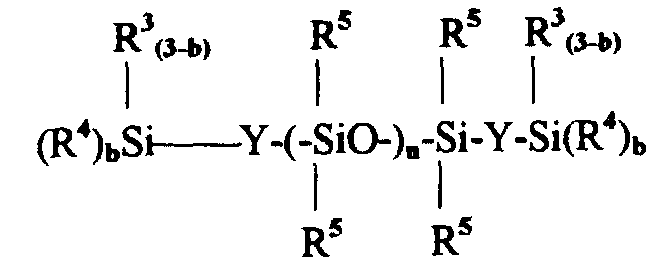
- the preferred organopolysiloxanes, of component (a) are straight-chain organopolysiloxanes represented bv the formula: where R 3 represents a group selected from alkyl, phenyl, tolyl, xylyl, naphthyl, benzyl, phenethyl, phenylpropyl, 3-chloropropyl and 3,3,3-trifluoropropyl, R 4 represents an alkoxy group, R 5 a group selected from alkyl, phenyl, tolyl, xylyl, naphthyl, benzyl, phenethyl, phenylpropyl, 3-chloropropyl and 3,3,3-trifluoropropyl, Y represents an oxygen atom or bivalent hydrocarbon radical, b is 1, 2, or 3, n represents a number corresponding to a polymer with a viscosity at 25°C of 0.02 to 1,000 Pa.s.
- R 3 examples include methyl, ethyl, propyl, butyl, pentyl, hexyl, heptyl, octyl, nonyl, decyl, and octadecyl; cyclopentyl, or cyclohexyl. Among them, methyl is preferred for R 3 .
- R 4 examples include methoxy, ethoxy, propoxy, and buthoxy. Among them, methoxy is preferred.
- R 5 include the same types of monovalent groups as for R 3 . Among them, methyl and phenyl are preferred.
- Y represents an oxygen atom or bivalent hydrocarbon group.
- Preferred types of the bivalent hydrocarbon groups of Y include alkylene radicals.
- Preferred types of the alkylene radicals include ethylene, propylene, and methylethylene. Among them, ethylene and propylene radicals are preferred.
- b is 1, 2, or 3, and n represents the number corresponding to a viscosity of the organopolysiloxane at 25°C of 0.02-1,000 Pa.s.
- the viscosity of component (a) at 25°C should be 0.02 to 1,000 Pa.s, preferably 0.1-500 Pa.s, and the more preferred viscosity is 1-25 Pa.s. If the viscosity of component (a) at 25°C is less than 0.02 Pa.s, the physical properties of the cured silicone substance are degraded. In particular, softness and elongation are degraded significantly. On the other hand, if the viscosity is greater than 1,000 Pa.s, the viscosity of the composition is too high, and the operability is degraded.
- the alkenyl-organopolysiloxane, component (b) has at least two silicon-bonded alkenyl groups in each molecule. When there are less than two silicon-bonded alkenyl groups in each molecule of component (b), the cured substance, fails to have a sufficient curing property.
- component (b) There is no special limitation on the molecular structure of component (b). For example, it may have a straight-chain form (linear), a straight-chain form with partial branching, branched-chain form, cyclic form, or resin form. Among these forms, the straight-chain structure and resin structure are preferred.
- Examples of the silicon-bonded alkenyl groups in component (b) are those alkenyl groups having from 1 to 6 carbon atoms per group inclusive, and include vinyl, allyl, butenyl, pentenyl, and hexenyl. Among them, vinyl is preferred.
- the silicon-bonded alkenyl groups may be located anywhere. However, from the viewpoint of curing, it is preferred that they are present at least at the terminals of the molecular chain.
- component (b) examples include trimethylsiloxy, dimethylvinylsiloxy, dimethylphenylsiloxy, and methylvinylphenylsiloxy. Among them, trimethylsiloxy and dimethylvinylsiloxy are preferred.
- silicon-bonded organic groups other than the silicon-bonded alkenyl groups in component (b) include methyl, ethyl, propyl, butyl, pentyl, hexyl, heptyl, octyl, nonyl, decyl, and octadecyl; cyclopentyl, or cyclohexyl; phenyl, tolyl, xylyl, or naphthyl; benzyl, phenethyl, or phenylpropyl; 3-chloropropyl, or 3,3,3-trifluoropropyl. Among them, methyl is preferred.
- the viscosity of component (b) at 25°C should be 0.020 to 1,000 Pa.s, preferably 0.1 to 500 Pa.s, and the more preferred viscosity is 1 to 25 Pa.s. If the viscosity of component (b) at 25°C is less than 0.02 Pa.s, the physical properties of the cured silicone substance are degraded. In particular, softness and elongation are degraded significantly. On the other hand, if the viscosity is greater than 1,000 Pa.s, the viscosity of the composition is too high, and operability is degraded.
- the hydrogen-organopolysiloxane, component (B) serves as a crosslinking agent for component (b) to cure the composition. It has at least two silicon-bonded hydrogen atoms in each molecule.
- component (B) may have a straight-chain form (linear), straight-chain form with partial branching, cyclic form, or resin form. Among these forms, the straight-chain form is preferred.
- Examples of silicon-bonded organic groups other than the silicon-bonded hydrogen atoms in component (B) include alkyl, such as methyl, ethyl, propyl, butyl, pentyl, hexyl, heptyl, octyl, nonyl, decyl, and octadecyl; cyclopentyl, or cyclohexyl; phenyl, tolyl, xylyl, and naphthyl; benzyl, phenethyl, and phenylpropyl; 3-chloropropyl group, or 3,3,3-trifluoropropyl. Among them, methyl and phenyl are preferred.
- the viscosity of component (B) There is no special limitation on the viscosity of component (B). However, it is preferred that the viscosity be 0.001 to 10 Pa.s, and a more preferred viscosity is from 0.005 to 1 Pa.s.
- the amount of component (B) added should be appropriate to ensure that the amount of the silicon-bonded hydrogen atoms in component (B) is 0.3-5 moles with respect to 1 mole of the silicon-bonded alkenyl groups in the composition. If the amount of component (B) added is less than 0.3 mole of silicon-bonded hydrogen atoms per one mole of alkenyl in the composition, curing of the composition obtained is insufficient. On the other hand, when the amount corresponds to greater than 5 moles of silicon-bonded hydrogen atoms per one mole of alkenyl in the composition, hydrogen gas is generated during the curing process of the composition. This effects the heat resistance of the cured silicone substance, and it is degraded significantly. Satisfactory conditions can usually be realized by adding 0.5-50 parts by weight of component (B) with respect to 100 parts by weight of component (b) in component (A).
- the alkoxysilane or its partial hydrolysis condensate, component (C), serves as a crosslinker for the alkoxy-organo-polysiloxane, component (a), to cure the composition.
- It is an alkoxysilane represented by the following formula : R 1 a Si(OR 2 ) (4-a) where R 1 represents a monovalent hydrocarbon group, R 2 represents alkyl group or alkoxy group-substituted alkyl group, and a is 0, 1, or 2.
- R 1 examples include methyl, ethyl, propyl, butyl, pentyl, hexyl, heptyl, octyl, nonyl, decyl, and octadecyl; cyclopentyl, or cyclohexyl; vinyl or allyl; phenyl, tolyl, xylyl, and naphthyl; benzyl, phenethyl, and phenylpropyl; 3-chloropropyl, or 3,3,3-trifluoropropyl. Among them, methyl is preferred.
- R 2 represents an alkyl group or alkoxy group-substituted alkyl group.
- alkyl groups used as R 2 include methyl, ethyl, propyl, butyl, pentyl, hexyl, heptyl, octyl, nonyl, decyl, and octadecyl. Among them, methyl is preferred.
- alkoxy group-substituted alkyl groups of R 2 include methoxypropyl and methoxybutyl. In the aforementioned formula, a is 0, 1, or 2.
- alkoxysilane or its partial hydrolysis condensate as component (C) examples include tetramethoxysilane, tetra-ethoxysilane, and ethylene glycol monomethyl ether orthosilicate; methyltrimethoxysilane, methyltri-ethoxysilane, ethyltrimethoxysilane, vinyltrimethoxysilane, phenyltrimethoxysilane, and methyltrimethoxyethoxysilane; dimethyldimethoxysilane, or diphenyldimethoxysilane; as well as the partial hydrolysis condensates of these alkoxysilanes. They may be used either alone, or as a mixture of several types or as hydrolysis condensates.
- the preferred alkoxysilane is methyltrimethoxysilane.
- the amount of component (C) is present in an amount of from 0.1-20 parts by weight, preferably 1-10 parts by weight, with respect to 100 parts by weight of component (A). If the amount of (C) added with respect to 100 parts by weight of (A) is less than 0.1 part by weight, the composition is not well-cured, thickening or gelation may take place easily during storage, and adhesive strength is poor. On the other hand, if the amount is greater than 20 parts by weight, the curing property of the composition is degraded significantly, which is undesirable from an economical point of view.
- the titanium catalyst (D) for the condensation reaction is used for promoting the crosslinking reaction of components (a) and (C) to cure our composition.
- Organic titanic esters, organic titanium chelate compounds, and other conventional titanium catalysts for condensation reactions can be used.
- component (D) include tetrabutyl titanate, tetraisopropyl titanate, diisopropoxybis(acetylacetonate)titanium, and diisopropoxybis(ethylacetoacetate)-titanium.
- the amount of component (D) added with respect to 100 parts by weight of component (A) is from 0.01-20 parts by weight, preferably 0.1-5 parts by weight. If the amount of (D) is less than 0.01 part by weight with respect to 100 parts by weight of (A), curing is slow and easily inhibited. On the other hand, when the amount is greater than 20 parts by weight, the storage stability of the composition is poor.
- the hydrosilylation reaction catalyst, component (E) is a catalyst that promotes the addition reaction of components (b) and (B) to cure the composition. It is possible to make use of platinum compounds, tetrakis(triphenylphosphine)palladium, rhodium compounds, and other conventional catalysts for hydrosilylation reactions. Preferred hydrosilylation reaction catalysts are the platinum compounds. Examples of platinum compounds that can be used as component (E) include platinum black, platinum-carrying activated carbon, platinum-carrying silica powder, chloroplatinic acid, an alcohol solution of chloroplatinic acid, a complex of platinum and olefin, and a complex of platinum and vinylsiloxane.
- the amount of the catalyst added as component (E) is preferably 0.1-1,000 parts by weight, and more preferably is 0.5-200 parts by weight.
- the curable organopolysiloxane composition of our invention can be prepared by uniformly blending the aforemen-tioned components (A) - (E).
- the composition can then be stored in single-liquid form (a one-container composition).
- a composition (I) liquid a composition (II) liquid
- Composition (I) and composition (II) therein are uniformly blended with each other immediately before application.
- Composition (I) is made of said components (b), (D) and (E)
- composition (II) is made of components (a), (B), and (C), or of components (A), (B), and (C) is most preferred.
- a curing inhibitor can be added as an arbitrary component.
- examples of curing inhibitor include 3-methyl-1-butyl-3-ol, 3,5-dimethyl-1-hexyne-3-ol, and phenylbutynol; 3-methyl-3-penten-1-yne, or 3,5-dimethyl-3-hexen-1-yne; 1,3,5,7-tetramethyl-1,3,5,7tetra-vinylcyclotetrasiloxane, 1,3,5,7-tetramethyl-1,3,5,7-tetra-hexenylcyclotetrasiloxane, and benzotriazole; phosphines; mercaptans; hydrazines.
- the amount of curing inhibitor used can be selected appropriately according to the curing conditions of our composition. For example, the amount can be selected as 0.001-5 parts by weight with respect to 100 parts by weight of component (A).
- Our curable organopolysiloxane composition can also contain fillers as another arbitrary component.
- fillers are dry silica powder, wet silica powder, quartz powder, calcium carbonate powder, titanium dioxide powder, diatomaceous earth powder, aluminum oxide powder, aluminum hydroxide powder, zinc oxide powder, and zinc carbonate powder.
- Treated inorganic fillers prepared by performing surface processing of the aforementioned inorganic fillers may also be used.
- Suitable agents for treating inorganic fillers are methyltrimethoxysilane, hexamethyldisilzane, and other organosilazanes; alpha,omega-silanol endblocked dimethylsiloxane oligomer, alpha,omega-silanol endblocked methylphenylsiloxane oligomer, alpha,omega-silanol endblocked methylvinylsiloxane oligomer, and other siloxane oligomers.
- the following can also be added toluene, xylene, acetone, methyl ethyl ketone, methyl isobutyl ketone, hexane, and heptane; alpha, omega-trimethylsiloxy endblocked dimethylpolysiloxane, alpha,omega-trimethylsiloxy endblocked methylphenylpolysiloxane, and other noncrosslinked diorganopolysiloxanes; fire retardants, heat-resistance agents, plasticizers, thixotropic agents, bonding promoters, and mildew-proofing agents.
- the viscosity refers to values measured at 25°C and "part” and “parts” represent “part by weight” and “parts by weight” respectively.
- this curable organopoly-siloxane composition was coated at a thickness of 1 mm between two aluminum sheets, followed by heating at 120°C in a hot-air-circulating oven for 30 min, forming a bonded specimen.
- a bonded specimen was prepared by setting asimilar specimen to the one prepared above under conditions of 20°C and 55% RH for 7 days after the aforementioned heat treatment. The shear adhesive strength was of both specimens measured, and the results are listed in Table I.
- our curable organopolysiloxane composition was coated in bead form on the substrates listed in Table I, followed by heating at 120°C in the hot-air-circulating oven for 30 min. Then, the specimen was set under conditions of 20C and 55% RN for 7 days. The bonding property was evaluated for both specimens, and the results are also listed in Table I.
- a comparative curable organopolysiloxane composition was prepared by blending uniformly 100 parts of alpha,omega-trimethoxysiloxy endblocked dimethylpolysiloxane with viscosity of 15 Pa.s, 6 parts of dry silica powder with a BET specific surface area of 200 m 2 /g and having been surface-treated by hexamethyldisilazane, 4 parts of methyltrimethoxysilane, and 4 parts of diisopropoxybis(ethylacetoacetate)titanium.
- the adhesive strength and bonding property were measured for the comparative composition formed, and the results are listed in Table I.
- an organopolysiloxane mixture prepared by uniformly blending 50 parts of alpha,omega-trimethoxysiloxy-endblocked dimethylpolysiloxane with a viscosity of 4 Pa.s and 50 parts of alpha,omega-dimethylvinylsiloxy endblocked dimethyl-polysiloxane with a viscosity of 2 Pa.s were blended uniformly with 1 part of alpha,omega-trimethylsiloxy endblocked dimethyl-siloxane-methylhydrogensiloxane copolymer with a silicon-bonded hydrogen atom content of 0.7 wt% and a viscosity of 0.01 Pa.s, an isopropyl solution of chloroplatinic acid in an amount corresponding to 5 ppm of the platinum metal with respect to the organopolysiloxane mixture, 1 part of methyltrimethoxysilane, and 0.5 part of diisopropoxybis(ethylaceto)
- a sheet was prepared from a composition prepared by uniformly blending 100 parts of alpha,omega-hydroxydimethyl-siloxy endblocked dimethylpolysiloxane with a viscosity of 12 Pa.s, 10 parts of dry silica powder with a BET specific surface area of 200 m 2 /g, 4 parts of methyltrimethoxysilane, and 0.3 part of dibutyltin dilaurate.
- the composition was formed to a sheet, which was set under conditions of 20°C and 55% RH for 3 days, forming a cured silicone elastomeric sheet.
- the curable organopolysiloxane composition of this invention prepared above was coated onto the cured silicone elastomeric sheet, followed by heating at 120°C in a hot-air-circulating oven for 15 min, then setting under conditions of 20°C and 55% RH for 7 days. The curing state of the curable organopolysiloxane composition and the bonding property on the cured silicone sheet were observed. The results are as listed in Table II.
- a comparative curable organopolysiloxane composition was prepared as in Example 2, except that the methyltrimethoxysilane and diisopropoxybis(ethylacetoacetate)-titanium of Example 2 were not added. As in Example 2, the adhesive strength and bonding property were measured for the curable organopolysiloxane composition formed. The results were as listed in Table II.
- a comparative curable organopolysiloxane composition was prepared as in Example 2, except that instead of the diisopropoxybis(ethylacetoacetate)titanium of Example 2, 0.5 part of dibutyltin dilaurate was added. As in Example 2, the adhesive strength and bonding property were measured for the curable organopolysiloxane composition formed. The results are listed in Table II.
- compositions (I) and (II) were prepared, 55 parts of composition (I) and 58 parts weight of composition (II) were uniformly blended, forming a curable organopolysiloxane composition of this invention.
- the curable organopolysiloxane composition was heat-treated at 120°C in a hot-air-circulating oven for 30 min, forming a cured silicone substance.
- the hardness of the cured silicone substance formed was measured using a JIS A hardness meter, defined in JIS K 6301. After setting at 20°C and 55% RN for 7 days, the hardness of the cured silicone substance was measured.
- compositions (I) and (II) were prepared, they were stored in sealed glass bottles, and were set in this state at 20°C and 55% RN for 7 days. Then, 55 parts by weight of composition (I) and 58 parts by weight of composition (II) were uniformly blended, forming another curable organopolysiloxane composition of this invention.
- This curable organopolysiloxane composition was heat-treated at 120°C in a hot-air-circulating oven for 30 min, forming a cured silicone substance. The hardness of the cured silicone substance formed was measured as above. After setting at 20°C and 55% RH for 7 days, the hardness of the cured silicone substance was again measured. The results a listed in Table III.
- our curable organopoly-siloxane composition was heat-treated at 120°C in a hot-air-circulating oven for 30 min, forming a cured silicone substance.
- the hardness of the cured silicone was measured as defined in JIS K 6301. After setting at 20°C and 55% RH for 7 days, the hardness of the cured silicone was measured as above. Also, after said composition was prepared, it was stored in a sealed glass bottle at 20°C and 55% RH for 7 days. Then, the curable organopolysiloxane composition was heat-treated at 120°C in a hot-air-circulating oven for 30 min, forming a cured silicone substance. The hardness of the cured silicone was also measured as above.
- Our curable organopolysiloxane composition comprises components (A)-(E) and cures freely uninhibited by moisture or heat.
- the cured silicone substance thereby formed has excellent adhesive strength to various substrates when cured in contact with them.
- Our curable organopolysiloxane composition exhibits no change of curing property over time during storage when it is in the form of a 2-container, liquid composition.
Landscapes
- Chemical & Material Sciences (AREA)
- Chemical Kinetics & Catalysis (AREA)
- Organic Chemistry (AREA)
- Life Sciences & Earth Sciences (AREA)
- Engineering & Computer Science (AREA)
- Materials Engineering (AREA)
- Wood Science & Technology (AREA)
- Health & Medical Sciences (AREA)
- Medicinal Chemistry (AREA)
- Polymers & Plastics (AREA)
- Compositions Of Macromolecular Compounds (AREA)
- Adhesives Or Adhesive Processes (AREA)
Claims (7)
- Härtbare Organopolysiloxanzusammensetzung umfassend:(A) 100 Gew.-Teile eines Organopolysiloxangemisches von (a) einem Alkoxyorganopolysiloxan mit einer Viskosität bei 25°C von 0,02 bis 1000 Pa.s und mindestens zwei siliciumgebundenen Alkoxygruppen in jedem Molekül, und wobei die anderen siliciumgebundenen organischen Gruppen als die siliciumgebundenen Alkoxygruppen ausgewählt sind aus Alkyl, Phenyl, Tolyl, Xylyl, Naphthyl, Benzyl, Phenethyl, Phenylpropyl. 3-Chlorpropyl und 3,3,3-Trifluorpropyl, und (b) einem Alkenylorganopolysiloxan mit einer Viskosität bei 25°C von 0,02 bis 1000 Pa.s und mindestens zwei siliciumgebundenen Alkenylgruppen in jedem Molekül,(B) einem Organowasserstoffpolysiloxan mit mindestens zwei siliciumgebundenen Wasserstoffatomen in jedem Molekül, wobei das Organowasserstoffpolysiloxan in einer Gewichtsmenge vorliegt, mit der sichergestellt ist, daß 0,3 bis 5 Mol siliciumgebundene Wasserstoffatome in Komponente (B) für jedes Mol siliciumgebundene Alkenylgruppen in der Zusammensetzung vorhanden sind,(C) 0,1 bis 20 Gew.-Teile eines Alkoxysilans, bezogen auf 100 Gew.-Teile (A), das durch die folgende Formel(D) 0,01 bis 20 Gew.-Teile eines Titankatalysators für eine Kondensationsreaktion zur Beschleunigung der Vernetzungsreaktionen von (a) und (C), bezogen auf 100 Gew.-Teile (A), und(E) eine ausreichende Menge eines Hydrosilylierungsreaktionskatalysators, um 0,1 bis 1000 Gew.-Teile des Katalysatormetalls, bezogen auf 1 Million Gew.-Teile (A), bereitzustellen.
- Härtbare Organopolysiloxanzusammensetzung nach Anspruch 1, in der (a) in einer Menge von 10 bis 90 Gew.-% und (b) in einer Menge von 10 bis 90 Gew.-% vorliegt, wobei die Summe von (a) und (b) 100 Gew.-% beträgt und (a) plus (b) (A) ist.
- Härtbare Organopolysiloxanzusammensetzung nach Anspruch 2, in der das Alkoxyorganopolysiloxan (a) durch die folgende allgemeine Formeldargestellt ist, wobei R3 für eine Gruppe steht ausgewählt aus Alkyl, Phenyl, Tolyl, Xylyl, Naphthyl, Benzyl, Phenethyl, Phenylpropyl, 3-Chlorpropyl und 3,3,3-Trifluorpropyl, R4 für eine Alkoxygruppe steht, R5 für eine Gruppe steht ausgewählt aus Alkyl, Phenyl, Tolyl, Xylyl, Naphthyl, Benzyl, Phenethyl, Phenylpropyl, 3-Chlorpropyl und 3,3,3-Trifluorpropyl, Y für ein Sauerstoffatom oder einen zweiwertigen Kohlenwasserstoffrest, b für 1, 2 oder 3, n für eine Zahl, die einem Polymer mit einer Viskosität bei 25°C von 0,02 bis 1000 Pa.s entspricht, stehen und (b) ein Alkenylorganopolysiloxan ist, das eine geradkettige Struktur oder eine Harzstruktur aufweist.
- Härtbare Organopolysiloxanzusammensetzung nach Anspruch 3, in der das Alkenylorganopolysiloxan eine Harzstruktur aufweist, umfassend die folgenden Siloxaneinheiten, die durch die Formel SiO4/2, Siloxyeinheiten, die durch die Formel (CH3)3SiO1/2 und Siloxyeinheiten, die durch (CH3)2(CH2=CH)SiO1/2 dargestellt sind
- Härtbare Organopolysiloxanzusammensetzung nach Anspruch 3, in der die Viskosität des Alkoxyorganopolysiloxans der Komponente (a) 0,1 bis 500 Pa.s beträgt, die Viskosität des Alkenylorganopolysiloxans der Komponente (b) 0,1 bis 500 Pa.s beträgt, die Viskosität des Organowasserstoffpolysiloxans der Komponente (B) 0,001 bis 10 Pa.s bei 25°C beträgt, die Komponente (C) in einer Menge von 1 bis 10 Gew.-Teilen, Komponente (D) in einer Menge von 0,1 bis 5 Gew.-Teilen vorliegt und Komponente (E) ein Platinverbindungskatalysator ist.
- Härtbare Organopolysiloxanzusammensetzung nach Anspruch 5, in der (a) in einer Menge von 40 bis 60 Gew.-%, (b) in einer Menge von 40 bis 60 Gew.-% vorliegen, (a) plus (b) 100 Gew.-% ergeben und gleich (A) sind das Alkoxyorganopolysiloxan (a) eine Viskosität von 1 bis 25 Pa.s aufweist, wobei R3 für Methyl, R4 für Methoxy, R5 für Methyl stehen, die Viskosität des Organowasserstoffpolysiloxans der Komponente (B) 0,005 bis 1 Pa.s beträgt und die organische Gruppe Methyl ist, das Alkoxysilan (C) Methyltrimethoxysilan, der Titankatalysator (D) Diisopropoxybis(ethylacetoacetat)titan sind und der Platinverbindungskatalysator der Komponente (E) in einer Menge von 0,5 bis 200 Gew.-Teilen des Platinmetalls, bezogen auf 1 Million Gew.-Teile der Komponente (A), vorliegt.
- Härtbare Organopolysiloxanzusammensetzung nach Anspruch 1, umfassend eine flüssige Zusammensetzung in zwei Behältern, hergestellt aus einer Zusammensetzung (I) und einer flüssigen Zusammensetzung (II), wobei die Summe der Mengen der Komponente (a) und der Komponente (b) 100 Gew.-Teile beträgt:(1) Zusammensetzung (I) umfassend:(b) ein Alkenylorganopolysiloxan mit einer Viskosität bei 25°C von 0,02 bis 1000 Pa.s und mindestens zwei siliciumgebundenen Alkenylgruppen in jedem Molekül,(D) 0,01 bis 20 Gew.-Teile eines Titankatalysators für eine Kondensationsreaktion, bezogen auf 100 Gew.-Teile der Komponente (a) und Komponente (b) und(E) eine ausreichende Menge eines Hydrosilylierungsreaktionskatalysators, um 0,1 bis 1000 Gew.-Teile des Katalysatormetalls bereitzustellen, bezogen auf Million Gew.-Teile (A) und(2) Zusammensetzung (II), umfassend ein Organopolysiloxan ausgewählt aus(a) einem Alkoxyorganopolysiloxan mit einer Viskosität bei 25°C von 0,02 bis 1000 Pa.s, mindestens zwei siliciumgebundenen Alkoxygruppen in jedem Molekül und anderen siliciumgebundenen organischen Gruppen als die siliciumgebundenen Alkoxygruppen, ausgewählt aus Alkyl, Phenyl, Tolyl, Xylyl, Naphthyl, Benzyl, Phenethyl, Phenylpropyl, 3-Chlorpropyl und 3,3,3-Trifluorpropyl, und(A) einem Organopolysiloxangemisch aus (a) einem Alkoxyorganopolysiloxan mit einer Viskosität bei 25°C von 0,02 bis 1000 Pa.s und mindestens zwei siliciumgebundenen Alkoxygruppen in jedem Molekül, und wobei die anderen siliciumgebundenen organischen Gruppen als die siliciumgebundenen Alkoxygruppen ausgewählt sind aus Alkyl, Phenyl, Tolyl, Xylyl, Naphthyl, Benzyl, Phenethyl, Phenylpropyl, 3-Chlorpropyl und 3,3,3-Trifluorpropyl, und (b) einem Alkenylorganopolysiloxan mit einer Viskosität bei 25°C von 0,02 bis 1000 Pa.s und mindestens zwei siliciumgenbundenen Alkenylgruppen in jedem Molekül,(B) einem Organowasserstoffpolysiloxan, das mindestens zwei siliciumgebundene Wasserstoffatome in jedem Molekül aufweist, und das Organowasserstoffpolysiloxan in einer Gewichtsmenge vorliegt, mit der sichergestellt ist, daß 0,3 bis 5 Mol siliciumgebundene Wasserstoffatome in Komponente (B) für jedes Mol siliciumgebundene Alkenylgruppen in der Zusammensetzung vorhanden sind und(C) 0,1 bis 20 Gew.-Teile eines Alkoxysilans, bezogen auf 100 Gew.-Teile der Komponente (a) und der Komponente (b) in der Zusammensetzung (I) und der Zusammensetzung (II), das durch die Formel
Applications Claiming Priority (2)
| Application Number | Priority Date | Filing Date | Title |
|---|---|---|---|
| JP19854/94 | 1994-01-20 | ||
| JP01985494A JP3846640B2 (ja) | 1994-01-20 | 1994-01-20 | 硬化性オルガノポリシロキサン組成物 |
Publications (2)
| Publication Number | Publication Date |
|---|---|
| EP0664322A1 EP0664322A1 (de) | 1995-07-26 |
| EP0664322B1 true EP0664322B1 (de) | 1998-07-01 |
Family
ID=12010827
Family Applications (1)
| Application Number | Title | Priority Date | Filing Date |
|---|---|---|---|
| EP95100704A Expired - Lifetime EP0664322B1 (de) | 1994-01-20 | 1995-01-19 | Mittels Kondensationsreaktion und Additionsreaktion härtbare Organopolysiloxane-Massen |
Country Status (4)
| Country | Link |
|---|---|
| US (1) | US5504174A (de) |
| EP (1) | EP0664322B1 (de) |
| JP (1) | JP3846640B2 (de) |
| DE (1) | DE69503155T2 (de) |
Cited By (1)
| Publication number | Priority date | Publication date | Assignee | Title |
|---|---|---|---|---|
| US7005460B2 (en) | 2001-01-25 | 2006-02-28 | Kettenbach Gmbh & Co. Kg | Two-step curable mixer-suitable materials |
Families Citing this family (44)
| Publication number | Priority date | Publication date | Assignee | Title |
|---|---|---|---|---|
| JP3461404B2 (ja) * | 1995-03-29 | 2003-10-27 | 東レ・ダウコーニング・シリコーン株式会社 | 硬化性オルガノポリシロキサン組成物 |
| FR2736060B1 (fr) * | 1995-06-30 | 1998-10-23 | Gen Electric | Compositions a base de silicone elastomere, durcissables par la chaleur, et articles obtenus a partir de ces compositions |
| JPH0912892A (ja) * | 1995-07-04 | 1997-01-14 | Toray Dow Corning Silicone Co Ltd | 現場成形ガスケット用シリコーンゴム組成物 |
| JP3950490B2 (ja) * | 1995-08-04 | 2007-08-01 | 東レ・ダウコーニング株式会社 | 導電性シリコーンゴム組成物および半導体装置 |
| TW334469B (en) * | 1995-08-04 | 1998-06-21 | Doconitele Silicon Kk | Curable organosiloxane compositions and semiconductor devices |
| JPH09324152A (ja) * | 1996-06-06 | 1997-12-16 | Toray Dow Corning Silicone Co Ltd | 同種もしくは異種の基材からなる接着構造体の製造方法 |
| JPH108022A (ja) * | 1996-06-25 | 1998-01-13 | Toray Dow Corning Silicone Co Ltd | 光メモリ素子用シリコーン系接着剤、光メモリ素子、および光メモリ素子の製造方法 |
| JPH1121508A (ja) * | 1997-07-02 | 1999-01-26 | Toshiba Silicone Co Ltd | コーティング剤組成物 |
| US6069201A (en) * | 1997-09-12 | 2000-05-30 | Shin-Etsu Chemical Co., Ltd. | Zinc oxide-filled addition-curable silicone rubber compositions |
| US6297305B1 (en) * | 1998-09-02 | 2001-10-02 | Dow Corning Toray Silicone Company, Ltd. | Curable silicone composition |
| JP4727017B2 (ja) * | 1999-11-15 | 2011-07-20 | 東レ・ダウコーニング株式会社 | 熱伝導性シリコーンゴム組成物 |
| US6559201B2 (en) | 2000-06-02 | 2003-05-06 | Microphase Coatings, Inc. | Antifouling coating composition |
| US6476095B2 (en) * | 2000-06-02 | 2002-11-05 | Microphase Coatings, Inc. | Antifouling coating composition |
| US6512037B1 (en) * | 2001-06-06 | 2003-01-28 | Dow Corning Corporation | Silicone composition and cured silicone product |
| US6482888B1 (en) * | 2001-06-06 | 2002-11-19 | Dow Corning Corporation | Silicone composition and cured silicone product |
| US7250467B2 (en) * | 2001-07-26 | 2007-07-31 | Dow Corning Toray Silcone Co., Ltd. | Room-temperature-curable organopolysiloxane composition |
| US7163750B2 (en) | 2003-04-10 | 2007-01-16 | Microphase Coatings, Inc. | Thermal barrier composition |
| US20040260018A1 (en) | 2003-04-10 | 2004-12-23 | Simendinger William H. | Thermal barrier composition |
| JP4733937B2 (ja) * | 2004-07-09 | 2011-07-27 | 東レ・ダウコーニング株式会社 | 室温硬化性オルガノポリシロキサン組成物、および電気・電子機器 |
| DE102005042755A1 (de) * | 2005-09-08 | 2007-03-15 | Wacker Chemie Ag | Textilbeschichtung |
| JP2008239719A (ja) * | 2007-03-26 | 2008-10-09 | Dow Corning Toray Co Ltd | シリコーンエラストマー組成物およびシリコーンエラストマー |
| JP2009120437A (ja) * | 2007-11-14 | 2009-06-04 | Niigata Univ | シロキサンをグラフト化したシリカ及び高透明シリコーン組成物並びに該組成物で封止した発光半導体装置 |
| EP2196503B1 (de) * | 2008-12-12 | 2015-02-18 | Nitto Denko Corporation | Wärmehärtende Silikonharzzusammensetzung, Silikonharz, Silikonharzfolie und Verwendung dafür |
| JP5566036B2 (ja) * | 2009-02-02 | 2014-08-06 | 日東電工株式会社 | 熱硬化性シリコーン樹脂用組成物 |
| JP2010159411A (ja) * | 2008-12-12 | 2010-07-22 | Nitto Denko Corp | 半硬化状シリコーン樹脂シート |
| JP5566088B2 (ja) * | 2008-12-12 | 2014-08-06 | 日東電工株式会社 | 熱硬化性シリコーン樹脂用組成物 |
| JP4913858B2 (ja) * | 2009-04-14 | 2012-04-11 | 日東電工株式会社 | 熱硬化性シリコーン樹脂用組成物 |
| JP5594991B2 (ja) * | 2009-07-29 | 2014-09-24 | 旭化成ワッカーシリコーン株式会社 | 接着性シリコーンゴム組成物 |
| US20130135800A1 (en) * | 2010-10-29 | 2013-05-30 | Prologium Holding Inc. | Package structure of electronic modules with silicone sealing frame |
| JPWO2012137977A1 (ja) * | 2011-04-08 | 2014-07-28 | 東レ・ダウコーニング株式会社 | 被膜形成用組成物 |
| CN103187370B (zh) * | 2011-12-28 | 2016-06-29 | 辉能科技股份有限公司 | 电子模组的侧封装结构 |
| JP6440615B2 (ja) * | 2012-07-30 | 2018-12-19 | ダウ シリコーンズ コーポレーション | 熱伝導性縮合反応硬化型ポリオルガノシロキサン組成物、並びに該組成物の調製及び使用のための方法 |
| KR102385489B1 (ko) * | 2014-04-09 | 2022-04-14 | 듀폰 도레이 스페셜티 머티리얼즈 가부시키가이샤 | 경화성 오르가노폴리실록산 조성물 및 전기·전자 부품의 보호제 또는 접착제 조성물 |
| RU2709088C2 (ru) * | 2015-04-30 | 2019-12-13 | Колопласт А/С | Адгезивная композиция |
| JP6601142B2 (ja) * | 2015-10-22 | 2019-11-06 | 信越化学工業株式会社 | 付加縮合併用硬化性シリコーン樹脂シート、波長変換シート、及び発光装置の製造方法 |
| US11981786B2 (en) * | 2018-02-01 | 2024-05-14 | Dow Toray Co., Ltd. | Sponge-forming silicone rubber composition and silicone rubber sponge |
| EP4139389B1 (de) * | 2020-04-23 | 2023-11-29 | Wacker Chemie AG | Silikonverbindung mit uv-blocker zur aussenanwendung |
| JP2023532407A (ja) * | 2020-06-24 | 2023-07-28 | ダウ グローバル テクノロジーズ エルエルシー | シリコーンゴム組成物 |
| WO2022024734A1 (ja) * | 2020-07-28 | 2022-02-03 | 信越化学工業株式会社 | 熱ラジカル硬化可能なオルガノポリシロキサン組成物、該組成物で接着、コーティング又はポッティングされた物品、及び該組成物の硬化物を製造する方法 |
| CN112210341B (zh) * | 2020-09-18 | 2022-07-26 | 山东东岳有机硅材料股份有限公司 | 双硫化体系建筑密封胶及其制备方法 |
| EP4251402B1 (de) | 2020-11-30 | 2024-06-19 | Dow Silicones Corporation | Hydrosilylierunghärtungsinhibitoren und deren verwendung |
| JP7524488B2 (ja) * | 2021-03-30 | 2024-07-29 | ダウ シリコーンズ コーポレーション | シリコーンゴムの熱可塑性物質への接着 |
| CN114874746B (zh) * | 2022-06-28 | 2023-06-02 | 浙江新安化工集团股份有限公司 | Uv-湿气双重固化的有机硅组合物及其用途和制备方法 |
| CN120590630B (zh) * | 2025-08-07 | 2025-12-12 | 浙江润禾有机硅新材料有限公司 | 一种高纯度支链硅油及其制备方法和应用 |
Citations (1)
| Publication number | Priority date | Publication date | Assignee | Title |
|---|---|---|---|---|
| JPH04178461A (ja) * | 1990-11-13 | 1992-06-25 | Toray Dow Corning Silicone Co Ltd | 硬化性オルガノポリシロキサン組成物 |
Family Cites Families (10)
| Publication number | Priority date | Publication date | Assignee | Title |
|---|---|---|---|---|
| JPS6011950B2 (ja) * | 1977-10-24 | 1985-03-29 | 信越化学工業株式会社 | 粘着テ−プ |
| JPS5950181B2 (ja) * | 1979-03-07 | 1984-12-06 | ト−レ・シリコ−ン株式会社 | 高温でセラミツク化するシリコ−ン組成物 |
| JPS59152955A (ja) * | 1983-02-21 | 1984-08-31 | Toshiba Silicone Co Ltd | 硬化性シリコーンゴム組成物 |
| US4677641A (en) * | 1984-10-26 | 1987-06-30 | Honeywell Inc. | Simplified readout optics for a ring laser apparatus |
| JPH0751123B2 (ja) * | 1987-06-25 | 1995-06-05 | オムロン株式会社 | 指用電子血圧計 |
| US4921880A (en) * | 1988-08-15 | 1990-05-01 | Dow Corning Corporation | Adhesion promoter for UV curable siloxane compositions and compositions containing same |
| JP3119481B2 (ja) * | 1990-03-26 | 2000-12-18 | 東レ・ダウコーニング・シリコーン株式会社 | 1液型加熱硬化性オルガノポリシロキサン組成物 |
| JP2522721B2 (ja) * | 1990-08-01 | 1996-08-07 | 信越化学工業株式会社 | オルガノポリシロキサン組成物及びそのゲル硬化物 |
| EP0490321B1 (de) * | 1990-12-10 | 1997-07-30 | Shin-Etsu Chemical Co., Ltd. | Optische Fasern und Zusammensetzungen für die Kerne dieser Fasern |
| US5364921A (en) * | 1993-08-17 | 1994-11-15 | Dow Corning Corporation | Silicone rubber with self-adhesion to glass and metal |
-
1994
- 1994-01-20 JP JP01985494A patent/JP3846640B2/ja not_active Expired - Fee Related
-
1995
- 1995-01-19 DE DE69503155T patent/DE69503155T2/de not_active Expired - Lifetime
- 1995-01-19 EP EP95100704A patent/EP0664322B1/de not_active Expired - Lifetime
- 1995-01-19 US US08/386,993 patent/US5504174A/en not_active Expired - Lifetime
Patent Citations (1)
| Publication number | Priority date | Publication date | Assignee | Title |
|---|---|---|---|---|
| JPH04178461A (ja) * | 1990-11-13 | 1992-06-25 | Toray Dow Corning Silicone Co Ltd | 硬化性オルガノポリシロキサン組成物 |
Cited By (1)
| Publication number | Priority date | Publication date | Assignee | Title |
|---|---|---|---|---|
| US7005460B2 (en) | 2001-01-25 | 2006-02-28 | Kettenbach Gmbh & Co. Kg | Two-step curable mixer-suitable materials |
Also Published As
| Publication number | Publication date |
|---|---|
| DE69503155T2 (de) | 1998-12-10 |
| EP0664322A1 (de) | 1995-07-26 |
| DE69503155D1 (de) | 1998-08-06 |
| US5504174A (en) | 1996-04-02 |
| JPH07207164A (ja) | 1995-08-08 |
| JP3846640B2 (ja) | 2006-11-15 |
Similar Documents
| Publication | Publication Date | Title |
|---|---|---|
| US5504174A (en) | Curable organopolysiloxane composition with condensation reaction curing and addition reaction curing | |
| JP3461404B2 (ja) | 硬化性オルガノポリシロキサン組成物 | |
| EP1225211B1 (de) | Klebstoff für Siliconkautschuk | |
| JP5960843B2 (ja) | アルコキシシリル−エチレン基末端オルガノシロキサンポリマーの製造方法、室温硬化性組成物及びその硬化物である成形物 | |
| US5468826A (en) | Adhesion promoting additives and curable organosiloxane compositions containing same | |
| JP6722581B2 (ja) | 接着促進剤、それを含有してなる硬化性オルガノポリシロキサン組成物 | |
| JP5025917B2 (ja) | 硬化性オルガノポリシロキサン組成物 | |
| EP0714936B1 (de) | Organosiliciumverbindungen und diese enthaltende, bei niedriger Temperatur härtende Organosiloxanzusammensetzungen | |
| EP0682085B1 (de) | Härtbare Organosiloxan-Zusammensetzungen, die bei niedriger Temperatur reagierende Haftungsverbesserer enthalten | |
| JPH08259820A (ja) | 高電圧電気絶縁体用シリコーンゴム組成物 | |
| JPS642626B2 (de) | ||
| KR101528789B1 (ko) | 실온 경화성 오가노폴리실록산 조성물 | |
| JPH07238259A (ja) | コンフォーマルコーティング剤 | |
| EP0682069B1 (de) | Haftungsfördernde Additive und diese enthaltende bei niedriger Temperatur härtbare Silikon-Zusammensetzungen | |
| EP4421128A1 (de) | Bei raumtemperatur härtbare organopolysiloxanzusammensetzung, klebstoff, dichtungsmittel und beschichtungsmittel | |
| JP5068988B2 (ja) | 接着性ポリオルガノシロキサン組成物 | |
| JP4180477B2 (ja) | 室温硬化性ポリオルガノシロキサン組成物 | |
| JP3835891B2 (ja) | 硬化性オルガノポリシロキサン組成物 | |
| KR102810630B1 (ko) | 습기경화형 실록산 조성물 | |
| JPH10152616A (ja) | 電気絶縁材料用熱硬化性樹脂組成物 | |
| KR101159537B1 (ko) | 실온 경화성 폴리오르가노실록산 조성물 | |
| JPH111618A (ja) | 室温硬化性オルガノポリシロキサン組成物の製造方法 |
Legal Events
| Date | Code | Title | Description |
|---|---|---|---|
| PUAI | Public reference made under article 153(3) epc to a published international application that has entered the european phase |
Free format text: ORIGINAL CODE: 0009012 |
|
| AK | Designated contracting states |
Kind code of ref document: A1 Designated state(s): DE FR GB IT |
|
| 17P | Request for examination filed |
Effective date: 19950928 |
|
| 17Q | First examination report despatched |
Effective date: 19970211 |
|
| GRAG | Despatch of communication of intention to grant |
Free format text: ORIGINAL CODE: EPIDOS AGRA |
|
| GRAG | Despatch of communication of intention to grant |
Free format text: ORIGINAL CODE: EPIDOS AGRA |
|
| GRAH | Despatch of communication of intention to grant a patent |
Free format text: ORIGINAL CODE: EPIDOS IGRA |
|
| GRAH | Despatch of communication of intention to grant a patent |
Free format text: ORIGINAL CODE: EPIDOS IGRA |
|
| GRAA | (expected) grant |
Free format text: ORIGINAL CODE: 0009210 |
|
| AK | Designated contracting states |
Kind code of ref document: B1 Designated state(s): DE FR GB IT |
|
| ITF | It: translation for a ep patent filed | ||
| REF | Corresponds to: |
Ref document number: 69503155 Country of ref document: DE Date of ref document: 19980806 |
|
| ET | Fr: translation filed | ||
| PLBE | No opposition filed within time limit |
Free format text: ORIGINAL CODE: 0009261 |
|
| STAA | Information on the status of an ep patent application or granted ep patent |
Free format text: STATUS: NO OPPOSITION FILED WITHIN TIME LIMIT |
|
| 26N | No opposition filed | ||
| REG | Reference to a national code |
Ref country code: GB Ref legal event code: IF02 |
|
| PGFP | Annual fee paid to national office [announced via postgrant information from national office to epo] |
Ref country code: IT Payment date: 20060131 Year of fee payment: 12 |
|
| PG25 | Lapsed in a contracting state [announced via postgrant information from national office to epo] |
Ref country code: IT Free format text: LAPSE BECAUSE OF NON-PAYMENT OF DUE FEES Effective date: 20070119 |
|
| PGFP | Annual fee paid to national office [announced via postgrant information from national office to epo] |
Ref country code: FR Payment date: 20100208 Year of fee payment: 16 |
|
| PGFP | Annual fee paid to national office [announced via postgrant information from national office to epo] |
Ref country code: GB Payment date: 20100113 Year of fee payment: 16 |
|
| GBPC | Gb: european patent ceased through non-payment of renewal fee |
Effective date: 20110119 |
|
| REG | Reference to a national code |
Ref country code: FR Ref legal event code: ST Effective date: 20110930 |
|
| PG25 | Lapsed in a contracting state [announced via postgrant information from national office to epo] |
Ref country code: FR Free format text: LAPSE BECAUSE OF NON-PAYMENT OF DUE FEES Effective date: 20110131 |
|
| PG25 | Lapsed in a contracting state [announced via postgrant information from national office to epo] |
Ref country code: GB Free format text: LAPSE BECAUSE OF NON-PAYMENT OF DUE FEES Effective date: 20110119 |
|
| PGFP | Annual fee paid to national office [announced via postgrant information from national office to epo] |
Ref country code: DE Payment date: 20130116 Year of fee payment: 19 |
|
| REG | Reference to a national code |
Ref country code: DE Ref legal event code: R119 Ref document number: 69503155 Country of ref document: DE |
|
| REG | Reference to a national code |
Ref country code: DE Ref legal event code: R119 Ref document number: 69503155 Country of ref document: DE Effective date: 20140801 |
|
| PG25 | Lapsed in a contracting state [announced via postgrant information from national office to epo] |
Ref country code: DE Free format text: LAPSE BECAUSE OF NON-PAYMENT OF DUE FEES Effective date: 20140801 |