EP0457596A2 - Verfahren zum Herstellen eines Dünnfilm-Transistors - Google Patents
Verfahren zum Herstellen eines Dünnfilm-Transistors Download PDFInfo
- Publication number
- EP0457596A2 EP0457596A2 EP91304428A EP91304428A EP0457596A2 EP 0457596 A2 EP0457596 A2 EP 0457596A2 EP 91304428 A EP91304428 A EP 91304428A EP 91304428 A EP91304428 A EP 91304428A EP 0457596 A2 EP0457596 A2 EP 0457596A2
- Authority
- EP
- European Patent Office
- Prior art keywords
- layer
- insulating layer
- island
- substrate
- sides
- Prior art date
- Legal status (The legal status is an assumption and is not a legal conclusion. Google has not performed a legal analysis and makes no representation as to the accuracy of the status listed.)
- Granted
Links
Images




Classifications
-
- H—ELECTRICITY
- H10—SEMICONDUCTOR DEVICES; ELECTRIC SOLID-STATE DEVICES NOT OTHERWISE PROVIDED FOR
- H10D—INORGANIC ELECTRIC SEMICONDUCTOR DEVICES
- H10D86/00—Integrated devices formed in or on insulating or conducting substrates, e.g. formed in silicon-on-insulator [SOI] substrates or on stainless steel or glass substrates
- H10D86/01—Manufacture or treatment
- H10D86/021—Manufacture or treatment of multiple TFTs
- H10D86/0231—Manufacture or treatment of multiple TFTs using masks, e.g. half-tone masks
-
- H—ELECTRICITY
- H01—ELECTRIC ELEMENTS
- H01L—SEMICONDUCTOR DEVICES NOT COVERED BY CLASS H10
- H01L21/00—Processes or apparatus adapted for the manufacture or treatment of semiconductor or solid state devices or of parts thereof
- H01L21/02—Manufacture or treatment of semiconductor devices or of parts thereof
- H01L21/04—Manufacture or treatment of semiconductor devices or of parts thereof the devices having potential barriers, e.g. a PN junction, depletion layer or carrier concentration layer
- H01L21/18—Manufacture or treatment of semiconductor devices or of parts thereof the devices having potential barriers, e.g. a PN junction, depletion layer or carrier concentration layer the devices having semiconductor bodies comprising elements of Group IV of the Periodic Table or AIIIBV compounds with or without impurities, e.g. doping materials
- H01L21/30—Treatment of semiconductor bodies using processes or apparatus not provided for in groups H01L21/20 - H01L21/26
- H01L21/31—Treatment of semiconductor bodies using processes or apparatus not provided for in groups H01L21/20 - H01L21/26 to form insulating layers thereon, e.g. for masking or by using photolithographic techniques; After treatment of these layers; Selection of materials for these layers
- H01L21/3205—Deposition of non-insulating-, e.g. conductive- or resistive-, layers on insulating layers; After-treatment of these layers
- H01L21/321—After treatment
- H01L21/3213—Physical or chemical etching of the layers, e.g. to produce a patterned layer from a pre-deposited extensive layer
- H01L21/32133—Physical or chemical etching of the layers, e.g. to produce a patterned layer from a pre-deposited extensive layer by chemical means only
- H01L21/32135—Physical or chemical etching of the layers, e.g. to produce a patterned layer from a pre-deposited extensive layer by chemical means only by vapour etching only
- H01L21/32136—Physical or chemical etching of the layers, e.g. to produce a patterned layer from a pre-deposited extensive layer by chemical means only by vapour etching only using plasmas
- H01L21/32137—Physical or chemical etching of the layers, e.g. to produce a patterned layer from a pre-deposited extensive layer by chemical means only by vapour etching only using plasmas of silicon-containing layers
-
- H—ELECTRICITY
- H10—SEMICONDUCTOR DEVICES; ELECTRIC SOLID-STATE DEVICES NOT OTHERWISE PROVIDED FOR
- H10D—INORGANIC ELECTRIC SEMICONDUCTOR DEVICES
- H10D30/00—Field-effect transistors [FET]
- H10D30/01—Manufacture or treatment
- H10D30/021—Manufacture or treatment of FETs having insulated gates [IGFET]
- H10D30/031—Manufacture or treatment of FETs having insulated gates [IGFET] of thin-film transistors [TFT]
- H10D30/0312—Manufacture or treatment of FETs having insulated gates [IGFET] of thin-film transistors [TFT] characterised by the gate electrodes
- H10D30/0314—Manufacture or treatment of FETs having insulated gates [IGFET] of thin-film transistors [TFT] characterised by the gate electrodes of lateral top-gate TFTs comprising only a single gate
-
- H—ELECTRICITY
- H10—SEMICONDUCTOR DEVICES; ELECTRIC SOLID-STATE DEVICES NOT OTHERWISE PROVIDED FOR
- H10D—INORGANIC ELECTRIC SEMICONDUCTOR DEVICES
- H10D30/00—Field-effect transistors [FET]
- H10D30/01—Manufacture or treatment
- H10D30/021—Manufacture or treatment of FETs having insulated gates [IGFET]
- H10D30/031—Manufacture or treatment of FETs having insulated gates [IGFET] of thin-film transistors [TFT]
- H10D30/0321—Manufacture or treatment of FETs having insulated gates [IGFET] of thin-film transistors [TFT] comprising silicon, e.g. amorphous silicon or polysilicon
-
- H—ELECTRICITY
- H10—SEMICONDUCTOR DEVICES; ELECTRIC SOLID-STATE DEVICES NOT OTHERWISE PROVIDED FOR
- H10D—INORGANIC ELECTRIC SEMICONDUCTOR DEVICES
- H10D86/00—Integrated devices formed in or on insulating or conducting substrates, e.g. formed in silicon-on-insulator [SOI] substrates or on stainless steel or glass substrates
- H10D86/40—Integrated devices formed in or on insulating or conducting substrates, e.g. formed in silicon-on-insulator [SOI] substrates or on stainless steel or glass substrates characterised by multiple TFTs
-
- H—ELECTRICITY
- H10—SEMICONDUCTOR DEVICES; ELECTRIC SOLID-STATE DEVICES NOT OTHERWISE PROVIDED FOR
- H10D—INORGANIC ELECTRIC SEMICONDUCTOR DEVICES
- H10D86/00—Integrated devices formed in or on insulating or conducting substrates, e.g. formed in silicon-on-insulator [SOI] substrates or on stainless steel or glass substrates
- H10D86/40—Integrated devices formed in or on insulating or conducting substrates, e.g. formed in silicon-on-insulator [SOI] substrates or on stainless steel or glass substrates characterised by multiple TFTs
- H10D86/60—Integrated devices formed in or on insulating or conducting substrates, e.g. formed in silicon-on-insulator [SOI] substrates or on stainless steel or glass substrates characterised by multiple TFTs wherein the TFTs are in active matrices
-
- H10P50/268—
Definitions
- the present invention relates to a process for fabricating thin film transistors, and is applicable ularly to a process for fabricating thin film transistors (hereinafter called "TFT") at a low temperature, the TFTs being adapted for use in display devices and image sensors.
- TFT thin film transistors
- TFTs used for driving liquid crystal display devices and image sensors are fabricated in the same manner as the IC fabricating process.
- the ICs must be processed at about 1,000°C so as to effect crystallization, formation of insulating layers and activation of impurities, which requires that the substrate on which IDs are formed must be selected from materials which can withstand high temperatures.
- the commonest material is quartz. Such a requirement makes it difficult to use a large substrate on which ICs are formed.
- amorphous or polycrystalline substance is used as a starting material which is crystallized by the solid phase growth or by laser annealing.
- a TFT is a MOS type transistor.
- the performances of transistors depend upon the interface condition of the gate insulating layer and the semiconductor layer. When transistors are processed at low temperatures, the gate insulating layers are also processed at equally low temperatures.
- Thin semiconductor layers are formed in a desired shape on a substrate, and subjected to surface treatment with the use of hydrofluoric acid, etc. Then, gate insulating layers are formed by sputtering or by a CVD method. These methods are not appropriate for reducing the interfacial level density for an unknown reason. The reason has been investigated. The investigation teaches that thin semiconductor layers should be followed by the formation of gate insulating layers without pause before the thin semiconductor layers are exposed to atmosphere.
- the formation of thin semiconductor layers must be followed by the overlaying of gate insulating layers.
- the layer to be overlaid is formed in a desired island-shaped pattern in which the sides of the semiconductor layer are exposed outside. If the gate electrode is formed under this condition, the exposed sides of the semiconductor layer and the gate electrode are likely to come into contact with each other, thereby increasing the current leak. In order to prevent this current leak, it is required to cover the exposed sides of the semiconductor layer with an insulating layer 8 as shown in Figure 9, prior to the formation of the gate electrode.
- the insulating layer 8 is made of SiO2, which is a material in common use for making gate insulating layers, the SiO2 of the gate insulating layer 3 is simultaneously etched. This simultaneous etching leaves the insulating layer 8 from shaping, and even if SiO2 and SiO2 have a large etching selective ratio, the simultaneous fabrication by etching is difficult.
- a PSG is known in the art which is fabricated by doping the SiO2 of an insulating layer with phosphorus. The larger the amount of the added phosphorus is, the larger the selective ratio becomes, but the phosphorus diffuses from the sides of the semiconductor layer 2, thereby changing the characteristics of the thin film transistor (TFT).
- the thin film transistors fabricating process of the present invention comprises the steps of forming a multi-layer body on a substrate, the multi-layer body including a semiconductor layer, a gate insulating layer and a lower thin layer, patterning the multi-layer body into islands, thereby removing the other portions of the multi-layer body, forming an insulating layer on the sides of the island-patterned multi-layered portion by etching at a selective ratio between the constituents of the insulating layer and the lower thin layer, forming an upper thin layer, and etching the upper and lower thin layers into upper and lower gate electrodes by use of one resist pattern.
- the formation of the multi-layer body is conducted in a vacuum or inert-gas filled space, thereby preventing the multi-layer body from being exposed to the atmosphere.
- the multi-layered portion is etched with a reactive ion-etchant so as to make the sides of the islands perpendicular to the substrate.
- the insulating layer on the sides of the islands is made of Si3N4.
- the gate electrode layer is made of metal.
- the process comprises the steps of preparing a substrate having a first insulating layer on a surface, forming a multi-layer body on the insulating layer of the substrate, the multi-layer body including a semiconductor layer, a gate insulating layer and a lower thin layer, patterning the multi-layer body into island, thereby removing the other portions of the multi-layer body than the island, forming a second insulating layer on the sides of the island, forming an upper thin layer, and etching the upper and lower thin layers into gate electrodes by use of the same resist pattern.
- the first and the second insulating layers of the substrate are made of different materials.
- the second insulating layer on both sides of the island is formed by overlaying it on the whole surface of the substrate, and removing other than a portion on both sides of the island by anisotropic etching.
- the anisotropic etching is a plasma etching
- the spectroscopic characteristics of the plasma applied to the second insulating layer are detected throughout the etching process so as to detect a change in the spectroscopic characteristics occuring when the first insulating layer is exposed, thereby controlling the period of time over which the plasma etching is applied to the second insulating layer.
- the invention described herein makes possible the objective of providing a TFT fabricating process which can form TFTs over a relatively wide range of a substrate easily with a high yield of manufacture.
- a glass substrate 1, after it is cleansed, is placed on a plasma CVD apparatus.
- the substrate 1 is heated to a temperature ranging from 400°C to 600°C, and a SiH4 gas is decomposed by heat and plasma, and deposited on the glass substrate 1 so as to form an amorphous Si layer to a thickness of about 1000 angstroms.
- the deposited amorphous Si layer is annealed in a vacuum or in an inert gas atmosphere at 600°C for about 50 hours so as to form a polycrystalline silicon layer 2.
- a SiO2 layer is formed to a thickness of about 1000 angstroms by sputtering so as to make it into a gate insulating layer 3.
- the glass substrate 1 is transported from the plasma CVD apparatus to the sputtering furnace by way of the annealing furnace in a confined chamber kept in a vacuum or filled with an inert gas, thereby ensuring that the substrate is kept free from exposure to the atmosphere.
- a polycrystalline silicon layer is formed to a thickness of about 1000 angstroms by a vacuum CVD apparatus, so as to make a lower gate electrode 4a.
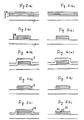
- the resulting three-layered structure is shown in Figures 2 (a) and 2 (b).
- the next step is shown in Figures 3 (a) and 3 (b), by which the three-layered layer is etched into an island-shaped pattern by use of a resist pattern produced in the transistor portion.
- the etching is a reactive ion-etching, which is called an anisotropic etching in which the sides of the island-patterned multi-layer portion are vertical to the surface of the substrate surface.
- the etchant can be a gaseous mixture of SF6 and CCl4 for a polycrystalline silicon layer, and a CHF3 gas for a SiO2 layer.
- a polycrystalline silicon layer is deposited by a vacuum CVD method to a thickness of about 2000 angstroms as an upper gate electrode 4b, and then the upper gate electrode 4b and a lower gate electrode 4a are formed by a reactive ion etchant through a resist pattern formed as a gate electrode.
- the finished gate electrode 4 is shown in Figure 1.
- any suitable impurities are ion injected on the substrate 1, and an activating annealling is carried out.
- the upper gate electrode 4a, the lower gate electrode 4b and the polycrystalline silicon layer which is later made into a source and a drain at opposite sides of the gate electrode, are made so as to have a low resistance with electrically conductivity.
- the next step is the stage shown in Figures 7 (a) and 7 (b) in which an insulating layer 6 is formed. More specifically, a SiO2 or a PSG layer having a phosphorus doping is formed on the whole surface of the substrate 1 by a normal pressure CVD method, and contact holes (not numbered) are formed in the layer 6 at the junction of electrodes. Other contact holes are formed in the layer 6 on a gate electrode 4 connected to an Al wiring, which is described in the next paragraph.
- Al layer 7 having a thickness of about 5000 angstroms is first formed by sputtering, and then it is made into Al layer wirings 7a and 7b of a predetermined shape by photo-etching as shown in Figures 8 (a) and 8 (b). In this way, the final TFT having a desired wiring as shown in Figure 1 is obtained.
- the insulating layer on the sides of the island that is, the island-patterned multi-layer portion, and the gate electrodes are made of different materials, thereby avoiding the difficulty resulting from the use of the same kind of material which is adopted under the known fabricating process.
- the insulating layer on the sides of the island-patterned multi-layer portion can be made of Si3N4 or other material if they do not unfavorably affect the semiconductor.
- the gate electrode can be made of metal such as Ti or W, instead of polycrystalline silicon, or made of a combination of them with silicide.
- a SiN film 22 is formed on the substrate 1 to a thickness of about 3000 angstroms by a plasma CVD apparatus after the substrate 1 is cleansed. Then an amorphous Si layer is formed on the first Si layer at a temperature of 400°C to 600°C by using a SiH4 diluted with H2 and decomposed by heat and plasma. This layer is about 1000 angstroms thick.
- the Si layer is annealed at 600°C at a vacuum or in an inert gas atmosphere for about 50 hours so as to make it into polycrystalline Si layer 23.
- a SiO2 is then formed by sputtering to a thickness of about 1000 angstroms from which a gate insulating layer is formed at a later stage. These processes are conducted without being exposed to atmosphere as described above.
- Figure 11 shows the formation of a polycrystalline silicon layer having a thickness of about 1000 angstroms from which a first gate electrode 25a is formed.
- a first gate electrode 25a is formed.
- three layers 22, 23, and 25a are obtained, all of which are patterned by use of the same resist pattern into an island-shaped portion, hereinafter referred to the island as shown in Figure 12.
- a reactive ion etchant is used and an anisotropic etching is adopted so that after etching each vertical section is perpendicular to the substrate 1.
- a gaseous mixture of SF6 and CCl4 is used for the polycrystalline silicon layer and a CHF3 gas is used for the SiO2.
- the whole surface of the substrate 1 is covered with a SiO2 26 having a thickness of about 5000 angstroms by a sputtering device or a normal pressure CVD device.
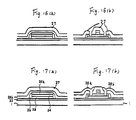
- a reactive ion etchant is used to perform an anisotropic etching so as to remove the SiO2 26 until the only sides of the island remain as shown in Figure 14.
- Figure 18 shows the variations with time in the emitting light intensity from the initiation of the etching, of the spectrums of 388 nm of CN resulting from the etching gas CHF3 and the SiN layer 22 selected from the plasma emitting spectrums.
- the etching process is stopped. This ensures that a constant size of the SiO2 layer is formed on the sides of the island.
- the next step is to form a polycrystalline silicon layer having a thickness of about 2000 angstroms by a reduced pressure CVD device from which a second gate electrode 25b is made.
- a resist pattern is formed so as to shape the gate electrode as desired.
- the first gate electrode 25a and the second gate electrode 25b are etched with a reactive ion etchant at the same time.
- ion is injected into the gate electrodes 25a and 25b so as to effect an activated annealing, so that the polycrystalline silicon layer of the two gate electrodes and a polycrystalline silicon layer from which a drain is later formed are treated so as to have low resistance.
- a PSG layer is formed by doping the substrate 1 with SiO2 or phosphorus, and contact holes are made at desired spots so as to form an inter-layer insulating layer 7.
- the gate insulating layer is also provided with holes so that the source and drain and an Al electrode referred to below may be electrically connected.
- the contact hole is made in a layer 27 on the gate electrode 25 connected to an Al wiring referred to below (not shown).
- the next step is to form an Al layer to a thickness of about 5000 angstroms by sputtering to a desired shape for a source electrode 28a and a drain electrode 28b, which, as a thin film transistor and a circumferential wirings, is shown in Figure 17.
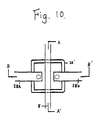
- the final TFT is shown in Figure 10.
- the material for the first insulating layer on the substrate 1 and the material for the second insulating layer on the sides of the island are replaceable, and any other materials can be used for the insulating layers on condition that they have different spectroscopic characteristics.
- the gate electrode can be made of metals such as Ti or W instead of the polycrystalline silicon.
Landscapes
- Engineering & Computer Science (AREA)
- Physics & Mathematics (AREA)
- Condensed Matter Physics & Semiconductors (AREA)
- Chemical & Material Sciences (AREA)
- Chemical Kinetics & Catalysis (AREA)
- General Chemical & Material Sciences (AREA)
- Plasma & Fusion (AREA)
- General Physics & Mathematics (AREA)
- Manufacturing & Machinery (AREA)
- Computer Hardware Design (AREA)
- Microelectronics & Electronic Packaging (AREA)
- Power Engineering (AREA)
- Thin Film Transistor (AREA)
Applications Claiming Priority (2)
| Application Number | Priority Date | Filing Date | Title |
|---|---|---|---|
| JP129973/90 | 1990-05-17 | ||
| JP12997390 | 1990-05-17 |
Publications (3)
| Publication Number | Publication Date |
|---|---|
| EP0457596A2 true EP0457596A2 (de) | 1991-11-21 |
| EP0457596A3 EP0457596A3 (en) | 1992-05-20 |
| EP0457596B1 EP0457596B1 (de) | 1995-12-06 |
Family
ID=15023018
Family Applications (1)
| Application Number | Title | Priority Date | Filing Date |
|---|---|---|---|
| EP91304428A Expired - Lifetime EP0457596B1 (de) | 1990-05-17 | 1991-05-16 | Verfahren zum Herstellen eines Dünnfilm-Transistors |
Country Status (3)
| Country | Link |
|---|---|
| US (1) | US5120667A (de) |
| EP (1) | EP0457596B1 (de) |
| DE (1) | DE69115118T2 (de) |
Cited By (3)
| Publication number | Priority date | Publication date | Assignee | Title |
|---|---|---|---|---|
| FR2728390A1 (fr) * | 1994-12-19 | 1996-06-21 | Korea Electronics Telecomm | Procede de formation d'un transistor a film mince |
| US5681761A (en) * | 1995-12-28 | 1997-10-28 | Philips Electronics North America Corporation | Microwave power SOI-MOSFET with high conductivity metal gate |
| US8120111B2 (en) | 2003-04-11 | 2012-02-21 | Semiconductor Energy Laboratory Co., Ltd. | Thin film transistor including insulating film and island-shaped semiconductor film |
Families Citing this family (14)
| Publication number | Priority date | Publication date | Assignee | Title |
|---|---|---|---|---|
| US5753542A (en) * | 1985-08-02 | 1998-05-19 | Semiconductor Energy Laboratory Co., Ltd. | Method for crystallizing semiconductor material without exposing it to air |
| JP2508851B2 (ja) * | 1989-08-23 | 1996-06-19 | 日本電気株式会社 | 液晶表示素子用アクティブマトリクス基板とその製造方法 |
| US5409851A (en) * | 1992-05-04 | 1995-04-25 | Goldstar Co., Ltd. | Method of making a thin film transistor |
| KR940010384A (ko) * | 1992-10-23 | 1994-05-26 | 이헌조 | 박막트랜지스터 제조방법 |
| JPH0766420A (ja) * | 1993-08-31 | 1995-03-10 | Matsushita Electric Ind Co Ltd | 薄膜の加工方法 |
| KR0124958B1 (ko) * | 1993-11-29 | 1997-12-11 | 김광호 | 액정용 박막트랜지스터 및 그 제조방법 |
| JP3464285B2 (ja) * | 1994-08-26 | 2003-11-05 | 株式会社半導体エネルギー研究所 | 半導体装置の作製方法 |
| JP3497627B2 (ja) * | 1994-12-08 | 2004-02-16 | 株式会社東芝 | 半導体装置およびその製造方法 |
| TW297950B (de) * | 1994-12-16 | 1997-02-11 | Handotai Energy Kenkyusho Kk | |
| US6746905B1 (en) * | 1996-06-20 | 2004-06-08 | Kabushiki Kaisha Toshiba | Thin film transistor and manufacturing process therefor |
| KR100349366B1 (ko) * | 1999-06-28 | 2002-08-21 | 주식회사 하이닉스반도체 | 에스오아이 소자 및 그의 제조방법 |
| JP4243455B2 (ja) * | 2002-05-21 | 2009-03-25 | 日本電気株式会社 | 薄膜トランジスタの製造方法 |
| US6963083B2 (en) * | 2003-06-30 | 2005-11-08 | Lg.Philips Lcd Co., Ltd. | Liquid crystal display device having polycrystalline TFT and fabricating method thereof |
| KR101860859B1 (ko) * | 2011-06-13 | 2018-05-25 | 삼성디스플레이 주식회사 | 박막트랜지스터의 제조 방법, 상기 방법에 의해 제조된 박막트랜지스터, 유기발광표시장치의 제조방법, 및 상기 방법에 의해 제조된 유기발광표시장치 |
Family Cites Families (10)
| Publication number | Priority date | Publication date | Assignee | Title |
|---|---|---|---|---|
| JPS5317069A (en) * | 1976-07-30 | 1978-02-16 | Fujitsu Ltd | Semiconductor device and its production |
| JPS56116627A (en) * | 1980-02-20 | 1981-09-12 | Chiyou Lsi Gijutsu Kenkyu Kumiai | Thin film semiconductor device |
| JPS58102560A (ja) * | 1981-12-14 | 1983-06-18 | Fujitsu Ltd | 薄膜トランジスタの製造方法 |
| FR2566583B1 (fr) * | 1984-06-22 | 1986-09-19 | Thomson Csf | Procede de fabrication d'au moins un transistor a effet de champ en couche mince, et transistor obtenu par ce procede |
| JPH0622245B2 (ja) * | 1986-05-02 | 1994-03-23 | 富士ゼロックス株式会社 | 薄膜トランジスタの製造方法 |
| US4753896A (en) * | 1986-11-21 | 1988-06-28 | Texas Instruments Incorporated | Sidewall channel stop process |
| JPS63308386A (ja) * | 1987-01-30 | 1988-12-15 | Sony Corp | 半導体装置とその製造方法 |
| JPH0687503B2 (ja) * | 1987-03-11 | 1994-11-02 | 株式会社日立製作所 | 薄膜半導体装置 |
| JPH0220820A (ja) * | 1988-07-08 | 1990-01-24 | Minolta Camera Co Ltd | 画像形成装置 |
| FR2651068B1 (fr) * | 1989-08-16 | 1994-06-10 | France Etat | Procede de fabrication de transistor mos mesa de type silicium sur isolant |
-
1991
- 1991-05-16 EP EP91304428A patent/EP0457596B1/de not_active Expired - Lifetime
- 1991-05-16 DE DE69115118T patent/DE69115118T2/de not_active Expired - Fee Related
- 1991-10-18 US US07/778,750 patent/US5120667A/en not_active Expired - Lifetime
Cited By (4)
| Publication number | Priority date | Publication date | Assignee | Title |
|---|---|---|---|---|
| FR2728390A1 (fr) * | 1994-12-19 | 1996-06-21 | Korea Electronics Telecomm | Procede de formation d'un transistor a film mince |
| US5681761A (en) * | 1995-12-28 | 1997-10-28 | Philips Electronics North America Corporation | Microwave power SOI-MOSFET with high conductivity metal gate |
| US8120111B2 (en) | 2003-04-11 | 2012-02-21 | Semiconductor Energy Laboratory Co., Ltd. | Thin film transistor including insulating film and island-shaped semiconductor film |
| US9362307B2 (en) | 2003-04-11 | 2016-06-07 | Semiconductor Energy Laboratory Co., Ltd. | Thin film transistor, electronic device having the same, and method for manufacturing the same |
Also Published As
| Publication number | Publication date |
|---|---|
| DE69115118T2 (de) | 1996-05-30 |
| EP0457596B1 (de) | 1995-12-06 |
| US5120667A (en) | 1992-06-09 |
| DE69115118D1 (de) | 1996-01-18 |
| EP0457596A3 (en) | 1992-05-20 |
Similar Documents
| Publication | Publication Date | Title |
|---|---|---|
| US5120667A (en) | Process for fabricating a thin film transistor | |
| KR100372841B1 (ko) | 고품질 결정성 규소막을 갖는 반도체 장치의 제조방법 | |
| US5766977A (en) | Method for producing semiconductor device | |
| CN100481512C (zh) | 半导体器件及其制造方法 | |
| JPH10135137A (ja) | 結晶性半導体作製方法 | |
| JPH05109737A (ja) | 薄膜トランジスタの製造方法 | |
| KR20040081344A (ko) | 박막 트랜지스터 및 그 제조 방법 | |
| US20050082537A1 (en) | Semiconductor device and method for manufacturing the same | |
| US7160768B2 (en) | Method of manufacturing electronic device and method of manufacturing semiconductor device | |
| JPH04275436A (ja) | Soimosトランジスタ | |
| JPH0685258A (ja) | 薄膜トランジスタとその製造方法 | |
| JP2698724B2 (ja) | 薄膜トランジスタ及びその製造方法 | |
| JP4901020B2 (ja) | ポリシリコン薄膜トランジスタの製造方法 | |
| US20050157222A1 (en) | Method of manufacturing semiconductor device | |
| JPH04226080A (ja) | 薄膜トランジスタの製造方法 | |
| JPH0555578A (ja) | 薄膜トランジスタの製造方法 | |
| JPH0666312B2 (ja) | 半導体装置の製造方法 | |
| JP2513664B2 (ja) | 薄膜トランジスタの製造方法 | |
| JPH07122752A (ja) | 薄膜トランジスタの製造方法 | |
| JP3310567B2 (ja) | 半導体装置の製造方法 | |
| JP2004165286A (ja) | 薄膜トランジスタの製造方法 | |
| JPH09331067A (ja) | 半導体装置の製造方法 | |
| JPS583252A (ja) | 半導体集積回路装置 | |
| JPS59195859A (ja) | 半導体装置の製造方法 | |
| JPH0917798A (ja) | 半導体装置およびその製造方法 |
Legal Events
| Date | Code | Title | Description |
|---|---|---|---|
| PUAI | Public reference made under article 153(3) epc to a published international application that has entered the european phase |
Free format text: ORIGINAL CODE: 0009012 |
|
| 17P | Request for examination filed |
Effective date: 19910527 |
|
| AK | Designated contracting states |
Kind code of ref document: A2 Designated state(s): DE FR GB |
|
| PUAL | Search report despatched |
Free format text: ORIGINAL CODE: 0009013 |
|
| AK | Designated contracting states |
Kind code of ref document: A3 Designated state(s): DE FR GB |
|
| 17Q | First examination report despatched |
Effective date: 19940412 |
|
| GRAA | (expected) grant |
Free format text: ORIGINAL CODE: 0009210 |
|
| AK | Designated contracting states |
Kind code of ref document: B1 Designated state(s): DE FR GB |
|
| REF | Corresponds to: |
Ref document number: 69115118 Country of ref document: DE Date of ref document: 19960118 |
|
| ET | Fr: translation filed | ||
| PLBE | No opposition filed within time limit |
Free format text: ORIGINAL CODE: 0009261 |
|
| STAA | Information on the status of an ep patent application or granted ep patent |
Free format text: STATUS: NO OPPOSITION FILED WITHIN TIME LIMIT |
|
| 26N | No opposition filed | ||
| PGFP | Annual fee paid to national office [announced via postgrant information from national office to epo] |
Ref country code: DE Payment date: 20010508 Year of fee payment: 11 |
|
| PGFP | Annual fee paid to national office [announced via postgrant information from national office to epo] |
Ref country code: GB Payment date: 20010516 Year of fee payment: 11 |
|
| PGFP | Annual fee paid to national office [announced via postgrant information from national office to epo] |
Ref country code: FR Payment date: 20010518 Year of fee payment: 11 |
|
| REG | Reference to a national code |
Ref country code: GB Ref legal event code: IF02 |
|
| PG25 | Lapsed in a contracting state [announced via postgrant information from national office to epo] |
Ref country code: GB Free format text: LAPSE BECAUSE OF NON-PAYMENT OF DUE FEES Effective date: 20020516 |
|
| PG25 | Lapsed in a contracting state [announced via postgrant information from national office to epo] |
Ref country code: DE Free format text: LAPSE BECAUSE OF NON-PAYMENT OF DUE FEES Effective date: 20021203 |
|
| GBPC | Gb: european patent ceased through non-payment of renewal fee |
Effective date: 20020516 |
|
| PG25 | Lapsed in a contracting state [announced via postgrant information from national office to epo] |
Ref country code: FR Free format text: LAPSE BECAUSE OF NON-PAYMENT OF DUE FEES Effective date: 20030131 |
|
| REG | Reference to a national code |
Ref country code: FR Ref legal event code: ST |