EP0336214B1 - Verfahren zur Reinigung von Salzen des Riboflavin-5'-phosphats, insbesondere von Mononatrium-riboflavin-5'-phosphat - Google Patents
Verfahren zur Reinigung von Salzen des Riboflavin-5'-phosphats, insbesondere von Mononatrium-riboflavin-5'-phosphat Download PDFInfo
- Publication number
- EP0336214B1 EP0336214B1 EP89105097A EP89105097A EP0336214B1 EP 0336214 B1 EP0336214 B1 EP 0336214B1 EP 89105097 A EP89105097 A EP 89105097A EP 89105097 A EP89105097 A EP 89105097A EP 0336214 B1 EP0336214 B1 EP 0336214B1
- Authority
- EP
- European Patent Office
- Prior art keywords
- fmn
- riboflavin
- solution
- salt
- water
- Prior art date
- Legal status (The legal status is an assumption and is not a legal conclusion. Google has not performed a legal analysis and makes no representation as to the accuracy of the status listed.)
- Expired - Lifetime
Links
- 238000000034 method Methods 0.000 title claims description 50
- 238000000746 purification Methods 0.000 title claims description 16
- 150000003839 salts Chemical class 0.000 title claims description 13
- FVTCRASFADXXNN-SCRDCRAPSA-N flavin mononucleotide Chemical class OP(=O)(O)OC[C@@H](O)[C@@H](O)[C@@H](O)CN1C=2C=C(C)C(C)=CC=2N=C2C1=NC(=O)NC2=O FVTCRASFADXXNN-SCRDCRAPSA-N 0.000 title claims description 10
- FVTCRASFADXXNN-UHFFFAOYSA-N flavin mononucleotide Natural products OP(=O)(O)OCC(O)C(O)C(O)CN1C=2C=C(C)C(C)=CC=2N=C2C1=NC(=O)NC2=O FVTCRASFADXXNN-UHFFFAOYSA-N 0.000 title description 2
- AUNGANRZJHBGPY-SCRDCRAPSA-N Riboflavin Chemical compound OC[C@@H](O)[C@@H](O)[C@@H](O)CN1C=2C=C(C)C(C)=CC=2N=C2C1=NC(=O)NC2=O AUNGANRZJHBGPY-SCRDCRAPSA-N 0.000 claims description 139
- 239000011768 flavin mononucleotide Substances 0.000 claims description 90
- AUNGANRZJHBGPY-UHFFFAOYSA-N D-Lyxoflavin Natural products OCC(O)C(O)C(O)CN1C=2C=C(C)C(C)=CC=2N=C2C1=NC(=O)NC2=O AUNGANRZJHBGPY-UHFFFAOYSA-N 0.000 claims description 72
- 239000002151 riboflavin Substances 0.000 claims description 72
- 235000019192 riboflavin Nutrition 0.000 claims description 72
- 229960002477 riboflavin Drugs 0.000 claims description 72
- HEMHJVSKTPXQMS-UHFFFAOYSA-M Sodium hydroxide Chemical compound [OH-].[Na+] HEMHJVSKTPXQMS-UHFFFAOYSA-M 0.000 claims description 60
- 239000000243 solution Substances 0.000 claims description 57
- XLYOFNOQVPJJNP-UHFFFAOYSA-N water Substances O XLYOFNOQVPJJNP-UHFFFAOYSA-N 0.000 claims description 36
- 229920005989 resin Polymers 0.000 claims description 28
- 239000011347 resin Substances 0.000 claims description 28
- MYRTYDVEIRVNKP-UHFFFAOYSA-N 1,2-Divinylbenzene Chemical compound C=CC1=CC=CC=C1C=C MYRTYDVEIRVNKP-UHFFFAOYSA-N 0.000 claims description 22
- IJGRMHOSHXDMSA-UHFFFAOYSA-N Atomic nitrogen Chemical compound N#N IJGRMHOSHXDMSA-UHFFFAOYSA-N 0.000 claims description 18
- LFQSCWFLJHTTHZ-UHFFFAOYSA-N Ethanol Chemical compound CCO LFQSCWFLJHTTHZ-UHFFFAOYSA-N 0.000 claims description 18
- DGAQECJNVWCQMB-PUAWFVPOSA-M Ilexoside XXIX Chemical compound C[C@@H]1CC[C@@]2(CC[C@@]3(C(=CC[C@H]4[C@]3(CC[C@@H]5[C@@]4(CC[C@@H](C5(C)C)OS(=O)(=O)[O-])C)C)[C@@H]2[C@]1(C)O)C)C(=O)O[C@H]6[C@@H]([C@H]([C@@H]([C@H](O6)CO)O)O)O.[Na+] DGAQECJNVWCQMB-PUAWFVPOSA-M 0.000 claims description 17
- 239000000203 mixture Substances 0.000 claims description 17
- 239000011734 sodium Substances 0.000 claims description 17
- 229910052708 sodium Inorganic materials 0.000 claims description 17
- 230000026731 phosphorylation Effects 0.000 claims description 16
- 238000006366 phosphorylation reaction Methods 0.000 claims description 16
- VYPSYNLAJGMNEJ-UHFFFAOYSA-N Silicium dioxide Chemical compound O=[Si]=O VYPSYNLAJGMNEJ-UHFFFAOYSA-N 0.000 claims description 15
- 239000000741 silica gel Substances 0.000 claims description 14
- 229910002027 silica gel Inorganic materials 0.000 claims description 14
- 235000019231 riboflavin-5'-phosphate Nutrition 0.000 claims description 13
- 239000002585 base Substances 0.000 claims description 11
- 239000012266 salt solution Substances 0.000 claims description 11
- 239000007864 aqueous solution Substances 0.000 claims description 10
- 150000008044 alkali metal hydroxides Chemical class 0.000 claims description 9
- 239000013078 crystal Substances 0.000 claims description 9
- 229910052757 nitrogen Inorganic materials 0.000 claims description 9
- 239000004228 Riboflavin-5'-Phosphate Substances 0.000 claims description 8
- 125000000217 alkyl group Chemical group 0.000 claims description 8
- DNIAPMSPPWPWGF-GSVOUGTGSA-N (R)-(-)-Propylene glycol Chemical compound C[C@@H](O)CO DNIAPMSPPWPWGF-GSVOUGTGSA-N 0.000 claims description 6
- -1 riboflavin monophosphates Chemical class 0.000 claims description 6
- KEAYESYHFKHZAL-UHFFFAOYSA-N Sodium Chemical compound [Na] KEAYESYHFKHZAL-UHFFFAOYSA-N 0.000 claims description 5
- 150000001252 acrylic acid derivatives Chemical class 0.000 claims description 5
- 239000012452 mother liquor Substances 0.000 claims description 5
- 229920002223 polystyrene Polymers 0.000 claims description 5
- 239000004793 Polystyrene Substances 0.000 claims description 4
- 238000006243 chemical reaction Methods 0.000 claims description 4
- 238000007334 copolymerization reaction Methods 0.000 claims description 4
- 230000008929 regeneration Effects 0.000 claims description 4
- 238000011069 regeneration method Methods 0.000 claims description 4
- 239000000126 substance Substances 0.000 claims description 4
- 239000000725 suspension Substances 0.000 claims description 4
- CERQOIWHTDAKMF-UHFFFAOYSA-N Methacrylic acid Chemical class CC(=C)C(O)=O CERQOIWHTDAKMF-UHFFFAOYSA-N 0.000 claims description 3
- 229910019142 PO4 Inorganic materials 0.000 claims description 3
- 238000009826 distribution Methods 0.000 claims description 3
- 238000010438 heat treatment Methods 0.000 claims description 3
- 239000011148 porous material Substances 0.000 claims description 3
- 238000005406 washing Methods 0.000 claims description 3
- 238000001704 evaporation Methods 0.000 claims description 2
- 230000008020 evaporation Effects 0.000 claims description 2
- 238000002955 isolation Methods 0.000 claims description 2
- 238000002360 preparation method Methods 0.000 claims description 2
- 229940116441 divinylbenzene Drugs 0.000 claims 4
- 239000002245 particle Substances 0.000 claims 3
- 230000020477 pH reduction Effects 0.000 claims 1
- OKKJLVBELUTLKV-UHFFFAOYSA-N Methanol Chemical compound OC OKKJLVBELUTLKV-UHFFFAOYSA-N 0.000 description 27
- 239000000047 product Substances 0.000 description 18
- 238000004140 cleaning Methods 0.000 description 13
- 239000001177 diphosphate Substances 0.000 description 11
- XPPKVPWEQAFLFU-UHFFFAOYSA-J diphosphate(4-) Chemical class [O-]P([O-])(=O)OP([O-])([O-])=O XPPKVPWEQAFLFU-UHFFFAOYSA-J 0.000 description 11
- 235000011180 diphosphates Nutrition 0.000 description 11
- FAPWRFPIFSIZLT-UHFFFAOYSA-M Sodium chloride Chemical compound [Na+].[Cl-] FAPWRFPIFSIZLT-UHFFFAOYSA-M 0.000 description 9
- BDAGIHXWWSANSR-UHFFFAOYSA-N methanoic acid Natural products OC=O BDAGIHXWWSANSR-UHFFFAOYSA-N 0.000 description 9
- 238000000926 separation method Methods 0.000 description 9
- 239000000872 buffer Substances 0.000 description 8
- 239000002904 solvent Substances 0.000 description 8
- 150000002500 ions Chemical class 0.000 description 7
- KFZMGEQAYNKOFK-UHFFFAOYSA-N Isopropanol Chemical compound CC(C)O KFZMGEQAYNKOFK-UHFFFAOYSA-N 0.000 description 6
- 238000004587 chromatography analysis Methods 0.000 description 6
- 239000003480 eluent Substances 0.000 description 6
- 229920000388 Polyphosphate Polymers 0.000 description 5
- 238000002425 crystallisation Methods 0.000 description 5
- 230000008025 crystallization Effects 0.000 description 5
- 235000019253 formic acid Nutrition 0.000 description 5
- 239000001205 polyphosphate Substances 0.000 description 5
- 235000011176 polyphosphates Nutrition 0.000 description 5
- OSWFIVFLDKOXQC-UHFFFAOYSA-N 4-(3-methoxyphenyl)aniline Chemical compound COC1=CC=CC(C=2C=CC(N)=CC=2)=C1 OSWFIVFLDKOXQC-UHFFFAOYSA-N 0.000 description 4
- OKTJSMMVPCPJKN-UHFFFAOYSA-N Carbon Chemical compound [C] OKTJSMMVPCPJKN-UHFFFAOYSA-N 0.000 description 4
- 238000010828 elution Methods 0.000 description 4
- XHXFXVLFKHQFAL-UHFFFAOYSA-N phosphoryl trichloride Chemical compound ClP(Cl)(Cl)=O XHXFXVLFKHQFAL-UHFFFAOYSA-N 0.000 description 4
- 239000011780 sodium chloride Substances 0.000 description 4
- LYCAIKOWRPUZTN-UHFFFAOYSA-N Ethylene glycol Chemical compound OCCO LYCAIKOWRPUZTN-UHFFFAOYSA-N 0.000 description 3
- MUBZPKHOEPUJKR-UHFFFAOYSA-N Oxalic acid Chemical compound OC(=O)C(O)=O MUBZPKHOEPUJKR-UHFFFAOYSA-N 0.000 description 3
- 239000007853 buffer solution Substances 0.000 description 3
- 239000006227 byproduct Substances 0.000 description 3
- 229920001429 chelating resin Polymers 0.000 description 3
- 238000001914 filtration Methods 0.000 description 3
- 238000004519 manufacturing process Methods 0.000 description 3
- 239000000463 material Substances 0.000 description 3
- HZAXFHJVJLSVMW-UHFFFAOYSA-N 2-Aminoethan-1-ol Chemical compound NCCO HZAXFHJVJLSVMW-UHFFFAOYSA-N 0.000 description 2
- WMFOQBRAJBCJND-UHFFFAOYSA-M Lithium hydroxide Chemical compound [Li+].[OH-] WMFOQBRAJBCJND-UHFFFAOYSA-M 0.000 description 2
- YNAVUWVOSKDBBP-UHFFFAOYSA-N Morpholine Chemical compound C1COCCN1 YNAVUWVOSKDBBP-UHFFFAOYSA-N 0.000 description 2
- NQRYJNQNLNOLGT-UHFFFAOYSA-N Piperidine Chemical compound C1CCNCC1 NQRYJNQNLNOLGT-UHFFFAOYSA-N 0.000 description 2
- 102000048125 Riboflavin kinases Human genes 0.000 description 2
- 239000006096 absorbing agent Substances 0.000 description 2
- 238000010521 absorption reaction Methods 0.000 description 2
- VZTDIZULWFCMLS-UHFFFAOYSA-N ammonium formate Chemical compound [NH4+].[O-]C=O VZTDIZULWFCMLS-UHFFFAOYSA-N 0.000 description 2
- 229910052799 carbon Inorganic materials 0.000 description 2
- 238000013375 chromatographic separation Methods 0.000 description 2
- 238000001816 cooling Methods 0.000 description 2
- 239000003814 drug Substances 0.000 description 2
- 229940013640 flavin mononucleotide Drugs 0.000 description 2
- 230000007062 hydrolysis Effects 0.000 description 2
- 238000006460 hydrolysis reaction Methods 0.000 description 2
- 239000005457 ice water Substances 0.000 description 2
- 150000004712 monophosphates Chemical class 0.000 description 2
- 239000010452 phosphate Substances 0.000 description 2
- 230000000865 phosphorylative effect Effects 0.000 description 2
- 238000001556 precipitation Methods 0.000 description 2
- 108091000042 riboflavin kinase Proteins 0.000 description 2
- 159000000000 sodium salts Chemical class 0.000 description 2
- 239000002351 wastewater Substances 0.000 description 2
- QBPPRVHXOZRESW-UHFFFAOYSA-N 1,4,7,10-tetraazacyclododecane Chemical compound C1CNCCNCCNCCN1 QBPPRVHXOZRESW-UHFFFAOYSA-N 0.000 description 1
- VKIGAWAEXPTIOL-UHFFFAOYSA-N 2-hydroxyhexanenitrile Chemical compound CCCCC(O)C#N VKIGAWAEXPTIOL-UHFFFAOYSA-N 0.000 description 1
- ATRRKUHOCOJYRX-UHFFFAOYSA-N Ammonium bicarbonate Chemical compound [NH4+].OC([O-])=O ATRRKUHOCOJYRX-UHFFFAOYSA-N 0.000 description 1
- VHUUQVKOLVNVRT-UHFFFAOYSA-N Ammonium hydroxide Chemical compound [NH4+].[OH-] VHUUQVKOLVNVRT-UHFFFAOYSA-N 0.000 description 1
- 229910019213 POCl3 Inorganic materials 0.000 description 1
- QAOWNCQODCNURD-UHFFFAOYSA-N Sulfuric acid Chemical compound OS(O)(=O)=O QAOWNCQODCNURD-UHFFFAOYSA-N 0.000 description 1
- 229930003471 Vitamin B2 Natural products 0.000 description 1
- 206010047612 Vitamin B2 deficiency Diseases 0.000 description 1
- 239000002253 acid Substances 0.000 description 1
- 239000000654 additive Substances 0.000 description 1
- 230000000996 additive effect Effects 0.000 description 1
- 150000003973 alkyl amines Chemical class 0.000 description 1
- 229910000147 aluminium phosphate Inorganic materials 0.000 description 1
- 150000001412 amines Chemical class 0.000 description 1
- PRKQVKDSMLBJBJ-UHFFFAOYSA-N ammonium carbonate Chemical compound N.N.OC(O)=O PRKQVKDSMLBJBJ-UHFFFAOYSA-N 0.000 description 1
- 239000001099 ammonium carbonate Substances 0.000 description 1
- 235000012501 ammonium carbonate Nutrition 0.000 description 1
- 235000011162 ammonium carbonates Nutrition 0.000 description 1
- 235000011114 ammonium hydroxide Nutrition 0.000 description 1
- 150000003863 ammonium salts Chemical class 0.000 description 1
- 150000001450 anions Chemical class 0.000 description 1
- 201000007590 ariboflavinosis Diseases 0.000 description 1
- 239000011324 bead Substances 0.000 description 1
- 230000015572 biosynthetic process Effects 0.000 description 1
- 238000009835 boiling Methods 0.000 description 1
- 125000004432 carbon atom Chemical group C* 0.000 description 1
- 239000001913 cellulose Substances 0.000 description 1
- 229920002678 cellulose Polymers 0.000 description 1
- 238000003889 chemical engineering Methods 0.000 description 1
- 239000003153 chemical reaction reagent Substances 0.000 description 1
- 239000003795 chemical substances by application Substances 0.000 description 1
- 239000005515 coenzyme Substances 0.000 description 1
- 150000001875 compounds Chemical class 0.000 description 1
- 239000012043 crude product Substances 0.000 description 1
- 230000018109 developmental process Effects 0.000 description 1
- 238000010586 diagram Methods 0.000 description 1
- 125000005265 dialkylamine group Chemical group 0.000 description 1
- 238000010790 dilution Methods 0.000 description 1
- 239000012895 dilution Substances 0.000 description 1
- 229940079593 drug Drugs 0.000 description 1
- 230000000694 effects Effects 0.000 description 1
- 238000006911 enzymatic reaction Methods 0.000 description 1
- 150000002169 ethanolamines Chemical class 0.000 description 1
- 239000012065 filter cake Substances 0.000 description 1
- 239000000706 filtrate Substances 0.000 description 1
- VWWQXMAJTJZDQX-UYBVJOGSSA-N flavin adenine dinucleotide Chemical compound C1=NC2=C(N)N=CN=C2N1[C@@H]([C@H](O)[C@@H]1O)O[C@@H]1CO[P@](O)(=O)O[P@@](O)(=O)OC[C@@H](O)[C@@H](O)[C@@H](O)CN1C2=NC(=O)NC(=O)C2=NC2=C1C=C(C)C(C)=C2 VWWQXMAJTJZDQX-UYBVJOGSSA-N 0.000 description 1
- 235000019162 flavin adenine dinucleotide Nutrition 0.000 description 1
- 239000011714 flavin adenine dinucleotide Substances 0.000 description 1
- 229940093632 flavin-adenine dinucleotide Drugs 0.000 description 1
- 235000013305 food Nutrition 0.000 description 1
- 239000000499 gel Substances 0.000 description 1
- 238000004128 high performance liquid chromatography Methods 0.000 description 1
- 239000012535 impurity Substances 0.000 description 1
- 229910052500 inorganic mineral Inorganic materials 0.000 description 1
- 238000006317 isomerization reaction Methods 0.000 description 1
- 239000011707 mineral Substances 0.000 description 1
- 230000007935 neutral effect Effects 0.000 description 1
- 150000007524 organic acids Chemical class 0.000 description 1
- 235000006408 oxalic acid Nutrition 0.000 description 1
- NBIIXXVUZAFLBC-UHFFFAOYSA-N phosphoric acid Substances OP(O)(O)=O NBIIXXVUZAFLBC-UHFFFAOYSA-N 0.000 description 1
- 229920000642 polymer Polymers 0.000 description 1
- 239000002244 precipitate Substances 0.000 description 1
- 230000008707 rearrangement Effects 0.000 description 1
- 238000004064 recycling Methods 0.000 description 1
- 208000004223 riboflavin deficiency Diseases 0.000 description 1
- 150000003287 riboflavins Chemical class 0.000 description 1
- 239000000523 sample Substances 0.000 description 1
- 239000000377 silicon dioxide Substances 0.000 description 1
- 239000001488 sodium phosphate Substances 0.000 description 1
- 235000011008 sodium phosphates Nutrition 0.000 description 1
- RPACBEVZENYWOL-XFULWGLBSA-M sodium;(2r)-2-[6-(4-chlorophenoxy)hexyl]oxirane-2-carboxylate Chemical compound [Na+].C=1C=C(Cl)C=CC=1OCCCCCC[C@]1(C(=O)[O-])CO1 RPACBEVZENYWOL-XFULWGLBSA-M 0.000 description 1
- 238000002336 sorption--desorption measurement Methods 0.000 description 1
- 239000007858 starting material Substances 0.000 description 1
- 235000011149 sulphuric acid Nutrition 0.000 description 1
- 230000009885 systemic effect Effects 0.000 description 1
- 229940124597 therapeutic agent Drugs 0.000 description 1
- 125000005270 trialkylamine group Chemical group 0.000 description 1
- RYFMWSXOAZQYPI-UHFFFAOYSA-K trisodium phosphate Chemical class [Na+].[Na+].[Na+].[O-]P([O-])([O-])=O RYFMWSXOAZQYPI-UHFFFAOYSA-K 0.000 description 1
- 235000019164 vitamin B2 Nutrition 0.000 description 1
- 239000011716 vitamin B2 Substances 0.000 description 1
- 238000009736 wetting Methods 0.000 description 1
- 238000010626 work up procedure Methods 0.000 description 1
Classifications
-
- C—CHEMISTRY; METALLURGY
- C07—ORGANIC CHEMISTRY
- C07F—ACYCLIC, CARBOCYCLIC OR HETEROCYCLIC COMPOUNDS CONTAINING ELEMENTS OTHER THAN CARBON, HYDROGEN, HALOGEN, OXYGEN, NITROGEN, SULFUR, SELENIUM OR TELLURIUM
- C07F9/00—Compounds containing elements of Groups 5 or 15 of the Periodic Table
- C07F9/02—Phosphorus compounds
- C07F9/547—Heterocyclic compounds, e.g. containing phosphorus as a ring hetero atom
- C07F9/6561—Heterocyclic compounds, e.g. containing phosphorus as a ring hetero atom containing systems of two or more relevant hetero rings condensed among themselves or condensed with a common carbocyclic ring or ring system, with or without other non-condensed hetero rings
- C07F9/65618—Heterocyclic compounds, e.g. containing phosphorus as a ring hetero atom containing systems of two or more relevant hetero rings condensed among themselves or condensed with a common carbocyclic ring or ring system, with or without other non-condensed hetero rings containing the ring system, e.g. flavins or analogues
Definitions
- the invention relates to a process for the purification of salts of riboflavin-5'-phosphate (5'-flavin mononucleotide and therefore hereinafter referred to as 5'-FMN), in particular the commercially available monosodium salt, of 5'-FMN, which are used in the phosphorylation of riboflavin and Reacting the obtained riboflavin-5'-phosphoric acid can be obtained with aqueous bases.
- 5'-FMN riboflavin-5'-phosphate
- 5'-FMN the commercially available monosodium salt
- 5'-FMN is a compound which plays an essential role as a coenzyme in various enzyme reactions in the living body and which is therefore used in the form of its salts, in particular in the form of sodium 5'-FMN, as an additive for medicines, foods and animal feed .
- Sodium 5'-FMN also serves as a starting material for flavin adenine dinucleotide, which is used as a therapeutic agent against vitamin B2 deficiency.
- sodium 5'-FMN is generally obtained by reacting riboflavin with a phosphorylating agent, such as partially hydrolyzed phosphoryl chloride, and then treating the resulting riboflavin 5'-phosphate with sodium hydroxide solution. Accordingly, it contains as impurities about 5 to 30% unreacted riboflavin, isomeric riboflavin mononucleotides such as 2'-FMN and 4'-FMN and riboflavin dinucleotides (5 ', 4'-FDN and 5', 3'-FDN) and polyphosphates.
- a phosphorylating agent such as partially hydrolyzed phosphoryl chloride
- Desired is a market product that contains at least 70% sodium 5'-FMN and a maximum of 5% riboflavin, as well as a high-purity market product that contains at least 80% sodium 5'-FMN, no unreacted riboflavin and only contains the isomeric monophosphates as by-products .
- sodium 5'-FMN can be purified by absorbing it on activated carbon and thus separating it from the riboflavin or don diphosphates in the eluate.
- the sodium 5'-FMN is then desorbed with dilute NaOH and is obtained in the form of a highly diluted solution. Since the desired product is absorbed in this process, large amounts of absorbers are required, which makes this method too expensive for a technical process.
- the process is particularly advantageous if the homogeneous aqueous crude 5'-FMN salt solution is passed through a column which is filled with the suitable polymeric adsorber resin, and the purified 5'-FMN salt is obtained from the eluate obtained isolated or the eluate is fed to a subsequent fine cleaning.
- Polymeric adsorber resins which are suitable for the process according to the invention are commercially available polymers with particular mechanical strength, macroreticular (sponge structure-like) porosity, uniform pore size distribution, large active surface area and chemically homogeneous, nonionic structure which are obtained by copolymerization from polystyrene / divinylbenzene (nonpolar); Acrylic acid derivatives / divinylbenzene (polar) or methacrylic acid derivatives / divinylbenzene (moderately polar) have been prepared and are generally commercially available in the form of insoluble beads.
- polar adsorber resins produced by copolymerization of acrylic acid derivatives with divinylbenzene are used with particular advantage since the regeneration is easier and there are no wetting problems with water.
- suitable adsorber resins are the so-called Amberlite of the XAD series from Rohm & Haas, in particular Amberlite® XAD-1180 and Amberlite® XAD-7.
- ribloflavin In general, up to 20 g of ribloflavin are adsorbed per liter of adsorber resin, while the phosphorylated riboflavins are not bound at a suitable pH.
- the process according to the invention is advantageously carried out in such a way that the crude 5′-FMN obtained in the phosphorylation process and containing about 5 to 30% by weight of unreacted riboflavin is suspended in water, the suspension with an alkali metal hydroxide or a nitrogen base, in particular with NaOH, adjusted to a pH between 4 and 8, preferably 5.5 to 6.5, in particular about 6, and the crude 5'-FMN salt solution is prepared with gentle heating.
- the crude 5'-FMN can be used immediately in the form of the filter cake containing residual moisture obtained in the phosphorylation.
- the adjustment of the pH and thus the formation of the 5'-FMN salt can in principle be carried out with all alkali metal hydroxides or suitable nitrogen bases.
- sodium hydroxide solution is generally used, which is also a particularly inexpensive reagent. If you work with bases other than NaOH, the purified 5'-FMN salt would then have to be converted into the sodium 5'-FMN if desired.
- alkali metal hydroxides may also be KOH or LiOH.
- suitable nitrogen bases are NH4OH, alkylamines, dialkylamines, trialkylamines in which the alkyl groups contain 1 to 3 carbon atoms, and ethanolamines and cycloaliphatic amines, such as morpholine or piperidine.
- the crude 5'-FMN salt solution obtained is then passed through the column filled with adsorber resin.
- the eluate contains between 0 and 5%, preferably 0 to 1, in particular only about 0.5% of unreacted riboflavin and between 65 and 80% of 5'-FMN salt.
- the adsorber resin is regenerated by washing with aqueous NaOH solution.
- concentration of this NaOH solution should be 0.01-5 molar, preferably about 0.1 molar.
- the ribloflavin can thus be recovered in the form of a concentrated solution of its Na salt.
- the riboflavin can be acidified e.g. with a mineral acid such as HCl, H2SO4 or a strong organic acid such as oxalic acid or formic acid can be recovered in crystalline form.
- a mineral acid such as HCl, H2SO4
- a strong organic acid such as oxalic acid or formic acid
- the 5′-FMN salt in aqueous solution which has been largely freed from riboflavin by treatment with the adsorber resin, preferably by passage through the adsorber resin column, by chromatography on a reversed phase silica gel derivatized with alkyl groups, also without the use of non-systemic salt or Buffer solutions can be further purified if a sufficient amount of an undiluted aqueous solution is chromatographed. On the other hand, thinner aqueous solutions cannot be separated in this way.
- the invention therefore also relates to a process for the purification of 5′-FMN- obtained by phosphorylation of riboflavin and reaction of the resulting riboflavin-5′-phosphate contaminated with unreacted riboflavin, isomeric riboflavin monophosphates and diphosphates with alkali metal hydroxides or nitrogen bases, preferably sodium hydroxide solution.
- Salt which is characterized in that, as described above, by treatment with the adsorber resin, preferably the 5'-FMN salt in the form of a 1 to 15% by weight obtained from passage through the adsorber resin column, largely purified from unreacted riboflavin.
- % preferably 4 to 6% by weight of dry matter solution in water with a pH between 4 and 8, preferably 5.5 and 6.5, in particular about 6, in a minimum amount of 5 to 50%, preferably 8 to 20 % of the bed volume (BV) of the column on a reverse phase (RP) silica gel derivatized with alkyl groups with a grain fraction in the range 10 to 30 0 ⁇ , preferably 20 to 200 ⁇ , with water or a mixture of water and a lower aliphatic alcohol with an alcohol content between 0 and 80% as the eluent under pressure.
- RP reverse phase
- the ratio of dry substance to separating material in this process step is between 1: 200 and 1: 7, preferably 1:25 to 1:15, in particular approximately 1:20.
- RP-silica gel derivatized with alkyl groups of the above-mentioned grain fraction
- Known suitable commercially available RP silica gels have grain fractions of 20 to 45 ⁇ or 30 to 70 ⁇ . Examples include silica gel RP-8; Kieselgel-RP-12 and Kieselgel-RP-18, such as HD-SIL-RP-18 from Orpregen.
- lower aliphatic alcohols are e.g. Designated methanol, ethanol, isopropanol and ethylene glycol. Methanol is used with particular advantage.
- Riboflavin still obtained is adsorbed by the silica gel under the specified conditions. If you use 5'-FMN solutions for this fine cleaning, which have a riboflavin content of less than 1%, you can make many consecutive separations without changing the quality of the cleaning. After the chromatography process has been completed, the adsorbed riboflavin can be eluted relatively easily by washing with a solvent containing more alcohol, for example with 60% strength aqueous methanol.
- the water-alcohol mixture used as the eluent in chromatography can be isocratic, i.e. be used in constant solvent ratio or with continuously changing solvent ratio (gradient elution). For example, very good separations can be achieved by gradient elution with eluents increasing from 0% to 30% methanol in water.
- the invention therefore also relates to a process for the preparative purification of a monosodium riboflavin 5'-phosphate monosodium free of riboflavin and contaminated by isomeric flavin mononucleotides and flavin dinucleotides by chromatography of a sodium 5'-FMN solution on an RP-derivatized with alkyl groups.
- Silica gel with a grain fraction in the range from 10 to 300 ⁇ if necessary under pressure which is characterized in that a solution with a concentration of 1 to 15 wt.%, Preferably 4 to 6 wt.% Dry matter in water or a mixture of water and a lower aliphatic alcohol with an alcohol content between 0 and 80% by weight with a pH between 4 and 7 in a minimum amount of 5 to 50%, preferably 8 to 20% of the bed volume of the silica gel column with water or a mixture of water and a lower aliphatic alcohol with an alcohol content between 0 and 80 wt.% Chromatographed as eluent.
- a solution with a concentration of 1 to 15 wt.% Preferably 4 to 6 wt.% Dry matter in water or a mixture of water and a lower aliphatic alcohol with an alcohol content between 0 and 80% by weight with a pH between 4 and 7 in a minimum amount of 5 to 50%, preferably 8 to 20% of the bed volume of the si
- the invention furthermore relates to a process for the purification of 5′-FMN- obtained by phosphorylation of riboflavin and reaction of the resulting riboflavin-5′-phosphate contaminated with unreacted riboflavin, isomeric riboflavin monophosphates and diphosphates with alkali metal hydroxides or nitrogen bases, in particular sodium hydroxide solution.
- Salt which is characterized in that the 5′-FMN salt, obtained by treatment with the appropriate adsorber resin and largely purified from unreacted riboflavin, is preferably in the form of an aqueous solution having a pH of 4 to 8, as described above 5.5-6, at temperatures of 20 to 100 ° C, preferably 40 to 60 ° C, concentrated until the 5'-FMN salt crystallizes, the crystal suspension cools, preferably to about 20 ° C, the crystalline 5'-FMN -Salt is separated off and the mother liquor is returned to the production process, if necessary after further concentration and isolation of a second crystallizate.
- the sodium 5'-FMN can also be precipitated from aqueous solution at a pH of 5 to 6.5 by adding ethanol.
- the diphosphates remain in solution.
- the 5′-FMN obtained by phosphorylation of riboflavin can be largely largely purified in a simple manner of unreacted riboflavin, isomeric flavin mononucleotides and flavin dinucleotides.
- the following examples are intended to illustrate the process.
- the eluate was checked using a pH probe and a UV detector.
- the eluate which was collected separately in the subsequent regeneration, contained the riboflavin dissolved out of the ion exchanger by the NaOH solution in concentrated form.
- the most concentrated possible riboflavin solution was obtained by UV control. It was then acidified with HCl or with HCOOH, heated to boiling for 5 minutes (min), the precipitate was filtered off, washed neutral with water and dried. In this way, approximately 85% of the absorbed riboflavin was recovered in the form of an approximately 98% pure product.
- the eluate was examined by measuring the UV absorption at 530 nm and collected in 3 fractions according to the elution diagram.
- the first and second fractions were about 1/3 of the BV, the third fraction about 2 BV.
- the composition of the 5'-FMN solution used and of the 3 fractions obtained after metering in 0.1 BV (A) or 0.2 BV (B) of the starting solution are given in Table III below.
- the value fractions (fractions II and III) were concentrated at 60 ° C. on a rota-vapor evaporator and cooled to 20 ° C. The product which crystallized out was filtered off with suction and washed with ice water.
- a 5'-FMN solution obtained by phosphorylating 70 g of riboflavin with POCl3 ⁇ H2O was brought to a pH of 5.5 and a concentration of 5% by weight with NaOH and, analogously to Example 1, through an absorber resin bed (XAD-7 ) headed.
- the solution thus obtained was evaporated at about 50 ° C.
- 200 g of a supersaturated solution were obtained, from which the 5′-FMN crystallized out in high purity even when hot.
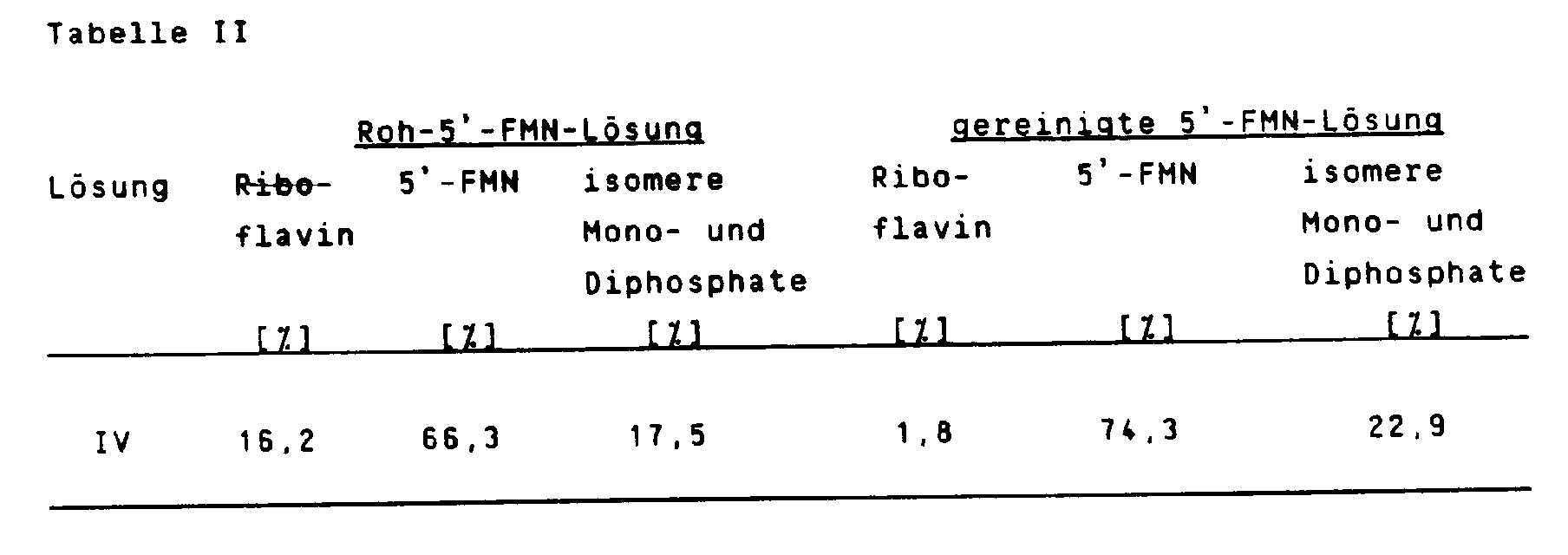
- the crystal suspension was cooled to about 20 ° C., filtered and the crystals were washed with a little ice water. This gave 62 g of first crystals of the composition shown in Table IV.
Landscapes
- Chemical & Material Sciences (AREA)
- Organic Chemistry (AREA)
- Health & Medical Sciences (AREA)
- Life Sciences & Earth Sciences (AREA)
- Biochemistry (AREA)
- General Health & Medical Sciences (AREA)
- Molecular Biology (AREA)
- Saccharide Compounds (AREA)
Description
- Die Erfindung betrifft ein Verfahren zur Reinigung von Salzen von Riboflavin-5′-phosphat (5′-Flavinmononucleotid und daher nachfolgend als 5′-FMN bezeichnet), insbesondere des handelsüblichen Mononatriumsalzes, von 5′-FMN, welche bei der Phosphorylierung von Riboflavin und Umsetzen der erhaltenen Riboflavin-5′-phosphorsäure mit wäßrigen Basen erhalten werden.
- 5′-FMN ist eine Verbindung, die eine wesentliche Rolle als Coenzym in verschiedenen Enzymreaktionen im lebenden Körper spielt und die deshalb in Form ihrer Salze, insbesondere in Form von Natrium-5′-FMN, als Zusatz für Arzneimittel, Nahrungsmittel und Futterstoffe verwendet wird. Natrium-5′-FMN dient auch als Ausgangsmaterial für Flavin-adenin-dinukleotid, das als therapeutisches Mittel gegen Vitamin-B₂-Mangel eingesetzt wird.
- Industriell wird Natrium-5′-FMN im allgemeinen durch Umsetzen von Riboflavin mit einem Phosphorylierungsmittel, wie partiell hydrolisiertem Phosphorylchlorid, und anschließendes Behandeln des erhaltenen Riboflavin-5′-phosphats mit Natronlauge gewonnen. Dementsprechend enthält es als Verunreinigungen etwa 5 bis 30 % unumgesetztes Riboflavin, isomere Riboflavinmononucleotide, wie 2′-FMN und 4′-FMN sowie Riboflavin-dinucleotide (5′,4′-FDN und 5′,3′-FDN) und Polyphosphate. Nur das 5′-FMN ist die physiologisch aktive Form des wasserlöslichen Riboflavins, d.h., die isomeren Riboflavinmonophosphate und -polyphosphate zeigen keine Vitamin-B2-Aktivität mehr. Daher sind Produkte von Interesse, die einen möglichst hohen prozentualen Anteil an 5′-FMN aufweisen. Auch ist ein hoher Gehalt an unumgesetztem Riboflavin unerwünscht, da dieser verhindert, daß aus dem Produkt eine stabile, klare, homogene wäßrige Lösung hergestellt werden kann. Die im Handel erhältlichen Präparate enthalten auch bei Deklarierung als "hochreines Natrium-5′-FMN" im allgemeinen nicht mehr als 74 % an Natrium-5′-FMN. Erwünscht ist ein Marktprodukt, das mindestens 70 % Natrium-5′-FMN und maximal 5 % Riboflavin enthält, sowie ein hochreines Marktprodukt, das mindestens 80 % Natrium-5′-FMN, kein unumgesetztes Riboflavin und als Nebenprodukte nur noch die isomeren Monophosphate enthält.
- Bei allen bekannten Herstellungsverfahren von Mononatrium-5′-FMN durch Phosphorylierung von Riboflavin wird zunächst ein Rohprodukt erhalten, das noch erhebliche Mengen an unumgesetzten Riboflavin, sowie isomere Mono- und Polyphosphate als Nebenprodukte enthält. Um ein gut wasserlösliches Produkt zu erhalten, aus dem sich stabile Lösungen herstellen lassen, ist es unbedingt erforderlich, den Riboflavingehalt wesentlich zu vermindern. Andernfalls tritt je nach Riboflavingehalt mehr oder weniger schnell eine Trübung der Lösung auf.
- Aus Chemical Engineering, Nov. 1954, Seiten 120f ist bekannt, daß in einem Produktionsprozeß das 5′-FMN angereichert wird, indem man dieses mehrmals kalt in wäßriger Lösung mit Ethanolamin als Monosalz in Lösung bringt und durch Filtration vom ungelösten Riboflavin abtrennt. Bei der anschließenden Fällung mittels Ethanol fällt das 5′-FMN in angereicherter Form an. Der Reinigungsgrad ist jedoch unvollständig, so daß der Prozeß mehrmals wiederholt werden muß. Ein weiterer Nachteil dieses Verfahrens ist, daß man für die Filtration des ungelösten Riboflavins teure Filtrationsvorrichtungen benötigt, da das Riboflavin in Form äußerst feiner Kristalle anfällt. Außerdem muß das hierbei gebildete Ammoniumsalz in einem weiteren Schritt noch in das Natriumsalz überführt werden. Dieser Prozeß ist daher umständlich, teuer und mit einem hohen Lösungsmittelverbrauch verbunden.
- Ferner ist aus CA 83 (1975) 79551a bekannt, daß man Natrium-5′-FMN reinigen kann, indem man es an Aktivkohle absorbiert und so von dem im Eluat befindlichen Riboflavin bzw. don Diphosphaten abtrennt. Das Natrium-5′-FMN wird anschließend mit verdünnter NaOH desorbiert und fällt dabei in Form einer stark verdünnten Lösung an. Da bei diesem Verfahren das gewünschte Produkt absorbiert wird, werden große Mengen an Absorbern benötigt, wodurch diese Methode für ein technisches Verfahren zu teuer wird.
- Weiterhin ist aus CA 104 (1986) 19 453n ein Reinigungsverfahren bekannt, bei dem die isomeren Monophosphate an einem definierten Anionenaustauscher absorbiert und mit einer Kochsalzlösung eluiert werden. Nachteilig an diesem Verfahren ist, daß ein sehr großes Volumen an Ionenaustauscher benötigt wird, und außerdem die Produktfraktion zusätzlich an einem weiteren Ionenaustauscher von NaCl abgetrennt werden muß.
- Weiterhin ist aus der DE-OS 32 30 895 bekannt, daß 5′-FMN durch Chromatographie an einem schwach basischen, modifizierten Ionenaustauscher chromatographisch gereinigt werden kann. Als Eluens wird hierbei ein Puffer mit einem pH-Wert von 3,8 bestehend aus Ameisensäure und NaCl benötigt. Auch bei diesem Verfahren wird daher ein weiterer Reinigungsschritt zur Entfernung des Puffers nach der Trennung notwendig.
- Eine gute Übersicht über den derzeitigen Stand der Technik bei der Reinigung von 5′-FMN ist in dem Übersichtsartikel von P. Nielsen et al in "Methods in Enzymology, Vol. 122, 209-220 (1986)" und von R. Hausinger et al in "Methods in Enzymology, Vol. 122, 199-208 (1986)" zu finden. In loc. cit wird auch eine präparative Reinigung von rohem 5′-FMN an Silicagel RP-18 beschrieben, bei der mit einem Ammoniumformiat/Ameisensäurepuffer eluiert wird. Als weitere Reinigungsmethoden werden beschrieben:
- a) Ionenaustauscher auf Polystyrolbasis unter Benutzung von Puffersystemen wie Isopropanol/Triethylammoniumacetat.
- b) Ionenaustauscher auf Cellulosebasis und unter Benutzung von Puffersystemen, wie Ammoniumcarbonat, sowie
- c) Chromatographie an immobilisierter Flavokinase. Diese Methode ist jedoch wegen des teuren Trennungsmediums das nur eine geringe Standzeit hat, nur für sehr kleine Mengen geeignet.
- Es war daher die Aufgabe der Erfindung, ein Verfahren zur Reinigung von Salzen von 5′-FMN zu entwickeln, mit dessen Hilfe es gelingt, das unumgesetzte Riboflavin aus dem Phosphorylierungsgemisch ohne die Nachteile der bekannten Verfahren auf einfache Weise möglichst weitgehend zu entfernen; das bedeutet: in möglichst nur einem Reinigungsschritt und unter Verwendung von nur kleinen Mengen an Reinigungshilfsmitteln.
- Es war weiterhin die Aufgabe der Erfindung, das weitgehend von Riboflavin gereinigte Salz von 5′-FMN auf möglichst einfache Weise in die gewünschten marktgerechten Produkte zu überführen. Dies bedeutet entweder die Entwicklung eines Verfahrens zur anschließenden chromatographischen Feinreinigung ohne Verwendung von Salz- oder Pufferlösungen als Eluent oder aber ein geeignetes Kristallisationsverfahren.
- Es wurde nun überraschenderweise gefunden, daß man das bei der Phosphorylierung von Riboflavin und Umsetzen des dabei gebildeten, mit unumgesetztem Riboflavin, isomeren Riboflavinmonophosphaten und -diphosphaten verunreinigten Ribloflavin-5′-phosphats (5′-FMN) mit Alkalihydroxiden oder Stickstoffbasen, insbesondere mit Natronlauge erhaltenen Salzen von 5′-FMN weitgehend von unumgesetzten Riboflavin reinigen kann, wenn man
- a) aus dem bei der Phosphorylierung erhaltenen Roh-5′-FMN, Wasser, dem Alkalihydroxid oder der Stickstoffbase, insbesondere von Natronlauge, ggf. unter Erwärmen auf 30 bis 100°C, vorzugsweise 45 bis 55°C, eine etwa 1 bis 15 gew.%ige, vorzugsweise etwa 4 bis 6 gew.%ige homogene, klare wäßrige Roh-5′-FMN-Salz-Lösung mit einem pH-Wert zwischen 4 und 8, vorzugsweise 5,5 und 6,5 herstellt,
- b) die erhaltene Lösung mit einem geeigneten polymeren Adsorberharz in Form unlöslicher kleiner Kügelchen behandelt, das sich durch besondere mechanische Festigkeit, makroretikulare Porosität, eine gleichförmige Porengrößenverteilung, eine große aktive Oberfläche und durch eine chemisch homogene, nichtionogene Struktur auszeichnet und durch Co-Polymerisation aus Polystyrol/Divinylbenzol; Acrylsäurederivaten/Divinylbenzol oder Methacrylsäurederivaten/Divinylbenzol hergestellt wurde und
- c) aus der dabei erhaltenen Lösung, das weitgehend von unumgesetztem Riboflavin gereinigte 5′-FMN-Salz isoliert ggf. in das Natrium-5′-FMN überführt und gewünschtenfalls die Lösung einer anschließenden Feinreinigung zuführt.
- Mit besonderem Vorteil gelingt das Verfahren, wenn man die homogene wäßrige Roh-5′-FMN-Salz-Lösung durch eine Säule leitet, die mit dem geeigneten polymeren Adsorberharz gefüllt ist, und aus dem dabei erhaltenen Eluat das gereinigte 5′-FMN-Salz isoliert oder das Eluat einer anschließenden Feinreinigung zuführt.
- Als für das erfindungsgemäße Verfahren geeignete polymere Adsorberharze werden handelsübliche Polymere mit besonderer mechanischer Festigkeit, makroretikularer (schwammstrukturartiger) Porosität, gleichförmiger Porengrößenverteilung, großer aktiver Oberfläche und chemisch homogener, nichtionogener Struktur verstanden, die durch durch Copolymerisation aus Polystyrol/Divinylbenzol (unpolar); Acrylsäurederivaten/Divinylbenzol (polar) oder Methacrylsäurederivaten/Divinylbenzol (mäßig polar) hergestellt wurden und im allgemeinen in Form von unlöslichen Kügelchen im Handel sind.
- Mit besonderem Vorteil verwendet man die durch Copolymerisation von Acrylsäurederivaten mit Divinylbenzol hergestellten polaren Adsorberharze, da hierbei die Regenerierung einfacher verläuft und mit Wasser keine Benetzungsprobleme auftreten. Als geeignete Adsorberharze seien beispielsweise die sogenannten Amberlite der XAD-Serie der Firma Rohm & Haas, insbesondere Amberlite® XAD-1180 und Amberlite® XAD-7 genannt.
- Pro Liter Adsorberharz werden im allgemeinen bis zu 20 g Ribloflavin adsorbiert, während die phosphorylierten Riboflavine bei geeignetem pH-Wert nicht gebunden werden.
- Mit Vorteil führt man das erfindungsgemäße Verfahren so durch, daß man das bei dem Phosphorylierungsverfahren anfallende, etwa 5 bis 30 Gew.% unumgesetztes Riboflavin enthaltende rohe 5′-FMN in Wasser suspendiert, die Suspension mit einem Alkalihydroxid oder einer Stickstoffbase, insbesondere mit NaOH, auf einen pH-Wert zwischen 4 und 8, vorzugsweise 5,5 bis 6,5, insbesondere etwa 6 eingestellt und unter leichtem Erwärmen die Roh-5′-FMN-Salz-Lösung herstellt. Das Roh-5′-FMN kann gewünschtenfalls gleich in Form des bei der Phosphorylierung anfallenden Restfeuchte enthaltenden Filterkuchens eingesetzt werden.
- Das Einstellen des pH-Wertes und damit die Bildung des 5′-FMN-Salzes kann im Prinzip mit allen Alkalihydroxiden oder geeigneten Stickstoffbasen erfolgen. Da jedoch bisher nur das Natriumsalz auf dem Markt gefragt ist, verwendet man im allgemeinen Natronlauge, die zudem ein besonders billiges Reagens ist. Arbeitet man mit anderen Basen als mit NaOH, dann müßte das gereinigte 5′-FMN-Salz gewünschtenfalls anschließend in das Natrium-5′-FMN überführt werden.
- Als Alkalihydroxide seien außer dem bevorzugten NaOH noch KOH oder LiOH genannt. Als Stickstoffbasen kämen beispielsweise NH₄OH, Alkylamine, Dialkylamine, Trialkylamine, in denen die Alkylgruppen 1 bis 3 C-Atome enthalten, sowie Ethanolamine und cycloaliphatische Amine, wie Morpholin oder Piperidin in Betracht.
- Die erhaltene rohe 5′-FMN-Salz-Lösung wird anschließend durch die mit Adsorberharz gefüllte Säule geleitet.
- Das Eluat enthält je nach Kapazitätsauslastung des Adsorberharzes zwischen 0 und 5 %, vorzugsweise 0 bis 1, insbesondere nur etwa 0,5 % unumgesetztes Riboflavin und zwischen 65 und 80 % an 5′-FMN-Salz.
- Die Regenerierung des Adsorberharzes erfolgt durch Waschen mit wäßriger NaOH-Lösung. Die Konzentration dieser NaOH-Lösung soll 0,01-5 molar, vorzugsweise etwa 0,1 molar sein. Das Ribloflavin kann auf diese Weise in Form einer konzentrierten Lösung seines Na-Salzes zurückgewonnen werden.
- Aus dem bei der Regenerierung mit wäßriger NaOH-Lösung anfallenden Eluat kann das Riboflavin durch Ansäuern z.B. mit einer Mineralsäure, wie HCl, H₂SO₄ oder einer starken organischen Säure, wie Oxalsäure oder Ameisensäure in kristalliner Form zurückgewonnen werden.
- Es war sehr überraschend, daß die Abtrennung des Riboflavins aus der so komplex zusammengesetzten 5′-FMN-Lösung durch eine schnelle Passage der Lösung durch ein geeignetes Adsorberharzbett so selektiv und sauber möglich ist und dadurch die aufwendigen mehrmaligen Lösungs- und Fällungssequenzen mit der schwierigen Abtrennung des schwerfiltrierbaren Riboflavins gemäß dem Stand der Technik entfallen können.
- Weitere entscheidende Vorteile des Verfahrens sind:
- 1. Dadurch, daß das Riboflavin, welches im Vergleich zum Wertprodukt in wesentlich geringerer Menge enthalten ist, durch das Adsorberharz selektiv entfernt werden kann, werden wesentlich geringere Mengen an Adsorberharz benötigt als bei den bekannten Reinigungsverfahren, bei denen das Wertprodukt 5′-FMN adsorbiert wird.
- 2. Die Produktlösung wird durch die Adsorberharzpassage nur wenig verdünnt (maximale Verdünnung = 2:1).
- 3. Man kann nur mit Wasser als Lösungsmittel arbeiten, wodurch eine Lösungsmittelaufarbeitung entfällt.
- 4. Auch nach 50 Cyclen waren keine meßbaren Veränderungen des Adsorbermaterials eingetreten, so daß man eine sehr lange Standzeit der Adsorbersäulen erwarten kann.
- 5. Das unumgesetzte Riboflavin kann leicht in gereinigter und konzentrierter Form eluiert werden, so daß eine verlustarme schnelle Adsorptions-/Desorptionssequenz möglich ist.
- Es wurde weiterhin überraschenderweise gefunden, daß das durch Behandeln mit dem Adsorberharz vorzugsweise durch Passage der Adsorberharzsäule weitgehend von Riboflavin befreite 5′-FMN-Salz in wäßriger Lösung durch Chromatographie an einem mit Alkylgruppen derivatisierten Reversed Phase Kieselgel präparativ auch ohne Mitverwendung von systemfremden Salz- oder Pufferlösungen weiter gereinigt werden kann, wenn man eine ausreichende Menge einer nicht zu verdünnten wäßrigen Lösung chromatographiert. Verdünntere wäßrige Lösungen können dagegen auf diese Weise nicht aufgetrennt werden.
- Gegenstand der Erfindung ist daher auch ein Verfahren zur Reinigung von durch Phosphorylierung von Riboflavin und Umsetzen der dabei gebildeten, mit unumgesetztem Riboflavin, isomeren Riboflavinmonophosphaten und -diphosphaten verunreinigten Riboflavin-5′-phosphats mit Alkalihydroxiden oder Stickstoffbasen, vorzugsweise Natronlauge erhaltenem 5′-FMN-Salz, das dadurch gekennzeichnet ist, daß man das, wie oben beschrieben, durch Behandeln mit dem Adsorberharz, vorzugsweise das bei der Passage durch die Adsorberharzsäule erhaltene, weitgehend von unumgesetztem Riboflavin gereinigte 5′-FMN-Salz in Form einer 1 bis 15 Gew.%, vorzugsweise 4 bis 6 Gew.% Trockenmasse enthaltenden Lösung in Wasser mit einem pH-Wert zwischen 4 und 8, vorzugsweise 5,5 und 6,5, insbesondere etwa 6, in einer Mindestmenge von 5 bis 50 %, vorzugsweise 8 bis 20 % des Bettvolumens (BV) der Säule an einem mit Alkylgruppen derivatisierten Reversed Phase (RP) Kieselgel mit einer Kornfraktion im Bereich 10 bis 300 µ, vorzugsweise 20 bis 200 µ, mit Wasser oder einer Mischung aus Wasser und einem niederen aliphatischen Alkohol mit einem Alkoholgehalt zwischen 0 und 80 % als Elutionsmittel unter Druck chromatographiert.
- Das Verhältnis von Trockensubstanz zu Trennmaterial liegt bei diesem Verfahrensschritt zwischen 1:200 und 1:7, vorzugsweise 1:25 bis 1:15, insbesondere etwa 1:20.
- Als Trennmaterial verwendet man handelsübliches, mit Alkylgruppen derivatisiertes RP-Kieselgel der oben genannten Kornfraktion. Bekannte geeignete handelsübliche RP-Kieselgele haben Kornfraktionen von 20 bis 45 µ bzw. 30 bis 70 µ. Genannt seien beispielsweise Kieselgel-RP-8; Kieselgel-RP-12 und Kieselgel-RP-18, wie HD-SIL-RP-18 der Firma Orpregen.
- Als niedere aliphatische Alkohole werden erfindungsgemäß z.B. Methanol, Ethanol, Isopropanol und Ethylenglykol bezeichnet. Mit besonderem Vorteil verwendet man Methanol.
- Unter den angegebenen Bedingungen wird noch erhaltenes Riboflavin von dem Kieselgel adsorbiert. Wenn man für diese Feinreinigung 5′-FMN-Lösungen einsetzt, die einen Riboflavingehalt von weniger als 1 % aufweisen, kann man viele aufeinanderfolgende Trennungen vornehmen, ohne daß sich die Qualität der Reinigung verändert. Nach abgeschlossenem Chromatographiervorgang kann das adsorbierte Riboflavin relativ einfach durch Waschen mit einem mehr Alkohol enthaltenden Lösungsmittel, beispielsweise mit 60 %igem wäßrigem Methanol eluiert werden.
- Die eigentliche chromatographische Trennung von 5′-FMN und seinen Nebenprodukten erfolgt mit Wasseralkoholgemischen, die weniger Alkohol, d.h. Alkoholmengen von 1 bis 20, vorzugweise etwa 10 % enthalten.
- Beispielsweise erhält man die Verwendung von Silicalgel HD-SIL-RP 18 (20-40 µ) und einem Gemisch Methanol/Wasser = 10:90 die folgenden Fraktionen:
- 1. Eine Vorfraktion, enthaltend Polyphosphate, Diphosphate und 3′-FMN,
- 2. eine Zwischenfraktion, enthaltend 70 bis 85 % 5′-FMN neben 3′-FMN, 4′-FMN und 4′,5′-FDN sowie
- 3. eine Hauptfraktion mit einem 5′-FMN-Gehalt > 90 % neben 4′-FMN und 2′-FMN. In der 2. Hälfte des Elutionspeaks liegt 97 %iges 5′-FMN enthaltend 3 % 2′-FMN vor.
- Mit Hilfe dieses chromatographischen Feinreinigungsschrittes kann man demnach bis zu 91 % reines 5′-FMN erhalten.
- Das bei der Chromatographie als Elutionsmittel verwendete Wasser-Alkoholgemisch kann isokratisch, d.h. in konstantem Lösungsmittelverhältnis oer aber mit kontinuierlich veränderten Lösungsmittelverhältnis (Gradientenelution) eingesetzt werden. Beispielsweise kann man durch Gradientenelution mit von 0 % bis auf 30 % Methanol in Wasser ansteigenden Elutionsmittel sehr gute Trennungen erzielen.
- Es war überraschend, daß man für diese präparative chromatographische Trennung keine Pufferlösung benötigt. Bei Einhaltung aller sonstigen Bedingungen, aber Einsatz von nur analytischen Mengen an 5′-FMN-Lösung wird keine Trennung erzielt. Es ist überraschend, daß sich bei Einhalten eines bestimmten pH-Wertes der Auftragslösung das System selbst puffert, wenn eine ausreichende Menge an Trenngemisch aufgetragen wird. Hierdurch ergibt sich der große Vorteil des Verfahrens, nämlich daß man ohne Fremdpuffer arbeiten kann. Ein Puffer wäre teuer und schwer zu entfernen. Er müßte in einem weiteren Verfahrensschrift vom Wertprodukt abgetrennt werden, wobei Wertprodukt verloren geht und Abwasserprobleme auftreten. Ein weiterer großer Vorteil des Verfahrens ist, daß man mit Wasser oder niedrigprozentigem Alkohol als Lösungsmittel arbeiten kann.
- Selbstverständlich können auch auf anderem Wege hergestellte, weitgehend von unumgesetztem Riboflavin gereinigte Roh-5′-FMN-Salz-Lösungen auf die oben beschriebene Weise gereinigt werden. Gegenstand der Erfindung ist daher auch ein Verfahren zur präparativen Reinigung von einem weitgehend von Riboflavin freien, durch isomere Flavinmononucleotide und Flavindinucleotide verunreinigtem Mononatrium-riboflavin-5′-phosphat durch Chromatographie einer Natrium-5′-FMN-Lösung an einem mit Alkylgruppen deriviatisierten RP-Kieselgel mit einer Kornfraktion im Bereich von 10 bis 300 µ ggf. unter Druck, das dadurch gekennzeichnet ist, daß man eine Lösung mit einer Konzentration von 1 bis 15 Gew.%, vorzugsweise 4 bis 6 Gew.% Trockensubstanz in Wasser oder einem Gemisch aus Wasser und einem niederen aliphatischen Alkohol mit einem Alkoholgehalt zwischen 0 und 80 Gew.% mit einem pH-Wert zwischen 4 und 7 in einer Mindestmenge von 5 bis 50 %, vorzugsweise 8 bis 20 % des Bettvolumens der Kieselgelsäule mit Wasser oder einer Mischung aus Wasser und einem niederen aliphatischen Alkohol mit einem Alkoholgehalt zwischen 0 und 80 Gew.% als Elutionsmittel chromatographiert.
- Gegenstand der Erfindung ist weiterhin ein Verfahren zur Reinigung von durch Phosphorylierung von Riboflavin und Umsetzen des dabei gebildeten, mit unumgesetztem Riboflavin, isomeren Riboflavinmonophosphaten und -diphosphaten verunreinigten Riboflavin-5′-phosphats mit Alkalihydroxiden oder Stickstoffbasen, insbesondere Natronlauge, erhaltenem 5′-FMN-Salz, das dadurch gekennzeichnet ist, daß man das, wie oben beschrieben, durch Behandeln mit dem geeigneten Adsorberharz erhaltene, weitgehend von unumgesetztem Riboflavin gereinigte 5′-FMN-Salz in Form einer wäßrigen Lösung mit einem pH-Wert von 4 bis 8, vorzugsweise 5,5-6, bei Temperaturen von 20 bis 100°C, vorzugsweise 40 bis 60°C, einengt bis das 5′-FMN-Salz auskristallisiert, die Kristallsuspension abkühlt, vorzugsweise auf etwa 20°C, das kristalline 5′-FMN-Salz abtrennt und die Mutterlauge ggf. nach erneutem Einengen und Isolieren eines Zweitkristallisats in das Herstellungsverfahren zurückführt.
- Gemäß dem Stand der Technik kann das Natrium-5′-FMN aus wäßriger Lösung bei einem pH-Wert von 5 bis 6,5 auch durch Zugabe von Ethanol gefällt werden. Hierbei bleiben vor allem die Diphosphate in Lösung.
- Die erfindungsgemäße Kristallisation hat gegenüber dem genannten Stand der Technik wesentliche Vorteile.
- 1. Es bleiben anorganische Salze, wie NaCl oder Natriumphosphate, die aus dem Phosphorylierungsprozeß stammen, in jedem Fall gelöst, so daß immer ein spezifikationsgerechtes Produkt erhalten wird.
- 2. Kristallisiert bevorzugt 5′-FMN-Salz und etwa weniger bevorzugt 4′-FMN-Salz aus - und falls noch vorhanden - Riboflavin während sich das 3′-FMN überwiegend und die Diphosphate fast vollständig in der Mutterlauge verbleiben. Aus den Mutterlaugen läßt sich durch partielle Hydrolyse und sauer katalysierte Umlagerung weiteres 5′-FMN-Salz herstellen.
- 3. Bilden sich sehr schöne Kristalle, d.h. durch geeignetes Abkühlen lassen sich produktgerechte Kristalle herstellen, die leicht filtriert und gewaschen werden können.
- 4. Ist das verwendete Lösungsmittel Wasser billig und können Aufarbeitungsprobleme entfallen.
- 5. Durch die mögliche Rückführung der Diphosphate und die Isomerisierung der isomeren Flavinmononucleotide wird einerseits insgesamt eine maximale Ausbeute an 5′-FMN erhalten und andererseits das Abwasser weniger durch organischen Kohlenstoff belastet.
- Es war überraschend, daß unter diesen Bedingungen der Verdampfungskristallisation bei dem vorgegebenen pH-Wert keine Hydrolyse des 5′-FMN-Salzes bzw. des Riboflavins auftritt. Ferner ist überraschend, daß sich unter diesen Bedingungen überwiegend das 5′-FMN anreichert und so durch eine Kristallisationsstufe ein typgerechtes Produkt erhalten werden kann.
- Mit Hilfe des erfindungsgemäßen Verfahrens kann das durch Phosphorylierung von Riboflavin erhaltene 5′-FMN auf einfache Weise weitgehend von unumgesetztem Riboflavin, isomeren Flavinmononucleotiden und Flavindinucleotiden gereinigt werden. Die folgenden Beispiele sollen das Verfahren erläutern.
- Durch eine Säule mit einem Durchmesser von 9 cm und einem Bettvolumen (BV) von 2 Litern (1) gefüllt mit dem Adsorberharz XAD-7 der Firma Rohm & Haas wurden jeweils nacheinander
- a) 2 l einer durch Phosphorylierung von Riboflavin erhaltenen, mittels NaOH auf einen Wert von pH=6 eingestellten 5 %igen Lösung mit der aus der folgenden Tabelle I ersichtlichen Zusammensetzung
- b) 2 l Wasser,
- c) 1 l einer 0,1 m wäßrigen NaOH-Lösung und
- d) 2 l Wasser gepumpt.
- Das Eluat wurde mittels einer pH-Sonde und einem UV-Detektor kontrolliert.
- Das Eluat wurde gesammelt bis die UV-Absorption auf 10 % des maximalen Wertes gefallen war. Man erhielt dabei etwa 2 l Eluat mit der aus der folgenden Tabelle I ersichtlichen Zusammensetzung.
- Das bei der anschließenden Regenerierung gesondert aufgefangene Eluat enthielt das durch die NaOH-Lösung aus dem Ionenaustauscher herausgelöste Riboflavin in konzentrierter Form. Durch UV-Kontrolle wurde eine möglichst konzentrierte Riboflavinlösung gewonnen. Sie wurde anschließend mit HCl oder mit HCOOH angesäuert, 5 Minuten (min) zum Sieden erhitzt, der Niederschlag abfiltriert, mit Wasser neutral gewaschen und getrocknet. Auf diese Weise wurden ca. 85 % des absorbierten Riboflavins in Form eines ca. 98 % reinen Produktes zurückgewonnen.

- Es wurde gearbeitet wie in Beispiel 1 beschrieben, nur wurde anstelle von dem Ionenaustauscher XAD-7 der Austauscher XAD-1180 der gleichen Firma verwendet. Dabei wurde folgendes Ergebnis erzielt:
- Eine chromatographische Säule mit einem Innendurchmesser von 30 cm wurde über eine Länge von 15 cm mit dem Kieselgel HD-SIL-RP 18 der Firma Orpregen (20-45 µ) in Methanol/Wasser = 10/90 gefüllt.
- Anschließend wurden
- A. 1000 ml (0,1 BV) und
- B. 2000 ml (0,2 BV)
- Das Eluat wurde mittels Messung der UV-Absorption bei 530 nm untersucht und entsprechend dem Elutionsdiagramm in 3 Fraktionen gesammelt. Die erste und die zweite Fraktion betrugen etwa 1/3 des BV, die dritte Fraktion etwa 2 BV. Die eingesetzte 5′-FMN-Lösung sowie die erhaltenen Fraktionen wurden mittel HPLC (Hypersil-ODS RP-18; 0,1 m Ammoniumformiat/Ameisensäure; pH = 3,9; 24 % Methanol, UV = 435 nm) untersucht. Die Zusammensetzung der eingesetzten 5′-FMN-Lösung sowie der nach Aufdosieren von 0,1 BV (A) bzw. 0,2 BV (B) Ausgangslösung erhaltenen 3 Fraktionen ist in der folgenden Tabelle III angegeben. Die Wertfraktionen (Fraktionen II und III) wurden bei 60°C am Rota-vapor-Verdampfer eingeengt und auf 20°C abgekühlt. Dss auskristallisierte Produkt wurde abgesaugt und mit Eiswasser nachgewaschen.

- Eine durch Phosphorylieren von 70 g Riboflavin mit POCl₃·H₂O erhaltene 5′-FMN-Lösung wurde mit NaOH auf einen pH-Wert von 5,5 und eine Konzentration von 5 Gew.% gebracht und analog Beispiel 1 durch ein Absorberharzbett (XAD-7) geleitet. Hierdurch wurde eine weitgehend von unumgesetztem Riboflavin befreite 5′-FMN-Lösung erhalten, deren Zusammensetzung aus Tabelle IV ersichtlich ist. Die so erhaltene Lösung wurde bei etwa 50°C eingedampft. Hierbei wurden 200 g einer übersättigten Lösung erhalten, aus der bereits in der Wärme das 5′-FMN in hoher Reinheit auskristallisierte. Die Kristallsuspension wurde auf etwa 20°C abgekühlt, filtriert und das Kristallisat mit wenig Eiswasser gewaschen. Man erhielt hierbei 62 g Erstkristallisat der aus Tabelle IV ersichtlichen Zusammensetzung.
- Durch weiteres Einengen des Filtrats auf etwa 100 g bei etwa 50°C und Abkühlen auf etwa 20°C wurden weitere 20 g eines Zweitkristallisats sowie die Mutterlauge der aus Tabelle IV ersichtlichen Zusammensetzung erhalten. Das erhaltene Zweitkristallisat wurde in die Erstkristallisation zurückgeführt, die Mutterlauge in den Phosphorylierungsprozess zurückgeführt.

Claims (12)
Applications Claiming Priority (2)
| Application Number | Priority Date | Filing Date | Title |
|---|---|---|---|
| DE3810957A DE3810957A1 (de) | 1988-03-31 | 1988-03-31 | Verfahren zur reinigung von salzen des riboflavin-5'-phosphats, insbesondere von mononatrium-riboflavin-5'-phosphat |
| DE3810957 | 1988-03-31 |
Publications (2)
| Publication Number | Publication Date |
|---|---|
| EP0336214A1 EP0336214A1 (de) | 1989-10-11 |
| EP0336214B1 true EP0336214B1 (de) | 1992-04-01 |
Family
ID=6351139
Family Applications (1)
| Application Number | Title | Priority Date | Filing Date |
|---|---|---|---|
| EP89105097A Expired - Lifetime EP0336214B1 (de) | 1988-03-31 | 1989-03-22 | Verfahren zur Reinigung von Salzen des Riboflavin-5'-phosphats, insbesondere von Mononatrium-riboflavin-5'-phosphat |
Country Status (4)
| Country | Link |
|---|---|
| US (1) | US4987229A (de) |
| EP (1) | EP0336214B1 (de) |
| JP (1) | JP2856760B2 (de) |
| DE (2) | DE3810957A1 (de) |
Families Citing this family (7)
| Publication number | Priority date | Publication date | Assignee | Title |
|---|---|---|---|---|
| DE3930668A1 (de) * | 1989-09-14 | 1991-03-28 | Basf Ag | Verfahren zur herstellung von riboflavin-5'-phosphat(5'-fmn) bzw. dessen natriumsalz |
| DE4123993A1 (de) * | 1991-07-19 | 1993-01-21 | Basf Ag | Verbessertes verfahren zur herstellung des mononatriumsalzes von riboflavin-5'-phosphat |
| WO2003010172A1 (en) * | 2001-07-23 | 2003-02-06 | Eisai Co., Ltd. | Process for producing highly pure riboflavin-5’-phosphate sodium |
| JP5204990B2 (ja) * | 2007-05-25 | 2013-06-05 | 第一ファインケミカル株式会社 | リボフラビン−5’−リン酸の製造方法 |
| CN102617643B (zh) * | 2012-03-06 | 2013-04-10 | 黄金秀 | 一种核黄素磷酸钠化合物 |
| CN103396452B (zh) * | 2013-08-19 | 2015-09-30 | 周晓东 | 一种核黄素磷酸钠化合物及其组合物 |
| CN106674225B (zh) * | 2016-11-09 | 2019-04-02 | 珠海同源药业有限公司 | 一种核黄素磷酸钠化合物及其药物组合物 |
Family Cites Families (3)
| Publication number | Priority date | Publication date | Assignee | Title |
|---|---|---|---|---|
| GB687556A (en) * | 1950-11-08 | 1953-02-18 | Roche Products Ltd | Salts of riboflavin phosphate and the manufacture thereof |
| JPS5238106B2 (de) * | 1973-03-09 | 1977-09-27 | ||
| JPS5832898A (ja) * | 1981-08-21 | 1983-02-25 | Mitsubishi Chem Ind Ltd | リボフラビン−5′−モノ燐酸エステルの精製方法 |
-
1988
- 1988-03-31 DE DE3810957A patent/DE3810957A1/de not_active Withdrawn
-
1989
- 1989-03-15 US US07/323,795 patent/US4987229A/en not_active Expired - Fee Related
- 1989-03-22 DE DE8989105097T patent/DE58901065D1/de not_active Expired - Lifetime
- 1989-03-22 EP EP89105097A patent/EP0336214B1/de not_active Expired - Lifetime
- 1989-03-31 JP JP1078692A patent/JP2856760B2/ja not_active Expired - Lifetime
Non-Patent Citations (3)
| Title |
|---|
| CHEMICAL ABSTRACTS, Band 89, Nr. 3, 17. Juli 1978, Ref.Nr. 19426c; R.D. Johnson "A preparative method for purification of purification of riboflavin 5-monophosphate" & Anal Biochem. 1978, 86 (2), 526-30 * |
| METHODS IN ENZYMOLOGY, Band 122, Seiten 199-208 (1986); R.P. Hausinger et al. "Separation of Flavons and Flavin Analogs by High h-Performance Liquid Chromatography" * |
| METHODS IN ENZYMOLOGY, Band 122, Seiten 209-222 (1986); P. Nielsen et al. "Preparation, Properties and Separation by High-Performance Liquid Chromatography of Riboflavin Phosphates" * |
Also Published As
| Publication number | Publication date |
|---|---|
| JPH01287084A (ja) | 1989-11-17 |
| JP2856760B2 (ja) | 1999-02-10 |
| DE3810957A1 (de) | 1989-10-19 |
| EP0336214A1 (de) | 1989-10-11 |
| DE58901065D1 (de) | 1992-05-07 |
| US4987229A (en) | 1991-01-22 |
Similar Documents
| Publication | Publication Date | Title |
|---|---|---|
| DE3345445A1 (de) | Verfahren zur reinigung von anthracyclinon-glykosiden durch selektive adsorption an harzen | |
| DE69011516T2 (de) | Verfahren zur herstellung von l-alpha-glycerylphosphorylcholin und von l-alpha-glycerylphosphorylethanolamin. | |
| DE2047368A1 (de) | Verfahren zur Herstellung von 9 (beta D Arabinofuranosyl) adenin 5 phos phat | |
| EP0336214A1 (de) | Verfahren zur Reinigung von Salzen des Riboflavin-5'-phosphats, insbesondere von Mononatrium-riboflavin-5'-phosphat | |
| DE60021629T2 (de) | Dinukleotid-Kristalle | |
| DE3508372C2 (de) | Verfahren zur Wiedergewinnung von Ceftazidim aus einer dieses enthaltenden wäßrigen Lösung | |
| DE1803978A1 (de) | Verfahren zur Isolierung und Reinigung von S-Adenosyl-1-methionin und S-Adenosyl-1-aethionin | |
| DE69112770T2 (de) | Verfahren zur Abscheidung der organischen Säure oder Säuren aus einer organische Säuren enthaltenden Lösung. | |
| DE3000986A1 (de) | Ferrisalz von fructose-1,6-diphosphat, verfahren zu seiner herstellung und zu seiner verwendung bei der herstellung von fructose-1,6-diphosphorsaeure | |
| DE1918282B2 (de) | Verfahren zur Herstellung von Diestern kondensierter Phosphorsauren | |
| EP0417604A2 (de) | Verfahren zur Herstellung von Riboflavin-5'-phosphat bzw. dessen Natriumsalz | |
| DE2059429C2 (de) | Verfahren zur Herstellung von Nucleosiddiphosphatestern | |
| DE69319428T2 (de) | Verfahren zur herstellung von vancomycin | |
| EP0872556A2 (de) | Verfahren zur Herstellung von Moenomycin A | |
| DE3141030C2 (de) | ||
| DE60022960T2 (de) | Verfahren für die Aufreinigung von S-Adenosyl-L-methionin und für die Herstellung von pharmazeutisch annehmbaren Salzen davon | |
| DE1966849C3 (de) | 1 zu 1 Komplex von Cephalosporin C und Zink in kristalliner Form | |
| DE2016049B2 (de) | Verfahren zur Herstellung von Nucleosiddiphosphaten bzw. ihren Estern | |
| DE1695308C3 (de) | Verfahren zur Isolierung von Adenosintriphosphat | |
| DE60000844T2 (de) | Verfahren zur Reinigung L-Ascorbyl 2-monophosphat | |
| DE69304839T2 (de) | Verfahren zur Herstellung von Nukleosidderivaten | |
| DE69509822T2 (de) | Verfahren zur Herstellung von Ascorbinsäurederivaten | |
| DE3506944C2 (de) | ||
| DE2309899C2 (de) | Verfahren zum Abtrennen von Cephalosporin C aus rohen wäßrigen Lösungen | |
| DE3877641T2 (de) | Isolierung von neutralen aminosaeuren bei hohen ph-werten. |
Legal Events
| Date | Code | Title | Description |
|---|---|---|---|
| PUAI | Public reference made under article 153(3) epc to a published international application that has entered the european phase |
Free format text: ORIGINAL CODE: 0009012 |
|
| AK | Designated contracting states |
Kind code of ref document: A1 Designated state(s): CH DE FR GB LI NL |
|
| 17P | Request for examination filed |
Effective date: 19891120 |
|
| 17Q | First examination report despatched |
Effective date: 19910419 |
|
| GRAA | (expected) grant |
Free format text: ORIGINAL CODE: 0009210 |
|
| AK | Designated contracting states |
Kind code of ref document: B1 Designated state(s): CH DE FR GB LI NL |
|
| REF | Corresponds to: |
Ref document number: 58901065 Country of ref document: DE Date of ref document: 19920507 |
|
| GBT | Gb: translation of ep patent filed (gb section 77(6)(a)/1977) | ||
| ET | Fr: translation filed | ||
| PLBE | No opposition filed within time limit |
Free format text: ORIGINAL CODE: 0009261 |
|
| STAA | Information on the status of an ep patent application or granted ep patent |
Free format text: STATUS: NO OPPOSITION FILED WITHIN TIME LIMIT |
|
| 26N | No opposition filed | ||
| PGFP | Annual fee paid to national office [announced via postgrant information from national office to epo] |
Ref country code: FR Payment date: 20010219 Year of fee payment: 13 |
|
| PGFP | Annual fee paid to national office [announced via postgrant information from national office to epo] |
Ref country code: NL Payment date: 20010228 Year of fee payment: 13 Ref country code: CH Payment date: 20010228 Year of fee payment: 13 |
|
| PGFP | Annual fee paid to national office [announced via postgrant information from national office to epo] |
Ref country code: GB Payment date: 20010316 Year of fee payment: 13 Ref country code: DE Payment date: 20010316 Year of fee payment: 13 |
|
| REG | Reference to a national code |
Ref country code: GB Ref legal event code: IF02 |
|
| PG25 | Lapsed in a contracting state [announced via postgrant information from national office to epo] |
Ref country code: DE Free format text: LAPSE BECAUSE OF THE APPLICANT RENOUNCES Effective date: 20020309 |
|
| PG25 | Lapsed in a contracting state [announced via postgrant information from national office to epo] |
Ref country code: GB Free format text: LAPSE BECAUSE OF NON-PAYMENT OF DUE FEES Effective date: 20020322 |
|
| PG25 | Lapsed in a contracting state [announced via postgrant information from national office to epo] |
Ref country code: LI Free format text: LAPSE BECAUSE OF NON-PAYMENT OF DUE FEES Effective date: 20020331 Ref country code: CH Free format text: LAPSE BECAUSE OF NON-PAYMENT OF DUE FEES Effective date: 20020331 |
|
| PG25 | Lapsed in a contracting state [announced via postgrant information from national office to epo] |
Ref country code: NL Free format text: LAPSE BECAUSE OF NON-PAYMENT OF DUE FEES Effective date: 20021001 |
|
| GBPC | Gb: european patent ceased through non-payment of renewal fee |
Effective date: 20020322 |
|
| REG | Reference to a national code |
Ref country code: CH Ref legal event code: PL |
|
| PG25 | Lapsed in a contracting state [announced via postgrant information from national office to epo] |
Ref country code: FR Free format text: LAPSE BECAUSE OF NON-PAYMENT OF DUE FEES Effective date: 20021129 |
|
| NLV4 | Nl: lapsed or anulled due to non-payment of the annual fee |
Effective date: 20021001 |
|
| REG | Reference to a national code |
Ref country code: FR Ref legal event code: ST |