EP0280591B1 - Heterogenes Copolymer aus Vinylidenfluorid und Chlortrifluorethylen und Verfahren zu seiner Herstellung - Google Patents
Heterogenes Copolymer aus Vinylidenfluorid und Chlortrifluorethylen und Verfahren zu seiner Herstellung Download PDFInfo
- Publication number
- EP0280591B1 EP0280591B1 EP19880400145 EP88400145A EP0280591B1 EP 0280591 B1 EP0280591 B1 EP 0280591B1 EP 19880400145 EP19880400145 EP 19880400145 EP 88400145 A EP88400145 A EP 88400145A EP 0280591 B1 EP0280591 B1 EP 0280591B1
- Authority
- EP
- European Patent Office
- Prior art keywords
- vinylidene fluoride
- c2f3cl
- chlorotrifluoroethylene
- weight
- copolymer
- Prior art date
- Legal status (The legal status is an assumption and is not a legal conclusion. Google has not performed a legal analysis and makes no representation as to the accuracy of the status listed.)
- Expired - Lifetime
Links
- BQCIDUSAKPWEOX-UHFFFAOYSA-N 1,1-Difluoroethene Chemical compound FC(F)=C BQCIDUSAKPWEOX-UHFFFAOYSA-N 0.000 title claims abstract description 93
- UUAGAQFQZIEFAH-UHFFFAOYSA-N chlorotrifluoroethylene Chemical group FC(F)=C(F)Cl UUAGAQFQZIEFAH-UHFFFAOYSA-N 0.000 title claims abstract description 91
- 229920001577 copolymer Polymers 0.000 title claims abstract description 41
- 238000000034 method Methods 0.000 title claims description 11
- 238000002360 preparation method Methods 0.000 title description 2
- 238000007334 copolymerization reaction Methods 0.000 claims abstract description 22
- 238000006116 polymerization reaction Methods 0.000 claims abstract description 19
- 239000000725 suspension Substances 0.000 claims abstract description 5
- 239000000839 emulsion Substances 0.000 claims abstract description 4
- 229920001971 elastomer Polymers 0.000 claims description 26
- 239000000806 elastomer Substances 0.000 claims description 26
- 229920000642 polymer Polymers 0.000 claims description 19
- 238000004519 manufacturing process Methods 0.000 claims description 13
- 239000011159 matrix material Substances 0.000 claims description 11
- 238000002844 melting Methods 0.000 claims description 11
- 230000008018 melting Effects 0.000 claims description 11
- 239000000178 monomer Substances 0.000 claims description 6
- 239000002245 particle Substances 0.000 claims description 5
- 238000004455 differential thermal analysis Methods 0.000 claims description 2
- 229920001519 homopolymer Polymers 0.000 claims description 2
- XUCNUKMRBVNAPB-UHFFFAOYSA-N fluoroethene Chemical compound FC=C XUCNUKMRBVNAPB-UHFFFAOYSA-N 0.000 claims 2
- 239000011248 coating agent Substances 0.000 claims 1
- 238000000576 coating method Methods 0.000 claims 1
- CSCPPACGZOOCGX-UHFFFAOYSA-N Acetone Chemical compound CC(C)=O CSCPPACGZOOCGX-UHFFFAOYSA-N 0.000 description 20
- ZWEHNKRNPOVVGH-UHFFFAOYSA-N 2-Butanone Chemical compound CCC(C)=O ZWEHNKRNPOVVGH-UHFFFAOYSA-N 0.000 description 18
- 239000002033 PVDF binder Substances 0.000 description 12
- 229920002981 polyvinylidene fluoride Polymers 0.000 description 12
- 238000005481 NMR spectroscopy Methods 0.000 description 7
- 239000003995 emulsifying agent Substances 0.000 description 7
- 239000004816 latex Substances 0.000 description 7
- 229920000126 latex Polymers 0.000 description 7
- 239000000203 mixture Substances 0.000 description 7
- 238000007792 addition Methods 0.000 description 6
- USHAGKDGDHPEEY-UHFFFAOYSA-L potassium persulfate Chemical compound [K+].[K+].[O-]S(=O)(=O)OOS([O-])(=O)=O USHAGKDGDHPEEY-UHFFFAOYSA-L 0.000 description 6
- 239000012429 reaction media Substances 0.000 description 6
- 238000006243 chemical reaction Methods 0.000 description 5
- 239000008367 deionised water Substances 0.000 description 5
- 229910021641 deionized water Inorganic materials 0.000 description 5
- 238000000605 extraction Methods 0.000 description 5
- 238000005259 measurement Methods 0.000 description 5
- 238000000386 microscopy Methods 0.000 description 5
- 239000012188 paraffin wax Substances 0.000 description 5
- JRKICGRDRMAZLK-UHFFFAOYSA-L persulfate group Chemical group S(=O)(=O)([O-])OOS(=O)(=O)[O-] JRKICGRDRMAZLK-UHFFFAOYSA-L 0.000 description 5
- FQENQNTWSFEDLI-UHFFFAOYSA-J sodium diphosphate Chemical compound [Na+].[Na+].[Na+].[Na+].[O-]P([O-])(=O)OP([O-])([O-])=O FQENQNTWSFEDLI-UHFFFAOYSA-J 0.000 description 5
- 229940048086 sodium pyrophosphate Drugs 0.000 description 5
- 235000019818 tetrasodium diphosphate Nutrition 0.000 description 5
- 239000001577 tetrasodium phosphonato phosphate Substances 0.000 description 5
- XLYOFNOQVPJJNP-UHFFFAOYSA-N water Chemical compound O XLYOFNOQVPJJNP-UHFFFAOYSA-N 0.000 description 5
- 238000013019 agitation Methods 0.000 description 4
- 230000015572 biosynthetic process Effects 0.000 description 4
- 239000003795 chemical substances by application Substances 0.000 description 4
- QSHDDOUJBYECFT-UHFFFAOYSA-N mercury Chemical compound [Hg] QSHDDOUJBYECFT-UHFFFAOYSA-N 0.000 description 4
- 229910052753 mercury Inorganic materials 0.000 description 4
- 239000002904 solvent Substances 0.000 description 4
- 238000003756 stirring Methods 0.000 description 3
- 239000012736 aqueous medium Substances 0.000 description 2
- 239000000084 colloidal system Substances 0.000 description 2
- 229920001198 elastomeric copolymer Polymers 0.000 description 2
- 238000007720 emulsion polymerization reaction Methods 0.000 description 2
- 150000002148 esters Chemical class 0.000 description 2
- 150000002576 ketones Chemical class 0.000 description 2
- 239000002609 medium Substances 0.000 description 2
- 230000001681 protective effect Effects 0.000 description 2
- 230000009257 reactivity Effects 0.000 description 2
- 238000010557 suspension polymerization reaction Methods 0.000 description 2
- 229920002153 Hydroxypropyl cellulose Polymers 0.000 description 1
- 238000013459 approach Methods 0.000 description 1
- 125000000484 butyl group Chemical group [H]C([*])([H])C([H])([H])C([H])([H])C([H])([H])[H] 0.000 description 1
- 239000013043 chemical agent Substances 0.000 description 1
- 230000000052 comparative effect Effects 0.000 description 1
- 150000001875 compounds Chemical class 0.000 description 1
- 230000007423 decrease Effects 0.000 description 1
- 238000001514 detection method Methods 0.000 description 1
- 238000004090 dissolution Methods 0.000 description 1
- 230000000694 effects Effects 0.000 description 1
- 238000001493 electron microscopy Methods 0.000 description 1
- 230000008030 elimination Effects 0.000 description 1
- 238000003379 elimination reaction Methods 0.000 description 1
- 239000008187 granular material Substances 0.000 description 1
- 238000010438 heat treatment Methods 0.000 description 1
- 125000004051 hexyl group Chemical group [H]C([H])([H])C([H])([H])C([H])([H])C([H])([H])C([H])([H])C([H])([H])* 0.000 description 1
- 235000010977 hydroxypropyl cellulose Nutrition 0.000 description 1
- 238000011065 in-situ storage Methods 0.000 description 1
- 239000003999 initiator Substances 0.000 description 1
- 230000000977 initiatory effect Effects 0.000 description 1
- 239000000463 material Substances 0.000 description 1
- 229920000609 methyl cellulose Polymers 0.000 description 1
- 235000010981 methylcellulose Nutrition 0.000 description 1
- 238000001000 micrograph Methods 0.000 description 1
- 229920002451 polyvinyl alcohol Polymers 0.000 description 1
- 235000019422 polyvinyl alcohol Nutrition 0.000 description 1
- 230000000750 progressive effect Effects 0.000 description 1
- 230000036632 reaction speed Effects 0.000 description 1
- 239000011347 resin Substances 0.000 description 1
- 229920005989 resin Polymers 0.000 description 1
- 239000000126 substance Substances 0.000 description 1
- 229920001169 thermoplastic Polymers 0.000 description 1
Images
Classifications
-
- C—CHEMISTRY; METALLURGY
- C08—ORGANIC MACROMOLECULAR COMPOUNDS; THEIR PREPARATION OR CHEMICAL WORKING-UP; COMPOSITIONS BASED THEREON
- C08F—MACROMOLECULAR COMPOUNDS OBTAINED BY REACTIONS ONLY INVOLVING CARBON-TO-CARBON UNSATURATED BONDS
- C08F214/00—Copolymers of compounds having one or more unsaturated aliphatic radicals, each having only one carbon-to-carbon double bond, and at least one being terminated by a halogen
- C08F214/18—Monomers containing fluorine
- C08F214/24—Trifluorochloroethene
-
- C—CHEMISTRY; METALLURGY
- C08—ORGANIC MACROMOLECULAR COMPOUNDS; THEIR PREPARATION OR CHEMICAL WORKING-UP; COMPOSITIONS BASED THEREON
- C08F—MACROMOLECULAR COMPOUNDS OBTAINED BY REACTIONS ONLY INVOLVING CARBON-TO-CARBON UNSATURATED BONDS
- C08F214/00—Copolymers of compounds having one or more unsaturated aliphatic radicals, each having only one carbon-to-carbon double bond, and at least one being terminated by a halogen
- C08F214/18—Monomers containing fluorine
- C08F214/22—Vinylidene fluoride
-
- C—CHEMISTRY; METALLURGY
- C08—ORGANIC MACROMOLECULAR COMPOUNDS; THEIR PREPARATION OR CHEMICAL WORKING-UP; COMPOSITIONS BASED THEREON
- C08F—MACROMOLECULAR COMPOUNDS OBTAINED BY REACTIONS ONLY INVOLVING CARBON-TO-CARBON UNSATURATED BONDS
- C08F259/00—Macromolecular compounds obtained by polymerising monomers on to polymers of halogen containing monomers as defined in group C08F14/00
- C08F259/08—Macromolecular compounds obtained by polymerising monomers on to polymers of halogen containing monomers as defined in group C08F14/00 on to polymers containing fluorine
Definitions
- the present invention relates to a heterogeneous copolymer of vinylidene fluoride (VF2) and chlorotrifluoroethylene (C2F3Cl) consisting of nodules of vinylidene fluoride and chlorotrifluoroethylene dispersed in a matrix formed of a quasi-polymer of vinylidene fluoride.
- This copolymer is obtained by copolymerization of VF2 and C2F3Cl so as to obtain an elastomer on which VF2 is polymerized.
- PVDF Polyvinylidene fluoride
- the homogeneous copolymers thus obtained have a high degree of flexibility, but in return have their melting point more and more lowered as the number of ⁇ CF2-CFCl ⁇ groups in the macromolecular chain increases.
- C2F3Cl in the copolymer, one enters the field of elastomers which, in homogeneous structure, are known as products with low stresses at break and at the yield point, but, with high elongation at the breakup.
- the copolymer according to the invention has the advantage of having both good flexibility and a melting temperature close to that of PVDF.
- the copolymer according to the invention is a copolymer of VF2 and C2F3Cl characterized by the heterogeneous structure of the particles consisting of nodules of homogeneous copolymer elastomer of VF2 and C2F3Cl, dispersed in a matrix formed of a quasi-polymer of VF2. While being dispersed in the matrix, the nodules are closely linked to it by the chemical bonds due to the copolymerization of the monomers.
- the elastomer constituting the nodules is a homogeneous copolymer of the type ( ⁇ CF2-CH2-CF2-CH2-CF2-CFCl) ⁇ n in which the group ⁇ CF2 ⁇ CFCl ⁇ of C2F3Cl used represents by weight 15 to 70% of l elastomer and preferably 23 to 45%.
- This elastomer is dispersed in a matrix consisting of a quasi-polymer of VF2.
- This matrix is called quasi-polymer, because, as it is explained in the manufacturing process below, the matrix closely linked to the nodule, consists, at the interface binding the quasi-polymer to the nodule, by a copolymer of VF2 and C2F3Cl, the C2F3Cl of which decreases as one approaches the surface of the particle, said copolymer being progressively and rapidly substituted with almost pure PVDF.
- the presence of this almost pure PVDF in the quasi-polymer is due to the practically total elimination in the reaction medium of C2F3Cl after manufacture of the elastomer representing the nucleus. It is obviously recommended to have the minimum of C2F3Cl in this quasi-polymer which should ideally consist essentially of PVDF.
- This quasi-PVDF polymer usually represents 45% to 90% by weight of the final heterogeneous copolymer.
- the overall level of C2F3Cl in the heterogeneous copolymer preferably represents from 5 to 15% by weight.
- the original structure of the copolymer can be demonstrated by electron microscopy.
- the detection method consists in revealing the elastomer nodules with a selective solvent, preferably methyl ethyl ketone.
- the copolymer preferably in the form of a granule to facilitate handling, is coated in a resin which is cut into fine strips of the order of less than 100 nanometers per microtome. The strips are soaked for about twelve hours in the solvent at room temperature. The solvent selectively dissolves the VF2-C2F3Cl elastomer.
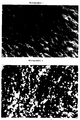
- Micrographs (25,000 magnification) 1 and 2 appended corresponding respectively to a homogeneous copolymer according to the prior art at 8% by total weight of C2F3Cl and to a heterogeneous copolymer according to the invention at 8% by total weight of C2F3Cl show the difference of product structure.
- According to 2 there is the existence of nodules coated with polymer represented by holes of dimension 0.1-0.4 ⁇ m corresponding to the place occupied by the elastomer before its dissolution.
- 1 only highlights a perfectly homogeneous film.
- the melting temperature, measured by differential thermal analysis, of PVDF is around 169 ° C
- the melting temperature of the heterogeneous copolymers according to the invention is around 160-170 ° C, that is to say within limits close to that of PVDF, while having a flexural modulus which can be lowered to less than 50% of that of PVDF.
- the respective melting points are 153 and 168 ° C for an overall content by weight of C2F3Cl of 8% and 144 and 164 ° C for an overall content by weight of C2F3Cl of 12%.
- the copolymer according to the invention can be obtained by emulsion copolymerization or suspension of C2F3Cl and VF2, the principle being as follows: in a first step, the C2F3Cl is copolymerized in VF2 which is gradually introduced into the medium in proportion sufficient to obtain a homogeneous elastomer, then in a second step the polymerization reaction of VF2 is continued, stopping the supply of C2F3Cl with possibly addition of VF2 if all of the VF2 to be used has not been initially introduced into the reactor.
- the essential point of the copolymerization process is that in the stage of preparation of the elastomer the proportion by weight of C2F3Cl used relative to the copolymerizable VF2 is at least equal to 15% and at most preferably of the order of 70%.
- VF2-C2F3Cl elastomer nodules it is not excluded to polymerize in a first step the VF2 then to a degree of homopolymerization chosen to introduce for the second step the C2F3Cl to form the elastomer nodule.
- This progressive introduction can be carried out by any known means either continuously or discontinuously by successive additions programmed as a function of the speed of reactivity of the reaction medium and this so as to preserve the homogeneity of said medium. It is recommended to form elastomer particles from 0.05 to 0.5 ⁇ m and better still from 0.1 to 0.2 ⁇ m.
- the reaction is carried out in a reactor with stirring in an aqueous medium containing an emulsifier chosen from the usual emulsifiers.
- the polymerization reaction is initiated by an agent producing water-soluble free radicals usually chosen from alkaline persulfates.
- the reaction temperature is generally between 60 and 100 ° C for pressures from 60 to 100 bars.
- the VF2 can be initially introduced entirely into the reactor, but it may be preferable to initially introduce only part of the feed, the remainder of VF2 being gradually added during polymerization so as to keep the pressure constant in the reactor.
- the C2F3Cl is, taking into account the difference in reaction rate with the VF2, gradually introduced.
- the copolymerization stage 10 to 55% by weight of the entire product formed in the two stages is formed.
- the copolymerization stage is considered to be terminated after stopping the introduction of C2F3Cl.
- the first step consists in copolymerizing VF2 and C2F3Cl to manufacture the elastomer nodules
- the second step after stopping the introduction of C2F3Cl, a gradual depletion of the level of C2F3Cl.
- This exhaustion has the effect of covering the latex particles of elastomer with layers of quasi-polymer of VF2 increasingly poor in C2F3Cl, the final layers being practically nothing more than homopolymer of VF2.
- the polymerization conditions of VF2 in the step of manufacturing the quasi-polymer can differ from those of the step of manufacturing the elastomer insofar as these conditions correspond to the hypercritical state of VF2.
- this step of manufacturing the quasi-polymer is carried out at a temperature between 50-90 ° C under a pressure of 50 to 90 bars.
- the molecular weights of the products of each of the stages are adjusted by means of transfer agent such as ketone, C3 to C8 ester, chlorinated or brominated derivative and others.
- the heterogeneous copolymer latex finally obtained is recovered and transformed under the usual conditions for emulsion polymerizations.
- the heterogeneous copolymer according to the invention can also be obtained by the suspension polymerization process.
- the protective colloid is chosen from those known and used in this kind of polymerization.
- the VF2 may be initially introduced entirely into the reactor, but it may be preferable to initially introduce only part of the feed, the remainder of VF2 being gradually added during polymerization so as to keep the pressure constant in the reactor.
- the C2F3Cl is, taking into account the difference in reaction rate with the VF2, introduced gradually. It is possible to simultaneously introduce VF2 and C2F3Cl, but in this case it is necessary to adjust the flow rate of C2F3Cl in such a way that the formation of patterns C2F3Cl is controlled with respect to the formation of patterns VF2.
- this copolymerization step it is not essential to manufacture a rigorously homogeneous elastomeric copolymer, but it is necessary that in its composition the content by weight of C2F3Cl is at least 15%.
- the copolymerization stage is considered to be terminated after stopping the introduction of C2F3Cl.
- the polymerization conditions of VF2 in the step of manufacturing the quasi-polymer can differ from those of the step of manufacturing the elastomer insofar as these conditions correspond to the hypercritical state of VF2.
- this step of manufacturing the quasi-polymer is carried out at a temperature between 50-90 ° C under a pressure of 50 to 90 bars.
- the molecular weights of the products of each of the stages are adjusted by means of transfer agent such as ketone, C3 to C8 ester, chlorinated or brominated derivative and others.
- the process for manufacturing heterogeneous copolymer of VF2 and C2F3Cl in emulsion or suspension is characterized in that in one stage, copolymerization of VF2 and C2F3Cl by gradually introducing the latter into the reaction medium so as to form a homogeneous elastomer and in that in another stage a PVDF matrix is formed by in situ polymerization of VF2, the copolymerization step preferably being the first.
- thermoplastic polymer products obtained according to these processes contain, calculated as a monomer, from 95 to 85% by weight of VF2 knowing that 6 to 50% of this monomer VF2 is contained in the elastomer VF2-C2F3Cl the rest forming the matrix of almost polymer.
- the start of agitation marks the beginning of the polymerization and lowers the pressure.
- VF2 is introduced regularly to raise and maintain the pressure at 90 bars.
- C introduitF3Cl is then introduced at the rate of 0.3 g. of C2F3Cl per gram of VF2 introduced to raise and maintain the pressure at 90 bars in the reactor.
- the feeding of C2F3Cl is stopped and 400 g are added.
- acetone and 1 g. potassium persulfate then 12 kg. of VF2 at a speed allowing the pressure to be maintained at 90 bars.
- the speed of introduction of VF2 is of the order of 3 kg / h during and after the addition of C2F3Cl.
- the reactor is degassed and a latex containing 36% of dry extract of heterogeneous composition is recovered by microscopy containing an overall rate of 8% by weight of C2F3Cl.
- the copolymer obtained contains 35% by weight of nodules themselves containing approximately 22.8% by weight of units originating from C2F3Cl measured by NMR analysis of the extraction with methyl ethyl ketone.
- a 60 l autoclave 40 l are introduced. deionized water, 40 g. emulsifier of formula C6F13C2H4SO3K, 4 g. sodium pyrophosphate, 4 g. persulfate and 500 g. paraffin melting between 54 and 56 ° C. The temperature is adjusted to 80 ° C. and the reactor is placed under vacuum of 9.3 ⁇ 104Pa (700 mm of mercury). 50 g are then introduced. acetone, 1100 g. of C2F3Cl and a VF2 pressure of 90 bars is allowed. The start of agitation marks the start of polymerization and lowers the pressure.
- VF2 is introduced regularly to raise and maintain the pressure at 90 bars.
- C2F3Cl is then introduced at a rate of 0.44 g. of C2F3Cl per gram of VF2 introduced to raise and maintain the pressure at 90 bars in the reactor.
- the feeding of C2F3Cl is stopped and 400 g are added.
- acetone, 1 g. potassium persulfate then 8.4 kg. of VF2 at a speed allowing the pressure to be maintained at 90 bars.
- the speed of introduction of VF2 is of the order of 3 kg / h during and after the addition of C2F3Cl.
- the reactor is degassed and a latex containing 37% of dry extract of heterogeneous composition is recovered by microscopy containing an overall rate of 14% by weight of C2F3Cl.
- the copolymer obtained contains 45% by weight of nodules themselves containing about 31% by weight of units from C2F3Cl measured by NMR analysis of the extraction with methyl ethyl ketone.
- a 60 l autoclave 40 l are introduced. deionized water, 40 g. emulsifier of formula C6F13C2H4SO3K, 4 g. sodium pyrophosphate, 4 g. persulfate and 500 g. paraffin melting between 54 and 56 ° C. The temperature is adjusted to 80 ° C. and the reactor is placed under vacuum of 9.3 ⁇ 104Pa (700 mm of mercury). 50 g are then introduced. acetone, 600 g. of C2F3Cl and a VF2 pressure of 90 bars is allowed.
- the start of agitation marks the beginning of the polymerization and lowers the pressure.
- VF2 is introduced regularly to raise and maintain the pressure at 90 bars.
- C introduitF3Cl is then introduced at the rate of 0.3 g. of C2F3Cl per gram of VF2 introduced to raise and maintain the pressure at 90 bars in the reactor.
- the feeding of C2F3Cl is stopped and 400 g are added.
- acetone and 1 g. potassium persulfate then 6.82 kg. of VF2 at a speed allowing the pressure to be maintained at 90 bars.
- the speed of introduction of VF2 is around 3 kg / h during and after the addition of C2F3Cl.
- the reactor is degassed and a latex containing 33% of dry extract of heterogeneous composition is recovered by microscopy containing an overall rate of 12% by weight of C2F3Cl.
- the copolymer obtained contains 53% by weight of nodules themselves containing approximately 22.6% by weight of units originating from C2F3Cl measured by NMR analysis of the extraction with methyl ethyl ketone.
- a 60 l autoclave 40 l are introduced. deionized water, 40 g. emulsifier of formula C6F13C2H4SO3K, 4 g. sodium pyrophosphate, 4 g. persulfate and 500 g. paraffin melting between 54 and 56 ° C. The temperature is adjusted to 80 ° C. and the reactor is placed under vacuum of 9.3 ⁇ 104Pa (700 mm of mercury). 50 g are then introduced. acetone, 600 g. of C2F3Cl and a VF2 pressure of 90 bars is allowed.
- the start of agitation marks the beginning of the polymerization and lowers the pressure.
- VF2 is introduced regularly to maintain the pressure at 90 bars.
- C introduitF3Cl is then introduced at the rate of 0.3 g. of C2F3Cl per gram of VF2 introduced to raise and maintain the pressure at 90 bars in the reactor.
- the feeding of C2F3Cl is stopped and 400 g are added.
- acetone, 1 g. potassium persulfate then 8.72 kg. of VF2 at a speed allowing the pressure to be maintained at 90 bars.
- the speed of introduction of VF2 is of the order of 3 kg / h during and after the addition of C2F3Cl.
- the reactor is degassed and a latex containing 36% of dry extract of heterogeneous composition is recovered by microscopy containing an overall rate of 7.4% by weight of C2F3Cl.
- the copolymer obtained contains 32% by weight of nodules themselves containing approximately 23% by weight of units originating from C2F3Cl measured by NMR analysis of the extraction with methyl ethyl ketone.
Landscapes
- Chemical & Material Sciences (AREA)
- Health & Medical Sciences (AREA)
- Chemical Kinetics & Catalysis (AREA)
- Medicinal Chemistry (AREA)
- Polymers & Plastics (AREA)
- Organic Chemistry (AREA)
- Addition Polymer Or Copolymer, Post-Treatments, Or Chemical Modifications (AREA)
- Graft Or Block Polymers (AREA)
- Polymerisation Methods In General (AREA)
- Organic Low-Molecular-Weight Compounds And Preparation Thereof (AREA)
Claims (10)
Priority Applications (1)
| Application Number | Priority Date | Filing Date | Title |
|---|---|---|---|
| AT88400145T ATE66941T1 (de) | 1987-02-03 | 1988-01-22 | Heterogenes copolymer aus vinylidenfluorid und chlortrifluorethylen und verfahren zu seiner herstellung. |
Applications Claiming Priority (2)
| Application Number | Priority Date | Filing Date | Title |
|---|---|---|---|
| FR8701283 | 1987-02-03 | ||
| FR8701283A FR2610325B1 (fr) | 1987-02-03 | 1987-02-03 | Copolymere heterogene de fluorure de vinylidene et de chlorotrifluoroethylene. procede de fabrication du copolymere heterogene |
Publications (2)
| Publication Number | Publication Date |
|---|---|
| EP0280591A1 EP0280591A1 (de) | 1988-08-31 |
| EP0280591B1 true EP0280591B1 (de) | 1991-09-04 |
Family
ID=9347533
Family Applications (1)
| Application Number | Title | Priority Date | Filing Date |
|---|---|---|---|
| EP19880400145 Expired - Lifetime EP0280591B1 (de) | 1987-02-03 | 1988-01-22 | Heterogenes Copolymer aus Vinylidenfluorid und Chlortrifluorethylen und Verfahren zu seiner Herstellung |
Country Status (9)
| Country | Link |
|---|---|
| US (2) | US4851479A (de) |
| EP (1) | EP0280591B1 (de) |
| JP (1) | JP2823121B2 (de) |
| KR (1) | KR950008158B1 (de) |
| CN (1) | CN1012068B (de) |
| AT (1) | ATE66941T1 (de) |
| CA (1) | CA1332489C (de) |
| DE (1) | DE3864539D1 (de) |
| FR (1) | FR2610325B1 (de) |
Families Citing this family (27)
| Publication number | Priority date | Publication date | Assignee | Title |
|---|---|---|---|---|
| US5177150A (en) * | 1990-05-10 | 1993-01-05 | Elf Atochem North America, Inc. | Powder coatings of vinylidene fluoride/hexafluoropylene copolymers |
| US5093427A (en) | 1990-05-10 | 1992-03-03 | Atochem North America, Inc. | Copolymers of vinylidene fluoride and hexafluoropropylene and process for preparing the same |
| BE1005693A3 (fr) * | 1992-02-05 | 1993-12-21 | Solvay | Nouveaux materiaux plastiques formes de copolymeres heterogenes de fluorure de vinylidene et de chlortrifluorethylene, utilisation et procede de fabrication. |
| JP3303408B2 (ja) * | 1992-07-09 | 2002-07-22 | ダイキン工業株式会社 | 含フッ素樹脂複合微粒子 |
| DE69508275T2 (de) * | 1994-12-06 | 1999-09-30 | Daikin Industries, Ltd. | Elastisches fluorcopolymer mit ausgezeichneter formverarbeitbarkeit, verfahren zu dessen herstellung und vulkanisierbare zusammensetzung mit ausgezeichneter formverarbeitbarkeit |
| US5880204A (en) * | 1995-09-27 | 1999-03-09 | Alliedsignal Inc. | Room temperature coalescable aqueous fluoropolymer dispersions and method for their manufacture |
| IT1288121B1 (it) * | 1996-07-01 | 1998-09-10 | Ausimont Spa | Copolimeri termoplastici del vinilidenfluoruro (vdf) |
| EP0884358B1 (de) | 1997-06-12 | 2003-07-23 | Atofina | Weiche und schlagzähe Polyvinylidenfluoridzusammensetzungen und Verfahren zu ihrer Herstellung |
| US6153697A (en) * | 1998-03-18 | 2000-11-28 | Ppg Industries Ohio, Inc. | Fluoropolymers and coating compositions |
| EP1342752A1 (de) * | 2002-03-07 | 2003-09-10 | Atofina | Zusammensetzungen auf Polyvinylidenfluorid-Basis |
| FR2842203A1 (fr) * | 2002-07-12 | 2004-01-16 | Atofina | Procede de fabrication du polymere du fluorure de vinylidene |
| FR2849046A1 (fr) * | 2002-12-24 | 2004-06-25 | Atofina | Composition a base de pvdf heterogene et de bisimide aromatique reticulable par des radiations ionisantes |
| WO2006080259A1 (ja) * | 2005-01-27 | 2006-08-03 | Kureha Corporation | フッ化ビニリデン系コア/シェル型重合体およびその非水系電気化学素子における利用 |
| CN100420701C (zh) * | 2005-12-23 | 2008-09-24 | 上海三爱富新材料股份有限公司 | 氟弹性体及其制备方法 |
| WO2007130757A2 (en) * | 2006-05-01 | 2007-11-15 | Arkema Inc. | Fluoropolymers having improved whiteness |
| US7700700B2 (en) * | 2007-01-26 | 2010-04-20 | Arkema Inc. | Vinylidene fluoride copolymer composition with improved low-temperature impact properties |
| CN101186668B (zh) * | 2007-11-07 | 2011-01-19 | 中昊晨光化工研究院 | 一种涂料用含氟橡胶的制备方法 |
| CN101691412B (zh) * | 2009-09-30 | 2012-11-07 | 西安交通大学 | 一种由聚(偏氟乙烯-三氟氯乙烯)制备聚(偏氟乙烯-三氟氯乙烯-三氟乙烯)或聚(偏氟乙烯-三氟乙烯)的方法 |
| JP2014508210A (ja) | 2011-03-16 | 2014-04-03 | アーケマ・インコーポレイテッド | 2,3,3,3−テトラフルオロプロペン含有フルオロポリマーの合成 |
| CN102585077B (zh) * | 2011-12-16 | 2013-11-06 | 中昊晨光化工研究院 | 三氟氯乙烯改性聚偏氟乙烯的制备方法 |
| FR2987667B1 (fr) * | 2012-03-01 | 2014-03-07 | Technip France | Structure tubulaire flexible d'exploitation petroliere a haute tenue |
| CN103740012A (zh) * | 2014-01-10 | 2014-04-23 | 长园电子(集团)有限公司 | 一种耐低温氟橡胶热收缩套管及其制备方法 |
| CN106336476B (zh) * | 2016-08-25 | 2019-12-10 | 浙江孚诺林化工新材料有限公司 | 一种高断裂伸长率的偏氟乙烯共聚物的制备方法 |
| JP2019529671A (ja) * | 2016-10-05 | 2019-10-17 | ソルベイ スペシャルティ ポリマーズ イタリー エス.ピー.エー. | フッ化ビニリデンポリマー |
| JP6955355B2 (ja) * | 2017-03-31 | 2021-10-27 | 株式会社クレハ | コアシェル型粒子ならびにその用途および製造方法 |
| JP7226314B2 (ja) * | 2017-07-18 | 2023-02-21 | 株式会社Gsユアサ | 電極、蓄電素子、及び電極の製造方法 |
| CN110627942B (zh) * | 2018-06-22 | 2022-02-18 | 浙江省化工研究院有限公司 | 一种含氟热塑性弹性体、其制备方法及应用 |
Family Cites Families (16)
| Publication number | Priority date | Publication date | Assignee | Title |
|---|---|---|---|---|
| CA629174A (en) * | 1961-10-17 | Minnesota Mining And Manufacturing Company | Fluorine-containing polymers | |
| US2752331A (en) * | 1953-01-21 | 1956-06-26 | Kellogg M W Co | Copolymers of a perfluorochloroethylene and a fluoroethylene and method for their preparation |
| US2880154A (en) * | 1954-11-08 | 1959-03-31 | Allied Chem | Production of copolymers of chlorotrifluoroethylene and vinylidene fluoride |
| US3580975A (en) * | 1967-09-21 | 1971-05-25 | Monsanto Co | Vinyl halide graft polymers |
| GB1150190A (en) * | 1968-03-07 | 1969-04-30 | Dow Chemical Co | Preparation of Fluorinated Polymers. |
| JPS5148191B1 (de) * | 1971-07-26 | 1976-12-18 | ||
| US3929934A (en) * | 1973-11-19 | 1975-12-30 | Du Pont | Novel fluoroelastomers in powder form |
| JPS6023688B2 (ja) * | 1975-06-12 | 1985-06-08 | 呉羽化学工業株式会社 | 弗化ビニリデン共重合物の重合法 |
| US4141874A (en) * | 1975-11-15 | 1979-02-27 | Daikin Kogyo Co., Ltd. | Fluorine-containing elastomeric copolymers, process for preparing the same and composition containing the same |
| DE2559260C3 (de) * | 1975-12-31 | 1982-04-01 | Dynamit Nobel Ag, 5210 Troisdorf | Verfahren zur Modifizierung von Polyvinylidenfluorid |
| JPS5930847A (ja) * | 1982-08-14 | 1984-02-18 | Central Glass Co Ltd | ポリフツ化ビニリデン樹脂組成物 |
| JPS59126452A (ja) * | 1983-01-06 | 1984-07-21 | Japan Synthetic Rubber Co Ltd | 高分子圧電材料 |
| US4469846A (en) * | 1983-05-20 | 1984-09-04 | E. I. Du Pont De Nemours And Company | Core/shell fluoropolymer compositions |
| DK310484A (da) * | 1983-06-30 | 1984-12-31 | Montedison Spa | Elastomerpraeparat baseret paa vinylidenfluorid |
| JPS6023688A (ja) * | 1983-07-15 | 1985-02-06 | 日成建設株式会社 | ワイヤ−ロ−プ等による地中埋設物の緊縛方法及びその実施に用いられるパイロツト装置 |
| JPS61118455A (ja) * | 1984-11-14 | 1986-06-05 | Central Glass Co Ltd | 導電性ふっ素樹脂の製造方法 |
-
1987
- 1987-02-03 FR FR8701283A patent/FR2610325B1/fr not_active Expired
-
1988
- 1988-01-22 EP EP19880400145 patent/EP0280591B1/de not_active Expired - Lifetime
- 1988-01-22 US US07/146,814 patent/US4851479A/en not_active Expired - Lifetime
- 1988-01-22 AT AT88400145T patent/ATE66941T1/de not_active IP Right Cessation
- 1988-01-22 DE DE8888400145T patent/DE3864539D1/de not_active Expired - Fee Related
- 1988-01-29 CA CA000557734A patent/CA1332489C/fr not_active Expired - Fee Related
- 1988-02-03 KR KR1019880000984A patent/KR950008158B1/ko not_active Expired - Fee Related
- 1988-02-03 CN CN88100574A patent/CN1012068B/zh not_active Expired
- 1988-02-03 JP JP63023648A patent/JP2823121B2/ja not_active Expired - Fee Related
-
1989
- 1989-04-14 US US07/339,173 patent/US4946900A/en not_active Expired - Lifetime
Also Published As
| Publication number | Publication date |
|---|---|
| JPS63270711A (ja) | 1988-11-08 |
| EP0280591A1 (de) | 1988-08-31 |
| US4851479A (en) | 1989-07-25 |
| FR2610325B1 (fr) | 1989-10-06 |
| JP2823121B2 (ja) | 1998-11-11 |
| CN88100574A (zh) | 1988-09-07 |
| US4946900A (en) | 1990-08-07 |
| CN1012068B (zh) | 1991-03-20 |
| FR2610325A1 (fr) | 1988-08-05 |
| CA1332489C (fr) | 1994-10-11 |
| KR880010005A (ko) | 1988-10-06 |
| DE3864539D1 (de) | 1991-10-10 |
| ATE66941T1 (de) | 1991-09-15 |
| KR950008158B1 (ko) | 1995-07-25 |
Similar Documents
| Publication | Publication Date | Title |
|---|---|---|
| EP0280591B1 (de) | Heterogenes Copolymer aus Vinylidenfluorid und Chlortrifluorethylen und Verfahren zu seiner Herstellung | |
| JP2785077B2 (ja) | 弗化ビニリデンとヘキサフルオロプロピレンとのコポリマー及びその調製方法 | |
| JPS648022B2 (de) | ||
| EP2045271B1 (de) | Verfahren zur radikalären Polymerisation von Vinyliden-Chlorat und jene Polymere | |
| FR2931826A1 (fr) | Procede de preparation multi-etapes d'un latex composite halogene porteur de groupes associatifs | |
| FR2474516A1 (fr) | Composition de resine de chlorure de vinyle contenant un copolymere reticule et ayant des proprietes ameliorees | |
| EP0810241A1 (de) | Vinylchloridecopolymer Latex mit bimodaler Teilchengrössenverteilung, Verfahren zu seiner Herstellung und seine Verwendungen | |
| JPS6330324B2 (de) | ||
| JPH04234413A (ja) | 塩化ビニル単または共重合体およびポリアクリル酸エステルをベースとする熱可塑性材料の製造方法 | |
| CN1024802C (zh) | 呈单分散粒子胶乳态聚氯乙烯水乳液的制备方法 | |
| JPS61207411A (ja) | 塩化ビニル系樹脂の製造法 | |
| EP0264982B1 (de) | Verfahren zur Herstellung von Vinylhalogenidepolymeren, modifiziert mit Polymeren aus Sauerstoffheterocyclen | |
| JP2002220403A (ja) | フッ化ビニリデン重合体及びその製造方法 | |
| EP0270436B1 (de) | Verfahren zur Herstellung von Homo- und Kopolymeren des Vinylchlorids in Mikrosuspension in Gegenwart eines Keimproduktes | |
| CA2011092C (fr) | Procede pour la fabrication de polymeres du chlorure de vinyle modifies par des polymeres de lactones et nouveaux polymeres du chlorure de vinyle modifies par des polymeres de lactones | |
| JP5456471B2 (ja) | 塩化ビニリデンポリマー組成物の製造方法ならびにその組成物から得られるフィルムおよびパッケージング | |
| JPH0665691B2 (ja) | 塩化ビニリデン系共重合体粒子とその製法 | |
| JP2009096829A (ja) | ポリ塩化ビニル樹脂の回収方法 | |
| JP3628470B2 (ja) | トリアリルイソシアヌレート系重合体の製造方法 | |
| JP4504490B2 (ja) | 塩化ビニル系樹脂及びその成形体及び成形体の製造方法 | |
| FR2649113A1 (fr) | Composition thermoplastique de resine acrilique | |
| FR2839725A1 (fr) | Polymeres alpha-fluoroacryliques a faible indice de polydispersite, procede pour les synthetiser et procede de fabrication d'articles les mettant en oeuvre | |
| FR2484420A1 (fr) | Procede ameliore pour la polymerisation en suspension de chlorure de vinyle | |
| WO2012080646A1 (fr) | Procede de preparation en emulsion d'un pvc greffe sur elastomere vinyl aromatique | |
| BE1003634A3 (fr) | Procede pour la fabrication de polymeres du chlorure de vinyle modifies par des polymeres de lactones et nouveaux polymers du chlorure de vinyle modifies par des polymeres de lactones. |
Legal Events
| Date | Code | Title | Description |
|---|---|---|---|
| PUAI | Public reference made under article 153(3) epc to a published international application that has entered the european phase |
Free format text: ORIGINAL CODE: 0009012 |
|
| 17P | Request for examination filed |
Effective date: 19880127 |
|
| AK | Designated contracting states |
Kind code of ref document: A1 Designated state(s): AT BE DE FR GB IT NL SE |
|
| 17Q | First examination report despatched |
Effective date: 19900329 |
|
| GRAA | (expected) grant |
Free format text: ORIGINAL CODE: 0009210 |
|
| AK | Designated contracting states |
Kind code of ref document: B1 Designated state(s): AT BE DE FR GB IT NL SE |
|
| REF | Corresponds to: |
Ref document number: 66941 Country of ref document: AT Date of ref document: 19910915 Kind code of ref document: T |
|
| ITF | It: translation for a ep patent filed | ||
| REF | Corresponds to: |
Ref document number: 3864539 Country of ref document: DE Date of ref document: 19911010 |
|
| GBT | Gb: translation of ep patent filed (gb section 77(6)(a)/1977) | ||
| RAP4 | Party data changed (patent owner data changed or rights of a patent transferred) |
Owner name: ELF ATOCHEM S.A. |
|
| PLBE | No opposition filed within time limit |
Free format text: ORIGINAL CODE: 0009261 |
|
| STAA | Information on the status of an ep patent application or granted ep patent |
Free format text: STATUS: NO OPPOSITION FILED WITHIN TIME LIMIT |
|
| 26N | No opposition filed | ||
| EAL | Se: european patent in force in sweden |
Ref document number: 88400145.4 |
|
| PGFP | Annual fee paid to national office [announced via postgrant information from national office to epo] |
Ref country code: SE Payment date: 19990107 Year of fee payment: 12 |
|
| PGFP | Annual fee paid to national office [announced via postgrant information from national office to epo] |
Ref country code: AT Payment date: 19990113 Year of fee payment: 12 |
|
| PG25 | Lapsed in a contracting state [announced via postgrant information from national office to epo] |
Ref country code: AT Free format text: LAPSE BECAUSE OF NON-PAYMENT OF DUE FEES Effective date: 20000122 |
|
| PG25 | Lapsed in a contracting state [announced via postgrant information from national office to epo] |
Ref country code: SE Free format text: LAPSE BECAUSE OF NON-PAYMENT OF DUE FEES Effective date: 20000123 |
|
| EUG | Se: european patent has lapsed |
Ref document number: 88400145.4 |
|
| REG | Reference to a national code |
Ref country code: GB Ref legal event code: IF02 |
|
| PGFP | Annual fee paid to national office [announced via postgrant information from national office to epo] |
Ref country code: FR Payment date: 20020110 Year of fee payment: 15 |
|
| PGFP | Annual fee paid to national office [announced via postgrant information from national office to epo] |
Ref country code: GB Payment date: 20020123 Year of fee payment: 15 |
|
| PGFP | Annual fee paid to national office [announced via postgrant information from national office to epo] |
Ref country code: NL Payment date: 20020131 Year of fee payment: 15 |
|
| PGFP | Annual fee paid to national office [announced via postgrant information from national office to epo] |
Ref country code: DE Payment date: 20020227 Year of fee payment: 15 |
|
| PGFP | Annual fee paid to national office [announced via postgrant information from national office to epo] |
Ref country code: BE Payment date: 20020320 Year of fee payment: 15 |
|
| PG25 | Lapsed in a contracting state [announced via postgrant information from national office to epo] |
Ref country code: GB Free format text: LAPSE BECAUSE OF NON-PAYMENT OF DUE FEES Effective date: 20030122 |
|
| PG25 | Lapsed in a contracting state [announced via postgrant information from national office to epo] |
Ref country code: BE Free format text: LAPSE BECAUSE OF NON-PAYMENT OF DUE FEES Effective date: 20030131 |
|
| PG25 | Lapsed in a contracting state [announced via postgrant information from national office to epo] |
Ref country code: NL Free format text: LAPSE BECAUSE OF NON-PAYMENT OF DUE FEES Effective date: 20030801 Ref country code: DE Free format text: LAPSE BECAUSE OF NON-PAYMENT OF DUE FEES Effective date: 20030801 |
|
| GBPC | Gb: european patent ceased through non-payment of renewal fee | ||
| PG25 | Lapsed in a contracting state [announced via postgrant information from national office to epo] |
Ref country code: FR Free format text: LAPSE BECAUSE OF NON-PAYMENT OF DUE FEES Effective date: 20030930 |
|
| NLV4 | Nl: lapsed or anulled due to non-payment of the annual fee |
Effective date: 20030801 |
|
| REG | Reference to a national code |
Ref country code: FR Ref legal event code: ST |
|
| PG25 | Lapsed in a contracting state [announced via postgrant information from national office to epo] |
Ref country code: IT Free format text: LAPSE BECAUSE OF NON-PAYMENT OF DUE FEES;WARNING: LAPSES OF ITALIAN PATENTS WITH EFFECTIVE DATE BEFORE 2007 MAY HAVE OCCURRED AT ANY TIME BEFORE 2007. THE CORRECT EFFECTIVE DATE MAY BE DIFFERENT FROM THE ONE RECORDED. Effective date: 20050122 |