EP0177851B1 - Steel materials for welded structures - Google Patents
Steel materials for welded structures Download PDFInfo
- Publication number
- EP0177851B1 EP0177851B1 EP85112244A EP85112244A EP0177851B1 EP 0177851 B1 EP0177851 B1 EP 0177851B1 EP 85112244 A EP85112244 A EP 85112244A EP 85112244 A EP85112244 A EP 85112244A EP 0177851 B1 EP0177851 B1 EP 0177851B1
- Authority
- EP
- European Patent Office
- Prior art keywords
- steel
- haz
- present
- steels
- oxides
- Prior art date
- Legal status (The legal status is an assumption and is not a legal conclusion. Google has not performed a legal analysis and makes no representation as to the accuracy of the status listed.)
- Expired - Lifetime
Links
Images
Classifications
-
- C—CHEMISTRY; METALLURGY
- C21—METALLURGY OF IRON
- C21C—PROCESSING OF PIG-IRON, e.g. REFINING, MANUFACTURE OF WROUGHT-IRON OR STEEL; TREATMENT IN MOLTEN STATE OF FERROUS ALLOYS
- C21C7/00—Treating molten ferrous alloys, e.g. steel, not covered by groups C21C1/00 - C21C5/00
- C21C7/04—Removing impurities by adding a treating agent
- C21C7/06—Deoxidising, e.g. killing
-
- C—CHEMISTRY; METALLURGY
- C22—METALLURGY; FERROUS OR NON-FERROUS ALLOYS; TREATMENT OF ALLOYS OR NON-FERROUS METALS
- C22C—ALLOYS
- C22C38/00—Ferrous alloys, e.g. steel alloys
- C22C38/14—Ferrous alloys, e.g. steel alloys containing titanium or zirconium
-
- Y—GENERAL TAGGING OF NEW TECHNOLOGICAL DEVELOPMENTS; GENERAL TAGGING OF CROSS-SECTIONAL TECHNOLOGIES SPANNING OVER SEVERAL SECTIONS OF THE IPC; TECHNICAL SUBJECTS COVERED BY FORMER USPC CROSS-REFERENCE ART COLLECTIONS [XRACs] AND DIGESTS
- Y10—TECHNICAL SUBJECTS COVERED BY FORMER USPC
- Y10T—TECHNICAL SUBJECTS COVERED BY FORMER US CLASSIFICATION
- Y10T29/00—Metal working
- Y10T29/49—Method of mechanical manufacture
- Y10T29/4998—Combined manufacture including applying or shaping of fluent material
- Y10T29/49988—Metal casting
- Y10T29/49991—Combined with rolling
Definitions
- the present invention relates to welding structural steels, and more particularly to a production process of steel materials which, when used as welded structures, are less susceptible to initiation and propagation of brittle cracks in the heat affected zone (herein called HAZ) in the welded joints, and to a steel material for welded structures. More specifically, the present invention is mainly directed to steel materials which are required to satisfy severe demands with respect to Charpy notch toughness in HAZ welded with large-heat-inputs, and with respect to COD values in HAZ welded by ordinary welding.
- HAZ heat affected zone
- welding structural steels In case of steel materials which are designated for welding, represented by so-called “welding structural steels", it is generally very difficult to retain various properties of the steel materials in the HAZ after fabrication of steel structure. Specifically, it has been very often experienced that notch toughness and COD value, and further properties favorable to prevention of initiation and propagation of brittle fractures are much deteriorated in HAZ as compared with the properties in the parent material which is not affected by the welding heat.
- HAZ For the purpose of preventing excessive growth of the grains in HAZ of such steel, fine dispersion of nitride particles such as TiN into the steel, and fine dispersion of such inclusions as oxides and sulfides of REM into the steel are preferable to minimize the embrittlement in HAZ.
- Japanese Patent Publication Sho 51-16890 and Japanese Laid-Open Patent Application Sho 50-80911 disclose the art of preventing the excessive growth of grains in the HAZ
- Japanese Laid-Open Patent Applications Sho 58-204115, Sho 58-204116, Sho 58-204117 and Sho 58-204118 disclose the art of reducing the embrittlement in the HAZ.
- oxides and sulfides of REM has its own problem. Because AI 2 0 3 -oxides and sulfides tend to be combined with each other to form larger inclusions in AI-killed steels, and this adverse effect of REM is very difficult to be eliminated particularly in manufacturing processes including continuous casting process which nowadays constitutes the most important process for steel plates.
- oxides and sulfides of REM appearing in AI-killed steels are stable in the high temperature HAZ portion. They remain to be effective in preventing the growth of austenite grains, but the resultant austenite grains are generally too coarse to suppress the development of Bu and FSP which deteriorate the toughness of HAZ.
- an object of the present invention is to provide steel materials free from the formation of coarse Bu and FSP in the HAZ, which induce the brittle fractures in welded steel structures.
- the present invention aims at remarkable improvements of the Charpy notch toughness of the HAZ as compared with the conventional steel and simultaneously aims at great enhancement of the COD characteristics.
- Ceq is the abbreviation of carbon equivalent which indicates a mechanical characteristic, particularly crackability of a welded structure by means of chemical ingredients.
- Pcm also indicates a similar characteristic of a welded structure. They are different in such point that “Ceq” is usually used in connection with high carbon structure while “Pcm” is usually used in connection with low carbon structure.
- Ceq and Pcm requires the addition of strengthening elements such as Mn, Cu, Ni, Mo, Nb, V and B so as to compensate the lowering of strength of the steel material by the lowered carbon content, Ceq and Pcm.
- the addition of these elements increases the production cost of the steel materials as well as difficulties in refining of molten steel, and it also does not escape from segregation problems and deteriorations in surface quality of casting slabs (particularly continuous cast slabs), which greatly deteriorates efficiency in production and economical manufacturing of steel plates.
- the conventional art has been found not to be always effective to achieve the desired improvement on the cold cracking in HAZ.
- ferrite plates develop from finely dispersed oxide particles which play a role as the transformation nuclei within austenite grains, resulting in a bainitic microstructure in which the ferrite plates develop along the three equivalent (100) planes of the austenite phase so that the undesirable microstructures, such as coarse Bu, FSP and other coarse and hard microstructures can be suppressed.
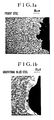
- a bainitic microstructure consisting of ferrite plates of Widmannstatten structure is formed in the HAZ as shown in Fig. 1 (a).
- This bainitic microstructure will not be formed as the Al content in steel increases to a higher level.
- another type of bainitic microstructure is formed.
- the ferrite plates of the bainitic microstructures grow predominantly along with one of the three equivalent (100) planes of the original austenite as seen in Fig. 1(b). This bainite structure is herein called "FSP”.
- the present invention has been completed on the above discoveries and has its main object to provide a process for producing steel materials which show improved Charpy notch toughness and COD property when welded, particularly with large heat-input weldings.
- the above objects are achieved by the steel material and the process for its production according to the claims.
- the steel material of the present invention is less susceptible to cold cracking by way of refinement of the microstructure in welded HAZ through the special transformation behaviour from austenite to bainite.
- the molten steel preferably contains not more than 0.05% of silicon which is unavoidably introduced during the treatment of molten steel.
- the cast product may be further rolled.
- the steel material according to the present invention should contain 0.001 to 0.300% C and 0.4 to 2.0% Mn.
- P, S, and N they do not have primary significance to the technical features of the present invention, however, they should be preferably maintained as low as possible.
- P and S should be not more than 0.025% respectively and N should be not more than 0.0040%.
- fine bainite structure composed of ferrite plates of Widmannst5tten-like form (hereinafter called fine bainite structure) in the HAZ.
- fine bainite structure With AI contents higher than 0.007%, the fine bainite structure will not appear for the reason that the oxides containing the complex grain phase of one or more of titanium oxides such as TiO and Ti 2 0 3 which control the formation of the Widmannstatten-like ferrite plates composing the fine bainite structure are reduced by AI into oxides which are no more able to form the "fine bainite structure", so that the desired result of the present invention will not be achieved.
- AI is neither added nor allowed to be contained exceeding an amount required to keep the necessary amount of dissolved oxygen in the molten steel prior to addition of titanium. In that sense it is necessary to prevent the contamination of AI into the steel from ferro-alloys and refractories.
- the AI content unavoidably contaminated into the molten steel as impurity is maintained not more than 0.007%.
- the AI content should preferably be maintained not larger than 0.005%.
- Si content Similar considerations should be made regarding Si content. Thus it is desired that no silicon is present in the molten steel prior to the addition of titanium because it lowers the content of oxygen dissolved in the molten steel prior to the addition of titanium. However Si has less affinity with oxygen in the molten steel as compared with Al, and if added after the addition of titanium it will not deteriorate the result of the present invention. For these reasons the addition of Si prior to the addition of Ti is preferably not more than 0.05% and the Si content, if added after the addition of Ti, may be in the same range as seen in ordinary welding structural steels and may be present up to 0.8%.
- Ti and 0 directly participate in the formation of the above Ti oxides, and if their contents are excessively low an appropriate amount of Ti oxides cannot be formed, and on the other hand if excessively high, the Ti oxides coagulate and grow coarse so that the desired result of the present invention will not be obtained.
- the final contents of Ti and O attained by the cleaning of the molten steel deoxidized by addition of Ti under stirring or using inert gas should be maintained in the range from 0.003 to 0.050% for Ti and from 0.0010 to 0.0100% for O and the cleaning process by stirring or inert gas is stopped at this stage. If the cleaning of the molten steel is not enough and the O content exceeds 0.0100%, the resultant Ti oxides are coarse and the desired fine bainite structure of the present invention will not be produced, instead they tend to be the cause of surface defects in the final products due to the coarse inclusions. On the other hand, if the 0 content is less than 0.0010%, the amount of above oxides is not enough. Also if the Ti content is less than 0.003%, the amount of the above oxides is not enough, and if it exceeds 0.050%, an excessive amount of TiO is formed, which will deteriorate the toughness in the HAZ.
- Cu and Ni are both effective to increase the strength and toughness of the steel materials, with less harm on the cold toughness of the HAZ and are added for these purposes in amounts not more than 1.5% Cu and not more than 10% Ni, beyond which they can not produce any technical contribution to the desired results of the present invention.
- Cr, Mo, Nb, and V are effective to enhance the hardening property of the steel and to increase the strength through precipitation hardening as they precipitate in the form of carbo-nitrides. Further, if applied to an appropriate manufacturing process, they are expected to improve the low temperature toughness of the steel. However, these elements, when added in excessive amounts, cause the hardening of the HAZ, hence greater tendency of cold cracking of the weld. Therefore, Cr and Mo should be maintained not more than 1% respectively and Nb should be not more than 0.2% and V should be not more than 0.5%.
- B contributes to improvement of the hardenability of the steel in the quenching treatment and to the increase of nuclei for the ferrite transformation in a controlled rolling process, hence effective to refine the ferrite-pearlite structure.
- B is added in an amount no more than 0.0050%.
- Zr, Ta, W and Co may be added in an amount not more than 0.1% respectively for the purpose of improving the corrosion behaviour of the steel.
- Ca is added for controlling the shape of MnS, but excessive amounts of Ca will cause reduction of the titanium oxides, thus producing detrimental effects on the desired results of the present invention.
- Ca should be added in amounts not more than 0.0020%.
- a protective atmosphere of inert gas such as argon gas for the molten steel prior to the addition of Ti, specifically in a closed vessel such as RH, DH, and VAD, or cover the surface of the molten bath with inert gas for the purpose of preventing loss of the added Ti though oxidation by oxygen in atmosphere during the stirring of the molten steel, and for this purpose it is also desirable to maintain the partial pressure of oxygen in the protective atmosphere not higher than 10 Torr.
- the steel material produced according to the present invention may be as-cast, as hot-rolled, or heat-treated following the casting or hot rolling.
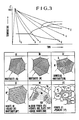
- the structure of the HAZ changes depending on the maximum temperature and the cooling rate at which the transformation from the austenite phase begins. This fact can be illustrated by the CCT diagram.
- Fig. 3 shows schematically the structure of the conventional killed steel when it is heated to a temperature of 1400°C or higher with a simulating thermal cycle and cooled at various cooling rates. Needless to say the heat cycles shown simulate the heat cycle of the portions of the HAZ adjacent to the weld metal. As shown in Fig. 3, at higher cooling rates a and b, the martensite transformation appears predominantly in the resultant microstructures (a) and (b), and at a lower cooling rate f, the ferrite-pearlite transformation appears predominantly in the resultant microstructure (f). In actual high temperature HAZ produced by intermediate cooling rates like c, d and e, these microstructures are seldom seen and the microstructure will be like the microstructures as shown (c), (d) and (e).
- the microstructures (c) and (d) are mixed structures of martensite and bainite, very susceptible to the occurrence and development of hydrogen delayed cracks.
- the structure (e) contains ferrite at the grain boundaries mixed with FSP and Bu, thus having as poor resistance to the brittle fracture as the structure (c).
- the present steel shows a completely different transformation behaviour at the cooling rates corresponding to those of the structures (c), (d) and (e) in Fig. 3.
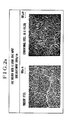
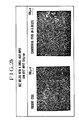
- the "fine bainite structure" accompanying no grain boundary ferrite is formed when welded with a small heat-input as shown in Fig. 2(b).
- a similar "fine bainite structure” can be obtained as in the case of the small heat-input welding.
- the reason for the formation of the "fine bainite structure" in the HAZ of the steel according to the present invention is that the ferrite plates develop along the three equivalent crystal planes (100) (010) (001) of the y phase during the transformation from austenite to bainite to form the Widmannstatten structure.
- the AI content in the steel material is low and there must be present Ti oxides including one or more crystal phases of TiO, Ti 2 0 3 , etc. If the deoxidation with AI is performed prior to the addition of Ti, or if AI is added after the addition of Ti, the amount of the desired Ti oxides is decreased or reduced so that the desired result of the present invention cannot be obtained.
- the present invention is completely different from the conventional art involving the TiN treatment of Al-Si killed steels and also-completely different from the conventional art of forming a structure mainly composed of fine ferrite and bainite in the HAZ of a large heat-input welding by adding successively into the molten steel Mn, Si with Ti or AI, REM or Ca from a weak deoxidizer to a strong one according to the deoxidizing power, to uniformly disperse fine inclusions so as to form fine precipitates of nitrides, such as TiN and BN.
- the HAZ will have a microstructure as shown in Fig. 2.
- the microstructure is a fine acicular ferrite structure so that the cleavage unit of brittle fracture in the HAZ is remarkably small compared with that of the conventional steel.
- Fig. 1(a) shows the brittle fracture of the high temperature HAZ portion of the steel according to the present invention and Fig. 1 (b) shows the brittle fracture in a similar HAZ portion of the conventional steel (Al-Si killed).
- Table 1 the production conditions, properties of the steels according to the present invention are shown together with the transformation structures after various fusion simulating thermal cycles and the results of Charpy impact tests, in comparison with the conventional killed steel.
- the steel compositions of the present invention are represented by HT50 steel which is widely used in marine structures and ships while the corresponding steel by a conventional process is treated with TiN (TiN treatment is most commonly accepted as a technic for preventing the coarsening of grains).
- the undesired structures such as FSP and coarse Bu will not appear during the cooling from 800 to 500°C at an average cooling rate from 1.5 to 30°C/s, and the cross-like fine acicular ferrite is formed with the Ti oxide precipitates in the austenite grains, serving as the transformation nuclei.
- the structures after the simulating thermal cycle of the present invention and the comparison steel are shown in Figs. 1 (a) and 1 (b).
- the steels of the present invention show markedly excellent Charpy notch toughness similarly after any of the various simulating thermal cycles as compared with the comparative steel.
- Table 2 the results of tests for deforming the cold cracks in the steels according to the present invention are shown in comparison with the conventional steel.
- the tests were conducted according to the "Tekken-type y-slit test defined in JIS Z3158 (1966)" in which the samples were held at the temperatures as shown in the table and welded in the atmosphere of 72 to 78% humidity at an ambient temperature of 20°C.
- the cold crack appeared even at the preheating temperature of 50°C in the comparative steel, while in the present invention no crack appeared even at the material temperature of 0°C.
- the compositions of the present steels and the comparative steel are substantially same, the difference in the resistance to the cold cracking is considered to be attributable to the difference in the transformation structure of the HAZ.
- the HAZ structure of the steels of the present invention is composed of "fine bainite structure” consisting of Widmannstatten ferrite plates, whereas the HAZ structure of the comparative steel is a structure mixed with coarse Bu and mixture of bainite and island-like martensite, through which the crack runs.
- Table 3 shows the transformation structures and results of COD tests of various steels as-cast or as- hot-rolled which are prepared by adding Ti to molten steels having various combinations of AI and dissolved oxygen contents and casting or further hot rolling.
- the steels A, B, F, G, H, I, J and K are within the scope of the present invention, while the steels C, D and E are comparative steels.
- Ti is added to the molten steels containing not more than 0.007% [AI] and not more than 0.020% dissolved [0] prior to the Ti addition, and when these steels are subjected to the simulating thermal cycle (800 to 500°C, average cooling rate 12°C/s), the fine bainite structure composed of fine Widmannstatten ferrite plates, which is the main feature of the present steel, is formed. In the portion where the Widmannstatten ferrite plates cross each other, fine particles of Ti oxides mainly composed of Ti 2 0 3 are seen.
- the amount of [AI] existing prior to the addition of Ti to the molten heats of the above steels is not the aluminum added as the deoxidizer, but the aluminum coming from the ferro-alloys and the refractories and so on.
- the amounts of [AI] in the molten steel prior to the addition of Ti are within the scope of the present invention, the amounts of dissolved O and Ti added are excessive so that the resultant Ti precipitates are in the form of coarse oxides having an unclear crystal structure, and in their transformation structures after the simulating thermal cycle, FSP, coarse Bu and coarse ingrain ferrite are formed.
- the steels D and E are the so-called Si-Al killed steel, and the addition of Ti to these steels is nothing more than the conventional TiN treatment. Therefore, the transformation structures of these steels after the simulating thermal cycle are quite susceptible to the formation of FSP, coarse Bu and additionally bainite, and island-like martensite. These undesired transformation structures are considered to be attributed to the fact that the AI existing in the molten steel prior to the addition of Ti prevents the formation of the desired Ti oxides which is the basic technical essence of the present invention.
- the steels of the present invention will produce a microstructure composed of Bu partially mixed with cementite, whereas the comparative steels will produce a structure in which many coarse Bu and additionally island-like martensites appear at the grain boundaries of the original austenite grains.
- the steels according to the present invention when applied with welding, produce a microstructure in the HAZ which is far finer than that obtainable by the conventional Al-Si killed steels treated with TiN for improving the toughness of the HAZ and provides the following commercial advantages:
- the present invention provides steel materials which can be advantageously used in marine structures, ships, various tanks, penstocks, pressure vessels, bridges, line pipes and other steel structures without necessity of preheating or after-heating for welding, yet assuring safety against the brittle fractures in welded structures.
Landscapes
- Chemical & Material Sciences (AREA)
- Engineering & Computer Science (AREA)
- Materials Engineering (AREA)
- Metallurgy (AREA)
- Organic Chemistry (AREA)
- Mechanical Engineering (AREA)
- Heat Treatment Of Steel (AREA)
- Treatment Of Steel In Its Molten State (AREA)
Applications Claiming Priority (2)
| Application Number | Priority Date | Filing Date | Title |
|---|---|---|---|
| JP59203099A JPS6179745A (ja) | 1984-09-28 | 1984-09-28 | 溶接継手熱影響部靭性のすぐれた鋼材の製造法 |
| JP203099/84 | 1984-09-28 |
Publications (2)
| Publication Number | Publication Date |
|---|---|
| EP0177851A1 EP0177851A1 (en) | 1986-04-16 |
| EP0177851B1 true EP0177851B1 (en) | 1990-09-05 |
Family
ID=16468362
Family Applications (1)
| Application Number | Title | Priority Date | Filing Date |
|---|---|---|---|
| EP85112244A Expired - Lifetime EP0177851B1 (en) | 1984-09-28 | 1985-09-27 | Steel materials for welded structures |
Country Status (5)
| Country | Link |
|---|---|
| US (1) | US4629504A (enExample) |
| EP (1) | EP0177851B1 (enExample) |
| JP (1) | JPS6179745A (enExample) |
| CA (1) | CA1251952A (enExample) |
| DE (1) | DE3579547D1 (enExample) |
Families Citing this family (40)
| Publication number | Priority date | Publication date | Assignee | Title |
|---|---|---|---|---|
| JPS63126683A (ja) * | 1986-11-14 | 1988-05-30 | Nippon Steel Corp | 溶接金属の靭性に優れた鋼の溶接方法 |
| JPH0694569B2 (ja) * | 1987-02-27 | 1994-11-24 | 新日本製鐵株式会社 | 溶接熱影響部の低温靭性が優れた鋼の製造法 |
| JPS6415320A (en) * | 1987-07-08 | 1989-01-19 | Nippon Steel Corp | Production of high tensile steel for low temperature use having excellent toughness of weld zone |
| JPH01159356A (ja) * | 1987-12-16 | 1989-06-22 | Nippon Steel Corp | 溶接熱影響部靭性の優れた高張力鋼 |
| FR2625227A1 (fr) * | 1987-12-23 | 1989-06-30 | Intraviss Sn | Acier allie pour boulonnerie a controle de serrage par ultrason |
| JPH01228643A (ja) * | 1988-03-09 | 1989-09-12 | Nippon Steel Corp | 鋼中にMnSを均一かつ微細に分散析出させる方法 |
| JPH02194115A (ja) * | 1989-01-23 | 1990-07-31 | Nippon Steel Corp | チタン酸化物を含有する溶接部靭性の優れた低温用高張力鋼の製造法 |
| JPH0642979B2 (ja) * | 1989-02-20 | 1994-06-08 | 新日本製鐵株式会社 | チタン酸化物を含有する溶接・低温用高張力鋼の製造法 |
| JPH0637684B2 (ja) * | 1990-04-24 | 1994-05-18 | 新日本製鐵株式会社 | Ti酸化物が均一微細分散した鋼の製造方法 |
| US5236521A (en) * | 1990-06-06 | 1993-08-17 | Nkk Corporation | Abrasion resistant steel |
| US5403410A (en) * | 1990-06-06 | 1995-04-04 | Nkk Corporation | Abrasion-resistant steel |
| JPH0765097B2 (ja) * | 1990-07-27 | 1995-07-12 | 新日本製鐵株式会社 | 耐火性及び溶接部靭性の優れたh形鋼の製造方法 |
| JP2596853B2 (ja) * | 1990-10-20 | 1997-04-02 | 新日本製鐵株式会社 | 圧延ままで母材靱性に優れると共に、溶接部靱性に優れた粒内フエライト系形鋼の製造方法 |
| JPH04191314A (ja) * | 1990-11-27 | 1992-07-09 | Nippon Steel Corp | 低炭素鋼の製造方法 |
| JP2579841B2 (ja) * | 1991-03-08 | 1997-02-12 | 新日本製鐵株式会社 | 圧延ままで耐火性及び靱性の優れた粒内フェライト系形鋼の製造方法 |
| US5534084A (en) * | 1992-02-26 | 1996-07-09 | Nippon Steel Corporation | Continuous-cast slab and steel product having dispersed fine particles |
| US5292384A (en) * | 1992-07-17 | 1994-03-08 | Martin Marietta Energy Systems, Inc. | Cr-W-V bainitic/ferritic steel with improved strength and toughness and method of making |
| JP2760713B2 (ja) * | 1992-09-24 | 1998-06-04 | 新日本製鐵株式会社 | 耐火性及び靱性の優れた制御圧延形鋼の製造方法 |
| JP2661845B2 (ja) * | 1992-09-24 | 1997-10-08 | 新日本製鐵株式会社 | 含オキサイド系耐火用形鋼の制御圧延による製造方法 |
| JP2950076B2 (ja) * | 1993-01-08 | 1999-09-20 | 住友金属工業株式会社 | 溶接構造物用鋼 |
| DK0789785T3 (da) * | 1994-11-04 | 2002-11-25 | Babcock Hitachi Kk | Ferritisk varmebestandig ståltype med fremragende højtemperaturstyrke og fremgangsmåde til fremstilling heraf |
| FR2727431B1 (fr) * | 1994-11-30 | 1996-12-27 | Creusot Loire | Procede d'elaboration d'un acier au titane et acier obtenu |
| JP3422612B2 (ja) * | 1996-01-19 | 2003-06-30 | Jfeスチール株式会社 | 極低炭素冷延鋼板の製造方法 |
| CA2231985C (en) * | 1997-03-26 | 2004-05-25 | Sumitomo Metal Industries, Ltd. | Welded high-strength steel structures and methods of manufacturing the same |
| US6855213B2 (en) | 1998-09-15 | 2005-02-15 | Armco Inc. | Non-ridging ferritic chromium alloyed steel |
| GB2341613A (en) * | 1998-09-04 | 2000-03-22 | British Steel Plc | A steel composition for laser welding |
| JP2000319750A (ja) * | 1999-05-10 | 2000-11-21 | Kawasaki Steel Corp | 溶接熱影響部靱性に優れた大入熱溶接用高張力鋼材 |
| JP4571752B2 (ja) * | 2000-08-10 | 2010-10-27 | 新日本製鐵株式会社 | 超大入熱溶接熱影響部の靭性に優れた溶接用高張力鋼の製造方法 |
| US6572713B2 (en) | 2000-10-19 | 2003-06-03 | The Frog Switch And Manufacturing Company | Grain-refined austenitic manganese steel casting having microadditions of vanadium and titanium and method of manufacturing |
| KR100482208B1 (ko) | 2000-11-17 | 2005-04-21 | 주식회사 포스코 | 침질처리에 의한 용접구조용 강재의 제조방법 |
| US6946038B2 (en) | 2000-12-01 | 2005-09-20 | Posco | Steel plate having Tin+MnS precipitates for welded structures, method for manufacturing same and welded structure |
| CN1149297C (zh) | 2000-12-14 | 2004-05-12 | Posco公司 | 用于焊接结构的具有TiN+ZrN析出相的钢板及其制造方法和使用该钢板的焊接结构 |
| WO2003042420A1 (en) | 2001-11-16 | 2003-05-22 | Posco | Steel plate having superior toughness in weld heat-affected zone and method for manufacturing the same, welding fabric using the same |
| JP4041447B2 (ja) * | 2003-09-29 | 2008-01-30 | 株式会社神戸製鋼所 | 大入熱溶接継手靭性に優れた厚鋼板 |
| DE102004044021B3 (de) * | 2004-09-09 | 2006-03-16 | Salzgitter Flachstahl Gmbh | Voll beruhigter, unlegierter oder niedriglegierter Stranggussstahl und Verfahren zu seiner Herstellung |
| JP5385554B2 (ja) * | 2008-06-19 | 2014-01-08 | 株式会社神戸製鋼所 | 熱処理用鋼 |
| KR101322067B1 (ko) * | 2009-12-28 | 2013-10-25 | 주식회사 포스코 | 용접 후 열처리 저항성이 우수한 고강도 강판 및 그 제조방법 |
| DE102016204194A1 (de) * | 2016-03-15 | 2017-09-21 | Comtes Fht A. S. | Federnde Bauteile aus einer Stahllegierung und Herstellungsverfahren |
| JP2019056146A (ja) * | 2017-09-21 | 2019-04-11 | 新日鐵住金株式会社 | 水圧鉄管用高張力鋼材およびその製造方法、ならびに水圧鉄管 |
| KR20210009934A (ko) | 2019-07-18 | 2021-01-27 | 주식회사 포스코 | 대입열 용접열영향부 인성이 우수한 구조용강재 및 그 제조방법 |
Family Cites Families (14)
| Publication number | Priority date | Publication date | Assignee | Title |
|---|---|---|---|---|
| US1019526A (en) * | 1909-09-14 | 1912-03-05 | Titanium Alloy Mfg Co | Compound or alloy of titanium and silicon. |
| US1104317A (en) * | 1914-04-10 | 1914-07-21 | Titanium Alloy Mfg Co | Metallurgical method. |
| LU48990A1 (enExample) * | 1965-07-05 | 1967-01-05 | ||
| US3773500A (en) * | 1970-03-26 | 1973-11-20 | Nippon Steel Corp | High tensile steel for large heat-input automatic welding and production process therefor |
| US3829312A (en) * | 1972-01-04 | 1974-08-13 | Nat Res Inst Metals | Process for the manufacture of steel of good machinability |
| US3765874A (en) * | 1972-05-19 | 1973-10-16 | Armco Steel Corp | Vacuum degassed, interstitial-free, low carbon steel and method for producing same |
| JPS5080911A (enExample) * | 1973-11-22 | 1975-07-01 | ||
| JPS5116890A (ja) * | 1974-08-01 | 1976-02-10 | Suwa Seikosha Kk | Suishoshindoshi |
| JPS5669358A (en) * | 1979-10-18 | 1981-06-10 | Kobe Steel Ltd | Ultra low carbon cold rolled steel sheet with superior press formability |
| JPS5751243A (en) * | 1980-09-12 | 1982-03-26 | Nippon Steel Corp | Steel products for welding |
| JPS58174551A (ja) * | 1982-04-03 | 1983-10-13 | Sumitomo Electric Ind Ltd | ボロン含有鋼およびその製造方法 |
| JPS58204116A (ja) * | 1982-05-22 | 1983-11-28 | Kawasaki Steel Corp | 低温靭性にすぐれる大入熱溶接用鋼の製造方法 |
| JPS58204118A (ja) * | 1982-05-22 | 1983-11-28 | Kawasaki Steel Corp | 微細介在物が均一分散した鋼材の製造方法 |
| JPS58204117A (ja) * | 1982-05-22 | 1983-11-28 | Kawasaki Steel Corp | 微細介在物が均一に分散した鋼材の製造方法 |
-
1984
- 1984-09-28 JP JP59203099A patent/JPS6179745A/ja active Granted
-
1985
- 1985-09-26 US US06/780,632 patent/US4629504A/en not_active Expired - Lifetime
- 1985-09-27 EP EP85112244A patent/EP0177851B1/en not_active Expired - Lifetime
- 1985-09-27 CA CA000491785A patent/CA1251952A/en not_active Expired
- 1985-09-27 DE DE8585112244T patent/DE3579547D1/de not_active Expired - Lifetime
Also Published As
| Publication number | Publication date |
|---|---|
| CA1251952A (en) | 1989-04-04 |
| US4629504A (en) | 1986-12-16 |
| JPH0517300B2 (enExample) | 1993-03-08 |
| EP0177851A1 (en) | 1986-04-16 |
| DE3579547D1 (de) | 1990-10-11 |
| JPS6179745A (ja) | 1986-04-23 |
Similar Documents
| Publication | Publication Date | Title |
|---|---|---|
| EP0177851B1 (en) | Steel materials for welded structures | |
| EP0589424B1 (en) | Shape steel material having high strength, high toughness and excellent fire resistance and process for producing rolled shape steel of said material | |
| JP3898814B2 (ja) | 低温靱性に優れた高強度鋼用の連続鋳造鋳片およびその製造法、および低温靱性に優れた高強度鋼 | |
| JPWO1995004838A1 (ja) | 溶接部の疲労強度と溶接性に優れた高張力鋼およびその製造方法 | |
| EP0589435B1 (en) | Refractory shape steel material containing oxide and process for producing rolled shape steel of said material | |
| JPH03202422A (ja) | 溶接熱影響部靱性の優れた高張力厚鋼板の製造法 | |
| US4078919A (en) | Ferritic stainless steel having excellent workability and high toughness | |
| CA1190835A (en) | Method of producing as rolled high toughness steel | |
| JPH02220735A (ja) | チタン酸化物を含有する溶接・低温用高張力鋼の製造法 | |
| JP2653594B2 (ja) | 溶接熱影響部靭性の優れた厚鋼板の製造方法 | |
| JP2002047531A (ja) | 溶接部の疲労特性に優れた溶接構造用高張力鋼およびその製造方法 | |
| JPH0860292A (ja) | 溶接熱影響部靱性の優れた高張力鋼 | |
| EP1520912B1 (en) | Steel excellent in toughness of weld heat-affected zone | |
| JPH03162522A (ja) | 大入熱溶接熱影響部靭性の優れた高張力厚鋼板の製造法 | |
| JP2001335884A (ja) | Ctod特性に優れた高強度厚鋼板及びその製造方法 | |
| JP2688312B2 (ja) | 高強度高靭性鋼板 | |
| JP5008879B2 (ja) | 強度および低温靭性の優れた高張力鋼板および高張力鋼板の製造方法 | |
| JP3852118B2 (ja) | 溶接熱影響部靱性の優れた鋼材 | |
| JPH0853734A (ja) | 大入熱溶接熱影響部靭性の優れた溶接用鋼材の製造方法 | |
| JPS593537B2 (ja) | 溶接構造用鋼 | |
| JPH093600A (ja) | 溶接熱影響部靱性の優れた溶接構造用鋼材 | |
| JP3238271B2 (ja) | 大入熱溶接熱影響部靭性の優れた低温用鋼材の製造方法 | |
| JP3502805B2 (ja) | 溶接継手部靭性の優れた鋼材の製造方法 | |
| JP3464566B2 (ja) | 溶接熱影響部靱性の優れた低温用鋼材 | |
| JPH08283902A (ja) | 耐火用圧延形鋼およびその製造方法 |
Legal Events
| Date | Code | Title | Description |
|---|---|---|---|
| PUAI | Public reference made under article 153(3) epc to a published international application that has entered the european phase |
Free format text: ORIGINAL CODE: 0009012 |
|
| AK | Designated contracting states |
Kind code of ref document: A1 Designated state(s): DE FR GB IT |
|
| 17P | Request for examination filed |
Effective date: 19860611 |
|
| 17Q | First examination report despatched |
Effective date: 19870714 |
|
| GRAA | (expected) grant |
Free format text: ORIGINAL CODE: 0009210 |
|
| AK | Designated contracting states |
Kind code of ref document: B1 Designated state(s): DE FR GB IT |
|
| ITF | It: translation for a ep patent filed | ||
| REF | Corresponds to: |
Ref document number: 3579547 Country of ref document: DE Date of ref document: 19901011 |
|
| ET | Fr: translation filed | ||
| PLBI | Opposition filed |
Free format text: ORIGINAL CODE: 0009260 |
|
| 26 | Opposition filed |
Opponent name: MANNESMANN AKTIENGESELLSCHAFT Effective date: 19910605 |
|
| ITTA | It: last paid annual fee | ||
| PLAB | Opposition data, opponent's data or that of the opponent's representative modified |
Free format text: ORIGINAL CODE: 0009299OPPO |
|
| R26 | Opposition filed (corrected) |
Opponent name: MANNESMANN AKTIENGESELLSCHAFT Effective date: 19910605 |
|
| PLBN | Opposition rejected |
Free format text: ORIGINAL CODE: 0009273 |
|
| STAA | Information on the status of an ep patent application or granted ep patent |
Free format text: STATUS: OPPOSITION REJECTED |
|
| 27O | Opposition rejected |
Effective date: 19930320 |
|
| REG | Reference to a national code |
Ref country code: GB Ref legal event code: IF02 |
|
| PGFP | Annual fee paid to national office [announced via postgrant information from national office to epo] |
Ref country code: FR Payment date: 20020910 Year of fee payment: 18 |
|
| PGFP | Annual fee paid to national office [announced via postgrant information from national office to epo] |
Ref country code: GB Payment date: 20020925 Year of fee payment: 18 |
|
| PGFP | Annual fee paid to national office [announced via postgrant information from national office to epo] |
Ref country code: DE Payment date: 20021002 Year of fee payment: 18 |
|
| PG25 | Lapsed in a contracting state [announced via postgrant information from national office to epo] |
Ref country code: GB Free format text: LAPSE BECAUSE OF NON-PAYMENT OF DUE FEES Effective date: 20030927 |
|
| PG25 | Lapsed in a contracting state [announced via postgrant information from national office to epo] |
Ref country code: DE Free format text: LAPSE BECAUSE OF NON-PAYMENT OF DUE FEES Effective date: 20040401 |
|
| GBPC | Gb: european patent ceased through non-payment of renewal fee |
Effective date: 20030927 |
|
| PG25 | Lapsed in a contracting state [announced via postgrant information from national office to epo] |
Ref country code: FR Free format text: LAPSE BECAUSE OF NON-PAYMENT OF DUE FEES Effective date: 20040528 |
|
| REG | Reference to a national code |
Ref country code: FR Ref legal event code: ST |
|
| PLAB | Opposition data, opponent's data or that of the opponent's representative modified |
Free format text: ORIGINAL CODE: 0009299OPPO |