EP0080976B1 - Gemische aus quaternären, polymeren Ammoniumsalzen auf Acrylbasis, aus quaternären, mono- bis oligomeren Ammoniumsalzen und aus Tensiden, deren Herstellung und Verwendung in kosmetischen Mitteln - Google Patents
Gemische aus quaternären, polymeren Ammoniumsalzen auf Acrylbasis, aus quaternären, mono- bis oligomeren Ammoniumsalzen und aus Tensiden, deren Herstellung und Verwendung in kosmetischen Mitteln Download PDFInfo
- Publication number
- EP0080976B1 EP0080976B1 EP82810503A EP82810503A EP0080976B1 EP 0080976 B1 EP0080976 B1 EP 0080976B1 EP 82810503 A EP82810503 A EP 82810503A EP 82810503 A EP82810503 A EP 82810503A EP 0080976 B1 EP0080976 B1 EP 0080976B1
- Authority
- EP
- European Patent Office
- Prior art keywords
- alkyl
- carbon atoms
- formula
- surfactant
- component
- Prior art date
- Legal status (The legal status is an assumption and is not a legal conclusion. Google has not performed a legal analysis and makes no representation as to the accuracy of the status listed.)
- Expired
Links
- 239000000203 mixture Substances 0.000 title claims description 91
- 239000004094 surface-active agent Substances 0.000 title claims description 84
- 150000003863 ammonium salts Chemical class 0.000 title claims description 66
- -1 acrylic ammonium salts Chemical class 0.000 title claims description 62
- 239000002537 cosmetic Substances 0.000 title claims description 23
- 238000002360 preparation method Methods 0.000 title claims description 5
- 125000004432 carbon atom Chemical group C* 0.000 claims description 73
- 239000000243 solution Substances 0.000 claims description 68
- 125000000217 alkyl group Chemical group 0.000 claims description 59
- 150000003242 quaternary ammonium salts Chemical class 0.000 claims description 40
- KRKNYBCHXYNGOX-UHFFFAOYSA-N citric acid Chemical compound OC(=O)CC(O)(C(O)=O)CC(O)=O KRKNYBCHXYNGOX-UHFFFAOYSA-N 0.000 claims description 33
- XLYOFNOQVPJJNP-UHFFFAOYSA-N water Substances O XLYOFNOQVPJJNP-UHFFFAOYSA-N 0.000 claims description 33
- 229920001577 copolymer Polymers 0.000 claims description 30
- 239000003945 anionic surfactant Substances 0.000 claims description 29
- 125000004433 nitrogen atom Chemical group N* 0.000 claims description 29
- 125000003342 alkenyl group Chemical group 0.000 claims description 27
- 235000014113 dietary fatty acids Nutrition 0.000 claims description 25
- 239000000194 fatty acid Substances 0.000 claims description 25
- 229930195729 fatty acid Natural products 0.000 claims description 25
- 239000002736 nonionic surfactant Substances 0.000 claims description 24
- 150000004665 fatty acids Chemical class 0.000 claims description 23
- 238000000034 method Methods 0.000 claims description 22
- 239000008367 deionised water Substances 0.000 claims description 20
- 239000003921 oil Substances 0.000 claims description 20
- 230000003750 conditioning effect Effects 0.000 claims description 19
- 239000001257 hydrogen Substances 0.000 claims description 18
- 229910052739 hydrogen Inorganic materials 0.000 claims description 18
- 125000002496 methyl group Chemical group [H]C([H])([H])* 0.000 claims description 18
- 229920000642 polymer Polymers 0.000 claims description 18
- 150000003254 radicals Chemical class 0.000 claims description 18
- NBIIXXVUZAFLBC-UHFFFAOYSA-N Phosphoric acid Chemical compound OP(O)(O)=O NBIIXXVUZAFLBC-UHFFFAOYSA-N 0.000 claims description 13
- 125000000129 anionic group Chemical group 0.000 claims description 13
- 125000002887 hydroxy group Chemical group [H]O* 0.000 claims description 12
- 238000009826 distribution Methods 0.000 claims description 10
- 125000001495 ethyl group Chemical group [H]C([H])([H])C([H])([H])* 0.000 claims description 10
- 229910052757 nitrogen Inorganic materials 0.000 claims description 10
- 229910019142 PO4 Inorganic materials 0.000 claims description 9
- HEMHJVSKTPXQMS-UHFFFAOYSA-M Sodium hydroxide Chemical compound [OH-].[Na+] HEMHJVSKTPXQMS-UHFFFAOYSA-M 0.000 claims description 9
- 239000000839 emulsion Substances 0.000 claims description 9
- 239000003995 emulsifying agent Substances 0.000 claims description 8
- 239000010452 phosphate Substances 0.000 claims description 8
- 239000002904 solvent Substances 0.000 claims description 8
- GAWIXWVDTYZWAW-UHFFFAOYSA-N C[CH]O Chemical group C[CH]O GAWIXWVDTYZWAW-UHFFFAOYSA-N 0.000 claims description 7
- UFHFLCQGNIYNRP-UHFFFAOYSA-N Hydrogen Chemical compound [H][H] UFHFLCQGNIYNRP-UHFFFAOYSA-N 0.000 claims description 7
- 239000007864 aqueous solution Substances 0.000 claims description 7
- 150000003839 salts Chemical class 0.000 claims description 7
- 239000013543 active substance Substances 0.000 claims description 6
- 150000008051 alkyl sulfates Chemical class 0.000 claims description 6
- 229910000147 aluminium phosphate Inorganic materials 0.000 claims description 6
- 150000001412 amines Chemical class 0.000 claims description 6
- 229910052799 carbon Inorganic materials 0.000 claims description 6
- 239000003999 initiator Substances 0.000 claims description 6
- 238000005342 ion exchange Methods 0.000 claims description 6
- 125000000951 phenoxy group Chemical group [H]C1=C([H])C([H])=C(O*)C([H])=C1[H] 0.000 claims description 6
- 125000001997 phenyl group Chemical group [H]C1=C([H])C([H])=C(*)C([H])=C1[H] 0.000 claims description 6
- 239000003381 stabilizer Substances 0.000 claims description 6
- 125000003178 carboxy group Chemical group [H]OC(*)=O 0.000 claims description 5
- 150000002191 fatty alcohols Chemical class 0.000 claims description 5
- NBIIXXVUZAFLBC-UHFFFAOYSA-K phosphate Chemical compound [O-]P([O-])([O-])=O NBIIXXVUZAFLBC-UHFFFAOYSA-K 0.000 claims description 5
- 229920001522 polyglycol ester Polymers 0.000 claims description 5
- QTBSBXVTEAMEQO-UHFFFAOYSA-M Acetate Chemical compound CC([O-])=O QTBSBXVTEAMEQO-UHFFFAOYSA-M 0.000 claims description 4
- QGZKDVFQNNGYKY-UHFFFAOYSA-O Ammonium Chemical compound [NH4+] QGZKDVFQNNGYKY-UHFFFAOYSA-O 0.000 claims description 4
- VGGSQFUCUMXWEO-UHFFFAOYSA-N Ethene Chemical compound C=C VGGSQFUCUMXWEO-UHFFFAOYSA-N 0.000 claims description 4
- 239000002253 acid Substances 0.000 claims description 4
- 229910052783 alkali metal Inorganic materials 0.000 claims description 4
- 125000001797 benzyl group Chemical group [H]C1=C([H])C([H])=C(C([H])=C1[H])C([H])([H])* 0.000 claims description 4
- 150000001720 carbohydrates Chemical class 0.000 claims description 4
- 235000014633 carbohydrates Nutrition 0.000 claims description 4
- 125000004663 dialkyl amino group Chemical group 0.000 claims description 4
- 150000004820 halides Chemical class 0.000 claims description 4
- 239000000178 monomer Substances 0.000 claims description 4
- XHYQEDUCQXLVLU-UHFFFAOYSA-N 1-carboxy-4,5-dihydroimidazol-1-ium-1-carboxylate Chemical class OC(=O)[N+]1(C([O-])=O)CCN=C1 XHYQEDUCQXLVLU-UHFFFAOYSA-N 0.000 claims description 3
- 239000005977 Ethylene Substances 0.000 claims description 3
- IAYPIBMASNFSPL-UHFFFAOYSA-N Ethylene oxide Chemical compound C1CO1 IAYPIBMASNFSPL-UHFFFAOYSA-N 0.000 claims description 3
- VEXZGXHMUGYJMC-UHFFFAOYSA-N Hydrochloric acid Chemical compound Cl VEXZGXHMUGYJMC-UHFFFAOYSA-N 0.000 claims description 3
- GOOHAUXETOMSMM-UHFFFAOYSA-N Propylene oxide Chemical compound CC1CO1 GOOHAUXETOMSMM-UHFFFAOYSA-N 0.000 claims description 3
- 150000001340 alkali metals Chemical class 0.000 claims description 3
- 150000001450 anions Chemical class 0.000 claims description 3
- QVGXLLKOCUKJST-UHFFFAOYSA-N atomic oxygen Chemical compound [O] QVGXLLKOCUKJST-UHFFFAOYSA-N 0.000 claims description 3
- 125000003917 carbamoyl group Chemical group [H]N([H])C(*)=O 0.000 claims description 3
- MTNDZQHUAFNZQY-UHFFFAOYSA-N imidazoline Chemical group C1CN=CN1 MTNDZQHUAFNZQY-UHFFFAOYSA-N 0.000 claims description 3
- 150000002462 imidazolines Chemical class 0.000 claims description 3
- JZMJDSHXVKJFKW-UHFFFAOYSA-N methyl sulfate Chemical compound COS(O)(=O)=O JZMJDSHXVKJFKW-UHFFFAOYSA-N 0.000 claims description 3
- 239000001301 oxygen Substances 0.000 claims description 3
- 229910052760 oxygen Inorganic materials 0.000 claims description 3
- 125000004430 oxygen atom Chemical group O* 0.000 claims description 3
- QQONPFPTGQHPMA-UHFFFAOYSA-N propylene Natural products CC=C QQONPFPTGQHPMA-UHFFFAOYSA-N 0.000 claims description 3
- 229940071089 sarcosinate Drugs 0.000 claims description 3
- FSYKKLYZXJSNPZ-UHFFFAOYSA-N sarcosine Chemical compound C[NH2+]CC([O-])=O FSYKKLYZXJSNPZ-UHFFFAOYSA-N 0.000 claims description 3
- 239000007762 w/o emulsion Substances 0.000 claims description 3
- VBXZSFNZVNDOPB-UHFFFAOYSA-N 1,4,5,6-tetrahydropyrimidine Chemical group C1CNC=NC1 VBXZSFNZVNDOPB-UHFFFAOYSA-N 0.000 claims description 2
- KRKNYBCHXYNGOX-UHFFFAOYSA-K Citrate Chemical compound [O-]C(=O)CC(O)(CC([O-])=O)C([O-])=O KRKNYBCHXYNGOX-UHFFFAOYSA-K 0.000 claims description 2
- JVTAAEKCZFNVCJ-UHFFFAOYSA-M Lactate Chemical compound CC(O)C([O-])=O JVTAAEKCZFNVCJ-UHFFFAOYSA-M 0.000 claims description 2
- 239000012736 aqueous medium Substances 0.000 claims description 2
- ZBCBWPMODOFKDW-UHFFFAOYSA-N diethanolamine Chemical compound OCCNCCO ZBCBWPMODOFKDW-UHFFFAOYSA-N 0.000 claims description 2
- NHOGGUYTANYCGQ-UHFFFAOYSA-N ethenoxybenzene Chemical group C=COC1=CC=CC=C1 NHOGGUYTANYCGQ-UHFFFAOYSA-N 0.000 claims description 2
- JZMJDSHXVKJFKW-UHFFFAOYSA-M methyl sulfate(1-) Chemical compound COS([O-])(=O)=O JZMJDSHXVKJFKW-UHFFFAOYSA-M 0.000 claims description 2
- 239000002244 precipitate Substances 0.000 claims description 2
- 125000004805 propylene group Chemical group [H]C([H])([H])C([H])([*:1])C([H])([H])[*:2] 0.000 claims description 2
- 125000004435 hydrogen atom Chemical class [H]* 0.000 claims 5
- 125000004178 (C1-C4) alkyl group Chemical group 0.000 claims 4
- UUEYCHLWAOBOHG-UHFFFAOYSA-N 3-(2-pyridin-4-ylethyl)-1h-indole Chemical compound C=1NC2=CC=CC=C2C=1CCC1=CC=NC=C1 UUEYCHLWAOBOHG-UHFFFAOYSA-N 0.000 claims 1
- 125000002853 C1-C4 hydroxyalkyl group Chemical group 0.000 claims 1
- OKTJSMMVPCPJKN-UHFFFAOYSA-N Carbon Chemical compound [C] OKTJSMMVPCPJKN-UHFFFAOYSA-N 0.000 claims 1
- VEXZGXHMUGYJMC-UHFFFAOYSA-M Chloride anion Chemical compound [Cl-] VEXZGXHMUGYJMC-UHFFFAOYSA-M 0.000 claims 1
- 125000003282 alkyl amino group Chemical group 0.000 claims 1
- 125000004429 atom Chemical group 0.000 claims 1
- BVKZGUZCCUSVTD-UHFFFAOYSA-N carbonic acid Chemical compound OC(O)=O BVKZGUZCCUSVTD-UHFFFAOYSA-N 0.000 claims 1
- 125000005131 dialkylammonium group Chemical group 0.000 claims 1
- 238000001035 drying Methods 0.000 claims 1
- 230000001376 precipitating effect Effects 0.000 claims 1
- 229910021641 deionized water Inorganic materials 0.000 description 19
- OKKJLVBELUTLKV-UHFFFAOYSA-N Methanol Chemical compound OC OKKJLVBELUTLKV-UHFFFAOYSA-N 0.000 description 18
- CSCPPACGZOOCGX-UHFFFAOYSA-N Acetone Chemical compound CC(C)=O CSCPPACGZOOCGX-UHFFFAOYSA-N 0.000 description 15
- 238000009472 formulation Methods 0.000 description 15
- 230000003766 combability Effects 0.000 description 12
- 230000000694 effects Effects 0.000 description 11
- 238000009825 accumulation Methods 0.000 description 10
- NIXOWILDQLNWCW-UHFFFAOYSA-N acrylic acid group Chemical group C(C=C)(=O)O NIXOWILDQLNWCW-UHFFFAOYSA-N 0.000 description 9
- 239000002888 zwitterionic surfactant Substances 0.000 description 9
- 150000002431 hydrogen Chemical class 0.000 description 8
- 238000003756 stirring Methods 0.000 description 8
- 238000011282 treatment Methods 0.000 description 8
- 235000021317 phosphate Nutrition 0.000 description 7
- 239000003795 chemical substances by application Substances 0.000 description 6
- 238000010528 free radical solution polymerization reaction Methods 0.000 description 6
- 239000012071 phase Substances 0.000 description 6
- 239000002453 shampoo Substances 0.000 description 6
- PUAQLLVFLMYYJJ-UHFFFAOYSA-N 2-aminopropiophenone Chemical compound CC(N)C(=O)C1=CC=CC=C1 PUAQLLVFLMYYJJ-UHFFFAOYSA-N 0.000 description 5
- RTZKZFJDLAIYFH-UHFFFAOYSA-N Diethyl ether Chemical group CCOCC RTZKZFJDLAIYFH-UHFFFAOYSA-N 0.000 description 5
- PEDCQBHIVMGVHV-UHFFFAOYSA-N Glycerine Chemical compound OCC(O)CO PEDCQBHIVMGVHV-UHFFFAOYSA-N 0.000 description 5
- ULUAUXLGCMPNKK-UHFFFAOYSA-N Sulfobutanedioic acid Chemical class OC(=O)CC(C(O)=O)S(O)(=O)=O ULUAUXLGCMPNKK-UHFFFAOYSA-N 0.000 description 5
- 150000002148 esters Chemical class 0.000 description 5
- 125000002768 hydroxyalkyl group Chemical group 0.000 description 5
- 239000011541 reaction mixture Substances 0.000 description 5
- 229920006395 saturated elastomer Polymers 0.000 description 5
- 235000003441 saturated fatty acids Nutrition 0.000 description 5
- 150000004671 saturated fatty acids Chemical class 0.000 description 5
- 235000021122 unsaturated fatty acids Nutrition 0.000 description 5
- 150000004670 unsaturated fatty acids Chemical class 0.000 description 5
- KFZMGEQAYNKOFK-UHFFFAOYSA-N Isopropanol Chemical compound CC(C)O KFZMGEQAYNKOFK-UHFFFAOYSA-N 0.000 description 4
- 238000012726 Water-in-Oil Emulsion Polymerization Methods 0.000 description 4
- 238000006243 chemical reaction Methods 0.000 description 4
- 238000004140 cleaning Methods 0.000 description 4
- 229920001519 homopolymer Polymers 0.000 description 4
- POULHZVOKOAJMA-UHFFFAOYSA-N methyl undecanoic acid Natural products CCCCCCCCCCCC(O)=O POULHZVOKOAJMA-UHFFFAOYSA-N 0.000 description 4
- IPCSVZSSVZVIGE-UHFFFAOYSA-N n-hexadecanoic acid Natural products CCCCCCCCCCCCCCCC(O)=O IPCSVZSSVZVIGE-UHFFFAOYSA-N 0.000 description 4
- 239000012299 nitrogen atmosphere Substances 0.000 description 4
- 238000006116 polymerization reaction Methods 0.000 description 4
- GEHJYWRUCIMESM-UHFFFAOYSA-L sodium sulfite Chemical compound [Na+].[Na+].[O-]S([O-])=O GEHJYWRUCIMESM-UHFFFAOYSA-L 0.000 description 4
- HRPVXLWXLXDGHG-UHFFFAOYSA-N Acrylamide Chemical compound NC(=O)C=C HRPVXLWXLXDGHG-UHFFFAOYSA-N 0.000 description 3
- UHOVQNZJYSORNB-UHFFFAOYSA-N Benzene Chemical compound C1=CC=CC=C1 UHOVQNZJYSORNB-UHFFFAOYSA-N 0.000 description 3
- MUBZPKHOEPUJKR-UHFFFAOYSA-N Oxalic acid Chemical compound OC(=O)C(O)=O MUBZPKHOEPUJKR-UHFFFAOYSA-N 0.000 description 3
- 239000005662 Paraffin oil Substances 0.000 description 3
- DNIAPMSPPWPWGF-UHFFFAOYSA-N Propylene glycol Chemical compound CC(O)CO DNIAPMSPPWPWGF-UHFFFAOYSA-N 0.000 description 3
- YXFVVABEGXRONW-UHFFFAOYSA-N Toluene Chemical compound CC1=CC=CC=C1 YXFVVABEGXRONW-UHFFFAOYSA-N 0.000 description 3
- ROOXNKNUYICQNP-UHFFFAOYSA-N ammonium persulfate Chemical compound [NH4+].[NH4+].[O-]S(=O)(=O)OOS([O-])(=O)=O ROOXNKNUYICQNP-UHFFFAOYSA-N 0.000 description 3
- 230000001143 conditioned effect Effects 0.000 description 3
- 125000003438 dodecyl group Chemical group [H]C([H])([H])C([H])([H])C([H])([H])C([H])([H])C([H])([H])C([H])([H])C([H])([H])C([H])([H])C([H])([H])C([H])([H])C([H])([H])C([H])([H])* 0.000 description 3
- 239000003676 hair preparation Substances 0.000 description 3
- 238000004519 manufacturing process Methods 0.000 description 3
- IHBKAGRPNRKYAO-UHFFFAOYSA-M methyl sulfate;trimethyl-[2-(2-methylprop-2-enoyloxy)ethyl]azanium Chemical compound COS([O-])(=O)=O.CC(=C)C(=O)OCC[N+](C)(C)C IHBKAGRPNRKYAO-UHFFFAOYSA-M 0.000 description 3
- ZQPPMHVWECSIRJ-KTKRTIGZSA-N oleic acid group Chemical group C(CCCCCCC\C=C/CCCCCCCC)(=O)O ZQPPMHVWECSIRJ-KTKRTIGZSA-N 0.000 description 3
- 229920001195 polyisoprene Polymers 0.000 description 3
- 239000000047 product Substances 0.000 description 3
- 125000001273 sulfonato group Chemical class [O-]S(*)(=O)=O 0.000 description 3
- 150000003467 sulfuric acid derivatives Chemical class 0.000 description 3
- 238000005406 washing Methods 0.000 description 3
- JNYAEWCLZODPBN-JGWLITMVSA-N (2r,3r,4s)-2-[(1r)-1,2-dihydroxyethyl]oxolane-3,4-diol Chemical compound OC[C@@H](O)[C@H]1OC[C@H](O)[C@H]1O JNYAEWCLZODPBN-JGWLITMVSA-N 0.000 description 2
- WRIDQFICGBMAFQ-UHFFFAOYSA-N (E)-8-Octadecenoic acid Natural products CCCCCCCCCC=CCCCCCCC(O)=O WRIDQFICGBMAFQ-UHFFFAOYSA-N 0.000 description 2
- PSBDWGZCVUAZQS-UHFFFAOYSA-N (dimethylsulfonio)acetate Chemical class C[S+](C)CC([O-])=O PSBDWGZCVUAZQS-UHFFFAOYSA-N 0.000 description 2
- VBICKXHEKHSIBG-UHFFFAOYSA-N 1-monostearoylglycerol Chemical compound CCCCCCCCCCCCCCCCCC(=O)OCC(O)CO VBICKXHEKHSIBG-UHFFFAOYSA-N 0.000 description 2
- LQJBNNIYVWPHFW-UHFFFAOYSA-N 20:1omega9c fatty acid Natural products CCCCCCCCCCC=CCCCCCCCC(O)=O LQJBNNIYVWPHFW-UHFFFAOYSA-N 0.000 description 2
- QSBYPNXLFMSGKH-UHFFFAOYSA-N 9-Heptadecensaeure Natural products CCCCCCCC=CCCCCCCCC(O)=O QSBYPNXLFMSGKH-UHFFFAOYSA-N 0.000 description 2
- CIWBSHSKHKDKBQ-JLAZNSOCSA-N Ascorbic acid Chemical compound OC[C@H](O)[C@H]1OC(=O)C(O)=C1O CIWBSHSKHKDKBQ-JLAZNSOCSA-N 0.000 description 2
- KAKZBPTYRLMSJV-UHFFFAOYSA-N Butadiene Chemical compound C=CC=C KAKZBPTYRLMSJV-UHFFFAOYSA-N 0.000 description 2
- FBPFZTCFMRRESA-FSIIMWSLSA-N D-Glucitol Natural products OC[C@H](O)[C@H](O)[C@@H](O)[C@H](O)CO FBPFZTCFMRRESA-FSIIMWSLSA-N 0.000 description 2
- FBPFZTCFMRRESA-JGWLITMVSA-N D-glucitol Chemical compound OC[C@H](O)[C@@H](O)[C@H](O)[C@H](O)CO FBPFZTCFMRRESA-JGWLITMVSA-N 0.000 description 2
- ZHNUHDYFZUAESO-UHFFFAOYSA-N Formamide Chemical compound NC=O ZHNUHDYFZUAESO-UHFFFAOYSA-N 0.000 description 2
- MHAJPDPJQMAIIY-UHFFFAOYSA-N Hydrogen peroxide Chemical compound OO MHAJPDPJQMAIIY-UHFFFAOYSA-N 0.000 description 2
- 102000011782 Keratins Human genes 0.000 description 2
- 108010076876 Keratins Proteins 0.000 description 2
- KWIUHFFTVRNATP-UHFFFAOYSA-O N,N,N-trimethylglycinium Chemical class C[N+](C)(C)CC(O)=O KWIUHFFTVRNATP-UHFFFAOYSA-O 0.000 description 2
- DFPAKSUCGFBDDF-UHFFFAOYSA-N Nicotinamide Chemical group NC(=O)C1=CC=CN=C1 DFPAKSUCGFBDDF-UHFFFAOYSA-N 0.000 description 2
- 239000005642 Oleic acid Substances 0.000 description 2
- ZQPPMHVWECSIRJ-UHFFFAOYSA-N Oleic acid Natural products CCCCCCCCC=CCCCCCCCC(O)=O ZQPPMHVWECSIRJ-UHFFFAOYSA-N 0.000 description 2
- 235000021314 Palmitic acid Nutrition 0.000 description 2
- 239000004721 Polyphenylene oxide Substances 0.000 description 2
- FAPWRFPIFSIZLT-UHFFFAOYSA-M Sodium chloride Chemical compound [Na+].[Cl-] FAPWRFPIFSIZLT-UHFFFAOYSA-M 0.000 description 2
- 235000021355 Stearic acid Nutrition 0.000 description 2
- PPBRXRYQALVLMV-UHFFFAOYSA-N Styrene Chemical compound C=CC1=CC=CC=C1 PPBRXRYQALVLMV-UHFFFAOYSA-N 0.000 description 2
- CZMRCDWAGMRECN-UGDNZRGBSA-N Sucrose Chemical compound O[C@H]1[C@H](O)[C@@H](CO)O[C@@]1(CO)O[C@@H]1[C@H](O)[C@@H](O)[C@H](O)[C@@H](CO)O1 CZMRCDWAGMRECN-UGDNZRGBSA-N 0.000 description 2
- 229930006000 Sucrose Natural products 0.000 description 2
- 150000001298 alcohols Chemical class 0.000 description 2
- 150000001338 aliphatic hydrocarbons Chemical class 0.000 description 2
- 150000005215 alkyl ethers Chemical class 0.000 description 2
- 125000002947 alkylene group Chemical group 0.000 description 2
- 150000001408 amides Chemical class 0.000 description 2
- 239000008346 aqueous phase Substances 0.000 description 2
- 150000004945 aromatic hydrocarbons Chemical class 0.000 description 2
- 239000002585 base Substances 0.000 description 2
- 238000009835 boiling Methods 0.000 description 2
- 239000012876 carrier material Substances 0.000 description 2
- 239000003638 chemical reducing agent Substances 0.000 description 2
- 239000012459 cleaning agent Substances 0.000 description 2
- 239000013065 commercial product Substances 0.000 description 2
- 238000001816 cooling Methods 0.000 description 2
- 238000007334 copolymerization reaction Methods 0.000 description 2
- 150000002016 disaccharides Chemical class 0.000 description 2
- UKMSUNONTOPOIO-UHFFFAOYSA-N docosanoic acid Chemical compound CCCCCCCCCCCCCCCCCCCCCC(O)=O UKMSUNONTOPOIO-UHFFFAOYSA-N 0.000 description 2
- 229920001971 elastomer Polymers 0.000 description 2
- 230000005611 electricity Effects 0.000 description 2
- 235000019197 fats Nutrition 0.000 description 2
- 238000005227 gel permeation chromatography Methods 0.000 description 2
- 235000011187 glycerol Nutrition 0.000 description 2
- 230000002209 hydrophobic effect Effects 0.000 description 2
- 238000012688 inverse emulsion polymerization Methods 0.000 description 2
- QXJSBBXBKPUZAA-UHFFFAOYSA-N isooleic acid Natural products CCCCCCCC=CCCCCCCCCC(O)=O QXJSBBXBKPUZAA-UHFFFAOYSA-N 0.000 description 2
- 239000007788 liquid Substances 0.000 description 2
- 150000002772 monosaccharides Chemical class 0.000 description 2
- AOHAPDDBNAPPIN-UHFFFAOYSA-N myristicinic acid Natural products COC1=CC(C(O)=O)=CC2=C1OCO2 AOHAPDDBNAPPIN-UHFFFAOYSA-N 0.000 description 2
- WQEPLUUGTLDZJY-UHFFFAOYSA-N n-Pentadecanoic acid Natural products CCCCCCCCCCCCCCC(O)=O WQEPLUUGTLDZJY-UHFFFAOYSA-N 0.000 description 2
- QIQXTHQIDYTFRH-UHFFFAOYSA-N octadecanoic acid Chemical compound CCCCCCCCCCCCCCCCCC(O)=O QIQXTHQIDYTFRH-UHFFFAOYSA-N 0.000 description 2
- OQCDKBAXFALNLD-UHFFFAOYSA-N octadecanoic acid Natural products CCCCCCCC(C)CCCCCCCCC(O)=O OQCDKBAXFALNLD-UHFFFAOYSA-N 0.000 description 2
- 125000001117 oleyl group Chemical group [H]C([*])([H])C([H])([H])C([H])([H])C([H])([H])C([H])([H])C([H])([H])C([H])([H])C([H])([H])/C([H])=C([H])\C([H])([H])C([H])([H])C([H])([H])C([H])([H])C([H])([H])C([H])([H])C([H])([H])C([H])([H])[H] 0.000 description 2
- 239000007800 oxidant agent Substances 0.000 description 2
- 125000000913 palmityl group Chemical group [H]C([*])([H])C([H])([H])C([H])([H])C([H])([H])C([H])([H])C([H])([H])C([H])([H])C([H])([H])C([H])([H])C([H])([H])C([H])([H])C([H])([H])C([H])([H])C([H])([H])C([H])([H])C([H])([H])[H] 0.000 description 2
- 239000012188 paraffin wax Substances 0.000 description 2
- WXZMFSXDPGVJKK-UHFFFAOYSA-N pentaerythritol Chemical compound OCC(CO)(CO)CO WXZMFSXDPGVJKK-UHFFFAOYSA-N 0.000 description 2
- 229940083254 peripheral vasodilators imidazoline derivative Drugs 0.000 description 2
- 150000003014 phosphoric acid esters Chemical class 0.000 description 2
- 229920001281 polyalkylene Polymers 0.000 description 2
- 229920000570 polyether Polymers 0.000 description 2
- 229920000223 polyglycerol Polymers 0.000 description 2
- 239000003505 polymerization initiator Substances 0.000 description 2
- 230000002265 prevention Effects 0.000 description 2
- 125000001436 propyl group Chemical group [H]C([*])([H])C([H])([H])C([H])([H])[H] 0.000 description 2
- 239000002994 raw material Substances 0.000 description 2
- 238000009419 refurbishment Methods 0.000 description 2
- 239000005060 rubber Substances 0.000 description 2
- 235000010265 sodium sulphite Nutrition 0.000 description 2
- 239000000600 sorbitol Substances 0.000 description 2
- 230000003068 static effect Effects 0.000 description 2
- 239000008117 stearic acid Substances 0.000 description 2
- 125000004079 stearyl group Chemical group [H]C([*])([H])C([H])([H])C([H])([H])C([H])([H])C([H])([H])C([H])([H])C([H])([H])C([H])([H])C([H])([H])C([H])([H])C([H])([H])C([H])([H])C([H])([H])C([H])([H])C([H])([H])C([H])([H])C([H])([H])C([H])([H])[H] 0.000 description 2
- 239000005720 sucrose Substances 0.000 description 2
- 150000005846 sugar alcohols Polymers 0.000 description 2
- 239000008399 tap water Substances 0.000 description 2
- 235000020679 tap water Nutrition 0.000 description 2
- ZORQXIQZAOLNGE-UHFFFAOYSA-N 1,1-difluorocyclohexane Chemical compound FC1(F)CCCCC1 ZORQXIQZAOLNGE-UHFFFAOYSA-N 0.000 description 1
- TZJQCUDHKUWEFU-UHFFFAOYSA-N 2,2-dimethylpentanenitrile Chemical compound CCCC(C)(C)C#N TZJQCUDHKUWEFU-UHFFFAOYSA-N 0.000 description 1
- JKTAIYGNOFSMCE-UHFFFAOYSA-N 2,3-di(nonyl)phenol Chemical compound CCCCCCCCCC1=CC=CC(O)=C1CCCCCCCCC JKTAIYGNOFSMCE-UHFFFAOYSA-N 0.000 description 1
- OZAIFHULBGXAKX-UHFFFAOYSA-N 2-(2-cyanopropan-2-yldiazenyl)-2-methylpropanenitrile Chemical compound N#CC(C)(C)N=NC(C)(C)C#N OZAIFHULBGXAKX-UHFFFAOYSA-N 0.000 description 1
- MJPPGVVIDGQOQT-UHFFFAOYSA-N 2-bromo-5-(2-bromo-2-nitroethenyl)furan Chemical compound [O-][N+](=O)C(Br)=CC1=CC=C(Br)O1 MJPPGVVIDGQOQT-UHFFFAOYSA-N 0.000 description 1
- 125000004974 2-butenyl group Chemical group C(C=CC)* 0.000 description 1
- 125000003903 2-propenyl group Chemical group [H]C([*])([H])C([H])=C([H])[H] 0.000 description 1
- TXPKUUXHNFRBPS-UHFFFAOYSA-N 3-(2-carboxyethylamino)propanoic acid Chemical class OC(=O)CCNCCC(O)=O TXPKUUXHNFRBPS-UHFFFAOYSA-N 0.000 description 1
- PIFPCDRPHCQLSJ-WYIJOVFWSA-N 4,8,12,15,19-Docosapentaenoic acid Chemical compound CC\C=C\CC\C=C\C\C=C\CC\C=C\CC\C=C\CCC(O)=O PIFPCDRPHCQLSJ-WYIJOVFWSA-N 0.000 description 1
- 235000021357 Behenic acid Nutrition 0.000 description 1
- 239000004342 Benzoyl peroxide Substances 0.000 description 1
- OMPJBNCRMGITSC-UHFFFAOYSA-N Benzoylperoxide Chemical compound C=1C=CC=CC=1C(=O)OOC(=O)C1=CC=CC=C1 OMPJBNCRMGITSC-UHFFFAOYSA-N 0.000 description 1
- 125000006539 C12 alkyl group Chemical group [H]C([H])([H])C([H])([H])C([H])([H])C([H])([H])C([H])([H])C([H])([H])C([H])([H])C([H])([H])C([H])([H])C([H])([H])C([H])([H])C([H])([H])* 0.000 description 1
- XTEGARKTQYYJKE-UHFFFAOYSA-M Chlorate Chemical class [O-]Cl(=O)=O XTEGARKTQYYJKE-UHFFFAOYSA-M 0.000 description 1
- PIFPCDRPHCQLSJ-UHFFFAOYSA-N Clupanodonic acid Natural products CCC=CCCC=CCC=CCCC=CCCC=CCCC(O)=O PIFPCDRPHCQLSJ-UHFFFAOYSA-N 0.000 description 1
- 235000013162 Cocos nucifera Nutrition 0.000 description 1
- 244000060011 Cocos nucifera Species 0.000 description 1
- 229920002307 Dextran Polymers 0.000 description 1
- SNRUBQQJIBEYMU-UHFFFAOYSA-N Dodecane Natural products CCCCCCCCCCCC SNRUBQQJIBEYMU-UHFFFAOYSA-N 0.000 description 1
- 229920005682 EO-PO block copolymer Polymers 0.000 description 1
- LFQSCWFLJHTTHZ-UHFFFAOYSA-N Ethanol Chemical compound CCO LFQSCWFLJHTTHZ-UHFFFAOYSA-N 0.000 description 1
- 239000012541 Fractogel® Substances 0.000 description 1
- DGAQECJNVWCQMB-PUAWFVPOSA-M Ilexoside XXIX Chemical compound C[C@@H]1CC[C@@]2(CC[C@@]3(C(=CC[C@H]4[C@]3(CC[C@@H]5[C@@]4(CC[C@@H](C5(C)C)OS(=O)(=O)[O-])C)C)[C@@H]2[C@]1(C)O)C)C(=O)O[C@H]6[C@@H]([C@H]([C@@H]([C@H](O6)CO)O)O)O.[Na+] DGAQECJNVWCQMB-PUAWFVPOSA-M 0.000 description 1
- OYHQOLUKZRVURQ-HZJYTTRNSA-N Linoleic acid Chemical compound CCCCC\C=C/C\C=C/CCCCCCCC(O)=O OYHQOLUKZRVURQ-HZJYTTRNSA-N 0.000 description 1
- 241001465754 Metazoa Species 0.000 description 1
- CTQNGGLPUBDAKN-UHFFFAOYSA-N O-Xylene Chemical compound CC1=CC=CC=C1C CTQNGGLPUBDAKN-UHFFFAOYSA-N 0.000 description 1
- 241000170793 Phalaris canariensis Species 0.000 description 1
- 229920003171 Poly (ethylene oxide) Polymers 0.000 description 1
- 239000004952 Polyamide Substances 0.000 description 1
- 239000005062 Polybutadiene Substances 0.000 description 1
- 239000004743 Polypropylene Substances 0.000 description 1
- 239000004793 Polystyrene Substances 0.000 description 1
- 108010009736 Protein Hydrolysates Proteins 0.000 description 1
- 229920005654 Sephadex Polymers 0.000 description 1
- 239000012507 Sephadex™ Substances 0.000 description 1
- 229920002125 Sokalan® Polymers 0.000 description 1
- QAOWNCQODCNURD-UHFFFAOYSA-L Sulfate Chemical compound [O-]S([O-])(=O)=O QAOWNCQODCNURD-UHFFFAOYSA-L 0.000 description 1
- LSNNMFCWUKXFEE-UHFFFAOYSA-N Sulfurous acid Chemical class OS(O)=O LSNNMFCWUKXFEE-UHFFFAOYSA-N 0.000 description 1
- WERKSKAQRVDLDW-ANOHMWSOSA-N [(2s,3r,4r,5r)-2,3,4,5,6-pentahydroxyhexyl] (z)-octadec-9-enoate Chemical compound CCCCCCCC\C=C/CCCCCCCC(=O)OC[C@H](O)[C@@H](O)[C@H](O)[C@H](O)CO WERKSKAQRVDLDW-ANOHMWSOSA-N 0.000 description 1
- 125000001931 aliphatic group Chemical group 0.000 description 1
- 150000001336 alkenes Chemical class 0.000 description 1
- 125000002877 alkyl aryl group Chemical group 0.000 description 1
- 150000008055 alkyl aryl sulfonates Chemical class 0.000 description 1
- DTOSIQBPPRVQHS-PDBXOOCHSA-N alpha-linolenic acid Chemical compound CC\C=C/C\C=C/C\C=C/CCCCCCCC(O)=O DTOSIQBPPRVQHS-PDBXOOCHSA-N 0.000 description 1
- 235000020661 alpha-linolenic acid Nutrition 0.000 description 1
- 229910001870 ammonium persulfate Inorganic materials 0.000 description 1
- 239000012935 ammoniumperoxodisulfate Substances 0.000 description 1
- 235000010323 ascorbic acid Nutrition 0.000 description 1
- 229960005070 ascorbic acid Drugs 0.000 description 1
- 239000011668 ascorbic acid Substances 0.000 description 1
- LCIYFINKFGDAHD-UHFFFAOYSA-N azepane;3-nitrobenzoic acid Chemical compound C1CCCNCC1.OC(=O)C1=CC=CC([N+]([O-])=O)=C1 LCIYFINKFGDAHD-UHFFFAOYSA-N 0.000 description 1
- TZCXTZWJZNENPQ-UHFFFAOYSA-L barium sulfate Chemical compound [Ba+2].[O-]S([O-])(=O)=O TZCXTZWJZNENPQ-UHFFFAOYSA-L 0.000 description 1
- 229940116226 behenic acid Drugs 0.000 description 1
- 235000019400 benzoyl peroxide Nutrition 0.000 description 1
- 229920001400 block copolymer Polymers 0.000 description 1
- 125000000484 butyl group Chemical group [H]C([*])([H])C([H])([H])C([H])([H])C([H])([H])[H] 0.000 description 1
- 238000011088 calibration curve Methods 0.000 description 1
- 239000003054 catalyst Substances 0.000 description 1
- 125000002091 cationic group Chemical group 0.000 description 1
- 239000001913 cellulose Substances 0.000 description 1
- 229920002678 cellulose Polymers 0.000 description 1
- ZCDOYSPFYFSLEW-UHFFFAOYSA-N chromate(2-) Chemical class [O-][Cr]([O-])(=O)=O ZCDOYSPFYFSLEW-UHFFFAOYSA-N 0.000 description 1
- 150000001875 compounds Chemical class 0.000 description 1
- 239000013078 crystal Substances 0.000 description 1
- GHVNFZFCNZKVNT-UHFFFAOYSA-N decanoic acid Chemical compound CCCCCCCCCC(O)=O GHVNFZFCNZKVNT-UHFFFAOYSA-N 0.000 description 1
- 125000002704 decyl group Chemical group [H]C([H])([H])C([H])([H])C([H])([H])C([H])([H])C([H])([H])C([H])([H])C([H])([H])C([H])([H])C([H])([H])C([H])([H])* 0.000 description 1
- 125000001033 ether group Chemical group 0.000 description 1
- 239000004872 foam stabilizing agent Substances 0.000 description 1
- 239000011521 glass Substances 0.000 description 1
- 150000002303 glucose derivatives Chemical class 0.000 description 1
- YQEMORVAKMFKLG-UHFFFAOYSA-N glycerine monostearate Natural products CCCCCCCCCCCCCCCCCC(=O)OC(CO)CO YQEMORVAKMFKLG-UHFFFAOYSA-N 0.000 description 1
- SVUQHVRAGMNPLW-UHFFFAOYSA-N glycerol monostearate Natural products CCCCCCCCCCCCCCCCC(=O)OCC(O)CO SVUQHVRAGMNPLW-UHFFFAOYSA-N 0.000 description 1
- PYGSKMBEVAICCR-UHFFFAOYSA-N hexa-1,5-diene Chemical group C=CCCC=C PYGSKMBEVAICCR-UHFFFAOYSA-N 0.000 description 1
- 150000002402 hexoses Chemical class 0.000 description 1
- 230000007062 hydrolysis Effects 0.000 description 1
- 238000006460 hydrolysis reaction Methods 0.000 description 1
- 239000001866 hydroxypropyl methyl cellulose Substances 0.000 description 1
- UFVKGYZPFZQRLF-UHFFFAOYSA-N hydroxypropyl methyl cellulose Chemical compound OC1C(O)C(OC)OC(CO)C1OC1C(O)C(O)C(OC2C(C(O)C(OC3C(C(O)C(O)C(CO)O3)O)C(CO)O2)O)C(CO)O1 UFVKGYZPFZQRLF-UHFFFAOYSA-N 0.000 description 1
- 235000010979 hydroxypropyl methyl cellulose Nutrition 0.000 description 1
- 229920003088 hydroxypropyl methyl cellulose Polymers 0.000 description 1
- VKOBVWXKNCXXDE-UHFFFAOYSA-N icosanoic acid Chemical compound CCCCCCCCCCCCCCCCCCCC(O)=O VKOBVWXKNCXXDE-UHFFFAOYSA-N 0.000 description 1
- 239000004615 ingredient Substances 0.000 description 1
- 239000002563 ionic surfactant Substances 0.000 description 1
- 125000001972 isopentyl group Chemical group [H]C([H])([H])C([H])(C([H])([H])[H])C([H])([H])C([H])([H])* 0.000 description 1
- 125000000555 isopropenyl group Chemical group [H]\C([H])=C(\*)C([H])([H])[H] 0.000 description 1
- 125000001449 isopropyl group Chemical group [H]C([H])([H])C([H])(*)C([H])([H])[H] 0.000 description 1
- 239000003350 kerosene Substances 0.000 description 1
- 239000010985 leather Substances 0.000 description 1
- 235000020778 linoleic acid Nutrition 0.000 description 1
- OYHQOLUKZRVURQ-IXWMQOLASA-N linoleic acid Natural products CCCCC\C=C/C\C=C\CCCCCCCC(O)=O OYHQOLUKZRVURQ-IXWMQOLASA-N 0.000 description 1
- 229960004488 linolenic acid Drugs 0.000 description 1
- KQQKGWQCNNTQJW-UHFFFAOYSA-N linolenic acid Natural products CC=CCCC=CCC=CCCCCCCCC(O)=O KQQKGWQCNNTQJW-UHFFFAOYSA-N 0.000 description 1
- 125000001421 myristyl group Chemical group [H]C([*])([H])C([H])([H])C([H])([H])C([H])([H])C([H])([H])C([H])([H])C([H])([H])C([H])([H])C([H])([H])C([H])([H])C([H])([H])C([H])([H])C([H])([H])C([H])([H])[H] 0.000 description 1
- 235000021290 n-3 DPA Nutrition 0.000 description 1
- 125000003136 n-heptyl group Chemical group [H]C([H])([H])C([H])([H])C([H])([H])C([H])([H])C([H])([H])C([H])([H])C([H])([H])* 0.000 description 1
- 125000001280 n-hexyl group Chemical group C(CCCCC)* 0.000 description 1
- 125000001400 nonyl group Chemical group [H]C([*])([H])C([H])([H])C([H])([H])C([H])([H])C([H])([H])C([H])([H])C([H])([H])C([H])([H])C([H])([H])[H] 0.000 description 1
- WWZKQHOCKIZLMA-UHFFFAOYSA-N octanoic acid Chemical compound CCCCCCCC(O)=O WWZKQHOCKIZLMA-UHFFFAOYSA-N 0.000 description 1
- 125000002347 octyl group Chemical group [H]C([*])([H])C([H])([H])C([H])([H])C([H])([H])C([H])([H])C([H])([H])C([H])([H])C([H])([H])[H] 0.000 description 1
- 235000021313 oleic acid Nutrition 0.000 description 1
- 235000006408 oxalic acid Nutrition 0.000 description 1
- 230000001590 oxidative effect Effects 0.000 description 1
- 239000003973 paint Substances 0.000 description 1
- 150000002972 pentoses Chemical class 0.000 description 1
- 239000002304 perfume Substances 0.000 description 1
- 150000002978 peroxides Chemical class 0.000 description 1
- JRKICGRDRMAZLK-UHFFFAOYSA-L persulfate group Chemical group S(=O)(=O)([O-])OOS(=O)(=O)[O-] JRKICGRDRMAZLK-UHFFFAOYSA-L 0.000 description 1
- 229920003229 poly(methyl methacrylate) Polymers 0.000 description 1
- 239000004584 polyacrylic acid Substances 0.000 description 1
- 229920002647 polyamide Polymers 0.000 description 1
- 229920002857 polybutadiene Polymers 0.000 description 1
- 229920000151 polyglycol Polymers 0.000 description 1
- 239000010695 polyglycol Substances 0.000 description 1
- 239000002685 polymerization catalyst Substances 0.000 description 1
- 239000004926 polymethyl methacrylate Substances 0.000 description 1
- 229920001155 polypropylene Polymers 0.000 description 1
- 229920002223 polystyrene Polymers 0.000 description 1
- 238000001556 precipitation Methods 0.000 description 1
- 239000003755 preservative agent Substances 0.000 description 1
- 239000011814 protection agent Substances 0.000 description 1
- 239000003531 protein hydrolysate Substances 0.000 description 1
- 108090000623 proteins and genes Proteins 0.000 description 1
- 238000001542 size-exclusion chromatography Methods 0.000 description 1
- 239000002002 slurry Substances 0.000 description 1
- 229910052708 sodium Inorganic materials 0.000 description 1
- 239000011734 sodium Substances 0.000 description 1
- 239000011780 sodium chloride Substances 0.000 description 1
- 239000001593 sorbitan monooleate Substances 0.000 description 1
- 235000011069 sorbitan monooleate Nutrition 0.000 description 1
- 229940035049 sorbitan monooleate Drugs 0.000 description 1
- 241000894007 species Species 0.000 description 1
- 238000003860 storage Methods 0.000 description 1
- 239000000126 substance Substances 0.000 description 1
- 125000001424 substituent group Chemical group 0.000 description 1
- LSNNMFCWUKXFEE-UHFFFAOYSA-L sulfite Chemical class [O-]S([O-])=O LSNNMFCWUKXFEE-UHFFFAOYSA-L 0.000 description 1
- BDHFUVZGWQCTTF-UHFFFAOYSA-M sulfonate Chemical compound [O-]S(=O)=O BDHFUVZGWQCTTF-UHFFFAOYSA-M 0.000 description 1
- 239000000271 synthetic detergent Substances 0.000 description 1
- 229920003051 synthetic elastomer Polymers 0.000 description 1
- 239000005061 synthetic rubber Substances 0.000 description 1
- 239000004753 textile Substances 0.000 description 1
- 239000002562 thickening agent Substances 0.000 description 1
- 235000013311 vegetables Nutrition 0.000 description 1
- 239000002023 wood Substances 0.000 description 1
- 238000010626 work up procedure Methods 0.000 description 1
- 239000008096 xylene Substances 0.000 description 1
Classifications
-
- A—HUMAN NECESSITIES
- A61—MEDICAL OR VETERINARY SCIENCE; HYGIENE
- A61Q—SPECIFIC USE OF COSMETICS OR SIMILAR TOILETRY PREPARATIONS
- A61Q5/00—Preparations for care of the hair
- A61Q5/12—Preparations containing hair conditioners
-
- A—HUMAN NECESSITIES
- A61—MEDICAL OR VETERINARY SCIENCE; HYGIENE
- A61K—PREPARATIONS FOR MEDICAL, DENTAL OR TOILETRY PURPOSES
- A61K8/00—Cosmetics or similar toiletry preparations
- A61K8/18—Cosmetics or similar toiletry preparations characterised by the composition
- A61K8/72—Cosmetics or similar toiletry preparations characterised by the composition containing organic macromolecular compounds
- A61K8/81—Cosmetics or similar toiletry preparations characterised by the composition containing organic macromolecular compounds obtained by reactions involving only carbon-to-carbon unsaturated bonds
- A61K8/8141—Compositions of homopolymers or copolymers of compounds having one or more unsaturated aliphatic radicals, each having only one carbon-to-carbon double bond, and at least one being terminated by only one carboxyl radical, or of salts, anhydrides, esters, amides, imides or nitriles thereof; Compositions of derivatives of such polymers
- A61K8/8158—Homopolymers or copolymers of amides or imides, e.g. (meth) acrylamide; Compositions of derivatives of such polymers
-
- A—HUMAN NECESSITIES
- A61—MEDICAL OR VETERINARY SCIENCE; HYGIENE
- A61Q—SPECIFIC USE OF COSMETICS OR SIMILAR TOILETRY PREPARATIONS
- A61Q5/00—Preparations for care of the hair
- A61Q5/02—Preparations for cleaning the hair
-
- A—HUMAN NECESSITIES
- A61—MEDICAL OR VETERINARY SCIENCE; HYGIENE
- A61K—PREPARATIONS FOR MEDICAL, DENTAL OR TOILETRY PURPOSES
- A61K2800/00—Properties of cosmetic compositions or active ingredients thereof or formulation aids used therein and process related aspects
- A61K2800/40—Chemical, physico-chemical or functional or structural properties of particular ingredients
- A61K2800/54—Polymers characterized by specific structures/properties
- A61K2800/542—Polymers characterized by specific structures/properties characterized by the charge
- A61K2800/5426—Polymers characterized by specific structures/properties characterized by the charge cationic
Definitions
- Good conditioning effects can also be achieved with high molecular weight, polymeric quaternary ammonium salts which, however, are generally weaker than when the monomeric to oligomeric quaternary ammonium salts are used simultaneously. This is especially true for the prevention of static electricity on the treated hair.
- the polymeric, quaternary ammonium salts retain their affinity for hair keratin in the presence of many surfactants commonly used in the cosmetics industry and can therefore be used in most shampoo formulations, they have the major disadvantage, in addition to their relatively high price, that hair treatment leads to undesirable accumulation effects to be able to.
- high molecular weight, polymeric, quaternary ammonium salts on an acrylic basis which have a molecular weight distribution of 10 4 to 10 9 , the molecular weight of at least 5% of the polymer being 10 7 to 10 9 .
- GB-A-1 073 947 discloses surfactant compositions which, however, are used for cleaning, for example, leather, glass, paints and wood and do not contain any oligomeric, quaternary ammonium salts.
- the known compositions contain acrylic-based polymers which, however, are not quaternized and have molecular weights of only 3 to 15.10 6 .
- GB-A-1 342 176 compositions are known which contain anionic or non-ionic surfactants, monomeric, quaternary ammonium salts and polymeric, quaternary ammonium salts on an acrylic basis, which, however, are used as wash liquors for making synthetic polyamide textiles antistatic.
- GB-A-1 342 176 contains no information about the molecular weight of the polymeric, quaternary ammonium salts used.
- hair shampoos which contain anionic surfactants and polymeric, quaternary ammonium salts on an acrylic basis, but do not contain any monomeric to oligomeric ammonium salts.
- the molecular weight of the polymeric ammonium salts used is only 10 3 to 10 6 .
- JP-A-78 24036 discloses hair rinsing agents which contain monomeric, quaternary ammonium salts and polymeric, quaternary ammonium salts based on acrylic, but no further surfactants, such as, for example, anionic or non-ionic surfactants.
- the molecular weight of the polymeric ammonium salts used is only 1.10 4 to 5.10 5 .
- hair rinsing agents which contain an anionic or a nonionic surfactant, a monomeric to oligomeric ammonium salt and a polymeric, quaternary ammonium salt, but the polymeric ammonium salt is not based on acrylic, but instead is a cationic cellulose, the molecular weight of which is only 10 3 to 10 6 .
- Hair shampoos are known from EP-A-0 045 720 and EP-A-0 047 714 which contain surfactants and polymeric, quaternary ammonium salts which are identical to the surfactants and polymeric, quaternary ammonium salts used according to the invention.
- the known shampoos do not contain any monomeric to oligomeric ammonium salts and therefore result in conditioning effects on the hair that are worse than in the case of Use of the compositions according to the invention.
- Further objects of the invention are the manufacturing process for the above-mentioned composition, their use in cosmetic agents, the cosmetic agents (hair cosmetics) containing the mixtures according to the invention and their application methods, in particular methods for treating hair and hair treated according to the application methods, e.g. in the form of wigs.
- the pH of 3 to 9 of the composition according to the invention is adjusted by adding an acid or base, the selection of the acid or base not being critical.
- polymeric ammonium salts used as component (A) in the mixtures according to the invention are distinguished by the fact that they can be obtained by water-in-oil emulsion polymerization or solution polymerization of a quaternary ammonium salt of the acrylic acid series and, if appropriate, at least one further acrylic-based comonomer.
- the high molecular weight range of the polymers used according to the invention from 10 7 to 10 9 , the proportion of which is preferably 5 to 60, especially 10 to 60 and in particular 20 to 50 Weight percent of the copolymers within the broad molecular weight distribution of 10 4 to 10 9 .
- Enrichment to a molecular weight of 10 7 to 10 9 within the broad molecular weight distribution of 10 4 to 10 9 can, if necessary, also be achieved by treating the polymer in a solvent which is preferably miscible with oil and water, for example methanol, isopropanol or acetone.
- Such treatment is carried out primarily after solution polymerization has been carried out.
- Particularly preferred polymers have 15-45 or even 30-45 percent by weight in the molecular weight range 10 7 to 10 9 and less than 15 percent by weight in the molecular weight range less than 10 5 .
- the proportion of structural elements of the formula (1) in the polymers forms, in addition to the molecular weight distribution, a further essential characteristic of the ammonium salts used, which on average are about 5 to 100, preferably 5 to 80 and in particular 6 to 40 or 10 up to 30 mol% of structural elements of the formula (I), 0 to an average of about 95, preferably 10 to 95 or 10 to 75 and in particular 50 to 90 mol% of structural elements of the formula (2) and 0 to an average of about 10, preferably a total of 1 to 8 Mol% of structural elements of the formula (3) and optionally (4), ie (3) and / or (4) and in particular each contain 1 to 4 mol% of structural elements of the formulas (3) and (4).
- Ammonium salts with a quat content, ie a content of structural elements of formula (I), of 100% are homopolymers.
- the quat content of 100% is to be regarded as an ideal value, since the homopolymers are always traces by hydrolysis of the structural elements of formula (I) ( eg 0.01 to 0.5 percent by weight) of structural elements of the formula (4) in which G 2 is -COOH.
- Copolymers which have at least one of the structural elements (2), (3) and / or (4) are preferred over the homopolymers as component (A) in the mixtures according to the invention, since they also act alone as a component in the presence of anionic surfactants (C) lead to completely clear compositions of (A), (B) and (C).
- the polymeric ammonium salt as component (A) contains at most 80 mol%, for example 5 to 80 mol%, of structural elements of the formula (1) and at least 10 mol%, for example 10 to 75 mol% Structural elements of the formula (2).
- L in formula (5) are hydrogen, alkenyl with 3 or 4 carbon atoms, for example allyl, I- and 2-butenyl or isopropenyl, hydroxyalkyl with 2 to 4 carbon atoms, for example hydroxypropyl or hydroxyethyl or especially alkyl with 1 to 4 carbon atoms, for example butyl, isopropyl, propyl and in particular ethyl and methyl.
- the compounds of the formula (5) in particular those in which L 1 is hydrogen, are always present as quaternary ammonium salts.
- L 2 , L 3 and L 4 in formula (5) are alkyl or alkenyl radicals, they generally have 1 to 22 carbon atoms.
- Preferred alkyl or alkenyl radicals of this type include, in addition to the meanings given for L 1 , for example diallyl, isoamyl, cetyl or especially alkyl or alkenyl radicals which are derived from the corresponding saturated or unsaturated fatty acids having 8 to 22, preferably 12 to 18, carbon atoms Question.
- Examples of the corresponding fatty acids are caprylic, capric, arachic and behenic acid, in particular lauric, myristic, palmitic and stearic acid or myristoleic, palmitoleic, elaeostearic, clupanodonic acid, in particular oleic, elaidic, erucic, Called linoleic and linolenic acid.
- Alkyl and alkenyl radicals for L 2 , L 3 and L 4 which are derived from industrial mixtures of the saturated and / or unsaturated fatty acids mentioned, are particularly preferred.
- the alkyl or alkenyl chains interrupted by acid amide residues generally have only one -CONH or -NHCO bridge link, with 2 alkyl or alkenyl chains and one acid amide bridge link preferably having a maximum of 40 carbon atoms in total.
- L 2 , L 3 and L 4 in the formula (5) are alkyl radicals which are interrupted by oxygen atoms, these are, for example, polyalkylene, preferably polypropylene and in particular polyethylene chains which have about 1 to 40 polyalkylene units.
- Dialkylamino as the terminal substituent of the alkyl or alkylene chains L 2 , L 3 and L 4 has the di- or trialkylammonium substituents each having 1 to 4 carbon atoms in the alkyl part, methyl and ethyl being of primary interest.
- Preferred ammonium salts with 1 or 2 quaternary nitrogen atoms correspond accordingly to the formula wherein L 5 is hydrogen, alkyl with 1 to 4 carbon atoms or hydroxyalkyl with 2 to 4 carbon atoms or alkenyl with 3 or 4 carbon atoms, L 6 , L 7 and L 8 each alkyl with 1 to 22 carbon atoms, hydroxyalkyl with 2 to 4 carbon atoms, alkenyl with 3 to 22 carbon atoms or radicals of the formulas wherein L 9 is hydroxyethyl or alkyl having 1 to 22 carbon atoms or L 9 is the remainder of the formula or wherein L 10 and L 11 each methyl, ethyl or hydroxyethyl and L 12 hydrogen, methyl, ethyl or hydroxyethyl, a 1 to 22, b 1 to 40 and c 1 to 6 or L 7 and L 8 together with the quaternary nitrogen atom Ring of the formula wherein L 13 is alkyl or alkenyl having 8 to
- n in formula (13) is 2, the ammonium salts have 2 quaternary nitrogen atoms.
- the radicals L 6 , L 7 and L 8 in formula (6) denotes an alkyl of one of the formulas (10) or (11) which is interrupted by acid amide radicals.
- ammonium salts which have 3 quaternary nitrogen atoms correspond to the formula (5), in which L 4 is alkyl which is interrupted by nitrogen atoms and L 3 is, for example, carbalkoxyalkyl.
- Preferred ammonium salts of this type correspond to the formula wherein L 5 , L 13 and Y 2 9 have the meanings given.
- ammonium salts with only one quaternary nitrogen atom are preferred over those with 3 or 2 quaternary nitrogen atoms.
- Preferred ammonium salts with a quaternary nitrogen atom correspond to the formula wherein L 5 , L 13 and c have the meanings given and Y 3 8 is a chloride, methyl sulfate or acetate anion.
- ammonium salts with a quaternary nitrogen atom correspond to the formula wherein L 14 and L 15 each alkyl with 1 to 4 carbon atoms, L 16 hydrogen, alkyl with 1 to 4 carbon atoms or hydroxyalkyl with 2 to 4 carbon atoms or -CH 2 -CO-NH 2 and Y 4 ⁇ a chloride, methyl sulfate or acetate anion or if L 16 is hydrogen, is a citrate, lactate or phosphate anion and L 13 and c have the meanings indicated, or of the formula wherein b, b 'and b "each 1 to 40, n, n' and n" each 1 or 2 and L 14 and Y 3 8 have the meaning given.
- a single, quaternary nitrogen atom-containing ammonium salts which are of primary interest, correspond to the formula wherein L 17 is alkyl with 10 to 22, preferably 10 to 18 carbon atoms and L 18 alkyl with 1 to 22, preferably 10 to 22 carbon atoms, benzyl, phenoxymethylene or phenoxyethylene and L 10 , L 11 and Y 3 9 have the meanings given.
- Also of interest are a single quaternary nitrogen atom-containing ammonium salt of the formula (17), in which L 14 and L 15 are each ethyl or preferably methyl and L 16 -CH 2 -CO-NH 2 and in particular ammonium salts which have the formula (16 ) correspond.
- ammonium salts may be mentioned as specific examples of component (B) of the preparation according to the invention:
- ammonium salts of the formulas (23) to (32) are preferably (23), (24), (25) and (28), and especially the formulas to (39), (47) and (48), in particular ( 37), (38), (39) and (48), in the foreground of interest.
- the nonionic surfactants for component (C) in the compositions according to the invention are alkoxylated, preferably propoxylated and in particular ethoxylated fatty amines, but especially ethoxylated fatty alcohols, fatty acids, fatty acid amides, alkylphenols or carbohydrates, in which the terminal hydroxyl groups may be etherified, and in particular as Alkyl ethers with 1 to 20 carbon atoms are present in the ether moiety, adducts (block copolymers) of ethylene oxide and propylene oxide, phosphoric acid polyglycol esters or amine oxides, which preferably have a fatty residue, are also considered.
- fatty acid esters of 3- to 6-valent alcohols glycerol, pentaerythritol, sorbitol, sorbitan
- mono and disaccharides sucrose
- the ethoxylated fatty acids, fatty acid amides, fatty alcohols, alkylphenols or carbohydrates used as non-ionic surfactants preferably correspond to one of the formulas or wherein T, alkyl or alkenyl with 7 to 21, preferably II to 17 carbon atoms, T 2 alkyl or alkenyl with 8 to 22, preferably 12 to 18 carbon atoms, T 3 alkyl or alkenyl with 6 to 14, preferably 8 to 12 carbon atoms, p is an integer from 1 to 50, preferably 1 to 20, and s is 3 or preferably 4.
- the radicals T, COO- are derived from the corresponding saturated or unsaturated fatty acids having 8 to 22, preferably 12 to 18, carbon atoms. These are generally the fatty acids or fatty acid mixtures mentioned above in the definition of L 2 , L 3 and L 4 of the formula (5).
- the fatty acid amide and fatty alcohol residues T i -CO-NH- and T 2 -0-in formulas (50) and (51) are preferably also derived from the corresponding fatty acids mentioned.
- Preferred alkyl radicals for T 3 in formula (52) are, for example, alkyl radicals having 6 to 12 carbon atoms, such as n-hexyl, i-hexyl, n-heptyl, n-octyl, i-octyl, n-nonyl, i-nonyl, n-decyl , n-Dodecyl, furthermore alkyl radicals with 12 to 14 carbon atoms, such as lauryl and myristyl, alkenyl radicals such as oleyl and radicals which are derived from dimerized olefins each having 6 or 7 carbon atoms.
- alkyl radicals having 6 to 12 carbon atoms such as n-hexyl, i-hexyl, n-heptyl, n-octyl, i-octyl, n-nonyl, i-nonyl,
- the ethoxylated carbohydrates used are especially ethoxylated pentoses and especially hexoses, e.g. ethoxylated glucose.
- the ethoxylated surfactants of the formulas (49) to (53) can also be present in etherified form (alkyl ethers having 1 to 20 carbon atoms in the ether moiety).
- the ethoxylated fatty acids and fatty alcohols of the formulas (49) and (51) and in particular the ethoxylated alkylphenols of the formula (52) are preferred.
- Specific examples of such ethoxylated alkylphenols include the surfactant of the formula called.
- non-ionic surfactant for component (C) of the mixture according to the invention preference is also given to commercially available products made from ethylene oxide and propylene oxide which can be obtained by adding ethylene oxide to addition products made from propylene oxide and propylene glycol and have molecular weights of about 1000 to about 15000.
- Such adducts are block copolymers of the probable formula correspond, in which x, y and z mean identical or different integers.
- the values for x, y and z depend on the molecular weight of the copolymer and are only average values. Copolymers with average molecular weights of 2000 to 8000 are particularly preferred, wherein the average values of x and z are each between 2 and 60 and of y between 20 and 80 fluctuate and thus the likely formula correspond.
- nonionic surfactant for component (C) are phosphoric acid esters, phosphoric acid polyglycol esters and amine oxides, especially those with fat residues, the phosphoric acid esters and the phosphoric acid polyglycol esters preferably having the formula correspond, in which T3 ', T 3 "and T" are different from one another or preferably identical and each represent alkyl having 6 to 14 carbon atoms, and q, q' and q "are different from one another or preferably identical and an integer of 1 to 13, in particular 7 to 13, and amine oxides are preferably one of the formulas and particularly correspond in which T 1 and T 2 have the meanings given.
- Fatty acid esters of 3- to 6-valent alcohols with 3 to 6 carbon atoms or of mono- or disaccharides (sucrose) are also suitable.
- the fatty acid residues derive e.g. from saturated or unsaturated fatty acids with preferably 12 to 18 carbon atoms (lauric, palmitimic, stearic, oleic acid). Sorbitan fatty acid esters are particularly worth mentioning.
- non-ionic surfactants of the formulas (49) to (56), especially (49) (51), (52) and (55) and in particular (54) and (56), are the non-ionic surfactants of the formulas ( 57) to (59) are preferred.
- component (C) Also suitable as component (C) are surfactants with an intramolecular positive and negative charge, which is generally preferred over the non-ionic surfactants of the type specified is given.
- surfactants are primarily betaines or sulfobetaines, which are derived from imidazoline derivatives or open-chain, aliphatic amines.
- betaines or sulfobetaines derived from imidazoline derivatives and used according to the invention as component (C) preferably correspond to one of the formulas or where T has the meanings given.
- Examples of specific representatives of such imidazolimium betaines or sulfobetaines include the surfactants or technical surfactant mixtures of the formulas and called.
- betaine derivatives used in accordance with the invention and derived from an open-chain, aliphatic amine preferably correspond to one of the formulas or wherein T 1 and T 2 have the meanings given, and t is 1 or 2.
- Examples of specific entrants to such betaine derivatives include the surfactants or surfactant mixtures of the formulas in particular and called.
- sulfobetaine derivatives used according to the invention which are derived from an aliphatic, open-chain amine, preferably correspond to one of the formulas or wherein T 1 and T 2 have the meanings given and p 'and p "have the meanings given for p, wherein p, p' and p" are the same or different.
- Component (C) of the mixture according to the invention are nonionic surfactants of the formulas (56), especially (54) and in particular surfactants with intramolecularly positive and negative charges of the formulas (62), (63) and (72) to (75) in the foreground of interest.
- Anionic, optionally zwitterionic surfactants which are contained as an embodiment of component (C) in the compositions according to the invention, correspond to the formula wherein Z ⁇ is an alkali metal, in particular sodium or an ammonium cation, the ammonium cation (NH 4 +74) being unsubstituted or preferably substituted by 1, 2 or above all 3 alkyl or alkanol radicals each having 1 to 4 carbon atoms and X e represents the remainder of an anionic, optionally zwitterionic surfactant.
- Anionic surfactants of the formula (82) are preferred over betaines or sulfobetaines and especially the nonionic surfactants of the type specified above.
- X e in formula (82) represents the residue of an anionic but not zwitterionic surfactant, it is preferably residues of surface-active sarcosinates, sulfates, for example alkyl sulfates, alkyl ether sulfates, alkyl amide sulfates, alkyl amide ether sulfates, alkylaryl polyether sulfates or monoglyceride sulfates, sulfonates, for example alkyl sulfide sulfonates, for example alkyl sulfide sulfonates , Alkylarylsulfonates, ⁇ -olefinsulfonates or sulfosuccinic acid derivatives, for example alkyl sulfosuccinates, alkyl ether sulfosuccinates, alkyl amide sulfosuccinates, alkyl amide polyether sulfosucc
- the radicals T 1 CO- are derived from the corresponding saturated or unsaturated fatty acids having 8 to 22, preferably 12 to 18, carbon atoms. These are generally the fatty acids or fatty acid mixtures mentioned above in the definition of L 2 , L 3 and L 4 of the formula (5).
- the specific representatives of sarcosinate surfactants are, above all, those of the formulas and particularly called.
- X e is a sulfate radical (of alkyl sulfates, and of ether, ester, amide or aminosulfates)
- tensides of the formulas in particular come, for example into consideration, in which T 1 , T 3 and Z e have the meanings given and p is an integer from 1 to 50, q is an integer from 6 to 12 and r is an integer from 2 to 6.
- T 1 , T 3 , Z e and r have the meanings given
- T 1 ' has the meanings given for T 1 , where T 1 and T' 1 are identical or different and t is 1 or 2.
- the surfactant corresponds, for example, to one of the formulas or wherein T 1 , T 3 , Z ⁇ , p and t have the meanings given and T 3 'has the meanings given for T 3 , where T 3 and T' 3 are the same or different.
- the sulfosuccinic acid derivatives of the formulas are specific representatives of such surfactants and particularly mentioned.
- fluorinated surfactants examples include surfactants of the formula question in which T 4 is perfluorinated alkyl or alkenyl having 6 to 14 carbon atoms and Z ⁇ has the meanings given.
- the perfluorinated surfactant of the formula represents a specific example of such surfactants.
- phosphate surfactants used are primarily those of the formulas or in question where M is hydrogen, ammonium is an alkali metal or alkyl having 1 to 3 carbon atoms TT 3 T ' 3 Z e p and t have the meanings given, p' has the meaning given for p and p and p 'are the same or different .
- phosphate surfactants are those of the formulas and their mixtures, for example technical mixtures of phosphate surfactant residues of formulas (127) and (128), formulas (129) and (130) or formulas (131) and (131a).
- the radicals X e in the meaning of residues of zwitterionic anionic surfactants in formula (82) are surfactant residues which generally have one positive and two negative charges, ie ampholytic surfactant residues which always have an excess of negative charges.
- Suitable residues of such zwitterionic anionic surfactants are, above all, residues of surface-active N-alkyl-a-iminodipropionates and in particular imidazolinium dicarboxylic acid derivatives which are alkyl-substituted in the 2-position.
- the surfactants of the formulas are a specific example and or technical mixtures from the tensions of formulas (133) and (133a).
- the preferred imidazolinium surfactants of the type specified are primarily those of the formula where T 3 and ZID have the meanings given.
- the surfactants of the formulas are specific examples or or their technical mixtures mentioned.
- surfactants for component (C) of the compositions according to the invention surface-active sarcosinates, sulfates, sulfonates, sulfosuccinic acid derivatives and imidazolinium dicarboxylic acid derivatives and in particular those of the formulas (85), (92), (94), (96), ( 105), (106), (121), (135) and (136).
- compositions according to the invention contain components (A), (B) and (C) in a weight ratio (A) :( B) :( C) of 1: (1 to 10): (2 to 400), in particular 1: ( 2 to 6): (20 to 200).
- the procedure is, for example, that a monomer of the formula and optionally at least one comonomer of one of the formulas and wherein A 1 ' A 2 , A 3 , A 4 , D 1 , E 1 , G 1 .
- R 1 ' R 2 Q and Y 1 9 have the meanings given, polymerized by means of water-in-oil emulsion polymerization in the presence of a water-in-oil emulsifier and, if appropriate, an emulsion stabilizer or by solution polymerization, in each case in the presence of a polymerization initiator, to give component (A) , the polymer precipitates with a solvent which is soluble in both water and oil and then dries, the process being characterized in that the polymer obtained in this way is used as component (A) and in an aqueous medium with at least one to three quaternary nitrogen atoms and a molecular weight of at most 9000 ammonium salt as component (B) and with at least one nonionic surfactant, one surfactant with intramolecularly one positive and negative charge or one anionic, optionally zwitterionic surfactant as component (C) at 10 to 90 ° preferably 10 to 60 ° C and a pH of 3 to 9
- hydrophobic, organic liquids are required for the oil phase.
- aliphatic or aromatic hydrocarbons oils of animal or vegetable origin and the corresponding denatured oils (e.g. hydrogenated oils, polymerized oils).
- the preferred hydrophobic organic liquids include aliphatic hydrocarbons such as kerosene, paraffin, isoparaffin and aromatic hydrocarbons such as benzene, toluene and xylene.
- Commercially available technical mixtures of preferably branched paraffin oils with a boiling range of 160-260 ° C, preferably 180 to 210 ° C, are of primary interest.
- the water-in-oil emulsifiers used in the inverse emulsion polymerization are polyoxyalkylene, preferably polyoxyethylene adducts of aliphatic alcohols with 8 to 24 carbon atoms, such as lauryl, cetyl, stearyl and oleyl alcohols, of fatty acids with 8 to 24 carbon atoms of the type indicated above, preferably lauric, palmitic, stearic and oleic acid, of alkylphenols having 8 to 24 carbon atoms in the alkyl radical, for example Octyl, nonyl, dodecyl and dinonylphenol and of esters of fatty acids of the indicated type with polyhydric alcohols, e.g.
- Glycerin, pentaerythritol, sorbitol and sorbitan are considered.
- Commercially available mixtures i.e. Polyoxyalkylene adducts of technical alcohol mixtures, fatty acid mixtures, alkylphenol genes and ester mixtures are particularly suitable as water-in-oil emulsifiers.
- esters of the fatty acids of the specified type or fatty acid mixtures with polyhydric alcohols of the specified type are particularly preferred, with sorbitol monooleate being of primary interest.
- an emulsion stabilizer in the oil phase has proven to be expedient.
- rubbers that are soluble in the oil phase are particularly suitable, both those of natural origin, e.g. Crystal rubber, as well as preferably of synthetic origin, e.g. Polybutadiene, copolymers of styrene and butadiene and in particular polyisoprene, which is of primary interest.
- the oil phase contains about 2 to 15 percent by weight of emulsifier and 0 to about 1, preferably 0.4 to 0.8 percent by weight of stabilizer.
- the polymerization is generally started by adding a polymerization initiator .
- a polymerization initiator e.g., ethylene glycol dimethacrylate, ethylene glycol dimethacrylate, ethylene glycol dimethacrylate, ethylene glycol dimethacrylate, ethylene glycol dimethacrylate, ethylene glycol dimethacrylate, ethylene glycol dimethacrylate, ethylene glycol dimethacrylate, ethylene glycol dimethacrylate, ethylene glycol dimethacrylate, ethylene glycol dimethacrylate, ethylene glycol dimethacrylate, ethylene glycol dimethacrylate, ethylene glycol dimethacrylate, ethylene glycol dimethacrylate, ethylene glycol dimethacrylate, ethylene glycol dimethacrylate, ethylene glycol dimethacrylate, ethylene glycol dimethacrylate, ethylene glycol dimethacrylate, ethylene glycol dimethacrylate, ethylene glycol dimethacrylate,
- Azo compounds such as azo bis (iso-butyronitrile) or azo-bis (dimethylvaleronitrile), oxidizing agents, preferably peroxides such as hydrogen peroxide or benzoyl peroxide or preferably persulfates such as ammonium persulfate, also also chlorates or chromates, reducing agents such as sulfites, bisulfites, oxalic acid and ascorbic acid, as well the combination, as so-called redox catalysts, of the oxidizing and reducing agents listed above.
- sodium sulfite is particularly suitable as an initiator as an aqueous solution.
- the polymerization generally takes place at 30 to 90 ° C., preferably 40 to 70 ° C., and is exothermic, so that the polymerization temperature may have to be maintained by cooling.
- the polymer obtained is generally precipitated by a solvent which is preferably miscible with oil and water, for example with methanol, isopropanol or acetone, the precipitation generally being introduced into the mixture by adding the polymerization solution or the water-in-oil emulsion Solvent, preferably at room temperature (15 to 25 ° C), is carried out, after which the precipitated polymer is preferably dried at temperatures of at most 60 ° C, in particular at temperatures of about 30 to 50 ° C, advantageously under reduced pressure.
- a solvent which is preferably miscible with oil and water, for example with methanol, isopropanol or acetone
- the precipitation generally being introduced into the mixture by adding the polymerization solution or the water-in-oil emulsion Solvent, preferably at room temperature (15 to 25 ° C)
- the precipitated polymer is preferably dried at temperatures of at most 60 ° C, in particular at temperatures of about 30 to 50 ° C, advantageously under reduced pressure.
- the polymer can be subjected to an additional treatment in the solvents mentioned in order, if necessary, to bring about an enrichment in high molecular weight fractions (molecular weight from 10 7 to 10 9 within the broad molecular weight distribution from 10 4 to 109).
- Such a treatment is particularly suitable for polymers that are produced by solution polymerization.
- component (A) known per se and thus obtained are then, according to methods known per se, with the mono- to oligomeric, quaternary ammonium salts as component (B) and with at least one nonionic surfactant of one of the formulas ( 49) to (81) and / or an anionic surfactant of one of the formulas (82) to (136) as component (C), preferably at room temperature (10 to 25 ° C.), or, if a copolymer as component (A ) and an anionic, optionally zwitterionic surfactant is used as component (C), at preferred, slightly elevated temperatures of 15 to 90 °, preferably 15 to 40 ° C, for 30 to 100, in particular 60 to 90 minutes, at least partially reacted with one another, usually an excess of at least one anionic, optionally zwitterionic surfactant of the formula (82), based on the monomeric to oligomeric, quaternary ammonium salt, for example of the formula (5) and
- the mixtures according to the invention of components (A), (B) and (C) are preferably used as hair cosmetics.
- the cosmetic compositions according to the invention are in the form of aqueous solutions which, for example, 0.05 to 1.5, preferably 0.2 to 1.0 part by weight, calculated as the active substance, of at least one polymeric quaternary ammonium salt as component (A), 0.1 to 10, preferably 0.2 to 6 parts by weight, calculated as Active substance, at least one monomeric to oligomeric, quaternary ammonium salt as component (B) and 5 to 20, preferably 8 to 15, in particular 9 to 12 parts by weight, calculated as active substance, at least one nonionic surfactant, or one surfactant with one intramolecular positive and negative charge or an anionic, optionally zwitterionic surfactant as component (C) and optionally cosmetic auxiliaries as component (D) and are diluted to a total of 100 parts by weight with deionized water.
- aqueous solutions which, for example, 0.05 to 1.5, preferably 0.2 to 1.0 part by weight, calculated as the active substance, of at least one polymeric quaternary ammonium
- the optional cosmetic auxiliaries as component (D) are commercially available agents such as those used in hair cosmetics.
- Fatty acid polyalkanolamides Fatty acid polyalkanolamides, thickening agents of natural or synthetic origin such as hydroxypropylmethyl cellulose and polyacrylic acid, opalizing agents such as fatty acid monoalkanol amides or preferably glycerol monostearate, skin protection agents such as protein hydrolysates and allantoins, and also, among others, Preservatives, perfumes and pearlescent agents.
- the hair cosmetic compositions are adjusted to a pH of 3 to 9, preferably 5 to 9, especially 5 to 8 and in particular 5 to 6, which is expediently obtained by adding aqueous solutions from e.g. Sodium hydroxide or preferably citric acid can be achieved.
- the above-described aqueous hair cosmetic agent is applied to hair moistened with tap water in the hair treatment process, usually at room temperature to a slightly elevated temperature, e.g. 20 to 40 ° C, applied and then shampooed and conditioned at the same time.
- the hair treated in this way can also be in the form of wigs or toupees.
- the main advantage of the present invention is that in the application of the hair cosmetic compositions which, in a novel combination, both the polymeric and the monomeric to oligomeric, quaternary ammonium salts as components (A) and (B) in addition to the surfactants of the type specified as a component (C) contain, not only good cleaning, but also excellent conditioning effects can be achieved on the treated hair.
- the hair treated with the composition according to the invention has antistatic properties and is very easy to comb (wet and dry).
- the composition according to the invention is used repeatedly, no undesirable accumulation effect is observed, impairing the feel, the fullness and the gloss of the treated hair.
- the hair treated with the hair cosmetic agents according to the invention thus has extraordinarily good conditioning effects in an unexpected manner.
- the usual cosmetic agents also contain mixtures of surfactants and quaternary ammonium salts, but not the novel and inventive combination of polymeric and monomeric to oligomeric quaternary ammonium salts according to the present invention.
- solution II With intensive stirring (3000 rpm), solution II is added to the initially introduced solution 1 at 20 ° C. within 10 minutes in an inert nitrogen atmosphere. A homogeneous, white emulsion is obtained which is stirred further at 20 ° C. until the viscosity of an emulsion sample is 14000 mPa.s (Brookfield viscometer LV, spindle 3, 6 rpm, 25 ° C.), which is generally 10 minutes Takes up. The reaction mixture is then heated to 40 ° C. in the course of 30 minutes with stirring at 300 rpm. Solution III is then added to the reaction mixture within 150 minutes by means of a metering pump, the temperature being kept at 40 to 41 ° C. by cooling.
- a metering pump the temperature being kept at 40 to 41 ° C. by cooling.
- reaction mixture is further stirred at 40 ° C. and 300 rpm until the viscosity of an emulsion sample reaches 7600 mPa.s. (Brookfield viscometer LV, spindle I, 60 rpm, 25 ° C), which generally takes an hour.
- (142) contains, wherein the molecular weight of 37% of the copolymer is between 10 7 and 10 9 .
- the molecular weight distribution is determined by means of gel permeation chromatography, the carrier material used being FRACTOGEL® (trademark of MERCK and EM LABORATORIES) type OR-PVA, which is expediently swollen in formamide as a solvent. Details of the carrier material can be found in the textbook "Modern Size-Exclusion Chromatography" by W.W. Yau, J.J. Kirkland and D.D. Bly, pages 166 to 173, published by John Wiley & Sons (1979). A differential refractometer serves as the detector.
- the GPC chromatograms are evaluated using a calibration curve that is created with polystyrene, polymethyl methacrylate and the standard polymers SEPHADEX DEXTRAN® (trademark of PHARMACIA UPPSALA and PRESSURE CHEMICAL CORP., Pittsburg).
- the concentrations are determined using the uncorrected area percentages, the sum of all eluted components being 100%.
- the gel is crushed and dissolved in 1350 parts of deionized water.
- the highly viscous solution is then pressed into 18,000 parts of acetone in a thin strand at 20 ° C. and the copolymer is precipitated.
- the copolymer is then filtered off and kneaded again in 1800 parts of acetone until it becomes hard and brittle.
- the copolymer is filtered off again and dried at 40 ° C. for 2 days under reduced pressure.
- the molecular weight of 20% of the copolymer is between 10 7 and 10 9 , are pulverized and stirred with a mixture of 400 parts of methanol and 100 parts of water at room temperature for 30 minutes. A further 500 parts of methanol are added and the mixture is stirred for a further 5 minutes and then left to stand for one hour.
- the gelatinous slurry is then filtered in a pressure filter under a pressure of 3 bar.
- the gel mass is then slurried with 100 parts of methanol and filtered off again under pressure. After three treatments with methanol, the product is dried in a vacuum at 40 ° C. for one day.
- the molecular weight of 45% of the reprecipitated copolymer obtained is between 10 7 and 10 9 , the molecular weight distribution of the treated copolymer and of the starting polymer (commercial product) being determined as indicated in regulation A.
- the wig half treated according to the invention has better antistatic properties than the wig half treated with the empty formulation.
- the antistatic effects are recorded qualitatively by subjectively assessing the tendency of the hair to "fly away”. No accumulation effects after 3 applications can be observed on either wig halves.
- the wig half treated according to the invention in comparison to the wig half treated with the empty formulation also has good antistatic properties, with no accumulation effects after 3 applications being observed on either wig half.
- the solution of the quaternary ammonium salts need not be added slowly to the solution of the surfactant at 35 ° C., since none Implementation takes place under ion exchange.
- the solutions of the quaternary ammonium salts and the solutions of the non-ionic surfactants or the surfactants with intramolecular positive and negative charges can thus be mixed in any order at room temperature (10 to 25 ° C) by pouring.
- Example 1 The procedure described in Example 1 is followed, except that 2 parts of the polymeric ammonium salt according to instruction C, 10 parts of the monomeric ammonium salt of the formula (37) in 100 parts of deionized water and 150 parts of the surfactant of the formula (94) in 650 parts of deionized water .
- the wig half treated according to the invention in comparison to the wig half treated with the empty formulation also has good antistatic properties, with no accumulation effects after 2 applications being observed on either wig half.
- Example 1 The procedure described in Example 1 is followed, except that 2 parts of the polymer ammonium salt according to instruction A, 5 parts of the monomeric ammonium salt of the formula (25) in 100 parts of deionized water and 150 parts of the surfactant of the formula (94) in 650 parts of deionized water .
- the wig half treated according to the invention in comparison to the wig half treated with the empty formulation also has good antistatic properties, with no accumulation effects after 3 applications being observed on either wig half.
- the wig half treated according to the invention in comparison to the wig half treated with the empty formulation also has good antistatic properties, with no accumulation effects after 3 applications being observed on either. Wig halves.
- Example 1 The procedure described in Example 1 is followed, except that 2 parts of the polymer ammonium salt according to instruction C, 5 parts of the monomeric ammonium salt of the formula (37) and 100 parts of a surfactant mixture of the formulas (129) and (130) are used.
- the wig half treated according to the invention in comparison to the wig half treated with the empty formulation also has good antistatic properties, with no accumulation effects after 3 applications being observed on either wig half.
- the wig half treated according to the invention also has good antistatic properties compared to the wig half treated with the empty formulation.
- Example 1 The procedure described in Example 1 is followed, except that 2 parts of the polymeric ammonium salt according to instruction C, 5 parts of the monomeric ammonium salt of the formula (39) and 100 parts of the industrial surfactant mixture of the formula (81a) are used.
- the wig half treated according to the invention in comparison to the wig half treated with the empty formulation also has good antistatic properties, with no accumulation effects after 3 applications being observed on either wig half.
- the wig half treated according to the invention in comparison to the wig half treated with the empty formulation also has good antistatic properties, with no accumulation effects after 2 applications being observed on either wig half.
Landscapes
- Health & Medical Sciences (AREA)
- Life Sciences & Earth Sciences (AREA)
- Animal Behavior & Ethology (AREA)
- General Health & Medical Sciences (AREA)
- Public Health (AREA)
- Veterinary Medicine (AREA)
- Dermatology (AREA)
- Birds (AREA)
- Epidemiology (AREA)
- Cosmetics (AREA)
- Detergent Compositions (AREA)
- Compositions Of Macromolecular Compounds (AREA)
Description
- In der Haarpflege stellt die Reinigung der Haare einen der wichtigsten Vorgänge dar. Neuerdings werden als Reinigungsmittel zweckmässig synthetische Waschrohstoffe eingesetzt, die den Vorteil aufweisen, auch bei hoher Wasserhärte ihre volle Reinigungskraft zu behalten. Bei alleiniger Verwendung von Waschrohstoffen zeigt das behandelte Haar in der Regel keine Konditioniereffekte.
- Der vorliegenden Erfindung liegt nun die Aufgabe zugrunde, ein für kosmetische Zwecke, insbesondere für die Haarpflege geeignetes, kostengünstiges Reinigungsmittel zur Verfügung zu stellen, das neben einer guten Waschwirkung die Erzielung ausgezeichneter Konditioniereffekte auf dem Haar ermöglicht. Diese sog. Konditioniereffekte stellen einen Sammelbegriff für u.a. folgende erwünschte Eigenschaften des behandelten Haares dar:
- - leichte Nass- und Trockenkämmbarkeit
- - Verhinderung der statischen Aufladung
- - keine negative Beeinträchtigung des ursprünglichen Glanzes
- - Aspekt, insbesondere Volumen und Fülle
- - Griff.
- Gute Konditioniereffekte sind mit monomeren bis oligomeren, quaternären Ammoniumsalzen insbesondere in Nachspülmitteln erreichbar. Die Affinität dieser Ammoniumsalze zum Haarkeratin ist jedoch nur in Abwesenheit von synthetischen Waschrohstoffen, insbesondere von anionischen Tensiden, voll gewährleistet so dass der Einsatz solcher Ammoniumsalze in Shampoos kaum in Frage kommt. Um an sich gute Konditioniereffekte zu erzielen, ist es deshalb in der Regel nötig, Haar zuerst zu shampoonieren und in einer getrennten, weiteren Stufe mit einem tensidarmen Nachspülmittel zu behandeln, das das angegebene quaternäre Ammoniumsalz enthält. Obwohl die monomeren bis oligomeren, quaternären Ammoniumsalze an sich im allgemeinen besonders preisgünstig sind, ist ihre begrenzte Formulierungsmöglichkeit ein wesentlicher Nachteil, indem immer ein zweistufiges und damit recht aufwendiges Haarbehandlungsverfahren erforderlich ist.
- Auch mit hochmolekularen, polymeren quaternären Ammoniumsalzen sind gute Konditioniereffekte erreichbar, die jedoch im allgemeinen schwächer sind als beim gleichzeitigen Einsatz der monomeren bis oligomeren quaternären Ammoniumsalze. Dies trifft vor allem für die Verhinderung der statischen Aufladung der behandelten Haare zu. Obschon die polymeren, quaternären Ammoniumsalze in Gegenwart von vielen, in der Kosmetikindustrie üblicherweise verwendeten Tensiden ihre Affinität zum Haarkeratin behalten und somit in den meisten Shampooformulierungen einsetzbar sind, weisen sie neben ihrem relativ hohen Preis den wesentlichen Nachteil auf, bei der Haarbehandlung zu unerwünschten Akkumuliereffekten führen zu können.
- Durch die Kombination von monomeren bis oligomeren, quaternären Ammoniumsalzen mit ausgewählten, polymeren, quaternären Ammoniumsalzen auf Acrylbasis in Gegenwart von Tensiden in neuartiger Zusammensetzung ist es erfindungsgemäss nun auf unerwartete Weise gelungen, die vorstehend erwähnten Nachteile, wie sie bei der separaten Verwendung der Ammoniumsalze der beiden angegebenen Arten auftraten, weitgehend zu eliminieren.
- Erfindungsgemäss werden hochmolekulare, polymere, quaternäre Ammoniumsalze auf Acrylbasis eingesetzt, die eine Molekulargewichtsverteilung von 104 bis 109 aufweisen, wobei das Molekulargewicht von mindestens 5 % des Polymers 107 bis 109 beträgt.
- Aus GB-A-1 073 947 sind Tensidzusammensetzungen bekannt, die jedoch zum Reinigen von z.B. Leder, Glas, Anstrichen und Holz verwendet werden und keine oligomere, quaternäre Ammoniumsalze enthalten. Zudem enthalten die bekannten Zusammensetzungen Polymere auf Acrylbasis, die jedoch nicht quaterniert sind und Molekulargewichte von nur 3 bis 15.106 aufweisen.
- Aus GB-A-1 342 176 sind Zusammensetzungen bekannt, die anionische oder nicht-ionogene Tenside, monomere, quaternäre Ammoniumsalze und polymere, quaternäre Ammoniumsalze auf Acrylbasis enthalten, die jedoch als Waschflotte zum Antistatischmachen von synthetischen Polyamidtextilien verwendet werden. Zudem enthält GB-A-1 342 176 über das Molekulargewicht der eingesetzten polymeren, quaternären Ammoniumsalze keinerlei Angaben.
- Aus GB-A-2 027 045 sind Haarshampoos bekannt, die anionische Tenside und polymere, quaternäre Ammoniumsalze auf Acrylbasis, jedoch keine monomere bis oligomere Ammoniumsalze enthalten. Zudem beträgt das Molekulargewicht der eingesetzten, polymeren Ammoniumsalze nur 103 bis 106.
- Aus JP-A-78 24036 sind Haarnachspülmittel bekannt, die monomere, quaternäre Ammoniumsalze und polymere, quaternäre Ammoniumsalze auf Acrylbasis, jedoch keine weiteren Tenside, wie z.B. anionische oder nicht-ionogene Tenside enthalten. Zudem ist das Molekulargewicht der eingesetzten, polymeren Ammoniumsalze nur 1.104 bis 5.105.
- Aus JP-A-54 43211 und JP-A-79 135 234 sind Haarnachspülmittel bekannt, die ein anionisches oder ein nichtionogenes Tensid, ein monomeres bis oligomeres Ammoniumsalz und ein polymeres, quaternäres Ammoniumsalz enthalten, wobei das polymere Ammoniumsalz jedoch nicht auf Acrylbasis, sondern eine kationische Cellulose ist, deren Molekulargewicht nur 103 bis 106 beträgt.
- Aus EP-A-0 045 720 und EP-A-0 047 714 sind Haarshampoos bekannt, die Tenside und polymere, quaternäre Ammoniumsalze enthalten, die mit den erfindungsgemäss eingesetzten Tensiden und polymeren, quaternären Ammoniumsalzen identisch sind. Die bekannten Shampoos enthalten jedoch keine monomere bis oligomere Ammoniumsalze und ergeben daher Konditionseffekte auf dem Haar, die schlechter anfallen, als bei Verwendung der erfindungsgemässen Zusammensetzungen.
- Gegenstand der vorliegenden Erfindung ist somit eine wässrige Zusammensetzung aus polymeren, quaternären Ammoniumsalzen, aus monomeren bis oligomeren, quaternären Ammoniumsalzen und aus nicht-ionischen oder anionischen Tensiden, die dadurch gekennzeichnet ist, dass sie einen pH-Wert von 3 bis 9 aufweist und mindestens (A) ein in wässrigen Tensidsystemen lösliches oder mikroemulgierbares er Ammoniumsalz, das eine Molekulargewichtsverteilung von 104 bis 109 aufweist, wobei das Molekulargewicht von mindestens 5 Gewichtsprozent des polymeren Salzes 107 bis 109 beträgt und das Salz wiederkehrende Strukturelemente der Formel


R1, R2, R3 und R4 je Methyl oder Aethyl, Q Alkyl, Hydroxyalkyl mit 1 bis 4 Kohlenstoffatomen oder Benzyl und Y1⊖ ein Halogenid-, Alkylsulfat- oder Alkylphospbonatanion mit 1 bis 4 Kohlenstoffatomen im Alkylrest bedeuten, - (B) ein Ammoniumsalz, das 1 bis 3 quaternäre Stickstoffatome und ein Molekulargewicht von höchstens 9'000 aufweist und
- (C) ein nicht-ionisches Tensid, ein Tensid mit intramolekular je einer positiven und negativen Ladung oder ein anionisches, gegebenenfalls zwitterionisches Tensid oder deren Gemische
- Weitere Gegenstände der Erfindung sind das Herstellungsverfahren für die vorstehemd angegebene Zusammensetzung, deren Verwendung in kosmetischen Mitteln, die kosmetischen Mittel (Haarkosmetika), welche die erfindungsgemässen Gemische enthalten und deren Applikationsverfahren, insbesondere Verfahren zum Behandeln von Haar sowie nach den Applikationsverfahren behandeltes Haar, z.B. in Form von Perücken.
- Der pH-Wert von 3 bis 9 der erfindungsgemässen Zusammensetzung wird, sofern notwendig, durch Zusatz einer Säure oder Base eingestellt, wobei die Auswahl der Säure bzw. Base nicht kritisch ist.
- Die in den erfindungsgemässen Gemischen als Komponente (A) eingesetzten, polymeren Ammoniumsalze zeichnen sich dadurch aus, dass sie durch Wasser-in-Oel Emulsionspolymerisation oder Lösungspolymerisation eines quaternären Ammoniumsalzes der Acrylsäurereihe und gegebenenfalls mindestens eines weiteren Comonomers auf Acrylbasis erhältlich sind.
- Durch Wasser-in-Oel Emulsionspolymerisation, auch inverse Emulsionspolymerisation genannt, oder durch Lösungspolymerisation, erreicht man den hohen Molekulargewichtsbereich der erfindungsgemäss eingesetzten Polymerisate von 107 bis 109, deren Anteil vorzugsweise 5 bis 60, vor allem 10 bis 60 und insbesondere 20 bis 50 Gewichtsprozent der Copolymerisate innerhalb der breiten Molekulargewichtsvertei-i lung von 104 bis 109 ausmacht. Eine Anreicherung an Anteile eines Molekulargewichtes von 107 bis 109 innerhalb der breiten Molekulargewichtsverteilung von 104 bis 109 kann nötigenfalls auch durch Behandlung des Polymers in einem vorzugsweise mit Oel und Wasser mischbaren Lösungsmittel, z.B. Methanol, Isopropanol oder Aceton, erzielt werden. Eine solche Behandlung wird vor allem nach durchgeführter Lösungspolymerisation durchgeführt. Besonders bevorzugte Polymere weisen 15-45 oder sogar 30-45 Gewichtsprozent Anteile im Molgewichtsbereich 107 bis 109 und weniger als 15 Gewichtsprozent Anteile im Molgewichtsbereich kleiner als 105 auf.
- Der Anteil an Strukturelementen der Formel (1) in den Polymerisaten, auch Quatgehalt genannt, bildet neben der Molekulargewichtsverteilung ein weiteres, wesentliches Kennzeichen der eingesetzten Ammoniumsalze, welche durchschnittlich etwa 5 bis 100, vorzugsweise 5 bis 80 und insbesondere 6 bis 40, bzw. 10 bis 30 Mol% Strukturelemente der Formel (I), 0 bis durchschnittlich etwa 95, vorzugsweise 10 bis 95 oder 10 bis 75 und insbesondere 50 bis 90 Mol% Strukturelemente der Formel (2) und 0 bis durchschnittlich etwa 10, vorzugsweise insgesamt 1 bis 8 Mol% Strukturelemente der Formel (3) und gegebenenfalls (4), d.h. (3) und/oder (4) und insbesondere je 1 bis 4 Mol% Strukturelemente der Formeln (3) und (4) enthalten. Ammoniumsalze mit einem Quatgehalt, d.h. einem Gehalt an Strukturelementen der Formel (I), von 100%, stellen Homopolymerisate dar. Der Quatgehalt von 100% ist aber als Idealwert anzusehen, da durch Hydrolyse der Strukturelemente der Formel (I) die Homopolymerisate stets Spuren (z.B. 0,01 bis 0,5 Gewichtsprozent) an Strukturelementen der Formel (4), worin G2 -COOH bedeutet, enthalten. Copolymerisate, die mindestens eines der Strukturelemente (2), (3) und/oder (4) aufweisen, sind den Homopolymerisaten gegenüber als Komponente (A) in den erfindungsgemässen Gemischen bevorzugt, da sie auch in Gegenwart von anionischen Tensiden für sich allein als Komponente (C) zu vollständig klar gelösten Zusammensetzungen aus (A), (B) und (C) führen. Insbesondere enthält bei Einsatz eines anionischen Tensides als Komponente (C) das polymere Ammoniumsalz als Komponente (A) höchstens 80 Mol%, z.B. 5 bis 80 Mol%, Strukturelemente der Formel (1) und mindestens 10 Mol%, z.B. 10 bis 75 Mol%, Strukturelemente der Formel (2).
- Als bevorzugte Bedeutungen für die Symbole der Formel (1) gelten für A, Methyl, für D1 Sauerstoff, für E, unsubstituiertes n-Propylen oder insbesondere unsubstituiertes Aethylen, für R, und R2 Methyl und für Q unsubstituiertes Propyl, vorzugsweise Aethyl oder insbesondere Methyl. A2 in Formel (2) steht vorzugsweise für Wasserstoff. Falls Strukturelemente der Formel (3) für sich allein, d.h. in Abwesenheit von Strukturelementen der Formel (4) vorhanden sind, gelten als bevorzugte Bedeutungen für die Symbole in Formel (3):
- Methyl für A3 und

- Als bevorzugte Komponenten (B) enthalten die erfindungsgemässen Zusammensetzungen Ammoniumsalze der Formel

- worin L, Wasserstoff, Alkyl oder Alkenyl mit höchstens 4 Kohlenstoffatomen, das gegebenenfalls durch Hydroxyl substituiert ist, L2, L3 und L4 je gegebenenfalls verzweigtes Alkyl oder Alkenyl mit höchstens 22 Kohlenstoffatomen, das gegebenenfalls durch Sauerstoffatome oder Säureamidreste unterbrochen ist und gegebenenfalls endständig durch Hydroxyl, Carbamoyl, Dialkylamino, unsubstituiertes Phenyl oder Phenoxy, halogensubstituiertes oder halogenmethylsubstituiertes Phenyl oder Phenoxy substituiert ist, wobei durch -0-oder -CONH- unterbrochene L2-, L3- und L4-Reste insgesamt je höchstens 120 Kohlenstoffatome aufweisen, oder bei Ammioniumsalzen mit zwei quaternären Stickstoffatomen, einer der L2-, L3- oder L4-Reste der angegebenen Art endständig mit einem Di- oder Trialkylammonium-Kation substituiert ist, wobei die Alkylreste in-Alkylamino- bzw. Alkylammonium-Substituenten 1 bis 4 Kohlenstoffatome aufweisen und gegebenenfalls durch Hydroxyl substituiert sind, oder L3 und L4 zusammen mit dem quaternären Stickstoffatom einen 4,5-Dihydroimidazolring oder einen 3,4,5,6-Tetrahydropyrimidinring bilden, wobei diese Ringe in 2-Stellung mit Alkyl mit 1 bis.22 Kohlenstoffatomen und am quaternären Stickstoffatom mit L, und L2 mit je den angegebenen Bedeutungen substituiert sind, oder bei Ammoniumsalzen mit 3 quaternären Stickstoffatomen L, und L2 die für L, angegebenen Bedeutungen haben, L3 Carbalkoxyalkyl oder Carbalkenyloxyalkyl mit 8 bis 22 Kohlenstoffatomen im Carbalkoxy- oder Carbalkenyloxyteil und 1 oder 2 Kohlenstoffatome im Alkylteil, und
- L4 einen geradkettigen Alkylrest mit 5 bis 8 Kohlenstoffatomen, der durch 2 quaternäre Stickstoffatome unterbrochen ist, wobei die Stickstoffatome durch Aethylen oder Propylen verbunden sind und jeweils mit L1-und L3-Reste der zuletzt angegebenen Bedeutungen substituiert sind und
- Y2 ⊖ in Halogenid-, Alkylsulfat- oder Alkylphosphonatanion mit 1 bis 4 Kohlenstoffatomen im Alkylrest oder das Anion einer Alkylcarbonsäure oder einer Oxycarbonsäure mit höchstens 6 Kohlenstoffatomen oder einer Phosphorsäure bedeuten.
- Bevorzugte Bedeutungen für L, in Formel (5) sind Wasserstoff, Alkenyl mit 3 oder 4 Kohlenstoffatomen, z.B. Allyl, I- und 2-Butenyl oder Isopropenyl, Hydroxyalkyl mit 2 bis 4 Kohlenstoffatomen, z.B. Hydroxypropyl oder Hydroxyäthyl oder vor allem Alkyl mit 1 bis 4 Kohlenstoffatomen, z.B. Butyl, Isopropyl, Propyl und insbesondere Aethyl und Methyl. Infolge des pH-Wertes von 3 bis 8 der erfindungsgemässen Zusammensetzungen liegen die Verbindungen der Formel (5), insbesondere solche worin L1 für Wasserstoff steht, stets als quaternäre Ammoniumsalze vor.
- Sind L2, L3 und L4 in Formel (5) Alkyl- oder Alkenylreste, so weisen sie in der Regel 1 bis 22 Kohlenstoffatome auf. Als bevorzuge Alkyl- oder Alkenylreste dieser Art kommen neben der für L1 angegebenen Bedeutungen z.B. Diallyl, Isoamyl, Cetyl oder vor allem Alkyloder Alkenylreste, die sich von den entsprechenden gesättigten oder ungesättigten Fettsäuren mit 8 bis 22, vorzugsweise 12 bis 18 Kohlenstoffatomen ableiten, in Frage.
- Als Beispiele der entsprechenden Fettsäuren seien Capryl-, Caprin-, Arachin- und Behensäure, insbesondere Laurin-, Myristin-, Palmitin- und Stearinsäure oder Myristolein-, Palmitolein-, Elaeostearin-, Clupanodonsäure, insbesondere Oel-, Elaidin-, Eruka-, Linolund Linolensäure genannt. Alkyl- und Alkenylreste für L2, L3 und L4, die sich von technischen Gemischem der genannten gesättigten und/oder ungesättigten Fettsäuren ableiten, sind besonders bevorzugt.
- Die durch Säureamidreste unterbrochenen Alkyl- oder Alkenylketten weisen in der Regel nur ein -CONH-oder -NHCO-Brückenglied auf, wobei 2 Alkyl- oder Alkenylketten und ein Säureamidbrückenglied insgesamt vorzugsweise höchstens 40 Kohlenstoffatome aufweisen.
- Bedeuten L2, L3 und L4 in Formel (5) durch Sauerstoffatome unterbrochene Alkylreste, so handelt es sich hierbei z.B. um Polyalkylen-, vorzugsweise Polypropylen- und insbesondere Polyäthylenketten, die etwa 1 bis 40 Polyalkyleneinheiten aufweisen.
- Dialkylamino als endständiger Substituent der Alkyl- oder alkylenketten L2, L3 und L4 weist die Di- oder Trialkylammonium-Substituenten je 1 bis 4 Kohlenstoffatome im Alkylteil, wobei Methyl und Aethyl im Vordergrund des Interesses stehen, auf.
- Bevorzugte Ammoniumsalze mit 1 oder 2 quaternären Stickstoffatomen entsprechen demgemäss der Formel


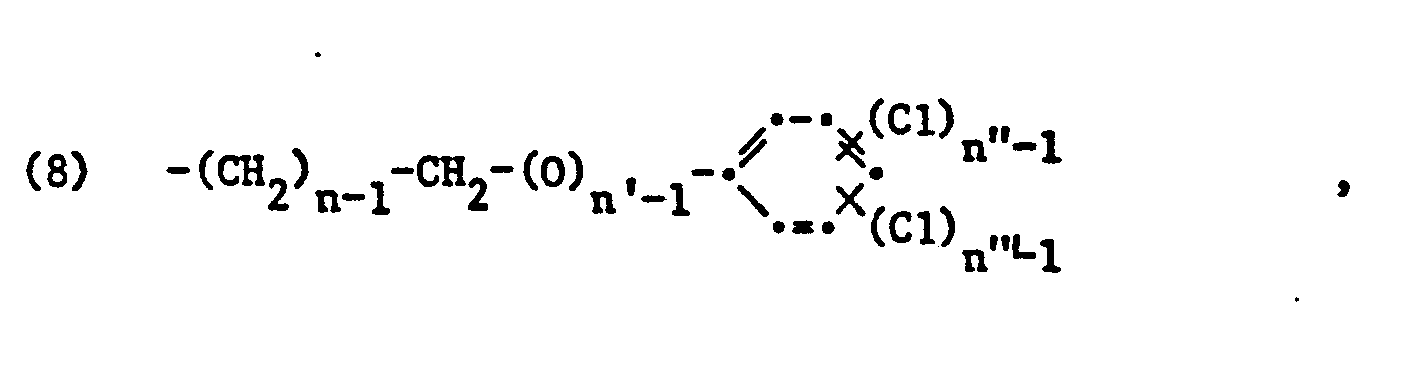


- Falls n in Formel (13) für 2 steht, weisen die Ammoniumsalze 2 quatermäre Stickstoffatome auf. In diesem Falle bedeutet nur einer der Reste L6, L7 und L8 in Formel (6) ein durch Säureamidreste unterbrochenes Alkyl einer der Formeln (10) oder (11).
- Die Ammoniumsalze, welche 3 quaternäre Stickstoffatome aufweisen, entsprechen der Formel (5), worin L4 durch Stickstoffatome unterbrochenes Alkyl und L3 z.B. Carbalkoxyalkyl bedeuten. Bevorzugte Ammomiumsalze dieser Art entsprechen der Formel

- Die Ammoniumsalze mit nur einem quaternären Stickstoffatom sind gegenüber solchen mit 3 oder 2 quaternären Stickstoffatomen bevorzugt. Bevorzugte Ammoniumsalze mit einem quaternären Stickstoffatom entsprechen der Formel

- Andere bevorzugte Ammoniumsalze mit einem quaternären Stickstoffatom entsprechen der Formel


L14 und Y3 8 die angegebenen Bedeutung haben. - Ein einziges, quaternares Stickstoffatom aufweisende Ammoniumsalze, die im Vordergrund des Interesses stehen, entsprechen indessem der Formel

- Im Vordergrund des Interesses stehen ebenfalls ein einziges quaternäres Stickstoffatom aufweisende Ammoniumsalze der Formel (17), worin L14 umd L15 je Aethyl oder vorzugsweise Methyl umd L16 -CH2-CO-NH2 bedeuten und insbesondere Ammoniumsalze, die der Formel (16) entsprechen.
- Als spezifische Beispiele der Komponente (B) der erfindungsgemässen Zubereitung seien die folgenden Ammoniumsalze genannt:


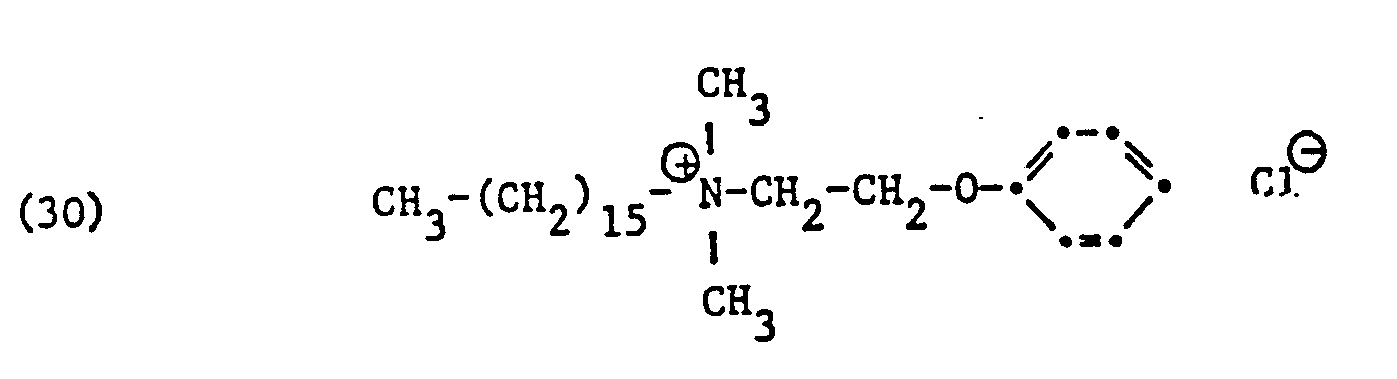
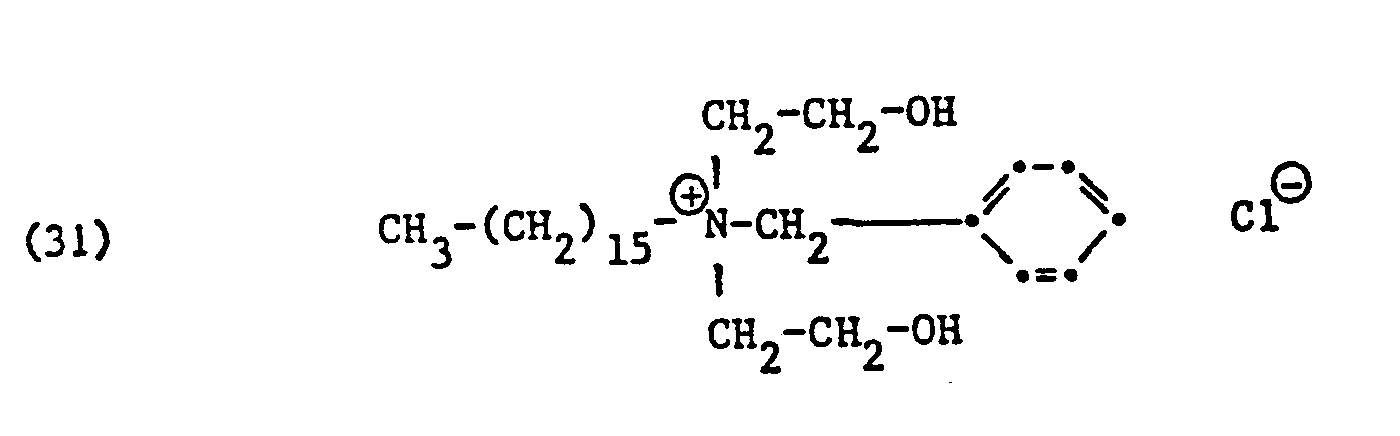


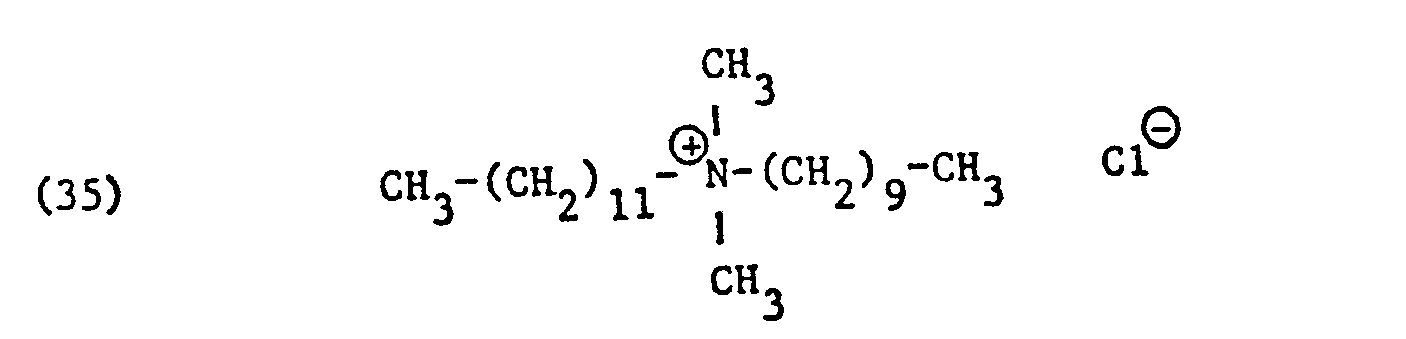
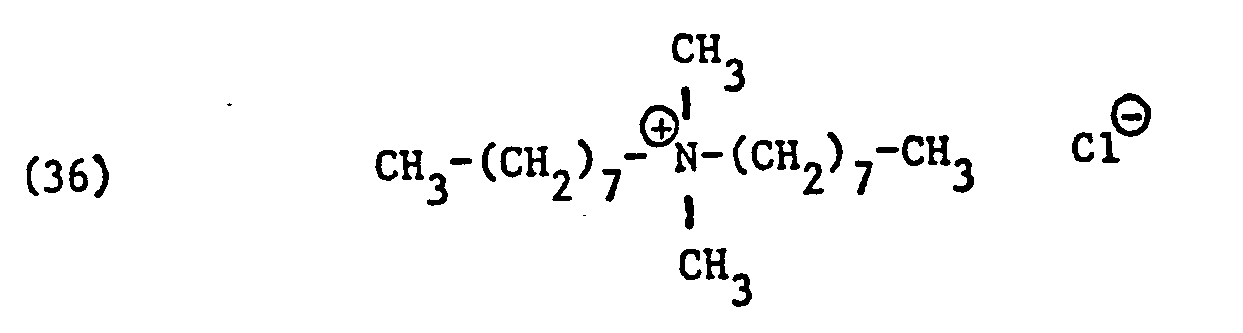


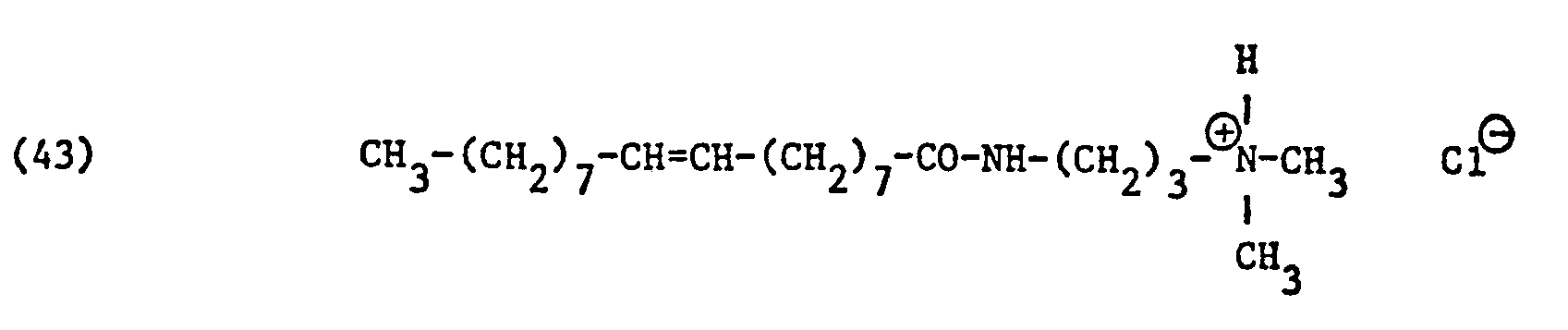
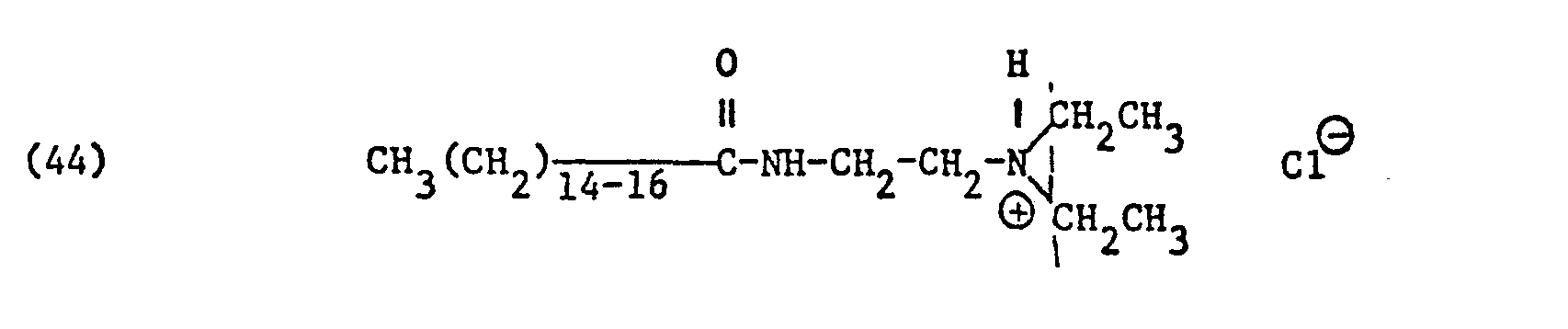


- Hierbei stehen die Ammoniumsalze der Formeln (23) bis (32) vorzugsweise (23), (24), (25) und (28), und vor allem der Formeln bis (39), (47) und (48), insbesondere (37), (38), (39) und (48), im Vordergrund des Interesses.
- Als nicht-ionische Tenside für die Komponente (C) in den erfindungsgemässen Zusammensetzungen kommen alkoxylierte, vorzugsweise propoxylierte und insbesondere äthoxylierte Fettamine, vor allem aber äthoxylierte Fettalkohole, Fettsäuren, Fettsäureamide, Alkylphenole oder Kohlenhydrate, worin die endständigen Hydroxylgruppen gegebenenfalls veräthert sind, und insbesondere als Alkyläther mit 1 bis 20 Kohlenstoffatomen im Aetherteil vorliegen, Addukte (Blockcopolymere) aus Aethylen- und Propylenoxyd, Phosphorsäurepolyglykolester oder Aminoxyde, die vorzugsweise einen Fettrest aufweisen, in Betracht.
- Geeignet sind ferner auch Fettsäureester von 3- bis 6-wertigen Alkoholen (Glycerin, Pentaerythrit, Sorbit, Sorbitan) oder von Monound Disacchariden (Saccharose).
- Die als nicht-ionische Tenside verwendeten, äthoxylierten Fettsäuren, Fettsäureamide, Fettalkohole, Alkylphenole oder Kohlenhydrate entsprechen vorzugsweise einer der Formeln





- In Formel (49) leiten sich die Reste T,COO- von den entsprechenden gesättigten oder ungesättigten Fettsäuren mit 8 bis 22, vorzugsweise 12 bis 18 Kohlenstoffatomen ab. Hierbei handelt es sich im allgemeinen um die bei der Definition von L2, L3 und L4 der Formel (5) vorstehend genanntem Fettsäurem bzw. Fettsäuregemische.
- Die Fettsäureamid- und Fettalkoholreste Ti-CO-NH- und T2-0-in den Formeln (50) und (51) leiten sich vorzugsweise ebenfalls von den entsprechenden erwähnten Fettsäuren ab.
- Bevorzugte Alkylreste für T3 in Formel (52) sind z.B. Alkylreste mit 6 bis 12 Kohlenstoffatomen wie n-Hexyl, i-Hexyl, n-Heptyl, n-Octyl, i-Octyl, n-Nonyl, i-Nonyl, n-Decyl, n-Dodecyl, ferner Alkylreste mit 12 bis 14 Kohlenstoffatomen, wie Lauryl und Myristyl, Alkenylreste wie Oleyl und Reste, die sich von dimerisierten Olefinen mit je 6 oder 7 Kohlenstoffatomen ableiten.
- Als äthoxylierte Kohlenhydrate kommen je nach dem Wert von s in Formel (53) vor allem äthoxylierte Pentosen und insbesondere Hexosen, z.B. äthoxylierte Glukose, in Betracht.
- Gegebenenfalls können die äthoxylierten Tenside der Formel (49) bis (53) auch in verätherter Form (Alkyläther mit 1 bis 20 Kohlenstoffatomen im Aetherteil) vorliegen.
- Unter den äthoxylierten, nicht-ionischen Tensiden der Formeln (49) bis (53) sind die äthoxylierten Fettsäuren und Fettalkohole der Formeln (49) und (51) und insbesondere die äthoxylierten Alkylphenole der Formel (52) bevorzugt. Als spezifische Beispiele solcher äthoxylierter Alkylphenole sei u.a. das Tensid der Formel

- Als nicht-ionisches Tensid für die Komponente (C) des erfindungsgemässen Gemisches sind ebenfalls handelsübliche Produkte aus Aethylenoxyd und Propylenoxyd bevorzugt, die durch Addition von Aethylenoxyd an Additionsprodukte aus Propylenoxyd und Propylenglykol erhältlich sind und Molekulargewichte von etwa 1000 bis etwa 15000 aufweisen. Solche Addukte stellen Blockcopolymerisate dar, die der wahrscheinlichen Formel


- Als nicht-ionisches Tensid für die Komponente (C) kommen auch Phosphorsäureester, Phosphorsäurepolyglykolester und Aminoxyde, vor allem solche mit Fettresten, in Frage, wobei die Phosphorsäureester und die Phosphorsäurepolyglykolester vorzugsweise der Formel

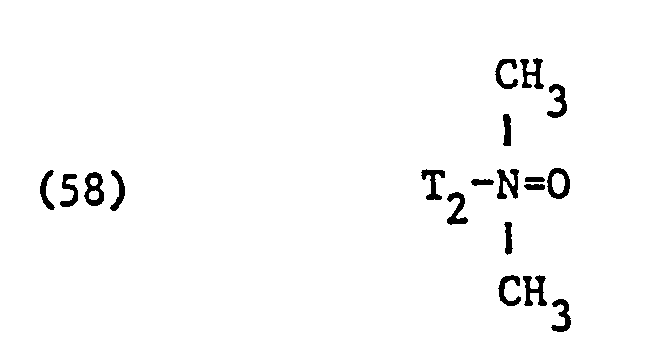
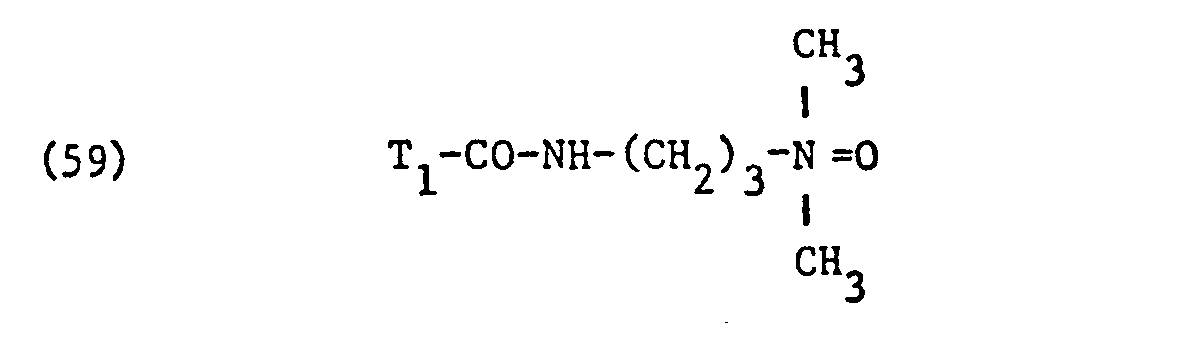
- Geeignet sind ferner auch Fettsäureester von 3- bis 6-wertigen Alkoholen mit 3 bis 6 Kohlenstoffatomen oder von Mono- oder Disacchariden (Saccharose). Die Fettsäurereste leiten sich z.B. von gesättigten oder ungesättigten Fettsäuren mit vorzugsweise 12 bis 18 Kohlenstoffatomen (Laurin-, Palmitim-, Stearim-, Oelsäure) ab. Genannt seien insbesondere die Sorbitan-Fettsäureester.
- Die nicht-ionischen Temside der Formeln (49) bis (56), vor allem (49) (51), (52) und (55) und insbesondere (54) und (56), sind dem nicht-ionischen Tensiden der Formeln (57) bis (59) gegenüber bevorzugt.
- Als Komponente (C) kommen auch Tenside mit intramolekular je einer positiven und negativen Ladung in Betracht, welchen im allgemeinen gegenüber dem nicht-ionischen Tensiden der angegebenen Art der Vorzug gegeben wird. Bei diesen Tensiden handelt es sich vor allem um Betaine oder Sulfobetaine, die sich von Imidazolinderivaten oder offenkettigen, aliphatischen Aminen ableiten.
- Die als Komponente (C) erfindungsgemäss eingesetzten, sich von Imidazolinderivaten ableitenden Betaine oder Sulfobetaine entsprechen vorzugsweise einer der Formeln


- Als Beispiele spezifischer Vertreter solcher Imidazolimiumbetaine oder -sulfobetaine seien u.a. die Tenside, bzw. technischen Tensidgemische der Formeln


- Die erfindungsgemäss eingesetzten, sich von einem offenkettigen, aliphatischen Amin ableitenden Betainderivate entsprechen vorzugsweise einer der Formeln


- Als Beispiele spezifischer Dertreter solcher Betainderivate seien u.a. die Tenside bzw. tecknischen Tensidgemische der Formeln


- Die erfindungsgemäss eingesetzten Sulfobetainderivate, die sich von einem aliphatischen, offenkettigen Amin ableiten, entsprechen vorzugsweise einer der Formeln


- Als Beispiele spezifischer Vertreter solcher Sulfobetainderivate seien u.a. die Tenside der Formeln
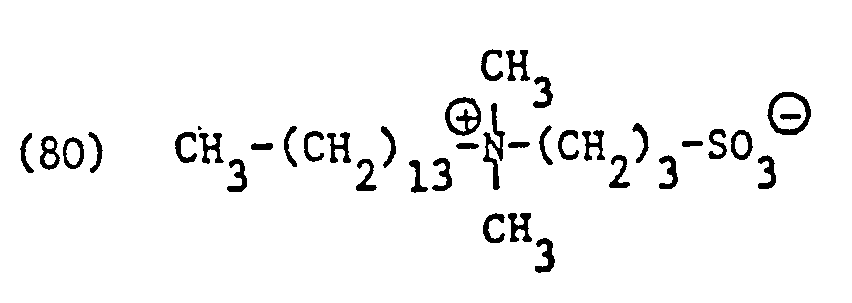


- C8-C18 = technisches Gemisch aus Kokosfett aus
- ca. 15% C8- und C10-Alkyl
- ca. 40% C12-Alkyl
- ca. 300/0 C14-Alkyl umd
- ca. 15% C16- und C18-Alkyl.
- genannt.
- Als Komponente (C) des erfindungsgemässen Gemisches stehen nichtionische Tenside der Formeln (56), vor allem (54) und insbesondere Tenside mit intramolekular je einer positiven und negativen Ladung der Formeln (62), (63) und (72) bis (75) im Vordergrund des Interesses.
- Anionische, gegebenenfalls zwitterionische Tenside, die als Ausführumgsform der Komponente (C) in den erfindungsgemässen Zusammensetzungen enthalten sind, entsprechen der Formel

- Anionische Tenside der Formel (82) sind den Betainen oder Sulfobetainen und vor allem den nicht-ionischen Tensiden der vorstehend angegebenen Art gegenüber bevorzugt.
- Falls Xe in Formel (82) für den Rest eines anionischen, jedoch nicht zwitterionischen Tensids steht, handelt es sich vorzugsweise um Reste oberflächenaktiver Sarkosinate, Sulfate, z.B. Alkylsulfate, Alkyläthersulfate, Alkylamidsulfate, Alkylamidäthersulfate, Alkylarylpolyäthersulfate oder Monoglyceridsulfate, Sulfonate, z.B. Alkylsulfonate, Alkylamidsulfonate, Alkylarylsulfonate, a-Oelfinsulfonate oder Sulfobernsteinsäurederivate, z.B. Alkylsulfosuccinate, Alkyläthersulfosuccinate, Alkylamidsulfosuccinate, Alkylamidpolyäthersulfosuccinate oder Alkylsulfosuccinamide, ferner auch um Reste von fluorierten Tensiden oder Phosphattensiden, wie z.B. Alkyl- oder Alkylätherphosphaten.
- In Frage kommen z.B. für Sarkosinat-Tenside solche der Formel

- In Formel (83) leiten sich die Reste TlCO- von dem entsprechenden gesättigten oder ungesättigten Fettsäuren mit 8 bis 22, vorzugsweise 12 bis 18 Kohlenstoffatomen ab. Hierbei handelt es sich im allgemeinen um die bei der Definition von L2, L3 und L4 der Formel (5) vorstehend erwähnten Fettsäuren bzw. FettsäureGemische. Als spezifische Vertreter von Sarkosinat-Tensiden seien vor allem solche der Formeln


- Falls Xe einen Sulfatrest (von Alkylsulfaten, sowie von Aether-, Ester-, Amid- oder Aminosulfaten) bedeutet, kommen z.B. insbesondere Tenside der Formeln


- Als spezifische Vertreter von Sulfat-Tensiden seien vor allen solche der Formeln


- Ist X⊖ ein Sulfonatrest, so kommen Tenside der Formeln

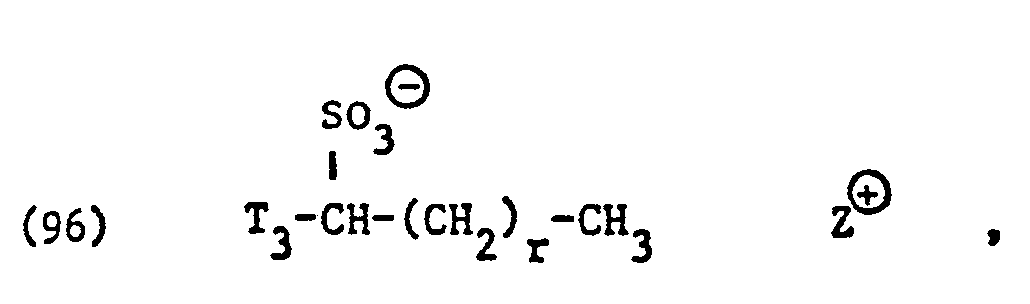


- Als spezifische Vertreter solcher Sulfonat-Tenside seien vor allem die Reste der Formeln




- Bedeutet X⊖ den Rest eines Sulfobernsteinsäurederivats, so entspricht das Tensid z.B. einer der Formeln


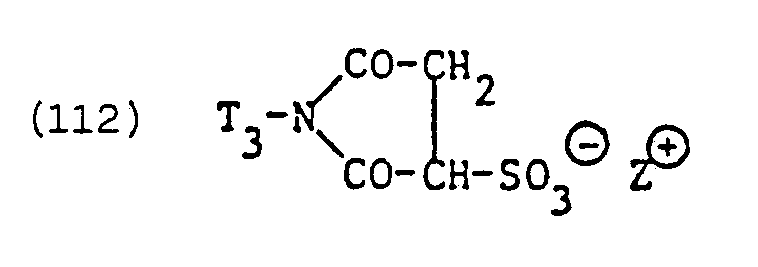
- Als spezifische Vertreter solcher Tenside seien die Sulfobernsteinsäurederivate der Formeln


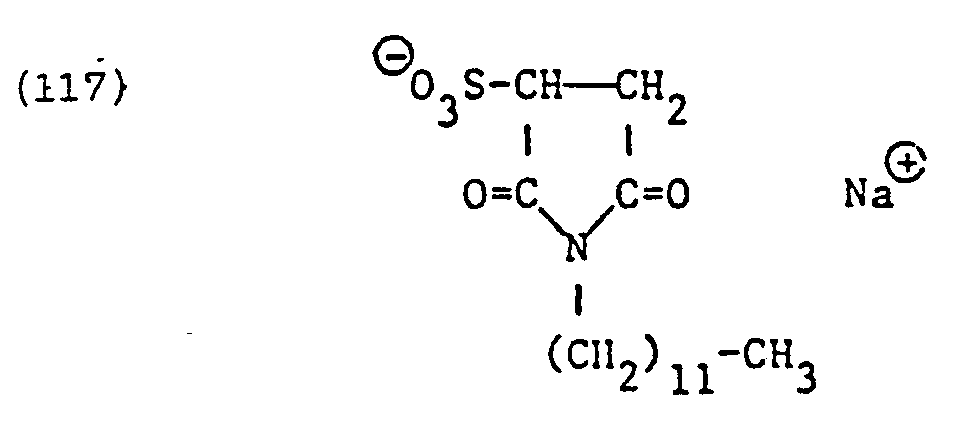

- Als mögliches fluoriertes Tensid kommen z.B. Tenside der Formel
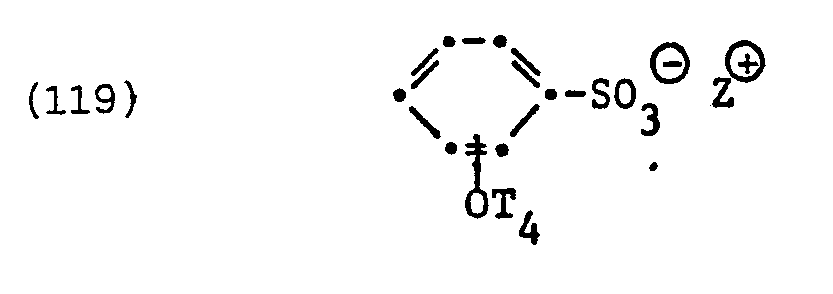
- Das perfluorierte Tensid der Formel

- Als Phosphattenside kommen vor allem solche der Formeln


- Als Beispiele solcher Phosphattenside seien solche der Formeln


- Bei den Resten Xe in der Bedeutung von Resten zwitterionisch anionischer Tenside in Formel (82) handelt es sich um Tensidreste, die in der Regel eine positive und zwei negative Ladungen aufweisen, d.h. um ampholytische Tensidreste, die stets einen Ueberschuss an negativen Ladungen aufweisen. Als Reste solcher zwitterionisch anionischer Tenside kommen vor allem Reste von oberflächenaktiven N-Alkyl-a-iminodipropionaten und insbesondere von in 2-Stellung alkylsubstituierten Imidazoliniumdicarbonsäurederivaten in Betracht.
- Oberflächenaktive, alkylsubstituierte Iminodipropionate entsprechen vorzugsweise der Formel

- Als spezifisches Beispiel seien die Tenside der Formeln


- Bei den bevorzugten Imidazolinium-Tensiden der angegeben Art handelt es sich vor allem um solche der Formel


- Im Vordergrund des Interesses stehen als Tenside für die Komponente (C) der erfindungsgemässen Zusammensetzungen oberflächenaktive Sarkosinate, Sulfate, Sulfonate, Sulfobernsteinsäurederivate und Imidazolinium-dicarbonsäurederivate und insbesondere solche der Formeln (85), (92), (94), (96), (105), (106), (121), (135) und (136).
- Bevorzugte erfindungsgemässe Zusammensetzungen enthalten die Komponenten (A), (B) und (C) in einem Gewichtsverhältnis (A):(B):(C) von 1: (1 bis 10): (2 bis 400), insbesondere 1: (2 bis 6): (20 bis 200).
- Zur Herstellung der erfindungsgemässen Zusammensetzung wird z.B. so verfahren, dass man ein Monomer der Formel


- Arbeitet man nach der Methode der Lösungspolymerisation, so ist der Einsatz von Emulgatoren und Emulsionsstabilisatoren nicht notwendig. Als Lösungsmittel dient in der Regel Wasser.
- Bei der Wasser-in-Oel Emulsionspolymerisation werden für die Oelphase hydrophobe, organische Flüssigkeiten benötigt. Zu diesem Zweck eignen sich z.B. aliphatische oder aromatische Kohlenwasserstoffe, Oele tierischer oder pflanzlicher Herkunft und die entsprechenden denaturierten Oele (.z.B. hydrierte Oele, polymerisierte Oele). Zu den bevorzugten hydrophoben organischen Flüssigkeiten gehören aliphatische Kohlenwasserstoffe wie Kerosin, Paraffin, Isoparaffin und aromatische Kohlenwasserstoffe wie Benzol, Toluol und Xylol. Handelsübliche technische Gemische von vorzugsweise verzweigten Paraffinölen mit einem SiedeBereich von 160-260°C, vorzugsweise 180 bis 210°C, stchen im Vordergrund des Interesses.
- Als bei der inversen Emulsionspolymerisation eingesetzte Wasser-in-Oel Emulgatoren kommen Polyoxyalkylen-, vorzugsweise Polyoxyäthylenaddukte von aliphatischen Alkoholen mit 8 bis 24 Kohlenstoffatomen wie Lauryl-, Cetyl-, Stearyl- und Oleylalkohole, von Fettsäuren mit 8 bid 24 Kohlenstoffatomen der vorstehend angegebenen Art, vorzugsweise Laurin-, Palmitin-, Stearin- umd Oelsäure, von Alkylphenolen mit 8 bis 24 Kohlenstoffatomen im Alkylrest, z.B. Octyl-, Nonyl-, Dodecyl- und Dinonylphenol und von Estern von Fettsäuren der angegebenen Art mit mehrwertigen Alkoholen, z.B. Glycerin, Pentaerythrit, Sorbit und Sorbitan in Betracht. Auch handelsübliche Gemische, d.h. Polyoxyalkylenaddukte von technischen Alkoholgemischen, Fettsäuregemischen, Alkylphenolgenischen und Estergemischen sind als Wasser-in-Oel Emulgatoren besonders geeignet. Besonders bevorzugt sind indessen Ester der Fettsäuren der angegebenen Art bzw. Fettsäuregemische mit mehrwertigen Alkoholen der angegebenen Art, wobei Sorbitmonooleat im Vordergrund des Interesses steht.
- In besonderen Fällen hat sich die Verwendung eines Emulsionsstabilisators in der Oelphase als zweckmässig erwiesen. Zu diesem Zweck eignen sich vor allem in der Oelphase lösliche Kautschuke, und zwar sowohl solche natürlicher Herkunft, z.B. Kristallgummi, als auch vorzugsweise solche synthetischer Herkunft, z.B. Polybutadien, Copolymerisate aus Styrol und Butadien und insbesondere Polyisopren, das im Vordergrund des Interesses steht.
- In der Regel enthält die Oelphase etwa 2 bis 15 Gewichtsprozent Emulgator und 0 bis etwa 1, vorzugsweise 0,4 bis 0,8 Gewichtsprozent Stabilisator.
- Nach dem Vermischen der Oelphase mit der wassrigen Phase, welche die Monomeren der Formel (137) und gegebenenfalls die Comonomeren der Formeln (138), (139) und (140) enthält, wird in der Regel die Polymerisation durch Zugabe eines Polymerisationsinitiators in Gang gesetzt. Als Initiatoren können die üblichen Polymerisationskatalysatoren, vorzugsweise in Form ihrer organischen oder wässrigen Lösung, eingesetzt werden, z.B. Azoverbindungen wie Azobis(iso-butyronitril) oder Azo-bis(dimethylvaleronitril), oxydierende Mittel, vorzugsweise Peroxyde wie Wasserstoffperoxyd oder Benzoylperoxyd oder vorzugsweise Persulfate wie Ammoniumpersulfat, ferner auch Chlorate oder Chromate, reduzierende Mittel, wie Sulfite, Bisulfite, Oxalsäure und Ascorbinsäure, sowie die Kombination, als sogenannte Redoxkatalysatoren, der vorstehend aufgeführten oxydierenden und reduzierenden Mittel. Im vorliegenden Fall eignet sich Natriumsulfit vorzugsweise als wässrige Lösung besonders gut als Initiator.
- Die Polymerisation erfolgt in der Regel bei 30 bis 90°C, vorzugsweise 40 bis 70°C, und verläuft exotherm, so dass die Polymerisationstemperatur gegebenenfalls durch Kühlen eingehalten werden muss.
- Zur üblichen Aufarbeitung wird das erhaltene Polymerisat in der Regel durch ein vorzugsweise mit Oel und Wasser mischbares Lösungsmittel gefällt, z.B. mit Methanol, Isopropanol oder Aceton, wobei die Fällung im allgemeinen durch Zugabe der Polymerisationslösung bzw. der Wasser-in-Oel Emulsion ins vorgelegte Lösungsmittel, vorzugsweise bei Raumtemperatur (15 bis 25°C), durchgeführt wird, worauf nach der Filtration das gefällte Polymerisat vorzugsweise bei Temperaturen von höchstens 60° C, insbesondere bei Temperaturen von etwa 30 bis 50° C, zweckmässig unter vermindertem Druck getrocknet wird.
- Um nötigenfalls eine Anreicherung an hochmolekulare Anteile (Molekulargewicht von 107 bis 109 innerhalb der breiten Molekulargewichtsverteilung von 104 bis 109) zu bewirken, kann das Polymer einer zusätzlichen Behandlung in den genannten Lösungsmitteln unterworfen werden. Eine solche Behandlung kommt vor allem für Polymere in Frage, die durch Lösungspolymerisation hergestellt werden.
- Die an sich bekannten, so erhaltenen Homo- oder vorzugsweise Copolymerisate der Komponente (A) werden nun nach an sich bekannten Methoden mit den mono- bis oligomeren, quaternären Ammoniumsalzen als Komponente (B) und mit mindestens einem nicht-ionischen Tensid einer der Formeln (49) bis (81) und/oder einem anionischen Tensid einer der Formeln (82) bis (136) als Komponente (C), vorzugsweise bei Raumtemperatur (10 bis 25° C) miteinander vermischt, oder, sofern ein Copolymerisat als Komponente (A) und ein anionisches, gegebenenfalls zwitterionisches Tensid als Komponente (C) eingesetzt wird, bei bevorzugten, leicht erhöhten Temperaturen von 15 bis 90°,vorzugs-weise 15 bis 40°C, während 30 bis 100, insbesondere 60 bis 90 Minuten, mindestens teilweise miteinander umgesetzt, wobei in der Regel ein Ueberschuss mindestens eines anionischen, gegebenenfalls zwitterionischen Tensids der Formel (82), bezogen auf das monomere bis oligomere, quaternäre Ammoni-umsalz, z.B. der Formel (5) und auf das bei der Herstellung des Copolymerisats, angewandte, comonomere, quaternäre Ammoniumsalz der Formel (137) eingesetzt wird. Dieser Ueberschuss beträgt etwa 4 bis 500, vorzugsweise 5 bis 120 und insbesondere 7 bis 70 Mol Tensid pro Mol des angewandten monomeren Ammoniumsalzes.
- Bei ihrer Verwendung in der Kosmetikindustrie werden die erfindungsgemässen Gemische der Komponenten (A), (B) und (C) vorzugsweise als Haarkosmetika eingesetzt.
- Die erfindungsgemässen kosmetischen Mittel, vorzugsweise haarkosmetische Mittel, liegen in ihrer bevorzugten Ausführungsform als wässrige Lösungen vor, die z.B. 0,05 bis 1,5, vorzugsweise 0,2 bis 1,0 Gewichtsteile, berechnet als Wirksubstanz, mindestens eines polymeren, quaternären Ammoniumsalzes als Komponente (A), 0,1 bis 10, vorzugsweise 0,2 bis 6 Gewichtsteile, berechnet als Wirksubstanz, mindestens einem monomeren bis oligomeren, quaternären Ammoniumsalzes als Komponente (B) und 5 bis 20, vorzugsweise 8 bis 15, insbesondere 9 bis 12 Gewichtsteile, berechnet als Wirksubstanz, mindestens eines nicht-ionischen Tensides, oder eines Tensides mit intramolekular je einer positiven und negativen Ladung oder eines anionischen, gegebenenfalls zwitterionischen Tensides als Komponente (C) und gegebenenfalls kosmetische Hilfsmittel als Komponente (D) enthalten und mit entionisiertem Wasser auf insgesamt 100 Gewichtsteile verdünnt sind.
- 'f-Die fakultativen, kosmetischen Hilfsmittel als Komponente (D) sind handelsübliche Mittel, wie sie in der Haarkosmetik eingesetzt werden. In Betracht kommen z.B. Tenside, die von den als Komponente (C) eingesetzten Tensiden der angegebenen Art verschieden sind, wie Polyglycerolester und Polyglykolester von Fettsäuren, insbesondere Polyglycerololeate, im weiteren auch Polyglykole und Schaumstabilisatoren, z.B. Fettsäurepolyalkanolamide, Verdickungsmittel natürlicher oder synthetischer Herkunft wie Hydroxypropylmethylcellulose und Polyacrylsäure, Opalisierungsmittel, wie Fettsäuremonoalkanol-amide oder vorzugsweise Glycerinmonostearat, Hautschutzmittel wie Eiweisshydrolysate und Allantoine, ferner auch u.a. Konservierungsmittel, Parfüms und Perlglanzmittel.
- Erforderlichenfalls werden die haarkosmetischen Mittel auf einen pH-Wert von 3 bis 9, vorzugsweise 5 bis 9, vor allem 5 bis 8 und insbesondere 5 bis 6 eingestellt, was zweckmässig durch einen Zusatz von wässrigen Lösungen aus z.B. Natriumhydroxid oder vorzugsweise Zitronensäure erreicht werden kann.
- Bei der Applikation der haarkosmetischen Mittel, vorzugsweise auf menschlichem Haar, wird im Haarbehandlungsverfahren das vorstehend beschriebene, wässrige, haarkosmetische Mittel auf mit Leitungswasser angefeuchtetem Haar, in der Regel bei Raumtemperatur bis leicht erhöhter Temperatur, z.B. 20 bis 40°C, aufgebracht und das Haar anschliessend schampooniert und gleichzeitig konditioniert. Das so behandelte Haar kann ebenfalls in Form von Perücken oder Toupets vorliegen.
- Der wesentliche Vorteil der vorliegenden Erfindung liegt darin, dass bei der Applikation der haarkosmetischen Mittel, welche in neuartiger Kombination sowohl die polymeren als auch die monomeren bis oligomeren, quaternären Ammoniumsalze als Komponenten (A) und (B) neben den Tensiden der angegebenen Art als Komponente (C) enthalten, nicht nur eine gute Reinigung, sondern auch gleichzeitig ausgezeichnete Konditioniereffekte auf dem behandelten Haar erzielt werden. So weisen die mit der erfindungsgemässen Zusammensetzung behandelten Haare antistatische Eigenschaften und eine sehr gute Kämmbarkeit (nass und trocken) auf. Zudem ist bei wiederholter Verwendung der erfindungsgemässen Zusammensetzung keinerlei unerwünschter Akkumuliereffekt unter Beeinträchtigung des Griffs, der Fülle und des Glanzes der behandelten Haare zu beobachten. Im Vergleich zu den Konditioniereffekten auf Haaren, die mit herkömmlichen kosmetischen Mitteln behandelt werden, weisen die mit den erfindungsgemässen haarkosmetischen Mitteln behandelten Haare somit in unerwarteter Weise ausserordentlich gute Konditioniereffekte auf. Die üblichen kosmetischen Mittel enthalten zwar auch Mischungen aus Tensiden und quaternären Ammoniumsalzen, jedoch nicht die neuartige und erfinderische Kombination von polymeren und monomeren bis oligomeren, quaternären Ammoniumsalzen gemäss der vorliegenden Erfindung.
- In den nachfolgenden Herstellungsvorschriften und Beispielen angegebene Teile und Prozente sind Gewichtseinheiten.
- In einem Doppelmantelreaktionsgefäss werden
- 500 Teile eines verzweigten Paraffinöls (technisches Gemisch, Molekulargewicht 171, Siedebereich 188-206° C) vorgelegt.
- 140 Teile einer 2,5%igen Lösung eines synthetischen Kautschuks aus Polyisopren (Emulsionsstabilisator) in Paraffinenöl der angegebenen Art und anschliessend
- 78 Teile Sorbitanmonooleat (Wasser-in-Oel Emulgator) werden dem vorgelegten Paraffinöl unter Rühren bei 20° C zugegeben.
- Man erhält eine klare, gelbe Lösung.
-
- 568,6 Teile Acrylamid (8 Mol) werden bei 20° C in
- 700 Teilen entionisiertem, sauerstofffreiem Wasser gelöst. In diese Lösung werden
- 220 Teile Natriumchlorid unter Rühren eingetragen und anschliessend
- 1133,2 Teile einer 50%igen, wässrigen Lösung aus Methacryloyl-oxyätyl-trimethylammonium-methylsulfat (2 Mol) zugegeben.
- Man erhält eine klare, farblose Lösung.
-
- 0,66 Teile Natriumsulfit werden in
- 40 Teile entionisiertem, sauerstofffreiem Wasser gelöst.
- Unter intensivem Rühren (3000 U/min) wird innerhalb von 10 Minuten in inerter Stickstoffatmosphäre die Lösung II in die vorgelegte Lösung 1 bei 20° C zugegeben. Man erhält eine homogene, weisse Emulsion, die bei 20°C weitergerührt wird, bis die Viskosität einer Emulsionsprobe 14000 mPa.s (Brookfield Viskosimeter LV, Spindel 3, 6 U/min, 25°C) beträgt, was im allgemeinen 10 Minuten in Anspruch nimmt. Hierauf wird das Reaktionsgemisch unter Rühren bei 300 U/min innerhalb von 30 Minuten auf 40°C geheizt. Mittels einer Dosierpumpe wird nun die Lösung III innerhalb von 150 Minuten in das Reaktionsgemisch zugegeben, wobei die Temperatur durch Kühlen auf 40 bis 41°C gehalten wird. Nach Beendigung der Initiatorlösung-Zugabe wird das Reaktionsgemisch bei 40°C und 300 U/min weitergerührt, bis die Viskosität einer Emulsionsprobe auf 7600 mPa.s. (Brookfield Viskosimeter LV, Spindel I, 60 U/min, 25°C) absinkt, was im allgemeinen eine Stunde in Anspruch nimmt.
- Die erhaltene Emulsion des Copolymerisates wird unter Rühren in 24000 Teilen Aceton bei 20° C gegeben und das Copolymerisat ausgefällt. Das ausgefällte Copolymerisat wird abfiltriert und während 2 Tagen unter vermindertem Druck bei 40° C getrocknet. Man erhält 1100 Teile eines Copolymerisates, das in beliebiger Reihenfolge 80 Mol% Strukturelemente der Formel

- (142)

- Die molekulare Gewichtsverteilung wird mittels der Gelpermeationschromatographie bestimmt, wobei als Trägermaterial FRACTOGEL® (Handelsmarke von MERCK und EM LABORATORIES) Typ OR-PVA eingesetzt wird, welches zweckmässig in Formamid als Lösungsmittel gequollen wird. Einzelheiten über das Trägermaterial sind aus dem Lehrbuch "Modern Size-Exclusion Chromatography" von W.W. Yau, J.J. Kirkland and D.D. Bly, Seiten 166 bis 173, Verlag John Wiley & Sons (1979) zu entnehmen. Als Detektor dient ein Differenzialrefraktometer.
- Die Auswertung der GPC-Chromatogramme erfolgt anhand einer Eichkurve, die mit Polystyrol, Polymethylmethacrylat und den Standard-Polymeren SEPHADEX DEXTRAN® (Handelsmarke der Firmen PHARMACIA UPPSALA und PRESSURE CHEMICAL CORP., Pittsburg) erstellt wird. Die Konzentrationen werden über die unkorrigierten Flächenprozente ermittelt, wobei die Summe aller eluierten Komponenten 100 % beträgt.
- Die folgenden zwei Lösungen werden in sauerstofffreier inerter Stickstoffatmosphäre vorbereitet:
- In einem Doppelmantelgefäss werden
- 71,1 Teile Acrylamid (1 Mol) und
- 141,7 Teile einer 50%igen, wässrigen Lösung aus Methacryloyl-oxyäthyltrimethylammonium-methylsulfat (0,25 Mol) bei 20°C in
- 228 Teilen entionisiertem, sauerstofffreiem Wasser gelöst.
- Man erhält eine klare farblose Lösung.
- 0,2 Teile Ammoniumperoxodisulfat werden in 150 Teilen deionisiertem sauerstofffreiem Wasser gelöst.
- Unter Rühren wird innerhalb 1 Minute in inerter Stickstoffatmosphäre die Hälfte der Lösung II in die vorgelegte Lösung 1 bei 35° C zugegeben. Nach 6 Stunden wird die Reaktionslösung auf 50° C erwärmt und die zweite Hälfte von Lösung II zugegeben. Das Reaktionsgemisch wird solange unter Rühren gehalten, bis nach 2 bis 3 Stunden eine hochviskose Lösung entstanden ist. Ohne Rühren wird das Reaktionsgemisch stehen gelassen. Nach 24 Stunden lässt man das entstandene farblose Gel abkühlen.
- Das Gel wird zerkleinert und in 1350 Teilen deionisiertem Wasser gelöst. Die hochviskose Lösung wird dann in 18000 Teilen Aceton in dünnem Strang bei 20° C eingepresst und das Copolymerisat ausgefällt. Das Copolymerisat wird dann abfiltriert und nochmals in 1800 Teilen Aceton geknetet, bis es hart und spröde wird. Das Copolymerisat wird wieder abfiltriert und während 2 Tagen unter vermindertem Druck bei 40° C getrocknet. Man erhält 110 Teile eines Copolymerisats, das in beliebiger Folge 80 Mol% Strukturelemente der Formel (141) und 20 Mol% Strukturelemente der Formel (142) enthält, wobei das Molekulargewicht von 12% des Copolymerisats zwischen 107 und 109 liegt. Hierbei wird diese Molekulargewichtsverteilung wie in Vorschrift A angegeben bestimmt.
- 100 Teile eines im Handel erhältlichen Copolymerisates, das zu 75 Mol-% aus Strukturelementen der Formel (141) und zu 25 Mol-% aus Elementen der Formel

- besteht, wobei das Molekulargewicht von 20 % des Copolymerisates zwischen 107 und 109 liegt, werden pulverisiert und mit einem Gemisch von 400 Teilen Methanol und 100 Teilen Wasser bei Raumtemperatur 30 Minuten lang gerührt. Weitere 500 Teile Methanol werden zugesetzt und das Gemisch noch 5 Minuten gerührt und dann eine Stunde stehen gelassen. Der gelige Brei wird dann in einer Drucknutsche unter einem Druck von 3 bar filtriert. Die gelige Masse wird anschliessend mit 100 Teilen Methanol aufgeschlämmt und wieder unter Druck abfiltriert. Nach dreimaliger Behandlung mit Methanol wird das Produkt einen Tag im Vakuum bei 40° C getrocknet. Das Molekulargewicht von 45 % des erhaltenen, umgefällten Copolymerisats liegt zwischen 107 und 109, wobei die Molekulargewichtsverteilung des behandelten Copolymerisats und des Ausgangspolymers (Handelsprodukt) wie in Vorschrift A angegeben bestimmt wird.
- 2 Teile des polymeren Ammoniumsalzes gemäss Vorschrift A (1,41 m-Aequivalente, bezogen auf den Quatgehalt des Copolymerisats) und 10 Teile des monomeren Ammoniumsalzes der Formel (37) (27,74 mMol) werden bei 25 bis 35°C in kleinen Portionen in 100 Teilen entionisiertem Wasser eingetragen. Es entsteht eine viskose Lösung. 100 Teile des anionischen Tensides der Formel (94) (241 mMol oder 8,27 Mol pro Mol angewandtes Methacryloyl-oxyäthyl-trimethylammonium-methylsulfat und pro Mol monomeres, quaternäres Ammoniumsalz der Formel (94)) werden in 700 Teilen entionisiertem Wasser bei 25° C gelöst. Die Lösung der quaternären Ammoniumsalze wird nun in die Tensidlösung innerhalb von 80 Minuten zugegeben, wobei gleichzeitig die Umsetzung der quaternären Strukturelemente des Copolymerisats und die Umsetzung des monomeren, quaternären Ammoniumsalzes mit dem eingesetzten Tensid unter Ionenaustausch erfolgt. Man erhält 912 Teile einer wässrigen, schwach opalisierenden und viskosen Lösung, die durch Zugabe einer 10%- iden, wässrigen Zitronensäurelösung auf den pH-Wert von 7,1 eingestellt und mit entionisiertem Wasser auf 1000 Teile verdünnt wird. Die erhaltene, verdünnte, gebrauchsfertige Lösung ist vollständig klar und lagerstabil. Nun wird diese Lösung auf eine mit Leitungswasser angefeuchtete Perücke aus ungebleichtem und ungefärbtem, braunem Menschenhaar europäischer Herkunft bei 40°C in dreimaliger Applikation ä 2 Schimponierungen im sogenannten Halbseitentest aufgebricht, worauf das Perückenhaar bei dieser Temperatur schampooniert und gleichzeitig konditioniert wird. Im Halbseitentest wird nur die eine Hälfte der Perücke mit der vorstehend genannten Lösung schampooniert und konditioniert, während die andere Hälfte der Perücke mit einer Lösung unter gleichen Bedingungen schampooniert wird, die kein erfindungsgemässes Gemisch aus den Ammoniumsalzen und dem Tensid, sondern nur das Tensid enthält. In dieser sogenannten Leerformulierung wird die Menge an Ammoniumsalzen durch die entsprechende Menge Tensid ersetzt, so dass z.B. die Leerformulierung als Vergleich 11,2% des Tensides der Formel (94) enthält, wobei der pH-Wert der Leerformulierung ebenfalls mit der wässrigen, 10%-igen Zitronensäurelösung auf den pH-Wert von 7,1 eingestellt wird. Nach jeder Applikation wird die Nass- und Trockenkämmbarkeit der erfindungsgemäss behandelten Perückenhälfte im Vergleich mit der mit der Leerformulierung behandelten Perückenhälfte mit Hilfe der nachfolgenden Notenskala beurteilt:
- + 3 viel besser als die Leerformulierung
- +2 besser als die Leerformulierung
- + 1 etwas besser als die Leerformulierung
- 0 kein Unterschied zur Leerformulierung
- -1 etwas schlechter als die Leerformulierung
- -2 schlechter als die Leerformulierung
- -3 viel schlechter als die Leerformulierung.
- Die erzielten Kämmbarkeitsnoten sind in der nachfolgenden Tabelle I zusammengefasst.

- Zudem weist die erfindungsgemäss behandelte Perückenhälfte bessere antistatische Eigenschaften auf als die mit der Leerformulierung behandelte Perückenhälfte. Die antistatischen Effekte werden qualitativ erfasst, indem die Neigung der Haare zum "Wegfliegen" (fly away) subjektiv beurteilt wird. Auf beiden Perückenhälften können keinerlei Akkumuliereffekte nach 3 Applikationen beobachtet werden.
- Man verfährt wie im Beispiel 1 angegeben, setzt jedoch 2 Teile des polymeren Ammoniumsalzes gemäss Vorschrift B (1,41 m-Aequivalente bezogen auf den Quatgehalt des Copolymerisates), 5 Teile des monomeren Ammoniumsalzes der Formel (48) (6,72 mMol) und 100 Teile des Tensides der Formel (93) (255 mMol oder 31,4 Mol pro Mol angewandte Methacryloyl-oxyäthyl-trimethylammonium-methylsulfat und pro Mol monomeres, quaternäres Ammoniumsalz der Formel (48)) ein.
- Man erhält 907 Teile einer schwach opalisierenden und viskosen Lösung, die durch Zugabe einer 5%-igen, wässrigen Natriumhydroxydlösung auf den pH-Wert von 7,1 eingestellt und mit entionisiertem Wasser auf 1000 Teile verdünnt wird.
- Das Schimpoonieren und Konditionieren der Perücke im Halbseitentest mit der verdünnten, klaren, lagerstabilen Lösung wird ebenfalls wie in Beispiel 1 durchgeführt, wobei die folgenden, in der nachstehenden Tabelle II zusammengefassten Kämmbarkeitsnoten erzielt werden:
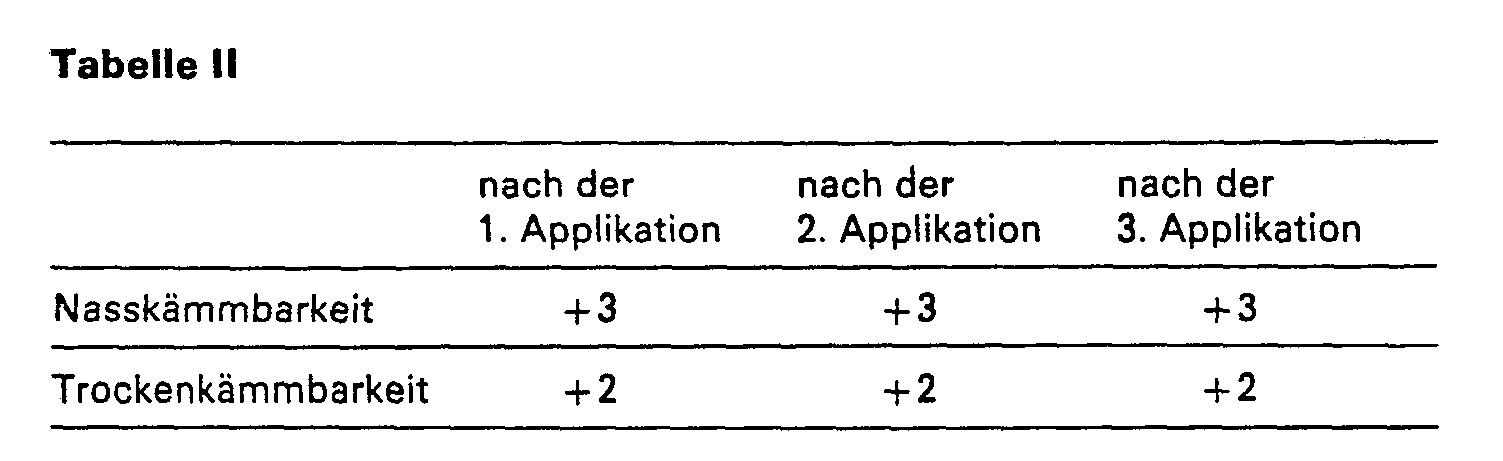
- Die erfindungsgemäss behandelte Perückenhälfte im Vergleich zur Perückenhälfte, die mit der Leerformulierung behandelt wird, weist ebenfalls gute antistatische Eigenschaften auf, wobei auf beiden Perückenhälften keinerlei Akkumuliereffekte nach 3 Applikationen beobachtet werden können.
- Aehnliche Ergebnisse werden beim Ersatz des monomeren, quaternären Ammoniumsalzes der Formel (48) durch diejenigen einer der Formeln (23) bis (32), (35), (36), (37), (38) oder (47) und beim Ersatz des anionischen Tensids der Formel (93) durch diejenigen einer der Formeln (85), (102), (105), (106), (118), (135) oder (136) erzielt. Dies trifft auch zu für den Ersatz des anionischen Tensids der Formel (93) durch nicht-ionische Tenside einer der Formeln (54) oder (56) oder Tenside mit intramolekular je einer positiven und negativen Ladung einer der Formeln (62), (63) oder (72) bis (75). In diesem letzten Fall braucht jedoch die Lösung der quaternären Ammoniumsalze nicht langsam in die vorgelegte Lösung des Tensides bei 35° C zugegeben zu werden, da keine Umsetzung unter Ionenaustausch stattfindet. Die Lösungen der quaternären Ammoniumsalze und die Lösungen der nicht-ionischen Tenside oder der Tenside mit intramolekular je einer positiven und negativen Ladung können somit in beliebiger Reihenfolge bei Raumtemperatur (10 bis 25° C) durch Zugiessen vermischt werden.
- Man verfährt wie im Beispiel 1 angegeben, setzt jedoch 2 Teile des polymeren Ammoniumsalzes gemäss Vorschrift C, 10 Teile des monomeren Ammoniumsalzes der Formel (37) in 100 Teilen entionisiertem Wasser und 150 Teile des Tensides der Formel (94) in 650 Teilen entionisiertem Wasser ein.
- Man erhält 912 Teile einer schwach opalisierenden und viskosen Lösung, die durch Zugabe einer 10-%igen, wässrigen Zitronensäurelösung auf den pH-Wert von 5,5 eingestellt und mit entionisiertem Wasser auf 1000 Teile verdünnt wird.
- Das Schampoonieren und Konditionieren der Perücke im Halbseitentest mit der verdünnten klaren lagerstabilen Lösung wird ebenfalls wie in Beispiel 1 durchgeführt, wobei die folgenden, in der nachstehenden Tabelle 111 zusammengefassten Kämmbarkeitsnoten erzielt werden.

- Die erfindungsgemäss behandelte Perückenhälfte im Vergleich zur Perückenhälfte, die mit der Leerformulierung behandelt wird, weist ebenfalls gute antistatische Eigenschaften auf, wobei auf beiden Perückenhälften keinerlei Akkumuliereffekte nach 2 Applikationen beobachtet werden können.
- Man verfährt wie im Beispiel 1 angegeben, setzt jedoch 2 Teile des Polymeren Ammoniumsalzes gemäss Vorschrift A, 5 Teile des monomeren Ammoniumsalzes der Formel (25) in 100 Teilen entionisiertem Wasser und 150 Teile des Tensides der Formel (94) in 650 Teilen entionisiertem Wasser ein.
- Man erhält 912 Teile einer schwach opalisierenden und viskosen Lösung, die durch Zugabe einer 10-%igen, wässrigen Zitronensäurelösung auf den pH-Wert von 6 Oeingestellt und mit entionisiertem Wasser auf 1000 Teile verdünnt wird.
- Das Schampoonieren und Konditionieren der Perücke im Halbseitentest mit der verdünnten, klaren, lagerstabilen Lösung wird ebenfalls wie in Beispiel 1 durchgeführt, wobei die folgenden, in der nachstehenden Tabelle IV zusammengefassten Kämmbarkeitsnoten erzielt werden:

- Die erfindungsgemäss behandelte Perückenhälfte im Vergleich zur Perückenhälfte, die mit der Leerformulierung behandelt wird, weist ebenfalls gute antistatische Eigenschaften auf, wobei auf beiden Perückenhälften keinerlei Akkumuliereffekte nach 3 Applikationen beobachtet werden können.
- Man verfährt wie im Beispiel 1 angegeben, setzt jedoch 2 Teile des polymeren Ammoniumsalzes gemäss Vorschrift A, 5 Teile des monomeren Ammoniumsalzes der Formel(39) in 100 Teilen entionisiertem Wasser und 150 Teile des Tensides der Formel (94) in 650 Teilen entionisiertem Wasser ein.
- Man erhält 912 Teile einer schwach opalisierenden und viskosen Lösung, die durch Zugabe einer 10-%igen, wässrigen Zitronensäurelösung auf den pH-Wert von 6,0 eingestellt und mit entionisiertem Wasser auf 1000 Teile verdünnt wird.
- Das Schampoonieren und Konditionieren der Perücke im Halbseitentest mit der verdünnten, klaren, lagerstabilen Lösung wird ebenfalls wie in Beispiel 1 durchgeführt, wobei die folgenden, in der nachstehenden Tabelle V zusammengefassten Kämmbarkeitsnoten erzielt werden:

- Die erfindungsgemäss behandelte Perückenhälfte im Vergleich zur Perückenhälfte, die mit der Leerformulierung behandelt wird, weist ebenfalls gute antistatische Eigenschaften auf, wobei auf beiden .Perückenhälften keinerlei Akkumuliereffekte nach 3 Applikationen beobachtet werden können.
- Man verfährt wie im Beispiel 1 angegeben, setzt jedoch 2 Teile des Polymeren Ammoniumsalzes gemäss Vorschrift C, 5 Teile des monomeren Ammoniumsalzes der Formel (37) und 100 Teile eines Tensidgemisches der Formeln (129) und (130) ein.
- Man erhält 907 Teile einer schwach opalisierenden und viskosen Lösung, die durch Zugabe einer 10-%igen, wässrigen Zitronensäurelösung auf den pH-Wert von 5,1 eingestellt und mit entionisiertem Wasser auf 1000 Teile verdünnt wird.
- Das Schampoonieren und Konditionieren der Perücke im Halbseitentest mit der verdünnten, klaren, lagerstabilen Lösung wird ebenfalls wie in Beispiel 1 durchgeführt, wobei die folgenden, in der nachstehenden Tabelle VI zusammengefassten Kämmbarkeitsnoten erzielt werden:

- Die erfindungsgemäss behandelte Perückenhälfte im Vergleich zur Perückenhälfte, die mit der Leerformulierung behandelt wird, weist ebenfalls gute antistatische Eigenschaften auf, wobei auf beiden Perückenhälften keinerlei Akkumuliereffekte nach 3 Applikationen beobachtet werden können.
- Gleiche Resultate, insbesondere gleiche Kämmbarkeitsnoten werden erzielt, wenn man anstelle von 100 Teilen eines Tensidgemisches der Formeln (129) und (130) 100 Teile eines anionischen Tensides der Formel (57), worin q, q' und q" die Zahl 8 und T3', T3" und T3'" Oleyl bedeuten, einsetzt.
- Man verfährt wie im Beispiel 1 angegeben, setzt jedoch jeweils 2 Teile des polymeren Ammoniumsalzes gemäss Vorschrift C, 5 Teile eines monomeren Ammoniumsalzes und 100 Teile eines Tensides oder Tensidgemisches ein, wobei die Formeln des eingesetzten monomeren Ammoniumsalzes und der eingesetzten Tenside in der nachfolgenden Tabelle VII angegeben sind.
- Man erhält 907 Teile einer schwach opalisierenden und viskosen Lösung, die durch Zugabe einer 10-%igen, wässrigen Zitronensäurelösung auf den ebenfalls in Tabelle VII angegebenen pH-Wert eingestellt und mit entionisiertem Wasser auf 1000 Teile verdünnt wird.
- Das Schampoonieren und Konditionieren der Perücke im Halbseitentest mit der verdünnten, klaren, lagerstabilen Lösung wird ebenfalls wie in Beispiel 1 durchgeführt, wobei die folgenden, ebenfalls in der nachstehenden Tabelle VII zusammengefassten Kämmbarkeitsnoten erzielt werden.
- Zudem weist die erfindungsgemäss behandelte Perückenhälfte im Vergleich zur Perückenhälfte, die mit der Leerformulierung behandelt wird, ebenfalls gute antistatische Eigenschaften auf.

- Man verfährt wie im Beispiel 1 angegeben, setzt jedoch 2 Teile des polymeren Ammoniumsalzes gemäss Vorschrift C, 5 Teile des monomeren Ammoniumsalzes der Formel (39) und 100 Teile des technischen Tensidgemisches der Formel (81a) ein.
- Man erhält 907 Teile einer schwach opalisierenden und viskosen Lösung, die durch Zugabe einer 10-0/oigen, wässrigen Zitronensäurelösung auf den pH-Wert von 5,0 eingestellt und mit entionisiertem Wasser auf 1000 Teile verdünnt wird.
- Das Schampoonieren und Konditionieren der Perücke im Halbseitentest mit der verdünnten, klaren, lagerstabilen Lösung wird ebenfalls wie in Beispiel 1 durchgeführt, wobei die folgenden, in der nachstehenden Tabelle VIII zusammengefassten Kämmbarkeitsnoten erzielt werden:

- Die erfindungsgemäss behandelte Perückenhälfte im Vergleich zur Perückenhälfte, die mit der Leerformulierung behandelt wird, weist ebenfalls gute antistatische Eigenschaften auf, wobei auf beiden Perückenhälften keinerlei Akkumuliereffekte nach 3 Applikationen beobachtet werden können.
- Man verfährt wie im Beispiel 1 angegeben, setzt jedoch 2 Teile des polymeren Ammoniumsalzes gemäss Vorschrift C, 10 Teile des monomeren Ammoniumsalzes der Formel (39), 150 Teile des Tensides der Formel (94) und 30 Teile des Tensides der Formel (58), worin T2 Octadecyl bedeutet, ein, wobei das Gemisch der Tenside der Formeln (94) und (58) mit 100 Teilen Wasser gelöst werden.
- Man erhält 992 Teile einer schwach opalisierenden und viskosen Lösung, die durch Zugabe einer 10-%igen, wässrigen Zitronensäurelösung auf den pH-Wert von 5,0 eingestellt und mit entionisiertem Wasser auf 1000 Teile verdünnt wird.
- Das Schampoonieren und Konditionieren der Perücke im Halbseitentest mit der verdünnten, klaren, lagerstabilen Lösung wird ebenfalls wie in Beispiel 1 durchgeführt, wobei die folgenden, in der nachstehenden Tabelle IX zusammengefassten Kämmbarkeitsnoten erzielt werden:

- Die erfindungsgemäss behandelte Perückenhälfte im Vergleich zur Perückenhälfte, die mit der Leerformulierung behandelt wird, weist ebenfalls gute antistatische Eigenschaften auf, wobei auf beiden Perückenhälften keinerlei Akkumuliereffekte nach 2 Applikation beobachtet werden können.
enthält,
wobei bei Einsatz eines anionischen Tensides als Komponente (C) das polymere Ammoniumsalz als Komponente (A) ein Copolymerisat ist, das neben Strukturelementen der Formel (1) auch Strukturelemente der Formel (2) aufweist, und das anionische Tensid mindestens teilweise mit den Komponenten (A) und (B) unter Ionenaustausch umgesetzt ist.
Claims (14)


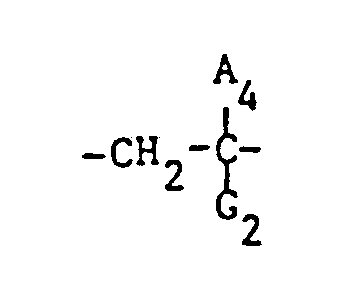
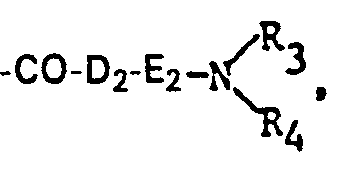
enthält,
wobei bei Einsatz eines anionischen Tensides als Komponente (C) das polymere Ammoniumsalz als Komponente (A) neben Strukturelementen der Formel


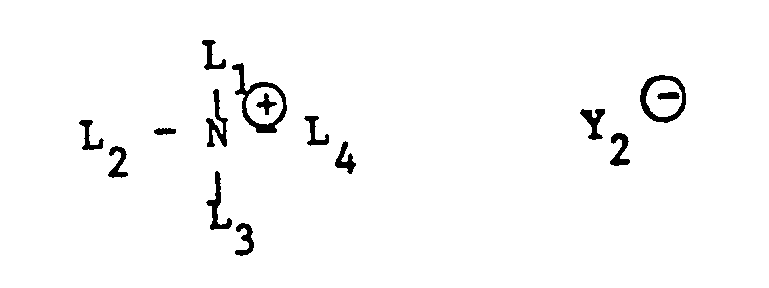


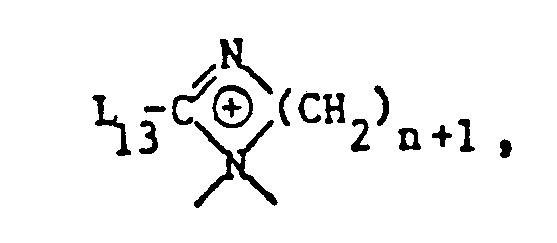

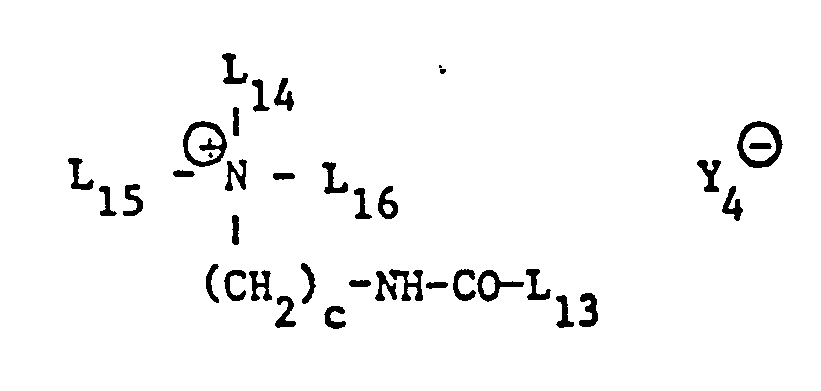
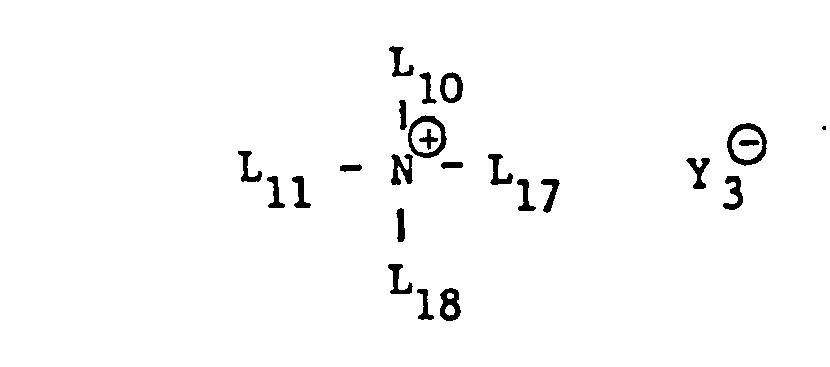


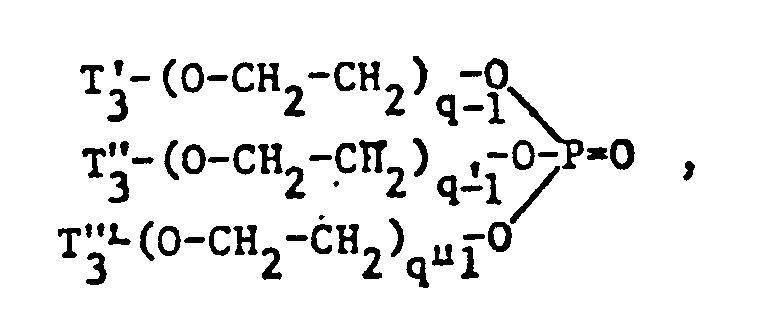
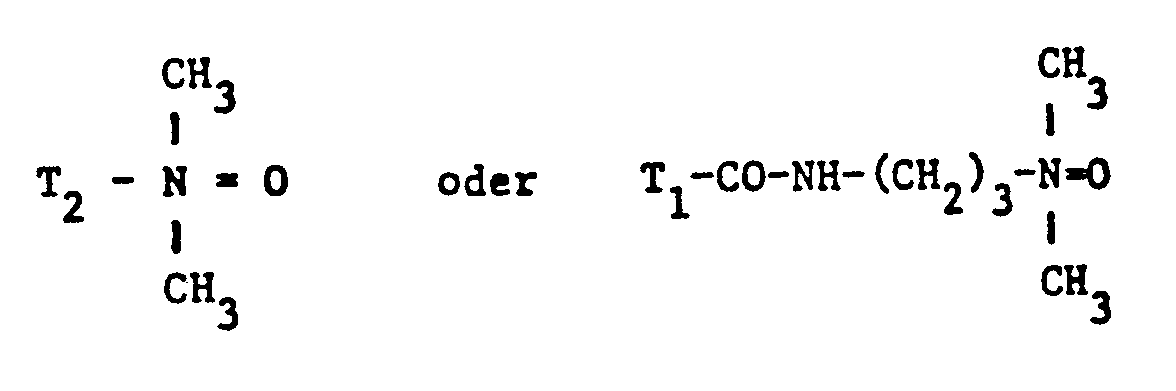





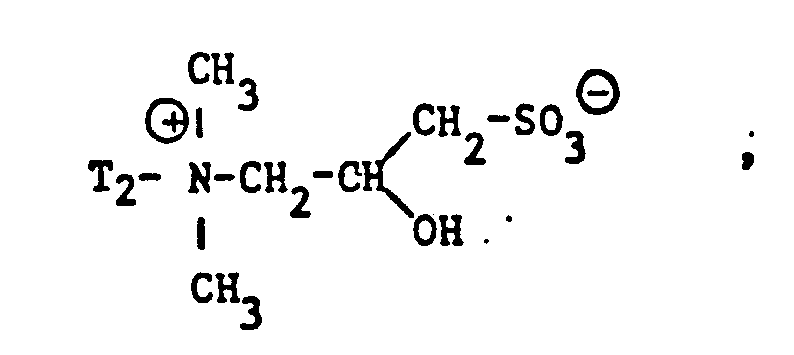


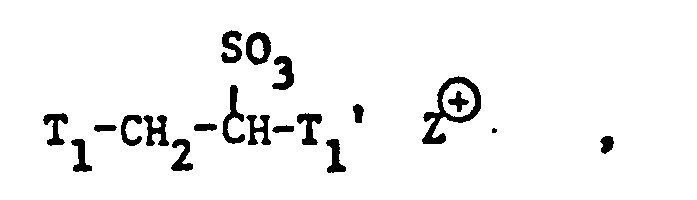
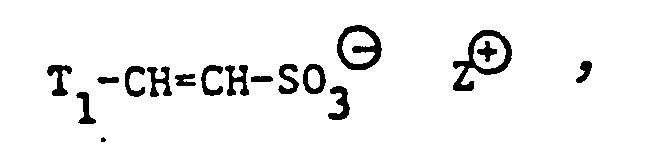


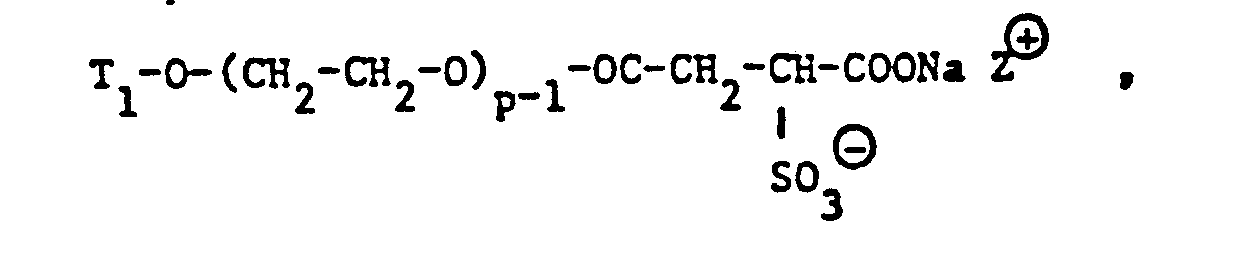


Applications Claiming Priority (2)
| Application Number | Priority Date | Filing Date | Title |
|---|---|---|---|
| CH765581 | 1981-11-30 | ||
| CH7655/81 | 1981-11-30 |
Publications (2)
| Publication Number | Publication Date |
|---|---|
| EP0080976A1 EP0080976A1 (de) | 1983-06-08 |
| EP0080976B1 true EP0080976B1 (de) | 1986-09-24 |
Family
ID=4328519
Family Applications (1)
| Application Number | Title | Priority Date | Filing Date |
|---|---|---|---|
| EP82810503A Expired EP0080976B1 (de) | 1981-11-30 | 1982-11-24 | Gemische aus quaternären, polymeren Ammoniumsalzen auf Acrylbasis, aus quaternären, mono- bis oligomeren Ammoniumsalzen und aus Tensiden, deren Herstellung und Verwendung in kosmetischen Mitteln |
Country Status (3)
| Country | Link |
|---|---|
| EP (1) | EP0080976B1 (de) |
| JP (1) | JPS58103546A (de) |
| DE (1) | DE3273489D1 (de) |
Cited By (40)
| Publication number | Priority date | Publication date | Assignee | Title |
|---|---|---|---|---|
| DE3524950A1 (de) * | 1985-07-12 | 1987-01-15 | Roehm Gmbh | Umweltfreundliche flockungsmittelorganosole |
| US6514918B1 (en) | 2000-08-18 | 2003-02-04 | Johnson & Johnson Consumer Companies, Inc. | Viscous, mild, and effective cleansing compositions |
| US6908889B2 (en) | 1999-05-27 | 2005-06-21 | Johnson & Johnson Consumer Companies, Inc. | Detergent composition with enhanced depositing, conditioning and softness capabilities |
| US7147673B2 (en) | 2003-04-01 | 2006-12-12 | L'oreal S.A. | Composition for dyeing human keratin materials, comprising at least one fluorescent dye and at least one insoluble polyorganosiloxane conditioning polymer, process therefor and use thereof |
| US7150764B2 (en) | 2003-04-01 | 2006-12-19 | L'oreal S.A. | Composition for dyeing a human keratin material, comprising at least one fluorescent dye and at least one insoluble conditioning agent, process thereof, use thereof, and devices thereof |
| US7153331B2 (en) | 2001-12-21 | 2006-12-26 | L'oreal S.A. | Dyeing composition for keratinous fibers comprising an oxyethylene rapeseed fatty acid amide |
| US7157413B2 (en) | 2002-07-08 | 2007-01-02 | L'oreal | Detergent cosmetic compositions comprising an anionic surfactant, an amphoteric, cationic, and/or nonionic surfactant, and a polysacchardie, and use thereof |
| US7186278B2 (en) | 2003-04-01 | 2007-03-06 | L'oreal S.A. | Composition for dyeing human keratin materials, comprising at least one fluorescent dye and at least one compound comprising an acid functional group and processes therefor |
| US7192454B2 (en) | 2003-04-01 | 2007-03-20 | L'oreal S.A. | Composition for dyeing human keratin materials, comprising a fluorescent dye and a particular sequestering agent, process therefor and use thereof |
| US7195651B2 (en) | 2003-04-01 | 2007-03-27 | L'oreal S.A. | Cosmetic composition for dyeing human keratin materials, comprising at least one fluorescent dye and at least one cationic polymer, and a dyeing process therefor |
| US7195650B2 (en) | 2003-04-01 | 2007-03-27 | L'oreal S.A. | Process for dyeing, with a lightening effect, human keratin fibers that have been permanently reshaped, using at least one composition comprising at least one fluorescent dye |
| US7198650B2 (en) | 2003-04-01 | 2007-04-03 | L'oreal S.A. | Method of dyeing human keratin materials with a lightening effect with compositions comprising at least one fluorescent dye and at least one amphoteric or nonionic surfactant, composition thereof, process thereof, and device therefor |
| US7204860B2 (en) | 2003-04-01 | 2007-04-17 | L'oreal | Composition for dyeing human keratin materials, comprising at least one fluorescent dye and at least one polyol, process therefor and use thereof |
| US7208018B2 (en) | 2003-04-01 | 2007-04-24 | L'oreal | Composition for dyeing human keratin materials, comprising at least one fluorescent dye and at least one associative polymer, process therefor and use thereof |
| US7217296B2 (en) | 2001-09-28 | 2007-05-15 | L'oreal S.A. | Dyeing composition with a lightening effect for human keratin materials comprising at least one fluorescent dye |
| US7220408B2 (en) | 2001-11-08 | 2007-05-22 | L'oreal, S.A. | Cosmetic compositions containing a particular aminosilicone and a thickener, and uses thereof |
| US7223385B2 (en) | 2001-11-08 | 2007-05-29 | L'oreal S.A. | Cosmetic compositions containing a particular aminosilicone and a conditioner, and uses thereof |
| US7250064B2 (en) | 2003-04-01 | 2007-07-31 | L'oreal S.A. | Dye composition comprising at least one fluorescent dye and a non-associative thickening polymer for human keratin materials, process therefor, and method thereof |
| US7261744B2 (en) | 2002-12-24 | 2007-08-28 | L'oreal S.A. | Method for dyeing or coloring human keratin materials with lightening effect using a composition comprising at least one fluorescent compound and at least one optical brightener |
| US7303589B2 (en) | 2003-04-01 | 2007-12-04 | L'oreal S.A. | Process for dyeing human keratin fibers, having a lightening effect, comprising at least one fluorescent compound and compositions of the same |
| US7442214B2 (en) | 2005-03-31 | 2008-10-28 | L'oreal S.A. | Dye composition comprising at least one non-ionic associative polymer and process for dyeing keratin fibers using same |
| US7550015B2 (en) | 2005-03-31 | 2009-06-23 | L'oreal S.A. | Dye composition with a reduced content of starting materials, and process for dyeing keratin fibers using the same |
| US7569078B2 (en) | 2005-03-31 | 2009-08-04 | L'oreal S.A. | Dye composition comprising at least one cellulose and process for dyeing keratin fibers using the dye composition |
| US7575605B2 (en) | 2005-03-31 | 2009-08-18 | L'oreal S.A. | Dye composition comprising at least one glycerol ester and a process for dyeing keratin fibers using the composition |
| US7578854B2 (en) | 2005-03-31 | 2009-08-25 | L'oreal S.A. | Dye composition comprising at least one fatty acid ester and process for dyeing keratin fibers using the same |
| US7651535B2 (en) | 2005-02-28 | 2010-01-26 | L'oreal S.A. | Dyeing of in particular human keratin materials by dry thermal transfer of a direct anthraquinone dye, composition comprising the said dye and its method of preparation |
| US7651533B2 (en) | 2005-03-31 | 2010-01-26 | Oreal | Dye composition with a reduced content of starting materials, process for dyeing keratin fibers using the same and device therefor |
| US7722680B2 (en) | 2005-02-28 | 2010-05-25 | L'oreal S.A. | Dyeing of human keratin materials by dry thermal transfer of a direct dye, composition comprising the said dye and its method of preparation |
| US7736631B2 (en) | 2003-04-01 | 2010-06-15 | L'oreal S.A. | Cosmetic dye composition with a lightening effect for human keratin materials, comprising at least one fluorescent dye and at least one aminosilicone, and process of dyeing |
| US7803877B2 (en) | 2002-09-26 | 2010-09-28 | L'oreal S.A. | Block polymers and cosmetic compositions and processes comprising them |
| US7875265B2 (en) | 2002-09-26 | 2011-01-25 | L'oreal | Cosmetic composition comprising a sequenced polymer and a plasticizer |
| US7981404B2 (en) | 2004-04-08 | 2011-07-19 | L'oreal S.A. | Composition for application to the skin, to the lips, to the nails, and/or to hair |
| US7998464B2 (en) | 2005-09-29 | 2011-08-16 | L'oreal S.A. | Process for the photoprotective treatment of artificially dyed keratin fibers by application of a liquid water/steam mixture |
| US8007772B2 (en) | 2002-10-02 | 2011-08-30 | L'oreal S.A. | Compositions to be applied to the skin and the integuments |
| US8119110B2 (en) | 2003-09-26 | 2012-02-21 | L'oreal S.A. | Cosmetic composition comprising a block polymer and a non-volatile silicone oil |
| US8544475B2 (en) | 2005-08-30 | 2013-10-01 | L'oreal | Packaging and applicator assembly including a magnetic device, a magnetic device, a method of forming a pattern on a nail using a magnetic device and a method of manufacturing a magnetic device |
| US8710152B2 (en) | 2006-07-27 | 2014-04-29 | L'oreal | Block polymers and their process of preparation |
| US8790623B2 (en) | 2005-01-18 | 2014-07-29 | Il'Oreal | Composition for treating keratin fibers, comprising at least one aromatic alcohol, at least one aromatic carboxylic acid, and at least one protecting agent |
| US9609934B2 (en) | 2004-10-05 | 2017-04-04 | L'oreal | Method of applying makeup by means of a magnetic composition including at least one interferential pigment |
| US9649261B2 (en) | 2004-10-05 | 2017-05-16 | L'oreal | Method of applying makeup to a surface and a kit for implementing such a method |
Families Citing this family (350)
| Publication number | Priority date | Publication date | Assignee | Title |
|---|---|---|---|---|
| LU83876A1 (fr) * | 1982-01-15 | 1983-09-02 | Oreal | Composition cosmetique destinee au traitement des fibres keratiniques et procede de traitement de celles-ci |
| US5139037A (en) * | 1982-01-15 | 1992-08-18 | L'oreal | Cosmetic composition for treating keratin fibres, and process for treating the latter |
| FR2718961B1 (fr) * | 1994-04-22 | 1996-06-21 | Oreal | Compositions pour le lavage et le traitement des cheveux et de la peau à base de céramide et de polymères à groupements cationiques. |
| US5879670A (en) * | 1997-03-31 | 1999-03-09 | Calgon Corporation | Ampholyte polymers for use in personal care products |
| US6322778B1 (en) | 1998-02-10 | 2001-11-27 | Johnson & Johnson Consumer Companies, Inc. | Hair conditioning compositions comprising a quaternary ammonium compound |
| FR2786391B1 (fr) | 1998-11-26 | 2002-08-02 | Oreal | Composition de coiffage comprenant un polymere aux caracteristiques particulieres et un polymere filmogene ionique |
| FR2788976B1 (fr) | 1999-01-29 | 2003-05-30 | Oreal | Composition anhydre de decoloration de fibres keratiniques comprenant l'association d'un polymere epaississant hydrosoluble et d'un polymere amphiphile non ionique comportant au moins une chaine grasse |
| FR2788975B1 (fr) | 1999-01-29 | 2002-08-09 | Oreal | Composition aqueuse de decoloration de fibres keratiniques prete a l'emploi comprenant l'association d'un solvant hydrosoluble et d'un polymere amphiphile non ionique ou anionique comportant au moins une chaine grasse |
| FR2788974B1 (fr) | 1999-01-29 | 2001-03-30 | Oreal | Composition anhydre de decoloration des fibres keratiniques comprenant l'association de polymeres amphiphiles anioniques et/ou non ioniques comportant au moins une chaine grasse et de polymeres substantifs cationiques ou amphoteres |
| FR2788972B1 (fr) | 1999-02-03 | 2001-04-13 | Oreal | Composition capillaire comprenant une base lavante, un polymere cationique et un polyurethane anionique et utilisation |
| FR2794971B1 (fr) | 1999-06-18 | 2003-08-29 | Oreal | Composition de cosmetique capillaire sous forme d'emulsion d'eau-dans-silicone comprenant au moins un polymere fixant |
| FR2795310B1 (fr) | 1999-06-25 | 2003-02-14 | Oreal | Compositions cosmetiques contenant un polymere amphotere et un polymere fixant/conditionneur et leurs utilisations |
| FR2799971B1 (fr) | 1999-10-20 | 2001-12-07 | Oreal | Compositions cosmetiques contenant un copolymere vinyldimethicone/dimethicone et un polymere cationique et leurs utilisations |
| FR2802093B1 (fr) | 1999-12-08 | 2002-01-18 | Oreal | Composition pour la decoloration ou la deformation permanente des fibres keratiniques comprenant un polymere epaississant a squelette aminoplaste-ether |
| FR2802092B1 (fr) | 1999-12-08 | 2002-01-18 | Oreal | Composition de decoloration pour fibres keratiniques comprenant un polymere epaississant a squelette aminoplaste-ether |
| FR2802090B1 (fr) | 1999-12-08 | 2002-01-18 | Oreal | Composition de teinture directe pour fibres keratiniques comprenant un polymere epaississant a squelette aminoplaste-ether |
| FR2802089B1 (fr) | 1999-12-08 | 2002-01-18 | Oreal | Composition de teinture d'oxydation pour fibres keranitiques comprenant un polymere epaississant a squelette aminoplaste-ether |
| FR2802094B1 (fr) | 1999-12-13 | 2002-01-18 | Oreal | Composition de decoloration pour fibres keratiniques comprenant une association de deux polyethers polyurethanes |
| FR2803195B1 (fr) | 1999-12-30 | 2002-03-15 | Oreal | Composition pour la teinture d'oxydation des fibres keratiniques comprenant un polymere epaississant comportant au moins une chaine grasse et un alcool gras mono-ou poly-glycerole |
| FR2803196B1 (fr) | 1999-12-30 | 2002-03-15 | Oreal | Composition pour la teinture d'oxydation des fibres keratiniques comprenant un alcool gras ayant plus de vingt atomes de carbone et un tensioactif non-ionique oxyalkylene de hlb superieure a 5 |
| FR2803197B1 (fr) | 1999-12-30 | 2002-03-15 | Oreal | Composition pour la teinture d'oxydation des fibres keratiniques comprenant un polymere epaississant comportant au moins une chaine grasse et un alcool gras ayant plus de vingt atomes de carbone |
| FR2806274B1 (fr) | 2000-03-14 | 2002-09-20 | Oreal | Applicateur a bille contenant une composition capilaire |
| DE10027016A1 (de) | 2000-05-31 | 2001-12-20 | Cht R Beitlich Gmbh | Polymerdispersion mit verbesserter biologischer Abbaubarkeit |
| FR2811886B1 (fr) | 2000-07-18 | 2003-01-31 | Oreal | Composition de coiffage des cheveux permettant un remodelage de la coiffure et procede de remodelage de la coiffure utilisant une telle composition |
| FR2812810B1 (fr) | 2000-08-11 | 2002-10-11 | Oreal | Composition pour la teinture d'oxydation des fibres keratiniques comprenant un polymere amphiphile cationique, un alcool gras oxyalkylene ou polyglycerole et un solvant hydroxyle |
| EP1311230A2 (de) | 2000-08-16 | 2003-05-21 | L'oreal | Klebende partikel enthaltende haarformungszusammensetzung |
| FR2816210B1 (fr) | 2000-11-08 | 2005-02-25 | Oreal | Composition pour la decoloration ou la deformation permanente des fibres keratiniques comprenant un polyurethane associatif cationique |
| FR2816207B1 (fr) | 2000-11-08 | 2003-01-03 | Oreal | Composition de teinture d'oxydation pour fibres keratiniques comprenant un polyurethane associatif cationique |
| FR2816208B1 (fr) | 2000-11-08 | 2003-01-03 | Oreal | Composition de teinture directe pour fibres keratiniques comprenant un polyurethane associatif cationique |
| FR2816209B1 (fr) | 2000-11-08 | 2005-02-25 | Oreal | Composition de decoloration pour fibres keratiniques comprenant un polyurethane associatif cationique |
| FR2817466B1 (fr) | 2000-12-04 | 2004-12-24 | Oreal | Composition de teinture d'oxydation pour fibres keratiniques comprenant un polymere associatif et un agent nacrant |
| FR2817467B1 (fr) | 2000-12-04 | 2003-01-10 | Oreal | Composition de teinture pour fibres keratiniques comprenant un polymere associatif et un polymere a motifs acrylamide, halogenure de dialkyldiallylammonium et acide carboxylique vinylique |
| FR2820312B1 (fr) | 2001-02-02 | 2003-05-02 | Oreal | Composition pulverulente pour la decoloration des fibres keratiniques humaines |
| FR2824734B1 (fr) | 2001-05-16 | 2003-06-27 | Oreal | Composition pulverulente pour la decoloration des fibres keratiniques humaines |
| FR2825624B1 (fr) | 2001-06-12 | 2005-06-03 | Oreal | Composition de teinture des fibres keratiniques humaines avec des colorants directs et des composes dicationiques |
| FR2827761B1 (fr) | 2001-07-27 | 2005-09-02 | Oreal | Composition pour la teinture d'oxydation des fibres keratiniques comprenant un alcool gras mono- ou poly-glycerole et un polyol particulier |
| FR2829385B1 (fr) | 2001-09-11 | 2005-08-05 | Oreal | Compositions cosmetiques contenant un copolymere d'acide methacrylique, une huile et leurs utilisations |
| US7147672B2 (en) | 2002-10-21 | 2006-12-12 | L'oreal S.A. | Oxidation dyeing composition for keratin fibers comprising a cationic poly(vinyllactam) and at least one C10-C14 fatty acid, methods and devices for oxidation dyeing |
| US7323015B2 (en) | 2002-10-21 | 2008-01-29 | L'oreal S.A. | Oxidation dyeing composition for keratin fibers comprising a cationic poly(vinyllactam) and at least One C10-C14 fatty alcohol, methods and devices for oxidation dyeing |
| WO2004043330A2 (fr) | 2002-11-07 | 2004-05-27 | L'oreal | Composition cosmetique comprenant au moins un carbonate cyclique particulier apte a polymeriser |
| FR2848105B1 (fr) | 2002-12-06 | 2006-11-17 | Oreal | Composition de teinture d'oxydation pour fibres keratiniques comprenant un alcool gras, un colorant d'oxydation, un polymere associatif et un alkyl sulfate en c14-c30. |
| FR2848102B1 (fr) | 2002-12-06 | 2007-08-03 | Oreal | Composition de teinture d'oxydation comprenant un colorant d'oxydation, un polymere associatif, un compose cellulosique non ionique et un polymere cationique |
| US7329287B2 (en) | 2002-12-06 | 2008-02-12 | L'oreal S.A. | Oxidation dye composition for keratin fibers, comprising at least one oxidation dye, at least one associative polymer, at least one nonionic cellulose-based compound not comprising a C8-C30 fatty chain, and at least one cationic polymer with a charge density of greater than 1 meq/g and not comprising a C8-C30 fatty chain |
| US7326256B2 (en) | 2002-12-06 | 2008-02-05 | L'ORéAL S.A. | Composition for the oxidation dyeing of keratin fibers, comprising at least one non-oxyalkenylated fatty alcohol, at least one oxidation dye, at least one associative polymer, and at least one amide of an alkanolamine and a C14-C30 fatty acid |
| FR2854570B1 (fr) | 2003-05-09 | 2009-07-03 | Oreal | Procede de traitement des fibres keratiniques par application de chaleur |
| US8399001B2 (en) | 2003-11-18 | 2013-03-19 | L'oreal | Cosmetic composition comprising at least one gellan gum or derivative thereof, at least one monovalent salt, and at least one suspension compound, processes using this composition, and uses thereof |
| US8246940B2 (en) | 2003-11-18 | 2012-08-21 | L'oreal S.A. | Cosmetic composition comprising gellan gum or a derivative thereof, a fixing polymer, a monovalent salt and an alcohol, process of using the same |
| FR2863884B1 (fr) | 2003-12-19 | 2007-06-29 | Oreal | Composition coiffante comprenant, dans un milieu majoritairement aqueux, un polyurethane cationique elastique, procedes la mettant en oeuvre et utilisations |
| JP4786535B2 (ja) * | 2004-02-09 | 2011-10-05 | 三菱化学株式会社 | 毛髪化粧料 |
| JP4784102B2 (ja) | 2004-02-09 | 2011-10-05 | 三菱化学株式会社 | 水溶性樹脂及びこれを含有する毛髪化粧料、ならびにシリコンオイル吸着助剤 |
| US7378103B2 (en) | 2004-03-22 | 2008-05-27 | L'oreal | Cosmetic composition comprising a polyglycerolated silicone elastomer |
| FR2873035A1 (fr) | 2004-07-16 | 2006-01-20 | Oreal | Composition cosmetique comprenant un polymere de silicone defini et un agent filmogene. |
| FR2873576B1 (fr) | 2004-07-29 | 2006-11-03 | Oreal | Composition cosmetique comprenant un polyester sulfonique lineaire et une gomme de guar modifiee, procedes mettant en oeuvre cette composition et utilisations |
| FR2873579B1 (fr) | 2004-07-29 | 2006-11-03 | Oreal | Composition cosmetique comprenant un polyester sulfonique lineaire et un polyurethane particulier, procedes mettant en oeuvre cette composition et utilisations |
| US20060024255A1 (en) | 2004-07-30 | 2006-02-02 | L'oréal | Hair styling compositions comprising adhesive particles and non-adhesive particles |
| FR2874820B1 (fr) | 2004-09-08 | 2007-06-22 | Oreal | Composition cosmetique a base d'un tensioactif cationique, d'un alcool gras et d'un diol |
| FR2874824B1 (fr) | 2004-09-09 | 2006-12-01 | Oreal | Composition de coiffage comprenant l'association d'un materiau polymerique hydrophile de haute porosite et polymere fixant |
| FR2875135B1 (fr) | 2004-09-10 | 2006-12-01 | Oreal | Composition cosmetique comprenant des composes ayant une structure cage |
| FR2876026B1 (fr) | 2004-10-04 | 2007-02-09 | Oreal | Composition cosmetique capillaire a base de particules creuses et de polymere fixant non silicone |
| FR2876025B1 (fr) | 2004-10-04 | 2007-02-09 | Oreal | Composition cosmetique capillaire a base de particules creuses et de polyurethane fixant silicone |
| FR2877215B1 (fr) | 2004-10-28 | 2006-12-29 | Oreal | Composition cosmetique comprenant un polyester sulfonique et un polyurethane |
| FR2877927B1 (fr) | 2004-11-16 | 2007-01-26 | Oreal | Dispositif pressurise pour le coiffage des fibres capilaires et utilisation d'un tel dispositif pour la mise en forme et/ou le maintien de la coiffure. |
| FR2877926B1 (fr) | 2004-11-16 | 2007-01-26 | Oreal | Dispositif pressurise pour le coiffage des fibres capillaires et utilisation d'un tel dispositif pour la mise en forme et/ou le soin des fibres capillaires. |
| US7429275B2 (en) | 2004-12-23 | 2008-09-30 | L'oreal S.A. | Use of at least one compound chosen from porphyrin compounds and phthalocyanin compounds for dyeing human keratin materials, compositions comprising them, a dyeing process, and compounds therefor |
| FR2880801B1 (fr) | 2005-01-18 | 2008-12-19 | Oreal | Composition de traitement des fibres keratiniques comprenant un alcool aromatique, un acide carboxylique aromatique et un agent protecteur |
| FR2881346B1 (fr) | 2005-01-28 | 2007-04-27 | Oreal | Procede de traitement capillaire et utilisation dudit procede |
| FR2882560B1 (fr) | 2005-02-28 | 2007-05-18 | Oreal | Composition anhydre sous forme de film comprenant un polymere filmogene et un colorant d'oxydation, preparation et procede de coloration la mettant en oeuvre |
| FR2882559B1 (fr) | 2005-02-28 | 2008-03-21 | Oreal | Composition anhydre sous forme de film comprenant un polymere filmogene et un agent oxydant, preparation et procede de traitement de fibres keratiniques la mettant en oeuvre |
| FR2882519B1 (fr) | 2005-02-28 | 2008-12-26 | Oreal | Coloration de matieres keratiniques notamment humaines par transfert thermique a sec d'un colorant direct azomethinique composition comprenant ledit colorant et son procede de preparation |
| FR2882561B1 (fr) | 2005-02-28 | 2007-09-07 | Oreal | Composition anhydre sous forme de film comprenant un polymere filmogene et un colorant direct, preparation et procede de coloration la mettant en oeuvre |
| FR2883738B1 (fr) | 2005-03-31 | 2007-05-18 | Oreal | Composition colorante comprenant un polymere associatif non ionique, procede de coloration de fibres keratiniques la mettant en oeuvre |
| FR2883737B1 (fr) | 2005-03-31 | 2009-06-12 | Oreal | Composition colorante comprenant un ester de glyceryle et procede de coloration de fibres keratiniques la mettant en oeuvre |
| FR2883746B1 (fr) | 2005-03-31 | 2007-05-25 | Oreal | Composition colorante comprenant une cellulose et procede de coloration de fibres keratiniques la mettant en oeuvre |
| FR2883736B1 (fr) | 2005-03-31 | 2007-05-25 | Oreal | Composition colorante comprenant un ester d'acide gras et procede de coloration de fibres keratiniques la mettant en oeuvre |
| FR2883735B1 (fr) | 2005-03-31 | 2009-06-12 | Oreal | Composition colorante a teneur diminuee en matieres premieres, procede de coloration de fibres keratiniques la mettant en oeuvre et dispositif |
| FR2883734B1 (fr) | 2005-03-31 | 2007-09-07 | Oreal | Composition colorante a teneur diminuee en matieres premieres et procede de coloration de fibres keratiniques la mettant en oeuvre |
| US8586014B2 (en) | 2005-10-28 | 2013-11-19 | L'oreal | Composition for the care of keratin material and cosmetic treatment process using said composition |
| US7867969B2 (en) | 2005-10-28 | 2011-01-11 | L'oreal S.A. | Composition for washing keratin materials comprising a magnesium salt anionic surfactant |
| FR2907678B1 (fr) | 2006-10-25 | 2012-10-26 | Oreal | Composition de coloration des fibres keratiniques comprenant un copolymere bloc polysiloxane/polyuree |
| US7416567B2 (en) | 2006-12-22 | 2008-08-26 | L'oreal | Cosmetic composition for keratinous substrates with triarylmethane compounds |
| FR2910274B1 (fr) | 2006-12-22 | 2009-04-03 | Oreal | Procede de deformation permanente des fibres keratiniques comprenant une etape d'application d'une composition reductrice faiblement concentree et une etape intermediaire de sechage |
| FR2911272B1 (fr) | 2007-01-12 | 2009-03-06 | Oreal | Composition reductrice destinee a etre mise en oeuvre dans un procede de deformation permanente des fibres keratiniques comprenant de la cysteine et de l'acide thiolactique ou l'un de leurs sels |
| FR2912936B1 (fr) | 2007-02-23 | 2011-12-16 | Oreal | Dispositif de pulverisation d'une composition de brillance |
| FR2912935B1 (fr) | 2007-02-23 | 2009-05-15 | Oreal | Dispositif de pulverisation d'une composition de fixation |
| FR2915376B1 (fr) | 2007-04-30 | 2011-06-24 | Oreal | Utilisation d'un agent de couplage multi-carbo sites multi-groupements pour proteger la couleur vis-a-vis du lavage de fibres keratiniques teintes artificiellement; procedes de coloration |
| FR2917972B1 (fr) | 2007-06-29 | 2009-10-16 | Oreal | Composition anhydre sous forme de pate pour la decoloration des fibres keratiniques |
| FR2917968B1 (fr) | 2007-06-29 | 2010-02-26 | Oreal | Compositions cosmetiques detergentes comprenant quatre tensioactifs, un polymere cationique et un agent benefique et utilisation |
| FR2920971B1 (fr) | 2007-09-14 | 2014-03-28 | Oreal | Composition cosmetique comprenant au moins un polymere cationique particulier, au moins un agent tensioactif, au moins un polymere cationique ou amphotere et au moins une particule minerale, et procede de traitement cosmetique. |
| FR2920972B1 (fr) | 2007-09-14 | 2009-12-04 | Oreal | Composition cosmetique comprenant un polymere cationique particulier et au moins un ester d'acide gras en c8-c24 et de sorbitan oxyethylene comprenant 2 a 10 motifs d'oxyethylene, et procede de traitement cosmetique. |
| FR2920978B1 (fr) | 2007-09-14 | 2012-04-27 | Oreal | Composition cosmetique comprenant un copolymere cationique et un amidon et procede de traitement cosmetique. |
| FR2920977B1 (fr) | 2007-09-14 | 2012-07-27 | Oreal | Compositions cosmetiques contenant un copolymere cationique et un triglyceride particulier et leurs utilisations. |
| FR2920969B1 (fr) | 2007-09-14 | 2009-12-18 | Oreal | Compositions cosmetiques contenant un copolymere cationique, une silicone aminee et un polymere cationique et leurs utilisations. |
| FR2920976B1 (fr) | 2007-09-14 | 2009-12-04 | Oreal | Composition cosmetique comprenant un copolymere cationique et un polymere associatif anionique et procede de traitement cosmetique. |
| FR2924337A1 (fr) | 2007-11-30 | 2009-06-05 | Oreal | Composition de coiffage repositionnable comprenant au moins un copolymere (meth)acrylique et au moins une silicone. |
| FR2924336A1 (fr) | 2007-11-30 | 2009-06-05 | Oreal | Composition de coiffage comprenant des copolymeres (meth)acryliques et au moins une huile. |
| FR2924338B1 (fr) | 2007-11-30 | 2010-09-03 | Oreal | Composition de coiffage comprenant au moins un copolymere (meth)acrylique et au moins un agent nacrant. |
| MY148610A (en) * | 2007-12-12 | 2013-05-15 | Mimos Berhad | Process for the preparation of fluorinated quaternary ammonium salts |
| EP2224802A2 (de) * | 2007-12-21 | 2010-09-08 | Cognis IP Management GmbH | Adjuvanzien für agrochemische anwendungen |
| FR2930440B1 (fr) | 2008-04-28 | 2012-12-14 | Oreal | Composition cosmetique comprenant un polyurethane cationique et un polyacrylate particulier et utilisations en coiffage |
| FR2930441B1 (fr) | 2008-04-28 | 2010-05-28 | Oreal | Compression cosmetique comprenant un polyrethane cationique et un derive de cellulose et utilisations en coiffage |
| FR2930436B1 (fr) | 2008-04-28 | 2010-06-11 | Oreal | Composition cosmetique comprenant une emulsion obtenue par un procede pit |
| FR2930442B1 (fr) | 2008-04-28 | 2010-06-11 | Oreal | Composition cosmetique comprenant une emulsion obtenue par procede pit |
| FR2939657B1 (fr) | 2008-12-15 | 2011-02-11 | Oreal | Composition cosmetique comprenant une polyamine portant des groupes diazirines et utilisation pour le photo-greffage d'un polymere non saccharidique different des polymeres polyamines |
| WO2010076483A1 (fr) | 2008-12-16 | 2010-07-08 | L'oreal | Composition cosmetique comprenant un polyester, une huile organique et de l'eau. |
| WO2010076484A1 (fr) | 2008-12-16 | 2010-07-08 | L'oreal | Composition cosmetique anhydre comprenant un polyester, une huile volatile et une huile non volatile. |
| FR2940063B1 (fr) | 2008-12-19 | 2011-02-11 | Oreal | Compositions anti-transpirantes contenant au moins un complexe forme par l'association d'au moins une espece anionique et d'au moins une espece cationique et procede de traitement de la transpiration humaine. |
| FR2940078B1 (fr) | 2008-12-19 | 2011-05-13 | Oreal | Composition comprenant un corps gras et un polymere cationique, procede de coloration la mettant en oeuvre et dispositifs |
| FR2940094B1 (fr) | 2008-12-22 | 2011-02-25 | Oreal | Composition cosmetique detergente comprenant quatre tensioactifs, un polymere cationique et un sel de zinc |
| EP2198850A1 (de) | 2008-12-22 | 2010-06-23 | L'oreal | Kosmetische Zusammensetzung enthaltend ein nicht silikoniertes Fettderivat und vier Tenside |
| FR2941621B1 (fr) | 2009-01-30 | 2011-04-01 | Oreal | Composition cosmetique comprenant un alkoxysilane particulier et une gomme microbienne et utilisations en coiffage |
| FR2943895B1 (fr) | 2009-04-03 | 2011-05-06 | Oreal | Procede de traitement des cheveux a l'aide de vapeur d'eau. |
| FR2944438B1 (fr) | 2009-04-15 | 2011-06-17 | Oreal | Procede de mise en forme des cheveux au moyen d'une composition reductrice et d'un chauffage. |
| JP2011001344A (ja) | 2009-04-30 | 2011-01-06 | L'oreal Sa | アミノトリアルコキシシランまたはアミノトリアルケニルオキシシラン組成物を用いたヒトケラチン繊維の明色化および/または着色ならびに装置 |
| FR2944961B1 (fr) | 2009-04-30 | 2011-05-27 | Oreal | Procede coloration des cheveux comprenant une etape de traitement des cheveux a partir d'un compose organique du silicium |
| EP2432448A2 (de) | 2009-05-22 | 2012-03-28 | L'Oréal | Kosmetische zusammensetzung mit zumindest einem elastomeren polyurethan |
| EP2432449A2 (de) | 2009-05-22 | 2012-03-28 | L'Oréal | Kosmetische zusammensetzung mit zumindest einem elastomeren anionischen polyurethan und zumindest einem nichtionischen verdickungsmittel |
| FR2949970B1 (fr) | 2009-09-15 | 2011-09-02 | Oreal | Utilisation d'une huile siccative pour proteger la couleur vis-a-vis du lavage de fibres keratiniques teintes artificiellement ; procedes de coloration |
| FR2954149B1 (fr) | 2009-12-17 | 2014-10-24 | Oreal | Composition cosmetique comprenant un tensioactif, un alcool gras liquide et un polymere associatif non ionique et procede de traitement cosmetique |
| FR2954114B1 (fr) | 2009-12-17 | 2013-10-11 | Oreal | Composition cosmetique comprenant un tensioactif, un alcool gras liquide et un ether d'alcool gras oxyethylene et procede de traitement cosmetique |
| EP2512602B1 (de) | 2009-12-18 | 2017-11-22 | L'Oréal | Verfahren zur behandlung von keratinfasern |
| FR2954129B1 (fr) | 2009-12-23 | 2012-03-02 | Oreal | Composition cosmetique comprenant au moins un compose organique du silicium, au moins deux tensioactifs anioniques et au moins un tensioactif amphotere |
| FR2954108B1 (fr) | 2009-12-23 | 2012-03-09 | Oreal | Utilisation d'une composition cosmetique contenant un alcane lineaire volatil et un polymere associatif non ionique pour le conditionnement des cheveux |
| FR2954107B1 (fr) | 2009-12-23 | 2012-04-20 | Oreal | Composition cosmetique sous forme de nanoemulsion contenant un alcane lineaire volatil |
| FR2954139B1 (fr) | 2009-12-23 | 2012-05-11 | Oreal | Composition cosmetique comprenant au moins un alcane lineaire volatil et au moins un polymere cationique non-proteique |
| FR2954154B1 (fr) | 2009-12-23 | 2012-02-24 | Oreal | Composition cosmetique comprenant au moins un alcane lineaire volatil, au moins une silicone et au moins un corps gras dans un rapport corps gras/silicone particulier |
| FR2954128B1 (fr) | 2009-12-23 | 2012-02-17 | Oreal | Composition cosmetique comprenant au moins un compose organique du silicium, au moins un tensioactif anionique et au moins un agent epaississant non ionique ainsi qu'un procede mettant en oeuvre la composition |
| FR2954112B1 (fr) | 2009-12-23 | 2013-02-22 | Oreal | Composition cosmetique comprenant au moins un alcane lineaire volatil, au moins un tensioactif cationique dans un rapport alcane(s) lineaire(s) volatil(s)/tensioactif(s) cationique(s) particulier |
| FR2954135B1 (fr) | 2009-12-23 | 2012-02-24 | Oreal | Composition cosmetique comprenant au moins un compose organique du silicium, au moins un tensioactif anionique et au moins une silicone aminee ainsi qu'un procede mettant en oeuvre ladite composition |
| FR2954100B1 (fr) | 2009-12-23 | 2012-03-09 | Oreal | Composition cosmetique comprenant au moins un compose organique du silicium, au moins un tensioactif anionique et au moins un polymere cationique |
| FR2956809B1 (fr) | 2010-03-01 | 2014-09-26 | Oreal | Composition comprenant de l'acide ellagique et un tensioactif cationique particulier et son utilisation en cosmetique |
| FR2956808B1 (fr) | 2010-03-01 | 2012-05-25 | Oreal | Utilisation de l'acide ellagique comme agent anti-pelliculaire. |
| FR2956812B1 (fr) | 2010-03-01 | 2013-03-08 | Oreal | Composition cosmetique a base d'acide ellagique ou d'un de ses derives et d'un extrait de bacterie. |
| FR2956811B1 (fr) | 2010-03-01 | 2012-05-25 | Oreal | Composition cosmetique anti-pelliculaire a base d'acide ellagique ou d'un de ses derives et d'un second compose actif different dans un rapport ponderal particulier. |
| EP2542216A2 (de) | 2010-03-01 | 2013-01-09 | L'Oréal | Kosmetische zusammensetzung auf der basis von ellagsäure oder eines derivats daraus sowie einer bestimmten tensidmischung |
| FR2957790B1 (fr) | 2010-03-25 | 2012-07-06 | Oreal | Composition comprenant un copolymere silicone, un tensioactif silicone, procede de traitement cosmetique et utilisation |
| FR2959666B1 (fr) | 2010-05-07 | 2012-07-20 | Oreal | Composition cosmetique moussante a base d'acide ellagique ou d'un de ses derives et d'huile essentielle. |
| FR2961395B1 (fr) | 2010-06-17 | 2012-07-27 | Oreal | Composition cosmetique comprenant un polyester sulfonique ramifie et un epaississant particulier et utilisations en coiffage |
| FR2964317B1 (fr) | 2010-09-06 | 2013-04-12 | Oreal | Composition cosmetique comprenant un polymere fixant et un epaississant particulier et utilisations en coiffage |
| FR2964319B1 (fr) | 2010-09-06 | 2017-01-13 | Oreal | Composition cosmetique comprenant au moins un polymere cationique et au moins deux tensioactifs |
| WO2012032673A1 (en) | 2010-09-08 | 2012-03-15 | L'oreal | Cosmetic composition for keratin fibers |
| FR2964565B1 (fr) | 2010-09-14 | 2012-09-07 | Oreal | Composition cosmetique comprenant un polymere fixant et un agent antipelliculaire |
| FR2965174B1 (fr) | 2010-09-24 | 2013-04-12 | Oreal | Composition cosmetique comprenant au moins un sel hygroscopique, au moins un ether aromatique de polyol et au moins un diol, procede de traitement cosmetique |
| FR2965481B1 (fr) | 2010-10-01 | 2013-04-19 | Oreal | Procede de traitement des fibres keratiniques mettant en oeuvre au moins un reducteur soufre, au moins un polymere cationique et au moins un mercaptosiloxane |
| WO2012049145A1 (en) | 2010-10-12 | 2012-04-19 | L'oreal | Cosmetic composition comprising a particular silicon derivative and one or more acrylic thickening polymers |
| FR2966357A1 (fr) | 2010-10-26 | 2012-04-27 | Oreal | Composition cosmetique comprenant un alcoxysilane a chaine grasse et un agent antipelliculaire |
| FR2966352B1 (fr) | 2010-10-26 | 2016-03-25 | Oreal | Composition cosmetique comprenant un alcoxysilane a chaine grasse et un polymere cationique |
| FR2966725B1 (fr) | 2010-11-02 | 2013-02-22 | Oreal | Composition de coloration a faible teneur en ammoniaque |
| US20120128616A1 (en) | 2010-11-19 | 2012-05-24 | Voisin Sebastien | Cosmetic composition comprising at least one elastomeric polyurethane and at least one cationic polymer |
| FR2968309B1 (fr) * | 2010-12-02 | 2014-04-11 | Seppic Sa | Nouveaux epaississants cationiques, utilisables sur une large gamme de ph procede pour leur preparation et composition en contenant. |
| FR2968209B1 (fr) | 2010-12-03 | 2013-07-12 | Oreal | Compositions cosmetiques contenant une silicone non aminee, un ester gras liquide et une silicone aminee, procedes et utilisations |
| FR2968204B1 (fr) | 2010-12-07 | 2012-12-14 | Oreal | Composition comprenant un precurseur de colorant d'oxydation, un polycondensat d'oxyde d'ethylene et d'oxyde de propylene et un polymere cationique de densite de charge superieure ou egale a 4 meq/g |
| EP2651372B2 (de) | 2010-12-14 | 2023-10-25 | L'oreal | Aerosolvorrichtung mit zwei behältern welche eine (hydro)alkoholische haarstylingzusammenstzung enthält sowie methode zum haarstyling |
| FR2968939B1 (fr) | 2010-12-21 | 2014-03-14 | Oreal | Composition cosmetique comprenant un sel de zinc particulier et un ester gras |
| FR2968942B1 (fr) | 2010-12-21 | 2016-02-12 | Oreal | Composition cosmetique comprenant un sel de zinc et du 1,2-octanediol |
| FR2968940B1 (fr) | 2010-12-21 | 2013-04-19 | Oreal | Composition cosmetique comprenant un sel de zinc particulier et une silicone aminee |
| FR2968944B1 (fr) | 2010-12-21 | 2013-07-12 | Oreal | Composition comprenant un sel de zinc non azote et un agent tensioactif cationique particulier |
| FR2968941B1 (fr) | 2010-12-21 | 2014-06-06 | Oreal | Composition cosmetique comprenant un sel de zinc particulier et un amidon |
| FR2968943B1 (fr) | 2010-12-21 | 2013-07-05 | Oreal | Composition cosmetique comprenant un sel de zinc, un polymere cationique et un agent propulseur |
| FR2971157B1 (fr) | 2011-02-08 | 2013-10-04 | Oreal | Procede d'application d'une composition capillaire sur les cheveux. |
| WO2012110608A2 (fr) | 2011-02-17 | 2012-08-23 | L'oreal | Procédé de traitement des fibres kératiniques mettant en oeuvre une silicone élastomère en association avec de la chaleur |
| EP3378313A1 (de) | 2011-03-23 | 2018-09-26 | Basf Se | Zusammensetzungen mit polymeren, ionischen verbindungen mit imidazoliumgruppen |
| FR2973661A1 (fr) | 2011-04-08 | 2012-10-12 | Oreal | Procede de traitement des cheveux. |
| WO2012149617A1 (en) | 2011-05-04 | 2012-11-08 | L'oreal S.A. | Detergent cosmetic compositions comprising four surfactants, a cationic polymer and a silicone, and use thereof |
| FR2975593B1 (fr) | 2011-05-27 | 2013-05-10 | Oreal | Composition comprenant un alcoxysilane et un amidon modifie et son utilisation en cosmetique |
| FR2975594B1 (fr) | 2011-05-27 | 2013-05-10 | Oreal | Composition comprenant un alcoxysilane, un ester gras et une silicone et son utilisation en cosmetique |
| US9180086B2 (en) | 2011-06-01 | 2015-11-10 | L'oreal | Process for treating straightened keratin fibres |
| FR2976483B1 (fr) | 2011-06-17 | 2013-07-26 | Oreal | Composition cosmetique comprenant un tensioactif anionique, un tensioactif non ionique ou amphotere et un alcool gras solide et procede de traitement cosmetique |
| US8506650B2 (en) | 2011-06-24 | 2013-08-13 | L'oreal | Emulsion dyeing composition containing at least one polyamine, at least one nonionic surfactant and at least one phosphate ester, and method of using same |
| US8795644B2 (en) | 2011-06-24 | 2014-08-05 | L'oreal | Compositions containing a phospholipid, a nonionic surfactant, and a phosphate ester for lifting color and/or imparting shine onto keratinous substrates |
| WO2012175690A2 (en) | 2011-06-24 | 2012-12-27 | L'oreal | Compositions containing an amine or a phospholipid, a nonionic surfactant, and a carboxylate compound for lifting color and/or imparting shine onto keratinous substrates |
| US8523955B2 (en) | 2011-06-24 | 2013-09-03 | L'oreal | Emulsion dyeing composition containing at least one fatty quaternary amine, at least one nonionic surfactant and at least one silicone, and method of using same |
| US8802070B2 (en) | 2011-06-24 | 2014-08-12 | L'oreal | Compositions containing a phospholipid, a nonionic surfactant, and an anionic silicone for lifting color and/or imparting shine onto keratinous substrates |
| US8540782B2 (en) | 2011-06-24 | 2013-09-24 | L'oreal | Emulsion dyeing composition containing at least one quarternary amine, at least one nonionic surfactant and at least one carboxylic acid and method of using the same |
| US8388698B2 (en) | 2011-06-24 | 2013-03-05 | L'oreal | Emulsion dyeing composition containing at least one polyamine, at least one nonionic surfactant and at least one carboxylic acid, and method of using same |
| WO2012175687A2 (en) | 2011-06-24 | 2012-12-27 | L'oreal | Emulsion dyeing composition containing an amine or a phospholipid, at least one nonionic surfactant and at least one phosphate ester, and method of using same |
| WO2012175686A2 (en) | 2011-06-24 | 2012-12-27 | L'oreal | Compositions containing an amine or a phospholipid, a nonionic surfactant, and a phosphate ester for lifting color and/or imparting shine onto keratinous substrates |
| US8394152B2 (en) | 2011-06-24 | 2013-03-12 | L'oreal | Emulsion dyeing composition containing at least one amine, at least one nonionic surfactant and at least one carboxylic acid, and method of using same |
| US8802071B2 (en) | 2011-06-24 | 2014-08-12 | L'oreal | Compositions containing a fatty quaternary amine, a nonionic surfactant, and a carboxylate compound for lifting color and/or imparting shine onto keratinous substrates |
| US8518125B2 (en) | 2011-06-24 | 2013-08-27 | L'oreal | Emulsion dyeing composition containing at least one phospholipid, at least one nonionic surfactant and at least one carboxylic acid, and method of using same |
| US8795645B2 (en) | 2011-06-24 | 2014-08-05 | L'oreal | Compositions containing a fatty quaternary amine, a nonionic surfactant, and an anionic silicone for lifting color and/or imparting shine onto keratinous substrates |
| US8758735B2 (en) | 2011-06-24 | 2014-06-24 | L'oreal | Compositions containing a fatty quaternary amine, a nonionic surfactant, and a phosphate ester for lifting color and/or imparting shine onto keratinous substrates |
| CN103619314A (zh) | 2011-07-05 | 2014-03-05 | 莱雅公司 | 包含烷氧基化脂肪醇醚和脂肪醇或脂肪酸酯的染料组合物 |
| FR2977482B1 (fr) | 2011-07-05 | 2013-11-08 | Oreal | Composition de coloration mettant en oeuvre un ether a longue chaine d'un alcool gras alcoxyle et un polymere cationique, procedes et dispositifs |
| BR112013032002A2 (pt) | 2011-07-05 | 2017-10-03 | Oreal | Composição para tingir fibras de queratina, método para tingir fibras de queratina e dispositivo de múltiplos compartimentos |
| WO2013042274A1 (en) | 2011-09-22 | 2013-03-28 | L'oreal | Cosmetic cleansing composition |
| WO2013061477A1 (en) | 2011-10-26 | 2013-05-02 | L'oreal | Hair coloration by thermal transfer technology |
| FR2984159B1 (fr) | 2011-12-19 | 2014-01-31 | Oreal | Composition cosmetique comprenant une cellulose hydrophobiquement modifiee, un tensioactif anionique sulfate ou sulfonate, et un alcool gras ramifie. |
| FR2984135B1 (fr) | 2011-12-19 | 2013-12-20 | Oreal | Composition cosmetique comprenant un polymere associatif anionique ou non ionique, un polymere fixant et un tensioactif particulier et utilisation en coiffage |
| FR2984136B1 (fr) | 2011-12-19 | 2013-12-20 | Oreal | Composition cosmetique comprenant un polymere associatif anionique ou non ionique, un polymere fixant et un tensioactif particulier et utilisation en coiffage |
| FR2984156B1 (fr) | 2011-12-19 | 2016-08-26 | Oreal | Composition cosmetique comprenant une cellulose hydrophobiquement modifiee et un tensioactif anionique a groupement(s) carboxylate(s) |
| EP2793831B2 (de) | 2011-12-20 | 2021-11-10 | L'Oréal | Kosmetische behandlung mit einer zusammensetzung enthaltend ein anionisches tensid, einen festen fettalkohol und einen festen fettester |
| FR2985905B1 (fr) | 2012-01-23 | 2014-10-17 | Oreal | Composition comprenant au moins un polymere alcoxysilane particulier |
| FR2990131B1 (fr) | 2012-05-07 | 2015-12-25 | Oreal | Dispositif aerosol a base de sel de calcium et de polymere fixant |
| ES2690780T3 (es) | 2012-06-07 | 2018-11-22 | L'oreal | Proceso de moldeado capilar utilizando cuerpos grasos |
| WO2014002290A1 (en) | 2012-06-29 | 2014-01-03 | L'oreal | Cosmetic composition for keratin fibers |
| RU2015106932A (ru) | 2012-08-02 | 2016-09-20 | Л'Ореаль | Композиция для окрашивания, содержащая жировое вещество, неионную гуаровую камедь, амфотерное поверхностно-активное вещество и неионное или анионное поверхностно-активное вещество и окислитель, способ окрашивания и подходящее устройство |
| FR2994091B1 (fr) | 2012-08-02 | 2014-08-01 | Oreal | Composition de coloration comprenant de la gomme de guar non ionique ou l'un de ses derives non ionique, procede et dispositif |
| FR2994084B1 (fr) | 2012-08-02 | 2014-10-31 | Oreal | Composition de coloration sous forme de creme comprenant au moins une huile, pas ou peu d'alcool gras solide, procede de coloration et dispositif approprie |
| ES2709026T5 (es) | 2012-08-02 | 2022-12-22 | Oreal | Composición para teñir que comprende al menos una sustancia grasa, al menos un agente oxidante y al menos un tensioactivo no iónico, aniónico y anfótero |
| FR2994385B1 (fr) | 2012-08-07 | 2016-10-28 | Oreal | Composition cosmetique biphasique conditionnee en flacon-pompe |
| FR2994388B1 (fr) | 2012-08-07 | 2014-09-05 | Oreal | Composition cosmetique comprenant au moins un polymere fixant particulier et au moins un polymere epaississant particulier |
| JP6339084B2 (ja) | 2012-10-02 | 2018-06-06 | ロレアル | エマルジョン系中の脂肪性物質およびレオロジー調整ポリマーを含有するケラチン繊維の色を変更するための薬剤 |
| WO2014056962A2 (en) | 2012-10-11 | 2014-04-17 | L'oreal | Cosmetic composition comprising a bacterial lysate, a thickener and a particular surfactant system, and cosmetic treatment process |
| WO2014068795A1 (en) | 2012-10-31 | 2014-05-08 | L'oreal | Use of triazine derivatives for permanent deformation of keratin fibers |
| FR2997848B1 (fr) | 2012-11-09 | 2015-01-16 | Oreal | Composition comprenant un derive dicarbonyle et procede de lissage des cheveux a partir de cette composition |
| FR2997845B1 (fr) | 2012-11-09 | 2015-03-06 | Oreal | Procede de lissage des cheveux a partir d'une composition contenant de l'acide glyoxylique et/ou un de ses derives |
| FR2999077B1 (fr) | 2012-12-11 | 2019-06-07 | L'oreal | Composition cosmetique comprenant un tensioactif non ionique, un ten-sioactif cationique, un ester gras liquide et une silicone particuliere, et pro-cede de traitement cosmetique |
| FR2999078B1 (fr) | 2012-12-11 | 2015-08-07 | Oreal | Composition cosmetique comprenant l'association de tensioactifs non ionique et cationique, et procede de traitement cosmetique |
| FR2999423B1 (fr) | 2012-12-14 | 2015-03-13 | Oreal | Composition cosmetique sous forme de poudre comprenant un polymere epaississant (meth)acrylique, un polymere fixant, des particules insolubles dans l'eau |
| FR3001145B1 (fr) | 2013-01-18 | 2015-07-17 | Oreal | Composition cosmetique solide souple comprenant des tensioactifs anio-niques et des polyols, et procede de traitement cosmetique |
| FR3001147B1 (fr) | 2013-01-18 | 2015-07-17 | Oreal | Composition cosmetique solide souple, comprenant des tensioactifs anio-niques et des particules solides, et procede de traitement cosmetique |
| FR3001144B1 (fr) | 2013-01-18 | 2015-07-17 | Oreal | Composition cosmetique solide souple comprenant des tensioactifs anioniques et des agents conditionneurs polymeriques, et procede de traitement cosmetique |
| FR3001149B1 (fr) | 2013-01-18 | 2015-01-16 | Oreal | Procede de mise en forme des cheveux dans lequel on applique une composition de coiffage particuliere que l'on rince |
| FR3004902A1 (fr) | 2013-04-30 | 2014-10-31 | Oreal | Dispositif aerosol a diffusion a multi-orifices pour la mise en forme des cheveux et/ou le maintien de la coiffure |
| FR3004929B1 (fr) | 2013-04-30 | 2015-04-10 | Oreal | Dispositif aerosol a base de poudre absorbante de sebum et de carbonate de calcium |
| FR3004901B1 (fr) | 2013-04-30 | 2016-02-12 | Oreal | Dispositif aerosol a diffusion a multi-orifices pour le lavage a sec des cheveux |
| WO2014188007A1 (en) | 2013-05-24 | 2014-11-27 | L'oreal | Cosmetic composition comprising an aqueous phase and a fatty phase that are visually distinct |
| EP3010592B1 (de) | 2013-06-17 | 2018-10-17 | L'oreal | Kosmetische zusammensetzung mit einem mineralischen wachs, einer fettsäure, einem mineralöl, einem tensid, einer fettsäure und/oder einem fettalkoholester und einem fixierenden polymer |
| FR3009680B1 (fr) | 2013-08-13 | 2018-05-18 | L'oreal | Composition comprenant un silane, un polymere fixant particulier et un polymere epaississant cellulosique |
| FR3010899B1 (fr) | 2013-09-24 | 2017-02-17 | Oreal | Composition cosmetique comprenant une association d'agents tensioactifs anioniques de types carboxylate et acyl-isethionate. |
| FR3010900B1 (fr) | 2013-09-24 | 2017-02-17 | Oreal | Composition cosmetique comprenant une association d'agents tensioactifs de types carboxylate, acyl-isethionate, et alkyl(poly)glycoside. |
| FR3013972B1 (fr) | 2013-12-02 | 2016-01-01 | Oreal | Composition comprenant au moins un polymere associatif anionique, au moins un polymere fixant anionique et au moins un amidon |
| FR3015274B1 (fr) | 2013-12-19 | 2016-12-09 | Oreal | Composition de coloration comprenant au moins 70% de corps gras et un melange de tensioactifs oxyethylenes |
| FR3015273B1 (fr) | 2013-12-19 | 2015-12-25 | Oreal | Composition de coloration riche en corps gras comprenant un melange de tensioactifs oxyethylenes |
| FR3015272B1 (fr) | 2013-12-19 | 2016-01-08 | Oreal | Procede de coloration mettant en œuvre des compositions riches en corps gras |
| FR3015252B1 (fr) | 2013-12-19 | 2015-12-25 | Oreal | Composition riche en corps gras comprenant du peroxyde d'hydrogene, un persel et des tensioactifs oxyethylenes |
| US20150265525A1 (en) | 2014-03-21 | 2015-09-24 | L'oreal | Composition for altering the color of keratin fibers |
| FR3022770B1 (fr) | 2014-06-30 | 2016-07-29 | Oreal | Dispositif aerosol a base de sel de calcium, de polymere fixant, de tensioactif et d'eau |
| US10780030B2 (en) | 2014-07-31 | 2020-09-22 | L'oreal | Carbonated cosmetic products containing polymers |
| FR3027798B1 (fr) | 2014-10-29 | 2017-12-22 | Oreal | Composition a base de poudre coiffante et/ou absorbante de sebum et un sel de zinc |
| FR3027800B1 (fr) | 2014-10-29 | 2018-01-26 | L'oreal | Composition a base de poudre coiffante et/ou absorbante de sebum et un sel d'aluminium |
| FR3030243B1 (fr) | 2014-12-17 | 2018-11-09 | L'oreal | Composition de coloration comprenant une base d'oxydation para-phenylenediamine et une base d'oxydation heterocyclique |
| FR3030233B1 (fr) | 2014-12-17 | 2016-12-09 | Oreal | Composition de coloration comprenant une base d'oxydation para-phenylenediamine, et un polymere amphotere ou cationique dans un milieu riche en corps gras |
| FR3030237B1 (fr) | 2014-12-17 | 2017-07-14 | Oreal | Composition de coloration comprenant une base d'oxydation para-phenylenediamine, un tensio actif amphotere dans un milieu riche en corps gras |
| FR3030234B1 (fr) | 2014-12-17 | 2018-05-18 | Oreal | Composition de coloration comprenant une base d'oxydation para-phenylenediamine, un tensio actif non ionique dans un milieu riche en corps gras |
| FR3030244B1 (fr) | 2014-12-17 | 2018-07-06 | L'oreal | Composition de coloration comprenant une base d'oxydation para-phenylenediamine et un coupleur particulier |
| FR3030255B1 (fr) | 2014-12-17 | 2016-12-23 | Oreal | Composition de coloration comprenant une base d'oxydation para-phenylenediamine, un epaississant polysaccharide dans un milieu riche en corps gras |
| FR3030239B1 (fr) | 2014-12-17 | 2016-12-09 | Oreal | Composition de coloration comprenant une base d'oxydation para-phenylenediamine et une base additionnelle |
| FR3031453B1 (fr) | 2015-01-08 | 2017-01-13 | Oreal | Procede de traitement capillaire apportant de la brillance au moyen d'un dispositif aerosol |
| FR3031437B1 (fr) | 2015-01-08 | 2017-01-13 | Oreal | Dispositif aerosol pour la mise en forme des cheveux et/ou le maintien de la coiffure |
| FR3032117B1 (fr) | 2015-01-29 | 2018-03-16 | L'oreal | Composition comprenant une silicone fonctionnalisee par au moins un motif alcoxysilane et un polymere fixant non ionique ou anionique |
| FR3032118B1 (fr) | 2015-01-29 | 2018-03-16 | L'oreal | Composition aerosol comprenant une silicone fonctionnalisee par au moins un motif alcoxysilane et un polymere fixant amphotere et/ou cationique |
| FR3032119B1 (fr) | 2015-01-29 | 2017-01-20 | Oreal | Procede de traitement des cheveux avec au moins une silicone fonctionnalisee par au moins un motif alcoxysilane, et de la vapeur |
| EP3277252B1 (de) | 2015-04-02 | 2020-08-12 | L'Oréal | Kosmetische zusammensetzung mit nicht-amino-polyalkylsiloxanen, oxyethylierten polymeren und fettalkoholen |
| JP2017025051A (ja) | 2015-07-28 | 2017-02-02 | ロレアル | ケラチン繊維用の組成物、プロセス、方法及び使用 |
| US10111816B2 (en) | 2015-08-05 | 2018-10-30 | L'oreal | Composition for altering the color of keratin fibers |
| FR3044879B1 (fr) | 2015-12-14 | 2018-01-19 | L'oreal | Dispositif de distribution d'un produit de coloration et/ou d'eclaircissement des fibres keratiniques comprenant un polymere associatif |
| JP6812100B2 (ja) | 2015-12-15 | 2021-01-13 | ロレアル | ポリイオンコンプレックス粒子と親水性又は水溶性uv遮蔽剤との組合せ |
| JP6921476B2 (ja) | 2015-12-15 | 2021-08-18 | ロレアル | ポリイオンコンプレックス粒子と2つ以上の酸解離定数を有する非ポリマー酸との組合せ |
| FR3045331B1 (fr) | 2015-12-21 | 2019-09-06 | L'oreal | Composition de coloration a ph acide comprenant un colorant direct de structure triarylmethane |
| FR3045361B1 (fr) | 2015-12-21 | 2018-02-02 | L'oreal | Composition comprenant un copolymere vinylformamide/vinylamine, un polymere fixant et une association particuliere d'agents tensioactifs |
| FR3045346B1 (fr) | 2015-12-21 | 2019-08-30 | L'oreal | Composition de coloration comprenant un colorant direct de structure triarylmethane, et une silicone |
| FR3045376B1 (fr) | 2015-12-22 | 2018-02-16 | L'oreal | Procede de traitement capillaire mettant en oeuvre une composition comprenant au moins un copolymere acrylique cationique |
| FR3045375B1 (fr) | 2015-12-22 | 2020-02-21 | L'oreal | Composition non colorante comprenant un copolymere acrylique cationique et un agent de conditionnement |
| BR112018010483A8 (pt) | 2016-03-31 | 2019-02-26 | Oreal | ?composições para cuidados dos cabelos, método e método para conferir modelagem durável ou propriedades de forma e/ ou controle de frisado? |
| US11246824B2 (en) | 2016-07-07 | 2022-02-15 | L'oreal | Cosmetic composition comprising a particular combination of surfactants, a silicone, a cationic polymer, a fatty alcohol and a clay |
| FR3060381B1 (fr) | 2016-12-16 | 2019-05-31 | L'oreal | Composition cosmetique comprenant un organosilane, au moins un polymere cationique et une association particuliere de tensioactifs |
| FR3060370B1 (fr) | 2016-12-16 | 2019-07-19 | L'oreal | Procede de traitement des fibres keratiniques mettant en oeuvre un homopolymere de type acrylamidoalkyltrialkylammonium et une silicone aminee |
| FR3060335B1 (fr) | 2016-12-21 | 2019-05-24 | L'oreal | Composition capillaire comportant un sel de guanidine, une alcanolamine et de l’hydroxyde d’ammonium et des polymeres cationiques et/ou amphoteres. |
| FR3060336B1 (fr) | 2016-12-21 | 2020-10-16 | Oreal | Composition capillaire comportant un sel de guanidine, une alcanolamine, de l’hydroxyde d’ammonium et un polyol |
| US20180177690A1 (en) | 2016-12-28 | 2018-06-28 | L'oreal | Composition for lifting color and/or altering the color of keratinous substrates |
| FR3063606B1 (fr) | 2017-03-09 | 2021-07-23 | Oreal | Dispositif aerosol pour la mise en forme des cheveux et/ou le maintien de la coiffure |
| FR3063605B1 (fr) | 2017-03-09 | 2021-07-23 | Oreal | Dispositif aerosol pour la mise en forme des cheveux et/ou le maintien de la coiffure |
| FR3063607B1 (fr) | 2017-03-09 | 2021-07-23 | Oreal | Dispositif aerosol pour le lavage a sec et le traitement des cheveux |
| JP7442953B2 (ja) | 2017-05-31 | 2024-03-05 | ロレアル | ケラチン繊維のための組成物 |
| JP2018203699A (ja) | 2017-06-09 | 2018-12-27 | ロレアル | ケラチン繊維のための組成物 |
| JP7063549B2 (ja) | 2017-06-13 | 2022-05-09 | ロレアル | ポリイオンコンプレックス粒子と2つ以上の解離定数を有する非ポリマー酸又は塩基との組合せ |
| JP7176836B2 (ja) | 2017-06-13 | 2022-11-22 | ロレアル | ポリイオンコンプレックス粒子と油とを含む組成物 |
| JP7127966B2 (ja) | 2017-06-13 | 2022-08-30 | ロレアル | ポリイオンコンプレックス粒子と2つ以上の解離定数を有する非ポリマー塩基との組合せ |
| FR3068250B1 (fr) | 2017-06-30 | 2019-07-19 | L'oreal | Composition cosmetique comprenant des organosilanes, des polymeres cationiques, des corps gras liquides, des tensioactifs anioniques particuliers, et des tensioactifs non ioniques et amphoteres, procede de traitement cosmetique et utilisation |
| FR3068241B1 (fr) | 2017-06-30 | 2019-07-19 | L'oreal | Composition cosmetique comprenant un melange de tensioactifs carboxy-liques particuliers, des tensioactifs non ioniques et amphoteres, et des po-lymeres cationiques, procede de traitement cosmetique et utilisation |
| FR3068246B1 (fr) | 2017-06-30 | 2020-11-06 | Oreal | Procede de coloration de fibres keratiniques avec trois compositions distinctes |
| FR3070127B1 (fr) | 2017-08-16 | 2019-09-13 | L'oreal | Composition cosmetique aqueuse comprenant un agent oxydant chimique, un polymere fixant et de la montmorillonite |
| JP7139104B2 (ja) | 2017-10-12 | 2022-09-20 | ロレアル | ケラチン繊維のためのプロセス、組成物、方法及び使用 |
| JP7246848B2 (ja) | 2017-10-12 | 2023-03-28 | ロレアル | ケラチン繊維のためのプロセス、組成物、方法及び使用 |
| JP7063593B2 (ja) | 2017-12-12 | 2022-05-09 | ロレアル | 油と、少なくとも1つの脂肪鎖を有するセルロース系カチオン性ポリマーを含むポリイオンコンプレックスとを含む組成物 |
| FR3075624B1 (fr) | 2017-12-21 | 2022-06-17 | Oreal | Procede de traitement des matieres keratiniques mettant en oeuvre une composition comprenant une ou plusieurs dispersions aqueuses de particules de polyurethane ou de polymere acrylique et au moins une matiere colorante |
| FR3082736B1 (fr) | 2018-06-20 | 2020-05-29 | L'oreal | Composition de coloration capillaire comprenant un colorant d’oxydation, une gomme de scleroglucane et agent alcalin de type acide amine. |
| FR3082739B1 (fr) | 2018-06-20 | 2020-05-29 | L'oreal | Procede de coloration capillaire mettant en œuvre une composition colorante et une composition oxydante, lesdites compositions comprenant une gomme de scleroglucane. |
| FR3082735B1 (fr) | 2018-06-20 | 2022-03-11 | Oreal | Composition de coloration capillaire comprenant un colorant d’oxydation, une gomme de scleroglucane et un polymere associatif. |
| FR3082742B1 (fr) | 2018-06-20 | 2020-05-29 | L'oreal | Composition de coloration capillaire comprenant un colorant d’oxydation, une gomme de scleroglucane, et un alkylpolyglycoside. |
| FR3082740B1 (fr) | 2018-06-20 | 2020-05-29 | L'oreal | Composition de coloration capillaire comprenant un colorant d’oxydation, une gomme de scleroglucane, une alcalnolamine et un agent alcalin mineral. |
| FR3082738B1 (fr) | 2018-06-20 | 2020-07-10 | L'oreal | Composition de coloration capillaire comprenant un colorant d’oxydation, une gomme de scleroglucane et un polymere cationique. |
| FR3082710B1 (fr) | 2018-06-20 | 2021-11-26 | Oreal | Dispositif de distribution d’un produit de coloration capillaire mettant en œuvre une composition colorante et une composition oxydante comprenant une gomme de scleroglucane. |
| US20200048468A1 (en) | 2018-08-07 | 2020-02-13 | Michael Milbocker | Polymeric hair color composition |
| CN111087347B (zh) * | 2018-10-23 | 2021-06-22 | 中国石油化工股份有限公司 | 烃基咪唑啉磺酸盐两性离子表面活性剂、组合物及其制备方法和应用 |
| JP7353754B2 (ja) | 2018-12-14 | 2023-10-02 | ロレアル | ケラチン繊維の矯正法 |
| FR3089801B1 (fr) | 2018-12-17 | 2021-09-24 | Oreal | Composition cosmétique comprenant l’association de tensioactifs anioniques particuliers et de corps gras liquides non siliconés, et procédé de traitement cosmétique |
| FR3090342B1 (fr) | 2018-12-20 | 2021-05-21 | Oreal | Composition cosmétique capillaire sous forme de nanoémulsion comprenant un tensioactif non ionique particulier et un agent propulseur |
| FR3095756B1 (fr) | 2019-05-07 | 2021-04-16 | Oreal | Procede de lissage des fibres keratiniques a partir d’une une composition comprenant un acide amine |
| JP7827403B2 (ja) | 2019-08-28 | 2026-03-10 | ロレアル | ポリイオンコンプレックス及びテクスチャー剤を含む組成物 |
| JP2021095361A (ja) | 2019-12-17 | 2021-06-24 | ロレアル | ヒアルロン酸系ポリイオンコンプレックス粒子を含む組成物 |
| US11857660B2 (en) | 2019-12-31 | 2024-01-02 | L'oreal | Compositions for imparting color and tone to the hair |
| US11826451B2 (en) | 2019-12-31 | 2023-11-28 | L'oreal | Compositions for treating hair |
| WO2021171909A1 (en) | 2020-02-26 | 2021-09-02 | L'oreal | Composition comprising positively charged polyion complex |
| FR3108511A1 (fr) | 2020-03-26 | 2021-10-01 | L'oreal | Composition comprenant un complexe polyion et un alcool gras |
| WO2021171908A1 (en) | 2020-02-26 | 2021-09-02 | L'oreal | Composition comprising polyion complex and fatty alcohol |
| FR3108510A1 (fr) | 2020-03-26 | 2021-10-01 | L'oreal | Composition comprenant un complexe polyion chargé positivement |
| US11160739B1 (en) | 2020-06-29 | 2021-11-02 | L'oreal | Compositions and methods for altering the color of the hair |
| FR3113377B1 (fr) | 2020-08-17 | 2023-11-17 | Oreal | Compositions et procedes pour modifier la couleur des cheveux |
| EP4171484A1 (de) | 2020-06-29 | 2023-05-03 | L'oreal | Zusammensetzungen und verfahren zur veränderung der haarfarbe |
| FR3115206B1 (fr) | 2020-10-16 | 2023-12-15 | Oreal | Composition pour modifier la couleur de fibres keratiniques |
| US20230404872A1 (en) | 2020-11-06 | 2023-12-21 | L'oreal | Composition for keratin fibers |
| FR3117017B1 (fr) | 2020-12-07 | 2023-04-21 | Oreal | Composition pour fibres kératiniques |
| WO2022131351A1 (en) | 2020-12-14 | 2022-06-23 | L'oreal | Composition comprising polyion complex particle and filler |
| WO2023277194A1 (en) | 2021-06-30 | 2023-01-05 | L'oreal | Sunscreen w/o emulsion |
| FR3124703B1 (fr) | 2021-06-30 | 2024-03-08 | Oreal | Composition sous forme d’émulsion comprenant un tensioactif non ionique particulier |
| FR3124704B1 (fr) | 2021-06-30 | 2024-02-16 | Oreal | Composition d’apparence monophasique comprenant un tensioactif non ionique et un tensioactif amphotère |
| US12036299B2 (en) | 2021-06-30 | 2024-07-16 | L'oreal | Compositions containing direct dyes for imparting color and tone to the hair |
| FR3124726B1 (fr) | 2021-06-30 | 2024-02-23 | Oreal | Composition sous forme d’émulsion comprenant un alkyl(poly)glycoside, un corps gras et un agent propulseur |
| FR3124723B1 (fr) | 2021-06-30 | 2024-02-16 | Oreal | Composition sous forme d’émulsion comprenant un tensioactif amphotère, un corps gras et un agent propulseur |
| FR3124718B1 (fr) | 2021-06-30 | 2024-03-01 | Oreal | Composition sous forme d’émulsion comprenant un tensioactif anionique sulfaté, un corps gras et un agent propulseur |
| US12109289B2 (en) | 2021-06-30 | 2024-10-08 | L'oreal | Compositions for imparting color and tone to the hair |
| FR3124717B1 (fr) | 2021-06-30 | 2024-03-01 | Oreal | Composition d’apparence monophasique comprenant un tensioactif anionique et un tensioactif amphotère |
| FR3124729B1 (fr) | 2021-06-30 | 2024-02-16 | Oreal | Composition d’apparence monophasique comprenant l’association de deux tensioactifs non ioniques différents l’un de l’autre, dont un est siliconé |
| US11707420B2 (en) | 2021-08-31 | 2023-07-25 | L'oreal | Compositions, kits, and methods for altering the color of hair |
| WO2023106217A1 (en) | 2021-12-08 | 2023-06-15 | L'oreal | Composition comprising polyion complex particle |
| FR3130143B1 (fr) | 2021-12-10 | 2024-08-02 | Oreal | Composition comprenant un précurseur de coloration d’oxydation particulier et une silicone aminée particulière |
| FR3130144B1 (fr) | 2021-12-10 | 2024-08-30 | Oreal | Composition comprenant un précurseur de coloration d’oxydation particulier, une silicone aminée particulière et un polyol |
| FR3130150B1 (fr) | 2021-12-10 | 2024-08-09 | Oreal | Composition comprenant un précurseur de coloration d’oxydation particulier et une silicone aminée particulière |
| FR3130142B1 (fr) | 2021-12-10 | 2024-08-02 | Oreal | Composition comprenant deux précurseurs de coloration d’oxydation particuliers et une silicone aminée particulière |
| WO2023112867A1 (en) | 2021-12-17 | 2023-06-22 | L'oreal | Composition comprising hyaluronic acid-based polyion complex particle and surfactant |
| FR3131842B1 (fr) | 2022-01-20 | 2025-03-14 | Oreal | Composition comprenant des particules complexes polyioniques à base d'acide hyaluronique et un tensioactif |
| FR3131847B1 (fr) | 2022-01-20 | 2025-03-14 | Oreal | Composition comprenant un polymère cationique hydrophobisé |
| EP4452188A1 (de) | 2021-12-20 | 2024-10-30 | L'oreal | Zusammensetzung mit hydrophobiertem kationischem polymer |
| WO2023120388A1 (en) | 2021-12-20 | 2023-06-29 | L'oreal | Composition comprising hydrophobicized polyion complex particle |
| FR3137835A1 (fr) | 2022-07-15 | 2024-01-19 | L'oreal | Composition pour la coloration des fibres kératineuses |
| WO2023228870A1 (en) | 2022-05-25 | 2023-11-30 | L'oreal | Composition for coloring keratin fibers |
| US12409123B2 (en) | 2022-07-31 | 2025-09-09 | L'oreal | Compositions and methods for altering the color of hair |
| US12144879B2 (en) | 2022-07-31 | 2024-11-19 | L'oreal | Compositions and methods for altering the color of hair |
| US12109287B2 (en) | 2022-07-31 | 2024-10-08 | L'oreal | Compositions and methods for altering the color of hair |
| WO2024070749A1 (en) | 2022-09-27 | 2024-04-04 | L'oreal | Composition comprising hyaluronic acid-based polyion complex and superabsorbent polymer |
| FR3141342B1 (fr) | 2022-10-28 | 2024-11-01 | Oreal | Composition comprenant un complexe polyionique à base d’acide hyaluronique et un polymère superabsorbant |
| WO2024075555A1 (en) | 2022-10-04 | 2024-04-11 | L'oreal | Composition comprising large amount of polyol |
| FR3142884B1 (fr) | 2022-12-09 | 2025-10-31 | Oreal | Dispositif aerosol delivrant une composition a base de polycondensat d’oxyde d’ethylene et d’oxyde de propylene et de polymere fixant |
| FR3145282B1 (fr) | 2023-01-30 | 2025-02-28 | Oreal | Composition comprenant de l’acide hyaluronique, incluant des nano particules hydrophobes |
| WO2024135301A1 (en) | 2022-12-19 | 2024-06-27 | L'oreal | Composition comprising hyaluronic acid-including hydrophobicized nanoparticles |
| EP4637675A1 (de) | 2022-12-20 | 2025-10-29 | L'oreal | Zusammensetzung mit einem polyionenkomplex auf hyaluronsäurebasis und einem hydrophilen oder lipophilen antioxidans |
| WO2024135577A1 (en) | 2022-12-23 | 2024-06-27 | L'oreal | Stable dispersion composition comprising retinoid |
| WO2024262654A1 (en) | 2023-06-20 | 2024-12-26 | L'oreal | Composition comprising hydrophobicized cationic polymer |
| WO2024262651A1 (en) | 2023-06-20 | 2024-12-26 | L'oreal | Composition comprising cationic polymer and basic amino acid |
| WO2024262655A1 (en) | 2023-06-20 | 2024-12-26 | L'oreal | Composition comprising cationic polymer and at least two fatty acids |
| FR3151213B3 (fr) | 2023-07-21 | 2025-08-15 | Oreal | Composition comprenant du polymère cationique et de l’acide amino basique |
| WO2024262652A1 (en) | 2023-06-20 | 2024-12-26 | L'oreal | Composition comprising hydrophobicized cationic polymer and water-insoluble particle |
| FR3151490B3 (fr) | 2023-07-24 | 2025-08-15 | Oreal | Composition comprenant un polymère cationique hydrophobisé |
| WO2025249584A1 (en) | 2024-05-31 | 2025-12-04 | L'oreal | Kit and cosmetic process for skin |
| WO2025263638A1 (en) | 2024-06-20 | 2025-12-26 | L'oreal | Improved emulsion composition |
| WO2025263639A1 (en) | 2024-06-20 | 2025-12-26 | L'oreal | Stable w/o emulsion composition |
| FR3164909A3 (fr) | 2024-07-25 | 2026-01-30 | L'oreal | Composition d’émulsion comprenant un polymère cationique et des poudres inorganiques |
| WO2026054128A1 (en) | 2024-09-09 | 2026-03-12 | L'oreal | Composition comprising polymer blend and polyol |
Family Cites Families (5)
| Publication number | Priority date | Publication date | Assignee | Title |
|---|---|---|---|---|
| GB1073947A (en) * | 1963-11-08 | 1967-06-28 | W E Zimmie A G | Improvements in or relating to cleaning compositions |
| GB1342176A (en) * | 1972-05-25 | 1973-12-25 | Ici Ltd | Textile treatment process |
| DE2832944A1 (de) * | 1978-07-27 | 1980-02-14 | Roehm Gmbh | Stabile waessrige loesung von kationische gruppen aufweisenden vinylcopolymerisaten und aniontensiden oder anionischen polyelektrolyten |
| CH645653A5 (de) * | 1980-08-01 | 1984-10-15 | Ciba Geigy Ag | Quaternaere, copolymere, hochmolekulare ammoniumsalze auf acrylbasis, deren herstellung und verwendung als aktive komponente in kosmetischen mitteln. |
| DE3172768D1 (en) * | 1980-09-05 | 1985-12-05 | Ciba Geigy Ag | Mixtures of polymeric high-molecular acrylic quaternary ammonium salts and detergents, their preparation and use in cosmetic formulations |
-
1982
- 1982-11-24 EP EP82810503A patent/EP0080976B1/de not_active Expired
- 1982-11-24 DE DE8282810503T patent/DE3273489D1/de not_active Expired
- 1982-11-30 JP JP21054382A patent/JPS58103546A/ja active Pending
Non-Patent Citations (1)
| Title |
|---|
| PATENTS ABSTRACTS OF JAPAN, Band 3, Nr. 68(C-48), 13. Juni 1979, Seite 128C48, 2. Zusammenfassung * |
Cited By (44)
| Publication number | Priority date | Publication date | Assignee | Title |
|---|---|---|---|---|
| DE3524950A1 (de) * | 1985-07-12 | 1987-01-15 | Roehm Gmbh | Umweltfreundliche flockungsmittelorganosole |
| US6908889B2 (en) | 1999-05-27 | 2005-06-21 | Johnson & Johnson Consumer Companies, Inc. | Detergent composition with enhanced depositing, conditioning and softness capabilities |
| US6514918B1 (en) | 2000-08-18 | 2003-02-04 | Johnson & Johnson Consumer Companies, Inc. | Viscous, mild, and effective cleansing compositions |
| US7217296B2 (en) | 2001-09-28 | 2007-05-15 | L'oreal S.A. | Dyeing composition with a lightening effect for human keratin materials comprising at least one fluorescent dye |
| US7223385B2 (en) | 2001-11-08 | 2007-05-29 | L'oreal S.A. | Cosmetic compositions containing a particular aminosilicone and a conditioner, and uses thereof |
| US7220408B2 (en) | 2001-11-08 | 2007-05-22 | L'oreal, S.A. | Cosmetic compositions containing a particular aminosilicone and a thickener, and uses thereof |
| US7153331B2 (en) | 2001-12-21 | 2006-12-26 | L'oreal S.A. | Dyeing composition for keratinous fibers comprising an oxyethylene rapeseed fatty acid amide |
| US7157413B2 (en) | 2002-07-08 | 2007-01-02 | L'oreal | Detergent cosmetic compositions comprising an anionic surfactant, an amphoteric, cationic, and/or nonionic surfactant, and a polysacchardie, and use thereof |
| US8992903B2 (en) | 2002-09-26 | 2015-03-31 | L'oreal | Composition comprising at least one block polymer and at least one gelling agent |
| US7875265B2 (en) | 2002-09-26 | 2011-01-25 | L'oreal | Cosmetic composition comprising a sequenced polymer and a plasticizer |
| US7915347B2 (en) | 2002-09-26 | 2011-03-29 | L'oreal S.A. | Block polymers and cosmetic compositions and processes comprising them |
| US7932324B2 (en) | 2002-09-26 | 2011-04-26 | L'oreal | Block polymers and cosmetic compositions and processes comprising them |
| US7803877B2 (en) | 2002-09-26 | 2010-09-28 | L'oreal S.A. | Block polymers and cosmetic compositions and processes comprising them |
| US9017704B2 (en) | 2002-09-26 | 2015-04-28 | L'oreal | Composition comprising a block polymer and a film-forming agent |
| US8007772B2 (en) | 2002-10-02 | 2011-08-30 | L'oreal S.A. | Compositions to be applied to the skin and the integuments |
| US7261744B2 (en) | 2002-12-24 | 2007-08-28 | L'oreal S.A. | Method for dyeing or coloring human keratin materials with lightening effect using a composition comprising at least one fluorescent compound and at least one optical brightener |
| US7303589B2 (en) | 2003-04-01 | 2007-12-04 | L'oreal S.A. | Process for dyeing human keratin fibers, having a lightening effect, comprising at least one fluorescent compound and compositions of the same |
| US7250064B2 (en) | 2003-04-01 | 2007-07-31 | L'oreal S.A. | Dye composition comprising at least one fluorescent dye and a non-associative thickening polymer for human keratin materials, process therefor, and method thereof |
| US7150764B2 (en) | 2003-04-01 | 2006-12-19 | L'oreal S.A. | Composition for dyeing a human keratin material, comprising at least one fluorescent dye and at least one insoluble conditioning agent, process thereof, use thereof, and devices thereof |
| US7195651B2 (en) | 2003-04-01 | 2007-03-27 | L'oreal S.A. | Cosmetic composition for dyeing human keratin materials, comprising at least one fluorescent dye and at least one cationic polymer, and a dyeing process therefor |
| US7186278B2 (en) | 2003-04-01 | 2007-03-06 | L'oreal S.A. | Composition for dyeing human keratin materials, comprising at least one fluorescent dye and at least one compound comprising an acid functional group and processes therefor |
| US7192454B2 (en) | 2003-04-01 | 2007-03-20 | L'oreal S.A. | Composition for dyeing human keratin materials, comprising a fluorescent dye and a particular sequestering agent, process therefor and use thereof |
| US7208018B2 (en) | 2003-04-01 | 2007-04-24 | L'oreal | Composition for dyeing human keratin materials, comprising at least one fluorescent dye and at least one associative polymer, process therefor and use thereof |
| US7147673B2 (en) | 2003-04-01 | 2006-12-12 | L'oreal S.A. | Composition for dyeing human keratin materials, comprising at least one fluorescent dye and at least one insoluble polyorganosiloxane conditioning polymer, process therefor and use thereof |
| US7204860B2 (en) | 2003-04-01 | 2007-04-17 | L'oreal | Composition for dyeing human keratin materials, comprising at least one fluorescent dye and at least one polyol, process therefor and use thereof |
| US7198650B2 (en) | 2003-04-01 | 2007-04-03 | L'oreal S.A. | Method of dyeing human keratin materials with a lightening effect with compositions comprising at least one fluorescent dye and at least one amphoteric or nonionic surfactant, composition thereof, process thereof, and device therefor |
| US7195650B2 (en) | 2003-04-01 | 2007-03-27 | L'oreal S.A. | Process for dyeing, with a lightening effect, human keratin fibers that have been permanently reshaped, using at least one composition comprising at least one fluorescent dye |
| US7736631B2 (en) | 2003-04-01 | 2010-06-15 | L'oreal S.A. | Cosmetic dye composition with a lightening effect for human keratin materials, comprising at least one fluorescent dye and at least one aminosilicone, and process of dyeing |
| US8119110B2 (en) | 2003-09-26 | 2012-02-21 | L'oreal S.A. | Cosmetic composition comprising a block polymer and a non-volatile silicone oil |
| US7981404B2 (en) | 2004-04-08 | 2011-07-19 | L'oreal S.A. | Composition for application to the skin, to the lips, to the nails, and/or to hair |
| US9649261B2 (en) | 2004-10-05 | 2017-05-16 | L'oreal | Method of applying makeup to a surface and a kit for implementing such a method |
| US9609934B2 (en) | 2004-10-05 | 2017-04-04 | L'oreal | Method of applying makeup by means of a magnetic composition including at least one interferential pigment |
| US8790623B2 (en) | 2005-01-18 | 2014-07-29 | Il'Oreal | Composition for treating keratin fibers, comprising at least one aromatic alcohol, at least one aromatic carboxylic acid, and at least one protecting agent |
| US7651535B2 (en) | 2005-02-28 | 2010-01-26 | L'oreal S.A. | Dyeing of in particular human keratin materials by dry thermal transfer of a direct anthraquinone dye, composition comprising the said dye and its method of preparation |
| US7722680B2 (en) | 2005-02-28 | 2010-05-25 | L'oreal S.A. | Dyeing of human keratin materials by dry thermal transfer of a direct dye, composition comprising the said dye and its method of preparation |
| US7578854B2 (en) | 2005-03-31 | 2009-08-25 | L'oreal S.A. | Dye composition comprising at least one fatty acid ester and process for dyeing keratin fibers using the same |
| US7569078B2 (en) | 2005-03-31 | 2009-08-04 | L'oreal S.A. | Dye composition comprising at least one cellulose and process for dyeing keratin fibers using the dye composition |
| US7575605B2 (en) | 2005-03-31 | 2009-08-18 | L'oreal S.A. | Dye composition comprising at least one glycerol ester and a process for dyeing keratin fibers using the composition |
| US7550015B2 (en) | 2005-03-31 | 2009-06-23 | L'oreal S.A. | Dye composition with a reduced content of starting materials, and process for dyeing keratin fibers using the same |
| US7442214B2 (en) | 2005-03-31 | 2008-10-28 | L'oreal S.A. | Dye composition comprising at least one non-ionic associative polymer and process for dyeing keratin fibers using same |
| US7651533B2 (en) | 2005-03-31 | 2010-01-26 | Oreal | Dye composition with a reduced content of starting materials, process for dyeing keratin fibers using the same and device therefor |
| US8544475B2 (en) | 2005-08-30 | 2013-10-01 | L'oreal | Packaging and applicator assembly including a magnetic device, a magnetic device, a method of forming a pattern on a nail using a magnetic device and a method of manufacturing a magnetic device |
| US7998464B2 (en) | 2005-09-29 | 2011-08-16 | L'oreal S.A. | Process for the photoprotective treatment of artificially dyed keratin fibers by application of a liquid water/steam mixture |
| US8710152B2 (en) | 2006-07-27 | 2014-04-29 | L'oreal | Block polymers and their process of preparation |
Also Published As
| Publication number | Publication date |
|---|---|
| EP0080976A1 (de) | 1983-06-08 |
| JPS58103546A (ja) | 1983-06-20 |
| DE3273489D1 (en) | 1986-10-30 |
Similar Documents
| Publication | Publication Date | Title |
|---|---|---|
| EP0080976B1 (de) | Gemische aus quaternären, polymeren Ammoniumsalzen auf Acrylbasis, aus quaternären, mono- bis oligomeren Ammoniumsalzen und aus Tensiden, deren Herstellung und Verwendung in kosmetischen Mitteln | |
| EP0047714B1 (de) | Gemische aus quaternären, polymeren, hochmolekularen Ammoniumsalzen auf Acrylbasis und Tensiden, deren Herstellung und Verwendung in kosmetischen Mitteln | |
| EP0045720B1 (de) | Quaternäre, copolymere, hochmolekulare Ammoniumsalze auf Acrylbasis, deren Herstellung und Verwendung in kosmetischen Mitteln | |
| DE69712278T2 (de) | Verdicktes Körperpflegemittel | |
| AT391618B (de) | Haarwaschmittel mit antimikrobieller wirkung | |
| DE3302921C2 (de) | Haar- und Hautreinigungsmittel auf der Basis von Acylisethionaten, kationischen Polymeren und Salzen der Kondensate von Fettsäuren und Polypeptiden und deren Verwendung | |
| DE2840010C3 (de) | Pfropfmischpolymerisate | |
| DE60128594T2 (de) | Verdicktes wäscheweichspülmittel | |
| DE3414042C3 (de) | Verwendung eines waschenden und schäumenden Mittels auf der Basis nicht-ionischer oberflächenaktiver Agentien und anionischer Polymere in der Kosmetik | |
| DE68912335T2 (de) | Hydrolysebeständige vinyl-lactam-amino-acrylamid-polymere. | |
| EP0929285B1 (de) | Verwendung wasserlöslicher copolymere als wirkstoffe in kosmetischen formulierungen | |
| DD297554A5 (de) | Haarpflegemittel | |
| EP1069142A1 (de) | Wasserlösliche Polymere und ihre Verwendung in kosmetischen und pharmazeutischen Mitteln | |
| DE2401752A1 (de) | Reinigungsmittelstueck | |
| EP0569869B1 (de) | Lactobionsäureamidzusammensetzungen und deren Verwendung | |
| DE2250552A1 (de) | Verfahren zur herstellung von quaternaeren copolymeren | |
| EP1251142B1 (de) | Verwendung von Copolymerisaten auf Basis von Acrylamidoalkylsulfonsäuren als Verdicker in Zubereitungen enthaltend organische Lösemittel | |
| EP0115252A2 (de) | Gemische aus quaternären, polymeren Ammoniumsalzen, Tensiden und Fettsäuren, deren Herstellung und Verwendung in kosmetischen Mitteln | |
| EP0828762A1 (de) | Wasserlösliche copolymerisate, die vernetzer einpolymerisiert enthalten, verfahren zu ihrer herstellung und ihre verwendung | |
| DE10132173A1 (de) | Neue Betainester | |
| DE69431793T2 (de) | Waschmittelzusammensetzung | |
| EP0127580A2 (de) | Gemische aus quaternären, polymeren Ammoniumsalzen und einem ternären Tensidsystem aus nicht-ionogenen, anionischen und amphoteren Tensiden, deren Herstellung und Verwendung in kosmetischen Mitteln | |
| DE69732024T2 (de) | Haarbehandlungsmittel | |
| DE69528194T2 (de) | Verfahren zur herstellung einer wässrigen celluloseethersuspension und trockenmischung geeignet zur verwendung bei der herstellung der suspension | |
| DE1223994B (de) | Haarwaschmittel |
Legal Events
| Date | Code | Title | Description |
|---|---|---|---|
| PUAI | Public reference made under article 153(3) epc to a published international application that has entered the european phase |
Free format text: ORIGINAL CODE: 0009012 |
|
| 17P | Request for examination filed |
Effective date: 19821126 |
|
| AK | Designated contracting states |
Designated state(s): CH DE FR GB IT LI |
|
| GRAA | (expected) grant |
Free format text: ORIGINAL CODE: 0009210 |
|
| AK | Designated contracting states |
Kind code of ref document: B1 Designated state(s): CH DE FR GB IT LI |
|
| PG25 | Lapsed in a contracting state [announced via postgrant information from national office to epo] |
Ref country code: IT Free format text: LAPSE BECAUSE OF FAILURE TO SUBMIT A TRANSLATION OF THE DESCRIPTION OR TO PAY THE FEE WITHIN THE PRESCRIBED TIME-LIMIT;WARNING: LAPSES OF ITALIAN PATENTS WITH EFFECTIVE DATE BEFORE 2007 MAY HAVE OCCURRED AT ANY TIME BEFORE 2007. THE CORRECT EFFECTIVE DATE MAY BE DIFFERENT FROM THE ONE RECORDED. Effective date: 19860924 Ref country code: FR Free format text: THE PATENT HAS BEEN ANNULLED BY A DECISION OF A NATIONAL AUTHORITY Effective date: 19860924 |
|
| REF | Corresponds to: |
Ref document number: 3273489 Country of ref document: DE Date of ref document: 19861030 |
|
| PG25 | Lapsed in a contracting state [announced via postgrant information from national office to epo] |
Ref country code: LI Effective date: 19861130 Ref country code: CH Effective date: 19861130 |
|
| EN | Fr: translation not filed | ||
| GBPC | Gb: european patent ceased through non-payment of renewal fee | ||
| PLBE | No opposition filed within time limit |
Free format text: ORIGINAL CODE: 0009261 |
|
| STAA | Information on the status of an ep patent application or granted ep patent |
Free format text: STATUS: NO OPPOSITION FILED WITHIN TIME LIMIT |
|
| REG | Reference to a national code |
Ref country code: CH Ref legal event code: PL |
|
| PG25 | Lapsed in a contracting state [announced via postgrant information from national office to epo] |
Ref country code: DE Effective date: 19870801 |
|
| 26N | No opposition filed | ||
| PG25 | Lapsed in a contracting state [announced via postgrant information from national office to epo] |
Ref country code: GB Effective date: 19881122 |