EP0004975B1 - Corticoid-17-Alkylcarbonate, Verfahren zu deren Herstellung sowie deren Verwendung als Arzneimittel gegen Dermatosen - Google Patents
Corticoid-17-Alkylcarbonate, Verfahren zu deren Herstellung sowie deren Verwendung als Arzneimittel gegen Dermatosen Download PDFInfo
- Publication number
- EP0004975B1 EP0004975B1 EP79101200A EP79101200A EP0004975B1 EP 0004975 B1 EP0004975 B1 EP 0004975B1 EP 79101200 A EP79101200 A EP 79101200A EP 79101200 A EP79101200 A EP 79101200A EP 0004975 B1 EP0004975 B1 EP 0004975B1
- Authority
- EP
- European Patent Office
- Prior art keywords
- carbonate
- prednisolone
- dexamethasone
- chloride
- methyl
- Prior art date
- Legal status (The legal status is an assumption and is not a legal conclusion. Google has not performed a legal analysis and makes no representation as to the accuracy of the status listed.)
- Expired
Links
- 238000000034 method Methods 0.000 title claims description 19
- 239000003814 drug Substances 0.000 title claims 2
- 238000002360 preparation method Methods 0.000 title description 13
- 208000017520 skin disease Diseases 0.000 title description 2
- 229940079593 drug Drugs 0.000 title 1
- -1 ethylphenyl Chemical group 0.000 claims description 18
- PXGOKWXKJXAPGV-UHFFFAOYSA-N Fluorine Chemical compound FF PXGOKWXKJXAPGV-UHFFFAOYSA-N 0.000 claims description 13
- 229910052731 fluorine Inorganic materials 0.000 claims description 12
- 239000011737 fluorine Substances 0.000 claims description 12
- 150000001875 compounds Chemical class 0.000 claims description 11
- 229910052801 chlorine Inorganic materials 0.000 claims description 8
- ZAMOUSCENKQFHK-UHFFFAOYSA-N Chlorine atom Chemical compound [Cl] ZAMOUSCENKQFHK-UHFFFAOYSA-N 0.000 claims description 7
- 239000000460 chlorine Substances 0.000 claims description 7
- 239000003960 organic solvent Substances 0.000 claims description 7
- 229910052739 hydrogen Inorganic materials 0.000 claims description 6
- 239000001257 hydrogen Substances 0.000 claims description 6
- 125000003944 tolyl group Chemical group 0.000 claims description 6
- 229910052736 halogen Inorganic materials 0.000 claims description 5
- PNDPGZBMCMUPRI-UHFFFAOYSA-N iodine Chemical compound II PNDPGZBMCMUPRI-UHFFFAOYSA-N 0.000 claims description 5
- 125000002496 methyl group Chemical group [H]C([H])([H])* 0.000 claims description 5
- WKBOTKDWSSQWDR-UHFFFAOYSA-N Bromine atom Chemical compound [Br] WKBOTKDWSSQWDR-UHFFFAOYSA-N 0.000 claims description 4
- GDTBXPJZTBHREO-UHFFFAOYSA-N bromine Substances BrBr GDTBXPJZTBHREO-UHFFFAOYSA-N 0.000 claims description 4
- 229910052794 bromium Inorganic materials 0.000 claims description 4
- JBWKIWSBJXDJDT-UHFFFAOYSA-N triphenylmethyl chloride Chemical compound C=1C=CC=CC=1C(C=1C=CC=CC=1)(Cl)C1=CC=CC=C1 JBWKIWSBJXDJDT-UHFFFAOYSA-N 0.000 claims description 4
- 125000001570 methylene group Chemical group [H]C([H])([*:1])[*:2] 0.000 claims description 3
- 150000007522 mineralic acids Chemical class 0.000 claims description 3
- 125000006501 nitrophenyl group Chemical group 0.000 claims description 3
- 125000001997 phenyl group Chemical group [H]C1=C([H])C([H])=C(*)C([H])=C1[H] 0.000 claims description 3
- 239000012736 aqueous medium Substances 0.000 claims description 2
- 125000004432 carbon atom Chemical group C* 0.000 claims description 2
- 125000001309 chloro group Chemical group Cl* 0.000 claims description 2
- 125000000068 chlorophenyl group Chemical group 0.000 claims description 2
- 125000001153 fluoro group Chemical group F* 0.000 claims description 2
- 238000004519 manufacturing process Methods 0.000 claims description 2
- 125000004435 hydrogen atom Chemical class [H]* 0.000 claims 3
- 125000004799 bromophenyl group Chemical group 0.000 claims 1
- 125000001207 fluorophenyl group Chemical group 0.000 claims 1
- YMWUJEATGCHHMB-UHFFFAOYSA-N Dichloromethane Chemical compound ClCCl YMWUJEATGCHHMB-UHFFFAOYSA-N 0.000 description 107
- OKKJLVBELUTLKV-UHFFFAOYSA-N Methanol Chemical compound OC OKKJLVBELUTLKV-UHFFFAOYSA-N 0.000 description 63
- CSCPPACGZOOCGX-UHFFFAOYSA-N Acetone Chemical compound CC(C)=O CSCPPACGZOOCGX-UHFFFAOYSA-N 0.000 description 55
- XLYOFNOQVPJJNP-UHFFFAOYSA-N water Substances O XLYOFNOQVPJJNP-UHFFFAOYSA-N 0.000 description 55
- YXFVVABEGXRONW-UHFFFAOYSA-N toluene Substances CC1=CC=CC=C1 YXFVVABEGXRONW-UHFFFAOYSA-N 0.000 description 46
- ZMXDDKWLCZADIW-UHFFFAOYSA-N N,N-Dimethylformamide Chemical compound CN(C)C=O ZMXDDKWLCZADIW-UHFFFAOYSA-N 0.000 description 33
- 239000000203 mixture Substances 0.000 description 33
- RTZKZFJDLAIYFH-UHFFFAOYSA-N Diethyl ether Chemical compound CCOCC RTZKZFJDLAIYFH-UHFFFAOYSA-N 0.000 description 31
- XEKOWRVHYACXOJ-UHFFFAOYSA-N Ethyl acetate Chemical compound CCOC(C)=O XEKOWRVHYACXOJ-UHFFFAOYSA-N 0.000 description 31
- UREBDLICKHMUKA-CXSFZGCWSA-N dexamethasone Chemical compound C1CC2=CC(=O)C=C[C@]2(C)[C@]2(F)[C@@H]1[C@@H]1C[C@@H](C)[C@@](C(=O)CO)(O)[C@@]1(C)C[C@@H]2O UREBDLICKHMUKA-CXSFZGCWSA-N 0.000 description 29
- KWGKDLIKAYFUFQ-UHFFFAOYSA-M lithium chloride Chemical compound [Li+].[Cl-] KWGKDLIKAYFUFQ-UHFFFAOYSA-M 0.000 description 28
- 229960003957 dexamethasone Drugs 0.000 description 26
- 239000000243 solution Substances 0.000 description 26
- 238000006243 chemical reaction Methods 0.000 description 24
- FVAUCKIRQBBSSJ-UHFFFAOYSA-M sodium iodide Chemical compound [Na+].[I-] FVAUCKIRQBBSSJ-UHFFFAOYSA-M 0.000 description 24
- 239000002904 solvent Substances 0.000 description 24
- ZAFNJMIOTHYJRJ-UHFFFAOYSA-N Diisopropyl ether Chemical compound CC(C)OC(C)C ZAFNJMIOTHYJRJ-UHFFFAOYSA-N 0.000 description 20
- FAPWRFPIFSIZLT-UHFFFAOYSA-M Sodium chloride Chemical compound [Na+].[Cl-] FAPWRFPIFSIZLT-UHFFFAOYSA-M 0.000 description 18
- AMXOYNBUYSYVKV-UHFFFAOYSA-M lithium bromide Chemical compound [Li+].[Br-] AMXOYNBUYSYVKV-UHFFFAOYSA-M 0.000 description 18
- 239000002244 precipitate Substances 0.000 description 18
- LFQSCWFLJHTTHZ-UHFFFAOYSA-N Ethanol Chemical compound CCO LFQSCWFLJHTTHZ-UHFFFAOYSA-N 0.000 description 17
- VYPSYNLAJGMNEJ-UHFFFAOYSA-N Silicium dioxide Chemical compound O=[Si]=O VYPSYNLAJGMNEJ-UHFFFAOYSA-N 0.000 description 15
- 238000003756 stirring Methods 0.000 description 15
- JUJWROOIHBZHMG-UHFFFAOYSA-N Pyridine Chemical compound C1=CC=NC=C1 JUJWROOIHBZHMG-UHFFFAOYSA-N 0.000 description 14
- 239000000741 silica gel Substances 0.000 description 14
- 229910002027 silica gel Inorganic materials 0.000 description 14
- WEVYAHXRMPXWCK-UHFFFAOYSA-N Acetonitrile Chemical compound CC#N WEVYAHXRMPXWCK-UHFFFAOYSA-N 0.000 description 12
- 239000003480 eluent Substances 0.000 description 12
- 229960005205 prednisolone Drugs 0.000 description 12
- 239000011541 reaction mixture Substances 0.000 description 12
- 238000002844 melting Methods 0.000 description 11
- 230000008018 melting Effects 0.000 description 11
- VLKZOEOYAKHREP-UHFFFAOYSA-N n-Hexane Chemical compound CCCCCC VLKZOEOYAKHREP-UHFFFAOYSA-N 0.000 description 11
- 239000000047 product Substances 0.000 description 11
- 235000002639 sodium chloride Nutrition 0.000 description 11
- ZWEHNKRNPOVVGH-UHFFFAOYSA-N 2-Butanone Chemical compound CCC(C)=O ZWEHNKRNPOVVGH-UHFFFAOYSA-N 0.000 description 10
- 238000004821 distillation Methods 0.000 description 10
- 239000012299 nitrogen atmosphere Substances 0.000 description 10
- 239000011780 sodium chloride Substances 0.000 description 10
- 238000004809 thin layer chromatography Methods 0.000 description 10
- 238000005406 washing Methods 0.000 description 10
- JYGXADMDTFJGBT-VWUMJDOOSA-N Hydrocortisone Natural products O=C1CC[C@]2(C)[C@H]3[C@@H](O)C[C@](C)([C@@](CC4)(O)C(=O)CO)[C@@H]4[C@@H]3CCC2=C1 JYGXADMDTFJGBT-VWUMJDOOSA-N 0.000 description 9
- ZLYBFBAHAQEEQQ-UHFFFAOYSA-N 4-chlorobenzenesulfonyl chloride Chemical compound ClC1=CC=C(S(Cl)(=O)=O)C=C1 ZLYBFBAHAQEEQQ-UHFFFAOYSA-N 0.000 description 8
- 239000002253 acid Substances 0.000 description 8
- 238000002425 crystallisation Methods 0.000 description 8
- 230000008025 crystallization Effects 0.000 description 8
- 238000001035 drying Methods 0.000 description 8
- 238000001819 mass spectrum Methods 0.000 description 8
- OIGNJSKKLXVSLS-VWUMJDOOSA-N prednisolone Chemical compound O=C1C=C[C@]2(C)[C@H]3[C@@H](O)C[C@](C)([C@@](CC4)(O)C(=O)CO)[C@@H]4[C@@H]3CCC2=C1 OIGNJSKKLXVSLS-VWUMJDOOSA-N 0.000 description 8
- 235000009518 sodium iodide Nutrition 0.000 description 8
- 230000003110 anti-inflammatory effect Effects 0.000 description 7
- UMJSCPRVCHMLSP-UHFFFAOYSA-N pyridine Natural products COC1=CC=CN=C1 UMJSCPRVCHMLSP-UHFFFAOYSA-N 0.000 description 7
- 239000012074 organic phase Substances 0.000 description 6
- NROKBHXJSPEDAR-UHFFFAOYSA-M potassium fluoride Chemical compound [F-].[K+] NROKBHXJSPEDAR-UHFFFAOYSA-M 0.000 description 6
- 238000001953 recrystallisation Methods 0.000 description 6
- CPELXLSAUQHCOX-UHFFFAOYSA-M Bromide Chemical compound [Br-] CPELXLSAUQHCOX-UHFFFAOYSA-M 0.000 description 5
- MFYSYFVPBJMHGN-ZPOLXVRWSA-N Cortisone Chemical compound O=C1CC[C@]2(C)[C@H]3C(=O)C[C@](C)([C@@](CC4)(O)C(=O)CO)[C@@H]4[C@@H]3CCC2=C1 MFYSYFVPBJMHGN-ZPOLXVRWSA-N 0.000 description 5
- QAOWNCQODCNURD-UHFFFAOYSA-N Sulfuric acid Chemical compound OS(O)(=O)=O QAOWNCQODCNURD-UHFFFAOYSA-N 0.000 description 5
- 150000003983 crown ethers Chemical class 0.000 description 5
- 239000000284 extract Substances 0.000 description 5
- 239000006260 foam Substances 0.000 description 5
- XOFYZVNMUHMLCC-ZPOLXVRWSA-N prednisone Chemical compound O=C1C=C[C@]2(C)[C@H]3C(=O)C[C@](C)([C@@](CC4)(O)C(=O)CO)[C@@H]4[C@@H]3CCC2=C1 XOFYZVNMUHMLCC-ZPOLXVRWSA-N 0.000 description 5
- 238000010992 reflux Methods 0.000 description 5
- 150000003431 steroids Chemical class 0.000 description 5
- 239000000126 substance Substances 0.000 description 5
- JOXIMZWYDAKGHI-UHFFFAOYSA-N toluene-4-sulfonic acid Chemical compound CC1=CC=C(S(O)(=O)=O)C=C1 JOXIMZWYDAKGHI-UHFFFAOYSA-N 0.000 description 5
- FUFLCEKSBBHCMO-UHFFFAOYSA-N 11-dehydrocorticosterone Natural products O=C1CCC2(C)C3C(=O)CC(C)(C(CC4)C(=O)CO)C4C3CCC2=C1 FUFLCEKSBBHCMO-UHFFFAOYSA-N 0.000 description 4
- XEZNGIUYQVAUSS-UHFFFAOYSA-N 18-crown-6 Chemical compound C1COCCOCCOCCOCCOCCO1 XEZNGIUYQVAUSS-UHFFFAOYSA-N 0.000 description 4
- IJGRMHOSHXDMSA-UHFFFAOYSA-N Atomic nitrogen Chemical compound N#N IJGRMHOSHXDMSA-UHFFFAOYSA-N 0.000 description 4
- VEXZGXHMUGYJMC-UHFFFAOYSA-M Chloride anion Chemical compound [Cl-] VEXZGXHMUGYJMC-UHFFFAOYSA-M 0.000 description 4
- HEDRZPFGACZZDS-UHFFFAOYSA-N Chloroform Chemical compound ClC(Cl)Cl HEDRZPFGACZZDS-UHFFFAOYSA-N 0.000 description 4
- MFYSYFVPBJMHGN-UHFFFAOYSA-N Cortisone Natural products O=C1CCC2(C)C3C(=O)CC(C)(C(CC4)(O)C(=O)CO)C4C3CCC2=C1 MFYSYFVPBJMHGN-UHFFFAOYSA-N 0.000 description 4
- IAZDPXIOMUYVGZ-UHFFFAOYSA-N Dimethylsulphoxide Chemical compound CS(C)=O IAZDPXIOMUYVGZ-UHFFFAOYSA-N 0.000 description 4
- VEXZGXHMUGYJMC-UHFFFAOYSA-N Hydrochloric acid Chemical compound Cl VEXZGXHMUGYJMC-UHFFFAOYSA-N 0.000 description 4
- UFHFLCQGNIYNRP-UHFFFAOYSA-N Hydrogen Chemical compound [H][H] UFHFLCQGNIYNRP-UHFFFAOYSA-N 0.000 description 4
- PMZURENOXWZQFD-UHFFFAOYSA-L Sodium Sulfate Chemical compound [Na+].[Na+].[O-]S([O-])(=O)=O PMZURENOXWZQFD-UHFFFAOYSA-L 0.000 description 4
- 125000000217 alkyl group Chemical group 0.000 description 4
- UHOVQNZJYSORNB-UHFFFAOYSA-N benzene Substances C1=CC=CC=C1 UHOVQNZJYSORNB-UHFFFAOYSA-N 0.000 description 4
- 238000001816 cooling Methods 0.000 description 4
- 239000003246 corticosteroid Substances 0.000 description 4
- 229960004544 cortisone Drugs 0.000 description 4
- 238000010586 diagram Methods 0.000 description 4
- 229960000890 hydrocortisone Drugs 0.000 description 4
- XMBWDFGMSWQBCA-UHFFFAOYSA-N hydrogen iodide Chemical compound I XMBWDFGMSWQBCA-UHFFFAOYSA-N 0.000 description 4
- QARBMVPHQWIHKH-UHFFFAOYSA-N methanesulfonyl chloride Chemical compound CS(Cl)(=O)=O QARBMVPHQWIHKH-UHFFFAOYSA-N 0.000 description 4
- 229960004618 prednisone Drugs 0.000 description 4
- 229910052938 sodium sulfate Inorganic materials 0.000 description 4
- 235000011152 sodium sulphate Nutrition 0.000 description 4
- 238000005507 spraying Methods 0.000 description 4
- KRHYYFGTRYWZRS-UHFFFAOYSA-M Fluoride anion Chemical compound [F-] KRHYYFGTRYWZRS-UHFFFAOYSA-M 0.000 description 3
- AFVFQIVMOAPDHO-UHFFFAOYSA-N Methanesulfonic acid Chemical compound CS(O)(=O)=O AFVFQIVMOAPDHO-UHFFFAOYSA-N 0.000 description 3
- 239000003513 alkali Substances 0.000 description 3
- 238000009835 boiling Methods 0.000 description 3
- 230000003197 catalytic effect Effects 0.000 description 3
- IJOOHPMOJXWVHK-UHFFFAOYSA-N chlorotrimethylsilane Chemical compound C[Si](C)(C)Cl IJOOHPMOJXWVHK-UHFFFAOYSA-N 0.000 description 3
- 229960001334 corticosteroids Drugs 0.000 description 3
- 150000002148 esters Chemical group 0.000 description 3
- 238000000227 grinding Methods 0.000 description 3
- 150000002367 halogens Chemical class 0.000 description 3
- 238000002347 injection Methods 0.000 description 3
- 239000007924 injection Substances 0.000 description 3
- 229910052740 iodine Inorganic materials 0.000 description 3
- 229910001507 metal halide Inorganic materials 0.000 description 3
- 150000005309 metal halides Chemical class 0.000 description 3
- 229960004584 methylprednisolone Drugs 0.000 description 3
- 230000000269 nucleophilic effect Effects 0.000 description 3
- IOLCXVTUBQKXJR-UHFFFAOYSA-M potassium bromide Inorganic materials [K+].[Br-] IOLCXVTUBQKXJR-UHFFFAOYSA-M 0.000 description 3
- 235000003270 potassium fluoride Nutrition 0.000 description 3
- 239000011698 potassium fluoride Substances 0.000 description 3
- 239000011877 solvent mixture Substances 0.000 description 3
- 239000000725 suspension Substances 0.000 description 3
- 230000009885 systemic effect Effects 0.000 description 3
- 238000002560 therapeutic procedure Methods 0.000 description 3
- 230000000699 topical effect Effects 0.000 description 3
- RYHBNJHYFVUHQT-UHFFFAOYSA-N 1,4-Dioxane Chemical compound C1COCCO1 RYHBNJHYFVUHQT-UHFFFAOYSA-N 0.000 description 2
- LFMXSZSVDQJYDU-UHFFFAOYSA-N 1-(tripropoxymethoxy)propane Chemical compound CCCOC(OCCC)(OCCC)OCCC LFMXSZSVDQJYDU-UHFFFAOYSA-N 0.000 description 2
- ZESRJSPZRDMNHY-YFWFAHHUSA-N 11-deoxycorticosterone Chemical compound O=C1CC[C@]2(C)[C@H]3CC[C@](C)([C@H](CC4)C(=O)CO)[C@@H]4[C@@H]3CCC2=C1 ZESRJSPZRDMNHY-YFWFAHHUSA-N 0.000 description 2
- RJWBTWIBUIGANW-UHFFFAOYSA-N 4-chlorobenzenesulfonic acid Chemical compound OS(=O)(=O)C1=CC=C(Cl)C=C1 RJWBTWIBUIGANW-UHFFFAOYSA-N 0.000 description 2
- VHRSUDSXCMQTMA-PJHHCJLFSA-N 6alpha-methylprednisolone Chemical compound C([C@@]12C)=CC(=O)C=C1[C@@H](C)C[C@@H]1[C@@H]2[C@@H](O)C[C@]2(C)[C@@](O)(C(=O)CO)CC[C@H]21 VHRSUDSXCMQTMA-PJHHCJLFSA-N 0.000 description 2
- QTBSBXVTEAMEQO-UHFFFAOYSA-N Acetic acid Chemical compound CC(O)=O QTBSBXVTEAMEQO-UHFFFAOYSA-N 0.000 description 2
- XDTMQSROBMDMFD-UHFFFAOYSA-N Cyclohexane Chemical compound C1CCCCC1 XDTMQSROBMDMFD-UHFFFAOYSA-N 0.000 description 2
- 239000012359 Methanesulfonyl chloride Substances 0.000 description 2
- JRNVZBWKYDBUCA-UHFFFAOYSA-N N-chlorosuccinimide Chemical compound ClN1C(=O)CCC1=O JRNVZBWKYDBUCA-UHFFFAOYSA-N 0.000 description 2
- NQRYJNQNLNOLGT-UHFFFAOYSA-N Piperidine Chemical compound C1CCNCC1 NQRYJNQNLNOLGT-UHFFFAOYSA-N 0.000 description 2
- UIIMBOGNXHQVGW-UHFFFAOYSA-M Sodium bicarbonate Chemical compound [Na+].OC([O-])=O UIIMBOGNXHQVGW-UHFFFAOYSA-M 0.000 description 2
- 238000004458 analytical method Methods 0.000 description 2
- 239000008346 aqueous phase Substances 0.000 description 2
- 239000003054 catalyst Substances 0.000 description 2
- 238000004587 chromatography analysis Methods 0.000 description 2
- OMFXVFTZEKFJBZ-HJTSIMOOSA-N corticosterone Chemical compound O=C1CC[C@]2(C)[C@H]3[C@@H](O)C[C@](C)([C@H](CC4)C(=O)CO)[C@@H]4[C@@H]3CCC2=C1 OMFXVFTZEKFJBZ-HJTSIMOOSA-N 0.000 description 2
- 125000004122 cyclic group Chemical group 0.000 description 2
- ZESRJSPZRDMNHY-UHFFFAOYSA-N de-oxy corticosterone Natural products O=C1CCC2(C)C3CCC(C)(C(CC4)C(=O)CO)C4C3CCC2=C1 ZESRJSPZRDMNHY-UHFFFAOYSA-N 0.000 description 2
- YWEUIGNSBFLMFL-UHFFFAOYSA-N diphosphonate Chemical compound O=P(=O)OP(=O)=O YWEUIGNSBFLMFL-UHFFFAOYSA-N 0.000 description 2
- 125000004185 ester group Chemical group 0.000 description 2
- 238000000605 extraction Methods 0.000 description 2
- 230000002349 favourable effect Effects 0.000 description 2
- 238000001914 filtration Methods 0.000 description 2
- 150000004820 halides Chemical class 0.000 description 2
- 125000005843 halogen group Chemical group 0.000 description 2
- 150000002431 hydrogen Chemical group 0.000 description 2
- 125000002887 hydroxy group Chemical group [H]O* 0.000 description 2
- 229910052757 nitrogen Inorganic materials 0.000 description 2
- 239000003791 organic solvent mixture Substances 0.000 description 2
- CTSLXHKWHWQRSH-UHFFFAOYSA-N oxalyl chloride Chemical compound ClC(=O)C(Cl)=O CTSLXHKWHWQRSH-UHFFFAOYSA-N 0.000 description 2
- 238000007254 oxidation reaction Methods 0.000 description 2
- 239000003208 petroleum Substances 0.000 description 2
- 230000000144 pharmacologic effect Effects 0.000 description 2
- DLYUQMMRRRQYAE-UHFFFAOYSA-N phosphorus pentoxide Inorganic materials O1P(O2)(=O)OP3(=O)OP1(=O)OP2(=O)O3 DLYUQMMRRRQYAE-UHFFFAOYSA-N 0.000 description 2
- XHXFXVLFKHQFAL-UHFFFAOYSA-N phosphoryl trichloride Chemical compound ClP(Cl)(Cl)=O XHXFXVLFKHQFAL-UHFFFAOYSA-N 0.000 description 2
- WSVOMANDJDYYEY-CWNVBEKCSA-N prednylidene Chemical compound O=C1C=C[C@]2(C)[C@H]3[C@@H](O)C[C@](C)([C@@](C(=C)C4)(O)C(=O)CO)[C@@H]4[C@@H]3CCC2=C1 WSVOMANDJDYYEY-CWNVBEKCSA-N 0.000 description 2
- 230000035484 reaction time Effects 0.000 description 2
- BDHFUVZGWQCTTF-UHFFFAOYSA-M sulfonate Chemical compound [O-]S(=O)=O BDHFUVZGWQCTTF-UHFFFAOYSA-M 0.000 description 2
- 125000005208 trialkylammonium group Chemical group 0.000 description 2
- 238000010626 work up procedure Methods 0.000 description 2
- QIVUCLWGARAQIO-OLIXTKCUSA-N (3s)-n-[(3s,5s,6r)-6-methyl-2-oxo-1-(2,2,2-trifluoroethyl)-5-(2,3,6-trifluorophenyl)piperidin-3-yl]-2-oxospiro[1h-pyrrolo[2,3-b]pyridine-3,6'-5,7-dihydrocyclopenta[b]pyridine]-3'-carboxamide Chemical compound C1([C@H]2[C@H](N(C(=O)[C@@H](NC(=O)C=3C=C4C[C@]5(CC4=NC=3)C3=CC=CN=C3NC5=O)C2)CC(F)(F)F)C)=C(F)C=CC(F)=C1F QIVUCLWGARAQIO-OLIXTKCUSA-N 0.000 description 1
- KQZSMOGWYFPKCH-UJPCIWJBSA-N (8s,9s,10r,11s,13s,14s,17r)-17-acetyl-11,17-dihydroxy-10,13-dimethyl-7,8,9,11,12,14,15,16-octahydro-6h-cyclopenta[a]phenanthren-3-one Chemical compound C1CC2=CC(=O)C=C[C@]2(C)[C@@H]2[C@@H]1[C@@H]1CC[C@@](C(=O)C)(O)[C@@]1(C)C[C@@H]2O KQZSMOGWYFPKCH-UJPCIWJBSA-N 0.000 description 1
- 0 *C(CC(C(CC(C(C1(C2[C@@]3C2)N)=CC3=O)N)C1=CC1)C11N)[C@@]1([N+](*)[O-])O[N+]([O-])O* Chemical compound *C(CC(C(CC(C(C1(C2[C@@]3C2)N)=CC3=O)N)C1=CC1)C11N)[C@@]1([N+](*)[O-])O[N+]([O-])O* 0.000 description 1
- WHBHBVVOGNECLV-UHFFFAOYSA-N 11-deoxy-17-hydroxy-corticosterone Natural products O=C1CCC2(C)C3CCC(C)(C(CC4)(O)C(=O)CO)C4C3CCC2=C1 WHBHBVVOGNECLV-UHFFFAOYSA-N 0.000 description 1
- WHBHBVVOGNECLV-OBQKJFGGSA-N 11-deoxycortisol Chemical compound O=C1CC[C@]2(C)[C@H]3CC[C@](C)([C@@](CC4)(O)C(=O)CO)[C@@H]4[C@@H]3CCC2=C1 WHBHBVVOGNECLV-OBQKJFGGSA-N 0.000 description 1
- HDLXPNDSLDLJHF-UHFFFAOYSA-N 4,7,13,16,21-pentaoxa-1,10-diazabicyclo[8.8.5]tricosane Chemical compound C1COCCOCCN2CCOCCOCCN1CCOCC2 HDLXPNDSLDLJHF-UHFFFAOYSA-N 0.000 description 1
- LVNQVIZBPSRXAN-UHFFFAOYSA-N 4,7,13,18-tetraoxa-1,10-diazabicyclo[8.5.5]icosane Chemical compound C1COCCOCCN2CCOCCN1CCOCC2 LVNQVIZBPSRXAN-UHFFFAOYSA-N 0.000 description 1
- MYYIMZRZXIQBGI-HVIRSNARSA-N 6alpha-Fluoroprednisolone Chemical compound O=C1C=C[C@]2(C)[C@H]3[C@@H](O)C[C@](C)([C@@](CC4)(O)C(=O)CO)[C@@H]4[C@@H]3C[C@H](F)C2=C1 MYYIMZRZXIQBGI-HVIRSNARSA-N 0.000 description 1
- ZCYVEMRRCGMTRW-UHFFFAOYSA-N 7553-56-2 Chemical compound [I] ZCYVEMRRCGMTRW-UHFFFAOYSA-N 0.000 description 1
- AWFOJLJWZNBTBX-MJWISQFFSA-N 9alpha-Fluoro-11beta,17alpha,21-trihydroxy-6alpha-methylpregna-1,4-diene-3,20-dione Chemical compound C([C@@]12C)=CC(=O)C=C1[C@@H](C)C[C@@H]1[C@]2(F)[C@@H](O)C[C@]2(C)[C@@](O)(C(=O)CO)CC[C@H]21 AWFOJLJWZNBTBX-MJWISQFFSA-N 0.000 description 1
- NLHHRLWOUZZQLW-UHFFFAOYSA-N Acrylonitrile Chemical compound C=CC#N NLHHRLWOUZZQLW-UHFFFAOYSA-N 0.000 description 1
- 101100387923 Caenorhabditis elegans dos-1 gene Proteins 0.000 description 1
- OYPRJOBELJOOCE-UHFFFAOYSA-N Calcium Chemical compound [Ca] OYPRJOBELJOOCE-UHFFFAOYSA-N 0.000 description 1
- UXVMQQNJUSDDNG-UHFFFAOYSA-L Calcium chloride Chemical compound [Cl-].[Cl-].[Ca+2] UXVMQQNJUSDDNG-UHFFFAOYSA-L 0.000 description 1
- OMFXVFTZEKFJBZ-UHFFFAOYSA-N Corticosterone Natural products O=C1CCC2(C)C3C(O)CC(C)(C(CC4)C(=O)CO)C4C3CCC2=C1 OMFXVFTZEKFJBZ-UHFFFAOYSA-N 0.000 description 1
- DGAQECJNVWCQMB-PUAWFVPOSA-M Ilexoside XXIX Chemical compound C[C@@H]1CC[C@@]2(CC[C@@]3(C(=CC[C@H]4[C@]3(CC[C@@H]5[C@@]4(CC[C@@H](C5(C)C)OS(=O)(=O)[O-])C)C)[C@@H]2[C@]1(C)O)C)C(=O)O[C@H]6[C@@H]([C@H]([C@@H]([C@H](O6)CO)O)O)O.[Na+] DGAQECJNVWCQMB-PUAWFVPOSA-M 0.000 description 1
- WHXSMMKQMYFTQS-UHFFFAOYSA-N Lithium Chemical compound [Li] WHXSMMKQMYFTQS-UHFFFAOYSA-N 0.000 description 1
- FYYHWMGAXLPEAU-UHFFFAOYSA-N Magnesium Chemical compound [Mg] FYYHWMGAXLPEAU-UHFFFAOYSA-N 0.000 description 1
- 241001465754 Metazoa Species 0.000 description 1
- FXHOOIRPVKKKFG-UHFFFAOYSA-N N,N-Dimethylacetamide Chemical compound CN(C)C(C)=O FXHOOIRPVKKKFG-UHFFFAOYSA-N 0.000 description 1
- SECXISVLQFMRJM-UHFFFAOYSA-N N-Methylpyrrolidone Chemical compound CN1CCCC1=O SECXISVLQFMRJM-UHFFFAOYSA-N 0.000 description 1
- MKPDWECBUAZOHP-AFYJWTTESA-N Paramethasone Chemical compound C1([C@@H](F)C2)=CC(=O)C=C[C@]1(C)[C@@H]1[C@@H]2[C@@H]2C[C@@H](C)[C@@](C(=O)CO)(O)[C@@]2(C)C[C@@H]1O MKPDWECBUAZOHP-AFYJWTTESA-N 0.000 description 1
- OAICVXFJPJFONN-UHFFFAOYSA-N Phosphorus Chemical compound [P] OAICVXFJPJFONN-UHFFFAOYSA-N 0.000 description 1
- ZLMJMSJWJFRBEC-UHFFFAOYSA-N Potassium Chemical compound [K] ZLMJMSJWJFRBEC-UHFFFAOYSA-N 0.000 description 1
- BVAYTJBBDODANA-UHFFFAOYSA-N Prednisolon Natural products O=C1C=CC2(C)C3CCC(C)(C(CC4)(O)C(=O)CO)C4C3CCC2=C1 BVAYTJBBDODANA-UHFFFAOYSA-N 0.000 description 1
- RJKFOVLPORLFTN-LEKSSAKUSA-N Progesterone Chemical class C1CC2=CC(=O)CC[C@]2(C)[C@@H]2[C@@H]1[C@@H]1CC[C@H](C(=O)C)[C@@]1(C)CC2 RJKFOVLPORLFTN-LEKSSAKUSA-N 0.000 description 1
- 230000001133 acceleration Effects 0.000 description 1
- 229960000583 acetic acid Drugs 0.000 description 1
- 125000000218 acetic acid group Chemical group C(C)(=O)* 0.000 description 1
- 239000012346 acetyl chloride Substances 0.000 description 1
- 150000007513 acids Chemical class 0.000 description 1
- 150000001263 acyl chlorides Chemical class 0.000 description 1
- 125000004423 acyloxy group Chemical group 0.000 description 1
- 229910052784 alkaline earth metal Inorganic materials 0.000 description 1
- 150000001342 alkaline earth metals Chemical class 0.000 description 1
- 125000005910 alkyl carbonate group Chemical group 0.000 description 1
- 239000000010 aprotic solvent Substances 0.000 description 1
- 125000003710 aryl alkyl group Chemical group 0.000 description 1
- 125000005228 aryl sulfonate group Chemical group 0.000 description 1
- 230000015572 biosynthetic process Effects 0.000 description 1
- CODNYICXDISAEA-UHFFFAOYSA-N bromine monochloride Chemical compound BrCl CODNYICXDISAEA-UHFFFAOYSA-N 0.000 description 1
- 239000011575 calcium Substances 0.000 description 1
- 229910052791 calcium Inorganic materials 0.000 description 1
- 239000001110 calcium chloride Substances 0.000 description 1
- 229910001628 calcium chloride Inorganic materials 0.000 description 1
- 150000001768 cations Chemical class 0.000 description 1
- 239000003153 chemical reaction reagent Substances 0.000 description 1
- 150000008280 chlorinated hydrocarbons Chemical class 0.000 description 1
- DCFKHNIGBAHNSS-UHFFFAOYSA-N chloro(triethyl)silane Chemical group CC[Si](Cl)(CC)CC DCFKHNIGBAHNSS-UHFFFAOYSA-N 0.000 description 1
- 238000011097 chromatography purification Methods 0.000 description 1
- 238000004440 column chromatography Methods 0.000 description 1
- 230000009918 complex formation Effects 0.000 description 1
- 239000006071 cream Substances 0.000 description 1
- 229940119740 deoxycorticosterone Drugs 0.000 description 1
- IJKVHSBPTUYDLN-UHFFFAOYSA-N dihydroxy(oxo)silane Chemical compound O[Si](O)=O IJKVHSBPTUYDLN-UHFFFAOYSA-N 0.000 description 1
- 230000000694 effects Effects 0.000 description 1
- CWVNDXWCEADDCU-ZJUZSDNKSA-N ethyl [(8s,9s,10r,11s,13s,14s,17r)-11-hydroxy-17-(2-hydroxyacetyl)-10,13-dimethyl-3-oxo-7,8,9,11,12,14,15,16-octahydro-6h-cyclopenta[a]phenanthren-17-yl] carbonate Chemical compound C1CC2=CC(=O)C=C[C@]2(C)[C@@H]2[C@@H]1[C@@H]1CC[C@@](C(=O)CO)(OC(=O)OCC)[C@@]1(C)C[C@@H]2O CWVNDXWCEADDCU-ZJUZSDNKSA-N 0.000 description 1
- 230000007717 exclusion Effects 0.000 description 1
- 238000011049 filling Methods 0.000 description 1
- WXURHACBFYSXBI-GQKYHHCASA-N flumethasone Chemical compound C1([C@@H](F)C2)=CC(=O)C=C[C@]1(C)[C@]1(F)[C@@H]2[C@@H]2C[C@@H](C)[C@@](C(=O)CO)(O)[C@@]2(C)C[C@@H]1O WXURHACBFYSXBI-GQKYHHCASA-N 0.000 description 1
- OMRRUNXAWXNVFW-UHFFFAOYSA-N fluoridochlorine Chemical compound ClF OMRRUNXAWXNVFW-UHFFFAOYSA-N 0.000 description 1
- CTIKAHQFRQTTAY-UHFFFAOYSA-N fluoro(trimethyl)silane Chemical compound C[Si](C)(C)F CTIKAHQFRQTTAY-UHFFFAOYSA-N 0.000 description 1
- 238000005187 foaming Methods 0.000 description 1
- 239000012362 glacial acetic acid Substances 0.000 description 1
- 238000010438 heat treatment Methods 0.000 description 1
- GNOIPBMMFNIUFM-UHFFFAOYSA-N hexamethylphosphoric triamide Chemical compound CN(C)P(=O)(N(C)C)N(C)C GNOIPBMMFNIUFM-UHFFFAOYSA-N 0.000 description 1
- 229940088597 hormone Drugs 0.000 description 1
- 239000005556 hormone Substances 0.000 description 1
- 229930195733 hydrocarbon Natural products 0.000 description 1
- 230000002757 inflammatory effect Effects 0.000 description 1
- 238000002329 infrared spectrum Methods 0.000 description 1
- 238000011835 investigation Methods 0.000 description 1
- 239000011630 iodine Substances 0.000 description 1
- 238000002955 isolation Methods 0.000 description 1
- 229910052744 lithium Inorganic materials 0.000 description 1
- 229910003002 lithium salt Inorganic materials 0.000 description 1
- 159000000002 lithium salts Chemical class 0.000 description 1
- 230000005923 long-lasting effect Effects 0.000 description 1
- 239000011777 magnesium Substances 0.000 description 1
- 229910052749 magnesium Inorganic materials 0.000 description 1
- OHZZTXYKLXZFSZ-UHFFFAOYSA-I manganese(3+) 5,10,15-tris(1-methylpyridin-1-ium-4-yl)-20-(1-methylpyridin-4-ylidene)porphyrin-22-ide pentachloride Chemical compound [Cl-].[Cl-].[Cl-].[Cl-].[Cl-].[Mn+3].C1=CN(C)C=CC1=C1C(C=C2)=NC2=C(C=2C=C[N+](C)=CC=2)C([N-]2)=CC=C2C(C=2C=C[N+](C)=CC=2)=C(C=C2)N=C2C(C=2C=C[N+](C)=CC=2)=C2N=C1C=C2 OHZZTXYKLXZFSZ-UHFFFAOYSA-I 0.000 description 1
- 239000000463 material Substances 0.000 description 1
- ZGEGCLOFRBLKSE-UHFFFAOYSA-N methylene hexane Natural products CCCCCC=C ZGEGCLOFRBLKSE-UHFFFAOYSA-N 0.000 description 1
- XKBGEWXEAPTVCK-UHFFFAOYSA-M methyltrioctylammonium chloride Chemical compound [Cl-].CCCCCCCC[N+](C)(CCCCCCCC)CCCCCCCC XKBGEWXEAPTVCK-UHFFFAOYSA-M 0.000 description 1
- 230000007935 neutral effect Effects 0.000 description 1
- 238000006386 neutralization reaction Methods 0.000 description 1
- 239000002674 ointment Substances 0.000 description 1
- 230000003647 oxidation Effects 0.000 description 1
- 239000002245 particle Substances 0.000 description 1
- 239000012071 phase Substances 0.000 description 1
- 238000003408 phase transfer catalysis Methods 0.000 description 1
- 150000004714 phosphonium salts Chemical class 0.000 description 1
- 150000003015 phosphoric acid halides Chemical class 0.000 description 1
- 229910052698 phosphorus Inorganic materials 0.000 description 1
- 239000011574 phosphorus Substances 0.000 description 1
- FAIAAWCVCHQXDN-UHFFFAOYSA-N phosphorus trichloride Chemical compound ClP(Cl)Cl FAIAAWCVCHQXDN-UHFFFAOYSA-N 0.000 description 1
- 239000002798 polar solvent Substances 0.000 description 1
- 239000011591 potassium Substances 0.000 description 1
- 229910052700 potassium Inorganic materials 0.000 description 1
- WCUXLLCKKVVCTQ-UHFFFAOYSA-M potassium chloride Inorganic materials [Cl-].[K+] WCUXLLCKKVVCTQ-UHFFFAOYSA-M 0.000 description 1
- NLKNQRATVPKPDG-UHFFFAOYSA-M potassium iodide Inorganic materials [K+].[I-] NLKNQRATVPKPDG-UHFFFAOYSA-M 0.000 description 1
- 238000001556 precipitation Methods 0.000 description 1
- 239000000583 progesterone congener Substances 0.000 description 1
- 150000003242 quaternary ammonium salts Chemical class 0.000 description 1
- 230000008707 rearrangement Effects 0.000 description 1
- 150000003839 salts Chemical class 0.000 description 1
- 239000011734 sodium Substances 0.000 description 1
- 229910052708 sodium Inorganic materials 0.000 description 1
- 235000017557 sodium bicarbonate Nutrition 0.000 description 1
- 229910000030 sodium bicarbonate Inorganic materials 0.000 description 1
- 239000007787 solid Substances 0.000 description 1
- 238000001228 spectrum Methods 0.000 description 1
- 239000007921 spray Substances 0.000 description 1
- 239000007858 starting material Substances 0.000 description 1
- 238000006467 substitution reaction Methods 0.000 description 1
- 125000001273 sulfonato group Chemical group [O-]S(*)(=O)=O 0.000 description 1
- 150000003461 sulfonyl halides Chemical class 0.000 description 1
- IMFACGCPASFAPR-UHFFFAOYSA-O tributylazanium Chemical compound CCCC[NH+](CCCC)CCCC IMFACGCPASFAPR-UHFFFAOYSA-O 0.000 description 1
- 238000001665 trituration Methods 0.000 description 1
- 238000002211 ultraviolet spectrum Methods 0.000 description 1
Classifications
-
- C—CHEMISTRY; METALLURGY
- C07—ORGANIC CHEMISTRY
- C07J—STEROIDS
- C07J7/00—Normal steroids containing carbon, hydrogen, halogen or oxygen substituted in position 17 beta by a chain of two carbon atoms
- C07J7/008—Normal steroids containing carbon, hydrogen, halogen or oxygen substituted in position 17 beta by a chain of two carbon atoms substituted in position 21
- C07J7/0085—Normal steroids containing carbon, hydrogen, halogen or oxygen substituted in position 17 beta by a chain of two carbon atoms substituted in position 21 by an halogen atom
-
- A—HUMAN NECESSITIES
- A61—MEDICAL OR VETERINARY SCIENCE; HYGIENE
- A61P—SPECIFIC THERAPEUTIC ACTIVITY OF CHEMICAL COMPOUNDS OR MEDICINAL PREPARATIONS
- A61P29/00—Non-central analgesic, antipyretic or antiinflammatory agents, e.g. antirheumatic agents; Non-steroidal antiinflammatory drugs [NSAID]
-
- C—CHEMISTRY; METALLURGY
- C07—ORGANIC CHEMISTRY
- C07J—STEROIDS
- C07J21/00—Normal steroids containing carbon, hydrogen, halogen or oxygen having an oxygen-containing hetero ring spiro-condensed with the cyclopenta(a)hydrophenanthrene skeleton
-
- C—CHEMISTRY; METALLURGY
- C07—ORGANIC CHEMISTRY
- C07J—STEROIDS
- C07J31/00—Normal steroids containing one or more sulfur atoms not belonging to a hetero ring
- C07J31/006—Normal steroids containing one or more sulfur atoms not belonging to a hetero ring not covered by C07J31/003
-
- C—CHEMISTRY; METALLURGY
- C07—ORGANIC CHEMISTRY
- C07J—STEROIDS
- C07J71/00—Steroids in which the cyclopenta(a)hydrophenanthrene skeleton is condensed with a heterocyclic ring
- C07J71/0036—Nitrogen-containing hetero ring
- C07J71/0042—Nitrogen only
- C07J71/0047—Nitrogen only at position 2(3)
Definitions
- German published patent application 1 902 340 discloses steroid compounds which differ from the present ones in that they contain an acyloxy group in the 17-position, while the compounds according to the invention carry an alkyl carbonate group at this point. Compared to the known compounds, the compounds according to the invention are distinguished by an improved anti-inflammatory activity.
- the Luxembourg patent 68212 describes compounds which differ from those of the invention in that they carry a free hydroxyl group in the 21-position. Such compounds are unstable to acids. They experience a rearrangement to the corresponding 21-alkyl carbonates with a free 17-hydroxyl group in an acid to neutral environment.
- steroid carbonates are known from US Pat. No. 3,558,675, which differ from the substances according to the invention by different substitution in the 11 and / or 21 position.
- K annten compounds have a progestin hormone action and differ in their mode of action fundamentally different from the novel substances having anti-inflammatory and anti-inflammatory efficacy.
- the steroid-21-alkyl- or arylsulfonate-17-alkylcarbonates of the formula I or II required as starting substances, in which R 1 denotes an alkyl, aralkyl or optionally substituted arylsulfonic acid ester residue, are according to German Offenlegungsschrift (DOS) 2735 110 ( HOE 77 / F 154) can be manufactured.
- DOS German Offenlegungsschrift
- the steroid 17 ⁇ , 21-dialkyl-orthocarbonates of the general formula IV or V required as starting substances for process variant b) are generally known and can be prepared according to German patent specification DBP 1 668 079.
- the nucleophilic exchange of the 21-alkyl or 21-arylsulfonic acid ester group with a halogen atom, such as fluorine, chlorine, bromine or iodine, to be carried out in the first process variant is carried out according to methods known per se.
- a particularly advantageous and gentle way of carrying out this process step of the process according to the invention is that the cations of the above-mentioned metal halides are complexed with compounds suitable for complex formation, preferably with "crown ethers" (cryptate formation), which leads to an increase in the degree of nucleophilicity of the responsible halide ions caused thereby Corresponding exchange of sulfonate residue for halogen takes place at a temperature of 0 ° to 30 ° C in a practical and sufficient manner.
- the steroid 17-alkylcarbonate-21-sulfonic acid ester is dissolved in one of the solvents or solvent mixtures indicated above, chlorine hydrocarbons such as, for. B. chloroform, methylene chloride and non-chlorinated hydrocarbons such.
- B. benzene, toluene, cyclohexane can be used, and these solutions are either treated with 1 to 3 molar equivalents of a previously prepared cryptate solution, which in a known manner from one of the above-mentioned metal halides by reaction with a crown ether (e.g. 18-crown -6) or a polyoxadiazamakrobicyclus (z. B.
- a low molecular weight alcohol preferably methanol or ethanol
- 1 to 5 molar equivalents of one of the specified metal halides with the addition of catalytic amounts of crown ether or polyoxadiazamacrobicycles of the type mentioned above (0.001 to 0.01 molar equivalent) can react for 24 hours to 14 days, preferably 7 days, at a temperature of 0 ° to 60
- Halide ions are achieved by the so-called "phase transfer catalysis", in which the nucleophilic exchange reactions at the interface between an organic solvent or solvent mixture and an aqueous phase in the presence of catalytic amounts of a quaternary ammonium or phosphonium salt or a crown ether with addition of the halide ions to be exchanged takes place as salts.
- the steroid 21-sulfonate is dissolved in one of the above.
- Solvent preferably acrylonitrile or dimethyl sulfoxide, adds a solution to one of the above.
- Alkali or alkaline earth halides such as. B.
- potassium fluoride chloride, bromide or iodide in water and 0.01 to 1 mol equivalent of a quaternary ammonium halide or sulfonate as a catalyst, for example tricaprylmethyl, tri-n-octylmethylammonium chloride, tributylhexadecylphosphonium iodide or bromide or instead Catalyst a crown ether, for example "[18] crown-6", and treats the reaction mixture for 10 minutes to 100 hours, preferably 30 minutes to 48 hours at temperatures from 0 ° C. to the boiling point of the reaction mixtures, preferably at temperatures from 60 ° to 110 ° C.
- a quaternary ammonium halide or sulfonate as a catalyst
- a quaternary ammonium halide or sulfonate for example tricaprylmethyl, tri-n-octylmethylammonium chloride, tributylhexadecylphospho
- the steroid-17-alkylcar according to the invention bonat-21-halides can also be obtained from the underlying steroid-17,21-dialkylorthocarbonates, by treating the latter with halogen-donating inorganic or organic acid halide compounds, for example with a silyl halide, preferably triethyl or trimethylsilyl chloride, bromide, iodide, fluoride or with a phosphorus or phosphoric acid halide, preferably phosphorus oxychloride, phosphorus tri- and pentachloride, bromide, or with an acyl chloride, preferably acetyl and oxalyl chloride, or with a sulfonyl halide, preferably p-toluenesulfonic acid and methanesulfonic acid chloride, or with an N -Halogenamide or -imide, preferably N-chlorosuccinimide, NN
- the steroid-17-alkylcarbonate-21-sulfonic acid esters or 21-ols required according to the invention are obtained according to German patent application DOS 2735110, while the underlying steroid-17,21-dialkylorthocarbonates can be prepared according to German patent specification DBP 1 668079.
- the process products have valuable pharmacological properties. They have a particularly strong local and topical anti-inflammatory activity and advantageously show a favorable ratio of local to systemic anti-inflammatory activity, as can be derived from standard pharmacological tests.
- the process products can be used advantageously in veterinary and human therapy for the treatment of inflammatory dermatoses of various origins in the form of suspensions, ointments, creams, solutions, sprays, etc. Preparations with a concentration range of 0.025-1% can be used as dosage when treating humans and animals. It should be emphasized as particularly advantageous for the local and topical form of therapy that the process products, due to their favorable ratio of local to systemic anti-inflammatory activity, can practically only cause minor systemic side effects even with high-dose and long-lasting therapy. In addition, the process products used have a significantly better acid stability than the cyclic corticoid-17,21-orthocarbonates on which they are based. This fact is of crucial importance for the safe and therapy-appropriate use of the products.
- the melting points were determined in the Tottoli apparatus (Büchi) and are not corrected.
- the IR spectra (in KBr) were recorded with the Perkin-Elmer 521 grating spectrophotometer. Only the characteristic bands are listed.
- the UV spectra (in methanol) were recorded with the Beckman DK 1 A spectrophotometer.
- the mass spectrometric investigations (MS) were carried out with the MS 9 device (AEI).
- Prednisolone-17-n-butyl carbonate-21-p-chlorobenzenesulfonate is prepared in the same way from prednisolone-17-n-butyl carbonate and p-chlorobenzenesulfanoyl chloride, as in connection with Example 4 for the preparation of prednisolone-17-ethyl carbonate-21-p -chlorobenzenesulfonate has been described.
- Prednisolone-17-n-butyl carbonate-21-p-chlorobenzenesulfonate is prepared in the same way from prednisolone-17-n-butyl carbonate and p-chlorobenzenesulfonic acid chloride, as in connection with Example 4 for the preparation of prednisolone-17-ethyl carbonate-21-p -chlorobenzenesulfonate has been described.
- Prednisolone-17-n-pentyl carbonate-21-p-chlorobenzenesulfonate is prepared in the same way from prednisolone-17-n-pentyl carbonate and p-chlorobenzenesulfonic acid chloride, as in connection with Example 4 for the preparation of prednisolone-17-ethyl carbonate-21-p -chlorobenzenesulfonate has been described.
- Urbason-17-propylcarbonate-21-mesylate was dissolved in 20 ml of absolute dimethylformamide, 2 g of anhydrous lithium chloride were added and the mixture was stirred for 4 hours at an internal temperature of 95 ° C. in a nitrogen atmosphere.
- reaction mixture is then stirred into 100 ml of cold water, the resulting precipitate is filtered off with suction, washed with a little water, the filter residue is taken up in methylene chloride, washed again with water, dried over sodium sulfate, evaporated to a small volume in vacuo and filtered out on a column Chromatograph 50 g of silica gel using toluene / ethyl acetate (3: 1) as the eluent. Similarly to that described in Example 1 b), 380 mg of 21-deoxy-urbason-17-propyl carbonate-21 chloride of mp 117-120 ° C. are obtained after recrystallization from methylene chloride / hexane.
- Dexamethasone-17-n-pentyl carbonate-21-p-chlorobenzenesulfonate is prepared in the same way from dexamethasone-17-n-pentyl carbonate and p-chlorobenzenesulfonic acid chloride, as in connection with Example 4 for the preparation of prednisolone-17-ethyl carbonate-21-p -chlorobenzenesulfonate has been described.
- Example 19 instead of dexamethasone 17-ethyl carbonate-21-p-chlorobenzene sulfonate, the 17-ethyl carbonate or the 17-n-propyl carbonate or the 17-n-butyl carbonate of prednisone, cortisol, cortisone, 6 ⁇ - Methyl-prednisolone-, betamethasone-, beclomethasone-, 6 ⁇ -fluoro-dexamethasone-, 6 ⁇ -fluoro-prednisolone-, 16 ⁇ - or 16ß-methylprednisolone-, 6 ⁇ , 16 ⁇ - or ß-dimethylprednisolone- or 9 ⁇ -chloroprednisolone-21- If p-chlorobenzenesulfonate is used in the reaction and is also reacted, worked up and isolated, as indicated there, the corresponding 21-bromo-21-deoxy-17-alkyl carbonate corticoids of the
- Example 20 instead of dexamethasone 17-ethyl carbonate-21-p-chlorobenzene sulfonate, the 17-ethyl carbonate or the 17-n-propyl carbonate or the 17-n-butyl carbonate of prednisone, cortisol, cortisone, 6 ⁇ - Methyl-prednisolone-, betamethasone-, beclomethasone-, 6 ⁇ -fluoro-dexamethasone-, 6 ⁇ -fluoro-prednisolone-, 16 ⁇ - or 16ß-methylprednisolone-, 6 ⁇ , 16 ⁇ - or ß-dimethylprednisolone- or 9 ⁇ -chloroprednisolone-21- If p-chlorobenzene sulfonate is used in the reaction and is also reacted, worked up and isolated, as indicated there, the corresponding 21-iodo-21-deoxy-17-alkyl carbonate corticoids
- the corticoid-17-alkylcarbonates shown in the previous examples each have a hydroxyl group in the 11-position and either a halogen atom in the 21-position (F , CI, Br, J) or an alkyl or arylsulfonic acid ester group, used in the oxidation reaction just described, the corresponding 21-deoxy-11-de-hydro-corticoid-17-alkyl carbonate-21 is obtained after an analogous reaction and working up -halides or -21-alkylsulfonic acid esters or -21-arylsulfonic acid esters.
Landscapes
- Chemical & Material Sciences (AREA)
- Organic Chemistry (AREA)
- Health & Medical Sciences (AREA)
- General Health & Medical Sciences (AREA)
- Life Sciences & Earth Sciences (AREA)
- Veterinary Medicine (AREA)
- Medicinal Chemistry (AREA)
- Nuclear Medicine, Radiotherapy & Molecular Imaging (AREA)
- Rheumatology (AREA)
- Pharmacology & Pharmacy (AREA)
- General Chemical & Material Sciences (AREA)
- Pain & Pain Management (AREA)
- Chemical Kinetics & Catalysis (AREA)
- Public Health (AREA)
- Animal Behavior & Ethology (AREA)
- Steroid Compounds (AREA)
- Pharmaceuticals Containing Other Organic And Inorganic Compounds (AREA)
- Organic Low-Molecular-Weight Compounds And Preparation Thereof (AREA)
- Cephalosporin Compounds (AREA)
Description
- Gegenstand der Erfindung sind neue Steroid-21-halogen-17-alkylcarbonate der Formel I oder II


- Y Wasserstoff, Fluor oder Chlor,
- Z Wasserstoff, Chlor, Fluor oder Methyl,
- R1 Fluor, Chlor, Brom, Jod,
- R2 verzweigtes oder unverzweigtes Alkyl mit 1 bis 10 C-Atomen,
- R3 Wasserstoff, α- oder β-ständiges Methyl, Fluor oder eine gegebenenfalls durch ein oder zwei Fluoratome substituierte Methylengruppe
- Aus der deutschen Offenlegungsschrift 1 902 340 sind Steroid-Verbindungen bekannt, die sich von vorliegenden dadurch unterscheiden, daß sie in 17-Stellung eine Acyloxygruppe enthalten, während die erfindungsgemäßen Verbindungen an dieser Stelle eine Alkylcarbonatgruppe tragen. Die erfindungsgemäßen Verbindungen zeichnen sich gegenüber den bekannten durch eine verbesserte antiphlogistische Wirksamkeit aus.
- In der luxemburgischen Patentschrift 68212 sind Verbindungen beschrieben, die sich von den erfindungsgemäßen dadurch unterscheiden, daß sie in 21-Stellung eine freie Hydroxylgruppe tragen. Derartige Verbindungen sind gegen Säuren instabil. Sie erfahren in saurem bis neutralem Milieu eine Umlagerung zu den entsprechenden 21-Alkylcarbonaten mit freier 17-Hydroxylgruppe.
- Endlich sind aus der US-Patentschrift 3 558 675 Steroid-Carbonate bekannt, die sich von den erfindungsgemäßen Substanzen durch unterschiedliche Substitution in 11- und/oder 21-Stellung unterscheiden. Diese beKannten Verbindungen besitzen eine Gestagen-Hormonwirkung und unterscheiden sich dadurch in ihrer Wirkungsweise grundlegend von den erfindungsgemäßen Substanzen, die antiinflammatorische und antiphlogistische Wirksamkeit besitzen.
- Gegenstand der Erfindung ist ferner ein Verfahren zur Herstellung von Verbindungen der Formel oder II, das dadurch gekennzeichnet ist, daß man
- a) ein Steroid-21-alkyl- bzw. arylsulfonat-17-alkylcarbonat der Formel oder II, in der R2, R3, A, Y und Z die genannte Bedeutung haben, R1 jedoch einen Rest der Formel III

mit einer Halogen-Anionen liefernden Verbindung in Gegenwart von inerten organischen Lösungsmitteln umsetzt, wobei gegebenenfalls nach dem Phasentransferverfahren auch wäßrige Medien benutzt werden können, oder - b) ein Corticosteroid-17,21-dialkylorthocarbonat der Formel IV oder V


- Die als Ausgangssubstanzen benötigten Steroid-21-alkyl- bzw. arylsulfonat-17-alkylcarbonate der Formel I oder II, in der R1 einen Alkyl-, Aralkyl- oder gegebenenfalls substituierten Arylsulfonsäureesterrest bedeutet, sind gemäß der deutschen Offenlegungsschrift (DOS) 2735 110 (HOE 77/F 154) herstellbar. Die für die Verfahrensvariante b) als Ausgangssubstanzen benötigten Steroid-17α,21-dialkyl-orthocarbonate der allgemeinen Formel IV oder V sind in der Regel bekannt und können nach der deutschen Patentschrift DBP 1 668 079 hergestellt werden.
- Es kommen die Steroid-21-alkyl- oder arylsulfonat-17-alkylcarbonate bzw. Steroid-17α,21-dialkyl- orthocarbonate folgender 17,21-Dihydroxy-steroide bzw. -corticoide in Betracht:
- Cortison, Hydrocortison, Reichsteins Substanz S, Prednison, Prednisolon, 6α-Methylprednisolon, 16α-oder 16ß-Methylprednisolon, 9α-Fluor- oder 9α-Chlor-prednisolon, 16-Methylenprednisolon, 6α,9α-Di- fluorprednisolon, 6α-Methyl-9α-fluor-prednisolon, 6α-Fluor-prednisolon, 9α-Fluor-16α-methyl-prednisolon, 9α-Fluor-prednisolon, 9α-Fluor-16α-methyl-prednisolon, 9α-Fluor-prednisolon, 9α-Fluor-16α-methyl-prednisolon, 6α-Fluor-16α-methyl-prednisolon, 6α-Fluor-16β-methyl-prednisolon, 6α-Fluor-16-methylen-prednisolon, 6α,9α-Difluor-16α-methyl-prednisolon, 6α,9α-Difluor-16β-methyl-prednisolon, 6α,9α-Difluor-16-methylen-prednisolon, 9α-Fluor-6α,16α-dimethylprednisolon, 9α,16α-Diftuor-predni- sclon, 6α,9α-Trifluor-prednisoion, 17α,21-Dihydroxy-Δ4(5),9(11)-pregnadien-dion-(3,20), 17α,21-Dihydroxy-9x, 11-β-dichlor-Δ1,4-pregnadien-dion-(3,20), Desoxycorticosteron, Corticosteron. 16α-Methyl-corticosteron, 9α-Fluor-16α-methyl-corticosteron, 6α,9α-Difluor-16α-methyl-corticosteron, 6α-Fluor-16α-methyl-corticosteron. Ferner kommen solche Corticoide mit den o. a. Bezeichnungen in Betracht, die anstelle einer 6α-Fluor- und/oder 9a-Fluor- und/oder 11β-Hydroxygruppe eine in entsprechender Konfiguration orientierte Chlorgruppe aufweisen. Vorzugsweise kommen von den genannten Steroid-21-alkyl- oder -arylsulfonat-17-alkylcarbonaten die 17-Methyl-, 17-Äthyl-, 17-n-Propyl-, 17-n-Butyl- und 17-n-Pentylcarbonate sowie die 21-Methan-, 21-Benzol-, 21-Toluol-, 21-p-Chlorbenzol-, 21-p-Nitrobenzolsulfonsäureester zum Einsatz. Von den genannten Steroid-17,21-dialkylorthocarbona- ten werden die 17,21-Dimethyl-, 17,21-Diäthyl-, 17,21-Di-n-propyl-, 17,21-n-Butyl-, 17,21-n-Pentylorthocarbonate bevorzugt.
- Der bei der ersten Verfahrensvariante zu erfolgende nukleophile Austausch der 21-Alkyl- bzw. 21-Arylsulfonsäureestergruppe gegen ein Halogenatom, wie Fluor, Chlor, Brom oder Jod, wird nach an sich bekannten Methoden durchgeführt. Hierzu werden die Steroid-21-sulfonsäure-17-alkylcarbonate mit einem Alkali-, Erdalkali- oder Trialkylammonium-fluorid-, -chlorid, -bromid oder -jodid, wobei als Alkali vorzugsweise Lithium, Natrium oder Kalium, als Erdalkali Magnesium oder Calcium und als Trialkylammonium Trimethyl-, Triäthyl-, Tripropyl-, Tributylammonium in Betracht kommen, in einem inerten, vorzugsweisen aprotischen und polaren Lösungsmittel, wie z. B. Aceton, Äthylmethylketon, Dimethylformamid, N,N-Dimethylacetamid, Acetonitril, N-Methylpyrrolidon, Hexamethylphosphorsäuretriamid, Dimethylsulfoxyd oder gegebenenfalls in Gemischen dieser Lösungsmittel unter möglichst wasserfreien Reaktionsbedingungen bei Temperaturen von 0° bis zu den Siedepunkten der verwendeten Lösungsmittel (bzw. -Gemische), vorzugsweise bei Temperaturen von 70°-120° C, 1 Minute bis 7 Tage lang, vorzugsweise 0,5 bis 16 Stunden, umgesetzt und in üblicher Weise durch Eingießen in gegebenenfalls Kochsalz enthaltendes Wasser, Abfiltrieren des festen oder öligen Niederschlags bzw. Extrahieren mit einem geeigneten organischen Lösungsmittel, Waschen mit Wasser, gegebenenfalls Abdestillieren der Lösungsmittel und gegebenenfalls Umkristallieren aus geeigneten Lösungsmitteln (bzw. -Gemischen) isoliert bzw. gereinigt.
- Eine besonders günstige und schonende Durchführungsform dieses Verfahrensschrittes des erfindungsgemäßen Verfahrens besteht darin, daß man die Kationen der obengenannten Metallhalogenide mit zur Komplexbildung geeigneten Verbindungen vorzugsweise mit »Kronen- äthern« komplexiert (Kryptatbildung), wodurch wegen der dadurch bewirkten Erhöhung des Nukleophiliegrades der zuständigen Halogenidionen ein entsprechender Austausch Sulfonatrest gegen Halogen schon bei einer Temperatur von 0° bis 30°C in praktikabler und ausreichender Weise erfolgt.
- Hierzu löst man in einer beispielsweisen Ausführungsform jeweils die Steroid-17-alkylcarbonat-21-sulfonsäureester in einem der oben angegebenen Lösungsmittel bzw. Lösungsmittelgemische, wobei zusätzlich chlorierte Kohlenwasserstoffe wie z. B. Chloroform, Methylenchlorid sowie nicht chlorierte Kohlenwasserstoffe wie z. B. Benzol, Toluol, Cyclohexan zur Anwendung kommen können, und versetzt diese Lösungen entweder mit 1 bis 3 Moläquivalent einer vorher bereiteten Kryptatlösung, die in bekannter Weise aus einem der oben angeführten Metallhalogenide durch Umsetzung mit einem Kronenäther (z. B. 18-Krone-6) oder einem Polyoxadiazamakrobicyclus (z. B. Kryptofix(R) 211 oder 221 oder 222) in Gegenwart einer der eben erwähnten Lösungsmittel gegebenenfalls unter Hinzufügen von katalytischen Mengen eines niedermolekularen Alkohols, vorzugsweise Methanol oder Äthanol, hergestellt wird, oder mit 1 bis 5 Moläquivalent eines der angegebenen Metallhalogenide unter Zusatz von katalytischen Mengen Kronenäther oder Polyoxadiazamakrobicyclen vom o. a. Typ (0,001 bis 0,01 Moläquivalent) läßt 24 Stunden bis 14 Tage, vorzugsweise 7 Tage bei Temperatur von 0° bis 60°C, vorzugsweise Raumtemperatur, reagieren und arbeitet wie üblich auf.
- Ebenfalls eine starke Beschleunigung des nukleophilen Austausches der Steroid-21-sulfonsäure- estergruppe gegen eines der o. a. Halogenidionen wird durch die sogenannte »Phasentransfer-Katalyse« erreicht, bei der die nukleophilen Austausch-Reaktionen an der Grenzfläche zwischen einem organischen Lösungsmittel bzw. Lösungsmittelgemisch und einer wäßrigen Phase in Gegenwart von katalytischen Mengen eines quartären Ammonium- oder Phosphoniumsalzes oder auch eines Kronenäthers unter Zusatz der auszutauschenden Halogenidionen als Salze abläuft.
- Hierzu löst man beispielsweise das Steroid-21-sulfonat in einem der o. a. Lösungsmittel, vorzugsweise Acrylnitril oder Dimethylsulfoxyd, fügt eine Lösung eines der o. a. Alkali- oder Erdalkalihalogenide, wie z. B. Kaliumfluorid, -chlorid-, -bromid oder -jodid in Wasser sowie 0,01 bis 1 Moläquivalent eines quartären Ammoniumhalogenids bzw. -sulfonats als Katalysator, beispielsweise Tricaprylmethyl-, Tri-n-octylmethylammoniumchlorid, Tributylhexadecylphosphoniumjodid oder -bromid oder statt dessen als Katalysator einen Kronenäther, beispielsweise »[18]Krone-6«, hinzu und behandelt das Reaktionsgemisch 10 Minuten bis 100 Stunden, vorzugsweise 30 Minuten bis 48 Stunden bei Temperaturen von 0°C bis zum Siedepunkt der Reaktionsgemische, vorzugsweise bei Temperaturen von 60° bis 110° C.
- Anschließend wird in üblicher Weise, beispielsweise durch Extraktion mit einem vorzugsweisen chlorierten organischen Lösungsmittel, z. B. Methylenchlorid oder Chloroform ein- oder mehrfach extrahiert, mit Wasser gewaschen, und das Lösungsmittel abdestilliert. Der Rückstand wird wie üblich zur Reinsubstanz aufgearbeitet.
- In einer weiteren zweiten Verfahrensvariante können die erfindungsgemäßen Steroid-17-alkylcarbonat-21-halogenide auch aus den zugrunde liegenden Steroid-17,21-dialkylorthocarbonaten erhalten werden, indem man letztere mit Halogen abgebenden anorganischen oder organischen Säurehalogenidverbindungen, zum Beispiel mit einem Silylhalogenid, vorzugsweise Triäthyl- oder Trimethylsilylchlorid, -bromid, -jodid, -fluorid oder mit einem Phosphorig- bzw. Phosphorsäurehalogenid, vorzugsweise Phosphoroxychlorid, Phosphortri- und -pentachlorid, -bromid, oder mit einem Acylchlorid, vorzugsweise Acetyl- und Oxalylchlorid, oder mit einem Sulfonylhalogenid, vorzugsweise p-Toluolsulfonsäure- und Methansulfonsäurechlorid, oder mit einem N-Halogenamid oder -imid, vorzugsweise N-Chlorsuccinimid, N.N-Dibrombenzolsulfonamid, oder mit einem Triphenylalkylhalogenid, vorzugsweise Triphenylmethylchlorid, in einem der oben angegebenen organischen Lösungsmittel bzw. eines Lösungsmittelgemisches 1 Minute bis 60 Stunden, vorzugsweise 5 Minuten bis 24 Stunden, bei Temperaturen von 0° C bis zu den Siedepunkten der angegebenen Lösungsmittel, vorzugsweise bei Raumtemperatur bis 120°C, umsetzt. Hierbei erfolgt die Ringaufspaltung des 17,21-Dialkylorthocarbonats in der Weise, daß das Halogen die 21-Position einnimmt und das cyclische Orthocarbonat zum linearen 17-Alkylcarbonat geöffnet wird.
- Die gemäß der Erfindung benötigten Steroid-17-alkylcarbonat-21-sulfonsäureester bzw. 21-ole werden gemäß der deutschen Patentanmeldung DOS 2735110 erhalten, während die zugrunde liegenden Steroid-17,21-dialkylorthocarbonate nach der deutschen Patentschrift DBP 1 668079 darstellbar sind.
- Die Verfahrensprodukte besitzen wertvolle pharmakologische Eigenschaften. Sie sind insbesondere lokal und topisch sehr stark antiinflammatorisch wirksam und zeigen in vorteilhafter Weise ein günstiges Verhältnis von lokaler zu systemischer antiinflammatorischer Wirkung, wie aus pharmakologischen Standardtests hergeleitet werden kann.
- Aufgrund ihrer sehr starken lokalen und topischen antiphlogistischen Wirkung können die Verfahrensprodukte vorteilhaft in der Veterinär- und Humantherapie zur Behandlung von entzündlichen Dermatosen verschiedenster Genese in Form von Suspensionen, Salben, Cremes, Lösungen, Sprays usw. Verwendung finden. Als Dosierung kommen bei Behandlung von Mensch und Tier Zubereitungen mit einem Konzentrationsbereich von 0,025-1% in Betracht. Dabei ist als besonders vorteilhaft für die lokale und topische Therapieform herauszuheben, daß die Verfahrensprodukte aufgrund ihres günstigen Verhältnisses von lokaler zu systemischer antiphlogistischer Wirkung auch bei hochdosierter und langanhaltender Therapie praktisch nur geringfügige systemische Nebenwirkungen hervorrufen können. Darüber hinaus weisen die eingesetzten Verfahrensprodukte eine signifikant bessere Säurestabilität auf als die ihnen zugrunde liegenden cyclischen Corticoid-17,21-orthocarbonate. Dieser Tatbestand ist für eine sichere und therapiegerechte Anwendung der Produkte von ausschlaggebender Relevanz.
- Die Schmelzpunkte wurden im Apparat nach Tottoli (Fa. Büchi) bestimmt und sind nicht korrigiert.
- Die IR-Spektren (in KBr) wurden mit dem Gitterspektrophotometer Perkin-Elmer 521 aufgenommen. Es werden jeweils nur die charakteristischen Banden angeführt. Die Aufnahme der UV-Spektren (in Methanol) erfolgte mit dem Spektralphotometer Beckman DK 1 A. Die massenspektroskopischen Untersuchungen (MS) wurden mit dem Gerät MS 9 (Fa. AEI) durchgeführt.
- Für die Dünnschichtchromatographie (DC) dienten Fertigplatten Kieselgel F254 (Fa. Merck).
Wenn nicht anders angegeben, wurde als Laufmittel-Methylenchlorid : Methanol = 19 : 1 benutzt. Es wurde jeweils einmal entwickelt. Die Flecken wurden durch Besprühen mit 10%iger methanolischer Schwefelsäure sowie durch Erhitzen auf 100°C sichtbar gemacht. Die Rf-Werte sind immer nur relativ zu verstehen. - Zur Säulenchromatographie wurde Kieselgel 60, Korngröße 0,063-0,2 mm (Fa. Merck) verwendet.
-
- a) Eine Lösung von 1 g Prednisolon-17-äthylcarbonat-21-methansulfonat in 20 ml absol. Dimethylformamid wird mit 2,2 g trockenem Lithiumchlorid versetzt und in Stickstoffatmosphäre 2 Stunden bei 100°C gerührt. Nach dem Eingießen der Reaktionslösung in etwa 150 ml Kochsalz enthaltendes Wasser wird erschöpfend mit Methylenchlorid extrahiert. Die organische Phase wird mit Wasser gewaschen, getrocknet und anschließend durch Destillation im Vakuum vom Lösungsmittel befreit. Man erhält 1,2 g eines Schaums, der an 30 g Kieselgel (Säulenmaße 2,5 x 10 cm) mit Methylenchlorid chromatographiert wird. Die Eluate, die im Dünnschichtdiagramm einen weitgehend einheitlichen RF-Wert von RF ≅ 0,60 aufweisen, werden vereinigt und durch Abdestillieren von Lösungsmittel befreit. Der Rückstand wird aus Methanoi/Diisopropyi- äther umkristallisiert und ergibt 690 mg 21-Desoxy-prednisolon-17-äthylcarbonat-21-chlorid vom Schmp. 167-169° C.
- Charakt. IR-Banden: 3520,3430,1740,1725,1650,1270 cm-1
- Massenspektrum: M⊕=450
- DC: RF = 0,60
- UV: λmax. = 238 nm; ε = 15100
- Beilsteinprobe: positiv
- b) Zum gleichen Verfahrensprodukt mit den gleichen Daten, wie unter Beispiel 1 a) angegeben, gelangt man, wenn man anstelle des Prednisolons-17-äthylcarbonat-21-methansulfonats eine äquimolekulare Menge von Prednisolon-17-äthylcarbonat-21-toluolsulfonat oder -21-p-Chlorben- zolsulfonat in die Reaktion einsetzt und in gleicher Weise, wie unter Beispiel 1 a) angegeben, umsetzt und aufarbeitet.
- Wird in die Reaktion gemäß Beispiel 1 a) oder 1 b) anstelle des Lithiumchlorids eine äquimolekulare Menge Lithiumbromid eingesetzt und in gleicher Weise, wie dort angegeben, umgesetzt und aufgearbeitet, so erhält man nach dem Kristallisieren aus Methanol/Äther490 mg 21-Desoxy-prednisolon-17-äthylcarbonat-21-bromid vom Schmp. 164-166° C.
- Charakt. IR-Banden: 3440,1730,1655,1610,1270 cm-1
- DC: RF = 0,63
- UV: λmax. = 238 nm; e = 14750
- Beilsteinprobe: positiv
- Eine Lösung von 2,3g Prednisolon-17-äthylcarbonat-21-p-chlorbenzolsulfonat in 46 ml absol. Äthylmethylketon wird mit 460 mg Natriumjodid versetzt. Nach 2stündigem Rückflußkochen (nach etwa 30 Minuten wird hier eine Ausfällung beobachtet) wird in 450 ml Kochsalz enthaltendes Wasser eingerührt und erschöpfend mit Methylenchlorid extrahiert. Nach dem Waschen der vereinigten Extrakte mit Wasser, Trocknen und Abdestillieren des Lösungsmittels erhält man einen schaumigen Rückstand, der mit Diäthyläther zur »Kristallisation« gebracht wird. Man erhält 2,1 g amorphes 21-Desoxy-prednisolon-17-äthylcarbonat-21-jodid.
- Charakt. IR-Banden: 3400,1730,1650,1610,1270 cm-1
- UV: λmax. = 238 nm; e = 15150
- DC: RF = 0,50 (Laufmittel = Toluol : Methanol : Aceton = 80 : 20 : 5)
- Analyse: Jod: Ber.: 23,4% Gef.: 21,6%
- 1 g Prednisolon-17-äthylcarbonat-21-methansulfonat werden zu einer vorher bereits 35 Minuten bei Raumtemperatur gerührten Suspension von 145 mg 18-Krone-6 und 190 mg Kaliumfluorid in 8 ml Acetonitril gegeben. Dann wird in einer N2-Atmosphäre 8 Stunden lang bei 80°C gerührt. Nach dem Abkühlen wird das Reaktionsgemisch in 50 ml Wasser eingerührt und wie üblich (Extrahieren mit Methylenchlorid, mehrmaliges Waschen mit Wasser, Abdestillieren der Lösungsmittel im Vakuum, chromatographische Reinigung wie in Beispiel 1 beschrieben, Umkristallisieren des DC-einheitlichen Eluat-Rückstands aus Methanol/Diisopropyläther) aufgearbeitet. Es werden 310 mg 21-Desoxy-21-fluor-prednisolon-17-äthylcarbonat erhalten.
- Schmp. 170° C
- IR: 3520,1735,1720,1650,1270 cm-1
- UV: λmax. = 238 nm, ε = 1480
- Zu einer Lösung von 3 g Prednisolon-17-äthylcarbonat in 35 ml abs. Aceton und 12 ml abs. Pyridin werden bei 0°C 1,8 g p-Chlorbenzolsulfonsäurechlorid zugegeben. Nach 20 Stunden Rühren bei 0° bis 22° C (aHmählich Temperatur ansteigen lassen) wird in Wasser eingegossen (das ausgefallene Öl abfiltriert und dieses mit Methylenchlorid aufgenommen, dann wird gewaschen und das Lösungsmittel im Vakuum eingeengt. Der Rückstand wird an Kieselgel (Säule 4 × 14 cm) mit Methylenchlorid als Eluationsmittel chromatographiert. Die DC-reinen Fraktionen mit Rf = 0,60 werden vereinigt und aus Äthanol/Äther kristallisiert. Man erhält 2,6 g Prednisolon-17-äthylcarbonat-21-p-chlorbenzolsulfonatvom Schmp. 188° C.
- Massenspektrum: M+=605
- IR: 3430, 3320, 1740, 1655, 1620, 1600, 1510, 1370, 1280, 1190, 1030 cm-1
-
- a) Eine Lösung von 1g Prednisolon-17-n-propylcarbonat-21-methansulfonat in 20 ml absol. Dimethylformamid wird mit 2,2 g trockenem Lithiumchlorid versetzt und in Stickstoffatmosphäre 2 Stunden bei 100°C gerührt. Nach dem Eingießen der Reaktionslösung in etwa 150 ml Kochsalz enthaltendes Wasser wird erschöpfend mit Methylenchlorid extrahiert. Die organische Phase wird mit Wasser gewaschen, getrocknet und anschließend durch Destillation im Vakuum vom Lösungsmittel befreit. Man erhält 1,2 g eines Schaums, der an 30 g Kieselgel (Säulenmaße 2,5 x 10 cm) mit Methylenchlorid chromatographiert wird. Die Eluate, die im Dünnschichtdiagramm einen weitgehend einheitlichen RF-Wert von RF = 0,60 aufweisen, werden vereinigt und durch Abdestillieren vom Lösungsmittel befreit. Der Rückstand wird aus Methanol/Diisopropyläther umkristallisiert und ergibt 710 mg 21-Desoxyprednisolon-17-n-propylcarbonat-21-chlorid vom Schmp.128° -130°C.
- Charakt. IR-Banden: 3420,1730,1650,1610,1270-1280 cm-1
- Massenspektrum: M⊕ = 464
- DC: RF = 0,60
- UV: Amax. = 238 nm; s = 15300
- b) Zum gleichen Verfahrensprodukt mit den gleichen Daten, wie unter Beispiel 5 a) angegeben, gelangt man, wenn man anstelle des Prednisolons-17-n-propylcarbonat-21-methansulfonats eine äquimolekulare Menge von Prednisolon-17-n-propylcarbonat-21-toluo!sulfonat oder -21-p-chlor- benzolsulfonat in die Reaktion einsetzt und in gleicher Weise, wie unter Beispiel 5. a) angegeben, umsetzt und aufarbeitet.
- Wird in die Reaktion gemäß Beispiel 5 a) oder 5 b) anstelle des Lithiumchlorids eine äquimolekulare Menge Lithiumbromid eingesetzt und in gleicher Weise, wie dort angegeben, umgesetzt und aufgearbeitet, so erhält man nach dem Kristallisieren aus Methanol/Äther 490 mg 21-Desoxy-prednisolon-17-n-propylcarbonat-21-bromid vom Schmp. 102-105° C.
- Charakt. IR-Banden: 3440,1730,1650,1610,1270 cm-1
- DC: RF = 0,63
- UV: Amax. = 238 nm; s = 14900
- Eine Lösung von 2,3 g Prednisolon-17-n-propylcarbonat-21-p-chlorbenzolsulfonat in 46 ml absol. Äthylmethylketon wird mit 460 mg Natriumjodid versetzt. Nach 2stündigem Rückflußkochen wird in 450 ml Kochsalz enthaltendes Wasser eingerührt und erschöpfend mit Methylenchlorid extrahiert. Nach dem Waschen der vereinigten Extrakte mit Wasser, Trocknen und Abdestillieren des Lösungsmittels, erhält man 2 g eines schaumigen Rückstandes, der das 21-Desoxy-prednisolon-17-n-propylcarbonat-21-jodid darstellt.
- Charakt. IR-Banden: 3420,1730,1650,1610,1255 cm-1
- Beilsteinprobe: positiv
- DC: RF = 0,50 (Laufmittel = Toluol : Methanol : Aceton = 80: 20 : 5)
- UV: λmax. = 237 nm; s = 13800
- In gleicher Weise, wie in Beispiel 4 beschrieben, werden 1 g Prednisolon-17-n-propylcarbonat-21-p-chlorbenzolsulfonat umgesetzt und aufgearbeitet. Man erhält das 21-Desoxy-prednisolon-17-n-propylcarbonat-21-fluorid.
- UV: Amax. = 238 nm; ε = 13900
- Zu einer Lösung von 3 g Prednisolon-17-n-propylcarbonat in 35 ml abs. Aceton und 12 ml abs. Pyridin werden bei 0°C 1,75 g p-Chlorbenzolsulfonsäurechlorid zugetropft. Nach 20 Stunden Rühren bei 0° bis 22°C (allmählich Temperatur ansteigen lassen) wird in Wasser eingegossen, mit Methylenchlorid extrahiert, gewaschen und das Extraktionsmittel im Vakuum eingeengt. Der Rückstand wird an Kieselgel (Säule 4 x 14 cm) mit Methylenchlorid als Eluationsmittel chromatographiert. Die DC-reinen Fraktionen mit Rf = 0,60 werden vereinigt und aus Äthanol/Äther kristallisiert.
- Man erhält 2,5 g Prednisolon-17-n-propylcarbonat-21-p-chlorbenzolsulfonat vom Schmp. 105° C.
- Massenspektrum: M⊕ = 620
- IR: 3430,1730,1655,1610,1600,1350,1265,1170,1030 cm-1
- In gleicher Weise, wie in Beispiel 1 a) beschrieben werden 1 g Prednisolon-17-n-butylcarbonat-21- methansulfonat mit 2 g Lithiumchlorid umgesetzt und aufgearbeitet. Man erhält nach dem Kristallisieren aus Diisopropyläther (Anreiben) 670 mg 21-Desoxy-prednisolon-17-n-butylcarbonat-21- chlorid vom Schmp. 151-155° C.
- Charakt. IR-Banden: 3430, 1740, 1660, 1610, 1270 cm-1
- UV: Amax. = 238 nm; ε = 14750
- Beilsteinprobe positiv
- In gleicher Weise, wie in Beispiel 1 a) beschrieben werden 1 g Prednisolon-17-n-butylcarbonat-21- methansulfonat mit 4,5 g Lithiumbromid umgesetzt und aufgearbeitet. Man erhält nach dem Anspritzen mit Diisopropyläther 685 mg 21-Desoxy-prednisolon-17-n-butylcarbonat-21-bromid vom Schmp. ca. 140°C (Zers.).
- UV: λmax. = 238 nm; ε = 15200
- Beilsteinprobe positiv
- In gleicher Weise, wie in Beispiel 3 beschrieben werden 2,3 g Prednisolon-17-n-butylcarbonat-21-p-chlorbenzolsulfonat mit 460 mg Natriumjodid umgesetzt und aufgearbeitet. Man erhält nach dem Anspritzen mit Äther 2,3g 21-Desoxy-prednisolon-17-n-butylcarbonat-21-jodid. Schmp. ca. 100°C (Zers.).
- UV: λmax. = 237 nm; ε = 13600
- Beilsteinprobe positiv
- In gleicher Weise, wie in Beispiel 4 beschrieben, werden 1 g Prednisolon-17-n-butylcarbonat-21-p-chlorbenzolsulfonat umgesetzt und aufgearbeitet. Man erhält das 21-Desoxy-prednisolon-17-n-butylcarbonat-21-fluorid.
- UV: λmax. = 238 nm; ε = 14400
- Prednisolon-17-n-butylcarbonat-21-p-chlorbenzolsulfonat wird in gleicher Weise aus Prednisolon-17-n-butylcarbonat und p-Chlorbenzolsulfänsäurechlorid hergestellt, wie im Anschluß an Beispiel 4 für die Darstellung von Prednisolon-17-äthylcarbonat-21-p-chlorbenzolsulfonat beschrieben worden ist.
- In gleicherweise, wie in Beispiel 4 beschrieben, werden 1 g Prednisolon-17-n-butylcarbonat-21-p-chlorbenzolsulfonat umgesetzt und aufgearbeitet. Man erhält das 21-Desoxy-prednisolon-17-n-butylcarbonat-21-fluorid.
- UV: λmax. = 238 nm; s = 14400
- Prednisolon-17-n-butylcarbonat-21-p-chlorbenzolsulfonat wird in gleicher Weise aus Prednisolon-17-n-butylcarbonat und p-Chlorbenzolsulfonsäurechlorid hergestellt, wie im Anschluß an Beispiel 4 für die Darstellung von Prednisolon-17-äthylcarbonat-21-p-chlorbenzolsulfonat beschrieben worden ist.
- In gleicher Weise, wie in Beispiel 1 a) beschrieben werden 1 g Prednisolon-17-n-pentylcarbonat-21- methansulfonat mit 2g Lithiumchlorid umgesetzt und aufgearbeitet. Man erhält nach dem Kristallisieren aus Diisopropyläther (Anreiben) 540 mg 21-Desoxy-prednisolon-17-n-pentylcarbonat-21-chlorid vom Schmp. 118 -124° C.
- Charakt. IR-Banden: 3430,1740,1660,1610,1270 cm-1
- UV: λmax. = 238 nm; ε = 14400
- Beilsteinprobe positiv
- In gleicher Weise, wie in Beispiel 1 a) beschrieben werden 1 g Prednisolon-17-n-pentylcarbonat-21- methansulfonat mit 4,5 g Lithiumbromid umgesetzt und aufgearbeitet. Man erhält nach dem Anspritzen mit Diisopropyläther 525 mg 21-Desoxy-prednisolon-17-n-pentylcarbonat-21-bromid vom Schmp. von etwa 100° C (Zers.).
- UV: λmax. = 238 nm; ε = 14800
- Beilsteinprobe positiv
- In gleicher Weise, wie in Beispiel 3 beschrieben, werden 2,3 g Prednisolon-17-n-pentylcarbonat-21-p-chlorbenzolsulfonat mit 460 mg Natriumjodid umgesetzt und aufgearbeitet. Man erhält nach dem Digerieren mit Äther 2,0 g amorphes 21-Desoxy-prednisolon-17-n-pentylcarbonat-21-jodid.
- UV: λmax. = 238 nm; s = 13000
- Beilsteinprobe positiv
- In gleicher Weise, wie in Beispiel 4 beschrieben, werden 1 g Prednisolon-17-n-pentylcarbonat-21-p-chlorbenzolsulfonat umgesetzt und aufgearbeitet. Man erhält das 21-Desoxy-prednisolon-17-n-pentyl- carbonat-21-fluorid.
- UV: λmax. = 238 nm; s = 14100
- Prednisolon-17-n-pentylcarbonat-21-p-chlorbenzolsulfonat wird in gleicher Weise aus Prednisolon-17-n-pentylcarbonat und p-Chlorbenzolsulfonsäurechlorid hergestellt, wie im Anschluß an Beispiel 4 für die Darstellung von Prednisolon-17-äthylcarbonat-21-p-chlorbenzolsulfonat beschrieben worden ist.
-
- a) Eine Lösung von 1 g Dexamethason-17-äthylcarbonat-21-p-chlorbenzol-sulfonat in 20 ml absol. Dimethylformamid wird mit 2,2 g trockenem Lithiumchlorid versetzt und in Stickstoffatmosphäre 2 Stunden bei 100°C gerührt. Nach dem Eingießen der Reaktionslösung in etwa 100 ml Kochsalz enthaltendes Wasser wird erschöpfend mit Methylenchlorid extrahiert. Die organische Phase wird mit Wasser gewaschen, getrocknet und anschließend durch Destillation im Vakuum vom Lösungsmittel befreit. Man erhält 1,0 g eines Schaums, der an 30 g Kieselgel (Säulenmaße 2,5 x 10 cm) mit Methylenchlorid chromatographiert wird. Die Eluate, die im Dünnschichtdiagramm einen weitgehend einheitlichen RF-Wert von RF ≅ 0,60 aufweisen, werden vereinigt und durch Abdestillieren vom Lösungsmittel befreit. Der Rückstand wird aus Methanol/Diisopropyläther umkristallisiert und ergibt 620 mg 21-Desoxy-dexamethason-17-äthylcarbonat-21-chlorid vom Schmp. 222° C.
- Wird nicht umkristallisiert, sondern nur mit Diisopropyläther digeriert, so beträgt in der Regel der Sehmp. 140-145° C.
- Charakt. IR-Banden: 3420,1730,1655,1600,1260 cm-1
- Massenspektrum: M⊕ = 482
- DC: RF = 0,35 (Essigester/Toluol = 1 : 1)
- UV: Amax. = 238 nm; = 15000
- b) Zum gleichen Verfahrensprodukt mit den gleichen Daten, wie unter Beispiel 18 a) angegeben, gelangt man, wenn man anstelle des Dexamethason-17-äthylcarbonat-21-p-chlorbenzolsulfonats eine äquimolekulare Menge vom Dexamethason-17-äthylcarbonat-21-toluolsulfonat oder -21-methansulfonat in die Reaktion einsetzt und in gleicher Weise, wie unter Beispiel 18 a) angegeben, umsetzt und aufarbeitet.
- Wird in die Reaktion gemäß Beispiel 18 a) oder 18 b) anstelle des Lithiumchlorids eine äquimolekulare Menge Lithiumbromid eingesetzt und in gleicher Weise, wie dort angegeben, umgesetzt (statt 2 h Reaktionsdauer hier aber 3,5 h Reaktionszeit) so erhält man nach dem Eingießen des Reaktionsansatzes in Wasser, Abfiltrieren des Niederschlags, Waschen mit Wasser und Trocknen des Niederschlags über Phosphorpentoxyd im Hochvakuum bei 70°C 710 mg 21-Desoxy-dexamethason-17-äthylcarbonat-21-bromid vom Schmp. 165° C.
- IR-Banden: 3430,1725,1655,1610,1270 cm-1
- DC: RF = 0,32 (Toluol/Essigester = 55 : 45)
- MS-Spektrum: M⊕ ≅ 416
- Beilsteinprobe positiv
- UV: Amax. = 238 nm; ε = 15400
- Eine Lösung von 2,3g Dexamethason-17-äthylcarbonat-21-p-chlorbenzolsulfonat in 46 ml absol. Äthylmethylketon wird mit 800 mg Natriumjodid versetzt. Nach 2stündigem Rückflußkochen wird in 450 ml Kochsalz enthaltendes Wasser eingerührt, wobei ein Niederschlag anfällt, der abfiltriert wird. Nach dem Waschen mit Wasser, Trocknen im Vakuum über P205, wird der Niederschlag mit Diäthyläther digeriert. Man erhält 2,1 g 21-Desoxy-dexamethason-17-äthylcarbonat-21-jodid.
- Charakt. JR-Banden: 3420,1730,1660,1610,1270 cm-1
- DC: RF = 0,50 (Laufmittel = Toluol : Methanol : Aceton = 80 : 20 : 5) Beilsteinprobe positiv
- UV: λmax. = 237 nm; ε = 14600
- In gleicher Weise, wie in Beispiel 4 beschrieben, werden 1 g Dexamethason-17-äthylcarbonat-21-p-chlorbenzolsulfonat umgesetzt und aufgearbeitet. Man erhält das 21-Desoxy-dexamethason-17-äthylcarbonat-21-fluorid.
- UV: λmax. = 238 nm; ε = 14600
- Herstellung von Dexamethason-17-äthylcarbonat-21-p-chlorbenzolfulfonat
- Zu einer Lösung von 3 g Dexamethason-17-äthylcarbonat in 35 ml abs. Aceton und 12 ml abs. Pyridin werden bei 0°C 1,8 g p-Chlorbenzolsulfonsäurechlorid zugegeben. Nach 20 Stunden Rühren bei 0° bis 22°C (allmählich Temperatur ansteigen lassen) wird in Wasser eingegossen, das ausgefallene Öl abfiltriert und dieses mit Methylenchlorid aufgenommen; dann wird gewaschen und das Lösungsmittel im Vakuum eingeengt. Der Rückstand wird mit Diisoplopyläther verrieben und ergibt 3,8 g Dexamethason-17-äthylcarbonat-21-p-chlorbenzolsulfonat vom Schmp. 123°C (unter Aufschäumen).
- Massenspektrum: M⊕ = 638
- IR: 3430, 1730, 1655, 1920, 1600, 1370, 1260, 1180 cm-1
- UV: λmax. = 232 nm; ε = 24500
-
- a) Dexamethason-17-propylcarbönat-21-methansulfonat
46,8 g Dexamethason-17-propylcarbonat werden in einer Mischung aus 470 ml Aceton und 173 ml Pyridin gelöst. Dann werden nach Abkühlen auf 0° C 33 ml Mesylchlorid unter Rühren eingetropft. Nach 5½stündigem Rühren bei 0-5° C wird das Reaktionsgemisch in ca. 41 Wasser gegossen. Nach einigem Stehen wird der ausgefallene Niederschlag abgesaugt und in Methylenchlorid aufgenommen. Nach dem Waschen mit Wasser und Trocknen über Natriumsulfat wird der Methylenchloridextrakt im Vakuum zur Trockne eingedampft. Der Destillationsrückstand wird aus Toluol/Diisopropyläther umkristallisiert. Es werden so 49,3 g Dexamethason-17-propylcarbonat-21-methansulfonat vom Schmp. 161-163° C erhalten. - b) 40,0 g Dexamethason-17-propylcarbonat-21-methansulfonat werden zu einer Mischung aus 400 ml absolutem Dimethylformamid und 80,0 g Lithiumchlorid, das im Vakuum bei 120°C getrocknet worden war, gegeben. Anschließend wird das Reaktionsgemisch unter Stickstoff 6 Stunden lang bei 100°C Innentemperatur gerührt. Anschließend wird im Vakuum bei ca. 50°C Außentemperatur zur Trockne eingedampft. Es wird mit einer Mischung aus 100 ml Toluol und 100 ml Essigester verrührt und zur Entfernung der Lithiumsalze mit 200 ml Wasser ausgerührt. Nach Abtrennen der wäßrigen Phase und dem Trocknen wird abermals eingeengt und durch Digerieren mit Toluol in Essigester von schwerlöslichen Anteilen abgetrennt. Die Mutterlaugen werden einrotiert und an einer Säule aus 1,6 kg Kieselgel mit Toluol/Essigestern 4 : 1 als Laufmittel chromatographiert. Die Chromatographie wird mittels DC Laufmittel Toluoi/Essigester 65: 35 kontrolliert unter Zuhilfenahme von authentischem Material. Es werden so, nach dem Umkristallisieren aus Essigester und anschließend aus Äthanol 10,2 g 21-Desoxy-dexamethason-17-propylcarbonat-21-chlorid vom Schmp. 189-190° C erhalten.
- 1,1 g Urbason-17-propylcarbonat werden in 4 ml absolutem Piperidin gelöst und bei 0°C unter Rühren mit 1 ml Mesylchlorid versetzt. Anschließend wird noch eine Stunde lang bei Raumtemperatur nachgerührt. Dann wird das Reaktionsgemisch in ca. 50 ml eiskalter 1 n Salzsäure eingerührt.
- Der ausgefallene Niederschlag wird abgesaugt, mit Wasser gewaschen und nach dem Trocknen im Vakuum über Calciumchlorid bei 30-40° C aus Methanol und wenig Äther umkristallisiert. Es werden 1,21 g Urbason-17-propylcarbonat-21-methansulfonatvom Schmp. 143-145° C erhalten.
- 1,0 g Urbason-17-propylcarbonat-21-mesylat wurden in 20 ml absolutem Dimethylformamid gelöst, mit 2 g wasserfreiem Lithiumchlorid versetzt und 4 Stunden lang bei 95° C Innentemperatur in einer Stickstoffatmosphäre gerührt. Danach wird das Reaktionsgemisch in 100 ml kaltes Wasser eingerüh.t, der resultierende Niederschlag abgesaugt, mit etwas Wasser gewaschen, der Filterrückstand in Methylenchlorid aufgenommen, abermals mit Wasser gewaschen, über Natriumsulfat getrocknet, auf ein kleines Volumen im Vakuum eingedampft und an einer Säule aus 50 g Kieselgel mittels Toluol/Essigester (3: 1) als Laufmittel chromatographiert. Ähnlich wie in Beispiel 1 b) beschrieben, werden so nach dem Umkristallisieren aus Methylenchlorid/Hexan 380 mg 21-Desoxy-urbason-17-propylcarbonat-21-chlorid vom Schmp. 117 -120° C erhalten.
- 0,544 g 9α-Chlor-16α-methyl-prednisolon-17-n-propylcarbonat wurden in 2 ml absolutem Pyridin gelöst, anschließend bei 0°C mit 0,5 mt Methansulfonsäurechlorid versetzt. Danach wird noch 30 Minuten bei Raumtemperatur gerührt und anschließend wird das Reaktionsgemisch in 25 ml eiskalter 1 n Salzsäure eingerührt. Der ausgefallene Niederschlag wird abgesaugt, mit Wasser gewaschen und aus Methanol umkristallisiert. Es werden 470 mg 9α-Chlor-16α-methyl-prednisolon-17-n-propylcarbonat-21-methansulfonat vom Schmp. 203-204°C erhalten. 200 m dieses 21-Methansulfonates werden in 4 ml absolutem Dimethylformamid gelöst. Nach Zugabe von 400 mg trockenem Lithiumbromid wird 6 Stunden lang unter Rühren und in einer Stickstoffatmosphäre auf 100° C erwärmt. Anschließend wird in 25 ml Wasser eingerührt, der ausgefallene Niederschlag abgesaugt, in Methylenchlorid aufgenommen und mit etwas Wasser gewaschen. Nach dem Trocknen über Natriumsulfat wird im Vakuum zur Trockne eingedampft und der Destillationsrückstand in sehr wenig Methylenchlorid gelöst, auf eine Säule aus 20 g Kieselgel aufgetragen und mit Methylenchlorid als Laufmittel chromatographiert (wie in Beispiel 22 beschrieben mittels DC kontrolliert). Die authentischen Fraktionen wurden gesammelt, im Vakuum eingeengt.
- Nach dem Umkristallisieren aus Diisopropyläther/Petroläther werden 115 mg 16a-Methyl-21-des- oxy-prednisolon-17-n-propylcarbonat-9α,21-dichlorid vom Schmp. 193-196° C erhatten.
- Das als Ausgangsmaterial verwendete 9a-Chlor-16a-methyl-prednisolon-17-n-propylcarbonat kann in Anlehnung an die eigene Anmeldung DOS 1 668 079 und vorteilhaft wie folgt erhalten werden:
- 3,3 g 9a-Chlor-16a-methyl-prednisolon wurden in 97 ml absolutem Dioxan gelöst und nach Zugabe von 3,5 g Tetrapropylorthocarbonat und 190 mg p-Toluolsulfonsäure 4 Stunden lang bei Raumtemperatur gerührt. Anschließend wird in ca. 500 ml ca. 1%ige wäßrige Natriumhydrogencarbonatlösung eingerührt. Der ausgefallene Niederschlag wird abgesaugt und aus Äthanol/Petroläther umkristallisiert. Es wird in wenig Methylenchlorid, das 1% Methanol enthält, gelöst und an 20 g Kieselgel mit demselben Lösungsmittelgemisch als Elutionsmittel chromatographiert. Es werden so, ebenfalls wieder mittels Kontrolle der einzelnen Fraktionen mittels DC, 2,68 g 9α-Chlor-16α-methylprednisolon-17,21-dipropylorthocarbonat vom Schmp. 222-225°C erhalten. 2,5 g dieses Orthocarbonats werden zu 136 ml Eisessig, das 0,61 ml Wasser enthält, gegeben und 4 Stunden bei Raumtemperatur gerührt. Nach dem Einrühren in 500 ml Kochsalzlösung wird der ausgefallene Niederschlag abgesaugt, mit etwas Wasser gewaschen und bei 80°C im Hochvakuum getrocknet. Es werden 2.2g 9α-Chlor-16α-methyl-prednisolon-17-n-propylearbonat vom Schmp. 230-235° C erhalten, das für die weiteren Umsetzungen von ausreichender Reinheit ist.
- 1 g Urbason-17-propylcarbonat-21-methansulfonat werden in 27 ml Aceton gelöst. Dazu werden bei 0°C und in einer N2-Atmosphäre langsam unter Rühren 0,7 ml einer Cr03-Lösung nach Jones (hergestellt durch Auflösen von 6,67 g Chormtrioxyd in einer Mischung aus 25 ml Wasser und 5,33 ml konzentrierter Schwefelsäure) zugetropft.
- Anschließend wird 2 Stunden lang bei 0°C und noch 1 Stunde bei Raumtemperatur nachgerührt. Anschließend wird mit einer Mischung aus Diisopropyläther und Essigester extrahiert und die organische Phase gut mit Wasser gewaschen und über Natriumsulfat getrocknet. Nach dem Einengen im Vakuum wird das resultierende Öl mit Diisopropyläther zur Kristallisation gebracht. Es werden so 0,78 g 6a-Methyl-prednisolon-17-propylcarbonat-21-methansulfonat vom Schmp. 92-95°C erhalten.
- Davon wurden 700 mg zu einer Mischung aus 7 ml absolutem Dimethylsulformamid und 1,4 g trockenem Lithiumchlorid unter strengem Feuchtigkeitsausschluß gegeben und 4 Stunden lang auf 90° C in einer trockenen Stickstoffatmosphäre unter Rühren erwärmt. Im übrigen wird, wie im Beispiel 1 beschrieben, aufgearbeitet (Chromatographie an 30 g Kieselgel). Es wurde 175 mg 6α-Methyl-21-des- oxy-21-chlor-prednison-17-propylcarbonatvom Schmp. 123-126° C erhalten.
- 2,7 g Dexamethason-17-propylcarbonat-21-methansulfonat, gelöst in 81 ml Aceton (s. Beispiel 9), wurden, wie unter Beispiel 4 beschrieben, mit 2,16 ml Reagenz nach Jones behandelt. Nach der üblichen Aufarbeitung werden 2,27 g 9α-Fluor-16α-methyl-prednison-17-propylcarbonat-21-methansulfonat vom Schmp. 100-105° C (Zers.) erhalten.
- Hiervon werden 1,5g in einer Mischung aus 55 ml Aceton (wasserfrei) und 34 ml trockenem Dimethylformamid gelöst und nach Zugabe von 3 g trockenem Lithiumchlorid 6 Stungen lang unter Rückfluß und Rühren gekocht. Anschließend wird unter Stickstoff im Vakuum auf ca. 1/3 des Volumens eingeengt und dann, wie in Beispiel 3 beschrieben, aufgearbeitet.
- Es werden 840mg 9α-Fluor-16α-methyl-21-desoxy-21-chlor-prednison-17-propylcarbonat vom Schmp. 152-155°C erhalten.
- In gleicher Weise wie in Beispiel 18 a) beschrieben, werden 1 g Dexamethason-17 n-butylcarbonat-21-p-chlorbenzolsulfonat mit 2 g Lithiumchlorid umgesetzt und aufgearbeitet. Man erhält nach dem Kristallisieren aus Diisopropyläther (Anreiben) 600 mg 21-Desoxy-dexamethason-17-n-butylcarbonat-21-chlorid vom Schmp. 136° C.
- Charakt. IR-Banden: 3430,1730,1660,1610,1260-1280 cm-1
- UV: λmax. = 238 nm; = 15200
- MS: M⊕ = 510
- In gleicher Weise wie in Beispiel 18 a) beschrieben, werden 1 g Dexamethason-17-n-butylcarbonat-21-methansulfonat mit 4,5g Lithiumbromid umgesetzt und aufgearbeitet. Man erhält nach dem Anspritzen mit Diisopropyläther 585 mg 21-Desoxy-dexamethason-17-n-butylcarbonat-21-bromid vom Schmp. 120-125° C (Zers.).
- UV: λmax. = 238 nm; ε = 14750
- In gleicher Weise wie in Beispiel 20 beschrieben, werden 2,3 g Dexamethason-17-n-butylcarbonat-21-p-chlorbenzolsulfonat mit 460 mg Natriumjodid umgesetzt und aufgearbeitet. Man erhält nach dem Anspritzen mit Äther 2,0 g 21-Desoxy-dexamethason-17-n-butylcarbonat-21-jodid.
- UV: λmax. = 238 nm; ε = 13600
- Beilsteinprobe positiv
- Dexamethason-17-n-butylcarbonat-21-p-chlorbenzolsulfonatwird in gleicherweise aus Dexamethason-17-n-butylcarbonat und p-chlorbenzolsulfonsäurechlorid hergestellt, wie im Anschluß an Beispiel 4 für die Darstellung von Prednisolon-17-äthylcarbonat-21-p-chlorbenzolsulfonat beschrieben worden ist.
- IR: 3430, 1730, 1660, 1610, 1600, 1370, 1270, 1180 cm-1
- UV: λmax. = 231 nm; ε = 23700
- In gleicher Weise wie in Beispiel 18 a) beschrieben, werden 1 g Dexamethason-17-n-pentylcarbo- nat-21-methansulfonat mit 2 g Lithiumchlorid umgesetzt und aufgearbeitet. Man erhält nach dem Kristallieren aus Diisopropyläther + Cyclohexan (Anreiben) 480 mg amorphes 21-Desoxy-dexamethason-17-n-pentylcarbonat-21-chlorid.
- Charakt. IR-Banden: 3430,1740,1660,1610,1270 cm-1
- UV: λmax. = 238 nm; ε = 13600
- Beilsteinprobe positiv
- In gleicher Weise wie in Beispiel 18 a) beschrieben, werden 1 g Dexamethason-17-n-pentylcarbo- nat-21-methansulfonat mit 4,5 g Lithiumbromid umgesetzt und aufgearbeitet. Man erhält nach dem Anspritzen mit Diisopropyläther/Hexan 520 mg amorphes 21-Desoxy-dexamethason-17-n-pentylcar- bonat-21-bromid.
- UV: λmax. = 238 n,; a = 13400
- Beilsteinprobe positiv
- In gleicher Weise wie in Beispiel 20 beschrieben, werden 2,3 g Dexamethason-17-n-pentylcarbonat-21-p-chlorbenzolsulfonat mit 460 mg Natriumjodid umgesetzt und aufgearbeitet. Man erhält nach dem Digerieren mit Diisopropyläther 2,0 g amorphes 21-Desoxy-dexamethason-17-n-pentylcarbonat-21-jodid.
- UV: λmax. = 238 nm; s = 12800
- Beilsteinprobe positiv
- Dexamethason-17-n-pentylcarbonat-21-p-chlorbenzolsulfonat wird in gleicher Weise aus Dexamethason-17-n-pentylcarbonat und p-chlorbenzolsulfonsäurechlorid hergestellt, wie im Anschluß an Beispiel 4 für die Darstellung von Prednisolon-17-äthylcarbonat-21-p-chlorbenzolsulfonat beschrieben worden ist.
-
- a) Eine lösung von 10g Dexamethason-17-n-propylcarbonat-21-p-chlorbenzolsulfonat in 200 ml absol. Dimethylformamid wird mit 22 g trockenem Lithiumchlorid versetzt und in Stickstoffatmosphäre ½ bis 1 Std. bei 100°C gerührt. Nach dem Eingießen der Reaktionslösung in etwa 1 I Kochsalz enthaltendes Wasser erhält man einen Niederschlag, der abfiltriert, mit Wasser gewaschen und über P205 im Vakuum getrocknet wird. Der erhaltene trockene Niederschlag (7,4 g) wird an 500 g Kieselgel (Säulenmaße 4,5 x 70 cm) mit Toluol/Essigester ≅ 4: 1 chromatographiert. Die Eluate, die im Dünnschichtdiagramm einen weitgehend einheitlichen Rf-Wert von Rf ≅ 0,60 aufweisen, werden vereinigt und durch Abdestillieren vom Lösungsmittel befreit. Der Rückstand wird aus Methanol/Diisopropyläther umkristallisiert und ergibt 5,2 g 21-Desoxy-dexamethason-17-n-propylcarbonat-21-chlorid vom Schmp. 190° C.
- Charakt. IR-Banden: 3430,1730,1655,1610,1285,1260 cm-1
- Massenspektrum: M⊕ = 496
- DC: Rf = 0,63 (keine Nebenflecke)
- UV: λmax. = 239 nm; ε = 15600
- b) Zum gleichen Verfahrensprodukt mit den gleichen Daten wie unter Beispiel 32 a) angegeben, gelangt man, wenn man anstelle des Dexamethason-17-n-propylcarbonat-21-p-chlorbenzolsulfo- nats eine äquimolekulare Menge von Dexamethason-17-n-propylcarbonat-21-toluolsulfomat in die Reaktion einsetzt und in gleicher Weise wie unter Beispiel 32 a) angegeben, umsetzt und aufarbeitet.
- Wird in die Reaktion gemäß Beispiel 32 a) anstelle des Lithiumchlorids eine äquimolekulare Menge Lithiumbromid eingesetzt und in gleicher Weise wie dort angegeben, umgesetzt, so erhält man nach dem Eingießen des Reaktionsansatzes in Wasser, Abfiltrieren des Niederschlags, Waschen mit Wasser und Trocknen des Niederschlags über Phosphorpentoxyd im Hochvakuum bei 70°C 4,8 g 21-Desoxy-dexamethason-17-n-propylcarbonat-21-bromid vom Schmp. 175°-180° C.
- IR-Banden: 3430,1730,1660,1610,1270 cm-1
- UV: λmax. = 238 nm; ε = 15700
- Beilsteinprobe positiv
- Eine Lösung von 2,3 g Dexamethason-17-n-propylcarbonat-21-p-chlorbenzolsulfonat in 46 ml absol. Äthylmethylketon wird mit 800 mg Natriumjodid versetzt. Nach 2stündigem Rückflußkochen wird in 450 ml Kochsalz enthaltendes Wasser eingerührt, wobei ein Niederschlag ausfällt, der abfiltriert wird. Nach dem Waschen mit Wasser, Trocknen im Vakuum über P205, wird der Niederschlag mit Diäthyläther digeriert. Man erhält 2,0 g 21-Desoxy-dexamethason-17-n-propylcarbonat-21-jodid.
- Charakt. IR-Banden: 3420,1730,1660,1610,1270 cm-1
- DC: Rf ≅ 0,50 (Laufmittel = Toluol : Methanol : Aceton = 80: 20: 5)
- UV: λmax. = 238 nm; ε = 14900
- Beilsteinprobe positiv
- In gleicher Weise wie in Beispiel 4 beschrieben, werden 1 g Dexamethason-17-n-propylcarbonat-21-p-chlorbenzolsulfonat umgesetzt und aufgearbeitet. Man erhält das 21-Desoxy-dexamethason-17-n-propylcarbonat-21 -fluorid.
- UV: λmax. = 238 nm; ε = 15100
- Zu einer Lösung von 3 g Dexamethason-17-n-propylcarbonat in 35 ml abs. Aceton und 12 ml abs. Pyridin werden bei 0°C 2,6 g p-Chlorbenzolsulfonsäurechlorid zugegeben. Nach 20 Stunden Rühren bei 0° bis 22°C (allmählich Temperatur ansteigen lassen) wird in Wasser eingegossen, das ausgefallene Öl abfiltriert und dieses mit Methylenchlorid aufgenommen, dann wird gewaschen und das Lösungsmittel im Vakuum eingeengt.
- Man erhält 3,8g Dexamethason-17-n-propylcarbonat-21-p-chlorbenzolsulfonat als Schaum vom Erweichungspunkt 87° C.
- Massenspektrum: M⊕ = 652
- IR: 3430,1730,1660,1620-1600,1370,1260,1180 cm-1
- UV: λmax.=232 nm; ε=27900
-
- a) Eine Lösung von 0,5 g Dexamethason-17,21-diäthylorthocarbonat in 5 ml abs. Dimethylformamid werden nach Zugabe von 0,7 ml Trimethylsilylfluorid 3 Stunden lang bei 25° gerührt. Anschließend wird in 30 ml Wasser eingerührt und mit Methylenchlorid extrahiert. Nach mehrmaligem Waschen der vereinigten Methylenchloridextrakte mit Wasser wird die organische Phase i.V. zur Trocknung eingeengt. Der Destillationsrückstand wird in sehr wenig Methylenchlorid gelöst und an einer Säule aus 20 g Kieselgel mit Methylenchlorid als Elektion3mittel wie üblich chromatographiert. Es wurden nach dem Umkristallisieren aus Aceton/Hexan 160 mg 21-Desoxy-21-fluor-dexamethason-17-äthylcarbonatvom Smp. 167-170° erhalten.
- b) 500 mg Dexamethason-17-äthylcarbonat-21-methansulfonat wurden zu einer vorher bereits 35 Minuten bei Raumtemperatur gerührten Suspension von 73 mg 18-Krone-6 und 95 mg Kaliumfluorid in 4 ml Acetonitril gegeben. Dann wird in einer N2-Atmosphäre 8 Stunden lang bei 80° gerührt. Nach dem Abkühlen wird das Reaktionsgemisch in 20 ml Wasser eingerührt und wie unter a) beschrieben aufgearbeitet. Es werden 140 mg 21-Desoxy-21-fluor-dexamethason-17- äthylcarbonat erhalten das mit dem unter a) erhaltenen Produkt identisch ist.
- Werden in Beispiel 18 a) anstelle von Dexamethason-17-äthylcarbonat-21-p-chlorbenzol-sulfonat das 17-Äthylcarbonat oder das 17-n-Propylcarbonat oder das 17-n-Butylcarbonat des Prednison-, Cortisol-, Cortison-, 6α-Methyl-prednisolon-, Betamethason-, Beclomethason-, 6α-Fluor-dexamethason-, 6α-Fluor-prednisolon-, 16α- oder 16β-Methylprednisolon-, 6α, 16α- oder β-Dimethylprednisolon- bzw. 9α-Chlor-prednisolon-21-p-chlorbenzol-sulfonats in die Reaktion eingesetzt und ebenso zur Reaktion gebracht, aufgearbeitet und isoliert, wie dort angegeben wurde, so erhält man die entsprechenden 21-Chlor-21-desoxy-17-alkyl-carbonate-corticoide der angegebenen Corticosteroide.
- Werden in Beispiel 19) anstelle von Dexamethason-17-äthylcarbonat-21-p-chlorbenzol-sulfonat das 17-Äthylcarbonat oder das 17-n-Propylcarbonat oder das 17-n-Butylcarbonat des Prednison-, Cortisol-, Cortison-, 6α-Methyl-prednisolon-, Betamethason-, Beclomethason-, 6α-Fluor-dexamethason-, 6α-Fluor-prednisolon-, 16α- oder 16ß-Methylprednisolon-, 6α, 16α- oder ß-Dimethylprednisolon- bzw. 9α-Chlorprednisolon-21-p-Chlorbenzolsulfonats in die Reaktion eingesetzt und ebenso zur Reaktion gebracht, aufgearbeitet und isoliert, wie dort angegeben wurde, so erhält man die entsprechenden 21-Brom-21-desoxy-17-alkylcarbonat-corticoide der angegebenen Corticosteroide.
- Werden in Beispiel 20) anstelle von Dexamethason-17-äthylcarbonat-21-p-chlorbenzol-sulfonat das 17-Äthylcarbonat oder das 17-n-Propylcarbonat oder das 17-n-Butylcarbonat des Prednison-, Cortisol-, Cortison-, 6α-Methyl-prednisolon-, Betamethason-, Beclomethason-, 6α-Fluor-dexamethason-, 6α-Fluor-prednisolon-, 16α- oder 16ß-Methylprednisolon-, 6α, 16α- oder ß-Dimethylprednisolon- bzw. 9α-Chlorprednisolon-21-p-chlorbenzol-sulfonats in die Reaktion eingesetzt und ebenso zur Reaktion gebracht, aufgearbeitet und isoliert, wie dort angegeben wurde, so erhält man die entsprechenden 21-Jod-21-desoxy-17-alkylcarbonat-corticoide der angegebenen Corticosteroide.
- Eine Lösung von 0,5 g Dexamethason-17,21-diäthylorthocarbonat in 5 ml abs. Dimethylformamid oder Acetonitril werden nach Zugabe von 1 ml Trimethylsilylchlorid 16 Stunden lang bei 25°C gerührt. Anschließend wird in 30 ml Wasser eingerührt und mit Methylenchlorid extrahiert. Nach mehrmaligem Waschen der vereinigten Methylenchloridextrakte mit Wasser wird die organische Phase i. V. zur Trocknung eingeeingt. Der Destillationsrückstand wird in sehr wenig Methylenchlorid gelöst und an einer Säule aus 20 g Kieselgel mit Methylenchlorid als Elektionsmittel wie üblich chromatographiert. Es wurden nach dem Umkristallisieren aus Aceton/Hexan 170 mg 21-Desoxy-21-chlor-dexamethason-17-äthylcarbonat mit den gleichen Daten, wie unter Beispiel 18 a) beschrieben, erhalten.
- Wird in die Reaktion eine entsprechende Menge Dexamethason-17,21-di-n-propylorthocarbonat eingesetzt und in gleicher Weise die Reaktion mit Trimethylsilylchlorid durchgeführt und aufgearbeitet, wie eben beschrieben, so erhält man nach dem Kristallisieren das 21-Desoxy-21-chlor- dexamethason-17-n-propylcarbonat mit dem gleichen Schmp., wie in Beispiel 22b) angegeben.
- In gleicher Weise erhält man, wenn man in die Reaktion statt der Dexamethason-17,21-dialkylortho- carbonate jeweils 0,5 g des Prednisolon-17,21-diäthyl- bzw. des -di-n-propylcarbonats einsetzt, nach analoger Reaktionsführung, Aufarbeitung und Isolierung das 21-Desoxy-21-chlor-prednisolon-17- äthylcarbonat bzw. das 21-Desoxy-21-chlor-prednisolon-17-n-propylcarbonat, die jeweils in allen Daten mit den entsprechenden Verfahrensprodukten, die nach Beispiel 1 bzw. Beispiel 5a) erhalten werden, identisch sind.
- Zu einer Lösung von 2,5 g 21-Desoxy-dexamethason-17-äthylcarbonat-21-chlorid, hergestellt nach Beispiel 18 a) in 75 ml Aceton p. A. werden bei 0° C und unter Rühren 2 ml einer Cr03-Oxydationslösung (Herstellung: 13,36 g Cr03 werden in 30 ml Wasser gelöst und unter Eiskühlung läßt man dazu 11,5 ml konz. Schwefelsäure zutropfen, anschließend füllt man auf 50 ml auf) zugetropft. Nach 1 Std. Rühren bei 0°C und 1,5 Std. Rühren bei 20°C gießt man das Reaktionsgemisch in Wasser ein, das eine zur Neutralisation erforderliche Menge Pyridin enthält, extrahiert mehrmals mit Methylenchlorid, wäscht mit Wasser, trocknet und engt im Vakuum ein. Der erhaltene Schaum wird aus Aceton/Diisopropyl- äther umkristallisiert und ergibt 2,0 g 21-Desoxy-11-dehydro-dexamethason-17-äthylcarbonat-21-chlorid vom Schmp. 214° C.
- IR: 1720-1740, 1660, 1625, 1280, 1260 cm-1, keine Bande im Bereich um 3420 cm-1 (OH) mehr vorhanden!
- UV: λmax. = 238 nm; s = 15200
- Werden anstelle des 21-Desoxy-11-dehydro-dexamethason-17-äthyl-21-chlorids jeweils die in den vorausgegangenen Beispielen dargestellten Corticoid-17-alkylcarbonate, die in 11-Stellung eine Hydroxylgruppe und in 21-Stellung entweder ein Halogenatom (F, CI, Br, J) oder eine Alkyl- bzw. Arylsulfonsäureestergruppe aufweisen, in die eben beschriebene Oxydationsreaktion eingesetzt, so erhält man nach analoger Reaktionsführung und Aufarbeitung die entsprechenden 21-Desoxy-11-de- hydro-corticoid-17-alkylcarbonat-21-halogenide bzw. -21-alkylsulfonsäureester bzw. -21-arylsulfon- säureester.
bedeuten, wobei in 1,2-Stellung eine zusätzliche Doppelbindung vorhanden sein kann.
Claims (3)
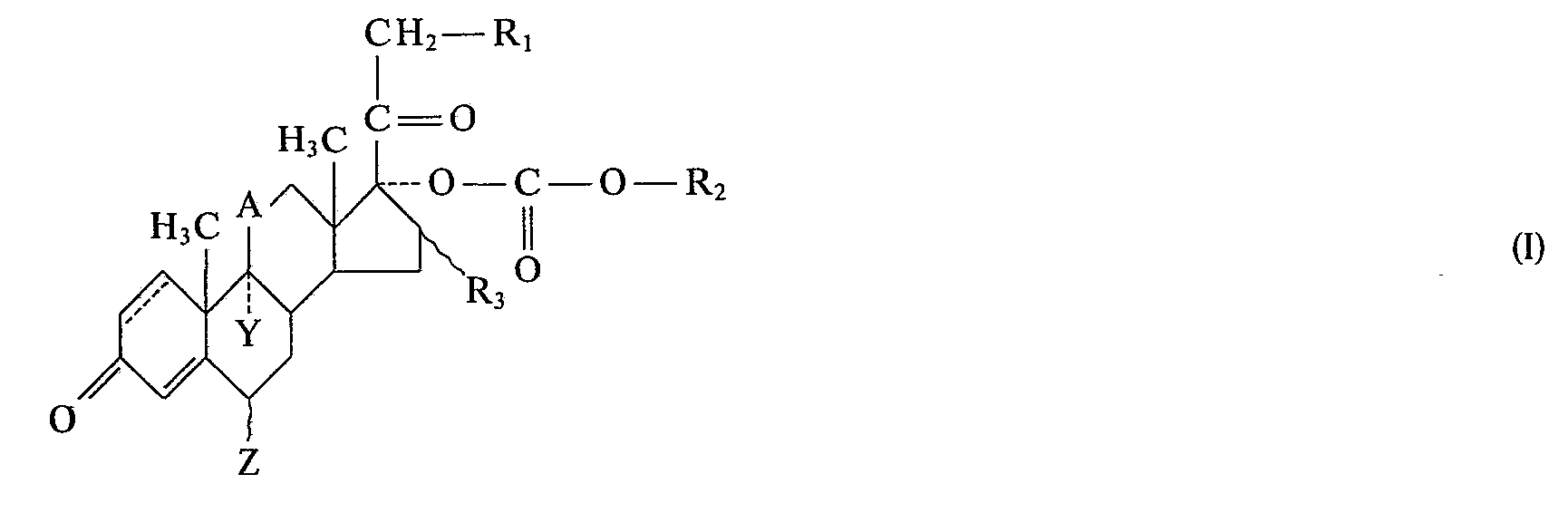


wobei in 1,2-Stellung eine zusätzliche Doppelbindung vorhanden sein kann.


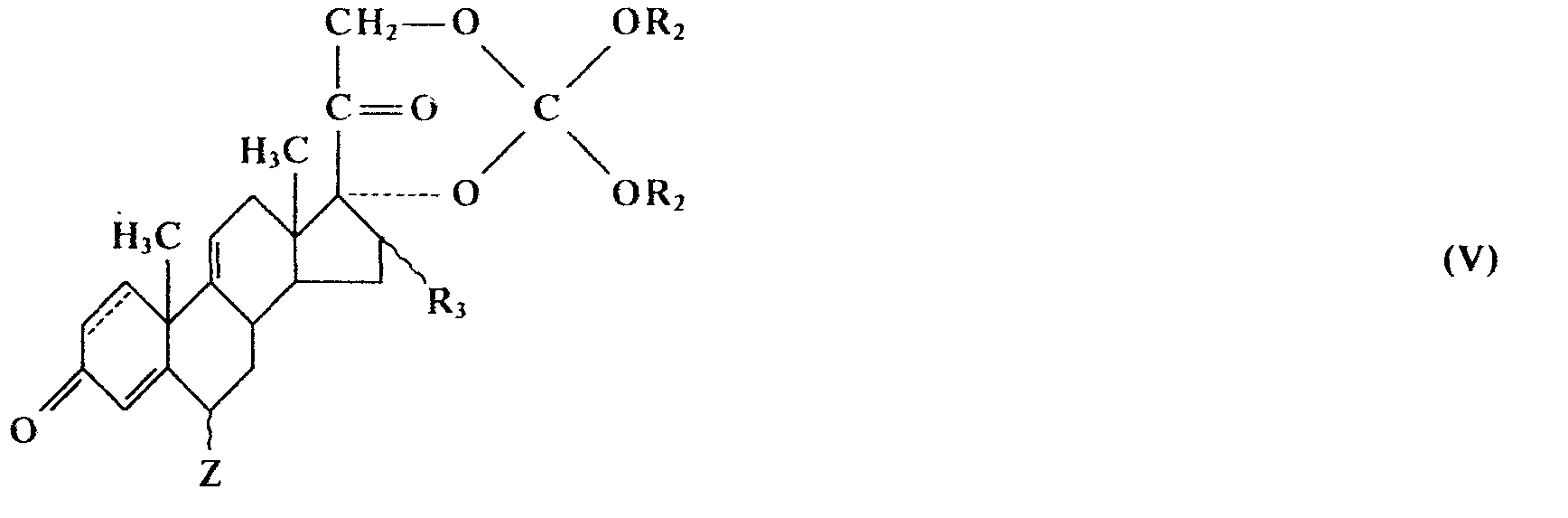
Applications Claiming Priority (2)
| Application Number | Priority Date | Filing Date | Title |
|---|---|---|---|
| DE19782817988 DE2817988A1 (de) | 1978-04-25 | 1978-04-25 | Corticoid 17-alkylcarbonate und verfahren zu deren herstellung |
| DE2817988 | 1978-04-25 |
Publications (3)
| Publication Number | Publication Date |
|---|---|
| EP0004975A2 EP0004975A2 (de) | 1979-10-31 |
| EP0004975A3 EP0004975A3 (en) | 1979-11-14 |
| EP0004975B1 true EP0004975B1 (de) | 1982-02-17 |
Family
ID=6037909
Family Applications (1)
| Application Number | Title | Priority Date | Filing Date |
|---|---|---|---|
| EP79101200A Expired EP0004975B1 (de) | 1978-04-25 | 1979-04-20 | Corticoid-17-Alkylcarbonate, Verfahren zu deren Herstellung sowie deren Verwendung als Arzneimittel gegen Dermatosen |
Country Status (19)
| Country | Link |
|---|---|
| US (1) | US4377575A (de) |
| EP (1) | EP0004975B1 (de) |
| JP (1) | JPS54144357A (de) |
| AR (1) | AR226157A1 (de) |
| AT (1) | AT372094B (de) |
| AU (1) | AU529172B2 (de) |
| CA (1) | CA1130276A (de) |
| DE (2) | DE2817988A1 (de) |
| DK (1) | DK157880C (de) |
| ES (2) | ES479709A1 (de) |
| FI (1) | FI791307A7 (de) |
| GR (1) | GR72886B (de) |
| HU (1) | HU180788B (de) |
| IE (1) | IE48328B1 (de) |
| IL (1) | IL57114A (de) |
| NO (1) | NO791365L (de) |
| NZ (1) | NZ190256A (de) |
| PT (1) | PT69544A (de) |
| ZA (1) | ZA791941B (de) |
Families Citing this family (34)
| Publication number | Priority date | Publication date | Assignee | Title |
|---|---|---|---|---|
| US4996335A (en) * | 1980-07-10 | 1991-02-26 | Nicholas S. Bodor | Soft steroids having anti-inflammatory activity |
| SE449106B (sv) * | 1980-07-10 | 1987-04-06 | Otsuka Pharma Co Ltd | Steroid med anti-inflammatorisk verkan samt komposition innehallande denna |
| JPS5835199A (ja) * | 1981-08-26 | 1983-03-01 | Mitsubishi Chem Ind Ltd | モノヨ−ドステロイドおよびその製造法 |
| JPS58103400A (ja) * | 1981-12-11 | 1983-06-20 | Ota Seiyaku Kk | 6α−メチルプレドニゾロン誘導体 |
| AU558725B2 (en) * | 1983-09-07 | 1987-02-05 | Mitsubishi Kasei Corporation | Corticoid derivatives |
| JPS6056997A (ja) * | 1983-09-07 | 1985-04-02 | Mitsubishi Chem Ind Ltd | 新規な6−酸素化コルチコイド/7α−カ−ボネ−ト誘導体およびその製法 |
| DE4025342A1 (de) * | 1990-08-10 | 1992-02-13 | Hoechst Ag | In 17-stellung substituierte corticoid-17-alkylcarbonate, verfahren zu deren herstellung und diese enthaltende arzneimittel |
| DE4328819A1 (de) * | 1993-08-27 | 1995-03-02 | Hoechst Ag | Corticosteroid-17-alkylcarbonat-21/0/-Carbonsäure- und Kohlensäureester, Verfahren zu deren Herstellung und diese enthaltende Arzneimittel |
| DE4333920A1 (de) | 1993-10-05 | 1995-04-13 | Hoechst Ag | Corticoid-17,21-dicarbonsäureester sowie Corticosteroid-17-carbonsäureester-21-kohlensäureester, Verfahren zu deren Herstellung und diese enthaltende Arzneimittel |
| DE4433374A1 (de) * | 1994-09-20 | 1996-03-21 | Hoechst Ag | 17-Desoxi-corticosteroid-21-/O/-Carbonsäure- ester, Verfahren zu deren Herstellung und diese enthaltende Arzneimittel |
| US6787532B2 (en) * | 2000-08-05 | 2004-09-07 | Smithkline Beecham Corporation | Formulation containing anti-inflammatory androstane derivatives |
| US6858596B2 (en) * | 2000-08-05 | 2005-02-22 | Smithkline Beecham Corporation | Formulation containing anti-inflammatory androstane derivative |
| EP1305329B2 (de) * | 2000-08-05 | 2015-03-18 | Glaxo Group Limited | 6.alpha.,9.alpha.-difluoro-17.alpha.-(2-furanylcarboxyl)oxy-11.beta.-hydroxy-16.alpha.-methyl-3-oxo-androst-1,4-diene-17-carbothioic acid s-fluoromethyl ester als entzündungshemmendes arzneimittel |
| GB0019172D0 (en) * | 2000-08-05 | 2000-09-27 | Glaxo Group Ltd | Novel compounds |
| US6750210B2 (en) * | 2000-08-05 | 2004-06-15 | Smithkline Beecham Corporation | Formulation containing novel anti-inflammatory androstane derivative |
| US6858593B2 (en) * | 2000-08-05 | 2005-02-22 | Smithkline Beecham Corporation | Anti-inflammatory androstane derivative compositions |
| US6777400B2 (en) * | 2000-08-05 | 2004-08-17 | Smithkline Beecham Corporation | Anti-inflammatory androstane derivative compositions |
| US6759398B2 (en) | 2000-08-05 | 2004-07-06 | Smithkline Beecham Corporation | Anti-inflammatory androstane derivative |
| US6777399B2 (en) * | 2000-08-05 | 2004-08-17 | Smithkline Beecham Corporation | Anti-inflammatory androstane derivative compositions |
| UA77656C2 (en) * | 2001-04-07 | 2007-01-15 | Glaxo Group Ltd | S-fluoromethyl ester of 6-alpha, 9-alpha-difluoro-17-alpha-[(2-furanylcarbonyl)oxy]-11-beta-hydroxy-16- alpha-methyl-3-oxoandrosta-1,4-dien-17-beta-carbothioacid as anti-inflammatory agent |
| PL366937A1 (en) * | 2001-04-30 | 2005-02-07 | Glaxo Group Limited | Anti-inflammatory 17.beta.-carbothioate ester derivatives of androstane with a cyclic ester group in position 17.alpha |
| US20050175545A1 (en) * | 2002-02-04 | 2005-08-11 | Keith Biggadike | Formulation for inhalation comprising a glucocorticoid and a beta 2-adrenoreceptor agonist |
| GB0202635D0 (en) * | 2002-02-05 | 2002-03-20 | Glaxo Wellcome Mfg Pte Ltd | Formulation containing novel anti-inflammatory androstane derivative |
| GB2389530B (en) * | 2002-06-14 | 2007-01-10 | Cipla Ltd | Pharmaceutical compositions |
| US7208485B2 (en) * | 2003-01-13 | 2007-04-24 | Chemagis Ltd. | Crystalline forms of halobetasol propionate |
| US20040138192A1 (en) * | 2003-01-13 | 2004-07-15 | Chemagis Ltd. | Crystalline forms of halobetasol propionate |
| GB0507165D0 (en) * | 2005-04-08 | 2005-05-18 | Glaxo Group Ltd | Novel crystalline pharmaceutical product |
| GB0615108D0 (en) * | 2006-07-28 | 2006-09-06 | Glaxo Group Ltd | Novel formulations |
| WO2009044200A1 (en) * | 2007-10-04 | 2009-04-09 | Astrazeneca Ab | Steroidal [3, 2-c] pyrazole compounds, with glucocorticoid activity |
| CA2707618A1 (en) * | 2007-12-20 | 2009-07-02 | Astrazeneca Ab | Steroid derivatives acting as glucocorticosteroid receptor agonists |
| UY32523A (es) * | 2009-04-03 | 2010-10-29 | Astrazeneca Ab | Compuestos que tienen actividad agonista del receptor de glucocorticosteroides |
| UY32525A (es) * | 2009-04-03 | 2010-10-29 | Astrazeneca Ab | Compuestos que tienen actividad agonista del receptor de glucocorticosteroides |
| UY32520A (es) * | 2009-04-03 | 2010-10-29 | Astrazeneca Ab | Compuestos que tienen actividad agonista del receptor de glucocorticoesteroides |
| UY32521A (es) * | 2009-04-03 | 2010-10-29 | Astrazeneca Ab | Combinación para emplear en el tratamiento de enfermedades respiratorias |
Family Cites Families (11)
| Publication number | Priority date | Publication date | Assignee | Title |
|---|---|---|---|---|
| DE1668451U (de) | 1953-09-22 | 1953-12-10 | Heinrich Loos | Naehmaschinen-antrieb. |
| GB885092A (en) | 1958-05-15 | 1961-12-20 | Upjohn Co | Improvements in or relating to steroids and the manufacture thereof |
| GB1253831A (en) * | 1968-01-19 | 1971-11-17 | Glaxo Lab Ltd | 9alpha,21-DIHALOPREGNANE COMPOUNDS |
| GB1281689A (en) * | 1968-10-14 | 1972-07-12 | Glaxo Lab Ltd | Steroid 21-phosphates |
| US3558675A (en) * | 1969-06-30 | 1971-01-26 | Merck & Co Inc | Steroid carbonates and process |
| GB1440063A (en) * | 1972-08-11 | 1976-06-23 | Glaxo Lab Ltd | 17alpha-esters of 17alpha,21-dihydroxy-20-oxo-steroids |
| DE2432408A1 (de) | 1973-07-05 | 1975-01-30 | Squibb & Sons Inc | 21-chlor-11 beta, 16 alpha, 17 alphatrihydroxypregnen-3,20-dion-derivate, verfahren zu ihrer herstellung und arzneimittel |
| US3832366A (en) * | 1973-07-30 | 1974-08-27 | Squibb & Sons Inc | Process for preparing 21-chloro-17-acyloxy-20-ketosteroids |
| YU54476A (en) * | 1975-03-31 | 1982-05-31 | Taisho Pharmaceutical Co Ltd | Process for obtaining 17-ester 21-halo-pregnane |
| US4021459A (en) * | 1975-08-14 | 1977-05-03 | Schering Corporation | Process for the preparation of 21-halogeno-21-desoxy-17α-acyloxy 20-keto-pregnenes |
| DE2735110A1 (de) * | 1977-08-04 | 1979-02-15 | Hoechst Ag | Corticoid-17-alkylcarbonate und verfahren zu ihrer herstellung |
-
1978
- 1978-04-25 DE DE19782817988 patent/DE2817988A1/de not_active Ceased
-
1979
- 1979-04-06 GR GR58830A patent/GR72886B/el unknown
- 1979-04-19 ES ES479709A patent/ES479709A1/es not_active Expired
- 1979-04-20 DE DE7979101200T patent/DE2962122D1/de not_active Expired
- 1979-04-20 EP EP79101200A patent/EP0004975B1/de not_active Expired
- 1979-04-23 FI FI791307A patent/FI791307A7/fi not_active Application Discontinuation
- 1979-04-23 IL IL57114A patent/IL57114A/xx unknown
- 1979-04-23 AR AR276277A patent/AR226157A1/es active
- 1979-04-23 NZ NZ190256A patent/NZ190256A/xx unknown
- 1979-04-24 NO NO791365A patent/NO791365L/no unknown
- 1979-04-24 AU AU46398/79A patent/AU529172B2/en not_active Ceased
- 1979-04-24 AT AT0307479A patent/AT372094B/de not_active IP Right Cessation
- 1979-04-24 DK DK168579A patent/DK157880C/da not_active IP Right Cessation
- 1979-04-24 JP JP5198879A patent/JPS54144357A/ja active Granted
- 1979-04-24 CA CA326,264A patent/CA1130276A/en not_active Expired
- 1979-04-24 PT PT69544A patent/PT69544A/de unknown
- 1979-04-24 ZA ZA791941A patent/ZA791941B/xx unknown
- 1979-04-24 HU HU79HO2145A patent/HU180788B/hu not_active IP Right Cessation
- 1979-08-08 IE IE831/79A patent/IE48328B1/en unknown
-
1980
- 1980-01-31 ES ES488120A patent/ES488120A1/es not_active Expired
- 1980-12-15 US US06/216,258 patent/US4377575A/en not_active Expired - Fee Related
Also Published As
| Publication number | Publication date |
|---|---|
| GR72886B (de) | 1984-01-02 |
| EP0004975A3 (en) | 1979-11-14 |
| JPS6252759B2 (de) | 1987-11-06 |
| DK157880B (da) | 1990-02-26 |
| IL57114A (en) | 1983-11-30 |
| JPS54144357A (en) | 1979-11-10 |
| ATA307479A (de) | 1983-01-15 |
| AU529172B2 (en) | 1983-05-26 |
| DK168579A (da) | 1979-10-26 |
| IE48328B1 (en) | 1984-12-12 |
| IE790831L (en) | 1979-10-25 |
| ES488120A1 (es) | 1980-09-16 |
| IL57114A0 (en) | 1979-07-25 |
| CA1130276A (en) | 1982-08-24 |
| FI791307A7 (fi) | 1981-01-01 |
| ES479709A1 (es) | 1980-08-16 |
| US4377575A (en) | 1983-03-22 |
| AR226157A1 (es) | 1982-06-15 |
| DK157880C (da) | 1990-07-30 |
| NZ190256A (en) | 1981-03-16 |
| ZA791941B (en) | 1980-04-30 |
| DE2817988A1 (de) | 1979-11-08 |
| EP0004975A2 (de) | 1979-10-31 |
| NO791365L (no) | 1979-10-26 |
| AT372094B (de) | 1983-08-25 |
| DE2962122D1 (en) | 1982-03-25 |
| HU180788B (en) | 1983-04-29 |
| PT69544A (de) | 1979-05-01 |
Similar Documents
| Publication | Publication Date | Title |
|---|---|---|
| EP0004975B1 (de) | Corticoid-17-Alkylcarbonate, Verfahren zu deren Herstellung sowie deren Verwendung als Arzneimittel gegen Dermatosen | |
| EP0000742A1 (de) | Corticoid-17-Alkylcarbonate und Verfahren zu deren Herstellung und diese enthaltende Mittel | |
| EP0640616B1 (de) | Corticosteroid-17-alkylcarbonat-21-(O)-Carbonsäure- und Kohlensäureester, Verfahren zu deren Herstellung und diese enthaltende Arzneimittel | |
| EP0470617A2 (de) | In 17-Stellung substituierte Corticoid-17-alkylcarbonate, Verfahren zu deren Herstellung und diese enthaltende Arzneimittel | |
| EP0100874A2 (de) | Neue 6,16-Dimethylkortikoide, ihre Herstellung und Verwendung | |
| CH635595A5 (de) | Verfahren zur herstellung von steroiden der 17-alpha-pregnanreihe. | |
| DE2538595A1 (de) | Steroidverbindungen | |
| DE2645104C2 (de) | 11β-Hydroxy-1,4,8-pregnatrien-3,20-dion-Derivate und Verfahren zu ihrer Herstellung | |
| CH651053A5 (de) | Steroid-zwischenprodukte. | |
| EP0077541B1 (de) | Delta-1,3,5-3-Chlor-11-Beta,16-Alpha,17-Alpha,21-tetra-(hydroxy)-pregnan-20-on-16,17-acetonidderivate, Verfahren zu ihrer Herstellung und diese Verbindungen enthaltende Arzneimittel | |
| DE2365992C3 (de) | 6α-Fluor-17,21-dihydroxy-16β-methylpregna-4,9(11)-dien-3,20-dion-17,21-diacetat und Verfahren zu dessen Herstellung | |
| EP0708111B1 (de) | 17-Desoxi-corticosteroid-21-[O]-Carbonsäureester, Verfahren zu deren Herstellung und diese enthaltende Arzneimittel | |
| DE1493178C3 (de) | 6 alpha-Fluor-16 alpha-methyl-1,4pregnadien-3,20-dion-derivate und Verfahren zu ihrer Herstellung | |
| AT395427B (de) | Verfahren zur herstellung von neuen androstancarbothioaten | |
| DE1220414B (de) | Verfahren zur Herstellung von in 4-Stellung ungesaettigten 6-Methylen-3-oxo-steroid-verbindungen der Androstan-, Pregnan- und Spirostanreihe | |
| EP0011121A1 (de) | Hydrocortisonester, diese enthaltende pharmazeutische Zubereitungen und Verfahren zu ihrer Herstellung | |
| DE1813083B2 (de) | 11 beta-Methyl-19-norpregn-4-en 3,20-dione, Verfahren zu ihrer Herstellung sowie diese enthaltendes Mittel | |
| DE2441647A1 (de) | 17beta-aethinyl-3,17alpha-oestradiolverbindungen, verfahren zu ihrer herstellung, arzneimittel und 17beta-aethinyl-16alpha, 17alpha-epoxyoestran-3-olverbindungen | |
| DD232497A5 (de) | Verfahren zur herstellung von neuen corticoidderivaten | |
| AT395428B (de) | Verfahren zur herstellung von neuen androstancarbothioaten | |
| AT253135B (de) | Verfahren zur Herstellung neuer Steroidverbindungen | |
| DE1917082C3 (de) | Neue 9alpha, llbeta, 21-Trichlorsteroide, Verfahren zu ihrer Herstellung sowie diese Verbindungen enthaltendes Präparat | |
| AT300842B (de) | Verfahren zur Herstellung von Verbindungen, die zwei Carbonylgruppen oder zwei Nitrilgruppen oder eine Nitril- sowie eine Carbonylgruppe enthalten | |
| DE2508136C3 (de) | Neue Steroide, Verfahren zu ihrer Herstellung und sie enthaltende pharmazeutische Mittel | |
| DE1177147B (de) | Verfahren zur Herstellung von 3-Enolaethern von 6-Formyl-3-oxo-?-steroiden |
Legal Events
| Date | Code | Title | Description |
|---|---|---|---|
| PUAI | Public reference made under article 153(3) epc to a published international application that has entered the european phase |
Free format text: ORIGINAL CODE: 0009012 |
|
| PUAL | Search report despatched |
Free format text: ORIGINAL CODE: 0009013 |
|
| AK | Designated contracting states |
Designated state(s): BE CH DE FR GB IT LU NL SE |
|
| AK | Designated contracting states |
Designated state(s): BE CH DE FR GB IT LU NL SE |
|
| 17P | Request for examination filed | ||
| ITF | It: translation for a ep patent filed | ||
| GRAA | (expected) grant |
Free format text: ORIGINAL CODE: 0009210 |
|
| AK | Designated contracting states |
Designated state(s): BE CH DE FR GB IT LU NL SE |
|
| REF | Corresponds to: |
Ref document number: 2962122 Country of ref document: DE Date of ref document: 19820325 |
|
| ITTA | It: last paid annual fee | ||
| PGFP | Annual fee paid to national office [announced via postgrant information from national office to epo] |
Ref country code: FR Payment date: 19930315 Year of fee payment: 15 |
|
| PGFP | Annual fee paid to national office [announced via postgrant information from national office to epo] |
Ref country code: CH Payment date: 19930317 Year of fee payment: 15 |
|
| PGFP | Annual fee paid to national office [announced via postgrant information from national office to epo] |
Ref country code: GB Payment date: 19930319 Year of fee payment: 15 |
|
| PGFP | Annual fee paid to national office [announced via postgrant information from national office to epo] |
Ref country code: SE Payment date: 19930322 Year of fee payment: 15 |
|
| PGFP | Annual fee paid to national office [announced via postgrant information from national office to epo] |
Ref country code: LU Payment date: 19930324 Year of fee payment: 15 |
|
| PGFP | Annual fee paid to national office [announced via postgrant information from national office to epo] |
Ref country code: BE Payment date: 19930414 Year of fee payment: 15 |
|
| PGFP | Annual fee paid to national office [announced via postgrant information from national office to epo] |
Ref country code: NL Payment date: 19930430 Year of fee payment: 15 |
|
| PGFP | Annual fee paid to national office [announced via postgrant information from national office to epo] |
Ref country code: DE Payment date: 19930624 Year of fee payment: 15 |
|
| EPTA | Lu: last paid annual fee | ||
| PG25 | Lapsed in a contracting state [announced via postgrant information from national office to epo] |
Ref country code: LU Free format text: LAPSE BECAUSE OF NON-PAYMENT OF DUE FEES Effective date: 19940420 Ref country code: GB Effective date: 19940420 |
|
| PG25 | Lapsed in a contracting state [announced via postgrant information from national office to epo] |
Ref country code: SE Effective date: 19940421 |
|
| PG25 | Lapsed in a contracting state [announced via postgrant information from national office to epo] |
Ref country code: CH Effective date: 19940430 Ref country code: BE Effective date: 19940430 |
|
| BERE | Be: lapsed |
Owner name: HOECHST A.G. Effective date: 19940430 |
|
| PG25 | Lapsed in a contracting state [announced via postgrant information from national office to epo] |
Ref country code: NL Effective date: 19941101 |
|
| GBPC | Gb: european patent ceased through non-payment of renewal fee |
Effective date: 19940420 |
|
| NLV4 | Nl: lapsed or anulled due to non-payment of the annual fee | ||
| PG25 | Lapsed in a contracting state [announced via postgrant information from national office to epo] |
Ref country code: FR Effective date: 19941229 |
|
| REG | Reference to a national code |
Ref country code: CH Ref legal event code: PL |
|
| PG25 | Lapsed in a contracting state [announced via postgrant information from national office to epo] |
Ref country code: DE Effective date: 19950103 |
|
| EUG | Se: european patent has lapsed |
Ref document number: 79101200.8 Effective date: 19941110 |
|
| REG | Reference to a national code |
Ref country code: FR Ref legal event code: ST |
|
| PLBE | No opposition filed within time limit |
Free format text: ORIGINAL CODE: 0009261 |
|
| STAA | Information on the status of an ep patent application or granted ep patent |
Free format text: STATUS: NO OPPOSITION FILED WITHIN TIME LIMIT |