EP0100874A2 - Neue 6,16-Dimethylkortikoide, ihre Herstellung und Verwendung - Google Patents
Neue 6,16-Dimethylkortikoide, ihre Herstellung und Verwendung Download PDFInfo
- Publication number
- EP0100874A2 EP0100874A2 EP83106649A EP83106649A EP0100874A2 EP 0100874 A2 EP0100874 A2 EP 0100874A2 EP 83106649 A EP83106649 A EP 83106649A EP 83106649 A EP83106649 A EP 83106649A EP 0100874 A2 EP0100874 A2 EP 0100874A2
- Authority
- EP
- European Patent Office
- Prior art keywords
- dione
- dimethyl
- hydroxy
- pregnadiene
- acetoxy
- Prior art date
- Legal status (The legal status is an assumption and is not a legal conclusion. Google has not performed a legal analysis and makes no representation as to the accuracy of the status listed.)
- Granted
Links
Classifications
-
- C—CHEMISTRY; METALLURGY
- C07—ORGANIC CHEMISTRY
- C07J—STEROIDS
- C07J5/00—Normal steroids containing carbon, hydrogen, halogen or oxygen, substituted in position 17 beta by a chain of two carbon atoms, e.g. pregnane and substituted in position 21 by only one singly bound oxygen atom, i.e. only one oxygen bound to position 21 by a single bond
- C07J5/0046—Normal steroids containing carbon, hydrogen, halogen or oxygen, substituted in position 17 beta by a chain of two carbon atoms, e.g. pregnane and substituted in position 21 by only one singly bound oxygen atom, i.e. only one oxygen bound to position 21 by a single bond substituted in position 17 alfa
- C07J5/0061—Normal steroids containing carbon, hydrogen, halogen or oxygen, substituted in position 17 beta by a chain of two carbon atoms, e.g. pregnane and substituted in position 21 by only one singly bound oxygen atom, i.e. only one oxygen bound to position 21 by a single bond substituted in position 17 alfa substituted in position 16
- C07J5/0069—Normal steroids containing carbon, hydrogen, halogen or oxygen, substituted in position 17 beta by a chain of two carbon atoms, e.g. pregnane and substituted in position 21 by only one singly bound oxygen atom, i.e. only one oxygen bound to position 21 by a single bond substituted in position 17 alfa substituted in position 16 by a saturated or unsaturated hydrocarbon group
- C07J5/0076—Normal steroids containing carbon, hydrogen, halogen or oxygen, substituted in position 17 beta by a chain of two carbon atoms, e.g. pregnane and substituted in position 21 by only one singly bound oxygen atom, i.e. only one oxygen bound to position 21 by a single bond substituted in position 17 alfa substituted in position 16 by a saturated or unsaturated hydrocarbon group by an alkyl group
-
- A—HUMAN NECESSITIES
- A61—MEDICAL OR VETERINARY SCIENCE; HYGIENE
- A61P—SPECIFIC THERAPEUTIC ACTIVITY OF CHEMICAL COMPOUNDS OR MEDICINAL PREPARATIONS
- A61P17/00—Drugs for dermatological disorders
-
- A—HUMAN NECESSITIES
- A61—MEDICAL OR VETERINARY SCIENCE; HYGIENE
- A61P—SPECIFIC THERAPEUTIC ACTIVITY OF CHEMICAL COMPOUNDS OR MEDICINAL PREPARATIONS
- A61P29/00—Non-central analgesic, antipyretic or antiinflammatory agents, e.g. antirheumatic agents; Non-steroidal antiinflammatory drugs [NSAID]
-
- C—CHEMISTRY; METALLURGY
- C07—ORGANIC CHEMISTRY
- C07J—STEROIDS
- C07J21/00—Normal steroids containing carbon, hydrogen, halogen or oxygen having an oxygen-containing hetero ring spiro-condensed with the cyclopenta(a)hydrophenanthrene skeleton
-
- C—CHEMISTRY; METALLURGY
- C07—ORGANIC CHEMISTRY
- C07J—STEROIDS
- C07J7/00—Normal steroids containing carbon, hydrogen, halogen or oxygen substituted in position 17 beta by a chain of two carbon atoms
- C07J7/008—Normal steroids containing carbon, hydrogen, halogen or oxygen substituted in position 17 beta by a chain of two carbon atoms substituted in position 21
- C07J7/0085—Normal steroids containing carbon, hydrogen, halogen or oxygen substituted in position 17 beta by a chain of two carbon atoms substituted in position 21 by an halogen atom
-
- C—CHEMISTRY; METALLURGY
- C07—ORGANIC CHEMISTRY
- C07J—STEROIDS
- C07J71/00—Steroids in which the cyclopenta(a)hydrophenanthrene skeleton is condensed with a heterocyclic ring
- C07J71/0005—Oxygen-containing hetero ring
- C07J71/001—Oxiranes
- C07J71/0015—Oxiranes at position 9(11)
Definitions
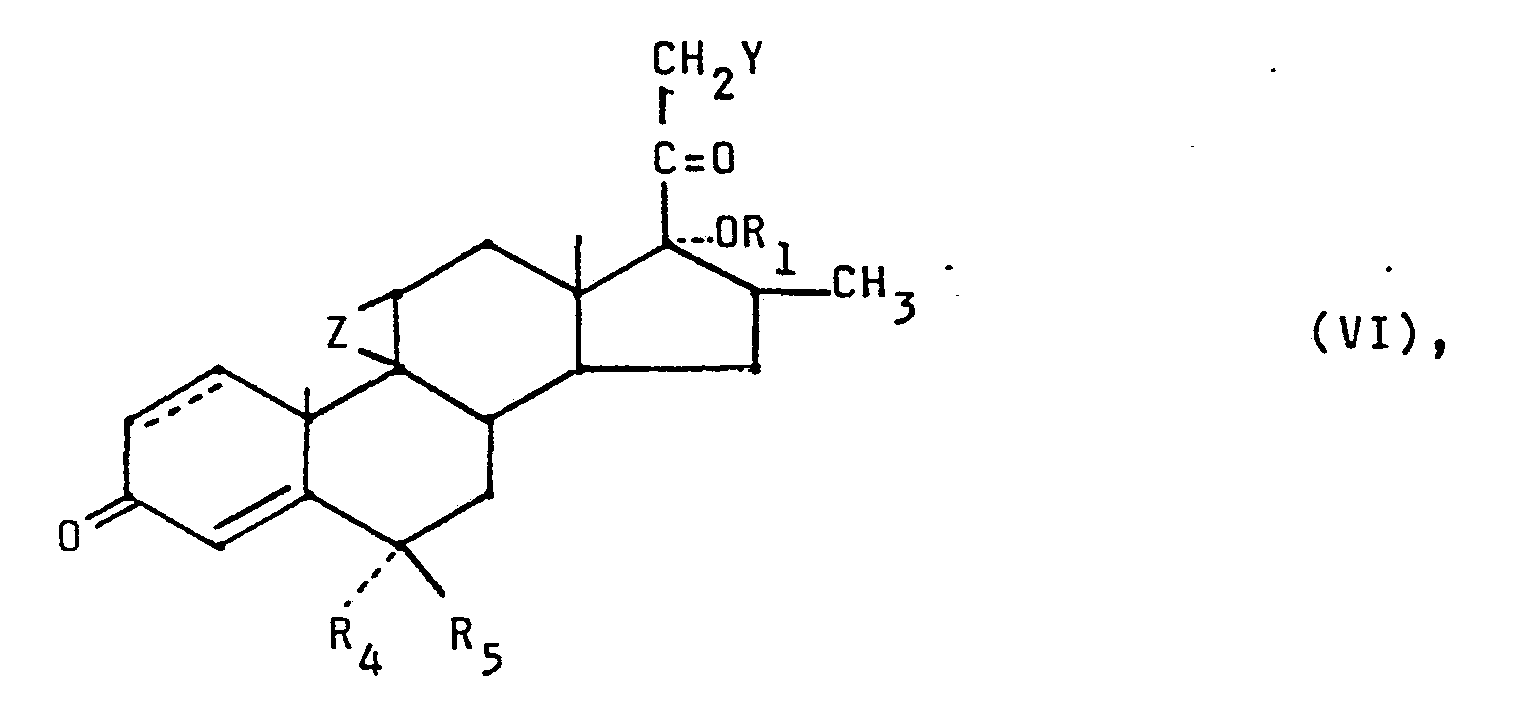
- the invention relates to the 6,16-dimethylcorticoids characterized in patent claim 1, pharmaceutical preparations which contain these compounds, a process for the preparation of these substances and ultimately steroids which are used as intermediates for the synthesis of these 6,16-dimethylcorticoids.
- the new 6,16-dimethyl corticoids can contain, as substituents R 1, a formyl group, an alkanoyl group or alkoxyalkyl group containing 2 to 8 (preferably 2 to 6) carbon atoms or a benzoyl group.
- Suitable alkanoyl groups R are, for example, the acetyl group, proionyl group, the butyryl group, the isobutyryl group, the valerianyl group, the 3-methylbutyryl group, the tri-s methylacetyl group or the hexanoyl groups.
- alkoxyalkyl groups R 2 alkoxymethyl groups such as the methoxymethyl group, the ethoxymethyl group, the propyloxymethyl group, the isopropyloxymethyl group, the butyloxymethyl group, the isobutyloxymethyl group or the tert-butyloxymethyl group may be mentioned by way of example.
- the 6,16-dimethylcorticoids can contain a chlorine atom, a hydroxy group, an alkanoyloxy group containing 2 to 8 (preferably 2 to 6) carbon atoms or a benzoyloxy group.
- Suitable alkanoyloxy groups are, for example, those derived from the alkanoyl groups mentioned above.
- the 6,16-dimethylcorticoids of the general formula I according to claim 1 are notable for topical application due to their excellent anti-inflammatory activity. In addition, they are characterized by an excellent dissociation between the desired topical effectiveness and undesirable systemic side effects.
- 6,16-dimethylcorticoids of the general formula I according to claim 1 with X in the meaning of a hydrogen atom, a fluorine atom or a chlorine atom are more suitable for use in pharmaceutical preparations than those in which the substituent X is a bromine atom, since the latter are less stable in pharmaceutical preparations.
- the 9-bromsteroids of the general formula I are valuable intermediates for the synthesis of the other pharmacologically active 6,16-dimethylcorticoids according to the invention.
- the new 6,16-dimethylcorticoids of the general formula I according to claim 1 are suitable in combination with the carrier agents customary in galenical pharmacy for the local treatment of contact dermatitis, eczema of all kinds, neurodermatoses, erythroderma, burns pruritis vulvae et ani, rosacea, erythematosus cutaneus, psoriasis, lichen planus et verrucosus and similar skin diseases.
- the pharmaceutical specialties are produced in a conventional manner by converting the active ingredients into the desired application form, for example: solutions, lotions, ointments, creams or plasters, with suitable additives.
- the active substance concentration depends on the form of administration.
- an active ingredient concentration of 0.001% to 1% is preferably used.
- the new compounds if appropriate in combination with the customary carriers and auxiliaries, are also well suited for the production of inhalants which can be used for the therapy of allergic diseases of the respiratory tract such as bronchial asthma or rhinitis.
- the new corticoids are also suitable in the form of capsules, tablets or dragees, which preferably contain 10 to 200 mg of active ingredient and are administered orally, or in the form of suspensions, which preferably contain 100 to 500 mg of active ingredient per dose unit and are applied rectally. Also for the treatment of allergic diseases of the intestinal tract, such as ulcerative colitis and granulomatous colitis.
- the new 6,16-dimethylcorticoids can be according to that characterized in claims 40 and 41; Processes are produced which can be carried out under the conditions as described in German patent applications Nos. P 26 45 105.8 and 28 03 661.5.
Landscapes
- Chemical & Material Sciences (AREA)
- Organic Chemistry (AREA)
- Health & Medical Sciences (AREA)
- General Health & Medical Sciences (AREA)
- Public Health (AREA)
- Animal Behavior & Ethology (AREA)
- Veterinary Medicine (AREA)
- Chemical Kinetics & Catalysis (AREA)
- General Chemical & Material Sciences (AREA)
- Medicinal Chemistry (AREA)
- Nuclear Medicine, Radiotherapy & Molecular Imaging (AREA)
- Pharmacology & Pharmacy (AREA)
- Life Sciences & Earth Sciences (AREA)
- Rheumatology (AREA)
- Engineering & Computer Science (AREA)
- Dermatology (AREA)
- Pain & Pain Management (AREA)
- Bioinformatics & Cheminformatics (AREA)
- Steroid Compounds (AREA)
- Pharmaceuticals Containing Other Organic And Inorganic Compounds (AREA)
- Organic Low-Molecular-Weight Compounds And Preparation Thereof (AREA)
- Acyclic And Carbocyclic Compounds In Medicinal Compositions (AREA)
- Saccharide Compounds (AREA)
- Medicines Containing Plant Substances (AREA)
- Manufacture Of Tobacco Products (AREA)
- Agricultural Chemicals And Associated Chemicals (AREA)
- Medicines Containing Material From Animals Or Micro-Organisms (AREA)
- Detergent Compositions (AREA)
- Cosmetics (AREA)
Abstract
Description
- Die Erfindung betrifft die im Patentanspruch 1 gekennzeichneten 6,16-Dimethylkortikoide, pharmazeutische Präparate, die diese Verbindungen enthalten, ein Verfahren zur Herstellung dieser Substanzen und letztlich Steroide, welche als Zwischenprodukte zur Synthese dieser 6,16-Dimethylkortikoide verwendet werden.
- Die neuen 6,16-Dimethylkortikoide können als Substituenten R1 eine Formylgruppe, eine 2 bis 8 (vorzugsweise 2 bis 6) Kohlenstoffatome enthaltende Alkanoylgruppe oder Alkoxyalkylgruppe oder eine Benzoylgruppe enthalten. Geeignete Alkanoylgruppen R, sind beispielsweise die Acetylgruppe, Proionylgruppe, die Butyrylgruppe, die Isobutyrylgruppe, die Valerianylgruppe, die 3-Methylbutyrylgruppe, die Tri-s methylacetylgruppe oder die Hexanoylgruppen. Als Alkoxyalkylgruppen R2 seien insbesondere Alkoxymethylgruppen, wie die Methoxymethylgruppe, die Ethoxymethylgruppe, die Propyloxymethylgruppe, die Isopropyloxymethylgruppe, die Butyloxymethylgruppe, die Isobutyloxymethylgruppe oder die tert.-Butyloxymethylgruppe beispielsmäßig genannt.
- Als Substituenten Y können die 6,16-Dimethylkortikoide ein Chloratom, eine Hydroxygruppe, eine 2 bis 8 (vorzugsweise 2 bis 6) Kohlenstoffatome enthaltende Alkanoyloxygruppe oder eine Benzoyloxygruppe enthalten. Geeignete Alkanoyloxygruppen sind beispielsweise solche, die sich von den obengenannten Alkanoylgruppen ableiten.
- Die 6,16-Dimethylkortikoide der allgemeinen Formel I gemäß Patentanspruch 1, zeichnen sich bei topischer Applikation durch eine ausgezeichnete antiinflammatorische Wirksamkeit aus. Darüberhinaus zeichnen sie sich durch eine ausgezeichnete Dissoziation zwischen erwünschter topischer Wirksamkeit und unerwünschter systemischer Nebenwirkungen aus.
- Es sei angemerkt, daß die 6,16-Dimethylkortikoide der allgemeinen Formel I gemäß Patentanspruch 1 mit X in der Bedeutung eines Wasserstoffatoms, eines Fluoratoms oder eines Chloratoms zur Anwendung in pharmazeutischen Präparaten geeigneter sind, als solche in denen der Substituent X ein Bromatom darstellt, da letztere in galenischen Zubereitungen weniger stabil sind. Andererseits sind aber die 9-Bromsteroide der allgemeinen Formel I gemäß Patentanspruch 1 wertvolle Zwischenprodukte zur Synthese der übrigen erfindungsgemäßen, pharmakologisch wirksamen 6,16-Dimethylkortikoide.
- Die neuen 6,16-Dimethylkortikoide der allgemeinen Formel I gemäß Patentanspruch 1 eignen sich in Kombination mit den in der galenischen Pharmazie üblichen Trägermitteln zur lokalen Behandlung von Kontaktdermatitis, Ekzemen der verschiedensten Art, Neurodermatosen, Erythrodermie, Verbrennungen Pruritis vulvae et ani, Rosacea, Erythematodes cutaneus, Psoriasis, Lichen ruber planus et verrucosus und ähnlichen Hauterkrankungen.
- Die Herstellung der Arzneimittelspezialitäten erfolgt in üblicher Weise, indem man die Wirkstoffe mit geeigneten Zusätzen in die gewünschte Applikationsform, wie zum Beispiel: Lösungen, Lotionen, Salben, Cremen oder Pflaster, überführt. In den so formulierten Arzneimitteln ist die Wirkstoffkonzentration von der Applikationsform abhängig. Bei Lotionen und Salben wird vorzugsweise eine Wirkstoffkonzentration von 0,001 % bis 1 % verwendet.
- Darüberhinaus sind die neuen Verbindungen gegebenenfalls in Kombination mit den üblichen Trägermitteln und Hilfsstoffen auch gut zur Herstellung von Inhalationsmitteln geeignet, welche zur Therapie allergischer Erkrankungen der Atemwege wie zum Beispiel des Bronchialasthmas oder der Rhinitis verwendet werden können.
- Ferner eignen sich die neuen Kortikoide auch in Form von Kapseln, Tabletten oder Dragees, die vorzugsweise 10 bis 200 mg Wirkstoff enthalten und oral appliziert werden oder in Form von Suspensionen, die vorzugsweise 100 bis 500 mg Wirkstoff pro Dosiseinheit enthalten und rektal appliziert werden. Auch zur Behandlung allergischer Erkrankungen des Darmtraktes, wie der Kolitis ulcerosa und der Kolitis granulomatosa.
- Die neuen 6,16-Dimethylkortikoide können nach dem in den Patentansprüchen 40 und 41 gekennzeichnete; Verfahren hergestellt werden, welche unter den Bedingungen durchgeführt werden können, wie sie in den deutschen Patentanmeldungen Nr. P 26 45 105.8 und 28 03 661.5 beschrieben sind.
- Die nachfolgenden Ausführungsbeispiele dienen zur Erläuterung des erfindungsgemäßen Verfahrens.
-
- A) Aus einer Lösung von 24.0 g 17α.21-Dihydroxy-16β-methyl-4.9(11)-pregnadien-3.20-dion und 2.4 g Pyridiniumtosylat in 180 ml Dimethylformamid und 1.7 1 Benzol werden bei 130 C über einen Wasserabscheider 720 ml Benzol abdestilliert. In die heiße Reaktionslösung läßt man 58 ml Orthopropionsäuretriethylester langsam zulaufen und destilliert anschließend weiter Benzol und andere leichtflüchtige Reaktionskomponenten ab. Man fügt nun 29 ml Pyridin hinzu und engt im Vakuum zur Trockne ein. Es wird 17a.21-(1-Ethoxy-propyliden-dioxy)-16ß-methyl-4.9(11)-pregnadien-3.20-dion als Öl isoliert.
- B) Das rohe 17α.21-(1-Eihoxy-propylidendioxy)-16β-methyl-4.9(11)-pregnadien-3.20-dion wird in 720 ml Methanol gelöst und mit einem Gemisch aus 258 ml 0.1N wäßriger Essigsäure und 28.8 ml 0.1M wäßriger Natriumacetat-Lösung 1.5 h bei 100 C Badtemperatur gerührt. Man engt die Lösung auf 1/3 ihres Volumens ein, gibt auf Wasser und wäscht die Essigesterextrakte neutral. Noch dem Trocknen und Einengen wird das Rohprodukt an 2 kg Kieselgel mit einem Methylenchlorid- Aceton-Gradienten (0-15 % Aceton) gereinigt. Man erhält 23.7 g 21-Hydroxy-16ß-methyl-17a-propionyloxy-4.9(11)-pregnadien-3.20-dion vom Schmp. 192 °C.
- C) 7.9 g 21-Hydroxy-16ß-methyl-17a-propionyloxy-4.9(11)-pregnadien-3.20-dion werden in 79 ml Pyridin und 39 ml Acetanhydrid 1 h bei Raumtemperatur gerührt. Nach Eiswasserfällung und üblicher Aufarbeitung isoliert man 8.15 g 21-Acetoxy-16ß-methyl-17a-propionyloxy-4.9(11)-pregnadien-3.20-dion vom Schmp. 95-96 C.
- ) Eine Suspension von 10.0 g Natriumacetat in 300 ml Chloroform und 300 ml Formaldehyddimethylacetal wird mit 19 ml Phosphoroxychlorid 1 h bei 65 C Badtemperatur gerührt. Nach Zugabe von 10.0 g 21-Acetoxy-16ß-methyl-17a-propionyloxy-4.9(11)-pregnadien-3.20-dion tropft man weitere 19 ml Phosphoroxychlorid hinzu und rührt 6.5 h bei 65 C weiter. Die abgekühlte Reaktionslösung wird mit soviel einer gesättigten Sodalösung behandelt, bis die wäßrige Phase alkalisch bleibt. Man trennt die organische Phase ab, wäscht neutral und engt nach dem Trocknen ein. Das Rohprodukt wird an 700 g Kieselgel mit einem Hexan-Essigester-Gradienten (0-50 % Essigester) gereinigt. Man isoliert 7.5 g 21-Acetoxy-16ß-methyl-6-methylen-17a-propionyloxy-4.9(11)-pregnadien-3.20-dion vom Schmp. 206-207 °C.
- E) 7.0 g 21 Acetoxy-16β-methyl-6-methylen-17α-propionyloxy-4.9(11)-pregnadien-3.20-dion und 1.4 g Palladium/Aktivkohle (9.64 %ig) werden in 350 ml Isopropanol suspendiert und mit 21 ml Cyclohexen 5 h bei 120 °C Badtemperatur gerührt. Nach dem Abkühlen wird der Katalysator abgesaugt, mit Methylenchlorid gewaschen und die vereinigten Filtrate mit 40 ml konz. Salzsäure 0.5 h bei Raumtemperatur gerührt. Man engt die Reaktionslösung auf 1/3 ihres Volumens ein, gibt auf Eiswasser und arbeitet wie üblich auf. Das Rohprodukt wird an 600 g Kieselgel mit einem Hexan-Essigester-Gradienten (0-50 % Essigester) gereinigt. Ausbeute 5.4 g 21-Acetoxy-6a.16ß-dimethyl-17a-propionyloxy-4.9(11)-pregnadien-3.20-dion. Schmp. 184-185 °C.
- F) Eine Suspension von 4.4 g 21-Acetoxy-6a.16ß-dimethyl-17a-propionyloxy-4.9(11)-pregnadien-3.20-dion in 68 ml Dioxan und 4.4 ml Wasser werden bei einer Innentemperatur von 20 C portionsweise mit 3.3 g N-Bromsuccinimid versetzt. Beim Zutropfen einer Lösung von 0.35 ml 70 %iger Perchlorsäure in 5.3 ml Wasser darf die Innentemperatur 23 °C nicht überschreiten. Man rührt 45 min bei 20 °C Innentemperatur weiter, kühlt auf +15 C herunter und neutralisiert tropfenweise mit einer Lösung aus 1.6 g Natriumacetat und 1.0 g Natriumsulfit in 9.7 ml Wasser. Dabei darf die Innentemperatur 23 C nicht übersteigen. Nach Zugabe von 60 ml Methanol wird das Reaktionsgemisch 15 min bei Raumtemperatur und nach Zugabe von 172 ml Wasser 3 h bei 0 °C weitergerührt. Schließlich saugt man den Niederschlag ab, wäscht den Rückstand mit Wasser neutral und trocknet bei 70 °C im Vakuumtrockenschrank. Das Rohprodukt wird an 350.0 g Kieselgel mit einem Methylenchlorid-Aceton-Gradienten (0-8 % Aceton) gereinigt. Man erhält 3.2 g 21-Acetoxy-9α-brom-11β-hydroxy-6α. 16β-dimethyl-17a-propionyloxy-4-pregnen-3.20-dion. Schmp. 176-178 °C. 600 mg 21-Acetoxy-9α-brom-11β-hydroxy-6α.16β-dimethyl-17α-propionyloxy-4-pregnen-3.20-dion werden in 12.5 ml wasserfreiem Tetrghydrofurgn suspendiert und nach Zugabe von 0.63 ml Tributylzinnhydrid und 20 mg Azobisisobutyronitril 0.5 h refluxiert. Man engt im Vakuum ein und reinigt den Rückstand on 100 g Kieselgel mit einem Hexan-Essigester-Gradienten (0-50 % Essigester). Ausbeute 320 mg 21-Acetoxy-llß-hydroxy-6α.16β-dimethyl-17α-propionyloxy-4-pregnen-3.20-dion. Schmp. 139-140 °C.
-
- A) 34.4 g 21-Hydroxy-16ß-methyl-17a-propionyloxy-4.9(11)-pregnadien-3.20-dion werden analog Beispiel 1 C) mit Propionsdureanhydrid umgesetzt und aufgearbeitet. Rohausbeute 40.0 g 16ß-Methyl-17a.21-dipropionyloxy-4.9(11)-pregnadien-3.20-dion. Schmp. 95-97 °C.
- B) 22.0 g 16β-Methyl-17α.21-dipropionyloxy-4.9(11)-pregngdien-3.20-dion werden unter den Bedingungen des Beispiels 1 D) mit Formaldehyddimethylacetal und Phosphoroxychlorid umgesetzt, aufgearbeitet und gereinigt. Man isoliert 13.5 g 16ß-Methyl-6-methylen-17a.21-dipropionyloxy-4.9(11)-pregna- dien-3.20-dion mit dem Schmp. 169-171 °C.
- C) Unter den Bedingungen des Beispiels 1 E) werden 13.0 g 16β-Methyl-6-methylen-17α.21-dipropionyloxy-4.9(11)-pregna- dien-3.20-dion mit Palladium/A-Kohle und Cyclohexen hydriert, aufgearbeitet und gereinigt. Ausbeute 9.8 g 6α.16β-Dimethyl-17α.21-dipropionyloxy-4.9(11)-pregngdien-3.20-dion. Schmp. 170-172 °C.
- D) 4.0 g 6a.16ß-Dimethyl-17a.21-dipropionyloxy-4.9(11)-pregnadien-3.20-dion werden analog Beispiel 1 F) mit N-Bromsuccinimid und Perchlorsäure umgesetzt, aufgearbeitet und gereinigt. Man erhält 2.9 g 9α-Brom-11β-hydroxy-6α.16β-dimethyl-17a.21-dipropionyloxy-4-pregnen-3.20-dion. Schmp. 177-178 °C.
- E) Wie im Beispiel 1 G) beschrieben, wird 1.0 g 9α-Brom-11β-hydroxy-6α.16β-dimethyl-17α.21-dipropionyloxy-4-pregnen-3.20-dion mit Tributylzinnhydrid debromiert, aufgearbeitet und gereinigt. Ausbeute 710 mg 11β-Hydroxy-6α.16β-dimethyl-17α.21- dipropionyloxy-4-pregnen-3.20-dion. Schmp. 132-134 °C.
-
- A) Eine Lösung von 1.0 g 17α.21-(1-Ethoxy-propylidendioxy)-16ß-methyl-4.9(11)-pregnadien-3.20-dion in 50 ml Dimethylformamid wird nach tropfenweiser Zugabe von 1 ml Trimethylchlorsilan 23 h bei 80 °C Badtemperatur gerührt. Nach der Eiswasserfällung und üblichen Aufarbeitung reinigt man das Rohprodukt an 150 g Kieselgel mit einem Methylenchlorid- Aceton-Gradienten (0-8 % Aceton). Ausbeute 680 mg 21-Chlor-16ß-methyl-17a-propionyloxy-4.9(11)-pregnadien-3.20-dion. Schmp. 197-199 °C.
- B) 15.3 g 21-Chlor-16ß-methyl-17a-propionyloxy-4.9(11)-pregna- dien-3.20-dion werden analog Beispiel 1 D) mit Formaldehyddimethylacetal und Phosphoroxychlorid umgesetzt, aufgearbeitet und gereinigt. Man isoliert 9.6 g 21-Chlor-16B-methyl-6-methylen-17a-propionyloxy-4.9(11)-pregnadien-3.20-dion. Schmp. 199-200 °C.
- C) Unter den Bedingungen des Beispiels 1 E) werden 7.2 g 21-Chlor-16β-methyl-6-methylen-17α-propionyloxy-4.9(11)-pregnadien-3.20-dion hydriert, aufgearbeitet und gereinigt. Es werden 5.4 g 21-Chlor-6a.16B-dimethyl-17a-propionyloxy-4.9(11)-pregnadien-3.20-dion isoliert. Schmp. 155-157 °C.
- D) Wie im Beispiel 1 F) beschrieben, werden 5.0 g 21-Chlor-6α.16β-dimethyl-17α-propionyloxy-4.9(11)-pregngdien-3.20-dion mit N-Bromsuccinimid und Perchlorsäure umgesetzt, aufgearbeitet und chromatographiert. Ausbeute 5.3 g 9a-Brom-21-chlor-11β-hydroxy-6α.16β-dimethyl-17α-propionyloxy-4-pregnen-3.20-dion. Schmp. 185-187 °C.
- E) 2.0 g 9α-Brom-21-chlor-11β-hydroxy-6α.16β-dimethyl-17α-propionyloxy-4-pregnen-3.20-dion werden analog Beispiel 1 G) debromiert, aufgearbeitet und chromatographiert. Man isoliert 751 mg 21-Chlor-11ß-hydroxy-6a.16ß-dimethyl-17a-propionyl- oxy-4-pregnen-3.20-dion. Schmp. 219-221 °C.
-
- A) Eine Lösung von 9.5 g 6α.16β-Dimethyl-17α.21-dipropionyloxy-4.9(11)-pregnadien-3.20-dion in 475 ml Dioxan wird mit 9.5 g Dichlorodicyanobenzochinon 15 h refluxiert. Nach dem Abkühlen und Abfiltrieren engt man das Filtrat zur Trockne ein. Das Rohprodukt wird an 750 g Kieselgel mit einem Hexan-Essigester-Gradienten (0-50 % Essigester) gereinigt. Rohausbeute 5.73 g 6α.16β-Dimethyl-17α.21-dipropionyloxy-1.4.9(11)-pregnatrien-3.20-dion, die in 20 ml siedendem Ethanol tropfenweise mit einer Lösung von 5.73 g Na2S205 in 8 ml Wasser behandelt werden. Nach 2 h wird das Reaktionsgemisch in der Weise destilliert, daß das Volumen in der Destillationsblase durch Wasserzufuhr erhalten bleibt und das Brückenthermometer 99 °C anzeigt. Man kühlt die Destillationsblase auf +20 °C ab, filtriert ab, wäscht den Rückstand gründlich mit Wasser und löst ihn in Methylenchlorid. Die organische Lösung wird nach dem Trocknen über eine Kieselgelschicht filtriert und anschließend eingeengt. Ausbeute 4.7 g. Schmp. 188-190 C.
- B) 3.0 g 6α.16β-Dimethyl-17α.21-dipropionyloxy-1.4.9(11)-pregnatrien-3.20-dion werden in 30 ml Dioxan gelöst und nach Zugabe von 2.8 g N-Bromsuccinimid tropfenweise mit 15 ml einer 10 %igen Perchlorsäure versetzt. Man rührt 0.5 h bei Raumtemperatur, gibt auf Eiswasser und arbeitet wie üblich auf Man isoliert 3.5 g 9α-Brom-11β-hydroxy-6α.16β-dimethyl-17α.21 dipropionyloxy-1.4-pregnadien-3.20-dion. Schmp. 186-187 °C.
- C) Unter den Bedingungen des Beispiels 1 G) wird 1.0 g 9α-Brom-11β-hydroxy-6α.16β-dimethyl-17α.21-dipropionyloxy-1.4- pregnadien-3.20-dion mit Tributylzinnhydrid debromiert, aufgearbeitet und gereinigt. Man erhält 760 mg llß-Hydroxy-6α.16β-dimethyl-17α.21-dipropionyloxy-1.4-pregnadien-3.20-dion. Schmp. 130-132 °C
-
- A) 5.2 g 21-Chlor-6α.16β-dimethyl-17α-propionyloxy-4.9(11)-pregnadien 3.20-dion werden unter den Bedingungen des Beispiels 4 A) dehydriert, aufgearbeitet und gereinigt. Ausbeute 3.2 g 21-Chlor-6α.16β-dimethyl-17α-propionyloxy-1.4.9(11)-pregnatrien-3.20-dion. Schmp. 199-200 °C.
- B) Wie im Beispiel 4 B) beschrieben, setzt man 2.2 g 21-Chlor-6a. 16β-dimethyl-17α-propionyloxy-1.4.9(11)-pregnatrien-3.20-dion mit 2.0 g N-Bromsuccinimid um, arbeitet auf und isoliert 2.5 g 9α-Brom-21-chlor-11β-hydroxy-6α.16β-dimethyi-17α-propionyloxy-1.4-pregnadien-3.20-dion. Schmp. 180-182 °C.
- C) 700 mg 9α-Brom-21-chlor-11β-hydroXy-6α.16β-dimethyl-1.4- pregnadien-3.20-dion werden analog Beispiel 4 C) debromiert, aufgearbeitet und chromatographiert. Es werden 520 mg 21-Chlor-11β-hydroxy-6α.16β-dimethyl-17α-propionyloxy-1.4- pregnadien-3.20-dion isoliert. Schmp. 205-206 °C.
-
- A) Analog Beispiel 1 A) wird 1.0 g 11β,17α.21-Trihydroxy-6a.16ß-dimethyl-4-pregnen-3.20-dion mit 1.2 ml Orthobuttersäuretriethylester umgesetzt und aufgearbeitet. Man isoliert 17α.21-(1-Ethoxybutylidendioxy)-11β-hydroxy-6α.16β-dimethyl-4-pregnen-3.20-dior gls C1.
- B) Das rohe 17α.21-(1-Ethoxybutylidendioxy)-11β-hydroxy-6α.16β-dimethyl-4-pregnen-3.20-dion wird unter den Bedingungen des Beispiels 1 B) hydrolysiert und aufgearbeitet. Das Rohprodukt wird an 100 g Kieselgel mit einem Methylenchlorid-Aceton-Gradienten (0-20 % Aceton) gereinigt. Ausbeute 810 mg 17α-Butyryloxy-11β.21-dihydroxy-6α.16β-dimethyl-4-pregnen-3.20-dion.
-
- A) 1.0 g 11β.17α.21-Trihydroxy-6α.16β-dimethyl-1.4-pregnadien-3.20-dion wird unter den Bedingungen des Beispiels 1 A) mit Orthobenzoesäuretriethylester umgesetzt und aufgearbeitet. Dabei wird das 17α.21-(1-Ethoxybenzylidendioxy)-11β-hydröxy-6α.16β-dimethyl-1.4-pregnodien-3.20-dion als Öl isoliert.
- B) Analog Beispiel 1 B) wird das rohe 17a.21-(1-Ethoxybenzyliden- dioxy)-11ß-hydroxy-6a.16ß-dimethyl-1.4-pregnadien-3.20-dion hydrolysiert und aufgearbeitet. Das Rohprodukt wird an 100 g Kieselgel mit einem Methylenchlorid-Aceton-Gradienten (0-8 % Aceton) gereinigt. Man isoliert 680 mg 17α-Benzoyloxy-11β.21-dihydroxy-6α.16β-dimethyl-1.4-pregnadien-3.20-dion.
-
- A) Unter den Bedingungen des Beispiels 1 A) wird 1.0 g 11ß.17a.21 Trihydroxy-6a.16ß-dimethyl-4-pregnen-3.20-dion mit Orthoessigsäuretriethylester umgesetzt und aufgearbeitet. Man erhält das 17α.21-(1-Ethoxy-ethylidendioxy)-11β-hydroxy-6a.16ß-dimethyl-4-pregnen-3.20-dion als Öl.
- B) Das rohe 17a.21-(1-Ethoxy-ethylendioxy)-11ß-hydroxy-6a.16ß- dimethyl-4-pregnen-3.20-dion wird, wie im Beispiel 1 B) beschrieben, hydrolysiert und aufgearbeitet. Das Rohprodukt wird an 100 g Kieselgel mit einem Methylenchlorid-Aceton-Gradienten (0-15 % Aceton) gereinigt. Ausbeute 840 mg 17a-Acetoxy-11ß.21-dihydroxy-6a.16ß-dimethyl-4-pregnen-3.20-dion.
-
- A) 3.0 g 21-Acetoxy-17α-hydroxy-16β-methyl-4.9(11)-pregngdien-3.20-dion werden analog Beispiel 1 D), jedoch mit Formaldehyddiethylacetal, umgesetzt. Nach einer Reaktionszeit von 1 h wird aufgearbeitet und gereinigt. Ausbeute 1.5 g 21-Acetoxy-17a-hydroxy-16ß-methyl-6-methylen-4.9(11)-pregnadien-3.20-dion. Schmp. 122-123 °C.
- B) Analog Beispiel 1 E) werden 1.4 g 21-Acetoxy-17a-hydroxy-16ß-methyl-6-methylen-4.9(11)-pregnadien-3.20-dion mit Cyclohexen und Palladium/A-Kohle hydriert, aufgearbeitet und gereinigt. Man erhält 830 mg 21-Acetoxy-17a-hydroxy-6a.16ß-dimethyl-4.9(11)-pregnadien-3.20-dion. Schmp. 197-199 °C.
- C) 5.0 g 21-Acetoxy-17α-hydroxy-6α.16β-dimethyl-4.9(11)-pregnadien-3.20-dion werden analog Beispiel 4 A) dehydriert, aufgearbeitet und gereinigt. Ausbeute 3.5 g 21-Acetoxy-17α-hydroxy-6a.16ß-dimethyl-1.4.9(11)-pregnatrien-3.20-dion. Schmp. 215-216 °C.
- D) 3.5 g 21-Acetoxy-17α-hydroxy-6α.16β-dimethyl-1.4.9(11)-pregnatrien-3.20-dion werden in 25 ml wasserfreiem Methylenchlorid und 16 ml Formaldehyddimethylacetal gelöst und portionsweise mit einem Gemisch aus 5.0 g Kieselgur W20 und 2.5 g Phosphorpentoxid versetzt. Man rührt 45 min bei Raumtemperatur nach, saugt ab und eluiert den Rückstand mehrmals mit Methylenchlorid, das 3-5 % Triethylamin enthält. Das Rohprodukt wird an 500 g Kieselgel mit einem Methylenchlorid-Aceton-Gradienten (0-10 % Aceton) gereinigt. Man isoliert 2.8 g 21-Acetoxy-17a-methoxymethoxy-6a.16ß- dimethyl-1.4.9-pregnatrien-3.20-dion.
- E) Unter den Bedingungen des Beispiels 4 B) werden 2.8 g 21-Acetoxy-17α-methoxymethoxy-6α.16β-dimethyl-1.4.9-pregna- trien-3.20-dion mit N-Bromsuccinimid umgesetzt, aufgearbeitet und gereinigt. Ausbeute 2.7 g 21-Acetoxy-9α-brom-11β-hydroxy-17α-methoxymethoxy-6α.16β-dimethyl-1.4-pregnadien-3.20-dion.
- F) Analog Beispiel 1 G) werden 2.6 g 21-Acetoxy-9a-brom-11ß- hydroxy-17α-methoxymethoxy-6α.16β-dimethyl-1.4-pregnadien-3.20-dion mit Tributylzinnhydrid debromiert, aufgearbeitet und gereinigt. Man isoliert 2.0 g 21-Acetoxy-llß-hydroxy-17α-methoxymethoxy-6α.16β-dimethyl-1.4-pregnadien-3.20-dion.
- Eine Lösung von 700 mg 21-Acetoxy-llß-hydroxy-17a-methoxy- methoxy-6a.16ß-dimethyl-1.4-pregnadien-3.20-dion in 8 ml methanolischer 0.2N Kaliumhydroxidlösung wird 40 min bei 0 °C gerührt. Man neutralisiert mit 10 %iger Essigsäure und erhält nach der Eiswasserfällung und Aufarbeitung ein Rohprodukt, das an 50 g Kieselgel mit einem Methylenchlorid- Aceton-Gradienten (0-15 % Aceton) gereinigt wird. Ausbeute 420 mg 11β.21-Dihydroxy-17α-methoxymethoxy-6α.16β-dimethyl-1.4-pregnadien-3.20-dion.
-
- A) 3.0 g 21-Acetoxy-17α-hydroxy-6α.16β-dimethyl-4.9(11)-pregnadien-3.20-dion werden analog Beispiel 9 D) mit Formaldehyddimethylacetal umgesetzt, aufgearbeitet und gereinigt. Man erhält 1.75 g 21-Acetoxy-17a-methoxymethoxy-6a.16ß-dimethyl-4.9(11)-pregnadien-3.20-dion.
- B) Wie im Beispiel 1 F) beschrieben, werden 1.7 g 21-Acetoxy-17a-methoxymethoxy-6a.16ß-dimethyl-4.9(11)-pregnadien-3.20-dion mit N-Bromsuccinimid umgesetzt, aufgearbeitet und gereinigt. Ausbeute 810 mg 21-Acetoxy-9a-brom-llß-hydroxy-17α-methoxymethoxy-6α.16β-dimethyl-4-pregnen-3.20-dion.
- C) Unter den Bedingungen des Beispiels 1 G) werden 800 mg 21-Acetoxy-9α-brom-11β-hydroxy-17α-methoxymethoxy-6α.16β-dimethyl-4-pregnen-3.20-dion mit Tributylzinnhydrid debromiert, aufgearbeitet und gereinigt. Man isoliert 415 mg 21-Acetoxy-11ß-hydroxy-17a-methoxymethoxy-6a.16ß-dimethyl-4-pregnen-3.20-dion.
- Analog Beispiel 10 werden 400 mg 21-Acetoxy-11β-hydroxy-17a-methoxymethoxy-6a.16ß-dimethyl-4-pregnen-3.20-dion mit methanolischer Kalilauge verseift, aufgearbeitet und gereinigt. Ausbeute 250 mg 11ß.21-Dihydroxy-17a-methoxymethoxy-6α.16β-dimethyl-4-pregnen-3.20-dion.
-
- A) Eine Lösung von 2.4 g 9α-Brom-11β-hydroxy-6α.16βdimethyl-17a.21-dipropionyloxy-1.4-pregnadien-3.20-dion in 34 ml Aceton wird noch Zugabe von 3.6 g Kaliumcarbonat 24 h bei Raumtemperatur gerührt. Man filtriert das Kaliumcarbonat ab und engt das Filtrat im Vakuum ein. Der Rückstand wird an 100 g Kieselgel mit einem Hexan-Essigester-Gradienten (0-40 % Essigester) gereinigt. Man isoliert 1.4 g 9.11ß-Epoxy-6a.16ß-dimethyl-17a.21-dipropionyloxy-1.4-pregnadien-3.20-dion. Schmp. 240-242 °C.
- B) Eine auf -40 °C abgekühlte Lösung von 3.4 ml (HF)n/Pyridin wird nach Zugabe von 900 mg 9.11β-Epoxy-6α.16β-dimethyl-17α.21-dipropionyloxy-1.4-pregnadien-3.20-dion 5.75 h bei einer Temperatur zwischen -20 °C und -10 °C gerührt. Man gibt auf eine ammoniakalische Eiswasserlösung, filtriert den Niederschlag ab und arbeitet wie üblich auf. Das Rohprodukt wird an 100 g Kieselgel mit einem Methylenchlorid- Aceton-Gradieneten (0-10 % Aceton) gereinigt. Ausbeute 540 mg 9a-Fluor-11ß-hydroxy-6a.16ß-dimethyl-17.21-dipropionyloxy-1.4-pregnadien-3.20-dion.
-
- A) 3.0 g 9α-Brom-11β-hydroxy-6α.16β-dimethyl-17α.21-dipropionyl- oxy-4-pregnen-3.20-dion werden analog Beispiel 13 A) mit Kaliumcarbonat behandelt und aufgearbeitet. Man isoliert 1.95 g 9.11β-Epoxy-6α.16β-dimethyl-17α.21-dipropionyloxy-4-pregnen-3.20-dion. Schmp. 220-221 °C.
- B) Unter den Bedingungen des Be-ispiels 13 B) werden 1.6 g 9.11β-Epoxy-6α.16β-dimethyl-17α.21-dipropionyloxy-4-pregnen-3.20-dion mit (HF)n/Pyridin umgesetzt, aufgearbeitet und gereinigt. Ausbeute 690 mg 9α-Fluor-11β-hydroxy-6α.16β-dimethyl-17a.21-dipropionyloxy-4-pregnen-3.20-dion. Schmp. 170-171 °C.
-
- A) Wie im Beispiel 1 A) beschrieben, wird 1.0 g 9a-Fluor-11β. 17α.21-trihydroxy-6α. 16β-dimethyl-4-pregnen-3.20-dion mit Orthopropionsäuretriethylester umgesetzt und aufgearbeitet. Man isoliert 17α.21-(1-Ethoxy-propylidendioxy)-9α-fluor-11β-hydroxy-6α.16β-dimethyl-4-pregnen-3.20-dion als Ö1.
- B) Das rohe 17α.21-(1-Ethoxy-propylidendioxy)-9α-fluor-11β-hydroxy-6a.16ß-dimethyl-4-pregnen-3.20-dion wird unter den Bedingungen des Beispiels 1 B) umgesetzt, aufgearbeitet und gereinigt. Ausbeute 795 mg 9α-Fluor-11β.21-dihydroxy-6α.16β-dimethyl-17a-propionyloxy-4-pregnen-3.20-dion.
- 1.0 g 9α-Fluor-11β.17α.21-trihydroxy-ba.i6β-dimethyl-1.4- pregnadien-3.20-dion werden unter den Bedingungen der Beispiele 7 A) und 7 B) umgesetzt, aufgearbeitet und gereinigt. Man isoliert 805 mg 17a-Benzoyloxy-9a-fluor-11ß.21-dihydroxy-6α.16β-dimethyl-1.4-pregnadien-3.20-dion.
-
- A) Analog Beispiel 13 A) werden 1.5 g 21-Acetoxy-9a-brom-11ß- hydroxy-6a.16ß-dimethyl-17a-propionyloxy-4-pregnen-3.20-dion mit Kaliumcarbonat umgesetzt, aufgearbeitet und gereinigt. Ausbeute 1.05 g 21-Acetoxy-9.11β-epoxy-6a.16β-dimethyl-17α-propionyloxy-4-pregnen-3.20-dion. Schmp. 195-197 °C.
- B) Unter den Bedingungen des Beispiels 13 B) werden 800 mg 21-Acetoxy-9.11β-epoxy-6α.16β-dimethyl-17α-propionyloxy- 4-pregnen-3.20-dion mit 3 ml einer (HF)n/Pyridin-Lösung umgesetzt und aufgearbeitet. Es werden 530 mg 21-Acetoxy-9α-fluor-11β-hydroxy-6α.16β-dimethyl-17α-propionyloxy-4- pregnen-3.20-dion erhalten. Schmp. 167-168 °C.
-
- A) 3.0 g 9a-Brom-21-chlor-11ß-hydroxy-6a.16ß-dimethyl-17a-propionyloxy-4-pregnen-3.20-dion werden, wie im Beispiel 13 A) beschrieben, mit Kaliumcarbonat umgesetzt, aufgearbeitet und gereinigt. Man erhält 2.1 g 21-Chlor-9.11β-epoxy-6α.16β-dimethyl-17a-propionyloxy-4-pregnen-3.20-dion vom Schmp. 201-202 °C.
- B) Unter den Bedingungen des Beispiels 13 B) werden 1.75 g 21-Chlor-9.11β-epoxy-6α.16β-dimethyl-17α-propionyloxy-4- pregnen-3.20-dion mit 6 ml einer (HF)n/Pyridin-Lösung umgesetzt, aufgearbeitet und gereinigt. Ausbeute 930 mg 21-Chlor-9α-fluor-11β-hydroxy-6α:16β-dimethyl-17α-propionyl- oxy-4-pregnen-3.20-dion. Schmp. 234-235 C.
-
- A) Aus 1.7 g 9a-Brom-21-chlor-11ß-hydroxy-6a.16ß-dimethyl-17a-propionyloxy-1.4-pregnadien-3.20-dion werden analog Beispiel 13 A) mit Kaliumcarbonat 970 mg 21-Chlor-9.11β-epoxy-6α.16β-dimethyl-17a-propionyloxy-1.4-pregnadien-3.20-dion hergestellt. Schmp. 220-222 °C.
- B) Wie im Beispiel 13 B)beschrieben, werden 830 mg 21-Chlor-9.11β-epoxy-6α.16β-dimethyl-17α-propionyloxy-1.4-pregnadien-3.20-dion mit 3.2 ml einer (HF)n/Pyridin-Lösung umgesetzt, aufgearbeitet und gereinigt. Man erhält 650 mg 21-Chlor-9α-fluor-11β-hydroxy-6α.16β-dimethyl-17α-propionyloxy-1.4- pregnadien-3.20-dion. Schmp. 233-235 °C.
- Zu einer Suspension von 11.1 g Kupfer(I)-jodid in 220 ml wasserfreiem Tetrahydrofuran tropft man bei 0°C unter Argon 55 ml einer 1.6 M Lithiummethyl-Lösung. Man rührt 15 min bei -0°C weiter und kühlt die gelbliche Lösung auf -30°C ab. Nach tropfenweiser Zugabe einer Lösung von 8.8 g 9α-Fluor-11β,17α-dihydroxy-6a,16β-dimethyl-21-valeryloxy-4-pregnen -3.20-dion wird das Reaktionsgemisch 40 min bei -30°C nachgerührt, anschließend auf eine eiskalte gesättigte Ammoniumchlorid-Lösung gegeben und mit Essigester extrahiert. Die organischen Extrakte werden wie üblich aufgearbeitet und das Rohprodukt an 100 g Kieselgel mit einem Methylenchlorid- Aceton-Gradienten (0-20% Aceton) gereinigt. Ausbeute 6.6 g 9α-Fluor-11β,21-dihydroxy.-6α,16β-dimethy1-17α-valeryloxy-4-pregnen-3.20-dion.
- 800 mg 6α.16β-Dimethyl-17α.21-dipropionyloxy-1.4.9(11)-pregnatrien-3.20-dion werden in 8.0 ml Dioxan mit 660 mg N-Chlorsuccinimid versetzt und nach tropfenweiser Zugabe von 4.0 ml einer 10 %igen Perchlorsäurelösung 3 h bei Raumtemperatur gerührt. Man gibt auf eine Eiswasser-KochsalzLösung und arbeitet wie üblich auf. Ausbeute 690 mg 9α-Chlor-11β-hydroxy-6α.16β-dimethyl-17α.21-dipropionyloxy-1.4-pregnadien-3.20-dion. Schmp. 197-198 °C.
- Analog Beispiel 21 werden 800 mg 21-Chlor-6α.16β-dimethyl-17a-propionyloxy-1.4.9(11)-pregnatrien-3.20-dion mit N-Chlorsuccinimid umgesetzt, aufgearbeitet und gereinigt. Man isoliert 620 mg. 9α.21-Dichlor-11β-hydroxy-6α.16β-dimethyl-17a-propionyloxy-1.4-pregnadien-3.20-dion vom Schmp. 240-241 °C.
- Unter den Bedingungen des Beispiels 21 werden 1.3 g 21-Chlor-6α.16β-dimethyl-17α-propionyloxy-4.9(11)-pregnadien-3.20-dion mit N-Chlorsuccinimid umgesetzt, aufgearbeitet und gereinigt. Es werden 590 mg 9α.21-Dichlor-11β-hydroxy-6 ,16β-dimethyl-17α-propiony oxy-4-pregnen-3.20-dion erhalten. Schmp. 197-198 °C.
- Wie im Beispiel 21 beschrieben, wird 1.0 g 21-Acetoxy-6a.16ß-dimethyl-17a-propionyloxy-4.9(11)-pregnadien-3.20-dion mit N-Chlorsuccinimid umgesetzt, aufgearbeitet und gereinigt. Ausbeute 540 mg 21-Acetoxy-9α-chlor-11β-hydroxy-17a-propionyloxy-6a.16ß-dimethyl-4-pregnen-3.20-dion.
- Schmp. 190-192 °C.
-
- A) Unter den Bedingungen des Beispiels 1 A) wird 1.0 g 9α-Chlor-11β.17α.21-trihydroxy-6α.16β-dimethyl-1.4- pregnadien-3.20-dion mit Orthoessigsäuretriethylester umgesetzt und aufgearbeitet. Es wird 9a-Chlor-17a.21-(1-ethoxy-ethylidendioxy)-11β-hydroxy-ba.16β-dimethyl-1.4-pregnadien-3.20-dion als Öl isoliert.
- B) Das rohe 9a-Chlor-17a.21-(1-ethoxy-ethylidendioxy)-11ß- hydroxy-6a.16ß-dimethyl-1.4-pregnadien-3.20-dion wird analog Beispiel 1 B) hydrolysiert, aufgearbeitet und gereinigt. Man isoliert 860 mg 17a-Acetoxy-9a-chlor-11β.21-dihydroxy-6α.16β-dimethyl-1.4-pregnadien-3.20-dion.
-
- A) Analog Beispiel 1 A) wird 1.0 g 9a-Chlor-11B.17a.21-trihydroxy-bα.16β-dimethyl-1.4-pregnadien-3.20-dion mit Orthopropionsäuretriethylester umgesetzt und aufgearbeitet. Man isoliert 9a-Chlor-17a.21-(1-ethoxy-propylidendioxy)-11β-hydroxy-6α.16β-dimethyl-1.4-pregnadien-3.20-dion als Öl.
- B) 9a-Chlor-17a.21-(1-ethoxy-propylidendioxy)-11ß-hydroxy-6a.16ß-dimethyl-1.4-pregnadien-3.20-dion werden als Rohprodukt unter den Bedingungen des Beispiels 1 B) hydrolysiert, aufgearbeitet und gereinigt. Ausbeute 810 mg 9a-Chlor-11β.21-dihydroxy-6α.16β-dimethyl-17α-propionyloxy-1.4- pregnadien-3.20-dion.
-
- A) Unter den Bedingungen des Beispiels 1 A) wird 1.0 g 9a-Chlor-11β.17α.21-trihydroxy-6α.16β-dimethyl-1.4-pregnadien-3.20-dion mit Orthobenzoesöuretriethylester umgesetzt und aufgearbeitet. Es wird das 9α-Chlor-17α.21-(1-ethoxy-benzylidendioxy)-11β-hydroxy-6a.16ß-dimethyl-1.4-pregnadien-3.20-dion als Öl isoliert
- B) Das rohe 9α-Chlor-17α.21-(1-ethoxy-benzylidendioxy)-11β-hydroxy-6α.16β-dimethyl-1.4-pregnadien-3.20-dion wird, wie im Beispiel 1 B) beschrieben, hydrolysiert, aufgearbeitet und gereinigt. Man isoliert 710 mg 17α-Benzoyloxy-9α-chlor-11β.21-dihydroxy-6α.16β-dimethyl-1.4-pregnadien-3.20-dion.
-
- A) 1.0 g 9α-Chlor-11β.17α.21-trihydroxy-6α.16β-dimethyl-1.4- pregnadien-3.20-dion werden analog Beispiel 1 A) mit Orthobuttersäuretriethylester umgesetzt und aufgearbeitet. Man isoliert 9a-Chlor-17a.21-(1-ethoxy-butylidendioxy)-11B-hydroxy-6a.16β-dimethyl-1.4-pregnadien-3.20-dion als Ö1.
- B) Das rohe 9a-Chlor-17a.21-(1-ethoxy-butylidendioxy)-11ß- hydroxy-6a.16ß-dimethyl-1.4-pregnadien-3.20-dion wird unter den Bedingungen des Beispiels 1 B) hydrolysiert, aufgearbeitet und gereinigt. Ausbeute 830 mg 17a-Butyryloxy-9a-chlor-11β.21-dihydroxy-6α.16β-dimethyl-1.4-pregnadien-3.20-dion.
- 1.1 g 17α-Butyryloxy-9α-chlor-11β.21-dihydroxy-6α.16β-dimethyl-1.4-pregnadien-3.20-dion werden in 10 ml Pyridin und 5 ml Acetanhydrid 1.5 h bei Raumtemperatur gerührt und anschließend auf Eiswasser gegeben. Nach der üblichen Aufarbeitung wird das Rohprodukt an 100 g Kieselgel mit einem Methylenchlorid-Aceton-Gradienten (0-25 % Aceton) gereinigt. Man isoliert 960 mg 21-Acetoxy-17a-butyryloxy-9a-chlor-11ß-hydroxy-6a.16ß-dimethyl-1.4-pregnadien-3,20-dion.
- Unter den Bedingungen des Beispiels 29 werden 1.5 g 9α-Chlor-11β.21-dihydroxy-6α.16β-dimethyl-17α-propionyl- oxy-1.4-pregnadien-3.20-dion mit Acetanhydrid umgesetzt, aufgearbeitet und gereinigt. Ausbeute 1.4 g 21-Acetoxy-9α-chlor-11β-hydroxy-6α.16β-dimethyl-17α-propionyloxy-1.4-pregnadien-3.20-dion.
-
- A) 4.0 g 21-Acetoxy-17a-hydroxy-6a.16ß-dimethyl-1.4.9(I1)-pregnatrien-3.20-dion werden analog Beispiel 9D) mit 36 ml Formaldehyddiäthylacetal umgesetzt, aufgearbeitet und gereinigt. Man isoliert 2.0 g 21-Acetoxy-17a-ethoxymethoxy-6a.16ß-dimethyl-1.4.9-pregnatrien-3.20-dion.
- B) Unter den Bedingungen des Beispiels 4B) werden 2.0 g 21-Acetoxy-17α-ethoxymethoxy-6α.16β-dimethyl-1.4.9- pregnatrien-3.20-dion mit N-Bromsuccinimid umgesetzt und aufgearbeitet. Ausbeute 2.2 g 21-Acetoxy-9α-brom-17α-ethoxymethoxy-llß-hydroxy-6a.16ß-dimethyl-1.4-pregnadien-3.20-dion.
- C) Analog Beispiel 1G) werden 2.2 g 21-Acetoxy-9a-brom-17a-ethoxymethoxy-llß-hydroxy-6a.16ß-dimethyl-1.4-pregnadien-3.20-dion mit Tributylzinnhydrid enthalogeniert, aufgearbeitet und gereinigt. Man erhält 1.3 g 21-Acetoxy-17a-ethoxymethoxy- llß-hydroxy-6a.16ß-dimethyl-1.4-pregnadien-3.20-dion. Schmelzpunkt 137-139°C.
- Eine Suspension von 0.7 g 21-Acetoxy-17a-ethoxymethoxy-11β-hydroxy-6α.16β-dimethyl-1.4-pregnadien-3.20-dion in 8 ml einer 0.2N methanolischen Kaliumhydroxidlösung wird 30 Minuten bei 0°C gerührt und anschließend mit 10proz. Essigsäure neutralisiert. Nach der üblichen Aufarbeitung isoliert man 470 mg 17a-Ethoxymethoxy-llß.21-dihydroxy-6a.16ß-dimethyl-1.4-pregnadien-3.20-dion. Schmelzpunkt 100-102°C.
-
- A) Eine Lösung von 1.0 g 21-Acetoxy-17a-hydroxy-6a.16ß-dimethyl-1.4.9-pregnatrien-3.20-dion in 13 ml Diethylenglykoldimethylether und 1.5 ml Essigsäureanhydrid wird mit 1.5 g N.N-Dimethylaminopyridin 31 Stunden bei 80°C gerührt. Nach der Eiswasserfällung wird wie üblich aufgearbeitet und an 100 g Kieselgel mit einem Methylenchlorid/Aceton-Gradienten chromatographiert. Man isoliert 730 mg 17a.21-Diacetoxy-6a.l6ß-dimethyl-1.4.9-pregnatrien-3.20-dion. Schmelzpunkt 134-136°C.
- B) Analog Beispiel 4B) werden 500 mg 17a.21-Diacetoxy-6a.16ß- dimethyl-1.4.9-pregnatrien-3.20-dion mit N-Bromsuccinimid umgesetzt, aufgearbeitet und gereinigt. Ausbeute 565 mg 17α.21-Diacetoxy-9α-brom-11β-hydroxy-6α.16β-dimethyl-1.4- pregnadien-3.20-dion. Schmelzpunkt 205-206°C.
- C) Wie im Beispiel 1G) beschrieben, werden 460 mg 17a.21-Diacetoxy-9α-brom-11β-hydroxy-6α.16β-dimethyl-1.4-pregnadien-3.20-dion mit Tributylzinnhydrid debromiert und aufbereitet. Man erhält 400 mg 17α.21-Diacetoxy-11β-hydroxy-6α.16β-dimethyl-1.4-pregnadien-3.20-dion. Schmelzpunkt 124-126°C.
-
- A) Unter den Bedingungen des Beispiels 33A) wird 1.0 g 21-Acetoxy-17a-hydroxy-6a.l6ß-dimethyl-1.4.9-pregnatrien-3.20-dion mit Propionsäureanhydrid behandelt und aufgearbeitet. Nach der Reinigung isoliert man 750 mg 21-Acetoxy-6a.16ß- dimethyl-17a-propionyloxy-1.4.9-pregnatrien-3.20-dion. Schmelzpunkt 110-112°C.
- B) 800 mg 21-Acetoxy-6α.16β-dimethyl-17α-propionyloxy-1.4.9- pregnatrien-3.20-dion werden analog Beispiel 4B) mit N-Bromsuccinimid umgesetzt und aufgearbeitet. Ausbeute 850 mg 21-Acetoxy-9a-brom-llß-hydroxy-6a.16ß-dimethyl-17a-propionyloxy-1.4-pregnadien-3.20-dion. Schmelzpunkt 185-187°C.
- C) Die Debromierung der 800 mg 21-Acetoxy-9a-brom-llß-hydroxy-6a.16ß-dimethyl-17a-propionyloxy-1.4-pregnadien-3.20-dion wird analog Beispiel 1G) mit Tributylzinnhydrid durchgeführt. Nach der Aufreinigung isoliert man 520 mg 21-Acetoxy-llß- hydroxy-6α.16β-dimethyl-17α-propionyloxy-1.4-pregnadien-3.20-dion. Schmelzpunkt 115-117°C.
-
- A) Wie im Beispiel 33A) beschrieben, wird 1.0 g 21-Acetoxy-17a-hydroxy-6a.16ß-dimethyl-1.4.9-pregnatrien-3.20-dion mit Buttersäureanhydrid umgesetzt, aufgearbeitet und gereinigt. Man erhält 860 mg 21-Acetoxy-17a-butyryloxy-6a.16ß-dimethyl-1.4.9-pregnatrien-3.20-dion. Schmelzpunkt 88-90°C.
- B) 800 mg 21-Acetoxy-17α-butyryloxy-6α,16β-dimethyl-1.4.9- pregnatrien-3.20-dion werden unter den Bedingungen des Beispiels 48) mit N-Bromsuccinimid umgesetzt, aufgearbeitet und gereinigt. Ausbeute 830 mg 21-Acetoxy-9a-brom-17a-butyryloxy-llß-hydroxy-6a.l6ß-dimethyl-1.4-pregnadien-3.20-dion. Schmelzpunkt 173-175°C.
- C) Analog Beispiel IG) werden 780 mg 21-Acetoxy-9a-brom-17a-butyryloxy-llß-hydroxy-6a.16ß-dimethyl-1.4-pregnadien-3.20-dion mit Tributylzinnhydrid debromiert, aufgearbeitet und gereinigt. Man isoliert 610 mg 21-Acetoxy-17a-butyryloxy- llß-hydroxy-6a.l6ß-dimethyl-1.4-pregnadien-3.20-dion. Schmelzpunkt 106-108°C.
Claims (14)


Applications Claiming Priority (2)
| Application Number | Priority Date | Filing Date | Title |
|---|---|---|---|
| DE3227312 | 1982-07-19 | ||
| DE3227312A DE3227312A1 (de) | 1982-07-19 | 1982-07-19 | Neue 6,16-dimethylkortikoide, ihre herstellung und verwendung |
Publications (3)
| Publication Number | Publication Date |
|---|---|
| EP0100874A2 true EP0100874A2 (de) | 1984-02-22 |
| EP0100874A3 EP0100874A3 (en) | 1985-04-17 |
| EP0100874B1 EP0100874B1 (de) | 1990-03-07 |
Family
ID=6168986
Family Applications (1)
| Application Number | Title | Priority Date | Filing Date |
|---|---|---|---|
| EP83106649A Expired - Lifetime EP0100874B1 (de) | 1982-07-19 | 1983-07-07 | Neue 6,16-Dimethylkortikoide, ihre Herstellung und Verwendung |
Country Status (23)
| Country | Link |
|---|---|
| US (2) | US4555507A (de) |
| EP (1) | EP0100874B1 (de) |
| JP (1) | JPS5967298A (de) |
| AT (1) | ATE50780T1 (de) |
| AU (1) | AU1694183A (de) |
| BG (2) | BG43692A3 (de) |
| CA (1) | CA1312856C (de) |
| DD (1) | DD214134A5 (de) |
| DE (2) | DE3227312A1 (de) |
| DK (1) | DK162232C (de) |
| ES (1) | ES524238A0 (de) |
| FI (1) | FI832575A7 (de) |
| GB (1) | GB2124230A (de) |
| GR (1) | GR78902B (de) |
| HU (1) | HU191539B (de) |
| IE (1) | IE55771B1 (de) |
| IL (1) | IL69230A (de) |
| NO (1) | NO157453C (de) |
| PH (1) | PH19976A (de) |
| PL (1) | PL141537B1 (de) |
| PT (1) | PT76995B (de) |
| RO (4) | RO92854A (de) |
| ZA (1) | ZA835249B (de) |
Cited By (2)
| Publication number | Priority date | Publication date | Assignee | Title |
|---|---|---|---|---|
| EP0149464A3 (en) * | 1984-01-16 | 1986-05-28 | Schering Aktiengesellschaft Berlin Und Bergkamen | 6-alpha, 16-beta-dimethyl steroids |
| EP0610138A1 (de) * | 1993-02-05 | 1994-08-10 | Roussel Uclaf | Neues Verfahren zur Herstellung von 6alpha, 9alphadifluoro-Sterioden und Zwischenprodukte davon |
Families Citing this family (13)
| Publication number | Priority date | Publication date | Assignee | Title |
|---|---|---|---|---|
| DE3227312A1 (de) * | 1982-07-19 | 1984-01-19 | Schering AG, 1000 Berlin und 4709 Bergkamen | Neue 6,16-dimethylkortikoide, ihre herstellung und verwendung |
| DE3400188A1 (de) * | 1984-01-02 | 1985-07-11 | Schering AG, Berlin und Bergkamen, 1000 Berlin | Neue 6(alpha),16(alpha)-dimethylkortikoide |
| PT78973A (en) * | 1984-07-25 | 1984-08-01 | Joao Emerico Villax | New preparation process of the 9alpha-fluoro 17,21-acylates or hidroxilades in 17 and 21 chloro-corticosteroid |
| US5319115A (en) * | 1987-08-25 | 1994-06-07 | Cocensys Inc. | Method for making 3α-hydroxy, 3β-substituted-pregnanes |
| US4866050A (en) * | 1988-04-27 | 1989-09-12 | Ben Amoz Daniel | Ultrasonic transdermal application of steroid compositions |
| DE3915951C1 (de) * | 1989-05-12 | 1990-09-13 | Schering Ag, 1000 Berlin Und 4709 Bergkamen, De | |
| JPH05501115A (ja) * | 1990-03-27 | 1993-03-04 | シェリング・コーポレーション | 9α―ヒドロキシ ステロイドの脱水法 |
| DE4333920A1 (de) * | 1993-10-05 | 1995-04-13 | Hoechst Ag | Corticoid-17,21-dicarbonsäureester sowie Corticosteroid-17-carbonsäureester-21-kohlensäureester, Verfahren zu deren Herstellung und diese enthaltende Arzneimittel |
| US5502222A (en) * | 1994-06-01 | 1996-03-26 | Schering Corporation | Process for preparing delta 9,11 and 21-chloro corticosteroids |
| DK2444092T3 (en) | 2008-05-28 | 2015-09-28 | Reveragen Biopharma Inc | Non-hormonal steroidmodulatorer of NF-? B for the treatment of disease |
| EP2556083A4 (de) | 2010-04-05 | 2013-12-04 | Validus Biopharma Inc | Nichthormonale steroide modulatoren von nf-kappa-b zur krankheitsbehandlung |
| WO2017004205A1 (en) | 2015-06-29 | 2017-01-05 | Reveragen Biopharma, Inc. | NON-HORMONAL STEROID MODULATORS OF NF-κB FOR TREATMENT OF DISEASE |
| US11382922B2 (en) | 2019-03-07 | 2022-07-12 | Reveragen Biopharma, Inc. | Aqueous oral pharmaceutical suspension compositions |
Family Cites Families (18)
| Publication number | Priority date | Publication date | Assignee | Title |
|---|---|---|---|---|
| LU75903A1 (de) * | 1976-09-29 | 1978-05-16 | ||
| GB931221A (en) * | 1958-10-01 | 1963-07-17 | Merck & Co Inc | Steroid compounds |
| GB898292A (en) * | 1959-03-18 | 1962-06-06 | Upjohn Co | Improvements in or relating to steroids and the manufacture thereof |
| GB898295A (en) * | 1959-03-18 | 1962-06-06 | Upjohn Co | Improvements in or relating to steroids and the manufacture thereof |
| CH429716A (de) * | 1961-06-24 | 1967-02-15 | Vismara Francesco Spa | Verfahren zur Herstellung von 17a-Acyloxy-21-hydroxy-Steroiden |
| US3054811A (en) * | 1961-09-14 | 1962-09-18 | Merck & Co Inc | Ring a unsaturated 6, 16-dimethyl steroids of the pregnane series |
| GB1047519A (en) * | 1963-06-11 | 1966-11-02 | Glaxo Lab Ltd | 17ª‡,21-diesters of 11,17,21-trihydroxy steroid compounds |
| GB1047518A (en) * | 1963-06-11 | 1966-11-02 | Glaxo Lab Ltd | 17ª-monoesters of 11,17,21-trihydroxy steroid compounds |
| GB1544642A (en) * | 1976-06-04 | 1979-04-25 | Bristol Myers Co | 9,11-epoxy steroids and synthesis of corticosteroids therefrom |
| DE2645105C2 (de) * | 1976-10-04 | 1986-03-13 | Schering AG, 1000 Berlin und 4709 Bergkamen | Derivate des 9-Chlorprednisolons, Verfahren zu ihrer Herstellung und diese enthaltendes pharmazeutisches Präparat |
| DE2715854A1 (de) * | 1977-04-06 | 1978-10-19 | Schering Ag | Verfahren zur herstellung von 11alpha,21-dihydroxy-1,4-pregnadien- 3,20-dion-derivaten |
| US4086254A (en) * | 1977-04-13 | 1978-04-25 | The Upjohn Company | Photocleavable steroids |
| DE2759135A1 (de) * | 1977-12-30 | 1979-07-19 | Lark Spa | Neue steroidverbindungen und deren herstellung und verwendung |
| US4154748A (en) * | 1978-01-20 | 1979-05-15 | The Upjohn Company | Phosphate catalyzed acylation of steroidal tertiary alcohols |
| DE2803661A1 (de) * | 1978-01-25 | 1979-07-26 | Schering Ag | Neue in 17-position substituierte 11beta-hydroxysteroide der pregnanreihe, ihre herstellung und verwendung |
| DE2901561A1 (de) * | 1979-01-12 | 1980-07-31 | Schering Ag | Verfahren zur herstellung von 11 beta, 17 alpha, 21-trihydroxy-4-pregnen-3,20dion-derivaten |
| ATE12237T1 (de) * | 1980-12-23 | 1985-04-15 | Schering Ag | Neue 6-alpha-methylhydrocortison-derivate, ihre herstellung und verwendung. |
| DE3227312A1 (de) * | 1982-07-19 | 1984-01-19 | Schering AG, 1000 Berlin und 4709 Bergkamen | Neue 6,16-dimethylkortikoide, ihre herstellung und verwendung |
-
1982
- 1982-07-19 DE DE3227312A patent/DE3227312A1/de not_active Withdrawn
-
1983
- 1983-07-07 AT AT83106649T patent/ATE50780T1/de not_active IP Right Cessation
- 1983-07-07 EP EP83106649A patent/EP0100874B1/de not_active Expired - Lifetime
- 1983-07-07 PT PT76995A patent/PT76995B/de unknown
- 1983-07-07 DE DE8383106649T patent/DE3381291D1/de not_active Expired - Lifetime
- 1983-07-14 FI FI832575A patent/FI832575A7/fi not_active Application Discontinuation
- 1983-07-14 IL IL69230A patent/IL69230A/xx unknown
- 1983-07-15 DD DD83253117A patent/DD214134A5/de not_active IP Right Cessation
- 1983-07-18 PL PL1983243082A patent/PL141537B1/pl unknown
- 1983-07-18 AU AU16941/83A patent/AU1694183A/en not_active Abandoned
- 1983-07-18 CA CA000432599A patent/CA1312856C/en not_active Expired - Fee Related
- 1983-07-18 RO RO83121056A patent/RO92854A/ro unknown
- 1983-07-18 IE IE1658/83A patent/IE55771B1/en not_active IP Right Cessation
- 1983-07-18 GR GR71957A patent/GR78902B/el unknown
- 1983-07-18 PH PH29244A patent/PH19976A/en unknown
- 1983-07-18 DK DK329183A patent/DK162232C/da not_active IP Right Cessation
- 1983-07-18 RO RO83121037A patent/RO92855A/ro unknown
- 1983-07-18 BG BG067461A patent/BG43692A3/xx unknown
- 1983-07-18 GB GB08319363A patent/GB2124230A/en not_active Withdrawn
- 1983-07-18 RO RO121055A patent/RO92853B1/ro unknown
- 1983-07-18 HU HU832540A patent/HU191539B/hu not_active IP Right Cessation
- 1983-07-18 RO RO83121058A patent/RO92856A/ro unknown
- 1983-07-18 NO NO832609A patent/NO157453C/no unknown
- 1983-07-18 BG BG061781A patent/BG43693A3/xx unknown
- 1983-07-19 ZA ZA835249A patent/ZA835249B/xx unknown
- 1983-07-19 ES ES524238A patent/ES524238A0/es active Granted
- 1983-07-19 JP JP58130373A patent/JPS5967298A/ja active Granted
- 1983-07-19 US US06/515,243 patent/US4555507A/en not_active Expired - Lifetime
-
1985
- 1985-10-29 US US06/777,144 patent/US4701451A/en not_active Expired - Fee Related
Cited By (5)
| Publication number | Priority date | Publication date | Assignee | Title |
|---|---|---|---|---|
| EP0149464A3 (en) * | 1984-01-16 | 1986-05-28 | Schering Aktiengesellschaft Berlin Und Bergkamen | 6-alpha, 16-beta-dimethyl steroids |
| US4777165A (en) * | 1984-01-16 | 1988-10-11 | Schering Aktiengesellschaft | 6α, 16β-dimethyl corticoids and their anti-inflammatory use |
| EP0610138A1 (de) * | 1993-02-05 | 1994-08-10 | Roussel Uclaf | Neues Verfahren zur Herstellung von 6alpha, 9alphadifluoro-Sterioden und Zwischenprodukte davon |
| FR2701262A1 (fr) * | 1993-02-05 | 1994-08-12 | Roussel Uclaf | Nouveau procédé de préparation de stéroïdes 6 alpa, 9 alpha-difluorés et nouveaus intermédiaires. |
| US5478957A (en) * | 1993-02-05 | 1995-12-26 | Roussel-Uclaf | Preparation of 6α, 9α-difluoro steroids |
Also Published As
Similar Documents
| Publication | Publication Date | Title |
|---|---|---|
| EP0072547B1 (de) | Neue 6-alpha-Methylprednisolon-Derivate ihre Herstellung und Verwendung | |
| EP0100874B1 (de) | Neue 6,16-Dimethylkortikoide, ihre Herstellung und Verwendung | |
| EP0110041B1 (de) | Neue 6alpha-Methylkortikoide, ihre Herstellung und Verwendung | |
| EP0072546B1 (de) | Neue Hydrocortison-Derivate, ihre Herstellung und Verwendung | |
| DE3109459A1 (de) | (delta)(pfeil hoch)9(pfeil hoch)(pfeil hoch)((pfeil hoch)(pfeil hoch)1(pfeil hoch)(pfeil hoch)1(pfeil hoch)(pfeil hoch))(pfeil hoch)- und (delta)(pfeil hoch)1(pfeil hoch)(pfeil hoch)6(pfeil hoch)-21-chlor-20-keto-steroide der pregnan- und d-homo-pregnan-reihe, verfahren zu ihrer herstellung und ihre verwendung als zwischenprodukte fuer die synthese von hochwirksamen corticoiden | |
| US4777165A (en) | 6α, 16β-dimethyl corticoids and their anti-inflammatory use | |
| EP0149222A2 (de) | Neue 6alpha, 16alpha-Dimethylkortikoide | |
| EP0072989A1 (de) | Neue Kortikoide ihre Herstellung und Verwendung | |
| EP0003341B1 (de) | 11,17-substituierte Pregnane, ihre Herstellung und Verwendung zur Herstellung von pharmazeutischen Präparaten | |
| DD208812A5 (de) | Verfahren zur herstellung von 6-alpha-methylhydrocortison-derivaten | |
| EP0164298A2 (de) | Neue 6alpha-Methyl-D-homo-kortikoide | |
| DE1668205C3 (de) | 16 alpha-Alkylthio-9beta, lOalpha-Steroide, Verfahren zu ihrer Herstellung und diese enthaltende pharmazeutische Präparate | |
| EP0123241A1 (de) | Verfahren zur Herstellung von Pregnan-Derivaten | |
| DE2448662C2 (de) | 6α-Fluor-16α-methyl-1,4,8-pregnatrien-3,20-dion-Derivate, Verfahren zu ihrer Herstellung und diese enthaltende Arzneimittel | |
| EP0049783B1 (de) | D-Homo-kortikoide, ihre Herstellung und Verwendung | |
| DE1568971C3 (de) | Steroidoxazoline und Verfahren zu ihrer Herstellung | |
| EP0078432A1 (de) | Neue Kortikoide, ihre Herstellung und Verwendung | |
| CH638226A5 (en) | Derivatives of 9-fluoroprednisolone | |
| EP0112467A1 (de) | Neue 6alpha-Methylprednisolon-Derivate ihre Herstellung und Verwendung | |
| DE1593348C3 (de) | Verfahren zur Herstellung von 19-Fluorsteroidepoxyden und 19-Fluor-11,19epoxysteroide | |
| EP0019763A1 (de) | Neue Kortikoide, ihre Herstellung und Verwendung | |
| DE1768569A1 (de) | Neues Verfahren zur Herstellung von ungesaettigten Steroidderivaten mit modifiziertem A-Ring | |
| DE1921462B2 (de) | Steroid-oxazoline, verfahren zu deren herstellung und dieselben enthaltende arzneimittel | |
| DE2809732A1 (de) | Neue derivate des 9-fluorprednisolons | |
| DE2855465A1 (de) | Neue kortikoide, verfahren zu ihrer herstellung, ihre verwendung und diese kortikoide enthaltende pharmazeutische praeparate |
Legal Events
| Date | Code | Title | Description |
|---|---|---|---|
| PUAI | Public reference made under article 153(3) epc to a published international application that has entered the european phase |
Free format text: ORIGINAL CODE: 0009012 |
|
| 17P | Request for examination filed |
Effective date: 19830707 |
|
| AK | Designated contracting states |
Designated state(s): AT BE CH DE FR GB IT LI LU NL SE |
|
| PUAL | Search report despatched |
Free format text: ORIGINAL CODE: 0009013 |
|
| AK | Designated contracting states |
Designated state(s): AT BE CH DE FR GB IT LI LU NL SE |
|
| 17Q | First examination report despatched |
Effective date: 19870421 |
|
| ITF | It: translation for a ep patent filed | ||
| GRAA | (expected) grant |
Free format text: ORIGINAL CODE: 0009210 |
|
| AK | Designated contracting states |
Kind code of ref document: B1 Designated state(s): AT BE CH DE FR GB IT LI LU NL SE |
|
| REF | Corresponds to: |
Ref document number: 50780 Country of ref document: AT Date of ref document: 19900315 Kind code of ref document: T |
|
| REF | Corresponds to: |
Ref document number: 3381291 Country of ref document: DE Date of ref document: 19900412 |
|
| ET | Fr: translation filed | ||
| GBT | Gb: translation of ep patent filed (gb section 77(6)(a)/1977) | ||
| PLBE | No opposition filed within time limit |
Free format text: ORIGINAL CODE: 0009261 |
|
| STAA | Information on the status of an ep patent application or granted ep patent |
Free format text: STATUS: NO OPPOSITION FILED WITHIN TIME LIMIT |
|
| 26N | No opposition filed | ||
| PGFP | Annual fee paid to national office [announced via postgrant information from national office to epo] |
Ref country code: AT Payment date: 19930611 Year of fee payment: 11 |
|
| PGFP | Annual fee paid to national office [announced via postgrant information from national office to epo] |
Ref country code: SE Payment date: 19930615 Year of fee payment: 11 |
|
| PGFP | Annual fee paid to national office [announced via postgrant information from national office to epo] |
Ref country code: BE Payment date: 19930621 Year of fee payment: 11 |
|
| PGFP | Annual fee paid to national office [announced via postgrant information from national office to epo] |
Ref country code: LU Payment date: 19930701 Year of fee payment: 11 |
|
| ITTA | It: last paid annual fee | ||
| EPTA | Lu: last paid annual fee | ||
| PG25 | Lapsed in a contracting state [announced via postgrant information from national office to epo] |
Ref country code: LU Free format text: LAPSE BECAUSE OF NON-PAYMENT OF DUE FEES Effective date: 19940707 Ref country code: AT Effective date: 19940707 |
|
| PG25 | Lapsed in a contracting state [announced via postgrant information from national office to epo] |
Ref country code: SE Effective date: 19940708 |
|
| PG25 | Lapsed in a contracting state [announced via postgrant information from national office to epo] |
Ref country code: BE Effective date: 19940731 |
|
| BERE | Be: lapsed |
Owner name: SCHERING A.G. BERLIN UND BERGKAMEN Effective date: 19940731 |
|
| EUG | Se: european patent has lapsed |
Ref document number: 83106649.3 Effective date: 19950210 |
|
| EUG | Se: european patent has lapsed |
Ref document number: 83106649.3 |
|
| PGFP | Annual fee paid to national office [announced via postgrant information from national office to epo] |
Ref country code: FR Payment date: 19970613 Year of fee payment: 15 |
|
| PGFP | Annual fee paid to national office [announced via postgrant information from national office to epo] |
Ref country code: GB Payment date: 19970620 Year of fee payment: 15 |
|
| PGFP | Annual fee paid to national office [announced via postgrant information from national office to epo] |
Ref country code: DE Payment date: 19970623 Year of fee payment: 15 |
|
| PGFP | Annual fee paid to national office [announced via postgrant information from national office to epo] |
Ref country code: NL Payment date: 19970630 Year of fee payment: 15 Ref country code: CH Payment date: 19970630 Year of fee payment: 15 |
|
| PG25 | Lapsed in a contracting state [announced via postgrant information from national office to epo] |
Ref country code: GB Free format text: LAPSE BECAUSE OF NON-PAYMENT OF DUE FEES Effective date: 19980707 |
|
| PG25 | Lapsed in a contracting state [announced via postgrant information from national office to epo] |
Ref country code: LI Free format text: LAPSE BECAUSE OF NON-PAYMENT OF DUE FEES Effective date: 19980731 Ref country code: CH Free format text: LAPSE BECAUSE OF NON-PAYMENT OF DUE FEES Effective date: 19980731 |
|
| PG25 | Lapsed in a contracting state [announced via postgrant information from national office to epo] |
Ref country code: NL Free format text: LAPSE BECAUSE OF NON-PAYMENT OF DUE FEES Effective date: 19990201 |
|
| GBPC | Gb: european patent ceased through non-payment of renewal fee |
Effective date: 19980707 |
|
| REG | Reference to a national code |
Ref country code: CH Ref legal event code: PL |
|
| PG25 | Lapsed in a contracting state [announced via postgrant information from national office to epo] |
Ref country code: FR Free format text: LAPSE BECAUSE OF NON-PAYMENT OF DUE FEES Effective date: 19990331 |
|
| NLV4 | Nl: lapsed or anulled due to non-payment of the annual fee |
Effective date: 19990201 |
|
| PG25 | Lapsed in a contracting state [announced via postgrant information from national office to epo] |
Ref country code: DE Free format text: LAPSE BECAUSE OF NON-PAYMENT OF DUE FEES Effective date: 19990501 |
|
| REG | Reference to a national code |
Ref country code: FR Ref legal event code: ST |