WO2023140134A1 - 硬化性パーフルオロポリエーテルゲル組成物、パーフルオロポリエーテルゲル硬化物、および該硬化物で封止された電気・電子部品 - Google Patents
硬化性パーフルオロポリエーテルゲル組成物、パーフルオロポリエーテルゲル硬化物、および該硬化物で封止された電気・電子部品 Download PDFInfo
- Publication number
- WO2023140134A1 WO2023140134A1 PCT/JP2023/000243 JP2023000243W WO2023140134A1 WO 2023140134 A1 WO2023140134 A1 WO 2023140134A1 JP 2023000243 W JP2023000243 W JP 2023000243W WO 2023140134 A1 WO2023140134 A1 WO 2023140134A1
- Authority
- WO
- WIPO (PCT)
- Prior art keywords
- perfluoropolyether
- group
- component
- integer
- curable
- Prior art date
- Legal status (The legal status is an assumption and is not a legal conclusion. Google has not performed a legal analysis and makes no representation as to the accuracy of the status listed.)
- Ceased
Links
Images
Classifications
-
- H—ELECTRICITY
- H10—SEMICONDUCTOR DEVICES; ELECTRIC SOLID-STATE DEVICES NOT OTHERWISE PROVIDED FOR
- H10W—GENERIC PACKAGES, INTERCONNECTIONS, CONNECTORS OR OTHER CONSTRUCTIONAL DETAILS OF DEVICES COVERED BY CLASS H10
- H10W74/00—Encapsulations, e.g. protective coatings
- H10W74/40—Encapsulations, e.g. protective coatings characterised by their materials
- H10W74/47—Encapsulations, e.g. protective coatings characterised by their materials comprising organic materials, e.g. plastics or resins
-
- C—CHEMISTRY; METALLURGY
- C08—ORGANIC MACROMOLECULAR COMPOUNDS; THEIR PREPARATION OR CHEMICAL WORKING-UP; COMPOSITIONS BASED THEREON
- C08G—MACROMOLECULAR COMPOUNDS OBTAINED OTHERWISE THAN BY REACTIONS ONLY INVOLVING UNSATURATED CARBON-TO-CARBON BONDS
- C08G65/00—Macromolecular compounds obtained by reactions forming an ether link in the main chain of the macromolecule
- C08G65/002—Macromolecular compounds obtained by reactions forming an ether link in the main chain of the macromolecule from unsaturated compounds
- C08G65/005—Macromolecular compounds obtained by reactions forming an ether link in the main chain of the macromolecule from unsaturated compounds containing halogens
- C08G65/007—Macromolecular compounds obtained by reactions forming an ether link in the main chain of the macromolecule from unsaturated compounds containing halogens containing fluorine
-
- C—CHEMISTRY; METALLURGY
- C08—ORGANIC MACROMOLECULAR COMPOUNDS; THEIR PREPARATION OR CHEMICAL WORKING-UP; COMPOSITIONS BASED THEREON
- C08G—MACROMOLECULAR COMPOUNDS OBTAINED OTHERWISE THAN BY REACTIONS ONLY INVOLVING UNSATURATED CARBON-TO-CARBON BONDS
- C08G65/00—Macromolecular compounds obtained by reactions forming an ether link in the main chain of the macromolecule
- C08G65/02—Macromolecular compounds obtained by reactions forming an ether link in the main chain of the macromolecule from cyclic ethers by opening of the heterocyclic ring
- C08G65/32—Polymers modified by chemical after-treatment
- C08G65/329—Polymers modified by chemical after-treatment with organic compounds
-
- C—CHEMISTRY; METALLURGY
- C08—ORGANIC MACROMOLECULAR COMPOUNDS; THEIR PREPARATION OR CHEMICAL WORKING-UP; COMPOSITIONS BASED THEREON
- C08G—MACROMOLECULAR COMPOUNDS OBTAINED OTHERWISE THAN BY REACTIONS ONLY INVOLVING UNSATURATED CARBON-TO-CARBON BONDS
- C08G65/00—Macromolecular compounds obtained by reactions forming an ether link in the main chain of the macromolecule
- C08G65/02—Macromolecular compounds obtained by reactions forming an ether link in the main chain of the macromolecule from cyclic ethers by opening of the heterocyclic ring
- C08G65/32—Polymers modified by chemical after-treatment
- C08G65/329—Polymers modified by chemical after-treatment with organic compounds
- C08G65/336—Polymers modified by chemical after-treatment with organic compounds containing silicon
-
- C—CHEMISTRY; METALLURGY
- C08—ORGANIC MACROMOLECULAR COMPOUNDS; THEIR PREPARATION OR CHEMICAL WORKING-UP; COMPOSITIONS BASED THEREON
- C08L—COMPOSITIONS OF MACROMOLECULAR COMPOUNDS
- C08L71/00—Compositions of polyethers obtained by reactions forming an ether link in the main chain; Compositions of derivatives of such polymers
-
- C—CHEMISTRY; METALLURGY
- C08—ORGANIC MACROMOLECULAR COMPOUNDS; THEIR PREPARATION OR CHEMICAL WORKING-UP; COMPOSITIONS BASED THEREON
- C08L—COMPOSITIONS OF MACROMOLECULAR COMPOUNDS
- C08L83/00—Compositions of macromolecular compounds obtained by reactions forming in the main chain of the macromolecule a linkage containing silicon with or without sulfur, nitrogen, oxygen or carbon only; Compositions of derivatives of such polymers
- C08L83/04—Polysiloxanes
-
- H—ELECTRICITY
- H10—SEMICONDUCTOR DEVICES; ELECTRIC SOLID-STATE DEVICES NOT OTHERWISE PROVIDED FOR
- H10W—GENERIC PACKAGES, INTERCONNECTIONS, CONNECTORS OR OTHER CONSTRUCTIONAL DETAILS OF DEVICES COVERED BY CLASS H10
- H10W74/00—Encapsulations, e.g. protective coatings
- H10W74/10—Encapsulations, e.g. protective coatings characterised by their shape or disposition
-
- H—ELECTRICITY
- H10—SEMICONDUCTOR DEVICES; ELECTRIC SOLID-STATE DEVICES NOT OTHERWISE PROVIDED FOR
- H10W—GENERIC PACKAGES, INTERCONNECTIONS, CONNECTORS OR OTHER CONSTRUCTIONAL DETAILS OF DEVICES COVERED BY CLASS H10
- H10W74/00—Encapsulations, e.g. protective coatings
- H10W74/40—Encapsulations, e.g. protective coatings characterised by their materials
-
- H—ELECTRICITY
- H10—SEMICONDUCTOR DEVICES; ELECTRIC SOLID-STATE DEVICES NOT OTHERWISE PROVIDED FOR
- H10W—GENERIC PACKAGES, INTERCONNECTIONS, CONNECTORS OR OTHER CONSTRUCTIONAL DETAILS OF DEVICES COVERED BY CLASS H10
- H10W74/00—Encapsulations, e.g. protective coatings
- H10W74/40—Encapsulations, e.g. protective coatings characterised by their materials
- H10W74/47—Encapsulations, e.g. protective coatings characterised by their materials comprising organic materials, e.g. plastics or resins
- H10W74/476—Organic materials comprising silicon
-
- C—CHEMISTRY; METALLURGY
- C08—ORGANIC MACROMOLECULAR COMPOUNDS; THEIR PREPARATION OR CHEMICAL WORKING-UP; COMPOSITIONS BASED THEREON
- C08G—MACROMOLECULAR COMPOUNDS OBTAINED OTHERWISE THAN BY REACTIONS ONLY INVOLVING UNSATURATED CARBON-TO-CARBON BONDS
- C08G2650/00—Macromolecular compounds obtained by reactions forming an ether link in the main chain of the macromolecule
- C08G2650/28—Macromolecular compounds obtained by reactions forming an ether link in the main chain of the macromolecule characterised by the polymer type
- C08G2650/46—Macromolecular compounds obtained by reactions forming an ether link in the main chain of the macromolecule characterised by the polymer type containing halogen
- C08G2650/48—Macromolecular compounds obtained by reactions forming an ether link in the main chain of the macromolecule characterised by the polymer type containing halogen containing fluorine, e.g. perfluropolyethers
-
- C—CHEMISTRY; METALLURGY
- C08—ORGANIC MACROMOLECULAR COMPOUNDS; THEIR PREPARATION OR CHEMICAL WORKING-UP; COMPOSITIONS BASED THEREON
- C08G—MACROMOLECULAR COMPOUNDS OBTAINED OTHERWISE THAN BY REACTIONS ONLY INVOLVING UNSATURATED CARBON-TO-CARBON BONDS
- C08G77/00—Macromolecular compounds obtained by reactions forming a linkage containing silicon with or without sulfur, nitrogen, oxygen or carbon in the main chain of the macromolecule
- C08G77/04—Polysiloxanes
- C08G77/12—Polysiloxanes containing silicon bound to hydrogen
Definitions
- the present invention relates to a curable perfluoropolyether gel composition that is excellent in heat resistance, chemical resistance, low-temperature properties, adhesion, etc. after curing, and has particularly low viscosity before curing, so that even if it is used for potting, sealing materials, coating materials, etc. of electric and electronic parts, bubbles can be easily removed in a short time, and can be suitably used for improving productivity;
- Cured silicone rubber is used as a material for potting and sealing electrical and electronic parts, and as a coating material for protecting control circuit elements such as power transistors, ICs, and capacitors from external thermal and mechanical damage, utilizing its excellent electrical and thermal insulation, stable electrical properties, and flexibility.
- gel-like cured products are particularly useful for the above applications due to their low modulus.
- a typical example of a silicone rubber composition that forms such a gel-like cured product is an addition-curable organopolysiloxane composition.
- This addition-curable organopolysiloxane composition contains, for example, an organopolysiloxane having a silicon-bonded vinyl group and an organohydrogenpolysiloxane having a silicon-bonded hydrogen atom, and is known to yield a silicone gel by undergoing a cross-linking reaction in the presence of a platinum-based catalyst (Patent Documents 1, 2, and 3).
- a fluorosilicone gel composition containing an organopolysiloxane having a trifluoropropyl group is also known (Patent Document 4).
- silicone gels obtained from these addition-curing organopolysiloxane compositions tend to swell and deteriorate due to chemicals such as strong bases and strong acids, and solvents such as toluene, alcohol, and gasoline, making it difficult to maintain their performance.
- Japanese Unexamined Patent Publication No. 56-143241 Japanese Unexamined Patent Publication No. 63-35655 Japanese Patent Application Laid-Open No. 63-33475 JP-A-7-324165 JP-A-11-116685
- the present invention has been devised in view of the above circumstances, and provides a curable perfluoropolyether gel composition that is excellent in heat resistance, chemical resistance, low temperature properties, adhesion, etc. after curing, and has particularly low viscosity before curing, so that bubbles can be easily removed in a short time even when used in potting, sealing materials, coating materials, etc. of electronic and electronic parts, and can be suitably used for improving productivity; aim.
- the present invention provides a curable perfluoropolyether gel composition that contains the following components (A) to (D), has a viscosity (23° C.) of 1000 mPa ⁇ s or less before curing, and provides a perfluoropolyether gel cured product having a resin modulus of 0.1 to 200 kPa ⁇ s after curing at 25° C. of the composition.
- a curable perfluoropolyether gel composition containing components (A) to (D) as in the present invention is excellent in heat resistance, chemical resistance, low-temperature properties, moisture resistance, low gas permeability, etc. after curing.
- the viscosity before curing is low, even if it is used for potting, sealing materials, coating materials, etc. of electronic and electronic parts, bubbles can be easily eliminated in a short time.
- X' is -CH 2 -, -OCH 2 -, -CH 2 OCH 2 -, or -CO-NR 2 -Y'- (provided that Y' is -CH 2 - or a group represented by the following structural formula (Z'), (Dimethylphenylsilylene group at ortho-, meta- or para-position)
- R2 is a hydrogen atom, a methyl group, a phenyl group, or an allyl group.
- p is independently 0 or 1.
- Rf 1 is a perfluoropolyether structure represented by the general formula -[C a F 2a O] w -CF 2 - (wherein a is an integer of 1 to 6, w is an integer of 1 to 300, and has no branched structure).
- ] is a linear perfluoropolyether compound represented by the above curable perfluoropolyether gel composition.
- a curable perfluoropolyether gel composition containing such a component (A) is excellent in heat resistance, chemical resistance, low-temperature properties, moisture resistance, low gas permeability, etc. after curing, and in particular, has a low viscosity before curing, so that bubbles can be removed in a short time, and it becomes a fluorine-containing curable gel composition that can be preferably used due to improved productivity.
- a curable perfluoropolyether gel composition which is at least one linear perfluoropolyether compound selected from the group consisting of compounds represented by:
- a curable perfluoropolyether gel composition containing such a component (B) is a gel composition and a cured product thereof, in which the viscosity and modulus are moderately lowered while maintaining physical properties such as heat resistance and chemical resistance.
- Rf2- (X') p' -CH CH2 (4)
- X' is -CH 2 -, -OCH 2 -, -CH 2 OCH 2 -, or -CO-NR 2 -Y'- (provided that Y' is -CH 2 - or a group represented by the following structural formula (Z'), (Dimethylphenylsilylene group at ortho-, meta- or para-position)
- R2 is a hydrogen atom, a methyl group, a phenyl group, or an allyl group.
- p′ is 0 or 1.
- Rf 2 is a perfluoropolyether structure represented by the general formula F-[CF(CF 3 )CF 2 O] w' -CF(CF 3 )- (wherein w' is an integer of 1-300). ] as an optional component to provide a curable perfluoropolyether gel composition.
- a curable perfluoropolyether gel composition containing such a component (E) provides a cured gel with moderately reduced crosslink density while maintaining physical properties such as chemical resistance.
- the curable perfluoropolyether gel composition preferably provides a cured perfluoropolyether gel having a penetration of 5 to 80 in ASTM D-1403 (1/4 cone).
- Such a curable perfluoropolyether gel composition gives a gel cured product with moderate softness.
- the present invention also provides a cured perfluoropolyether gel obtained by curing the curable perfluoropolyether gel composition.
- Such perfluoropolyether gel cured products are excellent in heat resistance, chemical resistance, low temperature characteristics, adhesion, etc., and are useful for potting, sealing materials, coating materials, etc. of electronic and electronic parts.
- the present invention also provides electrical and electronic components sealed with a cured product of the curable perfluoropolyether gel composition (that is, perfluoropolyether gel), particularly gas pressure sensors, liquid pressure sensors, temperature sensors, humidity sensors, rotation sensors, G sensors, timing sensors, air flow meters, electronic circuits, computer control units, and semiconductor modules.
- a curable perfluoropolyether gel composition that is, perfluoropolyether gel
- curable perfluoropolyether gel composition of the present invention which leads to the improvement of production efficiency by eliminating air bubbles generated during dispensing in a short period of time, and by sealing electric and electronic parts with a perfluoropolyether gel cured product obtained by curing the composition, electronic and electronic parts excellent in heat resistance, chemical resistance, low temperature characteristics, adhesion, etc. can be manufactured with good productivity.
- the curable perfluoropolyether gel composition of the present invention is excellent in heat resistance, chemical resistance, low-temperature properties, adhesiveness, etc., and has particularly low viscosity before curing. Therefore, even if it is used as a potting material, a sealing material, a coating material, etc. for electronic and electronic parts, bubbles can be easily removed in a short time, and a curable perfluoropolyether gel composition that can be suitably used for improving productivity can be provided.
- the specific perfluoropolyether gel composition according to the present invention can provide a perfluoropolyether gel composition that can have a lower viscosity than conventional fluorine-containing gel compositions while maintaining chemical resistance and solvent resistance, which leads to improved productivity, and in particular, a composition that gives a cured product without air bubbles after curing, and has completed the present invention.
- the present invention provides the following components (A) to (D), (A) a linear perfluoropolyether compound having at least two alkenyl groups in one molecule and having a perfluoropolyether structure containing —C a F 2a O— repeating units in the main chain (provided that the main chain does not have a branched structure; a is an integer of 1 to 6): 10 to 90 parts by mass; (B) a linear perfluoropolyether compound having a perfluoropolyether structure having no reactive functional group in one molecule: 10 to 90 parts by mass (where the total of components (A) and (B) is 100 parts by mass); (C) an organohydrogenpolysiloxane having at least two silicon-bonded hydrogen atoms in one molecule: a curing effective amount; (D) Hydrosilylation reaction catalyst: A curable perfluoropolyether gel composition containing a catalytic amount, wherein the viscosity (23°C) of the composition before
- the component (A) contained in the curable perfluoropolyether gel composition of the present invention acts as the main agent (base polymer) of the curable perfluoropolyether gel composition of the present invention, and is a linear perfluoropolyether compound having at least two alkenyl groups in one molecule and a perfluoropolyether structure containing repeating units of —C a F 2a O— in the main chain (provided that the main chain does not have a branched structure, a is an integer of 1 to 6), that is, a divalent perfluoropolyether compound. It is a linear perfluoropolyether compound having an oxyalkylene structure.
- the number of alkenyl groups in one molecule of the compound is 2 or more, and the upper limit is not particularly limited.
- the perfluorooxyalkylene structure includes a structure containing a large number of repeating oxyalkylene units represented by -C a F 2a O- (wherein a in each unit is independently an integer of 1 to 6), such as those represented by the following general formula (I).
- -C a F 2a O- wherein a in each unit is independently an integer of 1 to 6
- a in each unit is independently an integer of 1 to 6
- -[ CaF2aO ] w- CF2- ( I) (Wherein, w is an integer of 1 to 300, preferably an integer of 2 to 300, more preferably an integer of 5 to 250, and still more preferably an integer of 10 to 200.)
- Examples of the individual repeating structures —C a F 2a O— (ie, oxyalkylene units) constituting the perfluorooxyalkylene structure represented by formula (I) include the following structures.
- the perfluoroalkyl ether structure may be composed of one of these repeating structures alone, or may be a combination of two or more.
- the “linear” main chain means that the individual repeating units —C a F 2a O— (oxyalkylene units) constituting the perfluoropolyether structure (perfluorooxyalkylene structure) of the main chain are bonded to each other in a straight chain.
- the main chain of component (A) has a perfluoropolyether structure that does not have a branched structure (that is, does not have a branched oxyalkylene unit).
- a perfluoropolyether compound with a branched structure has a higher viscosity than a perfluoropolyether without a branched structure. Therefore, by using a perfluoropolyether having no branched structure as the component (A), it is possible to reduce the viscosity of the composition, which is necessary for improving productivity.
- the alkenyl group in the linear perfluoropolyether compound of the component (A) preferably has 2 to 8 carbon atoms, particularly 2 to 6 carbon atoms, and has a CH 2 ⁇ CH— structure at the end.
- the alkenyl group may be directly bonded to both ends of a perfluoropolyether structure, particularly a divalent perfluorooxyalkylene structure, which constitutes the main chain of the linear perfluoropolyether compound, or may be a divalent linking group such as -CH 2 -, -CH 2 O-, -CH 2 OCH 2 -, or -Y-NR-CO- [wherein Y is -CH 2 - or a group represented by the following structural formula (Z) (Dimethylphenylsilylene group at ortho-, meta- or para-position) and R is a hydrogen atom, a methyl group, a phenyl group, or an allyl group. ] or the like.
- component (A) has at
- Component (A) includes polyfluorodialkenyl compounds represented by the following general formula (5) or (6).
- X is independently -CH 2 -, -CH 2 O-, -CH 2 OCH 2 -, or -Y-NR 1 -CO- (where Y is -CH 2 - or a group represented by the following structural formula (Z)
- R 1 is a hydrogen atom, a methyl group, a phenyl group, or an allyl group
- X' is -CH 2 -, -OCH 2 -, -CH 2 OCH 2 -, or - CO-NR 2 -Y'- (where Y' is -CH 2 - or a group represented by the following structural
- Rf 1 is a divalent perfluoropolyether structure (perfluorooxyalkylene structure), preferably represented by the above formula (I), ie, -[C a F 2a O] w -CF 2 -.
- Q is a divalent hydrocarbon group having 1 to 15 carbon atoms and may contain an ether bond, specifically an alkylene group, an alkylene group optionally containing an ether bond.
- p is independently 0 or 1; ]
- the proportion of component (A) in the total 100 parts by mass of component (A) and component (B) described later is 10 to 90 parts by mass, preferably 15 to 85 parts by mass. If the blending amount is less than 10 parts by mass, the resulting composition may have extremely low modulus and fluidity.
- the linear perfluoropolyether compound of the general formula (1) preferably has a polyethylene-equivalent weight-average molecular weight of 3,000 to 100,000, particularly 4,000 to 50,000 in molecular weight distribution measurement by gel permeation chromatography (GPC) analysis using a fluorine-based solvent as a developing solvent.
- GPC gel permeation chromatography
- the weight-average molecular weight is 3,000 or more, swelling in gasoline and various solvents is reduced. In particular, the swelling with respect to gasoline is 6% or less, and the properties can be satisfied as a member required to be resistant to gasoline. Further, when the weight average molecular weight is 100,000 or less, the viscosity is not too high and the workability is excellent, which is practical.
- the value of the degree of polymerization (m+n) of the linear perfluoropolyether compound of the general formula (1) can be similarly determined as the number average degree of polymerization or the weight average degree of polymerization in terms of polyethylene in molecular weight distribution measurement by gel permeation chromatography (GPC) analysis using a fluorine-based solvent as a developing solvent.
- the number average degree of polymerization and number average molecular weight can also be calculated from the ratio of the terminal structure to the repeating unit structure obtained from the 19 F-NMR spectrum.
- the linear perfluoropolyether compound of formula (1) in order to adjust the linear perfluoropolyether compound of formula (1) to a desired weight-average molecular weight according to the purpose, it is also possible to hydrosilylate the linear perfluoropolyether compound as described above with an organosilicon compound containing two SiH groups in the molecule under normal methods and conditions, and use the product obtained by chain extension as the component (A).
- the straight-chain perfluoropolyether compound of component (A) may be used alone or in combination of two or more.
- the component (B) of the present invention is a linear perfluoropolyether compound having a perfluoropolyether structure with no reactive functional group in one molecule.
- a composition having excellent chemical resistance, solvent resistance, low-temperature properties, and low viscosity can be obtained without impairing physical properties.
- "not having a reactive functional group” means that the molecule does not have an alkenyl group and a silicon-bonded hydrogen atom (hydrosilyl group represented by SiH) involved in the hydrosilylation addition reaction, and an adhesive functional group having a hetero atom (epoxy group, alkoxysilyl group, amino group, mercapto group, etc.).
- Component (B) is clearly distinguished from component (A) described above and components (C) and (E) described below in that it does not have a reactive functional group in the molecule.
- component (B) one or more (one or two or more) linear perfluoropolyether compounds selected from the group consisting of compounds represented by the following general formulas (2) and (3) can be used.
- A—O—(CF 2 CF 2 CF 2 O) b —A (2) (Wherein, A is independently a group represented by the formula: C s F 2s+1 - (s is an integer of 1 to 3), and b is an integer of 1 to 200) AO-(CF 2 O) d (CF 2 CF 2 O) e -A(3) (Wherein, A is as described above, d and e are each an integer of 0 to 200, and d + e 1 to 250)
- component (B) includes the following (the sum of b or d and e below satisfies the above requirements).
- CF 3 O—(CF 2 CF 2 CF 2 O) b —CF 2 CF 3 CF 3 —O—[(CF 2 O) d (CF 2 CF 2 O) e ]—CF 3 (b an integer of 1 to 200, preferably an integer of 2 to 150, more preferably an integer of 5 to 120, more preferably an integer of 10 to 100; d and e are each an integer of 0 to 200, preferably an integer of 1 to 100, more preferably an integer of 5 to 80, more preferably an integer of 10 to 60; 0 to 100)
- the proportion of component (B) is 10 to 90 parts by mass, preferably 15 to 85 parts by mass, and more preferably 20 parts by mass or more. If the blending amount is less than 10 parts by mass, the viscosity of the resulting composition may increase, making it difficult to remove air bubbles, and the modulus may become extremely high, resulting in reduced adhesion to the base material.
- Component (C) acts as a cross-linking agent and/or a chain extender for component (A) or component (E) described below.
- This component (C) is an organohydrogenpolysiloxane having at least two, preferably three or more, silicon-bonded hydrogen atoms (hydrosilyl groups represented by SiH) per molecule.
- the number of alkenyl groups in one molecule of the component (C) is 2 or more, and the upper limit is not particularly limited.
- Examples of such component (C) include the known organosilicon compounds described in Patent Document 5, but are not particularly limited.
- the organohydrogenpolysiloxane of component (C) can preferably be a fluorine-containing organohydrogenpolysiloxane having one or more monovalent perfluoroalkyl groups, monovalent perfluorooxyalkyl groups, divalent perfluoroalkylene groups and/or divalent perfluorooxyalkylene groups per molecule.
- Examples of the monovalent or divalent fluorine-containing organic group include perfluoroalkyl groups, perfluorooxyalkyl groups, perfluoroalkylene groups and perfluorooxyalkylene groups represented by the following formulas.
- f is an integer of 1 to 200, preferably an integer of 1 to 100, and h is an integer of 1 to 3.
- i and j are each an integer of 1 or more, preferably an integer of 1 to 100, and the average of i+j is 2 to 200, preferably 2 to 100.
- d and e are each an integer of 1 to 50, preferably an integer of 1 to 40.
- these perfluoroalkyl groups, perfluorooxyalkyl groups, perfluoroalkylene groups or perfluorooxyalkylene groups and silicon atoms are preferably linked by a divalent linking group, and the divalent linking group may be an alkylene group, an arylene group, a combination thereof, or an ether-bonded oxygen atom, an amide bond, a carbonyl bond, an ester bond, a diorganosilylene group, or the like interposed in these groups.
- Examples of the monovalent or divalent fluorine-containing organic groups and silicon-bonded monovalent substituents other than silicon-bonded hydrogen atoms in the fluorine-containing organohydrogenpolysiloxane of component (C) include, for example, alkyl groups such as methyl, ethyl, propyl, butyl, hexyl, cyclohexyl, octyl, and decyl; alkenyl groups such as vinyl and allyl; aryl groups such as phenyl, tolyl, and naphthyl; , an aralkyl group such as a phenylethyl group, and some or all of the hydrogen atoms of these groups are substituted with a chlorine atom, a cyano group, etc., for example, a chloromethyl group, a chloropropyl group, a cyanoethyl group, etc., having 1 to 20 carbon atoms, preferably 1 to 12 unsubstituted
- the fluorine-containing organohydrogenpolysiloxane of component (C) may be cyclic, linear, branched, three-dimensional network, or a combination thereof.
- the number of silicon atoms in this fluorine-containing organohydrogenpolysiloxane is not particularly limited, it is usually about 2-60, preferably about 3-30.
- Examples of (C) components having such monovalent or divalent fluorine-containing organic groups and silicon-bonded hydrogen atoms include the following compounds. These compounds may be used singly or in combination of two or more. In the formula below, Me represents a methyl group and Ph represents a phenyl group.
- the amount of component (C) is an effective amount for curing component (A) and component (E), which will be described later, that is, an effective amount for curing.
- the amount is such that the hydrosilyl groups (Si—H) in component (C) are preferably 0.2 to 4 mol, more preferably 0.5 to 3 mol, per 1 mol of alkenyl groups in total of component (A) and (E), if present, in the composition. If the amount of hydrosilyl groups (Si—H) is 0.2 mol or more, the degree of cross-linking is sufficient, and there is no possibility that a cured product cannot be obtained. Also, if the amount of hydrosilyl groups (Si—H) is 4 mol or less, there is no fear of foaming during curing.
- the component (C) can be used singly or in combination of two or more.
- the hydrosilylation reaction catalyst (addition reaction catalyst) of component (D) of the present invention is a catalyst that promotes the addition reaction between alkenyl groups in component (A) or alkenyl groups in component (E) described below and hydrosilyl groups in component (C).
- This hydrosilylation reaction catalyst is generally a compound of a noble metal (platinum group metal) and is expensive, so relatively easily available platinum or a platinum compound is often used.
- platinum compounds include chloroplatinic acid, complexes of chloroplatinic acid and olefins such as ethylene, complexes with vinylsiloxane, and metal platinum supporting silica, alumina, carbon, or the like.
- platinum group metal catalysts other than platinum compounds rhodium , ruthenium , iridium , and palladium- based compounds are also known.
- the blending amount of the hydrosilylation reaction catalyst can be a catalytic amount, but it is usually blended in a proportion of 0.1 to 500 ppm (in terms of mass of platinum group metal) relative to the total mass of components (A), (C) and (E), and more preferably blended in a proportion of 0.1 to 100 ppm.
- the (D) component hydrosilylation reaction catalyst can be used alone or in combination of two or more.
- Component (E) is an optional component for reducing the crosslink density and modulus in the curable perfluoropolyether gel composition of the present invention, and is a polyfluoromonoalkenyl compound having one alkenyl group per molecule and a perfluoropolyether structure in the main chain.
- a polyfluoromonoalkenyl compound represented by the following general formula (4) is particularly preferred.
- Rf2- (X') p' -CH CH2 (4)
- X' is -CH 2 -, -OCH 2 -, -CH 2 OCH 2 -, or -CO-NR 2 -Y'- (where Y' is -CH 2 - or a group represented by the following structural formula (Z'), R 2 is a hydrogen atom, a methyl group, a phenyl group, or an allyl group), and p' is 0 or 1.
- Rf 2 is a perfluoropolyether structure represented by the general formula F-[CF(CF 3 )CF 2 O] w' -CF(CF 3 )- (wherein w' is an integer of 1-300). ] (Dimethylphenylsilylene group at ortho-, meta- or para-position)
- polyfluoromonoalkenyl compound represented by the general formula (4) include the following.
- m is an integer of 1 to 200, particularly an integer of 2 to 100.
- the blending amount in the curable perfluoropolyether gel composition can be selected to be 0 to 100 parts by mass, preferably 1 to 50 parts per 100 parts by mass of the components (A) and (B) in the present composition.
- the (E) component polyfluoromonoalkenyl compound may be used alone or in combination of two or more.
- Component (F) is a hydrosilylation reaction catalyst control agent (curing control agent) and is an optional component. It can be added before heat curing, for example, during preparation of the composition or use of the composition, in order to prevent the composition from thickening or gelling.
- (F) component may be used individually by 1 type, or may be used together by 2 or more types.
- the amount of component (F) to be blended is in the range of 0 to 5 parts by mass with respect to the total of 100 parts by mass of components (A), (B) and (E). If the blending amount is 5 parts by mass or less, there is no possibility that the curability of the obtained composition will be lowered.
- inorganic fillers include, for example, surface-untreated or surface-hydrophobized fumed silica (fumed silica, dry silica), precipitated silica (wet silica), colloidal silica, sol-gel silica, crystalline silica (quartz fine powder), fused silica, silica-based fillers such as crushed silica, iron oxide, zinc oxide, titanium oxide, calcium carbonate, magnesium carbonate, zinc carbonate, carbon black, etc.
- the addition of these fillers adjusts the hardness and mechanical strength of the cured gel obtained from the present composition.
- Hollow mineral fillers or rubbery spherical fillers can also be added.
- Adhesion imparting agent a known adhesive agent containing an epoxy group, an alkoxy group, or the like can be added to impart adhesiveness.
- surfactant Furthermore, a known surfactant containing a fluorine group can be added to impart antifoaming properties.
- the amount of these compounding ingredients used is arbitrary depending on the properties of the resulting composition and the physical properties of the cured product.
- the viscosity of the composition at 23°C in the present invention must be 1000 mPa ⁇ s or less. If the viscosity is higher than this, there is a risk that the time required to remove air bubbles generated during application or injection onto a base material such as an electronic component will become longer.
- the above viscosity conforms to JIS K6249 and can be measured using a TV-10M type rotational viscometer.
- the curable perfluoropolyether gel composition of the present invention gives a perfluoropolyether gel cured product by curing it. Among them, it is preferable to give a cured perfluoropolyether gel having a penetration of 5 to 80 in ASTM D-1403 (1/4 cone).
- the present composition containing the above components can be cured to form a cured product excellent in solvent resistance, chemical resistance and the like.
- the cured product is formed by a conventionally known method such as injecting the present composition into a suitable mold and curing, or coating the present composition on a suitable substrate and then curing. Curing can be easily carried out by heat treatment usually at a temperature of 60 to 150° C. for about 30 to 180 minutes.
- the cured product of the composition of the present invention has a resin modulus of 0.1 to 200 kPa ⁇ s at 25°C. If it is less than 0.1 kPa ⁇ s, the shape retention property of the gel may become difficult, and if it exceeds 200 kPa ⁇ s, the adhesion to the substrate may decrease and reliability may be impaired.
- the resin modulus means the storage elastic modulus (G') at a certain temperature measured using a known dynamic viscoelasticity measuring device under shear conditions where the shape of the sample (composition, cured product) has a thickness of 1.0 mm, a diameter of 20 mm, and a frequency of 1 Hz.
- electrical and electronic components sealed with the cured product of the present composition include gas pressure sensors, liquid pressure sensors, temperature sensors, humidity sensors, rotation sensors, G sensors, timing sensors, air flow meters, electronic circuits, semiconductor modules, various control units such as computer control units, and the like.
- % shows the mass % in the following example.
- Viscosity measurement The viscosities of the curable compositions obtained from the examples and comparative examples shown in Table 1 were measured at 23°C. The viscosity was measured according to JIS K6249 using a TV-10M type rotational viscometer.
- Solvent resistance test After filling 3 g of the compositions of Examples 1 to 4 and Comparative Examples 1 and 4 in a glass container of 32 ⁇ ⁇ 15 mm, a sample was prepared by curing at 150 ° C. for 60 minutes, immersed in xylene at 25 ° C. for 7 days, and the weight change rate before and after immersion was measured.
- composition except dynamic viscoelasticity measurement comparative example 2 was measured using a dynamic viscoelasticity measuring device with a thickness of 1.0 mm, a diameter of 20 mm, a frequency of 1 Hz, a strain of 10%, and cured at 150 ° C. for 60 minutes. After cooling, the resin modulus (storage elastic modulus G') was measured again at 25 ° C. under the same conditions.
- the glass transition point of the cured product of each composition was determined by DSC (differential scanning calorimetry) in the range of -130°C to 25°C (heating rate 5°C/min).
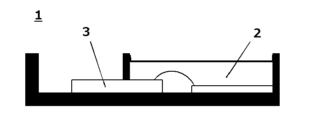
- Each composition was filled in the airflow meter 1 shown in FIG. 1 and subjected to 1000 cycles of -30° C. (1 hour) and 150° C. (1 hour). When no abnormality such as peeling was observed from the base material, it was evaluated as ⁇ , and when peeling was observed, it was evaluated as x.
- the airflow meter 1 has a detection section 3, and each composition 2 is filled so that the detection section 3 is partially covered.
- the gels of Examples 1 to 4 using the curable perfluoropolyether gel composition of the present invention had good adhesion by debubbling and heat shock tests after injection into the substrate.
- the cured product obtained in the above example has an appropriate penetration, has flexibility suitable for potting of electronic and electronic parts, and does not have a reactive functional group in the molecule (that is, even if it contains the component (B), which is a linear perfluoropolyether compound that does not participate in the cross-linking reaction, it exhibits sufficient solvent resistance and has excellent low-temperature characteristics due to its low glass transition temperature.
- the resin modulus is in an appropriate range, the shape retention property as a gel and the adhesion to the substrate are excellent.
- the composition of the present invention has a perfluoropolyether structure
- the cured product (perfluoropolyether gel cured product) obtained from the composition has excellent chemical resistance.
- the component (A), which is an essential component of the present invention, is excessive the resin modulus is high and the adhesion is lowered
- Comparative Example 3 in which the component (B), which is an essential component of the present invention, is excessive, the resin modulus is significantly decreased and the shape retention as a gel is deteriorated.
- Comparative Example 2 which does not contain the essential component (C) component, curing does not occur
- Comparative Example 4 which is a perfluoropolyether composition having a branched structure in the main chain of the component (A)
- the viscosity is high and bubbles are not easily removed, so foaming was confirmed in the reduced pressure treatment.
- the present invention is excellent in heat resistance, chemical resistance, low-temperature properties, adhesion, etc. after curing, and in particular, has a low viscosity before curing, so that even if it is used for potting, sealing materials, coating materials, etc. of electronic / electronic parts, bubbles can be easily removed in a short time, and it is possible to obtain a fluorine-containing curable gel composition that can be suitably used to improve productivity.
- the present invention is not limited to the above embodiments.
- the above embodiment is an example, and any device having substantially the same configuration as the technical idea described in the claims of the present invention and having similar effects is included in the technical scope of the present invention.
Landscapes
- Chemical & Material Sciences (AREA)
- Health & Medical Sciences (AREA)
- Chemical Kinetics & Catalysis (AREA)
- Medicinal Chemistry (AREA)
- Polymers & Plastics (AREA)
- Organic Chemistry (AREA)
- General Chemical & Material Sciences (AREA)
- Compositions Of Macromolecular Compounds (AREA)
- Structures Or Materials For Encapsulating Or Coating Semiconductor Devices Or Solid State Devices (AREA)
Priority Applications (4)
| Application Number | Priority Date | Filing Date | Title |
|---|---|---|---|
| JP2023575198A JPWO2023140134A1 (https=) | 2022-01-24 | 2023-01-10 | |
| CN202380018220.4A CN118715285A (zh) | 2022-01-24 | 2023-01-10 | 固化性全氟聚醚凝胶组合物、全氟聚醚凝胶固化物、及用该固化物密封的电气及电子构件 |
| KR1020247024775A KR20240134142A (ko) | 2022-01-24 | 2023-01-10 | 경화성 퍼플루오로폴리에테르 겔 조성물, 퍼플루오로폴리에테르 겔 경화물, 및 이 경화물로 봉지된 전기·전자부품 |
| EP23743130.9A EP4471090A4 (en) | 2022-01-24 | 2023-01-10 | Composition of hardenable perfluoropolyether gel, hardened perfluoropolyether gel product, and electrical/electronic component sealed using said hardened product |
Applications Claiming Priority (2)
| Application Number | Priority Date | Filing Date | Title |
|---|---|---|---|
| JP2022008714 | 2022-01-24 | ||
| JP2022-008714 | 2022-01-24 |
Publications (1)
| Publication Number | Publication Date |
|---|---|
| WO2023140134A1 true WO2023140134A1 (ja) | 2023-07-27 |
Family
ID=87348719
Family Applications (1)
| Application Number | Title | Priority Date | Filing Date |
|---|---|---|---|
| PCT/JP2023/000243 Ceased WO2023140134A1 (ja) | 2022-01-24 | 2023-01-10 | 硬化性パーフルオロポリエーテルゲル組成物、パーフルオロポリエーテルゲル硬化物、および該硬化物で封止された電気・電子部品 |
Country Status (6)
| Country | Link |
|---|---|
| EP (1) | EP4471090A4 (https=) |
| JP (1) | JPWO2023140134A1 (https=) |
| KR (1) | KR20240134142A (https=) |
| CN (1) | CN118715285A (https=) |
| TW (1) | TW202336153A (https=) |
| WO (1) | WO2023140134A1 (https=) |
Cited By (1)
| Publication number | Priority date | Publication date | Assignee | Title |
|---|---|---|---|---|
| WO2024214452A1 (ja) * | 2023-04-13 | 2024-10-17 | 信越化学工業株式会社 | 硬化性パーフルオロポリエーテルゲル組成物、パーフルオロポリエーテルゲル硬化物、および該硬化物で封止された電子部品 |
Citations (12)
| Publication number | Priority date | Publication date | Assignee | Title |
|---|---|---|---|---|
| JPS56143241A (en) | 1980-04-11 | 1981-11-07 | Toshiba Silicone Co Ltd | Polyorganosiloxane composition |
| JPS6333475A (ja) | 1986-07-22 | 1988-02-13 | バイエル・アクチエンゲゼルシヤフト | 軟質シリコ−ンエラストマ− |
| JPS6335655A (ja) | 1986-07-30 | 1988-02-16 | Toshiba Silicone Co Ltd | シリコ−ンゲル組成物 |
| JPH07324165A (ja) | 1993-06-17 | 1995-12-12 | Shin Etsu Chem Co Ltd | チキソ性フルオロシリコーンゲル組成物 |
| JPH0867819A (ja) * | 1994-06-23 | 1996-03-12 | Shin Etsu Chem Co Ltd | 硬化性組成物 |
| JPH11116685A (ja) | 1997-10-09 | 1999-04-27 | Shin Etsu Chem Co Ltd | 硬化性組成物 |
| JP2004043590A (ja) * | 2002-07-10 | 2004-02-12 | Shin Etsu Chem Co Ltd | 硬化性組成物及び電気・電子部品 |
| JP2006022223A (ja) * | 2004-07-08 | 2006-01-26 | Shin Etsu Chem Co Ltd | 硬化性フルオロポリエーテル組成物 |
| JP2010077267A (ja) * | 2008-09-25 | 2010-04-08 | Fujifilm Corp | 含フッ素ポリエーテル系化合物を含有する硬化性組成物 |
| JP2010189602A (ja) * | 2009-02-20 | 2010-09-02 | Shin-Etsu Chemical Co Ltd | 硬化性フルオロポリエーテル組成物、該組成物から得られる微粉末状又はペースト状の重合生成物、及び該重合生成物の製造方法 |
| JP2012102187A (ja) * | 2010-11-08 | 2012-05-31 | Shin-Etsu Chemical Co Ltd | パーフルオロポリエーテルゲル硬化物の耐酸性を向上する方法 |
| JP2013035904A (ja) * | 2011-08-04 | 2013-02-21 | Shin-Etsu Chemical Co Ltd | コーティング又はポッティング用液剤及びその製造方法、被覆層の形成方法、並びに該被覆層を有する物品 |
Family Cites Families (3)
| Publication number | Priority date | Publication date | Assignee | Title |
|---|---|---|---|---|
| US4565714B1 (en) * | 1984-06-14 | 1999-06-29 | Minnesota Mining & Mfg | Low surface energy material |
| JP5246212B2 (ja) * | 2010-07-14 | 2013-07-24 | 信越化学工業株式会社 | 硬化性パーフルオロポリエーテル系ゲル組成物及びその硬化物を用いたゲル製品 |
| US20230015835A1 (en) * | 2019-12-13 | 2023-01-19 | Shin-Etsu Chemical Co., Ltd. | Curable perfluoropolyether adhesive composition and adhesive containing cured product thereof |
-
2023
- 2023-01-10 KR KR1020247024775A patent/KR20240134142A/ko active Pending
- 2023-01-10 CN CN202380018220.4A patent/CN118715285A/zh active Pending
- 2023-01-10 JP JP2023575198A patent/JPWO2023140134A1/ja active Pending
- 2023-01-10 EP EP23743130.9A patent/EP4471090A4/en active Pending
- 2023-01-10 WO PCT/JP2023/000243 patent/WO2023140134A1/ja not_active Ceased
- 2023-01-12 TW TW112101341A patent/TW202336153A/zh unknown
Patent Citations (12)
| Publication number | Priority date | Publication date | Assignee | Title |
|---|---|---|---|---|
| JPS56143241A (en) | 1980-04-11 | 1981-11-07 | Toshiba Silicone Co Ltd | Polyorganosiloxane composition |
| JPS6333475A (ja) | 1986-07-22 | 1988-02-13 | バイエル・アクチエンゲゼルシヤフト | 軟質シリコ−ンエラストマ− |
| JPS6335655A (ja) | 1986-07-30 | 1988-02-16 | Toshiba Silicone Co Ltd | シリコ−ンゲル組成物 |
| JPH07324165A (ja) | 1993-06-17 | 1995-12-12 | Shin Etsu Chem Co Ltd | チキソ性フルオロシリコーンゲル組成物 |
| JPH0867819A (ja) * | 1994-06-23 | 1996-03-12 | Shin Etsu Chem Co Ltd | 硬化性組成物 |
| JPH11116685A (ja) | 1997-10-09 | 1999-04-27 | Shin Etsu Chem Co Ltd | 硬化性組成物 |
| JP2004043590A (ja) * | 2002-07-10 | 2004-02-12 | Shin Etsu Chem Co Ltd | 硬化性組成物及び電気・電子部品 |
| JP2006022223A (ja) * | 2004-07-08 | 2006-01-26 | Shin Etsu Chem Co Ltd | 硬化性フルオロポリエーテル組成物 |
| JP2010077267A (ja) * | 2008-09-25 | 2010-04-08 | Fujifilm Corp | 含フッ素ポリエーテル系化合物を含有する硬化性組成物 |
| JP2010189602A (ja) * | 2009-02-20 | 2010-09-02 | Shin-Etsu Chemical Co Ltd | 硬化性フルオロポリエーテル組成物、該組成物から得られる微粉末状又はペースト状の重合生成物、及び該重合生成物の製造方法 |
| JP2012102187A (ja) * | 2010-11-08 | 2012-05-31 | Shin-Etsu Chemical Co Ltd | パーフルオロポリエーテルゲル硬化物の耐酸性を向上する方法 |
| JP2013035904A (ja) * | 2011-08-04 | 2013-02-21 | Shin-Etsu Chemical Co Ltd | コーティング又はポッティング用液剤及びその製造方法、被覆層の形成方法、並びに該被覆層を有する物品 |
Non-Patent Citations (1)
| Title |
|---|
| See also references of EP4471090A4 |
Cited By (1)
| Publication number | Priority date | Publication date | Assignee | Title |
|---|---|---|---|---|
| WO2024214452A1 (ja) * | 2023-04-13 | 2024-10-17 | 信越化学工業株式会社 | 硬化性パーフルオロポリエーテルゲル組成物、パーフルオロポリエーテルゲル硬化物、および該硬化物で封止された電子部品 |
Also Published As
| Publication number | Publication date |
|---|---|
| TW202336153A (zh) | 2023-09-16 |
| EP4471090A4 (en) | 2026-01-28 |
| KR20240134142A (ko) | 2024-09-06 |
| EP4471090A1 (en) | 2024-12-04 |
| JPWO2023140134A1 (https=) | 2023-07-27 |
| CN118715285A (zh) | 2024-09-27 |
Similar Documents
| Publication | Publication Date | Title |
|---|---|---|
| JP5233952B2 (ja) | 硬化性パーフルオロポリエーテル組成物及びその硬化物を用いたゲル製品 | |
| JP5549554B2 (ja) | 熱硬化性フルオロポリエーテル系接着剤組成物及びその接着方法 | |
| JP5811985B2 (ja) | 接着剤組成物 | |
| JP5447343B2 (ja) | パーフルオロポリエーテルゲル硬化物の耐酸性を向上する方法 | |
| US11535749B2 (en) | Curable composition | |
| JP3654338B2 (ja) | 含フッ素硬化性組成物 | |
| JP3985133B2 (ja) | チキソ性含フッ素硬化性組成物及びこれを用いた封止物 | |
| EP1614718A1 (en) | Curable fluoropolyether compositions, their preparation and use | |
| JP2023179446A (ja) | 積層構造 | |
| JP2006022319A (ja) | 硬化性パーフルオロポリエーテル組成物及びその硬化物を用いたゴム及びゲル製品 | |
| WO2023140134A1 (ja) | 硬化性パーフルオロポリエーテルゲル組成物、パーフルオロポリエーテルゲル硬化物、および該硬化物で封止された電気・電子部品 | |
| JP4269127B2 (ja) | 硬化性組成物 | |
| JP3815778B2 (ja) | 低ブリード性ゲル状硬化物を与える硬化性組成物 | |
| JP2004331903A (ja) | パーフルオロアルキルエーテル系接着剤組成物の製造方法 | |
| JP7796104B2 (ja) | 加熱硬化性パーフルオロポリエーテル粘着剤組成物、その硬化物を用いた粘着剤並びに粘着テープ | |
| JP5578131B2 (ja) | 熱硬化性フルオロポリエーテル系接着剤組成物及びその接着方法 | |
| JP5141862B2 (ja) | マスキング用硬化性フルオロポリエーテルゴム組成物 | |
| JP3835536B2 (ja) | 含フッ素硬化性組成物 | |
| JP2024151871A (ja) | 硬化性パーフルオロポリエーテルゲル組成物、パーフルオロポリエーテルゲル硬化物、および該硬化物で封止された電子部品 | |
| EP1247830A2 (en) | Fluorinated curable compositions, their preparations and use | |
| JP2020027838A (ja) | 熱硬化性フルオロポリエーテル系組成物の硬化物からなる封止層を有するウェアラブルセンサーデバイス用半導体装置 |
Legal Events
| Date | Code | Title | Description |
|---|---|---|---|
| 121 | Ep: the epo has been informed by wipo that ep was designated in this application |
Ref document number: 23743130 Country of ref document: EP Kind code of ref document: A1 |
|
| ENP | Entry into the national phase |
Ref document number: 2023575198 Country of ref document: JP Kind code of ref document: A |
|
| ENP | Entry into the national phase |
Ref document number: 20247024775 Country of ref document: KR Kind code of ref document: A |
|
| WWE | Wipo information: entry into national phase |
Ref document number: 202380018220.4 Country of ref document: CN |
|
| NENP | Non-entry into the national phase |
Ref country code: DE |
|
| ENP | Entry into the national phase |
Ref document number: 2023743130 Country of ref document: EP Effective date: 20240826 |