WO2022102423A1 - 架橋性高分子組成物、架橋高分子材料、金属部材ならびにワイヤーハーネス - Google Patents
架橋性高分子組成物、架橋高分子材料、金属部材ならびにワイヤーハーネス Download PDFInfo
- Publication number
- WO2022102423A1 WO2022102423A1 PCT/JP2021/039800 JP2021039800W WO2022102423A1 WO 2022102423 A1 WO2022102423 A1 WO 2022102423A1 JP 2021039800 W JP2021039800 W JP 2021039800W WO 2022102423 A1 WO2022102423 A1 WO 2022102423A1
- Authority
- WO
- WIPO (PCT)
- Prior art keywords
- component
- metal
- polymer composition
- crosslinkable polymer
- group
- Prior art date
- Legal status (The legal status is an assumption and is not a legal conclusion. Google has not performed a legal analysis and makes no representation as to the accuracy of the status listed.)
- Ceased
Links
Images

Classifications
-
- C—CHEMISTRY; METALLURGY
- C09—DYES; PAINTS; POLISHES; NATURAL RESINS; ADHESIVES; COMPOSITIONS NOT OTHERWISE PROVIDED FOR; APPLICATIONS OF MATERIALS NOT OTHERWISE PROVIDED FOR
- C09D—COATING COMPOSITIONS, e.g. PAINTS, VARNISHES OR LACQUERS; FILLING PASTES; CHEMICAL PAINT OR INK REMOVERS; INKS; CORRECTING FLUIDS; WOODSTAINS; PASTES OR SOLIDS FOR COLOURING OR PRINTING; USE OF MATERIALS THEREFOR
- C09D5/00—Coating compositions, e.g. paints, varnishes or lacquers, characterised by their physical nature or the effects produced; Filling pastes
- C09D5/08—Anti-corrosive paints
- C09D5/082—Anti-corrosive paints characterised by the anti-corrosive pigment
- C09D5/086—Organic or non-macromolecular compounds
-
- C—CHEMISTRY; METALLURGY
- C08—ORGANIC MACROMOLECULAR COMPOUNDS; THEIR PREPARATION OR CHEMICAL WORKING-UP; COMPOSITIONS BASED THEREON
- C08K—Use of inorganic or non-macromolecular organic substances as compounding ingredients
- C08K5/00—Use of organic ingredients
- C08K5/04—Oxygen-containing compounds
- C08K5/05—Alcohols; Metal alcoholates
- C08K5/057—Metal alcoholates
-
- C—CHEMISTRY; METALLURGY
- C08—ORGANIC MACROMOLECULAR COMPOUNDS; THEIR PREPARATION OR CHEMICAL WORKING-UP; COMPOSITIONS BASED THEREON
- C08K—Use of inorganic or non-macromolecular organic substances as compounding ingredients
- C08K5/00—Use of organic ingredients
- C08K5/04—Oxygen-containing compounds
- C08K5/07—Aldehydes; Ketones
-
- C—CHEMISTRY; METALLURGY
- C08—ORGANIC MACROMOLECULAR COMPOUNDS; THEIR PREPARATION OR CHEMICAL WORKING-UP; COMPOSITIONS BASED THEREON
- C08L—COMPOSITIONS OF MACROMOLECULAR COMPOUNDS
- C08L101/00—Compositions of unspecified macromolecular compounds
- C08L101/02—Compositions of unspecified macromolecular compounds characterised by the presence of specified groups, e.g. terminal or pendant functional groups
-
- C—CHEMISTRY; METALLURGY
- C09—DYES; PAINTS; POLISHES; NATURAL RESINS; ADHESIVES; COMPOSITIONS NOT OTHERWISE PROVIDED FOR; APPLICATIONS OF MATERIALS NOT OTHERWISE PROVIDED FOR
- C09D—COATING COMPOSITIONS, e.g. PAINTS, VARNISHES OR LACQUERS; FILLING PASTES; CHEMICAL PAINT OR INK REMOVERS; INKS; CORRECTING FLUIDS; WOODSTAINS; PASTES OR SOLIDS FOR COLOURING OR PRINTING; USE OF MATERIALS THEREFOR
- C09D133/00—Coating compositions based on homopolymers or copolymers of compounds having one or more unsaturated aliphatic radicals, each having only one carbon-to-carbon double bond, and at least one being terminated by only one carboxyl radical, or of salts, anhydrides, esters, amides, imides, or nitriles thereof; Coating compositions based on derivatives of such polymers
- C09D133/04—Homopolymers or copolymers of esters
- C09D133/06—Homopolymers or copolymers of esters of esters containing only carbon, hydrogen and oxygen, the oxygen atom being present only as part of the carboxyl radical
- C09D133/08—Homopolymers or copolymers of acrylic acid esters
-
- C—CHEMISTRY; METALLURGY
- C09—DYES; PAINTS; POLISHES; NATURAL RESINS; ADHESIVES; COMPOSITIONS NOT OTHERWISE PROVIDED FOR; APPLICATIONS OF MATERIALS NOT OTHERWISE PROVIDED FOR
- C09D—COATING COMPOSITIONS, e.g. PAINTS, VARNISHES OR LACQUERS; FILLING PASTES; CHEMICAL PAINT OR INK REMOVERS; INKS; CORRECTING FLUIDS; WOODSTAINS; PASTES OR SOLIDS FOR COLOURING OR PRINTING; USE OF MATERIALS THEREFOR
- C09D147/00—Coating compositions based on homopolymers or copolymers of compounds having one or more unsaturated aliphatic radicals, at least one having two or more carbon-to-carbon double bonds; Coating compositions based on derivatives of such polymers
-
- C—CHEMISTRY; METALLURGY
- C09—DYES; PAINTS; POLISHES; NATURAL RESINS; ADHESIVES; COMPOSITIONS NOT OTHERWISE PROVIDED FOR; APPLICATIONS OF MATERIALS NOT OTHERWISE PROVIDED FOR
- C09D—COATING COMPOSITIONS, e.g. PAINTS, VARNISHES OR LACQUERS; FILLING PASTES; CHEMICAL PAINT OR INK REMOVERS; INKS; CORRECTING FLUIDS; WOODSTAINS; PASTES OR SOLIDS FOR COLOURING OR PRINTING; USE OF MATERIALS THEREFOR
- C09D183/00—Coating compositions based on macromolecular compounds obtained by reactions forming in the main chain of the macromolecule a linkage containing silicon, with or without sulfur, nitrogen, oxygen, or carbon only; Coating compositions based on derivatives of such polymers
- C09D183/04—Polysiloxanes
-
- H—ELECTRICITY
- H01—ELECTRIC ELEMENTS
- H01B—CABLES; CONDUCTORS; INSULATORS; SELECTION OF MATERIALS FOR THEIR CONDUCTIVE, INSULATING OR DIELECTRIC PROPERTIES
- H01B7/00—Insulated conductors or cables characterised by their form
- H01B7/17—Protection against damage caused by external factors, e.g. sheaths or armouring
- H01B7/28—Protection against damage caused by moisture, corrosion, chemical attack or weather
- H01B7/2806—Protection against damage caused by corrosion
-
- H—ELECTRICITY
- H01—ELECTRIC ELEMENTS
- H01B—CABLES; CONDUCTORS; INSULATORS; SELECTION OF MATERIALS FOR THEIR CONDUCTIVE, INSULATING OR DIELECTRIC PROPERTIES
- H01B7/00—Insulated conductors or cables characterised by their form
- H01B7/17—Protection against damage caused by external factors, e.g. sheaths or armouring
- H01B7/29—Protection against damage caused by extremes of temperature or by flame
- H01B7/292—Protection against damage caused by extremes of temperature or by flame using material resistant to heat
-
- C—CHEMISTRY; METALLURGY
- C08—ORGANIC MACROMOLECULAR COMPOUNDS; THEIR PREPARATION OR CHEMICAL WORKING-UP; COMPOSITIONS BASED THEREON
- C08K—Use of inorganic or non-macromolecular organic substances as compounding ingredients
- C08K5/00—Use of organic ingredients
- C08K5/04—Oxygen-containing compounds
- C08K5/09—Carboxylic acids; Metal salts thereof; Anhydrides thereof
- C08K5/098—Metal salts of carboxylic acids
-
- C—CHEMISTRY; METALLURGY
- C08—ORGANIC MACROMOLECULAR COMPOUNDS; THEIR PREPARATION OR CHEMICAL WORKING-UP; COMPOSITIONS BASED THEREON
- C08K—Use of inorganic or non-macromolecular organic substances as compounding ingredients
- C08K5/00—Use of organic ingredients
- C08K5/49—Phosphorus-containing compounds
- C08K5/51—Phosphorus bound to oxygen
- C08K5/52—Phosphorus bound to oxygen only
- C08K5/521—Esters of phosphoric acids, e.g. of H3PO4
-
- H—ELECTRICITY
- H01—ELECTRIC ELEMENTS
- H01B—CABLES; CONDUCTORS; INSULATORS; SELECTION OF MATERIALS FOR THEIR CONDUCTIVE, INSULATING OR DIELECTRIC PROPERTIES
- H01B7/00—Insulated conductors or cables characterised by their form
- H01B7/0045—Cable-harnesses
Definitions
- the present disclosure relates to crosslinkable polymer compositions, crosslinked polymer materials, metal members and wire harnesses.
- Patent Document 1 describes that a grease containing a perfluoroether base oil, a thickening agent, barium sulfate or antimony oxide is used for mechanical parts.
- curable material there is also a method of protecting the surface with various curable materials as a method of imparting corrosion resistance to metal equipment and metal parts.
- curable material various curable forms such as a photocurable material, a moisture curable material, an anaerobic curable material, a cationic curable material, an anion curable material, and a thermosetting material are known.
- Patent Document 2 describes that an epoxy curing material is used as a thermosetting material.
- Grease is a base oil in which a thickener is dispersed, and its viscosity greatly decreases when heated. Therefore, when applying grease to the metal surface, it becomes easier to apply by heating, but when heat is applied to the coating film, the grease will flow out, so the grease coating film tends to have low heat resistance. ..
- a thickener By selecting a thickener, it is possible to prevent grease from flowing out even under high temperature conditions, but in that case, the heating temperature required for application to the metal surface also increases, making it difficult to form a uniform coating film. It becomes.
- the problem to be solved in the present disclosure is a crosslinkable polymer composition and a crosslinked polymer material which have high corrosion resistance and heat resistance and can easily form a highly uniform coating film, and the above-mentioned crosslinking. It is an object of the present invention to provide a metal member and a wire harness to which a sex polymer composition and a crosslinked polymer material are applied.
- the crosslinkable polymer composition according to the present disclosure has the following constitution.
- the valence of the metal ion liberated from the component A is + y
- the content of the metal ion is mmol
- the valence of the substituent contained in the component B is ⁇ z
- the content of the substituent is defined as ⁇ z.
- the valence of the acidic phosphoric acid ester constituting the C component is ⁇ x, and the content of the acidic phosphoric acid ester is l mol.
- g (m ⁇ yl ⁇ x) / (n ⁇ z), g ⁇ 0.1.
- P ( O) (-OR) (-OH) 2 (C1)
- P ( O) (-OR) 2 (-OH) (C2)
- R is a hydrocarbon group having 4 or more and 30 or less carbon atoms.
- the crosslinked polymer material according to the present disclosure is a crosslinked body of the crosslinkable polymer composition according to the present disclosure, and the B component is crosslinked via the metal ion liberated from the A component.
- the metal member according to the present disclosure includes a metal base material and a coating material that covers the surface of the metal base material, and the coating material is composed of the crosslinked polymer material according to the present disclosure. Is.
- the wire harness according to the present disclosure includes the crosslinked polymer material according to the present disclosure.
- crosslinkable polymer composition according to the present disclosure, it is possible to easily form a coating film having high corrosion resistance and heat resistance and high uniformity.
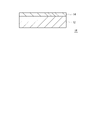
- FIG. 1 is a cross-sectional view of a metal member according to an embodiment of the present disclosure.
- FIG. 2 is a perspective view of a wire harness according to an embodiment of the present disclosure.
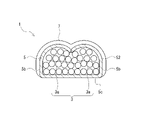
- FIG. 3 is a vertical cross-sectional view taken along the line AA in FIG.
- the crosslinkable polymer composition according to the present disclosure has the following constitution.
- a component in which metal ions are liberated by heat and
- a component B composed of an organic polymer having a substituent capable of ionic bonding with the metal ion released from the component A
- a component C composed of one or more of the acidic phosphoric acid esters represented by the following general formulas (C1) and (C2), and Including
- the valence of the metal ion liberated from the component A is + y
- the content of the metal ion is mmol
- the valence of the substituent contained in the component B is ⁇ z
- the content of the substituent is defined as ⁇ z.
- the valence of the acidic phosphoric acid ester constituting the C component is ⁇ x, and the content of the acidic phosphoric acid ester is l mol.
- g (m ⁇ yl ⁇ x) / (n ⁇ z), g ⁇ 0.1.
- P ( O) (-OR) (-OH) 2 (C1)
- P ( O) (-OR) 2 (-OH) (C2)
- R is a hydrocarbon group having 4 or more and 30 or less carbon atoms.
- the B component is crosslinked via the metal ion liberated from the A component by heating. Therefore, it is possible to form a coating film having high heat resistance through heating. Further, the crosslinkable polymer composition exhibits high anticorrosion property by forming a phosphate ester salt with the metal ion liberated from the A component and becoming a metal adsorption component. On the other hand, since the crosslinkable polymer composition according to the present disclosure is in a state of high fluidity in a state where it is not heated, it can be applied uniformly to a metal surface or the like. After that, only by heating, the coating film having excellent corrosion resistance and heat resistance is obtained as described above, so that a highly uniform coating film can be easily formed.
- the component A may have a decomposition point or a phase transition point at 50 ° C. or higher and 200 ° C. or lower.
- a decomposition point or a phase transition point at 50 ° C. or higher and 200 ° C. or lower.
- it is easy to suppress the release of metal ions from the component A, and the curing of the crosslinkable polymer composition is suppressed. Therefore, it is excellent in coatability at a low temperature such as room temperature, and is also excellent in storage stability such that quality change during storage of the crosslinkable polymer composition at a low temperature such as room temperature is suppressed. Further, it is because the metal ion is easily released from the A component by the decomposition or phase transition of the A component at an appropriate temperature, and the curing rate is excellent when the crosslinkable polymer composition is used.
- the component A may be a metal complex.
- the effect of stabilizing the metal ion by the ligand is excellent, and the release of the metal ion from the component A is suppressed at the time of preparing the crosslinkable polymer composition or before using the crosslinkable polymer composition. This is because when the crosslinkable polymer composition is used, metal ions are easily released from the component A by heat.
- the component A may be a metal complex containing a polydentate ligand or a cross-linking ligand. Coordination with a polydentate ligand or a bridging ligand is more effective than non-bridging coordination with a monodentate ligand for stabilizing metal ions by the ligand, and thus the crosslinkable polymer composition. This is because the release of metal ions from the component A is further suppressed at the time of preparation and before the use of the crosslinkable polymer composition.
- the component A may be a metal complex containing a ⁇ -diketonato ligand or an alkoxide ligand.
- the ⁇ -diketonato ligand and the alkoxide ligand are stably coordinated to the metal ion.
- ⁇ -diketonato ligands and alkoxide ligands are more likely to form polydentate or crosslinked coordination, in which case the metal with the ligand is more likely than the non-bridging coordination with the monodentate ligand. This is because the effect of stabilizing the ions is excellent, and the release of metal ions from the component A is further suppressed at the time of preparing the crosslinkable polymer composition or before using the crosslinkable polymer composition.
- the metal of the metal ion liberated from the component A is preferably at least one of alkaline earth metal, zinc, titanium, and aluminum. This is because the ions of these metals have a valence of divalent or higher and are excellent in the stability of the crosslinked polymer material composed of the crosslinked body of the crosslinkable polymer composition. Further, when the phosphoric acid ester salt is formed with the C component, it exhibits high adsorptivity to the metal surface.
- the substituent of the B component may be an electron-withdrawing group. This is because it is easy to form an ionic bond with the metal ion liberated from the component A.
- the substituent of the B component may be at least one of a carboxylic acid group, an acid anhydride group, a phosphoric acid group, and a sulfonic acid group. This is because it is easy to form an ionic bond with the metal ion liberated from the component A.
- the B component is preferably liquid at 150 ° C. or lower. This is because the crosslinkable polymer composition can be applied to a metal surface or the like at a relatively low temperature.
- the A component is contained in an amount of 1 part by mass or more and 30 parts by mass or less with respect to 100 parts by mass of the B component. This is because the crosslinkable polymer composition is excellent in crosslinkability, and it is easy to avoid the influence of a large amount of A component such as separation and precipitation of the A component.
- the C component is contained in an amount of 1 part by mass or more and 30 parts by mass or less with respect to 100 parts by mass of the B component. This is because the crosslinkable polymer composition exhibits high anticorrosion properties, and it is easy to avoid the influence of a large amount of C component such as separation and precipitation of the C component.
- the crosslinked polymer material of the present disclosure is a crosslinked body of the crosslinkable polymer composition according to the present disclosure, and the B component is crosslinked via the metal ion liberated from the A component. .. Therefore, the crosslinked polymer material has high corrosion resistance and heat resistance, and is easily formed as a highly uniform coating film.
- the metal member of the present disclosure includes a metal base material and a coating material for covering the surface of the metal base material, and the coating material is composed of the crosslinked polymer material of the present disclosure. .. Therefore, the metal member has excellent corrosion resistance, and even when heated, the state of having high corrosion resistance is maintained.
- the wire harness of the present disclosure includes the crosslinked polymer material of the present disclosure. Therefore, the wire harness has excellent corrosion resistance, and even if it is heated, the state of having high corrosion resistance is maintained.
- the crosslinkable polymer composition according to the present disclosure is capable of ion-bonding with a component A in which metal ions are liberated by heat and a metal ion liberated from the component A. It contains a component B composed of an organic polymer having a suitable substituent and a component C composed of an acidic phosphate ester having a predetermined structure.
- the crosslinkable polymer composition according to the present disclosure undergoes heating, and the B component is crosslinked via the metal ion liberated from the A component to cause curing, and the crosslinkable polymer according to the embodiment of the present disclosure. Make up the material.
- the C component forms a phosphate ester salt with the metal ion released from the A component, and functions as a metal adsorbing component.
- Component A is a component in which metal ions are liberated by heat. By heat, it is assumed that it will be heated, and it is assumed that the temperature is higher than normal temperature.
- the release of metal ions means that the metal ions are released from the A component by the decomposition or phase transition of the A component.
- the metal ions released from the A component cause cross-linking of the B component and formation of a metal salt with the C component.
- the component A preferably has a decomposition point or a phase transition point at 50 ° C. or higher and 200 ° C. or lower.
- a decomposition point or a phase transition point at 50 ° C. or higher and 200 ° C. or lower.
- the metal ion is easily released from the A component by the decomposition or phase transition of the A component at an appropriate temperature, and the curing rate is excellent when the crosslinkable polymer composition is used.
- the component A may have a decomposition point or a phase transition point at 60 ° C. or higher, more preferably 70 ° C. or higher.
- the component A may have a decomposition point or a phase transition point more preferably 150 ° C. or lower, still more preferably 120 ° C. or lower.
- the decomposition point or phase transition point of the component A is represented by the baseline change start temperature by differential scanning calorimetry (DSC) (measurement temperature range: 25 ° C. to 200 ° C., measured in the atmosphere).
- DSC differential scanning calorimetry
- Examples of the metal of the metal ion liberated from the component A include alkaline earth metal, zinc, titanium, aluminum, iron, nickel, copper, and zirconium.
- the metal of the metal ion may be at least one of these metals.
- the metal of the metal ion may be composed of only one of these metals, or may be composed of two or more of them.
- the metal of the metal ion is preferably at least one of alkaline earth metal, zinc, titanium and aluminum. This is because the metal ions of these metals have a valence of divalent or higher, easily crosslink the organic polymer, and have excellent stability of the crosslinked polymer material composed of the crosslinked body of the crosslinkable polymer composition.
- zinc is particularly preferable among the above-mentioned preferable metal species.
- the stability of the crosslinked polymer material composed of the crosslinked body of the crosslinkable polymer composition is particularly excellent.
- the alkaline earth metals, zinc, titanium, and aluminum mentioned above as preferable ones are divalent or higher valent metals and have a relatively high ionization tendency, so that they are placed between the C component and the metal surface. It is possible to form a phosphate ester salt showing high adsorptivity.
- a component examples include metal complexes and the like.
- a metal complex is composed of a ligand having an unshared electron pair coordinated to a central metal ion.
- the component A is preferably a metal complex. It has an excellent effect of stabilizing metal ions by the ligand, and it suppresses the release of metal ions from the component A and has the cross-linking property at the time of preparing the cross-linking polymer composition or before using the cross-linking polymer composition. This is because when the polymer composition is used, metal ions are easily released from the component A by heat.
- the ligand of the metal complex has a group having a lone electron pair, and this group is coordinated with a metal ion to form a metal complex.
- the ligand include a monodentate ligand having one coordination site and a polydentate ligand having two or more coordination sites.
- the metal complex produced by the polydentate ligand is more stable than the metal complex produced by the monodentate ligand due to the chelating effect.
- the ligand there is a non-bridge ligand in which one ligand coordinates with one metal ion, and a bridging ligand in which one ligand coordinates with two or more metal ions. ..
- the cross-linking ligand may be composed of a monodentate ligand or a polydentate ligand.
- the component A is preferably a metal complex containing a polydentate ligand or a cross-linking ligand. Coordination with a polydentate ligand or a bridging ligand is more effective than non-bridging coordination with a monodentate ligand for stabilizing metal ions by the ligand, and thus is a crosslinkable polymer composition. This is because the release of metal ions from the component A is further suppressed at the time of preparation and before the use of the crosslinkable polymer composition.
- Examples of the ligand of the metal complex include ⁇ -diketonato ligand (1,3-diketonato ligand) and alkoxide ligand.
- the ⁇ -diketonato ligand is represented by the following general formula (1).
- the alkoxide ligand is represented by the following general formula (2).
- Examples of the ⁇ -diketonato ligand include acetylacetonato ligand (acac), 2,2,6,6-tetramethyl-3,5-heptandionato ligand (dpm), and 3-methyl-2,4-.
- Pentazionato Ligand 3-Ethyl-2,4-Pentandionato Ligand, 3,5-Heptandionato Ligand, 2,6-dimethyl-3,5-Heptandionato Ligand, 1,3-diphenyl-1, Examples thereof include 3-propanedionato ligand.
- alkoxide ligand include a methoxide ligand, an ethoxydo ligand, an isopropoxide ligand, an n-propoxide ligand, an n-butoxide ligand and the like.
- R 1 , R 2 , and R 3 represent hydrocarbon groups.
- R 1 , R 2 , and R 3 may be hydrocarbon groups having the same structure as each other, or may be hydrocarbon groups having different structures from each other.
- R 1 , R 2 , and R 3 may be an aliphatic hydrocarbon group or a hydrocarbon group containing an aromatic ring.
- R 1 , R 2 , and R 3 are preferably hydrocarbon groups having 1 or more and 10 or less carbon atoms.
- R 3 may be hydrogen. It also includes the case where at least two of R 1 , R 2 and R 3 are connected to each other by a ring structure.
- R 4 represents a hydrocarbon group.
- R4 may be an aliphatic hydrocarbon group or a hydrocarbon group containing an aromatic ring.
- R4 is preferably a hydrocarbon group having 1 or more and 10 or less carbon atoms.
- the component A is preferably a metal complex containing a ⁇ -diketonato ligand or an alkoxide ligand.
- the ⁇ -diketonato ligand and the alkoxide ligand are stably coordinated to the metal ion.
- ⁇ -diketonato ligands and alkoxide ligands are more likely to form polydentate or crosslinked coordination, in which case the metal with the ligand is more likely than the non-bridging coordination with the monodentate ligand. This is because the effect of stabilizing the ions is excellent, and the liberation of metal ions from the component A is further suppressed at the time of preparing the crosslinkable polymer composition or before using the crosslinkable polymer composition.
- the component B is a component composed of a metal ion liberated from the component A and an organic polymer having a substituent capable of ionic bonding.
- substituent capable of ionic bonding with the metal ion include a carboxylic acid group, an acid anhydride group, a phosphoric acid group, and a sulfonic acid group.
- the above substituent does not contain a hydroxyl group.
- the above-mentioned substituent may be only one kind among the exemplified substituents, or may be two or more kinds.
- the above-mentioned substituent may be at least one of the exemplified substituents.
- the substituent may be an electron-withdrawing group. This is because it is easy to form an ionic bond with a metal ion liberated from the A component.
- the content of the above-mentioned substituent in the component B is not particularly limited, but is preferably 0.01% by mass or more and 10% by mass or less from the viewpoint of ensuring physical properties by crosslinking. It is more preferably 0.1% by mass or more and 5% by mass or less, and further preferably 0.2% by mass or more and 3% by mass or less.
- the content of the substituent in the component B can be determined by comparing the magnitude of the substituent-specific peak in the infrared spectroscopic spectrum with the magnitude of the spectral peak of the material having a known content.
- the organic polymer of component B is an organic polymer such as resin, rubber, and elastomer.
- the component B may be liquid at room temperature or solid at room temperature, but is preferably liquid at 150 ° C. or lower. This is because the crosslinkable polymer composition can be applied to a metal surface or the like at a relatively low temperature. Further, the component B is preferably liquid at room temperature. This is because the crosslinkable polymer composition can be applied to a metal surface or the like at room temperature. In addition, the crosslinkable polymer composition can be easily prepared. It is preferable that not only the B component alone but also the crosslinkable polymer composition as a whole is liquid at 150 ° C. or lower, and further at room temperature.
- the B component preferably has a molecular weight of 1000 or more. This is because even if it is liquid at room temperature, it is easily cured by crosslinking. On the other hand, the B component preferably has a molecular weight of 100,000 or less from the viewpoint that it tends to be liquid at room temperature. More preferably, the molecular weight is 50,000 or less.
- the molecular weight of component B is expressed as a number average molecular weight (Mn) by gel permeation chromatography (GPC) analysis.
- the organic polymer of the B component examples include polyolefin, polybutadiene, polyisoprene, polyacrylate, polymethacrylate, polyurethane, polyester, organopolysiloxane (silicone) and the like.
- the substituent of the B component may be one introduced into the main chain of the organic polymer or one introduced into the side chain.
- the organic polymer of the B component polybutadiene and polyisoprene are particularly preferable from the viewpoint of ensuring fluidity at room temperature.
- the organic polymer also includes a polymer having a relatively low degree of polymerization such as an oligomer.
- C component is composed of one or more of the acidic phosphoric acid esters represented by the following general formulas (C1) and (C2).
- P ( O) (-OR) (-OH) 2 (C1)
- P ( O) (-OR) 2 (-OH) (C2)
- R is a hydrocarbon group having 4 or more and 30 or less carbon atoms.
- the C component forms a metal salt with the metal ion liberated from the A component after heating.
- This metal salt becomes a metal adsorption component that is adsorbed on a metal surface or the like.
- the metal adsorption component exhibits anticorrosion performance that protects the metal surface from corrosion.
- the C component is relative to the B component. Since it exhibits high compatibility, the C component is less likely to cause aggregation in the crosslinkable polymer composition and exhibits high dispersibility.
- the C component is dispersed in the B component cured by ion cross-linking even after forming a salt with the metal ion released by heat from the A component, and maintains the metal adsorptivity.
- the number of carbon atoms of the hydrocarbon group is more preferably 5 or more, still more preferably 6 or more, from the viewpoint of enhancing dispersibility.
- hydrocarbon group R examples include an alkyl group, a cycloalkyl group, an alkyl-substituted cycloalkyl group, an alkenyl group, an aryl group, an alkyl-substituted aryl group, and an arylalkyl group.
- Alkyl groups include butyl group, pentyl group, hexyl group, heptyl group, octyl group, nonyl group, decyl group, undecyl group, dodecyl group, tridecyl group, tetradecyl group, pentadecyl group, hexadecyl group, heptadecyl group and octadecyl group. And so on. These alkyl groups may be linear or branched.
- cycloalkyl group examples include a cyclopentyl group, a cyclohexyl group, a cycloheptyl group and the like.
- Alkyl-substituted cycloalkyl groups include methylcyclopentyl group, dimethylcyclopentyl group, methylethylcyclopentyl group, diethylcyclopentyl group, methylcyclohexyl group, dimethylcyclohexyl group, methylethylcyclohexyl group, diethylcyclohexyl group, methylcycloheptyl group and dimethylcyclo.
- alkyl Substitution The substitution position of the cycloalkyl group is not particularly limited.
- the alkyl group may be linear or branched.
- alkenyl group examples include a butenyl group, a pentenyl group, a hexenyl group, a heptenyl group, an octenyl group, a nonenyl group, a decenyl group, an undecenyl group, a dodecenyl group, a tridecenyl group, a tetradecenyl group, a pentadecenyl group, a hexadecenyl group, a heptadecenyl group and an octadecenyl group. And so on. These alkenyl groups may be linear or branched chain.
- Examples of the aryl group include a phenyl group and a naphthyl group.
- the alkyl-substituted aryl groups include trill group, xylyl group, ethylphenyl group, propylphenyl group, butylphenyl group, pentylphenyl group, hexylphenyl group, heptylphenyl group, octylphenyl group, nonylphenyl group and decylphenyl group. Examples include undecylphenyl group and dodecylphenyl group.
- the substitution position of the alkyl-substituted aryl group is not particularly limited.
- the alkyl group may be linear or branched.
- arylalkyl group examples include a benzyl group, a phenylethyl group, a phenylpropyl group, a phenylbutyl group, a phenylpentyl group, a phenylhexyl group and the like.
- the alkyl group may be linear or branched.
- the hydrocarbon group is preferably an aliphatic hydrocarbon group or an alicyclic hydrocarbon group. More preferably, it is an aliphatic hydrocarbon group.
- the aliphatic hydrocarbon group include an alkyl group composed of a saturated hydrocarbon and an alkenyl group composed of an unsaturated hydrocarbon.
- the alkyl group or alkenyl group which is an aliphatic hydrocarbon group may have either a linear structure or a branched chain structure.
- the alkyl group is a linear alkyl group such as an n-butyl group or an n-octyl group
- the alkyl groups tend to be easily oriented and the dispersibility in the B component tends to decrease.
- the hydrocarbon group is an alkyl group
- a branched-chain alkyl group is preferable to a linear alkyl group.
- the alkenyl group since the alkenyl group has one or more carbon-carbon double bond structures, the orientation is not so high even if it is linear. Therefore, the alkenyl group may be linear or branched.
- the acidic phosphoric acid ester examples include butyl octyl acid phosphate, isomilystyl acid phosphate, isosetyl acid phosphate, hexyl decyl acid phosphate, isostearyl acid phosphate, isobehenyl acid phosphate, and octyl decyl acid phosphate.
- stearyl acid phosphate oleyl acid phosphate, and di-2-ethylhexyl acid phosphate are preferable from the viewpoint of high anticorrosion performance when used as a metal salt and dispersibility in the B component.
- the crosslinkable polymer composition of the present disclosure may appropriately contain additives such as diluents, dispersants, and colorants in addition to the above A to C components as long as the functions of the materials are not impaired.
- the crosslinkable polymer composition includes a grease component and various curable materials such as a photocurable material, a moisture curable material, an anaerobic curable material, a cationic curable material, an anion curable material, and a thermosetting material. It is preferable not to include it.
- the component B when the component B is 150 ° C. or lower or liquid at room temperature, it is preferable that the polymer component which is solid at 150 ° C. or lower or room temperature is not contained.
- the crosslinkable polymer composition may contain only the B component as the polymer component.
- the following compounds (a) to (f) can be mentioned. That is, (a) a silane coupling agent, (b) an epoxy compound, (c) an isocyanate, an isothiocyanate compound, (d) a photoradical generator, a thermal radical generator, (e) a chlorine compound, a bromine compound, (f).
- a volatile organic solvent can be mentioned.
- cross-linking of the B component by a reaction different from the cross-linking reaction via the metal ion liberated from the A component during heating, or cross-linking of the B component or B Unintended chemical reactions such as cleavage of the main chain of the component may occur. Then, the heat resistance and remoldability of the crosslinkable polymer composition may not be sufficiently exhibited. Further, when the compound of the group (e) is contained in the crosslinkable polymer composition, coloring or generation of corrosive gas may occur due to heating. When the compound of the group (f) is contained in the crosslinkable polymer composition, ignition or generation of bubbles may occur when molding the composition.
- the crosslinkable polymer composition can be easily prepared by mixing the A component, the B component, and the C component and dispersing the A component and the C component in the B component.
- each component is defined in relation to the valence of each component.
- the valence and content of each component satisfy the following formula (3).
- the valence of the metal ion liberated from the component A is + y
- the content of the metal ion is mmol.
- the valence of the ionic bondable substituent contained in the B component is ⁇ z
- the content of the substituent is n mol.
- the valence of the acidic phosphoric acid ester constituting the C component is ⁇ x, and the content of the acidic phosphoric acid ester is l mol.
- each of m ⁇ y, l ⁇ x, n ⁇ z in the formula (3) is the sum of the values calculated for each type of element.
- the content of each of the above elements with m mol, n mol and l mol refers to the content of each element in the entire crosslinkable polymer composition.
- the metal ions liberated from the component A by heat form a metal ion crosslink of the component B by forming an ionic bond with the substituent of the component B, and phosphorus with the component C. Consumed for both the formation of acid ester salts. Therefore, in order to sufficiently proceed with the cross-linking of the component B, the metal ions liberated from the component A need to remain even if they are consumed in the formation of the phosphate ester salt with the component C.
- the g value of the above formula (3) is the amount of metal ions freed from the A component and remaining without being consumed in the formation of the phosphate ester salt with the C component, as a ratio to the abundance of the substituent of the B component. The larger the value, the larger the amount of metal ions that can contribute to the cross-linking of the B component.
- g ⁇ 0.1 the cross-linking of the B component can be sufficiently promoted and the cross-linking polymer composition can be cured. From the viewpoint of enhancing the curability, it is more preferable that g ⁇ 0.2, further g ⁇ 0.5 and g ⁇ 1.0.
- g ⁇ 2.0 and further g ⁇ 1.5 are preferable.
- the component A is contained in an amount of 1 part by mass or more and 30 parts by mass or less with respect to 100 parts by mass of the component B.
- the A component is contained in an amount of 1 part by mass or more, sufficient crosslinkability to the B component can be obtained, and further, the metal adsorption property due to the metal adsorption component formed from the C component and the metal ion can be sufficiently obtained. Highly protective effect on the surface.
- the content of the component A is suppressed to 30 parts by mass or less, it is easy to avoid separation and precipitation of the component A in the state before cross-linking of the crosslinkable polymer composition, and even in the state after cross-linking, A Deterioration of physical properties of the crosslinked body such as aggregation of components and embrittlement, and deterioration of anticorrosion performance due to these phenomena are unlikely to occur.
- the lower limit of the content of the component A is more preferably 2 parts by mass or more, still more preferably 5 parts by mass or more and 10 parts by mass or more.
- the upper limit of the content of the component A is more preferably 20 parts by mass or less, still more preferably 15 parts by mass or less.
- the C component is contained in an amount of 1 part by mass or more and 30 parts by mass or less with respect to 100 parts by mass of the B component.
- the metal adsorption component formed from the metal ion liberated from the A component and the C component exhibits high metal adsorption property, so that a high protective effect on the metal surface is exhibited. Will be done.
- the content of the C component is suppressed to 30 parts by mass or less, it is easy to avoid separation and precipitation of the C component in the state before cross-linking of the crosslinkable polymer composition, and even in the state after cross-linking, C Deterioration of physical properties of the crosslinked body such as aggregation of components and embrittlement, and deterioration of anticorrosion performance due to these phenomena are unlikely to occur.
- the lower limit of the content of the C component is more preferably 2 parts by mass or more, still more preferably 5 parts by mass or more.
- the upper limit of the content of the C component is more preferably 20 parts by mass or less, still more preferably 15 parts by mass or less and 10 parts by mass or less.
- the crosslinkable polymer composition according to the present disclosure has an excellent curing rate. Further, the metal ion of the component A is liberated by heat, the metal ion is not liberated from the component A until the temperature at which the metal ion is liberated, and the cross-linking of the organic polymer of the component B by the ionic bond does not proceed. Therefore, the crosslinkable polymer composition according to the present disclosure is excellent in storage stability and is uniformly heated by being applied to an object such as a metal surface in a state of high fluidity before crosslinking. A highly high-quality coating film can be easily formed.
- the organic polymer of the B component is crosslinked via an ionic bond, and the bonding force is stronger than the van der Waals force to form a tough crosslinked body. .. Further, the crosslinkable polymer composition according to the present disclosure is excellent in heat resistance and chemical resistance because the organic polymer of the B component is crosslinked via an ionic bond.
- the phosphate ester salt formed from the metal ion liberated from the A component and the C component is uniformly dispersed in the crosslinked product of the B component and exhibits metal adsorptivity. Due to its metal adsorption property, high anticorrosion property is exhibited on the metal surface.
- the C component does not form a phosphoric acid ester salt by ionic bond with a metal ion, and even in the state of an acidic phosphoric acid ester, it exhibits a certain degree of metal adsorptivity, but the phosphoric acid ester salt is formed together with the metal ion. In the formed state, it is more likely to be adsorbed on the metal surface via ionic bonds, and exhibits high anticorrosion performance.
- the ratio of the contents of the components A to C is specified so that g ⁇ 0.1, so that the metal ions released from the component A by heat are released.
- B component can contribute to both metal ion cross-linking and formation of phosphate ester salt with C component. As a result, both the improvement of heat resistance by cross-linking the B component and the improvement of corrosion resistance by the formation of the phosphate ester salt are achieved.
- the crosslinkable polymer composition according to the present disclosure is easily crosslinked and cured by heat.
- the crosslinked polymer material according to the present disclosure is composed of a crosslinked body of the crosslinkable polymer composition according to the present disclosure.
- the B component in the crosslinkable polymer composition is in a state of being crosslinked via the metal ion liberated from the A component.
- the crosslinkable polymer composition according to the present disclosure can be suitably used as a protective material having anticorrosion properties, an adhesive material, a curing molding material, and the like.
- a protective material having anticorrosion properties for example, it can be used for anticorrosion to prevent metal corrosion by adhering to the surface of a metal base material to be surface-protected and covering the metal base material.
- an anticorrosive application it can be used, for example, as an anticorrosive agent for a covered electric wire with a terminal.
- FIG. 1 shows a cross-sectional view of a metal member according to an embodiment.
- the metal member 10 has a metal base material 12 and a covering material 14 that covers the surface of the metal base material 12, and the covering material 14 is a crosslinked polymer material according to the present disclosure, that is, a crosslinkable property according to the present disclosure. It is composed of a crosslinked body (cured product) of a polymer composition.
- the metal member 10 according to the present disclosure is excellent in anticorrosion effect because the covering material 14 is composed of the crosslinked polymer material of the present disclosure.
- the wire harness according to the present disclosure includes the crosslinked polymer material according to the present disclosure.
- a form in which the crosslinked polymer material according to the present disclosure is used as an anticorrosion agent for covering a terminal fitting of a covered electric wire with a terminal in a wire harness and an electrical connection portion of the electric wire conductor can be mentioned.
- a coated electric wire with a terminal is a conductor terminal of an insulated electric wire in which a terminal fitting is connected, and the terminal fitting and the electric wire conductor are made of the crosslinked polymer material (cured product of the crosslinkable polymer composition according to the present disclosure) according to the present disclosure. It consists of a covered electrical connection. This structure prevents corrosion at the electrical connections.
- FIG. 2 is a perspective view of a covered electric wire with a terminal according to an embodiment of the present disclosure
- FIG. 3 is a vertical sectional view taken along line AA in FIG.
- the electric wire conductor 3 and the terminal fitting 5 of the coated electric wire 2 in which the electric wire conductor 3 is covered with an insulating coating (insulator) 4 are formed by an electric connection portion 6. It is electrically connected.
- the terminal fitting 5 is a wire fixing portion composed of a tab-shaped connecting portion 51 made of an elongated flat plate connected to the mating terminal, a wire barrel 52 extendingly formed at the end of the connecting portion 51, and an insulation barrel 53. Has 54.
- the terminal fitting 5 can be formed (processed) into a predetermined shape by pressing a metal plate material.
- the insulating coating 4 of the terminal of the coated electric wire 2 is peeled off to expose the electric wire conductor 3, and the exposed electric wire conductor 3 is crimped to one side of the terminal fitting 5 to expose the coated electric wire 2. And the terminal fitting 5 are connected.
- the wire barrel 52 of the terminal fitting 5 is crimped from above the wire conductor 3 of the coated electric wire 2, and the wire conductor 3 and the terminal fitting 5 are electrically connected. Further, the insulation barrel 53 of the terminal fitting 5 is crimped from above the insulating coating 4 of the coated electric wire 2.
- the range indicated by the alternate long and short dash line is covered by the cured product 7 of the crosslinkable polymer composition according to the present disclosure.
- the area up to the surface of is covered with the cured product 7. That is, the tip 2a side of the covered electric wire 2 is covered with the cured product 7 so as to slightly protrude from the tip of the electric wire conductor 3 to the connection portion 51 side of the terminal fitting 5.
- the end edge 5a side of the terminal fitting 5 is covered with the cured product 7 so as to slightly protrude from the end portion of the insulation barrel 53 to the insulating coating 4 side of the coated electric wire 2. Then, as shown in FIG. 3, the side surface 5b of the terminal fitting 5 is also covered with the cured product 7. The back surface 5c of the terminal fitting 5 may or may not be covered with the cured product 7.
- the peripheral end of the cured product 7 is composed of a portion that contacts the surface of the terminal fitting 5, a portion that contacts the surface of the electric wire conductor 3, and a portion that contacts the surface of the insulating coating 4.
- the electrical connection portion 6 is covered with the cured product 7 to a predetermined thickness along the outer peripheral shape of the terminal fitting 5 and the covered electric wire 2.
- the exposed portion of the electric wire conductor 3 of the covered electric wire 2 is completely covered with the cured product 7 so as not to be exposed to the outside. Therefore, the electrical connection portion 6 is completely covered with the cured product 7. Since the cured product 7 has excellent adhesion to all of the electric wire conductor 3, the insulating coating 4, and the terminal fitting 5, the cured product 7 allows moisture or the like to enter the electric wire conductor 3 and the electrical connection portion 6 from the outside, and the metal portion is formed. Prevents corrosion.
- the cured product 7 has excellent adhesion, for example, even if the electric wire is bent in the process from the manufacture of the wire harness to the attachment to the vehicle, the cured product 7 and the electric wire conductor are formed at the peripheral end of the cured product 7. 3. It is difficult for a gap to be formed between any of the insulating coating 4 and the terminal fitting 5, and the waterproof and anticorrosion functions are maintained.
- the crosslinkable polymer composition according to the present disclosure that forms the cured product 7 is applied to a predetermined range.
- a known means such as a dropping method and a coating method can be used for coating the crosslinkable polymer composition according to the present disclosure to form the cured product 7.
- the cured product 7 is formed in a predetermined range with a predetermined thickness.
- the thickness is preferably 0.1 mm or less. If the cured product 7 becomes too thick, it becomes difficult to insert the terminal fitting 5 into the connector.
- the electric wire conductor 3 of the covered electric wire 2 is composed of a stranded wire formed by twisting a plurality of strands 3a.
- the stranded wire may be composed of one kind of metal strand or may be composed of two or more kinds of metal strands.
- the stranded wire may include a wire made of an organic fiber or the like in addition to the metal wire.
- the term "consisting of one type of metal strand” means that all the metal strands constituting the twisted wire are made of the same metal material, and the term “consisting of two or more types of metal strands" means that the twisted wire is composed of the same metal material. It means that the wire contains a metal wire made of different metal materials.
- the stranded wire may include a reinforcing wire (tension member) or the like for reinforcing the coated electric wire 2.
- the material of the metal wire constituting the electric wire conductor 3 copper, a copper alloy, aluminum, an aluminum alloy, or a material obtained by various plating on these materials can be exemplified. Further, as the material of the metal wire as the reinforcing wire, copper alloy, titanium, tungsten, stainless steel and the like can be exemplified. Moreover, Kevlar and the like can be mentioned as an organic fiber as a reinforcing wire. As the metal wire constituting the electric wire conductor 3, aluminum, an aluminum alloy, or a material obtained by subjecting these materials to various platings is preferable from the viewpoint of weight reduction.
- Examples of the material of the insulating coating 4 include rubber, polyolefin, PVC, and thermoplastic elastomer. These materials may be used alone or in combination of two or more.
- Various additives may be appropriately added to the material of the insulating coating 4. Examples of the additive include a flame retardant, a filler, a colorant and the like.
- Examples of the material of the terminal fitting 5 include brass, which is generally used, various copper alloys, and copper. A part (for example, a contact) or the whole of the surface of the terminal fitting 5 may be plated with various metals such as tin, nickel, and gold.
- the terminal fitting is crimp-connected to the terminal of the electric wire conductor, but instead of the crimp connection, another known electric connection method such as welding may be used.
- Component B-MA5 Maleic anhydride-modified liquid polybutadiene (manufactured by CRAY VALLEY), substituent equivalent 2350 g / mol UC3510: Carboxyl group-introduced liquid polyacrylate (manufactured by Toagosei), substituent equivalent 801 g / mol X-22-3701E: carboxyl-modified silicone oil (manufactured by Shin-Etsu Chemical Co., Ltd.), substituent equivalent 4000 g / mol -R134: Liquid polybutadiene (manufactured by CRA
- ⁇ Evaluation method> Curing time A copper plate having a thickness of 50 mm ⁇ 50 mm ⁇ 0.5 mm was heated to 120 ° C. in advance, and 0.1 g of each prepared composition was dropped on the copper plate. The time point at which each composition was dropped onto a heated copper plate was defined as 0 s (0 seconds), and the time until the dropped composition was cured was defined as the curing time. The time until the composition was cured was set to the time until the composition stopped pulling the thread when the surface of the drooping composition was applied with a spatula and pulled up. Those whose curing is confirmed within 60 seconds can be evaluated as having an excellent curing rate (fast curing).
- the valence of the compound represented by the formula (C1) (divalent) and the valence of the compound represented by the formula (C2) (monovalent) are set as valences according to the content.
- the weighted average value is displayed. Further, in the middle part of the table, each value of m ⁇ y, n ⁇ z, l ⁇ x is calculated as the product of the content of each component and the number of equivalents, and the g value is calculated from those values. it's shown.
- compositions of the samples A1 to A10 have a compound in which metal ions are liberated by heat as the A component, an organic polymer having a substituent capable of ionic bonding with the metal ions as the B component, and the above general formula (C1) as the C component. ) And the acidic phosphate ester represented by the general formula (C2), and the g value defined by their valence and content is g ⁇ 0.1.
- the curing proceeds in a short curing time within 60 seconds, and further, good heat resistance and anticorrosion performance evaluated as A or B are obtained. ..
- a part of the metal ion liberated from the A component crosslinks the B component to form a cured product having high heat resistance in a short time
- another part of the metal ion is a C component and a phosphoric acid ester. It is interpreted that the formation of a salt imparts high anticorrosion performance to the film of the cured product.
- the samples A8 to A10 obtained sufficiently high anticorrosion performance evaluated as B, the anticorrosion performance was not as high as that of the samples A1 to A7.
- the heat resistance of the sample A10 is not as high as that of the samples A1 to A9, and the curing time is slightly longer.
- the content of the A component is higher than that of the samples A1 to A7, and the g value is slightly higher correspondingly. It is interpreted that the physical properties have deteriorated.
- the content of the B component is smaller and the content of the C component is higher than that of the samples A1 to A7. It is interpreted that this is because it is relatively difficult to take a form.
- the contents of the A component and the C component are smaller than those in the samples A1 to A9, and the g value is also relatively small.
- the cross-linking of the B component and the salt formation of the C component by the metal ions do not proceed as efficiently as in the cases of the samples A1 to A9.
- sample B1 Since the composition of sample B1 does not contain the component A, cross-linking of the component B by metal ions does not occur even if the composition is heated. Therefore, the maleic anhydride-modified liquid polybutadiene of the B component remained in the same state and did not cure even if the heating time exceeded 600 seconds.
- sample B2 since the cross-linking of the B component proceeds due to the contribution of the A component, the curing proceeds in a short time and a highly heat-resistant coating film is formed, but the C component which is a metal adsorption component is contained. Corresponding to the absence, the anticorrosion performance is low.
- Sample B3 uses zinc oxide as the component A, which does not cause the release of metal ions even when heated, instead of the component that releases metal ions by heat. Therefore, the B component could not be crosslinked with metal ions, and the composition did not cure even if the heating time exceeded 600 seconds. Since the curing does not proceed, the anticorrosion performance is also low.
- Sample B4 uses calcium stearate, which is a fatty acid metal salt, as the component A, not a component that liberates metal ions by heat. Heating a fatty acid metal salt only forms a metal oxide by thermal decomposition, and heating the composition does not release metal ions. Therefore, the B component cannot be crosslinked with metal ions, and it takes 500 seconds to cure the composition. The curability of the composition is low, and the curing does not proceed sufficiently, so that the anticorrosion performance is also low.
- the composition contains the A component that liberates the metal ion, but the heating time exceeds 600 seconds. Did not cure. Since the curing does not proceed, the anticorrosion performance is also low.
- Sample B6 uses an acidic phosphoric acid ester having a methyl group, which is a hydrocarbon group having 1 carbon atom, instead of an acidic phosphoric acid ester having a hydrocarbon group having 4 or more and 30 or less carbon atoms as the C component.
- the curing by heating proceeds in a short time, and good heat resistance is obtained, but the anticorrosion performance is low.
- the methyl group contained in the acidic phosphoric acid ester has a small number of carbon atoms, the compatibility of the C component with the B component is poor, and the C component causes separation and aggregation in the composition, and is adsorptive to the metal surface. Is thought to have decreased.
- the C component is contained more than the A component, and the g value is g ⁇ 0.1.
- the metal ion cross-linking of the component B could not proceed sufficiently, and the curing of the composition did not proceed in a short time. Since the curing does not proceed sufficiently, the anticorrosion performance is also low.
- sample B7, g ⁇ 0, and corresponding to the extremely small g value curing was not observed even if the heating time exceeded 600 seconds, but in sample B8, 0 ⁇ g ⁇ 0. It is 1, and it takes a long time of 280 seconds corresponding to the fact that the g value is not as small as that of sample B7, but the curing of the composition has been confirmed. However, it is considered that the cross-linking of the sample is still insufficient, and the anticorrosion performance is low even in the sample B8.
Landscapes
- Chemical & Material Sciences (AREA)
- Organic Chemistry (AREA)
- Life Sciences & Earth Sciences (AREA)
- Engineering & Computer Science (AREA)
- Materials Engineering (AREA)
- Wood Science & Technology (AREA)
- Chemical Kinetics & Catalysis (AREA)
- Health & Medical Sciences (AREA)
- Medicinal Chemistry (AREA)
- Polymers & Plastics (AREA)
- Compositions Of Macromolecular Compounds (AREA)
- Paints Or Removers (AREA)
- Insulated Conductors (AREA)
Abstract
Description
熱によって金属イオンが遊離するA成分と、
前記A成分から遊離する前記金属イオンとイオン結合が可能な置換基を持つ有機高分子で構成されるB成分と、
下記の一般式(C1)および一般式(C2)で表される酸性リン酸エステルの1種または2種以上で構成されるC成分と、
を含み、
前記A成分から遊離する前記金属イオンの価数を+y、該金属イオンの含有量をmモルとし、前記B成分中に含まれる前記置換基の価数を-z、該置換基の含有量をnモルとし、前記C成分を構成する前記酸性リン酸エステルの価数を-x、該酸性リン酸エステルの含有量をlモルとして、
g=(m・y-l・x)/(n・z)において、g≧0.1である。
P(=O)(-OR)(-OH)2 (C1)
P(=O)(-OR)2(-OH) (C2)
ただし、Rは炭素数4以上30以下の炭化水素基である。
最初に本開示の実施態様を列記して説明する。
熱によって金属イオンが遊離するA成分と、
前記A成分から遊離する前記金属イオンとイオン結合が可能な置換基を持つ有機高分子で構成されるB成分と、
下記の一般式(C1)および一般式(C2)で表される酸性リン酸エステルの1種または2種以上で構成されるC成分と、
を含み、
前記A成分から遊離する前記金属イオンの価数を+y、該金属イオンの含有量をmモルとし、前記B成分中に含まれる前記置換基の価数を-z、該置換基の含有量をnモルとし、前記C成分を構成する前記酸性リン酸エステルの価数を-x、該酸性リン酸エステルの含有量をlモルとして、
g=(m・y-l・x)/(n・z)において、g≧0.1である。
P(=O)(-OR)(-OH)2 (C1)
P(=O)(-OR)2(-OH) (C2)
ただし、Rは炭素数4以上30以下の炭化水素基である。
本開示の架橋性高分子組成物、架橋高分子材料、金属部材ならびにワイヤーハーネスの具体例を、以下に図面を参照しつつ説明する。なお、本開示はこれらの例示に限定されるものではない。
本開示にかかる架橋性高分子組成物は、熱によって金属イオンが遊離するA成分と、前記A成分から遊離する金属イオンとイオン結合が可能な置換基を持つ有機高分子で構成されるB成分と、所定の構造を有する酸性リン酸エステルで構成されるC成分と、を含む。本開示にかかる架橋性高分子組成物は、加熱を経て、A成分から遊離した金属イオンを介して、B成分が架橋されることで、硬化を起こし、本開示の実施形態にかかる架橋高分子材料を構成する。C成分は、A成分から遊離した金属イオンとリン酸エステル塩を形成し、金属吸着成分として機能する。
A成分は、熱によって金属イオンが遊離する成分である。熱によってとは、加熱することを想定したものであり、常温よりも高い温度を想定している。金属イオンが遊離するとは、A成分が分解あるいは相転移することでA成分から金属イオンが遊離することをいう。A成分から遊離した金属イオンは、B成分の架橋、およびC成分との金属塩の形成を起こす。


B成分は、A成分から遊離する金属イオンとイオン結合が可能な置換基を持つ有機高分子で構成される成分である。金属イオンとイオン結合が可能な置換基としては、カルボン酸基、酸無水物基、リン酸基、スルホン酸基などが挙げられる。上記置換基には、水酸基は含まれない。上記置換基は、例示する置換基のうちの1種のみであってもよいし、2種以上であってもよい。上記置換基は、例示する置換基のうちの少なくとも1種であるとよい。A成分から遊離する金属イオンとイオン結合を形成しやすいからである。また、上記置換基は、電子求引性基であるとよい。A成分から遊離する金属イオンとイオン結合を形成しやすいからである。
C成分は、下記の一般式(C1)および一般式(C2)で表される酸性リン酸エステルの1種または2種以上で構成される。
P(=O)(-OR)(-OH)2 (C1)
P(=O)(-OR)2(-OH) (C2)
ここで、Rは炭素数4以上30以下の炭化水素基である。
本開示にかかる架橋性高分子組成物においては、A~C成分のそれぞれの含有量が、各成分の価数との関係で、規定されている。具体的には、各成分の価数と含有量が、以下の式(3)を満たす。
g=(m・y-l・x)/(n・z)において、g≧0.1 (3)
ここで、A成分から遊離する金属イオンの価数を+y、その金属イオンの含有量をmモルとしている。また、B成分中に含まれるイオン結合可能な置換基の価数を-z、その置換基の含有量をnモルとしている。さらに、C成分を構成する酸性リン酸エステルの価数を-x、酸性リン酸エステルの含有量をlモルとしている。金属イオン、置換基、酸性リン酸エステルとして、それぞれ価数の異なる2種以上の要素が混在している場合には、式(3)において、m・y、l・x、n・zの各項は、各種類の要素に対して算出される値の和となる。酸性リン酸エステルの場合は、式(C1)で表されるx=2の場合と、式(C2)で表されるx=1の場合のそれぞれについてl・xを計算し、それらを合計したものが、酸性リン酸エステル全体としてのl・x値となる。また、mモル、nモル、lモルとの上記各要素の含有量は、架橋性高分子組成物全体における各要素の含有量を指す。
以上の構成を有する本開示にかかる架橋性高分子組成物によれば、熱によってA成分から金属イオンが遊離し、遊離した金属イオンがB成分の置換基とイオン結合し、イオン結合を介してB成分の有機高分子が架橋する。同時に、A成分から遊離した金属イオンが、C成分とともにリン酸エステルの金属塩を形成する。よって、加熱を経て、B成分の架橋体の中に、リン酸エステル塩が分散した状態となる。
次に、本開示にかかる金属部材について説明する。図1には、一実施形態にかかる金属部材の断面図を示している。
次に、本開示にかかるワイヤーハーネスについて説明する。本開示にかかるワイヤーハーネスは、本開示にかかる架橋高分子材料を含むものである。具体的には、例えば、ワイヤーハーネスにおける端子付き被覆電線の端子金具と電線導体の電気接続部を覆う防食剤などに、本開示にかかる架橋高分子材料を用いる形態が挙げられる。
表1に記載の配合組成(単位:質量部)で、常温にてA~C成分をメノウ乳鉢で5分間混合し、試料A1~A10,B1~B8にかかる架橋性高分子組成物を調製した。なお、試料B1ではA成分およびC成分を添加せず、試料B2ではC成分を添加していない。
(1)A成分
・Ca-AA:カルシウム(II)アセチルアセトナート
・Zn-AA:亜鉛(II)アセチルアセトナート
・Al-IP:アルミニウム(III)トリイソプロポキシド
・ZnO:酸化亜鉛(II)
・Ca-St:ステアリン酸カルシウム(II)
(2)B成分
・MA5:無水マレイン酸変性液状ポリブタジエン(CRAY VALLEY製)、置換基当量2350g/mol
・UC3510:カルボキシル基導入液状ポリアクリレート(東亞合成製)、置換基当量801g/mol
・X-22-3701E:カルボキシル変性シリコーンオイル(信越化学工業製)、置換基当量4000g/mol
・R134:液状ポリブタジエン(CRAY VALLEY製)、イオン結合可能な置換基なし
(3)C成分
・EH-P:ジ-2-エチルヘキシルアシッドホスフェイト(SC有機化学社製「Phoslex A-208」、分子量322(平均)、酸価172mgKOH/g)
・ST-P:n-ステアリルアシッドホスフェイト(SC有機化学社製「Phoslex A18」、分子量437(平均)、酸価228mgKOH/g)
・OL-P:オレイルアシッドホスフェイト(SC有機化学社製「Phoslex A18D」、分子量467(平均)、酸価183mgKOH/g)
・MT-P:メチルアシッドホスフェイト(SC有機化学社製「Phoslex A-1」、分子量119(平均)、酸価707mgKOH/g)
(1)硬化時間
50mm×50mm×0.5mm厚の銅板を予め120℃に加熱しておき、その上に調製した各組成物を0.1g垂らした。各組成物を加熱した銅板上に垂らした時点を0s(0秒)とし、垂らした組成物が硬化するまでの時間を硬化時間とした。組成物が硬化するまでの時間は、垂らした組成物の表面にスパーテルを当てて引き上げたときに組成物が糸を引かなくなった時点までの時間とした。60秒以内に硬化が確認されたものは、硬化速度に優れる(硬化が速い)と評価することができる。
前記硬化時間評価の試験において、硬化した試料について、そのまま銅板を155℃のオーブン中に垂直に立てかけ、2時間放置後、硬化物の状態を目視で観察した。硬化物が垂れ落ちなかったものは特に耐熱性が良好「A」、一部が垂れ落ちたものは耐熱性が良好「B」、完全に垂れ落ちたものは耐熱性が不良「C」とした。温度等の測定条件は、JIS C60068-2-2に準拠した。
1cm×5cmの短冊状銅板の一方端から2cmにわたる部分に上記各組成物を塗布し、120℃のオーブン中で5分間硬化させた。その後、塗布した一方端側を上にして、銅板を155℃のオーブン中に垂直に2時間放置した後、常温まで戻した。得られた試料を、測定用試験片とした。測定用試験片の塗布・硬化させた部分(被覆膜部分)をカソード電極とし、別途準備したAl板をアノード電極とし、5%NaCl水溶液中に電極を浸し、電位差(腐食電流)を測定した。電位差が小さいほど、短冊状銅板上に硬化した組成物が均一な被覆膜として存在し、かつ、短冊状銅板の表面に対する吸着力が強いといえる。一方、電位差が大きいほど、短冊状銅板上での組成物の硬化が不均一であるか、あるいは、短冊状銅板の表面に対する組成物の吸着力が弱いといえる。なお、表面保護剤組成物に浸漬していない未処理の短冊状銅板を、155℃のオーブン中に垂直に放置した後で、この銅板をカソード電極とした場合、腐食電流値は80μAであった。この80μAとの値を基準値として、各試料に対して測定された電流値が、基準値の1/10未満であると、防食性能(表面保護性)が特に高い「A」と判断され、電流値が基準値の1/10以上かつ1/5未満であると、防食性能が高い「B」と判断される。電流値が基準値の1/5以上であると、防食性能の効果が低い「C」と判断される。
下の表1に、試料A1~A10,B1~B8について、各成分の含有量(単位:質量部)を上段に示すとともに、各評価の結果を下段に示す。表中の左欄には、各成分について、質量あたりの当量数を示している。単位は、mEq/gであり、1gあたりの各成分の価数(Eq)を、ミリの単位で表示している。つまり、当量数(mEq/g)=各成分の価数/分子量×1000として算出している。C成分については、価数として、式(C1)で表現される化合物の価数(2価)と、式(C2)で表現される化合物の価数(1価)を、含有量に応じて加重平均した値を表示している。さらに、表の中段には、各成分の含有量と当量数の積として、m・y,n・z,l・xの各値を算出するとともに、それらの値からg値を算出して、表示している。

2 被覆電線
2a 被覆電線の先端
3 電線導体
3a 素線
4 絶縁被覆(絶縁体)
5 端子金具
5a 端子金具の端縁
5b 端子金具の側面
5c 端子金具の裏面
51 接続部
52 ワイヤバレル
53 インシュレーションバレル
54 電線固定部
6 電気接続部
7 硬化物
10 金属部材
12 金属基材
14 被覆材
Claims (14)
- 熱によって金属イオンが遊離するA成分と、
前記A成分から遊離する前記金属イオンとイオン結合が可能な置換基を持つ有機高分子で構成されるB成分と、
下記の一般式(C1)および一般式(C2)で表される酸性リン酸エステルの1種または2種以上で構成されるC成分と、
を含み、
前記A成分から遊離する前記金属イオンの価数を+y、該金属イオンの含有量をmモルとし、前記B成分中に含まれる前記置換基の価数を-z、該置換基の含有量をnモルとし、前記C成分を構成する前記酸性リン酸エステルの価数を-x、該酸性リン酸エステルの含有量をlモルとして、
g=(m・y-l・x)/(n・z)において、g≧0.1である、架橋性高分子組成物。
P(=O)(-OR)(-OH)2 (C1)
P(=O)(-OR)2(-OH) (C2)
ただし、Rは炭素数4以上30以下の炭化水素基である。 - 前記A成分は、50℃以上200℃以下に分解点または相転移点を有する、請求項1に記載の架橋性高分子組成物。
- 前記A成分は、金属錯体である、請求項1または請求項2に記載の架橋性高分子組成物。
- 前記A成分は、多座配位子または架橋配位子を含む金属錯体である、請求項1から請求項3のいずれか1項に記載の架橋性高分子組成物。
- 前記A成分は、β-ジケトナト配位子またはアルコキシド配位子を含む金属錯体である、請求項1から請求項4のいずれか1項に記載の架橋性高分子組成物。
- 前記A成分から遊離する前記金属イオンの金属は、アルカリ土類金属、亜鉛、チタン、アルミニウムのうちの少なくとも1種である、請求項1から請求項5のいずれか1項に記載の架橋性高分子組成物。
- 前記B成分の前記置換基は、電子求引性基である、請求項1から請求項6のいずれか1項に記載の架橋性高分子組成物。
- 前記B成分の前記置換基は、カルボン酸基、酸無水物基、リン酸基、スルホン酸基のうちの少なくとも1種である、請求項1から請求項7のいずれか1項に記載の架橋性高分子組成物。
- 前記B成分は、150℃以下において液状である、請求項1から請求項8のいずれか1項に記載の架橋性高分子組成物。
- 前記B成分100質量部に対し、前記A成分が1質量部以上30質量部以下含まれる、請求項1から請求項9のいずれか1項に記載の架橋性高分子組成物。
- 前記B成分100質量部に対し、前記C成分が1質量部以上30質量部以下含まれる、請求項1から請求項10のいずれか1項に記載の架橋性高分子組成物。
- 請求項1から請求項11のいずれか1項に記載の架橋性高分子組成物の架橋体であり、
前記B成分が前記A成分から遊離した前記金属イオンを介して架橋されている、架橋高分子材料。 - 金属基材と、前記金属基材の表面を被覆する被覆材と、を有し、前記被覆材が、請求項12に記載の架橋高分子材料で構成される、金属部材。
- 請求項12に記載の架橋高分子材料を含む、ワイヤーハーネス。
Priority Applications (3)
| Application Number | Priority Date | Filing Date | Title |
|---|---|---|---|
| CN202180073313.8A CN116490552B (zh) | 2020-11-16 | 2021-10-28 | 交联性高分子组合物、交联高分子材料、金属构件和线束 |
| JP2022561814A JP7463548B2 (ja) | 2020-11-16 | 2021-10-28 | 架橋性高分子組成物、架橋高分子材料、金属部材ならびにワイヤーハーネス |
| US18/033,856 US12435224B2 (en) | 2020-11-16 | 2021-10-28 | Crosslinkable polymer composition, crosslinked polymer material, metal member, and wiring harness |
Applications Claiming Priority (2)
| Application Number | Priority Date | Filing Date | Title |
|---|---|---|---|
| JP2020189983 | 2020-11-16 | ||
| JP2020-189983 | 2020-11-16 |
Publications (1)
| Publication Number | Publication Date |
|---|---|
| WO2022102423A1 true WO2022102423A1 (ja) | 2022-05-19 |
Family
ID=81602221
Family Applications (1)
| Application Number | Title | Priority Date | Filing Date |
|---|---|---|---|
| PCT/JP2021/039800 Ceased WO2022102423A1 (ja) | 2020-11-16 | 2021-10-28 | 架橋性高分子組成物、架橋高分子材料、金属部材ならびにワイヤーハーネス |
Country Status (4)
| Country | Link |
|---|---|
| US (1) | US12435224B2 (ja) |
| JP (1) | JP7463548B2 (ja) |
| CN (1) | CN116490552B (ja) |
| WO (1) | WO2022102423A1 (ja) |
Cited By (3)
| Publication number | Priority date | Publication date | Assignee | Title |
|---|---|---|---|---|
| WO2024167025A1 (ja) * | 2023-02-10 | 2024-08-15 | 株式会社オートネットワーク技術研究所 | 架橋性高分子組成物、架橋高分子材料、絶縁電線ならびにワイヤーハーネス |
| WO2024167026A1 (ja) * | 2023-02-10 | 2024-08-15 | 株式会社オートネットワーク技術研究所 | 架橋性高分子組成物、架橋高分子材料、絶縁電線ならびにワイヤーハーネス |
| US12509570B2 (en) | 2020-12-11 | 2025-12-30 | Autonetworks Technologies, Ltd. | Metal-containing additive, crosslinkable polymer composition, crosslinked polymer material, metal member, and wire harness |
Citations (7)
| Publication number | Priority date | Publication date | Assignee | Title |
|---|---|---|---|---|
| JP2000212359A (ja) * | 1998-11-20 | 2000-08-02 | Asahi Denka Kogyo Kk | 塩化ビニル系樹脂組成物 |
| JP2009082781A (ja) * | 2007-09-28 | 2009-04-23 | Kansai Paint Co Ltd | 複層塗膜形成方法 |
| JP2015509995A (ja) * | 2011-12-29 | 2015-04-02 | モーメンティブ・パフォーマンス・マテリアルズ・インク | 湿気硬化性オルガノポリシロキサン組成物 |
| WO2016067891A1 (ja) * | 2014-10-30 | 2016-05-06 | 株式会社オートネットワーク技術研究所 | ワイヤーハーネス |
| WO2017117499A1 (en) * | 2015-12-31 | 2017-07-06 | Frx Polymers, Inc. | Fast curing, transparent and translucent, non-halogenated flame retardant systems |
| JP2019157209A (ja) * | 2018-03-14 | 2019-09-19 | 株式会社オートネットワーク技術研究所 | 表面保護剤組成物および端子付き被覆電線 |
| WO2019189723A1 (ja) * | 2018-03-30 | 2019-10-03 | 味の素株式会社 | 封止用組成物 |
Family Cites Families (41)
| Publication number | Priority date | Publication date | Assignee | Title |
|---|---|---|---|---|
| JPH08975B2 (ja) | 1991-10-17 | 1996-01-10 | 東ソー・アクゾ株式会社 | 酸化物薄膜形成用金属アセチルアセトナト錯体 |
| JP2652297B2 (ja) | 1992-02-26 | 1997-09-10 | 三洋化成工業株式会社 | 樹脂組成物、コーティング剤および接着剤 |
| JPH0741636A (ja) | 1993-07-26 | 1995-02-10 | Yokohama Rubber Co Ltd:The | スチレン−エチレン−ブチレン−スチレンブロック共重合体組成物およびこれを含むホットメルト接着剤 |
| JPH11235872A (ja) | 1998-02-23 | 1999-08-31 | Konica Corp | 画像形成材料及び画像形成方法 |
| JPH11314672A (ja) | 1998-05-06 | 1999-11-16 | Sumitomo Chem Co Ltd | 蓋付容器 |
| JP4391630B2 (ja) | 1998-10-08 | 2009-12-24 | 株式会社カネカ | 硬化性組成物 |
| DE69941101D1 (de) | 1998-10-08 | 2009-08-20 | Kaneka Corp | Strahlenhärtbare Zusammensetzungen |
| JP2001342305A (ja) | 2000-05-31 | 2001-12-14 | Toyo Ink Mfg Co Ltd | 繊維強化オレフィン系樹脂用着色剤組成物及びその成形品 |
| JP2002317122A (ja) | 2001-04-20 | 2002-10-31 | Yokohama Rubber Co Ltd:The | 熱可塑性エラストマー組成物 |
| US6809157B2 (en) | 2000-06-29 | 2004-10-26 | The Yokohama Rubber Co., Ltd. | Thermoplastic polymer and thermoplastic elastomer composition |
| JP2002020579A (ja) | 2000-07-11 | 2002-01-23 | Mitsubishi Engineering Plastics Corp | ポリアセタール樹脂組成物 |
| JP3958201B2 (ja) | 2002-03-04 | 2007-08-15 | ディーエスエム アイピー アセッツ ビー.ブイ. | 液状硬化性樹脂組成物 |
| JP4076381B2 (ja) | 2002-07-05 | 2008-04-16 | 横浜ゴム株式会社 | 熱可塑性エラストマー組成物 |
| JP2004051814A (ja) | 2002-07-22 | 2004-02-19 | Yokohama Rubber Co Ltd:The | 熱可塑性エラストマー組成物 |
| JP4322065B2 (ja) | 2003-08-05 | 2009-08-26 | 三菱エンジニアリングプラスチックス株式会社 | 導電性ポリアミド樹脂組成物 |
| JP4716193B2 (ja) | 2004-03-15 | 2011-07-06 | 宇部興産株式会社 | β−ジケトナトを配位子とする金属錯体 |
| DE112006002981B4 (de) | 2005-11-04 | 2014-04-30 | NOK Klüber Co., Ltd. | Schmiermittel |
| JP4965245B2 (ja) | 2006-12-28 | 2012-07-04 | 株式会社オートネットワーク技術研究所 | キレート導入高分子および高分子組成物ならびに被覆電線およびワイヤーハーネス |
| JP2010092782A (ja) | 2008-10-10 | 2010-04-22 | Toyo Ink Mfg Co Ltd | 金属酸化物分散体 |
| JP2010096416A (ja) | 2008-10-16 | 2010-04-30 | Furukawa-Sky Aluminum Corp | 熱交換器用プレコートアルミニウムフィン材 |
| JP2011162673A (ja) | 2010-02-10 | 2011-08-25 | Tosoh Corp | 樹脂組成物 |
| EP2907845A4 (en) | 2012-10-12 | 2016-07-27 | Ccs Inc | SEALANT COMPOSITION FOR ELECTRICAL AND ELECTRONIC COMPONENTS, COATING MATERIALS FOR ELECTRICAL AND ELECTRONIC COMPONENTS AND LED DEVICE |
| JP6198574B2 (ja) | 2013-10-30 | 2017-09-20 | 株式会社クラレ | 粘着剤組成物 |
| JP6481251B2 (ja) | 2013-12-03 | 2019-03-13 | 日立化成株式会社 | 感光性樹脂組成物、及び感光性エレメント |
| JP5843406B2 (ja) | 2014-02-19 | 2016-01-13 | 株式会社オートネットワーク技術研究所 | 金属表面コーティング用組成物およびこれを用いた端子付き被覆電線 |
| JP2016050288A (ja) | 2014-09-02 | 2016-04-11 | 株式会社オートネットワーク技術研究所 | 電線被覆材用組成物、絶縁電線およびワイヤーハーネス |
| JP6612498B2 (ja) | 2014-11-21 | 2019-11-27 | スリーエム イノベイティブ プロパティズ カンパニー | エポキシ接着剤、並びに自動車用部材及びその製造方法 |
| US10196529B2 (en) * | 2015-06-11 | 2019-02-05 | Autonetworks Technologies, Ltd. | Metal surface coating composition and terminal fitted electric wire |
| WO2016199567A1 (ja) * | 2015-06-11 | 2016-12-15 | 株式会社オートネットワーク技術研究所 | 金属表面コーティング用組成物および端子付き被覆電線 |
| JP6446383B2 (ja) | 2016-03-29 | 2018-12-26 | 株式会社オートネットワーク技術研究所 | 表面保護剤組成物および端子付き被覆電線 |
| KR20190011715A (ko) | 2016-05-27 | 2019-02-07 | 도레이 카부시키가이샤 | 평판 인쇄판 원판 |
| KR102404430B1 (ko) * | 2016-09-30 | 2022-06-02 | 닛산 가가쿠 가부시키가이샤 | 가교성 오가노폴리실록산 조성물, 그의 경화물 및 led 장치 |
| JP6996808B2 (ja) | 2016-11-09 | 2022-01-17 | 花王株式会社 | 絶縁膜形成用樹脂組成物 |
| JP7139193B2 (ja) | 2018-08-28 | 2022-09-20 | サカタインクス株式会社 | プラズマ硬化用インキ組成物 |
| JP7086025B2 (ja) | 2019-03-27 | 2022-06-17 | 古河電気工業株式会社 | 複合ケーブル及びその製造方法 |
| JP7456225B2 (ja) | 2019-03-28 | 2024-03-27 | 日本ポリエチレン株式会社 | アイオノマー樹脂を含む電線・ケーブル |
| JP7287268B2 (ja) | 2019-04-18 | 2023-06-06 | 株式会社プロテリアル | 絶縁電線、ケーブルおよび絶縁電線の製造方法 |
| CN111825914B (zh) | 2019-04-18 | 2024-03-29 | 株式会社博迈立铖 | 树脂组合物、绝缘电线、电缆和绝缘电线的制造方法 |
| WO2020262482A1 (ja) | 2019-06-24 | 2020-12-30 | 日本ポリエチレン株式会社 | フィルム状成形体用樹脂及びそれからなる成形品 |
| JP7642987B2 (ja) | 2019-07-01 | 2025-03-11 | 日本ポリエチレン株式会社 | ガスケット用エチレン系アイオノマー及びその成形体 |
| JP7461194B2 (ja) | 2020-03-27 | 2024-04-03 | 株式会社オートネットワーク技術研究所 | 金属架橋性高分子組成物、金属架橋高分子材料、金属部材、ワイヤーハーネスならびに金属架橋高分子材料の製造方法 |
-
2021
- 2021-10-28 CN CN202180073313.8A patent/CN116490552B/zh active Active
- 2021-10-28 US US18/033,856 patent/US12435224B2/en active Active
- 2021-10-28 WO PCT/JP2021/039800 patent/WO2022102423A1/ja not_active Ceased
- 2021-10-28 JP JP2022561814A patent/JP7463548B2/ja active Active
Patent Citations (7)
| Publication number | Priority date | Publication date | Assignee | Title |
|---|---|---|---|---|
| JP2000212359A (ja) * | 1998-11-20 | 2000-08-02 | Asahi Denka Kogyo Kk | 塩化ビニル系樹脂組成物 |
| JP2009082781A (ja) * | 2007-09-28 | 2009-04-23 | Kansai Paint Co Ltd | 複層塗膜形成方法 |
| JP2015509995A (ja) * | 2011-12-29 | 2015-04-02 | モーメンティブ・パフォーマンス・マテリアルズ・インク | 湿気硬化性オルガノポリシロキサン組成物 |
| WO2016067891A1 (ja) * | 2014-10-30 | 2016-05-06 | 株式会社オートネットワーク技術研究所 | ワイヤーハーネス |
| WO2017117499A1 (en) * | 2015-12-31 | 2017-07-06 | Frx Polymers, Inc. | Fast curing, transparent and translucent, non-halogenated flame retardant systems |
| JP2019157209A (ja) * | 2018-03-14 | 2019-09-19 | 株式会社オートネットワーク技術研究所 | 表面保護剤組成物および端子付き被覆電線 |
| WO2019189723A1 (ja) * | 2018-03-30 | 2019-10-03 | 味の素株式会社 | 封止用組成物 |
Cited By (3)
| Publication number | Priority date | Publication date | Assignee | Title |
|---|---|---|---|---|
| US12509570B2 (en) | 2020-12-11 | 2025-12-30 | Autonetworks Technologies, Ltd. | Metal-containing additive, crosslinkable polymer composition, crosslinked polymer material, metal member, and wire harness |
| WO2024167025A1 (ja) * | 2023-02-10 | 2024-08-15 | 株式会社オートネットワーク技術研究所 | 架橋性高分子組成物、架橋高分子材料、絶縁電線ならびにワイヤーハーネス |
| WO2024167026A1 (ja) * | 2023-02-10 | 2024-08-15 | 株式会社オートネットワーク技術研究所 | 架橋性高分子組成物、架橋高分子材料、絶縁電線ならびにワイヤーハーネス |
Also Published As
| Publication number | Publication date |
|---|---|
| JP7463548B2 (ja) | 2024-04-08 |
| CN116490552B (zh) | 2024-10-01 |
| US20230399525A1 (en) | 2023-12-14 |
| JPWO2022102423A1 (ja) | 2022-05-19 |
| US12435224B2 (en) | 2025-10-07 |
| CN116490552A (zh) | 2023-07-25 |
Similar Documents
| Publication | Publication Date | Title |
|---|---|---|
| JP7463548B2 (ja) | 架橋性高分子組成物、架橋高分子材料、金属部材ならびにワイヤーハーネス | |
| JP7461194B2 (ja) | 金属架橋性高分子組成物、金属架橋高分子材料、金属部材、ワイヤーハーネスならびに金属架橋高分子材料の製造方法 | |
| US20130032394A1 (en) | Anticorrosive, coated electric wire with terminal, and wiring harness | |
| JP6895915B2 (ja) | 表面保護剤組成物および端子付き被覆電線 | |
| JP5843406B2 (ja) | 金属表面コーティング用組成物およびこれを用いた端子付き被覆電線 | |
| WO2023053889A1 (ja) | 絶縁電線、ワイヤーハーネス、および絶縁電線の製造方法 | |
| JP2016225112A (ja) | 端子付き電線及びその製造方法 | |
| WO2020110678A1 (ja) | 表面保護剤組成物および端子付き被覆電線 | |
| CN114787293B (zh) | 表面保护剂组合物和带端子的包覆电线 | |
| JP6040924B2 (ja) | 端子付き被覆電線およびワイヤーハーネス | |
| JP2021001364A (ja) | 表面保護剤組成物および端子付き被覆電線 | |
| JP2013149418A (ja) | 端子付き電線および端子付き電線の製造方法 | |
| JP7256701B2 (ja) | 表面保護剤組成物および端子付き被覆電線 | |
| US12509570B2 (en) | Metal-containing additive, crosslinkable polymer composition, crosslinked polymer material, metal member, and wire harness | |
| JP7062578B2 (ja) | 表面保護剤組成物および端子付き被覆電線 | |
| JP6895916B2 (ja) | 表面保護剤組成物および端子付き被覆電線 | |
| JP2016056373A (ja) | 金属表面コーティング用組成物 | |
| JP2014192141A (ja) | 端子付き被覆電線及びワイヤーハーネス | |
| JP2015109168A (ja) | 端子付き被覆電線およびワイヤーハーネス |
Legal Events
| Date | Code | Title | Description |
|---|---|---|---|
| 121 | Ep: the epo has been informed by wipo that ep was designated in this application |
Ref document number: 21891670 Country of ref document: EP Kind code of ref document: A1 |
|
| ENP | Entry into the national phase |
Ref document number: 2022561814 Country of ref document: JP Kind code of ref document: A |
|
| WWE | Wipo information: entry into national phase |
Ref document number: 202180073313.8 Country of ref document: CN |
|
| NENP | Non-entry into the national phase |
Ref country code: DE |
|
| 122 | Ep: pct application non-entry in european phase |
Ref document number: 21891670 Country of ref document: EP Kind code of ref document: A1 |
|
| WWG | Wipo information: grant in national office |
Ref document number: 18033856 Country of ref document: US |