WO2022054540A1 - 固体二次電池用結着剤、固体二次電池用スラリー、固体二次電池用層形成方法及び固体二次電池 - Google Patents
固体二次電池用結着剤、固体二次電池用スラリー、固体二次電池用層形成方法及び固体二次電池 Download PDFInfo
- Publication number
- WO2022054540A1 WO2022054540A1 PCT/JP2021/030584 JP2021030584W WO2022054540A1 WO 2022054540 A1 WO2022054540 A1 WO 2022054540A1 JP 2021030584 W JP2021030584 W JP 2021030584W WO 2022054540 A1 WO2022054540 A1 WO 2022054540A1
- Authority
- WO
- WIPO (PCT)
- Prior art keywords
- secondary battery
- oxide
- solid secondary
- binder
- slurry
- Prior art date
- Legal status (The legal status is an assumption and is not a legal conclusion. Google has not performed a legal analysis and makes no representation as to the accuracy of the status listed.)
- Ceased
Links
Images
Classifications
-
- H—ELECTRICITY
- H01—ELECTRIC ELEMENTS
- H01M—PROCESSES OR MEANS, e.g. BATTERIES, FOR THE DIRECT CONVERSION OF CHEMICAL ENERGY INTO ELECTRICAL ENERGY
- H01M4/00—Electrodes
- H01M4/02—Electrodes composed of, or comprising, active material
- H01M4/62—Selection of inactive substances as ingredients for active masses, e.g. binders, fillers
- H01M4/621—Binders
- H01M4/622—Binders being polymers
- H01M4/623—Binders being polymers fluorinated polymers
-
- H—ELECTRICITY
- H01—ELECTRIC ELEMENTS
- H01M—PROCESSES OR MEANS, e.g. BATTERIES, FOR THE DIRECT CONVERSION OF CHEMICAL ENERGY INTO ELECTRICAL ENERGY
- H01M10/00—Secondary cells; Manufacture thereof
- H01M10/05—Accumulators with non-aqueous electrolyte
- H01M10/052—Li-accumulators
-
- H—ELECTRICITY
- H01—ELECTRIC ELEMENTS
- H01M—PROCESSES OR MEANS, e.g. BATTERIES, FOR THE DIRECT CONVERSION OF CHEMICAL ENERGY INTO ELECTRICAL ENERGY
- H01M10/00—Secondary cells; Manufacture thereof
- H01M10/05—Accumulators with non-aqueous electrolyte
- H01M10/052—Li-accumulators
- H01M10/0525—Rocking-chair batteries, i.e. batteries with lithium insertion or intercalation in both electrodes; Lithium-ion batteries
-
- H—ELECTRICITY
- H01—ELECTRIC ELEMENTS
- H01M—PROCESSES OR MEANS, e.g. BATTERIES, FOR THE DIRECT CONVERSION OF CHEMICAL ENERGY INTO ELECTRICAL ENERGY
- H01M10/00—Secondary cells; Manufacture thereof
- H01M10/05—Accumulators with non-aqueous electrolyte
- H01M10/056—Accumulators with non-aqueous electrolyte characterised by the materials used as electrolytes, e.g. mixed inorganic/organic electrolytes
- H01M10/0561—Accumulators with non-aqueous electrolyte characterised by the materials used as electrolytes, e.g. mixed inorganic/organic electrolytes the electrolyte being constituted of inorganic materials only
- H01M10/0562—Solid materials
-
- H—ELECTRICITY
- H01—ELECTRIC ELEMENTS
- H01M—PROCESSES OR MEANS, e.g. BATTERIES, FOR THE DIRECT CONVERSION OF CHEMICAL ENERGY INTO ELECTRICAL ENERGY
- H01M4/00—Electrodes
- H01M4/02—Electrodes composed of, or comprising, active material
- H01M4/13—Electrodes for accumulators with non-aqueous electrolyte, e.g. for lithium-accumulators; Processes of manufacture thereof
-
- H—ELECTRICITY
- H01—ELECTRIC ELEMENTS
- H01M—PROCESSES OR MEANS, e.g. BATTERIES, FOR THE DIRECT CONVERSION OF CHEMICAL ENERGY INTO ELECTRICAL ENERGY
- H01M4/00—Electrodes
- H01M4/02—Electrodes composed of, or comprising, active material
- H01M4/13—Electrodes for accumulators with non-aqueous electrolyte, e.g. for lithium-accumulators; Processes of manufacture thereof
- H01M4/131—Electrodes based on mixed oxides or hydroxides, or on mixtures of oxides or hydroxides, e.g. LiCoOx
-
- H—ELECTRICITY
- H01—ELECTRIC ELEMENTS
- H01M—PROCESSES OR MEANS, e.g. BATTERIES, FOR THE DIRECT CONVERSION OF CHEMICAL ENERGY INTO ELECTRICAL ENERGY
- H01M4/00—Electrodes
- H01M4/02—Electrodes composed of, or comprising, active material
- H01M4/13—Electrodes for accumulators with non-aqueous electrolyte, e.g. for lithium-accumulators; Processes of manufacture thereof
- H01M4/139—Processes of manufacture
-
- H—ELECTRICITY
- H01—ELECTRIC ELEMENTS
- H01M—PROCESSES OR MEANS, e.g. BATTERIES, FOR THE DIRECT CONVERSION OF CHEMICAL ENERGY INTO ELECTRICAL ENERGY
- H01M4/00—Electrodes
- H01M4/02—Electrodes composed of, or comprising, active material
- H01M4/13—Electrodes for accumulators with non-aqueous electrolyte, e.g. for lithium-accumulators; Processes of manufacture thereof
- H01M4/139—Processes of manufacture
- H01M4/1391—Processes of manufacture of electrodes based on mixed oxides or hydroxides, or on mixtures of oxides or hydroxides, e.g. LiCoOx
-
- H—ELECTRICITY
- H01—ELECTRIC ELEMENTS
- H01M—PROCESSES OR MEANS, e.g. BATTERIES, FOR THE DIRECT CONVERSION OF CHEMICAL ENERGY INTO ELECTRICAL ENERGY
- H01M4/00—Electrodes
- H01M4/02—Electrodes composed of, or comprising, active material
- H01M4/62—Selection of inactive substances as ingredients for active masses, e.g. binders, fillers
-
- H—ELECTRICITY
- H01—ELECTRIC ELEMENTS
- H01M—PROCESSES OR MEANS, e.g. BATTERIES, FOR THE DIRECT CONVERSION OF CHEMICAL ENERGY INTO ELECTRICAL ENERGY
- H01M2300/00—Electrolytes
- H01M2300/0017—Non-aqueous electrolytes
- H01M2300/0065—Solid electrolytes
- H01M2300/0068—Solid electrolytes inorganic
- H01M2300/0071—Oxides
-
- Y—GENERAL TAGGING OF NEW TECHNOLOGICAL DEVELOPMENTS; GENERAL TAGGING OF CROSS-SECTIONAL TECHNOLOGIES SPANNING OVER SEVERAL SECTIONS OF THE IPC; TECHNICAL SUBJECTS COVERED BY FORMER USPC CROSS-REFERENCE ART COLLECTIONS [XRACs] AND DIGESTS
- Y02—TECHNOLOGIES OR APPLICATIONS FOR MITIGATION OR ADAPTATION AGAINST CLIMATE CHANGE
- Y02E—REDUCTION OF GREENHOUSE GAS [GHG] EMISSIONS, RELATED TO ENERGY GENERATION, TRANSMISSION OR DISTRIBUTION
- Y02E60/00—Enabling technologies; Technologies with a potential or indirect contribution to GHG emissions mitigation
- Y02E60/10—Energy storage using batteries
Definitions
- the present disclosure relates to a binder for a solid secondary battery, a slurry for a solid secondary battery, a layer forming method for a solid secondary battery, and a solid secondary battery.
- Solid-state secondary batteries are being studied as batteries with excellent safety.
- Sulfide-based and oxide-based solid electrolytes are known as solid electrolytes used in solid-state secondary batteries, and solid-state secondary batteries using these are being studied.
- oxide-based solid secondary battery a slurry that does not use a binder is prepared, and the slurry is heated to a high temperature of 400 ° C. or higher and fired to form an electrode layer and a solid electrolyte layer. Is known.
- Patent Document 1 discloses that a binder having a fluorine-based copolymer containing tetrafluoroethylene is used in the positive electrode side electrolyte layer of a solid secondary battery.
- Patent Document 2 discloses that polyvinylidene fluoride is used as a binder in the positive electrode material layer of the positive electrode and the negative electrode material layer of the negative electrode of the solid secondary battery.
- Patent Documents 3 and 4 disclose a slurry for forming a layer constituting a solid secondary battery. Further, in recent years, it has been desired to increase the size of solid-state secondary batteries.
- Patent Document 5 discloses a method for producing an electrode body using polyvinylidene fluoride as a binder without firing at a high temperature.
- Patent Documents 6 and 7 disclose a binder or a binder solution containing a fluoropolymer having a polymerization unit based on vinylidene fluoride and a polymerization unit based on an amide group or a monomer having an amide bond. Further, it is disclosed that the fluorine-containing polymer may have a polymer unit based on 2,3,3,3-tetrafluoropropene.
- An object of the present disclosure is to provide a binder for a solid secondary battery using an oxide-based solid electrolyte, which has an excellent effect of suppressing gelation of a slurry.
- the present disclosure is a fluorinated polymer containing a vinylidene fluoride unit and a fluorinated monomer unit (excluding the vinylidene fluoride unit), and the fluorinated monomer unit is the following general formula (1).
- fluorine-containing fluorine-containing unit (A) which is at least one selected from the group consisting of the monomer unit having the structure represented by the following general formula (2) and the monomer unit having the structure represented by the following general formula (2).
- Rf 1 and Rf 2 are linear or branched fluorinated alkyl groups or fluorinated alkoxy groups having 1 to 12 carbon atoms, and when the number of carbon atoms is 2 or more, carbon-carbon. It may contain oxygen atoms between the atoms.
- the binder preferably has a molar ratio of vinylidene fluoride unit / copolymerization unit (A) of 87/13 to 20/80.
- the binder preferably has a fluorine-containing copolymer having a glass transition temperature of 25 ° C. or lower.
- the binder is a fluorocarbon-containing unit composed of a vinylidene fluoride unit, a fluorinated monomer unit having a structure represented by the general formula (1), and another monomer unit copolymerizable with these. It is a polymer, and the molar ratio of vinylidene fluoride unit / fluorinated monomer unit is 87/13 to 20/80, and the other monomer units are 0 to 50 mol% of all monomer units. Is preferable.
- the present disclosure is a slurry for a solid secondary battery containing an oxide-based solid electrolyte and a binder.
- the binder is also a slurry for a solid secondary battery, which is the one described in any one of the above.
- the oxide-based solid electrolyte preferably contains lithium.
- the oxide-based solid electrolyte is preferably an oxide having a crystal structure.
- the present disclosure is a method for forming a layer for a solid secondary battery, which comprises a step of applying a slurry on a substrate and performing heating and drying.
- the slurry is also a method for forming a layer for a solid secondary battery, characterized in that it is a slurry for a solid secondary battery according to any one of the above.
- the heat drying is preferably performed at a temperature equal to or lower than the decomposition temperature of the binder.
- the present disclosure is also an electrode for a solid secondary battery, characterized by having an active material layer containing any one of the above-mentioned binders, an oxide-based solid electrolyte and an active material.
- the present disclosure is also an oxide-based solid electrolyte layer for a solid secondary battery, characterized by containing any one of the above-mentioned binders.
- the present disclosure is also a solid secondary battery characterized by having the above-mentioned electrode for a solid secondary battery and / or the above-mentioned oxide-based solid electrolyte layer for a solid secondary battery.
- the present disclosure provides a binder for use in solid secondary batteries.
- heating at a high temperature is required for sintering, and such a process requires a large area. It causes an increase in cost in the manufacture of batteries. Therefore, as a method of molding at a low temperature, a method of preparing a slurry and coating and drying it has been devised.
- polyvinylidene fluoride which is a relatively inexpensive and general-purpose polymer
- the slurry is contained. There is a problem of causing gelation in. If the binder is gelled, a uniform slurry cannot be obtained, so that the binder cannot function as a binder.
- Such gelation is particularly likely to occur in a slurry using a positive electrode active material containing lithium hydroxide. It is presumed that some oxide-based solid electrolytes are sensitive to moisture and react with moisture in the air to change to lithium hydroxide, which becomes an alkaline component that causes gelation.
- the present disclosure remedies a particular problem with slurries containing oxide-based solid electrolytes used in solid-state batteries. That is, the oxide-based solid electrolyte used in the solid-state battery tends to generate lithium hydroxide, and it is presumed that such lithium hydroxide causes gelation. Therefore, the problem of gelation due to interaction with the oxide-based solid electrolyte used in solid-state batteries is completely separate from the problem of gelation derived from conventional electrode active materials. Therefore, the solution method is also completely separate from the gelation problem derived from the conventional electrode active material.
- the present disclosure is characterized in that a binder containing a fluorine-containing polymer having a specific chemical structure is used in the production of electrodes and electrolyte layers.
- the fluorinated monomer unit is a fluorinated polymer containing a vinylidene fluoride unit and a fluorinated monomer unit (excluding the vinylidene fluoride unit) as a binder.
- Rf 1 and Rf 2 are linear or branched fluorinated alkyl groups or fluorinated alkoxy groups having 1 to 12 carbon atoms, and when the number of carbon atoms is 2 or more, carbon-carbon. It may contain oxygen atoms between the atoms.
- the binder of the present disclosure is a fluoropolymer containing a vinylidene fluoride unit and a fluorinated monomer unit (excluding the vinylidene fluoride unit), and the fluorinated monomer unit is the above.
- Such a polymer is preferable in that it does not easily cause the problem of gelation over a long period of time.
- A is excellent in alkali resistance, so that a slurry that does not react with the oxide-based solid electrolyte can be obtained. It also has the advantage of being excellent in performance such as heat resistance, flexibility, oxidation resistance, and reduction resistance.
- Rf 1 is a linear or branched fluorinated alkyl group having 1 to 12 carbon atoms, or a carbon number of carbon atoms. 1 to 12 linear or branched fluorinated alkoxy groups. Both the fluorinated alkyl group and the fluorinated alkoxy group can contain an oxygen atom (—O—) between carbon atoms when the number of carbon atoms is 2 or more.
- the fluorinated alkyl group of Rf 1 may be a partially fluorinated alkyl group in which a part of the hydrogen atom bonded to the carbon atom is replaced by the fluorine atom, or all the hydrogen atoms bonded to the carbon atom are fluorine atoms. It may be a perfluorinated alkyl group substituted with. Further, in the fluorinated alkyl group of Rf 1 , the hydrogen atom may be substituted with a substituent other than the fluorine atom, but it is preferable that the hydrogen atom does not contain a substituent other than the fluorine atom.
- the fluorinated alkoxy group of Rf 1 may be a partially fluorinated alkoxy group in which a part of the hydrogen atom bonded to the carbon atom is replaced by the fluorine atom, or all the hydrogen atoms bonded to the carbon atom may be used. It may be a perfluorinated alkoxy group substituted with a fluorine atom. Further, in the fluorinated alkoxy group of Rf 1 , the hydrogen atom may be substituted with a substituent other than the fluorine atom, but it is preferable that the fluorinated alkoxy group does not contain a substituent other than the fluorine atom.
- the number of carbon atoms of Rf 1 is preferably 1 to 10, more preferably 1 to 6, still more preferably 1 to 4, and particularly preferably 1.
- Rf 1 the general formula: -(Rf 11 ) m- (O) p- (Rf 12 -O) n-Rf 13
- Rf 11 and Rf 12 are independently linear or branched fluorinated alkylene groups having 1 to 4 carbon atoms
- Rf 13 is linear or branched chain having 1 carbon atom.
- the fluorinated alkylene group of Rf 11 and Rf 12 may be a partially fluorinated alkylene group in which a part of the hydrogen atom bonded to the carbon atom is replaced by the fluorine atom, or all of the hydrogen atoms bonded to the carbon atom. May be a perfluorinated alkylene group substituted with a fluorine atom. Further, in the fluorinated alkylene group of Rf 11 and Rf 12 , the hydrogen atom may be substituted with a substituent other than the fluorine atom, but it is preferable that the fluorinated alkylene group does not contain a substituent other than the fluorine atom. Rf 11 and Rf 12 may be the same or different at each appearance.
- the fluorinated alkylene groups of Rf 11 include -CHF-, -CF 2- , -CH 2 -CF 2- , -CHF-CF 2- , -CF 2 -CF 2- , -CF (CF 3 )-, -CH 2 -CF 2 -CF 2-, -CHF-CF 2 -CF 2- , -CF 2 -CF 2 -CF 2- , -CF (CF 3 ) -CF 2- , -CF 2 -CF (CF) 3 )-, -C (CF 3 ) 2- , -CH 2 -CF 2 -CF 2 -CF 2- , -CHF-CF 2 -CF 2 -CF 2- , -CF 2 -CF 2 -CF 2- CF 2- , -CH (CF 3 ) -CF 2 -CF 2- , -CF (CF 3 ) -CF 2 -CF 2- , -CH (CF 3 ) -CF 2 -CF 2- , -CF
- the fluorinated alkylene groups of Rf 12 include -CHF-, -CF 2- , -CH 2 -CF 2- , -CHF-CF 2- , -CF 2 -CF 2- , -CF (CF 3 )-, -CH 2 -CF 2 -CF 2-, -CHF-CF 2 -CF 2- , -CF 2 -CF 2 -CF 2- , -CF (CF 3 ) -CF 2- , -CF 2 -CF (CF) 3 )-, -C (CF 3 ) 2- , -CH 2 -CF 2 -CF 2 -CF 2- , -CHF-CF 2 -CF 2 -CF 2- , -CF 2 -CF 2 -CF 2- CF 2- , -CH (CF 3 ) -CF 2 -CF 2- , -CF (CF 3 ) -CF 2 -CF 2- , -CH (CF 3 ) -CF 2 -CF 2- , -CF
- a perfluorinated alkylene group having 1 to 3 carbon atoms is preferable, and -CF 2- , -CF 2 CF 2- , -CF 2 -CF 2 -CF 2- , -CF (CF 3 ) -CF 2- or- CF 2 -CF (CF 3 )-is more preferred.
- the fluorinated alkyl group of Rf 13 may be a partially fluorinated alkyl group in which a part of the hydrogen atom bonded to the carbon atom is substituted with the fluorine atom, or all the hydrogen atoms bonded to the carbon atom are fluorine. It may be a perfluorinated alkyl group substituted with an atom. Further, in the fluorinated alkyl group of Rf 13 , the hydrogen atom may be substituted with a substituent other than the fluorine atom, but the substituent other than the fluorine atom (for example, -CN, -CH 2 I, -CH 2 Br. Etc.) are not included.
- the fluorinated alkyl groups of Rf 13 include -CH 2 F, -CHF 2 , -CF 3 , -CH 2 -CH 2 F, -CH 2 -CHF 2 , -CH 2 -CF 3 , and -CHF-CH 2 .
- n is preferably an integer of 0 to 2, more preferably 0 or 1, and even more preferably 0. Further, when p is 0, it is preferable that m is also 0.
- n is preferably an integer of 0 to 2, more preferably 0 or 1, and even more preferably 0.
- Rf 2 is a linear or branched fluorinated alkyl group having 1 to 12 carbon atoms, or a carbon number of carbon atoms. 1 to 12 linear or branched fluorinated alkoxy groups. Both the fluorinated alkyl group and the fluorinated alkoxy group can contain an oxygen atom (—O—) between carbon atoms when the number of carbon atoms is 2 or more.
- the fluorinated alkyl group of Rf 2 may be a partially fluorinated alkyl group in which a part of the hydrogen atom bonded to the carbon atom is replaced by the fluorine atom, or all the hydrogen atoms bonded to the carbon atom are fluorine atoms. It may be a perfluorinated alkyl group substituted with. Further, in the fluorinated alkyl group of Rf 2 , the hydrogen atom may be substituted with a substituent other than the fluorine atom, but it is preferable that the hydrogen atom does not contain a substituent other than the fluorine atom.
- the fluorinated alkoxy group of Rf 2 may be a partially fluorinated alkoxy group in which a part of the hydrogen atom bonded to the carbon atom is replaced by the fluorine atom, or all the hydrogen atoms bonded to the carbon atom may be used. It may be a perfluorinated alkoxy group substituted with a fluorine atom. Further, in the fluorinated alkoxy group of Rf 2 , the hydrogen atom may be substituted with a substituent other than the fluorine atom, but it is preferable that the fluorinated alkoxy group does not contain a substituent other than the fluorine atom.
- the carbon number of Rf 2 is preferably 1 to 10, more preferably 1 to 6, still more preferably 1 to 4, and particularly preferably 1.
- Rf 21 and Rf 22 are independently linear or branched fluorinated alkylene groups having 1 to 4 carbon atoms, and Rf 23 is linear or branched chain having 1 carbon atom.
- a fluorinated alkyl group of to 4 p is 0 or 1
- m is an integer of 0 to 4
- n is an integer of 0 to 4).
- the fluorinated alkylene group of Rf 21 and Rf 22 may be a partially fluorinated alkylene group in which a part of the hydrogen atom bonded to the carbon atom is replaced by the fluorine atom, or all of the hydrogen atoms bonded to the carbon atom. May be a perfluorinated alkylene group substituted with a fluorine atom. Further, in the fluorinated alkylene group of Rf 21 and Rf 22 , the hydrogen atom may be substituted with a substituent other than the fluorine atom, but it is preferable that the fluorinated alkylene group does not contain a substituent other than the fluorine atom. Rf 21 and Rf 22 may be the same or different at each appearance.
- the fluorinated alkylene groups of Rf 21 include -CHF-, -CF 2- , -CH 2 -CF 2- , -CHF-CF 2- , -CF 2 -CF 2- , -CF (CF 3 )-, -CH 2 -CF 2 -CF 2-, -CHF-CF 2 -CF 2- , -CF 2 -CF 2 -CF 2- , -CF (CF 3 ) -CF 2- , -CF 2 -CF (CF) 3 )-, -C (CF 3 ) 2- , -CH 2 -CF 2 -CF 2 -CF 2- , -CHF-CF 2 -CF 2 -CF 2- , -CF 2 -CF 2 -CF 2- CF 2- , -CH (CF 3 ) -CF 2 -CF 2- , -CF (CF 3 ) -CF 2 -CF 2- , -CH (CF 3 ) -CF 2 -CF 2- , -CF
- the fluorinated alkylene groups of Rf 22 include -CHF-, -CF 2- , -CH 2 -CF 2- , -CHF-CF 2- , -CF 2 -CF 2- , -CF (CF 3 )-, -CH 2 -CF 2 -CF 2-, -CHF-CF 2 -CF 2- , -CF 2 -CF 2 -CF 2- , -CF (CF 3 ) -CF 2- , -CF 2 -CF (CF) 3 )-, -C (CF 3 ) 2- , -CH 2 -CF 2 -CF 2 -CF 2- , -CHF-CF 2 -CF 2 -CF 2- , -CF 2 -CF 2 -CF 2- CF 2- , -CH (CF 3 ) -CF 2 -CF 2- , -CF (CF 3 ) -CF 2 -CF 2- , -CH (CF 3 ) -CF 2 -CF 2- , -CF
- a perfluorinated alkylene group having 1 to 3 carbon atoms is preferable, and -CF 2- , -CF 2 CF 2- , -CF 2 -CF 2 -CF 2- , -CF (CF 3 ) -CF 2- or- CF 2 -CF (CF 3 )-is more preferred.
- the fluorinated alkyl group of Rf 23 may be a partially fluorinated alkyl group in which a part of the hydrogen atom bonded to the carbon atom is substituted with the fluorine atom, or all the hydrogen atoms bonded to the carbon atom are fluorine. It may be a perfluorinated alkyl group substituted with an atom. Further, in the fluorinated alkyl group of Rf 23 , the hydrogen atom may be substituted with a substituent other than the fluorine atom, but the substituent other than the fluorine atom (for example, -CN, -CH 2 I, -CH 2 Br. Etc.) are not included.
- the fluorinated alkyl groups of Rf 23 include -CH 2 F, -CHF 2 , -CF 3 , -CH 2 -CH 2 F, -CH 2 -CHF 2 , -CH 2 -CF 3 , and -CHF-CH 2 .
- n is preferably an integer of 0 to 2, more preferably 0 or 1, and even more preferably 0. Further, when p is 0, it is preferable that m is also 0.
- n is preferably an integer of 0 to 2, more preferably 0 or 1, and even more preferably 0.
- the molar ratio of the vinylidene fluoride unit / copolymer unit (A) of the polymer is preferably 87/13 to 20/80.
- the above molar ratio is preferable in that it can satisfactorily exert a function as a binder while preferably suppressing gelation.
- the polymer according to the present disclosure is preferably a fluorine-containing elastomer.
- the fluorinated elastomer is an amorphous fluoropolymer having a low glass transition temperature. Further, it may contain a repeating unit based on a monomer that gives a reactive functional group site, but in one embodiment of the present disclosure, it does not contain a cross-linking agent.
- the polymer according to the present disclosure preferably has a glass transition temperature of 25 ° C. or lower. More preferably, the glass transition temperature is 0 ° C. or lower. The glass transition temperature is more preferably ⁇ 5 ° C. or lower, and most preferably ⁇ 10 ° C. or lower. Further, the temperature can be set to ⁇ 20 ° C. or lower.
- the glass transition temperature is a DSC curve by cooling to ⁇ 75 ° C. using a differential scanning calorimeter (X-DSC823e manufactured by Hitachi Technoscience Co., Ltd.) and then raising the temperature of 10 mg of the sample at 20 ° C./min. The temperature indicating the intersection of the extension of the baseline before and after the quadratic transition of the DSC curve and the tangent at the turning point of the DSC curve was defined as the glass transition temperature.
- the polymer according to the present disclosure is preferably amorphous.
- Amorphous means that the melting point peak does not exist in the DSC curve described above.
- Such a low Tg and amorphous fluorine-containing elastomer is particularly preferable in that it is easily dissolved in a solvent, and when used as a binder, it gives flexibility to the electrode and makes it easy to process. be.
- the polymer according to the present disclosure is preferably composed of two components, the vinylidene fluoride unit and the copolymerization unit (A), but when a lower temperature property is desired for the binder, the vinylidene fluoride unit is desired.
- the copolymerization unit (A) may have another copolymerizable monomer unit.
- the content of the other monomer units is preferably 50 mol% or less of the total monomer units.
- the content of the other monomer unit is more preferably 30 mol% or less, further preferably 15 mol% or less.
- the polymer is a fluorine-containing copolymer composed of the above-mentioned vinylidene fluoride, the above-mentioned fluorinated monomer unit represented by the general formula (1), and other monomer units. .. It is preferable that the molar ratio of vinylidene fluoride unit / fluorinated monomer unit is 87/13 to 20/80, and the other monomer unit is 0 to 50 mol% of all monomer units.
- TFE tetrafluoroethylene
- HFP hexafluoropropylene
- perfluoro methyl vinyl ether
- perfluoro ethyl vinyl ether
- perfluoro propyl vinyl ether
- chlorotrifluoroethylene chlorotrifluoroethylene
- tri tetrafluoroethylene
- HFP hexafluoropropylene
- It is preferably at least one selected from the group consisting of fluoroethylene, hexafluoroisobutene, vinyl fluoride, ethylene, propylene, alkyl vinyl ether, and a monomer giving a reactive functional group, and more preferably TFE or It is a monomer that gives a reactive functional group. It is also one of the preferable forms that each of them is only a monomer giving TFE or a reactive functional group.
- the polymer may use a monomer that gives a reactive functional group as the other monomer.
- X 2 is an iodine atom or a bromine atom
- CF 2 CFO (CF 2 CF (CF 3 ) O) m (CF 2 ) n -X 3
- m is an integer of 0 to 5
- n is an integer of 1 to 3
- X 3 is a cyano group, a carboxyl group, an alkoxycarbonyl group, an iodine atom, or a bromine atom.
- CF 2 CFOCF 2 CF (CF 3 ) OCF 2 CF 2 CN
- CF 2 CFOCF 2 CF (CF 3 ) OCF 2 CF 2 COOH
- CF 2 CFOCF 2 CF 2 CH 2 I
- CF 2 CFOCF 2 CF (CF 3 ) OCF 2 CF 2 CH 2 I
- CH 2 CFCF 2 OCF (CF 3 ) CF 2 OCF (CF 3 ) CN
- CH 2 CFCF 2 OCF (CF 3 ) CF 2 OCF (CF 3 )
- It is preferably at least one selected from the group consisting of COOH and CH 2 CFCF 2 OCF (CF 3 ) CF 2 OCF (CF 3 ) CH 2 OH.
- the above polymer has the following inequality at the terminal structure: 0.01 ⁇ ([-CH 2 OH] + [-COOH]) / ([-CH 3 ] + [-CF 2 H] + [-CH 2 OH] + [-CH 2 I] + [-OC ( O) RH] + [-COOH]) ⁇ 0.25
- R represents an alkyl group having 1 to 20 carbon atoms.
- the terminal functional group has good adhesion and flexibility, and has an excellent function as a binder.
- [-CH 2 OH] and [-COOH] have functional groups having high affinity such as hydroxyl groups and carboxyl groups, they have affinity with oxide-based solid electrolytes and active materials. Therefore, it is preferable to contain these functional groups in a ratio of a certain amount or more in that a binder having excellent adhesion is obtained. On the other hand, if the amount of [-CH 2 OH] or [-COOH] is excessive, the flexibility will decrease. From this point of view, it is preferable that [-CH 2 OH] and [-COOH] are within the above-mentioned range.
- satisfying the above general formula means that [-CH 3 ], [-CF 2 H], [-CH 2 OH], [-CH 2 I], and [-OC (O) are contained in the polymer terminal. ) It does not mean that it has all the functional groups of [RH] and [-COOH], but it means that the number ratio of the existing terminal groups is within the above-mentioned range. ..
- the abundance of each terminal group of the resin can be determined by analysis by NMR.
- the end group analysis of NMR was measured by the solution NMR method of protons.
- the analysis sample was prepared using Acetone-d6 as a solvent so as to be a 20 wt% solution, and measurement was performed.
- As the reference peak the peak top of acetone is 2.05 ppm.
- Measuring device VNMRS400 manufactured by Varian Resonance frequency: 399.74 (Sfrq) Pulse width: 45 ° Each end corresponds to the one at the following peak position.
- the method for setting [-CH 2 OH] and [-COOH] within the above-mentioned predetermined range is not particularly limited, and a known method (for example, selection / amount of initiator to be used, etc.) is used. Can be controlled.
- the polymer according to the present disclosure has a number average molecular weight (Mn) of 7,000 to 5,000,000 in order to have good adhesion and flexibility and good solubility in a solvent.
- the mass average molecular weight (Mw) is preferably 10,000 to 10,000,000
- Mw / Mn is preferably 1.0 to 30.0, and 1.5 to 25.0. It is more preferable to have.
- the number average molecular weight (Mn), the mass average molecular weight (Mw), and Mw / Mn are values measured by the gel permeation chromatography (GPC) method. N, N-dimethylformamide is used as a solvent, and the measurement can be performed at 50 ° C.
- the columns used in the measurement were AS-8010 and CO-8020 manufactured by Tosoh Corporation, columns (three GMHHR-H connected in series), and RID-10A manufactured by Shimadzu Corporation. It was calculated from the data (reference: polystyrene) measured by flowing the solvent at a flow rate of 1.0 ml / min.
- the polymer according to the present disclosure has a Mooney viscosity (ML1 + 10 (121 ° C.)) at 121 ° C. of preferably 2 or more, more preferably 5 or more, further preferably 10 or more, and 30 or more. It is particularly preferable to have.
- the polymer according to the present disclosure has a Mooney viscosity (ML1 + 10 (140 ° C.)) at 140 ° C. of preferably 2 or more, more preferably 5 or more, further preferably 10 or more, and 30 or more. It is particularly preferable to have.
- Mooney viscosity is a value measured according to ASTM-D1646-15 and JIS K6300-1: 2013.
- the polymer of the present disclosure can be produced by a general radical polymerization method.
- the polymerization form may be any of bulk polymerization, solution polymerization, suspension polymerization and emulsion polymerization, but emulsion polymerization is preferable because it is industrially easy to carry out.
- a polymerization initiator In the polymerization, a polymerization initiator, a surfactant, a chain transfer agent and a solvent can be used, and conventionally known ones can be used for each. In the polymerization of the copolymer, an oil-soluble radical polymerization initiator or a water-soluble radical initiator can be used as the polymerization initiator.
- the oil-soluble radical polymerization initiator may be a known oil-soluble peroxide, for example, dialkylperoxycarbonates such as diisopropylperoxydicarbonate and disec-butylperoxydicarbonate, and t-butylper.
- dialkylperoxycarbonates such as diisopropylperoxydicarbonate and disec-butylperoxydicarbonate, and t-butylper.
- Peroxyesters such as oxyisobutyrate and t-butylperoxypivalate, dialkyl peroxides such as di-t-butyl peroxide, and di ( ⁇ -hydro-dodecafluoroheptanoid) peroxides, Di ( ⁇ -hydro-tetradecafluoroheptanoyl) peroxide, di ( ⁇ -hydro-hexadecafluorononanoyl) peroxide, di (perfluorobutylyl) peroxide, di (perflupareryl) peroxide, di (per) Fluorohexanoyl) peroxide, di (perfluoroheptanoyl) peroxide, di (perfluorooctanoyl) peroxide, di (perfluorononanoyl) peroxide, di ( ⁇ -chloro-hexafluorobutyryl) peroxide , Di ( ⁇ -chloro-decafluoro
- the water-soluble radical polymerization initiator may be a known water-soluble peroxide, for example, an ammonium salt such as persulfuric acid, perboric acid, perchloric acid, perphosphoric acid, or percarbonate, a potassium salt, or a sodium salt. , T-butyl permalate, t-butyl hydroperoxide and the like.
- a reducing agent such as sulfites and sulfites may also be contained, and the amount used thereof may be 0.1 to 20 times that of the peroxide.
- the amount of the radical polymerization initiator added is not particularly limited, but an amount (for example, a concentration of several ppm per water) or more that does not significantly reduce the polymerization rate is collectively, sequentially, or continuously at the initial stage of polymerization. And add it.
- the upper limit is the range in which the heat of the polymerization reaction can be removed from the device surface.
- a nonionic surfactant an anionic surfactant, a cationic surfactant or the like can be used, and a linear chain having 4 to 20 carbon atoms such as ammonium perfluorooctanoate and ammonium perfluorohexaneate can be used.
- a branched fluorine-containing anionic surfactant is preferable.
- the addition amount (against the polymerized water) is preferably 10 to 5000 ppm. More preferably, it is 50 to 5000 ppm.
- a reactive emulsifier can be used as the surfactant.
- the addition amount (against the polymerized water) is preferably 10 to 5000 ppm. More preferably, it is 50 to 5000 ppm.
- the chain transfer agent includes, for example, esters such as dimethyl malonate, diethyl malonate, methyl acetate, ethyl acetate, butyl acetate and dimethyl succinate, as well as isopentane, methane, ethane, propane, isopropanol and acetone. , Various mercaptans, carbon tetrachloride, cyclohexane and the like.
- a bromine compound or an iodine compound may be used as the chain transfer agent.
- Examples of the polymerization method using a bromine compound or an iodine compound include a method of performing emulsion polymerization in an aqueous medium under pressure in the presence of a bromine compound or an iodine compound in a substantially anoxic state. (Iodine transfer polymerization method).
- Typical examples of the bromine compound or iodine compound used include, for example, the general formula: R 2 I x Br y (In the formula, x and y are integers of 0 to 2 and satisfy 1 ⁇ x + y ⁇ 2, respectively, and R 2 is a saturated or unsaturated fluorohydrocarbon group having 1 to 16 carbon atoms or chlorofluoro. Examples thereof include a compound represented by a hydrocarbon group or a hydrocarbon group having 1 to 3 carbon atoms and may contain an oxygen atom).
- Examples of the iodine compound include 1,3-diiodoperfluoropropane, 2-iodoperfluoropropane, 1,3-diiodo-2-chloroperfluoropropane, 1,4-diiodoperfluorobutane, and 1,5.
- 1,4-diiodoperfluorobutane, 1,6-diiodoperfluorohexane, and 2-iodoperfluoropropane are used from the viewpoints of polymerization reactivity, cross-linking reactivity, availability, and the like. Is preferable.
- the solvent is preferably a solvent having no chain transfer.
- dichloropentafluoropropane R-225
- water, a mixture of water and a water-soluble organic solvent, or water and a water-insoluble organic solvent examples include mixtures.
- the polymer obtained by the above-mentioned method can be obtained in a powder state by coagulating the dispersion liquid after polymerization, washing with water, dehydrating and drying.
- the coagulation can be carried out by adding an inorganic salt or an inorganic acid such as aluminum sulfate, applying a mechanical shearing force, or freezing the dispersion.
- a powder state can be obtained by recovering from the dispersion liquid after polymerization and drying.
- solution polymerization it can be obtained by drying the solution containing the polymer as it is, or by dropping a poor solvent and purifying it.
- polymer one kind may be used, or two or more kinds may be used.
- two types of copolymers having different molecular structures may be used in combination.
- the binder of the present disclosure may further contain other fluorine-containing polymers as long as the effects of the present disclosure are not impaired.
- the other fluorine-containing polymer is not particularly limited, and examples thereof include polyvinylidene fluoride and the like.
- the polyvinylidene fluoride may be a homopolymer or a copolymer. Further, for example, a vinylidene fluoride (VdF) -based fluorine-containing elastomer may be used.
- VdF-based fluorine-containing elastomer is not particularly limited as long as it can be copolymerized with VdF, and for example, tetrafluoroethylene (TFE), hexafluoropropylene (HFP), and perfluoroalkyl vinyl ether (PAVE).
- TFE tetrafluoroethylene
- HFP hexafluoropropylene
- PAVE perfluoroalkyl vinyl ether
- CTFE Chlorotrifluoroethylene
- trifluoroethylene trifluoropropylene, tetrafluoropropylene, pentafluoropropylene, trifluorobutene, tetrafluoroisobutene, hexafluoroisobutene, vinyl fluoride, iodine-containing fluorinated vinyl ether and the like.
- CTFE Chlorotrifluoroethylene
- trifluoroethylene trifluoropropylene
- tetrafluoropropylene pentafluoropropylene
- trifluorobutene tetrafluoroisobutene
- hexafluoroisobutene vinyl fluoride
- iodine-containing fluorinated vinyl ether iodine-containing fluorinated vinyl ether and the like.
- VdF / HFP copolymers VdF / TFE / HFP copolymers.
- the other fluorine-containing polymer When the above-mentioned other fluorine-containing polymer is used in combination, it is preferable to use the other fluorine-containing polymer at a ratio of 10 to 90% by mass with respect to the mass of the above-mentioned fluorine-containing polymer.
- the present disclosure is also a slurry containing the above-mentioned binder and an oxide-based solid electrolyte.
- the slurry is in a state where oxide-based solid electrolyte particles are dispersed in a liquid medium.
- the binder is preferably in a state of being dissolved or dispersed in a liquid medium.
- the oxide-based solid electrolyte is preferably a compound containing an oxygen atom (O), having ionic conductivity of a metal belonging to Group 1 or Group 2 of the Periodic Table, and having electron insulating properties. ..
- O oxygen atom
- nb (M bb is at least one element of Al, Mg, Ca, Sr, V, Nb, Ta, Ti, Ge, In, Sn, xb satisfies 5 ⁇ xb ⁇ 10, and yb is 1 ⁇ yb.
- zb is 1 ⁇ zb ⁇ 4
- mb is 0 ⁇ mb ⁇ 2
- nb is 5 ⁇ nb ⁇ 20
- nc satisfies 0 ⁇ nc ⁇ 6
- Li xd (Al, Ga) yd (Ti, Ge) zd Si ad P mdOnd however, 1 ⁇ xd ⁇ 3, 0 ⁇ yd ⁇ 2).
- D ee represents a halogen atom or a combination of two or more kinds of halogen atoms), Li xf Si yf Ozf ( 1 ⁇ xf ⁇ 5, 0 ⁇ yf ⁇ 3). , 1 ⁇ zf ⁇ 10), Li xg S yg O zg (1 ⁇ xg ⁇ 3, 0 ⁇ yg ⁇ 2, 1 ⁇ zg ⁇ 10), Li 3 BO 3 ⁇ Li 2 SO 4 , Li 2 OB 2 O 3 -P 2 O 5 , Li 2 O-SiO 2 , Li 6 BaLa 2 Ta 2 O 12 , Li 3 PO (4-3 / 2w) N w (w is w ⁇ 1), LISION (Lithium superionic compound) ) Type crystal structure Li 3.5 Zn 0.25 GeO 4 , La 0.51 Li 0.34 TIM 2.94 with perovskite type crystal structure, La 0.55 Li 0.35 TiO 3 , NASICON (Naturium) LiTi
- a ceramic material in which element substitution is performed on LLZ is also known.
- at least one of Mg (magnesium) and A A is at least one element selected from the group consisting of Ca (calcium), Sr (strontium), and Ba (barium)).
- LLZ-based ceramic materials subjected to element substitution can also be mentioned.
- a phosphorus compound containing Li, P and O is also desirable.
- lithium phosphate (Li 3 PO 4 ) LiPON in which a part of oxygen of lithium phosphate is replaced with nitrogen
- LiPOD 1 LiPOD 1 (D 1 is Ti, V, Cr, Mn, Fe, Co, Ni, Cu, Zr.
- LiA 1 ON (A 1 is at least one selected from Si, B, Ge, Al, C, Ga and the like) and the like can also be preferably used. Specific examples include, for example, Li 2 O-Al 2 O 3 -SiO 2 -P 2 O 5 -TiO 2 -GeO 2 , Li 2 O-Al 2 O 3 -SiO 2 -P 2 O 5 -TiO 2 . Can be mentioned.
- the oxide-based solid electrolyte preferably contains lithium.
- Lithium-containing oxide-based solid electrolytes are used in solid-state batteries that use lithium ions as carriers, and are particularly preferable in terms of electrochemical devices having a high energy density.
- the oxide-based solid electrolyte is preferably an oxide having a crystal structure.
- Oxides having a crystalline structure are particularly preferred in terms of good Li ion conductivity.
- Oxides having a crystal structure include perovskite type (La 0.51 Li 0.34 TIM 2.94 , etc.), NASICON type (Li 1.3 Al 0.3 Ti 1.7 (PO 4 ) 3 , etc.), and Examples include a garnet type (Li 7 La 3 Zr 2 O 12 (LLZ), etc.). Of these, the garnet type is preferable.
- the volume average particle size of the oxide-based solid electrolyte is not particularly limited, but is preferably 0.01 ⁇ m or more, and more preferably 0.03 ⁇ m or more.
- the upper limit is preferably 100 ⁇ m or less, and more preferably 50 ⁇ m or less.
- the volume average particle diameter of the oxide-based solid electrolyte particles is measured by the following procedure. Oxide-based solid electrolyte particles are diluted with 1% by mass of a dispersion in a 20 ml sample bottle with water (heptane in the case of a water-unstable substance). The diluted dispersed sample is irradiated with 1 kHz ultrasonic waves for 10 minutes, and immediately after that, it is used for the test.
- the content of the oxide-based solid electrolyte in the solid electrolyte composition is 100 mass by mass of the solid component when considering the reduction of the interfacial resistance and the maintenance of the reduced interfacial resistance when used in an all-solid-state secondary battery.
- the electrode is preferably 3% by mass or more, more preferably 4% by mass or more, and particularly preferably 5% by mass or more.
- the upper limit is preferably 99% by mass or less, more preferably 90% by mass or less, and particularly preferably 80% by mass or less.
- the oxide-based solid electrolyte layer arranged between the positive electrode and the negative electrode it is preferably 50% by mass or more, more preferably 60% by mass or more, and particularly preferably 70% by mass or more.
- the upper limit is preferably 99.9% by mass or less, more preferably 99.8% by mass or less, and particularly preferably 99.7% by mass or less.
- the oxide-based solid electrolyte may be used alone or in combination of two or more.
- the solid content means a component that does not volatilize or evaporate and disappear when it is dried at 170 ° C. for 6 hours in a nitrogen atmosphere. Typically, it refers to a component other than the dispersion medium described later.
- the dispersion medium used for preparing the slurry of the present disclosure includes a nitrogen-containing organic solvent such as N-methylpyrrolidone, dimethylformamide, and dimethylacetamide, as well as a ketone solvent such as acetone, methylethylketone, cyclohexanone, and methylisobutylketone; ethyl acetate.
- a nitrogen-containing organic solvent such as N-methylpyrrolidone, dimethylformamide, and dimethylacetamide
- a ketone solvent such as acetone, methylethylketone, cyclohexanone, and methylisobutylketone
- ethyl acetate Ester solvent such as butyl acetate
- Ether solvent such as tetrahydrofuran and dioxane
- general-purpose organic solvent having a low boiling point such as a mixed solvent thereof can be mentioned.
- N-methylpyrrolidone is particularly preferable because it
- the water content is preferably low, specifically, 200 ppm or less, more preferably 100 ppm or less, still more preferably 50 ppm or less.
- the slurry of the present disclosure may be a slurry for a positive electrode or a slurry for a negative electrode. Further, it can be used as a slurry for forming a solid electrolyte layer. Of these, when the slurry for electrodes is used, it further contains an active substance.
- the active material can be a positive electrode active material or a negative electrode active material.
- the slurry of the present disclosure can be more preferably used as a slurry for a positive electrode using a positive electrode active material.
- the blending amount of the active substance is preferably 1 to 99.0% by mass with respect to the total solid content of the slurry.
- the lower limit is more preferably 10% by mass, further preferably 20% by mass.
- the upper limit is more preferably 98% by mass, further preferably 97% by mass.
- the positive electrode active material is not particularly limited as long as it can electrochemically occlude and release lithium ions.
- a substance containing lithium and at least one transition metal is preferable, and examples thereof include a lithium transition metal composite oxide and a lithium-containing transition metal phosphoric acid compound.
- V, Ti, Cr, Mn, Fe, Co, Ni, Cu and the like are preferable as the transition metal of the lithium transition metal composite oxide, and a lithium-cobalt composite such as LiCoO 2 is a specific example of the lithium transition metal composite oxide.
- substituted ones include, for example, LiNi 0.5 Mn 0.5 O 2 , LiNi 0.6 Mn 0.2 Co 0.2 O 2, and LiNi 0.8 Mn 0.1 Co 0.1 O. 2 , LiNi 0.85 Co 0.10 Al 0.05 O 2 , LiNi 0.82 Co 0.15 Al 0.03 O 2 , LiNi 0.80 Co 0.15 Al 0.05 O 2 , LiNi 1 / 3 Co 1/3 Mn 1/3 O 2 , LiMn 1.8 Al 0.2 O 4 , LiMn 1.5 Ni 0.5 O 4 , Li 4 Ti 5 O 12 and the like can be mentioned.
- the positive electrode active material containing Ni the larger the proportion of Ni, the higher the capacity of the positive electrode active material, so further improvement in the capacity of the battery can be expected.
- the transition metal of the lithium-containing transition metal phosphoric acid compound is preferably V, Ti, Cr, Mn, Fe, Co, Ni, Cu or the like, and specific examples of the lithium-containing transition metal phosphoric acid compound include, for example, LiFePO 4 .
- Iron phosphates such as Li 3 Fe 2 (PO 4 ) 3 , LiFeP 2 O 7 , cobalt phosphates such as LiCo PO 4 , and some of the transition metal atoms that are the main constituents of these lithium-containing transition metal phosphate compounds. Examples thereof include those substituted with other metals such as Al, Ti, V, Cr, Mn, Fe, Co, Li, Ni, Cu, Zn, Mg, Ga, Zr, Nb and Si.
- LiCoO 2 , LiNiO 2 , LiMn 2 O 4 , LiNi 0.8 Mn 0.1 Co 0.1 O 2 , LiNi 0.6 . Mn 0.2 Co 0.2 O 2, LiNi 0.82 Co 0.15 Al 0.03 O 2 , LiNi 0.80 Co 0.15 Al 0.05 O 2 , LiNi 1/3 Co 1/3 Mn 1/3 O 2 and LiFePO 4 are preferable.
- the shape of the positive electrode active material is particulate, and mass, polyhedron, spherical, elliptical spherical, plate, needle, columnar, etc., which are conventionally used, are used. Among them, primary particles are aggregated and secondary. It is preferable that the particles are formed and the secondary particles have a spherical or elliptical spherical shape.
- the active material in the electrode expands and contracts with the charge and discharge of the electrochemical element, so that the stress tends to cause deterioration such as destruction of the active material and breakage of the conductive path.
- the primary particles aggregate to form the secondary particles rather than the single particle active material containing only the primary particles because the stress of expansion and contraction is alleviated and deterioration is prevented.
- the expansion and contraction of the electrode during charging and discharging is also smaller, and the electrode is created. It is also preferable to mix it with the conductive auxiliary agent because it is easy to mix uniformly.
- a substance having a composition different from that of the substance constituting the main positive electrode active material may be attached to the surface of these positive electrode active materials.
- Surface adhering substances include aluminum oxide, silicon oxide, titanium oxide, zirconium oxide, magnesium oxide, calcium oxide, boron oxide, antimony oxide, bismuth oxide and other oxides, lithium sulfate, sodium sulfate, potassium sulfate, magnesium sulfate and sulfuric acid. Examples thereof include sulfates such as calcium and aluminum sulfate, and carbonates such as lithium carbonate, calcium carbonate and magnesium carbonate.
- These surface-adhering substances are, for example, dissolved or suspended in a solvent to be impregnated with the positive electrode active material and dried, and the surface-adhering substance precursor is dissolved or suspended in the solvent to be impregnated with the positive electrode active material and then heated. It can be attached to the surface of the positive electrode active material by a method of reacting with the above, a method of adding to the positive electrode active material precursor and firing at the same time, or the like.
- the amount of the surface adhering substance is the mass with respect to the positive electrode active material, with a lower limit of preferably 0.1 ppm, more preferably 1 ppm, still more preferably 10 ppm, and an upper limit of preferably 20%, more preferably 10%, still more preferable. Is used at 5%.
- the surface adhering substance can suppress the oxidation reaction of the non-aqueous electrolyte solution on the surface of the positive electrode active material and improve the battery life, but if the adhering amount is too small, the effect is not sufficiently exhibited. If it is too much, the resistance may increase because it inhibits the ingress and egress of lithium ions.
- the tap density of the positive electrode active material is usually 1.3 g / cm 3 or more, preferably 1.5 g / cm 3 or more, more preferably 1.6 g / cm 3 or more, and most preferably 1.7 g / cm 3 or more. ..
- the tap density of the positive electrode active material is lower than the above lower limit, the amount of the dispersion medium required for forming the positive electrode active material layer increases, and the required amount of the conductive auxiliary agent and the binder increases, so that the positive electrode to the positive electrode active material layer is formed.
- the filling rate of the active material is restricted, and the battery capacity may be restricted.
- the diffusion of lithium ions through the non-aqueous electrolyte solution as a medium in the positive electrode active material layer becomes rate-determining, and the load characteristics may be easily deteriorated.
- it is 5 g / cm 3 or less, preferably 2.4 g / cm 3 or less.
- the tap density of the positive electrode active material is determined by passing a sieve having an opening of 300 ⁇ m and dropping a sample into a tapping cell of 20 cm 3 to fill the cell volume, and then a powder density measuring instrument (for example, a tap density manufactured by Seishin Enterprise Co., Ltd.). ) Is used to perform tapping with a stroke length of 10 mm 1000 times, and the density obtained from the volume at that time and the mass of the sample is defined as the tap density.
- a powder density measuring instrument for example, a tap density manufactured by Seishin Enterprise Co., Ltd.
- the median diameter d50 (secondary particle diameter when the primary particles are aggregated to form secondary particles) of the particles of the positive electrode active material is usually 0.1 ⁇ m or more, preferably 0.5 ⁇ m or more, more preferably 1 ⁇ m. As described above, it is most preferably 3 ⁇ m or more, usually 20 ⁇ m or less, preferably 18 ⁇ m or less, more preferably 16 ⁇ m or less, and most preferably 15 ⁇ m or less. If it is below the above lower limit, a high bulk density product may not be obtained, and if it exceeds the upper limit, it takes time to diffuse lithium in the particles, resulting in deterioration of battery performance or making a positive electrode of the battery, that is, a positive electrode active material.
- the median diameter d50 in the present disclosure is measured by a known laser diffraction / scattering type particle size distribution measuring device.
- LA-920 manufactured by HORIBA is used as the particle size distribution meter
- a 0.1 mass% sodium hexametaphosphate aqueous solution is used as the dispersion medium used for the measurement, and the measured refractive index is set to 1.24 after ultrasonic dispersion for 5 minutes. Is measured.
- the average primary particle diameter of the positive electrode active material is usually 0.01 ⁇ m or more, preferably 0.05 ⁇ m or more, and more preferably 0.08 ⁇ m or more. It is most preferably 0.1 ⁇ m or more, usually 3 ⁇ m or less, preferably 2 ⁇ m or less, still more preferably 1 ⁇ m or less, and most preferably 0.6 ⁇ m or less. If it exceeds the above upper limit, it is difficult to form spherical secondary particles, which adversely affects the powder filling property and greatly reduces the specific surface area, so that there is a high possibility that the battery performance such as output characteristics will deteriorate. May be done.
- the primary particle size is measured by observation using a scanning electron microscope (SEM). Specifically, in a photograph with a magnification of 10000 times, the longest value of the intercept by the left and right boundary lines of the primary particles with respect to the horizontal straight line is obtained for any 50 primary particles, and the average value is taken. Be done.
- the BET specific surface area of the positive electrode active material is usually 0.2 m 2 / g or more, preferably 0.3 m 2 / g or more, more preferably 0.4 m 2 / g or more, and usually 4.0 m 2 / g or less, preferably 4.0 m 2 / g or less. Is 2.5 m 2 / g or less, more preferably 1.5 m 2 / g or less. If the BET specific surface area is smaller than this range, the battery performance tends to deteriorate, and if it is large, the tap density does not easily increase, and a problem may easily occur in the coatability at the time of forming the positive electrode active material.
- a surface area meter for example, a fully automatic surface area measuring device manufactured by Okura Riken Co., Ltd.
- a surface area meter for example, a fully automatic surface area measuring device manufactured by Okura Riken Co., Ltd.
- It is defined by the value measured by the nitrogen adsorption BET 1-point method by the gas flow method using a nitrogen-helium mixed gas accurately adjusted so that the relative pressure value is 0.3.
- a general method is used as a method for producing an inorganic compound.
- various methods can be considered for producing spherical or elliptical spherical active materials.
- transition metal raw materials such as transition metal nitrates and sulfates and, if necessary, raw materials of other elements such as water can be used.
- Dissolve or pulverize and disperse in a solvent adjust the pH while stirring to prepare and recover a spherical precursor, dry it as necessary, and then Li such as LiOH, Li 2 CO 3 , and LiNO 3 .
- Li sources such as LiOH, Li 2 CO 3 , and LiNO 3
- transition metal raw materials such as transition metal nitrates, sulfates, hydroxides, and oxides
- Li sources such as LiOH, Li 2 CO 3 , and LiNO 3
- the positive electrode active material one type may be used alone, or two or more types having different compositions or different powder physical characteristics may be used in combination in any combination and ratio.
- the negative electrode active material is not particularly limited as long as it can electrochemically store and release lithium ions, and is a carbonaceous material, a metal oxide such as tin oxide or silicon oxide, a metal composite oxide, or lithium.
- a carbonaceous material such as tin oxide or silicon oxide, a metal composite oxide, or lithium.
- a metal oxide such as tin oxide or silicon oxide
- a metal composite oxide or lithium.
- examples thereof include a simple substance, a lithium alloy such as a lithium-aluminum alloy, and a metal capable of forming an alloy with lithium such as Sn and Si. These may be used alone or in combination of two or more in any combination and ratio.
- carbonaceous materials or lithium composite oxides are preferably used from the viewpoint of safety.
- the metal composite oxide is not particularly limited as long as it can occlude and release lithium, but it is preferable that titanium and / or lithium is contained as a constituent component from the viewpoint of high current density charge / discharge characteristics.
- Natural graphite (2) Artificial carbonaceous material and artificial graphite material; carbonaceous material ⁇ for example, natural graphite, coal-based coke, petroleum-based coke, coal-based pitch, petroleum-based pitch, or an oxidation-treated product of these pitches, needle coke, etc. Pyrolysis of organic materials such as pitch coke and partially graphitized carbon material, furnace black, acetylene black, pitch-based carbon fibers, hydrocarbonizable organic materials (for example, coal tar pitch from soft pitch to hard pitch, or dry distillation).
- organic materials such as pitch coke and partially graphitized carbon material, furnace black, acetylene black, pitch-based carbon fibers, hydrocarbonizable organic materials (for example, coal tar pitch from soft pitch to hard pitch, or dry distillation).
- Coal-based heavy oils such as liquefied oils, normal pressure residual oils, DC heavy oils such as decompressed residual oils, crude oils, cracked petroleum heavy oils such as ethylene tar that are by-produced during thermal decomposition of naphtha, etc.
- Aromatic hydrocarbons such as anthracene and phenanthrene, N-ring compounds such as phenazine and acrydin, S-ring compounds such as thiophene and bithiophene, polyphenylene such as biphenyl and terphenyl, polyvinyl chloride, polyvinyl alcohol, polyvinyl butyral, etc.
- Insolubilized products nitrogen-containing polyacnilonitrile, organic polymers such as polypyrrole, sulfur-containing polythiophene, organic polymers such as polystyrene, cellulose, lignin, mannan, polygalactouronic acid, chitosan, saccharose, etc.
- Natural polymers such as polysaccharides, thermoplastic resins such as polyphenylene sulfide and polyphenylene oxide, thermosetting resins such as furfuryl alcohol resin, phenol-formaldehyde resin, and imide resin) and their hydrocarbons or carbonizable organic substances.
- the one selected from the above is preferable because it has a good balance between initial irreversible capacity and high current density charge / discharge characteristics.
- the negative electrode active material in addition to a powdery carbonaceous material such as graphite, activated carbon, or a material obtained by calcining a phenol resin or pitch, metal oxide-based GeO, GeO 2 , SnO, SnO 2 , PbO, etc. PbO 2 and the like, or composite metal oxides thereof (for example, those disclosed in JP-A-7-249409) and the like may be used.
- a powdery carbonaceous material such as graphite, activated carbon, or a material obtained by calcining a phenol resin or pitch
- metal oxide-based GeO, GeO 2 , SnO, SnO 2 , PbO, etc. PbO 2 and the like, or composite metal oxides thereof (for example, those disclosed in JP-A-7-249409) and the like may be used.
- the conductive auxiliary agent is added as needed for the purpose of improving the conductivity when an active material having low electron conductivity such as LiCoO 2 is used in the battery.
- an active material having low electron conductivity such as LiCoO 2
- Carbon black, graphite fine powder or carbon fiber, carbon fiber, single-walled carbon nanotube, multi-walled carbon nanotube, carbonaceous substance such as carbon nanohorn, and metal fine powder such as nickel and aluminum, or fiber can be used.
- the content of the powder electrode material is preferably 40% by mass or more in the electrode mixture in order to increase the capacity of the obtained electrode.
- the content ratio of the solvent is preferably 10 to 90% by mass. If the content ratio of the solvent is less than 10% by mass, the content ratio of the solvent is too small, so that the binder, the positive electrode active material, etc. do not dissolve or disperse in the solvent, which hinders the formation of the layer forming the solid-state battery. May occur. On the other hand, if the content ratio of the solvent exceeds 90% by mass, the content ratio of the solvent is too large, and it may be difficult to control the basis weight (coating).
- the content ratio of the solvent is more preferably 15 to 70% by mass, further preferably 20 to 65% by mass.
- the solid content ratio in the slurry is preferably 30 to 85% by mass.
- a slurry by the following procedure.
- (1) The above-mentioned binder is added to the solvent to obtain a binder solution containing the binder.
- An oxide-based solid electrolyte prepared separately from the binder solution obtained in (1) and a positive electrode active material or a negative electrode active material to be used are added to the solvent and subjected to stirring treatment.
- An "electrode slurry" in which a solid electrolyte, an active material, and a binder are dispersed in a solvent is obtained.
- the electrode active material, the oxide-based solid electrolyte, and the binder are highly dispersed in the solvent and have a predetermined viscosity for "electrodes".
- the "slurry" can be adjusted.
- a conductive auxiliary agent may be added as needed.
- the binder solution obtained in (1) and an oxide-based solid electrolyte prepared separately are added to the solvent, and the dispersion treatment is performed using a stirrer or the like.
- a "slurry for a solid electrolyte layer" in which the oxide-based solid electrolyte and the binder are highly dispersed in the solvent is obtained.
- a solvent and performing a dispersion treatment using a stirrer or the like the oxide-based solid electrolyte and the binder remain highly dispersed in the solvent, and the “slurry for the solid electrolyte layer” having a predetermined viscosity is maintained. Can be adjusted.
- a conductive auxiliary agent may be added as needed.
- a binder, an oxide-based solid electrolyte, and an electrode active material to be used as needed are added stepwise and subjected to sequential dispersion treatment, whereby each component is highly dispersed in the solvent. Can be easily obtained.
- an arbitrary component (conductive auxiliary agent or the like) other than these is added, and it is preferable to add the component while performing a sequential dispersion treatment.
- the slurry is applied. Is possible.
- the above-mentioned agitator can be mentioned.
- dispersion by a homogenizer may be considered.
- the mixing ratio of the binder, the oxide-based solid electrolyte, and the electrode active material used as needed should be a mixing ratio that functions appropriately when each layer is formed. Any known mixing ratio can be adopted. It is particularly preferable that the above-mentioned binder is contained in an amount of 0.1 part by mass or more and 9.5 parts by mass or less with respect to 100 parts by mass of the total solid content in the slurry. If the amount of the binder is too small, the adhesion in the electrode layer and the adhesion between the electrode layer and the current collector may be poor when the electrode is used, and it may be difficult to handle the electrode. On the other hand, if the amount of the binder is too large, the resistance of the electrodes becomes large, and it may not be possible to obtain a solid-state battery having sufficient performance.
- the amount of the solid content (electrode active material, oxide-based solid electrolyte and binder) with respect to the solvent is not particularly limited, but for example, the solid content in the slurry is 30% by mass. It is preferable that the content is% or more and 75% by mass or less. With such a solid content ratio, the electrode can be manufactured more easily.
- the lower limit of the solid content ratio is more preferably 50% by mass or more, and the upper limit is more preferably 70% by mass or less.
- the slurry of the present disclosure can be used to form an electrode for a solid secondary battery and / or an oxide-based electrolyte layer for a solid secondary battery.
- the method for producing such an electrode for a solid secondary battery and / or an oxide-based electrolyte layer for a solid secondary battery is not particularly limited, but (1) a step of preparing a base material and (2) a slurry can be prepared. It can be carried out by the step of preparing and (3) the step of coating the slurry to form an electrode for a solid secondary battery and / or an oxide-based electrolyte layer for a solid secondary battery.
- the above steps (1) to (3) will be described in order.
- Step (1) Step of preparing a base material The base material used in the present disclosure is not particularly limited as long as it has a flat surface to which a slurry can be applied.
- the base material may be in the form of a plate or in the form of a sheet. Further, the base material may be a prefabricated one or a commercially available product.
- the substrate used in the present disclosure may be one used for an oxide-based solid-state battery after forming an electrode for an oxide-based solid-state battery and / or an oxide-based electrolyte layer, or may be used for an oxide-based solid-state battery. It may not be a material.
- the base material used for the oxide-based solid-state battery include an electrode material such as a current collector and a material for an oxide-based solid electrolyte layer such as an oxide-based solid electrolyte membrane.
- An oxide-based solid-state battery electrode and / or an oxide-based electrolyte layer obtained by using the slurry of the present disclosure is used as a base material, and further, an oxide-based solid-state battery electrode and / or an oxide is used. It is also possible to form a system electrolyte layer.
- Examples of the base material that cannot be used as a material for the oxide-based solid-state battery include a transfer base material such as a transfer sheet and a transfer substrate. After joining the oxide-based solid battery electrode and / or the oxide-based electrolyte layer formed on the transfer substrate and the oxide-based solid battery electrode and / or the oxide-based electrolyte layer by thermal pressure bonding or the like, By peeling off the transfer substrate, an electrode for an oxide-based solid battery can be formed on the oxide-based solid electrolyte layer. Further, the electrode layer for an oxide-based solid-state battery formed on the transfer substrate is bonded to the current collector by thermocompression bonding or the like, and then the transfer substrate is peeled off to form an electrode for the oxide-based solid-state battery. Can be formed.
- a transfer base material such as a transfer sheet and a transfer substrate.
- Step (2) Step of preparing a slurry This step can be performed according to the above-mentioned slurry preparation method.
- Step (3) Step of coating the slurry to form an electrode for an oxide-based solid-state battery or an oxide-based electrolyte layer
- the slurry is coated on at least one surface of the base material.
- This is a step of forming an electrode for an oxide-based solid-state battery or an oxide-based electrolyte layer.
- the oxide-based solid-state battery electrode and / or the oxide-based electrolyte layer may be formed on only one side of the base material, or may be formed on both sides of the base material.
- the slurry coating method, drying method and the like can be appropriately selected.
- examples of the coating method include a spray method, a screen printing method, a doctor blade method, a bar coating method, a roll coating method, a gravure printing method, and a die coating method.
- examples of the drying method include vacuum drying, heat drying, vacuum heat drying and the like. There are no particular restrictions on the specific conditions for vacuum drying and heat drying, which may be set as appropriate.
- the heat drying is preferably performed at a temperature equal to or lower than the decomposition temperature of the binder. This is because the performance of the binder can be fully exhibited.
- the decomposition temperature of the binder was reduced by 5% by mass by recording the weight loss when the temperature was raised at a heating rate of 10 ° C./min using a thermogravimetric measuring device [TGA] (manufactured by Shimadzu). The temperature was taken as the thermal decomposition temperature.
- TGA thermogravimetric measuring device
- the amount of the slurry coated varies depending on the composition of the slurry and the intended use of the oxide-based solid-state battery electrode and / or the oxide-based electrolyte layer, but should be about 5 to 30 mg / cm 2 in a dry state. do it.
- the thickness of the oxide-based solid-state battery electrode and / or the oxide-based electrolyte layer is not particularly limited, but may be about 10 to 300 ⁇ m.
- the electrode for an oxide-based solid-state battery according to the present disclosure has an active material layer made of the slurry for the electrode, and in addition to the active material layer, a current collector and a lead connected to the current collector. Etc. may be provided.
- the thickness of the active material layer used in the present disclosure varies depending on the intended use of the oxide-based solid-state battery and the like, but is preferably 10 to 300 ⁇ m, more preferably 20 to 280 ⁇ m. In particular, it is most preferably 30 to 250 ⁇ m.
- the current collector used in the present disclosure is not particularly limited as long as it has a function of collecting current in the above-mentioned active material layer.
- Examples of the material of the current collector include aluminum, SUS, copper, nickel, iron, titanium, chromium, gold, platinum, zinc and the like, and among them, aluminum and copper are preferable.
- the shape of the current collector for example, a foil shape, a plate shape, a mesh shape and the like can be mentioned, and among them, the foil shape is preferable.
- the content ratio of the binder is set to 0.5 to 9.5% by mass of the electrode for an oxide-based solid-state battery (preferably the electrode active material layer).
- the oxide-based solid-state battery using the positive electrode exhibits high output while exhibiting excellent adhesive strength.
- the present disclosure is also a solid-state secondary battery characterized by comprising the above-mentioned electrode for an oxide-based solid-state battery and / or an oxide-based electrolyte layer.
- the solid-state secondary battery is preferably a lithium-ion battery.
- the oxide-based solid secondary battery of the present disclosure is an oxide-based solid secondary battery including a positive electrode, a negative electrode, and an oxide-based solid electrolyte layer interposed between the positive electrode and the negative electrode, and is an oxide-based solid.
- the battery electrode and / or the oxide-based electrolyte layer contains the binder of the present disclosure described above.
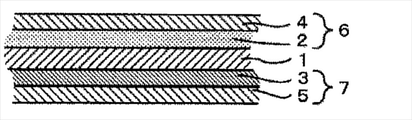
- FIG. 1 is a diagram showing an example of a laminated structure of an oxide-based solid secondary battery according to the present disclosure, and is a diagram schematically showing a cross section cut in the laminated direction.
- the oxide-based solid secondary battery according to the present disclosure is not necessarily limited to this example.
- the oxide-based solid secondary battery includes a positive electrode 6 including a positive electrode active material layer 2 and a positive electrode current collector 4, a negative electrode 7 including a negative electrode active material layer 3 and a negative electrode current collector 5, and the positive electrode 6 and the negative electrode 7. It is provided with an oxide-based solid electrolyte layer 1 sandwiched between the two.
- the positive and negative electrodes used in the present disclosure are the same as the above-mentioned electrodes for oxide-based solid-state batteries.
- the electrodes and the oxide-based solid electrolyte layer used in the oxide-based solid secondary battery according to the present disclosure, and the separator and the battery case preferably used in the oxide-based solid secondary battery according to the present disclosure will be described in detail. explain.
- the oxide-based solid secondary battery of the present disclosure may include a separator between the positive electrode and the negative electrode.
- the separator include a porous film such as polyethylene and polypropylene; a non-woven fabric made of a resin such as polypropylene, and a non-woven fabric such as a glass fiber non-woven fabric.
- the oxide-based solid secondary battery of the present disclosure may further include a battery case.
- the shape of the battery case used in the present disclosure is not particularly limited as long as it can accommodate the above-mentioned positive electrode, negative electrode, oxide-based electrolyte layer, etc., but specifically, it is cylindrical or square. , Coin type, laminated type and the like.
- the solid secondary battery of the present disclosure includes, for example, a step of preparing the oxide-based electrolyte layer, a step of kneading the positive electrode or negative electrode active material, an oxide-based electrolyte, a binder and a solvent to prepare a slurry, and a step of preparing a slurry.
- the above slurry is applied to one surface of the oxide-based electrolyte layer to form a positive electrode, and the slurry is applied to the other surface of the oxide-based electrolyte layer to laminate and press a negative electrode. It can be manufactured by the process of manufacturing an oxide-based solid secondary battery.
- a mixed solution monomer having a molar ratio of tetrafluoropropene of 77.2 / 22.8 was press-fitted to 1.501 MPa.
- Polymerization was started by dissolving 0.1 g of ammonium persulfate in 4 ml of pure water and press-fitting it with nitrogen. When 11 g of the continuous monomer was reached, 1.6738 g of 1,1,1,2,3,3,3-heptafluoro-2-iodo-propane was added. When the pressure dropped to 1.44 MPa, the pressure was increased to 1.50 MPa with a continuous monomer.
- the gas in the autoclave was released and cooled to recover 2087 g of the dispersion liquid.
- the solid content of the dispersion was 26.08%.
- Calcium chloride was added to this dispersion, coagulated, and dried to obtain 524.3 g of a polymer.
- the obtained polymer contained 2,3,3,3-tetrafluoropropene and VdF in a molar ratio of 23.1 / 76.9.
- the Mooney viscosity (ML1 + 10 (121 ° C.)) of the obtained polymer was 25, and the Tg was determined by DSC to be ⁇ 14 ° C.
- a mixed solution monomer having a molar ratio of tetrafluoropropene of 77.6 / 22.4 was press-fitted to 1.501 MPa. Polymerization was started by dissolving 0.23 ml of 2-methylbutane and 0.775 g of ammonium persulfate in 10 ml of pure water and press-fitting them with nitrogen. The continuous monomer was supplied so that the pressure was maintained at 1.5 MPa, and after 4.8 hours, 400 g of the continuous monomer was charged, the gas in the autoclave was released, and the mixture was cooled to recover 3937 g of the dispersion liquid. The solid content of the dispersion was 10.79%.
- the obtained polymer contained 2,3,3,3-tetrafluoropropene and VdF in a molar ratio of 22.8 / 77.2.
- the Mooney viscosity (ML1 + 10 (140 ° C.)) of the obtained polymer was 60, and the Tg was determined by DSC to be ⁇ 14 ° C.
- Binder 11 for comparative example
- KF7200 manufactured by Kureha
- Binder 12 for comparative example
- CH 2 CFCF 2 OCF (CF 3 ) CF 2 OCF (CF 3 ) COONH 4 50% aqueous solution, 0.3432 g, C 5 F 11 COONH 4 in a 3 L stainless steel autoclave.
- 3.421 g of a 50% aqueous solution was added, substituted with nitrogen, slightly pressurized with HFP, and the temperature was adjusted to 80 ° C. while stirring at 560 rpm.
- HFP was press-fitted to 0.56 MPa
- VdF was press-fitted to 0.69 MPa.
- a mixed solution monomer having a molar ratio of VdF, TFE and HFP of 70.2 / 11.3 / 18.5 was press-fitted to 2.000 MPa.
- a solution of 0.0218 g of ammonium persulfate in 4 ml of pure water was press-fitted with nitrogen to start polymerization.
- 12.5022 g of 1,4-diiodoperfluorobutane was added.
- the pressure dropped to 1.97 MPa, the pressure was increased to 2.03 MPa with a continuous monomer.
- the gas in the autoclave was released and cooled to recover 2302 g of the dispersion liquid.
- the solid content of the dispersion was 23.5%.
- Aluminum sulfate was added to this dispersion, coagulated, and dried to obtain 571 g of the polymer.
- the obtained polymer contained VdF, TFE and HFP in a molar ratio of 69.9 / 11.2 / 18.9.
- the Mooney viscosity (ML1 + 10 (121 ° C.)) of the obtained polymer was 50, and the Tg was determined by DSC to be ⁇ 20 ° C. In addition, heat of fusion was not observed in the second run.
- Binder 13 for comparative example
- the polymer composition was adjusted so as to have the composition of the binder 13 shown in Table 1 in the same manner as that of the binder 12, and this was obtained.
- the content of each repeating unit is a value measured by the NMR method.
- Examples 1-10, 13-15, Comparative Examples 1-3 The binder shown in Table 1 was dissolved in N-methylpyrrolidone (hereinafter referred to as NMP) to prepare an 8% binder solution. 0.35 g of acetylene black as a conductive auxiliary agent and 0.3 g of a binder solution in terms of solid content were added, and the mixture was stirred.
- NMP N-methylpyrrolidone
- Example 11 The binders listed in Table 1 were dissolved in NMP to prepare an 8% binder solution. 10.4 g of the solid electrolyte LLZ and 0.21 g of the binder solution in terms of solid content were added, and the mixture was stirred and ice-cooled together with the container.
- Example 12 Binder 1 was dissolved in NMP to prepare an 8% binder solution. 6.8 g of the solid electrolyte LLZ, 13.5 g of artificial graphite as the negative electrode active material, and 0.41 g of the binder solution in terms of solid content were added and stirred. After cooling the whole container with ice for 2 minutes, the mixture was stirred again.
- Electrodes were prepared using the prepared slurry. (Manufacturing of negative electrode)
- the negative electrode slurry prepared in Example 12 was applied onto a copper foil as a negative electrode current collector using a doctor blade, and dried at 100 ° C. for 10 minutes. Then, it was dried in a vacuum dryer at 70 ° C. for 12 hours to obtain a negative electrode having a negative electrode layer having a thickness of 100 ⁇ m formed on the surface of the negative electrode current collector.
- Such an active material layer did not cause any problem by visual observation, and good film formation could be performed.
- the positive electrode slurry prepared in Example 5 was applied onto an aluminum foil as a positive electrode current collector using a doctor blade, and dried at 100 ° C. for 10 minutes. Then, it was dried in a vacuum dryer at 70 ° C. for 12 hours to obtain a positive electrode having a positive electrode layer having a thickness of 90 ⁇ m formed on the surface of the positive electrode current collector. Such an active material layer did not cause any problem by visual observation, and good film formation could be performed.
- Example 11 The electrolyte slurry prepared in Example 11 was applied onto a peelable substrate (PET foil) using a doctor blade, and dried at 100 ° C. for 20 minutes. Then, it was dried in a vacuum dryer at 70 ° C. for 12 hours to form a solid electrolyte layer having a thickness of 205 ⁇ m on the substrate. Such a solid electrolyte layer did not cause any problem by visual observation, and good film formation could be performed.
- the binders of the present disclosure are used in the manufacture of solid secondary batteries. More specifically, it can be used in the formation of each layer forming a solid secondary battery.
- the binder of the present disclosure makes it possible to provide a larger solid secondary battery inexpensively and efficiently.
Landscapes
- Chemical & Material Sciences (AREA)
- Engineering & Computer Science (AREA)
- Chemical Kinetics & Catalysis (AREA)
- Electrochemistry (AREA)
- General Chemical & Material Sciences (AREA)
- Manufacturing & Machinery (AREA)
- Materials Engineering (AREA)
- Physics & Mathematics (AREA)
- Condensed Matter Physics & Semiconductors (AREA)
- General Physics & Mathematics (AREA)
- Inorganic Chemistry (AREA)
- Addition Polymer Or Copolymer, Post-Treatments, Or Chemical Modifications (AREA)
- Battery Electrode And Active Subsutance (AREA)
- Secondary Cells (AREA)
Priority Applications (5)
| Application Number | Priority Date | Filing Date | Title |
|---|---|---|---|
| JP2022547468A JP7481649B2 (ja) | 2020-09-09 | 2021-08-20 | 固体二次電池用結着剤、固体二次電池用スラリー、固体二次電池用層形成方法及び固体二次電池 |
| CN202180058771.4A CN116097475A (zh) | 2020-09-09 | 2021-08-20 | 固态二次电池用粘结剂、固态二次电池用浆料、固态二次电池用层形成方法和固态二次电池 |
| EP21866500.8A EP4213248A4 (en) | 2020-09-09 | 2021-08-20 | Binder for solid secondary battery, solid secondary battery slurry, method for producing a solid secondary battery layer, and solid secondary battery |
| KR1020237011605A KR102845342B1 (ko) | 2020-09-09 | 2021-08-20 | 고체 이차 전지용 결착제, 고체 이차 전지용 슬러리, 고체 이차 전지용 층 형성 방법 및 고체 이차 전지 |
| US18/119,083 US12476254B2 (en) | 2020-09-09 | 2023-03-08 | Binder for solid-state secondary battery, slurry for solid-state secondary battery, method for forming layer for solid-state secondary battery and solid-state secondary battery |
Applications Claiming Priority (2)
| Application Number | Priority Date | Filing Date | Title |
|---|---|---|---|
| JP2020151525 | 2020-09-09 | ||
| JP2020-151525 | 2020-09-09 |
Related Child Applications (1)
| Application Number | Title | Priority Date | Filing Date |
|---|---|---|---|
| US18/119,083 Continuation US12476254B2 (en) | 2020-09-09 | 2023-03-08 | Binder for solid-state secondary battery, slurry for solid-state secondary battery, method for forming layer for solid-state secondary battery and solid-state secondary battery |
Publications (1)
| Publication Number | Publication Date |
|---|---|
| WO2022054540A1 true WO2022054540A1 (ja) | 2022-03-17 |
Family
ID=80631586
Family Applications (1)
| Application Number | Title | Priority Date | Filing Date |
|---|---|---|---|
| PCT/JP2021/030584 Ceased WO2022054540A1 (ja) | 2020-09-09 | 2021-08-20 | 固体二次電池用結着剤、固体二次電池用スラリー、固体二次電池用層形成方法及び固体二次電池 |
Country Status (7)
| Country | Link |
|---|---|
| US (1) | US12476254B2 (https=) |
| EP (1) | EP4213248A4 (https=) |
| JP (1) | JP7481649B2 (https=) |
| KR (1) | KR102845342B1 (https=) |
| CN (1) | CN116097475A (https=) |
| TW (1) | TWI858285B (https=) |
| WO (1) | WO2022054540A1 (https=) |
Cited By (2)
| Publication number | Priority date | Publication date | Assignee | Title |
|---|---|---|---|---|
| JP7492186B1 (ja) | 2023-01-18 | 2024-05-29 | ダイキン工業株式会社 | 電気化学デバイス用合剤、電気化学デバイス用合剤シート、電極、及び、電気化学デバイス |
| WO2024154773A1 (ja) * | 2023-01-18 | 2024-07-25 | ダイキン工業株式会社 | テトラフルオロエチレン系ポリマー組成物、電気化学デバイス用バインダー、電極合剤、電極、及び、二次電池 |
Citations (11)
| Publication number | Priority date | Publication date | Assignee | Title |
|---|---|---|---|---|
| JPH07249409A (ja) | 1994-03-11 | 1995-09-26 | Fuji Photo Film Co Ltd | 非水電解質二次電池 |
| JP2001167798A (ja) * | 1999-09-30 | 2001-06-22 | Sony Corp | 固体電解質電池 |
| JP2007005279A (ja) | 2004-12-13 | 2007-01-11 | Matsushita Electric Ind Co Ltd | 活物質層と固体電解質層とを含む積層体およびこれを用いた全固体リチウム二次電池 |
| JP2013219016A (ja) | 2012-01-24 | 2013-10-24 | Daikin Ind Ltd | 結着剤、正極合剤及び負極合剤 |
| WO2015049996A1 (ja) | 2013-10-01 | 2015-04-09 | トヨタ自動車株式会社 | 二次電池 |
| WO2016076371A1 (ja) * | 2014-11-14 | 2016-05-19 | 旭硝子株式会社 | 蓄電デバイス用バインダー組成物、蓄電デバイス用電極合剤、蓄電デバイス用電極、及び二次電池 |
| JP2016164888A (ja) | 2016-04-26 | 2016-09-08 | 株式会社東芝 | バイポーラ電池、電池パック及び車 |
| JP2017188379A (ja) | 2016-04-08 | 2017-10-12 | トヨタ自動車株式会社 | 電極体の製造方法 |
| JP2019046721A (ja) | 2017-09-05 | 2019-03-22 | トヨタ自動車株式会社 | スラリー、固体電解質層の製造方法、及び、全固体電池の製造方法 |
| CN110854429A (zh) * | 2019-11-18 | 2020-02-28 | 成都新柯力化工科技有限公司 | 一种粒子复合膜包覆聚合物电解质及制备方法 |
| WO2020071336A1 (ja) * | 2018-10-03 | 2020-04-09 | ダイキン工業株式会社 | 正極構造体および二次電池 |
Family Cites Families (15)
| Publication number | Priority date | Publication date | Assignee | Title |
|---|---|---|---|---|
| JP4253051B2 (ja) * | 1997-12-26 | 2009-04-08 | 株式会社クレハ | 非水系電池用電極合剤および非水系電池 |
| NO20004855L (no) * | 1999-09-30 | 2001-04-02 | Sony Corp | Fast elektrolyttcelle |
| US20070259271A1 (en) | 2004-12-13 | 2007-11-08 | Tetsuo Nanno | Laminate Including Active Material Layer and Solid Electrolyte Layer, and All Solid Lithium Secondary Battery Using the Same |
| CN102308417B (zh) * | 2009-02-12 | 2014-04-02 | 大金工业株式会社 | 锂二次电池的正极合剂用浆料、使用了该浆料的正极和锂二次电池 |
| US8481661B2 (en) * | 2009-03-05 | 2013-07-09 | Daikin Industries, Ltd. | Fluoroelastomer, curable composition and cured rubber article |
| JP6070699B2 (ja) * | 2012-04-27 | 2017-02-01 | 旭硝子株式会社 | 蓄電デバイス用バインダー |
| JP5945208B2 (ja) * | 2012-10-10 | 2016-07-05 | トヨタ自動車株式会社 | 硫化物系固体電池用負極用スラリー、硫化物系固体電池用負極及びその製造方法、並びに、硫化物系固体電池及びその製造方法 |
| KR101470556B1 (ko) | 2013-05-07 | 2014-12-10 | 주식회사 엘지화학 | 이차전지용 전극, 그의 제조방법, 그를 포함하는 이차전지 및 케이블형 이차전지 |
| KR101822854B1 (ko) | 2013-10-31 | 2018-01-29 | 주식회사 엘지화학 | 전극 및 그를 포함하는 전기화학소자 |
| WO2015115158A1 (ja) * | 2014-01-28 | 2015-08-06 | 株式会社リコー | ポリチオフェン誘導体、その製造方法、二次電池用正極活物質、及び二次電池 |
| JP5975072B2 (ja) | 2014-07-23 | 2016-08-23 | トヨタ自動車株式会社 | 固体電池用負極の製造方法及び固体電池の製造方法、並びに、負極用スラリー |
| JP6623083B2 (ja) * | 2016-02-29 | 2019-12-18 | 富士フイルム株式会社 | 固体電解質組成物、これを用いた全固体二次電池用シートおよび全固体二次電池ならびにこれらの製造方法 |
| EP3447831B1 (en) * | 2016-10-07 | 2021-02-17 | Daikin Industries, Ltd. | Binder for secondary batteries and electrode mixture for secondary batteries |
| US11742491B2 (en) | 2017-10-30 | 2023-08-29 | Daikin Industries, Ltd. | Binder for secondary battery, electrode mixture for secondary battery, electrode for secondary battery and secondary battery |
| JP7023217B2 (ja) * | 2017-12-01 | 2022-02-21 | ダイキン工業株式会社 | アルカリ接触する表面を有する構成要素 |
-
2021
- 2021-08-20 JP JP2022547468A patent/JP7481649B2/ja active Active
- 2021-08-20 WO PCT/JP2021/030584 patent/WO2022054540A1/ja not_active Ceased
- 2021-08-20 EP EP21866500.8A patent/EP4213248A4/en active Pending
- 2021-08-20 CN CN202180058771.4A patent/CN116097475A/zh active Pending
- 2021-08-20 KR KR1020237011605A patent/KR102845342B1/ko active Active
- 2021-09-03 TW TW110132825A patent/TWI858285B/zh active
-
2023
- 2023-03-08 US US18/119,083 patent/US12476254B2/en active Active
Patent Citations (12)
| Publication number | Priority date | Publication date | Assignee | Title |
|---|---|---|---|---|
| JPH07249409A (ja) | 1994-03-11 | 1995-09-26 | Fuji Photo Film Co Ltd | 非水電解質二次電池 |
| JP2001167798A (ja) * | 1999-09-30 | 2001-06-22 | Sony Corp | 固体電解質電池 |
| JP2007005279A (ja) | 2004-12-13 | 2007-01-11 | Matsushita Electric Ind Co Ltd | 活物質層と固体電解質層とを含む積層体およびこれを用いた全固体リチウム二次電池 |
| JP2013219016A (ja) | 2012-01-24 | 2013-10-24 | Daikin Ind Ltd | 結着剤、正極合剤及び負極合剤 |
| JP2013229337A (ja) | 2012-01-24 | 2013-11-07 | Daikin Ind Ltd | 結着剤溶液、正極合剤及び負極合剤 |
| WO2015049996A1 (ja) | 2013-10-01 | 2015-04-09 | トヨタ自動車株式会社 | 二次電池 |
| WO2016076371A1 (ja) * | 2014-11-14 | 2016-05-19 | 旭硝子株式会社 | 蓄電デバイス用バインダー組成物、蓄電デバイス用電極合剤、蓄電デバイス用電極、及び二次電池 |
| JP2017188379A (ja) | 2016-04-08 | 2017-10-12 | トヨタ自動車株式会社 | 電極体の製造方法 |
| JP2016164888A (ja) | 2016-04-26 | 2016-09-08 | 株式会社東芝 | バイポーラ電池、電池パック及び車 |
| JP2019046721A (ja) | 2017-09-05 | 2019-03-22 | トヨタ自動車株式会社 | スラリー、固体電解質層の製造方法、及び、全固体電池の製造方法 |
| WO2020071336A1 (ja) * | 2018-10-03 | 2020-04-09 | ダイキン工業株式会社 | 正極構造体および二次電池 |
| CN110854429A (zh) * | 2019-11-18 | 2020-02-28 | 成都新柯力化工科技有限公司 | 一种粒子复合膜包覆聚合物电解质及制备方法 |
Cited By (5)
| Publication number | Priority date | Publication date | Assignee | Title |
|---|---|---|---|---|
| JP7492186B1 (ja) | 2023-01-18 | 2024-05-29 | ダイキン工業株式会社 | 電気化学デバイス用合剤、電気化学デバイス用合剤シート、電極、及び、電気化学デバイス |
| WO2024154777A1 (ja) * | 2023-01-18 | 2024-07-25 | ダイキン工業株式会社 | 電気化学デバイス用合剤、電気化学デバイス用合剤シート、電極、及び、電気化学デバイス |
| WO2024154773A1 (ja) * | 2023-01-18 | 2024-07-25 | ダイキン工業株式会社 | テトラフルオロエチレン系ポリマー組成物、電気化学デバイス用バインダー、電極合剤、電極、及び、二次電池 |
| JP2024102026A (ja) * | 2023-01-18 | 2024-07-30 | ダイキン工業株式会社 | テトラフルオロエチレン系ポリマー組成物、電気化学デバイス用バインダー、電極合剤、電極、及び、二次電池 |
| JP2024102027A (ja) * | 2023-01-18 | 2024-07-30 | ダイキン工業株式会社 | 電気化学デバイス用合剤、電気化学デバイス用合剤シート、電極、及び、電気化学デバイス |
Also Published As
| Publication number | Publication date |
|---|---|
| US20230223542A1 (en) | 2023-07-13 |
| TW202219187A (zh) | 2022-05-16 |
| EP4213248A1 (en) | 2023-07-19 |
| US12476254B2 (en) | 2025-11-18 |
| CN116097475A (zh) | 2023-05-09 |
| KR20230065292A (ko) | 2023-05-11 |
| JP7481649B2 (ja) | 2024-05-13 |
| KR102845342B1 (ko) | 2025-08-13 |
| EP4213248A4 (en) | 2025-05-21 |
| TWI858285B (zh) | 2024-10-11 |
| JPWO2022054540A1 (https=) | 2022-03-17 |
Similar Documents
| Publication | Publication Date | Title |
|---|---|---|
| JP6863470B2 (ja) | 二次電池用結着剤、二次電池用電極合剤、二次電池用電極及び二次電池 | |
| JP6269890B1 (ja) | 二次電池用結着剤及び二次電池用電極合剤 | |
| JP5949915B2 (ja) | 電極合剤 | |
| JP5949914B2 (ja) | 電極合剤 | |
| JP7212291B2 (ja) | 電池用結着剤、電極合剤、電極および二次電池 | |
| JP7752600B2 (ja) | 組成物、結着剤、電極合剤、電極および二次電池 | |
| US12476254B2 (en) | Binder for solid-state secondary battery, slurry for solid-state secondary battery, method for forming layer for solid-state secondary battery and solid-state secondary battery | |
| JP2024026579A (ja) | ポリビニリデンフルオライド、結着剤、電極合剤、電極および二次電池 | |
| JP7842723B2 (ja) | 正極用バインダー、電極合剤、電極及び二次電池 | |
| JP2018060745A (ja) | 二次電池用結着剤及び二次電池用電極合剤 | |
| JP2018063932A (ja) | 二次電池用結着剤及び二次電池用電極合剤 | |
| WO2022124254A1 (ja) | 組成物、結着剤、接着剤および積層体 | |
| WO2022124253A1 (ja) | 共重合体、結着剤、成形品および共重合体の製造方法 | |
| WO2021125150A1 (ja) | 固体二次電池用スラリー、固体二次電池用層形成方法及び固体二次電池 | |
| JP7817608B2 (ja) | 非水電解質電池用結着剤、電極合剤、電極および非水電解質電池 | |
| JP7817639B2 (ja) | ポリマー組成物、電気化学デバイス用バインダー、電極合剤、電極、及び、二次電池 | |
| JP2022090402A (ja) | 共重合体、結着剤、成形品および共重合体の製造方法 |
Legal Events
| Date | Code | Title | Description |
|---|---|---|---|
| 121 | Ep: the epo has been informed by wipo that ep was designated in this application |
Ref document number: 21866500 Country of ref document: EP Kind code of ref document: A1 |
|
| ENP | Entry into the national phase |
Ref document number: 2022547468 Country of ref document: JP Kind code of ref document: A |
|
| WWE | Wipo information: entry into national phase |
Ref document number: 202337025452 Country of ref document: IN |
|
| ENP | Entry into the national phase |
Ref document number: 20237011605 Country of ref document: KR Kind code of ref document: A |
|
| NENP | Non-entry into the national phase |
Ref country code: DE |
|
| ENP | Entry into the national phase |
Ref document number: 2021866500 Country of ref document: EP Effective date: 20230411 |