WO2022019095A1 - 熱硬化性樹脂組成物、カバーレイフィルム、接着シート、及びフレキシブルプリント配線板 - Google Patents
熱硬化性樹脂組成物、カバーレイフィルム、接着シート、及びフレキシブルプリント配線板 Download PDFInfo
- Publication number
- WO2022019095A1 WO2022019095A1 PCT/JP2021/025253 JP2021025253W WO2022019095A1 WO 2022019095 A1 WO2022019095 A1 WO 2022019095A1 JP 2021025253 W JP2021025253 W JP 2021025253W WO 2022019095 A1 WO2022019095 A1 WO 2022019095A1
- Authority
- WO
- WIPO (PCT)
- Prior art keywords
- epoxy resin
- mass
- resin composition
- thermosetting resin
- parts
- Prior art date
- Legal status (The legal status is an assumption and is not a legal conclusion. Google has not performed a legal analysis and makes no representation as to the accuracy of the status listed.)
- Ceased
Links
Images
Classifications
-
- C—CHEMISTRY; METALLURGY
- C08—ORGANIC MACROMOLECULAR COMPOUNDS; THEIR PREPARATION OR CHEMICAL WORKING-UP; COMPOSITIONS BASED THEREON
- C08G—MACROMOLECULAR COMPOUNDS OBTAINED OTHERWISE THAN BY REACTIONS ONLY INVOLVING UNSATURATED CARBON-TO-CARBON BONDS
- C08G18/00—Polymeric products of isocyanates or isothiocyanates
- C08G18/06—Polymeric products of isocyanates or isothiocyanates with compounds having active hydrogen
- C08G18/28—Polymeric products of isocyanates or isothiocyanates with compounds having active hydrogen characterised by the compounds used containing active hydrogen
- C08G18/40—High-molecular-weight compounds
- C08G18/42—Polycondensates having carboxylic or carbonic ester groups in the main chain
- C08G18/44—Polycarbonates
-
- C—CHEMISTRY; METALLURGY
- C08—ORGANIC MACROMOLECULAR COMPOUNDS; THEIR PREPARATION OR CHEMICAL WORKING-UP; COMPOSITIONS BASED THEREON
- C08L—COMPOSITIONS OF MACROMOLECULAR COMPOUNDS
- C08L63/00—Compositions of epoxy resins; Compositions of derivatives of epoxy resins
-
- B—PERFORMING OPERATIONS; TRANSPORTING
- B32—LAYERED PRODUCTS
- B32B—LAYERED PRODUCTS, i.e. PRODUCTS BUILT-UP OF STRATA OF FLAT OR NON-FLAT, e.g. CELLULAR OR HONEYCOMB, FORM
- B32B7/00—Layered products characterised by the relation between layers; Layered products characterised by the relative orientation of features between layers, or by the relative values of a measurable parameter between layers, i.e. products comprising layers having different physical, chemical or physicochemical properties; Layered products characterised by the interconnection of layers
- B32B7/04—Interconnection of layers
- B32B7/12—Interconnection of layers using interposed adhesives or interposed materials with bonding properties
-
- C—CHEMISTRY; METALLURGY
- C08—ORGANIC MACROMOLECULAR COMPOUNDS; THEIR PREPARATION OR CHEMICAL WORKING-UP; COMPOSITIONS BASED THEREON
- C08F—MACROMOLECULAR COMPOUNDS OBTAINED BY REACTIONS ONLY INVOLVING CARBON-TO-CARBON UNSATURATED BONDS
- C08F136/00—Homopolymers of compounds having one or more unsaturated aliphatic radicals, at least one having two or more carbon-to-carbon double bonds
- C08F136/02—Homopolymers of compounds having one or more unsaturated aliphatic radicals, at least one having two or more carbon-to-carbon double bonds the radical having only two carbon-to-carbon double bonds
- C08F136/04—Homopolymers of compounds having one or more unsaturated aliphatic radicals, at least one having two or more carbon-to-carbon double bonds the radical having only two carbon-to-carbon double bonds conjugated
- C08F136/06—Butadiene
-
- C—CHEMISTRY; METALLURGY
- C08—ORGANIC MACROMOLECULAR COMPOUNDS; THEIR PREPARATION OR CHEMICAL WORKING-UP; COMPOSITIONS BASED THEREON
- C08G—MACROMOLECULAR COMPOUNDS OBTAINED OTHERWISE THAN BY REACTIONS ONLY INVOLVING UNSATURATED CARBON-TO-CARBON BONDS
- C08G18/00—Polymeric products of isocyanates or isothiocyanates
- C08G18/06—Polymeric products of isocyanates or isothiocyanates with compounds having active hydrogen
- C08G18/08—Processes
- C08G18/10—Prepolymer processes involving reaction of isocyanates or isothiocyanates with compounds having active hydrogen in a first reaction step
-
- C—CHEMISTRY; METALLURGY
- C08—ORGANIC MACROMOLECULAR COMPOUNDS; THEIR PREPARATION OR CHEMICAL WORKING-UP; COMPOSITIONS BASED THEREON
- C08G—MACROMOLECULAR COMPOUNDS OBTAINED OTHERWISE THAN BY REACTIONS ONLY INVOLVING UNSATURATED CARBON-TO-CARBON BONDS
- C08G18/00—Polymeric products of isocyanates or isothiocyanates
- C08G18/06—Polymeric products of isocyanates or isothiocyanates with compounds having active hydrogen
- C08G18/28—Polymeric products of isocyanates or isothiocyanates with compounds having active hydrogen characterised by the compounds used containing active hydrogen
- C08G18/30—Low-molecular-weight compounds
- C08G18/34—Carboxylic acids; Esters thereof with monohydroxyl compounds
- C08G18/348—Hydroxycarboxylic acids
-
- C—CHEMISTRY; METALLURGY
- C08—ORGANIC MACROMOLECULAR COMPOUNDS; THEIR PREPARATION OR CHEMICAL WORKING-UP; COMPOSITIONS BASED THEREON
- C08G—MACROMOLECULAR COMPOUNDS OBTAINED OTHERWISE THAN BY REACTIONS ONLY INVOLVING UNSATURATED CARBON-TO-CARBON BONDS
- C08G18/00—Polymeric products of isocyanates or isothiocyanates
- C08G18/06—Polymeric products of isocyanates or isothiocyanates with compounds having active hydrogen
- C08G18/28—Polymeric products of isocyanates or isothiocyanates with compounds having active hydrogen characterised by the compounds used containing active hydrogen
- C08G18/65—Low-molecular-weight compounds having active hydrogen with high-molecular-weight compounds having active hydrogen
- C08G18/66—Compounds of groups C08G18/42, C08G18/48, or C08G18/52
- C08G18/6633—Compounds of group C08G18/42
- C08G18/6659—Compounds of group C08G18/42 with compounds of group C08G18/34
-
- C—CHEMISTRY; METALLURGY
- C08—ORGANIC MACROMOLECULAR COMPOUNDS; THEIR PREPARATION OR CHEMICAL WORKING-UP; COMPOSITIONS BASED THEREON
- C08G—MACROMOLECULAR COMPOUNDS OBTAINED OTHERWISE THAN BY REACTIONS ONLY INVOLVING UNSATURATED CARBON-TO-CARBON BONDS
- C08G18/00—Polymeric products of isocyanates or isothiocyanates
- C08G18/06—Polymeric products of isocyanates or isothiocyanates with compounds having active hydrogen
- C08G18/70—Polymeric products of isocyanates or isothiocyanates with compounds having active hydrogen characterised by the isocyanates or isothiocyanates used
- C08G18/72—Polyisocyanates or polyisothiocyanates
- C08G18/74—Polyisocyanates or polyisothiocyanates cyclic
- C08G18/75—Polyisocyanates or polyisothiocyanates cyclic cycloaliphatic
- C08G18/751—Polyisocyanates or polyisothiocyanates cyclic cycloaliphatic containing only one cycloaliphatic ring
- C08G18/752—Polyisocyanates or polyisothiocyanates cyclic cycloaliphatic containing only one cycloaliphatic ring containing at least one isocyanate or isothiocyanate group linked to the cycloaliphatic ring by means of an aliphatic group
- C08G18/753—Polyisocyanates or polyisothiocyanates cyclic cycloaliphatic containing only one cycloaliphatic ring containing at least one isocyanate or isothiocyanate group linked to the cycloaliphatic ring by means of an aliphatic group containing one isocyanate or isothiocyanate group linked to the cycloaliphatic ring by means of an aliphatic group having a primary carbon atom next to the isocyanate or isothiocyanate group
- C08G18/755—Polyisocyanates or polyisothiocyanates cyclic cycloaliphatic containing only one cycloaliphatic ring containing at least one isocyanate or isothiocyanate group linked to the cycloaliphatic ring by means of an aliphatic group containing one isocyanate or isothiocyanate group linked to the cycloaliphatic ring by means of an aliphatic group having a primary carbon atom next to the isocyanate or isothiocyanate group and at least one isocyanate or isothiocyanate group linked to a secondary carbon atom of the cycloaliphatic ring, e.g. isophorone diisocyanate
-
- C—CHEMISTRY; METALLURGY
- C08—ORGANIC MACROMOLECULAR COMPOUNDS; THEIR PREPARATION OR CHEMICAL WORKING-UP; COMPOSITIONS BASED THEREON
- C08G—MACROMOLECULAR COMPOUNDS OBTAINED OTHERWISE THAN BY REACTIONS ONLY INVOLVING UNSATURATED CARBON-TO-CARBON BONDS
- C08G59/00—Polycondensates containing more than one epoxy group per molecule; Macromolecules obtained by polymerising compounds containing more than one epoxy group per molecule using curing agents or catalysts which react with the epoxy groups
- C08G59/18—Macromolecules obtained by polymerising compounds containing more than one epoxy group per molecule using curing agents or catalysts which react with the epoxy groups ; e.g. general methods of curing
- C08G59/20—Macromolecules obtained by polymerising compounds containing more than one epoxy group per molecule using curing agents or catalysts which react with the epoxy groups ; e.g. general methods of curing characterised by the epoxy compounds used
- C08G59/22—Di-epoxy compounds
- C08G59/24—Di-epoxy compounds carbocyclic
- C08G59/245—Di-epoxy compounds carbocyclic aromatic
-
- C—CHEMISTRY; METALLURGY
- C08—ORGANIC MACROMOLECULAR COMPOUNDS; THEIR PREPARATION OR CHEMICAL WORKING-UP; COMPOSITIONS BASED THEREON
- C08K—Use of inorganic or non-macromolecular organic substances as compounding ingredients
- C08K3/00—Use of inorganic substances as compounding ingredients
- C08K3/18—Oxygen-containing compounds, e.g. metal carbonyls
- C08K3/20—Oxides; Hydroxides
- C08K3/22—Oxides; Hydroxides of metals
-
- C—CHEMISTRY; METALLURGY
- C08—ORGANIC MACROMOLECULAR COMPOUNDS; THEIR PREPARATION OR CHEMICAL WORKING-UP; COMPOSITIONS BASED THEREON
- C08K—Use of inorganic or non-macromolecular organic substances as compounding ingredients
- C08K5/00—Use of organic ingredients
- C08K5/36—Sulfur-, selenium-, or tellurium-containing compounds
- C08K5/41—Compounds containing sulfur bound to oxygen
- C08K5/42—Sulfonic acids; Derivatives thereof
-
- C—CHEMISTRY; METALLURGY
- C08—ORGANIC MACROMOLECULAR COMPOUNDS; THEIR PREPARATION OR CHEMICAL WORKING-UP; COMPOSITIONS BASED THEREON
- C08L—COMPOSITIONS OF MACROMOLECULAR COMPOUNDS
- C08L21/00—Compositions of unspecified rubbers
-
- C—CHEMISTRY; METALLURGY
- C08—ORGANIC MACROMOLECULAR COMPOUNDS; THEIR PREPARATION OR CHEMICAL WORKING-UP; COMPOSITIONS BASED THEREON
- C08L—COMPOSITIONS OF MACROMOLECULAR COMPOUNDS
- C08L51/00—Compositions of graft polymers in which the grafted component is obtained by reactions only involving carbon-to-carbon unsaturated bonds; Compositions of derivatives of such polymers
- C08L51/04—Compositions of graft polymers in which the grafted component is obtained by reactions only involving carbon-to-carbon unsaturated bonds; Compositions of derivatives of such polymers grafted on to rubbers
-
- C—CHEMISTRY; METALLURGY
- C08—ORGANIC MACROMOLECULAR COMPOUNDS; THEIR PREPARATION OR CHEMICAL WORKING-UP; COMPOSITIONS BASED THEREON
- C08L—COMPOSITIONS OF MACROMOLECULAR COMPOUNDS
- C08L63/00—Compositions of epoxy resins; Compositions of derivatives of epoxy resins
- C08L63/04—Epoxynovolacs
-
- C—CHEMISTRY; METALLURGY
- C08—ORGANIC MACROMOLECULAR COMPOUNDS; THEIR PREPARATION OR CHEMICAL WORKING-UP; COMPOSITIONS BASED THEREON
- C08L—COMPOSITIONS OF MACROMOLECULAR COMPOUNDS
- C08L75/00—Compositions of polyureas or polyurethanes; Compositions of derivatives of such polymers
- C08L75/04—Polyurethanes
- C08L75/06—Polyurethanes from polyesters
-
- C—CHEMISTRY; METALLURGY
- C09—DYES; PAINTS; POLISHES; NATURAL RESINS; ADHESIVES; COMPOSITIONS NOT OTHERWISE PROVIDED FOR; APPLICATIONS OF MATERIALS NOT OTHERWISE PROVIDED FOR
- C09J—ADHESIVES; NON-MECHANICAL ASPECTS OF ADHESIVE PROCESSES IN GENERAL; ADHESIVE PROCESSES NOT PROVIDED FOR ELSEWHERE; USE OF MATERIALS AS ADHESIVES
- C09J11/00—Features of adhesives not provided for in group C09J9/00, e.g. additives
- C09J11/02—Non-macromolecular additives
- C09J11/04—Non-macromolecular additives inorganic
-
- C—CHEMISTRY; METALLURGY
- C09—DYES; PAINTS; POLISHES; NATURAL RESINS; ADHESIVES; COMPOSITIONS NOT OTHERWISE PROVIDED FOR; APPLICATIONS OF MATERIALS NOT OTHERWISE PROVIDED FOR
- C09J—ADHESIVES; NON-MECHANICAL ASPECTS OF ADHESIVE PROCESSES IN GENERAL; ADHESIVE PROCESSES NOT PROVIDED FOR ELSEWHERE; USE OF MATERIALS AS ADHESIVES
- C09J11/00—Features of adhesives not provided for in group C09J9/00, e.g. additives
- C09J11/02—Non-macromolecular additives
- C09J11/06—Non-macromolecular additives organic
-
- C—CHEMISTRY; METALLURGY
- C09—DYES; PAINTS; POLISHES; NATURAL RESINS; ADHESIVES; COMPOSITIONS NOT OTHERWISE PROVIDED FOR; APPLICATIONS OF MATERIALS NOT OTHERWISE PROVIDED FOR
- C09J—ADHESIVES; NON-MECHANICAL ASPECTS OF ADHESIVE PROCESSES IN GENERAL; ADHESIVE PROCESSES NOT PROVIDED FOR ELSEWHERE; USE OF MATERIALS AS ADHESIVES
- C09J11/00—Features of adhesives not provided for in group C09J9/00, e.g. additives
- C09J11/08—Macromolecular additives
-
- C—CHEMISTRY; METALLURGY
- C09—DYES; PAINTS; POLISHES; NATURAL RESINS; ADHESIVES; COMPOSITIONS NOT OTHERWISE PROVIDED FOR; APPLICATIONS OF MATERIALS NOT OTHERWISE PROVIDED FOR
- C09J—ADHESIVES; NON-MECHANICAL ASPECTS OF ADHESIVE PROCESSES IN GENERAL; ADHESIVE PROCESSES NOT PROVIDED FOR ELSEWHERE; USE OF MATERIALS AS ADHESIVES
- C09J163/00—Adhesives based on epoxy resins; Adhesives based on derivatives of epoxy resins
-
- C—CHEMISTRY; METALLURGY
- C09—DYES; PAINTS; POLISHES; NATURAL RESINS; ADHESIVES; COMPOSITIONS NOT OTHERWISE PROVIDED FOR; APPLICATIONS OF MATERIALS NOT OTHERWISE PROVIDED FOR
- C09J—ADHESIVES; NON-MECHANICAL ASPECTS OF ADHESIVE PROCESSES IN GENERAL; ADHESIVE PROCESSES NOT PROVIDED FOR ELSEWHERE; USE OF MATERIALS AS ADHESIVES
- C09J163/00—Adhesives based on epoxy resins; Adhesives based on derivatives of epoxy resins
- C09J163/04—Epoxynovolacs
-
- C—CHEMISTRY; METALLURGY
- C09—DYES; PAINTS; POLISHES; NATURAL RESINS; ADHESIVES; COMPOSITIONS NOT OTHERWISE PROVIDED FOR; APPLICATIONS OF MATERIALS NOT OTHERWISE PROVIDED FOR
- C09J—ADHESIVES; NON-MECHANICAL ASPECTS OF ADHESIVE PROCESSES IN GENERAL; ADHESIVE PROCESSES NOT PROVIDED FOR ELSEWHERE; USE OF MATERIALS AS ADHESIVES
- C09J175/00—Adhesives based on polyureas or polyurethanes; Adhesives based on derivatives of such polymers
- C09J175/04—Polyurethanes
- C09J175/06—Polyurethanes from polyesters
-
- C—CHEMISTRY; METALLURGY
- C09—DYES; PAINTS; POLISHES; NATURAL RESINS; ADHESIVES; COMPOSITIONS NOT OTHERWISE PROVIDED FOR; APPLICATIONS OF MATERIALS NOT OTHERWISE PROVIDED FOR
- C09J—ADHESIVES; NON-MECHANICAL ASPECTS OF ADHESIVE PROCESSES IN GENERAL; ADHESIVE PROCESSES NOT PROVIDED FOR ELSEWHERE; USE OF MATERIALS AS ADHESIVES
- C09J7/00—Adhesives in the form of films or foils
- C09J7/20—Adhesives in the form of films or foils characterised by their carriers
-
- C—CHEMISTRY; METALLURGY
- C09—DYES; PAINTS; POLISHES; NATURAL RESINS; ADHESIVES; COMPOSITIONS NOT OTHERWISE PROVIDED FOR; APPLICATIONS OF MATERIALS NOT OTHERWISE PROVIDED FOR
- C09J—ADHESIVES; NON-MECHANICAL ASPECTS OF ADHESIVE PROCESSES IN GENERAL; ADHESIVE PROCESSES NOT PROVIDED FOR ELSEWHERE; USE OF MATERIALS AS ADHESIVES
- C09J7/00—Adhesives in the form of films or foils
- C09J7/30—Adhesives in the form of films or foils characterised by the adhesive composition
-
- H—ELECTRICITY
- H05—ELECTRIC TECHNIQUES NOT OTHERWISE PROVIDED FOR
- H05K—PRINTED CIRCUITS; CASINGS OR CONSTRUCTIONAL DETAILS OF ELECTRIC APPARATUS; MANUFACTURE OF ASSEMBLAGES OF ELECTRICAL COMPONENTS
- H05K3/00—Apparatus or processes for manufacturing printed circuits
- H05K3/22—Secondary treatment of printed circuits
- H05K3/28—Applying non-metallic protective coatings
-
- B—PERFORMING OPERATIONS; TRANSPORTING
- B32—LAYERED PRODUCTS
- B32B—LAYERED PRODUCTS, i.e. PRODUCTS BUILT-UP OF STRATA OF FLAT OR NON-FLAT, e.g. CELLULAR OR HONEYCOMB, FORM
- B32B2457/00—Electrical equipment
- B32B2457/08—PCBs, i.e. printed circuit boards
-
- C—CHEMISTRY; METALLURGY
- C08—ORGANIC MACROMOLECULAR COMPOUNDS; THEIR PREPARATION OR CHEMICAL WORKING-UP; COMPOSITIONS BASED THEREON
- C08G—MACROMOLECULAR COMPOUNDS OBTAINED OTHERWISE THAN BY REACTIONS ONLY INVOLVING UNSATURATED CARBON-TO-CARBON BONDS
- C08G2170/00—Compositions for adhesives
-
- C—CHEMISTRY; METALLURGY
- C08—ORGANIC MACROMOLECULAR COMPOUNDS; THEIR PREPARATION OR CHEMICAL WORKING-UP; COMPOSITIONS BASED THEREON
- C08K—Use of inorganic or non-macromolecular organic substances as compounding ingredients
- C08K3/00—Use of inorganic substances as compounding ingredients
- C08K3/18—Oxygen-containing compounds, e.g. metal carbonyls
- C08K3/20—Oxides; Hydroxides
- C08K3/22—Oxides; Hydroxides of metals
- C08K2003/2227—Oxides; Hydroxides of metals of aluminium
-
- C—CHEMISTRY; METALLURGY
- C08—ORGANIC MACROMOLECULAR COMPOUNDS; THEIR PREPARATION OR CHEMICAL WORKING-UP; COMPOSITIONS BASED THEREON
- C08L—COMPOSITIONS OF MACROMOLECULAR COMPOUNDS
- C08L2203/00—Applications
- C08L2203/20—Applications use in electrical or conductive gadgets
-
- C—CHEMISTRY; METALLURGY
- C08—ORGANIC MACROMOLECULAR COMPOUNDS; THEIR PREPARATION OR CHEMICAL WORKING-UP; COMPOSITIONS BASED THEREON
- C08L—COMPOSITIONS OF MACROMOLECULAR COMPOUNDS
- C08L2205/00—Polymer mixtures characterised by other features
- C08L2205/02—Polymer mixtures characterised by other features containing two or more polymers of the same C08L -group
- C08L2205/025—Polymer mixtures characterised by other features containing two or more polymers of the same C08L -group containing two or more polymers of the same hierarchy C08L, and differing only in parameters such as density, comonomer content, molecular weight, structure
-
- C—CHEMISTRY; METALLURGY
- C08—ORGANIC MACROMOLECULAR COMPOUNDS; THEIR PREPARATION OR CHEMICAL WORKING-UP; COMPOSITIONS BASED THEREON
- C08L—COMPOSITIONS OF MACROMOLECULAR COMPOUNDS
- C08L2205/00—Polymer mixtures characterised by other features
- C08L2205/03—Polymer mixtures characterised by other features containing three or more polymers in a blend
-
- C—CHEMISTRY; METALLURGY
- C08—ORGANIC MACROMOLECULAR COMPOUNDS; THEIR PREPARATION OR CHEMICAL WORKING-UP; COMPOSITIONS BASED THEREON
- C08L—COMPOSITIONS OF MACROMOLECULAR COMPOUNDS
- C08L2205/00—Polymer mixtures characterised by other features
- C08L2205/22—Mixtures comprising a continuous polymer matrix in which are dispersed crosslinked particles of another polymer
-
- C—CHEMISTRY; METALLURGY
- C08—ORGANIC MACROMOLECULAR COMPOUNDS; THEIR PREPARATION OR CHEMICAL WORKING-UP; COMPOSITIONS BASED THEREON
- C08L—COMPOSITIONS OF MACROMOLECULAR COMPOUNDS
- C08L2207/00—Properties characterising the ingredient of the composition
- C08L2207/53—Core-shell polymer
-
- C—CHEMISTRY; METALLURGY
- C09—DYES; PAINTS; POLISHES; NATURAL RESINS; ADHESIVES; COMPOSITIONS NOT OTHERWISE PROVIDED FOR; APPLICATIONS OF MATERIALS NOT OTHERWISE PROVIDED FOR
- C09J—ADHESIVES; NON-MECHANICAL ASPECTS OF ADHESIVE PROCESSES IN GENERAL; ADHESIVE PROCESSES NOT PROVIDED FOR ELSEWHERE; USE OF MATERIALS AS ADHESIVES
- C09J2203/00—Applications of adhesives in processes or use of adhesives in the form of films or foils
- C09J2203/326—Applications of adhesives in processes or use of adhesives in the form of films or foils for bonding electronic components such as wafers, chips or semiconductors
-
- C—CHEMISTRY; METALLURGY
- C09—DYES; PAINTS; POLISHES; NATURAL RESINS; ADHESIVES; COMPOSITIONS NOT OTHERWISE PROVIDED FOR; APPLICATIONS OF MATERIALS NOT OTHERWISE PROVIDED FOR
- C09J—ADHESIVES; NON-MECHANICAL ASPECTS OF ADHESIVE PROCESSES IN GENERAL; ADHESIVE PROCESSES NOT PROVIDED FOR ELSEWHERE; USE OF MATERIALS AS ADHESIVES
- C09J2463/00—Presence of epoxy resin
Definitions
- the present invention relates to a thermosetting resin composition, a coverlay film, an adhesive sheet, and a flexible printed wiring board.
- sheet-shaped electronic materials constituting electronic devices include coverlay films, adhesive sheets, flexible printed wiring boards, and the like.
- Such electronic materials have physical characteristics such as peel strength (hereinafter, also referred to as peel strength), electrical characteristics such as electrical insulation reliability (hereinafter, also referred to as migration characteristics), and heat resistance characteristics such as solder heat resistance.
- peel strength peel strength
- electrical characteristics such as electrical insulation reliability (hereinafter, also referred to as migration characteristics)
- heat resistance characteristics such as solder heat resistance.
- flame retardant properties are required to be well-balanced (see, for example, Patent Document 1).
- sheet-shaped electronic materials in recent years are that they can be processed efficiently and easily, and that they have excellent electrical insulation reliability under harsh conditions.
- processing can be performed efficiently and easily means that thermocompression bonding can be performed in a short time (hereinafter, also referred to as quick press).
- having excellent electrical insulation reliability under harsh conditions means, for example, evaluation of electrical insulation reliability under high stress conditions of 110 ° C., 85% RH, and DC50V, that is, BHAST (Biased Highly Accelerated temperature and). In humidity Stress Test), it means having excellent electrical insulation reliability.
- the present invention has been made in view of the above circumstances, and provides a thermosetting resin composition, a coverlay film, an adhesive sheet, and a flexible printed wiring board which can be quickly pressed and has excellent electrical insulation reliability in BHAST.
- the purpose is to do.
- the present inventors have found a solid epoxy resin at 25 ° C, a non-solid epoxy resin at 25 ° C, and fine particle rubber dispersed in the non-solid epoxy resin.
- a curing agent, an inorganic filler, and a polyurethane derived from a polycarbonate diol, and the content of the fine particle rubber is 3 to 15 with respect to the total number of parts of the solid epoxy resin and the non-solid epoxy resin.
- thermosetting resin composition which is a part by mass, has an acid value of 10 to 30 mgKOH / g of the polyurethane derived from the polycarbonate diol, and has a weight average molecular weight of 15,000 to 50,000 of the polyurethane derived from the polycarbonate diol.
- the present invention is as follows. [1] A solid epoxy resin at 25 ° C, a non-solid epoxy resin at 25 ° C, fine particle rubber dispersed in the non-solid epoxy resin, a curing agent, an inorganic filler, and polyurethane derived from polycarbonate diol.
- the content of the fine particle rubber is 3 to 15 parts by mass with respect to the total number of parts by mass of the solid epoxy resin and the non-solid epoxy resin, and the acid value of the polyurethane derived from the polycarbonate diol is A thermosetting resin composition having a weight average molecular weight of 10 to 30 mgKOH / g and a weight average molecular weight of the polyurethane derived from the polycarbonate diol of 15,000 to 50,000.
- thermosetting resin composition according to [1] or [2].
- thermosetting resin composition according to any one of [3].
- thermosetting resin composition according to any one of.
- thermosetting resin composition according to any one of [1] to [5] above, which is composed of a base material and an adhesive layer laminated on one side of the base material.
- Coverlay film composed of things.
- a coverlay film composed of a substrate on which wiring is formed and an adhesive layer laminated on one surface of the substrate is provided, and the surface of the substrate on which the wiring is formed is provided.
- a flexible printed wiring board provided with a coverlay film so as to be in contact with the adhesive layer, wherein the coverlay film is the coverlay film according to the above [6].
- thermosetting resin composition a coverlay film, an adhesive sheet, and a flexible printed wiring board which can be quickly pressed and have excellent electrical insulation reliability in BHAST.
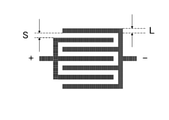
- thermosetting resin composition of this invention It is a top view which shows the wiring pattern adopted in the characteristic evaluation test of the flexible printed wiring board which used the thermosetting resin composition of this invention.
- embodiments for carrying out the present invention (hereinafter referred to as embodiments) will be described in detail.
- the following embodiments are examples for explaining the present invention, and are not intended to limit the present invention to the following contents.
- the present invention can be appropriately modified and carried out within the scope of the gist thereof.
- thermosetting resin composition The thermosetting resin composition of the present invention is mainly preferably used as a resin composition for electronic materials such as coverlay films, adhesive sheets, and flexible printed wiring boards.
- the thermosetting resin composition of the embodiment contains a solid epoxy resin at 25 ° C, a non-solid epoxy resin at 25 ° C, fine particle rubber dispersed in the non-solid epoxy resin, a curing agent, and an inorganic filler. And polyurethane derived from polycarbonate diol.
- the content of the fine particle rubber is 3 to 15 parts by mass
- the acid value of the polyurethane derived from the polycarbonate diol is 10 to 30 mgKOH / g
- the polycarbonate is based on the total number of parts by mass of the solid epoxy resin and the non-solid epoxy resin.
- the weight average molecular weight of diol-derived polyurethane is 15,000 to 50,000.
- the epoxy resin contained in the thermosetting resin composition of the embodiment spreads the resin in the fine grooves between the wirings from the viewpoint of uniformly mixing the thermosetting resin composition (hereinafter, also referred to as wiring filling property). From the viewpoint, from the viewpoint of enhancing the reliability of electrical insulation after the thermosetting resin composition is cured, and from the viewpoint of imparting heat resistance, it contains both a solid epoxy resin at 25 ° C and a non-solid epoxy resin at 25 ° C. ..
- the epoxy resin solid at 25 ° C. has two or more epoxy groups in one molecule and has an epoxy equivalent from the viewpoint of enhancing the reactivity and enhancing the electrical insulation reliability after the thermosetting resin composition is cured. Is preferably 150 to 500 g / eq, and more preferably 150 to 350 g / eq.
- the epoxy resin the epoxy equivalent is within the range of the above-mentioned epoxy equivalent, for example, bisphenol A type epoxy resin, bisphenol F type epoxy resin, bisphenol S type epoxy resin, novolak type epoxy resin, amine type epoxy resin, biphenyl type. Examples thereof include epoxy resins and alicyclic epoxy resins.
- a bisphenol A type epoxy resin is preferable, and a biphenyl type epoxy resin is more preferable.
- Two or more kinds of epoxy resins may be used.
- the epoxy resin solid at 25 ° C. may be previously dissolved in an organic solvent in order to facilitate mixing with other materials contained in the thermosetting resin composition.
- the epoxy equivalent of the epoxy resin can be measured in accordance with JIS K7236 2001.
- the content of the solid epoxy resin at 25 ° C is 100 parts by mass when the total of the epoxy resins (solid epoxy resin at 25 ° C and non-solid epoxy resin at 25 ° C) contained in the thermosetting resin composition is 100 parts by mass. It is preferably 60 to 85 parts by mass.
- the thermosetting resin composition is processed into a sheet, and the cured state of the thermosetting resin composition is half. Tackiness (stickiness) can be suppressed when the cured state (B stage) is set. Furthermore, it is possible to reduce the amount of air (air bubbles) mixed in during the quick press.
- the mass part used in the present invention means the mass part in terms of non-volatile content.
- the mass part in terms of non-volatile content means, for example, the mass part of the resin (nonvolatile component) excluding volatile components such as an organic solvent contained in the resin.
- the semi-cured state (B stage) means a state in which the curing reaction of the thermosetting resin composition has progressed halfway but not completely.
- the non-solid epoxy resin at 25 ° C means an epoxy resin that is fluid at 25 ° C.
- the non-solid epoxy resin at 25 ° C. has an epoxy group in one molecule from the viewpoint of enhancing the dispersibility of the fine particle rubber and increasing the peel strength of the sheet-shaped electronic material composed of the thermosetting resin composition. It is preferable to have two or more and the epoxy equivalent is 100 to 400 g / eq, and more preferably 150 to 350 g / eq.
- the epoxy resin include bisphenol A type epoxy resin, bisphenol F type epoxy resin, phenol novolac type epoxy resin, amine type epoxy resin, and alicyclic epoxy resin having an epoxy equivalent within the above range. Two or more kinds of epoxy resins may be used.
- thermosetting resin composition From the viewpoint of heat resistance, bisphenol A type epoxy resin is preferable, and phenol novolac type epoxy resin is more preferable. Further, from the viewpoint of exhibiting physical characteristics such as peel strength of a sheet-shaped electronic material composed of a thermosetting resin composition, fine particle rubber is non-solid at 25 ° C. before preparing the thermosetting resin composition. It is preferable to use the one uniformly dispersed in the epoxy resin of.
- the content of the non-solid epoxy resin at 25 ° C. was 100 parts by mass based on the total of the epoxy resins (solid epoxy resin at 25 ° C. and non-solid epoxy resin at 25 ° C.) contained in the thermosetting resin composition. Sometimes, it is preferably 15 to 40 parts by mass, more preferably 15 to 35 parts by mass, and further preferably 15 to 30 parts by mass. When the content of the non-solid epoxy resin is in the range of 15 to 40 parts by mass at 25 ° C., the peel strength of the sheet-shaped electronic material composed of the thermosetting resin composition can be maintained in a high state.
- the fine particle rubber is preferably core-shell polymer particles composed of a core layer and a shell layer covering the surface thereof.
- the polymer constituting the core layer is a polymer having rubber-like elasticity.
- the polymer having rubber-like elasticity include diene-based rubber, acrylic rubber, styrene rubber, and polysiloxane rubber. It may be composed of two or more kinds of polymers.
- polymer constituting the shell layer examples include (meth) acrylic acid ester-based monomer, aromatic vinyl-based monomer, cyanide vinyl-based monomer, unsaturated acid derivative, (meth) acrylamide derivative, and maleimide derivative.
- examples thereof include a (co) polymer obtained by copolymerizing one or more selected components.
- the polymer constituting the shell layer is bonded to the polymer constituting the core layer by graft polymerization. As a result, a part or the whole of the surface of the core layer is stably covered with the shell layer, and reaggregation of the core-shell polymer particles can be prevented.
- the polymer constituting the shell layer has a functional group that reacts with the resin or the curing agent contained in the thermosetting resin composition.
- the functional group include a hydroxyl group, a carboxyl group and an epoxy group, and an epoxy group is preferable from the viewpoint of improving compatibility with an epoxy resin.
- the size of the fine particle rubber is preferably 0.05 to 1 ⁇ m in terms of average particle size from the viewpoint of improving the dispersibility.
- the content of the fine particle rubber is preferably 3 to 3 parts by mass when the total of the epoxy resins (solid epoxy resin at 25 ° C. and non-solid epoxy resin at 25 ° C.) contained in the thermosetting resin composition is 100 parts by mass. It is 15 parts by mass, more preferably 3 to 13 parts by mass, and even more preferably 3 to 10 parts by mass.
- the thermosetting resin composition is composed of the thermosetting resin composition without deteriorating the reliability of electrical insulation after curing. The peel strength of the sheet-shaped electronic material can be maintained in a high state.
- fine particle rubber it is preferable to use fine particle rubber dispersed in a non-solid epoxy resin at 25 ° C. from the viewpoint of uniformly dispersing in the thermosetting resin composition.
- Examples of the fine particle rubber dispersed in the non-solid epoxy resin at 25 ° C. include MX-136, MX-153, MX-154, MX-170, MX-217, MX-257, MX-416, manufactured by Kaneka. MX-451, MX-551, MX-960, MX-965 and the like can be mentioned.
- the curing agent is preferably one that cures the epoxy resin.
- the curing agent include diaminodiphenylmethane (DDM), diaminodiphenylsulphon (DDS), diaminodiphenyl ether (DDE), hexamethylenediamine, dicyandiamide, and phenol novolac.
- DDM diaminodiphenylmethane
- DDS diaminodiphenylsulphon
- DDE diaminodiphenyl ether
- hexamethylenediamine dicyandiamide
- dicyandiamide is preferable
- diaminodiphenylsulphon is more preferable, from the viewpoint of easy control of the curing reaction.
- Two or more kinds of curing agents may be used.
- the equivalent amount of the curing agent is the epoxy resin (25 ° C.) contained in the thermosetting resin composition from the viewpoint of improving the wiring filling property and improving the electrical insulation reliability after the thermosetting resin composition is cured. Is preferably 0.3 to 0.8 equivalents, more preferably 0.3 to 0.6 equivalents, relative to 1 equivalent of the epoxy group (solid epoxy resin and non-solid epoxy resin at 25 ° C.). ..
- inorganic filler examples include aluminum hydroxide, magnesium hydroxide, and silica.
- magnesium hydroxide is preferable, and aluminum hydroxide is more preferable, from the viewpoint of improving flame retardancy and wiring filling property, and from the viewpoint of imparting tack-free property required by a quick press.
- Two or more kinds of inorganic fillers may be used.
- the content of the inorganic filler is an epoxy resin (solid epoxy resin at 25 ° C.) contained in the thermosetting resin composition from the viewpoint of improving flame retardancy and wire filling property and imparting tack-free property.
- the total of the non-solid epoxy resin at 25 ° C. is 100 parts by mass, it is preferably 60 to 150 parts by mass, more preferably 60 to 120 parts by mass, and further preferably 70 to 100 parts by mass. be.
- the polycarbonate diol-derived polyurethane contained in the thermosetting resin composition of the embodiment has at least one polycarbonate skeleton in the molecule.
- the number of polycarbonate skeletons is not particularly limited as long as it is a polyurethane derived from a polycarbonate diol.
- hydrolysis of polyurethane is suppressed in a high temperature and high humidity environment after the thermosetting resin composition is cured. This makes it possible to secure high electrical insulation reliability after the thermosetting resin composition is cured.
- the thermosetting resin composition of the present invention is imparted with film properties by containing polyurethane derived from polycarbonate diol. This imparts the flexibility required for sheet-like electronic materials such as coverlay films and adhesive sheets.
- polycarbonate diol examples include a polycarbonate diol represented by the following general formula (1).
- R indicates an alkylene group having 1 to 10 carbon atoms
- m indicates an integer of 1 to 20.
- R in the general formula (1) has 1 to 10 carbon atoms and m is 1 to 20.
- Polyurethane derived from polycarbonate diol can be obtained by polymerizing a polycarbonate diol represented by the general formula (1) with a polyisocyanate.
- the polyisocyanate is not particularly limited as long as it is a polyisocyanate that can react with the polycarbonate diol represented by the general formula (1) to form polyurethane.
- Examples of the polyisocyanate include tolylene-2,4-diisocyanate, 4-methoxy-1,3-phenylenediocyanate, 2,4-diisocyanate diphenyl ether, 4,4'-methylenebis (phenylenedi isocyanate) (MDI), 2,4.
- '-Aromatic diisocyanates such as methylenebis (phenylenediocyanate), tolylene diisocyanate (TDI), xylylene diisocyanate (XDI), 1,5-naphthalenediocyanate; aliphatic diisocyanates such as methylene diisocyanate and 1,6-hexanediisocyanate (HDI).
- Diisocyanates examples include alicyclic diisocyanates such as 1,4-cyclohexylene diisocyanate, 4,4'-methylenebis (cyclohexyldiisocyanate), and isophorone diisocyanate (IPDI).
- the polyisocyanate may be a compound obtained by reacting these isocyanate compounds with a low molecular weight polyol or polyamine to make the terminal functional group an isocyanate group.
- the polyisocyanate may be used alone or in combination of two or more kinds of polyisocyanates. Isophorone diisocyanate is preferable from the viewpoint of heat resistance, flexibility and reactivity.
- Polyurethane derived from polycarbonate diol is preferably acidic from the viewpoint of improving the peel strength of the sheet-shaped electronic material composed of the thermosetting resin composition.
- the polyurethane derived from the acidic polycarbonate diol preferably has a hydroxyl group, a sulfo group, and a carboxyl group in the molecular chain (mainly side chain) of the polyurethane, and from the viewpoint of improving the reactivity with the epoxy resin, It is more preferable to have a carboxyl group from the viewpoint of improving the electrical properties of the thermosetting resin composition after curing.
- the acidity can be indicated by the acid value.
- the acid value of polyurethane derived from polycarbonate diol is 10 to 30 mgKOH / g, preferably 10 to 25 mgKOH / g.
- the acid value of the polyurethane derived from the polycarbonate diol is 10 to 30 mgKOH / g, the wiring filling property is improved, and the peel strength of the sheet-shaped electronic material composed of the thermosetting resin composition is improved.
- the acid value of polyurethane derived from polycarbonate diol can be measured in accordance with JIS K0070.
- the content of polyurethane derived from the polycarbonate diol is an epoxy resin (solid at 25 ° C.) contained in the thermosetting resin composition from the viewpoint of increasing the peel strength of the sheet-shaped electronic material composed of the thermosetting resin composition.
- an epoxy resin solid at 25 ° C.
- the total of the epoxy resin and the non-solid epoxy resin at 25 ° C. is 100 parts by mass, it is preferably 50 to 100 parts by mass, more preferably 60 to 90 parts by mass, and further preferably 70 to 80 parts by mass. It is a department.
- the weight average molecular weight of the polyurethane derived from the polycarbonate diol is preferably 150,000 to 50,000, more preferably 20,000 to 45,000, and further preferably 25,000 to 40,000.
- the weight average molecular weight of the polyurethane derived from the polycarbonate diol can be measured by gel permeation chromatography (GPC) using standard polystyrene having an average molecular weight of about 5 to about 1 million.
- thermosetting resin composition of the embodiment may further contain other additives and the like.
- additives include imidazole-based accelerators such as 2-methylimidazole, N-benzyl-2-methylimidazole and 2-undecylimidazole, Lewis acid complexes such as boron trifluoride monoethylamine, polyamines and melamine resins. Examples thereof include curing accelerators, dispersants, softeners, antiaging agents, pigments, dyes, and silane coupling agents.
- Coverlay film is used, for example, to protect the wiring formed on the substrate.
- the coverlay film is composed of a base material and an adhesive layer laminated on one side of the base material.
- the adhesive layer may be provided on both sides of the film-shaped base material. According to the coverlay film having this configuration, the wiring surface of a plurality of substrates can be protected by one coverlay film. Further, the substrate can be multi-layered.
- the base material that constitutes the coverlay film is a film-like base material.
- the thickness of the base material is 2 to 75 ⁇ m.
- the substrate of the coverlay film examples include a polyimide (PI) -based substrate, a polyamide (PA) -based substrate, a polyethylene naphthalate (PEN) -based substrate, a polyamideimide (PAI) -based substrate, and a polyethylene terephthalate (PET).
- PI polyimide
- PA polyamide
- PEN polyethylene naphthalate
- PAI polyamideimide
- PET polyethylene terephthalate
- PPS polyphenylene sulfide
- LCP liquid crystal
- a polyimide (PI) -based substrate is preferable from the viewpoint of flame retardancy, electrical insulation reliability, heat resistance, and elastic modulus.
- the surface of the base material can be subjected to surface modification treatment such as corona treatment and plasma treatment. As a result, the surface of the base material is modified, and the adhesion between the adhesive layer and the base material is improved.
- the adhesive layer is composed of the thermosetting resin composition of the embodiment.
- the thickness of the adhesive layer is 5 to 50 ⁇ m after drying.
- the cured state of the thermosetting resin composition constituting the adhesive layer is a semi-cured state (B stage).
- the coverlay film is produced by the following procedure.
- a solution containing the thermosetting resin composition in which the thermosetting resin composition is dissolved in an organic solvent is prepared.
- the solution is applied on a film-like substrate.
- the thermosetting resin composition is heated until it reaches a semi-cured state (B stage).
- B stage After cooling, a coverlay film in which an adhesive layer composed of a thermosetting resin composition is formed on a film-like substrate is obtained.
- the heating conditions are 100 to 250 ° C., 5 seconds to 30 minutes, and are adjusted according to the coating thickness.
- organic solvent examples include alcohols such as methanol and ethanol; glycols such as ethylene glycol and propylene glycol; glycol monoalkyl ethers such as ethylene glycol monomethyl ether and ethylene glycol monoethyl ether; ethylene glycol dimethyl ether and ethylene glycol diethyl.
- Glycoldialkyl ethers such as ethers; alkyl esters such as methyl acetate, ethyl acetate, propyl acetate, methyl acetoacetate, methyl acetoacetate; ketones such as acetone, methyl ethyl ketone, methyl isobutyl ketone, cyclohexanone; benzene, toluene, xylene, ethylbenzene Aromatic hydrocarbons such as; aliphatic hydrocarbons such as hexane, cyclohexane and octane; amides such as dimethylformamide, dimethylacetamide and N-methylpyrrolidone; cyclic ethers such as tetrahydrofuran and dioxane.
- the coating device is not particularly limited, and a known coater can be used.
- a die coater for example, a die coater, a comma coater, a gravure coater, and the like.
- the coverlay film can be produced by the following procedure. First, an adhesive layer is formed on the surface of the release film that has been subjected to the release treatment so that the thickness after drying is 5 ⁇ m. Then, a film-like base material used for the coverlay film is separately prepared, and the surface of the base material and the surface of the adhesive layer are laminated so as to be aligned with each other. Next, after heating and pressurizing the obtained laminate, only the release film is peeled off. This makes it possible to obtain a coverlay film having a thickness of the adhesive layer of 5 ⁇ m.
- the adhesive sheet is a sheet of an adhesive material composed of the thermosetting resin composition of the embodiment.
- the thickness of the adhesive layer constituting the adhesive sheet is 5 to 50 ⁇ m.
- the adhesive sheet is made by the following procedure.
- a solution containing the thermosetting resin composition in which the thermosetting resin composition is dissolved in an organic solvent is prepared.
- the solution is applied to the mold release-treated surface of the film-like substrate that has been mold-released.
- the thermosetting resin composition is heated until it reaches a semi-cured state (B stage).
- B stage After cooling, an adhesive sheet having an adhesive layer composed of a thermosetting resin composition formed on a film-like substrate is obtained.
- the heating conditions are 100 to 250 ° C., 5 seconds to 30 minutes, and are adjusted according to the coating thickness.
- the film-like base material is peeled off from the adhesive layer before use.
- Examples of the mold release treatment agent used for the base material subjected to the mold release treatment include a silicone-based treatment agent and a fluorine-based treatment agent.
- Another configuration of the adhesive sheet is, for example, a configuration in which adhesive layers are provided on both sides of a film-like base material from the viewpoint of enhancing rigidity and electrical insulation reliability.
- a prepreg in which a base material such as a woven fabric or a non-woven fabric is impregnated with a thermosetting resin composition can be mentioned.
- the prepreg is prepared by the following procedure. First, a woven fabric or a non-woven fabric composed of fibers such as glass fibers is prepared as a base material. Next, a solution containing the thermosetting resin composition in which the thermosetting resin composition is dissolved in an organic solvent is prepared. The solution is impregnated with the substrate. The substrate pulled up from the solution is heated until the attached thermosetting resin composition reaches the B stage. After cooling, a B-stage prepreg is obtained.
- the adhesive sheet can be used as an interlayer adhesive for adhering substrates such as flexible printed wiring boards. Further, the wiring can be protected by the adhesive sheet covering the wiring.
- the flexible printed wiring board includes a substrate on which wiring is formed and a coverlay film composed of a base material and an adhesive layer laminated on one side of the base material, and adheres to the surface on which the wiring of the substrate is formed.
- a coverlay film is provided so that the material layers are in contact with each other.
- the wiring formed on the substrate is, for example, a wiring formed by etching a copper-plated laminated plate or a copper layer of a copper-plated laminated plate.
- the wiring formed on another substrate the wiring may be formed by inkjet printing using conductive ink.
- the wiring material may be composed of other metals such as silver and zinc instead of copper.
- the thickness of the substrate used for the flexible printed wiring board is not particularly limited, but is 15 to 200 ⁇ m from the viewpoint that the substrate has flexibility.
- the flexible printed wiring board is manufactured by the following procedure.
- a coverlay film composed of a substrate on which wiring is formed and an adhesive layer laminated on one side of the substrate and the substrate is prepared.
- the coverlay film is laminated so that the adhesive layer is in contact with the surface on which the wiring of the substrate is formed, and the coating is heated and pressed.
- the conditions for heating and pressurizing are 120 to 250 ° C., 5 seconds to 120 minutes, and 1 to 10 MPa, which are set according to the laminated configuration.
- Epoxy resin (1) Epoxy resin A: Biphenyl type epoxy resin solid at 25 ° C., epoxy equivalent 290 g / eq (manufactured by Nippon Kayaku Co., Ltd., NC3000H), (2) Epoxy resin B: Non-solid bisphenol A type epoxy resin at 25 ° C., epoxy equivalent 190 g / eq (DIC Corporation, Epicron 850), (3) Epoxy resin C: Non-solid fine particle rubber dispersed epoxy resin (phenol novolac type) at 25 ° C, epoxy equivalent 231 g / eq, fine particle rubber (polybutadiene rubber, average particle size 0.1 ⁇ m) with a total solid content of 100 Containing 25 parts by mass (manufactured by Kaneka, MX-217), (4) Epoxy resin D: Non-solid fine particle rubber dispersed epoxy resin (bisphenol A type) at 25 ° C., epoxy equivalent 294
- Diaminodiphenyl sulfone Amine value 62 g / eq (3, 3'-DAS manufactured by Konishi Chemical Industry Co., Ltd.).
- dimethylacetamide corresponding to 10% by mass of the total amount of (a), (b) and (c) and 45% by mass of the total amount of (a), (b) and (c).
- the corresponding toluene was added and stirred at 100 ° C. Then, after reacting until the NCO group disappears, methyl ethyl ketone corresponding to 45% by mass of the total amount of (a), (b) and (c) is added to obtain a polyurethane resin solution having a resin content of 45% by mass. rice field.
- polyurethanes B to I derived from the polycarbonate diol were synthesized by the same method as the synthesis of the polyurethane A derived from the polycarbonate diol by changing the addition amount of each component as shown in Table 1.
- Polyester-based polyurethane J number average molecular weight 13000, acid value 35 mgKOH / g (manufactured by Toyobo Co., Ltd., UR-3500), (2) Acrylonitrile butadiene rubber K: Acid value 40 mgKOH / g (manufactured by JSR Corporation, JSR XER-32C).
- each evaluation method and measurement method was performed by the following methods.
- ⁇ Peeling strength peeling strength> (1) Preparation procedure of sample (1-1) Preparation of coverlay film A resin composition to be an adhesive layer is dried on one side of a polyimide film (Apical 12.5 NPI manufactured by Kaneka Corporation) having a thickness of 12.5 ⁇ m. After that, the film was applied so as to have a thickness of 25 ⁇ m, and dried at 160 ° C. for 10 minutes until it became a semi-cured state (B stage). Then, the release PET film was laminated on the adhesive layer side at 100 ° C. to obtain a coverlay film with a release PET film.
- a polyimide film A resin composition to be an adhesive layer is dried on one side of a polyimide film (Apical 12.5 NPI manufactured by Kaneka Corporation) having a thickness of 12.5 ⁇ m. After that, the film was applied so as to have a thickness of 25 ⁇ m, and dried at 160 ° C. for 10 minutes until it became a semi-cured state (B stage). Then,
- BHAST ⁇ Electrical insulation reliability
- Example 1 70 parts by mass of epoxy resin A and 30 parts by mass of epoxy resin C were added to the container, and the total mass of epoxy resin was 100 parts by mass. To this, 10.4 parts by mass of a curing agent, 75 parts by mass of polyurethane A derived from polycarbonate diol, 90 parts by mass of aluminum hydroxide, 10.4 parts by mass of diaminodiphenyl sulfone, and 400 parts by mass of methyl ethyl ketone as an organic solvent are added. rice field. Then, these were stirred at room temperature to obtain a thermosetting resin composition.
- Example 2 Example 2 to (Example 12), (Comparative Example 1) to (Comparative Example 11)
- Tables 2 and 3 the type and content of each component were changed and adjusted by the same method as in Example 1 to obtain a thermosetting resin composition. Unless otherwise specified, the unit of content in the table is parts by mass.
- thermosetting resin compositions of Examples 1 to 12 were excellent in processability (wiring filling property) by quick pressing, and were also excellent in electrical insulation reliability in BHAST. Further, in Examples 1 to 12, no swelling or peeling was observed even when the solder was brought into contact with the solder bath at 260 ° C. for 60 seconds or longer in the solder heat resistance evaluation, and the solder heat resistance was excellent. In addition, all the examples had UL94 standard V-0 grade, which is a flame retardancy evaluation required for sheet-shaped electronic materials.
- solder heat resistance is performed by ⁇ peeling strength (peeling strength)> (1)
Landscapes
- Chemical & Material Sciences (AREA)
- Organic Chemistry (AREA)
- Health & Medical Sciences (AREA)
- Chemical Kinetics & Catalysis (AREA)
- Medicinal Chemistry (AREA)
- Polymers & Plastics (AREA)
- Engineering & Computer Science (AREA)
- Inorganic Chemistry (AREA)
- Manufacturing & Machinery (AREA)
- Microelectronics & Electronic Packaging (AREA)
- Non-Metallic Protective Coatings For Printed Circuits (AREA)
- Adhesive Tapes (AREA)
- Adhesives Or Adhesive Processes (AREA)
- Epoxy Resins (AREA)
- Compositions Of Macromolecular Compounds (AREA)
- Polyurethanes Or Polyureas (AREA)
- Laminated Bodies (AREA)
Priority Applications (4)
| Application Number | Priority Date | Filing Date | Title |
|---|---|---|---|
| US17/786,830 US11884815B2 (en) | 2020-07-22 | 2021-07-05 | Thermosetting resin composition, coverlay film, adhesive sheet, and flexible printed wiring board |
| CN202180007631.4A CN114867787B (zh) | 2020-07-22 | 2021-07-05 | 热固性树脂组合物、覆盖膜、粘接片材及柔性印刷布线板 |
| KR1020227020092A KR102463618B1 (ko) | 2020-07-22 | 2021-07-05 | 열경화성 수지 조성물, 커버레이 필름, 접착 시트 및 플렉시블 프린트 배선판 |
| JP2022503499A JP7090824B1 (ja) | 2020-07-22 | 2021-07-05 | 熱硬化性樹脂組成物、カバーレイフィルム、接着シート、及びフレキシブルプリント配線板 |
Applications Claiming Priority (2)
| Application Number | Priority Date | Filing Date | Title |
|---|---|---|---|
| JP2020124865 | 2020-07-22 | ||
| JP2020-124865 | 2020-07-22 |
Publications (1)
| Publication Number | Publication Date |
|---|---|
| WO2022019095A1 true WO2022019095A1 (ja) | 2022-01-27 |
Family
ID=79729314
Family Applications (1)
| Application Number | Title | Priority Date | Filing Date |
|---|---|---|---|
| PCT/JP2021/025253 Ceased WO2022019095A1 (ja) | 2020-07-22 | 2021-07-05 | 熱硬化性樹脂組成物、カバーレイフィルム、接着シート、及びフレキシブルプリント配線板 |
Country Status (6)
| Country | Link |
|---|---|
| US (1) | US11884815B2 (https=) |
| JP (1) | JP7090824B1 (https=) |
| KR (1) | KR102463618B1 (https=) |
| CN (1) | CN114867787B (https=) |
| TW (1) | TWI795842B (https=) |
| WO (1) | WO2022019095A1 (https=) |
Cited By (2)
| Publication number | Priority date | Publication date | Assignee | Title |
|---|---|---|---|---|
| JP2023062672A (ja) * | 2021-10-21 | 2023-05-08 | Dic株式会社 | 熱硬化性組成物、その硬化物、半導体封止材料、プリプレグ、回路基板及びビルドアップフィルム |
| WO2024135268A1 (ja) * | 2022-12-19 | 2024-06-27 | 株式会社有沢製作所 | 熱硬化性樹脂組成物、カバーレイフィルム、及びフレキシブルプリント配線板 |
Families Citing this family (1)
| Publication number | Priority date | Publication date | Assignee | Title |
|---|---|---|---|---|
| WO2025183038A1 (ja) * | 2024-02-27 | 2025-09-04 | 日東シンコー株式会社 | 接着シート |
Citations (3)
| Publication number | Priority date | Publication date | Assignee | Title |
|---|---|---|---|---|
| JP2007204715A (ja) * | 2006-02-06 | 2007-08-16 | Toyobo Co Ltd | 接着剤組成物及びそれを用いたフレキシブル銅張積層板 |
| JP2009096940A (ja) * | 2007-10-19 | 2009-05-07 | Toyo Ink Mfg Co Ltd | 難燃性接着剤組成物、カバーレイおよび接着剤シート、フレキシブルプリント配線板 |
| JP2013176965A (ja) * | 2011-05-31 | 2013-09-09 | Toyobo Co Ltd | フレキシブル金属張積層体、フレキシブルプリント基板、及び電子機器 |
Family Cites Families (10)
| Publication number | Priority date | Publication date | Assignee | Title |
|---|---|---|---|---|
| KR900007766B1 (ko) * | 1985-06-26 | 1990-10-19 | 더 다우 케미칼 캄파니 | 고무-개질 에폭시 화합물 |
| JP4425118B2 (ja) | 2003-12-03 | 2010-03-03 | 株式会社有沢製作所 | 難燃性樹脂組成物、並びに該組成物を用いたフレキシブルプリント配線板用金属張積層板、カバーレイ、接着シート及びフレキシブルプリント配線板 |
| JP5190976B2 (ja) * | 2004-09-21 | 2013-04-24 | 昭和電工株式会社 | ウレタン樹脂を用いた熱硬化性樹脂組成物 |
| JP5393959B2 (ja) * | 2007-07-13 | 2014-01-22 | 太陽ホールディングス株式会社 | 光硬化性・熱硬化性樹脂組成物及びその硬化物 |
| JP2010143981A (ja) * | 2008-12-17 | 2010-07-01 | Toyo Ink Mfg Co Ltd | 硬化性導電性ポリウレタンポリウレア接着剤組成物、硬化性電磁波シールド性接着性フィルムおよびその製造方法 |
| EP2468792A1 (en) * | 2010-12-23 | 2012-06-27 | 3M Innovative Properties Company | Curable adhesive composition |
| JP5712851B2 (ja) | 2011-07-29 | 2015-05-07 | 富士通株式会社 | データ分割装置、データ分割方法およびデータ分割プログラム |
| KR102237222B1 (ko) | 2013-09-26 | 2021-04-08 | 도요보 가부시키가이샤 | 폴리우레탄 수지 조성물 및 이것을 이용한 접착제 조성물, 적층체, 프린트 배선판 |
| JP6749887B2 (ja) | 2015-02-26 | 2020-09-02 | 日立化成株式会社 | 封止用フィルム及びそれを用いた電子部品装置 |
| JP2020038915A (ja) * | 2018-09-05 | 2020-03-12 | 戸田工業株式会社 | 多層印刷回路板の製造方法 |
-
2021
- 2021-07-05 KR KR1020227020092A patent/KR102463618B1/ko active Active
- 2021-07-05 CN CN202180007631.4A patent/CN114867787B/zh active Active
- 2021-07-05 JP JP2022503499A patent/JP7090824B1/ja active Active
- 2021-07-05 WO PCT/JP2021/025253 patent/WO2022019095A1/ja not_active Ceased
- 2021-07-05 US US17/786,830 patent/US11884815B2/en active Active
- 2021-07-15 TW TW110126000A patent/TWI795842B/zh active
Patent Citations (3)
| Publication number | Priority date | Publication date | Assignee | Title |
|---|---|---|---|---|
| JP2007204715A (ja) * | 2006-02-06 | 2007-08-16 | Toyobo Co Ltd | 接着剤組成物及びそれを用いたフレキシブル銅張積層板 |
| JP2009096940A (ja) * | 2007-10-19 | 2009-05-07 | Toyo Ink Mfg Co Ltd | 難燃性接着剤組成物、カバーレイおよび接着剤シート、フレキシブルプリント配線板 |
| JP2013176965A (ja) * | 2011-05-31 | 2013-09-09 | Toyobo Co Ltd | フレキシブル金属張積層体、フレキシブルプリント基板、及び電子機器 |
Cited By (3)
| Publication number | Priority date | Publication date | Assignee | Title |
|---|---|---|---|---|
| JP2023062672A (ja) * | 2021-10-21 | 2023-05-08 | Dic株式会社 | 熱硬化性組成物、その硬化物、半導体封止材料、プリプレグ、回路基板及びビルドアップフィルム |
| WO2024135268A1 (ja) * | 2022-12-19 | 2024-06-27 | 株式会社有沢製作所 | 熱硬化性樹脂組成物、カバーレイフィルム、及びフレキシブルプリント配線板 |
| JPWO2024135268A1 (https=) * | 2022-12-19 | 2024-06-27 |
Also Published As
| Publication number | Publication date |
|---|---|
| US11884815B2 (en) | 2024-01-30 |
| KR20220088799A (ko) | 2022-06-28 |
| JP7090824B1 (ja) | 2022-06-24 |
| TWI795842B (zh) | 2023-03-11 |
| CN114867787A (zh) | 2022-08-05 |
| JPWO2022019095A1 (https=) | 2022-01-27 |
| CN114867787B (zh) | 2022-12-06 |
| US20230134682A1 (en) | 2023-05-04 |
| KR102463618B1 (ko) | 2022-11-04 |
| TW202208574A (zh) | 2022-03-01 |
Similar Documents
| Publication | Publication Date | Title |
|---|---|---|
| CN101268163B (zh) | 粘结剂组合物、使用它的粘结剂片及其应用 | |
| JP7090824B1 (ja) | 熱硬化性樹脂組成物、カバーレイフィルム、接着シート、及びフレキシブルプリント配線板 | |
| KR102314255B1 (ko) | 열경화성 수지 조성물 | |
| KR102315466B1 (ko) | 수지 조성물 | |
| TW201833285A (zh) | 接著劑組成物與使用該組成物之包覆層薄膜、接合片、貼銅層合板及電磁波遮蔽材 | |
| JP2019157027A (ja) | 熱硬化性樹脂組成物、層間絶縁用樹脂フィルム、複合フィルム、プリント配線板及びその製造方法 | |
| JP2009096940A (ja) | 難燃性接着剤組成物、カバーレイおよび接着剤シート、フレキシブルプリント配線板 | |
| CN102803384B (zh) | 薄膜用组合物以及用其制作的接着薄膜与覆盖薄膜 | |
| CN104244603A (zh) | 部件内置型布线基板的制造方法及半导体装置 | |
| JP2020029494A (ja) | 絶縁層用樹脂組成物、シート状積層材料、多層プリント配線板及び半導体装置 | |
| JP2017059779A (ja) | プリント配線板の製造方法 | |
| JP2022017947A (ja) | 熱硬化性接着シート、およびその利用 | |
| JP5494914B2 (ja) | 接着シート、及び当該接着シートを使用して得られる多層プリント基板 | |
| JP4425118B2 (ja) | 難燃性樹脂組成物、並びに該組成物を用いたフレキシブルプリント配線板用金属張積層板、カバーレイ、接着シート及びフレキシブルプリント配線板 | |
| TWI707898B (zh) | 樹脂薄片之製造方法 | |
| JP6801280B2 (ja) | 熱硬化性樹脂組成物、層間絶縁用樹脂フィルム、複合フィルム、プリント配線板及びその製造方法 | |
| JP7673222B2 (ja) | 熱硬化性樹脂組成物、カバーレイフィルム、接着シート、及びフレキシブルプリント配線板 | |
| JP2004189815A (ja) | エポキシ樹脂組成物及びそれを用いたフレキシブル印刷配線板材料 | |
| HK40074824A (en) | Thermosetting resin composition, coverlay film, adhesive sheet, and flexible printed circuit board | |
| HK40074824B (en) | Thermosetting resin composition, coverlay film, adhesive sheet, and flexible printed circuit board | |
| TWI868058B (zh) | 熱硬化性樹脂組成物之用途 | |
| JP5239661B2 (ja) | カバーレイフィルム | |
| CN111757911B (zh) | 树脂组合物、预浸料、层压板、覆金属箔层压板和印刷线路板 | |
| JP2022122082A (ja) | 樹脂組成物、プリプレグ、樹脂付き金属箔、積層板、プリント配線板及び半導体パッケージ | |
| JP6478088B2 (ja) | めっきプロセス用プライマ層付プリプレグ、それを用いた多層プリント配線板の製造方法 |
Legal Events
| Date | Code | Title | Description |
|---|---|---|---|
| ENP | Entry into the national phase |
Ref document number: 2022503499 Country of ref document: JP Kind code of ref document: A |
|
| 121 | Ep: the epo has been informed by wipo that ep was designated in this application |
Ref document number: 21845771 Country of ref document: EP Kind code of ref document: A1 |
|
| ENP | Entry into the national phase |
Ref document number: 20227020092 Country of ref document: KR Kind code of ref document: A |
|
| NENP | Non-entry into the national phase |
Ref country code: DE |
|
| 122 | Ep: pct application non-entry in european phase |
Ref document number: 21845771 Country of ref document: EP Kind code of ref document: A1 |