WO2021145382A1 - 粘着テープ - Google Patents
粘着テープ Download PDFInfo
- Publication number
- WO2021145382A1 WO2021145382A1 PCT/JP2021/001070 JP2021001070W WO2021145382A1 WO 2021145382 A1 WO2021145382 A1 WO 2021145382A1 JP 2021001070 W JP2021001070 W JP 2021001070W WO 2021145382 A1 WO2021145382 A1 WO 2021145382A1
- Authority
- WO
- WIPO (PCT)
- Prior art keywords
- adhesive tape
- tape according
- less
- tape
- adhesive
- Prior art date
- Legal status (The legal status is an assumption and is not a legal conclusion. Google has not performed a legal analysis and makes no representation as to the accuracy of the status listed.)
- Ceased
Links
Images




Classifications
-
- C—CHEMISTRY; METALLURGY
- C09—DYES; PAINTS; POLISHES; NATURAL RESINS; ADHESIVES; COMPOSITIONS NOT OTHERWISE PROVIDED FOR; APPLICATIONS OF MATERIALS NOT OTHERWISE PROVIDED FOR
- C09J—ADHESIVES; NON-MECHANICAL ASPECTS OF ADHESIVE PROCESSES IN GENERAL; ADHESIVE PROCESSES NOT PROVIDED FOR ELSEWHERE; USE OF MATERIALS AS ADHESIVES
- C09J7/00—Adhesives in the form of films or foils
- C09J7/20—Adhesives in the form of films or foils characterised by their carriers
- C09J7/22—Plastics; Metallised plastics
-
- C—CHEMISTRY; METALLURGY
- C09—DYES; PAINTS; POLISHES; NATURAL RESINS; ADHESIVES; COMPOSITIONS NOT OTHERWISE PROVIDED FOR; APPLICATIONS OF MATERIALS NOT OTHERWISE PROVIDED FOR
- C09J—ADHESIVES; NON-MECHANICAL ASPECTS OF ADHESIVE PROCESSES IN GENERAL; ADHESIVE PROCESSES NOT PROVIDED FOR ELSEWHERE; USE OF MATERIALS AS ADHESIVES
- C09J7/00—Adhesives in the form of films or foils
- C09J7/20—Adhesives in the form of films or foils characterised by their carriers
- C09J7/22—Plastics; Metallised plastics
- C09J7/24—Plastics; Metallised plastics based on macromolecular compounds obtained by reactions involving only carbon-to-carbon unsaturated bonds
- C09J7/245—Vinyl resins, e.g. polyvinyl chloride [PVC]
-
- C—CHEMISTRY; METALLURGY
- C08—ORGANIC MACROMOLECULAR COMPOUNDS; THEIR PREPARATION OR CHEMICAL WORKING-UP; COMPOSITIONS BASED THEREON
- C08G—MACROMOLECULAR COMPOUNDS OBTAINED OTHERWISE THAN BY REACTIONS ONLY INVOLVING UNSATURATED CARBON-TO-CARBON BONDS
- C08G18/00—Polymeric products of isocyanates or isothiocyanates
- C08G18/06—Polymeric products of isocyanates or isothiocyanates with compounds having active hydrogen
- C08G18/28—Polymeric products of isocyanates or isothiocyanates with compounds having active hydrogen characterised by the compounds used containing active hydrogen
- C08G18/40—High-molecular-weight compounds
- C08G18/62—Polymers of compounds having carbon-to-carbon double bonds
- C08G18/6216—Polymers of alpha-beta ethylenically unsaturated carboxylic acids or of derivatives thereof
- C08G18/625—Polymers of alpha-beta ethylenically unsaturated carboxylic acids; hydrolyzed polymers of esters of these acids
-
- C—CHEMISTRY; METALLURGY
- C08—ORGANIC MACROMOLECULAR COMPOUNDS; THEIR PREPARATION OR CHEMICAL WORKING-UP; COMPOSITIONS BASED THEREON
- C08G—MACROMOLECULAR COMPOUNDS OBTAINED OTHERWISE THAN BY REACTIONS ONLY INVOLVING UNSATURATED CARBON-TO-CARBON BONDS
- C08G18/00—Polymeric products of isocyanates or isothiocyanates
- C08G18/06—Polymeric products of isocyanates or isothiocyanates with compounds having active hydrogen
- C08G18/70—Polymeric products of isocyanates or isothiocyanates with compounds having active hydrogen characterised by the isocyanates or isothiocyanates used
- C08G18/72—Polyisocyanates or polyisothiocyanates
- C08G18/73—Polyisocyanates or polyisothiocyanates acyclic
-
- C—CHEMISTRY; METALLURGY
- C09—DYES; PAINTS; POLISHES; NATURAL RESINS; ADHESIVES; COMPOSITIONS NOT OTHERWISE PROVIDED FOR; APPLICATIONS OF MATERIALS NOT OTHERWISE PROVIDED FOR
- C09J—ADHESIVES; NON-MECHANICAL ASPECTS OF ADHESIVE PROCESSES IN GENERAL; ADHESIVE PROCESSES NOT PROVIDED FOR ELSEWHERE; USE OF MATERIALS AS ADHESIVES
- C09J133/00—Adhesives based on homopolymers or copolymers of compounds having one or more unsaturated aliphatic radicals, each having only one carbon-to-carbon double bond, and at least one being terminated by only one carboxyl radical, or of salts, anhydrides, esters, amides, imides, or nitriles thereof; Adhesives based on derivatives of such polymers
-
- C—CHEMISTRY; METALLURGY
- C09—DYES; PAINTS; POLISHES; NATURAL RESINS; ADHESIVES; COMPOSITIONS NOT OTHERWISE PROVIDED FOR; APPLICATIONS OF MATERIALS NOT OTHERWISE PROVIDED FOR
- C09J—ADHESIVES; NON-MECHANICAL ASPECTS OF ADHESIVE PROCESSES IN GENERAL; ADHESIVE PROCESSES NOT PROVIDED FOR ELSEWHERE; USE OF MATERIALS AS ADHESIVES
- C09J133/00—Adhesives based on homopolymers or copolymers of compounds having one or more unsaturated aliphatic radicals, each having only one carbon-to-carbon double bond, and at least one being terminated by only one carboxyl radical, or of salts, anhydrides, esters, amides, imides, or nitriles thereof; Adhesives based on derivatives of such polymers
- C09J133/02—Homopolymers or copolymers of acids; Metal or ammonium salts thereof
-
- C—CHEMISTRY; METALLURGY
- C09—DYES; PAINTS; POLISHES; NATURAL RESINS; ADHESIVES; COMPOSITIONS NOT OTHERWISE PROVIDED FOR; APPLICATIONS OF MATERIALS NOT OTHERWISE PROVIDED FOR
- C09J—ADHESIVES; NON-MECHANICAL ASPECTS OF ADHESIVE PROCESSES IN GENERAL; ADHESIVE PROCESSES NOT PROVIDED FOR ELSEWHERE; USE OF MATERIALS AS ADHESIVES
- C09J175/00—Adhesives based on polyureas or polyurethanes; Adhesives based on derivatives of such polymers
- C09J175/04—Polyurethanes
-
- C—CHEMISTRY; METALLURGY
- C09—DYES; PAINTS; POLISHES; NATURAL RESINS; ADHESIVES; COMPOSITIONS NOT OTHERWISE PROVIDED FOR; APPLICATIONS OF MATERIALS NOT OTHERWISE PROVIDED FOR
- C09J—ADHESIVES; NON-MECHANICAL ASPECTS OF ADHESIVE PROCESSES IN GENERAL; ADHESIVE PROCESSES NOT PROVIDED FOR ELSEWHERE; USE OF MATERIALS AS ADHESIVES
- C09J183/00—Adhesives based on macromolecular compounds obtained by reactions forming in the main chain of the macromolecule a linkage containing silicon, with or without sulfur, nitrogen, oxygen, or carbon only; Adhesives based on derivatives of such polymers
- C09J183/04—Polysiloxanes
-
- C—CHEMISTRY; METALLURGY
- C09—DYES; PAINTS; POLISHES; NATURAL RESINS; ADHESIVES; COMPOSITIONS NOT OTHERWISE PROVIDED FOR; APPLICATIONS OF MATERIALS NOT OTHERWISE PROVIDED FOR
- C09J—ADHESIVES; NON-MECHANICAL ASPECTS OF ADHESIVE PROCESSES IN GENERAL; ADHESIVE PROCESSES NOT PROVIDED FOR ELSEWHERE; USE OF MATERIALS AS ADHESIVES
- C09J7/00—Adhesives in the form of films or foils
- C09J7/20—Adhesives in the form of films or foils characterised by their carriers
- C09J7/22—Plastics; Metallised plastics
- C09J7/24—Plastics; Metallised plastics based on macromolecular compounds obtained by reactions involving only carbon-to-carbon unsaturated bonds
-
- C—CHEMISTRY; METALLURGY
- C09—DYES; PAINTS; POLISHES; NATURAL RESINS; ADHESIVES; COMPOSITIONS NOT OTHERWISE PROVIDED FOR; APPLICATIONS OF MATERIALS NOT OTHERWISE PROVIDED FOR
- C09J—ADHESIVES; NON-MECHANICAL ASPECTS OF ADHESIVE PROCESSES IN GENERAL; ADHESIVE PROCESSES NOT PROVIDED FOR ELSEWHERE; USE OF MATERIALS AS ADHESIVES
- C09J7/00—Adhesives in the form of films or foils
- C09J7/30—Adhesives in the form of films or foils characterised by the adhesive composition
-
- C—CHEMISTRY; METALLURGY
- C09—DYES; PAINTS; POLISHES; NATURAL RESINS; ADHESIVES; COMPOSITIONS NOT OTHERWISE PROVIDED FOR; APPLICATIONS OF MATERIALS NOT OTHERWISE PROVIDED FOR
- C09J—ADHESIVES; NON-MECHANICAL ASPECTS OF ADHESIVE PROCESSES IN GENERAL; ADHESIVE PROCESSES NOT PROVIDED FOR ELSEWHERE; USE OF MATERIALS AS ADHESIVES
- C09J7/00—Adhesives in the form of films or foils
- C09J7/30—Adhesives in the form of films or foils characterised by the adhesive composition
- C09J7/38—Pressure-sensitive adhesives [PSA]
-
- C—CHEMISTRY; METALLURGY
- C09—DYES; PAINTS; POLISHES; NATURAL RESINS; ADHESIVES; COMPOSITIONS NOT OTHERWISE PROVIDED FOR; APPLICATIONS OF MATERIALS NOT OTHERWISE PROVIDED FOR
- C09J—ADHESIVES; NON-MECHANICAL ASPECTS OF ADHESIVE PROCESSES IN GENERAL; ADHESIVE PROCESSES NOT PROVIDED FOR ELSEWHERE; USE OF MATERIALS AS ADHESIVES
- C09J7/00—Adhesives in the form of films or foils
- C09J7/30—Adhesives in the form of films or foils characterised by the adhesive composition
- C09J7/38—Pressure-sensitive adhesives [PSA]
- C09J7/381—Pressure-sensitive adhesives [PSA] based on macromolecular compounds obtained by reactions involving only carbon-to-carbon unsaturated bonds
- C09J7/385—Acrylic polymers
-
- H—ELECTRICITY
- H02—GENERATION; CONVERSION OR DISTRIBUTION OF ELECTRIC POWER
- H02G—INSTALLATION OF ELECTRIC CABLES OR LINES, OR OF COMBINED OPTICAL AND ELECTRIC CABLES OR LINES
- H02G1/00—Methods or apparatus specially adapted for installing, maintaining, repairing or dismantling electric cables or lines
- H02G1/16—Methods or apparatus specially adapted for installing, maintaining, repairing or dismantling electric cables or lines for repairing insulation or armouring of cables
-
- C—CHEMISTRY; METALLURGY
- C08—ORGANIC MACROMOLECULAR COMPOUNDS; THEIR PREPARATION OR CHEMICAL WORKING-UP; COMPOSITIONS BASED THEREON
- C08G—MACROMOLECULAR COMPOUNDS OBTAINED OTHERWISE THAN BY REACTIONS ONLY INVOLVING UNSATURATED CARBON-TO-CARBON BONDS
- C08G77/00—Macromolecular compounds obtained by reactions forming a linkage containing silicon with or without sulfur, nitrogen, oxygen or carbon in the main chain of the macromolecule
- C08G77/04—Polysiloxanes
-
- C—CHEMISTRY; METALLURGY
- C09—DYES; PAINTS; POLISHES; NATURAL RESINS; ADHESIVES; COMPOSITIONS NOT OTHERWISE PROVIDED FOR; APPLICATIONS OF MATERIALS NOT OTHERWISE PROVIDED FOR
- C09J—ADHESIVES; NON-MECHANICAL ASPECTS OF ADHESIVE PROCESSES IN GENERAL; ADHESIVE PROCESSES NOT PROVIDED FOR ELSEWHERE; USE OF MATERIALS AS ADHESIVES
- C09J2203/00—Applications of adhesives in processes or use of adhesives in the form of films or foils
- C09J2203/326—Applications of adhesives in processes or use of adhesives in the form of films or foils for bonding electronic components such as wafers, chips or semiconductors
-
- C—CHEMISTRY; METALLURGY
- C09—DYES; PAINTS; POLISHES; NATURAL RESINS; ADHESIVES; COMPOSITIONS NOT OTHERWISE PROVIDED FOR; APPLICATIONS OF MATERIALS NOT OTHERWISE PROVIDED FOR
- C09J—ADHESIVES; NON-MECHANICAL ASPECTS OF ADHESIVE PROCESSES IN GENERAL; ADHESIVE PROCESSES NOT PROVIDED FOR ELSEWHERE; USE OF MATERIALS AS ADHESIVES
- C09J2301/00—Additional features of adhesives in the form of films or foils
- C09J2301/30—Additional features of adhesives in the form of films or foils characterized by the chemical, physicochemical or physical properties of the adhesive or the carrier
- C09J2301/312—Additional features of adhesives in the form of films or foils characterized by the chemical, physicochemical or physical properties of the adhesive or the carrier parameters being the characterizing feature
-
- C—CHEMISTRY; METALLURGY
- C09—DYES; PAINTS; POLISHES; NATURAL RESINS; ADHESIVES; COMPOSITIONS NOT OTHERWISE PROVIDED FOR; APPLICATIONS OF MATERIALS NOT OTHERWISE PROVIDED FOR
- C09J—ADHESIVES; NON-MECHANICAL ASPECTS OF ADHESIVE PROCESSES IN GENERAL; ADHESIVE PROCESSES NOT PROVIDED FOR ELSEWHERE; USE OF MATERIALS AS ADHESIVES
- C09J2427/00—Presence of halogenated polymer
- C09J2427/006—Presence of halogenated polymer in the substrate
-
- C—CHEMISTRY; METALLURGY
- C09—DYES; PAINTS; POLISHES; NATURAL RESINS; ADHESIVES; COMPOSITIONS NOT OTHERWISE PROVIDED FOR; APPLICATIONS OF MATERIALS NOT OTHERWISE PROVIDED FOR
- C09J—ADHESIVES; NON-MECHANICAL ASPECTS OF ADHESIVE PROCESSES IN GENERAL; ADHESIVE PROCESSES NOT PROVIDED FOR ELSEWHERE; USE OF MATERIALS AS ADHESIVES
- C09J2433/00—Presence of (meth)acrylic polymer
-
- C—CHEMISTRY; METALLURGY
- C09—DYES; PAINTS; POLISHES; NATURAL RESINS; ADHESIVES; COMPOSITIONS NOT OTHERWISE PROVIDED FOR; APPLICATIONS OF MATERIALS NOT OTHERWISE PROVIDED FOR
- C09J—ADHESIVES; NON-MECHANICAL ASPECTS OF ADHESIVE PROCESSES IN GENERAL; ADHESIVE PROCESSES NOT PROVIDED FOR ELSEWHERE; USE OF MATERIALS AS ADHESIVES
- C09J2483/00—Presence of polysiloxane
-
- H—ELECTRICITY
- H02—GENERATION; CONVERSION OR DISTRIBUTION OF ELECTRIC POWER
- H02G—INSTALLATION OF ELECTRIC CABLES OR LINES, OR OF COMBINED OPTICAL AND ELECTRIC CABLES OR LINES
- H02G1/00—Methods or apparatus specially adapted for installing, maintaining, repairing or dismantling electric cables or lines
- H02G1/14—Methods or apparatus specially adapted for installing, maintaining, repairing or dismantling electric cables or lines for joining or terminating cables
Definitions
- the present invention relates to an adhesive tape.
- One of the artificial oil sampling methods in oil fields is the ESP oil sampling method using an electric submersible pump (hereinafter referred to as "ESP").
- ESP electric submersible pump
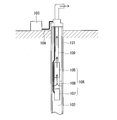
- the ESP formation 108 including the pump 105, the intake 106 and the motor 107 is inserted into the well 101 extending deep in the ground (see FIG. 5).
- the crude oil 102 in the well 101 is pushed up to the ground surface via the oil pump pipe 109 by the pump 105 driven by the motor 107.
- the motor 107 and the control device 103 are usually connected by a power cable 104 arranged on the outer peripheral surface of the oil pumping pipe 109 and the ESP knitting 108.
- the inside of the well 101 is in a harsh environment exposed to high temperatures and crude oil components, especially in the deepest part where the ESP knitting 108 is inserted. Therefore, the power cable 104 is easily damaged.
- the damaged power cable 104 is generally repaired in the field after being lifted from the well 101. In the repair, the damaged portion of the power cable 104 is removed by cutting. Adhesive tape is used when reconnecting the power lines of the power cable 104 after disconnection.
- Patent Documents 1 and 2 disclose, as adhesive tapes having excellent characteristics, an adhesive tape having a fluororesin base material and an adhesive tape having a polyimide base material, respectively.
- polyimide usually has higher heat resistance, chemical resistance and insulating property than fluororesin.
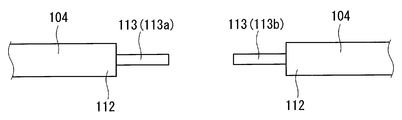
- Repair of the power cable 104 is typically carried out by the following procedure.
- the coating 112 is peeled off to expose the power lines 113a and 113b (FIG. 6B).
- the connecting member 114 is crimped to electrically connect the power lines 113a and 113b to each other. Connect (Fig. 6C).
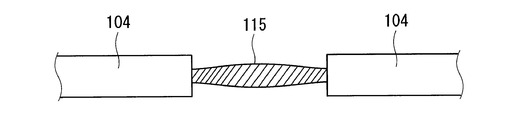
- the adhesive tape (inner tape) 115 is wrapped around the connecting member 114 so as to be in contact with the connecting member 114.
- the periphery of the exposed portion 116 is usually adhered integrally with the periphery of the connecting member 114.
- the tape 115 is wrapped around (Fig. 6D).
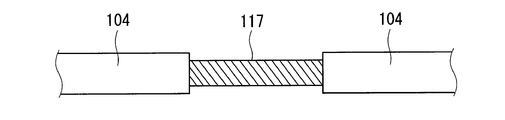
- an additional adhesive tape (outer tape) 117 is wound around the wound adhesive tape 115 so as to be in contact with the adhesive tape 115 (FIG. 6E).
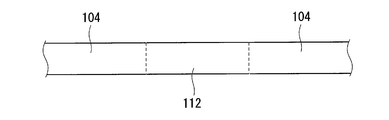
- a predetermined coating 112 is provided so as to cover the adhesive tape 117, and the repair of the power cable 104 is completed (FIG. 6F).
- the adhesive tapes 115 and 117 function as an insulating member that covers the power line 113.
- the adhesive tapes 115 and 117 are wound around each power line 113.
- An object of the present invention is to provide an adhesive tape having an excellent balance between insulation and wrapping property in wrapping work.
- the present invention A base material and an adhesive layer arranged on one surface of the base material are provided.
- the breakdown voltage in the thickness direction is X (unit: kV) and the initial elastic modulus obtained from the stress-strain curve by the tensile test is Y (unit: N / mm)
- Formula: Adhesive tape satisfying Y ⁇ 4.5X-22.5, I will provide a.
- the adhesive tape according to the present invention can reduce the minimum winding load (hereinafter referred to as “minimum winding load”) without wrinkles or gaps as compared with the conventional adhesive tape having the same dielectric breakdown voltage. Therefore, the adhesive tape according to the present invention has an excellent balance between the insulating property and the wrapping property in the wrapping work.
- FIG. 1 is a cross-sectional view schematically showing an example of the adhesive tape of the present invention.
- FIG. 2 is a schematic diagram for explaining a winding method when evaluating the minimum winding load of the adhesive tape.
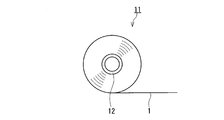
- FIG. 3 is a schematic view showing another example of the adhesive tape of the present invention.
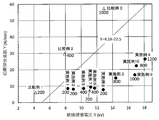
- FIG. 4A is a graph showing the relationship between the dielectric breakdown voltage X and the initial elastic modulus Y in each of the adhesive tapes of Examples and Comparative Examples.
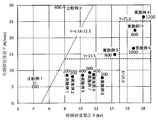
- FIG. 4B is an enlarged graph of a part of FIG. 4A.
- FIG. 5 is a schematic diagram for explaining the ESP oil extraction method.
- FIG. 6A is a schematic diagram for explaining a typical repair method of the power cable.
- FIG. 6B is a schematic diagram for explaining a typical repair method of the power cable.
- FIG. 6C is a schematic diagram for explaining a typical repair method of the power cable.
- FIG. 6D is a schematic diagram for explaining a typical repair method of the power cable.
- FIG. 6E is a schematic diagram for explaining a typical repair method of the power cable.
- FIG. 6F is a schematic diagram for explaining a typical repair method of the power cable.
- the adhesive tape of this embodiment is shown in FIG.
- the adhesive tape 1 of FIG. 1 includes a base material 2 and an adhesive layer 3.
- the pressure-sensitive adhesive layer 3 is arranged on one surface of the base material 2.
- the equation: Y ⁇ 4.5X-22.5 is satisfied.
- the minimum winding load can be reduced as compared with the conventional adhesive tape having the same dielectric breakdown voltage X.
- the X and Y of the adhesive tape 1 may satisfy the formula: Y ⁇ 3.89X-19.45, or the formula: Y ⁇ 2.75X-13.75.
- the dielectric breakdown voltage X is over 5.0 kV (in other words, Y is positive).
- the dielectric breakdown voltage X may be 8.0 kV or more, 10.0 kV or more, 12.0 kV or more, 14.0 kV or more, 15.0 kV or more, and further 16.0 kV or more.
- the upper limit of the dielectric breakdown voltage X is, for example, 30.0 kV or less.
- the initial elastic coefficient Y is 60.0 N / mm or less, 40.0 N / mm or less, 30.0 N / mm or less, 25.0 N / mm or less, 20.0 N / mm or less, 18.0 N / mm or less, 15. It may be 5 N / mm or less, 15.0 N / mm or less, 13.5 N / mm or less, and further 10.0 N / mm or less.
- the lower limit of the initial elastic modulus Y is, for example, 1.0 N / mm or more.
- the initial elastic modulus Y reflects the rigidity of the adhesive tape 1 (that is, the difficulty of deformation due to force). According to the study by the present inventors, when the initial elastic modulus Y is 15.5 N / mm or less, particularly 13.5 N / mm or less, the minimum winding load tends to be particularly small. Further, in the range where the dielectric breakdown voltage X is 14.0 kV or more, particularly 15.0 kV or more, the initial elastic modulus Y tends to increase as the dielectric breakdown voltage X increases. However, even if the initial elastic modulus Y increases to some extent, there are some applications in which a large dielectric breakdown voltage X is desirable.
- the initial elastic modulus Y may be 15.5 N / mm or less (or 13.5 N / mm or less). Further, the dielectric breakdown voltage X is 14.0 kV or more (or 15.0 kV or more), and the initial elastic modulus Y is 30.0 N / mm or less (or 25.0 N / mm or less, 15.5 N / mm or less, or It may be 13.5 N / mm or less).
- the adhesive tape 1 is usually strip-shaped.
- the initial elastic modulus obtained by performing a tensile test in the longitudinal direction of the strip-shaped adhesive tape 1 can be defined as the initial elastic modulus Y.
- the initial modulus corresponds to the slope in the elastic deformation region in the stress-elongation profile obtained by the tensile test.
- the direction is typically the direction in which the molecular chains of the resin constituting the resin layer are oriented or the MD direction.
- Each characteristic of breakdown elongation, breaking strength, 50 mm stress and dielectric breakdown voltage when tensile elongation is applied can also be determined as values obtained by conducting a tensile test in the longitudinal direction of the strip-shaped adhesive tape 1. ..
- the tensile test can be carried out in accordance with ASTM D882.
- the dielectric breakdown voltage in the thickness direction when 150% tensile elongation is applied may be 5 kV or more, 6 kV or more, and further 8 kV or more.
- the inter-chuck distance (initial inter-chuck distance) at the start of the test in the tensile test is L 0, and the inter-chuck distance during the test is L 1. It is a value obtained by (L 1 ⁇ L 0 ) / L 0.
- the breaking elongation of the adhesive tape 1 may be 100 to 1000%, 150 to 700%, and further 150 to 600%.
- the breaking strength of the adhesive tape 1 may be 10 to 300 N / 25 mm, 20 to 250 N / 25 mm, and further 20 to 220 N / 25 mm.
- the minimum winding load evaluated for the adhesive tape 1 by the following method may be 2000 gf or less, 1600 gf or less, 1200 gf or less, 1000 gf or less, 800 gf or less, 600 gf or less, 400 gf or less, and further 200 gf or less.
- Evaluation method An adhesive tape 51 to be evaluated is wound around an iron rod 52 having a circular cross section having a diameter of 10 mm so as to be in contact with the iron rod 52 (see FIG. 2). The winding is performed by half wrap while applying a constant tension F to the adhesive tape 51.
- the half wrap is a winding method in which each winding advances a distance corresponding to half the width of the adhesive tape 51.
- At least 10 or more turns are attempted with a tension F of 100 gf. If winding is possible without wrinkles or gaps, the minimum winding load is set to 100 gf. If wrinkles or gaps occur during winding, the above winding is repeated with a tension F increased by 100 gf, and the value of the first tension F that enables winding without wrinkles or gaps is taken as the minimum winding load. stipulate.
- the evaluation temperature is usually 23 ⁇ 2 ° C.
- Each characteristic of the adhesive tape 1 can be controlled by, for example, the attributes of the base material 2. Attributes are typically, but not limited to, material and thickness. In the base material 2 made of a crystalline resin such as a fluororesin, the crystallinity, the degree of orientation, and the like of the resin can affect each characteristic. Further, in the base material 2 made of fluororesin, the presence or absence of firing may affect each characteristic. The crystallinity and the degree of orientation can be controlled, for example, by the rolling conditions when forming the base material 2.
- the base material 2 usually includes a resin layer.
- the base material 2 may be composed of one layer or may have a laminated structure of a plurality of layers.
- the base material 2 having a laminated structure may include a conductive layer, for example, a metal layer.
- the resin constituting the base material 2 examples are fluororesin, polyimide resin, polyamide-imide resin and polyetheretherketone resin. These resins are excellent in heat resistance, chemical resistance and insulating properties.
- the resin is not limited to the above example.
- the resin is preferably a fluororesin or a polyimide resin, and in particular, the base material 2 composed of a single resin layer is preferably a fluororesin.
- the base material 2 may be made of a fluororesin. At the same dielectric breakdown voltage X, the fluororesin base material is usually thicker than the polyimide resin base material.
- the initial elastic modulus Y can be suppressed as compared with the polyimide resin base material at the same dielectric breakdown voltage X. Therefore, according to the fluororesin base material, it is possible to further improve the balance between the insulating property and the wrapping property in the wrapping work.
- fluororesins are polytetrafluoroethylene (PTFE), tetrafluoroethylene-hexafluoropropylene copolymer (FEP), ethylene-tetrafluoroethylene copolymer (ETFE) and polyvinylidene fluoride (PVDF). From the viewpoint of excellent heat resistance, chemical resistance and insulation, PTFE or FEP is preferable, and PTFE is particularly preferable.
- PTFE polytetrafluoroethylene
- FEP tetrafluoroethylene-hexafluoropropylene copolymer
- ETFE ethylene-tetrafluoroethylene copolymer
- PVDF polyvinylidene fluoride
- the base material 2 may contain a material other than the resin. Examples of such materials are colorants, antistatic agents, fillers such as glass fiber, and other additives.
- the material in the adhesive tape 1 for a power cable is preferably low conductivity (electric resistivity 10 5 ⁇ ⁇ cm or more) or insulating (electric resistivity 10 12 ⁇ ⁇ cm or more).
- the thickness of the base material 2 may be 25 ⁇ m or more, 40 ⁇ m or more, 50 ⁇ m or more, and further 70 ⁇ m or more. When the thickness of the base material 2 is within these ranges, sufficient strength that can withstand use in various applications can be more reliably secured.
- the upper limit of the thickness of the base material 2 is, for example, 250 ⁇ m or less.
- the base material 2 does not have to have holes communicating with each other in the thickness direction, and may not have holes.
- the surface 4 of the base material 2 on the side opposite to the pressure-sensitive adhesive layer 3 side may be subjected to a high adhesive treatment.
- the high adhesion treatment may be a physical treatment or a chemical treatment.
- An example of a physical process is a sputter etching process.
- An example of chemical treatment is sodium (Na) treatment.
- the Na treatment can be carried out, for example, by applying a treatment liquid containing metallic sodium or immersing the treatment liquid in the treatment liquid.
- the treatment liquid are an ammonia solution of metallic sodium and a tetrahydrofuran solution of metallic sodium naphthalene complex.
- a commercially available treatment liquid (for example, Tetra Etch manufactured by Junko Co., Ltd.) may be used.
- the surface 5 of the base material 2 on the pressure-sensitive adhesive layer 3 side may be subjected to the above-mentioned high adhesive treatment.
- the anchoring force of the pressure-sensitive adhesive layer 3 with respect to the base material 2 can be improved.
- the adhesive contained in the adhesive layer 3 are acrylic adhesive, silicone adhesive, urethane adhesive and rubber adhesive.
- the pressure-sensitive adhesive is not limited to the above example. Silicone adhesives are particularly excellent in heat resistance and chemical resistance. Acrylic adhesives are particularly excellent in adhesiveness.
- the acrylic pressure-sensitive adhesive is, for example, a pressure-sensitive adhesive disclosed in Japanese Patent Application Laid-Open No. 2005-105212.
- the acrylic pressure-sensitive adhesive is not limited to the above example.
- the silicone-based pressure-sensitive adhesive is, for example, a pressure-sensitive adhesive disclosed in Japanese Patent Application Laid-Open No. 2003-313516 (including those disclosed as comparative examples).
- the silicone-based adhesive is not limited to the above example.
- Silicone-based pressure-sensitive adhesives generally contain a condensate of a silicone gum and a silicone resin and / or a cross-linking reaction product.
- the compounding ratio (weight ratio) of the silicone gum and the silicone resin in the silicone-based pressure-sensitive adhesive may be 150: 100 to 100: 150.
- Silicone-based pressure-sensitive adhesives having a compounding ratio in the above range are excellent in adhesive strength and high-temperature cohesive strength. The higher the high-temperature cohesive force of the pressure-sensitive adhesive, the better the heat-resistant holding power of the pressure-sensitive adhesive tape 1.
- the thickness of the pressure-sensitive adhesive layer 3 may be 10 to 60 ⁇ m, 20 to 55 ⁇ m, and further 30 to 50 ⁇ m. When the thickness of the pressure-sensitive adhesive layer 3 is within these ranges, sufficient adhesive strength and heat-resistant holding power for various applications can be more reliably secured.
- the thickness of the adhesive tape 1 may be 35 ⁇ m or more, 50 ⁇ m or more, 60 ⁇ m or more, and further 80 ⁇ m or more.
- the upper limit of the thickness of the adhesive tape 1 is, for example, 310 ⁇ m or less.
- the width of the adhesive tape 1 may be 10 to 60 mm, 15 to 50 mm, and further 15 to 35 mm.
- the adhesive tape 1 is usually strip-shaped. However, the adhesive tape 1 can be processed into any shape.
- the shape of the processed adhesive tape 1 may be a polygon including a square and a rectangle. As shown in FIG. 3, the adhesive tape 1 may be a winding body 11 wound around a winding core 12.
- the adhesive tape 1 may further include a material and / or a layer other than the base material 2 and the adhesive layer 3.
- An example of a layer that the adhesive tape 1 can further include is a release layer (separator) arranged on the pressure-sensitive adhesive layer 3 so as to cover the pressure-sensitive adhesive layer 3.
- the separator is usually peeled off when the adhesive tape 1 is used.
- the surface of the separator facing the pressure-sensitive adhesive layer 3 may be peeled off.
- the separator is made of, for example, a polyester resin such as polyethylene terephthalate (PET) or a polyolefin resin such as polyethylene and polypropylene.
- PET polyethylene terephthalate
- the adhesive tape 1 may be wound with a separator.
- the adhesive tape 1 may be an insulating tape used for the power cable, or may be a repair tape for the power cable.
- the adhesive tape 1 has an excellent balance between the insulating property and the wrapping property in the wrapping work, and is advantageous for use in these applications.
- the use of the adhesive tape 1 is not limited to the above example.
- the power cable means a cable provided with a power line for supplying electric power to a motor or the like.
- the power cable may be an ESP cable.
- the adhesive tape 1 is used by wrapping the adhesive tape 1 around the connecting member so that at least a part of the power lines of the power cable is connected to each other by using the conductive connecting member (hereinafter,). , "Tape A").
- An example of tape A is an inner tape used for repairing a power cable.
- the connecting member is a member that electrically connects power lines to each other.
- the connecting member is usually composed of a conductor such as metal.
- An example of a connecting member is the sleeve described above.
- the adhesive tape 1 is used by being wound around the connecting member in a state of being separated from the energized portion of the connecting member via an insulating member.
- It may be a tape (hereinafter referred to as "tape B").
- Tape B is an outer tape used for repairing a power cable.
- the insulating member may be a covering portion of the connecting member that covers the energized portion of the connecting member, but is typically a member different from the connecting member.
- the insulating member may be another adhesive tape wrapped around the connecting member so that at least a part of the insulating member is in contact with the energized portion of the connecting member.
- Another adhesive tape may be tape A.
- Tape A and tape B usually do not have exactly the same preferred properties.
- preferable characteristics of the tape A and the tape B will be described.
- the tape A is wound as an inner tape, for example, so as to deform the connecting member 114 by crimping and / or to even out a step between the connecting member 114 and the exposed portion 116 of the power line 113 (FIGS. 6B to 6B). See 6D). Therefore, a tape having a small minimum winding load and sufficient deformability that can follow the above deformations and steps is preferable.
- the initial elastic modulus Y of the tape A may be 15.5 N / mm or less, 13.5 N / mm or less, and further 10.0 N / mm or less. With the tape A having an initial elastic modulus Y in these ranges, the minimum winding load can be reduced and the deformability can be improved.
- the lower limit of the initial elastic modulus Y may be 5.0 N / mm or more.
- the breaking elongation of the tape A may be 150% or more, 250% or more, 300% or more, 340% or more, 360% or more, and further 420% or more.
- the upper limit of the elongation at break is, for example, 500% or less, and may be 480% or less. With the tape A having the elongation at break in the above range, the deformability can be further improved.
- the tensile stress (hereinafter referred to as "50 mm stress”) when a tensile elongation of 50 mm is applied to the tape A is 20 N / 25 mm or more and 34 N / 25 mm or less, and even if it is 22 N / 25 mm or more and 28 N / 25 mm or less. good.
- the inter-chuck distance (initial inter-chuck distance) at the start of the test in the tensile test is L 0
- the inter-chuck distance during the test is L 1. It is a value obtained by 1- L 0.
- the elongation at break may be 340% or more, and the 50 mm stress may be 20 N / 25 mm or more and 34 N / 25 mm or less.
- the 50 mm stress is in the above range means that the hardness of the tape A is in a more appropriate range for the winding work of leveling the deformation and the step. If the tape A is excessively hard, the ability to follow deformation and steps tends to decrease. In the worst case, it is assumed that the tape is broken in an attempt to force it to follow. If the tape A is excessively soft, sufficient force cannot be applied at the time of winding, and gaps tend to occur easily.
- the breaking elongation is in the above range means that the workability when winding the tape A having a stress of 50 mm in the above range can be improved by an appropriate elongation. This makes it possible to prevent, for example, an unnecessarily increased work time that may occur in an attempt to even out deformation or steps. Further, by setting the range of the breaking elongation and the stress of 50 mm, the certainty of winding can be improved, and for example, the terminal peeling after winding and the permeation of oil in the presence of oil can be prevented. In the present specification, the terminal peeling means a phenomenon in which the end portion of the adhesive tape is peeled off when the adhesive tape is wound in multiple layers.
- the breaking strength of the tape A may be 10 N / 25 mm or more, 20 N / 25 mm or more, and further 30 N / 25 mm or more.
- the upper limit of the breaking strength is, for example, 200 N / 25 mm or less, 170 N / 25 mm or less, 150 N / 25 mm or less, 120 N / 25 mm or less, 100 N / 25 mm or less, 90 N / 25 mm or less, and further may be 80 N / 25 mm or less. ..
- the minimum winding load of the tape A may be 800 gf or less, 600 gf or less, 400 gf or less, and further 200 gf or less.
- the lower limit of the minimum winding load is, for example, 50 gf or more.
- the dielectric breakdown voltage X of the tape A may be 15.0 kV or less, 14.0 kV or less, and further 12.0 kV or less.
- the dielectric breakdown voltage in the thickness direction when 150% tensile elongation is applied may be 5 kV or more, 6 kV or more, and further 8 kV or more.
- the thickness of the tape A may be 50 to 200 ⁇ m, and further may be 60 to 150 ⁇ m.
- the base material 2 may be composed of FEP.
- the tape A provided with the FEP base material 2 is particularly excellent in deformability.
- the tape B is further wound on the wound inner tape, for example as an outer tape.
- the tape B is preferably a tape having excellent piercing strength and self-back adhesive strength.
- a metal sheet such as a lead sheet and / or a glass fiber sheet may be wound on the outer tape as a part of the coating 112.
- the piercing strength is high, damage to the outer tape due to the winding of the coating 112 is suppressed.
- the initial elastic modulus Y of the tape B may be 25.0 N / mm or less, 20.0 N / mm or less, 15.0 N / mm or less, and further 10.0 N / mm or less.
- the lower limit of the initial elastic modulus Y is, for example, 5.0 N / mm or more, and may be 10.0 N / mm or more.
- the breaking strength of the tape B may be 20 N / 25 mm or more, 50 N / 25 mm or more, and further 70 N / mm or more.
- the upper limit of the breaking strength is, for example, 300 N / 25 mm or less, 250 N / 25 mm or less, and further 220 N / 25 mm or less.
- the minimum winding load of the tape B may be 1400 gf or less, 1200 gf or less, 1000 gf or less, 800 gf or less, 600 gf or less, 400 gf or less, and further 200 gf or less.
- the lower limit of the minimum winding load is, for example, 50 gf or more.
- the dielectric breakdown voltage X of the tape B may be 8.0 kV or more, 10.0 kV or more, 12.0 kV or more, 14.0 kV or more, 15.0 kV or more, and further 16.0 kV or more.
- the piercing strength of the tape B may be 2 to 15N, 3 to 13N, and further 3.5 to 11N.
- the piercing strength can be measured in accordance with the piercing strength test specified in Japanese Industrial Standards (hereinafter referred to as "JIS") Z1707: 1997.
- JIS Japanese Industrial Standards
- the needle used for measurement has a diameter of 0.75 mm and a tip shape of a semicircle with a diameter of 0.75 mm. Further, the needle is pierced into the tape B from the base material 2 side.
- the breaking elongation of the tape B may be 150% or more, 200% or more, 210% or more, 230% or more, and further 250% or more.
- the upper limit of elongation at break is, for example, 700% or less, even if it is 620% or less, 500% or less, 400% or less, 300% or less, 280% or less, 250% or less, 230% or less, or even 210% or less. good.
- the 50 mm stress of the tape B may be 56.5 N / 25 mm or more, 57.0 N / 25 mm or more, 57.5 N / mm or more, 60.0 N / mm or more, and further 75.0 N / 25 mm or more.
- the upper limit of the 50 mm stress is, for example, 100 N / 25 mm or less.
- the self-backing adhesive strength of the tape B may be 2 to 25 N / 25 mm, 3 to 20 N / 25 mm, and further 3.5 to 18 N / 25 mm.
- the self-back adhesive strength can be measured in accordance with "Method 2" of the adhesive strength test method specified in JIS Z0237: 2009. If the width of the test piece is not 25 mm, the measurement may be performed at the current width and converted into a value per 25 mm in width. Further, the number of reciprocations of the roller for crimping the first test piece and the second test piece may be one time instead of the two times specified in the above "method 2".
- the breaking elongation of the tape B may be 620% or less, and the 50 mm stress may be 60 N / 25 mm or more. At this time, the elongation at break may be 500% or less, and further may be 400% or less. Further, the 50 mm stress may be 75.0 N / 25 mm or more. In these cases, for example, sufficient strength as an outer tape can be more reliably secured, excessive elongation of the tape B during winding is suppressed, and terminal peeling and oil presence after winding due to residual stress generated by the elongation are suppressed. It can prevent the oil from penetrating underneath.
- the self-backing adhesive force of the tape B may be 10 N / 25 mm or more, 14 N / 25 mm or more, 16 N / 25 mm or more, and further 17 N / 25 mm or more.
- the breaking elongation of the tape B may be 280% or less, and the 50 mm stress may be 56.5 N / 25 mm or more. At this time, the elongation at break may be 250% or less, 230% or less, and further 210% or less. Further, the 50 mm stress may be 57.0 N / 25 mm or more, and further may be 57.5 N / 25 mm or more. Further, at this time, the self-backing adhesive force of the tape B may be 3N / 25 mm or more, or 5N / 25 mm or more. The reason why the numerical range is different from the case where the acrylic pressure-sensitive adhesive is contained is that the characteristics such as the bonding force are different between the two pressure-sensitive adhesives.
- the thickness of the tape B may be 50 to 300 ⁇ m, 50 to 200 ⁇ m, and further 70 to 200 ⁇ m.
- the base material 2 may be made of PTFE.
- Tape A and tape B can also be distributed as an adhesive tape kit containing one or both tapes.
- the power cable repaired using the tape A and the tape B is a repaired power cable having the wound tape A and the tape B in the repaired part.
- the adhesive tape 1 can be manufactured by forming the adhesive layer 3 on one surface of the base material 2.
- the pressure-sensitive adhesive layer 3 can be formed, for example, by applying a pressure-sensitive adhesive composition to the surface of the base material 2 and drying and / or curing the applied pressure-sensitive adhesive composition. Known methods can be applied to the application, drying and curing of the pressure-sensitive adhesive composition.
- PTFE powder (molding powder) is introduced into a mold, and a predetermined pressure is applied to the powder in the mold for a predetermined time for preforming.
- Pre-molding can be carried out at room temperature.
- the shape of the internal space of the mold is preferably cylindrical in order to enable cutting by a cutting lathe described later.
- a columnar premolded product and a PTFE block can be obtained.
- the obtained preformed product is taken out from the mold and fired at a temperature equal to or higher than the melting point of PTFE (327 ° C.) for a predetermined time to obtain a PTFE block.
- a PTFE sheet which is a cutting sheet
- the obtained PTFE sheet may be used as it is as the base material 2, or may be used as the base material 2 after undergoing a predetermined treatment such as rolling.
- a predetermined treatment such as rolling.
- the PTFE block is cylindrical, it is possible to use a cutting lathe that continuously cuts the surface while rotating the block, and the PTFE sheet can be efficiently formed. Further, according to the cutting lathe, it is relatively easy to control the thickness of the PTFE sheet to be formed, and a strip-shaped PTFE sheet can also be formed.
- the initial elastic modulus Y, elongation at break, strength at break, 50 mm stress were evaluated by a tensile test according to ASTM D882.
- ASTM D882 As the tensile tester, RTG-1310 manufactured by A & D Co., Ltd. was used.
- the width of the test piece was 25 mm
- the initial distance between chucks was 500 mm
- the tensile speed was 500 mm / min
- the test temperature was 23 ⁇ 1 ° C.
- the tension direction was the longitudinal direction of the strip-shaped adhesive tape.
- the dielectric breakdown voltage X was evaluated as follows using an insulation breakdown voltage tester (manufactured by Tokyo Seiden Co., Ltd., dielectric strength tester TS-EB0270). A pair of electrodes (cylinder with a diameter of 6.4 mm) were arranged so as to sandwich a test piece having a length of 150 mm and a width of 25 mm. Each electrode was placed in the center of the test piece so that its end face was in contact with the adhesive layer or substrate of the test piece and the positions of the electrodes were aligned with each other when viewed from the direction perpendicular to the surface of the test piece. ..
- a load of 50 g was applied to the other electrode with one electrode fixed.
- the electrodes were connected to the insulation withstand voltage tester, a voltage was applied between the electrodes at a boosting speed of 0.5 kV / sec, and the applied voltage when the test piece was dielectrically broken was recorded.
- the recorded measured value was defined as the dielectric breakdown voltage X.
- the test was carried out in air, and the temperature of the test environment was 20 ° C. and the relative humidity was 65%.
- the frequency of the applied voltage was 50 Hz, which was the same as the power supply frequency of the tester.
- the dielectric breakdown voltage when a tensile elongation of 150% was given was determined in the same manner as the evaluation of the dielectric breakdown voltage X except that the test piece which was given a tensile elongation of 150% by the above tensile test was used.
- the self-backing adhesive strength was evaluated by the above-mentioned method using the first test piece and the second test piece having a length of 300 mm and a width of 25 mm.
- As the tensile tester RTC-1310A manufactured by Orientec was used.
- the number of round trips of the roller was set to one. Further, for the purpose of improving the measurement accuracy, it was left for 20 minutes from the crimping of the first test piece and the second test piece by the roller to the peeling test.
- the minimum winding load was evaluated by the method described above. However, the number of windings on the horizontal bar was 10, and the width of the adhesive tape to be wound was 25 mm.
- Terminal peeling The terminal peeling was evaluated as follows in oil at 220 ° C.
- oil petroleum-based hydrocarbon oil (manufactured by Matsumura Petroleum, Therm Oil 500) was used.
- test piece having a width of 20 mm was obtained from the adhesive tape according to the test piece preparation method (item 4.1) described in JIS Z0237: 2009. Next, a steel round bar (diameter 9.5 mm) was prepared, and the test piece was wound around the round bar from one end thereof for about 15 cm in the length direction of the round bar. The winding was carried out by half-wrapping in the circumferential direction of the peripheral surface of the round bar while applying a winding tension of 400 gf to the other end of the test piece with a weight.
- the test piece When the test piece is wound for about 15 cm, the test piece is cut in the width direction at the end of the wound portion while the above winding tension is applied, and a light force is applied perpendicularly to the surface so that the cut end is in close contact with the test piece.
- the end portion was used as a terminal portion to be evaluated for peeling resistance.
- the amount of peeling of the end portion of the wound test piece (the amount of peeling along the longitudinal direction of the tape) was evaluated.
- test piece having a width of 20 mm was obtained from the adhesive tape according to the method for preparing the test piece (item 4.1) described in JIS Z0237: 2009. Next, a steel round bar (diameter 9.5 mm) was prepared, and the test piece was wound around the round bar from one end thereof for about 15 cm in the length direction of the round bar. In wrapping, the test piece is stretched in the range of 100 to 200% in the length direction by applying a force by hand to prevent the occurrence of wrinkles, and while preventing the breakage due to the stretching, the circle on the peripheral surface of the round bar. It was carried out by half lap in the circumferential direction.
- the winding was performed twice (double winding) around the same part of the round bar.
- the case where the time from the start to the completion of the above winding is within 3 minutes is excellent ( ⁇ )
- the case where it is more than 3 minutes and less than 5 minutes is good ( ⁇ )
- the case where it is more than 5 minutes and less than 10 minutes is acceptable ( ⁇ )
- 10 The case of more than a minute was regarded as impossible (x).
- Example 1 [Preparation of PTFE sheet] PTFE powder (Teflon PTFE 7AX, manufactured by The Chemours) was introduced into a cylindrical mold and preformed under the conditions of a temperature of 23 ° C., a pressure of 60 MPa, and a pressure application time of 1 hour. Next, the formed preformed product was taken out from the mold and fired at 375 ° C. for 3 hours to obtain a columnar PTFE block having a height of 100 mm and an outer diameter of 50 mm. Next, the obtained PTFE block was cut with a cutting lathe to obtain a PTFE sheet having a thickness of 50 ⁇ m. In this way, a PTFE sheet to be used as a base material was prepared.
- PTFE powder Teflon PTFE 7AX, manufactured by The Chemours
- a protective tape was attached to one side of the prepared PTFE sheet.
- As the protective tape a tape that does not cause denaturation or peeling from the PTFE sheet during Na treatment was used.
- the PTFE sheet was immersed in a treatment liquid containing metallic sodium (Tetra Etch manufactured by Junko Co., Ltd.), pulled up, and washed with acetone.
- a treatment liquid containing metallic sodium Tetra Etch manufactured by Junko Co., Ltd.
- one side of the PTFE sheet was treated with Na.
- the immersion time of the PTFE sheet in the treatment liquid was 30 seconds. In this way, a base material composed of PTFE (PTFE base material) was obtained.
- Silicone Adhesive Composition A 100 parts by weight of dimethylpolysiloxane (weight average molecular weight 700,000, raw rubber) as a silicone gum and 120 parts by weight of MQ resin (weight average molecular weight 7,000) as a silicone resin were mixed together with toluene.
- the MQ resin used was composed of (CH 3 ) 3 SiO 1/2 (M unit) 44 mol% and SiO 2 (Q unit) 56 mol%. The resulting mixture was then held at 100-120 ° C. for 4 hours to partially condense dimethylpolysiloxane and MQ resin.
- toluene was further added to adjust the solid content (nonvolatile content) to obtain a silicone solution (solid content concentration 60% by weight) composed of dimethylpolysiloxane, MQ resin and a partial condensate thereof.
- a silicone solution solid content concentration 60% by weight
- a xylene solution of benzoyl peroxide Niper BMT-K40 manufactured by Nichiyu Co., Ltd.
- a pressure-sensitive adhesive composition A (solid content concentration: 40% by weight) was obtained.
- Silicone adhesive composition A is applied to one main surface (Na-treated surface) of the PTFE base material so that the coating thickness after drying is 30 ⁇ m, dried at 80 ° C. for 1 minute, and then at 235 ° C. The mixture was cured for 1 minute to obtain an adhesive tape (thickness 80 ⁇ m).
- Example 2 The pressure-sensitive adhesive tape (thickness) was the same as in Example 1 except that the thickness of the base material was set to 60 ⁇ m by changing the cutting thickness and the coating thickness (after drying) of the silicone-based pressure-sensitive adhesive composition A was set to 20 ⁇ m. 80 ⁇ m) was obtained.
- Example 3 The adhesive tape (thickness) is the same as in Example 1 except that the thickness of the base material is 90 ⁇ m by changing the cutting thickness and the coating thickness (after drying) of the silicone-based pressure-sensitive adhesive composition A is 40 ⁇ m. 130 ⁇ m) was obtained.
- Example 4 The pressure-sensitive adhesive tape (thickness) was the same as in Example 1 except that the thickness of the base material was set to 180 ⁇ m by changing the cutting thickness and the coating thickness (after drying) of the silicone-based pressure-sensitive adhesive composition A was set to 50 ⁇ m. 230 ⁇ m) was obtained.
- Example 5 A FEP film (manufactured by The Chemours, 200C, thickness 50 ⁇ m, easy-adhesion treatment on one side) was prepared as a base material.
- the silicone-based pressure-sensitive adhesive composition A is applied to the easy-adhesion-treated surface of the film so that the coating thickness after drying is 50 ⁇ m, dried at 80 ° C. for 1 minute, and then cured at 235 ° C. for 1 minute.
- An adhesive tape (thickness 100 ⁇ m) was obtained.
- Example 6 A FEP film (manufactured by Junko Co., Ltd., Junflon, thickness 50 ⁇ m) was prepared as a base material, and one side of the film was subjected to a sputter etching treatment. The treatment was carried out using argon gas under the conditions of a gas amount of 250 to 1300 scc / min, a vacuum degree of 5 Pa, an output of 3 to 7 kW, and a frequency of 13.56 MHz. Next, the silicone-based pressure-sensitive adhesive composition A was applied to the sputter-etched surface of the film so that the coating thickness after drying was 50 ⁇ m, dried at 80 ° C. for 1 minute, and then dried at 235 ° C. for 1 minute. It was cured to obtain an adhesive tape (thickness 100 ⁇ m).
- Example 7 The thickness of the base material was set to 60 ⁇ m by changing the cutting thickness, and the adhesive tape (thickness) was the same as in Example 1 except that both sides of the PTFE sheet were Na-treated (no protective tape was used during the treatment). 90 ⁇ m) was obtained.
- Example 8 In the same manner as in Example 1, except that both sides of the PTFE sheet were Na-treated (no protective tape was used during the treatment) and the silicone-based pressure-sensitive adhesive composition B was used instead of the silicone-based pressure-sensitive adhesive composition A. An adhesive tape (thickness 80 ⁇ m) was obtained.
- the silicone-based pressure-sensitive adhesive composition B is prepared by adding 1 part of a xylene solution of benzoyl peroxide (Nippon Oil Co., Ltd., Niper BMT-K40) to 100 parts by weight of the silicone-based pressure-sensitive adhesive (made by Shin-Etsu Chemical Industry Co., Ltd., KR-101-10). It was obtained by adding 4 parts by weight and diluting this with toluene to a solid content concentration of 40% by weight.
- the thickness of the base material is set to 140 ⁇ m, both sides of the PTFE sheet are Na-treated (no protective tape is used during the treatment), and the acrylic pressure-sensitive adhesive composition is used instead of the silicone-based pressure-sensitive adhesive composition A.
- An adhesive tape (thickness 190 ⁇ m) was obtained in the same manner as in Example 1 except that the product C was used.
- the coating thickness (after drying) of the pressure-sensitive adhesive composition C was 50 ⁇ m, and the drying conditions were 120 ° C. for 3 minutes. In addition, curing at 235 ° C. for 1 minute was not performed.
- the acrylic pressure-sensitive adhesive composition C contains 100 parts by weight of an acrylic pressure-sensitive adhesive (manufactured by Toyochem, Oliveine BPS4991TX), 0.5 parts by weight of a cross-linking agent (manufactured by Toyochem, BXX5983TX), and a cross-linking agent (manufactured by Toyochem, BHS8515TS). It was obtained by mixing with 5 parts by weight.
- an acrylic pressure-sensitive adhesive manufactured by Toyochem, Oliveine BPS4991TX
- a cross-linking agent manufactured by Toyochem, BXX5983TX
- a cross-linking agent manufactured by Toyochem, BHS8515TS
- the thickness of the base material is set to 130 ⁇ m, both sides of the PTFE sheet are Na-treated (no protective tape is used during the treatment), and the acrylic pressure-sensitive adhesive composition is used instead of the silicone-based pressure-sensitive adhesive composition A.
- An adhesive tape (thickness 170 ⁇ m) was obtained in the same manner as in Example 1 except that the product D was used.
- the coating thickness (after drying) of the pressure-sensitive adhesive composition D was 40 ⁇ m, and the drying conditions were 110 ° C. for 3 minutes. In addition, curing at 235 ° C. for 1 minute was not performed.
- the acrylic pressure-sensitive adhesive composition D was obtained as follows.
- Comparative Example 1 A commercially available adhesive tape (manufactured by Nitto Denko, No. 923UT, thickness 40 ⁇ m) having a base material of a PTFE sheet and an adhesive layer of a silicone-based adhesive was used as Comparative Example 1.
- Comparative Example 2 A commercially available adhesive tape (manufactured by Nitto Denko, No. 360UL_1 mil, thickness 60 ⁇ m) having a base material of a polyimide sheet and an adhesive layer of a silicone-based adhesive was used as Comparative Example 2.
- Comparative Example 3 A commercially available adhesive tape (manufactured by Nitto Denko, No. 360UL_2 mil, thickness 80 ⁇ m) having a base material of a polyimide sheet and an adhesive layer of a silicone-based adhesive was used as Comparative Example 3.
- each adhesive tape and the material of the base material are shown in Table 1 below, the characteristics of each adhesive tape are shown in Table 2 below, and the characteristics of each adhesive tape when wound are shown in Table 3 below.
- Table 1 The thickness of each adhesive tape and the material of the base material are shown in Table 1 below, the characteristics of each adhesive tape are shown in Table 2 below, and the characteristics of each adhesive tape when wound are shown in Table 3 below.
- the relationship between the dielectric breakdown voltage X and the initial elastic modulus Y in each adhesive tape is shown in FIGS. 4A and 4B together with the value of the minimum winding load.
- FIG. 4B is an enlarged graph in the range of the initial elastic modulus Y ⁇ 30.0 in FIG. 4A.
- the numerical value described in the vicinity of each marker in FIGS. 4A and 4B is the minimum winding load.
- FIGS. 4A and 4B the minimum winding load of each of the adhesive tapes of the examples was smaller than that of the adhesive tape of the comparative example showing the same dielectric breakdown voltage X.
- the adhesive tape of the present invention is suitable for use in various applications where an excellent balance between insulation and wrapping property in wrapping work is required, such as repair work of a power cable that supplies power to ESP knitting.
Landscapes
- Chemical & Material Sciences (AREA)
- Organic Chemistry (AREA)
- Chemical Kinetics & Catalysis (AREA)
- Health & Medical Sciences (AREA)
- Medicinal Chemistry (AREA)
- Polymers & Plastics (AREA)
- Adhesive Tapes (AREA)
- Adhesives Or Adhesive Processes (AREA)
Priority Applications (5)
| Application Number | Priority Date | Filing Date | Title |
|---|---|---|---|
| CN202180009438.4A CN114945643A (zh) | 2020-01-16 | 2021-01-14 | 粘合带 |
| KR1020227028107A KR20230021633A (ko) | 2020-01-16 | 2021-01-14 | 점착 테이프 |
| JP2021571231A JPWO2021145382A1 (https=) | 2020-01-16 | 2021-01-14 | |
| EP21741851.6A EP4092094A4 (en) | 2020-01-16 | 2021-01-14 | PRESSURE SENSITIVE ADHESIVE TAPE |
| US17/792,559 US20230038783A1 (en) | 2020-01-16 | 2021-01-14 | Adhesive tape |
Applications Claiming Priority (2)
| Application Number | Priority Date | Filing Date | Title |
|---|---|---|---|
| US202062961823P | 2020-01-16 | 2020-01-16 | |
| US62/961,823 | 2020-01-16 |
Publications (1)
| Publication Number | Publication Date |
|---|---|
| WO2021145382A1 true WO2021145382A1 (ja) | 2021-07-22 |
Family
ID=76864605
Family Applications (1)
| Application Number | Title | Priority Date | Filing Date |
|---|---|---|---|
| PCT/JP2021/001070 Ceased WO2021145382A1 (ja) | 2020-01-16 | 2021-01-14 | 粘着テープ |
Country Status (6)
| Country | Link |
|---|---|
| US (1) | US20230038783A1 (https=) |
| EP (1) | EP4092094A4 (https=) |
| JP (1) | JPWO2021145382A1 (https=) |
| KR (1) | KR20230021633A (https=) |
| CN (1) | CN114945643A (https=) |
| WO (1) | WO2021145382A1 (https=) |
Citations (14)
| Publication number | Priority date | Publication date | Assignee | Title |
|---|---|---|---|---|
| JPH0264186A (ja) * | 1988-08-30 | 1990-03-05 | Shin Etsu Chem Co Ltd | フッ素系粘着テープまたはシート |
| JPH0264184A (ja) * | 1988-08-30 | 1990-03-05 | Shin Etsu Chem Co Ltd | フッ素系粘着テープまたはシートの製造方法 |
| JPH08253740A (ja) | 1995-03-17 | 1996-10-01 | Oji Kako Kk | フッ素樹脂粘着テープ |
| JP2001164202A (ja) * | 1999-12-06 | 2001-06-19 | Nitto Denko Corp | 粘着テープ巻回体及び粘着テープの製造方法 |
| JP2003313516A (ja) | 2002-04-23 | 2003-11-06 | Nitto Denko Corp | 両面粘着テープおよび接着方法 |
| JP2005105212A (ja) | 2003-10-01 | 2005-04-21 | Nitto Denko Corp | 両面接着テープ又はシートおよびその製造方法 |
| JP2005298579A (ja) | 2004-04-07 | 2005-10-27 | Toyobo Co Ltd | 粘着テープ |
| JP2009024042A (ja) * | 2007-07-17 | 2009-02-05 | Nitto Denko Corp | ケーブル結束用粘着テープおよびその製造方法 |
| JP2011032451A (ja) * | 2009-08-05 | 2011-02-17 | Dengiken:Kk | 複合粘着テープ及びそれを用いた太陽電池モジュール |
| JP2012117054A (ja) * | 2010-11-08 | 2012-06-21 | Nitto Denko Corp | 耐油耐熱性粘着シート、貼着方法および耐油耐熱性貼着構造体 |
| CN103484032A (zh) * | 2013-09-29 | 2014-01-01 | 苏州华周胶带有限公司 | 绝缘胶带 |
| JP2015528837A (ja) * | 2012-06-26 | 2015-10-01 | イー・アイ・デュポン・ドウ・ヌムール・アンド・カンパニーE.I.Du Pont De Nemours And Company | 電気信号伝送ケーブルの補修用組成物 |
| CN105860878A (zh) * | 2016-04-26 | 2016-08-17 | 张琦 | 一种高压电缆接头用绝缘压敏胶带及其制作方法 |
| WO2020017413A1 (ja) * | 2018-07-17 | 2020-01-23 | 日東電工株式会社 | 粘着テープ |
Family Cites Families (5)
| Publication number | Priority date | Publication date | Assignee | Title |
|---|---|---|---|---|
| EP1433829A1 (en) * | 2002-12-23 | 2004-06-30 | 3M Innovative Properties Company | Thermally-formable and cross-linkable precursor of a thermally conductive material |
| JP2012184396A (ja) * | 2011-02-15 | 2012-09-27 | Nitto Shinko Kk | 粘着テープ |
| US9537230B2 (en) * | 2013-10-07 | 2017-01-03 | Tyco Electronics Corporation | Cable repair splice |
| JP6163622B2 (ja) * | 2015-05-29 | 2017-07-12 | リンテック株式会社 | 粘着シート |
| US11562834B2 (en) * | 2017-10-03 | 2023-01-24 | Schlumberger Technology Corporation | Lead alloy barrier tape splice for downhole power cable |
-
2021
- 2021-01-14 KR KR1020227028107A patent/KR20230021633A/ko active Pending
- 2021-01-14 EP EP21741851.6A patent/EP4092094A4/en not_active Withdrawn
- 2021-01-14 WO PCT/JP2021/001070 patent/WO2021145382A1/ja not_active Ceased
- 2021-01-14 CN CN202180009438.4A patent/CN114945643A/zh active Pending
- 2021-01-14 JP JP2021571231A patent/JPWO2021145382A1/ja active Pending
- 2021-01-14 US US17/792,559 patent/US20230038783A1/en active Pending
Patent Citations (14)
| Publication number | Priority date | Publication date | Assignee | Title |
|---|---|---|---|---|
| JPH0264186A (ja) * | 1988-08-30 | 1990-03-05 | Shin Etsu Chem Co Ltd | フッ素系粘着テープまたはシート |
| JPH0264184A (ja) * | 1988-08-30 | 1990-03-05 | Shin Etsu Chem Co Ltd | フッ素系粘着テープまたはシートの製造方法 |
| JPH08253740A (ja) | 1995-03-17 | 1996-10-01 | Oji Kako Kk | フッ素樹脂粘着テープ |
| JP2001164202A (ja) * | 1999-12-06 | 2001-06-19 | Nitto Denko Corp | 粘着テープ巻回体及び粘着テープの製造方法 |
| JP2003313516A (ja) | 2002-04-23 | 2003-11-06 | Nitto Denko Corp | 両面粘着テープおよび接着方法 |
| JP2005105212A (ja) | 2003-10-01 | 2005-04-21 | Nitto Denko Corp | 両面接着テープ又はシートおよびその製造方法 |
| JP2005298579A (ja) | 2004-04-07 | 2005-10-27 | Toyobo Co Ltd | 粘着テープ |
| JP2009024042A (ja) * | 2007-07-17 | 2009-02-05 | Nitto Denko Corp | ケーブル結束用粘着テープおよびその製造方法 |
| JP2011032451A (ja) * | 2009-08-05 | 2011-02-17 | Dengiken:Kk | 複合粘着テープ及びそれを用いた太陽電池モジュール |
| JP2012117054A (ja) * | 2010-11-08 | 2012-06-21 | Nitto Denko Corp | 耐油耐熱性粘着シート、貼着方法および耐油耐熱性貼着構造体 |
| JP2015528837A (ja) * | 2012-06-26 | 2015-10-01 | イー・アイ・デュポン・ドウ・ヌムール・アンド・カンパニーE.I.Du Pont De Nemours And Company | 電気信号伝送ケーブルの補修用組成物 |
| CN103484032A (zh) * | 2013-09-29 | 2014-01-01 | 苏州华周胶带有限公司 | 绝缘胶带 |
| CN105860878A (zh) * | 2016-04-26 | 2016-08-17 | 张琦 | 一种高压电缆接头用绝缘压敏胶带及其制作方法 |
| WO2020017413A1 (ja) * | 2018-07-17 | 2020-01-23 | 日東電工株式会社 | 粘着テープ |
Non-Patent Citations (1)
| Title |
|---|
| See also references of EP4092094A4 |
Also Published As
| Publication number | Publication date |
|---|---|
| TW202132505A (zh) | 2021-09-01 |
| EP4092094A4 (en) | 2023-11-29 |
| EP4092094A1 (en) | 2022-11-23 |
| US20230038783A1 (en) | 2023-02-09 |
| JPWO2021145382A1 (https=) | 2021-07-22 |
| CN114945643A (zh) | 2022-08-26 |
| KR20230021633A (ko) | 2023-02-14 |
Similar Documents
| Publication | Publication Date | Title |
|---|---|---|
| JP5401742B2 (ja) | 絶縁電線 | |
| KR101477875B1 (ko) | 절연전선, 전기기기 및 절연전선의 제조방법 | |
| JP2013033607A (ja) | 絶縁電線及びその製造方法 | |
| KR20170069175A (ko) | 축전 디바이스용 외장재 및 축전 디바이스 | |
| CN112513209B (zh) | 粘合带 | |
| JP5102541B2 (ja) | 絶縁電線 | |
| TW200933657A (en) | Multi-core flat insulated wire and producing process thereof | |
| WO2021145382A1 (ja) | 粘着テープ | |
| JP2010527808A (ja) | 積層電気絶縁部分 | |
| JP2013020725A (ja) | 超伝導線材用被覆材、超伝導電線及び電気機器 | |
| TWI922455B (zh) | 黏著帶 | |
| JP2013033716A (ja) | 超伝導線材用被覆材、超伝導電線及び電気機器 | |
| JP2011210520A (ja) | 絶縁電線 | |
| JP5521568B2 (ja) | 絶縁電線 | |
| KR101566603B1 (ko) | 와이어의 제조방법, 와이어 예비 생성물 및 와이어 | |
| JP2010170910A (ja) | 水中モータ用電線 | |
| JP5445109B2 (ja) | 絶縁電線 | |
| JP6149767B2 (ja) | 導体線加工ダイス及びそれを用いたエナメル線の製造装置及び製造方法 | |
| JP2003036736A (ja) | 絶縁電線 | |
| JP2015230773A (ja) | 絶縁電線及びその製造方法 | |
| JP2011210519A (ja) | 絶縁電線 | |
| JP5124236B2 (ja) | ケーブル端末部およびその形成方法 | |
| JP2012186046A (ja) | 多層押出被覆丸電線 | |
| JP2012015038A (ja) | 絶縁電線 | |
| JPS63202805A (ja) | 防錆電線 |
Legal Events
| Date | Code | Title | Description |
|---|---|---|---|
| 121 | Ep: the epo has been informed by wipo that ep was designated in this application |
Ref document number: 21741851 Country of ref document: EP Kind code of ref document: A1 |
|
| ENP | Entry into the national phase |
Ref document number: 2021571231 Country of ref document: JP Kind code of ref document: A |
|
| NENP | Non-entry into the national phase |
Ref country code: DE |
|
| ENP | Entry into the national phase |
Ref document number: 2021741851 Country of ref document: EP Effective date: 20220816 |