WO2018186183A1 - 酸基含有(メタ)アクリレート樹脂及びソルダーレジスト用樹脂材料 - Google Patents
酸基含有(メタ)アクリレート樹脂及びソルダーレジスト用樹脂材料 Download PDFInfo
- Publication number
- WO2018186183A1 WO2018186183A1 PCT/JP2018/011313 JP2018011313W WO2018186183A1 WO 2018186183 A1 WO2018186183 A1 WO 2018186183A1 JP 2018011313 W JP2018011313 W JP 2018011313W WO 2018186183 A1 WO2018186183 A1 WO 2018186183A1
- Authority
- WO
- WIPO (PCT)
- Prior art keywords
- meth
- acrylate
- resin
- acid
- compound
- Prior art date
- Legal status (The legal status is an assumption and is not a legal conclusion. Google has not performed a legal analysis and makes no representation as to the accuracy of the status listed.)
- Ceased
Links
Images

Classifications
-
- C—CHEMISTRY; METALLURGY
- C08—ORGANIC MACROMOLECULAR COMPOUNDS; THEIR PREPARATION OR CHEMICAL WORKING-UP; COMPOSITIONS BASED THEREON
- C08F—MACROMOLECULAR COMPOUNDS OBTAINED BY REACTIONS ONLY INVOLVING CARBON-TO-CARBON UNSATURATED BONDS
- C08F290/00—Macromolecular compounds obtained by polymerising monomers on to polymers modified by introduction of aliphatic unsaturated end or side groups
- C08F290/02—Macromolecular compounds obtained by polymerising monomers on to polymers modified by introduction of aliphatic unsaturated end or side groups on to polymers modified by introduction of unsaturated end groups
- C08F290/06—Polymers provided for in subclass C08G
- C08F290/064—Polymers containing more than one epoxy group per molecule
-
- C—CHEMISTRY; METALLURGY
- C08—ORGANIC MACROMOLECULAR COMPOUNDS; THEIR PREPARATION OR CHEMICAL WORKING-UP; COMPOSITIONS BASED THEREON
- C08F—MACROMOLECULAR COMPOUNDS OBTAINED BY REACTIONS ONLY INVOLVING CARBON-TO-CARBON UNSATURATED BONDS
- C08F290/00—Macromolecular compounds obtained by polymerising monomers on to polymers modified by introduction of aliphatic unsaturated end or side groups
- C08F290/02—Macromolecular compounds obtained by polymerising monomers on to polymers modified by introduction of aliphatic unsaturated end or side groups on to polymers modified by introduction of unsaturated end groups
- C08F290/06—Polymers provided for in subclass C08G
-
- G—PHYSICS
- G03—PHOTOGRAPHY; CINEMATOGRAPHY; ANALOGOUS TECHNIQUES USING WAVES OTHER THAN OPTICAL WAVES; ELECTROGRAPHY; HOLOGRAPHY
- G03F—PHOTOMECHANICAL PRODUCTION OF TEXTURED OR PATTERNED SURFACES, e.g. FOR PRINTING, FOR PROCESSING OF SEMICONDUCTOR DEVICES; MATERIALS THEREFOR; ORIGINALS THEREFOR; APPARATUS SPECIALLY ADAPTED THEREFOR
- G03F7/00—Photomechanical, e.g. photolithographic, production of textured or patterned surfaces, e.g. printing surfaces; Materials therefor, e.g. comprising photoresists; Apparatus specially adapted therefor
- G03F7/004—Photosensitive materials
- G03F7/027—Non-macromolecular photopolymerisable compounds having carbon-to-carbon double bonds, e.g. ethylenic compounds
-
- H—ELECTRICITY
- H05—ELECTRIC TECHNIQUES NOT OTHERWISE PROVIDED FOR
- H05K—PRINTED CIRCUITS; CASINGS OR CONSTRUCTIONAL DETAILS OF ELECTRIC APPARATUS; MANUFACTURE OF ASSEMBLAGES OF ELECTRICAL COMPONENTS
- H05K3/00—Apparatus or processes for manufacturing printed circuits
- H05K3/30—Assembling printed circuits with electric components, e.g. with resistors
- H05K3/32—Assembling printed circuits with electric components, e.g. with resistors electrically connecting electric components or wires to printed circuits
- H05K3/34—Assembling printed circuits with electric components, e.g. with resistors electrically connecting electric components or wires to printed circuits by soldering
- H05K3/3452—Solder masks
Definitions
- the present invention provides an acid group-containing (meth) acrylate resin excellent in the balance between elongation and heat resistance in a cured product, a curable resin composition containing the resin, an insulating material comprising the curable resin composition, and a solder resist
- the present invention relates to a resin material and a resist member.
- an acid group-containing epoxy acrylate resin obtained by reacting an acid anhydride after an epoxy resin is acrylated with acrylic acid is widely used.
- the performance requirements for the resin material for solder resist include various things such as curing with a small exposure dose, excellent alkali developability, and excellent heat resistance and strength, flexibility, elongation, dielectric properties, etc. in the cured product. It is done.
- resin materials for solder resists include acid group-containing epoxy acrylate resins obtained by reacting 1,1-bis (2,7-glycidyloxynaphthyl) methane with acrylic acid and tetrahydrophthalic anhydride.
- Patent Document 1 See Patent Document 1 below.
- the acid group-containing epoxy acrylate resin described in Patent Document 1 has excellent heat resistance as compared with an acid group-containing epoxy acrylate resin using a phenol novolac-type epoxy resin as a raw material, the elongation in the cured product is very low. Since the cured product is easily cracked and has low reliability, there is a problem that it is not suitable for applications requiring flexibility such as a flexible substrate.
- the problem to be solved by the present invention is an acid group-containing (meth) acrylate resin excellent in the balance between elongation and heat resistance in a cured product, a curable resin composition containing the acid group, and the curable resin composition.
- An insulating material, a resin material for solder resist, and a resist member are provided.
- polyglycidyl ether of a bis (hydroxynaphthyl) alkane compound is essential as an epoxy resin that is a reaction raw material of an acid group-containing epoxy (meth) acrylate resin.
- the present invention is an acid group-containing (meth) acrylate resin comprising an epoxy resin (A), an unsaturated monocarboxylic acid or derivative thereof (B), and a polycarboxylic acid anhydride (C) as essential reaction raw materials.
- the epoxy resin (A) is a reaction product of a raw material epoxy resin (a1) whose essential component is a polyglycidyl ether of a bis (hydroxynaphthyl) alkane compound (p1) and a polyhydroxy compound (a2).
- the present invention relates to an acid group-containing (meth) acrylate resin.
- the present invention further relates to a curable resin composition containing the acid group-containing (meth) acrylate resin and a photopolymerization initiator.
- the present invention further relates to a cured product of the curable resin composition.
- the present invention further relates to an insulating material comprising the curable resin composition.
- the present invention further relates to a solder resist resin material comprising the curable resin composition.
- the present invention further relates to a resist member made of the resin material for solder resist.
- an acid group-containing (meth) acrylate resin excellent in the balance between elongation and heat resistance in a cured product, a curable resin composition containing the resin, an insulating material comprising the curable resin composition, and a solder A resist resin material and a resist member can be provided.
- FIG. 1 is a GPC chart of the acid group-containing (meth) acrylate resin (1) obtained in Example 1.
- FIG. 1 is a GPC chart of the acid group-containing (meth) acrylate resin (1) obtained in Example 1.
- the acid group-containing (meth) acrylate resin of the present invention contains an acid group containing an epoxy resin (A), an unsaturated monocarboxylic acid or derivative thereof (B), and a polycarboxylic acid anhydride (C) as essential reaction materials.
- a raw material epoxy resin (a1) comprising a polyglycidyl ether of a bis (hydroxynaphthyl) alkane compound (p1) as an essential component, and a polyhydroxy compound (a2). And a reaction product.
- the (meth) acrylate resin refers to a resin having an acryloyl group, a methacryloyl group, or both in the molecule.
- the (meth) acryloyl group means one or both of an acryloyl group and a methacryloyl group, and (meth) acrylate is a general term for acrylate and methacrylate.
- the epoxy resin (A) is a reaction product of a raw material epoxy resin (a1) containing a polyglycidyl ether of a bis (hydroxynaphthyl) alkane compound (p1) as an essential component and a polyhydroxy compound (a2). This feature is an essential requirement for obtaining an acid group-containing (meth) acrylate resin that has an excellent balance between elongation and heat resistance in the cured product.
- the bis (hydroxynaphthyl) alkane compound (p1) is not particularly limited as long as the bis (hydroxynaphthyl) alkane compound (p1) has a structure in which a naphthalene skeleton having one or more hydroxy groups is bonded with an alkylene group. Can be used. As one of the preferred specific examples, the following structural formula (1)
- R 1 is independently an aliphatic hydrocarbon group, an alkoxy group or a halogen atom, and R 2 is an alkylene group.
- k is 1 or 2
- l is 0 or an integer of 1 to 6.
- the compound represented by these is mentioned.
- the bis (hydroxynaphthyl) alkane compound (p1) may be used alone or in combination of two or more.
- the aliphatic hydrocarbon group may be linear or branched, and may have one or more unsaturated bonds.
- the number of carbon atoms is not particularly limited.
- an alkyl group having 1 to 6 carbon atoms is preferable because the acid group-containing (meth) acrylate resin is further excellent in the balance between elongation and heat resistance in the cured product.
- the alkoxy group include alkoxy groups having about 1 to 6 carbon atoms such as a methoxy group, an ethoxy group, a propyloxy group, a butyloxy group, a pentyloxy group, and a hexyloxy group.
- the halogen atom include a chlorine atom, a bromine atom, and an iodine atom.
- the number of carbon atoms of the alkylene group is not particularly limited. Among them, an alkylene group having 1 to 6 carbon atoms is preferable because it becomes an acid group-containing (meth) acrylate resin having a further excellent balance between elongation and heat resistance in the cured product, and preferably has 1 to 3 carbon atoms. The alkylene group is more preferable.
- k is 1 or 2, and the two k may be the same number or different from each other.
- the substitution position of the hydroxyl group is preferably the 2-position relative to the carbon atom to which R 2 is bonded.
- k is 2, it is preferable to carbon atom to which R 2 is attached is a 2-position and 7-position.
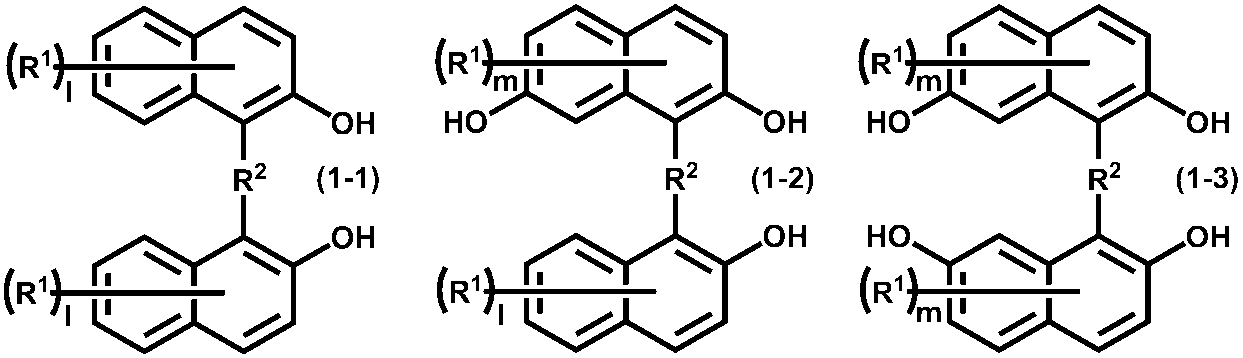
- more preferable examples of the compound (a1) include those represented by any of the following structural formulas (1-1) to (1-3).
- R 1 is independently an aliphatic hydrocarbon group, an alkoxy group or a halogen atom
- R 2 is an alkylene group.
- l is 0 or an integer of 1 to 6
- m is 0 or an integer of 1 to 5.
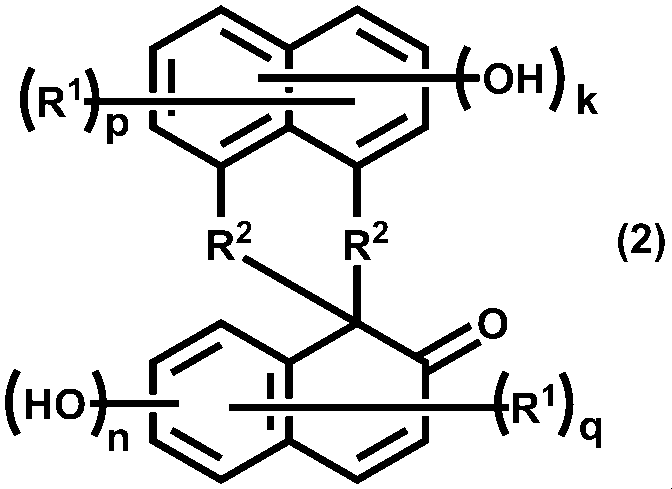
- the raw material epoxy resin (a1) may contain other components in addition to the polyglycidyl ether of the compound (p1). Among the other components, the following structural formula (2) is particularly preferable.
- R 1 is independently an aliphatic hydrocarbon group, an alkoxy group or a halogen atom
- R 2 is an alkylene group.
- k is 1 or 2
- n is 0 or 1
- p is 0 or an integer of 1 to 5
- q is 0 or an integer of 1 to 6.
- the polyglycidyl ether of the compound (p2) represented by these is mentioned. By using together the polyglycidyl ether of the compound (p2), the heat resistance of the cured product is further enhanced.
- R 1 and R 2 in the structural formula (2) have the same meanings as those in the structural formula (1).
- k is 1 or 2
- n is 0 or 1.
- the substitution position of the hydroxyl group is preferably the 2-position relative to the carbon atom to which R 2 is bonded.
- k is 2
- carbon atom to which R 2 is attached is a 2-position and 7-position.
- n is 1, it is preferably 7-position with respect to the carbon atom to which R 2 is bonded.
- more preferable examples of the compound (p2) include those represented by any of the following structural formulas (2-1) to (2-4).
- R 1 is independently an aliphatic hydrocarbon group, an alkoxy group or a halogen atom
- R 2 is an alkylene group.
- p is 0 or an integer of 1 to 5
- q is 0 or an integer of 1 to 6
- r is 0 or an integer of 1 to 4
- s is 0 or an integer of 1 to 5.
- the raw material epoxy resin (a1) includes, for example, bisphenol type epoxy resin; biphenyl type epoxy resin; phenol, cresol, dihydroxybenzene, naphthol, dihydroxynaphthalene, biphenol, bisphenol and the like.
- Various novolak type epoxy resins used as raw materials; triphenolmethane type epoxy resins; dicyclopentadiene-phenol addition reaction type epoxy resins; polyarylene ether type epoxy resins; phenol, cresol, naphthol, biphenol, bisphenol, etc. are arylene alkylene groups It may contain polyglycidyl ether of phenol resin having a resin structure linked by.
- the raw material epoxy resin (a1) may be manufactured in any way.
- the polyglycidyl ether of the compound (p1), the polyglycidyl ether of the compound (p2), and other epoxy resins may be separately prepared and blended, or the precursor phenol resin of each component was blended. You may manufacture by the method of polyglycidyl-etherification collectively later.
- As one preferred method for producing the raw material epoxy resin (a1) for example, various hydroxynaphthalene compounds and formaldehyde or alkylaldehyde are reacted in the presence of an alkali catalyst at a temperature of about 20 to 150 ° C. There is a method of obtaining a phenol intermediate and polyglycidyl etherifying it.
- the reaction ratio between the hydroxynaphthalene compound and the aldehyde compound is preferably such that the aldehyde compound is in the range of 0.6 to 2.0 mol per mol of the hydroxynaphthalene compound, and 0.6 to 1.5 mol. It is more preferable that the ratio be in the range.
- neutralization or water washing treatment it is preferable to appropriately carry out neutralization or water washing treatment.
- purification processes such as reprecipitation and microfiltration, as needed.
- alkali catalyst examples include alkali metal hydroxides such as sodium hydroxide and potassium hydroxide, alkali metals such as metal sodium and metal lithium, and alkali metal carbonates such as sodium carbonate and potassium carbonate. These may be used alone or in combination of two or more.
- the amount of catalyst added is preferably in the range of 0.2 to 2.0 moles per mole of hydroxynaphthalene compound.
- the reaction may be performed in an organic solvent as necessary.
- the selection of the organic solvent is appropriately selected according to the solubility of reaction raw materials and products, reaction temperature conditions, and the like, and examples thereof include methyl cellosolve, isopropyl alcohol, ethyl cellosolve, toluene, xylene, and methyl isobutyl ketone. These may be used alone or as a mixed solvent of two or more.
- the polyglycidyl etherification reaction of the phenol intermediate can be performed by a known and conventional method. Examples thereof include, for example, 2 to 10 moles of epihalohydrin per mole of phenolic hydroxyl group contained in the phenol intermediate, and 0.9 to 2.0 moles of basic catalyst per mole of phenolic hydroxyl group. And a method of reacting at a temperature of 20 to 120 ° C. for 0.5 to 10 hours while adding them all at once or in portions.
- the content of the polyglycidyl ether of the compound (p1) is preferably 20% or more, preferably 20 to 65%.
- the range is more preferable, and the range of 25 to 50% is particularly preferable.
- the raw material epoxy resin (a1) contains the polyglycidyl ether of the compound (p2), it becomes an acid group-containing (meth) acrylate resin having an excellent balance between elongation and heat resistance in the cured product.
- the content of the polyglycidyl ether of (p2) is preferably in the range of 1 to 30%, more preferably in the range of 2 to 20%.
- the content of each component in the raw material epoxy resin (a1) is a value calculated from the area ratio of the GPC chart measured under the following conditions.
- Measuring device “HLC-8320 GPC” manufactured by Tosoh Corporation Column: Guard column “HXL-L” manufactured by Tosoh Corporation + “TSK-GEL G2000HXL” manufactured by Tosoh Corporation + “TSK-GEL G2000HXL” manufactured by Tosoh Corporation + Tosoh Corporation “TSK-GEL G3000HXL” + “TSK-GEL G4000HXL” manufactured by Tosoh Corporation Detector: RI (differential refractometer) Data processing: “GPC workstation EcoSEC-WorkStation” manufactured by Tosoh Corporation Measurement conditions: Column temperature 40 ° C Developing solvent Tetrahydrofuran Flow rate 1.0 ml / min Standard: The following monodisperse polystyrene having a known molecular weight was used in accordance with the measurement manual of “GPC workstation EcoSEC-WorkStation”.
- the specific structure of the polyhydroxy compound (a2) is not particularly limited as long as it is a compound that can react with the raw material epoxy resin (a1), and a wide variety of compounds can be used. Among these, aromatic polyhydroxy compounds are preferable because of excellent reactivity with the raw material epoxy resin (a1).
- aromatic polyhydroxy compound examples include dihydroxybenzene, trihydroxybenzene, tetrahydroxybenzene, dihydroxynaphthalene, trihydroxynaphthalene, tetrahydroxynaphthalene, dihydroxyanthracene, trihydroxyanthracene, tetrahydroxyanthracene, polyhydroxybiphenyl, poly (hydroxy Phenyl) alkanes, other bisphenol compounds, and the like, as well as compounds having one or more substituents on the carbon atoms of these compounds.
- substituent on the carbon atom include an aliphatic hydrocarbon group, an alkoxy group, and a halogen atom, and specific examples thereof are as described above.
- an acid group-containing (meth) acrylate resin that is further excellent in the balance between elongation and heat resistance in the cured product
- it is preferably an aromatic dihydroxy compound, and one to one on dihydroxynaphthalene or its aromatic nucleus.
- a compound having a plurality of substituents is preferred.
- the reaction of the raw material epoxy resin (a1) and the polyhydroxy compound (a2) can be carried out, for example, in the presence of a reaction catalyst in a temperature range of about 100 to 200 ° C. Since the reaction ratio of the raw material epoxy resin (a1) and the polyhydroxy compound (a2) is an acid group-containing (meth) acrylate resin that is excellent in developability in addition to elongation and heat resistance in the cured product,
- the polyhydroxy compound (a2) is preferably used in the range of 0.1 to 20% by mass, more preferably in the range of 0.5 to 10% by mass, based on the total mass of the raw material epoxy resin (a1). .
- reaction catalyst examples include phosphorus compounds such as trimethylphosphine, tributylphosphine, and triphenylphosphine, and amine compounds such as triethylamine, tributylamine, and dimethylbenzylamine. These may be used alone or in combination of two or more.
- the addition amount of the catalyst is preferably 0.05 to 5% by mass with respect to the total mass of the raw material epoxy resin (a1) and the polyhydroxy compound (a2).
- the reaction between the raw material epoxy resin (a1) and the polyhydroxy compound (a2) may be performed in an organic solvent as necessary.
- the organic solvent to be used is appropriately selected depending on the solubility of the acid group-containing (meth) acrylate resin that is the reaction raw material and the product and the reaction temperature conditions.
- methyl ethyl ketone, acetone, dimethylformamide, methyl isobutyl ketone examples include methoxypropanol, cyclohexanone, methyl cellosolve, dialkylene glycol monoalkyl ether acetate, dialkylene glycol acetate and the like. These may be used alone or as a mixed solvent of two or more.
- the amount of the organic solvent used is preferably in the range of about 0.1 to 5 times the total mass of the reaction raw materials because the reaction efficiency is good.
- Examples of the unsaturated monocarboxylic acid or its derivative (B) include compounds having a (meth) acryloyl group and a carboxy group in one molecule such as acrylic acid and methacrylic acid, acid halides, acid anhydrides thereof, and the like. It is done. These may be used alone or in combination of two or more.
- any acid anhydride of a compound having two or more carboxy groups in one molecule can be used.
- oxalic acid, malonic acid, succinic acid, glutaric acid, adipic acid, pimelic acid, suberic acid, azelaic acid, sebacic acid, maleic acid, fumaric acid, phthalic acid, isophthalic acid, terephthalic acid, tetrahydrophthalic acid examples thereof include acid anhydrides of dicarboxylic acid compounds such as hexahydrophthalic acid and methylhexahydrophthalic acid.
- Polycarboxylic acid anhydrides (C) may be used alone or in combination of two or more.
- phthalic acid isophthalic acid, terephthalic acid, tetrahydrophthalic acid, hexahydrophthalic acid, methylhexahydrophthalic acid, etc.
- An acid anhydride of a compound having a cyclic structure is preferred.
- a succinic anhydride is preferable in that the acid group-containing (meth) acrylate resin is excellent in developability.
- the acid group-containing (meth) acrylate resin of the present invention uses the epoxy resin (A), the unsaturated monocarboxylic acid or its derivative (B), and the polycarboxylic acid anhydride (C) as essential reaction raw materials. If it is a thing, the manufacturing method will not be specifically limited, For example, either the method of reacting all the reaction raw materials collectively, or the method of reacting sequentially may be sufficient. Among them, since the reaction is easily controlled, the epoxy resin (A) is first reacted with the unsaturated monocarboxylic acid or derivative (B), and then the polycarboxylic acid anhydride (C) is reacted. The method is preferred.
- the reaction is performed, for example, by reacting the epoxy resin (A) with the unsaturated monocarboxylic acid or derivative (B) in the presence of a reaction catalyst in a temperature range of about 100 to 150 ° C.
- the polycarboxylic acid anhydride (C) can be added and reacted in a temperature range of about 90 to 120 ° C.
- the reaction ratio of the epoxy resin (A) to the unsaturated monocarboxylic acid or its derivative (B) is the ratio of the unsaturated monocarboxylic acid or its derivative (B) to 1 mol of the epoxy group in the epoxy resin (A). It is preferably used in the range of 0.9 to 1.1 mol.
- the reaction rate of the polycarboxylic acid anhydride (D) is preferably in the range of 0.2 to 1.0 mol with respect to 1 mol of the epoxy group in the epoxy resin (A).
- reaction catalyst examples include the same compounds as those used in the reaction of the raw material epoxy resin (a1) and the polyhydroxy compound (a2).
- the addition amount of the catalyst is preferably in the range of 0.03 to 5% by mass with respect to the total mass of the reaction raw materials.
- a catalyst may not be newly added or may be appropriately added.
- the reaction may be performed in an organic solvent as necessary.
- the organic solvent to be used include the same compounds as those used in the reaction between the raw material epoxy resin (a1) and the polyhydroxy compound (a2).
- the amount of the organic solvent used is preferably in the range of about 0.1 to 5 times the total mass of the reaction raw materials because the reaction efficiency is good.
- the acid value of the acid group-containing (meth) acrylate resin of the present invention is an acid group-containing (meth) acrylate resin that is excellent in developability in addition to elongation and heat resistance in the cured product, 40 to 90 mgKOH / g It is preferable that it is the range of these.
- the acid value of the acid group-containing (meth) acrylate resin is a value measured by a neutralization titration method of JIS K 0070 (1992).
- the acid group-containing (meth) acrylate resin of the present invention has a polymerizable (meth) acryloyl group in the molecular structure, for example, it can be used as a curable resin composition by adding a photopolymerization initiator. Can do.
- the photopolymerization initiator may be selected and used according to the type of active energy ray to be irradiated. Moreover, you may use together with photosensitizers, such as an amine compound, a urea compound, a sulfur-containing compound, a phosphorus-containing compound, a chlorine-containing compound, a nitrile compound.
- photosensitizers such as an amine compound, a urea compound, a sulfur-containing compound, a phosphorus-containing compound, a chlorine-containing compound, a nitrile compound.
- photopolymerization initiator examples include, for example, 1-hydroxy-cyclohexyl-phenyl-ketone, 2-benzyl-2-dimethylamino-1- (4-morpholinophenyl) -butanone-1, 2- (dimethylamino) Alkylphenone photopolymerization initiators such as -2-[(4-methylphenyl) methyl] -1- [4- (4-morpholinyl) phenyl] -1-butanone; 2,4,6-trimethylbenzoyl-diphenyl- Examples include acylphosphine oxide photopolymerization initiators such as phosphine oxide; intramolecular hydrogen abstraction type photopolymerization initiators such as benzophenone compounds. These may be used alone or in combination of two or more.
- the addition amount of the photopolymerization initiator is preferably in the range of 0.05 to 15% by mass, for example, in the range of 0.1 to 10% by mass with respect to the total of components other than the solvent of the curable resin composition. It is more preferable that
- the curable resin composition of the present invention may contain a resin component other than the acid group-containing (meth) acrylate resin of the present invention.
- the resin component is obtained, for example, by reacting an epoxy resin such as a bisphenol type epoxy resin or a novolak type epoxy resin with (meth) acrylic acid, dicarboxylic acid anhydride, and unsaturated monocarboxylic acid anhydride as required.
- an epoxy resin such as a bisphenol type epoxy resin or a novolak type epoxy resin
- acrylic acid, dicarboxylic acid anhydride dicarboxylic acid anhydride
- unsaturated monocarboxylic acid anhydride unsaturated monocarboxylic acid anhydride
- Examples of the (meth) acrylate monomer include methyl (meth) acrylate, ethyl (meth) acrylate, propyl (meth) acrylate, butyl (meth) acrylate, pentyl (meth) acrylate, hexyl (meth) acrylate, 2-ethylhexyl ( Aliphatic mono (meth) acrylate compounds such as meth) acrylate and octyl (meth) acrylate; alicyclic mono (meth) acrylate compounds such as cyclohexyl (meth) acrylate, isobornyl (meth) acrylate and adamantyl mono (meth) acrylate; Heterocyclic mono (meth) acrylate compounds such as glycidyl (meth) acrylate and tetrahydrofurfuryl acrylate; benzyl (meth) acrylate, phenyl (meth) acrylate,
- Aliphatic di (meth) acrylate compounds such as ethylene glycol di (meth) acrylate, propylene glycol di (meth) acrylate, butanediol di (meth) acrylate, hexanediol di (meth) acrylate and neopentyl glycol di (meth) acrylate 1,4-cyclohexanedimethanol di (meth) acrylate, norbornane di (meth) acrylate, norbornane dimethanol di (meth) acrylate, dicyclopentanyl di (meth) acrylate, tricyclodecane dimethanol di (meth) acrylate
- alicyclic di (meth) acrylate compounds aromatic di (meth) acrylate compounds such as biphenol di (meth) acrylate and bisphenol di (meth) acrylate;
- Aliphatic tri (meth) acrylate compounds such as trimethylolpropane tri (meth) acrylate and glycerin tri (meth) acrylate; (poly) oxyethylene chain in the molecular structure of the aliphatic tri (meth) acrylate compound, (poly) (Poly) oxyalkylene-modified tri (meth) acrylate compound introduced with (poly) oxyalkylene chain such as oxypropylene chain and (poly) oxytetramethylene chain; in the molecular structure of the aliphatic tri (meth) acrylate compound ( A lactone-modified tri (meth) acrylate compound having a poly) lactone structure;
- Tetra- or higher functional aliphatic poly (meth) acrylate compounds such as pentaerythritol tetra (meth) acrylate, ditrimethylolpropane tetra (meth) acrylate, dipentaerythritol hexa (meth) acrylate; (Poly) oxyalkylene-modified poly (meth) having 4 or more functionalities in which (poly) oxyethylene chain, (poly) oxypropylene chain, (poly) oxytetramethylene chain, or other (poly) oxyalkylene chain is introduced into the molecular structure Acrylate compounds; tetrafunctional or higher functional lactone-modified poly (meth) acrylate compounds in which a (poly) lactone structure is introduced into the molecular structure of the aliphatic poly (meth) acrylate compound.
- the curable resin composition of the present invention may contain an organic solvent for the purpose of adjusting the coating viscosity.
- the kind and addition amount are appropriately adjusted according to the desired performance. Generally, it is used in the range of 10 to 90% by mass with respect to the total of the curable resin composition.
- Specific examples of the solvent include, for example, ketone solvents such as acetone, methyl ethyl ketone and methyl isobutyl ketone; cyclic ether solvents such as tetrahydrofuran and dioxolane; esters such as methyl acetate, ethyl acetate and butyl acetate; aromatics such as toluene and xylene.
- Solvents include cycloaliphatic, methylcyclohexane and other alicyclic solvents; carbitol, cellosolve, methanol, isopropanol, butanol, propylene glycol monomethyl ether and other alcohol solvents; alkylene glycol monoalkyl ether, dialkylene glycol monoalkyl ether, dialkylene glycol mono Examples include glycol ether solvents such as alkyl ether acetates. These may be used alone or in combination of two or more.
- the curable resin composition of the present invention may contain various additives such as inorganic fine particles and polymer fine particles, pigments, antifoaming agents, viscosity modifiers, leveling agents, flame retardants, and storage stabilizers. .
- the acid group-containing (meth) acrylate resin of the present invention is characterized by an excellent balance between elongation and heat resistance in a cured product.
- the acid group-containing (meth) acrylate resin of the present invention has a performance that defeats the conventional technical knowledge in that both of these difficult performances are combined at a high level.
- the acid group-containing (meth) acrylate resin of the present invention is used as an application in which the balance between elongation and heat resistance in a cured product is utilized, for example, as a semiconductor device-related application, a solder resist, an interlayer insulating material, It can be used as a package adhesive layer such as a package material, an underfill material or a circuit element, or an adhesive layer between an integrated circuit element and a circuit board.
- thin film display applications such as LCD and OELD can be suitably used for thin film transistor protective films, liquid crystal color filter protective films, color filter pigment resists, black matrix resists, spacers, and the like.
- the acid group-containing (meth) acrylate resin of the present invention is excellent in developability as well as elongation and heat resistance in a cured product, it can be suitably used for solder resist applications.
- the resin material for solder resist of the present invention includes, for example, each component such as a curing agent, a curing accelerator, and an organic solvent in addition to the acid group-containing (meth) acrylate resin, the photopolymerization initiator, and various additives. Become.
- the curing agent is not particularly limited as long as it has a functional group capable of reacting with a carboxy group in the acid group-containing (meth) acrylate resin, and examples thereof include an epoxy resin.
- examples of the epoxy resin used here include bisphenol type epoxy resin, phenylene ether type epoxy resin, naphthylene ether type epoxy resin, biphenyl type epoxy resin, triphenylmethane type epoxy resin, phenol novolac type epoxy resin, and cresol novolac type epoxy resin.
- Bisphenol novolac type epoxy resin, naphthol novolak type epoxy resin, naphthol-phenol co-condensed novolac type epoxy resin, naphthol-cresol co-condensed novolac type epoxy resin, phenol aralkyl type epoxy resin, naphthol aralkyl type epoxy resin, dicyclopentadiene-phenol Examples include addition reaction type epoxy resins. These may be used alone or in combination of two or more. Among these epoxy resins, phenolic novolac type epoxy resin, cresol novolac type epoxy resin, bisphenol novolac type epoxy resin, naphthol novolac type epoxy resin, naphthol-phenol co-condensed novolak type epoxy resin because of excellent heat resistance in cured products.
- Novolak type epoxy resins such as naphthol-cresol co-condensed novolak type epoxy resins are preferable, and those having a softening point in the range of 50 to 120 ° C. are particularly preferable.
- the curing accelerator accelerates the curing reaction of the curing agent.
- a phosphorus compound, a tertiary amine, an imidazole, an organic acid metal salt, a Lewis acid examples include amine complex salts. These may be used alone or in combination of two or more.
- the addition amount of the curing accelerator is, for example, in the range of 1 to 10 parts by mass with respect to 100 parts by mass of the curing agent.
- the organic solvent is not particularly limited as long as it can dissolve various components such as the acid group-containing (meth) acrylate resin and the curing agent.
- methyl ethyl ketone, acetone, dimethylformamide, methyl isobutyl ketone, methoxypropanol examples include cyclohexanone, methyl cellosolve, diethylene glycol monoethyl ether acetate, and propylene glycol monomethyl ether acetate.
- the method of obtaining a resist member using the solder resist resin material of the present invention is, for example, by applying the solder resist resin material on a substrate and evaporating and drying the organic solvent in a temperature range of about 60 to 100 ° C. Thereafter, there is a method in which a non-exposed portion is exposed with an ultraviolet solution or an electron beam through a photomask having a desired pattern formed, and an unexposed portion is developed with an alkaline aqueous solution, and further heated and cured in a temperature range of about 140 to 180 ° C. .
- the content of each component in the epoxy resin (a1) was calculated from the area ratio of the GPC chart measured under the following conditions.
- Measuring device “HLC-8320 GPC” manufactured by Tosoh Corporation Column: Guard column “HXL-L” manufactured by Tosoh Corporation + “TSK-GEL G2000HXL” manufactured by Tosoh Corporation + “TSK-GEL G2000HXL” manufactured by Tosoh Corporation + Tosoh Corporation “TSK-GEL G3000HXL” + “TSK-GEL G4000HXL” manufactured by Tosoh Corporation Detector: RI (differential refractometer) Data processing: “GPC workstation EcoSEC-WorkStation” manufactured by Tosoh Corporation Measurement conditions: Column temperature 40 ° C Developing solvent Tetrahydrofuran Flow rate 1.0 ml / min Standard: The following monodisperse polystyrene having a known molecular weight was used in accordance with the measurement manual of “GPC workstation EcoSEC-WorkStation”.
- MS data and C13NMR of the epoxy resin (a1) were measured by the following apparatus.
- NMR NMR GSX270 manufactured by JEOL Ltd.
- the acid value of the acid group-containing (meth) acrylate resin was measured by the neutralization titration method of JIS K 0070 (1992).
- Isopropyl alcohol was removed under reduced pressure, and 480 g of methyl isobutyl ketone was added. After repeating the operation of adding 200 g of water and washing with water three times, methyl isobutyl ketone was removed under heating and reduced pressure conditions to obtain 245 g of a phenol resin intermediate having a hydroxyl group equivalent of 84 g / equivalent.
- the epoxy resin (a1) contained 10% of a compound represented by the following structural formula (x1), 40% of a compound represented by the following structural formula (x2), and 50% of other oligomers.
- Example 2 Production of acid group-containing (meth) acrylate resin (2)
- 105 g of diethylene glycol monomethyl ether acetate and 190 g and 2 of the epoxy resin (a1) obtained above were obtained.
- 5,7-dihydroxynaphthalene was charged and dissolved.
- Dibutylhydroxytoluene 0.7 g and triphenylphosphine 1.3 g were added and reacted at 150 ° C. for 2 hours in a nitrogen atmosphere.
- Metoquinone 0.1 g and acrylic acid 74 g were added and reacted at 120 ° C. for 10 hours while blowing air.
- curable resin composition 100 g of acid group-containing (meth) acrylate resin obtained above, “EPICLON N-680” (cresol novolac type epoxy resin) manufactured by DIC Corporation 24 g, “IRGACURE 907” [2-methyl-1- (4-methylthiophenyl) -2-morpholinopropan-1-one] 5 g, manufactured by BASF “IRGACURE TPO” (2,4,6-trimethyl)
- a curable resin composition was obtained by blending 3 g of benzoyl-diphenyl-phosphine oxide) and 13 g of diethylene glycol monomethyl ether acetate.
- the curable resin composition was apply
- curable resin composition 100 g of acid group-containing (meth) acrylate resin obtained previously, “EPICLON N-680” (cresol novolac type epoxy resin manufactured by DIC Corporation) ) 24 g, “LumiCure DPA-600T” (composition containing dipentaerythritol pentaacrylate and dipentaerythritol hexaacrylate in a molar ratio of 40/60) manufactured by Toagosei Co., Ltd.
- “Irgacure 907” [2 -Methyl-1- (4-methylthiophenyl) -2-morpholinopropan-1-one] 5 g
- “IRGACURE TPO” (2,4,6-trimethylbenzoyl-diphenyl-phosphine oxide) 3 g
- diethylene glycol manufactured by BASF Monomethyl ether acetate 13 g, 0.65 g of phthalocyanine green as a pigment was blended and kneaded by a roll mill to obtain a curable resin composition.
- the curable resin composition was apply
- a polyethylene terephthalate (PET) film is placed on the surface of the coating, a 50 g weight is placed on it, and after standing for 10 seconds, when the polyethylene terephthalate (PET) film is lifted, the sticking does not occur.
- B was evaluated as B.
- Step Tablet No. 2 was irradiated with 1000 mJ / cm 2 ultraviolet rays using a metal halide lamp. This was developed with a 1% by mass aqueous sodium carbonate solution for 180 seconds and evaluated by the number of remaining steps. The greater the number of remaining stages, the higher the photosensitivity.
- a curable resin composition was applied on a glass substrate with a 50 ⁇ m applicator, and samples with drying times at 80 ° C. of 30 minutes, 40 minutes, 50 minutes, and 60 minutes, respectively, were prepared. . These were developed with a 1% by weight aqueous sodium carbonate solution for 180 seconds, and the 80 ° C. drying time of the sample in which no residue remained was evaluated as the dry control width. The longer the drying control width, the better the alkali developability.
Landscapes
- Physics & Mathematics (AREA)
- Chemical & Material Sciences (AREA)
- Engineering & Computer Science (AREA)
- General Physics & Mathematics (AREA)
- Polymers & Plastics (AREA)
- Organic Chemistry (AREA)
- Medicinal Chemistry (AREA)
- Spectroscopy & Molecular Physics (AREA)
- Health & Medical Sciences (AREA)
- Chemical Kinetics & Catalysis (AREA)
- Manufacturing & Machinery (AREA)
- Microelectronics & Electronic Packaging (AREA)
- Materials For Photolithography (AREA)
- Epoxy Resins (AREA)
- Macromonomer-Based Addition Polymer (AREA)
- Non-Metallic Protective Coatings For Printed Circuits (AREA)
Abstract
Description
本発明の酸基含有(メタ)アクリレート樹脂は、エポキシ樹脂(A)、不飽和モノカルボン酸又はその誘導体(B)、及びポリカルボン酸無水物(C)を必須の反応原料とする酸基含有(メタ)アクリレート樹脂であって、前記エポキシ樹脂(A)が、ビス(ヒドロキシナフチル)アルカン化合物(p1)のポリグリシジルエーテルを必須成分とする原料エポキシ樹脂(a1)と、ポリヒドロキシ化合物(a2)との反応生成物であることを特徴とする。
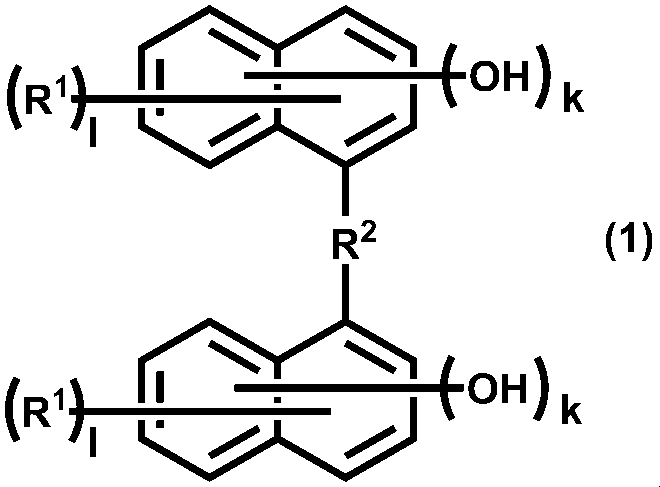
で表される化合物が挙げられる。ビス(ヒドロキシナフチル)アルカン化合物(p1)は1種類を単独で用いてもよいし、2種類以上を併用してもよい。
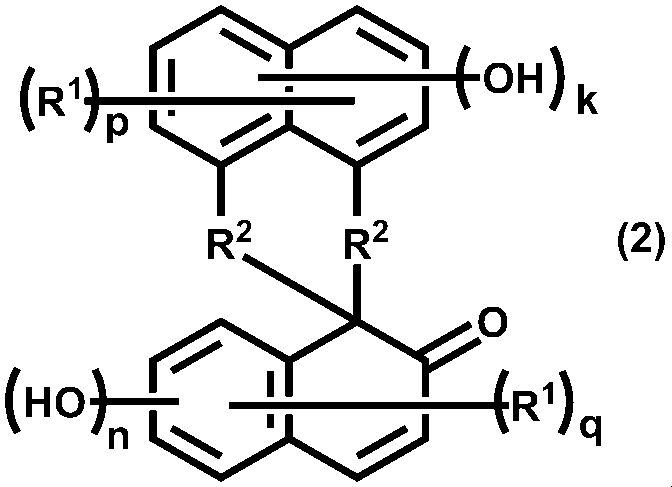
で表される化合物(p2)のポリグリシジルエーテルが挙げられる。化合物(p2)のポリグリシジルエーテルを併用することにより、硬化物の耐熱性が一層高まる。

カラム:東ソー株式会社製ガードカラム「HXL-L」
+東ソー株式会社製「TSK-GEL G2000HXL」
+東ソー株式会社製「TSK-GEL G2000HXL」
+東ソー株式会社製「TSK-GEL G3000HXL」
+東ソー株式会社製「TSK-GEL G4000HXL」
検出器: RI(示差屈折計)
データ処理:東ソー株式会社製「GPCワークステーション EcoSEC-WorkStation」
測定条件: カラム温度 40℃
展開溶媒 テトラヒドロフラン
流速 1.0ml/分
標準 : 前記「GPCワークステーション EcoSEC-WorkStation」の測定マニュアルに準拠して、分子量が既知の下記の単分散ポリスチレンを用いた。
(使用ポリスチレン)
東ソー株式会社製「A-500」
東ソー株式会社製「A-1000」
東ソー株式会社製「A-2500」
東ソー株式会社製「A-5000」
東ソー株式会社製「F-1」
東ソー株式会社製「F-2」
東ソー株式会社製「F-4」
東ソー株式会社製「F-10」
東ソー株式会社製「F-20」
東ソー株式会社製「F-40」
東ソー株式会社製「F-80」
東ソー株式会社製「F-128」
試料 : 樹脂固形分換算で1.0質量%のテトラヒドロフラン溶液をマイクロフィルターでろ過したもの(50μl)
カラム:東ソー株式会社製ガードカラム「HXL-L」
+東ソー株式会社製「TSK-GEL G2000HXL」
+東ソー株式会社製「TSK-GEL G2000HXL」
+東ソー株式会社製「TSK-GEL G3000HXL」
+東ソー株式会社製「TSK-GEL G4000HXL」
検出器: RI(示差屈折計)
データ処理:東ソー株式会社製「GPCワークステーション EcoSEC-WorkStation」
測定条件: カラム温度 40℃
展開溶媒 テトラヒドロフラン
流速 1.0ml/分
標準 : 前記「GPCワークステーション EcoSEC-WorkStation」の測定マニュアルに準拠して、分子量が既知の下記の単分散ポリスチレンを用いた。
(使用ポリスチレン)
東ソー株式会社製「A-500」
東ソー株式会社製「A-1000」
東ソー株式会社製「A-2500」
東ソー株式会社製「A-5000」
東ソー株式会社製「F-1」
東ソー株式会社製「F-2」
東ソー株式会社製「F-4」
東ソー株式会社製「F-10」
東ソー株式会社製「F-20」
東ソー株式会社製「F-40」
東ソー株式会社製「F-80」
東ソー株式会社製「F-128」
試料 : 樹脂固形分換算で1.0質量%のテトラヒドロフラン溶液をマイクロフィルターでろ過したもの(50μl)
MS :日本電子株式会社製 二重収束型質量分析装置 AX505H(FD505H)
NMR:日本電子株式会社製 NMR GSX270
温度計、滴下ロート、冷却管、分留管、撹拌器を取り付けたフラスコに、2,7-ジヒドロキシナフタレン240g、37質量%ホルムアルデヒド水溶液85g、イソプロピルアルコール376g、48%水酸化カリウム水溶液88gを仕込んだ。窒素を吹き込みながら撹拌を開始し、75℃まで加熱して2時間攪拌した。反応終了後、第1リン酸ソーダ108gを添加して中和した。イソプロピルアルコールを減圧下除去し、メチルイソブチルケトン480gを加えた。水200gを加えて水洗する作業を3回繰り返した後、メチルイソブチルケトンを加熱減圧条件下で除去し、水酸基当量は84g/当量のフェノール樹脂中間体245gを得た。
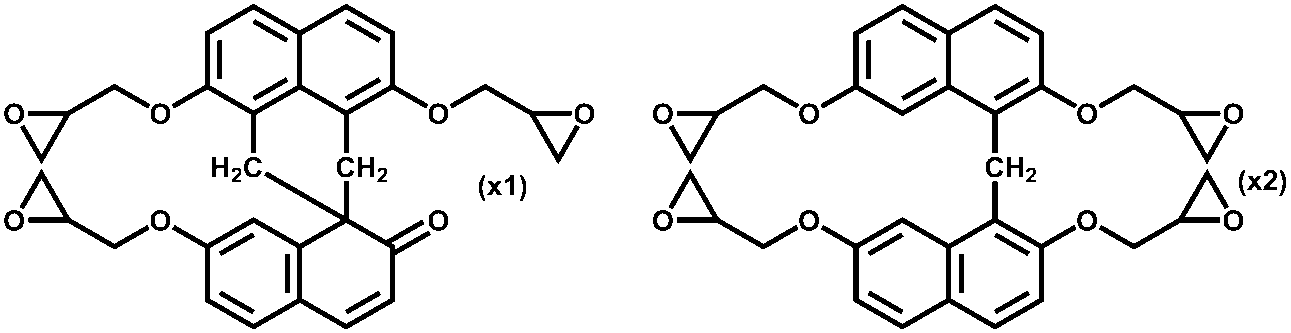
温度計、攪拌器、及び還流冷却器を備えたフラスコに、ジエチレングリコールモノメチルエーテルアセテート105g、先で得たエポキシ樹脂(a1)190gおよび2,7-ジヒドロキシナフタレン5gを仕込んで溶解させた。ジブチルヒドロキシトルエン0.7g、トリフェニルフォスフィン1.3gを添加し、窒素雰囲気下、150℃で2時間反応させた。メトキノン0.1g、アクリル酸74gを加え、空気を吹き込みながら120℃で10時間反応させた。ジエチレングリコールモノメチルエーテルアセテート105g、テトラヒドロ無水フタル酸73gを加え、110℃で5時間反応させて、基含有(メタ)アクリレート樹脂(1)を得た。基含有(メタ)アクリレート樹脂(1)の固形分酸価は80mgKOH/gであった。酸基含有(メタ)アクリレート樹脂(1)のGPCチャート図を図1に示す。
温度計、攪拌器、及び還流冷却器を備えたフラスコに、ジエチレングリコールモノメチルエーテルアセテート105g、先で得たエポキシ樹脂(a1)190gおよび2,7-ジヒドロキシナフタレン5gを仕込んで溶解させた。ジブチルヒドロキシトルエン0.7g、トリフェニルフォスフィン1.3gを添加し、窒素雰囲気下、150℃で2時間反応させた。メトキノン0.1g、アクリル酸74gを加え、空気を吹き込みながら120℃で10時間反応させた。ジエチレングリコールモノメチルエーテルアセテート87g、無水コハク酸44gを加え、110℃で5時間反応させて、酸基含有(メタ)アクリレート樹脂(2)を得た。酸基含有(メタ)アクリレート樹脂(2)の固形分酸価は80mgKOH/gであった。
温度計、攪拌器、及び還流冷却器を備えたフラスコに、ジエチレングリコールモノメチルエーテルアセテート87g、1,1-ビス(2,7-グリシジルオキシナフチル)メタン(DIC株式会社製「EPICLON HP-4700、エポキシ当量162g/当量)162gを仕込んで溶解させた。ジブチルヒドロキシトルエン0.6g、熱重合禁止剤としてメトキノン0.1g、アクリル酸72g、トリフェニルフォスフィン1.2gを加え、空気を吹き込みながら120℃で10時間反応させた。ジエチレングリコールモノメチルエーテルアセテート95g、テトラヒドロ無水フタル酸64gを加えて110℃で5時間反応させ、酸基含有(メタ)アクリレート樹脂(1’)を得た。酸基含有(メタ)アクリレート樹脂(1’)の固形分酸価は80mgKOH/gであった。
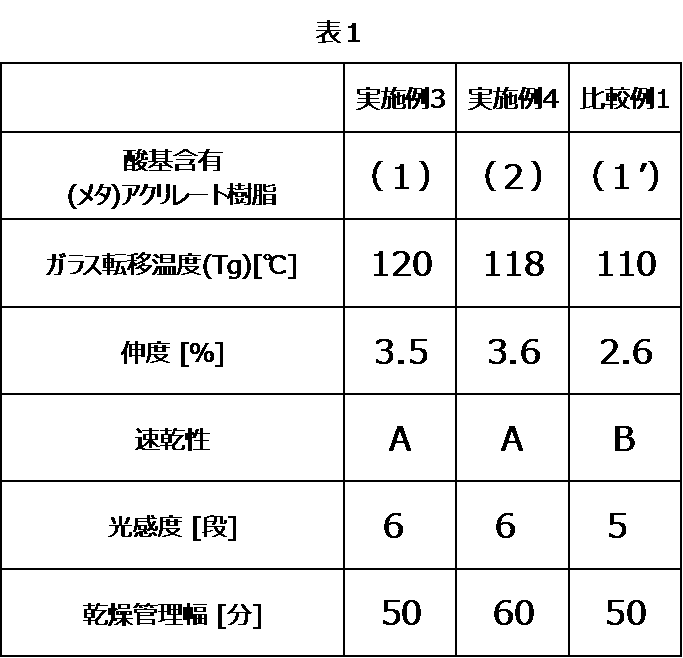
下記要領で硬化性樹脂組成物を調製し、各種評価試験を行った。結果を表1に示す。
・硬化性樹脂組成物の調製
先で得た酸基含有(メタ)アクリレート樹脂100g、DIC株式会社製「EPICLON N-680」(クレゾールノボラック型エポキシ樹脂)24g、BASF社製「イルガキュア907」[2-メチル-1-(4-メチルチオフェニル)-2-モルフォリノプロパン-1-オン]5g、BASF社製「IRGACURE TPO」(2,4,6-トリメチルベンゾイル-ジフェニル-フォスフィンオキサイド)3g、ジエチレングリコールモノメチルエーテルアセテート13gを配合して硬化性樹脂組成物を得た。
ガラス基材の上に硬化性樹脂組成物を50μmのアプリケーターで塗布し、80℃で30分間乾燥させた。メタルハライドランプを用いて1000mJ/cm2の紫外線を照射した後、160℃で1時間加熱して、硬化物をガラス基材から剥離し、硬化物を得た。
硬化物から6mm×40mmの試験片を切り出し、粘弾性測定装置(DMA:レオメトリック社製固体粘弾性測定装置「RSAII」、引張り法:周波数1Hz、昇温速度3℃/分)を用いて、弾性率変化が最大となる(tanδ変化率が最も大きい)温度をガラス転移温度(Tg)とて評価した。
硬化物から10mm×80mmの試験片を切り出し、引っ張り試験装置(島津製作所社製「機密万能試験器オートグラフAG-IS」)を用いて下記条件で伸度を測定し、評価した。
温度23℃、湿度50%、標線間距離20mm、支点間距離20mm、引っ張り速度10mm/分
・硬化性樹脂組成物の調製
先で得た酸基含有(メタ)アクリレート樹脂100g、DIC株式会社製「EPICLON N-680」(クレゾールノボラック型エポキシ樹脂)24g、東亞合成株式会社製「ルミキュアDPA-600T」(ジペンタエリスリトールペンタアクリレートとジペンタエリスリトールヘキサアクリレートとをモル比40/60で含有する組成物)10g、BASF社製「イルガキュア907」[2-メチル-1-(4-メチルチオフェニル)-2-モルフォリノプロパン-1-オン]5g、BASF社製「IRGACURE TPO」(2,4,6-トリメチルベンゾイル-ジフェニル-フォスフィンオキサイド)3g、ジエチレングリコールモノメチルエーテルアセテート13g、顔料としてフタロシアニングリーン0.65gを配合し、ロールミルにより混錬して硬化性樹脂組成物を得た。
ガラス基材の上に硬化性樹脂組成物を50μmのアプリケーターで塗布し、80℃で30分乾燥させた。塗膜表面にポリエチレンテレフタレート(PET)フィルムを載せ、更に50gの重りを載せて10秒放置した後、ポリエチレンテレフタレート(PET)フィルム持ち上げた際に張り付きが生じなかったものをA、張り付きが生じたものをBとして評価した。
ガラス基材の上に硬化性樹脂組成物を50μmのアプリケーターで塗布し、80℃で30分乾燥させた。次いで、コダック社製のステップタブレットNo.2を介し、メタルハライドランプを用いて1000mJ/cm2の紫外線を照射した。これを1質量%の炭酸ナトリウム水溶液で180秒現像し、残存した段数で評価した。残存段数が多いほど光感度が高い。
ガラス基材の上に硬化性樹脂組成物を50μmのアプリケーターで塗布し、80℃での乾燥時間がそれぞれ30分、40分、50分、60分であるサンプルを作成した。これらを1質量%の炭酸ナトリウム水溶液で180秒現像し、残渣が残らなかったサンプルの80℃乾燥時間を乾燥管理幅として評価した。乾燥管理幅が長いほどアルカリ現像性に優れる。
Claims (9)
- エポキシ樹脂(A)、不飽和モノカルボン酸又はその誘導体(B)、及びポリカルボン酸無水物(C)を必須の反応原料とする酸基含有(メタ)アクリレート樹脂であって、前記エポキシ樹脂(A)が、ビス(ヒドロキシナフチル)アルカン化合物(p1)のポリグリシジルエーテルを必須成分とする原料エポキシ樹脂(a1)と、ポリヒドロキシ化合物(a2)との反応生成物である酸基含有(メタ)アクリレート樹脂。
- 前記ビス(ヒドロキシナフチル)アルカン化合物(p1)が、下記構造式(1)

で表される化合物である請求項1記載の酸基含有(メタ)アクリレート樹脂。 - 前記ポリヒドロキシ化合物(a2)が、芳香族ジヒドロキシ化合物である請求項1記載の酸基含有(メタ)アクリレート樹脂。
- 前記原料エポキシ樹脂(a1)が、前記ビス(ヒドロキシナフチル)アルカン化合物(p1)のポリグリシジルエーテルに加え、下記構造式(2)
で表される化合物(p2)のポリグリシジルエーテルを含有する請求項1記載の酸基含有(メタ)アクリレート樹脂。 - 請求項1記載の酸基含有(メタ)アクリレート樹脂と、光重合開始剤とを含有する硬化性樹脂組成物。
- 請求項5記載の硬化性樹脂組成物の硬化物。
- 請求項5記載の硬化性樹脂組成物からなる絶縁材料。
- 請求項5記載の硬化性樹脂組成物からなるソルダーレジスト用樹脂材料。
- 請求項8記載のソルダーレジスト用樹脂材料を用いてなるレジスト部材。
Priority Applications (3)
| Application Number | Priority Date | Filing Date | Title |
|---|---|---|---|
| CN201880021638.XA CN110461900B (zh) | 2017-04-06 | 2018-03-22 | 含酸基的(甲基)丙烯酸酯树脂和阻焊剂用树脂材料 |
| KR1020197023248A KR102384628B1 (ko) | 2017-04-06 | 2018-03-22 | 산기 함유 (메타)아크릴레이트 수지 및 솔더 레지스트용 수지 재료 |
| JP2019511141A JP6541016B2 (ja) | 2017-04-06 | 2018-03-22 | 酸基含有(メタ)アクリレート樹脂及びソルダーレジスト用樹脂材料 |
Applications Claiming Priority (2)
| Application Number | Priority Date | Filing Date | Title |
|---|---|---|---|
| JP2017-075933 | 2017-04-06 | ||
| JP2017075933 | 2017-04-06 |
Publications (1)
| Publication Number | Publication Date |
|---|---|
| WO2018186183A1 true WO2018186183A1 (ja) | 2018-10-11 |
Family
ID=63712492
Family Applications (1)
| Application Number | Title | Priority Date | Filing Date |
|---|---|---|---|
| PCT/JP2018/011313 Ceased WO2018186183A1 (ja) | 2017-04-06 | 2018-03-22 | 酸基含有(メタ)アクリレート樹脂及びソルダーレジスト用樹脂材料 |
Country Status (5)
| Country | Link |
|---|---|
| JP (1) | JP6541016B2 (ja) |
| KR (1) | KR102384628B1 (ja) |
| CN (1) | CN110461900B (ja) |
| TW (1) | TWI768019B (ja) |
| WO (1) | WO2018186183A1 (ja) |
Cited By (2)
| Publication number | Priority date | Publication date | Assignee | Title |
|---|---|---|---|---|
| CN114531881A (zh) * | 2019-10-01 | 2022-05-24 | Dic株式会社 | 含酸基的(甲基)丙烯酸酯树脂、含酸基的(甲基)丙烯酸酯树脂组合物、固化性树脂组合物、固化物、绝缘材料、阻焊剂用树脂材料和保护构件 |
| JP2023183615A (ja) * | 2022-06-16 | 2023-12-28 | Dic株式会社 | メタクリレート樹脂、硬化性樹脂組成物、硬化物及び物品 |
Families Citing this family (1)
| Publication number | Priority date | Publication date | Assignee | Title |
|---|---|---|---|---|
| CN113544179B (zh) * | 2019-03-06 | 2024-02-02 | Dic株式会社 | 含酸基(甲基)丙烯酸酯树脂、固化性树脂组合物、固化物、绝缘材料、阻焊剂用树脂材料和抗蚀构件 |
Citations (6)
| Publication number | Priority date | Publication date | Assignee | Title |
|---|---|---|---|---|
| JPH04217675A (ja) * | 1990-10-30 | 1992-08-07 | Dainippon Ink & Chem Inc | エポキシ樹脂、その製造方法及びエポキシ樹脂組成物 |
| JP2001089644A (ja) * | 1999-09-22 | 2001-04-03 | Dainippon Ink & Chem Inc | 多層プリント配線板用層間電気絶縁材料 |
| WO2002024774A1 (en) * | 2000-09-20 | 2002-03-28 | Taiyo Ink Manufacturing Co., Ltd. | Carboxylated photosensitive resin, alkali-developable photocurable/heat-curable composition containing the same, and cured article obtained therefrom |
| JP2006335796A (ja) * | 2005-05-31 | 2006-12-14 | Dainippon Ink & Chem Inc | エポキシ樹脂組成物、その硬化物、新規ヒドロキシ化合物、新規エポキシ樹脂及びそれらの製造方法 |
| JP2010237576A (ja) * | 2009-03-31 | 2010-10-21 | Taiyo Ink Mfg Ltd | 硬化性樹脂組成物 |
| JP2017082193A (ja) * | 2015-10-26 | 2017-05-18 | Dic株式会社 | 不飽和基含有アルカリ現像性樹脂及びソルダーレジスト用樹脂材料 |
Family Cites Families (4)
| Publication number | Priority date | Publication date | Assignee | Title |
|---|---|---|---|---|
| JP3019435B2 (ja) * | 1991-02-27 | 2000-03-13 | 大日本インキ化学工業株式会社 | 新規なエネルギー線硬化型樹脂の製造方法 |
| JP3267636B2 (ja) * | 1991-03-30 | 2002-03-18 | 大日本インキ化学工業株式会社 | エポキシ樹脂組成物および電子部品封止用材料 |
| JP5424021B2 (ja) * | 2009-03-04 | 2014-02-26 | Dic株式会社 | 繊維強化複合材料用樹脂組成物、その硬化物、プリント配線基板用樹脂組成物、繊維強化複合材料、繊維強化樹脂成形品、及びその製造方法 |
| JP5263039B2 (ja) * | 2009-07-08 | 2013-08-14 | Dic株式会社 | エポキシ樹脂、その製造方法、硬化性樹脂組成物、その硬化物、及びプリント配線基板 |
-
2018
- 2018-03-22 CN CN201880021638.XA patent/CN110461900B/zh active Active
- 2018-03-22 KR KR1020197023248A patent/KR102384628B1/ko active Active
- 2018-03-22 JP JP2019511141A patent/JP6541016B2/ja active Active
- 2018-03-22 WO PCT/JP2018/011313 patent/WO2018186183A1/ja not_active Ceased
- 2018-03-30 TW TW107111142A patent/TWI768019B/zh active
Patent Citations (6)
| Publication number | Priority date | Publication date | Assignee | Title |
|---|---|---|---|---|
| JPH04217675A (ja) * | 1990-10-30 | 1992-08-07 | Dainippon Ink & Chem Inc | エポキシ樹脂、その製造方法及びエポキシ樹脂組成物 |
| JP2001089644A (ja) * | 1999-09-22 | 2001-04-03 | Dainippon Ink & Chem Inc | 多層プリント配線板用層間電気絶縁材料 |
| WO2002024774A1 (en) * | 2000-09-20 | 2002-03-28 | Taiyo Ink Manufacturing Co., Ltd. | Carboxylated photosensitive resin, alkali-developable photocurable/heat-curable composition containing the same, and cured article obtained therefrom |
| JP2006335796A (ja) * | 2005-05-31 | 2006-12-14 | Dainippon Ink & Chem Inc | エポキシ樹脂組成物、その硬化物、新規ヒドロキシ化合物、新規エポキシ樹脂及びそれらの製造方法 |
| JP2010237576A (ja) * | 2009-03-31 | 2010-10-21 | Taiyo Ink Mfg Ltd | 硬化性樹脂組成物 |
| JP2017082193A (ja) * | 2015-10-26 | 2017-05-18 | Dic株式会社 | 不飽和基含有アルカリ現像性樹脂及びソルダーレジスト用樹脂材料 |
Cited By (3)
| Publication number | Priority date | Publication date | Assignee | Title |
|---|---|---|---|---|
| CN114531881A (zh) * | 2019-10-01 | 2022-05-24 | Dic株式会社 | 含酸基的(甲基)丙烯酸酯树脂、含酸基的(甲基)丙烯酸酯树脂组合物、固化性树脂组合物、固化物、绝缘材料、阻焊剂用树脂材料和保护构件 |
| CN114531881B (zh) * | 2019-10-01 | 2024-05-10 | Dic株式会社 | 含酸基的(甲基)丙烯酸酯树脂及其组合物 |
| JP2023183615A (ja) * | 2022-06-16 | 2023-12-28 | Dic株式会社 | メタクリレート樹脂、硬化性樹脂組成物、硬化物及び物品 |
Also Published As
| Publication number | Publication date |
|---|---|
| TW201841765A (zh) | 2018-12-01 |
| KR102384628B1 (ko) | 2022-04-11 |
| TWI768019B (zh) | 2022-06-21 |
| KR20190137075A (ko) | 2019-12-10 |
| JP6541016B2 (ja) | 2019-07-10 |
| CN110461900B (zh) | 2022-03-18 |
| CN110461900A (zh) | 2019-11-15 |
| JPWO2018186183A1 (ja) | 2019-07-11 |
Similar Documents
| Publication | Publication Date | Title |
|---|---|---|
| KR102425174B1 (ko) | 산기 함유 (메타)아크릴레이트 수지 및 솔더 레지스트용 수지 재료 | |
| JP7264003B2 (ja) | エポキシ(メタ)アクリレート樹脂組成物、硬化性樹脂組成物、硬化物及び物品 | |
| JP7228103B2 (ja) | 酸基含有(メタ)アクリレート樹脂組成物、硬化性樹脂組成物、硬化物、絶縁材料、ソルダーレジスト用樹脂材料及びレジスト部材 | |
| JP7310253B2 (ja) | アミドイミド樹脂組成物、硬化性樹脂組成物、硬化物、絶縁材料、ソルダーレジスト用樹脂材料及びレジスト部材 | |
| JP7288167B2 (ja) | エチレン性不飽和基、酸基および二級水酸基含有ポリアミドイミド樹脂、エチレン性不飽和基および酸基含有ポリアミドイミド樹脂並びに製造方法 | |
| JP6541016B2 (ja) | 酸基含有(メタ)アクリレート樹脂及びソルダーレジスト用樹脂材料 | |
| JP6813135B1 (ja) | 酸基含有(メタ)アクリレート樹脂、硬化性樹脂組成物、硬化物、絶縁材料、ソルダーレジスト用樹脂材料及びレジスト部材 | |
| JP7228102B2 (ja) | エポキシ(メタ)アクリレート樹脂組成物、硬化性樹脂組成物、硬化物及び物品 | |
| JP7251449B2 (ja) | エポキシ(メタ)アクリレート樹脂組成物、硬化性樹脂組成物、硬化物及び物品 | |
| JP7247862B2 (ja) | 酸基含有(メタ)アクリレート樹脂組成物、硬化性樹脂組成物、硬化物、絶縁材料、ソルダーレジスト用樹脂材料及びレジスト部材 | |
| JP7275898B2 (ja) | 酸基含有(メタ)アクリレート樹脂、硬化性樹脂組成物、硬化物、絶縁材料、ソルダーレジスト用樹脂材料及びレジスト部材 | |
| JP7192521B2 (ja) | 酸基含有(メタ)アクリレート樹脂、硬化性樹脂組成物、硬化物、絶縁材料、ソルダーレジスト用樹脂材料及びレジスト部材 | |
| JP7172555B2 (ja) | 酸基含有(メタ)アクリレート樹脂組成物、硬化性樹脂組成物、硬化物、絶縁材料、ソルダーレジスト用樹脂材料及びレジスト部材 | |
| JP6660575B2 (ja) | 酸基含有(メタ)アクリレート樹脂及びソルダーレジスト用樹脂材料 | |
| JP7264004B2 (ja) | 酸基含有(メタ)アクリレート樹脂組成物、硬化性樹脂組成物、硬化物、絶縁材料、ソルダーレジスト用樹脂材料及びレジスト部材 | |
| JP7228101B2 (ja) | 酸基含有(メタ)アクリレート樹脂組成物、硬化性樹脂組成物、硬化物、絶縁材料、ソルダーレジスト用樹脂材料及びレジスト部材 | |
| JP7183761B2 (ja) | 酸基含有(メタ)アクリレート樹脂、硬化性樹脂組成物、硬化物、絶縁材料、ソルダーレジスト用樹脂材料及びレジスト部材 | |
| JP7215105B2 (ja) | 酸基含有(メタ)アクリレート樹脂、硬化性樹脂組成物、硬化物、絶縁材料、ソルダーレジスト用樹脂材料及びレジスト部材 | |
| JP7188053B2 (ja) | 酸基含有(メタ)アクリレート樹脂、硬化性樹脂組成物、硬化物、絶縁材料、ソルダーレジスト用樹脂材料及びレジスト部材 | |
| JP7005940B2 (ja) | 変性(メタ)アクリレート樹脂及びソルダーレジスト用樹脂材料 | |
| JP6819104B2 (ja) | 不飽和基含有アルカリ現像性樹脂及びソルダーレジスト用樹脂材料 | |
| JP6828410B2 (ja) | 酸基含有(メタ)アクリレート樹脂及びソルダーレジスト用樹脂材料 | |
| JP7196587B2 (ja) | 酸基含有(メタ)アクリレート樹脂、硬化性樹脂組成物、硬化物、絶縁材料、ソルダーレジスト用樹脂材料及びレジスト部材 | |
| JP7228104B2 (ja) | エポキシ(メタ)アクリレート樹脂組成物、硬化性樹脂組成物、硬化物及び物品 | |
| CN114531881A (zh) | 含酸基的(甲基)丙烯酸酯树脂、含酸基的(甲基)丙烯酸酯树脂组合物、固化性树脂组合物、固化物、绝缘材料、阻焊剂用树脂材料和保护构件 |
Legal Events
| Date | Code | Title | Description |
|---|---|---|---|
| 121 | Ep: the epo has been informed by wipo that ep was designated in this application |
Ref document number: 18780472 Country of ref document: EP Kind code of ref document: A1 |
|
| ENP | Entry into the national phase |
Ref document number: 2019511141 Country of ref document: JP Kind code of ref document: A |
|
| ENP | Entry into the national phase |
Ref document number: 20197023248 Country of ref document: KR Kind code of ref document: A |
|
| NENP | Non-entry into the national phase |
Ref country code: DE |
|
| 122 | Ep: pct application non-entry in european phase |
Ref document number: 18780472 Country of ref document: EP Kind code of ref document: A1 |