WO2018110106A1 - 合成皮革 - Google Patents
合成皮革 Download PDFInfo
- Publication number
- WO2018110106A1 WO2018110106A1 PCT/JP2017/038611 JP2017038611W WO2018110106A1 WO 2018110106 A1 WO2018110106 A1 WO 2018110106A1 JP 2017038611 W JP2017038611 W JP 2017038611W WO 2018110106 A1 WO2018110106 A1 WO 2018110106A1
- Authority
- WO
- WIPO (PCT)
- Prior art keywords
- hot melt
- synthetic leather
- mass
- polyol
- resin composition
- Prior art date
- Legal status (The legal status is an assumption and is not a legal conclusion. Google has not performed a legal analysis and makes no representation as to the accuracy of the status listed.)
- Ceased
Links
Classifications
-
- B—PERFORMING OPERATIONS; TRANSPORTING
- B32—LAYERED PRODUCTS
- B32B—LAYERED PRODUCTS, i.e. PRODUCTS BUILT-UP OF STRATA OF FLAT OR NON-FLAT, e.g. CELLULAR OR HONEYCOMB, FORM
- B32B27/00—Layered products comprising a layer of synthetic resin
-
- B—PERFORMING OPERATIONS; TRANSPORTING
- B32—LAYERED PRODUCTS
- B32B—LAYERED PRODUCTS, i.e. PRODUCTS BUILT-UP OF STRATA OF FLAT OR NON-FLAT, e.g. CELLULAR OR HONEYCOMB, FORM
- B32B27/00—Layered products comprising a layer of synthetic resin
- B32B27/40—Layered products comprising a layer of synthetic resin comprising polyurethanes
-
- B—PERFORMING OPERATIONS; TRANSPORTING
- B32—LAYERED PRODUCTS
- B32B—LAYERED PRODUCTS, i.e. PRODUCTS BUILT-UP OF STRATA OF FLAT OR NON-FLAT, e.g. CELLULAR OR HONEYCOMB, FORM
- B32B9/00—Layered products comprising a layer of a particular substance not covered by groups B32B11/00 - B32B29/00
- B32B9/02—Layered products comprising a layer of a particular substance not covered by groups B32B11/00 - B32B29/00 comprising animal or vegetable substances, e.g. cork, bamboo, starch
-
- C—CHEMISTRY; METALLURGY
- C08—ORGANIC MACROMOLECULAR COMPOUNDS; THEIR PREPARATION OR CHEMICAL WORKING-UP; COMPOSITIONS BASED THEREON
- C08G—MACROMOLECULAR COMPOUNDS OBTAINED OTHERWISE THAN BY REACTIONS ONLY INVOLVING UNSATURATED CARBON-TO-CARBON BONDS
- C08G18/00—Polymeric products of isocyanates or isothiocyanates
- C08G18/06—Polymeric products of isocyanates or isothiocyanates with compounds having active hydrogen
- C08G18/08—Processes
- C08G18/10—Prepolymer processes involving reaction of isocyanates or isothiocyanates with compounds having active hydrogen in a first reaction step
-
- C—CHEMISTRY; METALLURGY
- C08—ORGANIC MACROMOLECULAR COMPOUNDS; THEIR PREPARATION OR CHEMICAL WORKING-UP; COMPOSITIONS BASED THEREON
- C08G—MACROMOLECULAR COMPOUNDS OBTAINED OTHERWISE THAN BY REACTIONS ONLY INVOLVING UNSATURATED CARBON-TO-CARBON BONDS
- C08G18/00—Polymeric products of isocyanates or isothiocyanates
- C08G18/06—Polymeric products of isocyanates or isothiocyanates with compounds having active hydrogen
- C08G18/28—Polymeric products of isocyanates or isothiocyanates with compounds having active hydrogen characterised by the compounds used containing active hydrogen
- C08G18/40—High-molecular-weight compounds
-
- C—CHEMISTRY; METALLURGY
- C08—ORGANIC MACROMOLECULAR COMPOUNDS; THEIR PREPARATION OR CHEMICAL WORKING-UP; COMPOSITIONS BASED THEREON
- C08G—MACROMOLECULAR COMPOUNDS OBTAINED OTHERWISE THAN BY REACTIONS ONLY INVOLVING UNSATURATED CARBON-TO-CARBON BONDS
- C08G18/00—Polymeric products of isocyanates or isothiocyanates
- C08G18/06—Polymeric products of isocyanates or isothiocyanates with compounds having active hydrogen
- C08G18/28—Polymeric products of isocyanates or isothiocyanates with compounds having active hydrogen characterised by the compounds used containing active hydrogen
- C08G18/40—High-molecular-weight compounds
- C08G18/42—Polycondensates having carboxylic or carbonic ester groups in the main chain
-
- C—CHEMISTRY; METALLURGY
- C09—DYES; PAINTS; POLISHES; NATURAL RESINS; ADHESIVES; COMPOSITIONS NOT OTHERWISE PROVIDED FOR; APPLICATIONS OF MATERIALS NOT OTHERWISE PROVIDED FOR
- C09J—ADHESIVES; NON-MECHANICAL ASPECTS OF ADHESIVE PROCESSES IN GENERAL; ADHESIVE PROCESSES NOT PROVIDED FOR ELSEWHERE; USE OF MATERIALS AS ADHESIVES
- C09J175/00—Adhesives based on polyureas or polyurethanes; Adhesives based on derivatives of such polymers
- C09J175/04—Polyurethanes
- C09J175/06—Polyurethanes from polyesters
-
- C—CHEMISTRY; METALLURGY
- C09—DYES; PAINTS; POLISHES; NATURAL RESINS; ADHESIVES; COMPOSITIONS NOT OTHERWISE PROVIDED FOR; APPLICATIONS OF MATERIALS NOT OTHERWISE PROVIDED FOR
- C09J—ADHESIVES; NON-MECHANICAL ASPECTS OF ADHESIVE PROCESSES IN GENERAL; ADHESIVE PROCESSES NOT PROVIDED FOR ELSEWHERE; USE OF MATERIALS AS ADHESIVES
- C09J5/00—Adhesive processes in general; Adhesive processes not provided for elsewhere, e.g. relating to primers
- C09J5/06—Adhesive processes in general; Adhesive processes not provided for elsewhere, e.g. relating to primers involving heating of the applied adhesive
-
- D—TEXTILES; PAPER
- D06—TREATMENT OF TEXTILES OR THE LIKE; LAUNDERING; FLEXIBLE MATERIALS NOT OTHERWISE PROVIDED FOR
- D06N—WALL, FLOOR, OR LIKE COVERING MATERIALS, e.g. LINOLEUM, OILCLOTH, ARTIFICIAL LEATHER, ROOFING FELT, CONSISTING OF A FIBROUS WEB COATED WITH A LAYER OF MACROMOLECULAR MATERIAL; FLEXIBLE SHEET MATERIAL NOT OTHERWISE PROVIDED FOR
- D06N3/00—Artificial leather, oilcloth or other material obtained by covering fibrous webs with macromolecular material, e.g. resins, rubber or derivatives thereof
- D06N3/12—Artificial leather, oilcloth or other material obtained by covering fibrous webs with macromolecular material, e.g. resins, rubber or derivatives thereof with macromolecular compounds obtained otherwise than by reactions only involving carbon-to-carbon unsaturated bonds, e.g. gelatine proteins
- D06N3/14—Artificial leather, oilcloth or other material obtained by covering fibrous webs with macromolecular material, e.g. resins, rubber or derivatives thereof with macromolecular compounds obtained otherwise than by reactions only involving carbon-to-carbon unsaturated bonds, e.g. gelatine proteins with polyurethanes
-
- D—TEXTILES; PAPER
- D06—TREATMENT OF TEXTILES OR THE LIKE; LAUNDERING; FLEXIBLE MATERIALS NOT OTHERWISE PROVIDED FOR
- D06N—WALL, FLOOR, OR LIKE COVERING MATERIALS, e.g. LINOLEUM, OILCLOTH, ARTIFICIAL LEATHER, ROOFING FELT, CONSISTING OF A FIBROUS WEB COATED WITH A LAYER OF MACROMOLECULAR MATERIAL; FLEXIBLE SHEET MATERIAL NOT OTHERWISE PROVIDED FOR
- D06N2209/00—Properties of the materials
- D06N2209/16—Properties of the materials having other properties
- D06N2209/1692—Weather resistance
Definitions
- the present invention relates to a synthetic leather having a cured product layer of a moisture curable polyurethane hot melt resin composition.
- Moisture curable polyurethane hot melt resin compositions are widely used in the production of synthetic leather because they are excellent in mechanical strength, flexibility, adhesiveness, and the like.
- split leather having a floor leather, an adhesive layer, and a skin layer has an appearance and texture similar to those of natural leather, and therefore demand is increasing with the recent increase in prices of natural leather.
- the resin composition forming the adhesive layer of the split leather for example, a composition containing a hot melt urethane prepolymer using an aliphatic polyester polyol or the like as a raw material is disclosed (see, for example, Patent Document 1). ).
- the problem to be solved by the present invention is to provide a synthetic leather having a cured layer of a moisture curable polyurethane hot melt resin composition having excellent weather resistance and adhesive strength.
- the present invention relates to a moisture curable polyurethane hot melt resin composition
- the present invention provides a synthetic leather characterized by having a layer formed of a product.
- the synthetic leather of the present invention has a layer having high adhesive strength (particularly, initial adhesive strength) and excellent weather resistance.
- the synthetic leather of the present invention is a moisture curable polyurethane hot containing a polyol (A) containing an alicyclic polyester polyol (a1) and a hot melt urethane prepolymer (i) which is a reaction product of a polyisocyanate (B). It has a layer formed of a melt resin composition.
- the alicyclic polyester polyol (a1) is an essential component for obtaining excellent weather resistance and adhesive strength.
- an aromatic polyester polyol using an aromatic compound such as phthalic acid as a raw material is generally used.
- an aromatic polyester polyol is used, there is a problem of discoloration, particularly due to continuous irradiation of sunlight.
- the present invention by using the alicyclic polyester polyol (a1), a cured layer having excellent initial strength due to cohesive force and weather resistance (particularly, discoloration resistance even during continuous irradiation of sunlight) is obtained. Obtainable.
- the weather resistance by a QUV accelerated weathering tester (Q-LAB Corporation) equipped with a UVA-340 lamp that faithfully simulates the short wavelength region of sunlight, 295 to 365 nm. The result of a test is shown.
- Examples of the alicyclic polyester polyol (a1) include a reaction product of an alicyclic compound having two or more hydroxyl groups and an aliphatic polybasic acid, an aliphatic compound having two or more hydroxyl groups, and an alicyclic polybase. Examples include a reaction product with an acid. Such a reaction product can be obtained by a known esterification reaction.
- alicyclic compound having two or more hydroxyl groups for example, cyclopentanediol, cyclohexanediol, cyclohexanedimethanol, hydrogenated bisphenol A; and these alkylene oxide adducts can be used. These compounds may be used alone or in combination of two or more. Among these, it is preferable to use cyclohexanedimethanol from the standpoint of obtaining further excellent weather resistance and adhesive strength.
- aliphatic polybasic acid examples include succinic acid, adipic acid, pimelic acid, suberic acid, azelaic acid, sebacic acid, decanedioic acid, dodecanedioic acid, eicosadic acid, citraconic acid, itaconic acid, citraconic anhydride Itaconic anhydride and the like can be used. These compounds may be used alone or in combination of two or more.
- Examples of the aliphatic compound having two or more hydroxyl groups include ethylene glycol, 1,3-propanediol, 1,4-butanediol, 1,5-pentanediol, 1,6-hexanediol, 1,7- Heptanediol, 1,8-octanediol, 1,9-nonanediol, 1,10-decanediol, 1,12-dodecanediol, diethylene glycol, triethylene glycol, tetraethylene glycol, neopentyl glycol, 1,3-butane Diol, 2,2-diethyl-1,3-propanediol, 2,2-diethylpropanediol, 3-methyl-1,5-pentanediol, 2-ethyl-2-butyl-1,3-propanediol, 2 -Methyl-1,8-octanedio
- 1,6-hexanediol, 1,8-octanediol, 1,10-decanediol, neopentyl glycol, 3-methyl-1 are obtained from the standpoint of obtaining further excellent weather resistance and adhesive strength.
- 5-pentanediol is preferred, and neopentyl glycol and / or 3-methyl is preferred because it has a branched structure and thus has a higher cohesive force and can provide better weather resistance and adhesive strength.
- 1,5-pentanediol is more preferred.
- alicyclic polybasic acid for example, cyclohexanedicarboxylic acid, cyclopentanedicarboxylic acid, cyclohexanediadipate and the like can be used. These compounds may be used alone or in combination of two or more. Among these, it is preferable to use cyclohexanedicarboxylic acid and / or cyclohexanediadipate from the viewpoint that much more excellent weather resistance and adhesive strength can be obtained.
- the number average molecular weight of the alicyclic polyester polyol (a1) is preferably in the range of 400 to 10,000, and more preferably in the range of 500 to 5,000, from the viewpoint of obtaining even better weather resistance and adhesive strength. Is more preferable, and a range of 600 to 3,000 is even more preferable.
- the number average molecular weight of the said alicyclic polyester polyol (a1) shows the value measured by the gel permeation chromatography (GPC) method.
- the content of the alicyclic polyester polyol (a1) is preferably 10% by mass or more in the polyol (A) from the viewpoint of obtaining further excellent weather resistance and adhesive strength, and 20 to 80
- the range of mass% is preferable, the range of 30 to 70 mass% is more preferable, and the range of 30 to 50 mass% is more preferable.
- Examples of other polyols that can be used in addition to the alicyclic polyester polyol (a1) as the polyol (A) include polyester polyols other than the alicyclic polyester polyol (a1), polyether polyols, and polycarbonate polyols. Polybutadiene polyol, dimer diol, acrylic polyol, and the like can be used. These polyols may be used alone or in combination of two or more. Among these, when used in combination with the alicyclic polyester polyol (a1), the high-viscosity derived from the (a1) can be reduced, and the coating property by lowering the viscosity can be improved. From the viewpoint of improving production stability, it is preferable to use a polyether polyol, and more preferably polyoxypropylene glycol (a2).
- the content in the case of using the polyoxypropylene glycol (a2) is 5 to 90% by mass in the polyol (A) from the viewpoint that the low viscosity can be further improved while maintaining the weather resistance and the adhesive strength.
- the range is preferably 10 to 80% by mass, more preferably 30 to 70% by mass.
- polyoxypropylene glycol (a2) when polyoxypropylene glycol (a2) is used, aliphatic polyester polyol and / or polytetramethylene glycol are used in combination since the balance of weather resistance, adhesive strength, and low viscosity can be further improved. It is preferable to do.
- the number average molecular weight of the other polyol is preferably in the range of 500 to 10,000, more preferably in the range of 700 to 5,000, from the viewpoint of mechanical strength.
- the number average molecular weight is in the range of 1,100 to 5,000 from the viewpoint of further improving the low viscosity.
- the range of 1,500 to 3,000 is more preferable.
- the number average molecular weight of the said other polyol shows the value obtained by measuring similarly to the number average molecular weight of the said alicyclic polyester polyol (a1).
- polyisocyanate (B) examples include polymethylene polyphenyl polyisocyanate, diphenylmethane diisocyanate, carbodiimide-modified diphenylmethane diisocyanate isocyanate, xylylene diisocyanate, phenylene diisocyanate, tolylene diisocyanate, naphthalene diisocyanate, and the like; hexamethylene diisocyanate, cyclohexane Aliphatic or alicyclic polyisocyanates such as diisocyanate, isophorone diisocyanate, dicyclohexylmethane diisocyanate, and tetramethylxylylene diisocyanate can be used.
- polyisocyanates may be used alone or in combination of two or more.
- aromatic polyisocyanate is preferably used, and diphenylmethane diisocyanate is more preferable from the viewpoint that excellent reactivity and peel strength can be obtained.
- the amount of the polyisocyanate (B) used is preferably in the range of 5 to 40% by mass in the total mass of the raw materials constituting the hot melt urethane prepolymer (i), and is in the range of 10 to 30% by mass. It is more preferable.
- the hot melt urethane prepolymer (i) is obtained by reacting the polyol (A) and the polyisocyanate (B), and is coated with an air or moisture curable polyurethane hot melt resin composition. It has an isocyanate group that can react with moisture present in the substrate to form a crosslinked structure.
- the polyol (A) is put in a reaction vessel containing the polyisocyanate (B), and the isocyanate group of the polyisocyanate (B) is It can manufacture by making it react on the conditions which become excess with respect to the hydroxyl group which a polyol (A) has.
- the equivalent ratio (isocyanate group / hydroxyl group) of the isocyanate group of the polyisocyanate (B) and the hydroxyl group of the polyol (A) is even more excellent.
- the range is preferably 1.1 to 5, and more preferably 1.5 to 3.
- the isocyanate group content (hereinafter abbreviated as “NCO%”) of the hot-melt urethane prepolymer (i) obtained by the above method is 1.7 from the standpoint that even better peel strength is obtained.
- the range is preferably from 5 to 5, and more preferably from 1.8 to 3.
- the NCO% of the hot melt urethane prepolymer (i) is a value measured by potentiometric titration in accordance with JIS K1603-1: 2007.
- the moisture curable polyurethane hot melt resin composition used in the present invention contains the hot melt urethane prepolymer as an essential component, but may contain other additives as necessary.
- Examples of the other additives include a weather stabilizer, a curing catalyst, a tackifier, a plasticizer, a filler, a dye, a pigment, a fluorescent brightening agent, a silane coupling agent, a wax, and a thermoplastic resin. Can do. These additives may be used alone or in combination of two or more. Among these, it is preferable to use a weather resistance stabilizer from the viewpoint that even better weather resistance can be obtained.
- a hindered amine compound (ii), a triazole compound (iii), a hindered phenol compound, a phosphorus compound, or the like can be used.
- These weather stabilizers may be used alone or in combination of two or more.
- the hindered amine compound (ii) supplements radicals generated by photodegradation.
- the content of the hindered amine compound (ii) is in the range of 0.01 to 10 parts by mass with respect to 100 parts by mass of the hot-melt urethane prepolymer (i) from the viewpoint that even better weather resistance is obtained.
- the range is 0.05 to 5 parts by mass, and more preferably 0.1 to 3 parts by mass.
- the triazole compound (iii) can prevent discoloration, and includes, for example, N, N-bis (2-ethylhexyl)-[(1,2,4-triazol-1-yl) methyl] amine; 2-hydroxy-3,5-bis ( ⁇ , ⁇ -dimethylbenzyl) phenyl] -2H-benzotriazole, 2- (2′-hydroxy-3 ′, 5′-di-tert-butylphenyl) -5-chloro Benzotriazole, 2- (2'-hydroxy-3'-tert-butyl-5'-methylphenyl) -5-chlorobenzotriazole, 2- (2'-hydroxy-3'-tert-amyl-5'-isobutyl Phenyl) -5-chlorobenzotriazole, 2- (2′-hydroxy-3′-isobutyl-5′-methylphenyl) -5-chlorobenzotriazole, 2- (2′-hydroxy-3′-isobutyl-5′-
- the content in the case of using the triazole compound (iii) is 0.01 to 10 parts by mass with respect to 100 parts by mass of the hot-melt urethane prepolymer (i) from the viewpoint that a further excellent weather resistance is obtained.
- the range is preferably 0.05 to 5 parts by mass, and more preferably 0.1 to 3 parts by mass.
- the synthetic leather of the present invention has a layer having excellent weather resistance formed by the moisture-curable polyurethane hot melt resin composition. Thereby, since the said layer does not have discoloration by the deterioration over time by sunlight etc., the use range of the split leather in which the demand is increasing can be expanded more than before.
- the split leather includes a floor leather, an adhesive layer, and a skin layer, and the moisture-curable polyurethane hot melt resin composition can be suitably used as an adhesive layer for split leather.
- the moisture-curable polyurethane hot melt resin composition can be suitably used as an adhesive layer for split leather.
- a method for producing split leather when the moisture-curable polyurethane hot melt resin composition is used for the adhesive layer will be described.
- the floor leather known ones can be used, for example, natural leather such as cattle, horses, sheep, goats, deer, kangaroos, etc., composed of layers obtained by removing the epidermis and nipple layer. Can be used. It is preferable to use those floor leathers that have undergone a known leather making process, tanning process, and dyeing / finishing process.
- the thickness of the floor leather is appropriately determined according to the intended use, and is, for example, in the range of 0.1 to 2 mm.
- Examples of the method for forming the adhesive layer on the floor leather include, for example, a method of applying the moisture-curable polyurethane hot melt resin composition melted at 50 to 130 ° C. on the floor leather, for example. Coating the moisture-curable polyurethane hot melt resin composition melted at 50 to 130 ° C. on the release paper, and then bonding the cured product layer to the floor leather; On the formed skin layer, for example, a method of applying the moisture-curable polyurethane hot melt resin composition melted at 50 to 130 ° C. and then bonding the cured product layer to the floor leather is exemplified. It is done.
- a roll coater for example, a roll coater, a knife coater, a spray coater, a gravure coater, a comma coater, a T-die coater, an applicator or the like is used as a method for applying a moisture curable polyurethane hot melt resin composition.
- a method is mentioned.
- the moisture curable polyurethane hot melt resin composition After the moisture curable polyurethane hot melt resin composition is applied, it can be cured by a known method.
- the thickness of the cured product layer (adhesive layer) of the moisture curable urethane hot melt resin composition is, for example, in the range of 5 to 200 ⁇ m.
- known resins can be used, for example, solvent-based urethane resin, water-based urethane resin, solvent-free urethane resin, solvent-based acrylic resin, water-based acrylic resin, etc. Can do. These resins may be used alone or in combination of two or more.
- a heating method for removing the solvent in the resin for forming the skin layer for example, a method of carrying out at a temperature of 50 to 120 ° C. for 2 to 20 minutes can be mentioned.
- the thickness of the skin layer is, for example, in the range of 5 to 100 ⁇ m.
- Example 1 A four-necked flask equipped with a thermometer, stirrer, inert gas inlet and reflux condenser was charged with alicyclic polyester polyol (neopentyl glycol, 3-methyl-1,5-pentanediol, and cyclohexanedicarboxylic acid). What was reacted, number average molecular weight: 1,000, hereinafter abbreviated as “alicyclic PEs1”), 40 parts by mass, polyoxypropylene glycol (number average molecular weight; 2,000, hereinafter abbreviated as “PPG2000”) .) was added, mixed, and heated at 100 ° C.
- alicyclic polyester polyol neopentyl glycol, 3-methyl-1,5-pentanediol, and cyclohexanedicarboxylic acid. What was reacted, number average molecular weight: 1,000, hereinafter abbreviated as “alicyclic PEs1”), 40 parts
- a solvent-based urethane resin (“Crisbon TF-50P-C” manufactured by DIC Corporation) was applied on the release paper so that the film thickness after drying was 30 ⁇ m, and dried at 120 ° C. for 10 minutes. A skin layer was obtained.
- the hot melt urethane prepolymer melted at 110 ° C. for 1 hour was coated on the skin layer to a thickness of 30 ⁇ m using a comma coater, and then the skin and nipple layer were formed from natural cow leather. And was bonded to a leather floor leather, and then left for 3 days under conditions of a temperature of 23 ° C. and a relative humidity of 65% to obtain split leather.
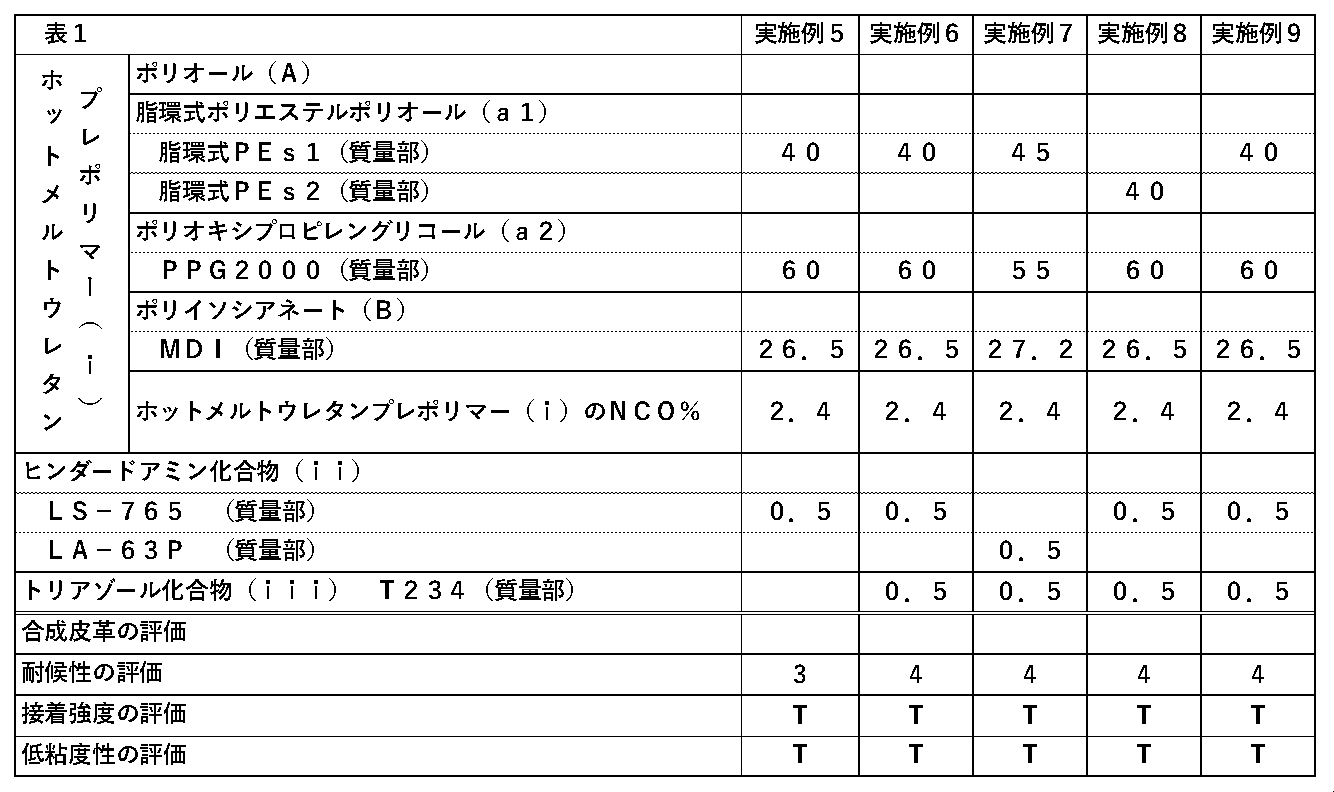
- Example 5 By placing 40 parts by mass of alicyclic PEs1 and 60 parts by mass of PPG2000 in a four-necked flask equipped with a thermometer, stirrer, inert gas inlet and reflux condenser, and mixing and heating at 100 ° C. under reduced pressure The flask was dehydrated until the water content in the flask was 0.05% by mass or less. Next, the inside of the flask is cooled to 90 ° C., 26.5 parts by mass of MDI melted at 70 ° C. is added, and the reaction is performed at 110 ° C. for about 3 hours under a nitrogen atmosphere until the isocyanate group content becomes constant.
- % 2.4% by mass of a hot-melt urethane prepolymer was obtained.
- bis (1,2,2,6,6-pentamethylpiperidin-4-yl) sebacate manufactured by Sankyo Co., Ltd., “Sanol LS-765”, hereinafter abbreviated as “LS-765”
- LS-765 bis (1,2,2,6,6-pentamethylpiperidin-4-yl) sebacate
- the moisture curable polyurethane hot melt resin composition melted at 110 ° C. for 1 hour is applied onto the skin layer so as to have a thickness of 30 ⁇ m using a comma coater.
- the epidermis and nipple layer were removed and bonded to the leather floor leather, and then left for 3 days under conditions of a temperature of 23 ° C. and a relative humidity of 65% to obtain split leather.
- Example 6 In the moisture curable polyurethane hot melt resin composition, 0.5 is added to the hot melt urethane prepolymer, a benzotriazole compound (“Tinvin (registered trademark) 234” manufactured by BASF, hereinafter abbreviated as “T234”)).
- T234 a benzotriazole compound manufactured by BASF, hereinafter abbreviated as “T234”.
- a moisture curable polyurethane hot melt resin composition was obtained in the same manner as in Example 1 except that it was further blended in mass% to produce a split leather.
- Example 7 Except that the moisture curable polyurethane hot melt resin composition was obtained with the types and amounts of polyol (A), polyisocyanate (B), hindered amine compound (ii) and triazole compound (iii) as shown in Table 2. In the same manner as in Example 6, a split leather was obtained.
- Measuring device High-speed GPC device (“HLC-8220GPC” manufactured by Tosoh Corporation) Column: The following columns manufactured by Tosoh Corporation were connected in series. "TSKgel G5000" (7.8 mm ID x 30 cm) x 1 "TSKgel G4000” (7.8 mm ID x 30 cm) x 1 "TSKgel G3000” (7.8 mm ID x 30 cm) x 1 “TSKgel G2000” (7.8 mm ID ⁇ 30 cm) ⁇ 1 detector: RI (differential refractometer) Column temperature: 40 ° C Eluent: Tetrahydrofuran (THF) Flow rate: 1.0 mL / min Injection amount: 100 ⁇ L (tetrahydrofuran solution with a sample concentration of 0.4 mass%) Standard sample: A calibration curve was prepared using the following standard polystyrene.
- Alicyclic PEs2 1,4-cyclohexanedimethanol and adipic acid reacted, number average molecular weight
- 1,000 “Aromatic PEs” reaction of diethylene glycol, neopentyl glycol, and terephthalic anhydride, number average molecular weight
- 1,000 “Aliphatic PEs” 1,4-butanediol and adipic acid reacted, number average molecular weight; 1,000)
- the synthetic leather of the present invention was found to have a cured product layer of a moisture curable polyurethane hot melt resin composition excellent in weather resistance, adhesive strength, and low viscosity.
- Comparative Example 1 is an embodiment in which an aromatic polyester polyol is used instead of the alicyclic polyester polyol (a1).
- the adhesive strength is excellent, the weather resistance and the low viscosity are poor. .
- Comparative Example 2 was an embodiment in which an aliphatic polyester polyol was used instead of the alicyclic polyester polyol (a1), but the adhesive strength was poor.
Landscapes
- Chemical & Material Sciences (AREA)
- Organic Chemistry (AREA)
- Chemical Kinetics & Catalysis (AREA)
- Health & Medical Sciences (AREA)
- Medicinal Chemistry (AREA)
- Polymers & Plastics (AREA)
- Dispersion Chemistry (AREA)
- Engineering & Computer Science (AREA)
- Textile Engineering (AREA)
- Polyurethanes Or Polyureas (AREA)
- Synthetic Leather, Interior Materials Or Flexible Sheet Materials (AREA)
- Adhesives Or Adhesive Processes (AREA)
Abstract
Description
温度計、撹拌機、不活性ガス導入口および還流冷却器を備えた四口フラスコに、脂環式ポリエステルポリオール(ネオペンチルグリコール、3-メチル-1,5-ペンタンジオール、及び、シクロヘキサンジカルボン酸を反応させたもの、数平均分子量;1,000、以下「脂環式PEs1」と略記する。)を40質量部、ポリオキシプロピレングリコール(数平均分子量;2,000、以下「PPG2000」と略記する。)を60質量部入れ、混合し、100℃で減圧加熱することにより、フラスコ内の水分が0.05質量%以下となるまで脱水した。
次いで、フラスコ内を90℃に冷却し、70℃で溶融した4,4’-ジフェニルメタンジイソシアネート(以下「MDI」と略記する。)を26.5質量部加え、窒素雰囲気下でイソシアネート基含有量が一定となるまで110℃で約3時間反応させることによって、NCO%;2.4質量%のホットメルトウレタンプレポリマーを得た。
次に、離型紙上に、溶剤系ウレタン樹脂(DIC株式会社製「クリスボンTF-50P-C」)を乾燥後の膜厚が30μmとなるように塗工し、120℃で10分間乾燥させ、表皮層を得た。次いで、この表皮層上に、110℃で1時間溶融した前記ホットメルトウレタンプレポリマーを、コンマコーターを使用して厚さ30μmとなるように塗工した後、牛の天然皮革から表皮と乳頭層とを取り除き、製革された床革と貼り合わせ、その後、温度23℃、相対湿度65%の条件下で3日間放置し、スプリットレザーを得た。
表1に示す通りのポリオール(A)とポリイソシアネート(B)との種類及び配合量にて、ホットメルトウレタンプレポリマーを得た以外は、実施例1と同様にしてスプリットレザーを得た。
温度計、撹拌機、不活性ガス導入口および還流冷却器を備えた四口フラスコに、脂環式PEs1を40質量部、PPG2000を60質量部入れ、混合し、100℃で減圧加熱することにより、フラスコ内の水分が0.05質量%以下となるまで脱水した。
次いで、フラスコ内を90℃に冷却し、70℃で溶融したMDIを26.5質量部加え、窒素雰囲気下でイソシアネート基含有量が一定となるまで110℃で約3時間反応させることによって、NCO%;2.4質量%のホットメルトウレタンプレポリマーを得た。これに、セバシン酸ビス(1,2,2,6,6-ペンタメチルピペリジン-4-イル)(三共株式会社製「サノールLS-765」、以下「LS-765」と略記する。)を0.5質量%配合し、湿気硬化型ポリウレタンホットメルト樹脂組成物を得た。
次に、離型紙上に、溶剤系ウレタン樹脂(DIC株式会社製「クリスボンTF-50P-C」)を乾燥後の膜厚が30μmとなるように塗工し、120℃で10分間乾燥させ、表皮層を得た。次いで、この表皮層上に、110℃で1時間溶融した前記湿気硬化型ポリウレタンホットメルト樹脂組成物を、コンマコーターを使用して厚さ30μmとなるように塗工した後、牛の天然皮革から表皮と乳頭層とを取り除き、製革された床革と貼り合わせ、その後、温度23℃、相対湿度65%の条件下で3日間放置し、スプリットレザーを得た。
前記湿気硬化型ポリウレタンホットメルト樹脂組成物において、ホットメルトウレタンプレポリマーに対して、ベンゾトリアゾール化合物(BASF社製「Tinuvin(登録商標)234」、以下「T234」と略記する。)を0.5質量%更に配合した以外は、実施例1と同様にして湿気硬化型ポリウレタンホットメルト樹脂組成物を得、スプリットレザーを作製した。
表2に示す通りのポリオール(A)とポリイソシアネート(B)とヒンダードアミン化合物(ii)とトリアゾール化合物(iii)の種類及び配合量にて、湿気硬化型ポリウレタンホットメルト樹脂組成物を得た以外は、実施例6と同様にしてスプリットレザーを得た。
実施例及び比較例で用いたポリオール等の数平均分子量は、ゲル・パーミエーション・クロマトグラフィー(GPC)法により、下記の条件で測定した値を示す。
カラム:東ソー株式会社製の下記のカラムを直列に接続して使用した。
「TSKgel G5000」(7.8mmI.D.×30cm)×1本
「TSKgel G4000」(7.8mmI.D.×30cm)×1本
「TSKgel G3000」(7.8mmI.D.×30cm)×1本
「TSKgel G2000」(7.8mmI.D.×30cm)×1本
検出器:RI(示差屈折計)
カラム温度:40℃
溶離液:テトラヒドロフラン(THF)
流速:1.0mL/分
注入量:100μL(試料濃度0.4質量%のテトラヒドロフラン溶液)
標準試料:下記の標準ポリスチレンを用いて検量線を作成した。
東ソー株式会社製「TSKgel 標準ポリスチレン A-500」
東ソー株式会社製「TSKgel 標準ポリスチレン A-1000」
東ソー株式会社製「TSKgel 標準ポリスチレン A-2500」
東ソー株式会社製「TSKgel 標準ポリスチレン A-5000」
東ソー株式会社製「TSKgel 標準ポリスチレン F-1」
東ソー株式会社製「TSKgel 標準ポリスチレン F-2」
東ソー株式会社製「TSKgel 標準ポリスチレン F-4」
東ソー株式会社製「TSKgel 標準ポリスチレン F-10」
東ソー株式会社製「TSKgel 標準ポリスチレン F-20」
東ソー株式会社製「TSKgel 標準ポリスチレン F-40」
東ソー株式会社製「TSKgel 標準ポリスチレン F-80」
東ソー株式会社製「TSKgel 標準ポリスチレン F-128」
東ソー株式会社製「TSKgel 標準ポリスチレン F-288」
東ソー株式会社製「TSKgel 標準ポリスチレン F-550」
実施例、及び比較例にて得られたウレタンプレポリマーを110℃で1時間溶融した後、110℃にあらかじめ加温したホットプレート上に置いた離型紙上に100μmで塗工した。この塗工品を、25℃、湿度50%にて24時間保管しキュアを行うことでフィルムを得た。このフィルムを使用して、UVA-340電球(UV照射量:0.78W/m2、温度45℃)を搭載したQUV促進耐候性試験機「QUV/basic」を使用してUV照射試験を行い、UV照射前後の変色の差(ΔE)により、耐候性の評価を以下のように評価した。
「4」;ΔEが10以下である。
「3」;ΔEが10を超えて13以下である。
「2」;ΔEが13を超えて15以下である。
「1」;ΔEが15を超える。
実施例、及び比較例にて得られたウレタンプレポリマーを120℃で1時間溶融した後、110℃にあらかじめ加温したホットプレート上に置いたPETフィルムに100μmで塗工した。塗工後ただちにPETフィルムをホットプレートから外し、直ちに別のPETフィルムをハンドローラーにて貼り合わせた。貼り合わせ後、試験片を1インチ幅に裁断し、デジタルフォースゲージ(株式会社イマアダ製「DS2-220N」)を使用して、貼り合わせ1分後のPET間の剥離強度を測定し、初期強度を以下のように評価した。
「T」;5N/inch以上
「F」;5N/inch未満
実施例、及び、比較例で得られたウレタンプレポリマーを、120℃で1時間溶融した後、1mlをサンプリングし、コーンプレート粘度計(40Pコーン、ローター回転数;50rpm)にて溶融粘度を測定し、以下のように評価した。
「T」;4,000mPa・s未満
「F」;4,000mPa・s以上

「脂環式PEs2」:1,4-シクロヘキサンジメタノール、及び、アジピン酸を反応させたもの、数平均分子量;1,000
「芳香族PEs」;ジエチレングリコール、ネオペンチルグリコール、及び無水テレフタル酸を反応させたもの、数平均分子量;1,000
「脂肪族PEs」;1,4-ブタンジオール、及びアジピン酸を反応させたもの、数平均分子量;1,000)
Claims (8)
- 脂環式ポリエステルポリオール(a1)を含むポリオール(A)、及び、ポリイソシアネート(B)の反応物であるホットメルトウレタンプレポリマー(i)を含有する湿気硬化型ポリウレタンホットメルト樹脂組成物により形成された層を有することを特徴とする合成皮革。
- 前記ポリオール(A)が、更に、ポリオキシプロピレングリコール(a2)を含むものである請求項1記載の合成皮革。
- ヒンダードアミン化合物(ii)を更に含有するものである請求項1又は2記載の合成皮革。
- 前記ヒンダードアミン化合物(ii)の含有量が、前記ホットメルトウレタンプレポリマー(i)100質量部に対して、0.01~10質量部の範囲である請求項3記載の合成皮革。
- トリアゾール化合物(iii)を更に含有するものである請求項3又は4記載の合成皮革。
- 前記トリアゾール化合物(iii)の含有量が、前記ホットメルトウレタンプレポリマー(i)100質量部に対して、0.01~10質量部の範囲である請求項5記載の合成皮革。
- 前記トリアゾール化合物(iii)が、ベンゾトリアゾール化合物である請求項5又は6記載の合成皮革。
- スプリットレザーである、請求項1~7のいずれか1項記載の合成皮革。
Priority Applications (3)
| Application Number | Priority Date | Filing Date | Title |
|---|---|---|---|
| CN201780070043.9A CN109963980B (zh) | 2016-12-16 | 2017-10-26 | 合成皮革 |
| JP2018520001A JP6355010B1 (ja) | 2016-12-16 | 2017-10-26 | 合成皮革 |
| KR1020197010097A KR102269803B1 (ko) | 2016-12-16 | 2017-10-26 | 합성 피혁 |
Applications Claiming Priority (4)
| Application Number | Priority Date | Filing Date | Title |
|---|---|---|---|
| JP2016-244383 | 2016-12-16 | ||
| JP2016-244382 | 2016-12-16 | ||
| JP2016244382 | 2016-12-16 | ||
| JP2016244383 | 2016-12-16 |
Publications (1)
| Publication Number | Publication Date |
|---|---|
| WO2018110106A1 true WO2018110106A1 (ja) | 2018-06-21 |
Family
ID=62558784
Family Applications (1)
| Application Number | Title | Priority Date | Filing Date |
|---|---|---|---|
| PCT/JP2017/038611 Ceased WO2018110106A1 (ja) | 2016-12-16 | 2017-10-26 | 合成皮革 |
Country Status (5)
| Country | Link |
|---|---|
| JP (1) | JP6355010B1 (ja) |
| KR (1) | KR102269803B1 (ja) |
| CN (1) | CN109963980B (ja) |
| TW (1) | TWI680997B (ja) |
| WO (1) | WO2018110106A1 (ja) |
Cited By (5)
| Publication number | Priority date | Publication date | Assignee | Title |
|---|---|---|---|---|
| JP6485726B1 (ja) * | 2017-09-25 | 2019-03-20 | Dic株式会社 | 合成皮革の製造方法 |
| WO2020129603A1 (ja) * | 2018-12-17 | 2020-06-25 | Dic株式会社 | 合成皮革 |
| WO2021054128A1 (ja) * | 2019-09-20 | 2021-03-25 | Dic株式会社 | 湿気硬化型ポリウレタン樹脂組成物、接着剤、及び、積層体 |
| JP2022114432A (ja) * | 2021-01-26 | 2022-08-05 | Dic株式会社 | 湿気硬化型ポリウレタンホットメルト樹脂組成物、硬化物及び積層体 |
| JP2022152670A (ja) * | 2021-03-29 | 2022-10-12 | 昭和電工マテリアルズ株式会社 | 反応性ホットメルト接着剤、接着体及びその製造方法、並びに衣類 |
Families Citing this family (2)
| Publication number | Priority date | Publication date | Assignee | Title |
|---|---|---|---|---|
| JP3249304B2 (ja) | 1993-11-24 | 2002-01-21 | 株式会社東芝 | 流量測定装置 |
| CN110878033B (zh) * | 2019-12-05 | 2022-04-22 | 万华化学集团股份有限公司 | 一种功能型降色剂以及稳定二异氰酸酯产品的色号的方法 |
Citations (6)
| Publication number | Priority date | Publication date | Assignee | Title |
|---|---|---|---|---|
| JPH09309939A (ja) * | 1996-05-23 | 1997-12-02 | Dainippon Ink & Chem Inc | ポリウレタン樹脂組成物及びその製造方法 |
| JPH1077325A (ja) * | 1996-09-03 | 1998-03-24 | Kuraray Co Ltd | ポリウレタンの製造方法 |
| JP2005194353A (ja) * | 2004-01-06 | 2005-07-21 | Sanyo Chem Ind Ltd | 反応性ホットメルト接着剤 |
| JP2009537669A (ja) * | 2006-05-18 | 2009-10-29 | ダウ グローバル テクノロジーズ インコーポレイティド | シクロヘキサンジメタノールから誘導されるポリウレタン−ウレアポリマー |
| JP2011523608A (ja) * | 2008-06-09 | 2011-08-18 | ビーエーエスエフ ソシエタス・ヨーロピア | 水蒸気透過性のプラスチック箔を含む多層複合材料、その製造方法、その利用方法 |
| JP2014181283A (ja) * | 2013-03-19 | 2014-09-29 | Dic Corp | ポリウレタン樹脂用組成物及びこれを用いたポリウレタン樹脂発泡体 |
Family Cites Families (14)
| Publication number | Priority date | Publication date | Assignee | Title |
|---|---|---|---|---|
| DE10161863A1 (de) * | 2001-12-14 | 2003-07-03 | Basf Ag | Stabilisatorzusammensetzung II |
| JP4107032B2 (ja) * | 2002-09-27 | 2008-06-25 | Dic株式会社 | 無溶剤型湿気硬化性ホットメルトウレタン樹脂組成物、発泡体、及びそれを用いたシート構造体 |
| JP3767826B2 (ja) * | 2004-02-26 | 2006-04-19 | 大日本インキ化学工業株式会社 | 皮革様シートの製造方法 |
| WO2005097933A1 (ja) * | 2004-04-09 | 2005-10-20 | Dainippon Ink And Chemicals, Inc. | 湿気硬化型ポリウレタンホットメルト接着剤 |
| US20100249291A1 (en) * | 2006-08-31 | 2010-09-30 | Ube Industries, Ltd. | Reactive hot-melt composition and molded article using the same |
| JP5340647B2 (ja) | 2008-06-12 | 2013-11-13 | セーレン株式会社 | スプリットレザー |
| JP5787141B2 (ja) * | 2011-06-17 | 2015-09-30 | Dic株式会社 | 湿気硬化型ポリウレタンホットメルト接着剤、及び造作部材 |
| CN102408825A (zh) * | 2011-09-14 | 2012-04-11 | 吴江市汇丰材料科技有限公司 | 一种单组份热固化聚氨酯弹性体组合物及制备方法 |
| TWI534165B (zh) * | 2011-10-24 | 2016-05-21 | 迪愛生股份有限公司 | 濕氣硬化型聚胺基甲酸酯熱熔樹脂組成物、接著劑及物品 |
| KR101529152B1 (ko) * | 2012-06-11 | 2015-06-24 | 주식회사 덕성 | 폴리우레탄 발포 시트의 제조방법 및 그것을 사용한 피혁 유사 시트형상물 |
| JP6045908B2 (ja) * | 2012-12-21 | 2016-12-14 | ヘンケルジャパン株式会社 | 湿気硬化型ホットメルト接着剤 |
| CN104031225B (zh) * | 2013-03-06 | 2016-11-09 | 万华化学集团股份有限公司 | 一种用于合成革粘合剂的水性聚氨酯分散体及其制备方法 |
| JP6330499B2 (ja) * | 2014-06-12 | 2018-05-30 | Dic株式会社 | 湿気硬化型ポリウレタンホットメルト接着剤 |
| CN107109177A (zh) * | 2014-09-26 | 2017-08-29 | 汉高股份有限及两合公司 | 反应性聚氨酯热熔粘合剂及其用途 |
-
2017
- 2017-10-26 KR KR1020197010097A patent/KR102269803B1/ko active Active
- 2017-10-26 CN CN201780070043.9A patent/CN109963980B/zh active Active
- 2017-10-26 JP JP2018520001A patent/JP6355010B1/ja active Active
- 2017-10-26 WO PCT/JP2017/038611 patent/WO2018110106A1/ja not_active Ceased
- 2017-11-03 TW TW106138148A patent/TWI680997B/zh active
Patent Citations (6)
| Publication number | Priority date | Publication date | Assignee | Title |
|---|---|---|---|---|
| JPH09309939A (ja) * | 1996-05-23 | 1997-12-02 | Dainippon Ink & Chem Inc | ポリウレタン樹脂組成物及びその製造方法 |
| JPH1077325A (ja) * | 1996-09-03 | 1998-03-24 | Kuraray Co Ltd | ポリウレタンの製造方法 |
| JP2005194353A (ja) * | 2004-01-06 | 2005-07-21 | Sanyo Chem Ind Ltd | 反応性ホットメルト接着剤 |
| JP2009537669A (ja) * | 2006-05-18 | 2009-10-29 | ダウ グローバル テクノロジーズ インコーポレイティド | シクロヘキサンジメタノールから誘導されるポリウレタン−ウレアポリマー |
| JP2011523608A (ja) * | 2008-06-09 | 2011-08-18 | ビーエーエスエフ ソシエタス・ヨーロピア | 水蒸気透過性のプラスチック箔を含む多層複合材料、その製造方法、その利用方法 |
| JP2014181283A (ja) * | 2013-03-19 | 2014-09-29 | Dic Corp | ポリウレタン樹脂用組成物及びこれを用いたポリウレタン樹脂発泡体 |
Cited By (13)
| Publication number | Priority date | Publication date | Assignee | Title |
|---|---|---|---|---|
| JP6485726B1 (ja) * | 2017-09-25 | 2019-03-20 | Dic株式会社 | 合成皮革の製造方法 |
| WO2019058804A1 (ja) * | 2017-09-25 | 2019-03-28 | Dic株式会社 | 合成皮革の製造方法 |
| WO2020129603A1 (ja) * | 2018-12-17 | 2020-06-25 | Dic株式会社 | 合成皮革 |
| JPWO2020129603A1 (ja) * | 2018-12-17 | 2021-02-15 | Dic株式会社 | 合成皮革 |
| KR102614433B1 (ko) * | 2018-12-17 | 2023-12-15 | 디아이씨 가부시끼가이샤 | 합성 피혁 |
| KR20210062084A (ko) * | 2018-12-17 | 2021-05-28 | 디아이씨 가부시끼가이샤 | 합성 피혁 |
| JPWO2021054128A1 (ja) * | 2019-09-20 | 2021-11-25 | Dic株式会社 | 湿気硬化型ポリウレタン樹脂組成物、接着剤、及び、積層体 |
| CN114222772A (zh) * | 2019-09-20 | 2022-03-22 | Dic株式会社 | 湿气硬化型聚氨基甲酸酯树脂组合物、接着剂及层叠体 |
| CN114222772B (zh) * | 2019-09-20 | 2023-12-08 | Dic株式会社 | 湿气硬化型聚氨基甲酸酯热熔树脂组合物、接着剂及层叠体 |
| WO2021054128A1 (ja) * | 2019-09-20 | 2021-03-25 | Dic株式会社 | 湿気硬化型ポリウレタン樹脂組成物、接着剤、及び、積層体 |
| JP2022114432A (ja) * | 2021-01-26 | 2022-08-05 | Dic株式会社 | 湿気硬化型ポリウレタンホットメルト樹脂組成物、硬化物及び積層体 |
| JP7828030B2 (ja) | 2021-01-26 | 2026-03-11 | Dic株式会社 | 湿気硬化型ポリウレタンホットメルト樹脂組成物、硬化物及び積層体 |
| JP2022152670A (ja) * | 2021-03-29 | 2022-10-12 | 昭和電工マテリアルズ株式会社 | 反応性ホットメルト接着剤、接着体及びその製造方法、並びに衣類 |
Also Published As
| Publication number | Publication date |
|---|---|
| CN109963980B (zh) | 2021-08-17 |
| CN109963980A (zh) | 2019-07-02 |
| TWI680997B (zh) | 2020-01-01 |
| TW201825552A (zh) | 2018-07-16 |
| JPWO2018110106A1 (ja) | 2018-12-13 |
| JP6355010B1 (ja) | 2018-07-11 |
| KR20190045334A (ko) | 2019-05-02 |
| KR102269803B1 (ko) | 2021-06-28 |
Similar Documents
| Publication | Publication Date | Title |
|---|---|---|
| JP6355010B1 (ja) | 合成皮革 | |
| JP6753550B2 (ja) | 湿気硬化型ポリウレタンホットメルト樹脂組成物 | |
| CN110088162B (zh) | 湿固化型聚氨酯热熔树脂组合物、层叠体和鞋 | |
| JP6481801B2 (ja) | 湿気硬化型ポリウレタンホットメルト樹脂組成物、及び、積層体 | |
| JP6850398B2 (ja) | ポリウレタンプレポリマー、接着剤、及び合成擬革 | |
| JP6330499B2 (ja) | 湿気硬化型ポリウレタンホットメルト接着剤 | |
| WO2018110105A1 (ja) | 水性ウレタン樹脂組成物、及び、合成皮革 | |
| JP6836713B2 (ja) | 湿気硬化型ポリウレタンホットメルト組成物 | |
| WO2021025093A1 (ja) | 湿気硬化型ポリウレタンホットメルト樹脂組成物 | |
| EP3816344B1 (en) | Synthetic leather | |
| JP6972532B2 (ja) | 湿気硬化型ポリウレタンホットメルト組成物 | |
| JP7196435B2 (ja) | 湿気硬化型ポリウレタンホットメルト樹脂組成物 | |
| JP7400257B2 (ja) | 湿気硬化型ポリウレタンホットメルト樹脂組成物、及び、その硬化物 | |
| WO2020129603A1 (ja) | 合成皮革 | |
| WO2019163621A1 (ja) | 湿気硬化型ポリウレタンホットメルト樹脂組成物、及び、その硬化物 | |
| JP6733836B2 (ja) | 湿気硬化型ポリウレタンホットメルト樹脂組成物 | |
| JP7453634B2 (ja) | 湿気硬化型ポリウレタンホットメルト樹脂組成物、接着剤、及び、工業用ベルト | |
| JP2020002261A (ja) | 湿気硬化型ポリウレタンホットメルト樹脂組成物 | |
| TW202342278A (zh) | 積層體及框架 | |
| WO2025164318A1 (ja) | 湿気硬化型ポリウレタンホットメルト樹脂組成物、接着剤 |
Legal Events
| Date | Code | Title | Description |
|---|---|---|---|
| ENP | Entry into the national phase |
Ref document number: 2018520001 Country of ref document: JP Kind code of ref document: A |
|
| 121 | Ep: the epo has been informed by wipo that ep was designated in this application |
Ref document number: 17881774 Country of ref document: EP Kind code of ref document: A1 |
|
| ENP | Entry into the national phase |
Ref document number: 20197010097 Country of ref document: KR Kind code of ref document: A |
|
| NENP | Non-entry into the national phase |
Ref country code: DE |
|
| 122 | Ep: pct application non-entry in european phase |
Ref document number: 17881774 Country of ref document: EP Kind code of ref document: A1 |