WO2017170934A1 - 新規化合物とその合成方法 - Google Patents
新規化合物とその合成方法 Download PDFInfo
- Publication number
- WO2017170934A1 WO2017170934A1 PCT/JP2017/013404 JP2017013404W WO2017170934A1 WO 2017170934 A1 WO2017170934 A1 WO 2017170934A1 JP 2017013404 W JP2017013404 W JP 2017013404W WO 2017170934 A1 WO2017170934 A1 WO 2017170934A1
- Authority
- WO
- WIPO (PCT)
- Prior art keywords
- group
- general formula
- compound
- compound represented
- polymerizable
- Prior art date
- Legal status (The legal status is an assumption and is not a legal conclusion. Google has not performed a legal analysis and makes no representation as to the accuracy of the status listed.)
- Ceased
Links
Images


Classifications
-
- B—PERFORMING OPERATIONS; TRANSPORTING
- B01—PHYSICAL OR CHEMICAL PROCESSES OR APPARATUS IN GENERAL
- B01J—CHEMICAL OR PHYSICAL PROCESSES, e.g. CATALYSIS OR COLLOID CHEMISTRY; THEIR RELEVANT APPARATUS
- B01J39/00—Cation exchange; Use of material as cation exchangers; Treatment of material for improving the cation exchange properties
- B01J39/08—Use of material as cation exchangers; Treatment of material for improving the cation exchange properties
- B01J39/16—Organic material
- B01J39/18—Macromolecular compounds
- B01J39/20—Macromolecular compounds obtained by reactions only involving unsaturated carbon-to-carbon bonds
-
- B—PERFORMING OPERATIONS; TRANSPORTING
- B01—PHYSICAL OR CHEMICAL PROCESSES OR APPARATUS IN GENERAL
- B01J—CHEMICAL OR PHYSICAL PROCESSES, e.g. CATALYSIS OR COLLOID CHEMISTRY; THEIR RELEVANT APPARATUS
- B01J20/00—Solid sorbent compositions or filter aid compositions; Sorbents for chromatography; Processes for preparing, regenerating or reactivating thereof
- B01J20/22—Solid sorbent compositions or filter aid compositions; Sorbents for chromatography; Processes for preparing, regenerating or reactivating thereof comprising organic material
- B01J20/223—Solid sorbent compositions or filter aid compositions; Sorbents for chromatography; Processes for preparing, regenerating or reactivating thereof comprising organic material containing metals, e.g. organo-metallic compounds, coordination complexes
-
- B—PERFORMING OPERATIONS; TRANSPORTING
- B01—PHYSICAL OR CHEMICAL PROCESSES OR APPARATUS IN GENERAL
- B01J—CHEMICAL OR PHYSICAL PROCESSES, e.g. CATALYSIS OR COLLOID CHEMISTRY; THEIR RELEVANT APPARATUS
- B01J20/00—Solid sorbent compositions or filter aid compositions; Sorbents for chromatography; Processes for preparing, regenerating or reactivating thereof
- B01J20/22—Solid sorbent compositions or filter aid compositions; Sorbents for chromatography; Processes for preparing, regenerating or reactivating thereof comprising organic material
- B01J20/26—Synthetic macromolecular compounds
- B01J20/261—Synthetic macromolecular compounds obtained by reactions only involving carbon to carbon unsaturated bonds
-
- B—PERFORMING OPERATIONS; TRANSPORTING
- B01—PHYSICAL OR CHEMICAL PROCESSES OR APPARATUS IN GENERAL
- B01J—CHEMICAL OR PHYSICAL PROCESSES, e.g. CATALYSIS OR COLLOID CHEMISTRY; THEIR RELEVANT APPARATUS
- B01J39/00—Cation exchange; Use of material as cation exchangers; Treatment of material for improving the cation exchange properties
- B01J39/04—Processes using organic exchangers
- B01J39/07—Processes using organic exchangers in the weakly acidic form
-
- C—CHEMISTRY; METALLURGY
- C02—TREATMENT OF WATER, WASTE WATER, SEWAGE, OR SLUDGE
- C02F—TREATMENT OF WATER, WASTE WATER, SEWAGE, OR SLUDGE
- C02F1/00—Treatment of water, waste water, or sewage
- C02F1/42—Treatment of water, waste water, or sewage by ion-exchange
-
- C—CHEMISTRY; METALLURGY
- C02—TREATMENT OF WATER, WASTE WATER, SEWAGE, OR SLUDGE
- C02F—TREATMENT OF WATER, WASTE WATER, SEWAGE, OR SLUDGE
- C02F1/00—Treatment of water, waste water, or sewage
- C02F1/68—Treatment of water, waste water, or sewage by addition of specified substances, e.g. trace elements, for ameliorating potable water
- C02F1/683—Treatment of water, waste water, or sewage by addition of specified substances, e.g. trace elements, for ameliorating potable water by addition of complex-forming compounds
-
- C—CHEMISTRY; METALLURGY
- C07—ORGANIC CHEMISTRY
- C07C—ACYCLIC OR CARBOCYCLIC COMPOUNDS
- C07C269/00—Preparation of derivatives of carbamic acid, i.e. compounds containing any of the groups, the nitrogen atom not being part of nitro or nitroso groups
- C07C269/02—Preparation of derivatives of carbamic acid, i.e. compounds containing any of the groups, the nitrogen atom not being part of nitro or nitroso groups from isocyanates with formation of carbamate groups
-
- C—CHEMISTRY; METALLURGY
- C07—ORGANIC CHEMISTRY
- C07C—ACYCLIC OR CARBOCYCLIC COMPOUNDS
- C07C269/00—Preparation of derivatives of carbamic acid, i.e. compounds containing any of the groups, the nitrogen atom not being part of nitro or nitroso groups
- C07C269/06—Preparation of derivatives of carbamic acid, i.e. compounds containing any of the groups, the nitrogen atom not being part of nitro or nitroso groups by reactions not involving the formation of carbamate groups
-
- C—CHEMISTRY; METALLURGY
- C07—ORGANIC CHEMISTRY
- C07C—ACYCLIC OR CARBOCYCLIC COMPOUNDS
- C07C271/00—Derivatives of carbamic acids, i.e. compounds containing any of the groups, the nitrogen atom not being part of nitro or nitroso groups
- C07C271/06—Esters of carbamic acids
- C07C271/40—Esters of carbamic acids having oxygen atoms of carbamate groups bound to carbon atoms of six-membered aromatic rings
- C07C271/42—Esters of carbamic acids having oxygen atoms of carbamate groups bound to carbon atoms of six-membered aromatic rings with the nitrogen atoms of the carbamate groups bound to hydrogen atoms or to acyclic carbon atoms
- C07C271/48—Esters of carbamic acids having oxygen atoms of carbamate groups bound to carbon atoms of six-membered aromatic rings with the nitrogen atoms of the carbamate groups bound to hydrogen atoms or to acyclic carbon atoms to carbon atoms of hydrocarbon radicals substituted by singly-bound oxygen atoms
-
- C—CHEMISTRY; METALLURGY
- C07—ORGANIC CHEMISTRY
- C07C—ACYCLIC OR CARBOCYCLIC COMPOUNDS
- C07C45/00—Preparation of compounds having >C = O groups bound only to carbon or hydrogen atoms; Preparation of chelates of such compounds
- C07C45/61—Preparation of compounds having >C = O groups bound only to carbon or hydrogen atoms; Preparation of chelates of such compounds by reactions not involving the formation of >C = O groups
- C07C45/67—Preparation of compounds having >C = O groups bound only to carbon or hydrogen atoms; Preparation of chelates of such compounds by reactions not involving the formation of >C = O groups by isomerisation; by change of size of the carbon skeleton
- C07C45/68—Preparation of compounds having >C = O groups bound only to carbon or hydrogen atoms; Preparation of chelates of such compounds by reactions not involving the formation of >C = O groups by isomerisation; by change of size of the carbon skeleton by increase in the number of carbon atoms
-
- C—CHEMISTRY; METALLURGY
- C07—ORGANIC CHEMISTRY
- C07C—ACYCLIC OR CARBOCYCLIC COMPOUNDS
- C07C49/00—Ketones; Ketenes; Dimeric ketenes; Ketonic chelates
- C07C49/76—Ketones containing a keto group bound to a six-membered aromatic ring
- C07C49/82—Ketones containing a keto group bound to a six-membered aromatic ring containing hydroxy groups
- C07C49/825—Ketones containing a keto group bound to a six-membered aromatic ring containing hydroxy groups all hydroxy groups bound to the ring
-
- C—CHEMISTRY; METALLURGY
- C07—ORGANIC CHEMISTRY
- C07C—ACYCLIC OR CARBOCYCLIC COMPOUNDS
- C07C49/00—Ketones; Ketenes; Dimeric ketenes; Ketonic chelates
- C07C49/92—Ketonic chelates
-
- C—CHEMISTRY; METALLURGY
- C07—ORGANIC CHEMISTRY
- C07C—ACYCLIC OR CARBOCYCLIC COMPOUNDS
- C07C67/00—Preparation of carboxylic acid esters
- C07C67/30—Preparation of carboxylic acid esters by modifying the acid moiety of the ester, such modification not being an introduction of an ester group
- C07C67/333—Preparation of carboxylic acid esters by modifying the acid moiety of the ester, such modification not being an introduction of an ester group by isomerisation; by change of size of the carbon skeleton
- C07C67/343—Preparation of carboxylic acid esters by modifying the acid moiety of the ester, such modification not being an introduction of an ester group by isomerisation; by change of size of the carbon skeleton by increase in the number of carbon atoms
-
- C—CHEMISTRY; METALLURGY
- C07—ORGANIC CHEMISTRY
- C07C—ACYCLIC OR CARBOCYCLIC COMPOUNDS
- C07C69/00—Esters of carboxylic acids; Esters of carbonic or haloformic acids
- C07C69/66—Esters of carboxylic acids having esterified carboxylic groups bound to acyclic carbon atoms and having any of the groups OH, O—metal, —CHO, keto, ether, acyloxy, groups, groups, or in the acid moiety
- C07C69/67—Esters of carboxylic acids having esterified carboxylic groups bound to acyclic carbon atoms and having any of the groups OH, O—metal, —CHO, keto, ether, acyloxy, groups, groups, or in the acid moiety of saturated acids
- C07C69/716—Esters of keto-carboxylic acids or aldehydo-carboxylic acids
-
- C—CHEMISTRY; METALLURGY
- C07—ORGANIC CHEMISTRY
- C07F—ACYCLIC, CARBOCYCLIC OR HETEROCYCLIC COMPOUNDS CONTAINING ELEMENTS OTHER THAN CARBON, HYDROGEN, HALOGEN, OXYGEN, NITROGEN, SULFUR, SELENIUM OR TELLURIUM
- C07F1/00—Compounds containing elements of Groups 1 or 11 of the Periodic Table
- C07F1/005—Compounds containing elements of Groups 1 or 11 of the Periodic Table without C-Metal linkages
-
- C—CHEMISTRY; METALLURGY
- C07—ORGANIC CHEMISTRY
- C07F—ACYCLIC, CARBOCYCLIC OR HETEROCYCLIC COMPOUNDS CONTAINING ELEMENTS OTHER THAN CARBON, HYDROGEN, HALOGEN, OXYGEN, NITROGEN, SULFUR, SELENIUM OR TELLURIUM
- C07F1/00—Compounds containing elements of Groups 1 or 11 of the Periodic Table
- C07F1/02—Lithium compounds
-
- C—CHEMISTRY; METALLURGY
- C07—ORGANIC CHEMISTRY
- C07F—ACYCLIC, CARBOCYCLIC OR HETEROCYCLIC COMPOUNDS CONTAINING ELEMENTS OTHER THAN CARBON, HYDROGEN, HALOGEN, OXYGEN, NITROGEN, SULFUR, SELENIUM OR TELLURIUM
- C07F9/00—Compounds containing elements of Groups 5 or 15 of the Periodic Table
- C07F9/02—Phosphorus compounds
- C07F9/28—Phosphorus compounds with one or more P—C bonds
- C07F9/50—Organo-phosphines
- C07F9/53—Organo-phosphine oxides; Organo-phosphine thioxides
- C07F9/5304—Acyclic saturated phosphine oxides or thioxides
-
- C—CHEMISTRY; METALLURGY
- C07—ORGANIC CHEMISTRY
- C07F—ACYCLIC, CARBOCYCLIC OR HETEROCYCLIC COMPOUNDS CONTAINING ELEMENTS OTHER THAN CARBON, HYDROGEN, HALOGEN, OXYGEN, NITROGEN, SULFUR, SELENIUM OR TELLURIUM
- C07F9/00—Compounds containing elements of Groups 5 or 15 of the Periodic Table
- C07F9/02—Phosphorus compounds
- C07F9/28—Phosphorus compounds with one or more P—C bonds
- C07F9/50—Organo-phosphines
- C07F9/53—Organo-phosphine oxides; Organo-phosphine thioxides
- C07F9/5325—Aromatic phosphine oxides or thioxides (P-C aromatic linkage)
-
- C—CHEMISTRY; METALLURGY
- C07—ORGANIC CHEMISTRY
- C07F—ACYCLIC, CARBOCYCLIC OR HETEROCYCLIC COMPOUNDS CONTAINING ELEMENTS OTHER THAN CARBON, HYDROGEN, HALOGEN, OXYGEN, NITROGEN, SULFUR, SELENIUM OR TELLURIUM
- C07F9/00—Compounds containing elements of Groups 5 or 15 of the Periodic Table
- C07F9/02—Phosphorus compounds
- C07F9/28—Phosphorus compounds with one or more P—C bonds
- C07F9/50—Organo-phosphines
- C07F9/53—Organo-phosphine oxides; Organo-phosphine thioxides
- C07F9/5329—Polyphosphine oxides or thioxides
-
- C—CHEMISTRY; METALLURGY
- C07—ORGANIC CHEMISTRY
- C07F—ACYCLIC, CARBOCYCLIC OR HETEROCYCLIC COMPOUNDS CONTAINING ELEMENTS OTHER THAN CARBON, HYDROGEN, HALOGEN, OXYGEN, NITROGEN, SULFUR, SELENIUM OR TELLURIUM
- C07F9/00—Compounds containing elements of Groups 5 or 15 of the Periodic Table
- C07F9/02—Phosphorus compounds
- C07F9/547—Heterocyclic compounds, e.g. containing phosphorus as a ring hetero atom
- C07F9/6564—Heterocyclic compounds, e.g. containing phosphorus as a ring hetero atom having phosphorus atoms, with or without nitrogen, oxygen, sulfur, selenium or tellurium atoms, as ring hetero atoms
- C07F9/6568—Heterocyclic compounds, e.g. containing phosphorus as a ring hetero atom having phosphorus atoms, with or without nitrogen, oxygen, sulfur, selenium or tellurium atoms, as ring hetero atoms having phosphorus atoms as the only ring hetero atoms
- C07F9/65685—Heterocyclic compounds, e.g. containing phosphorus as a ring hetero atom having phosphorus atoms, with or without nitrogen, oxygen, sulfur, selenium or tellurium atoms, as ring hetero atoms having phosphorus atoms as the only ring hetero atoms the ring phosphorus atom being part of a phosphine oxide or thioxide
-
- C—CHEMISTRY; METALLURGY
- C08—ORGANIC MACROMOLECULAR COMPOUNDS; THEIR PREPARATION OR CHEMICAL WORKING-UP; COMPOSITIONS BASED THEREON
- C08F—MACROMOLECULAR COMPOUNDS OBTAINED BY REACTIONS ONLY INVOLVING CARBON-TO-CARBON UNSATURATED BONDS
- C08F22/00—Homopolymers and copolymers of compounds having one or more unsaturated aliphatic radicals each having only one carbon-to-carbon double bond, and at least one being terminated by a carboxyl radical and containing at least one other carboxyl radical in the molecule; Salts, anhydrides, esters, amides, imides or nitriles thereof
- C08F22/10—Esters
- C08F22/12—Esters of phenols or saturated alcohols
- C08F22/20—Esters containing oxygen in addition to the carboxy oxygen
-
- C—CHEMISTRY; METALLURGY
- C08—ORGANIC MACROMOLECULAR COMPOUNDS; THEIR PREPARATION OR CHEMICAL WORKING-UP; COMPOSITIONS BASED THEREON
- C08F—MACROMOLECULAR COMPOUNDS OBTAINED BY REACTIONS ONLY INVOLVING CARBON-TO-CARBON UNSATURATED BONDS
- C08F236/00—Copolymers of compounds having one or more unsaturated aliphatic radicals, at least one having two or more carbon-to-carbon double bonds
- C08F236/02—Copolymers of compounds having one or more unsaturated aliphatic radicals, at least one having two or more carbon-to-carbon double bonds the radical having only two carbon-to-carbon double bonds
- C08F236/04—Copolymers of compounds having one or more unsaturated aliphatic radicals, at least one having two or more carbon-to-carbon double bonds the radical having only two carbon-to-carbon double bonds conjugated
- C08F236/045—Copolymers of compounds having one or more unsaturated aliphatic radicals, at least one having two or more carbon-to-carbon double bonds the radical having only two carbon-to-carbon double bonds conjugated conjugated hydrocarbons other than butadiene or isoprene
-
- C—CHEMISTRY; METALLURGY
- C08—ORGANIC MACROMOLECULAR COMPOUNDS; THEIR PREPARATION OR CHEMICAL WORKING-UP; COMPOSITIONS BASED THEREON
- C08F—MACROMOLECULAR COMPOUNDS OBTAINED BY REACTIONS ONLY INVOLVING CARBON-TO-CARBON UNSATURATED BONDS
- C08F36/00—Homopolymers and copolymers of compounds having one or more unsaturated aliphatic radicals, at least one having two or more carbon-to-carbon double bonds
- C08F36/02—Homopolymers and copolymers of compounds having one or more unsaturated aliphatic radicals, at least one having two or more carbon-to-carbon double bonds the radical having only two carbon-to-carbon double bonds
- C08F36/04—Homopolymers and copolymers of compounds having one or more unsaturated aliphatic radicals, at least one having two or more carbon-to-carbon double bonds the radical having only two carbon-to-carbon double bonds conjugated
- C08F36/14—Homopolymers and copolymers of compounds having one or more unsaturated aliphatic radicals, at least one having two or more carbon-to-carbon double bonds the radical having only two carbon-to-carbon double bonds conjugated containing elements other than carbon and hydrogen
- C08F36/16—Homopolymers and copolymers of compounds having one or more unsaturated aliphatic radicals, at least one having two or more carbon-to-carbon double bonds the radical having only two carbon-to-carbon double bonds conjugated containing elements other than carbon and hydrogen containing halogen
-
- C—CHEMISTRY; METALLURGY
- C08—ORGANIC MACROMOLECULAR COMPOUNDS; THEIR PREPARATION OR CHEMICAL WORKING-UP; COMPOSITIONS BASED THEREON
- C08K—Use of inorganic or non-macromolecular organic substances as compounding ingredients
- C08K5/00—Use of organic ingredients
- C08K5/0091—Complexes with metal-heteroatom-bonds
-
- C—CHEMISTRY; METALLURGY
- C08—ORGANIC MACROMOLECULAR COMPOUNDS; THEIR PREPARATION OR CHEMICAL WORKING-UP; COMPOSITIONS BASED THEREON
- C08K—Use of inorganic or non-macromolecular organic substances as compounding ingredients
- C08K5/00—Use of organic ingredients
- C08K5/49—Phosphorus-containing compounds
- C08K5/51—Phosphorus bound to oxygen
-
- C—CHEMISTRY; METALLURGY
- C08—ORGANIC MACROMOLECULAR COMPOUNDS; THEIR PREPARATION OR CHEMICAL WORKING-UP; COMPOSITIONS BASED THEREON
- C08L—COMPOSITIONS OF MACROMOLECULAR COMPOUNDS
- C08L101/00—Compositions of unspecified macromolecular compounds
-
- C—CHEMISTRY; METALLURGY
- C02—TREATMENT OF WATER, WASTE WATER, SEWAGE, OR SLUDGE
- C02F—TREATMENT OF WATER, WASTE WATER, SEWAGE, OR SLUDGE
- C02F2101/00—Nature of the contaminant
- C02F2101/10—Inorganic compounds
-
- C—CHEMISTRY; METALLURGY
- C02—TREATMENT OF WATER, WASTE WATER, SEWAGE, OR SLUDGE
- C02F—TREATMENT OF WATER, WASTE WATER, SEWAGE, OR SLUDGE
- C02F2101/00—Nature of the contaminant
- C02F2101/10—Inorganic compounds
- C02F2101/20—Heavy metals or heavy metal compounds
-
- C—CHEMISTRY; METALLURGY
- C02—TREATMENT OF WATER, WASTE WATER, SEWAGE, OR SLUDGE
- C02F—TREATMENT OF WATER, WASTE WATER, SEWAGE, OR SLUDGE
- C02F2103/00—Nature of the water, waste water, sewage or sludge to be treated
- C02F2103/08—Seawater, e.g. for desalination
Definitions
- the present invention relates to an acetylacetone derivative useful for capture by complex formation of metal elements and a simple and versatile synthesis method thereof. More specifically, the present invention relates to an acetylacetone derivative having a substituent at the 3-position, an acetylacetone derivative capable of forming a structure by a composition of the acetylacetone group and an appropriate ligand, and a synthesis method thereof.
- Non-Patent Document 3 It has an active methylene site at the 3-position, and has been usefully used as a precursor for dyes and dyes by condensing with an amino group or a carbonyl group to extend a conjugated system. Therefore, it was not necessary to introduce a substituent at the 3-position.
- the present invention provides a simple synthesis method using a simple structure and a relatively inexpensive acetylacetone derivative as a starting material, and introducing a general-purpose substituent at the 3-position thereof.
- An object is to provide a functional element capable of capturing a metal element with high selectivity.
- the object of the present invention can be achieved by the following means.
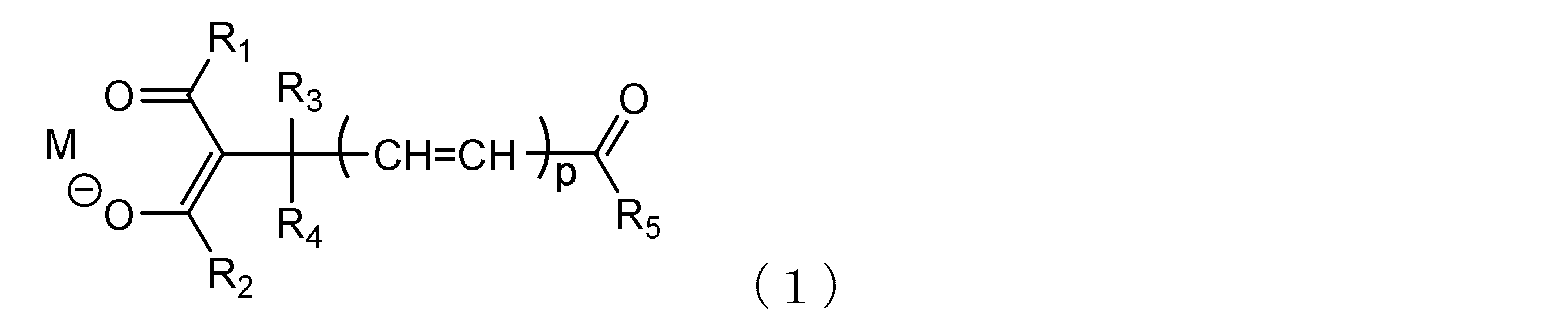
- a compound represented by the following general formula (1) (Where M represents a hydrogen atom or a monovalent or higher-valent metal ion which may have a ligand; R 1 and R 2 each independently represents a substituted or unsubstituted alkyl group, alkenyl group, aryl group or heterocyclic group, and these groups may contain a polymerizable group; R 3 and R 4 each independently represent a hydrogen atom, a substituted or unsubstituted alkyl group, an aryl group or a heterocyclic group, and these groups may contain a polymerizable group; R 5 represents a substituted or unsubstituted alkyl group, alkenyl group, alkynyl group, aryl group, heterocyclic group, alkoxy group, aryloxy group, alkylamino group or arylamino group, and these groups represent a polymerizable group.
- [2] The compound according to [1], wherein at least one of R 1 and R 2 is a trifluoromethyl group.
- R 5 contains a polymerizable group.
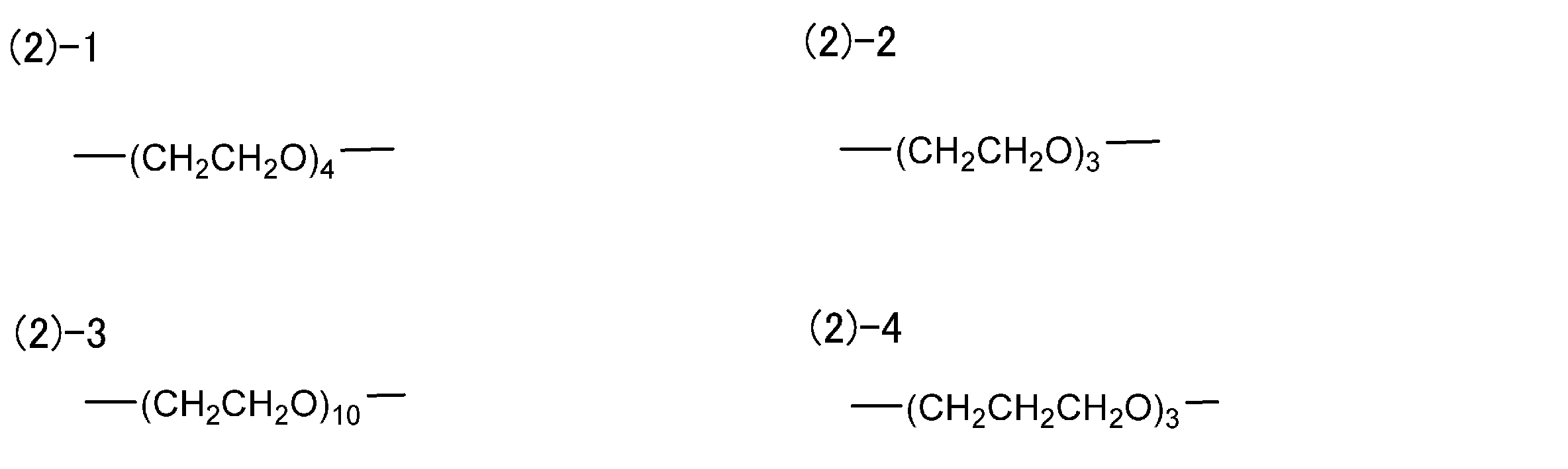
- R 5 includes a divalent residue represented by the following general formula (2).
- a polymerization composition comprising a polymer in which the compound represented by the general formula (1) has a polymerizable group and the compound is a structural unit.
- M in the general formula (1) is a monovalent or higher-valent metal ion that may have a ligand.
- a composition comprising the compound according to any one of [1] to [7] and a compound represented by the general formula (3).
- R 6 , R 7 and R 8 each independently represents a substituted or unsubstituted alkyl group, aryl group or heterocyclic group, and these groups may contain a polymerizable group; Any two of R 6 , R 7 and R 8 may be taken together to form a 5- to 7-membered ring containing the phosphorus atom to which they are attached; A dimer may be formed via any one of R 6 , R 7 and R 8 ; Each of R 6 to R 8 does not contain a polymerizable group, or at least one of R 6 to R 8 contains a polymerizable group.
- At least one of the compound represented by the general formula (1) and the compound represented by the general formula (3) has a polymerizable group, and includes a polymer having a compound having a polymerizable group as a structural unit.
- M in the general formula (1) is a monovalent or higher-valent metal ion which may have a ligand.
- [18] A method for selectively capturing metal ions using the polymerization composition obtained by the method according to [16] or [17]. [19] A method for producing a compound represented by the general formula (1), comprising reacting a compound represented by the following general formula (4) with a compound represented by the general formula (5).
- R 9 and R 10 represent a substituted or unsubstituted alkyl group, aryl group, or heterocyclic group, and these groups may contain a polymerizable group.
- R 11 represents a halogen element
- R 12 and R 13 represent a hydrogen atom, a substituted or unsubstituted alkyl group, an aryl group, or a heterocyclic group
- R 14 represents a substituted or unsubstituted alkyl group
- a simple method for synthesizing acetylacetone having a substituent at the 3-position has not been known so far.
- One of the reasons is that the reactivity of the hydroxyl group generated by keto-enol tautomerism of the acetylacetone group is large, and once substitution is performed. This is because it is extremely difficult to desorb under mild conditions, and it is difficult to synthesize a compound in which other functional groups coexist, and the other is to efficiently capture a metal from a neutral solution.
- Requires a low pKa acetylacetone group, but one of its preferred structures is a hexafluoroacetylacetone group, but it is difficult to control the reaction using expensive synthetic raw materials to synthesize the group stepwise.
- benzyl halide is known as a reagent that reacts with acetylacetone under mild conditions.
- the condensate is also thermally unstable depending on the substituent.
- an ⁇ -haloacetyl compound which is an active halogen compound, which is preferable also in terms of structural diversity, is reacted with substituted acetylacetone in a single step under relatively mild conditions.
- a -position substitution product can be obtained.
- the ⁇ -haloacetyl compound becomes a 3-position substituent, but acetyl is added to the end of the side chain with many functional groups, liquid crystal mesogens and polymerizable groups remaining as ketones, esters and amides. If the group is arranged, the end can be easily brominated with N-bromosuccinimide immediately before, so that it becomes a synthetic intermediate having high versatility.
- the acetylacetone derivative of the present invention which is used alone or together with other ligands (ligands) and has a good complex forming ability with various metal ions, has various functional substituents at the 3-position.
- Non-patent document 4 Formation of a new tetrahedral metal acetonate liquid crystal is also expected, and its industrial utility value is high, including the development of a novel complex-forming ability of the derivative.
- One embodiment of the present invention is a compound represented by the following general formula (1).
- M represents a hydrogen ion or a monovalent or higher-valent metal ion that may have a ligand.
- acetylacetonate in which acetylacetone forms a complex with a metal ion, almost all metal ions are applicable. Accordingly, it is not limited to which metal atom is preferable, but includes alkali metal ions, alkaline earth metal ions, first to fourth transition metal ions, earth metal ions, and boron group ions.
- rare metal element ions are exemplified as M.
- Examples include rare earth element ions used in hydrogen storage alloys and the like. Specific examples include ions such as platinum, palladium, indium, gallium, cesium, rubidium, molybdenum, vanadium, scandium, yttrium, uranium, and lithium.
- M is preferably lithium ion.
- R 1 and R 2 each independently represents a substituted or unsubstituted alkyl group, aryl group, heterocyclic group, alkenyl group, or alkynyl group, preferably a substituted or unsubstituted group.
- Alkyl groups include linear, branched, and cyclic alkyl groups. Examples of linear and branched alkyl groups include methyl, ethyl, propyl, isopropyl, tert-butyl, pentyl, and hexyl.
- Group methoxyethoxyethyl group, and the like, preferably methyl group, trifluoromethyl group, perfluoroalkyl group, for example, pentafluoroethyl group, nonafluorobutyl group, pentafluoroheptyl group and the like.
- Examples of the cyclic alkyl group (cycloalkyl group) include a cyclohexyl group and a cyclopentyl group.
- Examples of the aryl group include a phenyl group, a naphthyl group, and an anthracenyl group.
- heterocyclic group for example, pyridyl group, thiazolyl group, oxazolyl group, imidazolyl group, furyl group, thienyl group, pyrrolyl group, pyrazinyl group, pyrimidinyl group, pyridazinyl group, selenazolyl group, sriphoranyl group, piperidinyl group, pyrazolyl group, Examples include a tetrazolyl group.
- alkenyl group include ethenyl group, propenyl group, butenyl group, and the like, and cycloalkenyl groups such as cyclopropenyl group and cyclohexenyl group.
- alkynyl group examples include ethynyl group and propargyl group.
- the alkyl group, aryl group, heterocyclic group alkenyl group or alkynyl group may be substituted, and examples of the substituent include halogen (fluorine, chlorine, bromine, iodine), alkoxy group (for example, methoxy group, ethoxy group, Ethoxyethoxy group, ethoxydiethyleneoxy group) and amino group (for example, methylamino group, dimethylamino group, dimethylaminoethylamino group).
- the polymeric group mentioned later may be contained in the inside or terminal of the above-mentioned substituted or unsubstituted alkyl group, aryl group, heterocyclic group, alkenyl group or alkynyl group.
- R 3 and R 4 each independently represents a hydrogen atom, a substituted or unsubstituted alkyl group, an aryl group, or a heterocyclic group, and preferably a hydrogen atom.
- the substituted or unsubstituted alkyl group, aryl group, and heterocyclic group are the same as those described for R 1 and R 2 .
- R 5 represents a substituted or unsubstituted alkyl group, alkenyl group, alkynyl group, aryl group, heterocyclic group, alkoxy group, aryloxy group, alkylamino group, arylamino group, alkylthio group or arylthio group, preferably A substituted or unsubstituted alkyl group, alkenyl group, alkynyl group, aryl group, heterocyclic group, alkoxy group, aryloxy group, alkylamino group or arylamino group.
- Examples of the substituted or unsubstituted alkyl group for R 5 include a methyl group, an ethyl group, a propyl group, an isopropyl group, a tert-butyl group, a pentyl group, a hexyl group, an octadecyloxyethyl group, a heptadecyloxymethyl group, and acryloyl.
- Examples thereof include an oxymethyl group, an acryloyloxyethylaminocarbonyloxypropyl group, a glycidyloxymethyl group, a hexadecyloxytetraethyleneoxymethyl group, and a hexadecadienyloxytetraethyleneoxymethyl group.
- Examples of the substituted or unsubstituted alkenyl group include an ethenyl group and a propenyl group.
- Examples of the substituted or unsubstituted alkynyl group include an ethynyl group and a propargyl group.
- Examples of the substituted or unsubstituted aryl group include a phenyl group, a methoxyphenyl group, an octyloxyphenyl group, an acryloyloxyphenyl group, a glycidyloxyphenyl group, an acryloyloxyethylaminocarbonyloxyphenyl group, and a hexadecyloxytetraethyleneoxyphenyl group. Group, hexadecadienyloxytetraethyleneoxyphenyl group and the like.
- Examples of the substituted or unsubstituted heterocyclic group include pyridyl group, thiazolyl group, oxazolyl group, imidazolyl group, benzothiazolyl group, benzoxazolyl group, benzimidazolyl group, furyl group, pyrrolyl group, pyrazinyl group, pyrimidinyl group, pyridazinyl group , A serenazolyl group, a thriphoranyl group, a piperidinyl group, a pyrazolyl group, a tetrazolyl group, a thiadiazolyl group, and the like.
- Examples of the substituted or unsubstituted alkoxy group include a methoxy group, an ethoxy group, a propyloxy group, a pentyloxy group, a cyclopentyloxy group, a hexyloxy group, a cyclohexyloxy group, a propenyloxy group, a propargyloxy group, and an acryloyloxy group.
- Acryloyloxyethylaminocarbonyloxyethylamino group glycidyloxy group, octadecyloxy group, heptadecyloxy group, hexadecyloxytetraethyleneoxy group, hexadecadienyloxytetraethyleneoxy group and the like.
- Examples of the substituted or unsubstituted aryloxy group include a phenoxy group.
- Examples of the substituted or unsubstituted alkylamino group include a methylamino group, an ethylamino group, a propylamino group, a pentylamino group, a cyclopentylamino group, a hexylamino group, a cyclohexylamino group, a propenylamino group, a propargylamino group, Examples include acryloylamino group, glycidylamino group, octadecylamino group, heptadecylamino group, hexadecyloxytriethyleneoxyethylamino group, hexadecadienyloxytriethyleneoxyethylamino group, and the like.
- Examples of the substituted or unsubstituted arylamino group include a phenylamino group, a methoxyphenylamino group, a pentyloxy group, a cyclopentyloxyphenylamino group, a cyclohexyloxyphenylamino group, a propenyloxyphenylamino group, and a propargyloxyphenylamino group.
- Acryloyloxyphenylamino group glycidyloxyphenylamino group, octadecyloxyphenylamino group, hexadecyloxytetraethyleneoxyphenylamino group, hexadecadienyloxytetraethyleneoxyphenylamino group, and the like.
- Examples of the substituted or unsubstituted alkylthio group include a methylthio group and a hexadecylthio group.
- Examples of the substituted or unsubstituted arylthio group include a phenylthio group.
- each of R 1 to R 5 does not include a polymerizable group, or at least one of R 1 to R 5 includes a polymerizable group.
- the polymerizable group include ethynyl group, propargyl group, vinyl group, allyl group, vinylphenyl group, acryloyl group, methacryloyl group, epoxy group, glycidyl group, butanedienyl group, and sorbyl group.
- These polymerizable groups may not be contained, but are preferably contained in at least one of R 1 to R 5 , preferably contained in R 5, and more preferably contained in the terminal of R 5 .
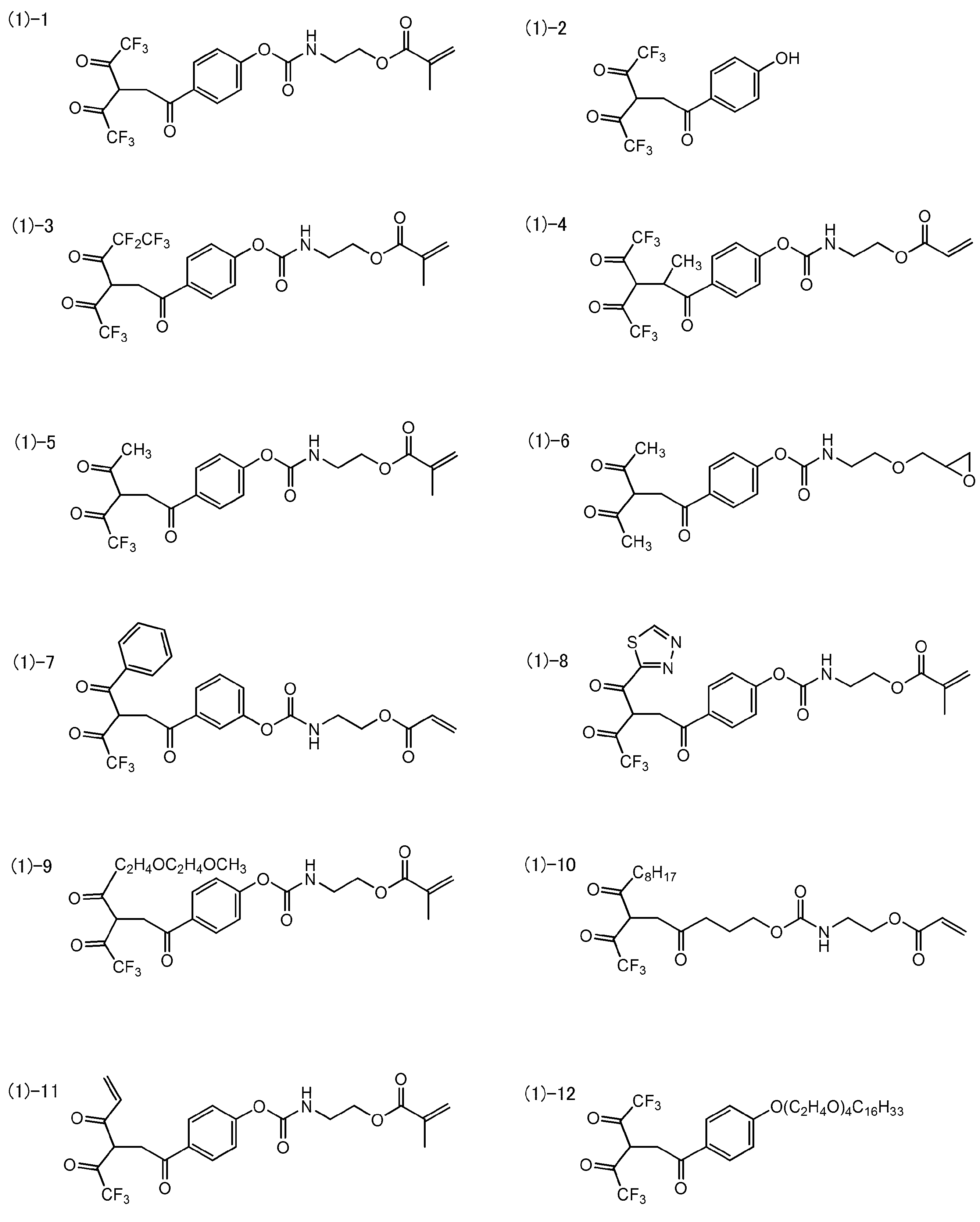
- Non-limiting examples of such compounds having R 5 are shown in (1) -1 to (1) -31 described later.
- At least one of R 1 and R 2 is preferably a trifluoromethyl group, and more preferably both are trifluoromethyl groups. This is because it is necessary for the acetylacetone group forming the metal salt to dissociate to form a metal salt, and for this purpose, R 1 and R 2 are preferably electron withdrawing groups.
- brine, salt lake water and waste liquid for capturing and recovering metals in general, including seawater are often close to neutrality, and further, the metal captured by the compound of the present invention and the composition containing the compound In the case of a pKa that is too small for elution and recovery of the salt, it is necessary to use a strong acid.
- the pKa is preferably 1 to 8. To 7 are more preferable, and 3 to 6 are most preferable in many cases.
- both R 1 and R 2 are trifluoromethyl groups.
- the tetrafluoroacetylacetone of the general formula (4) forms a metal complex that is thermally stable and easily volatilizes with copper, palladium, platinum, etc., and is used for CVD. It is a commercial material used.
- the compound of the present invention it is important to have a long chain substituent at the 3-position of the acetylacetone derivative.
- the long chain substituent of an acetylacetone derivative that forms a tetrahedral structure by complex formation has at the 1-position, the 5-position, or both, the following schematic diagram: As shown in FIG. 1, the substituent of the other ligand forming the tetrahedral structure generally has a high possibility of extending in the direction perpendicular to the long-chain substituent of the acetylacetone derivative, Cross in the center.
- the substituent of the corresponding ligand also extends in the reverse direction to form a rod-like structure as a whole, and the 3-position substituted acetylacetone derivative is relatively laminated or different. It is expected that it is easy to form an anisotropic structure.
- each of R 1 to R 5 does not include a polymerizable group, or at least one of R 1 to R 5 includes a polymerizable group.
- the polymerizable group include ethynyl group, propargyl group, vinyl group, allyl group, vinylphenyl group, acryloyl group, methacryloyl group, epoxy group, glycidyl group, butanedienyl group, and sorbyl group.
- These polymerizable groups may not be contained, but are preferably contained in at least one of R 1 to R 5 , preferably contained in R 5, and more preferably contained in the terminal of R 5 .
- R 5 in the general formula (1) preferably has a polymerizable group at its terminal, there is a concern of affecting the expression of liquid crystal properties expected when the terminal acetylacetone group becomes a metal salt. It is expected that the orientation of the 3-position substituted acetylacetone derivative can be fixed more quickly and gently.
- R 5 includes a divalent residue represented by the following general formula (2). That is, the options specified as R 5 are a substituted or unsubstituted alkyl group, alkenyl group, alkynyl group, aryl group, heterocyclic group, alkoxy group, aryloxy group, alkylamino group, arylamino group, alkylthio group or A divalent residue represented by the general formula (2) is contained inside the arylthio group.
- k represents 2 or 3, and 2 is preferable.
- m represents an integer of 1 to 20, preferably 2 to 10, and more preferably 3 to 6.
- Non-limiting examples when R 5 contains a divalent residue represented by the general formula (2) include ethyleneoxy group, diethyleneoxy group, triethyleneoxy group, tetraethyleneoxy group, propyleneoxy group, A dipropyleneoxy group, a tripropyleneoxy group, a butyleneoxy group, and a dibutyleneoxy group. Polymers containing these groups are preferable from the viewpoint of water permeability, and liquid crystallinity is expected in combination with long-chain alkyl groups. In these respects, a triethyleneoxy group and a tetraethyleneoxy group are more preferable.
- the compound represented by the general formula (1) basically has a rod-like structure, and has a possibility of exhibiting liquid crystallinity by selecting an appropriate functional group.
- the liquid crystal is described in detail throughout Non-Patent Document 4.
- the liquid crystal is a state in which an order in the direction of the particles is maintained in an intermediate state between the crystal and the liquid but the order in the three-dimensional position is lost.
- Liquid crystals are broadly classified into thermotropic liquid crystals and lyotropic liquid crystals. Thermotropic liquid crystals change phase only by heat and pressure, but lyotropic liquid crystals are composed of multiple components and change phase depending on the composition of temperature and components.
- Typical liquid crystal phases include nematic liquid crystals and smectic liquid crystals.
- a nematic liquid crystal is a liquid crystal corresponding to the anisotropic liquid described above. Since there is no regularity of position, it has fluidity similar to liquid.
- a smectic liquid crystal is a liquid crystal having at least a one-dimensional centroid order, in other words, a layered structure. Further, the phase is further classified into several phases depending on whether the molecules are inclined with respect to the layer structure and what order each molecule has in each layer.
- the liquid crystal used in the present invention may be any of the above-described thermotropic liquid crystals, lyotropic liquid crystals, nematic liquid crystals, and smectic liquid crystals.
- the advantage of using liquid crystals is that the metal ions can be transported, retained, and replaced with hydrogen ions flexibly. Regardless of the presence or absence of metal ions, regular molecules and thus various functional groups distribute the metal ions in the same way. This is because it is expected that the selectivity of metal ions can be enhanced by surrounding the seat and maintaining the state.
- the compound represented by the general formula (1) exhibits liquid crystallinity when used as a material for recovering a metal salt, particularly a lithium salt.
- a composition comprising a compound of the present invention repeats the operation of capturing a metal salt from a liquid containing the desired metal salt and then eluting it. Therefore, the composition is required to have durability against repeated expansion and contraction. Therefore, a rigid crystal or a metal organic structure MOF (Metal Organic Framework) is stable when capturing a metal salt, but the metal ion is replaced by a hydrogen atom during the elution. The repeated durability becomes a problem.
- MOF Metal Organic Framework
- both capture and elution require a large amount of metal ions to move through the composition at a high speed, and in the vicinity of the metal ion capture site, there must be a site for the metal ion to pass, Structural flexibility is required.
- the compound of the present invention exhibits liquid crystallinity, the compound is preferable in that it has flexibility and uniform processability.
- liquid crystallinity Another advantage of liquid crystallinity is that a regular structure like a crystal is accumulated.
- lithium salt is known to stabilize with a tetrahedral structure, and the distance between lithium ions and oxygen atoms at that time is 2.0 angstroms (Non-Patent Document 5), The cumulative structure can be further stabilized by the positional relationship that can form a regular tetrahedral structure of a certain size.
- the distance between sodium ions and oxygen atoms in the case of a tetrahedral structure with sodium is 2.4 ⁇ 0.2 angstrom (Non-patent Document 6), and it can be seen that there is a considerable difference.
- the lithium salt of the compound of the present invention preferably a structure in which the structure of the lithium salt exhibiting a liquid crystal structure is polymerized and fixed, and the lithium ion is eluted from the polymerized composition is relatively more lithium ion than sodium ion. Is expected to be more selectively captured.
- compositions comprising a compound in which M in the general formula (1) is a monovalent or higher-valent metal ion which may have a ligand.
- the compound represented by the general formula (1) has a polymerizable group, and the compound is polymerized by the polymerizable group to make the compound a structural unit (repeating unit). It is a polymerization composition containing a polymer.
- the compound represented by the general formula (1) includes a monovalent or higher-valent metal ion that may have a ligand as M. As so-called acetylacetonate in which acetylacetone forms a complex with a metal ion, almost all metal ions are applicable.
- ions of any metal atom are not limited to preferred ions, but include alkali metal, alkaline earth metal, first to fourth transition metals, earth metal, and boron group ions.
- one of the applications of the present invention for selectively capturing dissolved metals includes ions of rare metal elements, specifically platinum, palladium, indium, gallium, cesium, rubidium, molybdenum, Examples thereof include ions of vanadium, scandium, yttrium, uranium, lithium, and the like.
- M is preferably lithium ion.
- composition or the polymerization composition preferably has a cumulative structure due to self-assembly.
- composition comprising a compound represented by the general formula (1) and a compound represented by the following general formula (3).
- R 6 , R 7 and R 8 each independently represents a substituted or unsubstituted alkyl group, aryl group or heterocyclic group, and these groups are the polymers described in detail for R 5. It may contain a sex group.
- any two of R 6 , R 7 and R 8 may be combined to form a 5- to 7-membered ring containing the phosphorus atom to which they are bonded.
- a dimer may be formed via any one of R 6 , R 7 and R 8 .
- Each of R 6 to R 8 does not contain a polymerizable group, or at least one of R 6 to R 8 contains a polymerizable group.
- substituted or unsubstituted alkyl group, aryl group, and heterocyclic group are the same as those described for R 1 and R 2 .
- the 5- to 7-membered ring containing the phosphorus atom to which they are attached may further contain an N, O or S atom. Further, the 5- to 7-membered ring may contain an unsaturated bond and may have a substituent.
- substituents include halogen (fluorine, chlorine, bromine, iodine), alkoxy group (for example, methoxy group, ethoxy group, ethoxyethoxy group, ethoxydiethyleneoxy group), amino group (for example, methylamino group, dimethylamino group, Dimethylaminoethylamino group).
- a dimer may be formed via any one of R 6 , R 7 and R 8 .
- a dimer for example, when forming a dimer via an alkyl (methylene group, ethylene group, etc.) (compounds (3) -7, (3) -8 described later), via a benzene ring In the case of forming a dimer (compounds (3) -9, (3) -10 described later) and the like.
- the compound represented by the general formula (1) further forms a stable lithium salt with the phosphine oxide compound represented by the general formula (3).
- the phosphine oxide compound is preferably twice the equivalent of acetylacetone. Therefore, a unimolecular phosphine oxide compound in which a bifunctional phosphine oxide group is substituted with an adjacent carbon atom is more preferable.
- R 6 , R 7 and R 8 in the general formula (3) each represents a substituted or unsubstituted alkyl group, aryl group or heterocyclic group, each of which does not contain a polymerizable group, or R 6 to It is included in at least one of R 8.
- the compound represented by the general formula (1) includes a monovalent or higher-valent metal ion that may have a ligand as M.
- the compound represented by the general formula (1) and the compound represented by the general formula (2) has a polymerizable group, and the compound is polymerized by the polymerizable group. And it is a polymerization composition containing the polymer which uses the said compound as a structural unit (repeating unit).
- the compound represented by the general formula (1) includes a monovalent or higher-valent metal ion that may have a ligand as M.
- the composition or the polymerization composition preferably has a cumulative structure due to self-assembly. Therefore, it is preferable that the polymerization composition is fixed while maintaining a cumulative structure due to its self-organization during the polymerization. Therefore, a plurality of side chains containing a polymerizable group are included in one molecule, or the above-described during the polymerization. It is also a preferred embodiment that a molecule containing a plurality of polymerizable groups, that is, a crosslinkable molecule is contained.
- M is a monovalent or higher-valent metal ion which may have a ligand, and at least one of R 1 to R 5 contains a polymerizable group. And then eluting the metal salt and substituting M with a hydrogen atom, to produce a polymerization composition.
- one embodiment of the present invention is represented by the compound represented by the general formula (1) and the general formula (3), wherein M is a monovalent or higher-valent metal ion which may have a ligand.
- a composition comprising a compound, wherein at least one of both compounds has a polymerizable group, and after polymerizing the composition, eluting the metal salt and replacing M with a hydrogen atom. It is a manufacturing method of a composition.
- another aspect of the present invention is a method of selectively capturing metal ions using a polymerization composition obtained by the above-described method for producing a polymerization composition.
- the compound represented by the general formula (1) in which M is a monovalent or higher-valent metal ion which may have a ligand is an acetylacetone group having a 3-
- a composition comprising a functional substituent introduced at the position or a coordination to M by a coexisting compound such as a compound represented by the general formula (3), and the composition further comprises Phase separation by substituents, preferably has a cumulative structure within the composition.
- the compound has a polymerizable group or the coexisting compound has a polymerizable group, it becomes possible to fix the anisotropic orientation state of the phase separation structure and the cumulative structure, and the metal ion M This is preferable because a stable template structure can be formed.
- Examples of the polymerizable group include ethynyl group, propargyl group, vinyl group, allyl group, vinylphenyl group, acryloyl group, methacryloyl group, epoxy group, glycidyl group, butanedienyl group, sorbyl group, etc., but nonpolar butanedienyl Even if the group is contained at the end of a long chain alkyl group, its hydrophobicity and steric structure do not change greatly, so it is easy to reproduce the unstable liquid crystal phase structure, and it is possible to polymerize while maintaining its anisotropic structure Be expected. Moreover, although acryloyl group etc.
- a composition comprising an organometallic compound in which M represented by the general formula (1) is a lithium ion and at least one of R 1 to R 5 contains a polymerizable group is polymerized.
- the lithium ion is eluted with hydrochloric acid
- the polymerization composition obtained here is a method for producing a polymerization composition in which M is replaced with a hydrogen atom.
- the polymerization composition obtained here is diluted in a large amount with a sodium salt dissolved in a large amount. It has a function of recovering only lithium salt from seawater containing lithium salt with high selectivity. Therefore, if the same operation is performed with another metal, the polymer composition can be recovered with high selectivity.
- an appropriate solvent for example, water, methanol, ethanol, dimethylformamide, dimethyl sulfoxide and the like, and mixtures thereof.
- the organometallic salt produced by distilling off the solvent or adding a poor solvent and / or cooling operation is isolated.
- the thin film is formed by a coating method. It can be obtained as a polymerization composition in a desired form by making it into a fine particle in the process of polymerization or polymerization.
- a liquid crystal phase structure is formed, and the phase separation structure and the cumulative structure are fixed by polymerization. At this time, the degree of orientational order of the liquid crystal phase structure depends on the temperature, and the lower the degree of ordering, the higher the degree of ordering.
- the compound represented by the general formula (1) (when M is a hydrogen ion) is represented by the general formula (5) and acetylacetone represented by the general formula (4) or a derivative thereof in the presence of an appropriate base. It is synthesized by a condensation reaction of an ⁇ -haloacetyl compound or an ⁇ -halocrotonyl compound. Depending on the reaction rate, it may be heated.
- R 9 and R 10 represent a substituted or unsubstituted alkyl group, aryl group, heterocyclic group, alkenyl group or alkynyl group, preferably a substituted or unsubstituted alkyl group, aryl group or complex. It is a cyclic group. These groups may contain the polymerizable group detailed in R 5 .
- R 11 represents a halogen element
- R 12 and R 13 represent a hydrogen atom, a substituted or unsubstituted alkyl group, an aryl group, or a heterocyclic group
- R 14 represents a substituted or unsubstituted alkyl.
- p represents 0 or 1;
- halogen element for R 11 examples include chlorine, bromine and iodine, with chlorine and bromine being preferred.
- R 9 and R 10 in formula (4) correspond to R 1 and R 2 in formula (1), respectively.
- R 12 , R 13 and R 14 in the formula (5) correspond to R 3 , R 4 and R 5 in the formula (1), respectively. Therefore, a substituted or unsubstituted alkyl group, aryl group, heterocyclic group, alkenyl group or alkynyl group in R 9 and R 10 , a substituted or unsubstituted alkyl group, aryl group, heterocyclic group in R 12 and R 13 , substituted or unsubstituted alkyl group in R 14, an alkenyl group, an alkynyl group, an aryl group, a heterocyclic group, an alkoxy group, an aryloxy group, an alkylamino group, for arylamino group, R 1 ⁇ R in the formula (1) This is the same as described for 5 .
- Each of R 9 and R 10 in the general formula (4) and R 12 , R 13 and R 14 in the general formula (5) does not contain a polymerizable group, or at least one of them is a polymerizable group. Is included.
- the polymerizable group include ethynyl group, propargyl group, vinyl group, allyl group, vinylphenyl group, acryloyl group, methacryloyl group, epoxy group, glycidyl group, butanedienyl group, and sorbyl group.
- R 14 is not an alkoxy group having 4 or less carbon atoms.
- an aprotic solvent having no nucleophilicity is preferable.
- a functional functional group for example, a polymerizable group
- it is preferable to react a reactive low pKa acetylacetone derivative in the final stage in the production method of the present invention Therefore, mild reaction conditions that allow the reaction to proceed quickly at low temperatures are preferred.
- an inorganic base and an organic base can be used.
- the inorganic base include sodium hydroxide, lithium hydroxide, and potassium hydroxide.
- an organic base is used. It is more preferable.
- the organic base include triethylamine, diazabicyclononene (1,5-diazabicyclo [4.3.0] non-5-ene) and diazabicycloundecene (1,8-diazabicyclo [5.4.0].
- Undec-7-ene) is preferably used, and dimethylaminopyridine is particularly preferred.
- an iodo salt coexists in the reaction system because the reaction is promoted.
- the iodo salt potassium iodide, tetrahexylammonium iodide, and tetraethylammonium iodide are preferably used.
- the solubility of these iodo salts is often small with respect to the solvent used in the reaction, and in that case, it is preferable to dissolve in the presence of a small amount of water. Since water is a protic solvent, if the interior of the system is basic, hydrolysis occurs in parallel as a side reaction. Therefore, it is preferable to keep the reaction system as neutral as possible.
- an acetylacetone derivative having a low pKa is actually used as a reaction raw material, it is preferable to adjust the equivalency in anticipation of salt formation with a base used in advance.
- R 14 includes a divalent residue represented by the following general formula (2).
- k represents 2 or 3, and 2 is preferable.
- m represents an integer of 1 to 20, preferably 2 to 10, and more preferably 3 to 6.
- the appropriate base is a protic solvent that generates water by condensation when the compound represented by the general formula (4) or the general formula (5) is concerned about basic hydrolysis such as an ester group, and the like. Avoid aprotic solvents such as acetone and organic bases (for example, triethylamine, diazabicyclononane, etc.) and alkali metal hydrides (for example, sodium hydride, etc.), avoiding alkali metal hydroxides and carbonates. .
- aprotic solvents such as acetone and organic bases (for example, triethylamine, diazabicyclononane, etc.) and alkali metal hydrides (for example, sodium hydride, etc.), avoiding alkali metal hydroxides and carbonates. .
- the compound represented by the general formula (1) obtained above (when M is a hydrogen ion) is dissolved in water or an organic solvent (methanol, ethanol, isopropanol, etc.), and an approximately equivalent equivalent base is obtained in the resulting solution.
- an organic solvent methanol, ethanol, isopropanol, etc.
- Lithium hydroxide, lithium carbonate, sodium hydroxide, sodium hydride is added, and after stirring for a predetermined period of time, the solvent is distilled off and vacuum drying is performed to obtain a lithium salt or sodium salt of the compound represented by the general formula (1) Can be obtained.
- an aqueous solution in which a metal salt that captures the compound represented by the above general formula (1) or a polymerization composition thereof in a buffer solution that can completely dissociate the compound is dissolved.
- a desired metal salt which is isolated by an appropriate method.
- a solid solution of a compound represented by the above general formula (1) of pKa or a polymerization composition thereof that completely dissociates at an aqueous solution or an organic solvent in which a metal salt to be captured is dissolved, at the pH of the solution (
- the desired metal salt can be obtained by setting appropriate conditions such that the metal and hydrogen in the solution are replaced by contacting with fine particles or a thin film.
- Step 1 Synthesis of 2-((((4- (2-bromoacetyl) phenoxy) carbonyl) amino) ethyl methacrylate (1) -1a 2-Bromo-1- (4-hydroxyphenyl) ethane-1-one (2 .23 g, 10.4 mmol) and 2-isocyanoethyl methacrylate (1.60 mL, 11.3 mmol) in dry tetrahydrofuran (4.0 mL) at 0 ° C. slowly at triethylamine (0.35 mL, 2.5 mmol). Was added. The mixture was then stirred at room temperature for 3 hours. The reaction mixture was added into dilute hydrochloric acid (ca.
- Step 2 2-(((4- (5,5,5-trifluoro-4-oxo-3- (2,2,2-trifluoroacetyl) pentanoyl) phenoxy) carbonyl) amino) ethyl methacrylate
- -1,1,5,5,5-hexafluoropentane-2,4-dione (1.15 mL, 8.13 mmol) in acetone (5.0 mL) slowly at 0 ° C.
- Sodium hydride in Oil 60%) (0.324 g, 8.1 mmol) was added.
- Step 1 Synthesis of 3,6,9,12-tetraoxaoctacosan-1-ol (1) -13b
- hexadecanol 84.3 g, 348 mmol
- tetrahydrofuran 250 mL
- methanesulfonyl chloride 41.84 g, 365 mmol
- pyridine 30.0 mL, 365 mmol
- the reaction mixture was concentrated and added into dilute hydrochloric acid (ca 5%) and the product was extracted with ethyl acetate.
- Step 3 3,6,9,12-tetraoxaoctacosyl-21,23-dienyl 5,5,5-trifluoro-4-oxo-3- (2,2,2-trifluoroacetyl) pentanoate
- 1) Synthesis of -26 3,6,9,12-tetraoxatetracosane-21,23-dienyl 2-bromoacetate (0.992 mL, 2.07 mmol) in acetone (32.5 mL) at room temperature, 1,1,1,5,5,5-hexafluoropentane-2,4-dione (0.585 mL, 4.06 mmol) was added dropwise, and tetraethylammonium iodide (0.535 mg, 2.08 mmol) was further added.
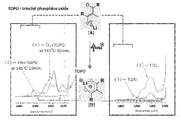
- ⁇ -diketone exhibits absorption of a conjugated carbonyl group [—CH ⁇ CH—C ⁇ O] (A) at 1660 to 1740 cm ⁇ 1 , but two carbonyls are formed by salt formation with a metal ion such as a lithium ion. It is known that taking an equivalent resonance ring structure (B) together with a group gives a broad absorption characteristic at 1550 to 1680 cm ⁇ 1 .
- FIG. 1 shows (1) -1 and its lithium salt (1) -1L, and (1) -1 lithium salt (1) -1L with its double equivalent trioctylphosphine oxide ( 2 shows FT-IR spectra after heat treatment of (1) -1L TOPO complex with (TOPO) added and (1) -1L TOPO complex.
- the right side of FIG. 1 shows FT-IR spectra of (1) -13 and its lithium salt (1) -13L.
- the compound (1) -13 having a tetraethyleneoxy group in the molecule has a function of forming a lithium salt having a resonance ring structure (B) which is completely stable at room temperature. . That is, it has been found that a compound having a ⁇ -diketone at the molecular end can form a thermally stable lithium salt by itself or by selecting an appropriate ligand to retain lithium.
- Example 2 Equivalent sodium hydride was added to methanol solutions of the compounds (1) -1, (1) -13 and (1) -26 synthesized above, and after stirring for 1 hour, the solvent was distilled off and vacuum dried, Sodium salts (1) -1N, (1) -13N and (1) -26N of (1) -1, (1) -13 and (1) -26 were obtained.
- the equilibrium is all biased to the thermally stable resonance ring structure (B), but in the case of sodium salts Some free body structure always remains. This suggests that in lithium salt and sodium salt, the lithium salt is relatively more thermally balanced in the stable resonance ring structure (B) than the sodium salt. It is expected to have selective resolution.
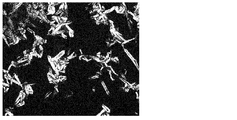
- FIG. 3 is a polarizing microscope observation image of Compound (1) -13 at room temperature. In the liquid crystal state (26 ° C.), a texture peculiar to the smectic B phase was observed under the crossed Nicol condition.
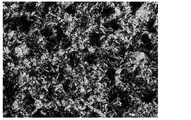
- FIG. 4 is a polarizing microscope observation image of Compound (1) -13L at room temperature. In the liquid crystal state (50 ° C.), a texture peculiar to the smectic B phase was observed under the crossed Nicols condition.
- Example 5 ⁇ Verification of photopolymerization reaction by FT-IR> It was confirmed that the lithium salt (1) -26L of (1) -26 was polymerized in a thin film state.
- FT-IR before and after irradiation was measured. As a result, as shown in FIG.
Landscapes
- Chemical & Material Sciences (AREA)
- Organic Chemistry (AREA)
- Chemical Kinetics & Catalysis (AREA)
- Health & Medical Sciences (AREA)
- Life Sciences & Earth Sciences (AREA)
- Medicinal Chemistry (AREA)
- Biochemistry (AREA)
- Molecular Biology (AREA)
- General Health & Medical Sciences (AREA)
- Polymers & Plastics (AREA)
- Engineering & Computer Science (AREA)
- Analytical Chemistry (AREA)
- Hydrology & Water Resources (AREA)
- Environmental & Geological Engineering (AREA)
- Water Supply & Treatment (AREA)
- Inorganic Chemistry (AREA)
- Materials Engineering (AREA)
- Organic Low-Molecular-Weight Compounds And Preparation Thereof (AREA)
Abstract
Description

(式中、
Mは水素原子または配位子を有してもよい1価以上の金属イオンを表し;
R1及びR2は、それぞれ独立して、置換または無置換のアルキル基、アルケニル基、アリール基又は複素環基を表し、これらの基は重合性基を含んでいてもよく;
R3及びR4は、それぞれ独立して、水素原子、置換または無置換のアルキル基、アリール基又は複素環基を表し、これらの基は重合性基を含んでいてもよく;
R5は、置換または無置換のアルキル基、アルケニル基、アルキニル基、アリール基、複素環基、アルコキシ基、アリールオキシ基、アルキルアミノ基又はアリールアミノ基を表し、これらの基は重合性基を含んでいてもよく;
R1~R5の各々には重合性基は含まれないか、または、R1~R5の少なくとも一つに重合性基が含まれる;
pは1または0を表し、但し、p=0のとき、R5は炭素数4以下のアルコキシ基ではない。)
[2]R1及びR2の少なくとも一つがトリフルオロメチル基である、[1]に記載の化合物。
[3]R5に重合性基が含まれる、[1]又は[2]に記載の化合物。
[4]R5に下記一般式(2)で表される二価残基が含まれる、[1]~[3]のいずれか1項に記載の化合物。

(式中、kは2または3を表し、mは1乃至20の整数を表す。)
[5]Mがリチウムイオンである、[1]~[4]のいずれか1項に記載の化合物。
[6]一般式(1)で表される化合物のpKaが3~6である、[1]~[5]のいずれか1項に記載の化合物。
[7]一般式(1)で表される化合物が液晶性を発現する、[1]~[6]のいずれか1項に記載の化合物。
[8]Mが配位子を有してもよい1価以上の金属イオンである、[1]~[7]のいずれか1項に記載の化合物からなる組成物。
[9]一般式(1) で表される化合物が重合性基を有し、当該化合物を構成単位とする重合体を含む重合組成物。
[10]一般式(1)におけるMが配位子を有してもよい1価以上の金属イオンである、[9]に記載の重合組成物。
[11]自己組織化による累積構造を有する、[8]~[10]のいずれか1項に記載の組成物。
[12][1]~[7]のいずれか1項に記載の化合物と、一般式(3)で表される化合物を含むことを特徴とする組成物。

(式中、R6、R7及びR8は、それぞれ独立して、置換または無置換のアルキル基、アリール基又は複素環基を表し、これらの基は重合性基を含んでいてもよく;
R6、R7及びR8のいずれか2つは一緒になって、これらが結合している燐原子を含む5~7員の環を形成してもよく;
R6、R7及びR8のいずれか1を介して2量体を形成してもよく;
R6~R8の各々には重合性基は含まれないか、またはR6~R8の少なくとも一つに重合性基が含まれる。)
[13]一般式(1) で表される化合物及び一般式(3)で表される化合物の少なくとも一つが重合性基を有し、重合性基を有する化合物を構成単位とする重合体を含む、[12]に記載の組成物。
[14]一般式(1)におけるMが配位子を有してもよい1価以上の金属イオンである、[12]又は[13]に記載の組成物。
[15]自己組織化による累積構造を有する、[12]~[14]のいずれか1項に記載の組成物。
[16]Mが配位子を有してもよい1価以上の金属イオンであり、R1~R5の少なくとも一つに重合性基が含まれる一般式(1)で表される化合物からなる組成物を重合した後、その金属塩を溶出し、Mを水素原子に置換したことを含む、重合組成物の製造方法。
[17]Mが配位子を有してもよい1価以上の金属イオンである一般式(1)で表される化合物及び一般式(3)で表される化合物を含み、両方の化合物の少なくとも一つが重合性基を有する、組成物を重合した後、その金属塩を溶出し、Mを水素原子に置換したことを含む、重合組成物の製造方法。
[18][16]又は[17]に記載の方法で得られる重合組成物を用いて、金属イオンを選択的に捕捉する方法。
[19]下記一般式(4)で表される化合物と一般式(5)で表される化合物を反応させることを含む、一般式(1)で表される化合物を製造する方法。

(式中、R9及びR10は置換または無置換のアルキル基、アリール基、複素環基を表し、これらの基は重合性基を含んでいてもよい。)

(式中、R11はハロゲン元素を表し、R12及びR13は、水素原子、置換または無置換のアルキル基、アリール基、複素環基を表し、R14は置換または無置換のアルキル基、アルケニル基、アルキニル基、アリール基、複素環基、アルコキシ基、アリールオキシ基、アルキルアミノ基、アリールアミノ基を表し、R12~R14として定義される基は重合性基を含んでいてもよく、pは0または1を表し、但し、p=0のとき、R14は炭素数4以下のアルコキシ基ではない。)
[20]有機化合物のヨード塩の共存下で、一般式(4)で表される化合物と一般式(5)で表される化合物を反応させる、[19]に記載の方法。
これに対して、本発明においては、活性ハロゲン化合物であり、構造的な多様性の点でも好ましいα-ハロアセチル化合物を置換アセチルアセトンと一段階で、比較的穏和な条件で反応させ、容易にその3-位置換体を得ることができる。そのα-ハロアセチル化合物は、3-位置換基となるのであるが、ケトン、エステル、アミドとして多くの官能基や液晶メソゲンや重合性基を付与したままの状態で、その側鎖の末端にアセチル基を配していれば、直前にN-ブロモスクシンイミドで容易に末端を臭素化できるので、合成的に汎用性の高い合成中間体となる。
また、単独または他のリガンド(配位子)と共に用いられ、種々の金属イオンとの良好な錯形成能を特徴とする本発明のアセチルアセトン誘導体は、その3-位に種々の機能性置換基を配することが可能であり、それが直鎖形状のメソゲン基の場合には隣接する親水性の金属アセトナート基同士が向かい合いメソゲン基がその両側に直線上に並ぶことで、過去に報告例のない(非特許文献4)新規な正4面体構造の金属アセトナート液晶の形成も期待され、その誘導体の新規な錯形成能の発現を含め、産業上の利用価値は高い。
他方、溶存する金属を選択的に捕捉するという本発明の用途の1つからは、Mとして、希少金属元素イオンが挙げられ、金属を保持した累積構造膜という機能からは、発光材料、磁石、水素吸蔵合金などに用いられる希土類元素イオンが挙げられる。具体的には、プラチナ、パラジウム、インジウム、ガリウム、セシウム、ルビジウム、モリブデン、バナジウム、スカンジウム、イットリウム、ウラニウム、リチウムなどのイオンが挙げられる。
また、近年の電気自動車(EV)等に用いられるリチウムイオン二次電池等の構成成分として炭酸リチウムの需要が高まっており、塩湖等から溶存するリチウムイオンを選択的に捕捉するという用途からは、Mはリチウムイオンであることが好ましい。
アルキル基には、直鎖、分岐、環状アルキル基が含まれ、直鎖、分岐のアルキル基としては、例えば、メチル基、エチル基、プロピル基、イソプロピル基、tert-ブチル基、ペンチル基、ヘキシル基、メトキシエトキシエチル基等が挙げられ、好ましくは、メチル基、トリフルオロメチル基、パーフルオロアルキル基、例えば、ペンタフルオロエチル基、ノナフルオロブチル基、ペンタフルオロヘプチル基等である。環状アルキル基(シクロアルキル基)としては、例えば、シクロヘキシル基、シクロペンチル基等が挙げられる。
アリール基としては、例えば、フェニル基、ナフチル基、アントラセニル基等が挙げられる。
複素環基としては、例えば、ピリジル基、チアゾリル基、オキサゾリル基、イミダゾリル基、フリル基、チエニル基、ピロリル基、ピラジニル基、ピリミジニル基、ピリダジニル基、セレナゾリル基、スリホラニル基、ピペリジニル基、ピラゾリル基、テトラゾリル基等が挙げられる。
アルケニル基としては、例えば、エテニル基、プロペニル基、ブテニル基等、シクロアルケニル基、例えば、シクロプロベニル基、シクロヘキセニル基等が挙げられ、アルキニル基としては、例えば、エチニル基、プロパルギル基等が挙げられる。
上記アルキル基、アリール基、複素環基アルケニル基又はアルキニル基は置換されていてもよく、置換基としては、ハロゲン(フッ素、塩素、臭素、ヨウ素)、アルコキシ基(例えば、メトキシ基、エトキシ基、エトキシエトキシ基、エトキシジエチレンオキシ基)、アミノ基(例えば、メチルアミノ基、ジメチルアミノ基、ジメチルアミノエチルアミノ基)が挙げられる。
また、上記した置換または無置換のアルキル基、アリール基、複素環基、アルケニル基又はアルキニル基の内部又は末端には、後述する重合性基が含まれていてもよい。
置換または無置換のアルケニル基としては、例えば、エテニル基、プロペニル基等が挙げられる。
置換または無置換のアルキニル基としては、例えば、エチニル基、プロパギル基等が挙げられる。
置換または無置換のアリール基としては、例えば、フェニル基、メトキシフェニル基、オクチルオキシフェニル基、アクリロイルオキシフェニル基、グリシジルオキシフェニル基、アクリロイルオキシエチルアミノカルボニルオキシフェニル基、ヘキサデシルオキシテトラエチレンオキシフェニル基、ヘキサデカジエニルオキシテトラエチレンオキシフェニル基等が挙げられる。
置換または無置換の複素環基としては、ピリジル基、チアゾリル基、オキサゾリル基、イミダゾリル基、ベンゾチアゾリル基、ベンゾオキサゾリル基、ベンズイミダゾリル基、フリル基、ピロリル基、ピラジニル基、ピリミジニル基、ピリダジニル基、セレナゾリル基、スリホラニル基、ピペリジニル基、ピラゾリル基、テトラゾリル基、チアジアゾリル基等が挙げられる。
置換または無置換のアルコキシ基としては、例えば、メトキシ基、エトキシ基、プロピルオキシ基、ペンチルオキシ基、シクロペンチルオキシ基、ヘキシルオキシ基、シクロヘキシルオキシ基、プロペニルオキシ基、プロパギルオキシ基、アクリロイルオキシ基、アクリロイルオキシエチルアミノカルボニルオキシエチルアミノ基、グリシジルオキシ基、オクタデシルオキシ基、ヘプタデシルオキシ基、ヘキサデシルオキシテトラエチレンオキシ基、ヘキサデカジエニルオキシテトラエチレンオキシ基等が挙げられる。
置換または無置換のアリールオキシ基としては、例えば、フェノキシ基等が挙げられる。
置換または無置換のアルキルアミノ基としては、例えば、メチルアミノ基、エチルアミノ基、プロピルアミノ基、ペンチルアミノ基、シクロペンチルアミノ基、ヘキシルアミノ基、シクロヘキシルアミノ基、プロペニルアミノ基、プロパギルアミノ基、アクリロイルアミノ基、グリシジルアミノ基、オクタデシルアミノ基、ヘプタデシルアミノ基、ヘキサデシルオキシトリエチレンオキシエチルアミノ基、ヘキサデカジエニルオキシトリエチレンオキシエチルアミノ基等が挙げられる。
置換または無置換のアリールアミノ基としては、例えば、フェニルアミノ基、メトキシフェニルアミノ基、ペンチルオキシ基、シクロペンチルオキシフェニルアミノ基、シクロヘキシルオキシフェニルアミノ基、プロペニルオキシフェニルアミノ基、プロパギルオキシフェニルアミノ基、アクリロイルオキシフェニルアミノ基、グリシジルオキシフェニルアミノ基、オクタデシルオキシフェニルアミノ基、ヘキサデシルオキシテトラエチレンオキシフェニルアミノ基、ヘキサデカジエニルオキシテトラエチレンオキシフェニルアミノ基等が挙げられる。
置換または無置換のアルキルチオ基としては、例えば、メチルチオ基、ヘキサデシルチオ基等が挙げられ、置換または無置換のアリールチオ基としては、例えば、フェニルチオ基等が挙げられる。
また、置換または無置換のアルキル基、アルケニル基、アルキニル基、アリール基、複素環基、アルコキシ基、アリールオキシ基、アルキルアミノ基、アリールアミノ基、アルキルチオ基又はアリールチオ基の内部又は末端には、後述する重合性基が含まれていてもよい。
重合性基としては、エチニル基、プロパギル基、ビニル基、アリル基、ビニルフェニル基、アクリロイル基、メタアクリロイル基、エポキシ基、グリシジル基、ブタンジエニル基、ソルビル基等が挙げられる。これら重合性基は含まれなくともよいが、好ましくは、R1乃至R5の少なくとも一つに含まれ、R5に含まれるのが好ましく、R5の末端に含まれるのがより好ましい。

重合性基としては、エチニル基、プロパギル基、ビニル基、アリル基、ビニルフェニル基、アクリロイル基、メタアクリロイル基、エポキシ基、グリシジル基、ブタンジエニル基、ソルビル基等が挙げられる。これら重合性基は含まれなくともよいが、好ましくは、R1乃至R5の少なくとも一つに含まれ、R5に含まれるのが好ましく、R5の末端に含まれるのがより好ましい。
また、一般式(1)のR5に、好ましくはその末端に重合性基があると、分子の末端のアセチルアセトン基が金属塩となった際に期待する液晶性の発現に影響を与える懸念が小さく、より温和に迅速に3-位置換アセチルアセトン誘導体の配向を固定化することができると期待される。

本発明に用いられる液晶は、上記のサーモトロピック液晶とリオトロピック液晶、ネマティック液晶やスメクティック液晶のいずれであってもよい。液晶を用いる利点は、金属イオンの輸送、保持、水素イオンとの置換を柔軟に行い、且つ金属イオンの有無に関わらず、規則的な分子、ひいては様々な官能基が金属イオンを同じような配座で取り巻き、その状態を維持することで、金属イオンの選択性をより高められると期待されるからである。
理論に拘束されることを意図するものではないが、本発明の化合物からなる組成物は、所望の金属塩を含む液体から金属塩を捕捉し、次に溶出するという操作を繰り返すことを想定しているので、その組成物は膨張、収縮の繰り返しに対する耐久性が求められる。従って、剛直な結晶体や金属有機構造体MOF(Metal Organic Framework)では金属塩の捕捉時は安定であるが、溶出時、金属イオンが水素原子に置換された状態は熱力学的な不安定状態であり、その繰り返し耐久性が問題となる。また、捕捉と溶出とはいずれも金属イオンが多量に高速にその組成物内を移動する必要があり、金属イオンの捕捉部位の近傍には、その金属イオンの通り道となる部位が必要であり、構造的な柔軟性が求められる。その点で、本発明の化合物が液晶性を発現すると、化合物は柔軟性を有し、均質な加工性を有する点でも好ましい。
前記重合組成物の好ましい側面において、一般式(1)で表される化合物はMとして配位子を有してもよい1価以上の金属イオンを含む。アセチルアセトンが金属イオンと錯体を形成してなるいわゆるアセチルアセトナートとしては、はほぼ全ての金属イオンが該当する。従って、どの金属原子のイオンが好ましいと限定されるものではないが、アルカリ金属、アルカリ土類金属、第一乃至第四遷移金属、土類金属、ホウ素族のイオンが含まれる。
他方、溶存する金属を選択的に捕捉するという本発明の用途の1つからは、希少金属元素のイオンが挙げられ、具体的には、プラチナ、パラジウム、インジウム、ガリウム、セシウム、ルビジウム、モリブデン、バナジウム、スカンジウム、イットリウム、ウラニウム、リチウムなどのイオンが挙げられる。
また、近年の電気自動車(EV)等に用いられるリチウムイオン二次電池等の構成成分として炭酸リチウムの需要が高まっており、塩湖等から溶存するリチウムイオンを選択的に捕捉するという用途からは、Mはリチウムイオンであることが好ましい。

ここで、R6、R7及びR8のいずれか2つは一緒になって、これらが結合している燐原子を含む5~7員の環を形成してもよい。
また、R6、R7及びR8のいずれか1を介して2量体を形成してもよい。
R6~R8の各々には重合性基は含まれないか、またはR6~R8の少なくとも一つに重合性基が含まれる。
また、5~7員の環は、不飽和結合を含んでもよく、置換基を有していてもよい。置換基としては、ハロゲン(フッ素、塩素、臭素、ヨウ素)、アルコキシ基(例えば、メトキシ基、エトキシ基、エトキシエトキシ基、エトキシジエチレンオキシ基)、アミノ基(例えば、メチルアミノ基、ジメチルアミノ基、ジメチルアミノエチルアミノ基)が挙げられる。
従って、二官能のフォスフィンオキシド基が隣り合う炭素原子に置換された一分子のフォスフィンオキシド化合物はより好ましい。一般式(3)のR6、R7及びR8は、置換または無置換のアルキル基、アリール基、複素環基を表し、その各々には重合性基は含まれないか、またはR6乃至R8の少なくとも一つに含まれる。
前記重合組成物の好ましい側面において、一般式(1)で表される化合物はMとして配位子を有してもよい1価以上の金属イオンを含む。
前記重合組成物の好ましい側面において、一般式(1)で表される化合物はMとして配位子を有してもよい1価以上の金属イオンを含む。
それゆえ重合組成物は、重合時にその自己組織化による累積構造を維持したまま固定化されることが好ましいので、重合性基を含む側鎖が一分子に複数本含まれるか、重合時には前述した重合性基が一分子に複数個含まれる分子、すなわち架橋性分子が含まれることも好ましい態様である。
重合性基としては、エチニル基、プロパギル基、ビニル基、アリル基、ビニルフェニル基、アクリロイル基、メタアクリロイル基、エポキシ基、グリシジル基、ブタンジエニル基、ソルビル基等が挙げられるが、非極性なブタンジエニル基は長鎖アルキル基末端に含まれてもその疎水性、立体構造に大きな変化を及ぼさないので、不安定な液晶相構造を再現しやすく、その異方性構造を維持しながら重合することが期待される。また、アクリロイル基などは極性基ではあるが、他官能アクリロイル基を含む架橋性化合物を共存させることで架橋反応が高速に進み、異方性構造を維持しつつ高分子量の架橋重合物が得られる。従って、どのような重合物が必要かによって、重合性基は適宜選択される。
更に、その組成物が重合される過程で、上記異方性配向状態が固定化されてなり、結果的に、その金属イオンMが溶出されたときに、その組成物が金属イオンMを選択的に捕捉できる鋳型構造機能を発現することができる。前記した本発明の重合組成物の製造方法には、この一連の製造過程が包含される。
次に、一般的には、溶媒の溜去または貧溶媒の添加及びまたは冷却操作により生成した有機金属塩を単離するが、溶液状態で熱、紫外線などにより重合させたのち、塗布法により薄膜化したり、または重合させる過程で微粒子化させるなどして、所望の形態の重合組成物として得ることができる。
好ましい重合組成物としては、液晶相構造を形成させ、その相分離構造、累積構造を重合により固定化して得られるものである。この時に、液晶相構造の配向秩序度が温度に依存し、低いほどその秩序度が大きいので、その低い温度下で重合することが好ましい。
一般式(1)で表される化合物(Mが水素イオンの場合)は、適切な塩基の存在下、一般式(4)で表されるアセチルアセトンまたはその誘導体と一般式(5)で表されるα-ハロアセチル化合物またはα-ハロクロトニル化合物の縮合反応により合成される。反応速度に応じて、加熱してもよい。


重合性基としては、エチニル基、プロパギル基、ビニル基、アリル基、ビニルフェニル基、アクリロイル基、メタアクリロイル基、エポキシ基、グリシジル基、ブタンジエニル基、ソルビル基等が挙げられる。これら重合性基は含まれなくともよいが、好ましくは、R9~R10、R12~R14の少なくとも一つに含まれ、R14に含まれるのが好ましく、R14の末端に含まれるのがより好ましい。
一般式(5)において、pは1または0を表す。但し、p=0のとき、R14は炭素数4以下のアルコキシ基ではない。
水はプロトン性溶剤であるから、系内が塩基性であると加水分解が副反応として並行して起こるため、反応系をできるだけ中性に保つことが好ましい。実際に低pKaのアセチルアセトン誘導体を反応原料に用いる場合は、予め用いる塩基との塩形成を見込んで当量性を調節することが好ましい。

または、捕捉する金属塩を溶解した水溶液または有機溶剤との混合溶液を、その溶液のpHで完全に解離するpKaの上記の一般式(1)で表される化合物またはその重合組成物の固体(微粒子あるいは薄膜)と接触させて溶液中の金属と水素が置換するような適切な条件を設定することで、所望の金属塩を得ることができる。




以下の実施例において、試薬および溶媒はすべて、アルドリッチケミカル社または東京化成工業(株)または和光純薬工業(株)から入手した。
1H-および13C{1H}-NMRスペクトルは、日本電子(株)(JEOL)製JNM-ECX400Delta V5スペクトロメータを用いて測定した。
FT-IRスペクトルの測定は、METTLER TOLEDO(株)製FP-90CentralProcessorで制御されたFP82HTホットステージを装備した日本分光(株)(JASCO)製IRT-5000顕微鏡およびJASCO製FT-IR6100スペクトロメータで行った。
X線回折(XRD)パターンは、加熱装置を装備したリガク社( Rigaku)製RINT-2500回折装置により、線源:CuKα線を用いて測定した。
< スキーム1 >

化合物(1)-1の合成

2-ブロモ-1-(4-ヒドロキシフェニル)エタン-1-オン( 2.23g ,10.4 mmol)および2-イソシアノエチル メタクリレート(1.60mL、11.3mmol)の乾燥テトラヒドロフラン(4.0mL)溶液に、0 ℃で、ゆっくりとトリエチルアミン(0.35mL、2.5mmol)を添加した。その後、混合物を室温で3時間撹拌した。反応混合物を、希塩酸(ca.5%)中に加え、生成物を酢酸エチルで抽出した。有機相を水で洗浄した後、無水硫酸ナトリウムで乾燥した。ろ過、次いで溶媒を留去した後、粗生成物をカラムクロマトグラフィー(シリカ、n-ヘキサン:酢酸エチル(2:1))で精製し、真空乾燥して、標題の化合物を白色固体で得た(収量3.01g、収率81%)。
1,1,1,5,5,5-ヘキサフルオロペンタン-2,4-ジオン(1.15mL、8.13mmol)のアセトン(5.0mL)溶液に、0 ℃で、ゆっくりと水素化ナトリウムin Oil(60%)(0.324g、8.1mmol)を添加した。30分撹拌した後、2-(((4-(2-ブロモアセチル)フェノキシ)カルボニル)アミノ)エチル メタクリレート(1.5g、4.05mmol)を添加した。その後、この混合物にジメチルホルムアミド(15mL)を添加し、100℃で10時間撹拌した。反応混合物に、n-ヘキサン:酢酸エチル(2:1)50mLを加え、0 ℃で2時間撹拌した後、生成した白色沈積物をろ過した。これを酢酸エチル(10mL)に加熱溶解し、メタノール/氷浴中で2時間撹拌した後、30分間静置し、上澄み溶液をデカントした。この操作を6度繰り返し、標題の化合物を白色固体で得た(収量0.30g、収率15%)。
化合物(1)-2の合成
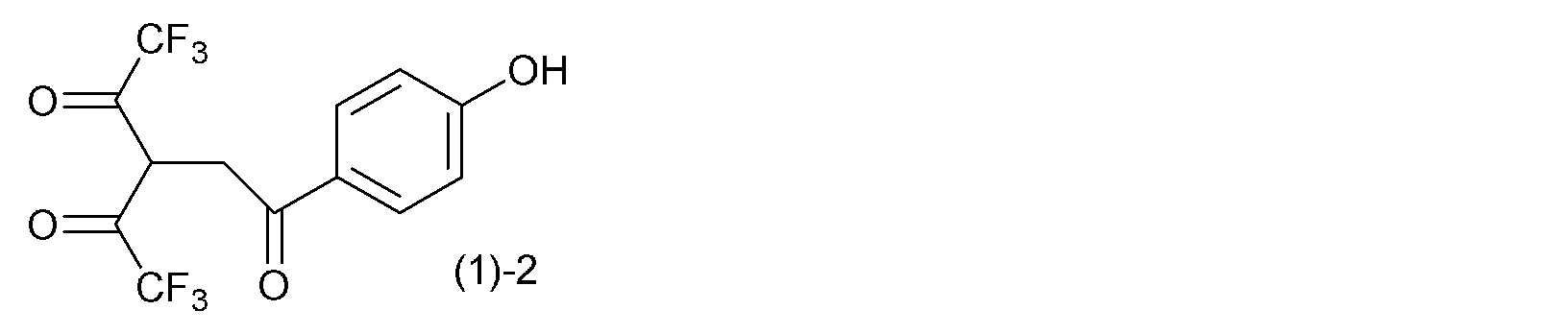
1,1,1,5,5,5-ヘキサフルオロペンタン-2,4-ジオン(5.31mL、37.5mmol)のアセトン(10.0mL)溶液に、室温下、水酸化カリウム( 2.18g、38.9mmol)とポリエチレングリコール400(0.75mL)を添加した。2時間撹拌した後、2-ブロモ-1-(4-ヒドロキシフェニル)エタン-1-オン(8.065g,37.5mmol)を添加した。その後、この混合物を10時間加熱還流した。反応混合物を濃縮した後、希塩酸(c a.5 %)を加え、生成物を酢酸エチルで抽出した。有機相を水で洗浄した後、無水硫酸ナトリウムで乾燥した。ろ過、次いで溶媒を留去した後、粗生成物をカラムクロマトグラフィー(シリカ、クロロホルム:酢酸エチル(2:1))で精製し、真空乾燥して、標題の化合物を白色固体で得た(収量13.1g、収率70%)。
IR (neat) cm-1: 3417.2, 3250.4, 1676.8, 1606.4, 1592.9, 1518.7, 1456.0, 1413.6, 1312.3, 1279.5, 1227.5, 1171.5,1115.6, 1088.6, 978.7, 833.1, 700.0
化合物(1)-13の合成

ヘキサデカノール(84.3g、348 mmol)のテトラヒドロフラン(250mL)溶液に、氷冷下、ゆっくりとメタンスルホニルクロリド(41.84g、365mmol)を添加したのち、ゆっくりとピリジン(30.0mL、365mmol)を添加した。その後、混合物を室温で10時間撹拌した。反応混合物を濃縮し、希塩酸(c a.5 %)中に加え、生成物を酢酸エチルで抽出した。有機相を水で洗浄した後、無水硫酸ナトリウムで乾燥した。ろ過、次いで溶媒を留去し、真空乾燥して、無色固体のヘキサデシルメタンスルホナートを得た。
テトラエチレングリコール(35.6g、183mmol)に、室温下、t-ブトキシカリウム( 6.06g、54.0mmol)を添加し、30分間撹拌した後、140℃に加熱した。2-ブロモ-1-(4-ヒドロキシフェニル)エタン-1-オン(8.065g、37.5mmol)を添加した。その混合物に、ヘキサデシルメタンスルホナート(17.3g、54.0mmol)を4回に分けて添加し、さらに5時間加熱した。反応混合物を冷却した後、希塩酸(ca.5%)を加え、生成物を酢酸エチルで抽出した。有機相を水で洗浄した後、無水硫酸ナトリウムで乾燥した。ろ過、次いで溶媒を留去した後、粗生成物をカラムクロマトグラフィー(シリカ、酢酸エチル)で精製し、真空乾燥して、(1)-13bを白色固体で得た( 収量13.6g、 収率60% ) 。
3,6,9,12-テトラオキサオクタコサン-1-オール(5.0g、11.9mmol)のジクロロメタン(9.0mL)溶液に、トリエチルアミン(2.8mL、20.2mmol)を添加した。これに、ブロモアセチルクロリド(1.5mL、17.9mmol)を-78℃でゆっくりと添加した。3時間撹拌した後、終夜で室温まで戻した。希塩酸(ca.5%)を加え、生成物をジクロロメタンで抽出した。有機相を水で洗浄した後、無水硫酸ナトリウムで乾燥した。ろ過、次いで溶媒を留去した後、粗生成物をカラムクロマトグラフィー(シリカ、酢酸エチル:クロロホルム(1:9))で精製し、真空乾燥して、(1)-13aを淡黄色wax状固体で得た(収量4.7g、収率73%)。
IR (neat) cm-1: 2952.5, 2917.8, 2850.3, 1756.8, 1467.6, 1415.5, 1376.9, 1351.9, 1293.0, 1251.6, 1184.1, 1133.0, 1036.6, 963.3, 870.7, 780.1, 721.2
1,1,1,5,5,5-ヘキサフルオロペンタン-2,4-ジオン(0.539mL、3.81mmol)のテトライドロフラン(5.0mL)溶液に、0 ℃で、ゆっくりと水素化ナトリウムin Oil(60%)(0.148g、3.7mmol)を添加した。30分撹拌した後、2-(((4-(2-ブロモアセチル)フェノキシ)カルボニル)アミノ)エチル メタクリレート(1.0g、1.85mmol)を添加した。その後、120℃で24時間撹拌した。反応混合物を、希塩酸(ca.5%)中に加え、生成物を酢酸エチルで抽出した。有機相を水で洗浄した後、無水硫酸ナトリウムで乾燥した。ろ過、次いで溶媒を留去した後、粗生成物をカラムクロマトグラフィー(シリカ、クロロホルム:酢酸エチル(3:1))で精製し、真空乾燥して、(1)-13を淡褐色固体で得た( 収量0.60g、収率24% ) 。
化合物(1)-26の合成

1,3-ジエニル-12-ヨードウンデカン(4.0g、13.7 mmol)とテトラエチレングリコール(8.0g、41.6mmol)のテトラヒドロフラン(250mL)溶液に、氷冷下、水素化ナトリウム( 0.56g、14.0mmol)を添加し、3時間撹拌した後、40℃で24時間加熱した。反応混合物を冷却した後、希塩酸(ca.5%)を加え、生成物を酢酸エチルで抽出した。有機相を水で洗浄した後、無水硫酸ナトリウムで乾燥した。ろ過、次いで溶媒を留去した後、粗生成物をカラムクロマトグラフィー(シリカ、酢酸エチル)で精製し、真空乾燥して、(1)-26bを無色液体で得た( 収量3.49g、 収率71% )。
3,6,9,12-テトラオキサオクタコシル-21,23-ジエニル-1-オールを用い、(1)-13aの方法に準じて合成し、3,6,9,12-テトラオキサテトラコサン-21,23-ジエニル 2-ブロモアセテート(1)-26a(=(5)-17)無色透明液体を得た(収量3.3g)。
3,6,9,12-テトラオキサテトラコサン-21,23-ジエニル 2-ブロモアセテート(0.992mL、2.07mmol)のアセトン(32.5mL)溶液に、室温下、 1,1,1,5,5,5-ヘキサフルオロペンタン-2,4-ジオン(0.585mL、4.06mmol)を滴下し、さらに、ヨウ化テトラエチルアンモニウム(0.535mg、2.08mmol)を添加したのち、ジメチルアミノピリジン(0.500mg、4.10mmol)をゆっくりと添加した。30分撹拌した後、水3.0mLを添加した。その後、24時間撹拌した。反応混合物を減圧濃縮したのち、3N塩酸と酢酸エチルの混合物を加え、生成物を酢酸エチルで抽出し、無水硫酸ナトリウムで乾燥した。ろ過、次いで溶媒を留去した後、粗生成物をカラムクロマトグラフィー(シリカ、n-ヘキサン:酢酸エチル(3:2))で精製し、真空乾燥して、淡々黄色粘性液体の(1)-26を得た( 収量0.77g、収率61% ) 。
上記で合成した化合物(1)-1、(1)-13、(1)-26のメタノール溶液に等当量の水酸化リチウムを加え、1時間撹拌後、溶媒を留去、真空乾燥して、(1)-1、(1)-13、(1)-26のリチウム塩(1)-1L、(1)-13L、(1)-26Lを得た。また、(1)-1のリチウム塩(1)-1Lについては、その二倍当量のトリオクチルフォスフィンオキシド(TOPO)を加えたメタノール溶液を、同様に1時間撹拌後、溶媒を留去、真空乾燥して、(1)-1L TOPO錯体を得た。さらに、その錯体をシリコン基板上で145℃15分間加熱し、(1)-1L TOPO錯体の加熱膜を得た。

図1の右は、(1)-13、及びそのリチウム塩(1)-13LのFT-IRスペクトルを示している。
一方、分子内にテトラエチレンオキシ基を有する化合物(1)-13は、単独しかも室温で完全に安定な共鳴環構造(B)のリチウム塩を形成する機能を有していることが分った。
すなわち、β-ジケトンを分子末端に有する化合物は、単独または適切なリガンドを選択することにより熱的に安定なリチウム塩を形成し、リチウムを保持できることが分かった。
上記で合成した化合物(1)-1、(1)-13および(1)-26のメタノール溶液に等当量の水素化ナトリウムを加え、1時間撹拌後、溶媒を留去、真空乾燥して、(1)-1、(1)-13および(1)-26のナトリウム塩(1)-1N、(1)-13Nおよび(1)-26Nを得た。
以下のX線回折(XRD)および偏光顕微鏡観察により、(1)-13は、層状構造をもったスメクチック液晶相を呈する液晶化合物であることが分かった。
<XRD>
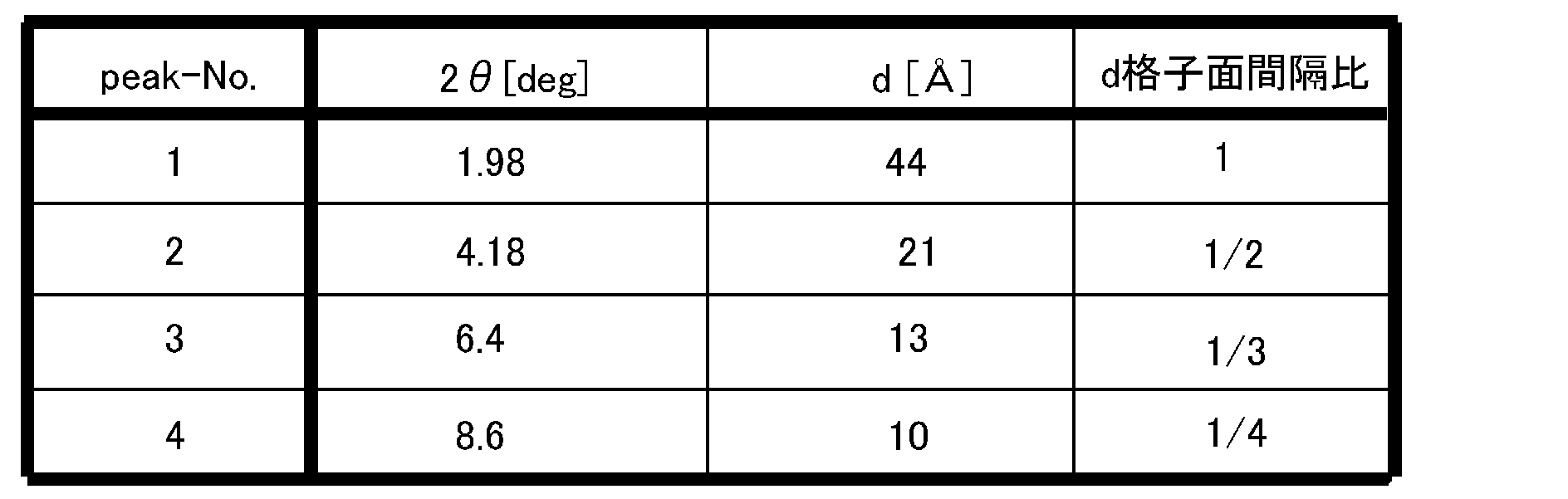
23℃(液晶状態)における(1)-13のX 線回折パターンを表1に示す。d 格子面間隔比が1:1/2:1/3:1/4を示すことから層状構造をもつことを確認した。
<XRD>
23℃(液晶状態)における(1)-13LのX 線回折パターンを表2に示す。(1)-13と酷似しているが、水素イオンがリチウムイオンに置き換わったために、若干d 格子面間隔は大きくなっているが、格子面間隔比は同様に1:1/2:1/3:1/4を示すことから(1)-13Lも同様に層状構造をもつことを確認した。

< 偏光顕微鏡観察>
図3は、化合物(1)-13の室温での偏光顕微鏡観察像である。液晶状態(26℃)では、クロスニコル条件下、スメクチックB相に特有のテクスチャーが観察された。
図4は、化合物(1)-13Lの室温での偏光顕微鏡観察像である。液晶状態(50℃)では、クロスニコル条件下、スメクチックB相に特有のテクスチャーが観察された。
<光重合反応のFT-IRによる検証>
(1)-26のリチウム塩(1)-26Lが薄膜状態で重合することを確認した。
(1)-26Lに15wt%の光重合開始剤である2,2-ジメトキシ-2-フェニルアセトフェノンを混合した2μm厚の薄膜を金蒸着基板上に形成し、紫外光を30分間照射し、その照射前後のFT-IRを測定した。その結果、図5に示すように、紫外光照射前(緑色曲線)に存在したブタンジエニル基の3086.5cm-1、3033.5cm-1および3003.6cm-1のC-H伸縮振動peakと1646.9cm-1および1600.6cm-1のC=C伸縮振動peakがすべて紫外光照射30分後(青色曲線)に消失したことによって、(1)-26L の重合が紫外光照射によって進行することを確認した。
Claims (20)
- 下記一般式(1)で表される化合物。

(式中、
Mは水素イオンまたは配位子を有してもよい1価以上の金属イオンを表し;
R1及びR2は、それぞれ独立して、置換または無置換のアルキル基、アルケニル基、アリール基又は複素環基を表し、これらの基は重合性基を含んでいてもよく;
R3及びR4は、それぞれ独立して、水素原子、置換または無置換のアルキル基、アリール基又は複素環基を表し、これらの基は重合性基を含んでいてもよく;
R5は、置換または無置換のアルキル基、アルケニル基、アルキニル基、アリール基、複素環基、アルコキシ基、アリールオキシ基、アルキルアミノ基又はアリールアミノ基を表し、これらの基は重合性基を含んでいてもよく;
R1~R5の各々には重合性基は含まれないか、または、R1~R5の少なくとも一つに重合性基が含まれ;
pは1または0を表し、但し、p=0のとき、R5は炭素数4以下のアルコキシ基ではない。) - R1及びR2の少なくとも一つがトリフルオロメチル基である、請求項1に記載の化合物。
- R5に重合性基が含まれる、請求項1又は2に記載の化合物。
- R5に下記一般式(2)で表される二価残基が含まれる、請求項1~3のいずれか1項に記載の化合物。

(式中、kは2または3を表し、mは1乃至20の整数を表す。) - Mがリチウムイオンである、請求項1~4のいずれか1項に記載の化合物。
- 一般式(1)で表される化合物のpKaが3~6である、請求項1~5のいずれか1項に記載の化合物。
- 一般式(1)で表される化合物が液晶性を発現する、請求項1~6のいずれか1項に記載の化合物。
- Mが配位子を有してもよい1価以上の金属イオンである、請求項1~7のいずれか1項に記載の化合物からなる組成物。
- 一般式(1) で表される化合物が重合性基を有し、当該化合物を構成単位とする重合体を含む重合組成物。
- 一般式(1)におけるMが配位子を有してもよい1価以上の金属イオンである、請求項9に記載の重合組成物。
- 自己組織化による累積構造を有する、請求項8~10のいずれか1項に記載の組成物。
- 請求項1~7のいずれか1項に記載の化合物と、一般式(3)で表される化合物を含む組成物。

(式中、R6、R7及びR8は、それぞれ独立して、置換または無置換のアルキル基、アリール基又は複素環基を表し、これらの基は重合性基を含んでいてもよく;
R6、R7及びR8のいずれか2つは一緒になって、これらが結合している燐原子を含む5~7員の環を形成してもよく;
R6、R7及びR8のいずれか1を介して2量体を形成してもよく;
R6~R8の各々には重合性基は含まれないか、またはR6~R8の少なくとも一つに重合性基が含まれる。) - 一般式(1) で表される化合物及び一般式(3)で表される化合物の少なくとも一つが重合性基を有し、重合性基を有する化合物を構成単位とする重合体を含む、請求項12に記載の組成物。
- 一般式(1)におけるMが配位子を有してもよい1価以上の金属イオンである、請求項12又は13に記載の組成物。
- 自己組織化による累積構造を有する、請求項12~14のいずれか1項に記載の組成物。
- Mが配位子を有してもよい1価以上の金属イオンであり、R1~R5の少なくとも一つに重合性基が含まれる一般式(1)で表される化合物からなる組成物を重合した後、その金属塩を溶出し、Mを水素原子に置換することを含む、重合組成物の製造方法。
- Mが配位子を有してもよい1価以上の金属イオンである一般式(1)で表される化合物及び一般式(3)で表される化合物を含み、両方の化合物の少なくとも一つが重合性基を有する、組成物を重合した後、その金属塩を溶出し、Mを水素原子に置換することを含む、重合組成物の製造方法。
- 請求項16又は17に記載の方法で得られる重合組成物を用いて、金属イオンを選択的に捕捉する方法。
- 下記一般式(4)で表される化合物と一般式(5)で表される化合物を反応させることを含む、一般式(1)で表される化合物を製造する方法。

(式中、R9及びR10は置換または無置換のアルキル基、アリール基、複素環基を表し、これらの基は重合性基を含んでいてもよい。)

(式中、R11はハロゲン元素を表し、R12及びR13は、水素原子、置換または無置換のアルキル基、アリール基、複素環基を表し、R14は置換または無置換のアルキル基、アルケニル基、アルキニル基、アリール基、複素環基、アルコキシ基、アリールオキシ基、アルキルアミノ基、アリールアミノ基を表し、R12~R14として定義される基は重合性基を含んでいてもよく、pは0または1を表し、但し、p=0のとき、R14は炭素数4以下のアルコキシ基ではない。) - 有機化合物のヨード塩の共存下で、一般式(4)で表される化合物と一般式(5)で表される化合物を反応させる、請求項19に記載の方法。
Priority Applications (3)
| Application Number | Priority Date | Filing Date | Title |
|---|---|---|---|
| JP2018509466A JP7079494B2 (ja) | 2016-04-01 | 2017-03-30 | 新規化合物とその合成方法 |
| AU2017239848A AU2017239848B2 (en) | 2016-04-01 | 2017-03-30 | Novel compound and synthesis method therefor |
| US16/090,405 US10835895B2 (en) | 2016-04-01 | 2017-03-30 | Compound and synthesis method therefor |
Applications Claiming Priority (2)
| Application Number | Priority Date | Filing Date | Title |
|---|---|---|---|
| JP2016-073976 | 2016-04-01 | ||
| JP2016073976 | 2016-04-01 |
Publications (1)
| Publication Number | Publication Date |
|---|---|
| WO2017170934A1 true WO2017170934A1 (ja) | 2017-10-05 |
Family
ID=59965866
Family Applications (1)
| Application Number | Title | Priority Date | Filing Date |
|---|---|---|---|
| PCT/JP2017/013404 Ceased WO2017170934A1 (ja) | 2016-04-01 | 2017-03-30 | 新規化合物とその合成方法 |
Country Status (4)
| Country | Link |
|---|---|
| US (1) | US10835895B2 (ja) |
| JP (1) | JP7079494B2 (ja) |
| AU (1) | AU2017239848B2 (ja) |
| WO (1) | WO2017170934A1 (ja) |
Cited By (1)
| Publication number | Priority date | Publication date | Assignee | Title |
|---|---|---|---|---|
| WO2019066045A1 (ja) * | 2017-09-29 | 2019-04-04 | 国立大学法人 東京大学 | 金属イオンを捕捉する材料 |
Families Citing this family (1)
| Publication number | Priority date | Publication date | Assignee | Title |
|---|---|---|---|---|
| CN114761100A (zh) * | 2019-10-12 | 2022-07-15 | 阿尔特姆斯产品公司 | 分离镓-68的系统和方法 |
Citations (6)
| Publication number | Priority date | Publication date | Assignee | Title |
|---|---|---|---|---|
| JPS5931768A (ja) * | 1982-06-03 | 1984-02-20 | モンテディソン・エッセ・ピ・ア | 殺菌活性を有するα−(1−トリアゾリル)ケト誘導体 |
| US4500601A (en) * | 1983-08-29 | 1985-02-19 | Minnesota Mining And Manufacturing Company | Chelating polymers for modifying metal surface properties |
| JPH111625A (ja) * | 1997-06-12 | 1999-01-06 | Mitsubishi Chem Corp | 水溶性錯体及びそれを利用した造影剤 |
| JPH11199855A (ja) * | 1998-01-07 | 1999-07-27 | Nippon Paint Co Ltd | 金属キレート化合物 |
| JP2002138069A (ja) * | 2000-10-31 | 2002-05-14 | National Institute Of Advanced Industrial & Technology | 1,3−プロパンジオールピレニルアセチルアセトンエステル化合物 |
| JP2014504632A (ja) * | 2011-02-03 | 2014-02-24 | ルピン・リミテッド | α7nAChRのモジュレータとして使用されるピロール誘導体 |
Family Cites Families (9)
| Publication number | Priority date | Publication date | Assignee | Title |
|---|---|---|---|---|
| US3405163A (en) * | 1965-08-26 | 1968-10-08 | Richardson Merrell Inc | Trifluoromethyl diones |
| AU565221B2 (en) | 1982-06-03 | 1987-09-10 | Montedison S.P.A. | 2-(1,2,4-triazol-1-yl) propanone derivatives |
| US4943673A (en) * | 1987-08-07 | 1990-07-24 | Air Products And Chemicals, Inc. | Novel metal-diketone absorbents for olefins |
| JPH10228638A (ja) * | 1997-02-10 | 1998-08-25 | Sony Corp | 磁気記録媒体 |
| US7320833B2 (en) * | 2001-11-07 | 2008-01-22 | E.I. Du Pont De Nemours And Company | Electroluminescent platinum compounds and devices made with such compounds |
| JP4934035B2 (ja) * | 2004-06-09 | 2012-05-16 | イー・アイ・デュポン・ドウ・ヌムール・アンド・カンパニー | 有機金属化合物およびかかる化合物で形成された素子 |
| JP5713360B2 (ja) | 2010-03-09 | 2015-05-07 | 国立大学法人 奈良先端科学技術大学院大学 | 円偏光発光性希土類錯体 |
| JP5565377B2 (ja) | 2011-05-31 | 2014-08-06 | コニカミノルタ株式会社 | 水処理剤 |
| JP6590254B2 (ja) * | 2014-02-10 | 2019-10-16 | 国立大学法人北海道大学 | 配位子、高分子錯体及びその製造方法 |
-
2017
- 2017-03-30 WO PCT/JP2017/013404 patent/WO2017170934A1/ja not_active Ceased
- 2017-03-30 AU AU2017239848A patent/AU2017239848B2/en not_active Ceased
- 2017-03-30 US US16/090,405 patent/US10835895B2/en not_active Expired - Fee Related
- 2017-03-30 JP JP2018509466A patent/JP7079494B2/ja not_active Expired - Fee Related
Patent Citations (6)
| Publication number | Priority date | Publication date | Assignee | Title |
|---|---|---|---|---|
| JPS5931768A (ja) * | 1982-06-03 | 1984-02-20 | モンテディソン・エッセ・ピ・ア | 殺菌活性を有するα−(1−トリアゾリル)ケト誘導体 |
| US4500601A (en) * | 1983-08-29 | 1985-02-19 | Minnesota Mining And Manufacturing Company | Chelating polymers for modifying metal surface properties |
| JPH111625A (ja) * | 1997-06-12 | 1999-01-06 | Mitsubishi Chem Corp | 水溶性錯体及びそれを利用した造影剤 |
| JPH11199855A (ja) * | 1998-01-07 | 1999-07-27 | Nippon Paint Co Ltd | 金属キレート化合物 |
| JP2002138069A (ja) * | 2000-10-31 | 2002-05-14 | National Institute Of Advanced Industrial & Technology | 1,3−プロパンジオールピレニルアセチルアセトンエステル化合物 |
| JP2014504632A (ja) * | 2011-02-03 | 2014-02-24 | ルピン・リミテッド | α7nAChRのモジュレータとして使用されるピロール誘導体 |
Non-Patent Citations (8)
Cited By (2)
| Publication number | Priority date | Publication date | Assignee | Title |
|---|---|---|---|---|
| WO2019066045A1 (ja) * | 2017-09-29 | 2019-04-04 | 国立大学法人 東京大学 | 金属イオンを捕捉する材料 |
| JPWO2019066045A1 (ja) * | 2017-09-29 | 2020-10-22 | 国立大学法人 東京大学 | 金属イオンを捕捉する材料 |
Also Published As
| Publication number | Publication date |
|---|---|
| AU2017239848B2 (en) | 2019-12-19 |
| AU2017239848A1 (en) | 2018-11-01 |
| JP7079494B2 (ja) | 2022-06-02 |
| US20190111418A1 (en) | 2019-04-18 |
| JPWO2017170934A1 (ja) | 2019-02-14 |
| US10835895B2 (en) | 2020-11-17 |
Similar Documents
| Publication | Publication Date | Title |
|---|---|---|
| Giese et al. | Tuning the photonic properties of chiral nematic mesoporous organosilica with hydrogen-bonded liquid-crystalline assemblies | |
| Ye et al. | The fabrication of helical fibers with circularly polarized luminescence via ionic linkage of binaphthol and tetraphenylethylene derivatives | |
| CN116903523B (zh) | 一种基于阳离子-π作用构筑的液晶材料及其制备方法及应用 | |
| CN105949440B (zh) | 一种含氨基的多孔芳香骨架材料paf11‑nh2及其制备方法 | |
| Mamlouk et al. | A nematic [60] fullerene supermolecule: when polyaddition leads to supramolecular self-organization at room temperature | |
| Ringstrand et al. | Anion-driven mesogenicity: a comparative study of ionic liquid crystals based on the [closo-1-CB 9 H 10]− and [closo-1-CB 11 H 12]− clusters | |
| CN117964651B (zh) | 一种窄谱带圆偏振发光分子及其制备方法和应用 | |
| JP7079494B2 (ja) | 新規化合物とその合成方法 | |
| CN113292581B (zh) | 一种新型配位圆偏振发光晶态化合物及其制备方法与应用 | |
| CN115536721B (zh) | 一种具有光热双重响应性的手性过盈螺烯类分子马达及其制备方法 | |
| JP4296995B2 (ja) | フルオレン化合物およびその製造方法 | |
| JP3942319B2 (ja) | 液晶性ポーラロン磁性体およびその製造方法 | |
| Zheng et al. | A pair of homochiral complexes generated via spontaneous resolution: Synthesis, structures and dielectric properties | |
| JP5407332B2 (ja) | クォータピリジン誘導体の製造方法及びその中間体 | |
| CN116730907B (zh) | 一种含醛基的n-芳基化紫精类分子的合成方法 | |
| Barcelona-Cazanave et al. | Synthesis and thermotropic liquid-crystalline properties of a hexyloxy-substituted pyridyl-ethynylene-azobenzene and its halogen-bonded complex with tetrafluoroiodophenyl decanoate | |
| JP3106664B2 (ja) | 新規金属錯体液晶 | |
| CN116083079B (zh) | 一种优降宁保护的二十六核铜簇及其制备方法和应用 | |
| CN104788330B (zh) | 一种手性双l‑亮氨酸盐酸盐的制备及合成方法 | |
| Freedman et al. | Metal–coumarin complexes: synthesis and characterization of 7-isocyanocoumarin ligands and Mo (CO) 4 (7-isocyanocoumarin) 2 complexes. X-ray crystal structure of Mo (CO) 4 (7-isocyano-4-trifluoromethylcoumarin) 2 | |
| CN118994289A (zh) | 一种α-氰基二苯乙烯型手性荧光液晶化合物及其制备方法 | |
| JPWO2019066045A1 (ja) | 金属イオンを捕捉する材料 | |
| JP4741789B2 (ja) | 吸着性能を持つ高分子錯体の合成法 | |
| JP2877662B2 (ja) | 液晶相を発現するカリックスアレーン誘導体 | |
| JP2018203684A (ja) | 金属錯体、キラルネマチック液晶組成物及び液晶素子 |
Legal Events
| Date | Code | Title | Description |
|---|---|---|---|
| ENP | Entry into the national phase |
Ref document number: 2018509466 Country of ref document: JP Kind code of ref document: A |
|
| NENP | Non-entry into the national phase |
Ref country code: DE |
|
| ENP | Entry into the national phase |
Ref document number: 2017239848 Country of ref document: AU Date of ref document: 20170330 Kind code of ref document: A |
|
| 121 | Ep: the epo has been informed by wipo that ep was designated in this application |
Ref document number: 17775468 Country of ref document: EP Kind code of ref document: A1 |
|
| 122 | Ep: pct application non-entry in european phase |
Ref document number: 17775468 Country of ref document: EP Kind code of ref document: A1 |