WO2017073522A1 - 活性エネルギー線硬化型塗料組成物 - Google Patents
活性エネルギー線硬化型塗料組成物 Download PDFInfo
- Publication number
- WO2017073522A1 WO2017073522A1 PCT/JP2016/081463 JP2016081463W WO2017073522A1 WO 2017073522 A1 WO2017073522 A1 WO 2017073522A1 JP 2016081463 W JP2016081463 W JP 2016081463W WO 2017073522 A1 WO2017073522 A1 WO 2017073522A1
- Authority
- WO
- WIPO (PCT)
- Prior art keywords
- meth
- acrylate
- polymerizable unsaturated
- active energy
- coating composition
- Prior art date
- Legal status (The legal status is an assumption and is not a legal conclusion. Google has not performed a legal analysis and makes no representation as to the accuracy of the status listed.)
- Ceased
Links
Classifications
-
- C—CHEMISTRY; METALLURGY
- C08—ORGANIC MACROMOLECULAR COMPOUNDS; THEIR PREPARATION OR CHEMICAL WORKING-UP; COMPOSITIONS BASED THEREON
- C08F—MACROMOLECULAR COMPOUNDS OBTAINED BY REACTIONS ONLY INVOLVING CARBON-TO-CARBON UNSATURATED BONDS
- C08F2/00—Processes of polymerisation
- C08F2/46—Polymerisation initiated by wave energy or particle radiation
- C08F2/48—Polymerisation initiated by wave energy or particle radiation by ultraviolet or visible light
-
- C—CHEMISTRY; METALLURGY
- C08—ORGANIC MACROMOLECULAR COMPOUNDS; THEIR PREPARATION OR CHEMICAL WORKING-UP; COMPOSITIONS BASED THEREON
- C08F—MACROMOLECULAR COMPOUNDS OBTAINED BY REACTIONS ONLY INVOLVING CARBON-TO-CARBON UNSATURATED BONDS
- C08F2/00—Processes of polymerisation
- C08F2/46—Polymerisation initiated by wave energy or particle radiation
- C08F2/54—Polymerisation initiated by wave energy or particle radiation by X-rays or electrons
-
- C—CHEMISTRY; METALLURGY
- C08—ORGANIC MACROMOLECULAR COMPOUNDS; THEIR PREPARATION OR CHEMICAL WORKING-UP; COMPOSITIONS BASED THEREON
- C08F—MACROMOLECULAR COMPOUNDS OBTAINED BY REACTIONS ONLY INVOLVING CARBON-TO-CARBON UNSATURATED BONDS
- C08F8/00—Chemical modification by after-treatment
- C08F8/14—Esterification
-
- C—CHEMISTRY; METALLURGY
- C08—ORGANIC MACROMOLECULAR COMPOUNDS; THEIR PREPARATION OR CHEMICAL WORKING-UP; COMPOSITIONS BASED THEREON
- C08G—MACROMOLECULAR COMPOUNDS OBTAINED OTHERWISE THAN BY REACTIONS ONLY INVOLVING UNSATURATED CARBON-TO-CARBON BONDS
- C08G18/00—Polymeric products of isocyanates or isothiocyanates
- C08G18/06—Polymeric products of isocyanates or isothiocyanates with compounds having active hydrogen
- C08G18/08—Processes
- C08G18/16—Catalysts
- C08G18/22—Catalysts containing metal compounds
- C08G18/24—Catalysts containing metal compounds of tin
- C08G18/244—Catalysts containing metal compounds of tin tin salts of carboxylic acids
- C08G18/246—Catalysts containing metal compounds of tin tin salts of carboxylic acids containing also tin-carbon bonds
-
- C—CHEMISTRY; METALLURGY
- C08—ORGANIC MACROMOLECULAR COMPOUNDS; THEIR PREPARATION OR CHEMICAL WORKING-UP; COMPOSITIONS BASED THEREON
- C08G—MACROMOLECULAR COMPOUNDS OBTAINED OTHERWISE THAN BY REACTIONS ONLY INVOLVING UNSATURATED CARBON-TO-CARBON BONDS
- C08G18/00—Polymeric products of isocyanates or isothiocyanates
- C08G18/06—Polymeric products of isocyanates or isothiocyanates with compounds having active hydrogen
- C08G18/28—Polymeric products of isocyanates or isothiocyanates with compounds having active hydrogen characterised by the compounds used containing active hydrogen
- C08G18/30—Low-molecular-weight compounds
- C08G18/32—Polyhydroxy compounds; Polyamines; Hydroxyamines
- C08G18/3203—Polyhydroxy compounds
- C08G18/3206—Polyhydroxy compounds aliphatic
-
- C—CHEMISTRY; METALLURGY
- C08—ORGANIC MACROMOLECULAR COMPOUNDS; THEIR PREPARATION OR CHEMICAL WORKING-UP; COMPOSITIONS BASED THEREON
- C08G—MACROMOLECULAR COMPOUNDS OBTAINED OTHERWISE THAN BY REACTIONS ONLY INVOLVING UNSATURATED CARBON-TO-CARBON BONDS
- C08G18/00—Polymeric products of isocyanates or isothiocyanates
- C08G18/06—Polymeric products of isocyanates or isothiocyanates with compounds having active hydrogen
- C08G18/28—Polymeric products of isocyanates or isothiocyanates with compounds having active hydrogen characterised by the compounds used containing active hydrogen
- C08G18/30—Low-molecular-weight compounds
- C08G18/34—Carboxylic acids; Esters thereof with monohydroxyl compounds
- C08G18/348—Hydroxycarboxylic acids
-
- C—CHEMISTRY; METALLURGY
- C08—ORGANIC MACROMOLECULAR COMPOUNDS; THEIR PREPARATION OR CHEMICAL WORKING-UP; COMPOSITIONS BASED THEREON
- C08G—MACROMOLECULAR COMPOUNDS OBTAINED OTHERWISE THAN BY REACTIONS ONLY INVOLVING UNSATURATED CARBON-TO-CARBON BONDS
- C08G18/00—Polymeric products of isocyanates or isothiocyanates
- C08G18/06—Polymeric products of isocyanates or isothiocyanates with compounds having active hydrogen
- C08G18/28—Polymeric products of isocyanates or isothiocyanates with compounds having active hydrogen characterised by the compounds used containing active hydrogen
- C08G18/40—High-molecular-weight compounds
- C08G18/62—Polymers of compounds having carbon-to-carbon double bonds
- C08G18/6216—Polymers of alpha-beta ethylenically unsaturated carboxylic acids or of derivatives thereof
- C08G18/622—Polymers of esters of alpha-beta ethylenically unsaturated carboxylic acids
- C08G18/6225—Polymers of esters of acrylic or methacrylic acid
- C08G18/6229—Polymers of hydroxy groups containing esters of acrylic or methacrylic acid with aliphatic polyalcohols
-
- C—CHEMISTRY; METALLURGY
- C08—ORGANIC MACROMOLECULAR COMPOUNDS; THEIR PREPARATION OR CHEMICAL WORKING-UP; COMPOSITIONS BASED THEREON
- C08G—MACROMOLECULAR COMPOUNDS OBTAINED OTHERWISE THAN BY REACTIONS ONLY INVOLVING UNSATURATED CARBON-TO-CARBON BONDS
- C08G18/00—Polymeric products of isocyanates or isothiocyanates
- C08G18/06—Polymeric products of isocyanates or isothiocyanates with compounds having active hydrogen
- C08G18/28—Polymeric products of isocyanates or isothiocyanates with compounds having active hydrogen characterised by the compounds used containing active hydrogen
- C08G18/67—Unsaturated compounds having active hydrogen
- C08G18/671—Unsaturated compounds having only one group containing active hydrogen
- C08G18/672—Esters of acrylic or alkyl acrylic acid having only one group containing active hydrogen
-
- C—CHEMISTRY; METALLURGY
- C08—ORGANIC MACROMOLECULAR COMPOUNDS; THEIR PREPARATION OR CHEMICAL WORKING-UP; COMPOSITIONS BASED THEREON
- C08G—MACROMOLECULAR COMPOUNDS OBTAINED OTHERWISE THAN BY REACTIONS ONLY INVOLVING UNSATURATED CARBON-TO-CARBON BONDS
- C08G18/00—Polymeric products of isocyanates or isothiocyanates
- C08G18/06—Polymeric products of isocyanates or isothiocyanates with compounds having active hydrogen
- C08G18/70—Polymeric products of isocyanates or isothiocyanates with compounds having active hydrogen characterised by the isocyanates or isothiocyanates used
- C08G18/71—Monoisocyanates or monoisothiocyanates
- C08G18/711—Monoisocyanates or monoisothiocyanates containing oxygen in addition to isocyanate oxygen
-
- C—CHEMISTRY; METALLURGY
- C08—ORGANIC MACROMOLECULAR COMPOUNDS; THEIR PREPARATION OR CHEMICAL WORKING-UP; COMPOSITIONS BASED THEREON
- C08G—MACROMOLECULAR COMPOUNDS OBTAINED OTHERWISE THAN BY REACTIONS ONLY INVOLVING UNSATURATED CARBON-TO-CARBON BONDS
- C08G18/00—Polymeric products of isocyanates or isothiocyanates
- C08G18/06—Polymeric products of isocyanates or isothiocyanates with compounds having active hydrogen
- C08G18/70—Polymeric products of isocyanates or isothiocyanates with compounds having active hydrogen characterised by the isocyanates or isothiocyanates used
- C08G18/72—Polyisocyanates or polyisothiocyanates
- C08G18/74—Polyisocyanates or polyisothiocyanates cyclic
- C08G18/75—Polyisocyanates or polyisothiocyanates cyclic cycloaliphatic
- C08G18/758—Polyisocyanates or polyisothiocyanates cyclic cycloaliphatic containing two or more cycloaliphatic rings
-
- C—CHEMISTRY; METALLURGY
- C08—ORGANIC MACROMOLECULAR COMPOUNDS; THEIR PREPARATION OR CHEMICAL WORKING-UP; COMPOSITIONS BASED THEREON
- C08G—MACROMOLECULAR COMPOUNDS OBTAINED OTHERWISE THAN BY REACTIONS ONLY INVOLVING UNSATURATED CARBON-TO-CARBON BONDS
- C08G18/00—Polymeric products of isocyanates or isothiocyanates
- C08G18/06—Polymeric products of isocyanates or isothiocyanates with compounds having active hydrogen
- C08G18/70—Polymeric products of isocyanates or isothiocyanates with compounds having active hydrogen characterised by the isocyanates or isothiocyanates used
- C08G18/72—Polyisocyanates or polyisothiocyanates
- C08G18/77—Polyisocyanates or polyisothiocyanates having heteroatoms in addition to the isocyanate or isothiocyanate nitrogen and oxygen or sulfur
- C08G18/78—Nitrogen
- C08G18/79—Nitrogen characterised by the polyisocyanates used, these having groups formed by oligomerisation of isocyanates or isothiocyanates
- C08G18/791—Nitrogen characterised by the polyisocyanates used, these having groups formed by oligomerisation of isocyanates or isothiocyanates containing isocyanurate groups
- C08G18/792—Nitrogen characterised by the polyisocyanates used, these having groups formed by oligomerisation of isocyanates or isothiocyanates containing isocyanurate groups formed by oligomerisation of aliphatic and/or cycloaliphatic isocyanates or isothiocyanates
-
- C—CHEMISTRY; METALLURGY
- C09—DYES; PAINTS; POLISHES; NATURAL RESINS; ADHESIVES; COMPOSITIONS NOT OTHERWISE PROVIDED FOR; APPLICATIONS OF MATERIALS NOT OTHERWISE PROVIDED FOR
- C09D—COATING COMPOSITIONS, e.g. PAINTS, VARNISHES OR LACQUERS; FILLING PASTES; CHEMICAL PAINT OR INK REMOVERS; INKS; CORRECTING FLUIDS; WOODSTAINS; PASTES OR SOLIDS FOR COLOURING OR PRINTING; USE OF MATERIALS THEREFOR
- C09D175/00—Coating compositions based on polyureas or polyurethanes; Coating compositions based on derivatives of such polymers
- C09D175/04—Polyurethanes
- C09D175/14—Polyurethanes having carbon-to-carbon unsaturated bonds
- C09D175/16—Polyurethanes having carbon-to-carbon unsaturated bonds having terminal carbon-to-carbon unsaturated bonds
-
- C—CHEMISTRY; METALLURGY
- C09—DYES; PAINTS; POLISHES; NATURAL RESINS; ADHESIVES; COMPOSITIONS NOT OTHERWISE PROVIDED FOR; APPLICATIONS OF MATERIALS NOT OTHERWISE PROVIDED FOR
- C09D—COATING COMPOSITIONS, e.g. PAINTS, VARNISHES OR LACQUERS; FILLING PASTES; CHEMICAL PAINT OR INK REMOVERS; INKS; CORRECTING FLUIDS; WOODSTAINS; PASTES OR SOLIDS FOR COLOURING OR PRINTING; USE OF MATERIALS THEREFOR
- C09D4/00—Coating compositions, e.g. paints, varnishes or lacquers, based on organic non-macromolecular compounds having at least one polymerisable carbon-to-carbon unsaturated bond ; Coating compositions, based on monomers of macromolecular compounds of groups C09D183/00 - C09D183/16
-
- C—CHEMISTRY; METALLURGY
- C09—DYES; PAINTS; POLISHES; NATURAL RESINS; ADHESIVES; COMPOSITIONS NOT OTHERWISE PROVIDED FOR; APPLICATIONS OF MATERIALS NOT OTHERWISE PROVIDED FOR
- C09D—COATING COMPOSITIONS, e.g. PAINTS, VARNISHES OR LACQUERS; FILLING PASTES; CHEMICAL PAINT OR INK REMOVERS; INKS; CORRECTING FLUIDS; WOODSTAINS; PASTES OR SOLIDS FOR COLOURING OR PRINTING; USE OF MATERIALS THEREFOR
- C09D4/00—Coating compositions, e.g. paints, varnishes or lacquers, based on organic non-macromolecular compounds having at least one polymerisable carbon-to-carbon unsaturated bond ; Coating compositions, based on monomers of macromolecular compounds of groups C09D183/00 - C09D183/16
- C09D4/06—Organic non-macromolecular compounds having at least one polymerisable carbon-to-carbon unsaturated bond in combination with a macromolecular compound other than an unsaturated polymer of groups C09D159/00 - C09D187/00
-
- C—CHEMISTRY; METALLURGY
- C09—DYES; PAINTS; POLISHES; NATURAL RESINS; ADHESIVES; COMPOSITIONS NOT OTHERWISE PROVIDED FOR; APPLICATIONS OF MATERIALS NOT OTHERWISE PROVIDED FOR
- C09D—COATING COMPOSITIONS, e.g. PAINTS, VARNISHES OR LACQUERS; FILLING PASTES; CHEMICAL PAINT OR INK REMOVERS; INKS; CORRECTING FLUIDS; WOODSTAINS; PASTES OR SOLIDS FOR COLOURING OR PRINTING; USE OF MATERIALS THEREFOR
- C09D7/00—Features of coating compositions, not provided for in group C09D5/00; Processes for incorporating ingredients in coating compositions
- C09D7/40—Additives
-
- C—CHEMISTRY; METALLURGY
- C09—DYES; PAINTS; POLISHES; NATURAL RESINS; ADHESIVES; COMPOSITIONS NOT OTHERWISE PROVIDED FOR; APPLICATIONS OF MATERIALS NOT OTHERWISE PROVIDED FOR
- C09D—COATING COMPOSITIONS, e.g. PAINTS, VARNISHES OR LACQUERS; FILLING PASTES; CHEMICAL PAINT OR INK REMOVERS; INKS; CORRECTING FLUIDS; WOODSTAINS; PASTES OR SOLIDS FOR COLOURING OR PRINTING; USE OF MATERIALS THEREFOR
- C09D7/00—Features of coating compositions, not provided for in group C09D5/00; Processes for incorporating ingredients in coating compositions
- C09D7/40—Additives
- C09D7/48—Stabilisers against degradation by oxygen, light or heat
-
- B—PERFORMING OPERATIONS; TRANSPORTING
- B05—SPRAYING OR ATOMISING IN GENERAL; APPLYING FLUENT MATERIALS TO SURFACES, IN GENERAL
- B05D—PROCESSES FOR APPLYING FLUENT MATERIALS TO SURFACES, IN GENERAL
- B05D3/00—Pretreatment of surfaces to which liquids or other fluent materials are to be applied; After-treatment of applied coatings, e.g. intermediate treating of an applied coating preparatory to subsequent applications of liquids or other fluent materials
- B05D3/06—Pretreatment of surfaces to which liquids or other fluent materials are to be applied; After-treatment of applied coatings, e.g. intermediate treating of an applied coating preparatory to subsequent applications of liquids or other fluent materials by exposure to radiation
- B05D3/061—Pretreatment of surfaces to which liquids or other fluent materials are to be applied; After-treatment of applied coatings, e.g. intermediate treating of an applied coating preparatory to subsequent applications of liquids or other fluent materials by exposure to radiation using U.V.
- B05D3/065—After-treatment
- B05D3/067—Curing or cross-linking the coating
-
- C—CHEMISTRY; METALLURGY
- C08—ORGANIC MACROMOLECULAR COMPOUNDS; THEIR PREPARATION OR CHEMICAL WORKING-UP; COMPOSITIONS BASED THEREON
- C08F—MACROMOLECULAR COMPOUNDS OBTAINED BY REACTIONS ONLY INVOLVING CARBON-TO-CARBON UNSATURATED BONDS
- C08F22/00—Homopolymers and copolymers of compounds having one or more unsaturated aliphatic radicals each having only one carbon-to-carbon double bond, and at least one being terminated by a carboxyl radical and containing at least one other carboxyl radical in the molecule; Salts, anhydrides, esters, amides, imides or nitriles thereof
- C08F22/10—Esters
- C08F22/12—Esters of phenols or saturated alcohols
- C08F22/14—Esters having no free carboxylic acid groups
-
- C—CHEMISTRY; METALLURGY
- C08—ORGANIC MACROMOLECULAR COMPOUNDS; THEIR PREPARATION OR CHEMICAL WORKING-UP; COMPOSITIONS BASED THEREON
- C08F—MACROMOLECULAR COMPOUNDS OBTAINED BY REACTIONS ONLY INVOLVING CARBON-TO-CARBON UNSATURATED BONDS
- C08F22/00—Homopolymers and copolymers of compounds having one or more unsaturated aliphatic radicals each having only one carbon-to-carbon double bond, and at least one being terminated by a carboxyl radical and containing at least one other carboxyl radical in the molecule; Salts, anhydrides, esters, amides, imides or nitriles thereof
- C08F22/10—Esters
- C08F22/12—Esters of phenols or saturated alcohols
- C08F22/22—Esters containing nitrogen
-
- C—CHEMISTRY; METALLURGY
- C08—ORGANIC MACROMOLECULAR COMPOUNDS; THEIR PREPARATION OR CHEMICAL WORKING-UP; COMPOSITIONS BASED THEREON
- C08F—MACROMOLECULAR COMPOUNDS OBTAINED BY REACTIONS ONLY INVOLVING CARBON-TO-CARBON UNSATURATED BONDS
- C08F220/00—Copolymers of compounds having one or more unsaturated aliphatic radicals, each having only one carbon-to-carbon double bond, and only one being terminated by only one carboxyl radical or a salt, anhydride ester, amide, imide or nitrile thereof
- C08F220/02—Monocarboxylic acids having less than ten carbon atoms; Derivatives thereof
- C08F220/10—Esters
- C08F220/12—Esters of monohydric alcohols or phenols
- C08F220/16—Esters of monohydric alcohols or phenols of phenols or of alcohols containing two or more carbon atoms
- C08F220/18—Esters of monohydric alcohols or phenols of phenols or of alcohols containing two or more carbon atoms with acrylic or methacrylic acids
- C08F220/1802—C2-(meth)acrylate, e.g. ethyl (meth)acrylate
-
- C—CHEMISTRY; METALLURGY
- C08—ORGANIC MACROMOLECULAR COMPOUNDS; THEIR PREPARATION OR CHEMICAL WORKING-UP; COMPOSITIONS BASED THEREON
- C08F—MACROMOLECULAR COMPOUNDS OBTAINED BY REACTIONS ONLY INVOLVING CARBON-TO-CARBON UNSATURATED BONDS
- C08F220/00—Copolymers of compounds having one or more unsaturated aliphatic radicals, each having only one carbon-to-carbon double bond, and only one being terminated by only one carboxyl radical or a salt, anhydride ester, amide, imide or nitrile thereof
- C08F220/02—Monocarboxylic acids having less than ten carbon atoms; Derivatives thereof
- C08F220/10—Esters
- C08F220/34—Esters containing nitrogen, e.g. N,N-dimethylaminoethyl (meth)acrylate
- C08F220/343—Esters containing nitrogen, e.g. N,N-dimethylaminoethyl (meth)acrylate in the form of urethane links
-
- C—CHEMISTRY; METALLURGY
- C08—ORGANIC MACROMOLECULAR COMPOUNDS; THEIR PREPARATION OR CHEMICAL WORKING-UP; COMPOSITIONS BASED THEREON
- C08F—MACROMOLECULAR COMPOUNDS OBTAINED BY REACTIONS ONLY INVOLVING CARBON-TO-CARBON UNSATURATED BONDS
- C08F2810/00—Chemical modification of a polymer
- C08F2810/50—Chemical modification of a polymer wherein the polymer is a copolymer and the modification is taking place only on one or more of the monomers present in minority
Definitions
- the present invention relates to an active energy ray-curable coating composition and a coated article on which a coating film comprising the active energy ray-curable coating composition is formed.
- a coating composition is formed by coating a coating composition on the surface of the substrate and curing the formed wet coating for the purpose of imparting excellent appearance and performance to the surface of the substrate.
- the coating composition an active energy ray-curable coating composition in which the wet coating film is cured with active energy rays has been studied from the viewpoint of energy saving and productivity improvement.
- an active energy ray-curable coating composition capable of forming a coating film having an excellent repair property that has an excellent appearance and can remove foreign matters on the coating film while maintaining the excellent appearance. Is required.
- Patent Document 1 discloses a polypentaerythritol having a (meth) acryloyl group, a urethane poly (meth) acrylate compound having a radically polymerizable unsaturated double bond, and (iso) having a (meth) acryloyl group.
- a coating composition containing cyanurate, ultraviolet absorber and photopolymerization initiator in specific proportions is applied to the surface of the substrate by irradiation with active energy rays, resulting in wear resistance, surface smoothness, heat resistance and chemical resistance. Further, it is described that a crosslinked cured film excellent in durability, weather resistance and adhesion to a substrate can be formed. However, the coating film formed by the coating material composition has a problem that the repairability is insufficient.
- the present invention has been made in view of the above circumstances, and an object thereof is to provide an active energy ray-curable coating composition capable of forming a coating film having excellent coating appearance and repairability. is there.
- the present inventors have found that a specific polymerizable unsaturated group-containing acrylic resin, a specific urethane (meth) acrylate, a specific polymerizable unsaturated compound, and photopolymerization start. It has been found that the above-mentioned object can be achieved by an active energy ray-curable coating composition containing an agent and forming a cured coating film having a specific molecular weight between crosslinks.
- the present invention includes the following aspects.
- Item 1 (A) a polymerizable unsaturated group-containing acrylic resin having a weight average molecular weight in the range of 5,000 to 30,000, and (B) a weight average molecular weight in the range of 1,000 to less than 5,000. And urethane (meth) acrylate having an average of 2 to 4 polymerizable unsaturated groups in one molecule, (C) having a weight average molecular weight in the range of 200 or more and less than 1,000, and An active energy ray-curable coating composition comprising a polymerizable unsaturated compound having an average of 2 to 9 polymerizable unsaturated groups in one molecule and (D) a photopolymerization initiator, wherein the active energy An active energy ray-curable coating composition in which the molecular weight between crosslinks of a cured coating film obtained by coating the wire-curable coating composition is in the range of 300 to 900 g / mol.
- the solid content of the component (A) is in the range of 20 to 70% by mass
- the component (B) Item 2 based on the total solid content of the components (A), (B) and (C)
- the solid content of the component (A) is in the range of 20 to 70% by mass
- the component (B) Item 2 The active energy ray-curable coating composition according to Item 1, wherein the solid content is in the range of 10 to 60% by mass and the solid content of component (C) is in the range of 1 to 30% by mass.
- Item 3 The active energy ray-curable coating composition according to Item 1 or 2, further comprising an ultraviolet absorber and / or a light stabilizer.
- Item 4 The active energy ray-curable coating composition according to any one of Items 1 to 3, wherein the glass transition temperature of the cured coating film is in the range of 20 to 80 ° C.
- Item 5 A cured coating film obtained by curing the active energy ray-curable coating composition according to any one of items 1 to 4 and having a molecular weight between crosslinks within a range of 300 to 900 g / mol.
- Item 6 A coated article having a cured coating film of the active energy ray-curable coating composition according to any one of Items 1 to 4 on an object to be coated.
- Item 7 An active energy ray-curable coating composition according to any one of Items 1 to 4 is coated on an article to form an uncured coating film, and then the active energy is applied to the uncured coating film.
- the present invention also includes the following aspects.
- A a polymerizable unsaturated group-containing acrylic resin having a weight average molecular weight in the range of 5,000 to 30,000, (B) having a weight average molecular weight in the range of 1,000 to less than 5,000, and Urethane (meth) acrylate having an average of 2 to 4 polymerizable unsaturated groups in one molecule, (C) The weight average molecular weight is in the range of 200 or more and less than 1,000, and one molecule
- An active energy ray-curable coating composition comprising a step of mixing a polymerizable unsaturated compound having 2 to 9 polymerizable unsaturated groups on the average and (D) a photopolymerization initiator in a solvent and dissolving or dispersing the mixture.
- a method for preparing a product The components (A), (B), (C) so that the molecular weight between crosslinks of a cured coating film obtained by applying the prepared active energy ray-curable coating composition is in the range of 300 to 900 g / mol. ) And (D) are dissolved or dispersed.
- the active energy ray-curable coating composition of the present invention can form a coating film excellent in coating film appearance and repairability by having the above configuration.
- the active energy ray-curable coating composition of the present invention comprises (A) a polymerizable unsaturated group-containing acrylic resin having a weight average molecular weight in the range of 5,000 to 30,000, (B) a weight average molecular weight of 1, Urethane (meth) acrylate having a molecular weight within the range of 000 to 5,000 and having an average of 2 to 4 polymerizable unsaturated groups in one molecule, (C) having a weight average molecular weight of 200 to 1, Active energy ray-curable type containing a polymerizable unsaturated compound having an average of 2 to 9 polymerizable unsaturated groups in one molecule and (D) a photopolymerization initiator within a range of less than 000 A coating composition, characterized in that the molecular weight between crosslinks of a cured coating film obtained by applying the active energy ray-curable coating composition is in the range of 300 to 900 g / mol.
- Polymerizable unsaturated group-containing acrylic resin (A) is a resin having one or more polymerizable unsaturated groups in one molecule and a weight average molecular weight in the range of 5,000 to 30,000.
- the polymerizable unsaturated group is an unsaturated group capable of radical polymerization, and specifically includes, for example, an acryloyl group, a methacryloyl group, a vinyl group, an allyl group, a propenyl group, an isopropenyl group, a maleimide group, and a vinyl ether group. Can be mentioned.
- an acryloyl group and a methacryloyl group are preferable, and an acryloyl group is particularly preferable from the viewpoint of excellent reactivity.
- the weight average molecular weight of the polymerizable unsaturated group-containing acrylic resin (A) is from the viewpoint of the appearance of the coating film, the repairability of the coating film to be formed (hereinafter, sometimes simply referred to as “repairability”), and the like. 6,000 to 20,000, particularly preferably in the range of 7,000 to 12,000.
- the number average molecular weight and the weight average molecular weight are the retention time (retention capacity) measured using a gel permeation chromatograph (GPC) and the retention time of a standard polystyrene with a known molecular weight measured under the same conditions.
- (Retention capacity) is a value obtained by converting to the molecular weight of polystyrene.
- HEC-8120GPC trade name, manufactured by Tosoh Corporation
- TSKgel G4000HXL “TSKgel G3000HXL”, “TSKgel G2500HXL” and “TSKgel” are used as columns.
- G2000HXL (trade name, all manufactured by Tosoh Corporation), using a differential refractometer as the detector, mobile phase: tetrahydrofuran, measurement temperature: 40 ° C, flow rate: 1 mL / min Can be measured below.
- the unsaturated group equivalent of the polymerizable unsaturated group-containing acrylic resin (A) is from 350 to 4,000 g / mol, preferably from 450 to 2,500 g / mol, more preferably from the viewpoints of coating film appearance and repairability. A range of 500 to 1,500 g / mol is preferred.
- the unsaturated group equivalent is the mass of the compound per 1 mol of the polymerizable unsaturated group, and is a value obtained by dividing the mass of the compound by the amount of the polymerizable unsaturated group present in the compound (g / Mol).
- the unsaturated group equivalent is a theoretical value calculated from the mass of the raw material used during the synthesis of the compound.
- the polymerizable unsaturated group-containing acrylic resin (A) preferably has 2 to 20, preferably 5 to 16 polymerizable unsaturated groups in one molecule from the viewpoint of repairability and the like. is there.
- the polymerizable unsaturated group-containing acrylic resin (A) includes, for example, a functional group-containing acrylic resin, a reactive group having reactivity with the functional group, and a radical polymerizable unsaturated compound having a polymerizable unsaturated group; Can be made to react.
- the polymerizable unsaturated group-containing acrylic resin (A) is subjected to the above 1) a method in which a carboxyl group-containing polymerizable unsaturated compound is added to the epoxy group-containing acrylic resin.
- the resulting polymerizable unsaturated group-containing acrylic resin is preferred.
- Functional group-containing acrylic resin such as epoxy group-containing acrylic resin, carboxyl group-containing acrylic resin, hydroxyl group-containing acrylic resin, carboxyl group-containing polymerizable unsaturated compound, epoxy group-containing polymerizable unsaturated compound, isocyanate group-containing polymerizable resin
- the addition reaction with a radically polymerizable unsaturated compound such as a saturated compound can usually be carried out in an organic solvent at 40 to 160 ° C. using a catalyst as necessary. Although the addition reaction can be performed by melting the functional group-containing acrylic resin, it is preferable to perform the reaction in an organic solvent for ease of production.
- carboxyl group-containing polymerizable unsaturated compounds examples include monocarboxylic acids such as (meth) acrylic acid, crotonic acid, and isocrotonic acid; maleic acid , ⁇ , ⁇ -unsaturated dicarboxylic acids such as fumaric acid, itaconic acid, citraconic acid and chlorinated maleic acid, or half esters thereof.
- the epoxy group-containing polymerizable unsaturated compound (hereinafter sometimes referred to as an epoxy group-containing polymerizable unsaturated monomer) is typically a compound having one epoxy group and one radically polymerizable unsaturated group in one molecule.
- epoxy group-containing monomer compounds such as glycidyl (meth) acrylate, ⁇ -methylglycidyl (meth) acrylate, glycidyl vinyl ether, allyl glycidyl ether; (meth) acrylic acid (2-oxo-1 , 3-oxolane) methyl and other (2-oxo-1,3-oxolane) group-containing vinyl monomer compounds; (meth) acrylic acid 3,4-epoxycyclohexyl, (meth) acrylic acid 3,4-epoxycyclohexyl Monomers of vinyl containing alicyclic epoxy groups such as methyl, 3,4-epoxycyclohexylethyl (meth) acrylate Etc. The.
- Typical examples of the isocyanate group-containing polymerizable unsaturated compound include compounds each having one isocyanate group and one radically polymerizable unsaturated group.
- isocyanate methyl (meth) acrylate isocyanate ethyl (meth) acrylate, isocyanate propyl (meth) acrylate, isocyanate octyl (meth) acrylate, p-methacryloxy- ⁇ , ⁇ ′-dimethylbenzyl isocyanate, m-acryloxy- ⁇
- examples include ⁇ ′-dimethylbenzyl isocyanate, m- or p-isopropenyl- ⁇ , ⁇ ′-dimethylbenzyl isocyanate.
- isocyanate of a polyisocyanate compound react with a hydroxyl-containing polymerizable unsaturated compound is mentioned.
- (meth) acrylate means acrylate or methacrylate.
- (Meth) acrylic acid means acrylic acid or methacrylic acid.
- (Meth) acryloyl means acryloyl or methacryloyl.
- (Meth) acrylamide means acrylamide or methacrylamide.
- the functional group-containing acrylic resin can be prepared by various methods.
- the functional group-containing acrylic unsaturated monomer, the epoxy group-containing polymerizable unsaturated monomer, and the hydroxyl group-containing polymerizable unsaturated monomer are desirable.
- the method of copolymerizing the polymerizable unsaturated monomer selected to obtain the functional group-containing acrylic resin and other polymerizable unsaturated monomer as necessary in an organic solvent is the simplest and preferable. .
- the above-mentioned monomers can be used.
- the hydroxyl group-containing polymerizable unsaturated monomer is typically a compound having one hydroxyl group and one radically polymerizable unsaturated group, such as 2-hydroxyethyl (meth) acrylate, 2-hydroxypropyl ( Monoesterified products of (meth) acrylic acid such as (meth) acrylate, 3-hydroxypropyl (meth) acrylate, 4-hydroxybutyl (meth) acrylate and the like and dihydric alcohols having 2 to 8 carbon atoms; the (meth) acrylic acid ⁇ -caprolactone modified product of a monoesterified product of a dihydric alcohol having 2 to 8 carbon atoms; N-hydroxymethyl (meth) acrylamide; allyl alcohol, and further having a polyoxyethylene chain having a hydroxyl group at the molecular end (meta ) Acrylate and the like.
- 2-hydroxyethyl (meth) acrylate 2-hydroxypropyl
- Monoesterified products of (meth) acrylic acid such as
- carboxyl group-containing polymerizable unsaturated monomer, isocyanate group-containing polymerizable unsaturated monomer, and hydroxyl group-containing polymerizable unsaturated monomer are prepared in preparing the carboxyl group-containing acrylic resin.
- An epoxy group-containing polymerizable unsaturated monomer, an isocyanate group-containing polymerizable unsaturated monomer, and a hydroxyl group-containing polymerizable unsaturated monomer are used in preparing a hydroxyl group-containing acrylic resin.
- a saturated monomer and an isocyanate group-containing polymerizable unsaturated monomer are both treated as other polymerizable unsaturated monomers.
- Examples of the other polymerizable unsaturated monomers include methyl (meth) acrylate, ethyl (meth) acrylate, n-propyl (meth) acrylate, isopropyl (meth) acrylate, n-butyl (meth) acrylate, isobutyl ( (Meth) acrylate, tert-butyl (meth) acrylate, n-hexyl (meth) acrylate, cyclohexyl (meth) acrylate, 2-ethylhexyl (meth) acrylate, n-octyl (meth) acrylate, isooctyl (meth) acrylate, 2- (Meth) acrylic acid alkyl esters such as ethyloctyl (meth) acrylate, dodecyl (meth) acrylate, isodecyl (meth) acrylate, lauryl (meth) acrylate,
- the polymerization initiator and the organic solvent used for the preparation of the functional group-containing acrylic resin such as carboxyl group-containing acrylic resin, epoxy group-containing acrylic resin, hydroxyl group-containing acrylic resin, various types can be used.
- polymerization initiator examples include 2,2′-azobisisobutyronitrile, 2,2′-azobis-methylbutyronitrile, 2,2′-azobis-2,4-dimethylvaleronitrile, 1'-azobis-cyclohexanecarbonitrile, dimethyl-2,2'-azobisisobutyrate, 4,4'-azobis-4-cyanovaleric acid, 2,2'-azobis- (2-amidinopropene) dihydrochloride Salt, 2-tert-butylazo-2-cyanopropane, 2,2′-azobis (2-methyl-propionamide) dihydrate, 2,2′-azobis [2- (2-imidazolin-2-yl) Propene], azo compounds such as 2,2′-azobis (2,2,4-trimethylpentane); benzoyl peroxide, methyl ethyl ketone peroxide, cumene hydroperio Side, potassium persulfate, tert-butylperoxyneodecan
- organic solvent examples include alkyl alcohol solvents such as methanol, ethanol, n-propanol, isopropanol, n-butanol, isobutanol, sec-butanol, tert-butanol, n-pentanol, and isopentanol; methyl cellosolve , Ethyl cellosolve, ethylene glycol dimethyl ether, ethylene glycol diethyl ether, propylene glycol monomethyl ether, propylene glycol monoethyl ether, propylene glycol monopropyl ether, propylene glycol dimethyl ether, propylene glycol diethyl ether, and other glycol ether solvents; benzene, toluene, xylene , Aromatic hydrocarbon solvents such as ethylbenzene; Exon Aromatic Naphtha No2 (produced by Exxon, USA) and other mixed hydrocarbon solvents containing aromatic hydrocarbons;
- Alicyclic hydrocarbon solvents such as tetrahydrofuran, dioxane, diisopropyl ether, di-n-butyl ether; ketone solvents such as acetone, methyl ethyl ketone, methyl isobutyl ketone; methyl acetate, ethyl acetate, n-propyl acetate , Isopropyl acetate, n acetate Butyl, isobutyl acetate, n- amyl, isoamyl acetate, hexyl acetate, ethyl propionate, and ester solvents such as butyl propionate.
- a small amount of water can be used in combination with these organic solvents.
- a chain transfer agent may be used as necessary.
- the chain transfer agent include dodecyl mercaptan, lauryl mercaptan, thioglycolic acid ester, mercaptoethanol, ⁇ -methylstyrene dimer, and the like.
- the glass transition temperature (Tg) of the functional group-containing acrylic resin is preferably in the range of ⁇ 20 to 100 ° C., preferably ⁇ 5 to 60 ° C., from the viewpoint of scratch resistance and the like.
- W 1 , W 2 ,... W n are mass fractions of each monomer
- T 1 , T 2, ... T n are glass transition temperatures Tg (K) of homopolymers of each monomer.
- the glass transition temperature of the homopolymer of each monomer is POLYMER HANDBOOK Fourth Edition, J. MoI. Brandrup, E .; h.
- the glass transition temperature of a monomer not described in the document which is a value according to Grulk ed. (1999), is a static value when a homopolymer of the monomer is synthesized with a weight average molecular weight of about 50,000. The glass transition temperature is assumed.
- the static glass transition temperature can be measured, for example, using a differential scanning calorimeter “DSC-50Q type” (trade name, manufactured by Shimadzu Corporation) after taking a sample in a measuring cup and completely removing the solvent by vacuum suction. It can be measured by measuring the change in calorie in the range of -100 ° C to 150 ° C at a temperature increase rate of 3 ° C / min, and setting the first baseline change point on the low temperature side as the static glass transition temperature. .
- DSC-50Q type trade name, manufactured by Shimadzu Corporation
- the weight-average molecular weight of the functional group-containing acrylic resin is 4,500 to 29,500, preferably 5,500 to 19,500, more preferably 6,500 to 500, from the viewpoint of coating film appearance and repairability. It is preferable to be within the range of 11,500.
- the polymerizable unsaturated group-containing acrylic resin (A) comprises a reactive group having reactivity with the functional group-containing acrylic resin and the functional group, and a radical polymerizable unsaturated compound having a polymerizable unsaturated group. It may be obtained by reacting a resin produced by reacting with a chain extending component of a hydroxyl group-containing compound.
- a hydroxyl group-containing polymerizable unsaturated monomer is used as one of the copolymerization monomer components of the functional group-containing acrylic resin, and the hydroxyl group derived from the monomer and the above-mentioned
- a method of reacting a chain-extending component of a hydroxyl group-containing compound; in the method 1) or 2), a secondary hydroxyl group produced by an addition reaction of an epoxy group and a carboxyl group is reacted with a chain-extending component of the hydroxyl group-containing compound.
- chain extension component of the hydroxyl group-containing compound examples include lactone compounds such as ⁇ -caprolactone and ⁇ -valerolactone; and alkylene oxide compounds such as ethylene oxide and propylene oxide.
- the polymerizable unsaturated group-containing acrylic resin (A) can be used alone or in combination of two or more.
- Urethane (meth) acrylate (B) Urethane (meth) acrylate (B) has an average of 2 to 4 polymerizable unsaturated groups, preferably acryloyl groups in one molecule, and has a weight average molecular weight of 1,000 or more and less than 5,000.
- the urethane compound has an average of 2 to 4 polymerizable unsaturated groups, preferably acryloyl groups in one molecule, and has a weight average molecular weight of 1,000 or more and less than 5,000.
- the urethane (meth) acrylate (B) preferably has an average of 2.5 to 3.5 (meth) acryloyl groups in one molecule from the viewpoint of repairability and the like. More preferably, it has an average of 2.5 to 3.5 acryloyl groups.
- the average number of polymerizable unsaturated groups in one molecule of a compound is a theoretical value calculated from the equivalent ratio of raw materials used in the synthesis of the compound.
- the weight average molecular weight of the urethane (meth) acrylate (B) is in the range of 1,500 to 4,500, preferably 2,000 to 4,000, from the viewpoints of coating film appearance, repairability and the like. Is more preferred.
- the glass transition temperature (Tg) of the urethane (meth) acrylate (B) is in the range of ⁇ 20 ° C. to 60 ° C., preferably 0 to 40 ° C., from the viewpoint of scratch resistance, repairability and the like. Is preferred.
- the glass transition temperature (Tg) of the urethane (meth) acrylate (B) is a static glass transition temperature.
- the static glass transition temperature can be measured, for example, by the method described in the explanation column of the polymerizable unsaturated group-containing acrylic resin (A).
- Examples of the urethane (meth) acrylate (B) include a polyisocyanate compound (b1) and a hydroxyl group-containing (meth) acrylate having one or more hydroxyl groups and one or more (meth) acryloyl groups in one molecule ( urethane (meth) acrylate (B1) obtained by reacting b2) with the chain extension component (b4) of the polyol compound (b3) and / or the hydroxyl group-containing compound as necessary; the polyol compound (b3) and An isocyanate group-containing (meth) acrylate (b5) having one or more isocyanate groups and one or more (meth) acryloyl groups in one molecule, and if necessary, the polyisocyanate compound (b1) and / or hydroxyl group Urethane (meth) a obtained by reacting with the chain extension component (b4) of the containing compound Relate (B2) and the like can be used.
- Polyisocyanate compound (b1) The polyisocyanate compound (b1) is a compound having two or more isocyanate groups in one molecule.
- polyisocyanate compound (b1) examples include aliphatic diisocyanate compounds such as hexamethylene diisocyanate, trimethylhexamethylene diisocyanate, dimer acid diisocyanate, and lysine diisocyanate, and uretdione type adducts, adduct type adducts, and burettes of these diisocyanates.
- an isocyanurate cycloadduct of an aliphatic polyisocyanate compound particularly an isocyanurate cycloadduct of hexamethylene diisocyanate is preferably used from the viewpoints of coating film appearance, repairability and the like. Can do.
- the hydroxyl group-containing (meth) acrylate (b2) is a compound having one or more hydroxyl groups and one or more (meth) acryloyl groups in one molecule.
- Examples of the hydroxyl group-containing (meth) acrylate (b2) include 2-hydroxyethyl (meth) acrylate, 2-hydroxypropyl (meth) acrylate, 3-hydroxypropyl (meth) acrylate, and 4-hydroxybutyl (meth) acrylate.
- Polyol compound (b3) is a compound having two or more hydroxyl groups in one molecule other than the hydroxyl group-containing (meth) acrylate (b2).
- polyol compound (b3) examples include ethylene glycol, propylene glycol, diethylene glycol, trimethylene glycol, tetraethylene glycol, triethylene glycol, dipropylene glycol, 1,4-butanediol, 1,3-butanediol, 2 , 3-butanediol, 1,2-butanediol, 2-methyl-1,3-propanediol, 3-methyl-1,2-butanediol, 2-butyl-2-ethyl-1,3-propanediol, 1,2-pentanediol, 1,5-pentanediol, 1,4-pentanediol, 2,4-pentanediol, 2,3-dimethyltrimethylene glycol, tetramethylene glycol, 3-methyl-4,3-pentane Diol, 3-methyl-1,5-pentane 2,2,4-trimethyl-1,3-pentanediol,
- the chain extension component (b4) of the hydroxyl group-containing compound is a compound that can react with a hydroxyl group-containing compound such as the hydroxyl group-containing (meth) acrylate (b2) and the polyol compound (b3) to extend the molecular chain.
- chain extension component (b4) of the hydroxyl group-containing compound examples include lactone compounds such as ⁇ -caprolactone and ⁇ -valerolactone; alkylene oxide compounds such as ethylene oxide and propylene oxide.
- Isocyanate group-containing (meth) acrylate (b5) is a compound having one or more isocyanate groups and one or more (meth) acryloyl groups in one molecule.
- Examples of the isocyanate group-containing (meth) acrylate (b5) include isocyanate methyl (meth) acrylate, isocyanate ethyl (meth) acrylate, isocyanate propyl (meth) acrylate, isocyanate butyl (meth) acrylate, and isocyanate octyl (meth) acrylate.
- the urethane (meth) acrylate (B) can be synthesized by subjecting a hydroxyl group-containing component and an isocyanate group-containing component to a known urethanization reaction.
- organic solvents include aromatic hydrocarbon solvents such as toluene and xylene, ketone solvents such as acetone, methyl ethyl ketone, methyl isobutyl ketone, and cyclohexanone, and ester solvents such as ethyl acetate, propyl acetate, isobutyl acetate, and butyl acetate.
- aromatic hydrocarbon solvents such as toluene and xylene
- ketone solvents such as acetone, methyl ethyl ketone, methyl isobutyl ketone, and cyclohexanone
- ester solvents such as ethyl acetate, propyl acetate, isobutyl acetate, and butyl acetate.
- These can be used as one or a mixture of two or more.
- the reaction temperature is preferably from room temperature to 100 ° C., and the reaction time is preferably from 1 to 10 hours.
- the progress of the reaction can be confirmed by tracking the isocyanate equivalent of the reaction solution.
- the isocyanate equivalent can be determined by back titration using dibutylamine. Specifically, the back titration can be carried out by adding an excess of dibutylamine to a sample and reacting, and titrating the remaining dibutylamine with an aqueous hydrochloric acid solution using bromophenol blue as a titration indicator.
- an organic tin catalyst such as dibutyltin dilaurate, dibutyltin diethylhexoate or dibutyltin sulfite may be used as necessary.
- the amount of the catalyst is preferably 0.01 to 1.0 part by mass, more preferably 0.1 to 0.5 part by mass, with respect to 100 parts by mass of the total amount of reaction raw materials.
- a polymerization inhibitor such as hydroquinone monomethyl ether may be used. When a polymerization inhibitor is used, the addition amount is preferably 0.01 to 1.0 part by mass with respect to 100 parts by mass of the total amount of reaction raw materials.
- Urethane (meth) acrylate (B) can be used alone or in combination of two or more.
- Polymerizable unsaturated compound (C) is a compound having an average of 2 to 9 polymerizable unsaturated groups in one molecule and having a weight average molecular weight in the range of 200 or more and less than 1,000.
- the polymerizable unsaturated compound (C) has an average of 2 to 7, preferably 2 to 6 polymerizable unsaturated groups in one molecule from the viewpoint of repairability and the like. Is preferred.
- the polymerizable unsaturated compound (C) has 2 to 9, preferably 2 to 7, more preferably 2 to 6 polymerizable unsaturated groups in one molecule from the viewpoint of repairability and the like. It is particularly preferred to have it.
- the weight average molecular weight of the polymerizable unsaturated compound (C) is preferably in the range of 220 to 800, preferably 240 to 700, from the viewpoints of coating film appearance, repairability, and the like.
- the unsaturated group equivalent of the polymerizable unsaturated compound (C) is from 50 to 250 g / mol, preferably from 65 to 225 g / mol, more preferably from 80 to 200 g / mol from the viewpoints of coating film appearance, repairability and the like. It is preferable to be within the range of mol.
- Examples of the polymerizable unsaturated compound (C) include an esterified product of a polyhydric alcohol and (meth) acrylic acid.
- Di (meth) acrylate compound glycerin tri (meth) acrylate, glycerin ethylene oxide modified tri (meth) acrylate, glycerin propylene oxide modified tri (meth) acrylate, trimethylolpropane tri (meth) acrylate, trimethylolpropane ethylene oxide modified Tri (meth) acrylate, trimethylolpropane propylene oxide modified tri (meth) acrylate, isocyanuric acid ethylene oxide Tri (meth) acrylate compounds such as modified tri (meth) acrylate, pentaerythritol tri (meth) acrylate, ⁇ -caprolactone modified tris (acryloxyethyl) isocyanurate; pentaerythritol tetra (meth) acrylate, pentaerythritol ethylene oxide modified tetra (Meth) acrylate, pentaerythritol propylene oxide modified tetra (
- the above polymerizable unsaturated compounds (C) can be used alone or in combination of two or more.
- Photopolymerization initiator (D) The photopolymerization initiator (D) is a compound that absorbs active energy rays and generates free radicals (even in the form of an intermediate) or a mixture of these compounds.
- Photoinitiators (D) include photochemically activatable compounds (eg benzoin); combinations of chromophores and coinitiators (eg benzophenone and tertiary amines) and mixtures thereof; sensitizers; A redox system such as a combination of H 2 O 2 and an iron (II) salt; a combination of a co-initiator (eg thioxanthone and a tertiary amine) or a chromophore (eg a thioxanthone and an aminoketone); Examples thereof include electron transport pairs such as acid salts and / or amines.
- photochemically activatable compounds eg benzoin
- combinations of chromophores and coinitiators eg benzophenone and tertiary amines
- sensitizers e.g., a redox system
- a redox system such as a combination of H 2 O 2 and an iron (II) salt
- photopolymerization initiator (D) include, for example, ⁇ -diketone compounds such as benzyl and diacetyl; acyloin compounds such as benzoin; acyloin ether compounds such as benzoin methyl ether, benzoin ethyl ether, and benzoin isopropyl ether; Thioxanthone compounds such as 2,4-diethylthioxanthone, 2-isopropylthioxanthone, thioxanthone-4-sulfonic acid; benzophenone, o-methylbenzoylbenzoate, 4-methylbenzophenone, 4-phenylbenzophenone, 4,4′-bis (dimethyl) Benzophenone compounds such as amino) benzophenone and 4,4′-bis (diethylamino) benzophenone; Michler ketone compounds; acetophenone, 2- (4-toluenesulfonyloxy) -2-phenylaceto
- Examples of commercially available photopolymerization initiators (D) include IRGACURE-127, Irgacure-184, Irgacure-261, Irgacure-369, Irgacure-500, Irgacure-651, Irgacure-754, Irgacure-819, Irgacure-907, Irgacure-CGI-1700, Irgacure-2959, Irgacure-TPO, Darocur-1173 (above, trade name, manufactured by BASF); Kayacure-MBP, Kayacure-DETX-S, Kayacure- DMBI, Kayacure-EPA, Kayacure-OA (above, Nippon Kayaku Co., Ltd., trade name); Vicure-10, Vicure-55 (above, STAUFER o., LTD., product name); Trigonal P1 (manufactured by Akzo Co., Ltd., product name); Sandray
- the above photopolymerization initiator (D) can be used alone or in combination of two or more.
- the active energy ray-curable coating composition of the present invention comprises the above-described polymerizable unsaturated group-containing acrylic resin (A), urethane (meth) acrylate (B), and polymerizable unsaturated group. It is a coating composition containing a compound (C) and a photoinitiator (D).
- the blending ratio of the polymerizable unsaturated group-containing acrylic resin (A), urethane (meth) acrylate (B) and polymerizable unsaturated compound (C) in the active energy ray-curable coating composition of the present invention is the appearance of the coating film. From the viewpoint of repairability and the like, it is preferable that the total solid content of the components (A), (B), and (C) is within the following ranges.
- the solid content of the photopolymerization initiator (D) in the active energy ray-curable coating composition of the present invention is the amount of the components (A), (B), and (C) from the viewpoint of repairability and the like. It is suitable that the amount is in the range of 0.1 to 20 parts by weight, preferably 0.5 to 15 parts by weight, and more preferably 1.0 to 10 parts by weight with respect to 100 parts by weight of the total solid content.
- the active energy ray-curable coating composition of the present invention has an active energy in which the molecular weight between crosslinks of a cured coating film obtained by coating the active energy ray-curable coating composition is in the range of 300 to 900 g / mol. It is a line curable coating composition.
- the active energy ray-curable coating composition of the present invention relates to an uncured coating composition.
- the molecular weight between crosslinks of the cured coating film is determined by using a FT rheology spectrumr “Rheogel E-400” (manufactured by UBM Co., Ltd.), a frequency of 11 Hertz, a heating rate of 4 ° C./min,
- a frequency of 11 Hertz a heating rate of 4 ° C./min
- Mc 3 ⁇ RT / Emin here, Mc: molecular weight between crosslinks (g / mol), [rho: the density of the sample coating (g / cm 3) R: gas constant (8.314 J / K / mol), T: absolute temperature (K) when the storage elastic modulus is Emin, Emin: Minimum value (MPa) of storage elastic modulus.
- the sample is prepared as follows. First, the active energy ray-curable coating composition of the present invention was applied onto a polypropylene plate so that the cured film thickness was 30 ⁇ 5 ⁇ m, and allowed to stand for 2 minutes, and then heated at 80 ° C. for 3 minutes to obtain the active energy. The solvent in the wire curable coating composition is volatilized. Subsequently, a cured coating film is formed by performing UV irradiation using a metal halide lamp under irradiation conditions of 400 mW / cm 2 and 1500 mJ / cm 2 . Thereafter, the cured coating film is cut into a strip shape having a length of 20 mm and a width of 5 mm, and a strip-shaped free coating film obtained by peeling from the polypropylene plate is used as a sample.
- the molecular weight between crosslinks of the cured coating film is preferably in the range of 320 to 750 g / mol, more preferably in the range of 340 to 700 g / mol, from the viewpoint of repairability and the like.
- the molecular weight between crosslinks of the cured coating film is adjusted, for example, by the unsaturated group equivalent of the polymerizable unsaturated group-containing acrylic resin (A), urethane (meth) acrylate (B) and polymerizable unsaturated compound (C). It can be performed by adjusting, adjusting the blending ratio of the components (A), (B) and (C).
- the cured coating film obtained by applying the active energy ray-curable coating composition has a glass transition temperature of 20 to 80 ° C., preferably 25 to 75 ° C., from the viewpoint of scratch resistance, repairability, etc.
- the temperature is preferably in the range of 30 to 70 ° C.
- the glass transition temperature of the cured coating film is measured as a temperature showing the maximum value of tan ⁇ (loss elastic modulus / storage elastic modulus) in the dynamic viscoelasticity measurement in the measurement of the molecular weight between crosslinks. Dynamic glass transition temperature.
- Adjustment of the glass transition temperature of the said cured coating film is adjustment of the glass transition temperature of the said polymerizable unsaturated group containing acrylic resin (A), urethane (meth) acrylate (B), and a polymerizable unsaturated compound (C), for example. , By adjusting the blending ratio of the components (A), (B) and (C). More specifically, it can be performed by adjusting the glass transition temperature of the copolymerizable monomer in the polymerizable unsaturated group-containing acrylic resin (A).
- the active energy ray-curable coating composition of the present invention can further contain an ultraviolet absorber and / or a light stabilizer.
- the ultraviolet absorber conventionally known ones can be used, and for example, a benzotriazole-based absorbent, a triazine-based absorbent, a salicylic acid derivative-based absorbent, a benzophenone-based absorbent, and the like can be used.
- the said ultraviolet absorber may have a polymerizable unsaturated group.
- benzotriazole-based absorbent examples include 2- (2′-hydroxy-5′-methylphenyl) benzotriazole, 2- (2′-hydroxy-5′-t-butylphenyl) benzotriazole, 2- ( 2'-hydroxy-3 ', 5'-di-t-butylphenyl) benzotriazole, 2- (2'-hydroxy-3'-t-butyl-5'-methylphenyl) -5-chlorobenzotriazole, 2 -(2'-hydroxy-3 ', 5'-di-t-butylphenyl) -5-chlorobenzotriazole, 2- (2'-hydroxy-3', 5'-di-t-amylphenyl) benzotriazole 2- (2′-hydroxy-4′-octoxyphenyl) benzotriazole, 2- ⁇ 2′-hydroxy-3 ′-(3 ′′, 4 ′′, 5 ′′, 6 ′′ -te La hydro) -5'-methylphenyl ⁇ benzotri
- triazine-based absorbent examples include 2,4-bis (2,4-dimethylphenyl) -6- (2-hydroxy-4-isooctyloxyphenyl) -1,3,5-triazine, 2- [4 ((2-hydroxy-3-dodecyloxypropyl) -oxy) -2-hydroxyphenyl] -4,6-bis (2,4-dimethylphenyl) -1,3,5-triazine, 2- [ 4-((2-hydroxy-3-tridecyloxypropyl) -oxy) -2-hydroxyphenyl] -4,6-bis (2,4-dimethylphenyl) -1,3,5-triazine, 2- (2,4-dihydroxyphenyl) -4,6-bis (2,4-dimethylphenyl) -1,3,5-triazine and the like.
- salicylic acid derivative-based absorbent examples include phenyl salicylate, p-octylphenyl salicylate, 4-tert-butylphenyl salicylate, and the like.
- benzophenone-based absorbent examples include 4-dihydroxybenzophenone, 2-hydroxy-4-methoxybenzophenone, 2,2′-dihydroxy-4-methoxybenzophenone, 2-hydroxy-4-methoxy-2′-carboxybenzophenone, 2-hydroxy-4-methoxy-5-sulfobenzophenone trihydrate, 2,2'-dihydroxy-4,4'-dimethoxybenzophenone, 2-hydroxy-4-octoxybenzophenone, 2-hydroxy-4-octadecyloxy Benzophenone, sodium 2,2'-dihydroxy-4,4'-dimethoxy-5-sulfobenzophenone, 2,2 ', 4,4'-tetrahydroxybenzophenone, 4-dodecyloxy-2-hydroxybenzophenone, 5-chloro-2 -Hydroxy Benzophenone, resorcinol monobenzoate, 2,4-dibenzoylresorcinol, 4,6-dibenzo
- Examples of commercially available ultraviolet absorbers include TINUVIN 900, TINUVIN 928, TINUVIN 348-2, TINUVIN 479, TINUVIN 405, TINUVIN 400, (manufactured by BASF, trade name, TINUVIN ⁇ Tinuvin is a registered trademark), And RUVA 93 (trade name, manufactured by Otsuka Chemical Co., Ltd.).
- the blending amount of the ultraviolet absorber is 0. 0 relative to the total solid content of the active energy ray-curable coating composition. It is suitable to be in the range of 5 to 10% by mass, preferably 0.8 to 9% by mass, more preferably 1.0 to 8% by mass.
- solid content means non-volatile components such as resins, additives, and pigments contained in the composition remaining after drying at 110 ° C. for 1 hour.
- the total solid content of the active energy ray-curable coating composition of the present invention is obtained by weighing the active energy ray-curable coating composition in a heat-resistant container such as an aluminum foil cup and then curing the active energy ray-curable coating composition on the bottom of the container. After spreading the mold coating composition, it is dried at 110 ° C. for 1 hour, the mass of the components in the active energy ray curable coating composition remaining after drying is weighed, and the active energy ray curable coating composition before drying is measured. It can calculate by calculating
- the light stabilizer is used as a radical chain inhibitor that traps active radical species generated during the deterioration process of the coating film, and includes, for example, a light stabilizer of a hindered amine compound.
- a hindered piperidine compound may be mentioned as a light stabilizer exhibiting an excellent light stabilizing action.
- the hindered piperidine compound include bis (1,2,2,6,6-pentamethyl-4-piperidyl) sebacate, bis (2,2,6,6-tetramethyl-4-piperidinyl) sebacate, bis ( N-methyl-2,2,6,6-tetramethyl-4-piperidinyl) sebacate, 4-benzoyloxy-2,2 ′, 6,6′-tetramethylpiperidine, bis (1,2,2,6, Monomer type such as 6-pentamethyl-4-piperidyl) ⁇ [3,5-bis (1,1-dimethylethyl) -4-hydroxyphenyl] methyl ⁇ butyl malonate; poly ⁇ [6- (1,1 , 3,3-tetramethylbutyl) imino-1,3,5-triazine-2,4-diyl] [(2,2,6,6-te
- TINUVIN 123 TINUVIN 152
- TINUVIN 292 trade name, TINUVIN ⁇ Tinuvin is a registered trademark
- HOSTAVIN 3058 trade name, Hostavin is a registered trademark, manufactured by Clariant
- ADK STAB LA-82 manufactured by ADEKA Corporation, trade name, ADK STAB ⁇ ADKSTAB and ADK STAB are registered trademarks
- ADK STAB LA-82 manufactured by ADEKA Corporation, trade name, ADK STAB ⁇ ADKSTAB and ADK STAB are registered trademarks
- the blending amount of the light stabilizer is 0. 0 relative to the total solid content of the active energy ray-curable coating composition. It is suitable to be in the range of 5 to 10% by mass, preferably 0.8 to 9% by mass, more preferably 1.0 to 8% by mass.
- the active energy ray-curable coating composition of the present invention may further contain a polymerizable unsaturated compound other than the components (A), (B), and (C).
- polymerizable unsaturated compound other than the above components (A), (B) and (C) a compound having one polymerizable unsaturated group in one molecule can be suitably used.
- Examples of the polymerizable unsaturated compound other than the components (A), (B) and (C) include, for example, esterified products of monohydric alcohol and (meth) acrylic acid, hydroxyl group-containing (meth) acrylate, glycidyl group-containing ( Examples include (meth) acrylates, carboxyl group-containing (meth) acrylates, vinyl aromatic compounds, nitrogen-containing alkyl (meth) acrylates, polymerizable amide compounds, and hydrolyzable silane compounds having a polymerizable unsaturated group.
- esterified products of monohydric alcohol and (meth) acrylic acid include methyl (meth) acrylate, ethyl (meth) acrylate, n-propyl (meth) acrylate, isopropyl (meth) acrylate, and n-butyl (meth).
- Acrylate isobutyl (meth) acrylate, t-butyl (meth) acrylate, neopentyl (meth) acrylate, cyclohexyl (meth) acrylate, tetrahydrofurfuryl (meth) acrylate, isobornyl (meth) acrylate, phenyl (meth) acrylate, benzyl ( And (meth) acrylate, N-acryloyloxyethyl hexahydrophthalimide and the like.
- hydroxyl group-containing (meth) acrylate examples include hydroxyethyl (meth) acrylate, hydroxypropyl (meth) acrylate, hydroxybutyl (meth) acrylate, and the like.
- carboxyl group-containing (meth) acrylate examples include acrylic acid, methacrylic acid, crotonic acid, itaconic acid, maleic acid, fumaric acid, 2-carboxyethyl (meth) acrylate, 2-carboxypropyl (meth) acrylate, 5- Carboxypentyl (meth) acrylate etc. are mentioned.
- Examples of the glycidyl group-containing (meth) acrylate include glycidyl (meth) acrylate and allyl glycidyl ether.
- vinyl aromatic compound examples include styrene, ⁇ -methylstyrene, vinyltoluene, ⁇ -chlorostyrene, and the like.
- nitrogen-containing alkyl (meth) acrylate examples include N, N-dimethylaminoethyl (meth) acrylate, N, N-diethylaminoethyl (meth) acrylate, Nt-butylaminoethyl (meth) acrylate, 4- ( And (meth) acryloylmorpholine.
- polymerizable amide compound examples include acrylamide, methacrylamide, N-methyl (meth) acrylamide, N-ethyl (meth) acrylamide, N-methoxymethyl (meth) acrylamide, N-butoxymethyl (meth) acrylamide, N, N-dimethyl (meth) acrylamide, N, N-dimethylaminopropyl (meth) acrylamide, N, N-dimethylaminoethyl (meth) acrylamide, N-hydroxymethyl (meth) acrylamide, N-hydroxyethyl (meth) acrylamide, etc. Is mentioned.
- hydrolyzable silane compound having a polymerizable unsaturated group examples include 3- (meth) acryloyloxypropyltrimethoxysilane, 2- (meth) acryloyloxyethyltrimethoxysilane, and 3- (meth) acryloyloxypropyltrimethoxysilane. Examples include ethoxysilane, 2- (meth) acryloyloxyethyltriethoxysilane, and 3- (meth) acryloyloxypropylmethyldimethoxysilane.
- the active energy ray-curable coating composition of the present invention further comprises a crosslinking agent, a solvent, a pigment, a catalyst, an antioxidant, a surface conditioner, an antifoaming agent, an emulsifier, a surfactant, an antifouling agent, if necessary.
- a crosslinking agent e.g., a crosslinking agent, a solvent, a pigment, a catalyst, an antioxidant, a surface conditioner, an antifoaming agent, an emulsifier, a surfactant, an antifouling agent, if necessary.
- Other additive components ordinarily used in the field of coating such as a wetting agent, a thickener, a dye, a scratch resistance improver, and a gloss adjusting agent can be appropriately contained.
- crosslinking agent examples include the polyisocyanate compound (b1), the blocked polyisocyanate compound, and the melamine resin when at least one of the components (A), (B), and (C) has a hydroxyl group.
- a carbodiimide compound or the like can be used.
- an organic solvent for example, an organic solvent, water or the like can be used.
- the organic solvent include ketones such as acetone, methyl ethyl ketone, and methyl isobutyl ketone; esters such as ethyl acetate, butyl acetate, methyl benzoate, ethyl ethoxypropionate, ethyl propionate, and methyl propionate; tetrahydrofuran, dioxane Ethers such as dimethoxyethane; glycol ethers such as ethylene glycol monomethyl ether, ethylene glycol monoethyl ether, diethylene glycol monomethyl ether, propylene glycol monomethyl ether acetate and 3-methoxybutyl acetate; aromatic hydrocarbons and aliphatic hydrocarbons And the like.
- the active energy ray-curable coating composition of the present invention may be either an organic solvent-type coating composition or an aqueous coating composition, but is an organic solvent-type coating composition from the viewpoint of storage stability of the coating. Is preferred.
- the water-based coating composition is a coating in which the main component of the solvent is water
- the organic solvent-type coating composition is a coating that does not substantially contain water as a solvent.
- the pigment examples include a luster pigment, a color pigment, and an extender pigment.
- the pigments can be used alone or in combination of two or more.
- the bright pigment examples include aluminum (including vapor-deposited aluminum), copper, zinc, brass, nickel, glass flakes, aluminum oxide, mica, titanium oxide and / or iron oxide coated with iron oxide, titanium oxide, and the like. Examples thereof include mica coated with iron oxide.
- color pigment examples include titanium oxide, zinc oxide, carbon black, molybdenum red, Prussian blue, cobalt blue, azo pigment, phthalocyanine pigment, quinacridone pigment, isoindoline pigment, selenium pigment, and perylene pigment. And dioxazine pigments and diketopyrrolopyrrole pigments.
- extender pigment examples include clay, kaolin, barium sulfate, barium carbonate, calcium carbonate, talc, silica, and alumina white.
- the active energy ray-curable coating composition of the present invention includes, for example, the above-described polymerizable unsaturated group-containing acrylic resin (A), urethane (meth) acrylate (B), polymerizable unsaturated compound (C), and light.
- the polymerization initiator (D), as well as additional components used as necessary, can be prepared by mixing in a solvent and dissolving or dispersing.
- Cured coating film A cured coating film is obtained by curing the active energy ray-curable coating composition of the present invention.
- the present invention also relates to such a cured coating film.
- Curing of the active energy ray-curable coating composition may be performed by coating the coating composition on an object to form an uncured coating film and then irradiating the uncured coating film with active energy rays. it can.
- the cured coating film is an active energy ray-curable coating composition having a molecular weight between crosslinks in the range of 300 to 900 g / mol.
- the molecular weight between crosslinks is preferably in the range of 320 to 750 g / mol, more preferably in the range of 340 to 700 g / mol, from the viewpoint of repairability.
- the cured coating film preferably has a glass transition temperature in the range of 20 to 80 ° C., preferably 25 to 75 ° C., more preferably 30 to 70 ° C., from the viewpoint of scratch resistance, repairability, and the like. It is.
- Coating film forming method After coating the active energy ray-curable coating composition of the present invention on an object to form an uncured coating film, the uncured coating film is irradiated with active energy rays and cured. Thereby, the coated article which has a cured coating film on a to-be-coated article can be obtained.
- the present invention also relates to such a coating film forming method and a coated article.
- the material of the object to be coated is not particularly limited, and may be any of an inorganic material, an organic material, or a hybrid material of organic and inorganic.
- the inorganic material examples include metal materials such as iron, aluminum, brass, copper, tinplate, stainless steel, galvanized steel, zinc alloy (Zn—Al, Zn—Ni, Zn—Fe, etc.) plated steel; glass; Cement; concrete and the like.
- organic material examples include acrylic resins such as polymethyl methacrylate, polyethylene terephthalate, polyethylene naphthalate, poly-1,4-cyclohexanedimethylene terephthalate, polyethylene-1,2-diphenoxyethane-4, 4′-dicarboxylate.
- Polyester resins such as polybutylene terephthalate, epoxy resins represented by commercial products such as Epicoat (trade name: manufactured by Yuka Shell Epoxy Co., Ltd.), polycarbonate resin, polyimide resin, novolac resin, phenol resin, acrylonitrile Butadiene-styrene (ABS) resin, acrylonitrile-ethylene-styrene (AES) resin, acrylonitrile-styrene-acrylate (ASA) resin, vinylidene chloride resin, polyurethane resin, cellulose Esters (eg, triacetyl cellulose, diacetyl cellulose, propionyl cellulose, butyryl cellulose, acetyl propionyl cellulose, nitrocellulose), polyamides, polystyrene (eg, syndiotactic polystyrene), polyolefins (eg, polypropylene, polyethylene, polymethylpentene) , Polysulfone, polyethersulf
- the object to be coated is, for example, a primer paint, a cationic electrodeposition paint, an intermediate paint, a top coat, etc., coated on a material such as the inorganic material, the organic material, or a hybrid material of organic and inorganic,
- a primer layer, an electrodeposition coating layer, an intermediate coating layer, a top coating layer, or the like may be formed in advance.
- the use of the object to be coated with the active energy ray-curable coating composition of the present invention is not particularly limited, and examples thereof include an outer plate portion of an automobile body such as a passenger car, a truck, a motorcycle, and a bus; Examples include interior / exterior parts for automobiles such as center pillars, mirrors, door handles, instrument panels, door trims, and center consoles; outer plates of home electric products such as mobile phones and audio equipment.
- the coating film obtained by the active energy ray-curable coating composition of the present invention is excellent in coating film appearance and repairability, it can be suitably used in the outer plate part of automobile bodies and automotive parts. it can.
- the method for coating the active energy ray-curable coating composition of the present invention is not particularly limited. For example, it can be applied by air spray, airless spray, rotary atomizing coater, dip coating, brush or the like. Electrostatic application may be performed during coating.
- the coating film thickness is usually in the range of 10 to 100 ⁇ m, preferably 15 to 75 ⁇ m, and more preferably 20 to 50 ⁇ m in terms of cured film thickness.
- the active energy ray-curable coating composition is applied onto an object to be coated, setting and / or preheating is performed, and the solid content of the coating film obtained is 90%. It is preferable to irradiate the active energy ray after the mass% or more.
- the coating film applied on the article to be coated can be polymerized by irradiation with active energy rays to form a cured coating film.
- a well-known thing can be used as an active energy ray irradiated with active energy ray irradiation .
- Specific examples include ultraviolet light, visible light, laser light (near infrared laser, visible light laser, ultraviolet laser, etc.), microwave, electron beam, electromagnetic wave, and the like.
- ultraviolet rays can be preferably used from the viewpoint of economy.
- Irradiation with active energy rays can be performed using any light source that emits electromagnetic waves having a wavelength that can be absorbed by the photopolymerization initiator (D) present in the active energy ray-curable coating composition.
- a light source usually emits an electromagnetic wave having a wavelength in the range of 200 nm to 2,000 nm.
- the irradiation source of the active energy ray a known source can be used. Specifically, for example, ultra high pressure, high pressure, medium pressure, low pressure mercury lamp, electrodeless lamp, chemical lamp, carbon arc lamp, xenon lamp, metal halide lamp, fluorescent lamp, tungsten lamp, LED (Light Emitting Diode, light emitting diode) ), Sunlight, etc. can be used.
- a pulsed emission type active energy ray irradiation apparatus can also be used.
- the irradiation of the active energy ray may be performed on the entire region and / or a part thereof, for example, through a mask or using a laser beam. It is also possible to cure the coating only in a specific area by the means.
- the irradiation amount of the active energy ray only needs to be within a range where the active energy ray-curable coating composition can be polymerized.
- a metal halide lamp In the case of 100 to 5,000 mJ / cm 2 , particularly in the case of a high-pressure mercury lamp, in the range of 100 to 1,500 mJ / cm 2 , in the case of a metal halide lamp, in the range of 500 to 2,500 mJ / cm 2. preferable.
- Irradiation with active energy rays can be performed in air or under inert gas.
- inert gas nitrogen gas, carbon dioxide, argon, helium, or a mixture thereof can be used.
- heating may be performed in combination with curing with active energy rays.
- heating means hot air, hot gas, infrared heater, IR radiator, oven, hot roller and the like can be used.
- the heating conditions are determined from the viewpoints of productivity, workability, and thermal stability of the substrate, but the heating temperature is in the range of 30 to 120 ° C, particularly 50 to 90 ° C.
- the heating time is preferably 1 to 60 minutes, particularly 1 to 20 minutes.
- heating When heating, the order of active energy ray irradiation and heating is not particularly limited, heating may be performed after active energy ray irradiation, active energy ray irradiation may be performed after heating, and active energy ray irradiation. Heating may be performed simultaneously.
- heat from an active energy ray irradiation source (for example, heat generated by a lamp) may be used as a heat source. Further, when the active energy ray irradiation is performed after the heating, the active energy ray irradiation may be performed in a state in which the film-forming substrate is heated (a state having residual heat).
- the active energy ray-curable coating composition of the present invention is preferably used as a coating to be applied to the uppermost layer because it can form a coating film having excellent coating film appearance and repairability.
- the present invention of the active energy ray-curable coating composition also relates to a process for the preparation of radiation-curable coating composition.
- the active energy ray-curable coating composition prepared by the preparation method of the present invention includes the above-described polymerizable unsaturated group-containing acrylic resin (A), urethane (meth) acrylate (B), polymerizable unsaturated compound ( C) and a photopolymerization initiator (D), and an additional component to be used as necessary are further mixed in a solvent and dissolved or dispersed.
- the blending ratio of the polymerizable unsaturated group-containing acrylic resin (A), urethane (meth) acrylate (B), and polymerizable unsaturated compound (C) is such as coating film appearance and repairability. From the viewpoint, it is preferable to be within the following range based on the total solid content of the components (A), (B) and (C).
- the solid content amount of the said photoinitiator (D) is 100 mass of total solid content of said component (A), (B) and (C) from viewpoints of repairability etc. It is suitable that the content is in the range of 0.1 to 20 parts by mass, preferably 0.5 to 15 parts by mass, more preferably 1.0 to 10 parts by mass with respect to parts.
- the component (A) is added so that the molecular weight between crosslinks of the cured coating film obtained by applying the prepared active energy ray-curable coating composition is in the range of 300 to 900 g / mol.
- (B), (C) and (D) are dissolved or dispersed.
- the molecular weight between crosslinks of the cured coating film can be in the range of 300 to 900 g / mol.
- the molecular weight between crosslinks of the cured coating film is preferably in the range of 320 to 750 g / mol, more preferably in the range of 340 to 700 g / mol, from the viewpoint of repairability and the like.
- an active energy ray-curable coating composition capable of forming a coating film having excellent coating film appearance and repairability can be prepared.
- Production of polymerizable unsaturated group-containing acrylic resin (A) Production Example 1 A reaction vessel equipped with a thermometer, thermostat, stirring device, reflux condenser, nitrogen inlet tube and dropping device was charged with 45 parts of methoxypropyl acetate and stirred at 125 ° C. while blowing nitrogen gas. .3 parts, 25.9 parts methyl methacrylate, 69.8 parts ethyl acrylate and 12.0 parts t-butylperoxy-2-ethylhexanoate were added dropwise at a uniform rate over 3 hours, Aging was carried out at the same temperature for 0.5 hour.
- the polymerizable unsaturated group-containing acrylic resin (A-1) solution having a solid content of 50%.
- the polymerizable unsaturated group-containing acrylic resin (A-1) obtained had a weight average molecular weight of 5,000, an unsaturated group equivalent of 3,672 g / mol, and a hydroxyl value of 14 mgKOH / g.
- Production Examples 2 to 11 and 15 to 16 a polymerizable unsaturated group-containing acrylic resin (A-2) having a solid content of 50% was prepared in the same manner as in Production Example 1, except that the composition, reaction temperature, and reaction time were as shown in Table 1. To (A-11), (A′-1) to (A′-2) solutions were obtained. Table 1 shows the glass transition temperature of each functional group-containing acrylic resin, the weight average molecular weight, the unsaturated group equivalent, and the hydroxyl value of each polymerizable unsaturated group-containing acrylic resin.
- the obtained polymerizable unsaturated group-containing acrylic resin (A-12) had a weight average molecular weight of 8,000, an unsaturated group equivalent of 1,056 g / mol, and a hydroxyl value of 0 mgKOH / g.
- the obtained polymerizable unsaturated group-containing acrylic resin (A-13) had a weight average molecular weight of 8,000, an unsaturated group equivalent of 1,042 g / mol, and a hydroxyl value of 0 mgKOH / g.
- Production Example 14 A reaction vessel equipped with a thermometer, thermostat, stirrer, reflux condenser, nitrogen inlet tube and dropping device was charged with 45 parts of methoxypropyl acetate and stirred at 125 ° C. while blowing nitrogen gas. A monomer mixture consisting of 0.0 part, 20.6 parts methyl methacrylate, 71.4 parts ethyl acrylate and 6 parts t-butylperoxy-2-ethylhexanoate was added dropwise at a uniform rate over 3 hours, and the same temperature For 0.5 hours.
- the mixture was reacted at 130 ° C. for 10 hours and diluted with methoxypropyl acetate to obtain a polymerizable unsaturated group-containing acrylic resin (A-14) solution having a solid content of 50%.
- the obtained polymerizable unsaturated group-containing acrylic resin (A-14) had a weight average molecular weight of 8,000, an unsaturated group equivalent of 1,057 g / mol, and a hydroxyl value of 56 mgKOH / g.
- urethane (meth) acrylate (B-1) having a solid content of 100%.
- the average number of polymerizable unsaturated groups in one molecule of the obtained urethane (meth) acrylate was 2, the weight average molecular weight was 1,100, and the glass transition temperature was 38 ° C.
- urethane (meth) acrylates (B-2) to (B-14) and (B-14) having a solid content of 100% were prepared in the same manner as in Production Example 16 except that the composition was as shown in Table 2. '-1) to (B'-3) were obtained.
- Table 2 shows the average number of polymerizable unsaturated groups in one molecule of each urethane (meth) acrylate, the weight average molecular weight, and the glass transition temperature.
- Production Example 1 of Active Energy Ray Curing Type Coating Composition A polymerizable unsaturated group-containing acrylic resin (A-1) having a solid content of 50% obtained in Production Example 1 (part 112) (solid content 56 parts), urethane (meth) acrylate obtained in Production Example 25 (B-9) ) 33 parts (solid content 33 parts), polymerizable unsaturated compound (C-1) (Note 2) 11 parts (solid content 11 parts), “IRGACURE 184” (trade name, manufactured by BASF, photopolymerization initiator, 6 parts "solid content 100%", “IRGACURE TPO” (trade name, manufactured by BASF, photopolymerization initiator, solid content 100%) 1 part, "TINUVIN 400” (trade name, manufactured by BASF, triazine) UV absorber, solid content 100%) 2 parts, “TINUVIN 292” (trade name, manufactured by BASF, hindered amine light stabilizer, solid content 100%) 2 parts and “BYK-333” (product) Name 0.1 parts of silicone surface conditioner, solid
- Example 2 the active energy ray-curable coating composition No. having a solid content of 50% was prepared in the same manner as in Example 1 except that the blending composition was as shown in Table 3. 2 to 58 were obtained.
- the compounding composition shown in Table 3 is based on the solid content mass of each component.
- (* 2) Polymerizable unsaturated compound (C-1): “Aronix M-215” (trade name, manufactured by Toagosei Co., Ltd., isocyanuric acid ethylene oxide-modified diacrylate, weight average molecular weight 270, polymerizable unsaturated group number 2) .
- test plate (ABS base material) The surface of a 100 mm ⁇ 150 mm ⁇ 3.0 mm acrylonitrile-butadiene-styrene plate was degreased with isopropyl alcohol to obtain an ABS substrate.
- AES base material The surface of a 100 mm ⁇ 150 mm ⁇ 3.0 mm acrylonitrile-ethylene-styrene plate was degreased with isopropyl alcohol to obtain an AES substrate.
- ASA base material The surface of a 100 mm ⁇ 150 mm ⁇ 3.0 mm acrylonitrile-styrene-acrylate plate was degreased with isopropyl alcohol to obtain an ASA base material.
- Example 48 On the ABS base material, the active energy ray-curable coating composition No. 1 obtained in Example 1 was used. 1 was coated using air spray so that the film thickness was 30 ⁇ m. Subsequently, setting was performed at room temperature for 2 minutes, and then preheating was performed at 80 ° C. for 3 minutes. Next, using a metal halide lamp, UV irradiation of 400 mW / cm 2 and 1,500 mJ / cm 2 was performed to prepare a test plate.
- Test Method Coating Film Appearance For each test plate, the coating film appearance was evaluated according to the following criteria. S: Smooth and no crusty skin was observed A: Very little crusty skin was observed B: Slight crusty skin Recognized C: Remarkable yuzu skin is recognized.
- Coating film appearance The glossiness of each coated surface was measured according to the specular glossiness (60 degrees) of JIS K5600-4-7 (1999). The measured glossiness was evaluated according to the following criteria.
- Specular gloss (60 degrees) is 85 or more
- Specular gloss (60 degrees) is 75 or more and less than 85
- Specular gloss (60 degrees) is 70 or more and less than 75
- Specular gloss Degree (60 degrees) is 60 or more and less than 70
- Specular glossiness (60 degrees) is less than 60.
- Scratch resistance 20 degree specular reflectance (20 °) of a test plate after a car washes 15 times with a car wash machine under a condition of 20 ° C. with a test plate attached to the roof with a water resistant tape made by Nichiban. (Gloss value) was measured and evaluated by the gloss retention (%) relative to the 20 ° gloss value before the test. The higher the gloss retention, the better the scratch resistance.
- As the car washer “PO20 FWRC” manufactured by Yasui Industry Co., Ltd. was used.
- Gloss retention 80% or more B: Gloss retention 75% or more and less than 80%
- C Gloss retention 70% or more and less than 75%
- D Gloss retention 50% or more and less than 70%
- E Gloss retention 50% or less
Landscapes
- Chemical & Material Sciences (AREA)
- Organic Chemistry (AREA)
- Health & Medical Sciences (AREA)
- Chemical Kinetics & Catalysis (AREA)
- Medicinal Chemistry (AREA)
- Polymers & Plastics (AREA)
- Life Sciences & Earth Sciences (AREA)
- Engineering & Computer Science (AREA)
- Materials Engineering (AREA)
- Wood Science & Technology (AREA)
- General Chemical & Material Sciences (AREA)
- Paints Or Removers (AREA)
- Macromonomer-Based Addition Polymer (AREA)
- Application Of Or Painting With Fluid Materials (AREA)
Abstract
Description
本出願は、2015年10月27日に出願された、日本国特許出願第2015-211289号明細書(その開示全体が参照により本明細書中に援用される)に基づく優先権を主張する。
調製される活性エネルギー線硬化型塗料組成物を塗装して得られる硬化塗膜の架橋間分子量が300~900g/molの範囲内となるように、前記成分(A)、(B)、(C)及び(D)を溶解又は分散せしめる、方法。
重合性不飽和基含有アクリル樹脂(A)は、1分子内に1個以上の重合性不飽和基を有し、重量平均分子量が5,000~30,000の範囲内の樹脂である。
ベンジル(メタ)アクリレート、フェニル(メタ)アクリレート、フェノキシエチル(メタ)アクリレート、テトラヒドロフルフリル(メタ)アクリレート、エチルカルビトール(メタ)アクリレート等の(メタ)アクリル酸アルキルカルビトール;
イソボルニル(メタ)アクリレート、ジシクロペンタニル(メタ)アクリレート、ジシクロペンテニル(メタ)アクリレート、ジシクロペンテニロキシエチル(メタ)アクリレート等のその他の(メタ)アクリル酸エステル;
γ-(メタ)アクリロイルオキシプロピルトリメトキシシラン、γ-(メタ)アクリロイルオキシプロピルトリエトキシシラン、γ-(メタ)アクリロイルオキシプロピルメチルジメトキシシラン等の加水分解性シリル基含有重合性不飽和モノマー;
フッ化ビニル、フッ化ビニリデン、トリフルオロエチレン、テトラフルオロエチレン、クロロトリフルオロエチレン、ブロモトリフルオロエチレン、ペンタフルオロプロピレン、ヘキサフルオロプロピレン等のフッ素含有α-オレフィン系化合物;
トリフルオロメチルトリフルオロビニルエーテル、ペンタフルオロエチルトリフルオロビニルエーテル、ヘプタフルオロプロピルトリフルオロビニルエーテル等のパーフルオロアルキル・パーフルオロビニルエーテル又は(パー)フルオロアルキルビニルエーテル(ただし、アルキル基の炭素数は1~18である。)等のような含フッ素ビニル系重合性不飽和モノマー;
フマル酸、マレイン酸、イタコン酸等で代表されるような種々の多価カルボキシル基含有重合性不飽和モノマーと、炭素数が1~18なるモノアルキルアルコールとのモノ-ないしはジエステル化合物;
スチレン、ビニルトルエン、α-メチルスチレン、p-tert-ブチルスチレン等の芳香族ビニル化合物;
(メタ)アクリルアミド、N-メチル(メタ)アクリルアミド、N-エチル(メタ)アクリルアミド、N-n-プロピル(メタ)アクリルアミド、N-iso-プロピル(メタ)アクリルアミド、N-n-ブチル(メタ)アクリルアミド、N-iso-ブチル(メタ)アクリルアミド、N-tert-ブチル(メタ)アクリルアミド、N-アミル(メタ)アクリルアミド、N-(メタ)アクリルアミド、N-ヘキシル(メタ)アクリルアミド、N-ヘプチル(メタ)アクリルアミド、N-2-エチルヘキシル(メタ)アクリルアミド、N,N-ジメチル(メタ)アクリルアミド、N,N-ジエチル(メタ)アクリルアミド、N-メチロール(メタ)アクリルアミド、N-メトキシメチル(メタ)アクリルアミド、N-エトキシメチル(メタ)アクリルアミド、N-n-プロポキシメチル(メタ)アクリルアミド、N-iso-プロポキシメチル(メタ)アクリルアミド、N-n-ブトキシメチル(メタ)アクリルアミド、N-iso-ブトキシメチル(メタ)アクリルアミド、N-tert-ブトキシメチル(メタ)アクリルアミド、N-アミロキシメチルアクリルアミド、N-ヘキシロキシ(メタ)アクリルアミド、N-ヘプチロキシメチル(メタ)アクリルアミド、N-オクチロキシメチル(メタ)アクリルアミド、N-2-エチル-ヘキシロキシメチル(メタ)アクリルアミド、ジアセトン(メタ)アクリルアミド等のアミド系重合性不飽和モノマー;
ジメチルアミノエチル(メタ)アクリレート、ジエチルアミノエチル(メタ)アクリレート、tert-ブチルアミノエチル(メタ)アクリレート、tert-ブチルアミノプロピル(メタ)アクリレート等の(メタ)アクリル酸ジアルキルアミノアルキル系化合物;
アジリジニルエチル(メタ)アクリレート、ピロリジニルエチル(メタ)アクリレート、ピペリジニルエチル(メタ)アクリレート、(メタ)アクリロイルモルホリン、N-ビニル-2-ピロリドン、N-ビニルカプロラクタム、N-ビニルオキサゾリン、(メタ)アクリロニトリル等の含窒素重合性不飽和モノマー;
酢酸ビニル、プロピオン酸ビニル、酪酸ビニル、イソ酪酸ビニル、カプロン酸ビニル、カプリル酸ビニル、カプリン酸ビニル、ラウリン酸ビニル、炭素数9~11の分岐状(分枝状)脂肪族カルボン酸ビニル、ステアリン酸ビニル等の脂肪族カルボン酸ビニル;
シクロヘキサンカルボン酸ビニル、メチルシクロヘキサンカルボン酸ビニル、安息香酸ビニル、p-tert-ブチル安息香酸ビニル等の環状構造を有するカルボン酸のビニルエステル系化合物;
エチルビニルエーテル、ヒドロキシエチルビニルエーテル、ヒドロキシn-ブチルビニルエーテル、ヒドロキシイソブチルビニルエーテル、シクロヘキシルビニルエーテル、ラウリルビニルエーテル等のアルキルビニルエーテル系化合物;
塩化ビニル、塩化ビニリデン等の前記したフルオロオレフィン系化合物以外のハロゲン化オレフィン系化合物;エチレン、プロピレン、ブテン-1等のα-オレフィン系化合物;
2-ヒドロキシ-4(3-メタクリロイルオキシ-2-ヒドロキシプロポキシ)ベンゾフェノン、2-ヒドロキシ-4-(3-アクリロイルオキシ-2-ヒドロキシプロポキシ)ベンゾフェノン、2,2’-ジヒドロキシ-4-(3-メタクリロイルオキシ-2-ヒドロキシプロポキシ)ベンゾフェノン、2,2’-ジヒドロキシ-4-(3-アクリロイルオキシ-2-ヒドロキシプロポキシ)ベンゾフェノン、2-[2-ヒドロキシ-5-[2-(メタクリロイルオキシ)エチル]フェニル]-2H-ベンゾトリアゾール等の紫外線吸収性官能基を有する重合性不飽和モノマー;
4-(メタ)アクリロイルオキシ1,2,2,6,6-ペンタメチルピペリジン、4-(メタ)アクリロイルオキシ-2,2,6,6-テトラメチルピペリジン、4-シアノ-4-(メタ)アクリロイルアミノ-2,2,6,6-テトラメチルピペリジン、1-(メタ)アクリロイル-4-(メタ)アクリロイルアミノ-2,2,6,6-テトラメチルピペリジン、1-(メタ)アクリロイル-4-シアノ-4-(メタ)アクリロイルアミノ-2,2,6,6-テトラメチルピペリジン、4-クロトノイルオキシ-2,2,6,6-テトラメチルピペリジン、4-クロトノイルアミノ-2,2,6,6-テトラメチルピペリジン、1-クロトノイル-4-クロトノイルオキシ-2,2,6,6-テトラメチルピペリジン等の光安定性重合性不飽和モノマー等が挙げられる。
1/Tg(K)=W1/T1+W2/T2+・・・Wn/Tn
Tg(℃)=Tg(K)-273
式中、W1、W2、・・・Wnは各モノマーの質量分率であり、T1、T2・・・Tnは各モノマーのホモポリマーのガラス転移温度Tg(K)である。
なお、各モノマーのホモポリマーのガラス転移温度は、POLYMER HANDBOOK Fourth Edition,J.Brandrup,E.h.Immergut,E.A.Grulke編(1999年)による値であり、該文献に記載されていないモノマーのガラス転移温度は、該モノマーのホモポリマーを重量平均分子量が50,000程度になるようにして合成したときの静的ガラス転移温度とする。
ウレタン(メタ)アクリレート(B)は、1分子内に平均して2~4個の重合性不飽和基、好ましくはアクリロイル基を有し、重量平均分子量が1,000以上5,000未満の範囲内のウレタン化合物である。
上記ポリイソシアネート化合物(b1)は、1分子内にイソシアネート基を2個以上有する化合物である。
前記水酸基含有(メタ)アクリレート(b2)は、1分子内に1個以上の水酸基及び1個以上の(メタ)アクリロイル基を有する化合物である。
前記ポリオール化合物(b3)は、上記水酸基含有(メタ)アクリレート(b2)以外の、1分子内に2個以上の水酸基を有する化合物である。
前記水酸基含有化合物の鎖伸長成分(b4)は、前記水酸基含有(メタ)アクリレート(b2)及びポリオール化合物(b3)等の水酸基含有化合物と反応して分子鎖を伸長させることができる化合物である。
前記イソシアネート基含有(メタ)アクリレート(b5)は、1分子内に1個以上のイソシアネート基及び1個以上の(メタ)アクリロイル基を有する化合物である。
重合性不飽和化合物(C)は、1分子内に平均して2~9個の重合性不飽和基を有し、重量平均分子量が200以上1,000未満の範囲内の化合物である。
光重合開始剤(D)は、活性エネルギー線を吸収して、フリーラジカル(中間体の形態でも)を発生する化合物又はこれらの化合物の混合物である。
本発明の活性エネルギー線硬化型塗料組成物は、以上に述べた重合性不飽和基含有アクリル樹脂(A)、ウレタン(メタ)アクリレート(B)、重合性不飽和化合物(C)及び光重合開始剤(D)を含有する塗料組成物である。
重合性不飽和基含有アクリル樹脂(A):20~70質量%、好ましくは25~65質量%、さらに好ましくは30~60質量%、
ウレタン(メタ)アクリレート(B):10~60質量%、好ましくは20~55質量%、さらに好ましくは30~50質量%、
重合性不飽和化合物(C):1~30質量%、好ましくは4~26質量%、さらに好ましくは8~22質量%。
式1:Mc=3ρRT/Emin
ここで、
Mc :架橋間分子量(g/mol)、
ρ :試料塗膜の密度(g/cm3)
R :気体定数(8.314J/K/mol)、
T :貯蔵弾性率がEminの時の絶対温度(K)、
Emin:貯蔵弾性率の極小値(MPa)。
本発明の活性エネルギー線硬化型塗料組成物を硬化して、硬化塗膜が得られる。本発明は、このような硬化塗膜にも関する。
被塗物上に、本発明の活性エネルギー線硬化型塗料組成物を塗装して未硬化塗膜を形成した後、該未硬化塗膜に活性エネルギー線を照射し、硬化させることにより、被塗物上に硬化塗膜を有する塗装物品を得ることができる。本発明は、このような塗膜形成方法及び塗装物品にも関する。
被塗物の材質としては、特に制限はなく、無機材料、有機材料、或いは、有機と無機とのハイブリッド材料のいずれであってもよい。
本発明の活性エネルギー線硬化型塗料組成物を塗装する方法は、特に限定されるものではない。例えば、エアスプレー、エアレススプレー、回転霧化塗装機、浸漬塗装、刷毛等により塗装することができる。塗装の際、静電印加を行ってもよい。塗装膜厚は、硬化膜厚で通常10~100μm、好ましくは15~75μm、さらに好ましくは20~50μmの範囲内とすることができる。
上記被塗物上に塗布された塗膜は、活性エネルギー線を照射することにより重合させ、硬化塗膜とすることができる。
照射される活性エネルギー線としては、公知のものを使用することができる。具体的には、紫外線、可視光線、レーザー光(近赤外線レーザー、可視光レーザー、紫外線レーザー等)、マイクロ波、電子ビーム、電磁波等を挙げることができる。
本発明は、活性エネルギー線硬化型塗料組成物の調製方法にも関する。
重合性不飽和基含有アクリル樹脂(A):20~70質量%、好ましくは25~65質量%、さらに好ましくは30~60質量%、
ウレタン(メタ)アクリレート(B):10~60質量%、好ましくは20~55質量%、さらに好ましくは30~50質量%、
重合性不飽和化合物(C):1~30質量%、好ましくは4~26質量%、さらに好ましくは8~22質量%。
製造例1
温度計、サーモスタット、撹拌装置、還流冷却器、窒素導入管及び滴下装置を備えた反応容器に、メトキシプロピルアセテート45部を仕込み、窒素ガスを吹き込みながら125℃で攪拌し、この中にグリシジルメタクリレート4.3部、メチルメタクリレート25.9部、エチルアクリレート69.8部及びt-ブチルパーオキシ-2-エチルヘキサノエート12.0部からなるモノマー混合物を3時間かけて均一速度で滴下し、さらに同温度で0.5時間熟成した。その後、さらにt-ブチルパーオキシ-2-エチルヘキサノエート0.5部及びメトキシプロピルアセテート10部の混合物を1時間かけて反応容器に滴下し、滴下終了後2時間熟成させ、エポキシ基含有アクリル樹脂溶液を得た。得られたエポキシ基含有アクリル樹脂のガラス転移温度は3℃であった。その後130℃に昇温し、さらに、反応容器内に空気を吹き込みながら、該エポキシ基含有アクリル樹脂溶液に、アクリル酸2.0部、ハイドロキノンモノメチルエーテル0.15部及びテトラブチルアンモニウムブロマイド0.5部を加えて、130℃で16時間反応させた後、メトキシプロピルアセテートで希釈し、固形分50%の重合性不飽和基含有アクリル樹脂(A-1)溶液を得た。得られた重合性不飽和基含有アクリル樹脂(A-1)の重量平均分子量は5,000、不飽和基当量は3,672g/mol、水酸基価は14mgKOH/gであった。
製造例1において、配合組成、反応温度及び反応時間を表1に示すものとする以外は、製造例1と同様にして、固形分50%の重合性不飽和基含有アクリル樹脂(A-2)~(A-11)、(A’-1)~(A’-2)溶液を得た。各官能基含有アクリル樹脂のガラス転移温度、各重合性不飽和基含有アクリル樹脂の重量平均分子量、不飽和基当量及び水酸基価を表1にあわせて示す。
温度計、サーモスタット、撹拌装置、還流冷却器、窒素導入管及び滴下装置を備えた反応容器に、酢酸ブチル45部を仕込み、窒素ガスを吹き込みながら125℃で攪拌し、この中に2-ヒドロキシエチルアクリレート12.9部、メチルメタクリレート17.0部、エチルアクリレート70.1部及びt-ブチルパーオキシ-2-エチルヘキサノエート6部からなるモノマー混合物を3時間かけて均一速度で滴下し、さらに同温度で0.5時間熟成した。その後、さらにt-ブチルパーオキシ-2-エチルヘキサノエート0.5部及びメトキシプロピルアセテート10部の混合物を1時間かけて反応容器に滴下し、滴下終了後2時間熟成させ、水酸基含有アクリル樹脂溶液を得た。得られた水酸基含有アクリル樹脂のガラス転移温度は3℃あった。その後80℃に冷却し、反応容器内に空気を吹き込みながら、該水酸基含有アクリル樹脂溶液に、2-イソシアネートエチルメタクリレート17.2部、ハイドロキノンモノメチルエーテル0.4部及びジブチル錫ジラウレート0.1部を仕込み、温度を80℃に保ち4時間熟成させた。その後、イソシアネート基が実質的に全て反応したのを確認して、酢酸ブチルで希釈し、固形分50%の重合性不飽和基含有アクリル樹脂(A-12)溶液を得た。得られた重合性不飽和基含有アクリル樹脂(A-12)の重量平均分子量は8,000、不飽和基当量は1,056g/mol、水酸基価は0mgKOH/gであった。
温度計、サーモスタット、撹拌装置、還流冷却器、窒素導入管及び滴下装置を備えた反応容器に、酢酸ブチル45部を仕込み、窒素ガスを吹き込みながら125℃で攪拌し、この中に2-ヒドロキシエチルアクリレート12.9部、メチルメタクリレート17.0部、エチルアクリレート70.1部及びt-ブチルパーオキシ-2-エチルヘキサノエート6部からなるモノマー混合物を3時間かけて均一速度で滴下し、さらに同温度で0.5時間熟成した。その後、さらにt-ブチルパーオキシ-2-エチルヘキサノエート0.5部及びメトキシプロピルアセテート10部の混合物を1時間かけて反応容器に滴下し、滴下終了後2時間熟成させ、水酸基含有アクリル樹脂溶液を得た。得られた水酸基含有アクリル樹脂のガラス転移温度は3℃あった。その後80℃に冷却し、反応容器内に空気を吹き込みながら、該水酸基含有アクリル樹脂溶液に、2-イソシアネートエチルアクリレート15.6部、ハイドロキノンモノメチルエーテル0.4部及びジブチル錫ジラウレート0.1部を仕込み、温度を80℃に保ち4時間熟成させた。その後、イソシアネート基が実質的に全て反応したのを確認して、酢酸ブチルで希釈し、固形分50%の重合性不飽和基含有アクリル樹脂(A-13)溶液を得た。得られた重合性不飽和基含有アクリル樹脂(A-13)の重量平均分子量は8,000、不飽和基当量は1,042g/mol、水酸基価は0mgKOH/gであった。
温度計、サーモスタット、撹拌装置、還流冷却器、窒素導入管及び滴下装置を備えた反応容器に、メトキシプロピルアセテート45部を仕込み、窒素ガスを吹き込みながら125℃で攪拌し、この中にアクリル酸8.0部、メチルメタクリレート20.6部、エチルアクリレート71.4部及びt-ブチルパーオキシ-2-エチルヘキサノエート6部からなるモノマー混合物を3時間かけて均一速度で滴下し、さらに同温度で0.5時間熟成した。その後、さらにt-ブチルパーオキシ-2-エチルヘキサノエート0.5部及びメトキシプロピルアセテート10部の混合物を1時間かけて反応容器に滴下し、滴下終了後2時間熟成させ、カルボキシル基含有アクリル樹脂溶液を得た。得られたカルボキシル基含有アクリル樹脂のガラス転移温度は3℃であった。その後130℃に昇温し、さらに、反応容器内に空気を吹き込みながら、該カルボキシル基含有アクリル樹脂溶液に、グリシジルメタクリレート17.4部、ハイドロキノンモノメチルエーテル0.15部及びテトラブチルアンモニウムブロマイド0.5部を加えて、130℃で10時間反応させた後、メトキシプロピルアセテートで希釈し、固形分50%の重合性不飽和基含有アクリル樹脂(A-14)溶液を得た。得られた重合性不飽和基含有アクリル樹脂(A-14)の重量平均分子量は8,000、不飽和基当量は1,057g/mol、水酸基価は56mgKOH/gであった。

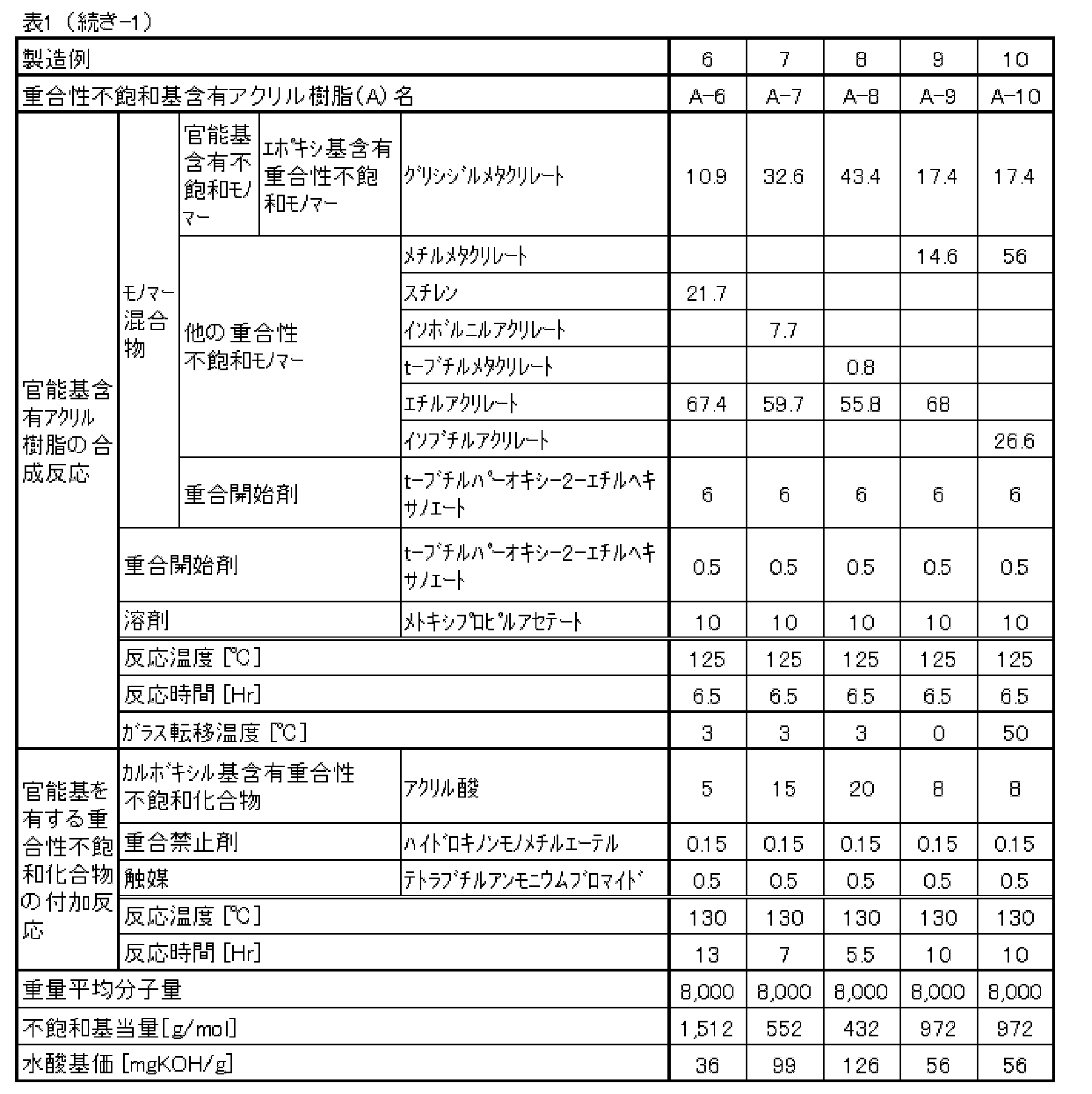
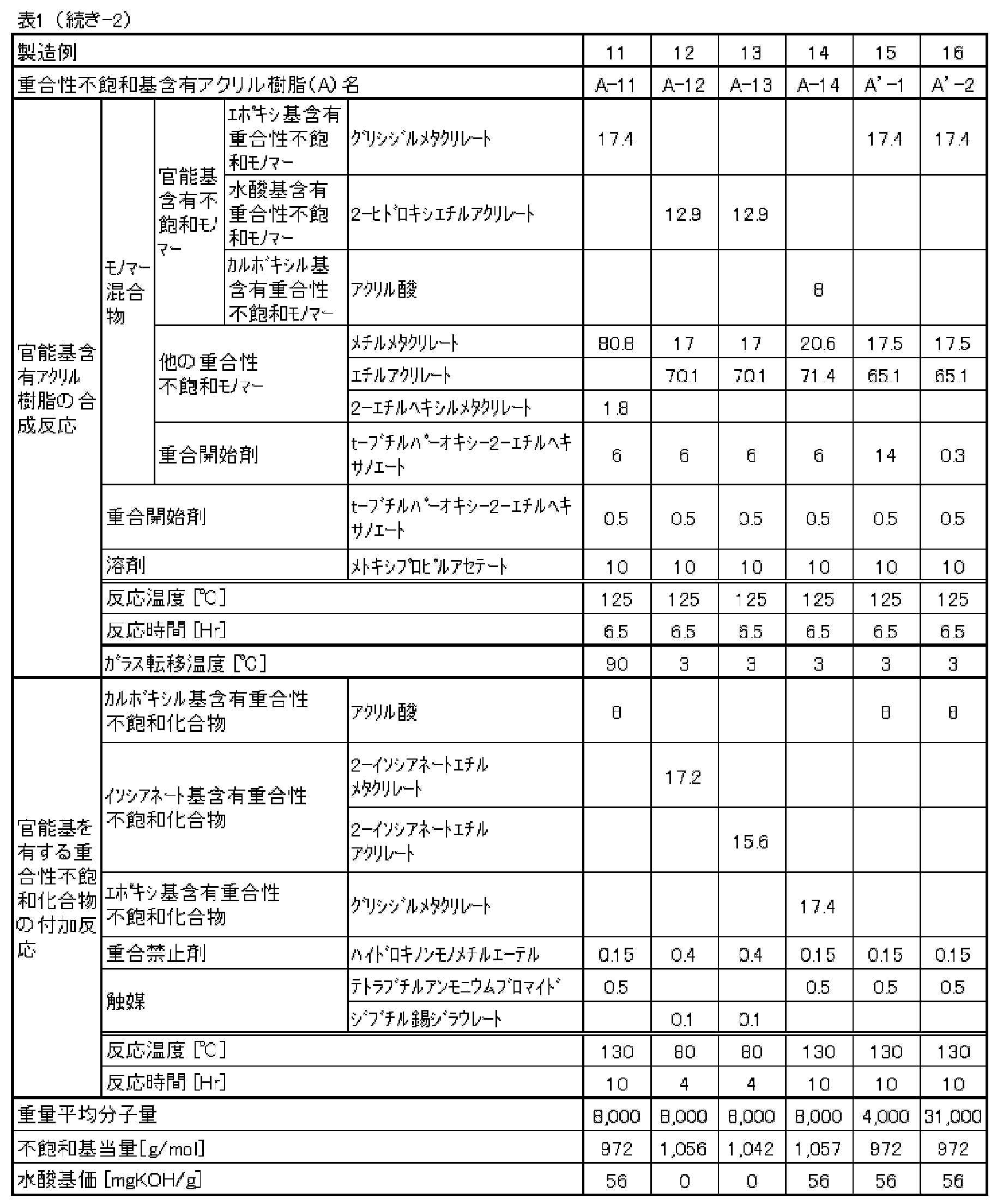
製造例17
温度計、サーモスタット、撹拌装置、還流冷却機および空気吹き込み装置を備えた反応容器に、メチレンビス(4,1-シクロヘキサンジイル)ジイソシアネート(水添MDI、分子量:262)79部(0.3mol)、2-ヒドロキシエチルアクリレート(分子量:116)23.2部(0.2mol)、エチレングリコール(分子量:62)12.4部(0.2mol)、ジブチル錫ジラウレート0.03部及びハイドロキノンモノメチルエーテル0.1部を仕込み、反応容器内に空気を吹き込みながら、80℃に昇温した。その後、同温度で5時間保ち、メチレンビス(4,1-シクロヘキサンジイル)ジイソシアネートが実質的に全て反応したのを確認した後、冷却し、固形分100%のウレタン(メタ)アクリレート(B-1)を得た。得られたウレタン(メタ)アクリレートの1分子内の重合性不飽和基の平均数は2個、重量平均分子量は1,100、ガラス転移温度は38℃であった。
製造例16において、配合組成を表2に示すものとする以外は、製造例16と同様にして、固形分100%のウレタン(メタ)アクリレート(B-2)~(B-14)及び(B'-1)~(B’-3)を得た。各ウレタン(メタ)アクリレートの1分子内の重合性不飽和基の平均数、重量平均分子量及びガラス転移温度を表2にあわせて示す。
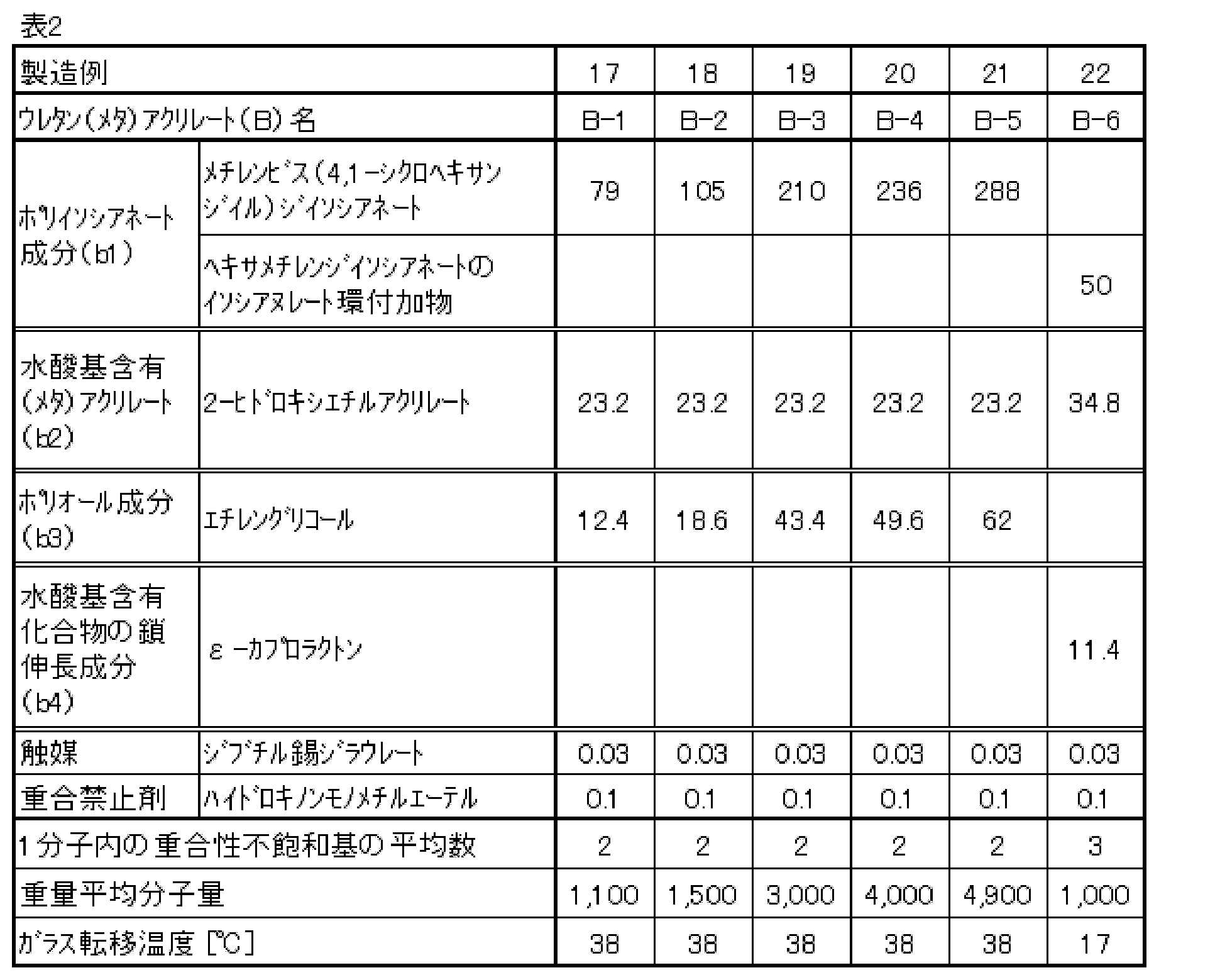
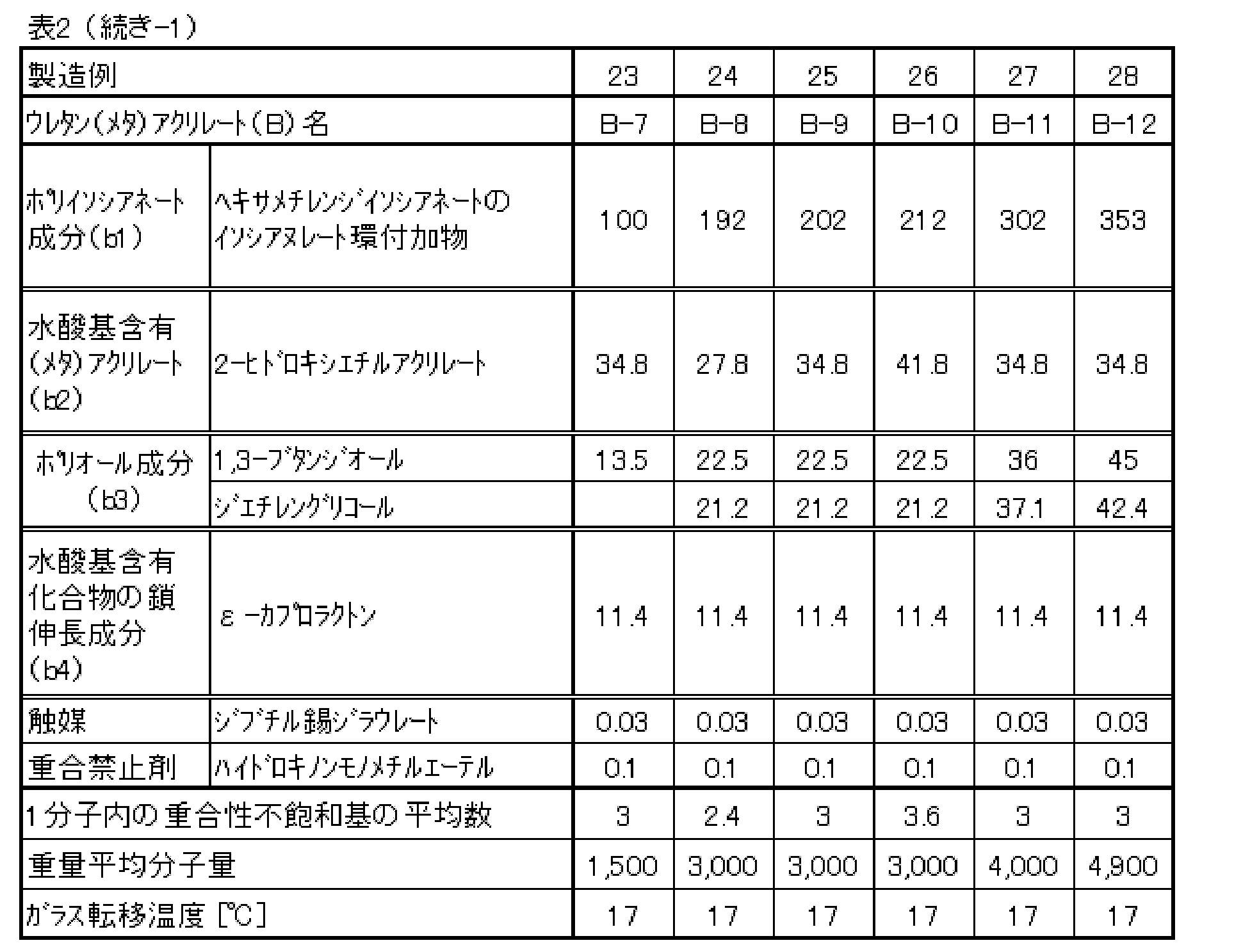
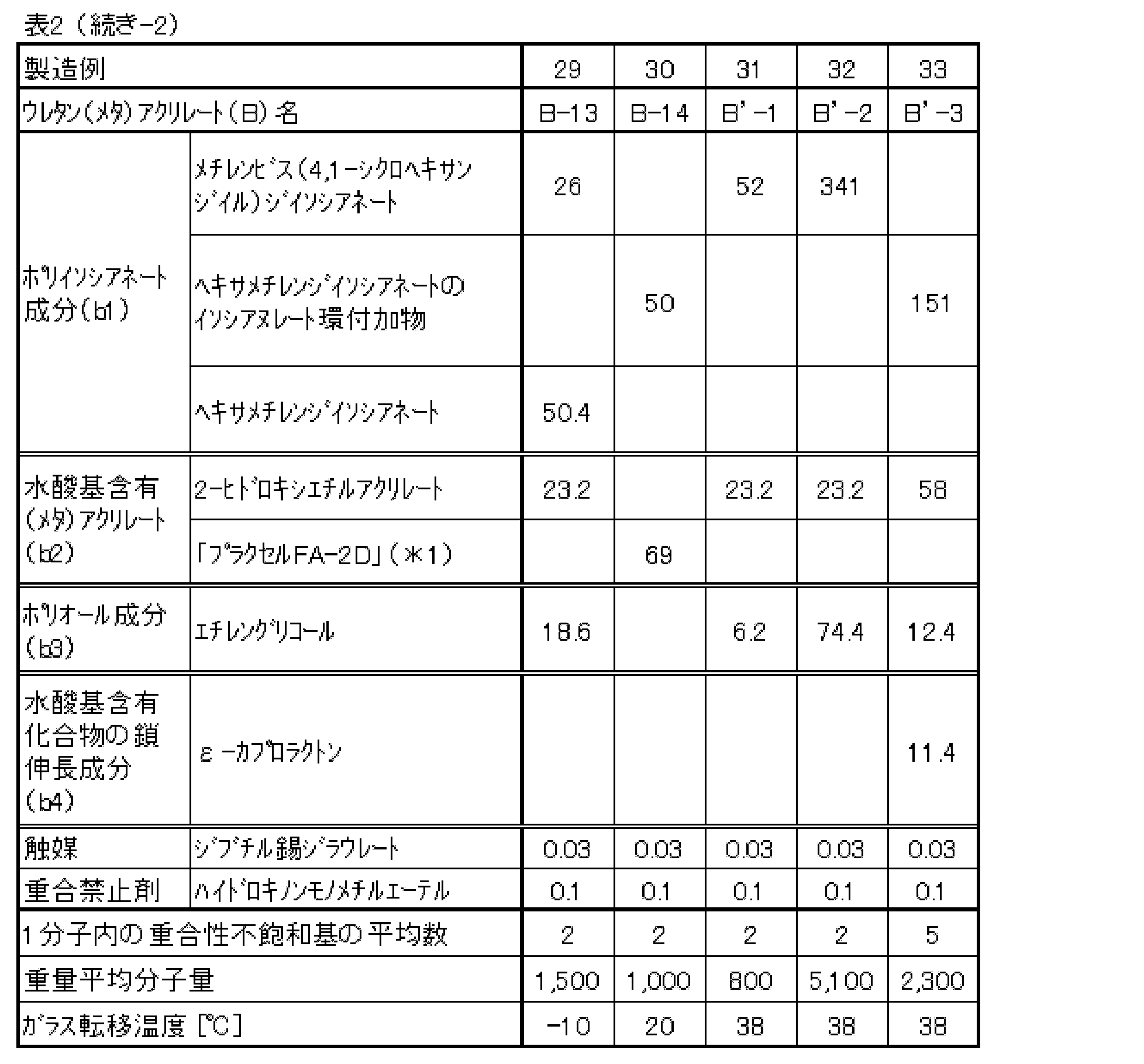
実施例1
製造例1で得られた固形分50%の重合性不飽和基含有アクリル樹脂(A-1)112部(固形分56部)、製造例25で得られたウレタン(メタ)アクリレート(B-9)33部(固形分33部)、重合性不飽和化合物(C-1)(注2)11部(固形分11部)、「IRGACURE 184」(商品名、BASF社製、光重合開始剤、固形分含有率100%)6部、「IRGACURE TPO」(商品名、BASF社製、光重合開始剤、固形分含有率100%)1部、「TINUVIN 400」(商品名、BASF社製、トリアジン系紫外線吸収剤、固形分含有率100%)2部、「TINUVIN 292」(商品名、BASF社製、ヒンダードアミン系光安定剤、固形分含有率100%)2部及び「BYK-333」(商品名、ビックケミー社製、シリコン系表面調整剤、固形分含有率100%)0.1部を均一に混合し、さらに固形分が50%になるようにメトキシプロピルアセテートで希釈攪拌して、活性エネルギー線硬化型塗料組成物No.1を得た。
実施例1において、配合組成を表3に示すものとする以外は、実施例1と同様にして、固形分50%の活性エネルギー線硬化型塗料組成物No.2~58を得た。なお表3に示す配合組成は、各成分の固形分質量による。
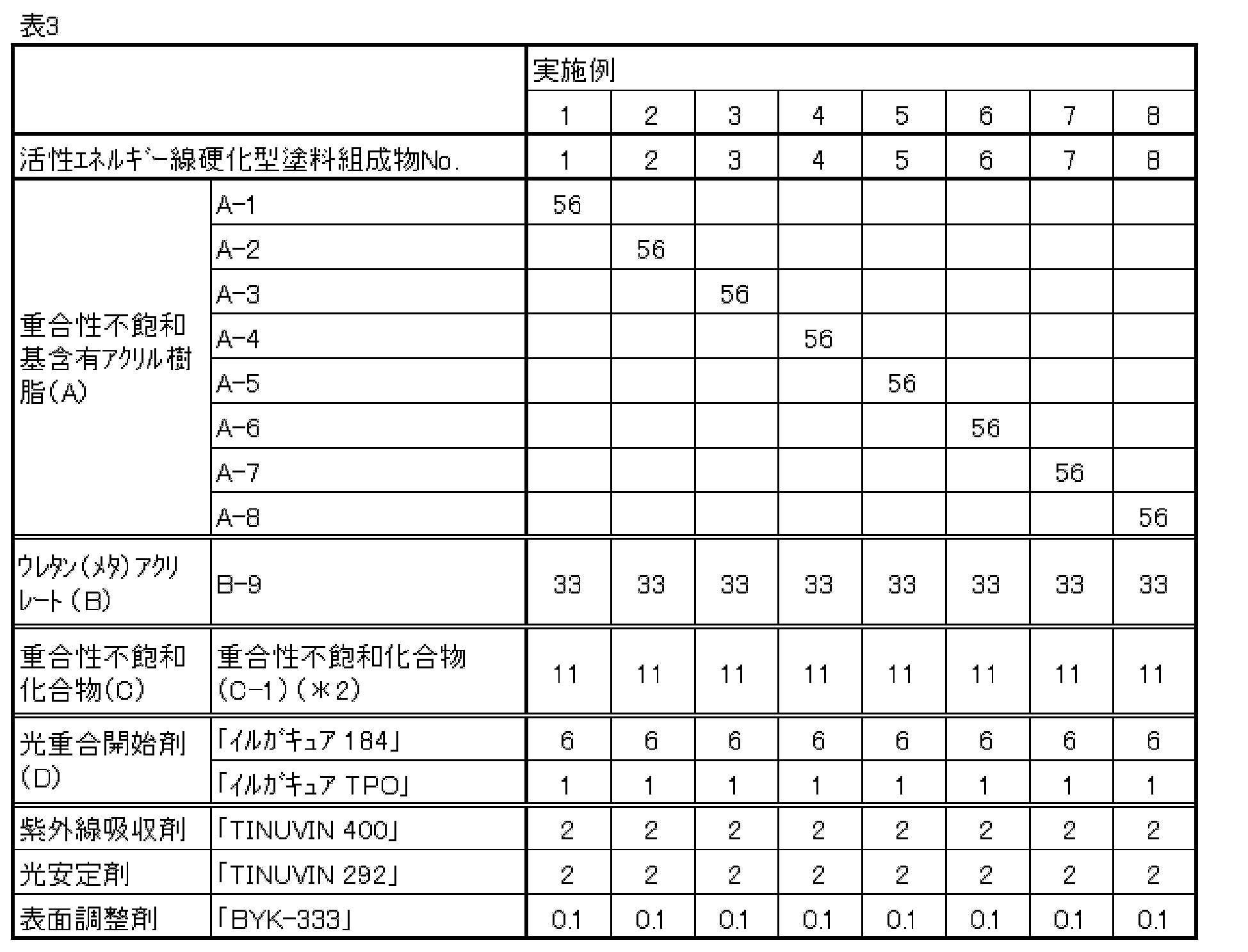
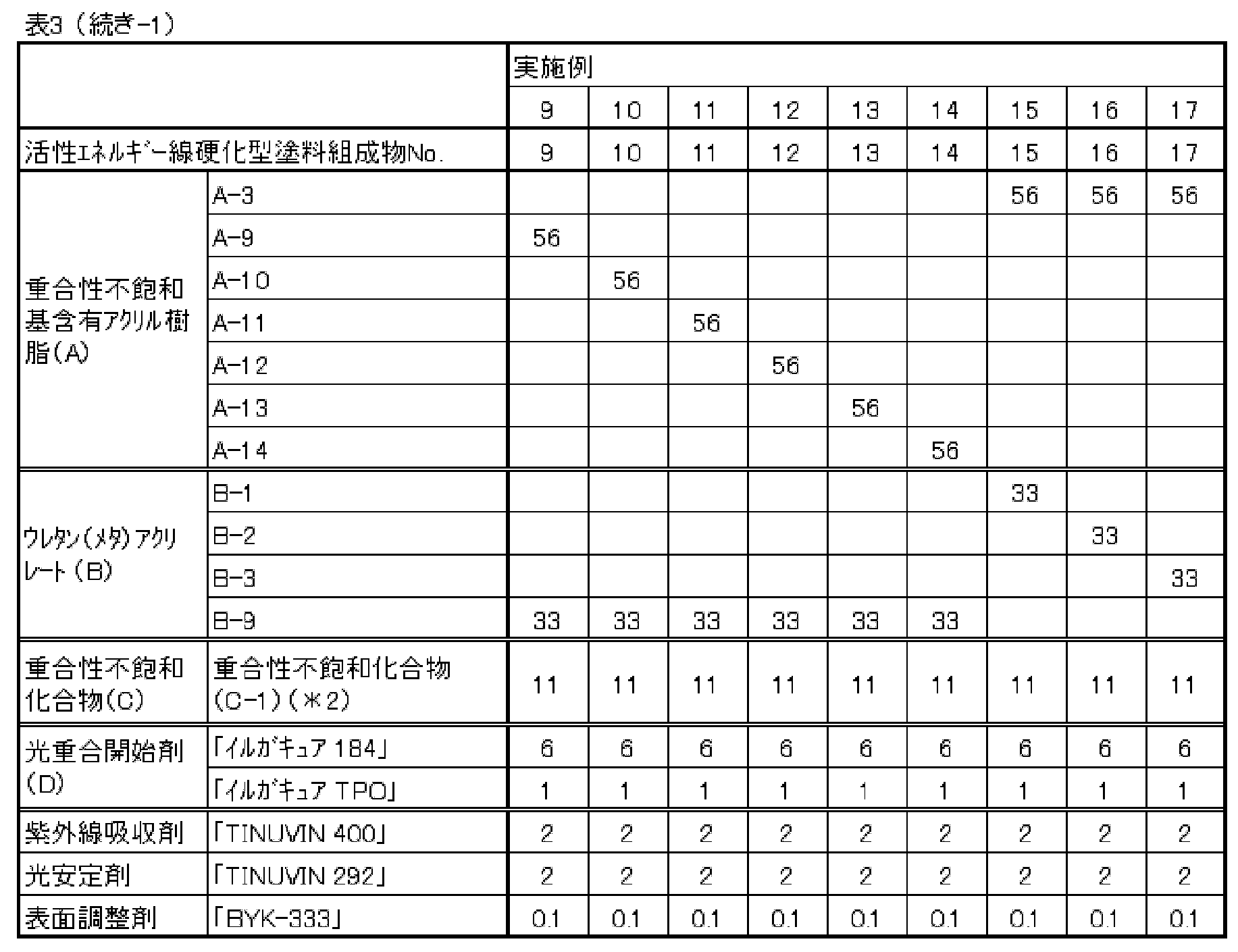
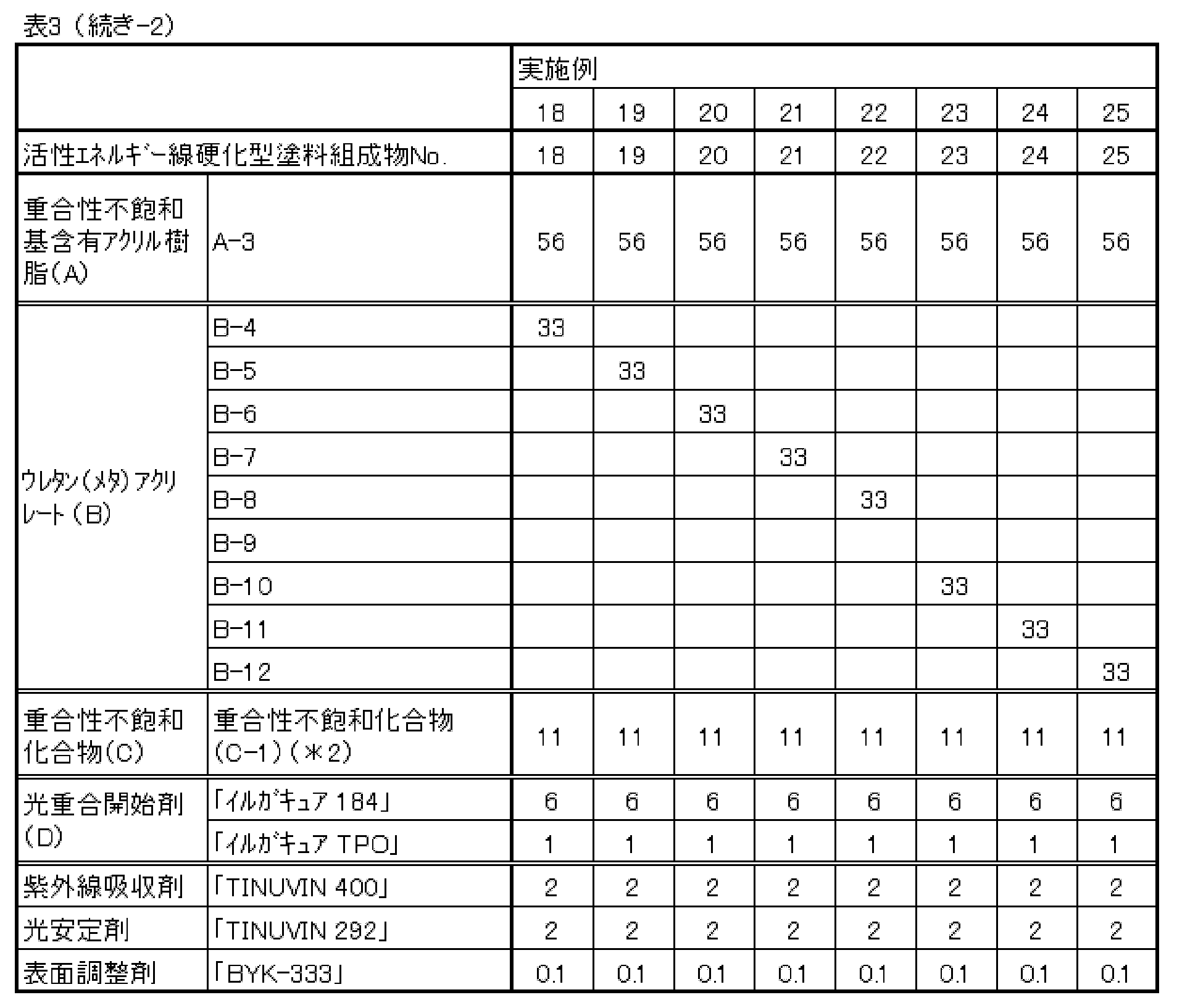
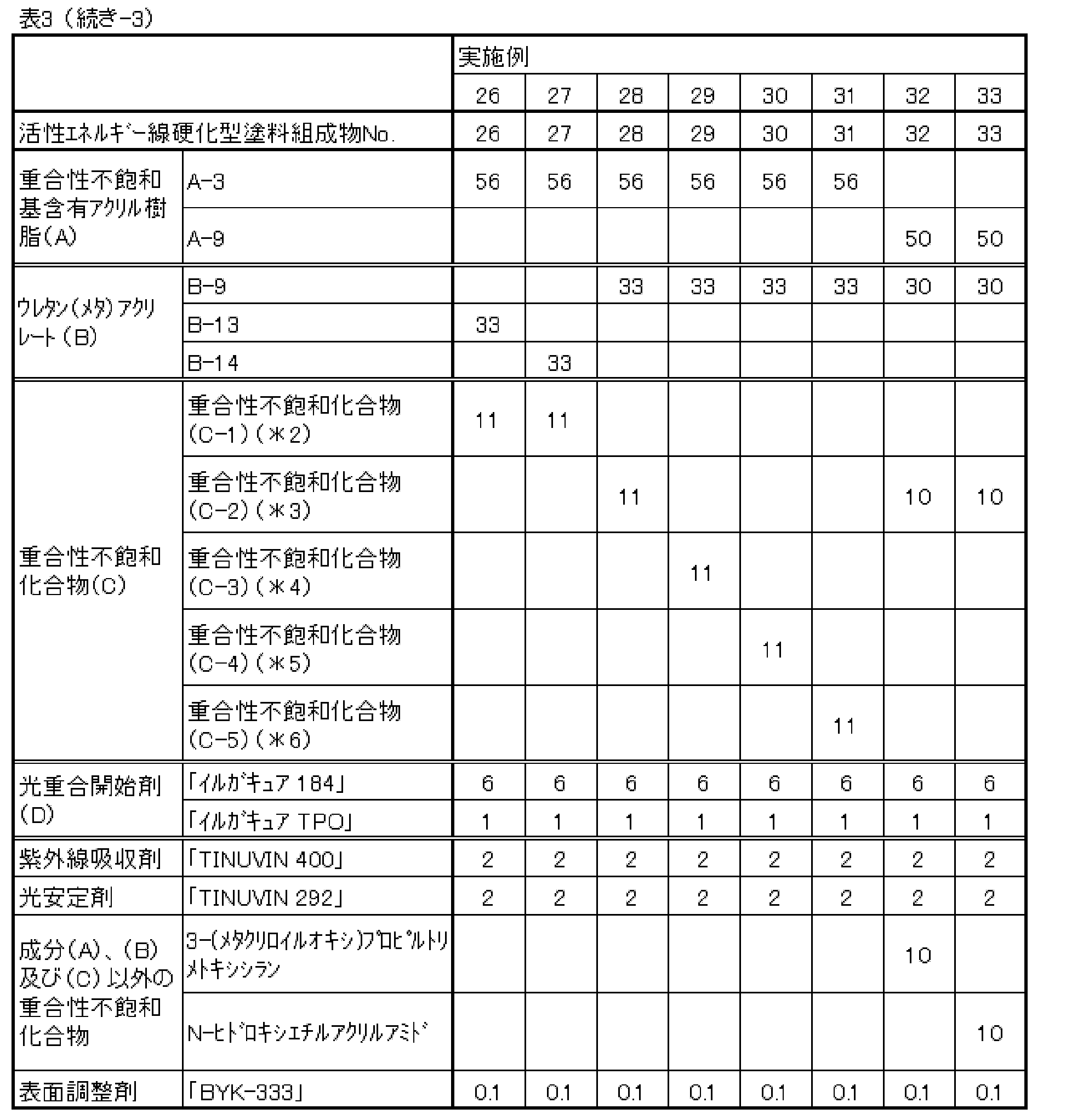
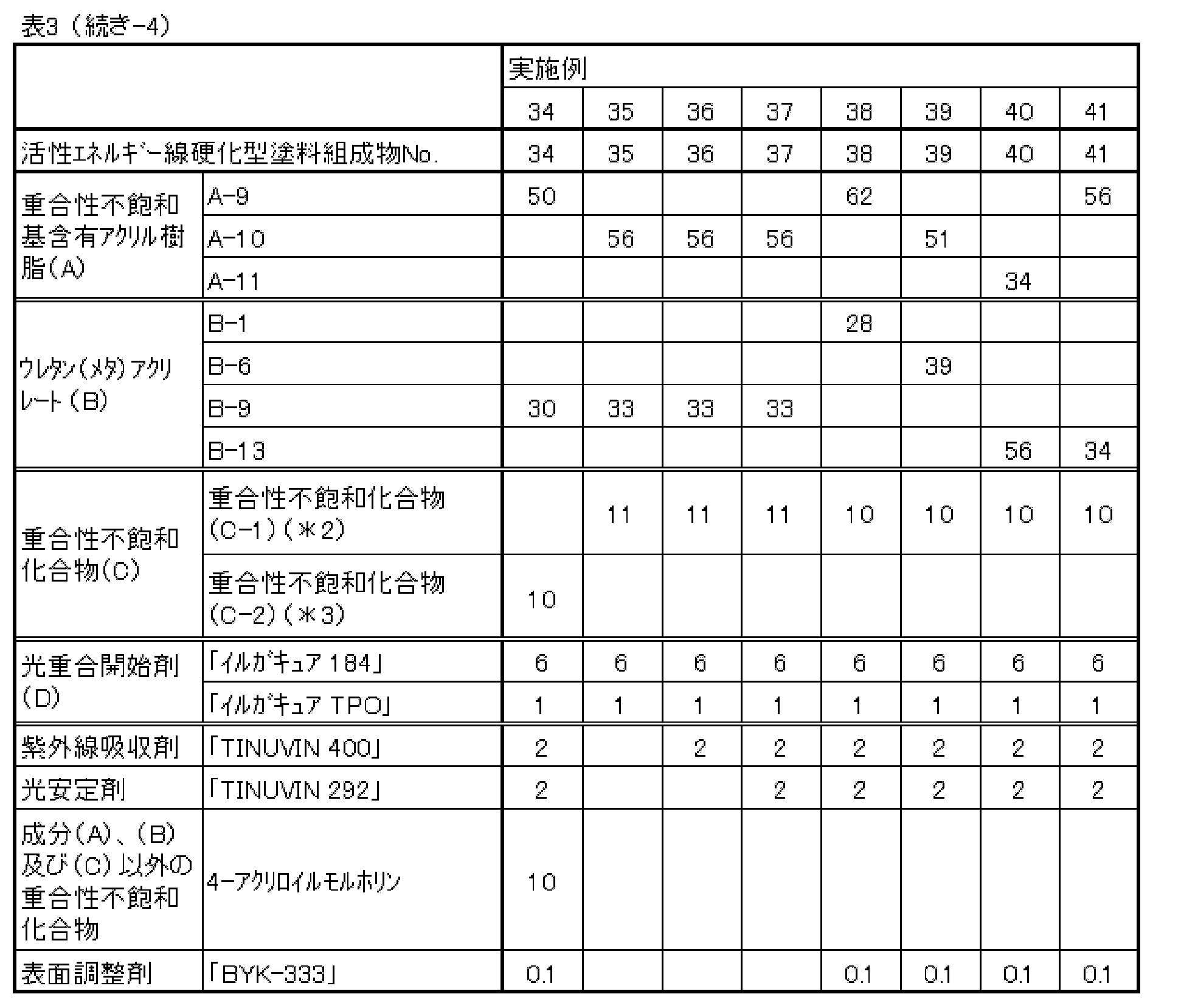


(*4)重合性不飽和化合物(C-3):「TMPTA」(商品名、ダイセル・オルネクス社製、トリメチロールプロパントリアクリレート、重量平均分子量286、重合性不飽和基数3)
(*5)重合性不飽和化合物(C-4):「アロニックス M-315」(商品名、東亞合成社製、イソシアヌル酸エチレンオキサイド変性ジ及びトリアクリレート、重量平均分子量387、重合性不飽和基数3)
(*6)重合性不飽和化合物(C-5):「DPHA」(商品名、ダイセル・オルネクス社製、ジペンタエリスリトールヘキサアクリレート、重量平均分子量524、重合性不飽和基数6)
(*7)重合性不飽和化合物(C’-1):「SR740」(商品名、サートマー社製、ポリエチレングリコール(1000)ジメタクリレート、重量平均分子量1,136、重合性不飽和基数2)。
被塗物
(ABS基材)
100mm×150mm×3.0mmのアクリロニトリル-ブタジエン-スチレン板の表面をイソプロピルアルコールで脱脂してABS基材とした。
100mm×150mm×3.0mmのアクリロニトリル-エチレン-スチレン板の表面をイソプロピルアルコールで脱脂してAES基材とした。
100mm×150mm×3.0mmのアクリロニトリル-スチレン-アクリレート板の表面をイソプロピルアルコールで脱脂してASA基材とした。
ABS基材上に、実施例1で得た活性エネルギー線硬化型塗料組成物No.1を、エアスプレーを用いて膜厚が30μmとなるように塗装した。続いて、常温で2分間セッティングを行い、その後80℃で3分間プレヒートした。次に、メタルハライドランプを用いて400mW/cm2、1,500mJ/cm2のUV照射を行い、試験板を作製した。
基材、活性エネルギー線硬化型塗料組成物として、表4に記載のものを使用し、活性エネルギー線硬化型塗料組成物の膜厚を表4に記載のとおりに変更する以外は、実施例48と同様にして、各試験板を得た。
得られた各試験板について、各種試験を行った。評価結果を表4に示す。
塗膜外観(肌):各試験板について、塗膜外観を下記基準にて評価した
S:平滑でユズ肌が認められない
A:ごくわずかなユズ肌が認められる
B:ユズ肌が少し認められる
C:顕著なユズ肌が認められる。
B:鏡面光沢度(60度)が75以上85未満である
C:鏡面光沢度(60度)が70以上75未満である
D:鏡面光沢度(60度)が60以上70未満である
E:鏡面光沢度(60度)が60未満である。
A:塗膜からのホコリ等の除去及び塗膜の磨きがやや困難であるが、補修部と未補修部の塗膜外観に差がほとんど認められない
B:塗膜からのホコリ等の除去及び塗膜の磨きが困難であり、補修部と未補修部の塗膜外観に差が少し認められる
C:塗膜からのホコリ等の除去及び塗膜の磨きが困難であり、補修部と未補修部の塗膜外観に顕著な差が認められる。
B:光沢保持率75%以上80%未満
C:光沢保持率70%以上75%未満
D:光沢保持率50%以上70%未満
E:光沢保持率50%未満
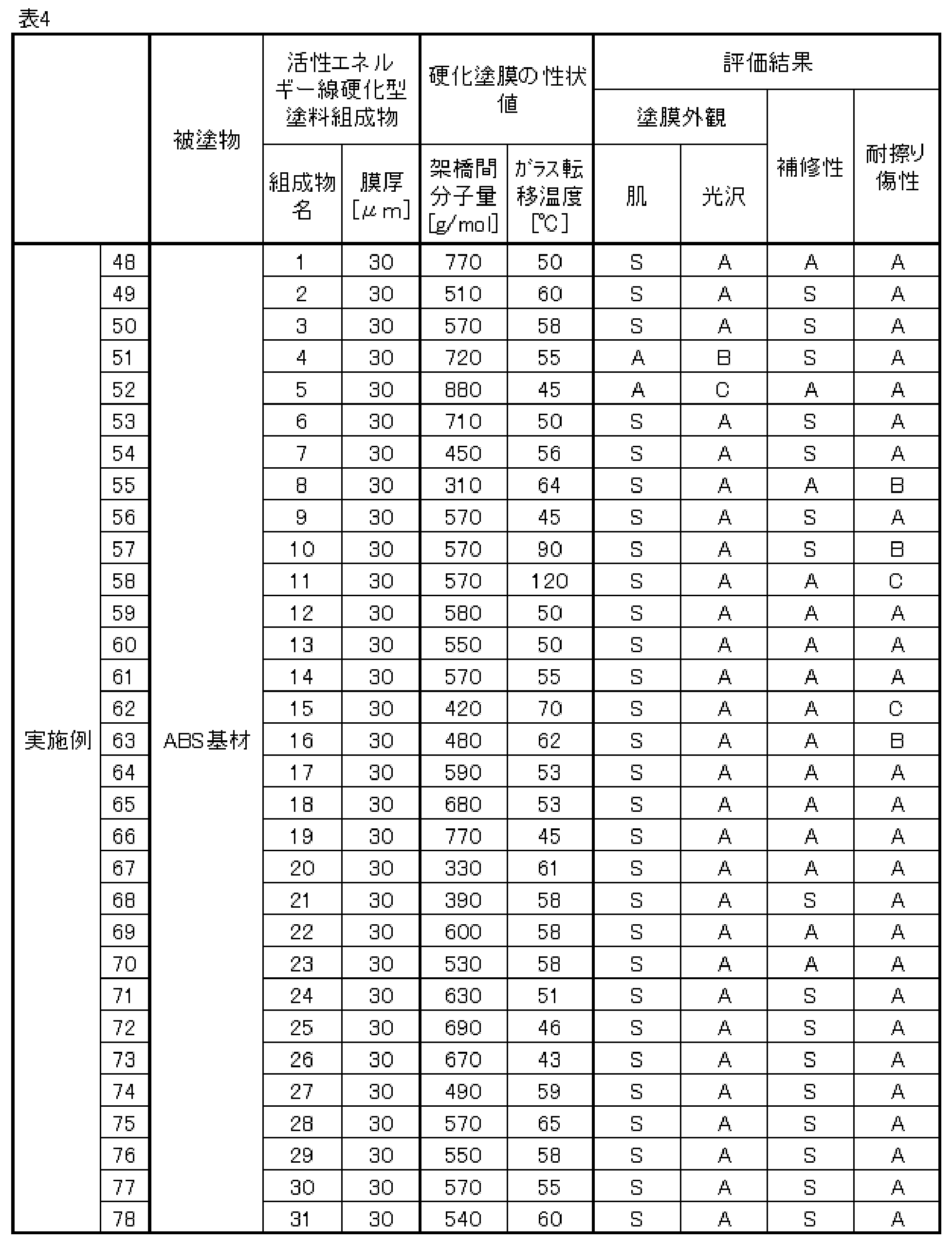

Claims (7)
- (A)重量平均分子量が5,000~30,000の範囲内である重合性不飽和基含有アクリル樹脂、(B)重量平均分子量が1,000以上5,000未満の範囲内であり、かつ、1分子内に平均して2~4個の重合性不飽和基を有するウレタン(メタ)アクリレート、(C)重量平均分子量が200以上1,000未満の範囲内であり、かつ、1分子内に平均して2~9個の重合性不飽和基を有する重合性不飽和化合物及び(D)光重合開始剤を含有する活性エネルギー線硬化型塗料組成物であって、該活性エネルギー線硬化型塗料組成物を塗装して得られる硬化塗膜の架橋間分子量が300~900g/molの範囲内である活性エネルギー線硬化型塗料組成物。
- 前記成分(A)、(B)及び(C)の合計固形分を基準として、成分(A)の固形分配合量が20~70質量%の範囲内であり、成分(B)の固形分配合量が10~60質量%の範囲内であり、成分(C)の固形分配合量が1~30質量%の範囲内である請求項1に記載の活性エネルギー線硬化型塗料組成物。
- さらに、紫外線吸収剤及び/又は光安定剤を含有する請求項1又は2に記載の活性エネルギー線硬化型塗料組成物。
- 硬化塗膜のガラス転移温度が20~80℃の範囲内である請求項1~3のいずれか1項に記載の活性エネルギー線硬化型塗料組成物。
- 請求項1~4のいずれか1項に記載の活性エネルギー線硬化型塗料組成物を硬化した、架橋間分子量が300~900g/molの範囲内である硬化塗膜。
- 被塗物上に、請求項1~4のいずれか1項に記載の活性エネルギー線硬化型塗料組成物の硬化塗膜を有する塗装物品。
- 被塗物上に、請求項1~4のいずれか1項に記載の活性エネルギー線硬化型塗料組成物を塗装して未硬化塗膜を形成した後、該未硬化塗膜に活性エネルギー線を照射し、硬化させることを特徴とする塗膜形成方法。
Priority Applications (3)
| Application Number | Priority Date | Filing Date | Title |
|---|---|---|---|
| US15/770,351 US10519318B2 (en) | 2015-10-27 | 2016-10-24 | Actinic-ray-curable coating composition |
| CN201680060781.0A CN108137981B (zh) | 2015-10-27 | 2016-10-24 | 活性能量射线可固化的涂料组合物 |
| JP2017502286A JP6109460B1 (ja) | 2015-10-27 | 2016-10-24 | 活性エネルギー線硬化型塗料組成物 |
Applications Claiming Priority (2)
| Application Number | Priority Date | Filing Date | Title |
|---|---|---|---|
| JP2015211289 | 2015-10-27 | ||
| JP2015-211289 | 2015-10-27 |
Publications (1)
| Publication Number | Publication Date |
|---|---|
| WO2017073522A1 true WO2017073522A1 (ja) | 2017-05-04 |
Family
ID=58630517
Family Applications (1)
| Application Number | Title | Priority Date | Filing Date |
|---|---|---|---|
| PCT/JP2016/081463 Ceased WO2017073522A1 (ja) | 2015-10-27 | 2016-10-24 | 活性エネルギー線硬化型塗料組成物 |
Country Status (4)
| Country | Link |
|---|---|
| US (1) | US10519318B2 (ja) |
| JP (1) | JP6109460B1 (ja) |
| CN (1) | CN108137981B (ja) |
| WO (1) | WO2017073522A1 (ja) |
Cited By (14)
| Publication number | Priority date | Publication date | Assignee | Title |
|---|---|---|---|---|
| EP3243845A1 (en) * | 2016-05-13 | 2017-11-15 | Ricoh Company, Ltd. | Active energy ray curable composition, cured product, composition storage container, two-dimensional or three-dimensional image forming apparatus, and two-dimensional or three-dimensional image forming method |
| CN108864927A (zh) * | 2017-05-16 | 2018-11-23 | 关西涂料株式会社 | 涂料组合物 |
| CN108864878A (zh) * | 2017-05-16 | 2018-11-23 | 关西涂料株式会社 | 涂膜形成方法 |
| JP2018192470A (ja) * | 2017-05-16 | 2018-12-06 | 関西ペイント株式会社 | 塗膜形成方法 |
| JP2018193529A (ja) * | 2017-05-16 | 2018-12-06 | 関西ペイント株式会社 | 塗料組成物 |
| JP2019167508A (ja) * | 2018-03-26 | 2019-10-03 | 三菱ケミカル株式会社 | 活性エネルギー線硬化性組成物及び金属成形物 |
| JP2020514130A (ja) * | 2017-06-01 | 2020-05-21 | エルジー・ケム・リミテッド | 多層マーキングフィルム |
| WO2020175664A1 (ja) * | 2019-02-28 | 2020-09-03 | 関西ペイント株式会社 | 活性エネルギー線硬化型塗料組成物、硬化塗膜、塗装物品及び塗膜形成方法 |
| JP2022086816A (ja) * | 2020-11-30 | 2022-06-09 | 東亞合成株式会社 | 活性エネルギー線硬化性組成物 |
| WO2023276600A1 (ja) * | 2021-06-29 | 2023-01-05 | Dic株式会社 | アクリル(メタ)アクリレート樹脂、活性エネルギー線硬化性樹脂組成物、硬化物及び物品 |
| JP2023525674A (ja) * | 2020-05-18 | 2023-06-19 | ディーエスエム アイピー アセッツ ビー.ブイ. | コーティング組成物、基材上での親水性コーティングの製造方法、及びそのようなコーティングを含む医療用デバイス |
| JP2023131972A (ja) * | 2022-03-10 | 2023-09-22 | Dic株式会社 | 活性エネルギー線硬化性組成物、及びフィルム |
| JP2024524055A (ja) * | 2021-06-09 | 2024-07-05 | ビーエーエスエフ コーティングス ゲゼルシャフト ミット ベシュレンクテル ハフツング | 放射線硬化性コーティング組成物及び前記コーティング組成物でコーティングされた基材 |
| WO2025142030A1 (ja) * | 2023-12-28 | 2025-07-03 | 日本ペイント・オートモーティブコーティングス株式会社 | 活性エネルギー線硬化性樹脂組成物および積層体 |
Families Citing this family (3)
| Publication number | Priority date | Publication date | Assignee | Title |
|---|---|---|---|---|
| JP6862733B2 (ja) * | 2015-09-24 | 2021-04-21 | 荒川化学工業株式会社 | 光学用活性エネルギー線硬化型樹脂組成物及び光学用フィルム |
| KR102418410B1 (ko) * | 2018-11-20 | 2022-07-07 | (주)엘엑스하우시스 | 자가복원성 코팅 조성물 및 이를 이용한 시트 |
| WO2025248386A1 (en) * | 2024-05-31 | 2025-12-04 | Unilin, Bv | Acrylate coating composition and method for applying a coating layer |
Citations (5)
| Publication number | Priority date | Publication date | Assignee | Title |
|---|---|---|---|---|
| JPH11140352A (ja) * | 1997-11-13 | 1999-05-25 | Ishihara Chem Co Ltd | パテ組成物 |
| JP2002293853A (ja) * | 2001-03-29 | 2002-10-09 | Kansai Paint Co Ltd | 光硬化性樹脂組成物 |
| JP2002363480A (ja) * | 2001-04-05 | 2002-12-18 | Kansai Paint Co Ltd | 光硬化型プライマー組成物及びこれを用いた塗装方法 |
| JP2011020381A (ja) * | 2009-07-16 | 2011-02-03 | Fujikura Kasei Co Ltd | 耐紫外線プラスチック成形体 |
| JP2012252748A (ja) * | 2011-06-03 | 2012-12-20 | Mitsubishi Rayon Co Ltd | 光記録媒体用活性エネルギー線硬化型樹脂組成物及び光記録媒体 |
Family Cites Families (5)
| Publication number | Priority date | Publication date | Assignee | Title |
|---|---|---|---|---|
| JP3096861B2 (ja) | 1991-11-21 | 2000-10-10 | 三菱レイヨン株式会社 | 被覆材組成物 |
| WO1996034063A1 (en) * | 1995-04-28 | 1996-10-31 | Nof Corporation | Coating composition, process for preparing the composition, and process for preparing dispersion of inorganic oxide sol |
| US6492521B2 (en) * | 2000-11-03 | 2002-12-10 | Cytec Technology Corp. | Hindered amine light stabilizers based on multi-functional carbonyl compounds and methods of making same |
| US6844029B2 (en) * | 2001-10-26 | 2005-01-18 | Kansai Paint Co., Ltd. | Photocurable primer composition and coating method by use of the same |
| JP6533046B2 (ja) | 2013-09-24 | 2019-06-19 | ソマール株式会社 | コーティング組成物及びそれを用いたハードコートフィルム |
-
2016
- 2016-10-24 US US15/770,351 patent/US10519318B2/en active Active
- 2016-10-24 CN CN201680060781.0A patent/CN108137981B/zh active Active
- 2016-10-24 WO PCT/JP2016/081463 patent/WO2017073522A1/ja not_active Ceased
- 2016-10-24 JP JP2017502286A patent/JP6109460B1/ja active Active
Patent Citations (5)
| Publication number | Priority date | Publication date | Assignee | Title |
|---|---|---|---|---|
| JPH11140352A (ja) * | 1997-11-13 | 1999-05-25 | Ishihara Chem Co Ltd | パテ組成物 |
| JP2002293853A (ja) * | 2001-03-29 | 2002-10-09 | Kansai Paint Co Ltd | 光硬化性樹脂組成物 |
| JP2002363480A (ja) * | 2001-04-05 | 2002-12-18 | Kansai Paint Co Ltd | 光硬化型プライマー組成物及びこれを用いた塗装方法 |
| JP2011020381A (ja) * | 2009-07-16 | 2011-02-03 | Fujikura Kasei Co Ltd | 耐紫外線プラスチック成形体 |
| JP2012252748A (ja) * | 2011-06-03 | 2012-12-20 | Mitsubishi Rayon Co Ltd | 光記録媒体用活性エネルギー線硬化型樹脂組成物及び光記録媒体 |
Cited By (22)
| Publication number | Priority date | Publication date | Assignee | Title |
|---|---|---|---|---|
| EP3243845A1 (en) * | 2016-05-13 | 2017-11-15 | Ricoh Company, Ltd. | Active energy ray curable composition, cured product, composition storage container, two-dimensional or three-dimensional image forming apparatus, and two-dimensional or three-dimensional image forming method |
| US9982152B2 (en) | 2016-05-13 | 2018-05-29 | Ricoh Company, Ltd. | Active energy ray curable composition, cured product, composition storage container, two-dimensional or three-dimensional image forming apparatus, and two-dimensional or three-dimensional image forming method |
| CN108864927A (zh) * | 2017-05-16 | 2018-11-23 | 关西涂料株式会社 | 涂料组合物 |
| CN108864878A (zh) * | 2017-05-16 | 2018-11-23 | 关西涂料株式会社 | 涂膜形成方法 |
| JP2018192470A (ja) * | 2017-05-16 | 2018-12-06 | 関西ペイント株式会社 | 塗膜形成方法 |
| JP2018193529A (ja) * | 2017-05-16 | 2018-12-06 | 関西ペイント株式会社 | 塗料組成物 |
| JP2020114929A (ja) * | 2017-05-16 | 2020-07-30 | 関西ペイント株式会社 | 塗料組成物 |
| JP2020514130A (ja) * | 2017-06-01 | 2020-05-21 | エルジー・ケム・リミテッド | 多層マーキングフィルム |
| JP2019167508A (ja) * | 2018-03-26 | 2019-10-03 | 三菱ケミカル株式会社 | 活性エネルギー線硬化性組成物及び金属成形物 |
| JP7670456B2 (ja) | 2018-03-26 | 2025-04-30 | 三菱ケミカル株式会社 | 活性エネルギー線硬化性組成物及び金属成形物 |
| JPWO2020175664A1 (ja) * | 2019-02-28 | 2021-12-23 | 関西ペイント株式会社 | 活性エネルギー線硬化型塗料組成物、硬化塗膜、塗装物品及び塗膜形成方法 |
| JP7182144B2 (ja) | 2019-02-28 | 2022-12-02 | 関西ペイント株式会社 | 活性エネルギー線硬化型塗料組成物、硬化塗膜、塗装物品及び塗膜形成方法 |
| US12060494B2 (en) | 2019-02-28 | 2024-08-13 | Kansai Paint Co., Ltd. | Actinic-ray-curable coating composition, cured coating film, coated article, and method for forming coating film |
| WO2020175664A1 (ja) * | 2019-02-28 | 2020-09-03 | 関西ペイント株式会社 | 活性エネルギー線硬化型塗料組成物、硬化塗膜、塗装物品及び塗膜形成方法 |
| JP2023525674A (ja) * | 2020-05-18 | 2023-06-19 | ディーエスエム アイピー アセッツ ビー.ブイ. | コーティング組成物、基材上での親水性コーティングの製造方法、及びそのようなコーティングを含む医療用デバイス |
| JP7741098B2 (ja) | 2020-05-18 | 2025-09-17 | ディーエスエム アイピー アセッツ ビー.ブイ. | コーティング組成物、基材上での親水性コーティングの製造方法、及びそのようなコーティングを含む医療用デバイス |
| JP2022086816A (ja) * | 2020-11-30 | 2022-06-09 | 東亞合成株式会社 | 活性エネルギー線硬化性組成物 |
| JP7819442B2 (ja) | 2020-11-30 | 2026-02-25 | 東亞合成株式会社 | 活性エネルギー線硬化性組成物 |
| JP2024524055A (ja) * | 2021-06-09 | 2024-07-05 | ビーエーエスエフ コーティングス ゲゼルシャフト ミット ベシュレンクテル ハフツング | 放射線硬化性コーティング組成物及び前記コーティング組成物でコーティングされた基材 |
| WO2023276600A1 (ja) * | 2021-06-29 | 2023-01-05 | Dic株式会社 | アクリル(メタ)アクリレート樹脂、活性エネルギー線硬化性樹脂組成物、硬化物及び物品 |
| JP2023131972A (ja) * | 2022-03-10 | 2023-09-22 | Dic株式会社 | 活性エネルギー線硬化性組成物、及びフィルム |
| WO2025142030A1 (ja) * | 2023-12-28 | 2025-07-03 | 日本ペイント・オートモーティブコーティングス株式会社 | 活性エネルギー線硬化性樹脂組成物および積層体 |
Also Published As
| Publication number | Publication date |
|---|---|
| CN108137981A (zh) | 2018-06-08 |
| US20180312697A1 (en) | 2018-11-01 |
| US10519318B2 (en) | 2019-12-31 |
| JP6109460B1 (ja) | 2017-04-05 |
| JPWO2017073522A1 (ja) | 2017-10-26 |
| CN108137981B (zh) | 2021-01-05 |
Similar Documents
| Publication | Publication Date | Title |
|---|---|---|
| JP6109460B1 (ja) | 活性エネルギー線硬化型塗料組成物 | |
| JP5889291B2 (ja) | 塗料組成物及び塗膜形成方法 | |
| JP7182144B2 (ja) | 活性エネルギー線硬化型塗料組成物、硬化塗膜、塗装物品及び塗膜形成方法 | |
| JP6964709B2 (ja) | 塗料組成物 | |
| JP5875184B2 (ja) | 塗料組成物および塗膜形成方法 | |
| JP6583889B2 (ja) | 被膜形成方法 | |
| US20100203259A1 (en) | Method of forming a coating film | |
| JP5762435B2 (ja) | 塗料組成物及び塗膜形成方法 | |
| JP6537364B2 (ja) | 基材の被膜形成方法 | |
| JP6602358B2 (ja) | 塗膜形成方法 | |
| JP5748209B2 (ja) | 塗料組成物及び塗装物品 | |
| JP2017113689A (ja) | 基材の親水性被膜形成方法 | |
| JP2016043325A (ja) | 基材の被膜形成方法 | |
| JP2011225744A (ja) | 塗料組成物及び塗膜形成方法 | |
| JP6130543B1 (ja) | 塗膜形成方法 | |
| JP2016135477A (ja) | 基材の被膜形成方法 | |
| JP2016135476A (ja) | 基材の被膜形成方法 | |
| JP2018089578A (ja) | 塗膜形成方法 | |
| JP2015213896A (ja) | 基材の被膜形成方法 | |
| JP6426960B2 (ja) | 補修用塗料組成物 | |
| CN108864878B (zh) | 涂膜形成方法 | |
| JP2011231172A (ja) | 活性エネルギー線硬化性コーティング用組成物 |
Legal Events
| Date | Code | Title | Description |
|---|---|---|---|
| ENP | Entry into the national phase |
Ref document number: 2017502286 Country of ref document: JP Kind code of ref document: A |
|
| 121 | Ep: the epo has been informed by wipo that ep was designated in this application |
Ref document number: 16859752 Country of ref document: EP Kind code of ref document: A1 |
|
| WWE | Wipo information: entry into national phase |
Ref document number: 15770351 Country of ref document: US |
|
| NENP | Non-entry into the national phase |
Ref country code: DE |
|
| 122 | Ep: pct application non-entry in european phase |
Ref document number: 16859752 Country of ref document: EP Kind code of ref document: A1 |