WO2016159344A1 - ガラス - Google Patents
ガラス Download PDFInfo
- Publication number
- WO2016159344A1 WO2016159344A1 PCT/JP2016/060913 JP2016060913W WO2016159344A1 WO 2016159344 A1 WO2016159344 A1 WO 2016159344A1 JP 2016060913 W JP2016060913 W JP 2016060913W WO 2016159344 A1 WO2016159344 A1 WO 2016159344A1
- Authority
- WO
- WIPO (PCT)
- Prior art keywords
- less
- glass
- mgo
- content
- bao
- Prior art date
- Legal status (The legal status is an assumption and is not a legal conclusion. Google has not performed a legal analysis and makes no representation as to the accuracy of the status listed.)
- Ceased
Links
Classifications
-
- C—CHEMISTRY; METALLURGY
- C03—GLASS; MINERAL OR SLAG WOOL
- C03C—CHEMICAL COMPOSITION OF GLASSES, GLAZES OR VITREOUS ENAMELS; SURFACE TREATMENT OF GLASS; SURFACE TREATMENT OF FIBRES OR FILAMENTS MADE FROM GLASS, MINERALS OR SLAGS; JOINING GLASS TO GLASS OR OTHER MATERIALS
- C03C3/00—Glass compositions
- C03C3/04—Glass compositions containing silica
- C03C3/076—Glass compositions containing silica with 40% to 90% silica, by weight
- C03C3/089—Glass compositions containing silica with 40% to 90% silica, by weight containing boron
- C03C3/091—Glass compositions containing silica with 40% to 90% silica, by weight containing boron containing aluminium
-
- C—CHEMISTRY; METALLURGY
- C03—GLASS; MINERAL OR SLAG WOOL
- C03C—CHEMICAL COMPOSITION OF GLASSES, GLAZES OR VITREOUS ENAMELS; SURFACE TREATMENT OF GLASS; SURFACE TREATMENT OF FIBRES OR FILAMENTS MADE FROM GLASS, MINERALS OR SLAGS; JOINING GLASS TO GLASS OR OTHER MATERIALS
- C03C3/00—Glass compositions
- C03C3/04—Glass compositions containing silica
- C03C3/076—Glass compositions containing silica with 40% to 90% silica, by weight
- C03C3/083—Glass compositions containing silica with 40% to 90% silica, by weight containing aluminium oxide or an iron compound
- C03C3/085—Glass compositions containing silica with 40% to 90% silica, by weight containing aluminium oxide or an iron compound containing an oxide of a divalent metal
-
- C—CHEMISTRY; METALLURGY
- C03—GLASS; MINERAL OR SLAG WOOL
- C03C—CHEMICAL COMPOSITION OF GLASSES, GLAZES OR VITREOUS ENAMELS; SURFACE TREATMENT OF GLASS; SURFACE TREATMENT OF FIBRES OR FILAMENTS MADE FROM GLASS, MINERALS OR SLAGS; JOINING GLASS TO GLASS OR OTHER MATERIALS
- C03C3/00—Glass compositions
- C03C3/04—Glass compositions containing silica
- C03C3/076—Glass compositions containing silica with 40% to 90% silica, by weight
- C03C3/083—Glass compositions containing silica with 40% to 90% silica, by weight containing aluminium oxide or an iron compound
- C03C3/085—Glass compositions containing silica with 40% to 90% silica, by weight containing aluminium oxide or an iron compound containing an oxide of a divalent metal
- C03C3/087—Glass compositions containing silica with 40% to 90% silica, by weight containing aluminium oxide or an iron compound containing an oxide of a divalent metal containing calcium oxide, e.g. common sheet or container glass
-
- C—CHEMISTRY; METALLURGY
- C03—GLASS; MINERAL OR SLAG WOOL
- C03C—CHEMICAL COMPOSITION OF GLASSES, GLAZES OR VITREOUS ENAMELS; SURFACE TREATMENT OF GLASS; SURFACE TREATMENT OF FIBRES OR FILAMENTS MADE FROM GLASS, MINERALS OR SLAGS; JOINING GLASS TO GLASS OR OTHER MATERIALS
- C03C4/00—Compositions for glass with special properties
-
- G—PHYSICS
- G09—EDUCATION; CRYPTOGRAPHY; DISPLAY; ADVERTISING; SEALS
- G09F—DISPLAYING; ADVERTISING; SIGNS; LABELS OR NAME-PLATES; SEALS
- G09F9/00—Indicating arrangements for variable information in which the information is built-up on a support by selection or combination of individual elements
- G09F9/30—Indicating arrangements for variable information in which the information is built-up on a support by selection or combination of individual elements in which the desired character or characters are formed by combining individual elements
- G09F9/301—Indicating arrangements for variable information in which the information is built-up on a support by selection or combination of individual elements in which the desired character or characters are formed by combining individual elements flexible foldable or roll-able electronic displays, e.g. thin LCD, OLED
-
- H—ELECTRICITY
- H10—SEMICONDUCTOR DEVICES; ELECTRIC SOLID-STATE DEVICES NOT OTHERWISE PROVIDED FOR
- H10K—ORGANIC ELECTRIC SOLID-STATE DEVICES
- H10K50/00—Organic light-emitting devices
-
- H—ELECTRICITY
- H10—SEMICONDUCTOR DEVICES; ELECTRIC SOLID-STATE DEVICES NOT OTHERWISE PROVIDED FOR
- H10K—ORGANIC ELECTRIC SOLID-STATE DEVICES
- H10K59/00—Integrated devices, or assemblies of multiple devices, comprising at least one organic light-emitting element covered by group H10K50/00
- H10K59/10—OLED displays
- H10K59/12—Active-matrix OLED [AMOLED] displays
-
- H—ELECTRICITY
- H10—SEMICONDUCTOR DEVICES; ELECTRIC SOLID-STATE DEVICES NOT OTHERWISE PROVIDED FOR
- H10K—ORGANIC ELECTRIC SOLID-STATE DEVICES
- H10K77/00—Constructional details of devices covered by this subclass and not covered by groups H10K10/80, H10K30/80, H10K50/80 or H10K59/80
- H10K77/10—Substrates, e.g. flexible substrates
Definitions
- the present invention relates to glass, and more particularly to alkali-free glass suitable for substrates of organic displays and liquid crystal displays.
- Organic EL displays are thin and excellent in moving image display and have low power consumption, and are therefore used for applications such as mobile phone displays.
- Non-alkali glass glass in which the content of the alkali component in the glass composition is 0.5 mol% or less
- the glass substrate for this purpose.
- the alkali-free glass for this application is required to have, for example, the following required characteristics (1) to (3).
- (1) In order to reduce the cost of a glass substrate, it is excellent in productivity, particularly in devitrification resistance and meltability.
- (2) The strain point is high in order to reduce the thermal shrinkage of the glass substrate in the manufacturing process of p-Si • TFT, especially high-temperature p-Si.
- (3) It has a low thermal expansion coefficient so as to match the thermal expansion coefficient of a member (for example, p-Si) formed on a glass substrate.
- chemical etching of a glass substrate is generally used for thinning the display.
- This method is a method of thinning a glass substrate by immersing a display panel in which two glass substrates are bonded together in an HF (hydrofluoric acid) chemical solution. Therefore, when performing chemical etching of a glass substrate, in addition to the required characteristics (1) to (3), in order to increase the production efficiency of the display panel, a high etching rate by HF is required.
- a high Young's modulus (or specific Young's modulus) may be required to suppress problems caused by the bending of the glass substrate.
- the present invention has been made in view of the above circumstances, and its technical problem is to create a glass having high heat resistance, a low thermal expansion coefficient, and excellent productivity.
- the present inventor has found that the above technical problem can be solved by regulating the glass composition within a predetermined range, and proposes as the present invention. That is, the glass of the present invention has a glass composition of mol%, SiO 2 55-80%, Al 2 O 3 12-30%, B 2 O 3 0-3%, Li 2 O + Na 2 O + K 2 O 0- 1%, MgO + CaO + SrO + BaO 5 to 35%, and a thermal expansion coefficient in a temperature range of 30 to 380 ° C. is less than 40 ⁇ 10 ⁇ 7 / ° C.
- “Li 2 O + Na 2 O + K 2 O” refers to the total amount of Li 2 O, Na 2 O and K 2 O.
- MgO + CaO + SrO + BaO refers to the total amount of MgO, CaO, SrO and BaO.
- Thermal expansion coefficient in the temperature range of 30 to 380 ° C.” refers to an average value measured with a dilatometer.
- Al 2 O 3 is 12 mol% or more in the glass composition
- the content of B 2 O 3 in the glass composition is 3 mol% or less
- the content of Li 2 O + Na 2 O + K 2 O is 1 It is regulated to less than mol%. If it does in this way, a strain point will raise notably and the heat resistance of a glass substrate can be improved significantly. Furthermore, it becomes easy to reduce a thermal expansion coefficient.
- the glass of the present invention contains 5 to 25 mol% of MgO + CaO + SrO + BaO in the glass composition. If it does in this way, devitrification resistance can be improved.
- the glass of the present invention preferably has a B 2 O 3 content of less than 1 mol%.
- the glass of the present invention preferably has a Li 2 O + Na 2 O + K 2 O content of 0.5 mol% or less.
- the glass of the present invention preferably has a molar ratio (MgO + CaO + SrO + BaO) / Al 2 O 3 of 0.3 to 3.
- “(MgO + CaO + SrO + BaO) / Al 2 O 3 ” is a value obtained by dividing the total amount of MgO, CaO, SrO and BaO by the content of Al 2 O 3 .
- the glass of the present invention preferably has a molar ratio MgO / (MgO + CaO + SrO + BaO) of 0.5 or more.
- MgO / (MgO + CaO + SrO + BaO) is a value obtained by dividing the content of MgO by the total amount of MgO, CaO, SrO and BaO.
- the glass of the present invention preferably has a strain point of 750 ° C. or higher.
- strain point refers to a value measured based on the method of ASTM C336.
- the glass of the present invention preferably has a strain point of 800 ° C. or higher.
- the glass of the present invention preferably has a (temperature-strain point at 10 2.5 dPa ⁇ s) of 1000 ° C. or lower.
- temperature at a high temperature viscosity of 10 2.5 dPa ⁇ s refers to a value measured by a platinum ball pulling method.
- the glass of the present invention preferably has a temperature at a viscosity of 10 2.5 dPa ⁇ s of 1800 ° C. or lower.
- the glass of the present invention preferably has a flat plate shape.
- the glass of the present invention is preferably used for a substrate of an organic EL display.
- the glass of the present invention has a glass composition of mol%, SiO 2 55-80%, Al 2 O 3 12-30%, B 2 O 3 0-3%, Li 2 O + Na 2 O + K 2 O 0-3%. MgO + CaO + SrO + BaO 5 to 35%.
- the reason why the content of each component is regulated as described above will be described below. In the description of each component, the following% display indicates mol%.
- the preferred lower limit range of SiO 2 is 55% or more, 58% or more, 60% or more, 65% or more, particularly 68% or more, and the preferred upper limit range is preferably 80% or less, 75% or less, 73% or less, 72% or less, 71% or less, particularly 70% or less.
- the content of SiO 2 is too small, the defects due to devitrification crystals containing Al 2 O 3 is likely to occur, the strain point tends to decrease. Moreover, high temperature viscosity falls and it becomes easy to fall liquid phase viscosity.
- the preferred lower limit range of Al 2 O 3 is 11% or more, 12% or more, 13% or more, 14% or more, particularly 15% or more, and the preferred upper limit range is 30% or less, 25% or less, 20% or less, 17% or less, particularly 16% or less.
- al 2 O 3 is too small, the content of, or Young's modulus decrease, or become liable strain point is lowered, has high becomes meltability temperature viscosity tends to decrease.
- the content of Al 2 O 3 is too large, devitrification crystals more likely to occur, which comprises Al 2 O 3.
- the molar ratio SiO 2 / Al 2 O 3 is preferably 2 to 6, 3 to 5.5, 3.5 to 5.5, 4 to 5 from the viewpoint of achieving both a high strain point and high devitrification resistance. .5, 4.5 to 5.5, especially 4.5 to 5.
- SiO 2 / Al 2 O 3 is a value obtained by dividing the content of SiO 2 by the content of Al 2 O 3 .
- a preferable upper limit range of B 2 O 3 is 3% or less, 1% or less, less than 1%, particularly 0.1% or less. When the content of B 2 O 3 is too large, or the strain point is lowered significantly, the Young's modulus may be decreased significantly.
- a suitable upper limit range of Li 2 O + Na 2 O + K 2 O is 1% or less, less than 1%, 0.5% or less, particularly 0.2% or less. If the content of Li 2 O + Na 2 O + K 2 O is too large, alkali ions diffuse into the semiconductor material in a high-temperature p-Si process or the like, and the semiconductor characteristics are likely to deteriorate.
- the suitable upper limit range of Li 2 O, Na 2 O and K 2 O is 1% or less, less than 1%, 0.5% or less, 0.3% or less, particularly 0.2% or less, respectively.
- the preferred lower limit range of MgO + CaO + SrO + BaO is 5% or more, 7% or more, 9% or more, 11% or more, 13% or more, particularly 14% or more, and the preferred upper limit range is 35% or less, 30% or less, 25% or less. 20% or less, 18% or less, 17% or less, particularly 16% or less.
- the content of MgO + CaO + SrO + BaO is too small, the liquidus temperature is greatly increased, and devitrification crystals are likely to occur in the glass, or the high-temperature viscosity is increased and the meltability is liable to be lowered.
- the content of MgO + CaO + SrO + BaO is too large, the strain point tends to be lowered and devitrification crystals containing alkaline earth elements are likely to occur.
- the preferred lower limit range of MgO is 0% or more, 1% or more, 2% or more, 3% or more, 4% or more, 5% or more, particularly 6% or more, and the preferred upper limit range is 15% or less, 10% or less. 8% or less, particularly 7% or less.
- MgO has an effect of increasing the Young's modulus, but the effect is most remarkable among alkaline earth oxides.
- the preferable lower limit range of CaO is 2% or more, 3% or more, 4% or more, 5% or more, 6% or more, particularly 7% or more, and the preferable upper limit range is 20% or less, 15% or less, 12% or less. 11% or less, 10% or less, particularly 9% or less.
- a meltability will fall easily.
- liquidus temperature will rise and it will become easy to produce a devitrification crystal
- CaO has a greater effect of improving the liquid phase viscosity and lowering the meltability without lowering the strain point than other alkaline earth oxides.
- CaO is an effective component for increasing the Young's modulus, although it is slightly inferior to MgO.
- the preferred lower limit range of SrO is 0% or more, 1% or more, particularly 2% or more, and the preferred upper limit range is 10% or less, 8% or less, 7% or less, 6% or less, 5% or less, especially 4%. It is as follows. When there is too little content of SrO, a strain point will fall easily. On the other hand, when there is too much content of SrO, liquidus temperature will rise and it will become easy to produce a devitrification crystal
- a preferable lower limit range of BaO is 0% or more, 1% or more, 2% or more, 3% or more, particularly 4% or more, and a preferable upper limit range is 15% or less, 12% or less, 11% or less, particularly 10%. % Or less.
- a strain point and a thermal expansion coefficient will fall easily.
- liquidus temperature will rise and it will become easy to produce a devitrification crystal
- the meltability tends to be lowered.
- BaO is the element that has the highest effect of lowering the Young's modulus among alkaline earth metal oxides. Therefore, the content of BaO is suppressed as much as possible from the viewpoint of increasing the Young's modulus, or coexists with MgO when the content is large. It is necessary to make the design.
- the lower limit range of the molar ratio MgO / CaO is preferably 0.1 or more, 0.2 or more, 0.3 or more, particularly 0.4 or more, and the upper limit range is preferably 2 or less, 1 or less, 0.8 or less, 0.7 or less, particularly 0.6 or less.
- MgO / CaO refers to a value obtained by dividing the content of MgO by the content of CaO.
- the lower limit range of the molar ratio BaO / CaO is preferably 0.2 or more, 0.5 or more, 0.6 or more, 0.7 or more, particularly 0.8 or more, and the upper limit.
- the range is preferably 5 or less, 4.5 or less, 3 or less, 2.5 or less, particularly 2 or less.
- BaO / CaO indicates a value obtained by dividing the content of BaO by the content of CaO.
- the lower limit range of the molar ratio (MgO + CaO + SrO + BaO) / Al 2 O 3 is preferably 0.3 or more, 0.5 or more, 0.7 or more, particularly 0.8 or more.
- the upper limit range is preferably 3.0 or less, 2.5 or less, 2.0 or less, 1.5 or less, 1.2 or less, particularly 1.1 or less.
- the molar ratio MgO / (MgO + CaO + SrO + BaO) is preferably 0.1 or more, 0.2 or more, 0.3 or more, 0.4 or more, 0.5 or more, particularly 0.6 or more. In this way, the meltability is easily improved.
- MgO is a component that significantly lowers the strain point, and the effect of lowering the strain point is remarkable in a region where the content of MgO is low. Accordingly, the content ratio of MgO in the alkaline earth metal oxide is preferably small, and the molar ratio MgO / (MgO + CaO + SrO + BaO) is preferably 0.8 or less, particularly 0.7 or less.
- 7 ⁇ [MgO] + 5 ⁇ [CaO] + 4 ⁇ [SrO] + 4 ⁇ [BaO] is preferably 100% or less, 90% or less, 80% or less, 70% or less, 65% or less, particularly 60% or less. .
- Alkaline earth metal elements all have the effect of lowering the strain point, but the effect is greater for elements with smaller ionic radii. Therefore, if the upper limit range of 7 ⁇ [MgO] + 5 ⁇ [CaO] + 4 ⁇ [SrO] + 4 ⁇ [BaO] is regulated so that the proportion of the alkaline earth element having a large ionic radius is increased, the strain point is given priority. Can be increased.
- [MgO] is the content of MgO
- [CaO] is the content of CaO
- [SrO] is the content of SrO
- [BaO] is the content of BaO.
- “7 ⁇ [MgO] + 5 ⁇ [CaO] + 4 ⁇ [SrO] + 4 ⁇ [BaO]” is 7 times [MgO], 5 times [CaO], 4 times [SrO] and 4 times [SrO]. Refers to the total amount of [BaO].
- 21 ⁇ [MgO] + 20 ⁇ [CaO] + 15 ⁇ [SrO] + 12 ⁇ [BaO] is preferably 200% or more, 210% or more, 220% or more, 230% or more, 240% or more, 250% or more, particularly 300 ⁇ 1000%.
- Alkaline earth metal elements all have an effect of improving the melting property, but the influence becomes larger as the ion radius is smaller. Therefore, when the lower limit range of 21 ⁇ [MgO] + 20 ⁇ [CaO] + 15 ⁇ [SrO] + 12 ⁇ [BaO] is regulated so that the proportion of the alkaline earth element having a small ionic radius is small, the meltability is preferential. Can be increased.
- 21 ⁇ [MgO] + 20 ⁇ [CaO] + 15 ⁇ [SrO] + 12 ⁇ [BaO] is too large, the strain point may be lowered.
- 21 ⁇ [MgO] + 20 ⁇ [CaO] + 15 ⁇ [SrO] + 12 ⁇ [BaO] is 21 times [MgO], 20 times [CaO], 15 times [SrO] and 12 times [SrO]. Refers to the total amount of [BaO].
- 9 ⁇ [Al 2 O 3 ] + 7 ⁇ [MgO] ⁇ 4 ⁇ [BaO] is preferably 95% or more, 105% or more, 115% or more, 125% or more, particularly 135% or more.
- [MgO] + [CaO] + 3 ⁇ [SrO] + 4 ⁇ [BaO] is preferably 27% or less, 26% or less, 25% or less, 24% or less, particularly 23% or less. If [MgO] + [CaO] + 3 ⁇ [SrO] + 4 ⁇ [BaO] is too large, the density is likely to increase. Therefore, the specific Young's modulus is decreased, and the amount of deflection due to its own weight is likely to increase. “[MgO] + [CaO] + 3 ⁇ [SrO] + 4 ⁇ [BaO]” refers to the total amount of [MgO], [CaO], 3 times [SrO], and 4 times [BaO].
- the following components may be introduced into the glass composition.
- ZnO is a component that enhances the meltability, but if it is contained in a large amount in the glass composition, the glass tends to devitrify and the strain point tends to decrease. Therefore, the content of ZnO is preferably 0 to 5%, 0 to 3%, 0 to 0.5%, 0 to 0.3%, particularly 0 to 0.1%.
- ZrO 2 is a component that increases the Young's modulus.
- the content of ZrO 2 is preferably 0 to 5%, 0 to 3%, 0 to 0.5%, 0 to 0.2%, particularly 0 to 0.02%. When the content of ZrO 2 is too large, the liquidus temperature increases, devitrification zircon crystals are easily precipitated.
- TiO 2 is a component that lowers the high-temperature viscosity and improves the meltability, and is a component that suppresses solarization. However, when it is contained in a large amount in the glass composition, the glass tends to be colored. Therefore, the content of TiO 2 is preferably 0 to 5%, 0 to 3%, 0 to 1%, 0 to 0.1%, particularly 0 to 0.02%.
- P 2 O 5 is a component that enhances devitrification resistance. However, if it is contained in a large amount in the glass composition, the glass tends to undergo phase separation and opalescence, and the water resistance may be greatly reduced. Therefore, the content of P 2 O 5 is preferably 0 to 5%, 0 to 4%, 0 to 3%, 0 to less than 2%, 0 to 1%, 0 to 0.5%, particularly 0 to 0. .1%.
- SnO 2 is a component having a good clarification action in a high temperature region and a component that lowers the high temperature viscosity.
- the SnO 2 content is preferably 0 to 1%, 0.01 to 0.5%, 0.01 to 0.3%, particularly 0.04 to 0.1%. When the content of SnO 2 is too large, the devitrification crystal SnO 2 is likely to precipitate.
- the glass of the present invention is suitably added with SnO 2 as a fining agent.
- CeO 2 , SO 3 , C, metal powder for example, Al, Si) Etc.
- metal powder for example, Al, Si
- each content is preferably less than 0.1%, particularly preferably less than 0.05%.
- Rh 2 O 3 may be mixed from a platinum production container.
- the content of Rh 2 O 3 is preferably 0 to 0.0005%, more preferably 0.00001 to 0.0001%.
- SO 3 is a component mixed from the raw material as an impurity, but if the content of SO 3 is too large, bubbles called reboil may be generated during melting and molding, which may cause defects in the glass. is there.
- a preferable lower limit range of SO 3 is 0.0001% or more, and a preferable upper limit range is 0.005% or less, 0.003% or less, 0.002% or less, and particularly 0.001% or less.
- Content of rare earth oxides (Sc, Y, La, Ce, Pr, Nd, Sm, Eu, Gd, Tb, Dy, Ho, Er, Tm, Yb, Lu, etc.) content is preferably less than 2% 1% or less, especially less than 1%.
- the content of La 2 O 3 + Y 2 O 3 is preferably less than 2%, less than 1%, less than 0.5%, in particular less than 0.1%.
- the content of La 2 O 3 is preferably less than 2%, less than 1%, less than 0.5%, in particular less than 0.1%. If the content of the rare earth oxide is too large, the batch cost tends to increase.
- “Y 2 O 3 + La 2 O 3 ” is the total amount of Y 2 O 3 and La 2 O 3 .
- the glass of the present invention preferably has the following characteristics.
- Density is preferably 2.80 g / cm 3 or less, 2.70 g / cm 3 or less, 2.60 g / cm 3 or less, in particular 2.50 g / cm 3 or less. If the density is too high, it will be difficult to reduce the weight of the display.
- the thermal expansion coefficient in the temperature range of 30 to 380 ° C. is preferably less than 40 ⁇ 10 ⁇ 7 / ° C., 38 ⁇ 10 ⁇ 7 / ° C. or less, 36 ⁇ 10 ⁇ 7 / ° C. or less, 34 ⁇ 10 ⁇ 7 / ° C. or less. In particular, 28 ⁇ 10 ⁇ 7 to 33 ⁇ 10 ⁇ 7 / ° C. is preferable. If the thermal expansion coefficient in the temperature range of 30 to 380 ° C. is too high, it becomes difficult to match the thermal expansion coefficient of a member (eg, p-Si) formed on the glass substrate, and the glass substrate is likely to warp. Become.
- a member eg, p-Si
- the strain point is preferably 750 ° C. or higher, 780 ° C. or higher, 800 ° C. or higher, 810 ° C. or higher, 820 ° C. or higher, and particularly preferably 830 to 1000 ° C. If the strain point is too low, the glass substrate is likely to be thermally contracted in the heat treatment step.
- the Young's modulus is preferably more than 75 GPa, 77 GPa or more, 78 GPa or more, 79 GPa or more, particularly 80 GPa or more. If the Young's modulus is too low, defects due to the bending of the glass substrate, for example, defects such as the image surface of the electronic device appear to be distorted tend to occur.
- the specific Young's modulus is preferably more than 30 GPa / (g / cm 3 ), 30.2 GPa / (g / cm 3 ) or more, 30.4 GPa / (g / cm 3 ) or more, 30.6 GPa / (g / cm 3) ) Or more, particularly 30.8 GPa / (g / cm 3 ) or more. If the specific Young's modulus is too low, problems such as cracking during conveyance of the glass substrate are likely to occur due to bending of the glass substrate.
- the etching depth when immersed in a 10% by mass aqueous HF solution at room temperature for 30 minutes is preferably 25 ⁇ m or more, 27 ⁇ m or more, 28 ⁇ m or more, 29 to 50 ⁇ m, particularly 30 to 45 ⁇ m.
- This etching depth is an index of the etching rate. That is, when the etching depth is large, the etching rate is increased, and when the etching depth is small, the etching rate is decreased. If the content of SiO 2 is reduced, the etching rate can be easily increased. However, the etching rate can be easily increased by preferentially introducing an element having a large ionic radius among alkaline earth metals.
- the SiO 2 —Al 2 O 3 —RO (RO refers to an alkaline earth metal oxide) glass according to the present invention is generally difficult to melt. For this reason, improvement of meltability becomes a problem. When the meltability is increased, the defect rate due to bubbles, foreign matters, and the like is reduced, so that a high-quality glass substrate can be supplied in large quantities at a low cost. On the other hand, if the high-temperature viscosity is too high, defoaming is hardly promoted in the melting step. Therefore, the temperature at a high temperature viscosity of 10 2.5 dPa ⁇ s is preferably 1800 ° C. or lower, 1750 ° C. or lower, 1700 ° C. or lower, 1680 ° C.
- the temperature at a high temperature viscosity of 10 2.5 dPa ⁇ s corresponds to the melting temperature, and the lower this temperature, the better the meltability.
- Temporal-strain point at 10 2.5 dPa ⁇ s is preferably 1000 ° C. or lower, 900 ° C. or lower, 850 ° C. or lower, particularly 800 ° C. or lower, from the viewpoint of achieving both a high strain point and a low melting temperature.
- the liquidus temperature is preferably 1450 ° C. or lower, 1400 ° C. or lower, particularly 1300 ° C. or lower.
- the liquid phase viscosity is preferably 10 3.0 dPa ⁇ s or more, 10 3.5 dPa ⁇ s or more, particularly 10 4.0 dPa ⁇ s or more.
- the “liquid phase temperature” is obtained by passing the standard sieve 30 mesh (500 ⁇ m) and putting the glass powder remaining in 50 mesh (300 ⁇ m) into a platinum boat and holding it in a temperature gradient furnace for 24 hours to precipitate crystals. Refers to the value measured temperature.
- “Liquid phase viscosity” refers to a value obtained by measuring the viscosity of glass at the liquid phase temperature by a platinum ball pulling method.
- the glass of the present invention can be molded by various molding methods.
- the glass substrate can be formed by an overflow downdraw method, a slot downdraw method, a redraw method, a float method, a rollout method, or the like.
- a glass substrate is shape
- the thickness thereof is preferably 1.0 mm or less, 0.7 mm or less, 0.5 mm or less, particularly 0.4 mm or less.
- the smaller the plate thickness the easier it is to reduce the weight of the electronic device.
- the smaller the plate thickness the easier the glass substrate bends.
- the plate thickness can be adjusted by the flow rate at the time of molding, the plate drawing speed, and the like.
- the strain point can be increased by lowering the ⁇ -OH value.
- ⁇ -OH value is preferably 0.45 / mm or less, 0.40 / mm or less, 0.35 / mm or less, 0.30 / mm or less, 0.25 / mm or less, 0.20 / mm or less, In particular, it is 0.15 / mm or less. If the ⁇ -OH value is too large, the strain point tends to decrease. If the ⁇ -OH value is too small, the meltability tends to be lowered. Therefore, the ⁇ -OH value is preferably 0.01 / mm or more, particularly 0.05 / mm or more.
- the following methods may be mentioned.
- ⁇ -OH value refers to a value obtained by measuring the transmittance of glass using FT-IR and using the following equation.
- beta-OH value (1 / X) log ( T 1 / T 2)
- X Glass wall thickness (mm)
- T 1 Transmittance (%) at a reference wavelength of 3846 cm ⁇ 1
- T 2 Minimum transmittance (%) in the vicinity of a hydroxyl group absorption wavelength of 3600 cm ⁇ 1
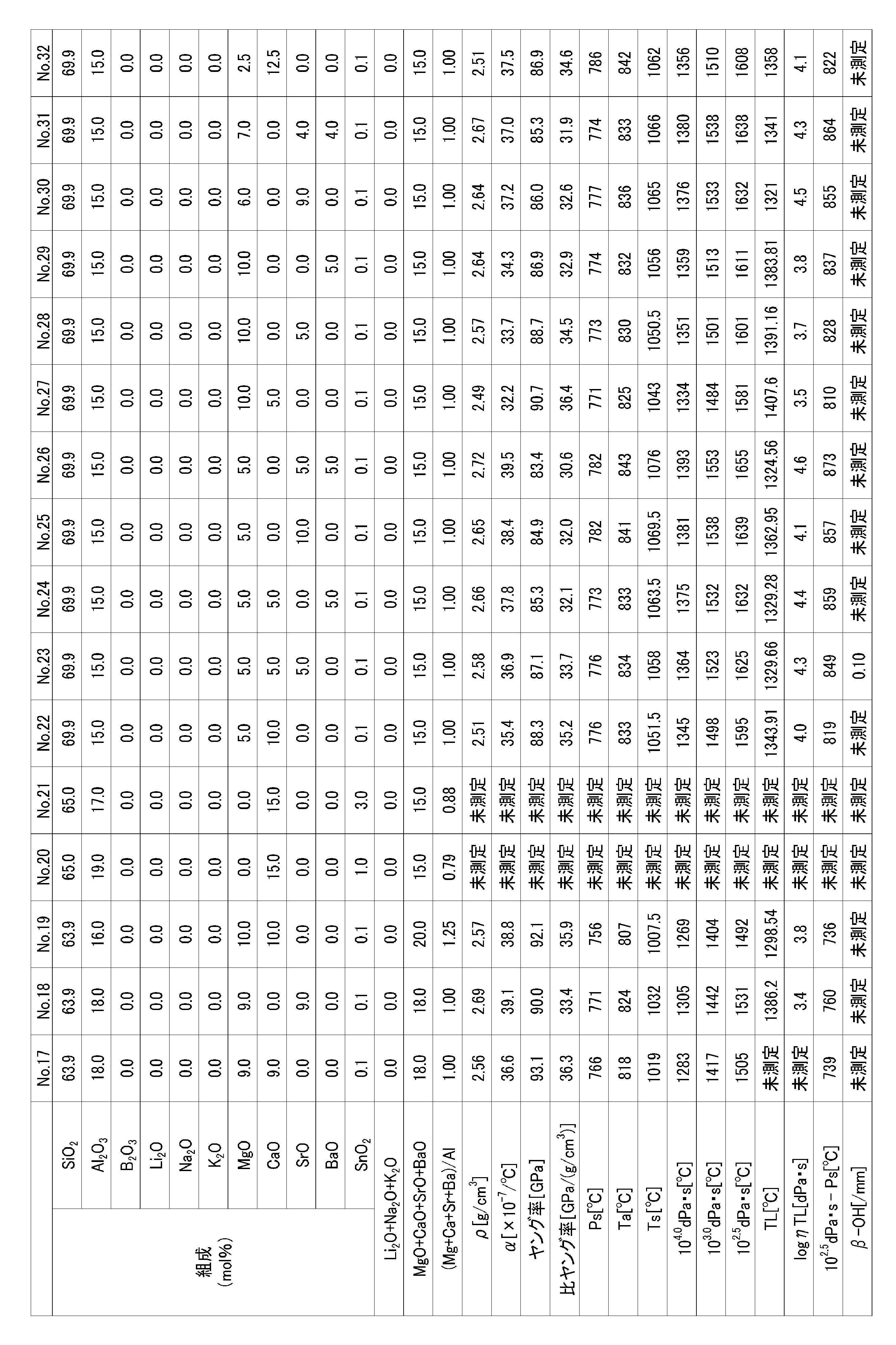
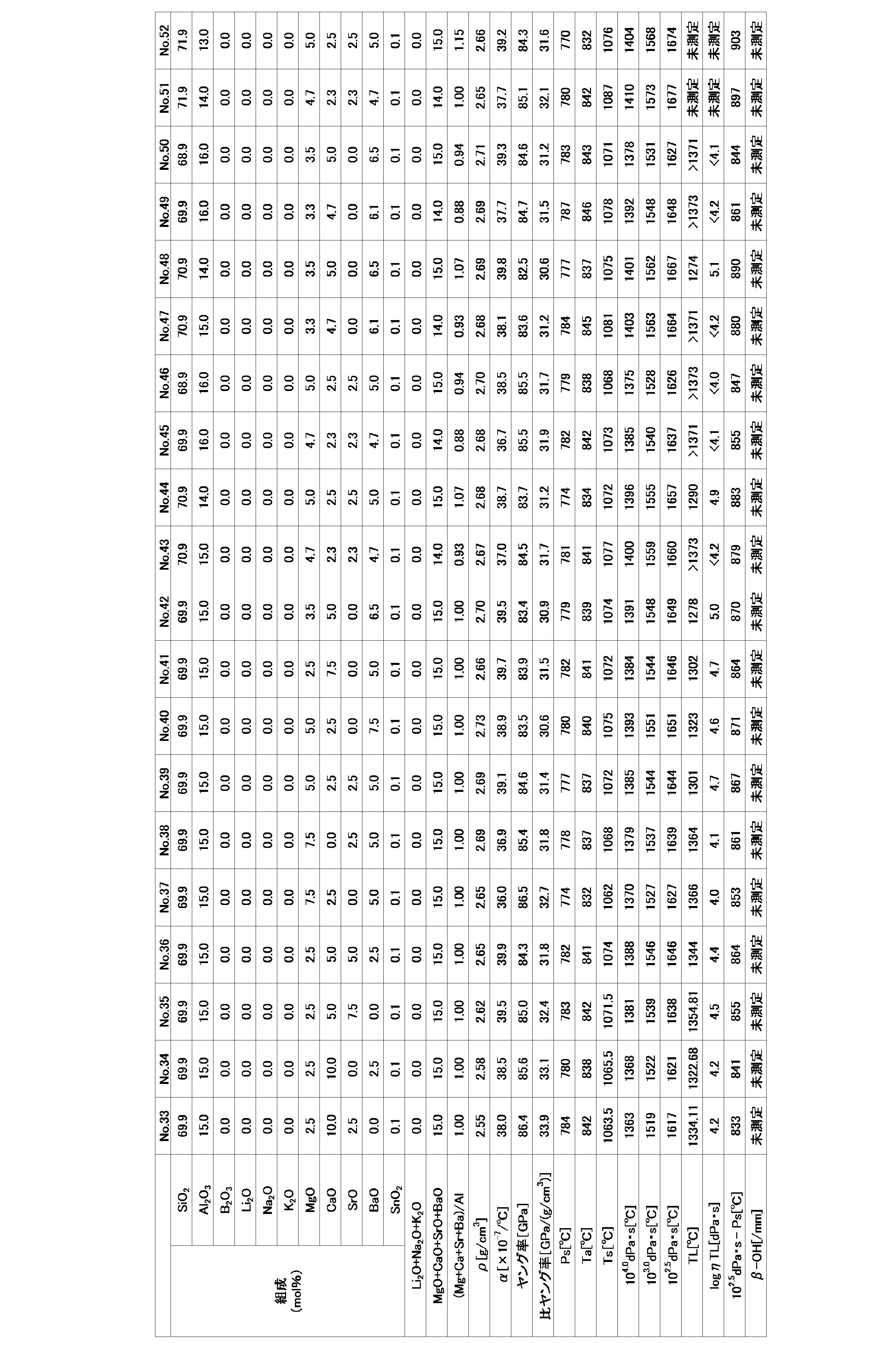
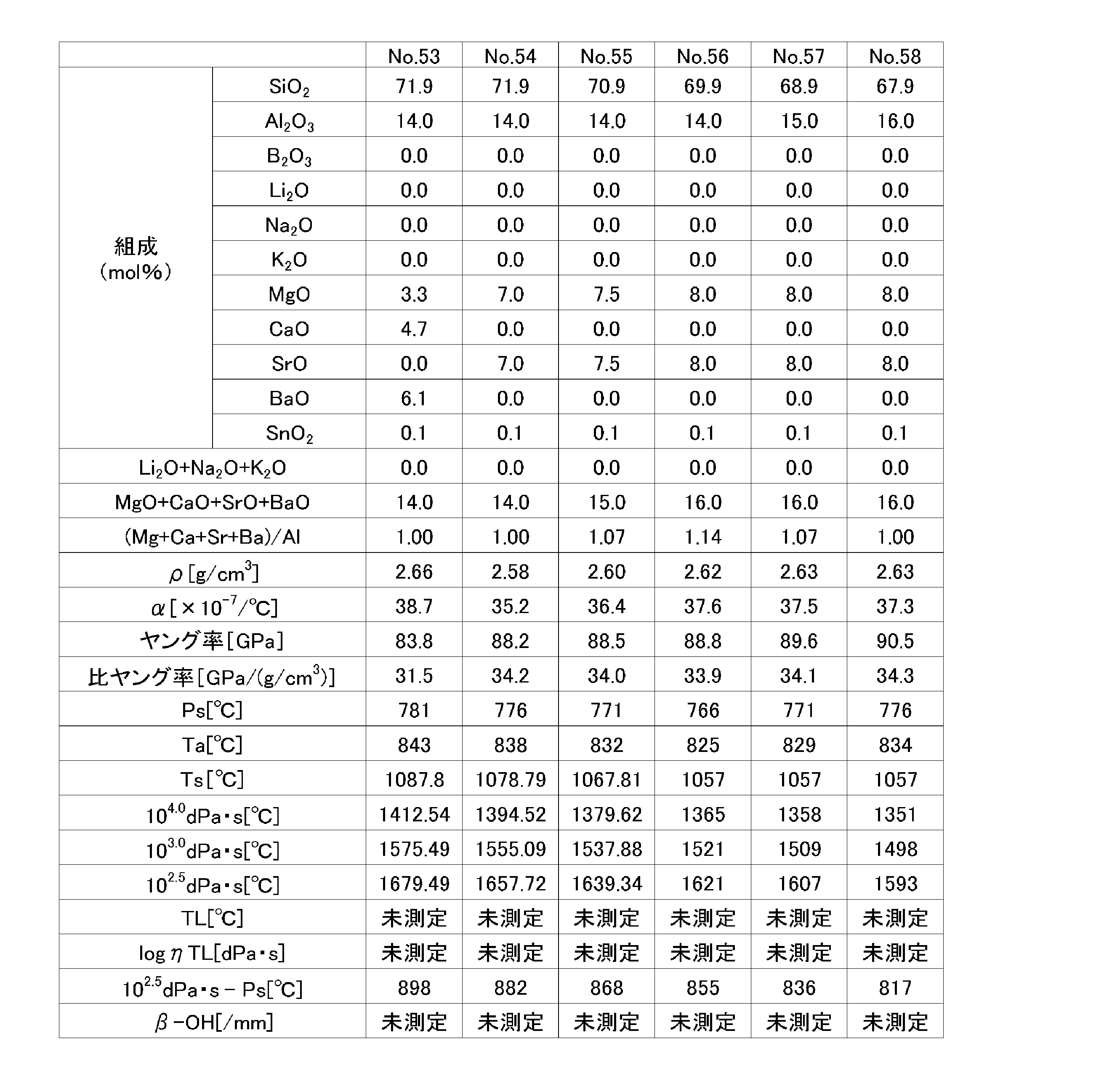
- Tables 1 to 4 show examples of the present invention (sample Nos. 1 to 58).
- Each sample was produced as follows. First, a glass batch in which glass raw materials were prepared so as to have the glass composition shown in the table was placed in a platinum crucible and melted at 1600 to 1750 ° C. for 24 hours. In melting the glass batch, the mixture was stirred and homogenized using a platinum stirrer. Next, the molten glass was poured onto a carbon plate and formed into a flat plate shape. About each obtained sample, density ⁇ , thermal expansion coefficient ⁇ , strain point Ps, annealing point Ta, softening point Ts, temperature at high temperature viscosity of 10 4.0 dPa ⁇ s, and high temperature viscosity at 10 3.0 dPa ⁇ s. The temperature, the temperature at a high temperature viscosity of 10 2.5 dPa ⁇ s, the liquid phase temperature TL, and the liquid phase viscosity log ⁇ TL were evaluated.
- the density ⁇ is a value measured by the well-known Archimedes method.
- the thermal expansion coefficient ⁇ is an average value measured with a dilatometer in a temperature range of 30 to 380 ° C.
- strain point Ps, the annealing point Ta, and the softening point Ts are values measured according to ASTM C336 or ASTM C338.
- the temperature at a high temperature viscosity of 10 4.0 dPa ⁇ s, the temperature at a high temperature viscosity of 10 3.0 dPa ⁇ s, and the temperature at a high temperature viscosity of 10 2.5 dPa ⁇ s are values measured by a platinum ball pulling method.
- the liquid phase temperature TL was obtained by crushing each sample, passing through a standard sieve 30 mesh (500 ⁇ m), putting the glass powder remaining on 50 mesh (300 ⁇ m) into a platinum boat, and holding it in a temperature gradient furnace for 24 hours. The platinum boat is taken out, and the temperature at which devitrification (devitrification crystal) is observed in the glass.
- the liquid phase viscosity log ⁇ TL is a value obtained by measuring the viscosity of the glass at the liquid phase temperature TL by a platinum ball pulling method.
- the ⁇ -OH value is a value calculated by the above formula.
- sample no. Nos. 1 to 58 have a high strain point, a low thermal expansion coefficient, and have meltability and devitrification resistance capable of mass production. Therefore, sample no. Nos. 1 to 58 are considered suitable as substrates for organic EL displays.
- the glass of the present invention has a high strain point, a low thermal expansion coefficient, and has meltability and devitrification resistance capable of mass production. Therefore, the glass of the present invention is suitable not only for organic EL display substrates but also for display substrates such as liquid crystal displays, and is particularly suitable as a display substrate driven by LTPS and oxide TFTs. Furthermore, the glass of the present invention is also suitable as an LED substrate for producing a semiconductor material at a high temperature.
Landscapes
- Chemical & Material Sciences (AREA)
- Engineering & Computer Science (AREA)
- Organic Chemistry (AREA)
- Life Sciences & Earth Sciences (AREA)
- Chemical Kinetics & Catalysis (AREA)
- General Chemical & Material Sciences (AREA)
- Geochemistry & Mineralogy (AREA)
- Materials Engineering (AREA)
- Physics & Mathematics (AREA)
- General Physics & Mathematics (AREA)
- Theoretical Computer Science (AREA)
- Microelectronics & Electronic Packaging (AREA)
- Optics & Photonics (AREA)
- Glass Compositions (AREA)
- Electroluminescent Light Sources (AREA)
- Devices For Indicating Variable Information By Combining Individual Elements (AREA)
- Liquid Crystal (AREA)
Abstract
Description
も低いため、携帯電話のディスプレイ等の用途に使用されている。
(1)ガラス基板を低廉化するために、生産性に優れること、特に耐失透性や溶融性に優れること。
(2)p-Si・TFT、特に高温p-Si等の製造工程において、ガラス基板の熱収縮を低減するために、歪点が高いこと。
(3)ガラス基板上に成膜される部材(例えば、p-Si)の熱膨張係数に整合するように、低い熱膨張係数を有すること。
β-OH値 = (1/X)log(T1/T2)
X:ガラス肉厚(mm)
T1:参照波長3846cm-1における透過率(%)
T2:水酸基吸収波長3600cm-1付近における最小透過率(%)
である。本発明は以下の実施例に何ら限定されない。

Claims (11)
- ガラス組成として、モル%で、SiO2 55~80%、Al2O3 12~30%、B2O3 0~3%、Li2O+Na2O+K2O 0~1%、MgO+CaO+SrO+BaO 5~35%を含有し、且つ30~380℃の温度範囲における熱膨張係数が40×10-7/℃未満であることを特徴とするガラス。
- B2O3の含有量が1モル%未満であることを特徴とする請求項1に記載のガラス。
- Li2O+Na2O+K2Oの含有量が0.5モル%以下であることを特徴とする請求項1又は2に記載のガラス。
- モル比(MgO+CaO+SrO+BaO)/Al2O3が0.3~3であることを特徴とする請求項1~3の何れかに記載のガラス。
- モル比MgO/(MgO+CaO+SrO+BaO)が0.5以上であることを特徴とする請求項1~4の何れかに記載のガラス。
- 歪点が750℃以上であることを特徴とする請求項1~5の何れかに記載のガラス。
- 歪点が800℃以上であることを特徴とする請求項1~6の何れかに記載のガラス。
- (102.5dPa・sにおける温度-歪点)が1000℃以下であることを特徴とする請求項1~7の何れかに記載のガラス。
- 102.5dPa・sの粘度における温度が1800℃以下であることを特徴とする請求項1~8の何れかに記載のガラス。
- 平板形状であることを特徴とする請求項1~9の何れかに記載のガラス。
- 有機ELディスプレイの基板に用いることを特徴とする請求項1~10の何れかに記載のガラス。
Priority Applications (8)
| Application Number | Priority Date | Filing Date | Title |
|---|---|---|---|
| KR1020257017631A KR20250079247A (ko) | 2015-04-03 | 2016-04-01 | 유리 |
| JP2017510248A JP7182871B2 (ja) | 2015-04-03 | 2016-04-01 | ガラス |
| US15/562,459 US10577277B2 (en) | 2015-04-03 | 2016-04-01 | Glass |
| CN202310871279.XA CN117023980A (zh) | 2015-04-03 | 2016-04-01 | 玻璃 |
| CN201680009894.8A CN107207322A (zh) | 2015-04-03 | 2016-04-01 | 玻璃 |
| KR1020177016879A KR102817508B1 (ko) | 2015-04-03 | 2016-04-01 | 유리 |
| US16/774,259 US11261123B2 (en) | 2015-04-03 | 2020-01-28 | Glass |
| US17/575,936 US12157697B2 (en) | 2015-04-03 | 2022-01-14 | Glass |
Applications Claiming Priority (4)
| Application Number | Priority Date | Filing Date | Title |
|---|---|---|---|
| JP2015076617 | 2015-04-03 | ||
| JP2015-076617 | 2015-04-03 | ||
| JP2015-164474 | 2015-08-24 | ||
| JP2015164474 | 2015-08-24 |
Related Child Applications (2)
| Application Number | Title | Priority Date | Filing Date |
|---|---|---|---|
| US15/562,459 A-371-Of-International US10577277B2 (en) | 2015-04-03 | 2016-04-01 | Glass |
| US16/774,259 Continuation US11261123B2 (en) | 2015-04-03 | 2020-01-28 | Glass |
Publications (1)
| Publication Number | Publication Date |
|---|---|
| WO2016159344A1 true WO2016159344A1 (ja) | 2016-10-06 |
Family
ID=57006116
Family Applications (1)
| Application Number | Title | Priority Date | Filing Date |
|---|---|---|---|
| PCT/JP2016/060913 Ceased WO2016159344A1 (ja) | 2015-04-03 | 2016-04-01 | ガラス |
Country Status (6)
| Country | Link |
|---|---|
| US (3) | US10577277B2 (ja) |
| JP (3) | JP7182871B2 (ja) |
| KR (2) | KR102817508B1 (ja) |
| CN (3) | CN113045197A (ja) |
| TW (3) | TWI710537B (ja) |
| WO (1) | WO2016159344A1 (ja) |
Cited By (6)
| Publication number | Priority date | Publication date | Assignee | Title |
|---|---|---|---|---|
| CN110088053A (zh) * | 2016-12-19 | 2019-08-02 | 日本电气硝子株式会社 | 玻璃 |
| US20210380468A1 (en) * | 2018-10-05 | 2021-12-09 | Nippon Electric Glass Co., Ltd. | Alkali-free glass plate |
| JP2022539144A (ja) * | 2019-06-26 | 2022-09-07 | コーニング インコーポレイテッド | 熱履歴の影響を受けにくい無アルカリガラス |
| JP2022173994A (ja) * | 2021-05-10 | 2022-11-22 | 日本電気硝子株式会社 | 無アルカリガラス板 |
| CN115572060A (zh) * | 2017-06-05 | 2023-01-06 | Agc株式会社 | 强化玻璃 |
| JP2023521805A (ja) * | 2020-04-13 | 2023-05-25 | コーニング インコーポレイテッド | K2oを含有するディスプレイ用ガラス |
Families Citing this family (7)
| Publication number | Priority date | Publication date | Assignee | Title |
|---|---|---|---|---|
| CN113045197A (zh) * | 2015-04-03 | 2021-06-29 | 日本电气硝子株式会社 | 玻璃 |
| CN115504675B (zh) | 2017-12-19 | 2024-04-30 | 欧文斯科宁知识产权资产有限公司 | 高性能玻璃纤维组合物 |
| JP7418947B2 (ja) * | 2018-01-31 | 2024-01-22 | 日本電気硝子株式会社 | ガラス |
| CN116813196A (zh) * | 2018-06-19 | 2023-09-29 | 康宁股份有限公司 | 高应变点且高杨氏模量玻璃 |
| CN108658454A (zh) * | 2018-07-31 | 2018-10-16 | 中南大学 | 一种低热膨胀系数无碱高铝硼硅酸盐玻璃及其制备方法 |
| CN118026526B (zh) * | 2024-01-31 | 2025-11-07 | 浙江大学 | 玻璃组合物、高性能电子玻璃基板及其制备方法 |
| CN120247537B (zh) * | 2025-05-29 | 2025-08-22 | 山东盛日奥鹏环保新材料集团股份有限公司 | 一种基于煅烧α-Al2O3的电子陶瓷材料及其制备方法 |
Citations (3)
| Publication number | Priority date | Publication date | Assignee | Title |
|---|---|---|---|---|
| JP2011105554A (ja) * | 2009-11-19 | 2011-06-02 | Nippon Electric Glass Co Ltd | ガラス繊維用ガラス組成物、ガラス繊維及びガラス製シート状物 |
| JP2012184146A (ja) * | 2011-03-08 | 2012-09-27 | Nippon Electric Glass Co Ltd | 無アルカリガラス |
| JP2012236759A (ja) * | 2011-04-25 | 2012-12-06 | Nippon Electric Glass Co Ltd | 液晶レンズ用ガラス基板 |
Family Cites Families (52)
| Publication number | Priority date | Publication date | Assignee | Title |
|---|---|---|---|---|
| US4180618A (en) | 1977-07-27 | 1979-12-25 | Corning Glass Works | Thin silicon film electronic device |
| JPS6042246A (ja) * | 1983-08-18 | 1985-03-06 | Toshiba Corp | 基板用ガラス |
| JPS6144732A (ja) * | 1984-08-06 | 1986-03-04 | Toshiba Corp | 基板用ガラス |
| JPS61236631A (ja) * | 1985-04-10 | 1986-10-21 | Ohara Inc | 耐火・耐熱性ガラス |
| JPS61261232A (ja) * | 1985-05-13 | 1986-11-19 | Ohara Inc | 耐火・耐熱性ガラス |
| US4634684A (en) * | 1985-10-23 | 1987-01-06 | Corning Glass Works | Strontium aluminosilicate glass substrates for flat panel display devices |
| US4634683A (en) * | 1985-10-23 | 1987-01-06 | Corning Glass Works | Barium and/or strontium aluminosilicate crystal-containing glasses for flat panel display devices |
| JPH0818845B2 (ja) * | 1987-11-11 | 1996-02-28 | 日本板硝子株式会社 | 電子機器用ガラス基板 |
| US5508237A (en) * | 1994-03-14 | 1996-04-16 | Corning Incorporated | Flat panel display |
| US5489558A (en) * | 1994-03-14 | 1996-02-06 | Corning Incorporated | Glasses for flat panel display |
| JP3800657B2 (ja) * | 1996-03-28 | 2006-07-26 | 旭硝子株式会社 | 無アルカリガラスおよびフラットディスプレイパネル |
| JP3804112B2 (ja) * | 1996-07-29 | 2006-08-02 | 旭硝子株式会社 | 無アルカリガラス、無アルカリガラスの製造方法およびフラットディスプレイパネル |
| US6809050B1 (en) | 2000-10-31 | 2004-10-26 | Owens Corning Fiberglas Technology, Inc. | High temperature glass fibers |
| JP3897170B2 (ja) | 2002-01-21 | 2007-03-22 | 日本板硝子株式会社 | 赤外発光体および光増幅媒体 |
| JP4790300B2 (ja) * | 2005-04-14 | 2011-10-12 | 株式会社日立製作所 | ガラス |
| WO2007095115A1 (en) * | 2006-02-10 | 2007-08-23 | Corning Incorporated | Glass compositions having high thermal and chemical stability and methods of making thereof |
| JP4947486B2 (ja) * | 2006-05-18 | 2012-06-06 | 日本電気硝子株式会社 | 平面画像表示装置用ガラスおよびそれを用いたガラス基板並びにその製造方法 |
| JP4882854B2 (ja) * | 2007-04-27 | 2012-02-22 | セントラル硝子株式会社 | ガラス用コーティング組成物 |
| US7709406B2 (en) * | 2007-07-31 | 2010-05-04 | Corning Incorporation | Glass compositions compatible with downdraw processing and methods of making and using thereof |
| US8187715B2 (en) | 2008-05-13 | 2012-05-29 | Corning Incorporated | Rare-earth-containing glass material and substrate and device comprising such substrate |
| JP5292028B2 (ja) * | 2008-09-10 | 2013-09-18 | 株式会社オハラ | ガラス |
| EP2351716A4 (en) * | 2008-09-10 | 2013-03-20 | Ohara Kk | GLASS |
| JP2011011933A (ja) * | 2009-06-30 | 2011-01-20 | Hitachi Automotive Systems Ltd | 耐熱性及び耐食性を有するガラス |
| EP2450319A4 (en) | 2009-07-02 | 2015-01-28 | Asahi Glass Co Ltd | ALKALIFREE GLASS AND METHOD FOR THE PRODUCTION THEREOF |
| JP5874304B2 (ja) * | 2010-11-02 | 2016-03-02 | 日本電気硝子株式会社 | 無アルカリガラス |
| EP2639205B1 (en) * | 2010-11-08 | 2019-03-06 | Nippon Electric Glass Co., Ltd. | Alkali-free glass |
| US8796165B2 (en) * | 2010-11-30 | 2014-08-05 | Corning Incorporated | Alkaline earth alumino-borosilicate crack resistant glass |
| KR101752033B1 (ko) * | 2010-12-07 | 2017-06-28 | 아사히 가라스 가부시키가이샤 | 무알칼리 유리 및 무알칼리 유리의 제조 방법 |
| KR101751569B1 (ko) * | 2010-12-27 | 2017-06-27 | 아사히 가라스 가부시키가이샤 | 무알칼리 유리 및 무알칼리 유리의 제조 방법 |
| CN103347830A (zh) * | 2011-01-25 | 2013-10-09 | 康宁股份有限公司 | 具有高热稳定性和化学稳定性的玻璃组合物 |
| CN103987666B (zh) * | 2011-12-06 | 2016-05-25 | 旭硝子株式会社 | 无碱玻璃的制造方法 |
| CN104039727A (zh) * | 2011-12-29 | 2014-09-10 | 日本电气硝子株式会社 | 无碱玻璃 |
| JP5943064B2 (ja) * | 2012-02-27 | 2016-06-29 | 旭硝子株式会社 | 無アルカリガラスの製造方法 |
| US9162919B2 (en) * | 2012-02-28 | 2015-10-20 | Corning Incorporated | High strain point aluminosilicate glasses |
| JP6086119B2 (ja) * | 2012-05-31 | 2017-03-01 | 旭硝子株式会社 | 無アルカリガラス基板、および、無アルカリガラス基板の薄板化方法 |
| CN104364215A (zh) * | 2012-06-05 | 2015-02-18 | 旭硝子株式会社 | 无碱玻璃及其制造方法 |
| EP2857366A1 (en) * | 2012-06-05 | 2015-04-08 | Asahi Glass Company, Limited | Alkali-free glass and method for producing same |
| EP2860161A1 (en) * | 2012-06-07 | 2015-04-15 | Asahi Glass Company, Limited | Alkali-free glass and alkali-free glass plate using same |
| CN110698057A (zh) * | 2012-12-21 | 2020-01-17 | 康宁股份有限公司 | 具有改进的总节距稳定性的玻璃 |
| JP5914453B2 (ja) * | 2012-12-28 | 2016-05-11 | AvanStrate株式会社 | ディスプレイ用ガラス基板およびその製造方法 |
| WO2014175215A1 (ja) * | 2013-04-23 | 2014-10-30 | 旭硝子株式会社 | 無アルカリガラス基板およびその製造方法 |
| US9527767B2 (en) * | 2013-05-09 | 2016-12-27 | Corning Incorporated | Alkali-free phosphoborosilicate glass |
| JP2015027932A (ja) * | 2013-06-27 | 2015-02-12 | 旭硝子株式会社 | 磁気記録媒体用無アルカリガラス、および、これを用いた磁気記録媒体用ガラス基板 |
| JP6299472B2 (ja) * | 2013-06-27 | 2018-03-28 | 旭硝子株式会社 | 磁気記録媒体用無アルカリガラス、および、これを用いた磁気記録媒体用ガラス基板 |
| JP2015027931A (ja) * | 2013-06-27 | 2015-02-12 | 旭硝子株式会社 | 磁気記録媒体用無アルカリガラス、および、これを用いた磁気記録媒体用ガラス基板 |
| JP6308044B2 (ja) * | 2013-06-27 | 2018-04-11 | 旭硝子株式会社 | 磁気記録媒体用無アルカリガラス、および、これを用いた磁気記録媒体用ガラス基板 |
| JP2016153346A (ja) * | 2013-06-27 | 2016-08-25 | 旭硝子株式会社 | 無アルカリガラス |
| FR3008695B1 (fr) * | 2013-07-16 | 2021-01-29 | Corning Inc | Verre aluminosilicate dont la composition est exempte de metaux alcalins, convenant comme substrat de plaques de cuisson pour chauffage a induction |
| KR102559221B1 (ko) * | 2014-10-31 | 2023-07-25 | 코닝 인코포레이티드 | 치수적으로 안정한 급속 에칭 유리 |
| CN113045197A (zh) * | 2015-04-03 | 2021-06-29 | 日本电气硝子株式会社 | 玻璃 |
| JP6663010B2 (ja) * | 2015-12-01 | 2020-03-11 | コーナーストーン・マテリアルズ・テクノロジー・カンパニー・リミテッドKornerstone Materials Technology Company, Ltd. | 低ホウ素とバリウムフリーのアルカリ土類アルミノシリケートガラス及びその応用 |
| US10045422B2 (en) * | 2016-02-24 | 2018-08-07 | Leviton Manufacturing Co., Inc. | System and method for light-based activation of an occupancy sensor wireless transceiver |
-
2016
- 2016-04-01 CN CN202110288211.XA patent/CN113045197A/zh active Pending
- 2016-04-01 WO PCT/JP2016/060913 patent/WO2016159344A1/ja not_active Ceased
- 2016-04-01 TW TW105110597A patent/TWI710537B/zh active
- 2016-04-01 TW TW109135079A patent/TWI768502B/zh active
- 2016-04-01 US US15/562,459 patent/US10577277B2/en active Active
- 2016-04-01 KR KR1020177016879A patent/KR102817508B1/ko active Active
- 2016-04-01 KR KR1020257017631A patent/KR20250079247A/ko active Pending
- 2016-04-01 JP JP2017510248A patent/JP7182871B2/ja active Active
- 2016-04-01 CN CN201680009894.8A patent/CN107207322A/zh active Pending
- 2016-04-01 CN CN202310871279.XA patent/CN117023980A/zh active Pending
- 2016-04-01 TW TW111118157A patent/TW202235393A/zh unknown
-
2020
- 2020-01-28 US US16/774,259 patent/US11261123B2/en active Active
-
2021
- 2021-07-13 JP JP2021115465A patent/JP7421171B2/ja active Active
-
2022
- 2022-01-14 US US17/575,936 patent/US12157697B2/en active Active
-
2024
- 2024-01-10 JP JP2024001573A patent/JP2024032755A/ja active Pending
Patent Citations (3)
| Publication number | Priority date | Publication date | Assignee | Title |
|---|---|---|---|---|
| JP2011105554A (ja) * | 2009-11-19 | 2011-06-02 | Nippon Electric Glass Co Ltd | ガラス繊維用ガラス組成物、ガラス繊維及びガラス製シート状物 |
| JP2012184146A (ja) * | 2011-03-08 | 2012-09-27 | Nippon Electric Glass Co Ltd | 無アルカリガラス |
| JP2012236759A (ja) * | 2011-04-25 | 2012-12-06 | Nippon Electric Glass Co Ltd | 液晶レンズ用ガラス基板 |
Cited By (8)
| Publication number | Priority date | Publication date | Assignee | Title |
|---|---|---|---|---|
| CN110088053A (zh) * | 2016-12-19 | 2019-08-02 | 日本电气硝子株式会社 | 玻璃 |
| CN115572060A (zh) * | 2017-06-05 | 2023-01-06 | Agc株式会社 | 强化玻璃 |
| US20210380468A1 (en) * | 2018-10-05 | 2021-12-09 | Nippon Electric Glass Co., Ltd. | Alkali-free glass plate |
| US12077471B2 (en) * | 2018-10-05 | 2024-09-03 | Nippon Electric Glass Co., Ltd. | Alkali-free glass plate |
| JP2022539144A (ja) * | 2019-06-26 | 2022-09-07 | コーニング インコーポレイテッド | 熱履歴の影響を受けにくい無アルカリガラス |
| JP2023521805A (ja) * | 2020-04-13 | 2023-05-25 | コーニング インコーポレイテッド | K2oを含有するディスプレイ用ガラス |
| JP7839593B2 (ja) | 2020-04-13 | 2026-04-02 | コーニング インコーポレイテッド | K2oを含有するディスプレイ用ガラス |
| JP2022173994A (ja) * | 2021-05-10 | 2022-11-22 | 日本電気硝子株式会社 | 無アルカリガラス板 |
Also Published As
| Publication number | Publication date |
|---|---|
| US12157697B2 (en) | 2024-12-03 |
| CN117023980A (zh) | 2023-11-10 |
| US20200239353A1 (en) | 2020-07-30 |
| JPWO2016159344A1 (ja) | 2018-02-01 |
| KR20250079247A (ko) | 2025-06-04 |
| US11261123B2 (en) | 2022-03-01 |
| TWI710537B (zh) | 2020-11-21 |
| TW202104116A (zh) | 2021-02-01 |
| CN113045197A (zh) | 2021-06-29 |
| TWI768502B (zh) | 2022-06-21 |
| KR20170137031A (ko) | 2017-12-12 |
| TW201700424A (zh) | 2017-01-01 |
| US10577277B2 (en) | 2020-03-03 |
| JP7182871B2 (ja) | 2022-12-05 |
| JP2024032755A (ja) | 2024-03-12 |
| CN107207322A (zh) | 2017-09-26 |
| US20220135465A1 (en) | 2022-05-05 |
| KR102817508B1 (ko) | 2025-06-10 |
| TW202235393A (zh) | 2022-09-16 |
| JP7421171B2 (ja) | 2024-01-24 |
| JP2021183560A (ja) | 2021-12-02 |
| US20180086660A1 (en) | 2018-03-29 |
Similar Documents
| Publication | Publication Date | Title |
|---|---|---|
| JP7421171B2 (ja) | ガラス | |
| CN103313948B (zh) | 无碱玻璃 | |
| JP6365826B2 (ja) | ガラス | |
| JP2017007939A (ja) | 無アルカリガラス | |
| WO2015056645A1 (ja) | 無アルカリガラス | |
| JP7307407B2 (ja) | 無アルカリガラス | |
| JP7486446B2 (ja) | ガラス | |
| JP2024087022A (ja) | ガラス | |
| WO2020080163A1 (ja) | 無アルカリガラス板 | |
| JP2016005999A (ja) | ガラス | |
| WO2018186143A1 (ja) | ガラス基板 | |
| JP2020172423A (ja) | 無アルカリガラス板 | |
| WO2014208524A1 (ja) | 無アルカリガラス |
Legal Events
| Date | Code | Title | Description |
|---|---|---|---|
| 121 | Ep: the epo has been informed by wipo that ep was designated in this application |
Ref document number: 16773224 Country of ref document: EP Kind code of ref document: A1 |
|
| ENP | Entry into the national phase |
Ref document number: 2017510248 Country of ref document: JP Kind code of ref document: A |
|
| ENP | Entry into the national phase |
Ref document number: 20177016879 Country of ref document: KR Kind code of ref document: A |
|
| WWE | Wipo information: entry into national phase |
Ref document number: 15562459 Country of ref document: US |
|
| NENP | Non-entry into the national phase |
Ref country code: DE |
|
| 122 | Ep: pct application non-entry in european phase |
Ref document number: 16773224 Country of ref document: EP Kind code of ref document: A1 |
|
| WWP | Wipo information: published in national office |
Ref document number: 1020257017631 Country of ref document: KR |