WO2016136454A1 - 硬化性組成物とその硬化物、及び光学部材 - Google Patents
硬化性組成物とその硬化物、及び光学部材 Download PDFInfo
- Publication number
- WO2016136454A1 WO2016136454A1 PCT/JP2016/053770 JP2016053770W WO2016136454A1 WO 2016136454 A1 WO2016136454 A1 WO 2016136454A1 JP 2016053770 W JP2016053770 W JP 2016053770W WO 2016136454 A1 WO2016136454 A1 WO 2016136454A1
- Authority
- WO
- WIPO (PCT)
- Prior art keywords
- meth
- acrylate
- curable composition
- acrylate compound
- cured product
- Prior art date
- Legal status (The legal status is an assumption and is not a legal conclusion. Google has not performed a legal analysis and makes no representation as to the accuracy of the status listed.)
- Ceased
Links
- 0 CC(C(*)C(*)OC(C(*)=C)=O)O*C1(*)c(cccc2)c2-c2c1cccc2 Chemical compound CC(C(*)C(*)OC(C(*)=C)=O)O*C1(*)c(cccc2)c2-c2c1cccc2 0.000 description 1
Classifications
-
- C—CHEMISTRY; METALLURGY
- C08—ORGANIC MACROMOLECULAR COMPOUNDS; THEIR PREPARATION OR CHEMICAL WORKING-UP; COMPOSITIONS BASED THEREON
- C08F—MACROMOLECULAR COMPOUNDS OBTAINED BY REACTIONS ONLY INVOLVING CARBON-TO-CARBON UNSATURATED BONDS
- C08F220/00—Copolymers of compounds having one or more unsaturated aliphatic radicals, each having only one carbon-to-carbon double bond, and only one being terminated by only one carboxyl radical or a salt, anhydride ester, amide, imide or nitrile thereof
- C08F220/02—Monocarboxylic acids having less than ten carbon atoms; Derivatives thereof
- C08F220/10—Esters
- C08F220/26—Esters containing oxygen in addition to the carboxy oxygen
- C08F220/30—Esters containing oxygen in addition to the carboxy oxygen containing aromatic rings in the alcohol moiety
- C08F220/301—Esters containing oxygen in addition to the carboxy oxygen containing aromatic rings in the alcohol moiety and one oxygen in the alcohol moiety
-
- C—CHEMISTRY; METALLURGY
- C08—ORGANIC MACROMOLECULAR COMPOUNDS; THEIR PREPARATION OR CHEMICAL WORKING-UP; COMPOSITIONS BASED THEREON
- C08F—MACROMOLECULAR COMPOUNDS OBTAINED BY REACTIONS ONLY INVOLVING CARBON-TO-CARBON UNSATURATED BONDS
- C08F2/00—Processes of polymerisation
- C08F2/44—Polymerisation in the presence of compounding ingredients, e.g. plasticisers, dyestuffs, fillers
-
- C—CHEMISTRY; METALLURGY
- C08—ORGANIC MACROMOLECULAR COMPOUNDS; THEIR PREPARATION OR CHEMICAL WORKING-UP; COMPOSITIONS BASED THEREON
- C08F—MACROMOLECULAR COMPOUNDS OBTAINED BY REACTIONS ONLY INVOLVING CARBON-TO-CARBON UNSATURATED BONDS
- C08F290/00—Macromolecular compounds obtained by polymerising monomers on to polymers modified by introduction of aliphatic unsaturated end or side groups
- C08F290/02—Macromolecular compounds obtained by polymerising monomers on to polymers modified by introduction of aliphatic unsaturated end or side groups on to polymers modified by introduction of unsaturated end groups
- C08F290/06—Polymers provided for in subclass C08G
-
- C—CHEMISTRY; METALLURGY
- C08—ORGANIC MACROMOLECULAR COMPOUNDS; THEIR PREPARATION OR CHEMICAL WORKING-UP; COMPOSITIONS BASED THEREON
- C08F—MACROMOLECULAR COMPOUNDS OBTAINED BY REACTIONS ONLY INVOLVING CARBON-TO-CARBON UNSATURATED BONDS
- C08F292/00—Macromolecular compounds obtained by polymerising monomers on to inorganic materials
-
- C—CHEMISTRY; METALLURGY
- C08—ORGANIC MACROMOLECULAR COMPOUNDS; THEIR PREPARATION OR CHEMICAL WORKING-UP; COMPOSITIONS BASED THEREON
- C08F—MACROMOLECULAR COMPOUNDS OBTAINED BY REACTIONS ONLY INVOLVING CARBON-TO-CARBON UNSATURATED BONDS
- C08F299/00—Macromolecular compounds obtained by interreacting polymers involving only carbon-to-carbon unsaturated bond reactions, in the absence of non-macromolecular monomers
-
- C—CHEMISTRY; METALLURGY
- C08—ORGANIC MACROMOLECULAR COMPOUNDS; THEIR PREPARATION OR CHEMICAL WORKING-UP; COMPOSITIONS BASED THEREON
- C08K—Use of inorganic or non-macromolecular organic substances as compounding ingredients
- C08K3/00—Use of inorganic substances as compounding ingredients
- C08K3/18—Oxygen-containing compounds, e.g. metal carbonyls
- C08K3/20—Oxides; Hydroxides
- C08K3/22—Oxides; Hydroxides of metals
-
- C—CHEMISTRY; METALLURGY
- C08—ORGANIC MACROMOLECULAR COMPOUNDS; THEIR PREPARATION OR CHEMICAL WORKING-UP; COMPOSITIONS BASED THEREON
- C08L—COMPOSITIONS OF MACROMOLECULAR COMPOUNDS
- C08L71/00—Compositions of polyethers obtained by reactions forming an ether link in the main chain; Compositions of derivatives of such polymers
- C08L71/02—Polyalkylene oxides
-
- C—CHEMISTRY; METALLURGY
- C09—DYES; PAINTS; POLISHES; NATURAL RESINS; ADHESIVES; COMPOSITIONS NOT OTHERWISE PROVIDED FOR; APPLICATIONS OF MATERIALS NOT OTHERWISE PROVIDED FOR
- C09D—COATING COMPOSITIONS, e.g. PAINTS, VARNISHES OR LACQUERS; FILLING PASTES; CHEMICAL PAINT OR INK REMOVERS; INKS; CORRECTING FLUIDS; WOODSTAINS; PASTES OR SOLIDS FOR COLOURING OR PRINTING; USE OF MATERIALS THEREFOR
- C09D163/00—Coating compositions based on epoxy resins; Coating compositions based on derivatives of epoxy resins
-
- C—CHEMISTRY; METALLURGY
- C09—DYES; PAINTS; POLISHES; NATURAL RESINS; ADHESIVES; COMPOSITIONS NOT OTHERWISE PROVIDED FOR; APPLICATIONS OF MATERIALS NOT OTHERWISE PROVIDED FOR
- C09D—COATING COMPOSITIONS, e.g. PAINTS, VARNISHES OR LACQUERS; FILLING PASTES; CHEMICAL PAINT OR INK REMOVERS; INKS; CORRECTING FLUIDS; WOODSTAINS; PASTES OR SOLIDS FOR COLOURING OR PRINTING; USE OF MATERIALS THEREFOR
- C09D4/00—Coating compositions, e.g. paints, varnishes or lacquers, based on organic non-macromolecular compounds having at least one polymerisable carbon-to-carbon unsaturated bond ; Coating compositions, based on monomers of macromolecular compounds of groups C09D183/00 - C09D183/16
-
- C—CHEMISTRY; METALLURGY
- C09—DYES; PAINTS; POLISHES; NATURAL RESINS; ADHESIVES; COMPOSITIONS NOT OTHERWISE PROVIDED FOR; APPLICATIONS OF MATERIALS NOT OTHERWISE PROVIDED FOR
- C09D—COATING COMPOSITIONS, e.g. PAINTS, VARNISHES OR LACQUERS; FILLING PASTES; CHEMICAL PAINT OR INK REMOVERS; INKS; CORRECTING FLUIDS; WOODSTAINS; PASTES OR SOLIDS FOR COLOURING OR PRINTING; USE OF MATERIALS THEREFOR
- C09D5/00—Coating compositions, e.g. paints, varnishes or lacquers, characterised by their physical nature or the effects produced; Filling pastes
- C09D5/006—Anti-reflective coatings
-
- G—PHYSICS
- G02—OPTICS
- G02B—OPTICAL ELEMENTS, SYSTEMS OR APPARATUS
- G02B1/00—Optical elements characterised by the material of which they are made; Optical coatings for optical elements
- G02B1/10—Optical coatings produced by application to, or surface treatment of, optical elements
-
- G—PHYSICS
- G02—OPTICS
- G02F—OPTICAL DEVICES OR ARRANGEMENTS FOR THE CONTROL OF LIGHT BY MODIFICATION OF THE OPTICAL PROPERTIES OF THE MEDIA OF THE ELEMENTS INVOLVED THEREIN; NON-LINEAR OPTICS; FREQUENCY-CHANGING OF LIGHT; OPTICAL LOGIC ELEMENTS; OPTICAL ANALOGUE/DIGITAL CONVERTERS
- G02F1/00—Devices or arrangements for the control of the intensity, colour, phase, polarisation or direction of light arriving from an independent light source, e.g. switching, gating or modulating; Non-linear optics
- G02F1/01—Devices or arrangements for the control of the intensity, colour, phase, polarisation or direction of light arriving from an independent light source, e.g. switching, gating or modulating; Non-linear optics for the control of the intensity, phase, polarisation or colour
- G02F1/13—Devices or arrangements for the control of the intensity, colour, phase, polarisation or direction of light arriving from an independent light source, e.g. switching, gating or modulating; Non-linear optics for the control of the intensity, phase, polarisation or colour based on liquid crystals, e.g. single liquid crystal display cells
- G02F1/133—Constructional arrangements; Operation of liquid crystal cells; Circuit arrangements
- G02F1/1333—Constructional arrangements; Manufacturing methods
- G02F1/1335—Structural association of cells with optical devices, e.g. polarisers or reflectors
- G02F1/1336—Illuminating devices
-
- B—PERFORMING OPERATIONS; TRANSPORTING
- B32—LAYERED PRODUCTS
- B32B—LAYERED PRODUCTS, i.e. PRODUCTS BUILT-UP OF STRATA OF FLAT OR NON-FLAT, e.g. CELLULAR OR HONEYCOMB, FORM
- B32B37/00—Methods or apparatus for laminating, e.g. by curing or by ultrasonic bonding
- B32B37/12—Methods or apparatus for laminating, e.g. by curing or by ultrasonic bonding characterised by using adhesives
- B32B2037/1253—Methods or apparatus for laminating, e.g. by curing or by ultrasonic bonding characterised by using adhesives curable adhesive
-
- C—CHEMISTRY; METALLURGY
- C08—ORGANIC MACROMOLECULAR COMPOUNDS; THEIR PREPARATION OR CHEMICAL WORKING-UP; COMPOSITIONS BASED THEREON
- C08F—MACROMOLECULAR COMPOUNDS OBTAINED BY REACTIONS ONLY INVOLVING CARBON-TO-CARBON UNSATURATED BONDS
- C08F222/00—Copolymers of compounds having one or more unsaturated aliphatic radicals, each having only one carbon-to-carbon double bond, and at least one being terminated by a carboxyl radical and containing at least one other carboxyl radical in the molecule; Salts, anhydrides, esters, amides, imides, or nitriles thereof
- C08F222/10—Esters
- C08F222/1006—Esters of polyhydric alcohols or polyhydric phenols
- C08F222/102—Esters of polyhydric alcohols or polyhydric phenols of dialcohols, e.g. ethylene glycol di(meth)acrylate or 1,4-butanediol dimethacrylate
- C08F222/1025—Esters of polyhydric alcohols or polyhydric phenols of dialcohols, e.g. ethylene glycol di(meth)acrylate or 1,4-butanediol dimethacrylate of aromatic dialcohols
-
- C—CHEMISTRY; METALLURGY
- C08—ORGANIC MACROMOLECULAR COMPOUNDS; THEIR PREPARATION OR CHEMICAL WORKING-UP; COMPOSITIONS BASED THEREON
- C08F—MACROMOLECULAR COMPOUNDS OBTAINED BY REACTIONS ONLY INVOLVING CARBON-TO-CARBON UNSATURATED BONDS
- C08F222/00—Copolymers of compounds having one or more unsaturated aliphatic radicals, each having only one carbon-to-carbon double bond, and at least one being terminated by a carboxyl radical and containing at least one other carboxyl radical in the molecule; Salts, anhydrides, esters, amides, imides, or nitriles thereof
- C08F222/10—Esters
- C08F222/1006—Esters of polyhydric alcohols or polyhydric phenols
- C08F222/106—Esters of polycondensation macromers
- C08F222/1063—Esters of polycondensation macromers of alcohol terminated polyethers
-
- C—CHEMISTRY; METALLURGY
- C08—ORGANIC MACROMOLECULAR COMPOUNDS; THEIR PREPARATION OR CHEMICAL WORKING-UP; COMPOSITIONS BASED THEREON
- C08K—Use of inorganic or non-macromolecular organic substances as compounding ingredients
- C08K3/00—Use of inorganic substances as compounding ingredients
- C08K3/18—Oxygen-containing compounds, e.g. metal carbonyls
- C08K3/20—Oxides; Hydroxides
- C08K3/22—Oxides; Hydroxides of metals
- C08K2003/2244—Oxides; Hydroxides of metals of zirconium
-
- C—CHEMISTRY; METALLURGY
- C08—ORGANIC MACROMOLECULAR COMPOUNDS; THEIR PREPARATION OR CHEMICAL WORKING-UP; COMPOSITIONS BASED THEREON
- C08K—Use of inorganic or non-macromolecular organic substances as compounding ingredients
- C08K2201/00—Specific properties of additives
- C08K2201/011—Nanostructured additives
Definitions
- the present invention relates to a curable composition having high light transmittance and refractive index in a cured product and excellent scratch resistance, a cured product thereof, and an optical member.
- a brightness enhancement sheet such as a prism sheet or a microlens sheet for improving the brightness is installed.
- Patent Document 1 describes a curable composition containing zirconium oxide fine particles and phenoxyethyl acrylate.
- a cured product of such a resin composition containing inorganic fine particles has a high refractive index, but on the other hand, it has a defect that it is easily damaged due to its low elasticity.
- the problem to be solved by the present invention is to provide a curable composition having a high light transmittance and refractive index in a cured product and excellent scratch resistance, a cured product thereof, and an optical member.
- the present inventors have found that, in a curable composition containing inorganic fine particles, a dispersant, and a curable resin component, the dispersant has an acid value of 100 to 300 mgKOH / g. It was found that the above-mentioned problems can be solved by using a polymethene oxide structure-containing (meth) acrylate compound as the curable resin component.
- the present invention contains zirconium oxide nanoparticles (A), a dispersant (B), and a (meth) acrylate compound (C), and the acid value of the dispersant (B) is in the range of 100 to 300 mgKOH / g.
- the (meth) acrylate compound (C) contains a poly (alkylene oxide) structure-containing (meth) acrylate compound (C1).
- the present invention further relates to a cured product obtained by curing the curable composition, and an optical member.
- the present invention it is possible to provide a curable composition having high light transmittance and refractive index in a cured product and excellent scratch resistance, a cured product thereof, and an optical member.
- the curable composition of the present invention contains zirconium oxide nanoparticles (A), a dispersant (B), and a (meth) acrylate compound (C), and the acid value of the dispersant (B) is 100 to 300 mgKOH / It is the range of g, and the said (meth) acrylate compound (C) contains the polyalkylene oxide structure containing (meth) acrylate compound (C1), It is characterized by the above-mentioned.
- a curable composition containing inorganic fine particles and a compound having a highly polar structural site such as the polyalkylene oxide structure-containing (meth) acrylate compound (C1) tends to cause aggregation of inorganic fine particles in the system
- the stability of the curable composition may be reduced during storage, or the transparency of the cured coating film may be reduced.
- the dispersant (B) having an acid value in the range of 100 to 300 mgKOH / g a curable composition having excellent stability over time can be obtained, and not only the refractive index of the cured product is high. In addition, light transmittance and scratch resistance are excellent.
- the zirconium oxide nanoparticles (A) contained in the curable composition of the present invention are obtained by dispersing the raw zirconium oxide nanoparticles (a) in a dispersion medium essentially comprising the (meth) acrylate compound (C). Is.
- the average particle diameter of the zirconium oxide nanoparticles (A) in the curable composition is preferably in the range of 20 to 100 nm because it becomes a cured product having a high refractive index and excellent light transmittance.
- the average particle size of the zirconium oxide nanoparticles (A) is a value measured using a particle size measuring device (“ELSZ-2” manufactured by Otsuka Electronics Co., Ltd.).
- Zirconium oxide nanoparticles (a) used as a raw material can be generally known particles, and the shape of the particles is not particularly limited.
- the shape of the particles is not particularly limited.
- a spherical shape is preferable because a cured product having excellent dispersion stability and high light transmittance and refractive index can be obtained.
- the average primary particle diameter of the zirconium oxide nanoparticles (a) is preferably 1 to 50 nm, particularly 1 to 30 nm because a cured product having excellent dispersion stability and high light transmittance and refractive index can be obtained. preferable.
- the crystal structure of the zirconium oxide nanoparticles (a) is not particularly limited, but a monoclinic system is preferable because a cured product having excellent dispersion stability and high light transmittance and refractive index can be obtained. Moreover, in this invention, you may introduce
- silane coupling agent (D) examples include the following.
- Examples of (meth) acryloyloxy-based silane coupling agents include 3- (meth) acryloyloxypropyltrimethylsilane, 3- (meth) acryloyloxypropylmethyldimethoxysilane, 3- (meth) acryloyloxypropyltrimethoxysilane, 3 -(Meth) acryloyloxypropylmethyldiethoxysilane, 3- (meth) acryloyloxypropyltriethoxysilane are exemplified.
- Examples of the acryloxy-based silane coupling agent include 3-acryloxypropyltrimethoxysilane.
- vinyl silane coupling agents include allyltrichlorosilane, allyltriethoxysilane, allyltrimethoxysilane, diethoxymethylvinylsilane, trichlorovinylsilane, vinyltrichlorosilane, vinyltrimethoxysilane, vinyltriethoxysilane, vinyltris (2- Illustrative is methoxyethoxy) silane.
- Epoxy silane coupling agents include diethoxy (glycidyloxypropyl) methylsilane, 2- (3,4 epoxycyclohexyl) ethyltrimethoxysilane, 3-glycidoxypropyltrimethoxysilane, and 3-glycidoxypropylmethyl. Examples include diethoxysilane and 3-brisidoxypropyltriethoxysilane. Examples of the styrene-based silane coupling agent include p-styryltrimethoxysilane.
- amino silane coupling agents include N-2 (aminoethyl) 3-aminopropylmethyldimethoxysilane, N-2 (aminoethyl) 3-aminopropyltrimethoxysilane, and N-2 (aminoethyl) 3-amino.
- An example is methoxysilane.
- Examples of the ureido silane coupling agent include 3-ureidopropyltriethoxysilane.
- Examples of the chloropropyl silane coupling agent include 3-chloropropyltrimethoxysilane.
- Examples of mercapto-based silane coupling agents include 3-mercaptopropylmethyldimethoxysilane and 3-mercaptopropyltrimethinesilane.
- Examples of the sulfide-based silane coupling agent include bis (triethoxysilylpropyl) tetrasulfide.
- Examples of the isocyanate-based silane coupling agent include 3-isocyanatopropyltriethoxysilane.
- Examples of the aluminum coupling agent include acetoalkoxyaluminum diisopropylate.
- silane coupling agents (D) may be used alone or in combination of two or more. Among them, those having a (meth) acryloyloxy group, a glycidyl group, and an epoxycyclohexyl group are preferable, and 3- (meth) acryloyloxypropyltrimethoxysilane is most preferable.
- the dispersant (B) contained in the curable composition of the present invention contains the polyalkylene oxide structure as a dispersion medium for the inorganic fine particles as described above because the acid value is in the range of 100 to 300 mgKOH / g or more. Even when a compound having a highly polar structural site, such as the (meth) acrylate compound (C1), is used, a highly stable curable composition is obtained in which aggregation of inorganic fine particles hardly occurs in the system. As a result, the cured product has not only a high refractive index but also excellent light transmittance and scratch resistance. Among them, those having an acid value in the range of 120 to 200 mgKOH / g are more preferable.
- the dispersant (B) examples include a polymer containing an acid group such as a carboxy group, a sulfone group, and a phosphoric acid group.
- a phosphoric acid ester-based dispersant is preferable because it becomes a curable composition having excellent stability and a cured product having high light transmittance and refractive index, and more preferably has a structural portion derived from a lactone compound.
- the molecular weight is preferably a curable composition having excellent stability, and a cured product having high light transmittance and refractive index is obtained, so that the weight average molecular weight (Mw) is 1,000 to 3,000, Those of 1,300 to 2,000 are more preferred.
- the weight average molecular weight (Mw) is a value measured under the following conditions using a gel permeation chromatograph (GPC).
- Measuring device HLC-8220 manufactured by Tosoh Corporation Column: Guard column HXL-H manufactured by Tosoh Corporation + Tosoh Corporation TSKgel G5000HXL + Tosoh Corporation TSKgel G4000HXL + Tosoh Corporation TSKgel G3000HXL + Tosoh Corporation TSKgel G2000HXL Detector: RI (differential refractometer) Data processing: Tosoh Corporation SC-8010 Measurement conditions: Column temperature 40 ° C Solvent Tetrahydrofuran Flow rate 1.0 ml / min Standard; Polystyrene sample; 0.4% by weight tetrahydrofuran solution in terms of resin solids filtered through microfilter (100 ⁇ l)
- the amount of the dispersant (B) used is not particularly limited, but is 0.1 to 30 with respect to the total mass of the zirconium oxide nanoparticles (a).
- the range is preferably in the range of mass%, more preferably in the range of 0.5 to 15 mass%.
- the content of the zirconium oxide nanoparticles (A) in the curable composition of the present invention is good in handling when preparing the curable composition described later, and the dispersion process time can be shortened.
- the range is preferably 20 to 80% by mass, and more preferably 30 to 60% by mass.
- the (meth) acrylate compound (C) contained in the curable composition of the present invention contains a polyalkylene oxide structure-containing (meth) acrylate compound (C1) as an essential component. Thereby, it becomes a curable composition which not only has high light transmittance and refractive index in cured
- the polyalkylene oxide structure of the polyalkylene oxide structure-containing (meth) acrylate compound (C1) is a structure in which a plurality of alkylene oxide structural units such as an ethylene oxide structure, a propylene oxide structure, and a butylene oxide structure are connected. It may be composed of one type of alkylene oxide structural unit, or may be one in which a plurality of types of alkylene oxide structural units are arranged at random.
- the number of alkylene oxide structural units in one molecule is preferably in the range of 6 to 40, and in the range of 16 to 36, because the cured product has an excellent balance of light transmittance, refractive index, and scratch resistance. It is more preferable that
- the polyalkylene oxide structure-containing (meth) acrylate compound (C1) has high curability and excellent scratch resistance in the cured product, the number of (meth) acryloyl groups in one molecule ranges from 2 to 6 Are preferred.
- Examples of such a polyalkylene oxide structure-containing (meth) acrylate compound (C1) include compounds obtained by reacting a ring-opening polymer of a hydroxyl group-containing compound and a cyclic ether compound with acrylic acid or methacrylic acid. It is done.
- hydroxyl group-containing compound examples include ethylene glycol, diethylene glycol, propylene glycol, 1,3-propanediol, 1,4-butanediol, 1,3-butanediol, 3-methyl-1,3-butanediol, 1, Aliphatic polyols such as 5-pentanediol, neopentyl glycol, 1,6-hexanediol, trimethylolethane, trimethylolpropane, glycerin; hydroquinone, 2-methylhydroquinone, 1,4-benzenedimethanol, 3,3 ′ -Biphenyldiol, 4,4'-biphenyldiol, biphenyl-3,3'-dimethanol, biphenyl-4,4'-dimethanol, bisphenol A, bisphenol B, bisphenol F, bisphenol S, 1,4-naphthalenediol 1, - naphthalene diol, 2,6
- cyclic ether compound examples include ethylene oxide, propylene oxide, tetrahydrofuran, ethyl glycidyl ether, propyl glycidyl ether, butyl glycidyl ether, phenyl glycidyl ether, and allyl glycidyl ether.
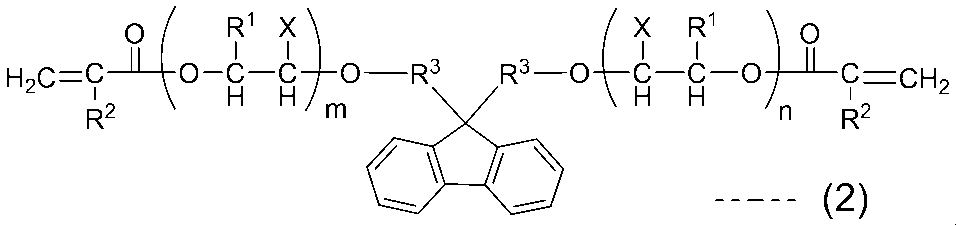
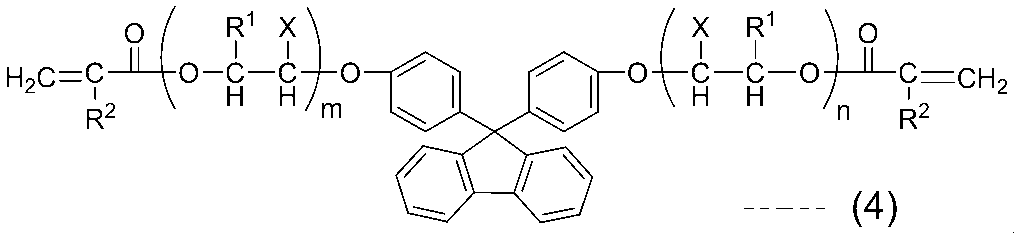
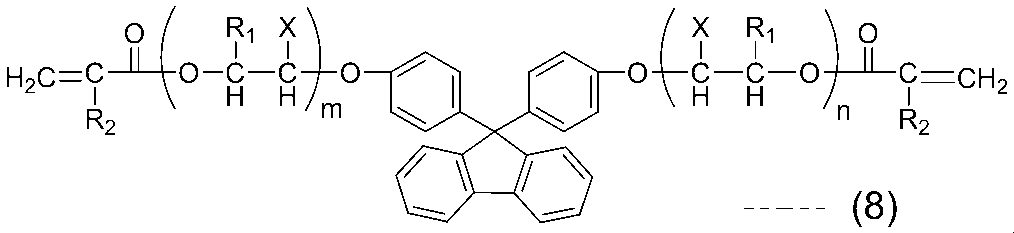
- a fluorene skeleton-containing compound represented by any of the following structural formulas (1) to (4) can also be suitably used as the polyalkylene oxide structure-containing (meth) acrylate compound (C1).
- X is a hydrogen atom or a hydroxyl group
- R 1 and R 4 are each independently a hydrogen atom or an alkyl group having 1 to 3 carbon atoms
- R 2 is a hydrogen atom or a methyl group
- R 3 is a direct bond or a methylene group
- m is an integer of 2 or more.
- each X is independently a hydrogen atom or a hydroxyl group
- each R 1 is independently a hydrogen atom or an alkyl group having 1 to 3 carbon atoms
- each R 2 is independently a hydrogen atom.
- each R 3 is independently a direct bond or a methylene group
- m and n are each independently 0 or an integer of 1 or more, and at least one is an integer of 2 or more.
- two X's are each independently a hydrogen atom or a hydroxyl group
- two R 1's are each independently a hydrogen atom or an alkyl group having 1 to 3 carbon atoms
- R 2 is a hydrogen atom. It is an atom or a methyl group
- m and n are each independently 0 or an integer of 1 or more, and at least one is an integer of 2 or more.
- two X's are each independently a hydrogen atom or a hydroxyl group
- two R 1 's are each independently a hydrogen atom or an alkyl group having 1 to 3 carbon atoms
- two R 2 Are each independently a hydrogen atom or a methyl group
- m and n are each independently 0 or an integer of 1 or more, and at least one is an integer of 2 or more.
- the polyalkylene oxide structure-containing (meth) acrylate compound (C1) may be used alone or in combination of two or more.
- the curable composition of this invention contains other (meth) acrylate compounds (C2) other than the said polyalkylene oxide structure containing (meth) acrylate compound (C1) as said (meth) acrylate compound (C). May be.
- the other (meth) acrylate compound (C2) is used, the blending ratio of the polyalkylene oxide structure-containing (meth) acrylate compound (C1) in the (meth) acrylate compound (C) is not particularly limited.
- the scratch resistance in the resulting cured product is sufficiently exhibited, so the range is preferably 5 to 80% by mass, more preferably 15 to 65% by mass.
- Examples of the other (meth) acrylate compound (C2) include n-butyl (meth) acrylate, isobutyl (meth) acrylate, tert-butyl (meth) acrylate, n-pentyl (meth) acrylate, and n-hexyl (meth) ) Acrylate, n-octyl (meth) acrylate, isooctyl (meth) acrylate, 2-ethylhexyl (meth) acrylate, glycidyl (meth) acrylate, morpholine (meth) acrylate, 2-hydroxyethyl (meth) acrylate, 2-hydroxypropyl (Meth) acrylate, 4-hydroxybutyl (meth) acrylate, 2-methoxyethyl (meth) acrylate, 2-butoxyethyl (meth) acrylate, 2-ethoxyethyl (meth) acrylate, 2- (2
- X represents a hydrogen atom or a hydroxyl group
- R 1 and R 4 each independently represent a hydrogen atom or an alkyl group having 1 to 3 carbon atoms
- R 2 represents a hydrogen atom or a methyl group
- R 3 is a direct bond or a methylene group
- m is 0 or 1.
- two Xs are each independently a hydrogen atom or a hydroxyl group
- two R1s are each independently a hydrogen atom or an alkyl group having 1 to 3 carbon atoms
- R2 is a hydrogen atom or A methyl group
- m and n are each independently 0 or 1;
- each X is independently a hydrogen atom or a hydroxyl group
- each R 1 is independently a hydrogen atom or an alkyl group having 1 to 3 carbon atoms
- each R 2 is independently a hydrogen atom.
- each R 3 is independently a direct bond or a methylene group
- m and n are each independently 0 or 1.
- two X's are each independently a hydrogen atom or a hydroxyl group;
- two R1's are each independently a hydrogen atom or an alkyl group having 1 to 3 carbon atoms; Independently a hydrogen atom or a methyl group, and m and n are each independently 0 or 1;
- (meth) acrylate compounds (C2) may be used alone or in combination of two or more.
- Aromatic ring-containing monofunctional (meth) acrylate compounds such as acrylate are preferred.
- urethane (meth) acrylate and epoxy (meth) acrylate are preferable, and epoxy (meth) acrylate is more preferable.
- the epoxy (meth) acrylate is preferably such that the raw material epoxy resin has an epoxy group equivalent of 200 to 600 g / equivalent.
- the aromatic ring-containing monofunctional (meth) acrylate compound in combination with urethane (meth) acrylate or epoxy (meth) acrylate.
- the proportion of the aromatic ring-containing monofunctional (meth) acrylate compound in the (meth) acrylate compound (C) is preferably in the range of 20 to 90% by mass.
- the proportion of the urethane (meth) acrylate or epoxy (meth) acrylate in the (meth) acrylate compound (C) is preferably in the range of 5 to 50% by mass.
- the curable composition of the present invention further includes a polymerization initiator, a photosensitizer, a curing accelerator, an organic solvent, a non-reactive resin, a filler, an inorganic filler, Organic fillers, coupling agents, tackifiers, antifoaming agents, leveling agents, adhesion aids, mold release agents, lubricants, UV absorbers, antioxidants, heat stabilizers, plasticizers, flame retardants, pigments, dyes Etc. may contain an additive component.
- intramolecular bond cleavage type photopolymerization initiators include, for example, diethoxyacetophenone, 2-hydroxy-2-methyl-1-phenylpropan-1-one, benzyldimethyl ketal, 1- (4 -Isopropylphenyl) -2-hydroxy-2-methylpropan-1-one, 4- (2-hydroxyethoxy) phenyl- (2-hydroxy-2-propyl) ketone, 1-hydroxycyclohexyl-phenylketone, 2-methyl Acetophenones such as 2-morpholino (4-thiomethylphenyl) propan-1-one, 2-benzyl-2-dimethylamino-1- (4-morpholinophenyl) -butanone; benzoin, benzoin methyl ether, benzoin isopropyl ether Benzoins such as: 2,4,6-trimethylbe Such as zone-in diphenylphosphine oxide acylphosphine oxide; benzyl
- intramolecular hydrogen abstraction type photopolymerization initiators include, for example, benzophenone, methyl 4-phenylbenzophenone, o-benzoylbenzoate, 4,4′-dichlorobenzophenone, hydroxybenzophenone, 4- Benzophenone series such as benzoyl-4'-methyl-diphenyl sulfide, acrylated benzophenone, 3,3 ', 4,4'-tetra (t-butylperoxycarbonyl) benzophenone, 3,3'-dimethyl-4-methoxybenzophenone; Thioxanthone series such as 2-isopropylthioxanthone, 2,4-dimethylthioxanthone, 2,4-diethylthioxanthone, 2,4-dichlorothioxanthone; Michler-ketone, aminobenzophenone such as 4,4'-diethylaminobenzophenone ; 10-but
- Examples of the photosensitizer include triethanolamine, methyldiethanolamine, triisopropanolamine, methyl 4-dimethylaminobenzoate, ethyl 4-dimethylaminobenzoate, isoamyl 4-dimethylaminobenzoate, and benzoic acid (2-dimethylamine). And amines such as amino) ethyl, 4-dimethylaminobenzoic acid (n-butoxy) ethyl and 2-dimethylhexyl 4-dimethylaminobenzoate.
- organic solvent examples include ethanol, isopropanol, butanol, cyclohexanol, methyl ethyl ketone, methyl isobutyl ketone, cyclohexanone, ethyl acetate, propyl acetate, butyl acetate, methyl cellosolve, cellosolve, butyl cellosolve, cellosolve acetate, tetrahydrofuran, 1,4-dioxane.
- the manufacturing method of the curable composition of this invention is not specifically limited, For example, the raw material which has the said zirconium oxide nanoparticle (a), the said dispersing agent (B), and the (meth) acrylate compound (C) as an essential component is used. It can adjust using the zirconium dispersion manufactured by the method etc. which disperse
- an organic solvent (E) is used in addition to the zirconium oxide nanoparticles (a), the dispersant (B), and the (meth) acrylate compound (C). Is preferred.
- the zirconium oxide nanoparticles (a) are dispersed using a component other than the zirconium oxide nanoparticles (a) and the (meth) acrylate compound (C) as a dispersion medium (X) to obtain a zirconium dispersion.
- the zirconium oxide nanoparticles (Method 1) in which the (meth) acrylate compound (C) is added thereto and all the components other than the zirconium oxide nanoparticles (a) as a dispersion medium (X) Examples thereof include a method (method 2) in which a) is dispersed to directly obtain a curable composition.
- the viscosity at the time of dispersion is in an appropriate range, and it becomes easy to separate the media from the raw material composition in the pulverizer. Therefore, the dispersion medium (X) 25 It is preferable to adjust the viscosity at 200 ° C. so as to be 200 mPa ⁇ s or less.
- the viscosity value is a value measured by a generally known method such as a B-type viscometer.
- media type wet disperser used in the above production method generally known ones can be used without limitation.
- beads mill Star mill LMZ-015 manufactured by Ashizawa Finetech Co., Ltd., Ultra Apex Mill UAM manufactured by Kotobuki Industries Co., Ltd.
- -015 etc. beads mill (Star mill LMZ-015 manufactured by Ashizawa Finetech Co., Ltd., Ultra Apex Mill UAM manufactured by Kotobuki Industries Co., Ltd.) -015 etc.).
- the medium used in the disperser is not particularly limited as long as it is a generally known bead, but preferably includes zirconia, alumina, silica, glass, silicon carbide, and silicon nitride.
- the average particle size of the media is preferably 50 to 500 ⁇ m, more preferably 100 to 200 ⁇ m. When the particle diameter is 50 ⁇ m or more, the impact force on the raw material powder is appropriate, and an excessive time is not required for dispersion. On the other hand, if the particle diameter of the media is 500 ⁇ m or less, the impact force against the raw material powder is appropriate, so that an increase in the surface energy of the dispersed particles can be suppressed and reaggregation can be prevented.
- a medium having a large particle size with a large impact force is used, and a medium having a small particle size that is difficult to re-aggregate after the particle size of the dispersed particles becomes small is used.
- the dispersion process time can be shortened.
- the order in which the raw materials are charged into the disperser is not particularly limited, but at least the dispersant (B) is supplied last, so that a small amount of the dispersant (B) Can be used to obtain a curable composition having excellent dispersion stability. More specifically, there is a method in which a raw material other than the dispersant (B) is charged first, mixing or pre-dispersing is performed, and finally the dispersing agent (B) is charged and this dispersion step is performed. Can be mentioned.
- the curable composition of the present invention can be obtained by adding various additives or distilling off volatile components according to the intended use.
- the curable composition of the present invention can be cured by heat or active energy rays.
- the active energy ray can be used without particular limitation as long as it is an active energy ray that causes the curable composition of the present invention to cure, but it is particularly preferable to use ultraviolet rays.
- UV light sources include fluorescent chemical lamps, black lights, low pressure, high pressure, ultrahigh pressure mercury lamps, metal halide lamps, and sunlight.
- the irradiation intensity of the ultraviolet rays may be constant from beginning to end, or the physical properties after curing can be finely adjusted by changing the intensity during the curing.
- active energy rays such as visible light and electron beams can also be used as active energy rays.
- the curable composition of the present invention has an intrinsic spectral sensitivity in the range of 200 to 400 nm. In the absence of a photopolymerization initiator, the energy of a normally used energy beam, for example, an energy value of 20 mW / cm 2 is obtained. It can be mentioned, but is not limited to this.
- the cured product obtained in the present invention can be preferably used as an optical member, for example, for an antireflection film such as a plastic lens, a brightness enhancement film (prism sheet), a film-type liquid crystal element, a touch panel, and a plastic optical component.
- an antireflection film such as a plastic lens, a brightness enhancement film (prism sheet), a film-type liquid crystal element, a touch panel, and a plastic optical component.
- Zirconium Dispersion Liquid (1) 50 g of zirconium oxide nanoparticles (a1), 7.5 g of silane coupling agent (D1), and 183.0 g of methyl ethyl ketone were mixed, and stirred for 30 minutes with a dispersion stirrer. went. The obtained mixed solution was subjected to dispersion treatment using zirconia beads having a particle diameter of 100 ⁇ m with a media-type wet disperser. Dispersion treatment was performed for 100 minutes while confirming the particle diameter in the middle of the process, 5 g of dispersant (B1) was added and mixed, and zirconium dispersion liquid (1) was obtained by further dispersion treatment for 20 minutes.
- Production Example 2 Production of Zirconium Dispersion (2) A zirconium dispersion (2) was obtained under the same conditions as in Production Example 1 except that the zirconium oxide nanoparticles (a1) in Production Example 1 were changed to zirconium oxide nanoparticles (a2). It was.
- Production Example 3 Production of Zirconium Dispersion (3) The same conditions as in Production Example 1 except that 7.5 g of silane coupling agent (D1) in Production Example 1 was changed to 15 g and 5 g of dispersant (B1) was changed to 10 g. A zirconium dispersion (3) was obtained.
- Production Example 4 Production of Zirconium Dispersion (4) A zirconium dispersion (4) was obtained under the same conditions as in Production Example 1 except that the zirconium oxide nanoparticles (a1) in Production Example 3 were changed to zirconium oxide nanoparticles (a2). It was.
- Production Example 5 Production of Zirconium Dispersion (5) A zirconium dispersion (5) was obtained under the same conditions as in Production Example 1 except that the silane coupling agent (D1) was not used.
- Example 1 Preparation of Curable Composition (1) To the zirconium dispersion (1) obtained in Production Example 1, a (meth) acrylate compound was added at a ratio shown in Table 1, and volatile components were removed under reduced pressure using an evaporator. Furthermore, the polymerization initiator was added and the curable composition (1) was prepared.
- cured product (1) The curable composition (1) obtained above was coated on a glass substrate with an applicator and photocured in air at 1000 mJ / cm 2 with a 120 W / cm high-pressure mercury lamp to obtain a thickness. A cured product (1) of about 100 ⁇ m was obtained.
- Examples 2 to 6 and Comparative Examples 1 to 3 A curable composition and a cured product were prepared in the same manner as in Example 1, and various evaluations were performed. The results are shown in Table 1 or Table 2.
- the curable composition of the present invention can obtain a cured product having high light transmittance and refractive index and excellent scratch resistance, and the cured product can be suitably used as an optical member.
Landscapes
- Chemical & Material Sciences (AREA)
- Organic Chemistry (AREA)
- Chemical Kinetics & Catalysis (AREA)
- Medicinal Chemistry (AREA)
- Polymers & Plastics (AREA)
- Health & Medical Sciences (AREA)
- Engineering & Computer Science (AREA)
- Materials Engineering (AREA)
- Physics & Mathematics (AREA)
- Life Sciences & Earth Sciences (AREA)
- Wood Science & Technology (AREA)
- Inorganic Chemistry (AREA)
- General Physics & Mathematics (AREA)
- Optics & Photonics (AREA)
- Nonlinear Science (AREA)
- Mathematical Physics (AREA)
- Crystallography & Structural Chemistry (AREA)
- Macromonomer-Based Addition Polymer (AREA)
- Polymerisation Methods In General (AREA)
- Treatments Of Macromolecular Shaped Articles (AREA)
- Compositions Of Macromolecular Compounds (AREA)
- Graft Or Block Polymers (AREA)
- Coating Of Shaped Articles Made Of Macromolecular Substances (AREA)
- Paints Or Removers (AREA)
- Adhesives Or Adhesive Processes (AREA)
- Addition Polymer Or Copolymer, Post-Treatments, Or Chemical Modifications (AREA)
- Electroluminescent Light Sources (AREA)
Abstract
Description
本発明の硬化性組成物は、酸化ジルコニウムナノ粒子(A)、分散剤(B)、及び(メタ)アクリレート化合物(C)を含有し、前記分散剤(B)の酸価が100~300mgKOH/gの範囲であり、かつ、前記(メタ)アクリレート化合物(C)がポリアルキレンオキサイド構造含有(メタ)アクリレート化合物(C1)を含有することを特徴とする。
カラム ; 東ソー株式会社製ガードカラムHXL-H
+東ソー株式会社製 TSKgel G5000HXL
+東ソー株式会社製 TSKgel G4000HXL
+東ソー株式会社製 TSKgel G3000HXL
+東ソー株式会社製 TSKgel G2000HXL
検出器 ; RI(示差屈折計)
データ処理:東ソー株式会社製 SC-8010
測定条件: カラム温度 40℃
溶媒 テトラヒドロフラン
流速 1.0ml/分
標準 ;ポリスチレン
試料 ;樹脂固形分換算で0.4重量%のテトラヒドロフラン溶液をマイクロフィルターでろ過したもの(100μl)




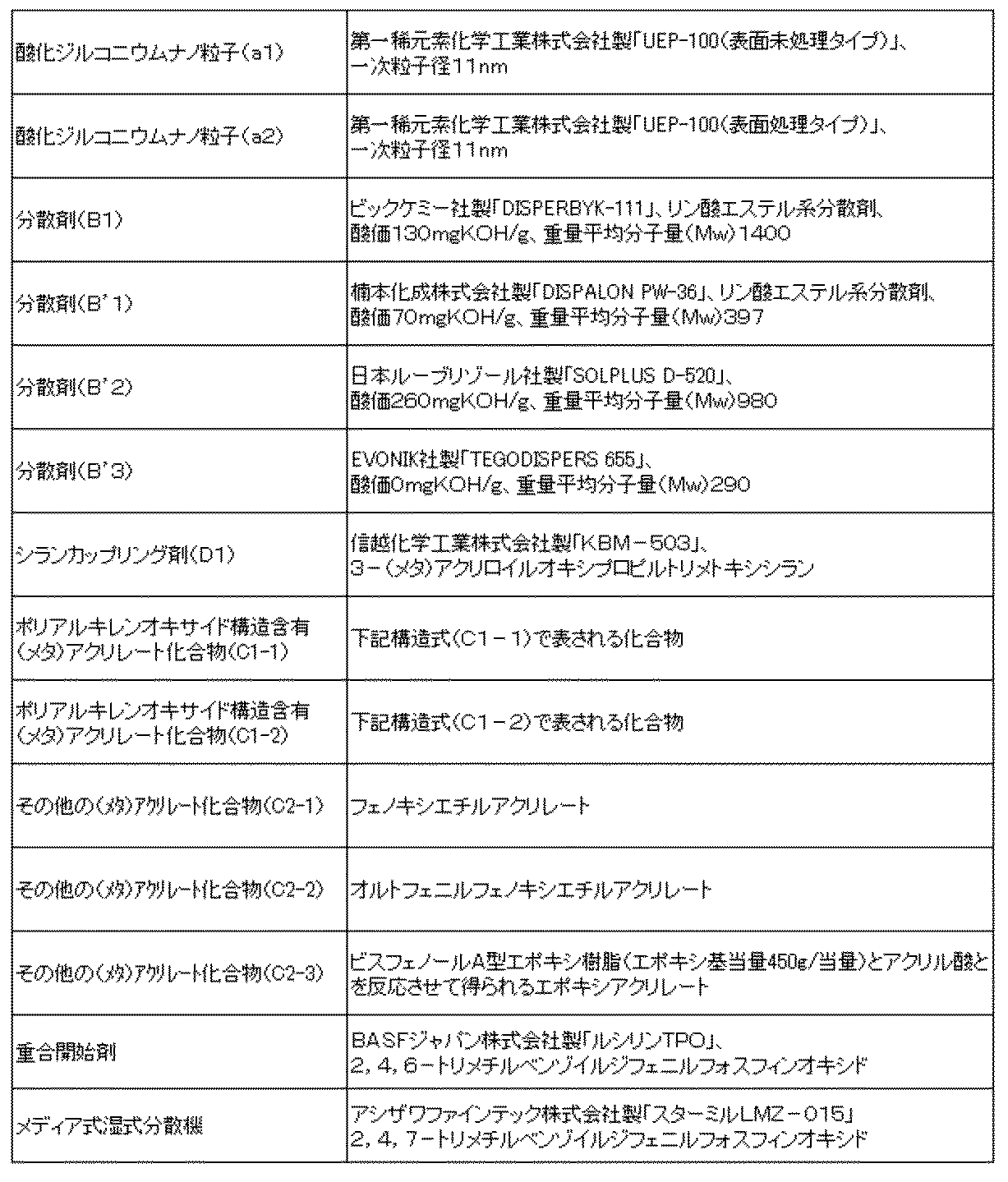
製造例や実施例で用いた各成分及び分散機の詳細は以下の通り。
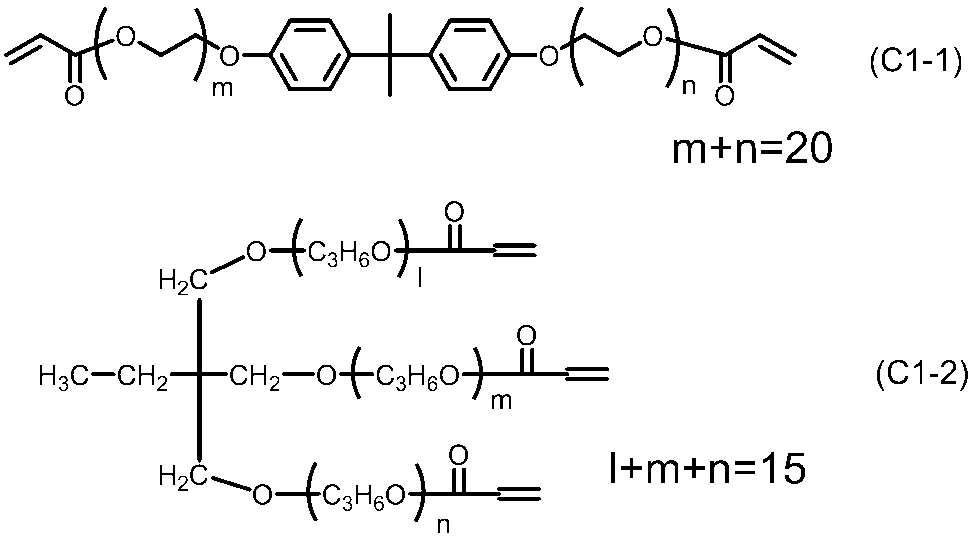
酸化ジルコニウムナノ粒子(a1)50g、シランカップリング剤(D1)7.5g、メチルエチルケトン183.0gを混合し、分散攪拌機で30分間攪拌し、粗分散を行った。得られた混合液を、メディア式湿式分散機で粒子径100μmのジルコニアビーズを用いて分散処理した。途中の粒子径を確認しながら、滞留時間100分の分散処理を行った後、分散剤(B1)5gを添加混合して、更に20分間の分散処理によりジルコニウム分散液(1)を得た。
製造例1の酸化ジルコニウムナノ粒子(a1)を酸化ジルコニウムナノ粒子(a2)に変更した以外は製造例1と同じ条件でジルコニウム分散液(2)を得た。
製造例1のシランカップリング剤(D1)7.5gを15gに、分散剤(B1)5gを10gに変更した以外は、製造例1と同じ条件でジルコニウム分散液(3)を得た。
製造例3の酸化ジルコニウムナノ粒子(a1)を酸化ジルコニウムナノ粒子(a2)に変更した以外は製造例1と同じ条件でジルコニウム分散液(4)を得た。
シランカップリング剤(D1)を使用しない以外は製造例1と同じ条件でジルコニウム分散液(5)を得た。
製造例1の分散剤(B1)を分散剤(B’1)に変更した以外は製造例1と同じ条件でジルコニウム分散液(1’)を得た。
製造例1の分散剤(B1)を分散剤(B’2)に変更した以外は製造例1と同じ条件でジルコニウム分散液(2’)を得た。
製造例1の分散剤(B1)を分散剤(B’3)に変更した以外は製造例1と同じ条件でジルコニウム分散液(3’)を得た。
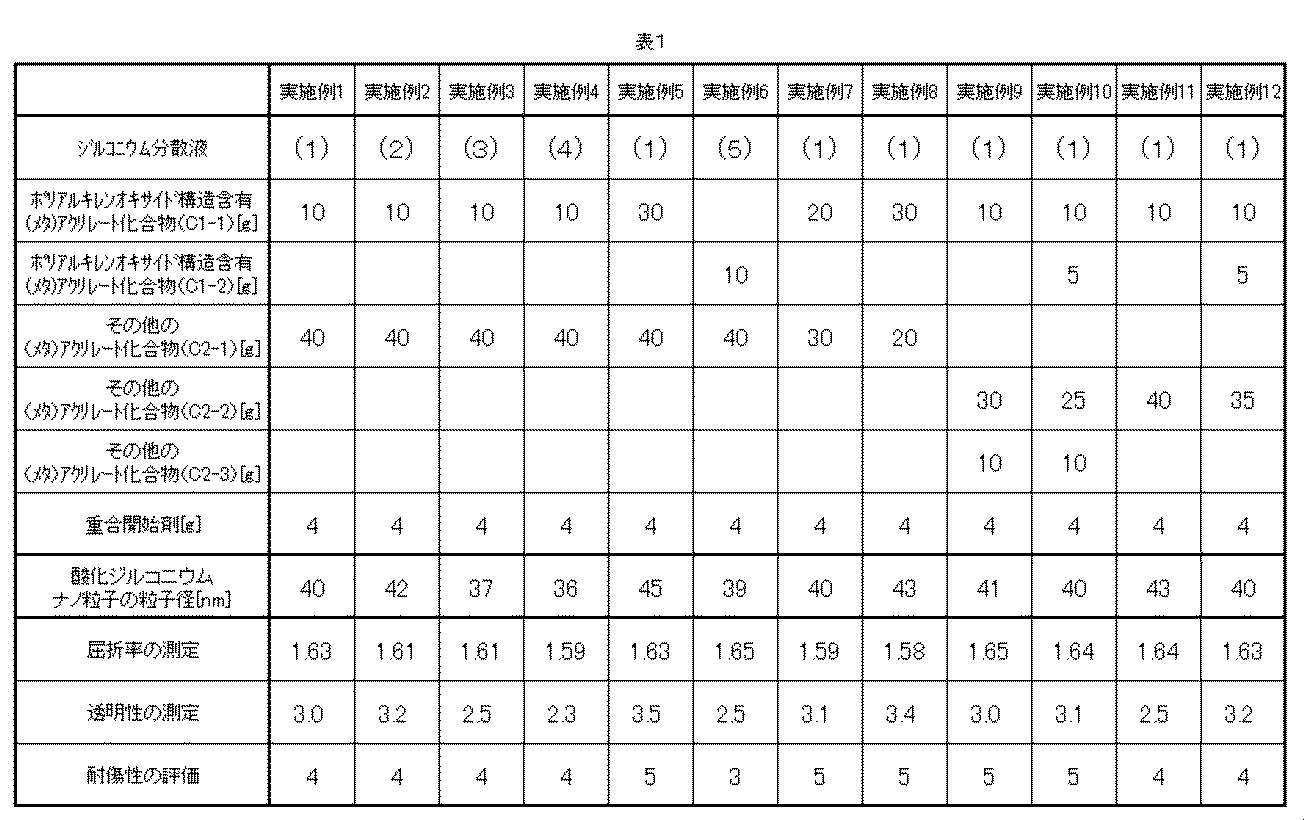
◆硬化性組成物(1)の調製
製造例1で得られたジルコニウム分散液(1)に、表1に示す割合で(メタ)アクリレート化合物を添加し、エバポレーターで揮発成分を減圧除去した。更に重合開始剤を添加し、硬化性組成物(1)を調製した。
先で得た硬化性組成物(1)中の酸化ジルコニウムナノ粒子の平均粒子径を、粒子径測定装置(大塚電子株式会社製「ELSZ-2」)を用いて測定した。
先で得た硬化性組成物(1)をガラス基板にアプリケーターで塗装し、空気中、120W/cm高圧水銀ランプにて1000mJ/cm2で光硬化して厚さ約100μmの硬化物(1)を得た。
先で得た硬化物(1)について、アッベ屈折率計によって屈折率を測定した。結果を表1に示した。
先で得た硬化物(1)について、ヘーズメータで透明性を測定した。結果を表1に示した。
先で得た硬化物(1)について、JIS K 5400に則し、荷重300g、硬度Hの鉛筆を用いて塗膜に傷をつけた。傷が回復するまでの時間で以下の通り評価した。結果を表1に示した。
5 1秒以内
4 1秒を超えて10秒以内
3 10秒を超えて1分以内
2 1分を超えて5分以内
1 5分を超える
0 治癒性なし(翌日も傷が残っている)
実施例1と同じ要領で硬化性組成物及び硬化物を作成し、各種評価を行った。結果を表1又は表2に示した。

Claims (7)
- 酸化ジルコニウムナノ粒子(A)、分散剤(B)、及び(メタ)アクリレート化合物(C)を含有し、前記分散剤(B)の酸価が100~300mgKOH/gの範囲であり、かつ、前記(メタ)アクリレート化合物(C)がポリアルキレンオキサイド構造含有(メタ)アクリレート化合物(C1)を含有することを特徴とする硬化性組成物。
- 前記分散剤(B)が、重量平均分子量(Mw)が1,000~3,000のポリマーである請求項1記載の硬化性組成物。
- 前記ポリアルキレンオキサイド構造含有(メタ)アクリレート化合物(C1)が、一分子中のアルキレンオキサイド構造単位の数が6~40個の範囲であり、かつ、(メタ)アクリロイル基の数が2~6個の範囲であるものである請求項1記載の硬化性組成物。
- 前記(メタ)アクリレート化合物(C)中の前記ポリアルキレンオキサイド構造含有(メタ)アクリレート化合物(C1)の割合が、5~80質量%の範囲である請求項1記載の硬化性組成物。
- 酸化ジルコニウムナノ粒子(a)、前記分散剤(B)、及び(メタ)アクリレート化合物(C)を必須成分とする原料を用い、メディア式湿式分散機を用いて製造され、各原料成分をメディア式湿式分散機に供給するに際し、少なくとも前記分散剤(B)を最後に供給する方法により製造されるジルコニウム分散液を用いてなる請求項1記載の硬化性組成物。
- 請求項1~5のいずれか一つに記載の硬化性組成物を硬化して得られる硬化物。
- 請求項1~5のいずれか一つに記載の硬化性組成物を硬化して得られる光学部材。
Priority Applications (4)
| Application Number | Priority Date | Filing Date | Title |
|---|---|---|---|
| KR1020177018022A KR102404488B1 (ko) | 2015-02-25 | 2016-02-09 | 경화성 조성물과 그 경화물, 및 광학 부재 |
| US15/541,185 US10358572B2 (en) | 2015-02-25 | 2016-02-09 | Curable composition, cured product thereof, and optical member |
| JP2016542796A JP6094720B2 (ja) | 2015-02-25 | 2016-02-09 | 硬化性組成物とその硬化物、及び光学部材 |
| CN201680010580.XA CN107406530B (zh) | 2015-02-25 | 2016-02-09 | 固化性组合物和其固化物、及光学构件 |
Applications Claiming Priority (2)
| Application Number | Priority Date | Filing Date | Title |
|---|---|---|---|
| JP2015035263 | 2015-02-25 | ||
| JP2015-035263 | 2015-02-25 |
Publications (1)
| Publication Number | Publication Date |
|---|---|
| WO2016136454A1 true WO2016136454A1 (ja) | 2016-09-01 |
Family
ID=56789210
Family Applications (1)
| Application Number | Title | Priority Date | Filing Date |
|---|---|---|---|
| PCT/JP2016/053770 Ceased WO2016136454A1 (ja) | 2015-02-25 | 2016-02-09 | 硬化性組成物とその硬化物、及び光学部材 |
Country Status (6)
| Country | Link |
|---|---|
| US (1) | US10358572B2 (ja) |
| JP (1) | JP6094720B2 (ja) |
| KR (1) | KR102404488B1 (ja) |
| CN (1) | CN107406530B (ja) |
| TW (1) | TWI784923B (ja) |
| WO (1) | WO2016136454A1 (ja) |
Cited By (3)
| Publication number | Priority date | Publication date | Assignee | Title |
|---|---|---|---|---|
| JP2018090792A (ja) * | 2016-11-30 | 2018-06-14 | 三洋化成工業株式会社 | 活性エネルギー線硬化性組成物 |
| JP2022188922A (ja) * | 2021-06-10 | 2022-12-22 | Dic株式会社 | 無機微粒子分散体、活性エネルギー線硬化性組成物、硬化物、積層体及び物品 |
| WO2024004861A1 (ja) * | 2022-06-30 | 2024-01-04 | Dic株式会社 | 活性エネルギー線硬化性組成物およびその硬化物 |
Families Citing this family (9)
| Publication number | Priority date | Publication date | Assignee | Title |
|---|---|---|---|---|
| CN113840882B (zh) * | 2019-06-11 | 2023-08-11 | Dic株式会社 | 无机微粒子分散体、硬化性组合物、硬化物及光学构件 |
| KR20230019092A (ko) * | 2020-06-03 | 2023-02-07 | 에이지씨 가부시키가이샤 | 화합물, 중합체, 및 경화성 조성물 |
| KR102432565B1 (ko) * | 2020-09-24 | 2022-08-19 | 주식회사 케이씨텍 | 표면개질된 금속산화물 나노입자 분산액 조성물 및 그의 제조방법 |
| KR102456605B1 (ko) * | 2020-10-22 | 2022-10-21 | 주식회사 케이씨텍 | 디스플레이용 금속 산화물 분산액 조성물, 그의 제조방법 및 디스플레이용 광학 부재 |
| KR102716656B1 (ko) * | 2021-08-23 | 2024-10-15 | 주식회사 케이씨텍 | 금속 산화물 분산액, 디스플레이용 필름 조성물 및 디스플레이용 광학 부재 |
| CN118475655A (zh) * | 2021-12-14 | 2024-08-09 | 关东电化工业株式会社 | ZrO2分散液 |
| CN114231163A (zh) * | 2021-12-22 | 2022-03-25 | 武汉工程大学 | 一种聚氨酯类有机无机复合材料及其制备方法和应用 |
| CN114479547A (zh) * | 2022-03-21 | 2022-05-13 | 山东国瓷功能材料股份有限公司 | 纳米氧化锆单体型分散液及其制备方法和光学膜 |
| CN114605762B (zh) * | 2022-04-21 | 2024-01-26 | 山东国瓷功能材料股份有限公司 | 纳米氧化锆分散液、制备方法及应用 |
Citations (4)
| Publication number | Priority date | Publication date | Assignee | Title |
|---|---|---|---|---|
| JPH11209558A (ja) * | 1998-01-28 | 1999-08-03 | Dainippon Printing Co Ltd | 光重合性顔料分散剤、感光性着色組成物及び遮光層用組成物 |
| JP2008058569A (ja) * | 2006-08-31 | 2008-03-13 | Tokyo Ohka Kogyo Co Ltd | 感光性組成物及び金属配線パターン |
| JP2014152197A (ja) * | 2013-02-05 | 2014-08-25 | Dnp Fine Chemicals Co Ltd | エネルギー線硬化性樹脂組成物 |
| JP2015067794A (ja) * | 2013-09-30 | 2015-04-13 | 太陽インキ製造株式会社 | プリント配線板用白色硬化型組成物、これを用いた硬化塗膜及びプリント配線板 |
Family Cites Families (10)
| Publication number | Priority date | Publication date | Assignee | Title |
|---|---|---|---|---|
| JP4163653B2 (ja) * | 2004-02-27 | 2008-10-08 | 株式会社日本触媒 | 光学部品用硬化性組成物 |
| JP2007231103A (ja) * | 2006-02-28 | 2007-09-13 | Fujifilm Corp | 紫外線硬化型再剥離性圧着組成物及び再剥離性接着加工紙 |
| JP5160275B2 (ja) * | 2008-03-18 | 2013-03-13 | 株式会社きもと | 金属酸化物ナノ粒子の製造方法、および金属酸化物ナノ粒子、ならびに金属酸化物ナノ粒子含有組成物 |
| JP5447916B2 (ja) | 2009-02-17 | 2014-03-19 | Dic株式会社 | 無機酸化物微粒子含有樹脂組成物および該組成物から得られる硬化物 |
| JP5587869B2 (ja) * | 2009-03-30 | 2014-09-10 | 昭和電工株式会社 | 硬化性組成物及びその硬化物 |
| KR101791493B1 (ko) * | 2009-12-11 | 2017-10-30 | 후지필름 가부시키가이샤 | 흑색 경화성 조성물, 차광성 컬러필터, 차광막 및 그 제조 방법, 웨이퍼 레벨 렌즈, 및 고체 촬상 소자 |
| JP5753721B2 (ja) * | 2011-04-11 | 2015-07-22 | 共栄社化学株式会社 | 光学材料用樹脂組成物及びその成形体 |
| CN102759859B (zh) * | 2011-04-27 | 2017-10-24 | 富士胶片株式会社 | 树脂组成物、硬化物的制造方法、树脂图案制造方法、硬化物及光学部件 |
| JP5692804B2 (ja) * | 2011-05-17 | 2015-04-01 | 日本化薬株式会社 | 光学レンズシート用エネルギー線硬化型樹脂組成物及びその硬化物 |
| CN104004452B (zh) * | 2014-06-13 | 2017-07-28 | 张家港康得新光电材料有限公司 | 涂料组合物与高折射硬化层 |
-
2016
- 2016-02-09 KR KR1020177018022A patent/KR102404488B1/ko active Active
- 2016-02-09 JP JP2016542796A patent/JP6094720B2/ja active Active
- 2016-02-09 US US15/541,185 patent/US10358572B2/en active Active
- 2016-02-09 WO PCT/JP2016/053770 patent/WO2016136454A1/ja not_active Ceased
- 2016-02-09 CN CN201680010580.XA patent/CN107406530B/zh active Active
- 2016-02-24 TW TW105105371A patent/TWI784923B/zh active
Patent Citations (4)
| Publication number | Priority date | Publication date | Assignee | Title |
|---|---|---|---|---|
| JPH11209558A (ja) * | 1998-01-28 | 1999-08-03 | Dainippon Printing Co Ltd | 光重合性顔料分散剤、感光性着色組成物及び遮光層用組成物 |
| JP2008058569A (ja) * | 2006-08-31 | 2008-03-13 | Tokyo Ohka Kogyo Co Ltd | 感光性組成物及び金属配線パターン |
| JP2014152197A (ja) * | 2013-02-05 | 2014-08-25 | Dnp Fine Chemicals Co Ltd | エネルギー線硬化性樹脂組成物 |
| JP2015067794A (ja) * | 2013-09-30 | 2015-04-13 | 太陽インキ製造株式会社 | プリント配線板用白色硬化型組成物、これを用いた硬化塗膜及びプリント配線板 |
Cited By (7)
| Publication number | Priority date | Publication date | Assignee | Title |
|---|---|---|---|---|
| JP2018090792A (ja) * | 2016-11-30 | 2018-06-14 | 三洋化成工業株式会社 | 活性エネルギー線硬化性組成物 |
| JP7098309B2 (ja) | 2016-11-30 | 2022-07-11 | 三洋化成工業株式会社 | 活性エネルギー線硬化性組成物 |
| JP2022188922A (ja) * | 2021-06-10 | 2022-12-22 | Dic株式会社 | 無機微粒子分散体、活性エネルギー線硬化性組成物、硬化物、積層体及び物品 |
| JP7721973B2 (ja) | 2021-06-10 | 2025-08-13 | Dic株式会社 | 無機微粒子分散体、活性エネルギー線硬化性組成物、硬化物、積層体及び物品 |
| WO2024004861A1 (ja) * | 2022-06-30 | 2024-01-04 | Dic株式会社 | 活性エネルギー線硬化性組成物およびその硬化物 |
| JPWO2024004861A1 (ja) * | 2022-06-30 | 2024-01-04 | ||
| JP7740554B2 (ja) | 2022-06-30 | 2025-09-17 | Dic株式会社 | 活性エネルギー線硬化性組成物およびその硬化物 |
Also Published As
| Publication number | Publication date |
|---|---|
| TWI784923B (zh) | 2022-12-01 |
| KR20170125318A (ko) | 2017-11-14 |
| CN107406530B (zh) | 2019-08-20 |
| JPWO2016136454A1 (ja) | 2017-04-27 |
| US20170349780A1 (en) | 2017-12-07 |
| CN107406530A (zh) | 2017-11-28 |
| JP6094720B2 (ja) | 2017-03-15 |
| KR102404488B1 (ko) | 2022-06-07 |
| TW201638174A (zh) | 2016-11-01 |
| US10358572B2 (en) | 2019-07-23 |
Similar Documents
| Publication | Publication Date | Title |
|---|---|---|
| JP6094720B2 (ja) | 硬化性組成物とその硬化物、及び光学部材 | |
| JP6083490B2 (ja) | 無機微粒子分散液の製造方法及び光学部材用硬化物の製造方法 | |
| CN107586511A (zh) | 光固化性树脂组合物、固化被膜及其制造方法以及带有被膜的基材及其制造方法 | |
| JP7024706B2 (ja) | 硬化性組成物及び光学部材 | |
| JP2010189506A (ja) | 無機酸化物微粒子含有樹脂組成物および該組成物から得られる硬化物 | |
| WO2012077808A1 (ja) | 画像表示装置用粘着シート、画像表示装置及び粘着性樹脂組成物 | |
| WO2020250721A1 (ja) | 無機微粒子分散体、硬化性組成物及び光学部材 | |
| JP7322710B2 (ja) | 無機微粒子分散体、硬化性組成物及び光学部材 | |
| KR20240010696A (ko) | 활성 에너지선 경화성 수지 조성물, 경화 도막 및 적층체 | |
| JPWO2015019758A1 (ja) | 屈折率調整用コート材組成物及びその積層体 | |
| TW201819439A (zh) | 活性能量線硬化型樹脂組成物及積層膜 | |
| KR20230065173A (ko) | 활성 에너지선 경화성 조성물, 경화물 및 광학 시트 | |
| JP2024011745A (ja) | 活性エネルギー線硬化性樹脂組成物、硬化塗膜及び積層体 | |
| WO2017221726A1 (ja) | ウレタン(メタ)アクリレート樹脂及び積層フィルム | |
| JP7740554B2 (ja) | 活性エネルギー線硬化性組成物およびその硬化物 | |
| JP7845575B2 (ja) | 活性エネルギー線硬化性組成物、光学物品または光学シート | |
| JP2008056749A (ja) | 電離放射線硬化性樹脂組成物及びそれを用いた積層体 | |
| TWI816241B (zh) | 抗黏附硬塗膜 | |
| JP2024168211A (ja) | 活性エネルギー線硬化性組成物、その硬化物及び光学粘着シート | |
| JP6718131B2 (ja) | ウレタン(メタ)アクリレート樹脂及び積層フィルム | |
| JP2017002104A (ja) | ウレタン(メタ)アクリレート樹脂及び積層フィルム | |
| JP2024057753A (ja) | 活性エネルギー線硬化性組成物、硬化物、及び積層体 | |
| JP2016121206A (ja) | 活性エネルギー線硬化性樹脂組成物、これを含有する塗料、その塗膜、及び該塗膜を有する積層フィルム |
Legal Events
| Date | Code | Title | Description |
|---|---|---|---|
| ENP | Entry into the national phase |
Ref document number: 2016542796 Country of ref document: JP Kind code of ref document: A |
|
| 121 | Ep: the epo has been informed by wipo that ep was designated in this application |
Ref document number: 16755201 Country of ref document: EP Kind code of ref document: A1 |
|
| ENP | Entry into the national phase |
Ref document number: 20177018022 Country of ref document: KR Kind code of ref document: A |
|
| WWE | Wipo information: entry into national phase |
Ref document number: 15541185 Country of ref document: US |
|
| NENP | Non-entry into the national phase |
Ref country code: DE |
|
| 122 | Ep: pct application non-entry in european phase |
Ref document number: 16755201 Country of ref document: EP Kind code of ref document: A1 |