WO2016017599A1 - 銀粉及びその製造方法、並びに導電性ペースト - Google Patents
銀粉及びその製造方法、並びに導電性ペースト Download PDFInfo
- Publication number
- WO2016017599A1 WO2016017599A1 PCT/JP2015/071292 JP2015071292W WO2016017599A1 WO 2016017599 A1 WO2016017599 A1 WO 2016017599A1 JP 2015071292 W JP2015071292 W JP 2015071292W WO 2016017599 A1 WO2016017599 A1 WO 2016017599A1
- Authority
- WO
- WIPO (PCT)
- Prior art keywords
- silver powder
- particle size
- organic substance
- acid
- conductive paste
- Prior art date
- Legal status (The legal status is an assumption and is not a legal conclusion. Google has not performed a legal analysis and makes no representation as to the accuracy of the status listed.)
- Ceased
Links
Classifications
-
- B—PERFORMING OPERATIONS; TRANSPORTING
- B22—CASTING; POWDER METALLURGY
- B22F—WORKING METALLIC POWDER; MANUFACTURE OF ARTICLES FROM METALLIC POWDER; MAKING METALLIC POWDER; APPARATUS OR DEVICES SPECIALLY ADAPTED FOR METALLIC POWDER
- B22F9/00—Making metallic powder or suspensions thereof
- B22F9/16—Making metallic powder or suspensions thereof using chemical processes
- B22F9/18—Making metallic powder or suspensions thereof using chemical processes with reduction of metal compounds
- B22F9/24—Making metallic powder or suspensions thereof using chemical processes with reduction of metal compounds starting from liquid metal compounds, e.g. solutions
-
- B—PERFORMING OPERATIONS; TRANSPORTING
- B22—CASTING; POWDER METALLURGY
- B22F—WORKING METALLIC POWDER; MANUFACTURE OF ARTICLES FROM METALLIC POWDER; MAKING METALLIC POWDER; APPARATUS OR DEVICES SPECIALLY ADAPTED FOR METALLIC POWDER
- B22F1/00—Metallic powder; Treatment of metallic powder, e.g. to facilitate working or to improve properties
- B22F1/05—Metallic powder characterised by the size or surface area of the particles
- B22F1/052—Metallic powder characterised by the size or surface area of the particles characterised by a mixture of particles of different sizes or by the particle size distribution
-
- B—PERFORMING OPERATIONS; TRANSPORTING
- B22—CASTING; POWDER METALLURGY
- B22F—WORKING METALLIC POWDER; MANUFACTURE OF ARTICLES FROM METALLIC POWDER; MAKING METALLIC POWDER; APPARATUS OR DEVICES SPECIALLY ADAPTED FOR METALLIC POWDER
- B22F1/00—Metallic powder; Treatment of metallic powder, e.g. to facilitate working or to improve properties
- B22F1/10—Metallic powder containing lubricating or binding agents; Metallic powder containing organic material
-
- B—PERFORMING OPERATIONS; TRANSPORTING
- B22—CASTING; POWDER METALLURGY
- B22F—WORKING METALLIC POWDER; MANUFACTURE OF ARTICLES FROM METALLIC POWDER; MAKING METALLIC POWDER; APPARATUS OR DEVICES SPECIALLY ADAPTED FOR METALLIC POWDER
- B22F1/00—Metallic powder; Treatment of metallic powder, e.g. to facilitate working or to improve properties
- B22F1/10—Metallic powder containing lubricating or binding agents; Metallic powder containing organic material
- B22F1/102—Metallic powder coated with organic material
-
- B—PERFORMING OPERATIONS; TRANSPORTING
- B22—CASTING; POWDER METALLURGY
- B22F—WORKING METALLIC POWDER; MANUFACTURE OF ARTICLES FROM METALLIC POWDER; MAKING METALLIC POWDER; APPARATUS OR DEVICES SPECIALLY ADAPTED FOR METALLIC POWDER
- B22F1/00—Metallic powder; Treatment of metallic powder, e.g. to facilitate working or to improve properties
- B22F1/10—Metallic powder containing lubricating or binding agents; Metallic powder containing organic material
- B22F1/107—Metallic powder containing lubricating or binding agents; Metallic powder containing organic material containing organic material comprising solvents, e.g. for slip casting
-
- B—PERFORMING OPERATIONS; TRANSPORTING
- B22—CASTING; POWDER METALLURGY
- B22F—WORKING METALLIC POWDER; MANUFACTURE OF ARTICLES FROM METALLIC POWDER; MAKING METALLIC POWDER; APPARATUS OR DEVICES SPECIALLY ADAPTED FOR METALLIC POWDER
- B22F1/00—Metallic powder; Treatment of metallic powder, e.g. to facilitate working or to improve properties
- B22F1/16—Metallic particles coated with a non-metal
-
- C—CHEMISTRY; METALLURGY
- C09—DYES; PAINTS; POLISHES; NATURAL RESINS; ADHESIVES; COMPOSITIONS NOT OTHERWISE PROVIDED FOR; APPLICATIONS OF MATERIALS NOT OTHERWISE PROVIDED FOR
- C09C—TREATMENT OF INORGANIC MATERIALS, OTHER THAN FIBROUS FILLERS, TO ENHANCE THEIR PIGMENTING OR FILLING PROPERTIES ; PREPARATION OF CARBON BLACK ; PREPARATION OF INORGANIC MATERIALS WHICH ARE NO SINGLE CHEMICAL COMPOUNDS AND WHICH ARE MAINLY USED AS PIGMENTS OR FILLERS
- C09C1/00—Treatment of specific inorganic materials other than fibrous fillers; Preparation of carbon black
- C09C1/62—Metallic pigments or fillers
-
- C—CHEMISTRY; METALLURGY
- C09—DYES; PAINTS; POLISHES; NATURAL RESINS; ADHESIVES; COMPOSITIONS NOT OTHERWISE PROVIDED FOR; APPLICATIONS OF MATERIALS NOT OTHERWISE PROVIDED FOR
- C09C—TREATMENT OF INORGANIC MATERIALS, OTHER THAN FIBROUS FILLERS, TO ENHANCE THEIR PIGMENTING OR FILLING PROPERTIES ; PREPARATION OF CARBON BLACK ; PREPARATION OF INORGANIC MATERIALS WHICH ARE NO SINGLE CHEMICAL COMPOUNDS AND WHICH ARE MAINLY USED AS PIGMENTS OR FILLERS
- C09C3/00—Treatment in general of inorganic materials, other than fibrous fillers, to enhance their pigmenting or filling properties
- C09C3/08—Treatment with low-molecular-weight non-polymer organic compounds
-
- C—CHEMISTRY; METALLURGY
- C09—DYES; PAINTS; POLISHES; NATURAL RESINS; ADHESIVES; COMPOSITIONS NOT OTHERWISE PROVIDED FOR; APPLICATIONS OF MATERIALS NOT OTHERWISE PROVIDED FOR
- C09C—TREATMENT OF INORGANIC MATERIALS, OTHER THAN FIBROUS FILLERS, TO ENHANCE THEIR PIGMENTING OR FILLING PROPERTIES ; PREPARATION OF CARBON BLACK ; PREPARATION OF INORGANIC MATERIALS WHICH ARE NO SINGLE CHEMICAL COMPOUNDS AND WHICH ARE MAINLY USED AS PIGMENTS OR FILLERS
- C09C3/00—Treatment in general of inorganic materials, other than fibrous fillers, to enhance their pigmenting or filling properties
- C09C3/10—Treatment with macromolecular organic compounds
-
- C—CHEMISTRY; METALLURGY
- C09—DYES; PAINTS; POLISHES; NATURAL RESINS; ADHESIVES; COMPOSITIONS NOT OTHERWISE PROVIDED FOR; APPLICATIONS OF MATERIALS NOT OTHERWISE PROVIDED FOR
- C09D—COATING COMPOSITIONS, e.g. PAINTS, VARNISHES OR LACQUERS; FILLING PASTES; CHEMICAL PAINT OR INK REMOVERS; INKS; CORRECTING FLUIDS; WOODSTAINS; PASTES OR SOLIDS FOR COLOURING OR PRINTING; USE OF MATERIALS THEREFOR
- C09D5/00—Coating compositions, e.g. paints, varnishes or lacquers, characterised by their physical nature or the effects produced; Filling pastes
- C09D5/24—Electrically-conducting paints
-
- C—CHEMISTRY; METALLURGY
- C09—DYES; PAINTS; POLISHES; NATURAL RESINS; ADHESIVES; COMPOSITIONS NOT OTHERWISE PROVIDED FOR; APPLICATIONS OF MATERIALS NOT OTHERWISE PROVIDED FOR
- C09D—COATING COMPOSITIONS, e.g. PAINTS, VARNISHES OR LACQUERS; FILLING PASTES; CHEMICAL PAINT OR INK REMOVERS; INKS; CORRECTING FLUIDS; WOODSTAINS; PASTES OR SOLIDS FOR COLOURING OR PRINTING; USE OF MATERIALS THEREFOR
- C09D7/00—Features of coating compositions, not provided for in group C09D5/00; Processes for incorporating ingredients in coating compositions
- C09D7/40—Additives
- C09D7/60—Additives non-macromolecular
- C09D7/61—Additives non-macromolecular inorganic
-
- H—ELECTRICITY
- H01—ELECTRIC ELEMENTS
- H01B—CABLES; CONDUCTORS; INSULATORS; SELECTION OF MATERIALS FOR THEIR CONDUCTIVE, INSULATING OR DIELECTRIC PROPERTIES
- H01B1/00—Conductors or conductive bodies characterised by the conductive materials; Selection of materials as conductors
- H01B1/20—Conductive material dispersed in non-conductive organic material
- H01B1/22—Conductive material dispersed in non-conductive organic material the conductive material comprising metals or alloys
-
- H—ELECTRICITY
- H01—ELECTRIC ELEMENTS
- H01B—CABLES; CONDUCTORS; INSULATORS; SELECTION OF MATERIALS FOR THEIR CONDUCTIVE, INSULATING OR DIELECTRIC PROPERTIES
- H01B13/00—Apparatus or processes specially adapted for manufacturing conductors or cables
-
- H—ELECTRICITY
- H01—ELECTRIC ELEMENTS
- H01B—CABLES; CONDUCTORS; INSULATORS; SELECTION OF MATERIALS FOR THEIR CONDUCTIVE, INSULATING OR DIELECTRIC PROPERTIES
- H01B5/00—Non-insulated conductors or conductive bodies characterised by their form
-
- B—PERFORMING OPERATIONS; TRANSPORTING
- B22—CASTING; POWDER METALLURGY
- B22F—WORKING METALLIC POWDER; MANUFACTURE OF ARTICLES FROM METALLIC POWDER; MAKING METALLIC POWDER; APPARATUS OR DEVICES SPECIALLY ADAPTED FOR METALLIC POWDER
- B22F1/00—Metallic powder; Treatment of metallic powder, e.g. to facilitate working or to improve properties
- B22F1/08—Metallic powder characterised by particles having an amorphous microstructure
-
- B—PERFORMING OPERATIONS; TRANSPORTING
- B22—CASTING; POWDER METALLURGY
- B22F—WORKING METALLIC POWDER; MANUFACTURE OF ARTICLES FROM METALLIC POWDER; MAKING METALLIC POWDER; APPARATUS OR DEVICES SPECIALLY ADAPTED FOR METALLIC POWDER
- B22F9/00—Making metallic powder or suspensions thereof
- B22F9/16—Making metallic powder or suspensions thereof using chemical processes
- B22F9/18—Making metallic powder or suspensions thereof using chemical processes with reduction of metal compounds
- B22F9/24—Making metallic powder or suspensions thereof using chemical processes with reduction of metal compounds starting from liquid metal compounds, e.g. solutions
- B22F2009/245—Reduction reaction in an Ionic Liquid [IL]
-
- B—PERFORMING OPERATIONS; TRANSPORTING
- B22—CASTING; POWDER METALLURGY
- B22F—WORKING METALLIC POWDER; MANUFACTURE OF ARTICLES FROM METALLIC POWDER; MAKING METALLIC POWDER; APPARATUS OR DEVICES SPECIALLY ADAPTED FOR METALLIC POWDER
- B22F2301/00—Metallic composition of the powder or its coating
- B22F2301/25—Noble metals, i.e. Ag Au, Ir, Os, Pd, Pt, Rh, Ru
- B22F2301/255—Silver or gold
-
- B—PERFORMING OPERATIONS; TRANSPORTING
- B22—CASTING; POWDER METALLURGY
- B22F—WORKING METALLIC POWDER; MANUFACTURE OF ARTICLES FROM METALLIC POWDER; MAKING METALLIC POWDER; APPARATUS OR DEVICES SPECIALLY ADAPTED FOR METALLIC POWDER
- B22F2302/00—Metal Compound, non-Metallic compound or non-metal composition of the powder or its coating
- B22F2302/45—Others, including non-metals
-
- B—PERFORMING OPERATIONS; TRANSPORTING
- B22—CASTING; POWDER METALLURGY
- B22F—WORKING METALLIC POWDER; MANUFACTURE OF ARTICLES FROM METALLIC POWDER; MAKING METALLIC POWDER; APPARATUS OR DEVICES SPECIALLY ADAPTED FOR METALLIC POWDER
- B22F2304/00—Physical aspects of the powder
- B22F2304/10—Micron size particles, i.e. above 1 micrometer up to 500 micrometer
-
- B—PERFORMING OPERATIONS; TRANSPORTING
- B22—CASTING; POWDER METALLURGY
- B22F—WORKING METALLIC POWDER; MANUFACTURE OF ARTICLES FROM METALLIC POWDER; MAKING METALLIC POWDER; APPARATUS OR DEVICES SPECIALLY ADAPTED FOR METALLIC POWDER
- B22F2998/00—Supplementary information concerning processes or compositions relating to powder metallurgy
- B22F2998/10—Processes characterised by the sequence of their steps
Definitions
- the present invention relates to a silver powder used for a conductive paste used for forming an internal electrode of a multilayer capacitor, a solar cell, a plasma display panel, a touch panel, a manufacturing method thereof, and a conductive paste.
- an inner electrode of a multilayer capacitor a conductor pattern of a circuit board, an electrode or a circuit of a substrate for a solar cell or a plasma display panel
- silver powder is added to an organic vehicle together with a glass frit and kneaded.
- the organic component is removed by heating at a temperature of 500 ° C. or higher, and silver powders are sintered to form a conductive film.
- the forming method is widely used.
- the silver powder used is required to have a reasonably small particle size, uniform particle size, and dispersion in an organic vehicle.
- Patent Document 1 As a method for producing such silver powder for conductive paste, there is known a wet reduction method in which spherical silver powder is reduced and precipitated by adding a reducing agent to an aqueous reaction system containing silver ions (for example, Patent Document 1). reference).
- the film thickness of the wiring is significantly thinner than the conventional one. For this reason, if the silver powder in the conductive paste is not compatible with the organic vehicle, the leveling property and dispersibility of the conductive paste may be deteriorated, and the wiring may be disconnected and the conduction may not be obtained.
- the leveling property is poor, it can be improved by lowering the filler concentration in the conductive paste, but if the filler concentration is lowered, the viscosity of the conductive paste will decrease, making it difficult to draw fine wiring. Become.
- Patent Document 2 significantly increases productivity because the number of work steps is greatly increased. Moreover, since it is difficult to increase the silver concentration in the conductive paste by using nano-sized particles having a high BET specific surface area, the wiring thickness cannot be ensured, and there is a possibility of disconnection.
- an object of the present invention is to provide a silver powder capable of producing a conductive paste with good leveling properties, a method for producing the same, and a conductive paste.
- the BET specific surface area is 0.1 m 2 / g or more and 2.0 m 2 / g or less, and the volume-based particles are measured by a laser diffraction particle size distribution measurement method.
- the cumulative 50% particle diameter (D 50 ) in the diameter distribution is 0.1 ⁇ m or more and 6.0 ⁇ m or less, and the ratio of D 50 to the cumulative 90% particle diameter (D 90 ) and the cumulative 10% particle diameter (D 10 ).
- the surface has an organic substance containing at least one carboxyl group and at least one hydroxyl group in one molecule, BET specific surface area is 0.1 m 2 / g or more and 2.0 m 2 / g or less,
- the cumulative 50% particle size (D 50 ) in the volume-based particle size distribution measured by the laser diffraction particle size distribution measurement method is 0.1 ⁇ m or more and 6.0 ⁇ m or less, and the cumulative 90% particle size (D 90 ) and the cumulative 10%.
- ⁇ 2> The silver powder according to ⁇ 1>, wherein the organic substance is a fatty acid having at least one hydroxyl group in one molecule.
- ⁇ 3> The silver powder according to ⁇ 1> or ⁇ 2>, wherein the number of hydroxyl groups in one molecule in the organic material is 1 or more and 5 or less.
- ⁇ 4> The silver powder according to any one of ⁇ 1> to ⁇ 3>, wherein the organic substance has 6 to 20 carbon atoms in one molecule.
- ⁇ 5> The silver powder according to any one of ⁇ 1> to ⁇ 4>, wherein the organic substance is at least one selected from ricinoleic acid, 12-hydroxystearic acid and alloyit acid.
- ⁇ 6> The silver powder according to any one of ⁇ 1> to ⁇ 5>, which is produced by a wet reduction method.
- ⁇ 7> After silver powder is reduced and precipitated with a reducing agent by a wet reduction method, an organic substance containing at least one carboxyl group and at least one hydroxyl group in one molecule is added as a dispersant. It is a manufacturing method.
- ⁇ 8> The method for producing silver powder according to ⁇ 7>, wherein the organic substance is a fatty acid having at least one hydroxyl group in one molecule.
- ⁇ 9> The method for producing a silver powder according to ⁇ 7> or ⁇ 8>, wherein the reducing agent is at least one selected from ascorbic acid, alkanolamine, sodium borohydride, hydroquinone, hydrazine, and formalin. . ⁇ 10> The method for producing a silver powder according to any one of ⁇ 7> to ⁇ 9>, wherein the reducing agent is at least one of hydrazine and formalin. ⁇ 11> A conductive paste comprising the silver powder according to any one of ⁇ 1> to ⁇ 6>.
- the conventional problems can be solved, and silver powder capable of producing a conductive paste with good leveling properties, a method for producing the same, and a conductive paste can be provided.
- the silver powder of the present invention has an organic substance containing at least one carboxyl group and at least one hydroxyl group in one molecule on the surface, and further contains other components as necessary.
- “having an organic substance containing at least one carboxyl group and at least one hydroxyl group in one molecule on the surface” means that the organic substance is attached to the surface of the silver powder by some method such as adsorption or coating. It is sufficient that at least a part of the surface of the silver powder has an organic substance, the entire surface of the silver powder may have an organic substance, or a part of the surface of the silver powder has an organic substance. You may do it. In addition, you may have an organic substance in the inside of silver powder.
- the silver powder is produced by a wet reduction method and has an organic substance on the surface, as will be described in detail in a silver powder production method described later.
- the organic substance contains at least one carboxyl group and at least one hydroxyl group in one molecule.
- the surface of the silver powder slightly hydrophilic by containing a hydroxyl group, it becomes possible to make the silver powder more familiar with the solvent. However, if it is too hydrophilic, the familiarity will be adversely affected. Therefore, the number of hydroxyl groups is preferably from 1 to 5 and more preferably from 1 to 3 in one molecule.
- the organic substance in view of the balance between the adsorptivity to silver powder and the detachability from silver powder, it is preferable to use a carboxylic acid in which a carboxyl group is bonded to a chain hydrocarbon group, that is, a fatty acid.
- a fatty acid having a hydroxyl group (also referred to as a hydroxy fatty acid) is more preferable.
- the number of carbon atoms of the fatty acid is preferably 6 or more and 20 or less, and more preferably 12 or more and 20 or less. If the carbon number is less than 6, steric hindrance may occur and aggregation may occur, and if it exceeds 20, the dispersant may not be decomposed during firing and conductivity may be deteriorated.
- the organic substance is typically a monovalent fatty acid containing one carboxyl group and at least one hydroxyl group in one molecule, and examples thereof include ricinoleic acid, 12-hydroxystearic acid, and alloyed acid. . These may be used individually by 1 type and may use 2 or more types together. In the ricinoleic acid and the 12-hydroxystearic acid, one hydrogen of the carbon chain of the fatty acid is substituted with a hydroxyl group, and the number of carbon atoms of the fatty acid is 18 for both ricinoleic acid and hydroxystearic acid.
- a dispersant having a plurality of substituted hydroxyl groups is also suitable for reducing the thixo ratio, such as the alloyed acid in which three hydrogens of the carbon chain of the fatty acid having a carboxyl group are substituted with hydroxyl groups. It is.
- a method for identifying the dispersant a method for measuring by FT-IR, a method for extracting a surface treatment agent by solvent extraction and measuring by a carbon automatic analyzer or GC-MS, or heating with a pyrolyzer or the like is used. It is possible to use a method in which the dispersing agent detached from the surface is measured by an automatic carbon analyzer or GC-MS.
- the ricinoleic acid is an unsaturated fatty acid represented by the following structural formula, and is naturally present in castor bean seeds. About 90% of the constituent fatty acids of castor oil are triglycerides of ricinoleic acid.
- the 12-hydroxystearic acid is a saturated fatty acid represented by the following structural formula.
- the alloying acid is a saturated fatty acid represented by the following structural formula.
- the adhesion amount of the organic substance is preferably 3.0% by mass or less, and more preferably 1.0% by mass or less with respect to the mass of the silver powder.
- silver powder production method In the method for producing silver powder of the present invention, silver powder is reduced and deposited with a reducing agent by a wet reduction method, and then an organic substance containing at least one carboxyl group and at least one hydroxyl group in one molecule is added as a dispersant. It is preferable to include a silver ion dispersion liquid preparation step, a silver reduction step, a dispersant adsorption step, a silver powder washing step, and a silver powder drying step. Comprising the steps.
- the step of preparing the silver ion dispersion is a step of preparing the silver ion dispersion.
- the aqueous reaction system containing silver ions an aqueous solution or slurry containing silver nitrate, a silver complex or a silver intermediate can be used.
- the aqueous solution containing the silver complex can be produced by adding aqueous ammonia or ammonium salt to an aqueous silver nitrate solution or a silver oxide suspension.
- a silver ammine complex aqueous solution obtained by adding ammonia water to a silver nitrate aqueous solution so that the silver powder has an appropriate particle size and a spherical shape. Since the coordination number of ammonia in the silver ammine complex is 2, 2 mol or more of ammonia is added per 1 mol of silver. Further, if the amount of ammonia added is too large, the complex becomes too stable and the reduction is difficult to proceed. Therefore, the amount of ammonia added is preferably 8 mol or less per mol of silver.
- a pH adjuster to the aqueous reaction system containing a silver ion.
- a general acid and a base can be used, For example, nitric acid, sodium hydroxide, etc. are mentioned.
- the silver reduction step is a step of reducing and precipitating silver with a reducing agent.
- the reducing agent include ascorbic acid, sulfite, alkanolamine, hydrogen peroxide, formic acid, ammonium formate, sodium formate, glyoxal, tartaric acid, sodium hypophosphite, sodium borohydride, hydroquinone, hydrazine, and hydrazine compounds. , Pyrogallol, glucose, gallic acid, formalin, anhydrous sodium sulfite, Rongalite and the like. These may be used individually by 1 type and may use 2 or more types together. Among these, at least one selected from ascorbic acid, alkanolamine, sodium borohydride, hydroquinone, hydrazine and formalin is preferable, and hydrazine and formalin are particularly preferable.
- the reducing agent By using the reducing agent, silver powder having an appropriate particle size can be obtained.
- the content of the reducing agent is preferably 1 equivalent or more with respect to silver, and when a reducing agent having a weak reducing power is used, the content of the reducing agent is 2 equivalents or more with respect to silver. Preferably, 10 equivalents or more and 20 equivalents or less are more preferable.
- the addition method of the said reducing agent in order to prevent aggregation of silver powder, it is preferable to add at a speed
- the addition time of the reducing agent is as short as possible.
- the reducing agent may be added at a rate of 100 equivalents / minute or more, and the reaction is completed in a shorter time during the reduction. It is preferable to stir the reaction solution.
- the liquid temperature during the reduction reaction is preferably 5 ° C. or higher and 80 ° C. or lower, and more preferably 15 ° C. or higher and 40 ° C. or lower.
- the spherical shape means that when silver powder is observed with a scanning electron microscope (SEM), the particle shape is spherical or substantially spherical, and the sphericity of 100 particles [sphericity: when observing particles with SEM photographs] Of (the diameter of the longest diameter portion) / (the diameter of the shortest diameter portion)] is 1.5 or less.
- the indefinite shape means a silver powder having a particle shape other than the spherical shape and having no specific particle shape characteristics such as a columnar shape and a prismatic shape when observed with an SEM.
- the dispersing agent adsorption step is a step of adsorbing the dispersing agent on the surface of the silver powder.
- the dispersant an organic substance containing at least one carboxyl group and at least one hydroxyl group in one molecule is used. After the silver powder is reduced and precipitated, the dispersant can be adsorbed on the surface of the silver powder by adding the dispersant to the liquid.
- the amount of the organic substance added in the dispersing agent adsorption step is preferably 0.05% by mass or more and 3.0% by mass or less, and more preferably 0.1% by mass or more and 1.0% by mass or less with respect to the silver powder mass. .
- the silver powder collection and washing step is a step of collecting and washing the obtained silver powder. Since the silver powder obtained through the reduction step contains impurities, it must be washed. As a cleaning solvent used for the cleaning, pure water is preferable. There is no restriction
- the drying process of the silver powder is a process of drying the silver powder after the washing. Since the silver powder after washing contains a lot of moisture, it is necessary to remove the moisture before use. As the method for removing moisture, vacuum drying is preferable.
- the drying temperature is preferably 100 ° C. or lower. If too much heat is applied, silver powders are sintered at the time of drying, which is not preferable.
- the obtained silver powder may be subjected to dry crushing treatment or classification treatment.
- the silver powder is put into an apparatus capable of mechanically fluidizing the silver powder, and the silver powder is mechanically collided with each other so that the surface irregularities and the angular portions of the silver powder are You may perform the surface smoothing process which makes it smooth. Moreover, you may perform a classification process after crushing and a smoothing process. In addition, you may dry, grind
- the silver powder produced by the method for producing silver powder of the present invention and having an organic substance containing at least one carboxyl group and at least one hydroxyl group in one molecule on the surface has the following characteristics.
- BET specific surface area of silver powder The BET specific surface area of the silver powder can be measured by a BET one-point method by nitrogen adsorption using Macsorb HM-model 1210 (manufactured by MOUNTECH). In the measurement of the BET specific surface area, the deaeration conditions before the measurement are 60 ° C. and 10 minutes. In the present invention, BET specific surface area of the silver is less 0.1 m 2 / g or more 2.0m 2 / g, 0.3m 2 / g or more 1.5 m 2 / g or less. When the BET specific surface area is less than 0.1 m 2 / g, the size of the silver powder becomes large and may not be suitable for drawing fine wiring.
- the cumulative 50% particle size (D 50 ) in the volume-based particle size distribution by the laser diffraction particle size distribution measurement method of the silver powder is 0.1 ⁇ m or more and 6.0 ⁇ m or less, preferably 0.1 ⁇ m or more and 4.0 ⁇ m or less.
- the ratio of D 50 to the cumulative 90% particle diameter (D 90 ) and the cumulative 10% particle diameter (D 10 ) [(D 90 ⁇ D 10 ) / D 50 ] is 3.0 or less, and 2.0 or less. Is preferred.
- the particle size distribution of the silver powder is too large, it is not suitable for drawing fine wiring, and if it is too small, it is difficult to increase the silver concentration in the conductive paste. Moreover, it is preferable that the peak width of the particle size distribution is narrow, the variation of the particle size is small, and uniform silver powder.
- the particle size distribution of the silver powder can be measured by wet laser diffraction type particle size distribution measurement. That is, in the wet laser diffraction type particle size distribution measurement, 0.1 g of silver powder is added to 40 mL of isopropyl alcohol and dispersed for 2 minutes with an ultrasonic homogenizer (MODEL US-150T manufactured by Nippon Seiki Seisakusho Co., Ltd.). Next, the particle size distribution of the silver powder in the dispersion is measured using a Microtrac particle size distribution analyzer (manufactured by Nikkiso Co., Ltd., Microtrac MT3300EXII). Graph the measurement results and determine the frequency and accumulation of the particle size distribution of the silver powder. The cumulative 10% particle size is expressed as D 10 , the cumulative 50% particle size is expressed as D 50 , and the cumulative 90% particle size is expressed as D 90 .
- the conductive paste of the present invention contains silver powder, glass frit, a resin, and a solvent, and further contains other components as necessary.
- the silver powder of the present invention is used as the silver powder.
- the glass frit is a component for adhering the silver powder to the substrate when baked.
- the glass frit is not particularly limited and may be appropriately selected depending on the intended purpose.
- the softening point of the glass frit is not particularly limited and may be appropriately selected depending on the intended purpose, but is preferably 400 ° C. or higher and 600 ° C. or lower.
- the softening point is less than 400 ° C.
- the glass binder starts sintering before the resin component in the conductive paste evaporates, so that the binder removal process does not proceed well.
- residual carbon is obtained after firing.
- the conductive film may be peeled off.
- the temperature exceeds 600 ° C. a dense conductive film having sufficient adhesive strength may not be obtained when baked at a temperature of about 600 ° C. or lower.
- the softening point can be obtained, for example, from the temperature at the bottom of the second endothermic part of the DTA curve measured using a thermogravimetric measuring device.
- the content of the glass frit is not particularly limited and may be appropriately selected depending on the intended purpose, but is preferably 0.1% by mass or more and 10% by mass or less with respect to the silver powder.
- ⁇ Resin> There is no restriction
- the solvent is not particularly limited and may be appropriately selected depending on the intended purpose. Examples thereof include terpineol, butyl carbitol, butyl carbitol acetate, and texanol. These may be used individually by 1 type and may use 2 or more types together.
- the other components are not particularly limited and may be appropriately selected depending on the intended purpose.
- Examples thereof include metal oxides such as zinc oxide and viscosity modifiers.
- the said silver powder of the present invention can be produced by mixing using, for example, ultrasonic dispersion, disperser, three-roll mill, ball mill, bead mill, biaxial kneader, self-revolving stirrer and the like.
- thixo ratio indicating the leveling property of the conductive paste
- the viscosity is a value measured at 25 ° C. using Cone: CP52 in a viscometer 5XHBDV-IIIUC manufactured by BROOKFIELD.
- the thixo ratio is preferably lower if it is the same, and can be adjusted by increasing the silver powder concentration if it is lower than the target. By increasing the silver powder concentration, the film thickness of the conductive film can be increased, the resistance is low, and conduction can be secured more stably.
- the conductive paste of the present invention can be printed on a substrate by, for example, screen printing, offset printing, photolithography, or the like.
- the viscosity of the conductive paste is preferably 10 Pa ⁇ s or more and 1,000 Pa ⁇ s or less at 25 ° C. and one rotation.
- the viscosity of the conductive paste is less than 10 Pa ⁇ s, “bleeding” may occur during printing, and when it exceeds 1,000 Pa ⁇ s, printing unevenness such as “blur” may occur. .
- the viscosity of the conductive paste can be adjusted by the content of silver powder, the addition of a viscosity modifier and the type of solvent.
- the conductive paste of the present invention is, for example, a solar cell, a chip component, a hybrid IC, a defogger, a thermistor, a varistor, a thermal head, a liquid crystal display (LCD), a plasma display (PDP), a touch panel, a field emission display (FED), etc. It is suitably used for electrodes and circuits of various electronic parts, electromagnetic shielding materials, and the like.
- the present invention is not limited to these examples and a comparative example.
- the identification of the organic substance of each silver powder produced by the Example and the comparative example, the BET specific surface area, and the particle size distribution were measured as follows.
- the BET specific surface area of each prepared silver powder was measured by a BET one-point method by nitrogen adsorption using a BET specific surface area measuring device (Macsorb HM-model 1210, manufactured by MOUNTECH). In the measurement of the BET specific surface area, the deaeration conditions before the measurement were 60 ° C. and 10 minutes.
- ⁇ Particle size distribution> The particle size distribution of each silver powder prepared was as follows: 0.1 g of silver powder was added to 40 mL of isopropyl alcohol, dispersed with an ultrasonic homogenizer (MODEL US-150T manufactured by Nippon Seiki Seisakusho Co., Ltd.) for 2 minutes, and then microtrac particle size distribution. Measured using a measuring device (Microtrack MT3300EXII manufactured by Nikkiso Co., Ltd.), graphs the measurement results, finds the frequency and accumulation of the particle size distribution of silver powder, accumulates 10% particle diameter (D 10 ), and accumulates 50% particle The diameter (D 50 ) and the cumulative 90% particle diameter (D 90 ) were measured.
- ⁇ Viscosity and thixo ratio of conductive paste> The viscosity of the obtained conductive paste was measured at a cone of CP-52 and a temperature of 25 ° C. using a viscometer 5XHBDV-IIIUC manufactured by BROOKFIELD.
- Example 1 -Production of silver powder- 3,600 g of a silver nitrate solution containing 52 g of silver was prepared, and 160 g of an aqueous ammonia solution having a concentration of 28% by mass was added to the silver nitrate solution to prepare an aqueous reaction system containing silver ions, and the liquid temperature was set to 25 ° C. To the aqueous reaction system containing silver ions, 13 g of an 80% by mass hydrazine aqueous solution as a reducing agent was added and stirred sufficiently to obtain a slurry containing silver powder.
- the BET specific surface area was 1.4 m 2 / g
- the cumulative 10% particle diameter (D 10 ) was 0.9 ⁇ m
- the cumulative 50% particle diameter (D 50 ) was 1.7 ⁇ m
- the cumulative 90% particle size (D 90 ) was 3.4 ⁇ m
- the peak derived from a ricinoleic acid derivative was seen, and it has confirmed that ricinoleic acid existed on the silver powder surface.
- Example 1 (Comparative Example 1) -Production of silver powder-
- silver powder was aged in the same procedure as in Example 1 except that the dispersant was changed to 5.9 g of a 3.5% by mass oleic acid ethanol solution.
- the addition amount of oleic acid is 0.4 mass% with respect to the mass of silver powder.
- the aged slurry was filtered, washed with water, and crushed to obtain a silver powder of Comparative Example 1.
- the BET specific surface area was 1.3 m 2 / g
- the cumulative 10% particle diameter (D 10 ) was 0.5 ⁇ m
- the cumulative 50% particle diameter (D 50 ) was 1.4 ⁇ m
- the cumulative 90% particle diameter (D 90 ) was 2.6 ⁇ m
- the peak originating in oleic acid was seen and it has confirmed that oleic acid existed on the silver powder surface.
- the electrically conductive paste of the comparative example 1 was obtained by the method similar to Example 1.
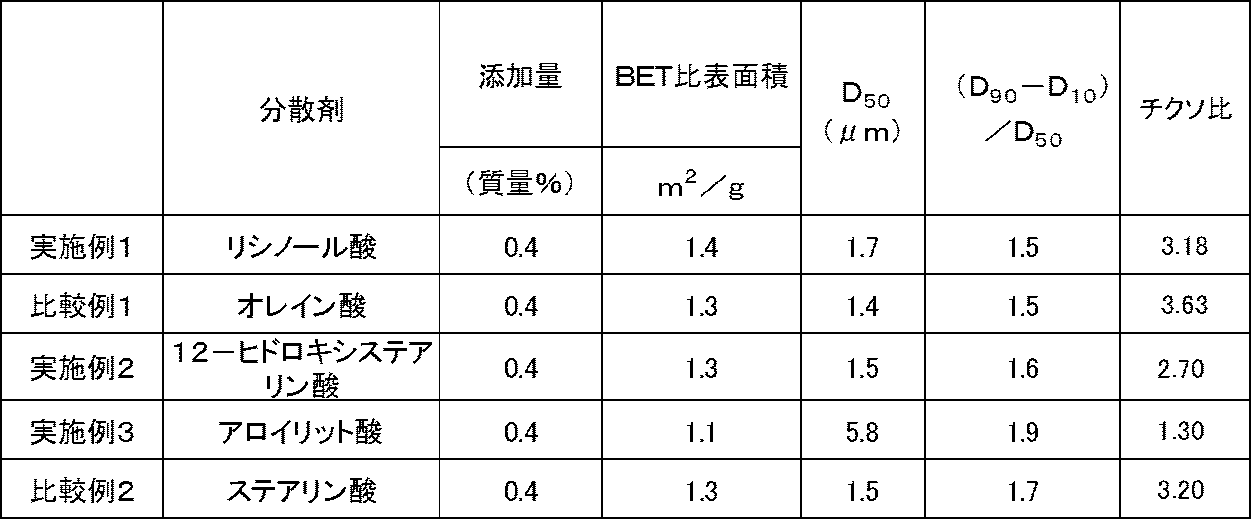
- Example 1 As a result of comparing Example 1 with Comparative Example 1, the thixo ratio of Comparative Example 1 to which oleic acid was added was 3.63, whereas the thixo ratio of Example 1 to which ricinoleic acid was added was 3.18. From this, it was found that by selecting a dispersant having a hydroxyl group, familiarity with the solvent can be improved, the thixo ratio can be lowered, and a conductive paste with good leveling properties can be obtained.
- Example 2 Provides silver powder- In Example 1, except that the dispersant was changed to 5.9 g of ethanol solution of 3.5% by mass of 12-hydroxystearic acid (stearic acid with one hydroxyl group, 18 carbon atoms).
- the silver powder was aged by the same procedure as described above.
- the addition amount of 12-hydroxystearic acid is 0.4% by mass with respect to the mass of the silver powder.
- the aged slurry was filtered, washed with water, and crushed to obtain a silver powder of Example 2.
- the BET specific surface area was 1.3 m 2 / g
- the cumulative 10% particle diameter (D 10 ) was 0.7 ⁇ m
- the cumulative 50% particle diameter (D 50 ) was 1.5 ⁇ m
- the cumulative 90% particle diameter (D 90 ) was 3.1 ⁇ m
- the electrically conductive paste of Example 2 was obtained by the method similar to Example 1.
- Example 3 Provide of silver powder-
- the dispersing agent was changed to 3.5% by mass of alloyed acid (stearic acid with three hydroxyl groups, 18 carbon atoms) ethanol solution 5.9 g, the same as in Example 1.
- Silver powder was aged by the procedure. The addition amount of alloying acid is 0.4 mass% with respect to the mass of silver powder. The aged slurry was filtered, washed with water, and crushed to obtain a silver powder of Example 3.
- the BET specific surface area was 1.1 m 2 / g
- the cumulative 10% particle diameter (D 10 ) was 2.6 ⁇ m
- the cumulative 50% particle diameter (D 50 ) was 5.8 ⁇ m
- the cumulative 90% particle diameter (D 90 ) was 13.8 ⁇ m
- the peak derived from an alloy acid derivative was seen and it has confirmed that the alloy powder existed on the silver powder surface.
- the conductive paste of Example 3 was obtained in the same manner as in Example 1.
- Example 2 (Comparative Example 2) -Production of silver powder-
- silver powder was aged in the same procedure as in Example 1 except that the dispersant was changed to 5.9 g of a 3.5 mass% stearic acid ethanol solution.
- the amount of stearic acid added is 0.4% by mass with respect to the mass of the silver powder.
- the aged slurry was filtered, washed with water, and crushed to obtain a silver powder of Comparative Example 2.
- the BET specific surface area was 1.3 m 2 / g
- the cumulative 10% particle diameter (D 10 ) was 0.5 ⁇ m
- the cumulative 50% particle diameter (D 50 ) was 1.5 ⁇ m
- the cumulative 90% particle size (D 90 ) was 3.1 ⁇ m
- the peak derived from a stearic acid was seen and it has confirmed that the stearic acid existed on the silver powder surface.
- the electroconductive paste of the comparative example 2 was obtained by the method similar to Example 1.
- Table 1 shows the BET specific surface area, D 50 , ratio [(D 90 -D 10 ) / D 50 ], and thixo ratio values for the above Examples and Comparative Examples.
- the conductive paste containing the silver powder of the present invention has good leveling properties, it is suitable for forming electrodes and circuits of various electronic components.
Landscapes
- Chemical & Material Sciences (AREA)
- Organic Chemistry (AREA)
- Engineering & Computer Science (AREA)
- Life Sciences & Earth Sciences (AREA)
- Materials Engineering (AREA)
- Wood Science & Technology (AREA)
- Dispersion Chemistry (AREA)
- General Chemical & Material Sciences (AREA)
- Chemical Kinetics & Catalysis (AREA)
- Physics & Mathematics (AREA)
- Spectroscopy & Molecular Physics (AREA)
- Inorganic Chemistry (AREA)
- Manufacturing & Machinery (AREA)
- Powder Metallurgy (AREA)
- Conductive Materials (AREA)
- Manufacture Of Metal Powder And Suspensions Thereof (AREA)
- Non-Insulated Conductors (AREA)
Abstract
Description
<1> 1分子中に少なくとも1つのカルボキシル基と、少なくとも1つのヒドロキシル基とを含む有機物を表面に有してなり、
BET比表面積が0.1m2/g以上2.0m2/g以下であり、
レーザー回折式粒度分布測定法による体積基準の粒子径分布における累積50%粒子径(D50)が0.1μm以上6.0μm以下であり、かつ累積90%粒子径(D90)及び累積10%粒子径(D10)に対する前記D50の比[(D90-D10)/D50]が3.0以下であることを特徴とする銀粉である。
<2> 前記有機物が、1分子中に少なくとも1つのヒドロキシル基を有する脂肪酸である前記<1>に記載の銀粉である。
<3> 前記有機物における1分子中のヒドロキシル基数が1以上5以下である前記<1>又は<2>に記載の銀粉である。
<4> 前記有機物における1分子中の炭素数が6以上20以下である前記<1>から<3>のいずれかに記載の銀粉である。
<5> 前記有機物が、リシノール酸、12-ヒドロキシステアリン酸及びアロイリット酸から選択される少なくとも1種である前記<1>から<4>のいずれかに記載の銀粉である。
<6> 湿式還元法により製造される前記<1>から<5>のいずれかに記載の銀粉である。
<7> 湿式還元法により還元剤で銀粉を還元析出させた後、分散剤として1分子中に少なくとも1つのカルボキシル基と少なくとも1つのヒドロキシル基とを含む有機物を添加することを特徴とする銀粉の製造方法である。
<8> 前記有機物が、1分子中に少なくとも1つのヒドロキシル基を有する脂肪酸である前記<7>に記載の銀粉の製造方法である。
<9> 前記還元剤が、アスコルビン酸、アルカノールアミン、水素化硼素ナトリウム、ヒドロキノン、ヒドラジン及びホルマリンから選択される少なくとも1種である前記<7>又は<8>に記載の銀粉の製造方法である。
<10> 前記還元剤が、ヒドラジン及びホルマリンの少なくともいずれかである前記<7>から<9>のいずれかに記載の銀粉の製造方法である。
<11> 前記<1>から<6>のいずれかに記載の銀粉を含むことを特徴とする導電性ペーストである。
本発明の銀粉は、1分子中に少なくとも1つのカルボキシル基と、少なくとも1つのヒドロキシル基とを含む有機物を表面に有してなり、更に必要に応じてその他の成分を有してなる。
前記銀粉は、後述する銀粉の製造方法で詳細に説明するように、湿式還元法により製造され、表面に有機物を有する。
前記有機物は、1分子中に少なくとも1つのカルボキシル基と、少なくとも1つのヒドロキシル基とを含む。ヒドロキシル基を含有させて銀粉表面をやや親水化させることで、より銀粉を溶剤に馴染み易くすることが可能となる。ただし、あまりに親水化させすぎると、逆に馴染みが悪くなってしてしまうのでヒドロキシル基数は1分子中に1以上5以下が好ましく、1以上3以下がより好ましい。また、前記有機物としては、銀粉への吸着性、銀粉からの脱離性のバランスを鑑みて、鎖状炭化水素基にカルボキシル基が結合したカルボン酸、即ち脂肪酸を用いることが好ましく、少なくとも1つのヒドロキシル基を有する脂肪酸(ヒドロキシ脂肪酸ともいう)であることがより好ましい。
前記脂肪酸の炭素数は、6以上20以下が好ましく、12以上20以下がより好ましい。前記炭素数が、6未満であると、立体障害が起こらず凝集してしまうことがあり、20を超えると、焼成時に分散剤が分解せず導電性が悪化してしまうことがある。
なお、前記分散剤の同定方法としては、FT-IRにより測定する方法や表面処理剤を溶媒抽出し炭素自動分析機やGC-MSにより測定する方法、もしくは、パイロライザーなどにより加熱することで銀粉表面より脱離した分散剤を炭素自動分析機やGC-MSにより測定する方法などを用いることが可能である。
前記リシノール酸は、下記構造式で表される不飽和脂肪酸であり、天然ではトウゴマの種子に存在する。なお、ひまし油の構成脂肪酸の約90%はリシノール酸のトリグリセリドである。

前記12-ヒドロキシステアリン酸は、下記構造式で表される飽和脂肪酸である。

前記アロイリット酸は、下記構造式で表される飽和脂肪酸である。

本発明の銀粉の製造方法は、湿式還元法により還元剤で銀粉を還元析出させた後、分散剤として1分子中に少なくとも1つのカルボキシル基と少なくとも1つのヒドロキシル基とを含む有機物を添加するものであり、銀イオン分散液の調液工程と、銀の還元工程と、分散剤の吸着工程と、銀粉の洗浄工程と、銀粉の乾燥工程とを含むことが好ましく、更に必要に応じてその他の工程を含んでなる。
前記銀イオン分散液の調液工程は、銀イオン分散液を調液する工程である。
銀イオンを含有する水性反応系としては、硝酸銀、銀錯体又は銀中間体を含有する水溶液又はスラリーを使用することができる。
前記銀錯体を含有する水溶液は、硝酸銀水溶液又は酸化銀懸濁液にアンモニア水又はアンモニウム塩を添加することにより生成することができる。これらの中でも、銀粉が適当な粒径と球状の形状を有するようにするためには、硝酸銀水溶液にアンモニア水を添加して得られる銀アンミン錯体水溶液を使用するのが好ましい。
前記銀アンミン錯体中におけるアンモニアの配位数は2であるため、銀1モル当たりアンモニア2モル以上を添加する。また、アンモニアの添加量が多過ぎると錯体が安定化し過ぎて還元が進み難くなるので、アンモニアの添加量は銀1モル当たりアンモニア8モル以下が好ましい。なお、還元剤の添加量を多くするなどの調整を行えば、アンモニアの添加量が8モルを超えても適当な粒径の球状銀粉を得ることは可能である。また、銀イオンを含有する水性反応系にpH調整剤を添加してもよい。前記pH調整剤としては、特に制限はなく、一般的な酸や塩基を使用することができ、例えば、硝酸、水酸化ナトリウムなどが挙げられる。
前記銀の還元工程は、還元剤により銀を還元析出する工程である。
前記還元剤としては、例えば、アスコルビン酸、亜硫酸塩、アルカノールアミン、過酸化水素水、ギ酸、ギ酸アンモニウム、ギ酸ナトリウム、グリオキサール、酒石酸、次亜燐酸ナトリウム、水素化硼素ナトリウム、ヒドロキノン、ヒドラジン、ヒドラジン化合物、ピロガロール、ぶどう糖、没食子酸、ホルマリン、無水亜硫酸ナトリウム、ロンガリットなどが挙げられる。これらは、1種単独で使用してもよいし、2種以上を併用してもよい。
これらの中で、アスコルビン酸、アルカノールアミン、水素化硼素ナトリウム、ヒドロキノン、ヒドラジン及びホルマリンから選択される少なくとも1種が好ましく、ヒドラジン、ホルマリンが特に好ましい。
前記還元剤の添加方法については、銀粉の凝集を防ぐために、1当量/分間以上の速さで添加することが好ましい。この理由は明確ではないが、還元剤を短時間で投入することで、銀粉の還元析出が一挙に生じて、短時間で還元反応が終了し、発生した核同士の凝集が生じ難いため、分散性が向上すると考えられる。したがって、還元剤の添加時間が短いほど好ましく、例えば、還元剤を100当量/分間以上の速さで添加してもよく、また、還元の際には、より短時間で反応が終了するように反応液を攪拌するのが好ましい。また、還元反応時の液温は5℃以上80℃以下が好ましく、15℃以上40℃以下がより好ましい。
前記分散剤の吸着工程は、銀粉表面に分散剤を吸着させる工程である。
前記分散剤としては、1分子中に少なくとも1つのカルボキシル基と、少なくとも1つのヒドロキシル基とを含む有機物が用いられる。
銀粉を還元析出させた後に前記分散剤を液中に添加することで銀粉表面へ分散剤を吸着させることができる。
前記分散剤の吸着工程における前記有機物の添加量は、前記銀粉質量に対して0.05質量%以上3.0質量%以下が好ましく、0.1質量%以上1.0質量%以下がより好ましい。
前記銀粉の回収及び洗浄工程は、得られた銀粉を回収し、洗浄する工程である。
前記還元工程を経て得られた銀粉には、不純物が含有しているため洗浄する必要がある。
前記洗浄に用いられる洗浄溶媒としては、純水が好適である。前記回収及び洗浄の方式としては、特に制限はなく、目的に応じて適宜選択することができ、例えば、デカンテーションやフィルタープレスなどが挙げられる。洗浄の終点は、洗浄後の水の電気伝導度を用いて判断ができ、電気伝導度が0.5mS/m以下になるまで洗浄を実施するのが好適である。
前記銀粉の乾燥工程は、前記洗浄後の銀粉を乾燥する工程である。
洗浄後の銀粉は多くの水分を含有しているため、使用前に水分を除去する必要がある。前記水分除去の方法としては、真空乾燥とするのが好適である。乾燥温度は100℃以下とするのが好適である。あまり熱をかけてしまうと乾燥の時点で銀粉同士が焼結してしまうため好ましくない。
前記銀粉のBET比表面積は、Macsorb HM-model 1210(MOUNTECH社製)を用いて窒素吸着によるBET1点法で測定することができる。なお、前記BET比表面積の測定において、測定前の脱気条件は60℃、10分間である。
本発明において、前記銀粉のBET比表面積は0.1m2/g以上2.0m2/g以下であり、0.3m2/g以上1.5m2/g以下が好ましい。前記BET比表面積が、0.1m2/g未満であると、銀粉のサイズが大きくなり、微細配線の描画に向かなくなることがあり、2.0m2/gを超えると、導電性ペーストにした際に粘度が高くなりすぎるために導電性ペーストを希釈して使用する必要があり、導電性ペースト中の銀濃度が低くなってしまうため配線が断線してしまうことがある。
前記銀粉のレーザー回折式粒度分布測定法による体積基準の粒子径分布における累積50%粒子径(D50)は、0.1μm以上6.0μm以下であり、0.1μm以上4.0μm以下が好ましい。
累積90%粒子径(D90)及び累積10%粒子径(D10)に対する前記D50の比[(D90-D10)/D50]は、3.0以下であり、2.0以下が好ましい。
前記BET比表面積と同様に、銀粉の粒度分布が大きすぎると、微細配線の描画に向かなくなり、小さすぎると、導電性ペースト中の銀濃度を上げることが困難となる。また、粒度分布のピーク幅が狭く、粒径のばらつきが少なく、揃った銀粉であることが好ましい。
本発明の導電性ペーストは、銀粉と、ガラスフリットと、樹脂と、溶剤とを含有し、更に必要に応じてその他の成分を含有してなる。
前記銀粉としては、本発明の前記銀粉が用いられる。
前記銀粉の含有量は、特に制限はなく、目的に応じて適宜選択することができるが、導電性ペースト全量に対して、40質量%以上90質量%以下が好ましい。
前記ガラスフリットは、焼成した際に前記銀粉を基板に接着させるための成分である。
前記ガラスフリットとしては、特に制限はなく、目的に応じて適宜選択することができ、例えば、ホウケイ酸ビスマス系、ホウケイ酸アルカリ金属系、ホウケイ酸アルカリ土類金属系、ホウケイ酸亜鉛系、ホウケイ酸鉛系、ホウ酸鉛系、ケイ酸鉛系、などが挙げられる。これらは、1種単独で使用してもよいし、2種以上を併用してもよい。なお、環境に与える影響から、鉛を含まないものが好ましい。
前記軟化点は、例えば、熱重量測定装置を用いて測定したDTA曲線の第2吸熱部の裾の温度から求めることができる。
前記ガラスフリットの含有量は、特に制限はなく、目的に応じて適宜選択することができるが、前記銀粉に対して、0.1質量%以上10質量%以下が好ましい。
前記樹脂としては、特に制限はなく、目的に応じて適宜選択することができ、例えば、エポキシ樹脂、アクリル樹脂、ポリエステル樹脂、ポリイミド樹脂、ポリウレタン樹脂、フェノキシ樹脂、シリコーン樹脂、エチルセルロースなどが挙げられる。これらは、1種単独で使用してもよいし、2種以上を併用してもよい。
前記樹脂の含有量は、特に制限はなく、目的に応じて適宜選択することができる。
前記導電性ペーストのレベリング性を示す指標の一つとして“チクソ比”があり、前記チクソ比は、以下の算出方法で求めることができる。

前記導電性ペーストの粘度は、銀粉の含有量、粘度調整剤の添加や溶剤の種類により調整することができる。
なお、実施例及び比較例で作製した各銀粉の有機物の同定、BET比表面積、及び粒度分布は、以下のようにして、測定した。
作製した各銀粉の表面にある有機物は、パイロライザー(EGA/Py-3030D、Frontier Lab社製)を用い銀粉を300℃で加熱することによって銀粉表面より脱離した有機物をGC-MS(7890A/5975C、Agilent Technologies社製)を用いて同定した。
また、ヒドロキシル基を有する脂肪酸は極性が高く上記の手法では非常に感度が低いために官能基をメチル化する必要がある。その手法について以下に記載した。
銀粉0.5gに対し塩酸とメタノールの混合液(東京化成工業株式会社製のHydrogen Chloride-Methanol Reagent)1mLを添加し、50℃にて30分間加熱処理をすることにより、有機物を銀粉表面より脱離させ、官能基をメチル化させた。放冷した後、純水1mLとn-ヘキサン2mLを加えて振とうし、メチル化した有機物をヘキサン層へ抽出した。前記ヘキサン層を前記GC-MSを用いて成分分析を行うことにより、銀粉表面の有機物を同定した。以下、官能基をメチル化させた有機物を、その有機物の誘導体と記す。
作製した各銀粉のBET比表面積は、BET比表面積測定装置(Macsorb HM-model 1210、MOUNTECH社製)を用いて、窒素吸着によるBET1点法により測定した。なお、前記BET比表面積の測定において、測定前の脱気条件は60℃、10分間とした。
作製した各銀粉の粒度分布は、銀粉0.1gをイソプロピルアルコール40mLに添加し、超音波ホモジナイザー(株式会社日本精機製作所製のMODEL US-150T)にて2分間分散させた後、マイクロトラック粒度分布測定装置(日機装株式会社製のマイクロトラックMT3300EXII)を用いて測定し、当該測定結果をグラフ化し、銀粉の粒度分布の頻度と累積を求め、累積10%粒子径(D10)、累積50%粒子径(D50)、及び累積90%粒子径(D90)を測定した。
得られた導電性ペーストの粘度は、BROOKFIELD社製の粘度計5XHBDV-IIIUCを用い、コーン:CP-52、温度25℃で測定した。
また、1rpm(ずり速度2sec-1)で5分間シェアをかけた際の粘度(Pa・s)と、5rpm(ずり速度10sec-1)で1分間シェアをかけた際の粘度(Pa・s)を測定し、チクソ比(TI値)=(1rpmで5分間シェアをかけた際の粘度)/(5rpmで1分間シェアをかけた際の粘度)、を求めた。
-銀粉の作製-
銀を52g含有する硝酸銀溶液を3,600g準備し、前記硝酸銀溶液に濃度28質量%のアンモニア水溶液を160g加えて銀イオンを含有する水性反応系を調製し、液温を25℃とした。前記銀イオンを含有する水性反応系へ、還元剤として80質量%ヒドラジン水溶液13gを加え十分に撹拌し、銀粉を含むスラリーを得た。
次に、得られた銀粉を含むスラリーに対して、分散剤として3.5質量%のリシノール酸(オレイン酸に対しヒドロキシル基が1つ付いたもの、炭素数18)エタノール溶液を5.9g加え、十分に撹拌した後、熟成させた。リシノール酸の添加量は、銀粉の質量に対して0.4質量%である。前記熟成されたスラリーを濾過、水洗し、解砕して、実施例1の銀粉を得た。
得られた銀粉27gに対して、ガラスフリット(奥野製薬工業株式会社製、G3-5754)を0.3g、酸化亜鉛(純正化学株式会社製、試薬特級)を0.6g、エチルセルロース100cp(和光純薬工業株式会社製)を0.2g、及びテキサノール(JNC株式会社製、CS-12)を3.3g加え、プロペラレス自公転式攪拌脱泡装置(シンキー株式会社製、AR-250)を用い、混合した。その後、3本ロールミル(EXAKT社製、EXAKT80S)を用いて、ロールギャップを徐々に狭めながら通過させて導電性ペーストを得た。
得られた導電性ペーストの粘度を測定したところ、1rpmで413Pa・s、5rpmで130Pa・sであり、チクソ比(TI値)=1rpm/5rpm=413/130=3.18であった。
-銀粉の作製-
実施例1において、分散剤を3.5質量%のオレイン酸エタノール溶液5.9gに変更した以外は、実施例1と同様の手順にて銀粉を熟成させた。オレイン酸の添加量は、銀粉の質量に対して0.4質量%である。前記熟成されたスラリーを濾過、水洗し、解砕して、比較例1の銀粉を得た。
得られた銀粉を評価した結果、BET比表面積1.3m2/gであり、累積10%粒子径(D10)が0.5μm、累積50%粒子径(D50)が1.4μm、及び累積90%粒子径(D90)が2.6μmであり、比[(D90-D10)/D50]は(2.6-0.5)/1.4=1.5であった。また、上記の方法により銀粉に付着する有機物の分析を行った結果、オレイン酸に由来するピークが見られ、銀粉表面にオレイン酸が存在することが確認できた。
得られた銀粉について、実施例1と同様の手法にて比較例1の導電性ペーストを得た。得られた導電性ペーストについて、粘度を測定したところ、1rpmで417Pa・s、5rpmで115Pa・sであり、チクソ比(TI値)=1rpm/5rpm=417/115=3.63であった。
-銀粉の作製-
実施例1において、分散剤を3.5質量%の12-ヒドロキシステアリン酸(ステアリン酸にヒドロキシル基が1つ付いたもの、炭素数18)エタノール溶液5.9gに変更した以外は、実施例1と同様の手順にて銀粉を熟成させた。12-ヒドロキシステアリン酸の添加量は、銀粉の質量に対して0.4質量%である。前記熟成されたスラリーを濾過、水洗し、解砕して、実施例2の銀粉を得た。
得られた銀粉を評価した結果、BET比表面積が1.3m2/gであり、累積10%粒子径(D10)が0.7μm、累積50%粒子径(D50)が1.5μm、及び累積90%粒子径(D90)が3.1μmであり、比[(D90-D10)/D50]は(3.1-0.7)/1.5=1.6であった。また、上記の方法により銀粉に付着する有機物の分析を行った結果、12-ヒドロキシステアリン酸誘導体に由来するピークが見られ、銀粉表面に12-ヒドロキシステアリン酸が存在することが確認できた。
得られた銀粉に対して、実施例1と同様の手法にて実施例2の導電性ペーストを得た。得られた導電性ペーストについて、粘度を測定したところ、1rpmで365Pa・s、5rpmで135Pa・sであり、チクソ比(TI値)=1rpm/5rpm=365/135=2.70であった。
-銀粉の作製-
実施例1において、分散剤を3.5質量%のアロイリット酸(ステアリン酸にヒドロキシル基が3つ付いたもの、炭素数18)エタノール溶液5.9gに変更した以外は、実施例1と同様の手順にて銀粉を熟成させた。アロイリット酸の添加量は、銀粉の質量に対して0.4質量%である。前記熟成されたスラリーを濾過、水洗し、解砕して、実施例3の銀粉を得た。
得られた銀粉を評価した結果、BET比表面積が1.1m2/gであり、累積10%粒子径(D10)が2.6μm、累積50%粒子径(D50)が5.8μm、及び累積90%粒子径(D90)が13.8μmであり、比[(D90-D10)/D50]は(13.8-2.6)/5.8=1.9であった。また、上記の方法により銀粉に付着する有機物の分析を行った結果、アロイリット酸誘導体に由来するピークが見られ、銀粉表面にアロイリット酸が存在することが確認できた。
得られた銀粉に対して、実施例1と同様の手法にて実施例3の導電性ペーストを得た。得られた導電性ペーストについて、粘度を測定したところ、1rpmで52Pa・s、5rpmで40Pa・sであり、チクソ比(TI値)=1rpm/5rpm=52/40=1.30であった。
-銀粉の作製-
実施例1において、分散剤を3.5質量%のステアリン酸エタノール溶液5.9gに変更した以外は、実施例1と同様の手順にて銀粉を熟成させた。ステアリン酸の添加量は、銀粉の質量に対して0.4質量%である。前記熟成されたスラリーを濾過、水洗し、解砕して、比較例2の銀粉を得た。
得られた銀粉を評価した結果、BET比表面積が1.3m2/gであり、累積10%粒子径(D10)が0.5μm、累積50%粒子径(D50)が1.5μm、及び累積90%粒子径(D90)が3.1μmであり、比[(D90-D10)/D50]は(3.1-0.5)/1.58=1.7であった。また、上記の方法により銀粉に付着する有機物の分析を行った結果、ステアリン酸に由来するピークが見られ、銀粉表面にステアリン酸が存在することが確認できた。
得られた銀粉に対して、実施例1と同様の手法にて比較例2の導電性ペーストを得た。得られた導電性ペーストについて、粘度を測定したところ、1rpmで429Pa・s、5rpmで134Pa・sであり、チクソ比(TI値)=1rpm/5rpm=429/134=3.20であった。
Claims (11)
- 1分子中に少なくとも1つのカルボキシル基と、少なくとも1つのヒドロキシル基とを含む有機物を表面に有してなり、
BET比表面積が0.1m2/g以上2.0m2/g以下であり、
レーザー回折式粒度分布測定法による体積基準の粒子径分布における累積50%粒子径(D50)が0.1μm以上6.0μm以下であり、かつ累積90%粒子径(D90)及び累積10%粒子径(D10)に対する前記D50の比[(D90-D10)/D50]が3.0以下であることを特徴とする銀粉。 - 前記有機物が、1分子中に少なくとも1つのヒドロキシル基を有する脂肪酸である請求項1に記載の銀粉。
- 前記有機物における1分子中のヒドロキシル基数が1以上5以下である請求項1又は2に記載の銀粉。
- 前記有機物における1分子中の炭素数が6以上20以下である請求項1から3のいずれかに記載の銀粉。
- 前記有機物が、リシノール酸、12-ヒドロキシステアリン酸及びアロイリット酸から選択される少なくとも1種である請求項1から4のいずれかに記載の銀粉。
- 湿式還元法により製造される請求項1から5のいずれかに記載の銀粉。
- 湿式還元法により還元剤で銀粉を還元析出させた後、分散剤として1分子中に少なくとも1つのカルボキシル基と少なくとも1つのヒドロキシル基とを含む有機物を添加することを特徴とする銀粉の製造方法。
- 前記有機物が、1分子中に少なくとも1つのヒドロキシル基を有する脂肪酸である請求項7に記載の銀粉の製造方法。
- 前記還元剤が、アスコルビン酸、アルカノールアミン、水素化硼素ナトリウム、ヒドロキノン、ヒドラジン及びホルマリンから選択される少なくとも1種である請求項7又は8に記載の銀粉の製造方法。
- 前記還元剤が、ヒドラジン及びホルマリンの少なくともいずれかである請求項7から9のいずれかに記載の銀粉の製造方法。
- 請求項1から6のいずれかに記載の銀粉を含むことを特徴とする導電性ペースト。
Priority Applications (3)
| Application Number | Priority Date | Filing Date | Title |
|---|---|---|---|
| CN201580040796.6A CN106573300B (zh) | 2014-07-31 | 2015-07-27 | 银粉及其制备方法、以及导电性浆料 |
| KR1020177005590A KR101918868B1 (ko) | 2014-07-31 | 2015-07-27 | 은 분말, 그 제조방법 및 도전성 페이스트 |
| US15/500,192 US9993871B2 (en) | 2014-07-31 | 2015-07-27 | Silver powder, method for producing same, and conductive paste |
Applications Claiming Priority (4)
| Application Number | Priority Date | Filing Date | Title |
|---|---|---|---|
| JP2014-156455 | 2014-07-31 | ||
| JP2014156455 | 2014-07-31 | ||
| JP2015146615A JP6029719B2 (ja) | 2014-07-31 | 2015-07-24 | 銀粉及びその製造方法、並びに導電性ペースト |
| JP2015-146615 | 2015-07-24 |
Publications (1)
| Publication Number | Publication Date |
|---|---|
| WO2016017599A1 true WO2016017599A1 (ja) | 2016-02-04 |
Family
ID=55217499
Family Applications (1)
| Application Number | Title | Priority Date | Filing Date |
|---|---|---|---|
| PCT/JP2015/071292 Ceased WO2016017599A1 (ja) | 2014-07-31 | 2015-07-27 | 銀粉及びその製造方法、並びに導電性ペースト |
Country Status (6)
| Country | Link |
|---|---|
| US (1) | US9993871B2 (ja) |
| JP (1) | JP6029719B2 (ja) |
| KR (1) | KR101918868B1 (ja) |
| CN (1) | CN106573300B (ja) |
| TW (1) | TWI563102B (ja) |
| WO (1) | WO2016017599A1 (ja) |
Cited By (3)
| Publication number | Priority date | Publication date | Assignee | Title |
|---|---|---|---|---|
| CN107052326A (zh) * | 2017-02-20 | 2017-08-18 | 江苏瑞德新能源科技有限公司 | 银微粉及其制备方法和应用 |
| WO2017169534A1 (ja) * | 2016-03-30 | 2017-10-05 | 株式会社大阪ソーダ | 導電性接着剤 |
| CN113677458A (zh) * | 2019-03-29 | 2021-11-19 | 大洲电子材料株式会社 | 混合银粉和包含其的导电糊 |
Families Citing this family (19)
| Publication number | Priority date | Publication date | Assignee | Title |
|---|---|---|---|---|
| JP6029719B2 (ja) * | 2014-07-31 | 2016-11-24 | Dowaエレクトロニクス株式会社 | 銀粉及びその製造方法、並びに導電性ペースト |
| JP6029720B2 (ja) * | 2014-07-31 | 2016-11-24 | Dowaエレクトロニクス株式会社 | 銀粉及びその製造方法、並びに導電性ペースト |
| JP2017052668A (ja) * | 2015-09-09 | 2017-03-16 | 三菱マテリアル株式会社 | 組成物、接合体の製造方法 |
| TWI623946B (zh) * | 2016-07-05 | 2018-05-11 | 國立成功大學 | 奈米銀漿料之製備方法 |
| JP6967845B2 (ja) * | 2016-09-27 | 2021-11-17 | 株式会社ノリタケカンパニーリミテド | 銀ペーストおよび電子素子 |
| KR102084117B1 (ko) * | 2017-08-31 | 2020-03-03 | 삼성에스디아이 주식회사 | 전자파 차폐용 도전성 조성물, 이로부터 제조된 전자파 차폐층 및 이를 포함하는 회로기판 적층체 |
| JP7090511B2 (ja) * | 2017-09-29 | 2022-06-24 | Dowaエレクトロニクス株式会社 | 銀粉およびその製造方法 |
| CN107866562B (zh) * | 2017-12-15 | 2019-09-06 | 湖南纳科新材料科技有限公司 | 一种球形金微粉及其制备方法和应用 |
| JP6857166B2 (ja) * | 2017-12-15 | 2021-04-14 | Dowaエレクトロニクス株式会社 | 球状銀粉およびその製造方法 |
| KR102007857B1 (ko) | 2018-06-29 | 2019-08-06 | 엘에스니꼬동제련 주식회사 | 표면 처리된 은 분말 및 이의 제조방법 |
| KR20200038742A (ko) * | 2018-10-04 | 2020-04-14 | 대주전자재료 주식회사 | 은 분말 및 이의 제조 방법 |
| KR20200061193A (ko) * | 2018-11-23 | 2020-06-02 | 엘에스니꼬동제련 주식회사 | 단분산 은 분말의 제조방법 |
| KR20210105405A (ko) * | 2018-12-26 | 2021-08-26 | 쇼에이 가가쿠 가부시키가이샤 | 은 페이스트 |
| KR20220153649A (ko) * | 2020-03-24 | 2022-11-18 | 도와 일렉트로닉스 가부시키가이샤 | 은분의 제조 방법 |
| CN111587056A (zh) * | 2020-05-14 | 2020-08-25 | 湖南省国银新材料有限公司 | 一种通信设备用电磁屏蔽银浆及其制备方法 |
| CN112853315A (zh) * | 2021-01-11 | 2021-05-28 | 武汉船用电力推进装置研究所(中国船舶重工集团公司第七一二研究所) | 一种太阳能正面银浆银粉末的表面改性方法 |
| CN114210996A (zh) * | 2021-12-29 | 2022-03-22 | 上海腾烁电子材料有限公司 | 一种高烧结活性纳米银粉及其制备方法 |
| CN117862520B (zh) * | 2024-03-11 | 2024-05-10 | 云南师范大学 | 一种使用紫胶制备片状银粉的方法 |
| CN119489199B (zh) * | 2024-11-06 | 2025-10-28 | 宁夏中色新材料有限公司 | 一种高松装片状银粉及其制备方法 |
Citations (9)
| Publication number | Priority date | Publication date | Assignee | Title |
|---|---|---|---|---|
| JP2005042174A (ja) * | 2003-07-24 | 2005-02-17 | Sakata Corp | 金属粉末の分散方法及びその方法によって得られる金属粉末分散体 |
| JP2007016258A (ja) * | 2005-07-05 | 2007-01-25 | Mitsui Mining & Smelting Co Ltd | 高結晶銀粉及びその高結晶銀粉の製造方法 |
| JP2008223096A (ja) * | 2007-03-13 | 2008-09-25 | Mitsui Mining & Smelting Co Ltd | フレーク状銀粉の製造方法 |
| JP2010229544A (ja) * | 2008-11-26 | 2010-10-14 | Mitsuboshi Belting Ltd | 金属コロイド粒子及びそのペースト並びにその製造方法 |
| JP2011032509A (ja) * | 2009-07-30 | 2011-02-17 | Dowa Electronics Materials Co Ltd | 金属ナノ粒子分散液 |
| JP2011052300A (ja) * | 2009-09-04 | 2011-03-17 | Dowa Electronics Materials Co Ltd | フレーク状銀粉及びその製造方法、並びに導電性ペースト |
| JP2012046779A (ja) * | 2010-08-25 | 2012-03-08 | Toyota Central R&D Labs Inc | 表面被覆金属ナノ粒子、その製造方法、およびそれを含む金属ナノ粒子ペースト |
| JP2012214873A (ja) * | 2011-03-28 | 2012-11-08 | Dowa Electronics Materials Co Ltd | 銀粉およびその製造方法、並びに導電性ペースト |
| JP2015010256A (ja) * | 2013-06-28 | 2015-01-19 | Dowaエレクトロニクス株式会社 | フレーク状銀粉及びその製造方法、並びに導電性ペースト |
Family Cites Families (30)
| Publication number | Priority date | Publication date | Assignee | Title |
|---|---|---|---|---|
| US4443495A (en) * | 1981-03-05 | 1984-04-17 | W. R. Grace & Co. | Heat curable conductive ink |
| JP2795467B2 (ja) | 1989-06-19 | 1998-09-10 | 第一工業製薬株式会社 | 接着性良好な金属ペースト |
| JPH03173007A (ja) * | 1989-12-01 | 1991-07-26 | Kao Corp | 導電性ペースト及び導電性塗膜 |
| JPH08176620A (ja) | 1994-12-27 | 1996-07-09 | Dowa Mining Co Ltd | 銀粉の製造法 |
| JP3541125B2 (ja) | 1998-05-01 | 2004-07-07 | 太陽インキ製造株式会社 | アルカリ現像型光硬化性導電性ペースト組成物及びそれを用いて電極形成したプラズマディスプレイパネル |
| JP2003262949A (ja) | 2002-03-08 | 2003-09-19 | Dainippon Printing Co Ltd | アルキド樹脂を用いた感光性導電ペースト及び電極 |
| JP4976642B2 (ja) * | 2004-02-10 | 2012-07-18 | 三井金属鉱業株式会社 | 高結晶性銀粉及びその製造方法 |
| JP2005330529A (ja) * | 2004-05-19 | 2005-12-02 | Dowa Mining Co Ltd | 球状銀粉およびその製造方法 |
| JP2006002228A (ja) * | 2004-06-18 | 2006-01-05 | Dowa Mining Co Ltd | 球状銀粉およびその製造方法 |
| JP4829489B2 (ja) | 2004-09-17 | 2011-12-07 | 株式会社リコー | トナー、並びに、現像剤、トナー入り容器、プロセスカートリッジ、画像形成装置及び画像形成方法 |
| JP2007194122A (ja) * | 2006-01-20 | 2007-08-02 | Sumitomo Electric Ind Ltd | 導電性ペーストおよびそれを用いた配線基板 |
| CN101077529B (zh) * | 2007-07-05 | 2010-05-19 | 中南大学 | 一种纳米铜粉及铜浆料的制备方法 |
| US20090098396A1 (en) * | 2007-10-10 | 2009-04-16 | Ppg Industries Ohio, Inc. | Powder coating compositions, methods for their preparation and related coated substrates |
| JP5688895B2 (ja) * | 2008-12-26 | 2015-03-25 | Dowaエレクトロニクス株式会社 | 微小銀粒子粉末と該粉末を使用した銀ペースト |
| CN102341866A (zh) * | 2009-03-06 | 2012-02-01 | 东洋铝株式会社 | 导电糊组合物和使用该导电糊组合物形成的导电膜 |
| CN102054882B (zh) | 2009-10-29 | 2012-07-18 | 上海宝银电子材料有限公司 | 晶体硅太阳能电池用正面栅极导电银浆及其制备方法 |
| KR101700615B1 (ko) * | 2010-03-30 | 2017-01-31 | 주식회사 동진쎄미켐 | 금속 나노입자의 제조방법, 이에 의해 제조된 금속 나노입자 및 이를 포함하는 금속 잉크 조성물 |
| JP5830237B2 (ja) * | 2010-11-10 | 2015-12-09 | Dowaエレクトロニクス株式会社 | 銀粒子含有組成物、分散液ならびにペーストの製造方法 |
| JP5916633B2 (ja) * | 2011-01-26 | 2016-05-11 | ナミックス株式会社 | 導電性ペースト及び導電膜の製造方法 |
| US8715387B2 (en) * | 2011-03-08 | 2014-05-06 | E I Du Pont De Nemours And Company | Process for making silver powder particles with small size crystallites |
| EP2578624A1 (en) * | 2011-10-06 | 2013-04-10 | Henkel Italia S.p.A. | Polymeric PTC thermistors |
| JP5924481B2 (ja) * | 2012-02-02 | 2016-05-25 | 戸田工業株式会社 | 銀微粒子の製造法及び該銀微粒子の製造法によって得られた銀微粒子並びに該銀微粒子を含有する導電性ペースト |
| JP5880300B2 (ja) * | 2012-06-14 | 2016-03-08 | 日立化成株式会社 | 接着剤組成物及びそれを用いた半導体装置 |
| US9388267B2 (en) * | 2013-02-04 | 2016-07-12 | Bridgestone Corporation | Photocurable elastomer composition, seal material, gasket for hard disc drive, hard disc drive and apparatus |
| JP2013151753A (ja) | 2013-03-04 | 2013-08-08 | Dowa Electronics Materials Co Ltd | 極性媒体との親和性に優れた銀微粉および銀インク |
| JP5936091B2 (ja) * | 2014-06-20 | 2016-06-15 | 昭栄化学工業株式会社 | 炭素被覆金属粉末、炭素被覆金属粉末を含有する導電性ペースト及びそれを用いた積層電子部品、並びに炭素被覆金属粉末の製造方法 |
| CN106537607B (zh) * | 2014-07-11 | 2018-11-02 | 横滨橡胶株式会社 | 太阳能电池集电电极形成用导电性组合物、太阳能电池单元和太阳能电池模块 |
| JP6282616B2 (ja) * | 2014-07-30 | 2018-02-21 | Dowaエレクトロニクス株式会社 | 銀粉およびその製造方法 |
| JP6029720B2 (ja) * | 2014-07-31 | 2016-11-24 | Dowaエレクトロニクス株式会社 | 銀粉及びその製造方法、並びに導電性ペースト |
| JP6029719B2 (ja) * | 2014-07-31 | 2016-11-24 | Dowaエレクトロニクス株式会社 | 銀粉及びその製造方法、並びに導電性ペースト |
-
2015
- 2015-07-24 JP JP2015146615A patent/JP6029719B2/ja active Active
- 2015-07-27 WO PCT/JP2015/071292 patent/WO2016017599A1/ja not_active Ceased
- 2015-07-27 US US15/500,192 patent/US9993871B2/en active Active
- 2015-07-27 KR KR1020177005590A patent/KR101918868B1/ko active Active
- 2015-07-27 CN CN201580040796.6A patent/CN106573300B/zh active Active
- 2015-07-31 TW TW104124931A patent/TWI563102B/zh active
Patent Citations (9)
| Publication number | Priority date | Publication date | Assignee | Title |
|---|---|---|---|---|
| JP2005042174A (ja) * | 2003-07-24 | 2005-02-17 | Sakata Corp | 金属粉末の分散方法及びその方法によって得られる金属粉末分散体 |
| JP2007016258A (ja) * | 2005-07-05 | 2007-01-25 | Mitsui Mining & Smelting Co Ltd | 高結晶銀粉及びその高結晶銀粉の製造方法 |
| JP2008223096A (ja) * | 2007-03-13 | 2008-09-25 | Mitsui Mining & Smelting Co Ltd | フレーク状銀粉の製造方法 |
| JP2010229544A (ja) * | 2008-11-26 | 2010-10-14 | Mitsuboshi Belting Ltd | 金属コロイド粒子及びそのペースト並びにその製造方法 |
| JP2011032509A (ja) * | 2009-07-30 | 2011-02-17 | Dowa Electronics Materials Co Ltd | 金属ナノ粒子分散液 |
| JP2011052300A (ja) * | 2009-09-04 | 2011-03-17 | Dowa Electronics Materials Co Ltd | フレーク状銀粉及びその製造方法、並びに導電性ペースト |
| JP2012046779A (ja) * | 2010-08-25 | 2012-03-08 | Toyota Central R&D Labs Inc | 表面被覆金属ナノ粒子、その製造方法、およびそれを含む金属ナノ粒子ペースト |
| JP2012214873A (ja) * | 2011-03-28 | 2012-11-08 | Dowa Electronics Materials Co Ltd | 銀粉およびその製造方法、並びに導電性ペースト |
| JP2015010256A (ja) * | 2013-06-28 | 2015-01-19 | Dowaエレクトロニクス株式会社 | フレーク状銀粉及びその製造方法、並びに導電性ペースト |
Cited By (7)
| Publication number | Priority date | Publication date | Assignee | Title |
|---|---|---|---|---|
| WO2017169534A1 (ja) * | 2016-03-30 | 2017-10-05 | 株式会社大阪ソーダ | 導電性接着剤 |
| CN108699397A (zh) * | 2016-03-30 | 2018-10-23 | 株式会社大阪曹達 | 导电性粘接剂 |
| JPWO2017169534A1 (ja) * | 2016-03-30 | 2019-02-28 | 株式会社大阪ソーダ | 導電性接着剤 |
| CN108699397B (zh) * | 2016-03-30 | 2021-07-27 | 株式会社大阪曹達 | 导电性粘接剂 |
| CN107052326A (zh) * | 2017-02-20 | 2017-08-18 | 江苏瑞德新能源科技有限公司 | 银微粉及其制备方法和应用 |
| CN113677458A (zh) * | 2019-03-29 | 2021-11-19 | 大洲电子材料株式会社 | 混合银粉和包含其的导电糊 |
| CN113677458B (zh) * | 2019-03-29 | 2024-03-29 | 大洲电子材料株式会社 | 混合银粉和包含其的导电糊 |
Also Published As
| Publication number | Publication date |
|---|---|
| JP6029719B2 (ja) | 2016-11-24 |
| TW201619400A (zh) | 2016-06-01 |
| KR20170045233A (ko) | 2017-04-26 |
| CN106573300B (zh) | 2020-08-21 |
| KR101918868B1 (ko) | 2019-02-08 |
| US20170259334A1 (en) | 2017-09-14 |
| CN106573300A (zh) | 2017-04-19 |
| US9993871B2 (en) | 2018-06-12 |
| JP2016035101A (ja) | 2016-03-17 |
| TWI563102B (en) | 2016-12-21 |
Similar Documents
| Publication | Publication Date | Title |
|---|---|---|
| JP6029719B2 (ja) | 銀粉及びその製造方法、並びに導電性ペースト | |
| JP6029720B2 (ja) | 銀粉及びその製造方法、並びに導電性ペースト | |
| TWI725796B (zh) | 混合銀粉及包含其之導電性糊 | |
| JP6423508B2 (ja) | 銀粉の製造方法 | |
| CN108367927B (zh) | 银被覆石墨粒子、银被覆石墨混合粉及其制造方法和导电浆料 | |
| JPWO2012099161A1 (ja) | 金属粒子粉末およびそれを用いたペースト組成物 | |
| JP6796448B2 (ja) | 導電性ペーストおよびその製造方法、ならびに太陽電池セル | |
| JP5510531B1 (ja) | 銀粉及び銀ペースト | |
| JP5756694B2 (ja) | 扁平金属粒子 | |
| JP5790433B2 (ja) | 銀粉及びその製造方法 | |
| JP2014029845A (ja) | 導電性ペーストの製造方法 | |
| JP2017002409A (ja) | 銀粉及びその製造方法 | |
| WO2017033889A1 (ja) | 銀粉およびその製造方法、ならびに導電性ペースト |
Legal Events
| Date | Code | Title | Description |
|---|---|---|---|
| 121 | Ep: the epo has been informed by wipo that ep was designated in this application |
Ref document number: 15826701 Country of ref document: EP Kind code of ref document: A1 |
|
| WWE | Wipo information: entry into national phase |
Ref document number: 15500192 Country of ref document: US |
|
| NENP | Non-entry into the national phase |
Ref country code: DE |
|
| ENP | Entry into the national phase |
Ref document number: 20177005590 Country of ref document: KR Kind code of ref document: A |
|
| 122 | Ep: pct application non-entry in european phase |
Ref document number: 15826701 Country of ref document: EP Kind code of ref document: A1 |