WO2016010124A1 - ポジ型感光性樹脂組成物 - Google Patents
ポジ型感光性樹脂組成物 Download PDFInfo
- Publication number
- WO2016010124A1 WO2016010124A1 PCT/JP2015/070443 JP2015070443W WO2016010124A1 WO 2016010124 A1 WO2016010124 A1 WO 2016010124A1 JP 2015070443 W JP2015070443 W JP 2015070443W WO 2016010124 A1 WO2016010124 A1 WO 2016010124A1
- Authority
- WO
- WIPO (PCT)
- Prior art keywords
- group
- formula
- carbon atoms
- photosensitive resin
- positive photosensitive
- Prior art date
- Legal status (The legal status is an assumption and is not a legal conclusion. Google has not performed a legal analysis and makes no representation as to the accuracy of the status listed.)
- Ceased
Links
- ISWSIDIOOBJBQZ-UHFFFAOYSA-N Oc1ccccc1 Chemical compound Oc1ccccc1 ISWSIDIOOBJBQZ-UHFFFAOYSA-N 0.000 description 3
- 0 *c1ccccc1 Chemical compound *c1ccccc1 0.000 description 1
- XPCJEXQYHJKEEU-UHFFFAOYSA-N Cc(cc1)ccc1S(c1cc(-c2c(C)ccc(C)c2)c(C)cc1)(=O)=O Chemical compound Cc(cc1)ccc1S(c1cc(-c2c(C)ccc(C)c2)c(C)cc1)(=O)=O XPCJEXQYHJKEEU-UHFFFAOYSA-N 0.000 description 1
- YXFVVABEGXRONW-UHFFFAOYSA-N Cc1ccccc1 Chemical compound Cc1ccccc1 YXFVVABEGXRONW-UHFFFAOYSA-N 0.000 description 1
Classifications
-
- G—PHYSICS
- G03—PHOTOGRAPHY; CINEMATOGRAPHY; ANALOGOUS TECHNIQUES USING WAVES OTHER THAN OPTICAL WAVES; ELECTROGRAPHY; HOLOGRAPHY
- G03F—PHOTOMECHANICAL PRODUCTION OF TEXTURED OR PATTERNED SURFACES, e.g. FOR PRINTING, FOR PROCESSING OF SEMICONDUCTOR DEVICES; MATERIALS THEREFOR; ORIGINALS THEREFOR; APPARATUS SPECIALLY ADAPTED THEREFOR
- G03F7/00—Photomechanical, e.g. photolithographic, production of textured or patterned surfaces, e.g. printing surfaces; Materials therefor, e.g. comprising photoresists; Apparatus specially adapted therefor
- G03F7/004—Photosensitive materials
- G03F7/039—Macromolecular compounds which are photodegradable, e.g. positive electron resists
- G03F7/0392—Macromolecular compounds which are photodegradable, e.g. positive electron resists the macromolecular compound being present in a chemically amplified positive photoresist composition
-
- H—ELECTRICITY
- H10—SEMICONDUCTOR DEVICES; ELECTRIC SOLID-STATE DEVICES NOT OTHERWISE PROVIDED FOR
- H10K—ORGANIC ELECTRIC SOLID-STATE DEVICES
- H10K50/00—Organic light-emitting devices
-
- C—CHEMISTRY; METALLURGY
- C08—ORGANIC MACROMOLECULAR COMPOUNDS; THEIR PREPARATION OR CHEMICAL WORKING-UP; COMPOSITIONS BASED THEREON
- C08G—MACROMOLECULAR COMPOUNDS OBTAINED OTHERWISE THAN BY REACTIONS ONLY INVOLVING UNSATURATED CARBON-TO-CARBON BONDS
- C08G8/00—Condensation polymers of aldehydes or ketones with phenols only
- C08G8/04—Condensation polymers of aldehydes or ketones with phenols only of aldehydes
- C08G8/08—Condensation polymers of aldehydes or ketones with phenols only of aldehydes of formaldehyde, e.g. of formaldehyde formed in situ
- C08G8/10—Condensation polymers of aldehydes or ketones with phenols only of aldehydes of formaldehyde, e.g. of formaldehyde formed in situ with phenol
-
- C—CHEMISTRY; METALLURGY
- C08—ORGANIC MACROMOLECULAR COMPOUNDS; THEIR PREPARATION OR CHEMICAL WORKING-UP; COMPOSITIONS BASED THEREON
- C08G—MACROMOLECULAR COMPOUNDS OBTAINED OTHERWISE THAN BY REACTIONS ONLY INVOLVING UNSATURATED CARBON-TO-CARBON BONDS
- C08G8/00—Condensation polymers of aldehydes or ketones with phenols only
- C08G8/28—Chemically modified polycondensates
- C08G8/30—Chemically modified polycondensates by unsaturated compounds, e.g. terpenes
-
- G—PHYSICS
- G03—PHOTOGRAPHY; CINEMATOGRAPHY; ANALOGOUS TECHNIQUES USING WAVES OTHER THAN OPTICAL WAVES; ELECTROGRAPHY; HOLOGRAPHY
- G03F—PHOTOMECHANICAL PRODUCTION OF TEXTURED OR PATTERNED SURFACES, e.g. FOR PRINTING, FOR PROCESSING OF SEMICONDUCTOR DEVICES; MATERIALS THEREFOR; ORIGINALS THEREFOR; APPARATUS SPECIALLY ADAPTED THEREFOR
- G03F7/00—Photomechanical, e.g. photolithographic, production of textured or patterned surfaces, e.g. printing surfaces; Materials therefor, e.g. comprising photoresists; Apparatus specially adapted therefor
- G03F7/004—Photosensitive materials
- G03F7/022—Quinonediazides
- G03F7/023—Macromolecular quinonediazides; Macromolecular additives, e.g. binders
-
- G—PHYSICS
- G03—PHOTOGRAPHY; CINEMATOGRAPHY; ANALOGOUS TECHNIQUES USING WAVES OTHER THAN OPTICAL WAVES; ELECTROGRAPHY; HOLOGRAPHY
- G03F—PHOTOMECHANICAL PRODUCTION OF TEXTURED OR PATTERNED SURFACES, e.g. FOR PRINTING, FOR PROCESSING OF SEMICONDUCTOR DEVICES; MATERIALS THEREFOR; ORIGINALS THEREFOR; APPARATUS SPECIALLY ADAPTED THEREFOR
- G03F7/00—Photomechanical, e.g. photolithographic, production of textured or patterned surfaces, e.g. printing surfaces; Materials therefor, e.g. comprising photoresists; Apparatus specially adapted therefor
- G03F7/26—Processing photosensitive materials; Apparatus therefor
- G03F7/38—Treatment before imagewise removal, e.g. prebaking
-
- G—PHYSICS
- G03—PHOTOGRAPHY; CINEMATOGRAPHY; ANALOGOUS TECHNIQUES USING WAVES OTHER THAN OPTICAL WAVES; ELECTROGRAPHY; HOLOGRAPHY
- G03F—PHOTOMECHANICAL PRODUCTION OF TEXTURED OR PATTERNED SURFACES, e.g. FOR PRINTING, FOR PROCESSING OF SEMICONDUCTOR DEVICES; MATERIALS THEREFOR; ORIGINALS THEREFOR; APPARATUS SPECIALLY ADAPTED THEREFOR
- G03F7/00—Photomechanical, e.g. photolithographic, production of textured or patterned surfaces, e.g. printing surfaces; Materials therefor, e.g. comprising photoresists; Apparatus specially adapted therefor
- G03F7/26—Processing photosensitive materials; Apparatus therefor
- G03F7/40—Treatment after imagewise removal, e.g. baking
-
- H—ELECTRICITY
- H05—ELECTRIC TECHNIQUES NOT OTHERWISE PROVIDED FOR
- H05B—ELECTRIC HEATING; ELECTRIC LIGHT SOURCES NOT OTHERWISE PROVIDED FOR; CIRCUIT ARRANGEMENTS FOR ELECTRIC LIGHT SOURCES, IN GENERAL
- H05B33/00—Electroluminescent light sources
- H05B33/10—Apparatus or processes specially adapted to the manufacture of electroluminescent light sources
-
- H—ELECTRICITY
- H05—ELECTRIC TECHNIQUES NOT OTHERWISE PROVIDED FOR
- H05B—ELECTRIC HEATING; ELECTRIC LIGHT SOURCES NOT OTHERWISE PROVIDED FOR; CIRCUIT ARRANGEMENTS FOR ELECTRIC LIGHT SOURCES, IN GENERAL
- H05B33/00—Electroluminescent light sources
- H05B33/12—Light sources with substantially two-dimensional [2D] radiating surfaces
- H05B33/22—Light sources with substantially two-dimensional [2D] radiating surfaces characterised by the chemical or physical composition or the arrangement of auxiliary dielectric or reflective layers
Definitions
- the present invention relates to a positive photosensitive resin composition characterized by low outgas. More specifically, when used for an insulating film such as an organic electroluminescence device, the outgas generated after the formed insulating film pattern is thermally baked is small, and dark spots and pixel shrinkage, which are deterioration phenomena of the organic electroluminescence device, are generated.
- the present invention relates to a photosensitive resin composition that provides an insulating film capable of suppressing the above.
- Photosensitive resin compositions are widely used for forming fine structures by radiation lithography in the production of semiconductors, liquid crystal panel substrates, and the like.
- a photosensitive resin composition a novolak resin-based resin composition is widely used in semiconductor manufacturing and the like (see, for example, Patent Documents 1 and 2), but conventional novolak resin-based photosensitive resin compositions are After heating and baking, there is a lot of outgas from the film, and contamination to the light emitting element or the like becomes a problem.
- Photosensitive resin compositions are used not only for semiconductor production, but also as constituent elements of light-emitting elements.
- the organic electroluminescent element is highly visible due to self-emission, and because it is a complete solid element, it has features such as excellent impact resistance. It includes structures such as insulating films.
- the photosensitive resin film has (1) a cross-sectional shape of a forward taper, and (2) a small amount of outgas from the resin film after heating and baking. Is required.
- a photosensitive resin composition for example, Patent Document 3 combining a novolak resin and a benzoxazine compound, a carbodiimide compound, a triazine thiol compound or a bismaleimide compound is exemplified.
- Patent Document 3 a photosensitive resin composition
- this technology is mainly composed of novolak resin having low heat resistance, and is not sufficient in terms of reducing outgas.
- an object of the present invention is to provide a positive type photosensitive resin composition with less outgas from the film after heating and baking.
- the inventors of the present invention have good heat resistance of a positive photosensitive resin composition containing a polyalkenylphenol resin, and a composition containing a polyalkenylphenol resin, an alkali-soluble resin, and a quinonediazide compound. It has been found that a pattern can be formed by photolithography, and at the same time, a low outgas can be realized after firing the pattern.
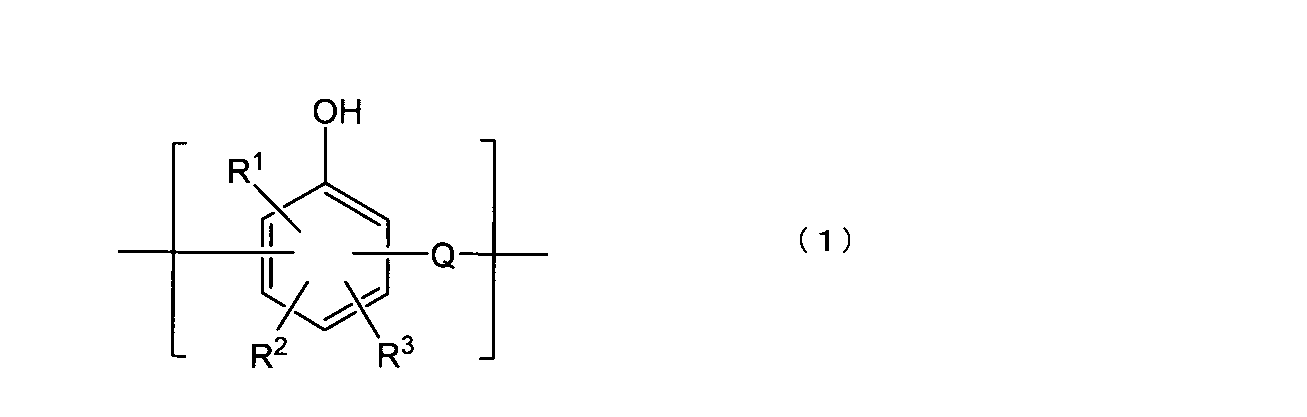
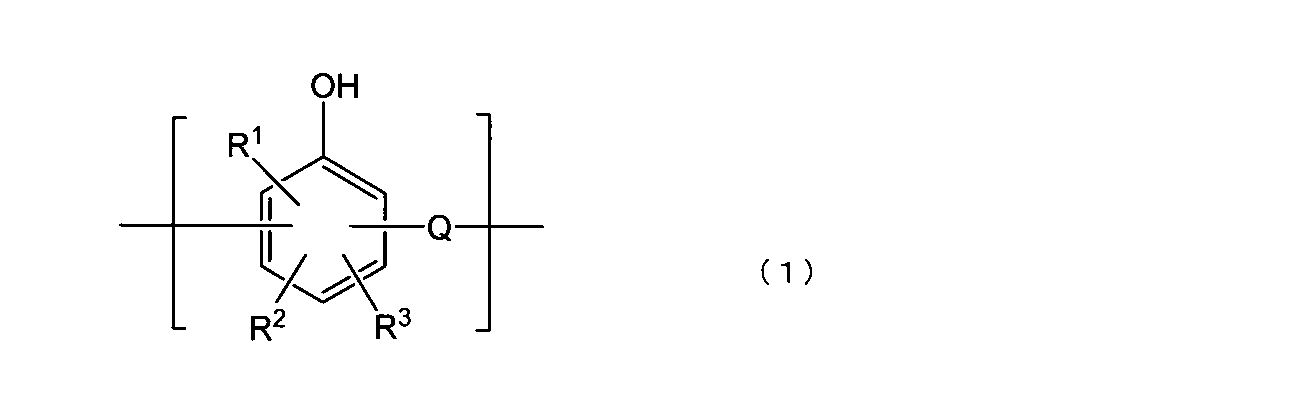
- the present invention has the formula (1)
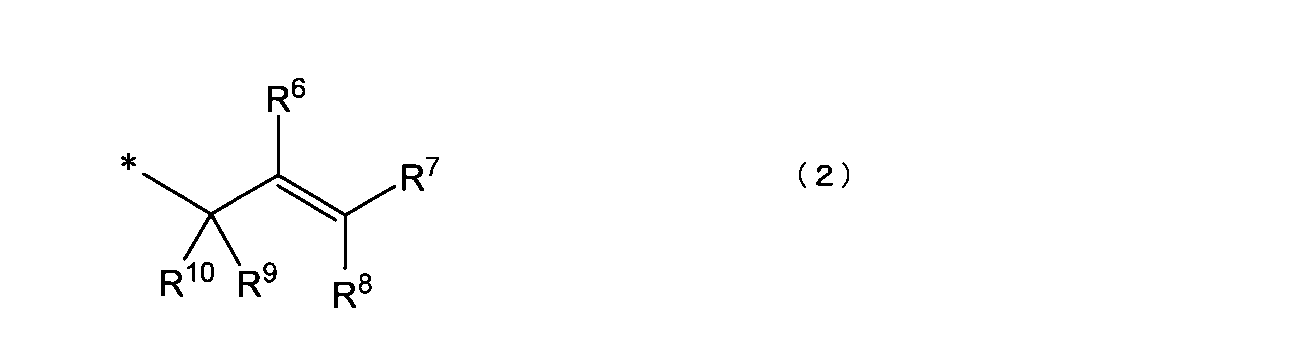
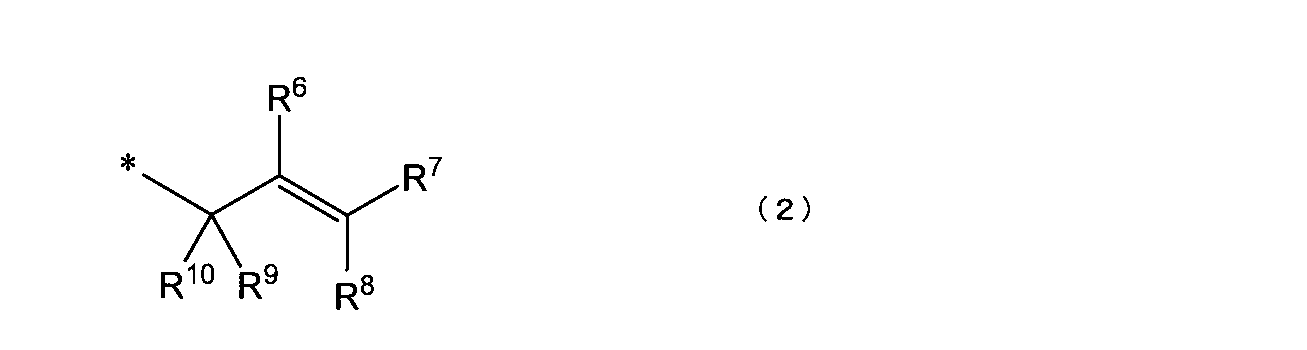
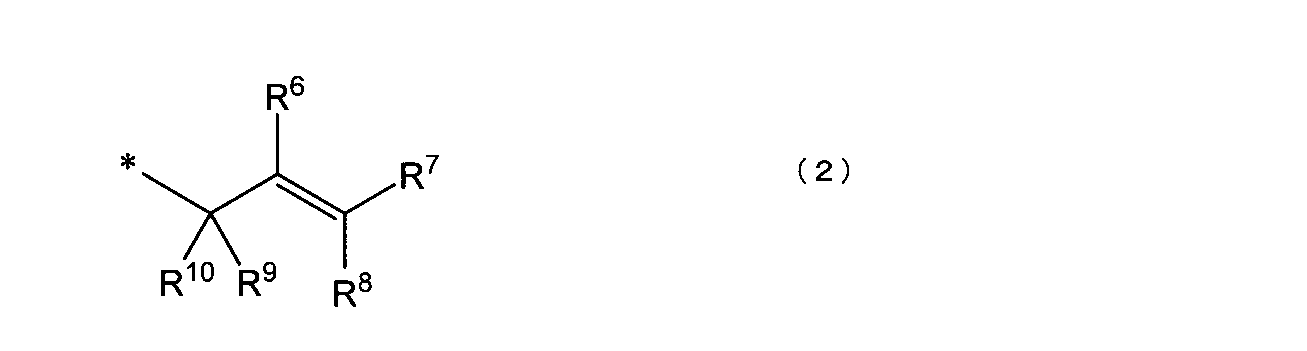
- R 1 , R 2 and R 3 are each independently a hydrogen atom, an alkyl group having 1 to 5 carbon atoms, Formula (2)
- R 1 , R 2 and R 3 is an alkenyl group represented by formula (2).
- Q is independently an alkylene group represented by the formula —CR 4 R 5 —, a cycloalkylene group having 5 to 10 carbon atoms, a divalent organic group having an aromatic ring, or a divalent organic group having an alicyclic condensed ring.
- R 4 and R 5 are each independently a hydrogen atom, an alkyl group having 1 to 5 carbon atoms, an alkenyl group having 2 to 6 carbon atoms, or a cycloalkyl having 5 to 10 carbon atoms.
- R 6 , R 7 , R 8 , R 9 and R 10 are each independently a hydrogen atom, an alkyl group having 1 to 5 carbon atoms, a cycloalkyl group having 5 to 10 carbon atoms, or 6 to 6 carbon atoms. 12 aryl groups are represented. * In the formula (2) represents a bond with a carbon atom constituting the aromatic ring.
- a positive-type photosensitive resin composition comprising a polyalkenylphenol resin having the structure: an alkali-soluble resin (excluding a polyalkenylphenol resin having the structure of formula (1)) and a quinonediazide compound.
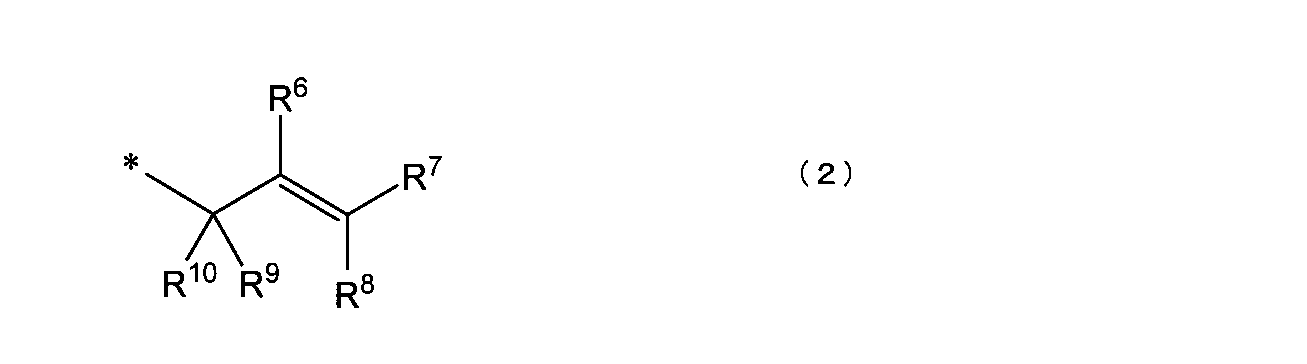
- R 1 , R 2 and R 3 are each independently a hydrogen atom, an alkyl group having 1 to 5 carbon atoms, Formula (2)
- R 1 , R 2 and R 3 is an alkenyl group represented by formula (2).
- Q is independently an alkylene group represented by the formula —CR 4 R 5 —, a cycloalkylene group having 5 to 10 carbon atoms, a divalent organic group having an aromatic ring, or a divalent organic group having an alicyclic condensed ring.
- R 4 and R 5 are each independently a hydrogen atom, an alkyl group having 1 to 5 carbon atoms, an alkenyl group having 2 to 6 carbon atoms, or a cycloalkyl having 5 to 10 carbon atoms.
- R 6 , R 7 , R 8 , R 9 and R 10 are each independently a hydrogen atom, an alkyl group having 1 to 5 carbon atoms, a cycloalkyl group having 5 to 10 carbon atoms, or 6 to 6 carbon atoms. 12 aryl groups are represented. * In the formula (2) represents a bond with a carbon atom constituting the aromatic ring.
- a positive photosensitive resin composition comprising a polyalkenylphenol resin having the structure: an alkali-soluble resin (excluding a polyalkenylphenol resin having the structure of formula (1)) and a quinonediazide compound.
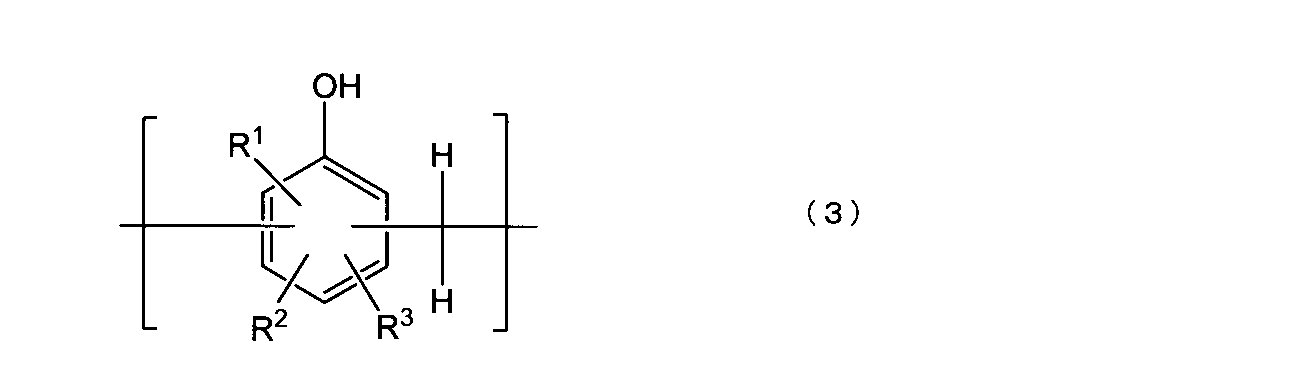
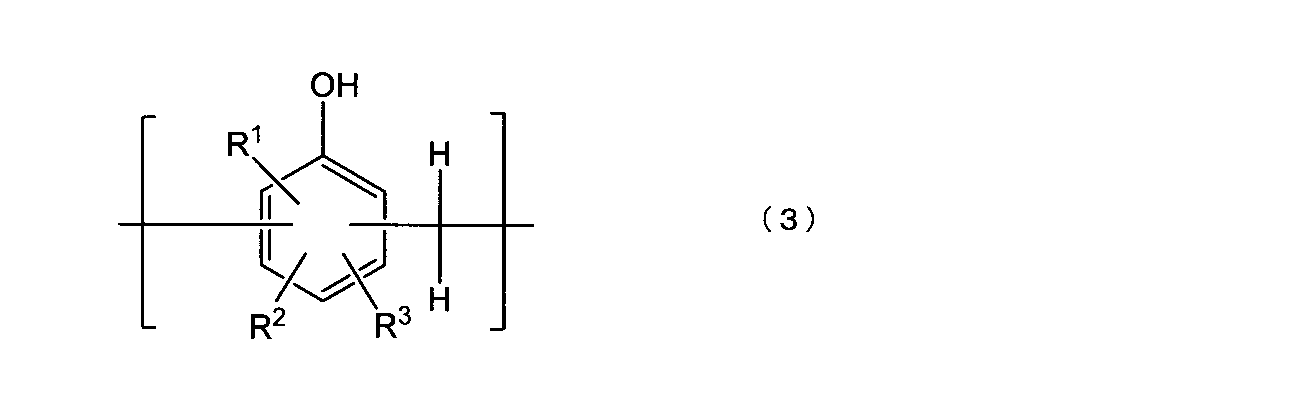
- the structure of formula (1) is represented by formula (3)
- R 1, R 2 and R 3 .p representing the same meaning as R 1, R 2 and R 3 in Formula (1) is an integer of 0-50.
- R 11 represents a divalent organic group having 2 or more carbon atoms
- R 12 represents a trivalent or tetravalent organic group having 2 or more carbon atoms
- R 13 represents a hydrogen atom or a carbon number.
- R represents an organic group having 1 to 20
- R 14 represents a hydrogen atom or an organic group having 1 to 50 carbon atoms
- m represents 1 or 2
- n represents an integer of 5 to 200.
- R 14 in the formula (5) contains an unsaturated group.
- the positive photosensitive resin composition as described in [7] wherein the unsaturated group is a maleimide group.
- the polyimide precursor is (I) Formula (6)
- step (i) a polyamic acid obtained in step (i), by reacting the acid compound represented by formula (1) with a molar ratio of 1: 0.8 to 0.95 to obtain a polyamic acid having an amino group at the terminal.
- the positive photosensitive resin composition according to any one of [1] to [9], comprising 20 to 50 parts by mass of a polyalkenylphenol resin, 100 parts by mass of an alkali-soluble resin, and 20 to 70 parts by mass of a quinonediazide compound. .
- the present invention it is possible to provide a photosensitive resin composition for positive lithography in which outgas from a coating film after heat baking is small.
- a photosensitive resin composition for positive lithography in which outgas from a coating film after heat baking is small.
- an organic electroluminescent device it is possible to produce a device that does not cause performance deterioration due to outgassing.
- the polyalkenyl phenol resin is a phenol novolak resin, a cresol novolak resin, a triphenylmethane type phenol resin, a phenol aralkyl resin, a biphenyl aralkyl phenol resin, a phenol-dicyclopentadiene copolymer resin, or the like. And can be obtained by the Claisen rearrangement of the alkenyl ether group.
- the polyalkenyl phenol resin used in the photosensitive resin composition of the present invention has a structure represented by the formula (1). By containing such a resin, it is possible to improve the development characteristics of the resulting photosensitive resin composition and to contribute to the reduction of outgas. In particular, it can be suitably used as an alternative to phenol novolac resins, cresol novolac resins, and polyvinyl phenol resins.
- R 1 , R 2 and R 3 are each independently a hydrogen atom, an alkyl group having 1 to 5 carbon atoms, Formula (2)
- R 1 , R 2 and R 3 is an alkenyl group represented by formula (2).
- Q is independently an alkylene group represented by the formula —CR 4 R 5 —, a cycloalkylene group having 5 to 10 carbon atoms, a divalent organic group having an aromatic ring, or a divalent organic group having an alicyclic condensed ring.
- R 4 and R 5 are each independently a hydrogen atom, an alkyl group having 1 to 5 carbon atoms, an alkenyl group having 2 to 6 carbon atoms, or a cycloalkyl having 5 to 10 carbon atoms.
- R 6 , R 7 , R 8 , R 9 and R 10 are each independently a hydrogen atom, an alkyl group having 1 to 5 carbon atoms, a cycloalkyl group having 3 to 10 carbon atoms, or 6 to 6 carbon atoms. 12 aryl groups are represented. * In the formula (2) represents a bond with a carbon atom constituting the aromatic ring. )
- R 1 , R 2 and R 3 in the formula (1) represent a hydrogen atom, an alkyl group having 1 to 5 carbon atoms, an alkenyl group represented by the formula (2), an alkoxy group having 1 to 2 carbon atoms or a hydroxyl group, At least one of R 1 , R 2 and R 3 is an alkenyl group represented by the formula (2).
- alkyl group having 1 to 5 carbon atoms in R 1 , R 2 and R 3 of the formula (1) include a methyl group, an ethyl group, an n-propyl group, an isopropyl group, an n-butyl group, sec- Examples thereof include a butyl group, a t-butyl group, and an n-pentyl group.
- alkoxy group having 1 to 2 carbon atoms include methoxy group and ethoxy group.
- R 6 , R 7 , R 8 , R 9 and R 10 are each independently a hydrogen atom, an alkyl group having 1 to 5 carbon atoms, or a cycloalkyl having 5 to 10 carbon atoms. Group or an aryl group having 6 to 12 carbon atoms. Specific examples of the alkyl group having 1 to 5 carbon atoms include methyl group, ethyl group, n-propyl group, isopropyl group, n-butyl group, sec-butyl group, t-butyl group, and n-pentyl group. Can do.
- Examples of the cycloalkyl group having 5 to 10 carbon atoms include a cyclopentyl group, a cyclohexyl group, a methylcyclohexyl group, and a cycloheptyl group.
- Specific examples of the aryl group having 6 to 12 carbon atoms include a phenyl group, a methylphenyl group, an ethylphenyl group, a biphenyl group, and a naphthyl group.
- R 6 , R 7 , R 8 , R 9 and R 10 are preferably each independently a hydrogen atom or an alkyl group having 1 to 5 carbon atoms.
- Preferable alkenyl groups represented by formula (2) include an allyl group and a methallyl group from the viewpoint of reactivity, and more preferably an allyl group. Most preferably, any one of R 1 , R 2 and R 3 is an allyl group or a methallyl group, and the other two are hydrogen atoms.
- Q is independently an alkylene group represented by the formula —CR 4 R 5 —, a cycloalkylene group having 5 to 10 carbon atoms, a divalent organic group having an aromatic ring, or a divalent organic group having an alicyclic condensed ring.
- R 4 and R 5 each independently represent a hydrogen atom, an alkyl group having 1 to 5 carbon atoms, an alkenyl group having 2 to 6 carbon atoms, a cycloalkyl group having 5 to 10 carbon atoms, or an aryl group having 6 to 12 carbon atoms.
- alkyl group having 1 to 5 carbon atoms in R 4 and R 5 include a methyl group, an ethyl group, an n-propyl group, an isopropyl group, an n-butyl group, a sec-butyl group, a t-butyl group, Examples thereof include an n-pentyl group.
- alkenyl group having 2 to 6 carbon atoms include vinyl group, allyl group, butenyl group, pentenyl group, hexenyl group and the like.
- Examples of the cycloalkyl group having 5 to 10 carbon atoms include a cyclopentyl group, a cyclohexyl group, a methylcyclohexyl group, and a cycloheptyl group.
- Specific examples of the aryl group having 6 to 12 carbon atoms include a phenyl group, a methylphenyl group, an ethylphenyl group, a biphenyl group, and a naphthyl group.
- R 4 and R 5 are preferably each independently a hydrogen atom or an alkyl group having 1 to 3 carbon atoms, and most preferably both are hydrogen atoms.
- cycloalkylene group having 5 to 10 carbon atoms represented by Q include a cyclopentylene group, a cyclohexylene group, a methylcyclohexylene group, and a cycloheptylene group.
- divalent organic group having an aromatic ring include a phenylene group, a tolylene group, a naphthylene group, a biphenylene group, a fluorenylene group, an anthracenylene group, a xylylene group, a 4,4-methylenediphenyl group, and a formula (8). And the like.
- divalent organic group having an alicyclic condensed ring examples include a dicyclopentadienylene group.
- polyalkenylphenol resins used in the photosensitive resin composition of the present invention those having a structure represented by the formula (3) are particularly preferable from the viewpoint of alkali developability and outgassing.
- R 1, R 2 and R 3 have the same meanings as R 1, R 2 and R 3 in the formula (1).
- Preferred R 1, R 2 and R 3 are the same as the preferred R 1, R 2 and R 3 in the formula (1).
- the structure represented by the formula (1) or the formula (3) is preferably 50 to 100% by mass, more preferably 70 to 100% by mass in the polyalkenyl phenol resin.
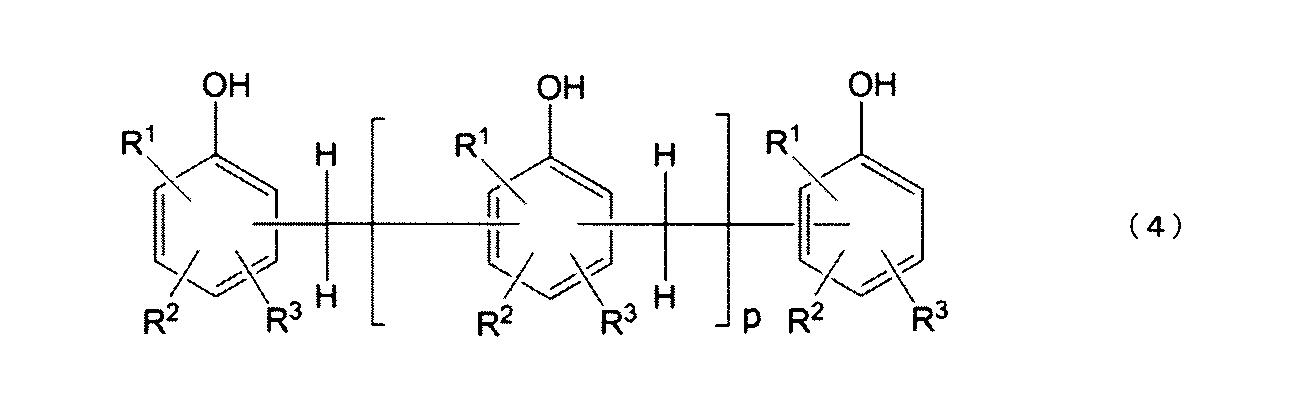
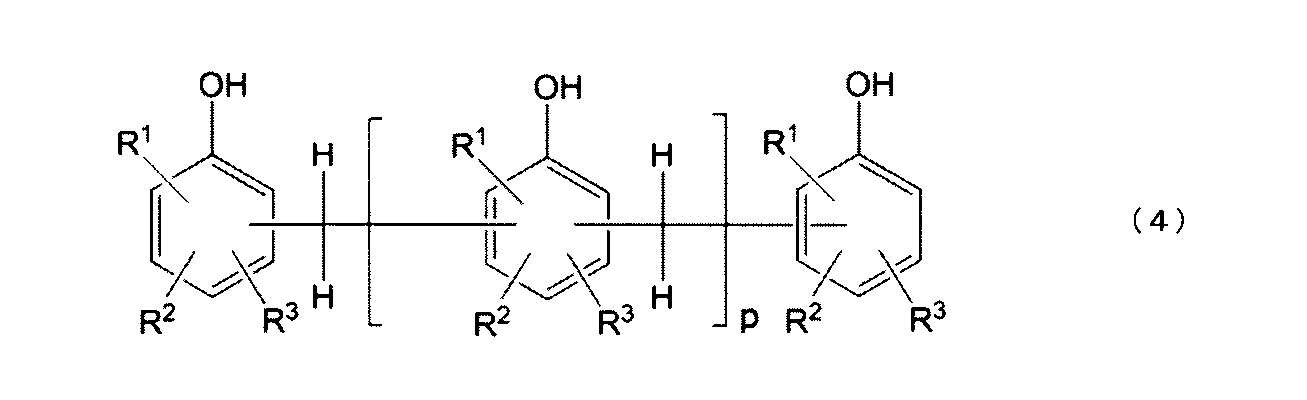
- the polyalkenylphenol resin containing the structure of the formula (3) is more preferably a polyalkenylphenol resin represented by the formula (4).
- R 1, R 2 and R 3 have the same meanings as R 1, R 2 and R 3 in the formula (1).
- p is an integer of 0-50.
- the number average molecular weight of the polyalkenyl phenol resin used in the present invention is preferably 800 to 5000, more preferably 1000 to 3000. If the number average molecular weight is less than 800, the amount of outgas increases, and if it exceeds 5000, the alkali developability deteriorates.
- the number average molecular weight and weight average molecular weight in this application are the values of polystyrene conversion obtained by GPC measurement.
- the polyalkenyl phenol resin having the structure of the formula (1) used in the present invention is obtained by alkenyl etherifying a hydroxyl group of a phenol resin used as a raw material, and then alkenyl at the ortho or para position of the original hydroxyl group by a Claisen rearrangement reaction. It is a resin obtained by rearranging groups.
- a raw material phenol resin of the polyalkenyl phenol resin having the structure of the formula (1) a known phenol resin having the structure of the formula (9) can be used.
- X 1 , X 2 and X 3 each independently represent a hydrogen atom, an alkyl group having 1 to 5 carbon atoms, an alkoxyl group having 1 to 2 carbon atoms or a hydroxyl group, and bonded to the hydroxyl group. (At least one of the substituents bonded to the carbon atom in the ortho or para position with respect to the carbon atom of the benzene ring is a hydrogen atom. Q represents the same meaning as Q in formula (1).)
- alkyl group having 1 to 5 carbon atoms examples include methyl group, ethyl group, n-propyl group, isopropyl group, n-butyl group, sec- A butyl group, a t-butyl group, an n-pentyl group and the like can be mentioned.
- alkoxy group having 1 to 2 carbon atoms include methoxy group and ethoxy group.
- Q, R 4 and R 5 are the same as Q, R 4 and R 5, respectively formula (1).
- phenol resin represented by the formula (9) examples include phenol novolak resin, cresol novolak resin, triphenylmethane type phenol resin, phenol aralkyl resin, biphenyl aralkyl phenol resin, phenol-dicyclopentadiene copolymer resin, and the like.
- a phenol novolak resin or a cresol novolak resin in which Q is an alkylene group represented by —CR 4 R 5 — and R 4 and R 5 are hydrogen atoms is preferably used. Can do.
- the alkenyl etherification reaction of a phenol resin includes (i) a known method of reacting a phenol resin with a halogenated alkenyl compound such as allyl chloride, methallyl chloride, allyl bromide, and (ii) a carboxylic acid alkenyl compound such as allyl acetate Two methods of reacting the phenol resin can be exemplified.
- a halogenated alkenyl compound such as allyl chloride, methallyl chloride, allyl bromide
- a carboxylic acid alkenyl compound such as allyl acetate
- the photosensitive resin composition of the present invention is required to have long-term insulation performance, the method (ii) above in which a halogen compound derived from a halogenated alkenyl compound that may adversely affect long-term insulation performance is not mixed is preferable.
- the addition amount of the alkenyl halide compound or alkenyl carboxylate to the phenolic hydroxyl group is preferably 0.3 to 1.0 equivalent, more preferably 0.5 to 1.0 equivalent. If it is less than 0.3 equivalent, the reactivity with bismaleimide after the Claisen rearrangement may be lowered.
- the target polyalkenyl phenol resin can be obtained by performing a Claisen rearrangement reaction on the polyalkenyl ether resin produced by the method described in the above-mentioned “alkenyl etherification reaction of phenol resin”.
- the Claisen rearrangement reaction can be obtained by heating to a temperature of 100 to 250 ° C. and reacting for 1 to 20 hours.
- a high boiling point solvent may be used or no solvent may be used.
- an inorganic salt such as sodium thiosulfate or sodium carbonate may be added. Details are described in JP-A-2-91113.
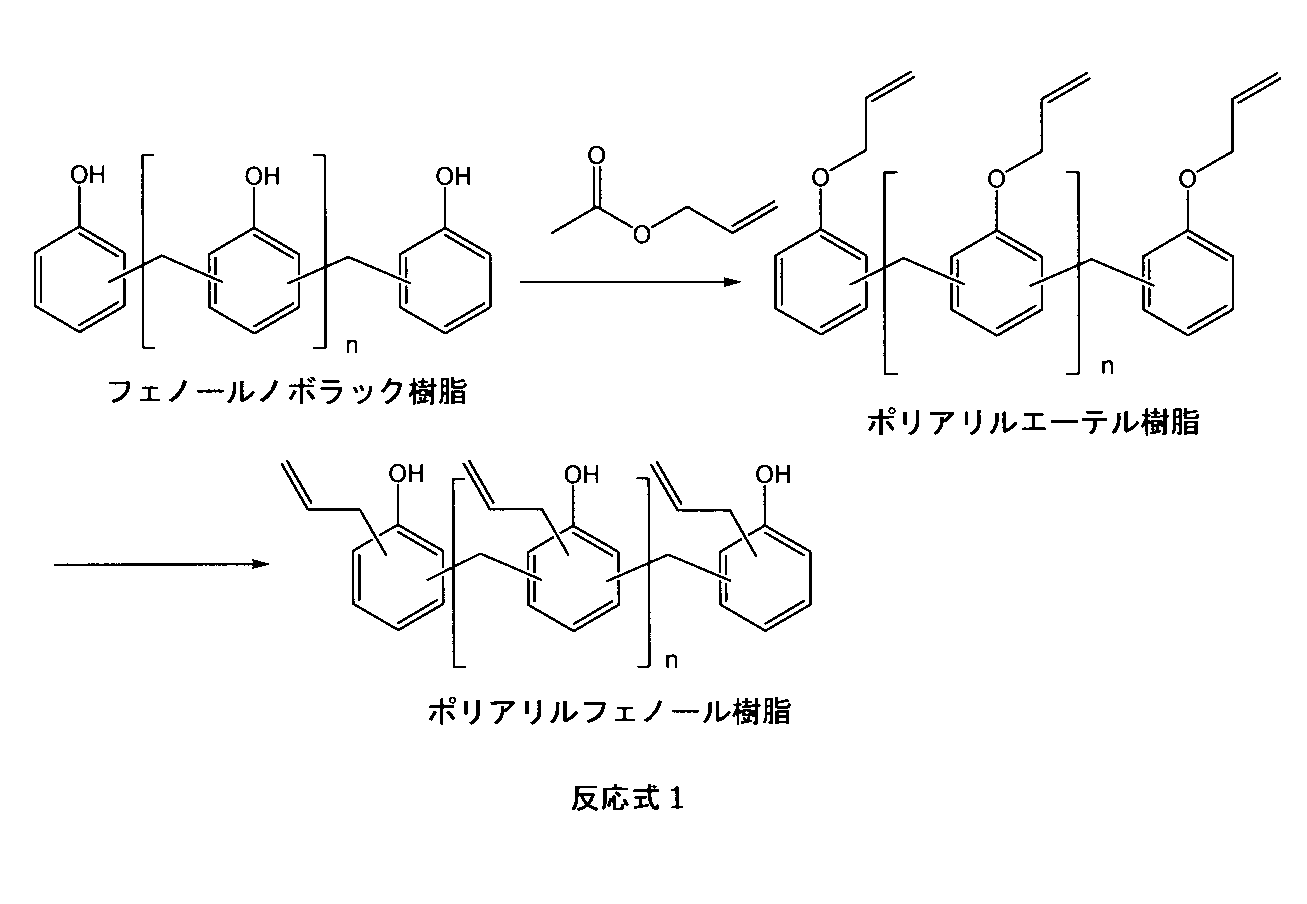
- An example of a reaction formula of phenol novolac resin ⁇ alkenyl ether resin ⁇ (Claisen rearrangement reaction) ⁇ polyalkenyl phenol resin is shown in the following reaction formula 1.
- the content of the polyalkenylphenol resin in the photosensitive resin composition is preferably 20 to 50 parts by weight, more preferably 30 to 40 parts by weight, based on 100 parts by weight of the alkali-soluble resin. If it is 20 parts by mass or more, the heat resistance during baking at 300 to 400 ° C. is good, and if it is 50 parts by mass or less, the pattern formability during alkali development is good.
- the photosensitive resin composition of this invention contains alkali-soluble resin (however, except the polyalkenyl phenol resin which has a structure of Formula (1)).
- the alkali-soluble resin improves the solubility of the composition in an alkaline solution.
- the alkali-soluble resin preferably has a hydroxyl group or a carboxyl group, and includes a phenol novolac resin, a cresol novolac resin, a polyvinyl phenol resin, a carboxylic acid-containing acrylic polymer, a phenol group-containing acrylic polymer, a carboxylic acid-containing silicone resin, and a phenol group-containing silicone.
- Examples thereof include resins, polybenzoxazole precursors, polyimide precursors, and phenol group-containing polyimides.
- the alkali-soluble resin when a 2 ⁇ m resin coating film is prepared on a glass plate and immersed in an aqueous 2.38% tetramethylammonium hydroxide solution, it is preferably completely dissolved within 60 seconds.
- the photosensitive resin composition of the present invention preferably contains a polyimide precursor represented by the formula (5).
- R 11 represents a divalent organic group having 2 or more carbon atoms
- R 12 represents a trivalent or tetravalent organic group having 2 or more carbon atoms
- R 13 represents a hydrogen atom or a carbon number.
- R represents an organic group having 1 to 20
- R 14 represents a hydrogen atom or an organic group having 1 to 50 carbon atoms
- m represents 1 or 2
- n represents an integer of 5 to 200.
- R 11 and R 12 preferably have an aromatic ring, and preferred aromatic rings are a benzene ring and a naphthalene ring.
- preferred aromatic rings are a benzene ring and a naphthalene ring.
- R 12 examples include
- Examples of the organic group having 1 to 20 carbon atoms of R 13 include methyl group, ethyl group, propyl group, butyl group, pentyl group, hexyl group, trimethylsilyl group, phenyl group, hydroxyphenyl group, carboxylphenyl group, A methyl carboxyl phenyl group etc. are mentioned. From the viewpoint of solubility in an alkali developer, a hydrogen atom, a hydroxyphenyl group or a carboxylphenyl group is preferred.
- Examples of the organic group having 1 to 50 carbon atoms of R 14 are a residue obtained by reacting a carboxylic acid compound, a carboxylic acid anhydride, or a maleimide and an amino group, and is appropriately selected for adjusting the solubility in an alkali developer.
- the solid content acid value of the compound of formula (5) is preferably 110 to 210 mgKOH / g.
- the solubility in an alkali developer is improved when the polyalkenylphenol resin and the quinonediazide compound are blended. Good shape.
- R 14 preferably contains an unsaturated group.
- the unsaturated group examples include, but are not limited to, a maleimide group, a vinyl group, an allyl group, an acryloyl group, and a methacryloyl group.
- a maleimide group is preferable.
- the maleimide group is a monovalent organic group in a form in which a hydrogen atom bonded to a nitrogen atom of maleimide is eliminated to form a bond.
- R 14 contains a maleimide group
- the cross-linking reaction with the polyalkenylphenol resin is preferable because the heat resistance is further increased.
- a preferred number average molecular weight of the compound of the formula (5) is 5000 to 20000.
- the polyimide precursor represented by the formula (5) is a diamine compound or a derivative thereof and an acid compound or a derivative such as tricarboxylic acid or tetracarboxylic acid, such as N-methyl-2-pyrrolidone, ⁇ -butyrolactone, N , N-dimethyl sulfoxide, N, N-dimethylacetamide, N, N-dimethylformamide, propylene carbonate, propylene glycol monomethyl ether, propylene glycol monomethyl ether acetate, butyl cellosolve, ethyl cellosolve, etc., and -30 ° C to 300 ° C It can be obtained by reacting in the range of ° C.
- an acid compound or a derivative such as tricarboxylic acid or tetracarboxylic acid, such as N-methyl-2-pyrrolidone, ⁇ -butyrolactone, N , N-dimethyl sulfoxide, N, N-di
- diamine or a derivative thereof with an acid compound such as tricarboxylic acid or tetracarboxylic acid or a derivative thereof in a molar ratio of 1: 0.8 to 0.95 to make the terminal an amino group.
- the terminal amino group may be reacted with a carboxylic acid compound, a carboxylic acid anhydride, maleimide, or the like.
- a preferred diamine for producing the compound of formula (5) is represented by formula (6).
- R 11 is the same as R 11 in formula (5).
- the diamine compound used include 1,4-phenylenediamine, 1,3-phenylenediamine, 4,4′-diaminodiphenyl ether, 4,4′-diaminodiphenylmethane, 4,4′-diaminodiphenylsulfone, 4 4,4'-diaminodiphenyl sulfide and the like, and these can be used alone or in admixture of two or more.
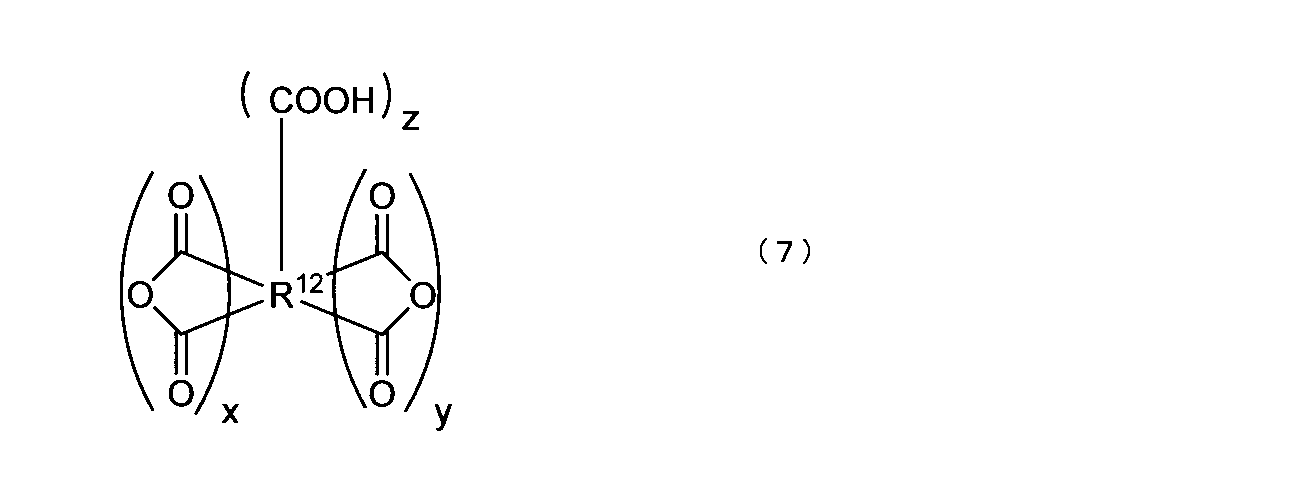
- a preferred acid compound for producing the compound of formula (5) is represented by formula (7).
- R 12 is the same as R 12 in formula (5).
- the acid compound used include pyromellitic acid, 3,3 ′, 4,4′-biphenyltetracarboxylic acid, 2,3,3 ′, 4′-biphenyltetracarboxylic acid, 3,3 ′, 4 , 4'-benzophenone tetracarboxylic acid, 4,4'-oxydiphthalic acid, 3,3 ', 4,4'-diphenylsulfone tetracarboxylic acid, 2,2'-bis (3,4-dicarboxyphenyl) hexafluoro Propane, 2,3,6,7-naphthalenetetracarboxylic acid, 1,2,5,6-naphthalenetetracarboxylic acid, 1,4,5,8-naphthalenetetracarboxylic acid, 1,2,3,4-cyclobutane Tetracarboxylic acid, 1,2,3,4-butanetetracarboxylic acid, 1,2,4,5-cyclopentanetetracarboxylic acid
- maleimide compounds to be reacted with the terminal amino group include monofunctional maleimide compounds such as N-phenylmaleimide, p-hydroxyphenylmaleimide, m-hydroxyphenylmaleimide, p-carboxyphenylmaleimide, N-dodecylmaleimide, bis (4- Bismaleimide compounds such as maleimidophenyl) methane, 4-methyl-1,3-dimaleimidobenzene, bis (3-ethyl-5-methyl-4-maleimidophenyl) methane, Tris such as tris (4-maleimidophenyl) methane Examples thereof include a maleimide compound, a tetrakismaleimide compound such as bis (3,4-dimaleimidophenyl) methane, and a polymaleimide compound such as poly (4-maleimidestyrene). These may be used alone or in combination of two or more. it can.
- the positive photosensitive resin composition of the present invention contains a quinonediazide compound as a radiation sensitive compound.
- the quinonediazide compound includes a polyhydroxy compound in which a sulfonic acid of quinonediazide is bonded with an ester, a polyamino compound in which a sulfonic acid of quinonediazide is bonded to a sulfonamide, and a sulfonic acid of quinonediazide in an ester bond and / or sulfone. Examples include amide-bonded ones.
- quinonediazide a positive photosensitive resin composition that is sensitive to i-line (365 nm), h-line (405 nm), and g-line (436 nm) of a mercury lamp that is a general ultraviolet ray. it can.
- Polyhydroxy compounds include Bis-Z, BisP-EZ, TekP-4HBPA, TrisP-HAP, TrisP-PA, TrisP-SA, TrisOCR-PA, BisOCHP-Z, BisP-MZ, BisP-PZ, BisP-IPZ, BisOCP-IPZ, BisP-CP, BisRS-2P, BisRS-3P, BisP-OCHP, Methylenetris-FR-CR, BisRS-26X, DML-MBPC, DML-MBOC, DML-OCHP, DML-PCHP, DML-PC , DML-PTBP, DML-34X, DML-EP, DML-POP, dimethylol-BisOC-P, DML-PFP, DML-PSBP, DML-MTrisPC, TriML-P, TriML-35XL, TML-BP, TM -HQ, TML-pp-BPF, TML-BPA, TMOM-BP, HML-TPPHBA, HML-TPHAP (
- Examples of the quinonediazide compound include 1,2-naphthoquinonediazide-4-sulfonic acid ester or 1,2-naphthoquinonediazide-5-sulfonic acid ester of the above polyhydroxy compound.
- the quinonediazide compound generates a carboxyl group through a reaction shown in the following reaction formula 2 when exposed to ultraviolet light or the like.
- production of a carboxyl group enables it to melt
- the content of the quinonediazide compound in the photosensitive resin composition varies depending on the quinonediazide compound to be used, but is preferably 20 to 70 parts by weight, more preferably 30 to 60 parts by weight based on 100 parts by weight of the alkali-soluble resin. .
- Alkali developability is favorable as it is 20 mass parts or more.
- the rate of decrease in heating at 300 ° C. or higher is difficult to increase.
- the photosensitive resin composition of the present invention is dissolved in a solvent and used in a solution state.
- a polyalkenylphenol resin or an alkali-soluble resin is dissolved in a solvent, and a quinonediazide compound and, if necessary, a thermosetting agent, a surfactant, or a colorant such as a dye or pigment is mixed in this solution at a certain ratio.
- a photosensitive resin composition in a solution state can be prepared.
- the solvent examples include glycol ethers such as ethylene glycol monomethyl ether, ethylene glycol dimethyl ether, ethylene glycol methyl ethyl ether and ethylene glycol monoethyl ether, ethylene glycol alkyl ether acetates such as methyl cellosolve acetate and ethyl cellosolve acetate, diethylene glycol monomethyl ether, Diethylene glycols such as diethylene glycol diethyl ether, diethylene glycol dimethyl ether, diethylene glycol ethyl methyl ether, diethylene glycol monoethyl ether, diethylene glycol monobutyl ether, propylene glycol methyl ether acetate, propylene glycol ethyl ether acetate, etc.
- glycol ethers such as ethylene glycol monomethyl ether, ethylene glycol dimethyl ether, ethylene glycol methyl ethyl ether and ethylene glycol monoethyl ether
- Propylene glycol alkyl ether acetates aromatic hydrocarbons such as toluene and xylene, ketones such as methyl ethyl ketone, methyl amyl ketone, cyclohexanone, 4-hydroxy-4-methyl-2-pentanone and cyclohexanone, ethyl 2-hydroxypropionate Methyl 2-hydroxy-2-methylpropionate, ethyl 2-hydroxy-2-methylpropionate, ethyl ethoxyacetate, ethyl hydroxyacetate, methyl 2-hydroxy-2-methylbutanoate, methyl 3-methoxypropionate, 3- Esters such as ethyl methoxypropionate, methyl 3-ethoxypropionate, ethyl 3-ethoxypropionate, ethyl acetate, butyl acetate, methyl lactate, ethyl lactate, ⁇ -butyrolactone, N-methyl-2-pi Amides such as
- a thermal radical generator can be used as a thermosetting agent as an optional component.
- the thermal radical generator include organic peroxides, and specifically include dicumyl peroxide, 2,5-dimethyl-2,5-di (tert-butylperoxy) hexane, and tert-butyl.
- Organic peroxides such as cumyl peroxide, di-tert-butyl peroxide, 1,1,3,3-tetramethylbutyl hydroperoxide, cumene hydroperoxide, etc. having a 10-hour half-life temperature of 100 to 170 ° C. Can be mentioned.
- the preferable content of the thermosetting agent in the positive photosensitive resin composition is preferably 0.1 to 5 parts by mass, more preferably 0, based on 100 parts by mass of the total amount of the polyalkenylphenol resin and the alkali-soluble resin. .5-3 parts by mass.
- the positive photosensitive resin composition of the present invention can further contain a surfactant as an optional component, for example, in order to improve coatability or improve the developability of the coating film.
- a surfactant include polyoxyethylene alkyl ethers such as polyoxyethylene lauryl ether, polyoxyethylene stearyl ether, polyoxyethylene oleyl ether; polyoxyethylene octyl phenyl ether, polyoxyethylene nonyl phenyl ether
- Nonionic surfactants such as polyoxyethylene dialkyl esters such as polyoxyethylene dilaurate and polyoxyethylene distearate; Megafax F-251, F-281, F- 430, F-444, R-40 (above, trade name, manufactured by DIC Corporation), Surflon S-242, S-243, S-420, S-611 (above, trade name, ACG Seimi) chemical Fluorine-based surfactants such as Formula Company Ltd.); an organosiloxane polymer KP323, KP326, KP34
- the positive photosensitive resin composition of the present invention can contain a coloring material such as a dye or a pigment as an optional component.
- a coloring material such as a dye or a pigment
- Such coloring materials such as dyes and pigments may be inorganic pigments or organic pigments.
- Specific examples of such a colorant include black pigments such as carbon black, carbon nanotubes, acetylene black, graphite, iron black, aniline black, and titanium black, and C.I. I. Pigment Yellow 20, 24, 86, 93, 109, 110, 117, 125, 137, 138, 147, 148, 153, 154, 166, C.I. I. Pigment orange 36, 43, 51, 55, 59, 61, C.I. I.
- the positive photosensitive resin composition of the present invention is prepared by dissolving or dispersing the polyalkenylphenol resin, alkali-soluble resin, quinonediazide compound and other components as necessary in the solvent, and mixing them. Depending on the purpose of use, an appropriate solid content concentration can be adopted. For example, the solid content concentration can be 10 to 60% by mass. Moreover, the composition liquid prepared as mentioned above is usually filtered before use. Examples of the filtering means include a Millipore filter having a pore diameter of 0.05 to 1.0 ⁇ m. The positive photosensitive resin composition of the present invention thus prepared is also excellent in long-term storage stability.
- the positive photosensitive resin composition of the present invention is used for radiation lithography, first, the positive photosensitive resin composition of the present invention is applied to the substrate surface, and the solvent is removed by drying or the like by means such as heating. Thus, a coating film can be formed.
- the method for applying the positive photosensitive resin composition to the substrate surface is not particularly limited, and various methods such as a spray method, a roll coating method, a slit method, and a spin coating method can be employed.
- the solvent is usually dried by heating (pre-baking) to form a coating film.
- the heating conditions vary depending on the type of each component, the blending ratio, etc., but usually at 70 to 120 ° C. for a predetermined time, for example, 1 to 20 minutes on a hot plate, and 3 to 60 minutes in an oven for coating. Can be obtained.
- the pre-baked coating film is irradiated with radiation (for example, visible light, ultraviolet light, far ultraviolet light, X-rays, electron beams, gamma rays, synchrotron radiation, etc.) through a mask having a predetermined pattern (exposure process), It develops with a developing solution, an unnecessary part is removed, and a predetermined pattern-like coating film is formed (development process).
- radiation for example, visible light, ultraviolet light, far ultraviolet light, X-rays, electron beams, gamma rays, synchrotron radiation, etc.
- the preferable radiation for the positive photosensitive resin composition of the present invention is ultraviolet rays to visible rays having a wavelength of 250 to 450 nm because naphthoquinone diazide sulfonic acid ester is preferably used as the positive photosensitive compound.
- Examples of the developer include inorganic alkalis such as sodium hydroxide, potassium hydroxide, sodium carbonate, sodium silicate, sodium metasilicate, and aqueous ammonia; primary amines such as ethylamine and n-propylamine; Secondary amines such as n-propylamine; tertiary amines such as triethylamine and methyldiethylamine; alcohol amines such as dimethylethanolamine and triethanolamine; tetramethylammonium hydroxide, tetraethylammonium hydroxide, choline Quaternary ammonium salts such as: cyclic amines such as pyrrole, piperidine, 1,8-diazabicyclo [5.4.0] -7-undecene, 1,5-diazabicyclo [4.3.0] -5-nonane Alkaline water such as Liquid can be used.
- inorganic alkalis such as sodium hydroxide, potassium hydroxide
- an aqueous solution obtained by adding an appropriate amount of a water-soluble organic solvent such as methanol or ethanol, a surfactant or the like to the alkaline aqueous solution can also be used as a developer.
- the development time is usually 30 to 180 seconds, and the development method may be any of a liquid filling method, a shower method, a dipping method and the like. After development, washing with running water is performed for 30 to 90 seconds, unnecessary portions are removed, and the pattern is formed by air drying with compressed air or compressed nitrogen.
- a coating film can be obtained by heating the pattern at a predetermined temperature, for example, 150 to 350 ° C. for 20 to 200 minutes using a heating device such as a hot plate or an oven. It does not matter (heat treatment step).
- the radiation lithography structure using the positive photosensitive resin composition of the present invention produced by the above method is further baked under conditions of 350 to 450 ° C. to remove volatile components, and the temperature when the mass decreases by 5%.
- High radiation lithography structures may be used.
- the firing atmosphere may be either air or an inert gas atmosphere such as nitrogen.
- the firing time is preferably 5 to 60 minutes, more preferably 10 to 40 minutes, depending on the firing temperature. If the firing time is less than 5 minutes, the effect may not be seen, and if it exceeds 60 minutes, the productivity may decrease.
- allyl acetate manufactured by Showa Denko KK
- 50% water content 5% -Pd / C-STD type metal palladium was dispersed in activated carbon at a content of 5% by mass under a nitrogen stream
- 0.62 g (0.291 mmol) of an allylation reaction catalyst which was stabilized by blending water so that the metal palladium and activated carbon dispersion was 50% by mass, manufactured by N.E. 3.82 g (14.6 mmol) of an activator of an allylation reaction catalyst using palladium (made by Hokuko Chemical Co., Ltd.) was added, heated to 105 ° C. in a nitrogen atmosphere and reacted for 4 hours.
- Polyimide precursor 1 10.00 g (0.05 mol) of 4,4′-diaminodiphenyl ether (Wako Pure Chemical Industries, Ltd., hereinafter abbreviated as “ODA”) was added to N-methylpyrrolidone ( Wako Pure Chemical Industries, Ltd. (hereinafter abbreviated as “NMP”) dissolved in 70 g, 3,3 ′, 4,4′-biphenyltetracarboxylic anhydride (Wako Pure Chemical Industries, Ltd., hereinafter “BPDA”) 13.22 g (0.045 mol) was added and stirred at 40 ° C. for 5 hours.
- ODA 4,4′-diaminodiphenyl ether
- NMP N-methylpyrrolidone
- BPDA 4,4′-biphenyltetracarboxylic anhydride
- p-HBzOH p-hydroxybenzyl alcohol
- the reaction solution was returned to room temperature and then poured into 1500 mL of acetone, and the precipitate was recovered to obtain a pale yellow solid. Furthermore, the obtained solid was washed with 1500 mL of water, and then dried for 10 hours with a vacuum dryer at 50 ° C. to obtain a light yellow powder of polyimide precursor 2.
- the solid content acid value of the polyimide precursor 2 was 150 mgKOH / g.
- the solid content acid value of the polyimide precursor 3 was 115 mgKOH / g.
- Example 2 It was prepared in the same manner as in Example 1 except that the polyimide precursor 1 was changed to the polyimide precursor 2.
- Example 3 It was prepared in the same manner as in Example 1 except that the polyimide precursor 1 was changed to the polyimide precursor 3.
- Example 4 It was prepared in the same manner as in Example 1 except that the polyimide precursor 1 was changed to the polyimide precursor 4.
- Example 5 It was prepared in the same manner as in Example 1 except that the polyimide precursor 1 was changed to the phenol novolac resin “Shonol” (trademark) BRG-556 (manufactured by Showa Denko KK).
- Example 6 It was prepared in the same manner as in Example 1 except that the polyimide precursor 1 was changed to cresol novolac resin “Shonol” (trademark) CRG-951 (manufactured by Showa Denko KK).
- Comparative Example 1 A polyalkenylphenol resin A-1 was prepared in the same manner as in Example 1 except that the cresol novolac resin “Shonol” (trademark) CRG-951 (manufactured by Showa Denko KK) was used.
- Comparative Example 2 A polyimide precursor 1 and a polyalkenylphenol resin A-1 were prepared in the same manner as in Example 1 except that the total amount of the novolak phenol resin “Shonol” (trademark) BRG-556 (manufactured by Showa Denko KK) was changed.
- Comparative Example 3 A polyimide precursor 1 and a polyalkenylphenol resin A-1 were prepared in the same manner as in Example 1 except that the total amount was changed to cresol novolac resin “Shonol” (trademark) CRG-591 (manufactured by Showa Denko KK).
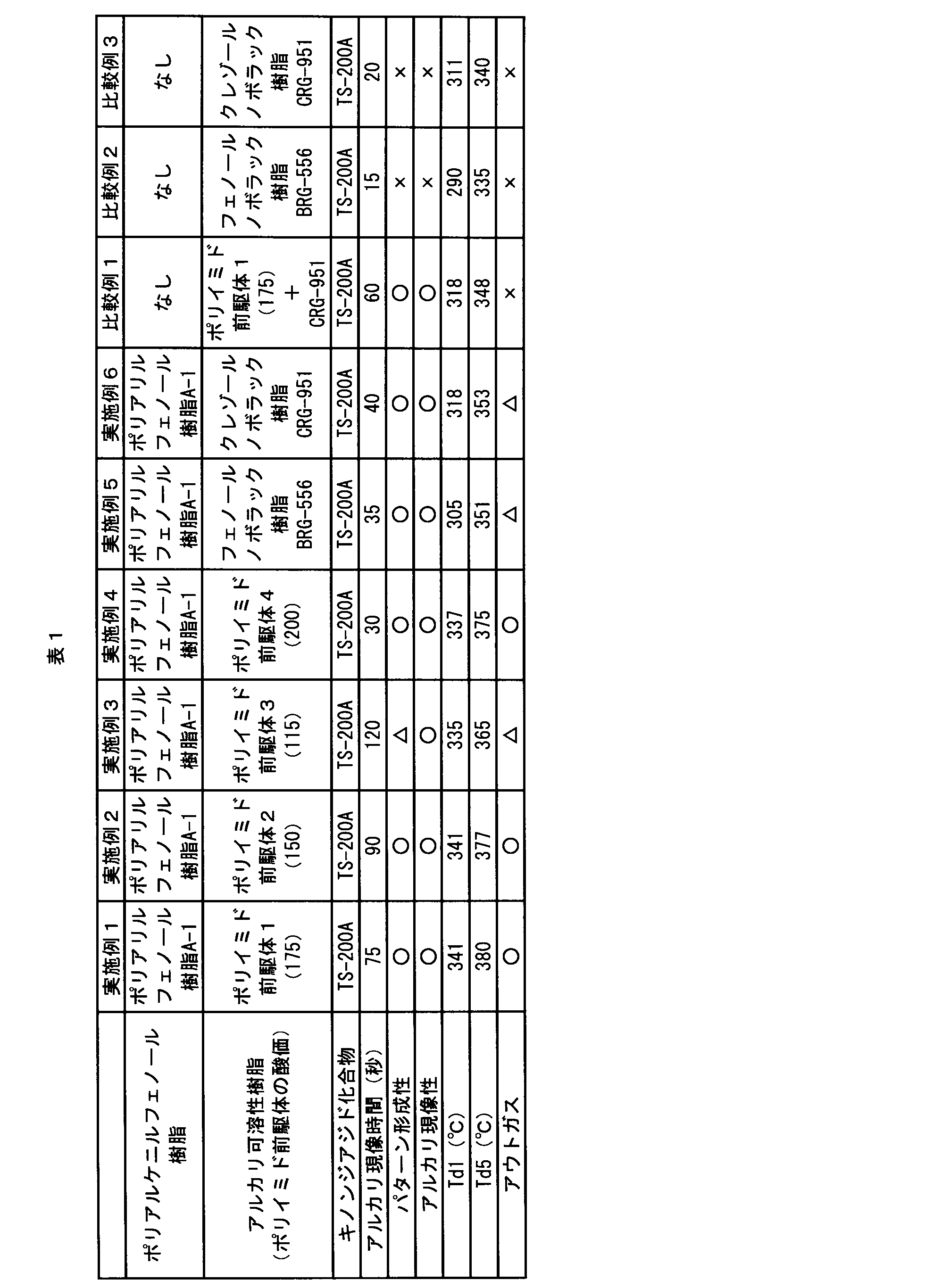
- the acid value was measured for the polyimide precursor used in each example and each comparative example, and pattern formation / alkali developability and outgas were evaluated for the positive photosensitive resin composition prepared in each example and each comparative example. .
- the results are shown in Table 1.
- the acid value measurement method and pattern formation / alkali developability and outgas evaluation method are as follows.
- a positive photosensitive resin composition of each example and each comparative example was spin coated on a glass substrate (size 100 mm ⁇ 100 mm ⁇ 1 mm) so that the dry film thickness was about 2 ⁇ m, and the solvent was dried at 110 ° C. for 2 minutes. did. Further, exposure was performed at 600 mJ / cm 2 through a quartz photomask with an exposure apparatus (trade name: Multilight ML-251A / B, manufactured by USHIO INC.) Incorporating an ultra-high pressure mercury lamp. The amount of exposure was measured using an ultraviolet integrated light meter (trade name UIT-150, light receiving unit UVD-S365, manufactured by USHIO INC.).
- the exposed coating film is further subjected to alkali development with a 2.38% tetramethylammonium hydroxide aqueous solution, and the alkali development time in which the line width of the pattern is almost the same as the line width of the photomask is measured to evaluate the pattern formability. did.
- the case where the pattern could be formed in the alkali development time of 30 to 100 seconds was judged as ⁇ , the case of 100 to 180 seconds was judged as ⁇ , and the case where the pattern was out of the range was judged as ⁇ .
- the line width of the pattern of the photomask that is the target of pattern formation evaluation is 50 ⁇ m.
- Alkali development was performed using a spin development apparatus (AD-1200, manufactured by Takizawa Sangyo Co., Ltd.), and line width measurement was performed using an optical microscope (VH-Z250, manufactured by Keyence Corporation). Moreover, the alkali developability was evaluated by observing the presence or absence of a development residue in the exposed portion with an optical microscope during an alkali development time in which the line width of the pattern was almost the same as the line width of the photomask. The case where there was no residue was judged as ⁇ , and the case where there was a residue was judged as ⁇ .
- the positive photosensitive resin compositions of the examples and comparative examples were coated on an aluminum plate and dried at 100 ° C. for 30 minutes to form a coating film having a thickness of 10 to 20 ⁇ m. Furthermore, after drying at 130 ° C. for 30 minutes in the air, curing was performed at 250 ° C. for 60 minutes under nitrogen. Using the coating film, a differential thermogravimetric simultaneous measurement apparatus TG / DTA7000 (manufactured by Hitachi High-Tech Science Co., Ltd.) was used, and the temperature was increased from room temperature to 10 ° C./min in a nitrogen atmosphere, and the amount of decrease in heating was measured as outgas.
- TG / DTA7000 manufactured by Hitachi High-Tech Science Co., Ltd.
- the temperature at which the mass was reduced by 1% before the temperature rise was Td1
- the temperature at which the mass was reduced by 5% was Td5
- the Td5 was 370.degree. C. or higher, .largecircle.
- the thing below ° C. was determined as x.
- the radiation-sensitive composition of the present invention can be suitably used for positive radiation lithography.
- it can be suitably used for forming an insulating film such as an organic electroluminescent element.
Landscapes
- Physics & Mathematics (AREA)
- Chemical & Material Sciences (AREA)
- General Physics & Mathematics (AREA)
- Spectroscopy & Molecular Physics (AREA)
- Polymers & Plastics (AREA)
- Organic Chemistry (AREA)
- Health & Medical Sciences (AREA)
- Chemical Kinetics & Catalysis (AREA)
- Medicinal Chemistry (AREA)
- Optics & Photonics (AREA)
- General Chemical & Material Sciences (AREA)
- Manufacturing & Machinery (AREA)
- Engineering & Computer Science (AREA)
- Materials For Photolithography (AREA)
- Photosensitive Polymer And Photoresist Processing (AREA)
- Exposure And Positioning Against Photoresist Photosensitive Materials (AREA)
Abstract
Description

の構造を有するポリアルケニルフェノール樹脂、アルカリ可溶性樹脂(ただし、式(1)の構造を有するポリアルケニルフェノール樹脂を除く。)およびキノンジアジド化合物を含有するポジ型感光性樹脂組成物である。
[1]式(1)
の構造を有するポリアルケニルフェノール樹脂、アルカリ可溶性樹脂(ただし、式(1)の構造を有するポリアルケニルフェノール樹脂を除く。)およびキノンジアジド化合物を含有するポジ型感光性樹脂組成物。
[2]式(1)の構造が式(3)
の構造であることを特徴とする[1]に記載のポジ型感光性樹脂組成物。
[3]式(3)の構造を有するポリアルケニルフェノール樹脂が、式(4)
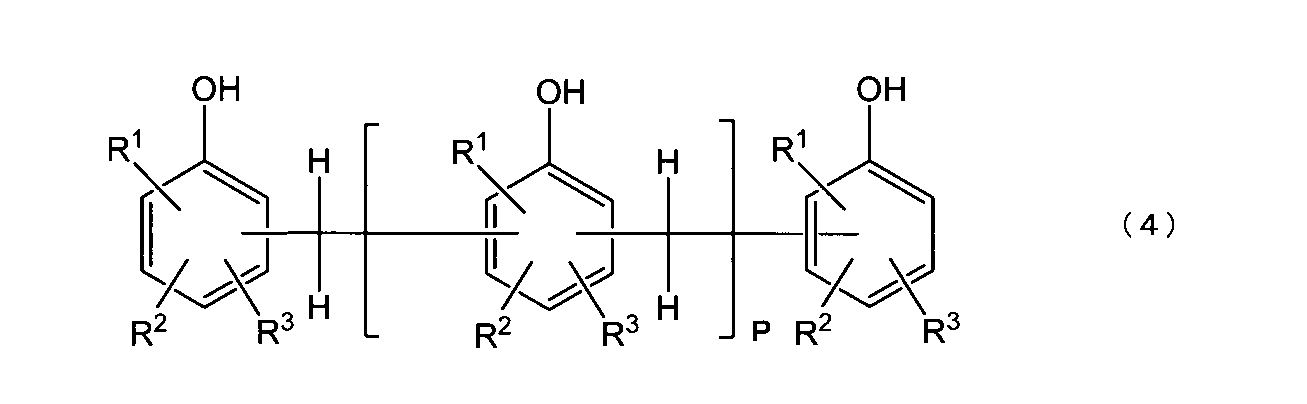
の構造を含むことを特徴とする[2]に記載のポジ型感光性樹脂組成物。
[4]式(2)で表されるアルケニル基がアリル基であることを特徴とする[1]~[3]のいずれかに記載のポジ型感光性樹脂組成物。
[5]アルカリ可溶性樹脂がポリイミド前駆体であることを特徴とする[1]~[4]のいずれかに記載のポジ型感光性樹脂組成物。
[6]前記ポリイミド前駆体が式(5)

で表されることを特徴とする[1]~[5]のいずれかに記載のポジ型感光性樹脂組成物。
[7]式(5)のR14が不飽和基を含むことを特徴とする[6]に記載のポジ型感光性樹脂組成物。
[8]前記不飽和基がマレイミド基であることを特徴とする[7]に記載のポジ型感光性樹脂組成物。
[9]前記ポリイミド前駆体が、
(i)式(6)


で表される酸化合物を、1:0.8~0.95のモル比で反応させ、末端にアミノ基を有するポリアミック酸を得る工程、および
(ii)工程(i)で得られたポリアミック酸の末端のアミノ基にビスマレイミド化合物を反応させることにより、末端にマレイミド基を有するポリイミド前駆体を得る工程
を含む方法によって製造されることを特徴とする[8]に記載のポジ型感光性樹脂組成物。
[10]ポリアルケニルフェノール樹脂20~50質量部、アルカリ可溶性樹脂100質量部およびキノンジアジド化合物20~70質量部を含有する[1]~[9]のいずれかに記載のポジ型感光性樹脂組成物。
[11]式(5)で表されるポリイミド前駆体の固形分酸価が110~210mgKOH/gであることを特徴とする[6]~[10]のいずれかに記載のポジ型感光性樹脂組成物。
[12](1)[1]~[11]のいずれかに記載のポジ型感光性樹脂組成物を基材に塗布する塗布工程、
(2)塗布されたポジ型感光性樹脂組成物中の溶剤を除去する乾燥工程、
(3)放射線をフォトマスク越しに照射する露光工程、
(4)アルカリ現像によりパターン形成する現像工程、および
(5)150~350℃の温度で加熱する加熱処理工程
を含む方法によって得られた放射線リソグラフィー構造物。
[13]加熱減量が5質量%のときの温度が350℃以上であることを特徴とする[12]に記載の放射線リソグラフィー構造物。
ポリアルケニルフェノール樹脂は、フェノールノボラック樹脂、クレゾールノボラック樹脂、トリフェニルメタン型フェノール樹脂、フェノールアラルキル樹脂、ビフェニルアラルキルフェノール樹脂、フェノール-ジシクロペンタジエン共重合体樹脂等の公知のフェノール樹脂の水酸基をアルケニルエーテル化し、さらにアルケニルエーテル基をクライゼン転位することにより得ることができる。
本発明の感光性樹脂組成物に使用されるポリアルケニルフェノール樹脂は、式(1)の構造を有する。このような樹脂を含有することにより、得られる感光性樹脂組成物の現像特性を向上させるとともに、アウトガスの低減にも寄与することができる。特にフェノールノボラック樹脂、クレゾールノボラック樹脂、ポリビニルフェノール樹脂の代替として好適に使用できる。
式(1)のR1、R2およびR3において、炭素数1~5のアルキル基の具体例としては、メチル基、エチル基、n-プロピル基、イソプロピル基、n-ブチル基、sec-ブチル基、t-ブチル基、n-ペンチル基等を挙げることができる。炭素数1~2のアルコキシ基の具体例としてはメトキシ基、エトキシ基が挙げられる。
Qで表される炭素数5~10のシクロアルキレン基の具体例としては、シクロペンチレン基、シクロヘキシレン基、メチルシクロヘキシレン基、シクロヘプチレン基等を挙げることができる。芳香環を有する二価の有機基の具体例として、フェニレン基、トリレン基、ナフチレン基、ビフェニレン基、フルオレニレン基、アントラセニレン基、キシリレン基、4,4-メチレンジフェニル基、式(8)で表される基等を挙げることができる。

好ましいR1、R2およびR3は、式(1)における好ましいR1、R2およびR3と同様である。
なお、本願における数平均分子量および重量平均分子量は、GPC測定により得られたポリスチレン換算の値である。
本発明に使用される式(1)の構造を有するポリアルケニルフェノール樹脂は、原料となるフェノール樹脂の水酸基をアルケニルエーテル化した後、クライゼン転位反応により、元の水酸基のオルト位またはパラ位にアルケニル基を転位させて得られる樹脂である。
式(1)の構造を有するポリアルケニルフェノール樹脂の原料フェノール樹脂として、式(9)の構造を有する公知のフェノール樹脂を使用することができる。

式(9)で表されるフェノール樹脂の具体例としては、フェノールノボラック樹脂、クレゾールノボラック樹脂、トリフェニルメタン型フェノール樹脂、フェノールアラルキル樹脂、ビフェニルアラルキルフェノール樹脂、フェノール-ジシクロペンタジエン共重合体樹脂等を挙げることができ、アルカリ現像性の観点からはQが-CR4R5-で表されるアルキレン基でR4およびR5が水素原子であるフェノールノボラック樹脂、クレゾールノボラック樹脂を好ましく使用することができる。
フェノール樹脂のアルケニルエーテル化反応は、(i)塩化アリル、塩化メタリル、臭化アリル等のハロゲン化アルケニル化合物とフェノール樹脂を反応させる公知の方法、(ii)酢酸アリルのようなカルボン酸アルケニル化合物とフェノール樹脂を反応させる方法の2つの方法を例示することができる。
ハロゲン化アルケニル化合物を用いたアルケニルエーテル化反応は例えば特開平2-91113号公報に記載の方法を使用することができる。また、カルボン酸アルケニル化合物とフェノール樹脂を反応させる方法は、例えば特開2011-26253号公報に記載の方法を使用することができる。本発明の感光性樹脂組成物は、長期絶縁性能が要求されることから、長期絶縁性能に悪影響を及ぼす可能性があるハロゲン化アルケニル化合物由来のハロゲン化合物が混入しない上記(ii)の方法が好ましい。
フェノール性水酸基に対するハロゲン化アルケニル化合物またはカルボン酸アルケニルの付加量は0.3~1.0当量が好ましく、より好ましくは0.5~1.0当量である。0.3当量未満であると、クライゼン転位した後のビスマレイミドとの反応性が低下する場合がある。
目的とするポリアルケニルフェノール樹脂は、前記「フェノール樹脂のアルケニルエーテル化反応」に記載の方法により製造されたポリアルケニルエーテル樹脂を、クライゼン転位反応を行うことにより得ることができる。クライゼン転位反応は、100~250℃の温度に加熱し、1~20時間反応させることにより得ることができる。クライゼン転位反応は高沸点の溶剤を用いてもよく、無溶媒であっても構わない。また、転位反応を促進するため、チオ硫酸ナトリウム、炭酸ナトリウム等の無機塩を添加しても構わない。詳しくは特開平2-91113号公報に記載されている。
フェノールノボラック樹脂→アルケニルエーテル樹脂→(クライゼン転位反応)→ポリアルケニルフェノール樹脂の反応式の例を次の反応式1に示す。
感光性樹脂組成物中のポリアルケニルフェノール樹脂の含有量は、アルカリ可溶性樹脂100質量部を基準として、20~50質量部が好ましく、より好ましくは30~40質量部である。20質量部以上では300~400℃焼成時における耐熱性が良好となり、50質量部以下ではアルカリ現像時のパターン形成性が良好となる。
本発明の感光性樹脂組成物は、アルカリ可溶性樹脂(ただし、式(1)の構造を有するポリアルケニルフェノール樹脂を除く。)を含む。アルカリ可溶性樹脂は、組成物のアルカリ溶液への溶解性を良好にする。
アルカリ可溶性樹脂としては、水酸基やカルボキシル基を有することが好ましく、フェノールノボラック樹脂、クレゾールノボラック樹脂、ポリビニルフェノール樹脂、カルボン酸含有アクリルポリマー、フェノール基含有アクリルポリマー、カルボン酸含有シリコーン樹脂、フェノール基含有シリコーン樹脂、ポリベンゾオキサゾール前駆体、ポリイミド前駆体、フェノール基含有ポリイミドなどが挙げられる。
ここで、アルカリ可溶性樹脂の特性として、ガラス板に2μmの樹脂塗膜を作製し、2.38%テトラメチルアンモニウムヒドロキシド水溶液に浸漬したときに、60秒以内に完全に溶解することが好ましい。
より高い耐熱性を求められる場合、アルカリ可溶性樹脂としてポリイミド前駆体が用いることが好ましい。本発明の感光性樹脂組成物は、好ましくは、式(5)で表されるポリイミド前駆体を含有する。


その際、ジアミンやその誘導体とトリカルボン酸、テトラカルボン酸などの酸化合物やその誘導体を1:0.8~0.95のモル比で反応させ、末端をアミノ基とすることが好ましい。さらに、末端のアミノ基と、カルボン酸化合物、カルボン酸無水物またはマレイミドなどと反応させてもよい。

使用するジアミン化合物の具体例としては、1,4-フェニレンジアミン、1,3-フェニレンジアミン、4,4′-ジアミノジフェニルエーテル、4,4′-ジアミノジフェニルメタン、4,4′-ジアミノジフェニルスルホン、4,4′-ジアミノジフェニルスルフィドなどが挙げられ、これらは単独または2種類以上混合して使用することができる。
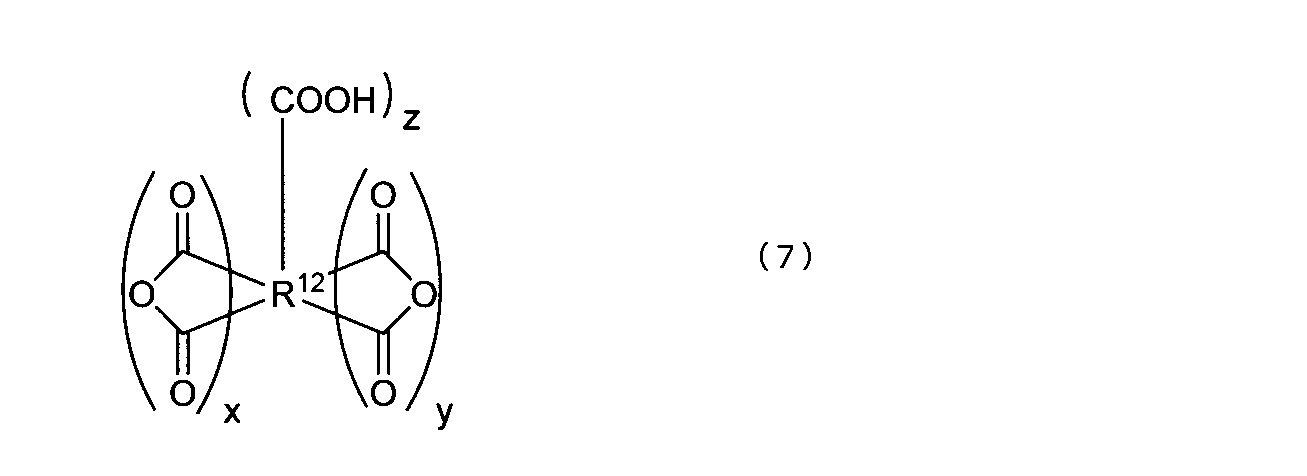
なお、式(7)において、R12は式(5)のR12と同じである。
本発明のポジ型感光性樹脂組成物は、感放射線化合物としてキノンジアジド化合物を含有する。キノンジアジド化合物としては、ポリヒドロキシ化合物にキノンジアジドのスルホン酸がエステルで結合したもの、ポリアミノ化合物にキノンジアジドのスルホン酸がスルホンアミド結合したもの、ポリヒドロキシポリアミノ化合物にキノンジアジドのスルホン酸がエステル結合および/またはスルホンアミド結合したものなどが挙げられる。露光部と未露光部のコントラストの観点から、これらポリヒドロキシ化合物やポリアミノ化合物の官能基全体の50モル%以上がキノンジアジドで置換されていることが好ましい。このようなキノンジアジド化合物を用いることで、一般的な紫外線である水銀灯のi線(365nm)、h線(405nm)、g線(436nm)に感光するポジ型の感光性樹脂組成物を得ることができる。

このような界面活性剤としては、たとえば、ポリオキシエチレンラウリルエーテル、ポリオキシエチレンステアリルエーテル、ポリオキシエチレンオレイルエーテルなどのポリオキシエチレンアルキルエーテル類;ポリオキシエチレンオクチルフェニルエーテル、ポリオキシエチレンノニルフェニルエーテルなどのポリオキシエチレンアリールエーテル類;ポリオキシエチレンジラウレート、ポリオキシエチレンジステアレートなどのポリオキシエチレンジアルキルエステル類などのノニオン系界面活性剤;メガファックF-251、同F-281、同F-430、同F-444、同R-40(以上、商品名、DIC株式会社製)、サーフロンS-242、同S-243、同S-420、同S-611(以上、商品名、ACGセイミケミカル株式会社製)などのフッ素系界面活性剤;オルガノシロキサンポリマーKP323、KP326、KP341(以上、商品名、信越化学工業株式会社製)などが挙げられる。これらは2種以上用いることもできる。このような界面活性剤は、ポリアルケニルフェノール樹脂、アルカリ可溶性樹脂の合計量100質量部を基準として、2質量部以下、好ましくは1質量部以下の量で配合される。
本発明のポジ型感光性樹脂組成物は、前記のポリアルケニルフェノール樹脂、アルカリ可溶性樹脂、キノンジアジド化合物および必要に応じてその他の成分を前記の溶剤に溶解または分散して混合することにより調製され、その使用目的により、適宜の固形分濃度を採用することができるが、例えば、固形分濃度10~60質量%とすることができる。また上記のように調製された組成物液は、通常、使用前にろ過される。ろ過の手段としては、例えば孔径0.05~1.0μmのミリポアフィルターなどが挙げられる。
このように調製された本発明のポジ型感光性樹脂組成物は、長期間の貯蔵安定性にも優れている。
本発明のポジ型感光性樹脂組成物を放射線リソグラフィー用に使用する場合、まず、本発明のポジ型感光性樹脂組成物を基板表面に塗布し、加熱などの手段により溶剤を乾燥等によって除去して、塗膜を形成することができる。基板表面へのポジ型感光性樹脂組成物の塗布方法は特に限定されず、たとえばスプレー法、ロールコート法、スリット法、回転塗布法などの各種の方法を採用することができる。
[製造例1]ポリアリルフェノール樹脂A-1の製造
1000mLの3つ口型フラスコに、炭酸カリウム(日本曹達株式会社製)201g(1.45mol)を純水150gに溶解した溶液、フェノールノボラック樹脂「ショウノール」(商標)BRG-556(昭和電工株式会社製)150.0gを仕込み、反応器を窒素置換し85℃に加熱した。窒素気流下、酢酸アリル(昭和電工株式会社製)204g(2.04mol)、50%含水5%-Pd/C-STDタイプ(金属パラジウムを活性炭中に5質量%の含有量で分散され、かつ前記金属パラジウムと活性炭分散物を50質量%となるよう水を配合して安定化したアリル化反応の触媒、エヌ・イーケムキャット株式会社製)0.62g(0.291mmol)およびトリフェニルホスフィン(前記パラジウムを用いたアリル化反応触媒の活性化剤、北興化学工業株式会社製)3.82g(14.6mmol)を入れ、窒素雰囲気中、105℃に昇温して4時間反応させた後、酢酸アリル29g(0.291mol)を追添し、加熱を10時間継続した。その後撹拌を停止し、静置することで有機層と水層の二層に分離した。析出している塩が溶解するまで、純水(200g)を添加した後、トルエン200gを加え、80℃以上の温度に保持して白色沈殿が析出していないことを確認した後、Pd/Cを濾過(1μmのメンブランフィルター(アドバンテック社製KST-142-JAを用いて加圧(0.3MPa))により回収した。この濾滓をトルエン100gで洗浄し、その洗浄液を濾液と合わせた。その濾液の水層を分離して、有機層を水200gで2度洗浄し、その洗浄液が中性であることを確認した。有機層を分離後、減圧下、濃縮し、褐色油状物のフェノールノボラック型のポリアリルエーテル樹脂を得た。このものを1H-NMR測定した結果、フェノールノボラック型のポリアリルエーテル樹脂を主成分として含むことを確認した。特徴的な測定データは以下の通りである。 1H-NMR(400MHz,CDCl3,27℃)、δ 3.6-4.0(m,-Ph-CH 2 -Ph-)δ 4.4-4.8(2H,m,-CH 2 CH=CH2),δ 5.1-5.3(1H,m,-CH2CH=CHH),δ 5.3-5.5(1H,m,-CH2CH=CHH),δ 5.8-6.2(1H,m,-CH2CH=CH2),δ 6.6-7.3(m,ベンゼン環)。
また、このものの水酸基価を測定したが、ほとんど検出できなかった。
つづいてフェノールノボラック型のポリアリルエーテル樹脂を、メカニカルスターラーをセットした500mLのフラスコに入れた。300rpmで攪拌をしながら190度まで昇温し、そのまま10時間クライゼン転位反応させ、フェノールノボラック型のポリアリルフェノール樹脂A-1を得た。ポリアリルフェノール樹脂A-1の水酸基当量は165であり、水酸基の生成が確認できた。また、数平均分子量1000、重量平均分子量は2400であった。このものを1H-NMR測定した結果、フェノールノボラック型のポリアリルフェノール樹脂A-1を主成分として含むことを確認した。特徴的な測定データは以下の通りであり、アリル基の水素原子のケミカルシフトがクライゼン転位反応後移動していることが確認できた。1H-NMR(400MHz,CDCl3,27℃),δ 3.2-3.4(2H,m,-CH 2 CH=CH2),δ 3.6-4.0(m,-Ph-CH2-Ph-,-OH),δ 4.6-5.0(1H,m,-CH2CH=CHH),δ 5.0-5.3(1H,m,-CH2CH=CHH),δ 5.8-6.1(1H,m,-CH2CH=CH2),δ 6.6-7.2(m,ベンゼン環)。
この樹脂は式(4)において、R1,R2,R3のうち、1個がアリル基で他は水素原子を示す。
4,4′-ジアミノジフェニルエーテル(和光純薬工業株式会社製、以下「ODA」と略す。)10.00g(0.05モル)をN-メチルピロリドン(和光純薬工業株式会社製、以下「NMP」と略す。)70gに溶解させ、3,3′,4,4′-ビフェニルテトラカルボン酸無水物(和光純薬工業株式会社製、以下「BPDA」と略す。)13.22g(0.045モル)を加え、40℃で5時間攪拌した。その後、ビス(3-エチル-5-メチル-4-マレイミドフェニル)メタン(ケイ・アイ化成株式会社製、以下「BMI-70」と略す。)4.42g(0.01モル)を加え、さらに90℃で3時間攪拌した。反応溶液を室温に戻した後、アセトン1500mL中に投入し、沈殿物を回収して淡黄色固体を得た。さらに得られた固体を水1500mLで洗浄し、その後50℃の真空乾燥機で10時間乾燥させ、ポリイミド前駆体1の淡黄色粉末を得た。ポリイミド前駆体1の固形分酸価は175mgKOH/gであった。
ODA(和光純薬工業株式会社製)10.00g(0.05モル)をNMP(和光純薬工業株式会社製)70gに溶解させ、BPDA(和光純薬工業株式会社製)13.22g(0.045モル)を加え、40℃で5時間攪拌した。その後、p-ヒドロキシベンジルアルコール(和光純薬工業株式会社製、以下「p-HBzOH」と略す。)5.58g(0.045モル)を加え、さらに100℃で3時間攪拌した。反応溶液を室温に戻した後、アセトン1500mL中に投入し、沈殿物を回収して淡黄色固体を得た。さらに得られた固体を水1500mLで洗浄し、その後50℃の真空乾燥機で10時間乾燥させ、ポリイミド前駆体2の淡黄色粉末を得た。ポリイミド前駆体2の固形分酸価は150mgKOH/gであった。
ODA(和光純薬工業株式会社製)10.00g(0.05モル)をNMP(和光純薬工業株式会社製)70gに溶解させ、BPDA(和光純薬工業株式会社製)13.22g(0.045モル)を加え、40℃で5時間攪拌した。その後、BMI-70(ケイ・アイ化成株式会社製)を4.42g(0.01モル)加え、さらに90℃で3時間攪拌し、p-HBzOH(和光純薬工業株式会社製)5.58g(0.045モル)を加え、さらに100℃で3時間攪拌した。反応溶液を室温に戻した後、アセトン1500mL中に投入し、沈殿物を回収して淡黄色固体を得た。さらに得られた固体を水1500mLで洗浄し、その後50℃の真空乾燥機で10時間乾燥させ、ポリイミド前駆体3の淡黄色粉末を得た。ポリイミド前駆体3の固形分酸価は115mgKOH/gであった。
ODA(和光純薬工業株式会社製)10.00g(0.05モル)をNMP(和光純薬工業株式会社製)70gに溶解させ、BPDA(和光純薬工業株式会社製)13.22g(0.045モル)を加え、40℃で5時間攪拌した。反応溶液をアセトン1500mL中に投入し、沈殿物を回収して淡黄色固体を得た。さらに得られた固体を水1500mLで洗浄し、その後50℃の真空乾燥機で10時間乾燥させ、ポリイミド前駆体4の淡黄色粉末を得た。ポリイミド前駆体4の固形分酸価は210mgKOH/gであった。
実施例1
ポリアリルフェノール樹脂A-1の6質量部およびアルカリ可溶性樹脂としてポリイミド前駆体1の20質量部をN-メチル-2-ピロリドン100質量部に溶解させ、キノンジアジド化合物としてTS-200A(東洋合成工業株式会社製、α,α,α-トリス(4-ヒドロキシフェニル)-1-エチル-4-イソプロピルベンゼンの1,2-ナフトキノンジアジド-5-スルホン酸エステル)を9質量部加えた。溶解を目視で確認した後、孔径1μmのミリポアフィルターで濾過し、ポジ型感光性樹脂組成物を調製した。
ポリイミド前駆体1をポリイミド前駆体2に変更した以外は実施例1と同様に調製した。
ポリイミド前駆体1をポリイミド前駆体3に変更した以外は実施例1と同様に調製した。
ポリイミド前駆体1をポリイミド前駆体4に変更した以外は実施例1と同様に調製した。
ポリイミド前駆体1をフェノールノボラック樹脂「ショウノール」(商標)BRG-556(昭和電工株式会社製)に変更した以外は実施例1と同様に調製した。
ポリイミド前駆体1をクレゾールノボラック樹脂「ショウノール」(商標)CRG-951」(昭和電工株式会社製)に変更した以外は実施例1と同様に調製した。
ポリアルケニルフェノール樹脂A-1をクレゾールノボラック樹脂「ショウノール」(商標)CRG-951(昭和電工株式会社製)に変更した以外は実施例1と同様に調製した。
ポリイミド前駆体1およびポリアルケニルフェノール樹脂A-1を全量ノボラックフェノール樹脂「ショウノール」(商標)BRG-556(昭和電工株式会社製)に変更した以外は実施例1と同様に調製した。
ポリイミド前駆体1およびポリアルケニルフェノール樹脂A-1を全量クレゾールノボラック樹脂「ショウノール」(商標)CRG-591(昭和電工株式会社製)に変更した以外は実施例1と同様に調製した。
酸価の測定方法ならびにパターン形成・アルカリ現像性およびアウトガスの評価方法は下記のとおりである。
JIS K0070に則って測定した。
ガラス基板(大きさ100mm×100mm×1mm)に各実施例および各比較例のポジ型感光性樹脂組成物を乾燥膜厚が約2μmになるようにスピンコートし、110℃で2分間溶剤を乾燥した。さらに超高圧水銀ランプを組み込んだ露光装置(商品名マルチライトML-251A/B、ウシオ電機株式会社製)で石英製のフォトマスクを介して600mJ/cm2露光した。露光量は紫外線積算光量計(商品名UIT-150、受光部UVD-S365、ウシオ電機株式会社製)を用いて測定した。露光した塗膜は、さらに2.38%テトラメチルアンモニウムハイドロオキサイド水溶液でアルカリ現像を行ない、パターンの線幅がフォトマスクの線幅とほぼ同一となるアルカリ現像時間を測定し、パターン形成性を評価した。該アルカリ現像時間が30~100秒でパターン形成できた場合を○、100~180秒の場合を△、その範囲をはずれた場合は×として判定した。パターン形成性の評価対象としたフォトマスクのパターンの線幅は50μmである。
アルカリ現像はスピン現像装置(AD-1200、滝沢産業株式会社製)を用いて行い、線幅測定は光学顕微鏡(VH-Z250、株式会社キーエンス製)を用いた。また、パターンの線幅がフォトマスクの線幅とほぼ同一となるアルカリ現像時間において露光部の現像残渣の有無を光学顕微鏡で観察することにより、アルカリ現像性を評価した。残渣がない場合を○、残渣があった場合を×として判定した。
各実施例および比較例のポジ型感光性樹脂組成物をアルミ板に塗装し、100℃で30分乾燥し、厚み10~20μmの塗膜とした。さらに、空気中130℃で30分乾燥後、窒素下250℃で60分硬化した。その塗膜を用い、示差熱重量同時測定装置TG/DTA7000(株式会社日立ハイテクサイエンス製)を使用して窒素雰囲気下、室温から10℃/分で昇温し加熱減少量をアウトガスとして測定した。昇温前からの質量が1%減少した温度をTd1、質量が5%減少した温度をTd5とし、Td5が370℃以上のものを○とし、350℃以上370℃未満のものを△とし、350℃未満のものを×として判定した。
Claims (13)
- 式(1)

の構造を有するポリアルケニルフェノール樹脂、アルカリ可溶性樹脂(ただし、式(1)の構造を有するポリアルケニルフェノール樹脂を除く。)およびキノンジアジド化合物を含有するポジ型感光性樹脂組成物。 - 式(1)の構造が式(3)

の構造であることを特徴とする請求項1に記載のポジ型感光性樹脂組成物。 - 式(3)の構造を有するポリアルケニルフェノール樹脂が、式(4)
の構造を含むことを特徴とする請求項2に記載のポジ型感光性樹脂組成物。 - 式(2)で表されるアルケニル基がアリル基であることを特徴とする請求項1~3のいずれか1項に記載のポジ型感光性樹脂組成物。
- アルカリ可溶性樹脂がポリイミド前駆体であることを特徴とする請求項1~4のいずれか1項に記載のポジ型感光性樹脂組成物。
- 前記ポリイミド前駆体が式(5)

で表されることを特徴とする請求項1~5のいずれか1項に記載のポジ型感光性樹脂組成物。 - 式(5)のR14が不飽和基を含むことを特徴とする請求項6に記載のポジ型感光性樹脂組成物。
- 前記不飽和基がマレイミド基であることを特徴とする請求項7に記載のポジ型感光性樹脂組成物。
- 前記ポリイミド前駆体が、
(i)式(6)

で表される酸化合物を、1:0.8~0.95のモル比で反応させ、末端にアミノ基を有するポリアミック酸を得る工程、および
(ii)工程(i)で得られたポリアミック酸の末端のアミノ基にビスマレイミド化合物を反応させることにより、末端にマレイミド基を有するポリイミド前駆体を得る工程
を含む方法によって製造されることを特徴とする請求項8に記載のポジ型感光性樹脂組成物。 - ポリアルケニルフェノール樹脂20~50質量部、アルカリ可溶性樹脂100質量部およびキノンジアジド化合物20~70質量部を含有する請求項1~9のいずれか1項に記載のポジ型感光性樹脂組成物。
- 式(5)で表されるポリイミド前駆体の固形分酸価が110~210mgKOH/gであることを特徴とする請求項6~10のいずれか1項に記載のポジ型感光性樹脂組成物。
- (1)請求項1~11のいずれか1項に記載のポジ型感光性樹脂組成物を基材に塗布する塗布工程、
(2)塗布されたポジ型感光性樹脂組成物中の溶剤を除去する乾燥工程、
(3)放射線をフォトマスク越しに照射する露光工程、
(4)アルカリ現像によりパターン形成する現像工程、および
(5)150~350℃の温度で加熱する加熱処理工程
を含む方法によって得られた放射線リソグラフィー構造物。 - 加熱減量が5質量%のときの温度が350℃以上であることを特徴とする請求項12に記載の放射線リソグラフィー構造物。
Priority Applications (3)
| Application Number | Priority Date | Filing Date | Title |
|---|---|---|---|
| CN201580031678.9A CN106462064B (zh) | 2014-07-18 | 2015-07-16 | 正型感光性树脂组合物 |
| JP2016534494A JP6524085B2 (ja) | 2014-07-18 | 2015-07-16 | ポジ型感光性樹脂組成物 |
| KR1020167029226A KR101870647B1 (ko) | 2014-07-18 | 2015-07-16 | 포지티브형 감광성 수지 조성물 |
Applications Claiming Priority (2)
| Application Number | Priority Date | Filing Date | Title |
|---|---|---|---|
| JP2014148200 | 2014-07-18 | ||
| JP2014-148200 | 2014-07-18 |
Publications (1)
| Publication Number | Publication Date |
|---|---|
| WO2016010124A1 true WO2016010124A1 (ja) | 2016-01-21 |
Family
ID=55078610
Family Applications (1)
| Application Number | Title | Priority Date | Filing Date |
|---|---|---|---|
| PCT/JP2015/070443 Ceased WO2016010124A1 (ja) | 2014-07-18 | 2015-07-16 | ポジ型感光性樹脂組成物 |
Country Status (4)
| Country | Link |
|---|---|
| JP (1) | JP6524085B2 (ja) |
| KR (1) | KR101870647B1 (ja) |
| CN (1) | CN106462064B (ja) |
| WO (1) | WO2016010124A1 (ja) |
Cited By (4)
| Publication number | Priority date | Publication date | Assignee | Title |
|---|---|---|---|---|
| WO2018074040A1 (ja) * | 2016-10-18 | 2018-04-26 | 昭和電工株式会社 | ポリアルケニルフェノール化合物の製造方法、並びにポリアルケニルフェノール化合物を含む硬化性組成物及びその硬化物 |
| WO2021240879A1 (ja) * | 2020-05-28 | 2021-12-02 | 昭和電工株式会社 | 熱硬化性樹脂組成物 |
| WO2021240878A1 (ja) * | 2020-05-28 | 2021-12-02 | 昭和電工株式会社 | 熱硬化性樹脂組成物 |
| US11561469B2 (en) | 2017-04-07 | 2023-01-24 | Showa Denko K.K. | Photosensitive resin composition |
Families Citing this family (1)
| Publication number | Priority date | Publication date | Assignee | Title |
|---|---|---|---|---|
| JP6689434B1 (ja) * | 2019-02-06 | 2020-04-28 | 昭和電工株式会社 | 感光性樹脂組成物、有機el素子隔壁、及び有機el素子 |
Citations (7)
| Publication number | Priority date | Publication date | Assignee | Title |
|---|---|---|---|---|
| JPS62260147A (ja) * | 1986-05-02 | 1987-11-12 | Tokyo Ohka Kogyo Co Ltd | ポジ型ホトレジスト組成物 |
| JPS62260145A (ja) * | 1986-05-02 | 1987-11-12 | Tokyo Ohka Kogyo Co Ltd | ポジ型ホトレジスト組成物 |
| JPH05134411A (ja) * | 1991-09-05 | 1993-05-28 | Japan Synthetic Rubber Co Ltd | ネガ型レジスト組成物 |
| JPH05232696A (ja) * | 1992-02-18 | 1993-09-10 | Sumitomo Chem Co Ltd | ポジ型レジスト組成物 |
| JP2006133585A (ja) * | 2004-11-08 | 2006-05-25 | Nippon Zeon Co Ltd | 感放射線性樹脂組成物及び感放射線性樹脂パターンの形成方法 |
| JP2013015701A (ja) * | 2011-07-05 | 2013-01-24 | Hitachi Chemical Dupont Microsystems Ltd | 感光性樹脂組成物、該樹脂組成物を用いたパターン硬化膜の製造方法及び電子部品 |
| JP2013130816A (ja) * | 2011-12-22 | 2013-07-04 | Nippon Zeon Co Ltd | 永久膜用樹脂組成物及び電子部品 |
Family Cites Families (4)
| Publication number | Priority date | Publication date | Assignee | Title |
|---|---|---|---|---|
| JPH08272091A (ja) * | 1995-03-31 | 1996-10-18 | Fuji Photo Film Co Ltd | フォトレジスト組成物 |
| JP2000169538A (ja) | 1998-12-04 | 2000-06-20 | Meiwa Kasei Kk | 液状フェノールノボラック樹脂の製造方法 |
| JP5088169B2 (ja) * | 2008-02-25 | 2012-12-05 | 東レ株式会社 | ポジ型感光性樹脂組成物 |
| JP6271272B2 (ja) * | 2014-01-31 | 2018-01-31 | 昭和電工株式会社 | 感放射線組成物および放射線リソグラフィー構造物の製造方法 |
-
2015
- 2015-07-16 WO PCT/JP2015/070443 patent/WO2016010124A1/ja not_active Ceased
- 2015-07-16 CN CN201580031678.9A patent/CN106462064B/zh active Active
- 2015-07-16 JP JP2016534494A patent/JP6524085B2/ja not_active Expired - Fee Related
- 2015-07-16 KR KR1020167029226A patent/KR101870647B1/ko active Active
Patent Citations (7)
| Publication number | Priority date | Publication date | Assignee | Title |
|---|---|---|---|---|
| JPS62260147A (ja) * | 1986-05-02 | 1987-11-12 | Tokyo Ohka Kogyo Co Ltd | ポジ型ホトレジスト組成物 |
| JPS62260145A (ja) * | 1986-05-02 | 1987-11-12 | Tokyo Ohka Kogyo Co Ltd | ポジ型ホトレジスト組成物 |
| JPH05134411A (ja) * | 1991-09-05 | 1993-05-28 | Japan Synthetic Rubber Co Ltd | ネガ型レジスト組成物 |
| JPH05232696A (ja) * | 1992-02-18 | 1993-09-10 | Sumitomo Chem Co Ltd | ポジ型レジスト組成物 |
| JP2006133585A (ja) * | 2004-11-08 | 2006-05-25 | Nippon Zeon Co Ltd | 感放射線性樹脂組成物及び感放射線性樹脂パターンの形成方法 |
| JP2013015701A (ja) * | 2011-07-05 | 2013-01-24 | Hitachi Chemical Dupont Microsystems Ltd | 感光性樹脂組成物、該樹脂組成物を用いたパターン硬化膜の製造方法及び電子部品 |
| JP2013130816A (ja) * | 2011-12-22 | 2013-07-04 | Nippon Zeon Co Ltd | 永久膜用樹脂組成物及び電子部品 |
Cited By (11)
| Publication number | Priority date | Publication date | Assignee | Title |
|---|---|---|---|---|
| WO2018074040A1 (ja) * | 2016-10-18 | 2018-04-26 | 昭和電工株式会社 | ポリアルケニルフェノール化合物の製造方法、並びにポリアルケニルフェノール化合物を含む硬化性組成物及びその硬化物 |
| TWI639635B (zh) * | 2016-10-18 | 2018-11-01 | 日商昭和電工股份有限公司 | 聚烯基酚化合物之製造方法、及含有聚烯基酚化合物之硬化性組成物及其硬化物 |
| KR20190015463A (ko) * | 2016-10-18 | 2019-02-13 | 쇼와 덴코 가부시키가이샤 | 폴리알케닐페놀 화합물의 제조 방법, 및 폴리알케닐페놀 화합물을 포함하는 경화성 조성물 및 그 경화물 |
| CN109563223A (zh) * | 2016-10-18 | 2019-04-02 | 昭和电工株式会社 | 多烯基酚化合物的制造方法、以及包含多烯基酚化合物的固化性组合物及其固化物 |
| JPWO2018074040A1 (ja) * | 2016-10-18 | 2019-08-08 | 昭和電工株式会社 | ポリアルケニルフェノール化合物の製造方法、並びにポリアルケニルフェノール化合物を含む硬化性組成物及びその硬化物 |
| EP3530681A4 (en) * | 2016-10-18 | 2020-04-29 | Showa Denko K.K. | METHOD FOR PRODUCING A POLYALKENYLPHENOL COMPOUND, CURABLE COMPOSITION WITH THE POLYALKENYLPHENOL COMPOUND, AND HARDNESS PRODUCT FROM THE CURABLE COMPOSITION |
| KR102171008B1 (ko) | 2016-10-18 | 2020-10-28 | 쇼와 덴코 가부시키가이샤 | 폴리알케닐페놀 화합물의 제조 방법, 및 폴리알케닐페놀 화합물을 포함하는 경화성 조성물 및 그 경화물 |
| CN109563223B (zh) * | 2016-10-18 | 2021-07-09 | 昭和电工株式会社 | 多烯基酚化合物的制造方法、以及包含多烯基酚化合物的固化性组合物及其固化物 |
| US11561469B2 (en) | 2017-04-07 | 2023-01-24 | Showa Denko K.K. | Photosensitive resin composition |
| WO2021240879A1 (ja) * | 2020-05-28 | 2021-12-02 | 昭和電工株式会社 | 熱硬化性樹脂組成物 |
| WO2021240878A1 (ja) * | 2020-05-28 | 2021-12-02 | 昭和電工株式会社 | 熱硬化性樹脂組成物 |
Also Published As
| Publication number | Publication date |
|---|---|
| CN106462064B (zh) | 2019-10-25 |
| CN106462064A (zh) | 2017-02-22 |
| KR20160135334A (ko) | 2016-11-25 |
| JPWO2016010124A1 (ja) | 2017-04-27 |
| KR101870647B1 (ko) | 2018-06-25 |
| JP6524085B2 (ja) | 2019-06-05 |
Similar Documents
| Publication | Publication Date | Title |
|---|---|---|
| JP6271272B2 (ja) | 感放射線組成物および放射線リソグラフィー構造物の製造方法 | |
| US10866512B2 (en) | Positive photosensitive resin composition | |
| JP6252174B2 (ja) | ポジ型感光性樹脂組成物、それを用いた硬化膜を含む半導体装置の製造方法 | |
| JP6524085B2 (ja) | ポジ型感光性樹脂組成物 | |
| JP5332350B2 (ja) | 感光性重合体組成物 | |
| JPWO2018088052A1 (ja) | ポジ型感光性樹脂組成物及びチタンブラック分散液 | |
| WO2009145227A1 (ja) | 感光性樹脂組成物 | |
| JP2016164646A (ja) | 遮光膜を含むデバイスおよび前記遮光膜パターニング方法 | |
| JP6700020B2 (ja) | ポジ型感光性樹脂組成物 | |
| JP2017198918A (ja) | 感光性樹脂組成物 | |
| CN105938208B (zh) | 包括光阻挡层的装置以及图案化所述光阻挡层的方法 | |
| KR102287214B1 (ko) | 감광성 수지 조성물, 이를 이용한 감광성 수지막 및 전자 소자 | |
| JP2010197748A (ja) | 感光性樹脂組成物 | |
| JP2009175651A (ja) | ポジ型感光性樹脂組成物、硬化膜、保護膜、絶縁膜およびそれを用いた半導体装置、表示体装置。 | |
| KR102044944B1 (ko) | 감광성 수지 조성물, 이를 이용한 감광성 수지막 및 디스플레이 장치 | |
| CN106249546B (zh) | 负型感光性树脂组合物 | |
| TWI919430B (zh) | 正型感光性樹脂組成物、有機el元件分隔壁、有機el元件絕緣膜及有機el元件 | |
| KR20120072971A (ko) | 포지티브형 감광성 수지 조성물 및 이를 이용한 감광성 수지막 | |
| JP5139886B2 (ja) | 感光性樹脂組成物 | |
| TWI705301B (zh) | 感光性樹脂組成物、感光性樹脂層以及電子裝置 | |
| KR102149967B1 (ko) | 감광성 수지 조성물 및 이를 이용한 감광성 수지막 | |
| JP2026047327A (ja) | パターン化された硬化物の製造方法、パターン化された硬化物、隔壁、ブラックマトリクス、カラーフィルター、画像表示パネル、画像表示装置、及びポジ型感光性組成物 | |
| TW202336096A (zh) | 感光性樹脂組成物、硬化物、有機電致發光顯示裝置及顯示裝置 | |
| JP2015059152A (ja) | 樹脂組成物およびそれを用いた耐熱性樹脂被膜 | |
| JP2012181273A (ja) | 感光性樹脂組成物、硬化膜、保護膜、絶縁膜、半導体装置、および表示体装置 |
Legal Events
| Date | Code | Title | Description |
|---|---|---|---|
| 121 | Ep: the epo has been informed by wipo that ep was designated in this application |
Ref document number: 15822576 Country of ref document: EP Kind code of ref document: A1 |
|
| ENP | Entry into the national phase |
Ref document number: 2016534494 Country of ref document: JP Kind code of ref document: A |
|
| ENP | Entry into the national phase |
Ref document number: 20167029226 Country of ref document: KR Kind code of ref document: A |
|
| NENP | Non-entry into the national phase |
Ref country code: DE |
|
| 122 | Ep: pct application non-entry in european phase |
Ref document number: 15822576 Country of ref document: EP Kind code of ref document: A1 |