WO2015163040A1 - ポリシロキサン共重合体並びにそれを含有する帯電防止剤及び樹脂組成物 - Google Patents
ポリシロキサン共重合体並びにそれを含有する帯電防止剤及び樹脂組成物 Download PDFInfo
- Publication number
- WO2015163040A1 WO2015163040A1 PCT/JP2015/057807 JP2015057807W WO2015163040A1 WO 2015163040 A1 WO2015163040 A1 WO 2015163040A1 JP 2015057807 W JP2015057807 W JP 2015057807W WO 2015163040 A1 WO2015163040 A1 WO 2015163040A1
- Authority
- WO
- WIPO (PCT)
- Prior art keywords
- formula
- bis
- imide
- trifluoromethanesulfonyl
- polysiloxane copolymer
- Prior art date
- Legal status (The legal status is an assumption and is not a legal conclusion. Google has not performed a legal analysis and makes no representation as to the accuracy of the status listed.)
- Ceased
Links
Classifications
-
- C—CHEMISTRY; METALLURGY
- C08—ORGANIC MACROMOLECULAR COMPOUNDS; THEIR PREPARATION OR CHEMICAL WORKING-UP; COMPOSITIONS BASED THEREON
- C08G—MACROMOLECULAR COMPOUNDS OBTAINED OTHERWISE THAN BY REACTIONS ONLY INVOLVING UNSATURATED CARBON-TO-CARBON BONDS
- C08G77/00—Macromolecular compounds obtained by reactions forming a linkage containing silicon with or without sulfur, nitrogen, oxygen or carbon in the main chain of the macromolecule
- C08G77/04—Polysiloxanes
- C08G77/22—Polysiloxanes containing silicon bound to organic groups containing atoms other than carbon, hydrogen and oxygen
- C08G77/26—Polysiloxanes containing silicon bound to organic groups containing atoms other than carbon, hydrogen and oxygen nitrogen-containing groups
-
- C—CHEMISTRY; METALLURGY
- C08—ORGANIC MACROMOLECULAR COMPOUNDS; THEIR PREPARATION OR CHEMICAL WORKING-UP; COMPOSITIONS BASED THEREON
- C08G—MACROMOLECULAR COMPOUNDS OBTAINED OTHERWISE THAN BY REACTIONS ONLY INVOLVING UNSATURATED CARBON-TO-CARBON BONDS
- C08G77/00—Macromolecular compounds obtained by reactions forming a linkage containing silicon with or without sulfur, nitrogen, oxygen or carbon in the main chain of the macromolecule
- C08G77/04—Polysiloxanes
- C08G77/22—Polysiloxanes containing silicon bound to organic groups containing atoms other than carbon, hydrogen and oxygen
- C08G77/30—Polysiloxanes containing silicon bound to organic groups containing atoms other than carbon, hydrogen and oxygen phosphorus-containing groups
-
- C—CHEMISTRY; METALLURGY
- C08—ORGANIC MACROMOLECULAR COMPOUNDS; THEIR PREPARATION OR CHEMICAL WORKING-UP; COMPOSITIONS BASED THEREON
- C08L—COMPOSITIONS OF MACROMOLECULAR COMPOUNDS
- C08L101/00—Compositions of unspecified macromolecular compounds
-
- C—CHEMISTRY; METALLURGY
- C08—ORGANIC MACROMOLECULAR COMPOUNDS; THEIR PREPARATION OR CHEMICAL WORKING-UP; COMPOSITIONS BASED THEREON
- C08L—COMPOSITIONS OF MACROMOLECULAR COMPOUNDS
- C08L33/00—Compositions of homopolymers or copolymers of compounds having one or more unsaturated aliphatic radicals, each having only one carbon-to-carbon double bond, and only one being terminated by only one carboxyl radical, or of salts, anhydrides, esters, amides, imides or nitriles thereof; Compositions of derivatives of such polymers
-
- C—CHEMISTRY; METALLURGY
- C08—ORGANIC MACROMOLECULAR COMPOUNDS; THEIR PREPARATION OR CHEMICAL WORKING-UP; COMPOSITIONS BASED THEREON
- C08L—COMPOSITIONS OF MACROMOLECULAR COMPOUNDS
- C08L69/00—Compositions of polycarbonates; Compositions of derivatives of polycarbonates
-
- C—CHEMISTRY; METALLURGY
- C08—ORGANIC MACROMOLECULAR COMPOUNDS; THEIR PREPARATION OR CHEMICAL WORKING-UP; COMPOSITIONS BASED THEREON
- C08L—COMPOSITIONS OF MACROMOLECULAR COMPOUNDS
- C08L83/00—Compositions of macromolecular compounds obtained by reactions forming in the main chain of the macromolecule a linkage containing silicon with or without sulfur, nitrogen, oxygen or carbon only; Compositions of derivatives of such polymers
- C08L83/04—Polysiloxanes
-
- C—CHEMISTRY; METALLURGY
- C09—DYES; PAINTS; POLISHES; NATURAL RESINS; ADHESIVES; COMPOSITIONS NOT OTHERWISE PROVIDED FOR; APPLICATIONS OF MATERIALS NOT OTHERWISE PROVIDED FOR
- C09K—MATERIALS FOR MISCELLANEOUS APPLICATIONS, NOT PROVIDED FOR ELSEWHERE
- C09K3/00—Materials not provided for elsewhere
- C09K3/16—Anti-static materials
Definitions
- the present invention relates to a polysiloxane copolymer, an antistatic agent containing it, and a resin composition containing this antistatic agent.
- an onium salt in which the cation is ammonium or phosphonium having a trialkoxysilylalkyl group and the anion is perfluoroalkylsulfonylimide can be used as a low molecular weight antistatic agent for a fluororesin.
- Patent Document 1 Japanese Patent Application Laid-Open No. 2010-248165.
- the present inventors used 1- (3-trimethoxysilylpropyl) -1,1,1-tributylphosphonium bis (trifluoromethanesulfonyl) imide, which is one of the onium salts, as a polycarbonate resin, an acrylic resin, and a silicone.
- the present invention can impart high antistatic properties to polycarbonate resins, acrylic resins and silicone resins, and in particular has excellent heat resistance when heated and melted and kneaded into polycarbonate resins as antistatic agents, and optical adhesives. It is an object of the present invention to provide a polysiloxane copolymer capable of producing a silicone resin having practical strength characteristics as an agent and an antistatic agent containing the polysiloxane copolymer. Furthermore, another object is to provide a resin composition containing this antistatic agent.
- the onium salt represented by the formula (1), the trialkoxysilane represented by the formula (2), and the optional component represented by the formula (3) The polysiloxane copolymer obtained by copolymerizing the indicated dialkoxysilane was found, and when the polysiloxane copolymer was used as an antistatic agent in a polycarbonate resin, an acrylic resin, and a silicone resin, On the other hand, it was found that high antistatic performance can be imparted. Furthermore, the present inventors have found that the polysiloxane copolymer has good heat resistance capable of withstanding high temperatures particularly during melt kneading into a polycarbonate resin. Further, the present inventors have found that a silicone resin composition having a practical strength characteristic as an optical pressure-sensitive adhesive can be obtained by smoothly proceeding the curing reaction of the silicone resin, and completed the present invention.
- this invention provides the following polysiloxane copolymer, its manufacturing method, an antistatic agent, and a resin composition.
- R 2 and R 3 may be bonded to each other at the terminal to form a pyrrolidine ring, piperidine ring, pyridine ring, phosphorane ring, phosphorinan ring or phospholine ring, provided that R 2 and R 3 are bonded to each other at the terminal to form a pyridine ring or phospholine.
- Formula (2) (Wherein R 5 represents an alkyl group having 1 to 10 carbon atoms, an aryl group having 6 to 10 carbon atoms, an aralkyl group having 7 to 10 carbon atoms, or an alkenyl group having 2 to 8 carbon atoms, and R 6 represents carbon Represents an alkyl group of the number 1 to 3.)
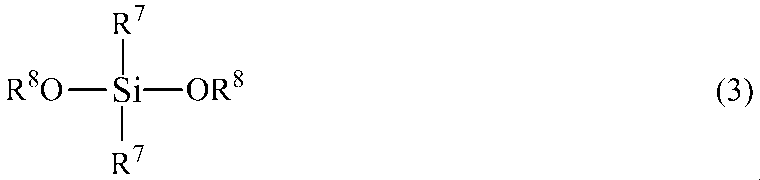
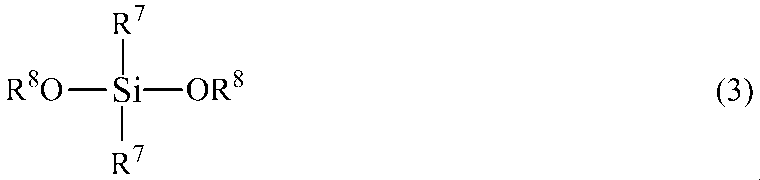
- Formula (3) (Wherein R 7 represents an alkyl group having 1 to 10 carbon atoms, an aryl group having 6 to 10 carbon atoms, or an aralkyl group having 7 to 10 carbon atoms, and R 8 represents an alkyl group having 1 to 3 carbon atoms.
- An antistatic agent comprising the polysiloxane copolymer according to any one of [1] to [6].
- an onium salt represented by the formula (1), a trialkoxysilane represented by the formula (2), and a dialkoxysilane represented by the formula (3) as an optional component are copolymerized.
- the method for producing a polysiloxane copolymer according to any one of [1] to [6] which is characterized in that
- the polysiloxane copolymer of the present invention can be used as an antistatic agent, and by using the antistatic agent for a polycarbonate resin, an acrylic resin, and a silicone resin, a resin composition having high antistatic performance can be produced. In particular, it is excellent in heat resistance necessary for melt kneading into a polycarbonate resin, and when the polysiloxane copolymer of the present invention is used, a silicone resin composition having practical strength characteristics as an optical pressure-sensitive adhesive can be produced. it can.
- the polysiloxane copolymer according to the present invention comprises an onium salt represented by formula (1) (hereinafter referred to as onium salt (1)) and a trialkoxysilane represented by formula (2) (hereinafter referred to as trialkoxy).
- Silane (2)) and a dialkoxysilane represented by formula (3) as an optional component (hereinafter referred to as dialkoxysilane (3)) are copolymerized.
- R 2 and R 3 may be bonded to each other at the terminal to form a pyrrolidine ring, piperidine ring, pyridine ring, phosphorane ring, phosphorinan ring or phospholine ring, provided that R 2 and R 3 are bonded to each other at the terminal to form a pyridine ring or phospholine.
- Formula (2) (Wherein R 5 represents an alkyl group having 1 to 10 carbon atoms, an aryl group having 6 to 10 carbon atoms, an aralkyl group having 7 to 10 carbon atoms, or an alkenyl group having 2 to 8 carbon atoms, and R 6 represents carbon Represents an alkyl group of the number 1 to 3.)
- Formula (3) (Wherein R 7 represents an alkyl group having 1 to 10 carbon atoms, an aryl group having 6 to 10 carbon atoms, or an aralkyl group having 7 to 10 carbon atoms, and R 8 represents an alkyl group having 1 to 3 carbon atoms. .)
- the onium salt (1) used in the present invention can be produced according to the method described in JP 2010-248165 A.
- Q + represents a nitrogen cation or a phosphorus cation, and is preferably a phosphorus cation.
- R 1 is an alkyl group having 1 to 3 carbon atoms, and specific examples include a methyl group, an ethyl group, a propyl group, and an isopropyl group. A methyl group and an ethyl group are preferable, and a methyl group is particularly preferable.
- R 2 to R 4 represent an alkyl group having 1 to 8 carbon atoms, which may be either linear or branched, and is preferably a linear alkyl group.
- R 2 and R 3 may be bonded to each other at the terminal to form a pyrrolidine ring, piperidine ring, pyridine ring, phosphorane ring, phosphorinane ring or phospholine ring.
- X ⁇ represents an anion.
- X ⁇ includes a halogen anion or a fluorine-containing anion, and the halogen anion is preferably a chloro anion, a bromo anion, or an iodo anion, and more preferably a chloro anion.
- a trifluoromethanesulfonic acid anion a bis (trifluoromethanesulfonyl) imide anion, a tetrafluoroborate anion, and a hexafluorophosphate anion are preferable, and a bis (trifluoromethanesulfonyl) imide anion is more preferable.
- the onium salt (1) used in the present invention can be produced according to the method described in JP 2010-248165 A.
- the representative method is illustrated in the following reaction formula 1.
- R 1 , R 2 , R 3 , R 4 , Q, X, and n are the same as described above, Z represents a halogen atom, and M represents an alkali metal.
- onium halides (6) and an alkyl metal salt represented by the formula (7).
- the onium salt (1) can be produced by an ion exchange reaction with
- amines (4a) trimethylamine, triethylamine, tripropylamine, tributylamine, tripentylamine, trihexylamine, triheptylamine, trioctylamine,
- phosphines (4b) examples include trimethylphosphine, triethylphosphine, tripropylphosphine, tributylphosphine, tripentylphosphine, trihexylphosphine, triheptylphosphine, trioctylphosphine,
- alkyl halides (5) include chloromethyltrimethoxysilane, 2-chloroethyltrimethoxysilane, 3-chloropropyltrimethoxysilane, 4-chlorobutyltrimethoxysilane, chloromethyltriethoxysilane, 2-chloro Ethyltriethoxylane, 3-chloropropyltriethoxysilane, 4-chlorobutyltriethoxysilane, chloromethyltripropoxysilane, 2-chloroethyltripropoxysilane, 3-chloropropyltripropoxysilane, 4-chlorobutyltripropoxysilane Chloromethyltributoxysilane, 2-chloroethyltributoxysilane, 3-chloropropyltributoxysilane, 4-chlorobutyltributoxysilane, bromomethyltrimethoxysilane, 2-bromoethyltrimethoxysilane
- the quaternization reaction of the amines or phosphines represented by the formula (4) and the alkyl halides (5) may or may not use a solvent.
- the solvent when using the solvent include alcohols such as methanol, ethanol and 2-propanol, acetonitrile, ethyl acetate, tetrahydrofuran, dimethylformamide and the like.
- the amount of alkyl halides (5) used may be 0.7 moles or more, preferably 0.9 to 1.5 moles per mole of amines or phosphines represented by formula (4). is there.
- alkali metal salt (7) examples include bis (trifluoromethanesulfonyl) imide lithium, bis (trifluoromethanesulfonyl) imide sodium, bis (trifluoromethanesulfonyl) imide potassium, tetrafluoroborate lithium, tetrafluoroborate sodium, and tetrafluoroborate potassium.
- alkali metal salts of fluorine-containing anions such as lithium hexafluorophosphate, sodium hexafluorophosphate, potassium hexafluorophosphate, and the like.
- alkali metal that forms an anion counter cation examples include lithium, sodium, and potassium.
- the ion exchange reaction is usually performed in a solvent.
- the solvent include ketones such as acetone and methyl ethyl ketone, alcohols such as methanol, ethanol and 2-propanol, acetonitrile, ethyl acetate, tetrahydrofuran and dimethylformamide.
- the amount used is not particularly limited, but is usually 10 parts by mass or less, preferably 1 to 10 parts by mass, and particularly preferably 2 to 6 parts by mass with respect to 1 part by mass of onium halides (6).
- the onium halides (6) may be added after mixing the alkali metal salt (5) and the solvent.
- the reaction temperature in the ion exchange reaction is usually 10 ° C. or higher, preferably 10 to 60 ° C., particularly preferably 10 to 30 ° C.
- the solvent and the generated inorganic salt are removed from the reaction solution. If an inorganic salt is precipitated in the obtained reaction solution, the reaction solution is filtered to remove the precipitated inorganic salt, and then combined with unit operations such as concentration, filtration, extraction, etc. as appropriate to obtain the onium salt (1). Isolate. In addition, when no inorganic salt is precipitated in the obtained reaction solution, the reaction solution is concentrated to precipitate the inorganic salt, and after removing the inorganic salt by filtration, unit operations such as concentration, filtration, extraction, etc. Are appropriately combined to isolate the onium salt (1).
- R 5 represents an alkyl group having 1 to 10 carbon atoms, an aryl group having 6 to 10 carbon atoms, an aralkyl group having 7 to 10 carbon atoms, or an alkenyl group having 2 to 8 carbon atoms.
- R 5 include methyl group, ethyl group, propyl group, butyl group, pentyl group, hexyl group, heptyl group, octyl group, nonyl group, decyl group, phenyl group, naphthyl group, benzyl group, vinyl group.
- R 6 represents an alkyl group having 1 to 3 carbon atoms, and specific examples thereof include a methyl group, an ethyl group, and a propyl group. A methyl group and an ethyl group are preferable, and a methyl group is particularly preferable.
- trialkoxysilane (2) include methyltrimethoxysilane, ethyltrimethoxysilane, propyltrimethoxysilane, butyltrimethoxysilane, pentyltrimethoxysilane, hexyltrimethoxysilane, heptyltrimethoxysilane, octyltri Methoxysilane, nonyltrimethoxysilane, decyltrimethoxysilane, phenyltrimethoxysilane, naphthyltrimethoxysilane, benzyltrimethoxysilane, vinyltrimethoxysilane, allyltrimethoxysilane, butenyltrimethoxysilane, hexenyltrimethoxysilane, octyl Tenenyltrimethoxysilane, methyltriethoxysilane, ethyltriethoxysilane,
- the trialkoxysilane (2) may be a commercially available product or may be one produced by a known production method.
- R 7 represents an alkyl group having 1 to 10 carbon atoms, an aryl group having 6 to 10 carbon atoms, or an aralkyl group having 7 to 10 carbon atoms.
- R 7 may be the same or different.
- Specific examples of R 7 include methyl, ethyl, propyl, butyl, pentyl, hexyl, heptyl, octyl, nonyl, decyl, A phenyl group, a naphthyl group, a benzyl group, etc. are mentioned, A methyl group and a phenyl group are preferable, and a methyl group is especially preferable.
- R 8 represents an alkyl group having 1 to 3 carbon atoms, and specific examples thereof include a methyl group, an ethyl group, and a propyl group.
- a methyl group and an ethyl group are preferable, and a methyl group is particularly preferable.
- dialkoxysilane (3) include dimethyldimethoxysilane, diethyldimethoxysilane, dipropyldimethoxysilane, methylethyldimethoxysilane, methylpropyldimethoxysilane, methylbutyldimethoxysilane, methylpentyldimethoxysilane, methylhexyldimethoxysilane, Methylheptyldimethoxysilane, methyloctyldimethoxysilane, methylnonyldimethoxysilane, methyldecyldimethoxysilane, methylphenyldimethoxysilane, methylnaphthyldimethoxysilane, methylbenzyldimethoxysilane, dimethyldiethoxysilane, diethyldiethoxysilane, dipropyldiethoxy Silane, methylethyldiethoxysilane
- dialkoxysilane (3) a commercially available product may be used, or a product produced by a known production method may be used.
- onium salt (1), trialkoxysilane (2) and optional dialkoxysilane (3) is usually done by onium salt (1), trialkoxysilane (2) and optional component dialkoxy.
- onium salt (1), trialkoxysilane (2) and dialkoxysilane (3) as an optional component are used in the mixture of silane (3), an organic solvent that dissolves all dialkoxysilane (3) (for example, methanol, ethanol, isopropyl alcohol, acetone, etc.) are added to form a solution, and then an acid (hereinafter referred to as acid (8)) or a base (hereinafter referred to as base (9)) that serves as a catalyst for the hydrolysis reaction in the solution.
- the acid (8) or base (9) may be added dropwise with an aqueous solution.
- the stoichiometric ratio of the onium salt (1) to the trialkoxysilane (2) and the optional dialkoxysilane (3) is preferably 0.5% of the trialkoxysilane (2) to 1 mole of the onium salt (1). ⁇ 95 moles, dialkoxysilane (3) 0-49 moles, more preferably trialkoxysilane (2) 0.5-10 moles, dialkoxysilane (3) 4-16 moles per mole of onium salt (1) Mol, most preferably 0.5 to 4 mol of trialkoxysilane (2) and 4 to 8 mol of dialkoxysilane (3) per mol of onium salt (1).
- the heat resistance of the resulting polysiloxane copolymer may be impaired, while the stoichiometric ratio of the trialkoxysilane (2) is within the above range. If it is larger, the surface migration property of the polysiloxane copolymer is lowered, and when the polysiloxane copolymer is used as an antistatic agent, good antistatic property may not be exhibited. When the stoichiometric ratio of dialkoxysilane (3) is larger than the above range, the heat resistance of the resulting polysiloxane copolymer may be lowered.
- monoalkoxysilane and tetraalkoxysilane may be mixed and copolymerized within a range not impairing the effects of antistatic property and heat resistance.
- monoalkoxysilane include trimethylmethoxysilane, vinyldimethylmethoxysilane, trimethylethoxysilane, vinyldimethylethoxysilane, trimethylpropoxysilane, and vinyldimethylpropoxysilane.
- tetraalkoxysilane include tetra Examples include methoxysilane, tetraethoxysilane, and tetrapropoxysilane.
- the amount of the organic solvent used for dissolving the onium salt (1), trialkoxysilane (2), and optional dialkoxysilane (3) is not particularly limited, but is usually 1 part by weight of the onium salt (1). On the other hand, it is usually 20 parts by mass or less, preferably 0.5 to 10 parts by mass, particularly preferably 1 to 5 parts by mass.
- Examples of the acid (8) include hydrochloric acid, sulfuric acid, nitric acid, acetic acid, paratoluenesulfonic acid monohydrate, and hydrochloric acid is particularly preferable.
- the amount of acid (8) to be used is generally 0.001 to 1 mol, preferably 0.01 to 0.2 mol, per 1 mol of onium salt (1).
- Examples of the base (9) include sodium hydroxide, potassium hydroxide, lithium hydroxide and the like.
- the amount of the base (9) to be used is generally 0.001 to 1 mol, preferably 0.01 to 0.2 mol, per 1 mol of the onium salt (1).
- the amount of water used for copolymerization is usually 4 to 49 moles per mole of onium salt (1).
- the reaction temperature for the copolymerization of the onium salt (1), trialkoxysilane (2) and optional dialkoxysilane (3) is not particularly limited, but is usually 10 to 80 ° C., preferably 20 to 40 ° C. is there.
- the reaction time is usually 3 hours or longer, preferably 3 to 72 hours.
- the polysiloxane copolymer is obtained by concentrating the reaction mixture obtained by the above reaction, and the obtained polysiloxane copolymer is washed with an immiscible organic solvent (hexane, heptane, benzene, toluene, etc.) as necessary. May be.
- an immiscible organic solvent hexane, heptane, benzene, toluene, etc.
- the concentration temperature of the reaction mixture is not particularly limited, but is usually 10 to 120 ° C, preferably 60 to 80 ° C.
- the polysiloxane copolymer thus obtained can impart antistatic performance to the resin by kneading into the resin.
- the resin include polycarbonate resin, acrylic resin, and silicone resin. Therefore, the present invention also provides a method for imparting antistatic performance to a resin, including a step of adding (for example, kneading) the polysiloxane copolymer to the resin. Furthermore, the present invention also provides the use of the polysiloxane copolymer as an antistatic agent, particularly for imparting antistatic performance to a resin.
- the polysiloxane copolymer into the resin when kneading the polysiloxane copolymer into the resin, it may be heated and melted and kneaded, or after mixing with an appropriate solvent (for example, dichloromethane, ethyl acetate, toluene, etc.) to prepare a solution,
- the resin may be molded by a method such as applying the solution and removing the solvent.
- the coated surface may be cured by ultraviolet irradiation.
- the amount of the polysiloxane copolymer added to the resin is not particularly limited, but is preferably 0.01 to 1% by mass, particularly preferably 0.05 to 0.5% by mass with respect to 1 part by mass of the resin. .
- the present invention will be specifically described based on examples, but the present invention is not limited thereto.
- the surface resistivity was measured using a Hirester UP (MCP-HT450) manufactured by Mitsubishi Chemical Corporation under conditions of 23 ⁇ 3 ° C. and humidity 45 ⁇ 5%.
- TG-DTA measurement results measured under a temperature increase condition of 10 ° C./min in a nitrogen atmosphere using TG / DTA 220 manufactured by Seiko Instruments Inc. was the decomposition temperature.
- “A” indicates that the polycarbonate resin has heat resistance capable of being melt-kneaded
- the decomposition temperature is less than 300 ° C.
- “C” indicates that the heat resistance is insufficient. It was evaluated.
- Example 1 A 50 mL sample bottle was charged with 3.2 g of polycarbonate resin (manufactured by Sumitomo Dow Co., Ltd., Caliber (registered trademark) 200-13 NAT) and 20 mL of dichloromethane, and the polycarbonate resin was dissolved to prepare a dichloromethane solution of the polycarbonate resin.
- 3.2 mg of the polysiloxane copolymer A obtained in Production Example 1 was added as an antistatic agent, and after complete dissolution, the solution was poured into a mold (length 12 cm ⁇ width 20 cm ⁇ depth 2 cm) for 1 hour at room temperature. And dried at 40 ° C. for 1 hour to prepare a polycarbonate resin composition test piece (film thickness 0.1 ⁇ 0.02 mm).
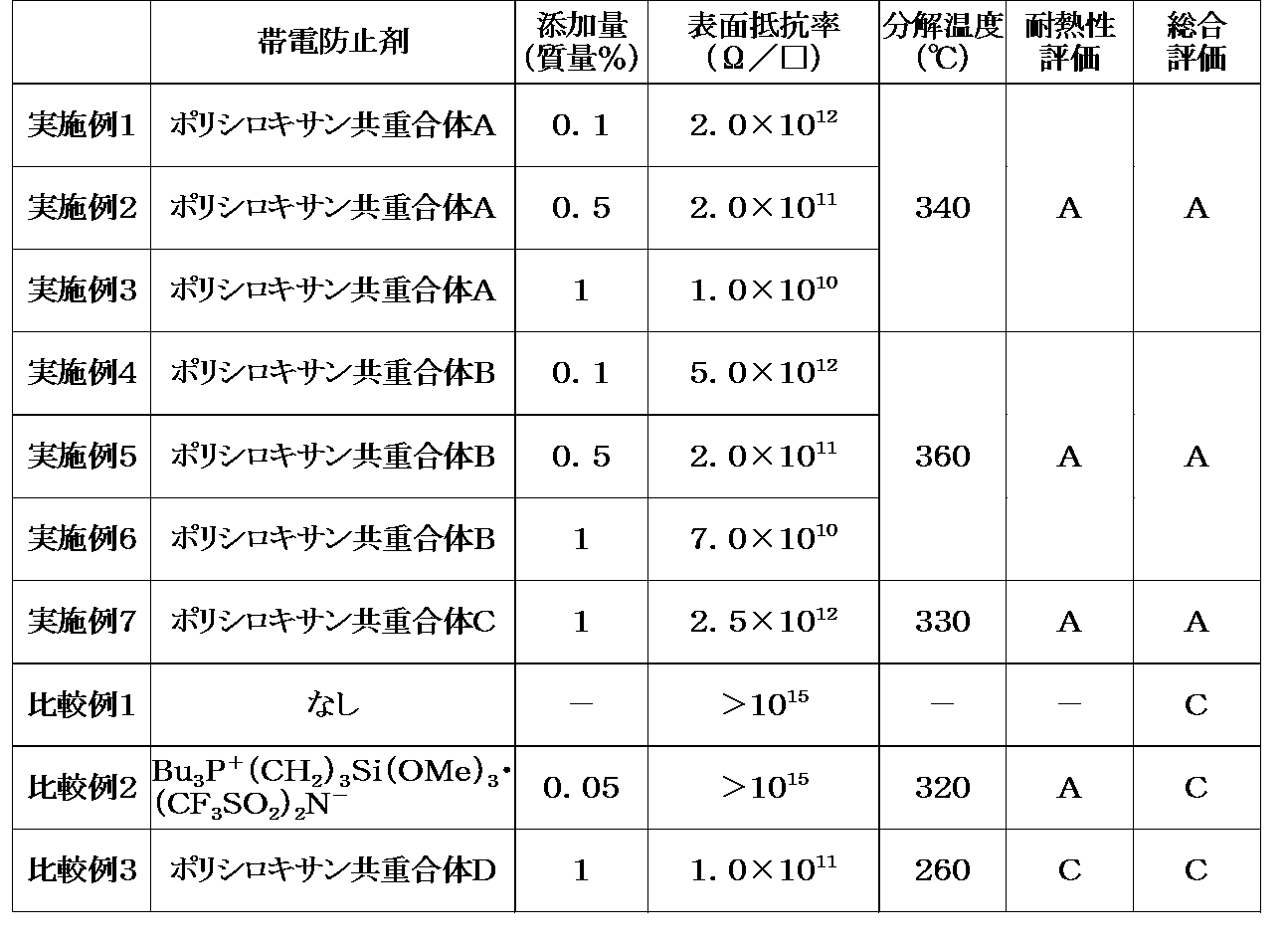
- Table 1 shows the measurement results of the surface resistivity of the obtained test pieces.
- Example 2 A test piece of a polycarbonate resin composition was prepared in the same manner as in Example 1 except that 16 mg of polysiloxane copolymer A was used, and the surface resistivity was measured. The results are shown in Table 1.
- Example 3 A test piece of a polycarbonate resin composition was prepared in the same manner as in Example 1 except that 32 mg of polysiloxane copolymer A was used, and the surface resistivity was measured. The results are shown in Table 1.
- Example 4 A test piece of a polycarbonate resin composition was prepared in the same manner as in Example 1 except that 3.2 mg of the polysiloxane copolymer B obtained in Production Example 2 was used, and the surface resistivity was measured. The results are shown in Table 1.
- Example 5 A test piece of the polycarbonate resin composition was prepared in the same manner as in Example 1 except that 16 mg of the polysiloxane copolymer B was used, and the surface resistivity was measured. The results are shown in Table 1.
- Example 6 A test piece of the polycarbonate resin composition was prepared in the same manner as in Example 1 except that 32 mg of the polysiloxane copolymer B was used, and the surface resistivity was measured. The results are shown in Table 1.
- Example 7 A test piece of a polycarbonate resin composition was prepared in the same manner as in Example 1 except that 32 mg of the polysiloxane copolymer C obtained in Production Example 3 was used, and the surface resistivity was measured. The results are shown in Table 1.
- Example 1 Except not adding polysiloxane copolymer A, B, or C, the test piece of the polycarbonate resin composition was produced like Example 1, and the surface resistivity was measured. The results are shown in Table 1.
- Example 1 except that 1- (3-trimethoxysilylpropyl) -1,1,1-tributylphosphonium bis (trifluoromethanesulfonyl) imide was used in place of the polysiloxane copolymer A, B or C.
- a test piece of the polycarbonate resin composition was prepared, and the surface resistivity was measured. The results are shown in Table 1.
- Example 3 A test piece of a polycarbonate resin composition was prepared in the same manner as in Example 1 except that the polysiloxane copolymer D obtained in Comparative Production Example 1 was used instead of the polysiloxane copolymer A, B or C. The surface resistivity was measured. The results are shown in Table 1.
- Example 8 Dipentaerythritol hexaacrylate (A-DPH: Shin-Nakamura Chemical Co., Ltd.) 0.50 g, Pentaerythritol triacrylate (A-TMN-3LM-N: Shin-Nakamura Chemical Co., Ltd.) 1.50 g, trimethylolpropane 0.50 g of triacrylate (A-TMPT: Shin-Nakamura Chemical Co., Ltd.), 0.54 g of polysiloxane copolymer A obtained in Production Example 1 as an antistatic agent, 1.75 g of isopropyl alcohol, IPA dispersion of colloidal silica (IPA-ST: Silica solid content 30% by mass, manufactured by Nissan Chemical Industries, Ltd.) 3.60 g and 2-hydroxy-2-methylpropiophenone 0.15 g as a photopolymerization initiator were mixed.
- IPA-ST Silica solid content 30% by mass, manufactured by Nissan Chemical Industries, Ltd.
- the obtained mixture was applied on one side of a 100 ⁇ m thick polyethylene terephthalate film using a bar coater so that the dry film thickness was about 5 ⁇ m, and then the ultraviolet ray of a high pressure mercury UV lamp (120 W / cm 2 ) was applied on the coating side.
- a high pressure mercury UV lamp 120 W / cm 2
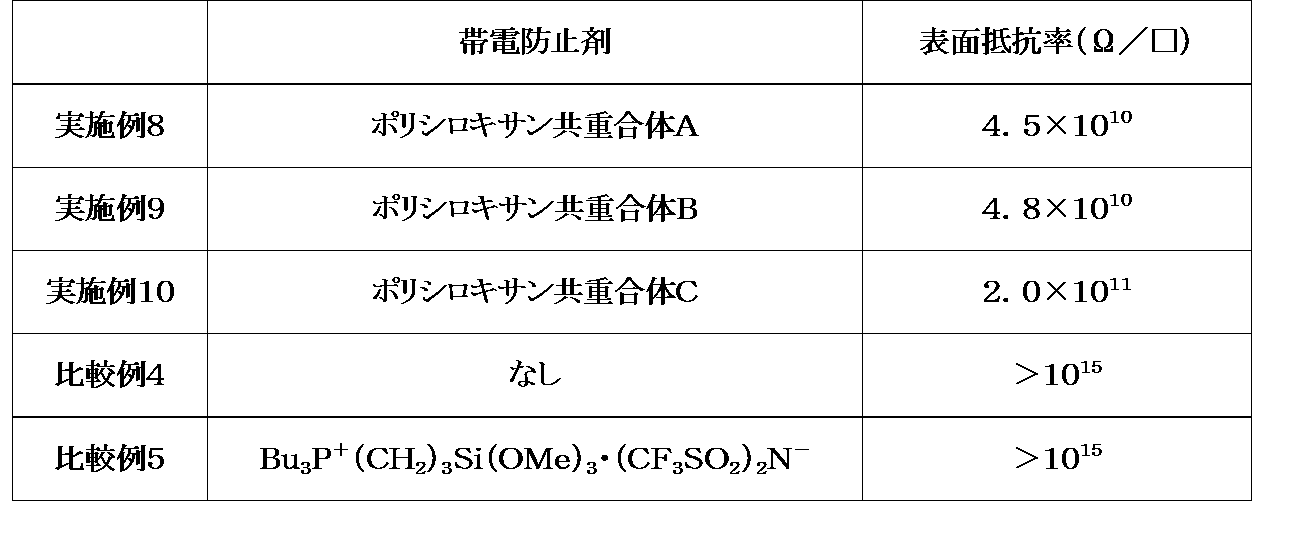
- Table 2 shows the measurement results of the surface resistivity of the hard coat surface of the obtained test piece.
- Example 9 A test piece hard-coated with an acrylic resin was produced in the same manner as in Example 8 except that 0.54 g of the polysiloxane copolymer B obtained in Production Example 2 was used. Table 2 shows the measurement results of the surface resistivity of the hard coat surface of the obtained test piece.
- Example 10 A test piece hard-coated with an acrylic resin was prepared in the same manner as in Example 8 except that 0.54 g of the polysiloxane copolymer C obtained in Production Example 3 was used. Table 2 shows the measurement results of the surface resistivity of the hard coat surface of the obtained test piece.
- Example 4 A test piece hard-coated with an acrylic resin was prepared in the same manner as in Example 8 except that the polysiloxane copolymer A, B or C was not added. Table 2 shows the measurement results of the surface resistivity of the hard coat surface of the obtained test piece.
- Example 5 Examples were used except that 0.54 g of 1- (3-trimethoxysilylpropyl) -1,1,1-tributylphosphonium bis (trifluoromethanesulfonyl) imide was used in place of the polysiloxane copolymer A or B. In the same manner as in Example 8, a test piece hard-coated with an acrylic resin was produced. Table 2 shows the measurement results of the surface resistivity of the hard coat surface of the obtained test piece.
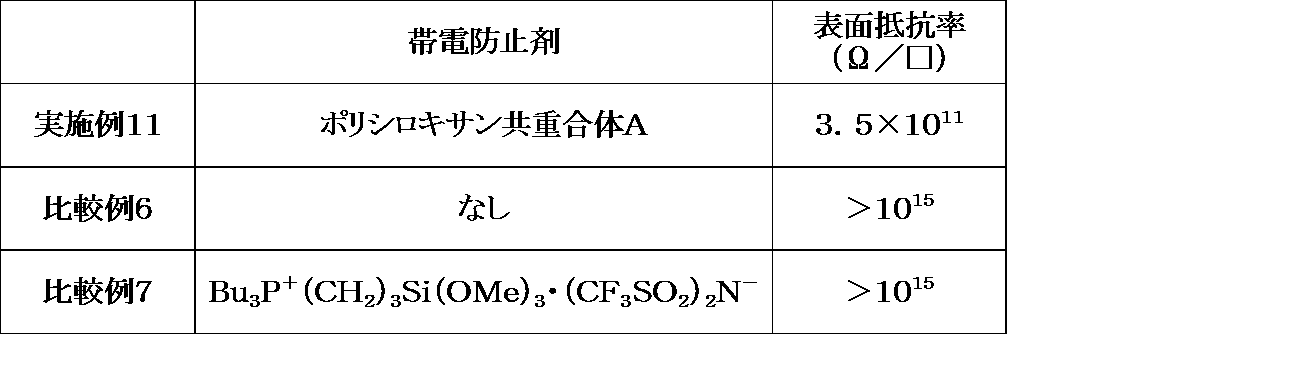
- Example 11 5.00 g of methyl methacrylate, 0.20 g of azobisisobutyronitrile and 5 mg of the polysiloxane copolymer A obtained in Production Example 1 as an antistatic agent were mixed, and the resulting mixture was made into a plastic container (inner diameter 5 cm ⁇ depth). Into a 1.5 cm cylindrical shape) and cured at 50 ° C. for 10 hours to prepare a test piece of polymethyl methacrylate resin having a thickness of about 2 mm. Table 3 shows the measurement results of the surface resistivity of the obtained test pieces.
- Example 12 Peroxide curing type silicone adhesive KR-101-10 (solid content 60%, manufactured by Shin-Etsu Chemical Co., Ltd.) 4.0 g, curing agent BPO 0.08 g (benzoyl peroxide), ethyl acetate 6.2 g and antistatic agent
- 48 mg of the polysiloxane copolymer A obtained in Example 1 was mixed to obtain a silicone resin pressure-sensitive adhesive.
- the silicone resin adhesive is applied to one side of a polyethylene terephthalate film (release paper) using a bar coater so that the dry film thickness is about 8 ⁇ m, and dried by heating at 90 ° C. for 3 minutes and 160 ° C. for 2 minutes.
- a resin adhesive layer was prepared and the surface resistivity was measured. The results are shown in Table 4.
- a triacetyl cellulose film (TAC film) was bonded to the surface having the pressure-sensitive adhesive layer, and aged for 1 hour at 25 ° C. and 50% RH to prepare a test film. The adhesive state of the adhesive to the release paper when the release paper was peeled from the test film was visually evaluated. The results are shown in Table 4.
- B Partial adhesion of the adhesive to the release paper is observed.
- C Adhesion of most of the adhesive to the release paper is observed.
- Example 8 A silicone resin pressure-sensitive adhesive layer and a test film were prepared in the same manner as in Example 12 except that the polysiloxane copolymer A, B, or C was not added, and the surface resistivity was measured and the pressure-sensitive adhesive to the release paper was used. The adhesion state of was visually evaluated. The results are shown in Table 4.
- Example 12 except that 1- (3-trimethoxysilylpropyl) -1,1,1-tributylphosphonium bis (trifluoromethanesulfonyl) imide was used in place of the polysiloxane copolymer A, B or C. Similarly, a silicone resin pressure-sensitive adhesive layer and a test film were prepared, the surface resistivity was measured, and the adhesive state of the pressure-sensitive adhesive on the release paper was visually evaluated. The results are shown in Table 4.
Landscapes
- Chemical & Material Sciences (AREA)
- Organic Chemistry (AREA)
- Health & Medical Sciences (AREA)
- Chemical Kinetics & Catalysis (AREA)
- Medicinal Chemistry (AREA)
- Polymers & Plastics (AREA)
- Engineering & Computer Science (AREA)
- Materials Engineering (AREA)
- Silicon Polymers (AREA)
- Compositions Of Macromolecular Compounds (AREA)
Abstract
Description
〔1〕
式(1)で示されるオニウム塩と、式(2)で示されるトリアルコキシシランと、任意成分として式(3)で示されるジアルコキシシランとを共重合して得られるポリシロキサン共重合体。
式(1):

式(2):

式(3):
〔2〕
前記式(1)において、Q+がリンカチオンである〔1〕に記載のポリシロキサン共重合体。
〔3〕
前記式(1)において、X-がハロゲンアニオン又は含フッ素アニオンである〔1〕又は〔2〕に記載のポリシロキサン共重合体。
〔4〕
前記含フッ素アニオンがトリフルオロメタンスルホン酸アニオン、ビス(トリフルオロメタンスルホニル)イミドアニオン、テトラフルオロボレートアニオン又はヘキサフルオロホスフェートアニオンである〔3〕に記載のポリシロキサン共重合体。
〔5〕
前記式(1)で示されるオニウム塩1モルに対し、前記式(2)で示されるトリアルコキシシラン0.5~95モルと前記式(3)で示されるジアルコキシシラン0~49モルを共重合して得られる〔1〕~〔4〕のいずれか1項に記載のポリシロキサン共重合体。
〔6〕
前記式(1)で示されるオニウム塩1モルに対し、前記式(2)で示されるトリアルコキシシラン0.5~95モルと前記式(3)で示されるジアルコキシシラン4~49モルを共重合して得られる〔1〕~〔4〕のいずれかに記載のポリシロキサン共重合体。
〔7〕
〔1〕~〔6〕のいずれかに記載のポリシロキサン共重合体を含有する帯電防止剤。
〔8〕
〔7〕に記載の帯電防止剤を含有する樹脂組成物。
〔9〕
前記樹脂組成物がポリカーボネート樹脂組成物、アクリル樹脂組成物又はシリコーン樹脂組成物である〔8〕に記載の樹脂組成物。
〔10〕
塩酸存在下、前記式(1)で示されるオニウム塩と、前記式(2)で示されるトリアルコキシシランと、任意成分として前記式(3)で示されるジアルコキシシランとを共重合させることを特徴とする〔1〕~〔6〕のいずれかに記載のポリシロキサン共重合体の製造方法。
本発明に係るポリシロキサン共重合体は、上述した通り、式(1)で示されるオニウム塩(以下、オニウム塩(1)という)と式(2)で示されるトリアルコキシシラン(以下、トリアルコキシシラン(2)という)と任意成分として式(3)で示されるジアルコキシシラン(以下、ジアルコキシシラン(3)という)を共重合することにより得られるものである。
式(1):

式(2):

式(3):

実施例中、表面抵抗率は、三菱化学株式会社製ハイレスターUP(MCP-HT450)を用いて、23±3℃、湿度45±5%の条件下で測定した。
また、耐熱性評価に関しては、セイコーインスツル株式会社製TG/DTA 220を用いて、窒素雰囲気下、10℃/分の昇温条件で測定したTG-DTAの測定結果において、5%質量減少時の温度を分解温度とした。分解温度が300℃以上である場合にはポリカーボネート樹脂への溶融混練可能な耐熱性を有しているとして「A」、分解温度が300℃未満である場合には耐熱性不十分として「C」と評価した。
撹拌装置を備えた500mLのガラス反応器に、窒素雰囲気下、ジメチルジメトキシシラン130.3g(1.1モル)、メチルトリメトキシシラン42.20g(0.31モル)、イソプロピルアルコール136.3g及び特開2010-248165号公報に記載の方法により製造した1-(3-トリメトキシシリルプロピル)-1,1,1-トリブチルホスホニウム=ビス(トリフルオロメタンスルホニル)イミド100.0g(0.15モル)を仕込んだ。得られた混合物に対して、0.1規定塩酸30.00gを室温で滴下した後、更に室温で16時間撹拌して得た反応混合物をロータリーエバポレーターで80℃下4時間濃縮した。得られた濃縮残渣をn-ヘキサン272.5gで2回分液洗浄し、更にロータリーエバポレーターを用いて80℃で5時間濃縮することにより、白色懸濁液体のポリシロキサン共重合体A120.2gを得た。
メチルトリメトキシシランの代わりに、ビニルトリメトキシシランを45.90g(0.31モル)用いた以外は、製造例1と同様にして白色懸濁液体のポリシロキサン共重合体B123.10gを得た。
撹拌装置を備えた500mLのガラス反応器に、窒素雰囲気下、メチルトリメトキシシラン190.0g(1.40モル)、イソプロピルアルコール145.0g及び特開2010-248165号公報に記載の方法により製造した1-(3-トリメトキシシリルプロピル)-1,1,1-トリブチルホスホニウム=ビス(トリフルオロメタンスルホニル)イミド100.0g(0.15モル)を仕込んだ。得られた混合物に対して、0.1規定塩酸39.20gを室温で滴下した後、更に室温で16時間撹拌して得た反応混合物をロータリーエバポレーターで80℃下4時間濃縮した。得られた濃縮残渣をn-ヘキサン290.0gで2回分液洗浄し、更にロータリーエバポレーターを用いて80℃で5時間濃縮することにより、白色懸濁液体のポリシロキサン共重合体C139.2gを得た。
撹拌装置を備えた500mLのガラス反応器に、窒素雰囲気下、ジメチルジメトキシシラン171.3g(1.4モル)、イソプロピルアルコール135.7g及びN-{(3-トリエトキシシリルプロピル)カルバモイルオキシエチル}-N,N,N-トリメチルアンモニウム=ビス(トリフルオロメタンスルホニル)イミド100.0g(0.16モル)を仕込んだ。得られた混合物に対して、0.1規定塩酸28.00gを室温で滴下した後、更に室温で16時間撹拌して得た反応混合物をロータリーエバポレーターで80℃下4時間濃縮した。得られた濃縮残渣をn-ヘキサン271.3gで2回分液洗浄し、更にロータリーエバポレーターを用いて80℃で5時間濃縮することにより、淡黄色透明液体のポリシロキサン共重合体D127.1gを得た。
50mLのサンプル瓶にポリカーボネート樹脂(住友ダウ株式会社製、カリバー(登録商標)200-13 NAT)3.2gとジクロロメタン20mLを入れ、ポリカーボネート樹脂を溶解させてポリカーボネート樹脂のジクロロメタン溶液を調製した。その溶液に帯電防止剤として製造例1で得たポリシロキサン共重合体A3.2mgを添加し、完溶させた後に金型(縦12cm×横20cm×深さ2cm)へ流し込み、室温で1時間、40℃で1時間乾燥させ、ポリカーボネート樹脂組成物の試験片(膜厚0.1±0.02mm)を作製した。得られた試験片の表面抵抗率の測定結果を表1に示す。
ポリシロキサン共重合体Aを16mg用いた以外は、実施例1と同様にしてポリカーボネート樹脂組成物の試験片を作製し、その表面抵抗率を測定した。その結果を表1に示す。
ポリシロキサン共重合体Aを32mg用いた以外は、実施例1と同様にしてポリカーボネート樹脂組成物の試験片を作製し、その表面抵抗率を測定した。その結果を表1に示す。
製造例2で得たポリシロキサン共重合体Bを3.2mg用いた以外は、実施例1と同様にしてポリカーボネート樹脂組成物の試験片を作製し、その表面抵抗率を測定した。その結果を表1に示す。
ポリシロキサン共重合体Bを16mg用いた以外は、実施例1と同様にしてポリカーボネート樹脂組成物の試験片を作製し、その表面抵抗率を測定した。その結果を表1に示す。
ポリシロキサン共重合体Bを32mg用いた以外は、実施例1と同様にしてポリカーボネート樹脂組成物の試験片を作製し、その表面抵抗率を測定した。その結果を表1に示す。
製造例3で得たポリシロキサン共重合体Cを32mg用いた以外は、実施例1と同様にしてポリカーボネート樹脂組成物の試験片を作製し、その表面抵抗率を測定した。その結果を表1に示す。
ポリシロキサン共重合体A、B又はCを添加しない以外は、実施例1と同様にしてポリカーボネート樹脂組成物の試験片を作製し、その表面抵抗率を測定した。その結果を表1に示す。
ポリシロキサン共重合体A、B又はCの代わりに、1-(3-トリメトキシシリルプロピル)-1,1,1-トリブチルホスホニウム=ビス(トリフルオロメタンスルホニル)イミドを用いた以外は、実施例1と同様にしてポリカーボネート樹脂組成物の試験片を作製し、その表面抵抗率を測定した。その結果を表1に示す。
ポリシロキサン共重合体A、B又はCの代わりに、比較製造例1で得たポリシロキサン共重合体Dを用いた以外は、実施例1と同様にしてポリカーボネート樹脂組成物の試験片を作製し、その表面抵抗率を測定した。その結果を表1に示す。
ジペンタエリスリトールヘキサアクリレート(A-DPH:新中村化学工業株式会社製)0.50g、ペンタエリスリトールトリアクリレート(A-TMN-3LM-N:新中村化学工業株式会社製)1.50g、トリメチロールプロパントリアクリレート(A-TMPT:新中村化学工業株式会社製)0.50g、帯電防止剤として製造例1で得たポリシロキサン共重合体A0.54g、イソプロピルアルコール1.75g、コロイダルシリカのIPA分散液(IPA-ST:シリカ固形分30質量%、日産化学工業株式会社製)3.60g及び光重合開始剤として2-ヒドロキシ-2-メチルプロピオフェノン0.15gを混合した。得られた混合物を厚さ100μmのポリエチレンテレフタラートフィルムの片面にバーコーターを用いて乾燥膜厚が約5μmとなるよう塗布した後、塗膜側に高圧水銀UVランプ(120W/cm2)の紫外線を積算光量約400mJ/cm2の条件で照射して、塗膜を硬化させることによって、アクリル樹脂でハードコートされた試験片を作製した。得られた試験片のハードコート面の表面抵抗率の測定結果を表2に示す。
製造例2で得たポリシロキサン共重合体Bを0.54g用いた以外は、実施例8と同様にしてアクリル樹脂でハードコートされた試験片を作製した。得られた試験片のハードコート面の表面抵抗率の測定結果を表2に示す。
製造例3で得たポリシロキサン共重合体Cを0.54g用いた以外は、実施例8と同様にしてアクリル樹脂でハードコートされた試験片を作製した。得られた試験片のハードコート面の表面抵抗率の測定結果を表2に示す。
ポリシロキサン共重合体A、B又はCを添加しない以外は、実施例8と同様にしてアクリル樹脂でハードコートされた試験片を作製した。得られた試験片のハードコート面の表面抵抗率の測定結果を表2に示す。
ポリシロキサン共重合体A又はBの代わりに、1-(3-トリメトキシシリルプロピル)-1,1,1-トリブチルホスホニウム=ビス(トリフルオロメタンスルホニル)イミド0.54gを用いた以外は、実施例8と同様にしてアクリル樹脂でハードコートされた試験片を作製した。得られた試験片のハードコート面の表面抵抗率の測定結果を表2に示す。
メタクリル酸メチル5.00g、アゾビスイソブチロニトリル0.20g及び帯電防止剤として製造例1で得たポリシロキサン共重合体A5mgを混合し、得られた混合物をプラスティック容器(内径5cm×深さ1.5cmの円筒形)に流し込み、50℃で10時間硬化させて厚さ約2mmのポリメチルメタクリレート樹脂の試験片を作製した。得られた試験片の表面抵抗率の測定結果を表3に示す。
ポリシロキサン共重合体A、B又はCを添加しない以外は、実施例11と同様にしてポリメチルメタクリレート樹脂の試験片を作製し、その表面抵抗率を測定した。その結果を表3に示す。
ポリシロキサン共重合体A、B又はCの代わりに、1-(3-トリメトキシシリルプロピル)-1,1,1-トリブチルホスホニウム=ビス(トリフルオロメタンスルホニル)イミド5mgを用いた以外は、実施例11と同様にしてポリメチルメタクリレート樹脂の試験片を作製し、その表面抵抗率を測定した。その結果を表3に示す。
過酸化物硬化型シリコーン粘着剤KR-101-10(固形分60%、信越化学工業株式会社製)4.0g、硬化剤BPO0.08g(過酸化ベンゾイル)、酢酸エチル6.2g及び帯電防止剤として実施例1で得たポリシロキサン共重合体A48mgを混合してシリコーン樹脂粘着剤を得た。前記シリコーン樹脂粘着剤をポリエチレンテレフタラートフィルム(離型紙)の片面にバーコーターを用いて乾燥膜厚が約8μmとなるよう塗布し、90℃で3分間、160℃で2分間加熱乾燥させてシリコーン樹脂粘着剤層を作製し、その表面抵抗率を測定した。その結果を表4に示す。
前記粘着剤層を有する面にトリアセチルセルロースフィルム(TACフィルム)を貼り合わせ、25℃、50%RHで1時間エージングして試験用フィルムを作製した。試験用フィルムから離型紙を剥離した際の離型紙への粘着剤の付着状態を目視で評価した。その結果を表4に示す。
A:離型紙への粘着剤の付着が認められない。
B:離型紙への部分的な粘着剤の付着が認められる。
C:離型紙への大部分の粘着剤の付着が認められる。
ポリシロキサン共重合体A、B又はCを添加しない以外は実施例12と同様にしてシリコーン樹脂粘着剤層及び試験用フィルムを作製し、その表面抵抗率を測定するとともに、離型紙への粘着剤の付着状態を目視で評価した。その結果を表4に示す。
ポリシロキサン共重合体A、B又はCの代わりに、1-(3-トリメトキシシリルプロピル)-1,1,1-トリブチルホスホニウム=ビス(トリフルオロメタンスルホニル)イミドを用いた以外は実施例12と同様にしてシリコーン樹脂粘着剤層及び試験用フィルムを作製し、その表面抵抗率を測定するとともに、離型紙への粘着剤の付着状態を目視で評価した。その結果を表4に示す。

Claims (10)
- 式(1)で示されるオニウム塩と、式(2)で示されるトリアルコキシシランと、任意成分として式(3)で示されるジアルコキシシランとを共重合して得られるポリシロキサン共重合体。
式(1):

式(2):

式(3):

- 前記式(1)において、Q+がリンカチオンである請求項1に記載のポリシロキサン共重合体。
- 前記式(1)において、X-がハロゲンアニオン又は含フッ素アニオンである請求項1又は2に記載のポリシロキサン共重合体。
- 前記含フッ素アニオンがトリフルオロメタンスルホン酸アニオン、ビス(トリフルオロメタンスルホニル)イミドアニオン、テトラフルオロボレートアニオン又はヘキサフルオロホスフェートアニオンである請求項3に記載のポリシロキサン共重合体。
- 前記式(1)で示されるオニウム塩1モルに対し、前記式(2)で示されるトリアルコキシシラン0.5~95モルと前記式(3)で示されるジアルコキシシラン0~49モルを共重合して得られる請求項1~4のいずれか1項に記載のポリシロキサン共重合体。
- 前記式(1)で示されるオニウム塩1モルに対し、前記式(2)で示されるトリアルコキシシラン0.5~95モルと前記式(3)で示されるジアルコキシシラン4~49モルを共重合して得られる請求項1~4のいずれか1項に記載のポリシロキサン共重合体。
- 請求項1~6のいずれか1項に記載のポリシロキサン共重合体を含有する帯電防止剤。
- 請求項7に記載の帯電防止剤を含有する樹脂組成物。
- 前記樹脂組成物がポリカーボネート樹脂組成物、アクリル樹脂組成物又はシリコーン樹脂組成物である請求項8に記載の樹脂組成物。
- 塩酸存在下、前記式(1)で示されるオニウム塩と、前記式(2)で示されるトリアルコキシシランと、任意成分として前記式(3)で示されるジアルコキシシランとを共重合させることを特徴とする請求項1~6のいずれか1項に記載のポリシロキサン共重合体の製造方法。
Priority Applications (3)
| Application Number | Priority Date | Filing Date | Title |
|---|---|---|---|
| CN201580011487.6A CN106062044B (zh) | 2014-04-21 | 2015-03-17 | 聚硅氧烷共聚物以及含有其的抗静电剂和树脂组合物 |
| KR1020167023144A KR102288085B1 (ko) | 2014-04-21 | 2015-03-17 | 폴리실록세인 공중합체, 그것을 함유하는 대전 방지제 및 수지 조성물 |
| JP2016514811A JP6179668B2 (ja) | 2014-04-21 | 2015-03-17 | ポリシロキサン共重合体並びにそれを含有する帯電防止剤及び樹脂組成物 |
Applications Claiming Priority (2)
| Application Number | Priority Date | Filing Date | Title |
|---|---|---|---|
| JP2014-087134 | 2014-04-21 | ||
| JP2014087134 | 2014-04-21 |
Publications (1)
| Publication Number | Publication Date |
|---|---|
| WO2015163040A1 true WO2015163040A1 (ja) | 2015-10-29 |
Family
ID=54332211
Family Applications (1)
| Application Number | Title | Priority Date | Filing Date |
|---|---|---|---|
| PCT/JP2015/057807 Ceased WO2015163040A1 (ja) | 2014-04-21 | 2015-03-17 | ポリシロキサン共重合体並びにそれを含有する帯電防止剤及び樹脂組成物 |
Country Status (5)
| Country | Link |
|---|---|
| JP (1) | JP6179668B2 (ja) |
| KR (1) | KR102288085B1 (ja) |
| CN (1) | CN106062044B (ja) |
| TW (1) | TWI657102B (ja) |
| WO (1) | WO2015163040A1 (ja) |
Cited By (6)
| Publication number | Priority date | Publication date | Assignee | Title |
|---|---|---|---|---|
| JP2014108993A (ja) * | 2012-12-03 | 2014-06-12 | Koei Chem Co Ltd | 四級塩構造を有するポリシロキサン共重合体およびそれを含有する帯電防止剤 |
| CN109790438A (zh) * | 2016-09-26 | 2019-05-21 | 日东电工株式会社 | 粘合剂组合物、粘合片、及光学构件 |
| JP2019199519A (ja) * | 2018-05-16 | 2019-11-21 | 株式会社スリーボンド | 塗膜形成組成物 |
| JP2020094139A (ja) * | 2018-12-13 | 2020-06-18 | 信越化学工業株式会社 | 帯電防止性シリコーンゴム組成物及び帯電防止キャリアプレート |
| JP2022529808A (ja) * | 2019-04-22 | 2022-06-24 | サムスン エスディアイ カンパニー,リミテッド | シリコン系粘着性保護フィルム及びこれを含む光学部材 |
| US12404424B2 (en) | 2019-04-25 | 2025-09-02 | Samsung Sdi Co., Ltd. | Silicone-based adhesive protection film and optical member comprising same |
Families Citing this family (2)
| Publication number | Priority date | Publication date | Assignee | Title |
|---|---|---|---|---|
| CN108864460B (zh) * | 2018-06-28 | 2020-06-09 | 浙江清华柔性电子技术研究院 | 抗静电硅橡胶的制备方法 |
| JP6958511B2 (ja) * | 2018-08-17 | 2021-11-02 | 信越化学工業株式会社 | オルガノポリシロキサン化合物およびその製造方法並びにそれを含有する帯電防止剤および硬化性組成物 |
Citations (8)
| Publication number | Priority date | Publication date | Assignee | Title |
|---|---|---|---|---|
| JPS4844181A (ja) * | 1971-10-04 | 1973-06-25 | ||
| JPH01266137A (ja) * | 1988-04-19 | 1989-10-24 | Toshiba Silicone Co Ltd | 第4級アンモニウム基含有シリコーン樹脂微粉末 |
| JPH06128379A (ja) * | 1992-10-20 | 1994-05-10 | Showa Denko Kk | ポリオルガノシルセスキオキサン及びその製造方法 |
| JP2004202925A (ja) * | 2002-12-26 | 2004-07-22 | Takemoto Oil & Fat Co Ltd | インクジェット記録媒体の光沢層用塗工液及びインクジェット記録媒体 |
| WO2010021290A1 (ja) * | 2008-08-18 | 2010-02-25 | 日産化学工業株式会社 | オニウム基を有するシリコン含有レジスト下層膜形成組成物 |
| KR20120022200A (ko) * | 2010-09-01 | 2012-03-12 | (주)밀텍엔지니어링 | 축합성 기능기를 갖는 경화 촉매를 포함하는 내마모성 실리콘계 코팅제 조성물 |
| JP2013515154A (ja) * | 2009-12-22 | 2013-05-02 | ダウ コーニング コーポレーション | 水分散性のシリコーン樹脂 |
| WO2014021256A1 (ja) * | 2012-07-30 | 2014-02-06 | 日産化学工業株式会社 | スルホン酸オニウム塩を含有するケイ素含有euvレジスト下層膜形成組成物 |
Family Cites Families (2)
| Publication number | Priority date | Publication date | Assignee | Title |
|---|---|---|---|---|
| JP5628504B2 (ja) | 2009-03-24 | 2014-11-19 | 広栄化学工業株式会社 | トリアルコキシシリルアルキル基を有するオニウム塩 |
| JP6190572B2 (ja) * | 2011-06-24 | 2017-08-30 | 広栄化学工業株式会社 | トリアルコキシシリルアルキル基を有するオニウム塩 |
-
2015
- 2015-03-17 KR KR1020167023144A patent/KR102288085B1/ko not_active Expired - Fee Related
- 2015-03-17 CN CN201580011487.6A patent/CN106062044B/zh not_active Expired - Fee Related
- 2015-03-17 WO PCT/JP2015/057807 patent/WO2015163040A1/ja not_active Ceased
- 2015-03-17 JP JP2016514811A patent/JP6179668B2/ja active Active
- 2015-04-08 TW TW104111270A patent/TWI657102B/zh not_active IP Right Cessation
Patent Citations (8)
| Publication number | Priority date | Publication date | Assignee | Title |
|---|---|---|---|---|
| JPS4844181A (ja) * | 1971-10-04 | 1973-06-25 | ||
| JPH01266137A (ja) * | 1988-04-19 | 1989-10-24 | Toshiba Silicone Co Ltd | 第4級アンモニウム基含有シリコーン樹脂微粉末 |
| JPH06128379A (ja) * | 1992-10-20 | 1994-05-10 | Showa Denko Kk | ポリオルガノシルセスキオキサン及びその製造方法 |
| JP2004202925A (ja) * | 2002-12-26 | 2004-07-22 | Takemoto Oil & Fat Co Ltd | インクジェット記録媒体の光沢層用塗工液及びインクジェット記録媒体 |
| WO2010021290A1 (ja) * | 2008-08-18 | 2010-02-25 | 日産化学工業株式会社 | オニウム基を有するシリコン含有レジスト下層膜形成組成物 |
| JP2013515154A (ja) * | 2009-12-22 | 2013-05-02 | ダウ コーニング コーポレーション | 水分散性のシリコーン樹脂 |
| KR20120022200A (ko) * | 2010-09-01 | 2012-03-12 | (주)밀텍엔지니어링 | 축합성 기능기를 갖는 경화 촉매를 포함하는 내마모성 실리콘계 코팅제 조성물 |
| WO2014021256A1 (ja) * | 2012-07-30 | 2014-02-06 | 日産化学工業株式会社 | スルホン酸オニウム塩を含有するケイ素含有euvレジスト下層膜形成組成物 |
Non-Patent Citations (2)
| Title |
|---|
| PARTHA MAJUMDAR ET AL.: "Combinatorial Materials Research Applied to the Development of New Surface Coatings XIII: An Investigation of Polysiloxane Antimicrobial Coatings Containing Tethered Quaternary Ammonium Salt Groups", J. COMB. CHEM., vol. 11, no. 6, 2009, pages 1115 - 1127, XP055232678 * |
| YONGHUI WU ET AL.: "PVA-silica anion-exchange hybrid membranes prepared through a copolymer crosslinking agent", JOURNAL OF MEMBRANE SCIENCE, vol. 350, 2010, pages 322 - 332, XP026915576 * |
Cited By (10)
| Publication number | Priority date | Publication date | Assignee | Title |
|---|---|---|---|---|
| JP2014108993A (ja) * | 2012-12-03 | 2014-06-12 | Koei Chem Co Ltd | 四級塩構造を有するポリシロキサン共重合体およびそれを含有する帯電防止剤 |
| CN109790438A (zh) * | 2016-09-26 | 2019-05-21 | 日东电工株式会社 | 粘合剂组合物、粘合片、及光学构件 |
| JPWO2018056167A1 (ja) * | 2016-09-26 | 2019-07-18 | 日東電工株式会社 | 粘着剤組成物、粘着シート、及び、光学部材 |
| CN109790438B (zh) * | 2016-09-26 | 2021-08-31 | 日东电工株式会社 | 粘合剂组合物、粘合片、及光学构件 |
| JP2019199519A (ja) * | 2018-05-16 | 2019-11-21 | 株式会社スリーボンド | 塗膜形成組成物 |
| JP6994149B2 (ja) | 2018-05-16 | 2022-01-14 | 株式会社スリーボンド | 塗膜形成組成物 |
| JP2020094139A (ja) * | 2018-12-13 | 2020-06-18 | 信越化学工業株式会社 | 帯電防止性シリコーンゴム組成物及び帯電防止キャリアプレート |
| JP2022529808A (ja) * | 2019-04-22 | 2022-06-24 | サムスン エスディアイ カンパニー,リミテッド | シリコン系粘着性保護フィルム及びこれを含む光学部材 |
| JP7465283B2 (ja) | 2019-04-22 | 2024-04-10 | サムスン エスディアイ カンパニー,リミテッド | シリコン系粘着性保護フィルム及びこれを含む光学部材 |
| US12404424B2 (en) | 2019-04-25 | 2025-09-02 | Samsung Sdi Co., Ltd. | Silicone-based adhesive protection film and optical member comprising same |
Also Published As
| Publication number | Publication date |
|---|---|
| CN106062044A (zh) | 2016-10-26 |
| TW201605933A (zh) | 2016-02-16 |
| TWI657102B (zh) | 2019-04-21 |
| KR20160148513A (ko) | 2016-12-26 |
| KR102288085B1 (ko) | 2021-08-11 |
| JPWO2015163040A1 (ja) | 2017-04-13 |
| CN106062044B (zh) | 2019-11-26 |
| JP6179668B2 (ja) | 2017-08-16 |
Similar Documents
| Publication | Publication Date | Title |
|---|---|---|
| JP6179668B2 (ja) | ポリシロキサン共重合体並びにそれを含有する帯電防止剤及び樹脂組成物 | |
| JP6177430B2 (ja) | ポリシロキサン共重合体及びそれを含有する帯電防止剤 | |
| CN107001583B (zh) | 光及热固化性树脂组合物、固化物以及层积体 | |
| TWI530532B (zh) | A silicon-containing hardened composition and a hardened product thereof | |
| CN105324407B (zh) | 活性能量线固化性组合物 | |
| JP2011190413A (ja) | シロキサンポリマー架橋硬化物 | |
| CN104193995B (zh) | 一种用于3d打印装置的有机硅封装材料及制备方法 | |
| JP6958511B2 (ja) | オルガノポリシロキサン化合物およびその製造方法並びにそれを含有する帯電防止剤および硬化性組成物 | |
| JP2015155541A (ja) | シロキサンポリマー架橋硬化物 | |
| JP6353306B2 (ja) | 高分子エポキシ樹脂を含む光学シート状接着剤用樹脂組成物、該組成物よりなる光学シート用接着剤、及びその硬化物、並びに、前記組成物に使用する高分子エポキシ樹脂の製造方法 | |
| JP5626788B2 (ja) | 封止材用塗料およびその用途 | |
| JP6443293B2 (ja) | 放射線硬化性シリコーン組成物及びそれを用いた帯電防止性剥離フィルムの製造方法 | |
| JP5661429B2 (ja) | 液状付加硬化性メタロシロキサン | |
| CN114008113B (zh) | 树脂组合物、其制造方法、以及多组分型固化性树脂组合物 | |
| JP4520559B2 (ja) | 硬化性組成物 | |
| JP6296857B2 (ja) | ポリシロキサン共重合体を含むシリコーン樹脂組成物 | |
| CN110437655B (zh) | TiO2改性的聚丙烯酸脂/有机硅杂化涂料及其制备方法 | |
| CN108463509A (zh) | 含硅固化性组合物及其固化物 | |
| JP6509526B2 (ja) | オルガノポリシロキサン、ハイドロジェンオルガノポリシロキサン、及びそれらを用いた熱硬化性樹脂組成物、光半導体用封止材、光半導体用ダイボンド材、並びに、半導体パッケージ | |
| JP6784614B2 (ja) | 熱硬化性オルガノポリシロキサン組成物 | |
| JP2010248385A (ja) | 組成物、硬化体、および光半導体封止材 | |
| JP2018008492A (ja) | 積層シート |
Legal Events
| Date | Code | Title | Description |
|---|---|---|---|
| 121 | Ep: the epo has been informed by wipo that ep was designated in this application |
Ref document number: 15782361 Country of ref document: EP Kind code of ref document: A1 |
|
| ENP | Entry into the national phase |
Ref document number: 2016514811 Country of ref document: JP Kind code of ref document: A |
|
| ENP | Entry into the national phase |
Ref document number: 20167023144 Country of ref document: KR Kind code of ref document: A |
|
| NENP | Non-entry into the national phase |
Ref country code: DE |
|
| 122 | Ep: pct application non-entry in european phase |
Ref document number: 15782361 Country of ref document: EP Kind code of ref document: A1 |