WO2015104973A1 - ポリアリーレンエーテル樹脂、ポリアリーレンエーテル樹脂の製造方法、硬化性樹脂材料、その硬化物、半導体封止材料、プリプレグ、回路基板、及びビルドアップフィルム - Google Patents
ポリアリーレンエーテル樹脂、ポリアリーレンエーテル樹脂の製造方法、硬化性樹脂材料、その硬化物、半導体封止材料、プリプレグ、回路基板、及びビルドアップフィルム Download PDFInfo
- Publication number
- WO2015104973A1 WO2015104973A1 PCT/JP2014/083587 JP2014083587W WO2015104973A1 WO 2015104973 A1 WO2015104973 A1 WO 2015104973A1 JP 2014083587 W JP2014083587 W JP 2014083587W WO 2015104973 A1 WO2015104973 A1 WO 2015104973A1
- Authority
- WO
- WIPO (PCT)
- Prior art keywords
- group
- polyarylene ether
- resin
- aromatic
- formula
- Prior art date
- Legal status (The legal status is an assumption and is not a legal conclusion. Google has not performed a legal analysis and makes no representation as to the accuracy of the status listed.)
- Ceased
Links
- 0 *C=C(C=C(C=C(C(C1)=C2)OCN1c1ccccc1)C2=Cc1ccc(ccc(O)c2)c2c1)Oc(cc1)cc2c1cc(CN(CO1)c3ccccc3)c1c2 Chemical compound *C=C(C=C(C=C(C(C1)=C2)OCN1c1ccccc1)C2=Cc1ccc(ccc(O)c2)c2c1)Oc(cc1)cc2c1cc(CN(CO1)c3ccccc3)c1c2 0.000 description 1
- RMMSJIXGNRKBMC-QSCHNALKSA-N C[C@H]1C=CC(N2COc3cc4cc(Oc(cc5)cc6c5ccc(Oc(cc5)cc7c5cc(CN(CO5)c8ccccc8)c5c7-c5cc(N7COc8cc9cc(OCN(C%10)c%11ccccc%11)c%10cc9cc8C7)ccc5)c6)ccc4cc3C2)=CC=C1 Chemical compound C[C@H]1C=CC(N2COc3cc4cc(Oc(cc5)cc6c5ccc(Oc(cc5)cc7c5cc(CN(CO5)c8ccccc8)c5c7-c5cc(N7COc8cc9cc(OCN(C%10)c%11ccccc%11)c%10cc9cc8C7)ccc5)c6)ccc4cc3C2)=CC=C1 RMMSJIXGNRKBMC-QSCHNALKSA-N 0.000 description 1
Images





Classifications
-
- C—CHEMISTRY; METALLURGY
- C08—ORGANIC MACROMOLECULAR COMPOUNDS; THEIR PREPARATION OR CHEMICAL WORKING-UP; COMPOSITIONS BASED THEREON
- C08J—WORKING-UP; GENERAL PROCESSES OF COMPOUNDING; AFTER-TREATMENT NOT COVERED BY SUBCLASSES C08B, C08C, C08F, C08G or C08H
- C08J5/00—Manufacture of articles or shaped materials containing macromolecular substances
- C08J5/24—Impregnating materials with prepolymers which can be polymerised in situ, e.g. manufacture of prepregs
-
- C—CHEMISTRY; METALLURGY
- C08—ORGANIC MACROMOLECULAR COMPOUNDS; THEIR PREPARATION OR CHEMICAL WORKING-UP; COMPOSITIONS BASED THEREON
- C08G—MACROMOLECULAR COMPOUNDS OBTAINED OTHERWISE THAN BY REACTIONS ONLY INVOLVING UNSATURATED CARBON-TO-CARBON BONDS
- C08G14/00—Condensation polymers of aldehydes or ketones with two or more other monomers covered by at least two of the groups C08G8/00 - C08G12/00
- C08G14/02—Condensation polymers of aldehydes or ketones with two or more other monomers covered by at least two of the groups C08G8/00 - C08G12/00 of aldehydes
- C08G14/04—Condensation polymers of aldehydes or ketones with two or more other monomers covered by at least two of the groups C08G8/00 - C08G12/00 of aldehydes with phenols
- C08G14/06—Condensation polymers of aldehydes or ketones with two or more other monomers covered by at least two of the groups C08G8/00 - C08G12/00 of aldehydes with phenols and monomers containing hydrogen attached to nitrogen
-
- C—CHEMISTRY; METALLURGY
- C08—ORGANIC MACROMOLECULAR COMPOUNDS; THEIR PREPARATION OR CHEMICAL WORKING-UP; COMPOSITIONS BASED THEREON
- C08G—MACROMOLECULAR COMPOUNDS OBTAINED OTHERWISE THAN BY REACTIONS ONLY INVOLVING UNSATURATED CARBON-TO-CARBON BONDS
- C08G65/00—Macromolecular compounds obtained by reactions forming an ether link in the main chain of the macromolecule
- C08G65/34—Macromolecular compounds obtained by reactions forming an ether link in the main chain of the macromolecule from hydroxy compounds or their metallic derivatives
- C08G65/38—Macromolecular compounds obtained by reactions forming an ether link in the main chain of the macromolecule from hydroxy compounds or their metallic derivatives derived from phenols
-
- C—CHEMISTRY; METALLURGY
- C08—ORGANIC MACROMOLECULAR COMPOUNDS; THEIR PREPARATION OR CHEMICAL WORKING-UP; COMPOSITIONS BASED THEREON
- C08G—MACROMOLECULAR COMPOUNDS OBTAINED OTHERWISE THAN BY REACTIONS ONLY INVOLVING UNSATURATED CARBON-TO-CARBON BONDS
- C08G65/00—Macromolecular compounds obtained by reactions forming an ether link in the main chain of the macromolecule
- C08G65/34—Macromolecular compounds obtained by reactions forming an ether link in the main chain of the macromolecule from hydroxy compounds or their metallic derivatives
- C08G65/48—Polymers modified by chemical after-treatment
- C08G65/485—Polyphenylene oxides
-
- C—CHEMISTRY; METALLURGY
- C09—DYES; PAINTS; POLISHES; NATURAL RESINS; ADHESIVES; COMPOSITIONS NOT OTHERWISE PROVIDED FOR; APPLICATIONS OF MATERIALS NOT OTHERWISE PROVIDED FOR
- C09D—COATING COMPOSITIONS, e.g. PAINTS, VARNISHES OR LACQUERS; FILLING PASTES; CHEMICAL PAINT OR INK REMOVERS; INKS; CORRECTING FLUIDS; WOODSTAINS; PASTES OR SOLIDS FOR COLOURING OR PRINTING; USE OF MATERIALS THEREFOR
- C09D163/00—Coating compositions based on epoxy resins; Coating compositions based on derivatives of epoxy resins
-
- H—ELECTRICITY
- H10—SEMICONDUCTOR DEVICES; ELECTRIC SOLID-STATE DEVICES NOT OTHERWISE PROVIDED FOR
- H10W—GENERIC PACKAGES, INTERCONNECTIONS, CONNECTORS OR OTHER CONSTRUCTIONAL DETAILS OF DEVICES COVERED BY CLASS H10
- H10W74/00—Encapsulations, e.g. protective coatings
- H10W74/40—Encapsulations, e.g. protective coatings characterised by their materials
- H10W74/47—Encapsulations, e.g. protective coatings characterised by their materials comprising organic materials, e.g. plastics or resins
Definitions
- the present invention relates to a polyarylene ether resin excellent in various physical properties such as heat resistance, heat decomposition resistance, moisture resistance and solder resistance, flame retardancy and dielectric properties in a cured product, a method for producing the same, a curable resin material and a cured product thereof, and semiconductor encapsulation.
- the present invention relates to materials, prepregs, circuit boards, and build-up films.
- resins such as epoxy resins, cyanate ester resins, bismaleimide-triazine resins, and benzoxazine resins are used as resin materials for electronic components used in semiconductor sealing materials and insulating layers for multilayer printed boards. These resin materials are required to have various performances such as heat resistance, heat decomposition resistance, flame resistance, moisture resistance, solder resistance, and dielectric properties.
- benzoxazine resins have excellent heat resistance and dielectric properties in cured products.
- benzoxazine resins obtained by reacting bisphenol, formalin and aniline are known.
- the benzoxazine resin described in Patent Document 1 does not have sufficient heat decomposability, flame retardancy, and moisture resistance and solder resistance, such as heat resistance, heat decomposability, moisture resistance, solder resistance, flame resistance, and dielectric properties.
- the problem to be solved by the present invention is a polyarylene ether resin excellent in various physical properties such as heat resistance, heat decomposition resistance, moisture resistance solder resistance, flame retardancy and dielectric properties in a cured product, a method for producing the same, and a curable resin. It is providing a material and its hardened
- a dihydrooxazine structure-containing resin having a polyarylene ether structure and at least one of the aromatic nuclei in the polyarylene ether structure is a naphthalene skeleton is obtained.
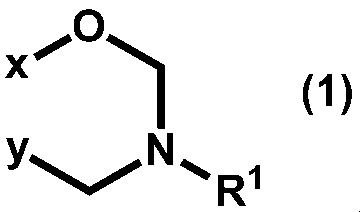
- the present invention has a polyarylene ether structure ( ⁇ ) in the molecular structure, at least one of the aromatic nuclei in the polyarylene ether structure ( ⁇ ) has a naphthalene skeleton, and the polyarylene At least one of the aromatic nuclei in the ether structure ( ⁇ ) has the following structural formula (1) on the aromatic nuclei:
- R 1 represents an aliphatic hydrocarbon group, an aromatic hydrocarbon group, or a structural site in which one or more of hydrogen atoms contained therein are substituted with a hydroxyl group, an alkoxy group, or a halogen atom.
- X And y is the point of attachment to the aromatic nucleus and is attached to adjacent carbon atoms.
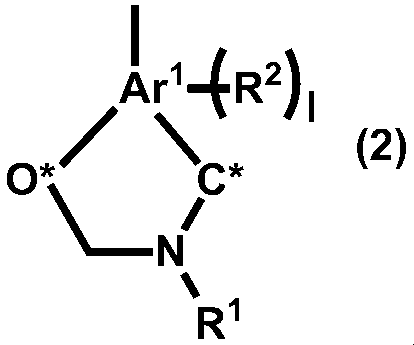
- Ar 1 represents an aromatic nucleus
- R 1 is an aliphatic hydrocarbon group, an aromatic hydrocarbon group, or a structure in which one or more of hydrogen atoms contained therein are substituted with a hydroxyl group, an alkoxy group, or a halogen atom.
- R 2 independently represents any of a hydrogen atom, an alkyl group, an aryl group, and an aralkyl group, and l is 1 or 2.
- the O * atom and the C * atom are Ar And bonded to adjacent carbon atoms of the aromatic nucleus represented by 1 .
- the present invention relates to a polyarylene ether resin characterized by having a structural moiety ( ⁇ ) represented by:
- the present invention further provides a polyarylene ether intermediate (1) obtained by reacting an aromatic dihydroxy compound and an aralkylating agent under an acid catalyst condition, and reacting this with a monoamine compound and formaldehyde.
- the present invention relates to a method for producing an arylene ether resin.
- the present invention further provides a polyarylene ether resin obtained by reacting an aromatic dihydroxy compound under alkaline catalyst conditions to obtain a polyarylene ether intermediate (2), which is reacted with a monoamine compound and formaldehyde. Regarding the method.
- the present invention further relates to a curable resin material containing the polyarylene ether resin as an essential component.
- the present invention further relates to a cured product obtained by curing the curable resin material.
- the present invention further relates to a semiconductor sealing material containing the polyarylene ether resin and an inorganic filler.
- the present invention further relates to a prepreg obtained by impregnating a reinforced resin material diluted with an organic solvent into a reinforcing base material and semi-curing the resulting impregnated base material.
- the present invention further relates to a circuit board obtained by obtaining a varnish obtained by diluting the curable resin material in an organic solvent, and molding it into a plate shape and copper foil.
- the present invention further relates to a build-up film obtained by applying a material obtained by diluting the curable resin material in an organic solvent onto a base film and drying it.
- a polyarylene ether resin excellent in various physical properties such as heat resistance, heat decomposition resistance, moisture solder resistance, flame resistance and dielectric properties in a cured product, a method for producing the same, a curable resin material and a cured product thereof, A semiconductor sealing material, a prepreg, a circuit board, and a buildup film can be provided.
- FIG. 1 is a GPC chart of the polyarylene ether intermediate (1) obtained in Production Example 1.
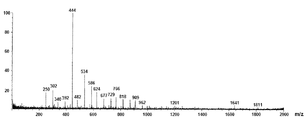
- FIG. FIG. 2 is an FD-MS spectrum of the polyarylene ether intermediate (1) obtained in Production Example 1.
- FIG. 3 is an FD-MS spectrum of the trimethylsilylated product of the polyarylene ether intermediate (1) obtained in Production Example 1.
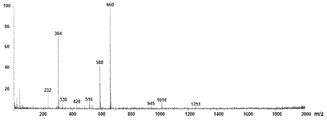
- FIG. 4 is an FD-MS spectrum of the polyarylene ether resin (1) obtained in Example 1.
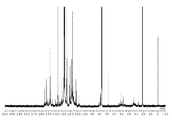
- FIG. 5 is a 13C-NMR chart of the polyarylene ether resin (1) obtained in Example 1.
- FIG. 6 is a GPC chart of the polyarylene ether intermediate (2) obtained in Production Example 2.
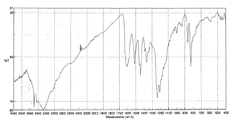
- FIG. 7 is an FT-IR chart of the polyarylene ether intermediate (2) obtained in Production Example 2.
- FIG. 8 is an FD-MS spectrum of the polyarylene ether intermediate (2) obtained in Production Example 2.
- FIG. 9 is an FD-MS spectrum of the trimethylsilylated product of the polyarylene ether intermediate (2) obtained in Production Example 2.
- the polyarylene ether resin of the present invention has a polyarylene ether structure ( ⁇ ) in the molecular structure, and at least one of the aromatic nuclei in the polyarylene ether structure ( ⁇ ) has a naphthalene skeleton, and At least one of the aromatic nuclei in the polyarylene ether structure ( ⁇ ) has the following structural formula (1) on the aromatic nuclei:
- R 1 represents an aliphatic hydrocarbon group, an aromatic hydrocarbon group, or a structural site in which one or more of hydrogen atoms contained therein are substituted with a hydroxyl group, an alkoxy group, or a halogen atom.
- X And y is the point of attachment to the aromatic nucleus and is attached to adjacent carbon atoms.
- Ar 1 represents an aromatic nucleus
- R 1 is an aliphatic hydrocarbon group, an aromatic hydrocarbon group, or a structure in which one or more of hydrogen atoms contained therein are substituted with a hydroxyl group, an alkoxy group, or a halogen atom.
- R 2 independently represents any of a hydrogen atom, an alkyl group, an aryl group, and an aralkyl group, and l is 1 or 2.
- the O * atom and the C * atom are Ar And bonded to adjacent carbon atoms of the aromatic nucleus represented by 1 . It has the structure part ((gamma)) represented by these.
- the structural part ( ⁇ ) and the six-membered ring structure in the structural part ( ⁇ ) are so-called dihydrooxazine structures, and as described above, the resin having such a dihydrooxazine structure is characterized by excellent heat resistance and dielectric properties. On the other hand, the thermal decomposition resistance, flame retardancy, and moisture and solder resistance are not sufficient.
- the polyarylene ether structure ( ⁇ ) into the molecular structure of the resin, the heat decomposability, flame retardancy and moisture resistance and solder resistance of the dihydrooxazine structure-containing resin are dramatically improved. It is a success.
- R 1 in the structural formula (1) and the structural formula (2) is an aliphatic hydrocarbon group, an aromatic hydrocarbon group, or one or more of hydrogen atoms included in these are a hydroxyl group, an alkoxy group, or a halogen atom.
- Any of the substituted structural sites specifically, alkyl groups such as methyl, ethyl, propyl, butyl, pentyl, hexyl, and cyclohexyl groups; alkenyl groups such as allyl groups Alkynyl groups such as propargyl group; hydroxyl-containing alkyl groups such as hydroxyethyl group and hydroxypropyl group; methoxyethyl group, methoxypropyl group, allyloxymethyl group, allyloxypropyl group, propargyloxymethyl group, propargyloxypropyl group, etc.
- Alkoxy group-containing alkyl group chloromethyl group, chloroethyl group, chloropropyl group, bromomethyl Group, bromoethyl group, bromopropyl group, fluoromethyl group, fluoroethyl group, fluoropropyl group and other halogenated alkyl groups; phenyl group, tolyl group, xylyl group, naphthyl group and other aryl groups; hydroxyphenyl group, hydroxynaphthyl group Hydroxyl group-containing aryl groups such as methoxyphenyl group, ethoxyphenyl group, allyloxyphenyl group, propargyloxyphenyl group, etc .; alkoxy group-containing aryl groups; unsaturated phenyl groups such as vinylphenyl, allylphenyl, ethynylphenyl, propargylphenyl, etc.
- aryl group Containing aryl group; halogenated aryl groups such as chlorophenyl group, bromophenyl group, fluorophenyl group, chloronaphthyl group, bromonaphthyl group, and fluoronaphthyl group.
- aryl group is preferable and a phenyl group is more preferable because of excellent reactivity and excellent physical properties such as heat resistance, heat decomposition resistance, flame retardancy, and moisture resistance and solder resistance in a cured product.
- Ar 1 in the structural formula (2) represents an aromatic nucleus such as a benzene ring, a naphthalene ring, or an anthracene ring.
- R 2 in the structural formula (2) is any one of a hydrogen atom, an alkyl group, an aryl group, and an aralkyl group, and specifically, a methyl group, an ethyl group, a propyl group, a butyl group, a pentyl group, Alkyl groups such as xyl group and cyclohexyl group; aryl groups such as phenyl group, tolyl group, xylyl group and naphthyl group; benzyl group, phenylethyl group, phenylpropyl group, tolylmethyl group, tolylethyl group, tolylpropyl group, xylylmethyl group Aralkyl groups such as a group, xylylethyl group, xyly
- the structural site ( ⁇ ) and the structural site ( ⁇ ) may be bonded to any of the aromatic nuclei in the polyarylene ether structure ( ⁇ ).
- a more preferred structure of the polyarylene ether resin of the present invention is, for example, the following structural formula (3)
- Ar 2 and Ar 3 represent an aromatic nucleus, and at least one of Ar 2 and Ar 3 present in the molecule is a naphthalene ring structure, and Ar 2 is a hydroxyl group or a structure shown below as a substituent on the aromatic nucleus Formula (1)
- R 1 represents an aliphatic hydrocarbon group, an aromatic hydrocarbon group, or a structural site in which one or more of hydrogen atoms contained therein are substituted with a hydroxyl group, an alkoxy group, or a halogen atom.
- X And y is the point of attachment to the aromatic nucleus Ar 1 and binds to adjacent carbon atoms.
- R 3 each independently represents a hydrogen atom, an alkyl group, an aryl group, an aralkyl group, the following structural formula (2)
- Ar 1 represents an aromatic nucleus
- R 1 is an aliphatic hydrocarbon group, an aromatic hydrocarbon group, or a structure in which one or more of hydrogen atoms contained therein are substituted with a hydroxyl group, an alkoxy group, or a halogen atom.
- R 2 independently represents any of a hydrogen atom, an alkyl group, an aryl group, and an aralkyl group, and l is 1 or 2.
- the O * atom and the C * atom are Ar And bonded to adjacent carbon atoms of the aromatic nucleus represented by 1 .
- m is an integer of 1 to 3
- n is an integer of 0 to 4.
- Ar 2 and Ar 3 in the structural formula (3) each represent an aromatic nucleus such as a benzene ring, a naphthalene ring, or an anthracene ring.
- R 3 in the structural formula (3) is independently a hydrogen atom, an alkyl group, an aryl group, an aralkyl group, the following structural formula (2)
- Ar 1 represents an aromatic nucleus
- R 1 is an aliphatic hydrocarbon group, an aromatic hydrocarbon group, or a structure in which one or more of hydrogen atoms contained therein are substituted with a hydroxyl group, an alkoxy group, or a halogen atom.
- R 2 independently represents any of a hydrogen atom, an alkyl group, an aryl group, and an aralkyl group, and l is 1 or 2.
- the O * atom and the C * atom are Ar And bonded to adjacent carbon atoms of the aromatic nucleus represented by 1 . Any of the structural sites ( ⁇ ) represented by
- the alkyl group, aryl group and aralkyl group represented by R 3 are specifically alkyl groups such as methyl group, ethyl group, propyl group, butyl group, pentyl group, hexyl group and cyclohexyl group; phenyl Groups, tolyl groups, xylyl groups, naphthyl groups, and aryl groups such as structural sites having one or more functional groups such as hydroxyl groups and halogen atoms on their aromatic nuclei; benzyl groups, phenylethyl groups, phenylpropyl groups And an aralkyl group such as a tolylmethyl group, a tolylethyl group, a tolylpropyl group, a xylylmethyl group, a xylylethyl group, a xylylpropyl group, a naphthylmethyl group, a naphthylethyl group, a naph
- the polyarylene ether structure ( ⁇ ) of the polyarylene ether resin of the present invention may have a phenyl skeleton, as long as at least one of its aromatic nuclei has a naphthalene skeleton.
- it since it becomes a polyarylene ether resin excellent in heat resistance and flame retardancy in a cured product, it is preferable that 50 mol% or more of aromatic nuclei in the polyarylene ether structure ( ⁇ ) have a naphthalene skeleton
- the polyarylene ether structure ( ⁇ ) is preferably a polynaphthylene ether structure.
- polyarylene ether structure ( ⁇ ) is a polynaphthylene ether structure
- a more preferred structure of the polyarylene ether resin of the present invention is, for example, the following structural formula (4)
- X and Y are either a hydroxyl group and Y is a hydrogen atom, or the following structural formula (1)
- R 1 represents an aliphatic hydrocarbon group, an aromatic hydrocarbon group, or a structural site in which one or more of hydrogen atoms contained therein are substituted with a hydroxyl group, an alkoxy group, or a halogen atom.
- X And y is the point of attachment to the naphthalene ring, and is bonded to adjacent carbon atoms.
- It is a structural site ( ⁇ ) represented by R 3 is independently a hydrogen atom, an alkyl group, an aryl group, an aralkyl group, the following structural formula (5)
- R 1 represents an aliphatic hydrocarbon group, an aromatic hydrocarbon group, or a structural part in which one or more of hydrogen atoms thereof are substituted with a hydroxyl group, an alkoxy group, or a halogen atom; 2 each independently represents a hydrogen atom, an alkyl group, an aryl group, or an aralkyl group, and l is 1 or 2.
- * is a point of attachment to the naphthalene ring, and is bonded to adjacent carbon atoms.
- m is an integer of 1 to 3
- n is an integer of 0 to 4.
- ⁇ structural sites
- the bonding position of the oxygen atom on the naphthalene skeleton in the naphthylene ether structure in the structural formula (4) is, for example, 1,2-position, 1,4-position, 1,5-position, 1,6-position, It may be bonded to any carbon atom on the aromatic nucleus, such as 1,7-position, 2,3-position, 2,6-position, 2,7-position. Of these, the 1,6-position or the 2,7-position is preferred, and the 2,7-position is particularly preferred because of excellent flame retardancy and dielectric properties in the cured product.
- the positional relationship between the bonding position of the oxygen atom on the naphthalene skeleton represented by * and the bond to the naphthalene skeleton in the structural formula (4) is For example, 1,2-position, 1,4-position, 1,5-position, 1,6-position, 1,7-position, 2,3-position, 2,6-position, 2,7-position, etc. , It may be bonded to any carbon atom on the naphthalene ring. Of these, the 1,6-position or the 2,7-position is preferred, and the 2,7-position is particularly preferred because of excellent flame retardancy and dielectric properties in the cured product.
- N in the structural formula (3) and the structural formula (4) is an integer of 0 to 4.
- the total of the aromatic nuclei represented by Ar 2 , Ar 3 , and R 3 in the polyarylene ether resin represented by the structural formula (3) has a low viscosity, and flame retardancy and moisture resistance solder resistance in the cured product It is preferably in the range of 4 to 12 because it is excellent in both properties.
- the dihydrooxazine structure in the structural moiety ( ⁇ ) represented by the structural formula (1) or the structural moiety ( ⁇ ) represented by the structural formula (2), and a phenolic hydroxyl group The functional group equivalent when the total amount is the functional group is excellent in reactivity and excellent in various physical properties such as heat resistance, thermal decomposition resistance, flame retardancy and moisture solder resistance in the cured product. / Equivalent range is preferable.
- the structural site ( ⁇ ) and the structural site ( ⁇ ) with respect to the total number of phenolic hydroxyl groups, the structural site ( ⁇ ) and the structural site ( ⁇ ) present in the resin are preferably 50% or more because of excellent reactivity and excellent physical properties such as heat resistance, heat decomposition resistance, flame resistance, and moisture resistance and solder resistance in the cured product. The above is particularly preferable.
- the polyarylene ether resin of the present invention can be produced, for example, by the following method.
- Method 1 A method in which an aromatic dihydroxy compound and an aralkylating agent are reacted under an acid catalyst condition to obtain a polyarylene ether intermediate, which is reacted with a monoamine compound and formaldehyde.
- Method 2 A method in which an aromatic dihydroxy compound is reacted under alkaline catalyst conditions to obtain a polyarylene ether intermediate, which is reacted with a monoamine compound and formaldehyde.
- the method 1 will be described.
- Examples of the aromatic dihydroxy compound used in Method 1 include dihydroxybenzenes such as 1,2-benzenediol, 1,3-benzenediol, and 1,4-benzenediol; 1,2-dihydroxynaphthalene, 1,4-dihydroxy And dihydroxynaphthalene such as naphthalene, 1,5-dihydroxynaphthalene, 1,6-dihydroxynaphthalene, 1,7-dihydroxynaphthalene, 2,3-dihydroxynaphthalene, 2,6-dihydroxynaphthalene, 2,7-dihydroxynaphthalene, etc. It is done. These may be used alone or in combination of two or more.
- dihydroxynaphthalene is preferable because of excellent flame retardancy and dielectric properties in the cured product, 1,6-dihydroxynaphthalene or 2,7-dihydroxynaphthalene is more preferable, and 2,7-dihydroxynaphthalene is particularly preferable.
- Examples of the aralkylating agent used in Method 1 include benzyl chloride, benzyl bromide, benzyl iodide, o-methylbenzyl chloride, m-methylbenzyl chloride, p-methylbenzyl chloride, p-ethylbenzyl chloride, p-isopropylbenzyl.
- benzyl chloride, benzyl bromide, and benzyl alcohol are preferable because a polyarylene ether resin having excellent dielectric properties and moisture and solder resistance in a cured product can be obtained.
- the reaction ratio between the aromatic dihydroxy compound and the aralkylating agent is such that the molar ratio between them (dihydroxy compound / aralkylating agent) is 1.0 / 0.1 to 1.0 / 1.0. It is preferable because a polyarylene ether resin excellent in flame retardancy and moisture and solder resistance in a cured product can be obtained.
- Examples of the acid catalyst used in Method 1 include inorganic acids such as phosphoric acid, sulfuric acid, and hydrochloric acid, organic acids such as oxalic acid, benzenesulfonic acid, toluenesulfonic acid, methanesulfonic acid, and fluoromethanesulfonic acid, and aluminum chloride. And Friedel-Crafts catalysts such as zinc chloride, stannic chloride, ferric chloride, and diethylsulfuric acid. These may be used alone or in combination of two or more.
- the amount of these acid catalysts used is preferably in the range of 0.01 to 5.0 parts by mass with respect to 100 parts by mass of the aromatic dihydroxy compound raw material in the case of inorganic acids and organic acids. Is preferably used in the range of 0.2 to 3.0 moles per mole of the aromatic dihydroxy compound raw material.
- the reaction between the aromatic dihydroxy compound and the aralkylating agent may be performed in an organic solvent as necessary.
- organic solvent used herein include ketone solvents such as acetone, methyl ethyl ketone, and cyclohexanone, acetate solvents such as ethyl acetate, butyl acetate, cellosolve acetate, propylene glycol monomethyl ether acetate, and carbitol acetate, cellosolve, butyl carbitol, and the like.
- Examples thereof include carbitol solvents, aromatic hydrocarbon solvents such as toluene and xylene, dimethylformamide, dimethylacetamide, N-methylpyrrolidone and the like. Each of these may be used alone, or two or more kinds of mixed solvents may be used.
- the reaction between the aromatic dihydroxy compound and the aralkylating agent can be performed, for example, under a temperature condition of 100 to 180 ° C. After completion of the reaction, the reaction system is circulated using an alkali compound such as an alkali metal hydroxide. After neutralization, the water and organic solvent produced by the reaction can be dried under reduced pressure to obtain the polyarylene ether intermediate (1).
- an alkali compound such as an alkali metal hydroxide
- the polyarylene ether intermediate (1) obtained in the first step of Method 1 has a hydroxyl group equivalent in the range of 150 to 200 g / equivalent to have low viscosity and excellent curability, and heat resistance and heat resistance in the cured product. This is preferable because a polyarylene ether resin having excellent physical properties such as decomposability, flame retardancy, and moisture and solder resistance can be obtained.
- the obtained polyarylene ether intermediate (1) is reacted with a monoamine compound and formaldehyde.
- the monoamine compound used here is, for example, the following structural formula (6)
- R 1 represents an aliphatic hydrocarbon group, an aromatic hydrocarbon group, or a structural site in which one or more of hydrogen atoms contained therein are substituted with a hydroxyl group, an alkoxy group, or a halogen atom.
- R 1 in the structural formula (6) include a methyl group, an ethyl group, a propyl group, a butyl group, a pentyl group, a hexyl group, and a cyclohexyl group.
- Halogenated alkyl group phenyl group, tolyl group, xyl group Aryl group such as ryl group and naphthyl group; hydroxyl group-containing aryl group such as hydroxyphenyl group and hydroxynaphthyl group; alkoxy group-containing aryl group such as methoxyphenyl group, ethoxyphenyl group, allyloxyphenyl group and propargyloxyphenyl group; vinyl Unsaturated hydrocarbon group-containing aryl groups such as phenyl group, allylphenyl group, ethynylphenyl group, propargylphenyl group; halogens such as chlorophenyl group, bromophenyl group, fluorophenyl group, chloronaphthyl group, bromonaphthyl group, fluoronaphthyl group Aryl group and the like.
- These monoamine compounds may be used alone or in combination of two or more.
- an aryl group is preferable and a phenyl group is more preferable because of excellent reactivity and excellent physical properties such as heat resistance, heat decomposition resistance, flame retardancy, and moisture resistance and solder resistance in a cured product.
- the formaldehyde may be used in the form of either formalin in a solution state or paraformaldehyde in a solid state.
- the reaction ratio between the polyarylene ether intermediate (1) and the monoamine compound is such that the monoamine compound is in the range of 1.0 to 1.2 mol with respect to 1 mol of the hydroxyl group in the polyarylene ether intermediate.
- the target polyarylene ether resin is preferable because it is more efficiently produced.
- the reaction ratio between the polyarylene ether intermediate (1) and the formaldehyde is within the range of 2.0 to 2.2 mol of formaldehyde with respect to 1 mol of hydroxyl group in the polyarylene ether intermediate (1). Is preferable because the target polyarylene ether resin is more efficiently produced.
- the reaction of the polyarylene ether intermediate (1), the monoamine compound, and formaldehyde may be performed in the presence of a catalyst as necessary.
- a catalyst as necessary.
- the catalyst used here include various catalysts usually used in the production of dihydrooxazine compounds. Specific examples include amide compounds such as N, N-dimethylformamide; pyridine, N, N-dimethyl-4- Pyridine compounds such as aminopyridine; amine compounds such as triethylamine and tetramethylethylenediamine; quaternary ammonium salts such as tetrabutylammonium bromide; organic acid compounds such as acetic acid, trifluoroacetic acid, paratoluenesulfonic acid and trifluoromethanesulfonic acid; water Alkali metal hydroxides or carbonates such as potassium oxide, potassium carbonate, sodium carbonate; phenolic compounds such as dibutylhydroxytoluene; palladium, tetrakis (triphen
- the reaction of the polyarylene ether intermediate (1), the monoamine compound, and formaldehyde may be performed in an organic solvent as necessary.
- organic solvent used herein include alcohol compounds such as water, methanol, ethanol, and isopropanol; ether compounds such as dioxane, tetrahydrofuran, and diethyl ether; acetic acid compounds such as acetic acid and trifluoroacetic acid; acetone, methyl ethyl ketone, methyl isobutyl ketone, Ketone compounds such as cyclohexanone; acetate compounds such as ethyl acetate, butyl acetate, cellosolve acetate, propylene glycol monomethyl ether acetate, carbitol acetate; carbitol compounds such as cellosolve, butyl carbitol; dichloromethane, chloroform, carbon tetrachloride, dichloroethane Chlorinated hydrocarbon compounds such as
- the reaction of the polyarylene ether intermediate (1), the monoamine compound, and formaldehyde can be performed, for example, under a temperature condition of 50 to 100 ° C. After the reaction is completed, the aqueous layer and the organic layer are separated and then the organic layer is separated.
- the target polyarylene ether resin can be obtained by, for example, drying the organic solvent under reduced pressure from the layer.
- the polyarylene ether resin obtained by the above method 1 is, for example, when 2,7-dihydroxynaphthalene is used as the aromatic dihydroxy compound, benzyl alcohol is used as the aralkylating agent, and aniline is used as the monoamine compound.
- examples thereof include those represented by structural formulas (7-1) to (7-23).
- Ph represents a phenyl group
- Bn represents a benzyl group.
- benzyl alcohol is used as the aralkylating agent
- aniline is used as the monoamine compound, specifically, the following structural formulas (8-1) to (8-23) Or the like represented by any of the above.
- Ph represents a phenyl group
- Bn represents a benzyl group.
- alkali catalyst used in Method 1 examples include alkali metal hydroxides such as potassium hydroxide and sodium hydroxide, alkali metal carbonates such as potassium carbonate and sodium carbonate, and phosphorus compounds such as triphenylphosphine. . These may be used alone or in combination of two or more. Among these, alkali metal hydroxides are preferable because they are more excellent in reactivity.
- the amount of these alkali catalysts used is preferably in the range of 0.1 to 3.0 moles with respect to 1 mole of the aromatic dihydroxy compound raw material.
- the polycondensation reaction of the aromatic dihydroxy compound may be performed in an organic solvent as necessary.
- organic solvent used herein include ketone solvents such as acetone, methyl ethyl ketone, and cyclohexanone, acetate solvents such as ethyl acetate, butyl acetate, cellosolve acetate, propylene glycol monomethyl ether acetate, and carbitol acetate, cellosolve, butyl carbitol, and the like.
- Examples thereof include carbitol solvents, aromatic hydrocarbon solvents such as toluene and xylene, dimethylformamide, dimethylacetamide, N-methylpyrrolidone and the like. These may be used alone or in combination of two or more.
- the polycondensation reaction of the aromatic dihydroxy compound can be performed, for example, at a temperature of 150 to 210 ° C. After the reaction is completed, the aqueous layer and the organic layer are separated, and then the organic solvent is dried from the organic layer under reduced pressure. Thus, the polyarylene ether intermediate (2) can be obtained.
- the polyarylene ether intermediate (2) obtained in the first step of Method 2 has a hydroxyl group equivalent in the range of 100 to 150 g / equivalent to have low viscosity and excellent curability, and heat resistance and heat resistance in the cured product. This is preferable because a polyarylene ether resin having excellent physical properties such as decomposability, flame retardancy, and moisture and solder resistance can be obtained.
- the monoamine compound and formaldehyde used here are the same as those described in the explanation of the method 1.
- the reaction ratio between the polyarylene ether intermediate (2) and the monoamine compound is such that the monoamine compound is in the range of 1.0 to 1.2 mol with respect to 1 mol of the hydroxyl group in the polyarylene ether intermediate.
- the target polyarylene ether resin is preferable because it is more efficiently produced.
- the reaction ratio between the polyarylene ether intermediate (2) and the formaldehyde is within the range of 2.0 to 2.2 mol of formaldehyde with respect to 1 mol of hydroxyl group in the polyarylene ether intermediate (2). Is preferable because the target polyarylene ether resin is more efficiently produced.
- the reaction of the polyarylene ether intermediate (2), the monoamine compound, and formaldehyde may be performed in the presence of a catalyst as necessary.
- a catalyst as necessary.
- the catalyst used here include various catalysts usually used in the production of dihydrooxazine compounds. Specific examples include amide compounds such as N, N-dimethylformamide; pyridine, N, N-dimethyl-4- Pyridine compounds such as aminopyridine; amine compounds such as triethylamine and tetramethylethylenediamine; quaternary ammonium salts such as tetrabutylammonium bromide; organic acid compounds such as acetic acid, trifluoroacetic acid, paratoluenesulfonic acid and trifluoromethanesulfonic acid; water Alkali metal hydroxides or carbonates such as potassium oxide, potassium carbonate, sodium carbonate; phenolic compounds such as dibutylhydroxytoluene; palladium, tetrakis (triphen
- the reaction of the polyarylene ether intermediate (2), the monoamine compound, and formaldehyde may be performed in an organic solvent as necessary.
- organic solvent used herein include alcohol compounds such as water, methanol, ethanol, and isopropanol; ether compounds such as dioxane, tetrahydrofuran, and diethyl ether; acetic acid compounds such as acetic acid and trifluoroacetic acid; acetone, methyl ethyl ketone, methyl isobutyl ketone, Ketone compounds such as cyclohexanone; acetate compounds such as ethyl acetate, butyl acetate, cellosolve acetate, propylene glycol monomethyl ether acetate, carbitol acetate; carbitol compounds such as cellosolve, butyl carbitol; dichloromethane, chloroform, carbon tetrachloride, dichloroethane Chlorinated hydrocarbon compounds such as
- the reaction of the polyarylene ether intermediate (2), the monoamine compound, and formaldehyde can be performed, for example, at a temperature of 50 to 100 ° C. After the reaction is completed, the aqueous layer and the organic layer are separated, and then the organic layer is separated.
- the target polyarylene ether resin can be obtained by, for example, drying the organic solvent under reduced pressure from the layer.
- the polyarylene ether resin obtained by the above method 2 is, for example, when 2,7-dihydroxynaphthalene is used as the aromatic dihydroxy compound and aniline is used as the monoamine compound, specifically, the structural formula (9-1) to And those represented by any one of (9-12).
- Ph represents a phenyl group.
- 1,6-dihydroxynaphthalene is used as the aromatic dihydroxy compound and aniline is used as the monoamine compound, specifically, those represented by any of the following structural formulas (10-1) to (10-12) Etc.
- Ph represents a phenyl group.
- the curable resin material of the present invention contains the polyarylene ether resin of the present invention as an essential component. Since the polyarylene ether resin alone can cause a curing reaction, the polyarylene aer resin may be used alone as a resin component in the curable resin material of the present invention, or in combination with other resins. Also good.
- Examples of the other resins include epoxy resins, phenolic hydroxyl group-containing compounds, active ester resins, cyanate ester resins, vinyl benzyl compounds, acrylic compounds, maleimide compounds, and copolymers of styrene and maleic anhydride.
- epoxy resin examples include bisphenol A type epoxy resin, bisphenol F type epoxy resin, bisphenol E type epoxy resin, bisphenol S type epoxy resin, bisphenol sulfide type epoxy resin, phenylene ether type epoxy resin, naphthylene ether type epoxy resin, Biphenyl type epoxy resin, tetramethyl biphenyl type epoxy resin, polyhydroxynaphthalene type epoxy resin, phenol novolac type epoxy resin, cresol novolac type epoxy resin, triphenylmethane type epoxy resin, tetraphenylethane type epoxy resin, dicyclopentadiene-phenol Addition reaction type epoxy resin, phenol aralkyl type epoxy resin, naphthol novolak type epoxy resin, naphthol aralkyl type epoxy Si resin, naphthol-phenol co-condensed novolak type epoxy resin, naphthol-cresol co-condensed novolac type epoxy resin, aromatic hydrocarbon formaldehyde resin-modified phenol resin type epoxy resin, biphenyl-modified
- epoxy resins tetramethylbiphenol type epoxy resin, biphenyl aralkyl type epoxy resin, naphthylene ether type epoxy resin, polyhydroxynaphthalene type epoxy resin, novolak are particularly preferable in that a cured product having excellent flame retardancy can be obtained. It is preferable to use a type epoxy resin, and a dicyclopentadiene-phenol addition reaction type epoxy resin is preferable in that a cured product having excellent dielectric properties can be obtained.
- the total number of moles (p) of the dihydrooxazine structure and the phenolic hydroxyl group in the polyarylene ether resin and the number of moles of the epoxy group in the epoxy resin is a ratio of 1.0 / 0.1 to 1.0 / 1.0, more preferably 1.0 / 0.1 to 1.0 / A ratio of 0.5 is preferable because a cured product having excellent heat resistance and thermal decomposition resistance in the cured product can be obtained.
- phenolic hydroxyl group-containing compound examples include phenol novolak resins, cresol novolak resins, aromatic hydrocarbon formaldehyde resin-modified phenol resins, naphthylene ether resins, dicyclopentadiene phenol addition resins, phenol aralkyl resins, naphthol aralkyl resins, triphenyl resins.
- phenolic hydroxyl group-containing compounds those containing a large amount of an aromatic skeleton in the molecular structure are preferred because of their excellent dielectric properties and moisture absorption resistance.
- phenol novolak resins, cresol novolak resins, aromatic carbonizations are preferred.
- cyanate ester resin examples include bisphenol A type cyanate ester resin, bisphenol F type cyanate ester resin, bisphenol E type cyanate ester resin, bisphenol S type cyanate ester resin, bisphenol sulfide type cyanate ester resin, phenylene ether type cyanate ester resin, Naphthylene ether type cyanate ester resin, biphenyl type cyanate ester resin, tetramethylbiphenyl type cyanate ester resin, polyhydroxynaphthalene type cyanate ester resin, phenol novolac type cyanate ester resin, cresol novolac type cyanate ester resin, triphenylmethane type cyanate ester Resin, tetraphenylethane type cyanate ester resin, dis Lopentadiene-phenol addition reaction type cyanate ester resin, phenol aralkyl type cyanate ester resin, naphthol novolak type cyanate ester resin, napht
- cyanate ester resins bisphenol A-type cyanate ester resins, bisphenol F-type cyanate ester resins, bisphenol E-type cyanate ester resins, and polyhydroxynaphthalene-type cyanate ester resins are particularly preferred in that a cured product having excellent heat resistance can be obtained.
- a naphthylene ether type cyanate ester resin or a novolak type cyanate ester resin is preferably used, and a dicyclopentadiene-phenol addition reaction type cyanate ester resin is preferred in that a cured product having excellent dielectric properties can be obtained.
- maleimide compound examples include various compounds represented by any of the following structural formulas (i) to (iii).
- R is an m-valent organic group
- x and y are each a hydrogen atom, a halogen atom, an alkyl group, or an aryl group
- n is an integer of 1 or more.
- R is a hydrogen atom, alkyl group, aryl group, aralkyl group, halogen atom, hydroxyl group or alkoxy group, n is an integer of 1 to 3, and m is an average of 0 to 10 repeating units.
- R is a hydrogen atom, alkyl group, aryl group, aralkyl group, halogen atom, hydroxyl group or alkoxy group, n is an integer of 1 to 3, and m is an average of 0 to 10 repeating units.
- the curing of the curable resin material of the present invention proceeds even without a catalyst, but a catalyst can be used in combination.
- These catalysts include tertiary amine compounds such as imidazole and dimethylaminopyridine; phosphorus compounds such as triphenylphosphine; boron trifluoride amine complexes such as boron trifluoride and boron trifluoride monoethylamine complexes; thiodipropionic acid Examples thereof include organic acid compounds such as: benzoxazine compounds such as thiodiphenol benzoxazine and sulfonyl benzoxazine; sulfonyl compounds; phenolic hydroxyl group-containing compounds.
- phenolic hydroxyl group-containing compound examples include phenol, cresol, dihydroxybenzene, bisphenol A type, bisphenol F type, bisphenol E type, bisphenol S type, bisphenol sulfide, dihydroxyphenylene ether, phenol novolac resin, cresol novolac resin, and aromatic.
- a non-halogen flame retardant containing substantially no halogen atoms may be blended.
- non-halogen flame retardant examples include a phosphorus flame retardant, a nitrogen flame retardant, a silicone flame retardant, an inorganic flame retardant, an organic metal salt flame retardant, and the like. It is not intended to be used alone, and a plurality of the same type of flame retardants may be used, or different types of flame retardants may be used in combination.
- the phosphorous flame retardant can be either inorganic or organic.
- the inorganic compounds include red phosphorus, monoammonium phosphate, diammonium phosphate, triammonium phosphate, ammonium phosphates such as ammonium polyphosphate, and inorganic nitrogen-containing phosphorus compounds such as phosphate amide. .
- the red phosphorus is preferably subjected to a surface treatment for the purpose of preventing hydrolysis and the like.
- the surface treatment method include (i) magnesium hydroxide, aluminum hydroxide, zinc hydroxide, water A method of coating with an inorganic compound such as titanium oxide, bismuth oxide, bismuth hydroxide, bismuth nitrate or a mixture thereof; (ii) an inorganic compound such as magnesium hydroxide, aluminum hydroxide, zinc hydroxide, titanium hydroxide; and A method of coating with a mixture of a thermosetting resin such as a phenol resin, (iii) thermosetting of a phenol resin or the like on a coating of an inorganic compound such as magnesium hydroxide, aluminum hydroxide, zinc hydroxide, or titanium hydroxide
- a method of double coating with a resin may be used.
- organic phosphorus compounds examples include 9,10-dihydro, as well as general-purpose organic phosphorus compounds such as phosphate ester compounds, phosphonic acid compounds, phosphinic acid compounds, phosphine oxide compounds, phosphorane compounds, and organic nitrogen-containing phosphorus compounds.
- the amount of these phosphorus-based flame retardants is preferably in the range of 0.1 to 2.0 parts by weight in the case of using red phosphorus in 100 parts by weight of the curable resin material. When used, it is preferably blended in the range of 0.1 to 10.0 parts by mass, and more preferably in the range of 0.5 to 6.0 parts by mass.
- the phosphorous flame retardant when using the phosphorous flame retardant, may be used in combination with hydrotalcite, magnesium hydroxide, boric compound, zirconium oxide, black dye, calcium carbonate, zeolite, zinc molybdate, activated carbon, etc. Good.
- nitrogen flame retardant examples include triazine compounds, cyanuric acid compounds, isocyanuric acid compounds, phenothiazines, and the like, and triazine compounds, cyanuric acid compounds, and isocyanuric acid compounds are preferable.
- triazine compound examples include melamine, acetoguanamine, benzoguanamine, melon, melam, succinoguanamine, ethylene dimelamine, melamine polyphosphate, triguanamine, and the like, for example, sulfuric acid such as guanylmelamine sulfate, melem sulfate, and melam sulfate.
- sulfuric acid such as guanylmelamine sulfate, melem sulfate, and melam sulfate.
- aminotriazine compounds aminotriazine-modified phenol resins
- aminotriazine-modified phenol resins examples include aminotriazine-modified phenol resins that are further modified with tung oil, isomerized linseed oil, and the like.
- cyanuric acid compound examples include cyanuric acid and melamine cyanurate.
- the blending amount of the nitrogen-based flame retardant is, for example, preferably in the range of 0.05 to 10 parts by mass and in the range of 0.1 to 5 parts by mass in 100 parts by mass of the curable resin material. Is more preferable.
- a metal hydroxide, a molybdenum compound or the like may be used in combination.
- the silicone flame retardant is not particularly limited as long as it is an organic compound containing a silicon atom, and examples thereof include silicone oil, silicone rubber, and silicone resin.
- the compounding amount of the silicone flame retardant is preferably in the range of 0.05 to 20 parts by mass in 100 parts by mass of the curable resin material, for example. Moreover, when using the said silicone type flame retardant, you may use a molybdenum compound, an alumina, etc. together.
- inorganic flame retardant examples include metal hydroxide, metal oxide, metal carbonate compound, metal powder, boron compound, and low melting point glass.
- metal hydroxide examples include aluminum hydroxide, magnesium hydroxide, dolomite, hydrotalcite, calcium hydroxide, barium hydroxide, and zirconium hydroxide.
- metal oxide examples include zinc molybdate, molybdenum trioxide, zinc stannate, tin oxide, aluminum oxide, iron oxide, titanium oxide, manganese oxide, zirconium oxide, zinc oxide, molybdenum oxide, cobalt oxide, bismuth oxide, Examples thereof include chromium oxide, nickel oxide, copper oxide, and tungsten oxide.
- metal carbonate compound examples include zinc carbonate, magnesium carbonate, calcium carbonate, barium carbonate, basic magnesium carbonate, aluminum carbonate, iron carbonate, cobalt carbonate, and titanium carbonate.
- metal powder examples include aluminum, iron, titanium, manganese, zinc, molybdenum, cobalt, bismuth, chromium, nickel, copper, tungsten, and tin.
- Examples of the boron compound include zinc borate, zinc metaborate, barium metaborate, boric acid, and borax.
- low melting point glass examples include, for example, Shipley (Bokusui Brown), hydrated glass SiO 2 —MgO—H 2 O, PbO—B 2 O 3 system, ZnO—P 2 O 5 —MgO system, and P 2 O. Glass forms such as 5- B 2 O 3 —PbO—MgO, P—Sn—O—F, PbO—V 2 O 5 —TeO 2 , Al 2 O 3 —H 2 O, lead borosilicate A compound can be mentioned.
- the blending amount of the inorganic flame retardant is, for example, preferably in the range of 0.05 to 20 parts by mass and in the range of 0.5 to 15 parts by mass in 100 parts by mass of the curable resin material. Is more preferable.
- organic metal salt flame retardant examples include ferrocene, acetylacetonate metal complex, organic metal carbonyl compound, organic cobalt salt compound, organic sulfonic acid metal salt, metal atom and aromatic compound or heterocyclic compound. And the like.
- the compounding amount of the organometallic salt flame retardant is preferably in the range of 0.005 to 10 parts by mass, for example, in 100 parts by mass of the curable resin material.
- the curable resin material of the present invention can be blended with an inorganic filler as necessary.
- the inorganic filler include fused silica, crystalline silica, alumina, silicon nitride, and aluminum hydroxide.
- fused silica When particularly increasing the blending amount of the inorganic filler, it is preferable to use fused silica.
- the fused silica can be used in either a crushed shape or a spherical shape. However, in order to increase the blending amount of the fused silica and suppress an increase in the melt viscosity of the molding material, it is preferable to mainly use a spherical shape.
- the filling rate is preferably higher in consideration of flame retardancy, and particularly preferably 20% by mass or more with respect to the total mass of the curable resin material.
- electroconductive fillers such as silver powder and copper powder, can be used.
- various compounding agents such as a silane coupling agent, a release agent, a pigment, and an emulsifier can be added as necessary.
- the curable resin material of the present invention is obtained by uniformly mixing the above-described components, and can be easily made into a cured product by heating.
- the cured product include molded cured products such as laminates, cast products, adhesive layers, coating films, and films.
- the curable resin material of the present invention is excellent in various physical properties such as heat resistance, heat decomposition resistance, moisture resistance and solder resistance, flame resistance and dielectric properties in a cured product, so that it is a hard printed wiring board material and a resin for flexible wiring board.
- Suitable for use in various electronic materials such as compositions, insulating materials for circuit boards such as interlayer insulating materials for build-up boards, semiconductor sealing materials, conductive pastes, build-up adhesive films, resin casting materials, adhesives, etc. I can do it.
- an organic solvent is added to the curable resin material of the present invention to obtain a varnish, which is formed into a plate shape, laminated with copper foil, and heated and pressed. Can be manufactured.
- a prepreg is obtained by impregnating a reinforcing base material with a varnish-like epoxy resin composition containing an organic solvent and semi-curing it, and copper foil is laminated on it and heated. It can be manufactured by a method of pressure bonding.
- the organic solvent used for varnishing for example, a polar solvent having a boiling point of 160 ° C. or lower, such as methyl ethyl ketone, acetone, 1-methoxy-2-propanol, can be preferably used, and the nonvolatile content of the curable resin material is 40 to 80 mass. It is preferable to use it in the ratio which becomes%.
- the reinforcing base material used for the printed wiring board include paper, glass cloth, glass nonwoven fabric, aramid paper, aramid cloth, glass mat, and glass roving cloth.
- the varnish-like curable resin material is first heated at a heating temperature corresponding to the solvent type used, preferably 50 to 170 ° C., to obtain a prepreg that is a cured product.
- the mass ratio of the curable resin material to be used and the reinforcing substrate is not particularly limited, but it is usually preferable that the resin content in the prepreg is 20 to 60 mass%.
- the prepreg obtained as described above is laminated by a conventional method, and a copper foil is appropriately stacked, and heat-pressed at 170 to 250 ° C. for 10 minutes to 3 hours under a pressure of 1 to 10 MPa, A target circuit board can be obtained.
- a curable resin material blended with an organic solvent is applied to an electrically insulating film using a coating machine such as a reverse roll coater or a comma coater.
- the curable resin material is B-staged by heating at 60 to 170 ° C. for 1 to 15 minutes using a heater to evaporate the solvent.
- the metal foil is thermocompression bonded to the resin layer using a heating roll or the like.
- the pressure for pressure bonding is preferably 2 to 200 N / cm, and the temperature for pressure bonding is preferably 40 to 200 ° C. If sufficient adhesion performance can be obtained, the process may be completed here. However, if complete curing is required, post-curing is preferably performed at 100 to 200 ° C. for 1 to 24 hours.
- the thickness of the resin layer after final curing is preferably in the range of 5 to 100 ⁇ m.
- a curable resin material appropriately blended with rubber, filler or the like is applied to a wiring substrate on which a circuit is formed by a spray coating method or curtain coating. After applying using a method or the like, it is cured. Then, after drilling a predetermined through-hole part etc. as needed, it treats with a roughening agent, forms the unevenness
- the plating method electroless plating or electrolytic plating treatment is preferable, and examples of the roughening agent include an oxidizing agent, an alkali, and an organic solvent.
- a build-up base can be obtained by alternately building up and forming the resin insulating layer and the conductor layer having a predetermined circuit pattern.
- the through-hole portion is formed after the outermost resin insulating layer is formed.
- a resin-coated copper foil obtained by semi-curing a curable resin material on a copper foil is heat-pressed at 170 to 250 ° C. on a circuit board on which a circuit is formed, thereby forming a roughened surface and performing plating treatment. It is also possible to produce a build-up substrate by omitting the process.
- a method for producing an adhesive film for buildup from the curable resin material of the present invention is, for example, by applying a diluted product of an organic solvent to the curable resin material of the present invention on a support film to form a tree layer. And an adhesive film for multilayer printed wiring boards.
- organic solvent used herein examples include ketone solvents such as acetone, methyl ethyl ketone, and cyclohexanone, acetate solvents such as ethyl acetate, butyl acetate, cellosolve acetate, propylene glycol monomethyl ether acetate, and carbitol acetate, ethanol, propanol, and butanol.
- ketone solvents such as acetone, methyl ethyl ketone, and cyclohexanone
- acetate solvents such as ethyl acetate, butyl acetate, cellosolve acetate, propylene glycol monomethyl ether acetate, and carbitol acetate, ethanol, propanol, and butanol.
- alcohol solvents carbitol solvents such as cellosolve and butyl carbitol, dimethylformamide, dimethylacetamide, N-methylpyrrolidone and the like
- the adhesive film made of the curable resin material of the present invention is softened under the lamination temperature condition (usually 70 ° C. to 140 ° C.) in the vacuum laminating method, and in the via hole or through hole existing on the circuit board at the same time as laminating the circuit board. It is important to show fluidity (resin flow) that can be filled with resin, and it is preferable to blend the above-mentioned components so as to exhibit such characteristics.
- the diameter of the through hole of the multilayer printed wiring board is usually 0.1 to 0.5 mm, and the depth is usually 0.1 to 1.2 mm. Usually, it is preferable that the resin can be filled in this range. When laminating both surfaces of the circuit board, it is desirable to fill about 1/2 of the through hole.
- the method for producing the adhesive film described above is prepared by preparing the varnish-like curable resin material of the present invention, applying the varnish-like curable resin material to the surface of the support film, and further heating.
- it can be produced by drying the organic solvent by hot air blowing or the like to form the layer ( ⁇ ) of the curable resin material.
- the thickness of the layer ( ⁇ ) to be formed is usually not less than the thickness of the conductor layer. Since the thickness of the conductor layer of the circuit board is usually in the range of 5 to 70 ⁇ m, the resin layer preferably has a thickness of 10 to 100 ⁇ m.
- the said layer ((alpha)) may be protected with the protective film mentioned later.
- the protective film mentioned later By protecting with a protective film, it is possible to prevent dust and the like from adhering to the resin assembly layer surface and scratches.
- the above-mentioned support film and protective film are made of polyolefin such as polyethylene, polypropylene and polyvinyl chloride, polyethylene terephthalate (hereinafter sometimes abbreviated as “PET”), polyester such as polyethylene naphthalate, polycarbonate, polyimide, and further. Examples thereof include metal foil such as pattern paper, copper foil, and aluminum foil.
- the support film and the protective film may be subjected to a release treatment in addition to the mud treatment and the corona treatment.
- the thickness of the support film is not particularly limited, but is usually 10 to 150 ⁇ m, preferably 25 to 50 ⁇ m.
- the thickness of the protective film is preferably 1 to 40 ⁇ m.
- the support film described above is peeled off after being laminated on a circuit board or after forming an insulating layer by heat curing. If the support film is peeled after the adhesive film is heat-cured, adhesion of dust and the like in the curing process can be prevented. In the case of peeling after curing, the support film is usually subjected to a release treatment in advance.
- the method for producing a multilayer printed wiring board using the adhesive film obtained as described above is, for example, when the layer ( ⁇ ) is protected with a protective film, Lamination is performed on one or both sides of the circuit board by, for example, vacuum laminating so that ⁇ ) is in direct contact with the circuit board.
- the laminating method may be a batch method or a continuous method using a roll. Further, the adhesive film and the circuit board may be heated (preheated) as necessary before lamination.
- the lamination conditions are such that the pressure bonding temperature (laminating temperature) is preferably 70 to 140 ° C., the pressure bonding pressure is preferably 1 to 11 kgf / cm 2 (9.8 ⁇ 10 4 to 107.9 ⁇ 10 4 N / m 2), Lamination is preferably performed under reduced pressure with an air pressure of 20 mmHg (26.7 hPa) or less.
- the curable resin material of the present invention is used as a conductive paste, for example, a method in which fine conductive particles are dispersed in a curable resin material to form a composition for an anisotropic conductive film, a circuit that is liquid at room temperature
- a paste resin composition for connection and an anisotropic conductive adhesive examples thereof include a paste resin composition for connection and an anisotropic conductive adhesive.
- the curable resin material of the present invention can also be used as a resist ink.
- a vinyl monomer having an ethylenically unsaturated double bond and a cationic polymerization catalyst as a curing agent are blended into the curable resin material, and a pigment, talc, and filler are further added to form a resist ink composition. Then, after apply
- Softening point measurement method compliant with JIS K7234.
- GPC Measured under the following conditions. Measuring device: “HLC-8220 GPC” manufactured by Tosoh Corporation Column: Guard column “HXL-L” manufactured by Tosoh Corporation + “TSK-GEL G2000HXL” manufactured by Tosoh Corporation + “TSK-GEL G2000HXL” manufactured by Tosoh Corporation + Tosoh Corporation “TSK-GEL G3000HXL” + “TSK-GEL G4000HXL” manufactured by Tosoh Corporation Detector: RI (Differential refraction diameter) Data processing: “GPC-8020 Model II version 4.10” manufactured by Tosoh Corporation Measurement conditions: Column temperature 40 ° C Developing solvent Tetrahydrofuran Flow rate 1.0 ml / min Standard: The following monodisperse polystyrene having a known molecular weight was used according to the measurement manual of “GPC-8020 model II version 4.10”.
- Production Example 1 Production of Polyarylene Ether Intermediate (1) Into a flask equipped with a thermometer, dropping funnel, condenser, fractionator, and stirrer, 160 g (1.0 mol) of 2,7-dihydroxynaphthalene, benzyl alcohol 25 g (0.25 mol), 160 g of xylene and 2 g of paratoluenesulfonic acid monohydrate were charged and stirred at room temperature while blowing nitrogen. Next, the temperature was raised to 140 ° C., and the generated water was distilled out of the system, and at the same time, the distilled xylene was stirred for 4 hours while returning to the system.
- FIG. 1 shows the GPC chart of the polyarylene ether intermediate (1)
- FIG. 2 shows the FD-MS spectrum
- FIG. 3 shows the FD-MS spectrum of the trimethylsilylated product of the polyarylene ether intermediate (1).
- Example 1 Production of polyarylene ether resin (1) While flowing nitrogen gas through a four-necked flask equipped with a dropping funnel, thermometer, stirring device, heating device, and cooling reflux tube, 93.1 g (1.0 mol) of aniline was flowed. ) And 178.0 g of the polyarylene ether intermediate (1) obtained in Production Example 1 (hydroxyl group 1.0 mol), dissolved in 800 g of toluene, and then 143 g (2.0 mol) of a 42% formaldehyde aqueous solution. In addition, the temperature was raised to 80 ° C. with stirring, and the reaction was carried out at 80 ° C. for 5 hours. After the reaction, it was transferred to a separatory funnel and the aqueous layer was removed.
- polyarylene ether resin (1) The FD-MS spectrum of the polyarylene ether resin (1) is shown in FIG. 4, and the 13C-NMR chart is shown in FIG. The structural site ( ⁇ ) and the structural site ( ⁇ ) with respect to the total number of phenolic hydroxyl groups present in the resin, the structural site ( ⁇ ) and the structural site ( ⁇ ) calculated based on the 13C-NMR chart. ) And the total number ratio was 80%.
- Production Example 2 Production of polyarylene ether intermediate (2) A flask equipped with a thermometer, a dropping funnel, a condenser tube, a fractionating tube, and a stirrer was charged with 160 g (1.0 mol) of 2,7-dihydroxynaphthalene, The mixture was heated and melted at 200 ° C. with stirring while blowing nitrogen. After melting, 23 g (0.2 mol) of 48% aqueous potassium hydroxide solution was added, and water derived from the 48% aqueous potassium hydroxide solution and water produced were extracted using a fractionating tube, and then reacted for another 5 hours. .
- the obtained polyarylene ether resin (2) had a hydroxyl group equivalent of 120 g / equivalent and a melting point of 179 ° C.
- the GPC chart of the polyarylene ether resin (2) is shown in FIG. 6, the FT-IR chart in FIG. 7, the FD-MS spectrum in FIG. 8, and the FD-MS spectrum of the trimethylsilylated product of the polyarylene ether intermediate (2). Is shown in FIG. Shown in
- Example 2 Production of Polyarylene Ether Resin (2)
- 178.0 g of polyarylene ether intermediate (1) (1.0 mol of hydroxyl group) was converted to 120.0 g of polyarylene ether intermediate (2) (hydroxyl 1.
- Examples 3 to 5 and Comparative Example 1 ⁇ Adjustment of curable resin material> Polyarylene ether resins (1) and (2) obtained in Examples 1 and 2, dihydrooxazine compound for comparison (“MT35700” produced by Huntsman, reaction product of bisphenol F, formalin and aniline), epoxy resin (DIC Corporation) “N-680” cresol novolac epoxy resin), phenolic resin (“TD-2131” phenol novolac resin manufactured by DIC Corporation), fused silica (“FB3SDC” manufactured by Electrochemical Co., Ltd.) at the ratios shown in Table 1. Blended to obtain a curable resin material.
- dihydrooxazine compound for comparison (“MT35700” produced by Huntsman, reaction product of bisphenol F, formalin and aniline), epoxy resin (DIC Corporation) “N-680” cresol novolac epoxy resin), phenolic resin (“TD-2131” phenol novolac resin manufactured by DIC Corporation), fused silica (“FB3SDC” manufactured by Electrochemical Co., Ltd.) at the ratio
- ⁇ Glass transition temperature> The cured product obtained above was cut into a size of 5 mm in width and 54 mm in length, and this was used as a test piece as a viscoelasticity measuring device (DMA: solid viscoelasticity measuring device “RSAII” manufactured by Rheometric Co., rectangular tension method: frequency 1 Hz, The temperature at which the change in elastic modulus was the maximum (the tan ⁇ change rate was the largest) was evaluated as the glass transition temperature using a temperature increase rate of 3 ° C./min.
- DMA solid viscoelasticity measuring device “RSAII” manufactured by Rheometric Co., rectangular tension method: frequency 1 Hz
- the cured product obtained above was cut into a mass of 6 mg, and this was used as a test piece, using a differential thermal-thermogravimetric simultaneous measurement device (“TGA / DSC1” manufactured by METTLER TOLEDO) with a nitrogen gas flow (100 ml). / Min) Under the conditions, the temperature was raised at 5 ° C. per minute, and the temperature was evaluated when 5% of the mass was reduced.
- TGA / DSC1 manufactured by METTLER TOLEDO
Landscapes
- Chemical & Material Sciences (AREA)
- Organic Chemistry (AREA)
- Engineering & Computer Science (AREA)
- Materials Engineering (AREA)
- Health & Medical Sciences (AREA)
- Chemical Kinetics & Catalysis (AREA)
- Medicinal Chemistry (AREA)
- Polymers & Plastics (AREA)
- Manufacturing & Machinery (AREA)
- Life Sciences & Earth Sciences (AREA)
- Wood Science & Technology (AREA)
- General Chemical & Material Sciences (AREA)
- Reinforced Plastic Materials (AREA)
- Phenolic Resins Or Amino Resins (AREA)
- Structures Or Materials For Encapsulating Or Coating Semiconductor Devices Or Solid State Devices (AREA)
Abstract
硬化物における耐熱性、耐熱分解性、耐湿耐半田性、難燃性及び誘電特性の諸物性に優れるポリアリーレンエーテル樹脂とその製造方法、硬化性樹脂材料とその硬化物、半導体封止材料、プリプレグ、回路基板、及びビルドアップフィルムを提供する。分子構造中にポリアリーレンエーテル構造(α)を有し、前記ポリアリーレンエーテル構造(α)中の芳香核の少なくとも一つがナフタレン骨格を有するものであり、かつ、前記ポリアリーレンエーテル構造(α)中の芳香核の少なくとも一つが、その芳香核上に下記構造式(1)(x及びyは芳香核との結合点であり、互いに隣接した炭素原子に結合する。) で表される構造部位(β)又は下記構造式(2) (式中のO*原子とC*原子はAr1で表される芳香核の隣接した炭素原子にそれぞれ結合する。) で表される構造部位(γ)を有することを特徴とするポリアリーレンエーテル樹脂。
Description
本発明は硬化物における耐熱性、耐熱分解性、耐湿耐半田性、難燃性及び誘電特性の諸物性に優れるポリアリーレンエーテル樹脂とその製造方法、硬化性樹脂材料とその硬化物、半導体封止材料、プリプレグ、回路基板、及びビルドアップフィルムに関する。
半導体封止材料や多層プリント基板用絶縁層などに用いられる電子部品用樹脂材料には、エポキシ樹脂、シアネートエステル樹脂、ビスマレイミド-トリアジン樹脂、ベンゾオキサジン樹脂など様々な樹脂が用いられている。これら樹脂材料には、耐熱性や耐熱分解性、難燃性、耐湿耐半田性、誘電特性など様々な性能が求められる。
前記種々の樹脂材料のうちベンゾオキサジン樹脂は、硬化物における耐熱性及び誘電特性に優れる特徴を有し、具体的には、ビスフェノールとホルマリンとアニリンとを反応させて得られるベンゾオキサジン樹脂が知られている(特許文献1参照)。しかしながら、特許文献1記載のベンゾオキサジン樹脂は耐熱分解性や難燃性、耐湿耐半田性が十分なものではなく、耐熱性、耐熱分解性、耐湿耐半田性、難燃性及び誘電特性等の何れにも優れる性能バランスの良い樹脂材料の開発が求められていた。
従って、本発明が解決しようとする課題は、硬化物における耐熱性、耐熱分解性、耐湿耐半田性、難燃性及び誘電特性の諸物性に優れるポリアリーレンエーテル樹脂とその製造方法、硬化性樹脂材料とその硬化物、半導体封止材料、プリプレグ、回路基板、及びビルドアップフィルムを提供することにある。
本発明者らは前記課題を解決すべく鋭意検討した結果、ポリアリーレンエーテル構造を有し、該ポリアリーレンエーテル構造中の芳香核の少なくとも一つがナフタレン骨格であるジヒドロオキサジン構造含有樹脂が、硬化物における耐熱性、耐熱分解性、耐湿耐半田性、難燃性及び誘電特性の諸物性に優れることから、電子部材用の樹脂材料として有用性が高いことを見出し、本発明を完成するに至った。
即ち、本発明は、分子構造中にポリアリーレンエーテル構造(α)を有し、前記ポリアリーレンエーテル構造(α)中の芳香核の少なくとも一つがナフタレン骨格を有するものであり、かつ、前記ポリアリーレンエーテル構造(α)中の芳香核の少なくとも一つが、その芳香核上に下記構造式(1)
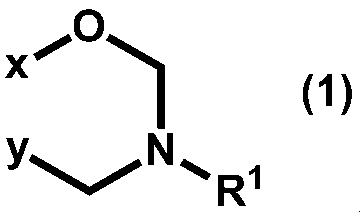
で表される構造部位(β)又は下記構造式(2)
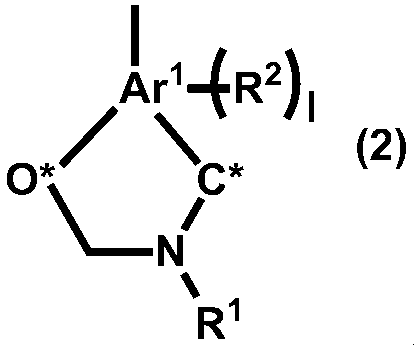
で表される構造部位(γ)を有することを特徴とするポリアリーレンエーテル樹脂に関する。
本発明は更に、芳香族ジヒドロキシ化合物とアラルキル化剤とを酸触媒条件下で反応させてポリアリーレンエーテル中間体(1)を得、これとモノアミン化合物とホルムアルデヒドとを反応させることを特徴とするポリアリーレンエーテル樹脂の製造方法に関する。
本発明は更に、芳香族ジヒドロキシ化合物をアルカリ触媒条件下で反応させてポリアリーレンエーテル中間体(2)を得、これとモノアミン化合物とホルムアルデヒドとを反応させることを特徴とするポリアリーレンエーテル樹脂の製造方法に関する。
本発明は更に、前記ポリアリーレンエーテル樹脂を必須の成分とする硬化性樹脂材料に関する。
本発明は更に、前記硬化性樹脂材料を硬化させて得られる硬化物に関する。
本発明は更に、前記ポリアリーレンエーテル樹脂と、無機質充填材とを含有する半導体封止材料に関する。
本発明は更に、前記硬化性樹脂材料を有機溶剤に希釈したものを補強基材に含浸し、得られる含浸基材を半硬化させることにより得られるプリプレグに関する。
本発明は更に、前記硬化性樹脂材料を有機溶剤に希釈したワニスを得、これを板状に賦形したものと銅箔とを加熱加圧成型することにより得られる回路基板に関する。
本発明は更に、前記硬化性樹脂材料を有機溶剤に希釈したものを基材フィルム上に塗布し、乾燥させることにより得られるビルドアップフィルムに関する。
本発明によれば、硬化物における耐熱性、耐熱分解性、耐湿耐半田性、難燃性及び誘電特性の諸物性に優れるポリアリーレンエーテル樹脂とその製造方法、硬化性樹脂材料とその硬化物、半導体封止材料、プリプレグ、回路基板、及びビルドアップフィルムを提供することができる。
以下、本発明を詳細に説明する。
本発明のポリアリーレンエーテル樹脂は、分子構造中にポリアリーレンエーテル構造(α)を有し、前記ポリアリーレンエーテル構造(α)中の芳香核の少なくとも一つがナフタレン骨格を有するものであり、かつ、前記ポリアリーレンエーテル構造(α)中の芳香核の少なくとも一つが、その芳香核上に下記構造式(1)
本発明のポリアリーレンエーテル樹脂は、分子構造中にポリアリーレンエーテル構造(α)を有し、前記ポリアリーレンエーテル構造(α)中の芳香核の少なくとも一つがナフタレン骨格を有するものであり、かつ、前記ポリアリーレンエーテル構造(α)中の芳香核の少なくとも一つが、その芳香核上に下記構造式(1)
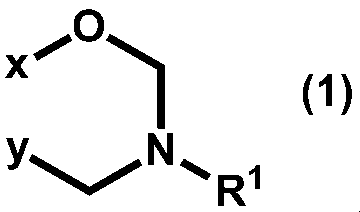
で表される構造部位(β)又は下記構造式(2)

で表される構造部位(γ)を有することを特徴とする。
前記構造部位(β)及び前記構造部位(γ)中の六員環構造は所謂ジヒドロオキサジン構造であり、前述の通り、このようなジヒドロオキサジン構造を有する樹脂は耐熱性や誘電特性に優れる特徴を有する反面、耐熱分解性や難燃性、耐湿耐半田性は十分なものではない。本願発明では、樹脂の分子構造中に前記ポリアリーレンエーテル構造(α)を導入することにより、ジヒドロオキサジン構造含有樹脂おける耐熱分解性、難燃性及び耐湿耐半田性を飛躍的に向上させることに成功したものである。
前記構造式(1)及び前記構造式(2)中のR1は脂肪族炭化水素基、芳香族炭化水素基、又はこれらが有する水素原子の1つ乃至複数が水酸基、アルコキシ基又はハロゲン原子で置換された構造部位の何れかであり、具体的には、メチル基、エチル基、プロピル基、ブチル基、ペンチル基、へキシル基、シクロへキシル基等のアルキル基;アリル基等のアルケニル基;プロパルギル基等のアルキニル基;ヒドロキシエチル基、ヒドロキシプロピル基等の水酸基含有アルキル基;メトキシエチル基、メトキシプロピル基、アリルオキシメチル基、アリルオキシプロピル基、プロパルギルオキシメチル基、プロパルギルオキシプロピル基などのアルコキシ基含有アルキル基;クロロメチル基、クロロエチル基、クロロプロピル基、ブロモメチル基、ブロモエチル基、ブロモプロピル基、フルオロメチル基、フルオロエチル基、フルオロプロピル基等のハロゲン化アルキル基;フェニル基、トリル基、キシリル基、ナフチル基等のアリール基;ヒドロキシフェニル基、ヒドロキシナフチル基等の水酸基含有アリール基;メトキシフェニル基、エトキシフェニル基、アリルオキシフェニル基、プロパルギルオキシフェニル基などのアルコキシ基含有アリール基;ビニルフェニル、アリルフェニル、エチニルフェニル、プロパルギルフェニルなどの不飽和炭化水素基含有アリール基;クロロフェニル基、ブロモフェニル基、フルオロフェニル基、クロロナフチル基、ブロモナフチル基、フルオロナフチル基等のハロゲン化アリール基等が挙げられる。中でも、反応性に優れ、硬化物における耐熱性、耐熱分解性、難燃性及び耐湿耐半田性等の諸物性に優れることからアリール基であることが好ましく、フェニル基であることがより好ましい。
前記構造式(2)中のAr1はベンゼン環、ナフタレン環、アントラセン環等の芳香核を表す。また、構造式(2)中のR2は水素原子、アルキル基、アリール基、アラルキル基の何れかであり、具体的には、メチル基、エチル基、プロピル基、ブチル基、ペンチル基、へキシル基、シクロへキシル基等のアルキル基;フェニル基、トリル基、キシリル基、ナフチル基等のアリール基;ベンジル基、フェニルエチル基、フェニルプロピル基、トリルメチル基、トリルエチル基、トリルプロピル基、キシリルメチル基、キシリルエチル基、キシリルプロピル基、ナフチルメチル基、ナフチルエチル基、ナフチルプロピル基等のアラルキル基等が挙げられる。中でも、硬化物における難燃性に優れることからR2は水素原子であることが好ましい。
本発明のポリアリーレンエーテル樹脂中、前記構造部位(β)及び前記構造部位(γ)は前記ポリアリーレンエーテル構造(α)中の芳香核の何れに結合していても良い。本発明のポリアリーレンエーテル樹脂のより好ましい構造は、例えば、下記構造式(3)

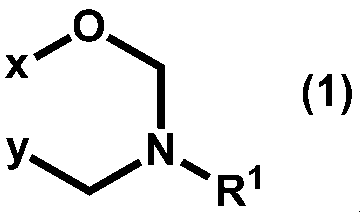
で表される構造部位(β)を有する。R3はそれぞれ独立に水素原子、アルキル基、アリール基、アラルキル基、下記構造式(2)
で表される構造部位(γ)の何れかであり、mは1~3の整数、nは0~4の整数である。]
で表される分子構造を有し、分子中に前記構造部位(β)又は構造部位(γ)を1つ以上含有するものが挙げられる。
前記構造式(3)中のAr2、Ar3はそれぞれベンゼン環、ナフタレン環、アントラセン環等の芳香核を表す。また、構造式(3)中のR3はそれぞれ独立に水素原子、アルキル基、アリール基、アラルキル基、下記構造式(2)

で表される構造部位(γ)の何れかである。
R3で表されるアルキル基、アリール基、アラルキル基は、具体的には、メチル基、エチル基、プロピル基、ブチル基、ペンチル基、へキシル基、シクロへキシル基等のアルキル基;フェニル基、トリル基、キシリル基、ナフチル基、及びこれらの芳香核上に水酸基、ハロゲン原子等の官能基を一つ乃至複数個有する構造部位等のアリール基;ベンジル基、フェニルエチル基、フェニルプロピル基、トリルメチル基、トリルエチル基、トリルプロピル基、キシリルメチル基、キシリルエチル基、キシリルプロピル基、ナフチルメチル基、ナフチルエチル基、ナフチルプロピル基等のアラルキル基等が挙げられる。中でも、硬化性に優れ、硬化物における耐熱性、耐熱分解性、難燃性及び耐湿耐半田性等の諸物性に優れることから、水素原子、ヒドロキシフェニル基、ヒドロキシナフチル基、ベンジル基、ナフチルメチル基、又は前記構造式(2)で表される構造部位(γ)の何れかであることが好ましい。
本発明のポリアリーレンエーテル樹脂が有するポリアリーレンエーテル構造(α)は、その芳香核の少なくとも一つがナフタレン骨格を有するものであれば、一部がフェニル骨格を有するものであっても良い。中でも、硬化物における耐熱性及び難燃性に優れるポリアリーレンエーテル樹脂となることから、ポリアリーレンエーテル構造(α)中の芳香核の50モル%以上がナフタレン骨格を有するものであることが好ましく、ポリアリーレンエーテル構造(α)がポリナフチレンエーテル構造であることが好ましい。
前記ポリアリーレンエーテル構造(α)がポリナフチレンエーテル構造である場合、本発明のポリアリーレンエーテル樹脂のより好ましい構造は、例えば、下記構造式(4)
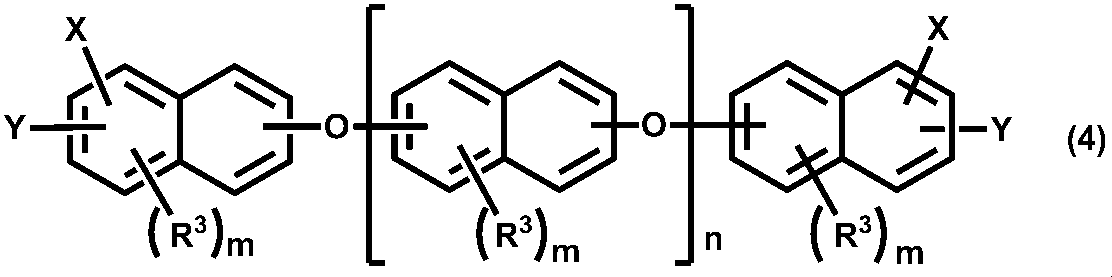
で表される構造部位(β)である。また、R3はそれぞれ独立に水素原子、アルキル基、アリール基、アラルキル基、下記構造式(5)
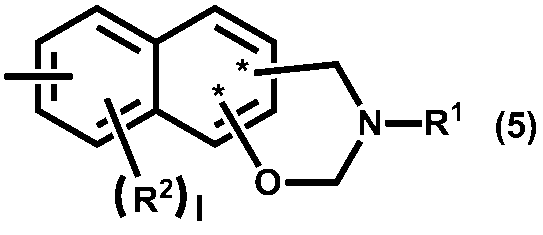
で表される構造部位(γ)の何れかであり、mは1~3の整数、nは0~4の整数である。]
で表される分子構造を有し、分子中に前記構造部位(β)又は構造部位(γ)を1つ以上含有するものが挙げられる。
前記構造式(4)中のナフチレンエーテル構造におけるナフタレン骨格上の酸素原子の結合位置は、例えば、1,2-位、1,4-位、1,5-位、1,6-位、1,7-位、2,3-位、2,6-位、2,7位など、芳香核上の何れの炭素原子に結合していても良い。中でも、硬化物における難燃性及び誘電特性に優れることから、1,6-位又は2,7-位であることが好ましく、2,7-位であることが特に好ましい。
また、前記構造式(5)で表される構造部位において、*で示されるナフタレン骨格上の酸素原子の結合位置と、前記構造式(4)中のナフタレン骨格との結合手との位置関係は、例えば、1,2-位、1,4-位、1,5-位、1,6-位、1,7-位、2,3-位、2,6-位、2,7位など、ナフタレン環上の何れの炭素原子に結合していても良い。中でも、硬化物における難燃性及び誘電特性に優れることから、1,6-位又は2,7-位であることが好ましく、2,7-位であることが特に好ましい。
前記構造式(3)及び前記構造式(4)中のnは0~4の整数である。中でも、粘度が低く、硬化物における難燃性と耐湿耐半田性との両方に優れることから、nが0又は1である樹脂成分を含有していることが好ましい。
また、前記構造式(3)で表されるポリアリーレンエーテル樹脂中のAr2、Ar3、R3で表される芳香核の合計は、粘度が低く、硬化物における難燃性と耐湿耐半田性との両方に優れることから、4~12の範囲であることが好ましい。
本発明のポリアリーレンエーテル樹脂において、前記構造式(1)で表される構造部位(β)又は前記構造式(2)で表される構造部位(γ)中のジヒドロオキサジン構造と、フェノール性水酸基との合計を官能基とした場合の官能基当量は、反応性に優れ、硬化物における耐熱性、耐熱分解性、難燃性及び耐湿耐半田性等の諸物性に優れることから、200~350g/当量の範囲であることが好ましい。
また、本発明のポリアリーレンエーテル樹脂において、樹脂中に存在するフェノール性水酸基、前記構造部位(β)及び前記構造部位(γ)の総数に対する、前記構造部位(β)と前記構造部位(γ)との合計数の割合は、反応性に優れ、硬化物における耐熱性、耐熱分解性、難燃性及び耐湿耐半田性等の諸物性に優れることから50%以上であることが好ましく、70%以上であることが特に好ましい。
本発明のポリアリーレンエーテル樹脂は、例えば、以下の方法により製造することが出来る。
方法1:芳香族ジヒドロキシ化合物とアラルキル化剤とを酸触媒条件下で反応させてポリアリーレンエーテル中間体を得、これとモノアミン化合物とホルムアルデヒドとを反応させる方法。
方法2:芳香族ジヒドロキシ化合物をアルカリ触媒条件下で反応させてポリアリーレンエーテル中間体を得、これとモノアミン化合物とホルムアルデヒドとを反応させる方法。
方法1:芳香族ジヒドロキシ化合物とアラルキル化剤とを酸触媒条件下で反応させてポリアリーレンエーテル中間体を得、これとモノアミン化合物とホルムアルデヒドとを反応させる方法。
方法2:芳香族ジヒドロキシ化合物をアルカリ触媒条件下で反応させてポリアリーレンエーテル中間体を得、これとモノアミン化合物とホルムアルデヒドとを反応させる方法。
前記方法1について説明する。前記方法1で用いる芳香族ジヒドロキシ化合物は、例えば、1,2-ベンゼンジオール、1,3-ベンゼンジオール、1,4-ベンゼンジオール等のジヒドロキシベンゼン;1,2-ジヒドロキシナフタレン、1,4-ジヒドロキシナフタレン、1,5-ジヒドロキシナフタレン、1,6-ジヒドロキシナフタレン、1,7-ジヒドロキシナフタレン、2,3-ジヒドロキシナフタレン、2,6-ジヒドロキシナフタレン、2,7-ジヒドロキシナフタレン等のジヒドロキシナフタレン等が挙げられる。これらはそれぞれ単独で用いても良いし、2種類以上を併用しても良い。中でも、硬化物における難燃性及び誘電特性に優れることからジヒドロキシナフタレンが好ましく、1,6-ジヒドロキシナフタレン又は2,7-ジヒドロキシナフタレンがより好ましく、2,7-ジヒドロキシナフタレンが特に好ましい。
前記方法1で用いるアラルキル化剤は、例えば、ベンジルクロライド、ベンジルブロマイド、ベンジルアイオダイト、o-メチルベンジルクロライド、m-メチルベンジルクロライド、p-メチルベンジルクロライド、p-エチルベンジルクロライド、p-イソプロピルベンジルクロライド、p-tert-ブチルベンジルクロライド、p-フェニルベンジルクロライド、5-クロロメチルアセナフチレン、2-ナフチルメチルクロライド、1-クロロメチル-2-ナフタレン及びこれらの核置換異性体、α-メチルベンジルクロライド、並びにα,α-ジメチルベンジルクロライド等のハライド化合物;ベンジルメチルエーテル、o-メチルベンジルメチルエーテル、m-メチルベンジルメチルエーテル、p-メチルベンジルメチルエーテル、p-エチルベンジルメチルエーテル及びこれらの核置換異性体、ベンジルエチルエーテル、ベンジルプロピルエーテル、ベンジルイソブチルエーテル、ベンジルn-ブチルエーテル、p-メチルベンジルメチルエーテル及びその核置換異性体等のエーテル化合物;ベンジルアルコール、o-メチルベンジルアルコール、m-メチルベンジルアルコール、p-メチルベンジルアルコール、p-エチルベンジルアルコール、p-イソプロピルベンジルアルコール、ptert-ブチルベンジルアルコール、p-フェニルベンジルアルコール、α-ナフチルメタノール及びこれらの核置換異性体、α-メチルベンジルアルコール、及びα,α-ジメチルベンジルアルコール等のアルコール化合物;スチレン、o-メチルスチレン、m-メチルスチレン、p-メチルスチレン、α-メチルスチレン、β-メチルスチレン等のスチレン化合物等が挙げられる。これらはそれぞれ単独で用いても良いし、2種類以上を併用しても良い。これらの中でも、硬化物における誘電特性及び耐湿耐半田性に優れるポリアリーレンエーテル樹脂が得られることから、ベンジルクロライド、ベンジルブロマイド、及びベンジルアルコールが好ましい。
前記芳香族ジヒドロキシ化合物とアラルキル化剤との反応割合は、両者のモル比[ジヒドロキシ化合物/アラルキル化剤]が1.0/0.1~1.0/1.0となる割合であることが、硬化物における難燃性と耐湿耐半田性とに優れるポリアリーレンエーテル樹脂が得られることから好ましい。
前記方法1で用いる酸触媒は、例えば、例えば、リン酸、硫酸、塩酸などの無機酸、シュウ酸、ベンゼンスルホン酸、トルエンスルホン酸、メタンスルホン酸、フルオロメタンスルホン酸等の有機酸、塩化アルミニウム、塩化亜鉛、塩化第2錫、塩化第2鉄、ジエチル硫酸などのフリーデルクラフツ触媒が挙げられる。これらはそれぞれ単独で用いても良いし、2種類以上を併用しても良い。
これら酸触媒の使用量は、無機酸や有機酸の場合には芳香族ジヒドロキシ化合物原料100質量部に対し0.01~5.0質量部の範囲であることが好ましく、フリーデルクラフツ触媒の場合は芳香族ジヒドロキシ化合物原料1モルに対し、0.2~3.0モルの範囲で用いることが好ましい。
前記芳香族ジヒドロキシ化合物とアラルキル化剤との反応は、必要に応じて有機溶媒中で行っても良い。ここで用いる有機溶媒は、例えば、アセトン、メチルエチルケトン、シクロヘキサノン等のケトン溶媒、酢酸エチル、酢酸ブチル、セロソルブアセテート、プロピレングリコールモノメチルエーテルアセテート、カルビトールアセテート等の酢酸エステル溶媒、セロソルブ、ブチルカルビトール等のカルビトール溶媒、トルエン、キシレン等の芳香族炭化水素溶媒、ジメチルホルムアミド、ジメチルアセトアミド、N-メチルピロリドン等が挙げられる。これらはそれぞれ単独で用いても良いし、2種類以上の混合溶媒としても良い。
前記芳香族ジヒドロキシ化合物とアラルキル化剤との反応は、例えば100~180℃の温度条件下で行うことが出来、反応終了後は、アルカリ金属水酸化物等のアルカリ化合物を用いて反応系中を中和した後、反応にて生成した水及び有機溶媒を減圧乾燥させてポリアリーレンエーテル中間体(1)を得ることが出来る。
方法1の第1工程で得られるポリアリーレンエーテル中間体(1)は、その水酸基当量が150~200g/当量の範囲であることが、低粘度で硬化性に優れ、硬化物における耐熱性、耐熱分解性、難燃性、耐湿耐半田性等の諸物性に優れるポリアリーレンエーテル樹脂が得られるため好ましい。
ついで、方法1の第二行程では、得られたポリアリーレンエーテル中間体(1)とモノアミン化合物とホルムアルデヒドとを反応させる。
ここで用いるモノアミン化合物は、例えば、下記構造式(6)
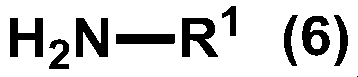
で表されるものが挙げられ、前記構造式(6)中のR1は具体的には、メチル基、エチル基、プロピル基、ブチル基、ペンチル基、へキシル基、シクロへキシル基等のアルキル基;アリル基等のアルケニル基;プロパルギル基等のアルキニル基;ヒドロキシエチル基、ヒドロキシプロピル基等の水酸基含有アルキル基;メトキシエチル基、メトキシプロピル基、アリルオキシメチル基、アリルオキシプロピル基、プロパルギルオキシメチル基、プロパルギルオキシプロピル基などのアルコキシ基含有アルキル基;クロロメチル基、クロロエチル基、クロロプロピル基、ブロモメチル基、ブロモエチル基、ブロモプロピル基、フルオロメチル基、フルオロエチル基、フルオロプロピル基等のハロゲン化アルキル基;フェニル基、トリル基、キシリル基、ナフチル基等のアリール基;ヒドロキシフェニル基、ヒドロキシナフチル基等の水酸基含有アリール基;メトキシフェニル基、エトキシフェニル基、アリルオキシフェニル基、プロパルギルオキシフェニル基などのアルコキシ基含有アリール基;ビニルフェニル基、アリルフェニル基、エチニルフェニル基、プロパルギルフェニル基などの不飽和炭化水素基含有アリール基;クロロフェニル基、ブロモフェニル基、フルオロフェニル基、クロロナフチル基、ブロモナフチル基、フルオロナフチル基等のハロゲン化アリール基等が挙げられる。これらのモノアミン化合物はそれぞれ単独で用いても良いし、2種類以上を併用しても良い。中でも、反応性に優れ、硬化物における耐熱性、耐熱分解性、難燃性及び耐湿耐半田性等の諸物性に優れることからアリール基であることが好ましく、フェニル基であることがより好ましい。
また、前記ホルムアルデヒドは溶液の状態であるホルマリン、或いは固形の状態であるパラホルムアルデヒドのどちらの形態で用いても良い。
前記ポリアリーレンエーテル中間体(1)と前記モノアミン化合物との反応割合は、ポリアリーレンエーテル中間体中の水酸基1モルに対し、モノアミン化合物が1.0~1.2モルの範囲であることが、目的のポリアリーレンエーテル樹脂がより効率的に生成することから好ましい。また、前記ポリアリーレンエーテル中間体(1)と前記ホルムアルデヒドとの反応割合は、ポリアリーレンエーテル中間体(1)中の水酸基1モルに対し、ホルムアルデヒドが2.0~2.2モルの範囲であることが、目的のポリアリーレンエーテル樹脂がより効率的に生成することから好ましい。
前記ポリアリーレンエーテル中間体(1)、モノアミン化合物、及びホルムアルデヒドの反応は、必要に応じて触媒の存在下で行っても良い。ここで用いる触媒は、ジヒドロオキサジン化合物を製造する際に通常用いられる各種の触媒が挙げられ、具体的には、N,N-ジメチルホルムアミド等のアミド化合物;ピリジン、N,N-ジメチル―4-アミノピリジン等のピリジン化合物;トリエチルアミン、テトラメチルエチレンジアミン等のアミン化合物;テトラブチルアンモニウムブロミド等の4級アンモニウム塩;酢酸、トリフルオロ酢酸、パラトルエンスルホン酸、トリフルオロメタンスルホン酸等の有機酸化合物;水酸化カリウム、炭酸カリウム、炭酸ナトリウム等のアルカリ金属水酸化物又は炭酸塩;ジブチルヒドロキシトルエン等のフェノール性化合物;パラジウム、テトラキス(トリフェニルホスフィン)パラジウム、ヨウ化銅、四塩化錫、ニッケル、プラチナ等の金属触媒等が挙げられる。これらはそれぞれ単独で用いても良いし、2種類以上を併用しても良い。
前記ポリアリーレンエーテル中間体(1)、モノアミン化合物、及びホルムアルデヒドの反応は、必要に応じて有機溶媒中で行っても良い。ここで用いる有機溶媒は、例えば、水、メタノール、エタノール、イソプロパノール等のアルコール化合物;ジオキサン、テトラヒドロフラン、ジエチルエーテル等のエーテル化合物;酢酸、トリフルオロ酢酸等の酢酸化合物;アセトン、メチルエチルケトン、メチルイソブチルケトン、シクロヘキサノン等のケトン化合物;酢酸エチル、酢酸ブチル、セロソルブアセテート、プロピレングリコールモノメチルエーテルアセテート、カルビトールアセテート等の酢酸エステル化合物;セロソルブ、ブチルカルビトール等のカルビトール化合物;ジクロロメタン、クロロホルム、四塩化炭素、ジクロロエタン、クロロベンゼン等の塩素化炭化水素化合物;シクロヘキサン、ベンゼン、トルエン、キシレン等の炭化水素化合物;ジメチルホルムアミド、ジメチルアセトアミド、N-メチルピロリドン等のアミド化合物;アニリン等のアミン化合物;ジメチルスルホキシド、アセトニトリル等が挙げられる。これらはそれぞれ単独で用いても良いし、2種類以上の混合溶媒としても良い。
前記ポリアリーレンエーテル中間体(1)、モノアミン化合物、及びホルムアルデヒドの反応は、例えば50~100℃の温度条件下で行うことが出来、反応終了後は水層と有機層とを分離した後、有機層から有機溶媒を減圧乾燥させるなどして、目的のポリアリーレンエーテル樹脂を得ることが出来る。
前記方法1にて得られるポリアリーレンエーテル樹脂は、例えば、芳香族ジヒドロキシ化合物として2,7-ジヒドロキシナフタレンを、アラルキル化剤としてベンジルアルコールを、モノアミン化合物としてアニリンを用いた場合、具体的には下記構造式(7-1)~(7-23)の何れかで表されるものなどが挙げられる。なお、式中のPhはフェニル基を、Bnはベンジル基を表す。


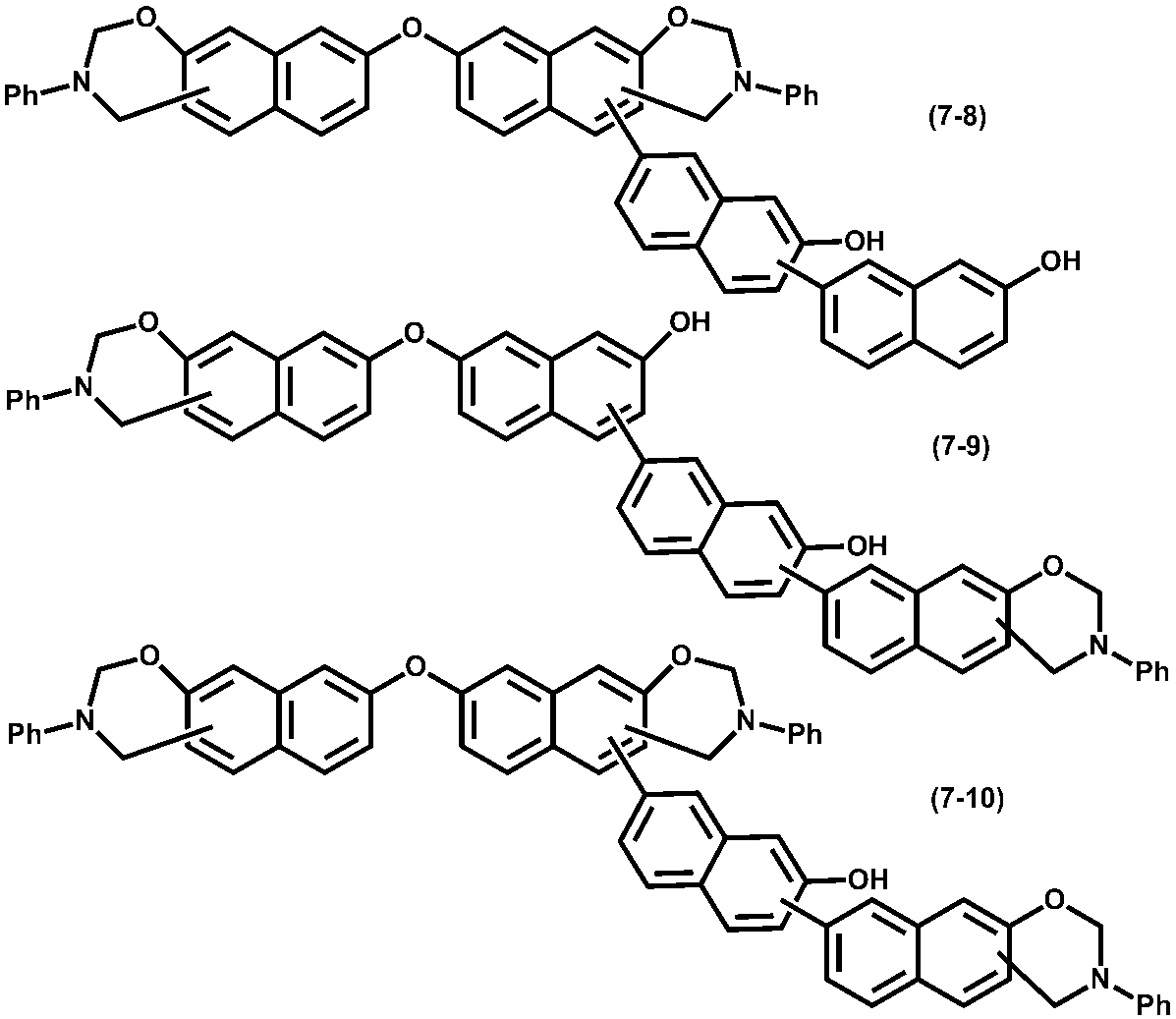
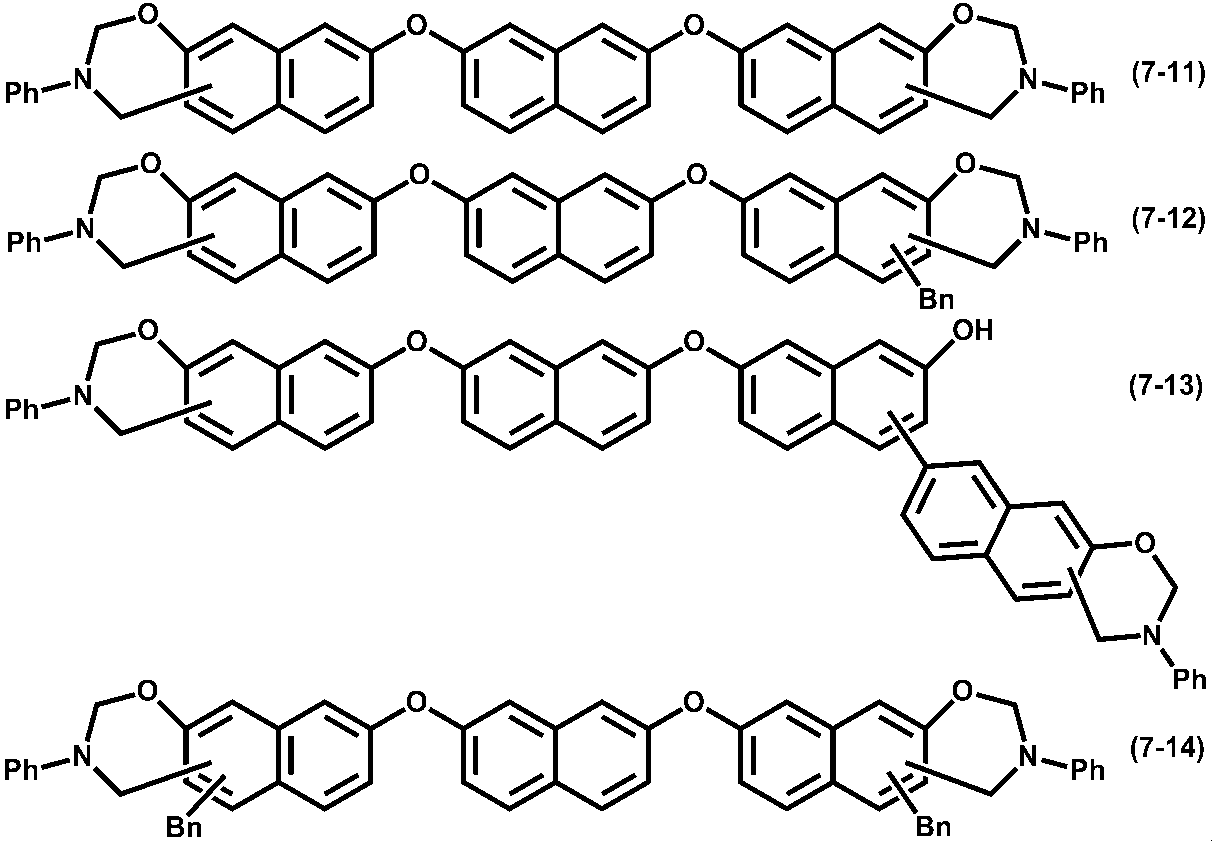


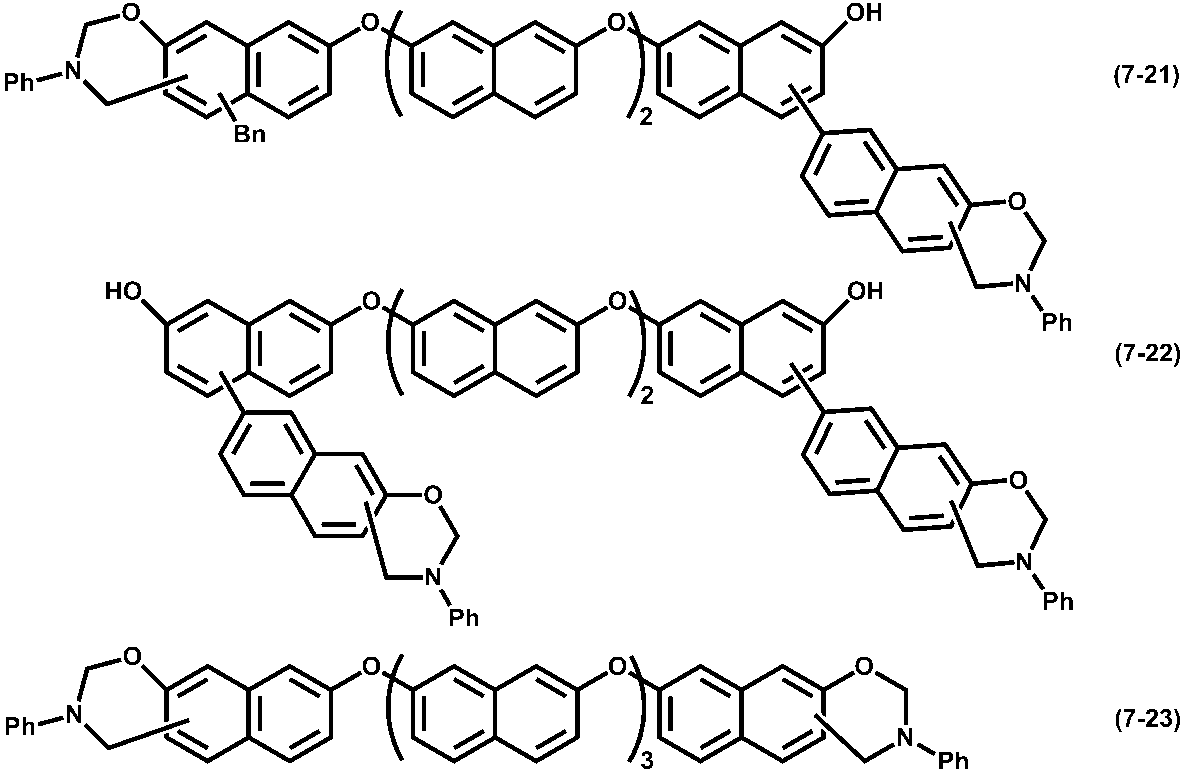
また、芳香族ジヒドロキシ化合物として1,6-ジヒドロキシナフタレンを、アラルキル化剤としてベンジルアルコールを、モノアミン化合物としてアニリンを用いた場合、具体的には下記構造式(8-1)~(8-23)の何れかで表されるものなどが挙げられる。なお、式中のPhはフェニル基を、Bnはベンジル基を表す。
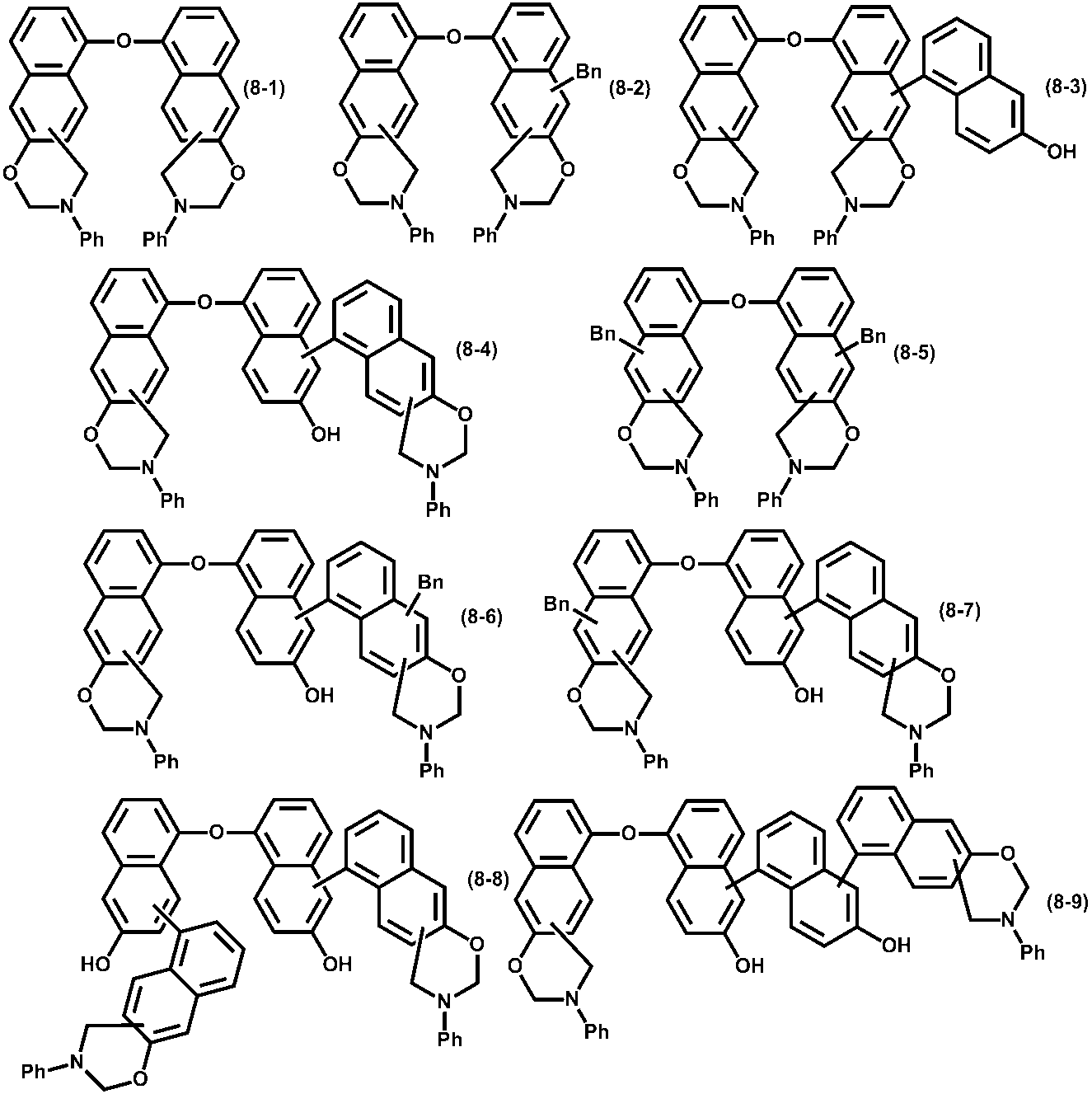


次に前記方法2について説明する。前記方法2で用いる芳香族ジヒドロキシ化合物は前記方法1についての説明にて記載したものと同様である。
前記方法1で用いるアルカリ触媒は、例えば、水酸化カリウム、水酸化ナトリウム等のアルカリ金属水酸化物、炭酸カリウム、炭酸ナトリウム等のアルカリ金属炭酸塩、トリフェニルホスフィン等のリン系化合物等が挙げられる。これらはそれぞれ単独で用いても良いし、2種類以上を併用しても良い。中でも、反応性により優れることからアルカリ金属水酸化物が好ましい。
これらアルカリ触媒の使用量は、芳香族ジヒドロキシ化合物原料1モルに対し、0.1~3.0モルの範囲で用いることが好ましい。
前記芳香族ジヒドロキシ化合物の縮重合反応は、必要に応じて有機溶媒中で行っても良い。ここで用いる有機溶媒は、例えば、アセトン、メチルエチルケトン、シクロヘキサノン等のケトン溶媒、酢酸エチル、酢酸ブチル、セロソルブアセテート、プロピレングリコールモノメチルエーテルアセテート、カルビトールアセテート等の酢酸エステル溶媒、セロソルブ、ブチルカルビトール等のカルビトール溶媒、トルエン、キシレン等の芳香族炭化水素溶媒、ジメチルホルムアミド、ジメチルアセトアミド、N-メチルピロリドン等が挙げられる。これらはそれぞれ単独で用いても良いし、2種類以上を併用しても良い。
前記芳香族ジヒドロキシ化合物の重縮合反応は、例えば150~210℃の温度条件下で行うことが出来、反応終了後は水層と有機層とを分離した後、有機層から有機溶媒を減圧乾燥させるなどして、ポリアリーレンエーテル中間体(2)を得ることが出来る。
方法2の第1工程で得られるポリアリーレンエーテル中間体(2)は、その水酸基当量が100~150g/当量の範囲であることが、低粘度で硬化性に優れ、硬化物における耐熱性、耐熱分解性、難燃性、耐湿耐半田性等の諸物性に優れるポリアリーレンエーテル樹脂が得られるため好ましい。
ついで、方法2の第二行程では、得られたポリアリーレンエーテル中間体(2)とモノアミン化合物とホルムアルデヒドとを反応させる。
ここで用いるモノアミン化合物及びホルムアルデヒドは、前記方法1についての説明にて記載したものと同様である。
前記ポリアリーレンエーテル中間体(2)と前記モノアミン化合物との反応割合は、ポリアリーレンエーテル中間体中の水酸基1モルに対し、モノアミン化合物が1.0~1.2モルの範囲であることが、目的のポリアリーレンエーテル樹脂がより効率的に生成することから好ましい。また、前記ポリアリーレンエーテル中間体(2)と前記ホルムアルデヒドとの反応割合は、ポリアリーレンエーテル中間体(2)中の水酸基1モルに対し、ホルムアルデヒドが2.0~2.2モルの範囲であることが、目的のポリアリーレンエーテル樹脂がより効率的に生成することから好ましい。
前記ポリアリーレンエーテル中間体(2)、モノアミン化合物、及びホルムアルデヒドの反応は、必要に応じて触媒の存在下で行っても良い。ここで用いる触媒は、ジヒドロオキサジン化合物を製造する際に通常用いられる各種の触媒が挙げられ、具体的には、N,N-ジメチルホルムアミド等のアミド化合物;ピリジン、N,N-ジメチル―4-アミノピリジン等のピリジン化合物;トリエチルアミン、テトラメチルエチレンジアミン等のアミン化合物;テトラブチルアンモニウムブロミド等の4級アンモニウム塩;酢酸、トリフルオロ酢酸、パラトルエンスルホン酸、トリフルオロメタンスルホン酸等の有機酸化合物;水酸化カリウム、炭酸カリウム、炭酸ナトリウム等のアルカリ金属水酸化物又は炭酸塩;ジブチルヒドロキシトルエン等のフェノール性化合物;パラジウム、テトラキス(トリフェニルホスフィン)パラジウム、ヨウ化銅、四塩化錫、ニッケル、プラチナ等の金属触媒等が挙げられる。これらはそれぞれ単独で用いても良いし、2種類以上を併用しても良い。
前記ポリアリーレンエーテル中間体(2)、モノアミン化合物、及びホルムアルデヒドの反応は、必要に応じて有機溶媒中で行っても良い。ここで用いる有機溶媒は、例えば、水、メタノール、エタノール、イソプロパノール等のアルコール化合物;ジオキサン、テトラヒドロフラン、ジエチルエーテル等のエーテル化合物;酢酸、トリフルオロ酢酸等の酢酸化合物;アセトン、メチルエチルケトン、メチルイソブチルケトン、シクロヘキサノン等のケトン化合物;酢酸エチル、酢酸ブチル、セロソルブアセテート、プロピレングリコールモノメチルエーテルアセテート、カルビトールアセテート等の酢酸エステル化合物;セロソルブ、ブチルカルビトール等のカルビトール化合物;ジクロロメタン、クロロホルム、四塩化炭素、ジクロロエタン、クロロベンゼン等の塩素化炭化水素化合物;シクロヘキサン、ベンゼン、トルエン、キシレン等の炭化水素化合物;ジメチルホルムアミド、ジメチルアセトアミド、N-メチルピロリドン等のアミド化合物;アニリン等のアミン化合物;ジメチルスルホキシド、アセトニトリル等が挙げられる。これらはそれぞれ単独で用いても良いし、2種類以上の混合溶媒としても良い。
前記ポリアリーレンエーテル中間体(2)、モノアミン化合物、及びホルムアルデヒドの反応は、例えば50~100℃の温度条件下で行うことが出来、反応終了後は水層と有機層とを分離した後、有機層から有機溶媒を減圧乾燥させるなどして、目的のポリアリーレンエーテル樹脂を得ることが出来る。
前記方法2にて得られるポリアリーレンエーテル樹脂は、例えば、芳香族ジヒドロキシ化合物として2,7-ジヒドロキシナフタレンを、モノアミン化合物としてアニリンを用いた場合、具体的には下記構造式(9-1)~(9-12)の何れかで表されるものなどが挙げられる。なお、式中のPhはフェニル基を表す。
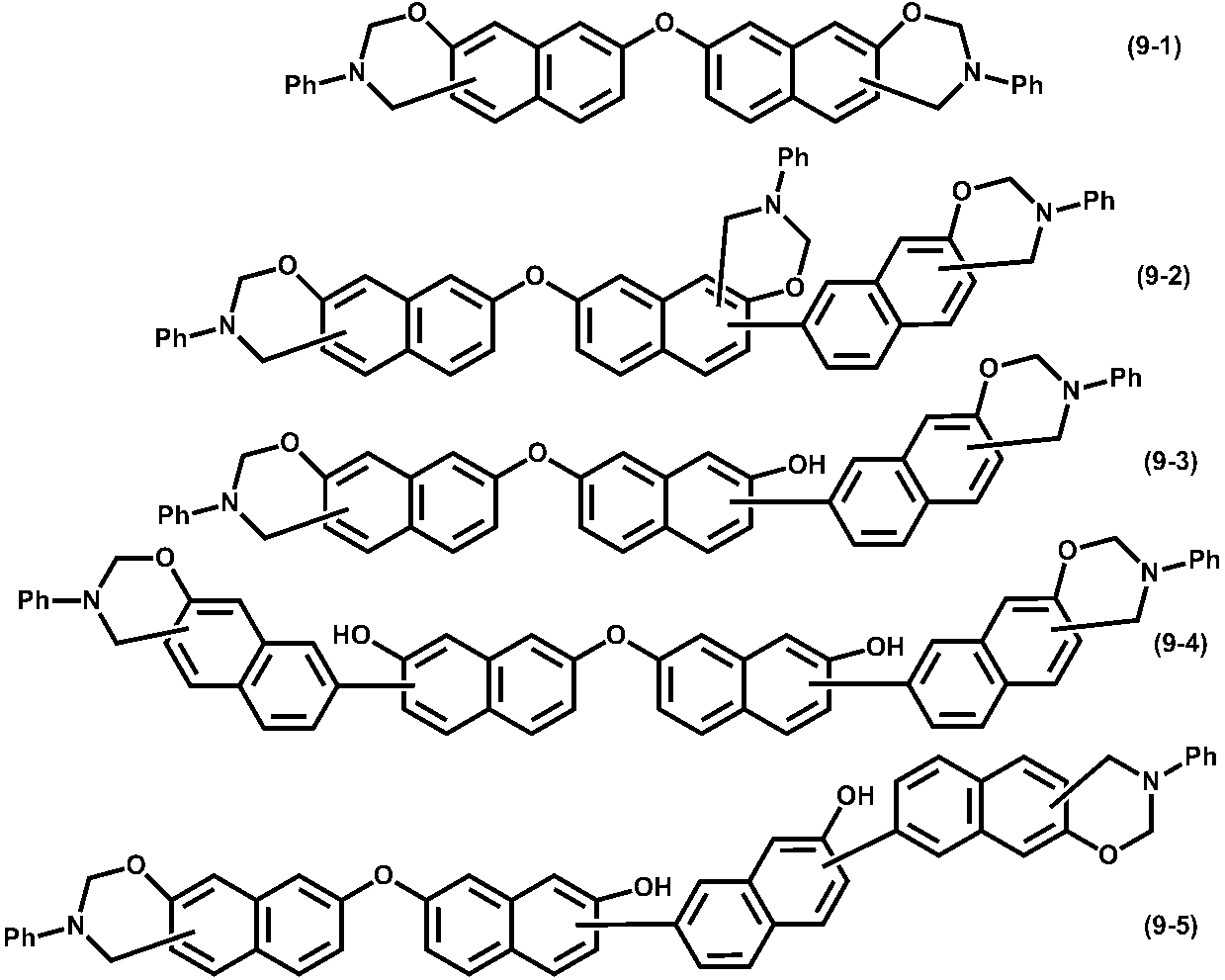

また、芳香族ジヒドロキシ化合物として1,6-ジヒドロキシナフタレンを、モノアミン化合物としてアニリンを用いた場合、具体的には下記構造式(10-1)~(10-12)の何れかで表されるものなどが挙げられる。なお、式中のPhはフェニル基を表す。

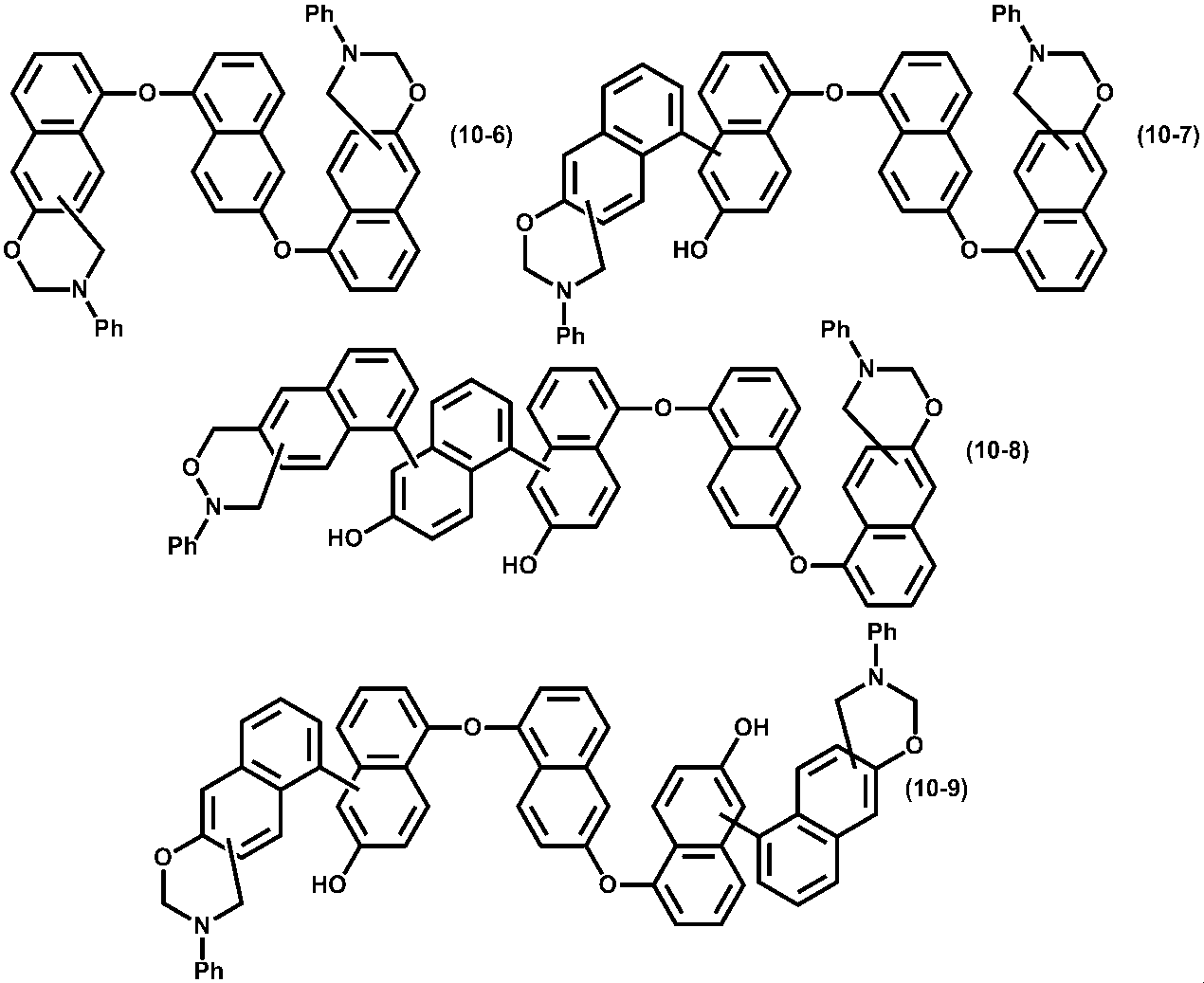
本発明の硬化性樹脂材料は、前記本発明のポリアリーレンエーテル樹脂を必須の成分とするものである。前記ポリアリーレンエーテル樹脂はそれ単独でも硬化反応を生じ得ることから、本発明の硬化性樹脂材料においては樹脂成分として前記ポリアリーレンエーエル樹脂を単独で用いても良いし、その他の樹脂と併用しても良い。
前記その他の樹脂は、例えば、エポキシ樹脂やフェノール性水酸基含有化合物、活性エステル樹脂、シアネートエステル樹脂、ビニルベンジル化合物、アクリル化合物、マレイミド化合物、スチレンとマレイン酸無水物の共重合物などが挙げられる
前記エポキシ樹脂は、例えば、ビスフェノールA型エポキシ樹脂、ビスフェノールF型エポキシ樹脂、ビスフェノールE型エポキシ樹脂、ビスフェノールS型エポキシ樹脂、ビスフェノールスルフィド型エポキシ樹脂、フェニレンエーテル型エポキシ樹脂、ナフチレンエーテル型エポキシ樹脂、ビフェニル型エポキシ樹脂、テトラメチルビフェニル型エポキシ樹脂、ポリヒドロキシナフタレン型エポキシ樹脂、フェノールノボラック型エポキシ樹脂、クレゾールノボラック型エポキシ樹脂、トリフェニルメタン型エポキシ樹脂、テトラフェニルエタン型エポキシ樹脂、ジシクロペンタジエン-フェノール付加反応型エポキシ樹脂、フェノールアラルキル型エポキシ樹脂、ナフトールノボラック型エポキシ樹脂、ナフトールアラルキル型エポキシ樹脂、ナフトール-フェノール共縮ノボラック型エポキシ樹脂、ナフトール-クレゾール共縮ノボラック型エポキシ樹脂、芳香族炭化水素ホルムアルデヒド樹脂変性フェノール樹脂型エポキシ樹脂、ビフェニル変性ノボラック型エポキシ樹脂、アントラセン型エポキシ樹脂等が挙げられる。これらはそれぞれ単独で用いても良いし、2種類以上を併用しても良い。
これらのエポキシ樹脂の中でも、特に難燃性に優れる硬化物が得られる点においては、テトラメチルビフェノール型エポキシ樹脂、ビフェニルアラルキル型エポキシ樹脂、ナフチレンエーテル型エポキシ樹脂、ポリヒドロキシナフタレン型エポキシ樹脂、ノボラック型エポキシ樹脂を用いることが好ましく、誘電特性に優れる硬化物が得られる点においては、ジシクロペンタジエン-フェノール付加反応型エポキシ樹脂が好ましい。
本発明の両者のポリアリーレンエーテル樹脂とエポキシ樹脂とを併用する場合、ポリアリーレンエーテル樹脂中のジヒドロオキサジン構造とフェノール性水酸基との合計モル数(p)と、エポキシ樹脂中のエポキシ基のモル数(q)との比率[(p)/(q)]は1.0/0.1~1.0/1.0となる割合、より好ましくは1.0/0.1~1.0/0.5となる割合であることが、硬化物における耐熱性と耐熱分解性とに優れる硬化物が得られることから好ましい。
前記フェノール性水酸基含有化合物は、例えば、フェノールノボラック樹脂、クレゾールノボラック樹脂、芳香族炭化水素ホルムアルデヒド樹脂変性フェノール樹脂、ナフチレンエーテル樹脂、ジシクロペンタジエンフェノール付加型樹脂、フェノールアラルキル樹脂、ナフトールアラルキル樹脂、トリメチロールメタン樹脂、テトラフェニロールエタン樹脂、ナフトールノボラック樹脂、ナフトール-フェノール共縮ノボラック樹脂、ナフトール-クレゾール共縮ノボラック樹脂、ビフェニル変性フェノール樹脂(ビスメチレン基でフェノール核が連結された多価フェノール化合物)、ビフェニル変性ナフトール樹脂(ビスメチレン基でフェノール核が連結された多価ナフトール化合物)、アミノトリアジン変性フェノール樹脂(メラミンやベンゾグアナミンなどでフェノール核が連結された多価フェノール化合物)等が挙げられる。これらはそれぞれ単独で用いても良いし、2種類以上を併用しても良い。
これらのフェノール性水酸基含有化合物の中でも、芳香族骨格を分子構造内に多く含むものが誘電特性及び耐吸湿性に優れることから好ましく、具体的には、フェノールノボラック樹脂、クレゾールノボラック樹脂、芳香族炭化水素ホルムアルデヒド樹脂変性フェノール樹脂、ナフチレンエーテル樹脂、フェノールアラルキル樹脂、ナフトールアラルキル樹脂、ナフトールノボラック樹脂、ナフトール-フェノール共縮ノボラック樹脂、ナフトール-クレゾール共縮ノボラック樹脂、ビフェニル変性フェノール樹脂、ビフェニル変性ナフトール樹脂、アミノトリアジン変性フェノール樹脂が好ましい。
前記シアネートエステル樹脂は、例えば、ビスフェノールA型シアネートエステル樹脂、ビスフェノールF型シアネートエステル樹脂、ビスフェノールE型シアネートエステル樹脂、ビスフェノールS型シアネートエステル樹脂、ビスフェノールスルフィド型シアネートエステル樹脂、フェニレンエーテル型シアネートエステル樹脂、ナフチレンエーテル型シアネートエステル樹脂、ビフェニル型シアネートエステル樹脂、テトラメチルビフェニル型シアネートエステル樹脂、ポリヒドロキシナフタレン型シアネートエステル樹脂、フェノールノボラック型シアネートエステル樹脂、クレゾールノボラック型シアネートエステル樹脂、トリフェニルメタン型シアネートエステル樹脂、テトラフェニルエタン型シアネートエステル樹脂、ジシクロペンタジエン-フェノール付加反応型シアネートエステル樹脂、フェノールアラルキル型シアネートエステル樹脂、ナフトールノボラック型シアネートエステル樹脂、ナフトールアラルキル型シアネートエステル樹脂、ナフトール-フェノール共縮ノボラック型シアネートエステル樹脂、ナフトール-クレゾール共縮ノボラック型シアネートエステル樹脂、芳香族炭化水素ホルムアルデヒド樹脂変性フェノール樹脂型シアネートエステル樹脂、ビフェニル変性ノボラック型シアネートエステル樹脂、アントラセン型シアネートエステル樹脂等が挙げられる。これらはそれぞれ単独で用いても良いし、2種類以上を併用しても良い。
これらのシアネートエステル樹脂の中でも、特に耐熱性に優れる硬化物が得られる点においては、ビスフェノールA型シアネートエステル樹脂、ビスフェノールF型シアネートエステル樹脂、ビスフェノールE型シアネートエステル樹脂、ポリヒドロキシナフタレン型シアネートエステル樹脂、ナフチレンエーテル型シアネートエステル樹脂、ノボラック型シアネートエステル樹脂を用いることが好ましく、誘電特性に優れる硬化物が得られる点においては、ジシクロペンタジエン-フェノール付加反応型シアネートエステル樹脂が好ましい。
前記マレイミド化合物は、例えば、下記構造式(i)~(iii)の何れかで表される各種の化合物等が挙げられる。


(式中Rは水素原子、アルキル基、アリール基、アラルキル基、ハロゲン原子、水酸基、アルコキシ基の何れかであり、nは1~3の整数、mは繰り返し単位の平均で0~10である。)

本発明の硬化性樹脂材料の硬化は無触媒でも進行するが、触媒も併用できる。これら触媒としてはイミダゾール、ジメチルアミノピリジンなどの3級アミン化合物;トリフェニルホスフィンなどの燐系化合物;3フッ化ホウ素、3フッ化ホウ素モノエチルアミン錯体などの3フッ化ホウ素アミン錯体;チオジプロピオン酸等の有機酸化合物;チオジフェノールベンズオキサジン、スルホニルベンズオキサジン等のベンズオキサジン化合物;スルホニル化合物;フェノール性水酸基含有化合物などが例示できる。前記フェノール性水酸基含有化合物は、例えば、フェノール、クレゾール、ジヒドロキシベンゼン、ビスフェノールA型、ビスフェノールF型、ビスフェノールE型、ビスフェノールS型、ビスフェノールスルフィド、ジヒドロキシフェニレンエーテル、フェノールノボラック樹脂、クレゾールノボラック樹脂、芳香族炭化水素ホルムアルデヒド樹脂変性フェノール樹脂、ナフチレンエーテル樹脂、ジシクロペンタジエンフェノール付加型樹脂、フェノールアラルキル樹脂、ナフトールアラルキル樹脂、トリメチロールメタン樹脂、テトラフェニロールエタン樹脂、ナフトールノボラック樹脂、ナフトール-フェノール共縮ノボラック樹脂、ナフトール-クレゾール共縮ノボラック樹脂、ビフェニル変性フェノール樹脂(ビスメチレン基でフェノール核が連結された多価フェノール化合物)、ビフェニル変性ナフトール樹脂(ビスメチレン基でフェノール核が連結された多価ナフトール化合物)、アミノトリアジン変性フェノール樹脂(メラミンやベンゾグアナミンなどでフェノール核が連結された多価フェノール化合物)等が挙げられる。これらはそれぞれ単独で用いても良いし、2種類以上を併用しても良い。これら触媒の添加量は、硬化性樹脂材料100重量部中0.001~15重量部の範囲であることが好ましい。
本発明の硬化性樹脂材料をプリント配線基板用途などの高い難燃性が求められる用途に用いる場合には、実質的にハロゲン原子を含有しない非ハロゲン系難燃剤を配合してもよい。
前記非ハロゲン系難燃剤は、例えば、リン系難燃剤、窒素系難燃剤、シリコーン系難燃剤、無機系難燃剤、有機金属塩系難燃剤等が挙げられ、それらの使用に際しても何等制限されるものではなく、単独で使用しても、同一系の難燃剤を複数用いても良く、また、異なる系の難燃剤を組み合わせて用いることも可能である。
前記リン系難燃剤は、無機系、有機系のいずれも使用することができる。無機系化合物としては、例えば、赤リン、リン酸一アンモニウム、リン酸二アンモニウム、リン酸三アンモニウム、ポリリン酸アンモニウム等のリン酸アンモニウム類、リン酸アミド等の無機系含窒素リン化合物が挙げられる。
また、前記赤リンは、加水分解等の防止を目的として表面処理が施されていることが好ましく、表面処理方法としては、例えば、(i)水酸化マグネシウム、水酸化アルミニウム、水酸化亜鉛、水酸化チタン、酸化ビスマス、水酸化ビスマス、硝酸ビスマス又はこれらの混合物等の無機化合物で被覆処理する方法、(ii)水酸化マグネシウム、水酸化アルミニウム、水酸化亜鉛、水酸化チタン等の無機化合物、及びフェノール樹脂等の熱硬化性樹脂の混合物で被覆処理する方法、(iii)水酸化マグネシウム、水酸化アルミニウム、水酸化亜鉛、水酸化チタン等の無機化合物の被膜の上にフェノール樹脂等の熱硬化性樹脂で二重に被覆処理する方法等が挙げられる。
前記有機リン系化合物は、例えば、リン酸エステル化合物、ホスホン酸化合物、ホスフィン酸化合物、ホスフィンオキシド化合物、ホスホラン化合物、有機系含窒素リン化合物等の汎用有機リン系化合物の他、9,10-ジヒドロ-9-オキサ-10-ホスファフェナントレン-10-オキシド、10-(2,5―ジヒドロオキシフェニル)-10H-9-オキサ-10-ホスファフェナントレン-10-オキシド、10-(2,7-ジヒドロオキシナフチル)-10H-9-オキサ-10-ホスファフェナントレン-10-オキシド等の環状有機リン化合物及びそれをエポキシ樹脂やフェノール樹脂等の化合物と反応させた誘導体等が挙げられる。
これらリン系難燃剤の配合量は、例えば、硬化性樹脂材料100質量部中、赤リンを用いる場合には0.1~2.0質量部の範囲で配合することが好ましく、有機リン化合物を用いる場合には0.1~10.0質量部の範囲で配合することが好ましく、0.5~6.0質量部の範囲で配合することがより好ましい。
また前記リン系難燃剤を使用する場合、該リン系難燃剤にハイドロタルサイト、水酸化マグネシウム、ホウ化合物、酸化ジルコニウム、黒色染料、炭酸カルシウム、ゼオライト、モリブデン酸亜鉛、活性炭等を併用してもよい。
前記窒素系難燃剤は、例えば、トリアジン化合物、シアヌル酸化合物、イソシアヌル酸化合物、フェノチアジン等が挙げられ、トリアジン化合物、シアヌル酸化合物、イソシアヌル酸化合物が好ましい。
前記トリアジン化合物は、例えば、メラミン、アセトグアナミン、ベンゾグアナミン、メロン、メラム、サクシノグアナミン、エチレンジメラミン、ポリリン酸メラミン、トリグアナミン等の他、例えば、硫酸グアニルメラミン、硫酸メレム、硫酸メラムなどの硫酸アミノトリアジン化合物、前記アミノトリアジン変性フェノール樹脂、及び該アミノトリアジン変性フェノール樹脂を更に桐油、異性化アマニ油等で変性したもの等が挙げられる。
前記シアヌル酸化合物は、例えば、シアヌル酸、シアヌル酸メラミン等を挙げることができる。
前記窒素系難燃剤の配合量は、例えば、硬化性樹脂材料100質量部中、0.05~10質量部の範囲で配合することが好ましく、0.1~5質量部の範囲で配合することがより好ましい。
また前記窒素系難燃剤を使用する際、金属水酸化物、モリブデン化合物等を併用してもよい。
前記シリコーン系難燃剤は、ケイ素原子を含有する有機化合物であれば特に制限がなく使用でき、例えば、シリコーンオイル、シリコーンゴム、シリコーン樹脂等が挙げられる。
前記シリコーン系難燃剤の配合量は、例えば、硬化性樹脂材料100質量部中、0.05~20質量部の範囲で配合することが好ましい。また前記シリコーン系難燃剤を使用する際、モリブデン化合物、アルミナ等を併用してもよい。
前記無機系難燃剤は、例えば、金属水酸化物、金属酸化物、金属炭酸塩化合物、金属粉、ホウ素化合物、低融点ガラス等が挙げられる。
前記金属水酸化物は、例えば、水酸化アルミニウム、水酸化マグネシウム、ドロマイト、ハイドロタルサイト、水酸化カルシウム、水酸化バリウム、水酸化ジルコニウム等を挙げることができる。
前記金属酸化物は、例えば、モリブデン酸亜鉛、三酸化モリブデン、スズ酸亜鉛、酸化スズ、酸化アルミニウム、酸化鉄、酸化チタン、酸化マンガン、酸化ジルコニウム、酸化亜鉛、酸化モリブデン、酸化コバルト、酸化ビスマス、酸化クロム、酸化ニッケル、酸化銅、酸化タングステン等を挙げることができる。
前記金属炭酸塩化合物は、例えば、炭酸亜鉛、炭酸マグネシウム、炭酸カルシウム、炭酸バリウム、塩基性炭酸マグネシウム、炭酸アルミニウム、炭酸鉄、炭酸コバルト、炭酸チタン等を挙げることができる。
前記金属粉は、例えば、アルミニウム、鉄、チタン、マンガン、亜鉛、モリブデン、コバルト、ビスマス、クロム、ニッケル、銅、タングステン、スズ等を挙げることができる。
前記ホウ素化合物は、例えば、ホウ酸亜鉛、メタホウ酸亜鉛、メタホウ酸バリウム、ホウ酸、ホウ砂等を挙げることができる。
前記低融点ガラスのは、例えば、シープリー(ボクスイ・ブラウン社)、水和ガラスSiO2-MgO-H2O、PbO-B2O3系、ZnO-P2O5-MgO系、P2O5-B2O3-PbO-MgO系、P-Sn-O-F系、PbO-V2O5-TeO2系、Al2O3-H2O系、ホウ珪酸鉛系等のガラス状化合物を挙げることができる。
前記無機系難燃剤の配合量は、例えば、硬化性樹脂材料100質量部中、0.05~20質量部の範囲で配合することが好ましく、0.5~15質量部の範囲で配合することがより好ましい。
前記有機金属塩系難燃剤は、例えば、フェロセン、アセチルアセトナート金属錯体、有機金属カルボニル化合物、有機コバルト塩化合物、有機スルホン酸金属塩、金属原子と芳香族化合物又は複素環化合物がイオン結合又は配位結合した化合物等が挙げられる。
前記有機金属塩系難燃剤の配合量は、例えば、硬化性樹脂材料100質量部中、0.005~10質量部の範囲で配合することが好ましい。
本発明の硬化性樹脂材料は、必要に応じて無機質充填材を配合することができる。前記無機質充填材は、例えば、溶融シリカ、結晶シリカ、アルミナ、窒化珪素、水酸化アルミ等が挙げられる。前記無機充填材の配合量を特に大きくする場合は溶融シリカを用いることが好ましい。前記溶融シリカは破砕状、球状のいずれでも使用可能であるが、溶融シリカの配合量を高め且つ成形材料の溶融粘度の上昇を抑制するためには、球状のものを主に用いる方が好ましい。更に球状シリカの配合量を高めるためには、球状シリカの粒度分布を適当に調整することが好ましい。その充填率は難燃性を考慮して、高い方が好ましく、硬化性樹脂材料の全質量に対して20質量%以上が特に好ましい。また導電ペーストなどの用途に使用する場合は、銀粉や銅粉等の導電性充填剤を用いることができる。
本発明の硬化性樹脂材料は、この他、必要に応じて、シランカップリング剤、離型剤、顔料、乳化剤等の種々の配合剤を添加することができる。
本発明の硬化性樹脂材料は、上記した各成分を均一に混合することにより得られ、加熱により容易に硬化物とすることができる。該硬化物としては積層物、注型物、接着層、塗膜、フィルム等の成形硬化物が挙げられる。
本発明の硬化性樹脂材料は、硬化物における耐熱性、耐熱分解性、耐湿耐半田性、難燃性及び誘電特性の諸物性に優れることから、硬質プリント配線板材料、フレキシルブル配線基板用樹脂組成物、ビルドアップ基板用層間絶縁材料等の回路基板用絶縁材料、半導体封止材料、導電ペースト、ビルドアップ用接着フィルム、樹脂注型材料、接着剤等の各種電子材料用途に好適に用いることが出来る。
このうち回路基板用途へ応用する場合には、本発明の硬化性樹脂材料に有機溶剤を加えてワニスを得、これを板状に賦形したものを銅箔と積層し、加熱加圧成型して製造することが出来る。また、硬質プリント配線基板用途へ応用する場合には、有機溶剤を含むワニス状のエポキシ樹脂組成物を補強基材に含浸し、半硬化させることによってプリプレグを得、これに銅箔を重ねて加熱圧着させる方法により製造することが出来る。
ワニス化に用いる有機溶剤は、例えば、メチルエチルケトン、アセトン、1-メトキシ-2-プロパノール等の沸点が160℃以下の極性溶剤を好ましく用いることが出来、硬化性樹脂材料の不揮発分が40~80質量%となる割合で使用することが好ましい。また、プリント配線基板用途に用いる補強基材は、紙、ガラス布、ガラス不織布、アラミド紙、アラミド布、ガラスマット、ガラスロービング布などが挙げられる。かかる方法を更に詳述すれば、先ず、前記したワニス状の硬化性樹脂材料を、用いた溶剤種に応じた加熱温度、好ましくは50~170℃で加熱することによって硬化物であるプリプレグを得る。この際、用いる硬化性樹脂材料と補強基材の質量割合は特に限定されないが、通常、プリプレグ中の樹脂分が20~60質量%となるように調製することが好ましい。次いで、上記のようにして得られたプリプレグを、常法により積層し、適宜銅箔を重ねて、1~10MPaの加圧下に170~250℃で10分~3時間、加熱圧着させることにより、目的とする回路基板を得ることができる。
本発明の硬化性樹脂材料からフレキシブル配線基板を製造するには、有機溶剤を配合した硬化性樹脂材料をリバースロールコータ、コンマコータ等の塗布機を用いて電気絶縁性フィルムに塗布する。次いで、加熱機を用いて60~170℃で1~15分間加熱し、溶媒を揮発させて硬化性樹脂材料をB-ステージ化する。次いで、加熱ロール等を用いて、樹脂層に金属箔を熱圧着する。その際の圧着圧力は2~200N/cm、圧着温度は40~200℃が好ましい。それで十分な接着性能が得られれば、ここで終えても構わないが、完全硬化が必要な場合は、さらに100~200℃で1~24時間の条件で後硬化させることが好ましい。最終的に硬化させた後の樹脂層の厚みは、5~100μmの範囲が好ましい。
本発明の硬化性樹脂材料からビルドアップ基板用層間絶縁材料を製造するには、例えば、ゴム、フィラーなどを適宜配合した硬化性樹脂材料を、回路を形成した配線基板にスプレーコーティング法、カーテンコーティング法等を用いて塗布した後、硬化させる。その後、必要に応じて所定のスルーホール部等の穴あけを行った後、粗化剤により処理し、その表面を湯洗することによって、凹凸を形成させ、銅などの金属をめっき処理する。前記めっき方法としては、無電解めっき、電解めっき処理が好ましく、また前記粗化剤としては酸化剤、アルカリ、有機溶剤等が挙げられる。このような操作を所望に応じて順次繰り返し、樹脂絶縁層及び所定の回路パターンの導体層を交互にビルドアップして形成することにより、ビルドアップ基盤を得ることができる。但し、スルーホール部の穴あけは、最外層の樹脂絶縁層の形成後に行う。また、銅箔上で硬化性樹脂材料を半硬化させた樹脂付き銅箔を、回路を形成した配線基板上に、170~250℃で加熱圧着することで、粗化面を形成、メッキ処理の工程を省き、ビルドアップ基板を作製することも可能である。
本発明の硬化性樹脂材料からビルドアップ用接着フィルムを製造する方法は、例えば、本発明の硬化性樹脂材料に有機溶剤を加えて希釈したものを支持フィルム上に塗布し、樹層を形成させて多層プリント配線板用の接着フィルムとする方法が挙げられる。
ここで用いる有機溶剤は、例えば、アセトン、メチルエチルケトン、シクロヘキサノン等のケトン溶剤、酢酸エチル、酢酸ブチル、セロソルブアセテート、プロピレングリコールモノメチルエーテルアセテート、カルビトールアセテート等の酢酸エステル溶剤、エタノール、プロパノール、ブタノール等のアルコール溶剤、セロソルブ、ブチルカルビトール等のカルビトール溶剤、ジメチルホルムアミド、ジメチルアセトアミド、N-メチルピロリドン等が挙げられ、硬化性樹脂材料の不揮発分30~60質量%となる割合で使用することが好ましい。
本発明の硬化性樹脂材料からなる接着フィルムは、真空ラミネート法におけるラミネートの温度条件(通常70℃~140℃)で軟化し、回路基板のラミネートと同時に、回路基板に存在するビアホール或いはスルーホール内の樹脂充填が可能な流動性(樹脂流れ)を示すことが肝要であり、このような特性を発現するよう上記各成分を配合することが好ましい。
ここで、多層プリント配線板のスルーホールの直径は通常0.1~0.5mm、深さは通常0.1~1.2mmであり、通常この範囲で樹脂充填を可能とするのが好ましい。なお回路基板の両面をラミネートする場合はスルーホールの1/2程度充填されることが望ましい。
上記した接着フィルムを製造する方法は、具体的には、ワニス状の本発明の硬化性樹脂材料を調製した後、支持フィルムの表面に、このワニス状の硬化性樹脂材料を塗布し、更に加熱、あるいは熱風吹きつけ等により有機溶剤を乾燥させて硬化性樹脂材料の層(α)を形成させることにより製造することができる。
形成される層(α)の厚さは、通常、導体層の厚さ以上とする。回路基板が有する導体層の厚さは通常5~70μmの範囲であるので、樹脂層の厚さは10~100μmの厚みを有するのが好ましい。
なお、前記層(α)は、後述する保護フィルムで保護されていてもよい。保護フィルムで保護することにより、樹脂組層表面へのゴミ等の付着やキズを防止することができる。
前記した支持フィルム及び保護フィルムは、ポリエチレン、ポリプロピレン、ポリ塩化ビニル等のポリオレフィン、ポリエチレンテレフタレート(以下「PET」と略称することがある。)、ポリエチレンナフタレート等のポリエステル、ポリカーボネート、ポリイミド、更には離型紙や銅箔、アルミニウム箔等の金属箔などを挙げることができる。なお、支持フィルム及び保護フィルムはマッド処理、コロナ処理の他、離型処理を施してあってもよい。
支持フィルムの厚さは特に限定されないが、通常10~150μmであり、好ましくは25~50μmの範囲で用いられる。また保護フィルムの厚さは1~40μmとするのが好ましい。
上記した支持フィルムは、回路基板にラミネートした後に、或いは加熱硬化することにより絶縁層を形成した後に、剥離される。接着フィルムを加熱硬化した後に支持フィルムを剥離すれば、硬化工程でのゴミ等の付着を防ぐことができる。硬化後に剥離する場合、通常、支持フィルムには予め離型処理が施される。
次に、上記のようして得られた接着フィルムを用いて多層プリント配線板を製造する方法は、例えば、層(α)が保護フィルムで保護されている場合はこれらを剥離した後、層(α)を回路基板に直接接するように、回路基板の片面又は両面に、例えば真空ラミネート法によりラミネートする。ラミネートの方法はバッチ式であってもロールでの連続式であってもよい。またラミネートを行う前に接着フィルム及び回路基板を必要により加熱(プレヒート)しておいてもよい。
ラミネートの条件は、圧着温度(ラミネート温度)を好ましくは70~140℃、圧着圧力を好ましくは1~11kgf/cm2(9.8×104~107.9×104N/m2)とし、空気圧20mmHg(26.7hPa)以下の減圧下でラミネートすることが好ましい。
本発明の硬化性樹脂材料を導電ペーストとして使用する場合には、例えば、微細導電性粒子を硬化性樹脂材料中に分散させ異方性導電膜用組成物とする方法、室温で液状である回路接続用ペースト樹脂組成物や異方性導電接着剤とする方法が挙げられる。
また、本発明の硬化性樹脂材料は、レジストインキとして使用することも可能である。この場合、硬化性樹脂材料にエチレン性不飽和二重結合を有するビニル系モノマーと、硬化剤としてカチオン重合触媒を配合し、更に、顔料、タルク、及びフィラーを加えてレジストインキ用組成物とした後、スクリーン印刷方式にてプリント基板上に塗布した後、レジストインキ硬化物とする方法が挙げられる。
次に本発明を実施例、比較例により具体的に説明するが、以下において「部」及び「%」は特に断わりのない限り質量基準である。尚、軟化点測定、融点測定、GPC測定、13C-NMR、MSスペクトル、IRは以下の条件にて測定した。
軟化点測定法:JIS K7234に準拠した。
融点測定法:ASTM D4287に準拠した。
GPC:以下の条件により測定した。
測定装置 :東ソー株式会社製「HLC-8220 GPC」、
カラム:東ソー株式会社製ガードカラム「HXL-L」
+東ソー株式会社製「TSK-GEL G2000HXL」
+東ソー株式会社製「TSK-GEL G2000HXL」
+東ソー株式会社製「TSK-GEL G3000HXL」
+東ソー株式会社製「TSK-GEL G4000HXL」
検出器: RI(示差屈折径)
データ処理:東ソー株式会社製「GPC-8020モデルIIバージョン4.10」
測定条件: カラム温度 40℃
展開溶媒 テトラヒドロフラン
流速 1.0ml/分
標準 : 前記「GPC-8020モデルIIバージョン4.10」の測定マニュアルに準拠して、分子量が既知の下記の単分散ポリスチレンを用いた。
測定装置 :東ソー株式会社製「HLC-8220 GPC」、
カラム:東ソー株式会社製ガードカラム「HXL-L」
+東ソー株式会社製「TSK-GEL G2000HXL」
+東ソー株式会社製「TSK-GEL G2000HXL」
+東ソー株式会社製「TSK-GEL G3000HXL」
+東ソー株式会社製「TSK-GEL G4000HXL」
検出器: RI(示差屈折径)
データ処理:東ソー株式会社製「GPC-8020モデルIIバージョン4.10」
測定条件: カラム温度 40℃
展開溶媒 テトラヒドロフラン
流速 1.0ml/分
標準 : 前記「GPC-8020モデルIIバージョン4.10」の測定マニュアルに準拠して、分子量が既知の下記の単分散ポリスチレンを用いた。
(使用ポリスチレン)
東ソー株式会社製「A-500」
東ソー株式会社製「A-1000」
東ソー株式会社製「A-2500」
東ソー株式会社製「A-5000」
東ソー株式会社製「F-1」
東ソー株式会社製「F-2」
東ソー株式会社製「F-4」
東ソー株式会社製「F-10」
東ソー株式会社製「F-20」
東ソー株式会社製「F-40」
東ソー株式会社製「F-80」
東ソー株式会社製「F-128」
試料 : 樹脂固形分換算で1.0質量%のテトラヒドロフラン溶液をマイクロフィルターでろ過したもの(50μl)。
東ソー株式会社製「A-500」
東ソー株式会社製「A-1000」
東ソー株式会社製「A-2500」
東ソー株式会社製「A-5000」
東ソー株式会社製「F-1」
東ソー株式会社製「F-2」
東ソー株式会社製「F-4」
東ソー株式会社製「F-10」
東ソー株式会社製「F-20」
東ソー株式会社製「F-40」
東ソー株式会社製「F-80」
東ソー株式会社製「F-128」
試料 : 樹脂固形分換算で1.0質量%のテトラヒドロフラン溶液をマイクロフィルターでろ過したもの(50μl)。
13C-NMR:日本電子株式会社製「JNM-ECA500」により測定した。
磁場強度:500MHz
パルス幅:3.25μsec
積算回数:8000回
溶媒:DMSO-d6
試料濃度:30質量%
磁場強度:500MHz
パルス幅:3.25μsec
積算回数:8000回
溶媒:DMSO-d6
試料濃度:30質量%
FD-MS:日本電子株式会社製「JMS-T100GC AccuTOF」を用いて測定した。
測定範囲:m/z=4.00~2000.00
変化率:51.2mA/min
最終電流値:45mA
カソード電圧:-10kV
記録間隔:0.07sec
測定範囲:m/z=4.00~2000.00
変化率:51.2mA/min
最終電流値:45mA
カソード電圧:-10kV
記録間隔:0.07sec
IR:サーモフィッシャーサイエンティフィック社製「Nicolet iS10」を用い、KBr法で測定した。
製造例1 ポリアリーレンエーテル中間体(1)の製造
温度計、滴下ロート、冷却管、分留管、撹拌器を取り付けたフラスコに、2,7-ジヒドロキシナフタレン160g(1.0モル)、ベンジルアルコール25g(0.25モル)、キシレン160g、パラトルエンスルホン酸・1水和物2gを仕込み、室温下、窒素を吹き込みながら撹拌した。次いで140℃まで昇温し、生成する水を系外に留去し、同時に留去されたキシレンを系中に戻しながら4時間攪拌した。更に150℃まで昇温し、生成する水とキシレンとを系外に留去しながら3時間攪拌した。反応終了後、20%水酸化ナトリウム水溶液2gを添加して中和した後、水およびキシレンを減圧下除去して褐色固体のポリアリーレンエーテル中間体(1)178g得た。得られたポリアリーレンエーテル中間体(1)の水酸基当量は178g/当量、軟化点は130℃であった。ポリアリーレンエーテル中間体(1)のGPCチャートを図1に、FD-MSスペクトルを図2に、ポリアリーレンエーテル中間体(1)のトリメチルシリル化体のFD-MSスペクトルを図3に示す。
温度計、滴下ロート、冷却管、分留管、撹拌器を取り付けたフラスコに、2,7-ジヒドロキシナフタレン160g(1.0モル)、ベンジルアルコール25g(0.25モル)、キシレン160g、パラトルエンスルホン酸・1水和物2gを仕込み、室温下、窒素を吹き込みながら撹拌した。次いで140℃まで昇温し、生成する水を系外に留去し、同時に留去されたキシレンを系中に戻しながら4時間攪拌した。更に150℃まで昇温し、生成する水とキシレンとを系外に留去しながら3時間攪拌した。反応終了後、20%水酸化ナトリウム水溶液2gを添加して中和した後、水およびキシレンを減圧下除去して褐色固体のポリアリーレンエーテル中間体(1)178g得た。得られたポリアリーレンエーテル中間体(1)の水酸基当量は178g/当量、軟化点は130℃であった。ポリアリーレンエーテル中間体(1)のGPCチャートを図1に、FD-MSスペクトルを図2に、ポリアリーレンエーテル中間体(1)のトリメチルシリル化体のFD-MSスペクトルを図3に示す。
前記図2及び図3の分子量ピークから、以下a~fの各化合物の存在を確認した。
a.2,7-ジヒドロキシナフタレン(Mw:160)にベンジル基(分子量Mw:90)が1個付加したピーク(M+=250)、及びベンジル基(分子量Mw:90)が2個付加したピーク(M+=340)が見られたことから、2,7-ジヒドロキシナフタレン1モルにベンジル基が1モル結合した化合物、及び2,7-ジヒドロキシナフタレン1モルにベンジル基が2モル結合した化合物の存在を確認した。
a.2,7-ジヒドロキシナフタレン(Mw:160)にベンジル基(分子量Mw:90)が1個付加したピーク(M+=250)、及びベンジル基(分子量Mw:90)が2個付加したピーク(M+=340)が見られたことから、2,7-ジヒドロキシナフタレン1モルにベンジル基が1モル結合した化合物、及び2,7-ジヒドロキシナフタレン1モルにベンジル基が2モル結合した化合物の存在を確認した。
b.2,7-ジヒドロキシナフタレン2量体のピーク(M+=302)、及びこれにトリメチルシリル基(分子量Mw:72)が2個付加したピーク(M+=446)が見られたことから、2,7-ジヒドロキシナフタレンの2量体エーテル化合物の存在を確認した。
c.2,7-ジヒドロキシナフタレン3量体のピーク(M+=444)、これにトリメチルシリル基(分子量Mw:72)が2個付加したピーク(M+=588)、及びトリメチルシリル基が3個付加したピーク(M+=660)が見られたことから、2,7-ジヒドロキシナフタレン3量体エーテル化合物、及び2,7-ジヒドロキシナフタレン2量体エーテル化合物1モルに2,7-ジヒドロキシナフタレンが1モル核脱水して生成した構造の3量体化合物の存在を確認した。
d.2,7-ジヒドロキシナフタレン4量体のピーク(M+=586)、これにトリメチルシリル基(分子量Mw:72)が2個付加したピーク(M+=730)、及びトリメチルシリル基が3個付加したピーク(M+=802)が見られたことから、2,7-ジヒドロキシナフタレン4量体エーテル化合物、及び2,7-ジヒドロキシナフタレン3量体エーテル化合物1モルに2,7-ジヒドロキシナフタレンが1モル核脱水して生成した構造の4量体化合物の存在を確認した。
e .2,7-ジヒドロキシナフタレン5量体のピーク(M+=729)、これにトリメチルシリル基(分子量Mw:72)が2個付加したピーク(M+=873)、トリメチルシリル基が3個付加したピーク(M+=944)、及びトリメチルシリル基が4個付加したピーク(M+=1016)が見られたことから、2,7-ジヒドロキシナフタレン5量体エーテル化合物、2,7-ジヒドロキシナフタレン4量体エーテル化合物1モルに2,7-ジヒドロキシナフタレンが1モル核脱水して生成した構造の5量体化合物、2,7-ジヒドロキシナフタレン3量体エーテル化合物1モルに2,7-ジヒドロキシナフタレンが2モル核脱水して生成した構造の5量体化合物の存在を確認した。
f .b~eで確認された化合物のそれぞれにベンジル基(分子量Mw:90)が1個付加したピーク、及びベンジル基(分子量Mw:90)が2個付加したピークが見られたことから、b~eで確認された化合物のそれぞれ1モルにベンジル基が1モル結合した化合物、及び2モル結合した化合物での存在を確認した。
実施例1 ポリアリーレンエーテル樹脂(1)の製造
滴下ロート、温度計、攪拌装置、加熱装置、冷却還流管を取り付けた4つ口フラスコに窒素ガスを流しながら、アニリン93.1g(1.0モル)と製造例1で得られたポリアリーレンエーテル中間体(1)178.0g(水酸基1.0モル)を仕込み、トルエン800gに溶解させた後、42%ホルムアルデヒド水溶液143g(2.0モル)を加えて、攪拌しながら80℃まで昇温し、80℃で5時間反応させた。反応後、分液ロートに移し、水層を除去した。その後有機層から溶媒を加熱減圧下に除去し、ポリアリーレンエーテル樹脂(1)を289.0g得た。ポリアリーレンエーテル樹脂(1)のFD-MSスペクトルを図4に、13C-NMRチャートを図5に示す。13C-NMRチャート図を元に算出される、樹脂中に存在するフェノール性水酸基、前記構造部位(β)及び前記構造部位(γ)の総数に対する、前記構造部位(β)と前記構造部位(γ)との合計数の割合が80%であった。また、ポリアリーレンエーテル樹脂(1)のIRスペクトルからジヒドロオキサジン構造に起因する950cm-1の吸収が確認され、また、MSスペクトルから下記構造式(1-1)~(1-5)等で表される化合物に相当するM+=394、484、536、678のピークが確認された。
滴下ロート、温度計、攪拌装置、加熱装置、冷却還流管を取り付けた4つ口フラスコに窒素ガスを流しながら、アニリン93.1g(1.0モル)と製造例1で得られたポリアリーレンエーテル中間体(1)178.0g(水酸基1.0モル)を仕込み、トルエン800gに溶解させた後、42%ホルムアルデヒド水溶液143g(2.0モル)を加えて、攪拌しながら80℃まで昇温し、80℃で5時間反応させた。反応後、分液ロートに移し、水層を除去した。その後有機層から溶媒を加熱減圧下に除去し、ポリアリーレンエーテル樹脂(1)を289.0g得た。ポリアリーレンエーテル樹脂(1)のFD-MSスペクトルを図4に、13C-NMRチャートを図5に示す。13C-NMRチャート図を元に算出される、樹脂中に存在するフェノール性水酸基、前記構造部位(β)及び前記構造部位(γ)の総数に対する、前記構造部位(β)と前記構造部位(γ)との合計数の割合が80%であった。また、ポリアリーレンエーテル樹脂(1)のIRスペクトルからジヒドロオキサジン構造に起因する950cm-1の吸収が確認され、また、MSスペクトルから下記構造式(1-1)~(1-5)等で表される化合物に相当するM+=394、484、536、678のピークが確認された。

製造例2 ポリアリーレンエーテル中間体(2)の製造
温度計、滴下ロート、冷却管、分留管、撹拌器を取り付けたフラスコに、2,7-ジヒドロキシナフタレン160g(1.0モル)を仕込み、窒素を吹き込みつつ攪拌しながら200℃に加熱して溶融させた。溶融後、48%水酸化カリウム水溶液23g(0.2モル)を添加し、分留管を用いて48%水酸化カリウム水溶液由来の水および生成する水を抜き出した後、更に5時間反応させた。反応終了後、反応系中にメチルイソブチルケトン1000gを加えて内容物を溶解させ、分液ロートに移した。洗浄水が中性を示すまで水洗した後、有機層から溶媒を加熱減圧下に除去し、褐色固体のポリアリーレンエーテル樹脂(2)150gを得た。得られたポリアリーレンエーテル樹脂(2)の水酸基当量は120g/当量、融点は179℃であった。ポリアリーレンエーテル樹脂(2)のGPCチャートを図6に、FT-IRチャートを図7に、FD-MSスペクトルを図8に、ポリアリーレンエーテル中間体(2)のトリメチルシリル化体のFD-MSスペクトルを図9に示す。
に示す。
温度計、滴下ロート、冷却管、分留管、撹拌器を取り付けたフラスコに、2,7-ジヒドロキシナフタレン160g(1.0モル)を仕込み、窒素を吹き込みつつ攪拌しながら200℃に加熱して溶融させた。溶融後、48%水酸化カリウム水溶液23g(0.2モル)を添加し、分留管を用いて48%水酸化カリウム水溶液由来の水および生成する水を抜き出した後、更に5時間反応させた。反応終了後、反応系中にメチルイソブチルケトン1000gを加えて内容物を溶解させ、分液ロートに移した。洗浄水が中性を示すまで水洗した後、有機層から溶媒を加熱減圧下に除去し、褐色固体のポリアリーレンエーテル樹脂(2)150gを得た。得られたポリアリーレンエーテル樹脂(2)の水酸基当量は120g/当量、融点は179℃であった。ポリアリーレンエーテル樹脂(2)のGPCチャートを図6に、FT-IRチャートを図7に、FD-MSスペクトルを図8に、ポリアリーレンエーテル中間体(2)のトリメチルシリル化体のFD-MSスペクトルを図9に示す。
に示す。
図4のGPCチャートより、ポリアリーレンエーテル樹脂(2)中の2,7-ジヒドロキシナフタレンの残存率はGPCによる面積比で64%であることを確認した。
図5のFT-IRチャートより、芳香族エーテル由来の吸収(1250cm-1)が確認され、ポリナフチレンエーテル構造の生成を確認した。
前記図6及び図7の分子量ピークから、以下a~fの各化合物の存在を確認した。
図5のFT-IRチャートより、芳香族エーテル由来の吸収(1250cm-1)が確認され、ポリナフチレンエーテル構造の生成を確認した。
前記図6及び図7の分子量ピークから、以下a~fの各化合物の存在を確認した。
a.2,7-ジヒドロキシナフタレン3量体のピーク(M+=444)、これにトリメチルシリル基(分子量Mw:72)が2個付加したピーク(M+=588)、及びトリメチルシリル基が3個付加したピーク(M+=660)が見られたことから、2,7-ジヒドロキシナフタレン3量体エーテル化合物、及び2,7-ジヒドロキシナフタレン2量体エーテル化合物1モルに2,7-ジヒドロキシナフタレンが1モル核脱水して生成した構造の3量体化合物の存在を確認した。
b.2,7-ジヒドロキシナフタレン5量体のピーク(M+=729)、これにトリメチルシリル基(分子量Mw:72)が3個付加したピーク(M+=944)、及びトリメチルシリル基が4個付加したピーク(M+=1016)が見られたことから、2,7-ジヒドロキシナフタレン5量体エーテル化合物、2,7-ジヒドロキシナフタレン4量体エーテル化合物1モルに2,7-ジヒドロキシナフタレンが1モル核脱水して生成した構造の5量体化合物、2,7-ジヒドロキシナフタレン3量体エーテル化合物1モルに2,7-ジヒドロキシナフタレンが2モル核脱水して生成した構造の5量体化合物の存在を確認した。
実施例2 ポリアリーレンエーテル樹脂(2)の製造
実施例1においてポリアリーレンエーテル中間体(1)178.0g(水酸基1.0モル)をポリアリーレンエーテル中間体(2)120.0g(水酸基1.0モル)に変更する以外は、実施例1と同様の操作で、ポリアリーレンエーテル樹脂(2)を得た。ポリアリーレンエーテル樹脂(2)のIRスペクトルからジヒドロオキサジン構造に起因する950cm-1の吸収が確認され、また、FD-MSスペクトルから下記構造式(2-1)~(2-3)等で表される化合物に相当するM+=394、678のピークが確認された。
実施例1においてポリアリーレンエーテル中間体(1)178.0g(水酸基1.0モル)をポリアリーレンエーテル中間体(2)120.0g(水酸基1.0モル)に変更する以外は、実施例1と同様の操作で、ポリアリーレンエーテル樹脂(2)を得た。ポリアリーレンエーテル樹脂(2)のIRスペクトルからジヒドロオキサジン構造に起因する950cm-1の吸収が確認され、また、FD-MSスペクトルから下記構造式(2-1)~(2-3)等で表される化合物に相当するM+=394、678のピークが確認された。

実施例3~5、及び比較例1
<硬化性樹脂材料の調整>
実施例1、2で得たポリアリーレンエーテル樹脂(1)、(2)、比較用ジヒドロオキサジン化合物(ハンツマン社製「MT35700」ビスフェノールFとホルマリンとアニリンの反応生成物)、エポキシ樹脂(DIC株式会社製「N-680」クレゾールノボラック型エポキシ樹脂)、フェノール樹脂(DIC株式会社製「TD-2131」フェノールノボラック樹脂)、溶融シリカ(電気化学株式会社製「FB3SDC」)、を表1に示す割合で配合し、硬化性樹脂材料を得た。
<硬化性樹脂材料の調整>
実施例1、2で得たポリアリーレンエーテル樹脂(1)、(2)、比較用ジヒドロオキサジン化合物(ハンツマン社製「MT35700」ビスフェノールFとホルマリンとアニリンの反応生成物)、エポキシ樹脂(DIC株式会社製「N-680」クレゾールノボラック型エポキシ樹脂)、フェノール樹脂(DIC株式会社製「TD-2131」フェノールノボラック樹脂)、溶融シリカ(電気化学株式会社製「FB3SDC」)、を表1に示す割合で配合し、硬化性樹脂材料を得た。
<硬化物の作成>
先で得た硬化性樹脂材料を200℃の温度で10分間プレス成型した後、更に200℃条件下で5時間加熱硬化させ、厚さ0.8mmの硬化物を得た。この硬化物について、下記の方法で種々の物性評価を行った。結果を表1に示す。
先で得た硬化性樹脂材料を200℃の温度で10分間プレス成型した後、更に200℃条件下で5時間加熱硬化させ、厚さ0.8mmの硬化物を得た。この硬化物について、下記の方法で種々の物性評価を行った。結果を表1に示す。
<ガラス転移温度>
先で得た硬化物を幅5mm、長さ54mmのサイズに切り出し、これを試験片として粘弾性測定装置(DMA:レオメトリック社製固体粘弾性測定装置「RSAII」、レクタンギュラーテンション法:周波数1Hz、昇温速度3℃/分)を用いて、弾性率変化が最大となる(tanδ変化率が最も大きい)温度をガラス転移温度として評価した。
先で得た硬化物を幅5mm、長さ54mmのサイズに切り出し、これを試験片として粘弾性測定装置(DMA:レオメトリック社製固体粘弾性測定装置「RSAII」、レクタンギュラーテンション法:周波数1Hz、昇温速度3℃/分)を用いて、弾性率変化が最大となる(tanδ変化率が最も大きい)温度をガラス転移温度として評価した。
<耐熱分解性の評価>
先で得た硬化物を質量が6mgとなる大きさに切り出し、これを試験片として示差熱-熱重量同時測定装置(メトラー・トレド社製「TGA/DSC1」)を用い、窒素ガスフロー(100ml/min)条件下、毎分5℃で昇温し、質量の5%が減少した時の温度で評価した。
先で得た硬化物を質量が6mgとなる大きさに切り出し、これを試験片として示差熱-熱重量同時測定装置(メトラー・トレド社製「TGA/DSC1」)を用い、窒素ガスフロー(100ml/min)条件下、毎分5℃で昇温し、質量の5%が減少した時の温度で評価した。
<誘電率及び誘電正接の測定>
JIS-C-6481に準拠し、アジレント・テクノロジー株式会社製インピーダンス・マテリアル・アナライザ「HP4291B」により、絶乾後23℃、湿度50%の室内に24時間保管した後の試験片の1GHzでの誘電率および誘電正接を測定した。
JIS-C-6481に準拠し、アジレント・テクノロジー株式会社製インピーダンス・マテリアル・アナライザ「HP4291B」により、絶乾後23℃、湿度50%の室内に24時間保管した後の試験片の1GHzでの誘電率および誘電正接を測定した。
<耐吸湿性>
先で得た硬化物を幅25mm、長さ75mmのサイズに切り出し、これを試験片として85℃/85%RHの雰囲気下に168時間放置し、処理前後の重量変化を測定した
先で得た硬化物を幅25mm、長さ75mmのサイズに切り出し、これを試験片として85℃/85%RHの雰囲気下に168時間放置し、処理前後の重量変化を測定した
<ハンダリフロー性>
先で得た硬化物を幅25mm、長さ75mmのサイズに切り出したものを10個作成し、これらを85℃/85%RHの雰囲気下に168時間放置して吸湿処理を行った。吸湿処理後の試験片を260℃のハンダ浴に10秒間浸漬させた際、クラックが発生した試験片の数を数えた。
先で得た硬化物を幅25mm、長さ75mmのサイズに切り出したものを10個作成し、これらを85℃/85%RHの雰囲気下に168時間放置して吸湿処理を行った。吸湿処理後の試験片を260℃のハンダ浴に10秒間浸漬させた際、クラックが発生した試験片の数を数えた。
<難燃性>
先で得た硬化物を12.7mm、長さ127mmに切り出したものを5個作成し、これらを試験片として、UL-94試験法に準拠した燃焼試験を行った。
*1:試験片5本の合計燃焼時間(秒)
*2:1回の接炎における最大燃焼時間(秒)
先で得た硬化物を12.7mm、長さ127mmに切り出したものを5個作成し、これらを試験片として、UL-94試験法に準拠した燃焼試験を行った。
*1:試験片5本の合計燃焼時間(秒)
*2:1回の接炎における最大燃焼時間(秒)

Claims (15)
- 分子構造中にポリアリーレンエーテル構造(α)を有し、前記ポリアリーレンエーテル構造(α)中の芳香核の少なくとも一つがナフタレン骨格を有するものであり、かつ、前記ポリアリーレンエーテル構造(α)中の芳香核の少なくとも一つが、その芳香核上に下記構造式(1)

で表される構造部位(β)又は下記構造式(2)
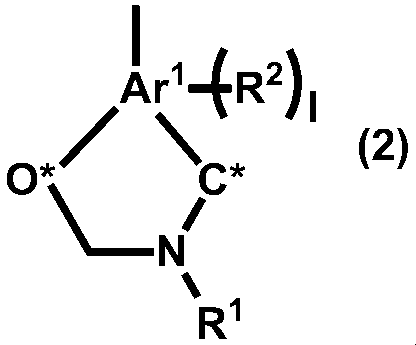
で表される構造部位(γ)を有することを特徴とするポリアリーレンエーテル樹脂。 - 下記構造式(3)

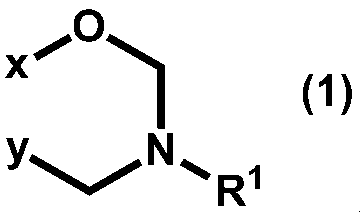
で表される構造部位(β)を有する。R3はそれぞれ独立に水素原子、アルキル基、アリール基、アラルキル基、下記構造式(2)
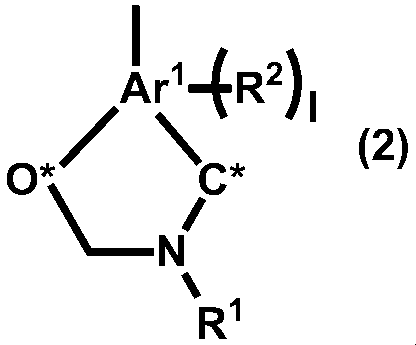
で表される構造部位(γ)の何れかであり、mは1~3の整数、nは0~4の整数である。]
で表される分子構造を有し、分子中に前記構造部位(β)又は前記構造部位(γ)を1つ以上含有する請求項1記載のポリアリーレンエーテル樹脂。 - 前記ポリアリーレンエーテル構造(α)が、ポリナフチレンエーテル構造である請求項1記載のポリアリーレンエーテル樹脂。
- 前記構造式(3)中のAr2、Ar3及び前記構造式(2)中のAr1がナフタレン環構造部位である請求項2記載のポリアリーレンエーテル樹脂。
- 樹脂中に存在するフェノール性水酸基、前記構造部位(β)及び前記構造部位(γ)の総数に対する、前記構造部位(β)と前記構造部位(γ)との合計数の割合が50%以上である請求項2記載のポリアリーレンエーテル樹脂。
- 芳香族ジヒドロキシ化合物とアラルキル化剤とを酸触媒条件下で反応させてポリアリーレンエーテル中間体(1)を得、これとモノアミン化合物とホルムアルデヒドとを反応させて得られる請求項1記載のポリアリーレンエーテル樹脂。
- 芳香族ジヒドロキシ化合物をアルカリ触媒条件下で反応させてポリアリーレンエーテル中間体(2)を得、これとモノアミン化合物とホルムアルデヒドとを反応させて得られる請求項1記載のポリアリーレンエーテル樹脂。
- 芳香族ジヒドロキシ化合物とアラルキル化剤とを酸触媒条件下で反応させてポリアリーレンエーテル中間体(1)を得、これとモノアミン化合物とホルムアルデヒドとを反応させることを特徴とするポリアリーレンエーテル樹脂の製造方法。
- 芳香族ジヒドロキシ化合物をアルカリ触媒条件下で反応させてポリアリーレンエーテル中間体(2)を得、これとモノアミン化合物とホルムアルデヒドとを反応させることを特徴とするポリアリーレンエーテル樹脂の製造方法。
- 請求項1~7の何れか一つに記載のポリアリーレンエーテル樹脂を必須の成分とする硬化性樹脂材料。
- 請求項10記載の硬化性樹脂材料を硬化させて得られる硬化物。
- 請求項1~7の何れか一つに記載のポリアリーレンエーテル樹脂と、無機質充填材とを含有する半導体封止材料。
- 請求項10記載の硬化性樹脂材料を有機溶剤に希釈したものを補強基材に含浸し、得られる含浸基材を半硬化させることにより得られるプリプレグ。
- 請求項10記載の硬化性樹脂材料を有機溶剤に希釈したワニスを得、これを板状に賦形したものと銅箔とを加熱加圧成型することにより得られる回路基板。
- 請求項10記載の硬化性樹脂材料を有機溶剤に希釈したものを基材フィルム上に塗布し、乾燥させることにより得られるビルドアップフィルム。
Priority Applications (1)
| Application Number | Priority Date | Filing Date | Title |
|---|---|---|---|
| JP2015514276A JP5835528B1 (ja) | 2014-01-07 | 2014-12-18 | ポリアリーレンエーテル樹脂、ポリアリーレンエーテル樹脂の製造方法、硬化性樹脂材料、その硬化物、半導体封止材料、プリプレグ、回路基板、及びビルドアップフィルム |
Applications Claiming Priority (2)
| Application Number | Priority Date | Filing Date | Title |
|---|---|---|---|
| JP2014-000922 | 2014-01-07 | ||
| JP2014000922 | 2014-01-07 |
Publications (1)
| Publication Number | Publication Date |
|---|---|
| WO2015104973A1 true WO2015104973A1 (ja) | 2015-07-16 |
Family
ID=53523810
Family Applications (1)
| Application Number | Title | Priority Date | Filing Date |
|---|---|---|---|
| PCT/JP2014/083587 Ceased WO2015104973A1 (ja) | 2014-01-07 | 2014-12-18 | ポリアリーレンエーテル樹脂、ポリアリーレンエーテル樹脂の製造方法、硬化性樹脂材料、その硬化物、半導体封止材料、プリプレグ、回路基板、及びビルドアップフィルム |
Country Status (3)
| Country | Link |
|---|---|
| JP (1) | JP5835528B1 (ja) |
| TW (1) | TW201529637A (ja) |
| WO (1) | WO2015104973A1 (ja) |
Families Citing this family (1)
| Publication number | Priority date | Publication date | Assignee | Title |
|---|---|---|---|---|
| JP6690121B2 (ja) * | 2014-12-25 | 2020-04-28 | Dic株式会社 | ポリアリーレンエーテル樹脂、ポリアリーレンエーテル樹脂の製造方法、硬化性樹脂材料、その硬化物、半導体封止材料、半導体装置、プリプレグ、プリント回路基板、ビルドアップフィルム、ビルドアップ基板、繊維強化複合材料、及び繊維強化成形品 |
Citations (9)
| Publication number | Priority date | Publication date | Assignee | Title |
|---|---|---|---|---|
| JP2004182814A (ja) * | 2002-12-02 | 2004-07-02 | Nippon Steel Chem Co Ltd | 熱硬化性樹脂、樹脂組成物及び硬化物 |
| JP2004238412A (ja) * | 2003-02-03 | 2004-08-26 | Nippon Steel Chem Co Ltd | 熱硬化性樹脂の製造方法 |
| JP2009046592A (ja) * | 2007-08-20 | 2009-03-05 | Sekisui Chem Co Ltd | 熱硬化性樹脂組成物及びその製造方法 |
| JP2009114443A (ja) * | 2007-11-02 | 2009-05-28 | Samsung Electronics Co Ltd | ナフトオキサジンベンゾオキサジン系モノマーとその重合体、燃料電池用電極、燃料電池用電解質膜および燃料電池 |
| JP2009209210A (ja) * | 2008-02-29 | 2009-09-17 | Sekisui Chem Co Ltd | 熱硬化性樹脂組成物、その成形体、硬化体、硬化成形体、並びにそれらを含む電子機器 |
| JP2012087103A (ja) * | 2010-10-21 | 2012-05-10 | Asahi Organic Chemicals Industry Co Ltd | アントラセン誘導体、硬化性組成物及び硬化物 |
| JP2013510912A (ja) * | 2009-11-14 | 2013-03-28 | ビーエーエスエフ ソシエタス・ヨーロピア | 窒素含有ポリマーを機械的に安定化させる方法 |
| WO2013183679A1 (ja) * | 2012-06-05 | 2013-12-12 | 日産化学工業株式会社 | 接着剤組成物又はアンダーフィル組成物 |
| JP2014503669A (ja) * | 2011-01-25 | 2014-02-13 | サイテク・テクノロジー・コーポレーシヨン | ベンズオキサジン樹脂 |
Family Cites Families (3)
| Publication number | Priority date | Publication date | Assignee | Title |
|---|---|---|---|---|
| TW404969B (en) * | 1998-02-23 | 2000-09-11 | Asahi Chemical Ind | Curable polyphenylene ether resin composition and the uses thereof |
| JP4259536B2 (ja) * | 2006-03-29 | 2009-04-30 | Dic株式会社 | フェノール樹脂の製造方法、およびエポキシ樹脂の製造方法 |
| US8669333B2 (en) * | 2010-07-02 | 2014-03-11 | Dic Corporation | Thermosetting resin composition, cured product thereof, active ester resin, semiconductor encapsulating material, prepreg, circuit board, and build-up film |
-
2014
- 2014-12-18 WO PCT/JP2014/083587 patent/WO2015104973A1/ja not_active Ceased
- 2014-12-18 JP JP2015514276A patent/JP5835528B1/ja active Active
- 2014-12-22 TW TW103144860A patent/TW201529637A/zh unknown
Patent Citations (9)
| Publication number | Priority date | Publication date | Assignee | Title |
|---|---|---|---|---|
| JP2004182814A (ja) * | 2002-12-02 | 2004-07-02 | Nippon Steel Chem Co Ltd | 熱硬化性樹脂、樹脂組成物及び硬化物 |
| JP2004238412A (ja) * | 2003-02-03 | 2004-08-26 | Nippon Steel Chem Co Ltd | 熱硬化性樹脂の製造方法 |
| JP2009046592A (ja) * | 2007-08-20 | 2009-03-05 | Sekisui Chem Co Ltd | 熱硬化性樹脂組成物及びその製造方法 |
| JP2009114443A (ja) * | 2007-11-02 | 2009-05-28 | Samsung Electronics Co Ltd | ナフトオキサジンベンゾオキサジン系モノマーとその重合体、燃料電池用電極、燃料電池用電解質膜および燃料電池 |
| JP2009209210A (ja) * | 2008-02-29 | 2009-09-17 | Sekisui Chem Co Ltd | 熱硬化性樹脂組成物、その成形体、硬化体、硬化成形体、並びにそれらを含む電子機器 |
| JP2013510912A (ja) * | 2009-11-14 | 2013-03-28 | ビーエーエスエフ ソシエタス・ヨーロピア | 窒素含有ポリマーを機械的に安定化させる方法 |
| JP2012087103A (ja) * | 2010-10-21 | 2012-05-10 | Asahi Organic Chemicals Industry Co Ltd | アントラセン誘導体、硬化性組成物及び硬化物 |
| JP2014503669A (ja) * | 2011-01-25 | 2014-02-13 | サイテク・テクノロジー・コーポレーシヨン | ベンズオキサジン樹脂 |
| WO2013183679A1 (ja) * | 2012-06-05 | 2013-12-12 | 日産化学工業株式会社 | 接着剤組成物又はアンダーフィル組成物 |
Also Published As
| Publication number | Publication date |
|---|---|
| TW201529637A (zh) | 2015-08-01 |
| JP5835528B1 (ja) | 2015-12-24 |
| JPWO2015104973A1 (ja) | 2017-03-23 |
Similar Documents
| Publication | Publication Date | Title |
|---|---|---|
| KR101340283B1 (ko) | 페놀 수지 조성물, 경화성 수지 조성물, 그 경화물, 및 프린트 배선 기판 | |
| JP5463859B2 (ja) | エポキシ樹脂組成物、その硬化物、新規エポキシ樹脂、新規フェノール樹脂、プリプレグ、及び回路基板 | |
| JP5892404B1 (ja) | 硬化性樹脂組成物、その硬化物、半導体封止材料、半導体装置、プリプレグ、回路基板、ビルドアップフィルム、ビルドアップ基板、繊維強化複合材料、及び繊維強化樹脂成形品 | |
| WO2016098488A1 (ja) | 熱硬化性樹脂組成物、その硬化物、及びこれに用いる活性エステル樹脂 | |
| WO2014199655A1 (ja) | リン原子含有活性エステル樹脂、エポキシ樹脂組成物、その硬化物、プリプレグ、回路基板、及びビルドアップフィルム | |
| JP5146793B2 (ja) | リン原子含有オリゴマー組成物、硬化性樹脂組成物、その硬化物、及びプリント配線基板 | |
| JP6278239B2 (ja) | 活性エステル樹脂、エポキシ樹脂組成物、その硬化物、プリプレグ、回路基板、及びビルドアップフィルム | |
| JP6413740B2 (ja) | ベンゾオキサジン化合物、ベンゾオキサジン樹脂、ベンゾオキサジン樹脂の製造方法、硬化性樹脂組成物、その硬化物、frp材料、半導体封止材料、ワニス、回路基板、プリプレグ、及びビルドアップフィルム | |
| JP5614519B1 (ja) | 変性フェノール樹脂、変性フェノール樹脂の製造方法、変性エポキシ樹脂、変性エポキシ樹脂の製造方法、硬化性樹脂組成物、その硬化物、及びプリント配線基板 | |
| JP5402091B2 (ja) | 硬化性樹脂組成物、その硬化物、プリント配線基板、新規フェノール樹脂、及びその製造方法 | |
| JP6410097B2 (ja) | ベンゾオキサジン化合物、ベンゾオキサジン樹脂、ベンゾオキサジン樹脂の製造方法、硬化性樹脂組成物、その硬化物、frp材料、半導体封止材料、ワニス、回路基板、プリプレグ、及びビルドアップフィルム | |
| JP6766316B2 (ja) | ベンゾオキサジン化合物、ベンゾオキサジン樹脂、ベンゾオキサジン化合物の製造方法、硬化性樹脂組成物、その硬化物、frp材料、半導体封止材料、ワニス、回路基板、プリプレグ、及びビルドアップフィルム | |
| JP6497125B2 (ja) | ポリアリーレンエーテル樹脂、ポリアリーレンエーテル樹脂の製造方法、硬化性樹脂材料、その硬化物、半導体封止材料、半導体装置、プリプレグ、プリント回路基板、ビルドアップフィルム、ビルドアップ基板 | |
| JP5850228B2 (ja) | 硬化性樹脂組成物、その硬化物、シアン酸エステル樹脂、半導体封止材料、プリプレグ、回路基板、及び、ビルドアップフィルム | |
| JP5835528B1 (ja) | ポリアリーレンエーテル樹脂、ポリアリーレンエーテル樹脂の製造方法、硬化性樹脂材料、その硬化物、半導体封止材料、プリプレグ、回路基板、及びビルドアップフィルム | |
| CN104704021B (zh) | 环氧树脂、固化性树脂组合物、其固化物、以及印刷布线基板 | |
| JP6690120B2 (ja) | ベンゾオキサジン化合物、ベンゾオキサジン樹脂、ベンゾオキサジン化合物の製造方法、硬化性樹脂組成物、その硬化物、frp材料、半導体封止材料、ワニス、回路基板、プリプレグ、及びビルドアップフィルム | |
| JP6690121B2 (ja) | ポリアリーレンエーテル樹脂、ポリアリーレンエーテル樹脂の製造方法、硬化性樹脂材料、その硬化物、半導体封止材料、半導体装置、プリプレグ、プリント回路基板、ビルドアップフィルム、ビルドアップ基板、繊維強化複合材料、及び繊維強化成形品 | |
| JP2012041396A (ja) | エポキシ樹脂組成物、硬化性樹脂組成物、その硬化物、及びプリント配線基板 | |
| JP6040725B2 (ja) | フェノキシ樹脂、硬化性樹脂組成物、その硬化物、プリプレグ、回路基板、及びビルドアップフィルム | |
| JP5637367B2 (ja) | 硬化性樹脂組成物、その硬化物、リン原子含有フェノール樹脂の製造方法、プリント配線基板用樹脂組成物、プリント配線基板、フレキシブル配線基板用樹脂組成物、半導体封止材料用樹脂組成物、及びビルドアップ基板用層間絶縁材料用樹脂組成物 | |
| JP5637368B2 (ja) | 硬化性樹脂組成物、その硬化物、リン原子含有フェノール化合物の製造方法、プリント配線基板用樹脂組成物、プリント配線基板、フレキシブル配線基板用樹脂組成物、半導体封止材料用樹脂組成物、及びビルドアップ基板用層間絶縁材料用樹脂組成物 | |
| JP6127640B2 (ja) | 変性ポリアリーレンエーテル樹脂、エポキシ樹脂組成物、その硬化物、プリプレグ、回路基板、及びビルドアップフィルム | |
| JP2014205774A (ja) | 変性ポリアリーレンエーテル樹脂、エポキシ樹脂組成物、その硬化物、プリプレグ、回路基板、及びビルドアップフィルム | |
| JP2013010904A (ja) | 硬化性樹脂組成物、その硬化物、プリント配線基板、及びフェノール樹脂 |
Legal Events
| Date | Code | Title | Description |
|---|---|---|---|
| ENP | Entry into the national phase |
Ref document number: 2015514276 Country of ref document: JP Kind code of ref document: A |
|
| 121 | Ep: the epo has been informed by wipo that ep was designated in this application |
Ref document number: 14878277 Country of ref document: EP Kind code of ref document: A1 |
|
| NENP | Non-entry into the national phase |
Ref country code: DE |
|
| 122 | Ep: pct application non-entry in european phase |
Ref document number: 14878277 Country of ref document: EP Kind code of ref document: A1 |