WO2015099137A1 - 感光性樹脂組成物及び感光性樹脂積層体 - Google Patents
感光性樹脂組成物及び感光性樹脂積層体 Download PDFInfo
- Publication number
- WO2015099137A1 WO2015099137A1 PCT/JP2014/084557 JP2014084557W WO2015099137A1 WO 2015099137 A1 WO2015099137 A1 WO 2015099137A1 JP 2014084557 W JP2014084557 W JP 2014084557W WO 2015099137 A1 WO2015099137 A1 WO 2015099137A1
- Authority
- WO
- WIPO (PCT)
- Prior art keywords
- photosensitive resin
- group
- mass
- resin composition
- divalent linking
- Prior art date
- Legal status (The legal status is an assumption and is not a legal conclusion. Google has not performed a legal analysis and makes no representation as to the accuracy of the status listed.)
- Ceased
Links
Classifications
-
- G—PHYSICS
- G03—PHOTOGRAPHY; CINEMATOGRAPHY; ANALOGOUS TECHNIQUES USING WAVES OTHER THAN OPTICAL WAVES; ELECTROGRAPHY; HOLOGRAPHY
- G03F—PHOTOMECHANICAL PRODUCTION OF TEXTURED OR PATTERNED SURFACES, e.g. FOR PRINTING, FOR PROCESSING OF SEMICONDUCTOR DEVICES; MATERIALS THEREFOR; ORIGINALS THEREFOR; APPARATUS SPECIALLY ADAPTED THEREFOR
- G03F7/00—Photomechanical, e.g. photolithographic, production of textured or patterned surfaces, e.g. printing surfaces; Materials therefor, e.g. comprising photoresists; Apparatus specially adapted therefor
- G03F7/004—Photosensitive materials
-
- C—CHEMISTRY; METALLURGY
- C08—ORGANIC MACROMOLECULAR COMPOUNDS; THEIR PREPARATION OR CHEMICAL WORKING-UP; COMPOSITIONS BASED THEREON
- C08F—MACROMOLECULAR COMPOUNDS OBTAINED BY REACTIONS ONLY INVOLVING CARBON-TO-CARBON UNSATURATED BONDS
- C08F2/00—Processes of polymerisation
- C08F2/46—Polymerisation initiated by wave energy or particle radiation
- C08F2/48—Polymerisation initiated by wave energy or particle radiation by ultraviolet or visible light
-
- C—CHEMISTRY; METALLURGY
- C07—ORGANIC CHEMISTRY
- C07C—ACYCLIC OR CARBOCYCLIC COMPOUNDS
- C07C39/00—Compounds having at least one hydroxy or O-metal group bound to a carbon atom of a six-membered aromatic ring
- C07C39/12—Compounds having at least one hydroxy or O-metal group bound to a carbon atom of a six-membered aromatic ring polycyclic with no unsaturation outside the aromatic rings
- C07C39/15—Compounds having at least one hydroxy or O-metal group bound to a carbon atom of a six-membered aromatic ring polycyclic with no unsaturation outside the aromatic rings with all hydroxy groups on non-condensed rings, e.g. phenylphenol
-
- C—CHEMISTRY; METALLURGY
- C08—ORGANIC MACROMOLECULAR COMPOUNDS; THEIR PREPARATION OR CHEMICAL WORKING-UP; COMPOSITIONS BASED THEREON
- C08F—MACROMOLECULAR COMPOUNDS OBTAINED BY REACTIONS ONLY INVOLVING CARBON-TO-CARBON UNSATURATED BONDS
- C08F220/00—Copolymers of compounds having one or more unsaturated aliphatic radicals, each having only one carbon-to-carbon double bond, and only one being terminated by only one carboxyl radical or a salt, anhydride ester, amide, imide or nitrile thereof
- C08F220/02—Monocarboxylic acids having less than ten carbon atoms; Derivatives thereof
- C08F220/10—Esters
-
- C—CHEMISTRY; METALLURGY
- C08—ORGANIC MACROMOLECULAR COMPOUNDS; THEIR PREPARATION OR CHEMICAL WORKING-UP; COMPOSITIONS BASED THEREON
- C08F—MACROMOLECULAR COMPOUNDS OBTAINED BY REACTIONS ONLY INVOLVING CARBON-TO-CARBON UNSATURATED BONDS
- C08F265/00—Macromolecular compounds obtained by polymerising monomers on to polymers of unsaturated monocarboxylic acids or derivatives thereof as defined in group C08F20/00
- C08F265/02—Macromolecular compounds obtained by polymerising monomers on to polymers of unsaturated monocarboxylic acids or derivatives thereof as defined in group C08F20/00 on to polymers of acids, salts or anhydrides
-
- G—PHYSICS
- G03—PHOTOGRAPHY; CINEMATOGRAPHY; ANALOGOUS TECHNIQUES USING WAVES OTHER THAN OPTICAL WAVES; ELECTROGRAPHY; HOLOGRAPHY
- G03F—PHOTOMECHANICAL PRODUCTION OF TEXTURED OR PATTERNED SURFACES, e.g. FOR PRINTING, FOR PROCESSING OF SEMICONDUCTOR DEVICES; MATERIALS THEREFOR; ORIGINALS THEREFOR; APPARATUS SPECIALLY ADAPTED THEREFOR
- G03F7/00—Photomechanical, e.g. photolithographic, production of textured or patterned surfaces, e.g. printing surfaces; Materials therefor, e.g. comprising photoresists; Apparatus specially adapted therefor
- G03F7/004—Photosensitive materials
- G03F7/027—Non-macromolecular photopolymerisable compounds having carbon-to-carbon double bonds, e.g. ethylenic compounds
- G03F7/028—Non-macromolecular photopolymerisable compounds having carbon-to-carbon double bonds, e.g. ethylenic compounds with photosensitivity-increasing substances, e.g. photoinitiators
-
- G—PHYSICS
- G03—PHOTOGRAPHY; CINEMATOGRAPHY; ANALOGOUS TECHNIQUES USING WAVES OTHER THAN OPTICAL WAVES; ELECTROGRAPHY; HOLOGRAPHY
- G03F—PHOTOMECHANICAL PRODUCTION OF TEXTURED OR PATTERNED SURFACES, e.g. FOR PRINTING, FOR PROCESSING OF SEMICONDUCTOR DEVICES; MATERIALS THEREFOR; ORIGINALS THEREFOR; APPARATUS SPECIALLY ADAPTED THEREFOR
- G03F7/00—Photomechanical, e.g. photolithographic, production of textured or patterned surfaces, e.g. printing surfaces; Materials therefor, e.g. comprising photoresists; Apparatus specially adapted therefor
- G03F7/004—Photosensitive materials
- G03F7/027—Non-macromolecular photopolymerisable compounds having carbon-to-carbon double bonds, e.g. ethylenic compounds
- G03F7/032—Non-macromolecular photopolymerisable compounds having carbon-to-carbon double bonds, e.g. ethylenic compounds with binders
-
- G—PHYSICS
- G03—PHOTOGRAPHY; CINEMATOGRAPHY; ANALOGOUS TECHNIQUES USING WAVES OTHER THAN OPTICAL WAVES; ELECTROGRAPHY; HOLOGRAPHY
- G03F—PHOTOMECHANICAL PRODUCTION OF TEXTURED OR PATTERNED SURFACES, e.g. FOR PRINTING, FOR PROCESSING OF SEMICONDUCTOR DEVICES; MATERIALS THEREFOR; ORIGINALS THEREFOR; APPARATUS SPECIALLY ADAPTED THEREFOR
- G03F7/00—Photomechanical, e.g. photolithographic, production of textured or patterned surfaces, e.g. printing surfaces; Materials therefor, e.g. comprising photoresists; Apparatus specially adapted therefor
- G03F7/004—Photosensitive materials
- G03F7/038—Macromolecular compounds which are rendered insoluble or differentially wettable
- G03F7/0382—Macromolecular compounds which are rendered insoluble or differentially wettable the macromolecular compound being present in a chemically amplified negative photoresist composition
-
- G—PHYSICS
- G03—PHOTOGRAPHY; CINEMATOGRAPHY; ANALOGOUS TECHNIQUES USING WAVES OTHER THAN OPTICAL WAVES; ELECTROGRAPHY; HOLOGRAPHY
- G03F—PHOTOMECHANICAL PRODUCTION OF TEXTURED OR PATTERNED SURFACES, e.g. FOR PRINTING, FOR PROCESSING OF SEMICONDUCTOR DEVICES; MATERIALS THEREFOR; ORIGINALS THEREFOR; APPARATUS SPECIALLY ADAPTED THEREFOR
- G03F7/00—Photomechanical, e.g. photolithographic, production of textured or patterned surfaces, e.g. printing surfaces; Materials therefor, e.g. comprising photoresists; Apparatus specially adapted therefor
- G03F7/004—Photosensitive materials
- G03F7/039—Macromolecular compounds which are photodegradable, e.g. positive electron resists
- G03F7/0392—Macromolecular compounds which are photodegradable, e.g. positive electron resists the macromolecular compound being present in a chemically amplified positive photoresist composition
-
- G—PHYSICS
- G03—PHOTOGRAPHY; CINEMATOGRAPHY; ANALOGOUS TECHNIQUES USING WAVES OTHER THAN OPTICAL WAVES; ELECTROGRAPHY; HOLOGRAPHY
- G03F—PHOTOMECHANICAL PRODUCTION OF TEXTURED OR PATTERNED SURFACES, e.g. FOR PRINTING, FOR PROCESSING OF SEMICONDUCTOR DEVICES; MATERIALS THEREFOR; ORIGINALS THEREFOR; APPARATUS SPECIALLY ADAPTED THEREFOR
- G03F7/00—Photomechanical, e.g. photolithographic, production of textured or patterned surfaces, e.g. printing surfaces; Materials therefor, e.g. comprising photoresists; Apparatus specially adapted therefor
- G03F7/004—Photosensitive materials
- G03F7/075—Silicon-containing compounds
- G03F7/0757—Macromolecular compounds containing Si-O, Si-C or Si-N bonds
-
- G—PHYSICS
- G03—PHOTOGRAPHY; CINEMATOGRAPHY; ANALOGOUS TECHNIQUES USING WAVES OTHER THAN OPTICAL WAVES; ELECTROGRAPHY; HOLOGRAPHY
- G03F—PHOTOMECHANICAL PRODUCTION OF TEXTURED OR PATTERNED SURFACES, e.g. FOR PRINTING, FOR PROCESSING OF SEMICONDUCTOR DEVICES; MATERIALS THEREFOR; ORIGINALS THEREFOR; APPARATUS SPECIALLY ADAPTED THEREFOR
- G03F7/00—Photomechanical, e.g. photolithographic, production of textured or patterned surfaces, e.g. printing surfaces; Materials therefor, e.g. comprising photoresists; Apparatus specially adapted therefor
- G03F7/20—Exposure; Apparatus therefor
-
- H—ELECTRICITY
- H05—ELECTRIC TECHNIQUES NOT OTHERWISE PROVIDED FOR
- H05K—PRINTED CIRCUITS; CASINGS OR CONSTRUCTIONAL DETAILS OF ELECTRIC APPARATUS; MANUFACTURE OF ASSEMBLAGES OF ELECTRICAL COMPONENTS
- H05K1/00—Printed circuits
- H05K1/02—Details
- H05K1/03—Use of materials for the substrate
- H05K1/0313—Organic insulating material
- H05K1/032—Organic insulating material consisting of one material
- H05K1/0326—Organic insulating material consisting of one material containing O
-
- H—ELECTRICITY
- H05—ELECTRIC TECHNIQUES NOT OTHERWISE PROVIDED FOR
- H05K—PRINTED CIRCUITS; CASINGS OR CONSTRUCTIONAL DETAILS OF ELECTRIC APPARATUS; MANUFACTURE OF ASSEMBLAGES OF ELECTRICAL COMPONENTS
- H05K2203/00—Indexing scheme relating to apparatus or processes for manufacturing printed circuits covered by H05K3/00
- H05K2203/05—Patterning and lithography; Masks; Details of resist
- H05K2203/0502—Patterning and lithography
- H05K2203/0514—Photodevelopable thick film, e.g. conductive or insulating paste
-
- H—ELECTRICITY
- H05—ELECTRIC TECHNIQUES NOT OTHERWISE PROVIDED FOR
- H05K—PRINTED CIRCUITS; CASINGS OR CONSTRUCTIONAL DETAILS OF ELECTRIC APPARATUS; MANUFACTURE OF ASSEMBLAGES OF ELECTRICAL COMPONENTS
- H05K3/00—Apparatus or processes for manufacturing printed circuits
- H05K3/0011—Working of insulating substrates or insulating layers
- H05K3/0017—Etching of the substrate by chemical or physical means
- H05K3/0023—Etching of the substrate by chemical or physical means by exposure and development of a photosensitive insulating layer
Definitions
- the present invention relates to a photosensitive resin composition and the like.
- a photosensitive resin laminate comprising a photosensitive resin layer laminated on a support film, and further a protective film laminated on the photosensitive resin layer as necessary, A so-called dry film photoresist (hereinafter sometimes referred to as DF) is used.
- DF dry film photoresist
- the photosensitive resin layer is generally of an alkali development type using a weak alkaline aqueous solution as a developer.
- the following steps are performed.
- DF has a protective film
- the protective film is first peeled off.
- DF is laminated on a permanent circuit fabrication substrate such as a copper clad laminate or a flexible substrate using a laminator or the like, and exposure is performed through a wiring pattern mask film or the like.
- the support film is peeled off, and a photosensitive resin layer of an uncured portion (for example, an unexposed portion in a negative type) is dissolved or dispersed and removed by a developer, and a cured resist pattern (hereinafter simply referred to as a resist pattern) is formed on the substrate. (Sometimes called a resist pattern).
- the process of forming a circuit after forming a resist pattern is roughly divided into two methods.
- the first method is a method in which a substrate surface not covered with a resist pattern (for example, a copper surface of a copper clad laminate) is removed by etching, and then the resist pattern portion is removed with an alkaline aqueous solution stronger than a developer (etching method). It is.
- the substrate surface is plated with copper, solder, nickel, tin or the like, and then the resist pattern portion is removed in the same manner as in the first method.
- This is a method (plating method) for etching the copper surface of the tension laminate.
- Patent Document 1 describes a photosensitive resin composition whose resolution is enhanced by a specific thermoplastic resin, a monomer, and a photopolymerizable initiator. .
- the present invention provides a photosensitive resin laminate that exhibits high resolution even when the focus during exposure is shifted, a photosensitive resin composition for forming the same, and the photosensitive property. It is an object of the present invention to provide a resist pattern forming method and a conductor pattern forming method using a resin laminate.
- the present invention is as follows.
- a photosensitive resin composition comprising (A) an alkali-soluble polymer, (B) a compound having an ethylenically unsaturated double bond, and (C) a photopolymerization initiator, In a resist pattern obtained by forming a photosensitive resin layer comprising the photosensitive resin composition on the substrate surface, and performing exposure and development, pattern resolution when the exposure is performed with the focal position being aligned with the substrate surface a photosensitive resin composition in which a difference between a and a pattern resolution b when the exposure is performed by aligning a focal position at a position shifted from the substrate surface to the inside of the substrate by 300 ⁇ m in the thickness direction of the substrate is less than 15 ⁇ m .
- R 3 R 4 and R 5 are each independently hydrogen, or substituted A linear alkyl group, a branched alkyl group, an aryl group, a cyclohexyl group, a linear alkyl group via a divalent linking group, a branched alkyl group via a divalent linking group, or a divalent linking group.
- a photosensitive resin composition comprising: (D) The following general formula (II) as a phenol derivative: ⁇ Wherein R 2 is an optionally substituted linear alkyl group, branched alkyl group, aryl group, cyclohexyl group, a linear alkyl group via a divalent linking group, or a divalent linking group. A branched alkyl group, a cyclohexyl group via a divalent linking group or an aryl group via a divalent linking group, and R 3 , R 4 and R 5 are each independently hydrogen or substituted.
- R 6 and R 7 are, each independently may be substituted, straight-chain alkyl group, branched alkyl group, an aryl group, a cyclohexyl group, a divalent straight chain alkyl group through a linking group, Represents a branched alkyl group via a divalent linking group, a cyclohexyl group via a divalent linking group, or an aryl group via a divalent linking group, and a plurality of R 6 and R 7 are the same or different from each other.
- P and q each independently represent an integer of 0 to 4
- B represents a linking group consisting of a single bond or a conjugated bond.
- the photosensitive resin composition containing at least 1 sort (s) selected from the group which consists of a compound represented by these.
- a method for forming a resist pattern comprising a developing step of developing and removing.
- the resist pattern forming method according to [15] wherein the exposure step is performed by an exposure method by direct drawing of a drawing pattern.
- a photosensitive resin laminate that exhibits high resolution even when the focus at the time of exposure shifts, a photosensitive resin composition for forming the same, and the photosensitive resin laminate. It is possible to provide a method for forming a resist pattern and a method for forming a conductor pattern using the. As a result, even when the focus position at the time of exposure deviates from the substrate surface due to warpage and distortion of the substrate, setting failure of the exposure apparatus, etc., it is possible to reduce the short circuit problem when forming a circuit by the etching method. In addition, when a circuit is formed by a plating method, problems such as chipping, disconnection, and plating failure can be reduced.
- the photosensitive resin composition has a focal position on the substrate surface in a resist pattern obtained by forming a photosensitive resin layer made of the photosensitive resin composition on the substrate surface and performing exposure and development.
- the difference between the pattern resolution a and the pattern resolution b is preferably 12 ⁇ m or less, more preferably 10 ⁇ m or less.
- the difference between the pattern resolution a and the pattern resolution b is preferably 0 ⁇ m or more, more preferably 5 ⁇ m or more, and even more preferably 7 ⁇ m or more, from the viewpoint of ease of manufacturing and little decrease in sensitivity.
- various measured values in the present specification are based on the method described in the [Example] section of the present disclosure or a method understood by those skilled in the art to be equivalent thereto. Measured.
- the pattern resolution a when exposure is performed with the focal position on the substrate surface, and the position shifted from the substrate surface to the inside of the substrate 300 ⁇ m in the thickness direction of the substrate (deviation of the focal position, such as the amount of waviness on the surface)
- the photosensitive resin composition is designed by paying attention to the difference from the pattern resolution b when the exposure is performed by aligning the focal position with the reference value set as a very large deviation amount with respect to the amount). I found it effective to solve the problem. That is, it is possible to select and use a specific photosensitive resin composition in which a difference between the pattern resolution a and the pattern resolution b is included in a certain range, even in the recent situation of increasing the wiring density and multilayering.
- the present inventors have found that the present invention is effective for reducing defects, chips, disconnections, plating defects, and problems that a desired copper line cannot be formed.
- the means for setting the difference between the pattern resolution a and the pattern resolution b within the specific range is not particularly limited.
- the composition of the photosensitive resin composition can be adjusted in various ways as will be described in detail below for each component. To do.
- the photosensitive resin composition includes (A) an alkali-soluble polymer, (B) a compound having an ethylenically unsaturated double bond, and (C) a photopolymerization initiator.
- the photosensitive resin composition comprises (A) an alkali-soluble polymer: 10% by mass to 90% by mass; (B) a compound having an ethylenically unsaturated double bond, based on the total solid content of the photosensitive resin composition. : 5 mass% to 70 mass%; and (C) Photopolymerization initiator: 0.01 mass% to 20 mass% is preferably included.
- each component will be described in order.
- the (A) alkali-soluble polymer includes a polymer that is easily soluble in an alkaline substance. More specifically, the amount of carboxyl groups contained in (A) the alkali-soluble polymer is from 100 to 600, preferably from 250 to 450, as an acid equivalent.
- the acid equivalent means the mass (unit: gram) of a polymer having 1 equivalent of a carboxyl group in the molecule.
- the carboxyl group in the alkali-soluble polymer is necessary for giving the photosensitive resin layer developability and releasability with respect to an aqueous alkali solution.
- the acid equivalent is a value measured by a potentiometric titration method using a potentiometric titrator and titrating with a 0.1 mol / L NaOH aqueous solution.
- the weight average molecular weight of the alkali-soluble polymer is preferably 5,000 to 500,000.
- a weight average molecular weight of 500,000 or less is preferable from the viewpoint of improving resolution and developability.
- the weight average molecular weight is more preferably 300,000 or less, and further preferably 200,000 or less.
- setting the weight average molecular weight to 5,000 or more is a viewpoint for controlling the properties of the development aggregate and the properties of the unexposed film such as the edge fuse property and the cut chip property when the photosensitive resin laminate is used.
- the weight average molecular weight is more preferably 10,000 or more, and further preferably 20,000 or more.
- the edge fuse property refers to the degree to which a photosensitive resin layer (that is, a layer made of a photosensitive resin composition) easily protrudes from the end surface of the roll when the photosensitive resin laminate is wound into a roll.
- the cut chip property refers to the degree of ease with which a chip can fly when an unexposed film is cut with a cutter. If this chip adheres to the upper surface of the photosensitive resin laminate, it is transferred to a mask in a later exposure process or the like, causing defective products.
- the alkali-soluble polymer is preferably a copolymer obtained from at least one of the first monomers described below and at least one of the second monomers described below.
- the first monomer is a carboxylic acid or acid anhydride having one polymerizable unsaturated group in the molecule.
- the first monomer is divided into a first monomer having an aromatic hydrocarbon group and a first monomer having no aromatic hydrocarbon group.
- Examples of the first monomer having an aromatic hydrocarbon group include cinnamic acid.
- Examples of the first monomer having no aromatic hydrocarbon group include (meth) acrylic acid, fumaric acid, crotonic acid, itaconic acid, maleic anhydride, maleic acid half ester, and the like.
- (meth) acrylic acid is preferred from the viewpoint of ease of production and developability.
- (meth) acryl refers to acryl and / or methacryl. The same applies hereinafter.
- the second monomer is non-acidic and has at least one polymerizable unsaturated group in the molecule.
- the second monomer is divided into a second monomer having an aromatic hydrocarbon group and a second monomer having no aromatic hydrocarbon group.
- Examples of the second monomer having an aromatic hydrocarbon group include benzyl (meth) acrylate, styrene, and a styrene derivative.
- Examples of the second monomer having no aromatic hydrocarbon group include methyl (meth) acrylate, ethyl (meth) acrylate, n-propyl (meth) acrylate, isopropyl (meth) acrylate, n-butyl ( (Meth) acrylate, isobutyl (meth) acrylate, tert-butyl (meth) acrylate, 2-hydroxyethyl (meth) acrylate, 2-hydroxypropyl (meth) acrylate, 2-ethylhexyl (meth) acrylate, vinyl alcohol esters, For example, vinyl acetate, (meth) acrylonitrile, etc. are mentioned.
- methyl (meth) acrylate, n-butyl (meth) acrylate, styrene, 2-ethylhexyl (meth) acrylate, and benzyl (meth) acrylate are preferable.
- styrene and benzyl (meth) acrylate are preferred.
- styrene and benzyl (meth) acrylate are also used from the viewpoint of reducing the difference in resolution between when the focus position during exposure is adjusted to the substrate surface and when the focus position during exposure is shifted from the substrate surface. preferable.
- the alkali-soluble polymer preferably contains a monomer component having an aromatic hydrocarbon group.
- the content ratio of the monomer component having an aromatic hydrocarbon group in the (A) alkali-soluble polymer is preferably 10% by mass or more based on the total mass of all monomer components, and is 20% by mass. More preferably, it is more preferably 30% by mass or more, and particularly preferably 50% by mass or more. Although it does not specifically limit as an upper limit, Preferably it is 95 mass% or less, More preferably, it is 80 mass% or less.
- the alkali-soluble polymer is a polymer having a structure derived from (meth) acrylic acid, alkyl (meth) acrylate and styrene, and / or (meth) acrylic acid, benzyl (meth) acrylate. And a polymer having a structure derived from alkyl (meth) acrylate.
- the copolymerization ratio of the first monomer and the second monomer is 10% by mass to 60% by mass of the first monomer, based on the total mass of the polymerization components, and the second monomer. Is preferably 40% by mass to 90% by mass, more preferably 15% by mass to 35% by mass of the first monomer and 65% by mass to 85% by mass of the second monomer. is there.
- the alkali-soluble polymer can be used alone or in combination of two or more.
- the proportion of the alkali-soluble polymer containing the monomer component having an aromatic hydrocarbon group is preferably 50% by mass or more based on the total amount of the (A) alkali-soluble polymer. More preferably, it is 80 mass% or more, and it is more preferable that it is 90 mass% or more.
- the synthesis of the alkali-soluble polymer is carried out by diluting a mixture of the first monomer and the second monomer with a solvent such as acetone, methyl ethyl ketone, isopropanol or the like, and adding benzoyl peroxide, azoisobutyrate. It is preferable to carry out by adding an appropriate amount of a radical polymerization initiator such as nitrile and stirring with heating. In some cases, the synthesis is performed while a part of the mixture is dropped into the reaction solution. After completion of the reaction, a solvent may be further added to adjust to a desired concentration. As synthesis means, bulk polymerization, suspension polymerization, or emulsion polymerization may be used in addition to solution polymerization.
- a solvent such as acetone, methyl ethyl ketone, isopropanol or the like
- benzoyl peroxide azoisobutyrate
- a radical polymerization initiator such as nitrile
- the ratio of the alkali-soluble polymer to the total solid mass of the photosensitive resin composition is preferably in the range of 10% by mass to 90% by mass, more preferably 30% by mass to 70% by mass, More preferably, it is 40% by mass to 60% by mass. Setting the ratio of (A) the alkali-soluble polymer to the photosensitive resin composition to 90% by mass or less is preferable from the viewpoint of controlling the development time. On the other hand, it is preferable from the viewpoint of improving edge fuse resistance that the ratio of (A) the alkali-soluble polymer to the photosensitive resin composition be 10% by mass or more.
- the compound having an ethylenically unsaturated double bond preferably contains a compound having a (meth) acryloyl group in the molecule from the viewpoint of curability and compatibility with (A) an alkali-soluble polymer.
- the number of (meth) acryloyl groups in a compound should just be one or more.
- the (B) compound having one (meth) acryloyl group for example, a compound obtained by adding (meth) acrylic acid to one end of polyalkylene oxide, or (meth) acrylic acid at one end of polyalkylene oxide And a compound in which the other end is alkyl etherified or allyl etherified.
- Phenoxyhexaethylene glycol mono (meth) acrylate which is a (meth) acrylate of a compound in which polyethylene glycol is added to a phenyl group
- 4-Normal nonylphenoxyheptaethylene glycol dipropylene glycol which is a (meth) acrylate of a compound obtained by adding polypropylene glycol with an average of 2 mol of propylene oxide and polyethylene glycol with an average of 7 mol of ethylene oxide added to nonylphenol.
- (Meth) acrylate 4-Normal nonylphenoxypentaethylene glycol monopropylene glycol, which is a (meth) acrylate of a compound in which polypropylene glycol with an average of 1 mol of propylene oxide added and polyethylene glycol with an average of 5 mol of ethylene oxide added to nonylphenol (Meth) acrylate,
- Examples include 4-normal nonylphenoxyoctaethylene glycol (meth) acrylate (for example, M-114 manufactured by Toagosei Co., Ltd.), which is an acrylate of a compound obtained by adding polyethylene glycol added with an average of 8 moles of ethylene oxide to nonylphenol. .
- Examples of the compound having two (meth) acryloyl groups in the molecule include, for example, a compound having a (meth) acryloyl group at both ends of an alkylene oxide chain, or an alkylene in which an ethylene oxide chain and a propylene oxide chain are bonded randomly or in blocks. Examples thereof include compounds having (meth) acryloyl groups at both ends of the oxide chain.
- Examples of such a compound include tetraethylene glycol di (meth) acrylate, pentaethylene glycol di (meth) acrylate, hexaethylene glycol di (meth) acrylate, heptaethylene glycol di (meth) acrylate, octaethylene glycol di (Poly (ethylene glycol) (meth) acrylates such as (meth) acrylate, nonaethylene glycol di (meth) acrylate, decaethylene glycol di (meth) acrylate, and compounds having (meth) acryloyl groups at both ends of 12 moles of ethylene oxide chain Other than Examples thereof include polypropylene glycol di (meth) acrylate and polybutylene glycol di (meth) acrylate.
- polyalkylene oxide di (meth) acrylate compounds containing ethylene oxide groups and propylene oxide groups in the compound for example, an average of 3 mol of ethylene oxide is further added to both ends of polypropylene glycol to which an average of 12 mol of propylene oxide is added.
- a compound having (meth) acryloyl groups at both ends by modifying alkylene oxide with bisphenol A has improved resolution and adhesion. From the viewpoint, it is preferable.
- the alkylene oxide modification include ethylene oxide modification, propylene oxide modification, butylene oxide modification, pentylene oxide modification, and hexylene oxide modification.
- a compound having (meth) acryloyl groups at both ends by modifying bisphenol A with ethylene oxide is preferred.
- Examples of such compounds include 2,2-bis (4-((meth) acryloxydiethoxy) phenyl) propane (for example, NK ester BPE-200 manufactured by Shin-Nakamura Chemical Co., Ltd.), 2,2- Bis (4-((meth) acryloxytriethoxy) phenyl) propane, 2,2-bis (4-((meth) acryloxytetraethoxy) phenyl) propane, 2,2-bis (4-((meth)) (Acryloxypentaethoxy) phenyl) propane (for example, NK ester BPE-500 manufactured by Shin-Nakamura Chemical Co., Ltd.), 2,2-bis (4-((meth) acryloxyhexaethoxy) phenyl) propane, 2,2- Bis (4-((meth) acryloxyheptaethoxy) phenyl) propane, 2,2-bis (4-((meth) acryloxyoctaethoxy) phenyl) Lopan, 2,2-bis (4-((me
- di (meth) acrylate of polyalkylene glycol obtained by adding an average of 2 mol of propylene oxide and an average of 6 mol of ethylene oxide to both ends of bisphenol A, or an average of 2 mol of propylene oxide and an average of both ends of bisphenol A, respectively.
- compounds modified with ethylene oxide and propylene oxide such as di (meth) acrylate of polyalkylene glycol added with 15 mol of ethylene oxide.
- the number of moles of ethylene oxide in the compound having (meth) acryloyl groups at both ends by modifying bisphenol A with alkylene oxide is 10 moles from the viewpoint of further improving resolution, adhesion, and flexibility.
- the amount is preferably 30 mol or less.
- a compound having more than two (meth) acryloyl groups in one molecule has 3 moles or more of a group that can add an alkylene oxide group in the molecule as a central skeleton, and includes an ethyleneoxy group, propylene It can be obtained by using (meth) acrylate as an alcohol obtained by adding an alkyleneoxy group such as an oxy group or a butyleneoxy group.
- examples of the compound that can be a central skeleton include glycerin, trimethylolpropane, pentaerythritol, dipentaerythritol, and isocyanurate rings.
- Such compounds include, for example, trimethylolpropane ethylene oxide (EO) 3 mol modified triacrylate, trimethylolpropane EO 6 mol modified triacrylate, trimethylolpropane EO 9 mol modified triacrylate, trimethylolpropane EO 12 mol modified A triacrylate etc. can be mentioned.
- Examples of such compounds include glycerol EO 3 mol-modified triacrylate (for example, A-GLY-3E manufactured by Shin-Nakamura Chemical Co., Ltd.) and glycerol EO 9 mol-modified triacrylate (for example, manufactured by Shin-Nakamura Chemical Co., Ltd.).
- A-GLY-9E EO 6 mol of glycerin and propylene oxide (PO) 6 mol modified triacrylate
- A-GLY-0606PE EO 9 mol PO9 mol modified triacrylate of glycerin
- pentaerythritol 4EO-modified tetraacrylate for example, SR-494 manufactured by Sartomer Japan, Inc.
- 35 EO-modified tetraacrylate of pentaerythritol for example, NK ester ATM-35E, manufactured by Shin-Nakamura Chemical Co., Ltd.
- urethane compounds are also exemplified.
- hexamethylene diisocyanate, tolylene diisocyanate or a diisocyanate compound eg 2,2,4-trimethylhexamethylene diisocyanate
- a compound having a hydroxyl group and a (meth) acryl group in one molecule for example, a urethane compound with 2-hydroxypropyl acrylate and oligopropylene glycol monomethacrylate.
- a reaction product of hexamethylene diisocyanate and oligopropylene glycol monomethacrylate for example, Bremer PP1000 manufactured by NOF Corporation.
- di- or tri (meth) acrylates of isocyanuric acid esters modified with polypropylene glycol or polycaprolactone are also included.
- the urethane oligomer obtained by making the terminal of the urethane compound obtained as a polyadduct of diisocyanate and a polyol react with the compound which has an ethylenically unsaturated double bond and a hydroxyl group etc. can be mentioned, for example.
- the ratio of the compound having an ethylenically unsaturated double bond to the total solid mass of the photosensitive resin composition is preferably 5% by mass to 70% by mass. Setting this ratio to 5% by mass or more is preferable from the viewpoints of sensitivity, resolution, and adhesion. This ratio is more preferably 20% by mass or more, and further preferably 30% by mass or more. On the other hand, setting this ratio to 70% by mass or less is preferable from the viewpoint of suppressing the delay of peeling of the edge fuse and the cured resist. More preferably, this ratio is 50% by mass or less.
- Photopolymerization initiator examples include hexaarylbiimidazole compounds, N-aryl- ⁇ -amino acid compounds, quinones, aromatic ketones, acetophenones, acylphosphine oxides, benzoin or benzoin ethers, Examples thereof include dialkyl ketals, thioxanthones, dialkylaminobenzoic acid esters, oxime esters, acridines, pyrazoline derivatives, N-aryl amino acid ester compounds, halogen compounds and the like.
- hexaarylbiimidazole compounds include 2- (o-chlorophenyl) -4,5-diphenylbiimidazole, 2,2 ′, 5-tris- (o-chlorophenyl) -4- (3,4-dimethoxyphenyl).
- N-aryl- ⁇ -amino acid compound examples include N-phenylglycine, N-methyl-N-phenylglycine, N-ethyl-N-phenylglycine and the like.
- N-phenylglycine is preferable because of its high sensitizing effect.
- quinones examples include 2-ethylanthraquinone, octaethylanthraquinone, 1,2-benzanthraquinone, 2,3-benzanthraquinone, 2-phenylanthraquinone, 2,3-diphenylanthraquinone, 1-chloroanthraquinone, 2-chloro.
- Anthraquinone 2-methylanthraquinone, 1,4-naphthoquinone, 9,10-phenanthraquinone, 2-methyl-1,4-naphthoquinone, 9,10-phenanthraquinone, 2-methyl-1,4-naphthoquinone 2,3-dimethylanthraquinone, 3-chloro-2-methylanthraquinone and the like.
- aromatic ketones examples include benzophenone, Michler's ketone [4,4′-bis (dimethylamino) benzophenone], 4,4′-bis (diethylamino) benzophenone, 4-methoxy-4′-dimethylaminobenzophenone, and the like. be able to.
- acetophenones examples include 2-hydroxy-2-methyl-1-phenylpropan-1-one, 1- (4-isopropylphenyl) -2-hydroxy-2-methylpropan-1-one, 1- (4 -Dodecylphenyl) -2-hydroxy-2-methylpropan-1-one, 4- (2-hydroxyethoxy) -phenyl (2-hydroxy-2-propyl) ketone, 1-hydroxycyclohexyl phenyl ketone, 2-benzyl- Examples thereof include 2-dimethylamino-1- (4-morpholinophenyl) -butanone-1, 2-methyl-1- [4- (methylthio) phenyl] -2-morpholino-propanone-1.
- examples of commercially available acetophenones examples include Irgacure-907, Irgacure-369, and Irgacure-379 manufactured by Ciba Specialty Chemicals.
- acylphosphine oxides examples include 2,4,6-trimethylbenzyldiphenylphosphine oxide, bis (2,4,6-trimethylbenzoyl) -phosphine oxide, and bis (2,6-dimethoxybenzoyl) -2. 4,4-trimethyl-pentyl phosphine oxide and the like.
- examples of commercially available acylphosphine oxides include Lucilin TPO manufactured by BASF and Irgacure-819 manufactured by Ciba Specialty Chemicals.
- benzoin or benzoin ethers examples include benzoin, benzoin ethyl ether, benzoin phenyl ether, methyl benzoin, and ethyl benzoin.
- dialkyl ketals examples include benzyl dimethyl ketal and benzyl diethyl ketal.
- thioxanthones examples include 2,4-diethylthioxanthone, 2,4-diisopropylthioxanthone, 2-chlorothioxanthone, and the like.
- dialkylaminobenzoic acid esters examples include ethyl dimethylaminobenzoate, ethyl diethylaminobenzoate, ethyl-p-dimethylaminobenzoate, 2-ethylhexyl-4- (dimethylamino) benzoate and the like.
- oxime esters examples include 1-phenyl-1,2-propanedione-2-O-benzoyloxime, 1-phenyl-1,2-propanedione-2- (O-ethoxycarbonyl) oxime, and the like.
- examples of commercially available oxime esters include CGI-325, Irgacure-OXE01, and Irgacure-OXE02 manufactured by Ciba Specialty Chemicals.
- acridines examples include 1,7-bis (9,9′-acridinyl) heptane, 9-phenylacridine, 9-methylacridine, 9-ethylacridine, 9-chloroethylacridine, 9-methoxyacridine, 9- Ethoxyacridine, 9- (4-methylphenyl) acridine, 9- (4-ethylphenyl) acridine, 9- (4-n-propylphenyl) acridine, 9- (4-n-butylphenyl) acridine, 9- ( 4-tert-butylphenyl) acridine, 9- (4-methoxyphenyl) acridine, 9- (4-ethoxyphenyl) acridine, 9- (4- (4-acetylphenyl) acridine, 9- (4-dimethylaminophenyl) acridine, 9- (4-
- Examples of the pyrazoline derivative include 1- (4-tert-butyl-phenyl) -3-styryl-5-phenyl-pyrazoline, 1-phenyl-3- (4-tert-butyl-styryl) -5- (4- tert-butyl-phenyl) -pyrazoline, 1,5-bis- (4-tert-butyl-phenyl) -3- (4-tert-butyl-styryl) -pyrazoline, 1- (4-tert-octyl-phenyl) -3-styryl-5-phenyl-pyrazoline, 1-phenyl-3- (4-tert-butyl-styryl) -5- (4-ethoxy-phenyl) -pyrazoline, 1-phenyl-3- (4-tert- Octyl-styryl) -5- (4-tert-octyl-phenyl) -pyrazoline, 1,5-bis- (4-tert-octyl-
- Examples of the pyrazoline derivative further include 1-phenyl-3- (3,5-di-tert-butyl-styryl) -5- (3,5-di-tert-butyl-phenyl) -pyrazoline, 1-phenyl-3 -(2,6-di-tert-butyl-styryl) -5- (2,6-di-tert-butyl-phenyl) -pyrazoline, 1-phenyl-3- (2,5-di-tert-butyl- Styryl) -5- (2,5-di-tert-butyl-phenyl) -pyrazoline, 1-phenyl-3- (2,6-di-n-butyl-styryl) -5- (2,6-di-) n-butyl-phenyl) -pyrazoline, 1- (3,4-di-tert-butyl-phenyl) -3-styryl-5-phenyl-pyrazoline,
- the pyrazoline derivatives further include 1- (4- (5-tert-butyl-benzoxazol-2-yl) phenyl) -3- (4-tert-octyl-styryl) -5- (4-tert-octyl- Phenyl) -pyrazoline, 1- (4- (5-dodecyl-benzoxazol-2-yl) phenyl) -3- (4-tert-butyl-styryl) -5- (4-tert-butyl-phenyl) -pyrazoline 1- (4- (5-tert-butyl-benzoxazol-2-yl) phenyl) -3- (4-dodecyl-styryl) -5- (4-dodecyl-phenyl) -pyrazoline, 1- (4- (5-dodecyl-benzoxazol-2-yl) phenyl) -3- (4-dodecyl-styryl
- Examples of the pyrazoline derivative include 1-phenyl-3- (4-biphenyl) -5- (4-n-butyl-phenyl) -pyrazoline, 1-phenyl-3- (4-biphenyl) -5- (4- tert-butyl-phenyl) -pyrazoline, 1-phenyl-3- (4-biphenyl) -5- (4-isobutyl-phenyl) -pyrazoline, 1-phenyl-3- (4-biphenyl) -5- (4- n-pentyl-phenyl) -pyrazoline, 1-phenyl-3- (4-biphenyl) -5- (4-isopentyl-phenyl) -pyrazoline, 1-phenyl-3- (4-biphenyl) -5- (4- Neopentyl-phenyl) -pyrazoline, 1-phenyl-3- (4-biphenyl) -5- (4-hexyl-phenyl) -pyr
- ester compounds of N-aryl amino acids include methyl ester of N-phenylglycine, ethyl ester of N-phenylglycine, n-propyl ester of N-phenylglycine, isopropyl ester of N-phenylglycine, N-phenylglycine 1-butyl ester, N-phenylglycine 2-butyl ester, N-phenylglycine tert-butyl ester, N-phenylglycine pentyl ester, N-phenylglycine hexyl ester, N-phenylglycine pentyl ester, N -Octyl ester of phenylglycine and the like.
- halogen compound examples include amyl bromide, isoamyl bromide, isobutylene bromide, ethylene bromide, diphenylmethyl bromide, benzyl bromide, methylene bromide, tribromomethylphenyl sulfone, carbon tetrabromide, tris (2 , 3-Dibromopropyl) phosphate, trichloroacetamide, amyl iodide, isobutyl iodide, 1,1,1-trichloro-2,2-bis (p-chlorophenyl) ethane, chlorinated triazine compounds, diallyl iodonium compounds, etc.
- tribromomethylphenylsulfone is preferred.
- the (C) photopolymerization initiators listed above may be used alone or in combination of two or more.
- these (C) photopolymerization initiators hexaarylbiimidazole compounds, N-aryl- ⁇ -amino acid compounds, quinones, acridines, and the like from the viewpoints of sensitivity, resolution and the like of the photosensitive resin composition. It is preferable to use at least one selected from the group consisting of pyrazoline derivatives, and to use at least one selected from the group consisting of hexaarylbiimidazole compounds, N-aryl- ⁇ -amino acid compounds, and acridines. More preferred. From the viewpoints of sensitivity, resolution, etc.
- the photosensitive resin composition from the viewpoint of suppressing resolution deterioration when the focus is shifted during exposure, or the space between adjacent resist lines when the focus is shifted during exposure From the viewpoint of suppressing the narrowing of the portion, it is more preferable to use acridines.
- the ratio of the photopolymerization initiator to the total solid content of the photosensitive resin composition is preferably 0.01% by mass to 20% by mass. Setting this proportion to 0.01% by mass or more is preferable from the viewpoint of obtaining good sensitivity. This ratio is more preferably 0.1% by mass or more, and further preferably 0.5% by mass or more. On the other hand, setting this ratio to 20% by mass or less is preferable from the viewpoint of obtaining high resolution and suppressing aggregation in the developer. This ratio is more preferably 10% by mass or less.
- the content of the hexaarylbiimidazole compound is 0.1% by mass to 15% by mass with respect to the total solid mass of the photosensitive resin composition. % Is preferred.
- the blending amount of 0.1% by mass or more is preferable from the viewpoint of obtaining good sensitivity.
- the blending amount is more preferably 1% by mass or more, and particularly preferably 3% by mass or more.
- the blending amount is more preferably 10% by mass or less, and particularly preferably 6% by mass or less.
- the content of the N-aryl- ⁇ -amino acid compound is based on the total solid content of the photosensitive resin composition.
- 0.001% by mass to 5% by mass is preferable. Setting this amount to 0.001% by mass or more is preferable from the viewpoint of obtaining good sensitivity.
- the blending amount is more preferably 0.01% by mass or more, and particularly preferably 0.1% by mass or more. On the other hand, it is preferable to adjust the blending amount to 5% by mass or less from the viewpoint of obtaining high resolution and improving hue stability.
- the blending amount is more preferably 1% by mass or less, and particularly preferably 0.5% by mass or less.
- the content of acridines is preferably 0.01% by mass to 5% by mass with respect to the total solid mass of the photosensitive resin composition.
- the blending amount of 0.01% by mass or more is preferable from the viewpoint of obtaining good sensitivity.
- the blending amount is more preferably 0.1% by mass or more, and particularly preferably 0.2% by mass or more.
- the blending amount is more preferably 3% by mass or less, and particularly preferably 2% by mass or less.
- the blending amount in the above range is from the viewpoint of reducing the difference in resolution when the focus position at the time of exposure is adjusted to the substrate surface and when the focus position at the time of exposure is shifted from the substrate surface. Is also preferable.
- the photosensitive resin composition further contains (D) a phenol derivative.
- the photosensitive resin composition has the following general formula (I) as a phenol derivative (D): ⁇ In the formula, R 1 may be substituted, a linear alkyl group, a branched alkyl group, an aryl group, a cyclohexyl group, a linear alkyl group via a divalent linking group, via a divalent linking group A branched alkyl group, a cyclohexyl group via a divalent linking group, or an aryl group via a divalent linking group, wherein a plurality of R 1 s may be the same or different, and m is an integer of 0-4 N represents an integer of 1 or more, and when n is 1, A is a monovalent organic group, and when n is 2 or more, A is a divalent or more organic group, single bond, or conjugated bond Represents
- Examples of the compound represented by the general formula (I) include the following general formula (II): ⁇ Wherein R 2 is an optionally substituted linear alkyl group, branched alkyl group, aryl group, cyclohexyl group, a linear alkyl group via a divalent linking group, or a divalent linking group.
- a branched alkyl group, a cyclohexyl group via a divalent linking group, or an aryl group via a divalent linking group, and R 3 , R 4 and R 5 are each independently hydrogen or substituted Linear alkyl group, branched alkyl group, aryl group, cyclohexyl group, linear alkyl group via divalent linking group, branched alkyl group via divalent linking group, divalent linking A cyclohexyl group via a group or an aryl group via a divalent linking group is represented.
- R 6 and R 7 are each independently a linear alkyl group, a branched alkyl group, an aryl group, a cyclohexyl group, a linear alkyl group via a divalent linking group, which may be substituted, Represents a branched alkyl group via a divalent linking group, a cyclohexyl group via a divalent linking group, or an aryl group via a divalent linking group, and a plurality of R 6 and R 7 are the same or different from each other.
- P and q each independently represents an integer of 0 to 4
- B represents a linking group comprising a single bond or a conjugated bond.
- At least 1 sort (s) selected from the group which consists of a compound represented by this is included, and it is more preferable that the compound represented by general formula (III) is included.
- the thing applicable to the compound represented by general formula (III) is remove
- the compound represented by the general formula (II) and the compound represented by the general formula (III) are respectively the viewpoints of improving the resolution of the photosensitive resin composition, and the resolution when the focus at the time of exposure is shifted. It is particularly excellent in terms of suppressing deterioration of the property, suppressing the narrowing of the space portion between the resist line and the resist line when the focus at the time of exposure shifts, and suppressing the decrease in sensitivity.
- the compound represented by the general formula (II) has a viewpoint of improving the resolution of the photosensitive resin composition, a viewpoint of suppressing deterioration of resolution when the focus at the time of exposure shifts, and a focus at the time of exposure. From the viewpoint of suppressing the narrowing of the space portion between the resist lines at the time of deviation and the viewpoint of suppressing the decrease in sensitivity, among the R 2 , R 3 , R 4 , and R 5 in the formula (II) It is preferable that at least one of has an aromatic ring. From the same viewpoint, the compound represented by the general formula (II) preferably has two or more phenol nuclei.
- the hydroxyl group concentration of the compound represented by the general formula (II) is preferably 0.10 mol / 100 g to 0.75 mol / 100 g.
- at least one of R 2 is a linear or branched alkyl group, a benzyl group, a 1- or 2-phenylethyl group, or a hydroxyl group or A phenylthio group which may be substituted with an alkyl group is preferred.
- Preferred alkyl groups include, for example, methyl group, ethyl group, n-propyl group, isopropyl group, n-butyl group, sec-butyl group, isobutyl group, tert-butyl group and the like.
- the molecular weight of the compound represented by the general formula (II) is preferably about 130 to about 1000, more preferably about 130 to about 600, still more preferably about 130 to about 400, and about 180 to about 400. Is particularly preferred.
- the compound represented by the general formula (II) has a specific gravity of about 1.02 to about 1.12, or a melting point of about 155 ° C. or higher (eg, about 208 ° C. or higher), or water. It is preferably soluble in an organic solvent such as methanol, acetone and toluene, or solid (eg, powder, crystal, etc.) or liquid when used.
- Examples of the compound represented by the general formula (II) include 4,4′-thiobis (6-tert-butyl-m-cresol) and 4,4′-butylidenebis (3-methyl-6-tert-butylphenol). 1,1,3-tris (2-methyl-4-hydroxy-5-tert-butylphenyl) butane, styrenated phenol (eg, ANTAGE SP, manufactured by Kawaguchi Chemical Co., Ltd.), tribenzylphenol (eg, Kawaguchi Chemical) Kogyo Co., Ltd., TBP, phenol having 1 to 3 benzyl groups) and the like.
- B represents a linking group consisting of a single bond or a conjugated bond.
- the linking group comprising a conjugated bond is preferably a conjugated bond linking group formed of C, N, O, S, etc., more preferably an alkenylene, an alkynylene, an arylene, a divalent aromatic heterocycle, an azo, And imines, and combinations of one or more of these with N.
- the compound represented by the general formula (III) has a viewpoint of improving the resolution of the photosensitive resin composition, a viewpoint of suppressing deterioration of resolution when the focus at the time of exposure shifts, and a focus at the time of exposure. From the viewpoint of suppressing narrowing of the space portion between the resist line and the resist line at the time of deviation, and from the viewpoint of suppressing sensitivity reduction, it is preferable that B is a single bond in the formula (III).
- the (D) phenol derivative may further contain a compound other than the compounds represented by the general formula (II) and the general formula (III).
- compounds other than the compounds represented by general formula (II) and general formula (III) include 2,6-di-tert-butyl-4-methylphenol, 2,5-di- tert-amylhydroquinone, 2,5-di-tert-butylhydroquinone, 2,2'-methylenebis (4-methyl-6-tert-butylphenol), bis (2-hydroxy-3-tert-butyl-5-ethylphenyl) ) Methane, triethylene glycol-bis [3- (3-t-butyl-5-methyl-4-hydroxyphenyl) propionate], 1,6-hexanediol-bis [3- (3,5-di-t- Butyl-4-hydroxyphenyl) propionate], pentaerythrityl tetrakis [3- (3,5-di-t
- the reaction rate constant of the phenol derivative (D) in the embodiment with the peroxy radical is preferably 20 L ⁇ mol ⁇ 1 ⁇ sec ⁇ 1 or more (more preferably 30 L ⁇ mol ⁇ 1 ⁇ sec ⁇ 1 or more, more preferably Is 40 L ⁇ mol ⁇ 1 ⁇ sec ⁇ 1 or more, preferably 500 L ⁇ mol ⁇ 1 ⁇ sec ⁇ 1 or less (more preferably 300 L ⁇ mol ⁇ 1 ⁇ sec ⁇ 1 or less, more preferably 200 L ⁇ mol or less). ⁇ 1 ⁇ sec ⁇ 1 or less)).
- the selection of the phenol derivative (D) as described above affects the value of the difference between the pattern resolution a and the pattern resolution b, and thus even under the recent circumstances such as higher wiring density and multilayering.
- the details of the mechanism of whether it affects the selection of the photosensitive resin composition that reduces the problem of short-circuit failure, chipping, disconnection, plating failure, and the problem that the desired copper line cannot be formed are not detailed, but Can be considered.
- the antioxidant action of the phenol derivative is considered to have an optimum point from the viewpoint of the reactivity with the radical species and the stability of the phenoxy radical generated after the reaction with the radical species. For example, the greater the substituent at the ortho position relative to the phenolic OH group, the more stable the phenoxy radical.
- the steric hindrance of the ortho-position substituent when the steric hindrance of the ortho-position substituent is too large, the reactivity with the radical species is lowered.
- the optimum value of the degree of steric hindrance varies depending on the characteristics of the chemical species to be oxidized (ease of being oxidized).
- the photosensitive resin composition in the embodiment is photo-radical polymerizable, in order to capture peroxy radicals that can be a factor that deteriorates the resolution, (D) the phenol derivative is highly reactive with radical species. Sex is required.
- a compound represented by the general formula (I) is preferable, and further, a compound represented by the general formula (II) and a general formula (II) At least one selected from the group consisting of compounds represented by III) is preferred.
- the compound represented by the general formula (II) is considered to be excellent in both the reactivity with the peroxy radical and the stability of the phenoxy radical because the steric hindrance of the ortho-position substituent is optimally adjusted.
- the compounds shown as specific examples of the compound represented by the general formula (II) or the general formula (III) and satisfying the above reaction rate constant range include, for example, 1,1,3- tris the (2-methyl-4-hydroxy -5-tert-butylphenyl) butane was 45.4L ⁇ mol -1 ⁇ sec -1, 4,4'- butylidenebis (3-methyl -6-tert-butylphenol ) Is 48.6 L ⁇ mol ⁇ 1 ⁇ sec ⁇ 1 .
- the ⁇ value (gamma value) from the remaining film ratio of the photosensitive resin composition is preferably 0.5 or more, more preferably 1.0 or more, still more preferably 2.0 or more, and particularly preferably. Is 5.0 or more.
- the ⁇ value (gamma value) from the reaction rate of C ⁇ C double bond is preferably 0.18 or more, more preferably 0.19 or more, still more preferably 0.20 or more, and particularly preferably. Is 0.25 or more.
- the ratio of the phenol derivative to the total solid mass of the photosensitive resin composition is preferably 0.001% by mass to 10% by mass. This ratio is the viewpoint of improving the resolution of the photosensitive resin composition, the viewpoint of suppressing the deterioration of the resolution when the focus is shifted during exposure, and the resist line when the focus is shifted during exposure. Is preferably 0.001% by mass or more, more preferably 0.01% by mass or more, and 0.1% by mass or more from the viewpoint of suppressing the narrowing of the space portion between the resist line and the resist line. More preferably, it is more preferably 0.2% by mass or more, and most preferably 0.5% by mass or more.
- this ratio is preferably 10% by mass or less, more preferably 5% by mass or less, and more preferably 3% by mass or less, from the viewpoint of little reduction in sensitivity and improvement in resolution. Is more preferably 2% by mass or less, and most preferably 1.5% by mass or less.
- the photosensitive resin composition may further contain at least one selected from the group consisting of dyes (for example, leuco dyes, fluoran dyes, etc.) and coloring substances, if desired.
- dyes for example, leuco dyes, fluoran dyes, etc.
- Examples of the coloring substance include fuchsin, phthalocyanine green, auramin base, paramadienta, crystal violet, methyl orange, Nile blue 2B, Victoria blue, malachite green (for example, Eisen (registered trademark) MALACHITE GREEN manufactured by Hodogaya Chemical Co., Ltd.), Examples include Basic Blue 20 and Diamond Green (for example, Eizen (registered trademark) DIAMOND GREEN GH manufactured by Hodogaya Chemical Co., Ltd.).
- the content of the coloring substance in the photosensitive resin composition is preferably 0.001% by mass to 1% by mass when the total solid content of the photosensitive resin composition is 100% by mass.
- the content of 0.001% by mass or more is preferable from the viewpoint of improving the handleability of the photosensitive resin composition.
- the photosensitive resin composition is preferable in terms of visibility because the exposed portion develops color by containing a dye, and when the inspection machine reads the alignment marker for exposure, the exposed portion and the unexposed portion The higher the contrast, the easier to recognize and the more advantageous.
- Preferred dyes from this viewpoint include leuco dyes and fluoran dyes.
- the leuco dye examples include tris (4-dimethylaminophenyl) methane [leuco crystal violet], bis (4-dimethylaminophenyl) phenylmethane [leucomalachite green], and the like.
- leuco crystal violet as the leuco dye.
- the content of the leuco dye in the photosensitive resin composition is preferably 0.1% by mass to 10% by mass with respect to the total solid mass of the photosensitive resin composition. Setting this content to 0.1% by mass or more is preferable from the viewpoint of improving the contrast between the exposed portion and the unexposed portion. This content is more preferably 0.2% by mass or more, and particularly preferably 0.4% by mass or more.
- the content is preferably 10% by mass or less from the viewpoint of maintaining storage stability.
- the content is more preferably 5% by mass or less, and particularly preferably 2% by mass or less.
- the content of the halogen compound in the photosensitive resin composition is 0.01 mass when the total solid content mass of the photosensitive resin composition is 100 mass%. % To 3% by mass is preferable from the viewpoint of maintaining the storage stability of the hue in the photosensitive layer.
- the photosensitive resin composition further contains at least one compound selected from the group consisting of radical polymerization inhibitors, benzotriazoles, and carboxybenzotriazoles, in order to improve thermal stability and storage stability. Also good.
- radical polymerization inhibitor examples include p-methoxyphenol, hydroquinone, pyrogallol, naphthylamine, tert-butylcatechol, cuprous chloride, 2,6-di-tert-butyl-p-cresol, 2,2′-methylenebis. (4-methyl-6-tert-butylphenol), 2,2′-methylenebis (4-ethyl-6-tert-butylphenol), nitrosophenylhydroxyamine aluminum salt, diphenylnitrosamine and the like. In order not to impair the sensitivity of the photosensitive resin composition, a nitrosophenylhydroxyamine aluminum salt is preferred.
- benzotriazoles include 1,2,3-benzotriazole, 1-chloro-1,2,3-benzotriazole, bis (N-2-ethylhexyl) aminomethylene-1,2,3-benzotriazole, Examples thereof include bis (N-2-ethylhexyl) aminomethylene-1,2,3-tolyltriazole, bis (N-2-hydroxyethyl) aminomethylene-1,2,3-benzotriazole.
- carboxybenzotriazoles include 4-carboxy-1,2,3-benzotriazole, 5-carboxy-1,2,3-benzotriazole, and N- (N, N-di-2-ethylhexyl) aminomethylene. Examples thereof include carboxybenzotriazole, N- (N, N-di-2-hydroxyethyl) aminomethylenecarboxybenzotriazole, N- (N, N-di-2-ethylhexyl) aminoethylenecarboxybenzotriazole and the like.
- the total content of the radical polymerization inhibitor, benzotriazoles, and carboxybenzotriazoles is preferably 0.01% by mass to 100% by mass when the total solid content of the photosensitive resin composition is 100% by mass. It is 3% by mass, and more preferably 0.05% by mass to 1% by mass. The content of 0.01% by mass or more is preferable from the viewpoint of imparting storage stability to the photosensitive resin composition. On the other hand, the content of 3% by mass or less is preferable from the viewpoint of maintaining sensitivity and suppressing dye decolorization.
- the photosensitive resin composition may further contain epoxy compounds of bisphenol A.
- bisphenol A epoxy compounds include compounds obtained by modifying bisphenol A with polypropylene glycol and epoxidizing the ends.
- the photosensitive resin composition may further contain a plasticizer.
- the plasticizer include phthalic acid esters (eg, diethyl flate), o-toluenesulfonic acid amide, p-toluenesulfonic acid amide, tributyl citrate, triethyl citrate, acetyl triethyl citrate, acetyl citrate tri -N-propyl, tri-n-butyl acetyl citrate, polyethylene glycol, polypropylene glycol, polyethylene glycol alkyl ether, polypropylene glycol alkyl ether and the like.
- Adecanol SDX-1569, Adecanol SDX-1570, Adecanol SDX-1571, Adecanol SDX-479 (manufactured by Asahi Denka Co., Ltd.), New Pole BP-23P, New Pole BP-3P, New Pole BP-5P, New Pole Pole BPE-20T, New Pole BPE-60, New Pole BPE-100, New Pole BPE-180 (manufactured by Sanyo Chemical Co., Ltd.), Unior DB-400, Unior DAB-800, Unior DA-350F, Unior DA- Examples include compounds having a bisphenol skeleton such as 400, Uniol DA-700 (manufactured by Nippon Oil & Fats Co., Ltd.), BA-P4U glycol, BA-P8 glycol (manufactured by Nippon Emulsifier Co., Ltd.).
- the content of the plasticizer in the photosensitive resin composition is preferably 1% by mass to 50% by mass, more preferably 1% by mass to 30% by mass with respect to the total solid content mass of the photosensitive resin composition. It is. Setting the content to 1% by mass or more is preferable from the viewpoint of suppressing delay in development time and imparting flexibility to the cured film. On the other hand, setting the content to 50% by mass or less is preferable from the viewpoint of suppressing insufficient curing and cold flow.
- the photosensitive resin composition can be dissolved in a solvent and used in the production of a photosensitive resin laminate in the form of a photosensitive resin composition preparation.
- the solvent include ketones and alcohols.
- the ketones are represented by methyl ethyl ketone (MEK).
- the alcohols are typified by methanol, ethanol, and isopropanol.
- the solvent is photosensitive in such an amount that the viscosity at 25 ° C. of the photosensitive resin composition preparation applied on the support layer is 500 mPa ⁇ s to 4,000 mPa ⁇ s. It is preferable to add to the resin composition.
- the photosensitive resin laminated body by which the photosensitive resin layer which consists of the above photosensitive resin compositions is laminated
- stacked on a support layer for example, support film etc.
- the photosensitive resin laminate may have a protective layer on the surface of the photosensitive resin layer opposite to the support layer side.
- the support layer is preferably a transparent support film that transmits light emitted from the exposure light source.
- support films include polyethylene terephthalate film, polyvinyl alcohol film, polyvinyl chloride film, vinyl chloride copolymer film, polyvinylidene chloride film, vinylidene chloride copolymer film, polymethyl methacrylate copolymer film, Examples thereof include a polystyrene film, a polyacrylonitrile film, a styrene copolymer film, a polyamide film, and a cellulose derivative film. These films can be stretched if necessary.
- the support film preferably has a haze of 5 or less. The thinner the film is, the more advantageous it is for improving the image forming property and the economical efficiency, but a film having a thickness of 10 to 30 ⁇ m is preferably used in order to maintain the strength of the photosensitive resin laminate.
- the protective layer used in the photosensitive resin laminate is that the adhesive strength with the photosensitive resin layer is sufficiently smaller than that of the holding layer and can be easily peeled off.
- a polyethylene film or a polypropylene film can be preferably used as the protective layer.
- a film having excellent releasability disclosed in JP-A-59-202457 can be used.
- the thickness of the protective layer is preferably 10 ⁇ m to 100 ⁇ m, more preferably 10 ⁇ m to 50 ⁇ m.
- a gel called fish eye on the surface of the polyethylene film.
- the fish eyes may be transferred to the photosensitive resin layer.
- air may be entrained during lamination to form voids, leading to a defect in the resist pattern.
- stretched polypropylene is preferred as the material for the protective layer.
- Alfane E-200A manufactured by Oji Paper Co., Ltd. can be mentioned.
- the thickness of the photosensitive resin layer in the photosensitive resin laminate varies depending on the application, but is preferably 5 ⁇ m to 100 ⁇ m, more preferably 7 ⁇ m to 60 ⁇ m. The thinner the photosensitive resin layer, the higher the resolution, and the thicker the film strength.
- the manufacturing method of the photosensitive resin laminated body is demonstrated.
- a method for producing a photosensitive resin laminate by sequentially laminating a support layer, a photosensitive resin layer, and if necessary, a protective layer a known method can be employed.
- the photosensitive resin composition used for the photosensitive resin layer is mixed with a solvent that dissolves the photosensitive resin composition to form a uniform solution, first applied onto the support layer using a bar coater or roll coater, and then dried to form the solvent. By removing, a photosensitive resin layer made of a photosensitive resin composition can be laminated on the support layer. Then, if necessary, a photosensitive resin laminate can be produced by laminating a protective layer on the photosensitive resin layer.
- the method includes a lamination step of laminating a photosensitive resin laminate on a substrate, an exposure step of exposing a photosensitive resin layer of the photosensitive resin laminate, and a development step of developing and removing an unexposed portion of the photosensitive resin layer Can be included.
- resist patterns include printed wiring boards, semiconductor elements, printing plates, liquid crystal display panels, flexible substrates, lead frame substrates, COF (chip on film) substrates, semiconductor package substrates, liquid crystal transparent electrodes, and liquid crystal TFTs. Patterns for wiring, PDP (plasma display panel) electrodes, and the like.
- a method for manufacturing a printed wiring board will be described as follows. A printed wiring board is manufactured through the following steps.
- Exposure step In this step, an exposure method using an active light source by closely attaching a mask film having a desired wiring pattern on a support layer, an exposure method by direct drawing of a drawing pattern which is a desired wiring pattern, or The photosensitive resin layer is exposed by an exposure method by projecting a photomask image through a lens.
- the advantages of the photosensitive resin composition according to the embodiment are more conspicuous in an exposure method by direct drawing of a drawing pattern or an exposure method of projecting a photomask image through a lens, and in an exposure method by direct drawing of a drawing pattern. This is particularly noticeable.
- the support layer on the photosensitive resin layer is peeled off, and then the unexposed area is developed and removed using a developer of an alkaline aqueous solution, whereby the resist pattern is formed on the substrate.
- an alkaline aqueous solution an aqueous solution of Na 2 CO 3 or K 2 CO 3 is used.
- the alkaline aqueous solution is appropriately selected according to the characteristics of the photosensitive resin layer, but an aqueous Na 2 CO 3 solution having a concentration of about 0.2% by mass to about 2% by mass and about 20 ° C. to about 40 ° C. is preferable.
- a resist pattern can be obtained through the above steps (1) to (3). After these steps, a heating step of about 100 ° C. to about 300 ° C. can be further performed in some cases. By carrying out this heating step, chemical resistance can be further improved. For heating, a hot-air, infrared, or far-infrared heating furnace can be used.
- the substrate surface exposed by development (for example, the copper surface of a copper-clad laminate) is etched or plated to produce a conductor pattern.
- the resist pattern is stripped from the substrate with an aqueous solution having alkalinity stronger than the developer.
- the alkaline aqueous solution for peeling is not particularly limited, but an aqueous solution of NaOH or KOH having a concentration of about 2% by mass to about 5% by mass and a temperature of about 40 to about 70 ° C. is preferable.
- a small amount of a water-soluble solvent can also be added to the stripping solution.
- the photosensitive resin laminate of the present embodiment is a conductive pattern such as a printed wiring board, a flexible substrate, a lead frame substrate, a COF substrate, a semiconductor package substrate, a liquid crystal transparent electrode, a liquid crystal TFT wiring, and a PDP electrode. It is the photosensitive resin laminated body suitable for manufacture of this. Note that the various parameters described above are measured according to a method understood by a person skilled in the art to be equivalent to the measurement method in Examples described later or the same unless otherwise specified.
- ⁇ Sensitivity evaluation> First, a 0.4 mm-thick copper clad laminate on which 35 ⁇ m rolled copper foil is laminated is jetted using a grinding material (Nippon Carlit Co., Ltd., Sacradund R (registered trademark # 220)) at a spray pressure of 0.2 MPa. Scrub polished. Next, while peeling off the polyethylene film (protective layer) of the photosensitive resin laminate, the copper-clad laminate preheated to 60 ° C. is subjected to a photosensitive resin by a hot roll laminator (Asahi Kasei Co., Ltd., AL-700). The laminate was laminated at a roll temperature of 105 ° C.
- the air pressure was 0.35 MPa, and the laminating speed was 1.5 m / min.
- exposure was carried out at various exposure amounts using a direct drawing type exposure apparatus (Paragon-Ultra 100, manufactured by Orbotech Co., Ltd.) using a stove 21 step tablet as a mask. At this time, the position of the focus at the time of exposure was adjusted to the substrate surface. Further, after the polyethylene terephthalate film (support layer) is peeled off, a 1 mass% Na 2 CO 3 aqueous solution at 30 ° C. is sprayed for a predetermined time using an alkali developing machine (produced by Fuji Kiko Co., Ltd., a dry film developing machine).
- an alkali developing machine produced by Fuji Kiko Co., Ltd., a dry film developing machine.
- the unexposed portion of the photosensitive resin layer was dissolved and removed in a time twice as long as the minimum development time. At this time, the minimum time required for completely dissolving the photosensitive resin layer in the unexposed portion was defined as the minimum development time. Through the above operation, a cured resist pattern was obtained. The exposure amount at which the number of remaining film limit steps after development was 7 was determined.
- the air pressure was 0.35 MPa, and the laminating speed was 1.5 m / min.
- a pattern in which an unexposed portion becomes a line (space) was exposed by a direct drawing type exposure apparatus (Paragon-Ultra 100, manufactured by Orbotech Co., Ltd.).
- the exposure was carried out with an exposure amount at which the maximum number of remaining film steps when the exposure and development were carried out using the stove 21-step tablet as a mask was 7 steps.
- the position of the focus at the time of exposure was adjusted to the substrate surface.
- the film was developed with a development time twice as long as the minimum development time.
- the value of the minimum line width in which the lines and spaces in the unexposed area are normally formed is defined as the pattern resolution a.
- the minimum development time is defined as the minimum time required for the photosensitive resin layer in the unexposed portion to be completely dissolved.
- the substrate surface is exposed, there is no protrusion of the resist component as if the yarn was pulled from the cured resist, and the line linearity is also good.
- the minimum line width formed normally without adhesion between the cured resists was evaluated. As a resolution value, 30 ⁇ m or less was obtained in 2 ⁇ m increments, and 30 ⁇ m or more was exposed using a drawing pattern obtained in 5 ⁇ m increments.
- ⁇ Resolution evaluation (defocus)> The position of the focal point at the time of exposure was shifted from the substrate surface to the inner side of the 300 ⁇ m substrate in the thickness direction of the substrate. Other than this, it was the same as the above-described resolution evaluation (normal). At this time, the value of the minimum line width in which the line (space) of the unexposed portion is normally formed is defined as the pattern resolution b.
- ⁇ Resolution difference> The difference in resolution between when the focus position at the time of exposure is adjusted to the substrate surface and when the focus position at the time of exposure is shifted by 300 ⁇ m from the substrate surface is the pattern resolution b of ⁇ Resolution evaluation (focus shift)> described above.
- the value of ⁇ resolution evaluation (normal)> pattern resolution a was subtracted from the value of.
- ⁇ Difference in space width> a 0.4 mm-thick copper clad laminate on which 35 ⁇ m rolled copper foil is laminated is jetted using a grinding material (Nippon Carlit Co., Ltd., Sacradund R (registered trademark # 220)) at a spray pressure of 0.2 MPa. Scrub polished.
- a grinding material Nippon Carlit Co., Ltd., Sacradund R (registered trademark # 220)
- the copper-clad laminate preheated to 60 ° C. is subjected to a photosensitive resin by a hot roll laminator (Asahi Kasei Co., Ltd., AL-700).
- the laminate was laminated at a roll temperature of 105 ° C.
- the air pressure was 0.35 MPa, and the laminating speed was 1.5 m / min.
- a pattern in which the width of each of the exposed portion and the unexposed portion was 2: 1 was exposed by a direct drawing type exposure apparatus (Paragon-Ultra 100, manufactured by Orbotech Co., Ltd.). In this exposure, the exposure was carried out with an exposure amount at which the maximum number of remaining film steps when the exposure and development were carried out using the stove 21-step tablet as a mask was 7 steps. Further, after the polyethylene terephthalate film (support layer) was peeled off, the film was developed with a development time twice as long as the minimum development time.
- the space width of the portion where the line (space) width of the unexposed portion was 40 ⁇ m was measured with a microscope.
- the focus position at the time of exposure is aligned with the substrate surface
- the focus position at the time of exposure is shifted from the substrate surface to the inside of the substrate by 300 ⁇ m in the thickness direction of the substrate.
- the pattern was formed.
- the difference in space width between when the focus position during exposure is adjusted to the substrate surface and when the focus position during exposure is shifted by 300 ⁇ m from the substrate surface is when the focus position during exposure is adjusted to the substrate surface.
- a 0.4 mm-thick copper clad laminate on which 35 ⁇ m rolled copper foil is laminated is jetted using a grinding material (Nippon Carlit Co., Ltd., Sacradund R (registered trademark # 220)) at a spray pressure of 0.2 MPa. Scrub polished.
- the copper-clad laminate preheated to 60 ° C. is subjected to a photosensitive resin by a hot roll laminator (Asahi Kasei Co., Ltd., AL-700). The laminate was laminated at a roll temperature of 105 ° C.
- the air pressure was 0.35 MPa, and the laminating speed was 1.5 m / min.
- exposure was carried out with various exposure amounts using a direct drawing type exposure apparatus (Paragon-Ultra 100, manufactured by Orbotech Co., Ltd.) using a stove 41 step tablet as a mask. At this time, the position of the focus at the time of exposure was adjusted to the substrate surface. Further, after the polyethylene terephthalate film (support layer) is peeled off, a 1 mass% Na2CO3 aqueous solution at 30 [deg.] C. is sprayed for a predetermined time using an alkali developing machine (produced by Fuji Kiko Co., Ltd., a dry film developing machine).
- the unexposed portion of the conductive resin layer was dissolved and removed in a time twice as long as the minimum development time.
- the film thickness of the cured resist pattern obtained by the above operation was measured with a surface roughness shape measuring machine (manufactured by Tokyo Seimitsu Co., Ltd., SURFCOM 575A), and the remaining film ratio was determined from the film thickness.
- the actual exposure amount was calculated from the exposure amount and the transmittance of the stove 41-step tablet.
- the ⁇ value was determined based on the remaining film ratio and the actual exposure amount.
- the ⁇ value can be calculated by the method described in “Photosensitive resin learned from the beginning, P.60, Akihiko Ikeda, Akiyoshi Mizuno, Industrial Research Committee”.
- the actual exposure amount was calculated from the exposure amount and the transmittance of the stove 41-step tablet.
- the ⁇ value was determined based on the reaction rate of the C ⁇ C double bond and the actual exposure amount.
- the ⁇ value calculation method is the same as described above.
- UV-Vis ultraviolet-visible light measuring device
- the polyethylene film of the photosensitive resin laminate was peeled off, and the transmittances at 600 nm and 630 nm were measured.
- a photosensitive resin laminate is prepared using the photosensitive resin composition preparation after being stored at 40 ° C. for 3 days, and the polyethylene film of the photosensitive resin laminate is peeled off to obtain transmittances of 600 nm and 630 nm. It was measured. The change in hue was determined by calculating (ii) transmittance ⁇ (i) transmittance.
- Examples 1 to 11 and Comparative Examples 1 to 15 The photosensitive resin composition and the solvent (methyl ethyl ketone and ethanol) having the compositions shown in Tables 1 and 2 (however, the numbers of each component indicate the blending amount (parts by mass) as a solid content) are sufficiently stirred and mixed.
- a photosensitive resin composition preparation liquid solution in which the photosensitive resin composition was 55% by mass
- the thickness of the photosensitive resin layer was 35 ⁇ m.
- a 19 ⁇ m-thick polyethylene film (manufactured by Tamapoly Co., Ltd., GF-18) is bonded as a protective layer on the surface of the photosensitive resin layer on which the polyethylene terephthalate film is not laminated to obtain a photosensitive resin laminate. It was. Various evaluation was performed about the obtained photosensitive resin laminated body. The results are also shown in Table 1. The results of the difference in the space width were -5.9 ⁇ m in Example 1, -5.2 ⁇ m in Example 3, -5.6 ⁇ m in Example 4, -6.0 ⁇ m in Example 5, and Comparative Example 1. It was ⁇ 7.5 ⁇ m and Comparative Example 2 was ⁇ 9.5 ⁇ m.
- the result of the ⁇ value (gamma value) from the remaining film ratio was 1.3 in Example 4 and 0.6 in Example 5.
- the result of the ⁇ value (gamma value) from the reaction rate of C ⁇ C double bond was 0.192 in Example 3 and 0.177 in Comparative Example 1.
- the undulation of the outermost surface was about 30 ⁇ m.
- a short of the copper line was observed in the composition of Comparative Example 1, but no short was observed in the composition of Example 3, and it was assumed that defects could be reduced.
- the sensitivity (necessary exposure amount) was 21 mJ / cm 2
- the resolution (normal) was 18 ⁇ m
- the resolution (defocus) was 30 ⁇ m
- the difference in resolution was 12 ⁇ m.
- Example 16 H-1 (1 part by mass) of Example 1 shown in Table 1 was replaced with H-4 (1 part by mass), and the others were the same as Example 1.
- the sensitivity was 80 mJ / cm 2 and the resolution (normal) was 45 ⁇ m.
- Example 1 was 1% at 600 nm, 5% at 630 nm, Example 3 was 0% at 600 nm, 5% at 630 nm, and Example 12 was 2 at 600 nm.
- Comparative Example 13 was 12% at 600 nm, 30% at 630 nm, Comparative Example 14 was 16% at 600 nm, 37% at 630 nm, Comparative Example 15 was 16% at 600 nm, and 37% at 630 nm.
- the photosensitive resin laminate of the present embodiment can exhibit high sensitivity and high resolution, and in particular, can exhibit high resolution even when the focus is shifted during exposure. Even when the focus position during exposure deviates from the surface of the substrate due to warpage and distortion of the exposure apparatus, a setting failure of the exposure apparatus, etc., the short circuit problem is prevented when the circuit is formed by the etching method, and the circuit is formed by the plating method. When formed, problems such as chipping, disconnection, and poor plating can be prevented. Therefore, the photosensitive resin laminate includes a printed wiring board, a flexible substrate, a lead frame substrate, a COF (chip on film) substrate, a semiconductor package substrate, a liquid crystal transparent electrode, a liquid crystal TFT wiring, a PDP (plasma display). It can be suitably used for the production of conductor patterns such as electrodes for panels).
Landscapes
- Physics & Mathematics (AREA)
- Chemical & Material Sciences (AREA)
- Spectroscopy & Molecular Physics (AREA)
- General Physics & Mathematics (AREA)
- Organic Chemistry (AREA)
- Medicinal Chemistry (AREA)
- Chemical Kinetics & Catalysis (AREA)
- Polymers & Plastics (AREA)
- Health & Medical Sciences (AREA)
- Engineering & Computer Science (AREA)
- Microelectronics & Electronic Packaging (AREA)
- Materials For Photolithography (AREA)
- Manufacturing Of Printed Circuit Boards (AREA)
- Manufacturing Of Printed Wiring (AREA)
- Exposure And Positioning Against Photoresist Photosensitive Materials (AREA)
Abstract
Description
従って、本発明は、露光時の焦点がずれたときにも高解像性を発現する感光性樹脂積層体、及びこれを形成するための感光性樹脂組成物を提供すること、並びに該感光性樹脂積層体を用いた、レジストパターンの形成方法及び導体パターンの形成方法を提供することを課題とする。
すなわち、本発明は、以下の通りのものである。
該感光性樹脂組成物から成る感光性樹脂層を基板表面上に形成し、露光及び現像を行って得られるレジストパターンにおいて、該基板表面に焦点位置を合わせて該露光を行ったときのパターン解像度aと、該基板表面から該基板の厚み方向に300μm基板内側にずらした位置に焦点位置を合わせて該露光を行ったときのパターン解像度bとの差が15μm未満である、感光性樹脂組成物。
[2] 感光性樹脂組成物の全固形分質量基準で、
前記(A)アルカリ可溶性高分子:10質量%~90質量%;
前記(B)エチレン性不飽和二重結合を有する化合物:5質量%~70質量%;及び
前記(C)光重合開始剤:0.01質量%~20質量%;
を含む、[1]に記載の感光性樹脂組成物。
[4] (D)フェノール誘導体として下記一般式(I):
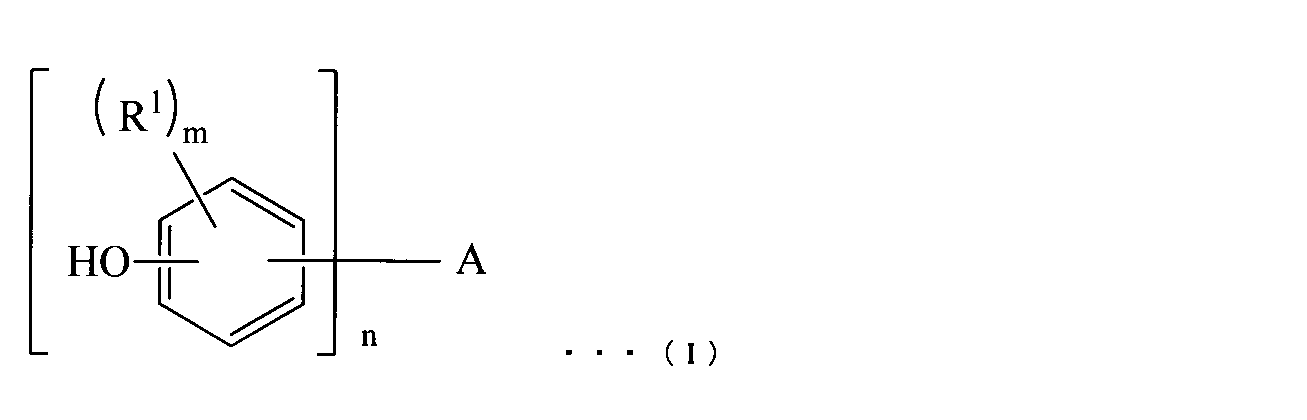
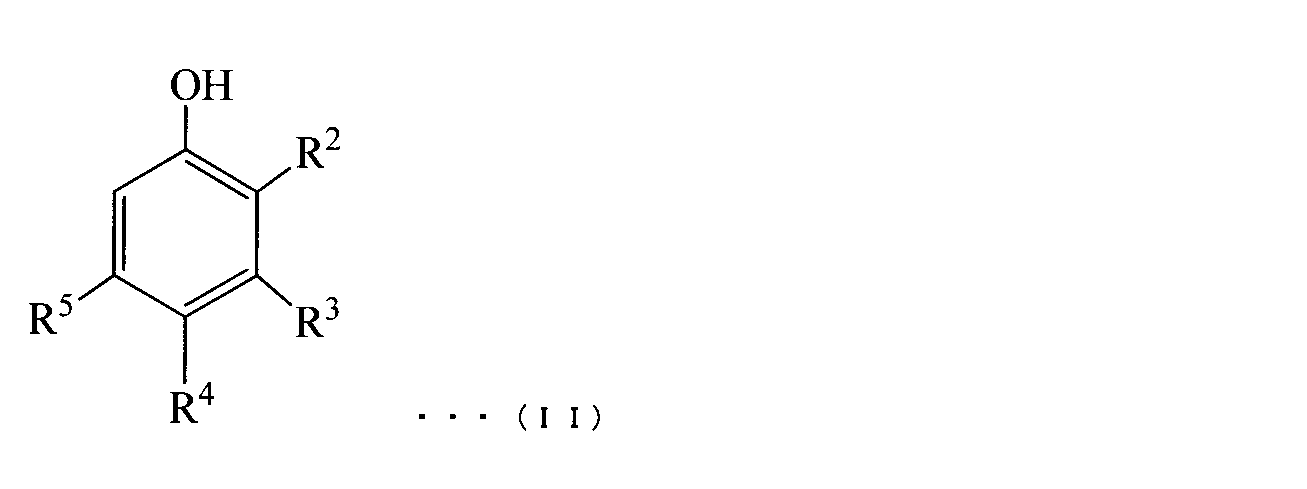
[6] (D)フェノール誘導体として下記一般式(III):

(A)アルカリ可溶性高分子:10質量%~90質量%;
(B)エチレン性不飽和二重結合を有する化合物:5質量%~70質量%;
(C)光重合開始剤:0.01質量%~20質量%;及び
(D)フェノール誘導体:0.001質量%~10質量%
を含む感光性樹脂組成物であって、
(D)フェノール誘導体として下記一般式(II):
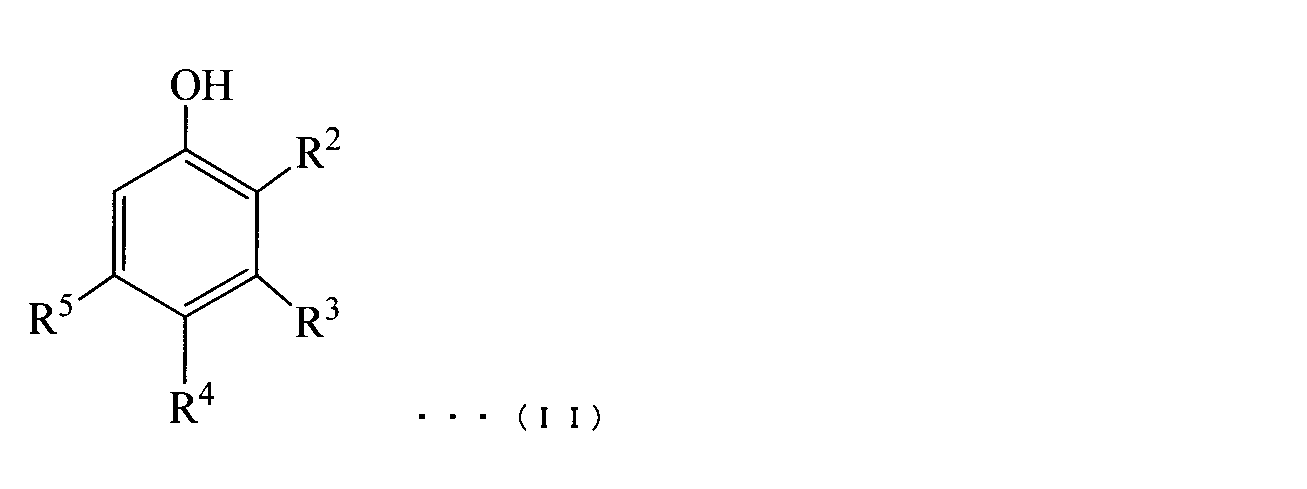
下記一般式(III):

から成る群より選択される少なくとも1種を含む、感光性樹脂組成物。
[9] 前記式(III)において、p=q=0である、[6]~[8]のいずれか1項に記載の感光性樹脂組成物。
[10] (D)フェノール誘導体としてペルオキシラジカルとの反応速度定数が20Lmol-1・sec-1以上の化合物を含む、[3]~[9]のいずれか1項に記載の感光性樹脂組成物。
[11] (A)アルカリ可溶性高分子の単量体成分が芳香族炭化水素基を有する、[1]~[10]のいずれか1項に記載の感光性樹脂組成物。
[12] (C)光重合開始剤としてアクリジン類を含む、[1]~[11]のいずれか1項に記載の感光性樹脂組成物。
[13] 支持層上に[1]~[12]のいずれか1項に記載の感光性樹脂組成物から成る感光性樹脂層が積層されている、感光性樹脂積層体。
[15] 前記露光工程を、描画パターンの直接描画による露光方法、又はフォトマスクの像をレンズを通して投影させる露光方法により行う、[14]に記載のレジストパターンの形成方法。
[16] 前記露光工程を、描画パターンの直接描画による露光方法により行う、[15]に記載のレジストパターンの形成方法。
[17] 露光工程を描画パターン直接描画による露光方法によって行うレジストパターンの形成方法に用いられる、[1]~[12]のいずれか1項に記載の感光性樹脂組成物。
実施の形態では、感光性樹脂組成物は、該感光性樹脂組成物から成る感光性樹脂層を基板表面上に形成し、露光及び現像を行って得られるレジストパターンにおいて、該基板表面に焦点位置を合わせて該露光を行ったときのパターン解像度aと、該基板表面から該基板の厚み方向に300μm基板内側にずらした位置に焦点位置を合わせて該露光を行ったときのパターン解像度bとの差が15μm未満であるという特徴を有する。これにより、基板の反り及びゆがみ、露光装置の設定不具合等により、露光時の焦点の位置が基板表面からずれたときにおいても、エッチング法により回路を形成した際にはショート問題を低減し得、メッキ法により回路を形成した際には欠け、断線、メッキ不良等の問題を低減し得る。パターン解像度aとパターン解像度bとの差は、好ましくは12μm以下、より好ましくは10μm以下である。一方、製造容易性、感度の低下が少ない等の観点から、パターン解像度aとパターン解像度bとの差は、好ましくは0μm以上、より好ましくは5μm以上、更に好ましくは7μm以上である。なお、本明細書における各種測定値については、特に断りのない限りにおいて、本開示の[実施例]の項に記載される方法又はこれと同等であることが当業者に理解される方法に準じて測定される。
なお、パターン解像度aとパターン解像度bとの差を上記特定範囲内とする手段としては、特に限定されないが、例えば、感光性樹脂組成物の組成を、各成分に関して詳しく後述するように、種々調整することが挙げられる。
本開示で、(A)アルカリ可溶性高分子は、アルカリ物質に溶け易い高分子を包含する。より具体的には、(A)アルカリ可溶性高分子に含まれるカルボキシル基の量は、酸当量で100~600であり、好ましくは250~450である。酸当量とは、その分子中に1当量のカルボキシル基を有する重合体の質量(単位:グラム)を言う。(A)アルカリ可溶性高分子中のカルボキシル基は、感光性樹脂層に、アルカリ水溶液に対する現像性及び剥離性を与えるために必要である。酸当量を100以上にすることは、現像耐性、解像性、及び密着性を向上させる観点から好ましい。そして酸当量を250以上にすることがより好ましい。一方で、酸当量を600以下にすることは、現像性及び剥離性を向上させる観点から好ましい。そして酸当量を450以下にすることがより好ましい。本開示で、酸当量は、電位差滴定装置を用い、0.1mol/LのNaOH水溶液で滴定する電位差滴定法により測定される値である。
好ましい態様において、(A)アルカリ可溶性高分子は、(メタ)アクリル酸、アルキル(メタ)アクリレート及びスチレンに由来する構造を有する高分子、並びに/又は、(メタ)アクリル酸、ベンジル(メタ)アクリレート及びアルキル(メタ)アクリレートに由来する構造を有する高分子、を含むことができる。
(A)アルカリ可溶性高分子は、1種単独で使用することができ、或いは2種以上を混合して使用してもよい。2種以上を混合して使用する場合には、芳香族炭化水素基を有する単量体成分を含むアルカリ可溶性高分子を2種類混合使用すること、又は芳香族炭化水素基を有する単量体成分を含むアルカリ可溶性高分子と、芳香族炭化水素基を有する単量体成分を含まないアルカリ可溶性高分子と、を混合使用することが好ましい。後者の場合、芳香族炭化水素基を有する単量体成分を含むアルカリ可溶性高分子の使用割合は、(A)アルカリ可溶性高分子の全部に対して、50質量%以上であることが好ましく、70質量%以上であることがより好ましく、80質量%以上であることが好ましく、90質量%以上であることがより好ましい。
(B)エチレン性不飽和二重結合を有する化合物は、硬化性及び(A)アルカリ可溶性高分子との相溶性の観点から、分子内に(メタ)アクリロイル基を有する化合物を含むことが好ましい。(B)化合物中の(メタ)アクリロイル基の数は、1個以上であればよい。
ポリエチレングリコールをフェニル基に付加した化合物の(メタ)アクリレートであるフェノキシヘキサエチレングリコールモノ(メタ)アクリレート、
平均2モルのプロピレンオキサイドを付加したポリプロピレングリコールと、平均7モルのエチレンオキサイドを付加したポリエチレングリコールと、をノニルフェノールに付加した化合物の(メタ)アクリレートである4-ノルマルノニルフェノキシヘプタエチレングリコールジプロピレングリコール(メタ)アクリレート、
平均1モルのプロピレンオキサイドを付加したポリプロピレングリコールと、平均5モルのエチレンオキサイドを付加したポリエチレングリコールと、をノニルフェノールに付加した化合物の(メタ)アクリレートである4-ノルマルノニルフェノキシペンタエチレングリコールモノプロピレングリコール(メタ)アクリレート、
平均8モルのエチレンオキサイドを付加したポリエチレングリコールをノニルフェノールに付加した化合物のアクリレートである4-ノルマルノニルフェノキシオクタエチレングリコール(メタ)アクリレート(例えば東亞合成(株)製、M-114)等が挙げられる。
ポリプロピレングリコ-ルジ(メタ)アクリレ-ト、ポリブチレングリコ-ルジ(メタ)アクリレ-ト等を挙げることができる。化合物中にエチレンオキシド基とプロピレンオキシド基とを含むポリアルキレンオキシドジ(メタ)アクリレート化合物としては、例えば、平均12モルのプロピレンオキシドを付加したポリプロピレングリコールの両末端にそれぞれ平均3モルのエチレンオキシドを更に付加したグリコールのジメタクリレート、平均18モルのプロピレンオキシドを付加したポリプロピレングリコールの両末端にそれぞれ均15モルのエチレンオキシドを更に付加したグリコールのジメタクリレート等が挙げられる。
一分子中にヒドロキシル基及び(メタ)アクリル基を有する化合物、例えば、2-ヒドロキシプロピルアクリレート、オリゴプロピレングリコールモノメタクリレートと
のウレタン化合物が挙げられる。具体的には、ヘキサメチレンジイソシアネートとオリゴプロピレングリコールモノメタクリレート(例えば日本油脂(株)製、ブレンマーPP1000)との反応生成物がある。また、ポリプロピレングリコール又はポリカプロラクトンにより変性したイソシアヌル酸エステルのジ又はトリ(メタ)アクリレート等も挙げられる。また、例えばジイソシアネートとポリオールとの重付加物として得られるウレタン化合物の末端とエチレン性不飽和二重結合及びヒドロキシル基を有する化合物とを反応させて得られるウレタンオリゴマー等も挙げることができる。
(C)光重合開始剤としては、例えば、ヘキサアリールビイミダゾール化合物、N-アリール-α-アミノ酸化合物、キノン類、芳香族ケトン類、アセトフェノン類、アシルフォスフィンオキサイド類、ベンゾイン又はベンゾインエーテル類、ジアルキルケタール類、チオキサントン類、ジアルキルアミノ安息香酸エステル類、オキシムエステル類、アクリジン類、ピラゾリン誘導体、N-アリールアミノ酸のエステル化合物、ハロゲン化合物等が挙げられる。
アセトフェノン類としては、例えば、2-ヒドロキシ-2-メチル-1-フェニルプロパン-1-オン、1-(4-イソプロピルフェニル)-2-ヒドロキシ-2-メチルプロパン-1-オン、1-(4-ドデシルフェニル)-2-ヒドロキシ-2-メチルプロパン-1-オン、4-(2-ヒドロキシエトキシ)-フェニル(2-ヒドロキシ-2-プロピル)ケトン、1-ヒドロキシシクロヘキシルフェニルケトン、2-ベンジル-2-ジメチルアミノ-1-(4-モルホリノフェニル)-ブタノン-1、2-メチル-1-[4-(メチルチオ)フェニル]-2-モルフォリノ-プロパノン-1等を挙げることができる。アセトフェノン類の市販品としては、例えば、チバ・スペシャリティ・ケミカルズ社製のイルガキュア-907、イルガキュア-369、及びイルガキュア-379を挙げることができる。
ジアルキルケタール類としては、例えば、ベンジルジメチルケタール、ベンジルジエチルケタール等を挙げることができる。
チオキサントン類としては、例えば、2,4-ジエチルチオキサントン、2,4-ジイソプロピルチオキサントン、2-クロルチオキサントン等を挙げることができる。
ジアルキルアミノ安息香酸エステル類としては、例えば、ジメチルアミノ安息香酸エチル、ジエチルアミノ安息香酸エチル、エチル-p-ジメチルアミノベンゾエート、2-エチルヘキシル-4-(ジメチルアミノ)ベンゾエート等を挙げることができる。
実施の形態では、感光性樹脂組成物は、(D)フェノール誘導体を更に含むことが好ましい。中でも、感光性樹脂組成物は、(D)フェノール誘導体として下記一般式(I):
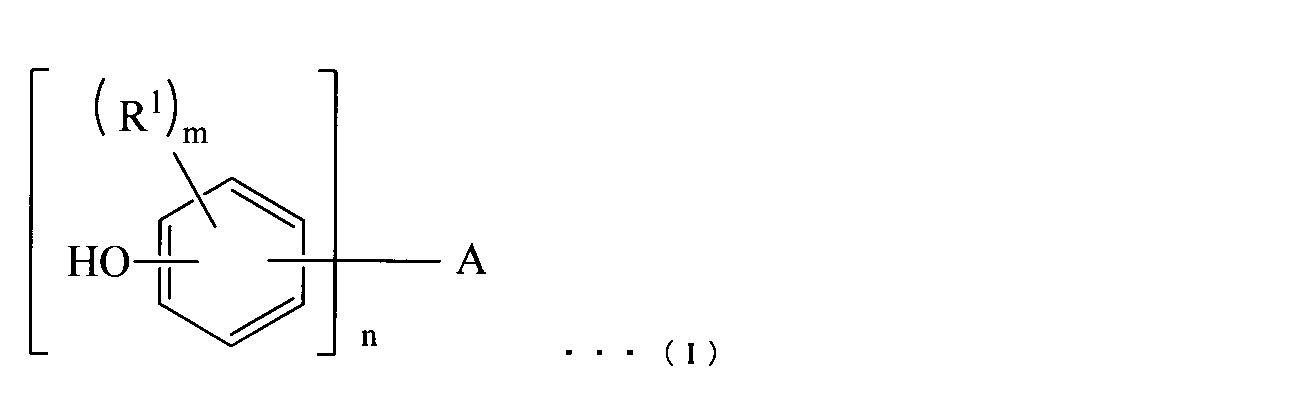


フェノール誘導体の抗酸化作用については、ラジカル種との反応性の面と、ラジカル種との反応後に生成するフェノキシラジカルの安定性の面とから、最適点が存在すると考えられる。例えば、フェノールのOH基に対してオルト位の置換基が大きいほど、フェノキシラジカルは安定となる。一方で、このオルト位置換基の立体障害が大きすぎると、ラジカル種との反応性は低くなる。また、立体障害の程度の最適値は、酸化される化学種の特性(酸化され易さ)によって異なる。
ここで、実施の形態における感光性樹脂組成物は光ラジカル重合性であるため、解像度を悪化させる因子となり得るペルオキシラジカルを捕捉するためには、(D)フェノール誘導体にはラジカル種との高い反応性が求められる。
以上の種々の要素を総合的に勘案した場合、(D)フェノール誘導体としては、一般式(I)で表される化合物が好ましく、更には一般式(II)で表される化合物及び一般式(III)で表される化合物から成る群より選択される少なくとも1種が好ましい。一般式(II)で表される化合物は、オルト位置換基の立体障害が最適に調整されているから、ペルオキシラジカルとの反応性、及びフェノキシラジカルの安定性の双方に優れると考えられる。また、一般式(III)で表される化合物においては、オルト位置換基の立体障害が小さいとペルオキシラジカルとの反応性が高く、ビフェノール型フェノキシラジカルは、フェノキシラジカルの共鳴構造の多さによって安定化されているものと考えられる。
(染料及び着色物質)
実施の形態では、感光性樹脂組成物は、所望により、染料(例えばロイコ染料、フルオラン染料等)及び着色物質から成る群より選ばれる少なくとも1種を更に含有してもよい。
感光性樹脂組成物は、熱安定性及び保存安定性を向上させるために、ラジカル重合禁止剤、ベンゾトリアゾール類、及びカルボキシベンゾトリアゾール類から成る群より選ばれる少なくとも1種の化合物を更に含有してもよい。
感光性樹脂組成物は、溶剤に溶解させて感光性樹脂組成物調合液の形態で、感光性樹脂積層体の製造に使用できる。溶剤としては、ケトン類、アルコール類等が挙げられる。前記ケトン類は、メチルエチルケトン(MEK)に代表される。前記アルコール類は、メタノール、エタノール、及びイソプロパノールに代表される。溶剤は、感光性樹脂積層体の製造に際して、支持層上に塗布する感光性樹脂組成物調合液の25℃における粘度が、500mPa・s~4,000mPa・sとなるような量で、感光性樹脂組成物に添加されることが好ましい。
実施の形態では、上記のような感光性樹脂組成物から成る感光性樹脂層が支持層(例えば、支持フィルム等)上に積層されている感光性樹脂積層体が提供される。必要により、感光性樹脂積層体は、感光性樹脂層の支持層側とは反対側の表面に保護層を有してもよい。
支持層及び感光性樹脂層、並びに必要により保護層を順次積層して感光性樹脂積層体を作製する方法としては、既知の方法を採用することができる。例えば、感光性樹脂層に用いる感光性樹脂組成物を、これを溶解する溶剤と混ぜ合わせ均一な溶液にし、まず支持層上にバーコーター又はロールコーターを用いて塗布し、次いで乾燥して前記溶剤を除去することにより、支持層上に感光性樹脂組成物から成る感光性樹脂層を積層することができる。次いで必要により、感光性樹脂層上に保護層をラミネートすることにより、感光性樹脂積層体を作製することができる。
次に、本実施の形態の感光性樹脂積層体を用いてレジストパターンを製造する方法の一例を説明する。該方法は、感光性樹脂積層体を基板に積層する積層工程、該感光性樹脂積層体の感光性樹脂層を露光する露光工程、及び該感光性樹脂層の未露光部を現像除去する現像工程を含むことができる。レジストパターンとしては、例えば、プリント配線板、半導体素子、印刷版、液晶ディスプレイパネル、フレキシブル基板、リードフレーム基板、COF(チップオンフィルム)用基板、半導体パッケージ用基板、液晶用透明電極、液晶用TFT用配線、PDP(プラズマディスプレイパネル)用電極等のパターンが挙げられる。一例として、プリント配線板の製造方法を、下記の通り説明する。
プリント配線板は、以下の各工程を経て製造される。
本工程では、感光性樹脂積層体の保護層を剥がしながら(保護層がある場合)、感光性樹脂積層体を、銅張積層板、フレキシブル基板等の基板上にホットロールラミネーターを用いて密着させる。
本工程では、所望の配線パターンを有するマスクフィルムを支持層上に密着させて活性光源を用いて行う露光方法、所望の配線パターンである描画パターンの直接描画による露光方法、又はフォトマスクの像をレンズを通して投影させることによる露光方法によって、感光性樹脂層を露光する。実施の形態に係る感光性樹脂組成物の利点は、描画パターンの直接描画による露光方法、又はフォトマスクの像をレンズを通して投影させる露光方法においてより顕著であり、描画パターンの直接描画による露光方法において特に顕著である。
本工程では、露光後、感光性樹脂層上の支持層を剥離し、続いてアルカリ水溶液の現像液を用いて未露光部を現像除去することにより、レジストパターンを基板上に形成する。
アルカリ水溶液としては、Na2CO3又はK2CO3の水溶液を用いる。アルカリ水溶液は、感光性樹脂層の特性に合わせて適宜選択されるが、約0.2質量%~約2質量%の濃度、かつ約20℃~約40℃のNa2CO3水溶液が好ましい。
現像により露出した基板表面(例えば銅張積層板の銅面)をエッチング又はめっきし、導体パターンを製造する。
その後、レジストパターンを、現像液よりも強いアルカリ性を有する水溶液により基板から剥離する。剥離用のアルカリ水溶液については、特に制限はないが、約2質量%~約5質量%の濃度、かつ約40~約70℃の温度のNaOH又はKOHの水溶液が好ましい。剥離液に、少量の水溶性溶媒を加えることもできる。
なお、上述した各種パラメータについては、特に断りのない限り、後述の実施例における測定方法又はこれと同等であることが当業者に理解される方法に準じて測定される。
まず、35μm圧延銅箔を積層した0.4mm厚の銅張積層板を、スプレー圧0.2MPaで研削材(日本カーリット(株)製、サクランダムR(登録商標#220))を用いてジェットスクラブ研磨した。
次に、感光性樹脂積層体のポリエチレンフィルム(保護層)を剥がしながら、60℃に予熱した銅張積層板に、ホットロールラミネーター(旭化成(株)社製、AL-700)により、感光性樹脂積層体をロール温度105℃でラミネートした。エアー圧は0.35MPaとし、ラミネート速度は1.5m/minとした。
次に、直接描画式露光装置(オルボテック(株)製、Paragon-Ultra 100)により、ストーファー21段ステップタブレットをマスクとして、種々の露光量で露光した。このとき、露光時の焦点の位置を、基板表面に合わせた。
更に、ポリエチレンテレフタレートフィルム(支持層)を剥離した後、アルカリ現像機(フジ機工製、ドライフィルム用現像機)を用いて、30℃の1質量%Na2CO3水溶液を所定時間に亘ってスプレーし、感光性樹脂層の未露光部分を最小現像時間の2倍の時間で溶解除去した。この際、未露光部分の感光性樹脂層が完全に溶解するのに要する最も少ない時間を最小現像時間とした。
以上の操作により、硬化レジストパターンを得た。現像後の残膜限界段数が7段となる露光量を求めた。
まず、35μm圧延銅箔を積層した0.4mm厚の銅張積層板を、スプレー圧0.2MPaで研削材(日本カーリット(株)製、サクランダムR(登録商標#220))を用いてジェットスクラブ研磨した。
次に、感光性樹脂積層体のポリエチレンフィルム(保護層)を剥がしながら、60℃に予熱した銅張積層板に、ホットロールラミネーター(旭化成(株)社製、AL-700)により、感光性樹脂積層体をロール温度105℃でラミネートした。エアー圧は0.35MPaとし、ラミネート速度は1.5m/minとした。
次に、直接描画式露光装置(オルボテック(株)製、Paragon-Ultra 100)により、未露光部がライン(スペース)となるパターンを露光した。このときの露光は、前記のストーファー21段ステップタブレットをマスクとして露光、現像したときの最高残膜段数が7段となる露光量で露光した。このとき、露光時の焦点の位置を、基板表面に合わせた。更に、ポリエチレンテレフタレートフィルム(支持層)を剥離した後、最小現像時間の2倍の現像時間で現像した。このとき、未露光部のライン及びスペースが正常に形成されている最小ライン幅の値を、パターン解像度aとした。
本開示では、未露光部分の感光性樹脂層が完全に溶解するのに要する最も少ない時間を最小現像時間とした。なお、硬化レジストパターンにおいて、未露光部分の基板表面に残留レジストがなく基板表面が表出しており、硬化レジストから糸を引いたようなレジスト成分の突起もなく、ラインの直線性も良好であり、硬化レジスト同士の密着もない、正常に形成されている最小ライン幅を評価した。解像度の値としては、30μm以下は2μm刻みで得られ、30μm以上は5μm刻みで得られる描画パターンを用いて露光した。
露光時の焦点の位置を、基板表面から該基板の厚み方向に300μm基板内側にずらした。これ以外は、上述した解像度評価(通常)と同様とした。このとき、未露光部のライン(スペース)が正常に形成されている最小ライン幅の値をパターン解像度bとした。
露光時の焦点の位置を基板表面に合わせたときと、露光時の焦点の位置を基板表面から300μmずらしたときとの解像度の差は、上記の<解像度評価(焦点ずれ)>のパターン解像度bの値から<解像度評価(通常)>のパターン解像度aの値を差し引くことで求めた。
まず、35μm圧延銅箔を積層した0.4mm厚の銅張積層板を、スプレー圧0.2MPaで研削材(日本カーリット(株)製、サクランダムR(登録商標#220))を用いてジェットスクラブ研磨した。
次に、感光性樹脂積層体のポリエチレンフィルム(保護層)を剥がしながら、60℃に予熱した銅張積層板に、ホットロールラミネーター(旭化成(株)社製、AL-700)により、感光性樹脂積層体をロール温度105℃でラミネートした。エアー圧は0.35MPaとし、ラミネート速度は1.5m/minとした。
次に、直接描画式露光装置(オルボテック(株)製、Paragon-Ultra 100)により、露光部及び未露光部のそれぞれの幅が2:1の比率となるパターンを露光した。このときの露光は、前記のストーファー21段ステップタブレットをマスクとして露光、現像したときの最高残膜段数が7段となる露光量で露光した。更に、ポリエチレンテレフタレートフィルム(支持層)を剥離した後、最小現像時間の2倍の現像時間で現像した。得られたパターンのうちの、未露光部のライン(スペース)幅が40μmの部分について、そのスペース幅を顕微鏡により実測した。各積層体の試料について、露光時の焦点の位置を基板表面に合わせた場合と、露光時の焦点の位置を基板表面から該基板の厚み方向に300μm基板内側にずらした場合と、の2種のパターン形成を行った。
露光時の焦点の位置を基板表面に合わせたときと、露光時の焦点の位置を基板表面から300μmずらしたときの、スペース幅の差は、露光時の焦点の位置を基板表面に合わせたときのスペース幅から、露光時の焦点の位置を基板表面から基板内側に300μmずらしたときのスペース幅を差し引くことで求めた。
日本分光(株)製ゲルパーミエーションクロマトグラフィー(GPC)[ポンプ:Gulliver、PU-1580型、カラム:昭和電工(株)製Shodex(登録商標)(KF-807、KF-806M、KF-806M、KF-802.5)4本直列、移動層溶媒:テトラヒドロフラン、ポリスチレン標準サンプル(昭和電工(株)製Shodex STANDARD SM-105)による検量線使用]により、ポリスチレン換算値として重量平均分子量を求めた。
<ペルオキシラジカルとの反応速度定数>
J.Macromol.Sci.Chem.,A11(10),p1975(1977)に記載の方法による。
まず、35μm圧延銅箔を積層した0.4mm厚の銅張積層板を、スプレー圧0.2MPaで研削材(日本カーリット(株)製、サクランダムR(登録商標#220))を用いてジェットスクラブ研磨した。
次に、感光性樹脂積層体のポリエチレンフィルム(保護層)を剥がしながら、60℃に予熱した銅張積層板に、ホットロールラミネーター(旭化成(株)社製、AL-700)により、感光性樹脂積層体をロール温度105℃でラミネートした。エアー圧は0.35MPaとし、ラミネート速度は1.5m/minとした。
次に、直接描画式露光装置(オルボテック(株)製、Paragon-Ultra 100)により、ストーファー41段ステップタブレットをマスクとして、種々の露光量で露光した。このとき、露光時の焦点の位置を、基板表面に合わせた。
更に、ポリエチレンテレフタレートフィルム(支持層)を剥離した後、アルカリ現像機(フジ機工製、ドライフィルム用現像機)を用いて、30℃の1質量%Na2CO3水溶液を所定時間に亘ってスプレーし、感光性樹脂層の未露光部分を最小現像時間の2倍の時間で溶解除去した。
以上の操作により得られた硬化レジストパターンの膜厚を表面粗さ形状測定機((株)東京精密製、SURFCOM 575A)により測定し、その膜厚から残膜率を求めた。また、露光量とストーファー41段ステップタブレットの透過率から実質露光量を算出した。この残膜率と実質露光量をもとにγ値を求めた。なお、γ値の計算方法は、「初歩から学ぶ感光性樹脂、P.60、池田章彦・水野晶好著、工業調査会」に記載の方法によって求めることができる。
感光性樹脂積層体のポリエチレンテレフタレートフィルム(支持層)側から直接描画式露光装置(オルボテック(株)製、Paragon-Ultra 100)により、ストーファー41段ステップタブレットをマスクとして、種々の露光量で露光した。このとき、露光時の焦点の位置を、レジスト底部に合わせた。
以上の操作により得られた硬化レジストパターンのC=C二重結合の反応率をFT-IR(Thermo SCIENTIFIC製、NICOLET 380)により求めた。なお、C=C二重結合は810cm-1のピーク高さを測定した。また、露光量とストーファー41段ステップタブレットの透過率から実質露光量を算出した。このC=C二重結合の反応率と実質露光量をもとにγ値を求めた。なお、γ値の計算方法は上記と同様である。
感光性樹脂積層体の600nm及び630nmの透過率を紫外-可視光(UV-Vis)測定装置((株)日立ハイテクノロジーズ製、U-3010形分光光度計)を用いて以下のように測定した:
(i)感光性樹脂積層体のポリエチレンフィルムを剥がして600nm及び630nmの透過率を測定した。
(ii)40℃で3日間保存した後の感光性樹脂組成物調合液を用いて感光性樹脂積層体を作成し、該感光性樹脂積層体のポリエチレンフィルムを剥がして600nm及び630nmの透過率を測定した。
色相の変化を、(ii)の透過率-(i)の透過率、の計算により求めた。
表1及び2に示す組成(但し、各成分の数字は固形分としての配合量(質量部)を示す。)の感光性樹脂組成物及び溶剤(メチルエチルケトン及びエタノール)を十分に攪拌、混合して感光性樹脂組成物調合液(感光性樹脂組成物が55質量%となる溶液)を得た。支持層として16μm厚のポリエチレンテレフタラートフィルム(帝人デュポンフィルム(株)製、GR―16)を用意して、そのフィルムの表面にバーコーターを用いて感光性樹脂組成物調合液を均一に塗布し、95℃の乾燥器中で4分間乾燥して、感光性樹脂層を形成した。感光性樹脂層の厚みは35μmであった。
エッチングによるL/S=60/60μmの回路パターン作成を8回繰り返し、積層を試みたところ、最表面のうねりは約30μmであった。このときの最表面の回路パターンにおいて、比較例1の組成では銅ラインのショートが観察されたが、実施例3の組成ではショートが観察されず、不良低減可能であると推察された。
表1に示す実施例1のH-1(1質量部)を1,1,3-トリス(2-メチル-4-ヒドロキシ-5-tert-ブチルフェニル)ブタン(ペルオキラジカルとの反応速度定数=45.4L・mol-1・sec-1)(1質量部)に置き換え、それ以外は実施例1と同様とした。その結果、感度(必要露光量)は21mJ/cm2、解像度(通常)は18μm、解像度(焦点ずれ)は30μm、解像度の差は12μmであった。
表1に示す実施例1のH-1(1質量部)をH-4(1質量部)に置き換え、それ以外は実施例1と同様とした。その結果、感度(必要露光量)は80mJ/cm2、解像度(通常)は45μmであった。


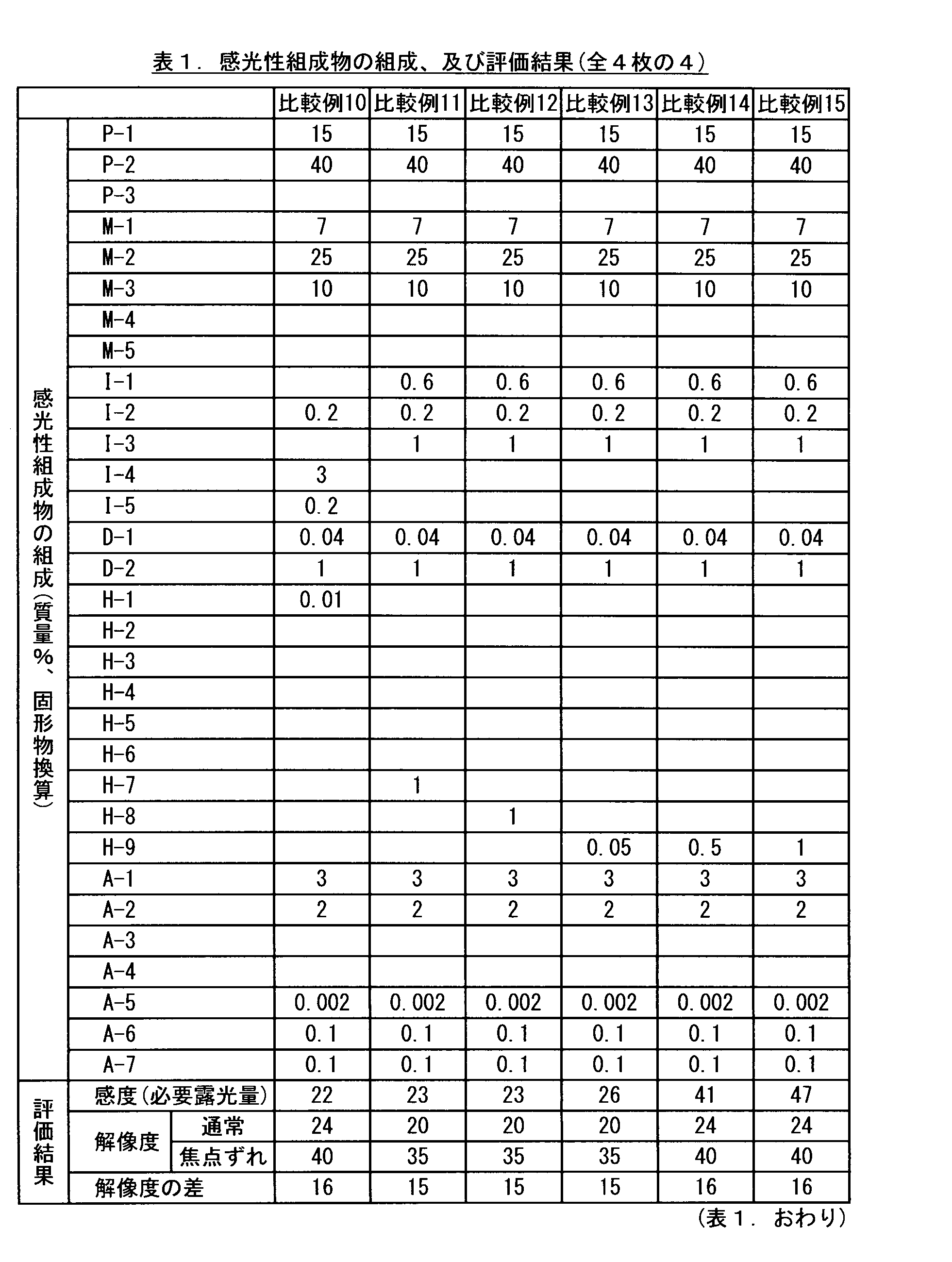


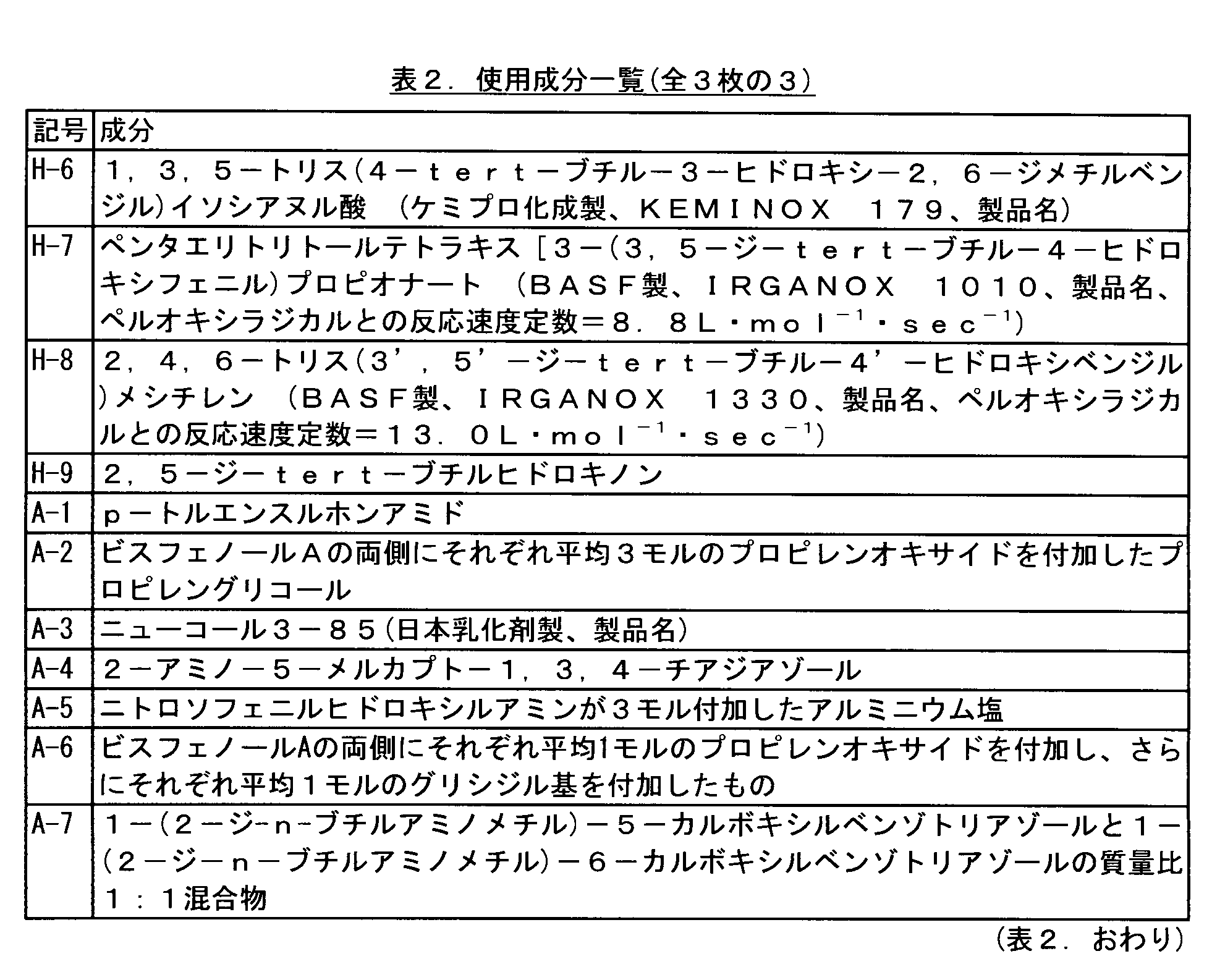
実施例と比較例との対比により、本実施形態の感光性樹脂組成物を用いれば、高解像性を発現することができ、特には露光時の焦点がずれたときにも高解像性を発現し得る。更に高感度を維持することも可能である。当該感光性樹脂組成物を用いることにより、多層配線に適用した場合にもエッチング法により回路を形成した際にショート問題を抑制し得ることができる。
Claims (17)
- (A)アルカリ可溶性高分子、(B)エチレン性不飽和二重結合を有する化合物、及び(C)光重合開始剤を含む感光性樹脂組成物であって、
該感光性樹脂組成物から成る感光性樹脂層を基板表面上に形成し、露光及び現像を行って得られるレジストパターンにおいて、該基板表面に焦点位置を合わせて該露光を行ったときのパターン解像度aと、該基板表面から該基板の厚み方向に300μm基板内側にずらした位置に焦点位置を合わせて該露光を行ったときのパターン解像度bとの差が15μm未満である、感光性樹脂組成物。 - 感光性樹脂組成物の全固形分質量基準で、
前記(A)アルカリ可溶性高分子:10質量%~90質量%;
前記(B)エチレン性不飽和二重結合を有する化合物:5質量%~70質量%;及び
前記(C)光重合開始剤:0.01質量%~20質量%;
を含む、請求項1に記載の感光性樹脂組成物。 - 感光性樹脂組成物の全固形分質量基準で、(D)フェノール誘導体:0.001質量%~10質量%を更に含む、請求項2に記載の感光性樹脂組成物。
- (D)フェノール誘導体として下記一般式(I):
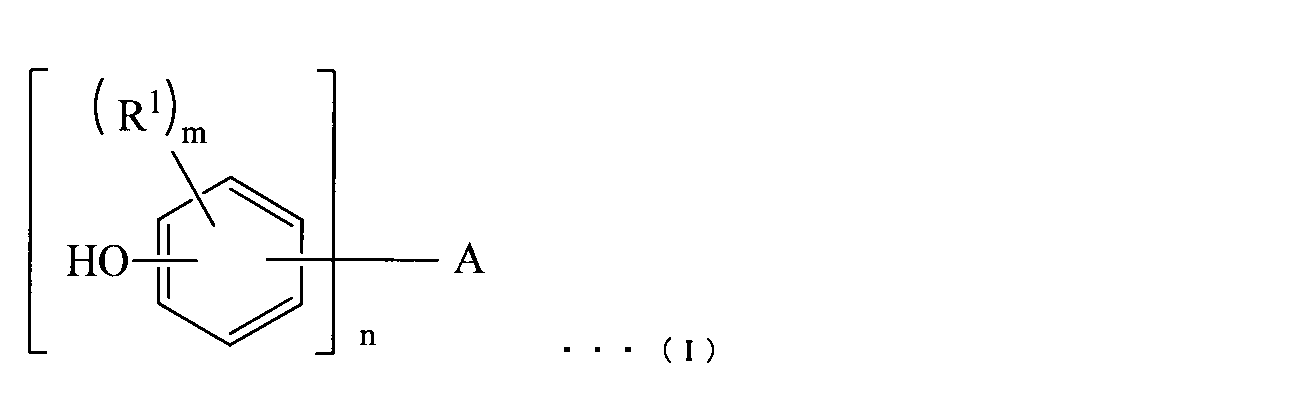
- (D)フェノール誘導体として下記一般式(II):
- (D)フェノール誘導体として下記一般式(III):
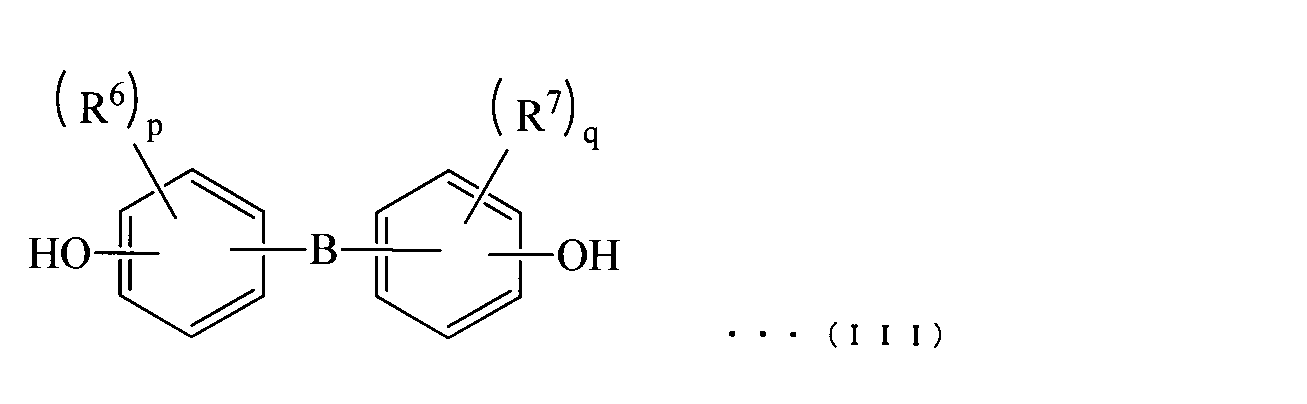
- 感光性樹脂組成物の全固形分質量基準で、
(A)アルカリ可溶性高分子:10質量%~90質量%;
(B)エチレン性不飽和二重結合を有する化合物:5質量%~70質量%;
(C)光重合開始剤:0.01質量%~20質量%;及び
(D)フェノール誘導体:0.001質量%~10質量%
を含む感光性樹脂組成物であって、
(D)フェノール誘導体として下記一般式(II):

下記一般式(III):

から成る群より選択される少なくとも1種を含む、感光性樹脂組成物。 - 前記式(III)において、Bが単結合である、請求項6又は7に記載の感光性樹脂組成物。
- 前記式(III)において、p=q=0である、請求項6~8のいずれか1項に記載の感光性樹脂組成物。
- (D)フェノール誘導体としてペルオキシラジカルとの反応速度定数が20Lmol-1・sec-1以上の化合物を含む、請求項3~9のいずれか1項に記載の感光性樹脂組成物。
- (A)アルカリ可溶性高分子の単量体成分が芳香族炭化水素基を有する、請求項1~10のいずれか1項に記載の感光性樹脂組成物。
- (C)光重合開始剤としてアクリジン類を含む、請求項1~11のいずれか1項に記載の感光性樹脂組成物。
- 支持層上に請求項1~12のいずれか1項に記載の感光性樹脂組成物から成る感光性樹脂層が積層されている、感光性樹脂積層体。
- 請求項13に記載の感光性樹脂積層体を基板に積層する積層工程、該感光性樹脂積層体の感光性樹脂層を露光する露光工程、及び該感光性樹脂層の未露光部を現像除去する現像工程を含む、レジストパターンの形成方法。
- 前記露光工程を、描画パターンの直接描画による露光方法、又はフォトマスクの像をレンズを通して投影させる露光方法により行う、請求項14に記載のレジストパターンの形成方法。
- 前記露光工程を、描画パターンの直接描画による露光方法により行う、請求項15に記載のレジストパターンの形成方法。
- 露光工程を描画パターン直接描画による露光方法によって行うレジストパターンの形成方法に用いられる、請求項1~12のいずれか1項に記載の感光性樹脂組成物。
Priority Applications (7)
| Application Number | Priority Date | Filing Date | Title |
|---|---|---|---|
| CN201480064426.1A CN105793778B (zh) | 2013-12-26 | 2014-12-26 | 感光性树脂组合物及感光性树脂层叠体 |
| MYUI2016701970A MY174577A (en) | 2013-12-26 | 2014-12-26 | Photosensitive resin composition and photosensitive resin laminate |
| JP2015555052A JP6320425B2 (ja) | 2013-12-26 | 2014-12-26 | 感光性樹脂組成物及び感光性樹脂積層体 |
| CN202010498797.8A CN111596526B (zh) | 2013-12-26 | 2014-12-26 | 感光性树脂组合物及感光性树脂层叠体 |
| KR1020187004734A KR102248976B1 (ko) | 2013-12-26 | 2014-12-26 | 감광성 수지 조성물 및 감광성 수지 적층체 |
| KR1020167012407A KR20160070801A (ko) | 2013-12-26 | 2014-12-26 | 감광성 수지 조성물 및 감광성 수지 적층체 |
| KR1020217013116A KR102437195B1 (ko) | 2013-12-26 | 2014-12-26 | 감광성 수지 조성물 및 감광성 수지 적층체 |
Applications Claiming Priority (2)
| Application Number | Priority Date | Filing Date | Title |
|---|---|---|---|
| JP2013-270370 | 2013-12-26 | ||
| JP2013270370 | 2013-12-26 |
Publications (1)
| Publication Number | Publication Date |
|---|---|
| WO2015099137A1 true WO2015099137A1 (ja) | 2015-07-02 |
Family
ID=53478976
Family Applications (1)
| Application Number | Title | Priority Date | Filing Date |
|---|---|---|---|
| PCT/JP2014/084557 Ceased WO2015099137A1 (ja) | 2013-12-26 | 2014-12-26 | 感光性樹脂組成物及び感光性樹脂積層体 |
Country Status (6)
| Country | Link |
|---|---|
| JP (2) | JP6320425B2 (ja) |
| KR (3) | KR20160070801A (ja) |
| CN (2) | CN111596526B (ja) |
| MY (1) | MY174577A (ja) |
| TW (4) | TWI541596B (ja) |
| WO (1) | WO2015099137A1 (ja) |
Cited By (4)
| Publication number | Priority date | Publication date | Assignee | Title |
|---|---|---|---|---|
| JP2017075988A (ja) * | 2015-10-13 | 2017-04-20 | 日立化成株式会社 | 感光性樹脂組成物、感光性エレメント、硬化物、レジストパターンの形成方法、及び、プリント配線板の製造方法 |
| JP2017181646A (ja) * | 2016-03-29 | 2017-10-05 | 旭化成株式会社 | 感光性樹脂組成物、感光性樹脂積層体、レジストパターン形成方法及び導体パターン製造方法 |
| JP2021113984A (ja) * | 2016-12-07 | 2021-08-05 | 旭化成株式会社 | 感光性樹脂組成物及び感光性樹脂積層体 |
| JPWO2021187549A1 (ja) * | 2020-03-19 | 2021-09-23 |
Families Citing this family (6)
| Publication number | Priority date | Publication date | Assignee | Title |
|---|---|---|---|---|
| KR20160070801A (ko) * | 2013-12-26 | 2016-06-20 | 아사히 가세이 가부시키가이샤 | 감광성 수지 조성물 및 감광성 수지 적층체 |
| TWI664497B (zh) * | 2017-01-30 | 2019-07-01 | 日商旭化成股份有限公司 | 感光性樹脂組合物、感光性樹脂積層體、形成有光阻圖案之基板及電路基板之製造方法 |
| KR102295744B1 (ko) * | 2017-03-29 | 2021-08-30 | 아사히 가세이 가부시키가이샤 | 감광성 수지 조성물 |
| MY197618A (en) * | 2017-11-06 | 2023-06-28 | Asahi Chemical Ind | Photosensitive resin laminate and method for producing resist pattern |
| CN108663867A (zh) * | 2018-04-11 | 2018-10-16 | 华南师范大学 | 一种染料掺杂的激光防护膜 |
| CN112534351B (zh) * | 2018-08-09 | 2025-03-18 | 旭化成株式会社 | 感光性树脂组合物及抗蚀图案的形成方法 |
Citations (6)
| Publication number | Priority date | Publication date | Assignee | Title |
|---|---|---|---|---|
| JP2002278059A (ja) * | 2002-05-30 | 2002-09-27 | Hitachi Chem Co Ltd | 感光性エレメント |
| JP2007286480A (ja) * | 2006-04-19 | 2007-11-01 | Fujifilm Corp | パターン形成方法 |
| JP2013200891A (ja) * | 2011-12-05 | 2013-10-03 | Hitachi Chemical Co Ltd | タッチパネル用電極の保護膜及びタッチパネル |
| JP2014010333A (ja) * | 2012-06-29 | 2014-01-20 | Asahi Kasei E-Materials Corp | 感光性樹脂組成物及び感光性樹脂積層体 |
| JP2014010330A (ja) * | 2012-06-29 | 2014-01-20 | Asahi Kasei E-Materials Corp | 感光性樹脂組成物及び感光性樹脂積層体 |
| JP2014074834A (ja) * | 2012-10-05 | 2014-04-24 | Asahi Kasei E-Materials Corp | 感光性樹脂組成物及び感光性樹脂積層体 |
Family Cites Families (42)
| Publication number | Priority date | Publication date | Assignee | Title |
|---|---|---|---|---|
| JPH08190192A (ja) * | 1995-01-11 | 1996-07-23 | Konica Corp | 感光性組成物及び該組成物の層を有する感光性平版印刷版 |
| JPH0990625A (ja) * | 1995-09-27 | 1997-04-04 | Nippon Zeon Co Ltd | ポジ型レジスト組成物 |
| US5869212A (en) * | 1996-05-31 | 1999-02-09 | Kabushiki Kaisha Toshiba | Integrated circuit photofabrication masks and methods for making same |
| JP4006815B2 (ja) * | 1997-06-11 | 2007-11-14 | Jsr株式会社 | 感放射線性樹脂組成物 |
| JP3515879B2 (ja) * | 1997-06-18 | 2004-04-05 | 東京応化工業株式会社 | ポジ型ホトレジスト組成物及びこれを用いた多層レジスト材料 |
| JPH11237737A (ja) * | 1997-12-19 | 1999-08-31 | Kansai Shingijutsu Kenkyusho:Kk | 感光性樹脂組成物およびその製造方法 |
| JP4420165B2 (ja) * | 2000-03-07 | 2010-02-24 | 信越化学工業株式会社 | 化学増幅ポジ型レジスト材料 |
| JP3141376B1 (ja) * | 2000-10-05 | 2001-03-05 | ジェイエスアール株式会社 | ネガ型感放射線性樹脂組成物溶液 |
| JP4262402B2 (ja) * | 2000-10-20 | 2009-05-13 | 富士フイルム株式会社 | ポジ型レジスト組成物 |
| JP4288445B2 (ja) * | 2000-10-23 | 2009-07-01 | 信越化学工業株式会社 | 新規オニウム塩及びレジスト材料用光酸発生剤並びにレジスト材料及びパターン形成方法 |
| KR100594223B1 (ko) * | 2000-11-10 | 2006-07-03 | 삼성전자주식회사 | 두장의 교번 위상 반전 마스크를 이용한 패턴 형성 방법 |
| TWI245774B (en) * | 2001-03-01 | 2005-12-21 | Shinetsu Chemical Co | Silicon-containing polymer, resist composition and patterning process |
| JP2001330949A (ja) * | 2001-05-17 | 2001-11-30 | Jsr Corp | 感放射線性樹脂組成物 |
| JP3727895B2 (ja) * | 2002-03-26 | 2005-12-21 | 株式会社東芝 | モニタ方法 |
| JP4189951B2 (ja) * | 2002-10-31 | 2008-12-03 | 東京応化工業株式会社 | 化学増幅型ポジ型レジスト組成物 |
| CN100549829C (zh) * | 2003-03-14 | 2009-10-14 | 东京应化工业株式会社 | 化学放大型正型光刻胶组合物 |
| JP2005099646A (ja) * | 2003-03-28 | 2005-04-14 | Tokyo Ohka Kogyo Co Ltd | 液浸露光プロセス用レジスト組成物および該レジスト組成物を用いたレジストパターン形成方法 |
| CN100545753C (zh) * | 2003-05-22 | 2009-09-30 | 东京应化工业株式会社 | 化学放大型正性光致抗蚀剂组合物以及形成抗蚀剂图案的方法 |
| JP2005202066A (ja) * | 2004-01-14 | 2005-07-28 | Fuji Photo Film Co Ltd | 感光性転写シート、感光性積層体、画像パターンを形成する方法、配線パターンを形成する方法 |
| JP4359467B2 (ja) * | 2003-08-28 | 2009-11-04 | 信越化学工業株式会社 | 新規スルホニルジアゾメタン化合物、光酸発生剤、並びにそれを用いたレジスト材料及びパターン形成方法。 |
| CN1886410A (zh) * | 2003-10-15 | 2006-12-27 | Jsr株式会社 | 硅烷化合物、聚硅氧烷以及放射线敏感性树脂组合物 |
| JP4308051B2 (ja) * | 2004-03-22 | 2009-08-05 | 富士フイルム株式会社 | 感光性組成物及びそれを用いたパターン形成方法 |
| WO2005124462A1 (ja) * | 2004-06-15 | 2005-12-29 | Fujifilm Corporation | 感光性組成物、並びにパターン形成方法及び永久パターン |
| JP4715234B2 (ja) * | 2005-02-28 | 2011-07-06 | 日立化成工業株式会社 | 感光性樹脂組成物、これを用いた感光性エレメント、レジストパターンの形成方法及びプリント配線板の製造方法並びに光硬化物の除去方法 |
| JP2007017721A (ja) * | 2005-07-07 | 2007-01-25 | Fujifilm Holdings Corp | パターン形成方法 |
| JP2007078889A (ja) * | 2005-09-12 | 2007-03-29 | Fujifilm Corp | 感光性組成物、パターン形成材料、感光性積層体、並びにパターン形成装置及びパターン形成方法 |
| CN101401035A (zh) * | 2006-01-13 | 2009-04-01 | 富士胶片株式会社 | 感光性树脂组合物及感光性转印薄膜以及图案形成方法 |
| JP2007240714A (ja) * | 2006-03-07 | 2007-09-20 | Toppan Printing Co Ltd | カラーフィルタの製造方法 |
| JP2008015364A (ja) * | 2006-07-07 | 2008-01-24 | Fujifilm Corp | 感光性組成物、感光性フィルム、永久パターン形成方法、及びプリント基板 |
| CN101206402A (zh) * | 2006-12-22 | 2008-06-25 | 住友化学株式会社 | 感光性树脂组合物 |
| JP4703674B2 (ja) * | 2008-03-14 | 2011-06-15 | 富士フイルム株式会社 | レジスト組成物及びそれを用いたパターン形成方法 |
| US9075307B2 (en) * | 2008-09-04 | 2015-07-07 | Hitachi Chemical Company, Ltd. | Photosensitive resin composition for protective film of printed wiring board for semiconductor package |
| CN102378940A (zh) * | 2009-03-30 | 2012-03-14 | 旭化成电子材料株式会社 | 感光性树脂组合物及其层压体 |
| JP2010249884A (ja) | 2009-04-10 | 2010-11-04 | Dupont Mrc Dryfilm Ltd | 光重合性樹脂組成物およびこれを用いた感光性フィルム |
| US8446640B2 (en) * | 2009-07-15 | 2013-05-21 | Eastman Kodak Company | Setting of imaging parameters using a scanner |
| CN102201333B (zh) * | 2009-12-15 | 2014-04-30 | 罗门哈斯电子材料有限公司 | 光刻胶及其使用方法 |
| JP5775701B2 (ja) * | 2010-02-26 | 2015-09-09 | 富士フイルム株式会社 | パターン形成方法及びレジスト組成物 |
| US8781075B2 (en) * | 2011-01-07 | 2014-07-15 | General Electric Company | Wireless communication in a medical imaging or monitoring system |
| KR102025036B1 (ko) * | 2011-12-05 | 2019-09-24 | 히타치가세이가부시끼가이샤 | 터치패널용 전극의 보호막의 형성 방법, 감광성 수지 조성물 및 감광성 엘리먼트, 및, 터치패널의 제조 방법 |
| JP6166526B2 (ja) * | 2011-12-09 | 2017-07-19 | 株式会社日本触媒 | 硬化性樹脂組成物及びその用途 |
| JP2013148804A (ja) * | 2012-01-23 | 2013-08-01 | Sumitomo Chemical Co Ltd | 感光性樹脂組成物 |
| KR20160070801A (ko) * | 2013-12-26 | 2016-06-20 | 아사히 가세이 가부시키가이샤 | 감광성 수지 조성물 및 감광성 수지 적층체 |
-
2014
- 2014-12-26 KR KR1020167012407A patent/KR20160070801A/ko not_active Ceased
- 2014-12-26 JP JP2015555052A patent/JP6320425B2/ja active Active
- 2014-12-26 TW TW103145839A patent/TWI541596B/zh active
- 2014-12-26 MY MYUI2016701970A patent/MY174577A/en unknown
- 2014-12-26 CN CN202010498797.8A patent/CN111596526B/zh active Active
- 2014-12-26 KR KR1020187004734A patent/KR102248976B1/ko active Active
- 2014-12-26 TW TW106116007A patent/TWI674478B/zh active
- 2014-12-26 TW TW108103816A patent/TWI721371B/zh active
- 2014-12-26 WO PCT/JP2014/084557 patent/WO2015099137A1/ja not_active Ceased
- 2014-12-26 CN CN201480064426.1A patent/CN105793778B/zh active Active
- 2014-12-26 TW TW105101582A patent/TWI592748B/zh active
- 2014-12-26 KR KR1020217013116A patent/KR102437195B1/ko active Active
-
2018
- 2018-04-03 JP JP2018071677A patent/JP6666944B2/ja active Active
Patent Citations (6)
| Publication number | Priority date | Publication date | Assignee | Title |
|---|---|---|---|---|
| JP2002278059A (ja) * | 2002-05-30 | 2002-09-27 | Hitachi Chem Co Ltd | 感光性エレメント |
| JP2007286480A (ja) * | 2006-04-19 | 2007-11-01 | Fujifilm Corp | パターン形成方法 |
| JP2013200891A (ja) * | 2011-12-05 | 2013-10-03 | Hitachi Chemical Co Ltd | タッチパネル用電極の保護膜及びタッチパネル |
| JP2014010333A (ja) * | 2012-06-29 | 2014-01-20 | Asahi Kasei E-Materials Corp | 感光性樹脂組成物及び感光性樹脂積層体 |
| JP2014010330A (ja) * | 2012-06-29 | 2014-01-20 | Asahi Kasei E-Materials Corp | 感光性樹脂組成物及び感光性樹脂積層体 |
| JP2014074834A (ja) * | 2012-10-05 | 2014-04-24 | Asahi Kasei E-Materials Corp | 感光性樹脂組成物及び感光性樹脂積層体 |
Cited By (6)
| Publication number | Priority date | Publication date | Assignee | Title |
|---|---|---|---|---|
| JP2017075988A (ja) * | 2015-10-13 | 2017-04-20 | 日立化成株式会社 | 感光性樹脂組成物、感光性エレメント、硬化物、レジストパターンの形成方法、及び、プリント配線板の製造方法 |
| JP2017181646A (ja) * | 2016-03-29 | 2017-10-05 | 旭化成株式会社 | 感光性樹脂組成物、感光性樹脂積層体、レジストパターン形成方法及び導体パターン製造方法 |
| JP2021113984A (ja) * | 2016-12-07 | 2021-08-05 | 旭化成株式会社 | 感光性樹脂組成物及び感光性樹脂積層体 |
| JPWO2021187549A1 (ja) * | 2020-03-19 | 2021-09-23 | ||
| WO2021187549A1 (ja) * | 2020-03-19 | 2021-09-23 | 富士フイルム株式会社 | 転写フィルム、感光性材料、パターン形成方法、回路基板の製造方法、タッチパネルの製造方法 |
| JP7495477B2 (ja) | 2020-03-19 | 2024-06-04 | 富士フイルム株式会社 | 転写フィルム、感光性材料、パターン形成方法、回路基板の製造方法、タッチパネルの製造方法 |
Also Published As
| Publication number | Publication date |
|---|---|
| JP6320425B2 (ja) | 2018-05-09 |
| TWI541596B (zh) | 2016-07-11 |
| TWI674478B (zh) | 2019-10-11 |
| JP6666944B2 (ja) | 2020-03-18 |
| CN105793778A (zh) | 2016-07-20 |
| TW201922805A (zh) | 2019-06-16 |
| CN111596526A (zh) | 2020-08-28 |
| KR102437195B1 (ko) | 2022-08-26 |
| KR102248976B1 (ko) | 2021-05-06 |
| TW201616234A (zh) | 2016-05-01 |
| KR20160070801A (ko) | 2016-06-20 |
| TW201727369A (zh) | 2017-08-01 |
| TWI592748B (zh) | 2017-07-21 |
| CN111596526B (zh) | 2023-07-25 |
| TW201533526A (zh) | 2015-09-01 |
| KR20210049995A (ko) | 2021-05-06 |
| TWI721371B (zh) | 2021-03-11 |
| CN105793778B (zh) | 2021-02-09 |
| JP2018120242A (ja) | 2018-08-02 |
| JPWO2015099137A1 (ja) | 2017-03-23 |
| MY174577A (en) | 2020-04-28 |
| KR20180021226A (ko) | 2018-02-28 |
Similar Documents
| Publication | Publication Date | Title |
|---|---|---|
| JP6320425B2 (ja) | 感光性樹脂組成物及び感光性樹脂積層体 | |
| JP6207654B2 (ja) | 感光性樹脂組成物 | |
| JP5948543B2 (ja) | 感光性樹脂組成物 | |
| JP6113967B2 (ja) | 感光性樹脂組成物及び感光性樹脂積層体 | |
| JP4395384B2 (ja) | 感光性樹脂組成物及び積層体 | |
| WO2010027061A1 (ja) | 感光性樹脂組成物、感光性樹脂積層体、レジストパターン形成方法並びに導体パターン、プリント配線板、リードフレーム、基材及び半導体パッケージの製造方法 | |
| JPWO2019244724A1 (ja) | 感光性樹脂組成物およびレジストパターンの形成方法 | |
| WO2019142786A1 (ja) | 感光性樹脂積層体およびその製造方法 | |
| JP2009069465A (ja) | 感光性樹脂組成物 | |
| JP5826006B2 (ja) | 感光性樹脂組成物 | |
| JP5997515B2 (ja) | 感光性樹脂組成物及び感光性樹脂積層体 | |
| JP6486672B2 (ja) | 感光性エレメント、及びその製造方法 | |
| KR102458384B1 (ko) | 감광성 수지 조성물 및 감광성 수지 적층체 | |
| CN108469717B (zh) | 感光性树脂组合物及感光性树脂层叠体 | |
| JP2013057902A (ja) | 感光性樹脂組成物及び感光性樹脂積層体 | |
| JP6132505B2 (ja) | 感光性樹脂組成物及び感光性樹脂積層体 | |
| JP2010271395A (ja) | 感光性樹脂組成物、感光性樹脂積層体、レジストパターン形成方法及び導体パターンの製造方法 | |
| JP2013134360A (ja) | 感光性樹脂組成物、感光性樹脂積層体、及びレジストパターン形成方法 |
Legal Events
| Date | Code | Title | Description |
|---|---|---|---|
| 121 | Ep: the epo has been informed by wipo that ep was designated in this application |
Ref document number: 14873539 Country of ref document: EP Kind code of ref document: A1 |
|
| ENP | Entry into the national phase |
Ref document number: 2015555052 Country of ref document: JP Kind code of ref document: A |
|
| ENP | Entry into the national phase |
Ref document number: 20167012407 Country of ref document: KR Kind code of ref document: A |
|
| NENP | Non-entry into the national phase |
Ref country code: DE |
|
| 122 | Ep: pct application non-entry in european phase |
Ref document number: 14873539 Country of ref document: EP Kind code of ref document: A1 |