WO2015019950A1 - 離型シートおよび離型シート付シリコーン樹脂シート - Google Patents
離型シートおよび離型シート付シリコーン樹脂シート Download PDFInfo
- Publication number
- WO2015019950A1 WO2015019950A1 PCT/JP2014/070321 JP2014070321W WO2015019950A1 WO 2015019950 A1 WO2015019950 A1 WO 2015019950A1 JP 2014070321 W JP2014070321 W JP 2014070321W WO 2015019950 A1 WO2015019950 A1 WO 2015019950A1
- Authority
- WO
- WIPO (PCT)
- Prior art keywords
- water
- silicone resin
- release sheet
- containing layer
- moisture
- Prior art date
- Legal status (The legal status is an assumption and is not a legal conclusion. Google has not performed a legal analysis and makes no representation as to the accuracy of the status listed.)
- Ceased
Links
Images


Classifications
-
- B—PERFORMING OPERATIONS; TRANSPORTING
- B32—LAYERED PRODUCTS
- B32B—LAYERED PRODUCTS, i.e. PRODUCTS BUILT-UP OF STRATA OF FLAT OR NON-FLAT, e.g. CELLULAR OR HONEYCOMB, FORM
- B32B7/00—Layered products characterised by the relation between layers; Layered products characterised by the relative orientation of features between layers, or by the relative values of a measurable parameter between layers, i.e. products comprising layers having different physical, chemical or physicochemical properties; Layered products characterised by the interconnection of layers
- B32B7/04—Interconnection of layers
- B32B7/12—Interconnection of layers using interposed adhesives or interposed materials with bonding properties
-
- B—PERFORMING OPERATIONS; TRANSPORTING
- B32—LAYERED PRODUCTS
- B32B—LAYERED PRODUCTS, i.e. PRODUCTS BUILT-UP OF STRATA OF FLAT OR NON-FLAT, e.g. CELLULAR OR HONEYCOMB, FORM
- B32B27/00—Layered products comprising a layer of synthetic resin
- B32B27/06—Layered products comprising a layer of synthetic resin as the main or only constituent of a layer, which is next to another layer of the same or of a different material
-
- B—PERFORMING OPERATIONS; TRANSPORTING
- B32—LAYERED PRODUCTS
- B32B—LAYERED PRODUCTS, i.e. PRODUCTS BUILT-UP OF STRATA OF FLAT OR NON-FLAT, e.g. CELLULAR OR HONEYCOMB, FORM
- B32B27/00—Layered products comprising a layer of synthetic resin
- B32B27/28—Layered products comprising a layer of synthetic resin comprising synthetic resins not wholly covered by any one of the sub-groups B32B27/30 - B32B27/42
- B32B27/283—Layered products comprising a layer of synthetic resin comprising synthetic resins not wholly covered by any one of the sub-groups B32B27/30 - B32B27/42 comprising polysiloxanes
-
- B—PERFORMING OPERATIONS; TRANSPORTING
- B32—LAYERED PRODUCTS
- B32B—LAYERED PRODUCTS, i.e. PRODUCTS BUILT-UP OF STRATA OF FLAT OR NON-FLAT, e.g. CELLULAR OR HONEYCOMB, FORM
- B32B7/00—Layered products characterised by the relation between layers; Layered products characterised by the relative orientation of features between layers, or by the relative values of a measurable parameter between layers, i.e. products comprising layers having different physical, chemical or physicochemical properties; Layered products characterised by the interconnection of layers
- B32B7/04—Interconnection of layers
- B32B7/06—Interconnection of layers permitting easy separation
-
- F—MECHANICAL ENGINEERING; LIGHTING; HEATING; WEAPONS; BLASTING
- F16—ENGINEERING ELEMENTS AND UNITS; GENERAL MEASURES FOR PRODUCING AND MAINTAINING EFFECTIVE FUNCTIONING OF MACHINES OR INSTALLATIONS; THERMAL INSULATION IN GENERAL
- F16J—PISTONS; CYLINDERS; SEALINGS
- F16J15/00—Sealings
- F16J15/02—Sealings between relatively-stationary surfaces
- F16J15/021—Sealings between relatively-stationary surfaces with elastic packing
- F16J15/022—Sealings between relatively-stationary surfaces with elastic packing characterised by structure or material
-
- B—PERFORMING OPERATIONS; TRANSPORTING
- B32—LAYERED PRODUCTS
- B32B—LAYERED PRODUCTS, i.e. PRODUCTS BUILT-UP OF STRATA OF FLAT OR NON-FLAT, e.g. CELLULAR OR HONEYCOMB, FORM
- B32B2307/00—Properties of the layers or laminate
- B32B2307/70—Other properties
- B32B2307/726—Permeability to liquids, absorption
-
- B—PERFORMING OPERATIONS; TRANSPORTING
- B32—LAYERED PRODUCTS
- B32B—LAYERED PRODUCTS, i.e. PRODUCTS BUILT-UP OF STRATA OF FLAT OR NON-FLAT, e.g. CELLULAR OR HONEYCOMB, FORM
- B32B2307/00—Properties of the layers or laminate
- B32B2307/70—Other properties
- B32B2307/726—Permeability to liquids, absorption
- B32B2307/7265—Non-permeable
-
- B—PERFORMING OPERATIONS; TRANSPORTING
- B32—LAYERED PRODUCTS
- B32B—LAYERED PRODUCTS, i.e. PRODUCTS BUILT-UP OF STRATA OF FLAT OR NON-FLAT, e.g. CELLULAR OR HONEYCOMB, FORM
- B32B2307/00—Properties of the layers or laminate
- B32B2307/70—Other properties
- B32B2307/748—Releasability
-
- B—PERFORMING OPERATIONS; TRANSPORTING
- B32—LAYERED PRODUCTS
- B32B—LAYERED PRODUCTS, i.e. PRODUCTS BUILT-UP OF STRATA OF FLAT OR NON-FLAT, e.g. CELLULAR OR HONEYCOMB, FORM
- B32B2457/00—Electrical equipment
Definitions
- the present invention relates to a release sheet and a silicone resin sheet with a release sheet, and more specifically to a release sheet used to cover the silicone resin sheet and a silicone resin sheet with a release sheet.
- an optical semiconductor device is configured by sealing an optical semiconductor element such as an LED or LD with a silicone resin sheet.
- the purpose of the present invention is to prevent cohesive failure of the silicone resin sheet when peeling off the release sheet from the silicone resin sheet, causing interfacial peeling between the adhesive surface of the silicone resin sheet and the surface of the release sheet,
- the release sheet can be easily peeled off from the silicone resin sheet, and thereby the reliability of the silicone resin sheet can be easily prevented from decreasing, and the release sheet including the release sheet.
- the object is to provide a silicone resin sheet with a mold sheet.
- the release sheet of the present invention comprises a first moisture-impermeable substrate layer and a water-containing layer laminated on one surface in the thickness direction of the first moisture-impermeable substrate layer and containing water, and a silicone resin
- the adhesive surface of the sheet is used so as to be covered with the water-containing layer.
- the water-containing layer further contains a water absorbing agent, and the water content in the water-containing layer is 60% by mass or more and 95% by mass or less.
- the water content in the water-containing layer after storing the release sheet at a temperature of 5 ° C. and a humidity of 30 to 70% RH for 1 week is 60% by mass or more and 95% by mass. % Or less is preferable.
- the water content in the water-containing layer after storing the release sheet at a temperature of 5 ° C. and a humidity of 30 to 70% RH for one month is 60% by mass or more and 95% by mass. It is preferable that:
- the water-containing layer further contains a humectant.
- the water-absorbing agent contains gelatin, and the water-containing layer further contains transglutaminase.
- the water-containing layer has a thickness of 30 ⁇ m or more and 1000 ⁇ m or less.
- the release sheet of the present invention further includes a second moisture-impermeable base material layer laminated on one side in the thickness direction of the water-containing layer.
- the silicone resin sheet with a release sheet of the present invention is characterized by comprising the above-described release sheet and a silicone resin sheet having an adhesive surface that comes into contact with the water-containing layer of the release sheet.
- the release sheet of the present invention prevents cohesive failure of the silicone resin sheet when peeling the release sheet from the silicone resin sheet, and causes interfacial peeling between the adhesive surface of the silicone resin sheet and the surface of the release sheet. And the release sheet can be easily peeled from the silicone resin sheet. Therefore, it is possible to prevent a decrease in the reliability of the silicone resin sheet.
- FIG. 1 shows a cross-sectional view of an embodiment of the release sheet of the present invention.
- FIG. 2 shows a method of using the release sheet of FIG. 1 and shows a step of placing a silicone resin sheet on the release sheet.
- FIG. 3 shows a method of using the release sheet of FIG. 1 and shows a step of covering the release sheet with the second moisture-impermeable substrate layer.
- the upper side of the paper is the upper side (one side in the thickness direction, the one side in the first direction)
- the lower side of the paper is the lower side (the other side in the thickness direction, the other side in the first direction)
- the left side is the left side (perpendicular to the first direction).
- the right side on the right side (the other side in the second direction)
- the front side on the paper side in the front side (one side in the third direction orthogonal to the first direction and the second direction)
- the back side in the paper side on the rear side The other side in the third direction.
- the release sheet 1 which is one embodiment of the release sheet of the present invention is until the silicone resin sheet 6 (see FIG. 2) seals elements such as optical elements and electronic elements described later,
- the silicone resin sheet 6 is attached to the adhesive surface 8 of the silicone resin sheet 6 so that it can be peeled (released) (see FIG. 3). That is, as shown in FIG. 3, the release sheet 1 covers the adhesive surface 8 of the silicone resin sheet 6 at the time of shipment / transport / storage of the silicone resin sheet 5 with the base layer provided with the silicone resin sheet 6.
- the release sheet 1 does not include the silicone resin sheet 5 with the base material layer, the silicone resin sheet 6 and / or the element sealed thereto, that is, the release sheet 1 is made of only a flexible film.
- the release sheet 1 includes a first moisture-impermeable substrate layer 2 and a water-containing layer 3 laminated on the upper surface (one surface in the thickness direction) of the first moisture-impermeable substrate layer 2; A second moisture-impermeable base material layer 4 laminated on the upper surface (one surface in the thickness direction) of the water-containing layer 3.
- the first moisture-impermeable base material layer 2 is a base layer that supports the water-containing layer 3, and has an outer shape of the release sheet 1, specifically, a surface direction (a direction orthogonal to the thickness direction, that is, , In the left-right direction and the front-rear direction).
- the first moisture-impermeable substrate layer 2 is made of a moisture-impermeable substrate that does not substantially have moisture permeability.
- the moisture-impermeable substrate include organic polymers such as polyesters such as polyethylene terephthalate (PET) and polyethylene naphthalate, polyolefins such as polyethylene and polypropylene (PP), and polyamides.
- PET polyethylene terephthalate
- PP polypropylene
- polyamides preferably, polyester is used, and more preferably, PET is used.
- the moisture permeability of the moisture permeability test of the first non-moisture permeable substrate layer 2 at a thickness of 100 ⁇ m according to JIS Z0208-1976 is, for example, 50 g / m 2 ⁇ 24 hours or less, preferably 20 g / m 2 ⁇ 24.
- the time is 10 g / m 2 ⁇ 24 hours or less, for example, 0.1 g / m 2 ⁇ 24 hours or more. If the moisture permeation amount of the first non-moisture permeable substrate layer 2 is equal to or less than the above upper limit, scattering of water contained in the water-containing layer 3 can be effectively prevented.
- the ten-point average surface roughness Rz based on JIS B0601-1994 on the upper surface of the first moisture-impermeable base material layer 2 is, for example, 0.05 ⁇ m or more, preferably 0.1 ⁇ m or more. It is 1000 ⁇ m or less, preferably 100 ⁇ m or less, and more preferably 5 ⁇ m or less. If the ten-point average surface roughness Rz of the first moisture-impermeable substrate layer 2 is within the above-described range, the peel adhesive force between the first moisture-impermeable substrate layer 2 and the water-containing layer 3 due to the anchor effect. Can be improved.
- the thickness of the first non-moisture permeable substrate layer 2 is, for example, 4 ⁇ m or more, preferably 50 ⁇ m or more, and for example, 5000 ⁇ m or less, preferably 2000 ⁇ m or less, more preferably 500 ⁇ m or less. If the thickness of the 1st moisture-impermeable base material layer 2 is below the said upper limit, a raise of cost can be suppressed. If the thickness of the 1st moisture-impermeable base material layer 2 is more than the said minimum, while being able to ensure the outstanding moisture permeability, the outstanding handleability can be ensured.
- the water-containing layer 3 is laminated on the entire upper surface of the first moisture-impermeable base material layer 2.
- the water-containing layer 3 is a layer containing water, and specifically contains a water absorbing agent and water.
- the water-absorbing agent is a gel-forming agent that has water absorption and can form a gel by absorbing water, such as gelatin, polyacrylic acid or a salt thereof, an alkali metal salt of carboxymethyl cellulose, an alkali metal salt of alginic acid, a bacterium
- water-absorbing polymers such as cellulose.
- Gelatin is a derived protein and is a water-absorbing polymer synthesized from collagen.
- the type of collagen is not particularly limited, and examples thereof include glue gelatin and jelly rice.
- Polyacrylic acid is a polymer synthesized from acrylic acid.
- Examples of the salt of polyacrylic acid include monovalent metal salts of polyacrylic acid such as sodium polyacrylate and potassium polyacrylate.
- alkali metal salt of carboxymethyl cellulose examples include sodium salt of carboxymethyl cellulose and potassium salt of carboxymethyl cellulose.
- alkali metal salt of alginic acid examples include sodium alginate and potassium alginate.
- Water absorbents can be used alone or in combination.
- gelatin is preferably used from the viewpoint of water absorption and / or water retention.
- the weight average molecular weight of the water-absorbing agent is, for example, 15000 or more, preferably 61,000 or more, and for example, 250,000 or less, preferably 100,000 or less.
- the weight average molecular weight of the water absorbing agent is calculated by GPC as a standard polystyrene equivalent value.
- the weight average molecular weight other than the water absorbing agent is also calculated by the same method as described above.
- the mixing ratio of the water-absorbing agent in the water-containing layer 3 is such that the mixing ratio of water in the water-containing layer 3 (that is, the water content) is, for example, 60% by mass or more, more preferably 65% by mass or more. % Or less, preferably 90% by mass or less. If the moisture content in the water-containing layer 3 is not more than the above upper limit, the shape of the water-containing layer 3 can be ensured reliably. On the other hand, if the water content in the water-containing layer 3 is not less than the above lower limit, the water-absorbing agent can be uniformly compatible with water, and the water content of the silicone resin sheet 6 (see FIGS. 2 and 3 described later). The peelability with respect to the layer 3 can be improved.
- the blending ratio of the water absorbing agent in the water-containing layer 3 is, for example, 5% by mass or more, preferably 10% by mass or more, and for example, 40% by mass or less, preferably 35% by mass or less. is there.
- the water-containing layer 3 can further contain a humectant and / or transglutaminase, if necessary, in addition to the above components.
- the moisturizing agent is an agent for preventing water contained in the water-containing layer 3 from evaporating, and examples thereof include polyols, esters of polyols and fatty acids, urea, and derivatives thereof.
- the polyol includes a dihydric alcohol such as ethylene glycol, for example, a trihydric alcohol such as glycerin, for example, poly (di) ethylene glycol, poly (di) glycerin (or poly (di) glycerol), and the like having a total carbon number of 7 or more. And polyols.
- the number average molecular weight of a polyol is 200 or more, for example, Preferably, it is 300 or more, for example, is 10,000 or less.
- fatty acids examples include stearic acid and lauric acid.
- the humectant can be used alone or in combination.
- a trihydric alcohol is preferable, and glycerin is more preferable.
- the mixing ratio of the humectant is, for example, 10% by mass or more, preferably 20% by mass or more, and for example, less than 50% by mass, preferably 40% by mass or less with respect to the water-containing layer 3.
- Transglutaminase is contained in the water-containing layer 3 when the water-absorbing agent is gelatin.
- Transglutaminase is an enzyme (protein cross-linking enzyme) that increases the degree of cross-linking of gelatin in the water-containing layer 3 (or promotes cross-linking).
- the strength of the water-containing layer 3 can be increased.
- the blending ratio of transglutaminase is, for example, more than 0.001 parts by mass, preferably more than 0.002 parts by mass, more preferably more than 0.002 parts by mass with respect to 100 parts by mass of the total amount of the water-absorbing agent and water. Also, for example, 0.02 parts by mass or less, preferably 0.01 parts by mass or less, more preferably less than 0.01 parts by mass.
- the blending ratio of transglutaminase is not more than the above lower limit, the cross-linking of gelatin by transglutaminase may not be sufficiently promoted, so that the water-containing layer 3 cannot be retained, or the second non-permeable When the wet base material layer 4 is peeled from the water-containing layer 3, the water-containing layer 3 may be partially transferred to the second moisture-impermeable base material layer 4.
- the crosslinking reaction may be promoted during film formation (coating) described later, and film formation may become difficult.
- transglutaminase a commercially available product can be used, for example, Activa TG-S (manufactured by Ajinomoto Co., Inc.).
- Activa TG-S contains 1% by mass of transglutaminase and 99% by mass of secondary materials (specifically, sodium polyphosphate, anhydrous sodium pyrophosphate, sodium L-ascorbate, lactose, dextrin, etc.).
- the water-containing layer 3 can also contain a known additive in an appropriate ratio in addition to the above components.
- the thickness of the water-containing layer 3 is, for example, 30 ⁇ m or more, preferably 50 ⁇ m or more, and for example, 1000 ⁇ m or less, preferably 200 ⁇ m or less. If the thickness of the water-containing layer 3 is not more than the above upper limit, the handleability of the release sheet 1 can be improved, the weight of the water-containing layer 3 can be reduced, and the manufacturing cost of the release sheet 1 can be reduced. . On the other hand, if the thickness of the water-containing layer 3 is not less than the above lower limit, the water content in the water-containing layer 3 can be increased, and therefore a sufficient amount of water can remain in the water-containing layer 3.
- the peel adhesive strength of the water-containing layer 3 to the first moisture-impermeable base material layer 2 is higher than the peel adhesive force of the silicone resin sheet 6 to the water-containing layer 3.
- the second moisture-impermeable base material layer 4 is a cover layer that covers the upper surface of the water-containing layer 3, and prevents the water contained in the water-containing layer 3 from splashing together with the first moisture-impermeable base material layer 2. To do.
- the second non-moisture permeable substrate layer 4 is laminated on the entire upper surface of the water-containing layer 3.
- the second moisture-impermeable substrate layer 4 is made of a moisture-impermeable substrate that does not substantially have moisture permeability, and the moisture-impermeable substrate is the non-moisture-permeable substrate layer 2 mentioned in the first example.
- the thing similar to a moisture-permeable base material is mentioned.
- polyolefin is used, more preferably PP.
- the thickness of the second moisture-impermeable base material layer 4 is, for example, 50 ⁇ m or less, preferably 40 ⁇ m or less, more preferably 30 ⁇ m or less, preferably 10 ⁇ m or more. If the thickness of the 2nd moisture-impermeable base material layer 4 is below the said upper limit, the followable
- the peel adhesive force of the second moisture-impermeable substrate layer 4 to the water-containing layer 3 is adjusted to be smaller than the peel adhesive force of the moisture-containing layer 3 to the first moisture-impermeable substrate layer 2 described above.
- the thickness of the release sheet 1 is, for example, 50 ⁇ m or more, preferably 100 ⁇ m or more, and for example, 2000 ⁇ m or less, preferably 500 ⁇ m or less.
- the first moisture-impermeable base material layer 2 is prepared.
- the water-containing layer 3 is then laminated on the upper surface of the first moisture-impermeable substrate layer 2.
- the water-containing layer 3 is produced.
- a water-absorbing agent, water, and if necessary, a moisturizing agent, transglutaminase and an additive are mixed, and the water-absorbing agent absorbs water to prepare a mixture.
- the mixture is laminated (formed) on the upper surface of the first non-moisture permeable base material layer 2 while forming the mixture into a sheet (into a water absorbent sheet).
- an aqueous transglutaminase solution in which transglutaminase is dissolved in water is prepared in advance, and then a water-absorbing agent, water, an aqueous transglutaminase solution, and if necessary, a humectant and an additive.
- the mixture is prepared so that the water-absorbing agent absorbs the transglutaminase aqueous solution, and the upper surface of the first non-moisture permeable substrate layer 2 is formed while forming the mixture into a sheet (into a water-absorbing sheet). (Stacked).
- the second moisture-impermeable base material layer 4 is placed on the upper surface of the water-containing layer 3.
- the release sheet 1 is, for example, 10 ° C. or less, preferably 5 ° C. or less, for example ⁇ 5 ° C., from the viewpoint of gel stability in the water-containing layer 3. As described above, preferably, refrigerated and frozen at 0 ° C. or higher.
- the moisture content W2 of the water-containing layer 3 after storing the release sheet 1 at a temperature of 5 ° C. and a humidity of 30 to 70% RH (more specifically, a humidity of 40 to 60% RH) for one week is, for example, 60% by mass. As mentioned above, Preferably, it is 65 mass% or more, for example, 95 mass% or less, Preferably, it is 90 mass% or less. Further, the moisture content W2 of the water-containing layer 3 after storing the release sheet 1 at a temperature of 5 ° C. and a humidity of 30 to 70% RH (more specifically, a humidity of 40 to 60% RH) for one week is measured.
- the rate of change of the water-containing layer 3 (immediately after preparation) with respect to the water content W1 is, for example, 0% or more. Yes, for example, 10% or less, preferably 5% or less.
- the moisture content W3 of the moisture-containing layer 3 after storing the release sheet 1 at a temperature of 5 ° C. and a humidity of 30 to 70% RH (more specifically, humidity of 40 to 60% RH) for one month is, for example, 60% by mass. As mentioned above, Preferably, it is 65 mass% or more, for example, 95 mass% or less, Preferably, it is 90 mass% or less. Further, the moisture content W3 of the water-containing layer 3 after storing the release sheet 1 at a temperature of 5 ° C. and a humidity of 30 to 70% RH (more specifically, a humidity of 40 to 60% RH) for one month before storage.
- the rate of change with respect to the water content W1 of the water-containing layer 3 (immediately after production) (the percentage of the absolute value obtained by subtracting W1 from W3 with respect to W1. That is,
- the moisture content after storage for the above period is measured by the method described in the following examples.
- the second non-moisture permeable substrate layer 4 is peeled from the water-containing layer 3 in the release sheet 1. Specifically, the right end and the middle in the left-right direction of the second moisture-impermeable base material layer 4 are hydrated so that the left end of the second moisture-impermeable base material layer 4 remains on the upper surface of the water-containing layer 3. Peel from the right end of layer 3 and the middle in the left-right direction. Specifically, in the second non-moisture permeable base material layer 4, a part corresponding to the base material layer-attached silicone resin sheet 5 described below is peeled off from the water-containing layer 3.
- a base resin layer-attached silicone resin sheet 5 is prepared.
- the silicone resin sheet 5 with a base material layer includes a silicone resin sheet 6 and a base material layer 7 laminated on the upper surface of the silicone resin sheet 6.
- the silicone resin sheet 6 is formed from a silicone resin into a substantially rectangular sheet shape in plan view.
- the silicone resin include a curable silicone resin and a thermoplastic silicone resin.
- a curable silicone resin is used.
- the curable silicone resin examples include a two-stage curable silicone resin, a one-stage curable silicone resin, and the like, and preferably a two-stage curable silicone resin.
- the two-stage curable silicone resin has a two-stage reaction mechanism, and is B-staged (semi-cured) by the first-stage reaction and C-staged (final-cured) by the second-stage reaction.
- the one-step curable silicone resin has a one-step reaction mechanism and is completely cured by the first-step reaction.
- the B stage is a state between the A stage in which the two-stage curable silicone resin is in a liquid state and the fully cured C stage, and the curing and gelation proceed slightly, and the compression elastic modulus is C. It is a state smaller than the elastic modulus of the stage.
- the two-stage curable silicone resin includes, for example, a thermosetting silicone resin composition described in JP 2010-265436 A.
- particles such as phosphors and fillers can be contained in the silicone resin at an appropriate ratio, and a silicone resin composition containing them can be prepared.
- the above-mentioned silicone resin has water compatibility similar to that of oil. Specifically, it is substantially incompatible with water, that is, has water repellency (that is, exhibits hydrophobicity).
- the silicone resin has tackiness (pressure sensitive adhesiveness). Therefore, the surface (upper surface and lower surface) of the silicone resin sheet 6 forms an adhesive surface 8.
- the base material layer 7 is formed in a substantially rectangular sheet shape having a size including the silicone resin sheet 6 in a plan view.
- polymer sheets such as a polyethylene sheet and a PET sheet, for example, ceramic sheets, for example, metal foil etc. are mentioned, for example.
- a polymer sheet is used.
- the surface of the release sheet 2 can be subjected to a peeling treatment such as a fluorine treatment.
- the base material layer 7 is prepared. Separately, the above-described components are blended to prepare a varnish containing the silicone resin composition.
- varnish is applied to the surface of the base material layer 7 to form a coating film.
- the silicone resin is a two-stage curable silicone resin
- the coating film is heated and / or irradiated with active energy rays.
- the two-stage curable silicone resin is B-staged (semi-cured).
- a silicone resin sheet 5 with a base material layer including a silicone resin sheet 6 and a base material layer 7 is prepared.
- the base resin layer-attached silicone resin sheet 5 is placed on the release sheet 1 so that the adhesive surface 8 of the silicone resin sheet 6 is in contact with the upper surface of the water-containing layer 3. .
- the silicone resin sheet 5 with a base material layer is covered with the second moisture-impermeable base material layer 4 once peeled. Specifically, the lower surface of the middle portion in the left-right direction of the second moisture-impermeable substrate layer 4 is brought into contact with the upper surface of the substrate layer 7, and then the right end portion of the second moisture-impermeable substrate layer 4 is contacted. The lower surface is brought into contact with the lower surface of the water-containing layer 3.
- the peripheral end portions (front end portion, rear end portion, left end portion, and right end portion) of the second moisture-impermeable substrate layer 4 are in close contact with the water-containing layer 3 and the second moisture-impermeable substrate layer 4.
- the center part (the middle part in the front-rear direction and the middle part in the left-right direction) is in contact with the base material layer 7.
- the silicone resin sheet 5 with a base material layer is sandwiched between the water-containing layer 3 and the second non-moisture permeable base material layer 4 in the thickness direction. Is intervening.
- the water-containing layer 3 and the second moisture-impermeable base material layer 4 are in close contact with each other at the peripheral edge of the silicone resin sheet 9 with a release sheet. Therefore, in the silicone resin sheet 9 with a release sheet, the silicone resin sheet 5 with a base material layer is hermetically sealed by the water-containing layer 3 and the second moisture-impermeable base material layer 4. Therefore, the divergence of the water of the water-containing layer 3 in the silicone resin sheet 5 with a base material layer is prevented.
- the silicone resin sheet 9 with a release sheet is transported and / or stored as necessary.
- the release sheet 1 is peeled off from the silicone resin sheet 5 with the base material layer.
- the water-containing layer 3 is peeled off from the adhesive surface 8 of the silicone resin sheet 6.
- the silicone resin sheet 5 with the base layer is used for various applications, for example, sealing of optical elements such as LEDs and LDs, for example, electronic elements.
- the silicone resin sheet 6 can be lightly peeled from the water-containing layer 3 (that is, can be easily peeled off with a small force), so that the uniformity of the thickness of the silicone resin sheet 6 is ensured. 6 is used for sealing optical elements that require a high accuracy of thickness.
- the release sheet 1 prevents cohesive failure of the silicone resin sheet 6 when the release sheet 1 is peeled from the silicone resin sheet 6, and the adhesive surface 8 of the silicone resin sheet 6 and the surface of the release sheet 1. And the release sheet 1 can be easily peeled from the silicone resin sheet 6. More specifically, since the silicone resin forming the silicone resin sheet 6 is oily, the silicone resin sheet 6 and the water-containing layer 3 can be repelled together.
- the water-containing layer 3 further contains a water-absorbing agent, and if the water content in the water-containing layer is 60% by mass or more and 95% by mass or less, the shape of the water-containing layer 3 can be reliably ensured. In other words, while improving the film-forming property of the water-containing layer 3, the water-absorbing agent can be uniformly dissolved in water, and the releasability of the silicone resin sheet 6 to the water-containing layer 3 is improved. Can do.
- the water-containing layer 3 can be uniformly compatible with water while ensuring the shape of the water.
- the moisture content W3 in the water-containing layer 3 after storing the release sheet 1 at a temperature of 5 ° C. and a humidity of 30 to 70% RH for one month is 60% by mass or more and 95% by mass or less, while the shape can be reliably ensured, the water-absorbing agent can be uniformly dissolved in water.
- the water-containing layer 3 further contains a moisturizing agent, the water contained in the water-containing layer 3 can be prevented from evaporating.
- the transglutaminase can increase the degree of cross-linking of gelatin in the water-containing layer 3, thereby increasing the strength of the water-containing layer 3. .
- the thickness of the water-containing layer 3 is 30 ⁇ m or more and 1000 ⁇ m or less, the water-containing layer 3 can be reduced in weight, and the manufacturing cost of the release sheet 1 can be reduced. The amount can be increased, so that a sufficient amount of water can remain in the water-containing layer 3.
- the release sheet 1 further includes a second non-moisture permeable base material layer 4 laminated on the upper side of the water-containing layer 3, the first non-moisture permeable group indicates that water scatters from the water-containing layer 3. This can be prevented together with the material layer 2.
- the base layer-coated silicone resin sheet 5 is coated with the release sheet 1 and then laminated in a roll shape, or a substrate formed in a single wafer shape.
- the silicone resin sheet 5 with a material layer can be covered with the release sheet 1 and laminated in multiple stages. Therefore, the conveyance cost can be reduced by conveying the base layer-coated silicone resin sheet 5 covered with the release sheet 1 in a small space.
- the silicone resin sheet 5 with a base material layer is disposed on the upper surface of the water-containing layer 3, and then the second non-moisture permeable base material layer 4 is peeled so as to cover the silicone resin sheet 5 with a base material layer. It is made to contact the upper surface of the peripheral edge part of the water-containing layer 3.
- the release sheet 1 is provided with the second non-moisture permeable base material layer 4.
- the second non-moisture permeable base material layer 4 is not provided,
- the release sheet 1 can also be composed of the first moisture-impermeable base material layer 2 and the water-containing layer 3.
- the thickness of the water-containing layer 3 is set to, for example, 1000 ⁇ m or more from the viewpoint of securing the water content in the water-containing layer 3 for a long time.
- the second non-moisture permeable base material layer 4 is not provided on the silicone resin sheet 9 with a release sheet, and the base material layer 7 is exposed.
- the second moisture-impermeable base material layer 4 is not provided, so that the layer configuration and the process can be simplified.
- Example 1 [Production of release sheet] A first non-moisture permeable substrate layer made of PET having a thickness of 100 ⁇ m (moisture permeability in a moisture permeability test according to JIS Z0208-1976: 7 g / m 2 ⁇ 24 hours, 10-point average surface according to JIS B0601-1994) (Roughness Rz: 0.75 ⁇ m) was prepared.
- a water-containing layer having a thickness of 200 ⁇ m prepared according to the formulation shown in Table 1 was laminated on the upper surface of the first moisture-impermeable substrate layer. Note that the peel adhesive strength of the water-containing layer to the first moisture-impermeable substrate layer could not be calculated because the water-containing layer caused cohesive failure during the measurement of the peel adhesive strength.
- a second non-moisture permeable substrate layer made of PP having a thickness of 25 ⁇ m moisture permeability in a moisture permeability test according to JIS Z0208-1976: 5 g / m 2 ⁇ 24 hours, ten points according to JIS B0601-1994
- An average surface roughness Rz: 0.5 ⁇ m was placed on the upper surface of the water-containing layer.
- the peeling adhesive force with respect to the water-containing layer of the 2nd moisture-impermeable base material layer was 0.01 N / 20mm.
- Example 1 of JP 2010-265436 A A silicone resin composition described in Example 1 of JP 2010-265436 A was prepared. Next, 100 parts by mass of the silicone resin composition, 20 parts by mass of silicone rubber particles (average particle diameter: 7 ⁇ m), and 10 parts by mass of YAG particles (average particle diameter: 7 ⁇ m) that are yellow phosphors were mixed using a stirrer. Mixed. In this way, a varnish was prepared.
- the varnish is applied to the surface of a base material layer made of PET having a thickness of 50 ⁇ m, and subsequently heated in an oven at 135 ° C. for 15 minutes to be laminated on the silicone resin sheet having a thickness of 600 ⁇ m and the silicone resin sheet.
- a base resin layer-attached silicone resin sheet was prepared.
- the silicone resin sheet formed an adhesive surface. Moreover, the silicone resin sheet with a base material layer had a rectangular shape in plan view with a size of 20 mm ⁇ 140 mm and a thickness of 650 ⁇ m.
- the right end portion and the middle portion in the left-right direction of the second moisture-impermeable base material layer were peeled from the right end portion and the middle portion in the left-right direction of the water-containing layer (see FIG. 2).
- the silicone resin sheet with the base material layer was placed on the release sheet so that the adhesive surface of the silicone resin sheet was in contact with the upper surface of the water-containing layer (see the arrow in FIG. 2).
- the silicone resin sheet with the base layer was covered with the right end portion and the middle portion in the left-right direction of the second moisture-impermeable base layer once peeled (see FIG. 3). Specifically, the lower surface of the middle portion in the left-right direction of the second non-moisture permeable base material layer is brought into contact with the upper surface of the base material layer, and subsequently, the lower surface of the right end portion of the second non-moisture permeable base material layer contains water. The bottom surface of the layer was contacted.
- Examples 2-5 The water-containing layer was treated in the same manner as in Example 1 except that the water-containing layer was prepared according to the formulation described in Table 1.
- Comparative Example 1 The treatment was performed in the same manner as in Example 1 except that the water-containing layer was not provided.
- Evaluation 1 Solubility of gelatin in water
- the solubility of gelatin in water during the preparation of the water-containing layers of Examples 1 to 5 was evaluated according to the following criteria. The results are shown in Table 1.
- Standard A Gelatin sufficiently absorbed water and was compatible with each other. ⁇ : Most of the gelatin absorbed water, but part of the gelatin (1% by mass or more and less than 5% by mass) was not compatible with water. ⁇ : Most of the gelatin absorbed water, but part of the gelatin (5% by mass or more and less than 10% by mass) was not compatible with water.
- Criteria A Good film formability and high film strength. ⁇ : The film formability is good, but the film strength is low. ⁇ : The film formability is slightly poor and the film strength is low.
- Criteria A Interfacial peeling between the upper surface of the release sheet and the adhesive surface of the silicone resin sheet was caused, and the release sheet could be easily peeled from the silicone resin sheet.
- ⁇ Interfacial peeling between the upper surface of the release sheet and the adhesive surface of the silicone resin sheet was caused, and the release sheet could be peeled from the silicone resin sheet with a little force.
- ⁇ Interfacial peeling between the upper surface of the release sheet and the adhesive surface of the silicone resin sheet was caused, and the release sheet could be peeled from the silicone resin sheet with a slightly large force.
- X The silicone resin sheet caused cohesive failure, the silicone resin adhered to the upper surface of the first moisture-impermeable base material layer, and irregularities (surface roughness) were observed on the surface of the silicone resin sheet.
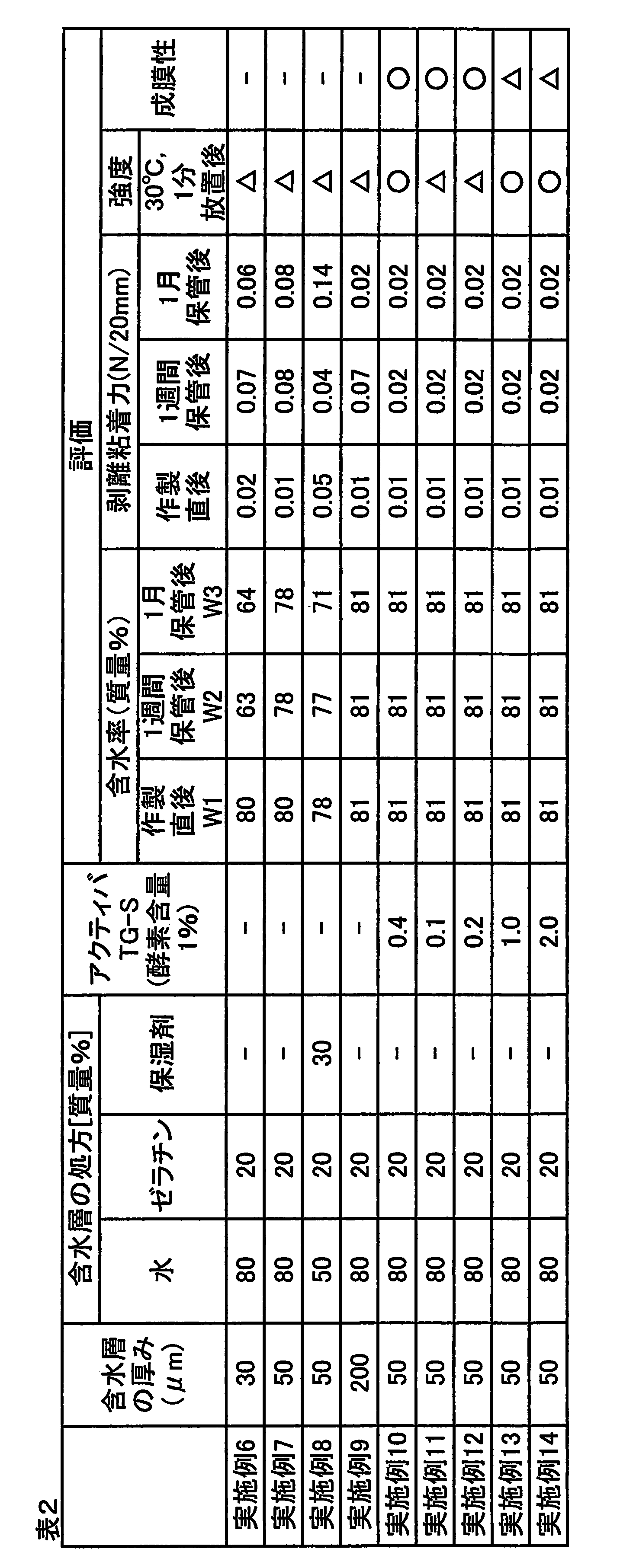
- Examples 6-9 A release sheet was produced in the same manner as in Example 1 except that the water-containing layer was prepared according to the formulation and thickness described in Table 2.
- Example 8 a hydrated layer was prepared by adding glycerin as a humectant to the gelatin solution treated in the same manner as in Example 1.
- Example 10 A release sheet was produced in the same manner as in Example 1 except that the water-containing layer was produced as described below.
- the mixture was formed into a sheet on the upper surface of the first moisture-impermeable substrate layer while being formed into a sheet to form a water-containing layer having a thickness of 50 ⁇ m.
- Examples 11-14 A release sheet was prepared in the same manner as in Example 10 except that the mixing ratio of activa TS-G (transglutaminase) in the water-containing layer was changed according to Table 2.
- the peel adhesive strength was measured by a 180 degree peel test on the release sheet of the silicone resin sheet with the base material layer.
- the 180-degree peel test first, the base resin layer-attached silicone resin sheet was cut into a width of 20 mm, and then the cut base material layer-attached silicone resin sheet was peeled off at 180 degrees with respect to the release sheet at a peel rate of 300 mm / min. The resistance force when peeled in the direction was calculated.
- the water-containing layer sandwiched between the first moisture-impermeable substrate layer and the second moisture-impermeable substrate layer is put into an oven at 30 ° C. for 1 minute, and then they are removed from the oven.
- the second moisture-impermeable base material layer is peeled off from the water-containing layer, and at that time, the moisture content based on the brittleness of the water-containing layer and the interfacial fracture between the second moisture-impermeable material layer and the water-containing layer.
- the evaluation was made based on whether or not the layer was transferred to the second moisture-impermeable substrate layer side.
- the evaluation criteria were as follows.
- the silicone resin sheet with a base material layer provided with a release sheet is used for various applications, for example, sealing of optical elements such as LEDs and LD, for example, electronic elements.
Landscapes
- Engineering & Computer Science (AREA)
- General Engineering & Computer Science (AREA)
- Mechanical Engineering (AREA)
- Laminated Bodies (AREA)
- Manufacture Of Macromolecular Shaped Articles (AREA)
Abstract
Description
図2の実施形態では、第2の非透湿性基材層4の右端部および左右方向途中部を含水層3から剥離しているが、例えば、図示しないが、第2の非透湿性基材層4の全部を含水層3から剥離することもできる。
[離型シートの作製]
厚み100μmのPETからなる第1の非透湿性基材層(JIS Z0208-1976に準拠した透湿性試験の透湿量:7g/m2・24時間、JIS B0601-1994に準拠した十点平均表面粗さRz:0.75μm)を用意した。
特開2010-265436号公報の実施例1に記載のシリコーン樹脂組成物を調製した。次いで、シリコーン樹脂組成物100質量部、シリコーンゴム粒子(平均粒子径7μm)20質量部、および、黄色蛍光体であるYAG粒子(平均粒子経7μm)10質量部を、撹拌機を用いてそれらを混合した。これによって、ワニスを調製した。
まず、第2の非透湿性基材層を、含水層の周端部、および、基材層から剥離した。続いて、離型シートを基材層付シリコーン樹脂シートから剥離した。具体的には、含水層を、シリコーン樹脂シートの粘着面から引き剥がした。
含水層を、表1に記載の処方に従って調製した以外は、実施例1と同様にして処理した。
含水層を設けなかった以外は、実施例1と同様にして処理した。
(ゼラチンの水に対する溶解性)
実施例1~5の含水層の調製時におけるゼラチンの水に対する溶解性を、下記の基準に従って、評価した。その結果を表1に示す。
◎:ゼラチンが水を十分に吸って、互いに相溶した。
○:ゼラチンのほとんどが水を吸ったが、ゼラチンの一部(1質量%以上5質量%未満)は、水と相溶しなかった。
△:ゼラチンのほとんどが水を吸ったが、ゼラチンの一部(5質量%以上10質量%未満)は、水と相溶しなかった。
実施例1~5の含水層の成膜性を、下記の基準に従って、評価した。その結果を表1に示す。
◎:成膜性が良好であり、膜強度が高い。
○:成膜性は良好であるが、膜強度が低い。
△:成膜性が若干不良であり、膜強度が低い。
含水層を、実施例1~5のシリコーン樹脂シートの粘着面から引き剥がした時の剥離性を、下記の基準に従って、評価した。一方、比較例1については、第1の非透湿性基材層をシリコーン樹脂シートの粘着面から引き剥がしたときの剥離性を、下記の基準に従って、評価した。その結果を表1に示す。
◎:離型シートの上面とシリコーン樹脂シートの粘着面との界面剥離を生じさせて、離型シートをシリコーン樹脂シートから容易に剥離することができた。
○:離型シートの上面とシリコーン樹脂シートの粘着面との界面剥離を生じさせ、離型シートをシリコーン樹脂シートから少しの力で剥離することができた。
△:離型シートの上面とシリコーン樹脂シートの粘着面との界面剥離を生じさせ、離型シートをシリコーン樹脂シートからわずかに大きな力で剥離することができた。
×:シリコーン樹脂シートが凝集破壊を生じ、第1の非透湿性基材層の上面にシリコーン樹脂が付着するとともに、シリコーン樹脂シートの表面に凹凸(表面荒れ)が認められた。

含水層を、表2に記載の処方および厚みに従って調製した以外は、実施例1と同様にして離型シートを作製した。
含水層を、下記の通りに作製した以外は、実施例1と同様にして離型シートを作製した。
含水層におけるアクティバTS-G(トランスグルタミナーゼ)の配合割合を表2に従って変更した以外は、実施例10と同様に処理して、離型シートを作製した。
実施例6~14に関し、(1)作製直後の離型シート付シリコーン樹脂シートの離型シート、(2)温度5℃、湿度50%RHで1週間保管後の離型シート付シリコーン樹脂シートの離型シート、および、(3)温度5℃、湿度50%RHで1月間保管後の離型シート付シリコーン樹脂シートの離型シートのそれぞれについて、下記の項目を評価した。
実施例6~14における上記(1)~(3)のそれぞれの含水層の含水率を赤外線水分計によって測定した。その結果を表2に示す。
実施例6~14における上記(1)~(3)のそれぞれについて、シリコーン樹脂シートの含水層に対する剥離粘着力を下記の方法によって測定した。その結果を表2に示す。
実施例6~14における上記(1)の含水層の強度を、30℃環境下1分放置後のハンドリング性により評価した。
○:30℃環境下でも、含水層は、膜として保形され、第2の非透湿性基材層への転写が認められなかった。
△:30℃環境下でも、含水層は、膜として保形されるが、第2の非透湿性基材層への転写が部分的に認められた。
実施例10~14の混合物の成膜性を下記の基準に従って評価した。
その結果を表2に示す。
なお、評価基準は、以下の通りとした。
○:混合物を第1の非透湿性基材層に対して良好に塗布できた。
△:混合物を第1の非透湿性基材層に対して塗布できたが、混合物においてトランスグルタミナーゼによるゼラチンの架橋反応が促進されることに起因する塗布不良箇所が部分的に観察された。
2 第1の非透湿性基材層
3 含水層
4 第2の非透湿性基材層
6 シリコーン樹脂シート
8 粘着面
9 離型シート付シリコーン樹脂シート
Claims (9)
- 第1の非透湿性基材層と、
前記第1の非透湿性基材層の厚み方向一方面に積層され、水を含有する含水層と
を備え、
シリコーン樹脂シートの粘着面を前記含水層によって被覆するように使用されることを特徴とする、離型シート。 - 前記含水層は、さらに、吸水剤を含有し、
前記含水層における水の含有割合が、60質量%以上、95質量%以下であることを特徴とする、請求項1に記載の離型シート。 - 前記離型シートを温度5℃、湿度30~70%RHで1週間保管した後の前記含水層における水の含有割合が、60質量%以上、95質量%以下であることを特徴とする、請求項2に記載の離型シート。
- 前記離型シートを温度5℃、湿度30~70%RHで1月間保管した後の含水層における水の含有割合が、60質量%以上、95質量%以下であることを特徴とする、請求項2または3に記載の離型シート。
- 前記含水層は、さらに、保湿剤を含有することを特徴とする、請求項1に記載の離型シート。
- 前記吸水剤は、ゼラチンを含有し、
前記含水層は、さらに、トランスグルタミナーゼを含有することを特徴とする、請求項2に記載の離型シート。 - 前記含水層の厚みが、30μm以上、1000μm以下であることを特徴とする、請求項1に記載の離型シート。
- 前記含水層の厚み方向一方側に積層される第2の非透湿性基材層をさらに備えることを特徴とする、請求項1に記載の離型シート。
- 第1の非透湿性基材層と、 前記第1の非透湿性基材層の厚み方向一方面に積層され、水を含有する含水層とを備える離型シートと、
前記離型シートの前記含水層と接触する粘着面を有するシリコーン樹脂シートと
を備えることを特徴とする、離型シート付シリコーン樹脂シート。
Priority Applications (2)
| Application Number | Priority Date | Filing Date | Title |
|---|---|---|---|
| US14/910,313 US20160176160A1 (en) | 2013-08-08 | 2014-08-01 | Release sheet and release sheet-including silicone resin sheet |
| KR1020167002797A KR20160040188A (ko) | 2013-08-08 | 2014-08-01 | 이형 시트 및 이형 시트 부착 실리콘 수지 시트 |
Applications Claiming Priority (4)
| Application Number | Priority Date | Filing Date | Title |
|---|---|---|---|
| JP2013-165169 | 2013-08-08 | ||
| JP2013165169 | 2013-08-08 | ||
| JP2014124086A JP2015051626A (ja) | 2013-08-08 | 2014-06-17 | 離型シートおよび離型シート付シリコーン樹脂シート |
| JP2014-124086 | 2014-06-17 |
Publications (1)
| Publication Number | Publication Date |
|---|---|
| WO2015019950A1 true WO2015019950A1 (ja) | 2015-02-12 |
Family
ID=52461286
Family Applications (1)
| Application Number | Title | Priority Date | Filing Date |
|---|---|---|---|
| PCT/JP2014/070321 Ceased WO2015019950A1 (ja) | 2013-08-08 | 2014-08-01 | 離型シートおよび離型シート付シリコーン樹脂シート |
Country Status (6)
| Country | Link |
|---|---|
| US (1) | US20160176160A1 (ja) |
| JP (1) | JP2015051626A (ja) |
| KR (1) | KR20160040188A (ja) |
| CN (2) | CN104342057A (ja) |
| TW (2) | TW201505834A (ja) |
| WO (1) | WO2015019950A1 (ja) |
Families Citing this family (3)
| Publication number | Priority date | Publication date | Assignee | Title |
|---|---|---|---|---|
| EP3841178A4 (en) * | 2018-08-23 | 2022-06-08 | 3M Innovative Properties Company | TACKED AND FILLED SILICONE ADHESIVE COMPOSITIONS |
| JP7332125B2 (ja) * | 2018-10-05 | 2023-08-23 | 青葉化成株式会社 | 粘弾性を有する天然高分子化合物組成物の製造方法 |
| EP3875431A4 (en) * | 2018-10-31 | 2022-08-03 | Tokuyama Corporation | ANTIFOULING PROCESS FOR POLYSILICON |
Citations (4)
| Publication number | Priority date | Publication date | Assignee | Title |
|---|---|---|---|---|
| JPH08334865A (ja) * | 1995-06-06 | 1996-12-17 | Teijin Ltd | 写真フイルム用下引きフイルム |
| JP2002301790A (ja) * | 2001-02-01 | 2002-10-15 | Toray Ind Inc | 離型フィルム |
| JP2009255492A (ja) * | 2008-04-15 | 2009-11-05 | Naniwa Kako Kk | 防眩性と自己修復性とを備えた表面基材 |
| JP2012012563A (ja) * | 2010-06-02 | 2012-01-19 | Nitto Denko Corp | 熱硬化性シリコーン樹脂用組成物 |
Family Cites Families (1)
| Publication number | Priority date | Publication date | Assignee | Title |
|---|---|---|---|---|
| MX2012009629A (es) * | 2010-02-17 | 2012-09-12 | Procter & Gamble | Articulo depilatorio. |
-
2014
- 2014-06-17 JP JP2014124086A patent/JP2015051626A/ja active Pending
- 2014-08-01 WO PCT/JP2014/070321 patent/WO2015019950A1/ja not_active Ceased
- 2014-08-01 KR KR1020167002797A patent/KR20160040188A/ko not_active Withdrawn
- 2014-08-01 US US14/910,313 patent/US20160176160A1/en not_active Abandoned
- 2014-08-06 TW TW103126964A patent/TW201505834A/zh unknown
- 2014-08-06 TW TW103214005U patent/TWM494081U/zh not_active IP Right Cessation
- 2014-08-08 CN CN201410390586.7A patent/CN104342057A/zh active Pending
- 2014-08-08 CN CN201420448811.3U patent/CN204211681U/zh not_active Expired - Fee Related
Patent Citations (4)
| Publication number | Priority date | Publication date | Assignee | Title |
|---|---|---|---|---|
| JPH08334865A (ja) * | 1995-06-06 | 1996-12-17 | Teijin Ltd | 写真フイルム用下引きフイルム |
| JP2002301790A (ja) * | 2001-02-01 | 2002-10-15 | Toray Ind Inc | 離型フィルム |
| JP2009255492A (ja) * | 2008-04-15 | 2009-11-05 | Naniwa Kako Kk | 防眩性と自己修復性とを備えた表面基材 |
| JP2012012563A (ja) * | 2010-06-02 | 2012-01-19 | Nitto Denko Corp | 熱硬化性シリコーン樹脂用組成物 |
Also Published As
| Publication number | Publication date |
|---|---|
| KR20160040188A (ko) | 2016-04-12 |
| TW201505834A (zh) | 2015-02-16 |
| CN104342057A (zh) | 2015-02-11 |
| CN204211681U (zh) | 2015-03-18 |
| JP2015051626A (ja) | 2015-03-19 |
| US20160176160A1 (en) | 2016-06-23 |
| TWM494081U (zh) | 2015-01-21 |
Similar Documents
| Publication | Publication Date | Title |
|---|---|---|
| CN102741038B (zh) | 激光粘接用层叠体、鞋和鞋的制造方法 | |
| JP5035491B2 (ja) | 乾燥剤収容器及び接着テープ用リール | |
| CN1946821A (zh) | 粘接片 | |
| WO2015019950A1 (ja) | 離型シートおよび離型シート付シリコーン樹脂シート | |
| US20210213715A1 (en) | Laminate film and packaging container | |
| WO2016031521A1 (ja) | 封止用シート、セパレータ付き封止用シート、半導体装置、及び、半導体装置の製造方法 | |
| CN103764513A (zh) | 用于包装电子元件的热密封包覆膜 | |
| CN102197104A (zh) | 胶带 | |
| CN1922280A (zh) | 粘接片 | |
| JP6170290B2 (ja) | 積層体 | |
| JP7037281B2 (ja) | 帯電防止性シリコーン粘着剤組成物および保護シート | |
| JP2017013306A (ja) | 多層積層フィルム及びその製造方法 | |
| TW201519378A (zh) | 電子裝置密封用薄片及電子裝置封裝之製造方法 | |
| CN115703948A (zh) | 皮肤粘贴用双面粘合片 | |
| JP2008265155A (ja) | 積層体およびその製造方法 | |
| JP5119956B2 (ja) | 積層体の製造方法 | |
| WO1999052987A1 (fr) | Ruban auto-adhesif et son procede de production | |
| JP6822626B1 (ja) | 電子部品包装用カバーテープおよび包装体 | |
| CN1613511A (zh) | 医用粘着片类及其制造方法 | |
| JP2006187908A (ja) | 積層体 | |
| JP2018176544A (ja) | 接着シート付き部材およびそれを用いた物品の製造方法、ならびに接着シート | |
| JP3511368B2 (ja) | 電子基盤固定用シート | |
| JP5550815B2 (ja) | 両面粘着シート | |
| JP2003145658A (ja) | 透明ガスバリヤー性フィルム積層板及び透明積層体 | |
| JP2011173414A (ja) | ポリマー部材の製造方法 |
Legal Events
| Date | Code | Title | Description |
|---|---|---|---|
| 121 | Ep: the epo has been informed by wipo that ep was designated in this application |
Ref document number: 14833778 Country of ref document: EP Kind code of ref document: A1 |
|
| ENP | Entry into the national phase |
Ref document number: 20167002797 Country of ref document: KR Kind code of ref document: A |
|
| WWE | Wipo information: entry into national phase |
Ref document number: 14910313 Country of ref document: US |
|
| NENP | Non-entry into the national phase |
Ref country code: DE |
|
| 122 | Ep: pct application non-entry in european phase |
Ref document number: 14833778 Country of ref document: EP Kind code of ref document: A1 |