WO2014204010A1 - 活性エネルギー線硬化性組成物 - Google Patents
活性エネルギー線硬化性組成物 Download PDFInfo
- Publication number
- WO2014204010A1 WO2014204010A1 PCT/JP2014/066548 JP2014066548W WO2014204010A1 WO 2014204010 A1 WO2014204010 A1 WO 2014204010A1 JP 2014066548 W JP2014066548 W JP 2014066548W WO 2014204010 A1 WO2014204010 A1 WO 2014204010A1
- Authority
- WO
- WIPO (PCT)
- Prior art keywords
- group
- active energy
- curable composition
- energy ray
- silane compound
- Prior art date
- Legal status (The legal status is an assumption and is not a legal conclusion. Google has not performed a legal analysis and makes no representation as to the accuracy of the status listed.)
- Ceased
Links
Classifications
-
- C—CHEMISTRY; METALLURGY
- C09—DYES; PAINTS; POLISHES; NATURAL RESINS; ADHESIVES; COMPOSITIONS NOT OTHERWISE PROVIDED FOR; APPLICATIONS OF MATERIALS NOT OTHERWISE PROVIDED FOR
- C09D—COATING COMPOSITIONS, e.g. PAINTS, VARNISHES OR LACQUERS; FILLING PASTES; CHEMICAL PAINT OR INK REMOVERS; INKS; CORRECTING FLUIDS; WOODSTAINS; PASTES OR SOLIDS FOR COLOURING OR PRINTING; USE OF MATERIALS THEREFOR
- C09D183/00—Coating compositions based on macromolecular compounds obtained by reactions forming in the main chain of the macromolecule a linkage containing silicon, with or without sulfur, nitrogen, oxygen, or carbon only; Coating compositions based on derivatives of such polymers
- C09D183/04—Polysiloxanes
- C09D183/06—Polysiloxanes containing silicon bound to oxygen-containing groups
-
- B—PERFORMING OPERATIONS; TRANSPORTING
- B32—LAYERED PRODUCTS
- B32B—LAYERED PRODUCTS, i.e. PRODUCTS BUILT-UP OF STRATA OF FLAT OR NON-FLAT, e.g. CELLULAR OR HONEYCOMB, FORM
- B32B27/00—Layered products comprising a layer of synthetic resin
- B32B27/06—Layered products comprising a layer of synthetic resin as the main or only constituent of a layer, which is next to another layer of the same or of a different material
-
- C—CHEMISTRY; METALLURGY
- C08—ORGANIC MACROMOLECULAR COMPOUNDS; THEIR PREPARATION OR CHEMICAL WORKING-UP; COMPOSITIONS BASED THEREON
- C08G—MACROMOLECULAR COMPOUNDS OBTAINED OTHERWISE THAN BY REACTIONS ONLY INVOLVING UNSATURATED CARBON-TO-CARBON BONDS
- C08G59/00—Polycondensates containing more than one epoxy group per molecule; Macromolecules obtained by polymerising compounds containing more than one epoxy group per molecule using curing agents or catalysts which react with the epoxy groups
- C08G59/18—Macromolecules obtained by polymerising compounds containing more than one epoxy group per molecule using curing agents or catalysts which react with the epoxy groups ; e.g. general methods of curing
- C08G59/20—Macromolecules obtained by polymerising compounds containing more than one epoxy group per molecule using curing agents or catalysts which react with the epoxy groups ; e.g. general methods of curing characterised by the epoxy compounds used
-
- C—CHEMISTRY; METALLURGY
- C08—ORGANIC MACROMOLECULAR COMPOUNDS; THEIR PREPARATION OR CHEMICAL WORKING-UP; COMPOSITIONS BASED THEREON
- C08G—MACROMOLECULAR COMPOUNDS OBTAINED OTHERWISE THAN BY REACTIONS ONLY INVOLVING UNSATURATED CARBON-TO-CARBON BONDS
- C08G77/00—Macromolecular compounds obtained by reactions forming a linkage containing silicon with or without sulfur, nitrogen, oxygen or carbon in the main chain of the macromolecule
- C08G77/04—Polysiloxanes
- C08G77/14—Polysiloxanes containing silicon bound to oxygen-containing groups
-
- B—PERFORMING OPERATIONS; TRANSPORTING
- B32—LAYERED PRODUCTS
- B32B—LAYERED PRODUCTS, i.e. PRODUCTS BUILT-UP OF STRATA OF FLAT OR NON-FLAT, e.g. CELLULAR OR HONEYCOMB, FORM
- B32B2307/00—Properties of the layers or laminate
- B32B2307/50—Properties of the layers or laminate having particular mechanical properties
- B32B2307/558—Impact strength, toughness
-
- B—PERFORMING OPERATIONS; TRANSPORTING
- B32—LAYERED PRODUCTS
- B32B—LAYERED PRODUCTS, i.e. PRODUCTS BUILT-UP OF STRATA OF FLAT OR NON-FLAT, e.g. CELLULAR OR HONEYCOMB, FORM
- B32B2605/00—Vehicles
Definitions
- the present invention relates to an active energy ray-curable composition, a cured product, a laminate, and a method for producing the laminate.
- Patent Document 1 In recent years, in the field of hard coating, research on photocurable resin coating agents as a substitute for metal and glass has been widely conducted from the viewpoint of weight reduction and cost reduction. Among them, many coating agents that UV cure using a photo-radical generator have been reported (Patent Document 1). However, in the curing method using radicals, the inhibition of curing is likely to occur due to oxygen, so the vicinity of the interface between the coating agent and air There is a problem that curing of the resin tends to be insufficient.
- Patent Documents 2 and 3 a coating agent that contains a compound having a cationically curable functional group such as a hydrolyzable silyl group or an epoxy group as a main component and is cured using a photoacid generator has been reported (Patent Documents 2 and 3).
- a curable composition mainly composed of a compound having a cationically curable functional group such as a hydrolyzable silyl group or an epoxy group the entire coating film is not inhibited by oxygen in the air. It cures instantly and exhibits sufficient hardness and scratch resistance.
- a siloxane bond formed by cationic curing of a hydrolyzable silyl group has attracted attention because it easily exhibits high hardness and high scratch resistance.
- curing shrinkage occurs along with hydrolysis / condensation polymerization, and the occurrence of cracks and warpage is a major problem. Therefore, using a silane compound having an epoxy group, a vinyl group, etc., the hydrolyzable silyl group is previously hydrolyzed and condensation polymerized with an acid catalyst such as hydrochloric acid, acetic acid, formic acid, etc. There have been extensive attempts to photocure using it.
- epoxy groups are often used from the viewpoint of suppressing curing shrinkage after photocuring, but since epoxy groups are hydrolyzable, they are hydrolyzed under the above acid catalyst, and sufficient film properties can be obtained. There was no problem. When considering application to full-scale boards such as smartphones and tablets, it is necessary that the coating film has excellent hardness and scratch resistance. To obtain a high cross-linking density, the epoxy group remains as much as possible. It is necessary to keep.
- a laminate having a layer made of a polyfunctional acrylate-based curable composition has a problem of warping when left under high temperature and high humidity conditions.
- the problem to be solved by the present invention is to provide a curable composition which is excellent in hardness, scratch resistance and impact resistance and does not generate cracks due to curing shrinkage.
- the present invention relates to the following general formula (I): R 1- (SiR 2 a (OR 3 ) 3-a ) (I) (Wherein R 1 is an alkyl group having 1 to 10 carbon atoms substituted with a 3,4-epoxycyclohexyl group at the end, and R 2 is independently a hydrogen atom or an alkyl group having 1 to 10 carbon atoms, R 3 is a monovalent hydrocarbon group selected from an aryl group having 6 to 25 carbon atoms and an aralkyl group having 7 to 12 carbon atoms, and each R 3 is independently a hydrogen atom or an alkyl group having 1 to 10 carbon atoms.
- R 1 is preferably a ⁇ - (3,4-epoxycyclohexyl) ethyl group.
- the condensate (A) is As the silane compound (II), The following general formula (II-1): R 5 —Si (OR 3 ) 3 (II-1) (Wherein R 5 is selected from a (meth) acryloyl group, a glycidyl group, or an alkyl group having 1 to 10 carbon atoms, an alkenyl group having 2 to 10 carbon atoms, and a substituted aryl group substituted with a thiol group. , A group having no 3,4-epoxycyclohexyl group, and each R 3 independently represents a hydrogen atom or an alkyl group having 1 to 10 carbon atoms.
- the molar ratio of the silane compound (II-1) to the silane compound (I) is 0.03 to 1.0
- the molar ratio of the silane compound (II-2) to the silane compound (I) is 0 to 1.0. It is preferable that it is obtained by hydrolyzing and condensing.
- the active energy ray-curable composition further contains an alicyclic epoxy compound (D).
- the alicyclic epoxy compound (D) is preferably 3,4-epoxycyclohexylmethyl-3 ', 4'-epoxycyclohexanecarboxylate.
- the active energy ray-curable composition further contains metal oxide fine particles (E) having an average particle diameter of 100 nm or less.
- the metal oxide fine particles (E) are preferably silica fine particles.
- the active energy ray-curable composition is 0.05 to 30 parts by weight of the photoacid generator (B) and 0 to 100 parts by weight of the alicyclic epoxy compound (D) with respect to 100 parts by weight of the condensate (A). And 0 to 100 parts by weight of the metal oxide fine particles (E) are preferably contained.
- the photoacid generator (B) is preferably an aromatic sulfonium salt or an aromatic iodonium salt.
- the counter anion of the photoacid generator (B) is preferably a fluorophosphate anion or a fluoroantimonate anion.
- the active energy ray-curable composition further contains a photosensitizer (F).
- the photosensitizer (F) is preferably an anthracene derivative, a thioxanthone derivative, or a benzophenone derivative.
- the present invention also relates to a cured product obtained by curing the active energy ray-curable composition of the present invention.
- the present invention also includes a step of applying the active energy ray-curable composition of the present invention to a substrate, and a step of irradiating the active energy ray to cure the active energy ray-curable composition to form a cured film. It is related with the manufacturing method of the laminated body containing.
- the present invention also relates to a laminate obtained by the above production method.
- silane compound (II) The following general formula (II-1): R 5 —Si (OR 3 ) 3 (II-1) (Wherein R 5 is selected from a (meth) acryloyl group, a glycidyl group, or an alkyl group having 1 to 10 carbon atoms, an alkenyl group having 2 to 10 carbon atoms, and a substituted aryl group substituted with a thiol group. , A group having no 3,4-epoxycyclohexyl group, and each R 3 independently represents a hydrogen atom or an alkyl group having 1 to 10 carbon atoms.
- the molar ratio of the silane compound (II-1) to the silane compound (I) is 0.03 to 1.0
- the molar ratio of the silane compound (II-2) to the silane compound (I) is 0 to 1.0.
- An active energy ray-curable composition using a condensate (A) obtained by hydrolysis / condensation and a laminate produced using a single layer substrate are preferred.
- the active energy ray-curable composition of the present invention comprises a silane compound (I) having a hydrolyzable silyl group, and a silane compound (II) having a hydrolyzable silyl group as a silane compound (
- the ratio Y / X of the number of moles Y of the OR 3 group directly bonded to is 0.2 or less.
- the silane compound (I) having a hydrolyzable silyl group has the following general formula (I): R 1- (SiR 2 a (OR 3 ) 3-a ) (I) (Wherein R 1 is an alkyl group having 1 to 10 carbon atoms substituted with a 3,4-epoxycyclohexyl group at the end, and R 2 is independently a hydrogen atom or an alkyl group having 1 to 10 carbon atoms, R 3 is a monovalent hydrocarbon group selected from an aryl group having 6 to 25 carbon atoms and an aralkyl group having 7 to 12 carbon atoms, and each R 3 is independently a hydrogen atom or an alkyl group having 1 to 10 carbon atoms.
- the silane compound (II) having a hydrolyzable silyl group has the following general formula (II): R 4 —Si (OR 3 ) 3 (II) (Wherein, R 4 is a substituted or unsubstituted alkyl group having 1 to 10 carbon atoms, an alkenyl group, and is selected from substituted aryl group, a group having no 3,4-epoxycyclohexyl group, R 3 Are each independently a hydrogen atom or an alkyl group having 1 to 10 carbon atoms.) It is represented by
- R 1 in the general formula (I) is an alkyl group having 1 to 10 carbon atoms that is substituted with a 3,4-epoxycyclohexyl group at the end, for example, a (3,4-epoxycyclohexyl) methyl group, (3,4) -Epoxycyclohexyl) ethyl group, (3,4-epoxycyclohexyl) propyl group, (3,4-epoxycyclohexyl) butyl group, (3,4-epoxycyclohexyl) pentyl group, and (3,4-epoxycyclohexyl) A hexyl group is mentioned.
- R 2 in the general formula (I) is a hydrogen atom or a monovalent hydrocarbon group selected from an alkyl group having 1 to 10 carbon atoms, an aryl group having 6 to 25 carbon atoms, and an aralkyl group having 7 to 12 carbon atoms.
- hydrocarbon groups include methyl, ethyl, propyl, butyl, pentyl, hexyl, octyl, nonyl, decyl, phenyl, tolyl, xylyl, naphthyl, Examples include a benzyl group and a phenethyl group.
- R 3 in the general formulas (I) and (II) is a hydrogen atom or an alkyl group having 1 to 10 carbon atoms.
- the alkyl group include a methyl group, an ethyl group, a propyl group, a butyl group, a pentyl group, a hexyl group, an octyl group, a nonyl group, and a decyl group.
- the alkyl group of R 3 preferably has 1 to 3 carbon atoms, and most preferably 1.
- R 4 in the general formula (II) is a group selected from a substituted or unsubstituted alkyl group having 1 to 10 carbon atoms, an alkenyl group, and a substituted aryl group, and having no 3,4-epoxycyclohexyl group.
- alkyl group include a methyl group, an ethyl group, a propyl group, a butyl group, a pentyl group, a hexyl group, an octyl group, a nonyl group, and a decyl group.
- Examples of the substituent for the alkyl group include a glycidyl group, a thiol group, an amino group, a (meth) acryloyl group, a phenyl group, a cyclohexyl group, and a chloro group.
- Examples of the alkenyl group include a vinyl group, allyl group, 3-butenyl group, 4-pentenyl group, 5-hexenyl group, 6-heptenyl group, and 7-octenyl group.
- Examples of the substituted aryl group include a styryl group.
- R 4 is an unsubstituted alkyl group
- the number of carbon atoms is 3 when the storage stability is good, the curing rate upon irradiation with active energy rays is high, and the occurrence of cracks in the obtained coating film can be suppressed.
- It is preferably an alkyl group having 10 or less and more preferably an alkyl group having 3 to 6 carbon atoms.
- the alkyl group preferably has 3 to 10 carbon atoms, more preferably 3 to 6 carbon atoms, and the substituent includes a phenyl group, a cyclohexyl group, and (meth) acryloyl. Groups are preferred.
- a vinyl group or an allyl group is preferred.
- a substituted aryl group a styryl group is preferable. If the unsubstituted alkyl group has 2 or less carbon atoms, or if the substituted alkyl group is not bulkier than the phenyl group, cyclohexyl group, or (meth) acryloyl group, the cross-linked structure becomes dense during crosslinking, and the gel It may become.
- the hydrophobicity increases and the hydrolysis rate increases. It may be extremely reduced, or the curing rate during irradiation with active energy rays may be reduced.
- a in the general formula (I) is an integer of 0 to 2, and is appropriately selected according to physical properties required for the curable composition.
- silane compound (I) examples include ⁇ - (3,4-epoxycyclohexyl) methyltrimethoxysilane, ⁇ - (3,4-epoxycyclohexyl) methylmethyldimethoxysilane, and ⁇ - (3,4-epoxycyclohexyl) methyldimethyl.
- Epoxy Cyclohexyl) hexylsilanes ⁇ - (3,4-epoxycyclohexyl) heptyltrimethoxysilane, ⁇ - (3,4-epoxycyclohexyl) heptylmethyldimethoxysilane, ⁇ - (3,4-epoxycyclohexyl) heptyldimethylmethoxysilane , ⁇ - (3,4-epoxycyclohexyl) heptyltriethoxysilane, ⁇ - (3,4-epoxycyclohexyl) heptylmethyldiethoxysilane, ⁇ - (3,4-epoxycyclohexyl) heptyldimethylethoxysilane, ⁇ - ( ⁇ - (3,4) such as 3,4-epoxycyclohexyl) heptyltripropoxysilane, ⁇ - (3,4-epoxycyclohe
- the alkyl group of R 3 in the general formula (I) preferably has 1 to 3 carbon atoms, most preferably 1 It is.
- the carbon number of the alkylene group that bonds the epoxycyclohexyl group and the silicon atom is important, and the carbon number is preferably 1 to 4, more preferably. 2 or 3.
- the silane compound (I) includes ⁇ - (3,4-epoxycyclohexyl) ethyltrimethoxysilane, ⁇ - (3,4-epoxycyclohexyl) ethylmethyldimethoxysilane, ⁇ - (3,4 -Epoxycyclohexyl) ethyldimethylmethoxysilane, ⁇ - (3,4-epoxycyclohexyl) propyltrimethoxysilane, ⁇ - (3,4-epoxycyclohexyl) propylmethyldimethoxysilane, and ⁇ - (3,4-epoxycyclohexyl) ) Propyldimethylmethoxysilane is preferred.
- R 1 is a ⁇ - (3,4-epoxycyclohexyl) ethyl group are preferred.
- silane compounds (II) those in which R 4 in the general formula (II) is an unsubstituted alkyl group include methyltrimethoxysilane, methyltriethoxysilane, methyltripropoxysilane, ethyltrimethoxysilane, ethyl Triethoxysilane, ethyltripropoxysilane, propyltrimethoxysilane, propyltriethoxysilane, propyltripropoxysilane, butyltrimethoxysilane, butyltriethoxysilane, butyltripropoxysilane, pentyltrimethoxysilane, pentyltriethoxysilane, pentyl Tripropoxysilane, hexyltrimethoxysilane, hexyltriethoxysilane, hexyltripropoxysilane, heptyltrimethoxysilane, h
- the R 4 in the general formula (II) include the following can be cited as a substituted alkyl group. Although there is no restriction
- Examples of the compound in which R 4 is a glycidyl group-substituted alkyl group include glycidoxymethyltrimethoxysilane, glycidoxymethyltriethoxysilane, 2-glycidoxyethyltrimethoxysilane, 2-glycidoxyethyltriethoxysilane, 3-glycidoxypropyltrimethoxysilane, 3-glycidoxypropyltriethoxysilane, 4-glycidoxybutyltrimethoxysilane, 4-glycidoxybutyltriethoxysilane, 5-glycidoxypentyltrimethoxysilane, Examples include 5-glycidoxypentyltriethoxysilane, 6-glycidoxyhexyltrimethoxysilane, and 6-glycidoxyhexyltriethoxysilane.
- Examples of the compound in which R 4 is a thiol group-substituted alkyl group include mercaptomethyltrimethoxysilane, mercaptomethyltriethoxysilane, 2-mercaptoethyltrimethoxysilane, 2-mercaptoethyltriethoxysilane, 3-mercaptopropyltrimethoxysilane, 3-mercaptopropyltriethoxysilane, 4-mercaptobutyltrimethoxysilane, 4-mercaptobutyltriethoxysilane, 5-mercaptopentyltrimethoxysilane, 5-mercaptopentyltriethoxysilane, 6-mercaptohexyltrimethoxysilane, 6- Examples include mercaptohexyltriethoxysilane.
- Examples of the compound in which R 4 is an amino group-substituted alkyl group include N-2- (aminoethyl) aminomethyltrimethoxysilane, N-2- (aminoethyl) aminomethyltriethoxysilane, N-2- (aminoethyl) -2-aminoethyltrimethoxysilane, N-2- (aminoethyl) -2-aminoethyltriethoxysilane, N-2- (aminoethyl) -3-aminopropyltrimethoxysilane, N-2- (aminoethyl) ) -3-Aminopropyltriethoxysilane, N-2- (aminoethyl) -4-aminobutyltrimethoxysilane, N-2- (aminoethyl) -4-aminobutyltriethoxysilane, N-2- (amino) E
- Examples of the compound in which R 4 is a (meth) acryloyl group-substituted alkyl group include (meth) acryloxymethyltrimethoxysilane, (meth) acryloxymethyltriethoxysilane, 2- (meth) acryloxyethyltrimethoxysilane, 2 -(Meth) acryloxyethyltriethoxysilane, 3- (meth) acryloxypropyltrimethoxysilane, 3- (meth) acryloxypropyltriethoxysilane, 4- (meth) acryloxybutyltrimethoxysilane, 4- ( (Meth) acryloxybutyltriethoxysilane, 5- (meth) acryloxypentyltrimethoxysilane, 5- (meth) acryloxypentyltriethoxysilane, 6- (meth) acryloxyhexyltrimethoxysilane, 6- (meth) Acryloxyhexy
- R 4 is a phenyl group-substituted alkyl group
- the compounds in which R 4 is a phenyl group-substituted alkyl group include benzyltrimethoxysilane, benzyltriethoxysilane, 2-phenylethyltrimethoxysilane, 2-phenylethyltriethoxysilane, 3-phenylpropyltrimethoxysilane, 3-phenylpropoxysilane.
- Rutriethoxysilane 4-phenylbutyltrimethoxysilane, 4-phenylbutyltriethoxysilane, 5-phenylpentyltrimethoxysilane, 5-phenylpentyltriethoxysilane, 6-phenylhexyltrimethoxysilane, 6-phenylhexyltriethoxy Silane etc. are mentioned.
- Examples of the compound in which R 4 is a cyclohexyl group-substituted alkyl group include cyclohexylmethyltrimethoxysilane, cyclohexylmethyltriethoxysilane, 2-cyclohexylethyltrimethoxysilane, 2-cyclohexylethyltriethoxysilane, 3-cyclohexylpropyltrimethoxysilane, 3-cyclohexylpropyltriethoxysilane, 4-cyclohexylbutyltrimethoxysilane, 4-cyclohexylbutyltriethoxysilane, 5-cyclohexylpentyltrimethoxysilane, 5-cyclohexylpentyltriethoxysilane, 6-cyclohexylhexyltrimethoxysilane, 6- Examples include cyclohexylhexyltriethoxysilane.
- Examples of the compound in which R 4 is a chloro group-substituted alkyl group include chloromethyltrimethoxysilane, chloromethyltriethoxysilane, 2-chloroethyltrimethoxysilane, 2-chloroethyltriethoxysilane, and 3-chloropropyltrimethoxy.
- Silane 3-chloropropyltriethoxysilane, 4-chlorobutyltrimethoxysilane, 4-chlorobutyltriethoxysilane, 5-chloropentyltrimethoxysilane, 5-chloropentyltriethoxysilane, 6-chlorohexyltrimethoxysilane, Examples include 6-chlorohexyltriethoxysilane.
- Examples of the compound in which R 4 is an alkenyl group include vinyltrimethoxysilane, vinyltriethoxysilane, allyltrimethoxysilane, allyltriethoxysilane, 3-butenyltrimethoxysilane, 3-butenyltriethoxysilane, 4 -Pentenyltrimethoxysilane, 4-pentenyltriethoxysilane, 5-hexenyltrimethoxysilane, 5-hexenyltriethoxysilane, 6-heptenyltrimethoxysilane, 6-heptenyltriethoxysilane, 7-octenyltrimethoxysilane 7-octenyltriethoxysilane and the like.
- Examples of the compound in which R 4 is a substituted aryl group include p-styryltrimethoxysilane and p-styryltriethoxysilane.
- the condensate (A) preferably has a large number of 3,4-epoxycyclohexyl groups in one molecule.
- the number of 3,4-epoxycyclohexyl groups in one molecule is preferably 4 or more, more preferably 5 or more, from the viewpoint of increasing the crosslinking density upon irradiation with energy active rays and improving the physical properties of the cured product. More than the number is more preferable. As the number of 3,4-epoxycyclohexyl groups in one molecule increases, the condensate (A) becomes a high molecular weight product.
- the molar ratio of the silane compound (II) to the silane compound (I) is 0 or more and 2.0 or less. Obtained by hydrolysis and condensation with When the molar ratio exceeds 2.0, the effect of suppressing warpage due to curing shrinkage at the time of forming a laminate with respect to the single-layer substrate becomes insufficient. Further, when the content of 3,4-epoxycyclohexyl group in the condensate (A) is lowered, there is a concern that intermolecular crosslinking becomes insufficient, and there is a concern that hardness and scratch resistance are lowered.
- the molar ratio is preferably 0 or more and 1.0 or less, more preferably 0 or more and 0.8 or less, and further preferably 0 or more and 0.6 or less. It is particularly preferably 0 or more and 0.4 or less, and most preferably 0 or more and 0.2 or less.
- the weight average molecular weight of the condensate (A) is 20,000 or less.
- the weight average molecular weight is preferably 500 or more, more preferably 1,000 or more, further preferably 1,500 or more, still more preferably 2,000 or more, and particularly preferably 2,800 or more.
- the weight average molecular weight is more preferably 18,000 or less, further preferably 16,000 or less, still more preferably 14,000 or less, and particularly preferably 12,000 or less.
- the weight average molecular weight of the condensate (A) is less than 500, the condensate (A) is volatile and may partially or completely volatilize before curing. Moreover, there exists a possibility that impact resistance may fall, so that a weight average molecular weight is low.
- the weight average molecular weight exceeds 20,000, the compatibility with other blends is lowered, and there is a risk of clouding when forming a coating film.
- the weight average molecular weight is a weight average molecular weight measured by GPC.
- the ratio Y / X of the number of moles Y of the OR 3 group is 0.2 or less. If Y / X exceeds 0.2, the coating film shrinks over time after irradiation with active energy rays and cracks occur.
- Y / X is more preferably 0.1 or less, even more preferably 0.05 or less, and most preferably substantially 0.
- Y / X can be determined by measuring by 1 HNMR.
- the amount of water required for the hydrolysis / condensation reaction is 0.3 to 3 equivalents, preferably 0.5 to 2 equivalents, with respect to the OR 3 group directly bonded to the silicon atom. If the amount of water is less than 0.3 equivalent, a part of the OR 3 group may remain without being hydrolyzed. If it exceeds 3 equivalents, the hydrolysis / condensation reaction rate is too high, and a high molecular weight condensate is produced, which may deteriorate the physical properties and transparency of the coating film.
- the number of OR 3 groups remaining in the condensate (A) is preferably 2 or less, more preferably 1 or less, and even more preferably 0.5 or less in one molecule. Preferably, it is particularly preferably 0.1 or less, and most preferably not substantially remaining.
- the residual ratio of 3,4-epoxycyclohexyl groups in the condensate (A), that is, the silane compound (I) as a raw material It is preferable that the ratio of the number of moles of 3,4-epoxycyclohexyl group in the condensate (A) to the number of moles of 3,4-epoxycyclohexyl group contained in is higher.
- the residual ratio of the 3,4-epoxycyclohexyl group is preferably 20% or more, more preferably 40% or more, and further preferably 60% or more.
- the residual ratio of 3,4-epoxycyclohexyl group can be determined by 1 HNMR measurement.
- the hydrolysis / condensation reaction is carried out under basic conditions.
- Cycloaliphatic epoxides such as epoxycyclohexyl groups have significantly different reactivities than aliphatic epoxides, and the electrophilic reaction is easy to proceed and the nucleophilic reaction is difficult to proceed.
- ring opening can be suppressed under basic conditions. Accordingly, a condensate synthesized under basic conditions is preferable in terms of hardness, scratch resistance and the like because it has a higher epoxy group residual ratio and a coating film having a high crosslinking density can be obtained.
- the pH in the hydrolysis / condensation reaction may be 7 to 14, and preferably 8 to 14 from the viewpoint of reaction rate. The pH can be measured by a glass electrode method.
- the basic compound used to make the reaction system basic is not particularly limited, and includes alkali metal or alkaline earth metal hydroxides such as sodium hydroxide, lithium hydroxide and magnesium hydroxide, triethylamine and the like. Amines and the like can be used. Since the epoxy group is cured using a photoacid generator after synthesizing the condensate, the basic compound is preferably easy to remove, and in view of this, it is preferable that the volatility is higher. Furthermore, since it is preferable that the nucleophilicity is low, a tertiary amine compound is preferable as the basic compound, and a tertiary amine compound having a boiling point of 30 ° C. to 160 ° C. is more preferable in consideration of handling properties. Specific examples include triethylamine, diethylmethylamine, tripropylamine, methyldiisopropylamine, and diisopropylethylamine.
- the compound (II-1) is used, and if necessary, the silane compound (II-2) represented by the general formula (II-2) is used, and the molar ratio of the silane compound (II-1) to the silane compound (I) Is preferably 0.03 to 1.0 and the molar ratio of the silane compound (II-2) to the silane compound (I) is 0 to 1.0.
- the silane compound (II-1) having a hydrolyzable silyl group is represented by the following general formula (II-1): R 5 —Si (OR 3 ) 3 (II-1) (Wherein R 5 is selected from a (meth) acryloyl group, a glycidyl group, or an alkyl group having 1 to 10 carbon atoms, an alkenyl group having 2 to 10 carbon atoms, and a substituted aryl group substituted with a thiol group. , A group having no 3,4-epoxycyclohexyl group, and each R 3 is independently a hydrogen atom or an alkyl group having 1 to 10 carbon atoms.
- the silane compound (II-2) having a hydrolyzable silyl group has the following general formula (II-2): R 6 —Si (OR 3 ) 3 (II-2) (Wherein R 6 is selected from an amino group, a phenyl group, a cyclohexyl group, or an alkyl group having 1 to 10 carbon atoms substituted with a chloro group, and an unsubstituted alkyl group having 1 to 10 carbon atoms; A group having no 3,4-epoxycyclohexyl group, and each R 3 is independently a hydrogen atom or an alkyl group having 1 to 10 carbon atoms).
- the silane compound (I) can be regarded as an expansion component during curing, and the silane compound (II-1) can be regarded as a contraction component during curing.
- the molar ratio of the silane compound (II-1) to the silane compound (I) is more preferably 0.05 or more, further preferably 0.075 or more, and particularly preferably 0.1 or more. Further, the molar ratio is more preferably 0.9 or less, further preferably 0.8 or less, and particularly preferably 0.6 or less.
- the silane compound (II-2) is not considered as either an expansion component or a contraction component at the time of curing, but acts as a kind of a dilution component, and can further reduce the influence of the expansion component and the contraction component. it can.
- the molar ratio of the silane compound (II-2) to the silane compound (I) is more preferably 0.8 or less, further preferably 0.6 or less, and particularly preferably 0.5 or less. . When the molar ratio is larger than 1.0, the hard coat properties (that is, hardness and scratch resistance) may be deteriorated.
- a higher concentration of the condensate (A) in the curable composition of the present invention is preferable because a coating film having a higher hardness can be obtained.
- the solid content concentration of the condensate (A) in the curable composition of the present invention is preferably 60% by weight or more, more preferably 70% by weight or more, still more preferably 80% by weight or more, and more preferably 90% by weight or more. Particularly preferred is 95% by weight or more.
- the photoacid generator as component (B) in the present invention is a compound that generates an acid when exposed to active energy rays, for example, a strong acid such as toluenesulfonic acid or boron tetrafluoride; a sulfonium salt, an ammonium salt , Phosphonium salts, iodonium salts, selenium salts, etc .; iron-allene complexes; silanol-metal chelate complexes; disulfones, disulfonyldiazomethanes, disulfonylmethanes, sulfonylbenzoylmethanes, imidosulfonates, benzoin Examples thereof include sulfonic acid derivatives such as sulfonates; compounds such as organic halogen compounds that generate an acid upon irradiation with radiation as disclosed in JP-A No. 5-134411.
- sulfonic acid derivatives examples include sulfonic acid esters such as benzoin tosylate, nitrobenzyl tosylate and succinimide tosyl sulfonate shown in US Pat. No. 4,618,564; US Pat. No. 4,540,598, JP-A-6- Oxime sulfonates such as ⁇ - (4-tosyloxyimino) -4-methoxybenzyl cyanide disclosed in Japanese Patent No. 67433; tris (methanesulfonyloxy) benzene shown in Japanese Patent Laid-Open No.
- Examples include 9,10-dialkoxyanthracenesulfonic acid nitrobenzyl ester disclosed in JP-A No. 64-18143; N- (p-dodecylbenzenesulfonyloxy) -1,8-naphthalimide and the like.
- organic halogen compounds examples include 2- (4-methoxyphenyl) -4,6-bis (trichloromethyl) -1,3,5-triazine, 2- (3,4-dimethoxystyryl) -4,6- Bis (trichloromethyl) -1,3,5-triazine, 2- [2- (5-methylfuran-2-yl) vinyl] -4,6-bis (trichloromethyl) -1,3,5-triazine, etc.
- aromatic sulfonium salts or aromatic iodonium salts are highly stable in compositions containing a condensate (A) of a silane compound having a 3,4-epoxycyclohexyl group, and are available It is preferable because it is easy to do.
- the aromatic anion sulfonium salt or aromatic iodonium salt counter anion is a fluorophosphate anion, a fluoroantimonate anion, or a fluoroborate anion that cures quickly and has excellent adhesion to a plastic substrate. This is preferable.
- a fluorophosphate anion or a fluoroantimonate anion is preferable.
- diphenyl (4-phenylthiophenyl) sulfonium hexafluorophosphate or diphenyl (4-phenylthiophenyl) sulfonium hexafluoroantimonate is preferable.
- the addition amount of the photoacid generator (B) needs to be adjusted according to the amount of acid generated and the generation rate, but it is 0.05 to 30 weights per 100 parts by weight of the condensate (A) (solid content). Parts, preferably 0.1 to 10 parts by weight. If the addition amount of the photoacid generator (B) is less than 0.05 parts by weight, the acid generated is insufficient, and the resulting coating film tends to have insufficient hardness and scratch resistance. There is a tendency that problems such as deterioration in film appearance and coloring occur.
- the photoradical generator is a compound that generates radicals when exposed to active energy rays.
- a polymerization initiator is used. Acts as
- Examples of the photo radical generator include carbonyl compounds, sulfur compounds, acyl phosphine oxides, and the like. More specifically, for example, benzoin, benzoin monomethyl ether, benzoin isopropyl ether, acetoin, benzyl, benzophenone, p-methoxybenzophenone, diethoxyacetophenone, benzyldimethyl ketal, 2,2-diethoxyacetophenone, 1-hydroxycyclohexyl phenyl ketone, Carbonyl compounds such as methylphenylglyoxylate, ethylphenylglyoxylate, 2-hydroxy-2-methyl-1-phenylpropan-1-one, sulfur compounds such as tetramethylthiuram monosulfide, tetramethylthiuram disulfide, And acylphosphine oxides such as 4,6-trimethylbenzoyldiphenylphosphine oxide.
- IRGACURE series such as IRGACURE 184 and IRGACURE 819
- DAROCUR series such as DAROCUR1173 and DAROCUR TPO
- KAYACURE series such as KAYACURE DETX-S
- KAYACURE CTX above, manufactured by Nippon Kayaku Co., Ltd., TA-Z
- a TAZ series such as -110 (manufactured by Midori Chemical Co., Ltd.) is commercially available.
- Photoradical generators may be used alone or in combination of two or more in consideration of curing speed and the like.
- the amount added when using the photoradical generator needs to be adjusted according to the amount of radicals generated and the target molecular weight, but 0.05 parts by weight with respect to 100 parts by weight of the condensate (A).
- the above is preferable, and 0.1 part by weight or more is more preferable.
- 50 weight part or less is preferable and 30 weight part or less is more preferable.
- the amount of the photo radical generator used is less than 0.05 parts by weight, the generated radicals are insufficient and may not be cured and may cause tackiness.
- the amount exceeds 50 parts by weight the coloring and weather resistance may be deteriorated. Tend to occur.
- the active energy ray-curable resin composition of the present invention may contain an alicyclic epoxy compound.
- the alicyclic epoxy compound include 3,4-epoxycyclohexylmethyl-3 ′, 4′-epoxycyclohexanecarboxylate (for example, trade name “Celoxide 2021P” manufactured by Daicel Chemical Industries, Ltd.), epsilon-caprolactone modified 3,4-epoxycyclohexylmethyl-3 ′, 4′-epoxycyclohexanecarboxylate (for example, Daicel Chemical Industries, Ltd .: trade name “Celoxide 2081”), 1,2,8,9-diepoxy limonene (for example, Daicel Chemical Industries, Ltd .: trade name “Celoxide 3000”), vinylcyclohexene monooxide 1,2-epoxy-4-vinylcyclohexane (for example, Daicel Chemical Industries, Ltd .:
- an epoxy compound having an epoxycyclohexyl group is preferable, and 3,4-epoxycyclohexylmethyl-3 ′, 4′-epoxycyclohexanecarboxylate, which is a low viscosity liquid compound, is more preferable.
- component (D) component can be used as a reactive diluent and can improve the coating-workability
- Component (D) is preferably used in an amount of 0 to 100 parts by weight, more preferably 0 to 50 parts by weight per 100 parts by weight of component (A). If the amount of component (D) used exceeds 100 parts by weight, the hardness and scratch resistance may be reduced.
- metal oxide fine particles can be used in the active energy ray-curable composition of the present invention.
- metal oxide fine particles as component (E), silica (SiO 2 ), alumina (Al 2 O 3 ), tin oxide (SnO 2 ), zirconia (ZrO 2 ), zinc oxide (ZnO), titania (TiO 2 ). ), ITO (tin / indium oxide), antimony oxide (Sb 2 O 3 , Sb 2 O 5 ), and composite fine particles thereof.
- silica, alumina, zirconia, and antimony oxide are preferable from the viewpoint of high hardness.
- silica fine particles and alumina fine particles are preferable from the viewpoint of availability, cost, surface hardness and the like, and silica fine particles are particularly preferable. These can be used alone or in combination of two or more.
- Such metal oxide fine particles are preferably powdery or solvent-dispersed sol.
- the dispersion medium is preferably an organic solvent from the viewpoint of compatibility with other components and dispersibility.
- organic solvent include alcohols such as methanol, ethanol, isopropanol, butanol and octanol; ketones such as acetone, methyl ethyl ketone, methyl isobutyl ketone and cyclohexanone; ethyl acetate, butyl acetate, ethyl lactate and ⁇ -butyrolactone.
- Esters such as ethylene glycol monomethyl ether and diethylene glycol monobutyl ether; aromatic hydrocarbons such as benzene, toluene and xylene; amides such as dimethylformamide, dimethylacetamide and N-methylpyrrolidone it can.
- aromatic hydrocarbons such as benzene, toluene and xylene
- amides such as dimethylformamide, dimethylacetamide and N-methylpyrrolidone it can.
- alcohols methyl ethyl ketone, methyl isobutyl ketone, ethyl acetate, and butyl acetate are preferable.
- the average particle size (average primary particle size) of the metal oxide fine particle (E) component is preferably 100 nm or less, more preferably 30 nm or less. If it exceeds 100 nm, the transparency of the resulting coating film tends to be impaired.
- silica fine particle dispersions include colloidal silica, methanol silica sol, IPA-ST, MEK-ST, NBA-ST, XBA-ST, DMAC-ST, MIBK-ST, ST-UP, ST-OUP, ST-20, ST-40, ST-C, ST-N, ST-O, ST-50, ST-OL, etc. (above, manufactured by Nissan Chemical Industries, Ltd.), OSCAL series, ELECOM series (above, JGC Catalysts & Chemicals) And the like).
- powder silica include Aerosil 130, Aerosil 300, Aerosil 380, Aerosil TT600, Aerosil OX50, etc.
- alumina fine particle dispersions include NANOBYK-3601, NANOBYK-3602, NANOBYK-3610, etc. (above, manufactured by Big Chemie Japan Co., Ltd.), and alumina isopropanol dispersions include AS-150I, etc.
- ELECOM V-8802 and ELECOM V-8804 (manufactured by JGC Catalysts & Chemicals Co., Ltd.) have high dispersibility of fine particles in the coating liquid, and the resulting coating film has more transparency, hardness and scratch resistance. It is preferable because it improves.
- Component (E) By mix
- Component (E) is preferably used in an amount of 0 to 100 parts by weight, more preferably 0 to 50 parts by weight per 100 parts by weight of component (A). If the amount of component (E) used exceeds 100 parts by weight, the coating film may not be formed or the transparency of the coating film may be reduced.
- the alicyclic epoxy compound (D) and the metal oxide fine particles (E) do not adversely affect the hardness of the coating film, they may be present together with the condensate (A).
- the total solid concentration of the condensate (A), the alicyclic epoxy compound (D), and the metal oxide fine particles (E) is preferably 60% by weight or more, more preferably 70% by weight or more, and 80% by weight. More preferably, it is more preferably 90% by weight or more, most preferably 95% by weight or more.
- the condensate (A), the alicyclic epoxy compound (D), and the metal oxide fine particles (E) are considered when considering the adhesiveness.
- the total solid content concentration is preferably 30% by weight to 80% by weight, more preferably 40% by weight to 80% by weight, even more preferably 50% by weight to 80% by weight, even more preferably 60% by weight to 80% by weight.
- the following are particularly preferred: If it exceeds 80% by weight, the adhesion to the substrate may be lowered.
- a photosensitizer in the active energy ray-curable composition of the present invention, can be used as necessary for the purpose of improving the photosensitivity of the component (B) or the component (C). Since the photosensitizer is more efficient if it can absorb light in a wavelength region that cannot be absorbed by the component (B) or component (C) used, the absorption wavelength region of the component (B) or component (C) Those with little overlap are good.
- anthracene derivative for example, an anthracene derivative, a benzophenone derivative, a thioxanthone derivative, an anthraquinone derivative, a benzoin derivative etc. are mentioned. Among them, those having a low oxidation potential and high excitation energy in a singlet or triplet state involved in electron transfer are ideal. From the viewpoint of photoinduced electron donating properties, anthracene derivatives, thioxanthone derivatives, and benzophenone derivatives are preferable.
- the addition amount in the case of using a photosensitizer may be appropriately adjusted according to the target curing rate, but is preferably 0.1 parts by weight or more with respect to 100 parts by weight of the photoacid generator (B), 0.5 parts by weight or more is more preferable. Moreover, 10 weight part or less is preferable and 5 weight part or less is more preferable. If the addition amount of the photosensitizer is less than 0.1 parts by weight, it is difficult to obtain the desired effect of the photosensitizer, and if it exceeds 10 parts by weight, the coating film tends to be colored or the cost tends to increase.
- the active energy ray-curable composition of the present invention contains the above components (A) and (B), and if necessary, contains (C), (D), (E), and (F) components, but has physical properties.
- various additives may be added as appropriate.
- additives commonly used in paints such as inorganic pigments and organic pigments, plasticizers, dispersants, wetting agents, thickeners and antifoaming agents can be added.
- a solvent can be mix
- the solvent resistance of the substrate is often low, so ketones such as methyl isobutyl ketone and diisobutyl ketone, and alcohols such as butanol and isopropyl alcohol And esters such as butyl acetate and isopropyl acetate, and ethers such as diethylene glycol methyl ether and propylene glycol methyl ether are preferred.
- an ether solvent in an amount of 30% by weight or more based on the total amount of the solvent because the base material is not damaged.
- the amount of the solvent is preferably 0 to 300 parts by weight with respect to 100 parts by weight of the total amount of the components (A), (B), (C), (D), and (E), 0 to 150 parts by weight are more preferable.
- the amount of the solvent is more than 300 parts by weight, the substrate may be damaged as described above, which is not preferable.
- the method for preparing the active energy ray-curable composition of the present invention is not particularly limited.
- the above components are blended, and if necessary, light-shielded and mixed with a hand mixer or a static mixer, a planetary mixer,
- Examples of the conventional method include kneading using a disper, roll, kneader, or the like at normal temperature or under heating, or using a small amount of a suitable solvent to dissolve and mix the components.
- the cured product of the present invention is obtained by curing the active energy ray-curable composition of the present invention.
- active energy rays irradiated when curing include visible light, ultraviolet rays, infrared rays, X-rays, ⁇ rays, ⁇ rays, ⁇ rays, etc., but the reaction rate is fast, and active energy ray generators are compared.
- Ultraviolet rays are most preferable from the viewpoint of low cost.
- As the irradiation amount of the active energy ray an integrated light amount of 50 mJ to 10,000 mJ / cm 2 is preferable, and an integrated light amount of 100 mJ to 2,000 mJ / cm 2 is more preferable.
- the irradiation amount of the active energy ray is less than 50 mJ / cm 2 , since the amount of light is small, it takes time to cure and the productivity may be deteriorated. On the other hand, when the irradiation amount of the active energy ray exceeds 10,000 mJ / cm 2 , it may not be cured beautifully or the substrate may be damaged.
- the curing temperature is not particularly limited, and is usually preferably 100 ° C. or lower, more preferably 80 ° C. or lower, and even more preferably 50 ° C. or lower.
- the strain may increase due to a difference in linear expansion between the cured product and the substrate. It is particularly preferred to cure at room temperature.
- a laminated body can be manufactured using the active energy ray-curable composition of the present invention.
- the laminate of the present invention forms a cured film by applying the active energy ray-curable composition of the present invention to a substrate, and irradiating the active energy ray to cure the active energy ray-curable composition. It is obtained by a production method including steps. It does not specifically limit as a base material, The various base material mentioned later can be used.
- the laminate of the present invention can be suitably used for a front plate of a personal computer or the like, an automobile window glass, or the like.
- the active energy ray-curable composition of the present invention is, for example, a building made of metal, ceramics, glass, cement, ceramic base material, plastic, film, sheet, wood, paper, fiber, etc., household appliances, industrial equipment, etc. It can be suitably used for painting. In particular, it can be suitably used for substrates such as plastics such as acrylic resins, polycarbonate resins, and PET resins, films, and sheets because of easy irradiation with active energy rays.
- the silane compound (I) and the silane compound (II-1) are used, and if necessary, the silane compound (II-2) is also used.
- a single layer base material is not particularly limited as long as it is a single layer, and may be a substrate composed of a plurality of compounds.
- a resinous substrate is preferable, for example, plastic such as acrylic resin, polycarbonate resin, PET resin, film, sheet, etc. The base material of these is mentioned.
- acrylic resin base materials Sumipex, Technoloy (above, manufactured by Sumika Acrylic Sales Co., Ltd.), Acryprene, Acrylite (above, manufactured by Mitsubishi Rayon Co., Ltd.), Paragrass, Comoglass (above, manufactured by Kuraray Co., Ltd.), Delagras, Dela prism (above, manufactured by Asahi Kasei Technoplus Co., Ltd.), Kanaselite (manufactured by Kanase Kogyo Co., Ltd.), and the like.
- PET resin base materials Carbograss (Asahi Glass Co., Ltd.), Iris Polyca Sheet (Iris Shinyo Co., Ltd.), Iupilon (Mitsubishi Gas Chemical Co., Ltd.), Panlite (Teijin Chemicals Co., Ltd.), Polycarbonate Plate ( Examples include Takiron Co., Ltd.), Polyca Ace (Sumitomo Bakelite Co., Ltd.), Polyca Plate (Sekisui Molding Co., Ltd.), and PC Mirror (Ryokan Co., Ltd.)
- PET resin base materials Pet Ace (manufactured by Sumitomo Bakelite), Estella, Estella Super (manufactured by Sekisui Molding Industry Co., Ltd.), Peters (manufactured by Mitsubishi Plastics Co., Ltd.), Petek (manufactured by Takiron Co., Ltd.), Mineron (Mineron Kasei) Kogyo Co., Ltd.), Polytec A-PET sheet (
- the thickness of the single layer substrate is preferably 5 mm or less, more preferably 4 mm or less, and even more preferably 3 mm or less.
- the coating thickness is preferably 1 to 100 ⁇ m. If the coating film thickness is less than 1 ⁇ m, it tends to be affected by the hardness of the substrate itself such as plastic, film, sheet, etc., and there is a tendency that sufficient hardness cannot be obtained. Hardening tends to be slow without reaching the deep part.
- the coating thickness is 100 ⁇ m or more, it is preferable to repeat the coating and irradiation with active energy rays in several steps.
- Base material A PET film (Toyobo Co., Ltd.) Manufactured by Cosmo Shine A4300, thickness 250 ⁇ m)
- Base material B acrylic sheet (manufactured by Sumika Acrylic Sales Co., Ltd., Technoloy S001, thickness 0.5 mm)
- Base material C Polycarbonate sheet (Teijin Chemicals, Panlite AD-5503 molded to 1.0 mm thickness)
- the resulting condensate, with acetone -d6 the solvent was measured by NMR, and the molar number Y of OR 3 groups bonded directly to silicon atoms, OR 3 group attached directly to the silicon atom of the silane compound starting material The ratio Y / X with the number of moles X of was calculated. Further, the resulting condensate was measured by 1 HNMR, and the residual ratio of 3,4-epoxycyclohexyl groups was calculated. The weight average molecular weight was measured by GPC (Table 1).
- Example 1-8 Comparative Example 1-8) It mix
- the condensate obtained in Synthesis Example 1-10 and A-186 used were diluted with propylene glycol monomethyl ether so that the nonvolatile content was 50% by weight.
- This coating solution was applied to a PET film (150 mm ⁇ 100 mm ⁇ 250 ⁇ m) with a bar coater No. 40 was applied so that the dry film thickness was about 20 ⁇ m, and dried at 80 ° C. for 2 minutes to remove the solvent.
- test piece was cured by irradiating with active energy rays at 240 mW so that the integrated light quantity with a wavelength of 310 to 390 nm was 1000 mJ / cm 2 to obtain a test piece.
- active energy rays at 240 mW so that the integrated light quantity with a wavelength of 310 to 390 nm was 1000 mJ / cm 2 to obtain a test piece.
- Each physical property of the test piece was evaluated (Tables 2 and 3).
- the positive value is set, and in the opposite case, the negative value is set.
- the result evaluated on the same conditions with the PET film base material alone was 0 mm.
- Example 1-8 when the curable composition containing the condensate (A) was cured, cracks did not occur even when the dry film thickness was 10 ⁇ m or more, and the hardness, scratch resistance, and impact resistance were excellent. In any case, it was confirmed that excellent performance was exhibited.
- Comparative Examples 1 and 6-8 when ⁇ - (3,4-epoxycyclohexyl) ethyltrimethoxysilane was cured, curing shrinkage occurred with the reaction of alkoxysilane, and cracks occurred in the coating film. The film thickness and various physical properties could not be measured. In Comparative Example 2, both hardness and scratch resistance were insufficient.
- Comparative Example 3 the glycidoxy group of the condensate was lower in cationic polymerizability than the epoxycyclohexyl group, and thus both hardness and scratch resistance were significantly inferior to those of the Examples.
- Comparative Example 4 since the blending amount of the silane compound having an epoxycyclohexyl group, which is a raw material of the condensate, is small and a sufficient crosslinking density cannot be obtained, both the hardness and the scratch resistance are inferior to those of the Examples. It was.
- Comparative Example 5 the polyfunctional acrylate was cured using a photoradical generator. However, the results showed that the curing shrinkage was significant and the impact resistance was inferior compared to the Examples. Further, it can be seen that the warpage is suppressed in Examples 1 to 8 as compared with Comparative Example 5.
- Example 9-20 Comparative Example 9-14
- the condensates obtained in Synthesis Examples 11 to 23 were diluted with propylene glycol monomethyl ether so that the nonvolatile content was 50%.
- This coating solution was applied to various bases of 210 mm ⁇ 297 mm (Example 20 was an acrylic sheet, Example 21 was a polycarbonate sheet, and the other was a PET film). 30 was applied to a dry film thickness of about 20 ⁇ m and dried at 80 ° C. for 2 minutes to remove the solvent.
- test piece was cured by irradiating with active energy rays at 240 mW so that the integrated light quantity with a wavelength of 310 to 390 nm was 1000 mJ / cm 2 to obtain a test piece.
- active energy rays at 240 mW so that the integrated light quantity with a wavelength of 310 to 390 nm was 1000 mJ / cm 2 to obtain a test piece.
- Each physical property of the test piece was evaluated (Tables 5 and 6). Regarding warpage, the value immediately after curing on the 7th was also evaluated.
Landscapes
- Chemical & Material Sciences (AREA)
- Chemical Kinetics & Catalysis (AREA)
- Organic Chemistry (AREA)
- Health & Medical Sciences (AREA)
- Medicinal Chemistry (AREA)
- Polymers & Plastics (AREA)
- Life Sciences & Earth Sciences (AREA)
- Engineering & Computer Science (AREA)
- Materials Engineering (AREA)
- Wood Science & Technology (AREA)
- Silicon Polymers (AREA)
- Application Of Or Painting With Fluid Materials (AREA)
- Laminated Bodies (AREA)
- Epoxy Resins (AREA)
- Paints Or Removers (AREA)
Abstract
Description
R1-(SiR2 a(OR3)3-a) (I)
(式中、R1は末端が3,4-エポキシシクロヘキシル基で置換された炭素数1~10のアルキル基であり、R2はそれぞれ独立して水素原子又は炭素数1~10のアルキル基、炭素数6~25のアリール基及び炭素数7~12のアラルキル基から選ばれる1価の炭化水素基であり、R3はそれぞれ独立して水素原子又は炭素数1~10のアルキル基である。aは0~2の整数である。)
で表される、加水分解性シリル基を有するシラン化合物(I)、及び、
下記一般式(II):
R4-Si(OR3)3 (II)
(式中、R4は炭素数1~10の置換若しくは非置換のアルキル基、アルケニル基、並びに、置換アリール基から選ばれ、3,4-エポキシシクロヘキシル基を有さない基であり、R3はそれぞれ独立して水素原子又は炭素数1~10のアルキル基である。)
で表される、加水分解性シリル基を有するシラン化合物(II)
を、シラン化合物(I)に対するシラン化合物(II)のモル比を2.0以下として塩基性条件下で加水分解・縮合させて得られる重量平均分子量20,000以下の縮合物(A)と、光酸発生剤(B)を含有し、
縮合物(A)の原料であるシラン化合物(I)及びシラン化合物(II)が有するケイ素原子に直接結合したOR3基のモル数Xに対する、縮合物(A)が有するケイ素原子に直接結合したOR3基のモル数Yの比Y/Xが0.2以下であることを特徴とする活性エネルギー線硬化性組成物に関する。
シラン化合物(II)として、
下記一般式(II-1):
R5-Si(OR3)3 (II-1)
(式中、R5は(メタ)アクリロイル基、グリシジル基、若しくは、チオール基で置換された炭素数1~10のアルキル基、炭素数2~10のアルケニル基、並びに、置換アリール基から選ばれ、3,4-エポキシシクロヘキシル基を有さない基であり、R3はそれぞれ独立して水素原子又は炭素数1~10のアルキル基である。)で表される、加水分解性シリル基を有するシラン化合物(II-1)、及び、
下記一般式(II-2):
R6-Si(OR3)3 (II-2)
(式中、R6は、アミノ基、フェニル基、シクロヘキシル基、若しくは、クロロ基で置換された炭素数1~10のアルキル基、並びに、炭素数1~10の非置換アルキル基から選ばれ、3,4-エポキシシクロヘキシル基を有さない基であり、R3はそれぞれ独立して水素原子又は炭素数1~10のアルキル基である。)で表される、加水分解性シリル基を有するシラン化合物(II-2)を用い、
シラン化合物(I)に対するシラン化合物(II-1)のモル比を0.03~1.0、
シラン化合物(I)に対するシラン化合物(II-2)のモル比を0~1.0
として加水分解・縮合させて得られるものであることが好ましい。
シラン化合物(II)として、
下記一般式(II-1):
R5-Si(OR3)3 (II-1)
(式中、R5は(メタ)アクリロイル基、グリシジル基、若しくは、チオール基で置換された炭素数1~10のアルキル基、炭素数2~10のアルケニル基、並びに、置換アリール基から選ばれ、3,4-エポキシシクロヘキシル基を有さない基であり、R3はそれぞれ独立して水素原子又は炭素数1~10のアルキル基である。)で表される、加水分解性シリル基を有するシラン化合物(II-1)、及び、
下記一般式(II-2):
R6-Si(OR3)3 (II-2)
(式中、R6は、アミノ基、フェニル基、シクロヘキシル基、若しくは、クロロ基で置換された炭素数1~10のアルキル基、並びに、炭素数1~10の非置換アルキル基から選ばれ、3,4-エポキシシクロヘキシル基を有さない基であり、R3はそれぞれ独立して水素原子又は炭素数1~10のアルキル基である。)で表される、加水分解性シリル基を有するシラン化合物(II-2)を用い、
シラン化合物(I)に対するシラン化合物(II-1)のモル比を0.03~1.0、
シラン化合物(I)に対するシラン化合物(II-2)のモル比を0~1.0
として加水分解・縮合させて得られる縮合物(A)を使用した活性エネルギー線硬化性組成物、及び、単層基材を使用して製造される積層体が好ましい。
本発明の活性エネルギー線硬化性組成物は、加水分解性シリル基を有するシラン化合物(I)、及び、加水分解性シリル基を有するシラン化合物(II)を、シラン化合物(I)に対するシラン化合物(II)のモル比が2.0以下となる条件で、塩基性条件下で加水分解・縮合させて得られる重量平均分子量20,000以下の縮合物(A)と、光酸発生剤(B)を含有し、縮合物(A)の原料であるシラン化合物(I)及びシラン化合物(II)が有するケイ素原子に直接結合したOR3基のモル数Xに対する、縮合物(A)が有するケイ素原子に直接結合したOR3基のモル数Yの比Y/Xが0.2以下であることを特徴とする。
加水分解性シリル基を有するシラン化合物(I)は、下記一般式(I):
R1-(SiR2 a(OR3)3-a) (I)
(式中、R1は末端が3,4-エポキシシクロヘキシル基で置換された炭素数1~10のアルキル基であり、R2はそれぞれ独立して水素原子又は炭素数1~10のアルキル基、炭素数6~25のアリール基及び炭素数7~12のアラルキル基から選ばれる1価の炭化水素基であり、R3はそれぞれ独立して水素原子又は炭素数1~10のアルキル基である。aは0~2の整数である。)
で表される。
加水分解性シリル基を有するシラン化合物(II)は、下記一般式(II):
R4-Si(OR3)3 (II)
(式中、R4は炭素数1~10の置換若しくは非置換のアルキル基、アルケニル基、並びに、置換アリール基から選ばれ、3,4-エポキシシクロヘキシル基を有さない基であり、R3はそれぞれ独立して水素原子又は炭素数1~10のアルキル基である。)
で表される。
中でも貯蔵安定性がよく、活性エネルギー線照射時の硬化速度が速く、さらに得られた塗膜のクラック発生が抑制できる点から、R4としては、非置換のアルキル基である場合、炭素数3以上10以下のアルキル基であることが好ましく、炭素数3以上6以下のアルキル基であることがより好ましい。置換アルキル基である場合、アルキル基は炭素数3以上10以下であることが好ましく、炭素数3以上6以下であることがより好ましく、置換基はフェニル基、シクロヘキシル基、及び、(メタ)アクリロイル基が好ましい。アルケニル基である場合、ビニル基又はアリル基が好ましい。置換アリール基としては、スチリル基が好ましい。非置換アルキル基で炭素数が2以下である場合や、置換アルキル基で置換基がフェニル基、シクロヘキシル基、又は、(メタ)アクリロイル基より嵩高くない場合、架橋時に緻密な架橋構造となり、ゲル化することがある。また、アルキル基の炭素数が11以上である場合や、置換アルキル基で置換基がフェニル基、シクロヘキシル基、又は、(メタ)アクリロイル基よりも嵩高い場合、疎水性が高くなり加水分解速度が極端に低下したり、活性エネルギー線照射時の硬化速度が低下したりすることがある。
Y/Xは、1HNMRで測定することによって求めることができる。
加水分解性シリル基を有するシラン化合物(II-1)は、下記一般式(II-1):
R5-Si(OR3)3 (II-1)
(式中、R5は(メタ)アクリロイル基、グリシジル基、若しくは、チオール基で置換された炭素数1~10のアルキル基、炭素数2~10のアルケニル基、並びに、置換アリール基から選ばれ、3,4-エポキシシクロヘキシル基を有さない基であり、R3はそれぞれ独立して水素原子又は炭素数1~10のアルキル基である。)で表される。
加水分解性シリル基を有するシラン化合物(II-2)は、下記一般式(II-2):
R6-Si(OR3)3 (II-2)
(式中、R6は、アミノ基、フェニル基、シクロヘキシル基、若しくは、クロロ基で置換された炭素数1~10のアルキル基、並びに、炭素数1~10の非置換アルキル基から選ばれ、3,4-エポキシシクロヘキシル基を有さない基であり、R3はそれぞれ独立して水素原子又は炭素数1~10のアルキル基である。)で表される。
単層基材に対する積層体における反りの発生を抑制するという観点では、シラン化合物(I)は硬化時における膨張成分、シラン化合物(II-1)は硬化時における収縮成分として捉えることができ、膨張成分と収縮成分のバランスを取ることにより、硬化収縮に起因する反りを抑制することができる。シラン化合物(I)に対するシラン化合物(II-1)のモル比は、0.05以上がより好ましく、0.075以上がさらに好ましく、0.1以上が特に好ましい。また、モル比は0.9以下がより好ましく、0.8以下がさらに好ましく、0.6以下が特に好ましい。モル比が0.03未満であると、硬化膨張に起因する反りを抑制することができない場合があり、1.0より大きいと、ハードコート性(すなわち、硬度や耐擦傷性)が低下する場合がある。
シラン化合物(II-2)は、硬化時における膨張成分・収縮成分のいずれとしても捉えられるものでなく、一種の希釈成分として作用するもので、膨張成分と収縮成分の影響をより小さくすることができる。シラン化合物(I)に対するシラン化合物(II-2)のモル比は、0.8以下であることがより好ましく、0.6以下であることがさらに好ましく、0.5以下であることが特に好ましい。モル比が1.0より大きいと、ハードコート性(すなわち、硬度や耐擦傷性)が低下する場合がある。
本発明における(B)成分である光酸発生剤は、活性エネルギー線に暴露されることにより酸を発生する化合物であり、たとえばトルエンスルホン酸又は四フッ化ホウ素などの強酸;スルホニウム塩、アンモニウム塩、ホスホニウム塩、ヨードニウム塩、セレニウム塩などのオニウム塩類;鉄-アレン錯体類;シラノール-金属キレート錯体類;ジスルホン類、ジスルホニルジアゾメタン類、ジスルホニルメタン類、スルホニルベンゾイルメタン類、イミドスルホネート類、ベンゾインスルホネート類などのスルホン酸誘導体;有機ハロゲン化合物類など、特開平5-134412号公報に示される放射線の照射により酸を発生する化合物があげられる。
シラン化合物(II-1)を使用し、R5に含まれる基が光ラジカル発生剤によって反応性を発現する場合、光ラジカル発生剤を配合することが好ましい。光ラジカル発生剤とは、活性エネルギー線に暴露されることによりラジカルを発生する化合物であり、シラン化合物(II-1)のR5に含まれる基がラジカル重合性を有する場合は、重合開始剤として作用する。
IRGACURE184やIRGACURE819などのIRGACUREシリーズやDAROCUR1173やDAROCUR TPOなどのDAROCURシリーズ(以上、BASF社製)、KAYACURE DETX-S、KAYACURE CTXなどのKAYACUREシリーズ(以上、日本化薬社製)、TAZ-101、TAZ-110などのTAZシリーズ(以上、みどり化学社製)等が市販されている。
光ラジカル発生剤は、単独で用いてもよく、硬化速度等を考慮して複数を併用してもよい。
本発明の活性エネルギー線硬化性樹脂組成物は、脂環式エポキシ化合物を含んでいても良い。脂環式エポキシ化合物としては、例えば、3,4-エポキシシクロヘキシルメチル-3’,4’-エポキシシクロヘキサンカルボキシレート(例えば、ダイセル化学工業株式会社製:商品名「セロキサイド2021P」)、イプシロン-カプロラクトン変性3,4-エポキシシクロヘキシルメチル-3’,4’-エポキシシクロヘキサンカルボキシレート(例えば、ダイセル化学工業株式会社製:商品名「セロキサイド2081」)、1,2,8,9-ジエポキシリモネン(例えば、ダイセル化学工業株式会社製:商品名「セロキサイド3000」)、ビニルシクロヘキセンモノオキサイド1,2-エポキシ-4-ビニルシクロヘキサン(例えば、ダイセル化学工業株式会社製:商品名「セロキサイド2000」)、2,2-ビス(ヒドロキシメチル)-1-ブタノールの1,2-エポキシ-4-(2-オキシラニル)シクロヘキサン付加物(例えば、ダイセル化学工業株式会社製:商品名「EHPE-3150」)、ビス-(3,4-エポキシシクロヘキシル)アジペート等の脂環式エポキシ化合物、環状脂肪族炭化水素に直接又は炭化水素を介してエポキシが付加したエポキシ化合物、トリグリシジルイソシアヌレート等のヘテロ環含有のエポキシ化合物等の脂環式エポキシド等を挙げることができる。これらの中では、エポキシシクロヘキシル基を有するエポキシ化合物が好ましく、低粘度の液状化合物である3,4-エポキシシクロヘキシルメチル-3’,4’-エポキシシクロヘキサンカルボキシレートがより好ましい。
本発明の活性エネルギー線硬化性組成物には、必要に応じて金属酸化物微粒子を使用することができる。(E)成分である金属酸化物微粒子としては、シリカ(SiO2)、アルミナ(Al2O3)、酸化スズ(SnO2)、ジルコニア(ZrO2)、酸化亜鉛(ZnO)、チタニア(TiO2)、ITO(スズ・酸化インジウム)、酸化アンチモン(Sb2O3、Sb2O5)、及びこれらの複合微粒子等を挙げることができる。
また本発明の活性エネルギー線硬化性組成物には、(B)成分や(C)成分の感光性を向上させる目的で、必要に応じて光増感剤を使用することができる。光増感剤は、使用する(B)成分や(C)成分では吸収できない波長域の光を吸収できるものがより効率的であるため、(B)成分や(C)成分の吸収波長域との重なりが少ないものがよい。
本発明の活性エネルギー線硬化性組成物は、上記(A)、(B)成分を含有し、必要により(C)、(D)、(E)、(F)成分を含有するが、物性を調整するために、さらに各種の添加剤を適宜配合してもよい。例えば、無機顔料や有機顔料、可塑剤、分散剤、湿潤剤、増粘剤、消泡剤などの通常塗料に用いられる添加剤を添加することができる。
また、本発明の活性エネルギー線硬化性組成物には溶剤を配合することができる。溶剤として特に制限はないが、使用する基材がプラスチックの場合には、基材の耐溶剤性が低いことが多いため、メチルイソブチルケトンやジイソブチルケトンなどのケトン類、ブタノールやイソプロピルアルコールなどのアルコール類、酢酸ブチルや酢酸イソプロピルなどのエステル類、ジエチレングリコールメチルエーテルやプロピレングリコールメチルエーテルなどのエーテル類が好ましい。とくに、エーテル系溶剤を全溶剤の30重量%以上使用することが、基材を傷めない点で好ましい。溶剤の配合量としては、(A)成分、(B)成分、(C)成分、(D)成分、及び、(E)成分の総量100重量部に対して、0~300重量部が好ましく、0~150重量部がより好ましい。溶剤の配合量が300重量部より多くなると、上記のごとく基材を傷める可能性があるため好ましくない。
本発明の硬化物は、本発明の活性エネルギー線硬化性組成物を硬化させて得られるものである。硬化させる際に照射する活性エネルギー線としては、可視光、紫外線、赤外線、X線、α線、β線、δ線などを挙げることができるが、反応速度が速く、活性エネルギー線発生装置が比較的安価であるという点からは、紫外線が最も好ましい。活性エネルギー線の照射量としては、50mJ~10,000mJ/cm2の積算光量が好ましく、100mJ~2,000mJ/cm2の積算光量がより好ましい。活性エネルギー線の照射量が50mJ/cm2未満の場合、光量が少ないために硬化に時間がかかり、生産性が悪くなる場合がある。一方、活性エネルギー線の照射量が10,000mJ/cm2を超える場合、綺麗に硬化しなかったり、基材を傷める場合がある。
本発明の活性エネルギー線硬化性組成物を用いて積層体を製造することができる。本発明の積層体は、本発明の活性エネルギー線硬化性組成物を基材に塗布する工程、及び、活性エネルギー線を照射して活性エネルギー線硬化性組成物を硬化させ、硬化被膜を形成する工程を含む製造方法により得られる。
基材としては特に限定されず、後述する各種基材を使用することができる。
本発明の積層体は、パソコン等の前面板、自動車の窓ガラス等に好適に使用できる。
ポリカーボネート樹脂基材としては、カーボグラス(旭硝子株式会社製)、アイリスポリカシート(アイリスシンヨー株式会社製)、ユーピロン(三菱ガス化学株式会社製)、パンライト(帝人化成株式会社製)、ポリカーボネートプレート(タキロン株式会社製)、ポリカエース(住友ベークライト株式会社製)、ポリカプレート(積水成型工業株式会社製)、PCミラー(株式会社菱晃製)等が挙げられる。
PET樹脂基材としては、ペットエース(住友ベークライト製)、エステラ、エステラ・スーパー(積水成型工業株式会社製)、ペテルス(三菱樹脂株式会社製)、ペテック(タキロン株式会社製)、ミネロン(ミネロン化成工業株式会社製)、ポリテックA-PETシート(ポリテック株式会社製)、A-PET樹脂シート(帝人化成株式会社製)、ルミラー(東レ株式会社製)、コスモシャイン(東洋紡株式会社製)等が挙げられる。
なお、複層基材であっても、それぞれの線膨張係数や吸湿性がほとんど同じで、環境試験を行った後にも反りがほとんど発生しない基材であれば、同様に好適に用いることができる。
塗膜厚みとしては1~100μmであることが好ましい。塗膜厚みが1μm未満では、プラスチック、フィルム、シート等の基材自体の硬度の影響を受けやすく、十分な硬度が得られない傾向があり、塗膜厚みが100μmを超えると、活性エネルギー線が深部まで到達せずに硬化が遅くなる傾向がある。塗膜厚みを100μm以上とする場合には、数回に分けて、塗装と活性エネルギー線の照射を繰り返すことが好ましい。
A-186:モメンティブ・パフォーマンス・マテリアルズ・ジャパン合同会社製、β-(3,4-エポキシシクロヘキシル)エチルトリメトキシシラン
A-187:モメンティブ・パフォーマンス・マテリアルズ・ジャパン合同会社製、3-グリシドキシプロピルトリメトキシシラン
セロキサイド2021P:株式会社ダイセル製、3,4-エポキシシクロヘキシルメチル-3’,4’-エポキシシクロヘキサンカルボキシレート
ELECOM V-8804:日揮触媒化成株式会社製、オルガノシリカゾル(シリカの平均粒子径:約10nm)のプロピレングリコールモノメチルエーテル溶液
CPI-101A:サンアプロ株式会社製、トリアリールスルホニウム・SbF6塩のプロピレンカーボネート溶液
A-174:モメンティブ・パフォーマンス・マテリアルズ・ジャパン合同会社製、γ-メタクリロキシプロピルトリメトキシシラン
A-171:モメンティブ・パフォーマンス・マテリアルズ・ジャパン合同会社製、ビニルトリメトキシシラン
KBM-5103:信越化学工業株式会社製、3-アクリロイロキシプロピルトリメトキシシラン
塩化マグネシウム:和光純薬工業株式会社製、特級
1-メトキシ-2-プロパノール:株式会社ダイセル製
メタノール:三菱ガス化学株式会社製
基材A:PETフィルム(東洋紡株式会社製、コスモシャインA4300、厚み250μm)
基材B:アクリルシート(住化アクリル販売株式会社製、テクノロイS001、厚み0.5mm)
基材C:ポリカーボネートシート(帝人化成株式会社製、パンライトAD-5503)を1.0mm厚に成形したもの)
攪拌機、温度計、還流冷却器を備えた反応器に表1の成分(配合量の単位は重量部)を仕込み、60℃に昇温し、5時間撹拌後、60℃で減圧脱揮し、縮合物を得た。

表2、3に示すように配合し(配合量の単位は重量部)、塗工液を調製した。なお、合成例1-10で得られた縮合物、及び、A-186は、不揮発分が50重量%になるようにプロピレングリコールモノメチルエーテルで希釈したものを使用した。この塗工液をPETフィルム(150mm×100mm×250μm)にバーコーターNo.40を用いて、乾燥膜厚が約20μmとなるように塗布し、80℃で2分間溶剤除去のため乾燥した。次いで、空気中で高圧水銀ランプを用い、240mWで、波長310~390nmの積算光量が1000mJ/cm2となるように活性エネルギー線を照射することで硬化させ、試験片とした。
試験片の各物性を評価した(表2、3)。
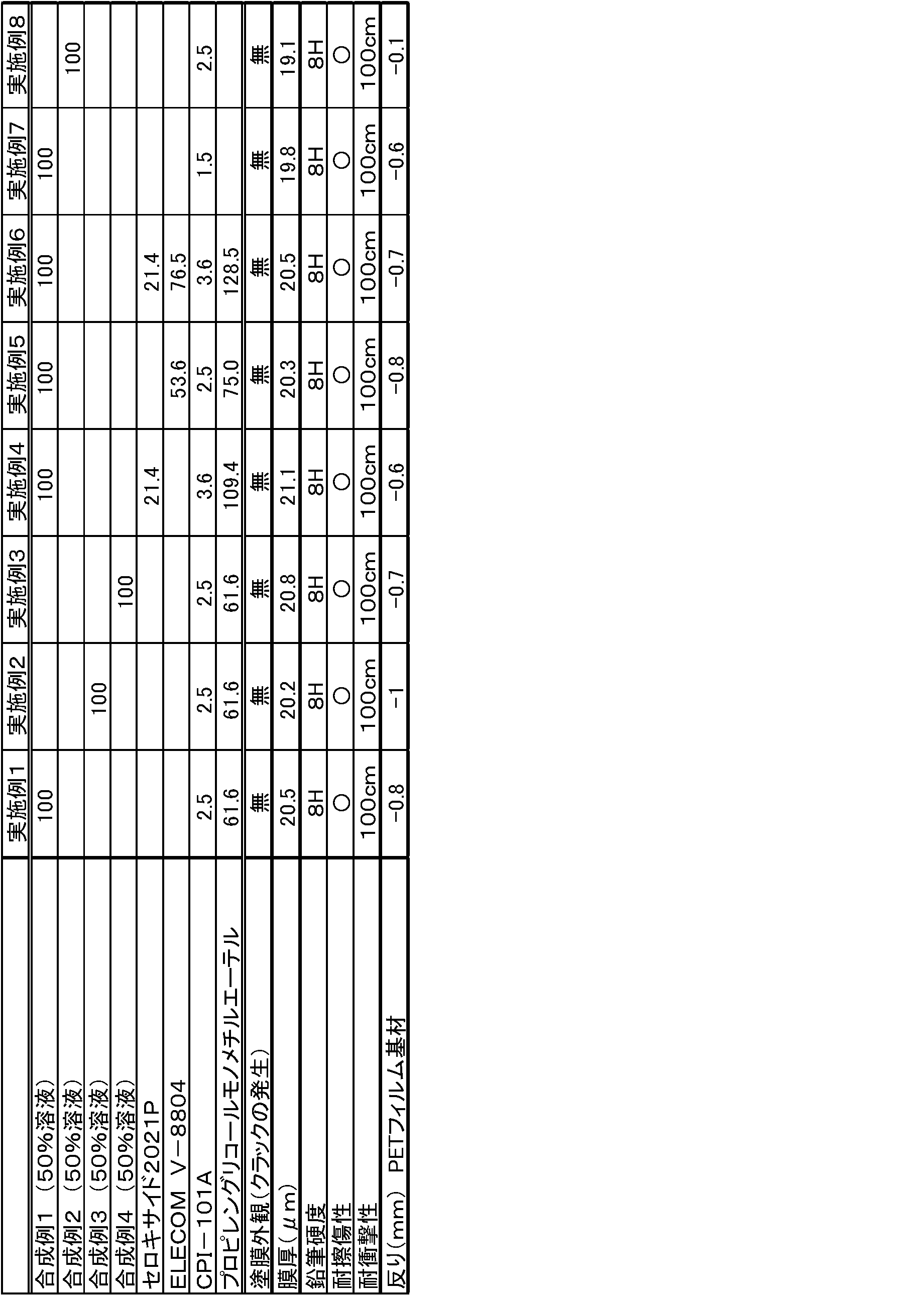

・膜厚
活性エネルギー線照射7日後に膜厚計を用いて測定し、基材の厚みを差し引いて算出した。
・硬度
照射7日後にJIS K5600に準拠して、鉛筆硬度を評価した。
・耐擦傷性
照射7日後に消しゴム磨耗試験機(株式会社光本製作所製)を用い、500g/cm2の荷重をかけてスチールウール#0000を1000回往復させ、塗膜に残った傷の本数を観察した。
○:全くないか3本以下の傷
△:4本から10本の浅い傷
×:傷が10本を超えるか、もしくは深い傷
・耐衝撃性
照射7日後、22gの鋼球を10cm2の試験片の中心に落とし、塗膜に割れが発生した時の高さを測定した。
・反り
活性エネルギー線照射7日後に、積層体を85℃85%高温高湿機中で72時間保管し、取り出した4時間後、塗膜が上面となるように水平な台の上に設置した。積層体の上面の4つの頂点のそれぞれについて、台の上面から垂直方向の距離を測定し、その平均値を算出した。積層体が塗装した面側に反る(積層体の下面の角が台の面から浮く)場合には正の値、その逆の場合には負の値とした。
なお、PETフィルム基材単独で同条件で評価した結果は、0mmであった。
また、実施例1~8において、比較例5よりも反りが抑制されていることが分かる。
攪拌機、温度計、還流冷却器を備えた反応器に表4の成分を仕込み、130℃に昇温し、5時間撹拌後、70℃で減圧脱揮し、縮合物を得た。
得られた縮合物に関して、モル比Y/X、3,4-エポキシシクロヘキシル基の残存率、及び、重量平均分子量を測定した。
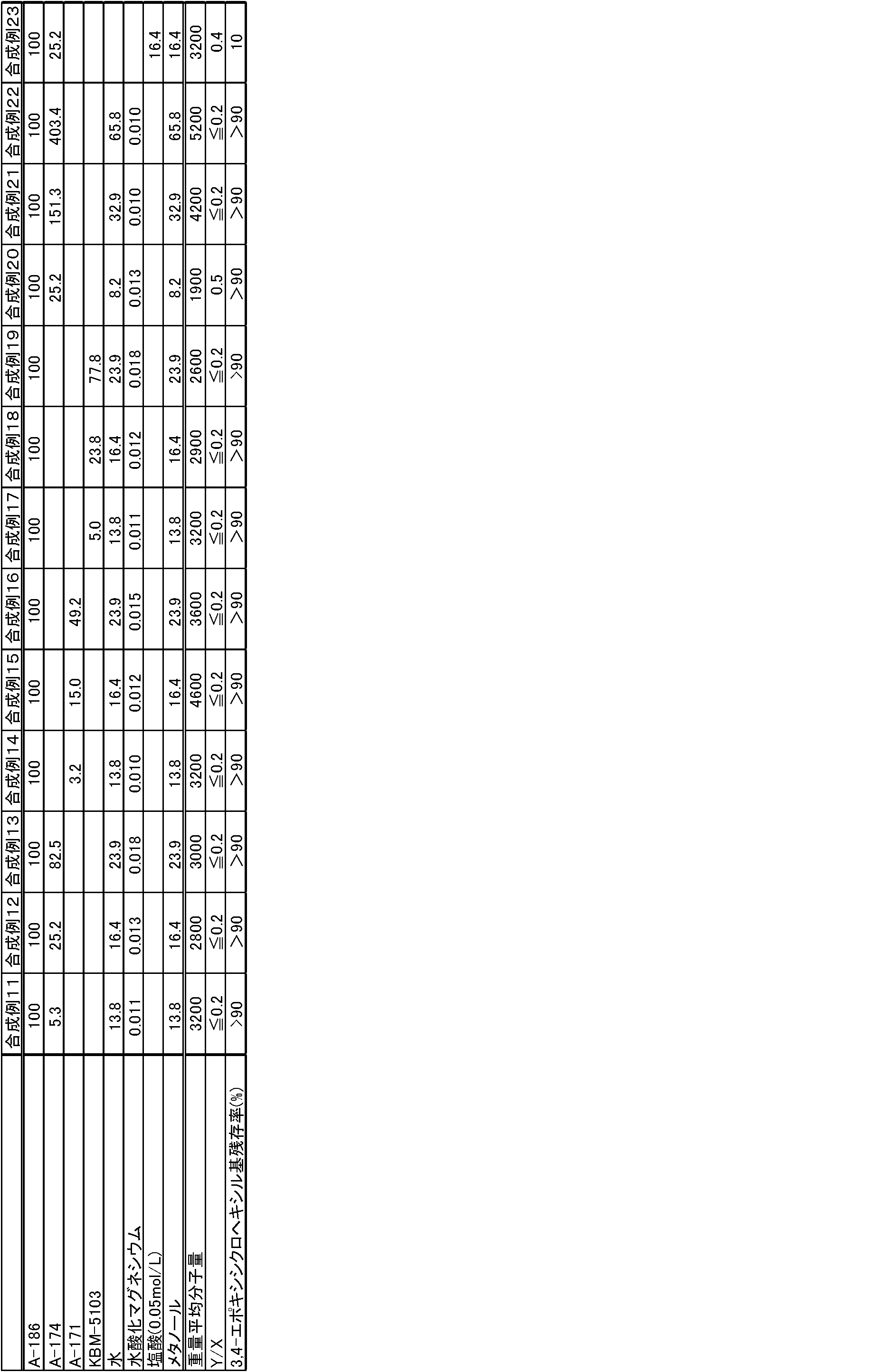
表5、6に示すように配合し(配合量の単位は、重量部)、塗工液を調製した。なお、合成例11~23で得られた縮合物は、不揮発分が50%になるようにプロピレングリコールモノメチルエーテルで希釈したものを使用した。この塗工液を、210mm×297mmの各種基材(実施例20はアクリルシート、実施例21はポリカーボネートシート、それ以外はPETフィルム)に、バーコーターNo.30を用いて、乾燥膜厚が約20μmとなるように塗布し、80℃で2分間溶剤除去のため乾燥した。次いで、空気中で高圧水銀ランプを用い、240mWで、波長310~390nmの積算光量が1000mJ/cm2となるように活性エネルギー線を照射することで硬化させ、試験片とした。
試験片の各物性を評価した(表5、6)。反りに関しては、7日養生直後の値も評価した。

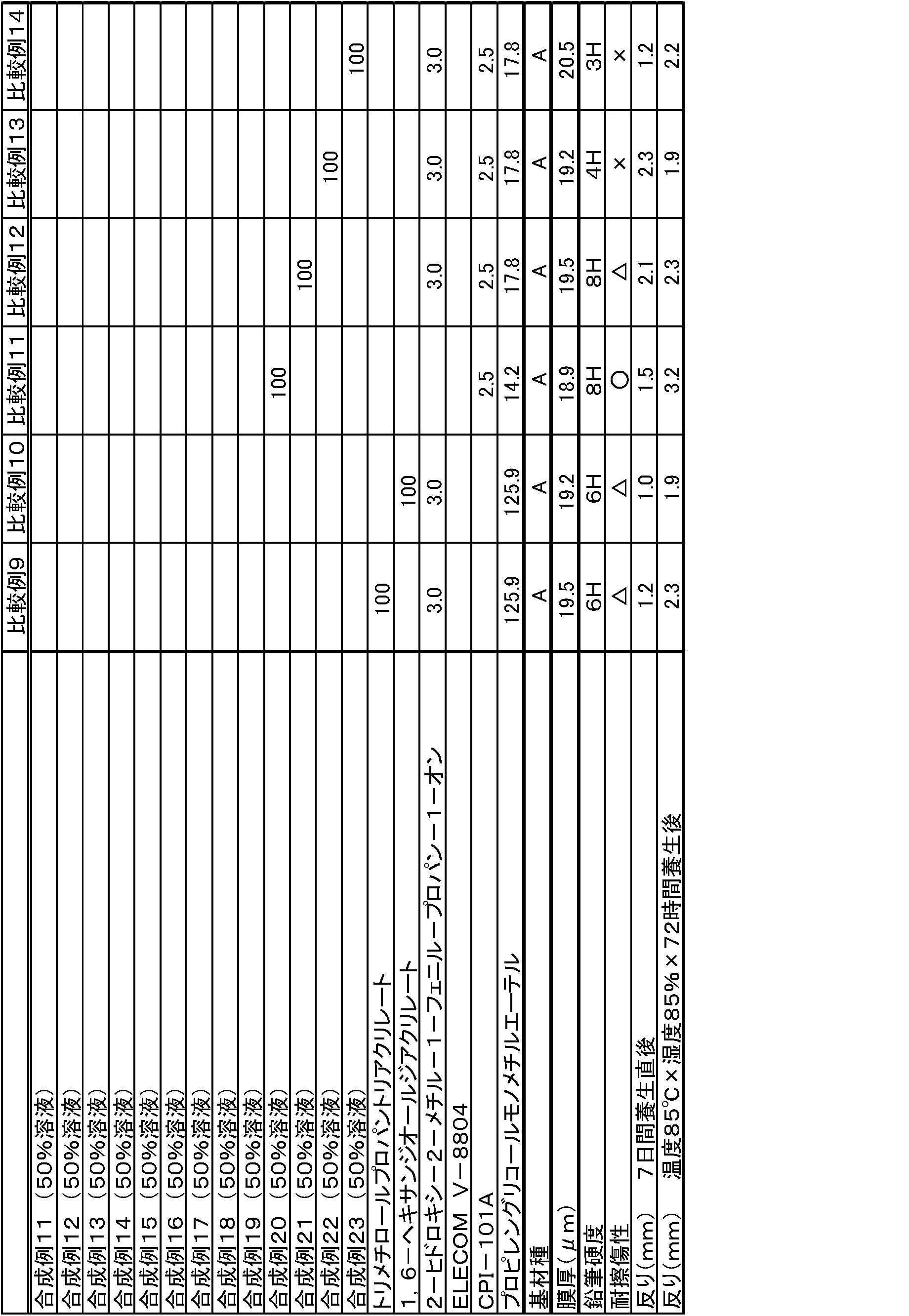
一方で、比較例9、10では、硬化させると、アクリレート基の重合に伴う硬化収縮を生じ、大きな反りが発生した。
また、比較例11では、縮合物中(A)に加水分解されていないアルコキシ基が50%残存しており、積層体作製時に反応するため、硬化収縮及び反りが実施例9よりも大きく発生した。
比較例12及び13では、縮合物(A)中のメタクリロイル基の数が多すぎるため、メタクリレート基の重合に伴う硬化収縮を生じ、大きな反りが発生した。
比較例14では、縮合物中(A)にアルコキシ基が40%残存していることから、比較例11と同様、硬化収縮及び反りが大きく発生しており、また、縮合物を調製する際に酸触媒を用いたことでエポキシシクロヘキシル基が加水分解してしまっていることから、硬度、耐擦傷性も実施例9と比較して低下している。
Claims (16)
- 下記一般式(I):
R1-(SiR2 a(OR3)3-a) (I)
(式中、R1は末端が3,4-エポキシシクロヘキシル基で置換された炭素数1~10のアルキル基であり、R2はそれぞれ独立して水素原子又は炭素数1~10のアルキル基、炭素数6~25のアリール基及び炭素数7~12のアラルキル基から選ばれる1価の炭化水素基であり、R3はそれぞれ独立して水素原子又は炭素数1~10のアルキル基である。aは0~2の整数である。)
で表される、加水分解性シリル基を有するシラン化合物(I)、及び、
下記一般式(II):
R4-Si(OR3)3 (II)
(式中、R4は炭素数1~10の置換若しくは非置換のアルキル基、アルケニル基、並びに、置換アリール基から選ばれ、3,4-エポキシシクロヘキシル基を有さない基であり、R3はそれぞれ独立して水素原子又は炭素数1~10のアルキル基である。)
で表される、加水分解性シリル基を有するシラン化合物(II)
を、シラン化合物(I)に対するシラン化合物(II)のモル比を2.0以下として塩基性条件下で加水分解・縮合させて得られる重量平均分子量20,000以下の縮合物(A)と、光酸発生剤(B)を含有し、
縮合物(A)の原料であるシラン化合物(I)及びシラン化合物(II)が有するケイ素原子に直接結合したOR3基のモル数Xに対する、縮合物(A)が有するケイ素原子に直接結合したOR3基のモル数Yの比Y/Xが0.2以下であることを特徴とする活性エネルギー線硬化性組成物。 - R1が、β-(3,4-エポキシシクロヘキシル)エチル基である、請求項1に記載の活性エネルギー線硬化性組成物。
- 縮合物(A)が、
シラン化合物(II)として、
下記一般式(II-1):
R5-Si(OR3)3 (II-1)
(式中、R5は(メタ)アクリロイル基、グリシジル基、若しくは、チオール基で置換された炭素数1~10のアルキル基、炭素数2~10のアルケニル基、並びに、置換アリール基から選ばれ、3,4-エポキシシクロヘキシル基を有さない基であり、R3はそれぞれ独立して水素原子又は炭素数1~10のアルキル基である。)で表される、加水分解性シリル基を有するシラン化合物(II-1)、及び、
下記一般式(II-2):
R6-Si(OR3)3 (II-2)
(式中、R6は、アミノ基、フェニル基、シクロヘキシル基、若しくは、クロロ基で置換された炭素数1~10のアルキル基、並びに、炭素数1~10の非置換アルキル基から選ばれ、3,4-エポキシシクロヘキシル基を有さない基であり、R3はそれぞれ独立して水素原子又は炭素数1~10のアルキル基である。)で表される、加水分解性シリル基を有するシラン化合物(II-2)を用い、
シラン化合物(I)に対するシラン化合物(II-1)のモル比を0.03~1.0、
シラン化合物(I)に対するシラン化合物(II-2)のモル比を0~1.0
として加水分解・縮合させて得られるものである、請求項1又は2に記載の活性エネルギー線硬化性組成物。 - 更に、脂環式エポキシ化合物(D)を含有する請求項1~3のいずれかに記載の活性エネルギー線硬化性組成物。
- 脂環式エポキシ化合物(D)が、3,4-エポキシシクロヘキシルメチル-3’,4’-エポキシシクロヘキサンカルボキシレートである、請求項4に記載の活性エネルギー線硬化性組成物。
- 更に、平均粒子径が100nm以下の金属酸化物微粒子(E)を含有する請求項1~5のいずれかに記載の活性エネルギー線硬化性組成物。
- 金属酸化物微粒子(E)がシリカ微粒子である請求項6に記載の活性エネルギー線硬化性組成物。
- 縮合物(A)100重量部に対して、光酸発生剤(B)を0.05~30重量部、脂環式エポキシ化合物(D)を0~100重量部、及び、金属酸化物微粒子(E)を0~100重量部含有する、請求項1~7のいずれかに記載の活性エネルギー線硬化性組成物。
- 光酸発生剤(B)が、芳香族スルホニウム塩又は芳香族ヨードニウム塩である請求項1~8のいずれかに記載の活性エネルギー線硬化性組成物。
- 光酸発生剤(B)のカウンターアニオンが、フルオロフォスフェート系アニオン又はフルオロアンチモネート系アニオンである請求項9に記載の活性エネルギー線硬化性組成物。
- 更に、光増感剤(F)を含有する請求項1~10のいずれかに記載の活性エネルギー線硬化性組成物。
- 光増感剤(F)が、アントラセン誘導体、チオキサントン誘導体、又は、ベンゾフェノン誘導体である請求項11に記載の活性エネルギー線硬化性組成物。
- 請求項1~12のいずれか一項に記載の活性エネルギー線硬化性組成物を硬化させて得られる硬化物。
- 請求項1~12のいずれか一項に記載の活性エネルギー線硬化性組成物を基材に塗布する工程、及び、活性エネルギー線を照射して活性エネルギー線硬化性組成物を硬化させ、硬化被膜を形成する工程を含む積層体の製造方法。
- 請求項14に記載の製造方法により得られる積層体。
- 請求項3に記載の活性エネルギー線硬化性組成物、及び、単層基材を使用することを特徴とする請求項15に記載の積層体。
Priority Applications (3)
| Application Number | Priority Date | Filing Date | Title |
|---|---|---|---|
| CN201480035324.7A CN105324407B (zh) | 2013-06-21 | 2014-06-23 | 活性能量线固化性组合物 |
| US14/899,826 US10227505B2 (en) | 2013-06-21 | 2014-06-23 | Active energy ray-curable composition |
| JP2015522995A JP6412867B2 (ja) | 2013-06-21 | 2014-06-23 | 活性エネルギー線硬化性組成物 |
Applications Claiming Priority (2)
| Application Number | Priority Date | Filing Date | Title |
|---|---|---|---|
| JP2013-130967 | 2013-06-21 | ||
| JP2013130967 | 2013-06-21 |
Publications (1)
| Publication Number | Publication Date |
|---|---|
| WO2014204010A1 true WO2014204010A1 (ja) | 2014-12-24 |
Family
ID=52104731
Family Applications (1)
| Application Number | Title | Priority Date | Filing Date |
|---|---|---|---|
| PCT/JP2014/066548 Ceased WO2014204010A1 (ja) | 2013-06-21 | 2014-06-23 | 活性エネルギー線硬化性組成物 |
Country Status (4)
| Country | Link |
|---|---|
| US (1) | US10227505B2 (ja) |
| JP (1) | JP6412867B2 (ja) |
| CN (1) | CN105324407B (ja) |
| WO (1) | WO2014204010A1 (ja) |
Cited By (13)
| Publication number | Priority date | Publication date | Assignee | Title |
|---|---|---|---|---|
| WO2016052636A1 (ja) * | 2014-10-02 | 2016-04-07 | 株式会社カネカ | 活性エネルギー線硬化性組成物 |
| JP2016193956A (ja) * | 2015-03-31 | 2016-11-17 | 株式会社カネカ | 光または熱硬化性樹脂組成物からなる積層体 |
| JP2017113943A (ja) * | 2015-12-22 | 2017-06-29 | 株式会社カネカ | 転写フィルム |
| WO2017110522A1 (ja) * | 2015-12-25 | 2017-06-29 | 株式会社ニコン・エシロール | ハードコート層形成用組成物、および、光学部材 |
| JPWO2016204014A1 (ja) * | 2015-06-17 | 2018-04-05 | 株式会社ダイセル | 硬化性組成物 |
| CN108350272A (zh) * | 2015-11-20 | 2018-07-31 | 三星Sdi株式会社 | 用于窗膜的组合物、由其形成的柔性窗膜和包含所述柔性窗膜的柔性显示器 |
| JP2018531999A (ja) * | 2016-06-24 | 2018-11-01 | ダウ グローバル テクノロジーズ エルエルシー | 硬化性樹脂組成物 |
| JP2018177952A (ja) * | 2017-04-12 | 2018-11-15 | 株式会社ダイセル | 硬化性組成物、硬化物及びハードコートフィルム |
| JP2018188618A (ja) * | 2017-04-28 | 2018-11-29 | パナソニックIpマネジメント株式会社 | 紫外線硬化性樹脂組成物、有機el発光装置の製造方法及び有機el発光装置 |
| JP2019056106A (ja) * | 2017-09-19 | 2019-04-11 | 三洋化成工業株式会社 | 活性エネルギー線硬化性組成物 |
| WO2021064534A2 (en) | 2019-10-03 | 2021-04-08 | 3M Innovative Properties Company | Silicone elastomers by free radical mediated cure |
| JP2023129477A (ja) * | 2019-03-22 | 2023-09-14 | 株式会社カネカ | 硬化物、硬化物の製造方法、硬化性樹脂組成物および硬化物の利用 |
| WO2025206154A1 (ja) * | 2024-03-27 | 2025-10-02 | 住友ベークライト株式会社 | ポリカーボネート積層体 |
Families Citing this family (5)
| Publication number | Priority date | Publication date | Assignee | Title |
|---|---|---|---|---|
| CN108473703B (zh) * | 2016-01-22 | 2021-05-04 | 三星Sdi株式会社 | 用于窗膜的组合物、由其形成的柔性窗膜以及包含该窗膜的显示装置 |
| JP2018002866A (ja) * | 2016-06-30 | 2018-01-11 | ホヤ レンズ タイランド リミテッドHOYA Lens Thailand Ltd | コーティング組成物、眼鏡レンズ及び眼鏡レンズの製造方法 |
| US10858541B2 (en) * | 2017-12-19 | 2020-12-08 | Rohm And Haas Electronic Materials Llc | Curable composition |
| US11846755B2 (en) * | 2019-02-11 | 2023-12-19 | Sk Innovation Co., Ltd. | Hard coating film and flexible display panel including the same |
| KR20220092957A (ko) * | 2019-12-05 | 2022-07-04 | 피피지 인더스트리즈 오하이오 인코포레이티드 | 경화성 조성물 |
Citations (3)
| Publication number | Priority date | Publication date | Assignee | Title |
|---|---|---|---|---|
| JP2008285502A (ja) * | 2007-04-19 | 2008-11-27 | Mitsubishi Rayon Co Ltd | 活性エネルギー線硬化性組成物および成形体 |
| JP2011518666A (ja) * | 2008-04-24 | 2011-06-30 | モメンティブ パフォーマンス マテリアルズ インコーポレイテッド | 可塑性ハードコートならびにそれによってコートされる基体 |
| JP2012533675A (ja) * | 2009-07-21 | 2012-12-27 | スリーエム イノベイティブ プロパティズ カンパニー | 硬化性組成物、フォトツールをコーティングする方法、及びコーティングされたフォトツール |
Family Cites Families (13)
| Publication number | Priority date | Publication date | Assignee | Title |
|---|---|---|---|---|
| US5457003A (en) * | 1990-07-06 | 1995-10-10 | Nippon Telegraph And Telephone Corporation | Negative working resist material, method for the production of the same and process of forming resist patterns using the same |
| JP3096861B2 (ja) * | 1991-11-21 | 2000-10-10 | 三菱レイヨン株式会社 | 被覆材組成物 |
| JP2000109695A (ja) * | 1998-08-04 | 2000-04-18 | Jsr Corp | 光硬化性樹脂組成物および硬化膜 |
| US7049044B2 (en) * | 2002-12-19 | 2006-05-23 | The University Of North Carolina At Charlotte | Nanocomposite negative resists for next generation lithographies |
| JP2004099467A (ja) * | 2002-09-05 | 2004-04-02 | Daicel Chem Ind Ltd | 脂環式エポキシ化合物の製造方法 |
| EP2546275B1 (en) | 2002-09-05 | 2023-09-20 | Daicel Corporation | Curable epoxy resin compositions, epoxy resin compositions for the encapsulation of electronic parts, stabilizers for electrical insulating oils, and casting epoxy resin compositions for electrical insulation. |
| JP2004204228A (ja) | 2002-12-13 | 2004-07-22 | Daicel Chem Ind Ltd | 硬化性エポキシ樹脂組成物および硬化物 |
| US7381784B2 (en) * | 2003-02-12 | 2008-06-03 | Nippon Kayaku Kabushiki Kaisha | Epoxy group-containing silicon compound and thermosetting resin composition |
| JP2004346144A (ja) * | 2003-05-21 | 2004-12-09 | Nippon Kayaku Co Ltd | エポキシ基を有するケイ素化合物及び熱硬化性樹脂組成物 |
| JP4412705B2 (ja) * | 2003-06-25 | 2010-02-10 | 日本化薬株式会社 | 感光性樹脂組成物及びその硬化皮膜を有するフィルム |
| GB0322485D0 (en) * | 2003-09-25 | 2003-10-29 | Disperse Ltd | Process for the preparation of surface coatings or dry films |
| JP2008248170A (ja) * | 2007-03-30 | 2008-10-16 | Nippon Steel Chem Co Ltd | 多官能エポキシシリコーン樹脂、その製造方法及び硬化性樹脂組成物 |
| JP5648518B2 (ja) * | 2011-02-10 | 2015-01-07 | Jsr株式会社 | ポジ型感放射線性樹脂組成物、表示素子用層間絶縁膜及びその形成方法 |
-
2014
- 2014-06-23 CN CN201480035324.7A patent/CN105324407B/zh active Active
- 2014-06-23 JP JP2015522995A patent/JP6412867B2/ja active Active
- 2014-06-23 US US14/899,826 patent/US10227505B2/en active Active
- 2014-06-23 WO PCT/JP2014/066548 patent/WO2014204010A1/ja not_active Ceased
Patent Citations (3)
| Publication number | Priority date | Publication date | Assignee | Title |
|---|---|---|---|---|
| JP2008285502A (ja) * | 2007-04-19 | 2008-11-27 | Mitsubishi Rayon Co Ltd | 活性エネルギー線硬化性組成物および成形体 |
| JP2011518666A (ja) * | 2008-04-24 | 2011-06-30 | モメンティブ パフォーマンス マテリアルズ インコーポレイテッド | 可塑性ハードコートならびにそれによってコートされる基体 |
| JP2012533675A (ja) * | 2009-07-21 | 2012-12-27 | スリーエム イノベイティブ プロパティズ カンパニー | 硬化性組成物、フォトツールをコーティングする方法、及びコーティングされたフォトツール |
Cited By (23)
| Publication number | Priority date | Publication date | Assignee | Title |
|---|---|---|---|---|
| WO2016052636A1 (ja) * | 2014-10-02 | 2016-04-07 | 株式会社カネカ | 活性エネルギー線硬化性組成物 |
| JP2016193956A (ja) * | 2015-03-31 | 2016-11-17 | 株式会社カネカ | 光または熱硬化性樹脂組成物からなる積層体 |
| JPWO2016204014A1 (ja) * | 2015-06-17 | 2018-04-05 | 株式会社ダイセル | 硬化性組成物 |
| CN108350272B (zh) * | 2015-11-20 | 2021-09-03 | 三星Sdi株式会社 | 用于窗膜的组合物、由其形成的柔性窗膜和包含所述柔性窗膜的柔性显示器 |
| CN108350272A (zh) * | 2015-11-20 | 2018-07-31 | 三星Sdi株式会社 | 用于窗膜的组合物、由其形成的柔性窗膜和包含所述柔性窗膜的柔性显示器 |
| JP2017113943A (ja) * | 2015-12-22 | 2017-06-29 | 株式会社カネカ | 転写フィルム |
| WO2017110522A1 (ja) * | 2015-12-25 | 2017-06-29 | 株式会社ニコン・エシロール | ハードコート層形成用組成物、および、光学部材 |
| CN108368382A (zh) * | 2015-12-25 | 2018-08-03 | 株式会社尼康依视路 | 硬涂层形成用组合物和光学部件 |
| US11525044B2 (en) | 2015-12-25 | 2022-12-13 | Nikon-Essilor Co., Ltd. | Hard-coat-layer-forming composition and optical member |
| JPWO2017110522A1 (ja) * | 2015-12-25 | 2018-11-22 | 株式会社ニコン・エシロール | ハードコート層形成用組成物、および、光学部材 |
| CN108368382B (zh) * | 2015-12-25 | 2020-04-24 | 株式会社尼康依视路 | 硬涂层形成用组合物和光学部件 |
| KR102057469B1 (ko) | 2016-06-24 | 2019-12-19 | 다우 글로벌 테크놀로지스 엘엘씨 | 경화성 수지 조성물 |
| JP2018531999A (ja) * | 2016-06-24 | 2018-11-01 | ダウ グローバル テクノロジーズ エルエルシー | 硬化性樹脂組成物 |
| JP2018177952A (ja) * | 2017-04-12 | 2018-11-15 | 株式会社ダイセル | 硬化性組成物、硬化物及びハードコートフィルム |
| JP2018188618A (ja) * | 2017-04-28 | 2018-11-29 | パナソニックIpマネジメント株式会社 | 紫外線硬化性樹脂組成物、有機el発光装置の製造方法及び有機el発光装置 |
| JP7199004B2 (ja) | 2017-04-28 | 2023-01-05 | パナソニックIpマネジメント株式会社 | 紫外線硬化性樹脂組成物、及び有機el発光装置 |
| JP2019056106A (ja) * | 2017-09-19 | 2019-04-11 | 三洋化成工業株式会社 | 活性エネルギー線硬化性組成物 |
| JP7352334B2 (ja) | 2017-09-19 | 2023-09-28 | 三洋化成工業株式会社 | 活性エネルギー線硬化性組成物 |
| JP2023129477A (ja) * | 2019-03-22 | 2023-09-14 | 株式会社カネカ | 硬化物、硬化物の製造方法、硬化性樹脂組成物および硬化物の利用 |
| JP7522273B2 (ja) | 2019-03-22 | 2024-07-24 | 株式会社カネカ | 硬化物、硬化物の製造方法、硬化性樹脂組成物および硬化物の利用 |
| WO2021064534A2 (en) | 2019-10-03 | 2021-04-08 | 3M Innovative Properties Company | Silicone elastomers by free radical mediated cure |
| US12234389B2 (en) | 2019-10-03 | 2025-02-25 | 3M Innovative Properties Company | Silicone elastomers by free radical mediated cure |
| WO2025206154A1 (ja) * | 2024-03-27 | 2025-10-02 | 住友ベークライト株式会社 | ポリカーボネート積層体 |
Also Published As
| Publication number | Publication date |
|---|---|
| JPWO2014204010A1 (ja) | 2017-02-23 |
| JP6412867B2 (ja) | 2018-10-24 |
| US10227505B2 (en) | 2019-03-12 |
| CN105324407A (zh) | 2016-02-10 |
| CN105324407B (zh) | 2017-07-28 |
| US20160145467A1 (en) | 2016-05-26 |
Similar Documents
| Publication | Publication Date | Title |
|---|---|---|
| JP6412867B2 (ja) | 活性エネルギー線硬化性組成物 | |
| JP6853668B2 (ja) | 光及び熱硬化性樹脂組成物、硬化物、並びに積層体 | |
| JP4959892B2 (ja) | 耐磨性及び着色性コーティングを与えるコーティング組成物 | |
| JP6557041B2 (ja) | 光または熱硬化性樹脂組成物からなる積層体 | |
| KR100759203B1 (ko) | 코팅 조성물 및 그의 경화 피막을 갖는 물품 | |
| JP6016784B2 (ja) | 活性エネルギー線硬化性コーティング用樹脂組成物 | |
| WO2008087741A1 (en) | Hardcoat composition | |
| CN105408435A (zh) | 用于包覆有机/无机基材的活性能量线固化性树脂组合物 | |
| JP6545482B2 (ja) | 光または熱硬化性樹脂組成物、硬化物及び積層体 | |
| JP7699063B2 (ja) | ハードコーフィルムおよびその製造方法 | |
| JP7522273B2 (ja) | 硬化物、硬化物の製造方法、硬化性樹脂組成物および硬化物の利用 | |
| JP6072493B2 (ja) | 活性エネルギー線硬化性コーティング用樹脂組成物 | |
| JP6639898B2 (ja) | 転写フィルム | |
| JP6039349B2 (ja) | 活性エネルギー線硬化性コーティング用樹脂組成物 | |
| WO2016052636A1 (ja) | 活性エネルギー線硬化性組成物 | |
| CN110437655B (zh) | TiO2改性的聚丙烯酸脂/有机硅杂化涂料及其制备方法 | |
| WO2022191328A1 (ja) | フィルムおよびその製造方法、積層フィルム、ならびにディスプレイ | |
| JP6016570B2 (ja) | 活性エネルギー線硬化性コーティング用樹脂組成物 | |
| WO2023008493A1 (ja) | シラン化合物およびその製造方法、ポリオルガノシロキサン化合物、ハードコート組成物、ハードコーフィルムおよびその製造方法、ならびにディスプレイ | |
| JP6062661B2 (ja) | 活性エネルギー線硬化性コーティング用樹脂組成物 | |
| JP2012116173A (ja) | 保護被膜を有する積層体 | |
| JP7719665B2 (ja) | ハードコート組成物、ならびにハードコートフィルムおよびその製造方法 | |
| WO2022270471A1 (ja) | ハードコートフィルムおよびその製造方法、ならびにディスプレイ | |
| WO2023008492A1 (ja) | ハードコートフィルムおよびその製造方法、ならびにディスプレイ |
Legal Events
| Date | Code | Title | Description |
|---|---|---|---|
| WWE | Wipo information: entry into national phase |
Ref document number: 201480035324.7 Country of ref document: CN |
|
| 121 | Ep: the epo has been informed by wipo that ep was designated in this application |
Ref document number: 14814620 Country of ref document: EP Kind code of ref document: A1 |
|
| ENP | Entry into the national phase |
Ref document number: 2015522995 Country of ref document: JP Kind code of ref document: A |
|
| WWE | Wipo information: entry into national phase |
Ref document number: 14899826 Country of ref document: US |
|
| NENP | Non-entry into the national phase |
Ref country code: DE |
|
| 122 | Ep: pct application non-entry in european phase |
Ref document number: 14814620 Country of ref document: EP Kind code of ref document: A1 |