WO2014196642A1 - 人工毛髪用繊維及びそれを含む頭飾製品 - Google Patents
人工毛髪用繊維及びそれを含む頭飾製品 Download PDFInfo
- Publication number
- WO2014196642A1 WO2014196642A1 PCT/JP2014/065138 JP2014065138W WO2014196642A1 WO 2014196642 A1 WO2014196642 A1 WO 2014196642A1 JP 2014065138 W JP2014065138 W JP 2014065138W WO 2014196642 A1 WO2014196642 A1 WO 2014196642A1
- Authority
- WO
- WIPO (PCT)
- Prior art keywords
- fiber
- section
- cross
- artificial hair
- hair
- Prior art date
- Legal status (The legal status is an assumption and is not a legal conclusion. Google has not performed a legal analysis and makes no representation as to the accuracy of the status listed.)
- Ceased
Links
Images




Classifications
-
- A—HUMAN NECESSITIES
- A41—WEARING APPAREL
- A41G—ARTIFICIAL FLOWERS; WIGS; MASKS; FEATHERS
- A41G3/00—Wigs
- A41G3/0083—Wigs characterised by their hair filaments
-
- A—HUMAN NECESSITIES
- A41—WEARING APPAREL
- A41G—ARTIFICIAL FLOWERS; WIGS; MASKS; FEATHERS
- A41G5/00—Hair pieces, inserts, rolls, pads, or the like; Toupées
- A41G5/004—Hairpieces, e.g. hair extensions
-
- A—HUMAN NECESSITIES
- A63—SPORTS; GAMES; AMUSEMENTS
- A63H—TOYS, e.g. TOPS, DOLLS, HOOPS OR BUILDING BLOCKS
- A63H3/00—Dolls
- A63H3/36—Details; Accessories
- A63H3/44—Dolls' hair or wigs; Eyelashes; Eyebrows
-
- D—TEXTILES; PAPER
- D01—NATURAL OR MAN-MADE THREADS OR FIBRES; SPINNING
- D01D—MECHANICAL METHODS OR APPARATUS IN THE MANUFACTURE OF ARTIFICIAL FILAMENTS, THREADS, FIBRES, BRISTLES OR RIBBONS
- D01D5/00—Formation of filaments, threads, or the like
- D01D5/22—Formation of filaments, threads, or the like with a crimped or curled structure; with a special structure to simulate wool
-
- D—TEXTILES; PAPER
- D01—NATURAL OR MAN-MADE THREADS OR FIBRES; SPINNING
- D01D—MECHANICAL METHODS OR APPARATUS IN THE MANUFACTURE OF ARTIFICIAL FILAMENTS, THREADS, FIBRES, BRISTLES OR RIBBONS
- D01D5/00—Formation of filaments, threads, or the like
- D01D5/24—Formation of filaments, threads, or the like with a hollow structure; Spinnerette packs therefor
-
- D—TEXTILES; PAPER
- D01—NATURAL OR MAN-MADE THREADS OR FIBRES; SPINNING
- D01D—MECHANICAL METHODS OR APPARATUS IN THE MANUFACTURE OF ARTIFICIAL FILAMENTS, THREADS, FIBRES, BRISTLES OR RIBBONS
- D01D5/00—Formation of filaments, threads, or the like
- D01D5/253—Formation of filaments, threads, or the like with a non-circular cross section; Spinnerette packs therefor
-
- D—TEXTILES; PAPER
- D01—NATURAL OR MAN-MADE THREADS OR FIBRES; SPINNING
- D01F—CHEMICAL FEATURES IN THE MANUFACTURE OF ARTIFICIAL FILAMENTS, THREADS, FIBRES, BRISTLES OR RIBBONS; APPARATUS SPECIALLY ADAPTED FOR THE MANUFACTURE OF CARBON FILAMENTS
- D01F1/00—General methods for the manufacture of artificial filaments or the like
- D01F1/02—Addition of substances to the spinning solution or to the melt
- D01F1/07—Addition of substances to the spinning solution or to the melt for making fire- or flame-proof filaments
-
- D—TEXTILES; PAPER
- D01—NATURAL OR MAN-MADE THREADS OR FIBRES; SPINNING
- D01F—CHEMICAL FEATURES IN THE MANUFACTURE OF ARTIFICIAL FILAMENTS, THREADS, FIBRES, BRISTLES OR RIBBONS; APPARATUS SPECIALLY ADAPTED FOR THE MANUFACTURE OF CARBON FILAMENTS
- D01F6/00—Monocomponent artificial filaments or the like of synthetic polymers; Manufacture thereof
- D01F6/58—Monocomponent artificial filaments or the like of synthetic polymers; Manufacture thereof from homopolycondensation products
- D01F6/62—Monocomponent artificial filaments or the like of synthetic polymers; Manufacture thereof from homopolycondensation products from polyesters
-
- D—TEXTILES; PAPER
- D01—NATURAL OR MAN-MADE THREADS OR FIBRES; SPINNING
- D01F—CHEMICAL FEATURES IN THE MANUFACTURE OF ARTIFICIAL FILAMENTS, THREADS, FIBRES, BRISTLES OR RIBBONS; APPARATUS SPECIALLY ADAPTED FOR THE MANUFACTURE OF CARBON FILAMENTS
- D01F6/00—Monocomponent artificial filaments or the like of synthetic polymers; Manufacture thereof
- D01F6/78—Monocomponent artificial filaments or the like of synthetic polymers; Manufacture thereof from copolycondensation products
-
- D—TEXTILES; PAPER
- D01—NATURAL OR MAN-MADE THREADS OR FIBRES; SPINNING
- D01F—CHEMICAL FEATURES IN THE MANUFACTURE OF ARTIFICIAL FILAMENTS, THREADS, FIBRES, BRISTLES OR RIBBONS; APPARATUS SPECIALLY ADAPTED FOR THE MANUFACTURE OF CARBON FILAMENTS
- D01F6/00—Monocomponent artificial filaments or the like of synthetic polymers; Manufacture thereof
- D01F6/28—Monocomponent artificial filaments or the like of synthetic polymers; Manufacture thereof from copolymers obtained by reactions only involving carbon-to-carbon unsaturated bonds
- D01F6/32—Monocomponent artificial filaments or the like of synthetic polymers; Manufacture thereof from copolymers obtained by reactions only involving carbon-to-carbon unsaturated bonds comprising halogenated hydrocarbons as the major constituent
-
- D—TEXTILES; PAPER
- D01—NATURAL OR MAN-MADE THREADS OR FIBRES; SPINNING
- D01F—CHEMICAL FEATURES IN THE MANUFACTURE OF ARTIFICIAL FILAMENTS, THREADS, FIBRES, BRISTLES OR RIBBONS; APPARATUS SPECIALLY ADAPTED FOR THE MANUFACTURE OF CARBON FILAMENTS
- D01F6/00—Monocomponent artificial filaments or the like of synthetic polymers; Manufacture thereof
- D01F6/28—Monocomponent artificial filaments or the like of synthetic polymers; Manufacture thereof from copolymers obtained by reactions only involving carbon-to-carbon unsaturated bonds
- D01F6/40—Modacrylic fibres, i.e. containing 35 to 85% acrylonitrile
-
- D—TEXTILES; PAPER
- D01—NATURAL OR MAN-MADE THREADS OR FIBRES; SPINNING
- D01F—CHEMICAL FEATURES IN THE MANUFACTURE OF ARTIFICIAL FILAMENTS, THREADS, FIBRES, BRISTLES OR RIBBONS; APPARATUS SPECIALLY ADAPTED FOR THE MANUFACTURE OF CARBON FILAMENTS
- D01F6/00—Monocomponent artificial filaments or the like of synthetic polymers; Manufacture thereof
- D01F6/58—Monocomponent artificial filaments or the like of synthetic polymers; Manufacture thereof from homopolycondensation products
- D01F6/60—Monocomponent artificial filaments or the like of synthetic polymers; Manufacture thereof from homopolycondensation products from polyamides
-
- D—TEXTILES; PAPER
- D01—NATURAL OR MAN-MADE THREADS OR FIBRES; SPINNING
- D01F—CHEMICAL FEATURES IN THE MANUFACTURE OF ARTIFICIAL FILAMENTS, THREADS, FIBRES, BRISTLES OR RIBBONS; APPARATUS SPECIALLY ADAPTED FOR THE MANUFACTURE OF CARBON FILAMENTS
- D01F6/00—Monocomponent artificial filaments or the like of synthetic polymers; Manufacture thereof
- D01F6/58—Monocomponent artificial filaments or the like of synthetic polymers; Manufacture thereof from homopolycondensation products
- D01F6/62—Monocomponent artificial filaments or the like of synthetic polymers; Manufacture thereof from homopolycondensation products from polyesters
- D01F6/64—Monocomponent artificial filaments or the like of synthetic polymers; Manufacture thereof from homopolycondensation products from polyesters from polycarbonates
-
- D—TEXTILES; PAPER
- D01—NATURAL OR MAN-MADE THREADS OR FIBRES; SPINNING
- D01F—CHEMICAL FEATURES IN THE MANUFACTURE OF ARTIFICIAL FILAMENTS, THREADS, FIBRES, BRISTLES OR RIBBONS; APPARATUS SPECIALLY ADAPTED FOR THE MANUFACTURE OF CARBON FILAMENTS
- D01F6/00—Monocomponent artificial filaments or the like of synthetic polymers; Manufacture thereof
- D01F6/58—Monocomponent artificial filaments or the like of synthetic polymers; Manufacture thereof from homopolycondensation products
- D01F6/76—Monocomponent artificial filaments or the like of synthetic polymers; Manufacture thereof from homopolycondensation products from other polycondensation products
- D01F6/765—Monocomponent artificial filaments or the like of synthetic polymers; Manufacture thereof from homopolycondensation products from other polycondensation products from polyarylene sulfides
-
- D—TEXTILES; PAPER
- D01—NATURAL OR MAN-MADE THREADS OR FIBRES; SPINNING
- D01F—CHEMICAL FEATURES IN THE MANUFACTURE OF ARTIFICIAL FILAMENTS, THREADS, FIBRES, BRISTLES OR RIBBONS; APPARATUS SPECIALLY ADAPTED FOR THE MANUFACTURE OF CARBON FILAMENTS
- D01F6/00—Monocomponent artificial filaments or the like of synthetic polymers; Manufacture thereof
- D01F6/78—Monocomponent artificial filaments or the like of synthetic polymers; Manufacture thereof from copolycondensation products
- D01F6/84—Monocomponent artificial filaments or the like of synthetic polymers; Manufacture thereof from copolycondensation products from copolyesters
-
- D—TEXTILES; PAPER
- D10—INDEXING SCHEME ASSOCIATED WITH SUBLASSES OF SECTION D, RELATING TO TEXTILES
- D10B—INDEXING SCHEME ASSOCIATED WITH SUBLASSES OF SECTION D, RELATING TO TEXTILES
- D10B2331/00—Fibres made from polymers obtained otherwise than by reactions only involving carbon-to-carbon unsaturated bonds, e.g. polycondensation products
- D10B2331/04—Fibres made from polymers obtained otherwise than by reactions only involving carbon-to-carbon unsaturated bonds, e.g. polycondensation products polyesters, e.g. polyethylene terephthalate [PET]
-
- D—TEXTILES; PAPER
- D10—INDEXING SCHEME ASSOCIATED WITH SUBLASSES OF SECTION D, RELATING TO TEXTILES
- D10B—INDEXING SCHEME ASSOCIATED WITH SUBLASSES OF SECTION D, RELATING TO TEXTILES
- D10B2501/00—Wearing apparel
Definitions
- the present invention relates to a fiber for artificial hair that can be used as a substitute for human hair, and more particularly to a fiber for artificial hair having a gap in the center of the cross section of the fiber and a hair ornament product including the same.
- Patent Document 1 discloses an artificial hair made of polyvinyl alcohol fibers having a dry heat shrinkage rate of 10% or less at 180 ° C. and a fineness of 25 to 100 denier as artificial hair that can be curled with a hair iron.
- Patent Document 2 describes artificial hair having hollow fibers having hollow portions with a hollow ratio of 10 to 50% as artificial hair having curl characteristics.
- the artificial hair described in Patent Document 1 is a thermoplastic resin
- the shape can be deformed by heating, but the shape cannot be fixed at that temperature, so it is necessary to cool the shape while maintaining the shape. There is. Specifically, it is necessary to hold the fiber by hand after applying the curl so that the curled shape does not collapse until the temperature of the fiber is lower than the glass transition point.
- this operation is called cooling
- the artificial hair described in Patent Document 1 has poor curl setting properties when curling with a hair iron when the cooling time is shortened.
- the present inventors have found that the artificial hair described in Patent Document 2 has a good curl setting property, but has a problem that the combing property greatly decreases after curling with a hair iron. It was.
- the present invention provides a fiber for artificial hair that has good curling properties when curling with a hair iron and has good combability even after curling with a hair iron. And a headdress product including the same.
- the present invention has a void at the center of the fiber cross section, the ratio of the area of the void to the entire area of the fiber cross section is 5% or more and 50% or less, and the cross-sectional shape of the fiber cross section is a flat multilobal shape
- the voids have a first side and a second side having an inclination of 70 degrees or more and 110 degrees or less with respect to the major axis of the fiber cross section.
- the cross-sectional shape of the fiber cross section is preferably a flat bilobal shape in which two circles or two ellipses are joined via a recess.
- the ratio of the length of the major axis to the length of the first minor axis is preferably 1.2 or more and 3.0 or less.
- the length of the first side and the second side of the gap is preferably 5 ⁇ m or more.
- the average value of the maximum linear distance and the minimum linear distance between the first side and the second side of the gap is the maximum linear distance and the minimum between the first short axis and the second short axis of the fiber cross section. It is preferably 20% or more and 180% or less of the average value of the linear distance.
- the artificial hair fiber is selected from the group consisting of a polyester resin composition, a polyamide resin composition, a vinyl chloride resin composition, a modacrylic resin composition, a polycarbonate resin composition, and a polyphenylene sulfide resin composition.
- a polyester resin composition Preferably 100 parts by weight of at least one polyester resin selected from the group consisting of polyalkylene terephthalates and copolymerized polyesters mainly composed of polyalkylene terephthalates, and brominated epoxy.
- the flame retardant is composed of a polyester resin composition containing 5 parts by weight or more and 40 parts by weight or less of the flame retardant.
- the said fiber for artificial hair is bent by the process by a gear crimp.
- the present invention also relates to a headdress product characterized by including the artificial hair fiber described above.
- the head decoration product may be any one selected from the group consisting of hair wigs, wigs, weaving, hair extensions, blade hairs, hair accessories, and doll hairs. Moreover, the said headdress product may be heat-processed in the temperature range of 120 to 240 degreeC with the hair iron.
- FIG. 1 is a schematic view showing a fiber cross section of a fiber for artificial hair according to an embodiment of the present invention.
- FIG. 2 is a schematic diagram for explaining the stress in the fiber cross section when pressure is applied from the outside to the artificial hair fiber of one embodiment of the present invention.
- FIG. 3 is a schematic diagram of a cross-section of a saddle-shaped fiber.
- FIG. 4 is a schematic diagram of a cross section of a spectacle-shaped fiber.
- Drawing 5 is a mimetic diagram explaining the length of the major axis in the fiber section of the fiber for artificial hair of one embodiment of the present invention, and the length of the 1st minor axis.
- FIG. 6A is a schematic diagram of a cross section of a flat bilobal fiber having a square gap, FIG.
- FIG. 6B is a schematic diagram of a cross section of a flat bilobal fiber having a hexagonal gap
- FIG. It is a schematic diagram of a cross section of a flat bilobal fiber having a gap formed by a combination
- FIG. 7A is a schematic diagram of a fiber cross section of a hollow fiber having a circular void
- FIG. 7B is a schematic diagram illustrating a stress in the fiber cross section when pressure is applied to the fiber from the outside
- FIG. It is a schematic diagram explaining that is split by the pressure from the outside.
- FIG. 8A is a schematic diagram of a nozzle used for producing the fiber of Example 1
- FIG. 8B is a schematic diagram of the nozzle used for producing the fiber of Comparative Example 1.
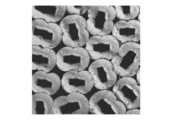
- FIG. 9 is a scanning electron micrograph (magnification 400 times) of the fiber cross section of the fiber of Example 1.
- FIG. 10 is a scanning electron micrograph (magnification 400 times) of the fiber cross section after curling with the hair iron of the fiber of Example 1.
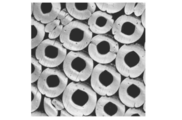
- FIG. 11 is a scanning electron micrograph (magnification 400 times) of the fiber cross section of the fiber of Comparative Example 1.
- FIG. 12 is a scanning electron micrograph (magnification 400 times) of a fiber cross section after curling with a hair iron of the fiber of Comparative Example 1.
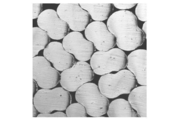
- FIG. 13 is a scanning electron micrograph (magnification 400 times) of the fiber cross section of the fiber of Comparative Example 2.
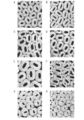
- 15A to 15H are scanning electron micrographs (magnification 400 times) of the fiber cross sections of Examples 2 to 8 and Comparative Example 4, respectively.
- the cross-sectional shape of the fiber cross section is a flat multilobal shape, for example, two circular or two, in a fiber having a gap at the center of the fiber cross section.
- the two cross-sections are formed into a flat bilobal shape in which two ellipses are connected via a concave portion, and a void having a first side and a second side that is inclined at 70 ° to 110 ° with respect to the major axis of the fiber cross section It has been found that, by providing it at the center part, it has excellent curl setting properties when imparting curl with a hair iron, and also has excellent combing properties after imparting curl with a hair iron, leading to the present invention.
- a flat bilobal shape in which two circles or ellipses are joined via a recess is a substantially bowl shape.
- gap in the center part of a fiber cross section, and the cross-sectional shape of a fiber cross section means an outer periphery shape.
- hair iron set means “to curl with a hair iron”.
- substantially vertical means an inclination of 70 degrees to 110 degrees.
- the fiber for artificial hair of the present invention has a flat multilobal fiber cross section.
- the flat multilobal shape is not particularly limited as long as it has two or more lobes.
- the artificial hair fiber of the present invention may have a flat multilobal fiber cross-section in which two or more circular or elliptical shapes are bonded via a recess.
- the fiber for artificial hair of the present invention has a void at the center of the fiber cross section.
- the term “void” refers to a continuous gap of 10 cm or more in the fiber axis direction, and does not include discontinuous voids generated by foaming or peeling in the fiber production process.
- a fiber having continuous voids inside the fiber is called a hollow fiber, and generally has a circular or elliptical void as described in Patent Document 2, for example.
- the present inventors have a gap at the center of the fiber cross section, so that it is not necessary to heat or cool to the center of the fiber at the time of setting the hair iron. It was found that the next moment increased, curling of the curl due to its own weight was suppressed by weight reduction, and the time required for cooling when setting the hair iron could be reduced.
- the gap in the fiber cross section is circular or oval
- the space is deformed by 200 and the volume of the gap 110 is reduced. Further, since the deformation stress 300 is concentrated at both ends (both end points) 111 of the gap in the direction perpendicular to the pressure 200, the fiber cross section 100 may be broken and the shape of the fiber cross section 100 may be broken.
- the fibers are frequently crimped at a high temperature during processing with a hair iron, and there are many processes for compressing the fibers with high pressure, such as processing with gear crimps, in the processing factory for head ornament products. It is easy to mix broken fibers. As shown in FIG. 7C, such a fiber whose cross-sectional shape is broken is presumed to cause the fiber to be easily split and cause the fiber to be entangled, resulting in a large frictional resistance and a deterioration in combing property.
- the gap has a first side and a second side that are substantially perpendicular to the major axis of the fiber cross section. That is, in the fiber for artificial hair of the present invention, the first side has an inclination of 70 degrees to 110 degrees with respect to the long axis of the fiber cross section. In the artificial hair fiber of the present invention, the second side has an inclination of 70 degrees or more and 110 degrees or less with respect to the major axis of the fiber cross section.
- the “long axis of the fiber cross section” is the maximum length of the line cross section of the fiber cross section and any two points on the outer periphery of the fiber cross section so as to be parallel to the line symmetry axis. Means a straight line.
- FIG. 1 is a schematic view showing a fiber cross section of an artificial hair fiber according to an embodiment of the present invention.
- the fiber cross section 1 has a flat multilobal shape, specifically, a flat bilobal structure in which two ellipses 10a and 10b are joined via recesses 20a and 20b.
- the long axis of the fiber cross section is perpendicular to the straight line that minimizes the straight line distance between the two recesses.
- the straight line that minimizes the straight line distance between two recesses is a straight line 22 connecting the bottom point 21a of the recess 20a and the bottom point 21b of the recess 20b.
- the long axis 11 is a straight line connecting two points having the maximum length when connecting arbitrary points on the outer periphery of the fiber cross section so as to be perpendicular to the straight line 22.
- the pressure 200 from the outside is dispersed in the two oval shapes 10a and 10b on both sides of the recesses 20a and 20b of the fiber cross section 1. It tends to act on the apexes of the four convex portions in the direction perpendicular to the long axis 11. And since the space
- FIG. 9 is a scanning electron micrograph (400 magnifications) of the fiber cross section of the fiber of Example 1 in the present invention
- FIG. 10 is a scanning electron micrograph of the fiber cross section of the fiber after the hair iron set ( (Magnification 400 times).
- FIG. 11 is a scanning electron micrograph of the fiber cross section of the fiber of Comparative Example 1 in the present invention (magnification 400 times)
- FIG. 12 is a scanning electron micrograph of the fiber cross section of the fiber after the hair iron set ( (Magnification 400 times).
- two circular or two oval shapes have a flat bilobal cross-sectional shape joined through a recess, and are substantially perpendicular to the long axis of the fiber cross section.
- gap which has 1 side and 2nd side in the center part of a fiber cross section does not have a crack of a fiber cross section, even after hair iron setting (pressure was applied from the outside).
- the hollow fiber having a circular gap has a hair iron set (pressure is applied from the outside), so that the fiber cross section of some fibers is deformed, and the fiber Is split.
- the artificial hair fiber Since the artificial hair fiber has a flat multilobal fiber cross section, there will be convex portions on both sides of the concave portion, so that the pressure applied to the fiber from the outside is reduced by the thickness of the fiber cross section. It can be dispersed in thick convex portions, and the phenomenon that the fiber cross section is broken can be suppressed.
- the artificial hair fiber has a flat bilobal fiber cross-section in which two circular or two elliptical shapes are joined via a recess, the thick protrusions on both sides of the two recesses. There are four parts. Thereby, the pressure applied to the fiber from the outside can be dispersed in the four convex portions having a thick fiber cross section, and the phenomenon that the fiber cross section is broken can be suppressed.
- the circular or elliptical shape is not particularly limited, but the ratio of the maximum length to the minimum length in a straight line passing through the center point of the circular or elliptical shape is in the range of 1 to 3. Preferably, it is in the range of 1.1 to 2.5, and more preferably in the range of 1.2 to 2.0.
- the ratio of the maximum length and the minimum length is within the above range on a straight line passing through the center point of a circle or an ellipse, the tactile sensation and appearance can be kept good.
- the circular or elliptical shape does not necessarily need to draw a continuous arc, and includes a substantially circular or substantially elliptical shape that is partially deformed unless it is an acute angle. Moreover, it is not necessary to consider the unevenness
- FIG. 3 shows an example of a saddle-shaped fiber cross section in which recesses 20a and 20b formed by joining two ellipses 10a and 10b are arcs
- FIG. 4 shows two ellipses 10a and 10b.
- An example of a spectacle-shaped fiber cross section in which the combined recesses 20a and 20b are formed with acute angles is shown.
- a straight line connecting the two points having the maximum length is defined as a first short axis.
- the straight lines connecting two arbitrary points on the outer periphery so as to be perpendicular to the long axis when there are two or more straight lines having the maximum length, one of them is defined as the first short axis.
- the first short axis is a straight line 12a connecting the vertices of the two convex portions of the ellipses 10a and 10b.
- the ratio of the length of the major axis to the length of the first minor axis is preferably 1.2 or more and 3.0 or less, more preferably 1.3 or more and 1.8 or less. It is.
- the “ratio of the length of the major axis to the length of the first minor axis” means an average value in 30 fiber cross sections arbitrarily selected. In addition, in 30 fiber cross sections arbitrarily selected, it is preferable that both the maximum value and the minimum value of the ratio of the length of the major axis to the length of the first minor axis are included in the above-described range. For example, in the flat bilobal fiber cross section shown in FIG.
- the ratio L / S of the length L of the long axis 11 to the length S of the first short axis 12a is 1.2 or more and 3.0 or less. Preferably, it is 1.3 or more and 1.8 or less.
- the fiber for artificial hair of the present invention utilizes the fact that fibers applied with pressure from the outside tend to be arranged so that the minor axis is parallel to the direction of pressure, aligning the direction in which pressure is applied to the fiber, By taking the structure of supporting by dispersing the pressure, the phenomenon that the fiber cross section collapses is suppressed.
- the fiber cross section when the ratio of the length of the major axis to the length of the first minor axis is 1.2 or more, the fiber cross section is not easily broken, fiber entanglement does not occur, and combing property is improved. There is no decline. Further, when the ratio of the length of the major axis to the length of the first minor axis is 3.0 or less, the tactile sensation and the appearance can be kept good.
- the distance between the two recesses is not particularly limited as long as it is not longer than the first short axis.
- the ratio of the linear distance between the bottom points of the two recesses to the length of the first short axis is 0.5 or more and less than 1, more preferably 0.5 or more and 0.9 or less, Preferably they are 0.7 or more and 0.9 or less.
- the “ratio of the linear distance between the bottom points of the two recesses and the length of the first short axis” refers to an average value in 30 fiber cross sections arbitrarily selected.
- both the maximum value and the minimum value of the ratio of the linear distance between the bottom points of the two recesses and the length of the first short axis are included in the above-described range. preferable.
- the ratio of the linear distance between the bottom points of the two recesses and the length of the first short axis is 0.5 or more, a space is secured in the center of the fiber cross section, and the time required for cooling when setting the hair iron Can be shortened and the curl setting property is improved.
- the ratio of the linear distance between the bottom points of the two recesses and the length of the first short axis is less than 1, the pressure applied to the fibers is easily dispersed to the four protrusions on both sides of the two recesses. The fiber cross section is not deformed when the pressure is applied, and the voids are not reduced. Further, if the ratio of the linear distance between the bottom points of the two recesses to the length of the first short axis is less than 1, the flat area on the surface of the fiber is reduced, so that the reflection of light is reduced. It tends to have a gloss similar to that of hair.
- the above-mentioned fiber for artificial hair has a gap having a first side and a second side having an inclination of 70 degrees or more and 110 degrees or less with respect to the long axis of the fiber cross section at the center of the fiber cross section.
- first side has an inclination within a range of 80 degrees to 100 degrees with respect to the long axis.
- the second side is preferably inclined with respect to the major axis in a range of 80 degrees to 100 degrees.
- “the angle of the first side with respect to the long axis” refers to an average value of 30 fiber cross sections arbitrarily selected.
- “the angle of the second side with respect to the long axis” refers to an average value of 30 fiber cross sections arbitrarily selected.
- the first side and the second side are preferably substantially parallel.
- the angle between the first side and the second side is not less than 0 degrees and not more than 40 degrees. It is preferable that it is the range of these.
- Each of the first side and the second side with respect to the major axis is inclined within a range of 70 degrees or more and 110 degrees or less, so that the pressure on the walls of the air gap (first side and second side) can be reduced. The supporting force is high, the fiber cross section does not collapse, fiber entanglement does not occur, and the combing property is improved.
- the specific shape of the voids is not particularly limited as long as it has a first side and a second side substantially perpendicular to the long axis of the fiber cross section.
- a quadrangle as shown in FIG. 6A, a hexagon as shown in FIG. 6B, a shape formed by a combination of a square and an arc as shown in FIG. 6A to 6C each illustrate a flat bilobal cross-sectional shape.
- the shape of the void is preferably a hexagonal shape or a combination of a square and an arc.
- the first side and the second side of the gap preferably have a length of 5 ⁇ m or more, more preferably a length of 5 ⁇ m or more and 50 ⁇ m or less, Preferably, it has a length of 10 ⁇ m or more and 30 ⁇ m or less.
- “the length of the first side of the void” refers to an average value of 30 fiber cross sections arbitrarily selected. In addition, in 30 fiber cross sections arbitrarily selected, it is preferable that both the maximum value and the minimum value of the length of the first side of the void are included in the above-described range.
- the length of the second side of the air gap refers to an average value of 30 fiber cross sections arbitrarily selected.
- 30 fiber cross sections arbitrarily selected it is preferable that both the maximum value and the minimum value of the length of the second side of the void are included in the above-described range.
- the length of the first side and the second side is 50 ⁇ m or less, the outer periphery of the fiber and the outer periphery of the gap are separated from each other, the wall thickness is not too thin, the fiber cross section is not easily broken, and the fiber is entangled. Is less likely to occur and the combing property is improved.
- a straight line connecting the vertices of two convex portions sandwiching the concave portion with respect to the first short axis is defined as a second short axis.
- the lengths of the first short axis and the second short axis may be the same or different.
- the second short axis is indicated by a straight line 12b connecting the vertices of two convex portions sandwiching the concave portions 20a and 20b with respect to the first short axis 12a.
- the gap is preferably at the center rather than the four convex portions of the fiber cross section, but in order to increase the porosity, the distance between the first short axis and the second short axis is increased within the following range. Also good.
- the average value of the maximum linear distance and the minimum linear distance between the first side and the second side of the void (hereinafter, also referred to as the average value of the distance between the sides of the void) is the first short of the fiber cross section. It is preferably in the range of 20% or more and 180% or less of the average value of the maximum linear distance and the minimum linear distance between the axis and the second minor axis (hereinafter the average value of the distance between the minor axes of the cross section), Preferably, it is in the range of 50% to 150%.
- “the ratio of the average value of the distance between the sides of the gap to the average value of the distance between the minor axes of the cross section” refers to the average value of 30 fiber cross sections arbitrarily selected.
- both the maximum value and the minimum value of the ratio of the average value of the distance between the sides of the gap to the average value of the distance between the short axes of the cross section are included in the above-described range. Is preferred.
- the average value of the distance between the sides of the gap is 20% or more of the average value of the distance between the minor axes of the cross section, it is easy to secure the initial void ratio, and it is easy to shorten the time required for cooling.
- the air gap that becomes a support from the fulcrum of the fiber cross section to which pressure is applied (the apex of the four convex portions)
- the distance between the walls (the first side and the second side) is small, the fiber cross section is not easily deformed, the porosity is not reduced, and the time required for cooling is easily shortened.
- the ratio of the void area to the entire area of the fiber cross section is 5% or more and 50% or less.
- the entire area of the fiber cross section refers to the area of the portion covered with the outer periphery of the fiber in the cross section obtained by vertically cutting the fiber, and includes the area of the void.
- the “ratio of the void area to the entire area of the fiber cross section” is also referred to as “void ratio”.
- the presence of a gap at the center of the fiber cross section eliminates the need for heating and cooling to the center of the fiber during hair iron setting, thereby shortening the cooling time.
- the distance from the center of gravity to the outer periphery becomes longer compared to fibers that do not have voids even with the same area (fineness), and the strength of the curl is increased by increasing the cross-sectional second moment.
- the strength of the curl is increased by increasing the cross-sectional second moment.
- the fiber cross section when a fiber bundle (hair bundle) of the same volume is used, it becomes lighter than a fiber bundle using fibers that do not have voids, and the curl grows with time due to its own weight. The going phenomenon can be reduced.
- it is desirable that the gap is large.
- the wall thickness is relatively thin, and the shape of the fiber cross section is difficult to maintain.
- the porosity of the fiber cross section is less than 5%, the time required for cooling cannot be shortened, and when the porosity of the fiber cross section exceeds 50%, there is a high possibility that the shape of the fiber cross section cannot be maintained. .
- the porosity of the fiber cross section is 10% or more and 40% from the viewpoint that the time required for cooling can be shortened, the shape of the fiber cross section is easily maintained, the fiber is not entangled, and the combing property is improved. Or less, more preferably 15% or more and 30% or less.
- the “ratio of the void area to the total area of the fiber cross section” refers to an average value in 30 fiber cross sections arbitrarily selected. In addition, in 30 arbitrarily selected fiber cross sections, it is preferable that both the maximum value and the minimum value of the ratio of the area of the void to the entire area of the fiber cross section are included in the above-described range.
- the fibers for artificial hair do not necessarily have to have the same fineness, cross-sectional shape, cross-sectional size, void shape, void area, void size, and different fineness, cross-sectional shape, cross-sectional size, void shape, Fibers having a void area and a void size may be mixed.
- the composition of the artificial hair fiber is not particularly limited.
- the fiber for artificial hair is a resin composition such as a polyester resin composition, a polyamide resin composition, a vinyl chloride resin composition, a modacrylic resin composition, a polycarbonate resin composition, or a polyphenylene sulfide resin composition. It can consist of things. Two or more of these resin compositions may be combined.
- a flame retardant can be used in combination, a polyester resin composition combining a polyester resin and a bromine polymer flame retardant, or a combination of a polyamide resin and a bromine polymer flame retardant.
- a polyamide-based resin composition or the like is preferably used.
- the fiber for artificial hair is preferably composed of a polyester resin composition containing a polyester resin and a bromine polymer flame retardant from the viewpoint of heat resistance and flame retardancy.
- a fiber obtained by melt spinning a polyester resin and a polyester resin composition containing a bromine polymer flame retardant can be used.
- the polyester resin is at least one selected from the group consisting of polyalkylene terephthalate and copolymer polyesters mainly composed of polyalkylene terephthalate.
- polyalkylene terephthalate a polyethylene terephthalate, a polypropylene terephthalate, a polybutylene terephthalate, a polycyclohexane dimethylene terephthalate etc. are mentioned.
- the copolymer polyester mainly composed of the polyalkylene terephthalate is not particularly limited.
- copolymer components mainly composed of polyalkylene terephthalate such as polyethylene terephthalate, polypropylene terephthalate, polybutylene terephthalate, polycyclohexanedimethylene terephthalate.
- Copolyesters containing in the present invention “main component” means containing 80 mol% or more, and “copolyester mainly composed of polyalkylene terephthalate” means a copolyester containing 80 mol% or more polyalkylene terephthalate. .
- Examples of the other copolymer components include isophthalic acid, orthophthalic acid, naphthalenedicarboxylic acid, paraphenylene dicarboxylic acid, trimellitic acid, pyromellitic acid, succinic acid, glutaric acid, adipic acid, suberic acid, and azelaic acid.
- Polycarboxylic acids such as sebacic acid and dodecanedioic acid and their derivatives; dicarboxylic acids including sulfonic acid salts such as 5-sodium sulfoisophthalic acid and dihydroxyethyl 5-sodium sulfoisophthalate; -Propanediol, 1,3-propanediol, 1,4-butanediol, 1,6-hexanediol, neopentyl glycol, 1,4-cyclohexanedimethanol, diethylene glycol, polyethylene glycol, trimethylolpropane, pentaerythritol , 4-hydroxybenzoic acid, .epsilon.-caprolactone, and ethylene glycol ether of bisphenol A and the like.
- sulfonic acid salts such as 5-sodium sulfoisophthalic acid and dihydroxyethyl 5-sodium sulfois
- the copolymer polyester is preferably produced by reacting a main component polyalkylene terephthalate with a small amount of other copolymer components.
- a polymer of terephthalic acid and / or a derivative thereof (for example, methyl terephthalate) and an alkylene glycol can be used.
- the copolymer polyester is a mixture of terephthalic acid and / or a derivative thereof (for example, methyl terephthalate) used for the polymerization of the main polyalkylene terephthalate and alkylene glycol, and a monomer or a small amount of other copolymer components. You may manufacture by polymerizing what contained the oligomer component.
- the copolymerized polyester is not limited as long as the other copolymerization component is polycondensed to the main chain and / or side chain of the main polyalkylene terephthalate, and the copolymerization method is not particularly limited.
- copolyester mainly composed of polyalkylene terephthalate include, for example, polyethylene terephthalate as a main component, bisphenol A ethylene glycol ether, 1,4-cyclohexanedimethanol, isophthalic acid and 5-sodium sulfoisophthalic acid dihydroxy.
- the above polyalkylene terephthalate and the copolymer polyester mainly composed of the above polyalkylene terephthalate may be used alone or in combination of two or more.
- the intrinsic viscosity (IV value) of the polyester resin is not particularly limited, but is preferably 0.3 or more and 1.2 or less, and more preferably 0.4 or more and 1.0 or less.
- the intrinsic viscosity is 0.3 or more, the mechanical strength of the obtained fiber does not decrease, and there is no fear of drip during the combustion test.
- the intrinsic viscosity is 1.2 or less, the molecular weight does not increase excessively, the melt viscosity does not become excessively high, melt spinning becomes easy, and the fineness tends to be uniform.
- the brominated epoxy flame retardant may be a brominated epoxy flame retardant having a molecular terminal consisting of an epoxy group or tribromophenol as a raw material, but the structure after melt-kneading of the brominated epoxy flame retardant is:
- the total number of structural units represented by the following chemical formula (1) and structural units in which at least a part of the following chemical formula (1) is modified is 100 mol%, 80 mol% or more is represented by chemical formula (1). Any configuration unit may be used.
- the brominated epoxy flame retardant may change its structure at the molecular end after melt-kneading.
- the molecular terminal of the brominated epoxy flame retardant may be substituted with a hydroxyl group other than an epoxy group or tribromophenol, a phosphoric acid group, a phosphonic acid group, and the molecular terminal is bonded to a polyester component and an ester group. It may be.
- a part of the structure other than the molecular terminal of the brominated epoxy flame retardant may change.
- the secondary hydroxyl group of the brominated epoxy flame retardant and the epoxy group may be bonded to form a branched structure. If the bromine content in the brominated epoxy flame retardant molecule does not change greatly, the following chemical formula ( A part of bromine of 1) may be eliminated or added.
- a polymer type brominated epoxy flame retardant represented by the following general formula (2) is preferably used.
- examples of the polymer-type brominated epoxy flame retardant represented by the following general formula (2) include a brominated epoxy flame retardant (trade name “SR-T2MP”) manufactured by Sakamoto Yakuhin Kogyo Co., Ltd. Commercial products may be used.
- m is 1 to 1000.
- flame retardant other than brominated epoxy flame retardant, flame retardant aid, heat-resistant agent, stabilizer, fluorescent agent, antioxidant
- flame retardant aid such as brominated epoxy flame retardant, flame retardant aid, heat-resistant agent, stabilizer, fluorescent agent, antioxidant
- antioxidant You may contain various additives, such as an agent, an antistatic agent, and a pigment.
- Examples of the flame retardant other than the brominated epoxy flame retardant include a phosphorus-containing flame retardant and a bromine-containing flame retardant.
- Examples of the phosphorus-containing flame retardant include a phosphoric ester amide compound and an organic cyclic phosphorus compound.
- bromine-containing flame retardant examples include pentabromotoluene, hexabromobenzene, decabromodiphenyl, decabromodiphenyl ether, bis (tribromophenoxy) ethane, tetrabromophthalic anhydride, ethylenebis (tetrabromophthalimide), ethylenebis ( Bromine-containing phosphate esters such as pentabromophenyl), octabromotrimethylphenylindane, tris (tribromoneopentyl) phosphate; brominated polystyrenes; brominated polybenzyl acrylates; brominated phenoxy resins; brominated polycarbonate oligomers Tetrabromobisphenol A, tetrabromobisphenol A-bis (2,3-dibromopropyl ether), tetrabromobisphenol A-bis (allyl ether), tetra Tetrabromobisphenol A derivatives such
- Examples of the flame retardant aid include antimony compounds and composite metals containing antimony.
- Examples of the antimony compounds include antimony trioxide, antimony tetraoxide, antimony pentoxide, sodium antimonate, potassium antimonate, and calcium antimonate. Antimony trioxide, antimony pentoxide, and sodium antimonate are more preferable from the viewpoint of flame retardancy improving effect and tactile feel.
- the method for producing the fiber for artificial hair is not particularly limited as long as it can produce a fiber having voids continuous in the axial direction in the fiber.
- a method of forming a void through air in the center using a conjugate nozzle, a core-sheath structure fiber using a soluble composition in the center using a conjugate nozzle, and post-processing to produce a center portion The method of eluting the composition to form voids, the method of bonding materials extruded from a plurality of holes directly under the discharge holes, and the like can be used.
- a gap is formed by providing a lattice in the land of the nozzle and dividing the fiber into two or more and then thermally fusing it.
- a forming method or the like can be used.
- thermoplastic resin composition such as a polyester resin composition
- the thermoplastic resin composition is melt-kneaded and pelletized using various general kneaders
- a fiber for artificial hair can be produced by melt spinning.
- the artificial hair fiber is composed of a polyester-based resin composition
- it can be produced by the following production method.
- melt-kneading a polyester-based resin composition obtained by dry blending each component such as the above-described polyester resin and brominated epoxy-based flame retardant using various general kneaders, and then pelletizing it.
- the polyester resin composition may contain other thermoplastic resin such as a polycarbonate resin, if necessary.
- the polyamide resin composition is melt-kneaded and pelletized using various general kneaders, and then melt-spun.
- the kneader include a single screw extruder, a twin screw extruder, a roll, a Banbury mixer, and a kneader.
- a twin screw extruder is preferable from the viewpoint of adjusting the degree of kneading and ease of operation.
- melt spinning is performed at a temperature of 250 ° C. or more and 300 ° C. or less, such as an extruder, a gear pump, or a die, melt spinning, and passing the spun yarn through a heating cylinder, A spun yarn (undrawn yarn) is obtained by cooling to a temperature below the glass transition point of the polyester resin and taking it up at a speed of 50 m / min to 5000 m / min.
- the temperature of the extruder, gear pump, base, etc. is set to 260 ° C. or higher and 320 ° C.
- a spun yarn (undrawn yarn) can be obtained by cooling below the transition point and taking it up at a speed of 50 m / min to 5000 m / min.
- fibers having voids can be produced by using the above-mentioned special nozzle. From the viewpoint of equipment load, productivity, and cross-sectional shape control, a lattice is provided in the land of the nozzle and the fibers are once removed. A method of forming a void by heat fusion after dividing into two or more is preferable. It is also possible to control the fineness by cooling the spun yarn in a water tank containing cooling water. The temperature and length of the heating cylinder, the temperature and blowing amount of the cooling air, the temperature of the cooling water tank, the cooling time and the take-up speed can be adjusted as appropriate depending on the amount of polymer discharged and the number of holes in the die.
- the spun yarn is preferably heat drawn. Stretching may be performed by any of a two-step method in which a spun yarn is once wound and then stretched, or a direct spin-stretching method in which a spun yarn is continuously stretched without being wound.
- the thermal stretching is performed by a one-stage stretching method or a multi-stage stretching method having two or more stages.
- a heating means in the heat stretching a heating roller, a heat plate, a steam jet device, a hot water tank, or the like can be used, and these can be used in combination as appropriate.
- an oil agent such as a fiber treatment agent or a softening agent can be added to the artificial hair fiber to make the feel and texture closer to human hair.
- the fiber treatment agent include a silicone fiber treatment agent and a non-silicone fiber treatment agent for improving tactile sensation and combing property.
- the single fiber fineness is preferably 10 dtex or more and 150 dtex or less, more preferably 30 dtex or more and 100 dtex or less, and further preferably 40 dtex or more and 80 dtex or less.
- the artificial hair fiber may be processed by gear crimping.
- gear crimping As a result, a gentle bending is imparted to the fiber, a natural appearance is obtained, and the adhesion between the fibers is lowered, so that the combing property is also improved.
- this gear crimp generally, the fiber is passed through between two meshed gears while the fiber is heated to the softening temperature or higher, and the shape of the gear is transferred to develop fiber bending. At this time, in order to uniformly impart fiber bending, it is necessary to press the gear with high pressure, and in the case of hollow fibers having a circular or elliptical void, the fiber cross section may be collapsed.
- the fiber for artificial hair has a flat multilobal shape, for example, a flat bilobal shape in which two circles or two ovals are joined via a recess, and a fiber cross section at the center of the fiber cross section.
- a flat multilobal shape for example, a flat bilobal shape in which two circles or two ovals are joined via a recess, and a fiber cross section at the center of the fiber cross section.
- the cross section of the fiber collapses even when pressure is applied to the fiber by pressing the gear with a high pressure because it has a gap having a first side and a second side that are substantially perpendicular to the major axis. It is difficult to provide uniform fiber bending.
- the fiber for artificial hair of the present invention has a good curling property when curling with a hair iron and also has a good combing property even after curling with a hair iron.
- the curl setting property when the curling is imparted with the hair iron of the artificial hair fiber can be judged by the curl setting property and the curl holding power at the time of the hair iron setting. Evaluation of curl setting property and curl holding power at the time of hair iron setting can be performed as described later.
- the curl setting property at the time of hair iron setting is preferably at a level that does not cause any problem as a curl style, and it is more preferable that curling is strong and the style is excellent.
- the curl retention strength is a state in which the curl elongation is less than 10% after 3 days from the curl setting, the change from the style immediately after the curling is relatively small, and the curl remains in a spiral shape as a whole. It is more preferable that the curl elongation is less than 5%, the change from the style immediately after curling is small, and the curl remains in a spiral shape as a whole.
- the combability of the artificial hair fiber can be determined by the combability after the hair iron set.
- the evaluation of combability after the hair iron set can be performed as described later.
- the combing property after the hair iron set is deformed by passing the comb 100 times for the fiber bundle for combing property evaluation in which the operation of heating while pressing from the root of the fixed fiber bundle to the hair tip is repeated five times. It is preferable that the number of split fibers is less than 100, resistance is increased in the middle, and the comb does not pass with a probability of less than 20 times. Even if the resistance is less than half and the resistance becomes slightly stronger, it is more preferable that the comb passes at least.
- the number of fibers deformed or split by passing the comb 100 times is less than 10, and the comb passes without resistance until the end. More preferably, it is a level.
- the artificial hair fiber can be used without particular limitation as long as it is a head ornament product.
- it can be used for hair wigs, wigs, weaving, hair extensions, blade hairs, hair accessories and doll hairs. It is preferable to use it for hair wigs, wigs, and weaving that frequently use a hair iron because it is excellent in curl setting at the time of hair iron setting and combing after hair iron setting.
- it can use suitably also for the headdress product which provides fiber bending by the process by a gear crimp.
- the above headdress product may be composed of only the artificial hair fiber of the present invention. Moreover, the said head decoration product may combine the fiber for artificial hair of this invention with natural fibers, such as another fiber for artificial hair, human hair, and animal hair.
- the head decoration product may be heat-processed in a temperature range of 180 ° C. or higher and 240 ° C. or lower with a hair iron. Thereby, curling can be imparted to the headdress product, curling properties such as curl setting property and curl holding power are good, and a headdress product that is excellent in combing property can be provided.
- the fiber was cut to a length of 150 mm, 0.7 g of the cut fiber was bundled, and after passing through a rubber tube, the tube was contracted by applying heat at 80 ° C. so that the fiber bundle was not displaced. . Thereafter, the tube portion was cut into a circle with a cutter to produce a fiber bundle for cross-sectional observation having a length of 5 mm.
- the fiber bundle was photographed with a scanning electron microscope (“S-3500N” manufactured by Hitachi High-Technologies Corporation) at a magnification of 400 times to obtain a fiber cross-sectional photograph.
- the ratio of the major axis to the first minor axis, the angle of the first side of the gap with respect to the major axis, the angle of the second side of the gap with respect to the major axis, the length of the first side of the gap The value of each size in the fiber cross section, such as the length of the second side of the void, the ratio of the average value of the distance between the sides of the void to the average value of the distance between the minor axes of the cross section, and the void ratio (area ratio of the void) can be expressed as an average value of measured values of arbitrarily selected 30 fiber cross sections.
- the fiber is cut to a length of 63.5 cm, and the obtained fiber length of 63.5 cm is bundled with 5.0 g of fibers, and the fiber bundle length is intentionally created by hackling.
- the thickness was set to 70 cm.
- the center of the fiber bundle was tied with a string, and the part of the string was fixed by folding it in half, and the part 30 cm from the tip of the hair was fixed with an insulok to prepare a fiber bundle for hair iron processing.
- the tip of the fiber bundle is held with a hair iron heated to 180 ° C. (manufactured by Belson Products, USA, “GOLD N HOT Professional Ceramic Spring Curling Iron 1-1 / 4 inch GH2150”), and the fiber bundle is fixed.
- the length (initial curl length) from the insulation lock fixing the end of the fiber bundle to which the curl was applied to the lower end of the fiber bundle was measured.
- the curl setting property at the time of a hair iron set was determined on the basis of the following criteria based on the initial curl length and the curl strength.
- A 100% human hair (fineness 68 dtex, commercially available Chinese hair) 100% fiber cooling time equivalent to 0 second curl length, strong curl entrainment and excellent style
- B slightly curl entrainment in the middle from the upper part of the fiber Weak, but the lower end of the hair has a strong curl, and there is no problem for curl style Level
- C Overall, the curl is weak and the curl style is unsatisfactory
- the fiber bundle evaluated for curl setting at the time of hair iron setting was allowed to stand for 3 days with the root fixed. Three days later, the length from the insulation lock fixing the end of the fiber bundle to the lower end of the fiber bundle (curl length after 3 days) was measured, and the length and the elongation of the curl were calculated by the following formula. Based on the curl length and curl shape after 3 days, the curl retention strength was determined according to the following criteria. In the curl elongation formula below, the initial curl length and the curl length after 3 days are both values in cm.
- Curl elongation percentage (%) 100 ⁇ [(curl length after 30-3 days) / (30 ⁇ initial curl length)] ⁇ 100
- C The curl elongation is 10% or more, and the style immediately after the curling is applied The curl is weak and the curl remains only at the hair ends
- the fiber was cut to a length of 63.5 cm, and the resulting fiber length of 63.5 cm was bundled with 5.0 g of fiber. Thereafter, the center of the fiber bundle was tied with a string and folded in half to fix the part of the string to prepare a fiber bundle for hair iron processing. Next, with a hair iron heated to 180 ° C. (“IZUNAMI ITC450 flat iron” manufactured by IZUNAMI. INC., USA), the heating operation is performed five times while crimping from the root fixing the fiber bundle to the hair tip. Repeatedly, a fiber bundle for evaluating the combing property was produced.
- IZUNAMI ITC450 flat iron manufactured by IZUNAMI. INC., USA
- the comb is passed through the comb 100 times from the root fixing the fiber bundle for evaluating the combing property to the tip of the hair.
- the combing property was evaluated from the number of split fibers according to the following criteria.
- Level D that occurs with a probability of less than 100: 100 or more fibers that have been deformed or split by passing through a comb 100 times, resistance increases in the middle, and a level at which the comb does not pass with a probability of 20 times or more
- Example 1 100 parts by weight of polyethylene terephthalate dried to a water content of 100 ppm or less, 20 parts by weight of brominated epoxy flame retardant, and 2 parts by weight of sodium antimonate were dry blended. The obtained mixture was supplied to a twin screw extruder, melt kneaded at 280 ° C., and pelletized. The obtained pellets were dried to a moisture content of 100 ppm or less. Next, the dried pellets are supplied to a melt spinning machine, and at a barrel set temperature of 280 ° C., the molten polymer is discharged from a spinneret having a nozzle having the shape shown in Table 1 below, and passed through a heating cylinder, and then polyethylene.
- the fiber of Example 1 is the nozzle hole shape of the shape which supported the space
- the obtained spun yarn is drawn at 80 ° C. to obtain a triple drawn yarn, heat treatment is performed using a heat roll heated to 200 ° C., and a polyester fiber (multifilament) having a single fiber fineness of about 65 dtex. Got.
- the single fiber fineness is measured as described above, and the same applies to the following.
- Example 2 In the nozzle shown in FIG. 8A, the sizes of a, b, c, d, and e in the outer peripheral portion and the gap portion are 1.10 times, 0.93 times, 1.04 times, 0.87 times, and 0.
- a polyester fiber (multifilament) having a single fiber fineness of about 60 dtex was obtained in the same manner as in Example 1 except that the ratio was changed to 88 times.
- Example 3 In the nozzle shown in FIG. 8A, the sizes of a, b, c, d, and e in the outer peripheral portion and the gap portion are 1.10 times, 0.93 times, 1.04 times, 1.00 times, and 0. 0 times, respectively.
- a polyester fiber (multifilament) having a single fiber fineness of about 60 dtex was obtained in the same manner as in Example 1 except that it was changed to 92 times.
- Example 4 A mixture obtained by dry blending 100 parts by weight of polyethylene terephthalate dried to a water content of 100 ppm or less, 10 parts by weight of polycarbonate dried to a water content of 100 ppm or less, 20 parts by weight of a brominated epoxy flame retardant, and 2 parts by weight of antimony trioxide. To the twin-screw extruder, melt-kneaded at 280 ° C., pelletized, and in the nozzle shown in FIG.
- Polyester fiber multifilament having a fineness of about 75 dtex in the same manner as in Example 1 except for changing to 1.10 times, 0.94 times, 1.00 times, 1.07 times, and 1.08 times.
- Example 5 A polyester fiber (multifilament) having a fineness of about 75 dtex in the same manner as in Example 1 except that polyethylene terephthalate dried to a water content of 100 ppm or less was supplied to a twin screw extruder, melted and kneaded at 280 ° C., and pelletized. )
- Example 6 Nylon 66 dried to a moisture content of 100 ppm or less was supplied to a twin screw extruder, melted and kneaded at 300 ° C., pelletized, and the molten polymer was discharged from the spinneret at a barrel set temperature of 300 ° C., nylon A polyamide-based fiber (multifilament) having a fineness of about 100 dtex was obtained in the same manner as in Example 1 except that the glass transition temperature was 66 or lower.
- Example 7 In the nozzle shown in FIG. 8A, the sizes of a, b, c, d, and e in the outer peripheral portion and the gap portion are 1.10 times, 0.68 times, 0.77 times, 1.15 times, and.
- a polyester fiber (multifilament) having a single fiber fineness of about 70 dtex was obtained in the same manner as in Example 1 except that it was changed to 75 times.
- Example 8 In the nozzle shown in FIG. 8A, the sizes of a, b, c, d, and e in the outer peripheral portion and the gap portion are 0.93 times, 0.74 times, 0.92 times, 0.61 times, and 0. 0 times, respectively.
- Comparative Example 1 A polyester fiber (multifilament) having a single fiber fineness of about 55 dtex was obtained in the same manner as in Example 1 except that a spinneret having a nozzle having the shape shown in Table 1 below was used.
- the fiber of Comparative Example 1 has a nozzle hole shape in which the gap portion is supported by providing a lattice 510 in the land of the nozzle 410 in the nozzle having the shape shown in Table 1 below, as shown in FIG. 8B. was obtained.
- Example 2 A polyester fiber (multifilament) having a single fiber fineness of about 65 dtex was obtained in the same manner as in Example 1 except that a spinneret having a nozzle having the shape shown in Table 1 below was used.
- Example 4 (Comparative Example 4)
- the sizes of a, b, c, d, and e in the outer peripheral portion and the gap portion are 0.93 times, 0.74 times, 0.92 times, 0.49 times, and 0. 0 times, respectively.
- a polyester fiber (multifilament) having a single fiber fineness of about 70 dtex was obtained in the same manner as in Example 1 except that it was changed to 94 times.
- the fiber cross sections of the fibers of Examples 1 to 8 and Comparative Examples 1 to 4 were evaluated by the evaluation method described above, and the results are shown in Table 1 below. Further, the curling properties, curl holding power, and combing properties of the fibers of Examples 1 to 8 and Comparative Examples 1 to 4 at the time of setting a hair iron were evaluated by the evaluation methods described above, and the results are shown in Table 1 below. . Table 1 below shows the maximum value, the average value, and the minimum value of each measurement value in 30 fiber cross sections used for the measurement for each measurement value of the fiber cross section.
- the fibers of Comparative Examples 2 to 3 having no voids and Comparative Example 4 having a void ratio of less than 5% had a considerably poor curl retention force when the hair iron was set. Furthermore, the fibers of Comparative Example 2 and Comparative Example 4 also had poor curl setting properties when the hair iron was set.
- FIG. 9 is a photograph of the fiber cross section of the fiber of Example 1
- FIG. 10 is a photograph of the fiber cross section of the fiber of Example 1 after the hair iron set.
- FIG. 11 is a photograph of the fiber cross section of the fiber of Comparative Example 1
- FIG. 12 is a photograph of the fiber cross section of the fiber of Comparative Example 1 after the hair iron set.
- FIG. 13 is a photograph of the fiber cross section of the fiber of Comparative Example 2
- FIG. 14 is a photograph of the fiber cross section of the fiber of Comparative Example 2 after the hair iron set.
- 15A to 15H are photographs of the fiber cross sections of the fibers of Examples 2 to 8 and Comparative Example 4, respectively.
- 15A is a photograph of the fiber cross section of the fiber of Example 2
- FIG. 15B is a photograph of the fiber cross section of the fiber of Example 3
- FIG. 15C is a photograph of the fiber cross section of the fiber of Example 4,
- FIG. 15E is a photograph of the fiber cross section of the fiber of Example 6
- FIG. 15F is a photograph of the fiber cross section of the fiber of Example 7
- FIG. Fig. 15H is a photograph of the fiber cross section of the fiber of Example 8
- Fig. 15H is a photograph of the fiber cross section of the fiber of Comparative Example 4.
- two circular or two oval shapes have a flat bilobal cross-sectional shape joined through a recess, and are substantially perpendicular to the long axis of the fiber cross section.
- the fiber of Example 1 having a gap having one side and a second side, specifically a hexagonal shape or a shape made of a combination of a square and an arc, in the center of the fiber cross section is a hair iron set. Even after this, there was almost no deformation of the fiber cross section.
- the fiber of Comparative Example 1 having a circular cross-sectional shape and having a circular gap has a fiber cross-section that is deformed by pressure bonding during hair iron setting, and some of the fibers are It was confirmed that it was split.
- the fiber of Comparative Example 2 having no voids hardly deformed the fiber cross section even after the hair iron was set.
Landscapes
- Engineering & Computer Science (AREA)
- Textile Engineering (AREA)
- Mechanical Engineering (AREA)
- Chemical & Material Sciences (AREA)
- Chemical Kinetics & Catalysis (AREA)
- General Chemical & Material Sciences (AREA)
- Manufacturing & Machinery (AREA)
- Artificial Filaments (AREA)
- Materials For Medical Uses (AREA)
- Yarns And Mechanical Finishing Of Yarns Or Ropes (AREA)
Abstract
Description


ポリエチレンテレフタレート:三菱化学株式会社製、商品名「BK-2180」
臭素化エポキシ系難燃剤:阪本薬品工業株式会社製、商品名「SR-T2MP」
アンチモン酸ナトリウム:日本精鉱株式会社製、商品名「SA-A」
ポリカーボネート:帝人化成株式会社製、商品名「パンライト(登録商標)K-1300Y」
ナイロン66:デュポン株式会社製、商品名「Zytel(登録商標)-42A」
三酸化アンチモン:日本精鉱株式会社製、商品名「PATOX-M」
オートバイブロ式繊度測定器 「DENIER COMPUTER タイプDC-11」(サーチ社製)を使用して測定し、30個のサンプルの測定値の平均値を算出して単繊維繊度とした。
繊維を長さ150mmの長さに切断し、切断した繊維0.7gを束ね、ゴム製チューブを通過させた後に80℃の熱をかけてチューブを収縮させて繊維束がズレないように固定した。その後、チューブの部分をカッターで輪切りにし、長さ5mmの断面観察用繊維束を作製した。この繊維束を走査型電子顕微鏡(株式会社日立ハイテクノロジーズ社製、「S-3500N」)にて400倍の倍率で撮影し、繊維断面写真を得た。この繊維断面写真からランダムに30本の繊維断面を選定し、画像解析装置(三谷商事株式会社製、画像解析ソフト「Win ROOF」)を用いて、長軸の長さ、第1短軸の長さ、長軸に対する空隙の第1の辺の角度、長軸に対する空隙の第2の辺の角度、空隙の第1の辺の長さ、空隙の第2の辺の長さ、空隙の面積、繊維断面の面積を計測した。なお、本発明の人工毛髪用繊維において、長軸と第1短軸の比、長軸に対する空隙の第1辺の角度、長軸に対する空隙の第2辺の角度、空隙の第1辺の長さ、空隙の第2辺の長さ、断面の短軸間の距離の平均値に対する空隙の辺間距離の平均値の割合、空隙率(空隙の面積率)などの繊維断面における各サイズの値は、任意に選択した30本の繊維断面の測定値の平均値で示すことができる。
繊維を長さが63.5cmになるように切断し、得られた繊維長が63.5cmの繊維5.0gを束ね、ハックリングにて意図的に繊維間のズレを作り、繊維束の長さを70cmとした。その後、繊維束の中央を紐で括り、2つ折りにして紐の部分を固定し、毛先から30cmの部分をインシュロックで固定して、ヘアーアイロン加工用の繊維束を作製した。次に、180℃に加熱したヘアーアイロン(米国Belson Products社製、「GOLD N HOT Professional Ceramic Spring Curling Iron 1-1/4inch GH2150」)にて繊維束の先端を掴み、繊維束を固定している根元に巻き上げ、3秒間保持した後、カール形状が崩れないように手の上に乗せ、1秒以内に手を離してカールを付与した繊維束を作製した。カールを付与した繊維束の端を固定しているインシュロックから繊維束の下端までの長さ(初期カール長さ)を計測した。また、初期カール長さ及びカール巻きの強さに基づいてヘアーアイロンセット時のカールセット性を以下の基準にて判定した。
A:人毛(繊度68dtex、市販の中国人頭髪)100%繊維のクーリング時間0秒のカール長さと同等で、カールの巻き込みが強くスタイルに優れる
B:繊維上部から中間部のカールの巻き込みは若干弱いが、下部の毛先はカールの巻き込みが強く、カール系のスタイルとしては問題ないレベル
C: 全体的にカールの巻き込みが弱く、カール系のスタイルとしては不満があるレベル
ヘアーアイロンセット時のカールセット性を評価した繊維束を、根元を固定した状態で3日間静置させた。3日後、該繊維束の端を固定しているインシュロックから繊維束の下端までの長さ(3日後のカール長さ)を計測し、その長さとカールの伸び率を下記式で算出した。3日後のカール長さ及びカール形状に基づいて、以下の基準でカール保持力を判定した。なお、下記カールの伸び率の式において、初期カール長さ及び3日後のカール長さは、いずれもcmの単位で示す値である。
カールの伸び率(%)=100-[(30-3日後のカール長さ)/(30-初期カール長さ)]×100
A:カールの伸び率が0%以上5%未満であり、カール付与直後のスタイルからの変化が小さく、全体的にカールが螺旋状に残っている状態
B:カールの伸び率が5%以上10%未満であり、カール付与直後のスタイルからの変化が比較的小さく、全体的にカールが螺旋状に残っている状態
C:カールの伸び率が10%以上であり、カール付与直後のスタイルから全体的にカールが弱くなっており、毛先のみカールが残っている状態
繊維を長さが63.5cmになるように切断し、得られた繊維長が63.5cmの繊維5.0gを束ねた。その後、繊維束の中央を紐で括り、2つ折りにして紐の部分を固定して、ヘアーアイロン加工用の繊維束を作製した。次に、180℃に加熱したヘアーアイロン(米国IZUNAMI.INC社製、「IZUNAMI ITC450 フラットアイロン」)にて、繊維束を固定している根元から毛先までを圧着しながら加熱する操作を5回繰り返し、櫛通り性評価用の繊維束を作製した。その後、髪梳き用の櫛(ドイツ製、「MATADOR PROFESSIONAL 386.8 1/2F」)にて、櫛通り性評価用の繊維束を固定している根元から毛先まで100回櫛を通し、変形あるいは分裂した繊維の数から、以下の基準にて櫛通り性を評価した。
A:櫛を100回通して変形あるいは分裂した繊維は10本未満で、最後まで抵抗なく櫛が通る
B:櫛を100回通して変形あるいは分裂した繊維は10本以上30本未満で、途中で抵抗がやや強くなるが櫛は通るレベル
C:櫛を100回通して変形あるいは分裂した繊維は30本以上100本未満で、途中で抵抗が強くなり、櫛の通らないことが1回以上20回未満の確率で発生するレベル
D:櫛を100回通して変形あるいは分裂した繊維は100本以上で、途中で抵抗が強くなり、櫛の通らないことが20回以上の確率で発生するレベル
水分量100ppm以下に乾燥したポリエチレンテレフタレート100重量部、臭素化エポキシ系難燃剤20重量部、アンチモン酸ナトリウム2重量部をドライブレンドした。得られた混合物を二軸押出機に供給して、280℃で溶融混練し、ペレット化した。得られたペレットを水分率100ppm以下に乾燥させた。次いで、乾燥したペレットを、溶融紡糸機に供給し、バレル設定温度280℃で、下記表1に記載の形状のノズルを有する紡糸口金より溶融ポリマーを吐出し、加熱筒に通過させたのち、ポリエチレンテレフタレートのガラス転移温度以下に冷却し、60~150m/分の速度で巻き取って紡出糸条(未延伸糸)を得た。なお、実施例1の繊維は、下記表1に示す形状のノズルにおいて、図8Aに示しているように、ノズル400のランド内に格子500を設けることで空隙部を支えた形のノズル孔形状にすることにより得た。得られた紡出糸条を80℃で延伸を行ない、3倍延伸糸とし、200℃に加熱したヒートロールを用いて、熱処理を行ない、単繊維繊度が約65dtexのポリエステル系繊維(マルチフィラメント)を得た。単繊維繊度は、上述したとおりに測定したものであり、以下においても、同様である。
図8Aに示すノズルにおいて、外周部及び空隙部におけるa、b、c、d及びeのサイズを、それぞれ、1.10倍、0.93倍、1.04倍、0.87倍及び0.88倍に変更した以外は、実施例1と同様にして単繊維繊度が約60dtexのポリエステル系繊維(マルチフィラメント)を得た。
図8Aに示すノズルにおいて、外周部及び空隙部におけるa、b、c、d及びeのサイズを、それぞれ、1.10倍、0.93倍、1.04倍、1.00倍及び0.92倍に変更した以外は、実施例1と同様にして単繊維繊度が約60dtexのポリエステル系繊維(マルチフィラメント)を得た。
水分量100ppm以下に乾燥したポリエチレンテレフタレート100重量部、水分量100ppm以下に乾燥したポリカーボネート10重量部、臭素化エポキシ系難燃剤20重量部、三酸化アンチモン2重量部をドライブレンドして得られた混合物を二軸押出機に供給して、280℃で溶融混練し、ペレット化したこと、及び図8Aに示すノズルにおいて、外周部及び空隙部におけるa、b、c、d及びeのサイズを、それぞれ、1.10倍、0.94倍、1.00倍、1.07倍及び1.08倍に変更した以外は、実施例1と同様にして繊度が約75dtexのポリエステル系繊維(マルチフィラメント)を得た。
水分量100ppm以下に乾燥したポリエチレンテレフタレートを二軸押出機に供給して、280℃で溶融混練し、ペレット化した以外は、実施例1と同様にして繊度が約75dtexのポリエステル系繊維(マルチフィラメント)を得た。
水分量100ppm以下に乾燥したナイロン66を二軸押出機に供給して、300℃で溶融混練し、ペレット化したことと、バレル設定温度300℃で、紡糸口金より溶融ポリマーを吐出したこと、ナイロン66のガラス転移温度以下に冷却したこと以外は、実施例1と同様にして繊度が約100dtexのポリアミド系繊維(マルチフィラメント)を得た。
図8Aに示すノズルにおいて、外周部及び空隙部におけるa、b、c、d及びeのサイズを、それぞれ、1.10倍、0.68倍、0.77倍、1.15倍及び0.75倍に変更した以外は、実施例1と同様にして単繊維繊度が約70dtexのポリエステル系繊維(マルチフィラメント)を得た。
図8Aに示すノズルにおいて、外周部及び空隙部におけるa、b、c、d及びeのサイズを、それぞれ、0.93倍、0.74倍、0.92倍、0.61倍及び0.94倍に変更した以外は、実施例1と同様にして単繊維繊度が約75dtexのポリエステル系繊維(マルチフィラメント)を得た。
下記表1に記載の形状のノズルを有する紡糸口金を用いた以外は、実施例1と同様にして単繊維繊度が約55dtexのポリエステル系繊維(マルチフィラメント)を得た。なお、比較例1の繊維は、下記表1に示す形状のノズルにおいて、図8Bに示しているように、ノズル410のランド内に格子510を設けることで空隙部を支えた形のノズル孔形状にすることにより得た。
下記表1に記載の形状のノズルを有する紡糸口金を用いた以外は、実施例1と同様にして単繊維繊度が約65dtexのポリエステル系繊維(マルチフィラメント)を得た。
水分量100ppm以下に乾燥したナイロン66を二軸押出機に供給して、300℃で溶融混練し、ペレット化したことと、バレル設定温度300℃で、紡糸口金より溶融ポリマーを吐出したこと、ナイロン66のガラス転移温度以下に冷却したこと以外は、比較例2と同様にして単繊維繊度が約100dtexのポリアミド系繊維(マルチフィラメント)を得た。
図8Aに示すノズルにおいて、外周部及び空隙部におけるa、b、c、d及びeのサイズを、それぞれ、0.93倍、0.74倍、0.92倍、0.49倍及び0.94倍に変更した以外は、実施例1と同様にして単繊維繊度が約70dtexのポリエステル系繊維(マルチフィラメント)を得た。

11 長軸
12a 第1短軸
12b 第2短軸
10a、10b 円形又は楕円形
20a、20b 凹部
21a、21b 凹部の底点
22 二つの凹部の底点を結んだ直線
30、110 空隙
111 空隙の両端
31a 空隙の第1の辺
31b 空隙の第2の辺
200 外部からの圧力
300 応力
400、410 ノズル
500、510 格子
Claims (11)
- 繊維断面の中央部に空隙を有し、
前記繊維断面の全体面積に対する前記空隙の面積の割合は5%以上50%以下であり、
前記繊維断面の断面形状は、扁平多葉形であり、
前記空隙は、前記繊維断面の長軸に対して70度以上110度以下の傾きである第1の辺と第2の辺を有することを特徴とする人工毛髪用繊維。 - 前記繊維断面の断面形状は、二つの円形又は二つの楕円形が凹部を介して結合した扁平二葉形である請求項1に記載の人工毛髪用繊維。
- 前記繊維断面において、長軸の長さと第1短軸の長さの比が1.2以上3.0以下である請求項1又は2に記載の人工毛髪用繊維。
- 前記空隙の第1の辺及び第2の辺の長さが5μm以上である請求項1~3のいずれか一項に記載の人工毛髪用繊維。
- 前記空隙の第1の辺と第2の辺の間の最大直線距離と最小直線距離の平均値が、前記繊維断面の第1短軸と第2短軸の間の最大直線距離と最小直線距離の平均値の20%以上180%以下の範囲である請求項1~4のいずれか一項に記載の人工毛髪用繊維。
- 前記人工毛髪用繊維が、ポリエステル系樹脂組成物、ポリアミド系樹脂組成物、塩化ビニル系樹脂組成物、モダアクリル系樹脂組成物、ポリカーボネート系樹脂組成物、及びポリフェニレンサルファイド系樹脂組成物からなる群から選ばれる少なくとも1種の樹脂組成物で構成される請求項1~5のいずれか一項に記載の人工毛髪用繊維。
- 前記人工毛髪用繊維が、ポリアルキレンテレフタレート及びポリアルキレンテレフタレートを主体とした共重合ポリエステルを含む群から選ばれる1種以上のポリエステル樹脂100重量部と、臭素化エポキシ系難燃剤5重量部以上40重量部以下を含むポリエステル系樹脂組成物で構成される請求項1~6のいずれか一項に記載の人工毛髪用繊維。
- ギアクリンプによる加工によって屈曲されている請求項1~7のいずれか一項に記載の人工毛髪用繊維。
- 請求項1~8のいずれか一項に記載の人工毛髪用繊維を含むことを特徴とする頭飾製品。
- 前記頭飾製品が、ヘアーウィッグ、かつら、ウィービング、ヘアーエクステンション、ブレードヘアー、ヘアーアクセサリー及びドールヘアーからなる群から選ばれる一種である請求項9に記載の頭飾製品。
- ヘアーアイロンによって120℃以上240℃以下の温度範囲で加熱加工されている請求項9又は10に記載の頭飾製品。
Priority Applications (7)
| Application Number | Priority Date | Filing Date | Title |
|---|---|---|---|
| AP2015008871A AP2015008871A0 (en) | 2013-06-06 | 2014-06-06 | Fiber for artificial hair, and head decoration article including same |
| KR1020157037072A KR101656198B1 (ko) | 2013-06-06 | 2014-06-06 | 인공 모발용 섬유 및 그것을 포함하는 머리 장식 제품 |
| CN201480031994.1A CN105263348B (zh) | 2013-06-06 | 2014-06-06 | 人工毛发用纤维及含有该纤维的头饰制品 |
| JP2015521508A JP6034966B2 (ja) | 2013-06-06 | 2014-06-06 | 人工毛髪用繊維及びそれを含む頭飾製品 |
| US14/892,863 US20160088888A1 (en) | 2013-06-06 | 2014-06-06 | Fiber for artificial hair and hair ornament product including same |
| ZA2015/08567A ZA201508567B (en) | 2013-06-06 | 2015-11-19 | Fiber for artificial hair,and head decoration article including same |
| US16/050,584 US12102151B2 (en) | 2013-06-06 | 2018-07-31 | Fiber for artificial hair and hair ornament product including same |
Applications Claiming Priority (2)
| Application Number | Priority Date | Filing Date | Title |
|---|---|---|---|
| JP2013-119829 | 2013-06-06 | ||
| JP2013119829 | 2013-06-06 |
Related Child Applications (2)
| Application Number | Title | Priority Date | Filing Date |
|---|---|---|---|
| US14/892,863 A-371-Of-International US20160088888A1 (en) | 2013-06-06 | 2014-06-06 | Fiber for artificial hair and hair ornament product including same |
| US16/050,584 Continuation US12102151B2 (en) | 2013-06-06 | 2018-07-31 | Fiber for artificial hair and hair ornament product including same |
Publications (1)
| Publication Number | Publication Date |
|---|---|
| WO2014196642A1 true WO2014196642A1 (ja) | 2014-12-11 |
Family
ID=52008271
Family Applications (1)
| Application Number | Title | Priority Date | Filing Date |
|---|---|---|---|
| PCT/JP2014/065138 Ceased WO2014196642A1 (ja) | 2013-06-06 | 2014-06-06 | 人工毛髪用繊維及びそれを含む頭飾製品 |
Country Status (8)
| Country | Link |
|---|---|
| US (2) | US20160088888A1 (ja) |
| JP (1) | JP6034966B2 (ja) |
| KR (1) | KR101656198B1 (ja) |
| CN (1) | CN105263348B (ja) |
| AP (1) | AP2015008871A0 (ja) |
| MY (1) | MY157592A (ja) |
| WO (1) | WO2014196642A1 (ja) |
| ZA (1) | ZA201508567B (ja) |
Cited By (8)
| Publication number | Priority date | Publication date | Assignee | Title |
|---|---|---|---|---|
| JPWO2017187843A1 (ja) * | 2016-04-28 | 2019-03-07 | デンカ株式会社 | 人工毛髪繊維 |
| CN110438576A (zh) * | 2019-09-01 | 2019-11-12 | 安徽同光邦飞生物科技有限公司 | 一种喷丝板、使用该喷丝板制备的烟用丝束及其制备方法 |
| WO2021176828A1 (ja) * | 2020-03-03 | 2021-09-10 | 株式会社カネカ | 人工毛髪用芯鞘複合繊維、それを含む頭飾製品及びその製造方法 |
| JPWO2021176829A1 (ja) * | 2020-03-03 | 2021-09-10 | ||
| JPWO2022039129A1 (ja) * | 2020-08-18 | 2022-02-24 | ||
| WO2022145115A1 (ja) * | 2020-12-28 | 2022-07-07 | 株式会社カネカ | 人工毛髪用芯鞘複合繊維、それを含む頭飾製品及びその製造方法 |
| WO2022172766A1 (ja) * | 2021-02-15 | 2022-08-18 | 株式会社カネカ | 人工毛髪用ポリアミド系中空繊維、それを含む頭飾製品及び人工毛髪用ポリアミド系中空繊維の製造方法 |
| WO2025164714A1 (ja) * | 2024-01-31 | 2025-08-07 | デンカ株式会社 | 人工毛髪用繊維、及び頭髪装飾製品 |
Families Citing this family (5)
| Publication number | Priority date | Publication date | Assignee | Title |
|---|---|---|---|---|
| CN102094657A (zh) * | 2010-12-27 | 2011-06-15 | 长沙科达建设机械制造有限公司 | 喷头手腕机构 |
| US10590567B2 (en) * | 2016-09-01 | 2020-03-17 | Dupont Safety & Construction, Inc. | Carbon-containing modacrylic and aramid bicomponent filament yarns |
| CN108239794A (zh) * | 2016-12-23 | 2018-07-03 | 东丽纤维研究所(中国)有限公司 | 一种聚酯中空长纤维 |
| EP3603432A4 (en) * | 2017-03-30 | 2020-12-16 | Kaneka Corporation | CORE-SLEEVE COMPOSITE FIBER FOR ARTIFICIAL HAIR AND A HEADGEAR PRODUCT WITH IT |
| JP7522047B2 (ja) * | 2019-02-15 | 2024-07-24 | 株式会社カネカ | 人工毛髪用芯鞘複合繊維、それを含む頭飾製品及びその製造方法 |
Citations (8)
| Publication number | Priority date | Publication date | Assignee | Title |
|---|---|---|---|---|
| JPS6183308A (ja) * | 1984-09-28 | 1986-04-26 | Toray Ind Inc | 異形断面中空糸用紡糸口金 |
| JPH07238418A (ja) * | 1994-02-28 | 1995-09-12 | Toray Ind Inc | ミルキー光沢を有するポリエステル中空繊維 |
| JPH08246225A (ja) * | 1995-03-06 | 1996-09-24 | Kuraray Co Ltd | 異形断面中空繊維およびその製造方法 |
| JPH0987966A (ja) * | 1995-09-22 | 1997-03-31 | Toray Ind Inc | 織編物およびその製造方法 |
| WO2005037000A1 (ja) * | 2003-10-17 | 2005-04-28 | Kaneka Corporation | カール特性の改善された毛髪用繊維およびそれからなる頭飾製品 |
| JP2007009336A (ja) * | 2005-06-28 | 2007-01-18 | Denki Kagaku Kogyo Kk | 人工毛髪用繊維束 |
| WO2008035712A1 (fr) * | 2006-09-21 | 2008-03-27 | Kaneka Corporation | Fibre pour cheveux postiches améliorée en termes de capacité de mise en plis et accessoires pour cheveux réalisés en utilisant la fibre |
| JP2008285772A (ja) * | 2007-05-15 | 2008-11-27 | Kaneka Corp | 人工毛髪およびそれからなる頭飾製品 |
Family Cites Families (11)
| Publication number | Priority date | Publication date | Assignee | Title |
|---|---|---|---|---|
| GB1236575A (en) * | 1967-11-01 | 1971-06-23 | Courtaulds Ltd | Artificial hair |
| JPS6312716A (ja) * | 1986-06-30 | 1988-01-20 | Kuraray Co Ltd | 人工毛髪及び製造方法 |
| JPH07216658A (ja) * | 1994-02-02 | 1995-08-15 | Toray Ind Inc | ポリエステル繊維およびその製造方法 |
| JPH11217714A (ja) | 1997-11-21 | 1999-08-10 | Kanegafuchi Chem Ind Co Ltd | 人工毛髪及びそれを用いた頭飾製品用繊維束 |
| KR100426685B1 (ko) * | 2001-11-23 | 2004-04-14 | (주)우노파이버 | 폴리에스테르 인조 모발용 원사 |
| US7759430B2 (en) | 2003-07-25 | 2010-07-20 | Kaneka Corporation | Flame retardant polyester fiber for artificial hair |
| KR100854645B1 (ko) | 2003-07-25 | 2008-08-27 | 가부시키가이샤 가네카 | 난연성 폴리에스테르계 인공 모발용 섬유 |
| JP2005042234A (ja) * | 2003-07-25 | 2005-02-17 | Kaneka Corp | 難燃性ポリエステル系人工毛髪用繊維 |
| WO2005090658A1 (ja) * | 2004-03-24 | 2005-09-29 | Kaneka Corporation | 難燃性ポリエステル系人工毛髪 |
| JP4931494B2 (ja) * | 2006-06-29 | 2012-05-16 | 旭化成ケミカルズ株式会社 | 塩化ビニリデン系人工毛髪 |
| WO2009078298A1 (ja) * | 2007-12-14 | 2009-06-25 | Denki Kagaku Kogyo Kabushiki Kaisha | 人工毛髪用繊維の梱包方法及び梱包体 |
-
2014
- 2014-06-06 JP JP2015521508A patent/JP6034966B2/ja active Active
- 2014-06-06 CN CN201480031994.1A patent/CN105263348B/zh active Active
- 2014-06-06 AP AP2015008871A patent/AP2015008871A0/xx unknown
- 2014-06-06 KR KR1020157037072A patent/KR101656198B1/ko active Active
- 2014-06-06 MY MYPI2015704406A patent/MY157592A/en unknown
- 2014-06-06 US US14/892,863 patent/US20160088888A1/en not_active Abandoned
- 2014-06-06 WO PCT/JP2014/065138 patent/WO2014196642A1/ja not_active Ceased
-
2015
- 2015-11-19 ZA ZA2015/08567A patent/ZA201508567B/en unknown
-
2018
- 2018-07-31 US US16/050,584 patent/US12102151B2/en active Active
Patent Citations (8)
| Publication number | Priority date | Publication date | Assignee | Title |
|---|---|---|---|---|
| JPS6183308A (ja) * | 1984-09-28 | 1986-04-26 | Toray Ind Inc | 異形断面中空糸用紡糸口金 |
| JPH07238418A (ja) * | 1994-02-28 | 1995-09-12 | Toray Ind Inc | ミルキー光沢を有するポリエステル中空繊維 |
| JPH08246225A (ja) * | 1995-03-06 | 1996-09-24 | Kuraray Co Ltd | 異形断面中空繊維およびその製造方法 |
| JPH0987966A (ja) * | 1995-09-22 | 1997-03-31 | Toray Ind Inc | 織編物およびその製造方法 |
| WO2005037000A1 (ja) * | 2003-10-17 | 2005-04-28 | Kaneka Corporation | カール特性の改善された毛髪用繊維およびそれからなる頭飾製品 |
| JP2007009336A (ja) * | 2005-06-28 | 2007-01-18 | Denki Kagaku Kogyo Kk | 人工毛髪用繊維束 |
| WO2008035712A1 (fr) * | 2006-09-21 | 2008-03-27 | Kaneka Corporation | Fibre pour cheveux postiches améliorée en termes de capacité de mise en plis et accessoires pour cheveux réalisés en utilisant la fibre |
| JP2008285772A (ja) * | 2007-05-15 | 2008-11-27 | Kaneka Corp | 人工毛髪およびそれからなる頭飾製品 |
Cited By (18)
| Publication number | Priority date | Publication date | Assignee | Title |
|---|---|---|---|---|
| JP2022000552A (ja) * | 2016-04-28 | 2022-01-04 | デンカ株式会社 | 人工毛髪繊維 |
| JP7011581B2 (ja) | 2016-04-28 | 2022-01-26 | デンカ株式会社 | 人工毛髪繊維 |
| JPWO2017187843A1 (ja) * | 2016-04-28 | 2019-03-07 | デンカ株式会社 | 人工毛髪繊維 |
| CN110438576A (zh) * | 2019-09-01 | 2019-11-12 | 安徽同光邦飞生物科技有限公司 | 一种喷丝板、使用该喷丝板制备的烟用丝束及其制备方法 |
| CN115175581A (zh) * | 2020-03-03 | 2022-10-11 | 株式会社钟化 | 人工毛发用芯鞘复合纤维、包含其的头饰制品及其制造方法 |
| WO2021176828A1 (ja) * | 2020-03-03 | 2021-09-10 | 株式会社カネカ | 人工毛髪用芯鞘複合繊維、それを含む頭飾製品及びその製造方法 |
| JPWO2021176828A1 (ja) * | 2020-03-03 | 2021-09-10 | ||
| JPWO2021176829A1 (ja) * | 2020-03-03 | 2021-09-10 | ||
| JP7576608B2 (ja) | 2020-03-03 | 2024-10-31 | 株式会社カネカ | 人工毛髪用芯鞘複合繊維、それを含む頭飾製品及びその製造方法 |
| WO2022039129A1 (ja) * | 2020-08-18 | 2022-02-24 | 東レ株式会社 | 複合繊維、中空繊維およびマルチフィラメント |
| JP7136361B2 (ja) | 2020-08-18 | 2022-09-13 | 東レ株式会社 | マルチフィラメント及び繊維製品 |
| JPWO2022039129A1 (ja) * | 2020-08-18 | 2022-02-24 | ||
| JPWO2022145115A1 (ja) * | 2020-12-28 | 2022-07-07 | ||
| WO2022145115A1 (ja) * | 2020-12-28 | 2022-07-07 | 株式会社カネカ | 人工毛髪用芯鞘複合繊維、それを含む頭飾製品及びその製造方法 |
| US12522952B2 (en) | 2020-12-28 | 2026-01-13 | Kaneka Corporation | Core-sheath conjugate fiber for artificial hair, hair ornament including same, and method for producing same |
| WO2022172766A1 (ja) * | 2021-02-15 | 2022-08-18 | 株式会社カネカ | 人工毛髪用ポリアミド系中空繊維、それを含む頭飾製品及び人工毛髪用ポリアミド系中空繊維の製造方法 |
| JPWO2022172766A1 (ja) * | 2021-02-15 | 2022-08-18 | ||
| WO2025164714A1 (ja) * | 2024-01-31 | 2025-08-07 | デンカ株式会社 | 人工毛髪用繊維、及び頭髪装飾製品 |
Also Published As
| Publication number | Publication date |
|---|---|
| ZA201508567B (en) | 2017-03-29 |
| CN105263348A (zh) | 2016-01-20 |
| US20180343945A1 (en) | 2018-12-06 |
| KR20160006260A (ko) | 2016-01-18 |
| KR101656198B1 (ko) | 2016-09-08 |
| JP6034966B2 (ja) | 2016-11-30 |
| JPWO2014196642A1 (ja) | 2017-02-23 |
| AP2015008871A0 (en) | 2015-11-30 |
| CN105263348B (zh) | 2017-06-27 |
| MY157592A (en) | 2016-06-17 |
| US20160088888A1 (en) | 2016-03-31 |
| US12102151B2 (en) | 2024-10-01 |
Similar Documents
| Publication | Publication Date | Title |
|---|---|---|
| JP6034966B2 (ja) | 人工毛髪用繊維及びそれを含む頭飾製品 | |
| WO2014196643A1 (ja) | 毛髪用繊維束及び頭飾製品 | |
| JP7033585B2 (ja) | 人工毛髪用芯鞘複合繊維及びそれを含む頭飾製品 | |
| WO2017187843A1 (ja) | 人工毛髪繊維 | |
| JP2009197379A (ja) | 難燃性ポリエステル系人工毛髪繊維及びその製造方法 | |
| WO2017179340A1 (ja) | 人工毛用樹脂組成物及びその成形体 | |
| JP2008285772A (ja) | 人工毛髪およびそれからなる頭飾製品 | |
| JP2003221733A (ja) | 難燃性ポリエステル系人工頭髪用繊維 | |
| KR100769509B1 (ko) | 난연성 폴리에스테르계 인공 모발 | |
| KR101907049B1 (ko) | 인공 모발용 섬유, 및 두발 제품 | |
| CN113453573B (zh) | 人工毛发用芯鞘复合纤维、包含其的头饰制品及其制造方法 | |
| JP2015066234A (ja) | 人工毛髪用ポリエステル系繊維、それを含む毛髪用繊維束及び頭飾製品 | |
| WO2022137740A1 (ja) | 人工毛髪用ポリエステル系中空繊維、その製造方法及びそれを含む頭飾製品 | |
| WO2021176831A1 (ja) | 人工毛髪用芯鞘複合繊維、それを含む頭飾製品及びその製造方法 | |
| OA17588A (en) | Fiber for artificial hair, and head decoration article including same. | |
| CN115175581A (zh) | 人工毛发用芯鞘复合纤维、包含其的头饰制品及其制造方法 | |
| JP2008002041A (ja) | 人工毛髪用繊維およびその製造方法 | |
| OA17591A (en) | Fiber bundle for hair and head accessory | |
| WO2022145115A1 (ja) | 人工毛髪用芯鞘複合繊維、それを含む頭飾製品及びその製造方法 | |
| WO2025028364A1 (ja) | 人工毛髪用繊維、頭髪装飾製品及び人工毛髪用繊維の溶融押出のためのノズル | |
| JP2022104320A (ja) | 人工毛髪用芯鞘複合繊維、それを含む頭飾製品及びその製造方法 | |
| WO2022145114A1 (ja) | 人工毛髪用芯鞘複合繊維、それを含む頭飾製品及びその製造方法 | |
| JP2015063767A (ja) | 人工毛髪用ポリエステル系繊維、その製造方法、それを含む毛髪用繊維束及び頭飾製品 | |
| JP2017122291A (ja) | 人工毛髪用ポリエステル系繊維及びそれを含む頭飾製品 | |
| JP2022104321A (ja) | 人工毛髪用芯鞘複合繊維、それを含む頭飾製品及びその製造方法 |
Legal Events
| Date | Code | Title | Description |
|---|---|---|---|
| WWE | Wipo information: entry into national phase |
Ref document number: 201480031994.1 Country of ref document: CN |
|
| 121 | Ep: the epo has been informed by wipo that ep was designated in this application |
Ref document number: 14807234 Country of ref document: EP Kind code of ref document: A1 |
|
| ENP | Entry into the national phase |
Ref document number: 2015521508 Country of ref document: JP Kind code of ref document: A |
|
| WWE | Wipo information: entry into national phase |
Ref document number: 14892863 Country of ref document: US |
|
| NENP | Non-entry into the national phase |
Ref country code: DE |
|
| ENP | Entry into the national phase |
Ref document number: 20157037072 Country of ref document: KR Kind code of ref document: A |
|
| 122 | Ep: pct application non-entry in european phase |
Ref document number: 14807234 Country of ref document: EP Kind code of ref document: A1 |