WO2014188971A1 - 塩化ビニル系共重合体、塩化ビニル系樹脂組成物及び成形体 - Google Patents
塩化ビニル系共重合体、塩化ビニル系樹脂組成物及び成形体 Download PDFInfo
- Publication number
- WO2014188971A1 WO2014188971A1 PCT/JP2014/063051 JP2014063051W WO2014188971A1 WO 2014188971 A1 WO2014188971 A1 WO 2014188971A1 JP 2014063051 W JP2014063051 W JP 2014063051W WO 2014188971 A1 WO2014188971 A1 WO 2014188971A1
- Authority
- WO
- WIPO (PCT)
- Prior art keywords
- vinyl chloride
- monomer
- copolymer
- weight
- acrylate
- Prior art date
- Legal status (The legal status is an assumption and is not a legal conclusion. Google has not performed a legal analysis and makes no representation as to the accuracy of the status listed.)
- Ceased
Links
Classifications
-
- C—CHEMISTRY; METALLURGY
- C08—ORGANIC MACROMOLECULAR COMPOUNDS; THEIR PREPARATION OR CHEMICAL WORKING-UP; COMPOSITIONS BASED THEREON
- C08F—MACROMOLECULAR COMPOUNDS OBTAINED BY REACTIONS ONLY INVOLVING CARBON-TO-CARBON UNSATURATED BONDS
- C08F265/00—Macromolecular compounds obtained by polymerising monomers on to polymers of unsaturated monocarboxylic acids or derivatives thereof as defined in group C08F20/00
- C08F265/04—Macromolecular compounds obtained by polymerising monomers on to polymers of unsaturated monocarboxylic acids or derivatives thereof as defined in group C08F20/00 on to polymers of esters
Definitions
- the present invention relates to a vinyl chloride copolymer that can increase both impact resistance and tensile yield strength.
- the present invention also relates to a vinyl chloride resin composition and a molded body using the vinyl chloride copolymer.
- Vinyl chloride resin is generally excellent in mechanical strength, weather resistance and chemical resistance. For this reason, the vinyl chloride resin is processed into various molded products and is used in many fields. However, the vinyl chloride resin has a problem that its impact resistance is relatively low when used for hard applications. Therefore, it has been studied to improve the impact resistance of the vinyl chloride resin.
- Patent Document 1 discloses a vinyl chloride resin obtained by graft copolymerization of an acrylic copolymer and vinyl chloride.
- a homopolymer has a glass transition temperature of ⁇ 140 ° C. or more and less than ⁇ 60 ° C., 100 parts by weight of a radically polymerizable monomer, and 0.1 to 1 part by weight of a polyfunctional monomer.
- a copolymer (a-1) obtained by copolymerizing is used. 100% by weight of the above-mentioned copolymer (a-1) having a main component of (meth) acrylate having a homopolymer having a glass transition temperature of ⁇ 55 ° C. or higher and lower than ⁇ 10 ° C.
- the acrylic copolymer (a) is obtained by graft copolymerization of 10 to 60% by weight of the mixed monomer (a-2) containing 1 part by weight and 1.5 to 10 parts by weight of the polyfunctional monomer.
- the acrylic copolymer (a) has an average particle size of 60 to 250 nm.
- the resulting acrylic copolymer (a) is graft-copolymerized with a vinyl monomer (b) containing vinyl chloride as a main component to obtain a vinyl chloride resin.
- the molded article using the vinyl chloride resin described in Patent Document 1 has a certain degree of impact resistance. However, depending on the application, considerably high impact resistance may be required, and further improvement in impact resistance is required.
- an acrylic copolymer 30 obtained by copolymerizing 100 parts by weight of an alkyl (meth) acrylate monomer and 0.1 part by weight or more and 10 parts by weight or less of a polyfunctional monomer.
- a vinyl chloride-based resin obtained by copolymerizing 2% by weight or more and 70% by weight or less of vinyl chloride monomer with a volume average particle size of 0.1 ⁇ m or more and 500 ⁇ m or less.
- a copolymer is provided.
- the acrylic copolymer has a core-shell structure having a core and a shell disposed on the surface of the core.
- the core in the acrylic copolymer is an alkyl (meth) having a homopolymer glass transition temperature of ⁇ 140 ° C. or higher and ⁇ 60 ° C. or lower. Contains components derived from acrylate monomers.
- the vinyl chloride copolymer has a core-shell structure having a core and a shell disposed on the surface of the core.
- the core in the vinyl chloride copolymer includes a component derived from the acrylic copolymer, and the shell in the vinyl chloride copolymer. Includes a component derived from the vinyl chloride monomer.
- the vinyl chloride copolymer is obtained using a flocculant during the copolymerization of the acrylic copolymer and the vinyl chloride monomer. .
- the vinyl chloride copolymer is a copolymer of the acrylic copolymer 100 when the acrylic copolymer and the vinyl chloride monomer are copolymerized. It is obtained using 0.3 to 50 parts by weight of the flocculant with respect to parts by weight.
- a vinyl chloride resin composition comprising the vinyl chloride copolymer described above.
- the vinyl chloride resin composition further includes a vinyl chloride resin.
- a molded article obtained by molding the above-described vinyl chloride copolymer or molding a vinyl chloride resin composition containing the above-described vinyl chloride copolymer is provided.
- the vinyl chloride copolymer according to the present invention is an acrylic copolymer obtained by copolymerizing 100 parts by weight of an alkyl (meth) acrylate monomer and 0.1 to 10 parts by weight of a polyfunctional monomer. It is obtained by copolymerizing a polymer of 30% by weight or more and 98% by weight or less and a vinyl chloride monomer of 2% by weight or more and 70% by weight or less, and the volume average particle size is 0.1 ⁇ m or more and 500 ⁇ m or less Both impact resistance and tensile yield strength can be enhanced.
- the vinyl chloride copolymer according to the present invention is an acrylic copolymer obtained by copolymerizing 100 parts by weight of an alkyl (meth) acrylate monomer and 0.1 to 10 parts by weight of a polyfunctional monomer. It is obtained by copolymerizing a polymer of 30% by weight or more and 98% by weight or less and a vinyl chloride monomer of 2% by weight or more and 70% by weight or less, and has a volume average particle size of 0.1 ⁇ m or more and 500 ⁇ m or less.
- both impact resistance and tensile yield strength can be improved.
- impact resistance and tensile yield strength can be improved in a well-balanced manner.
- the impact resistance and tensile yield strength of the molded body using the vinyl chloride copolymer according to the present invention can be increased.
- the impact resistance and tensile yield strength of the molded body using the vinyl chloride resin composition containing the vinyl chloride copolymer according to the present invention can be increased.
- the acrylic copolymer is obtained by copolymerizing the acrylic monomer and the polyfunctional monomer.
- the acrylic monomer is a reactive monomer.
- the acrylic monomer and the polyfunctional monomer are emulsion-polymerized using, for example, a polymerization initiator.
- the acrylic monomer is an alkyl (meth) acrylate monomer.
- the acrylic copolymer is a component that improves the impact resistance of the vinyl chloride copolymer. Accordingly, the homopolymer (homopolymer) obtained by polymerizing the alkyl (meth) acrylate monomer alone preferably has flexibility. Since the flexibility becomes high, the glass transition temperature of the homopolymer of the alkyl (meth) acrylate monomer is preferably ⁇ 20 ° C. or lower, more preferably ⁇ 60 ° C. or lower. The glass transition temperature of the homopolymer of the alkyl (meth) acrylate monomer is preferably ⁇ 140 ° C. or higher because it is generally used industrially and is easily available.
- the said alkyl (meth) acrylate monomer only 1 type may be used and 2 or more types may be used together. Moreover, in order to obtain the said acrylic copolymer, you may use only the said alkyl (meth) acrylate monomer.
- alkyl (meth) acrylate monomer examples include methyl acrylate, ethyl acrylate, n-propyl acrylate, isopropyl acrylate, n-butyl (meth) acrylate, isobutyl acrylate, sec-butyl acrylate, n-pentyl acrylate, n-hexyl acrylate, Cumyl acrylate, n-heptyl (meth) acrylate, n-octyl (meth) acrylate, 2-methylheptyl (meth) acrylate, 2-ethylhexyl (meth) acrylate, n-nonyl (meth) acrylate, 2-methyloctyl ( (Meth) acrylate, 2-ethylheptyl (meth) acrylate, n-decyl (meth) acrylate, 2-methylnonyl (meth) acrylate, 2-ethyloc
- the glass transition temperature of the homopolymer is described in “Polymer Data Handbook (Basic)” edited by the Society of Polymer Science, Japan (1986, Baifukan Co., Ltd.).
- the polyfunctional monomer crosslinks the alkyl (meth) acrylate monomer and improves the impact resistance of the molded article using the resulting vinyl chloride copolymer.
- the said polyfunctional monomer only 1 type may be used and 2 or more types may be used together.
- polyfunctional monomer examples include ethylene glycol di (meth) acrylate, diethylene glycol di (meth) acrylate, triethylene glycol di (meth) acrylate, neopentyl glycol di (meth) acrylate, and 1,6-hexanediol di (meth) ) Di (meth) acrylates such as acrylates; Tri (meth) acrylates such as trimethylolpropane tri (meth) acrylate, ethylene oxide modified trimethylolpropane tri (meth) acrylate and pentaerythritol tri (meth) acrylate; Tetra (meth) acrylate; dipentaerystol hexa (meth) acrylate and the like.
- the polyfunctional monomer is preferably a polyfunctional (meth) acrylate monomer.
- polyfunctional monomer examples include a monomer having a plurality of allyl groups and a monomer having a plurality of vinyl groups.
- examples of the other polyfunctional monomers include diallyl compounds, triallyl compounds, and divinyl compounds.
- examples of the diallyl compound and the triallyl compound include diallyl phthalate, diallyl malate, diallyl fumarate, diallyl succinate, triallyl isocyanurate, and the like.
- divinyl compound examples include divinylbenzene and butadiene.
- the polyfunctional monomer is copolymerized at 0.1 parts by weight or more and 10 parts by weight or less with respect to 100 parts by weight of the acrylic monomer. If the amount of the polyfunctional monomer used is less than 0.1 parts by weight, the components derived from the acrylic copolymer in the vinyl chloride copolymer cannot maintain the particle shape, and the molded product has a resistance to resistance. Impact resistance decreases. When the amount of the polyfunctional monomer used exceeds 10 parts by weight, the crosslinking density of the component derived from the acrylic copolymer increases, and the impact resistance of the molded article using the vinyl chloride copolymer decreases. .
- emulsion-polymerize the acrylic monomer and the polyfunctional monomer using a polymerization initiator.
- the emulsion polymerization method include a batch polymerization method (1), a monomer dropping polymerization method (2), and an emulsion dropping polymerization method (3).
- ion-exchanged water, a surfactant, and a water-soluble polymerization initiator are placed in a jacketed polymerization reactor, and the acrylic monomer and the polyfunctional monomer are added under nitrogen flow. And a method of starting the polymerization by supplying a heating medium to the jacket and raising the temperature in the reactor.
- the monomer dropping polymerization method (2) ion-exchanged water, a surfactant and a water-soluble polymerization initiator are placed in a jacketed polymerization reactor, and a heating medium is supplied to the jacket to raise the temperature in the reactor. And a method of starting the polymerization by dropping the acrylic monomer and the polyfunctional monomer under a nitrogen stream.
- emulsion dropping polymerization method (3) ion-exchanged water and a water-soluble polymerization initiator are placed in a jacketed polymerization reactor, a heating medium is supplied to the jacket, the temperature inside the reactor is raised, and the acrylic system Examples include a method in which the monomer, the polyfunctional monomer, and the surfactant are stirred at high speed to emulsify to obtain an emulsion, and the obtained emulsion is dropped under a nitrogen stream under pressure to initiate polymerization.
- the surfactant may be added in a batch at the initial stage of polymerization, or divided appropriately from the start of polymerization to the end of polymerization. May be added.
- the polymerization initiator is not particularly limited, and a polymerization initiator generally used in emulsion polymerization can be appropriately used.
- the polymerization initiator include water-soluble polymerization initiators.
- Specific examples of the polymerization initiator include potassium persulfate, ammonium persulfate, hydrogen peroxide solution, and tartaric acid. As for the said polymerization initiator, only 1 type may be used and 2 or more types may be used together.
- the acrylic copolymer preferably has a core-shell structure having a core and a shell disposed on the surface of the core.
- an acrylic copolymer having a core-shell structure is obtained by using an alkyl (meth) acrylate monomer (A) whose homopolymer has a glass transition temperature of ⁇ 140 ° C. or higher and ⁇ 60 ° C. or lower. Is easy to get.
- the alkyl (meth) acrylate monomer (A) it is preferable to use the alkyl (meth) acrylate monomer (A).
- alkyl (meth) acrylate monomer (A) in which the glass transition temperature of the homopolymer is ⁇ 140 ° C. or higher and ⁇ 60 ° C. or lower include n-heptyl acrylate, n-octyl acrylate, 2-methylheptyl acrylate, 2-ethylhexyl. Examples include acrylate, n-nonyl acrylate, 2-methyloctyl acrylate, 2-ethylheptyl acrylate, n-decyl acrylate, 2-methylnonyl acrylate, and 2-ethyloctyl acrylate.
- the said alkyl (meth) acrylate monomer (A) only 1 type may be used and 2 or more types may be used together.
- the polyfunctional monomer 0.1 is added to 100 parts by weight of the alkyl (meth) acrylate monomer (A).
- the amount of the polyfunctional monomer used is 0.1 parts by weight or more, a good core-shell structure is easily formed.
- the amount of the polyfunctional monomer used is 1.0 part by weight or less, the cross-linking density of the core is appropriately reduced, and the impact resistance of the molded body using the vinyl chloride copolymer is further increased. .
- An acrylic copolymer having a core-shell structure can also be obtained by using an alkyl (meth) acrylate monomer (B) whose homopolymer has a glass transition temperature of ⁇ 55 ° C. or higher and 0 ° C. or lower.
- the alkyl (meth) acrylate monomer (B) is included in the acrylic monomer.
- the impact resistance of the molded article using the vinyl chloride polymer is further enhanced.
- alkyl (meth) acrylate monomer (B) having a glass transition temperature of the above homopolymer of ⁇ 55 ° C. or more and 0 ° C. or less examples include ethyl acrylate, n-propyl acrylate, isopropyl acrylate, n-butyl (meth) acrylate, isobutyl Acrylate, sec-butyl acrylate, n-pentyl acrylate, n-hexyl acrylate, cumyl acrylate, n-heptyl methacrylate, n-octyl methacrylate, 2-methylheptyl methacrylate, 2-ethylhexyl methacrylate, n-nonyl methacrylate, 2-methyl Octyl methacrylate, 2-ethylheptyl methacrylate, n-decyl methacrylate, 2-methylnonyl methacrylate, 2-ethyloct
- the polyfunctional monomer 1.5 is added to 100 parts by weight of the alkyl (meth) acrylate monomer (B).
- the amount of the polyfunctional monomer used is 1.5 parts by weight or more, the coalescence of acrylic copolymer particles is more difficult to occur.
- the amount of the polyfunctional monomer used is 10 parts by weight or less, the crosslink density of the core is appropriately reduced, and the impact resistance of the molded product is further enhanced.
- an alkyl (meth) whose glass transition temperature of the homopolymer is ⁇ 140 ° C. or higher and ⁇ 60 ° C. or lower.
- the acrylate monomer (A) and the alkyl (meth) acrylate monomer (B) having a glass transition temperature of ⁇ 55 ° C. or more and 0 ° C. or less are preferably used in combination.
- the alkyl (meth) acrylate monomer (A) and the alkyl (meth) acrylate monomer (B) are used in combination, the alkyl (meth) acrylate monomer (A) is obtained when the acrylic copolymer is obtained. And the above alkyl (meth) acrylate monomer (B) in a weight ratio (the above alkyl (meth) acrylate monomer (A): the above alkyl (meth) acrylate monomer (B)) and used in a ratio of 40:60 to 90:10 Is preferred.
- the core in the acrylic copolymer preferably includes a component derived from the acrylic monomer, and preferably includes a component derived from the alkyl (meth) acrylate monomer (A).
- the content of the component derived from the acrylic monomer and the content of the component derived from the alkyl (meth) acrylate monomer (A) is preferably 50% by weight in 100% by weight of the core in the acrylic copolymer. % Or more, more preferably 70% by weight or more, and still more preferably 80% by weight or more.
- the content of the core is preferably 40% by weight or more, preferably 90% by weight or less, and the content of the shell is preferably 10% by weight or more, preferably 60% by weight or less.
- the content of the core and the content of the shell satisfy the relationship described above, a good core-shell structure can be formed, and the impact resistance of the molded body can be further enhanced.
- the acrylic copolymer when forming the core and when forming the shell, a monomer different from both the acrylic monomer and the polyfunctional monomer may be used. Monomers may be used.
- the acrylic copolymer having the above core-shell structure is preferably formed by an emulsion polymerization method.
- the copolymerization for copolymerizing the shell with the core is preferably graft copolymerization.
- the step of copolymerizing the shell with the core may be continuously performed in the same polymerization step as the (co) polymerization for obtaining the core. Good.
- the shell covers the surface of the core three-dimensionally, and the copolymer constituting the shell and the (co) polymer constituting the core Are partially covalently bonded, and the core and the shell each form a three-dimensional cross-linked structure.
- the content of the acrylic copolymer is preferably 10% in 100% by weight of the acrylic copolymer dispersion after the reaction. % Or more, preferably 60% by weight or less.
- the average particle diameter of the acrylic copolymer particles is preferably 0.05 ⁇ m or more, more preferably 0.1 ⁇ m or more, and preferably 1 ⁇ m or less.
- the average particle size is not less than the lower limit, fine particles are hardly contained, and the handling property of the acrylic copolymer is further enhanced.
- the average particle size is not more than the above upper limit, the impact resistance and mechanical strength of the molded product are further increased.
- the vinyl chloride copolymer is obtained by copolymerizing the acrylic copolymer and the vinyl chloride monomer.
- the vinyl chloride copolymer is an acrylic-vinyl chloride composite.
- the copolymerization for obtaining the vinyl chloride copolymer is preferably radical polymerization, and is preferably graft copolymerization. It is preferable to graft copolymerize the vinyl chloride monomer with the acrylic copolymer.
- the vinyl chloride copolymer thus obtained is added to a vinyl chloride resin, the compatibility can be enhanced. Furthermore, the impact resistance of the molded body using the vinyl chloride copolymer thus obtained can be increased.
- the degree of polymerization of the vinyl chloride monomer polymer is preferably 300 or more, more preferably 400 or more, preferably 2000 or less, more preferably 1600 or less.
- the polymerization degree of the polymer of the vinyl chloride monomer is not less than the above lower limit and not more than the above upper limit, the moldability of the vinyl chloride resin composition containing the vinyl chloride copolymer is further enhanced.
- the vinyl chloride copolymer according to the present invention is obtained using a flocculant during the copolymerization of the acrylic copolymer and the vinyl chloride monomer. It is preferable. Since the effects of the present invention are expressed more effectively, the vinyl chloride copolymer according to the present invention uses, for example, a polymerization initiator at the time of copolymerization of the acrylic copolymer and the vinyl chloride monomer. Obtained.
- Suspension polymerization can be used when the acrylic copolymer and the vinyl chloride monomer are copolymerized.
- a polymerization initiator such as the acrylic copolymer, surfactant and oil-soluble polymerization initiator is placed in a reaction vessel equipped with a temperature controller and a stirrer, and ionized as necessary. Add exchange water, water-soluble thickener, polymerization degree regulator, flocculant, etc., and then discharge the air in the polymerization vessel with a vacuum pump, and after adding vinyl chloride monomer under stirring conditions, And a method of carrying out copolymerization. At the time of this reaction, you may use a pH adjuster, antioxidant, etc. as needed.
- the polymerization temperature in the suspension polymerization method is preferably 30 ° C. or higher, preferably 90 ° C. or lower, and the polymerization time is preferably 2 hours or longer, preferably 20 hours or shorter.
- unreacted vinyl chloride monomer or the like may be removed to form a slurry, and further dehydrated and dried.
- the surfactant is added for the purpose of improving the dispersion stability of the acrylic copolymer and efficiently copolymerizing the vinyl chloride monomer.
- the surfactant is not particularly limited. Examples of the surfactant include an anionic surfactant, a nonionic surfactant, and a cationic surfactant. In the case of suspension polymerization, a nonionic surfactant is particularly preferable. As for the said surfactant, only 1 type may be used and 2 or more types may be used together.
- the oil-soluble polymerization initiator is not particularly limited, and an oil-soluble polymerization initiator used for suspension polymerization of a vinyl chloride monomer can be appropriately used. From the viewpoint of efficiently proceeding the copolymerization, the oil-soluble polymerization initiator is preferably a radical polymerization initiator. As for the said oil-soluble polymerization initiator, only 1 type may be used and 2 or more types may be used together.
- radical polymerization initiator examples include organic peroxides and azo compounds.
- organic peroxide examples include lauroyl peroxide, t-butyl peroxypivalate, diisopropyl peroxydicarbonate, dioctyl peroxydicarbonate, t-butyl peroxyneodecanoate, ⁇ -cumylperoxyneodecano And di-sec-butyl peroxydicarbonate.
- azo compound examples include 2,2-azobisisobutyronitrile and 2,2-azobis-2,4-dimethylvaleronitrile. As for the said radical polymerization initiator, only 1 type may be used and 2 or more types may be used together.
- the water-soluble thickener is not particularly limited, and a water-soluble thickener used for suspension polymerization of vinyl chloride monomer can be appropriately used.
- the water-soluble thickener include poly (meth) acrylic acid, alkyl (meth) acrylate-acrylic acid copolymer, casein, and metal salts thereof.
- the said water-soluble thickener only 1 type may be used and 2 or more types may be used together.
- the polymerization degree adjusting agent is not particularly limited, and a polymerization degree adjusting agent used for suspension polymerization of a vinyl chloride monomer can be appropriately used.
- the polymerization degree adjusting agent include a chain transfer agent and a crosslinking agent.
- the chain transfer agent include mercaptomethanol, mercaptoethanol and mercaptopropanol.
- the crosslinking agent include divinylbenzene and ethylene glycol dimethacrylate.
- the said polymerization degree modifier only 1 type may be used and 2 or more types may be used together.
- the above flocculant is not particularly limited, and flocculants generally used for agglomerating emulsion-polymerized latex can be used as appropriate.
- examples of the flocculant include aluminum sulfate and calcium chloride.
- As for the said flocculant only 1 type may be used and 2 or more types may be used together.
- the amount of the flocculant used is not particularly limited, but is preferably 0.3 parts by weight or more, more preferably 0.5 parts by weight or more, preferably 50 parts by weight with respect to 100 parts by weight of the acrylic copolymer. Below, more preferably 30 parts by weight or less.
- An emulsion polymerization method can be used when the acrylic copolymer and the vinyl chloride monomer are copolymerized.
- the acrylic copolymer is put into a reaction vessel equipped with a temperature controller and a stirrer, a water-soluble polymerization initiator is put, and a surfactant, ion-exchanged water, polymerization is added as necessary.
- a degree adjusting agent is added, and then the air in the polymerization vessel is discharged with a vacuum pump, and further, a vinyl chloride monomer is added under stirring conditions, and then the reaction vessel is heated to carry out copolymerization.
- the polymerization temperature in the emulsion polymerization method is preferably 30 ° C. or higher, preferably 90 ° C. or lower, and the polymerization time is preferably 20 hours or shorter. After completion of the reaction, unreacted vinyl chloride monomer and the like are removed to obtain an emulsion. This emulsion may be dehydrated and dried.
- the step of copolymerizing the acrylic copolymer with the vinyl chloride monomer is continuously performed in the same polymerization step as the polymerization for obtaining the acrylic copolymer. It may be done.
- the water-soluble polymerization initiator is not particularly limited, and a water-soluble polymerization initiator used for general emulsion polymerization can be appropriately used. From the viewpoint of efficiently proceeding the copolymerization, the water-soluble polymerization initiator is preferably a radical polymerization initiator. As for the said water-soluble polymerization initiator, only 1 type may be used and 2 or more types may be used together.
- radical polymerization initiator examples include persulfate compounds such as ammonium persulfate, persulfates such as potassium persulfate, peroxides such as hydrogen peroxide, and water-soluble azo polymerization initiators.
- persulfate compounds such as ammonium persulfate, persulfates such as potassium persulfate, peroxides such as hydrogen peroxide, and water-soluble azo polymerization initiators.
- persulfate compounds such as ammonium persulfate, persulfates such as potassium persulfate, peroxides such as hydrogen peroxide, and water-soluble azo polymerization initiators.
- persulfate compounds such as ammonium persulfate
- persulfates such as potassium persulfate
- peroxides such as hydrogen peroxide
- water-soluble azo polymerization initiators water-soluble azo polymerization initiators.
- the surfactant is added for the purpose of improving the dispersion stability of the acrylic copolymer and efficiently copolymerizing the vinyl chloride monomer.
- the surfactant is not particularly limited.
- Examples of the surfactant include an anionic surfactant, a nonionic surfactant, and a cationic surfactant. As for the said surfactant, only 1 type may be used and 2 or more types may be used together.
- the average particle size of the vinyl chloride copolymer is 0.1 ⁇ m or more and 500 ⁇ m or less.
- the average particle size is not less than the lower limit, fine particles are hardly included, and the handling property of the vinyl chloride copolymer is further enhanced.
- the average particle size is less than or equal to the above upper limit, the gelled state becomes uniform when the vinyl chloride resin composition is obtained, and the impact resistance and mechanical strength of the molded product are further increased.
- the average particle diameter of the acrylic copolymer particles and the average particle diameter of the vinyl chloride copolymer each mean a volume average particle diameter.
- the average particle size can be measured using a laser diffraction / scattering particle size distribution meter or the like.
- the vinyl chloride copolymer preferably has a core-shell structure having a core and a shell disposed on the surface of the core. It is preferable that the core in the vinyl chloride copolymer contains a component derived from the acrylic copolymer.
- the core in the vinyl chloride copolymer preferably contains more components derived from the acrylic copolymer than components derived from the vinyl chloride monomer. In 100% by weight of the core in the vinyl chloride copolymer, the content of the component derived from the acrylic copolymer is preferably 50% by weight or more, more preferably 60% by weight or more, and still more preferably 80% by weight. That's it.
- the shell in the vinyl chloride copolymer contains a component derived from the vinyl chloride monomer. It is preferable that the shell in the vinyl chloride copolymer contains more components derived from the vinyl chloride monomer than components derived from the acrylic copolymer. In 100% by weight of the shell in the vinyl chloride copolymer, the content of the component derived from the vinyl chloride monomer is preferably 70% by weight or more, and more preferably 80% by weight or more.
- the component derived from the vinyl chloride monomer is a polymer of the vinyl chloride monomer.
- the vinyl chloride resin composition includes the vinyl chloride copolymer.
- the above vinyl chloride resin composition can be used, if necessary, polyolefins such as polyethylene and polypropylene, vinyl chloride resins such as polyvinyl chloride and polyvinylidene chloride, polystyrene, and polyacetic acid.
- thermoplastic resins such as vinyl, polytetrafluoroethylene, acrylonitrile butadiene styrene resin, acrylonitrile styrene resin, acrylic resin, heat stabilizer, stabilization aid, lubricant, processing aid, antioxidant, light stabilizer, Including additives such as pigments, inorganic fillers and plasticizers.
- the resin composition preferably includes a vinyl chloride copolymer and a thermoplastic resin, and more preferably includes a vinyl chloride copolymer and a vinyl chloride resin.
- the thermoplastic resin is different from the vinyl chloride copolymer
- the vinyl chloride resin is different from the vinyl chloride copolymer.
- the vinyl chloride copolymer is highly compatible with the vinyl chloride resin. By using a mixture of the vinyl chloride copolymer and the vinyl chloride resin, a molded article having excellent impact resistance can be obtained.
- the vinyl chloride resin examples include a homopolymer of vinyl chloride monomer, a copolymer of vinyl chloride monomer and vinyl monomer copolymerizable with vinyl chloride monomer, and the like.
- the copolymer is preferably a copolymer of 50% by weight or more of vinyl chloride monomer and 50% by weight or less of vinyl monomer copolymerizable with vinyl chloride.
- the said vinyl chloride resin only 1 type may be used and 2 or more types may be used together.
- the vinyl monomer copolymerizable with the vinyl chloride monomer is not particularly limited, and vinyl esters, vinyl ethers, (meth) acrylic acid esters, ⁇ -olefins, vinylidene chloride, maleic acid, maleic anhydride, fluoride Examples thereof include vinyl and maleimide.
- vinyl esters include vinyl acetate and vinyl propionate.
- vinyl ethers include ethyl vinyl ether and butyl vinyl ether.
- Examples of the (meth) acrylic acid esters include methyl (meth) acrylate and hydroxyethyl (meth) acrylate.
- the said vinyl monomer only 1 type may be used and 2 or more types may be used together.
- the molded body is obtained by molding a vinyl chloride resin composition containing the vinyl chloride copolymer or molding a vinyl chloride resin composition containing the vinyl chloride copolymer. Moreover, when obtaining the said molded object, conventionally well-known arbitrary shaping
- molding methods are employable.
- the molding machine used at the time of molding is not particularly limited, and examples thereof include a single screw extruder, a biaxial different direction parallel extruder, a biaxial different direction conical extruder, and a biaxial same direction extruder.
- the vinyl chloride resin composition can be processed with good fluidity by blending the vinyl chloride resin composition with the lubricant, stabilizer or pigment used for molding.
- the vinyl chloride copolymer can be used as an impact modifier.
- the molded body can be used for various applications that are required to have excellent heat resistance and tensile yield strength.
- the said molded object can be used for a housing material, a pipe material, pipe construction equipment, etc.
- the housing material include rain gutters and window frame members.
- the pipe material include hard vinyl chloride pipes.
- Examples of the pipework equipment include joints.
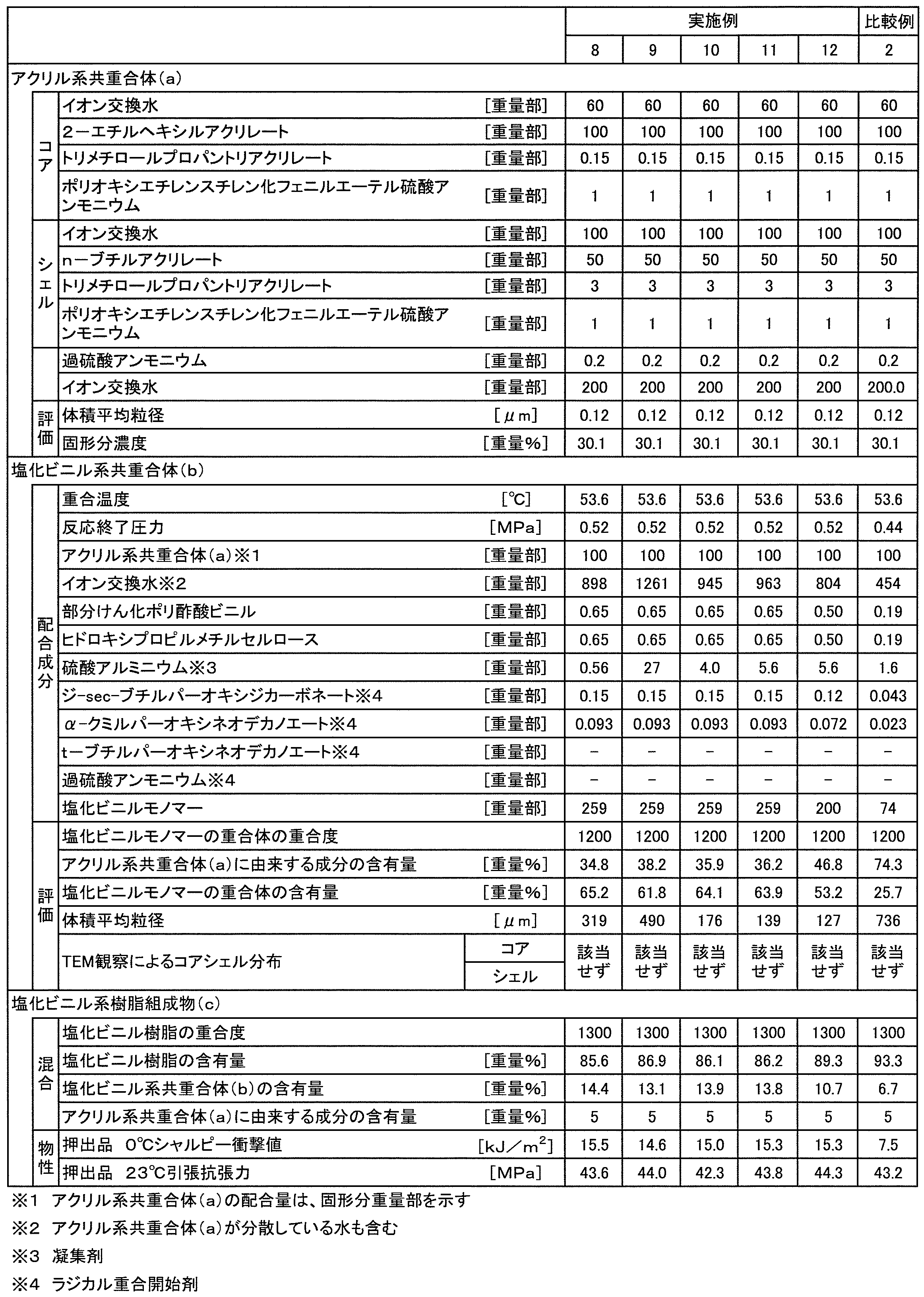
- acrylic copolymer (a) In a stainless steel reactor equipped with a stirrer and a reflux condenser, 200 parts by weight of ion-exchanged water was placed, and oxygen in the reactor was replaced with nitrogen. Thereafter, the temperature of the ion exchange water was raised to 70 ° C. with stirring. After completion of the temperature rise, 0.2 parts by weight of ammonium persulfate and 40 parts by weight of the emulsifying monomer for forming the core were placed in the reactor, and polymerization was started.
- the dripping of all the emulsified monomers was completed in 3 hours. After 1 hour had passed since the dropping of the emulsified monomer was completed, the polymerization was terminated to obtain an acrylic copolymer (a) having a solid content concentration shown in Tables 1 and 2 below.
- the obtained acrylic copolymer (a) had a core-shell structure.
- vinyl chloride resin composition (c) Vinyl chloride resins having the polymerization degrees shown in Tables 1 and 2 below were prepared. The obtained vinyl chloride copolymer (b) and vinyl chloride resin were blended in the blending amounts shown in Tables 1 and 2 below to obtain a vinyl chloride resin composition (c).
- volume average particle diameter The average particle diameter of each of the acrylic copolymer (a) and the vinyl chloride copolymer (b) was determined. The volume average particle diameters of the acrylic copolymer (a) and the vinyl chloride copolymer (b) were measured using a laser diffraction / scattering particle size distribution meter (manufactured by Horiba, Ltd.).
- the chlorine content C (% by weight) of the vinyl chloride copolymer (b) was measured according to JIS K7229.
- the content (% by weight) of the component derived from the acrylic copolymer (a) was calculated from the following formula.
- the content (% by weight) of the polymer of the vinyl chloride monomer is [100-content of component derived from acrylic copolymer (a) (% by weight)].
- a No. 1 test piece / A notch was used as an edgewise impact test piece in accordance with JIS K7111, and the Charpy impact value was measured.
- the measurement sample was stored for 12 hours in a 0 ° C. constant temperature bath, and then measured at 0 ° C.
- the tensile yield strength was measured at 10 mm / min with a No. 1 type test piece according to a plastic tensile test method (JIS K7113), using the press plate produced when measuring the Charpy impact value as a measurement sample.
- the measurement temperature was 23 ° C.
- an edgewise impact test piece was used to prepare a test piece with No. 1 test piece and A notch, and a Charpy impact value was measured.
- the measurement sample was stored for 12 hours in a 0 ° C. constant temperature bath, and then measured at 0 ° C.
- Extruded product tensile strength (tensile yield strength) Using the extruded plate produced when measuring the extruded Charpy impact value as a measurement sample, the tensile yield strength was measured with a No. 1 type test piece at 10 mm / min according to a plastic tensile test method (JIS K7113). The measurement temperature was 23 ° C.
Landscapes
- Chemical & Material Sciences (AREA)
- Health & Medical Sciences (AREA)
- Chemical Kinetics & Catalysis (AREA)
- Medicinal Chemistry (AREA)
- Polymers & Plastics (AREA)
- Organic Chemistry (AREA)
- Graft Or Block Polymers (AREA)
- Compositions Of Macromolecular Compounds (AREA)
Abstract
Description
本発明に係る塩化ビニル系共重合体は、アルキル(メタ)アクリレートモノマー100重量部と、多官能性モノマー0.1重量部以上、10重量部以下とを共重合させることにより得られるアクリル系共重合体30重量%以上、98重量%以下と、塩化ビニルモノマー2重量%以上、70重量%以下とを共重合させることにより得られ、体積平均粒径が0.1μm以上、500μm以下である。
上記塩化ビニル系樹脂組成物は、上記塩化ビニル系共重合体を含む。上記塩化ビニル系樹脂組成物は、上記塩化ビニル系共重合体に加えて、必要に応じて、ポリエチレン、ポリプロピレン等のポリオレフィン、ポリ塩化ビニル、ポリ塩化ビニリデンなどの塩化ビニル系樹脂、ポリスチレン、ポリ酢酸ビニル、ポリテトラフルオロエチレン、アクリロニトリルブタジエンスチレン樹脂、アクリロニトリルスチレン樹脂、アクリル樹脂等の各種の熱可塑性樹脂や、熱安定剤、安定化助剤、滑剤、加工助剤、酸化防止剤、光安定剤、顔料、無機充填剤及び可塑剤等の添加材等を含む。
上記成形体は、上記塩化ビニル系共重合体を含む塩化ビニル系樹脂組成物を成形するか、又は、上記塩化ビニル系共重合体を含む塩化ビニル系樹脂組成物を成形することにより得られる。また、上記成形体を得る際に、従来公知の任意の成形方法を採用可能である。
乳化モノマーの調製:
2-エチルヘキシルアクリレートと、トリメチロールプロパントリアクリレートと、界面活性剤(ポリオキシエチレンスチレン化フェニルエーテル硫酸アンモニウム)と、イオン交換水とを、下記の表1,2に示す配合量で攪拌混合して、コアを形成するための乳化モノマーを調製した。
撹拌機及び還流冷却器を備えたステンレス製の反応器に、イオン交換水200重量部を入れ、反応器内の酸素を窒素により置換した。その後、撹拌下でイオン交換水の温度を70℃まで昇温した。昇温終了後、反応器内に過硫酸アンモニウム0.2重量部と、上記コアを形成するための乳化モノマーのうち40重量部とを入れ、重合を開始した。
撹拌機及びジャケットを備えた重合器に、塩化ビニルモノマーを除く下記の表1,2で示す配合成分を下記の表1,2に示す配合量で入れた。
下記の表1,2に示す重合度の塩化ビニル系樹脂を用意した。得られた塩化ビニル系共重合体(b)と塩化ビニル系樹脂とを、下記の表1,2に示す配合量で配合して、塩化ビニル系樹脂組成物(c)を得た。
(1)体積平均粒径
アクリル系共重合体(a)及び塩化ビニル系共重合体(b)のそれぞれの平均粒径を求めた。レーザー回析/散乱粒度分布計(堀場製作所社製)を用いて、アクリル系共重合体(a)及び塩化ビニル系共重合体(b)の各体積平均粒径を測定した。
得られた塩化ビニル系共重合体(b)における、アクリル系共重合体(a)に由来する成分の含有量と塩化ビニルモノマーの重合体の含有量とを求めた。
塩化ビニル系共重合体をエポキシ包埋したサンプルを酸化ルテニウムにて染色し、ウルトラミクロトームにて削り出した薄片を透過型電子顕微鏡(TEM)にて観察した。
塩化ビニル系樹脂組成物100重量部に対して、有機錫系安定剤2.0重量部及びポリエチレンワックス0.5重量部を混合して、樹脂材料を得た。得られた樹脂材料を200℃で3分間ロール混練し、更に、205℃で3分間プレス成形して厚さ3mmのプレス板を作製した。
シャルピー衝撃値を測定する際に作製したプレス板を測定試料として、プラスチックの引張試験方法(JIS K7113)に従って、1号形試験片で10mm/分で、引張降伏強度を測定した。測定温度は23℃とした。
塩化ビニル系樹脂組成物100重量部に対して、有機錫系安定剤2.0重量部及びポリエチレンワックス0.5重量部を混合して、樹脂材料を得た。得られた樹脂材料を二軸コニカル押出機により樹脂温度190℃で押出し成形し、厚さ3mmの押出板を製作した。
押出品シャルピー衝撃値を測定する際に作製した押出板を測定試料として、プラスチックの引張試験方法(JIS K7113)に従って、1号形試験片で10mm/分で、引張降伏強度を測定した。測定温度は23℃とした。

Claims (10)
- アルキル(メタ)アクリレートモノマー100重量部と、多官能性モノマー0.1重量部以上、10重量部以下とを共重合させることにより得られるアクリル系共重合体30重量%以上、98重量%以下と、塩化ビニルモノマー2重量%以上、70重量%以下とを共重合させることにより得られ、
体積平均粒径が0.1μm以上、500μm以下である、塩化ビニル系共重合体。 - 前記アクリル系共重合体が、コアと前記コアの表面上に配置されたシェルとを有するコアシェル構造を有する、請求項1に記載の塩化ビニル系共重合体。
- 前記アクリル系共重合体における前記コアが、ホモポリマーのガラス転移温度が-140℃以上、-60℃以下であるアルキル(メタ)アクリレートモノマーに由来する成分を含む、請求項2に記載の塩化ビニル系共重合体。
- 塩化ビニル系共重合体が、コアと前記コアの表面上に配置されたシェルとを有するコアシェル構造を有する、請求項1~3のいずれか1項に記載の塩化ビニル系共重合体。
- 塩化ビニル系共重合体における前記コアが、前記アクリル系共重合体に由来する成分を含み、塩化ビニル系共重合体における前記シェルが、前記塩化ビニルモノマーに由来する成分を含む、請求項4に記載の塩化ビニル系共重合体。
- 前記アクリル系共重合体と前記塩化ビニルモノマーとの共重合時に、凝集剤を用いて得られる、請求項1~5のいずれか1項に記載の塩化ビニル系共重合体。
- 前記アクリル系共重合体と前記塩化ビニルモノマーとの共重合時に、前記アクリル系共重合体100重量部に対して、前記凝集剤0.3重量部以上、50重量部以下を用いて得られる、請求項6に記載の塩化ビニル系共重合体。
- 請求項1~7のいずれか1項に記載の塩化ビニル系共重合体を含む、塩化ビニル系樹脂組成物。
- さらに塩化ビニル系樹脂を含む、請求項8に記載の塩化ビニル系樹脂組成物。
- 請求項1~7のいずれか1項に記載の塩化ビニル系共重合体を成形するか、又は前記塩化ビニル系共重合体を含む塩化ビニル系樹脂組成物を成形することにより得られる、成形体。
Priority Applications (2)
| Application Number | Priority Date | Filing Date | Title |
|---|---|---|---|
| JP2015518221A JP6523950B2 (ja) | 2013-05-22 | 2014-05-16 | 塩化ビニル系共重合体、塩化ビニル系樹脂組成物及び成形体 |
| CN201480029638.6A CN105263977B (zh) | 2013-05-22 | 2014-05-16 | 氯乙烯类共聚物、氯乙烯类树脂组合物及成形体 |
Applications Claiming Priority (4)
| Application Number | Priority Date | Filing Date | Title |
|---|---|---|---|
| JP2013107988 | 2013-05-22 | ||
| JP2013-107988 | 2013-05-22 | ||
| JP2013195631 | 2013-09-20 | ||
| JP2013-195631 | 2013-09-20 |
Publications (1)
| Publication Number | Publication Date |
|---|---|
| WO2014188971A1 true WO2014188971A1 (ja) | 2014-11-27 |
Family
ID=51933527
Family Applications (1)
| Application Number | Title | Priority Date | Filing Date |
|---|---|---|---|
| PCT/JP2014/063051 Ceased WO2014188971A1 (ja) | 2013-05-22 | 2014-05-16 | 塩化ビニル系共重合体、塩化ビニル系樹脂組成物及び成形体 |
Country Status (4)
| Country | Link |
|---|---|
| JP (1) | JP6523950B2 (ja) |
| CN (1) | CN105263977B (ja) |
| TW (1) | TWI612090B (ja) |
| WO (1) | WO2014188971A1 (ja) |
Cited By (2)
| Publication number | Priority date | Publication date | Assignee | Title |
|---|---|---|---|---|
| JP2017132996A (ja) * | 2016-01-22 | 2017-08-03 | 積水化学工業株式会社 | ポリ塩化ビニル系樹脂組成物およびポリ塩化ビニル系樹脂シート |
| WO2023180317A1 (en) | 2022-03-21 | 2023-09-28 | Inovyn Europe Limited | Process for producing pvc and pvc product |
Citations (4)
| Publication number | Priority date | Publication date | Assignee | Title |
|---|---|---|---|---|
| EP1167407A1 (en) * | 1998-10-19 | 2002-01-02 | Sekisui Chemical Co., Ltd. | Vinyl chloride resin, process for producing the same, and molded object |
| JP2003221485A (ja) * | 2002-02-01 | 2003-08-05 | Sekisui Chem Co Ltd | ポリ塩化ビニル系樹脂組成物 |
| JP2004269877A (ja) * | 2003-02-21 | 2004-09-30 | Sekisui Chem Co Ltd | アクリル系共重合体ラテックスの製造方法及びそれを用いた塩化ビニル系樹脂の製造方法 |
| WO2010140647A1 (ja) * | 2009-06-04 | 2010-12-09 | 日信化学工業株式会社 | 塩化ビニル系樹脂エマルジョン、水性インキ及び記録用紙 |
Family Cites Families (9)
| Publication number | Priority date | Publication date | Assignee | Title |
|---|---|---|---|---|
| JPH0680097B2 (ja) * | 1984-05-31 | 1994-10-12 | 三井東圧化学株式会社 | 塩化ビニル樹脂の製造方法 |
| JP3212471B2 (ja) * | 1995-02-21 | 2001-09-25 | 積水化学工業株式会社 | 塩化ビニル系樹脂 |
| JP3262698B2 (ja) * | 1995-10-23 | 2002-03-04 | 積水化学工業株式会社 | 塩化ビニル系樹脂及び製造方法 |
| JPH11140140A (ja) * | 1997-09-02 | 1999-05-25 | Sekisui Chem Co Ltd | 塩化ビニル系グラフト樹脂の製造方法及び塩化ビニル系グラフト樹脂組成物 |
| JP2003096138A (ja) * | 2001-09-25 | 2003-04-03 | Tokuyama Sekisui Ind Corp | 塩化ビニル系樹脂の製造方法 |
| JP2003212911A (ja) * | 2002-01-24 | 2003-07-30 | Sekisui Chem Co Ltd | 塩化ビニル系樹脂の製造方法 |
| CN1181116C (zh) * | 2002-11-14 | 2004-12-22 | 河北工业大学 | 高抗冲聚丙烯酸酯复合粒子接枝氯乙烯乳液树脂的制备方法 |
| CN102030867B (zh) * | 2009-09-28 | 2014-11-12 | Lg化学株式会社 | 制备氯乙烯接枝共聚物树脂的方法 |
| CN102863581A (zh) * | 2012-10-19 | 2013-01-09 | 云南大学 | 一种可反应型核壳结构增韧剂及其制备方法 |
-
2014
- 2014-05-16 CN CN201480029638.6A patent/CN105263977B/zh active Active
- 2014-05-16 WO PCT/JP2014/063051 patent/WO2014188971A1/ja not_active Ceased
- 2014-05-16 JP JP2015518221A patent/JP6523950B2/ja active Active
- 2014-05-21 TW TW103117807A patent/TWI612090B/zh active
Patent Citations (4)
| Publication number | Priority date | Publication date | Assignee | Title |
|---|---|---|---|---|
| EP1167407A1 (en) * | 1998-10-19 | 2002-01-02 | Sekisui Chemical Co., Ltd. | Vinyl chloride resin, process for producing the same, and molded object |
| JP2003221485A (ja) * | 2002-02-01 | 2003-08-05 | Sekisui Chem Co Ltd | ポリ塩化ビニル系樹脂組成物 |
| JP2004269877A (ja) * | 2003-02-21 | 2004-09-30 | Sekisui Chem Co Ltd | アクリル系共重合体ラテックスの製造方法及びそれを用いた塩化ビニル系樹脂の製造方法 |
| WO2010140647A1 (ja) * | 2009-06-04 | 2010-12-09 | 日信化学工業株式会社 | 塩化ビニル系樹脂エマルジョン、水性インキ及び記録用紙 |
Cited By (2)
| Publication number | Priority date | Publication date | Assignee | Title |
|---|---|---|---|---|
| JP2017132996A (ja) * | 2016-01-22 | 2017-08-03 | 積水化学工業株式会社 | ポリ塩化ビニル系樹脂組成物およびポリ塩化ビニル系樹脂シート |
| WO2023180317A1 (en) | 2022-03-21 | 2023-09-28 | Inovyn Europe Limited | Process for producing pvc and pvc product |
Also Published As
| Publication number | Publication date |
|---|---|
| JPWO2014188971A1 (ja) | 2017-02-23 |
| CN105263977B (zh) | 2017-10-20 |
| TWI612090B (zh) | 2018-01-21 |
| CN105263977A (zh) | 2016-01-20 |
| TW201504310A (zh) | 2015-02-01 |
| JP6523950B2 (ja) | 2019-06-05 |
Similar Documents
| Publication | Publication Date | Title |
|---|---|---|
| JP6260480B2 (ja) | アクリル系エラストマー樹脂用加工助剤、アクリル系エラストマー樹脂組成物及び成形体 | |
| Yang et al. | One-pot polyvinyl chloride preparation utilizing polyacrylate latex with tertiary amine groups for improved thermal stability, toughness, and reduced reactor scaling | |
| JP6523950B2 (ja) | 塩化ビニル系共重合体、塩化ビニル系樹脂組成物及び成形体 | |
| JP4283702B2 (ja) | アクリル系共重合体ラテックスの製造方法及びそれを用いた塩化ビニル系樹脂の製造方法 | |
| JP2017538789A (ja) | アクリル系加工助剤及びこれを含む塩化ビニル系樹脂組成物 | |
| CN102030867B (zh) | 制备氯乙烯接枝共聚物树脂的方法 | |
| JPH11140140A (ja) | 塩化ビニル系グラフト樹脂の製造方法及び塩化ビニル系グラフト樹脂組成物 | |
| JP6214228B2 (ja) | 塩化ビニル系共重合体及び塩化ビニル系共重合体の製造方法 | |
| JP2014227538A (ja) | 塩化ビニル系共重合体の製造方法 | |
| JP5108224B2 (ja) | 硬質塩化ビニル系樹脂管 | |
| JP5091771B2 (ja) | 塩化ビニル系樹脂成形体及びその製造方法 | |
| KR101114476B1 (ko) | 저온충격강도가 우수한 염화비닐계 그라프트 공중합체수지의 제조방법 | |
| JP2003253082A (ja) | ポリ塩化ビニル系樹脂組成物 | |
| JP3262700B2 (ja) | 塩化ビニル系樹脂 | |
| JPH09316139A (ja) | 塩化ビニル系樹脂及びその製造方法 | |
| JP2003313391A (ja) | ポリ塩化ビニル系樹脂組成物 | |
| JP2004091518A (ja) | 塩化ビニル系樹脂成形品 | |
| JP2003306589A (ja) | ポリ塩化ビニル系樹脂組成物 | |
| JP2003119341A (ja) | ポリ塩化ビニル系樹脂組成物 | |
| JP4504490B2 (ja) | 塩化ビニル系樹脂及びその成形体及び成形体の製造方法 | |
| JP2003221485A (ja) | ポリ塩化ビニル系樹脂組成物 | |
| JP2002088216A (ja) | 塩化ビニル系樹脂組成物 | |
| JP4102229B2 (ja) | 塩化ビニル系樹脂組成物 | |
| KR101102272B1 (ko) | 염화비닐계 그라프트 공중합체 수지의 제조방법 | |
| JPH11106443A (ja) | 塩化ビニル系グラフト樹脂及び共重合体ラテックスの製造方法 |
Legal Events
| Date | Code | Title | Description |
|---|---|---|---|
| WWE | Wipo information: entry into national phase |
Ref document number: 201480029638.6 Country of ref document: CN |
|
| 121 | Ep: the epo has been informed by wipo that ep was designated in this application |
Ref document number: 14800386 Country of ref document: EP Kind code of ref document: A1 |
|
| ENP | Entry into the national phase |
Ref document number: 2015518221 Country of ref document: JP Kind code of ref document: A |
|
| NENP | Non-entry into the national phase |
Ref country code: DE |
|
| 122 | Ep: pct application non-entry in european phase |
Ref document number: 14800386 Country of ref document: EP Kind code of ref document: A1 |