WO2014178402A1 - ポリビニルアルコール水溶液 - Google Patents
ポリビニルアルコール水溶液 Download PDFInfo
- Publication number
- WO2014178402A1 WO2014178402A1 PCT/JP2014/061984 JP2014061984W WO2014178402A1 WO 2014178402 A1 WO2014178402 A1 WO 2014178402A1 JP 2014061984 W JP2014061984 W JP 2014061984W WO 2014178402 A1 WO2014178402 A1 WO 2014178402A1
- Authority
- WO
- WIPO (PCT)
- Prior art keywords
- polyvinyl alcohol
- film
- aqueous solution
- pva
- weight
- Prior art date
- Legal status (The legal status is an assumption and is not a legal conclusion. Google has not performed a legal analysis and makes no representation as to the accuracy of the status listed.)
- Ceased
Links
Classifications
-
- C—CHEMISTRY; METALLURGY
- C08—ORGANIC MACROMOLECULAR COMPOUNDS; THEIR PREPARATION OR CHEMICAL WORKING-UP; COMPOSITIONS BASED THEREON
- C08K—Use of inorganic or non-macromolecular organic substances as compounding ingredients
- C08K5/00—Use of organic ingredients
- C08K5/54—Silicon-containing compounds
- C08K5/541—Silicon-containing compounds containing oxygen
- C08K5/5415—Silicon-containing compounds containing oxygen containing at least one Si—O bond
- C08K5/5419—Silicon-containing compounds containing oxygen containing at least one Si—O bond containing at least one Si—C bond
-
- B—PERFORMING OPERATIONS; TRANSPORTING
- B29—WORKING OF PLASTICS; WORKING OF SUBSTANCES IN A PLASTIC STATE IN GENERAL
- B29C—SHAPING OR JOINING OF PLASTICS; SHAPING OF MATERIAL IN A PLASTIC STATE, NOT OTHERWISE PROVIDED FOR; AFTER-TREATMENT OF THE SHAPED PRODUCTS, e.g. REPAIRING
- B29C41/00—Shaping by coating a mould, core or other substrate, i.e. by depositing material and stripping-off the shaped article; Apparatus therefor
- B29C41/02—Shaping by coating a mould, core or other substrate, i.e. by depositing material and stripping-off the shaped article; Apparatus therefor for making articles of definite length, i.e. discrete articles
- B29C41/12—Spreading-out the material on a substrate, e.g. on the surface of a liquid
-
- C—CHEMISTRY; METALLURGY
- C08—ORGANIC MACROMOLECULAR COMPOUNDS; THEIR PREPARATION OR CHEMICAL WORKING-UP; COMPOSITIONS BASED THEREON
- C08J—WORKING-UP; GENERAL PROCESSES OF COMPOUNDING; AFTER-TREATMENT NOT COVERED BY SUBCLASSES C08B, C08C, C08F, C08G or C08H
- C08J5/00—Manufacture of articles or shaped materials containing macromolecular substances
- C08J5/18—Manufacture of films or sheets
-
- C—CHEMISTRY; METALLURGY
- C08—ORGANIC MACROMOLECULAR COMPOUNDS; THEIR PREPARATION OR CHEMICAL WORKING-UP; COMPOSITIONS BASED THEREON
- C08J—WORKING-UP; GENERAL PROCESSES OF COMPOUNDING; AFTER-TREATMENT NOT COVERED BY SUBCLASSES C08B, C08C, C08F, C08G or C08H
- C08J7/00—Chemical treatment or coating of shaped articles made of macromolecular substances
- C08J7/04—Coating
- C08J7/0427—Coating with only one layer of a composition containing a polymer binder
-
- C—CHEMISTRY; METALLURGY
- C08—ORGANIC MACROMOLECULAR COMPOUNDS; THEIR PREPARATION OR CHEMICAL WORKING-UP; COMPOSITIONS BASED THEREON
- C08J—WORKING-UP; GENERAL PROCESSES OF COMPOUNDING; AFTER-TREATMENT NOT COVERED BY SUBCLASSES C08B, C08C, C08F, C08G or C08H
- C08J7/00—Chemical treatment or coating of shaped articles made of macromolecular substances
- C08J7/04—Coating
- C08J7/043—Improving the adhesiveness of the coatings per se, e.g. forming primers
-
- C—CHEMISTRY; METALLURGY
- C08—ORGANIC MACROMOLECULAR COMPOUNDS; THEIR PREPARATION OR CHEMICAL WORKING-UP; COMPOSITIONS BASED THEREON
- C08J—WORKING-UP; GENERAL PROCESSES OF COMPOUNDING; AFTER-TREATMENT NOT COVERED BY SUBCLASSES C08B, C08C, C08F, C08G or C08H
- C08J7/00—Chemical treatment or coating of shaped articles made of macromolecular substances
- C08J7/04—Coating
- C08J7/048—Forming gas barrier coatings
-
- C—CHEMISTRY; METALLURGY
- C08—ORGANIC MACROMOLECULAR COMPOUNDS; THEIR PREPARATION OR CHEMICAL WORKING-UP; COMPOSITIONS BASED THEREON
- C08J—WORKING-UP; GENERAL PROCESSES OF COMPOUNDING; AFTER-TREATMENT NOT COVERED BY SUBCLASSES C08B, C08C, C08F, C08G or C08H
- C08J7/00—Chemical treatment or coating of shaped articles made of macromolecular substances
- C08J7/04—Coating
- C08J7/056—Forming hydrophilic coatings
-
- C—CHEMISTRY; METALLURGY
- C08—ORGANIC MACROMOLECULAR COMPOUNDS; THEIR PREPARATION OR CHEMICAL WORKING-UP; COMPOSITIONS BASED THEREON
- C08K—Use of inorganic or non-macromolecular organic substances as compounding ingredients
- C08K5/00—Use of organic ingredients
- C08K5/01—Hydrocarbons
-
- C—CHEMISTRY; METALLURGY
- C08—ORGANIC MACROMOLECULAR COMPOUNDS; THEIR PREPARATION OR CHEMICAL WORKING-UP; COMPOSITIONS BASED THEREON
- C08K—Use of inorganic or non-macromolecular organic substances as compounding ingredients
- C08K5/00—Use of organic ingredients
- C08K5/04—Oxygen-containing compounds
- C08K5/06—Ethers; Acetals; Ketals; Ortho-esters
-
- C—CHEMISTRY; METALLURGY
- C08—ORGANIC MACROMOLECULAR COMPOUNDS; THEIR PREPARATION OR CHEMICAL WORKING-UP; COMPOSITIONS BASED THEREON
- C08K—Use of inorganic or non-macromolecular organic substances as compounding ingredients
- C08K5/00—Use of organic ingredients
- C08K5/04—Oxygen-containing compounds
- C08K5/10—Esters; Ether-esters
- C08K5/101—Esters; Ether-esters of monocarboxylic acids
-
- C—CHEMISTRY; METALLURGY
- C08—ORGANIC MACROMOLECULAR COMPOUNDS; THEIR PREPARATION OR CHEMICAL WORKING-UP; COMPOSITIONS BASED THEREON
- C08K—Use of inorganic or non-macromolecular organic substances as compounding ingredients
- C08K5/00—Use of organic ingredients
- C08K5/04—Oxygen-containing compounds
- C08K5/10—Esters; Ether-esters
- C08K5/101—Esters; Ether-esters of monocarboxylic acids
- C08K5/103—Esters; Ether-esters of monocarboxylic acids with polyalcohols
-
- C—CHEMISTRY; METALLURGY
- C08—ORGANIC MACROMOLECULAR COMPOUNDS; THEIR PREPARATION OR CHEMICAL WORKING-UP; COMPOSITIONS BASED THEREON
- C08K—Use of inorganic or non-macromolecular organic substances as compounding ingredients
- C08K5/00—Use of organic ingredients
- C08K5/36—Sulfur-, selenium-, or tellurium-containing compounds
- C08K5/45—Heterocyclic compounds having sulfur in the ring
- C08K5/46—Heterocyclic compounds having sulfur in the ring with oxygen or nitrogen in the ring
- C08K5/47—Thiazoles
-
- C—CHEMISTRY; METALLURGY
- C08—ORGANIC MACROMOLECULAR COMPOUNDS; THEIR PREPARATION OR CHEMICAL WORKING-UP; COMPOSITIONS BASED THEREON
- C08L—COMPOSITIONS OF MACROMOLECULAR COMPOUNDS
- C08L29/00—Compositions of homopolymers or copolymers of compounds having one or more unsaturated aliphatic radicals, each having only one carbon-to-carbon double bond, and at least one being terminated by an alcohol, ether, aldehydo, ketonic, acetal or ketal radical; Compositions of hydrolysed polymers of esters of unsaturated alcohols with saturated carboxylic acids; Compositions of derivatives of such polymers
- C08L29/02—Homopolymers or copolymers of unsaturated alcohols
- C08L29/04—Polyvinyl alcohol; Partially hydrolysed homopolymers or copolymers of esters of unsaturated alcohols with saturated carboxylic acids
-
- C—CHEMISTRY; METALLURGY
- C09—DYES; PAINTS; POLISHES; NATURAL RESINS; ADHESIVES; COMPOSITIONS NOT OTHERWISE PROVIDED FOR; APPLICATIONS OF MATERIALS NOT OTHERWISE PROVIDED FOR
- C09D—COATING COMPOSITIONS, e.g. PAINTS, VARNISHES OR LACQUERS; FILLING PASTES; CHEMICAL PAINT OR INK REMOVERS; INKS; CORRECTING FLUIDS; WOODSTAINS; PASTES OR SOLIDS FOR COLOURING OR PRINTING; USE OF MATERIALS THEREFOR
- C09D129/00—Coating compositions based on homopolymers or copolymers of compounds having one or more unsaturated aliphatic radicals, each having only one carbon-to-carbon double bond, and at least one being terminated by an alcohol, ether, aldehydo, ketonic, acetal, or ketal radical; Coating compositions based on hydrolysed polymers of esters of unsaturated alcohols with saturated carboxylic acids; Coating compositions based on derivatives of such polymers
- C09D129/02—Homopolymers or copolymers of unsaturated alcohols
- C09D129/04—Polyvinyl alcohol; Partially hydrolysed homopolymers or copolymers of esters of unsaturated alcohols with saturated carboxylic acids
-
- C—CHEMISTRY; METALLURGY
- C08—ORGANIC MACROMOLECULAR COMPOUNDS; THEIR PREPARATION OR CHEMICAL WORKING-UP; COMPOSITIONS BASED THEREON
- C08J—WORKING-UP; GENERAL PROCESSES OF COMPOUNDING; AFTER-TREATMENT NOT COVERED BY SUBCLASSES C08B, C08C, C08F, C08G or C08H
- C08J2329/00—Characterised by the use of homopolymers or copolymers of compounds having one or more unsaturated aliphatic radicals, each having only one carbon-to-carbon double bond, and at least one being terminated by an alcohol, ether, aldehydo, ketonic, acetal, or ketal radical; Hydrolysed polymers of esters of unsaturated alcohols with saturated carboxylic acids; Derivatives of such polymer
- C08J2329/02—Homopolymers or copolymers of unsaturated alcohols
- C08J2329/04—Polyvinyl alcohol; Partially hydrolysed homopolymers or copolymers of esters of unsaturated alcohols with saturated carboxylic acids
-
- C—CHEMISTRY; METALLURGY
- C08—ORGANIC MACROMOLECULAR COMPOUNDS; THEIR PREPARATION OR CHEMICAL WORKING-UP; COMPOSITIONS BASED THEREON
- C08J—WORKING-UP; GENERAL PROCESSES OF COMPOUNDING; AFTER-TREATMENT NOT COVERED BY SUBCLASSES C08B, C08C, C08F, C08G or C08H
- C08J2429/00—Characterised by the use of homopolymers or copolymers of compounds having one or more unsaturated aliphatic radicals, each having only one carbon-to-carbon double bond, and at least one being terminated by an alcohol, ether, aldehydo, ketonic, acetal, or ketal radical; Hydrolysed polymers of esters of unsaturated alcohols with saturated carboxylic acids; Derivatives of such polymer
- C08J2429/02—Homopolymers or copolymers of unsaturated alcohols
- C08J2429/04—Polyvinyl alcohol; Partially hydrolysed homopolymers or copolymers of esters of unsaturated alcohols with saturated carboxylic acids
Definitions
- the present invention suppresses contamination by components other than polyvinyl alcohol, and can form a film having few bubbles and excellent adhesion to a substrate, and a laminate using the polyvinyl alcohol aqueous solution. Related to film.
- Polyvinyl alcohol (hereinafter also referred to as PVA) is widely used as a packaging material because it is excellent in transparency, oil resistance, chemical resistance, and gas barrier properties such as oxygen.
- packaging materials such as foods, pharmaceuticals, industrial chemicals, and agricultural chemicals whose deterioration due to oxidation has a great influence on characteristics have been required to have higher oxygen barrier properties.
- PVA-type resin when using PVA-type resin as various packaging materials, after dissolving PVA-type resin in water and obtaining PVA-type aqueous solution, the PVA-type aqueous solution is cast, it forms a film, and PVA-type aqueous solution is used as a basis. A method of applying to a material is generally adopted.
- the PVA-based aqueous solution has a high surface tension
- the PVA-based aqueous solution is easily foamed, and a film is easily formed without sufficient defoaming of the coating solution.
- the bubble portion becomes a defect and the gas barrier property is greatly lowered.
- PVA films particularly PVA films with a high degree of saponification, are used for packaging fiber products and the like. Even when the degree of saponification is high, the PVA film has a property of absorbing moisture or releasing moisture due to changes in ambient humidity. For this reason, when left in a packaged state for a long time, the plasticizer in the film oozes out on the film surface, and this causes a problem that the film absorbs moisture and the moisture released from the film and is transferred to the packaged material or scattered. There is.
- Patent Document 1 discloses that a low-foaming and high-dissipation property is obtained by using a resin composition containing a water-soluble PVA resin having a 1,2-diol structural unit and a water-swellable layered inorganic compound. It is described that an aqueous coating liquid that is foamy can be obtained.
- Patent Document 2 discloses a method for producing a PVA film in which a film-forming raw material is formed after passing a film-forming raw material containing PVA as a constituent component through a filter.
- Patent Document 2 when a filter is newly replaced, a new filter is filled with water or an aqueous solution, or a liquid that can be dissolved in water or a solution that contains a liquid that can be dissolved in water as a main component is filled. It is described that a PVA film for stretching can be obtained. Furthermore, in Patent Document 3, a compound having a specific hydroxyl group and a carboxyl group is used, so that a plasticizer in a film can be used even if left under severe conditions such as low temperature and low humidity and high temperature and high humidity for a long period of time. Does not ooze out on the film surface, and it is described that a PVA film that can maintain flexibility can be obtained.
- the present invention suppresses contamination by components other than polyvinyl alcohol, and can form a film having few bubbles and excellent adhesion to a substrate, and a laminate using the polyvinyl alcohol aqueous solution.
- the object is to provide a film.
- Patent Document 1 and Patent Document 2 are used, the problem that air bubble marks are likely to be generated inside or on the surface of the obtained film is not solved, and the gas barrier property of the obtained PVA film is greatly reduced. Or breakage caused by bubbles or droplets during stretching. Further, even with the PVA solution as described in Patent Document 3, it is difficult to suppress the seepage of the plasticizer on the film surface after casting into a sheet.
- the present invention is a polyvinyl alcohol aqueous solution containing polyvinyl alcohol, a surface tension adjusting agent and water, wherein the surface tension adjusting agent is a polyether silicone compound, a glycerin compound, a cyclic hydrocarbon compound, or a propylene glycol compound. And at least one selected from the group consisting of fatty acid ester compounds, containing 500 to 10,000 parts by weight of water with respect to 100 parts by weight of polyvinyl alcohol and having a surface tension of 45 to 72 mN / m Alcohol aqueous solution.
- the present invention is described in detail below.
- the present inventor suppresses contamination by components other than polyvinyl alcohol by adding a predetermined surface tension adjusting agent to the aqueous polyvinyl alcohol solution and keeping the amount of water and the surface tension of the aqueous solution within the predetermined range.
- the inventors have found that it is possible to form a film with less bubbles and excellent adhesion to the substrate, and have completed the present invention. Details of the present invention will be described below.
- the aqueous solution of polyvinyl alcohol (hereinafter sometimes referred to as PVA) according to the present invention is used to obtain a PVA film.
- the PVA aqueous solution according to the present invention contains PVA, a surface tension adjusting agent, and water.
- the lower limit of the surface tension is 45 mN / m, and the upper limit is 72 mN / m.
- the surface tension is less than 45 mN / m, when a laminated film is formed, the surface tension adjusting agent oozes out on the film surface or the interface between the film and the substrate, thereby deteriorating the adhesion with the substrate.
- a preferable lower limit of the surface tension is 50 mN / m, and a preferable upper limit is 60 mN / m. The surface tension is measured at 20 ° C.
- a method of measuring the surface tension it can be measured by a generally known measuring method such as a conventionally known drop weight method, capillary ascending method, annulus method, flat plate method, for example, manufactured by Kyowa Interface Science Co., Ltd. Can be measured by a flat plate method (Wilhelmy method) using an automatic surface tension meter DY-300.
- the PVA film is preferably used for forming a packaging film, and is preferably used for forming a stretch processing film.
- the PVA aqueous solution according to the present invention it is possible to make it difficult for precipitates to be generated in the interior and surface of the film after film formation. For this reason, for example, when a PVA film is formed on a support member, the uniformity of the thickness of the PVA film and the smoothness of the surface can be effectively improved. The adhesiveness of the PVA film to the support member can be effectively increased.
- the aqueous polyvinyl alcohol solution of the present invention contains polyvinyl alcohol.
- the polyvinyl alcohol becomes the main constituent resin of the film.
- the polyvinyl alcohol is obtained by polymerizing a vinyl ester to obtain a polymer according to a conventionally known method, and then saponifying the polymer, that is, hydrolyzing the polymer.
- alkali or acid is used for saponification.
- An alkali is preferably used for saponification.
- As said polyvinyl alcohol only 1 type may be used and 2 or more types may be used together.
- vinyl ester examples include vinyl acetate, vinyl formate, vinyl propionate, vinyl butyrate, vinyl pivalate, vinyl versatate, vinyl laurate, vinyl stearate and vinyl benzoate.
- the method for polymerizing the vinyl ester is not particularly limited.
- Examples of the polymerization method include a solution polymerization method, a bulk polymerization method, and a suspension polymerization method.
- polymerization catalyst used for polymerizing the vinyl ester examples include 2-ethylhexyl peroxydicarbonate (“TrigonoxEHP” manufactured by Tianjin McEIT), 2,2′-azobisisobutyronitrile (AIBN), t-butyl.
- Peroxyneodecanoate bis (4-tert-butylcyclohexyl) peroxydicarbonate, di-n-propylperoxydicarbonate, di-n-butylperoxydicarbonate, di-cetylperoxydicarbonate and di-s-butylperoxy Examples include dicarbonate.
- the said polymerization catalyst only 1 type may be used and 2 or more types may be used together.
- the polymer obtained by polymerizing the vinyl ester is preferably a polyvinyl ester.
- the polymer obtained by polymerizing the vinyl ester may be a copolymer of the vinyl ester and another monomer. That is, the polyvinyl alcohol may be formed using a copolymer of vinyl ester and another monomer.
- examples of other monomers, that is, comonomers to be copolymerized include olefins, (meth) acrylic acid and salts thereof, (meth) acrylic acid esters, (meth) acrylamide derivatives, N-vinylamides, vinyl ethers, and nitriles.
- the other monomer only one kind may be used, or two or more kinds may be used in combination.
- Examples of the olefins include ethylene, propylene, 1-butene and isobutene.
- the (meth) acrylic acid esters include methyl (meth) acrylate, ethyl (meth) acrylate, n-propyl (meth) acrylate, i-propyl (meth) acrylate, and n- (meth) acrylic acid. Examples include butyl and 2-ethylhexyl (meth) acrylate.
- Examples of the (meth) acrylamide derivative include acrylamide, n-methylacrylamide, N-ethylacrylamide, N, N-dimethylacrylamide, (meth) acrylamidepropanesulfonic acid and salts thereof, and the like.
- N-vinylamides examples include N-vinylpyrrolidone.
- vinyl ethers include methyl vinyl ether, ethyl vinyl ether, n-propyl vinyl ether, i-propyl vinyl ether, and n-butyl vinyl ether.
- nitriles include (meth) acrylonitrile.
- vinyl halides include vinyl chloride and vinylidene chloride.
- allyl compound include allyl acetate and allyl chloride.
- Examples of the vinylsilyl compound include vinyltrimethoxysilane.
- polyvinyl alcohol includes modified polyvinyl alcohol (modified PVA).
- the polyvinyl alcohol film includes a modified polyvinyl alcohol (modified PVA) film obtained by forming a modified polyvinyl alcohol (modified PVA) into a film.
- the saponification degree of the polyvinyl alcohol is preferably 90 mol% or more, more preferably 92 mol% or more, still more preferably 93 mol% or more, particularly preferably 94 mol% or more, preferably 100 mol% or less, more preferably 99 mol%. 0.9 mol% or less, more preferably 99.0 mol% or less, particularly preferably less than 98.5 mol%, and most preferably less than 98 mol%.
- the saponification degree is not less than the above lower limit and not more than the above upper limit, the water resistance and gas barrier properties of the PVA film are further enhanced. From the viewpoint of improving both water resistance and gas barrier properties in a well-balanced manner, the saponification degree of the PVA is particularly preferably 92 mol% or more and 99.0 mol% or less.
- the saponification degree is measured according to JIS K6726.
- the saponification degree indicates the proportion of units that are actually saponified to vinyl alcohol units among the units converted to vinyl alcohol units by saponification.
- the method for adjusting the saponification degree is not particularly limited.
- the degree of saponification can be appropriately adjusted according to the saponification conditions, that is, the hydrolysis conditions.
- the degree of polymerization of the PVA is not particularly limited.
- the polymerization degree of the PVA is preferably 1000 or more, more preferably 1500 or more, still more preferably 1800 or more, still more preferably 2000 or more, still more preferably 2300 or more, particularly preferably 2600 or more, most preferably 2700 or more, preferably Is 4000 or less, more preferably 3500 or less, still more preferably 3000 or less, and particularly preferably 2900 or less.
- the polymerization degree is not less than the above lower limit and not more than the above upper limit, the coating strength of the PVA film is further increased, and the stretching of the PVA film is further facilitated.
- the degree of polymerization is less than or equal to the above upper limit, the solubility of PVA in a solvent increases, and film formation by casting becomes even easier.
- the degree of polymerization is measured according to JIS K6726.
- the content of the polyvinyl alcohol is preferably 1% by weight or more, more preferably 5% by weight or more, still more preferably 7% by weight or more, preferably 15% by weight or less, more preferably. Is 13% by weight or less, more preferably 12% by weight or less, particularly preferably 10% by weight or less, and most preferably 9% by weight or less.
- the viscosity of the polyvinyl alcohol aqueous solution is appropriately increased, the drying time is further shortened, the thickness of the PVA film is further uniform, and the quality is further improved. A PVA film is obtained.
- the content of the polyvinyl alcohol is not more than the above upper limit, the viscosity of the polyvinyl alcohol aqueous solution becomes moderately low, the casting of the PVA aqueous solution becomes easy, and the resulting PVA film further includes bubble marks and droplets. It becomes difficult.
- the aqueous polyvinyl alcohol solution of the present invention contains at least one surface tension modifier selected from the group consisting of polyether silicone compounds, glycerin compounds, cyclic hydrocarbon compounds, propylene glycol compounds and fatty acid ester compounds. To do.
- the surface tension of the aqueous polyvinyl alcohol solution of the present invention can be in the range of 45 to 72 mN / m.
- production of the bubble of polyvinyl alcohol aqueous solution can be prevented by containing the said surface tension regulator.
- a silicone surfactant having an ether structure is preferable.
- the silicone surfactant having an ether structure include silicone surfactants having a polyether structure at both ends of silicone (“X-224952”, “X-22-4272” and “X22-6266” manufactured by Shin-Etsu Chemical Co., Ltd.).
- a silicone surfactant having a polyether structure in the side chain of silicone (“KF-351A”, “KF-352A”, “KF-353”, “KF-354L”, “KF-” manufactured by Shin-Etsu Chemical Co., Ltd.) 355A ",” KF-615A “,” KF-945 “,” KF-640 “,” KF-642 “,” KF-643 “,” KF-6020 “,” KS-604 “,” X-50- “ 1039A “,” X-50-1105G “,” X-22-6191 “,” X-22-4515 “,” KF-6011 “,” KF-6012 “,” KF-6 “ 15 ”and“ KF-6017 ”), and surfactants having a polyether structure at both ends of silicone (“ KF-6004 ”,“ KF-889 ”,“ X-22-4741 ”manufactured by Shin-Etsu Chemical Co., Ltd.), “KF-1002,” “X-22-4952,” “X-22-4272,” and
- the HLB of the silicone surfactant having an ether structure is preferably 0 or more, and preferably 12.0 or less.
- HLB Hydrophile Balance
- the HLB of the silicone surfactant having an ether structure is preferably 0 or more, more preferably 1.0 or more, still more preferably 1.5 or more, preferably 12.0 or less, more preferably 10.0 or less, and still more preferably. 9.0 or less.
- the HLB of the silicone surfactant having an ether structure is not less than the above lower limit and not more than the upper limit, bubble traces and droplets are further hardly contained in the obtained PVA film.
- a surfactant having a polyglycerin alkyl ester structure is preferable.
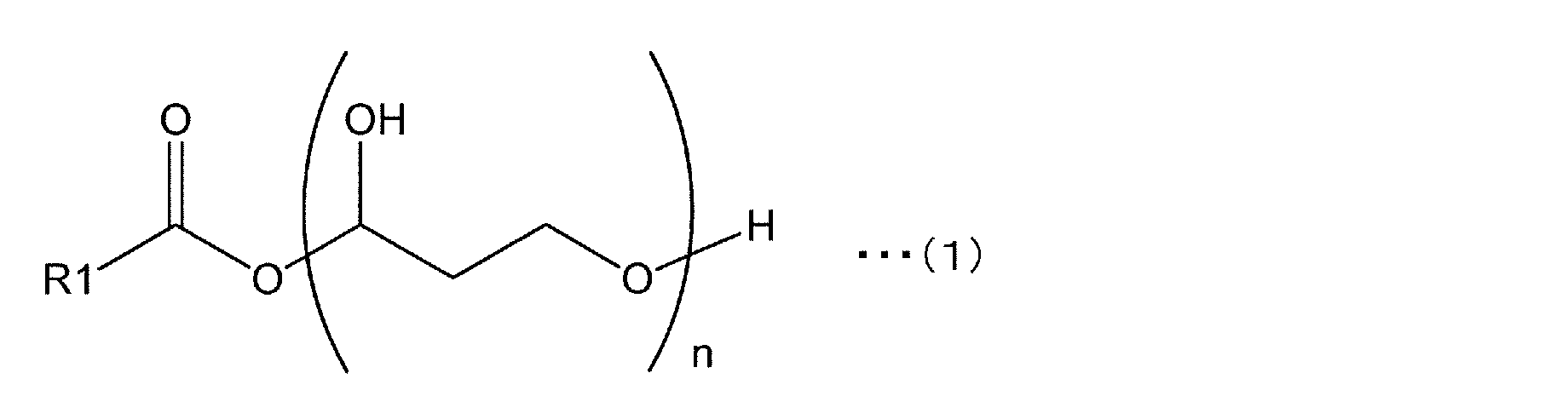
- a preferable example of the surfactant having the polyglycerin alkyl ester structure is a surfactant represented by the following formula (1).
- a surfactant having a polyglycerin alkyl ester structure other than the surfactant represented by the following formula (1) may be used. Since air bubbles can be effectively removed, the surfactant having the polyglycerin alkyl ester structure is preferably a surfactant represented by the following formula (1).
- R1 represents an alkyl group having 12 to 17 carbon atoms
- n represents an integer of 1 to 8.
- the surfactant having the polyglycerin alkyl ester structure is not particularly limited, but glycerin fatty acid monoesters (“Monogly D” and “Monogly M” manufactured by NOF Corporation) and glycerol monostearate (“MONOGLY” manufactured by NOF Corporation). I ”and“ Monogly MB ”), polyglycerin oleate (“ UNIGURI GO-102 ”manufactured by NOF Corporation), polyglycerol laurate (“ UNIGURI GL-106 ”manufactured by NOF Corporation), and polyglycerol stearic acid And esters ("UNIGURI GS-106" manufactured by NOF Corporation). Since the bubbles can be effectively removed, the surfactant having the polyglycerol alkyl ester structure is preferably polyglycerol laurate or polyglycerol stearate.
- the cyclic hydrocarbon compound is a hydrocarbon compound having a cyclic structure.
- Examples of the cyclic structure in the hydrocarbon compound having the cyclic structure include an alicyclic skeleton and an aromatic skeleton.
- the cyclic structure may be an alicyclic skeleton or an aromatic skeleton.
- the cyclic structure is preferably an alicyclic skeleton.
- cyclic hydrocarbon compound examples include hexane, toluene, 1-methylcyclohexanol, benzene, xylene, ethylbenzene, cumene, methylcyclopentane, cyclohexane, methylcyclohexane, ethylcyclohexane and cyclohexene.
- the cyclic hydrocarbon compound is preferably hexane, toluene or cyclohexane because the solubility parameter is low and generation of bubble marks can be further suppressed.
- propylene glycol compound those having an ether structure are preferable, for example, propylene glycol monomethyl ether, propylene glycol monoethyl ether, propylene glycol monomethyl ether acetate, propylene glycol monoethyl ether acetate, propylene glycol monopropyl ether, Examples include propylene glycol butyl ether, propylene glycol butyl ether acetate, dipropylene glycol monomethyl ether, dipropylene glycol monoethyl ether, and tripropylene glycol monomethyl ether.
- the propylene glycol compound is propylene glycol monomethyl ether, propylene glycol monoethyl ether, propylene glycol monomethyl ether acetate, or propylene glycol monoethyl ether acetate. Is preferred.
- fatty acid ester compound a compound having a structure represented by the following formula (2) is preferably used.
- R2 represents a hydrogen atom or an alkyl group having 1 to 3 carbon atoms
- R3 represents a hydrogen atom or an alkyl group having 1 to 6 carbon atoms.
- fatty acid ester compounds examples include propyl formate, butyl formate, isobutyl formate, pentyl formate, acetic acid, ethyl acetate, propyl acetate, isopropyl acetate, butyl acetate, isobutyl acetate, pentyl acetate, isopentyl acetate, sec-hexyl acetate, propionic acid , Methyl propionate, ethyl propionate, butyl propionate, methyl butyrate, ethyl butyrate, isobutyric acid, isobutyl isobutyrate and the like.
- the fatty acid ester compound is preferably butyl formate, isobutyl formate, propyl acetate, or ethyl propionate.
- the surface tension adjusting agent When the cyclic hydrocarbon compound, propylene glycol compound or fatty acid ester compound is used as the surface tension adjusting agent, it is preferable to use a liquid organic solvent.
- the boiling point of the surface tension modifier is preferably 60 ° C. or higher and 160 ° C. or lower. When the boiling point is less than 60 ° C., the surface tension adjusting agent tends to volatilize from the aqueous PVA solution, and it may be difficult to sufficiently remove bubbles.
- the surface tension adjusting agent tends to remain in the PVA film, the adhesion of the PVA film to the support member, and the adhesion of the PVA film to the metal roll during film formation deteriorate, Production of the film may be difficult.
- the boiling point of the surface tension modifier is more preferably 80 ° C. or higher, and still more preferably 90 ° C. or higher. If the boiling point is not less than the lower limit, bubbles can be more effectively removed.
- the boiling point of the surface tension modifier is more preferably 150 ° C. or lower, and further preferably 130 ° C. or lower. When the boiling point is not more than the above upper limit, the adhesiveness of the PVA film to the support member and the adhesiveness of the PVA film to the metal roll at the time of film formation are further improved, and the production of the PVA film is further facilitated.
- the solubility parameter is preferably 7 or more and 12 or less. A surface tension adjusting agent having a solubility parameter of 7 or more can be easily obtained. When the solubility parameter exceeds 12, the compatibility of the surface tension adjusting agent in the PVA aqueous solution becomes too high, and it is difficult to remove bubbles sufficiently.
- the solubility parameter of the surface tension modifier is more preferably 11.5 or less, and even more preferably 9 or less. If the solubility parameter is less than or equal to the upper limit, bubbles can be more effectively removed.
- the solubility parameter means SP value.
- the “SP value” can be calculated using the Fedors method (RF Fedors, Polym. Eng. Sci., 14, 147 (1974)).
- the bubbles present in the PVA aqueous solution are generally bubbles due to air or an inert gas. For this reason, by using a surface tension adjusting agent that satisfies the solubility parameter described above, it is possible to coalesce the bubbles and effectively remove the bubbles, and further reduce the viscosity around the bubbles in the aqueous PVA solution. , Can effectively remove air bubbles.
- the content of the surface tension modifier is preferably 0.01 parts by weight or more, more preferably 0.05 parts by weight or more, further preferably 0.1 parts by weight or more with respect to 100 parts by weight of the PVA.
- the amount is particularly preferably 0.5 parts by weight or more, preferably 20 parts by weight or less, more preferably 15 parts by weight or less, and still more preferably 10 parts by weight or less.
- the drying time is further shortened, and a PVA film with better quality can be obtained.
- the PVA aqueous solution preferably contains 0.0001 to 3 parts by weight of a surface tension adjusting agent with respect to 100 parts by weight of the total amount of PVA and water.
- a surface tension adjusting agent is less likely to be unevenly distributed in the aqueous PVA solution, and bubbles and droplets can be more effectively removed, and the drying time is further shortened, resulting in better quality.
- a PVA film is obtained.
- the PVA aqueous solution contains water together with the surface tension adjusting agent.
- the PVA is mainly dissolved in the water.
- the water content is 500 parts by weight or more, preferably 566 parts by weight or more, and more preferably 669 parts by weight or more with respect to 100 parts by weight of the PVA.
- the water content is 10,000 parts by weight or less, preferably 1900 parts by weight or less, more preferably 1566 parts by weight or less.
- the viscosity of the PVA aqueous solution becomes moderately high, the casting of the PVA aqueous solution becomes easy, the drying time is further shortened, and the thickness of the PVA film is made more uniform. Thus, an even better quality PVA film is obtained.
- the water content is preferably 85% by weight or more, more preferably 87% by weight or more, still more preferably 90% by weight or more, preferably 99% by weight or less, more preferably 95% by weight.
- it is more preferably 94% by weight or less.
- the viscosity of the PVA aqueous solution becomes moderately high, the casting of the PVA aqueous solution becomes easy, the drying time is further shortened, and the thickness of the PVA film is made more uniform. Thus, an even better quality PVA film is obtained.
- the PVA aqueous solution preferably further contains a preservative.
- a preservative As for the said preservative, only 1 type may be used and 2 or more types may be used together.
- PVA When producing a PVA film using PVA, generally, PVA is dissolved in a solvent.
- a preservative has not been blended in an aqueous PVA solution containing PVA and a solvent.
- preservatives suppress corrosion, but preservatives are never mixed in PVA aqueous solutions containing PVA and a solvent for obtaining a packaging film or a stretch film. It wasn't. For this reason, if a conventional PVA aqueous solution containing PVA and a solvent is stored for a long period of time or exposed to high temperature conditions or high humidity conditions, there is a problem that corrosion occurs in the solution. As a result, a good PVA film could not be obtained or the quality of multiple PVA films was likely to vary.
- preservative examples include isothiazolone compounds, glutaraldehyde, and quaternary ammonium compounds. Other preservatives may be used.
- the preservative is preferably a compound having a heterocyclic ring. Since the corrosion is further effectively suppressed, the heterocyclic ring preferably contains a nitrogen atom and a sulfur atom in the ring.
- the preservative is preferably an isothiazolone compound.
- isothiazolone compounds include 2-methyl-4-isothiazolin-3-one, 2-octyl-4-isothiazolin-3-one, 5-chloro-2-methyl-4-isothiazolin-3-one, and 5-chloro- Examples include 3-methylisothiazol-3-one and 2-methylisothiazol-3-one.
- the quaternary ammonium compound include benzyldecyldimethylammonium chloride, didecyldimethylammonium chloride, and cetylpyridinium chloride.
- the content of the preservative is preferably 0.01% by weight or more, more preferably 0.03% by weight or more, preferably 1% by weight or less, more preferably 0.3% by weight or less. It is. When the content of the preservative is not less than the above lower limit and not more than the above upper limit, the corrosion of the PVA aqueous solution is further suppressed, and a much better and homogeneous PVA film can be obtained.
- the PVA film according to the present invention is obtained by forming the PVA aqueous solution according to the present invention into a film.
- the PVA film according to the present invention is suitably used for obtaining a packaging film or a stretching film.
- the PVA film which concerns on this invention can be used conveniently also as an agricultural packaging film and a water-soluble film.
- the method of casting and drying the PVA aqueous solution which concerns on this invention can be used.
- Specific examples include a solution casting method (casting method), a roll coating method, a spin coating method, a screen coating method, a fountain coating method, a dipping method, and a spray method.
- the laminated film according to the present invention includes a support member and a PVA film laminated on the support member.
- the PVA film is obtained by casting and drying the above-described PVA aqueous solution.
- the said PVA film may be provided in the state laminated
- a laminated film in which a polyvinyl alcohol resin layer formed using the aqueous polyvinyl alcohol solution of the present invention is laminated on the support member and the support member is also one aspect of the present invention.
- the method etc. which cast and dry the said PVA aqueous solution on a support member, etc. are mentioned.
- the method for casting the PVA aqueous solution on the support member is not particularly limited, and examples thereof include a roll coating method, a spin coating method, a screen coating method, a fountain coating method, a dipping method, and a spray method.
- Examples of the roll coating method include a wire bar coating method, a reverse coating method, and a gravure coating method.
- the support member is preferably capable of supporting the PVA film obtained by maintaining the PVA aqueous solution on the surface and casting the PVA aqueous solution.
- the material for the support member include polyolefin, polyester, acrylic resin, and the like. You may use the supporting member formed with materials other than these.
- the polyolefin include ethylene, polypropylene, ethylene-vinyl acetate copolymer, and ethylene-vinyl alcohol copolymer.
- Examples of the polyester include polyethylene terephthalate and polyethylene naphthalate.
- the material of the support member is preferably not PVA.
- the drying method after casting the PVA aqueous solution on the support member can be any suitable method and is not particularly limited.
- Examples of the drying method include a method of natural drying and a method of heat drying at a temperature lower than the glass transition temperature of PVA.
- the PVA aqueous solution according to the present invention is preferably used for obtaining a packaging film or a stretching film having a thickness of 30 ⁇ m or less, and a packaging film or a stretching film having a thickness of 20 ⁇ m or less is obtained. More preferably, it is used.
- a packaging film or a stretching film having a thickness of 30 ⁇ m or less bubbles or droplets in the film tend to cause the film to break during stretching.
- the use of the PVA film according to the present invention can sufficiently contain bubbles or droplets even when a packaging film having a thickness of 30 ⁇ m or less or a film for stretching is obtained. Can be suppressed.
- the thickness of the PVA film is preferably 30 ⁇ m or less, more preferably 20 ⁇ m or less, still more preferably 15 ⁇ m or less, and particularly preferably 10 ⁇ m or less.
- the thickness of the PVA film is preferably 1 ⁇ m or more.
- the stretching method of the PVA resin film and the laminated film is not particularly limited, and examples thereof include a tenter stretching method, a roll stretching method, a stretching method using other stretching devices, and a tubular stretching method. Stretching may be performed only on one axis of the film or may be performed on two axes of the film. Moreover, regarding the device to be used, a plurality of devices may be used in combination. For example, as a subsequent process of roll longitudinal uniaxial stretching, a sequential stretching method of performing tenter transverse axis stretching may be employed. Furthermore, if necessary, the residual stress can be reduced by heat fixing the film after stretching.
- a polyvinyl alcohol aqueous solution capable of forming a film that suppresses contamination by components other than polyvinyl alcohol, has less bubbles, and has excellent adhesion to a substrate, and the polyvinyl alcohol aqueous solution are used.
- a laminated film can be provided.
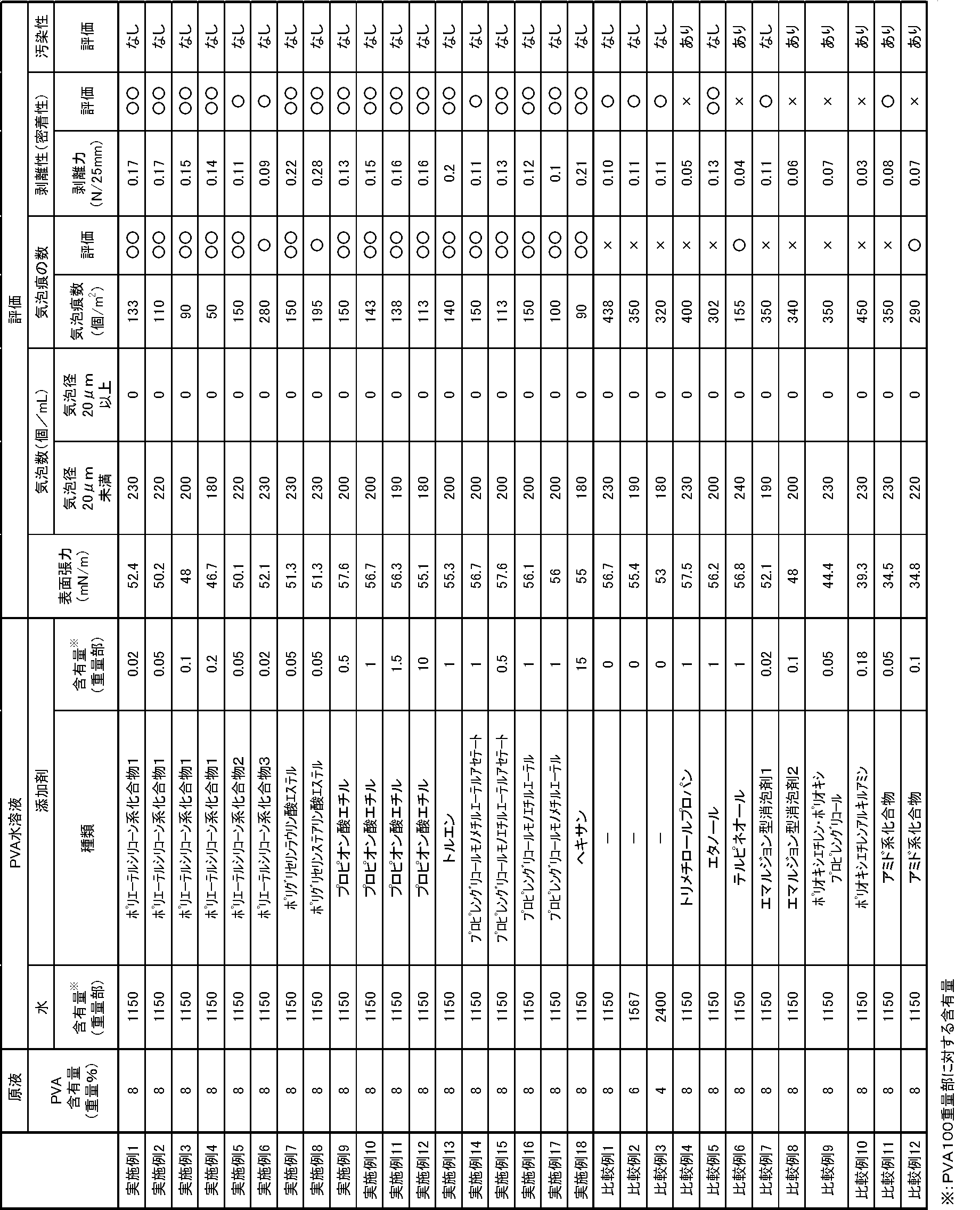
- Example 1 to 18 100 parts by weight of PVA (polymerization degree 2500, saponification degree 98.5 mol%, “CELVOL C350” manufactured by Seki Swiss Specialty Chemicals) and 1150 parts by weight of water are blended and heated at 95 ° C. for 90 minutes to obtain PVA. A stock solution containing 8% by weight was obtained.
- Additives of the type shown in Table 1 below are blended in 1250 parts by weight of the resulting stock solution in the amounts shown in Table 2 below, and further, an isothiazolone compound (San-Ieback IT-manufactured by Sanai Oil Co., Ltd.) as a preservative 20P ”) 1.25 parts by weight was blended to obtain a PVA aqueous solution.
- Table 1 below shows the types of additives used, solubility parameters, boiling point, and HLB.
- the obtained PVA aqueous solution was applied onto a polyethylene terephthalate (PET) film (thickness: 50 ⁇ m) as a support member using an auto film applicator (“PI-1210” manufactured by Tester Sangyo Co., Ltd.), and at 80 ° C. for 5 minutes. It was dried and then dried at 100 ° C. for 20 minutes to obtain a laminated film in which a PVA film (thickness: 12 ⁇ m) was laminated on the support member.
- PET polyethylene terephthalate
- PI-1210 manufactured by Tester Sangyo Co., Ltd.
- Comparative Example 1 To 1250 parts by weight of the stock solution obtained in Example 1, 1.25 parts by weight of a preservative isothiazolone compound (“San-Ibach IT-20P” manufactured by Sanai Oil Co., Ltd.) was blended to obtain an aqueous PVA solution. In Comparative Example 1, no additive was used. A laminated film was obtained in the same manner as in Example 1 except that the obtained PVA aqueous solution was used.
- Comparative Example 2 Comparative Example 2 was obtained by diluting the PVA aqueous solution obtained in Comparative Example 1 twice. Similarly, a 4-fold diluted product was designated as Comparative Example 3.
- Polyoxyethylene / polyoxypropylene glycol (Daiichi Kogyo Seiyaku Co., Ltd.,“ Epan 410 ”)” used in Comparative Example 9 is a copolymer composed of polyoxyethylene and polyoxypropylene.
- Number of bubble marks is 150 / m 2 or less
- Number of bubble marks exceeds 150 / m 2 and less than 300 / m 2
- Number of bubble marks is 300 / m 2 or more
- the obtained laminated film was cut into a size of 25 mm long ⁇ 100 mm wide.
- the cut laminated film was subjected to a tensile test to peel the PVA film from the PET film in the 180 ° direction under the conditions of a temperature of 23 ° C., a humidity of 50% and a peeling speed of 0.3 mm / min, and the peeling force (N / 25 mm).
- a temperature of 23 ° C. a humidity of 50% and a peeling speed of 0.3 mm / min
- the peeling force N / 25 mm
- the peeling force tends to decrease.
- the peelability was determined according to the following criteria.
- Peeling force is 0.12 N / 25 mm or more
- Peeling force is 0.08 N / 25 mm or more and less than 0.12 N / 25 mm
- Peeling force is less than 0.08 N / 25 mm
- the obtained laminated film was cut into a size of 100 mm length ⁇ 100 mm width.
- the cut laminated film is allowed to stand for 1 week at a temperature of 23 ° C. and a humidity of 50%, and then the surface of the laminated film and the surface of the PET film after the PVA film is peeled off from the PET film are traced with fingers.
- the case where an object is attached to a finger is “Yes”, and the case where an object is not attached is “None”.
- a polyvinyl alcohol aqueous solution capable of forming a film that suppresses contamination by components other than polyvinyl alcohol, has less bubbles, and has excellent adhesion to a substrate, and the polyvinyl alcohol aqueous solution are used.
- a laminated film can be provided.
Landscapes
- Chemical & Material Sciences (AREA)
- Organic Chemistry (AREA)
- Health & Medical Sciences (AREA)
- Chemical Kinetics & Catalysis (AREA)
- Medicinal Chemistry (AREA)
- Polymers & Plastics (AREA)
- Engineering & Computer Science (AREA)
- Materials Engineering (AREA)
- Manufacturing & Machinery (AREA)
- Mechanical Engineering (AREA)
- Life Sciences & Earth Sciences (AREA)
- Wood Science & Technology (AREA)
- Compositions Of Macromolecular Compounds (AREA)
- Laminated Bodies (AREA)
- Manufacture Of Macromolecular Shaped Articles (AREA)
Abstract
Description
また、PVA系樹脂を各種包装材料として用いる場合は、PVA系樹脂を水中に溶解させてPVA系水溶液を得た後、PVA系水溶液を流延し、製膜する方法や、PVA系水溶液を基材に塗布する方法が一般的に採用されている。しかしながら、PVA系水溶液は表面張力が高いため、PVA系水溶液は発泡しやすく、更に塗工液の消泡が充分でないまま皮膜が形成されやすい。この皮膜では、泡の部分が欠陥となってガスバリア性が大きく低下する。
また、特許文献2には、フィルターにPVAを構成成分とする製膜原料を通過させた後に、製膜原料を製膜するPVAフィルムの製造方法が開示されている。特許文献2では、フィルターを新たに交換する際に、新たなフィルター内に、水もしくは水溶液を充満させるか、又は水に溶解可能な液体もしくは水に溶解可能な液体を主要成分とする溶液を充満させることで、延伸加工用のPVAフィルムが得られることが記載されている。
更に、特許文献3には、特定の水酸基とカルボキシル基とを有する化合物を用いることで、長期間にわたって低温低湿下、高温多湿下などの過酷な条件下に放置されても、フィルム中の可塑剤がフィルム表面にしみ出さず、柔軟性を維持可能であるPVA系フィルムが得られることが記載されている。
また、特許文献3に記載のようなPVA溶液でも、シート状に流延した後のフィルム表面への可塑剤のしみ出しを抑えることが困難である。
以下、本発明を詳述する。
以下、本発明の詳細を説明する。
本発明に係るポリビニルアルコール(以下、PVAと記載することがある)水溶液は、PVAフィルムを得るために用いられる。本発明に係るPVA水溶液は、PVAと、表面張力調整剤と、水とを含む。
上記表面張力が45mN/m未満であると、積層フィルムを形成した場合に、フィルム表面やフィルムと基材の界面に表面張力調整剤のしみ出しが起こり、基材との密着性を悪化させる。
上記表面張力の好ましい下限は50mN/m、好ましい上限は60mN/mである。
なお、上記表面張力は、20℃において測定されるものである。また、表面張力を測定する方法としては、従来公知の滴重法、毛細管上昇法、輪環法、平板法など一般に知られている測定方法により測定することができ、例えば、協和界面科学社製の自動表面張力計DY-300を用いて平板法(Wilhelmy法)にて測定することができる。
本発明のポリビニルアルコール水溶液は、ポリビニルアルコールを含有する。
本発明のポリビニルアルコール水溶液を用いて、膜等を形成する際には、上記ポリビニルアルコールが膜の主たる構成樹脂となる。
上記けん化度の調整方法は特に限定されない。けん化度は、けん化条件、すなわち加水分解条件により適宜調整可能である。
上記ポリビニルアルコールの含有量が上記下限以上であると、ポリビニルアルコール水溶液の粘度が適度に高くなり、乾燥時間がより一層短くなり、PVAフィルムの厚みがより一層均一になり、より一層良好な品質のPVAフィルムが得られる。上記ポリビニルアルコールの含有量が上記上限以下であると、ポリビニルアルコール水溶液の粘度が適度に低くなり、PVA水溶液の流延が容易になり、得られるPVAフィルムにおいて気泡痕及び液滴がより一層含まれ難くなる。
本発明のポリビニルアルコール水溶液は、ポリエーテルシリコーン系化合物、グリセリン系化合物、環式炭化水素化合物、プロピレングリコール系化合物及び脂肪酸エステル系化合物からなる群より選択される少なくとも1種の表面張力調整剤を含有する。
上記表面張力調整剤を含有することで、本発明のポリビニルアルコール水溶液の表面張力を45~72mN/mの範囲内とすることができる。
また、上記表面張力調整剤を含有することで、ポリビニルアルコール水溶液の気泡の発生を防止することができる。
上記エーテル構造を有するシリコーン界面活性剤としては、シリコーンの両末端がポリエーテル構造を有するシリコーン界面活性剤(信越化学工業社製「X-224952」、「X-22-4272」及び「X22-6266」)、シリコーンの側鎖にポリエーテル構造を有するシリコーン界面活性剤(信越化学工業社製「KF-351A」、「KF-352A」、「KF-353」、「KF-354L」、「KF-355A」、「KF-615A」、「KF-945」、「KF-640」、「KF-642」、「KF-643」、「KF-6020」、「KS-604」、「X-50-1039A」、「X-50-1105G」、「X-22-6191」、「X-22-4515」、「KF-6011」、「KF-6012」、「KF-6015」及び「KF-6017」)、並びにシリコーンの両末端にポリエーテル構造を有する界面活性剤(信越化学工業社製「KF-6004」、「KF-889」、「X-22-4741」、「KF-1002」、「X-22-4952」、「X-22-4272」及び「X-22-6266」)等が挙げられる。気泡を効果的に取り除くことができるので、上記シリコーン界面活性剤は、シリコーンの側鎖にポリエーテル構造を有するシリコーン界面活性剤であることがより好ましい。
上記ポリグリセリンアルキルエステル構造を有する界面活性剤の好ましい例としては、下記式(1)で表される界面活性剤が挙げられる。下記式(1)で表される界面活性剤以外の、ポリグリセリンアルキルエステル構造を有する界面活性剤を用いてもよい。気泡を効果的に取り除くことができるので、上記ポリグリセリンアルキルエステル構造を有する界面活性剤は、下記式(1)で表される界面活性剤であることが好ましい。

この場合、上記表面張力調整剤の沸点は、60℃以上かつ160℃以下であることが好ましい。上記沸点が60℃未満であると、上記PVA水溶液から表面張力調整剤が揮発しやすくなり、気泡を充分に取り除くことが困難になることがある。上記沸点が160℃を超えると、上記PVAフィルム中に表面張力調整剤が残りやすくなり、PVAフィルムの支持部材に対する接着性、並びに成膜時のPVAフィルムの金属ロールに対する密着性が悪くなり、PVAフィルムの作製が困難になることがある。
上記PVA水溶液は、上記表面張力調整剤とともに水を含む。上記PVAは、主として、上記水中に溶解されている。
また、上記水の含有量は10000重量部以下、好ましくは1900重量部以下、より好ましくは1566重量部以下である。上記水の含有量が上記下限以上であると、PVA水溶液の粘度が適度に低くなり、PVA水溶液の流延が容易になり、更に気泡をより一層効果的に取り除くことができる。上記水の含有量が上記上限以下であると、PVA水溶液の粘度が適度に高くなり、PVA水溶液の流延が容易になり、乾燥時間がより一層短くなり、PVAフィルムの厚みがより一層均一になり、より一層良好な品質のPVAフィルムが得られる。
上記PVA水溶液は、更に防腐剤を含むことが好ましい。上記防腐剤は、1種のみが用いられてもよく、2種以上が併用されてもよい。
本発明に係るPVAフィルムは、本発明に係るPVA水溶液をフィルム化することで得られる。本発明に係るPVAフィルムは、包装用フィルム又は延伸加工用フィルムを得るために好適に用いられる。また、本発明に係るPVAフィルムは、農業包装フィルム、水溶性フィルムとしても好適に使用することができる。
上記支持部材と、上記支持部材上に、本発明のポリビニルアルコール水溶液を用いて形成されたポリビニルアルコール樹脂層が積層された積層フィルムもまた本発明の1つである。
PVA(重合度2500、けん化度98.5モル%、セキスイスペシャリティケミカルズ社製「CELVOL C350」)100重量部と、水1150重量部とを配合して、95℃で90分加熱して、PVAを8重量%含む原液を得た。
なお、使用した添加剤の種類、溶解度パラメータ、沸点、HLBを下記表1に示す。

実施例1で得られた原液1250重量部に、防腐剤であるイソチアゾロン化合物(三愛石油社製「サンアイバック IT-20P」)1.25重量部を配合して、PVA水溶液を得た。比較例1では、添加剤を用いなかった。得られたPVA水溶液を用いたこと以外は実施例1と同様にして、積層フィルムを得た。
比較例1で得られたPVA水溶液を2倍希釈したものを比較例2とした。同様にして4倍希釈したものを比較例3とした。
実施例1で得られた原液1250重量部に、上記の表1に示す種類の添加剤を上記の表2に示す配合量で配合して、更に防腐剤であるイソチアゾロン化合物(三愛石油社製「サンアイバック IT-20P」)1.25重量部を配合して、PVA水溶液を得た。得られたPVA水溶液を用いたこと以外は実施例1と同様にして、積層フィルムを得た。
なお、比較例9で使用の「ポリオキシエチレン・ポリオキシプロピレングリコール(第一工業製薬社製、「エパン410」)」は、ポリオキシエチレンとポリオキシプロピレンからなる共重合体である。
(1)表面張力測定
得られたPVA水溶液30mLをシャーレに入れて、自動表面張力計(協和界面科学社製、DY-300)を用い、平板法(Wilhelmy法)にて、PVA水溶液の表面張力を測定した。
測定条件は、室温20℃、湿度50%の環境下で、白金プレート(縦10mm×横24mm、厚さ0.15mm)を使用し、サンプリング間隔10秒で測定終了時間300秒、白金プレートの浸漬距離2.5mm、浸漬時間1秒、ステージ上昇速度0.7mm/秒、測定回数2回にて測定した。
なお、表面張力値は、測定時間50~300秒の間に得られた表面張力の平均値とした。
得られたPVA水溶液約1mLをプレパラートに滴下し、レーザー顕微鏡(キーエンス社製「VK-8710」)にて観察することで、PVA水溶液中の気泡数(気泡径が20μm未満である気泡の数、及び、気泡径が20μm以上である気泡の数)を計数した。
得られたPVAフィルム(厚さ12μm)を、縦0.2m×横0.4mの大きさに裁断した。裁断されたPVAフィルム10枚を、レーザー顕微鏡(キーエンス社製「VK-8710」)にて観察した。直径が1~100μmの気泡痕の個数を数え、個数の平均値を平米換算した。気泡痕の数を下記の基準で判定した。
○○:気泡痕の数が150個/m2以下
○:気泡痕の数が150個/m2を超え、300個/m2未満
×:気泡痕の数が300個/m2以上
得られた積層フィルムを縦25mm×横100mmの大きさに裁断した。裁断された積層フィルムについて、温度23℃、湿度50%及び剥離速度0.3mm/分の条件で、PVAフィルムをPETフィルムから180°方向で剥離する引張試験を行い、剥離力(N/25mm)を測定した。
○○:剥離力が0.12N/25mm以上
○:剥離力が0.08N/25mm以上、0.12N/25mm未満
×:剥離力が0.08N/25mm未満
得られた積層フィルムを縦100mm×横100mmの大きさに裁断した。裁断された積層フィルムについて、温度23℃、湿度50%の条件で1週間放置した後、積層フィルムの表面、及び、PVAフィルムをPETフィルムから剥離した後のPETフィルムの表面を指でなぞり、ブリード物が指に付く場合を「あり」、付かない場合を「なし」とした。
Claims (12)
- ポリビニルアルコール、表面張力調整剤及び水を含有するポリビニルアルコール水溶液であって、
前記表面張力調整剤は、ポリエーテルシリコーン系化合物、グリセリン系化合物、環式炭化水素化合物、プロピレングリコール系化合物及び脂肪酸エステル系化合物からなる群より選択される少なくとも1種であり、
ポリビニルアルコール100重量部に対して、水を500~10000重量部含有し、かつ、
表面張力が45~72mN/mである
ことを特徴とするポリビニルアルコール水溶液。 - ポリビニルアルコールと水の合計量100重量部に対して、表面張力調整剤を0.0001~3重量部含有することを特徴とする請求項1記載のポリビニルアルコール水溶液。
- ポリビニルアルコール100重量部に対して、表面張力調整剤を0.01~20重量部含有することを特徴とする請求項1又は2記載のポリビニルアルコール水溶液。
- ポリエーテルシリコーン系化合物は、エーテル構造を有するシリコーン界面活性剤であり、HLBが0以上かつ12.0以下であることを特徴とする請求項1、2又は3記載のポリビニルアルコール水溶液。
- グリセリン系化合物が、ポリグリセリンアルキルエステル構造を有する界面活性剤であることを特徴とする請求項1、2、3又は4記載のポリビニルアルコール水溶液。
- グリセリン系化合物が、下記式(1)で表される界面活性剤であることを特徴とする請求項5記載のポリビニルアルコール水溶液。

- 環式炭化水素化合物、プロピレングリコール系化合物又は脂肪酸エステル系化合物は、沸点が60℃以上かつ160℃以下であり、かつ、溶解度パラメータが7以上かつ12以下であることを特徴とする請求項1、2、3、4、5又は6記載のポリビニルアルコール水溶液。
- 脂肪酸エステル系化合物は、下記式(2)で表される構造を有する化合物であることを特徴とする請求項1、2、3、4、5、6又は7記載のポリビニルアルコール水溶液。

- 更に防腐剤を含有することを特徴とする請求項1、2、3、4、5、6、7又は8記載のポリビニルアルコール水溶液。
- 包装用フィルム又は延伸加工用フィルムを形成するためのポリビニルアルコールフィルムを得るために用いられる請求項1、2、3、4、5、6、7、8又は9記載のポリビニルアルコール水溶液。
- 請求項1、2、3、4、5、6、7、8又は9記載のポリビニルアルコール水溶液を、流延し、乾燥することを特徴とするポリビニルアルコールフィルムの製造方法。
- 支持部材と、前記支持部材上に、請求項1、2、3、4、5、6、7、8又は9記載のポリビニルアルコール水溶液を用いて形成されたポリビニルアルコール樹脂層が積層されていることを特徴とする積層フィルム。
Priority Applications (4)
| Application Number | Priority Date | Filing Date | Title |
|---|---|---|---|
| CN201480024542.0A CN105164202B (zh) | 2013-05-01 | 2014-04-30 | 聚乙烯醇水溶液 |
| KR1020157031695A KR20160004293A (ko) | 2013-05-01 | 2014-04-30 | 폴리비닐알코올 수용액 |
| JP2014524213A JP5845352B2 (ja) | 2013-05-01 | 2014-04-30 | ポリビニルアルコール水溶液 |
| US14/783,146 US9605133B2 (en) | 2013-05-01 | 2014-04-30 | Polyvinyl alcohol aqueous solution |
Applications Claiming Priority (6)
| Application Number | Priority Date | Filing Date | Title |
|---|---|---|---|
| JP2013096387 | 2013-05-01 | ||
| JP2013-096387 | 2013-05-01 | ||
| JP2013-096386 | 2013-05-01 | ||
| JP2013096386 | 2013-05-01 | ||
| JP2014-044092 | 2014-03-06 | ||
| JP2014044092 | 2014-03-06 |
Publications (1)
| Publication Number | Publication Date |
|---|---|
| WO2014178402A1 true WO2014178402A1 (ja) | 2014-11-06 |
Family
ID=51843526
Family Applications (1)
| Application Number | Title | Priority Date | Filing Date |
|---|---|---|---|
| PCT/JP2014/061984 Ceased WO2014178402A1 (ja) | 2013-05-01 | 2014-04-30 | ポリビニルアルコール水溶液 |
Country Status (6)
| Country | Link |
|---|---|
| US (1) | US9605133B2 (ja) |
| JP (1) | JP5845352B2 (ja) |
| KR (1) | KR20160004293A (ja) |
| CN (1) | CN105164202B (ja) |
| TW (1) | TWI623553B (ja) |
| WO (1) | WO2014178402A1 (ja) |
Cited By (4)
| Publication number | Priority date | Publication date | Assignee | Title |
|---|---|---|---|---|
| JP2018018062A (ja) * | 2016-07-19 | 2018-02-01 | 日本合成化学工業株式会社 | ポリビニルアルコール系樹脂水溶液、光学用ポリビニルアルコール系フィルムの製造方法、光学用ポリビニルアルコール系フィルム、及び偏光フィルム |
| JP2018072818A (ja) * | 2016-10-25 | 2018-05-10 | 日本合成化学工業株式会社 | ポリビニルアルコール系樹脂水溶液、積層体、積層体の製造方法、光学用ポリビニルアルコール系フィルム、熱可塑性フィルム付き偏光膜、偏光膜、偏光板 |
| US10407589B2 (en) * | 2014-05-30 | 2019-09-10 | Henkel Ag & Co. Kgaa | Hydrophilic coating for heat exchangers |
| WO2020052676A1 (zh) * | 2018-09-12 | 2020-03-19 | 华南理工大学 | 一种可循环再生利用的纸塑复合材料用水溶性涂覆材料及其制备方法 |
Families Citing this family (5)
| Publication number | Priority date | Publication date | Assignee | Title |
|---|---|---|---|---|
| CN108705837A (zh) * | 2018-06-02 | 2018-10-26 | 杭州宏畔纸塑包装有限公司 | 一种纸塑包装袋及其制备方法 |
| CN110183705B (zh) * | 2019-05-31 | 2021-11-05 | 南阳九鼎材料科技股份有限公司 | 一种pet基材打底技术 |
| CN113045847B (zh) * | 2021-01-15 | 2023-03-10 | 山东优化新材料有限公司 | 一种用于包装浓缩洗衣液的水溶性包装膜 |
| CN113308152A (zh) * | 2021-05-26 | 2021-08-27 | 广州大学 | 一种抗菌低粘附聚乙烯醇涂层 |
| CN118619686A (zh) * | 2024-05-08 | 2024-09-10 | 深圳市基克纳科技有限公司 | 一种水基流延陶瓷制备方法、浆料以及陶瓷 |
Citations (8)
| Publication number | Priority date | Publication date | Assignee | Title |
|---|---|---|---|---|
| JPH107828A (ja) * | 1996-06-26 | 1998-01-13 | Asahi Chem Ind Co Ltd | 記録シート |
| JP2003026945A (ja) * | 2001-07-17 | 2003-01-29 | Nippon Synthetic Chem Ind Co Ltd:The | プリント配線基板穿孔用水分散性樹脂組成物、該組成物よりなるシート及びかかるシートを用いたプリント配線基板の穿孔方法 |
| JP2003145692A (ja) * | 2001-11-14 | 2003-05-20 | Toyobo Co Ltd | 酸素ガスバリア性フィルム及びその製造方法 |
| JP2004131478A (ja) * | 2002-08-14 | 2004-04-30 | L'air Liquide Sante Internatl | 殺菌作用および殺藻作用を有する水性分散液 |
| JP2007530764A (ja) * | 2004-03-30 | 2007-11-01 | コベライト サーフェーシーズ ホールディング ゲーエムベーハー | コーティング組成物、コーティングされた物品、およびこれらを製造するための方法 |
| JP2010012778A (ja) * | 2008-06-30 | 2010-01-21 | Lg Chem Ltd | ポリビニルアルコール系フィルムの製造方法、それから形成されたポリビニルアルコール系フィルム、及びこれを備えた偏光板 |
| JP2012197389A (ja) * | 2011-03-23 | 2012-10-18 | Nippon Synthetic Chem Ind Co Ltd:The | ポリビニルアルコール系フィルムの製造方法、及び片面に梨地模様を有するポリビニルアルコール系フィルム |
| JP2013171210A (ja) * | 2012-02-22 | 2013-09-02 | Sekisui Chem Co Ltd | ポリビニルアルコール樹脂フィルム材料、偏光フィルム及び偏光フィルムの製造方法 |
Family Cites Families (10)
| Publication number | Priority date | Publication date | Assignee | Title |
|---|---|---|---|---|
| AU3742185A (en) * | 1983-11-22 | 1985-03-04 | Udviklingsselskabet A F 31 10 1983 ApS | Paint |
| JPH09157473A (ja) | 1995-12-12 | 1997-06-17 | Unitika Chem Kk | ポリビニルアルコール系フィルム |
| CA2272512C (en) * | 1998-06-03 | 2003-10-21 | Kuraray Co., Ltd. | Coating agent for film, laminate and method for producing it |
| JP4485045B2 (ja) | 2000-11-15 | 2010-06-16 | 株式会社クラレ | 延伸加工用ビニルアルコール系重合体フィルムの製造法 |
| JP4578140B2 (ja) * | 2004-04-21 | 2010-11-10 | 株式会社クラレ | ポリビニルアルコールフィルム |
| KR101212424B1 (ko) * | 2004-11-02 | 2012-12-13 | 닛폰고세이가가쿠고교 가부시키가이샤 | 폴리비닐알콜계 필름 및 그 제조 방법 |
| JP5191096B2 (ja) | 2005-12-12 | 2013-04-24 | 日本合成化学工業株式会社 | 樹脂組成物、それを用いた水性塗工液、及び多層構造体 |
| CN101033320B (zh) | 2007-03-20 | 2010-10-13 | 中国乐凯胶片集团公司 | 一种偏光片用聚乙烯醇膜 |
| DE102007026998A1 (de) * | 2007-06-07 | 2008-12-11 | Tesa Ag | Hydrophiler Beschichtungslack |
| KR101752027B1 (ko) * | 2010-04-20 | 2017-06-28 | 주식회사 쿠라레 | 폴리비닐알코올계 중합체 필름 |
-
2014
- 2014-04-30 WO PCT/JP2014/061984 patent/WO2014178402A1/ja not_active Ceased
- 2014-04-30 US US14/783,146 patent/US9605133B2/en not_active Expired - Fee Related
- 2014-04-30 JP JP2014524213A patent/JP5845352B2/ja active Active
- 2014-04-30 KR KR1020157031695A patent/KR20160004293A/ko not_active Ceased
- 2014-04-30 CN CN201480024542.0A patent/CN105164202B/zh active Active
- 2014-05-01 TW TW103115682A patent/TWI623553B/zh active
Patent Citations (8)
| Publication number | Priority date | Publication date | Assignee | Title |
|---|---|---|---|---|
| JPH107828A (ja) * | 1996-06-26 | 1998-01-13 | Asahi Chem Ind Co Ltd | 記録シート |
| JP2003026945A (ja) * | 2001-07-17 | 2003-01-29 | Nippon Synthetic Chem Ind Co Ltd:The | プリント配線基板穿孔用水分散性樹脂組成物、該組成物よりなるシート及びかかるシートを用いたプリント配線基板の穿孔方法 |
| JP2003145692A (ja) * | 2001-11-14 | 2003-05-20 | Toyobo Co Ltd | 酸素ガスバリア性フィルム及びその製造方法 |
| JP2004131478A (ja) * | 2002-08-14 | 2004-04-30 | L'air Liquide Sante Internatl | 殺菌作用および殺藻作用を有する水性分散液 |
| JP2007530764A (ja) * | 2004-03-30 | 2007-11-01 | コベライト サーフェーシーズ ホールディング ゲーエムベーハー | コーティング組成物、コーティングされた物品、およびこれらを製造するための方法 |
| JP2010012778A (ja) * | 2008-06-30 | 2010-01-21 | Lg Chem Ltd | ポリビニルアルコール系フィルムの製造方法、それから形成されたポリビニルアルコール系フィルム、及びこれを備えた偏光板 |
| JP2012197389A (ja) * | 2011-03-23 | 2012-10-18 | Nippon Synthetic Chem Ind Co Ltd:The | ポリビニルアルコール系フィルムの製造方法、及び片面に梨地模様を有するポリビニルアルコール系フィルム |
| JP2013171210A (ja) * | 2012-02-22 | 2013-09-02 | Sekisui Chem Co Ltd | ポリビニルアルコール樹脂フィルム材料、偏光フィルム及び偏光フィルムの製造方法 |
Cited By (4)
| Publication number | Priority date | Publication date | Assignee | Title |
|---|---|---|---|---|
| US10407589B2 (en) * | 2014-05-30 | 2019-09-10 | Henkel Ag & Co. Kgaa | Hydrophilic coating for heat exchangers |
| JP2018018062A (ja) * | 2016-07-19 | 2018-02-01 | 日本合成化学工業株式会社 | ポリビニルアルコール系樹脂水溶液、光学用ポリビニルアルコール系フィルムの製造方法、光学用ポリビニルアルコール系フィルム、及び偏光フィルム |
| JP2018072818A (ja) * | 2016-10-25 | 2018-05-10 | 日本合成化学工業株式会社 | ポリビニルアルコール系樹脂水溶液、積層体、積層体の製造方法、光学用ポリビニルアルコール系フィルム、熱可塑性フィルム付き偏光膜、偏光膜、偏光板 |
| WO2020052676A1 (zh) * | 2018-09-12 | 2020-03-19 | 华南理工大学 | 一种可循环再生利用的纸塑复合材料用水溶性涂覆材料及其制备方法 |
Also Published As
| Publication number | Publication date |
|---|---|
| US9605133B2 (en) | 2017-03-28 |
| TW201446809A (zh) | 2014-12-16 |
| CN105164202B (zh) | 2018-04-27 |
| KR20160004293A (ko) | 2016-01-12 |
| JP5845352B2 (ja) | 2016-01-20 |
| CN105164202A (zh) | 2015-12-16 |
| TWI623553B (zh) | 2018-05-11 |
| US20160032081A1 (en) | 2016-02-04 |
| JPWO2014178402A1 (ja) | 2017-02-23 |
Similar Documents
| Publication | Publication Date | Title |
|---|---|---|
| JP5845352B2 (ja) | ポリビニルアルコール水溶液 | |
| JP7804713B2 (ja) | 水溶性フィルムおよび包装体 | |
| JP7240422B2 (ja) | 水溶性フィルムおよび包装体 | |
| US11840590B2 (en) | Polyvinyl alcohol film | |
| CN111433135A (zh) | 药剂包装用膜及包装体 | |
| EP3196015B1 (en) | Water-soluble packaging film | |
| JPWO2020027020A1 (ja) | ポリビニルアルコール系フィルム及び薬剤包装体 | |
| JP2017052897A (ja) | 水溶性包装用フィルム | |
| WO2016167135A1 (ja) | 薬剤包装用フィルム | |
| JP7431627B2 (ja) | ポリビニルアルコールフィルム、及びパッケージ材料 | |
| WO2016093258A1 (ja) | ポリビニルアルコールフィルム | |
| JPWO2012043192A1 (ja) | 植物栽培用フィルム | |
| CN111032753A (zh) | 保鲜膜和保鲜膜卷绕体 | |
| JP2021143295A (ja) | ポリビニルアルコールフィルム、及パッケージ材料 | |
| WO2012043193A1 (ja) | フィルムおよびその製造方法 | |
| US20240392105A1 (en) | Modified ethylene-vinyl alcohol copolymer composition, pellets, multilayer structure, method for producing modified ethylene-vinyl alcohol copolymer composition, and method for producing multilayer structure | |
| JP7431626B2 (ja) | ポリビニルアルコールフィルム、及びパッケージ材料 | |
| JP2018184500A (ja) | 水溶性包装用フィルム | |
| JP2016050279A (ja) | ポリビニルアルコール水溶液 | |
| JP6122687B2 (ja) | ポリビニルアルコール溶液、ポリビニルアルコール溶液の製造方法、ポリビニルアルコールフィルムの製造方法及び積層フィルムの製造方法 | |
| JP5653680B2 (ja) | 表面処理されたポリビニルアルコール系重合体フィルム | |
| JP2023004163A (ja) | 抗菌性フィルム | |
| JP6227376B2 (ja) | ポリビニルアルコール系樹脂膜の製法 | |
| JP7339721B2 (ja) | 水溶性包装用フィルム | |
| JPWO2016121507A1 (ja) | フィルム |
Legal Events
| Date | Code | Title | Description |
|---|---|---|---|
| WWE | Wipo information: entry into national phase |
Ref document number: 201480024542.0 Country of ref document: CN |
|
| ENP | Entry into the national phase |
Ref document number: 2014524213 Country of ref document: JP Kind code of ref document: A |
|
| 121 | Ep: the epo has been informed by wipo that ep was designated in this application |
Ref document number: 14792120 Country of ref document: EP Kind code of ref document: A1 |
|
| WWE | Wipo information: entry into national phase |
Ref document number: 14783146 Country of ref document: US |
|
| NENP | Non-entry into the national phase |
Ref country code: DE |
|
| ENP | Entry into the national phase |
Ref document number: 20157031695 Country of ref document: KR Kind code of ref document: A |
|
| 122 | Ep: pct application non-entry in european phase |
Ref document number: 14792120 Country of ref document: EP Kind code of ref document: A1 |