WO2014157289A1 - 金属樹脂接合体及びその製造方法 - Google Patents
金属樹脂接合体及びその製造方法 Download PDFInfo
- Publication number
- WO2014157289A1 WO2014157289A1 PCT/JP2014/058435 JP2014058435W WO2014157289A1 WO 2014157289 A1 WO2014157289 A1 WO 2014157289A1 JP 2014058435 W JP2014058435 W JP 2014058435W WO 2014157289 A1 WO2014157289 A1 WO 2014157289A1
- Authority
- WO
- WIPO (PCT)
- Prior art keywords
- resin
- metal
- oxygen
- film
- containing film
- Prior art date
- Legal status (The legal status is an assumption and is not a legal conclusion. Google has not performed a legal analysis and makes no representation as to the accuracy of the status listed.)
- Ceased
Links
Images


Classifications
-
- B—PERFORMING OPERATIONS; TRANSPORTING
- B29—WORKING OF PLASTICS; WORKING OF SUBSTANCES IN A PLASTIC STATE IN GENERAL
- B29C—SHAPING OR JOINING OF PLASTICS; SHAPING OF MATERIAL IN A PLASTIC STATE, NOT OTHERWISE PROVIDED FOR; AFTER-TREATMENT OF THE SHAPED PRODUCTS, e.g. REPAIRING
- B29C45/00—Injection moulding, i.e. forcing the required volume of moulding material through a nozzle into a closed mould; Apparatus therefor
- B29C45/14—Injection moulding, i.e. forcing the required volume of moulding material through a nozzle into a closed mould; Apparatus therefor incorporating preformed parts or layers, e.g. injection moulding around inserts or for coating articles
- B29C45/14311—Injection moulding, i.e. forcing the required volume of moulding material through a nozzle into a closed mould; Apparatus therefor incorporating preformed parts or layers, e.g. injection moulding around inserts or for coating articles using means for bonding the coating to the articles
-
- B—PERFORMING OPERATIONS; TRANSPORTING
- B29—WORKING OF PLASTICS; WORKING OF SUBSTANCES IN A PLASTIC STATE IN GENERAL
- B29C—SHAPING OR JOINING OF PLASTICS; SHAPING OF MATERIAL IN A PLASTIC STATE, NOT OTHERWISE PROVIDED FOR; AFTER-TREATMENT OF THE SHAPED PRODUCTS, e.g. REPAIRING
- B29C45/00—Injection moulding, i.e. forcing the required volume of moulding material through a nozzle into a closed mould; Apparatus therefor
- B29C45/0001—Injection moulding, i.e. forcing the required volume of moulding material through a nozzle into a closed mould; Apparatus therefor characterised by the choice of material
-
- C—CHEMISTRY; METALLURGY
- C23—COATING METALLIC MATERIAL; COATING MATERIAL WITH METALLIC MATERIAL; CHEMICAL SURFACE TREATMENT; DIFFUSION TREATMENT OF METALLIC MATERIAL; COATING BY VACUUM EVAPORATION, BY SPUTTERING, BY ION IMPLANTATION OR BY CHEMICAL VAPOUR DEPOSITION, IN GENERAL; INHIBITING CORROSION OF METALLIC MATERIAL OR INCRUSTATION IN GENERAL
- C23C—COATING METALLIC MATERIAL; COATING MATERIAL WITH METALLIC MATERIAL; SURFACE TREATMENT OF METALLIC MATERIAL BY DIFFUSION INTO THE SURFACE, BY CHEMICAL CONVERSION OR SUBSTITUTION; COATING BY VACUUM EVAPORATION, BY SPUTTERING, BY ION IMPLANTATION OR BY CHEMICAL VAPOUR DEPOSITION, IN GENERAL
- C23C22/00—Chemical surface treatment of metallic material by reaction of the surface with a reactive liquid, leaving reaction products of surface material in the coating, e.g. conversion coatings, passivation of metals
- C23C22/05—Chemical surface treatment of metallic material by reaction of the surface with a reactive liquid, leaving reaction products of surface material in the coating, e.g. conversion coatings, passivation of metals using aqueous solutions
- C23C22/60—Chemical surface treatment of metallic material by reaction of the surface with a reactive liquid, leaving reaction products of surface material in the coating, e.g. conversion coatings, passivation of metals using aqueous solutions using alkaline aqueous solutions with pH greater than 8
- C23C22/66—Treatment of aluminium or alloys based thereon
-
- C—CHEMISTRY; METALLURGY
- C23—COATING METALLIC MATERIAL; COATING MATERIAL WITH METALLIC MATERIAL; CHEMICAL SURFACE TREATMENT; DIFFUSION TREATMENT OF METALLIC MATERIAL; COATING BY VACUUM EVAPORATION, BY SPUTTERING, BY ION IMPLANTATION OR BY CHEMICAL VAPOUR DEPOSITION, IN GENERAL; INHIBITING CORROSION OF METALLIC MATERIAL OR INCRUSTATION IN GENERAL
- C23C—COATING METALLIC MATERIAL; COATING MATERIAL WITH METALLIC MATERIAL; SURFACE TREATMENT OF METALLIC MATERIAL BY DIFFUSION INTO THE SURFACE, BY CHEMICAL CONVERSION OR SUBSTITUTION; COATING BY VACUUM EVAPORATION, BY SPUTTERING, BY ION IMPLANTATION OR BY CHEMICAL VAPOUR DEPOSITION, IN GENERAL
- C23C22/00—Chemical surface treatment of metallic material by reaction of the surface with a reactive liquid, leaving reaction products of surface material in the coating, e.g. conversion coatings, passivation of metals
- C23C22/05—Chemical surface treatment of metallic material by reaction of the surface with a reactive liquid, leaving reaction products of surface material in the coating, e.g. conversion coatings, passivation of metals using aqueous solutions
- C23C22/68—Chemical surface treatment of metallic material by reaction of the surface with a reactive liquid, leaving reaction products of surface material in the coating, e.g. conversion coatings, passivation of metals using aqueous solutions using aqueous solutions with pH between 6 and 8
-
- C—CHEMISTRY; METALLURGY
- C23—COATING METALLIC MATERIAL; COATING MATERIAL WITH METALLIC MATERIAL; CHEMICAL SURFACE TREATMENT; DIFFUSION TREATMENT OF METALLIC MATERIAL; COATING BY VACUUM EVAPORATION, BY SPUTTERING, BY ION IMPLANTATION OR BY CHEMICAL VAPOUR DEPOSITION, IN GENERAL; INHIBITING CORROSION OF METALLIC MATERIAL OR INCRUSTATION IN GENERAL
- C23C—COATING METALLIC MATERIAL; COATING MATERIAL WITH METALLIC MATERIAL; SURFACE TREATMENT OF METALLIC MATERIAL BY DIFFUSION INTO THE SURFACE, BY CHEMICAL CONVERSION OR SUBSTITUTION; COATING BY VACUUM EVAPORATION, BY SPUTTERING, BY ION IMPLANTATION OR BY CHEMICAL VAPOUR DEPOSITION, IN GENERAL
- C23C22/00—Chemical surface treatment of metallic material by reaction of the surface with a reactive liquid, leaving reaction products of surface material in the coating, e.g. conversion coatings, passivation of metals
- C23C22/73—Chemical surface treatment of metallic material by reaction of the surface with a reactive liquid, leaving reaction products of surface material in the coating, e.g. conversion coatings, passivation of metals characterised by the process
-
- C—CHEMISTRY; METALLURGY
- C23—COATING METALLIC MATERIAL; COATING MATERIAL WITH METALLIC MATERIAL; CHEMICAL SURFACE TREATMENT; DIFFUSION TREATMENT OF METALLIC MATERIAL; COATING BY VACUUM EVAPORATION, BY SPUTTERING, BY ION IMPLANTATION OR BY CHEMICAL VAPOUR DEPOSITION, IN GENERAL; INHIBITING CORROSION OF METALLIC MATERIAL OR INCRUSTATION IN GENERAL
- C23C—COATING METALLIC MATERIAL; COATING MATERIAL WITH METALLIC MATERIAL; SURFACE TREATMENT OF METALLIC MATERIAL BY DIFFUSION INTO THE SURFACE, BY CHEMICAL CONVERSION OR SUBSTITUTION; COATING BY VACUUM EVAPORATION, BY SPUTTERING, BY ION IMPLANTATION OR BY CHEMICAL VAPOUR DEPOSITION, IN GENERAL
- C23C22/00—Chemical surface treatment of metallic material by reaction of the surface with a reactive liquid, leaving reaction products of surface material in the coating, e.g. conversion coatings, passivation of metals
- C23C22/78—Pretreatment of the material to be coated
-
- B—PERFORMING OPERATIONS; TRANSPORTING
- B29—WORKING OF PLASTICS; WORKING OF SUBSTANCES IN A PLASTIC STATE IN GENERAL
- B29K—INDEXING SCHEME ASSOCIATED WITH SUBCLASSES B29B, B29C OR B29D, RELATING TO MOULDING MATERIALS OR TO MATERIALS FOR MOULDS, REINFORCEMENTS, FILLERS OR PREFORMED PARTS, e.g. INSERTS
- B29K2705/00—Use of metals, their alloys or their compounds, for preformed parts, e.g. for inserts
Definitions
- the present invention relates to a metal resin joined body in which a metal base material made of metal and a resin molded body made of a thermoplastic resin are integrally and firmly joined by injection molding or thermocompression bonding of a thermoplastic resin, and a method for manufacturing the same. .
- the present inventors have already made an aluminum / resin injection integrated molded product in which an aluminum shaped body and a resin molded body are already locked together by a concave portion of an aluminum material and a fitting portion of a thermoplastic resin.
- Patent Document 1 an aluminum alloy member excellent in resin bondability characterized by having a convex portion made of silicon crystal
- Patent Document 2 an aluminum alloy member excellent in resin bondability characterized by having a convex portion made of silicon crystal
- a technique for integrating an aluminum alloy material and a thermoplastic resin composition obtained through a pretreatment immersed in one or more aqueous solutions selected from ammonia, hydrazine, and a water-soluble amine compound by injection molding (Patent Documents 3 and 4), an aqueous solution of triazine dithiols, or a solution using various organic solvents as a solvent is used as an electrodeposition solution, and after the electrochemical surface treatment of the metal, the metal after the surface treatment (Patent Document 5) that joins rubber and plastic has been proposed. Further, an adhesive is applied on a metal plate, or an organic film is formed by surface treatment, and then injection molding is performed.
- Technology for integrating metal and resin (Patent Document 6), or treating the surface of the metal with an acid or alkali and then treating with a silane coupling agent, followed by injection molding Techniques for joining the (Patent Document 7) have been proposed respectively.
- Patent Document 8 a technique for injecting a thermoplastic resin onto the surface of a metal on which a microporous hydroxyl group-containing film is formed and integrating the metal and the thermoplastic resin through the film
- Patent Document 9 polyarylene A technique
- a metal terminal or the like is inserted and joined using a resin material mainly composed of a sulfide resin and a specific olefin copolymer and an inorganic filler blended therein.
- Patent Document 1 and Patent Document 2 the present inventors have so far proposed a physical bonding mainly based on the fitting of the anchor effect, and a special treatment in which halogen ions are contained in the treatment bath as the technique.
- a method by a simple etching process has been proposed. Although these methods have no problem in performance such as bonding strength and airtightness of the bonded portion, gas derived from halogen is generated during this etching process, and the surrounding metal parts and equipment are not corroded. There was another issue of having to take measures to prevent polluting the environment.
- Patent Document 8 describes the anchor effect and chemical action of a porous hydroxyl group-containing film, and the effect of using a thermoplastic resin composition to which a thermoplastic elastomer is added.
- Patent Document 9 discloses polyarylene sulfide resin. However, it is not clear about the effect on the bonding strength and adhesion by combining the metal surface treatment and the functional group of the resin composition. there were.
- an oxygen-containing film containing oxygen is formed on the surface of a metal substrate by intentionally increasing the oxygen content.
- an additive compound having a specific functional group that reacts with the oxygen-containing film is added to the thermoplastic resin composition.
- an object of the present invention is to provide a metal-resin joint that exhibits excellent metal-resin bond strength and that does not cause a decrease in strength after a durability test and that can maintain excellent metal-resin bond strength over a long period of time. To provide a body.
- the present invention includes a metal substrate made of metal, an oxygen-containing film containing oxygen formed by intentionally increasing the oxygen content on the surface of the metal substrate, and the oxygen-containing film.
- the thermoplastic resin composition contains an additive compound having a functional group that reacts with an oxygen-containing film,
- the additive compound is selected from the group consisting of carboxyl groups and salts thereof and esters thereof, epoxy groups, glycidyl groups, isocyanate groups, carbodiimide groups, amino groups and salts thereof, and acid anhydride groups and esters thereof.
- thermoplastic resin composition contains an additive compound having a functional group that reacts with an oxygen-containing film, and the additive compound comprises a carboxyl group and a salt thereof and an ester thereof, an epoxy group, a glycidyl group, an isocyanate group, and a carbodiimide. It is a method for producing a gold resin joined body having at least one functional group selected from the group consisting of a group, an amino group and a salt thereof, and an acid anhydride group and an ester thereof.
- the present invention relates to a film forming step of forming an oxygen-containing film by intentionally increasing the oxygen content on the surface of a metal substrate made of metal, and injection molding of a thermoplastic resin composition.
- the resin molded body obtained in the resin molding step is formed by injection molding or thermocompression bonding on the resin-containing process for forming the molded body and the oxygen-containing film of the surface-treated metal base material obtained in the film forming process.
- a metal resin bonding process for bonding It is a method for producing a metal resin joined body for producing a metal resin joined body in which a metal substrate and a resin molded body are joined through the oxygen-containing film,
- the thermoplastic resin composition contains an additive compound having a functional group that reacts with an oxygen-containing film, and the additive compound comprises a carboxyl group and a salt thereof and an ester thereof, an epoxy group, a glycidyl group, an isocyanate group, and a carbodiimide. It is a method for producing a metal resin joined body having at least one functional group selected from the group consisting of a group, an amino group and a salt thereof, and an acid anhydride group and an ester thereof.
- the metal base material used as a base is particularly limited, such as a copper base material made of copper or a copper alloy, an iron base material made of iron or an iron alloy, an aluminum base material made of aluminum or an aluminum alloy, or the like.
- a copper base material made of copper or a copper alloy such as copper base material made of copper or a copper alloy, an iron base material made of iron or an iron alloy, an aluminum base material made of aluminum or an aluminum alloy, or the like.
- it can be determined on the basis of various physical properties such as strength, corrosion resistance, and workability required for the use of the metal-resin bonded body formed by using the metal-resin bonded body.
- the material and shape of the aluminum base material are not particularly limited as long as it is made of aluminum or an aluminum alloy, and the strength required for the use of the aluminum resin joined body formed using the aluminum base material. It can be determined based on various physical properties such as corrosion resistance and workability.
- the oxygen-containing film formed on the surface of such a metal substrate is not particularly limited as long as the adhesion with the metal substrate is good, but the metal substrate is copper.
- a substrate for example, an oxygen-containing film obtained by blackening treatment or an oxygen-containing film (thermal oxide film) obtained by laser treatment can be exemplified, and the metal substrate is iron-based.
- a material for example, an oxygen-containing film derived from a zinc film obtained by galvanizing treatment can be mentioned.
- the metal substrate is an aluminum substrate, a zinc ion-containing alkaline aqueous solution is used.
- a zinc-containing film containing zinc element obtained by the film forming process used, a film forming process using hot water of 91 ° C. or higher and 100 ° C. or lower, or a film using hot water of 60 ° C. or higher and 90 ° C. or lower The hydrated oxide film obtained by the forming process It can be exemplified obtained oxide film or the like with a film forming process for performing laser processing on a surface of the aluminum substrate.
- the surface of the aluminum base material is oxidized with zinc oxide (ZnO) and oxidized with the zinc element. It is only necessary to be able to form a coating containing zinc iron (ZnFeO), zinc oxide aluminum (ZnAlO), etc., and when molding a resin molded body by injection molding of a thermoplastic resin composition, this thermoplasticity By thermocompression bonding with a resin molded body obtained by molding the resin composition, a strong aluminum-resin bonding strength is achieved between the resin molded body formed on the oxygen-containing film.
- the film-forming process using the zinc ion containing aqueous alkali solution preferably an alkali hydroxide (MOH) and zinc ion (Zn 2+) in a weight ratio (MOH / Zn 2+) ratio of 1 to 100 inclusive
- a zinc ion-containing aqueous alkali solution that is preferably contained in a proportion of 2 or more and 20 or less, more preferably 3 or more and 10 or less
- the zinc ion-containing alkaline aqueous solution is brought into contact with the surface of the aluminum substrate at room temperature, thereby producing A zinc-containing film containing oxygen is preferably formed on the surface of the substrate.
- the alkali source in the zinc ion-containing alkaline aqueous solution preferably one or more selected from sodium hydroxide, potassium hydroxide, and lithium hydroxide is used, and this zinc ion-containing alkaline aqueous solution is used.
- the zinc ion source is preferably at least one selected from zinc oxide, zinc hydroxide, zinc peroxide, zinc chloride, zinc sulfate, and zinc nitrate.
- the alkali hydroxide concentration is 10 g / L or more and 1000 g / L or less, preferably 50 g / L or more and 300 g / L or less. It may be 1 g / L or more and 200 g / L or less, preferably 10 g / L or more and 100 g / L or less.
- the composition of the aqueous solution containing zinc ions within the above range, aluminum and zinc ions cause a substitution reaction on the surface of the aluminum base material, aluminum is dissolved, and zinc ions are precipitated as fine particles, As a result, an oxygen-containing film (zinc-containing film) containing an oxygen element and a zinc element is formed on the surface of the aluminum substrate. That is, aluminum melts while forming a concave portion, and zinc is precipitated in the concave portion to form a zinc-containing film containing zinc element.
- the alkali hydroxide concentration is less than 10 g / L, there is a problem that the formation of a zinc-containing film containing zinc element becomes insufficient.
- the electrical conductivity is 0.01 mS / m or more and 20 mS / m or less, preferably 0.01 mS / m.
- m hot water of not less than 10 mS / m and not less than 91 ° C. and not more than 100 ° C.
- the aluminum substrate is usually immersed in this hot water for not less than 0.5 minutes and not more than 30 minutes, preferably not less than 1 minute and not more than 10 minutes.
- a hydrated oxide film or hot water having an electrical conductivity of 0.01 mS / m to 20 mS / m, preferably 0.01 mS / m to 10 mS / m, and 60 ° C. to 90 ° C.
- the aluminum substrate is usually immersed for 0.5 minutes to 30 minutes, preferably 1 minute to 10 minutes to form a hydrated oxide film.
- the hot water or hot water used in the film forming treatment for forming the hydrated oxide film is pure water.
- the electrical conductivity of hot water or hot water used in the film formation process for forming this hydrated oxide film is less than 0.01 mS / m, it will be in the region of ultrapure water, resulting in high production costs of pure water. On the other hand, when it exceeds 20 mS / m, the hydrated oxide film may not be formed, and the film formation rate becomes extremely slow, and the presence of impurities. There is also a problem that film defects of the hydrated film easily occur.
- boehmite or pseudoboehmite (boehmite) or pseudoboehmite ( This is a film with a broad peak mainly composed of pseudoboehmite), and in the film formation treatment using hot water of 60 ° C. or more and 90 ° C. or less, the peak derived from the crystalline component is not mainly observed. It is a film mainly composed of (amorphous).
- the X-ray diffraction measurement of the hydrated oxide film was performed by measuring 30 mm ⁇ from the surface-treated aluminum base material after the hydrated oxide film was formed as the oxygen-containing film on the surface of the aluminum base material by the film forming process.
- a sample for measurement was prepared with a thickness of 30 mm, and this sample was fixed to a glass sample plate (sample part 24 mm square / penetration) of an X-ray diffraction apparatus [manufactured by Rigaku Corporation: RAD-rR].
- Cu rotating anti-cathode target (used X-ray and wavelength: CuK ⁇ 1.5418 ⁇ ), X-ray output: 50 kV, 200 mA, detector: scintillation detector, optical system attributes: Bragg-Brentano optical system (concentration method), diverging slit 1 ° , Measured under conditions of a scattering slit of 1 ° and a light receiving slit of 0.3 mm, the contained components are identified, and then, among the peaks representing each detected phase, the peaks are high in intensity and derived from other components Integral diffraction strength for one non-overlapping peak To calculate the which it was sought.
- the vicinity of the surface of the aluminum substrate is partially made of aluminum. Heating to above the melting temperature of the base material to oxidize and deposit aluminum oxide (Al 2 O 3 ) near the surface of the aluminum base material to form an oxygen-containing film containing this aluminum oxide (Al 2 O 3 )
- a laser etching apparatus or the like can be used.
- the surface-treated aluminum base material obtained by forming the oxygen-containing film on the surface of the aluminum base material in the above-described film forming step is measured by EPMA on the surface layer from the outermost surface to a depth of 3 ⁇ m.
- the oxygen content is 0.1 to 50% by weight, preferably 1.0 to 30% by weight.
- the coating is too thin to achieve sufficient aluminum-resin bonding strength between the aluminum base material and the resin molding.
- the oxygen content is increased beyond 50% by weight, the film becomes too thick, causing film cohesive failure, and sufficient aluminum-resin bonding strength cannot be obtained. .
- the thickness of the oxygen-containing film formed on the surface of the aluminum substrate in this film forming process is usually 0.06 ⁇ m or more and 2 ⁇ m or less, preferably 0.1 ⁇ m or more and 1 ⁇ m or less. Good. If the film thickness of the oxygen-containing film is less than 0.06 ⁇ m, the film may be too thin to obtain sufficient aluminum-resin bonding strength. Conversely, if the film thickness exceeds 2 ⁇ m, the film will be thick. Thus, cohesive failure of the film may occur, and sufficient aluminum-resin bonding strength may not be obtained.
- the thickness of the hydrated oxide film formed on the surface of the aluminum base material by the film forming process using hot water of 91 ° C. or higher and 100 ° C. or lower is usually 0.1 ⁇ m or more and 1 ⁇ m or less.
- the thickness is preferably 0.2 ⁇ m or more and 0.5 ⁇ m or less. If the film thickness of this oxygen-containing film is less than 0.1 ⁇ m, the film may be too thin to obtain sufficient aluminum-resin bonding strength. Conversely, if the film thickness exceeds 1 ⁇ m, the film will be thick. Thus, cohesive failure of the film may occur, and sufficient aluminum-resin bonding strength may not be obtained.
- the thickness of the hydrated oxide film formed on the surface of the aluminum substrate by the film forming process using hot water of 60 ° C. or more and 90 ° C. or less is usually 0.1 ⁇ m or more and 1 ⁇ m or less.
- the thickness is preferably 0.2 ⁇ m or more and 0.5 ⁇ m or less. If the film thickness of this oxygen-containing film is less than 0.1 ⁇ m, the film may be too thin to obtain sufficient aluminum-resin bonding strength. Conversely, if it exceeds 1 ⁇ m, the film will be thick. Thus, cohesive failure of the film may occur, and sufficient aluminum-resin bonding strength may not be obtained.
- the resin molded body is integrated on the oxygen-containing film by injection molding of a thermoplastic resin composition.
- the resin molding process for forming the resin molded body by injection molding of the thermoplastic resin composition, and the obtained resin molded body with the surface-treated aluminum base Aluminum that is integrally bonded by thermocompression using means such as laser welding, vibration welding, ultrasonic welding, hot press welding, hot plate welding, non-contact hot plate welding, or high frequency welding on the oxygen-containing film of the material.
- An aluminum resin bonded body is manufactured by a resin bonding process.
- the thermoplastic resin composition used in the above resin molding step specifically includes a sulfur element such as a polyarylene sulfide resin such as polyphenylene sulfide (PPS) or a sulfone resin.
- a sulfur element such as a polyarylene sulfide resin such as polyphenylene sulfide (PPS) or a sulfone resin.
- Resins such as polyester resins such as polybutylene terephthalate (PBT), resins containing oxygen atoms such as liquid crystal polymers, polycarbonate resins, polyacetal resins, polyether resins, polyphenylene ether resins, such as polyamide (PA) , ABS, polyimide, polyetherimide, and other resin compositions comprising a thermoplastic resin containing a nitrogen atom.
- PA polyamide
- ABS polyimide
- polyetherimide polyetherimide
- automotive parts that have a great need for metal-resin bonded bodies are particularly preferred in terms of heat resistance and rigidity.
- PPS is used from the viewpoint of rigidity.
- PBT liquid crystal polymer
- engineering plastics such as polyacetal particularly preferred.
- thermoplastic resin composition used in the resin molding step a resin composition containing an additive compound having a specific functional group that reacts with the oxygen-containing film is used.
- the additive compound means a substance other than the thermoplastic resin constituting the thermoplastic resin composition, and is particularly limited as long as it is used by being added to the thermoplastic resin composition. It is not intended to be added for various purposes in consideration of the production of thermoplastic resin compositions, the moldability and processability of thermoplastic resin compositions, the properties of resin moldings obtained by molding thermoplastic resin compositions, etc.
- Examples include various additives such as antioxidants, mold release agents, plasticizers, UV absorbers, heat stabilizers, antistatic agents, dyes, pigments, lubricants, silane coupling agents, fillers, and elastomers.
- an elastomer is particularly preferable as the additive from the viewpoint of alleviating the distortion between the metal and the resin caused by the difference in linear expansion.
- the additive compound includes a carboxyl group and a salt thereof and an ester thereof, an epoxy group, a glycidyl group, an isocyanate group, a carbodiimide group, an amino group and a salt thereof, and an acid anhydride group and an ester thereof.
- a compound having at least one functional group selected from among them is preferable, and among them, a compound having a glycidyl group is particularly preferable.
- the additive compound is preferably an olefin copolymer containing a structural unit derived from ⁇ -olefin and a structural unit derived from a glycidyl ester of an ⁇ , ⁇ -unsaturated acid, and is further a (meth) acrylic copolymer.
- (meth) acrylic acid ester is also referred to as (meth) acrylate.
- glycidyl (meth) acrylate is also referred to as glycidyl (meth) acrylate.
- (meth) acrylic acid means both acrylic acid and methacrylic acid
- (meth) acrylate” means both acrylate and methacrylate.
- the ⁇ -olefin is not particularly limited, and examples thereof include ethylene, propylene, butylene and the like, and ethylene is particularly preferable.
- the ⁇ -olefin can be used alone or in combination of two or more.
- the additive compound contains a structural unit derived from ⁇ -olefin, flexibility is easily imparted to the resin molded body. By providing this flexibility, the resin molded body becomes soft, and excellent metal-resin bonding strength is exhibited, and strength reduction after a durability test is prevented, and excellent metal-resin bonding strength over a long period of time. Is easily maintained.
- the glycidyl ester of ⁇ , ⁇ -unsaturated acid is not particularly limited and includes, for example, glycidyl acrylate, glycidyl methacrylate, glycidyl ethacrylate, and the like, and glycidyl methacrylate is particularly preferable.
- the glycidyl ester of ⁇ , ⁇ -unsaturated acid can be used alone or in combination of two or more. When the additive compound contains a glycidyl ester of ⁇ , ⁇ -unsaturated acid, an effect of improving the bonding strength between the metal and the resin can be obtained.
- the (meth) acrylic acid ester is not particularly limited.
- methyl acrylate is particularly preferable.
- the (meth) acrylic acid ester can be used alone or in combination of two or more.
- the structural unit derived from (meth) acrylic acid ester contributes to the improvement of the bonding strength between the metal and the resin.
- a coalescence can be manufactured by superposing
- the copolymer can be obtained by performing copolymerization by a well-known radical polymerization reaction.
- the type of the copolymer is not particularly limited.
- the copolymer may be a random copolymer or a block copolymer.
- An olefin-based graft copolymer in which polyacrylonitrile / styrene copolymer, butyl acrylate / styrene copolymer, or the like is chemically bonded in a branched or cross-linked structure may be used.
- the olefin copolymer used in the present invention can contain structural units derived from other copolymer components as long as the effects of the present invention are not impaired.
- the functional group of the additive compound is contained in the thermoplastic resin composition at a rate of 0.5 to 150 ⁇ mol / g, preferably 0.5 to 50 ⁇ mol / g, more preferably 2 to 25 ⁇ mol / g.
- the ratio of the functional group in this thermoplastic resin composition is lower than 0.5 ⁇ mol / g, the metal-resin bonding strength tends to be lowered, and conversely if it is higher than 150 ⁇ mol / g, characteristics as a resin material, particularly fluidity It is not preferable because it tends to adversely affect mechanical strength such as tensile strength and bending strength, and rigidity.
- the ratio of the functional group in the thermoplastic resin composition is as follows.
- M molecular weight per functional group
- the amount of the functional group is 1 / M (mol / g)
- the additive compound is added to the thermoplastic resin composition in a proportion of 1% by mass
- (1 / M) ⁇ (1/100 ) 1/100 M (mol / g)
- the “molecular weight per functional group” M is 1 ⁇ 2 of the molecular weight Mw of the additive compound itself if the additive compound has a plurality of, for example, two functional groups.
- an oxygen-containing film is formed on the entire surface of the metal base material to be a base, and resin molding is performed by injection molding only at a necessary portion of the obtained surface-treated metal base material or by thermocompression bonding.
- the body may be joined, or in consideration of cost, an oxygen-containing film is formed only on a part of the surface of the metal substrate or only at a necessary portion, and the obtained surface-treated metal substrate is necessary. You may join a resin molding to a location by injection molding or thermocompression bonding.
- the oxygen-containing film when forming the oxygen-containing film only on a part of the surface of the metal substrate or only necessary portions, the oxygen-containing film is masked after masking portions other than the part that forms the oxygen-containing film, for example, with a masking tape or the like.
- a process for forming the mask may be performed, and then the masking tape or the like of the masked portion may be removed.
- a pre-treatment of the surface of the metal substrate if necessary, as a pretreatment of the surface of the metal substrate, if necessary, a degreasing treatment, an etching treatment, a desmut treatment, and a rough surface. Any one type or two or more types of processing selected from a chemical conversion treatment, a chemical polishing treatment, and an electrolytic polishing treatment may be performed.
- the degreasing process performed as said pre-processing it can carry out using the normal degreasing bath which consists of sodium hydroxide, sodium carbonate, sodium phosphate, surfactant, etc.
- immersion temperature is usually 15
- the immersion time is 1 minute or more and 10 minutes or less, preferably 3 minutes or more and 6 minutes or less.
- an alkali aqueous solution such as sodium hydroxide or an acid aqueous solution such as a sulfuric acid-phosphoric acid mixed aqueous solution is usually used.
- concentration of 20 g / L or more and 200 g / L or less is used, Preferably it is 50 g / L or more and 150 g / L or less, Immersion temperature 30 to 70 degreeC, Preferably it is 40 to 60 degreeC.
- the immersion treatment may be performed under a treatment condition of not more than ° C. and a treatment time of 0.5 to 5 minutes, preferably 1 to 3 minutes.
- the sulfuric acid concentration is 10 g / L or more and 500 g / L or less, preferably 30 g / L or more and 300 g / L or less
- the phosphoric acid concentration is 10 g / L or more and 1200 g. / L or less, preferably 30 g / L or more and 500 g / L, immersion temperature 30 ° C. or more and 110 ° C. or less, preferably 55 ° C. or more and 75 ° C. or less, and immersion time 0.5 minutes or more and 15 minutes or less, preferably
- the immersion treatment is preferably performed under a treatment condition of 1 minute or more and 6 minutes or less.
- a desmut bath made of an aqueous nitric acid solution having a concentration of 1 to 30% is used, an immersion temperature of 15 ° C. to 55 ° C., preferably 25 ° C. to 40 ° C., and an immersion time of 1
- the immersion treatment may be performed under a treatment condition of not less than 10 minutes and not more than 10 minutes, preferably not less than 3 minutes and not more than 6 minutes.
- the roughening treatment performed as the pretreatment for example, after the pretreatment of the aluminum base material, in the treatment liquid mainly composed of ammonium acid fluoride (trade name: JCB-3712 manufactured by Nippon Sea Hey Chemical) The method etc. which are immersed in can be illustrated.
- the treatment liquid mainly composed of ammonium acid fluoride (trade name: JCB-3712 manufactured by Nippon Sea Hey Chemical)
- JCB-3712 manufactured by Nippon Sea Hey Chemical
- the metal is an aluminum substrate
- a plurality of surface-treated aluminum substrates having an oxygen-containing film are formed on the surface of the aluminum substrate, and some of the surface-treated aluminum substrates have a glycidyl group on the surface.
- the PPS molded body was joined by injection molding of polyphenylene sulfide (PPS) having an aluminum PPS joined body.
- PPS polyphenylene sulfide
- For the remaining surface-treated aluminum substrate first, stearic acid is volatilized in an electric furnace maintained at 100 ° C., and the surface-treated aluminum substrate is exposed therein for 24 hours.
- a stearic acid-treated aluminum base material having a monomolecular film of stearic acid, and a PPS molded body is joined to the surface of the stearic acid-treated aluminum base material by injection molding of PPS having a glycidyl group, thereby stearic acid-treated aluminum PPS joining.
- the body The difference in bonding strength between the aluminum PPS bonded body and the stearic acid-treated aluminum PPS bonded body was measured. As a result, the bonding strength in the stearinized aluminum PPS bonded body is the bonding strength of the aluminum PPS bonded body. Compared with, it was clearly reduced.
- Stearic acid has both a carboxyl group (COOH) which is a hydrophilic group and an alkyl group (C 17 H 35 ) which is a hydrophobic group, and has a property of forming a monomolecular film having a thickness of one molecule.
- COOH carboxyl group
- C 17 H 35 alkyl group
- Stearic acid has both a carboxyl group (COOH) which is a hydrophilic group and an alkyl group (C 17 H 35 ) which is a hydrophobic group, and has a property of forming a monomolecular film having a thickness of one molecule.
- COOH carboxyl group
- C 17 H 35 alkyl group
- the surface-treated aluminum base material before and after the stearic acid treatment was compared and examined by observing the surface, but no difference was found in the surface structure depending on the presence or absence of the stearic acid monomolecular film.
- the contact angle was close to 180 °, and the droplet was almost spherical. This is a result of supporting that the alkyl group side of stearic acid is unevenly distributed on the outermost layer side of the aluminum base material.
- the metal-resin bonded body of the present invention is a specific material in which the surface of a metal substrate is coated with an oxygen-containing film by intentionally increasing the oxygen content and reacts with the oxygen-containing film as a thermoplastic composition.
- a resin composition containing an additive compound having a functional group of by injection molding of this thermoplastic resin composition, or by thermocompression bonding of a resin molded body obtained by injection molding of this thermoplastic resin composition It is obtained by joining a resin molded body on the oxygen-containing film on the surface of the metal substrate, and the metal substrate and the resin molded body are not only firmly bonded via the oxygen-containing film, but also for a long time. In addition, excellent metal-resin bonding strength can be maintained.
- the method for producing a metal-resin joined body of the present invention in the film formation step of forming an oxygen-containing film by intentionally increasing the oxygen content on the surface of the metal substrate, gas generation, etc.
- it can be operated at room temperature, has no problems with surrounding equipment and environment, is easy to operate and low cost, and can exhibit excellent metal-resin bonding strength over a long period of time.
- the body can be manufactured.
- FIG. 1 is an explanatory view for explaining a metal resin bonded body produced in Example 1 of the present invention.
- FIG. 2 is an explanatory diagram for explaining a method for evaluating a bonding strength between a metal and a resin performed in Example 1 of the present invention.
- the metal resin joined body of this invention and its manufacturing method are demonstrated concretely. 1.
- the surface roughening treatment and the film formation treatment for forming the oxygen-containing film performed as pretreatment are as follows.
- the aluminum substrate was immersed in an aqueous nitric acid solution adjusted to 30% by mass at room temperature for 0.5 minutes, and then 50 ° C. in an aqueous sodium hydroxide solution adjusted to 5% by mass, After dipping for 0.5 minutes and further dipping in an aqueous nitric acid solution adjusted to 30% by weight at room temperature for 0.5 minutes, the pretreated aluminum substrate was then adjusted to a concentration of 20% by weight.
- a roughened aluminum base material was prepared by immersing in a treatment liquid (JCB-3712, manufactured by Nippon CB Chemical Co., Ltd.) containing adjusted acidic ammonium fluoride as a main component at a temperature of 40 ° C. for 10 minutes.
- Treatment method A Formation of zinc-containing film
- Zinc ion-containing aqueous solution of sodium of (NaOH-Zn 2+ solution) was prepared (20 g / L as Zn 2+) sodium hydroxide as a film-forming treatment agent concentration 100 g / L and the zinc oxide concentration 25 g / L.
- the aluminum base material was immersed in this zinc ion-containing sodium aqueous solution for 1 minute at room temperature (Note: only in the case of Comparative Example 1 was immersed for 5 minutes), then washed with water, and an oxygen-containing film on the surface.
- a surface-treated aluminum base material for testing in which a zinc-containing film containing zinc element was formed was produced.
- Treatment method B formation of hydrated oxide film by hot water
- a test in which an aluminum substrate was immersed in hot water (pure water) at 91 to 100 ° C. for 0.5 to 30 minutes to form a hydrated oxide film mainly composed of boehmite or pseudoboehmite as an oxygen-containing film on the surface.
- a surface-treated aluminum substrate was prepared.
- Treatment method C formation of hydrated oxide film by hot water
- Treatment method D formation of oxide film by laser treatment
- laser etching processing device name: Miyachi Technos / ML-7112A; laser wavelength: 1064 nm, spot diameter: 50-60 ⁇ m, oscillation mode: Q switch pulse, frequency: 10 kHz
- pitch width is 50 ⁇ m intervals on the surface of aluminum substrate
- PPS (1) PPS-based resin composition [trade name: DURAFIDE (registered trademark) RSF-10719 manufactured by Polyplastics Co., Ltd .; additive compounds a and b described later; and inorganic filler 50%.
- PPS (2) PPS resin [trade name: Fortron KPS W203A manufactured by Kureha Co., Ltd.
- the above aromatic polyester liquid crystal resin (LCP) is manufactured as follows. Using a reactor equipped with a stirrer, a distillation pipe, a gas introduction pipe, a discharge hole, etc., p-hydroxybenzoic acid 345 parts by weight (73 mol%), 6-hydroxy-2-naphthoic acid 175 parts by weight (27 mol%), 0.02 part by weight of potassium acetate and 350 parts by weight of acetic anhydride were charged into the reactor, and the reactor was sufficiently replaced with nitrogen. Then, the temperature was raised to 150 ° C. under normal pressure, and stirring was started. The mixture was stirred at 150 ° C. for 30 minutes, and the temperature was gradually raised, and acetic acid produced as a by-product was distilled off.
- Additive compound in resin composition [Additive compound in resin composition]
- Additive Compound a Glycidyl group-containing elastomer [trade name: Modiper A4300, manufactured by NOF Corporation]
- Additive compound b Elastomer not containing functional group [Dow Chemical Japan Co., Ltd. trade name: Engage 8440]
- Additive compound c Elastomer containing glycidyl group [trade name: Bondfast 7L, manufactured by Sumitomo Chemical Co., Ltd.]
- Additive compound d isocyanate compound [Degussa Japan Co., Ltd.
- Additive compound e Epoxy compound [Mitsubishi Chemical Corporation product name: Epicoat JER1004K]
- Additive compound f Ester elastomer (trade name: NUC-6570, manufactured by Nihon Unicar Co., Ltd.)
- Additive Compound g Dicyandiamide [Nippon Carbide Industries, Ltd., trade name: Dicyandiamide G]
- Additive compound h Carbodiimide compound [Rhein Chemie Japan Co., Ltd. trade name: Stavacsol P400]
- Additive compound i Glycidyl group-containing elastomer (trade name: Bond First E, manufactured by Sumitomo Chemical Co., Ltd.)
- the “oxygen content” and “film thickness” of the oxygen-containing film formed on the surface of the aluminum substrate and the “film thickness of the aluminum resin joined body” are as follows: And measured. [Measurement of oxygen content of oxygen-containing film]
- the surface-treated aluminum base material obtained in the manufacturing process of the aluminum resin joined body was subjected to mapping analysis using EPMA (manufactured by Shimadzu: EPMA 1610) and measuring 512 steps in the vertical and horizontal directions at an irradiation diameter of 40 ⁇ m / step.
- the measurement area is 20.48 mm ⁇ 20.48 mm
- the sampling time for one step is 20 ms
- the acceleration voltage is 15 kV
- the resolution in the depth direction of oxygen is 3 ⁇ m or less.
- the detected oxygen intensity was calculated as a weight percentage (wt%) from a calibration curve prepared in advance.
- the calibration curve used was calculated and prepared from two points: the oxygen intensity of the Al 2 O 3 standard sample (oxygen content: 48 wt%) and the oxygen intensity of the high-purity Al foil.
- the aluminum resin bonded body and the surface-treated aluminum base material obtained in the manufacturing process of the aluminum resin bonded body are each focused on the sample surface using a type focused ion beam processing apparatus (manufactured by FEI: Quanta 3D type).
- the observation site was extracted by applying an ion beam to repel atoms on the surface and processed into a thin film having a thickness of about 100 nm to prepare an observation sample.
- the observation was performed using a transmission electron microscope (TEM) (manufactured by FEI: Tecnai G2 F20 S-TWIN) under an acceleration voltage of 200 kV.
- TEM transmission electron microscope
- Example 1 Production of surface-treated aluminum substrate An aluminum substrate having a size of 50 mm x 25 mm was cut out from a commercially available aluminum plate (A5052; plate thickness 2.0 mm). Next, the surface-treated aluminum base material for the test by which the oxygen-containing film
- thermoplastic resin composition As the thermoplastic resin composition, a PPS resin composition [PPS (1)] containing additive compound a and additive compound b shown in Table 1 and 50% inorganic filler was used. .
- This PPS resin composition [PPS (1)] is a resin composition having a melt viscosity of 230 Pa ⁇ s (310 ° C., 1000 s ⁇ 1 ).
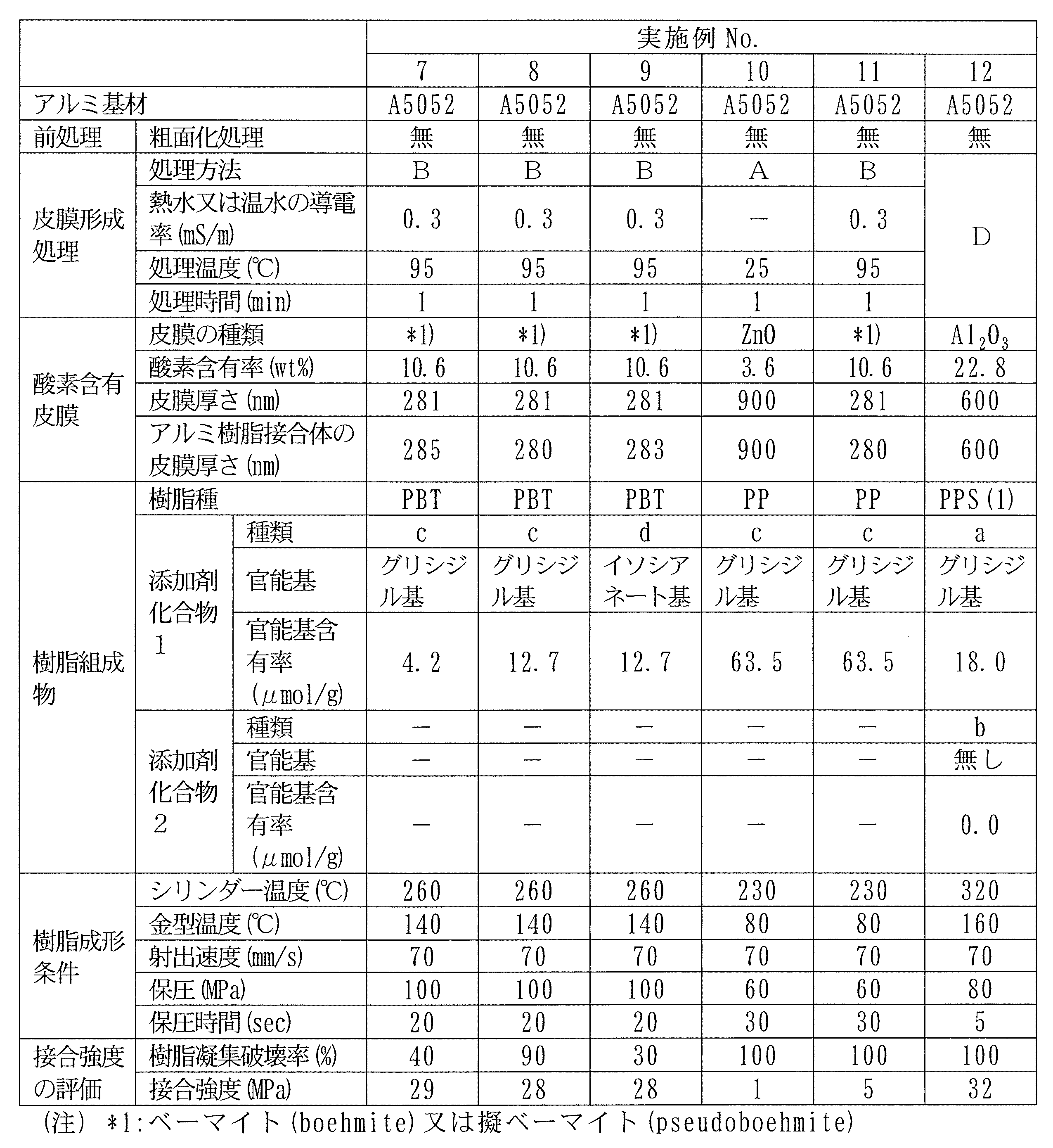
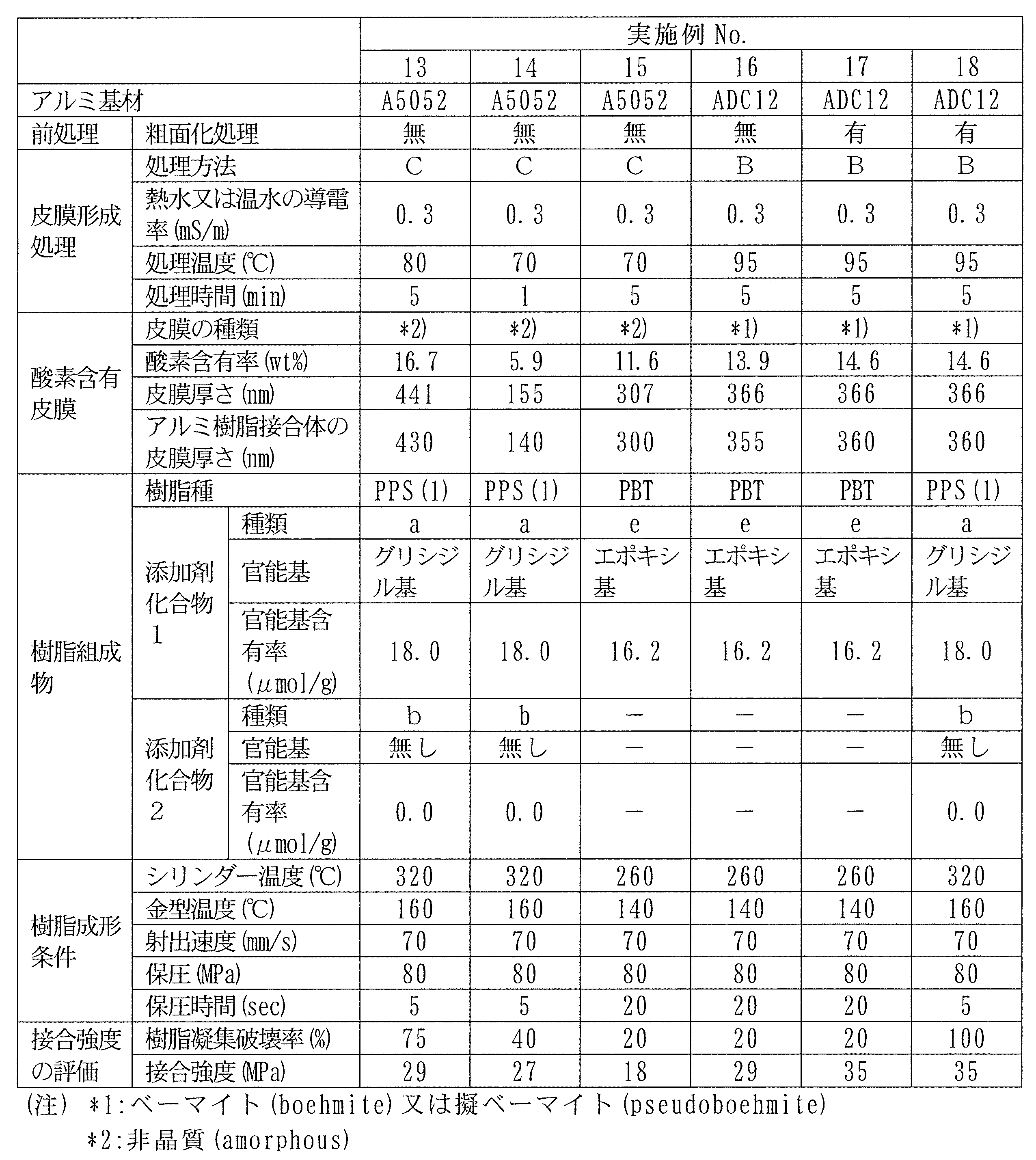
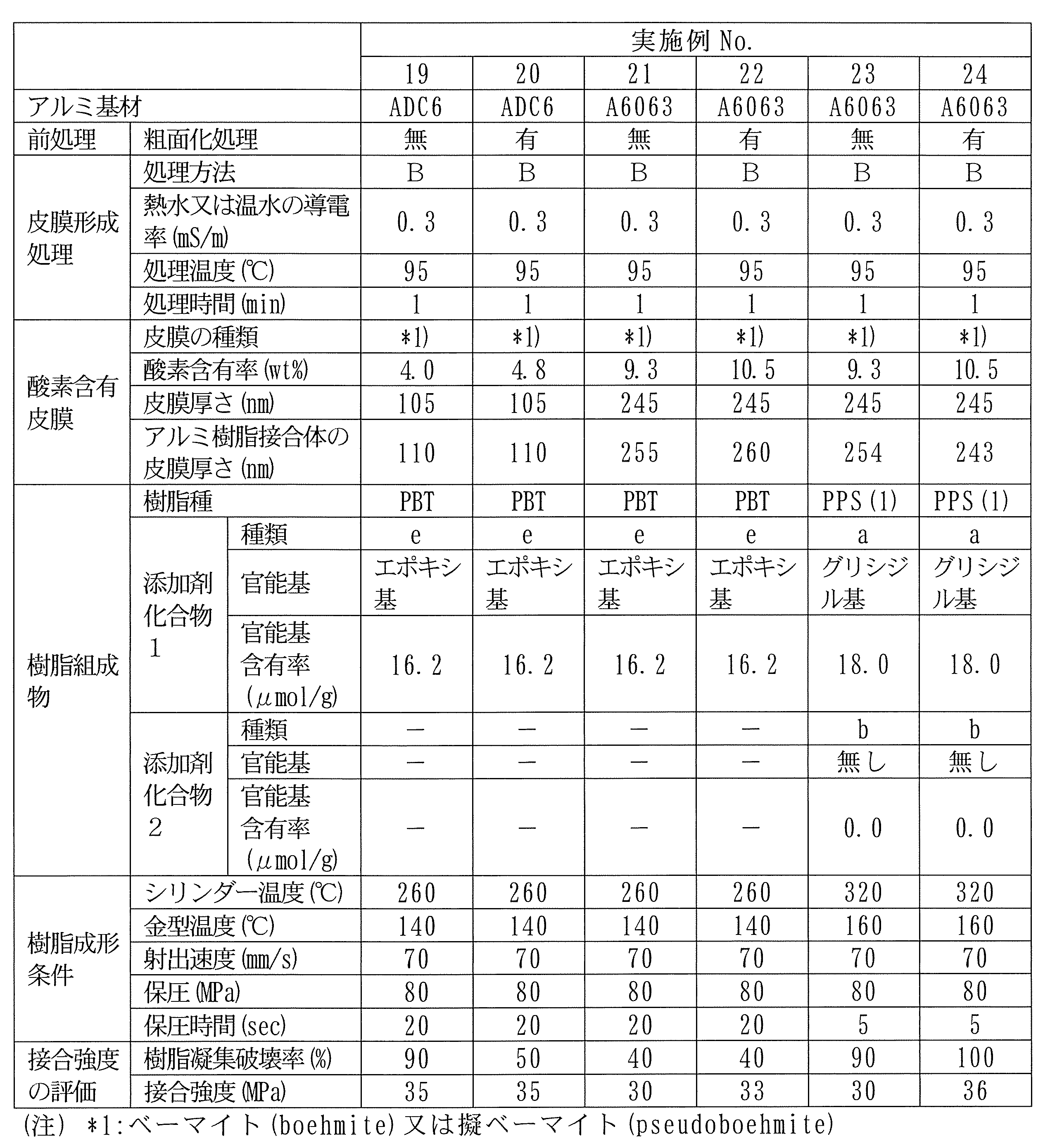
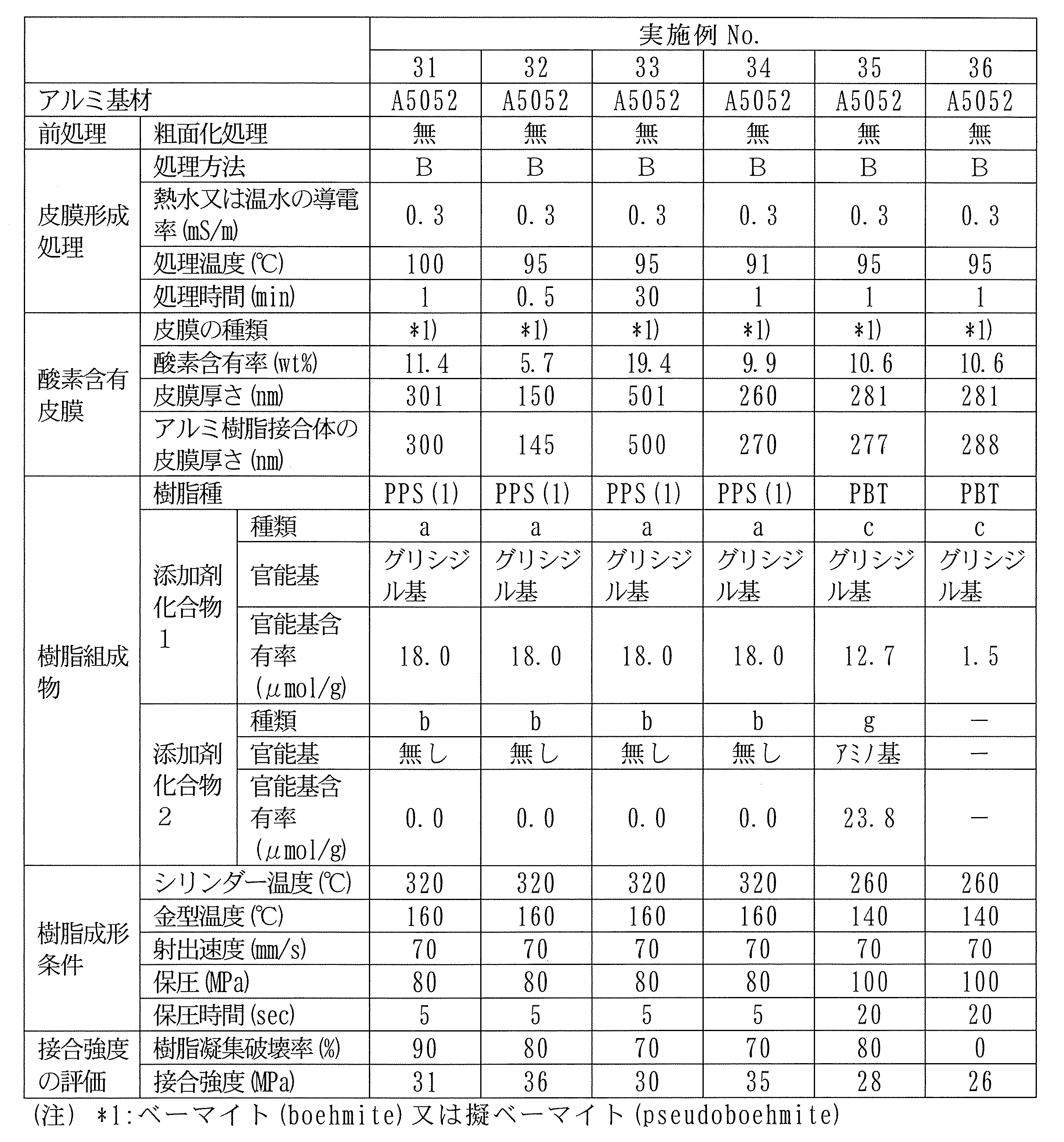
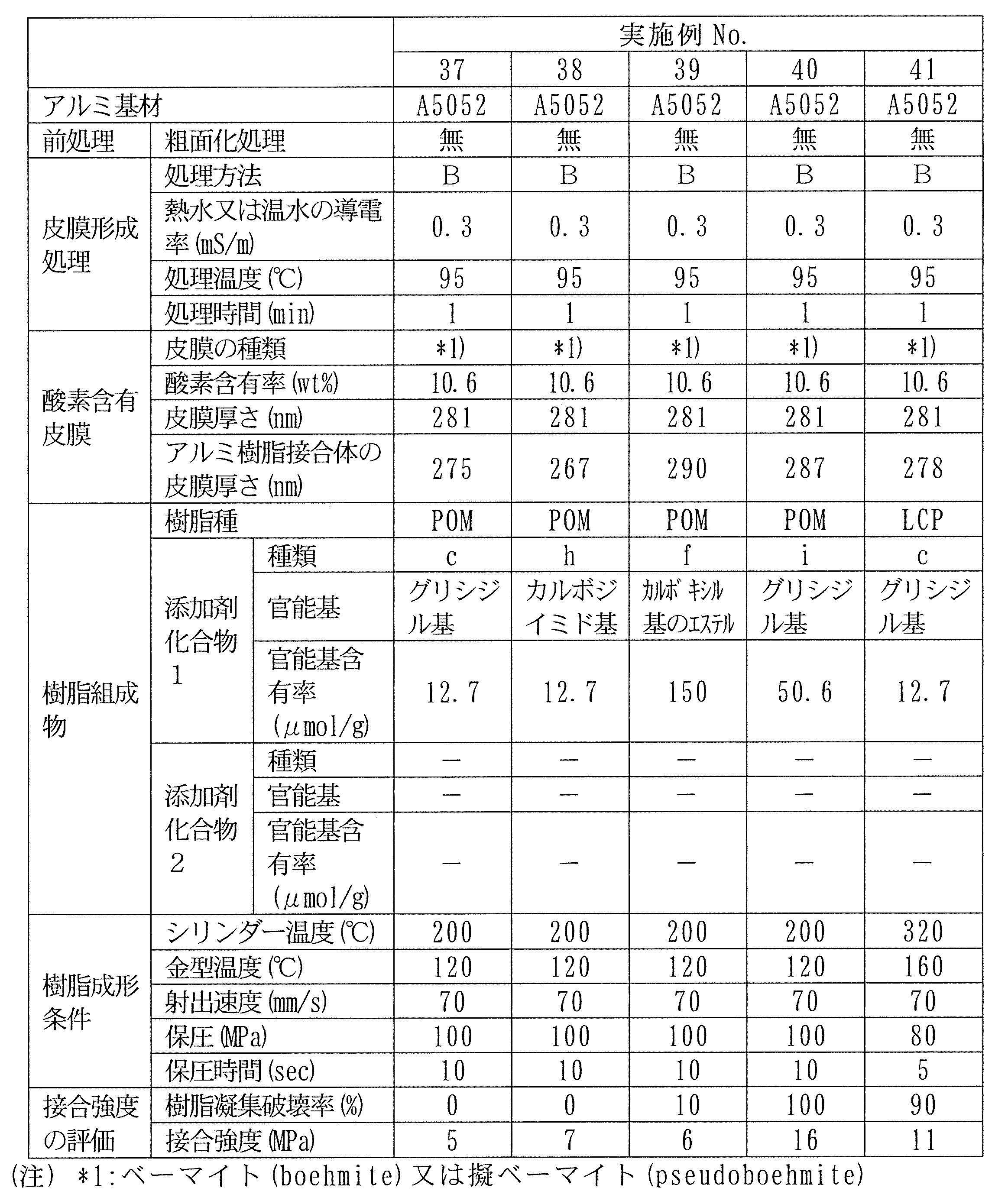
- Example 2 to 47 The aluminum substrate, the film formation treatment of the oxygen-containing film, the oxygen-containing film, the resin composition, and the resin molding conditions are as shown in Tables 1 to 8, respectively. Went. In Example 29, a 30 wt% HNO 3 solution was used, and in Example 30, the electrical conductivity of hot water was adjusted to the values shown in Table 5 using 0.1 M NaOH water.
- Example 3 4, 12 to 14, 18, 23, 24, 29 to 34, 42, 43, 45, and 46, the same PPS resin composition [PPS (1)] as in Example 1 was used. Using. In Example 2 using PPS resin [PPS (2)], 40% by mass of a glass-based filler was added to the resin composition, and Examples 5 to 9 using PBT were used. 15 to 17, 19 to 22, 25 to 28, 35, 36, 44, and 47, and Examples 10 and 11 using PP, 30% by mass of glass-based filler was added to the resin composition. Furthermore, in Examples 37 to 40 using POM, 25% by mass of glass-based filler is added, and in Example 41 using LCP, 50% by mass of glass is added. System filler material is added.
- Example 3 (Cool thermal shock test) Using a thermal shock tester (manufactured by ESPEC Corporation), a thermal shock test is performed under predetermined cycle conditions, taken out after 100 cycles, and a joint strength evaluation test is performed in the same manner as in Example 1 to evaluate durability. did.
- the cycle conditions are as follows. In Example 3, after heating at 160 ° C. for 1.5 hours, the temperature was lowered to ⁇ 40 ° C., cooled for 1.5 hours, and then heated to 160 ° C. again. In Example 27, after heating at 140 ° C. for 1.5 hours, the heating-cooling process in which the temperature is lowered to ⁇ 40 ° C., cooled for 1.5 hours, and then heated again to 140 ° C. is 1 cycle. It was. The results are shown in Tables 1 to 8.
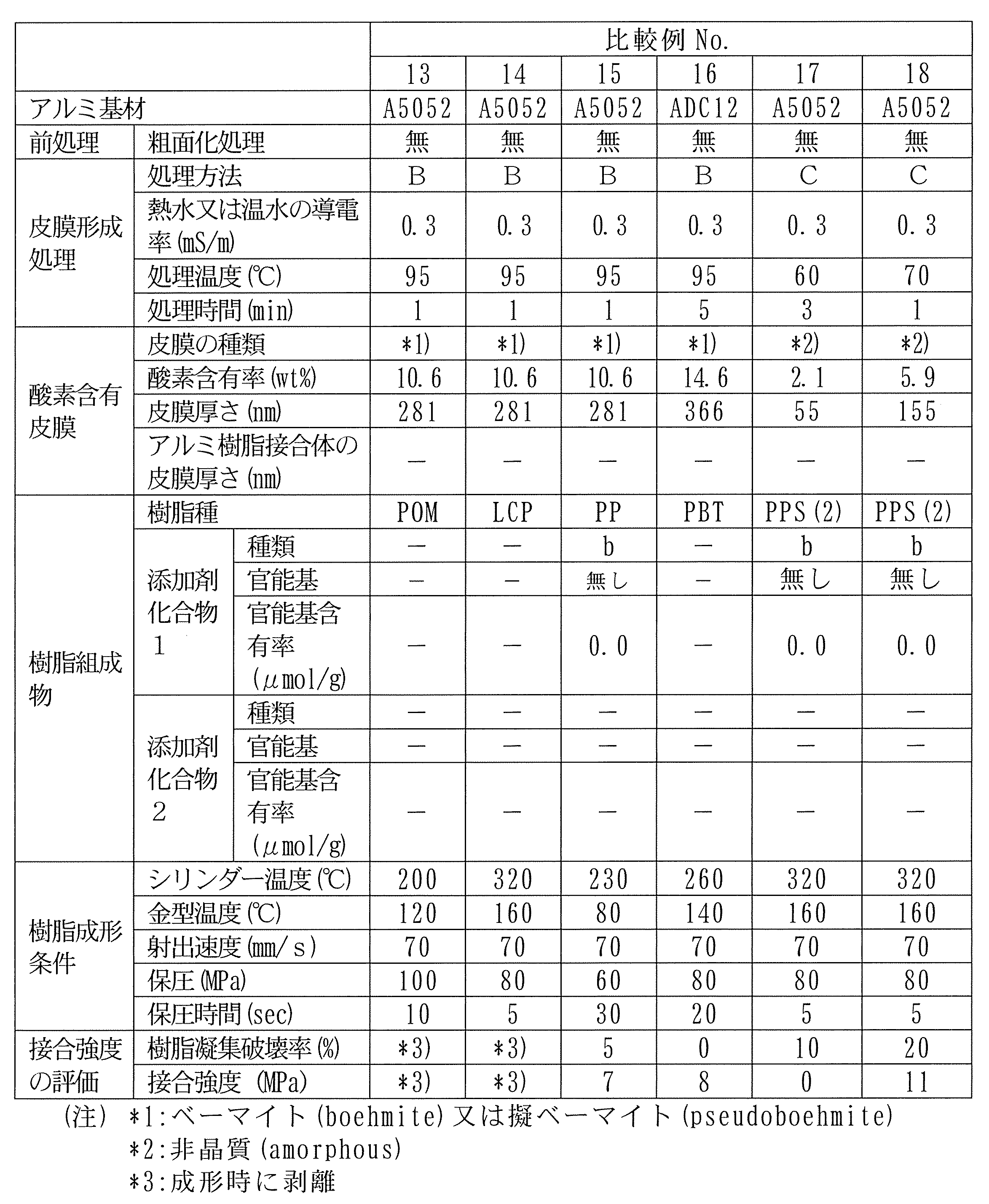
- Comparative Examples 4 and 7 to 10 the same PPS resin composition [PPS (1)] as in Example 1 was used.
- Comparative Examples 1, 11, 17, and 18 using PPS resin [PPS (2)] 40% by mass of a glass-based filler was added to the resin composition, and PBT was used.
- Comparative Examples 2, 5, 12 and 16, and Comparative Examples 3, 6 and 15 using PP 30% by mass of a glass filler is added to the resin composition, and POM is used.
- Comparative Example 13 25% by mass of the glass-based filler was added, and in Comparative Example 14 using LCP, 30% by mass of the glass-based filler was added.
- Comparative Examples 4 to 6 the roughening treatment as the pretreatment and the film formation treatment (surface treatment) for forming the oxygen-containing film were not performed, and in Comparative Examples 9 and 10, the oxygen-containing film was formed.
- An aluminum resin joined body was prepared in the same manner as in the above example except that an aluminum substrate was used without performing the film forming process (surface treatment) to be performed, and the joint strength was evaluated in the same manner as in Example 1. A test was conducted.
- Comparative Examples 7 and 8 the electrical conductivity of hot water was adjusted to the values shown in Table 10 using 0.1 M NaOH water. The results are shown in Tables 9 to 11.
- the metal resin bonded body of the present invention has excellent bonding strength before and after the durability test, it is suitably used for manufacturing various parts such as parts for various sensors for automobiles, parts for home appliances and parts for industrial equipment. Is possible.
- SYMBOLS 1 Aluminum resin joined body, 2 ... Surface-treated aluminum base material, 3 ... PPS molded object (resin molded object), 4 ... Tip joint part, 5 ... Pin gate, 6 ... Jig, 7 ... Load.
Landscapes
- Chemical & Material Sciences (AREA)
- Engineering & Computer Science (AREA)
- Mechanical Engineering (AREA)
- General Chemical & Material Sciences (AREA)
- Chemical Kinetics & Catalysis (AREA)
- Materials Engineering (AREA)
- Metallurgy (AREA)
- Organic Chemistry (AREA)
- Manufacturing & Machinery (AREA)
- Injection Moulding Of Plastics Or The Like (AREA)
- Laminated Bodies (AREA)
- Lining Or Joining Of Plastics Or The Like (AREA)
Abstract
Description
前記熱可塑性樹脂組成物が、酸素含有皮膜と反応する官能基を有する添加剤化合物を含有し、
前記添加剤化合物が、カルボキシル基及びその塩及びそのエステル、エポキシ基、グリシジル基、イソシアネート基、カルボジイミド基、アミノ基及びその塩、並びに、酸無水物基及びそのエステルからなる群の中から選ばれる少なくとも1種の官能基を有することを特徴とする金属樹脂接合体である。
前記酸素含有皮膜を介して金属基材と樹脂成形体とが接合された金属樹脂接合体を製造する金属樹脂接合体の製造方法であり、
前記熱可塑性樹脂組成物が、酸素含有皮膜と反応する官能基を有する添加剤化合物を含有し、前記添加剤化合物が、カルボキシル基及びその塩及びそのエステル、エポキシ基、グリシジル基、イソシアネート基、カルボジイミド基、アミノ基及びその塩、並びに、酸無水物基及びそのエステルからなる群の中から選ばれる少なくとも1種の官能基を有することを特徴とする金樹脂接合体の製造方法である。
前記酸素含有皮膜を介して金属基材と樹脂成形体とが接合された金属樹脂接合体を製造する金属樹脂接合体の製造方法であり、
前記熱可塑性樹脂組成物が、酸素含有皮膜と反応する官能基を有する添加剤化合物を含有し、前記添加剤化合物が、カルボキシル基及びその塩及びそのエステル、エポキシ基、グリシジル基、イソシアネート基、カルボジイミド基、アミノ基及びその塩、並びに、酸無水物基及びそのエステルからなる群の中から選ばれる少なくとも1種の官能基を有することを特徴とする金属樹脂接合体の製造方法である。
なお、上記前処理として行う化学研磨処理や電解研磨処理については、従来公知の方法を採用することができる。
そして、これらアルミPPS接合体とステアリン酸処理アルミPPS接合体との間における接合強度の違いを測定したところ、結果は、ステアリン処理有アルミPPS接合体における接合強度は、アルミPPS接合体の接合強度に比べて、明確に低下していた。
1.以下の実施例及び比較例において、前処理として行われた粗面化処理及び酸素含有皮膜を形成する皮膜形成処理は以下の通りである。
先ず、前処理として、アルミ基材を、30質量%に調整した硝酸水溶液中に室温、0.5分間の条件で浸漬し、その後、5質量%に調整した水酸化ナトリウム水溶液中に50℃、0.5分間の条件で浸漬し、更に、30質量%に調整した硝酸水溶液中に室温、0.5分間の条件で浸漬した後、次いで、前処理後のアルミ基材を濃度20質量%に調整した酸性フッ化アンモニウムを主成分とする処理液(日本シービーケミカル製:JCB-3712)中に温度40℃、10分間の条件で浸漬し、粗面化処理済のアルミ基材を作製した。
(1) 処理法A(亜鉛含有皮膜の形成)
皮膜形成処理剤として水酸化ナトリウム濃度100g/L及び酸化亜鉛濃度25g/L(Zn2+として20g/L)の亜鉛イオン含有ナトリウム水溶液(NaOH-Zn2+溶液)を調製した。次に、この亜鉛イオン含有ナトリウム水溶液中にアルミ基材を室温下に1分間浸漬し(注:比較例1の場合のみ5分間の浸漬を行った。)、その後水洗し、表面に酸素含有皮膜として亜鉛元素を含有する亜鉛含有皮膜が形成された試験用の表面処理済アルミ基材を作製した。
アルミ基材を91~100℃の熱水(純水)中に0.5~30分間浸漬し、表面に酸素含有皮膜としてベーマイトあるいは擬ベーマイトを主体とする水和酸化物皮膜が形成された試験用の表面処理済アルミ基材を作製した。
温度60~80℃の温水(純水)を用い、浸漬時間を1~5分間に変更した以外は、処理法B(熱水による水和酸化物皮膜の形成)と同様にして、アルミ基材の表面に酸素含有皮膜として非晶質成分を主体とする水和酸化物皮膜が形成された試験用の表面処理済アルミ基材を作製した。
レーザーエッチング処理(装置名:ミヤチテクノス/ML-7112A;レーザー光波長:1064nm、スポット径:50~60μm、発振方式:Qスイッチパルス、周波数:10kHz)において、アルミ基材の表面にピッチ幅50μm間隔で同一方向にレーザー照射を行い、アルミ基材の表層に酸素含有皮膜として酸化物皮膜(Al2O3)が形成された試験用の表面処理済アルミ基材を作製した。
〔樹脂組成物中の樹脂種〕
PPS(1):PPS系樹脂組成物〔ポリプラスチックス(株)製商品名:ジュラファイド(登録商標)RSF-10719;後述する添加剤化合物a及びbと、無機系充填材料50%を含む。〕
PPS(2):PPS樹脂〔(株)クレハ製商品名:フォートロンKPS W203A{溶融粘度:30Pa・s(せん断速度:1216sec-1、310℃)}〕
PBT:PBT樹脂〔ウィンテックポリマー(株)製商品名:TRB-CP〕
PP:PP系樹脂組成物〔(株)プライムポリマー製商品名:R-350G〕
POM:POM樹脂〔トリオキサン96.7質量%と1,3-ジオキソラン3.3質量%とを共重合させて得られたポリアセタール共重合体であり、メルトインデックス(190℃、荷重2160gで測定):9g/10min〕
LCP:芳香族ポリエステル液晶樹脂〔融点:280℃、溶融粘度(300℃):50.1Pa・s〕
攪拌機、留出管、ガス導入管、排出孔等を備えた反応器を用い、p-ヒドロキシ安息香酸345重量部(73mol%)、6-ヒドロキシ-2-ナフトエ酸175重量部(27mol%)、酢酸カリウム0.02重量部、及び無水酢酸350重量部を反応器内に仕込み、この反応器内を十分に窒素で置換した後、常圧下で150℃まで温度を上げ、攪拌を開始した。150℃で30分攪拌し、更に徐々に温度を上昇させ、副生する酢酸を留去した。温度が300℃に達したところで徐々に反応器内を減圧し、5Torr(即ち、665Pa)の圧力で1時間攪拌を続け、目標の攪拌トルクに達した時点で、反応器下部の排出孔を開け、窒素圧を使って生成した樹脂をストランド状に押し出して取り出した。取り出されたストランドをペレタイザーで粒子状に成形した。
添加剤化合物a:グリシジル基含有エラストマー〔日油(株)製商品名:モディパーA4300〕
添加剤化合物b:官能基を含有しないエラストマー〔ダウ・ケミカル日本(株)製商品名:Engage 8440〕
添加剤化合物c:グリシジル基を含有するエラストマー〔住友化学(株)製商品名:ボンドファースト7L〕
添加剤化合物d:イソシアネート化合物〔デグサジャパン(株)製商品名:Vestanat T1890/100〕
添加剤化合物e:エポキシ系化合物〔三菱化学(株)製商品名:エピコート JER1004K〕
添加剤化合物f:エステル系エラストマー〔日本ユニカー(株)製商品名:NUC-6570〕
添加剤化合物g:ジシアンジアミド〔日本カーバイド工業(株)製商品名:ジシアンジアミドG〕
添加剤化合物h:カルボジイミド化合物〔ラインケミージャパン(株)製商品名:スタバックゾールP400〕
添加剤化合物i:グリシジル基含有エラストマー〔住友化学(株)製商品名:ボンドファーストE〕
〔酸素含有皮膜の酸素含有率の測定〕
アルミ樹脂接合体の製造過程で得られた表面処理済アルミ基材について、EPMA(島津製:EPMA 1610)を用い、照射径が40μm/stepで縦横方向にそれぞれ512step測定するマッピング分析を実施した。ここで、測定面積は20.48mm×20.48mmであり、1stepのサンプリングタイムは20msであって、加速電圧は15kVであり、酸素の深さ方向の分解能は3μm以下である。次に、検出された酸素強度を事前に作成した検量線から重量百分率(wt%)として算出した。なお、検量線は、Al2O3標準試料(酸素含有率:48wt%)の酸素強度と高純度Al箔の酸素強度の2点から算出し作成したものを使用した。
アルミ樹脂接合体と、このアルミ樹脂接合体の製造過程で得られた表面処理済アルミ基材とについて、それぞれ、型集束イオンビーム加工装置(FEI社製:Quanta3D型)を用い、試料表面に集束イオンビームを当てて表面の原子をはじきとばすことにより観察部位を摘出すると共に、厚さ約100nmの薄膜状に加工して観察試料を作製した。観察は、透過電子顕微鏡(TEM)(FEI製:Tecnai G2 F20 S-TWIN)を用い、加速電圧200kVの条件で実施した。
(1) 表面処理済アルミ基材の作製
市販のアルミニウム板材(A5052;板厚2.0mm)から50mm×25mmの大きさのアルミ基材を切り出した。次に、上記の処理法A(亜鉛含有皮膜の形成)により、表面に亜鉛元素を含有する酸素含有皮膜が形成された試験用の表面処理済アルミ基材を作製した。
得られた表面処理済アルミ基材について、その酸素含有皮膜における酸素含有量測定、酸素強度測定、及び皮膜厚測定を行った。
結果を表1に示す。
熱可塑性樹脂組成物として、表1に示す添加剤化合物a及び添加剤化合物bと、無機系充填材料50%を含むPPS系樹脂組成物〔PPS(1)〕を用いた。このPPS系樹脂組成物〔PPS(1)〕は溶融粘度が230Pa・s(310℃、1000s-1)の樹脂組成物である。
上で得られた樹脂組成物を射出成形機に導入後、試験用表面処理済アルミ基材射出成形機の金型内にセットし、金型温度160℃、シリンダー温度320℃、射出速度70mm/s、保圧80MPa、保圧時間5秒の射出成形条件で樹脂の射出成形を行い、図1に示す試験用のアルミ樹脂接合体1を作製した。
このアルミ樹脂接合体1は、厚さ2mmの表面処理済アルミ基材2と、先端に5mm×5mm×10mmの大きさの先端接合部4を有すると共にこの先端接合部4以外の厚さが4mmのアルミ樹脂接合体1とが前記先端接合部4で接合されたもので、50mm2の接合部面積を有し、また、先端接合部4の部分には1.5mmφのピンゲート5が形成されている。
このアルミ樹脂接合体1について、下記の方法でそのアルミ-樹脂間の接合強度の評価試験を行った。
図2に示すように、アルミ樹脂接合体1の表面処理済アルミ基材2を冶具6に固定し、PPS成形体3の上端にその上方から1mm/minの速度で荷重7を印加し、表面処理済アルミ基材2と樹脂成形体3との間の接合部分を破壊する試験を実施した。その後、破断面のアルミ側について目視判断により樹脂凝集破壊率を判定した。
結果を表1に示す。
アルミ基材、酸素含有皮膜の皮膜形成処理、酸素含有皮膜、樹脂組成物、及び樹脂成形条件についてはそれぞれ表1~表8に示す通りであり、実施例1と同様にして接合強度の評価試験を行った。
また、実施例29は30wt%HNO3溶液を用い、実施例30においては、0.1MのNaOH水を用いて熱水の導電率を表5に示す数値に調整した。
冷熱衝撃試験機(エスペック(株)製)を用い、所定のサイクル条件で冷熱衝撃試験を行い、100サイクル後に取り出して、実施例1と同様にして接合強度の評価試験を行い、耐久性を評価した。
上記のサイクル条件は、実施例3では、160℃、1.5時間の加熱後に、-40℃に降温して1.5時間冷却し、その後再び160℃に昇温する加熱-冷却過程を1サイクルとし、また、実施例27では、140℃、1.5時間の加熱後に、-40℃に降温して1.5時間冷却し、その後再び140℃に昇温する加熱-冷却過程を1サイクルとした。
結果を表1~表8に示す。
アルミ基材、酸素含有皮膜の皮膜形成処理、酸素含有皮膜、樹脂組成物、及び樹脂成形条件についてはそれぞれ表9~表11に示す通りであり、実施例1と同様にして接合強度の評価試験を行った。
また、比較例7、8においては、0.1MのNaOH水を用いて熱水の導電率を表10に示す数値に調整した。
結果を表9~表11に示す。
実施例1と同じアルミ基材に対して、導電率25mS/mの水道水を用い、95℃で1分間の条件で熱水による皮膜形成処理を行った。
結果は、アルミ基材の表面に形成された酸素含有皮膜はその厚さがバラついているが0.02~0.05μmに過ぎなかった。




Claims (23)
- 金属からなる金属基材と、この金属基材の表面に、意図的に酸素含有量を増やす処理を施すことにより形成された酸素を含有する酸素含有皮膜と、この酸素含有皮膜の上に接合され、熱可塑性樹脂組成物で形成された樹脂成形体とを有し、
前記熱可塑性樹脂組成物が、前記酸素含有皮膜と反応する官能基を有する添加剤化合物を含有し、
前記添加剤化合物が、カルボキシル基及びその塩及びそのエステル、エポキシ基、グリシジル基、イソシアネート基、カルボジイミド基、アミノ基及びその塩、並びに、酸無水物基及びそのエステルからなる群の中から選ばれる少なくとも1種の官能基を有することを特徴とする金属樹脂接合体。 - 前記添加剤化合物の官能基が、熱可塑性樹脂組成物中に0.5~150μmol/gの割合で含有されていることを特徴とする請求項1に記載の金属樹脂接合体。
- 前記添加剤化合物が、α-オレフィン由来の構成単位とα,β-不飽和酸のグリシジルエステル由来の構成単位とを含むオレフィン系共重合体である請求項1又は2に記載の金属樹脂接合体。
- 前記添加剤化合物が、更に(メタ)アクリル酸エステル由来の構成単位を含むオレフィン系共重合体であるオレフィン系共重合体である請求項1~3に記載の金属樹脂接合体。
- 樹脂成形体が接合される前の表面に酸素含有皮膜を有する金属基材は、その最表面から3μmの深さまでの表層においてEPMAで測定された酸素含有率が0.1~50重量%の範囲内であることを特徴とする請求項1~4に記載の金属樹脂接合体。
- 酸素含有皮膜の上に樹脂成形体を接合する接合方法が、射出成形又は熱圧着による方法であることを特徴とする請求項1~5に記載の金属樹脂接合体。
- 酸素含有皮膜が形成される金属基材が、アルミニウム又はアルミニウム合金からなるアルミ基材であることを特徴とする請求項1~6に記載の金属樹脂接合体。
- 皮膜形成処理で得られた酸化物皮膜の厚さが0.06μm以上2μm以下の酸化物皮膜であることを特徴とする請求項1~7のいずれかに記載の金属樹脂接合体。
- 酸素含有皮膜が、亜鉛イオン含有アルカリ水溶液を用いた皮膜形成処理で得られた亜鉛元素を含有する亜鉛含有皮膜であることを特徴とする請求項1~8のいずれかに記載の金属樹脂接合体。
- 酸素含有皮膜が、導電率が0.01mS/m以上20mS/m以下であって91℃以上100℃以下の熱水を用いた皮膜形成処理で形成され、厚さが0.1μm以上1μm以下の水和酸化物皮膜であることを特徴とする請求項1~8のいずれかに記載の金属樹脂接合体。
- 酸素含有皮膜が、導電率が0.01mS/m以上20mS/m以下であって60℃以上90℃以下の温水を用いた皮膜形成処理で形成され、厚さが0.1μm以上1μm以下の水和酸化物皮膜であることを特徴とする請求項1~8のいずれかに記載の金属樹脂接合体。
- 酸素含有皮膜が、アルミ基材の表面にレーザー処理を施す皮膜形成処理で得られた酸化物皮膜であることを特徴とする請求項1~8のいずれかに記載の金属樹脂接合体。
- 熱可塑性樹脂組成物を構成する熱可塑性樹脂が、ポリアリーレンスルフィド系樹脂、ポリエステル系樹脂、ポリカーボネート系樹脂、ポリアセタール系樹脂、ポリエーテル系樹脂、ポリフェニレンエーテル系樹脂、ポリイミド系樹脂、ポリエーテルイミド系樹脂、液晶ポリマー、サルフォン系樹脂、ポリフェニレンオキサイド系樹脂、ポリアミド系樹脂、及びポリプロピレン系樹脂からなる群から選ばれたいずれか1種又は2種以上の樹脂であることを特徴とする請求項1~12のいずれかに記載の金属樹脂接合体。
- 金属からなる金属基材の表面に、意図的に酸素含有量を増やす処理を施すことにより酸素含有皮膜を形成する皮膜形成工程と、この皮膜形成工程で得られた表面処理済金属基材の酸素含有皮膜の上に、熱可塑性樹脂組成物の射出成形により樹脂成形体を形成する樹脂成形工程とを有し、
前記酸素含有皮膜を介して金属基材と樹脂成形体とが接合された金属樹脂接合体を製造する金属樹脂接合体の製造方法であり、
前記熱可塑性樹脂組成物が、酸素含有皮膜と反応する官能基を有する添加剤化合物を含有し、
前記添加剤化合物が、カルボキシル基及びその塩及びそのエステル、エポキシ基、グリシジル基、イソシアネート基、カルボジイミド基、アミノ基及びその塩、並びに、酸無水物基及びそのエステルからなる群の中から選ばれる少なくとも1種の官能基を有することを特徴とする金樹脂接合体の製造方法。 - 金属からなる金属基材の表面に、意図的に酸素含有量を増やす処理を施すことにより酸素含有皮膜を形成する皮膜形成工程と、熱可塑性樹脂組成物の射出成形により樹脂成形体を形成する樹脂成形工程と、前記皮膜形成工程で得られた表面処理済金属基材の酸素含有皮膜の上に、前記樹脂成形工程で得られた樹脂成形体を射出成形又は熱圧着により接合する金属樹脂接合工程とを有し、
前記酸素含有皮膜を介して金属基材と樹脂成形体とが接合された金属樹脂接合体を製造する金属樹脂接合体の製造方法であり、
前記熱可塑性樹脂組成物が、酸素含有皮膜と反応する官能基を有する添加剤化合物を含有し、
前記添加剤化合物が、カルボキシル基及びその塩及びそのエステル、エポキシ基、グリシジル基、イソシアネート基、カルボジイミド基、アミノ基及びその塩、並びに、酸無水物基及びそのエステルからなる群の中から選ばれる少なくとも1種の官能基を有することを特徴とする金属樹脂接合体の製造方法。 - 酸素含有皮膜が形成される金属基材がアルミニウム又はアルミニウム合金からなるアルミ基材であることを特徴とする請求項14又は15に記載の金属樹脂接合体の製造方法。
- 皮膜形成工程では、水酸化アルカリ(MOH)と亜鉛イオン(Zn2+)とを重量比(MOH/Zn2+)1~100の割合で含む亜鉛イオン含有アルカリ水溶液中にアルミ基材を浸漬する皮膜形成処理により、このアルミ基材の表面に亜鉛元素を含有する亜鉛含有皮膜を形成することを特徴とする請求項16に記載の金属樹脂接合体の製造方法。
- 亜鉛イオン含有アルカリ水溶液中のアルカリ源が、水酸化ナトリウム、水酸化カリウム、及び水酸化リチウムからなる群から選ばれたいずれか1種又は2種以上の水酸化アルカリであることを特徴とする請求項16又は17に記載の金属樹脂接合体の製造方法。
- 亜鉛イオン含有アルカリ水溶液中の亜鉛イオン源が、酸化亜鉛、水酸化亜鉛、過酸化亜鉛、塩化亜鉛、硫酸亜鉛、及び硝酸亜鉛からなる群から選ばれたいずれか1種又は2種以上の亜鉛塩であることを特徴とする請求項16~18のいずれかに記載の金属樹脂接合体の製造方法。
- 皮膜形成工程では、アルミ基材の表面に、導電率が0.01mS/m以上20mS/m以下であって91℃以上100℃以下の熱水を用いた皮膜形成処理により、厚さが0.1μm以上1μm以下の水和酸化物皮膜を形成することを特徴とする請求項16に記載の金属樹脂接合体の製造方法。
- 皮膜形成工程では、アルミ基材の表面に、導電率が0.01mS/m以上20mS/m以下であって60℃以上90℃以下の温水を用いた皮膜形成処理により、厚さが0.1μm以上1μm以下の水和酸化物皮膜を形成することを特徴とする請求項16に記載の金属樹脂接合体の製造方法。
- 皮膜形成工程では、アルミ基材の表面付近を加熱するレーザー処理を施す皮膜形成処理により酸化物皮膜を形成することを特徴とする請求項16に記載の金属樹脂接合体の製造方法。
- 熱可塑性樹脂組成物を構成する熱可塑性樹脂が、ポリアリーレンスルフィド系樹脂、ポリエステル系樹脂、ポリカーボネート系樹脂、ポリアセタール系樹脂、ポリエーテル系樹脂、ポリフェニレンエーテル系樹脂、ポリイミド系樹脂、ポリエーテルイミド系樹脂、液晶ポリマー、サルフォン系樹脂、ポリフェニレンオキサイド系樹脂、ポリアミド系樹脂、及びポリプロピレン系樹脂からなる群から選ばれたいずれか1種又は2種以上の樹脂であることを特徴とする請求項14~22のいずれかに記載の金属樹脂接合体の製造方法。
Priority Applications (3)
| Application Number | Priority Date | Filing Date | Title |
|---|---|---|---|
| KR1020157030218A KR102016783B1 (ko) | 2013-03-26 | 2014-03-26 | 금속 수지 접합체 및 그 제조 방법 |
| CN201480017983.8A CN105073375B (zh) | 2013-03-26 | 2014-03-26 | 金属树脂接合体及其制造方法 |
| JP2015508577A JP6017675B2 (ja) | 2013-03-26 | 2014-03-26 | 金属樹脂接合体及びその製造方法 |
Applications Claiming Priority (2)
| Application Number | Priority Date | Filing Date | Title |
|---|---|---|---|
| JP2013065268 | 2013-03-26 | ||
| JP2013-065268 | 2013-03-26 |
Publications (1)
| Publication Number | Publication Date |
|---|---|
| WO2014157289A1 true WO2014157289A1 (ja) | 2014-10-02 |
Family
ID=51624254
Family Applications (1)
| Application Number | Title | Priority Date | Filing Date |
|---|---|---|---|
| PCT/JP2014/058435 Ceased WO2014157289A1 (ja) | 2013-03-26 | 2014-03-26 | 金属樹脂接合体及びその製造方法 |
Country Status (5)
| Country | Link |
|---|---|
| JP (1) | JP6017675B2 (ja) |
| KR (1) | KR102016783B1 (ja) |
| CN (1) | CN105073375B (ja) |
| TW (1) | TWI630101B (ja) |
| WO (1) | WO2014157289A1 (ja) |
Cited By (17)
| Publication number | Priority date | Publication date | Assignee | Title |
|---|---|---|---|---|
| WO2016038945A1 (ja) * | 2014-09-11 | 2016-03-17 | オリンパス株式会社 | インサート成形品、該インサート成形品を用いた機器及びインサート成形品の製造方法 |
| EP2899296A4 (en) * | 2012-09-21 | 2016-05-11 | Uacj Corp | SURFACE TREATED ALUMINUM MATERIAL AND METHOD FOR THE PRODUCTION THEREOF |
| JP2017007306A (ja) * | 2015-06-26 | 2017-01-12 | 株式会社豊田中央研究所 | 金属樹脂接合部材およびその製造方法 |
| JP2017013084A (ja) * | 2015-06-29 | 2017-01-19 | マツダ株式会社 | 金属部材と樹脂部材との接合方法、その方法において使用される金属部材および金属部材と樹脂部材との接合体 |
| JP2017177464A (ja) * | 2016-03-29 | 2017-10-05 | マツダ株式会社 | 金属部材と樹脂部材との接合方法およびその方法において使用される金属部材 |
| JP2017218615A (ja) * | 2016-06-03 | 2017-12-14 | 三井化学株式会社 | 表面粗化金属部材の製造方法および金属/樹脂複合構造体の製造方法 |
| JP2017218614A (ja) * | 2016-06-03 | 2017-12-14 | 三井化学株式会社 | 表面粗化金属部材の製造方法および金属/樹脂複合構造体の製造方法 |
| JP6351902B1 (ja) * | 2017-09-26 | 2018-07-04 | 住友理工株式会社 | 複合部材の製造方法 |
| JP2018144475A (ja) * | 2017-03-03 | 2018-09-20 | 三井化学株式会社 | アルミニウム系金属/樹脂複合構造体、アルミニウム系金属部材、アルミニウム系金属部材の製造方法およびアルミニウム系金属/樹脂複合構造体の製造方法 |
| JP2019058949A (ja) * | 2018-06-05 | 2019-04-18 | 住友理工株式会社 | 複合部材の製造方法 |
| WO2019097624A1 (ja) | 2017-11-16 | 2019-05-23 | 睦月電機株式会社 | 金属部材、金属部材の製造方法、金属樹脂接合体及び金属樹脂接合体の製造方法 |
| WO2020075804A1 (ja) * | 2018-10-12 | 2020-04-16 | Dic株式会社 | 金属樹脂複合体及びその製造方法 |
| WO2020183747A1 (ja) * | 2019-03-08 | 2020-09-17 | 睦月電機株式会社 | 合成樹脂成形体の製造方法及び金属樹脂接合体の製造方法 |
| WO2021131804A1 (ja) * | 2019-12-27 | 2021-07-01 | Dic株式会社 | 複合構造体およびその製造方法 |
| CN113396243A (zh) * | 2019-01-29 | 2021-09-14 | 三井化学株式会社 | 铝系金属树脂复合结构体、铝系金属构件、铝系金属构件的制造方法及铝系金属树脂复合结构体的制造方法 |
| CN116056891A (zh) * | 2020-09-29 | 2023-05-02 | 三井金属矿业株式会社 | 树脂组合物、带树脂的金属箔、覆金属层叠片和电容器元件 |
| TWI914411B (zh) | 2020-09-29 | 2026-02-11 | 日商三井金屬股份有限公司 | 樹脂組合物、附有樹脂之金屬箔、金屬箔積層片以及電容元件 |
Families Citing this family (7)
| Publication number | Priority date | Publication date | Assignee | Title |
|---|---|---|---|---|
| JP6621694B2 (ja) * | 2016-03-25 | 2019-12-18 | 株式会社神戸製鋼所 | ポリオレフィン系樹脂接着用表面処理鋼板及びそれを用いた複合部材 |
| KR101707789B1 (ko) * | 2017-01-20 | 2017-02-20 | 주식회사 우신엠에스 | 광발산 메탈노브의 제조방법 |
| WO2019131046A1 (ja) * | 2017-12-28 | 2019-07-04 | 株式会社デンソー | 樹脂成形体およびその製造方法、物理量センサおよびその製造方法、インサート部品およびその製造方法、樹脂成形体の製造システムおよびそれを用いた樹脂成形体の製造方法 |
| JP6837580B2 (ja) * | 2018-05-18 | 2021-03-03 | ポリプラスチックス株式会社 | 熱プレス成形品用粉状液晶性樹脂及び熱プレス成形品 |
| US20200070269A1 (en) * | 2018-08-30 | 2020-03-05 | GM Global Technology Operations LLC | Laser-induced anti-corrosion micro-anchor structural layer for metal-polymeric composite joint and methods of manufacturing thereof |
| US20220224001A1 (en) * | 2019-04-22 | 2022-07-14 | Mitsui Chemicals, Inc. | Electronic device housing, manufacturing method of same, and metal-resin composite |
| JP2021004377A (ja) * | 2019-06-25 | 2021-01-14 | 本田技研工業株式会社 | アルミニウム部材の製造方法及びアルミニウム部材 |
Citations (6)
| Publication number | Priority date | Publication date | Assignee | Title |
|---|---|---|---|---|
| WO1997035716A1 (fr) * | 1996-03-27 | 1997-10-02 | Toyo Kohan Co., Ltd. | Plaque d'alliage d'aluminium revetue de resine thermoplastique, appareil et procede de production |
| JP2003103562A (ja) * | 2001-09-28 | 2003-04-09 | Toray Ind Inc | 金属インサート樹脂接合成形品の製造方法及び金属インサート樹脂接合成形品を有する圧力計の製造方法 |
| JP2010149511A (ja) * | 2008-11-19 | 2010-07-08 | Lanxess Deutschland Gmbh | ハイブリッド設計の軽量部材 |
| JP2011076887A (ja) * | 2009-09-30 | 2011-04-14 | Toppan Printing Co Ltd | リチウムイオン電池用包装材 |
| JP2011173353A (ja) * | 2010-02-25 | 2011-09-08 | Toray Ind Inc | 複合構造体 |
| JP2012232583A (ja) * | 2011-04-21 | 2012-11-29 | Taisei Plas Co Ltd | アルミニウム合金と樹脂の複合体及びその製造方法 |
Family Cites Families (15)
| Publication number | Priority date | Publication date | Assignee | Title |
|---|---|---|---|---|
| JP2702814B2 (ja) | 1990-03-09 | 1998-01-26 | ポリプラスチックス株式会社 | 金属をインサートした成形品 |
| JPH0551671A (ja) | 1991-08-21 | 1993-03-02 | Nikko Kyodo Co Ltd | 曲げ性及び応力緩和特性に優る電子機器用高力高導電性銅合金 |
| JP3016331B2 (ja) | 1993-09-07 | 2000-03-06 | 富士通株式会社 | 電子機器筐体の製造方法 |
| JP3954379B2 (ja) | 2001-12-28 | 2007-08-08 | 大成プラス株式会社 | アルミニューム合金と樹脂の複合体とその製造方法 |
| JP4270444B2 (ja) | 2003-10-14 | 2009-06-03 | 大成プラス株式会社 | アルミニウム合金と樹脂の複合体とその製造方法 |
| JP4927871B2 (ja) * | 2006-12-22 | 2012-05-09 | 大成プラス株式会社 | 金属と樹脂の複合体とその複合体の製造方法 |
| JP5058593B2 (ja) | 2006-12-28 | 2012-10-24 | Ykk株式会社 | 金属と樹脂の複合体の製造方法 |
| EP2221398B1 (en) * | 2007-12-14 | 2016-10-19 | Toadenka Corporation | Resin-metal bonded body and method for producing the same |
| WO2009139450A1 (ja) * | 2008-05-13 | 2009-11-19 | 住友化学株式会社 | アルミナ複合材 |
| US20110111214A1 (en) | 2008-06-12 | 2011-05-12 | Masanori Endo | Integrally injection-molded aluminum/resin article and process for producing the same |
| JP5381687B2 (ja) | 2008-12-29 | 2014-01-08 | 日本軽金属株式会社 | 樹脂接合性に優れたアルミニウム合金部材及びその製造方法 |
| JP4930565B2 (ja) * | 2009-09-30 | 2012-05-16 | ブラザー工業株式会社 | 現像剤収容器および画像形成装置 |
| JP5499741B2 (ja) * | 2010-02-04 | 2014-05-21 | 三菱樹脂株式会社 | 樹脂・金属積層材、樹脂・金属複合射出成形体、及びその製造方法 |
| JP5501026B2 (ja) * | 2010-02-22 | 2014-05-21 | 日新製鋼株式会社 | ステンレス鋼板と熱可塑性樹脂組成物の成形体とが接合された複合体、およびその製造方法 |
| JP5423468B2 (ja) * | 2010-02-23 | 2014-02-19 | オムロン株式会社 | 異常解析装置、および、異常解析装置の制御方法 |
-
2014
- 2014-03-26 JP JP2015508577A patent/JP6017675B2/ja active Active
- 2014-03-26 WO PCT/JP2014/058435 patent/WO2014157289A1/ja not_active Ceased
- 2014-03-26 CN CN201480017983.8A patent/CN105073375B/zh active Active
- 2014-03-26 TW TW103111246A patent/TWI630101B/zh active
- 2014-03-26 KR KR1020157030218A patent/KR102016783B1/ko active Active
Patent Citations (6)
| Publication number | Priority date | Publication date | Assignee | Title |
|---|---|---|---|---|
| WO1997035716A1 (fr) * | 1996-03-27 | 1997-10-02 | Toyo Kohan Co., Ltd. | Plaque d'alliage d'aluminium revetue de resine thermoplastique, appareil et procede de production |
| JP2003103562A (ja) * | 2001-09-28 | 2003-04-09 | Toray Ind Inc | 金属インサート樹脂接合成形品の製造方法及び金属インサート樹脂接合成形品を有する圧力計の製造方法 |
| JP2010149511A (ja) * | 2008-11-19 | 2010-07-08 | Lanxess Deutschland Gmbh | ハイブリッド設計の軽量部材 |
| JP2011076887A (ja) * | 2009-09-30 | 2011-04-14 | Toppan Printing Co Ltd | リチウムイオン電池用包装材 |
| JP2011173353A (ja) * | 2010-02-25 | 2011-09-08 | Toray Ind Inc | 複合構造体 |
| JP2012232583A (ja) * | 2011-04-21 | 2012-11-29 | Taisei Plas Co Ltd | アルミニウム合金と樹脂の複合体及びその製造方法 |
Cited By (32)
| Publication number | Priority date | Publication date | Assignee | Title |
|---|---|---|---|---|
| EP2899296A4 (en) * | 2012-09-21 | 2016-05-11 | Uacj Corp | SURFACE TREATED ALUMINUM MATERIAL AND METHOD FOR THE PRODUCTION THEREOF |
| WO2016038945A1 (ja) * | 2014-09-11 | 2016-03-17 | オリンパス株式会社 | インサート成形品、該インサート成形品を用いた機器及びインサート成形品の製造方法 |
| JP5945650B1 (ja) * | 2014-09-11 | 2016-07-05 | オリンパス株式会社 | インサート成形品、該インサート成形品を用いた機器及びインサート成形品の製造方法 |
| JP2017007306A (ja) * | 2015-06-26 | 2017-01-12 | 株式会社豊田中央研究所 | 金属樹脂接合部材およびその製造方法 |
| JP2017013084A (ja) * | 2015-06-29 | 2017-01-19 | マツダ株式会社 | 金属部材と樹脂部材との接合方法、その方法において使用される金属部材および金属部材と樹脂部材との接合体 |
| JP2017177464A (ja) * | 2016-03-29 | 2017-10-05 | マツダ株式会社 | 金属部材と樹脂部材との接合方法およびその方法において使用される金属部材 |
| JP2017218615A (ja) * | 2016-06-03 | 2017-12-14 | 三井化学株式会社 | 表面粗化金属部材の製造方法および金属/樹脂複合構造体の製造方法 |
| JP2017218614A (ja) * | 2016-06-03 | 2017-12-14 | 三井化学株式会社 | 表面粗化金属部材の製造方法および金属/樹脂複合構造体の製造方法 |
| JP2018144475A (ja) * | 2017-03-03 | 2018-09-20 | 三井化学株式会社 | アルミニウム系金属/樹脂複合構造体、アルミニウム系金属部材、アルミニウム系金属部材の製造方法およびアルミニウム系金属/樹脂複合構造体の製造方法 |
| JP6351902B1 (ja) * | 2017-09-26 | 2018-07-04 | 住友理工株式会社 | 複合部材の製造方法 |
| WO2019064344A1 (ja) * | 2017-09-26 | 2019-04-04 | 住友理工株式会社 | 複合部材の製造方法 |
| WO2019097624A1 (ja) | 2017-11-16 | 2019-05-23 | 睦月電機株式会社 | 金属部材、金属部材の製造方法、金属樹脂接合体及び金属樹脂接合体の製造方法 |
| US11090908B2 (en) | 2017-11-16 | 2021-08-17 | Mutsuki Electric Co., Ltd. | Metal member, method for producing metal member, metal-resin joined body and method for producing metal-resin joined body |
| JP2019058949A (ja) * | 2018-06-05 | 2019-04-18 | 住友理工株式会社 | 複合部材の製造方法 |
| JPWO2020075804A1 (ja) * | 2018-10-12 | 2021-02-15 | Dic株式会社 | 金属樹脂複合体及びその製造方法 |
| CN112823091A (zh) * | 2018-10-12 | 2021-05-18 | Dic株式会社 | 金属树脂复合体和其制造方法 |
| EP3865283B1 (en) * | 2018-10-12 | 2025-05-07 | DIC Corporation | Metal-resin composite and method for producing same |
| WO2020075804A1 (ja) * | 2018-10-12 | 2020-04-16 | Dic株式会社 | 金属樹脂複合体及びその製造方法 |
| US11766836B2 (en) | 2018-10-12 | 2023-09-26 | Dic Corporation | Metal-resin composite and method for producing same |
| CN113396243A (zh) * | 2019-01-29 | 2021-09-14 | 三井化学株式会社 | 铝系金属树脂复合结构体、铝系金属构件、铝系金属构件的制造方法及铝系金属树脂复合结构体的制造方法 |
| CN113396243B (zh) * | 2019-01-29 | 2024-03-01 | 三井化学株式会社 | 铝系金属树脂复合结构体、铝系金属构件、铝系金属构件的制造方法及铝系金属树脂复合结构体的制造方法 |
| US11426947B2 (en) | 2019-03-08 | 2022-08-30 | Mutsuki Electric Co., Ltd. | Method for manufacturing metal-resin joint |
| WO2020183747A1 (ja) * | 2019-03-08 | 2020-09-17 | 睦月電機株式会社 | 合成樹脂成形体の製造方法及び金属樹脂接合体の製造方法 |
| JP6830721B1 (ja) * | 2019-03-08 | 2021-02-17 | 睦月電機株式会社 | 金属樹脂接合体の製造方法 |
| WO2020184440A1 (ja) * | 2019-03-08 | 2020-09-17 | 睦月電機株式会社 | 金属樹脂接合体の製造方法 |
| WO2021131804A1 (ja) * | 2019-12-27 | 2021-07-01 | Dic株式会社 | 複合構造体およびその製造方法 |
| CN114901458A (zh) * | 2019-12-27 | 2022-08-12 | Dic株式会社 | 复合结构体及其制造方法 |
| JP7070804B2 (ja) | 2019-12-27 | 2022-05-18 | Dic株式会社 | 複合構造体およびその製造方法 |
| US12291605B2 (en) | 2019-12-27 | 2025-05-06 | Dic Corporation | Composite structure and manufacturing method thereof |
| JPWO2021131804A1 (ja) * | 2019-12-27 | 2021-07-01 | ||
| CN116056891A (zh) * | 2020-09-29 | 2023-05-02 | 三井金属矿业株式会社 | 树脂组合物、带树脂的金属箔、覆金属层叠片和电容器元件 |
| TWI914411B (zh) | 2020-09-29 | 2026-02-11 | 日商三井金屬股份有限公司 | 樹脂組合物、附有樹脂之金屬箔、金屬箔積層片以及電容元件 |
Also Published As
| Publication number | Publication date |
|---|---|
| TW201504036A (zh) | 2015-02-01 |
| CN105073375B (zh) | 2018-01-05 |
| TWI630101B (zh) | 2018-07-21 |
| KR20150134384A (ko) | 2015-12-01 |
| JP6017675B2 (ja) | 2016-11-02 |
| CN105073375A (zh) | 2015-11-18 |
| JPWO2014157289A1 (ja) | 2017-02-16 |
| KR102016783B1 (ko) | 2019-08-30 |
Similar Documents
| Publication | Publication Date | Title |
|---|---|---|
| JP6017675B2 (ja) | 金属樹脂接合体及びその製造方法 | |
| JP5772966B2 (ja) | アルミ樹脂接合体及びその製造方法 | |
| JP4927871B2 (ja) | 金属と樹脂の複合体とその複合体の製造方法 | |
| CN104540674B (zh) | 铝树脂接合体及其制造方法 | |
| CN101743111B (zh) | 金属和树脂的复合体及其制造方法 | |
| JP5055288B2 (ja) | 金属と樹脂の複合体とその製造方法 | |
| CN101313087B (zh) | 金属和树脂的复合体及其制造方法 | |
| CN101547779B (zh) | 高耐蚀性复合体的制造方法 | |
| JP4527196B2 (ja) | 複合体およびその製造方法 | |
| JP2016070527A (ja) | 熱交換器 | |
| JP2014111392A (ja) | アルミニウム−樹脂複合体の製造方法 | |
| JPWO2008126812A1 (ja) | 銅合金複合体とその製造方法 | |
| JP2013022761A (ja) | 銅−樹脂複合体の製造方法 | |
| JP2006305838A (ja) | 樹脂複合体及びその製造方法 |
Legal Events
| Date | Code | Title | Description |
|---|---|---|---|
| WWE | Wipo information: entry into national phase |
Ref document number: 201480017983.8 Country of ref document: CN |
|
| 121 | Ep: the epo has been informed by wipo that ep was designated in this application |
Ref document number: 14773867 Country of ref document: EP Kind code of ref document: A1 |
|
| ENP | Entry into the national phase |
Ref document number: 2015508577 Country of ref document: JP Kind code of ref document: A |
|
| NENP | Non-entry into the national phase |
Ref country code: DE |
|
| ENP | Entry into the national phase |
Ref document number: 20157030218 Country of ref document: KR Kind code of ref document: A |
|
| 122 | Ep: pct application non-entry in european phase |
Ref document number: 14773867 Country of ref document: EP Kind code of ref document: A1 |