WO2014129342A1 - ウェハレベルレンズ用硬化性組成物、ウェハレベルレンズの製造方法及びウェハレベルレンズ、並びに光学装置 - Google Patents
ウェハレベルレンズ用硬化性組成物、ウェハレベルレンズの製造方法及びウェハレベルレンズ、並びに光学装置 Download PDFInfo
- Publication number
- WO2014129342A1 WO2014129342A1 PCT/JP2014/053013 JP2014053013W WO2014129342A1 WO 2014129342 A1 WO2014129342 A1 WO 2014129342A1 JP 2014053013 W JP2014053013 W JP 2014053013W WO 2014129342 A1 WO2014129342 A1 WO 2014129342A1
- Authority
- WO
- WIPO (PCT)
- Prior art keywords
- wafer level
- level lens
- curable composition
- group
- curing
- Prior art date
- Legal status (The legal status is an assumption and is not a legal conclusion. Google has not performed a legal analysis and makes no representation as to the accuracy of the status listed.)
- Ceased
Links
Classifications
-
- C—CHEMISTRY; METALLURGY
- C08—ORGANIC MACROMOLECULAR COMPOUNDS; THEIR PREPARATION OR CHEMICAL WORKING-UP; COMPOSITIONS BASED THEREON
- C08G—MACROMOLECULAR COMPOUNDS OBTAINED OTHERWISE THAN BY REACTIONS ONLY INVOLVING UNSATURATED CARBON-TO-CARBON BONDS
- C08G59/00—Polycondensates containing more than one epoxy group per molecule; Macromolecules obtained by polymerising compounds containing more than one epoxy group per molecule using curing agents or catalysts which react with the epoxy groups
- C08G59/18—Macromolecules obtained by polymerising compounds containing more than one epoxy group per molecule using curing agents or catalysts which react with the epoxy groups ; e.g. general methods of curing
- C08G59/20—Macromolecules obtained by polymerising compounds containing more than one epoxy group per molecule using curing agents or catalysts which react with the epoxy groups ; e.g. general methods of curing characterised by the epoxy compounds used
- C08G59/22—Di-epoxy compounds
- C08G59/24—Di-epoxy compounds carbocyclic
- C08G59/245—Di-epoxy compounds carbocyclic aromatic
-
- G—PHYSICS
- G02—OPTICS
- G02B—OPTICAL ELEMENTS, SYSTEMS OR APPARATUS
- G02B1/00—Optical elements characterised by the material of which they are made; Optical coatings for optical elements
- G02B1/04—Optical elements characterised by the material of which they are made; Optical coatings for optical elements made of organic materials, e.g. plastics
- G02B1/041—Lenses
-
- B—PERFORMING OPERATIONS; TRANSPORTING
- B32—LAYERED PRODUCTS
- B32B—LAYERED PRODUCTS, i.e. PRODUCTS BUILT-UP OF STRATA OF FLAT OR NON-FLAT, e.g. CELLULAR OR HONEYCOMB, FORM
- B32B27/00—Layered products comprising a layer of synthetic resin
- B32B27/06—Layered products comprising a layer of synthetic resin as the main or only constituent of a layer, which is next to another layer of the same or of a different material
-
- B—PERFORMING OPERATIONS; TRANSPORTING
- B32—LAYERED PRODUCTS
- B32B—LAYERED PRODUCTS, i.e. PRODUCTS BUILT-UP OF STRATA OF FLAT OR NON-FLAT, e.g. CELLULAR OR HONEYCOMB, FORM
- B32B27/00—Layered products comprising a layer of synthetic resin
- B32B27/16—Layered products comprising a layer of synthetic resin specially treated, e.g. irradiated
-
- B—PERFORMING OPERATIONS; TRANSPORTING
- B32—LAYERED PRODUCTS
- B32B—LAYERED PRODUCTS, i.e. PRODUCTS BUILT-UP OF STRATA OF FLAT OR NON-FLAT, e.g. CELLULAR OR HONEYCOMB, FORM
- B32B27/00—Layered products comprising a layer of synthetic resin
- B32B27/38—Layered products comprising a layer of synthetic resin comprising epoxy resins
-
- B—PERFORMING OPERATIONS; TRANSPORTING
- B32—LAYERED PRODUCTS
- B32B—LAYERED PRODUCTS, i.e. PRODUCTS BUILT-UP OF STRATA OF FLAT OR NON-FLAT, e.g. CELLULAR OR HONEYCOMB, FORM
- B32B7/00—Layered products characterised by the relation between layers; Layered products characterised by the relative orientation of features between layers, or by the relative values of a measurable parameter between layers, i.e. products comprising layers having different physical, chemical or physicochemical properties; Layered products characterised by the interconnection of layers
- B32B7/02—Physical, chemical or physicochemical properties
- B32B7/027—Thermal properties
-
- C—CHEMISTRY; METALLURGY
- C08—ORGANIC MACROMOLECULAR COMPOUNDS; THEIR PREPARATION OR CHEMICAL WORKING-UP; COMPOSITIONS BASED THEREON
- C08G—MACROMOLECULAR COMPOUNDS OBTAINED OTHERWISE THAN BY REACTIONS ONLY INVOLVING UNSATURATED CARBON-TO-CARBON BONDS
- C08G59/00—Polycondensates containing more than one epoxy group per molecule; Macromolecules obtained by polymerising compounds containing more than one epoxy group per molecule using curing agents or catalysts which react with the epoxy groups
- C08G59/18—Macromolecules obtained by polymerising compounds containing more than one epoxy group per molecule using curing agents or catalysts which react with the epoxy groups ; e.g. general methods of curing
- C08G59/20—Macromolecules obtained by polymerising compounds containing more than one epoxy group per molecule using curing agents or catalysts which react with the epoxy groups ; e.g. general methods of curing characterised by the epoxy compounds used
- C08G59/22—Di-epoxy compounds
- C08G59/24—Di-epoxy compounds carbocyclic
-
- C—CHEMISTRY; METALLURGY
- C08—ORGANIC MACROMOLECULAR COMPOUNDS; THEIR PREPARATION OR CHEMICAL WORKING-UP; COMPOSITIONS BASED THEREON
- C08G—MACROMOLECULAR COMPOUNDS OBTAINED OTHERWISE THAN BY REACTIONS ONLY INVOLVING UNSATURATED CARBON-TO-CARBON BONDS
- C08G59/00—Polycondensates containing more than one epoxy group per molecule; Macromolecules obtained by polymerising compounds containing more than one epoxy group per molecule using curing agents or catalysts which react with the epoxy groups
- C08G59/18—Macromolecules obtained by polymerising compounds containing more than one epoxy group per molecule using curing agents or catalysts which react with the epoxy groups ; e.g. general methods of curing
- C08G59/68—Macromolecules obtained by polymerising compounds containing more than one epoxy group per molecule using curing agents or catalysts which react with the epoxy groups ; e.g. general methods of curing characterised by the catalysts used
- C08G59/687—Macromolecules obtained by polymerising compounds containing more than one epoxy group per molecule using curing agents or catalysts which react with the epoxy groups ; e.g. general methods of curing characterised by the catalysts used containing sulfur
-
- C—CHEMISTRY; METALLURGY
- C09—DYES; PAINTS; POLISHES; NATURAL RESINS; ADHESIVES; COMPOSITIONS NOT OTHERWISE PROVIDED FOR; APPLICATIONS OF MATERIALS NOT OTHERWISE PROVIDED FOR
- C09J—ADHESIVES; NON-MECHANICAL ASPECTS OF ADHESIVE PROCESSES IN GENERAL; ADHESIVE PROCESSES NOT PROVIDED FOR ELSEWHERE; USE OF MATERIALS AS ADHESIVES
- C09J163/00—Adhesives based on epoxy resins; Adhesives based on derivatives of epoxy resins
-
- B—PERFORMING OPERATIONS; TRANSPORTING
- B32—LAYERED PRODUCTS
- B32B—LAYERED PRODUCTS, i.e. PRODUCTS BUILT-UP OF STRATA OF FLAT OR NON-FLAT, e.g. CELLULAR OR HONEYCOMB, FORM
- B32B2307/00—Properties of the layers or laminate
- B32B2307/30—Properties of the layers or laminate having particular thermal properties
- B32B2307/306—Resistant to heat
-
- B—PERFORMING OPERATIONS; TRANSPORTING
- B32—LAYERED PRODUCTS
- B32B—LAYERED PRODUCTS, i.e. PRODUCTS BUILT-UP OF STRATA OF FLAT OR NON-FLAT, e.g. CELLULAR OR HONEYCOMB, FORM
- B32B2307/00—Properties of the layers or laminate
- B32B2307/40—Properties of the layers or laminate having particular optical properties
- B32B2307/412—Transparent
-
- B—PERFORMING OPERATIONS; TRANSPORTING
- B32—LAYERED PRODUCTS
- B32B—LAYERED PRODUCTS, i.e. PRODUCTS BUILT-UP OF STRATA OF FLAT OR NON-FLAT, e.g. CELLULAR OR HONEYCOMB, FORM
- B32B2307/00—Properties of the layers or laminate
- B32B2307/40—Properties of the layers or laminate having particular optical properties
- B32B2307/418—Refractive
-
- B—PERFORMING OPERATIONS; TRANSPORTING
- B32—LAYERED PRODUCTS
- B32B—LAYERED PRODUCTS, i.e. PRODUCTS BUILT-UP OF STRATA OF FLAT OR NON-FLAT, e.g. CELLULAR OR HONEYCOMB, FORM
- B32B2551/00—Optical elements
Definitions
- the present invention relates to a curable composition suitable for molding a wafer level lens (a curable composition for a wafer level lens), a method for producing a wafer level lens using the curable composition for a wafer level lens, and the method.
- the present invention relates to a wafer level lens and an optical apparatus.
- Patent Document 1 discloses an aromatic skeleton-containing alicyclic epoxy comprising a specific aromatic skeleton-containing alicyclic epoxy compound and a cationic curing catalyst as a resin composition for forming an optical member.
- a resin composition is disclosed. According to the said resin composition, it is supposed that high refractive index and cation hardening reactivity can be made compatible (refer patent document 1).
- Patent Document 2 discloses a resin composition containing an organic resin component, and the resin composition has a specific ratio of an organic resin component having a molecular weight of 700 or more and an organic resin component having a molecular weight of less than 700 in the molecular weight distribution.
- the organic resin component includes an aromatic epoxy compound, and the organic resin component having a molecular weight of 700 or more and the organic resin component having a molecular weight of less than 700 are respectively an alicyclic epoxy compound, a hydrogenated epoxy compound, and an aromatic compound.
- a resin composition for optical member molded bodies comprising at least one selected from the group consisting of epoxy compounds, wherein the resin composition further contains a release agent.
- the resin composition is rich in processability, and the cured product after curing the resin composition has high strength and is excellent in handling such as not cracking at the time of release (see Patent Document 2). ).
- Patent Document 1 Although there is a description about improving the cationic curing reactivity, the resin composition disclosed in the document is still insufficient in curability and poor curing when obtaining a cured product The problem was occurring. Further, the resin composition disclosed in Patent Document 2 also has a problem of poor curing due to insufficient curability. For this reason, as a curable composition for forming a wafer level lens (a curable composition for a wafer level lens), a cured product having a sufficiently high curing rate (fast curing), and further having high heat resistance and transparency. What can form is needed. In particular, a thermocationic curable composition that has a high curing rate and can form a cured product having a low Abbe number has not yet been obtained.
- a curable composition for forming a wafer level lens a curable composition for a wafer level lens
- a cured product having a sufficiently high curing rate fast curing
- What can form is needed.
- a thermocationic curable composition that has a high curing
- a highly accurate wafer level lens is obtained as the curable composition for wafer level lenses. Therefore, it is also required that the curing shrinkage rate when forming a cured product is small and that the shape stability is excellent. Further, the curable composition for wafer level lenses is also required to have excellent releasability when the obtained wafer level lens is released from the mold after being cured and molded.
- annealing heating
- annealing treatment tends to cause “sag” in the shape of the cured product, especially in the case of a wafer level lens, the center position of the lens shifts, or when multiple lenses are stacked, There is a high possibility that a problem of reduced accuracy such as blurring will occur.
- the object of the present invention is excellent in quick curing and shape stability at the time of curing, and has high heat resistance, high transparency, high refractive index, and low Abbe number optical characteristics by curing.
- Another object of the present invention is to provide a curable composition capable of obtaining a highly accurate wafer level lens.
- Another object of the present invention is a method for producing a wafer level lens using the above curable composition for wafer level lens, which is obtained by the method and has high heat resistance, high transparency, high refractive index, It is another object of the present invention to provide a highly accurate wafer level lens having optical characteristics of a low Abbe number, and an optical device including the wafer level lens.
- a curable composition containing an alicyclic epoxy compound having a specific structure and a cationic polymerizable compound having a specific structure as essential components is cured.
- it is excellent in fast curability and shape stability and can be cured to form a highly accurate cured product having high heat resistance, high transparency, high refractive index, and low Abbe number optical properties
- the present invention has been completed by finding it suitable as a material for wafer level lenses.
- this invention is a curable composition containing the alicyclic epoxy compound (A) which does not have an ester group, and the cationically polymerizable compound (B) which has an aromatic ring, Comprising: The alicyclic epoxy compound which does not have an ester group Provided is a curable composition for wafer level lenses, wherein (A) is a compound having at least two epoxidized cyclic olefin groups.
- the curable composition for a wafer level lens is provided, wherein the epoxidized cyclic olefin group is a group in which a cyclic olefin group having 5 to 12 carbon atoms is epoxidized.
- the above wafer wherein the alicyclic epoxy compound (A) having no ester group is a compound having a structure in which at least two of the epoxidized cyclic olefin groups are bonded by a single bond or a divalent hydrocarbon group.
- a curable composition for a level lens is provided.
- the curable composition for a wafer level lens wherein the alicyclic epoxy compound (A) having no ester group is a compound represented by the following formula (a2), is provided.
- X represents a single bond or a divalent hydrocarbon group.
- the curable composition for a wafer level lens described above wherein the content of the alicyclic epoxy compound (A) having no ester group is 10 to 60% by weight relative to the total amount (100% by weight) of the curable composition. Offer things.
- the cationically polymerizable compound (B) having an aromatic ring has at least one cationically curable functional group selected from the group consisting of an alicyclic epoxy group, a glycidyl group, and an oxetanyl group.
- a curable composition is provided.
- the above-mentioned curable composition for a wafer level lens wherein the content of the cationic polymerizable compound (B) having an aromatic ring is 40 to 90% by weight relative to the total amount (100% by weight) of the curable composition.
- the content of the cationic polymerizable compound (B) having an aromatic ring is 40 to 90% by weight relative to the total amount (100% by weight) of the curable composition.
- the above-mentioned curable composition for a wafer level lens comprising a thermal cation curing agent (C) is provided.
- the above-mentioned curable composition for a wafer level lens having a curing start temperature of 60 to 150 ° C. is provided.
- the above-mentioned curable composition for a wafer level lens in which the Abbe number of a cured product obtained by curing is 35 or less is provided.
- curable composition for a wafer level lens comprising a release agent having a cationic curable functional group is provided.
- the present invention also provides a method for producing a wafer level lens, wherein the curable composition for a wafer level lens is subjected to a casting molding method or an injection molding method.
- the casting molding method provides the method for manufacturing the wafer level lens including the following steps.
- Step 1a Step of preparing a wafer level lens molding die having one or more lens molds
- Step 2a Contacting the wafer level lens curable composition with the wafer level lens molding die
- Step 3a The wafer The step of curing the curable composition for level lenses by heating and / or light irradiation
- the casting molding method further provides the method for producing the wafer level lens further including the following steps.
- Step 4a A step of annealing the cured curable composition for a wafer level lens
- the casting molding method further provides the method for producing the wafer level lens further including the following steps.
- Step 5a Cutting the cured curable composition for a wafer level lens
- the said injection molding method provides the manufacturing method of the said wafer level lens including the following process.
- Step 1b Step of preparing a wafer level lens molding die having one or more lens molds
- Step 2b Step of injecting a curable composition for wafer level lenses onto the wafer level lens molding die
- Step 3b Wafer level The step of curing the curable composition for lenses by heating and / or light irradiation
- the said injection molding method provides the manufacturing method of the said wafer level lens further including the following process.
- Step 4b A step of annealing the cured curable composition for a wafer level lens
- the present invention also provides a wafer level lens sheet obtained by the method for producing a wafer level lens described above.
- the present invention also provides a wafer level lens obtained by the method for producing a wafer level lens described above.
- the present invention also provides an optical device equipped with the wafer level lens.
- the present invention is also a laminate of a plurality of wafer level lenses, and is obtained by curing and molding the above curable composition for wafer level lenses as a wafer level lens constituting the laminate.
- a laminated wafer level lens is provided.
- this invention is a manufacturing method of the said laminated wafer level lens, Comprising: The manufacturing method of the laminated wafer level lens including the following process is provided.
- Step 1c Step of preparing a wafer level lens molding die having one or more lens molds
- Step 2c Contacting the wafer level lens curable composition with the wafer level lens molding die
- Step 3c A step of obtaining a wafer level lens sheet by curing the curable composition for wafer level lens by heating and / or light irradiation
- Step 4c A wafer level lens obtained by laminating a plurality of wafer level lens sheets including the wafer level lens sheet.
- Step 5c Step of cutting the wafer level lens sheet laminate
- Step 6c A step of annealing the wafer level lens sheet
- the present invention also provides a wafer level lens sheet laminate obtained by laminating a plurality of wafer level lens sheets including the wafer level lens sheet.
- the present invention provides an optical device equipped with the above laminated wafer level lens.
- a curable composition comprising an alicyclic epoxy compound (A) having no ester group and a cationically polymerizable compound (B) having an aromatic ring, the alicyclic epoxy compound (A) having no ester group Is a compound having at least two epoxidized cyclic olefin groups, a curable composition for a wafer level lens.
- the epoxidized cyclic olefin group is a group in which a cyclic olefin group having 5 to 12 carbon atoms is epoxidized.
- the alicyclic epoxy compound (A) having no ester group is a compound having a structure in which at least two of the epoxidized cyclic olefin groups are bonded by a single bond or a divalent hydrocarbon group [1] ]
- An alicyclic epoxy compound (A) having no ester group is a compound represented by the above formula (a2) [in the formula (a2), X represents a single bond or a divalent hydrocarbon group. ]
- the curable composition for wafer level lenses according to any one of [1] to [3].
- the content of the alicyclic epoxy compound (A) having no ester group is 10 to 60% by weight relative to the total amount (100% by weight) of the curable composition.
- the curable composition for wafer level lenses according to any one of the above.
- the ratio of the alicyclic epoxy compound (A) having no ester group to the total amount (100% by weight) of the alicyclic epoxy compound (A) having no ester group and the cationic polymerizable compound (B) having an aromatic ring is The curable composition for wafer level lenses according to any one of [1] to [5], which is 10 to 60% by weight.
- Ring Z 1 and ring Z 2 are the same or different and represent an aromatic carbocyclic ring (aromatic hydrocarbon ring).
- R 6 and R 12 are the same or different and each represents an alkylene group having 1 to 10 carbon atoms.
- p1 and p2 are the same or different and are integers of 0 or more.
- the content of the cationically polymerizable compound (B) having an aromatic ring is 40 to 90% by weight relative to the total amount (100% by weight) of the curable composition, and any one of [1] to [11]
- the curable composition for wafer level lenses as described in any one of the above.
- the ratio of the total amount of the alicyclic epoxy compound (A) having no ester group and the cationic polymerizable compound (B) having an aromatic ring to the total amount (100% by weight) of the curable composition is 80% by weight or more, The curable composition for wafer level lenses according to any one of [1] to [12], which is less than 100% by weight. [14] The curable composition for wafer level lenses according to any one of [1] to [13], further comprising a thermal cation curing agent (C). [15] The curable composition for a wafer level lens according to [14], wherein the thermal cation curing agent (C) is a thermal cation polymerization initiator.
- the content (blending amount) of the thermal cation curing agent (C) is 0.001 to 10 parts by weight with respect to 100 parts by weight of the total amount of cation curable compounds contained in the curable composition [14] ] Or the curable composition for wafer level lenses as described in [15].
- the content (blending amount) of the antioxidant is 0.001 to 15 parts by weight with respect to 100 parts by weight of the total amount of the cationic curable compounds contained in the curable composition [18] or [19 ]
- the curable composition for wafer level lenses of description [21] The curable composition for a wafer level lens according to any one of [1] to [20], wherein the cured product obtained by curing has an Abbe number of 35 or less. [22] The curable composition for a wafer level lens according to any one of [1] to [21], further comprising a release agent having a cationic curable functional group. [23] The curable composition for wafer level lenses according to [22], wherein the release agent has 1 to 4 cationic curable functional groups.
- — (CH 2 ) r — may be one in which a part of hydrogen atoms is substituted with a hydroxyl group, or may contain an ether bond in the middle.
- the content (blending amount) of the release agent is 0 with respect to 100 parts by weight of the total amount of the alicyclic epoxy compound (A) having no ester group and the cationic polymerizable compound (B) having an aromatic ring.
- the curable composition for wafer level lenses according to any one of [22] to [25], which is 0.01 to 10 parts by weight.
- a method for producing a wafer level lens comprising subjecting the curable composition for a wafer level lens according to any one of [1] to [32] to a casting molding method or an injection molding method.
- the method for producing a wafer level lens according to [40], wherein the casting molding method includes the following steps.
- Step 1a Step of preparing a wafer level lens molding die having one or more lens molds
- Step 2a Contacting a curable composition for wafer level lenses with the wafer level lens molding step
- Step 3a Wafer level The step of curing the curable composition for lenses by heating and / or light irradiation
- the method for producing a wafer level lens according to [41], wherein the casting molding method further comprises the following steps.
- Step 4a A step of annealing the cured curable composition for a wafer level lens [43] The method for producing a wafer level lens according to [41] or [42], wherein the casting molding method further includes the following steps.
- Step 5a Cutting the cured curable composition for a wafer level lens [44] The method for producing a wafer level lens according to [40], wherein the injection molding method includes the following steps.
- Step 1b Step of preparing a wafer level lens molding die having one or more lens molds
- Step 2b Step of injecting a curable composition for wafer level lenses onto the wafer level lens molding die
- Step 3b Wafer level The process of hardening a curable composition for lenses by heating and / or light irradiation [45] The method for producing a wafer level lens according to [44], wherein the injection molding method further comprises the following steps.
- Step 4b Step of annealing the cured curable composition for a wafer level lens [46] A wafer level lens sheet obtained by the method for producing a wafer level lens according to [41] or [42].
- Step 1c Step of preparing a mold for molding a wafer level lens having one or more lens molds
- Step 2c The wafer level lens curable composition according to any one of [1] to [32] is used as the wafer.
- Step of contact with level lens molding die Step 3c: Step of obtaining the wafer level lens sheet by curing the curable composition for wafer level lens by heating and / or light irradiation
- Step 4c Plural including the wafer level lens sheet Step of obtaining a wafer level lens sheet laminate by laminating one wafer level lens sheet
- Step 5c Step of cutting the wafer level lens sheet laminate [58] Further, the following steps are performed between Step 3c and Step 4c.
- Step 6c Step of annealing the wafer level lens sheet
- a wafer level lens sheet laminate obtained by laminating a plurality of wafer level lens sheets including the wafer level lens sheet according to [46].
- the curable composition for a wafer level lens of the present invention has the above-described configuration, it is excellent in quick curing and shape stability at the time of curing, and has high heat resistance, high transparency, and high refractive index when cured. And a cured product (wafer level lens) having both low Abbe number optical characteristics.
- the curable composition for wafer level lenses of the present invention has a low shrinkage in curing and excellent shape stability, the use of the curable composition can contribute to the design of highly accurate wafer level lenses. it can.
- a diluting component (such diluting component can adversely affect the refractive index and Abbe number of the cured product) is separately provided. Since it is not necessary to add, fast curing can be achieved while maintaining the high refractive index and low Abbe number optical characteristics of the cured product, which contributes to the improvement of the productivity of the wafer level lens. Use of such a wafer level lens contributes to miniaturization, weight reduction, high performance and the like of an optical apparatus using the lens.
- the “wafer level lens” is a lens used when manufacturing a camera used for a mobile phone or the like at a wafer level, and the size thereof is, for example, about 1 to 10 mm in diameter. Preferably, it is about 3 to 5 mm. The thickness thereof is, for example, about 100 to 1500 ⁇ m, preferably about 500 to 800 ⁇ m.
- the curable composition for a wafer level lens of the present invention (sometimes simply referred to as “the curable composition of the present invention”) is an alicyclic epoxy compound (A) having no ester group and a cationic polymerization having an aromatic ring. It is a curable composition containing a curable compound (B) as an essential component.
- the curable composition of the present invention includes, for example, a thermal cation curing agent (C), a photocationic curing agent (D), an antioxidant, a release agent, various additives, and the like described later. Other components may be included.
- the curable composition of this invention can also be used as the thermosetting composition which hardens
- Alicyclic epoxy compound (A) having no ester group (ester bond) in the curable composition of the present invention Is a compound having no ester group (ester bond) in the molecule and having at least two epoxidized cyclic olefin groups in the molecule.
- the “epoxidized cyclic olefin group” possessed by the alicyclic epoxy compound (A) is a cyclic olefin (a cyclic aliphatic hydrocarbon in which at least one of the carbon-carbon bonds forming the ring is a carbon-carbon unsaturated bond).
- epoxidized cyclic olefin group or “fatty group” It may be referred to as “ring epoxy group”. That is, the epoxidized cyclic olefin group includes an aliphatic hydrocarbon ring structure and an epoxy group, and the epoxy group is composed of two adjacent carbon atoms and oxygen atoms constituting the aliphatic hydrocarbon ring. It is a group that is an epoxy group.
- Examples of the cyclic olefin group (form before epoxidation) in the epoxidized cyclic olefin group include a cyclopropenyl group (for example, 2-cyclopropen-1-yl group) and a cyclobutenyl group (for example, 2-cyclobutene-1).
- cyclopentenyl group eg, 2-cyclopenten-1-yl group, 3-cyclopenten-1-yl group, etc.
- cyclohexenyl group eg, 2-cyclohexen-1-yl group, 3-cyclohexene
- 2,4-cyclopentadien-1-yl group 2,4-cyclohexadien-1-yl group, 2,5-cyclohexadien-1-yl group, etc.
- One or more substituents may be bonded to the aliphatic hydrocarbon ring forming the cyclic olefin group in the epoxidized cyclic olefin group.
- substituents include substituents having 0 to 20 carbon atoms (more preferably 0 to 10 carbon atoms), and more specifically, fluorine atoms, chlorine atoms, bromine atoms, iodine atoms and the like.
- An alkenyloxy group such as an allyloxy group (preferably a C 2-6 alkenyloxy group, more preferably a C 2-4 alkenyloxy group); a C 1-4 alkyl group on an aromatic ring such as a phenoxy group, a tolyloxy group, a naphthyloxy group, etc.
- the substituent aryloxy group which may have a (preferably such as C 1-4 alkoxy C 6-14 aryl Alkoxy group); a benzyloxy group, an aralkyloxy group (preferably a C 7-18 aralkyloxy group) such as a phenethyloxy group; an acetyl group, propionyloxy group, (meth) acryloyloxy group, an acyloxy group such as a benzoyloxy group (Preferably C 1-12 acyloxy group); mercapto group; alkylthio group such as methylthio group and ethylthio group (preferably C 1-6 alkylthio group, more preferably C 1-4 alkylthio group); alkenylthio such as allylthio group A group (preferably a C 2-6 alkenylthio group, more preferably a C 2-4 alkenylthio group);
- arylthio group halogen atom, C 1-4 optionally arylthio group which may have a substituent such as an alkoxy group (preferably C 6-14 Riruchio group); benzylthio group, aralkylthio group (preferably a C 7-18 aralkylthio group such as a phenethylthio group); carboxy; methoxycarbonyl group, ethoxycarbonyl group, propoxycarbonyl group, an alkoxycarbonyl group such as a butoxycarbonyl group (Preferably C 1-6 alkoxy-carbonyl group); aryloxycarbonyl groups such as phenoxycarbonyl group, tolyloxycarbonyl group, naphthyloxycarbonyl group (preferably C 6-14 aryloxy-carbonyl group); benzyloxycarbonyl group aralkyloxycarbonyl group (preferably a C 7-18 aralkyloxy - group) and the like; amino group; methylamin
- the cyclic olefin group is preferably a cyclic olefin group having 5 to 12 carbon atoms, more preferably a cycloalkenyl group having 5 to 12 carbon atoms, and still more preferably a cyclohexenyl group.
- the epoxidized cyclic olefin group is preferably a group in which a cyclic olefin group having 5 to 12 carbon atoms is epoxidized, more preferably a group in which a cycloalkenyl group having 5 to 12 carbon atoms is epoxidized, and still more preferably.
- an alicyclic epoxy compound (A) may have 1 type of an epoxidized cyclic olefin group, and may have 2 or more types.
- the number of epoxidized cyclic olefin groups in the molecule of the alicyclic epoxy compound (A) may be two or more, and is not particularly limited, but is preferably 2 to 4, more preferably 2.
- the alicyclic epoxy compound (A) a compound having a structure in which at least two epoxidized cyclic olefin groups are bonded by a single bond or a divalent hydrocarbon group is preferable.
- the divalent hydrocarbon group include a divalent aliphatic hydrocarbon group, a divalent alicyclic hydrocarbon group, and a group in which a plurality of these are bonded.
- divalent aliphatic hydrocarbon group examples include a linear or branched alkylene group such as a methylene group, a methylmethylene group, a dimethylmethylene group, an ethylene group, a propylene group, a trimethylene group, and a tetramethylene group (for example, And an alkylene group having 1 to 6 carbon atoms).
- divalent alicyclic hydrocarbon group examples include 1,2-cyclopentylene group, 1,3-cyclopentylene group, 1,2-cyclohexylene group, 1,3-cyclohexylene group, And divalent cycloalkylene groups such as 1,4-cyclohexylene group.
- alicyclic epoxy compound (A) examples include compounds represented by the following formula (a1).
- R represents an epoxidized cyclic olefin group.
- Two Rs may be the same or different.
- X represents a single bond or a divalent hydrocarbon group. Examples of the epoxidized cyclic olefin group as R and the divalent hydrocarbon group as X are the same as those described above.
- examples of the compound represented by the formula (a1) in which two Rs are both cyclohexene oxide groups include compounds represented by the following formula (a2). [In formula (a2), X is the same as defined above. ]
- the alicyclic epoxy compound (A) can be used alone or in combination of two or more.
- the content (blending amount) of the alicyclic epoxy compound (A) in the curable composition of the present invention is not particularly limited, but is 10 to 60 with respect to the total amount (total amount) (100% by weight) of the curable composition. % By weight is preferred, more preferably 15 to 55% by weight, still more preferably 20 to 50% by weight. When the content of the alicyclic epoxy compound (A) is less than 10% by weight, the curability of the curable composition may be insufficient. On the other hand, if the content of the alicyclic epoxy compound (A) exceeds 60% by weight, it may be difficult to impart high refractive index and low Abbe number optical characteristics to the cured product.
- the ratio of the alicyclic epoxy compound (A) to the total amount (100% by weight) of the alicyclic epoxy compound (A) and the cationically polymerizable compound (B) having an aromatic ring is not particularly limited, but is preferably 10 to 60% by weight. More preferably, it is 15 to 55% by weight, still more preferably 20 to 50% by weight. When the ratio is less than 10% by weight, the curability of the curable composition may be insufficient. On the other hand, if the ratio exceeds 60% by weight, it may be difficult to impart high refractive index and low Abbe number optical characteristics to the cured product.
- cation polymerizable compound having an aromatic ring (B) The cation polymerizable compound (B) having an aromatic ring in the curable composition of the present invention (hereinafter sometimes simply referred to as “cation polymerizable compound (B)” or “component (B)”) is contained in the molecule. It is a compound having at least one aromatic ring and at least one cationically curable functional group (cationically polymerizable functional group).
- the cured product obtained by curing the curable composition of the present invention has particularly high heat resistance, high transparency, high refractive index, and low Abbe number. There exists a tendency which can provide an optical characteristic efficiently.
- the aromatic ring possessed by the cationically polymerizable compound (B) is not particularly limited.
- an aromatic monocyclic hydrocarbon ring such as a benzene ring
- aromatic condensation such as a naphthalene ring, an anthracene ring, a fluorene ring, and a pyrene ring
- aromatic hydrocarbon rings such as polycyclic hydrocarbon rings.
- the aromatic ring include aromatic heterocyclic rings such as a pyridine ring, furan ring, pyrrole ring, benzofuran ring, indole ring, carbazole ring, quinoline ring, benzimidazole ring, and quinoxaline ring.
- the aromatic ring is preferably an aromatic hydrocarbon ring, more preferably a benzene ring or a fluorene ring, and from the viewpoint of easily imparting high refractive index and low Abbe number optical characteristics to the cured product.
- a fluorene ring is particularly preferred.
- one or more substituents may be bonded to the aromatic ring of the cationic polymerizable compound (B).
- bonded with the aliphatic hydrocarbon ring which forms the above-mentioned cyclic olefin group is illustrated, for example.
- the cationically polymerizable compound (B) may have one type of aromatic ring or may have two or more types.
- the number of aromatic rings in the molecule of the cationically polymerizable compound (B) may be one or more, and is not particularly limited, but is preferably 1 to 10, more preferably 2 to 8.
- Examples of the cationically curable functional group possessed by the cationically polymerizable compound (B) include known or commonly used functional groups having cationic curable properties (cationic polymerizable properties), and are not particularly limited.
- an epoxy group, an oxetanyl group examples thereof include cyclic ether groups such as a tetrahydrofuranyl group and an oxazolinyl group; vinyl group-containing groups such as a vinyl ether group and a styryl group; and groups containing at least these groups.
- the cation-curable functional group is preferably an alicyclic epoxy group (epoxidized cyclic olefin group), a glycidyl group, or an oxetanyl group from the viewpoint of reactivity with the alicyclic epoxy compound (A).
- the cationically polymerizable compound (B) may have one kind of cationically curable functional group, or may have two or more kinds.
- the number of cationically curable functional groups in the molecule of the cationically polymerizable compound (B) may be one or more, and is not particularly limited, but is preferably 2 to 10, more preferably 2 to 4. .
- examples of the epoxy compound having an aromatic ring include bisphenol A type epoxy compounds (such as diglycidyl ether of bisphenol A or an alkylene oxide adduct thereof), bisphenol F type epoxy compounds (bisphenol F).
- diglycidyl ether of an alkylene oxide adduct thereof biphenol type epoxy compound, phenol novolak type epoxy compound, cresol novolak type epoxy compound, cresol type epoxy compound, cresol novolak type epoxy compound of bisphenol A, polyphenol type epoxy compound, bromine Bisphenol A epoxy compound, brominated bisphenol F epoxy compound, hydroquinone diglycidyl ether, resorcin diglycidyl ester Terephthalic acid diglycidyl ester, phthalic acid diglycidyl ester, addition reaction product of terminal carboxylic acid polybutadiene and bisphenol A type epoxy resin, naphthalene type epoxy compound (epoxy compound having naphthalene ring), epoxy compound having fluorene ring, etc.
- the epoxy compound having an aromatic ring for example, an alicyclic epoxy compound having an aromatic skeleton disclosed in JP-A-2009-179568 can be used.
- the epoxy compound having an aromatic ring is particularly preferably a compound represented by the following formula (b1) from the viewpoint of the high refractive index and low Abbe number of the cured product.
- R 1 to R 5 and R 7 to R 11 are the same or different and each represents a hydrogen atom or an alkyl group having 1 to 6 carbon atoms.
- the alkyl group having 1 to 6 carbon atoms include methyl group, ethyl group, propyl group, isopropyl group, butyl group, isobutyl group, s-butyl group, t-butyl group, pentyl group, hexyl group and the like. It is done.
- R 1 to R 5 and R 7 to R 11 are preferably a hydrogen atom or an alkyl group having 1 to 3 carbon atoms, more preferably a hydrogen atom.
- ring Z 1 and ring Z 2 are the same or different and represent an aromatic carbocyclic ring (aromatic hydrocarbon ring).
- aromatic carbocycle in the ring Z 1 and the ring Z 2 include about 1 to 4 aromatic carbocycles such as a benzene ring, a naphthalene ring, and an anthracene ring.
- aromatic carbocycle a benzene ring, a naphthalene ring and the like are preferable.
- the fluorene ring, the ring Z 1 and the ring Z 2 represented by the formula (b1) may have a substituent.
- substituents include alkyl groups such as a methyl group, an ethyl group, a propyl group, and an isopropyl group (eg, a C 1-6 alkyl group, preferably a methyl group); a cycloalkyl group such as a cyclopentyl group and a cyclohexyl group ( For example, C 5-8 cycloalkyl group etc.); Aryl group such as phenyl group, naphthyl group (eg C 6-15 aryl group etc.); Aralkyl group such as benzyl group (eg C 7-16 aralkyl group etc.) An acyl group such as an acetyl group, a propionyl group or a benzoyl group (for example, a C 1-10 acyl group); an alk
- R 6 and R 12 are the same or different and each represents an alkylene group having 1 to 10 carbon atoms.
- the alkylene group in R 6 and R 12 include a linear or branched alkylene group having 1 to 10 carbon atoms such as a methylene group, an ethylene group, a propylene group, a trimethylene group, a tetramethylene group, and a hexamethylene group. Is mentioned.
- the alkylene group is preferably an alkylene group having 2 to 6 carbon atoms such as an ethylene group, a propylene group, or a trimethylene group, and more preferably an alkylene group having 2 or 3 carbon atoms.
- p1 and p2 are the same or different and are integers of 0 or more, preferably an integer of 0 to 4, more preferably an integer of 1 to 4 in terms of lower viscosity and excellent fluidity. .
- examples of the oxetane compound having an aromatic ring include 1,4-bis ⁇ [(3-ethyl-3-oxetanyl) methoxy] methyl ⁇ benzene, 3-ethyl-3- [ (Phenoxy) methyl] oxetane, 4,4′-bis [3-ethyl- (3-oxetanyl) methoxymethyl] biphenyl, novolac oxetane resin and the like.
- cationically polymerizable compound (B) a commercially available product can be used.
- commercially available products of bisphenol A type epoxy compounds include, for example, trade names “jER828,” “jER828,” “jER828EL,” “jER828XA,” “jER834” (above, Mitsubishi Chemical Corporation).
- Product names “Epicron 840”, “Epicron 840-S”, “Epicron 850”, “Epicron 850-S”, “Epicron 850-LC” hereinafter, manufactured by DIC Corporation
- numerator among cationically polymerizable compounds (B) for example, brand name "Epicron HP4032”, “HP4032D”, “HP4700”, “HP4710”, “HP4770” “HP5000” (manufactured by DIC Corporation) and the like.
- cationically polymerizable compounds (B) as commercially available products of epoxy compounds having a fluorene ring in the molecule, for example, trade names “PG-100”, “EG-200”, “EG-250” (above, Osaka Product names “ONCOAT EX-1010”, “ONCOAT EX-1011”, “ONCOAT EX-1012”, “ONCOAT EX-1020”, “ONCOAT EX-1030”, “ONCOAT EX-1040”, “ONCOAT EX-1050”, “ONCOAT EX-1051” (manufactured by Nagase Sangyo Co., Ltd.) and the like.
- cationically polymerizable compounds (B) as commercial products of oxetane compounds having an aromatic ring in the molecule, for example, trade names “OXT-121” and “OXT-211” (above, manufactured by Toagosei Co., Ltd.) Trade name “ETERRNACOLL OXBP” (manufactured by Ube Industries, Ltd.) and the like.
- the cationically polymerizable compound (B) can be used alone or in combination of two or more.
- the content (blending amount) of the cationic polymerizable compound (B) in the curable composition of the present invention is not particularly limited, but is 40 to 90% by weight with respect to the total amount (100% by weight) of the curable composition. More preferably, it is 40 to 80% by weight, still more preferably 45 to 75% by weight. If the content of the cationic polymerizable compound (B) is less than 40% by weight, it may be difficult to impart high refractive index and low Abbe number optical characteristics to the cured product. On the other hand, when the content of the cationic polymerizable compound (B) exceeds 90% by weight, it may be difficult to obtain the effect of improving the rapid curability and the shape stability at the time of curing.
- the ratio of the total amount of component (A) and component (B) to the total amount (100% by weight) of the curable composition of the present invention is not particularly limited, but is 80% by weight or more (for example, 80% by weight or more, 100% by weight). Less than 90% by weight, more preferably 90% by weight or more (for example, 90 to 98% by weight). When the ratio is less than 80% by weight, various kinds of fast curability and shape stability at the time of curing of the curable composition, heat resistance of the cured product and optical physical properties (high transparency, high refractive index, low Abbe number) It may be difficult to control the characteristics in a balanced manner.
- the curable composition of the present invention may contain a thermal cationic curing agent (C) (hereinafter sometimes referred to as “component (C)”).
- the thermal cationic curing agent (C) is a cationic curable compound (a compound having a cationic curable functional group; for example, an alicyclic epoxy compound (A), a cationic polymerizable compound (B), which is contained in the curable composition by heating.
- thermal cation curing agent (C) known or commonly used compounds having the above-mentioned functions can be used, and are not particularly limited.
- cationic species are generated by heating, whereby polymerization of a curable compound ( Examples thereof include a thermal cationic polymerization initiator for initiating curing.
- thermal cationic curing agent (C) examples include thermal cationic polymerization initiators such as aryl diazonium salts, aryl iodonium salts, aryl sulfonium salts, and allene-ion complexes.
- thermal cation curing agent (C) examples include a compound of a chelate compound of a metal such as aluminum or titanium and acetoacetic acid or a diketone and a silanol such as triphenylsilanol, or a metal such as aluminum or titanium.
- thermal cationic polymerization initiators such as a compound of a chelate compound with acetoacetic acid or diketones and a compound of phenols such as bisphenol S.
- thermal cationic curing agent (C) examples include trade names “PP-33”, “CP-66”, “CP-77” (manufactured by ADEKA Corporation); trade name “FC-509” (3M).
- Product name “UVE1014” (manufactured by GE); product names “Sun-Aid SI-60L”, “Sun-Aid SI-80L”, “Sun-Aid SI-100L”, “Sun-Aid SI-110L”, “Sun-Aid SI-”
- Commercial products such as “150L” (manufactured by Sanshin Chemical Industry Co., Ltd.); trade name “CG-24-61” (manufactured by BASF) can also be used.
- thermal cationic curing agent (C) that can control the curing start temperature of the curable composition of the present invention described later to 60 to 150 ° C. (more preferably 80 to 120 ° C.).
- the thermal cation curing agent (C) can be used alone or in combination of two or more.
- the content (blending amount) of the thermal cation curing agent (C) in the curable composition of the present invention is not particularly limited, but is 0 with respect to 100 parts by weight of the total amount of the cationic curable compound contained in the curable composition.
- the amount is preferably 0.001 to 10 parts by weight, more preferably 0.01 to 5 parts by weight, still more preferably 0.1 to 3 parts by weight.
- the content is less than 0.001 part by weight, in some cases, such as when a relatively thick cured product is formed, defective curing may easily occur.
- the content exceeds 10 parts by weight physical properties such as heat resistance of the cured product may be lowered, or the cost may be disadvantageous.
- the curable composition of the present invention further contains a photocationic curing agent (D) (hereinafter sometimes referred to as “component (D)”) (in place of the thermal cationic curing agent (C)).
- the photocationic curing agent (D) is a cationically curable compound (compound having a cationically curable functional group) contained in the curable composition by light (light irradiation); for example, an alicyclic epoxy compound (A), a cationically polymerizable compound (B), a compound having a function of initiating or advancing a polymerization reaction (curing reaction) of a release agent having one or more cationic curable functional groups in the molecule.
- the photocationic curing agent (D) a known or conventional compound having the above-mentioned functions can be used, and is not particularly limited.
- a cationic species is generated by light irradiation, thereby polymerizing the curable compound.
- examples thereof include a cationic photopolymerization initiator that initiates (curing).
- Examples of the cation catalyst that generates cation species by light irradiation include hexafluoroantimonate salt, pentafluorohydroxyantimonate salt, hexafluorophosphate salt, hexafluoroarsenate salt, and the like.
- cationic catalyst examples include trade names “UVACURE1590” (manufactured by Daicel Cytec Co., Ltd.); trade names “CD-1010”, “CD-1011”, “CD-1012” (above, manufactured by Sartomer, USA); Commercially available products such as trade name “Irgacure 264” (manufactured by BASF); trade name “CIT-1682” (manufactured by Nippon Soda Co., Ltd.); trade name “CPI-101A” (manufactured by San Apro Corporation) are preferably used. You can also.
- the photocationic curing agent (D) can be used alone or in combination of two or more.
- the content (blending amount) of the photocationic curing agent (D) in the curable composition of the present invention is not particularly limited, but is 0 with respect to 100 parts by weight of the total amount of the cationic curable compound contained in the curable composition.
- the amount is preferably 0.001 to 10 parts by weight, more preferably 0.01 to 5 parts by weight, still more preferably 0.1 to 3 parts by weight.
- the content is less than 0.001 part by weight, in some cases, such as when a relatively thick cured product is formed, defective curing may easily occur.
- the content exceeds 10 parts by weight physical properties such as heat resistance of the cured product may be lowered, or the cost may be disadvantageous.
- the curable composition of the present invention may further contain an antioxidant.
- an antioxidant a known or conventional compound that can be used as an antioxidant can be used, and is not particularly limited.
- a phenolic antioxidant phenolic compound
- a phosphorus antioxidant phosphorus
- sulfur-based antioxidants sulfur-based compounds
- phenol-based antioxidant examples include 2,6-di-t-butyl-p-cresol, butylated hydroxyanisole, 2,6-di-t-butyl-p-ethylphenol, stearyl- ⁇ - ( Monophenols such as 3,5-di-tert-butyl-4-hydroxyphenyl) propionate; 2,2′-methylenebis (4-methyl-6-tert-butylphenol), 2,2′-methylenebis (4-ethyl) -6-tert-butylphenol), 4,4'-thiobis (3-methyl-6-tert-butylphenol), 4,4'-butylidenebis (3-methyl-6-tert-butylphenol), 3,9-bis [ 1,1-dimethyl-2- ⁇ - (3-tert-butyl-4-hydroxy-5-methylphenyl) propionyloxy ⁇ ethyl] 2,4,8,10-tetraoxa Bisphenols such as pyro [5.5] undecane; 1,1,3-tri
- Examples of the phosphorus antioxidant include triphenyl phosphite, diphenylisodecyl phosphite, phenyl diisodecyl phosphite, tris (nonylphenyl) phosphite, diisodecylpentaerythritol phosphite, tris (2,4-di-t -Butylphenyl) phosphite, cyclic neopentanetetraylbis (octadecyl) phosphite, cyclic neopentanetetraylbis (2,4-di-t-butylphenyl) phosphite, cyclic neopentanetetraylbis ( 2,4-di-tert-butyl-4-methylphenyl) phosphite, bis [2-tert-butyl-6-methyl-4- ⁇ 2- (oct
- Phosphites 9,1 -Dihydro-9-oxa-10-phosphaphenanthrene-10-oxide, 10- (3,5-di-t-butyl-4-hydroxybenzyl) -9,10-dihydro-9-oxa-10-phospha And oxaphosphaphenanthrene oxides such as phenanthrene-10-oxide.
- sulfur-based antioxidant examples include dilauryl-3,3′-thiodipropionate, dimyristyl-3,3′-thiodipropionate, distearyl-3,3′-thiodipropionate, and the like. It is done.
- antioxidants are preferred as the antioxidant.
- antioxidant in the curable composition of this invention, antioxidant can also be used individually by 1 type and can also be used in combination of 2 or more type.
- the content (blending amount) of the antioxidant in the curable composition of the present invention is not particularly limited, but is 0.001 to 15 with respect to 100 parts by weight of the total amount of the cationic curable compound contained in the curable composition. Part by weight is preferable, more preferably 0.01 to 10 parts by weight, and still more preferably 0.1 to 5 parts by weight. When the content is less than 0.001 part by weight, suppression of deterioration such as oxidation may be insufficient depending on applications. On the other hand, when the content exceeds 15 parts by weight, physical properties such as heat resistance of the cured product may be lowered, or the cost may be disadvantageous.
- the curable composition of the present invention may further contain a release agent.
- the release agent may be a known or conventional compound that can be used as a release agent, and is not particularly limited. Examples thereof include (poly) oxyalkylene alkyl phosphate compounds, fluorine compounds (fluorine release agents). ), A silicone compound, a compound having a long-chain alkyl group, a polyalkylene wax, an amide wax, a polytetrafluoroethylene powder, and the like.
- a release agent having one or more cationic curable functional groups in the molecule is preferable, and more preferably a fluorine compound having one or more cationic curable functional groups in the molecule ( Fluorine-based mold release agent).
- the cation curable functional group possessed by the fluorine compound having one or more cation curable functional groups in the molecule includes cyclic ether groups such as epoxy group, oxetanyl group, tetrahydrofuranyl group, oxazolinyl group; vinyl ether group, styryl group. Vinyl group-containing groups such as: groups containing at least these groups, and the like.
- a cyclic ether group is preferable, and an epoxy group is more preferable.
- the number of cation curable functional groups contained in the fluorine compound having one or more cation curable functional groups in the molecule may be one or more (for example, 1 to 4), and is not particularly limited.
- it may have only 1 type of cation curable functional group, and may have 2 or more types of cation curable functional groups.
- fluorine compound having one or more cationically curable functional groups in the molecule include, for example, a fluorine-substituted hydrocarbon having an epoxy group (epoxy group-containing fluorine-substituted hydrocarbon), and the like.
- fluorine-substituted hydrocarbon having an epoxy group epoxy group-containing fluorine-substituted hydrocarbon
- Specific examples include compounds represented by the following formula (i) (monofunctional epoxy compounds having fluoroalkyl).
- r represents an integer of 1 to 15.
- S represents an integer of 1 to 5.
- Y represents a hydrogen atom, a fluorine atom, or a fluoroalkyl group.
- the fluoroalkyl group include alkyl groups having 1 to 20 (preferably 1 to 10) carbon atoms in which some or all of hydrogen atoms are substituted with fluorine atoms [for example, trifluoromethyl group, perfluoroisopropyl group. Etc.].
- — (CH 2 ) r — may be one in which a part of hydrogen atoms is substituted with a hydroxyl group, or may contain an ether bond in the middle. Good. More specifically, examples of the compound represented by the formula (i) include 3-perfluorohexyl-1,2-epoxypropane.
- release agent examples include trade names “E-1430”, “E-1630”, “E-1830”, “E-2030”, “E-3430”, “E-3630”, “E- 3830 “,” E-4030 “,” E-5244 “,” E-5444 “,” E-5644 “,” E-5844 "(fluorine mold release agent, manufactured by Daikin Industries, Ltd.) Commercial products can also be used.
- a mold release agent can also be used individually by 1 type, and can also be used in combination of 2 or more type.
- the content (blending amount) of the release agent in the curable composition of the present invention is not particularly limited, but is 0 with respect to 100 parts by weight of the total amount of the alicyclic epoxy compound (A) and the cationic polymerizable compound (B). 0.01 to 10 parts by weight is preferable, and 0.1 to 5 parts by weight is more preferable. If the content of the release agent is less than 0.01 parts by weight, it may not be possible to release from the mold during molding. On the other hand, when content of a mold release agent exceeds 10 weight part, transparency of a curable composition may be impaired.
- the curable composition of this invention may contain other components, such as an additive, as needed other than the above-mentioned component.
- the additive includes known or commonly used additives, and is not particularly limited. For example, metal oxide particles, rubber particles, silicone-based or fluorine-based antifoaming agents, silane coupling agents, fillers, plastics Agents, leveling agents, antistatic agents, flame retardants, colorants, ultraviolet absorbers, ion adsorbers, pigments and the like.
- the content (blending amount) of these various additives is not particularly limited, but is preferably 5% by weight or less (for example, 0 to 5% by weight) with respect to the curable composition (100% by weight). .
- the curable composition of the present invention may contain a solvent, but if it is too much, bubbles may be generated in the cured product, so 10% by weight or less (100% by weight) with respect to the curable composition (100% by weight) ( For example, it is preferably 0 to 10% by weight), more preferably 1% by weight or less.
- Cationic polymerizable compound (cationic curable functional group) relative to the total amount (100% by weight) of the curable compound (a compound having a radical curable functional group or a compound having a cationic curable functional group) contained in the curable composition of the present invention
- the ratio of the total amount of the compound having, for example, an alicyclic epoxy compound (A), a cationic polymerizable compound (B), a release agent having one or more cationic curable functional groups in the molecule, etc. is not particularly limited. However, it is preferably 80% by weight or more (for example, 80 to 100% by weight), more preferably 90% by weight or more. When the ratio is less than 80% by weight, the curing shrinkage rate at the time of curing may be too large, or it may be difficult to ensure the transparency of the cured product.
- the curable composition of the present invention is not particularly limited, for example, a predetermined amount of an alicyclic epoxy compound (A), a cationic polymerizable compound (B), and a thermal cationic curing agent (C), and further oxidized if necessary. It can be prepared by blending an inhibitor, a release agent, various additives and the like, and stirring and mixing while removing bubbles under vacuum as necessary.
- the temperature at the time of stirring and mixing is preferably about 10 to 60 ° C., for example.
- a known or conventional device such as a rotating / revolving mixer, a single or multi-screw extruder, a planetary mixer, a kneader, or a dissolver can be used.
- the curing start temperature of the curable composition of the present invention (particularly when it contains a thermal cationic curing agent (C)) is not particularly limited, but is preferably 60 to 150 ° C., more preferably 80 to 120 ° C. When the curing start temperature of the curable composition of the present invention is less than 60 ° C, the storage stability is poor and may not be suitable for use in a room temperature environment (25 ° C).
- the “curing start temperature of the curable composition” refers to the rising temperature (when the heat of reaction is measured using a DSC (differential scanning calorimeter) under the following conditions for the curable composition of the present invention ( It means the temperature at which the rise from the baseline starts.
- the curing start temperature of the curable composition of the present invention is, for example, the composition of the curable composition (for example, the type of the thermal cationic curing agent (C); in particular, the alicyclic epoxy It can be controlled by a combination of the compound (A) and the cationic polymerizable compound (B) and the thermal cation curing agent (C).
- a cured product (sometimes referred to as “the cured product of the present invention”) is obtained by curing the curable composition of the present invention.
- the internal transmittance at 400 nm (internal transmittance of light having a wavelength of 400 nm) [converted to a thickness of 0.5 mm] of the cured product of the present invention is not particularly limited, but is preferably 70% or more (for example, 70 to 100%), more Preferably it is 75% or more, More preferably, it is 80% or more, Most preferably, it is 85% or more.
- the refractive index at 589 nm (refractive index of light having a wavelength of 589 nm) (25 ° C.) of the cured product of the present invention is not particularly limited, but is preferably 1.58 or more, more preferably 1.60 or more.
- the Abbe number of the cured product of the present invention is not particularly limited, but is preferably 35 or less, more preferably 30 or less, and still more preferably 27 or less.
- the glass transition temperature (glass transition point) (Tg) of the cured product of the present invention is not particularly limited, but is preferably 100 ° C. or higher (for example, 100 to 200 ° C.), more preferably 140 ° C. or higher. If the glass transition temperature is less than 100 ° C., the heat resistance may be insufficient depending on the use mode.
- the glass transition temperature of the cured product can be measured by, for example, various thermal analyzes [DSC (differential scanning calorimeter), TMA (thermomechanical analyzer), etc.], dynamic viscoelasticity measurement, and the like. It can be measured by the measurement method described in 1.
- the linear expansion coefficient ( ⁇ 1) of the cured product of the present invention below the glass transition temperature is not particularly limited, but is preferably 40 to 100 ppm / K, more preferably 40 to 90 ppm / K.
- the linear expansion coefficient ( ⁇ 2) at the glass transition temperature or higher of the cured product of the present invention is not particularly limited, but is preferably 90 to 150 ppm / K, more preferably 90 to 130 ppm / K.
- the linear expansion coefficients ⁇ 1 and ⁇ 2 of the cured product can be measured by, for example, TMA, and more specifically, can be measured by the measuring method described in the examples.
- a wafer level lens (sometimes referred to as “wafer level lens of the present invention”) is obtained. That is, the wafer level lens of the present invention is a wafer level lens formed of a cured product of the curable composition of the present invention. Therefore, the wafer level lens of the present invention preferably has the same characteristics (internal transmittance, refractive index, Abbe number, glass transition temperature, linear expansion coefficient ( ⁇ 1, ⁇ 2)) as those of the above-mentioned cured product.
- the wafer level lens of the present invention is obtained by a method of subjecting the curable composition of the present invention to a casting molding method or an injection molding method (sometimes referred to as “a method for producing a wafer level lens of the present invention”). can get.
- molding of a wafer level lens is not specifically limited, For example, any, such as a metal, glass, a plastics, may be sufficient.
- Step 1a Step of preparing a wafer level lens molding die having one or more lens molds
- Step 2a After Step 1a, contacting the curable composition of the present invention with the wafer level lens molding die
- Step 3a After step 2a, the step of curing the curable composition of the present invention by heating and / or light irradiation
- Curing of the curable composition of the present invention is performed by heating and / or light irradiation (either or both of heating and light irradiation) (step 3a).
- the temperature can be appropriately adjusted according to the components used in the reaction, the type of the catalyst, and the like, and is not particularly limited, but is preferably 100 to 200 ° C, more preferably about 120 to 160 ° C. It is.
- the light source for example, a mercury lamp, a xenon lamp, a carbon arc lamp, a metal halide lamp, sunlight, an electron beam source, a laser light source, or the like can be used.
- heat treatment may be performed at a temperature of about 50 to 180 ° C. to further advance the curing reaction.
- the casting molding method may further include the following step 4a after step 3a.
- Step 4a A step of annealing the cured curable composition of the present invention
- the annealing treatment is not particularly limited, but is performed by heating at a temperature of 100 to 200 ° C. for about 30 minutes to 1 hour, for example.
- the annealing process can be performed after removing the wafer level lens molding die, or can be performed without removing the mold.
- An object (wafer level lens sheet) is obtained.
- the wafer level lens sheet has a plurality of wafer level lenses, these wafer level lenses may be regularly arranged (aligned) or may be randomly arranged.
- the wafer level lens of the present invention is obtained by cutting the wafer level lens sheet and removing the excess portion.
- the casting molding method may further include the following step 5a after step 3a or step 4a.
- Step 5a Cutting the cured curable composition of the present invention (usually a wafer level lens sheet)
- Cutting of the cured curable composition of the present invention can be performed by known or conventional processing means.
- the casting molding method includes a simultaneous molding method including the following steps 1-1 to 1-3, an individual molding method including the following steps 2-1 and 2-2, and the like.
- Step 1-1 A step of pouring the curable composition of the present invention into a wafer level lens molding die having a shape in which a plurality of lens dies are aligned in a certain direction, and curing by heating and / or light irradiation
- Step 1 2 After step 1-1, the wafer level lens molding die is removed and annealed to obtain a cured product (wafer level lens sheet) having a shape in which a plurality of wafer level lenses are combined
- Step 1-3 After step 1-2, the cured product obtained is cut to obtain a wafer level lens (single piece molding method)
- Step 2-1 Step of pouring the curable composition of the present invention into a wafer level lens molding die having one lens die, and curing by heating and / or light irradiation Step 2-2:
- injection molding method examples include a method including the following steps 1b to 3b.
- Step 1b Step of preparing a wafer level lens molding die having one or more lens molds
- Step 2b After step 1b, a step of injecting the curable composition of the present invention into the wafer level lens molding die
- Step 3b The process of hardening the curable composition of this invention by heating and / or light irradiation after the process 2b.
- the curing of the curable composition of the present invention in the injection molding method is performed by heating and / or light irradiation, and more specifically can be performed in the same manner as the curing in the casting method described above.
- the injection molding method may further include the following step 4b after step 3b.
- Step 4b Step of annealing the cured curable composition of the present invention
- the annealing treatment is not particularly limited, but is performed by heating at a temperature of 100 to 200 ° C. for about 30 minutes to 1 hour, for example.
- the annealing process can be performed after removing the wafer level lens molding die, or can be performed without removing the mold.
- the injection molding method may further include a step of removing burrs after the step 3b or the step 4b.
- the curable composition of the present invention has a low viscosity and excellent fluidity in terms of excellent filling property to a wafer level lens molding die.
- a viscosity at 25 degrees C of the curable composition of this invention used in the said simultaneous molding method 5000 mPa * s or less is preferable, More preferably, it is 2500 mPa * s or less.
- the cured product of the curable composition of the present invention has excellent heat resistance even in a high temperature environment of about 100 to 200 ° C. and excellent shape retention. For this reason, even if it anneals after removing from a wafer level lens shaping type
- the deviation of the lens center position is preferably about ⁇ 2 ⁇ m or less, and more preferably about ⁇ 1 ⁇ m or less.
- the wafer level lens obtained by the wafer level lens manufacturing method of the present invention forms a cemented lens (laminated wafer level lens) having an extremely high number of pixels and excellent optical characteristics by laminating and bonding a plurality of wafer level lenses. be able to.
- the cured product of the curable composition of the present invention has excellent shape retention even in a high temperature environment as described above, there is no deviation in the lens pitch even when annealing is performed, and the above simultaneous molding In step 1-3 of the method, multiple wafer level lenses can be separated without damaging them by stacking a plurality of cured products, determining the position of the cutting line based on the top cured product, and cutting. The cost can be reduced and the work efficiency can be improved.
- the wafer level lens of the present invention can also be used as a component of a laminate of a plurality of wafer level lenses (sometimes referred to as “laminated wafer level lens”). That is, the laminated wafer level lens of the present invention is a laminated wafer level lens having at least the wafer level lens of the present invention as a wafer level lens constituting the laminated wafer level lens.
- the wafer level lenses constituting the laminated wafer level lens of the present invention may all be the wafer level lens of the present invention, or the wafer level lens of the present invention and other wafer level lenses.
- the number of wafer level lenses constituting the laminated wafer level lens of the present invention is not particularly limited, but is, for example, 2 to 5 (particularly 2 to 3).
- the laminated wafer level lens of the present invention can be produced by a known or conventional method, and is not particularly limited.
- the laminated wafer level lens is produced by laminating a plurality of wafer level lenses including the wafer level lens of the present invention.
- a wafer level lens sheet laminate laminate of wafer level lens sheets
- the wafer level lenses or between the wafer level lens sheets
- the laminated wafer level lens of the present invention can be manufactured, for example, by a method including at least the following steps 1c to 5c.
- Step 1c Step of preparing a wafer level lens molding die having one or more lens molds
- Step 2c After Step 1c, a step of bringing the curable composition of the present invention into contact with the wafer level lens molding die
- Step 3c After step 2c, the curable composition of the present invention is cured by heating and / or light irradiation to obtain a wafer level lens sheet.
- Step 4c After step 3c, a plurality of wafers including the wafer level lens sheet.
- Step 5c Step of cutting the wafer level lens sheet laminate after step 4c
- the method for manufacturing a laminated wafer level lens may further include the following steps between step 3c and step 4c.
- Step 6c Step of annealing the wafer level lens sheet
- the wafer level lens or laminated wafer level lens of the present invention has excellent heat resistance and optical characteristics, can exhibit excellent shape retention even when exposed to a high temperature environment, and has excellent optical characteristics. Can be maintained. For this reason, for example, as an imaging lens, a spectacle lens, a light beam condensing lens, a light diffusing lens, etc. for cameras (vehicle cameras, digital cameras, PC cameras, mobile phone cameras, surveillance cameras, etc.) in various optical devices It can be preferably used.
- the above-described optical device equipped with the wafer level lens or laminated wafer level lens of the present invention has high quality.
- the wafer level lens or the laminated wafer level lens of the present invention when mounted on a circuit board, it can be soldered and mounted by reflow.
- the camera module equipped with the wafer level lens or laminated wafer level lens of the present invention is mounted on a PCB (Printed Circuit Board) substrate such as a mobile phone by the same solder reflow process as the surface mounting of other electronic components. It can be mounted directly and very efficiently, and an extremely efficient optical device can be manufactured.
- PCB Printed Circuit Board
- the curable composition (curable composition for wafer level lenses) was obtained by stirring and mixing at normal temperature (25 degreeC) using the rotation-revolution mixer.
- the unit of the compounding quantity described in Table 1 is a weight part.
- a cured product was prepared by the following procedure. After applying (casting) the curable compositions obtained in Examples and Comparative Examples at 25 ° C. using an imprint molding machine (“NANOIMPRINTER NM-0501” manufactured by Meisho Kiko Co., Ltd.) The press shaft position was adjusted to a thickness of 0.5 mm, the temperature was raised to 180 ° C. at a temperature rising rate of 20 ° C./min, held at 180 ° C. for 5 minutes, cooled to 80 ° C., and then released. The obtained cured product (referred to as “primary cured product”) was heated in an oven preheated to 180 ° C. for 30 minutes to obtain a cured product (referred to as “secondary cured product”). In the production of the sample for evaluation of releasability and lens displacement, a mold having seven aspherical lens shapes is used at the center of the mold, and the other samples for evaluation are flat surfaces having no lens shape. A mold was used.
- Curing rate (%) ⁇ 1 ⁇ (curing of primary cured product) Calorific value) / (curing calorific value of curable composition) ⁇ ⁇ 100
- Abbe number (nd-1) / (nF-nC) (In the formula, nd represents the refractive index at 589.2 nm, nF represents the refractive index at 486.1 nm, and nC represents the refractive index at 656.3 nm.
- nd represents the refractive index at 589.2 nm
- nF represents the refractive index at 486.1 nm
- nC represents the refractive index at 656.3 nm.
- the value of the refractive index the above-described refractive index measurement method is used. And the refractive index values obtained at each wavelength were used.
- Glass-transition temperature The glass transition temperature (glass transition point) (Tg, ° C.) of the secondary cured product obtained above is compliant with JIS K7197 using a TMA measuring device (“TMA / SS100” manufactured by SII Nanotechnology). After measuring the coefficient of thermal expansion in a measurement temperature range of 30 to 250 ° C. under a nitrogen atmosphere at a rate of temperature increase of 5 ° C./minute, a tangent line is drawn on the curves before and after the glass transition point. Obtained from intersection of tangents.
- the linear expansion coefficient of the secondary cured product obtained above was measured using a TMA measuring device (“TMA / SS100” manufactured by SII Nanotechnology Co., Ltd.) under a nitrogen atmosphere by a method based on JIS K7197. After measuring the coefficient of thermal expansion in the measurement temperature range of 30 to 250 ° C. at a rate of temperature increase of 5 ° C./min, the slope of the straight line on the low temperature side from the glass transition point is ⁇ 1, and the slope of the straight line on the high temperature side from the glass transition point is ⁇ 2. Each was determined as a linear expansion coefficient.
- Heat resistance test evaluation of yellowing resistance under reflow conditions
- the secondary cured product obtained above was subjected to heat resistance tests under reflow conditions at a maximum temperature of 270 ° C. three times in succession based on the temperature profile described in the JEDEC standard.
- the light transmittance at 400 nm and the refractive index at 400 nm were measured by the measurement method described above to determine the internal transmittance after the heat resistance test. From the internal transmittance before and after the heat resistance test, the yellowing rate (%) was calculated by the following formula to evaluate the heat resistance.
- Yellowing rate (%) ⁇ (Internal transmittance before heat resistance test) ⁇ (Internal transmittance after heat resistance test) ⁇ / (Internal transmittance before heat resistance test) ⁇ 100
- the curable composition and the cured product obtained in the examples were compared with the case where an alicyclic epoxy compound having an ester group was used as in Comparative Example 1, and fast curability (high curing rate) and heat resistance. It was recognized that it was excellent as a lens material. Further, as in Comparative Example 2, curing was not observed at all in the thermal cation curing system not including a compound having an alicyclic epoxy group, and evaluation as a lens material was impossible. Furthermore, the curable composition and the cured product obtained in the examples have a small volume shrinkage and a tendency to be excellent in shape stability as compared with the thermal radical curing system as in Comparative Example 3. Since there is no problem in releasability and displacement, it was recognized that the lens material is excellent in terms of workability and performance.
- the wafer level lens of the present invention can be obtained by curing and molding the curable composition for a wafer level lens of the present invention.
- the wafer level lens of the present invention is, for example, an imaging lens, a spectacle lens, a light beam condensing lens, a light for a camera (vehicle camera, digital camera, PC camera, mobile phone camera, surveillance camera, etc.) in various optical devices. It can be preferably used as a diffusing lens.
Landscapes
- Chemical & Material Sciences (AREA)
- Organic Chemistry (AREA)
- Physics & Mathematics (AREA)
- Medicinal Chemistry (AREA)
- Polymers & Plastics (AREA)
- Health & Medical Sciences (AREA)
- Chemical Kinetics & Catalysis (AREA)
- General Physics & Mathematics (AREA)
- Optics & Photonics (AREA)
- Thermal Sciences (AREA)
- Epoxy Resins (AREA)
- Injection Moulding Of Plastics Or The Like (AREA)
- Casting Or Compression Moulding Of Plastics Or The Like (AREA)
Abstract
Description
また、本発明の他の目的は、上記ウェハレベルレンズ用硬化性組成物を使用してウェハレベルレンズを製造する方法、該方法により得られる、耐熱性が高く、高透明性、高屈折率、及び低アッベ数の光学特性を兼ね備えた高精度のウェハレベルレンズ、並びに、該ウェハレベルレンズを備えた光学装置を提供することにある。

工程1a:1つ以上のレンズ型を有するウェハレベルレンズ成型用型を準備する工程
工程2a:ウェハレベルレンズ用硬化性組成物を前記のウェハレベルレンズ成型用型に接触させる工程
工程3a:前記ウェハレベルレンズ用硬化性組成物を加熱及び/又は光照射により硬化させる工程
工程4a:硬化したウェハレベルレンズ用硬化性組成物をアニール処理する工程
工程5a:硬化したウェハレベルレンズ用硬化性組成物を切断する工程
工程1b:1つ以上のレンズ型を有するウェハレベルレンズ成型用型を準備する工程
工程2b:ウェハレベルレンズ用硬化性組成物を前記ウェハレベルレンズ成型用型に射出する工程
工程3b:前記ウェハレベルレンズ用硬化性組成物を加熱及び/又は光照射により硬化させる工程
工程4b:硬化したウェハレベルレンズ用硬化性組成物をアニール処理する工程
工程1c:1つ以上のレンズ型を有するウェハレベルレンズ成型用型を準備する工程
工程2c:前記のウェハレベルレンズ用硬化性組成物を前記ウェハレベルレンズ成型用型に接触させる工程
工程3c:前記ウェハレベルレンズ用硬化性組成物を加熱及び/又は光照射により硬化させてウェハレベルレンズシートを得る工程
工程4c:前記ウェハレベルレンズシートを含む複数枚のウェハレベルレンズシートを積層してウェハレベルレンズシート積層体を得る工程
工程5c:前記ウェハレベルレンズシート積層体を切断する工程
工程6c:前記ウェハレベルレンズシートをアニール処理する工程
[1]エステル基を有しない脂環エポキシ化合物(A)、及び芳香環を有するカチオン重合性化合物(B)を含む硬化性組成物であって、エステル基を有しない脂環エポキシ化合物(A)が、エポキシ化された環状オレフィン基を少なくとも2個有する化合物であることを特徴とするウェハレベルレンズ用硬化性組成物。
[2]エポキシ化された環状オレフィン基が、炭素数5~12の環状オレフィン基がエポキシ化された基である[1]に記載のウェハレベルレンズ用硬化性組成物。
[3]エステル基を有しない脂環エポキシ化合物(A)が、エポキシ化された環状オレフィン基の少なくとも2個が単結合又は2価の炭化水素基で結合された構造を有する化合物である[1]又は[2]に記載のウェハレベルレンズ用硬化性組成物。
[4]エステル基を有しない脂環エポキシ化合物(A)が、上記式(a2)で表される化合物[式(a2)中、Xは、単結合又は2価の炭化水素基を示す。]である[1]~[3]のいずれか1つに記載のウェハレベルレンズ用硬化性組成物。
[5]エステル基を有しない脂環エポキシ化合物(A)の含有量が、硬化性組成物の総量(100重量%)に対して、10~60重量%である[1]~[4]のいずれか1つに記載のウェハレベルレンズ用硬化性組成物。
[6]エステル基を有しない脂環エポキシ化合物(A)及び芳香環を有するカチオン重合性化合物(B)の総量(100重量%)に対するエステル基を有しない脂環エポキシ化合物(A)の割合が、10~60重量%である[1]~[5]のいずれか1つに記載のウェハレベルレンズ用硬化性組成物。
[7]芳香環を有するカチオン重合性化合物(B)が有する芳香環が、芳香族炭化水素環である[1]~[6]のいずれか1つに記載のウェハレベルレンズ用硬化性組成物。
[8]芳香環を有するカチオン重合性化合物(B)が分子内に有する芳香環の数が1~10個である[1]~[7]のいずれか1つに記載のウェハレベルレンズ用硬化性組成物。
[9]芳香環を有するカチオン重合性化合物(B)が、脂環エポキシ基、グリシジル基、及びオキセタニル基からなる群より選択された少なくとも1種のカチオン硬化性官能基を有する[1]~[8]のいずれか1つに記載のウェハレベルレンズ用硬化性組成物。
[10]芳香環を有するカチオン重合性化合物(B)が分子内に有するカチオン硬化性官能基の数が1~10個である[1]~[9]のいずれか1つに記載のウェハレベルレンズ用硬化性組成物。
[11]芳香環を有するカチオン重合性化合物(B)が下記式(b1)で表される化合物である[1]~[10]のいずれか1つに記載のウェハレベルレンズ用硬化性組成物。
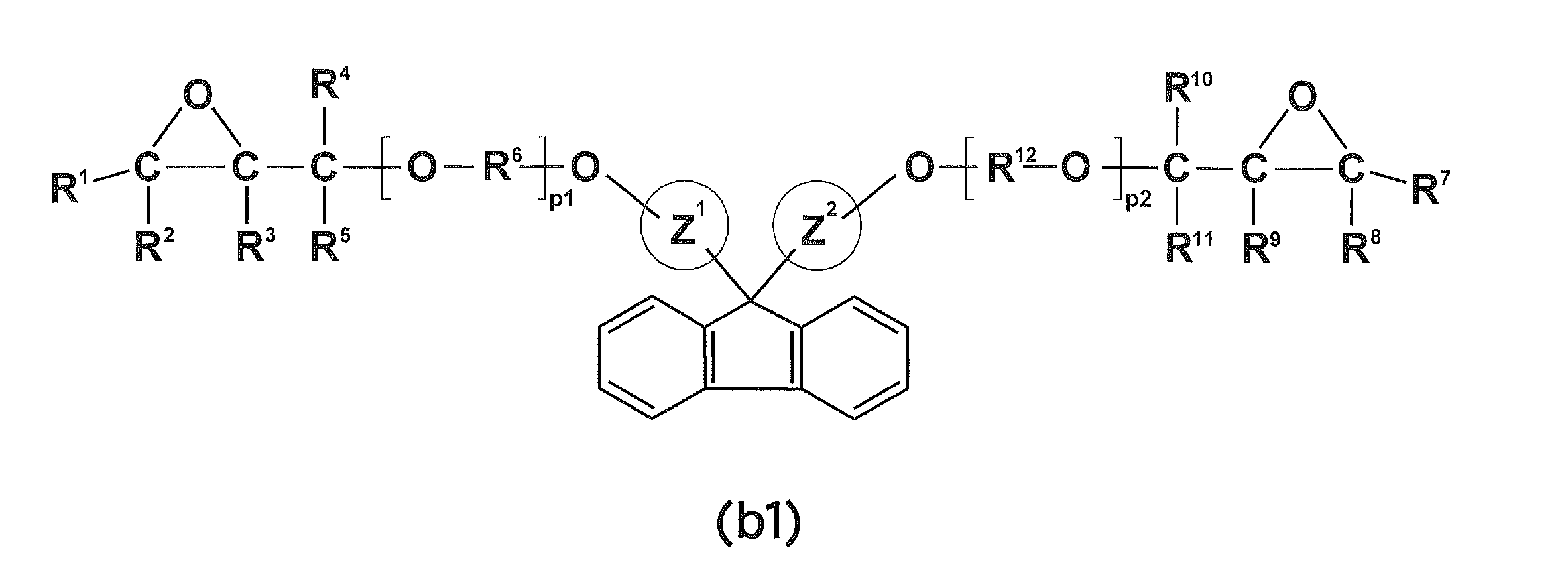
[12]芳香環を有するカチオン重合性化合物(B)の含有量が、硬化性組成物の総量(100重量%)に対して、40~90重量%である[1]~[11]のいずれか1つに記載のウェハレベルレンズ用硬化性組成物。
[13]硬化性組成物の総量(100重量%)に対するエステル基を有しない脂環エポキシ化合物(A)及び芳香環を有するカチオン重合性化合物(B)の総量の割合が、80重量%以上、100重量%未満である[1]~[12]のいずれか1つに記載のウェハレベルレンズ用硬化性組成物。
[14]さらに、熱カチオン硬化剤(C)を含む[1]~[13]のいずれか1つに記載のウェハレベルレンズ用硬化性組成物。
[15]熱カチオン硬化剤(C)が熱カチオン重合開始剤である[14]に記載のウェハレベルレンズ用硬化性組成物。
[16]熱カチオン硬化剤(C)の含有量(配合量)が、硬化性組成物に含まれるカチオン硬化性化合物の総量100重量部に対して、0.001~10重量部である[14]又は[15]に記載のウェハレベルレンズ用硬化性組成物。
[17]硬化開始温度が60~150℃である[14]~[16]のいずれか1つに記載のウェハレベルレンズ用硬化性組成物。
[18]さらに、酸化防止剤を含む[1]~[17]のいずれか1つに記載のウェハレベルレンズ用硬化性組成物。
[19]酸化防止剤がフェノール系酸化防止剤である[18]に記載のウェハレベルレンズ用硬化性組成物。
[20]酸化防止剤の含有量(配合量)が、硬化性組成物に含まれるカチオン硬化性化合物の総量100重量部に対して、0.001~15重量部である[18]又は[19]に記載のウェハレベルレンズ用硬化性組成物。
[21]硬化させて得られる硬化物のアッベ数が35以下である[1]~[20]のいずれか1つに記載のウェハレベルレンズ用硬化性組成物。
[22]さらに、カチオン硬化性官能基を有する離型剤を含む[1]~[21]のいずれか1つに記載のウェハレベルレンズ用硬化性組成物。
[23]前記離型剤が有するカチオン硬化性官能基の数が、1~4個である[22]に記載のウェハレベルレンズ用硬化性組成物。
[24]前記離型剤が、エポキシ基を有するフッ素置換炭化水素である[22]又は[23]に記載のウェハレベルレンズ用硬化性組成物。
[25]前記エポキシ基を有するフッ素置換炭化水素が、下記式(i)で表される化合物である[24]に記載のウェハレベルレンズ用硬化性組成物。

[26]前記離型剤の含有量(配合量)が、エステル基を有しない脂環エポキシ化合物(A)及び芳香環を有するカチオン重合性化合物(B)の総量100重量部に対して、0.01~10重量部である[22]~[25]のいずれか1つに記載のウェハレベルレンズ用硬化性組成物。
[27]硬化性組成物に含まれる硬化性化合物の総量(100重量%)に対するカチオン重合性化合物の総量の割合が、80~100重量%である[1]~[26]のいずれか1つに記載のウェハレベルレンズ用硬化性組成物。
[28]硬化させて得られる硬化物の400nmにおける内部透過率[厚み0.5mm換算]が、70~100%である[1]~[27]のいずれか1つに記載のウェハレベルレンズ用硬化性組成物。
[29]硬化させて得られる硬化物の589nmにおける屈折率(25℃)が、1.58以上である[1]~[28]のいずれか1つに記載のウェハレベルレンズ用硬化性組成物。
[30]硬化させて得られる硬化物のガラス転移温度が、100~200℃である[1]~[29]のいずれか1つに記載のウェハレベルレンズ用硬化性組成物。
[31]硬化させて得られる硬化物のガラス転移温度以下における線膨張係数(α1)が、40~100ppm/Kである[1]~[30]のいずれか1つに記載のウェハレベルレンズ用硬化性組成物。
[32]硬化させて得られる硬化物のガラス転移温度以上における線膨張係数(α2)が、90~150ppm/Kである[1]~[31]のいずれか1つに記載のウェハレベルレンズ用硬化性組成物。
[33][1]~[32]のいずれか1つに記載のウェハレベルレンズ用硬化性組成物を硬化させて得られる硬化物。
[34]400nmにおける内部透過率[厚み0.5mm換算]が、70~100%である[33]に記載の硬化物。
[35]589nmにおける屈折率(25℃)が、1.58以上である[33]又は[34]に記載の硬化物。
[36]ガラス転移温度が、100~200℃である[33]~[35]のいずれか1つに記載の硬化物。
[37]ガラス転移温度以下における線膨張係数(α1)が、40~100ppm/Kである[33]~[36]のいずれか1つに記載の硬化物。
[38]ガラス転移温度以上における線膨張係数(α2)が、90~150ppm/Kである[33]~[37]のいずれか1つに記載の硬化物。
[39]アッベ数が35以下である[33]~[38]のいずれか1つに記載の硬化物。
[40][1]~[32]のいずれか1つに記載のウェハレベルレンズ用硬化性組成物をキャスティング成型法又は射出成型法に付すことを特徴とするウェハレベルレンズの製造方法。
[41]前記キャスティング成型法が、下記工程を含む[40]に記載のウェハレベルレンズの製造方法。
工程1a:1つ以上のレンズ型を有するウェハレベルレンズ成型用型を準備する工程
工程2a:ウェハレベルレンズ用硬化性組成物を前記ウェハレベルレンズ成型用型に接触させる工程
工程3a:前記ウェハレベルレンズ用硬化性組成物を加熱及び/又は光照射により硬化させる工程
[42]前記キャスティング成型法が、さらに下記工程を含む[41]に記載のウェハレベルレンズの製造方法。
工程4a:硬化したウェハレベルレンズ用硬化性組成物をアニール処理する工程
[43]前記キャスティング成型法が、さらに下記工程を含む[41]又は[42]に記載のウェハレベルレンズの製造方法。
工程5a:硬化したウェハレベルレンズ用硬化性組成物を切断する工程
[44]前記射出成型法が、下記工程を含む[40]に記載のウェハレベルレンズの製造方法。
工程1b:1つ以上のレンズ型を有するウェハレベルレンズ成型用型を準備する工程
工程2b:ウェハレベルレンズ用硬化性組成物を前記ウェハレベルレンズ成型用型に射出する工程
工程3b:前記ウェハレベルレンズ用硬化性組成物を加熱及び/又は光照射により硬化させる工程
[45]前記射出成型法が、さらに下記工程を含む[44]に記載のウェハレベルレンズの製造方法。
工程4b:硬化したウェハレベルレンズ用硬化性組成物をアニール処理する工程
[46][41]又は[42]に記載のウェハレベルレンズの製造方法により得られるウェハレベルレンズシート。
[47][40]~[45]のいずれか1つに記載のウェハレベルレンズの製造方法により得られるウェハレベルレンズ。
[48]400nmにおける内部透過率[厚み0.5mm換算]が、70~100%である[47]に記載のウェハレベルレンズ。
[49]589nmにおける屈折率(25℃)が、1.58以上である[47]又は[48]に記載のウェハレベルレンズ。
[50]ガラス転移温度が、100~200℃である[47]~[49]のいずれか1つに記載のウェハレベルレンズ。
[51]ガラス転移温度以下における線膨張係数(α1)が、40~100ppm/Kである[47]~[50]のいずれか1つに記載のウェハレベルレンズ。
[52]ガラス転移温度以上における線膨張係数(α2)が、90~150ppm/Kである[47]~[51]のいずれか1つに記載のウェハレベルレンズ。
[53]アッベ数が35以下である[47]~[52]のいずれか1つに記載のウェハレベルレンズ。
[54][47]~[53]のいずれか1つに記載のウェハレベルレンズを搭載した光学装置。
[55]複数枚のウェハレベルレンズの積層体であって、該積層体を構成するウェハレベルレンズとして[1]~[32]のいずれか1つに記載のウェハレベルレンズ用硬化性組成物を硬化かつ成型して得られるウェハレベルレンズを少なくとも有する積層ウェハレベルレンズ。
[56]構成するウェハレベルレンズの枚数が2~5枚である[55]に記載の積層ウェハレベルレンズ。
[57][55]又は[56]に記載の積層ウェハレベルレンズの製造方法であって、下記工程を含む積層ウェハレベルレンズの製造方法。
工程1c:1つ以上のレンズ型を有するウェハレベルレンズ成型用型を準備する工程
工程2c:[1]~[32]のいずれか1つに記載のウェハレベルレンズ用硬化性組成物を前記ウェハレベルレンズ成型用型に接触させる工程
工程3c:前記ウェハレベルレンズ用硬化性組成物を加熱及び/又は光照射により硬化させてウェハレベルレンズシートを得る工程
工程4c:前記ウェハレベルレンズシートを含む複数枚のウェハレベルレンズシートを積層してウェハレベルレンズシート積層体を得る工程
工程5c:前記ウェハレベルレンズシート積層体を切断する工程
[58]さらに、工程3cと工程4cの間に、下記工程を含む[57]に記載の積層ウェハレベルレンズの製造方法。
工程6c:前記ウェハレベルレンズシートをアニール処理する工程
[59][46]に記載のウェハレベルレンズシートを含む複数枚のウェハレベルレンズシートを積層して得られるウェハレベルレンズシート積層体。
[60][55]又は[56]に記載の積層ウェハレベルレンズを搭載した光学装置。
本発明のウェハレベルレンズ用硬化性組成物(単に「本発明の硬化性組成物」と称する場合がある)は、エステル基を有しない脂環エポキシ化合物(A)、及び芳香環を有するカチオン重合性化合物(B)を必須成分として含む硬化性組成物である。本発明の硬化性組成物は、上述の必須成分のほかに、例えば、後述の熱カチオン硬化剤(C)、光カチオン硬化剤(D)、酸化防止剤、離型剤、各種添加剤等のその他の成分を含んでいてもよい。なお、本発明の硬化性組成物は、例えば、硬化剤の種類を選択することにより、加熱により硬化して硬化物(樹脂硬化物)を形成する熱硬化性組成物とすることもできるし、光(光照射)により硬化して硬化物を形成する光硬化性組成物とすることもできる。
本発明の硬化性組成物におけるエステル基(エステル結合)を有しない脂環エポキシ化合物(A)(以下、単に「脂環エポキシ化合物(A)」や「成分(A)」と称する場合がある)は、分子内にエステル基(エステル結合)を有しない化合物であって、分子内にエポキシ化された環状オレフィン基を少なくとも2個有する化合物である。脂環エポキシ化合物(A)が有する「エポキシ化された環状オレフィン基」とは、環状オレフィン(環を形成する炭素-炭素結合の少なくとも1つが炭素-炭素不飽和結合である環状脂肪族炭化水素)が有する炭素-炭素不飽和結合の少なくとも1つがエポキシ化された構造から1つの水素原子を除いて形成される基(1価の基)であり、以下、「エポキシ化環状オレフィン基」や「脂環エポキシ基」と称する場合がある。即ち、上記エポキシ化環状オレフィン基は、脂肪族炭化水素環構造とエポキシ基とを含み、該エポキシ基が上記脂肪族炭化水素環を構成する隣接する2つの炭素原子と酸素原子とで構成されるエポキシ基である基である。


本発明の硬化性組成物における芳香環を有するカチオン重合性化合物(B)(以下、単に「カチオン重合性化合物(B)」や「成分(B)」と称する場合がある)は、分子内に少なくとも1個の芳香環と、少なくとも1個のカチオン硬化性官能基(カチオン重合性官能基)とを有する化合物である。カチオン重合性化合物(B)を含むことにより、本発明の硬化性組成物を硬化させて得られる硬化物に対し、特に、耐熱性、並びに、高透明性、高屈折率、及び低アッベ数の光学特性を効率的に付与できる傾向がある。
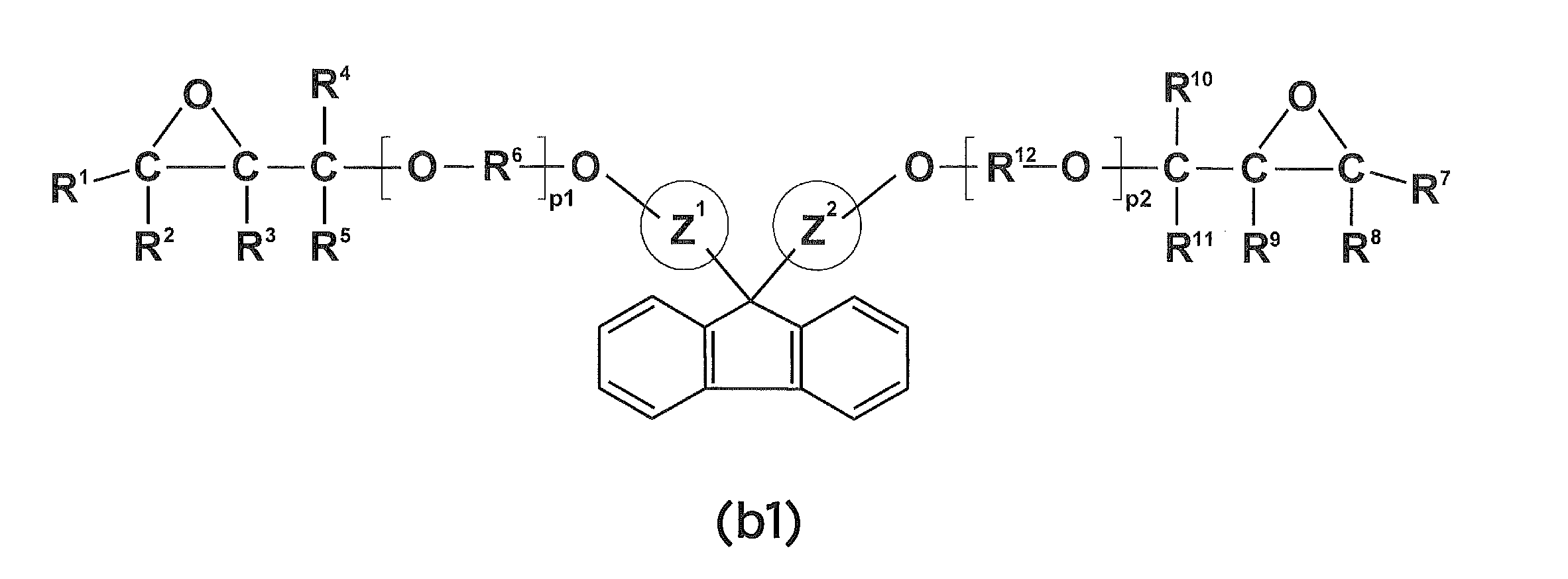
本発明の硬化性組成物は、熱カチオン硬化剤(C)(以下、「成分(C)」と称する場合がある)を含んでいてもよい。熱カチオン硬化剤(C)は、加熱によって硬化性組成物に含まれるカチオン硬化性化合物(カチオン硬化性官能基を有する化合物;例えば、脂環エポキシ化合物(A)、カチオン重合性化合物(B)、分子内に1個以上のカチオン硬化性官能基を有する離型剤等)の重合反応(硬化反応)を開始乃至進行させる働きを有する化合物である。熱カチオン硬化剤(C)としては、上述の働きを有する公知乃至慣用の化合物を使用することができ、特に限定されないが、例えば、加熱によりカチオン種を発生し、これにより硬化性化合物の重合(硬化)を開始させる熱カチオン重合開始剤等が挙げられる。
本発明の硬化性組成物は、さらに(例えば、熱カチオン硬化剤(C)の代わりに)、光カチオン硬化剤(D)(以下、「成分(D)」と称する場合がある)を含んでいてもよい。光カチオン硬化剤(D)は、光(光照射)によって硬化性組成物に含まれるカチオン硬化性化合物(カチオン硬化性官能基を有する化合物;例えば、脂環エポキシ化合物(A)、カチオン重合性化合物(B)、分子内に1個以上のカチオン硬化性官能基を有する離型剤等)の重合反応(硬化反応)を開始乃至進行させる働きを有する化合物である。光カチオン硬化剤(D)としては、上述の働きを有する公知乃至慣用の化合物を使用することができ、特に限定されないが、例えば、光照射によりカチオン種を発生し、これにより硬化性化合物の重合(硬化)を開始させる光カチオン重合開始剤等が挙げられる。
本発明の硬化性組成物は、さらに、酸化防止剤を含んでいてもよい。上記酸化防止剤としては、酸化防止剤として使用できる公知乃至慣用の化合物を使用することができ、特に限定されないが、例えば、フェノール系酸化防止剤(フェノール系化合物)、リン系酸化防止剤(リン系化合物)、硫黄系酸化防止剤(硫黄系化合物)等が挙げられる。
本発明の硬化性組成物は、さらに、離型剤を含んでいてもよい。上記離型剤としては、離型剤として使用できる公知乃至慣用の化合物を使用することができ、特に限定されないが、例えば、(ポリ)オキシアルキレンアルキルリン酸化合物、フッ素化合物(フッ素系離型剤)、シリコーン系化合物、長鎖アルキル基を有する化合物、ポリアルキレンワックス、アミドワックス、ポリテトラフルオロエチレンパウダー等が挙げられる。中でも、透明性を損なわない観点で、分子内に1個以上のカチオン硬化性官能基を有する離型剤が好ましく、より好ましくは分子内に1個以上のカチオン硬化性官能基を有するフッ素化合物(フッ素系離型剤)である。

本発明の硬化性組成物は、上述の成分のほか、必要に応じて添加剤等のその他の成分を含んでいてもよい。上記添加剤としては、公知乃至慣用の添加剤が挙げられ、特に限定されないが、例えば、金属酸化物粒子、ゴム粒子、シリコーン系やフッ素系の消泡剤、シランカップリング剤、充填剤、可塑剤、レベリング剤、帯電防止剤、難燃剤、着色剤、紫外線吸収剤、イオン吸着体、顔料等が挙げられる。これら各種の添加剤の含有量(配合量)は、特に限定されないが、硬化性組成物(100重量%)に対して、5重量%以下(例えば、0~5重量%)とすることが好ましい。また、本発明の硬化性組成物は溶媒を含んでいてもよいが、あまり多いと硬化物に気泡が生じる場合があるので、硬化性組成物(100重量%)に対して10重量%以下(例えば、0~10重量%)とすることが好ましく、より好ましくは1重量%以下である。
(DSCの測定条件)
・測定雰囲気:窒素(流量:50mL/分)
・測定温度:30~300℃
・昇温条件:20℃/分
なお、本発明の硬化性組成物の硬化開始温度は、例えば、硬化性組成物の組成(例えば、熱カチオン硬化剤(C)の種類;特に、脂環エポキシ化合物(A)及びカチオン重合性化合物(B)と熱カチオン硬化剤(C)との組み合わせ)によって制御することができる。
本発明の硬化性組成物を硬化かつ成型することにより、ウェハレベルレンズ(「本発明のウェハレベルレンズ」と称する場合がある)が得られる。即ち、本発明のウェハレベルレンズは、本発明の硬化性組成物の硬化物により形成されたウェハレベルレンズである。従って、本発明のウェハレベルレンズは、上述の硬化物と同様の特性(内部透過率、屈折率、アッベ数、ガラス転移温度、線膨張係数(α1、α2))を有することが好ましい。具体的には、本発明のウェハレベルレンズは、本発明の硬化性組成物をキャスティング成型法又は射出成型法に付す方法(「本発明のウェハレベルレンズの製造方法」と称する場合がある)により得られる。
上記キャスティング成型法としては、例えば、下記の工程1a~工程3aを含む方法が挙げられる。
工程1a:1つ以上のレンズ型を有するウェハレベルレンズ成型用型を準備する工程
工程2a:工程1aの後、本発明の硬化性組成物を上記ウェハレベルレンズ成型用型に接触させる工程
工程3a:工程2aの後、本発明の硬化性組成物を加熱及び/又は光照射により硬化させる工程
工程4a:硬化した本発明の硬化性組成物をアニール処理する工程
工程5a:硬化した本発明の硬化性組成物(通常、ウェハレベルレンズシート)を切断する工程
(同時成型法)
工程1-1:本発明の硬化性組成物を複数個のレンズ型が一定方向に整列した形状を有するウェハレベルレンズ成型用型に流し込み、加熱及び/又は光照射して硬化させる工程
工程1-2:工程1-1の後、ウェハレベルレンズ成型用型を外してアニール処理を行い、ウェハレベルレンズが複数個結合した形状を有する硬化物(ウェハレベルレンズシート)を得る工程
工程1-3:工程1-2の後、得られた硬化物を切断してウェハレベルレンズを得る工程
(個片成型法)
工程2-1:本発明の硬化性組成物を1個のレンズ型を有するウェハレベルレンズ成型用型に流し込み、加熱及び/又は光照射して硬化させる工程
工程2-2:工程2-1の後、ウェハレベルレンズ形成用型を外してアニール処理を行い、ウェハレベルレンズを得る工程
上記射出成型法としては、例えば、下記の工程1b~工程3bを含む方法が挙げられる。
工程1b:1つ以上のレンズ型を有するウェハレベルレンズ成型用型を準備する工程
工程2b:工程1bの後、本発明の硬化性組成物を上記ウェハレベルレンズ成型用型に射出する工程
工程3b:工程2bの後、本発明の硬化性組成物を加熱及び/又は光照射により硬化させる工程
工程4b:硬化した本発明の硬化性組成物をアニール処理する工程
工程1c:1つ以上のレンズ型を有するウェハレベルレンズ成型用型を準備する工程
工程2c:工程1cの後、本発明の硬化性組成物を上記ウェハレベルレンズ成型用型に接触させる工程
工程3c:工程2cの後、本発明の硬化性組成物を加熱及び/又は光照射により硬化させてウェハレベルレンズシートを得る工程
工程4c:工程3cの後、上記ウェハレベルレンズシートを含む複数枚のウェハレベルレンズシートを積層してウェハレベルレンズシート積層体を得る工程
工程5c:工程4cの後、上記ウェハレベルレンズシート積層体を切断する工程
工程6c:上記ウェハレベルレンズシートをアニール処理する工程
表1に記載の各成分につき、自転公転ミキサーを使用して、常温(25℃)にて攪拌・混合することにより、硬化性組成物(ウェハレベルレンズ用硬化性組成物)を得た。なお、表1に記載された配合量の単位は重量部である。
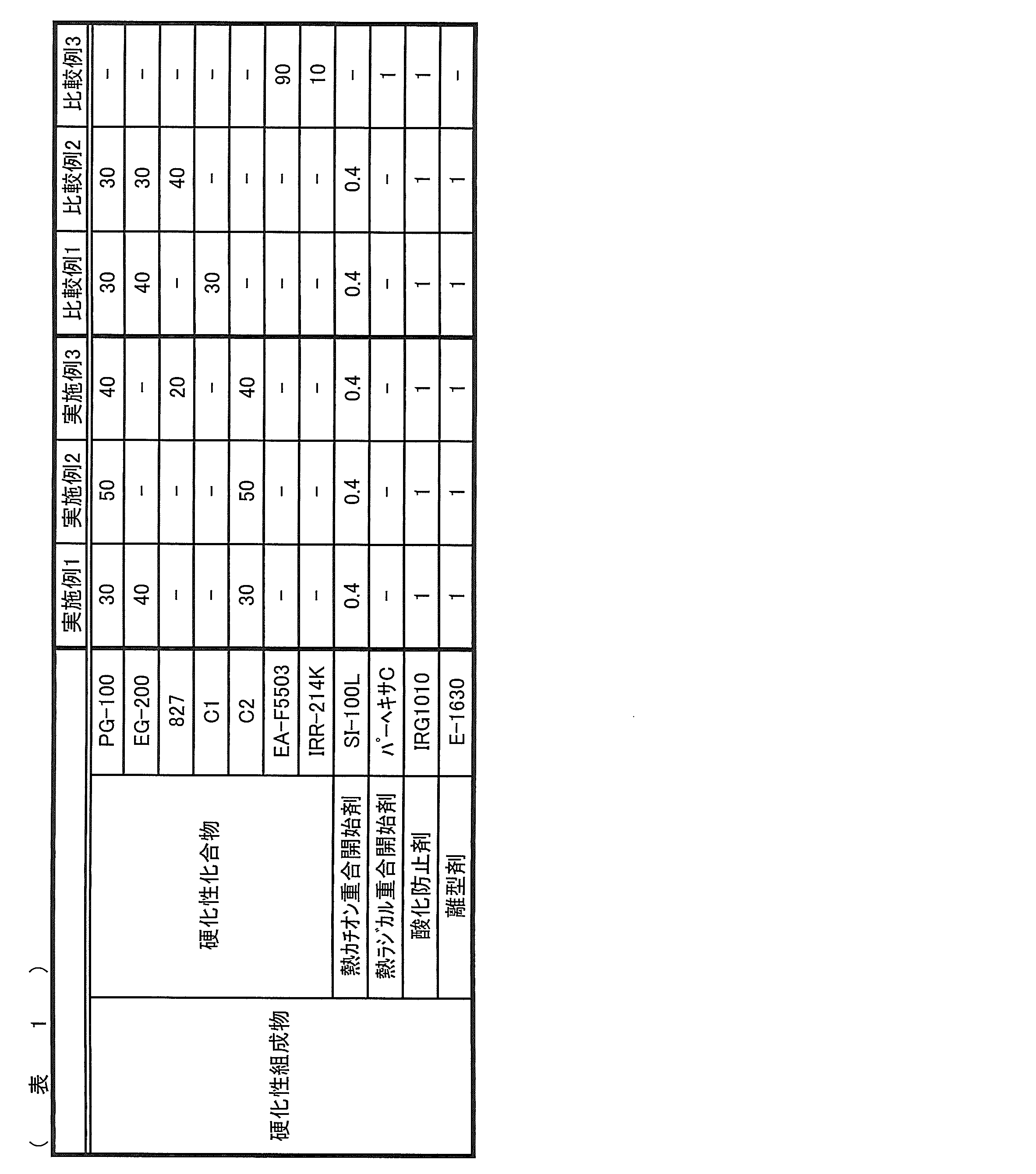
〔硬化性化合物〕
PG-100 : フルオレン系エポキシ化合物(大阪ガスケミカル(株)製、商品名「PG-100」)
EG-200 : フルオレン系エポキシ化合物(大阪ガスケミカル(株)製、商品名「EG-200」)
827 : ビスフェノールA型エポキシ化合物(三菱化学(株)製、商品名「jER827」)
C1 : 3,4-エポキシシクロヘキシルメチル(3,4-エポキシ)シクロヘキサンカルボキシレート
C2 : 3,4,3',4'-ジエポキシビシクロヘキシル
EA-F5503 : フルオレン系アクリル化合物(大阪ガスケミカル(株)製、商品名「オグソールEA-F5503」)
IRR-214K : 脂環アクリル化合物(ダイセル・サイテック(株)製、商品名「IRR-214K」)
〔熱カチオン重合開始剤〕
SI-100L : 芳香族スルホニウム塩(三新化学工業(株)製、商品名「サンエイドSI-100L)
〔熱ラジカル重合開始剤〕
パーヘキサC : 1,1-ジ(t-ブチルパーオキシ)シクロヘキサン(日油(株)製、商品名「パーヘキサC」、1分間半減期温度:153.8℃)
〔酸化防止剤〕
IRG1010 : ペンタエリスリトールテトラキス[3-(3,5-ジ-t-ブチル-4-ヒドロキシフェノール)プロピオネート](BASF社製、商品名「IRGANOX1010」)
〔離型剤〕
E-1630 : 3-パーフルオロヘキシル-1,2-エポキシプロパン(ダイキン工業(株)製、商品名「E-1630」)
以下の手順で硬化物を調製した。
実施例及び比較例で得られた硬化性組成物につき、インプリント成型機(明昌機工(株)製「NANOIMPRINTER NM-0501」)を使用して、25℃にて塗布(キャスティング)を行った後、プレス軸位置を調整して厚み0.5mmとし、昇温速度20℃/分にて180℃まで昇温した後、180℃にて5分間保持し、80℃まで冷却した後に離型した。得られた硬化物(「一次硬化物」とする)を、予め180℃に熱したオーブンにて30分間加熱した後、硬化物(「二次硬化物」とする)を得た。
なお、離型性及びレンズ位置ずれ評価用サンプルの作製においては、金型中央に7個の非球面のレンズ形状がある金型を用い、その他の評価用サンプルにおいては、レンズ形状がない平面の金型を用いた。
実施例及び比較例で得られた硬化性組成物について、レオメーター(Paar Physica社製「PHYSICA UDS200」)を使用して、温度25℃、回転速度20/秒における粘度(Pa・s)を測定した。
実施例及び比較例で得られた硬化性組成物について、示差走査熱量計(ティー・エイ・インスツルメント社製「Q2000」)を使用して、窒素雰囲気下にて、下記の温度条件における硬化発熱量を測定し、これを硬化性組成物の硬化発熱量とした。続いて、上記で得られた一次硬化物につき、同温度条件における硬化発熱量を、一次硬化物の中心部と周辺部(各々、該当箇所を刃物で切り出して取得)において測定し、その平均値を一次硬化物の硬化発熱量とした。そして、硬化率を下記式にて算出した。
温度条件:50℃にて3分間保持した後、昇温速度20℃/分にて250℃まで昇温し、250℃で3分間保持
硬化率(%)={1-(一次硬化物の硬化発熱量)/(硬化性組成物の硬化発熱量)}×100
実施例及び比較例で得られた硬化性組成物について、示差走査熱量計(ティー・エイ・インスツルメント社製「Q2000」)を使用して、窒素雰囲気下にて、上述の硬化開始温度測定時の条件で加熱した際の硬化発熱量(反応熱量)を観測した。得られた硬化発熱量のチャートにおいて、硬化発熱の立ち上がり温度(ベースラインからの立ち上がりが開始する温度)を、硬化開始温度として測定した。
上記で得られた二次硬化物(厚み:0.5mm)の内部透過率を下記式にて算出した。なお、400nmにおける光線透過率(二次硬化物の光線透過率)は、分光光度計(日立ハイテクノロジーズ(株)製「U-3900」)を使用して測定した。下記式におけるnは、400nmにおける屈折率であり、後述の屈折率の測定方法により得た値を使用した。
内部透過率(400nm)(%)=400nmにおける光線透過率(%)/(1-r)2
r={(n-1)/(n+1)}2
上記で得られた二次硬化物について、JIS K7142に準拠した方法により、屈折率計(メトリコン社製「Model 2010」)を使用して、25℃での589nmにおける屈折率を測定した。
上記で得られた二次硬化物のアッベ数を、下記式にて算出した。
アッベ数=(nd-1)/(nF-nC)
(式中、ndは589.2nmにおける屈折率、nFは486.1nmにおける屈折率、nCは656.3nmにおける屈折率を示す。なお、屈折率の値としては、前述の屈折率の測定方法を使用し、前記各波長において得られた屈折率の値を使用した。)
上記で得られた二次硬化物の体積収縮率(%)は、硬化性組成物の25℃における比重(G1)、及び二次硬化物の比重(G2)を、電子比重計((株)島津製作所製「SD-200L」)を使用して測定した後、下記式にて算出した。
体積収縮率(%)={(G2-G1)/G1×100}
上記で得られた二次硬化物のガラス転移温度(ガラス転移点)(Tg、℃)は、TMA測定装置(エスアイアイ・ナノテクノロジー社製「TMA/SS100」)を使用し、JIS K7197に準拠した方法により、窒素雰囲気下にて、昇温速度5℃/分で、測定温度範囲30~250℃における熱膨張率を測定した後、ガラス転移点の前及び後の曲線に接線を引き、これら接線の交点から求めた。
上記で得られた二次硬化物の線膨張係数は、TMA測定装置(エスアイアイ・ナノテクノロジー社製「TMA/SS100」)を使用し、JIS K7197に準拠した方法により、窒素雰囲気下にて、昇温速度5℃/分で、測定温度範囲30~250℃における熱膨張率を測定した後、ガラス転移点より低温側の直線の勾配をα1、ガラス転移点より高温側の直線の勾配をα2とし、各々を線膨張係数として求めた。
上記で得られた二次硬化物について、卓上リフロー炉(シンアペック社製)を使用して、JEDEC規格記載の温度プロファイルに基づき、最高温度270℃のリフロー条件の耐熱性試験を連続して3回行った後、400nmにおける光線透過率及び400nmにおける屈折率を前述した測定方法により測定し、耐熱性試験後における内部透過率を求めた。耐熱性試験前後の内部透過率から、黄変率(%)を下記式にて算出し、耐熱性を評価した。なお、黄変率が小さいほど、硬化物の耐熱性は良好である。
黄変率(%)={(耐熱性試験前の内部透過率)-(耐熱性試験後の内部透過率)}/(耐熱性試験前の内部透過率)×100
上述の硬化物(ウェハレベルレンズ)の調製において、硬化物(一次硬化物)を金型から離型する際の離型性を、以下の基準で評価した。
○(離型性極めて良好):5回連続で成型を行った際、硬化物(成型物)が割れる等の離型不良は発生しなかった
△(離型性良好)5回連続で成型を行った際、硬化物が割れる等の離型不良が1回発生した
×(離型性不良):5回連続で成型を行った際、硬化物が割れる等の離型不良が2回以上発生した
得られた硬化物(成型物)上に形成されたレンズ7個の中心位置を、それぞれ、画像寸法測定器(商品名「IM-6020」、(株)キーエンス製)にて測定し、金型設計値からのレンズの中心位置ずれを測定し、その平均値を算出した。
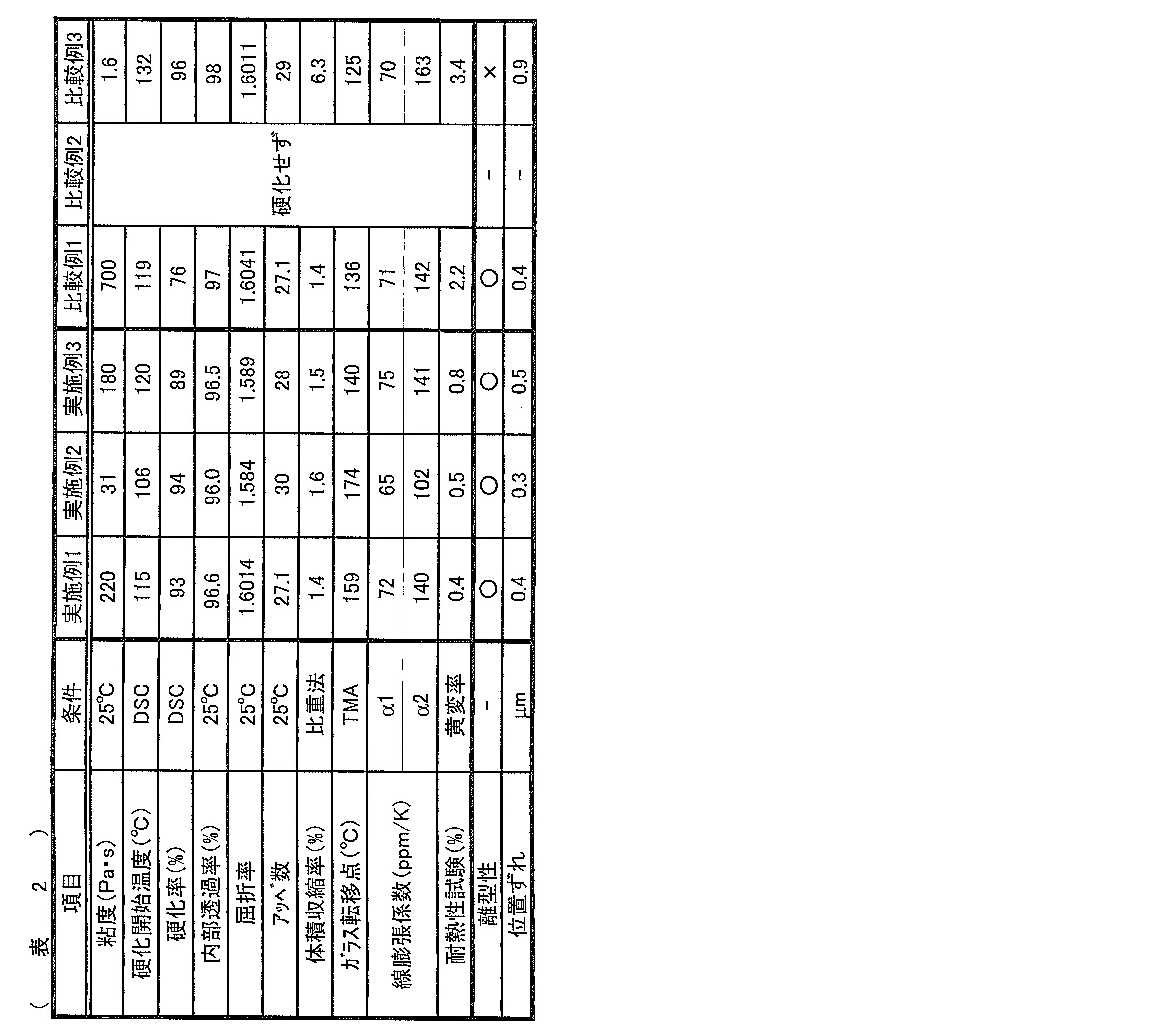
Claims (25)
- エステル基を有しない脂環エポキシ化合物(A)、及び芳香環を有するカチオン重合性化合物(B)を含む硬化性組成物であって、エステル基を有しない脂環エポキシ化合物(A)が、エポキシ化された環状オレフィン基を少なくとも2個有する化合物であることを特徴とするウェハレベルレンズ用硬化性組成物。
- エポキシ化された環状オレフィン基が、炭素数5~12の環状オレフィン基がエポキシ化された基である請求項1に記載のウェハレベルレンズ用硬化性組成物。
- エステル基を有しない脂環エポキシ化合物(A)が、エポキシ化された環状オレフィン基の少なくとも2個が単結合又は2価の炭化水素基で結合された構造を有する化合物である請求項1又は2に記載のウェハレベルレンズ用硬化性組成物。
- エステル基を有しない脂環エポキシ化合物(A)が、下記式(a2)で表される化合物である請求項1~3のいずれか1項に記載のウェハレベルレンズ用硬化性組成物。

- エステル基を有しない脂環エポキシ化合物(A)の含有量が、硬化性組成物の総量(100重量%)に対して、10~60重量%である請求項1~4のいずれか1項に記載のウェハレベルレンズ用硬化性組成物。
- 芳香環を有するカチオン重合性化合物(B)が、脂環エポキシ基、グリシジル基、及びオキセタニル基からなる群より選択された少なくとも1種のカチオン硬化性官能基を有する請求項1~5のいずれか1項に記載のウェハレベルレンズ用硬化性組成物。
- 芳香環を有するカチオン重合性化合物(B)の含有量が、硬化性組成物の総量(100重量%)に対して、40~90重量%である請求項1~6のいずれか1項に記載のウェハレベルレンズ用硬化性組成物。
- さらに、熱カチオン硬化剤(C)を含む請求項1~7のいずれか1項に記載のウェハレベルレンズ用硬化性組成物。
- 硬化開始温度が60~150℃である請求項8に記載のウェハレベルレンズ用硬化性組成物。
- 硬化させて得られる硬化物のアッベ数が35以下である請求項1~9のいずれか1項に記載のウェハレベルレンズ用硬化性組成物。
- さらに、カチオン硬化性官能基を有する離型剤を含む請求項1~10のいずれか1項に記載のウェハレベルレンズ用硬化性組成物。
- 請求項1~11のいずれか1項に記載のウェハレベルレンズ用硬化性組成物をキャスティング成型法又は射出成型法に付すことを特徴とするウェハレベルレンズの製造方法。
- 前記キャスティング成型法が、下記工程を含む請求項12に記載のウェハレベルレンズの製造方法。
工程1a:1つ以上のレンズ型を有するウェハレベルレンズ成型用型を準備する工程
工程2a:ウェハレベルレンズ用硬化性組成物を前記ウェハレベルレンズ成型用型に接触させる工程
工程3a:前記ウェハレベルレンズ用硬化性組成物を加熱及び/又は光照射により硬化させる工程 - 前記キャスティング成型法が、さらに下記工程を含む請求項13に記載のウェハレベルレンズの製造方法。
工程4a:硬化したウェハレベルレンズ用硬化性組成物をアニール処理する工程 - 前記キャスティング成型法が、さらに下記工程を含む請求項13又は14に記載のウェハレベルレンズの製造方法。
工程5a:硬化したウェハレベルレンズ用硬化性組成物を切断する工程 - 前記射出成型法が、下記工程を含む請求項12に記載のウェハレベルレンズの製造方法。
工程1b:1つ以上のレンズ型を有するウェハレベルレンズ成型用型を準備する工程
工程2b:ウェハレベルレンズ用硬化性組成物を前記ウェハレベルレンズ成型用型に射出する工程
工程3b:前記ウェハレベルレンズ用硬化性組成物を加熱及び/又は光照射により硬化させる工程 - 前記射出成型法が、さらに下記工程を含む請求項16に記載のウェハレベルレンズの製造方法。
工程4b:硬化したウェハレベルレンズ用硬化性組成物をアニール処理する工程 - 請求項13又は14に記載のウェハレベルレンズの製造方法により得られるウェハレベルレンズシート。
- 請求項12~17のいずれか1項に記載のウェハレベルレンズの製造方法により得られるウェハレベルレンズ。
- 請求項19に記載のウェハレベルレンズを搭載した光学装置。
- 複数枚のウェハレベルレンズの積層体であって、該積層体を構成するウェハレベルレンズとして請求項1~11のいずれか1項に記載のウェハレベルレンズ用硬化性組成物を硬化かつ成型して得られるウェハレベルレンズを少なくとも有する積層ウェハレベルレンズ。
- 請求項21に記載の積層ウェハレベルレンズの製造方法であって、下記工程を含む積層ウェハレベルレンズの製造方法。
工程1c:1つ以上のレンズ型を有するウェハレベルレンズ成型用型を準備する工程
工程2c:請求項1~11のいずれか1項に記載のウェハレベルレンズ用硬化性組成物を前記ウェハレベルレンズ成型用型に接触させる工程
工程3c:前記ウェハレベルレンズ用硬化性組成物を加熱及び/又は光照射により硬化させてウェハレベルレンズシートを得る工程
工程4c:前記ウェハレベルレンズシートを含む複数枚のウェハレベルレンズシートを積層してウェハレベルレンズシート積層体を得る工程
工程5c:前記ウェハレベルレンズシート積層体を切断する工程 - さらに、工程3cと工程4cの間に、下記工程を含む請求項22に記載の積層ウェハレベルレンズの製造方法。
工程6c:前記ウェハレベルレンズシートをアニール処理する工程 - 請求項18に記載のウェハレベルレンズシートを含む複数枚のウェハレベルレンズシートを積層して得られるウェハレベルレンズシート積層体。
- 請求項21に記載の積層ウェハレベルレンズを搭載した光学装置。
Priority Applications (4)
| Application Number | Priority Date | Filing Date | Title |
|---|---|---|---|
| KR1020157022700A KR102131201B1 (ko) | 2013-02-19 | 2014-02-10 | 웨이퍼 레벨 렌즈용 경화성 조성물, 웨이퍼 레벨 렌즈의 제조 방법 및 웨이퍼 레벨 렌즈, 및 광학 장치 |
| KR1020187011238A KR102131193B1 (ko) | 2013-02-19 | 2014-02-10 | 웨이퍼 레벨 렌즈용 경화성 조성물, 웨이퍼 레벨 렌즈의 제조 방법 및 웨이퍼 레벨 렌즈, 및 광학 장치 |
| JP2015501396A JP6382180B2 (ja) | 2013-02-19 | 2014-02-10 | ウェハレベルレンズ用硬化性組成物、ウェハレベルレンズの製造方法及びウェハレベルレンズ、並びに光学装置 |
| CN201480007908.3A CN104995230B (zh) | 2013-02-19 | 2014-02-10 | 晶片级透镜用固化性组合物、晶片级透镜的制造方法及晶片级透镜、以及光学装置 |
Applications Claiming Priority (4)
| Application Number | Priority Date | Filing Date | Title |
|---|---|---|---|
| JP2013-029690 | 2013-02-19 | ||
| JP2013029690 | 2013-02-19 | ||
| JP2013029688 | 2013-02-19 | ||
| JP2013-029688 | 2013-02-19 |
Publications (1)
| Publication Number | Publication Date |
|---|---|
| WO2014129342A1 true WO2014129342A1 (ja) | 2014-08-28 |
Family
ID=51391137
Family Applications (1)
| Application Number | Title | Priority Date | Filing Date |
|---|---|---|---|
| PCT/JP2014/053013 Ceased WO2014129342A1 (ja) | 2013-02-19 | 2014-02-10 | ウェハレベルレンズ用硬化性組成物、ウェハレベルレンズの製造方法及びウェハレベルレンズ、並びに光学装置 |
Country Status (5)
| Country | Link |
|---|---|
| JP (2) | JP6382180B2 (ja) |
| KR (2) | KR102131193B1 (ja) |
| CN (1) | CN104995230B (ja) |
| TW (1) | TWI658057B (ja) |
| WO (1) | WO2014129342A1 (ja) |
Cited By (6)
| Publication number | Priority date | Publication date | Assignee | Title |
|---|---|---|---|---|
| CN106569296A (zh) * | 2015-10-07 | 2017-04-19 | 住友化学株式会社 | 偏振板 |
| JP2018193480A (ja) * | 2017-05-17 | 2018-12-06 | 東京応化工業株式会社 | 硬化性組成物、硬化膜、表示パネル、及び硬化物の製造方法 |
| WO2019124476A1 (ja) * | 2017-12-21 | 2019-06-27 | 株式会社ダイセル | 硬化性エポキシ樹脂組成物及びその硬化物、並びに光半導体装置 |
| US20200174164A1 (en) * | 2017-07-11 | 2020-06-04 | Daicel Corporation | Fresnel lens and production method for same |
| WO2022158444A1 (ja) * | 2021-01-22 | 2022-07-28 | 住友ベークライト株式会社 | 成形用樹脂組成物 |
| JP2024017249A (ja) * | 2022-07-27 | 2024-02-08 | 株式会社ダイセル | 硬化性組成物、硬化物、光学部材、および光学装置 |
Families Citing this family (2)
| Publication number | Priority date | Publication date | Assignee | Title |
|---|---|---|---|---|
| JP6772169B2 (ja) * | 2014-11-26 | 2020-10-21 | ジャイスワル、スプリヤ | リソグラフィーおよび他の用途において極紫外線と使用するための材料、コンポーネントおよび方法 |
| TWI815191B (zh) | 2021-09-30 | 2023-09-11 | 新應材股份有限公司 | 樹脂組成物以及硬化膜 |
Citations (11)
| Publication number | Priority date | Publication date | Assignee | Title |
|---|---|---|---|---|
| JP2000109478A (ja) * | 1998-08-07 | 2000-04-18 | Mitsubishi Gas Chem Co Inc | 新規なエ―テル化合物およびそれを用いた硬化樹脂 |
| JP2000230050A (ja) * | 1999-02-08 | 2000-08-22 | Mitsui Chemicals Inc | 新規な光学用樹脂 |
| JP2004204228A (ja) * | 2002-12-13 | 2004-07-22 | Daicel Chem Ind Ltd | 硬化性エポキシ樹脂組成物および硬化物 |
| JP2005068303A (ja) * | 2003-08-25 | 2005-03-17 | Daicel Chem Ind Ltd | 熱硬化型エポキシ樹脂組成物および透明材料 |
| JP2008031424A (ja) * | 2006-07-06 | 2008-02-14 | Daicel Chem Ind Ltd | 脂環式ジエポキシ化合物、エポキシ樹脂組成物及び硬化物 |
| WO2008143003A1 (ja) * | 2007-05-24 | 2008-11-27 | Sumitomo Bakelite Co., Ltd. | 透明複合シート |
| JP2009084310A (ja) * | 2007-09-27 | 2009-04-23 | Nippon Shokubai Co Ltd | 熱・光硬化性樹脂組成物、光学材料及び光学部材 |
| JP2010105229A (ja) * | 2008-10-29 | 2010-05-13 | Seiko Epson Corp | プラスチックレンズの製造方法 |
| JP2010168448A (ja) * | 2009-01-21 | 2010-08-05 | Panasonic Corp | 複合光学素子用樹脂組成物および複合光学素子 |
| JP2011052116A (ja) * | 2009-09-02 | 2011-03-17 | Sumitomo Bakelite Co Ltd | エポキシ樹脂組成物、透明複合シートおよび表示素子用基板 |
| JP2011138089A (ja) * | 2010-01-04 | 2011-07-14 | Fujifilm Corp | ウェハレベルレンズアレイ、レンズモジュール及び撮像ユニット |
Family Cites Families (12)
| Publication number | Priority date | Publication date | Assignee | Title |
|---|---|---|---|---|
| JP3844824B2 (ja) * | 1996-11-26 | 2006-11-15 | 株式会社Adeka | エネルギー線硬化性エポキシ樹脂組成物、光学的立体造形用樹脂組成物及び光学的立体造形方法 |
| JP2004163490A (ja) * | 2002-11-11 | 2004-06-10 | Nippon Sheet Glass Co Ltd | 光学素子及びその製造方法 |
| JP2004163491A (ja) * | 2002-11-11 | 2004-06-10 | Nippon Sheet Glass Co Ltd | 光学素子及びその製造方法 |
| JP4398500B2 (ja) | 2007-04-06 | 2010-01-13 | 株式会社日本触媒 | 樹脂組成物及び光学部材 |
| CN101809055B (zh) * | 2007-09-27 | 2013-10-23 | 株式会社日本触媒 | 成型体用固化性树脂组合物、成型体及其制造方法 |
| JP2009179568A (ja) | 2008-01-29 | 2009-08-13 | Nippon Shokubai Co Ltd | 芳香族骨格含有脂環式エポキシ化合物、その製造方法、芳香族骨格含有脂環式エポキシ樹脂組成物並びにその成形体及び光学部材 |
| JP5486891B2 (ja) * | 2009-10-08 | 2014-05-07 | 三菱レイヨン株式会社 | 連鎖硬化性樹脂組成物および繊維強化複合材料 |
| JP5665445B2 (ja) * | 2010-09-13 | 2015-02-04 | キヤノン株式会社 | 有機無機複合組成物および光学素子 |
| JP5685879B2 (ja) * | 2010-10-08 | 2015-03-18 | 住友ベークライト株式会社 | 樹脂硬化物、透明複合基板、表示素子基板および樹脂硬化物の製造方法 |
| JP2012135914A (ja) * | 2010-12-24 | 2012-07-19 | Konica Minolta Advanced Layers Inc | 樹脂レンズの成形方法 |
| JP5827852B2 (ja) * | 2011-08-04 | 2015-12-02 | 株式会社ダイセル | ウェハレベルレンズの製造方法 |
| JP6474719B2 (ja) * | 2013-02-19 | 2019-02-27 | 株式会社ダイセル | 硬化性組成物及びその硬化物、光学部材、並びに光学装置 |
-
2014
- 2014-02-10 KR KR1020187011238A patent/KR102131193B1/ko not_active Expired - Fee Related
- 2014-02-10 CN CN201480007908.3A patent/CN104995230B/zh active Active
- 2014-02-10 KR KR1020157022700A patent/KR102131201B1/ko not_active Expired - Fee Related
- 2014-02-10 WO PCT/JP2014/053013 patent/WO2014129342A1/ja not_active Ceased
- 2014-02-10 JP JP2015501396A patent/JP6382180B2/ja active Active
- 2014-02-18 TW TW103105290A patent/TWI658057B/zh not_active IP Right Cessation
-
2018
- 2018-08-01 JP JP2018144908A patent/JP6612942B2/ja active Active
Patent Citations (11)
| Publication number | Priority date | Publication date | Assignee | Title |
|---|---|---|---|---|
| JP2000109478A (ja) * | 1998-08-07 | 2000-04-18 | Mitsubishi Gas Chem Co Inc | 新規なエ―テル化合物およびそれを用いた硬化樹脂 |
| JP2000230050A (ja) * | 1999-02-08 | 2000-08-22 | Mitsui Chemicals Inc | 新規な光学用樹脂 |
| JP2004204228A (ja) * | 2002-12-13 | 2004-07-22 | Daicel Chem Ind Ltd | 硬化性エポキシ樹脂組成物および硬化物 |
| JP2005068303A (ja) * | 2003-08-25 | 2005-03-17 | Daicel Chem Ind Ltd | 熱硬化型エポキシ樹脂組成物および透明材料 |
| JP2008031424A (ja) * | 2006-07-06 | 2008-02-14 | Daicel Chem Ind Ltd | 脂環式ジエポキシ化合物、エポキシ樹脂組成物及び硬化物 |
| WO2008143003A1 (ja) * | 2007-05-24 | 2008-11-27 | Sumitomo Bakelite Co., Ltd. | 透明複合シート |
| JP2009084310A (ja) * | 2007-09-27 | 2009-04-23 | Nippon Shokubai Co Ltd | 熱・光硬化性樹脂組成物、光学材料及び光学部材 |
| JP2010105229A (ja) * | 2008-10-29 | 2010-05-13 | Seiko Epson Corp | プラスチックレンズの製造方法 |
| JP2010168448A (ja) * | 2009-01-21 | 2010-08-05 | Panasonic Corp | 複合光学素子用樹脂組成物および複合光学素子 |
| JP2011052116A (ja) * | 2009-09-02 | 2011-03-17 | Sumitomo Bakelite Co Ltd | エポキシ樹脂組成物、透明複合シートおよび表示素子用基板 |
| JP2011138089A (ja) * | 2010-01-04 | 2011-07-14 | Fujifilm Corp | ウェハレベルレンズアレイ、レンズモジュール及び撮像ユニット |
Cited By (7)
| Publication number | Priority date | Publication date | Assignee | Title |
|---|---|---|---|---|
| CN106569296A (zh) * | 2015-10-07 | 2017-04-19 | 住友化学株式会社 | 偏振板 |
| CN106569296B (zh) * | 2015-10-07 | 2020-08-14 | 住友化学株式会社 | 偏振板 |
| JP2018193480A (ja) * | 2017-05-17 | 2018-12-06 | 東京応化工業株式会社 | 硬化性組成物、硬化膜、表示パネル、及び硬化物の製造方法 |
| US20200174164A1 (en) * | 2017-07-11 | 2020-06-04 | Daicel Corporation | Fresnel lens and production method for same |
| WO2019124476A1 (ja) * | 2017-12-21 | 2019-06-27 | 株式会社ダイセル | 硬化性エポキシ樹脂組成物及びその硬化物、並びに光半導体装置 |
| WO2022158444A1 (ja) * | 2021-01-22 | 2022-07-28 | 住友ベークライト株式会社 | 成形用樹脂組成物 |
| JP2024017249A (ja) * | 2022-07-27 | 2024-02-08 | 株式会社ダイセル | 硬化性組成物、硬化物、光学部材、および光学装置 |
Also Published As
| Publication number | Publication date |
|---|---|
| JP6612942B2 (ja) | 2019-11-27 |
| KR20180043413A (ko) | 2018-04-27 |
| KR102131193B1 (ko) | 2020-07-07 |
| TW201443095A (zh) | 2014-11-16 |
| CN104995230A (zh) | 2015-10-21 |
| KR20150118960A (ko) | 2015-10-23 |
| JP2019008301A (ja) | 2019-01-17 |
| JP6382180B2 (ja) | 2018-08-29 |
| CN104995230B (zh) | 2019-05-07 |
| JPWO2014129342A1 (ja) | 2017-02-02 |
| KR102131201B1 (ko) | 2020-07-07 |
| TWI658057B (zh) | 2019-05-01 |
Similar Documents
| Publication | Publication Date | Title |
|---|---|---|
| JP6612942B2 (ja) | ウェハレベルレンズ用硬化性組成物、ウェハレベルレンズの製造方法及びウェハレベルレンズ、並びに光学装置 | |
| JP6001668B2 (ja) | 硬化性組成物及びその硬化物、光学部材、並びに光学装置 | |
| JP6700369B2 (ja) | 硬化性組成物及びその硬化物、光学部材、並びに光学装置 | |
| JP6283634B2 (ja) | ウェハレベルレンズ用ラジカル硬化性組成物 | |
| JP6170951B2 (ja) | ウェハレベルレンズ用硬化性組成物、ウェハレベルレンズの製造方法及びウェハレベルレンズ、並びに光学装置 | |
| TWI655220B (zh) | Hardenable composition and hardened material thereof, and wafer level lens | |
| TW201211078A (en) | Curable composition and cured article thereof | |
| CN117467239A (zh) | 固化性组合物、固化物、光学构件以及光学装置 |
Legal Events
| Date | Code | Title | Description |
|---|---|---|---|
| 121 | Ep: the epo has been informed by wipo that ep was designated in this application |
Ref document number: 14754735 Country of ref document: EP Kind code of ref document: A1 |
|
| ENP | Entry into the national phase |
Ref document number: 2015501396 Country of ref document: JP Kind code of ref document: A |
|
| NENP | Non-entry into the national phase |
Ref country code: DE |
|
| ENP | Entry into the national phase |
Ref document number: 20157022700 Country of ref document: KR Kind code of ref document: A |
|
| 122 | Ep: pct application non-entry in european phase |
Ref document number: 14754735 Country of ref document: EP Kind code of ref document: A1 |