WO2014103166A1 - 非水電解質二次電池用正極活物質及び非水電解質二次電池 - Google Patents
非水電解質二次電池用正極活物質及び非水電解質二次電池 Download PDFInfo
- Publication number
- WO2014103166A1 WO2014103166A1 PCT/JP2013/006977 JP2013006977W WO2014103166A1 WO 2014103166 A1 WO2014103166 A1 WO 2014103166A1 JP 2013006977 W JP2013006977 W JP 2013006977W WO 2014103166 A1 WO2014103166 A1 WO 2014103166A1
- Authority
- WO
- WIPO (PCT)
- Prior art keywords
- positive electrode
- active material
- electrode active
- electrolyte secondary
- secondary battery
- Prior art date
- Legal status (The legal status is an assumption and is not a legal conclusion. Google has not performed a legal analysis and makes no representation as to the accuracy of the status listed.)
- Ceased
Links
Images

Classifications
-
- C—CHEMISTRY; METALLURGY
- C01—INORGANIC CHEMISTRY
- C01G—COMPOUNDS CONTAINING METALS NOT COVERED BY SUBCLASSES C01D OR C01F
- C01G53/00—Compounds of nickel
- C01G53/40—Complex oxides containing nickel and at least one other metal element
- C01G53/42—Complex oxides containing nickel and at least one other metal element containing alkali metals, e.g. LiNiO2
- C01G53/44—Complex oxides containing nickel and at least one other metal element containing alkali metals, e.g. LiNiO2 containing manganese
- C01G53/50—Complex oxides containing nickel and at least one other metal element containing alkali metals, e.g. LiNiO2 containing manganese of the type (MnO2)n-, e.g. Li(NixMn1-x)O2 or Li(MyNixMn1-x-y)O2
- C01G53/502—Complex oxides containing nickel and at least one other metal element containing alkali metals, e.g. LiNiO2 containing manganese of the type (MnO2)n-, e.g. Li(NixMn1-x)O2 or Li(MyNixMn1-x-y)O2 containing lithium and cobalt
- C01G53/504—Complex oxides containing nickel and at least one other metal element containing alkali metals, e.g. LiNiO2 containing manganese of the type (MnO2)n-, e.g. Li(NixMn1-x)O2 or Li(MyNixMn1-x-y)O2 containing lithium and cobalt with the molar ratio of nickel with respect to all the metals other than alkali metals higher than or equal to 0.5, e.g. Li(MzNixCoyMn1-x-y-z)O2 with x ≥ 0.5
-
- C—CHEMISTRY; METALLURGY
- C01—INORGANIC CHEMISTRY
- C01G—COMPOUNDS CONTAINING METALS NOT COVERED BY SUBCLASSES C01D OR C01F
- C01G53/00—Compounds of nickel
- C01G53/40—Complex oxides containing nickel and at least one other metal element
- C01G53/42—Complex oxides containing nickel and at least one other metal element containing alkali metals, e.g. LiNiO2
- C01G53/44—Complex oxides containing nickel and at least one other metal element containing alkali metals, e.g. LiNiO2 containing manganese
- C01G53/50—Complex oxides containing nickel and at least one other metal element containing alkali metals, e.g. LiNiO2 containing manganese of the type (MnO2)n-, e.g. Li(NixMn1-x)O2 or Li(MyNixMn1-x-y)O2
- C01G53/51—Complex oxides containing nickel and at least one other metal element containing alkali metals, e.g. LiNiO2 containing manganese of the type (MnO2)n-, e.g. Li(NixMn1-x)O2 or Li(MyNixMn1-x-y)O2 containing sodium
-
- H—ELECTRICITY
- H01—ELECTRIC ELEMENTS
- H01M—PROCESSES OR MEANS, e.g. BATTERIES, FOR THE DIRECT CONVERSION OF CHEMICAL ENERGY INTO ELECTRICAL ENERGY
- H01M10/00—Secondary cells; Manufacture thereof
- H01M10/05—Accumulators with non-aqueous electrolyte
- H01M10/052—Li-accumulators
-
- H—ELECTRICITY
- H01—ELECTRIC ELEMENTS
- H01M—PROCESSES OR MEANS, e.g. BATTERIES, FOR THE DIRECT CONVERSION OF CHEMICAL ENERGY INTO ELECTRICAL ENERGY
- H01M10/00—Secondary cells; Manufacture thereof
- H01M10/05—Accumulators with non-aqueous electrolyte
- H01M10/052—Li-accumulators
- H01M10/0525—Rocking-chair batteries, i.e. batteries with lithium insertion or intercalation in both electrodes; Lithium-ion batteries
-
- H—ELECTRICITY
- H01—ELECTRIC ELEMENTS
- H01M—PROCESSES OR MEANS, e.g. BATTERIES, FOR THE DIRECT CONVERSION OF CHEMICAL ENERGY INTO ELECTRICAL ENERGY
- H01M4/00—Electrodes
- H01M4/02—Electrodes composed of, or comprising, active material
- H01M4/36—Selection of substances as active materials, active masses, active liquids
- H01M4/48—Selection of substances as active materials, active masses, active liquids of inorganic oxides or hydroxides
- H01M4/50—Selection of substances as active materials, active masses, active liquids of inorganic oxides or hydroxides of manganese
- H01M4/505—Selection of substances as active materials, active masses, active liquids of inorganic oxides or hydroxides of manganese of mixed oxides or hydroxides containing manganese for inserting or intercalating light metals, e.g. LiMn2O4 or LiMn2OxFy
-
- H—ELECTRICITY
- H01—ELECTRIC ELEMENTS
- H01M—PROCESSES OR MEANS, e.g. BATTERIES, FOR THE DIRECT CONVERSION OF CHEMICAL ENERGY INTO ELECTRICAL ENERGY
- H01M4/00—Electrodes
- H01M4/02—Electrodes composed of, or comprising, active material
- H01M4/36—Selection of substances as active materials, active masses, active liquids
- H01M4/48—Selection of substances as active materials, active masses, active liquids of inorganic oxides or hydroxides
- H01M4/52—Selection of substances as active materials, active masses, active liquids of inorganic oxides or hydroxides of nickel, cobalt or iron
- H01M4/525—Selection of substances as active materials, active masses, active liquids of inorganic oxides or hydroxides of nickel, cobalt or iron of mixed oxides or hydroxides containing iron, cobalt or nickel for inserting or intercalating light metals, e.g. LiNiO2, LiCoO2 or LiCoOxFy
-
- C—CHEMISTRY; METALLURGY
- C01—INORGANIC CHEMISTRY
- C01P—INDEXING SCHEME RELATING TO STRUCTURAL AND PHYSICAL ASPECTS OF SOLID INORGANIC COMPOUNDS
- C01P2002/00—Crystal-structural characteristics
- C01P2002/50—Solid solutions
-
- C—CHEMISTRY; METALLURGY
- C01—INORGANIC CHEMISTRY
- C01P—INDEXING SCHEME RELATING TO STRUCTURAL AND PHYSICAL ASPECTS OF SOLID INORGANIC COMPOUNDS
- C01P2002/00—Crystal-structural characteristics
- C01P2002/50—Solid solutions
- C01P2002/52—Solid solutions containing elements as dopants
-
- H—ELECTRICITY
- H01—ELECTRIC ELEMENTS
- H01M—PROCESSES OR MEANS, e.g. BATTERIES, FOR THE DIRECT CONVERSION OF CHEMICAL ENERGY INTO ELECTRICAL ENERGY
- H01M4/00—Electrodes
- H01M4/02—Electrodes composed of, or comprising, active material
- H01M2004/021—Physical characteristics, e.g. porosity, surface area
-
- H—ELECTRICITY
- H01—ELECTRIC ELEMENTS
- H01M—PROCESSES OR MEANS, e.g. BATTERIES, FOR THE DIRECT CONVERSION OF CHEMICAL ENERGY INTO ELECTRICAL ENERGY
- H01M4/00—Electrodes
- H01M4/02—Electrodes composed of, or comprising, active material
- H01M2004/026—Electrodes composed of, or comprising, active material characterised by the polarity
- H01M2004/028—Positive electrodes
-
- Y—GENERAL TAGGING OF NEW TECHNOLOGICAL DEVELOPMENTS; GENERAL TAGGING OF CROSS-SECTIONAL TECHNOLOGIES SPANNING OVER SEVERAL SECTIONS OF THE IPC; TECHNICAL SUBJECTS COVERED BY FORMER USPC CROSS-REFERENCE ART COLLECTIONS [XRACs] AND DIGESTS
- Y02—TECHNOLOGIES OR APPLICATIONS FOR MITIGATION OR ADAPTATION AGAINST CLIMATE CHANGE
- Y02E—REDUCTION OF GREENHOUSE GAS [GHG] EMISSIONS, RELATED TO ENERGY GENERATION, TRANSMISSION OR DISTRIBUTION
- Y02E60/00—Enabling technologies; Technologies with a potential or indirect contribution to GHG emissions mitigation
- Y02E60/10—Energy storage using batteries
Definitions
- the present invention relates to a positive electrode active material for a non-aqueous electrolyte secondary battery and a non-aqueous electrolyte secondary battery.
- particle cracking In a positive electrode active material used for a non-aqueous electrolyte secondary battery, a phenomenon (particle cracking) may occur that the active material particles are repeatedly expanded and contracted with a charge / discharge cycle. When particle cracking occurs, it causes deterioration in performance of the nonaqueous electrolyte secondary battery such as an increase in internal resistance.
- the positive electrode active material is composed of particles in which fine single crystals called crystallites are gathered, and the crystallites and the shapes of the particles are three-dimensionally substantially isotropic, and the (003) vector direction of the crystallites
- the crystallite size of 500 to 750 angstroms is described as being able to minimize the collapse of the crystal structure due to the movement of Li accompanying charge / discharge.
- Japanese Patent Application Laid-Open No. H10-228867 discloses that a high-capacity positive electrode can be obtained by increasing the compressive fracture strength of the particles to achieve high packing by slipping between the particles.
- the crystallite size when the crystallite size is increased, the collapse of the crystal structure can be suppressed, and the compressive fracture strength of the particles can be improved.
- the crystallite size is increased too much, insertion / desorption of lithium ions is suppressed and capacity degradation is reduced. cause.
- An object of the present invention is to provide a positive electrode active material for a non-aqueous electrolyte secondary battery having a high energy density and excellent cycle characteristics. Another object is to provide a non-aqueous electrolyte secondary battery having such a positive electrode active material.
- Positive electrode active material for non-aqueous electrolyte secondary battery is represented by the general formula LiNi x Co y M (1- xy) O2 (wherein, M is at least one element selected from metal elements, 0. 3 ⁇ x ⁇ 1.0, 0 ⁇ y ⁇ 0.5), and composed of particles in which crystallites are aggregated, and one particle has a compressive fracture strength of 200 MPa to 500 MPa.
- the crystallite diameter in the (110) vector direction is 100 nm or more and 300 nm or less.
- the nonaqueous electrolyte secondary battery according to the present invention includes a positive electrode including the positive electrode active material, a negative electrode, and a nonaqueous electrolyte.
- the positive electrode active material for a nonaqueous electrolyte secondary battery and the nonaqueous electrolyte secondary battery according to the present invention have high energy density and excellent cycle characteristics.
- FIG. 1 is a partially cutaway view of an example of a nonaqueous electrolyte secondary battery 10 according to an embodiment of the present invention.
- the non-aqueous electrolyte secondary battery 10 includes a positive electrode 11 containing a positive electrode active material, a negative electrode 12, a separator 13 provided between the positive electrode 11 and the negative electrode 12, and a non-aqueous solvent not shown in FIG. Including water electrolyte.
- the positive electrode 11 and the negative electrode 12 are wound through a separator 13 to form a wound electrode body 14.
- Insulating plates 15 and 16 are disposed on the upper and lower sides of the wound electrode body 14, respectively, and are accommodated in a cylindrical battery outer can 17.
- the battery outer can 17 is made of, for example, steel that also serves as a negative electrode terminal.
- An example of the dimensions of the battery outer can 17 is about 18 mm in diameter and about 650 mm in height.
- a non-aqueous electrolyte which is a liquid non-aqueous electrolyte, is supplied to the inside from the opening of the battery outer can 17. After the non-aqueous electrolyte is supplied, the battery outer can 17 is hermetically sealed by a current cutoff sealing body 18 having a safety valve and a current cutoff device.
- the nonaqueous electrolyte secondary battery 10 includes the current collecting tabs 11a and 12a of the battery outer can 17 thus sealed as both electrode terminals, and includes the positive electrode 11, the negative electrode 12, the separator 13, and the nonaqueous electrolyte therein. It is a waste. Below, each structural member of the nonaqueous electrolyte secondary battery 10 is explained in full detail.
- the positive electrode 11 includes a positive electrode current collector such as a metal foil and a positive electrode active material layer formed on the positive electrode current collector.
- a positive electrode current collector such as a metal foil and a positive electrode active material layer formed on the positive electrode current collector.
- the positive electrode active material layer preferably includes a conductive agent, a binder, and the like in addition to the positive electrode active material.
- the positive electrode active material includes a general formula LiNi x Co y M (1- xy) lithium complex oxide having a layered rock-salt type crystal structure represented by O 2.
- M is at least one element selected from metal elements, and 0.3 ⁇ x ⁇ 1.0 and 0 ⁇ y ⁇ 0.5.
- LiCoO 2 is an example of a positive electrode active material that has been put into practical use. However, from the viewpoint of cost and increase in capacity, LiNiO 2 is desired, so that the amount of nickel (Ni) is preferably large. As described above, x is preferably 0.3 or more and less than 1.0. For example, LiNi 0.35 Co 0.35 M 0.3 O 2 can be used, and LiNi 0.5 Co 0.2 M 0.3 O 2 is more preferable.
- the ion diameters of Ni ions and Li ions are almost equal, and in the synthesis process, layered
- the firing temperature must be set low and the amount of Li must be excessively added. It is difficult to optimize the crystallite size while increasing the compressive fracture strength of the particles as compared with the case of producing LiCoO 2 which has been put to practical use in the same manner.
- the present inventors have expanded the control range of the firing temperature and the amount of Na, and nickel (Ni) is expressed by the following general formula: 0.3 ⁇ x ⁇ 1 It was found that in the lithium composite oxide having 0.0 and 0 ⁇ y ⁇ 0.5, the crystallite size can be optimized while increasing the compression fracture strength of the particles.
- the metal element M preferably contains manganese (Mn).
- the metal element M may contain other metal elements other than manganese (Mn). Examples of other metal elements include magnesium (Mg), zirconium (Zr), molybdenum (Mo), tungsten (W), aluminum (Al), chromium (Cr), vanadium (V), cerium (Ce), titanium ( Ti), iron (Fe), potassium (K), gallium (Ga), indium (In), and the like.
- the metal element M further preferably contains at least one selected from the other metal elements other than manganese (Mn).
- aluminum (Al) is particularly preferable from the viewpoint of thermal stability.
- the lithium composite oxide can be produced, for example, by ion exchange of sodium in the sodium composite oxide with lithium.
- the method for ion-exchanging sodium to lithium include at least one selected from the group consisting of lithium nitrate, lithium sulfate, lithium chloride, lithium carbonate, lithium hydroxide, lithium iodide, lithium bromide, and lithium chloride.
- a method of adding a molten salt bed of lithium salt to a sodium-containing transition metal oxide is mentioned.
- a method of immersing a sodium-containing transition metal oxide in a solution containing at least one lithium salt can be used.
- the lithium composite oxide particles is a powder including particles formed by agglomeration, that is, agglomeration of a large number of crystallites that are considered to be a single crystal, and the crystallites constitute primary particles,
- grains which the child gathered mean a secondary particle.
- the volume average particle diameter (D50) of the particles that are secondary particles is preferably 5 ⁇ m or more and 20 ⁇ m or less from the viewpoint that the positive electrode active material can be highly filled at the time of producing the positive electrode.
- the volume average particle diameter (D50) is measured using a laser diffraction / scattering particle size distribution analyzer (trade name “LA-750”, manufactured by HORIBA) using water as a dispersion medium.
- the volume average particle diameter (D50) here refers to the median diameter at which the volume integrated value is 50% in the particle diameter distribution.
- the hardness of the particles having the above volume average particle diameter (D50) means the closeness between the crystallites constituting the secondary particles, which is the compressive fracture strength of one particle that is a secondary particle.
- the compressive fracture strength (St) is divided by the square of the particle size, the dependence on the particle size is high, and the smaller the particle, the greater the compressive fracture strength (St). Therefore, the compressive fracture strength (St) is preferably defined as the compressive fracture strength (St) at a predetermined particle size.
- the compressive fracture strength of one particle having the above volume average particle diameter (D50) is preferably 200 MPa or more and 500 MPa or less. Furthermore, when the nonaqueous electrolyte secondary battery having lithium composite oxide particles is charged to a high voltage of about 4.3 to 4.4 V, the cycle characteristic is 300 MPa or more and 500 MPa or less. It is preferable in that the effect is obtained.
- the upper limit of the charging voltage is not particularly limited, but is preferably 4.4 V in increasing the voltage for the purpose of high capacity, and is preferably 4.5 V or less from the viewpoint of suppressing decomposition of the nonaqueous electrolyte. .
- the size of the crystallite is such that the (003) vector direction crystallite diameter is perpendicular to the (003) vector direction, which is the direction in which layers are stacked in a lithium composite oxide having a layered rock salt type crystal structure. It can be expressed by the crystallite diameter.
- the crystallite diameter in the (110) vector direction is evaluated.
- a powder X-ray diffraction pattern is obtained using a powder X-ray diffraction measurement device (Bulker AXS, trade name “D8ADVANCE”), and this powder X-ray diffraction pattern is obtained by a whole powder pattern decomposition method (hole powder pattern). It is calculated by analysis by a decomposition method (hereinafter referred to as a WPPD method).
- X-ray output 40 kV x 40 mA Goniometer radius: 250mm Divergent slit: 0.6 ° Scattering slit: 0.6 ° Receiving slit: 0.1mm Solar slit: 2.5 ° (incident side, light receiving side)
- the analysis procedure using the WPPD method will be described below.
- the crystallite diameter (nm) obtained by other analysis procedures may differ from the crystallite diameter (nm) obtained by this analysis procedure, but these are excluded from the scope of the present invention. It is not a thing. In the present invention, the value of the crystallite diameter (nm) obtained by this analysis procedure should be judged.
- Procedure 1 Start the software (TOPAS) and read the measurement data.
- Step 2 Set the Emission Profile. (Select Cu tube, Bragg Brentano concentrated optical system)
- Step 3 Set the background. (The Legendre polynomial is used as the profile function, and the number of terms is set to 8-20.)
- Procedure 4 Set Instrument. (Use Fundamental Parameter, input slit condition, filament length, sample length)
- Step 5 Set Corrections. (Uses sample displacement. Absorption is also used when the sample packing density in the sample holder is low. In this case, Absorption is fixed by the linear absorption coefficient of the measurement sample.)
- Procedure 6 Set the crystal structure. (Set to space group R3-m. Use lattice constant, crystallite diameter, and lattice strain.
- Step 7 Perform calculation. (The background, sample displacement, diffraction intensity, lattice constant, crystallite diameter, and lattice distortion are refined, and the Le-ball equation is used for the calculation)
- Procedure 8 If the standard deviation of the crystallite diameter is 6% or less of the refined value, the analysis is completed. If greater than 6%, go to step 9.
- Step 9 Set the profile spread due to lattice distortion to a Gaussian function. (The crystallite diameter remains the Lorentz function)
- Step 10 Perform calculation. (Precision of background, sample displacement, diffraction intensity, lattice constant, crystallite diameter, and lattice distortion)
- Procedure 11 If the standard deviation of the crystallite diameter is 6% or less of the refined value, the analysis is completed. If it is larger than 6%, analysis is impossible.
- the crystallite diameter in the (110) vector direction of the particles obtained as described above is 100 nm or more and 300 nm or less, and further 150 nm or more and 300 nm or less can improve ion conductivity, and high energy. This is preferable from the viewpoint of density.
- the conductive agent is used to increase the electrical conductivity of the positive electrode active material layer.
- the conductive agent include carbon materials such as carbon black, acetylene black, ketjen black, and graphite. These may be used alone or in combination of two or more.
- the binder is used to maintain a good contact state between the positive electrode active material and the conductive agent and to increase the binding property of the positive electrode active material and the like to the surface of the positive electrode current collector.
- the binder for example, polytetrafluoroethylene (PTFE), polyvinylidene fluoride (PVdF), or a modified product thereof is used.
- the binder may be used in combination with a thickener such as carboxymethyl cellulose (CMC) or polyethylene oxide (PEO).
- the negative electrode includes, for example, a negative electrode current collector such as a metal foil, and a negative electrode active material layer formed on the negative electrode current collector.
- a negative electrode current collector such as a metal foil
- a negative electrode active material layer formed on the negative electrode current collector.
- a metal foil that is stable in the potential range of the negative electrode such as copper a film in which a metal that is stable in the potential range of the negative electrode such as copper is arranged on the surface layer, or the like can be used.
- the negative electrode active material layer preferably contains a binder in addition to the negative electrode active material capable of inserting and extracting lithium ions.
- PTFE styrene-butadiene copolymer
- the binder may be used in combination with a thickener such as CMC.
- Examples of the negative electrode active material include natural graphite, artificial graphite, lithium, silicon, carbon, tin, germanium, aluminum, lead, indium, gallium, lithium alloy, carbon and silicon in which lithium is previously occluded, and alloys and mixtures thereof. Can be used.
- the non-aqueous electrolyte includes a non-aqueous solvent and an electrolyte salt dissolved in the non-aqueous solvent.
- the non-aqueous electrolyte is not limited to a non-aqueous electrolyte that is a liquid electrolyte, and may be a solid electrolyte using a gel polymer or the like.
- Nonaqueous solvents include cyclic carbonates such as ethylene carbonate (EC), chain esters such as dimethyl carbonate (DMC), and carboxylic acids such as ⁇ -butyrolactone ( ⁇ -GBL), which are generally used as nonaqueous solvents.
- Esters, cyclic ethers such as crown ether, chain ethers, nitriles, amides, or halogen-substituted products in which the hydrogen atom of the non-aqueous solvent is substituted with a halogen atom such as a fluorine atom, and mixed solvents thereof Can be used.
- the electrolyte salt is preferably a lithium salt.
- the lithium salt those generally used as a supporting salt in a conventional nonaqueous electrolyte secondary battery can be used. Specific examples include LiPF 6 , LiBF 4 , LiAsF 6 , LiClO 4 , LiCF 3 SO 3 , LiN (FSO 2 ) 2 , LiN (C 1 F 2l + 1 SO 2 ) (C m F 2m + 1 SO 2 ).
- These lithium salts may be used alone or in combination of two or more.
- an additive may be appropriately added to the nonaqueous electrolyte.
- the additive is used for the purpose of forming a good film on the positive and negative electrodes.
- examples of the additive include vinylene carbonate (VC), ethylene sulfite (ES), cyclohexylbenzene (CHB), and modified products thereof.
- the additives may be used alone or in combination of two or more.
- the ratio of the additive is not particularly limited, but is preferably about 0.05 to 10% by mass with respect to the nonaqueous electrolyte.
- a porous sheet having ion permeability and insulating properties is used for the separator 13.
- the porous sheet include a microporous thin film, a woven fabric, and a nonwoven fabric.
- polyolefin such as polyethylene and polypropylene is suitable as the material of the separator 13.
- a non-aqueous electrolyte secondary battery 10 having the structure described in FIG. 1 was produced, and Examples 1 to 5 and Comparative Examples 1 to 3 were evaluated.
- a specific method for producing the nonaqueous electrolyte secondary battery 10 is as follows.
- Example 1 [Production of positive electrode] To obtain Na 0.95 Ni 0.5 Co 0.2 Mn 0.3 O 2 (prepared composition), sodium nitrate (NaNO 3 ), nickel oxide (II) (NiO), cobalt oxide (II, III) (Co 3 O 4 ) and Then, manganese (III) oxide (Mn 2 O 3 ) was mixed. Then, the said mixture was hold
- a molten salt bed in which lithium nitrate (LiNO 3 ) and lithium hydroxide (LiOH) were mixed at a molar ratio of 61:39 was equivalent to 5 times equivalent (5 g) to 5 g of the obtained sodium-containing transition metal oxide. )added. Then, a part of sodium of the sodium-containing transition metal oxide was ion-exchanged into lithium by holding the mixture at 200 ° C. for 10 hours. Furthermore, the material after ion exchange was washed with water to obtain a lithium composite oxide.
- the obtained lithium-containing composite oxide was analyzed by a powder X-ray diffraction method (manufactured by Rigaku Corporation, using a powder XRD measurement apparatus RINT2200 (radiation source Cu-K ⁇ ), the same applies hereinafter), and the crystal structure was identified. .
- the obtained crystal structure was assigned to the layered rock salt type crystal structure.
- ICP emission analysis Thermo Fisher Scientific, using ICP emission spectroscopic analyzer iCAP6300, the same applies hereinafter
- the lithium composite oxide thus obtained was used as a positive electrode active material having a volume average particle diameter of 5 ⁇ m or more and 20 ⁇ m or less represented by the general formula Li 0.98 Ni 0.5 Co 0.2 Mn 0.3 O 2 .
- the positive electrode active material represented by Li 0.98 Ni 0.5 Co 0.2 Mn 0.3 O 2 is 92% by mass, the carbon powder as the conductive agent is 5% by mass, and the polyvinylidene fluoride powder as the binder is 3% by mass.
- NMP N-methyl-2-pyrrolidone
- the negative electrode active material As the negative electrode active material, three types of natural graphite, artificial graphite, and artificial graphite whose surface was coated with amorphous carbon were prepared and used in various blends.
- the negative electrode 12 was produced as follows. First, 98% by mass of the negative electrode active material, 1% by mass of the styrene-butadiene copolymer as the binder, and 1% by mass of carboxymethyl cellulose as the thickener are mixed, and this is mixed with water. A slurry was prepared, and this slurry was applied to both surfaces of a copper current collector having a thickness of 10 ⁇ m by a doctor blade method to form a negative electrode active material layer. Then, it compressed to the predetermined density using the compression roller, the length of the short side was 57 mm, the length of the long side was 620 mm, and the negative electrode was produced.
- LiPF 6 as an electrolyte salt is dissolved at 1.6 mol / L in an equal volume mixed non-aqueous solvent of ethylene carbonate (EC) and diethyl carbonate (DEC) to form a non-aqueous electrolyte that is a non-aqueous electrolyte. It was used for.
- EC ethylene carbonate
- DEC diethyl carbonate
- the non-aqueous electrolyte secondary battery 10 having the structure described with reference to FIG. That is, the positive electrode 11 and the negative electrode 12 produced as described above were wound through the separator 13 to produce a wound electrode body 14.
- the insulating plates 15 and 16 are respectively arranged above and below the wound electrode body 14, and the wound electrode body 14 is made of steel that also serves as a negative electrode terminal, and has a cylindrical battery outer can 17 having a diameter of 18 mm and a height of 650 mm. Housed inside.
- the current collection tab 11a of the positive electrode 11 was welded to the bottom board part of the electric current interruption sealing body 18 incorporating the safety device.
- a non-aqueous electrolyte was supplied from the opening of the battery outer can 17, and then the battery outer can 17 was sealed with a current interrupting sealing body 18 equipped with a safety valve and a current interrupting device.
- the rated capacity of the non-aqueous electrolyte secondary battery 10 obtained in this way is 1200 mAh.
- the negative electrode capacity / the positive electrode capacity was 1.1.
- Example 2 In the production method of the positive electrode active material of Example 1, the production method was the same as that of Example 1 except that the method was changed to a method of obtaining a sodium-containing transition metal oxide by holding at 1000 ° C. for 10 hours. A battery to be used was produced.
- Example 3 In the method for producing the positive electrode active material of Example 1, sodium nitrate (NaNO 3 ), nickel oxide (II) (NiO), cobalt oxide so that Na 0.80 Ni 0.5 Co 0.2 Mn 0.3 O 2 (prepared composition) is obtained. (II, III) (Co 3 O 4 ) and manganese (III) oxide (Mn 2 O 3 ) were mixed. Thereafter, the battery used in Example 3 was produced in the same manner as in Example 1 except that the mixture was held at 1000 ° C. for 10 hours to change to a method for obtaining a sodium-containing transition metal oxide. .
- Example 4 The production method of the positive electrode active material of Example 1 was the same as the production method of Example 1, except that the method was changed to a method of obtaining a sodium-containing transition metal oxide by holding at 1050 ° C. for 10 hours. A battery to be used was produced.
- Example 5 In the production method of the positive electrode active material of Example 1, the production method was the same as that of Example 1 except that the method was changed to a method of obtaining a sodium-containing transition metal oxide by holding at 800 ° C. for 10 hours. A battery to be used was produced.
- Table 1 shows a summary of compressive fracture strength, crystallite diameter in the (110) vector direction, initial capacity, and capacity retention after 500 cycles in Examples 1 to 5 and Comparative Examples 1 to 3.
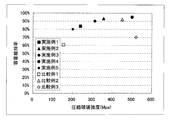
- FIG. 2 shows the correlation between the compressive fracture strength and the capacity retention rate for Examples 1 to 5 and Comparative Examples 1 to 3. From FIG. 2, it can be seen that Examples 1 to 5 show excellent cycle characteristics as compared with Comparative Examples 1 and 3. That is, good cycle characteristics were obtained by using lithium composite oxide particles having a compressive fracture strength of 200 MPa to 500 MPa. In Comparative Example 1 in which the compressive fracture strength is lower than that in Example 5, the capacity retention rate is about 60%, and in Comparative Example 3 in which the compressive fracture strength is higher than that in Example 4, the capacity retention rate is about 70%. Is out of the range of 200 MPa or more and 500 MPa or less, the capacity retention rate decreases.
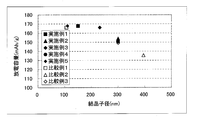
- the crystallite diameter in the (110) vector direction is as large as about 500 nm to 600 nm, the lithium moving speed is lowered, and insertion / extraction is suppressed, so that the capacity is reduced. causess deterioration. Therefore, it is required to reduce the crystallite diameter in the (110) vector direction. However, even if the crystallite diameter in the (110) vector direction is too small, the capacity becomes small because the space into which lithium can be inserted becomes small.
- FIG. 3 shows the correlation between the crystallite diameter in the (110) vector direction and the initial discharge capacity for Examples 1 to 5 and Comparative Examples 1 to 3.
- Comparative Example 2 is a hard particle having a compressive fracture strength of 450 MPa and a capacity retention rate of 92%, which is a good value, but the initial capacity is 135.6 mAh / g, and the positive electrode active capacity of the battery having a rated capacity of 1200 mAh. This capacity is not a good result in terms of material charge.
- the crystallite diameter in the (110) vector direction is set to 100 nm or more and 300 nm or less, thereby increasing the capacity. A positive electrode active material could be obtained.
- the nonaqueous electrolyte secondary battery including the positive electrode active material including the lithium composite oxide particles having a compressive fracture strength of 200 MPa to 500 MPa and a crystallite diameter in the (110) vector direction of 100 nm to 300 nm.
- No. 10 has a high energy density and excellent cycle characteristics.
- non-aqueous electrolyte secondary battery 11 positive electrode, 11a, 12a current collecting tab, 12 negative electrode, 13 separator, 14 wound electrode body, 15, 16 insulating plate, 17 battery outer can, 18 current blocking seal body.
Landscapes
- Chemical & Material Sciences (AREA)
- Inorganic Chemistry (AREA)
- Organic Chemistry (AREA)
- Chemical Kinetics & Catalysis (AREA)
- Electrochemistry (AREA)
- General Chemical & Material Sciences (AREA)
- Engineering & Computer Science (AREA)
- Manufacturing & Machinery (AREA)
- Materials Engineering (AREA)
- Battery Electrode And Active Subsutance (AREA)
- Inorganic Compounds Of Heavy Metals (AREA)
Abstract
Description
正極11は、金属箔等の正極集電体と、正極集電体上に形成された正極活物質層とで構成される。正極集電体としては、アルミニウムなどの正極の電位範囲で安定な金属の箔、アルミニウムなどの正極の電位範囲で安定な金属を表層に配置したフィルム等が用いられる。正極活物質層は、正極活物質の他に、導電剤及び結着剤等を含むことが好適である。
X線出力:40kV×40mA
ゴニオメーター半径:250mm
発散スリット:0.6°
散乱スリット:0.6°
受光スリット:0.1mm
ソーラースリット:2.5°(入射側、受光側)
手順2:Emission Profileを設定する。(Cu管球、Bragg Brentano集中光学系を選択する)
手順3:バックグラウンドを設定する。(プロファイル関数としてルジャンドルの多項式を使用、項数は8~20に設定)
手順4:Instrumentを設定する。(Fundamental Parameterを使用、スリット条件、フィラメント長、サンプル長を入力)
手順5:Correctionsを設定する。(Sample displacementを使用。試料ホルダーへの試料充填密度が低い場合、Absorptionも使用する。この場合、Absorptionは測定試料の線吸収係数で固定)
手順6:結晶構造の設定をする。(空間群R3-mに設定。格子定数・結晶子径・格子歪を使用。結晶子径と格子歪とによるプロファイルの広がりをローレンツ関数に設定)
手順7:計算を実行する。(バックグラウンド、Sample displacement、回折強度、格子定数、結晶子径、及び格子歪を精密化、計算にはLe-ball式を採用)
手順8:結晶子径の標準偏差が精密化した値の6%以下であれば、解析終了。6%より大きい場合は、手順9へ進む。
手順10:計算を実行する。(バックグラウンド、Sample displacement、回折強度、格子定数、結晶子径、及び格子歪を精密化)
手順11:結晶子径の標準偏差が精密化した値の6%以下であれば、解析終了。6%より大きい場合は、解析不可。
負極は、例えば、金属箔等の負極集電体と、負極集電体上に形成された負極活物質層とを備える。負極集電体には、銅などの負極の電位範囲で安定な金属の箔、銅などの負極の電位範囲で安定な金属を表層に配置したフィルム等を用いることができる。負極活物質層は、リチウムイオンを吸蔵・脱離可能な負極活物質の他に、結着剤を含むことが好適である。結着剤としては、正極の場合と同様にPTFE等を用いることもできるが、スチレン-ブタジエン共重合体(SBR)又はこの変性体等を用いることが好ましい。結着剤は、CMC等の増粘剤と併用されてもよい。
非水電解質は、非水溶媒と、非水溶媒に溶解した電解質塩とを含む。非水電解質は、液体電解質である非水電解液に限定されず、ゲル状ポリマー等を用いた固体電解質であってもよい。
セパレータ13には、例えば、イオン透過性及び絶縁性を有する多孔性シートが用いられる。多孔性シートの具体例としては、微多孔薄膜、織布、不織布等が挙げられる。セパレータ13の材質としては、ポリエチレン、ポリプロピレン等のポリオレフィンが好適である。
[正極の作製]
Na0.95Ni0.5Co0.2Mn0.3O2(仕込み組成)が得られるように、硝酸ナトリウム(NaNO3)、酸化ニッケル(II)(NiO)、酸化コバルト(II,III)(Co3O4)及び、酸化マンガン(III)(Mn2O3)を混合した。その後、当該混合物を900℃で10時間保持することによって、ナトリウム含有遷移金属酸化物を得た。
負極活物質としては、天然黒鉛、人造黒鉛、及び、表面を非晶質炭素で被覆した人造黒鉛の3種類を用意し、各種ブレンドしたものを用いた。負極12は次のようにして作製した。まず、負極活物質が98質量%と、結着剤としてのスチレン-ブタジエン共重合体が1質量%、増粘剤としてのカルボキシメチルセルロースが1質量%となるよう混合し、これを水と混合してスラリーを調製し、このスラリーを厚さ10μmの銅製の集電体の両面にドクターブレード法により塗布して負極活物質層を形成した。その後、圧縮ローラーを用いて所定の密度まで圧縮し、短辺の長さが57mm、長辺の長さが620mmとして、負極を作製した。
エチレンカーボネート(EC)とジエチルカーボネート(DEC)との等体積混合非水溶媒に、電解質塩としてのLiPF6を1.6mol/L溶解させ非水電解質である非水電解液とし、これを電池作製に供した。
このようにして作製した正極、負極、非水電解液を用いて、図1で説明した構造の非水電解質二次電池10を以下の手順で作製した。すなわち、上記のようにして作製された正極11と負極12とをセパレータ13を介して巻回し巻回電極体14を作製した。次に、この巻回電極体14の上下にそれぞれ絶縁板15,16を配置し、この巻回電極体14が負極端子を兼ねるスチール製で直径18mm、高さ650mmの円筒形の電池外装缶17の内部に収容した。そして、負極12の集電タブ12aを電池外装缶17の内側底部に溶接するとともに、正極11の集電タブ11aを安全装置が組み込まれた電流遮断封口体18の底板部に溶接した。この電池外装缶17の開口部から非水電解液を供給し、その後、安全弁と電流遮断装置を備えた電流遮断封口体18によって電池外装缶17を密閉した。
実施例1の正極活物質の製造方法において、1000℃で10時間保持することによってナトリウム含有遷移金属酸化物を得る方法へ変更した以外は、実施例1と同様の作製方法で、実施例2で使用する電池を作製した。
実施例1の正極活物質の製造方法において、Na0.80Ni0.5Co0.2Mn0.3O2(仕込み組成)が得られるように、硝酸ナトリウム(NaNO3)、酸化ニッケル(II)(NiO)、酸化コバルト(II,III)(Co3O4)及び、酸化マンガン(III)(Mn2O3)を混合した。その後、当該混合物を1000℃で10時間保持することによって、ナトリウム含有遷移金属酸化物を得る方法へ変更した以外は、実施例1と同様の作製方法で、実施例3で使用する電池を作製した。
実施例1の正極活物質の製造方法において、1050℃で10時間保持することによってナトリウム含有遷移金属酸化物を得る方法へ変更した以外は、実施例1と同様の作製方法で、実施例4で使用する電池を作製した。
実施例1の正極活物質の製造方法において、800℃で10時間保持することによってナトリウム含有遷移金属酸化物を得る方法へ変更した以外は、実施例1と同様の作製方法で、実施例5で使用する電池を作製した。
実施例1の正極活物質の製造方法において、750℃で10時間保持することによってナトリウム含有遷移金属酸化物を得る方法へ変更した以外は、また、正極活物質の製造方法を変更した以外は、実施例1と同様の作製方法で、比較例1で使用する電池を作製した。
実施例1の正極活物質の製造方法において、Na1.00Ni0.5Co0.2Mn0.3O2(仕込み組成)が得られるように、硝酸ナトリウム(NaNO3)、酸化ニッケル(II)(NiO)、酸化コバルト(II,III)(Co3O4)及び、酸化マンガン(III)(Mn2O3)を混合した。その後、当該混合物を1050℃で10時間保持することによって、ナトリウム含有遷移金属酸化物を得る方法へ変更した以外は、実施例1と同様の作製方法で、比較例2で使用する電池を作製した。
実施例1の正極活物質の製造方法において、Na0.80Ni0.5Co0.2Mn0.3O2(仕込み組成)が得られるように、硝酸ナトリウム(NaNO3)、酸化ニッケル(II)(NiO)、酸化コバルト(II,III)(Co3O4)及び、酸化マンガン(III)(Mn2O3)を混合した。その後、当該混合物を1100℃で10時間保持することによって、ナトリウム含有遷移金属酸化物を得る方法へ変更した以外は、実施例1と同様の作製方法で、比較例3で使用する電池を作製した。
実施例1~5及び比較例1~3の各電池を、25℃において、2It=2400mAの定電流で電池電圧が4.35Vとなるまで充電し、電池電圧が4.35Vに達した後は、2It=2400mAの定電流で電池電圧が2.5Vとなるまで放電した。このときの放電容量を初期容量とした。また、この充放電を1サイクルとして500回繰り返し、500サイクル目の放電容量を1サイクル目の放電容量で除した値に100をかけて、充放電サイクル特性として500サイクル後の容量維持率を求めた。

Claims (5)
- 非水電解質二次電池に用いられる正極活物質であって、
該正極活物質は、一般式LiNixCoyM(1-x-y)O2(式中、Mは、金属元素より選ばれる少なくとも1つの元素であり、0.3≦x<1.0、0<y≦0.5)で表され、かつ結晶子が集合した粒子で構成され、前記粒子1個の圧縮破壊強度は、200MPa以上500MPa以下であり、前記粒子の(110)ベクトル方向の結晶子径は、100nm以上300nm以下であることを特徴とする非水電解質二次電池用正極活物質。 - 請求項1に記載の非水電解質二次電池用正極活物質において、
前記粒子の体積平均粒子径(D50)は、5μm以上20μm以下であることを特徴とする非水電解質二次電池用正極活物質。 - 請求項1または2に記載の非水電解質二次電池用正極活物質において、
前記金属元素Mは、マンガン(Mn)、マグネシウム(Mg)、ジルコニウム(Zr)、モリブデン(Mo)、タングステン(W)、アルミニウム(Al)、クロム(Cr)、バナジウム(V)、セリウム(Ce)、チタン(Ti)、鉄(Fe)、カリウム(K)、ガリウム(Ga)、インジウム(In)から選ばれる少なくとも1種を含むことを特徴とする非水電解質二次電池用正極活物質。 - 請求項1から3のいずれか1項に記載の非水電解質二次電池用正極活物質において、
前記金属元素Mは、少なくともマンガン(Mn)を含有し、さらにマグネシウム(Mg)、ジルコニウム(Zr)、モリブデン(Mo)、タングステン(W)、アルミニウム(Al)、クロム(Cr)、バナジウム(V)、セリウム(Ce)、チタン(Ti)、鉄(Fe)、カリウム(K)、ガリウム(Ga)、インジウム(In)から選ばれる少なくとも1種の他の金属元素を含むことを特徴とする非水電解質二次電池用正極活物質。 - 正極活物質を含む正極と、負極と、非水電解質とを備える非水電解質二次電池であって、
前記正極活物質は、一般式LiNixCoyM(1-x-y)O2(式中、Mは、金属元素より選ばれる少なくとも1つの元素であり、0.3≦x<1.0、0<y≦0.5)で表され、かつ結晶子が集合した粒子で構成され、前記粒子1個の圧縮破壊強度は、200MPa以上500MPa以下であり、前記粒子の(110)ベクトル方向の結晶子径は、100nm以上300nm以下であることを特徴とする非水電解質二次電池。
Priority Applications (4)
| Application Number | Priority Date | Filing Date | Title |
|---|---|---|---|
| CN201380045152.7A CN104603996B (zh) | 2012-12-27 | 2013-11-27 | 非水电解质二次电池用正极活性物质和非水电解质二次电池 |
| US14/424,326 US9947924B2 (en) | 2012-12-27 | 2013-11-27 | Positive electrode active material for nonaqueous electrolyte secondary batteries, and nonaqueous electrolyte secondary battery |
| JP2014554091A JP6174047B2 (ja) | 2012-12-27 | 2013-11-27 | 非水電解質二次電池用正極活物質及び非水電解質二次電池 |
| US15/915,783 US10714748B2 (en) | 2012-12-27 | 2018-03-08 | Positive electrode active material for nonaqueous electrolyte secondary batteries, and nonaqueous electrolyte secondary battery |
Applications Claiming Priority (2)
| Application Number | Priority Date | Filing Date | Title |
|---|---|---|---|
| JP2012-285370 | 2012-12-27 | ||
| JP2012285370 | 2012-12-27 |
Related Child Applications (2)
| Application Number | Title | Priority Date | Filing Date |
|---|---|---|---|
| US14/424,326 A-371-Of-International US9947924B2 (en) | 2012-12-27 | 2013-11-27 | Positive electrode active material for nonaqueous electrolyte secondary batteries, and nonaqueous electrolyte secondary battery |
| US15/915,783 Division US10714748B2 (en) | 2012-12-27 | 2018-03-08 | Positive electrode active material for nonaqueous electrolyte secondary batteries, and nonaqueous electrolyte secondary battery |
Publications (1)
| Publication Number | Publication Date |
|---|---|
| WO2014103166A1 true WO2014103166A1 (ja) | 2014-07-03 |
Family
ID=51020295
Family Applications (1)
| Application Number | Title | Priority Date | Filing Date |
|---|---|---|---|
| PCT/JP2013/006977 Ceased WO2014103166A1 (ja) | 2012-12-27 | 2013-11-27 | 非水電解質二次電池用正極活物質及び非水電解質二次電池 |
Country Status (4)
| Country | Link |
|---|---|
| US (2) | US9947924B2 (ja) |
| JP (1) | JP6174047B2 (ja) |
| CN (1) | CN104603996B (ja) |
| WO (1) | WO2014103166A1 (ja) |
Cited By (14)
| Publication number | Priority date | Publication date | Assignee | Title |
|---|---|---|---|---|
| WO2015190480A1 (ja) * | 2014-06-10 | 2015-12-17 | 新神戸電機株式会社 | リチウムイオン二次電池 |
| WO2015190482A1 (ja) * | 2014-06-10 | 2015-12-17 | 新神戸電機株式会社 | リチウムイオン電池 |
| JP2016157677A (ja) * | 2015-02-19 | 2016-09-01 | パナソニック株式会社 | 非水電解質二次電池用正極活物質及び非水電解質二次電池 |
| JP2017037744A (ja) * | 2015-08-07 | 2017-02-16 | 日立マクセル株式会社 | 非水電解質二次電池 |
| US9692047B2 (en) | 2014-01-31 | 2017-06-27 | Panasonic Corporation | Positive electrode active material for non-aqueous electrolyte secondary battery and non-aqueous electrolyte secondary battery |
| JP2017157548A (ja) * | 2016-02-29 | 2017-09-07 | パナソニック株式会社 | 非水電解質二次電池用正極活物質、非水電解質二次電池及び非水電解質二次電池用正極活物質の製造方法 |
| JP2018095546A (ja) * | 2017-11-28 | 2018-06-21 | 住友化学株式会社 | リチウム金属複合酸化物粉末、リチウム二次電池用正極活物質、リチウム二次電池用正極及びリチウム二次電池 |
| US10109854B2 (en) | 2015-09-30 | 2018-10-23 | Panasonic Corporation | Positive electrode active material for nonaqueous electrolyte secondary batteries and nonaqueous electrolyte secondary battery |
| WO2019026629A1 (ja) * | 2017-07-31 | 2019-02-07 | パナソニックIpマネジメント株式会社 | 非水電解質二次電池 |
| WO2019044205A1 (ja) * | 2017-08-31 | 2019-03-07 | パナソニックIpマネジメント株式会社 | 非水電解質二次電池用正極活物質、非水電解質二次電池用正極及び非水電解質二次電池 |
| WO2019193857A1 (ja) * | 2018-04-03 | 2019-10-10 | パナソニックIpマネジメント株式会社 | 非水電解質二次電池 |
| WO2024070659A1 (ja) * | 2022-09-30 | 2024-04-04 | パナソニックIpマネジメント株式会社 | 非水電解質二次電池用正極活物質、非水電解質二次電池用正極活物質の製造方法、及び非水電解質二次電池 |
| WO2024162132A1 (ja) * | 2023-01-31 | 2024-08-08 | パナソニックIpマネジメント株式会社 | 非水電解質二次電池用正極活物質および非水電解質二次電池 |
| US12308415B2 (en) | 2018-05-17 | 2025-05-20 | Lg Energy Solution, Ltd. | Positive electrode active material for secondary battery, method of preparing the same, and lithium secondary battery including the same |
Families Citing this family (12)
| Publication number | Priority date | Publication date | Assignee | Title |
|---|---|---|---|---|
| WO2014103166A1 (ja) * | 2012-12-27 | 2014-07-03 | 三洋電機株式会社 | 非水電解質二次電池用正極活物質及び非水電解質二次電池 |
| WO2019198351A1 (ja) * | 2018-04-10 | 2019-10-17 | パナソニックIpマネジメント株式会社 | 非水電解質二次電池 |
| WO2020152770A1 (ja) * | 2019-01-22 | 2020-07-30 | 住友金属鉱山株式会社 | ニッケルコバルトアルミニウム複合水酸化物、ニッケルコバルトアルミニウム複合水酸化物の製造方法及び、リチウムニッケルコバルトアルミニウム複合酸化物 |
| US20220209229A1 (en) * | 2019-04-10 | 2022-06-30 | Panasonic Intellectual Property Management Co., Ltd. | Positive electrode for nonaqueous electrolyte secondary battery and nonaqueous electrolyte secondary battery |
| CN112687871B (zh) * | 2019-10-17 | 2022-11-04 | 中国石油化工股份有限公司 | 正极材料及其制备方法、锂电池正极及其应用 |
| JP6742547B1 (ja) | 2020-01-17 | 2020-08-19 | 住友化学株式会社 | 全固体リチウムイオン電池用正極活物質、電極及び全固体リチウムイオン電池 |
| CN114614006B (zh) * | 2022-02-16 | 2024-07-02 | 深圳市贝特瑞纳米科技有限公司 | 复合正极材料及其制备方法、锂离子电池 |
| CN119585887A (zh) * | 2022-12-16 | 2025-03-07 | 株式会社Lg新能源 | 锂二次电池、电池组以及包含其的电子器件 |
| KR102724217B1 (ko) * | 2022-12-16 | 2024-10-31 | 주식회사 엘지에너지솔루션 | 리튬 이차전지, 전지 팩 및 이를 포함하는 전자 기기 |
| CN120604358A (zh) * | 2023-01-31 | 2025-09-05 | 松下知识产权经营株式会社 | 非水电解质二次电池用正极活性物质和非水电解质二次电池 |
| KR20240168724A (ko) * | 2023-05-23 | 2024-12-02 | 에스케이온 주식회사 | 리튬 이차 전지용 양극 활물질 및 이를 포함하는 리튬 이차 전지 |
| KR102808083B1 (ko) * | 2023-08-11 | 2025-05-14 | 주식회사 엘지에너지솔루션 | 리튬이차전지, 전지 모듈 및 전지 팩 |
Citations (6)
| Publication number | Priority date | Publication date | Assignee | Title |
|---|---|---|---|---|
| JP2004220897A (ja) * | 2003-01-14 | 2004-08-05 | Seimi Chem Co Ltd | リチウム二次電池用正極活物質粉末 |
| WO2004082046A1 (ja) * | 2003-03-14 | 2004-09-23 | Seimi Chemical Co., Ltd. | リチウム二次電池用正極活物質粉末 |
| JP2007257885A (ja) * | 2006-03-20 | 2007-10-04 | Nissan Motor Co Ltd | 非水電解質リチウムイオン電池用正極材料およびこれを用いた電池 |
| JP2009032681A (ja) * | 2007-06-25 | 2009-02-12 | Sanyo Electric Co Ltd | 非水電解質二次電池および正極の製造方法 |
| WO2012039413A1 (ja) * | 2010-09-22 | 2012-03-29 | 株式会社Gsユアサ | リチウム二次電池用活物質、リチウム二次電池用電極及びリチウム二次電池 |
| WO2012165207A1 (ja) * | 2011-05-31 | 2012-12-06 | 三洋電機株式会社 | 非水電解質電池 |
Family Cites Families (11)
| Publication number | Priority date | Publication date | Assignee | Title |
|---|---|---|---|---|
| JP3591195B2 (ja) | 1997-03-07 | 2004-11-17 | 日亜化学工業株式会社 | リチウムイオン二次電池用正極活物質 |
| JP4020565B2 (ja) * | 2000-03-31 | 2007-12-12 | 三洋電機株式会社 | 非水電解質二次電池 |
| US20050220700A1 (en) | 2003-03-14 | 2005-10-06 | Seimi Chemical Co., Ltd. | Positive electrode active material powder for lithium secondary battery |
| WO2005020354A1 (ja) * | 2003-08-21 | 2005-03-03 | Seimi Chemical Co., Ltd. | リチウム二次電池用の正極活物質粉末 |
| WO2005124898A1 (ja) * | 2004-06-16 | 2005-12-29 | Seimi Chemical Co., Ltd. | リチウム二次電池用正極活物質粉末 |
| JP4832229B2 (ja) | 2006-01-23 | 2011-12-07 | 三洋電機株式会社 | 非水電解質二次電池 |
| JP5259078B2 (ja) | 2006-11-22 | 2013-08-07 | パナソニック株式会社 | 非水電解質二次電池用正極活物質及びその製造方法、ならびに、該正極活物質を用いた非水電解質二次電池 |
| JP4440339B2 (ja) | 2008-05-15 | 2010-03-24 | パナソニック株式会社 | 非水電解質二次電池用正極活物質、非水電解質二次電池用正極および非水電解質二次電池 |
| JP2009283354A (ja) * | 2008-05-23 | 2009-12-03 | Panasonic Corp | 非水電解質二次電池用電極およびその製造方法ならびに非水電解質二次電池 |
| JP5405091B2 (ja) * | 2008-12-01 | 2014-02-05 | 三洋電機株式会社 | 非水電解質電池 |
| WO2014103166A1 (ja) * | 2012-12-27 | 2014-07-03 | 三洋電機株式会社 | 非水電解質二次電池用正極活物質及び非水電解質二次電池 |
-
2013
- 2013-11-27 WO PCT/JP2013/006977 patent/WO2014103166A1/ja not_active Ceased
- 2013-11-27 US US14/424,326 patent/US9947924B2/en active Active
- 2013-11-27 CN CN201380045152.7A patent/CN104603996B/zh active Active
- 2013-11-27 JP JP2014554091A patent/JP6174047B2/ja active Active
-
2018
- 2018-03-08 US US15/915,783 patent/US10714748B2/en active Active
Patent Citations (6)
| Publication number | Priority date | Publication date | Assignee | Title |
|---|---|---|---|---|
| JP2004220897A (ja) * | 2003-01-14 | 2004-08-05 | Seimi Chem Co Ltd | リチウム二次電池用正極活物質粉末 |
| WO2004082046A1 (ja) * | 2003-03-14 | 2004-09-23 | Seimi Chemical Co., Ltd. | リチウム二次電池用正極活物質粉末 |
| JP2007257885A (ja) * | 2006-03-20 | 2007-10-04 | Nissan Motor Co Ltd | 非水電解質リチウムイオン電池用正極材料およびこれを用いた電池 |
| JP2009032681A (ja) * | 2007-06-25 | 2009-02-12 | Sanyo Electric Co Ltd | 非水電解質二次電池および正極の製造方法 |
| WO2012039413A1 (ja) * | 2010-09-22 | 2012-03-29 | 株式会社Gsユアサ | リチウム二次電池用活物質、リチウム二次電池用電極及びリチウム二次電池 |
| WO2012165207A1 (ja) * | 2011-05-31 | 2012-12-06 | 三洋電機株式会社 | 非水電解質電池 |
Cited By (21)
| Publication number | Priority date | Publication date | Assignee | Title |
|---|---|---|---|---|
| US9692047B2 (en) | 2014-01-31 | 2017-06-27 | Panasonic Corporation | Positive electrode active material for non-aqueous electrolyte secondary battery and non-aqueous electrolyte secondary battery |
| US9985282B2 (en) | 2014-01-31 | 2018-05-29 | Panasonic Corporation | Positive electrode active material for non-aqueous electrolyte secondary battery and non-aqueous electrolyte secondary battery |
| WO2015190482A1 (ja) * | 2014-06-10 | 2015-12-17 | 新神戸電機株式会社 | リチウムイオン電池 |
| WO2015190480A1 (ja) * | 2014-06-10 | 2015-12-17 | 新神戸電機株式会社 | リチウムイオン二次電池 |
| US10090521B2 (en) | 2014-06-10 | 2018-10-02 | Hitachi Chemical Company, Ltd. | Lithium ion battery with negative electrode in which state of charge at a potential to be 0.1 V with respect lithium potential is 60% or more, and positive electrode having a density positive electrode composite of 2.4 to 2.7 g/cm3 |
| JP2016157677A (ja) * | 2015-02-19 | 2016-09-01 | パナソニック株式会社 | 非水電解質二次電池用正極活物質及び非水電解質二次電池 |
| US10147943B2 (en) | 2015-02-19 | 2018-12-04 | Panasonic Corporation | Positive electrode active material for nonaqueous electrolyte secondary battery, and nonaqueous electrolyte secondary battery |
| JP2017037744A (ja) * | 2015-08-07 | 2017-02-16 | 日立マクセル株式会社 | 非水電解質二次電池 |
| US10109854B2 (en) | 2015-09-30 | 2018-10-23 | Panasonic Corporation | Positive electrode active material for nonaqueous electrolyte secondary batteries and nonaqueous electrolyte secondary battery |
| JP2017157548A (ja) * | 2016-02-29 | 2017-09-07 | パナソニック株式会社 | 非水電解質二次電池用正極活物質、非水電解質二次電池及び非水電解質二次電池用正極活物質の製造方法 |
| US10573881B2 (en) | 2016-02-29 | 2020-02-25 | Panasonic Corporation | Positive electrode active material for nonaqueous electrolyte secondary battery |
| WO2019026629A1 (ja) * | 2017-07-31 | 2019-02-07 | パナソニックIpマネジメント株式会社 | 非水電解質二次電池 |
| JPWO2019026629A1 (ja) * | 2017-07-31 | 2020-07-30 | パナソニックIpマネジメント株式会社 | 非水電解質二次電池 |
| WO2019044205A1 (ja) * | 2017-08-31 | 2019-03-07 | パナソニックIpマネジメント株式会社 | 非水電解質二次電池用正極活物質、非水電解質二次電池用正極及び非水電解質二次電池 |
| US11349121B2 (en) | 2017-08-31 | 2022-05-31 | Panasonic Intellectual Property Management Co., Ltd. | Positive electrode active substance for nonaqueous electrolyte secondary battery, positive electrode for nonaqueous electrolyte secondary battery, and nonaqueous electrolyte secondary battery |
| JP2018095546A (ja) * | 2017-11-28 | 2018-06-21 | 住友化学株式会社 | リチウム金属複合酸化物粉末、リチウム二次電池用正極活物質、リチウム二次電池用正極及びリチウム二次電池 |
| WO2019193857A1 (ja) * | 2018-04-03 | 2019-10-10 | パナソニックIpマネジメント株式会社 | 非水電解質二次電池 |
| JPWO2019193857A1 (ja) * | 2018-04-03 | 2021-04-15 | パナソニックIpマネジメント株式会社 | 非水電解質二次電池 |
| US12308415B2 (en) | 2018-05-17 | 2025-05-20 | Lg Energy Solution, Ltd. | Positive electrode active material for secondary battery, method of preparing the same, and lithium secondary battery including the same |
| WO2024070659A1 (ja) * | 2022-09-30 | 2024-04-04 | パナソニックIpマネジメント株式会社 | 非水電解質二次電池用正極活物質、非水電解質二次電池用正極活物質の製造方法、及び非水電解質二次電池 |
| WO2024162132A1 (ja) * | 2023-01-31 | 2024-08-08 | パナソニックIpマネジメント株式会社 | 非水電解質二次電池用正極活物質および非水電解質二次電池 |
Also Published As
| Publication number | Publication date |
|---|---|
| US9947924B2 (en) | 2018-04-17 |
| US20150243982A1 (en) | 2015-08-27 |
| JP6174047B2 (ja) | 2017-08-02 |
| US10714748B2 (en) | 2020-07-14 |
| CN104603996B (zh) | 2017-04-12 |
| US20180198122A1 (en) | 2018-07-12 |
| CN104603996A (zh) | 2015-05-06 |
| JPWO2014103166A1 (ja) | 2017-01-12 |
Similar Documents
| Publication | Publication Date | Title |
|---|---|---|
| JP6174047B2 (ja) | 非水電解質二次電池用正極活物質及び非水電解質二次電池 | |
| CN112335079B (zh) | 非水电解质二次电池用正极活性物质和非水电解质二次电池 | |
| JP5251401B2 (ja) | 非水系電解質二次電池用正極活物質及びその製造方法、並びに非水系電解質二次電池 | |
| JP6508892B2 (ja) | 非水電解質二次電池用正極活物質及び非水電解質二次電池 | |
| JP7258373B2 (ja) | 正極活物質、その製造方法、及びそれを含む正極を含むリチウム二次電池 | |
| JP3611188B2 (ja) | 非水電解質二次電池用正極活物質および非水電解質二次電池 | |
| JP7363747B2 (ja) | 正極活物質の製造方法、正極活物質およびリチウムイオン電池の製造方法 | |
| JP3611190B2 (ja) | 非水電解質二次電池用正極活物質および非水電解質二次電池 | |
| JP2005072008A (ja) | 非水系電解質二次電池用負極活物質及びその製造方法並びにそれを含む非水系電解質二次電池 | |
| WO2019044205A1 (ja) | 非水電解質二次電池用正極活物質、非水電解質二次電池用正極及び非水電解質二次電池 | |
| JP2016115658A (ja) | 非水系電解質二次電池用正極活物質とその製造方法、および、非水系電解質二次電池 | |
| KR20210133803A (ko) | 리튬 이차전지용 양극활물질, 그의 제조방법 및 이를 포함하는 리튬이차전지 | |
| JP6865601B2 (ja) | ナトリウムイオン二次電池用正極活物質およびその製造方法、並びにナトリウムイオン二次電池 | |
| US20080286654A1 (en) | Non-aqueous electrolyte secondary battery | |
| WO2014155990A1 (ja) | 非水電解質二次電池用正極及び非水電解質二次電池 | |
| JPH09153360A (ja) | リチウム二次電池用正極とその製造方法およびリチウム二次電池 | |
| JP2006351516A (ja) | 負極活物質及び非水電解質二次電池 | |
| JP5235307B2 (ja) | 非水電解質二次電池 | |
| JP2018195559A (ja) | 非水二次電池用負極活物質、及び、非水二次電池 | |
| JP7843471B2 (ja) | 非水電解質二次電池用正極、及び非水電解質二次電池 | |
| CN106558694B (zh) | 非水电解质二次电池用正极活性物质和非水电解质二次电池 | |
| JP6862091B2 (ja) | 負極活物質、混合負極活物質材料、非水電解質二次電池用負極、リチウムイオン二次電池、及び負極活物質の製造方法 | |
| CN121219847A (zh) | 二次电池用正极、二次电池及正极合剂浆料 | |
| JP5686060B2 (ja) | 非水電解質二次電池用正極活物質、非水電解質二次電池及び非水電解質二次電池の製造方法 | |
| WO2023120671A1 (ja) | 二次電池用正極活物質および二次電池 |
Legal Events
| Date | Code | Title | Description |
|---|---|---|---|
| 121 | Ep: the epo has been informed by wipo that ep was designated in this application |
Ref document number: 13867463 Country of ref document: EP Kind code of ref document: A1 |
|
| ENP | Entry into the national phase |
Ref document number: 2014554091 Country of ref document: JP Kind code of ref document: A |
|
| WWE | Wipo information: entry into national phase |
Ref document number: 14424326 Country of ref document: US |
|
| NENP | Non-entry into the national phase |
Ref country code: DE |
|
| 122 | Ep: pct application non-entry in european phase |
Ref document number: 13867463 Country of ref document: EP Kind code of ref document: A1 |