WO2014034425A1 - 研磨用組成物及び基板の製造方法 - Google Patents
研磨用組成物及び基板の製造方法 Download PDFInfo
- Publication number
- WO2014034425A1 WO2014034425A1 PCT/JP2013/071813 JP2013071813W WO2014034425A1 WO 2014034425 A1 WO2014034425 A1 WO 2014034425A1 JP 2013071813 W JP2013071813 W JP 2013071813W WO 2014034425 A1 WO2014034425 A1 WO 2014034425A1
- Authority
- WO
- WIPO (PCT)
- Prior art keywords
- polishing composition
- water
- polishing
- soluble polymer
- less
- Prior art date
- Legal status (The legal status is an assumption and is not a legal conclusion. Google has not performed a legal analysis and makes no representation as to the accuracy of the status listed.)
- Ceased
Links
Classifications
-
- C—CHEMISTRY; METALLURGY
- C09—DYES; PAINTS; POLISHES; NATURAL RESINS; ADHESIVES; COMPOSITIONS NOT OTHERWISE PROVIDED FOR; APPLICATIONS OF MATERIALS NOT OTHERWISE PROVIDED FOR
- C09G—POLISHING COMPOSITIONS; SKI WAXES
- C09G1/00—Polishing compositions
- C09G1/02—Polishing compositions containing abrasives or grinding agents
-
- B—PERFORMING OPERATIONS; TRANSPORTING
- B24—GRINDING; POLISHING
- B24B—MACHINES, DEVICES, OR PROCESSES FOR GRINDING OR POLISHING; DRESSING OR CONDITIONING OF ABRADING SURFACES; FEEDING OF GRINDING, POLISHING, OR LAPPING AGENTS
- B24B37/00—Lapping machines or devices; Accessories
- B24B37/04—Lapping machines or devices; Accessories designed for working plane surfaces
- B24B37/042—Lapping machines or devices; Accessories designed for working plane surfaces operating processes therefor
- B24B37/044—Lapping machines or devices; Accessories designed for working plane surfaces operating processes therefor characterised by the composition of the lapping agent
-
- C—CHEMISTRY; METALLURGY
- C08—ORGANIC MACROMOLECULAR COMPOUNDS; THEIR PREPARATION OR CHEMICAL WORKING-UP; COMPOSITIONS BASED THEREON
- C08B—POLYSACCHARIDES; DERIVATIVES THEREOF
- C08B11/00—Preparation of cellulose ethers
- C08B11/02—Alkyl or cycloalkyl ethers
- C08B11/04—Alkyl or cycloalkyl ethers with substituted hydrocarbon radicals
- C08B11/08—Alkyl or cycloalkyl ethers with substituted hydrocarbon radicals with hydroxylated hydrocarbon radicals; Esters, ethers, or acetals thereof
-
- C—CHEMISTRY; METALLURGY
- C08—ORGANIC MACROMOLECULAR COMPOUNDS; THEIR PREPARATION OR CHEMICAL WORKING-UP; COMPOSITIONS BASED THEREON
- C08F—MACROMOLECULAR COMPOUNDS OBTAINED BY REACTIONS ONLY INVOLVING CARBON-TO-CARBON UNSATURATED BONDS
- C08F16/00—Homopolymers and copolymers of compounds having one or more unsaturated aliphatic radicals, each having only one carbon-to-carbon double bond, and at least one being terminated by an alcohol, ether, aldehydo, ketonic, acetal or ketal radical
- C08F16/02—Homopolymers and copolymers of compounds having one or more unsaturated aliphatic radicals, each having only one carbon-to-carbon double bond, and at least one being terminated by an alcohol, ether, aldehydo, ketonic, acetal or ketal radical by an alcohol radical
- C08F16/04—Acyclic compounds
- C08F16/06—Polyvinyl alcohol ; Vinyl alcohol
-
- C—CHEMISTRY; METALLURGY
- C08—ORGANIC MACROMOLECULAR COMPOUNDS; THEIR PREPARATION OR CHEMICAL WORKING-UP; COMPOSITIONS BASED THEREON
- C08F—MACROMOLECULAR COMPOUNDS OBTAINED BY REACTIONS ONLY INVOLVING CARBON-TO-CARBON UNSATURATED BONDS
- C08F26/00—Homopolymers and copolymers of compounds having one or more unsaturated aliphatic radicals, each having only one carbon-to-carbon double bond, and at least one being terminated by a single or double bond to nitrogen or by a heterocyclic ring containing nitrogen
- C08F26/06—Homopolymers and copolymers of compounds having one or more unsaturated aliphatic radicals, each having only one carbon-to-carbon double bond, and at least one being terminated by a single or double bond to nitrogen or by a heterocyclic ring containing nitrogen by a heterocyclic ring containing nitrogen
- C08F26/10—N-Vinyl-pyrrolidone
-
- C—CHEMISTRY; METALLURGY
- C08—ORGANIC MACROMOLECULAR COMPOUNDS; THEIR PREPARATION OR CHEMICAL WORKING-UP; COMPOSITIONS BASED THEREON
- C08G—MACROMOLECULAR COMPOUNDS OBTAINED OTHERWISE THAN BY REACTIONS ONLY INVOLVING UNSATURATED CARBON-TO-CARBON BONDS
- C08G81/00—Macromolecular compounds obtained by interreacting polymers in the absence of monomers, e.g. block polymers
-
- C—CHEMISTRY; METALLURGY
- C09—DYES; PAINTS; POLISHES; NATURAL RESINS; ADHESIVES; COMPOSITIONS NOT OTHERWISE PROVIDED FOR; APPLICATIONS OF MATERIALS NOT OTHERWISE PROVIDED FOR
- C09G—POLISHING COMPOSITIONS; SKI WAXES
- C09G1/00—Polishing compositions
- C09G1/06—Other polishing compositions
- C09G1/14—Other polishing compositions based on non-waxy substances
- C09G1/16—Other polishing compositions based on non-waxy substances on natural or synthetic resins
-
- C—CHEMISTRY; METALLURGY
- C09—DYES; PAINTS; POLISHES; NATURAL RESINS; ADHESIVES; COMPOSITIONS NOT OTHERWISE PROVIDED FOR; APPLICATIONS OF MATERIALS NOT OTHERWISE PROVIDED FOR
- C09K—MATERIALS FOR MISCELLANEOUS APPLICATIONS, NOT PROVIDED FOR ELSEWHERE
- C09K3/00—Materials not provided for elsewhere
- C09K3/14—Anti-slip materials; Abrasives
- C09K3/1436—Composite particles, e.g. coated particles
-
- C—CHEMISTRY; METALLURGY
- C09—DYES; PAINTS; POLISHES; NATURAL RESINS; ADHESIVES; COMPOSITIONS NOT OTHERWISE PROVIDED FOR; APPLICATIONS OF MATERIALS NOT OTHERWISE PROVIDED FOR
- C09K—MATERIALS FOR MISCELLANEOUS APPLICATIONS, NOT PROVIDED FOR ELSEWHERE
- C09K3/00—Materials not provided for elsewhere
- C09K3/14—Anti-slip materials; Abrasives
- C09K3/1454—Abrasive powders, suspensions and pastes for polishing
- C09K3/1463—Aqueous liquid suspensions
-
- H—ELECTRICITY
- H10—SEMICONDUCTOR DEVICES; ELECTRIC SOLID-STATE DEVICES NOT OTHERWISE PROVIDED FOR
- H10P—GENERIC PROCESSES OR APPARATUS FOR THE MANUFACTURE OR TREATMENT OF DEVICES COVERED BY CLASS H10
- H10P90/00—Preparation of wafers not covered by a single main group of this subclass, e.g. wafer reinforcement
- H10P90/12—Preparing bulk and homogeneous wafers
- H10P90/129—Preparing bulk and homogeneous wafers by polishing
-
- Y—GENERAL TAGGING OF NEW TECHNOLOGICAL DEVELOPMENTS; GENERAL TAGGING OF CROSS-SECTIONAL TECHNOLOGIES SPANNING OVER SEVERAL SECTIONS OF THE IPC; TECHNICAL SUBJECTS COVERED BY FORMER USPC CROSS-REFERENCE ART COLLECTIONS [XRACs] AND DIGESTS
- Y02—TECHNOLOGIES OR APPLICATIONS FOR MITIGATION OR ADAPTATION AGAINST CLIMATE CHANGE
- Y02P—CLIMATE CHANGE MITIGATION TECHNOLOGIES IN THE PRODUCTION OR PROCESSING OF GOODS
- Y02P20/00—Technologies relating to chemical industry
- Y02P20/50—Improvements relating to the production of bulk chemicals
- Y02P20/582—Recycling of unreacted starting or intermediate materials
Definitions
- the present invention relates to a polishing composition and a method for producing a substrate using the same.
- the polishing composition containing a water-soluble polymer is used for polishing a substrate such as a silicon substrate.
- the water-soluble polymer serves to increase the wettability of the surface of the substrate, thereby reducing the residue of foreign matters on the surface of the substrate.
- Patent Document 1 discloses a polishing composition containing a water-soluble polymer or the like that increases the polishing rate and reduces the haze level.
- a surface defect called LPD Light Point Defect
- LPD Light Point Defect
- Mw weight average molecular weight
- Mn number average molecular weight
- An object of the present invention is to provide a polishing composition and a method for producing a substrate which can easily reduce the LPD of the surface after polishing.
- reducing LPD means reducing the number of LPDs, reducing the size, or the like.
- the polishing composition of the present invention has a weight average molecular weight of 1,000,000 or less and a molecular weight distribution represented by weight average molecular weight (Mw) / number average molecular weight (Mn) of 5. It contains a water-soluble polymer that is less than 0.
- the water-soluble polymer is selected from cellulose derivatives, starch derivatives, polyvinyl alcohol, polymers having a polyvinyl alcohol structure, polymers having a polyoxyalkylene structure, and polymers having a nitrogen atom in the main chain or side chain functional group. It is preferable to include at least one kind.
- the water-soluble polymer has at least one selected from cellulose derivatives, starch derivatives, polyvinyl alcohol and polymers having a polyvinyl alcohol structure, a polymer having a polyoxyalkylene structure, and a nitrogen atom in the main chain or side chain functional group. It is preferable to include at least one selected from polymers.
- the polishing composition is preferably used for polishing a substrate.
- the polishing composition is preferably used for final polishing of the substrate.
- the method for producing a substrate of the present invention is characterized by including a polishing step of polishing the substrate using the polishing composition.
- the polishing composition contains a water-soluble polymer having a weight average molecular weight of 1000000 or less and a molecular weight distribution expressed by weight average molecular weight (Mw) / number average molecular weight (Mn) of less than 5.0. .
- the polishing composition of the present embodiment is used for polishing a substrate such as a silicon substrate or a compound semiconductor substrate.
- a preliminary polishing step for example, primary polishing or secondary polishing
- a final polishing step in which fine irregularities present on the surface of the substrate are removed to give a mirror surface.
- the polishing composition can be suitably used for both pre-polishing the substrate and for final polishing.
- the polishing composition of this embodiment is more suitably used for the purpose of final polishing of the substrate.
- the polishing composition of the present embodiment can contain abrasive grains, a basic compound, and water as components other than the water-soluble polymer.
- the water-soluble polymer functions to increase the wettability of the polished surface.
- LPD can be easily reduced.
- the molecular weight distribution of the water-soluble polymer used in the polishing composition is less than 5.0, preferably 4.9 or less, more preferably 4.8 or less, and still more preferably 4.7 or less, and most preferably 4.6 or less.
- the molecular weight distribution of the water-soluble polymer is theoretically 1.0 or more. As the molecular weight distribution of the water-soluble polymer used increases, the wettability of the polished surface increases.
- the molecular weight distribution of the water-soluble polymer is also called polydispersity index (PDI).
- PDI polydispersity index
- Mw weight average molecular weight
- the weight average molecular weight, number average molecular weight, and molecular weight distribution indicate values measured by gel permeation chromatography (Gel Permeation Chromatography, GPC).
- water-soluble polymer those having at least one functional group selected from a cationic group, an anionic group and a nonionic group in the molecule can be used.
- the water-soluble polymer has, for example, a hydroxyl group, carboxyl group, acyloxy group, sulfo group, amide structure, quaternary nitrogen structure, heterocyclic structure, vinyl structure, polyoxyalkylene structure and the like in the molecule.
- water-soluble polymer examples include cellulose derivatives such as hydroxyethyl cellulose, starch derivatives such as pullulan or cyclodextrin, imine derivatives such as poly (N-acylalkyleneimine), polyvinyl alcohol, and polyvinyl alcohol as part of the structure.
- Copolymer polyvinylpyrrolidone, copolymer containing polyvinylpyrrolidone as part of its structure, polyvinylcaprolactam, copolymer containing polyvinylcaprolactam as part of its structure, polyalkylacrylamide, polyacryloylmorpholine, polyacryloylmorpholine
- copolymers include copolymers, polyoxyethylene, polymers having a polyoxyalkylene structure, polymers having a plurality of types such as diblock type, triblock type, random type, and alternating type. It is.
- Examples of a method for obtaining a water-soluble polymer having a small molecular weight distribution (Mw / Mn) include living anion polymerization, living cation polymerization, and living radical polymerization.
- the living radical polymerization method is preferable in that many types of monomers can be polymerized and there are few restrictions in the industrial production method.
- Examples of the living radical polymerization method include a polymerization method using a nitroxide compound or the like, an atom transfer radical polymerization method, and a polymerization method using a chain transfer agent (RAFT agent) such as a dithioester compound.
- RAFT agent chain transfer agent
- Monomers applicable to the living radical polymerization method include (meth) acrylic acid esters, styrene derivatives, acrylamide derivatives including cyclic amides, vinyl acetate, olefins, hydroxyl groups, alkoxysilyl groups, amino groups, epoxy groups, etc.
- Various water-soluble (hydrophilic) polymers obtained by using one or more of these may be the subject of the present invention.
- water-soluble polymer one kind may be used alone, or two or more kinds may be used in combination.
- water-soluble polymer A When at least one water-soluble polymer selected from cellulose derivatives and starch derivatives (hereinafter referred to as “water-soluble polymer A”) is used as the water-soluble polymer, the molecular weight distribution of the water-soluble polymer A is preferably 4.7. Or less, more preferably 4.5 or less.
- the molecular weight distribution of the water-soluble polymer A is preferably 2.0 or more, more preferably 3.0 or more, and further preferably 4.0 or more, from the viewpoint of improving wettability.
- water-soluble polymer B When a polymer having a polyoxyalkylene structure (hereinafter referred to as “water-soluble polymer B”) is used as the water-soluble polymer, the molecular weight distribution of the water-soluble polymer B is preferably 2.0 or less, more preferably 1.5 or less. The molecular weight distribution of the water-soluble polymer B is preferably 1.05 or more.
- water-soluble polymer C When at least one water-soluble polymer (hereinafter referred to as “water-soluble polymer C”) selected from polyvinyl alcohol and a polymer having a polyvinyl alcohol structure is used as the water-soluble polymer, the molecular weight distribution of the water-soluble polymer C is: Preferably it is 3.0 or less, More preferably, it is 2.5 or less, More preferably, it is 2.3 or less.
- the molecular weight distribution of the water-soluble polymer C is preferably 1.05 or more, and is preferably 1.3 or more from the viewpoint of improving wettability and ease of synthesis.
- water-soluble polymer D When a polymer having a nitrogen atom in the main chain or side chain functional group (pendant group) (hereinafter referred to as “water-soluble polymer D”) is used as the water-soluble polymer, the molecular weight distribution of the water-soluble polymer D is preferably It is 4.0 or less, More preferably, it is 3.5 or less, More preferably, it is 3.0 or less.
- the molecular weight distribution of the water-soluble polymer D is preferably 1.05 or more, and preferably 1.3 or more from the viewpoint of improving wettability and ease of synthesis.
- the water-soluble polymer has a weight average molecular weight of 1,000,000 or less, LPD is more easily reduced. As the weight average molecular weight of the water-soluble polymer decreases, the stability of the polishing composition is further improved. On the other hand, the wettability of the polished surface increases as the weight average molecular weight of the water-soluble polymer increases.
- the weight average molecular weight of the water-soluble polymer A is preferably 750,000 or less, more preferably 700,000 or less, still more preferably 500,000 or less, and most preferably 300,000 or less.
- the weight average molecular weight of the water-soluble polymer A is preferably 50000 or more, more preferably 80000 or more, and further preferably 100000 or more.
- the weight average molecular weight of the water-soluble polymer B is preferably 500,000 or less, more preferably 300,000 or less, and further preferably 250,000 or less (for example, 100,000 or less).
- the weight average molecular weight of the water-soluble polymer B is preferably 1000 or more, more preferably 2000 or more, and further preferably 5000 or more (for example, 10,000 or more).
- the weight average molecular weight of the water-soluble polymer C is preferably 300000 or less, more preferably 250,000 or less, still more preferably 200000 or less, and most preferably 100000 or less (for example, 50000 or less, further 20000 or less). It is.
- the weight average molecular weight of the water-soluble polymer C is preferably 1000 or more, more preferably 2000 or more, and further preferably 5000 or more (for example, 7000 or more).
- the weight average molecular weight of the water-soluble polymer D is preferably 300,000 or less, more preferably 250,000 or less, and further preferably 200,000 or less (for example, 100,000 or less, further 70,000 or less).
- the weight average molecular weight of the water-soluble polymer D is preferably 1000 or more, more preferably 3000 or more, still more preferably 5000 or more, most preferably 10,000 or more (for example, 20000 or more, further 30000 or more). It is.
- the polishing composition preferably contains at least one selected from water-soluble polymers A and C, from the viewpoint of reducing LPD, and includes at least one selected from water-soluble polymers A and C, and a water-soluble polymer. It is more preferable to contain at least one selected from B and D.
- water-soluble polymer A examples include cellulose derivatives such as hydroxyethyl cellulose, hydroxypropyl cellulose, hydroxyethyl methyl cellulose, hydroxypropyl methyl cellulose, methyl cellulose, ethyl cellulose, ethyl hydroxyethyl cellulose, carboxymethyl cellulose, and starch derivatives such as pullulan or cyclodextrin. Can be mentioned.
- cellulose derivatives and starch derivatives hydroxyethyl cellulose is particularly preferred from the viewpoint of high ability to impart wettability to the polished surface and easy removal in the cleaning step after polishing (that is, good cleaning properties).
- the water-soluble polymer B is preferably a polymer having a block structure containing an oxyethylene block and an oxypropylene block, more preferably a triblock structure containing an oxyethylene block, an oxypropylene block and an oxyethylene block.
- a polymer more preferably a polymer represented by the following general formula (1).
- EO represents an oxyethylene group
- PO represents an oxypropylene group
- a, b and c each represent an integer of 1 or more.
- a and c represent the degree of polymerization of EO, and the total of a and c is preferably in the range of 2 to 1000, more preferably in the range of 5 to 500, and still more preferably. It is in the range of 10 to 200.
- b represents the degree of polymerization of PO, and b is preferably in the range of 2 to 200, more preferably in the range of 5 to 100, and still more preferably in the range of 10 to 50. .
- water-soluble polymer C examples include polyvinyl alcohol and a polymer containing at least a vinyl alcohol unit.
- a polymer containing at least a vinyl alcohol unit for example, a polymer containing at least a vinyl alcohol unit and a vinyl acetate unit can be used.
- An example of the water-soluble polymer C is a water-soluble polymer formed by partially saponifying a vinyl acetate homopolymer or copolymer.
- partially saponified polyvinyl alcohol formed by partially saponifying a homopolymer of vinyl acetate can be preferably used.
- the partially saponified polyvinyl alcohol is a water-soluble polymer composed of vinyl alcohol units and vinyl acetate units, and the saponification degree is preferably 50 mol% or more, more preferably 60 mol% or more, for example, 65 mol% or more. More preferably, it is 70 mol% or more, More preferably, it is 80 mol% or more.
- the degree of saponification of polyvinyl alcohol is theoretically 100 mol% or less.
- the constituent ratio (molar ratio) of vinyl alcohol units constituting the copolymer is preferably 65 mol% or more, more preferably 75. Mol%.
- copolymer is a comprehensive term including various copolymers such as a random copolymer, an alternating copolymer, a block copolymer, and a graft copolymer unless otherwise specified. is there.
- water-soluble polymer D either a polymer containing a nitrogen atom in the main chain or a polymer having a nitrogen atom in a side chain functional group (pendant group) can be used.
- polymer containing a nitrogen atom in the main chain examples include homopolymers and copolymers of N-acylalkylenimine type monomers.
- N-acylalkyleneimine monomer examples include N-acetylethyleneimine, N-propionylethyleneimine, N-caproylethyleneimine, N-benzoylethyleneimine, N-acetylpropyleneimine, N-butyrylethyleneimine Etc.
- Examples of homopolymers of N-acylalkylenimine monomers include poly (N-acetylethyleneimine), poly (N-propionylethyleneimine), poly (N-caproylethyleneimine), poly (N-benzoylethyleneimine) , Poly (N-acetylpropyleneimine), poly (N-butyrylethyleneimine) and the like.
- Examples of copolymers of N-acylalkylenimine monomers include copolymers of two or more N-acylalkyleneimine monomers, and one or more N-acylalkylenimine monomers and other Copolymers with monomers are included.
- polymer having a nitrogen atom in the pendant group examples include a polymer containing an N- (meth) acryloyl type monomer unit and a polymer containing an N-vinyl type monomer unit.
- (meth) acryloyl is a comprehensive term meaning acrylic and methacrylic.
- Examples of polymers containing N- (meth) acryloyl type monomer units include homopolymers and copolymers of N- (meth) acryloyl type monomers (typically the proportion of N- (meth) acryloyl type monomers) In the amount of more than 50% by mass).
- Examples of the N- (meth) acryloyl type monomer include a chain amide having an N- (meth) acryloyl group and a cyclic amide having an N- (meth) acryloyl group.
- Examples of chain amides having an N- (meth) acryloyl group include (meth) acrylamide; N-methyl (meth) acrylamide, N-ethyl (meth) acrylamide, N-propyl (meth) acrylamide, N-isopropyl ( N-alkyl (meth) acrylamides such as (meth) acrylamide and Nn-butyl (meth) acrylamide; N, N-dimethyl (meth) acrylamide, N, N-diethyl (meth) acrylamide, N, N-dipropyl (meta) ) N, N-dialkyl (meth) acrylamide such as acrylamide, N, N-diisopropyl (meth) acrylamide, N, N-di (n-butyl) (meth) acrylamide and the like.
- a polymer containing a chain amide having an N- (meth) acryloyl group as a monomer unit a homopolymer of N-isopropylacrylamide and a copolymer of N-isopropylacrylamide (for example, the proportion of N-isopropylacrylamide is 50). Copolymer exceeding 20% by mass).
- Examples of the cyclic amide having an N- (meth) acryloyl group include N- (meth) acryloylmorpholine, N- (meth) acryloylpyrrolidine and the like.
- a polymer containing a cyclic amide having an N- (meth) acryloyl group as a monomer unit a homopolymer of N-acryloylmorpholine and a copolymer of N-acryloylmorpholine (for example, the proportion of N-acryloylmorpholine is 50 mass) % Of copolymer).
- polymers containing N-vinyl type monomer units include homopolymers and copolymers of N-vinyl lactam type monomers (for example, copolymers in which the proportion of N-vinyl lactam type monomer exceeds 50% by mass). , Homopolymers and copolymers of N-vinyl chain amide (for example, copolymers in which the proportion of N-vinyl chain amide exceeds 50% by mass).
- N-vinyl lactam monomers include N-vinyl pyrrolidone (VP), N-vinyl piperidone, N-vinyl morpholinone, N-vinyl caprolactam (VC), N-vinyl-1,3-oxazine-2- ON, N-vinyl-3,5-morpholinedione and the like.
- VP N-vinyl pyrrolidone
- VC N-vinyl caprolactam
- N-vinyl-1,3-oxazine-2- ON N-vinyl-3,5-morpholinedione and the like.
- polymers containing monomer units of the N-vinyl lactam type include polyvinyl pyrrolidone (PVP), polyvinyl caprolactam, random copolymers of VP and VC, one or both of VP and VC and other vinyl monomers (for example, Random copolymers with acrylic monomers, vinyl ester monomers, etc., block copolymers and graft copolymers containing polymer segments containing one or both of VP and VC (for example, polyvinylpyrrolidone grafted onto polyvinyl alcohol) Graft copolymer).
- PVP polyvinyl pyrrolidone
- VC vinyl VC
- other vinyl monomers for example, Random copolymers with acrylic monomers, vinyl ester monomers, etc., block copolymers and graft copolymers containing polymer segments containing one or both of VP and VC (for example, polyvinylpyrrolidone grafted onto polyvinyl alcohol) Graft cop
- N-vinyl chain amide examples include N-vinylacetamide, N-vinylpropionic acid amide, N-vinylbutyric acid amide and the like.
- polymers having a nitrogen atom in the pendant group include amino groups such as aminoethyl (meth) acrylate, N, N-dimethylaminoethyl (meth) acrylate, and N, N-dimethylaminopropyl (meth) acrylate.
- amino groups such as aminoethyl (meth) acrylate, N, N-dimethylaminoethyl (meth) acrylate, and N, N-dimethylaminopropyl (meth) acrylate.
- Homopolymers and copolymers of vinyl monomers having for example, monomers having a (meth) acryloyl group).
- the polishing composition contains the water-soluble polymer A and at least one selected from the water-soluble polymers B and D
- the polishing composition contains hydroxyethyl cellulose and the above from the viewpoint of reducing the LPD. Most preferably, it contains at least one selected from the polymer represented by the general formula (1), polyvinylpyrrolidone, polyalkylacrylamide, and polyacryloylmorpholine.
- the polishing composition contains the water-soluble polymer C and at least one selected from the water-soluble polymers B and D
- the polishing composition is polyvinyl alcohol or partially saponified from the viewpoint of reducing the LPD.
- it contains polyvinyl alcohol and at least one selected from the polymer represented by the general formula (1), polyvinyl pyrrolidone, polyalkylacrylamide, and polyacryloylmorpholine.
- the content of the water-soluble polymer in the polishing composition is preferably 0.002% by mass or more, more preferably 0.004% by mass or more, and further preferably 0.006% by mass or more. Most preferably, it is 0.01 mass% or more. As the content of the water-soluble polymer in the polishing composition increases, the wettability of the polished surface is further improved.
- the content of the water-soluble polymer in the polishing composition is preferably 0.5% by mass or less, more preferably 0.2% by mass or less, and still more preferably 0.1% by mass or less. Most preferably, it is 0.05 mass% or less. As the content of the water-soluble polymer in the polishing composition is decreased, the stability of the polishing composition is further improved.
- the polishing composition can contain abrasive grains.
- the abrasive grains serve to physically polish the polished surface.
- Examples of the abrasive grains include inorganic particles, organic particles, and organic-inorganic composite particles.
- the inorganic particles include particles made of a metal oxide such as silica, alumina, ceria, titania, and silicon nitride particles, silicon carbide particles, and boron nitride particles.
- the organic particles include polymethyl methacrylate (PMMA) particles.
- the average primary particle diameter of the abrasive grains is preferably 5 nm or more, more preferably 15 nm or more, and further preferably 25 nm or more. As the average primary particle diameter of the abrasive grains increases, a higher polishing rate is obtained.
- the average primary particle diameter of the abrasive grains is preferably 100 nm or less, more preferably 50 nm or less, and still more preferably 40 nm or less. As the average primary particle diameter of the abrasive grains decreases, the stability of the polishing composition improves.
- the value of the average primary particle diameter of the abrasive grains is calculated from, for example, the specific surface area measured by the BET method.
- the measurement of the specific surface area of the abrasive grains can be performed using, for example, “Flow SorbII 2300” manufactured by Micromeritex.
- the average secondary particle diameter of the abrasive grains is preferably 10 nm or more, more preferably 30 nm or more, and further preferably 40 nm or more. As the average secondary particle diameter of the abrasive grains increases, a higher polishing rate is obtained.
- the average secondary particle diameter of the abrasive grains is preferably 200 nm or less, more preferably 100 nm or less, and still more preferably 80 nm or less. As the average secondary particle diameter of the abrasive grains decreases, the stability of the polishing composition improves.
- the average secondary particle diameter of the abrasive grains is a value measured using FPAR-1000 manufactured by Otsuka Electronics Co., Ltd.
- the average value of the major axis / minor axis ratio of the abrasive grains is theoretically 1.0 or more, preferably 1.05 or more, and more preferably 1.1 or more. As the average value of the major axis / minor axis ratio increases, a higher polishing rate is obtained.
- the average value of the major axis / minor axis ratio of the abrasive grains is preferably 3.0 or less, more preferably 2.0 or less, and still more preferably 1.5 or less. As the average value of the major axis / minor axis ratio decreases, scratches generated on the polished surface decrease.
- the number of particles having a major axis / minor axis ratio of 1.5 or more with respect to the total number of abrasive grains contained in the polishing composition is preferably 10% or more, and more preferably 20% or more.
- the ratio of particles having a major axis / minor axis ratio of 1.5 or more increases, it becomes easier to reduce LPD. Further, as the ratio of particles having a major axis / minor axis ratio of 1.5 or more increases, a high polishing rate can be obtained.
- the ratio of particles having a major axis / minor axis ratio of 1.5 or more is preferably 90% or less, and more preferably 80% or less. As the ratio of the abrasive grains having the major axis / minor axis ratio of 1.5 or more is decreased, the haze level of the polished surface is easily reduced.
- the major axis / minor axis ratio is a value related to the shape of the abrasive grains, and can be determined using, for example, an electron microscope image of the abrasive grains. Specifically, in a scanning electron microscope image of a predetermined number (for example, 200) of abrasive grains, a minimum circumscribed rectangle is drawn for each abrasive grain. Next, for each minimum circumscribed rectangle, a value obtained by dividing the long side length (major axis value) by the short side length (minor axis value) is calculated as the major axis / minor axis ratio. By calculating the average value thereof, the average value of the major axis / minor axis ratio can be obtained. The calculation of the major axis / minor axis ratio can be performed, for example, based on an image obtained using a scanning electron microscope “S-4700” manufactured by Hitachi, Ltd.
- the content of abrasive grains in the polishing composition is preferably 0.05% by mass or more, more preferably 0.1% by mass or more, and further preferably 0.2% by mass or more. As the abrasive content increases, a higher polishing rate is obtained.
- the content of abrasive grains in the polishing composition is preferably 10% by mass or less, more preferably 3% by mass or less, and still more preferably 1% by mass or less. As the abrasive content decreases, the stability of the polishing composition is further improved.
- Silica as an abrasive is suitably used for polishing a silicon substrate, for example.
- silica include colloidal silica, fumed silica, and sol-gel silica.
- colloidal silica and fumed silica are preferable, and colloidal silica is particularly preferable from the viewpoint of reducing scratches generated on the polished surface.
- These silicas may be used individually by 1 type, and may be used in combination of 2 or more types.
- the true specific gravity of silica is preferably 1.5 or more, more preferably 1.6 or more, and still more preferably 1.7 or more. As the true specific gravity of silica increases, a higher polishing rate is obtained.
- the true specific gravity of silica is preferably 2.2 or less, more preferably 2.0 or less, and still more preferably 1.9 or less. As the true specific gravity of silica decreases, scratches generated on the polished surface decrease.
- the true specific gravity of silica is calculated from the weight of the dried silica particles and the total weight when the silica particles are immersed in ethanol with a known volume.
- the polishing composition can contain a basic compound.
- the basic compound serves to chemically polish the polished surface (chemical etching). This makes it easy to improve the polishing rate.
- Examples of basic compounds include alkali metal hydroxides, quaternary ammonium hydroxides or salts thereof, ammonia, and amines.
- Examples of the alkali metal hydroxide include potassium hydroxide and sodium hydroxide.
- Examples of the quaternary ammonium hydroxide or a salt thereof include tetramethylammonium hydroxide, tetraethylammonium hydroxide, and tetrabutylammonium hydroxide.
- amines include methylamine, dimethylamine, trimethylamine, ethylamine, diethylamine, triethylamine, ethylenediamine, monoethanolamine, N- ( ⁇ -aminoethyl) ethanolamine, hexamethylenediamine, diethylenetriamine, triethylenetetramine, anhydrous piperazine, Examples include piperazine hexahydrate, 1- (2-aminoethyl) piperazine, N-methylpiperazine, and guanidine.
- a basic compound may be used individually by 1 type, and may be used in combination of 2 or more type.
- At least one selected from ammonia, alkali metal hydroxides, and quaternary ammonium hydroxides is preferable.
- At least one selected from ammonia, potassium hydroxide, sodium hydroxide, tetramethylammonium hydroxide, and tetraethylammonium hydroxide is more preferable, and more preferably at least one of ammonia and tetramethylammonium hydroxide. Yes, most preferably ammonia.
- the content of the basic compound in the polishing composition is preferably 0.001% by mass or more, more preferably 0.002% by mass or more, and further preferably 0.003% by mass or more. Most preferably, it is 0.005 mass% or more. As the content of the basic compound in the polishing composition increases, a high polishing rate is obtained.
- the content of the basic compound in the polishing composition is preferably 1.0% by mass or less, more preferably 0.5% by mass or less, still more preferably 0.1% by mass or less, Most preferably, it is 0.05 mass% or less. As the content of the basic compound in the polishing composition decreases, roughness of the polished surface is suppressed and the shape of the substrate is easily maintained.
- Water in the polishing composition serves to dissolve or disperse other components. It is preferable that water does not inhibit the function of other components contained in the polishing composition. Examples of such water include water having a total content of transition metal ions of 100 ppb or less.
- the purity of water can be increased, for example, by removing impurity ions using an ion exchange resin, removing foreign matters using a filter, distillation, or the like. Specifically, for example, ion exchange water, pure water, ultrapure water, distilled water or the like is preferably used.
- the pH of the polishing composition is preferably 8.0 or more, more preferably 8.5 or more, and still more preferably 9.0 or more. As the pH of the polishing composition increases, a higher polishing rate is obtained. It is preferable that pH of polishing composition is 12.5 or less, More preferably, it is 11.5 or less, Most preferably, it is 11 or less. As the pH of the polishing composition decreases, the roughness of the polishing surface is suppressed and the shape of the substrate is easily maintained.
- the polishing composition can contain a chelating agent.
- the chelating agent reduces the residual level of metal impurities on the substrate by capturing metal impurities in the polishing system to form a complex.
- the metal impurities in the polishing system include, for example, those derived from the raw material of the polishing composition, those generated from the polishing surface and polishing apparatus during polishing, and external contaminants.
- the substrate is a semiconductor substrate
- metal contamination of the semiconductor substrate is prevented by reducing the residual level of metal impurities, and deterioration of the quality of the semiconductor substrate is suppressed.
- Examples of chelating agents include aminocarboxylic acid chelating agents and organic phosphonic acid chelating agents.
- aminocarboxylic acid chelating agents include ethylenediaminetetraacetic acid, ethylenediaminetetraacetic acid sodium, nitrilotriacetic acid, nitrilotriacetic acid sodium, nitrilotriacetic acid ammonium, hydroxyethylethylenediaminetriacetic acid, hydroxyethylethylenediamine sodium triacetate, diethylenetriaminepentaacetic acid. , Sodium diethylenetriaminepentaacetate, triethylenetetraminehexaacetic acid, and sodium triethylenetetraminehexaacetate.
- organic phosphonic acid chelating agent examples include 2-aminoethylphosphonic acid, 1-hydroxyethylidene-1,1-diphosphonic acid, aminotri (methylenephosphonic acid), ethylenediaminetetrakis (methylenephosphonic acid), diethylenetriaminepenta (methylenephosphonic).
- Ethane-1,2-dicarboxy-1,2-diphosphonic acid methanehydroxyphosphonic acid, 2-phosphonobutane-1,2-dicarboxylic acid, 1-phosphonobutane-2,3,4-tricarboxylic acid, and ⁇ -methyl
- Examples include phosphonosuccinic acid.
- the polishing composition can contain a surfactant.
- the surfactant suppresses roughening of the polished surface. Thereby, it becomes easy to reduce the haze level of the polished surface.
- the polishing composition contains a basic compound, the polished surface is likely to be roughened by chemical etching with the basic compound. For this reason, the combined use of the basic compound and the surfactant is particularly effective.
- the surfactant those having a weight average molecular weight of less than 1000 are preferable, and examples thereof include anionic or nonionic surfactants.
- anionic or nonionic surfactants are preferably used. Since the nonionic surfactant has low foaming property, it is easy to handle at the time of preparation and use of the polishing composition. Moreover, when a nonionic surfactant is used, pH adjustment of polishing composition becomes easy.
- Nonionic surfactants include, for example, oxyalkylene polymers such as polyethylene glycol and polypropylene glycol, polyoxyethylene alkyl ether, polyoxyethylene alkylphenyl ether, polyoxyethylene alkylamine, polyoxyethylene fatty acid ester, polyoxyethylene Examples thereof include polyoxyalkylene adducts such as ethylene glyceryl ether fatty acid ester and polyoxyethylene sorbitan fatty acid ester, and a plurality of types of oxyalkylene copolymers (diblock type, triblock type, random type, and alternating type).
- polyoxyethylene polyoxypropylene copolymer polyoxyethylene glycol, polyoxyethylene propyl ether, polyoxyethylene butyl ether, polyoxyethylene pentyl ether, polyoxyethylene hexyl ether, polyoxyethylene octyl ether, polyoxyethylene Oxyethylene-2-ethylhexyl ether, polyoxyethylene nonyl ether, polyoxyethylene decyl ether, polyoxyethylene isodecyl ether, polyoxyethylene tridecyl ether, polyoxyethylene lauryl ether, polyoxyethylene cetyl ether, polyoxyethylene stearyl Ether, polyoxyethylene isostearyl ether, polyoxyethylene oleyl ether, polyoxyethylene Phenyl ether, polyoxyethylene octyl phenyl ether, polyoxyethylene nonyl phenyl ether, polyoxyethylene dodecyl phenyl ether, polyoxyethylene styrenated phenyl ether, polyoxyethylene
- Surfactant may be used alone or in combination of two or more.
- the polishing composition further contains known additives generally contained in the polishing composition as necessary, for example, organic acids, organic acid salts, inorganic acids, inorganic acid salts, preservatives, antifungal agents and the like. May be.
- organic acid examples include fatty acids such as formic acid, acetic acid and propionic acid, aromatic carboxylic acids such as benzoic acid and phthalic acid, citric acid, oxalic acid, tartaric acid, malic acid, maleic acid, fumaric acid, succinic acid, organic Examples include sulfonic acid and organic phosphonic acid.
- organic acid salt examples include alkali metal salts such as sodium salt and potassium salt of organic acid, or ammonium salt.
- inorganic acids include sulfuric acid, nitric acid, hydrochloric acid, and carbonic acid.
- inorganic acid salts include alkali metal salts such as sodium salts and potassium salts of inorganic acids, or ammonium salts.
- Organic acids and salts thereof and inorganic acids and salts thereof may be used alone or in combination of two or more.
- antiseptics and fungicides examples include isothiazoline compounds, paraoxybenzoates, and phenoxyethanol.
- Polishing composition can be prepared using well-known mixing apparatuses, such as a propeller stirrer, an ultrasonic disperser, a homomixer, for example. Each raw material of polishing composition may be mixed simultaneously, and may be mixed in arbitrary orders.
- the polishing composition is preferably obtained through a dilution step in which a stock solution of the polishing composition is diluted with water from the viewpoint of facilitating transportation and storage, for example. That is, it is preferable to prepare a stock solution containing a water-soluble polymer in advance and dilute the stock solution to obtain a polishing composition.
- the polishing composition of the present embodiment can also be obtained from a stock solution containing abrasive grains and the water-soluble polymer having the above weight average molecular weight and molecular weight distribution. Even in this case, LPD can be easily reduced based on the weight average molecular weight and molecular weight distribution of the water-soluble polymer.
- the particles in the polishing composition prepared through the dilution step have suitable dispersibility.
- the particles include those composed of single abrasive grains and aggregates of abrasive grains and water-soluble polymers.
- the dispersibility of the particles in the polishing composition can be evaluated based on the measured value of the volume average particle diameter of the particles contained in the polishing composition.
- the volume average particle diameter can be measured, for example, by a dynamic light scattering method using a particle size distribution measuring apparatus (model “UPA-UT151”) manufactured by Nikkiso Co., Ltd.
- the dispersibility of the particles in the polishing composition is considered to be important in reducing LPD.
- the water-soluble polymer described above is advantageous from the viewpoint of enhancing the dispersibility of the particles, and the use of the water-soluble polymer described above makes it easier to reduce LPD.
- the volume average particle diameter of the particles in the polishing composition obtained by diluting the stock solution is preferably 10 nm or more, more preferably 30 nm or more, and further preferably 40 nm or more. As the volume average particle diameter of the particles increases, a high polishing rate is obtained.
- the volume average particle diameter of the particles in the polishing composition obtained by diluting the stock solution is preferably 200 nm or less, more preferably 100 nm or less, and still more preferably 80 nm or less. As the volume average particle diameter of the particles decreases, LPD is easily reduced.
- the dilution rate D in the dilution step is preferably 2 times or more in terms of volume, more preferably 5 times or more, and still more preferably 10 times or more.
- the dilution rate D in the dilution step is preferably 100 times or less, more preferably 50 times or less, and still more preferably 40 times or less in terms of volume.
- stock solution of polishing composition can be prepared using well-known mixing apparatuses, such as a propeller stirrer, an ultrasonic disperser, a homomixer, for example.
- stock solution of polishing composition may be mixed simultaneously, and may be mixed in arbitrary orders.
- the stock solution of the polishing composition is preferably diluted by a method of gradually adding water while stirring the stock solution with the above-described mixing apparatus.
- the stock solution of the polishing composition may be diluted by a method of stirring with the above-described mixing apparatus after adding water to the stock solution.
- the substrate is manufactured by a manufacturing method including a polishing process using a polishing composition.
- the polishing step while supplying the polishing composition to the surface of the substrate, the polishing pad is pressed against the surface of the substrate to rotate the substrate and the polishing pad.
- the polishing composition contains a water-soluble polymer having a weight average molecular weight of 1000000 or less and a molecular weight distribution of less than 5.0, the solubility or dispersibility of the water-soluble polymer is increased. Guessed. Thereby, it is estimated that LPD detected on the surface of the semiconductor substrate after polishing is easily reduced.
- the substrate that has completed the polishing process is then subjected to a cleaning process for cleaning the surface of the substrate.
- the polishing composition contains a water-soluble polymer having a weight average molecular weight of 1,000,000 or less and a molecular weight distribution of less than 5.0, thereby making it easy to reduce the LPD of the polishing surface. .
- the polishing composition is easily stored and transported by being prepared in the form of a stock solution containing abrasive grains and the water-soluble polymer.
- polishing composition for the purpose of polishing a substrate, it becomes easy to provide a substrate with reduced LPD on the surface after polishing.
- the polishing composition is used for final polishing of the substrate, thereby contributing to quality improvement in terms of reducing LPD in the substrate after final polishing that requires high quality.
- substrate includes the grinding
- the embodiment may be modified as follows.
- the molecular weight distribution (Mw / Mn) of the water-soluble polymer in the polishing composition may be adjusted by, for example, mixing a plurality of types of water-soluble polymers having different weight average molecular weights. That is, when the water-soluble polymer in the polishing composition is composed of a plurality of types of water-soluble polymers, the molecular weight distribution (Mw / Mn) in the weight average molecular weight Mw of the whole water-soluble polymer is less than 5.0. If it is.
- the polishing composition may be a one-part type or a multi-part type having two or more parts.
- Each component contained in the polishing composition or its stock solution may be filtered through a filter immediately before production.
- the polishing composition may be used after being filtered by a filter immediately before use.
- the polishing composition contains a water-soluble polymer having a molecular weight distribution of less than 5.0, clogging of the filter is suppressed in the filtration treatment, and good filterability is easily obtained.
- the material and structure of the filter used for the filtration process are not particularly limited.
- the filter material include cellulose, nylon, polysulfone, polyethersulfone, polypropylene, polytetrafluoroethylene (PTFE), polycarbonate, and glass.
- the filter structure include a depth filter, a pleated filter, and a membrane filter.
- the polishing pad used in the polishing step using the polishing composition is not particularly limited.
- any of non-woven fabric type, suede type, those containing abrasive grains, and those not containing abrasive grains may be used.
- the polishing composition once used for polishing may be recovered and used again for polishing the substrate.
- a method of reusing the polishing composition for example, there is a method in which the used polishing composition discharged from the polishing apparatus is once collected in the tank and then recycled from the tank to the polishing apparatus. Can be mentioned.
- the amount of the polishing composition discharged as a waste liquid can be reduced, and the amount of the polishing composition used can be reduced. This is useful in that the environmental load can be reduced and the cost for polishing the substrate can be suppressed.
- the polishing composition When the polishing composition is reused, components such as abrasive grains are consumed or lost by polishing. For this reason, it is preferable to supplement the polishing composition with a reduced amount of each component such as abrasive grains.
- the components to be replenished may be individually added to the polishing composition, or may be added to the polishing composition as a mixture containing two or more components at any concentration depending on the size of the tank, polishing conditions, etc. May be.
- the material of the compound semiconductor substrate to be polished by the polishing composition include silicon carbide, gallium nitride, and gallium arsenide.
- the polishing composition is not limited to a semiconductor substrate, and may be used for polishing a substrate made of metal such as stainless steel, plastic, glass, sapphire, and the like, and a method for manufacturing such a substrate. Also in this case, the LPD of the polished surface can be easily reduced. Further, the polishing composition is not limited to a substrate, and can be used to obtain a polishing product made of various materials.
- a stock solution for obtaining a polishing composition by diluting wherein the abrasive grains have a weight average molecular weight of 1,000,000 or less, and are expressed by weight average molecular weight (Mw) / number average molecular weight (Mn).
- Mw weight average molecular weight
- Mn number average molecular weight
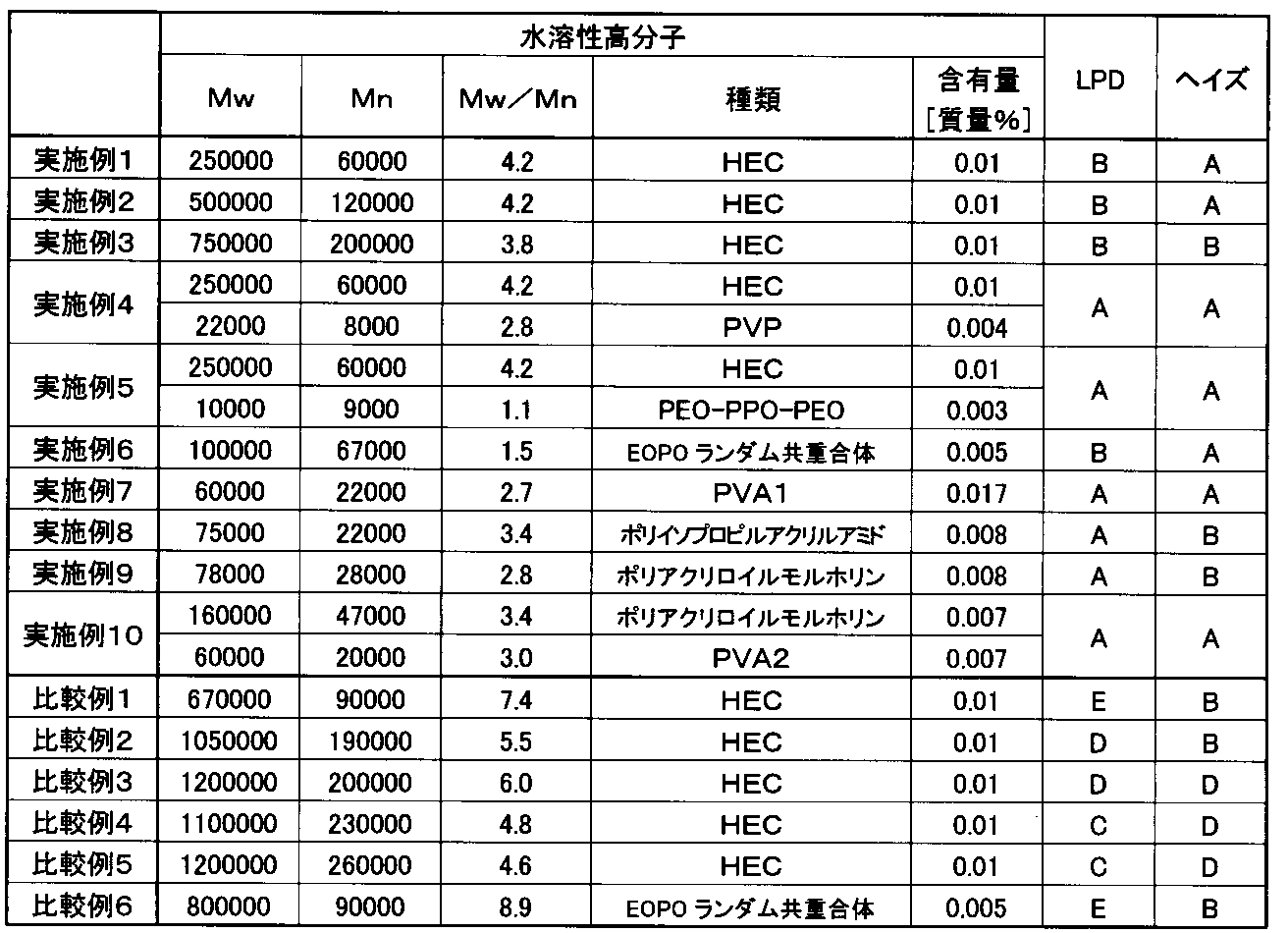
- a stock solution of the polishing composition was prepared by mixing colloidal silica as abrasive grains, one or two water-soluble polymers, and a basic compound in ion-exchanged water. Thereafter, the stock solution was filtered to remove coarse foreign substances contained in the stock solution. Colloidal silica having an average primary particle diameter of 35 nm was used as the abrasive grains, and ammonia was used as the basic compound. Next, the stock solution was diluted 20 times with pure water to obtain a polishing composition containing the water-soluble polymer shown in Table 1. In the dilution step, after stirring and dispersing using a homogenizer, the polishing composition was filtered in order to remove coarse foreign matters contained in the polishing composition.
- the content of abrasive grains in the polishing compositions of Examples and Comparative Examples was 0.5% by mass, and the content of basic compounds was 0.01% by mass.
- Mw is a weight average molecular weight
- Mn is a number average molecular weight
- Mw / Mn is a molecular weight distribution
- GPC gel permeation chromatography
- PEO-PPO-PEO is represented by the general formula (1), and the sum of a and c in the general formula (1) is 164, and b is 31.
- PVA1 represents polyvinyl alcohol having a saponification degree of 80 mol%
- PVA2 represents polyvinyl alcohol having a saponification degree of 98 mol% or more.
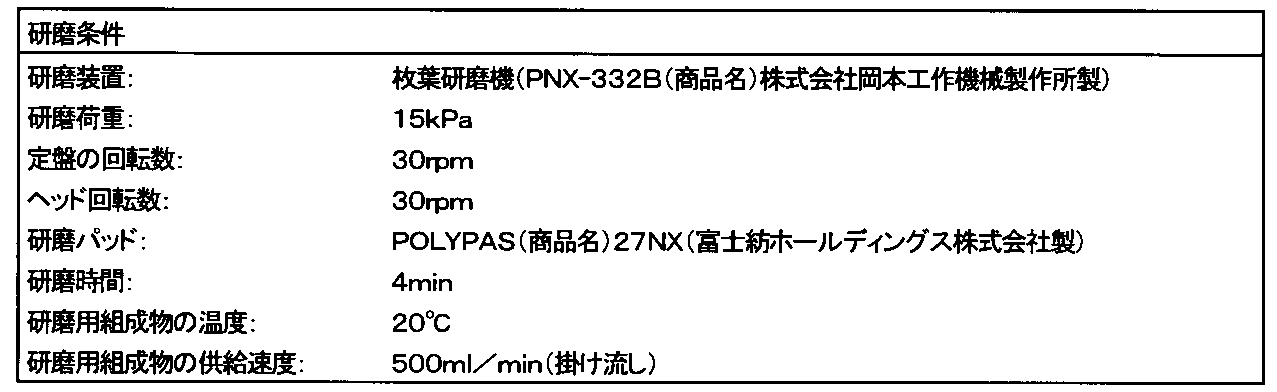
- the silicon substrate was finally polished under the conditions shown in Table 2.
- the silicon substrate subjected to this final polishing was pre-polished using a commercially available abrasive (trade name: GLANZOX-1103, manufactured by Fujimi Incorporated).
- the silicon substrate had a diameter of 300 mm, a conductivity type of P type, a crystal orientation of ⁇ 100>, and a resistivity of 0.1 ⁇ ⁇ cm to less than 100 ⁇ ⁇ cm.
- the silicon substrate was immersed in ultrapure water in a rinsing tank and rinsed while applying ultrasonic waves. Thereafter, the silicon substrate was immersed in the cleaning liquid in the second cleaning tank, and ultrasonic waves were applied for 6 minutes.
- LPD is measured by counting the number of particles having a size of 0.037 ⁇ m or more present on the surface of a polished silicon substrate using a wafer inspection apparatus (trade name: Surfscan SP2, manufactured by KLA Tencor). did.
- a wafer inspection apparatus trade name: Surfscan SP2, manufactured by KLA Tencor.
- the measured value is less than 0.110 ppm, “A”, when 0.110 ppm or more and less than 0.120 ppm, “B”, when 0.120 ppm or more and less than 0.130 ppm, “C”, 0.130 ppm or more and 0
- the determination result is shown in the “Haze” column of Table 1.
- the measurement result of LPD was A or B.
- Comparative Examples 1 and 6 since the molecular weight distribution of the water-soluble polymer was 5.0 or more, the measurement result of LPD was inferior to each Example.
- Comparative Examples 2 and 3 since the weight average molecular weight of the water-soluble polymer exceeded 1000000 and the molecular weight distribution was 5.0 or more, the measurement result of LPD was inferior to each Example.
- Comparative Examples 4 and 5 although the molecular weight distribution of the water-soluble polymer was less than 5.0, since the weight average molecular weight exceeded 1000000, the measurement result of LPD was inferior to each Example.
Landscapes
- Chemical & Material Sciences (AREA)
- Organic Chemistry (AREA)
- Engineering & Computer Science (AREA)
- Materials Engineering (AREA)
- Health & Medical Sciences (AREA)
- Chemical Kinetics & Catalysis (AREA)
- Medicinal Chemistry (AREA)
- Polymers & Plastics (AREA)
- Mechanical Engineering (AREA)
- Composite Materials (AREA)
- Biochemistry (AREA)
- Life Sciences & Earth Sciences (AREA)
- Finish Polishing, Edge Sharpening, And Grinding By Specific Grinding Devices (AREA)
- Mechanical Treatment Of Semiconductor (AREA)
Abstract
Description
水溶性高分子は、研磨面の濡れ性を高める働きをする。分子量分布が小さい水溶性高分子を用いることで、LPDの低減が容易となる。上述したように、研磨用組成物に使用される水溶性高分子の分子量分布は5.0未満であり、好ましくは4.9以下であり、より好ましくは4.8以下であり、更に好ましくは4.7以下であり、最も好ましくは4.6以下である。水溶性高分子の分子量分布は、理論上、1.0以上である。使用される水溶性高分子の分子量分布が大きくなるにつれて、研磨された面の濡れ性が高まる。
一般式(1)中、EOはオキシエチレン基を示すとともにPOはオキシプロピレン基を示し、a、b及びcはそれぞれ1以上の整数を示す。
研磨用組成物は、砥粒を含有することができる。砥粒は、研磨面を物理的に研磨する働きをする。
研磨用組成物は塩基性化合物を含有することができる。塩基性化合物は、研磨面を化学的に研磨する働きをする(ケミカルエッチング)。これにより、研磨速度を向上させることが容易となる。
研磨用組成物中の水は、他の成分を溶解または分散させる働きをする。水は、研磨用組成物に含有される他の成分の働きを阻害しないことが好ましい。このような水の例として、例えば遷移金属イオンの合計含有量が100ppb以下の水が挙げられる。水の純度は、例えば、イオン交換樹脂を用いる不純物イオンの除去、フィルターによる異物の除去、蒸留等によって高めることができる。具体的には、例えば、イオン交換水、純水、超純水、蒸留水等を用いることが好ましい。
研磨用組成物のpHは、8.0以上が好ましく、より好ましくは8.5以上であり、更に好ましくは9.0以上である。研磨用組成物のpHの増大につれて、高い研磨速度が得られる。研磨用組成物のpHは12.5以下であることが好ましく、より好ましくは11.5以下であり、最も好ましくは11以下である。研磨用組成物のpHの減少につれて、研磨面の荒れが抑制され、基板の形状が維持され易くなる。
研磨用組成物はキレート剤を含有することができる。キレート剤は、研磨系中の金属不純物を捕捉して錯体を形成することによって、基板における金属不純物の残留レベルを低減する。研磨系中の金属不純物には、例えば、研磨用組成物の原料に由来するもの、研磨中に研磨面や研磨装置から生じるもの、および外部からの混入物が含まれる。特に、基板が半導体基板である場合、金属不純物の残留レベルを低減することで半導体基板の金属汚染が防止され、半導体基板の品質低下が抑制される。
研磨用組成物は界面活性剤を含有することができる。界面活性剤は、研磨面の荒れを抑制する。これにより、研磨面のヘイズレベルを低減することが容易となる。特に、研磨用組成物が塩基性化合物を含有する場合には、塩基性化合物によるケミカルエッチングによって研磨面に荒れが生じ易くなる。このため、塩基性化合物と界面活性剤との併用は特に有効である。
研磨用組成物は、必要に応じて研磨用組成物に一般に含有されている公知の添加剤、例えば有機酸、有機酸塩、無機酸、無機酸塩、防腐剤、防カビ剤等を更に含有してもよい。
研磨用組成物は、例えばプロペラ攪拌機、超音波分散機、ホモミキサー等の周知の混合装置を用いて調製することができる。研磨用組成物の各原料は、同時に混合されてもよいし、任意の順序で混合されてもよい。
砥粒としてのコロイダルシリカ、1種または2種の水溶性高分子、及び塩基性化合物をイオン交換水に混合することで研磨用組成物の原液を調製した。その後、原液に含まれる粗大異物を取り除くために原液をろ過した。砥粒としては平均一次粒子径35nmのコロイダルシリカ、塩基性化合物としてはアンモニアを用いた。次に、原液を純水で20倍に希釈し、表1に示す水溶性高分子を含有する研磨用組成物を得た。希釈工程では、ホモジナイザーを用いて撹拌及び分散を行った後に、研磨用組成物中に含まれる粗大異物を取り除くために、研磨用組成物をろ過した。
カラム:東ソー株式会社製の商品名TSKgel GMPWXL×2+G2500PWXL(φ7.8mm×300mm×3本)
カラム温度:40℃
溶離液:200mM 硝酸ナトリウム水溶液
試料濃度:0.05質量%
流速:1.0mL/min
注入量:200μL
検出器:RI(示差屈折計)
標準物質:ポリエチレンオキサイド
表1中の“水溶性高分子”欄において“種類”欄に記載された“HEC”はヒドロキシエチルセルロースを示し、“PVP”はポリビニルピロリドンを示し、“PEO-PPO-PEO”はポリエチレンオキサイド-ポリプロピレンオキサイド-ポリエチレンオキサイドトリブロック共重合体を示す。なお、“PEO-PPO-PEO”は、一般式(1)で表されるものであり、一般式(1)中のaとcとの合計が164であり、bが31のものである。また“PVA1”はけん化度80mol%のポリビニルアルコールを示し、“PVA2”はけん化度98mol%以上のポリビニルアルコールを示す。
得られた研磨用組成物を用いて、表2に示す条件でシリコン基板を最終研磨した。この最終研磨に供されたシリコン基板は、市販の研磨剤(商品名:GLANZOX-1103、株式会社フジミインコーポレーテッド製)を用いて予備研磨されたものであった。シリコン基板は、直径が300mm、伝導型がP型、結晶方位が<100>、抵抗率が0.1Ω・cm以上100Ω・cm未満であった。
研磨後のシリコン基板を、NH4OH(29%):H2O2(31%):脱イオン水(DIW)=1:3:30(体積比)の洗浄液を用いて洗浄した(SC-1洗浄)。より具体的には、それぞれ周波数300kHzの超音波発振器を取り付けた第1の洗浄槽、第2の洗浄槽、およびリンス槽を用意した。第1および第2の洗浄槽の各々に上記洗浄液を入れ、60℃に保持した。リンス槽には超純水を入れた。研磨後のシリコン基板を第1の洗浄槽内の洗浄液に浸漬し、6分間超音波を適用した。続いてリンス槽内の超純水にシリコン基板を浸漬し、超音波を適用しながらリンスした。その後、シリコン基板を第2の洗浄槽内の洗浄液に浸漬し、6分間超音波を適用した。
LPDは、ウエハ検査装置(商品名:Surfscan SP2、ケーエルエー・テンコール社製)を用いて、研磨後のシリコン基板の表面に存在する0.037μm以上の大きさのパーティクルの個数をカウントすることにより測定した。表1の“LPD”欄において、“A”はパーティクルの個数が100個未満、“B”は100個以上150個未満、“C”は150個以上200個未満、“D”は200個以上300個未満、“E”は300個以上であったことを表す。
ウエハ検査装置(商品名:Surfscan SP2、ケーエルエー・テンコール社製)を用いて、同装置のDWOモードで研磨工程後の研磨面を測定して得た測定値に基づき、シリコン基板のヘイズレベルの判定を行った。その測定値が0.110ppm未満の場合を“A”、0.110ppm以上0.120ppm未満の場合を“B”、0.120ppm以上0.130ppm未満の場合を“C”、0.130ppm以上0.140ppm未満の場合を“D”、0.140ppm以上である場合を“E”と判定した。その判定結果を表1の“ヘイズ”欄に示す。
Claims (10)
- 重量平均分子量が1000000以下であり、かつ重量平均分子量(Mw)/数平均分子量(Mn)で表される分子量分布が5.0未満である水溶性高分子を含有することを特徴とする研磨用組成物。
- 前記水溶性高分子は、セルロース誘導体、デンプン誘導体、ポリビニルアルコール、ポリビニルアルコール構造を有する重合体、ポリオキシアルキレン構造を有する重合体、及び主鎖又は側鎖官能基に窒素原子を有する重合体から選ばれる少なくとも一種を含む、請求項1に記載の研磨用組成物。
- 前記水溶性高分子は、セルロース誘導体及びデンプン誘導体から選ばれる少なくとも一種を含む、請求項2に記載の研磨用組成物。
- 前記水溶性高分子は、ポリビニルアルコール及びポリビニルアルコール構造を有する重合体から選ばれる少なくとも一種を含む、請求項2に記載の研磨用組成物。
- 前記水溶性高分子は、ポリオキシアルキレン構造を有する重合体から選ばれる少なくとも一種を含む、請求項2に記載の研磨用組成物。
- 前記水溶性高分子は、主鎖又は側鎖官能基に窒素原子を有する重合体から選ばれる少なくとも一種を含む、請求項2に記載の研磨用組成物。
- 前記水溶性高分子は、セルロース誘導体、デンプン誘導体、ポリビニルアルコール及びポリビニルアルコール構造を有する重合体から選ばれる少なくとも一種と、ポリオキシアルキレン構造を有する重合体及び主鎖又は側鎖官能基に窒素原子を有する重合体から選ばれる少なくとも一種とを含む、請求項2に記載の研磨用組成物。
- 基板を研磨する用途に用いられる請求項1から請求項7のいずれか一項に記載の研磨用組成物。
- 基板を最終研磨する用途に用いられる請求項8に記載の研磨用組成物。
- 請求項1から請求項7のいずれか一項に記載の研磨用組成物を用いて基板を研磨する研磨工程を含むことを特徴とする基板の製造方法。
Priority Applications (6)
| Application Number | Priority Date | Filing Date | Title |
|---|---|---|---|
| DE112013004295.9T DE112013004295B4 (de) | 2012-08-31 | 2013-08-12 | Polierzusammensetzung, deren Verwendung und Verfahren zur Herstellung eines Substrats |
| US14/423,945 US9505950B2 (en) | 2012-08-31 | 2013-08-12 | Polishing composition and method for producing substrate |
| SG11201500924PA SG11201500924PA (en) | 2012-08-31 | 2013-08-12 | Polishing composition and method for producing substrate |
| JP2014532916A JP6184962B2 (ja) | 2012-08-31 | 2013-08-12 | 研磨用組成物及び基板の製造方法 |
| KR1020157007531A KR102155205B1 (ko) | 2012-08-31 | 2013-08-12 | 연마용 조성물 및 기판의 제조 방법 |
| CN201380045596.0A CN104603227B (zh) | 2012-08-31 | 2013-08-12 | 研磨用组合物和基板的制造方法 |
Applications Claiming Priority (2)
| Application Number | Priority Date | Filing Date | Title |
|---|---|---|---|
| JP2012191899 | 2012-08-31 | ||
| JP2012-191899 | 2012-08-31 |
Publications (1)
| Publication Number | Publication Date |
|---|---|
| WO2014034425A1 true WO2014034425A1 (ja) | 2014-03-06 |
Family
ID=50183241
Family Applications (1)
| Application Number | Title | Priority Date | Filing Date |
|---|---|---|---|
| PCT/JP2013/071813 Ceased WO2014034425A1 (ja) | 2012-08-31 | 2013-08-12 | 研磨用組成物及び基板の製造方法 |
Country Status (8)
| Country | Link |
|---|---|
| US (1) | US9505950B2 (ja) |
| JP (1) | JP6184962B2 (ja) |
| KR (1) | KR102155205B1 (ja) |
| CN (1) | CN104603227B (ja) |
| DE (1) | DE112013004295B4 (ja) |
| SG (1) | SG11201500924PA (ja) |
| TW (1) | TWI613283B (ja) |
| WO (1) | WO2014034425A1 (ja) |
Cited By (11)
| Publication number | Priority date | Publication date | Assignee | Title |
|---|---|---|---|---|
| CN105038698A (zh) * | 2014-04-15 | 2015-11-11 | 福吉米株式会社 | 研磨用组合物 |
| WO2015198561A1 (ja) * | 2014-06-24 | 2015-12-30 | 株式会社フジミインコーポレーテッド | シリコンウェーハ研磨用組成物 |
| JP2016171332A (ja) * | 2016-04-27 | 2016-09-23 | 株式会社フジミインコーポレーテッド | シリコンウェーハ研磨用組成物 |
| CN106133108A (zh) * | 2014-03-31 | 2016-11-16 | 霓达哈斯股份有限公司 | 研磨用组合物 |
| KR20160135752A (ko) * | 2014-03-17 | 2016-11-28 | 니혼 캐보트 마이크로일렉트로닉스 가부시키가이샤 | 슬러리 조성물 및 기판 연마 방법 |
| JP2017011220A (ja) * | 2015-06-25 | 2017-01-12 | 花王株式会社 | シリコンウェーハ用研磨液組成物 |
| EP3258483A4 (en) * | 2015-02-12 | 2018-02-28 | Fujimi Incorporated | Method for polishing silicon wafer and surface treatment composition |
| JP2018066893A (ja) * | 2016-10-20 | 2018-04-26 | 旭硝子株式会社 | マスクブランク用基板の製造方法 |
| WO2018096991A1 (ja) * | 2016-11-22 | 2018-05-31 | 株式会社フジミインコーポレーテッド | 研磨用組成物 |
| US10748778B2 (en) | 2015-02-12 | 2020-08-18 | Fujimi Incorporated | Method for polishing silicon wafer and surface treatment composition |
| JP2022045161A (ja) * | 2020-09-08 | 2022-03-18 | 株式会社フジミインコーポレーテッド | 研磨用組成物、半導体用濡れ剤、水溶性高分子、およびこれらの製造方法 |
Families Citing this family (14)
| Publication number | Priority date | Publication date | Assignee | Title |
|---|---|---|---|---|
| CN104327741B (zh) * | 2014-09-28 | 2016-06-15 | 顾泉 | 用于研磨蓝宝石基板的研磨组合物及其应用 |
| WO2018124230A1 (ja) * | 2016-12-28 | 2018-07-05 | ニッタ・ハース株式会社 | 研磨用組成物 |
| CN107189695A (zh) * | 2017-04-15 | 2017-09-22 | 浙江晶圣美纳米科技有限公司 | 一种可有效应用于不锈钢衬底化学机械抛光工艺的抛光液 |
| JP7221479B2 (ja) | 2018-08-31 | 2023-02-14 | 日化精工株式会社 | ダイシング加工用製剤及び加工処理液 |
| CN109054656B (zh) * | 2018-09-17 | 2021-07-06 | 宁波日晟新材料有限公司 | 一种金属自由曲面表面抛光液及其制备方法和应用 |
| CN109096924B (zh) * | 2018-09-17 | 2021-07-30 | 宁波日晟新材料有限公司 | 一种玻璃自由曲面表面抛光液及其制备方法和应用 |
| CN108822739A (zh) * | 2018-09-17 | 2018-11-16 | 珠海琴晟新材料有限公司 | 一种抛光液及其制备方法 |
| CN110551453A (zh) * | 2018-12-25 | 2019-12-10 | 清华大学 | 一种抛光组合物 |
| JP7534283B2 (ja) * | 2019-03-28 | 2024-08-14 | 株式会社フジミインコーポレーテッド | 研磨用組成物 |
| JP6761554B1 (ja) * | 2020-01-22 | 2020-09-23 | 日本酢ビ・ポバール株式会社 | 研磨用組成物 |
| WO2021182276A1 (ja) * | 2020-03-13 | 2021-09-16 | 株式会社フジミインコーポレーテッド | 研磨用組成物 |
| KR102699714B1 (ko) * | 2021-03-04 | 2024-08-29 | 주식회사 케이씨텍 | 실리콘 웨이퍼 연마용 조성물 |
| CN115662877B (zh) * | 2022-09-08 | 2023-08-04 | 东海县太阳光新能源有限公司 | 一种单晶硅表面清洗方法 |
| WO2026063545A1 (ko) * | 2024-09-20 | 2026-03-26 | 주식회사 지페라스 | 물품 보관 용기 제조 방법 및 이에 따라 제조된 물품 보관 용기 |
Citations (6)
| Publication number | Priority date | Publication date | Assignee | Title |
|---|---|---|---|---|
| JP2003303791A (ja) * | 2002-04-10 | 2003-10-24 | Nippon Shokubai Co Ltd | 化学機械研磨用水系分散体 |
| JP2003303792A (ja) * | 2002-04-10 | 2003-10-24 | Nippon Shokubai Co Ltd | 化学機械研磨用水系分散体と研磨方法 |
| JP2005123650A (ja) * | 1998-12-25 | 2005-05-12 | Hitachi Chem Co Ltd | Cmp研磨剤用添加液 |
| JP2006165541A (ja) * | 2004-11-24 | 2006-06-22 | Rohm & Haas Electronic Materials Cmp Holdings Inc | 無砥粒ケミカルメカニカルポリッシング組成物及びそれに関連する方法 |
| WO2009096495A1 (ja) * | 2008-02-01 | 2009-08-06 | Fujimi Incorporated | 研磨用組成物及びそれを用いた研磨方法 |
| JP2012079964A (ja) * | 2010-10-04 | 2012-04-19 | Nissan Chem Ind Ltd | 半導体ウェーハ用研磨液組成物 |
Family Cites Families (11)
| Publication number | Priority date | Publication date | Assignee | Title |
|---|---|---|---|---|
| KR20050006299A (ko) | 1998-12-25 | 2005-01-15 | 히다치 가세고교 가부시끼가이샤 | Cmp 연마제, cmp 연마제용 첨가액 및 기판의 연마방법 |
| JP4608925B2 (ja) * | 1998-12-25 | 2011-01-12 | 日立化成工業株式会社 | Cmp研磨剤用添加液 |
| JP2001240850A (ja) | 2000-02-29 | 2001-09-04 | Sanyo Chem Ind Ltd | 研磨用砥粒分散剤および研磨用スラリー |
| US6685757B2 (en) | 2002-02-21 | 2004-02-03 | Rodel Holdings, Inc. | Polishing composition |
| JP4668528B2 (ja) * | 2003-09-05 | 2011-04-13 | 株式会社フジミインコーポレーテッド | 研磨用組成物 |
| JP5121128B2 (ja) * | 2005-06-20 | 2013-01-16 | ニッタ・ハース株式会社 | 半導体研磨用組成物 |
| US8157876B2 (en) | 2007-07-31 | 2012-04-17 | Cabot Microelectronics Corporation | Slurry composition containing non-ionic polymer and method for use |
| US20090032006A1 (en) | 2007-07-31 | 2009-02-05 | Chul Woo Nam | Wire saw process |
| TW201038690A (en) | 2008-09-26 | 2010-11-01 | Rhodia Operations | Abrasive compositions for chemical mechanical polishing and methods for using same |
| JP2011171689A (ja) * | 2009-07-07 | 2011-09-01 | Kao Corp | シリコンウエハ用研磨液組成物 |
| US20110073800A1 (en) | 2009-09-25 | 2011-03-31 | Hongyu Wang | Abrasive-free chemical mechanical polishing compositions |
-
2013
- 2013-08-12 KR KR1020157007531A patent/KR102155205B1/ko active Active
- 2013-08-12 WO PCT/JP2013/071813 patent/WO2014034425A1/ja not_active Ceased
- 2013-08-12 DE DE112013004295.9T patent/DE112013004295B4/de active Active
- 2013-08-12 JP JP2014532916A patent/JP6184962B2/ja active Active
- 2013-08-12 SG SG11201500924PA patent/SG11201500924PA/en unknown
- 2013-08-12 CN CN201380045596.0A patent/CN104603227B/zh active Active
- 2013-08-12 US US14/423,945 patent/US9505950B2/en active Active
- 2013-08-27 TW TW102130604A patent/TWI613283B/zh active
Patent Citations (6)
| Publication number | Priority date | Publication date | Assignee | Title |
|---|---|---|---|---|
| JP2005123650A (ja) * | 1998-12-25 | 2005-05-12 | Hitachi Chem Co Ltd | Cmp研磨剤用添加液 |
| JP2003303791A (ja) * | 2002-04-10 | 2003-10-24 | Nippon Shokubai Co Ltd | 化学機械研磨用水系分散体 |
| JP2003303792A (ja) * | 2002-04-10 | 2003-10-24 | Nippon Shokubai Co Ltd | 化学機械研磨用水系分散体と研磨方法 |
| JP2006165541A (ja) * | 2004-11-24 | 2006-06-22 | Rohm & Haas Electronic Materials Cmp Holdings Inc | 無砥粒ケミカルメカニカルポリッシング組成物及びそれに関連する方法 |
| WO2009096495A1 (ja) * | 2008-02-01 | 2009-08-06 | Fujimi Incorporated | 研磨用組成物及びそれを用いた研磨方法 |
| JP2012079964A (ja) * | 2010-10-04 | 2012-04-19 | Nissan Chem Ind Ltd | 半導体ウェーハ用研磨液組成物 |
Cited By (24)
| Publication number | Priority date | Publication date | Assignee | Title |
|---|---|---|---|---|
| KR102411832B1 (ko) | 2014-03-17 | 2022-06-22 | 씨엠씨 마테리알즈 가부시키가이샤 | 슬러리 조성물 및 기판 연마 방법 |
| KR20160135752A (ko) * | 2014-03-17 | 2016-11-28 | 니혼 캐보트 마이크로일렉트로닉스 가부시키가이샤 | 슬러리 조성물 및 기판 연마 방법 |
| CN106133108A (zh) * | 2014-03-31 | 2016-11-16 | 霓达哈斯股份有限公司 | 研磨用组合物 |
| US10077380B2 (en) | 2014-03-31 | 2018-09-18 | Nitta Haas Incorporated | Polishing composition |
| CN105038698A (zh) * | 2014-04-15 | 2015-11-11 | 福吉米株式会社 | 研磨用组合物 |
| TWI660037B (zh) * | 2014-06-24 | 2019-05-21 | Fujimi Incorporated | 矽晶圓研磨用組成物 |
| US10344185B2 (en) | 2014-06-24 | 2019-07-09 | Fujimi Incorporated | Composition for polishing silicon wafers |
| KR20170021230A (ko) * | 2014-06-24 | 2017-02-27 | 가부시키가이샤 후지미인코퍼레이티드 | 실리콘 웨이퍼 연마용 조성물 |
| CN106663619A (zh) * | 2014-06-24 | 2017-05-10 | 福吉米株式会社 | 硅晶圆研磨用组合物 |
| EP3163600A4 (en) * | 2014-06-24 | 2017-06-21 | Fujimi Incorporated | Composition for polishing silicon wafers |
| WO2015198561A1 (ja) * | 2014-06-24 | 2015-12-30 | 株式会社フジミインコーポレーテッド | シリコンウェーハ研磨用組成物 |
| JP2016009759A (ja) * | 2014-06-24 | 2016-01-18 | 株式会社フジミインコーポレーテッド | シリコンウェーハ研磨用組成物 |
| KR102397821B1 (ko) * | 2014-06-24 | 2022-05-13 | 가부시키가이샤 후지미인코퍼레이티드 | 실리콘 웨이퍼 연마용 조성물 |
| CN106663619B (zh) * | 2014-06-24 | 2020-06-16 | 福吉米株式会社 | 硅晶圆研磨用组合物 |
| US10748778B2 (en) | 2015-02-12 | 2020-08-18 | Fujimi Incorporated | Method for polishing silicon wafer and surface treatment composition |
| EP3258483A4 (en) * | 2015-02-12 | 2018-02-28 | Fujimi Incorporated | Method for polishing silicon wafer and surface treatment composition |
| JP2017011220A (ja) * | 2015-06-25 | 2017-01-12 | 花王株式会社 | シリコンウェーハ用研磨液組成物 |
| JP2016171332A (ja) * | 2016-04-27 | 2016-09-23 | 株式会社フジミインコーポレーテッド | シリコンウェーハ研磨用組成物 |
| JP2018066893A (ja) * | 2016-10-20 | 2018-04-26 | 旭硝子株式会社 | マスクブランク用基板の製造方法 |
| WO2018096991A1 (ja) * | 2016-11-22 | 2018-05-31 | 株式会社フジミインコーポレーテッド | 研磨用組成物 |
| US11130883B2 (en) | 2016-11-22 | 2021-09-28 | Fujimi Incorporated | Polishing composition |
| JP2022045161A (ja) * | 2020-09-08 | 2022-03-18 | 株式会社フジミインコーポレーテッド | 研磨用組成物、半導体用濡れ剤、水溶性高分子、およびこれらの製造方法 |
| JP7613854B2 (ja) | 2020-09-08 | 2025-01-15 | 株式会社フジミインコーポレーテッド | 研磨用組成物、半導体用濡れ剤、水溶性高分子、およびこれらの製造方法 |
| JP2025066105A (ja) * | 2020-09-08 | 2025-04-22 | 株式会社フジミインコーポレーテッド | 研磨用組成物、半導体用濡れ剤、水溶性高分子、およびこれらの製造方法 |
Also Published As
| Publication number | Publication date |
|---|---|
| TW201420738A (zh) | 2014-06-01 |
| CN104603227A (zh) | 2015-05-06 |
| KR102155205B1 (ko) | 2020-09-11 |
| DE112013004295T5 (de) | 2015-05-13 |
| US20150210892A1 (en) | 2015-07-30 |
| US9505950B2 (en) | 2016-11-29 |
| TWI613283B (zh) | 2018-02-01 |
| JPWO2014034425A1 (ja) | 2016-08-08 |
| KR20150050572A (ko) | 2015-05-08 |
| JP6184962B2 (ja) | 2017-08-23 |
| CN104603227B (zh) | 2017-03-08 |
| SG11201500924PA (en) | 2015-04-29 |
| DE112013004295B4 (de) | 2024-12-05 |
Similar Documents
| Publication | Publication Date | Title |
|---|---|---|
| JP6184962B2 (ja) | 研磨用組成物及び基板の製造方法 | |
| JP6514653B2 (ja) | 研磨用組成物、研磨用組成物製造方法および研磨用組成物調製用キット | |
| KR102226501B1 (ko) | 연마용 조성물 및 연마물 제조 방법 | |
| JP2022118024A5 (ja) | ||
| JP6259723B2 (ja) | シリコンウェーハの研磨方法、研磨用組成物および研磨用組成物セット | |
| JP7185533B2 (ja) | シリコン基板中間研磨用組成物およびシリコン基板研磨用組成物セット | |
| JPWO2013137212A1 (ja) | 研磨用組成物及び半導体基板の製造方法 | |
| EP3053978A1 (en) | Polishing composition and production method therefor | |
| KR20170021230A (ko) | 실리콘 웨이퍼 연마용 조성물 | |
| CN105593330A (zh) | 研磨用组合物及其制造方法 | |
| WO2018096991A1 (ja) | 研磨用組成物 | |
| JP6029895B2 (ja) | 研磨用組成物及び基板の製造方法 | |
| TWI588249B (zh) | Silicon wafer polishing composition | |
| JP6255287B2 (ja) | 研磨方法およびそれに用いられる研磨用組成物 | |
| JP6013828B2 (ja) | 研磨用組成物、当該研磨用組成物の製造方法、及び当該研磨用組成物を用いた半導体基板の製造方法 | |
| JP2014038906A (ja) | 研磨用組成物、当該研磨用組成物の製造方法、及び当該研磨用組成物を用いた半導体基板の製造方法 | |
| JP6122783B2 (ja) | 研磨用組成物及び半導体基板の製造方法 | |
| JP6305674B2 (ja) | 研磨用組成物及び半導体基板の製造方法 | |
| WO2023181929A1 (ja) | 研磨用組成物 | |
| TW202231830A (zh) | 矽晶圓用研磨用組成物及其利用 |
Legal Events
| Date | Code | Title | Description |
|---|---|---|---|
| 121 | Ep: the epo has been informed by wipo that ep was designated in this application |
Ref document number: 13833504 Country of ref document: EP Kind code of ref document: A1 |
|
| ENP | Entry into the national phase |
Ref document number: 2014532916 Country of ref document: JP Kind code of ref document: A |
|
| WWE | Wipo information: entry into national phase |
Ref document number: 14423945 Country of ref document: US |
|
| WWE | Wipo information: entry into national phase |
Ref document number: 112013004295 Country of ref document: DE Ref document number: 1120130042959 Country of ref document: DE |
|
| ENP | Entry into the national phase |
Ref document number: 20157007531 Country of ref document: KR Kind code of ref document: A |
|
| 122 | Ep: pct application non-entry in european phase |
Ref document number: 13833504 Country of ref document: EP Kind code of ref document: A1 |