WO2013147128A1 - シアン含有排水の処理方法 - Google Patents
シアン含有排水の処理方法 Download PDFInfo
- Publication number
- WO2013147128A1 WO2013147128A1 PCT/JP2013/059476 JP2013059476W WO2013147128A1 WO 2013147128 A1 WO2013147128 A1 WO 2013147128A1 JP 2013059476 W JP2013059476 W JP 2013059476W WO 2013147128 A1 WO2013147128 A1 WO 2013147128A1
- Authority
- WO
- WIPO (PCT)
- Prior art keywords
- containing wastewater
- cyanide
- treating
- chlorine
- added
- Prior art date
- Legal status (The legal status is an assumption and is not a legal conclusion. Google has not performed a legal analysis and makes no representation as to the accuracy of the status listed.)
- Ceased
Links
Classifications
-
- C—CHEMISTRY; METALLURGY
- C02—TREATMENT OF WATER, WASTE WATER, SEWAGE, OR SLUDGE
- C02F—TREATMENT OF WATER, WASTE WATER, SEWAGE, OR SLUDGE
- C02F1/00—Treatment of water, waste water, or sewage
- C02F1/72—Treatment of water, waste water, or sewage by oxidation
- C02F1/76—Treatment of water, waste water, or sewage by oxidation with halogens or compounds of halogens
-
- C—CHEMISTRY; METALLURGY
- C02—TREATMENT OF WATER, WASTE WATER, SEWAGE, OR SLUDGE
- C02F—TREATMENT OF WATER, WASTE WATER, SEWAGE, OR SLUDGE
- C02F2101/00—Nature of the contaminant
- C02F2101/10—Inorganic compounds
- C02F2101/16—Nitrogen compounds, e.g. ammonia
- C02F2101/18—Cyanides
-
- C—CHEMISTRY; METALLURGY
- C02—TREATMENT OF WATER, WASTE WATER, SEWAGE, OR SLUDGE
- C02F—TREATMENT OF WATER, WASTE WATER, SEWAGE, OR SLUDGE
- C02F2209/00—Controlling or monitoring parameters in water treatment
- C02F2209/06—Controlling or monitoring parameters in water treatment pH
Definitions
- the present invention relates to a method for treating cyanide-containing wastewater, and more particularly, to a method for treating cyanide-containing wastewater by an alkali chlorine method.
- the alkali chlorine method is the most widely used method for treating cyanide-containing wastewater discharged from industrial facilities such as plating factories, steelworks, smelters, power plants, and coke factories.
- a chlorine source for example, sodium hypochlorite is added to cyanide-containing wastewater under alkalinity to oxidize cyanide in the wastewater (Patent Documents 1 and 2).
- Patent Document 2 describes a method of treating cyanide-containing wastewater containing ammonia by a two-stage reaction of the alkali chlorine method.
- An object of the present invention is to solve the above-mentioned conventional problems and to provide a method for treating cyanide-containing wastewater that can sufficiently oxidatively decompose cyanide compounds even when the cyanide-containing wastewater contains ammonium ions and organic matter. To do. Moreover, an object of this invention is to provide the processing method of the cyanate containing waste_water
- the method for treating cyan-containing wastewater of the present invention is a method for treating cyanide-containing wastewater in which a cyanide is decomposed by adding a chlorine source to cyanide-containing wastewater containing cyanide, wherein the cyanate-containing wastewater contains ammonium ions and organic matter.
- the pH of the cyanate-containing wastewater is 11 or more, and the chlorine source is added so that the free residual chlorine concentration is 0.1 mg / L or more even after the cyanide decomposition reaction.
- chlorine source at least one of sodium hypochlorite, chlorine and bleaching powder is preferable.
- a phosphonic acid scale inhibitor is further added to the cyanate-containing wastewater.
- the phosphonic acid-based scale inhibitor is preferably at least one selected from 1-hydroxyethylidene-1,1-diphosphonic acid, 2-phosphonobutane-1,2,4-tricarboxylic acid, and salts thereof.
- the chlorine source is preferably added so that the free residual chlorine concentration is 0.1 to 1 mg / L.
- an alkali agent to the cyanate-containing wastewater to adjust the pH to 11 to 12.5.
- the concentration of soluble iron in the cyanate-containing wastewater is 0.4 mg / L or less.
- the water temperature of the cyanate-containing wastewater is preferably 40 ° C. or higher, for example 40 to 80 ° C., particularly 50 to 70 ° C.
- a chlorine source is added at a pH of 11 or more to cyanide-containing wastewater containing ammonium ions and organic matter.
- the pH is 11 or more, the reaction between the chlorine source and ammonium ions is suppressed, whereby the generation of bonded chlorine is suppressed, and as a result, the generation of cyan due to the reaction between the combined chlorine and organic matter is also suppressed.
- the generation of scale is prevented (including suppression) by adding a phosphonic acid scale inhibitor to the cyanate-containing wastewater.
- an alkali agent to make the pH 11 or more.
- this alkaline agent and scale inhibitor are mixed and added as a single solution, scale troubles in the chemical injection (chemical injection) pump and chemical injection piping are prevented.
- the pH is preferably 11 or more even after completion of the cyanide decomposition reaction.
- cyanide-containing wastewater to be treated is discharged from industrial facilities such as a plating plant, a power plant, a steel mill, a smelter, a coke production plant, and cyan is a metal cyan complex such as Ni, Ag, Although the cyan containing waste water contained as a cyan complex of metals, such as Cu, Zn, Cd, is illustrated, it is not limited to this.
- the cyan concentration of such cyanate-containing wastewater is about 0.1 to 100 mg / L, and the pH is about 6 to 10.
- cyanide-containing wastewater containing ammonium ions and organic substances is treated.
- the concentration of this ammonium ion is preferably 5 mg / L or more, for example, about 5 to 250 mg / L.
- organic substances include those derived from coal and coke, and the concentration is preferably 1 mg / L or more, for example, about 1 to 30 mg / L.
- the cyan-containing wastewater to be treated by the method of the present invention preferably has a total cyan concentration of iron cyano complex of 1.0 mg / L or less and a concentration of soluble iron of less than 0.4 mg / L. .
- Examples of chlorine sources added to cyanide-containing wastewater include chlorine, bleached powder, and sodium hypochlorite.
- Examples of phosphonic acid scale inhibitors to be added to cyanate-containing wastewater include 1-hydroxyethylidene-1,1-diphosphonic acid (HEDP), 2-phosphonobutane-1,2,4-tricarboxylic acid (PBTC), and those At least one selected from these salts is exemplified, and examples of the salt include sodium salt and potassium salt, among which 1-hydroxyethylidene-1,1-diphosphonic acid is preferable.
- the pH of the cyanate-containing wastewater is adjusted to 11 or more, preferably 11 to 12.5, particularly 11 to 12 by adding an alkali such as NaOH and / or KOH as necessary.
- the alkali addition may be performed before or after the addition of the chlorine source, or may be performed simultaneously. If the pH of the cyanate-containing wastewater is 11 or more, the alkali may not be added. In addition, it is preferable that pH of the water after process reaction is 11 or more.
- the alkali agent and the scale inhibitor may be mixed to form one liquid. In this way, scale generation in the chemical injection pump and chemical injection piping is prevented.
- the amount of scale inhibitor added is preferably determined experimentally according to the water quality of the cyanate-containing wastewater, but in the usual case, it is preferably about 1 to 100 mg / L, particularly about 5 to 30 mg / L.
- the amount of chlorine source added is controlled such that the free residual chlorine concentration after the reaction is 0.1 mg / L or more, preferably 0.1 to 1 mg / L, particularly 0.1 to 0.5 mg / L.
- the predetermined value is preferably a value selected from 0 to 0.1 mg / L / min.
- the residence time in the tank is made longer than the reaction end time.
- the free residual chlorine concentration measured at the reaction vessel outlet is preferably treated as the free residual chlorine concentration after the reaction.
- the pH is set to 11 or more, so that the generation of bonded chlorine is suppressed, and the generation of cyanide due to the reaction between the bonded chlorine and organic matter is also suppressed. Moreover, scale adhesion is prevented by adding a scale inhibitor, and cyanide-containing wastewater can be treated stably.
- Cyanide is sufficiently decomposed by adding a chlorine source so that the free residual chlorine concentration after the reaction is 0.1 mg / L or more.
- a chlorine source so that the free residual chlorine concentration after completion of the reaction is 0.1 mg / L or more.
- the free residual chlorine concentration after completion of the reaction is 1 mg / L or less.
- excessive addition of the chlorine source is prevented, and the cost of the chlorine source is suppressed.
- corrosion of metal materials, such as steel materials which comprise a liquid-contact member is also suppressed.
- the water temperature of the cyanide-containing wastewater is preferably 40 ° C. or higher, for example, 40 to 80 ° C., particularly about 50 to 70 ° C., thereby increasing the cyan decomposition reaction rate.
- the cyan decomposition rate is increased, the contact time between the water to be treated containing free residual chlorine and the liquid contact member made of steel or the like is short, and corrosion of the liquid contact member is suppressed.
- the water temperature is preferably 80 ° C. or lower, particularly 70 ° C. or lower.
- an aqueous NaOH solution (concentration 48 wt%) is used as the alkaline agent
- an aqueous NaClO solution concentration 12 wt%) is used as the chlorine source
- HEDP, PBTC acrylic acid polymer (polyethylene is used as the scale inhibitor).
- Sodium acrylate (weight average molecular weight 3500)) or maleic acid polymer (isobutylene / maleic anhydride copolymer sodium salt (weight average molecular weight 15000) was used.
- the total CN analysis was performed by adding L (+)-ascorbic acid to reduce residual chlorine, adjusting the pH to 12 with NaOH, and measuring by a 4-pyridine-pyrazolone spectrophotometry method according to JIS K 0102 without filtration. .
- the scale prevention effect it judged based on the calcium ion concentration and the presence or absence of the scale adherence to the SUS test piece in the reaction vessel.
- test water As test water, the collected water from the following power generation facilities was used.
- Test water 50 mL was placed in a glass container with a lid, the water temperature was kept at 20 ° C., 40 ° C., 50 ° C. or 60 ° C., and an alkali agent and a chlorine source were added so as to satisfy the conditions shown in Table 1.
- the reaction time was as follows.
- Table 1 shows the pH after 5 minutes from the addition of the chemical and after the passage of each time, the added amount of NaClO, the residual chlorine concentration, the ORP and the total cyan concentration after the reaction time.
- free represents free residual chlorine.
- test water As test water, the collected water from the following power generation facilities was used.
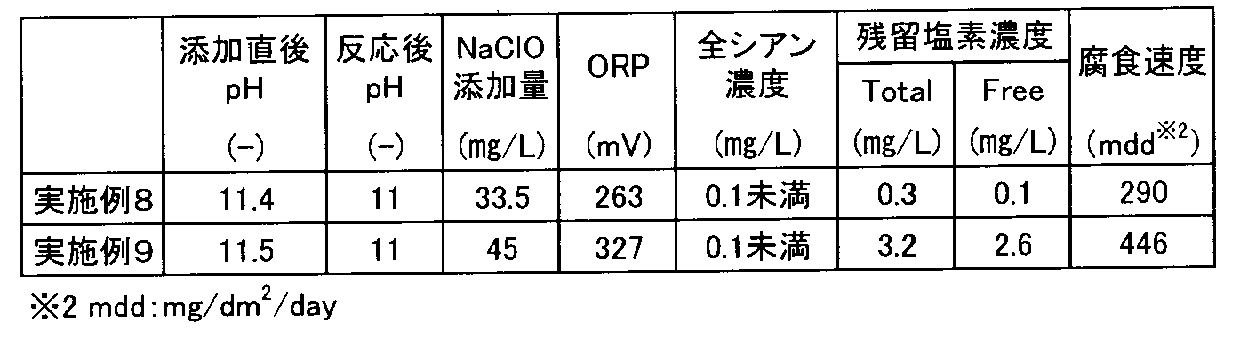
- Example 8 Place 100 mL of test water in a 1000 mL beaker, keep the water temperature at 60 ° C., add an alkaline agent and a chlorine source under the conditions shown in Table 2, put an iron test piece, and stir with a stirrer (rotation speed 150 rpm) for 3 days. did. The results are shown in Table 2.
- a test piece made of iron (SPCC) was put in each beaker, and after 3 days, the water quality and the amount of corrosion were measured, the corrosion rate was measured, and the result was It is shown in Table 2.
- Example 8 As shown in Table 2, the corrosion rate of Example 8 having a lower free residual chlorine concentration is lower than that of Example 9.
- test water As test water, the collected water from the following power generation facilities was used.
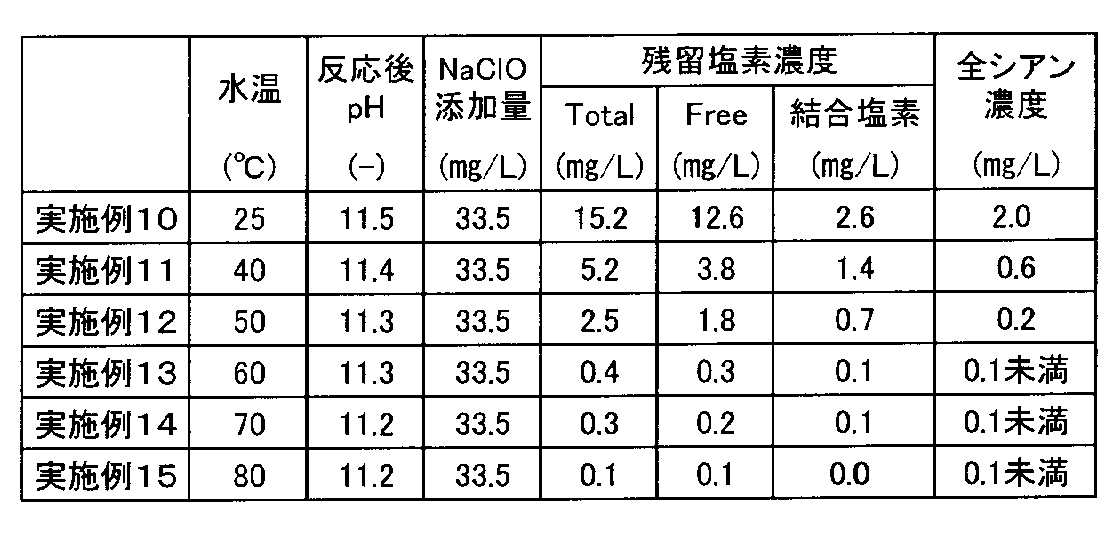
- Test water 500 mL was placed in a beaker with a lid, the water temperature was kept at 25 ° C., 40 ° C., 50 ° C., 60 ° C. or 80 ° C., and an alkali agent and a chlorine source were added under the conditions shown in Table 3.
- the measured water quality after 60 minutes is shown in Table 3.
- Test water having a soluble iron concentration of 0.1 mg / L, 0.3 mg / L, 0.4 mg / L or 0.5 mg / L by adding an aqueous ferric chloride solution to the same power generation facility dust collection water as in Example 1. was prepared. Take 500 mL of each test water in a glass container with a lid, keep the water temperature at 60 ° C., add an alkaline agent so that the pH is 11 after the reaction, and the concentration immediately after adding the chlorine source is 33.5 mg / L. Was added and allowed to react for 60 minutes. Table 4 shows the measured water quality after 60 minutes.
- test water As test water, the collected water from the following power generation facilities was used. pH: 8.7 Total cyan: 3 mg / L, Ammonium ion: 120 mg / L, TOC: 10 mg / L, Soluble iron: less than 0.1 mg / L
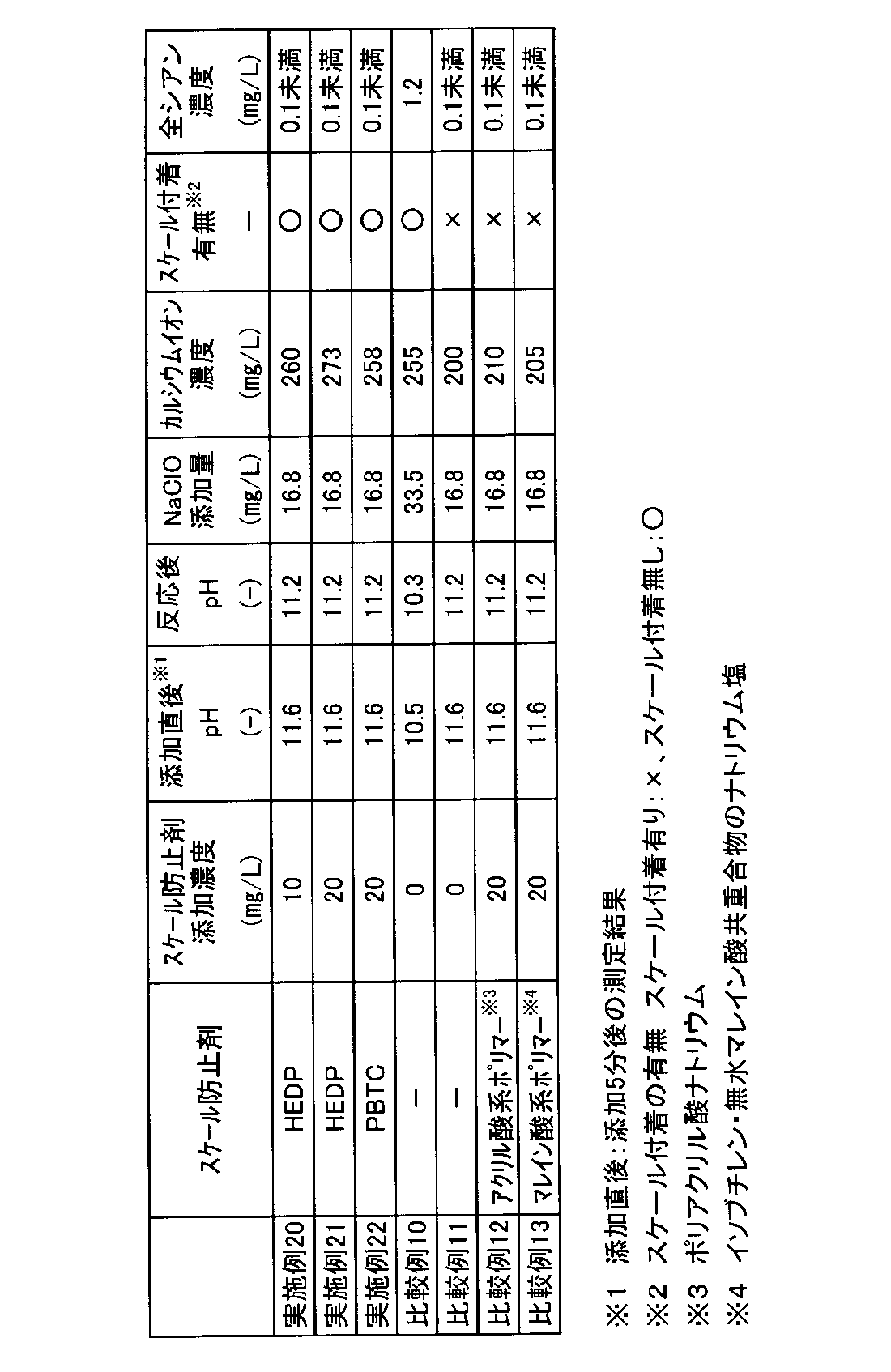
- Test water 500 mL was placed in a glass container with a lid, the water temperature was kept at 60 ° C., and a scale inhibitor, an alkali agent and a chlorine source were added so as to satisfy the conditions shown in Table 1.
- the test piece made from SUS was put in the container. The reaction time was 60 minutes.
- Table 5 shows the pH after the elapse of 5 minutes and 60 minutes after the addition of the chemical, the added amount of NaClO, the calcium ion concentration after the elapse of the reaction time, the presence or absence of scale adhesion to the test piece, and the total cyan concentration.
- cyan can be sufficiently decomposed and scale is also prevented.
- Comparative Example 10 since the pH is less than 11, the residual cyan density is high.
- Comparative Example 11 no scale inhibitor was added, and scale was generated.
- Comparative Examples 12 and 13 a scale inhibitor was added, but the scale adhered because it was not a phosphonic acid scale inhibitor.
Landscapes
- Life Sciences & Earth Sciences (AREA)
- Hydrology & Water Resources (AREA)
- Engineering & Computer Science (AREA)
- Environmental & Geological Engineering (AREA)
- Water Supply & Treatment (AREA)
- Chemical & Material Sciences (AREA)
- Organic Chemistry (AREA)
- Treatment Of Water By Oxidation Or Reduction (AREA)
- Removal Of Specific Substances (AREA)
Description
NaCN+NaOCl→NaCNO+NaCl …(1)
二段反応:pH7~8,ORP制御値600~650mV
2NaCNO+3NaClO+H2O→N2+3NaCl+2NaHCO3
…(2)
特許文献2には、アンモニアを含むシアン含有排水をアルカリ塩素法の2段階の反応によって処理する方法が記載されている。
試験水として次の水質の発電設備の集塵水を用いた。
全シアン:3mg/L、
アンモニウムイオン:120mg/L、
TOC:10mg/L、
溶解性鉄:0.1mg/L未満
水温40℃の場合 90分
水温50,60℃の場合 60分

試験水として次の水質の発電設備の集塵水を用いた。
全シアン:3mg/L、
アンモニウムイオン:100mg/L、
TOC:8mg/L、
溶解性鉄:0.1mg/L未満
試験水として次の水質の発電設備の集塵水を用いた。
全シアン:3mg/L、
アンモニウムイオン:130mg/L、
TOC:7mg/L、
溶解性鉄:0.1mg/L未満
実施例1と同じ発電設備集塵水に塩化第二鉄水溶液を添加して溶解性鉄濃度0.1mg/L、0.3mg/L、0.4mg/L又は0.5mg/Lの試験水を調製した。各試験水500mLを蓋付きのガラス製容器に採り、水温を60℃に保ち、反応後のpH11となるようにアルカリ剤を添加すると共に、塩素源を添加直後の濃度が33.5mg/Lとなるように添加し、60分反応させた。60分後の水質測定値を表4に示す。

試験水として次の水質の発電設備の集塵水を用いた。
pH:8.7、
全シアン:3mg/L、
アンモニウムイオン:120mg/L、
TOC:10mg/L、
溶解性鉄:0.1mg/L未満
なお、本出願は、2012年3月30日付で出願された日本特許出願(特願2012-080437)及び2012年3月30日付で出願された日本特許出願(特願2012-080438)に基づいており、その全体が引用により援用される。
Claims (10)
- シアン化合物を含有するシアン含有排水に塩素源を添加してシアン化合物を分解するシアン含有排水の処理方法において、
該シアン含有排水がアンモニウムイオン及び有機物を含有しており、
該シアン含有排水のpHを11以上とし、シアン化合物分解反応後においても遊離残留塩素濃度が0.1mg/L以上となるように前記塩素源を添加することを特徴とするシアン含有排水の処理方法。 - 請求項1において、前記シアン含有排水に、さらに、ホスホン酸系スケール防止剤を添加することを特徴とするシアン含有排水の処理方法。
- 請求項2において、前記ホスホン酸系スケール防止剤が1-ヒドロキシエチリデン-1,1-ジホスホン酸、2-ホスホノブタン-1,2,4-トリカルボン酸、及びそれらの塩から選ばれる少なくとも1種であることを特徴とするシアン含有排水の処理方法。
- 請求項2又は3において、前記アルカリ源と前記スケール防止剤とを混合して一液化して添加することを特徴とするシアン含有排水の処理方法。
- 請求項1又は2において、前記遊離残留塩素濃度が0.1~1mg/Lとなるように前記塩素源を添加することを特徴とするシアン含有排水の処理方法。
- 請求項1又は2において、前記シアン含有排水にアルカリ剤を添加してpHを11~12.5とすることを特徴とするシアン含有排水の処理方法。
- 請求項6において、前記シアン化合物分解反応後におけるpHが11以上となるように前記アルカリ剤を添加することを特徴とするシアン含有排水の処理方法。
- 請求項1又は2において、前記シアン含有排水の溶解性鉄の濃度が0.4mg/L以下であることを特徴とするシアン含有排水の処理方法。
- 請求項1又は2において、シアン含有排水の水温を40℃以上とすることを特徴とするシアン含有排水の処理方法。
- 請求項1又は2において、前記塩素源が次亜塩素酸ナトリウム、塩素及びさらし粉の少なくとも1種であることを特徴とするシアン含有排水の処理方法。
Priority Applications (3)
| Application Number | Priority Date | Filing Date | Title |
|---|---|---|---|
| DE112013001804.7T DE112013001804T5 (de) | 2012-03-30 | 2013-03-29 | Verfahren zur Behandlung von cyanidhaltigem Abwasser |
| KR1020147026020A KR102054535B1 (ko) | 2012-03-30 | 2013-03-29 | 시안 함유 배수의 처리 방법 |
| CN201380014559.3A CN104169226B (zh) | 2012-03-30 | 2013-03-29 | 含氰排水的处理方法 |
Applications Claiming Priority (4)
| Application Number | Priority Date | Filing Date | Title |
|---|---|---|---|
| JP2012080437A JP5617862B2 (ja) | 2012-03-30 | 2012-03-30 | シアン含有排水の処理方法 |
| JP2012080438A JP5617863B2 (ja) | 2012-03-30 | 2012-03-30 | シアン含有排水の処理方法 |
| JP2012-080437 | 2012-03-30 | ||
| JP2012-080438 | 2012-03-30 |
Publications (1)
| Publication Number | Publication Date |
|---|---|
| WO2013147128A1 true WO2013147128A1 (ja) | 2013-10-03 |
Family
ID=49260370
Family Applications (1)
| Application Number | Title | Priority Date | Filing Date |
|---|---|---|---|
| PCT/JP2013/059476 Ceased WO2013147128A1 (ja) | 2012-03-30 | 2013-03-29 | シアン含有排水の処理方法 |
Country Status (5)
| Country | Link |
|---|---|
| KR (1) | KR102054535B1 (ja) |
| CN (1) | CN104169226B (ja) |
| DE (1) | DE112013001804T5 (ja) |
| TW (1) | TWI527768B (ja) |
| WO (1) | WO2013147128A1 (ja) |
Cited By (1)
| Publication number | Priority date | Publication date | Assignee | Title |
|---|---|---|---|---|
| CN105884105A (zh) * | 2016-03-08 | 2016-08-24 | 南京红太阳生物化学有限责任公司 | 一种氨氰法合成百草枯的废水处理方法 |
Families Citing this family (2)
| Publication number | Priority date | Publication date | Assignee | Title |
|---|---|---|---|---|
| JP5867538B2 (ja) * | 2014-04-16 | 2016-02-24 | 栗田工業株式会社 | シアン及びアンモニア含有排水の処理方法 |
| CN112266095A (zh) * | 2020-09-29 | 2021-01-26 | 江苏阿尔法药业有限公司 | 废水中氰化物的氧化降解方法 |
Citations (13)
| Publication number | Priority date | Publication date | Assignee | Title |
|---|---|---|---|---|
| JPS4923701B1 (ja) * | 1970-01-22 | 1974-06-18 | ||
| JPS50161482A (ja) * | 1974-06-21 | 1975-12-27 | ||
| JPS5549191A (en) * | 1978-10-03 | 1980-04-09 | Hitachi Plant Eng & Constr Co Ltd | Purifying treatment method of waste water |
| JPH0248315B2 (ja) * | 1986-08-04 | 1990-10-24 | Kurita Water Ind Ltd | |
| JPH05337476A (ja) * | 1992-06-08 | 1993-12-21 | Kurita Water Ind Ltd | シアン化合物の処理方法 |
| JP2000084589A (ja) * | 1998-09-09 | 2000-03-28 | Nippon Steel Chem Co Ltd | コークス工場排水の処理方法 |
| JP2001269674A (ja) * | 2000-03-27 | 2001-10-02 | Kurita Water Ind Ltd | シアン含有排水の処理方法 |
| JP2003038909A (ja) * | 2001-07-31 | 2003-02-12 | Kurita Water Ind Ltd | 金属精錬炉排ガスの湿式集塵器循環水の処理方法 |
| JP2006334508A (ja) * | 2005-06-02 | 2006-12-14 | Nippon Parkerizing Co Ltd | シアン・アンモニア含有廃液の同時連続処理方法および同時連続処理装置 |
| WO2007080811A1 (ja) * | 2006-01-11 | 2007-07-19 | Kurita Water Industries Ltd. | スケール防止剤及びスケール防止方法 |
| JP2007260586A (ja) * | 2006-03-29 | 2007-10-11 | Jfe Steel Kk | コークス炉で発生する廃水の処理方法 |
| JP2008036608A (ja) * | 2006-08-10 | 2008-02-21 | Kurita Water Ind Ltd | シアン含有排水の処理方法及び装置 |
| JP2012020206A (ja) * | 2010-07-12 | 2012-02-02 | Jfe Steel Corp | シアン含有水の処理方法 |
Family Cites Families (7)
| Publication number | Priority date | Publication date | Assignee | Title |
|---|---|---|---|---|
| JPS5724695A (en) * | 1980-07-21 | 1982-02-09 | Nisshin Steel Co Ltd | Removal of cyanide from waste water |
| US5106508A (en) * | 1990-09-26 | 1992-04-21 | Klaus Schwitzgebel | Integrated process for cyanide and heavy metal removal from plating process waste streams |
| KR100291461B1 (ko) * | 1998-10-12 | 2001-06-01 | 홍영철 | 중금속함유시안폐수의전처리방법 |
| US7776363B2 (en) * | 2006-01-27 | 2010-08-17 | Nalco Company | Suppressing microbial growth in pulp and paper |
| CN100443423C (zh) * | 2007-04-27 | 2008-12-17 | 济南晶恒有限责任公司 | 电镀废水处理回用工艺 |
| CN102115271A (zh) * | 2009-12-30 | 2011-07-06 | 川化股份有限公司 | 一种高浓度含氰或腈有机废水的处理方法 |
| CN101885546B (zh) * | 2010-06-28 | 2012-03-28 | 重庆长安工业(集团)有限责任公司 | 一种高氰电镀废液处理方法 |
-
2013
- 2013-03-29 DE DE112013001804.7T patent/DE112013001804T5/de active Pending
- 2013-03-29 WO PCT/JP2013/059476 patent/WO2013147128A1/ja not_active Ceased
- 2013-03-29 TW TW102111464A patent/TWI527768B/zh not_active IP Right Cessation
- 2013-03-29 CN CN201380014559.3A patent/CN104169226B/zh active Active
- 2013-03-29 KR KR1020147026020A patent/KR102054535B1/ko active Active
Patent Citations (13)
| Publication number | Priority date | Publication date | Assignee | Title |
|---|---|---|---|---|
| JPS4923701B1 (ja) * | 1970-01-22 | 1974-06-18 | ||
| JPS50161482A (ja) * | 1974-06-21 | 1975-12-27 | ||
| JPS5549191A (en) * | 1978-10-03 | 1980-04-09 | Hitachi Plant Eng & Constr Co Ltd | Purifying treatment method of waste water |
| JPH0248315B2 (ja) * | 1986-08-04 | 1990-10-24 | Kurita Water Ind Ltd | |
| JPH05337476A (ja) * | 1992-06-08 | 1993-12-21 | Kurita Water Ind Ltd | シアン化合物の処理方法 |
| JP2000084589A (ja) * | 1998-09-09 | 2000-03-28 | Nippon Steel Chem Co Ltd | コークス工場排水の処理方法 |
| JP2001269674A (ja) * | 2000-03-27 | 2001-10-02 | Kurita Water Ind Ltd | シアン含有排水の処理方法 |
| JP2003038909A (ja) * | 2001-07-31 | 2003-02-12 | Kurita Water Ind Ltd | 金属精錬炉排ガスの湿式集塵器循環水の処理方法 |
| JP2006334508A (ja) * | 2005-06-02 | 2006-12-14 | Nippon Parkerizing Co Ltd | シアン・アンモニア含有廃液の同時連続処理方法および同時連続処理装置 |
| WO2007080811A1 (ja) * | 2006-01-11 | 2007-07-19 | Kurita Water Industries Ltd. | スケール防止剤及びスケール防止方法 |
| JP2007260586A (ja) * | 2006-03-29 | 2007-10-11 | Jfe Steel Kk | コークス炉で発生する廃水の処理方法 |
| JP2008036608A (ja) * | 2006-08-10 | 2008-02-21 | Kurita Water Ind Ltd | シアン含有排水の処理方法及び装置 |
| JP2012020206A (ja) * | 2010-07-12 | 2012-02-02 | Jfe Steel Corp | シアン含有水の処理方法 |
Cited By (1)
| Publication number | Priority date | Publication date | Assignee | Title |
|---|---|---|---|---|
| CN105884105A (zh) * | 2016-03-08 | 2016-08-24 | 南京红太阳生物化学有限责任公司 | 一种氨氰法合成百草枯的废水处理方法 |
Also Published As
| Publication number | Publication date |
|---|---|
| CN104169226A (zh) | 2014-11-26 |
| DE112013001804T5 (de) | 2014-12-11 |
| KR102054535B1 (ko) | 2019-12-10 |
| CN104169226B (zh) | 2016-04-06 |
| TWI527768B (zh) | 2016-04-01 |
| TW201339105A (zh) | 2013-10-01 |
| KR20140138173A (ko) | 2014-12-03 |
Similar Documents
| Publication | Publication Date | Title |
|---|---|---|
| JPWO2016190108A1 (ja) | シアン含有廃水の処理方法 | |
| JP4382556B2 (ja) | シアン含有廃水の処理方法 | |
| JP5867538B2 (ja) | シアン及びアンモニア含有排水の処理方法 | |
| JP6145682B2 (ja) | 錯シアン含有廃水の処理方法およびそれに用いる処理剤 | |
| JP4894403B2 (ja) | シアン含有排水の処理方法及び装置 | |
| KR102054535B1 (ko) | 시안 함유 배수의 처리 방법 | |
| JPWO2003040045A1 (ja) | シアン廃液の処理方法 | |
| JP5617862B2 (ja) | シアン含有排水の処理方法 | |
| JP2013056328A (ja) | シアン含有水の処理方法及び処理装置 | |
| JP7454096B1 (ja) | 廃水の処理方法 | |
| JP6146499B2 (ja) | アンモニア含有排水の処理方法 | |
| JP7684647B2 (ja) | シアン含有廃水の処理方法 | |
| JP5617863B2 (ja) | シアン含有排水の処理方法 | |
| JP2021053620A (ja) | シアン含有廃水の処理方法 | |
| KR102470058B1 (ko) | 폐수들의 처리를 위한 방법 | |
| JP6565966B2 (ja) | 水処理方法 | |
| WO2017154243A1 (ja) | シアン含有廃水用処理剤およびそれを用いるシアン含有廃水の処理方法 | |
| JP2021037449A (ja) | フッ素含有排水の処理方法 | |
| JP5990717B1 (ja) | シアン含有廃水用処理剤およびそれを用いるシアン含有廃水の処理方法 | |
| JP7318869B2 (ja) | シアン化合物を含む廃水処理方法、シアン化合物を含む廃水を処理するための薬剤の自動制御システム | |
| CN106232532B (zh) | 含有氨的废水的处理方法 | |
| JP7353619B2 (ja) | シアン含有廃水の処理方法 | |
| JP7537103B2 (ja) | シアン化合物含有液の処理方法及びシアン化合物含有液の処理装置 | |
| JP2013056327A (ja) | シアン含有水の処理方法及び処理装置 | |
| JP6152751B2 (ja) | 鉄シアノ錯体を含む低濃度シアン含有水の処理方法 |
Legal Events
| Date | Code | Title | Description |
|---|---|---|---|
| WWE | Wipo information: entry into national phase |
Ref document number: 201380014559.3 Country of ref document: CN |
|
| 121 | Ep: the epo has been informed by wipo that ep was designated in this application |
Ref document number: 13769743 Country of ref document: EP Kind code of ref document: A1 |
|
| ENP | Entry into the national phase |
Ref document number: 20147026020 Country of ref document: KR Kind code of ref document: A |
|
| WWE | Wipo information: entry into national phase |
Ref document number: 112013001804 Country of ref document: DE Ref document number: 1120130018047 Country of ref document: DE |
|
| 122 | Ep: pct application non-entry in european phase |
Ref document number: 13769743 Country of ref document: EP Kind code of ref document: A1 |