WO2013077072A1 - 酸化染毛剤 - Google Patents
酸化染毛剤 Download PDFInfo
- Publication number
- WO2013077072A1 WO2013077072A1 PCT/JP2012/073913 JP2012073913W WO2013077072A1 WO 2013077072 A1 WO2013077072 A1 WO 2013077072A1 JP 2012073913 W JP2012073913 W JP 2012073913W WO 2013077072 A1 WO2013077072 A1 WO 2013077072A1
- Authority
- WO
- WIPO (PCT)
- Prior art keywords
- agent
- acid
- surfactant
- hair
- ether
- Prior art date
- Legal status (The legal status is an assumption and is not a legal conclusion. Google has not performed a legal analysis and makes no representation as to the accuracy of the status listed.)
- Ceased
Links
Images

Classifications
-
- A—HUMAN NECESSITIES
- A61—MEDICAL OR VETERINARY SCIENCE; HYGIENE
- A61Q—SPECIFIC USE OF COSMETICS OR SIMILAR TOILETRY PREPARATIONS
- A61Q5/00—Preparations for care of the hair
- A61Q5/10—Preparations for permanently dyeing the hair
-
- A—HUMAN NECESSITIES
- A61—MEDICAL OR VETERINARY SCIENCE; HYGIENE
- A61K—PREPARATIONS FOR MEDICAL, DENTAL OR TOILETRY PURPOSES
- A61K8/00—Cosmetics or similar toiletry preparations
- A61K8/02—Cosmetics or similar toiletry preparations characterised by special physical form
- A61K8/0295—Liquid crystals
-
- A—HUMAN NECESSITIES
- A61—MEDICAL OR VETERINARY SCIENCE; HYGIENE
- A61K—PREPARATIONS FOR MEDICAL, DENTAL OR TOILETRY PURPOSES
- A61K8/00—Cosmetics or similar toiletry preparations
- A61K8/02—Cosmetics or similar toiletry preparations characterised by special physical form
- A61K8/04—Dispersions; Emulsions
- A61K8/06—Emulsions
- A61K8/068—Microemulsions
-
- A—HUMAN NECESSITIES
- A61—MEDICAL OR VETERINARY SCIENCE; HYGIENE
- A61K—PREPARATIONS FOR MEDICAL, DENTAL OR TOILETRY PURPOSES
- A61K8/00—Cosmetics or similar toiletry preparations
- A61K8/18—Cosmetics or similar toiletry preparations characterised by the composition
- A61K8/30—Cosmetics or similar toiletry preparations characterised by the composition containing organic compounds
- A61K8/33—Cosmetics or similar toiletry preparations characterised by the composition containing organic compounds containing oxygen
- A61K8/34—Alcohols
- A61K8/345—Alcohols containing more than one hydroxy group
-
- A—HUMAN NECESSITIES
- A61—MEDICAL OR VETERINARY SCIENCE; HYGIENE
- A61K—PREPARATIONS FOR MEDICAL, DENTAL OR TOILETRY PURPOSES
- A61K8/00—Cosmetics or similar toiletry preparations
- A61K8/18—Cosmetics or similar toiletry preparations characterised by the composition
- A61K8/30—Cosmetics or similar toiletry preparations characterised by the composition containing organic compounds
- A61K8/40—Cosmetics or similar toiletry preparations characterised by the composition containing organic compounds containing nitrogen
- A61K8/42—Amides
-
- A—HUMAN NECESSITIES
- A61—MEDICAL OR VETERINARY SCIENCE; HYGIENE
- A61K—PREPARATIONS FOR MEDICAL, DENTAL OR TOILETRY PURPOSES
- A61K2800/00—Properties of cosmetic compositions or active ingredients thereof or formulation aids used therein and process related aspects
- A61K2800/80—Process related aspects concerning the preparation of the cosmetic composition or the storage or application thereof
- A61K2800/88—Two- or multipart kits
- A61K2800/882—Mixing prior to application
Definitions
- the present invention relates to an oxidative hair dye. More specifically, by incorporating a bicontinuous microemulsion phase or lamellar liquid crystal phase into the base, damaged hair (chemical damage such as hair dyes and permanents, physical damage such as friction)
- the present invention relates to an oxidative hair dye having excellent dyeability for both (received hair) and healthy hair that is not damaged.
- the oxidative hair dye is mainly a two-component type consisting of a first agent containing an alkaline agent and an oxidative dye and a second agent containing an oxidant, and this is the first agent during the treatment.
- the second agent is mixed, applied to the hair, allowed to stand for a certain period of time, and then rinsed for use.
- the first component of the oxidative hair dye is blended with an oily component such as higher alcohol for the purpose of protecting the hair during hair dyeing.
- the surfactant is mix
- the cuticle that covers the surface of the hair is composed mainly of a hydrophobic substance, and plays a role in protecting the hair in a healthy state by protecting the area inside the hair.
- hair is often damaged by chemical influences such as hair dyeing and decoloring treatments and physical influences such as ultraviolet rays, friction and heat. Damaged hair partially loses hydrophobic cuticles.
- the hydrophobicity is lower than the surroundings.
- the loss of the cuticle is not a phenomenon that occurs evenly throughout the hair, but occurs frequently in the vicinity of the hair tip that has been repeatedly subjected to chemical and physical effects.
- Patent Document 6 describes a technique for making a foam using a flexible porous material and dyeing the hair without color unevenness.
- the hydrophilicity and hydrophobicity are not considered. For this reason, it has been difficult for these conventional techniques to distort hair with various degrees of hydrophilicity from the root to the tip of the hair without causing uneven coloration.
- the bicontinuous microemulsion phase is generally generated under conditions where the hydrophilic-hydrophobic balance is balanced, the oil-water interfacial tension is minimized, the number of associations of the surfactant increases, and the infinite association occurs.
- the solubilization amount of water and oil is dramatically improved, and the solubilization system has a unique structure in which water and oil form continuous channels.
- Non-Patent Document 1 polyoxyethylene lauryl ether (4EO) is used as a surfactant, and isohexadecane is used as an oil.
- 4EO polyoxyethylene lauryl ether
- Non-Patent Document 3 didecyldimethylammonium salt is used as a surfactant, and dodecane is used as an oil.
- non-patent document 4 it is reported that a bicontinuous microemulsion phase can be obtained by using soybean phospholipid as a surfactant, propanol as a surfactant, and triglyceride as an oil.
- Patent Document 7 uses polyethylene glycol monolaurate (12EO) as a surfactant, lauryl alcohol and ethanol as a surfactant aid, and liquid isoparaffin as an oil component.
- Patent Document 8 discloses POE (8 as a surfactant).
- Patent Document 9 discloses imidazolinium betaine and POE lauryl ether sulfate as surfactants, mono fatty acid monoglycerin ester and monoalkyl monoester as oil components. It has been reported that a bicontinuous microemulsion phase can be obtained by using glyceryl ether.
- the bicontinuous microemulsion phase has a unique structure in which both water and oil are continuous, it can contain a larger amount of oil and oily components than the micelle phase. Moreover, compared with a reverse micelle phase, a large amount of water and an aqueous component can be mix
- Patent Documents 7 to 11 There are many report examples (see, for example, Patent Documents 7 to 11). However, at present, industrial utilization other than the purpose of cleaning has not been sufficiently performed.
- the lamellar liquid crystal phase is one of liquid crystal aggregates having a structure in which both water and oil are continuous, like the bicontinuous microemulsion phase. Unlike the bicontinuous microemulsion phase, the bilayer film of the amphiphile has the regularity of the molecular arrangement. Therefore, small angle X-ray scattering (SAXS) measurement is performed to measure the spacing between the regular structures. Can be confirmed. Also, by placing a sample between two orthogonal polarizing plates and irradiating light through one polarizing plate, the light passes through the other polarizing plate, that is, confirming the optical rotation of the sample, The presence of the liquid crystal phase can be easily confirmed.
- the formation of lamellar liquid crystals has been widely known for a long time (Non-patent Document 5 etc.), and there are reported examples of gel cosmetics for cleansing or massage (Patent Document 12 etc.).
- the problem to be solved by the present invention is to provide excellent dyeing for both damaged hair and healthy hair that has not been damaged by utilizing a bicontinuous microemulsion phase or a lamellar liquid crystal phase.
- An object of the present invention is to provide an oxidative hair dye having properties.
- the present invention provides an oxidative hair dye that mixes a first agent containing an alkali agent and a second agent containing an oxidant, and immediately after mixing the first agent and the second agent,
- the present invention provides an oxidation hair dye characterized by containing a microemulsion phase or a lamellar liquid crystal phase.
- the present invention contains the following components (a) to (c) that form a bicontinuous microemulsion phase or a lamellar liquid crystal phase in the first agent and / or the second agent.
- An oxidative hair dye is provided.
- the present invention includes the following components (d) to (f) that form a bicontinuous microemulsion phase or a lamellar liquid crystal phase in the first agent and / or the second agent.
- An oxidative hair dye is provided.
- Nonionic surfactant e
- Oil f
- Water e
- the component (a) ionic surfactant contains an anionic surfactant, and further contains one or more selected from amphoteric surfactants and / or cationic surfactants.
- the above-mentioned oxidative hair dye characterized by the above is provided.
- the present invention provides the component (a) ionic surfactant, wherein the mass ratio of the anionic surfactant to the amphoteric surfactant and / or the cationic surfactant is (anionic surfactant).
- anionic surfactant 2: 8 to 8: 2
- the above oxidative hair dye is provided.
- amphiphile having a component (b) (inorganic value / organic value) ratio within a range of 0.8 to 1.5 is a monoglycerin derivative, a diglycerin derivative, Providing the above oxidative hair dye characterized in that it is one or more selected from propylene glycol derivatives, butylene glycol derivatives, monoethanolamide derivatives, monoethanolamine derivatives, diethanolamide derivatives, diethanolamine derivatives It is.
- the present invention provides the above-described oxidative hair dye, wherein the component (d) nonionic surfactant has an HLB in the range of 5-14.
- both the damaged hair and the undamaged healthy hair are dyeable (due to dyeing effect and dyeing). It is possible to provide an oxidative hair dye which is remarkably excellent in (non-color unevenness) and which is also excellent in the effect of suppressing discoloration by washing after hair dyeing.
- FIG. 1 is an example of interfacial tension measurement for decane when the mixing ratio of amphoteric surfactant and anionic surfactant is changed.
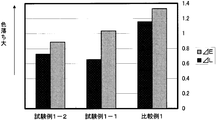
- FIG. 2 shows the results of measurement of lightness difference ( ⁇ L) and color difference ( ⁇ E) before and after shampooing after hair dyeing.
- the (a) ionic surfactant used in the present invention is a surfactant that is ionized in an aqueous solution and has a charge. Depending on the type of charge, the amphoteric surfactant, the cationic surfactant, and the anionic surfactant are used. are categorized.
- the amphoteric surfactant has at least one cationic functional group and one anionic functional group, becomes cationic when the solution is acidic, and anionic when the solution is alkaline, and is close to a nonionic surfactant near the isoelectric point. It has properties.
- Amphoteric surfactants are classified into carboxylic acid type, sulfate ester type, sulfonic acid type and phosphate ester type depending on the type of anionic group.
- the carboxylic acid type, sulfate type and sulfonic acid type are preferred in the present invention.
- Carboxylic acid types are further classified into amino acid types and betaine types. Particularly preferred is a betaine type.
- imidazoline-based amphoteric surfactants for example, 2-undecyl-N, N, N- (hydroxyethylcarboxymethyl) -2-imidazoline sodium, 2-cocoyl-2-imidazolinium hydroxide) 1-carboxyethyloxy disodium salt
- betaine surfactants for example, 2-heptadecyl-N-carboxymethyl-N-hydroxyethylimidazolinium betaine, lauryldimethylaminoacetic acid betaine, alkylbetaine, amide betaine, sulfone) Betaine
- cationic surfactant examples include quaternary ammonium salts such as cetyltrimethylammonium chloride, stearyltrimethylammonium chloride, behenyltrimethylammonium chloride, behenyldimethylhydroxyethylammonium chloride, stearyldimethylbenzylammonium chloride, and cetyltriethylammonium methylsulfate. Can be mentioned.
- stearic acid diethylaminoethylamide stearic acid dimethylaminoethylamide, palmitic acid diethylaminoethylamide, palmitic acid dimethylaminoethylamide, myristic acid diethylaminoethylamide, myristic acid dimethylaminoethylamide, behenic acid diethylaminoethylamide, behenic acid dimethyl Aminoethylamide, stearic acid diethylaminopropylamide, stearic acid dimethylaminopropylamide, palmitic acid diethylaminopropylamide, palmitic acid dimethylaminopropylamide, myristic acid diethylaminopropylamide, myristic acid dimethylaminopropylamide, behenic acid diethylaminopropylamide, behenine Amidoamino such as dimethylaminopropylamide Compounds
- Anionic surfactants include fatty acid soap, N-acyl glutamate, carboxylate type such as alkyl ether acetic acid, sulfonic acid type such as ⁇ -olefin sulfonate, alkane sulfonate, alkylbenzene sulfonic acid, higher alcohol sulfate It is classified into a sulfate ester salt type such as an ester salt and a phosphate ester salt type. Carboxylate type, sulfonic acid type and sulfate ester type are preferred, and sulfate ester type is particularly preferred.
- fatty acid soap eg, sodium laurate, sodium palmitate, etc.
- higher alkyl sulfate ester salt eg, sodium lauryl sulfate, potassium lauryl sulfate
- alkyl ether sulfate ester salt eg, POE- Lauryl sulfate triethanolamine, POE-sodium lauryl sulfate, etc.
- N-acyl sarcosine acid eg, sodium lauroyl sarcosine, etc.
- higher fatty acid amide sulfonate eg, sodium N-myristoyl-N-methyltaurine, coconut oil fatty acid
- phosphoric ester salts POE-oleyl ether sodium phosphate, POE-stearyl ether phosphoric acid etc.
- sulfosuccinates eg di-2-ethylhex
- amphoteric surfactants and anionic surfactants when mixed in an aqueous solution, reduce the interfacial tension with respect to oil.
- amphoteric surfactant, cationic surfactant and anionic surfactant when mixed in an aqueous solution, reduce the interfacial tension with respect to oil.
- the interfacial tension is not sufficiently lowered, and a bicontinuous microemulsion phase cannot be obtained or obtained. Even in such a case, the generation region is narrow, and the stability may not be sufficiently satisfied in practical use.
- the ionic surfactant includes an anionic surfactant, and further includes one or more selected from an amphoteric surfactant and / or a cationic surfactant.
- the mass ratio of the anionic surfactant to the amphoteric surfactant and / or the cationic surfactant is (anionic surfactant): (amphoteric interface).
- Activators and / or cationic surfactants) 2: 8 to 8: 2.
- the blending amount of the (a) ionic surfactant is preferably 0.1 to 50% by mass, more preferably 0.3 to 30% by mass with respect to the total amount of the first agent or the second agent. .
- (B) Amphiphilic substance having a ratio of (inorganic value / organic value) in the range of 0.8 to 1.5 in the present specification, the amphiphilic substance is simply referred to as a surfactant aid).
- a surfactant aid also called a cosurfactant
- the balance between the lipophilic group and the hydrophilic group is important. As an index, there is a method of quantifying the balance between the lipophilicity and the hydrophilicity as the organic value and the inorganic value from the structure of the compound.
- the value of (inorganic value / organic value) ratio needs to be in the range of 0.8 to 1.5.
- the (inorganic value / organic value) ratio of each compound is obtained, and the average value must be within the range of 0.8 to 1.5. .
- the range of 0.9 to 1.3 is particularly desirable.
- amphiphilic substances (surfactant aids) having a ratio of (inorganic value / organic value) in the range of 0.8 to 1.5 are monoglycerin derivatives, diglycerin derivatives, propylene glycol. It can be appropriately selected from among derivatives, butylene glycol derivatives and the like.
- the value of (inorganic value / organic value) ratio is a well-known concept called IOB value, and “inorganic value” and “organic value” corresponding to various atoms or functional groups are set, By integrating the “inorganic value” and “organic value” of all atoms and functional groups in the organic compound, the value (IOB value) of the (inorganic value / organic value) ratio of the organic compound is calculated.
- IOB value Inorganic value / organic value
- the value of (inorganic value / organic value) ratio may be referred to as an IOB value.
- monoglycerin derivatives specifically, monooctanoic acid monoglycerin ester, monooctyl monoglyceryl ether, monononanoic acid monoglyceryl ester, monononyl monoglyceryl ether, monodecanoic acid monoglyceryl ester, monodecyl monoglyceryl ether, Monoundecylenic acid monoglycerin ester, monoundecylenyl monoglyceryl ether, monododecanoic acid monoglycerin ester (monolauric acid monoglyceryl ester), monododecyl monoglyceryl ether (monolauryl monoglyceryl ether), monotetradecanoic acid monoglycerin ester (monomyristin) Acid monoglycerin ester), monohexadecanoic acid monoglycerin ester (monopalmitic acid monoglycerin ester) , Monoocta
- the diglycerin derivative specifically, monooctanoic acid diglycerin ester, monooctyl diglyceryl ether, monodecanoic acid diglycerin ester, monodecyl diglyceryl ether, monoundecylenic acid diglycerin ester, monoundecylenyl diglyceride Glyceryl ether, monododecanoic acid diglycerin ester (monolauric acid diglycerin ester), monododecyl diglyceryl ether (monolauryl diglyceryl ether), monotetradecanoic acid diglycerin ester (monomyristic acid diglycerin ester), monohexadecanoic acid diglycerin ester (Monopalmitic acid diglycerin ester), monooleic acid diglycerin ester, monoisostearic acid diglycerin ester and the like.
- propylene glycol derivatives specifically, propylene glycol octoate, octyl propylene glycol, propylene glycol decanoate, decyl propylene glycol, propylene glycol dodecanoate (propylene glycol laurate), dodecyl propylene glycol (lauryl propylene glycol) And propylene glycol tetradecanoate (propylene glycol myristate), tetradecyl propylene glycol (myristyl propylene glycol) and the like.
- butylene glycol derivative examples include butylene glycol octoate, octyl butylene glycol, butylene glycol decanoate, decyl butylene glycol, butylene glycol dodecanoate (butylene glycol laurate), dodecyl butylene glycol (lauryl butylene glycol) , Tetradecanoic acid butylene glycol (myristic acid butylene glycol), tetradecyl butylene glycol (myristyl butylene glycol) and the like.
- Examples include monoethanolamide derivatives, monoethanolamine derivatives, diethanolamide derivatives, and diethanolamine derivatives. Specifically, lauric acid diethanolamide, coconut oil fatty acid diethanolamide, undecylenic acid monoethanolamide, lauric acid monoethanolamide, coconut oil fatty acid monoethanolamide, coconut oil fatty acid (POE) 2 monoethanolamide, coconut oil fatty acid N -Methyl monoethanolamide, lauryl diethanolamine, coconut oil fatty acid dimethylaminopropylamide and the like.
- lauric acid diethanolamide coconut oil fatty acid diethanolamide, undecylenic acid monoethanolamide
- lauric acid monoethanolamide coconut oil fatty acid monoethanolamide
- coconut oil fatty acid (POE) 2 monoethanolamide coconut oil fatty acid N -Methyl monoethanolamide
- lauryl diethanolamine coconut oil fatty acid dimethylaminopropylamide and the like.
- amphiphilic substance whose ratio of (inorganic value / organic value) ratio is in the range of 0.8 to 1.5 is based on the total amount of the first agent or the second agent.
- the content is preferably 0.1 to 50% by mass, and more preferably 0.3 to 30% by mass.
- the (d) nonionic surfactant used in the present invention is a surfactant that is not ionized in an aqueous solution and has no electric charge.
- a type using alkyl and a type using dimethyl silicone are known.
- glycerin fatty acid ester for example, glycerin fatty acid ester, ethylene oxide derivative of glycerin fatty acid ester, polyglycerin fatty acid ester, propylene glycol fatty acid ester, ethylene oxide derivative of propylene glycol fatty acid ester, polyethylene glycol fatty acid ester, polyethylene glycol alkyl ether
- examples include polyethylene glycol alkylphenyl ether, polyethylene glycol castor oil derivatives, polyethylene glycol hydrogenated castor oil derivatives, and the like.
- examples of the latter include polyether-modified silicone and polyglycerin-modified silicone. A type using alkyl as a hydrophobic group is preferred.
- lipophilic nonionic surfactant used in the present invention include sorbitan fatty acid esters (for example, sorbitan monooleate, sorbitan monoisostearate, sorbitan monolaurate, sorbitan monopalmitate, Sorbitan monostearate, sorbitan sesquioleate, sorbitan trioleate, penta-2-ethylhexyl diglycerol sorbitan, tetra-2-ethylhexyl diglycerol sorbitan, etc.), glycerin polyglycerin fatty acids (eg mono cottonseed oil fatty acid glycerin, monoeruka Acid glycerin, sesquioleic acid glycerin, glyceryl monostearate, ⁇ , ⁇ '-oleic acid pyroglutamic acid glycerin, monostearic acid glycerin malic acid, etc.), propylene glycol And
- hydrophilic nonionic surfactant used in the present invention include POE-sorbitan fatty acid esters (for example, POE-sorbitan monooleate, POE-sorbitan monostearate, POE-sorbitan).
- POE sorbite fatty acid esters for example, POE-sorbite monolaurate, POE-sorbite monooleate, POE-sorbite pentaoleate, POE-sorbite monostearate, etc.
- POE-glycerin fatty acid esters for example, POE-glycerin monostearate, POE-glycerin monoisostearate, POE-glycerin triisostearate, etc.
- POE-fatty acid esters Eg POE-distearate, POE-monodiolate, ethylene glycol distearate, etc.
- POE-alkyl ethers eg POE-lauryl ether, POE-oleyl ether, POE-stearyl ether, POE-behenyl ether, POE-2- Octyldodecyl ether, POE-cholest
- the HLB of the nonionic surfactant is preferably in the range of 5-14.
- isostearyl glyceryl ether (HLB value 5), isostearic acid polyoxyethylene hydrogenated castor oil (HLB value 5), diisostearic acid PEG (6) (HLB value 5), dioleic acid PEG (6) (HLB) Value 5), polyglyceryl-3 diisostearate (HLB value 5), sorbitan distearate (HLB value 5), PEG-10 glyceryl triisostearate (HLB value 5), PEG-15 hydrogenated castor oil (HLB value) 5), POE (5) lauryl ether isostearate (HLB value 5), POE (2) cetyl ether (HLB value 5), PEG-3 glyceryl isostearate (HLB value 6), diisostearate PEG-8 (HLB value) 6), triisostearic acid POE (20) water Castor oil (HLB value 5), isostearic acid polyoxy
- the blending amount of the nonionic surfactant is preferably 0.5 to 70% by mass, more preferably 1 to 50% by mass, based on the total amount of the first agent or the second agent.
- (E) Oil examples of the (e) oil used in the present invention include hydrocarbon oils, higher fatty acids, higher alcohols, synthetic ester oils, silicone oils, liquid oils, solid oils, waxes and the like that are usually used in cosmetics, quasi drugs, and the like. 1 type, or 2 or more types of oily components can be used.
- hydrocarbon oil examples include liquid paraffin, ozokerite, squalane, pristane, paraffin, ceresin, squalene, petrolatum, and microcrystalline wax.
- higher fatty acids examples include lauric acid, myristic acid, palmitic acid, stearic acid, behenic acid, oleic acid, undecylenic acid, toluic acid, isostearic acid, linoleic acid, linolenic acid, eicosapentaenoic acid (EPA), docosahexaenoic acid (DHA) ) And the like.
- higher alcohols examples include linear alcohols (eg, lauryl alcohol, cetyl alcohol, stearyl alcohol, behenyl alcohol, myristyl alcohol, oleyl alcohol, cetostearyl alcohol), branched chain alcohols (eg, monostearyl glycerin ether (batyl alcohol)) -2-decyltetradecinol, lanolin alcohol, cholesterol, phytosterol, hexyl decanol, isostearyl alcohol, octyldodecanol, etc.).
- linear alcohols eg, lauryl alcohol, cetyl alcohol, stearyl alcohol, behenyl alcohol, myristyl alcohol, oleyl alcohol, cetostearyl alcohol
- branched chain alcohols eg, monostearyl glycerin ether (batyl alcohol)) -2-decyltetradecinol, lanolin alcohol, cholesterol, phytosterol, hexyl decanol, is
- Synthetic ester oils include, for example, octyl octoate, nonyl nonanoate, cetyl octanoate, isopropyl myristate, octyldodecyl myristate, isopropyl palmitate, butyl stearate, hexyl laurate, myristyl myristate, decyl oleate, dimethyloctane Hexyldecyl acid, cetyl lactate, myristyl lactate, lanolin acetate, isocetyl stearate, isocetyl isostearate, cholesteryl 12-hydroxystearate, ethylene glycol di-2-ethylhexanoate, dipentaerythritol fatty acid ester, N-alkyl monoisostearate Glycol, neopentyl glycol dicaprate, tripropylene glycol pivalate, diisosteary
- silicone oil examples include linear polysiloxanes (for example, dimethylpolysiloxane, methylphenylpolysiloxane, diphenylpolysiloxane, etc.), cyclic polysiloxanes (for example, octamethylcyclotetrasiloxane, decamethylcyclopentasiloxane, dodecamethylcyclohexa Siloxane etc.) Silicone resin, silicone rubber, various modified polysiloxanes (amino-modified polysiloxane, polyether-modified polysiloxane, alkyl-modified polysiloxane, fluorine-modified polysiloxane, etc.), acrylic silicones forming a three-dimensional network structure Etc.
- linear polysiloxanes for example, dimethylpolysiloxane, methylphenylpolysiloxane, diphenylpolysiloxane, etc.
- liquid oils and fats examples include avocado oil, camellia oil, turtle oil, macadamia nut oil, corn oil, mink oil, olive oil, rapeseed oil, egg yolk oil, sesame oil, persic oil, wheat germ oil, southern oil, castor oil, linseed oil , Safflower oil, cottonseed oil, eno oil, soybean oil, peanut oil, tea seed oil, kaya oil, rice bran oil, cinnagiri oil, Japanese kiri oil, jojoba oil, germ oil-triglycerin and the like.
- solid fat examples include cacao butter, palm oil, horse fat, hydrogenated palm oil, palm oil, beef tallow, sheep fat, hydrogenated beef tallow, palm kernel oil, pork fat, beef bone fat, owl kernel oil, hydrogenated oil, cattle Leg fats, moles, hydrogenated castor oil and the like.
- waxes examples include beeswax, candelilla wax, cotton wax, carnauba wax, bayberry wax, ibota wax, whale wax, montan wax, nuka wax, lanolin, kapok wax, lanolin acetate, liquid lanolin, sugar cane wax, lanolin fatty acid isopropyl, hexyl laurate, Examples include reduced lanolin, jojoballow, hard lanolin, shellac wax, POE lanolin alcohol ether, POE lanolin alcohol acetate, POE cholesterol ether, lanolin fatty acid polyethylene glycol, and POE hydrogenated lanolin alcohol ether.
- the blending amount of the oil is preferably 0.1 to 50% by mass, and more preferably 0.2 to 40% by mass with respect to the total amount of the first agent or the second agent.
- the water contained in the oxidative hair dye of the present invention is not particularly limited, and specific examples thereof include purified water, ion exchange water, and tap water.
- the amount of water of component (c) or component (f) is preferably 1 to 95% by mass, more preferably 5 to 80% by mass, based on the total amount of the first agent or the second agent.
- alkaline agent '' examples of the alkaline agent contained in the first agent of the oxidative hair dye of the present invention include ammonia, ammonium salts such as ammonium hydrogen carbonate and ammonium phosphate, alkanolamines such as monoethanolamine, diethanolamine and triethanolamine, arginine and lysine.
- Basic amino acids such as guanidine, organic amines such as guanidine, 2-amino-2-methylpropane and monoisopropanolamine, and inorganic alkalis such as sodium hydroxide and potassium hydroxide can be used.
- a buffer solution for example, phosphoric acid-phosphoric acid sodium salt
- Preferred alkali agents are ammonia, ammonium salts, and alkanolamines. These alkali agents can be used alone or in admixture of two or more.
- the blending amount of the alkali agent is appropriately changed depending on the desired dyeing or bleaching effect, but the general blending amount is adjusted so that the pH of the first agent falls within the range of 8.0 to 13.0. Specifically, it is preferable to contain 0.1 to 10% by mass, particularly 0.5 to 5% by mass with respect to the entire composition when the first agent and the second agent are mixed. If the pH is less than 8, the bleaching effect may be inferior, and if it exceeds 13, the skin irritation and hair damage are severe, which is not desirable.
- Oxidative dye examples of the oxidation dye blended in the first agent of the hair dye of the present invention include p-phenylenediamine, p-toluylenediamine, N-methyl-p-phenylenediamine, N, N-dimethyl-p-phenylene.
- Diamine N, N-diethyl-2-methyl-p-phenylenediamine, N-ethyl-N- (hydroxyethyl) -p-phenylenediamine, chloro-p-phenylenediamine, 2- (2'-hydroxyethylamino) -5-aminotoluene, N, N-bis- (2-hydroxyethyl) -p-phenylenediamine, methoxy-p-phenylenediamine, 2,6-dichloro-p-phenylenediamine, 2-chloro-6-bromo- p-phenylenediamine, 2-chloro-6-methyl-p-phenylenediamine, 6-methoxy-3-methyl-p-phenyle
- One or more NH2-groups such as diamine, 2,5-diaminoanisole, N- (2-hydroxypropyl) -p-phenylenediamine, N-2-methoxyethyl-p-phenylenedi
- a coupler can be blended, for example, ⁇ -naphthol, o-cresol, m-cresol, 2,6-dimethylphenol, 2,5-dimethylphenol, 3,4-dimethylphenol. 3,5-dimethylphenol, benzcatechin, pyrogallol, 1,5-dihydroxynaphthalene, 1,7-dihydroxynaphthalene, 5-amino-2-methylphenol, 5- (2'-hydroxyethylamino) -4 -Methoxyphenol, hydroquinone, 2,4-diaminoanisole, m-toluylenediamine, 4-aminophenol, resorcin, resorcin monomethyl ether, m-phenylenediamine, 1-phenyl-3-methyl-5-pyrazolone 1-phenyl-3-amino-5-pyrazolone, 1-phenyl-3,5-diketo Lazolidine, 1-methyl-7-dimethylamino-4-hydroxy-2-quinolone
- the blending amount of the oxidation dye is preferably 0.001 to 5% by mass, and more preferably 0.01 to 3% by mass, based on the total amount of the first agent.
- oxidizing agent blended with the second agent examples include hydrogen peroxide, urea peroxide, persulfate, perborate, percarbonate, bromate, periodate, and the like. It is preferable to use hydrogen.
- the content of the oxidizing agent is preferably 0.1 to 12% by mass in the second agent, and more preferably 1 to 9% by mass. If it is less than 0.1% by mass, the hair bleaching effect is inferior, and if it exceeds 12% by mass, no further effect can be expected, and skin irritation and damage to the hair become serious.
- one or both of the first agent and the second agent are other components used in normal cosmetics, for example, oily components other than those described above, surfactants, silicones, aromatic alcohols, many Alcohols such as monohydric alcohols, amino acids, conditioning agents, thickeners, pH adjusters, moisturizers, animal and plant extracts, vitamins, dyes, fragrances, pigments, preservatives, UV absorbers, sequestering agents, reductions
- One or two or more kinds of agents and the like can be appropriately blended within a range not impairing the effects of the present invention.
- blended of this invention is illustrated concretely.
- Water-soluble alcohols include lower alcohols, polyhydric alcohols, polyhydric alcohol polymers, dihydric alcohol alkyl ethers, dihydric alcohol ether esters, glycerin monoalkyl ethers, sugar alcohols, monosaccharides, oligosaccharides, polysaccharides and derivatives thereof. It is 1 type, or 2 or more types chosen from.
- lower alcohols examples include ethanol, propanol, isopropanol, isobutyl alcohol, t-butyl alcohol and the like.
- polyhydric alcohol examples include dihydric alcohols (eg, dipropylene glycol, 1,3-butylene glycol, ethylene glycol, trimethylene glycol, 1,2-butylene glycol, tetramethylene glycol, 2,3-butylene glycol, Pentamethylene glycol, 2-butene-1,4-diol, hexylene glycol, octylene glycol, etc.), trihydric alcohol (eg, glycerin, trimethylolpropane, etc.), tetrahydric alcohol (eg, diglycerin, 1,2, , 6-hexanetriol, etc.), pentahydric alcohol (eg, xylitol, triglycerin, etc.), hexahydric alcohol (eg, sorbitol, mannitol, etc.), polyhydric alcohol polymer (eg, diethylene glycol) Dipropylene glycol-triethylene glycol, polypropylene glycol, tetra
- monosaccharides include tricarbon sugars (eg, D-glyceryl aldehyde, dihydroxyacetone, etc.), tetracarbon sugars (eg, D-erythrose, D-erythrulose, D-threose, erythritol, etc.), pentose sugars (eg, L-arabinose, D-xylose, L-lyxose, D-arabinose, D-ribose, D-ribulose, D-xylulose, L-xylulose, etc., hexose (eg, D-glucose, D-talose, D -Bucicose, D-galactose, D-fructose, L-galactose, L-mannose, D-tagatose, etc.), pentose sugar (eg, aldheptose, heprose, etc.), octose sugar (eg
- Oligosaccharides include, for example, sucrose, guntianose, umbelliferose, lactose, planteose, isoliquinoses, ⁇ , ⁇ -trehalose, raffinose, lycnose, umbilicin, stachyose verbus courses, and the like.
- polysaccharide examples include cellulose, quince seed, starch, galactan, dermatan sulfate, glycogen, gum arabic, heparan sulfate-tragacanth gum, keratan sulfate, chondroitin, xanthan gum, guar gum, dextran, kerato sulfate, locust bean gum, saxino glucan, etc. Is mentioned.
- polyols include polyoxyethylene methyl glucoside (Glucam E-10), polyoxypropylene methyl glucoside (Glucam P-10) and the like.
- thickeners may be added to the oxidative hair dye of the present invention.
- thickeners include gum arabic, carrageenan, colored yam, gum tragacanth, carob gum, quince seed (malmello), casein, dextrin, gelatin, sodium pectate, sodium alginate, methylcellulose, ethylcellulose, CMC, hydroxyethylcellulose, hydroxypropyl Cellulose, PVA, PVM, PVP, sodium polyacrylate, carboxyvinyl polymer, locust bean gum, guar gum, tamarind gum, cellulose dialkyldimethylammonium sulfate, xanthan gum, magnesium aluminum silicate, bentonite, hectorite, AlMg silicate (Beegum), Examples thereof include laponite and silicic anhydride.
- natural water-soluble polymers include plant-based polymers (for example, gum arabic, gum tragacanth, galactan, guar gum, carob gum, colored yam, carrageenan, pectin, agar, quince seed (malmello), alge colloid (guckweed extract), starch (Rice, corn, potato, wheat), glycyrrhizic acid), microbial polymers (eg, xanthan gum, dextran, succinoglucan, pullulan, etc.), animal polymers (eg, collagen, casein, albumin, gelatin, etc.), etc. Is mentioned.
- plant-based polymers for example, gum arabic, gum tragacanth, galactan, guar gum, carob gum, colored yam, carrageenan, pectin, agar, quince seed (malmello), alge colloid (guckweed extract), starch (Rice, corn, potato, wheat), glycyrrhizic acid),
- semi-synthetic water-soluble polymers include starch polymers (eg, carboxymethyl starch, methylhydroxypropyl starch, etc.), cellulose polymers (methylcellulose, ethylcellulose, methylhydroxypropylcellulose, hydroxyethylcellulose, sodium cellulose sulfate). Hydroxypropylcellulose, carboxymethylcellulose, sodium carboxymethylcellulose, crystalline cellulose, cellulose powder, etc.), alginic acid polymers (for example, sodium alginate, propylene glycol alginate, etc.) and the like.
- starch polymers eg, carboxymethyl starch, methylhydroxypropyl starch, etc.
- cellulose polymers methylcellulose, ethylcellulose, methylhydroxypropylcellulose, hydroxyethylcellulose, sodium cellulose sulfate. Hydroxypropylcellulose, carboxymethylcellulose, sodium carboxymethylcellulose, crystalline cellulose, cellulose powder, etc.
- alginic acid polymers for example, sodium alginate
- Examples of the synthetic water-soluble polymer include vinyl polymers (for example, polyvinyl alcohol, polyvinyl methyl ether, polyvinyl pyrrolidone, carboxyvinyl polymer, etc.) and polyoxyethylene polymers (for example, polyethylene glycol 20,000, 40). , 000, 60,000, etc.), acrylic polymers (for example, sodium polyacrylate, polyethyl acrylate, polyacrylamide, etc.), polyethyleneimine, cationic polymers and the like.
- vinyl polymers for example, polyvinyl alcohol, polyvinyl methyl ether, polyvinyl pyrrolidone, carboxyvinyl polymer, etc.
- polyoxyethylene polymers for example, polyethylene glycol 20,000, 40. , 000, 60,000, etc.
- acrylic polymers for example, sodium polyacrylate, polyethyl acrylate, polyacrylamide, etc.
- polyethyleneimine for example, sodium polyacrylate, polyethyl acrylate, polyacrylamide, etc.
- UV absorber You may mix
- the water-soluble ultraviolet absorber include 2,4-dihydroxybenzophenone, 2,2′-dihydroxy-4-methoxybenzophenone, 2,2′-dihydroxy-4,4′-dimethoxybenzophenone, 2,2 ′, 4,4 '-Tetrahydroxybenzophenone, 2-hydroxy-4-methoxybenzophenone, 2-hydroxy-4-methoxy-4'-methylbenzophenone, 2-hydroxy-4-methoxybenzophenone-5-sulfonate, 4-phenylbenzophenone, 2 -Benzophenone UV absorbers such as ethylhexyl-4'-phenyl-benzophenone-2-carboxylate, 2-hydroxy-4-n-octoxybenzophenone, 4-hydroxy-3-carboxybenzophenone, phenylbenzimidazole-5-sulfone Acid and its salts Benzimidazole ultraviolet absorbers such
- oil-soluble ultraviolet absorbers examples include paraaminobenzoic acid (PABA), PABA monoglycerin ester, N, N-dipropoxy PABA ethyl ester, N, N-diethoxy PABA ethyl ester, N, N-dimethyl PABA ethyl ester, N, Benzoic acid UV absorbers such as N-dimethyl PABA butyl ester; Anthranilic acid UV absorbers such as homomenthyl-N-acetylanthranilate; Amyl salicylate, menthyl salicylate, homomenthyl salicylate, octyl salicylate, phenyl salicylate, benzyl salicylate , Salicylic acid ultraviolet absorbers such as p-isopropanolphenyl salicylate; octylcinnamate, ethyl-4-isopropylcinnamate, methyl-2,5-diisopropylcinnamate
- Powder ingredient Various powder components may be blended in the oxidative hair dye of the present invention.
- the powder component include inorganic powders (for example, talc, kaolin, mica, sericite (sericite), muscovite, phlogopite, synthetic mica, saucite, biotite, permiculite, magnesium carbonate, calcium carbonate, silicic acid.
- Red No. 104 Red No. 106, Red No. 227, Red No. 230, Red No. 401, Red No. 505, Orange No. 205, Yellow No. 4, Yellow No. 5, Yellow No. 202, Yellow No. 203, Green No. 3 and Blue No. 1
- natural pigments eg, chlorophyll, ⁇ -carotene, etc.
- humectant examples include chondroitin sulfate, hyaluronic acid, mucoitin sulfate, caronic acid, atelocollagen, cholesteryl-12-hydroxystearate, sodium lactate, bile salt, DL-pyrrolidone carboxylate, short chain soluble collagen, diglycerin (EO) PO adduct, Izayoi rose extract, Achillea millefolium extract, Merirot extract and the like.
- Metal sequestering agent You may mix
- the sequestering agent include 1-hydroxyethane-1,1-diphosphonic acid, 1-hydroxyethane-1,1-diphosphonic acid tetrasodium salt, disodium edetate, trisodium edetate, and tetrasodium edetate.
- amino acid Various amino acids may be added to the oxidative hair dye of the present invention.
- amino acids include neutral amino acids (eg, threonine, cysteine, etc.), basic amino acids (eg, hydroxylysine, etc.), and the like.
- amino acid derivatives include acyl sarcosine sodium (lauroyl sarcosine sodium), acyl glutamate, acyl ⁇ -alanine sodium, glutathione and the like.
- Organic amine Various organic amines may be blended in the oxidative hair dye of the present invention.
- examples of the organic amine include monoethanolamine, diethanolamine, triethanolamine, morpholine, tetrakis (2-hydroxypropyl) ethylenediamine, triisopropanolamine, 2-amino-2-methyl-1,3-propanediol, 2-amino Examples include -2-methyl-1-propanol.
- Polymer emulsion You may mix
- the polymer emulsion include an acrylic resin emulsion, a polyethyl acrylate emulsion, an acrylic resin liquid, a polyacryl alkyl ester emulsion, a polyvinyl acetate resin emulsion, and a natural rubber latex.
- pH adjuster examples include buffers such as lactic acid-sodium lactate, citric acid-sodium citrate, and succinic acid-sodium succinate.
- vitamins Various vitamins may be added to the oxidative hair dye of the present invention.
- vitamins include vitamins A, B1, B2, B6, C, E and derivatives thereof, pantothenic acid and derivatives thereof, biotin and the like.
- antioxidant examples include tocopherols, dibutylhydroxytoluene, butylhydroxyanisole, gallic acid esters and the like.
- antioxidant assistant examples include phosphoric acid, citric acid, ascorbic acid, maleic acid, malonic acid, succinic acid, fumaric acid, kephalin, hexametaphosphate, phytic acid, and ethylenediaminetetraacetic acid.
- ingredients that can be blended include, for example, preservatives (methylparaben, ethylparaben, butylparaben, phenoxyethanol, etc.), anti-inflammatory agents (for example, glycyrrhizic acid derivatives, glycyrrhetinic acid derivatives, salicylic acid derivatives, hinokitiol, zinc oxide, allantoin, etc.), Whitening agents (eg, placenta extract, yukinoshita extract, arbutin, etc.), various extracts (eg, buckwheat, auren, shikon, peonies, assembly, birch, sage, loquat, carrot, aloe, mallow, iris, grape, yokoinin , Loofah, lily, saffron, senkyu, ginger, hypericum, onionis, garlic, pepper, chimpi, toki, seaweed, etc.), activator (eg, royal jelly, photosen
- the oxidative hair dye of the present invention comprises the above-mentioned alkaline agent, oxidant, oxidative dye (but not blended in the case of hair bleach), and components (a) to (a) to form a bicontinuous microemulsion phase or lamellar liquid crystal phase.
- An oxidative hair dye comprising the first agent and the second agent, which contains (c) or components (d) to (f) and other components are added as necessary within a range not impairing the effects of the present invention. Yes, the first agent and the second agent are mixed, and contain a phase showing a bicontinuous microemulsion phase or a lamellar liquid crystal phase immediately after shaking.
- the bicontinuous microemulsion phase and the lamellar liquid crystal phase which are requirements of the present invention, are in a thermodynamic equilibrium state and are generated regardless of the order of addition of the essential blending components. Therefore, any order of addition can be produced.
- a water-soluble substance such as water, a surfactant, or an alkali agent is mixed to prepare an aqueous solution having a sufficiently low interfacial tension, and then a surfactant assistant (copolymer).
- Surfactant and oil-soluble substances are preferably added gradually with stirring.
- an oxidative hair dye containing a bicontinuous microemulsion phase or a lamellar liquid crystal phase it can be conveniently produced by the following steps.
- An ionic surfactant mixture in which the mixing ratio of an anionic surfactant and an amphoteric surfactant and / or a cationic surfactant is changed is prepared, and component (c) water is added to each.
- Figure 1 shows the surface tension against decane using 2-alkyl-N-carboxymethyl-N-hydroxyethylimidazolinium betaine as the amphoteric surfactant and polyoxyethylene (2 mol) sodium lauryl ether sulfate as the anionic surfactant. It is measured.
- FIG. 1 shows that the mixing ratio of the component (A) and the component (B) is 5: 5 to 9: 1, which is the mixing range where the interfacial tension is low.
- (3) Add other water-soluble additives to the ionic surfactant mixed aqueous solution having the mixing ratio obtained in (2), and stir and mix.
- Component (b) surfactant (cosurfactant) is gradually added to (3) while applying a relatively strong stirring force.
- the following methods 1 to 5 are effective for distinguishing between a lamellar liquid crystal phase and another optically anisotropic liquid crystal phase.
- the following methods 2 to 5 are effective.
- composition obtained by the above method contains a bicontinuous microemulsion phase or a lamellar liquid crystal phase is: 1. Observation with polarizing microscope and X-ray structural analysis 2. creation of phase equilibrium diagram; 3. Electrical conductivity measurement 4. Measurement of self-diffusion coefficient by NMR; This can be determined by electron microscope observation of a replica prepared using the freeze fracture method. It may be determined by any method. "1. Observation with polarizing microscope and X-ray structural analysis” According to observation with a polarizing microscope and X-ray structure analysis, when an anisotropic band-like pattern is observed and a scattering peak corresponding to the layer interval appears, it is considered to be a lamellar liquid crystal phase.
- a planar lamellar liquid crystal phase is obtained if the liquid is low viscosity, and a concentric lamellar liquid crystal is used if the liquid is slightly high viscosity. Further, when an anisotropic streak pattern is observed and a sharp scattering peak appears in the hexagonal rod-like micelle interval period, it is considered to be a hexagonal liquid crystal phase. When it is a dark field by polarization microscope observation and a spot with cubic symmetry appears, it is considered to be a cubic liquid crystal phase. “2.
- phase equilibrium diagram When a phase equilibrium diagram of a three-component system composed of water / oil component / surfactant (oil component includes cosurfactant surfactant) is created, the bicontinuous microemulsion phase is isotropic and transparent. Viscosity is a one-phase region and is not a region that is continuous from both water and oil peaks, and the concentration range in which a lamellar liquid crystal phase is generated is a region that is adjacent to an aqueous micellar phase or a bicontinuous microemulsion phase. However, this feature differs depending on the system (component) to be constructed. “3.
- the present invention is an oxidative hair dye characterized by mixing a first agent and a second agent and containing a phase showing a bicontinuous microemulsion or a lamellar liquid crystal phase immediately after shaking. Therefore, the 1st agent and 2nd agent before mixing may contain the phase which shows a bicontinuous microemulsion phase or a lamellar liquid crystal phase, and does not need to contain it.
- composition of the final composition (after mixing of the first and second agents) is determined by the above method, a component that forms a bicontinuous microemulsion phase or a lamellar liquid crystal phase in consideration of the pH stability of various components It is desirable that the essential components (a) to (c) or the components (d) to (f) are appropriately distributed to the first agent or the second agent.
- a compounding quantity represents the mass%.
- Evaluation (1) Association state The association state of 10 g of the dye solution in which the first agent and the second agent were mixed was evaluated. The above-described method was used to determine the meeting state.
- Evaluation (2) Dyeing effect 10 g of the dyeing solution in which the first agent and the second agent are mixed is uniformly applied to a human hair bundle having a weight of 3 g and a length of 15 cm, left for 20 minutes, and then thoroughly washed. It was dried and evaluated based on the following criteria by seven professional subjects.
- ⁇ : Slightly bad The number of subjects who answered that the staining effect was high was 2 to 3 of 7)
- ⁇ : Poor the number of subjects who answered that the staining effect was high was 0 to 1 out of 7)
- Evaluation (3) Color unevenness after dyeing 10 g of a dye solution in which the first agent and the second agent are mixed is uniformly applied to a human hair bundle having a weight of 3 g and a length of 15 cm, and left for 20 minutes. After washing, it was dried and evaluated by 7 professional subjects based on the following criteria.
- A Very good (the number of subjects who answered that there was little color unevenness after dyeing was 6 to 7 out of 7)
- ⁇ : Good the number of subjects who answered that there was little color unevenness after dyeing was 4-5 out of 7)
- ⁇ Slightly bad (2 to 3 of 7 subjects answered that there was little color unevenness after staining)
- ⁇ Poor (the number of subjects who answered that there was little color unevenness after staining was 0 to 1 of 7 subjects)
- Healthy hair Black hair bundle Damaged hair: Healthy hair subjected to bleach treatment at room temperature for 20 minutes
- High-damaged hair Healthy hair subjected to bleach treatment at room temperature for 45 minutes
- Test Example 1-1 Example of the present invention
- Test Example 1-2 Example of the present invention was It contained a bicontinuous microemulsion phase, and was excellent in dyeing effect and feel of hair after dyeing for healthy hair, damaged hair, and high-damaged hair.
- Comparative Example 1 contains a nonionic surfactant and an oil component, but its blending amount and HLB are not properly adjusted.
- the hair dye which does not contain a nuus microemulsion phase and a lamellar liquid crystal phase.
- the hair was uniformly applied to a human hair bundle having a weight of 3 g and a length of 15 cm, left for 20 minutes, and then thoroughly washed and dried. Further, shampoo washing was performed twice thereafter, and the brightness difference ( ⁇ L) and color difference ( ⁇ E) before and after shampooing were measured. The measurement results are shown in FIG.
- Test Example 1-1 containing the lamellar liquid crystal phase and Test Example 1-2 containing the bicontinuous microemulsion phase immediately after shaking after mixing the first agent and the second agent are: It was confirmed that the color difference before and after the shampoo was small as compared with Comparative Example 1 in which neither the lamellar liquid crystal phase nor the bicontinuous microemulsion phase was contained.
- the oxidative hair dye of the present invention containing a phase showing a bicontinuous microemulsion or a lamellar liquid crystal phase immediately after shaking is mixed with the first agent and the second agent has little color fading due to shampoo after hair dyeing, excellent It was found to be a base.
- Test Example 2-2 containing no surfactant assistant (Comparative Example containing neither the lamellar liquid crystal phase nor the bicontinuous microemulsion phase) is inferior in the dyeing effect and hair feel to healthy hair. It was a thing.
- Test Example 2-1 Example of the present invention
- a surfactant aid contains a lamellar liquid crystal phase when mixed with one agent and two agents, and can be used for healthy hair, damaged hair, or high-damaged hair. However, the dyeing effect and the feel of the hair after dyeing were excellent.
- Test Examples 3-1 and 3-6 in which the mass ratio of the anionic surfactant to the amphoteric surfactant is 10: 0 and 0:10 (the lamellar liquid crystal phase is also a bicontinuous microemulsion phase) Comparative Example), which also contains no hair, was inferior in dyeing effect and hair feel to healthy hair.
- Test Examples 3-2 to 5 in which the mass ratio of the anionic surfactant to the amphoteric surfactant is 2: 8 to 8: 2 is a lamellar liquid crystal when one agent and two agents are mixed. It contained a phase and was excellent in dyeing effect and feel of hair after dyeing for healthy hair, damaged hair, and high-damaged hair.
- Test Example 4-4 (Comparative Example containing neither a lamellar liquid crystal phase nor a bicontinuous microemulsion phase) having a low blending concentration of ionic surfactant and surfactant is particularly effective for healthy hair.
- the dyeing effect and hair feel were inferior.
- Test Examples 4-1 to 3 (Examples of the present invention) in which the blending concentrations of the ionic surfactant and the surfactant aid are suitable contain a lamellar liquid crystal phase when mixed with one agent and two agents, and healthy hair The dyeing effect and the hair feel after dyeing were excellent for both damaged hair and high-damaged hair.
- Nonionic surfactant formulation The oxidation hair dye of the test example which consists of a mixing
- Test Example 5-3 Comparative Example in which the lamellar liquid crystal phase does not contain the bicontinuous microemulsion phase
- Test Example 5-1 in which the association state of the surfactant was appropriately controlled by blending the nonionic surfactant and the oil component was a bicontinuous microemulsion when mixing one agent and two agents.
- Test Example 5-2 (Example of the present invention) contains a lamellar liquid crystal phase, and has a dyeing effect on the healthy hair, damaged hair, and high-damaged hair, and the feel of the hair after dyeing. It was excellent.
- the obtained oxidative hair dye was excellent in hair dyeing property, had good safety and use feeling, and had high base stability.
- Oxidative hair dye ⁇ 1 agent> (A) Lauryldimethylaminoacetic acid betaine 18 (A) Polyoxyethylene lauryl ether sulfate triethanolamine 6 Dodecylbenzenesulfonic acid triethanolamine 6 Isopropanol 9.5 Propylene glycol 10 Octyl octoate 2 Strong ammonia water (28%) 8.6 Ethanolamine 2.4 Hydrosulfite sodium 0.1 Ascorbic acid 0.3 Cationized silk protein 0.1 Edetic acid disodium 0.2 Resorcin 1 Perfume Appropriate amount (c) Purified water remainder (total 100% by mass) ⁇ 2 agents> Hydrogen peroxide solution (30%) 18 (B) Monooctyl monoglyceryl ether 8 (B) Propylene glycol laurate 7 Phosphoric acid 0.2 Sodium monohydrogen phosphate 0.2 Sodium stannate 0.02 Paraoxybenzoic acid ester appropriate amount (c) purified water remainder (A) Lauryld
- Oxidative hair dye ⁇ 1 agent> 1,3-butylene glycol 5
- D Polyoxyethylene (10EO) cetyl ether 15
- D Polyoxyethylene glyceryl oleate (8EO) 15 O- [2-hydroxy-3- (trimethylammonio) propyl] chloride Hydroxyethyl cellulose 0.5 Strong ammonia water (28%) 15
- DL-pyrrolidonecarboxylate sodium solution 0.1 Hydroxyethanediphosphonic acid tetrasodium 0.3 Resorcin 0.15 Perfume Appropriate amount
- f Purified water remaining (total 100% by mass) ⁇ 2 agents>
- E Liquid paraffin 5 Cetostearyl alcohol 2 Sodium lauryl sulfate 0.1 Hydrogen peroxide solution (30%) 18 Phosphoric acid 0.1 Anhydrous sodium monohydrogen phosphate 0.1 Sodium stannate 0.02 P-Hydroxybenzoate este
- a bicontinuous microemulsion phase or a lamellar liquid crystal phase into the base, damaged hair (chemical damage such as hair dyes and permanent agents, physical damage such as friction) It is possible to provide an oxidative hair dye excellent in dyeability for both damaged hair) and healthy hair that is not damaged. Moreover, according to this invention, it is possible to provide the oxidation hair dye which is excellent also in the inhibitory effect of the discoloration by the washing
Landscapes
- Health & Medical Sciences (AREA)
- Life Sciences & Earth Sciences (AREA)
- Veterinary Medicine (AREA)
- Animal Behavior & Ethology (AREA)
- General Health & Medical Sciences (AREA)
- Public Health (AREA)
- Birds (AREA)
- Epidemiology (AREA)
- Chemical & Material Sciences (AREA)
- Crystallography & Structural Chemistry (AREA)
- Dispersion Chemistry (AREA)
- Emergency Medicine (AREA)
- Cosmetics (AREA)
Abstract
Description
染毛剤は、ブリーチ効果を伴い元の毛髪よりも明るい色調に染色することができ、効果が持続的であることから、特に酸化染毛剤が広く利用されている。そして酸化染毛剤は、アルカリ剤及び酸化染料を含む第1剤と、酸化剤を含む第2剤からなる二剤式のものが主流となっており、これは施術の際に第1剤と第2剤を混合し、毛髪に塗布し、一定時間放置後洗い流して使用するものである。
ラメラ液晶の形成は古くから広く知られており(非特許文献5など)、クレンジング用またはマッサージ用のジェル状化粧料などの報告例がある(特許文献12など)。
(a)イオン性界面活性剤
(b)(無機性値/有機性値)比の値が0.8~1.5の範囲内である両親媒性物質
(c)水
(d)非イオン性界面活性剤
(e)油分
(f)水
「(a)イオン性界面活性剤」
本発明に用いる(a)イオン性界面活性剤は、水溶液中で電離して電荷を有する界面活性剤であり、その電荷の種類によって両性界面活性剤、カチオン性界面活性剤、アニオン性界面活性剤に分類される。
両性界面活性剤は、アニオン基の種類により、カルボン酸型、硫酸エステル型、スルホン酸型およびリン酸エステル型に分類される。本発明に好ましくはカルボン酸型、硫酸エステル型およびスルホン酸型である。カルボン酸型はさらにアミノ酸型とベタイン型に分類される。特に好ましくはベタイン型である。
具体的には、例えば、イミダゾリン系両性界面活性剤(例えば、2-ウンデシル-N,N,N-(ヒドロキシエチルカルボキシメチル)-2-イミダゾリンナトリウム、2-ココイル-2-イミダゾリニウムヒドロキサイド-1-カルボキシエチロキシ2ナトリウム塩等);ベタイン系界面活性剤(例えば、2-ヘプタデシル-N-カルボキシメチル-N-ヒドロキシエチルイミダゾリニウムベタイン、ラウリルジメチルアミノ酢酸ベタイン、アルキルベタイン、アミドベタイン、スルホベタイン等)等が挙げられる。
具体的には、例えば、脂肪酸石鹸(例えば、ラウリン酸ナトリウム、パルミチン酸ナトリウム等)、高級アルキル硫酸エステル塩(例えば、ラウリル硫酸ナトリウム、ラウリル硫酸カリウム等)、アルキルエーテル硫酸エステル塩(例えば、POE-ラウリル硫酸トリエタノールアミン、POE-ラウリル硫酸ナトリウム等)、N-アシルサルコシン酸(例えば、ラウロイルサルコシンナトリウム等)、高級脂肪酸アミドスルホン酸塩(例えば、N-ミリストイル-N-メチルタウリンナトリウム、ヤシ油脂肪酸メチルタウリンナトリウム、ラウリルメチルタウリンナトリウム等)、リン酸エステル塩(POE-オレイルエーテルリン酸ナトリウム、POE-ステアリルエーテルリン酸等)、スルホコハク酸塩(例えば、ジ-2-エチルヘキシルスルホコハク酸ナトリウム、モノラウロイルモノエタノールアミドポリオキシエチレンスルホコハク酸ナトリウム、ラウリルポリプロピレングリコールスルホコハク酸ナトリウム等)、アルキルベンゼンスルホン酸塩(例えば、リニアドデシルベンゼンスルホン酸ナトリウム、リニアドデシルベンゼンスルホン酸トリエタノールアミン、リニアドデシルベンゼンスルホン酸等)、高級脂肪酸エステル硫酸エステル塩(例えば、硬化ヤシ油脂肪酸グリセリン硫酸ナトリウム等)、N-アシルグルタミン酸塩(例えば、N-ラウロイルグルタミン酸モノナトリウム、N-ステアロイルグルタミン酸ジナトリウム、N-ミリストイル-L-グルタミン酸モノナトリウム等)、硫酸化油(例えば、ロート油等)、POE-アルキルエーテルカルボン酸、POE-アルキルアリルエーテルカルボン酸塩、α-オレフィンスルホン酸塩、高級脂肪酸エステルスルホン酸塩、二級アルコール硫酸エステル塩、高級脂肪酸アルキロールアミド硫酸エステル塩、ラウロイルモノエタノールアミドコハク酸ナトリウム、N-パルミトイルアスパラギン酸ジトリエタノールアミン、カゼインナトリウム等が挙げられる。
両性界面活性剤、カチオン性界面活性剤およびアニオン性界面活性剤の1種類のみ用いた場合には、界面張力の低下が十分でなく、バイコンティニュアスミクロエマルション相が得られないか、あるいは、得られた場合であってもその生成領域が狭く、実質上の使用にあたって安定性を十分に満たすことができない場合がある。
したがって、本発明においては、(a)イオン性界面活性剤がアニオン性界面活性剤を含み、さらに両性界面活性剤及び/又はカチオン性界面活性剤から選ばれる1種または2種以上を含むことが好ましい。
また、前記成分(a)イオン性界面活性剤において、アニオン性界面活性剤と、両性界面活性剤及び/又はカチオン性界面活性剤との質量比が、(アニオン性界面活性剤):(両性界面活性剤及び/又はカチオン性界面活性剤)=2:8~8:2であることが好ましい。
一方、(a)イオン性界面活性剤の配合量は、第1剤又は第2剤全量に対して、0.1~50質量%が好ましく、さらに好ましくは、0.3~30質量%である。
本発明に用いる(b)両親媒性物質が界面活性助剤(コサーファクタントとも呼ばれる)として機能するためには親油基と親水基のバランスが重要である。その指標として、化合物の構造から有機性値、無機性値として親油性、親水性のバランスを数値化する方法がある。本発明において界面活性助剤として機能するためには、(無機性値/有機性値)比の値が0.8~1.5の範囲内であることが必要である。いくつかの化合物を混合して用いる場合には、各化合物の(無機性値/有機性値)比を求め、その平均値が0.8~1.5の範囲内であることが必要である。特に望ましくは0.9~1.3の範囲である。
このような(無機性値/有機性値)比の値が0.8~1.5の範囲内である両親媒性物質(界面活性助剤)は、モノグリセリン誘導体、ジグリセリン誘導体、プロピレングリコール誘導体、ブチレングリコール誘導体等のなかから適宜選択することができる。
なお、(無機性値/有機性値)比の値はIOB値とも呼ばれる周知の概念であり、各種原子又は官能基に応じた「無機性値」、「有機性値」が設定されており、有機化合物中の全ての原子及び官能基の「無機性値」、「有機性値」を積算することによって、当該有機化合物の(無機性値/有機性値)比の値(IOB値)を算出することができる(例えば、藤田著、「化学の領域」、第11巻、第10号、1957年、第719頁~第725頁参照)。以下、本明細書において、(無機性値/有機性値)比の値をIOB値と言うことがある。
本発明に用いる(d)非イオン性界面活性剤は、水溶液中で電離して電荷を有することのない界面活性剤である。疎水基としてはアルキルを用いたタイプおよびジメチルシリコーンを用いたタイプなどが知られている。
前者としては具体的には、例えばグリセリン脂肪酸エステル、グリセリン脂肪酸エステルの酸化エチレン誘導体、ポリグリセリン脂肪酸エステル、プロピレングリコール脂肪酸エステル、プロピレングリコール脂肪酸エステルの酸化エチレン誘導体、ポリエチレングリコール脂肪酸エステル、ポリエチレングリコールアルキルエーテル、ポリエチレングリコールアルキルフェニルエーテル、ポリエチレングリコールヒマシ油誘導体、ポリエチレングリコール硬化ヒマシ油誘導体等が挙げられる。
後者としてはポリエーテル変性シリコーン、ポリグリセリン変性シリコーン等が挙げられる。好ましくは疎水基としてアルキルを用いたタイプである。
具体的は、例えば、イソステアリルグリセリルエーテル(HLB値5)、イソステアリン酸ポリオキシエチレン硬化ヒマシ油(HLB値5)、ジイソステアリン酸PEG(6)(HLB値5)、ジオレイン酸PEG(6)(HLB値5)、ジイソステアリン酸ポリグリセリル-3(HLB値5)、ジステアリン酸ソルビタン(HLB値5)、トリイソステアリン酸PEG-10グリセリル(HLB値5)、トリイソステアリン酸PEG-15水添ヒマシ油(HLB値5)、POE(5)ラウリルエーテルイソステアリン酸エステル(HLB値5)、POE(2)セチルエーテル(HLB値5)、イソステアリン酸PEG-3グリセリル(HLB値6)、ジイソステアリン酸PEG-8(HLB値6)、トリイソステアリン酸POE(20)水添ヒマシ油(HLB値6)、POE(3)セチルエーテル(HLB値6)、POE(7)水添ヒマシ油(HLB値6)、イソステアリン酸POE(15)水添ヒマシ油(HLB値7)、ジイソステアリン酸POE(10)グリセリル(HLB値7)、ジラウリン酸POE(6)(HLB値7)、セスキイソステアリン酸ソルビタン(HLB値7)、トリイソステアリン酸POE(30)水添ヒマシ油(HLB値7)、イソステアリン酸POE(3)(HLB値7)、イソステアリン酸POE(5)グリセリル(HLB値8)、イソステアリン酸POE(20)水添ヒマシ油(HLB値8)、ジイソステアリン酸POE(12)(HLB値8)、トリイソステアリン酸POE(20)グリセリル(HLB値8)、POE(5)イソステアリルエーテル(HLB値8)、POE(5)セチルエーテル(HLB値8)、イソステアリン酸PEG-30水添ヒマシ油(HLB値9)、イソステアリン酸POE(6)(HLB値9)、水添レシチン(HLB値9)、イソステアリン酸POE(10)グリセリル(HLB値10)、イソステアリン酸POE(8)グリセリル(HLB値10)、ジイソステアリン酸POE(20)グリセリル(HLB値10)、トリイソステアリン酸POE(30)グリセリル(HLB値10)、POE(8)ステアリルエーテル(HLB値10)、POE(7)セチルエーテル(HLB値10)、モノイソステアリン酸POE(8)(HLB値10)、イソステアリン酸POE(40)水添ヒマシ油(HLB値11)、POE(10)イソステアリルエーテル(HLB値11)、イソステアリン酸POE(10)(HLB値11)、イソステアリン酸POE(15)グリセリル(HLB値12)、POE(15)イソステアリルエーテル(HLB値12)、イソステアリン酸POE(20)グリセリル(HLB値13)、POE(20)イソステアリルエーテル(HLB値13)、POE(60)硬化ヒマシ油(HLB値14)、イソステアリン酸POE(20)(HLB値14)、イソステアリン酸POE(40)グリセリル(HLB値15)、POE(25)イソステアリルエーテル(HLB値15)等が挙げられる。
本発明に用いる(e)油分は、通常化粧品、医薬部外品等に使用される炭化水素油、高級脂肪酸、高級アルコール、合成エステル油、シリコーン油、液体油脂、固体油脂、ロウ類などが挙げられ、一種または二種以上の油性成分を用いることができる。
本発明の酸化染毛剤に含まれる水は特に限定されず、具体的に示すとすれば精製水、イオン交換水、水道水等が挙げられる。
一方、成分(c)又は成分(f)の水の配合量は、第1剤又は第2剤全量に対して、1~95質量%が好ましく、さらに好ましくは、5~80質量%である。
次に、本発明のその他の必須成分について説明する。
本発明の酸化染毛剤の第1剤に含まれるアルカリ剤としては、アンモニア、炭酸水素アンモニウム、リン酸アンモニウム等のアンモニウム塩、モノエタノールアミン、ジエタノールアミン、トリエタノールアミン等のアルカノールアミン、アルギニン、リジン等の塩基性アミノ酸、グアニジン、2-アミノ-2-メチルプロパン、モノイソプロパノールアミン等の有機アミン、水酸化ナトリウム、水酸化カリウム等の無機アルカリを使用することができる。さらに、これらの塩との組合せによる緩衝溶液(例えば、リン酸-リン酸のナトリウム塩)が用いられる。好ましいアルカリ剤としては、アンモニア、アンモニウム塩、アルカノールアミンである。また、これらのアルカリ剤はそれぞれ単独、または2種以上を混合して使用することができる。
本発明の染毛剤の第1剤に配合される酸化染料としては、例えば、p-フェニレンジアミン、p-トルイレンジアミン、N-メチル-p-フェニレンジアミン、N,N-ジメチル-p-フェニレンジアミン、N,N-ジエチル-2-メチル-p-フェニレンジアミン、N-エチル-N-(ヒドロキシエチル)-p-フェニレンジアミン、クロル-p-フェニレンジアミン、2-(2′-ヒドロキシエチルアミノ)-5-アミノトルエン、N,N-ビス-(2-ヒドロキシエチル)-p-フェニレンジアミン、メトキシ-p-フェニレンジアミン、2,6-ジクロル-p-フェニレンジアミン、2-クロル-6-ブロム-p-フェニレンジアミン、2-クロル-6-メチル-p-フェニレンジアミン、6-メトキシ-3-メチル-p-フェニレンジアミン、2,5-ジアミノアニソ-ル、N-(2-ヒドロキシプロピル)-p-フェニレンジアミン、N-2-メトキシエチル-p-フェニレンジアミン等の1種又は2種以上のNH2-基、NHR-基又はNHR 2-基(Rは炭素数1~4のアルキル基又はヒドロキシアルキル基を示す)を有するp-フェニレンジアミン類;2,5-ジアミノピリジン誘導体;p-アミノフェノール、2-メチル-4-アミノフェノール、3-メチル-4-アミノフェノール、2-クロロ-4-アミノフェノール、3-クロロ-4-アミノフェノール、2,6-ジメチル-4-アミノフェノール、3,5-ジメチル-4-アミノフェノール、2,3-ジメチル-4-アミノフェノール、2,5-ジメチル-4-アミノフェノール、2,4-ジアミノフェノール、5-アミノサリチル酸等のp-アミノフェノール類、o-アミノフェノール類、o-フェニレンジアミン類等を配合することができる。
なお、本発明においてこれらの染料を配合しないものはヘアブリーチとして用いられる。
第2剤に配合される酸化剤としては、例えば、過酸化水素、過酸化尿素、過硫酸塩、過ホウ酸塩、過炭酸塩、臭素酸塩、過ヨウ素酸塩等が挙げられ、過酸化水素を用いるのが好ましい。
酸化剤の含有量は、第2剤中0.1~12質量%とするのが好ましく、1~9質量%とするのがより好ましい。0.1質量%未満では毛髪のブリーチ効果に劣り、12質量%を超えるとそれ以上の効果が望めず、皮膚刺激や毛髪へのダメージが深刻となるため好ましくない。
本発明の酸化染毛剤には、各種水溶性アルコールを配合してもよい。
水溶性アルコールは、低級アルコール、多価アルコール、多価アルコール重合体、2価アルコールアルキルエーテル類、2価アルコールエーテルエステル、グリセリンモノアルキルエーテル、糖アルコール、単糖、オリゴ糖、多糖およびそれらの誘導体から選ばれる1種または2種以上である。
本発明の酸化染毛剤には、各種増粘剤を配合してもよい。
増粘剤としては、例えば、アラビアガム、カラギーナン、カラーヤガム、トラガカントガム、キャロブガム、クインスシード(マルメロ)、カゼイン、デキストリン、ゼラチン、ペクチン酸ナトリウム、アラギン酸ナトリウム、メチルセルロース、エチルセルロース、CMC、ヒドロキシエチルセルロース、ヒドロキシプロピルセルロース、PVA、PVM、PVP、ポリアクリル酸ナトリウム、カルボキシビニルポリマー、ローカストビーンガム、グアガム、タマリントガム、ジアルキルジメチルアンモニウム硫酸セルロース、キサンタンガム、ケイ酸アルミニウムマグネシウム、ベントナイト、ヘクトライト、ケイ酸AlMg(ビーガム)、ラポナイト、無水ケイ酸等が挙げられる。
本発明の酸化染毛剤には、各種紫外線吸収剤を配合してもよい。
水溶性紫外線吸収剤は、例えば2,4-ジヒドロキシベンゾフェノン、2,2’-ジヒドロキシ-4-メトキシベンゾフェノン、2,2’-ジヒドロキシ-4,4’-ジメトキシベンゾフェノン、2,2’,4,4’-テトラヒドロキシベンゾフェノン、2-ヒドロキシ-4-メトキシベンゾフェノン、2-ヒドロキシ-4-メトキシ-4’-メチルベンゾフェノン、2-ヒドロキシ-4-メトキシベンゾフェノン-5-スルホン酸塩、4-フェニルベンゾフェノン、2-エチルヘキシル-4’-フェニル-ベンゾフェノン-2-カルボキシレート、2-ヒドロキシ-4-n-オクトキシベンゾフェノン、4-ヒドロキシ-3-カルボキシベンゾフェノン等のベンゾフェノン系紫外線吸収剤、フェニルベンズイミダゾール-5-スルホン酸およびその塩、フェニレン-ビス-ベンゾイミダゾール-テトラスルホン酸およびその塩等のベンゾイミダゾール系紫外線吸収剤、3-(4’-メチルベンジリデン)-d,l-カンファー、3-ベンジリデン-d,l-カンファー、ウロカニン酸、ウロカニン酸エチルエステル等が挙げられる。
本発明の酸化染毛剤には、各種粉末成分を配合してもよい。
粉末成分としては、例えば、無機粉末(例えば、タルク、カオリン、雲母、絹雲母(セリサイト)、白雲母、金雲母、合成雲母、紅雲母、黒雲母、パーミキュライト、炭酸マグネシウム、炭酸カルシウム、ケイ酸アルミニウム、ケイ酸バリウム、ケイ酸カルシウム、ケイ酸マグネシウム、ケイ酸ストロンチウム、タングステン酸金属塩、マグネシウム、シリカ、ゼオライト、硫酸バリウム、焼成硫酸カルシウム(焼セッコウ)、リン酸カルシウム、弗素アパタイト、ヒドロキシアパタイト、セラミックパウダー、金属石鹸(例えば、ミリスチン酸亜鉛、パルミチン酸カルシウム、ステアリン酸アルミニウム)、窒化ホウ素等)、有機粉末(例えば、ポリアミド樹脂粉末(ナイロン粉末)、ポリエチレン粉末、ポリメタクリル酸メチル粉末、ポリスチレン粉末、スチレンとアクリル酸の共重合体樹脂粉末、ベンゾグアナミン樹脂粉末、ポリ四弗化エチレン粉末、セルロース粉末等)、無機白色顔料(例えば、二酸化チタン、酸化亜鉛等)、無機赤色系顔料(例えば、酸化鉄(ベンガラ)、チタン酸鉄等)、無機褐色系顔料(例えば、γ-酸化鉄等)、無機黄色系顔料(例えば、黄酸化鉄、黄土等)、無機黒色系顔料(例えば、黒酸化鉄、低次酸化チタン等)、無機紫色系顔料(例えば、マンゴバイオレット、コバルトバイオレット等)、無機緑色系顔料(例えば、酸化クロム、水酸化クロム、チタン酸コバルト等)、無機青色系顔料(例えば、群青、紺青等)、パール顔料(例えば、酸化チタンコ-テッドマイカ、酸化チタンコーテッドオキシ塩化ビスマス、酸化チタンコーテッドタルク、着色酸化チタンコーテッドマイカ、オキシ塩化ビスマス、魚鱗箔等)、金属粉末顔料(例えば、アルミニウムパウダー、カッパーパウダー等)、ジルコニウム、バリウム又はアルミニウムレーキ等の有機顔料(例えば、赤色201号、赤色202号、赤色204号、赤色205号、赤色220号、赤色226号、赤色228号、赤色405号、橙色203号、橙色204号、黄色205号、黄色401号、及び青色404号などの有機顔料、赤色3号、赤色104号、赤色106号、赤色227号、赤色230号、赤色401号、赤色505号、橙色205号、黄色4号、黄色5号、黄色202号、黄色203号、緑色3号及び青色1号等)、天然色素(例えば、クロロフィル、β-カロチン等)等が挙げられる。
本発明の酸化染毛剤には、各種保湿剤を配合してもよい。
保湿剤としては、例えば、コンドロイチン硫酸、ヒアルロン酸、ムコイチン硫酸、カロニン酸、アテロコラーゲン、コレステリル-12-ヒドロキシステアレート、乳酸ナトリウム、胆汁酸塩、DL-ピロリドンカルボン酸塩、短鎖可溶性コラーゲン、ジグリセリン(EO)PO付加物、イザヨイバラ抽出物、セイヨウノコギリソウ抽出物、メリロート抽出物等が挙げられる。
本発明の酸化染毛剤には、各種金属イオン封鎖剤を配合してもよい。
金属イオン封鎖剤としては、例えば、1-ヒドロキシエタン-1,1-ジフォスホン酸、1-ヒドロキシエタン-1,1-ジフォスホン酸四ナトリウム塩、エデト酸二ナトリウム、エデト酸三ナトリウム、エデト酸四ナトリウム、クエン酸ナトリウム、ポリリン酸ナトリウム、メタリン酸ナトリウム、グルコン酸、リン酸、クエン酸、アスコルビン酸、コハク酸、エデト酸、エチレンジアミンヒドロキシエチル三酢酸3ナトリウム等が挙げられる。
本発明の酸化染毛剤には、各種アミノ酸を配合してもよい。
アミノ酸としては、例えば、中性アミノ酸(例えば、スレオニン、システイン等)、塩基性アミノ酸(例えば、ヒドロキシリジン等)等が挙げられる。また、アミノ酸誘導体として、例えば、アシルサルコシンナトリウム(ラウロイルサルコシンナトリウム)、アシルグルタミン酸塩、アシルβ-アラニンナトリウム、グルタチオン等が挙げられる。
本発明の酸化染毛剤には、各種有機アミンを配合してもよい。
有機アミンとしては、例えば、モノエタノールアミン、ジエタノールアミン、トリエタノールアミン、モルホリン、テトラキス(2-ヒドロキシプロピル)エチレンジアミン、トリイソプロパノールアミン、2-アミノ-2-メチル-1,3-プロパンジオール、2-アミノ-2-メチル-1-プロパノール等が挙げられる。
本発明の酸化染毛剤には、各種高分子エマルジョンを配合してもよい。
高分子エマルジョンとしては、例えば、アクリル樹脂エマルジョン、ポリアクリル酸エチルエマルジョン、アクリルレジン液、ポリアクリルアルキルエステルエマルジョン、ポリ酢酸ビニル樹脂エマルジョン、天然ゴムラテックス等が挙げられる。
本発明の酸化染毛剤には、各種pH調整剤を配合してもよい。
pH調整剤としては、例えば、乳酸-乳酸ナトリウム、クエン酸-クエン酸ナトリウム、コハク酸-コハク酸ナトリウム等の緩衝剤等が挙げられる。
本発明の酸化染毛剤には、各種ビタミン類を配合してもよい。
ビタミン類としては、例えば、ビタミンA、B1、B2、B6、C、E及びその誘導体、パントテン酸及びその誘導体、ビオチン等が挙げられる。
本発明の酸化染毛剤には、各種酸化防止剤を配合してもよい。
酸化防止剤としては、例えばトコフェロール類、ジブチルヒドロキシトルエン、ブチルヒドロキシアニソール、没食子酸エステル類等が挙げられる。
酸化防止助剤としては、例えば、リン酸、クエン酸、アスコルビン酸、マレイン酸、マロン酸、コハク酸、フマル酸、ケファリン、ヘキサメタフォスフェイト、フィチン酸、エチレンジアミン四酢酸等が挙げられる。
しかしながら、最も速やかに平衡状態に到達させるためには、水、界面活性剤、アルカリ剤など水溶性の物質を混合し、界面張力が十分に低下した水溶液を調製した後、界面活性助剤(コサーファクタント)や油溶性の物質を撹拌しながら徐添することが望ましい。
(1)アニオン性界面活性剤と両性界面活性剤および/またはカチオン性界面活性剤の混合比を変えたイオン性界面活性剤混合物を調製し、それぞれに成分(c)水を添加する。
(2)界面張力が低い値を示すアニオン性界面活性剤と両性界面活性剤および/またはカチオン性界面活性剤の混合範囲をみつける。この混合範囲とは、最も界面張力が低下した混合比を中心とし、その両側±2程度の範囲である。界面張力測定例を図1に示す。図1は両性界面活性剤に2-アルキル-N-カルボキシメチル-N-ヒドロキシエチルイミダゾリニウムベタイン、アニオン界面活性剤にポリオキシエチレン(2モル)ラウリルエーテル硫酸ナトリウムを用い、デカンに対する界面張力を測定したものである。図1より成分(A)と成分(B)の混合比が5:5~9:1が界面張力が低い混合範囲であることがわかる。
(3)(2)で求めた混合比のイオン性界面活性剤混合水溶液に対し、他の水溶性添加剤を添加し、攪拌・混合する。
(4)比較的強い攪拌力を加えながら(3)に成分(b)界面活性助剤(コサーファクタント)を徐々に添加する。
(5)他の油溶性添加剤を添加し、攪拌・混合する。
上記の工程で製造した組成物がバイコンティニュアス相および/またはラメラ液晶相を含むかどうかは、以下のステップにより確認する。
(6)(5)より得られた最終混合組成物を、ねじ口試験管(サンプル管)に入れ、激しく振とうし、25℃の恒温水槽中に静置、または遠心分離する。目視にて、組成物溶液がそれぞれ透明~半透明で均一な相に分離されていることを確認する(ファーストデターミンステップ)。
(7)その後、組成物を、偏光板2枚を90度の位相差で組み合わせた間に保持し、光の透過性を確認する(セカンドデターミンステップ)。
(8)さらに、ねじ口試験管を軽く振ることでこのサンプルの各相の粘度を目視で確認する(サードデターミンステップ)。
一方、ファーストデターミンステップで均一透明相であり、セカンドデターミンステップで光の透過が観察されない場合は、ミクロエマルション相であると考えられる。バイコンティニュアスミクロエマルション相と他の光学等方相であるミセル水溶液、逆ミセル油溶液との区別には、下記2~5の方法が有効である。
「1.偏光顕微鏡観察およびX線構造解析」
偏光顕微鏡観察およびX線構造解析によれば、異方性の帯状模様が観察され、層間隔に対応する散乱ピークが出る場合はラメラ液晶相と考えられる。上記のサードデターミンステップにおいて、低粘度液状であればプレーナーラメラ液晶相、やや高粘性液状であればコンセントリックラメラ液晶であることが確認できる。
また、異方性の筋状模様が観察され、六方晶の棒状ミセル間隔周期に鋭い散乱ピークが出る場合はヘキサゴナル液晶相と考えられる。偏光顕微鏡観察で暗視野であり、キュービック対称性のスポットが出る場合は、キュービック液晶相と考えられる。
「2.相平衡図の作成」
水/油性成分/界面活性剤(油性成分にはコサーファクタントの界面活性助剤を含む)で構成される3成分系の相平衡図を作成すると、バイコンティニュアスミクロエマルション相は等方性透明低粘度1相領域で、かつ水および油頂点のいずれからも連続する領域でなく、また、ラメラ液晶相が生成する濃度範囲は、ミセル水溶液相やバイコンティニュアスミクロエマルション相と隣接する領域である等の特徴を有していることで同定可能であるが、この特徴は構成される系(成分)によって異なる。
「3.電気伝導度測定」
バイコンティニュアスミクロエマルション相の伝導度は同じ系で得られるミセル水溶液相の約2/3の値をとることが知られている。液晶相は、それぞれの相の流動性や構造の連続性、異方性に起因する特徴的な電気的性質を有するため、適切な条件下で伝導度測定を行うことにより相に関する情報を得ることが可能である。
「4.NMRによる自己拡散係数測定」
LindmanらによりJ. Colloid Interface Sci.,1981,83,569等に詳しく記載されている方法である。
「5.フリーズフラクチャー法による電子顕微鏡観察」
フリーズフラクチャー法を用いて調製した相サンプルの電子顕微鏡観察によれば、バイコンティニュアスミクロエマルション相は水および油の両方が連続となった像を得ることが、ラメラ液晶相は層状構造の像を得ることが可能である。この方法については、今栄らによる文献Colloid polym. Sci.,1994,272,604に詳しく記載されている。
上記の方法によって最終組成物(第1剤および第2剤の混合後)の組成が決まったら、各種成分のpH安定性などを考慮し、バイコンティニュアスミクロエマルション相又はラメラ液晶相を形成する成分(a)~(c)又は成分(d)~(f)の各必須成分を、適宜、第1剤又は第2剤にそれらの配合を振り分けるのが望ましい。
第1剤と第2剤を混合した染液10gの会合状態を評価した。会合状態の判定には上述の方法をとった。
L3:バイコンティニュアスミクロエマルション相を含んでいる
Lα:ラメラ液晶相を含んでいる
×:バイコンティニュアスミクロエマルション相、ラメラ液晶相のいずれも含んでいない
第1剤と第2剤を混合した染液10gを、重さ3g、長さ15cmの人毛毛束に均一に塗布し、20分間放置し、ついで、十分洗浄した後に乾燥させ、7名の専門被験者によって下記基準に基づいて評価した。
◎:非常に良好 (染色効果が高いと回答した被験者の数が7名中6~7名)
○:良好 (染色効果が高いと回答した被験者の数が7名中4~5名)
△:やや悪い (染色効果が高いと回答した被験者の数が7名中2~3名)
×:悪い (染色効果が高いと回答した被験者の数が7名中0~1名)
第1剤と第2剤を混合した染液10gを、重さ3g、長さ15cmの人毛毛束に均一に塗布し、20分間放置し、ついで、十分洗浄した後に乾燥させ、7名の専門被験者によって下記基準に基づいて評価した。
◎:非常に良好 (染色後の色むらが少ないと回答した被験者の数が7名中6~7名)
○:良好 (染色後の色むらが少ないと回答した被験者の数が7名中4~5名)
△:やや悪い (染色後の色むらが少ないと回答した被験者の数が7名中2~3名)
×:悪い (染色後の色むらが少ないと回答した被験者の数が7名中0~1名)
健常毛髪:黒髪毛束
ダメージ毛髪:健常毛髪を室温で20分間ブリーチ処理したもの
ハイダメージ毛髪:健常毛髪を室温で45分間ブリーチ処理したもの
以下の表1に記載した配合組成よりなる実施例の酸化染毛剤を製造し、上記の評価(1)~(3)について評価試験を行った。

※両親媒性物質であるモノオクチルモノグリセリルエーテル(IOB値1.048)5質量%とラウリン酸プロピレングリコール(IOB値0.53)5質量%の平均値
一方、イオン性界面活性剤を含有する試験例1-1(本発明の実施例)は1剤および2剤混合時にラメラ液晶相を含有し、試験例1-2(本発明の実施例)はバイコンティニュアスミクロエマルション相を含有し、健常毛髪、ダメージ毛髪、ハイダメージ毛髪のいずれに対しても染色効果および染色後の髪の感触に優れるものであった。
試験例1-1、1-2および以下の比較例1(比較例1は非イオン性界面活性剤、油分を含有しているもののその配合量、HLBが適切に調整されていないため、バイコンティニュアスミクロエマルション相およびラメラ液晶相を含まない染毛剤である。)に記載した配合組成よりなる試験例の酸化染毛剤を製造し、第1剤と第2剤を混合した染液10gを、重さ3g、長さ15cmの人毛毛束に均一に塗布し、20分間放置し、ついで、十分洗浄した後に乾燥させた。さらにその後2回シャンプー洗浄を実施し、シャンプー前後の明度差(ΔL)および色差(ΔE)を測定した。測定結果を図2に示す。
「比較例1(1剤:2剤混合比=1:2)」<1剤>
塩化アルキルトリメチルアンモニウム 2
脱臭セタノール 6
(e)流動パラフィン 2
プロピレングリコール 5
グリセリン 5
(d)ポリオキシエチレンセチルエーテル(HLB14) 1
(d)ポリオキシエチレンオレイルエーテル(HLB16) 0.5
アンモニア水(28%) 8
2-アミノ-2-メチル-1-プロパノール 0.5
パラフェニレンジアミン 0.4
レゾルシン 0.2
5-アミノオルトクレゾール 0.2
パラアミノフェノール(酸化染料) 1
塩酸2,4-ジアミノフェノキシエタノール 0.04
ナトリウムハイドロサルファイト 0.1
L-アスコルビン酸 0.6
エデト酸塩2ナトリウム 0.2
(f)精製水 残部(合計100質量%)
<2剤>
過酸化水素水(30%) 5
リン酸 0.24
リン酸水素2ナトリウム 0.3
フェノキシエタノール 適量
エデト酸塩2ナトリウム 適量
(f)精製水 残部
第1剤と第2剤を混合し、振とう直後にバイコンティニュアスミクロエマルション又はラメラ液晶相を示す相を含有する本発明の酸化染毛剤は染毛後のシャンプーによる色落ちが少ない、優れた基剤であることがわかった。
以下の表2に記載した配合組成よりなる試験例の酸化染毛剤を製造し、評価(1)~(3)について評価試験を行った。

※両親媒性物質であるモノデシルモノグリセリルエーテル(IOB値0.88)5質量%とラウリン酸プロピレングリコール(IOB値0.53)5質量%の平均値
一方、界面活性助剤を含有する試験例2-1(本発明の実施例)は、1剤および2剤混合時にラメラ液晶相を含有し、健常毛髪、ダメージ毛髪、ハイダメージ毛髪のいずれに対しても染色効果および染色後の髪の感触に優れるものであった。
以下の表3に記載した配合組成よりなる試験例の酸化染毛剤を製造し、評価(1)~(3)について評価試験を行った。
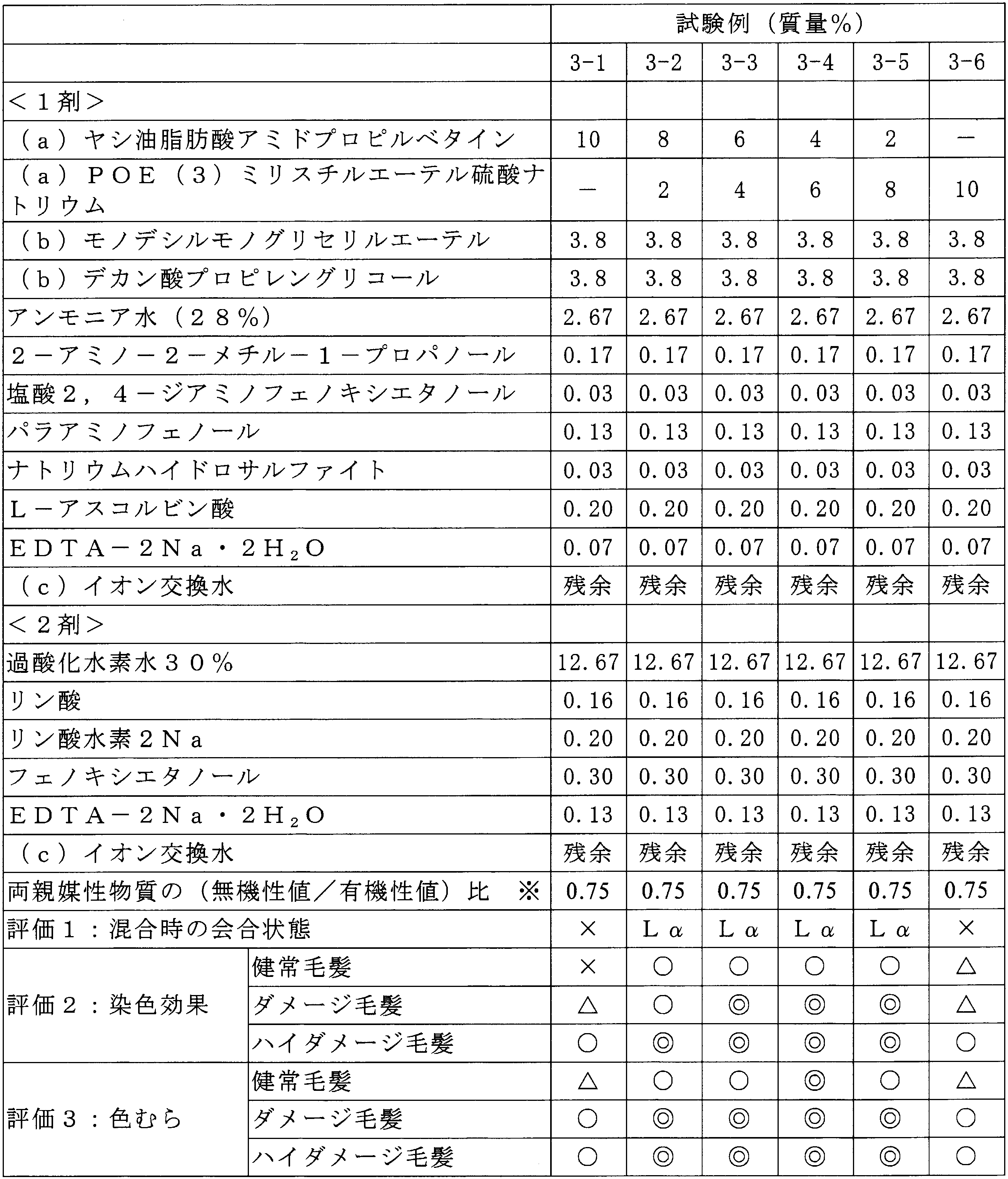
※両親媒性物質であるモノデシルモノグリセリルエーテル(IOB値0.88)3.8質量%とデカン酸プロピレングリコール(IOB値0.62)3.8質量%の平均値
一方、アニオン性界面活性剤と両性界面活性剤との質量比が2:8~8:2である試験例3-2~5(本発明の実施例)は1剤および2剤混合時にラメラ液晶相を含有し、健常毛髪、ダメージ毛髪、ハイダメージ毛髪のいずれに対しても染色効果および染色後の髪の感触に優れるものであった。
以下の表4に記載した配合組成よりなる試験例の酸化染毛剤を製造し、評価(1)~(3)について評価試験を行った。
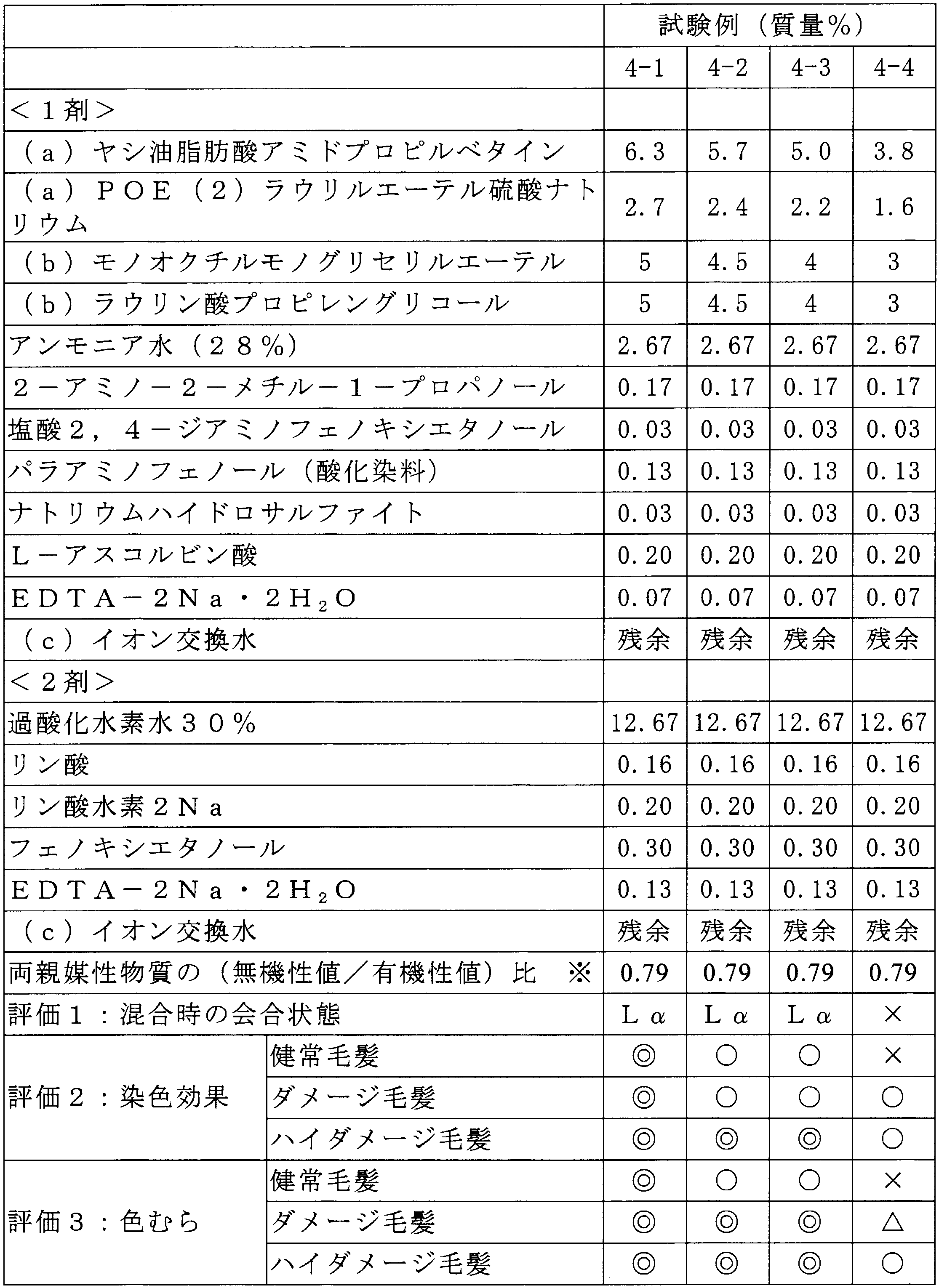
※両親媒性物質であるモノオクチルモノグリセリルエーテル(IOB値1.048)とラウリン酸プロピレングリコール(IOB値0.53)の平均値
一方、イオン性界面活性剤および界面活性助剤の配合濃度が好適である試験例4-1~3(本発明の実施例)は1剤および2剤混合時にラメラ液晶相を含有し、健常毛髪、ダメージ毛髪、ハイダメージ毛髪のいずれに対しても染色効果および染色後の髪の感触に優れるものであった。
以下の表4に記載した配合組成よりなる試験例の酸化染毛剤を製造し、評価(1)~(5)について評価試験を行った。

一方、非イオン性界面活性剤および油分の配合により適切に界面活性剤の会合状態が制御された試験例5-1(本発明の実施例)は1剤および2剤混合時にバイコンティニュアスミクロエマルション相を含有し、試験例5-2(本発明の実施例)はラメラ液晶相を含有し、健常毛髪、ダメージ毛髪、ハイダメージ毛髪のいずれに対しても染色効果および染色後の髪の感触に優れるものであった。
<1剤>
(a)ラウリルジメチルアミノ酢酸ベタイン 18
(a)ポリオキシエチレンラウリルエーテル硫酸トリエタノールアミン
6
ドデシルベンゼンスルホン酸トリエタノールアミン 6
イソプロパノール 9.5
プロピレングリコール 10
オクタン酸オクチル 2
強アンモニア水(28%) 8.6
エタノールアミン 2.4
ハイドロサルファイトナトリウム 0.1
アスコルビン酸 0.3
カチオン化シルクタンパク 0.1
エデト酸2ナトリウム 0.2
レゾルシン 1
香料 適量
(c)精製水 残余(合計100質量%)
<2剤>
過酸化水素水(30%) 18
(b)モノオクチルモノグリセリルエーテル 8
(b)ラウリン酸プロピレングリコール 7
リン酸 0.2
無水リン酸1水素ナトリウム 0.2
スズ酸ナトリウム 0.02
パラオキシ安息香酸エステル 適量
(c)精製水 残余(合計100質量%)
*1剤のpH=11.1、2剤のpH=3.01
*両親媒性物質の(無機性値/有機性値)比は0.81{両親媒性物質であるモノオクチルモノグリセリルエーテル(IOB値1.048)8%とラウリン酸プロピレングリコール(IOB値0.53)7%の平均値}
<1剤>
1,3-ブチレングリコール 5
(d)ポリオキシエチレン(10EO)セチルエーテル 15
(d)オレイン酸ポリオキシエチレングリセリル(8EO) 15
塩化O-[2-ヒドロキシ-3-(トリメチルアンモニオ)プロピル]
ヒドロキシエチルセルロース 0.5
強アンモニア水(28%) 15
エタノールアミン 2
アスコルビン酸 0.6
DL-ピロリドンカルボン酸ナトリウム液 0.1
ヒドロキシエタンジホスホン酸4ナトリウム 0.3
レゾルシン 0.15
香料 適量
(f)精製水 残余(合計100質量%)
<2剤>
(e)流動パラフィン 5
セトステアリルアルコール 2
ラウリル硫酸ナトリウム 0.1
過酸化水素水(30%) 18
リン酸 0.1
無水リン酸1水素ナトリウム 0.1
スズ酸ナトリウム 0.02
パラオキシ安息香酸エステル 適量
(f)精製水 残余(合計100質量%)
*1剤のpH=11.02、2剤のpH=3.0
*非イオン性界面活性剤のHLBは10.5{非イオン性界面活性剤であるポリオキシエチレン(10EO)セチルエーテル(HLB=11)15%とオレイン酸ポリオキシエチレングリセリル(8EO)(HLB=10)15%の平均値}
また、本発明によれば、染毛後の洗浄による色落ちの抑制効果にも優れる酸化染毛剤を提供することが可能である。
Claims (7)
- アルカリ剤を含む第1剤と、酸化剤を含む第2剤とを混合する酸化染毛剤において、前記第1剤と第2剤とを混合した直後に、バイコンティニュアスミクロエマルション相又はラメラ液晶相を含有することを特徴とする酸化染毛剤。
- 前記第1剤及び/又は第2剤中に、バイコンティニュアスミクロエマルション相又はラメラ液晶相を形成する下記成分(a)~(c)を含有することを特徴とする請求項1記載の酸化染毛剤。
(a)イオン性界面活性剤
(b)(無機性値/有機性値)比の値が0.8~1.5の範囲内である両親媒性物質
(c)水 - 前記第1剤及び/又は第2剤中に、バイコンティニュアスミクロエマルション相又はラメラ液晶相を形成する下記成分(d)~(f)を含有することを特徴とする請求項1記載の酸化染毛剤。
(d)非イオン性界面活性剤
(e)油分
(f)水 - 前記成分(a)イオン性界面活性剤がアニオン性界面活性剤を含み、さらに両性界面活性剤及び/又はカチオン性界面活性剤から選ばれる1種または2種以上を含むことを特徴とする請求項2記載の酸化染毛剤。
- 前記成分(a)イオン性界面活性剤において、アニオン性界面活性剤と、両性界面活性剤及び/又はカチオン性界面活性剤との質量比が、(アニオン性界面活性剤):(両性界面活性剤及び/又はカチオン性界面活性剤)=2:8~8:2であることを特徴とする請求項4記載の酸化染毛剤。
- 前記成分(b)(無機性値/有機性値)比の値が0.8~1.5の範囲内である両親媒性物質が、モノグリセリン誘導体、ジグリセリン誘導体、プロピレングリコール誘導体、ブチレングリコール誘導体、モノエタノールアミド誘導体、モノエタノールアミン誘導体、ジエタノールアミド誘導体、ジエタノールアミン誘導体から選ばれる1種または2種以上であることを特徴とする請求項2記載の酸化染毛剤。
- 前記成分(d)非イオン性界面活性剤のHLBが、5~14の範囲内であることを特徴とする請求項3記載の酸化染毛剤。
Priority Applications (3)
| Application Number | Priority Date | Filing Date | Title |
|---|---|---|---|
| CN201280057424.0A CN104093390B (zh) | 2011-11-22 | 2012-09-19 | 氧化染发剂 |
| KR1020147013038A KR101460483B1 (ko) | 2011-11-22 | 2012-09-19 | 산화 염모제 |
| HK14111956.3A HK1198468B (en) | 2011-11-22 | 2012-09-19 | Oxidation hair dye |
Applications Claiming Priority (2)
| Application Number | Priority Date | Filing Date | Title |
|---|---|---|---|
| JP2011-254624 | 2011-11-22 | ||
| JP2011254624A JP5327911B2 (ja) | 2011-11-22 | 2011-11-22 | 酸化染毛剤 |
Publications (1)
| Publication Number | Publication Date |
|---|---|
| WO2013077072A1 true WO2013077072A1 (ja) | 2013-05-30 |
Family
ID=48469529
Family Applications (1)
| Application Number | Title | Priority Date | Filing Date |
|---|---|---|---|
| PCT/JP2012/073913 Ceased WO2013077072A1 (ja) | 2011-11-22 | 2012-09-19 | 酸化染毛剤 |
Country Status (5)
| Country | Link |
|---|---|
| JP (1) | JP5327911B2 (ja) |
| KR (1) | KR101460483B1 (ja) |
| CN (1) | CN104093390B (ja) |
| TW (1) | TWI555533B (ja) |
| WO (1) | WO2013077072A1 (ja) |
Cited By (3)
| Publication number | Priority date | Publication date | Assignee | Title |
|---|---|---|---|---|
| WO2015112787A1 (en) * | 2014-01-24 | 2015-07-30 | Combe International Ltd. | Compositions for coloring hair including multi-lamellar emulsion systems and methods of making the same |
| US10022312B2 (en) | 2014-01-24 | 2018-07-17 | Combe Incorporated | Gradual haircolor compositions and methods of using the same |
| WO2020142521A1 (en) * | 2018-12-31 | 2020-07-09 | L'oreal | Hair coloring compositions and methods of use |
Families Citing this family (12)
| Publication number | Priority date | Publication date | Assignee | Title |
|---|---|---|---|---|
| JP6636243B2 (ja) * | 2014-11-05 | 2020-01-29 | ヘンケルジャパン株式会社 | 酸化染毛剤 |
| CN106236628A (zh) * | 2016-08-13 | 2016-12-21 | 黄剑忠 | 一种生物酵素染发剂 |
| EP3530722B1 (en) | 2016-10-19 | 2022-11-16 | Shiseido Company, Ltd. | Detergent composition |
| KR101916539B1 (ko) * | 2016-11-21 | 2018-11-07 | 김숙희 | 천연재료를 포함하는 염모제 조성물 |
| KR101932016B1 (ko) * | 2016-12-30 | 2018-12-26 | 주식회사 세화피앤씨 | 산화 염모제 조성물 |
| GB201813099D0 (en) * | 2018-08-10 | 2018-09-26 | Theunseen | Liquid crystal composition, use and method |
| CN108852860A (zh) * | 2018-09-13 | 2018-11-23 | 花安堂生物科技集团有限公司 | 一种具有层状液晶相的组合物及其制备方法和应用 |
| KR102196631B1 (ko) * | 2019-01-24 | 2020-12-30 | 강원대학교산학협력단 | 모발 침투성이 증가된 양이온성 고분자 및 치자황색소의 중합체를 유효성분으로 함유하는 염모제용 조성물 |
| JP2022061701A (ja) * | 2020-10-07 | 2022-04-19 | ロレアル | ケラチン繊維のための組成物 |
| KR20220117636A (ko) | 2021-02-17 | 2022-08-24 | 주식회사 보삼바이오산업 | 파래 강정의 제조방법 |
| JP2022181735A (ja) * | 2021-05-27 | 2022-12-08 | 株式会社ミルボン | 酸化染毛剤および染毛処理方法 |
| KR102640033B1 (ko) * | 2023-09-01 | 2024-02-26 | 한국콜마주식회사 | 아민 취 감소에 효과적인 액정 유화 조성물 |
Citations (4)
| Publication number | Priority date | Publication date | Assignee | Title |
|---|---|---|---|---|
| JPH0499711A (ja) * | 1990-08-14 | 1992-03-31 | Yamahatsu Sangyo Kk | 染毛剤 |
| JP2007191458A (ja) * | 2006-01-20 | 2007-08-02 | Number Three:Kk | 永久染毛剤組成物 |
| JP2008503502A (ja) * | 2004-06-24 | 2008-02-07 | ザ プロクター アンド ギャンブル カンパニー | 毛髪着色又は脱色組成物 |
| JP2010222324A (ja) * | 2009-03-25 | 2010-10-07 | Shiseido Co Ltd | 毛髪洗浄剤組成物 |
Family Cites Families (1)
| Publication number | Priority date | Publication date | Assignee | Title |
|---|---|---|---|---|
| JPH0499721A (ja) * | 1990-08-17 | 1992-03-31 | Asahi Chem Ind Co Ltd | ニューモシスチス・カリニ肺炎治療剤 |
-
2011
- 2011-11-22 JP JP2011254624A patent/JP5327911B2/ja active Active
-
2012
- 2012-09-19 KR KR1020147013038A patent/KR101460483B1/ko not_active Expired - Fee Related
- 2012-09-19 WO PCT/JP2012/073913 patent/WO2013077072A1/ja not_active Ceased
- 2012-09-19 CN CN201280057424.0A patent/CN104093390B/zh active Active
- 2012-09-25 TW TW101135068A patent/TWI555533B/zh not_active IP Right Cessation
Patent Citations (4)
| Publication number | Priority date | Publication date | Assignee | Title |
|---|---|---|---|---|
| JPH0499711A (ja) * | 1990-08-14 | 1992-03-31 | Yamahatsu Sangyo Kk | 染毛剤 |
| JP2008503502A (ja) * | 2004-06-24 | 2008-02-07 | ザ プロクター アンド ギャンブル カンパニー | 毛髪着色又は脱色組成物 |
| JP2007191458A (ja) * | 2006-01-20 | 2007-08-02 | Number Three:Kk | 永久染毛剤組成物 |
| JP2010222324A (ja) * | 2009-03-25 | 2010-10-07 | Shiseido Co Ltd | 毛髪洗浄剤組成物 |
Cited By (4)
| Publication number | Priority date | Publication date | Assignee | Title |
|---|---|---|---|---|
| WO2015112787A1 (en) * | 2014-01-24 | 2015-07-30 | Combe International Ltd. | Compositions for coloring hair including multi-lamellar emulsion systems and methods of making the same |
| US10022312B2 (en) | 2014-01-24 | 2018-07-17 | Combe Incorporated | Gradual haircolor compositions and methods of using the same |
| WO2020142521A1 (en) * | 2018-12-31 | 2020-07-09 | L'oreal | Hair coloring compositions and methods of use |
| US12257330B2 (en) | 2018-12-31 | 2025-03-25 | L'oreal | Hair coloring compositions and methods of use |
Also Published As
| Publication number | Publication date |
|---|---|
| TWI555533B (zh) | 2016-11-01 |
| CN104093390B (zh) | 2016-02-17 |
| CN104093390A (zh) | 2014-10-08 |
| HK1198468A1 (zh) | 2015-05-08 |
| TW201328712A (zh) | 2013-07-16 |
| JP2013144645A (ja) | 2013-07-25 |
| KR20140069362A (ko) | 2014-06-09 |
| KR101460483B1 (ko) | 2014-11-11 |
| JP5327911B2 (ja) | 2013-10-30 |
Similar Documents
| Publication | Publication Date | Title |
|---|---|---|
| JP5327911B2 (ja) | 酸化染毛剤 | |
| JP4834775B2 (ja) | 日焼け止め用組成物 | |
| JP5203735B2 (ja) | 毛髪化粧料 | |
| JP7114164B2 (ja) | 粉体含有水系組成物及び皮膚外用剤 | |
| JP7696334B2 (ja) | ラメラゲル含有組成物、乳化組成物、及び皮膚外用剤組成物 | |
| WO2020100803A1 (ja) | 化粧料 | |
| WO2017159566A1 (ja) | 水中油型組成物 | |
| JP2003221310A (ja) | 皮膚洗浄料 | |
| JP4571833B2 (ja) | ゲル状洗浄組成物 | |
| WO2019244911A1 (ja) | 組成物 | |
| JP7337842B2 (ja) | 洗浄剤組成物 | |
| JPWO2018079717A1 (ja) | 水中油型皮膚外用組成物 | |
| JP2004018375A (ja) | オイル状化粧料 | |
| JP5102004B2 (ja) | 皮膚洗浄料 | |
| WO2023042687A1 (ja) | 水中油型洗浄料組成物 | |
| JP7579635B2 (ja) | 化粧料 | |
| JP7316907B2 (ja) | 油性固形化粧料 | |
| HK1198468B (en) | Oxidation hair dye | |
| WO2022259877A1 (ja) | 化粧料 | |
| JP2001240526A (ja) | 皮膚外用剤 | |
| JP2002053450A (ja) | パック化粧料 | |
| JP2003119110A (ja) | メーキャップ化粧料 | |
| JP2005320295A (ja) | 毛髪化粧料 | |
| WO2021215420A1 (ja) | 洗浄料 | |
| JP2022167590A (ja) | 洗浄料組成物 |
Legal Events
| Date | Code | Title | Description |
|---|---|---|---|
| WWE | Wipo information: entry into national phase |
Ref document number: 201280057424.0 Country of ref document: CN |
|
| 121 | Ep: the epo has been informed by wipo that ep was designated in this application |
Ref document number: 12851638 Country of ref document: EP Kind code of ref document: A1 |
|
| ENP | Entry into the national phase |
Ref document number: 20147013038 Country of ref document: KR Kind code of ref document: A |
|
| NENP | Non-entry into the national phase |
Ref country code: DE |
|
| 122 | Ep: pct application non-entry in european phase |
Ref document number: 12851638 Country of ref document: EP Kind code of ref document: A1 |