WO2012133617A1 - 樹脂組成物および半導体素子基板 - Google Patents
樹脂組成物および半導体素子基板 Download PDFInfo
- Publication number
- WO2012133617A1 WO2012133617A1 PCT/JP2012/058307 JP2012058307W WO2012133617A1 WO 2012133617 A1 WO2012133617 A1 WO 2012133617A1 JP 2012058307 W JP2012058307 W JP 2012058307W WO 2012133617 A1 WO2012133617 A1 WO 2012133617A1
- Authority
- WO
- WIPO (PCT)
- Prior art keywords
- group
- resin
- acid
- ene
- compound
- Prior art date
- Legal status (The legal status is an assumption and is not a legal conclusion. Google has not performed a legal analysis and makes no representation as to the accuracy of the status listed.)
- Ceased
Links
Classifications
-
- G—PHYSICS
- G03—PHOTOGRAPHY; CINEMATOGRAPHY; ANALOGOUS TECHNIQUES USING WAVES OTHER THAN OPTICAL WAVES; ELECTROGRAPHY; HOLOGRAPHY
- G03F—PHOTOMECHANICAL PRODUCTION OF TEXTURED OR PATTERNED SURFACES, e.g. FOR PRINTING, FOR PROCESSING OF SEMICONDUCTOR DEVICES; MATERIALS THEREFOR; ORIGINALS THEREFOR; APPARATUS SPECIALLY ADAPTED THEREFOR
- G03F7/00—Photomechanical, e.g. photolithographic, production of textured or patterned surfaces, e.g. printing surfaces; Materials therefor, e.g. comprising photoresists; Apparatus specially adapted therefor
- G03F7/004—Photosensitive materials
- G03F7/038—Macromolecular compounds which are rendered insoluble or differentially wettable
- G03F7/0387—Polyamides or polyimides
-
- G—PHYSICS
- G03—PHOTOGRAPHY; CINEMATOGRAPHY; ANALOGOUS TECHNIQUES USING WAVES OTHER THAN OPTICAL WAVES; ELECTROGRAPHY; HOLOGRAPHY
- G03F—PHOTOMECHANICAL PRODUCTION OF TEXTURED OR PATTERNED SURFACES, e.g. FOR PRINTING, FOR PROCESSING OF SEMICONDUCTOR DEVICES; MATERIALS THEREFOR; ORIGINALS THEREFOR; APPARATUS SPECIALLY ADAPTED THEREFOR
- G03F7/00—Photomechanical, e.g. photolithographic, production of textured or patterned surfaces, e.g. printing surfaces; Materials therefor, e.g. comprising photoresists; Apparatus specially adapted therefor
- G03F7/004—Photosensitive materials
- G03F7/038—Macromolecular compounds which are rendered insoluble or differentially wettable
-
- C—CHEMISTRY; METALLURGY
- C08—ORGANIC MACROMOLECULAR COMPOUNDS; THEIR PREPARATION OR CHEMICAL WORKING-UP; COMPOSITIONS BASED THEREON
- C08G—MACROMOLECULAR COMPOUNDS OBTAINED OTHERWISE THAN BY REACTIONS ONLY INVOLVING UNSATURATED CARBON-TO-CARBON BONDS
- C08G77/00—Macromolecular compounds obtained by reactions forming a linkage containing silicon with or without sulfur, nitrogen, oxygen or carbon in the main chain of the macromolecule
- C08G77/04—Polysiloxanes
-
- C—CHEMISTRY; METALLURGY
- C08—ORGANIC MACROMOLECULAR COMPOUNDS; THEIR PREPARATION OR CHEMICAL WORKING-UP; COMPOSITIONS BASED THEREON
- C08G—MACROMOLECULAR COMPOUNDS OBTAINED OTHERWISE THAN BY REACTIONS ONLY INVOLVING UNSATURATED CARBON-TO-CARBON BONDS
- C08G77/00—Macromolecular compounds obtained by reactions forming a linkage containing silicon with or without sulfur, nitrogen, oxygen or carbon in the main chain of the macromolecule
- C08G77/42—Block-or graft-polymers containing polysiloxane sequences
- C08G77/452—Block-or graft-polymers containing polysiloxane sequences containing nitrogen-containing sequences
- C08G77/455—Block-or graft-polymers containing polysiloxane sequences containing nitrogen-containing sequences containing polyamide, polyesteramide or polyimide sequences
-
- G—PHYSICS
- G03—PHOTOGRAPHY; CINEMATOGRAPHY; ANALOGOUS TECHNIQUES USING WAVES OTHER THAN OPTICAL WAVES; ELECTROGRAPHY; HOLOGRAPHY
- G03F—PHOTOMECHANICAL PRODUCTION OF TEXTURED OR PATTERNED SURFACES, e.g. FOR PRINTING, FOR PROCESSING OF SEMICONDUCTOR DEVICES; MATERIALS THEREFOR; ORIGINALS THEREFOR; APPARATUS SPECIALLY ADAPTED THEREFOR
- G03F7/00—Photomechanical, e.g. photolithographic, production of textured or patterned surfaces, e.g. printing surfaces; Materials therefor, e.g. comprising photoresists; Apparatus specially adapted therefor
- G03F7/004—Photosensitive materials
- G03F7/0047—Photosensitive materials characterised by additives for obtaining a metallic or ceramic pattern, e.g. by firing
-
- G—PHYSICS
- G03—PHOTOGRAPHY; CINEMATOGRAPHY; ANALOGOUS TECHNIQUES USING WAVES OTHER THAN OPTICAL WAVES; ELECTROGRAPHY; HOLOGRAPHY
- G03F—PHOTOMECHANICAL PRODUCTION OF TEXTURED OR PATTERNED SURFACES, e.g. FOR PRINTING, FOR PROCESSING OF SEMICONDUCTOR DEVICES; MATERIALS THEREFOR; ORIGINALS THEREFOR; APPARATUS SPECIALLY ADAPTED THEREFOR
- G03F7/00—Photomechanical, e.g. photolithographic, production of textured or patterned surfaces, e.g. printing surfaces; Materials therefor, e.g. comprising photoresists; Apparatus specially adapted therefor
- G03F7/004—Photosensitive materials
- G03F7/022—Quinonediazides
- G03F7/023—Macromolecular quinonediazides; Macromolecular additives, e.g. binders
-
- G—PHYSICS
- G03—PHOTOGRAPHY; CINEMATOGRAPHY; ANALOGOUS TECHNIQUES USING WAVES OTHER THAN OPTICAL WAVES; ELECTROGRAPHY; HOLOGRAPHY
- G03F—PHOTOMECHANICAL PRODUCTION OF TEXTURED OR PATTERNED SURFACES, e.g. FOR PRINTING, FOR PROCESSING OF SEMICONDUCTOR DEVICES; MATERIALS THEREFOR; ORIGINALS THEREFOR; APPARATUS SPECIALLY ADAPTED THEREFOR
- G03F7/00—Photomechanical, e.g. photolithographic, production of textured or patterned surfaces, e.g. printing surfaces; Materials therefor, e.g. comprising photoresists; Apparatus specially adapted therefor
- G03F7/004—Photosensitive materials
- G03F7/075—Silicon-containing compounds
-
- G—PHYSICS
- G03—PHOTOGRAPHY; CINEMATOGRAPHY; ANALOGOUS TECHNIQUES USING WAVES OTHER THAN OPTICAL WAVES; ELECTROGRAPHY; HOLOGRAPHY
- G03F—PHOTOMECHANICAL PRODUCTION OF TEXTURED OR PATTERNED SURFACES, e.g. FOR PRINTING, FOR PROCESSING OF SEMICONDUCTOR DEVICES; MATERIALS THEREFOR; ORIGINALS THEREFOR; APPARATUS SPECIALLY ADAPTED THEREFOR
- G03F7/00—Photomechanical, e.g. photolithographic, production of textured or patterned surfaces, e.g. printing surfaces; Materials therefor, e.g. comprising photoresists; Apparatus specially adapted therefor
- G03F7/004—Photosensitive materials
- G03F7/075—Silicon-containing compounds
- G03F7/0757—Macromolecular compounds containing Si-O, Si-C or Si-N bonds
Definitions
- the present invention relates to a resin composition and a semiconductor element substrate provided with a resin film made of the resin composition. More specifically, the present invention has excellent storage stability and is excellent in pattern formability and transparency by development.
- the present invention relates to a resin composition capable of providing a resin film and a semiconductor element substrate including a resin film made of the resin composition.
- Various display elements such as organic EL elements and liquid crystal display elements, integrated circuit elements, solid-state imaging elements, color filters, black matrices, and other electronic parts are provided with protective films, element surfaces and wiring to prevent their deterioration and damage.
- Various resin films are provided as a planarization film for planarization, an electrical insulation film for maintaining electrical insulation, and the like.
- the organic EL element is provided with a resin film as a pixel separation film in order to separate the light-emitting body portion.
- the organic EL element is layered.
- a resin film as an interlayer insulating film is provided to insulate between the arranged wirings.
- thermosetting resin materials such as epoxy resins have been widely used as resin materials for forming these resin films.
- resin materials for forming these resin films.
- development of new resin materials excellent in electrical characteristics such as low dielectric properties has been demanded for these resin materials.
- Patent Document 1 discloses a resin (A), a crosslinking agent (B) having an epoxy group, a triazine ring structure or a glycoluril structure, and an imino group, a methylol group and an alkoxy group.
- a radiation-sensitive resin composition containing a crosslinking agent (C) having at least one functional group selected from the group consisting of butyl groups and a radiation-sensitive compound (D) is disclosed.
- the resin film obtained by using the resin composition described in Patent Document 1 has a pattern formation property by development, in particular, development adhesion (development pattern in the case where the development pattern width is narrowed and the definition is increased). Adhesion) is not always sufficient, and therefore, improvement of pattern formation by development has been desired.
- the present inventors have obtained a resin composition comprising a binder resin and a silane-modified resin and a compound having an acidic group or a thermal latent acidic group in a predetermined ratio.
- the present inventors have found that the above object can be achieved by a product, and have completed the present invention.
- a resin composition comprising a binder resin (A), a silane-modified resin (B), and a compound (C) having an acidic group or a thermal latent acidic group, the silane
- the ratio of the modified resin (B) and the compound (C) having the acidic group or the thermal latent acidic group is expressed by a weight ratio of “silane modified resin (B) / compound having an acidic group or thermal latent acidic group”.
- (C) ” 0.5 to 20 is provided.
- the silane-modified resin (B) is a chemical compound of at least one polymer material selected from polyester, polyamide, polyimide, polyamic acid, epoxy resin, acrylic resin, urethane resin, and phenol resin, and a silicon compound. It is a compound formed by binding.
- the silicon compound is a silicon compound represented by the following formula and / or a partial hydrolysis condensate of the silicon compound represented by the following formula.
- R 8 r —Si— (OR 9 ) 4-r
- r is an integer of 0 to 3
- R 8 is an alkyl group having 1 to 10 carbon atoms and an aryl group having 6 to 20 carbon atoms which may have a functional group directly bonded to a carbon atom.
- the content of the silane-modified resin (B) is 1 to 100 parts by weight with respect to 100 parts by weight of the binder resin (A).
- the binder resin (A) is a cyclic olefin polymer having a protic polar group or an acrylic resin.
- the resin composition of the present invention further contains a radiation sensitive compound (D).
- the resin composition of the present invention further contains a crosslinking agent (E).
- a semiconductor element substrate provided with a resin film made of any of the above resin compositions is provided.
- the resin composition which has the outstanding storage stability and can give the resin film excellent in the pattern formation property and transparency by image development, and a resin film consisting of such a resin composition A semiconductor element substrate can be provided.
- Binder resin (A) Although it does not specifically limit as binder resin (A) used by this invention, The cyclic olefin polymer (A1), acrylic resin (A2), cardo resin (A3), polysiloxane (A4), or polyimide which has a protic polar group (A5) is preferred, and among these, a cyclic olefin polymer (A1) having a protic polar group is particularly preferred. These binder resins (A) may be used alone or in combination of two or more.
- the cyclic olefin polymer (A1) having a protic polar group is a polymer of one or more cyclic olefin monomers, or 1 Or a copolymer of two or more cyclic olefin monomers and a monomer copolymerizable therewith.
- a monomer for forming the cyclic olefin polymer (A1) It is preferable to use a cyclic olefin monomer (a) having at least a protic polar group.
- the protic polar group means a group containing an atom in which a hydrogen atom is directly bonded to an atom belonging to Group 15 or Group 16 of the Periodic Table.
- atoms belonging to Group 15 or Group 16 of the periodic table atoms belonging to Group 1 or 2 of Group 15 or Group 16 of the Periodic Table are preferable, and oxygen atoms, nitrogen atoms or sulfur are more preferable.
- protic polar groups include polar groups having oxygen atoms such as hydroxyl groups, carboxy groups (hydroxycarbonyl groups), sulfonic acid groups, phosphoric acid groups; primary amino groups, secondary amino groups A polar group having a nitrogen atom such as a primary amide group or a secondary amide group (imide group); a polar group having a sulfur atom such as a thiol group; Among these, those having an oxygen atom are preferable, and a carboxy group is more preferable.
- the number of protic polar groups bonded to the cyclic olefin resin having a protic polar group is not particularly limited, and different types of protic polar groups may be included.
- cyclic olefin monomer (a) having a protic polar group examples include 2-hydroxycarbonylbicyclo [2.2.1] hept- 5-ene, 2-methyl-2-hydroxycarbonylbicyclo [2.2.1] hept-5-ene, 2-carboxymethyl-2-hydroxycarbonylbicyclo [2.2.1] hept-5-ene, 2 -Hydroxycarbonyl-2-methoxycarbonylmethylbicyclo [2.2.1] hept-5-ene, 2-hydroxycarbonyl-2-ethoxycarbonylmethylbicyclo [2.2.1] hept-5-ene, 2-hydroxy Carbonyl-2-propoxycarbonylmethylbicyclo [2.2.1] hept-5-ene, 2-hydroxycarbonyl-2-butoxycarbonyl Tyrbicyclo [2.2.1] hept-5-ene, 2-hydroxycarbonyl-2-pentyloxycarbonylmethyl bicyclo [2.
- dodec-9-ene 4-hydroxymethyltetracyclo [6.2.1.1 3,6 . 0 2,7 ] dodec-9-ene, 4,5-dihydroxymethyltetracyclo [6.2.1.1 3,6 . 0 2,7 ] dodec-9-ene, 4- (hydroxyethoxycarbonyl) tetracyclo [6.2.1.1 3,6 . 0 2,7 ] dodec-9-ene, 4-methyl-4- (hydroxyethoxycarbonyl) tetracyclo [6.2.1.1 3,6 .
- the content ratio of the monomer (a) unit in the cyclic olefin polymer (A1) is preferably 10 to 90 mol% with respect to the total monomer units.
- the content ratio of the monomer (a) unit is too small, the radiation sensitivity becomes insufficient when a radiation sensitive compound is added to the resin composition of the present invention, or a dissolution residue is generated during development. If the amount is too large, the solubility of the cyclic olefin polymer (A1) in the polar solvent may be insufficient.
- the more preferable range of the content ratio of the unit of the monomer (a) varies depending on the type of the resin film constituted by the resin composition of the present invention. Specifically, when the resin film is a resin film that is patterned by photolithography, such as a protective film of an active matrix substrate or a sealing film of an organic EL element substrate, a monomer ( The content of the unit a) is more preferably 40 to 70 mol%, and particularly preferably 50 to 60 mol%.
- the resin film is a resin film that is not patterned by photolithography, such as a gate insulating film of an active matrix substrate or a pixel isolation film of an organic EL element substrate
- the monomer (a) The content ratio of the unit is more preferably 20 to 80 mol%, and particularly preferably 30 to 70 mol%.
- the cyclic olefin polymer (A1) used in the present invention is obtained by copolymerizing a cyclic olefin monomer (a) having a protic polar group and a monomer (b) copolymerizable therewith. It may be a copolymer. Examples of such copolymerizable monomers include cyclic olefin monomers (b1) having polar groups other than protic polar groups, cyclic olefin monomers having no polar groups (b2), and cyclic olefins. Monomer (b3) (hereinafter referred to as “monomer (b1)”, “monomer (b2)”, “monomer (b3)” as appropriate).
- Examples of the cyclic olefin monomer (b1) having a polar group other than the protic polar group include N-substituted imide groups, ester groups, cyano groups, acid anhydride groups, and cyclic olefins having a halogen atom.
- Examples of the cyclic olefin having an N-substituted imide group include a monomer represented by the following formula (1) or a monomer represented by the following formula (2).
- R 1 represents a hydrogen atom, an alkyl group having 1 to 16 carbon atoms, or an aryl group.
- N represents an integer of 1 to 2.
- R 2 represents an alkylene group having 1 to 3 carbon atoms
- R 3 represents an alkyl group having 1 to 10 carbon atoms or a halogenated alkyl group having 1 to 10 carbon atoms.
- R 1 is an alkyl group having 1 to 16 carbon atoms or an aryl group.
- Specific examples of the alkyl group include a methyl group, an ethyl group, an n-propyl group, an n-butyl group, an n group.
- n-Pentyl group n-hexyl group, n-heptyl group, n-octyl group, n-nonyl group, n-decyl group, n-undecyl group, n-dodecyl group, n-tridecyl group, n-tetradecyl group, n -Linear alkyl groups such as pentadecyl group and n-hexadecyl group; cyclopropyl group, cyclobutyl group, cyclopentyl group, cyclohexyl group, cycloheptyl group, cyclooctyl group, cyclononyl group, cyclodecyl group, cycloundecyl group, cyclododecyl group , Norbornyl group, bornyl group, isobornyl group, decahydronaphthyl group, tricyclode
- Alkyl group 2-propyl group, 2-butyl group, 2-methyl-1-propyl group, 2-methyl-2-propyl group, 1-methylbutyl group, 2-methylbutyl group, 1-methylpentyl group, 1-ethylbutyl Groups, branched alkyl groups such as 2-methylhexyl group, 2-ethylhexyl group, 4-methylheptyl group, 1-methylnonyl group, 1-methyltridecyl group, 1-methyltetradecyl group, and the like.
- Specific examples of the aryl group include a benzyl group.
- an alkyl group and an aryl group having 6 to 14 carbon atoms are preferable and an alkyl group and an aryl group having 6 to 10 carbon atoms are more preferable because of excellent heat resistance and solubility in a polar solvent. If the number of carbons in these groups is too small, the solubility in polar solvents may be poor. If the number of carbons is too large, the heat resistance will be inferior, and if the resin film is patterned, it will melt with heat and disappear. There is a risk of it.
- the monomer represented by the above formula (1) include bicyclo [2.2.1] hept-5-ene-2,3-dicarboximide, N-phenyl-bicyclo [2.2. 1] Hept-5-ene-2,3-dicarboximide, N-methylbicyclo [2.2.1] hept-5-ene-2,3-dicarboximide, N-ethylbicyclo [2.2. 1] Hept-5-ene-2,3-dicarboximide, N-propylbicyclo [2.2.1] hept-5-ene-2,3-dicarboximide, N-butylbicyclo [2.2.
- dodec-9-ene-4,5-dicarboximide N- (2,4-dimethoxyphenyl) -tetracyclo [6.2.1.1 3,6 . 0 2,7 ] dodec-9-ene-4,5-dicarboximide and the like. These may be used alone or in combination of two or more.
- R 2 is an alkylene group having 1 to 3 carbon atoms
- examples of the alkylene group having 1 to 3 carbon atoms include a methylene group, an ethylene group, a propylene group, and an isopropylene group.
- a methylene group and an ethylene group are preferable because of good polymerization activity.
- R 3 is an alkyl group having 1 to 10 carbon atoms or a halogenated alkyl group having 1 to 10 carbon atoms.
- alkyl group having 1 to 10 carbon atoms include methyl group, ethyl group, propyl group, isopropyl group, butyl group, sec-butyl group, tert-butyl group, hexyl group and cyclohexyl group.
- halogenated alkyl group having 1 to 10 carbon atoms examples include fluoromethyl group, chloromethyl group, bromomethyl group, difluoromethyl group, dichloromethyl group, difluoromethyl group, trifluoromethyl group, trichloromethyl group, 2,2 , 2-trifluoroethyl group, pentafluoroethyl group, heptafluoropropyl group, perfluorobutyl group and perfluoropentyl group.
- R 3 because of excellent solubility in polar solvents, as R 3, methyl and ethyl are preferred.
- the monomers represented by the above formulas (1) and (2) can be obtained, for example, by an amidation reaction between a corresponding amine and 5-norbornene-2,3-dicarboxylic acid anhydride.
- the obtained monomer can be efficiently isolated by separating and purifying the reaction solution of the amidation reaction by a known method.
- Examples of the cyclic olefin having an ester group include 2-acetoxybicyclo [2.2.1] hept-5-ene, 2-acetoxymethylbicyclo [2.2.1] hept-5-ene, and 2-methoxycarbonyl.
- cyclic olefin having a cyano group for example, 4-cyanotetracyclo [6.2.1.1 3,6 . 0 2,7 ] dodec-9-ene, 4-methyl-4-cyanotetracyclo [6.2.1.1 3,6 . 0 2,7 ] dodec-9-ene, 4,5-dicyanotetracyclo [6.2.1.1 3,6 . 0 2,7 ] dodec-9-ene, 2-cyanobicyclo [2.2.1] hept-5-ene, 2-methyl-2-cyanobicyclo [2.2.1] hept-5-ene, 2 , 3-dicyanobicyclo [2.2.1] hept-5-ene, and the like.
- cyclic olefin having an acid anhydride group examples include, for example, tetracyclo [6.2.1.1 3,6 . 0 2,7 ] dodec-9-ene-4,5-dicarboxylic anhydride, bicyclo [2.2.1] hept-5-ene-2,3-dicarboxylic anhydride, 2-carboxymethyl-2- Hydroxycarbonylbicyclo [2.2.1] hept-5-ene anhydride, and the like.
- Examples of the cyclic olefin having a halogen atom include 2-chlorobicyclo [2.2.1] hept-5-ene, 2-chloromethylbicyclo [2.2.1] hept-5-ene, 2- (chlorophenyl). ) Bicyclo [2.2.1] hept-5-ene, 4-chlorotetracyclo [6.2.1.1 3,6 . 0 2,7 ] dodec-9-ene, 4-methyl-4-chlorotetracyclo [6.2.1.1 3,6 . 0 2,7 ] dodec-9-ene and the like.
- These monomers (b1) may be used alone or in combination of two or more.
- cyclic olefin monomer (b2) having no polar group examples include bicyclo [2.2.1] hept-2-ene (also referred to as “norbornene”), 5-ethyl-bicyclo [2.2.1]. Hept-2-ene, 5-butyl-bicyclo [2.2.1] hept-2-ene, 5-ethylidene-bicyclo [2.2.1] hept-2-ene, 5-methylidene-bicyclo [2.
- dodec-4-ene pentacyclo [9.2.1.1 3,9 . 0 2,10 . 0 4,8 ] pentadeca-5,12-diene, cyclobutene, cyclopentene, cyclopentadiene, cyclohexene, cycloheptene, cyclooctene, cyclooctadiene, indene, 3a, 5,6,7a-tetrahydro-4,7-methano-1H -Indene, 9-phenyl-tetracyclo [6.2.1.1 3,6 . 0 2,7] dodeca-4-ene, tetracyclo [9.2.1.0 2,10.
- the monomer (b3) other than the cyclic olefin examples include ethylene; propylene, 1-butene, 1-pentene, 1-hexene, 3-methyl-1-butene, 3-methyl-1-pentene, 3- Ethyl-1-pentene, 4-methyl-1-pentene, 4-methyl-1-hexene, 4,4-dimethyl-1-hexene, 4,4-dimethyl-1-pentene, 4-ethyl-1-hexene, ⁇ -olefins having 2 to 20 carbon atoms such as 3-ethyl-1-hexene, 1-octene, 1-decene, 1-dodecene, 1-tetradecene, 1-hexadecene, 1-octadecene, 1-eicosene; -Non-conjugated dienes such as hexadiene, 4-methyl-1,4-hexadiene, 5-methyl-1,4-hexadiene, 1,7
- the cyclic olefin monomer (b1) having a polar group other than the protic polar group is preferable from the viewpoint that the effect of the present invention becomes more remarkable.
- a cyclic olefin having an N-substituted imide group is particularly preferred.
- the content of the copolymerizable monomer (b) unit in the cyclic olefin polymer (A1) is preferably 10 to 90 mol% with respect to the total monomer units. If the content ratio of the copolymerizable monomer (b) is too small, the solubility of the cyclic olefin polymer (A1) in the polar solvent may be insufficient. When a radiation sensitive compound is added to the resin composition, the radiation sensitivity may be insufficient, or a dissolution residue may be generated during development.
- the more preferable range of the content ratio of the copolymerizable monomer (b) unit varies depending on the type of the resin film constituted by the resin composition of the present invention. Specifically, when the resin film is a resin film that is patterned by photolithography, such as a protective film of an active matrix substrate or a sealing film of an organic EL element substrate, copolymerization is possible.
- the content ratio of the monomer (b) unit is more preferably 30 to 60 mol%, and particularly preferably 40 to 50 mol%.
- the resin film is a resin film that is not patterned by photolithography, such as a gate insulating film of an active matrix substrate or a pixel isolation film of an organic EL element substrate, a copolymerizable single quantity
- the content ratio of the unit of the body (b) is more preferably 20 to 80% by mole, and particularly preferably 30 to 70% by mole.
- cyclic olefin polymer (A1) by introduce
- a polymer having no protic polar group is obtained by polymerizing at least one of the above-described monomers (b1) and (b2), and optionally combining the monomer (b3) as necessary. be able to.
- a compound having a protic polar group and a reactive carbon-carbon unsaturated bond in one molecule is usually used.
- Specific examples of such compounds include acrylic acid, methacrylic acid, angelic acid, tiglic acid, oleic acid, elaidic acid, erucic acid, brassic acid, maleic acid, fumaric acid, citraconic acid, mesaconic acid, itaconic acid, atropaic acid.
- Unsaturated carboxylic acids such as acids and cinnamic acids; allyl alcohol, methyl vinyl methanol, crotyl alcohol, methallyl alcohol, 1-phenylethen-1-ol, 2-propen-1-ol, 3-butene-1- All, 3-buten-2-ol, 3-methyl-3-buten-1-ol, 3-methyl-2-buten-1-ol, 2-methyl-3-buten-2-ol, 2-methyl- Saturation of 3-buten-1-ol, 4-penten-1-ol, 4-methyl-4-penten-1-ol, 2-hexen-1-ol, etc. Alcohol; and the like.
- the modification reaction of the polymer using these modifiers may be performed according to a conventional method, and is usually performed in the presence of a radical generator.
- the cyclic olefin polymer (A1) used in the present invention may be a ring-opening polymer obtained by ring-opening polymerization of the above-described monomer, or an addition polymer obtained by addition polymerization of the above-described monomer. Although it may be a polymer, it is preferably a ring-opening polymer from the viewpoint that the effect of the present invention becomes more remarkable.
- the ring-opening polymer comprises a ring-opening metathesis polymerization of a cyclic olefin monomer having a protic polar group (a) and a copolymerizable monomer (b) used as necessary in the presence of a metathesis reaction catalyst. Can be manufactured.
- the metathesis reaction catalyst may be any catalyst as long as it is a group 3-11 transition metal compound in the periodic table and performs ring-opening metathesis polymerization of the cyclic olefin monomer (a) having a protic polar group.
- a metathesis reaction catalyst those described in Olefin Metathesis and Metathesis Polymerization (KJ Ivinand JC Mol, Academic Press, San Diego 1997) can be used.
- metathesis reaction catalyst examples include Group 3 to 11 transition metal-carbene complex catalysts in the periodic table. Among these, use of a ruthenium carbene complex catalyst is preferable.
- Examples of the periodic table Group 3 to 11 transition metal-carbene complex catalyst include a tungsten alkylidene complex catalyst, a molybdenum alkylidene complex catalyst, a rhenium alkylidene complex catalyst, and a ruthenium carbene complex catalyst.
- tungsten alkylidene complex catalysts W (N-2,6-Pr i 2 C 6 H 3) (CHBu t) (OBu t) 2, W (N-2,6-Pr i 2 C 6 H 3) (CHBu t) (OCMe 2 CF 3) 2, W (N-2,6-Pr i 2 C 6 H 3) (CHBu t) (OCMe (CF 3) 2) 2, W (N-2, 6-Pr i 2 C 6 H 3) (CHCMe 2 Ph) (OBu t) 2 W (N-2,6-Pr i 2 C 6 H 3) (CHCMe 2 Ph) (OCMe 2 CF 3) 2, W (N-2,6-Pr i 2 C 6 H 3) (CHCMe 2 Ph) (OCMe (CF 3) 2) 2 and the like.
- molybdenum alkylidene complex catalyst Mo (N-2,6-Pr i 2 C 6 H 3) (CHBu t) (OBu t) 2, Mo (N-2,6-Pr i 2 C 6 H 3) (CHBu t) (OCMe 2 CF 3) 2, Mo (N-2,6-Pr i 2 C 6 H 3) (CHBu t) (OCMe (CF 3) 2) 2, Mo (N-2, 6-Pr i 2 C 6 H 3) (CHCMe 2 Ph) (OBu t) 2 Mo (N-2,6-Pr i 2 C 6 H 3) (CHCMe 2 Ph) (OCMe 2 CF 3) 2, Mo (N-2,6-Pr i 2 C 6 H 3) (CHCMe 2 Ph) (OCMe (CF 3) 2) 2, Mo (N-2,6-Pr i 2 C 6 H 3) (CHCMe 2 Ph ) (OCMe (CF 3) 2) 2, Mo (N-2,6-Pr i 2 C
- rhenium alkylidene complex catalyst Re (CBu t) (CHBu t) (O-2,6-Pr i 2 C 6 H 3) 2, Re (CBu t) (CHBu t) (O-2- Bu t C 6 H 4) 2 , Re (CBu t) (CHBu t) (OCMe 2 CF 3) 2, Re (CBu t) (CHBu t) (OCMe (CF 3) 2) 2, Re (CBu t) (CHBu t ) (O-2,6-Me 2 C 6 H 3 ) 2 and the like.
- ruthenium carbene complex catalyst examples include compounds represented by the following formula (3) or (4).
- ⁇ CR 4 R 5 and ⁇ C ⁇ CR 4 R 5 are carbene compounds containing a carbene carbon at the reaction center.
- R 4 and R 5 each independently represent a hydrogen atom, a hydrocarbon group having 1 to 20 carbon atoms which may contain a halogen atom, an oxygen atom, a nitrogen atom, a sulfur atom, a phosphorus atom or a silicon atom, an alkoxy group, an aryl Oxy group, acyloxy group, amino group, acylamino group, diacylamino group, alkylthio group, arylthio group, sulfonyl group, sulfinyl group, phosphino group, silyl group, these carbene compounds may or may not contain heteroatoms May be.
- L 1 represents a hetero atom-containing carbene compound
- L 2 represents any neutral electron-donating compound.
- the hetero atom-containing carbene compound refers to a compound containing a carbene carbon and a hetero atom.
- L 1 and L 2 or L 1 is a heteroatom-containing carbene compound, and a ruthenium metal atom is directly bonded to the carbene carbon contained therein, and a group containing a heteroatom is bonded.
- L 3 and L 4 each independently represent an arbitrary anionic ligand. Also, two, three, four, five or six of R 4 , R 5 , L 1 , L 2 , L 3 and L 4 are bonded to each other to form a multidentate chelating ligand. May be.
- Specific examples of heteroatoms include N, O, P, S, As, and Se atoms. Among these, from the viewpoint of obtaining a stable carbene compound, N, O, P, S atoms and the like are preferable, and N atom is particularly preferable.
- the anionic (anionic) ligands L 3 and L 4 are ligands having a negative charge when separated from the central metal, for example, fluorine atoms Halogen atoms such as chlorine atom, bromine atom and iodine atom; hydrocarbon groups containing oxygen such as diketonate group, alkoxy group, aryloxy group and carboxyl group; fat substituted with halogen atoms such as cyclopentadienyl chloride Examples thereof include a cyclic hydrocarbon group. Among these, a halogen atom is preferable and a chlorine atom is more preferable.
- L 2 When L 2 is a neutral electron donating compound other than a heteroatom-containing carbene compound, L 2 may be any ligand as long as it has a neutral charge when separated from the central metal. Specific examples thereof include carbonyls, amines, pyridines, ethers, nitriles, esters, phosphines, thioethers, aromatic compounds, olefins, isocyanides, thiocyanates, and the like. Among these, phosphines and pyridines are preferable, and trialkylphosphine is more preferable. In addition, when R 4 and L 2 or R 5 and L 2 are bonded to each other to form a bidentate chelating ligand, pyridines and ethers are preferable.
- Examples of the ruthenium complex catalyst represented by the above formula (3) include benzylidene (1,3-dimesitymylimidazolidine-2-ylidene) (tricyclohexylphosphine) ruthenium dichloride, (1,3-dimesitylimidazole).
- Lysine-2-ylidene (3-methyl-2-buten-1-ylidene) (tricyclopentylphosphine) ruthenium dichloride, ((2- (1-methylethoxy) phenyl) methylene) (1,3-dimesitylimidazo Lysine-2-ylidene) ruthenium dichloride, benzylidene (1,3-dimesitymylimidazolidine-2-ylidene) bis (3-bromopyridine) ruthenium dichloride (3- (2-pyridinyl) propylidene) (1,3-di Mesitylimidazolidine-2-ylidene) ruthenium dichloride, benzyl Den (1,3-dimesityl-octahydrobenzimidazol-2-ylidene) (tricyclohexylphosphine) ruthenium dichloride, (3-phenylindene-1-ylidene) (1,3-d
- Examples of the ruthenium carbene complex catalyst represented by the above formula (4) include (phenylvinylidene) (1,3-dimesityrylimidazolidine-2-ylidene) (tricyclohexylphosphine) ruthenium dichloride, (t-butylvinylidene). ) (1,3-diisopropyl-4-imidazoline-2-ylidene) (tricyclopentylphosphine) ruthenium dichloride, bis (1,3-dicyclohexyl-4-imidazoline-2-ylidene) phenylvinylidene ruthenium dichloride, and the like.
- the ring-opening polymerization using a metathesis reaction catalyst can be performed in a solvent or without a solvent.
- the hydrogenation reaction is carried out as it is without isolating the produced polymer after completion of the polymerization reaction, the polymerization is preferably carried out in a solvent.
- the solvent is not particularly limited as long as it dissolves the produced polymer and does not inhibit the polymerization reaction.
- the solvent used include aliphatic hydrocarbons such as n-pentane, n-hexane, and n-heptane; cyclopentane, cyclohexane, methylcyclohexane, dimethylcyclohexane, trimethylcyclohexane, ethylcyclohexane, diethylcyclohexane, decahydronaphthalene, and bicyclo Alicyclic hydrocarbons such as heptane, tricyclodecane, hexahydroindene and cyclooctane; aromatic hydrocarbons such as benzene, toluene, xylene and mesitylene; nitrogen-containing compounds such as nitromethane, nitrobenzene, acetonitrile, propionitrile and benzonitrile Hydrocarbons; ethers such
- Ketones methyl acetate, ethyl acetate, ethyl propionate, methyl benzoate, chloroform, dichloromethane, 1,2-dichloroethane, chlorobenzene, dichlorobenzene, halogenated hydrocarbons such as chlorobenzene; and the like.
- aromatic hydrocarbons alicyclic hydrocarbons, ethers, ketones or esters is preferable.
- the concentration of the monomer mixture in the solvent is preferably 1 to 50% by weight, more preferably 2 to 45% by weight, and still more preferably 5 to 40% by weight. If the concentration of the monomer mixture is less than 1% by weight, the productivity of the polymer may be deteriorated. If it exceeds 50% by weight, the viscosity after polymerization may be too high, and subsequent hydrogenation and the like may be difficult. is there.
- the metathesis reaction catalyst may be dissolved in a solvent and added to the reaction system, or may be added as it is without being dissolved.
- the solvent for preparing the catalyst solution include the same solvents as those used for the polymerization reaction.
- a molecular weight modifier can be added to the reaction system in order to adjust the molecular weight of the polymer.
- molecular weight modifiers include ⁇ -olefins such as 1-butene, 1-pentene, 1-hexene and 1-octene; ⁇ , ⁇ - such as 1,4-pentadiene, 1,5-hexadiene and 1,6-heptadiene Diolefins; Styrenes such as styrene, vinyltoluene and divinylbenzene; Ethers such as ethyl vinyl ether, isobutyl vinyl ether and allyl glycidyl ether; Halogen containing vinyl compounds such as allyl chloride; Oxygen containing vinyl such as allyl acetate, allyl alcohol and glycidyl methacrylate Compound; Nitrogen-containing vinyl compounds such as acrylonitrile and acrylamide can be used.
- a polymer having a desired molecular weight can be obtained by using 0.05 to 50 mol% of a molecular weight modifier with respect to the monomer mixture containing the cyclic olefin monomer (a) having a protic polar group. Can do.
- the polymerization temperature is not particularly limited, but is usually ⁇ 100 ° C. to + 200 ° C., preferably ⁇ 50 ° C. to + 180 ° C., more preferably ⁇ 30 ° C. to + 160 ° C., and further preferably 0 ° C. to + 140 ° C.
- the polymerization time is usually from 1 minute to 100 hours, and can be appropriately adjusted according to the progress of the reaction.
- the addition polymer comprises a cyclic olefin monomer having a protic polar group (a) and a copolymerizable monomer (b) used as required by a known addition polymerization catalyst such as titanium, It can be obtained by polymerization using a catalyst comprising a zirconium or vanadium compound and an organoaluminum compound. These polymerization catalysts can be used alone or in combination of two or more. The amount of the polymerization catalyst is usually in the range of 1: 100 to 1: 2,000,000 as a molar ratio of the metal compound to the monomer in the polymerization catalyst.
- the cyclic olefin polymer (A1) used in the present invention is a ring-opening polymer
- a hydrogenation reaction is further performed, and a hydrogenation in which a carbon-carbon double bond contained in the main chain is hydrogenated is performed. It is preferable to use a product.
- the ratio of hydrogenated carbon-carbon double bonds (hydrogenation rate) is usually 50% or more, and 70% from the viewpoint of heat resistance. Preferably, it is 90% or more, more preferably 95% or more.
- Hydrogenation ratio of the hydrogenated product may, for example, carbon in the 1 H-NMR spectrum of the ring-opening polymer - a peak intensity derived from the carbon-carbon double bond, carbon in the 1 H-NMR spectrum of the hydrogenated product - carbon double It can obtain
- the hydrogenation reaction can be performed, for example, by converting a carbon-carbon double bond in the main chain of the ring-opened polymer into a saturated single bond using hydrogen gas in the presence of a hydrogenation catalyst.
- the hydrogenation catalyst to be used is not particularly limited, such as a homogeneous catalyst and a heterogeneous catalyst, and those generally used for hydrogenation of olefin compounds can be appropriately used.
- homogeneous catalysts include transitions such as cobalt acetate and triethylaluminum, nickel acetylacetonate and triisobutylaluminum, a combination of titanocene dichloride and n-butyllithium, zirconocene dichloride and sec-butyllithium, tetrabutoxytitanate and dimethylmagnesium, etc.
- Ziegler catalyst comprising a combination of a metal compound and an alkali metal compound; ruthenium carbene complex catalyst, chlorotris (triphenylphosphine) rhodium described in the above-mentioned ring-opening metathesis reaction catalyst, JP-A-7-2929, JP-A-7- 149823, JP-A-11-109460, JP-A-11-158256, JP-A-11-193323, JP-A-11-109460, etc.
- Noble metal complex catalyst consisting ruthenium compound; and the like.
- heterogeneous catalyst examples include a hydrogenation catalyst in which a metal such as nickel, palladium, platinum, rhodium, and ruthenium is supported on a carrier such as carbon, silica, diatomaceous earth, alumina, and titanium oxide. More specifically, for example, nickel / silica, nickel / diatomaceous earth, nickel / alumina, palladium / carbon, palladium / silica, palladium / diatomaceous earth, palladium / alumina and the like can be used. These hydrogenation catalysts can be used alone or in combination of two or more.
- rhodium, ruthenium, and the like can be selectively hydrogenated from carbon-carbon double bonds in the polymer without causing side reactions such as modification of the functional group contained in the ring-opening polymer.
- a noble metal complex catalyst and a palladium supported catalyst such as palladium / carbon is preferred, and the use of a ruthenium carbene complex catalyst or a palladium supported catalyst is more preferred.
- the ruthenium carbene complex catalyst described above can be used as a ring-opening metathesis reaction catalyst and a hydrogenation catalyst. In this case, the ring-opening metathesis reaction and the hydrogenation reaction can be performed continuously.
- a vinyl compound such as ethyl vinyl ether or a catalyst modifier such as ⁇ -olefin is added to activate the catalyst. Then, a method of starting the hydrogenation reaction is preferably employed. Furthermore, it is also preferable to employ a method for improving the activity by adding a base such as triethylamine or N, N-dimethylacetamide.
- the hydrogenation reaction is usually performed in an organic solvent.
- an organic solvent it can select suitably by the solubility of the hydride to produce
- the organic solvent similar to the said polymerization solvent can be used. Therefore, after the polymerization reaction, the hydrogenation catalyst can be added to the reaction solution or the filtrate obtained by filtering the metathesis reaction catalyst from the reaction solution without replacing the solvent.
- the conditions for the hydrogenation reaction may be appropriately selected according to the type of hydrogenation catalyst used.
- the amount of the hydrogenation catalyst used is usually 0.01 to 50 parts by weight, preferably 0.05 to 20 parts by weight, more preferably 0.1 to 10 parts by weight with respect to 100 parts by weight of the ring-opening polymer. .
- the reaction temperature is usually ⁇ 10 ° C. to + 250 ° C., preferably 0 ° C. to + 240 ° C., more preferably 20 ° C. to + 230 ° C. At a temperature lower than this range, the reaction rate becomes slow. Conversely, at a high temperature, a side reaction tends to occur.
- the pressure of hydrogen is usually 0.01 to 10.0 MPa, preferably 0.05 to 8.0 MPa, and more preferably 0.1 to 6.0 MPa.
- the time for the hydrogenation reaction is appropriately selected in order to control the hydrogenation rate.
- the reaction time is usually in the range of 0.1 to 50 hours, and 50% or more, preferably 70% or more, more preferably 90% or more, most preferably, of the carbon-carbon double bonds of the main chain in the polymer. 95% or more can be hydrogenated.
- the acrylic resin (A2) used in the present invention is not particularly limited, but is selected from carboxylic acid having an acrylic group, carboxylic acid anhydride having an acrylic group, or an epoxy group-containing acrylate compound and an oxetane group-containing acrylate compound.
- a homopolymer or copolymer having at least one essential component is preferred.
- the “acryl group” may be a substituted acrylic group.
- carboxylic acid having an acrylic group examples include (meth) acrylic acid [meaning acrylic acid and / or methacrylic acid. The same applies to methyl (meth) acrylate. ], Crotonic acid, maleic acid, fumaric acid, citraconic acid, mesaconic acid, glutaconic acid, phthalic acid mono- (2-((meth) acryloyloxy) ethyl), N- (carboxyphenyl) maleimide, N- (carboxyphenyl) ) (Meth) acrylamide and the like.
- carboxylic acid anhydride having an acrylic group include maleic anhydride and citraconic anhydride.
- epoxy group-containing acrylate compound examples include glycidyl acrylate, glycidyl methacrylate, glycidyl ⁇ -ethyl acrylate, glycidyl ⁇ -n-propyl acrylate, glycidyl ⁇ -n-butyl acrylate, acrylate 3,4 -Epoxybutyl, methacrylic acid-3,4-epoxybutyl, acrylic acid-6,7-epoxyheptyl, methacrylic acid-6,7-epoxyheptyl, ⁇ -ethylacrylic acid-6,7-epoxyheptyl, acrylic acid- Examples include 3,4-epoxycyclohexylmethyl and 3,4-epoxycyclohexylmethyl methacrylate.
- oxetane group-containing acrylate compound examples include (meth) acrylic acid (3-methyloxetane-3-yl) methyl, (meth) acrylic acid (3-ethyloxetane-3-yl) methyl, and (meth) acrylic acid.
- the acrylic resin (A2) is composed of at least one selected from unsaturated carboxylic acid, unsaturated carboxylic acid anhydride and epoxy group-containing unsaturated compound, and other acrylate monomers or copolymerizable monomers other than acrylate And a copolymer thereof.
- acrylate monomers include methyl (meth) acrylate, ethyl (meth) acrylate, propyl (meth) acrylate, isopropyl (meth) acrylate, butyl (meth) acrylate, isobutyl (meth) acrylate, t-butyl ( (Meth) acrylate, amyl (meth) acrylate, isoamyl (meth) acrylate, hexyl (meth) acrylate, heptyl (meth) acrylate, octyl (meth) acrylate, isooctyl (meth) acrylate, ethylhexyl (meth) acrylate, nonyl (meth) Acrylate, decyl (meth) acrylate, isodecyl (meth) acrylate, undecyl (meth) acrylate, dodecyl (meth) acrylate, lauryl (
- methyl (meth) acrylate, butyl (meth) acrylate, cyclohexyl (meth) acrylate, 2-methylcyclohexyl (meth) acrylate, benzyl (meth) acrylate, tricyclo [5.2.1.0 2,6 Decan-8-yl (meth) acrylate, N-phenylmaleimide, N-cyclohexylmaleimide and the like are preferable.
- the copolymerizable monomer other than the acrylate is not particularly limited as long as it is a compound copolymerizable with the carboxylic acid having an acrylic group, a carboxylic acid anhydride having an acrylic group, or an epoxy group-containing acrylate compound.
- the monomer polymerization method may be in accordance with a conventional method, for example, a suspension polymerization method, an emulsion polymerization method, a solution polymerization method or the like is employed.
- the cardo resin (A3) used in the present invention is a resin having a cardo structure, that is, a skeleton structure in which two cyclic structures are bonded to a quaternary carbon atom constituting the cyclic structure.
- a common cardo structure is a fluorene ring bonded to a benzene ring.
- Specific examples of the skeleton structure in which two cyclic structures are bonded to a quaternary carbon atom constituting the cyclic structure include a fluorene skeleton, a bisphenol fluorene skeleton, a bisaminophenyl fluorene skeleton, a fluorene skeleton having an epoxy group, and an acrylic group.
- the cardo resin (A3) used in the present invention is formed by polymerizing a skeleton having the cardo structure by a reaction between functional groups bonded thereto.
- the cardo resin (A3) has a structure (cardo structure) in which the main chain and bulky side chains are connected by one element, and has a ring structure in a direction substantially perpendicular to the main chain.
- n is an integer of 0 to 10.
- Monomers having a cardo structure include, for example, bis (glycidyloxyphenyl) fluorene type epoxy resin; condensate of bisphenolfluorene type epoxy resin and acrylic acid; 9,9-bis (4-hydroxyphenyl) fluorene, Cardio structure-containing bisphenols such as 9-bis (4-hydroxy-3-methylphenyl) fluorene; 9,9-bis (cyanoalkyl) fluorenes such as 9,9-bis (cyanomethyl) fluorene; -9,9-bis (aminoalkyl) fluorenes such as bis (3-aminopropyl) fluorene;
- the cardo resin (A3) is a polymer obtained by polymerizing a monomer having a cardo structure, but may be a copolymer with other copolymerizable monomers.
- the polymerization method of the monomer may be selected according to the type of polymerizable functional group possessed by the monomer. For example, a ring-opening
- polysiloxane (A4) used by this invention Preferably the polymer obtained by mixing and making 1 type (s) or 2 or more types of the organosilane represented by following formula (6) mention is mentioned. It is done. (R 6 ) m -Si- (OR 7 ) 4-m (6)
- R 6 is a hydrogen atom, an alkyl group having 1 to 10 carbon atoms, an alkenyl group having 2 to 10 carbon atoms, or an aryl group having 6 to 15 carbon atoms, and a plurality of R 6 are the same. Or different.
- These alkyl groups, alkenyl groups, and aryl groups may all have a substituent or may be an unsubstituted form having no substituent, and are selected according to the characteristics of the composition. it can.
- alkyl group examples include methyl group, ethyl group, n-propyl group, isopropyl group, n-butyl group, t-butyl group, n-hexyl group, n-decyl group, trifluoromethyl group, 2,2 , 2-trifluoroethyl group, 3,3,3-trifluoropropyl group, 3-glycidoxypropyl group, 2- (3,4-epoxycyclohexyl) ethyl group, 3-aminopropyl group, 3-mercaptopropyl Group, 3-isocyanatopropyl group.
- alkenyl group examples include a vinyl group, a 3-acryloxypropyl group, and a 3-methacryloxypropyl group.
- aryl group examples include phenyl, tolyl, p-hydroxyphenyl, 1- (p-hydroxyphenyl) ethyl, 2- (p-hydroxyphenyl) ethyl, 4-hydroxy-5- (p -Hydroxyphenylcarbonyloxy) pentyl group, naphthyl group.
- R 7 is a hydrogen atom, an alkyl group having 1 to 6 carbon atoms, an acyl group having 1 to 6 carbon atoms or an aryl group having 6 to 15 carbon atoms, a plurality of R 7 is Each may be the same or different. In addition, both of these alkyl groups and acyl groups may have a substituent or may be an unsubstituted form having no substituent, and can be selected according to the characteristics of the composition.
- Specific examples of the alkyl group include a methyl group, an ethyl group, an n-propyl group, an isopropyl group, and an n-butyl group.
- Specific examples of the acyl group include an acetyl group.
- Specific examples of the aryl group include a phenyl group.
- silane, m 3, it is a monofunctional silane.
- organosilane represented by the above formula (6) include tetrafunctional silanes such as tetramethoxysilane, tetraethoxysilane, tetraacetoxysilane, and tetraphenoxysilane; methyltrimethoxysilane, methyltriethoxysilane, methyl Triisopropoxysilane, methyltri n-butoxysilane, ethyltrimethoxysilane, ethyltriethoxysilane, ethyltriisopropoxysilane, ethyltrin-butoxysilane, n-propyltrimethoxysilane, n-propyltriethoxysilane, n-butyl Trimethoxysilane, n-butyltriethoxysilane, n-hexyltrimethoxysilane, n-hexyltriethoxysilane, de
- the polysiloxane (A4) used in the present invention is obtained by hydrolyzing and partially condensing the organosilane described above.
- a general method can be used for hydrolysis and partial condensation. For example, a solvent, water, and a catalyst as necessary are added to the mixture, and the mixture is heated and stirred. During stirring, if necessary, hydrolysis by-products (alcohols such as methanol) and condensation by-products (water) may be distilled off by distillation.
- the polyimide (A5) used by this invention can be obtained by heat-processing the polyimide precursor obtained by making tetracarboxylic dianhydride and diamine react.
- the precursor for obtaining polyimide include polyamic acid, polyamic acid ester, polyisoimide, and polyamic acid sulfonamide.
- the polyimide (A5) used in the present invention is synthesized by a known method. That is, a tetracarboxylic dianhydride and a diamine are selectively combined, and these are combined with N-methyl-2-pyrrolidone, N, N-dimethylacetamide, N, N-dimethylformamide, dimethyl sulfoxide, hexamethylphosphorotriamide, It is synthesized by a known method such as reacting in a polar solvent such as ⁇ -butyrolactone and cyclopentanone.
- the terminal amino group of the produced polyimide (A5) can be reacted with a carboxylic acid anhydride to protect the terminal amino group.
- an amine compound can be made to react with the terminal acid anhydride group of the produced
- carboxylic anhydrides examples include phthalic anhydride, trimellitic anhydride, maleic anhydride, naphthalic anhydride, hydrogenated phthalic anhydride, methyl-5-norbornene-2,3-dicarboxylic acid
- Anhydrides, itaconic anhydrides, tetrahydrophthalic anhydrides and the like are exemplified by amine compounds such as aniline, 2-hydroxyaniline, 3-hydroxyaniline, 4-hydroxyaniline, 2-ethynylaniline, 3-ethynylaniline, 4- And ethynylaniline.
- the weight average molecular weight (Mw) of the binder resin (A) used in the present invention is usually 1,000 to 1,000,000, preferably 1,500 to 100,000, more preferably 2,000 to 10 , 000.
- the molecular weight distribution of the binder resin (A) is usually 4 or less, preferably 3 or less, and more preferably 2.5 or less, as a weight average molecular weight / number average molecular weight (Mw / Mn) ratio.
- the weight average molecular weight (Mw) and molecular weight distribution (Mw / Mn) of the binder resin (A) are values determined as polystyrene equivalent values by gel permeation chromatography (GPC) using a solvent such as tetrahydrofuran as an eluent. It is.
- silane modified resin (B) The silane-modified resin (B) used in the present invention has a resin part and a silane compound part in a state where they are chemically bonded to each other.
- the material constituting the resin part of the silane-modified resin (B) is not particularly limited, but a polymer material having a functional group that can be chemically bonded to the silane compound part is preferable.
- a polymer material is not particularly limited, and examples thereof include polyester, polyamide, polyimide, polyamic acid, epoxy resin, acrylic resin, urethane resin, and phenol resin.
- polyamic acid, epoxy resin, acrylic resin, and phenol resin are preferable from the viewpoint that the effect of the present invention becomes more remarkable.
- the functional group that can be bonded to the silane compound part is not particularly limited, and examples thereof include a hydroxyl group, an amino group, a thiol group, a carboxylic acid group, an acid anhydride group, an epoxy group, an amide group, and an imide group. From the viewpoint of reactivity with the silane compound, a hydroxyl group, a carboxylic acid group or an acid anhydride group is preferred.
- the silicon compound represented by following formula (7) and / or the silicon compound represented by following formula (7) can be obtained by partial hydrolysis of the silicon compound represented by the formula (7):
- the silicon compound represented by 8) is preferred.
- R 8 is an alkyl group having 1 to 10 carbon atoms, an aryl group having 6 to 20 carbon atoms, or an unsaturated aliphatic group having 2 to 10 carbon atoms, which may have a functional group directly bonded to a carbon atom.
- R 8 is plural, a plurality of R 8 may be different from one another respectively the same.
- R 9 is a hydrogen atom or an alkyl group of directly bonded to the functional group to 1 carbon atoms which may have a 10 carbon atoms, in the case R 9 is plural, a plurality of R 9 May be the same or different.
- examples of the functional group directly constituting R 8 and R 9 and bonded to a carbon atom include a hydroxyl group, an epoxy group, a halogen group, a mercapto group, a carboxyl group, and a methacryloxy group.
- p is 0 or 1.
- q is an integer of 2 to 10.
- alkyl group having 1 to 10 carbon atoms which may have a functional group directly bonded to a carbon atom constituting R 8 and R 9 include a methyl group, an ethyl group, an n-propyl group, i -Propyl group, n-butyl group, i-butyl group, sec-butyl group, t-butyl group, n-pentyl group, i-pentyl group, sec-pentyl group, n-hexyl group, i-hexyl group, sec -Hexyl group, cyclopentyl group, cyclohexyl group, cycloheptyl group, 3-chloropropyl group, 3-glycidoxypropyl group, epoxypropyl group, 3-methacryloxypropyl group, 3-mercaptopropyl group, 3,3,3 -A trifluoropropyl group etc.
- aryl group having 6 to 20 carbon atoms which may have a functional group directly bonded to a carbon atom constituting R 8 include a phenyl group, a toluyl group, a p-hydroxyphenyl group, 1- ( Examples thereof include p-hydroxyphenyl) ethyl group, 2- (p-hydroxyphenyl) ethyl group, 4-hydroxy-5- (p-hydroxyphenylcarbonyloxy) pentyl group, naphthyl group and the like.
- unsaturated aliphatic group having 1 to 10 carbon atoms which may have a functional group directly bonded to a carbon atom constituting R 8 include a vinyl group, a 3-acryloxypropyl group, A 3-methacryloxypropyl group is exemplified.
- silicon compounds include tetramethoxysilane, tetraethoxysilane, tetrapropoxysilane, tetra i-propoxysilane, tetrabutoxysilane, tetra i-butoxysilane, methyltrimethoxysilane, ethyltrimethoxysilane, n -Propyltrimethoxysilane, i-propyltrimethoxysilane, 3-chloropropyltrimethoxysilane, vinyltrimethoxysilane, phenyltrimethoxysilane, methyltriethoxysilane, ethyltriethoxysilane, n-propyltriethoxysilane, i- Propyltriethoxysilane, 3-chloropropyltriethoxysilane, vinyltriethoxysilane, phenyltriethoxysilane, methyltri-propoxys
- the silane compound part is a partial hydrolysis condensate of a silicon compound
- the partial condensate obtained by partial hydrolysis of the above-described silicon compound may be used as it is, or the obtained part
- a part of the condensate may be substituted by causing a dealcoholization reaction using an alcohol having a functional group such as an epoxy group, a halogen group, a mercapto group, a carboxyl group, or a methacryloxy group.
- a partial hydrolysis condensate having such a functional group can be easily obtained by substituting the partial condensate obtained by partial hydrolysis of the above-described silicon compound with an alcohol having such a functional group. Can do.
- the method of chemically bonding the resin part and the silane compound part to obtain the silane-modified resin (B) is not particularly limited.
- a polymer material having a hydroxyl group in the resin part is used, and the silane compound part is obtained.
- a method of chemically bonding the resin part and the silane compound part by subjecting the alkoxyl group to a dealcoholization reaction is mentioned.
- a polymer material having a carboxylic acid group or an acid anhydride group is used for the resin part, a compound having a glycidyloxy group is used for the silane compound part, and these are subjected to an addition reaction, or the oxirane ring is opened.
- the resin part can be polymerized to polymerize the resin part.
- a low molecular organic material is used as a material to be chemically bonded to the silane compound portion, and after the low molecular organic material and the silane compound portion are chemically bonded, the low molecular organic material is polymerized.
- a method of increasing the molecular weight can also be adopted.
- the material constituting the resin part and the material constituting the silane compound part are charged, heated, and the transesterification reaction is performed while distilling off the generated alcohol.
- a silane-modified resin (B) can be obtained.
- the reaction temperature is usually 70 to 150 ° C., preferably 80 to 130 ° C., and the total reaction time is usually 2 to 15 hours. If the reaction temperature is too low, the alcohol cannot be distilled off efficiently, and if the reaction temperature is too high, curing condensation of the material constituting the silane compound part may be initiated.
- ester-hydroxyl ester exchange catalyst can be used to promote the reaction.
- the transesterification catalyst include organic acids such as acetic acid, p-toluenesulfonic acid, benzoic acid, and propionic acid, lithium, sodium, potassium, rubidium, cesium, magnesium, calcium, barium, strontium, zinc, aluminum, titanium, and cobalt.
- metals such as germanium, tin, lead, antimony, arsenic, cerium, boron, cadmium and manganese, oxides thereof, organic acid salts, halides and alkoxides.
- metal organic acid salts and organic acids are preferably used, and organic tin and organic acid tin are particularly preferable.
- organic tin and organic acid tin are particularly preferable.
- acetic acid, tin octylate, and dibutyltin dilaurate are preferable.
- the dealcoholization reaction can be carried out with or without an organic solvent.
- the organic solvent is not particularly limited as long as it is a material constituting the resin part and an organic solvent that dissolves the material constituting the silane compound part.
- the material constituting the resin part and the material constituting the silane compound part are charged and heated to cause the ring-opening esterification reaction.
- a silane-modified resin (B) can be obtained.
- the reaction temperature is usually 40 to 130 ° C., preferably 70 to 110 ° C., and the total reaction time is usually 1 to 7 hours. If the reaction temperature is too low, the reaction time becomes long. If the reaction temperature is too high, curing condensation of the material constituting the silane compound part may be started.
- a catalyst for promoting the reaction can be used.
- the catalyst include three compounds such as 1,8-diaza-bicyclo [5.4.0] -7-undecene, triethylenediamine, benzyldimethylamine, triethanolamine, dimethylaminoethanol, and tris (dimethylaminomethyl) phenol.
- imidazoles such as 2-methylimidazole, 2-phenylimidazole, 2-phenyl-4-methylimidazole, 2-heptadecylimidazole, benzimidazole; tributylphosphine, methyldiphenylphosphine, triphenylphosphine, diphenylphosphine, Organic phosphines such as phenylphosphine; tetraphenylphosphonium tetraphenylborate, 2-ethyl-4-methylimidazole tetraphenylborate, N-methylmorpholine Tetraphenyl boron salts such as La phenyl borate, and the like.
- the ring-opening esterification reaction is preferably performed in the presence of an organic solvent.
- the organic solvent is not particularly limited as long as it is an organic solvent that dissolves the material constituting the resin part and the material constituting the silane compound part.
- N-methyl-2-pyrrolidone, dimethylformamide, dimethylacetamide, cyclohexanone and the like can be used.
- the ratio of the resin part and the silane compound part of the silane-modified resin (B) used in the present invention is preferably a weight ratio of “resin part: silane compound part”, preferably 1:50 to 50: 1, more preferably 1:10 to 10: 1.
- the content of the silane-modified resin (B) in the resin composition of the present invention may be determined in relation to the content of the compound (C) having an acidic group or a thermal latent acidic group, which will be described later.
- the amount is preferably 1 to 100 parts by weight, more preferably 2 to 50 parts by weight, and further preferably 5 to 40 parts by weight with respect to 100 parts by weight. If the content of the silane-modified resin (B) is too small, the pattern formability by development is lowered, and in particular, when the development pattern width is narrowed, the adhesion of the development pattern may be lowered. On the other hand, if it is too much, there is a possibility that the pattern formability by development, particularly the hole shape at the time of firing, is deteriorated.
- the compound (C) having an acidic group or a thermal latent acidic group used in the present invention is not particularly limited as long as it has an acid group or a heat-latent acidic group that generates an acidic group by heating.
- These compounds (C) having an acidic group or a heat-latent acidic group can be used alone or in combination of two or more.
- the number of acidic groups and thermal latent acidic groups of the compound (C) having an acidic group or thermal latent acidic group is not particularly limited, but it has two or more acidic groups and / or thermal latent acidic groups in total. Those are preferred.
- the acidic groups may be the same as or different from each other.
- the acidic group may be an acidic functional group, and specific examples thereof include strong acidic groups such as sulfonic acid group and phosphoric acid group; weak acidic groups such as carboxy group, thiol group and carboxymethylenethio group; Can be mentioned. Among these, a carboxy group, a thiol group or a carboxymethylenethio group is preferable, and a carboxy group is particularly preferable.
- the first dissociation constant pKa1 is an acid dissociation constant and the first dissociation constant pKa1 is in the above range.
- BH represents an organic acid
- B ⁇ represents a conjugate base of the organic acid.
- the measuring method of pKa can measure hydrogen ion concentration, for example using a pH meter, and can calculate it from the density
- the heat latent acidic group may be any group that generates an acidic functional group by heating. Specific examples thereof include sulfonium base, benzothiazolium base, ammonium base, phosphonium base, block carboxylic acid group, and the like. Is mentioned. Among these, a block carboxylic acid group is preferable.
- the carboxy group blocking agent used to obtain the blocked carboxylic acid group is not particularly limited, but is preferably a vinyl ether compound.
- fever latent acidic group may have substituents other than an acidic group and a heat
- substituents in addition to hydrocarbon groups such as alkyl groups and aryl groups, halogen atoms; alkoxy groups, aryloxy groups, acyloxy groups, heterocyclic oxy groups; substituted with alkyl groups, aryl groups, or heterocyclic groups Polar groups having no proton such as amino group, acylamino group, ureido group, sulfamoylamino group, alkoxycarbonylamino group, aryloxycarbonylamino group; alkylthio group, arylthio group, heterocyclic thio group; Examples thereof include a hydrocarbon group substituted with a polar group having no proton.
- specific examples of the compound having an acidic group include methanoic acid, ethanoic acid, propanoic acid, butanoic acid, pentanoic acid, butanoic acid, and pentanoic acid. , Hexanoic acid, heptanoic acid, octanoic acid, nonanoic acid, decanoic acid, glycolic acid, glyceric acid, ethanedioic acid (also referred to as “oxalic acid”), propanedioic acid (also referred to as “malonic acid”), butane diacid.
- succinic acid pentanedioic acid, hexanedioic acid (also referred to as “adipic acid”), 1,2-cyclohexanedicarboxylic acid, 2-oxopropanoic acid, 2-hydroxybutanedioic acid, 2 -Hydroxypropanetricarboxylic acid, mercaptosuccinic acid, dimercaptosuccinic acid, 2,3-dimercapto-1-propanol, 1,2,3-trimercaptopro 2,3,4-trimercapto-1-butanol, 2,4-dimercapto-1,3-butanediol, 1,3,4-trimercapto-2-butanol, 3,4-dimercapto-1,2 -Aliphatic compounds such as butanediol, 1,5-dimercapto-3-thiapentane;
- the acidic group of the compound having the acidic group is converted into a thermal latent acidic group.
- Compound 1,2,4-benzenetricarboxylic acid tris (1-propoxyethyl) obtained by converting a carboxy group of 1,2,4-benzenetricarboxylic acid into a block carboxylic acid group has a heat latent acidic group. It can be used as a compound. From the viewpoint that the adhesiveness of the resulting resin film can be further improved, the number of heat-latent acidic groups in the compound having a heat-latent acidic group is preferably 2 or more, and particularly preferably 3.
- the ratio of the silane-modified resin (B) to the compound (C) having an acidic group or a thermal latent acidic group is “silane modified resin (B) / acidic group or thermal latent.
- the weight ratio of the compound (C) having an acidic group is from 0.5 to 20, preferably from 0.7 to 18, more preferably from 1 to 15.
- the resin composition is blended with the silane-modified resin (B) and the compound (C) having an acidic group or a heat-latent acidic group, and the ratio is within the above range.
- the resulting resin film can be made excellent in pattern formability and transparency while making the product excellent in storage stability.
- the pattern forming property is lowered, and in particular, a residue at the time of development is easily generated, or the storage stability of the resin composition is lowered.
- the content ratio of the compound (C) having an acidic group or a heat-latent acidic group is too small, there is a possibility that the pattern forming property, particularly the hole shape at the time of firing, is deteriorated.
- the amount is preferably 0.05 to 200 parts by weight, more preferably 0.1 to 75 parts by weight, and still more preferably 0.3 to 40 parts by weight with respect to the resin (A). If the content of the compound (C) having an acidic group or a heat-latent acidic group is too small, the pattern forming property is lowered. In particular, when the pattern width is narrowed, the adhesion of the pattern and the hole shape at the time of firing are reduced. May get worse.
- the resin composition of the present invention further comprises a radiation-sensitive compound (D) in addition to the binder resin (A), the silane-modified resin (B), and the compound (C) having an acidic group or a heat-latent acidic group. It may be contained.
- the radiation sensitive compound (D) is a compound capable of causing a chemical reaction by irradiation with radiation such as ultraviolet rays or electron beams.
- the radiation sensitive compound (D) is preferably one that can control the alkali solubility of the resin film formed from the resin composition, and it is particularly preferable to use a photoacid generator.
- Examples of such a radiation sensitive compound (D) include azide compounds such as acetophenone compounds, triarylsulfonium salts and quinonediazide compounds, with azide compounds being particularly preferred, and quinonediazide compounds being particularly preferred.
- azide compounds such as acetophenone compounds, triarylsulfonium salts and quinonediazide compounds, with azide compounds being particularly preferred, and quinonediazide compounds being particularly preferred.
- quinonediazide compound for example, an ester compound of a quinonediazidesulfonic acid halide and a compound having a phenolic hydroxyl group can be used.
- the quinone diazide sulfonic acid halide include 1,2-naphthoquinone diazide-5-sulfonic acid chloride, 1,2-naphthoquinone diazide-4-sulfonic acid chloride, 1,2-benzoquinone diazide-5-sulfonic acid chloride, and the like. Can be mentioned.
- Representative examples of the compound having a phenolic hydroxyl group include 1,1,3-tris (2,5-dimethyl-4-hydroxyphenyl) -3-phenylpropane, 4,4 ′-[1- [4- [1 -[4-hydroxyphenyl] -1-methylethyl] phenyl] ethylidene] bisphenol and the like.
- phenolic hydroxyl group examples include 2,3,4-trihydroxybenzophenone, 2,3,4,4′-tetrahydroxybenzophenone, 2-bis (4-hydroxyphenyl) propane, tris (4- Hydroxyphenyl) methane, 1,1,1-tris (4-hydroxy-3-methylphenyl) ethane, 1,1,2,2-tetrakis (4-hydroxyphenyl) ethane, novolak resin oligomer, phenolic hydroxyl group Examples thereof include oligomers obtained by copolymerizing one or more compounds and dicyclopentadiene.
- photoacid generators include onium salts, halogenated organic compounds, ⁇ , ⁇ ′-bis (sulfonyl) diazomethane compounds, ⁇ -carbonyl- ⁇ ′-sulfonyldiazomethane compounds, sulfone compounds, Known compounds such as organic acid ester compounds, organic acid amide compounds, and organic acid imide compounds can be used. These radiation-sensitive compounds can be used alone or in combination of two or more.
- the content of the radiation sensitive compound (D) in the resin composition of the present invention is preferably 10 to 100 parts by weight, more preferably 15 to 70 parts by weight, still more preferably 100 parts by weight of the binder resin (A). Is in the range of 20 to 50 parts by weight. If the content of the radiation sensitive compound (D) is within this range, when patterning the resin film made of the resin composition, the difference in solubility in the developer between the radiation irradiated part and the radiation non-irradiated part becomes large, The radiation sensitivity is also high, and it is preferable because patterning by development is easy.
- the resin composition of this invention may contain the crosslinking agent (E) further.
- the crosslinking agent (E) used in the present invention is one that forms a crosslinked structure between crosslinking agent molecules by heating, or that reacts with the binder resin (A) to form a crosslinked structure between resin molecules. Includes compounds having two or more reactive groups. Examples of such a reactive group include an amino group, a carboxy group, a hydroxyl group, an epoxy group, and an isocyanate group, more preferably an amino group, an epoxy group, and an isocyanate group, and particularly preferably an amino group and an epoxy group. .
- the molecular weight of the crosslinking agent (E) is not particularly limited, but is usually 100 to 100,000, preferably 300 to 50,000, more preferably 500 to 10,000.
- a crosslinking agent can be used individually or in combination of 2 types or more, respectively.
- crosslinking agent (E) examples include aliphatic polyamines such as hexamethylenediamine; aromatic polyamines such as 4,4′-diaminodiphenyl ether and diaminodiphenylsulfone; 2,6-bis (4′-azidobenzal) Azides such as cyclohexanone and 4,4′-diazidodiphenylsulfone; polyamides such as nylon, polyhexamethylenediamine telelephthalamide and polyhexamethyleneisophthalamide; N, N, N ′, N ′, N ′′, Melamines which may have a methylol group such as N ′′-(hexaalkoxyalkyl) melamine or an imino group (trade names “Cymel 303, Cymel 325, Cymel 370, Cymel 232, Cymel 235, Cymel 272, Cymel 212, My Court 506 " ⁇ End Cymel series such as INDUSTRIES, etc.
- the epoxy compound examples include a trifunctional epoxy compound having a dicyclopentadiene skeleton (trade name “XD-1000”, manufactured by Nippon Kayaku Co., Ltd.), 2,2-bis (hydroxymethyl) 1-butanol 1,2-epoxy-4- (2-oxiranyl) cyclohexane adduct (15-functional alicyclic epoxy resin having cyclohexane skeleton and terminal epoxy group, trade name “EHPE3150”, manufactured by Daicel Chemical Industries), epoxidation 3-cyclohexene-1,2-dicarboxylate bis (3-cyclohexenylmethyl) modified ⁇ -caprolactone (aliphatic cyclic trifunctional epoxy resin, trade name “Epolide GT301”, manufactured by Daicel Chemical Industries), epoxidized butane Tetracarboxylic acid tetrakis (3-cyclohexenylmethyl) modified ⁇ -caprolactone ( Aliphatic cyclic tetrafunctional epoxy resin, trade name “E
- Aromatic amine type polyfunctional epoxy compound (trade name “H-434”, manufactured by Tohto Kasei Kogyo Co., Ltd.), isocyanuric acid tris (2,3-epoxypropyl) (polyfunctional epoxy compound having triazine skeleton, trade name “TEPIC”) , Nissan Chemical Industries, Ltd.), cresol novolac type polyfunctional epoxy compound (trade name “EOCN-1020”, manufactured by Nippon Kayaku Co., Ltd.), phenol novolac type polyfunctional epoxy compound (Epicoat 152, 154, manufactured by Japan Epoxy Resin Co., Ltd.) , Polyfunctional epoxy compounds having a naphthalene skeleton (trade name EXA-4700, manufactured by DIC Corporation), chain alkyl polyfunctional epoxy compounds (trade name “SR-TMP”, manufactured by Sakamoto Pharmaceutical Co., Ltd.), polyfunctional epoxy polybutadiene (Product name “Epolide PB3600”, manufactured by Daicel Chemical Industries, Ltd.) Resin glycidyl poly
- the content of the crosslinking agent (E) in the resin composition of the present invention is not particularly limited, and is arbitrarily set in consideration of the degree of heat resistance required for the resin film obtained using the resin composition of the present invention.
- the amount is usually 5 to 80 parts by weight, preferably 7 to 75 parts by weight, and more preferably 10 to 70 parts by weight with respect to 100 parts by weight of the binder resin (A). If the crosslinking agent (E) is too much or too little, the heat resistance tends to decrease.
- the resin composition of the present invention may further contain a solvent.
- the solvent is not particularly limited, and is known as a resin composition solvent, for example, acetone, methyl ethyl ketone, cyclopentanone, 2-hexanone, 3-hexanone, 2-heptanone, 3-heptanone, 4-heptanone, 2- Linear ketones such as octanone, 3-octanone and 4-octanone; alcohols such as n-propyl alcohol, isopropyl alcohol, n-butyl alcohol and cyclohexanol; ethers such as ethylene glycol dimethyl ether, ethylene glycol diethyl ether and dioxane Alcohol ethers such as ethylene glycol monomethyl ether and ethylene glycol monoethyl ether; propyl formate, butyl formate, propyl acetate, butyl acetate, methyl propionate, ethyl propionate Esters
- solvents may be used alone or in combination of two or more.
- the content of the solvent is preferably in the range of 10 to 10,000 parts by weight, more preferably 50 to 5000 parts by weight, and still more preferably 100 to 1000 parts by weight with respect to 100 parts by weight of the binder resin (A).
- a solvent will be normally removed after resin film formation.
- the resin composition of the present invention is a surfactant, an acidic compound, a coupling agent or a derivative thereof, a sensitizer, a latent acid generator, an oxidation, if desired, as long as the effects of the present invention are not inhibited. It may contain other compounding agents such as an inhibitor, a light stabilizer, an antifoaming agent, a pigment, a dye, and a filler;
- Surfactant is used for the purpose of preventing striation (after application stripes) and improving developability.
- Specific examples of the surfactant include polyoxyethylene lauryl ether, polyoxyethylene stearyl ether, polyoxyethylene alkyl ethers such as polyoxyethylene oleyl ether; polyoxyethylene octyl phenyl ether, polyoxyethylene nonyl phenyl ether, and the like.
- Nonionic surfactants such as polyoxyethylene dialkyl esters such as polyoxyethylene dilaurate and polyoxyethylene distearate; Fluorine surfactants; Silicone surfactants; Methacrylic acid copolymer System surfactants; acrylic acid copolymer system surfactants; and the like.
- the coupling agent or derivative thereof has an effect of further improving the adhesion between the resin film made of the resin composition and each layer including the semiconductor layer constituting the semiconductor element substrate.
- a compound having one atom selected from a silicon atom, a titanium atom, an aluminum atom, and a zirconium atom and having a hydrocarbyloxy group or a hydroxy group bonded to the atom can be used.
- Examples of coupling agents or derivatives thereof include: Tetraalkoxysilanes such as tetramethoxysilane, tetraethoxysilane, tetra-n-propoxysilane, tetra-i-propoxysilane, tetra-n-butoxysilane, Methyltrimethoxysilane, methyltriethoxysilane, ethyltrimethoxysilane, ethyltriethoxysilane, n-propyltrimethoxysilane, n-propyltriethoxysilane, i-propyltrimethoxysilane, i-propyltriethoxysilane, n- Butyltrimethoxysilane, n-butyltriethoxysilane, n-pentyltrimethoxysilane, n-hexyltrimethoxysilane, n-heptyltrime
- sensitizer examples include 2H-pyrido- (3,2-b) -1,4-oxazin-3 (4H) -ones, 10H-pyrido- (3,2-b) -1,4. -Benzothiazines, urazoles, hydantoins, barbituric acids, glycine anhydrides, 1-hydroxybenzotriazoles, alloxans, maleimides and the like.
- antioxidant there can be used phenolic antioxidants, phosphorus antioxidants, sulfur antioxidants, lactone antioxidants and the like used in ordinary polymers.
- phenols 2,6-di-t-butyl-4-methylphenol, p-methoxyphenol, styrenated phenol, n-octadecyl-3- (3 ′, 5′-di-t-butyl-4 '-Hydroxyphenyl) propionate, 2,2'-methylene-bis (4-methyl-6-t-butylphenol), 2-t-butyl-6- (3'-t-butyl-5'-methyl-2' -Hydroxybenzyl) -4-methylphenyl acrylate, 4,4'-butylidene-bis- (3-methyl-6-tert-butylphenol), 4,4'-thio-bis (3-methyl-6-tert-butylphenol) ), Pentaerythritol tetrakis [3- (3,
- light stabilizers examples include ultraviolet absorbers such as benzophenone, salicylic acid ester, benzotriazole, cyanoacrylate, and metal complex salts, hindered amine (HALS), and the like that capture radicals generated by light. Either is acceptable.
- HALS is a compound having a piperidine structure and is preferable because it is less colored with respect to the resin composition and has good stability.
- Specific compounds include bis (2,2,6,6-tetramethyl-4-piperidyl) sebacate, 1,2,2,6,6-pentamethyl-4-piperidyl / tridecyl 1,2,3,4 -Butanetetracarboxylate, bis (1-octyloxy-2,2,6,6-tetramethyl-4-piperidyl) sebacate and the like.
- the preparation method of the resin composition of this invention is not specifically limited, What is necessary is just to mix each component which comprises a resin composition by a well-known method.
- the mixing method is not particularly limited, but it is preferable to mix a solution or dispersion obtained by dissolving or dispersing each component constituting the resin composition in a solvent. Thereby, a resin composition is obtained with the form of a solution or a dispersion liquid.
- the method of dissolving or dispersing each component constituting the resin composition in a solvent may follow a conventional method. Specifically, stirring using a stirrer and a magnetic stirrer, a high-speed homogenizer, a disper, a planetary stirrer, a twin-screw stirrer, a ball mill, a three-roll, etc. can be used. Further, after each component is dissolved or dispersed in a solvent, it may be filtered using, for example, a filter having a pore size of about 0.5 ⁇ m.
- the solid content concentration of the resin composition of the present invention is usually 1 to 70% by weight, preferably 5 to 60% by weight, more preferably 10 to 50% by weight. If the solid content concentration is within this range, dissolution stability, coating properties, film thickness uniformity of the formed resin film, flatness, and the like can be highly balanced.
- the semiconductor element substrate of the present invention has a resin film made of the above-described resin composition of the present invention.
- the semiconductor element substrate of the present invention is not particularly limited as long as it has a configuration in which a semiconductor element is mounted on the substrate, but is not limited to an active matrix substrate, an organic EL element substrate, an integrated circuit element substrate, and a solid-state imaging element.
- An active matrix substrate and an organic EL element substrate are preferable from the viewpoint that the effect of improving the characteristics by forming the resin film made of the resin composition of the present invention described above is particularly remarkable.
- the active matrix substrate as an example of the semiconductor element substrate of the present invention is not particularly limited, but switching elements such as thin film transistors (TFTs) are arranged in a matrix on the substrate, and for driving the switching elements.
- switching elements such as thin film transistors (TFTs) are arranged in a matrix on the substrate, and for driving the switching elements. Examples include a configuration in which a gate signal line for supplying a gate signal and a source signal line for supplying a display signal to the switching element are provided so as to cross each other.
- TFTs thin film transistors
- a thin film transistor as an example of a switching element, a structure in which a gate electrode, a gate insulating layer, a semiconductor layer, a source electrode, and a drain electrode are provided over a substrate is exemplified.
- the organic EL element substrate as an example of the semiconductor element substrate of the present invention includes, for example, an anode, a hole injection transport layer, an organic light emitting layer as a semiconductor layer, an electron injection layer, and a cathode on the substrate.
- examples include those having a structure having a light emitting body portion and a pixel separation film for separating the light emitting body portion.
- the resin film constituting the semiconductor element substrate of the present invention is made of the resin composition described above, and is formed in contact with the surface of the semiconductor element mounted on the semiconductor element substrate or the semiconductor layer included in the semiconductor element.
- the resin film is preferably not particularly limited, but when the semiconductor element substrate of the present invention is an active matrix substrate or an organic EL element substrate, it can be configured as follows. That is, for example, when the semiconductor element substrate of the present invention is an active matrix substrate, the above-described resin film made of the resin composition of the present invention is a protective film or active matrix formed on the surface of the active matrix substrate.
- a gate insulating film formed in contact with a semiconductor layer (for example, an amorphous silicon layer) of a thin film transistor that forms a substrate can be used.
- the semiconductor element substrate of the present invention is an organic EL element substrate
- a sealing film formed on the surface of the organic EL element substrate or a light emitter part usually an anode, A pixel separation film for separating a hole injection transport layer, an organic light emitting layer as a semiconductor layer, an electron injection layer, and a cathode.
- the method for forming the resin film is not particularly limited, and for example, a method such as a coating method or a film lamination method can be used.
- the coating method is, for example, a method of removing a solvent by applying a resin composition and then drying by heating.
- a method for applying the resin composition for example, various methods such as a spray method, a spin coating method, a roll coating method, a die coating method, a doctor blade method, a spin coating method, a bar coating method, and a screen printing method may be adopted.
- the heating and drying conditions vary depending on the type and mixing ratio of each component, but are usually 30 to 150 ° C., preferably 60 to 120 ° C., usually 0.5 to 90 minutes, preferably 1 to 60 minutes, and more. Preferably, it may be performed in 1 to 30 minutes.
- the resin composition is applied onto a B-stage film-forming substrate such as a resin film or a metal film, and then the solvent is removed by heating and drying to obtain a B-stage film. It is a method of laminating.
- the heating and drying conditions can be appropriately selected according to the type and mixing ratio of each component, but the heating temperature is usually 30 to 150 ° C., and the heating time is usually 0.5 to 90 minutes.
- Film lamination can be performed using a pressure laminator, a press, a vacuum laminator, a vacuum press, a roll laminator or the like.
- the thickness of the resin film is not particularly limited and may be appropriately set depending on the application. However, when the resin film is a protective film for an active matrix substrate or a sealing film for an organic EL element substrate.
- the thickness of the resin film is preferably 0.1 to 100 ⁇ m, more preferably 0.5 to 50 ⁇ m, and still more preferably 0.5 to 30 ⁇ m.
- the resin composition of the present invention contains a crosslinking agent (E)
- a crosslinking reaction can be performed on the resin film formed by the above-described coating method or film lamination method.
- Such crosslinking may be appropriately selected depending on the type of the crosslinking agent (E), but is usually performed by heating.
- the heating method can be performed using, for example, a hot plate or an oven.
- the heating temperature is usually 180 to 250 ° C.
- the heating time is appropriately selected depending on the area and thickness of the resin film, the equipment used, etc.
- the oven is usually run for 5 to 60 minutes. When used, it is usually in the range of 30 to 90 minutes. Heating may be performed in an inert gas atmosphere as necessary.
- the inert gas is not particularly limited as long as it does not contain oxygen and does not oxidize the resin film.
- examples thereof include nitrogen, argon, helium, neon, xenon, and krypton.
- nitrogen and argon are preferable, and nitrogen is particularly preferable.
- an inert gas having an oxygen content of 0.1% by volume or less, preferably 0.01% by volume or less, particularly nitrogen is suitable.
- These inert gases can be used alone or in combination of two or more.
- the resin film made of the resin composition described above is formed in a predetermined pattern, such as a protective film for an active matrix substrate or a sealing film for an organic EL element substrate, it is patterned. Also good.
- a resin composition is made to contain a radiation sensitive compound (D), and a resin film before patterning is formed using the resin composition containing the radiation sensitive compound (D).
- a latent image pattern is formed by irradiating the resin film before patterning with actinic radiation, and then the developer is brought into contact with the resin film having the latent image pattern, thereby revealing the pattern.
- the actinic radiation is not particularly limited as long as it can activate the radiation-sensitive compound (D) contained in the resin composition and change the alkali solubility of the resin composition containing the radiation-sensitive compound (D).
- ultraviolet rays ultraviolet rays having a single wavelength such as g-line or i-line, light rays such as KrF excimer laser light and ArF excimer laser light; particle beams such as electron beams;
- a conventional method may be followed.
- a method of irradiating a light beam such as a laser beam or an ArF excimer laser beam through a desired mask pattern, a method of drawing with a particle beam such as an electron beam, or the like can be used.
- a light beam When a light beam is used as the active radiation, it may be single wavelength light or mixed wavelength light. Irradiation conditions are appropriately selected depending on the actinic radiation to be used. For example, when a light beam having a wavelength of 200 to 450 nm is used, the irradiation amount is usually 10 to 1,000 mJ / cm 2 , preferably 50 to 500 mJ / cm 2 . It is a range of cm 2 and is determined according to irradiation time and illuminance. After irradiation with actinic radiation in this manner, the resin film is heat-treated at a temperature of about 60 to 130 ° C. for about 1 to 2 minutes as necessary.
- an aqueous solution of an alkaline compound is usually used.
- an alkaline compound for example, an alkali metal salt, an amine, or an ammonium salt can be used.
- the alkaline compound may be an inorganic compound or an organic compound.
- alkali metal salts such as sodium hydroxide, potassium hydroxide, sodium carbonate, sodium silicate and sodium metasilicate; ammonia water; primary amines such as ethylamine and n-propylamine; diethylamine Secondary amines such as di-n-propylamine; tertiary amines such as triethylamine and methyldiethylamine; quaternary ammonium salts such as tetramethylammonium hydroxide, tetraethylammonium hydroxide, tetrabutylammonium hydroxide and choline Alcohol alcohols such as dimethylethanolamine and triethanolamine; pyrrole, piperidine, 1,8-diazabicyclo [5.4.0] undec-7-ene, 1,5-diazabicyclo [4.3.0] nona-5 -En, N-Me Cyclic amines such as Rupiroridon; and the like.
- alkaline compounds can be
- aqueous medium of the alkaline aqueous solution water; water-soluble organic solvents such as methanol and ethanol can be used.
- the alkaline aqueous solution may have a surfactant added in an appropriate amount.
- a paddle method, a spray method, a dipping method, or the like is used as a method of bringing the developer into contact with the resin film having the latent image pattern.
- the development is usually appropriately selected in the range of 0 to 100 ° C., preferably 5 to 55 ° C., more preferably 10 to 30 ° C., and usually 30 to 180 seconds.
- the resin film on which the target pattern is formed in this way can be rinsed with a rinsing liquid as necessary in order to remove the development residue. After the rinse treatment, the remaining rinse liquid is removed with compressed air or compressed nitrogen. Furthermore, in order to deactivate the radiation-sensitive compound (D) contained in the resin composition as necessary, the entire surface of the semiconductor element substrate can be irradiated with actinic radiation. For irradiation with actinic radiation, the method exemplified in the formation of the latent image pattern can be used.
- the resin film may be heated simultaneously with irradiation or after irradiation. Examples of the heating method include a method of heating the semiconductor element substrate in a hot plate or an oven. The temperature is usually in the range of 100 to 300 ° C, preferably 120 to 200 ° C.
- the resin film can be subjected to a crosslinking reaction after being patterned.
- Crosslinking may be performed according to the method described above.
- the resin composition of the present invention is obtained by blending the binder resin (A) with the silane-modified resin (B) and the compound (C) having an acidic group or a thermal latent acidic group at a specific ratio. Therefore, the resin composition of the present invention is excellent in storage stability, and the resin film obtained using the resin composition of the present invention is excellent in pattern formability and transparency by development. According to the present invention, by applying such a resin film to a semiconductor element substrate, the resin film included in the semiconductor element substrate can be patterned with high accuracy. A semiconductor element substrate capable of improving performance can be provided. Moreover, since the resin film obtained using the resin composition of this invention is excellent in transparency, it can be used suitably for the use as which transparency is requested
- ⁇ Weight average molecular weight / number average molecular weight> The molecular weight in terms of polystyrene was calculated using gel permeation chromatography (abbreviation GPC, manufactured by Tosoh Corporation, using three types of columns: “HLC-8020”, TSKgel SuperH2000, TSKgel SuperH4000, and TSKgel SuperH5000). Tetrahydrofuran was used as the developing solvent.
- ⁇ Development adhesion> The resin composition was spin coated on a silicon wafer and then pre-baked at 100 ° C. for 2 minutes using a hot plate to form a 2.5 ⁇ m thick resin film. Next, in order to pattern the resin film, there are 10 strip-like slits (corresponding to spaces) that can transmit light in parallel, and the width between adjacent slits (corresponding to lines) is the same as the slit width.
- a mask that is, a mask capable of forming a line-and-space pattern with the same width
- ultraviolet light having a light intensity at 365 nm of 5 mW / cm 2 was irradiated for a desired time.
- slit widths and widths between adjacent slits were used: 1 ⁇ m, 2 ⁇ m, 3 ⁇ m, 4 ⁇ m, 5 ⁇ m, 10 ⁇ m, 25 ⁇ m, and 50 ⁇ m, respectively.
- the paddle method is a method in which a developer is placed on a resin film.
- a resin film having a pattern (line and space pattern) in which a mask is transferred onto a glass substrate that is, line width and space width of 1 ⁇ m, 2 ⁇ m, 3 ⁇ m, 4 ⁇ m, 5 ⁇ m, 10 ⁇ m, 25 ⁇ m, and 50 ⁇ m). Eight types of resin films) were prepared.
- the portion corresponding to the slit portion of the mask corresponds to the portion where the resin film is removed, This is called a space portion, and a portion between adjacent slits of the mask corresponds to a portion where the resin film remains, and this is called a line portion.
- the glass substrate in which the resin film which has such a pattern was formed was made into the adhesiveness measurement sample, and the adhesiveness was evaluated with the following method.
- the adhesion was evaluated by observing the adhesion measurement sample obtained above using an optical microscope. Specifically, first, the presence or absence of a line part peeled off from the substrate was confirmed. If there is no peeled line part, it can be said that the adhesiveness is high. When there was a peeled line portion, the maximum width of the line portion was confirmed, and evaluation was performed according to the following criteria. The line portion is more easily peeled off from the substrate as the width is smaller. Therefore, it can be said that the smaller the maximum width of the line portion peeled from the substrate is, the higher the adhesion is. ⁇ : The peeled line portion does not exist.
- the maximum line width of the peeled line part is 3 ⁇ m or less.
- ⁇ The maximum line width of the peeled line part is 4 to 5 ⁇ m.
- X The maximum line width of the peeled line part is 10 ⁇ m or more.
- the radiation sensitive resin composition was spin coated on a silicon wafer and then pre-baked at 100 ° C. for 2 minutes using a hot plate to form a 2.5 ⁇ m thick resin film.
- the resin film was irradiated with ultraviolet rays having a light intensity at 365 nm of 5 mW / cm 2 in the air for 60 seconds through a mask having a hole pattern of 8 ⁇ m ⁇ 8 ⁇ m.
- development processing was performed at 23 ° C. for 120 seconds using a 0.4 wt% tetramethylammonium hydroxide aqueous solution, followed by rinsing with ultrapure water for 30 seconds to form a contact hole pattern.
- the lower end width of the pattern was measured, and this was defined as “the lower end width b of the post-baked pattern”.
- the ratio (b / a) of the lower end width b of the pattern after post-baking to the lower end width a of the pattern before post-baking was calculated
- ⁇ : b / a was 0.8 or more.
- ⁇ : b / a was 0.5 or more and less than 0.8.
- a resin composition is spin-coated on a glass substrate (Corning 1737 (product name)) and then pre-baked at 100 ° C. for 2 minutes using a hot plate to give a resin film having a thickness of 2.5 ⁇ m. Formed. Next, the resin film was immersed in a 0.4 wt% tetramethylammonium hydroxide aqueous solution at 23 ° C. for 120 seconds, washed with ultrapure water for 30 seconds, and then the light intensity at 365 nm. Was irradiated in the air for 100 seconds with an ultraviolet ray of 5 mW / cm 2 .
- the test sample which consists of a glass substrate in which the resin film was formed was obtained by performing the post-baking heated for 60 minutes at 230 degreeC using oven. Then, the obtained test sample was measured for transmittance at a wavelength of 400 nm using a spectrophotometer (manufactured by JASCO Corporation, “UV-visible spectrophotometer V-560 (product name)”). The transparency of the film was evaluated according to the following criteria: The transmittance of the resin film is calculated as a conversion value when a glass substrate without a resin film is used as a blank and the resin film thickness is 2 ⁇ m. Sought by. ⁇ : Light transmittance is 90% or more ⁇ : Light transmittance is 80% or more and less than 90% ⁇ : Light transmittance is less than 80%
- the obtained polymerization reaction liquid was put in an autoclave and stirred for 5 hours at 150 ° C. under a hydrogen pressure of 4 MPa to perform a hydrogenation reaction, thereby obtaining a polymer (A-1) solution containing a cyclic olefin polymer.
- the polymerization conversion rate of the obtained polymer was 99.7% by weight
- the polystyrene-equivalent weight average molecular weight was 7,150
- the number average molecular weight was 4,690
- the molecular weight distribution was 1.52
- the hydrogenation rate was 99.7%. there were.
- the solid content concentration of the obtained cyclic olefin polymer solution was 34.4% by weight.
- the acrylic polymer (A-2) had a polystyrene equivalent weight average molecular weight (Mw) of 8,000 and a molecular weight distribution (Mw / Mn) of 2.3.
- the resulting acrylic polymer (A-2) solution had a solid content concentration of 34.4% by weight.
- ⁇ Synthesis Example 4 >> ⁇ Preparation of silane-modified epoxy resin (B-1) solution> 800.0 parts of bisphenol A type epoxy resin (epoxy equivalent 480 g / eq) and 960.0 parts of diethylene glycol dimethyl ether were added to a reactor equipped with a stirrer, a condenser, and a thermometer, and dissolved at 80 ° C. Then, 605.0 parts of poly (methyltrimethoxysilane) obtained in Synthesis Example 3 and 2.3 parts of dibutyltin laurate as a catalyst were added, and a demethanol reaction was performed at 80 ° C. for 5 hours. A silane-modified epoxy resin (B-1) solution was obtained.
- the obtained silane-modified epoxy resin has an active ingredient (after curing) of 50% by weight, a silica-equivalent weight / bisphenol-type epoxy resin weight (weight ratio) of 0.51, and an epoxy equivalent of 1400 g / eq. Met. Further, it was confirmed by 1 H-NMR that 87 mol% of the methoxy group of the partial condensate component of poly (methyltrimethoxysilane) was retained.
- ⁇ Synthesis Example 7 >> ⁇ Preparation of silane-modified polyamic acid (B-3)> After adding 112 parts of 4,4′-diaminodiphenyl ether and 1170 parts of N-methylpyrrolidone to a 2 L three-necked flask equipped with a stirrer, a condenser, a thermometer, and a nitrogen gas inlet tube, and mixing well at room temperature, While cooling to below °C, 118 parts of pyromellitic dianhydride was added and stirred for 30 minutes to synthesize polyamic acid. The resulting polyamic acid had a polyimide-converted solid residue of 15% by weight.
- carboxyl group-containing acrylic polymer solution having a solid content of 37% by weight.
- the number average molecular weight of the obtained carboxyl group-containing acrylic polymer was 50,000, and the acid value (per solid content) was 65 mgKOH / g.
- Example 1 Preparation of resin composition>
- the binder resin (A) 291 parts of the cyclic olefin polymer (A-1) solution obtained in Synthesis Example 1 (100 parts as the cyclic olefin polymer (A-1)) and 359 parts of diethylene glycol ethyl methyl ether as the solvent
- the silane-modified resin (B) 20 parts of the silane-modified epoxy resin (B-1) solution obtained in Synthesis Example 4 (10 parts as the silane-modified epoxy resin (B-1)), acidic group or thermal latent acidity
- Example 2 Resin composition in the same manner as in Example 1 except that the compounding amount of 1,2,4-benzenetricarboxylic acid as the compound (C) having an acidic group or a thermal latent acidic group was changed from 3 parts to 10 parts. Things were obtained and evaluated in the same manner. The results are shown in Table 1.
- Example 3 The blending amount of the silane-modified epoxy resin (B-1) solution as the silane-modified resin (B) is changed from 20 parts to 60 parts (30 parts as the silane-modified epoxy resin (B-1)).
- a resin composition was obtained in the same manner as in Example 1 except that the amount of 1,2,4-benzenetricarboxylic acid as the compound (C) having a latent acidic group was changed from 3 parts to 2 parts. The evaluation was made in the same manner. The results are shown in Table 1.
- Example 4 As the crosslinking agent (E), N, N, N ′, N ′, N ′′, N ′′-(hexa) instead of 3,4-epoxycyclohexenylmethyl-3 ′, 4′-epoxycyclohexenecarboxylate A resin composition was obtained and evaluated in the same manner as in Example 1 except that 10 parts of methoxymethyl) melamine-based crosslinking agent was used. The results are shown in Table 1.
- Example 5 Implementation was performed except that 5 parts of tris (2,3-epoxypropyl) isocyanurate was used in place of 3,4-epoxycyclohexenylmethyl-3 ′, 4′-epoxycyclohexenecarboxylate as the crosslinking agent (E).
- E crosslinking agent
- Example 6 As in Example 5, except that 10 parts of the silane-modified phenol resin (B-2) obtained in Synthesis Example 5 was used as the silane-modified resin (B) instead of the silane-modified epoxy resin (B-1). Thus, a resin composition was obtained and evaluated in the same manner. The results are shown in Table 1.
- Example 7 As in Example 6, except that 20 parts of 2- (3,4-epoxycyclohexyl) ethyltrimethoxysilane was used as the crosslinking agent (E) instead of tris (2,3-epoxypropyl) isocyanurate. Thus, a resin composition was obtained and evaluated in the same manner. The results are shown in Table 1.
- Example 8 As the compound (C) having an acidic group or a thermal latent acidic group, propylene glycol monomethyl ether of 1,2,4-benzenetricarboxylic acid tris (1-propoxyethyl) instead of 1,2,4-benzenetricarboxylic acid A resin composition was obtained in the same manner as in Example 7 except that 5 parts of an acetate solution (3 parts as tris (1, propoxyethyl) 1,2,4-benzenetricarboxylate) was used, and evaluated in the same manner. Went. The results are shown in Table 1.
- Example 9 As the silane-modified resin (B), instead of the silane-modified epoxy resin (B-1) solution, 83 parts of the silane-modified polyamic acid (B-3) solution obtained in Synthesis Example 7 (silane-modified polyamic acid (B-3) ) was used in the same manner as in Example 1 except that 10 parts) were used, and evaluation was performed in the same manner. The results are shown in Table 1.
- Example 10 As the silane-modified resin (B), instead of the silane-modified epoxy resin (B-1) solution, 26 parts of the silane-modified acrylic resin (B-4) solution obtained in Synthesis Example 9 (silane-modified acrylic resin (B-4) ) was used in the same manner as in Example 1 except that 10 parts) were used, and evaluation was performed in the same manner. The results are shown in Table 1.
- Example 11 As binder resin (A), 291 parts of acrylic polymer (A-2) solution obtained in Synthesis Example 2 (100 parts as acrylic polymer (A-2)), 359 parts of diethylene glycol ethyl methyl ether as solvent, silane As the modified resin (B), 20 parts of the silane-modified epoxy resin (B-1) solution obtained in Synthesis Example 4 (10 parts as the silane-modified epoxy resin (B-1)), acidic groups or thermal latent acidic groups As a compound (C), 5 parts of propylene glycol monomethyl ether acetate solution of 1,2,4-benzenetricarboxylic acid tris (1-propoxyethyl) (1,2,4-benzenetricarboxylic acid tris (1-propoxyethyl)) 3 parts) and 1,1,3-tris (2,5-dimethyl-4-hydroxyphene) as the radiation-sensitive compound (D) 30 parts of a condensate of 3-phenylpropane (1 mol) and 1,2-naphthoquinon
- Example 12 As in Example 11, except that 10 parts of the silane-modified phenol resin (B-2) obtained in Synthesis Example 5 was used as the silane-modified resin (B) instead of the silane-modified epoxy resin (B-1). Thus, a resin composition was obtained and evaluated in the same manner. The results are shown in Table 1.
- Comparative Example 1 A resin composition was obtained in the same manner as in Example 1 except that 1,2,4-benzenetricarboxylic acid as the compound (C) having an acidic group or a thermal latent acidic group was not blended. Evaluation was performed. The results are shown in Table 1.
- Comparative Example 2 Except that the compounding amount of 1,2,4-benzenetricarboxylic acid as the compound (C) having an acidic group or a thermal latent acidic group was changed from 3 parts to 0.3 parts, the same as in Example 1, A resin composition was obtained and evaluated in the same manner. The results are shown in Table 1.
- Comparative Example 3 Resin composition in the same manner as in Example 1 except that the amount of 1,2,4-benzenetricarboxylic acid as the compound (C) having an acidic group or a thermal latent acidic group was changed from 3 parts to 30 parts. Things were obtained and evaluated in the same manner. The results are shown in Table 1.
- Comparative Example 4 A resin composition was obtained and evaluated in the same manner as in Example 1, except that the silane-modified epoxy resin (B-1) solution as the silane-modified resin (B) was not blended. The results are shown in Table 1.
- Comparative Example 5 Example except that the acrylic polymer (A-2) as the binder resin (A) was not blended, and the blending amount of the silane-modified phenol resin (B-2) as the silane-modified resin (B) was 100 parts. In the same manner as in No. 12, a resin composition was obtained and evaluated in the same manner. The results are shown in Table 1.
- a resin composition obtained by blending a binder resin (A) with a silane-modified resin (B) and a compound (C) having an acidic group or a heat-latent acidic group in a specific ratio is The resin film having excellent storage stability and the resin film obtained using the resin composition was excellent in pattern formation by development and had high transparency (Examples 1 to 12).
Landscapes
- Physics & Mathematics (AREA)
- General Physics & Mathematics (AREA)
- Spectroscopy & Molecular Physics (AREA)
- Chemical & Material Sciences (AREA)
- Medicinal Chemistry (AREA)
- Chemical Kinetics & Catalysis (AREA)
- Health & Medical Sciences (AREA)
- Polymers & Plastics (AREA)
- Organic Chemistry (AREA)
- Engineering & Computer Science (AREA)
- Ceramic Engineering (AREA)
- Materials For Photolithography (AREA)
- Compositions Of Macromolecular Compounds (AREA)
Abstract
Description
好ましくは、前記ケイ素化合物が、下記式で表されるケイ素化合物及び/又は下記式で表されるケイ素化合物の部分加水分解縮合物である。
(R8)r-Si-(OR9)4-r
(上記式中、rは0~3の整数であり、R8は、炭素原子に直接結合した官能基を有していてもよい炭素数1~10のアルキル基、炭素数6~20のアリール基、または炭素数2~10の不飽和脂肪族基であり、R8が複数である場合には、複数のR8は、それぞれ同じであっても異なっていてもよい。R9は、水素原子、または炭素原子に直接結合した官能基を有していてもよい炭素数1~10のアルキル基であり、R9が複数である場合には、複数のR9は、それぞれ同じであっても異なっていてもよい。)
好ましくは、前記シラン変性樹脂(B)の含有割合が、前記バインダー樹脂(A)100重量部に対して、1~100重量部である。
好ましくは、前記バインダー樹脂(A)が、プロトン性極性基を有する環状オレフィン重合体、またはアクリル樹脂である。
好ましくは、本発明の樹脂組成物は、感放射線化合物(D)をさらに含有する。
好ましくは、本発明の樹脂組成物は、架橋剤(E)をさらに含有する。
本発明で用いるバインダー樹脂(A)としては、特に限定されないが、プロトン性極性基を有する環状オレフィン重合体(A1)、アクリル樹脂(A2)、カルド樹脂(A3)、ポリシロキサン(A4)またはポリイミド(A5)であることが好ましく、これらの中でも、プロトン性極性基を有する環状オレフィン重合体(A1)が特に好ましい。
これらのバインダー樹脂(A)は、それぞれ単独で用いてもよく、または2種以上を併用してもよい。
本発明において、プロトン性極性基を有する環状オレフィン樹脂に結合しているプロトン性極性基の数に特に限定はなく、また、相異なる種類のプロトン性極性基が含まれていてもよい。


これら単量体(b2)は、それぞれ単独で用いてもよく、2種以上を組み合わせて用いてもよい。
これら単量体(b3)は、それぞれ単独で用いてもよく、2種以上を組み合わせて用いてもよい。
プロトン性極性基を有しない重合体は、上述した単量体(b1)および(b2)のうち少なくとも一種と、必要に応じて単量体(b3)とを任意に組み合わせて重合することによって得ることができる。
このような化合物の具体例としては、アクリル酸、メタクリル酸、アンゲリカ酸、チグリン酸、オレイン酸、エライジン酸、エルカ酸、ブラシジン酸、マレイン酸、フマル酸、シトラコン酸、メサコン酸、イタコン酸、アトロパ酸、ケイ皮酸等の不飽和カルボン酸;アリルアルコール、メチルビニルメタノール、クロチルアルコール、メタリルアルコール、1-フェニルエテン-1-オール、2-プロペン-1-オール、3-ブテン-1-オール、3-ブテン-2-オール、3-メチル-3-ブテン-1-オール、3-メチル-2-ブテン-1-オール、2-メチル-3-ブテン-2-オール、2-メチル-3-ブテン-1-オール、4-ペンテン-1-オール、4-メチル-4-ぺンテン-1-オール、2-ヘキセン-1-オール等の不飽和アルコール;等が挙げられる。
これら変性剤を用いた重合体の変性反応は、常法に従えばよく、通常、ラジカル発生剤の存在下で行われる。
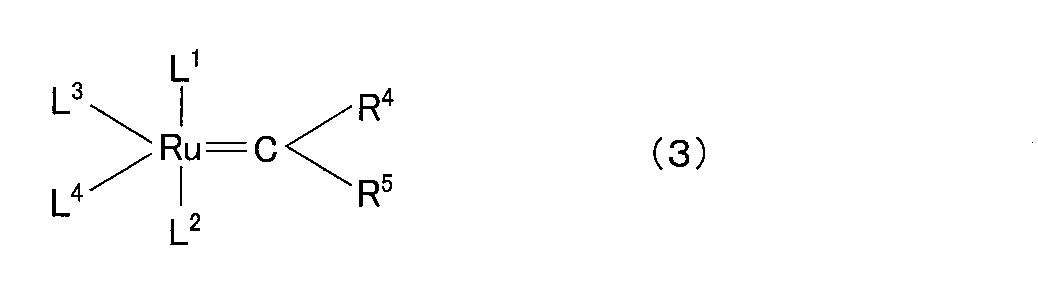

アクリル基を有するカルボン酸無水物の具体例としては、無水マレイン酸、シトラコン酸無水物等が挙げられる。
エポキシ基含有アクリレート化合物の具体例としては、アクリル酸グリシジル、メタクリル酸グリシジル、α-エチルアクリル酸グリシジル、α-n-プロピルアクリル酸グリシジル、α-n-ブチルアクリル酸グリシジル、アクリル酸-3,4-エポキシブチル、メタクリル酸-3,4-エポキシブチル、アクリル酸-6,7-エポキシヘプチル、メタクリル酸-6,7-エポキシヘプチル、α-エチルアクリル酸-6,7-エポキシヘプチル、アクリル酸-3,4-エポキシシクロヘキシルメチル、メタクリル酸-3,4-エポキシシクロヘキシルメチル等が挙げられる。
オキセタン基含有アクリレート化合物の具体例としては、(メタ)アクリル酸(3-メチルオキセタン-3-イル)メチル、(メタ)アクリル酸(3-エチルオキセタン-3-イル)メチル、(メタ)アクリル酸(3-メチルオキセタン-3-イル)エチル、(メタ)アクリル酸(3-エチルオキセタン-3-イル)エチル、(メタ)アクリル酸(3-クロロメチルオキセタン-3-イル)メチル、(メタ)アクリル酸(オキセタン-2-イル)メチル、(メタ)アクリル酸(2-メチルオキセタン-2-イル)メチル、(メタ)アクリル酸(2-エチルオキセタン-2-イル)メチル、(1-メチル-1-オキセタニル-2-フェニル)-3-(メタ)アクリレート、(1-メチル-1-オキセタニル)-2-トリフロロメチル-3-(メタ)アクリレート、及び(1-メチル-1-オキセタニル)-4-トリフロロメチル-2-(メタ)アクリレート等が挙げられる。
これらのうち、(メタ)アクリル酸、無水マレイン酸、(メタ)アクリル酸グリシジル、メタクリル酸-6,7-エポキシヘプチル等が好ましい。
これらのなかでも、メチル(メタ)アクリレート、ブチル(メタ)アクリレート、シクロヘキシル(メタ)アクリレート、2-メチルシクロヘキシル(メタ)アクリレート、ベンジル(メタ)アクリレート、トリシクロ[5.2.1.0 2,6 ]デカン-8-イル(メタ)アクリレート、N-フェニルマレイミドおよびN-シクロヘキシルマレイミド等が好ましい。
これらの化合物は、それぞれ単独で用いてもよく、2種以上を組み合わせて用いてもよい。
上記単量体の重合方法は、常法に従えばよく、例えば、懸濁重合法,乳化重合法,溶液重合法等が採用される。
環状構造を構成している4級炭素原子に二つの環状構造が結合した骨格構造の具体例としては、フルオレン骨格、ビスフェノールフルオレン骨格、ビスアミノフェニルフルオレン骨格、エポキシ基を有するフルオレン骨格、アクリル基を有するフルオレン骨格等が挙げられる。
本発明で用いるカルド樹脂(A3)は、このカルド構造を有する骨格がそれに結合している官能基間の反応等により重合して形成される。カルド樹脂(A3)は、主鎖と嵩高い側鎖が一つの元素で繋がれた構造(カルド構造)をもち、主鎖に対してほぼ垂直方向に環状構造を有している。
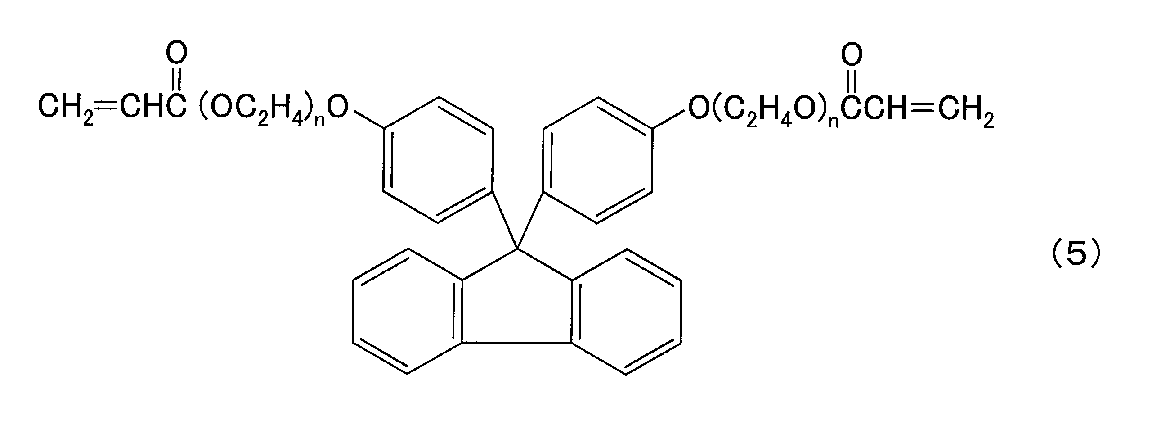
カルド樹脂(A3)は、カルド構造を有する単量体を重合して得られる重合体であるが、その他の共重合可能な単量体との共重合体であってもよい。
上記単量体の重合方法は、単量体が有する重合性の官能基の種類に応じて選択すればよく、例えば、開環重合法や付加重合法等が採用される。
(R6)m-Si-(OR7)4-m (6)
これらのオルガノシランのうち、得られる樹脂膜の耐クラック性や硬度の点から3官能性シランが好ましく用いられる。これらのオルガノシランは単独で使用しても、2種以上を組み合わせて使用してもよい。
ポリイミド(A5)を得るための原料として使用できる酸二無水物としては、具体的には、ピロメリット酸二無水物、3,3’,4,4’-ビフェニルテトラカルボン酸二無水物、2,3,3’,4’-ビフェニルテトラカルボン酸二無水物、2,2’,3,3’-ビフェニルテトラカルボン酸二無水物、3,3’,4,4’-ベンゾフェノンテトラカルボン酸二無水物、2,2’,3,3’-ベンゾフェノンテトラカルボン酸二無水物、2,2-ビス(3,4-ジカルボキシフェニル)プロパン二無水物、2,2-ビス(2,3-ジカルボキシフェニル)プロパン二無水物、2,2-ビス[3-[(3,4-ジカルボキシベンゾイル)アミノ]-4-ヒドロキシフェニル]ヘキサフルオロプロパン二無水物、1,1-ビス(3,4-ジカルボキシフェニル)エタン二無水物、1,1-ビス(2,3-ジカルボキシフェニル)エタン二無水物、ビス(3,4-ジカルボキシフェニル)メタン二無水物、ビス(2,3-ジカルボキシフェニル)メタン二無水物、ビス(3,4-ジカルボキシフェニル)スルホン二無水物、ビス(3,4-ジカルボキシフェニル)エーテル二無水物、1,2,5,6-ナフタレンテトラカルボン酸二無水物、2,3,6,7-ナフタレンテトラカルボン酸二無水物、2,3,5,6-ピリジンテトラカルボン酸二無水物、3,4,9,10-ペリレンテトラカルボン酸二無水物、2,2-ビス(3,4-ジカルボキシフェニル)ヘキサフルオロプロパン二無水物等の芳香族テトラカルボン酸二無水物や、1,2,3,4-ブタンテトラカルボン酸二無水物、1,2,3,4-シクロペンタンテトラカルボン酸二無水物等の脂肪族のテトラカルボン酸二無水物等を挙げることができる。これらの酸二無水物は、単独または2種以上を組み合わせて使用できる。
また、バインダー樹脂(A)の分子量分布は、重量平均分子量/数平均分子量(Mw/Mn)比で、通常、4以下、好ましくは3以下、より好ましくは2.5以下である。
バインダー樹脂(A)の重量平均分子量(Mw)や分子量分布(Mw/Mn)は、テトラヒドロフラン等の溶媒を溶離液としたゲル・パーミエーション・クロマトグラフィー(GPC)により、ポリスチレン換算値として求められる値である。
本発明で用いるシラン変性樹脂(B)は、樹脂部とシラン化合物部とを、これらが互いに化学的に結合された状態で有しているものである。
(R8)r-Si-(OR9)4-r (7)

また、上記式(8)中、pは0または1である。qは、2~10の整数である。
R8を構成する、炭素原子に直接結合した官能基を有していてもよい炭素数6~20のアリール基の具体例としては、フェニル基、トルイル基、p-ヒドロキシフェニル基、1-(p-ヒドロキシフェニル)エチル基、2-(p-ヒドロキシフェニル)エチル基、4-ヒドロキシ-5-(p-ヒドロキシフェニルカルボニルオキシ)ペンチル基、ナフチル基などが挙げられる。
また、R8を構成する、炭素原子に直接結合した官能基を有していてもよい炭素数1~10の不飽和脂肪族基の具体例としては、ビニル基、3-アクリロキシプロピル基、3-メタクリロキシプロピル基などが挙げられる。
本発明で用いる酸性基又は熱潜在性酸性基を有する化合物(C)は、酸性基または加熱により酸性基を生じる熱潜在性酸性基を有するものであればよく、特に限定されないが、好ましくは脂肪族化合物、芳香族化合物、複素環化合物であり、さらに好ましくは芳香族化合物、複素環化合物である。
これらの酸性基又は熱潜在性酸性基を有する化合物(C)は、それぞれ単独でまたは2種以上を組み合わせて用いることができる。
酸性基としては、酸性の官能基であればよく、その具体例としては、スルホン酸基、リン酸基等の強酸性基;カルボキシ基、チオール基およびカルボキシメチレンチオ基等の弱酸性基;が挙げられる。これらの中でも、カルボキシ基、チオール基またはカルボキシメチレンチオ基が好ましく、カルボキシ基が特に好ましい。また、これらの酸性基の中でも、酸解離定数pKaが3.5以上5.0以下の範囲にあるものが好ましい。なお、酸性基が2つ以上ある場合は第一解離定数pKa1を酸解離定数とし、第一解離定数pKa1が上記範囲にあるものが好ましい。また、pKaは、希薄水溶液条件下で、酸解離定数Ka=[H3O+][B-]/[BH]を測定し、pKa=-logKaにしたがって、求められる。ここでBHは、有機酸を表し、B-は有機酸の共役塩基を表す。
なお、pKaの測定方法は、例えばpHメータを用いて水素イオン濃度を測定し、該当物質の濃度と水素イオン濃度から算出することができる。
また、熱潜在性酸性基としては、加熱により酸性の官能基を生じる基であればよく、その具体例としては、スルホニウム塩基、ベンゾチアゾリウム塩基、アンモニウム塩基、ホスホニウム塩基、ブロックカルボン酸基等が挙げられる。これらの中でも、ブロックカルボン酸基が好ましい。なお、ブロックカルボン酸基を得るために用いられるカルボキシ基のブロック化剤は特に限定されないが、ビニルエーテル化合物であることが好ましい。
このような置換基としては、アルキル基、アリール基等の炭化水素基のほか、ハロゲン原子;アルコキシ基、アリールオキシ基、アシルオキシ基、ヘテロ環オキシ基;アルキル基又はアリール基又は複素環基で置換されたアミノ基、アシルアミノ基、ウレイド基、スルファモイルアミノ基、アルコキシカルボニルアミノ基、アリールオキシカルボニルアミノ基;アルキルチオ基、アリールチオ基、ヘテロ環チオ基;等のプロトンを有しない極性基、これらのプロトンを有しない極性基で置換された炭化水素基、等を挙げることができる。
これらの中でも、得られる樹脂膜の密着性をより高めることができるという観点から、酸性基を有する化合物における酸性基の数は、2つ以上であることが好ましく、3つが特に好ましい。
なお、本発明の樹脂組成物は、バインダー樹脂(A)、シラン変性樹脂(B)、及び酸性基又は熱潜在性酸性基を有する化合物(C)に加えて、感放射線化合物(D)をさらに含有するものであってもよい。感放射線化合物(D)は、紫外線や電子線等の放射線の照射により、化学反応を引き起こすことのできる化合物である。本発明において感放射線化合物(D)は、樹脂組成物から形成されてなる樹脂膜のアルカリ溶解性を制御できるものが好ましく、特に、光酸発生剤を使用することが好ましい。
これらの感放射線化合物は、それぞれ単独で、または2種以上を組み合わせて用いることができる。
また、本発明の樹脂組成物は、さらに架橋剤(E)を含有していてもよい。本発明で用いる架橋剤(E)は、加熱により架橋剤分子間に架橋構造を形成するものや、バインダー樹脂(A)と反応して樹脂分子間に架橋構造を形成するものであり、具体的には、2以上の反応性基を有する化合物が挙げられる。このような反応性基としては、例えば、アミノ基、カルボキシ基、水酸基、エポキシ基、イソシアネート基が挙げられ、より好ましくはアミノ基、エポキシ基及びイソシアネート基であり、アミノ基及びエポキシ基が特に好ましい。
本発明の樹脂組成物には、さらに、溶剤が含有されていてもよい。溶剤としては、特に限定されず、樹脂組成物の溶剤として公知のもの、例えばアセトン、メチルエチルケトン、シクロペンタノン、2-ヘキサノン、3-ヘキサノン、2-ヘプタノン、3-ヘプタノン、4-ヘプタノン、2-オクタノン、3-オクタノン、4-オクタノンなどの直鎖のケトン類;n-プロピルアルコール、イソプロピルアルコール、n-ブチルアルコール、シクロヘキサノールなどのアルコール類;エチレングリコールジメチルエーテル、エチレングリコールジエチルエーテル、ジオキサンなどのエーテル類;エチレングリコールモノメチルエーテル、エチレングリコールモノエチルエーテルなどのアルコールエーテル類;ギ酸プロピル、ギ酸ブチル、酢酸プロピル、酢酸ブチル、プロピオン酸メチル、プロピオン酸エチル、酪酸メチル、酪酸エチル、乳酸メチル、乳酸エチルなどのエステル類;セロソルブアセテート、メチルセロソルブアセテート、エチルセロソルブアセテート、プロピルセロソルブアセテート、ブチルセロソルブアセテートなどのセロソルブエステル類;プロピレングリコール、プロピレングリコールモノメチルエーテル、プロピレングリコールモノメチルエーテルアセテート、プロピレングリコールモノエチルエーテルアセテート、プロピレングリコールモノブチルエーテルなどのプロピレングリコール類;ジエチレングリコールモノメチルエーテル、ジエチレングリコールモノエチルエーテル、ジエチレングリコールジメチルエーテル、ジエチレングリコールジエチルエーテル、ジエチレングリコールメチルエチルエーテルなどのジエチレングリコール類;γ-ブチロラクトン、γ-バレロラクトン、γ-カプロラクトン、γ-カプリロラクトンなどの飽和γ-ラクトン類;トリクロロエチレンなどのハロゲン化炭化水素類;トルエン、キシレンなどの芳香族炭化水素類;ジメチルアセトアミド、ジメチルホルムアミド、N-メチルアセトアミドなどの極性溶媒などが挙げられる。これらの溶剤は、単独でも2種以上を組み合わせて用いてもよい。溶剤の含有量は、バインダー樹脂(A)100重量部に対して、好ましくは10~10000重量部、より好ましくは50~5000重量部、さらに好ましくは100~1000重量部の範囲である。なお、樹脂組成物に溶剤を含有させる場合には、溶剤は、通常、樹脂膜形成後に除去されることとなる。
テトラメトキシシラン、テトラエトキシシラン、テトラ-n-プロポキシシラン、テトラ-i-プロポキシシラン、テトラ-n-ブトキシシランなどのテトラアルコキシシラン類、
メチルトリメトキシシラン、メチルトリエトキシシラン、エチルトリメトキシシラン、エチルトリエトキシシラン、n-プロピルトリメトキシシラン、n-プロピルトリエトキシシラン、i-プロピルトリメトキシシラン、i-プロピルトリエトキシシラン、n-ブチルトリメトキシシラン、n-ブチルトリエトキシシラン、n-ペンチルトリメトキシシラン、n-ヘキシルトリメトキシシラン、n-ヘプチルトリメトキシシラン、n-オクチルトリメトキシシラン、n-デシルトリメトキシシラン、p-スチリルトリメトキシシラン、ビニルトリメトキシシラン、ビニルトリエトキシシラン、シクロヘキシルトリメトキシシラン、シクロヘキシルトリメトキシシラン、シクロヘキシルトリエトキシシラン、フェニルトリメトキシシラン、フェニルトリエトキシシラン、3-クロロプロピルトリメトキシシラン、3-クロロプロピルトリエトキシシラン、3,3,3-トリフルオロプロピルトリメトキシシラン、3,3,3-トリフルオロプロピルトリエトキシシラン、3-アミノプロピルトリメトキシシラン、3-アミノプロピルトリエトキシシラン、N-2-(アミノエチル)-3-アミノプロピルトリメトキシシラン、N-フェニル-3-アミノプロピルトリメトキシシラン、2-ヒドロキシエチルトリメトキシシラン、2-ヒドロキシエチルトリエトキシシラン、2-ヒドロキシプロピルトリメトキシシラン、2-ヒドロキシプロピルトリエトキシシラン、3-ヒドロキシプロピルトリメトキシシラン、3-ヒドロキシプロピルトリエトキシシラン、3-メルカプトプロピルトリメトキシシラン、3-メルカプトプロピルトリエトキシシラン、3-イソシアナートプロピルトリメトキシシラン、3-イソシアナートプロピルトリエトキシシラン、3-グリシドキシプロピルトリメトキシシラン、3-グリシドキシプロピルトリエトキシシラン、2-(3,4-エポキシシクロヘキシル)エチルトリメトキシシラン、2-(3,4-エポキシシクロヘキシル)エチルトリエトキシシラン、3-(メタ)アクリルオキシプロピルトリメトキシシラン、3-(メタ)アクリルオキシプロピルトリエトキシシラン、3-ウレイドプロピルトリメトキシシラン、3-ウレイドプロピルトリエトキシシラン、3-エチル(トリメトキシシリルプロポキシメチル)オキセタン、3-エチル(トリエトキシシリルプロポキシメチル)オキセタン、3-トリエトキシシリル-N-(1,3-ジメチル-ブチリデン)プロピルアミン、ビス(トリエトキシシリルプロピル)テトラスルフィドなどのトリアルコキシシラン類、
ジメチルジメトキシシラン、ジメチルジエトキシシラン、ジエチルジメトキシシラン、ジエチルジエトキシシラン、ジ-n-プロピルジメトキシシラン、ジ-n-プロピルジエトキシシラン、ジ-i-プロピルジメトキシシラン、ジ-i-プロピルジエトキシシラン、ジ-n-ブチルジメトキシシラン、ジ-n-ペンチルジメトキシシラン、ジ-n-ペンチルジエトキシシラン、ジ-n-ヘキシルジメトキシシラン、ジ-n-ヘキシルジエトキシシラン、ジ-n-へプチルジメトキシシラン、ジ-n-ヘプチルジエトキシシラン、ジ-n-オクチルジメトキシシラン、ジ-n-オクチルジエトキシシラン、ジ-n-シクロヘキシルジメトキシシラン、ジ-n-シクロヘキシルジエトキシシラン、ジフェニルジメトキシシラン、ジフェニルジエトキシシラン、3-グリシドキシプロピルメチルジエトキシシラン、3-メタクリルオキシプロピルメチルジメトキシシラン、3-アクリルオキシプロピルメチルジメトキシシラン、3-メタクリルオキシプロピルメチルジエトキシシラン、3-アクリルオキシプロピルメチルジエトキシシラン、N-2-(アミノエチル)-3-アミノプロピルメチルジメトキシシランなどのジアルコキシシラン類の他、
メチルトリアセチルオキシシラン、ジメチルジアセチルオキシシラン等のケイ素原子含有化合物;
(アセトアルコキシアルミウムジイソプロピレート)等のアルミニウム原子含有化合物;
(テトラノルマルプロポキシジルコニウム、テトラノルマルブトキシジルコニウム、ジルコニウムテトラアセチルアセトネート、ジルコニウムトリブトキシアセチルアセトネート、ジルコニウムものブトキシアセチルアセトネートビス(エチルアセトアセテート)、ジルコニウムジブトキシビス(エチルアセトアセテート)、ジルコニウムテトラアセチルアセトネート、ジルコニウムトリブトキシステアレート)等のジルコニウム原子含有化合物;が挙げられる。
混合の方法は特に限定されないが、樹脂組成物を構成する各成分を溶剤に溶解または分散して得られる溶液または分散液を混合するのが好ましい。これにより、樹脂組成物は、溶液または分散液の形態で得られる。
次いで、本発明の半導体素子基板について、説明する。本発明の半導体素子基板は、上述した本発明の樹脂組成物からなる樹脂膜を有する。
潜像パターンを有する樹脂膜に現像液を接触させる方法としては、例えば、パドル法、スプレー法、ディッピング法等の方法が用いられる。現像は、通常、0~100℃、好ましくは5~55℃、より好ましくは10~30℃の範囲で、通常、30~180秒間の範囲で適宜選択される。
さらに、必要に応じて、樹脂組成物に含有させた感放射線化合物(D)を失活させるために、半導体素子基板全面に、活性放射線を照射することもできる。活性放射線の照射には、上記潜像パターンの形成に例示した方法を利用できる。照射と同時に、または照射後に樹脂膜を加熱してもよい。加熱方法としては、例えば、半導体素子基板をホットプレートやオーブン内で加熱する方法が挙げられる。温度は、通常、100~300℃、好ましくは120~200℃の範囲である。
なお、各特性の定義および評価方法は、以下のとおりである。
重合反応終了後、ガスクロマトグラフィーを用いて反応液中の単量体の残存量を測定し、その値より算出した。
1H-NMRスペクトルにより、水素添加された炭素-炭素二重結合モル数を水素添加前の炭素-炭素二重結合モル数に対する割合として求めた。水素添加前を基準として、水素添加された炭素-炭素二重結合の割合をモル%として求めた。
ゲルパーミエーションクロマトグラフィー(略称GPC、東ソー社製、型版「HLC-8020」、TSKgel SuperH2000、TSKgel SuperH4000、TSKgel SuperH5000の3種類のカラムを組み合わせて使用)を用い、ポリスチレン換算の分子量として算出した。なお、展開溶剤としては、テトラヒドロフランを用いた。
樹脂組成物をシリコンウェハ上にスピンコートした後、ホットプレートを用いて100℃で2分間プリベークして、2.5μm厚の樹脂膜を形成した。次いで、樹脂膜をパターニングするために、光が透過可能な短冊状のスリット(スペースに相当)を平行して10本有し、互いに隣り合うスリット間(ラインに相当)の幅がスリット幅と同じとなっているマスク(すなわち、同じ幅のラインアンドスペースパターンを形成可能なマスク)を介して、365nmにおける光強度が5mW/cm2である紫外線を、所望の時間にて照射した。なお、マスクとしては、スリット幅及び隣り合うスリット間の幅が、それぞれ1μm、2μm、3μm、4μm、5μm、10μm、25μm及び50μmのものの合計8種類を使用した。
○:剥がれたライン部が存在しない。あるいは、剥がれたライン部が存在していても、剥がれたライン部の最大ライン幅が3μm以下
△:剥がれたライン部の最大ライン幅が4~5μm
×:剥がれたライン部の最大ライン幅が10μm以上
感放射線性樹脂組成物をシリコンウェハ上にスピンコートした後、ホットプレートを用いて100℃で2分間プリベークして、2.5μm厚の樹脂膜を形成した。次いで、この樹脂膜に、8μm×8μmのホールパターンのマスクを介して、365nmにおける光強度が5mW/cm2である紫外線を、60秒間、空気中で照射した。次いで、0.4重量%テトラメチルアンモニウムヒドロキシド水溶液を用いて、23℃、120秒間現像処理を行った後、超純水で30秒間リンスしてコンタクトホールのパターンを形成した。
そして、このようにして得られたコンタクトホールのパターンを有する樹脂膜について、走査型電子顕微鏡(SEM)を用いて、コンタクトホール内における、溶解残渣の有無を確認し、以下の基準で評価した。溶解残渣が観測されない方が、現像によるパターン形成性に優れるため、好ましい。
○:現像残渣が観測されなかった。
×:現像残渣が観測された。
上述した現像時残渣の評価と同様にして得られたコンタクトホールのパターンを有する樹脂膜に、365nmにおける光強度が5mW/cm2である紫外線を、100秒間、空気中で照射した。そして、得られたパターンの断面を電子顕微鏡で観察して、パターンの下端幅を測定し、これを「ポストベーク前のパターンの下端幅a」とした。次いで、得られたパターンを有する樹脂膜について、オーブンを用いて230℃、1時間ポストベークを行ない、得られたポストベーク後の樹脂膜について、パターンの断面を電子顕微鏡で観察して、パターンの上端の形状を評価するとともに、パターンの下端幅を測定し、これを「ポストベーク後のパターンの下端幅b」とした。そして、ポストベーク前のパターンの下端幅aに対するポストベーク後のパターンの下端幅bの比率(b/a)を求めて、下記の基準で評価を行った。
○:b/aが0.8以上であった。
△:b/aが0.5以上かつ0.8未満であった。
×:b/aが0.5未満、またはコンタクトホールの形状が歪んでいた。
ガラス基板(コーニング社製、「コーニング1737(製品名)」)上に、樹脂組成物をスピンコートしたのち、ホットプレートを用いて100℃で2分間プリベークして、膜厚2.5μmの樹脂膜を形成した。次いで、この樹脂膜について、0.4重量%テトラメチルアンモニウムヒドロキシド水溶液を用いて、23℃で120秒間浸漬処理を行ったのち、超純水で30秒間洗浄を行い、次いで、365nmにおける光強度が5mW/cm2である紫外線を、100秒間、空気中で照射した。そして、紫外線を照射した樹脂膜について、オーブンを用いて、230℃で60分間加熱するポストベークを行うことで、樹脂膜が形成されたガラス基板からなる試験用試料を得た。そして、得られた試験用試料について、分光光度計( 日本分光株式会社製、「紫外可視分光光度計V-560(製品名)」を用いて、波長400nmでの透過率の測定を行い、樹脂膜の透明性を、下記の基準で評価した。なお、樹脂膜の透過率は、樹脂膜が付いていないガラス基板をブランクとし、樹脂膜厚が2μmであるとしたときの換算値を算出することにより、求めた。
○:光線透過率が90%以上
△:光線透過率が80%以上かつ90%未満
×:光線透過率が80%未満
樹脂組成物を調製した後、23℃、湿度50%の環境で7日間放置し、その後、上述した現像時残渣の評価と同様にして得られたコンタクトホールのパターンを有する樹脂膜に、365nmにおける光強度が5mW/cm2である紫外線を、100秒間、空気中で照射した。そして、得られたパターンの断面を電子顕微鏡で観察して、パターンの下端幅を測定し、これを「7日間放置後の樹脂組成物のポストベーク前のパターンの下端幅a’」とした。そして、上述した焼成時ホール状態の評価にて得られたポストベーク前のパターンの下端幅aに対する7日間放置後の樹脂組成物のポストベーク前のパターンの下端幅a’の比率(a’/a)を求めて、下記の基準で評価を行った。
○:a’/aが0.95以上であり、かつ1.05以下であった。
×:a’/aが0.95未満、あるいは1.05超であった。
<環状オレフィン重合体(A-1)の調製>
N-(2-エチルヘキシル)-ビシクロ[2.2.1]ヘプト-5-エン-2,3-ジカルボキシイミド40モル%、および4-ヒドロキシカルボニルテトラシクロ[6.2.1.13,6.02,7]ドデカ-9-エン60モル%からなる単量体混合物100部、1,5-ヘキサジエン2部、(1,3-ジメシチルイミダゾリン-2-イリデン)(トリシクロヘキシルホスフィン)ベンジリデンルテニウムジクロリド(Org.Lett.,第1巻,953頁,1999年 に記載された方法で合成した)0.02部、及びジエチレングリコールエチルメチルエーテル200部を、窒素置換したガラス製耐圧反応器に仕込み、攪拌しつつ80℃にて4時間反応させて重合反応液を得た。
<アクリル重合体(A-2)の調製>
冷却管及び攪拌機を備えたフラスコに、2,2’-アゾビス-(2,4-ジメチルバレロニトリル)7部とジエチレングリコールエチルメチルエーテル200部とを仕込んだ。引き続き、メタクリル酸16部、トリシクロ[5.2.1.02,6]デカン-8-イルメタクリレート16部、2-メチルシクロヘキシルアクリレート20部、メタクリル酸グリシジル40部、スチレン10部及びα-メチルスチレンダイマー3部を仕込んで窒素置換した後、ゆるやかに撹拌を始めた。次いで、溶液の温度を70℃に上昇させ、この温度を4時間保持することによってアクリル重合体(A-2)を含む重合体溶液を得た。アクリル重合体(A-2)のポリスチレン換算重量平均分子量(Mw)は8,000、分子量分布(Mw/Mn)は2.3であった。また、得られたアクリル重合体(A-2)溶液の固形分濃度は34.4重量%であった。
<ポリ(メチルトリメトキシシラン)の調製>
攪拌装置、還流冷却管、及び温度計を取り付けたフラスコにメチルトリメトキシシランを136部、及びメタノール32部を仕込んだ。次いで、これらを常温で攪拌をしながら、イオン交換水13.5部(メチルトリメトキシシランに対して、0.75モル当量)に濃塩酸0.1部を溶かした水溶液を5分間かけて滴下し、4時間反応を続けた。そして、4時間の反応後、還流冷却管を分留管に取り替え、引き続いて、温度80℃、常圧下で30分間低沸点成分の留去を行い、その後、温度100℃、圧力0.3KPaになるまで留去を行うことで、ポリ(メチルトリメトキシシラン)を得た。得られたポリ(メチルトリメトキシシラン)を、ゲルパーミエーションクロマトグラフィー(GPC)により分析したところ、得られたポリ(メチルトリメトキシシラン)は、重量平均分子量490(ポリスチレン換算)であった。
<シラン変性エポキシ樹脂(B-1)溶液の調製>
攪拌機、冷却管、及び温度計を備えた反応装置に、ビスフェノールA型エポキシ樹脂(エポキシ当量480g/eq)800.0部、及びジエチレングリコールジメチルエーテル960.0部を加え、80℃で溶解した。そして、ここに、合成例3で得られたポリ(メチルトリメトキシシラン)605.0部、及び触媒としてのジブチル錫ラウレート2.3部を加え、80℃で5時間、脱メタノール反応させて、シラン変性エポキシ樹脂(B-1)溶液を得た。なお、得られたシラン変性エポキシ樹脂は、有効成分(硬化後)が50重量%、シリカ換算の重量/ビスフェノール型エポキシ樹脂の重量(重量比)が0.51であり、エポキシ当量が1400g/eqであった。また、ポリ(メチルトリメトキシシラン)の、部分縮合物成分のメトキシ基の87モル%が保持されていることが、1H-NMRで確認された。
<シラン変性フェノール樹脂(B-2)の調製>
攪拌機、分水器、温度計及び窒素ガス導入管を備えた反応装置に、ノボラック型フェノール樹脂(荒川化学工業(株)製,商品名タマノル759)800部、合成例3で得られたポリ(メチルトリメトキシシラン)590.3部を加え100℃で溶融混合した。ここに触媒としてのジブチル錫ジラウレート3部を加え、110℃で7時間、脱メタノール反応させ、また、これによりメタノール80部を留去することで、シラン変性フェノール樹脂(B-2)を得た。
<エポキシ基含有メトキシシラン部分縮合物の製造>
攪拌機、分水器、温度計及び窒素ガス導入管を備えた反応装置に、グリシドール1400部及び合成例3で得られたポリ(メチルトリメトキシシラン)9140部を仕込み、窒素気流下、攪拌しながら90℃に昇温した後、ジブチル錫ジラウレート2.2部を加え反応させた。反応中、分水器を使って生成したメタノールを留去し、その量が約630部に達した時点で冷却した。昇温後冷却までに要した時間は6時間であった。次いで、13kPaで約10分間、系内に残存するメタノール約30部を減圧除去することで、エポキシ基含有アルコキシシラン部分縮合物を得た。
<シラン変性ポリアミック酸(B-3)の調製>
攪拌機、冷却管、温度計及び窒素ガス導入管を備えた2Lの3ツ口フラスコに、4,4’-ジアミノジフェニルエーテル112部及びN-メチルピロリドン1170部を加え、室温でよく混合した後、60℃以下に冷却しながら、ピロメリット酸二無水物118部を加え30分攪拌し、ポリアミック酸を合成した。得られたポリアミック酸のポリイミド換算固形残分は15重量%であった。次いで、N-メチルピロリドン500部を加え、80℃まで昇温し、合成例6で得られたエポキシ基含有アルコキシシラン部分縮合物40.2部、及び触媒としての2-メチルイミダゾール0.24部を加え、80℃で4時間反応した。そして、4時間の反応後、室温まで冷却し、硬化残分12重量%のシラン変性ポリアミック酸(B-3)を得た。
<グリシジルエーテル基含有テトラメトキシシラン部分縮合物の製造>
攪拌機、分水器、温度計及び窒素ガス導入管を備えた反応装置に、グリシドール1,400部およびテトラメトキシシラン部分縮合物(多摩化学(株)製、商品名「メチルシリケート51」、1分子中のSiの平均個数が4、数平均分子量480)8,957.9部を仕込み、窒素気流下、攪拌しながら、90℃に昇温した後、触媒としてのジブチル錫ジラウレート2.0部を加え、反応させた。反応中、分水器を使って生成したメタノールを留去し、その量が約550部に達した時点で冷却した。昇温後冷却までに要した時間は5時間であった。次いで、13kPaで約10分間、系内に残存するメタノール約68部を減圧除去することで、グリシジルエーテル基含有テトラメトキシシラン部分縮合物を得た。
<シラン変性アクリル樹脂(B-4)の製造>
攪拌機、冷却管、温度計及びガス導入管を備えた反応装置に、ジエチレングリコールジメチルエーテル1461部を仕込み、窒素気流下で100℃に昇温した後、ブチルメタクリレート417部及びヒドロキシエチルアクリレート83.3部からなる混合モノマー、及びジターシャリーブチルパーオキサイド25部をそれぞれ1時間掛けて滴下し、さらにメチルメタクリレート250部及びメタクリル酸83.3部からなる混合モノマー、及びジターシャリーブチルパーオキサイド10部をそれぞれ1時間で滴下し、更に120℃で3時間反応させて、固形分37重量%のカルボキシル基含有アクリル系ポリマー溶液を得た。得られたカルボキシル基含有アクリル系ポリマーの数平均分子量は50,000、酸価(固形分当り)は65mgKOH/gであった。
<樹脂組成物の調製>
バインダー樹脂(A)として、合成例1で得られた環状オレフィン重合体(A-1)溶液291部(環状オレフィン重合体(A-1)として100部)、溶剤として、ジエチレングリコールエチルメチルエーテル359部、シラン変性樹脂(B)として、合成例4で得られたシラン変性エポキシ樹脂(B-1)溶液20部(シラン変性エポキシ樹脂(B-1)として10部)、酸性基又は熱潜在性酸性基を有する化合物(C)として、1,2,4-ベンゼントリカルボン酸3部、感放射線化合物(D)として、1,1,3-トリス(2,5-ジメチル-4-ヒドロキシフェニル)-3-フェニルプロパン(1モル)と1,2-ナフトキノンジアジド-5-スルホン酸クロライド(2モル)との縮合物30部、及び、架橋剤(E)として、3,4-エポキシシクロヘキセニルメチル-3’,4’-エポキシシクロヘキセンカルボキシレート30部を混合し、溶解させた後、孔径0.45μmのポリテトラフルオロエチレン製フィルターでろ過して樹脂組成物を調製した。
酸性基又は熱潜在性酸性基を有する化合物(C)としての1,2,4-ベンゼントリカルボン酸の配合量を3部から10部に変更した以外は、実施例1と同様にして、樹脂組成物を得て、同様に評価を行った。結果を表1に示す。
シラン変性樹脂(B)としてのシラン変性エポキシ樹脂(B-1)溶液の配合量を20部から60部(シラン変性エポキシ樹脂(B-1)として30部)に変更するとともに、酸性基又は熱潜在性酸性基を有する化合物(C)としての1,2,4-ベンゼントリカルボン酸の配合量を3部から2部に変更した以外は、実施例1と同様にして、樹脂組成物を得て、同様に評価を行った。結果を表1に示す。
架橋剤(E)として、3,4-エポキシシクロヘキセニルメチル-3’,4’-エポキシシクロヘキセンカルボキシレートに代えて、N,N,N’,N’,N’’,N’’-(ヘキサメトキシメチル)メラミン系架橋剤10部を使用した以外は、実施例1と同様にして、樹脂組成物を得て、同様に評価を行った。結果を表1に示す。
架橋剤(E)として、3,4-エポキシシクロヘキセニルメチル-3’,4’-エポキシシクロヘキセンカルボキシレートに代えて、イソシアヌル酸トリス(2,3-エポキシプロピル)5部を使用した以外は、実施例1と同様にして、樹脂組成物を得て、同様に評価を行った。結果を表1に示す。
シラン変性樹脂(B)として、シラン変性エポキシ樹脂(B-1)の代わりに、合成例5で得られたシラン変性フェノール樹脂(B-2)10部を用いた以外は、実施例5と同様にして、樹脂組成物を得て、同様に評価を行った。結果を表1に示す。
架橋剤(E)として、イソシアヌル酸トリス(2,3-エポキシプロピル)に代えて、2-(3,4-エポキシシクロヘキシル)エチルトリメトキシシラン20部を使用した以外は、実施例6と同様にして、樹脂組成物を得て、同様に評価を行った。結果を表1に示す。
酸性基又は熱潜在性酸性基を有する化合物(C)として、1,2,4-ベンゼントリカルボン酸に代えて、1,2,4-ベンゼントリカルボン酸トリス(1-プロポキシエチル)のプロピレングリコールモノメチルエーテルアセテート溶液5部(1,2,4-ベンゼントリカルボン酸トリス(1-プロポキシエチル)として3部)を使用したこと以外は、実施例7と同様にして、樹脂組成物を得て、同様に評価を行った。結果を表1に示す。
シラン変性樹脂(B)として、シラン変性エポキシ樹脂(B-1)溶液に代えて、合成例7で得られたシラン変性ポリアミック酸(B-3)溶液83部(シラン変性ポリアミック酸(B-3)として10部)を使用した以外は、実施例1と同様にして、樹脂組成物を得て、同様に評価を行った。結果を表1に示す。
シラン変性樹脂(B)として、シラン変性エポキシ樹脂(B-1)溶液に代えて、合成例9で得られたシラン変性アクリル樹脂(B-4)溶液26部(シラン変性アクリル樹脂(B-4)として10部)を使用した以外は、実施例1と同様にして、樹脂組成物を得て、同様に評価を行った。結果を表1に示す。
バインダー樹脂(A)として、合成例2で得られたアクリル重合体(A-2)溶液291部(アクリル重合体(A-2)として100部)、溶剤として、ジエチレングリコールエチルメチルエーテル359部、シラン変性樹脂(B)として、合成例4で得られたシラン変性エポキシ樹脂(B-1)溶液20部(シラン変性エポキシ樹脂(B-1)として10部)、酸性基又は熱潜在性酸性基を有する化合物(C)として、1,2,4-ベンゼントリカルボン酸トリス(1-プロポキシエチル)のプロピレングリコールモノメチルエーテルアセテート溶液を5部(1,2,4-ベンゼントリカルボン酸トリス(1-プロポキシエチル)として3部)、感放射線化合物(D)として、1,1,3-トリス(2,5-ジメチル-4-ヒドロキシフェニル)-3-フェニルプロパン(1モル)と1,2-ナフトキノンジアジド-5-スルホン酸クロライド(2モル)との縮合物30部、及び、架橋剤(E)として、2-(3,4-エポキシシクロヘキシル)エチルトリメトキシシラン10部を混合し、溶解させた後、孔径0.45μmのポリテトラフルオロエチレン製フィルターでろ過して樹脂組成物を調製した。そして、得られた樹脂組成物について、実施例1と同様に評価を行った。結果を表1に示す。
シラン変性樹脂(B)として、シラン変性エポキシ樹脂(B-1)の代わりに、合成例5で得られたシラン変性フェノール樹脂(B-2)10部を用いた以外は、実施例11と同様にして、樹脂組成物を得て、同様に評価を行った。結果を表1に示す。
酸性基又は熱潜在性酸性基を有する化合物(C)としての1,2,4-ベンゼントリカルボン酸を配合しなかった以外は、実施例1と同様にして、樹脂組成物を得て、同様に評価を行った。結果を表1に示す。
酸性基又は熱潜在性酸性基を有する化合物(C)としての1,2,4-ベンゼントリカルボン酸の配合量を3部から0.3部に変更した以外は、実施例1と同様にして、樹脂組成物を得て、同様に評価を行った。結果を表1に示す。
酸性基又は熱潜在性酸性基を有する化合物(C)としての1,2,4-ベンゼントリカルボン酸の配合量を3部から30部に変更した以外は、実施例1と同様にして、樹脂組成物を得て、同様に評価を行った。結果を表1に示す。
シラン変性樹脂(B)としてのシラン変性エポキシ樹脂(B-1)溶液を配合しなかった以外は、実施例1と同様にして、樹脂組成物を得て、同様に評価を行った。結果を表1に示す。
バインダー樹脂(A)としてのアクリル重合体(A-2)を配合せず、シラン変性樹脂(B)としてのシラン変性フェノール樹脂(B-2)の配合量を100部とした以外は、実施例12と同様にして、樹脂組成物を得て、同様に評価を行った。結果を表1に示す。
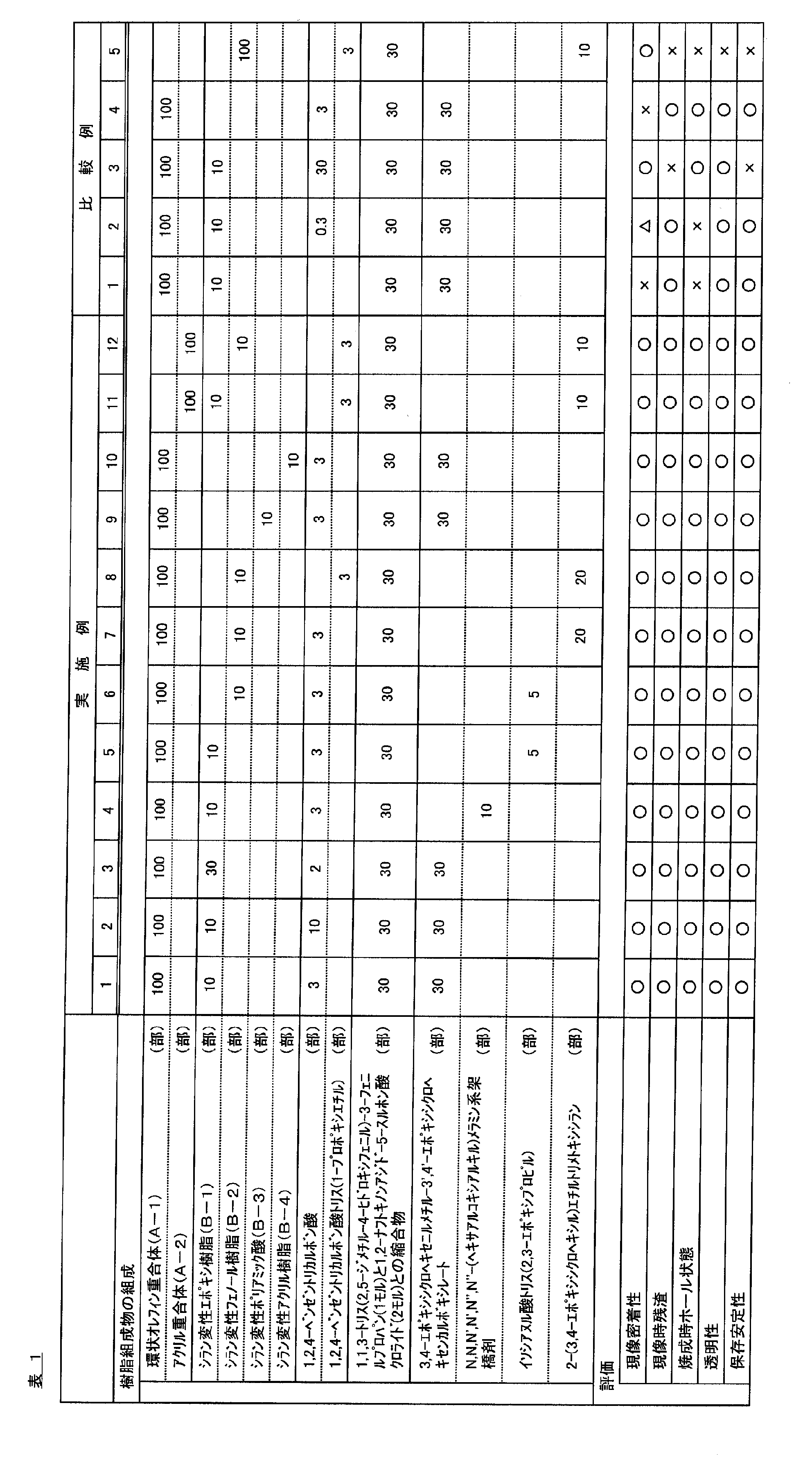
「シラン変性樹脂(B)/酸性基又は熱潜在性酸性基を有する化合物(C)」の重量比が、0.3と低すぎる場合には、得られる樹脂組成物は、保存安定性に劣り、さらに、樹脂膜とした場合には、現像残渣が発生する結果となった(比較例3)。
また、シラン変性樹脂(B)を配合しなかった場合には、現像密着性に劣り、現像パターン幅を細くした場合における、現像パターンの密着性が不十分であった(比較例4)。
さらに、バインダー樹脂(A)を配合しなかった場合には、得られる樹脂組成物は、保存安定性に劣り、さらに、樹脂膜とした場合には、現像残渣、焼成時ホール状態、及び透明性に劣る結果となった(比較例5)。
Claims (8)
- バインダー樹脂(A)、シラン変性樹脂(B)、及び酸性基又は熱潜在性酸性基を有する化合物(C)を含有してなる樹脂組成物であって、前記シラン変性樹脂(B)と、前記酸性基又は熱潜在性酸性基を有する化合物(C)との比率が、重量比で、「シラン変性樹脂(B)/酸性基又は熱潜在性酸性基を有する化合物(C)」=0.5~20であることを特徴とする樹脂組成物。
- 前記シラン変性樹脂(B)が、ポリエステル、ポリアミド、ポリイミド、ポリアミック酸、エポキシ樹脂、アクリル樹脂、ウレタン樹脂、及びフェノール樹脂から選択される少なくとも一つの高分子材料と、ケイ素化合物とを化学的に結合してなる化合物であることを特徴とする請求項1に記載の樹脂組成物。
- 前記ケイ素化合物が、下記式で表されるケイ素化合物及び/又は下記式で表されるケイ素化合物の部分加水分解縮合物であることを特徴とする請求項2に記載の樹脂組成物。
(R8)r-Si-(OR9)4-r
(上記式中、rは0~3の整数であり、R8は、炭素原子に直接結合した官能基を有していてもよい炭素数1~10のアルキル基、炭素数6~20のアリール基、または炭素数2~10の不飽和脂肪族基であり、R8が複数である場合には、複数のR8は、それぞれ同じであっても異なっていてもよい。R9は、水素原子、または炭素原子に直接結合した官能基を有していてもよい炭素数1~10のアルキル基であり、R9が複数である場合には、複数のR9は、それぞれ同じであっても異なっていてもよい。) - 前記シラン変性樹脂(B)の含有割合が、前記バインダー樹脂(A)100重量部に対して、1~100重量部であることを特徴とする請求項1~3のいずれかに記載の樹脂組成物。
- 前記バインダー樹脂(A)が、プロトン性極性基を有する環状オレフィン重合体、またはアクリル樹脂であることを特徴とする請求項1~4のいずれかに記載の樹脂組成物。
- 感放射線化合物(D)をさらに含有する請求項1~5のいずれかに記載の樹脂組成物。
- 架橋剤(E)をさらに含有する請求項1~6のいずれかに記載の樹脂組成物。
- 請求項1~7のいずれかに記載の樹脂組成物からなる樹脂膜を備える半導体素子基板。
Priority Applications (3)
| Application Number | Priority Date | Filing Date | Title |
|---|---|---|---|
| KR1020137022608A KR20140007405A (ko) | 2011-03-30 | 2012-03-29 | 수지 조성물 및 반도체 소자 기판 |
| CN2012800148101A CN103443707A (zh) | 2011-03-30 | 2012-03-29 | 树脂组合物和半导体元件基板 |
| JP2013507710A JPWO2012133617A1 (ja) | 2011-03-30 | 2012-03-29 | 樹脂組成物および半導体素子基板 |
Applications Claiming Priority (2)
| Application Number | Priority Date | Filing Date | Title |
|---|---|---|---|
| JP2011074673 | 2011-03-30 | ||
| JP2011-074673 | 2011-03-30 |
Publications (1)
| Publication Number | Publication Date |
|---|---|
| WO2012133617A1 true WO2012133617A1 (ja) | 2012-10-04 |
Family
ID=46931319
Family Applications (1)
| Application Number | Title | Priority Date | Filing Date |
|---|---|---|---|
| PCT/JP2012/058307 Ceased WO2012133617A1 (ja) | 2011-03-30 | 2012-03-29 | 樹脂組成物および半導体素子基板 |
Country Status (5)
| Country | Link |
|---|---|
| JP (1) | JPWO2012133617A1 (ja) |
| KR (1) | KR20140007405A (ja) |
| CN (1) | CN103443707A (ja) |
| TW (1) | TWI458759B (ja) |
| WO (1) | WO2012133617A1 (ja) |
Cited By (9)
| Publication number | Priority date | Publication date | Assignee | Title |
|---|---|---|---|---|
| JP2015508184A (ja) * | 2012-02-09 | 2015-03-16 | アーゼッド・エレクトロニック・マテリアルズ(ルクセンブルグ)ソシエテ・ア・レスポンサビリテ・リミテ | 低誘電性光画像形成性組成物及びそれから製造した電子デバイス |
| EP2826802A4 (en) * | 2012-03-16 | 2015-09-09 | Zeon Corp | METHOD FOR PRODUCING A RING OPENING METETHESENE POLYMER HYDRIDE AND RESIN COMPOSITION |
| KR20160061055A (ko) * | 2014-11-21 | 2016-05-31 | 롬엔드하스전자재료코리아유한회사 | 포지티브형 감광성 수지 조성물 및 이로부터 제조된 경화막 |
| WO2016133023A1 (ja) * | 2015-02-19 | 2016-08-25 | 日本ゼオン株式会社 | 樹脂組成物、樹脂膜、及び電子部品 |
| KR101815935B1 (ko) * | 2016-09-29 | 2018-01-08 | 염한균 | 고 내열성 면상 발열체 조성물 및 그 제조방법 |
| WO2018021049A1 (ja) * | 2016-07-28 | 2018-02-01 | 日産化学工業株式会社 | 樹脂組成物 |
| JP2018151644A (ja) * | 2012-12-27 | 2018-09-27 | 日立化成株式会社 | 感光性樹脂組成物、感光性フィルム及びレジストパターンの形成方法 |
| JP2019091020A (ja) * | 2017-11-16 | 2019-06-13 | ローム・アンド・ハース・エレクトロニック・マテリアルズ・コリア・リミテッド | 感光性樹脂組成物及びそれから調製された硬化膜 |
| KR102293308B1 (ko) * | 2021-01-15 | 2021-08-23 | 한국전기연구원 | 유기 실록산 바인더 기반 광감성 솔더레지스트 및 그 제조방법 |
Families Citing this family (4)
| Publication number | Priority date | Publication date | Assignee | Title |
|---|---|---|---|---|
| EP3121652B1 (en) * | 2014-03-20 | 2019-09-04 | Zeon Corporation | Radiation-sensitive resin composition and electronic component |
| TWI524150B (zh) * | 2014-06-27 | 2016-03-01 | 奇美實業股份有限公司 | 感光性樹脂組成物、保護膜及具有保護膜之元件 |
| TWI524141B (zh) * | 2014-06-27 | 2016-03-01 | 奇美實業股份有限公司 | 感光性樹脂組成物、保護膜及具有保護膜之元件 |
| TWI534131B (zh) | 2014-11-27 | 2016-05-21 | 財團法人工業技術研究院 | 氫化4,4’-二胺基二苯甲烷的觸媒與方法 |
Citations (6)
| Publication number | Priority date | Publication date | Assignee | Title |
|---|---|---|---|---|
| JPS49123323A (ja) * | 1973-03-16 | 1974-11-26 | ||
| JP2000338664A (ja) * | 1999-05-27 | 2000-12-08 | Hitachi Chemical Dupont Microsystems Ltd | 感光性樹脂組成物、パターンの製造法及び電子部品 |
| JP2004051876A (ja) * | 2002-07-23 | 2004-02-19 | Jsr Corp | 樹脂組成物および保護膜 |
| JP2007199606A (ja) * | 2006-01-30 | 2007-08-09 | Fujifilm Corp | 感光性樹脂組成物及びそれを用いた半導体装置の製造方法 |
| JP2008242438A (ja) * | 2007-02-28 | 2008-10-09 | Chisso Corp | ポジ型感光性樹脂組成物 |
| JP2011068731A (ja) * | 2009-09-24 | 2011-04-07 | Fujifilm Corp | 近赤外吸収性色素を含有する硬化性組成物、インク用組成物および近赤外線吸収フィルタの製造方法 |
Family Cites Families (7)
| Publication number | Priority date | Publication date | Assignee | Title |
|---|---|---|---|---|
| US4036644A (en) * | 1973-03-16 | 1977-07-19 | International Business Machines Corporation | Photoresist process and photosensitive O-quinone diazide article with aliphatic carboxylic acid as adhesion promotor |
| CN1202154C (zh) * | 1999-07-15 | 2005-05-18 | 荒川化学工业株式会社 | 含缩水甘油醚基团的烷氧基硅烷氧基硅烷的部分微合物与硅烷改性树脂的组合物及其制备方法 |
| KR100954044B1 (ko) * | 2002-05-14 | 2010-04-20 | 제이에스알 가부시끼가이샤 | 수지 조성물 및 보호막 |
| US20080177002A1 (en) * | 2005-01-05 | 2008-07-24 | Jsr Corporation | Thermoplastic Resin Composition, Optical Film, And Process For Producing Film |
| JPWO2008105244A1 (ja) * | 2007-02-28 | 2010-06-03 | 日本ゼオン株式会社 | アクティブマトリックス基板及びその製造方法並びに平面表示装置 |
| JP5181725B2 (ja) * | 2008-02-27 | 2013-04-10 | 日本ゼオン株式会社 | 感光性樹脂組成物、積層体及びその製造方法並びに電子部品 |
| KR101586871B1 (ko) * | 2008-04-28 | 2016-01-19 | 니폰 제온 가부시키가이샤 | 감방사선 수지 조성물, 적층체 및 그 제조 방법, 및 반도체 디바이스 |
-
2012
- 2012-03-29 JP JP2013507710A patent/JPWO2012133617A1/ja active Pending
- 2012-03-29 CN CN2012800148101A patent/CN103443707A/zh active Pending
- 2012-03-29 KR KR1020137022608A patent/KR20140007405A/ko not_active Withdrawn
- 2012-03-29 WO PCT/JP2012/058307 patent/WO2012133617A1/ja not_active Ceased
- 2012-03-30 TW TW101111264A patent/TWI458759B/zh not_active IP Right Cessation
Patent Citations (6)
| Publication number | Priority date | Publication date | Assignee | Title |
|---|---|---|---|---|
| JPS49123323A (ja) * | 1973-03-16 | 1974-11-26 | ||
| JP2000338664A (ja) * | 1999-05-27 | 2000-12-08 | Hitachi Chemical Dupont Microsystems Ltd | 感光性樹脂組成物、パターンの製造法及び電子部品 |
| JP2004051876A (ja) * | 2002-07-23 | 2004-02-19 | Jsr Corp | 樹脂組成物および保護膜 |
| JP2007199606A (ja) * | 2006-01-30 | 2007-08-09 | Fujifilm Corp | 感光性樹脂組成物及びそれを用いた半導体装置の製造方法 |
| JP2008242438A (ja) * | 2007-02-28 | 2008-10-09 | Chisso Corp | ポジ型感光性樹脂組成物 |
| JP2011068731A (ja) * | 2009-09-24 | 2011-04-07 | Fujifilm Corp | 近赤外吸収性色素を含有する硬化性組成物、インク用組成物および近赤外線吸収フィルタの製造方法 |
Cited By (15)
| Publication number | Priority date | Publication date | Assignee | Title |
|---|---|---|---|---|
| JP2015508184A (ja) * | 2012-02-09 | 2015-03-16 | アーゼッド・エレクトロニック・マテリアルズ(ルクセンブルグ)ソシエテ・ア・レスポンサビリテ・リミテ | 低誘電性光画像形成性組成物及びそれから製造した電子デバイス |
| US9850325B2 (en) | 2012-03-16 | 2017-12-26 | Zeon Corporation | Method for producing ring-opening metathesis polymer hydride, and resin composition |
| EP2826802A4 (en) * | 2012-03-16 | 2015-09-09 | Zeon Corp | METHOD FOR PRODUCING A RING OPENING METETHESENE POLYMER HYDRIDE AND RESIN COMPOSITION |
| JP2018151644A (ja) * | 2012-12-27 | 2018-09-27 | 日立化成株式会社 | 感光性樹脂組成物、感光性フィルム及びレジストパターンの形成方法 |
| JP2016128901A (ja) * | 2014-11-21 | 2016-07-14 | ローム・アンド・ハース・エレクトロニック・マテリアルズ・コリア・リミテッド | ポジ型感光性樹脂組成物及びそれより調製される硬化膜 |
| KR20160061055A (ko) * | 2014-11-21 | 2016-05-31 | 롬엔드하스전자재료코리아유한회사 | 포지티브형 감광성 수지 조성물 및 이로부터 제조된 경화막 |
| KR102329586B1 (ko) * | 2014-11-21 | 2021-11-22 | 롬엔드하스전자재료코리아유한회사 | 포지티브형 감광성 수지 조성물 및 이로부터 제조된 경화막 |
| WO2016133023A1 (ja) * | 2015-02-19 | 2016-08-25 | 日本ゼオン株式会社 | 樹脂組成物、樹脂膜、及び電子部品 |
| JPWO2016133023A1 (ja) * | 2015-02-19 | 2017-11-30 | 日本ゼオン株式会社 | 樹脂組成物、樹脂膜、及び電子部品 |
| WO2018021049A1 (ja) * | 2016-07-28 | 2018-02-01 | 日産化学工業株式会社 | 樹脂組成物 |
| KR101815935B1 (ko) * | 2016-09-29 | 2018-01-08 | 염한균 | 고 내열성 면상 발열체 조성물 및 그 제조방법 |
| JP2019091020A (ja) * | 2017-11-16 | 2019-06-13 | ローム・アンド・ハース・エレクトロニック・マテリアルズ・コリア・リミテッド | 感光性樹脂組成物及びそれから調製された硬化膜 |
| JP7240847B2 (ja) | 2017-11-16 | 2023-03-16 | ローム・アンド・ハース・エレクトロニック・マテリアルズ・コリア・リミテッド | 感光性樹脂組成物及びそれから調製された硬化膜 |
| KR102293308B1 (ko) * | 2021-01-15 | 2021-08-23 | 한국전기연구원 | 유기 실록산 바인더 기반 광감성 솔더레지스트 및 그 제조방법 |
| WO2022154442A1 (ko) * | 2021-01-15 | 2022-07-21 | 한국전기연구원 | 유기 실록산 바인더 기반 광감성 솔더레지스트 및 그 제조방법 |
Also Published As
| Publication number | Publication date |
|---|---|
| KR20140007405A (ko) | 2014-01-17 |
| TW201307439A (zh) | 2013-02-16 |
| JPWO2012133617A1 (ja) | 2014-07-28 |
| TWI458759B (zh) | 2014-11-01 |
| CN103443707A (zh) | 2013-12-11 |
Similar Documents
| Publication | Publication Date | Title |
|---|---|---|
| WO2012165448A1 (ja) | 樹脂組成物および半導体素子基板 | |
| JP5488460B2 (ja) | 感放射線樹脂組成物、積層体及びその製造方法ならびに半導体デバイス | |
| WO2012133617A1 (ja) | 樹脂組成物および半導体素子基板 | |
| JP6947027B2 (ja) | 樹脂組成物、樹脂膜、及び電子部品 | |
| JP6524996B2 (ja) | 感放射線樹脂組成物及び電子部品 | |
| JP5640864B2 (ja) | ネガ型感光性樹脂組成物および電子部品 | |
| JP6601394B2 (ja) | 感放射線性樹脂組成物、樹脂膜、および電子部品 | |
| JP6304044B2 (ja) | 感放射線樹脂組成物および電子部品 | |
| JP2013130816A (ja) | 永久膜用樹脂組成物及び電子部品 | |
| JP2012049300A (ja) | 半導体素子基板 | |
| JP5682413B2 (ja) | 半導体素子基板 | |
| JP6079277B2 (ja) | 感放射線樹脂組成物及び電子部品 |
Legal Events
| Date | Code | Title | Description |
|---|---|---|---|
| 121 | Ep: the epo has been informed by wipo that ep was designated in this application |
Ref document number: 12764073 Country of ref document: EP Kind code of ref document: A1 |
|
| ENP | Entry into the national phase |
Ref document number: 2013507710 Country of ref document: JP Kind code of ref document: A |
|
| ENP | Entry into the national phase |
Ref document number: 20137022608 Country of ref document: KR Kind code of ref document: A |
|
| NENP | Non-entry into the national phase |
Ref country code: DE |
|
| 122 | Ep: pct application non-entry in european phase |
Ref document number: 12764073 Country of ref document: EP Kind code of ref document: A1 |