WO2012035922A1 - 一体成形体 - Google Patents
一体成形体 Download PDFInfo
- Publication number
- WO2012035922A1 WO2012035922A1 PCT/JP2011/068614 JP2011068614W WO2012035922A1 WO 2012035922 A1 WO2012035922 A1 WO 2012035922A1 JP 2011068614 W JP2011068614 W JP 2011068614W WO 2012035922 A1 WO2012035922 A1 WO 2012035922A1
- Authority
- WO
- WIPO (PCT)
- Prior art keywords
- molded body
- phosphorus compound
- silicone composition
- addition reaction
- reaction type
- Prior art date
- Legal status (The legal status is an assumption and is not a legal conclusion. Google has not performed a legal analysis and makes no representation as to the accuracy of the status listed.)
- Ceased
Links
Images


Classifications
-
- C—CHEMISTRY; METALLURGY
- C08—ORGANIC MACROMOLECULAR COMPOUNDS; THEIR PREPARATION OR CHEMICAL WORKING-UP; COMPOSITIONS BASED THEREON
- C08J—WORKING-UP; GENERAL PROCESSES OF COMPOUNDING; AFTER-TREATMENT NOT COVERED BY SUBCLASSES C08B, C08C, C08F, C08G or C08H
- C08J5/00—Manufacture of articles or shaped materials containing macromolecular substances
- C08J5/12—Bonding of a preformed macromolecular material to the same or other solid material such as metal, glass, leather, e.g. using adhesives
- C08J5/124—Bonding of a preformed macromolecular material to the same or other solid material such as metal, glass, leather, e.g. using adhesives using adhesives based on a macromolecular component
- C08J5/128—Adhesives without diluent
-
- C—CHEMISTRY; METALLURGY
- C08—ORGANIC MACROMOLECULAR COMPOUNDS; THEIR PREPARATION OR CHEMICAL WORKING-UP; COMPOSITIONS BASED THEREON
- C08L—COMPOSITIONS OF MACROMOLECULAR COMPOUNDS
- C08L67/00—Compositions of polyesters obtained by reactions forming a carboxylic ester link in the main chain; Compositions of derivatives of such polymers
- C08L67/02—Polyesters derived from dicarboxylic acids and dihydroxy compounds
-
- C—CHEMISTRY; METALLURGY
- C08—ORGANIC MACROMOLECULAR COMPOUNDS; THEIR PREPARATION OR CHEMICAL WORKING-UP; COMPOSITIONS BASED THEREON
- C08K—Use of inorganic or non-macromolecular organic substances as compounding ingredients
- C08K5/00—Use of organic ingredients
- C08K5/49—Phosphorus-containing compounds
- C08K5/51—Phosphorus bound to oxygen
- C08K5/53—Phosphorus bound to oxygen bound to oxygen and to carbon only
- C08K5/5313—Phosphinic compounds, e.g. R2=P(:O)OR'
-
- B—PERFORMING OPERATIONS; TRANSPORTING
- B32—LAYERED PRODUCTS
- B32B—LAYERED PRODUCTS, i.e. PRODUCTS BUILT-UP OF STRATA OF FLAT OR NON-FLAT, e.g. CELLULAR OR HONEYCOMB, FORM
- B32B2250/00—Layers arrangement
- B32B2250/03—3 layers
-
- B—PERFORMING OPERATIONS; TRANSPORTING
- B32—LAYERED PRODUCTS
- B32B—LAYERED PRODUCTS, i.e. PRODUCTS BUILT-UP OF STRATA OF FLAT OR NON-FLAT, e.g. CELLULAR OR HONEYCOMB, FORM
- B32B2307/00—Properties of the layers or laminate
- B32B2307/30—Properties of the layers or laminate having particular thermal properties
- B32B2307/306—Resistant to heat
- B32B2307/3065—Flame resistant or retardant, fire resistant or retardant
-
- B—PERFORMING OPERATIONS; TRANSPORTING
- B32—LAYERED PRODUCTS
- B32B—LAYERED PRODUCTS, i.e. PRODUCTS BUILT-UP OF STRATA OF FLAT OR NON-FLAT, e.g. CELLULAR OR HONEYCOMB, FORM
- B32B2367/00—Polyesters, e.g. PET, i.e. polyethylene terephthalate
-
- B—PERFORMING OPERATIONS; TRANSPORTING
- B32—LAYERED PRODUCTS
- B32B—LAYERED PRODUCTS, i.e. PRODUCTS BUILT-UP OF STRATA OF FLAT OR NON-FLAT, e.g. CELLULAR OR HONEYCOMB, FORM
- B32B2383/00—Polysiloxanes
-
- B—PERFORMING OPERATIONS; TRANSPORTING
- B32—LAYERED PRODUCTS
- B32B—LAYERED PRODUCTS, i.e. PRODUCTS BUILT-UP OF STRATA OF FLAT OR NON-FLAT, e.g. CELLULAR OR HONEYCOMB, FORM
- B32B25/00—Layered products comprising a layer of natural or synthetic rubber
- B32B25/04—Layered products comprising a layer of natural or synthetic rubber comprising rubber as the main or only constituent of a layer, which is next to another layer of the same or of a different material
-
- B—PERFORMING OPERATIONS; TRANSPORTING
- B32—LAYERED PRODUCTS
- B32B—LAYERED PRODUCTS, i.e. PRODUCTS BUILT-UP OF STRATA OF FLAT OR NON-FLAT, e.g. CELLULAR OR HONEYCOMB, FORM
- B32B25/00—Layered products comprising a layer of natural or synthetic rubber
- B32B25/04—Layered products comprising a layer of natural or synthetic rubber comprising rubber as the main or only constituent of a layer, which is next to another layer of the same or of a different material
- B32B25/08—Layered products comprising a layer of natural or synthetic rubber comprising rubber as the main or only constituent of a layer, which is next to another layer of the same or of a different material of synthetic resin
-
- B—PERFORMING OPERATIONS; TRANSPORTING
- B32—LAYERED PRODUCTS
- B32B—LAYERED PRODUCTS, i.e. PRODUCTS BUILT-UP OF STRATA OF FLAT OR NON-FLAT, e.g. CELLULAR OR HONEYCOMB, FORM
- B32B25/00—Layered products comprising a layer of natural or synthetic rubber
- B32B25/20—Layered products comprising a layer of natural or synthetic rubber comprising silicone rubber
-
- B—PERFORMING OPERATIONS; TRANSPORTING
- B32—LAYERED PRODUCTS
- B32B—LAYERED PRODUCTS, i.e. PRODUCTS BUILT-UP OF STRATA OF FLAT OR NON-FLAT, e.g. CELLULAR OR HONEYCOMB, FORM
- B32B27/00—Layered products comprising a layer of synthetic resin
- B32B27/06—Layered products comprising a layer of synthetic resin as the main or only constituent of a layer, which is next to another layer of the same or of a different material
- B32B27/08—Layered products comprising a layer of synthetic resin as the main or only constituent of a layer, which is next to another layer of the same or of a different material of synthetic resin
-
- B—PERFORMING OPERATIONS; TRANSPORTING
- B32—LAYERED PRODUCTS
- B32B—LAYERED PRODUCTS, i.e. PRODUCTS BUILT-UP OF STRATA OF FLAT OR NON-FLAT, e.g. CELLULAR OR HONEYCOMB, FORM
- B32B27/00—Layered products comprising a layer of synthetic resin
- B32B27/18—Layered products comprising a layer of synthetic resin characterised by the use of special additives
-
- B—PERFORMING OPERATIONS; TRANSPORTING
- B32—LAYERED PRODUCTS
- B32B—LAYERED PRODUCTS, i.e. PRODUCTS BUILT-UP OF STRATA OF FLAT OR NON-FLAT, e.g. CELLULAR OR HONEYCOMB, FORM
- B32B27/00—Layered products comprising a layer of synthetic resin
- B32B27/28—Layered products comprising a layer of synthetic resin comprising synthetic resins not wholly covered by any one of the sub-groups B32B27/30 - B32B27/42
-
- B—PERFORMING OPERATIONS; TRANSPORTING
- B32—LAYERED PRODUCTS
- B32B—LAYERED PRODUCTS, i.e. PRODUCTS BUILT-UP OF STRATA OF FLAT OR NON-FLAT, e.g. CELLULAR OR HONEYCOMB, FORM
- B32B27/00—Layered products comprising a layer of synthetic resin
- B32B27/28—Layered products comprising a layer of synthetic resin comprising synthetic resins not wholly covered by any one of the sub-groups B32B27/30 - B32B27/42
- B32B27/283—Layered products comprising a layer of synthetic resin comprising synthetic resins not wholly covered by any one of the sub-groups B32B27/30 - B32B27/42 comprising polysiloxanes
-
- B—PERFORMING OPERATIONS; TRANSPORTING
- B32—LAYERED PRODUCTS
- B32B—LAYERED PRODUCTS, i.e. PRODUCTS BUILT-UP OF STRATA OF FLAT OR NON-FLAT, e.g. CELLULAR OR HONEYCOMB, FORM
- B32B27/00—Layered products comprising a layer of synthetic resin
- B32B27/36—Layered products comprising a layer of synthetic resin comprising polyesters
-
- B—PERFORMING OPERATIONS; TRANSPORTING
- B32—LAYERED PRODUCTS
- B32B—LAYERED PRODUCTS, i.e. PRODUCTS BUILT-UP OF STRATA OF FLAT OR NON-FLAT, e.g. CELLULAR OR HONEYCOMB, FORM
- B32B7/00—Layered products characterised by the relation between layers; Layered products characterised by the relative orientation of features between layers, or by the relative values of a measurable parameter between layers, i.e. products comprising layers having different physical, chemical or physicochemical properties; Layered products characterised by the interconnection of layers
- B32B7/04—Interconnection of layers
-
- B—PERFORMING OPERATIONS; TRANSPORTING
- B32—LAYERED PRODUCTS
- B32B—LAYERED PRODUCTS, i.e. PRODUCTS BUILT-UP OF STRATA OF FLAT OR NON-FLAT, e.g. CELLULAR OR HONEYCOMB, FORM
- B32B7/00—Layered products characterised by the relation between layers; Layered products characterised by the relative orientation of features between layers, or by the relative values of a measurable parameter between layers, i.e. products comprising layers having different physical, chemical or physicochemical properties; Layered products characterised by the interconnection of layers
- B32B7/04—Interconnection of layers
- B32B7/12—Interconnection of layers using interposed adhesives or interposed materials with bonding properties
-
- C—CHEMISTRY; METALLURGY
- C08—ORGANIC MACROMOLECULAR COMPOUNDS; THEIR PREPARATION OR CHEMICAL WORKING-UP; COMPOSITIONS BASED THEREON
- C08J—WORKING-UP; GENERAL PROCESSES OF COMPOUNDING; AFTER-TREATMENT NOT COVERED BY SUBCLASSES C08B, C08C, C08F, C08G or C08H
- C08J2367/00—Characterised by the use of polyesters obtained by reactions forming a carboxylic ester link in the main chain; Derivatives of such polymers
- C08J2367/02—Polyesters derived from dicarboxylic acids and dihydroxy compounds
-
- C—CHEMISTRY; METALLURGY
- C08—ORGANIC MACROMOLECULAR COMPOUNDS; THEIR PREPARATION OR CHEMICAL WORKING-UP; COMPOSITIONS BASED THEREON
- C08J—WORKING-UP; GENERAL PROCESSES OF COMPOUNDING; AFTER-TREATMENT NOT COVERED BY SUBCLASSES C08B, C08C, C08F, C08G or C08H
- C08J2367/00—Characterised by the use of polyesters obtained by reactions forming a carboxylic ester link in the main chain; Derivatives of such polymers
- C08J2367/04—Polyesters derived from hydroxy carboxylic acids, e.g. lactones
-
- C—CHEMISTRY; METALLURGY
- C08—ORGANIC MACROMOLECULAR COMPOUNDS; THEIR PREPARATION OR CHEMICAL WORKING-UP; COMPOSITIONS BASED THEREON
- C08J—WORKING-UP; GENERAL PROCESSES OF COMPOUNDING; AFTER-TREATMENT NOT COVERED BY SUBCLASSES C08B, C08C, C08F, C08G or C08H
- C08J2383/00—Characterised by the use of macromolecular compounds obtained by reactions forming in the main chain of the macromolecule a linkage containing silicon with or without sulfur, nitrogen, oxygen, or carbon only; Derivatives of such polymers
- C08J2383/04—Polysiloxanes
-
- C—CHEMISTRY; METALLURGY
- C08—ORGANIC MACROMOLECULAR COMPOUNDS; THEIR PREPARATION OR CHEMICAL WORKING-UP; COMPOSITIONS BASED THEREON
- C08K—Use of inorganic or non-macromolecular organic substances as compounding ingredients
- C08K3/00—Use of inorganic substances as compounding ingredients
- C08K3/32—Phosphorus-containing compounds
- C08K2003/321—Phosphates
-
- C—CHEMISTRY; METALLURGY
- C08—ORGANIC MACROMOLECULAR COMPOUNDS; THEIR PREPARATION OR CHEMICAL WORKING-UP; COMPOSITIONS BASED THEREON
- C08K—Use of inorganic or non-macromolecular organic substances as compounding ingredients
- C08K3/00—Use of inorganic substances as compounding ingredients
- C08K3/32—Phosphorus-containing compounds
- C08K2003/321—Phosphates
- C08K2003/324—Alkali metal phosphate
-
- C—CHEMISTRY; METALLURGY
- C08—ORGANIC MACROMOLECULAR COMPOUNDS; THEIR PREPARATION OR CHEMICAL WORKING-UP; COMPOSITIONS BASED THEREON
- C08K—Use of inorganic or non-macromolecular organic substances as compounding ingredients
- C08K3/00—Use of inorganic substances as compounding ingredients
- C08K3/32—Phosphorus-containing compounds
- C08K2003/321—Phosphates
- C08K2003/325—Calcium, strontium or barium phosphate
-
- C—CHEMISTRY; METALLURGY
- C08—ORGANIC MACROMOLECULAR COMPOUNDS; THEIR PREPARATION OR CHEMICAL WORKING-UP; COMPOSITIONS BASED THEREON
- C08K—Use of inorganic or non-macromolecular organic substances as compounding ingredients
- C08K3/00—Use of inorganic substances as compounding ingredients
- C08K3/32—Phosphorus-containing compounds
- C08K2003/321—Phosphates
- C08K2003/326—Magnesium phosphate
-
- C—CHEMISTRY; METALLURGY
- C08—ORGANIC MACROMOLECULAR COMPOUNDS; THEIR PREPARATION OR CHEMICAL WORKING-UP; COMPOSITIONS BASED THEREON
- C08K—Use of inorganic or non-macromolecular organic substances as compounding ingredients
- C08K3/00—Use of inorganic substances as compounding ingredients
- C08K3/32—Phosphorus-containing compounds
- C08K2003/329—Phosphorus containing acids
-
- C—CHEMISTRY; METALLURGY
- C08—ORGANIC MACROMOLECULAR COMPOUNDS; THEIR PREPARATION OR CHEMICAL WORKING-UP; COMPOSITIONS BASED THEREON
- C08K—Use of inorganic or non-macromolecular organic substances as compounding ingredients
- C08K3/00—Use of inorganic substances as compounding ingredients
- C08K3/01—Use of inorganic substances as compounding ingredients characterized by their specific function
-
- C—CHEMISTRY; METALLURGY
- C08—ORGANIC MACROMOLECULAR COMPOUNDS; THEIR PREPARATION OR CHEMICAL WORKING-UP; COMPOSITIONS BASED THEREON
- C08K—Use of inorganic or non-macromolecular organic substances as compounding ingredients
- C08K3/00—Use of inorganic substances as compounding ingredients
- C08K3/01—Use of inorganic substances as compounding ingredients characterized by their specific function
- C08K3/014—Stabilisers against oxidation, heat, light or ozone
-
- C—CHEMISTRY; METALLURGY
- C08—ORGANIC MACROMOLECULAR COMPOUNDS; THEIR PREPARATION OR CHEMICAL WORKING-UP; COMPOSITIONS BASED THEREON
- C08K—Use of inorganic or non-macromolecular organic substances as compounding ingredients
- C08K3/00—Use of inorganic substances as compounding ingredients
- C08K3/01—Use of inorganic substances as compounding ingredients characterized by their specific function
- C08K3/016—Flame-proofing or flame-retarding additives
-
- C—CHEMISTRY; METALLURGY
- C08—ORGANIC MACROMOLECULAR COMPOUNDS; THEIR PREPARATION OR CHEMICAL WORKING-UP; COMPOSITIONS BASED THEREON
- C08K—Use of inorganic or non-macromolecular organic substances as compounding ingredients
- C08K3/00—Use of inorganic substances as compounding ingredients
- C08K3/32—Phosphorus-containing compounds
-
- C—CHEMISTRY; METALLURGY
- C08—ORGANIC MACROMOLECULAR COMPOUNDS; THEIR PREPARATION OR CHEMICAL WORKING-UP; COMPOSITIONS BASED THEREON
- C08K—Use of inorganic or non-macromolecular organic substances as compounding ingredients
- C08K5/00—Use of organic ingredients
- C08K5/0008—Organic ingredients according to more than one of the "one dot" groups of C08K5/01 - C08K5/59
-
- C—CHEMISTRY; METALLURGY
- C08—ORGANIC MACROMOLECULAR COMPOUNDS; THEIR PREPARATION OR CHEMICAL WORKING-UP; COMPOSITIONS BASED THEREON
- C08K—Use of inorganic or non-macromolecular organic substances as compounding ingredients
- C08K5/00—Use of organic ingredients
- C08K5/0008—Organic ingredients according to more than one of the "one dot" groups of C08K5/01 - C08K5/59
- C08K5/005—Stabilisers against oxidation, heat, light, ozone
-
- C—CHEMISTRY; METALLURGY
- C08—ORGANIC MACROMOLECULAR COMPOUNDS; THEIR PREPARATION OR CHEMICAL WORKING-UP; COMPOSITIONS BASED THEREON
- C08K—Use of inorganic or non-macromolecular organic substances as compounding ingredients
- C08K5/00—Use of organic ingredients
- C08K5/0008—Organic ingredients according to more than one of the "one dot" groups of C08K5/01 - C08K5/59
- C08K5/0066—Flame-proofing or flame-retarding additives
-
- C—CHEMISTRY; METALLURGY
- C08—ORGANIC MACROMOLECULAR COMPOUNDS; THEIR PREPARATION OR CHEMICAL WORKING-UP; COMPOSITIONS BASED THEREON
- C08K—Use of inorganic or non-macromolecular organic substances as compounding ingredients
- C08K5/00—Use of organic ingredients
- C08K5/0091—Complexes with metal-heteroatom-bonds
-
- C—CHEMISTRY; METALLURGY
- C08—ORGANIC MACROMOLECULAR COMPOUNDS; THEIR PREPARATION OR CHEMICAL WORKING-UP; COMPOSITIONS BASED THEREON
- C08K—Use of inorganic or non-macromolecular organic substances as compounding ingredients
- C08K5/00—Use of organic ingredients
- C08K5/49—Phosphorus-containing compounds
-
- C—CHEMISTRY; METALLURGY
- C08—ORGANIC MACROMOLECULAR COMPOUNDS; THEIR PREPARATION OR CHEMICAL WORKING-UP; COMPOSITIONS BASED THEREON
- C08K—Use of inorganic or non-macromolecular organic substances as compounding ingredients
- C08K5/00—Use of organic ingredients
- C08K5/49—Phosphorus-containing compounds
- C08K5/51—Phosphorus bound to oxygen
-
- C—CHEMISTRY; METALLURGY
- C08—ORGANIC MACROMOLECULAR COMPOUNDS; THEIR PREPARATION OR CHEMICAL WORKING-UP; COMPOSITIONS BASED THEREON
- C08K—Use of inorganic or non-macromolecular organic substances as compounding ingredients
- C08K5/00—Use of organic ingredients
- C08K5/49—Phosphorus-containing compounds
- C08K5/51—Phosphorus bound to oxygen
- C08K5/52—Phosphorus bound to oxygen only
-
- C—CHEMISTRY; METALLURGY
- C08—ORGANIC MACROMOLECULAR COMPOUNDS; THEIR PREPARATION OR CHEMICAL WORKING-UP; COMPOSITIONS BASED THEREON
- C08K—Use of inorganic or non-macromolecular organic substances as compounding ingredients
- C08K5/00—Use of organic ingredients
- C08K5/49—Phosphorus-containing compounds
- C08K5/51—Phosphorus bound to oxygen
- C08K5/52—Phosphorus bound to oxygen only
- C08K5/521—Esters of phosphoric acids, e.g. of H3PO4
-
- C—CHEMISTRY; METALLURGY
- C08—ORGANIC MACROMOLECULAR COMPOUNDS; THEIR PREPARATION OR CHEMICAL WORKING-UP; COMPOSITIONS BASED THEREON
- C08K—Use of inorganic or non-macromolecular organic substances as compounding ingredients
- C08K5/00—Use of organic ingredients
- C08K5/49—Phosphorus-containing compounds
- C08K5/51—Phosphorus bound to oxygen
- C08K5/52—Phosphorus bound to oxygen only
- C08K5/524—Esters of phosphorous acids, e.g. of H3PO3
-
- C—CHEMISTRY; METALLURGY
- C08—ORGANIC MACROMOLECULAR COMPOUNDS; THEIR PREPARATION OR CHEMICAL WORKING-UP; COMPOSITIONS BASED THEREON
- C08K—Use of inorganic or non-macromolecular organic substances as compounding ingredients
- C08K5/00—Use of organic ingredients
- C08K5/49—Phosphorus-containing compounds
- C08K5/51—Phosphorus bound to oxygen
- C08K5/53—Phosphorus bound to oxygen bound to oxygen and to carbon only
-
- C—CHEMISTRY; METALLURGY
- C08—ORGANIC MACROMOLECULAR COMPOUNDS; THEIR PREPARATION OR CHEMICAL WORKING-UP; COMPOSITIONS BASED THEREON
- C08K—Use of inorganic or non-macromolecular organic substances as compounding ingredients
- C08K5/00—Use of organic ingredients
- C08K5/49—Phosphorus-containing compounds
- C08K5/51—Phosphorus bound to oxygen
- C08K5/53—Phosphorus bound to oxygen bound to oxygen and to carbon only
- C08K5/5317—Phosphonic compounds, e.g. R—P(:O)(OR')2
-
- C—CHEMISTRY; METALLURGY
- C08—ORGANIC MACROMOLECULAR COMPOUNDS; THEIR PREPARATION OR CHEMICAL WORKING-UP; COMPOSITIONS BASED THEREON
- C08K—Use of inorganic or non-macromolecular organic substances as compounding ingredients
- C08K5/00—Use of organic ingredients
- C08K5/49—Phosphorus-containing compounds
- C08K5/51—Phosphorus bound to oxygen
- C08K5/53—Phosphorus bound to oxygen bound to oxygen and to carbon only
- C08K5/5317—Phosphonic compounds, e.g. R—P(:O)(OR')2
- C08K5/5333—Esters of phosphonic acids
-
- C—CHEMISTRY; METALLURGY
- C08—ORGANIC MACROMOLECULAR COMPOUNDS; THEIR PREPARATION OR CHEMICAL WORKING-UP; COMPOSITIONS BASED THEREON
- C08L—COMPOSITIONS OF MACROMOLECULAR COMPOUNDS
- C08L2201/00—Properties
- C08L2201/02—Flame or fire retardant/resistant
-
- C—CHEMISTRY; METALLURGY
- C08—ORGANIC MACROMOLECULAR COMPOUNDS; THEIR PREPARATION OR CHEMICAL WORKING-UP; COMPOSITIONS BASED THEREON
- C08L—COMPOSITIONS OF MACROMOLECULAR COMPOUNDS
- C08L2201/00—Properties
- C08L2201/08—Stabilised against heat, light or radiation or oxydation
-
- C—CHEMISTRY; METALLURGY
- C08—ORGANIC MACROMOLECULAR COMPOUNDS; THEIR PREPARATION OR CHEMICAL WORKING-UP; COMPOSITIONS BASED THEREON
- C08L—COMPOSITIONS OF MACROMOLECULAR COMPOUNDS
- C08L2203/00—Applications
- C08L2203/20—Applications use in electrical or conductive gadgets
-
- C—CHEMISTRY; METALLURGY
- C08—ORGANIC MACROMOLECULAR COMPOUNDS; THEIR PREPARATION OR CHEMICAL WORKING-UP; COMPOSITIONS BASED THEREON
- C08L—COMPOSITIONS OF MACROMOLECULAR COMPOUNDS
- C08L67/00—Compositions of polyesters obtained by reactions forming a carboxylic ester link in the main chain; Compositions of derivatives of such polymers
- C08L67/02—Polyesters derived from dicarboxylic acids and dihydroxy compounds
- C08L67/03—Polyesters derived from dicarboxylic acids and dihydroxy compounds the dicarboxylic acids and dihydroxy compounds having the carboxyl- and the hydroxy groups directly linked to aromatic rings
-
- C—CHEMISTRY; METALLURGY
- C08—ORGANIC MACROMOLECULAR COMPOUNDS; THEIR PREPARATION OR CHEMICAL WORKING-UP; COMPOSITIONS BASED THEREON
- C08L—COMPOSITIONS OF MACROMOLECULAR COMPOUNDS
- C08L83/00—Compositions of macromolecular compounds obtained by reactions forming in the main chain of the macromolecule a linkage containing silicon with or without sulfur, nitrogen, oxygen or carbon only; Compositions of derivatives of such polymers
- C08L83/04—Polysiloxanes
-
- C—CHEMISTRY; METALLURGY
- C09—DYES; PAINTS; POLISHES; NATURAL RESINS; ADHESIVES; COMPOSITIONS NOT OTHERWISE PROVIDED FOR; APPLICATIONS OF MATERIALS NOT OTHERWISE PROVIDED FOR
- C09J—ADHESIVES; NON-MECHANICAL ASPECTS OF ADHESIVE PROCESSES IN GENERAL; ADHESIVE PROCESSES NOT PROVIDED FOR ELSEWHERE; USE OF MATERIALS AS ADHESIVES
- C09J183/00—Adhesives based on macromolecular compounds obtained by reactions forming in the main chain of the macromolecule a linkage containing silicon, with or without sulfur, nitrogen, oxygen, or carbon only; Adhesives based on derivatives of such polymers
- C09J183/04—Polysiloxanes
-
- Y—GENERAL TAGGING OF NEW TECHNOLOGICAL DEVELOPMENTS; GENERAL TAGGING OF CROSS-SECTIONAL TECHNOLOGIES SPANNING OVER SEVERAL SECTIONS OF THE IPC; TECHNICAL SUBJECTS COVERED BY FORMER USPC CROSS-REFERENCE ART COLLECTIONS [XRACs] AND DIGESTS
- Y10—TECHNICAL SUBJECTS COVERED BY FORMER USPC
- Y10T—TECHNICAL SUBJECTS COVERED BY FORMER US CLASSIFICATION
- Y10T428/00—Stock material or miscellaneous articles
- Y10T428/31504—Composite [nonstructural laminate]
- Y10T428/31786—Of polyester [e.g., alkyd, etc.]
Definitions
- the present invention relates to an integrally molded body.
- Resin molded bodies formed by molding a thermoplastic resin are easy to mold and have characteristics such as light weight, and thus are used in various products and parts.
- the resin molded body may be joined to other members depending on applications.
- Known methods of joining the resin molded body and other members include bonding with an adhesive, screwing, double molding, hot plate welding, vibration welding, laser welding, and the like.
- the selection of the joining method is performed in consideration of the use, the shape of the resin molded body, and the like, and a suitable joining method varies depending on the use.
- An example of a case where the resin molded body is joined to another member is a case material (case material made of a resin molded body) that houses a substrate on which an electronic component is mounted (Patent Document 1).
- the reason why the substrate is accommodated in the case material is to reduce damage given to the electronic component from dust, external impact, or the like.
- the electronic component housed in the case material as described above may be potted. This is to prevent the electronic component from being rusted by moisture.
- Examples of electronic components to which such potting is applied include various electronic control devices for automobiles, sensors, hybrid ICs for automobiles and home appliances, and semiconductor components (Patent Document 2).
- Adhesives are used to bond the case and lid that contain the above-mentioned substrate or electronic component, or to be fixed in the case, or as potting agents used for potting, epoxy-based compositions, silicone-based compositions Etc. are known.
- an addition reaction type silicone composition (a type that is cured using a platinum catalyst) is preferably used. This addition reaction type silicone composition is known to be used as a sealing agent, a coating agent and the like in addition to the above adhesive and potting agent.
- the phosphorus compound is added for the purpose of imparting desired physical properties to the resin molding.
- a phosphorus compound can be added to a resin as a flame retardant or stabilizer, and has an effect of imparting flame retardancy to a resin composition, or preventing physical properties from being lowered or discolored in a high temperature environment. is there.
- phosphorus compounds are known as useful additives, and phosphorus compounds are often included in resin compositions as essential components.
- the phosphorus compound is known as a useful additive, but is not suitable for blending into a resin molded body that comes into contact with the addition reaction type silicone composition.
- the present invention has been made to solve the above-described problems, and an object of the present invention is to provide a technique that does not inhibit curing even when an addition-reactive silicone-based composition comes into contact with a resin molded body containing a phosphorus compound. There is.
- the inventors of the present invention have made extensive studies to solve the above problems. As a result, when a pentavalent phosphorus compound is used among the phosphorus compounds, it has been found that the phosphorus compound does not cause a problem of inhibiting the curing of the addition reaction type silicone composition, and the present invention has been completed. More specifically, the present invention provides the following.
- thermoplastic resin molded body an addition reaction type silicone composition, and a member, wherein the thermoplastic resin molded body includes a pentavalent phosphorus compound, and the thermoplastic resin molded body and the addition reaction. Molded body in contact with the mold type silicone composition.
- thermoplastic resin molded body includes a polybutylene terephthalate resin.
- the pentavalent phosphorus compound is a phosphinic acid salt represented by the following general formula (I) and / or a diphosphinic acid salt represented by the following general formula (II) (1) or (2)
- R 1 , R 2 , R 3 and R 4 are the same or different and each represents an alkyl group, a cycloalkyl group, an aryl group or an aralkyl group, and R 5 represents an alkylene group or an alicyclic divalent group.
- R 1 and R 2 may be bonded to each other to form a ring with an adjacent phosphorus atom
- M m + represents a metal having a valence m
- m is 2 to 4.
- M n + represents a metal having a valence of n, and n is an integer of 2 to 4.
- the phosphorus compound since a pentavalent phosphorus compound is used as the phosphorus compound, the phosphorus compound does not inhibit the curing of the addition reaction type silicone composition.
- FIG. 1A is a perspective view schematically showing the integrally molded body 1 of the first embodiment
- FIG. 1B is a cross-sectional view schematically showing the XX cross section of FIG.
- FIG. 2A is a perspective view schematically showing the integrally molded body 1 of the second embodiment
- FIG. 2B is a cross-sectional view schematically showing the XX cross section of FIG.
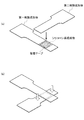
- FIG. 3 is a schematic view showing an integrally molded body of the example, (a) is a diagram showing a manufacturing process of the integrally molded body, and (b) is a diagram showing an evaluation method of the integrally molded body.
- the integral molded body of the present invention includes a thermoplastic resin molded body, an addition reaction type silicone composition, and a member.
- the thermoplastic resin molded body may be a single molded body or a plurality of molded bodies.
- an addition reaction type silicone composition in the following description, it may be simply referred to as a silicone composition
- An integral molded body formed by bonding is used.
- At least one of the first thermoplastic resin molded body and the second thermoplastic resin molded body contains a pentavalent phosphorus compound.
- the one containing the pentavalent phosphorus compound corresponds to the thermoplastic resin molded article. When both contain a pentavalent phosphorus compound, any of them may be a thermoplastic resin molded body.
- the member and the molded body are bonded with a silicone composition, or the member and the thermoplastic resin molded body are bonded by screws or the like and the periphery is covered with the silicone composition.
- the member may be housed in a container-shaped molded body and potted with a silicone-based composition.
- FIG. 1 is a view showing a first embodiment of an integrally molded body of the present invention
- FIG. 1 (a) is a perspective view schematically showing the integrally molded body 1 of the first embodiment
- b) is a cross-sectional view schematically showing the XX cross section of FIG.
- the integrally molded body 1 includes a case 10, a cover 11, and an addition reaction type silicone composition 12, and the case 10 and the cover 11 are joined by the addition reaction type silicone composition 12.
- a box structure is formed as a whole.
- the case 10 is a box-shaped part having an opening on one surface, and corresponds to the thermoplastic resin molded body in the present invention.
- the case 10 has a first bonding surface 101 for bonding to the cover 11 via the addition reaction type silicone composition 12 on the end surface of the surface where the opening exists.
- the cover 11 is a plate-like molded body, and corresponds to a member in the present invention.
- the cover 11 has a second bonding surface 111 for bonding to the case 10 via the addition reaction silicone composition 12 on the outer periphery of one surface.
- the case 10 and the cover 11 are required to have heat resistance that can withstand the curing temperature of the addition reaction type silicone composition. Therefore, it is preferable that the case 10 and the cover 11 use a thermoplastic resin having high heat resistance (details will be described later) as a raw material.
- the addition reaction type silicone composition 12 serves as an adhesive for joining the first joint surface 101 and the second joint surface 111.
- a method of joining with the addition reaction type silicone composition 12 is preferable because it does not cause a decrease in adhesion due to heat.
- the addition reaction type silicone composition 12 is applied to at least one of the first bonding surface 101 and the second bonding surface 111, and then the first bonding surface 101 and the second bonding surface 111 are brought into contact with each other. The surface 101 and the second bonding surface 111 are bonded.
- FIG. 2 is a view showing an integrally molded body of the second embodiment.
- FIG. 2A is a perspective view schematically showing the integrally molded body 1 of the second embodiment
- FIG. 2B is a cross-sectional view schematically showing the XX cross section of FIG.
- the integrally molded body 1 of the second embodiment has a configuration in which the electronic component 2 is disposed inside the integral molded body 1, a configuration in which the periphery of the electronic component 2 is covered with the addition reaction type silicone composition 12, and a case
- the joining of the cover 10 and the cover 11 is not limited to the case of using an addition reaction type silicone composition, but is different from the integrally molded body of the first embodiment in that the joining may be performed by screwing or welding.
- the same constituent elements as those in the first embodiment are denoted by the same reference numerals, and the description thereof is omitted or simplified.
- the electronic component 2 is an electronic component such as a sensor, a hybrid IC for automobiles / home appliances, or a semiconductor component.
- the electronic component 2 is surrounded by the case 10 and the cover 11 by a conventionally known general method. Be placed.
- a conventionally well-known general method for example, a method of using an adhesive or arranging by screwing may be mentioned.
- the adhesive an addition reaction type silicone composition may be used, or another adhesive may be used. Further, as shown in FIG. 2B, the periphery of the electronic component 2 is surrounded by the addition reaction type silicone composition 12.
- the addition reaction type silicone composition 12 covering the periphery of the electronic component 2 is surrounded by the case 10 and the cover 11 and the electronic component 2 so that the electronic component 2 is completely immersed in the addition reaction type silicone composition 12. It is provided in the space.
- This addition reaction type silicone composition 12 acts as a potting agent.
- the manufacturing method of the integrally molded body of the second embodiment shown in FIG. 2 will be briefly described. After the electronic component 2 is placed on the bottom of the case 10, the inside of the case 10 is filled with the addition reaction type silicone composition 12, and then the first bonding surface 101 and the second bonding surface 111 are bonded.
- the integral molded body obtained by the addition reaction type silicone composition is very useful because it is hardly affected by heat. Furthermore, according to the present invention, since a phosphorus compound can be added to the thermoplastic resin molded body, the thermoplastic resin molded body can be imparted with flame retardancy, a property that can be stably present at high temperatures, and the like, and suitable for use in high temperature environments An integral molded body that can be used is obtained.
- the phosphorus compound inhibits the curing of the addition reaction type silicone composition, and the resin It has been said that an integrally molded body in which the molded bodies are sufficiently adhered to each other cannot be obtained.
- the silicone potting agent for protecting electronic components may cause the electronic components to come into contact with the air due to inhibition of curing, resulting in malfunction of the electronic components due to rust.
- the integrally molded body of the present invention is an integral molded body in which resin molded bodies and electronic components are sufficiently adhered to each other, and the reliability of the interior board is improved, even though the resin molded body contains a phosphorus compound. Become a body.
- the present invention is a combination of a resin molded body containing a phosphorus compound, which has not been conventionally combined, and an addition reaction type silicone composition.
- an addition reaction type silicone composition As described above, the present invention is a combination of a resin molded body containing a phosphorus compound, which has not been conventionally combined, and an addition reaction type silicone composition.
- thermoplastic resin molded article, the addition reaction type silicone composition, and the member will be described in more detail.
- addition reaction type silicone composition is used as an adhesive or the case where the addition reaction type silicone composition is used as a potting agent has been described, but the addition reaction type silicone composition is used as a sealing agent, a coating agent, etc.
- An integrally molded body used as the above is also included in the present invention.
- a box-shaped integrally formed body having a case and a cover has been described as an example.
- the present invention is not limited to a box-shaped body.
- an electronic component is placed on a thermoplastic resin molded body and other members.
- the present invention also includes an integrally molded body formed by bonding with an addition reaction type silicone composition.
- thermoplastic resin molding The thermoplastic resin molded body is formed by molding a resin composition containing a thermoplastic resin and a phosphorus compound.
- thermoplastic resin, the phosphorus compound, and other components that can be contained (other components) will be described in this order.
- thermoplastic resin It does not specifically limit as a thermoplastic resin used for manufacture of a thermoplastic resin molded object, A general thermoplastic resin can be used.
- thermoplastic resins such as polyacetal, polybutylene terephthalate, polyamide, polyphenylene sulfide, ABS resin, polyethylene, polypropylene, polyphenylene oxide, liquid crystalline resin, and biodegradable resin can be used.
- one of the features of the addition reaction type silicone composition is excellent heat resistance. If a resin having high heat resistance is selected as the thermoplastic resin, an integrally molded body having excellent heat resistance can be obtained, and the characteristics of the addition reaction type silicone composition can be fully utilized. From such a viewpoint, among the above thermoplastic resins, polybutylene terephthalate, which has excellent heat resistance and can be suitably combined with a flame retardant, is most preferable. Accordingly, polybutylene terephthalate will be described below.
- Polybutylene terephthalate is composed of a dicarboxylic acid component containing at least terephthalic acid or an ester-forming derivative thereof (C 1-6 alkyl ester, acid halide, etc.) and an alkylene glycol (1,4-butanediol) having at least 4 carbon atoms. ) Or a polybutylene terephthalate resin obtained by polycondensation with a glycol component containing an ester-forming derivative thereof (acetylated product or the like).
- the polybutylene terephthalate is not limited to homopolybutylene terephthalate, but may be a copolymer containing 60 mol% or more (particularly 75 mol% or more and 95 mol% or less) of butylene terephthalate units.
- the amount of terminal carboxyl groups of polybutylene terephthalate used in the present invention is not particularly limited as long as the object of the present invention is not impaired.
- the amount of terminal carboxyl groups of polybutylene terephthalate used in the present invention is preferably 30 meq / kg or less, and more preferably 25 meq / kg or less.
- polybutylene terephthalate having a terminal carboxyl group content in such a range is used, the resulting polybutylene terephthalate resin composition is less susceptible to strength reduction due to hydrolysis in a moist heat environment.
- the intrinsic viscosity of the polybutylene terephthalate used in the present invention is not particularly limited as long as the object of the present invention is not impaired.
- the intrinsic viscosity (IV) of polybutylene terephthalate is preferably 0.60 dL / g or more and 1.2 dL / g or less. More preferably, it is 0.65 dL / g or more and 0.9 dL / g or less.
- the resulting polybutylene terephthalate resin composition has particularly excellent moldability.
- polybutylene terephthalate having different intrinsic viscosities can be prepared by blending polybutylene terephthalate having an intrinsic viscosity of 1.0 dL / g and polybutylene terephthalate having an intrinsic viscosity of 0.7 dL / g.
- the intrinsic viscosity (IV) of polybutylene terephthalate can be measured, for example, in o-chlorophenol at a temperature of 35 ° C.
- examples of dicarboxylic acid components (comonomer components) other than terephthalic acid and its ester-forming derivatives include, for example, isophthalic acid, phthalic acid, 2,6-naphthalenedicarboxylic acid, 4,4′- C 8-14 aromatic dicarboxylic acids such as dicarboxydiphenyl ether; C 4-16 alkane dicarboxylic acids such as succinic acid, adipic acid, azelaic acid and sebacic acid; C 5-10 cycloalkane dicarboxylic acids such as cyclohexane dicarboxylic acid Acid; ester-forming derivatives of these dicarboxylic acid components (C 1-6 alkyl ester derivatives, acid halides, etc.). These dicarboxylic acid components can be used alone or in combination of two or more.
- C 8-12 aromatic dicarboxylic acids such as isophthalic acid
- C 6-12 alkanedicarboxylic acids such as adipic acid, azelaic acid, and sebacic acid are more preferable.
- glycol components (comonomer components) other than 1,4-butanediol include, for example, ethylene glycol, propylene glycol, trimethylene glycol, 1,3-butylene glycol, hexamethylene glycol, neo C 2-10 alkylene glycol such as pentyl glycol and 1,3-octanediol; polyoxyalkylene glycol such as diethylene glycol, triethylene glycol and dipropylene glycol; alicyclic diol such as cyclohexanedimethanol and hydrogenated bisphenol A; Aromatic diols such as bisphenol A and 4,4′-dihydroxybiphenyl; ethylene oxide 2-mole adduct of bisphenol A, propylene oxide of bisphenol A Id such as 3-mol adduct, alkylene oxide adducts of C 2-4 of bisphenol A; or ester-forming derivatives of these glycols (
- C 2-6 alkylene glycol such as ethylene glycol and trimethylene glycol
- polyoxyalkylene glycol such as diethylene glycol
- alicyclic diol such as cyclohexanedimethanol
- Examples of the comonomer component that can be used in addition to the dicarboxylic acid component and the glycol component include 4-hydroxybenzoic acid, 3-hydroxybenzoic acid, 6-hydroxy-2-naphthoic acid, 4-carboxy-4′-hydroxybiphenyl, and the like.
- any of the polybutylene terephthalate copolymers obtained by copolymerizing the comonomer components described above can be suitably used as polybutylene terephthalate.
- the polybutylene terephthalate resin a homopolybutylene terephthalate polymer and a polybutylene terephthalate copolymer may be used in combination.
- the phosphorus compound is a pentavalent phosphorus compound. If it is a pentavalent phosphorus compound, it will hardly inhibit the curing of the addition reaction type silicone composition.
- pentavalent phosphorus compounds include phosphine oxides, phosphinates, phosphonates, phosphates, phosphinic amides, phosphonodiamidates, phosphoramides, phosphoramidates, phosphorodiamidates, phosphines.
- Examples thereof include phosphorus compounds such as imides, phosphine sulfides, phosphinates, phosphonates, and phosphine imides. These phosphorus compounds may be used alone or in combination.
- ⁇ ⁇ Phosphorus compounds may be used as flame retardants.
- the flame retardant imparts flame retardancy to the resin molded body.
- the resin molded body to which the flame retardant is added is a resin molded body that may come into contact with the flame, and heat resistance is also required.
- the addition reaction type silicone composition is excellent in heat resistance
- the integrally molded body of the present invention is flame retardant. It can be suitably used for applications that require high performance.
- the case where the phosphorus compound is used as a flame retardant includes, for example, a case where the content of the phosphorus compound in the resin molded body is 10% by mass or more and 30% by mass or less. If the content of the phosphorus compound is within this range, the degree of flame retardancy imparted varies depending on the type of phosphorus compound, but flame retardancy is imparted to the resin molded article. In addition, even if the content of the phosphorus compound exceeds the above upper limit, the effect as a flame retardant is exerted, but from the viewpoint of utilizing the properties of other components such as polybutylene terephthalate, it is preferably not more than the upper limit. .
- a phosphinic acid salt As a particularly preferable phosphorus compound as a flame retardant, a phosphinic acid salt is exemplified.
- phosphinates include salts such as phosphinic acid, diphosphinic acid, or polymers (or condensates such as polyphosphinic acid) [in addition to metal salts; boron salts (boryl compounds etc.), ammonium salts, Salts with amino group-containing nitrogen-containing compounds, etc.].
- Phosphinates can be used alone or in combination of two or more.
- the phosphinic acid salt may have either a chain structure or a cyclic structure.
- the phosphinic acid, diphosphinic acid or a polymer thereof forming a salt may be phosphinic acid having no organic group, diphosphinic acid, etc., but usually polymerization of organic phosphinic acid, organic diphosphinic acid, organic diphosphinic acid. It is often a product (or condensate).
- the said salt may contain 1 type of these phosphinic acids, and may contain it in combination of 2 or more types.
- metal salts are particularly preferred.
- the metal forming the salt include alkali metals (potassium, sodium, etc.), alkaline earth metals (magnesium, calcium, etc.), transition metals (iron, cobalt, nickel, copper, etc.), periodic table group 12 metals (zinc, etc.) ), Periodic Table Group 13 metals (aluminum, etc.) and the like.
- the metal salt may contain one kind of these metals or may contain two or more kinds in combination.
- alkaline earth metals (magnesium, calcium, etc.) and periodic table group 13 metals (aluminum, etc.) are preferred.
- the valence of the metal is not particularly limited and may be, for example, about 1 to 4 valences, preferably 2 to 4 valences, more preferably 2 or 3 valences.
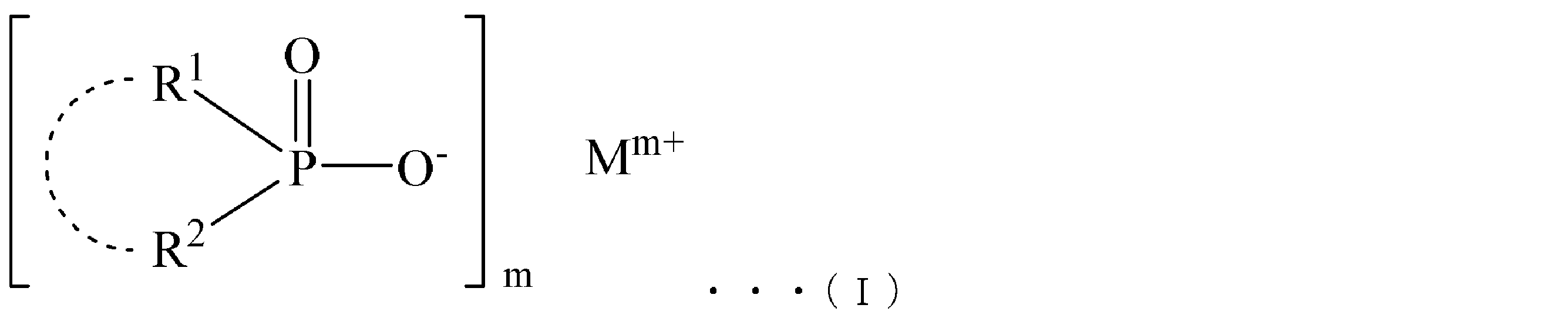
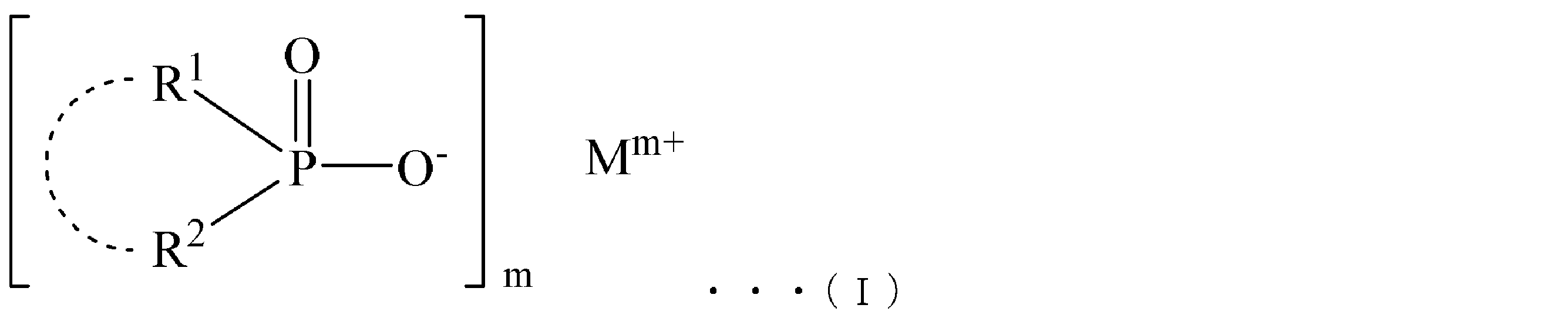
- preferred phosphinic acid salts include compounds represented by the following formula (I), and specific examples of preferred diphosphinic acid salts include compounds represented by the following formula (II).
- the phosphorus compounds represented by the following formulas (I) and (II) impart flame retardancy to the resin molded product without deteriorating various physical properties such as moldability, mechanical strength, and toughness of the thermoplastic resin. be able to.
- R 1 , R 2 , R 3 and R 4 are the same or different and each represents an alkyl group, a cycloalkyl group, an aryl group or an aralkyl group, and R 5 represents an alkylene group or an alicyclic divalent group.
- R 1 and R 2 may be bonded to each other to form a ring with an adjacent phosphorus atom, M m + represents a metal having a valence m, and m is 2 to 4.
- M n + represents a metal having a valence of n, and n is an integer of 2 to 4.
- Examples of the hydrocarbon group represented by R 1 to R 4 include an alkyl group (for example, a linear or branched C1-6 alkyl group such as methyl, ethyl, isopropyl, n-butyl, t-butyl group), Cycloalkyl groups (C5-8 cycloalkyl groups such as cyclohexyl groups), aryl groups (C6-10 aryl groups such as phenyl groups), aralkyl groups (C6-10 aryl-C1-4 alkyl groups such as benzyl groups), etc. ) And the like. Of these groups, an alkyl group (preferably a C1-4 alkyl group, etc.), an aryl group (phenyl group, etc.) and the like are usually preferred.
- an alkyl group for example, a linear or branched C1-6 alkyl group such as methyl, ethyl, isopropyl, n-butyl, t-butyl group
- the ring formed by combining R 1 and R 2 together with the adjacent phosphorus atom is a heterocycle having a phosphorus atom as a hetero atom constituting the ring (a phosphorus atom-containing heterocycle), and is usually a 4- to 20-membered heterocycle Preferably, a 5- to 16-membered heterocycle is used.
- the phosphorus atom-containing heterocycle may be a bicyclo ring.
- the phosphorus atom-containing heterocycle may have a substituent.
- Examples of the divalent hydrocarbon group represented by R 5 include alkylene groups (or alkylidene groups such as methylene, ethylene, phenylethylene, propylene, trimethylene, 1,4-butanediyl, 1,3-butanediyl groups, and the like.
- alkylene groups or alkylidene groups such as methylene, ethylene, phenylethylene, propylene, trimethylene, 1,4-butanediyl, 1,3-butanediyl groups, and the like.
- a linear or branched C1-10 alkylene group which may have a substituent such as -10 aryl group, etc.
- an alicyclic divalent group cyclohexylene group, cyclohexadimethylene group, etc.
- C5-8 Alicyclic divalent groups, etc.), aromatic divalent groups [C6-10 arylene groups optionally having substituents such as C1-4 alkyl groups such as phenylene groups and tolylene groups; arene rings such as xylylene groups;
- a C6-10 arylene C1-4 alkylene group which may have a C1-4 alkyl group such as a methyl group; a C1-4 alkyl group such as a methyl group may be included in the arene ring Bisaryl groups (for example, biphenylene groups; linear or branched C1-4 alkane-diC6-10 arylene groups such as metadiphenylene groups; divalent groups corresponding to C6-10 aryl ethers such as diphenyl ether; And the like; divalent groups corresponding to diC6-10 aryl ketones such as diphenyl sulfide; Of these divalent hydrocarbon groups, an alkylene group (particularly a C1-6 alkylene group and the like) is preferable.
- Preferred metal salts (I) and (II) are polyvalent metal salts in which the valence (m and n) of the metal M is 2 to 3, respectively.
- the metal salt (I) of phosphinic acid include, for example, dialkylphosphinic acid Al salts such as Al dimethylphosphinic acid Al, methylethylphosphinic acid Al, diethylphosphinic acid Al (di-C1-10 alkylphosphinic acid Al salts, etc.) Alphenyl phosphinic acid Al salts (mono- or di-C6-10 aryl phosphinic acid Al salt etc.), Alkyl aryl phosphinic acid Al salts (C 1-4 alkyl) such as methyl phenyl phosphinic acid Al -C6-10 arylphosphinic acid Al salt, etc.), 1-hydroxy-1H-phosphorane-1-oxide Al salt, 2-carboxy-1-hydroxy-1H-phosphorane-1-oxide Al salt, etc. Alkylphosphinic acid Al salt (C3- Alkylene phosphinic acid Al salts, etc.), other Ca salts
- metal salt (II) of diphosphinic acid examples include, for example, alkanebis (phosphinic acid) Al salts such as ethane-1,2-bis (phosphinic acid) Al salt [C1-10 alkanebis (phosphinic acid) Al salt, etc. ], Alkanebis (alkylphosphinic acid) Al salts such as ethane-1,2-bis (methylphosphinic acid) Al salt [C1-10 alkanebis (C1-6 alkylphosphinic acid) Al salt, etc.], corresponding to these Al salts
- alkanebis (phosphinic acid) Al salts such as ethane-1,2-bis (phosphinic acid) Al salt [C1-10 alkanebis (C1-6 alkylphosphinic acid) Al salt, etc.
- Alkanebis (alkylphosphinic acid) Al salts such as ethane-1,2-bis (methylphosphinic acid) Al salt [C1-10 alkanebis (C1-6 al
- the metal salt of phosphinic acid includes a polyvalent metal salt of these phosphinic acids and / or a polymer or condensate of a polyvalent metal salt of diphosphinic acid.
- the phosphinic acid salt is preferably at least one selected from a polyvalent metal salt of phosphinic acid, a polyvalent metal salt of diphosphinic acid, and a polyvalent metal salt of a polymer (or condensate) of diphosphinic acid.
- Preferred phosphinic acid salts include metal salts represented by the above formula (I) or (II), particularly dialkylphosphinic acid metal salts (Ca salts, Al salts, etc.), alkanebisphosphinic acid metal salts (Ca salts, Al salts). Etc.).
- the average particle size of the phosphinate is preferably 10 ⁇ m or less. More preferably, it is 8 micrometers or less, More preferably, it is 5 micrometers or less. The smaller the average particle size, the better the appearance of the molded product, and the better the toughness and flame retardancy improvement effects in many cases.
- the average particle diameter of the phosphinic acids is obtained as a median diameter by a laser diffraction / scattering type particle size distribution measuring apparatus or the like.
- Examples of phosphorus compounds that can be preferably used as flame retardants include phosphate esters in addition to the above phosphinates. Any of aliphatic phosphate esters, aromatic phosphate esters, and aromatic condensed phosphate esters can be used. Examples of the aliphatic phosphate ester include trimethyl phosphate, triethyl phosphate, tributyl phosphate and the like.
- Aromatic phosphate esters include triphenyl phosphate, tricresyl phosphate, cresyl diphenyl phosphate, trixylenyl phosphate, cresyl 2,6 xylenyl phosphate, tris (t-butylated phenyl) phosphate, tris (isopropylated) Phenyl) phosphate, triaryl isopropylated phosphate, and the like.
- Examples of the aromatic condensed phosphate ester include resorcinol bisdiphenyl phosphate, bisphenol A bis (diphenyl phosphate), resorcinol bisdixylenyl phosphate, and the like. Among these phosphate esters, the use of an aromatic condensed phosphate ester is preferred, and among the aromatic condensed phosphate esters, the use of resorcinol bis-dixylenyl phosphate is preferred.
- the stabilizer includes, for example, a stabilizer used for preventing discoloration of the resin molded body in a high temperature environment.
- the resin molded body to which such a stabilizer is added is premised on use in a high temperature environment, and high heat resistance is required even as an integrally molded body.
- the addition reaction type silicone composition is excellent in heat resistance, if a thermoplastic resin having excellent heat resistance is selected, the integral molded body of the present invention can be used in a high temperature environment. It can employ
- the case where the phosphorus compound is used as a stabilizer indicates, for example, the case where the phosphorus compound is contained in the resin molded body in an amount of 0.01% by mass to 3.0% by mass.
- the stabilizing effect and the degree of stabilization depend on the type of phosphorus compound and the content of the phosphorus compound, but if the content of the phosphorus compound in the resin molding is within the above range, the effect as a stabilizer is exhibited. There is a tendency. In addition, even if the content of the phosphorus compound exceeds the above upper limit, the effect as a stabilizer is exerted, but from the viewpoint of utilizing the properties of other components such as polybutylene terephthalate, it is preferably not more than the upper limit. .
- the stabilizer at least one selected from an inorganic phosphorus stabilizer (alkali metal or alkaline earth metal phosphate, etc.) and an organic phosphorus stabilizer (eg, organic phosphate ester, organic phosphonate ester).
- an inorganic phosphorus stabilizer alkali metal or alkaline earth metal phosphate, etc.
- an organic phosphorus stabilizer eg, organic phosphate ester, organic phosphonate ester.
- the phosphorus stabilizer may be either liquid or solid.
- Alkali metal phosphates include phosphates or the corresponding hydrogen phosphates (for example, potassium phosphate, sodium phosphate [(monosodium phosphate (sodium dihydrogen phosphate), disodium phosphate (hydrogen phosphate) And alkali metal salts such as sodium, sodium monohydrogen phosphate, disodium hydrogen phosphate))] etc.
- alkaline earth metal phosphates include calcium phosphate [primary calcium phosphate (calcium dihydrogen phosphate).
- alkaline earth metal salts such as magnesium hydrogen, etc.
- Alkali metal salts or alkaline earth metal salts include: May be any of anhydride or hydrate. Particularly preferably sodium phosphate, calcium phosphate.
- organic phosphoric acid ester examples include mono- to trialkyl esters of phosphoric acid (for example, mono- to di-C6-24 alkyl esters such as monostearyl acid phosphate and distearyl acid phosphate), and mono- to triaryl esters of phosphoric acid (mono Or mono- or di-C6-10 aryl ester such as diphenyl phosphate).
- mono- to trialkyl esters of phosphoric acid for example, mono- to di-C6-24 alkyl esters such as monostearyl acid phosphate and distearyl acid phosphate
- mono- to triaryl esters of phosphoric acid mono- Or mono- or di-C6-10 aryl ester such as diphenyl phosphate
- organic phosphonic acid esters examples include mono- or dialkyl phosphonates such as distearyl phosphonate (C6-24 alkyl phosphonates); (C6-10 aryl phosphonate, etc.); mono or diaralkyl phosphonates such as dibenzyl phosphonate ((C6-10 aryl-C1-6 alkyl) phosphonate, etc.) and the like.
- thermoplastic resin and phosphorus compound in addition to the above thermoplastic resin and phosphorus compound, conventionally known additives such as inorganic fillers, antioxidants, and pigments can be added to the resin molded body in a range that does not impair the effects of the present invention.
- inorganic fillers antioxidants, and pigments
- the use of glass fiber which is a kind of inorganic filler is preferable because the heat resistance of the resin molded body is increased.
- the addition reaction type silicone composition is a composition that cures at room temperature or by heating, and a conventionally known composition can be used.
- a conventionally known composition can be used.
- any addition-reactive silicone composition used for adhesives, potting agents, sealing agents, coating agents, etc. can be used.
- the addition reaction type silicone composition to be used is appropriately selected according to the intended use and the desired function. Curing proceeds by an addition reaction with a platinum-based catalyst.
- the presence or absence of an influence on curing inhibition can often be confirmed by simply adding a phosphorus compound directly to the silicone composition and curing it under curing conditions that are suitable for each silicone composition. Those that cure the silicone composition when such treatment is performed can be judged not to cause curing inhibition.
- the members are not particularly limited, and may be other resin molded bodies in addition to electronic components such as sensors, hybrid ICs for automobiles and home appliances, and semiconductor components. In the case where the member is an electronic component, both of adhesion and potting are common.
- an addition reaction type silicone composition is mainly used for joining with the thermoplastic resin molded body.
- the resin molded body may be made of any resin, and specifically, may be made of either a thermoplastic resin or a thermosetting resin.
- Phosphorus compound 1 aluminum tri (diethylphosphinate), EXOLIT OP1240 manufactured by Clariant Japan
- Phosphorus compound 2 resorcinol bis-dixylenyl phosphate, Daihachi Chemical Industry Co., Ltd.
- PX-200 Phosphorus Compound 3 Monocalcium Phosphate, manufactured by Taihei Chemical Industry Co., Ltd.
- Phosphorus Compound 4 Sodium Dihydrogen Phosphate, Wako Pure Chemical Industries, Ltd.
- Phosphorus Compound 5 Tetrakis (2,4-di-t-butylphenyl) 4,4 'biphenylene phosphonite, Clariant Japan Hostanox P-EPQ Phosphorus compound 6: bis (2,4-di-t-butylphenyl) pentaerythritol diphosphite, ADEKA Corporation ADEKA STAB PEP-24G
- Addition reaction type silicone-based composition manufactured by Toray Dow Corning Silicone Co., Ltd., trade name “SE1714”
- a Nittolon adhesive tape (thickness: 0.18 mm) made by Nitto Denko Corporation with a 7 mm ⁇ 7 mm hole is attached to the first resin molding, and the silicone composition is applied to the hole.
- the second resin molded body was overlaid, fixed with a clip, and bonded under conditions of 120 ° C. ⁇ 0.5 hours.
- the integrally molded bodies of Examples and Comparative Examples were obtained.
- Example 2 a pentavalent phosphorus compound is blended in an amount that acts as a flame retardant. For this reason, in Example 2, 6, it was confirmed that it becomes an integral molded object to which the flame retardance was provided.
- Examples 1, 3 to 5 a pentavalent phosphorus compound is added in an amount that acts as a stabilizer. For this reason, in Examples 1, 3 to 5, it was confirmed that the integrally formed body stably exists in a high temperature environment.
Landscapes
- Chemical & Material Sciences (AREA)
- Medicinal Chemistry (AREA)
- Organic Chemistry (AREA)
- Polymers & Plastics (AREA)
- Health & Medical Sciences (AREA)
- Chemical Kinetics & Catalysis (AREA)
- Materials Engineering (AREA)
- Manufacturing & Machinery (AREA)
- Engineering & Computer Science (AREA)
- Compositions Of Macromolecular Compounds (AREA)
- Manufacture Of Macromolecular Shaped Articles (AREA)
- Laminated Bodies (AREA)
- Coating Of Shaped Articles Made Of Macromolecular Substances (AREA)
Abstract
Description

熱可塑性樹脂成形体は、熱可塑性樹脂とリン化合物とを含む樹脂組成物を成形してなる。以下、熱可塑性樹脂、リン化合物、その他の含有可能な成分(その他の成分)についてこの順で説明する。
熱可塑性樹脂成形体の製造に使用される熱可塑性樹脂としては、特に限定されず、一般的な熱可塑性樹脂を使用することができる。例えば、ポリアセタール、ポリブチレンテレフタレート、ポリアミド、ポリフェニレンサルファイド、ABS樹脂、ポリエチレン、ポリプロピレン、ポリフェニレンオキサイド、液晶性樹脂、生分解性樹脂等の熱可塑性樹脂を使用することができる。
リン化合物は、5価のリン化合物である。5価のリン化合物であれば、付加反応型シリコーン系組成物の硬化を阻害することがほとんどない。5価のリン化合物としては、例えば、ホスフィンオキサイド系、ホスフィネート系、ホスホネート系、ホスフェート系、ホスフィニックアミド系、ホスホノジアミデート系、ホスホラミド系、ホスホラミデート系、ホスホロジアミデート系、ホスフィンイミド系、ホスフィンサルファイド系、ホスフィン酸塩、ホスホネート塩、ホスフィンイミド塩等のリン化合物を挙げることができる。これらのリン化合物は単独で用いてもよいし、複数を併用してもよい。

樹脂成形体は、上記の熱可塑性樹脂、リン化合物以外に、無機充填剤、酸化防止剤、顔料等の従来公知の添加剤を、本発明の効果を害さない範囲で添加できる。特に、無機充填剤の一種であるガラス繊維を使用すると、樹脂成形体の耐熱性が高まるため好ましい。
付加反応型シリコーン系組成物は、室温又は加熱により硬化する組成物であり、従来公知の組成物を使用することができる。例えば、接着剤用途、ポッティング剤用途、シーリング剤用途、コーティング剤用途等に用いられるいずれの付加反応型シリコーン系組成物も使用可能である。ここで、使用する付加反応型シリコーン系組成物は、用途や求める機能に応じて、適宜選択される。なお、硬化は、白金系触媒による付加反応で進行する。
部材は特に限定されず、センサー、自動車用・家電用のハイブリッドIC、半導体部品等の電子部品の他に、他の樹脂成形体であってもよい。部材が電子部品の場合には、接着、ポッティングのいずれの用途も一般的である。樹脂成形体の場合には、主に上記熱可塑性樹脂成形体との接合のために、付加反応型シリコーン系組成物が使用される。ここで、樹脂成形体は、どのような樹脂からなるものであってもよく、具体的には、熱可塑性樹脂、熱硬化性樹脂のいずれからなるものであってもよい。
ポリブチレンテレフタレート樹脂(PBT):ウィンテックポリマー社製、商品名「ジュラネックス300FP」
リン化合物2:レゾルシノールビスジキシレニルホスフェート、大八化学工業(株)PX-200
リン化合物3:第一リン酸カルシウム、太平化学産業(株)製
リン化合物4:リン酸二水素ナトリウム、和光純薬(株)試薬特級
リン化合物5:テトラキス(2,4-ジ-t-ブチルフェニル)4,4’ビフェニレンフォスフォナイト、クラリアントジャパン製Hostanox P-EPQ
リン化合物6:ビス(2,4-ジ-t-ブチルフェニル)ペンタエリスリトールジホスファイト、(株)ADEKA製 アデカスタブPEP-24G
アルミカップに付加反応型シリコーン系組成物5g、各リン化合物50mgを加えよく攪拌した後、120℃×1.0時間で硬化処理を行った。リン化合物1~4はシリコーン系組成物が硬化したが、リン化合物5,6は未硬化のままだった。
表1に示す配合割合(単位は質量%)で、PBT、リン化合物及びガラス繊維を二軸押出機にて溶融混練(シリンダー温度260℃、スクリュー回転数130rpm、押出量15kg/hr)しペレットを作成後、得られたペレットを140℃、3時間乾燥した後に、射出成形機(ファナック社製S2000i 100B)に投入し、後述する接着強度の測定に使用する樹脂試験片(ISO3167に準拠した多目的試験片)を作製した。このISO3167に準拠した試験片の中央部を切断し、一方を第一樹脂成形体とし、他方を第二樹脂成形体とした。
図3(a)に示すように、第一樹脂成形体に7mm×7mmの穴を開けた日東電工株式会社製ニトフロン粘着テープ(厚み0.18mm)を貼り付け、穴の部分にシリコーン系組成物を塗布した。塗布後、第二樹脂成形体を重ね合わせ、クリップで固定し、120℃×0.5時間の条件で接着を行った。実施例及び比較例の一体成形体が得られた。
接合体を23℃、50%RHの環境に24時間以上放置し、接合体を図3(b)に示すように固定し、オリエンテック製万能試験機テンシロンRTC-1325PLを用い,試験速度5mm/minの条件で第二樹脂成形体を押し剥がし(具体的には、図3(b)の白抜き矢印の方向に圧力を加えて押し剥がした。)、押し剥がし強度の最高値を測定した。測定結果は表1に示した。

10 ケース
101 第一接合面
11 カバー
111 第二接合面
12 付加反応型シリコーン系組成物
Claims (5)
- 熱可塑性樹脂成形体と、付加反応型シリコーン系組成物と、部材とを備え、
前記熱可塑性樹脂成形体は、5価のリン化合物を含み、
前記熱可塑性樹脂成形体と前記付加反応型シリコーン系組成物とが接触する一体成形体。 - 前記熱可塑性樹脂成形体がポリブチレンテレフタレート系樹脂を含む請求項1に記載の一体成形体。
- 前記5価のリン化合物が、下記の一般式(I)で表されるホスフィン酸塩及び/又は下記一般式(II)で表されるジホスフィン酸塩である請求項1又は2に記載の一体成形体。

- 前記5価のリン化合物が、リン酸エステルである請求項1又は2に記載の一体成形体。
- 前記5価のリン化合物が、アルカリ金属リン酸塩及び/又はアルカリ土類金属リン酸塩である請求項1又は2に記載の一体成形体。
Priority Applications (3)
| Application Number | Priority Date | Filing Date | Title |
|---|---|---|---|
| US13/823,711 US9249296B2 (en) | 2010-09-17 | 2011-08-17 | Integrated molded product |
| MX2013002819A MX2013002819A (es) | 2010-09-17 | 2011-08-17 | Producto moldeado integrado. |
| CN201180044893.4A CN103108904B (zh) | 2010-09-17 | 2011-08-17 | 一体成型体 |
Applications Claiming Priority (2)
| Application Number | Priority Date | Filing Date | Title |
|---|---|---|---|
| JP2010-208889 | 2010-09-17 | ||
| JP2010208889A JP5654300B2 (ja) | 2010-09-17 | 2010-09-17 | 一体成形体 |
Publications (1)
| Publication Number | Publication Date |
|---|---|
| WO2012035922A1 true WO2012035922A1 (ja) | 2012-03-22 |
Family
ID=45831396
Family Applications (1)
| Application Number | Title | Priority Date | Filing Date |
|---|---|---|---|
| PCT/JP2011/068614 Ceased WO2012035922A1 (ja) | 2010-09-17 | 2011-08-17 | 一体成形体 |
Country Status (5)
| Country | Link |
|---|---|
| US (1) | US9249296B2 (ja) |
| JP (1) | JP5654300B2 (ja) |
| CN (1) | CN103108904B (ja) |
| MX (1) | MX2013002819A (ja) |
| WO (1) | WO2012035922A1 (ja) |
Cited By (1)
| Publication number | Priority date | Publication date | Assignee | Title |
|---|---|---|---|---|
| JPWO2025182331A1 (ja) * | 2024-02-26 | 2025-09-04 |
Families Citing this family (5)
| Publication number | Priority date | Publication date | Assignee | Title |
|---|---|---|---|---|
| JP5744018B2 (ja) * | 2010-06-10 | 2015-07-01 | ウィンテックポリマー株式会社 | 接着力改善用変性ポリアルキレンテレフタレート樹脂、接着力改善用変性ポリアルキレンテレフタレート樹脂組成物、樹脂成形体、及び接合体 |
| DE102013012487A1 (de) * | 2013-07-26 | 2015-01-29 | Clariant International Ltd. | Zusammensetzung aus einem thermoplastischen Polymer und einer synergistischen Mischung aus bestimmten Aminoethern und feinteiligen Phosphinaten |
| WO2015088170A1 (ko) * | 2013-12-10 | 2015-06-18 | (주) 엘지화학 | 폴리올레핀 난연수지 조성물 및 성형품 |
| PL3133112T3 (pl) * | 2015-03-09 | 2022-05-02 | Lanxess Deutschland Gmbh | Termoplastyczne masy formierskie |
| US20170260372A1 (en) * | 2015-03-09 | 2017-09-14 | Lanxess Deutschland Gmbh | Thermoplastic moulding compounds |
Citations (3)
| Publication number | Priority date | Publication date | Assignee | Title |
|---|---|---|---|---|
| JP2002052667A (ja) * | 2000-08-11 | 2002-02-19 | Hiraoka & Co Ltd | 曝露汚れ防止シート及びその製造方法 |
| JP2003025516A (ja) * | 2001-07-11 | 2003-01-29 | Hiraoka & Co Ltd | 環境汚れ防止性の高い積層シート |
| JP2007009119A (ja) * | 2005-07-01 | 2007-01-18 | Mitsubishi Engineering Plastics Corp | ポリブチレンテレフタレート樹脂組成物及び一体成形品 |
Family Cites Families (29)
| Publication number | Priority date | Publication date | Assignee | Title |
|---|---|---|---|---|
| JPS536016B2 (ja) * | 1974-10-17 | 1978-03-03 | ||
| DE3276178D1 (en) * | 1981-01-30 | 1987-06-04 | Teijin Ltd | Polyester resin composition |
| JPH07119366B2 (ja) * | 1989-07-03 | 1995-12-20 | 東芝シリコーン株式会社 | 接着性シリコーン組成物 |
| US6004679A (en) * | 1991-03-14 | 1999-12-21 | General Electric Company | Laminates containing addition-curable silicone adhesive compositions |
| JP2734302B2 (ja) * | 1992-01-21 | 1998-03-30 | 信越化学工業株式会社 | シリコーンゴム接着剤組成物 |
| DE4430932A1 (de) | 1994-08-31 | 1996-03-07 | Hoechst Ag | Flammgeschützte Polyesterformmasse |
| TW296401B (ja) * | 1994-12-26 | 1997-01-21 | Shinetsu Chem Ind Co | |
| JP3495165B2 (ja) | 1995-12-14 | 2004-02-09 | 帝人株式会社 | シリコーンゴムとの接着性に優れたポリエステル樹脂組成物 |
| US6790886B2 (en) * | 1999-12-27 | 2004-09-14 | Polyplastics Co., Ltd. | Flame-retardant resin composition |
| JP2002020719A (ja) * | 2000-07-11 | 2002-01-23 | Shin Etsu Chem Co Ltd | シリコーンゴム接着剤組成物及び該接着剤組成物と熱可塑性樹脂との一体成形体 |
| JP5255169B2 (ja) * | 2000-11-24 | 2013-08-07 | 株式会社ダイセル | 難燃性樹脂組成物 |
| US6762235B2 (en) * | 2001-04-24 | 2004-07-13 | Mitsubishi Engineering-Plastics Corporation | Polybutylene terephthalate resin and compositions and molded articles comprising the resin |
| DE10137930A1 (de) * | 2001-08-07 | 2003-02-20 | Basf Ag | Halogenfreie flammgeschützte Polyester |
| US6878452B2 (en) * | 2002-05-22 | 2005-04-12 | Shin-Etsu Chemical Co., Ltd. | Room-temperature curable organopolysiloxane composition |
| JP3972900B2 (ja) | 2003-04-23 | 2007-09-05 | 株式会社村田製作所 | 表面実装型電子部品の筐体構造 |
| US8034870B2 (en) * | 2003-12-17 | 2011-10-11 | Sabic Innovative Plastics Ip B.V. | Flame-retardant polyester composition |
| US7812077B2 (en) * | 2003-12-17 | 2010-10-12 | Sabic Innovative Plastics Ip B.V. | Polyester compositions, method of manufacture, and uses thereof |
| WO2005108462A1 (ja) * | 2004-05-10 | 2005-11-17 | Mitsubishi Chemical Corporation | ポリブチレンテレフタレートの製造方法 |
| JP2007077205A (ja) * | 2005-09-12 | 2007-03-29 | Mitsubishi Engineering Plastics Corp | ポリブチレンテレフタレート樹脂組成物及び一体成形品 |
| JP5085927B2 (ja) * | 2006-12-21 | 2012-11-28 | ウィンテックポリマー株式会社 | 難燃性樹脂組成物 |
| JP2009149736A (ja) | 2007-12-19 | 2009-07-09 | Momentive Performance Materials Inc | 熱伝導性シリコーンゲル組成物 |
| JP5312783B2 (ja) * | 2007-12-26 | 2013-10-09 | ウィンテックポリマー株式会社 | ポリブチレンテレフタレート樹脂組成物 |
| JP5351415B2 (ja) * | 2007-12-26 | 2013-11-27 | ウィンテックポリマー株式会社 | ポリブチレンテレフタレート樹脂組成物 |
| JP5377869B2 (ja) * | 2008-03-07 | 2013-12-25 | ウィンテックポリマー株式会社 | 難燃性樹脂組成物及び被覆電線 |
| US8404763B2 (en) * | 2008-06-11 | 2013-03-26 | Wintech Polymer Ltd. | Method for forming an insert injection-molded article exhibiting improved resistance to heat shock comprising a specifically defined polybutylene terephthalate composition |
| EP2314643B1 (en) * | 2008-07-23 | 2012-05-16 | Mitsubishi Engineering-Plastics Corporation | Thermoplastic polyester resin composition |
| US7829614B2 (en) * | 2008-12-30 | 2010-11-09 | Sabic Innovative Plastics Ip B.V. | Reinforced polyester compositions, methods of manufacture, and articles thereof |
| US8138244B2 (en) * | 2008-12-30 | 2012-03-20 | Sabic Innovative Plastics Ip B.V. | Reinforced polyester compositions, method of manufacture, and articles thereof |
| JP5650496B2 (ja) * | 2010-10-28 | 2015-01-07 | ウィンテックポリマー株式会社 | 一体成形体 |
-
2010
- 2010-09-17 JP JP2010208889A patent/JP5654300B2/ja active Active
-
2011
- 2011-08-17 MX MX2013002819A patent/MX2013002819A/es active IP Right Grant
- 2011-08-17 WO PCT/JP2011/068614 patent/WO2012035922A1/ja not_active Ceased
- 2011-08-17 CN CN201180044893.4A patent/CN103108904B/zh active Active
- 2011-08-17 US US13/823,711 patent/US9249296B2/en not_active Expired - Fee Related
Patent Citations (3)
| Publication number | Priority date | Publication date | Assignee | Title |
|---|---|---|---|---|
| JP2002052667A (ja) * | 2000-08-11 | 2002-02-19 | Hiraoka & Co Ltd | 曝露汚れ防止シート及びその製造方法 |
| JP2003025516A (ja) * | 2001-07-11 | 2003-01-29 | Hiraoka & Co Ltd | 環境汚れ防止性の高い積層シート |
| JP2007009119A (ja) * | 2005-07-01 | 2007-01-18 | Mitsubishi Engineering Plastics Corp | ポリブチレンテレフタレート樹脂組成物及び一体成形品 |
Cited By (2)
| Publication number | Priority date | Publication date | Assignee | Title |
|---|---|---|---|---|
| JPWO2025182331A1 (ja) * | 2024-02-26 | 2025-09-04 | ||
| JP7823795B2 (ja) | 2024-02-26 | 2026-03-04 | 住友ベークライト株式会社 | プリプレグ、およびフラン樹脂の製造方法 |
Also Published As
| Publication number | Publication date |
|---|---|
| US20130274390A1 (en) | 2013-10-17 |
| CN103108904B (zh) | 2016-01-13 |
| JP5654300B2 (ja) | 2015-01-14 |
| CN103108904A (zh) | 2013-05-15 |
| JP2012062421A (ja) | 2012-03-29 |
| MX2013002819A (es) | 2013-06-05 |
| US9249296B2 (en) | 2016-02-02 |
Similar Documents
| Publication | Publication Date | Title |
|---|---|---|
| JP5654300B2 (ja) | 一体成形体 | |
| RU2673088C2 (ru) | Фосфорсодержащие замедлители горения | |
| JP6231013B2 (ja) | 難燃性ポリブチレンテレフタレート樹脂組成物及びその成形品 | |
| JP5805080B2 (ja) | ポリブチレンテレフタレート樹脂組成物 | |
| JP4964891B2 (ja) | ハロゲンフリーの難燃性熱可塑性ポリエステル | |
| US11859084B2 (en) | Flame-retardant and color-stable polyamide molding compounds | |
| TWI847960B (zh) | 阻燃性聚酯組成物及其用途 | |
| JP2001513839A (ja) | 難燃性ポリマー成形材料 | |
| TW201920408A (zh) | 阻燃性聚酯組成物及其用途 | |
| JP2013538926A (ja) | 熱可塑性ポリマーのための難燃剤−安定化剤の組み合わせ | |
| JP2004115795A (ja) | 難燃性熱硬化性材料 | |
| JP2004018857A (ja) | ホスホニットと他の成分との混合物 | |
| KR20230045050A (ko) | 개선된 가수분해 안정성을 갖는 난연성 중합체를 위한 난연제-안정제 배합물 및 이의 용도 | |
| CN103180370B (zh) | 一体成形体 | |
| JP2004339509A (ja) | 難燃性熱硬化性材料、その用途およびその製造方法 | |
| WO2003048270A1 (fr) | Composition ignifuge, procede de production de cette composition, composition de resine ignifuge, et objet moule produit avec cette composition | |
| WO2026088661A1 (ja) | ポリエステル樹脂組成物、及び樹脂成形品 | |
| HK40031529A (en) | Flame-retardant and color-stable polyamide molding compounds | |
| JPH10139987A (ja) | 難燃性ポリエステル樹脂組成物 | |
| JPWO2000011109A1 (ja) | 難燃剤組成物及び難燃性樹脂組成物 |
Legal Events
| Date | Code | Title | Description |
|---|---|---|---|
| WWE | Wipo information: entry into national phase |
Ref document number: 201180044893.4 Country of ref document: CN |
|
| 121 | Ep: the epo has been informed by wipo that ep was designated in this application |
Ref document number: 11824930 Country of ref document: EP Kind code of ref document: A1 |
|
| WWE | Wipo information: entry into national phase |
Ref document number: MX/A/2013/002819 Country of ref document: MX |
|
| NENP | Non-entry into the national phase |
Ref country code: DE |
|
| WWE | Wipo information: entry into national phase |
Ref document number: 13823711 Country of ref document: US |
|
| 122 | Ep: pct application non-entry in european phase |
Ref document number: 11824930 Country of ref document: EP Kind code of ref document: A1 |